WO1997007261A1 - Composition de resine-chromate et tole traitee en surface - Google Patents
Composition de resine-chromate et tole traitee en surface Download PDFInfo
- Publication number
- WO1997007261A1 WO1997007261A1 PCT/JP1996/002270 JP9602270W WO9707261A1 WO 1997007261 A1 WO1997007261 A1 WO 1997007261A1 JP 9602270 W JP9602270 W JP 9602270W WO 9707261 A1 WO9707261 A1 WO 9707261A1
- Authority
- WO
- WIPO (PCT)
- Prior art keywords
- weight
- organic polymer
- component
- ethylenically unsaturated
- acid
- Prior art date
- Legal status (The legal status is an assumption and is not a legal conclusion. Google has not performed a legal analysis and makes no representation as to the accuracy of the status listed.)
- Ceased
Links
Classifications
-
- C—CHEMISTRY; METALLURGY
- C09—DYES; PAINTS; POLISHES; NATURAL RESINS; ADHESIVES; COMPOSITIONS NOT OTHERWISE PROVIDED FOR; APPLICATIONS OF MATERIALS NOT OTHERWISE PROVIDED FOR
- C09D—COATING COMPOSITIONS, e.g. PAINTS, VARNISHES OR LACQUERS; FILLING PASTES; CHEMICAL PAINT OR INK REMOVERS; INKS; CORRECTING FLUIDS; WOODSTAINS; PASTES OR SOLIDS FOR COLOURING OR PRINTING; USE OF MATERIALS THEREFOR
- C09D5/00—Coating compositions, e.g. paints, varnishes or lacquers, characterised by their physical nature or the effects produced; Filling pastes
- C09D5/08—Anti-corrosive paints
-
- B—PERFORMING OPERATIONS; TRANSPORTING
- B05—SPRAYING OR ATOMISING IN GENERAL; APPLYING FLUENT MATERIALS TO SURFACES, IN GENERAL
- B05D—PROCESSES FOR APPLYING FLUENT MATERIALS TO SURFACES, IN GENERAL
- B05D7/00—Processes, other than flocking, specially adapted for applying liquids or other fluent materials to particular surfaces or for applying particular liquids or other fluent materials
- B05D7/14—Processes, other than flocking, specially adapted for applying liquids or other fluent materials to particular surfaces or for applying particular liquids or other fluent materials to metal, e.g. car bodies
-
- C—CHEMISTRY; METALLURGY
- C09—DYES; PAINTS; POLISHES; NATURAL RESINS; ADHESIVES; COMPOSITIONS NOT OTHERWISE PROVIDED FOR; APPLICATIONS OF MATERIALS NOT OTHERWISE PROVIDED FOR
- C09D—COATING COMPOSITIONS, e.g. PAINTS, VARNISHES OR LACQUERS; FILLING PASTES; CHEMICAL PAINT OR INK REMOVERS; INKS; CORRECTING FLUIDS; WOODSTAINS; PASTES OR SOLIDS FOR COLOURING OR PRINTING; USE OF MATERIALS THEREFOR
- C09D133/00—Coating compositions based on homopolymers or copolymers of compounds having one or more unsaturated aliphatic radicals, each having only one carbon-to-carbon double bond, and at least one being terminated by only one carboxyl radical, or of salts, anhydrides, esters, amides, imides, or nitriles thereof; Coating compositions based on derivatives of such polymers
- C09D133/04—Homopolymers or copolymers of esters
- C09D133/06—Homopolymers or copolymers of esters of esters containing only carbon, hydrogen and oxygen, the oxygen atom being present only as part of the carboxyl radical
-
- C—CHEMISTRY; METALLURGY
- C23—COATING METALLIC MATERIAL; COATING MATERIAL WITH METALLIC MATERIAL; CHEMICAL SURFACE TREATMENT; DIFFUSION TREATMENT OF METALLIC MATERIAL; COATING BY VACUUM EVAPORATION, BY SPUTTERING, BY ION IMPLANTATION OR BY CHEMICAL VAPOUR DEPOSITION, IN GENERAL; INHIBITING CORROSION OF METALLIC MATERIAL OR INCRUSTATION IN GENERAL
- C23C—COATING METALLIC MATERIAL; COATING MATERIAL WITH METALLIC MATERIAL; SURFACE TREATMENT OF METALLIC MATERIAL BY DIFFUSION INTO THE SURFACE, BY CHEMICAL CONVERSION OR SUBSTITUTION; COATING BY VACUUM EVAPORATION, BY SPUTTERING, BY ION IMPLANTATION OR BY CHEMICAL VAPOUR DEPOSITION, IN GENERAL
- C23C22/00—Chemical surface treatment of metallic material by reaction of the surface with a reactive liquid, leaving reaction products of surface material in the coating, e.g. conversion coatings, passivation of metals
- C23C22/05—Chemical surface treatment of metallic material by reaction of the surface with a reactive liquid, leaving reaction products of surface material in the coating, e.g. conversion coatings, passivation of metals using aqueous solutions
- C23C22/06—Chemical surface treatment of metallic material by reaction of the surface with a reactive liquid, leaving reaction products of surface material in the coating, e.g. conversion coatings, passivation of metals using aqueous solutions using aqueous acidic solutions with pH less than 6
- C23C22/24—Chemical surface treatment of metallic material by reaction of the surface with a reactive liquid, leaving reaction products of surface material in the coating, e.g. conversion coatings, passivation of metals using aqueous solutions using aqueous acidic solutions with pH less than 6 containing hexavalent chromium compounds
- C23C22/26—Chemical surface treatment of metallic material by reaction of the surface with a reactive liquid, leaving reaction products of surface material in the coating, e.g. conversion coatings, passivation of metals using aqueous solutions using aqueous acidic solutions with pH less than 6 containing hexavalent chromium compounds containing also organic compounds
- C23C22/28—Macromolecular compounds
-
- C—CHEMISTRY; METALLURGY
- C23—COATING METALLIC MATERIAL; COATING MATERIAL WITH METALLIC MATERIAL; CHEMICAL SURFACE TREATMENT; DIFFUSION TREATMENT OF METALLIC MATERIAL; COATING BY VACUUM EVAPORATION, BY SPUTTERING, BY ION IMPLANTATION OR BY CHEMICAL VAPOUR DEPOSITION, IN GENERAL; INHIBITING CORROSION OF METALLIC MATERIAL OR INCRUSTATION IN GENERAL
- C23C—COATING METALLIC MATERIAL; COATING MATERIAL WITH METALLIC MATERIAL; SURFACE TREATMENT OF METALLIC MATERIAL BY DIFFUSION INTO THE SURFACE, BY CHEMICAL CONVERSION OR SUBSTITUTION; COATING BY VACUUM EVAPORATION, BY SPUTTERING, BY ION IMPLANTATION OR BY CHEMICAL VAPOUR DEPOSITION, IN GENERAL
- C23C22/00—Chemical surface treatment of metallic material by reaction of the surface with a reactive liquid, leaving reaction products of surface material in the coating, e.g. conversion coatings, passivation of metals
- C23C22/05—Chemical surface treatment of metallic material by reaction of the surface with a reactive liquid, leaving reaction products of surface material in the coating, e.g. conversion coatings, passivation of metals using aqueous solutions
- C23C22/06—Chemical surface treatment of metallic material by reaction of the surface with a reactive liquid, leaving reaction products of surface material in the coating, e.g. conversion coatings, passivation of metals using aqueous solutions using aqueous acidic solutions with pH less than 6
- C23C22/24—Chemical surface treatment of metallic material by reaction of the surface with a reactive liquid, leaving reaction products of surface material in the coating, e.g. conversion coatings, passivation of metals using aqueous solutions using aqueous acidic solutions with pH less than 6 containing hexavalent chromium compounds
- C23C22/33—Chemical surface treatment of metallic material by reaction of the surface with a reactive liquid, leaving reaction products of surface material in the coating, e.g. conversion coatings, passivation of metals using aqueous solutions using aqueous acidic solutions with pH less than 6 containing hexavalent chromium compounds containing also phosphates
Definitions
- the present invention provides a resin chromate composition having excellent bath stability and odor characteristics, and a resin chromate treatment which does not generate putrefaction odor and has excellent corrosion resistance, poor chromium insolubility, alkali resistance, paint adhesion, and appearance quality.
- a resin chromate-treated metal plate having both low chromium insolubility and corrosion resistance, while maintaining good bath stability of a resin chromate composition to ensure continuous operability.
- Chromate treatment has been used for a long time as a simple treatment for preventing metal surfaces.It can be roughly classified into electrolytic chromate-reaction chrono- te containing trivalent chromium as a main component and hexavalent chromium. Some coated chromates are dried without drying.
- chromate treatment has been widely used for applications such as home appliances, building materials, and automobiles, various performances have been demanded by consumers. For example, uniformity of color tone, appearance quality such as fingerprint resistance, paint adhesion, flat plate corrosion resistance when used naked, and post-processing corrosion resistance, chromium hardly soluble in dew condensation and alkali degreasing, and slidability during processing.
- uniformity of color tone, appearance quality such as fingerprint resistance, paint adhesion, flat plate corrosion resistance when used naked, and post-processing corrosion resistance
- chromium hardly soluble in dew condensation and alkali degreasing, and slidability during processing.
- JP-A-5-230666 also discloses an example of a metal surface treatment composition that achieves both low chromium insolubility and high corrosion resistance.
- This is a resin chromate composition consisting of a specific composition of a carboxylic acid and a hydroxyl group-containing organic polymer and a water-soluble epoxy compound, and this composition is stored at a relative humidity of 65%. Even in a few days, abnormalities such as gelation, sedimentation and separation occur, making it difficult to withstand long-term continuous operation in metal surface treatment lines where the temperature of the treatment bath reaches 50 or more. Further, the obtained chromate-treated metal plate has poor secondary adhesion to paint.
- Japanese Patent Application Laid-Open No. Sho 633-1445785 discloses an acryl-based polymer emulsion obtained by emulsion polymerization using a polyoxyethylene-polypropylene propylene block polymer-based emulsifier and a hexavalent chromium compound.
- a composition is disclosed. This composition is stable for more than 3 weeks even at 40 due to the effect of the emulsifier. However, since the emulsifier is a factor inhibiting film formation, it has poor shochu eating properties and a large amount of chromium eluted.
- a resin chromate film is formed in a chromate treatment bath or after a resin chromate film is formed on a metal plate.
- the present inventors have found that there is a problem that a rotten odor is generated with the passage of time.
- Putrid odor is a kind of unpleasant odor that is generated from cheese or human sewage during the fermentation process of trees. This phenomenon occurs remarkably when metal sheets are stored in a stacked state, for example, when stored in a coil state.
- a metal plate treated by resin chromatography To provide a metal plate treated by resin chromatography.
- the present invention provides a resin chromate-treated metal plate having both low solubility and high corrosion resistance while ensuring continuous operability by maintaining good bath stability of the resin chromate composition. Its main purpose is to:
- a resin chromate composition with excellent bath stability and a resin chromate-treated metal plate with excellent corrosion resistance, poor chromium solubility, alkali resistance, paint adhesion, and appearance quality can be obtained. Can be provided.
- the content of the component which forms monocarboxylic acid having 3 to 7 carbon atoms in the aqueous chromic acid solution and / or in the chromate film, which is contained in the organic polymer (a), is set to a predetermined amount or less. Accordingly, it is possible to provide a resin chromate composition and a resin chromate-treated metal plate having excellent odor characteristics.
- a predetermined amount of (d) a water-soluble or Z and water-dispersible additive is added to the organic polymer (a), and a minimum film forming temperature of an organic thin film formed from a mixture of (a) and (d) is added.
- a minimum film forming temperature of an organic thin film formed from a mixture of (a) and (d) is added.
- the present invention provides: (a) an organic polymer emulsion in which an organic polymer composed of an ethylenically unsaturated compound is dispersed in an aqueous medium; (b) a water-soluble chromium compound; and (c) a mineral acid as a main component.
- the content of the ethylenically unsaturated carboxylic acid component (al) in the organic polymer (a) is more than 10% by weight based on the weight (solid content) of the organic polymer.
- the content of the hydroxyl group-containing ethylenically unsaturated compound component (a2) is 0% or more and less than 3% by weight based on the weight (solid content) of the organic polymer, and the remainder contains carboxyl groups and hydroxyl groups. It is characterized by comprising no ethylenically unsaturated compound component (a3). Further, characterized in that the coating of the resin chromate composition, a resin chromate-treated metal plate having 5 ⁇ 3 0 O mg / m 2 in metal chromium conversion.
- the organic polymer may be a copolymer composed of (al), (a2) and (a3), or a copolymer composed of (al) and (a3) (A) and (a2). It may be a mixture of the copolymer (B) consisting of (a3).
- the copolymer (A) and the water-soluble chromium compound are first mixed and stirred in consideration of the fact that the copolymer (B) is easily oxidized by chromic acid in the treatment bath.
- the T g total value of the organic polymer defined by the formula (1) is preferably from 140 ° C. to 20 e C. n
- T g tatal is the T g of the whole organic polymer
- T gi is the T g of the i component
- n is a simple quantity.
- the T gi of the monomer component of the copolymer and the volume fraction of the total organic polymer of each component (substantially the same as the weight fraction) shall be used.
- the volume average particle size of the organic polymer emulsion is preferably 50 to 30 nm or less.
- the thickness is in the range of 50 to 300 nm, a dense resin chromate film is formed, and particularly excellent in corrosion resistance and chromium insolubility, and excellent in uniform dispersibility as an emulsion.
- the volume average particle size is measured by a dynamic scattering method, and can be measured using, for example, ELS800 manufactured by Otsuka Electronics.
- the present inventors first studied diligently to obtain a resin chromate composition having excellent stability, which is suitable for continuous operation in a metal surface treatment line.
- mineral acids such as phosphoric acid, sulfuric acid, and hydrochloric acid were added to the chromate bath, the hydroxyl-containing component in the organic polymer was less than 3% by weight, and the hydroxyl-containing component in the organic polymer and the ethylenically unsaturated component were added. It has been found that a bath life of about one month can be obtained even at 50 ° C. by making the total amount of the carboxylic acid component and the carboxylic acid component more than 10% by weight.
- the amount of chromium eluted from the resin chromate-treated metal plate was examined, the amount of chromium eluted generally decreased as the amount of the hydroxyl group-containing component in the organic polymer increased, and the amount of the hydroxyl group-containing component was less than 3% by weight. In the range, it has been found that elution of chromium is sufficiently suppressed by setting the amount of the ethylenically unsaturated carboxylic acid component to less than 30% by weight.
- the hydroxyl group-containing monomer components of the organic polymer include 2-hydroxyethyl (meth) acrylate, hydroxypropyl (meth) acrylate, 3-hydroxybutyl (meth) acrylate, and 2,2-bis acrylate.
- (Meth) acrylic acid hydroxyesters such as (hydroxymethyl) ethyl, (methyl) 2,3-dihydroxypropyl acrylate, (meth) acrylic acid 1-3-chloro-12-hydroxypropyl, and aryl alcohol
- monomers containing reducing hydroxyl groups of alcohol amides such as N-methylol acrylamide and N-butoxymethylol (meth) acrylamide, and Daricidi, which can be expected to have the same reactivity as hydroxyl groups in acidic solutions
- One or two or more selected from monomers having a glycidyl group such as acrylate, 3,4-epoxycyclohexylmethyl (meth) acrylate, and monomers having an aldehyde group such as ac-lein. It is possible to use it, but it is particularly preferable to use 2-hydroxyhexyl or (meth)
- (meth) acrylic acid ⁇ represents methacrylic acid ⁇ or ⁇ and ataryl acid ⁇ .
- ethylenic unsaturated carboxylic acid component of the organic polymer examples include ethylenically unsaturated monocarboxylic acids such as acrylic acid, methacrylic acid, and crotonic acid; and ethylenically unsaturated dicarboxylic acids such as itaconic acid, maleic acid, and fumaric acid. And their strengths selected from alkali metal salts of rubonic acid, ammonium salts, organic amine salts, etc.
- One or more kinds can be used, but acrylic acid or ⁇ and methacrylic acid are preferred.
- alkyl (meth) acrylates examples include methyl (-meth) acrylate, ethyl (meth) acrylate, butyl (meth) acrylate, hexyl (meth) acrylate, and 2-ethyl (meth) acrylate.
- stearyl cetyl (meth) acrylate, dodecyl (meth) acrylate, and phenyl (meth) acrylate
- stearyl cetyl (meth) acrylate
- dodecyl (meth) acrylate phenyl (meth) acrylate
- vinyl compounds one or more aromatic vinyl compounds selected from styrene, -methylstyrene, dimethylaminostyrene, dimethylaminostyrene (meth) acrylamide, vinyl toluene and chlorostyrene are recommended. You. One or more of these may be used in combination, or a compound other than the aromatic vinyl compound may be used in combination. Further, compounds other than the above-mentioned compounds may be contained as long as the object of the present invention is not impaired.
- the Tg total value of the organic polymer obtained by the following formula (1) must be 20 eC or less. Is preferred. If the temperature is lower than 20 ° C, whitening due to poor film formation does not occur and corrosion resistance is sufficient. On the other hand, when the Tg total value is 14 (TC or more, the mouth mate film does not become tacky even after drying, no trace of fingerprints remains, and no sticking (blocking) occurs when the plates are overlapped. In order to achieve a high degree of compatibility between the film forming property, the fingerprint resistance and the shochu blocking property, the Tg total value is more preferably at least 20 and at most 10.
- Tg total is Tg of the whole organic polymer, Tg, is Tg of the i component, ⁇ is the volume fraction of one component (substantially the same as the weight fraction), and n is the total number of monomer components ]
- the Tg value of each component that is, Tg> and volume fraction (weight fraction and (Approximately the same) It is necessary to appropriately select ⁇ -, and the above-mentioned alkyl (meth) acrylate is methyl methyl acrylate, butyl methyl acrylate, and phenyl methacrylate.
- Tg value for acetyl, etc. increase the T g value for acetyl, etc., and decrease the T g value for methyl acrylate, ethyl acrylate, propyl acrylate, butyl acrylate, 2-ethylhexyl acrylate, etc.
- the organic polymer must be an emulsion that is stably dispersed in an aqueous medium, and its production method is not particularly limited, but a synthesis method by emulsion polymerization in an aqueous medium is desirable.
- a synthesis method by emulsion polymerization in an aqueous medium is desirable.
- synthesis is generally performed in the presence of a water-soluble protective colloid such as a low-molecular-weight surfactant or a higher-molecular-weight water-soluble polymer or water-soluble oligomer. .
- emulsions synthesized using low-molecular-weight surfactants have a problem in that low-molecular-weight surfactants remain at the emulsion particle interface after film formation, resulting in deterioration of the aqueous solution and corrosion resistance of the film. Therefore, it is preferable not to use such a low molecular weight surfactant in the emulsion polymerization.
- the organic polymer used in the present invention is desirably a so-called soap free emulsion without using a low molecular weight surfactant.
- examples of the water-soluble chromium compound (b) in the present invention include chromic anhydride, potassium (di) chromate, sodium (di) chromate, ammonium (di) chromate, barium chromate, and strontium chromate.
- Chromic acid, chromate bichromate, and reduced chromic acid obtained by partially reducing these with starch, alcohol, or the like can be used as chromate.
- the reduction ratio of chromic acid (salt) is not particularly specified, but if there is a performance that is particularly important-it is preferable to select it according to the following criteria. In other words, when importance is placed on the poor solubility of chromium, the reduction rate is selected from the range of 20 to 100%.
- the reduction rate is selected from the range of 0 to 70%.
- the amount ratio of the water-soluble chromium compound and an organic polymer Emarujo down of the resin chromate composition can be appropriately selected, C 1 "0 3 solids by weight and the organic polymer Emarujiyon in terms of normal water-soluble chromium compound
- the weight ratio is about 1: 1 to 1: 20.
- the thickness of the resin chromate can be selected as appropriate, but usually about 0.1 to 5 / m. a coating method, chromic acid Z resin ratio may vary in thickness overlooking Te cowpea, generally fall in the range of 5 to 1 0 O GZL in C r0 3 terms. Further, the bath concentration of organic polymers also the However, it is approximately 10 to 300 z / l in terms of solid content.
- the mineral acid (c) to be added to the resin chromate phosphoric acid, sulfuric acid, hydrochloric acid, nitric acid and the like can be used, but phosphoric acid is preferred from the viewpoint of corrosion resistance and bath stability. That the Addition Amount is not particularly limited, for 1. added more than twice the chromic acid concentration in the bath at H 3 P0 4 in terms in order to suitably bath stability (C r 0 3 basis) it is preferred, whereas, in order not to impair the corrosion resistance is advantageously at most four times the H 3 P0 4 chromic acid concentration in the bath at the exchange (C r 0 3 basis).
- inorganic sols such as silica, alumina, titania, and zirconia, fluorides, and the like can be contained in the resin chromate composition and the coating as required.
- colloidal silica has the effect of improving corrosion resistance and paint adhesion.
- the amount of the resin chromate composition deposited on the metal surface is preferably 5 to 300 mg / m 2 in terms of chromium metal. In the range of 5 to 300 mg / m 2 , sufficient corrosion resistance is obtained and it is economical.
- Chromate treatment on the metal surface can be performed by any of the usual methods such as coating with a roll coater, coating with a ringer roll, dipping and air knife squeezing, coating with a bar coater, coating with a spray, or brush coating. is there. -In addition, drying after application may be performed by a usual method.
- the metal plate to which the present invention can be applied is a zinc-plated steel plate, an alloy of zinc and a metal such as nickel, iron, aluminum, chromium, titanium, magnesium, and manganese.
- the present invention provides (a) an organic polymer emulsion in which an organic polymer comprising an ethylenically unsaturated compound is dispersed in an aqueous medium, (b) a water-soluble chromium compound, and (c) a mineral acid.
- the content of the component that generates a monocarboxylic acid having 3 to 7 carbon atoms in the aqueous chromic acid solution or in the Z and chromate coatings is 20% based on the weight of the organic polymer. It is characterized in that it is not more than% by weight. Further, it is characterized in that the film of the resin chromate composition is a resin chromate-treated metal plate having 5 to 30 Omg Zm 2 in terms of metal chromium.
- the component that does not produce monocarboxylic acid having 3 to 7 carbon atoms is synthesized from primary alcohols having 1, 2 or 8 or more carbon atoms and containing chain isomers. Esters or ethers and / or ethers synthesized from any 2-alcohol; esters or Zs and ethers synthesized from any three-handed alcohols; and 3 or more carbon atoms. It is preferable that the component producing the monocarboxylic acid having from 7 to 7 is an ester and / or an ether synthesized from a primary alcohol containing a chain isomer having 3 to 7 carbon atoms.
- the component that does not generate a monocarboxylic acid having 3 to 3 carbon atoms is more preferably an acrylate or / and a methacrylate.
- the volume average particle diameter of the organic polymer emulsion is preferably 50 to 300 nm. When it is in the range of 50 to 30 O nm, a particularly dense resin chromate film is formed, and it has excellent shochu-eating properties and poorly soluble chromium. The dispersibility is also excellent.
- the volume average particle diameter is measured by a dynamic scattering method, and can be measured by using, for example, ELS 800 manufactured by Otsuka Electronics.
- the present inventors first studied the following in order to clarify the cause of putrefaction odor generated from a chromate treatment bath and from a chromate-treated metal plate.
- a resin chromate treatment bath using an acryl-based resin containing butyl acrylate as a main component, which is generally used as an acrylate ester is built, and the zinc-coated steel sheet is subjected to chromate treatment in the treatment bath. They were overlaid and left at room temperature for 3 days. The treatment bath was left at room temperature for one week.
- the total amount of the components that form a lower carboxylic acid having 3 to 7 carbon atoms is An organic polymer having a content of not more than 20% by weight is mixed with a water-soluble chromium compound to obtain a resin chromate composition. If the total amount is zero, there is no putrefaction odor, and most preferably, if it is 10% by weight or less, almost no putrefaction odor is felt. On the other hand, if it exceeds 20% by weight, the putrefaction odor is not suppressed. Therefore, the term “the total amount of the components that form the lower carboxylic acid having 3 to 7 carbon atoms is not more than 20% by weight” means that the present invention includes zero.
- the type of the organic polymer is not particularly limited, but is preferably an ethylenically unsaturated compound.
- the method of dispersing the organic polymer in the aqueous medium is not particularly limited, either.
- Emulsions may be any of emulsions composed of a hydrophobic component and a hydrophilic component and dispersed without using an emulsifier.
- the present inventors have intensively studied to obtain a resin chromate composition having excellent stability that can withstand continuous operation in a metal surface treatment line. As a result, they found that it was effective to add mineral acids such as phosphoric acid, sulfuric acid, nitric acid, and hydrochloric acid to the chromate bath.
- mineral acids such as phosphoric acid, sulfuric acid, nitric acid, and hydrochloric acid
- the organic polymer is an ethylenically unsaturated compound
- a hydroxyl-containing component and an ethylenically unsaturated carboxylic acid component are contained as hydrophilic components, and the former is less than 3% by weight (including zero).
- the chromium insolubility of the resin chromate-treated metal plate was examined. As the amount of the hydroxyl group-containing component in the organic polymer increased, the chromium elution amount decreased, and the amount of the hydroxyl group-containing component was less than 3% by weight (zero). ), It was found that chromium elution was sufficiently suppressed by making the ethylenically unsaturated carboxylic acid component less than 30% by weight.
- Examples of the type of the organic polymer that can be used in the present invention include ethyl-unsaturated compounds such as atarilic acid or methacrylic acid ester, vinyl carboxylate, vinyl ether, styrene, acrylamide, acrylonitrile, and vinyl halide. , And epoxy, urethane and polyester.
- ethyl-unsaturated compounds such as atarilic acid or methacrylic acid ester, vinyl carboxylate, vinyl ether, styrene, acrylamide, acrylonitrile, and vinyl halide.
- epoxy urethane and polyester.
- (meth) acrylic acid esters, vinyl carboxylate esters, and vinyl ethers, the alcohols that are the raw materials for their synthesis are released into the oxalic acid bath by hydrolysis, oxidative decomposition, etc., and further oxidized. It is necessary to use the following, since they may produce putrefactive odor by being converted to lower carboxylic acid.
- Chain isomers are a general term for isomers arising from differences in the structure of the carbon chain.
- 1-Propanol is an example.
- Secondary and tertiary alcohols can be used without limitation on the number of carbon atoms because they hardly generate carboxylic acids even when oxidized in chromic acid.
- alkyl group and the allyl group of the primary alcohol include methyl, ethyl, 2-ethylhexyl, lauryl, stearyl, octyl, isooctyl, nonyl, isononyl, dodecyl, dimethylaminoethyl, getylaminoethyl, ter-t —Butylaminoethyl, benzyl, etc., alkyl groups of secondary alcohols, isopropyl groups, sec-butyl, cyclohexyl, cyclopentenyl, phenyl, etc. t-butyl and the like.
- a component that cannot contain more than 20% by weight of the organic polymer emulsion because it causes a putrefactive odor is a primary alcohol having 3 to 7 carbon atoms and containing a continuous isomer. That is, linear primary alcohols such as n-propanol, n-butanol, n-pentanol, n-hexanol, and n-heptanol, and branched such as isobutanol and isopenenol. These are esters or rosins and ethers formed from primary alcohols.
- the organic polymer is composed of an emulsion composed of only a hydrophobic component and dispersed with an emulsifier, an emulsion composed of a hydrophobic component and a hydrophilic component and dispersed with an emulsifier, and composed of a hydrophobic component and a hydrophilic component and dispersed without an emulsifier.
- ethylenically unsaturated carboxylic acid component of the organic polymer examples include ethylenically unsaturated monocarboxylic acids such as acrylic acid, methacrylic acid, and crotonic acid, and ethylenically unsaturated dicarboxylic acids such as itaconic acid, maleic acid, and fumaric acid.
- Acids and Their Powers One or more selected from alkali metal salts, ammonium salts, and organic amine salts of rubonic acid can be used, but acrylic acid, or Z and methacrylic acid are preferred. is there.
- the hydroxyl group-containing components in the organic polymer include (meth) acrylic acid 2-hydroquinethyl, (meth) acrylic acid 2-hydroquinpropyl, (meth) acrylic acid hydroxy butyl, (meth) acrylic acid 3- Such as hydroxybutyl, 2,2-bis (hydroxymethyl) ethyl acrylate, 2,3-dihydroxy (meth) acrylate pill, and (meth) acrylic acid 1-3-chloro-12-hydroxybutyl pill A) Hydroxyl acrylates, aryl alcohols, and monomers having reducing hydroxyl groups of alcohol amides such as N-methylol acrylamide and N-butyne methylol (meth) acrylamide, and acidic Glycidyl (meth) acrylate, which can be expected to have the same reactivity as hydroxyl groups in solution
- monomers having a glycidyl group such as ether, 3-methylglycidyl (meth) acrylate, 3,4-e
- the solid content concentration of the organic polymer in the aqueous medium can be appropriately selected within a range that does not hinder stable dispersion, but is usually about 5 to 50% by weight. 1.
- the present invention provides (a) an organic polymer emulsion in which an organic polymer composed of an ethylenically unsaturated compound is dispersed in an aqueous medium, (b) a water-soluble chromium compound, (c) a mineral acid, and (d) a water-soluble compound.
- a minimum film-forming temperature of the organic thin film is made from a mixture of (d) is 2 0 e C or less And a temperature lower than the minimum film forming temperature of the organic thin film formed only from the organic polymer (a) by 2 ° C or more.
- the Toku ⁇ that a film of the resin chromate composition, a resin chromate-treated metal plate having 5 ⁇ 3 0 O mg / m 2 reckoned as metal chromium.
- the water-soluble or Z and water-dispersible additive (d) is a monocarboxylic acid compound having 8 or more carbon atoms, a derivative thereof, an arbitrary polycarboxylic acid compound, a derivative thereof, and a repeating unit having a number of 2 to 20.
- a monocarboxylic acid compound having 8 or more carbon atoms, a derivative thereof, an arbitrary polycarboxylic acid compound, a derivative thereof, and a repeating unit having a number of 2 to 20 is selected from one or more water-soluble organic solvents having an amide-based or cyclic-carbon-based structure of any of the unsaturated carboxylic acids described above, wherein the content of the additive is as described above.
- the total amount is preferably not more than 20% by weight based on the total weight of the organic polymer (a).
- the present invention (III) will be described in detail.
- the present inventors have conducted intensive studies to improve the corrosion resistance of a resin chromate-treated metal sheet, particularly the corrosion resistance in a processed portion, the secondary adhesion of a paint, and the poor solubility of chromium.
- the minimum film formation temperature of an organic thin film formed from a mixture of an organic polymer emulsion and a water-soluble or water-dispersible additive is 20 or less, and the organic polymer (a) alone is used.
- a metal plate having a film of the mixture of these and a resin chromate composition containing a water-soluble chromium compound and a mineral acid as main components is as described above. We found that it had excellent performance. If the minimum film formation temperature of the organic thin film exceeds 2 O'C, the corrosion resistance of the processed metal sheet at room temperature will be poor. If the lowering of the minimum film formation temperature due to the addition of (d) is less than 2'C, the effect of improving the corrosion resistance of the processed portion is not significant.
- the water-soluble or Z- and water-dispersible additives that can be used in the present invention are not particularly limited as long as the minimum film thickness degree when mixed with an organic polymer emulsion satisfies the above.
- monocarboxylic acid compounds with 8 or more carbon atoms such as cabrilic acid, pelargonic acid, and cabric acid
- Alkyl ester derivatives of dicarboxylic acids such as dimethyl ester of malonate, dimethyl glutarate, and diisopropyl dalate:
- Polycarboxylic acid compounds containing hydroxyl groups such as malic acid, tartaric acid, and citric acid
- Amino group-containing polycarboxylic acid compounds such as acids: oligomers composed of one or more of acrylyl, methacrylic acid and the like,
- the content of the additive is preferably 20% by weight or less based on the total weight of the organic polymer. If the content exceeds 20% by weight, the excellent performance of the organic polymer is rather impaired, and the corrosion resistance, uniform appearance, bath stability of the composition and the like are deteriorated.
- the minimum film formation temperature of the organic thin film was determined using the temperature gradient method devised by PI otzman as follows. Folding the ends of the aluminum plate at a right angle, one end to the cryostat one 2 0 e C, put the other end to the high-temperature tank 2 0 hand, a temperature gradient on the aluminum plate. The temperature at each point on the plate was measured by drilling holes at regular intervals on the side of the plate and inserting a thermoelectric body. When the temperature stabilizes, a mixture of an organic polymer emulsion and a water-soluble or water-dispersible additive is applied and dried on the plate surface, and a film is formed between a transparent portion and a whitened portion without film formation. Determine the boundaries. The plate temperature at the boundary position was measured and set as the minimum film formation temperature.
- FIG. 1 is a graph showing the results of Example 4 eating edible shochu and elution of chromium.
- the present invention will be described in more detail with reference to Examples and Comparative Examples.
- n-BA butyl acrylate
- Electro-galvanized steel sheet (coating weight 20 g / m 2 )
- Drying was carried out using a roll coater at an ultimate plate temperature of 60.
- Adhering amount was 3 ⁇ 3 0 Om g / m 2 by metal C r terms.
- the film formability of the resin chromate treatment film gradually increases with time even at room temperature. In consideration of this, aging was performed at 4 O'C for 3 days to complete the film formation.
- EG, GI, SZ, GA were 3 days, and AL were 5 days.
- Chromium elution The samble was immersed in boiling water for 30 minutes, and the rate of change in the amount of chromium deposited before and after that was examined.
- Adhesion of paint 20 m of melamine alkyd paint was applied to the sample, dried and immersed in boiling water for 30 minutes. Immediately, the covering area ratio of the coating film was examined by a cross cut test (1 mm cross cut 10 ⁇ 10, tape covering).
- Color tone Yellowness ⁇ I of the sample was measured with a color difference meter. ⁇ ⁇ ⁇ ⁇ is smaller, white It has a uniform color appearance.
- Fingerprint resistance The thumb was pressed against the sample, and the prominence of the fingerprint was visually evaluated.
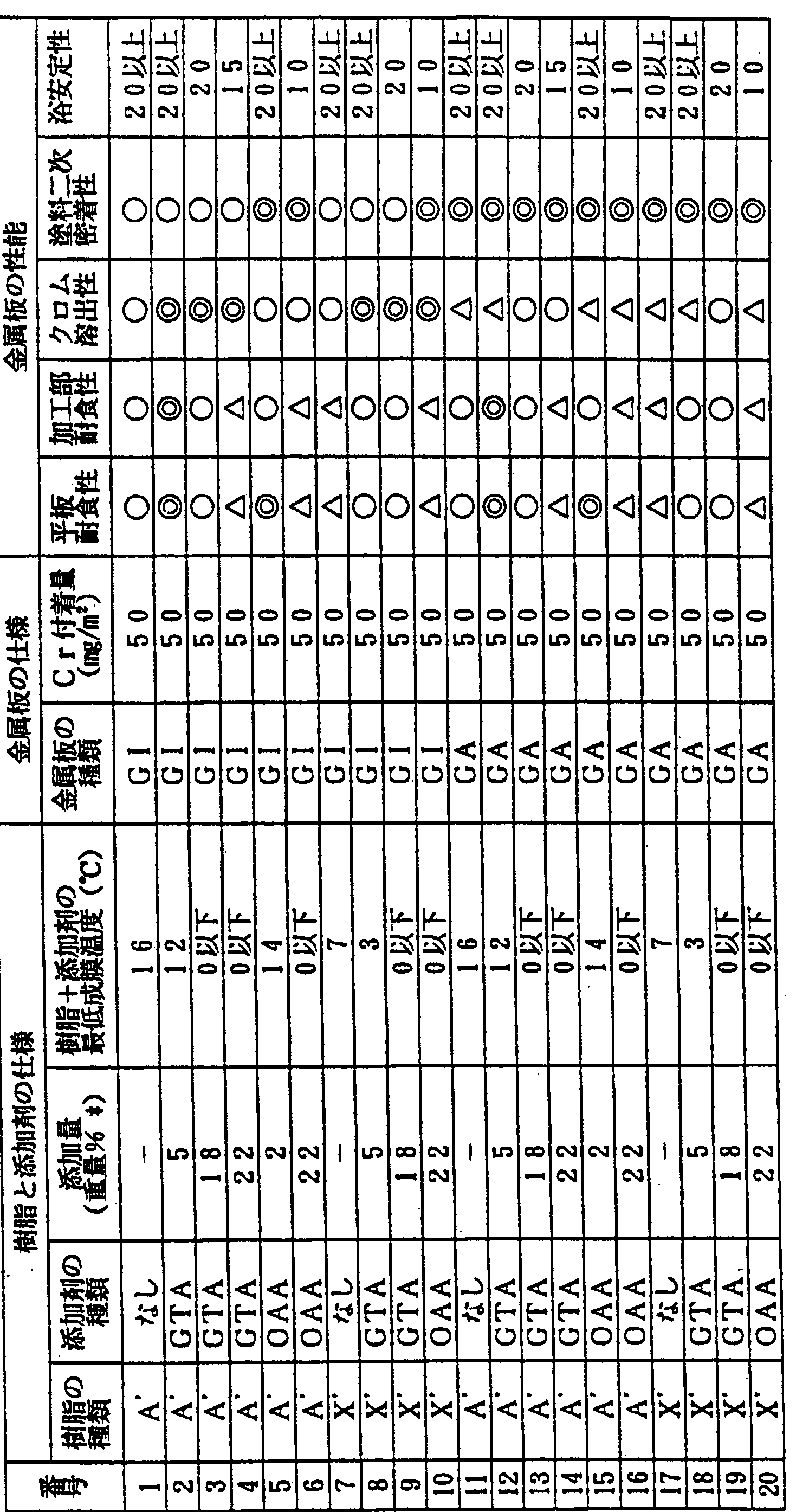
- Table 3 shows the results. As is clear from the table, the present invention is excellent in any of bath stability, flat plate corrosion resistance, corrosion resistance of the surface, chromium elution, paint adhesion, alkali resistance, color tone, and finger resistance.
- V EG 30 30 ⁇ ⁇ ⁇ X ⁇ ⁇ ⁇ Ratio
- Example 1 EG, GI, SZ, GA, and AL were used as in Example 1.
- the results are shown in Tables 4 to 8.
- the present invention shows excellent performance in any of the plated steel sheets.
- a EG 30 30 ⁇ ⁇ ⁇ 0 ⁇ ⁇ ⁇
- ⁇ h is considered somatic dietary output 'J
- Gold Cr bath flat coating, color-proof, color-proof, metal-plated, metal-plate, o-material, 7-m
- a bath containing a resin chromate composition containing 10 g in terms of 2 was prepared.
- the coating amount was adjusted to 3 Omg / m 2 in terms of metal Cr using a mouth coater, and the reached plate temperature was dried at 60 to 9 O e C.
- the film thickness was about 0.3 // m.
- Table 9 shows the results. When dried in less than Te sheet temperature 90, organic polymer Tg total guard 4 0 e C or more and 2 O'C less. 9
- the emulsion B shown in Table 2 was synthesized. However, the volume average particle diameter of the emulsion was changed in the range of 120 to 480 nm by appropriately changing the reaction temperature and the amount of the combined catalyst.
- the adhesion amount was adjusted to 3 OmgZni 2 in terms of metal Cr using an air knife, and the metal plate was dried at an ultimate plate temperature of 100'C.
- the thickness was about 0.5 m.
- Organic polymers A and B shown in Table 10 were synthesized.
- the volume average particle size was in the range of 100-280 nm.
- the chromate composition was bathed. The method of bathing is to first mix the partially reduced chromic acid and phosphoric acid, then add the organic polymer (A) and stir well, and finally add the organic polymer (B) and stir to mix with the treatment bath. did. For comparison, a bath containing no organic polymer was prepared.
- GI GI, EG, SZ, AL and cold rolled steel plate (CR) were used.
- the treatment was carried out using a mouth-water filter and dried at a plate temperature of 100.
- Example 2 The operation was performed in the same manner as in Example 1. However, for CR, the corrosion resistance of the flat plate was 5 days with salt spray and the corrosion resistance of the processed part was 3 days with salt spray.
- Table 11 shows the results.
- the present invention is excellent in all of bath stability, flat plate corrosion resistance, corrosion resistance of a processed portion, poor chromium insolubility, paint adhesion, alkali resistance, appearance quality, surface and fingerprint.
- A- 1 B-l MM 10
- HEA 1.5 EG ⁇ ⁇ ⁇ ⁇ ® ⁇
- A-1 B-2 MM 10.
- HEA 2.5 a 01 EG ⁇ ⁇ ⁇ ⁇ ⁇ ⁇ ⁇ ⁇ ⁇
- HbA 1. EG, SZ, AL ⁇ ⁇ ⁇ ⁇ ⁇ ⁇ ®
- A-2 B-l M 24.
- HBA 0.6 EG, SZ.
- AL ⁇ ⁇ ⁇ ⁇ ⁇ ⁇ ⁇ ⁇ ⁇
- A-2 B-2 MM 27.
- HKA 0.5 EG ⁇ ⁇
- A-4 B-2 AA 15.HBA: 2.5 EG ⁇ ⁇ ⁇ ⁇ ⁇
- A-l B-l MM 6.
- ⁇ U 2.1 EG ⁇ ⁇ ⁇ ⁇ ⁇ ⁇ ⁇
- An organic polymer composed of main components as shown in 1 to 9 in Table 12 was copolymerized with acrylic acid in the following procedure. When multiple components were listed in the table, the amounts were used for each component. 500 parts of deionized water was put into the reaction tank, and the liquid temperature was raised to 600 parts. C, 300 parts of a mixture of the monomer and acrylic acid shown in Tables 1 to 9 and 3 parts of ammonium persulfate (dissolved in 97 parts of deionized water), 3 parts of sodium acid sulfite (dewater was added dropwise with stirring to terminate at 2 hours concurrently and I O dissolved in down water 9 7 parts), the Emarujon perform polymerization reaction while 3 hours ⁇ at continued 6 0 e C Synthesized.
- 10 to 13 in Table 12 were synthesized by the following procedure using an emulsifier.
- An aqueous solution in which 6 parts of sodium dodecylbenzenesulfonate was dissolved as an emulsifier was added to 494 parts of deionized water, and the liquid temperature was raised to 6O'C, and the monomers shown in Tables 12 to 13 in Table 12 were added.
- Three hundred parts of ammonium persulfate, 3 parts of ammonium persulfate (dissolved in 97 parts of deionized water), and 3 parts of sodium acid sulfite (dissolved in 97 parts of deionized water) should be completed in two hours in parallel. Then, a polymerization reaction was carried out while stirring at 60 ° C. for 3 hours to synthesize an emulsion.
- Table 12 uses the same organic polymer as 1, 2, and 6, but differ in the metal plate coated with the resin microporous composition.
- the resin chromate bath takes 1 0 Om l, after storage for one week this with 5 0 e C, the bath components were quantitatively analyzed by gas chromatograph Z mass spectrometer (GC / MS). In addition, the presence or absence of putrefaction odor was examined by 10 subjects. The criterion is the same as (5).
- Tables 12 and 13 show the results of analyzing the amount of lower carboxylic acid produced in the baths Nos. 1 to 13 in Table 13.
- a putrid odor is generated in any of the metal plates. In these chromate baths, the corresponding lower monocarboxylic acids were formed even in the chromate baths, and the baths produced putrefactive odors.
- the organic polymers shown in Tables 14 and 15 were polymerized without using an emulsifier.
- the synthesis was performed in the same manner as in Example 6, Nos. 1 to 9.
- Partially reduced chromic acid 20 (50% reduction rate) at C r 0 3 terms GZL, phosphoric acid H 3 P0 4 converted at 40 g / 1.
- the coating was treated so that the adhesion amount was 5 OmgZm 2 in terms of metal Cr, and the coating was dried at an ultimate plate temperature of 60.
- the film thickness is about 0.
- Example 1 The following items were evaluated in the same manner as in Example 1 and Example 6. However, the difference between 0 and the above embodiment is different.
- the following six types were used. Among them, 1), 2), 4), 5) and 6) were mixed and stirred with a predetermined amount of resin. In 3), a predetermined amount was contained in the resin by appropriately preparing the method of synthesizing the resin.
- OAA Acrylic acid oligomer (mixture of repeating units 2 to 20)
- PMAA polymethacrylic acid (mixture of 30-50 repeating units)
- NB 88% by weight of n-B A and 12% by weight of MA A were converted into emulsion by the synthesis method of Example 1.
- the resin chromate composition was applied to a metal plate using a roll coater, and dried at a plate temperature of 6 O'C. Chromium deposition amount is about 25 and 50mgZnf, film thickness is 0.4 and 0. 8 tzm.
- the resin chromate composition of the present invention has excellent bath stability and no odor, it has good working efficiency and no problem in working environment. Further, the resin chromate-treated metal plate made from this composition does not generate putrefaction odor, and has excellent corrosion resistance, poor chromium solubility, alkali resistance, paint adhesion, and appearance quality.
Landscapes
- Chemical & Material Sciences (AREA)
- Engineering & Computer Science (AREA)
- Materials Engineering (AREA)
- Organic Chemistry (AREA)
- Life Sciences & Earth Sciences (AREA)
- Wood Science & Technology (AREA)
- General Chemical & Material Sciences (AREA)
- Chemical Kinetics & Catalysis (AREA)
- Mechanical Engineering (AREA)
- Metallurgy (AREA)
- Chemical Treatment Of Metals (AREA)
Description


Claims
Priority Applications (2)
| Application Number | Priority Date | Filing Date | Title |
|---|---|---|---|
| EP96926621A EP0787831A4 (en) | 1995-08-11 | 1996-08-09 | Resin-chromate composition and surface-treated metal sheet |
| KR1019970702359A KR970706421A (ko) | 1995-08-11 | 1997-04-11 | 수지 크로메이트 조성물 및 이것으로 표면처리된 금속판(resin-chromate composition and surface-treated metal sheet) |
Applications Claiming Priority (6)
| Application Number | Priority Date | Filing Date | Title |
|---|---|---|---|
| JP7/205963 | 1995-08-11 | ||
| JP20596395 | 1995-08-11 | ||
| JP3653996 | 1996-02-23 | ||
| JP8/36539 | 1996-02-23 | ||
| JP8/139353 | 1996-06-03 | ||
| JP13935396A JPH09316659A (ja) | 1996-06-03 | 1996-06-03 | 金属表面処理用組成物及び表面処理金属板 |
Publications (1)
| Publication Number | Publication Date |
|---|---|
| WO1997007261A1 true WO1997007261A1 (fr) | 1997-02-27 |
Family
ID=27289131
Family Applications (1)
| Application Number | Title | Priority Date | Filing Date |
|---|---|---|---|
| PCT/JP1996/002270 Ceased WO1997007261A1 (fr) | 1995-08-11 | 1996-08-09 | Composition de resine-chromate et tole traitee en surface |
Country Status (4)
| Country | Link |
|---|---|
| EP (1) | EP0787831A4 (ja) |
| KR (1) | KR970706421A (ja) |
| CN (1) | CN1239518A (ja) |
| WO (1) | WO1997007261A1 (ja) |
Cited By (1)
| Publication number | Priority date | Publication date | Assignee | Title |
|---|---|---|---|---|
| WO2004020380A1 (de) * | 2002-08-31 | 2004-03-11 | Oxeno Olefinchemie Gmbh | Verfahren zur hydroformylierung von olefinisch ungesättigten verbindungen, insbesondere olefinen in gegenwart cyclischer kohlensäureester |
Families Citing this family (5)
| Publication number | Priority date | Publication date | Assignee | Title |
|---|---|---|---|---|
| DE19755349A1 (de) * | 1997-12-12 | 1999-06-17 | Henkel Kgaa | Chromhaltiges leitfähiges Korrosionsschutzmittel und Korrosionsschutzverfahren |
| JP3872493B1 (ja) * | 2005-08-17 | 2007-01-24 | 日本パーカライジング株式会社 | 金属材料用水系表面処理剤及び表面被覆金属材料 |
| JP5860582B2 (ja) * | 2010-01-29 | 2016-02-16 | 日本パーカライジング株式会社 | 金属表面処理剤及び金属表面処理方法 |
| JP5854505B2 (ja) * | 2010-01-29 | 2016-02-09 | 日本パーカライジング株式会社 | 金属表面処理剤及び金属表面処理方法 |
| CN112281148A (zh) * | 2020-10-27 | 2021-01-29 | 宁波沈鑫电子有限公司 | 一种金属表面处理剂 |
Citations (7)
| Publication number | Priority date | Publication date | Assignee | Title |
|---|---|---|---|---|
| JPS52133837A (en) * | 1976-05-04 | 1977-11-09 | Nippon Paint Co Ltd | Metal surface treatment |
| JPS54110145A (en) * | 1978-01-30 | 1979-08-29 | Amchem Prod | Metal surface coating composition* preparation thereof* and application using same |
| JPH01172472A (ja) * | 1987-12-28 | 1989-07-07 | Nippon Paint Co Ltd | 塗布型クロメート皮膜処理剤 |
| JPH03129086A (ja) * | 1989-10-12 | 1991-06-03 | Tone Boring Co | ノンコア ダイヤモンドビツト |
| JPH06146002A (ja) * | 1992-10-29 | 1994-05-27 | Nippon Parkerizing Co Ltd | 潤滑性に優れた水系金属表面処理組成物 |
| JPH06173025A (ja) * | 1992-12-03 | 1994-06-21 | Nippon Parkerizing Co Ltd | 黒色皮膜形成用金属表面処理水系組成物 |
| JPH0860175A (ja) * | 1994-08-25 | 1996-03-05 | Nippon Parkerizing Co Ltd | 金属材料用2液型潤滑性クロメート処理組成物、および処理方法 |
Family Cites Families (7)
| Publication number | Priority date | Publication date | Assignee | Title |
|---|---|---|---|---|
| JPS51128650A (en) * | 1974-10-15 | 1976-11-09 | Kawasaki Steel Co | Process for fabricating electric steel having coatings superior in punchhworkability and weldability |
| US4373968A (en) * | 1981-06-24 | 1983-02-15 | Amchem Products, Inc. | Coating composition |
| JPS58224175A (ja) * | 1982-06-23 | 1983-12-26 | Nippon Kokan Kk <Nkk> | 脱脂処理後の塗料密着性に優れた表面処理鋼板の製造方法 |
| JPS6123767A (ja) * | 1984-07-11 | 1986-02-01 | Nisshin Steel Co Ltd | 高耐食性表面処理鋼板 |
| JPS6369984A (ja) * | 1986-07-16 | 1988-03-30 | サ−マテツク・インタ−ナシヨナル・インコ−ポレイテツド | 改良被覆部品、コ−テイング及びその適用方法 |
| JPH04193957A (ja) * | 1990-11-28 | 1992-07-14 | Nippon Parkerizing Co Ltd | クリヤー塗装下地用クロメート処理液 |
| JPH05214265A (ja) * | 1992-01-31 | 1993-08-24 | Nippon Parkerizing Co Ltd | 自己析出型水性被覆組成物 |
-
1996
- 1996-08-09 EP EP96926621A patent/EP0787831A4/en not_active Withdrawn
- 1996-08-09 CN CN96191176A patent/CN1239518A/zh active Pending
- 1996-08-09 WO PCT/JP1996/002270 patent/WO1997007261A1/ja not_active Ceased
-
1997
- 1997-04-11 KR KR1019970702359A patent/KR970706421A/ko not_active Ceased
Patent Citations (7)
| Publication number | Priority date | Publication date | Assignee | Title |
|---|---|---|---|---|
| JPS52133837A (en) * | 1976-05-04 | 1977-11-09 | Nippon Paint Co Ltd | Metal surface treatment |
| JPS54110145A (en) * | 1978-01-30 | 1979-08-29 | Amchem Prod | Metal surface coating composition* preparation thereof* and application using same |
| JPH01172472A (ja) * | 1987-12-28 | 1989-07-07 | Nippon Paint Co Ltd | 塗布型クロメート皮膜処理剤 |
| JPH03129086A (ja) * | 1989-10-12 | 1991-06-03 | Tone Boring Co | ノンコア ダイヤモンドビツト |
| JPH06146002A (ja) * | 1992-10-29 | 1994-05-27 | Nippon Parkerizing Co Ltd | 潤滑性に優れた水系金属表面処理組成物 |
| JPH06173025A (ja) * | 1992-12-03 | 1994-06-21 | Nippon Parkerizing Co Ltd | 黒色皮膜形成用金属表面処理水系組成物 |
| JPH0860175A (ja) * | 1994-08-25 | 1996-03-05 | Nippon Parkerizing Co Ltd | 金属材料用2液型潤滑性クロメート処理組成物、および処理方法 |
Non-Patent Citations (1)
| Title |
|---|
| See also references of EP0787831A4 * |
Cited By (1)
| Publication number | Priority date | Publication date | Assignee | Title |
|---|---|---|---|---|
| WO2004020380A1 (de) * | 2002-08-31 | 2004-03-11 | Oxeno Olefinchemie Gmbh | Verfahren zur hydroformylierung von olefinisch ungesättigten verbindungen, insbesondere olefinen in gegenwart cyclischer kohlensäureester |
Also Published As
| Publication number | Publication date |
|---|---|
| EP0787831A1 (en) | 1997-08-06 |
| CN1239518A (zh) | 1999-12-22 |
| EP0787831A4 (en) | 1998-11-11 |
| KR970706421A (ko) | 1997-11-03 |
Similar Documents
| Publication | Publication Date | Title |
|---|---|---|
| TWI222467B (en) | Metal-surface-treating composition and surface-treated metal material | |
| JP5509078B2 (ja) | 水系金属表面処理剤及び表面処理金属材料 | |
| WO1988000622A1 (fr) | Composition et procede de traitement de surfaces metalliques | |
| JP2001523769A (ja) | クロムを含んでいない有機系被覆用重合性組成物 | |
| JPS63247032A (ja) | 硬質微粒子が表面に突出した塗膜を金属素材上に形成せしめる方法 | |
| WO1997007261A1 (fr) | Composition de resine-chromate et tole traitee en surface | |
| JP5099732B2 (ja) | 水系金属表面処理剤 | |
| EP2294146B1 (en) | Cross linking thin organic coating resins to substrates through polyfunctional bridging molecules | |
| JP5411585B2 (ja) | 複層表面処理亜鉛系めっき鋼板 | |
| JPH01172472A (ja) | 塗布型クロメート皮膜処理剤 | |
| WO2016136834A1 (ja) | 亜鉛めっき鋼材用または亜鉛基合金めっき鋼材用の金属表面処理剤、被覆方法及び被覆鋼材 | |
| JP3615781B2 (ja) | 3価クロム化合物ゾルの製造方法、並びに前記ゾルを含む金属材料用表面処理剤及び表面処理方法 | |
| JP3383176B2 (ja) | 臭気特性に優れた樹脂クロメート組成物および表面処理金属板 | |
| JP5463609B2 (ja) | クロムフリー表面処理亜鉛系めっき鋼板およびその製造方法ならびに表面処理液 | |
| WO2005053950A1 (ja) | 黒色鋼板 | |
| JPH0230394B2 (ja) | Yosetsuseitosokohan | |
| JP2805211B2 (ja) | 樹脂複合クロメート処理めっき鋼材とその製造方法 | |
| JP3359547B2 (ja) | 消泡性に優れた樹脂クロメート組成物および樹脂クロメート処理金属板 | |
| JP2952841B2 (ja) | 加工後の耐食性、耐黒変性に優れた難溶性クロメート処理金属材料の製造方法 | |
| JPS63145785A (ja) | 金属表面処理組成物 | |
| JPH0329807B2 (ja) | ||
| JPH10140368A (ja) | 樹脂クロメート組成物および成膜性、加工後耐食性に優れた樹脂クロメート処理金属板ならびにその用途 | |
| JP4818533B2 (ja) | 熱硬化性被覆用組成物および塗料 | |
| JPH0959471A (ja) | 樹脂クロメ−ト組成物及び表面処理鋼板 | |
| JPH09157864A (ja) | 金属材料用クロメート処理液組成物、および処理方法 |
Legal Events
| Date | Code | Title | Description |
|---|---|---|---|
| WWE | Wipo information: entry into national phase |
Ref document number: 96191176.X Country of ref document: CN |
|
| AK | Designated states |
Kind code of ref document: A1 Designated state(s): CN KR US |
|
| AL | Designated countries for regional patents |
Kind code of ref document: A1 Designated state(s): AT BE CH DE DK ES FI FR GB GR IE IT LU MC NL PT SE |
|
| WWE | Wipo information: entry into national phase |
Ref document number: 1019970702359 Country of ref document: KR |
|
| WWE | Wipo information: entry into national phase |
Ref document number: 1996926621 Country of ref document: EP |
|
| 121 | Ep: the epo has been informed by wipo that ep was designated in this application | ||
| ENP | Entry into the national phase |
Ref document number: 1997 809986 Country of ref document: US Date of ref document: 19970707 Kind code of ref document: A |
|
| WWP | Wipo information: published in national office |
Ref document number: 1996926621 Country of ref document: EP |
|
| WWP | Wipo information: published in national office |
Ref document number: 1019970702359 Country of ref document: KR |
|
| WWW | Wipo information: withdrawn in national office |
Ref document number: 1996926621 Country of ref document: EP |
|
| WWR | Wipo information: refused in national office |
Ref document number: 1019970702359 Country of ref document: KR |