WO1999006457A1 - Particules de copolymeres greffes et compositions de resines thermoplastiques - Google Patents
Particules de copolymeres greffes et compositions de resines thermoplastiques Download PDFInfo
- Publication number
- WO1999006457A1 WO1999006457A1 PCT/JP1998/003304 JP9803304W WO9906457A1 WO 1999006457 A1 WO1999006457 A1 WO 1999006457A1 JP 9803304 W JP9803304 W JP 9803304W WO 9906457 A1 WO9906457 A1 WO 9906457A1
- Authority
- WO
- WIPO (PCT)
- Prior art keywords
- rubber
- latex
- parts
- copolymer
- monomer
- Prior art date
- Legal status (The legal status is an assumption and is not a legal conclusion. Google has not performed a legal analysis and makes no representation as to the accuracy of the status listed.)
- Ceased
Links
Classifications
-
- C—CHEMISTRY; METALLURGY
- C08—ORGANIC MACROMOLECULAR COMPOUNDS; THEIR PREPARATION OR CHEMICAL WORKING-UP; COMPOSITIONS BASED THEREON
- C08F—MACROMOLECULAR COMPOUNDS OBTAINED BY REACTIONS ONLY INVOLVING CARBON-TO-CARBON UNSATURATED BONDS
- C08F279/00—Macromolecular compounds obtained by polymerising monomers on to polymers of monomers having two or more carbon-to-carbon double bonds as defined in group C08F36/00
- C08F279/02—Macromolecular compounds obtained by polymerising monomers on to polymers of monomers having two or more carbon-to-carbon double bonds as defined in group C08F36/00 on to polymers of conjugated dienes
-
- C—CHEMISTRY; METALLURGY
- C08—ORGANIC MACROMOLECULAR COMPOUNDS; THEIR PREPARATION OR CHEMICAL WORKING-UP; COMPOSITIONS BASED THEREON
- C08F—MACROMOLECULAR COMPOUNDS OBTAINED BY REACTIONS ONLY INVOLVING CARBON-TO-CARBON UNSATURATED BONDS
- C08F220/00—Copolymers of compounds having one or more unsaturated aliphatic radicals, each having only one carbon-to-carbon double bond, and only one being terminated by only one carboxyl radical or a salt, anhydride ester, amide, imide or nitrile thereof
-
- C—CHEMISTRY; METALLURGY
- C08—ORGANIC MACROMOLECULAR COMPOUNDS; THEIR PREPARATION OR CHEMICAL WORKING-UP; COMPOSITIONS BASED THEREON
- C08F—MACROMOLECULAR COMPOUNDS OBTAINED BY REACTIONS ONLY INVOLVING CARBON-TO-CARBON UNSATURATED BONDS
- C08F265/00—Macromolecular compounds obtained by polymerising monomers on to polymers of unsaturated monocarboxylic acids or derivatives thereof as defined in group C08F20/00
- C08F265/04—Macromolecular compounds obtained by polymerising monomers on to polymers of unsaturated monocarboxylic acids or derivatives thereof as defined in group C08F20/00 on to polymers of esters
-
- C—CHEMISTRY; METALLURGY
- C08—ORGANIC MACROMOLECULAR COMPOUNDS; THEIR PREPARATION OR CHEMICAL WORKING-UP; COMPOSITIONS BASED THEREON
- C08F—MACROMOLECULAR COMPOUNDS OBTAINED BY REACTIONS ONLY INVOLVING CARBON-TO-CARBON UNSATURATED BONDS
- C08F265/00—Macromolecular compounds obtained by polymerising monomers on to polymers of unsaturated monocarboxylic acids or derivatives thereof as defined in group C08F20/00
- C08F265/04—Macromolecular compounds obtained by polymerising monomers on to polymers of unsaturated monocarboxylic acids or derivatives thereof as defined in group C08F20/00 on to polymers of esters
- C08F265/06—Polymerisation of acrylate or methacrylate esters on to polymers thereof
-
- C—CHEMISTRY; METALLURGY
- C08—ORGANIC MACROMOLECULAR COMPOUNDS; THEIR PREPARATION OR CHEMICAL WORKING-UP; COMPOSITIONS BASED THEREON
- C08F—MACROMOLECULAR COMPOUNDS OBTAINED BY REACTIONS ONLY INVOLVING CARBON-TO-CARBON UNSATURATED BONDS
- C08F283/00—Macromolecular compounds obtained by polymerising monomers on to polymers provided for in subclass C08G
- C08F283/12—Macromolecular compounds obtained by polymerising monomers on to polymers provided for in subclass C08G on to polysiloxanes
-
- C—CHEMISTRY; METALLURGY
- C08—ORGANIC MACROMOLECULAR COMPOUNDS; THEIR PREPARATION OR CHEMICAL WORKING-UP; COMPOSITIONS BASED THEREON
- C08F—MACROMOLECULAR COMPOUNDS OBTAINED BY REACTIONS ONLY INVOLVING CARBON-TO-CARBON UNSATURATED BONDS
- C08F291/00—Macromolecular compounds obtained by polymerising monomers on to macromolecular compounds according to more than one of the groups C08F251/00 - C08F289/00
- C08F291/02—Macromolecular compounds obtained by polymerising monomers on to macromolecular compounds according to more than one of the groups C08F251/00 - C08F289/00 on to elastomers
-
- C—CHEMISTRY; METALLURGY
- C08—ORGANIC MACROMOLECULAR COMPOUNDS; THEIR PREPARATION OR CHEMICAL WORKING-UP; COMPOSITIONS BASED THEREON
- C08L—COMPOSITIONS OF MACROMOLECULAR COMPOUNDS
- C08L51/00—Compositions of graft polymers in which the grafted component is obtained by reactions only involving carbon-to-carbon unsaturated bonds; Compositions of derivatives of such polymers
- C08L51/04—Compositions of graft polymers in which the grafted component is obtained by reactions only involving carbon-to-carbon unsaturated bonds; Compositions of derivatives of such polymers grafted on to rubbers
-
- C—CHEMISTRY; METALLURGY
- C08—ORGANIC MACROMOLECULAR COMPOUNDS; THEIR PREPARATION OR CHEMICAL WORKING-UP; COMPOSITIONS BASED THEREON
- C08L—COMPOSITIONS OF MACROMOLECULAR COMPOUNDS
- C08L55/00—Compositions of homopolymers or copolymers, obtained by polymerisation reactions only involving carbon-to-carbon unsaturated bonds, not provided for in groups C08L23/00 - C08L53/00
- C08L55/02—ABS [Acrylonitrile-Butadiene-Styrene] polymers
Definitions
- the present invention relates to a graphitized copolymer particle using a co-expanded rubber containing silicone rubber, and to provide impact resistance, weatherability, workability,
- the present invention relates to a thermoplastic resin composition having excellent heat discoloration resistance and excellent molding appearance. Background technology
- thermoplastic copolymer particle containing a rubber component It has been widely used to improve the impact resistance by combining a thermoplastic copolymer particle containing a rubber component with a thermoplastic resin. Yes.
- Tg glass transition temperature
- ABS resin Lubutadiene Z styrene copolymer
- polyganosiloxan hereinafter also referred to as "silicon” rubber, for example, Since methyl siloxane is at around 120 ° C, its graphitic copolymer particles containing silicone rubber components If it is possible to use Higher impact resistance can be expected as compared with those that include the components.
- silicone rubber is more easily produced than poly (acrylic acid butyl rubber) / polybutadiene rubber. It will be advantageous.
- Japanese Unexamined Patent Publication No. 4-108182 discloses a silicone rubber component and a polyalkyl (meta) acrylic rubber component.
- Japanese Patent Application Laid-Open No. Hei 4-239015 discloses that a silicone rubber component and a conjugated butadiene rubber component cannot be separated from each other. It is stated that the use of graphite copolymer particles obtained by polymerizing a vinyl monomer in a composite rubber having a structure entangled with It is.
- thermoplastic resin composition not only has excellent impact resistance but also has excellent weather resistance, processability, thermal discoloration, and molded appearance. What was found was found.
- the co-enlarged rubber obtained by coagulation and co-enlargement of the tex is a graph-enhanced rubber obtained by graft-polymerizing vinyl monomers to the co-enlarged rubber. Coalesced particles,
- the co-enlarged rubber contains 1 to 30% of unsaturated acid monomer based on 100 parts by weight (hereinafter referred to as "part") (solid content) of the mixed latex. And 35-99% of (meth) acrylic acid ester monomers and 0-35% of other monomers copolymerizable therewith.
- (1) according to the above (1) which is obtained by adding 0.1 to 15 parts (solid content) of the acid group-containing copolymer latex prepared as described above to cause coagulation and co-hypertrophy.
- Graphite copolymer particles (3)
- Silicon rubber latex (A) refers to silicone rubber latex, silicone rubber and rubber-free rubber.
- the graphitized copolymer particles described in the above (1) which are at least one kind of at least one kind of composite rubber latex,
- the vinyl monomer is an aromatic vinyl monomer, a vinyl cyanide monomer, a halogenated vinyl monomer, or a (meta) alpha monomer. Said monomer being at least one monomer selected from the group consisting of acrylates and (meth) acrylate ester monomers.
- thermoplastic resin composition 1 to 150 parts of the graphite copolymer particles described in the above (1), (2), (3) or (4) and 100 parts of the thermoplastic resin.
- thermoplastic resin is made of polyvinyl chloride, polystyrene, polystyrene-acrylonitrile copolymer, polystyrene-acyl Lilonitrile N-vinyl maleimide copolymer, ⁇ -methylstyrene-acrylonitrile copolymer, polymethacrylate Methyl methacrylate, methyl methacrylate-styrene copolymer, polycarbonate, polyamide, polyester, ABS resin, At least one tree selected from the group consisting of AAS resin, AES resin and poly (vinylene ether) -polystyrene composite resin
- Thermoplastic resin composition according to the above (5) which is a fat
- the graphite copolymer particles of the present invention are composed of silicone rubber latex ( ⁇ ) and acrylic rubber. Tex and Or the mixed latex obtained by mixing with the conjugated diene-based rubber latex (B) to coagulate and co-enlarge the resulting mixed latex. This is a polymer obtained by polymerizing vinyl monomers onto the co-fertilized rubber.
- the silicone rubber contained in the co-fertilized rubber is obtained by introducing a silicone rubber having excellent release properties into the co-fertilized rubber.
- Acrylic rubber and (or) conjugated diene rubber are used to reduce interfacial delamination at high temperatures. It is a component that is used to provide a heterogeneous rubber interface with the corn.
- the vinyl monomer which is obtained by polymerizing the above-described co-enlarged rubber with a graphitic resin is obtained when the graphitic copolymer particles are blended with a thermoplastic resin. It is a component used to increase the compatibility with the thermoplastic resin and to uniformly disperse the graphite copolymer particles in the thermoplastic resin.
- thermoplastic resins that are advantageous for improving the impact resistance of thermoplastic resins are not only low in Tg, but also aggregate into rubber particles when subjected to impact. It has been considered that it is better for the rubber to be able to relieve the internal stress more quickly by the voiding of the rubber. Therefore, coagulated co-fertilized rubber containing silicone rubber particles that have been sufficiently releasable can reduce the stress that concentrates on the rubber particles when subjected to an impact. It is thought that the voiding can be mitigated by the voiding based on the interfacial delamination of the recombination particles, and that excellent impact resistance can be achieved.
- acryl-based rubber latex and (or) the conjugated-gen rubber latex (B) can be obtained by coagulation enlargement of only the rubber.
- enlarged rubber of acryl-based rubber particles, enlarged rubber of conjugated rubber-based particles, or expanded rubber particles of conjugated rubber-based particles and conjugated rubber-based particles With Graphite copolymer particles made only with bloated rubber do not have the feature of the present invention that they exhibit high impact resistance o
- the silicone rubber in the present invention is a rubber elastic rubber, that is, a normal silicone rubber. And organic rubbers that do not contain the silicone rubber and silicone segment (for example, acrylic rubber, butadiene rubber, etc.) ), And the silicone rubber and the organic rubber containing no silicone segment are entangled with each other.
- the compounded rubber is an organic rubber containing a silicone segment.
- Silicon rubber optics used in the present invention are Silicon rubber optics used in the present invention.
- (A) means not only silicone rubber latex, but also silicone rubber, acrylic rubber, shared-gene rubber, etc. This is a concept that includes the latex of a compound rubber that is composed of other rubbers of the same type, and that is included in the co-bloated rubber in the event of an impact. A void is generated based on the separation of the interface of the recomb rubber, and if the impact is considered to be mitigated, it is not particularly limited. It can be used well. Among these, silicone rubber latex, latex of rubber compound consisting of silicone rubber and acrylic rubber Tass is preferred because it is easy to manufacture.
- the acryl type in the above-mentioned rubber type rubber is the (meta) acryl type unit in the unit constituting the rubber. It indicates that the percentage of body units is more than 50%, and more than 60%. The same applies to the conjugated system in the conjugated system rubber.
- the series included in the silicone rubber (A) above The size of the cone particles is an average particle diameter of 20 to 200 nm, and furthermore, a force of 20 to 150 nm. Preference is given to the fact that the hypertrophy operation makes it possible to co-bloat.
- the amount of solvent-insoluble matter contained in the silicone rubber particles (gel content: sample was immersed in toluene at room temperature for 24 hours).
- the weight fraction of toluene insoluble matter after centrifugation at 1200 rpm for 1 hour is 0 to 100%, but preferably 0 to 4%.
- 0% or 60 to: L 0% is preferable in terms of the impact strength.
- the percentage of silicone components contained in the silicone rubber particles described above includes the silicone in the co-enlarged rubber to be formed.
- the carbon content is within the specified range, but the impact resistance is 50% or more, and more preferably 60% or more. It is preferable from the point of view.
- the upper limit is 100%.
- silicone rubber examples include dimethylsiloxan rubber, butylacrylic acid acrylate, and dimethylsiloxan.
- Compound rubber, butadiene rubber and a compound rubber having a chemical bond between butadiene rubber and dimethylsiloxan rubber For example, compound rubber in which dimethylsiloxango is entangled with each other.
- dimethylsiloxy sangom a compound rubber consisting of butyl methyl acrylate and dimethyl siroxango gam They are preferred because they have good weather resistance and are easy to manufacture.
- the silicone rubber latex (A) is usually the solid concentration (measured after drying at 120 for 1 hour after drying). % Are used, and 20 to 40% are preferred because it is easier to control the particle size in the enlargement operation described later. No. Further, those having a pH of 5 to: Ll, and those having a pH of 6 to 10 are preferred.
- Silicon rubber latex (A) may be, for example, organosiloxane, a cross-linking agent used as needed, or a graphite crossover. And other known methods of organosirane and the like (for example, U.S. Pat. By the method described in, for example, the specification of No. 3,294,725).
- the aforementioned organosiloxan is a component that constitutes the main skeleton of the silicone rubber chain, and can be used in a linear or ring form. It is. Among them, cyclic organosiloxane is widely used from the viewpoint of applicability to emulsion polymerization and economical efficiency. . Examples of such concrete bodies are hexamethylene cyclotricyclosiloxanes and octamethylcyclotetrates having, for example, 6- to 12-membered rings. Lasiloxan, Decamethylcyclopenta, Dodecamethylcyclohexacycloxan, Trimethyltrif Encyclopedia, Tetramethod Soletet For example, trasiloxan is required. These may be used alone or in combination of two or more. Among them, those having a vinyl group are used to adjust the appearance of impact resistance by imparting affinity with the component (B). It is.
- the cross-linking agent co-polymerizes with the organosiloxane described above to introduce a cross-linked structure into silicone rubber and exhibit rubber elasticity.
- Component A concrete example is, for example, Tetrametoshiran, Tetraetishishiran, Tritekishitirishiran, Trietekishitirishiran, Petit 4 or 3 functions, such as Root Trim. This will give you the Shirani Dad. These may be used alone or in combination of two or more. Among them, those having a monovalent hydrocarbon group having 2 to 8 carbon atoms can impart (B) affinity with a component to exhibit impact resistance. It is used to adjust the temperature.
- the above-mentioned graphite cross-linking agent is a reactive silane compound having a polymerizable unsaturated bond or a mercapto group in the molecule, and a polymer in the molecule.
- a reactive silane compound having a polymerizable unsaturated bond or a mercapto group in the molecule and a polymer in the molecule.
- organosiloxane having a sexually unsaturated bond or a mercapto group such as the aforementioned organosiloxane or the aforementioned bridge
- a polymerizable unsaturated bond or a mercapto group is added to the side chain and / or the end of the copolymer. It is a component for introduction.
- the above-mentioned polymerizable unsaturated bond or mercapto group is a vinyl system that can be graft-copolymerized with the co-enlarged rubber used in the present invention. It becomes the active point of the monomer.
- the polymerizable unsaturated bond or the melt carboxylate group can also act as a bridge point when a radical polymerization initiator is used to react radically. Become .
- a part of the bridge remains as a graphitic activity point, so graphatization is possible.
- R 2 , X, and a are the same as those in the general formula (1), and R 3 represents a divalent hydrocarbon group having 1 to 6 carbon atoms).
- responsive Schirnig compounds are required.
- Examples of the concrete examples of R 2 in the general formulas (1) to (4) include, for example, a compound having 1 to 6 carbon atoms such as a methyl group, an ethyl group, and a propyl group.
- specific examples of X include methoxy, ethoxy, and proxoxy groups, such as a rutile group, a phenyl group, and the like.
- Alkoxy groups having 1 to 6 carbon atoms, such as butoxy groups, etc., are obtained.
- examples of the concrete examples of R ⁇ in the general formula (4) include a methylene group, an ethylene group, a trimethylene group, a propylene group, and a tetraethylene group. Of 1 to 6 carbon atoms such as lamethylene group Alkylen bases are required.
- the reactive silane compound represented by the general formula (1) for example, / S—metal hole Methacryl methyl silane, 7 — methacryloyl lip mouth pinhole meth yl methyl silane, 7 — methacryloyl oxy Circumferential metering, 7-methacryloyloxy methyl methacrylic acid, ⁇ -methacryloline b le O key sheet profiles Pi zone Les Application Benefits et preparative key sheet sheet run-7 - meta click Li b A Honoré O key sheet profiles Pi le di e preparative key sheet main Chi le shea run-, i - Metacryloyloxyproprisolation, 7 — Metacryloyloxypropyloxyprophylme Rusi Runs, etc., are exacerbated.
- the reactive silane compound represented by the general formula (2) for example, ⁇ —vinylphenyldimethyxole Silane, ⁇ —vinyl nitrile trim silane, ⁇ —vinyl nitrile trimet xylan, ⁇ —vinyl nitrile
- Rujet Kismetirushiran Specific examples of the reactive silane compound represented by the general formula (3) include, for example, vinyl methyl dimethoxy silane, vinyl nitrate, and the like. For example, it can be used as a non-registration xylan, a vinyl reticle xylan, and a vinyl retread xylan.
- the reactive silane compound represented by the general formula (4) include, for example, arylmethyldimethoxysilane, ⁇ It can be used for various purposes such as lily methyl thiocyanate, aryl trimethyl thiocyanate, and aryl thiet xylan.
- the monomers represented by the general formulas (1) and (2) are preferably used from the viewpoint of economy and reactivity. .
- R 2 , a, and X are the same as above; R is the same, and R 4 represents a divalent organic group such as an alkylene group having 1 to 18 carbon atoms.
- the reactive silane compound represented by is exposed.
- the concrete examples of the above-mentioned phenolic groups include, for example, methylene group, ethylene group, trimethylene group, propylene, tetylene, etc. Lamethylene group etc. are exposed.
- a reactive silane compound represented by the 7R formula (5) for example, melkabutoxypropyltrimethylsilan , Mel-cap-to-propyl meth- ylol, etc.
- cyclic siloxanes having an unsaturated bond or a mercapto group in the molecule for example, tetrabutyl tetanate Lame cinnamate cyro-tetra siroxan, Tetra methacryla di oxyprote te la te sine cros te te cro s s It is not possible to use tetramethylcaptopole as a cross-linking agent for graphene cross-linking agents.
- Reactive silane compounds that are powerful trialkoxy silane compounds can be used as graphitic cross-linking agents and cross-linking agents.
- Organosilanes other than the above-mentioned cross-linking agent and the above-mentioned graphite cross-linking agent are for imparting affinity with the component (II), and have the general formula ( 6): R 5-Si— 0— (6)
- R 5 and R 6 are a monovalent hydrocarbon group having 1 to 10 carbon atoms such as a methyl group, an ethyl group, a propyl group and a phenyl group.
- Oh Ri, R " ⁇ R 6 is have a structure single position that will be I table in the fit Chi Le based on such et al of only Re, but it may also be the same in Tsu Ku Do different good also) at the same time
- a specific example of an organosilane having the structural unit of the general formula (6) is, for example, Tokishiran, Djibutino Regime Tokishiran, Methyloctane Regime Tokishiran, Fernmethyl Metizila , Diphenylene methoxysilane, petitine limestone, silane limestone, octile limestone Tokishi These may be used singly or in combination of two or more.
- a cross-linking agent or a cross-linking agent having a structural unit represented by the general formula (6) is used, the ono
- organosiloxane, cross-linking agent, graphite cross-linking agent, and other organosilanols are usually the same as those of silicone rubber. 70 to 99.9% of organosiloxane in the silicone rubber component of latex (A), and 85 to 99.5%, cross-linked 0 to 10%, further 0 to 5%, graphite crossing agent 0 to 10%, more 0.3 to 5%, other onoreganosirane It is between 0 and 10%, and even between 0 and 5%, and is used so that their total force is ⁇ 100%.
- the cross-linking agent and the cross-linking agent become 0% at the same time. None, it is preferred to use 0.1% or more.
- the rubber lacks the properties of rubber and the effect of exhibiting impact resistance is low. And if too much, the amount of bridging agents, graphite cross-linking agents and other organosilans is reduced. There is a tendency for the effects of using these to be less likely to appear. Further, when the unit of the cross-linking agent or the above-mentioned graphite cross-linking agent is too small, the effect of exhibiting the impact resistance is reduced. If the amount is too large, the rubber tends to lack the properties of rubber, and the effect of exhibiting impact resistance tends to be reduced. In addition, other organosilans are voluntary components, and (B) impart affinity with the components to adjust the effect of the impact resistance. Although it is possible to do this, since it leads to cost-up, it is preferable to use it in consideration of cost and physical balance.
- the silicone rubber is made of, for example, organosiloxane, a cross-linking agent and a graphite used as needed.
- the cross-linking agent, as well as the mixture with the other organosilan, is emulsified and dispersed in water by mechanical shearing in the presence of the emulsifier, and the acid is dispersed.
- Manufactured by a method of superposing in the neutral state In this case, when emulsified droplets of several meters or more are prepared by mechanical shearing, the average particle size of silicone rubber obtained after polymerization should be used. Depending on the amount of emulsifier used, it can be controlled within the range of 20 to 400 nm.
- organosiloxane Emulsion 1 ⁇ 50 consisting of emulsified droplets of several ⁇ m or more, obtained by emulsifying a mixed solution with water, water and an emulsifier by mechanical shearing.
- % Is firstly subjected to emulsion polymerization in an acidic state, and then the remaining emulsion is added in the presence of the obtained silicone rubber to carry out polymerization.
- the silicone rubber thus obtained has an average particle diameter of 100 nm or less and a standard deviation of the particle diameter distribution of 50 or less.
- the emulsified droplets having the number of // m or more can be prepared by using a high-speed stirrer such as a homomixer, and the like.
- a high-speed stirrer such as a homomixer, and the like.
- 0 nm emulsified droplets can be prepared by using special dispersers such as high pressure homogenizers and ultrasonic dispersers.
- the emulsifier used in these methods does not lose its activity as an emulsifier even in the acidic region, and is an example of such an emulsifier.
- alkylbenzensulfonate, sodium alkylbenzensulfonate, alkylsulfonate, and alkinolesul Sodium sodium phosphate, (di) alkyl sodium sulfosuccinate, polyoxyethylene nonyl phenol Examples include sodium sulfonate and sodium alkylsulfate. These may be used alone or in combination of two or more.
- Acidic acidification refers to the addition of inorganic acids such as sulfuric acid or hydrochloric acid or alkyl to the system. Add an organic acid such as benzenesulphonic acid, phenolic sulphonic acid, trifluorophenolic acid or the like to bring the pH to 1.0 to 3.0. Is preferred.
- the polymerization temperature when producing silicone rubber latex is 60-: L 20 ° C, and it is 70-100 ° C. However, it is preferred because the polymerization speed is moderate.
- silicone rubber latex strength can be obtained, but under acid conditions, it forms the bone skeleton of silicone rubber.
- — 0 — Si bond is in an equilibrium state of cleavage and formation, and this equilibrium changes with temperature, so it is necessary to stabilize the silicone rubber chain.
- the equilibrium is determined by the fact that the lower the temperature, the higher the molecular weight, because the higher the molecular weight, the higher the molecular weight or the degree of the elevated bridge.
- the polymerization during the production of silicone rubber was carried out at 60 ° C or higher. It is preferable to cool to about room temperature, hold for about 5 to 100 hours, and then neutralize.
- the compound rubber latex containing a silicone rubber and a rubber-based rubber as a rubber component is, for example, the silicone rubber described in the above.
- a side-polymerization of a monomer mixture used in the production of acryl-type gomulatex described below is performed.
- the resulting composite rubber latex is constrained by the presence of the acryl-type rubber latex described below.
- the components used to produce the latex can be polymerized as is, or added to an emulsion.
- the resulting composite rubber tex It is.
- the method for producing a composite rubber latex that contains silicone rubber and acrylic rubber as rubber components there is no particular limitation on the method for producing a composite rubber latex that contains silicone rubber and acrylic rubber as rubber components.
- the known seed emulsification polymerization method is preferably used.
- the ingredient that can be a seed can be any of acrylic-based rubber latex and silicone rubber latex, but the resulting latex can be obtained. From the viewpoint of controlling the particle diameter of a particle, giving a narrow particle diameter distribution, etc., it is assumed that the acrylic rubber latex is a seed. It is preferable to add a mixture of the organosiloxane, the crosslinking agent, or the like as it is, or as an emulsification.
- reactive silyl groups are introduced into the acryl-based rubber, and the acryl-based rubber can be used at the time of polymerization such as organosiloxane.
- a compound rubber is formed between the rubber and silicone rubber, and the rubber is well mixed with the acrylic rubber and silicone rubber.
- the above-mentioned graph is required when preparing the acrylic-based rubber latex from the point that it is advantageous for the development of impact resistance. It is preferable to copolymerize a reactive silane compound having a polymerizable unsaturated bond such as a cross-linking agent.
- the silicone rubber and the rubber A simple rubber used in the production of rubber-based rubber latex in a composite rubber latex containing a rubber-based rubber as a rubber component.
- Monomer mixture used in the production of synergistic gen- erous rubber matrices or acryl-based rubber matrices It is only necessary to produce a composite rubber latex instead of a conjugated diene-based rubber latex.
- the conjugated diene-based rubber latex (B) is, as described above, a (meta) acrylic monomer unit of 50% or more. This refers to the rubber latex containing and / or the rubber latex containing 50% or more of the synergistic diene monomer unit. If it has the properties of rubber, it can be used without any particular limitation.
- the size of the rubber particles included in the acrylic rubber and (or) the conjugated rubber rubber (B) is described as follows. Has an average particle diameter of 20 to 200 nm and further has a mean particle diameter of 20 to 150 nm, and is co-fertilized by the co-fertilization operation described later. Preferable because of its ease.
- the solvent contained in the rubber particles in the acrylic rubber and the (or) co-generating rubber rubber B) Insoluble content (Gel content: sample immersed in toluene for 24 hours at room temperature, and centrifuged for 1 hour at 1200 rpm for 1 hour.
- the insoluble content (weight fraction) is preferably 70% or more, and more preferably 80% or more, from the viewpoint of the development of impact strength. The upper limit is 100%.
- acrylic rubber examples include, for example, butyl acrylic acid polymer rubber, acrylate acrylic acid (meta) acrylic rubber, and the like. 2- (ethylenoxy) hexyl copolymer rubber, butyl acrylate-butadiene copolymer rubber, butyryl acrylate-styrene
- the aforementioned conjugated diene rubbers such as copolymer rubbers are, for example, butadiene polymer rubbers and acrylonitrile rubbers.
- Tadiene copolymer rubber, polystyrene Tagee copolymer rubber etc. are required. These may be used alone or in combination of two or more.
- the copolymers used herein include random copolymers, block copolymers, and graphitic copolymers, and further include these copolymers. The combination is also acceptable.
- Acrylic rubber latex and (or) conjugated gene latex (B) usually have a solid component (120). After drying for 1 hour at ° C, measurement is carried out.) A substance with a concentration of 10 to 50% is used, and a substance with a concentration of 20 to 40% is used in the thickening operation described later. This is preferred because the particle size is easily controlled. Further, those having a pH of 5 to: Ll, and more preferably a pH of 6 to L0 are preferred.
- the acrylic rubber used as the component (B) may be a (meta) alkyl acrylate ester monomer or a monomer.
- the usual emulsification polymerization method using a polymerization initiator and, if necessary, a chain transfer agent for example, Japanese Patent Publication No. 50-881669 and Japanese Patent Publication No. 6 1 1 1 1 1 4 1 7 4 6 It can be obtained by superimposing by means of superposition according to the method described in the bulletin, etc. o
- the (meth) alkyl acrylate ester monomer is a component that forms the main skeleton of an acrylic rubber.
- Examples of the concrete include methyl acrylate, ethyl acrylate, acrylate acrylate, acrylate acrylate, and acrylate.
- These monomers may be used alone or in combination of two or more.
- acrylic acid butyl ester 40 to 100% is obtained from the viewpoint of low glass transition temperature and economy of the obtained polymer. %, More preferably from 60 to: L 0 0%, and the remaining co-polymerization component is, for example, methacrylic acid. Examples include tinole, acrylic acid ethyl, and acrylic acid 2 -ethyl hexyl.
- the multifunctional monomer containing two or more polymerizable unsaturated bonds in the molecule introduces a crosslinked structure into the acryl-based rubber particle to form a network structure.
- a vinyl-based monomer that is graft-polymerized It is a component used to provide a raft active site.
- Specific examples thereof include diaryl phthalate, triaryl succinate, triaryl isocyanurate, and methacrylate. , Ethylene glycol, dimethyacrylate, and divinyl benzene. These may be used alone or in combination of two or more.
- the bridge efficiency and the graphite efficiency are considered to be good, the metaacrylic acid triaryl, the cyanuric acid triaryl, Triaryl isocyanurate is preferred.
- the other copolymerizable monomer controls the refractive index of the resulting acrylic rubber and the affinity with the silicone rubber. It is a monomer for this purpose. Specific examples include, for example, methacrylic acid, methyl methacrylate, methyl methacrylate, glycidyl methacrylate. Methacrylic acid ester monomers such as methyl, methacryloleic acid, hydroxyethyl, and methacryloleic acid benzyl, styrene, ⁇ — Methyl styrene Any aromatic monomer such as vinyl monomer, acrylonitrile, or methacrylonitrile, etc. Reloading the printer, refilling the printer, 7 — Refilling the printer, refilling the printer, 7 Examples include gamma-containing vinyl monomers such as remethylvinylsilane. These may be used alone or in combination of two or more.
- the preferred usage ratio of the monomer is as follows: (meth) alkyl acrylate Ter monomer unit physical strength 66.5 to 99.9%, furthermore 85 to 99.9%, many containing two or more polymerizable unsaturated bonds in the molecule 0.1 to 10%, 0.1 to 5% and other copolymerizable monomers at 0 to 20%, and 0 to 10% of functional monomers. 110%, and these are used to give a total of 100%.
- the above (meta) alkyl acrylate ester monomer In the case where the above (meta) alkyl acrylate ester monomer is used in an excessively small proportion, it lacks the properties of rubber, The effect of exhibiting impact resistance is reduced, and in the case where there is too much, a polyfunctional monofunctional compound containing two or more polymerized unsaturated bonds in a molecule. As the proportion of the monomers becomes too small, there is a tendency for the effects used to be insufficiently obtained. Also, if the proportion of multifunctional monomers containing two or more polymerizable unsaturated bonds in the molecule is too small, the bridge density will be low. The effect of exhibiting shock resistance is reduced, and in the case of too much, on the contrary, the bridge density becomes too high and the impact resistance tends to be reduced. I do.
- the conjugated diene-based rubber latex used as the component (B) is obtained by radical polymerization of a conjugated diene and other copolymerizable monomers. It can be obtained by polymerization by an ordinary emulsion polymerization method using an initiator and, if necessary, a chain transfer agent.
- the conjugated diene is a component that forms the main skeleton of the conjugated diene rubber.
- Specific examples include 1,3—butadiene, isoprene, and black mouth planes. These may be used alone or in combination of two or more. Among these, 1,3-butadiene is preferable because of its low Tg when it is a rubber.
- the other copolymerizable monomer is a component used for adjusting the refractive index or the affinity with other rubber components.
- Specific examples thereof include cyanidyl vinyl monomer and styrene, ⁇ -methacrylonitrile, such as atalylonitrine and methacrylonitrile.
- aromatic vinyl monomers such as styrene and paramethylstyrene. These may be used alone or in combination of two or more.
- the preferred proportion of the monomer used is 50% or more of conjugated diene, and more preferably 60% or more. 0% or less, 50% or less of other copolymerizable monomers, and 40% or less and 0% or more. If the proportion of the conjugated diene is too small, the properties as rubber are lacking and the effect of exhibiting impact resistance is reduced.
- the other copolymerizable monomers are optional components and may not be used, but they may be used to adjust the refractive index or have an affinity with the thermoplastic resin. It is a component that is used to adjust the composition, and it is 0.1 to achieve its intended purpose. It is preferable to use more than%.
- the radical polymerization which can be used in the emulsion polymerization of the acryl-based rubber latex and the conjugated diene-based rubber latex described above.
- the initiator and, if necessary, the chain transfer agent used are not limited to those usually used in the radical polymerization.
- radical polymerization initiator examples include cumene-hide-opened poxide, tert-butyl-paxide, and benzoquinone.
- Organic peroxides such as nitroxide, organic peroxides such as potassium persulfate, and ammonium persulfate; 2,2'-azo Susoptilonitrile, 2,2'-azobis 1, 2,4-azo badly compounds such as dimethyl norronitrile It is.
- organic peroxides or inorganic peroxides are particularly preferred because of their high reactivity.
- ferrous sulfate / glucose / sodium phosphate and ferrous sulfate / dexamedium are used.
- Sodium spirophosphate or sodium ferrous sulfate sodium phthalate sodium sulfoxide A mixture such as amine acetate can be used as a reducing agent.
- the combined use of a reducing agent is particularly preferable because the polymerization temperature can be lowered.
- radical polymerization initiators are usually used in an amount of 0.05 to 10 parts with respect to 100 parts of the monomer mixture used. And preferably from 0.01 to 5 parts, more preferably from 0.02 to 2 parts. If the amount of the radical polymerization initiator is too small, the polymerization rate tends to be low, the production efficiency tends to be low, and the amount is too high. In such a case, the molecular weight of the obtained acryl-based rubber or conjugated-diene-based rubber is reduced, and the impact resistance tends to be reduced.
- chain transfer agent examples include t-dodecyl mel-butane, n-year-old melamine butane, and n-tetradecyl mel-butane.
- n - to key Shi Le menu Le mosquito porcine down a Cerikaraku Oh up, et al. is Ru 0
- the amount of the chain transfer agent to be used is 0.01 to 5 parts with respect to 100 parts of the monomer mixture from the viewpoint of the development of impact resistance. Something is preferred.
- the emulsifier used in the emulsion polymerization is a milky milk which can be used in the production of silicone rubber (A).
- silicone rubber A
- potassium oleate, sodium oleate, potassium rosinate, sodium rosinate, palmitium Fatty acid metal salts such as potassium phosphate, sodium palmitate and potassium stearate can be used. These may be used alone or in combination of two or more.
- Silicon rubber (A) and acrylic rubber and (or) conjugated rubber rubber (B) ) Is mixed within the range where the effect of imparting high impact resistance to the thermoplastic resin of the present invention can be obtained.
- the silicone content is 1 to 90%, preferably 5 to 60%, and more preferably 10 to 50% of the total rubber component. Either too little or too much silicon in the total rubber content In this case, too, the effect of the enlargement of the co-fertilizer cannot be sufficiently obtained, and the improvement of the impact resistance of the thermoplastic resin becomes insufficient.
- the solid concentration of the mixed latex is preferably 10 to 50%, and more preferably 20 to 40% in terms of the ease of coagulation and co-hypertrophy. It is better.
- the co-fertilized rubber obtained by coagulating and co-expanding the mixed latex has an average particle diameter of 150 nm or more, and further, 200 nm or more. Further, those having a diameter of 1200 nm or less, and more preferably, those having a diameter of 100 nm or less are more preferable because of their ability to exhibit impact resistance.
- Such co-fertilized rubber having an average particle diameter includes silicone rubber particles (A) and silicone rubber particles in the silicone rubber latex (A). Acrylic Gum Particles and / or Conjugates in the Genome-Rate (B) Each of the Jen-based rubber particles contains a large number of individual particles gathered together.
- the coagulation and co-growth of the mixed latex may be caused by, for example, that the mixed latex contains an inorganic salt such as sodium sulfate, an inorganic acid such as hydrochloric acid, or an unsaturated acid simple substance.
- Addition of acid-group-containing copolymer latex obtained by copolymerization of the polymer with (meth) alkyl acrylate monomer, etc. This can be done by any common method.
- the acid group-containing copolymer latex is mixed with 0.1 to 15 parts (solid content) per 100 parts (solid content) of the latex, and 0.2 to 0.2 part (solid content). 10 parts (solid content) It is preferable to add coagulation to cause coagulation and enlargement, since coagulated matter after coagulation and expansion is reduced.
- the acid group-containing copolymer latex is composed of 1 to 30% of an unsaturated acid monomer, 1 to 25%, and (meth) alkyl acrylate. 35 to 99%, and 50 to 99%, of the still monomers, and 0 to 35% of other monomers copolymerizable therewith, and more. Is 0 to 25%, which can be used for the production of the above-mentioned acryl-based rubber latex or the above-mentioned conjugated diene-based rubber latex.
- a conventional emulsion polymerization method for example, Japanese Patent Application Laid-Open No. 50-255655, Japanese Patent Application Laid-Open No.
- unsaturated acid monomers include acrylic acid, methacrylic acid, itaconic acid, itaconic acid monoester, and maleic acid. Acid, maleic acid monoester, crotonic acid, fumaric acid, carboxylic acid, sorbic acid, and the like. These may be used alone or in combination of two or more.
- the (meth) alkyl acrylate ester monomer it is used for the production of the acryl-based rubber latex.
- the same (meth) acrylic acid alkylester monomer is also used.
- Methacrylic acid having a C3 to C3 alkyl group such as methyl, methacrylic acid, and methyl methacrylate
- the cyster ester monomer is exposed.
- These monomers may be used alone or in combination of two or more.
- the combined use of an alkyl acrylate ester and an alkyl methacrylate ester is preferable since the hypertrophy rate is moderate. It is better.
- the desired weight ratio of the two is preferably 595 or more. It is 10 or more, Z90 or more, or 50/50 or less, and preferably 45/55 or less.
- examples of the other monomer which can be copolymerized as described above include, for example, styrene and ⁇ -methylstyrene.
- Single cyanated vinyls such as aromatic vinyl monomers such as lamethinolestyrene, acrylonitrile and methacrylonitrile Monomer, diaryl phthalate, triaryl succinate, triaryl isocyanurate, phenyl methacrylate, ethylene Monomers that have two or more polymerizable unsaturated bonds in the molecule such as glycol dimethacrylate, divinyl benzene, etc. These monomers may be used singly or in combination of two or more.
- the mixture may be mixed.
- the ability to agglomerate and coagulate the latex tends to be substantive, and if too much, the acid-containing co-polymer latex It is not impossible to polymerize the mixture, but it is necessary to produce coagulum and to increase the viscosity of the latex during the polymerization.
- the former monomer (meta) alkyl acrylate ester monomer unit Either too little or too much, the hypertrophy capacity is reduced and unagglomerated particles increase.
- the proportion of the other copolymerizable monomer units is too large, the coagulation / co-hypertrophy ability is reduced and unaggregated particles tend to increase.
- it should be used in the range of 0 to 3%, and the amount should be more than that. In this case, the ability to increase coagulation and co-fertilization is greatly reduced.
- a monomer used for obtaining the acid group-containing copolymer latex is polymerized in one step. Rather, it is preferable to combine them in two stages.
- the total amount of monomers used to obtain the acid group-containing copolymer latex is preferably 5 to 40%, and more preferably.
- Tg is preferably in the range of 95 to 40 in the first stage polymerization.
- C a copolymer having a low Tg of more preferably between 180 and 30 ° C and most preferably between 70 and 20 ° C was obtained.
- the balance of the entire amount of the monomer used to obtain the acid group-containing copolymer latex that is, preferably 60 to 95%, Preferably, 65 to 92% is added to the obtained copolymer, and the second stage polymerization is carried out, whereby the Tg is preferably 1 to 2%. 0 ° C ⁇ 80.
- a copolymer having a high Tg of C, more preferably from 10 to 70 ° C, and most preferably from 25 to 60 ° C is obtained.
- Such a production method is to produce an acid group-containing copolymer latex, which produces a small amount of coagulum during the production of the acid group-containing copolymer latex and has excellent hypertrophic properties.
- the acid group-containing copolymer latex has an average particle diameter of 30 to 1200 nm, a solid concentration of 10 to 40%, and a pH of 1.5 to 6. I like it.
- the acid group-containing copolymer latex used for the above-mentioned co-fertilization may be used alone or in combination of two or more. Using two or more types of acid group-containing copolymer latex with different co-fertilizing capacity, co-fertilizing rubber latex with bimodal distribution and wide particle size distribution It is also possible to obtain
- the treatment temperature for co-fertilization is preferably 20 to 90 ° C, and more preferably 40 to 70 ° C.
- the acid group-containing copolymer latex may be added after the temperature of the rubber latex has reached the temperature for the enlargement treatment, or may be added at 40 ° C. It can be added to the gum latex at the following temperature, and the temperature can be raised to 40 to 90 ° C with stirring to increase the coagulation and co-fertilization. Conversely, even if the rubber latex for co-enlargement is supplied to a container in which the acid group-containing copolymer latex is preliminarily charged. Okay.
- an inorganic salt was mixed with 100 parts of the mixed latex (solid content) in addition to the acid group-containing copolymer latex. 0 1 to 5 parts may be used together. Addition of inorganic salts can improve the effect of hypertrophy o
- the inorganic salt examples include a sodium metal salt such as sodium chloride and sodium sulfate, and an oxyacid salt such as potassium sulphate. Yes. These may be used alone or in combination of two or more.
- the pH at the time of coagulation and co-fertilization treatment is preferably 7 or more, and when the pH is less than 7, coagulation and co-fertilization is unlikely to occur. Increase bloat speed For this purpose, it is preferable to adjust the pH to 9 or more. To adjust the pH, add an appropriate amount of one or more compounds such as sodium hydroxide, sodium hydroxide, sodium carbonate, sodium hydrogencarbonate, etc. You should do it.
- the concentration of latetus that is subjected to the coagulation / coagulation enlargement treatment is also an important factor.
- By adjusting the rubber concentration it is possible to control the particle size of the co-enlarged rubber.
- the particle size distribution of the obtained co-enlarged rubber latex is different, The particle size of co-enlarged rubber tends to decrease as the rubber concentration is reduced.
- an emulsifier is added at the time of coagulation co-enlargement treatment to change the surface coverage of the rubber latex particles, thereby increasing the particle size of the resulting co-enlarged rubber latex. It is possible to change it. In other words, by adding an emulsifier to increase the emulsifier coverage on the surface, the particle size of the co-enlarged rubber can be reduced as compared with the case without the emulsifier. .
- the graph of the present invention is obtained by subjecting a vinyl monomer to the polymer polymerization of the co-fertilized rubber matrix obtained in the above process. Float copolymer particles are produced.
- the vinyl monomer enhances the compatibility between the obtained graphite copolymer particles and the thermoplastic resin to be blended, so that the graphite copolymer is contained in the thermoplastic resin. It is used to uniformly disperse polymer particles.
- the graphite copolymer particles are composed of silicone rubber particles in silicone rubber latex (A) and acrylic rubber latex.
- Acrylic Gum Particles and (or) Conjugates in Jen-based Gomalatex (B) It has a structure in which vinyl particles are grafted on rubber particles in which co-enlargement of diene-based rubber particles has occurred, and the average particle size and the average particle size are as follows. Therefore, those having a wavelength of 160 nm or more, further preferably having a wavelength of 200 nm or more are preferable, and those having a wavelength of 130 nm or less and further having a wavelength of 100 nm or less Things are preferred.
- the solvent-insoluble content of the graphite copolymer is preferably 70% or more, and more preferably 80% or more. If the solvent-insoluble content is less than 70%, the impact resistance tends to decrease.
- vinyl monomer examples include, for example, styrene, ⁇ -methylstyrene, and the like.
- Aromatic vinyl monomers such as lamethylstyrene, acrylonitrile, and cyanated vinyls such as nitrolinole
- Vinyl monomers vinyl chloride, vinylidene chloride, fluorinated vinyl monomers such as fluorinated vinylidene, and methacrylic acid monomers , Methyl methacrylate, methyl methacrylate, methyl methacrylate, methacrylic acid glycidinole, metal methacrylate
- Methacrylic acid ester monomers such as hydroxyethyl, acrylic acid monomer, methyl acrylate, methyl acrylate And acrylic acid ester monomers such as glycidinyl acrylate and hydroxyethyl acrylate. These may be used alone or in combination of two or more.
- the total amount of the vinyl monomer was 595 parts by weight of co-enlarged rubber latex (solid content), and the total amount was 1900 parts by weight of 190 parts. It is preferable to use 955 parts, and 90-: L0 part. If too much vinyl monomer is used, the content of rubber components will be reduced. If it is too small, it may be a matrix resin when it is blended with a thermoplastic resin. The compatibility with the thermoplastic resin becomes poor, and the impact resistance tends to decrease.
- the above-mentioned graft polymerization can be carried out by using a usual emulsion polymerization method, and a radical polymerization initiator and, if necessary, a chain transfer used.
- the emulsifier, and optionally the emulsifier added can be used in the acrylic-based or conjugated-gene-based rubber latex described above.
- the same restrictions can be applied to restrictions on usage.
- the polymerized graphite copolymer particles may be used after separating the polymer from the latex, or may be used as it is in the latex.
- a method for separating the polymer a usual method is used, for example, calcium chloride, magnesium chloride, magnesium sulfate in a latex.
- a spray drying method can also be used.
- the thus obtained graphite copolymer particles (in the form of a polymer separated or in the form of a latex) can be treated with various types of heat.
- a thermoplastic resin composition having improved impact resistance, which is blended with a thermoplastic resin, can be obtained.
- thermoplastic resin examples include polyvinyl chloride, polystyrene, styrene-acrylonitrile copolymer, and styrene-acrylonitrile.
- thermoplastic resin examples include polyvinyl chloride, polystyrene, styrene-acrylonitrile copolymer, and styrene-acrylonitrile.
- the amount of the graphite copolymer particles to be added to 100 parts of the thermoplastic resin is 1 to 150 parts, preferably 5 to 120 parts of the physical balance. Preferred from the point of view. If the amount is too small, the impact resistance of the thermoplastic resin will not be sufficiently improved. If the amount is too large, properties such as rigidity and surface hardness of the thermoplastic resin will be maintained. And it becomes difficult.
- thermoplastic copolymer with the graphite copolymer particles from which the polymer has been separated from the above-mentioned latex can be performed using a hen-shell mixer, a ribbon pre-mixer. After mixing with goo, etc., it can be done by melt kneading with a roll, extruder, nigo, etc.
- compounding agents for example, plasticizers, stabilizers, lubricants, UV absorbers, antioxidants, flame retardants, pigments, glass fibers, fillers, and polymer processing Auxiliaries, polymer lubricants, etc. can be added.
- thermoplastic resin When the thermoplastic resin is produced by an emulsion polymerization method, both the latex of the thermoplastic resin and the latex of the graphite copolymer particles are latex. It is also possible to obtain a thermoplastic resin composition by co-coagulating after blending in a molten state.
- thermoplastic resin composition As a molding method of the obtained thermoplastic resin composition, a molding method used for molding a normal thermoplastic resin composition, for example, a injection molding method, an extrusion molding method, Blow molding method, calendar-one molding method, etc. can be applied.
- the obtained molded product has excellent impact resistance, weather resistance, workability, thermal discoloration, and molded appearance as compared with those using the conventional impact modifier. Become .
- the latex was dried at 50 ° C. for 75 hours, and then dried at room temperature under reduced pressure for 8 hours to obtain a measurement sample.
- the sample was immersed in toluene for 24 hours at room temperature, centrifuged at 1200 rpm for 60 minutes, and the weight fraction of toluene insoluble in the sample was calculated.
- the weight average molecular weight in terms of polystyrene was measured by size exclusion chromatography (SEC) using THF as an eluent. [Azot impact strength]
- the color difference (mm E) was measured using a Sigma ( ⁇ ) 80 color difference meter manufactured by Hondenshoku Kogyo Co., Ltd.
- silicone rubber latex (A-1).
- the polymerization conversion rate of the silicone rubber raw material was 87%.
- the obtained latex had a solid concentration of 25%, an average particle diameter of 80 nm, and a gel content of 85%.
- TEOS was removed from the silicone rubber raw material to be used, and instead of MPr DMS, 7-metacryloyloxypropi Other than using resin methylsilan (DSMA), polymerization was performed in the same manner as in Production Example 1, and silicone rubber latex (A — 2) was obtained.
- the obtained latex had a solid content of 25%, an average particle size of 85 nm, and a polystyrene equivalent weight average molecular weight of 250,000.
- the silicone rubber latex (A_3 ) was obtained.
- the obtained latex had a solid content of 25%, an average particle size of 85 nm, and a gel content of 90%.
- TMS A Trimetic silylan
- the mixture containing the raw materials of silicone rubber (1.8 parts TE0S1.8) was stirred with a homomixer at 100,000 rpm for 10 minutes to emulsify the emulsion. It was prepared.
- the obtained latex had a pH of 8.2, a solid content of 32%, an average particle diameter of 80 nm, and a gel content of 99%.
- the temperature of the system was raised to 60 ° C to initiate polymerization.
- the polymerization was completed in 12 hours.
- the polymerization conversion was 96%.
- the resulting rubber latex has a pH of 8.6 and a solid content of The concentration was 32%, the average particle size was 70 nm, and the gel content was 85%.
- the system was heated to 65 ° C under a nitrogen stream while stirring. After reaching 6 5 ° C,
- the first-stage monomer mixture consisting of 0.05 parts of CHP was continuously added dropwise. After dripping
- a second-stage monomer mixture consisting of 60 parts of BMA, 15 parts of methacrylic acid (MAA), 15 parts of t-DM, 0.2 parts of CHP, and 0.15 parts was dropped continuously.
- the first and second monomer mixtures were dripped continuously and evenly over 5 hours.
- Two hours after the start of the dropwise addition 0.6 part of sodium dioctyl sodium succinate was added. Drip end Thereafter, stirring was continued at 65 ° C. for 1 hour to terminate the polymerization, thereby obtaining an acid group-containing copolymer latex (S).
- S acid group-containing copolymer latex
- the polymerization conversion was 98%.
- the obtained latex had a solid concentration of 33%, a gel content of 0%, and an average particle diameter of 100 nm.
- Production Example 8 Production Example 9 Production Example 10 ⁇ ⁇ ⁇ Hayasatoguchi 13 ⁇ 4 /
- thermometer A 5-port flask equipped with a stirrer, reflux condenser, nitrogen inlet, monomer addition port, and thermometer
- the system was heated to 65 ° C under nitrogen flow while stirring the system.
- the latex of the obtained graphite copolymer particles (I) was subjected to co-fertilization with the wax of the AN—ST copolymer (T—1) obtained in Production Example 8. Chemical rubber amount is reduced to 20% in terms of solid content.
- the mixture was mixed as described above to obtain a latex of the co-fertilized digoma AN-ST resin. Then, 2 parts of calcium chloride was added to coagulate, and the coagulated slurry was dehydrated and dried to obtain a co-enlarged rubber AN-ST resin powder.
- the temperature of the cylinder was set to 240 ° C, and an Izod test specimen and a plate-like molded body were produced. Evaluations were made on the impact strength of the Izod, the impact strength of the falling weight, and the appearance of the molded plate by visual observation of the molded plate. In addition, the injection molding processability was evaluated using a pellet. Table 2 shows the results.
- the obtained latex had a solid concentration of 30%, an average particle diameter of 290 nm, and a gel content of 98%.
- the obtained acrylic rubber latex was used in place of the co-fertilized rubber latex in Example 1 in the same manner as in Example 1.
- a latex of the graphite copolymer particles (I ') is prepared, and the latex is used to prepare the AN—S ⁇ resin composition (acrylic rubber AN— ST resin) was manufactured, and physical properties were evaluated in the same manner as in Example 1.
- Table 2 shows the results.
- the mixture was cooled to 25 ° C and maintained for 20 hours, and the pH was adjusted to 8.3 with a sodium hydroxide aqueous solution to complete the polymerization.
- Got a latex The polymerization conversion rate was 88.0%.
- the obtained latex had a solid concentration of 30%, an average particle diameter of 280 nm, and a gel content of 85%.
- the obtained silicone rubber latex was used in the same manner as in Example 1 except that the obtained silicone rubber latex was used in place of the co-enlarged rubber latex in Example 1.
- a latex of graphite copolymer particles ( ⁇ ') was prepared and the latex was used to prepare an AN-ST resin composition (silicone rubber-based AN). — ST resin) and evaluated for physical properties in the same manner as in Example 1. Table 2 shows the results. Comparative Example 3
- silicone-acryl composite rubber-based AN—ST resin For comparison with Example 1, production of a silicone-acryl composite rubber-based AN—ST resin was carried out and physical properties were evaluated. Incidentally, silicone'acrylic compound rubber followed the method described in Japanese Patent Laid-Open No. 4-108182.
- thermometer A 5-port flask equipped with a stirrer, reflux condenser, nitrogen inlet, monomer addition port, and thermometer
- a mixed solution consisting of 0.07 parts of CHP was added all at once, and after the addition, the mixture was stirred for 30 minutes.
- An aqueous solution consisting of 0.025 parts of EDTA and 0.01 parts of EDTA was added all at once to initiate the polymerization.
- the stirring was continued for 2 hours to terminate the polymerization, and a silicone-acrylic compound rubber latex was obtained.
- the polymerization conversion was 98%.
- the obtained latex had a solid content concentration of 30%, an average particle diameter of 330 nm, and a gel content of 96%.
- the obtained silicone-acrylic compound rubber latex was used in place of the co-enlarged rubber latex in Example 1.
- a latex of the graphite copolymer particles ( ⁇ ′) was prepared, and the latex was used to prepare an AN—ST resin composition ( Silicon-acrylic compound rubber AN (ST resin) was manufactured and its physical properties were evaluated in the same manner as in Example 1. The results are shown in Table 2.
- Example 2 In order to compare with Example 1, the production of blend resin of acrylic resin type AN-ST resin and silicone resin type AN-ST resin was carried out. Physical properties were evaluated.
- Latex of acrylic resin AN-ST resin obtained in Comparative Example 1 and LA of silicone resin AN-ST resin obtained in Comparative Example 2 The mixture was mixed with the technic so that an acrylic rubber composition ratio of 80/20 was obtained.
- the mixture was coagulated, dehydrated and dried in the same manner as in Example 1 to produce a blend resin.
- the blend resin was evaluated for physical properties in the same manner as in Example 1. Table 2 shows the results.
- the AN-ST resin composition using the co-enlarged rubber-based graft copolymer particles of the present invention is an acrylic rubber-based, silicone-based resin. Improves impact resistance, processability, and molded appearance compared to resin rubber-based, conventional silicone-acrylic composite rubber-based resin compositions, and pre-based resins. You can see how it works.
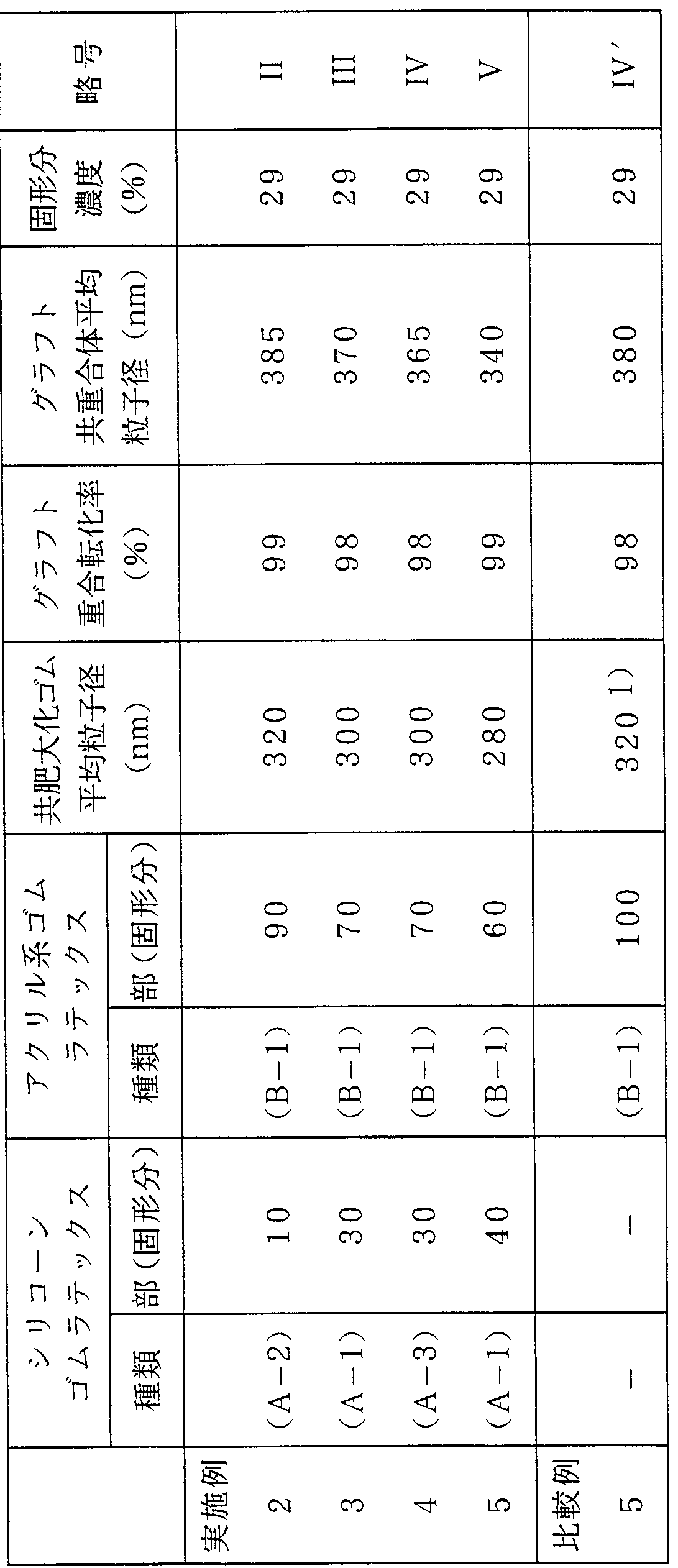
- Examples 2 to 5 and Comparative Example 5 (1) A mixture of silicone rubber and acrylic rubber latex Co-grown from mixed latex Production of Polymer Particles ( ⁇ ) to (V) and (IV ') As Examples 2 to 5, the silicone rubber latex and Example 1 in Example 1 were used. The types and amounts of the acrylic rubber latex were changed as shown in Table 3 in the same manner as in Example 1, except that the co-fertilized rubber and co-fertilized rubber were used. A latex of graphite copolymer particles (II) to (V) containing rubber was produced. As Comparative Example 5 except that only acrylic rubber latex was used as shown in Table 3, the enlarged rubber and the enlarged size were the same as in Example 1. A latex of graphite copolymer particles (IV ') containing rubber was produced.
- Example 4 Using the obtained latex copolymers ( ⁇ ) to (V) and (IV '), respectively, in the same manner as in Example 1 An AN-ST resin composition was manufactured and evaluated for izot impact strength, workability, and appearance in the same manner as in Example 1. The results are shown in Table 4. Table 4
- Example 6 the acrylic rubber latex (B-1) in Example 1 is replaced with the butadiene rubber latex (B-2).
- the type and amount of silicone rubber latex and butadiene rubber latex have been changed as shown in Table 5. Then, in the same manner as in Example 1, a latex of graphite copolymer particles (VI) to (Cor) containing co-enlarged rubber was produced.
- Example 6 except that only butadiene rubber latex was used as shown in Table 5, the same as in Example 1 except for the use of an enlarged rubber. A latex made of graft copolymer particles (V ') containing corn and hypertrophic rubber was produced.
- Example 6 Using the obtained latex copolymers (VI) to (Cor) and (V '), the same procedures as in Example 1 were performed, respectively. An AN-ST resin composition was manufactured, and the impact strength against izoto and the impact strength against falling weight were evaluated in the same manner as in Example 1. The results are shown in Table 6. Table 6
- Example 9 the co-hypertrophy obtained in Example 1 was Using the components shown in Table 7 including the rubber, latexes of the co-enlarged rubber-based graph copolymer particles (IX) to (X) were produced. The additional components were added dropwise in a nitrogen stream at a polymerization temperature of 60 ° C over 4 hours. After completion of the dropwise addition, the polymerization was terminated by continuing stirring for 1 hour. Further, as Comparative Examples 7 and 8, the same graph polymerization was performed on the silicone-acrylic composite rubber obtained in Comparative Example 3, Latexes of silicone-acrylic composite rubber-based graft copolymer particles (VI ') to (') were obtained.
- thermoplastic resin composition powder a phenolic stabilizer (AO-20, manufactured by Asahi Denka Kogyo Co., Ltd.) was added to 0.2 part. And 0.5 parts of Ethylenevista Relymide, and mixed with a single-screw extruder (Tabata Kikai Co., Ltd., HW-40-28). Pellets were produced by melt-kneading. This pellet was set at a cylinder temperature of 260 ° C using a FAS100B injection molding machine manufactured by FANUC Co., Ltd. A shaped body was produced. Drop weight impact strength and heat resistance (HDT) were evaluated. In addition, the injection molding processability was evaluated using pellets. Table 8 shows the results.
- AO-20 manufactured by Asahi Denka Kogyo Co., Ltd.
- thermoplastic resin composition of the present invention not only has excellent impact resistance and processability, but also has good heat resistance. I understand what it is.
- Methyl methacrylate (M M A 20 part t-butyl halide ⁇
- the obtained latex was mixed with 2 parts of salted calcium and coagulated, and then the coagulated slurry was dehydrated and dried to obtain a co-enlarged rubber.
- a powder consisting of the system-derived daphtal copolymer particles (XI) was obtained.
- Vinyl chloride resin 100 parts Graphite copolymer particles (XI) 10 parts Suzuki stabilizer 2.5 parts Lubricant 0.5 part Filler 3.0 parts Polymer processing aid 2 parts of the mixture was kneaded for 5 minutes with a hot roll adjusted to 180 ° C, and then compression molded at 190 ° C for 15 minutes A test piece was prepared from the test piece.
- salted vinyl resin is Kanevinyl S1008 manufactured by Kaneka Kagaku Kogyo Co., Ltd.
- tin-based stabilizer is N— manufactured by Nitto Kasei Co., Ltd.
- lubricant is Hoechst-ffachs E, manufactured by Hoechst
- filler is R-650, manufactured by Sakai Chemical Co., Ltd.
- the polymer processing aid used was Kanace PA-20 manufactured by Kanegafuchi Chemical Industry Co., Ltd.
- Izod impact strength was measured at 23 ° C and 0 ° C.
- the same measurement was performed on test specimens exposed for 100 hours with a Sanctuary ⁇ ⁇ ⁇ ⁇ ⁇ ⁇ ⁇ ⁇ ⁇ ⁇ ⁇ ⁇ ⁇ ⁇ ⁇ ⁇ ⁇ .
- the color tone (initial color tone) and thermal discoloration of the test piece immediately after molding were also evaluated. Table 9 shows the results.
- Example 11 Graphite polymerization was carried out in the same manner as in Example 11 except that the silicone-acrylic compound rubber obtained in Comparative Example 3 was used, and the graphite copolymerization was carried out. A powder consisting of coalesced particles (weeks) was produced. In addition, in Example 1, the powder containing the graphite copolymer particles (Cor ') was used instead of the powder containing the graphite copolymer particles (XI). A vinyl chloride resin composition was produced in the same manner as in (2) of 11 and a test piece was prepared.
- the evaluation of the impact impact strength, the initial color tone, and the thermal discoloration were performed in the same manner as in Example 11.
- the results are shown in Table 9.
- the initial color tone in Table 9 is an azot prepared by blending the combination of (2) in Example 11 except for the graphite copolymer particles (XI). The color difference was evaluated based on the color tone of the test piece.
- Example 12 to 14 and Comparative Example 10 to 12 the weight of the graphite in the vinyl chloride resin composition in Example 11 and Comparative Example 9 was changed.
- the amounts of the coalesced particles were changed as shown in Table 10, and the test pieces were prepared and the izod impact test was carried out in the same manner as in Example 11. The results are shown in Table 10.
- Table 10 Table 10
- the composition containing the co-enlarged rubber-based graft copolymer particles of the present invention was found to be combined with the vinyl chloride resin in the composition. Even when the composition is changed, the silicone obtained by the conventional method is compared with a composition containing particles of an acrylic complex rubber-based graph copolymer. It can be seen that the impact resistance is excellent.
- Examples 15 to 18 depict the silicone linguistics and the types of acryl gonula tex in Example 1. Except that the amounts and amounts were changed as shown in Table 11, co-enlarged rubber was produced in the same manner as in Example 1. Using the obtained co-fertilized rubber, the graft copolymerization was carried out in the same manner as in Example 11 Each powder consisting of body particles (XII) to (XV) was obtained. Table 11 shows the average particle size of the obtained co-enlarged rubber particles and the obtained graphitized copolymer particles, and the polymerization conversion rate of the graphitized polymerization.
- Example 11 (2) Production of vinyl chloride resin composition and evaluation of physical properties
- co-enlarged rubber was replaced with powder of rubber-based graft copolymer (XI).
- powder of the polymer particles (XII) to (XV) was used for the rubber-based graphite
- the preparation of the vinyl chloride resin composition and Test specimens were prepared, and the izho impact strength was measured. The results are shown in Table 12.
- the acrylic rubber latex obtained in Production Example 7 was used instead of the silicone rubber latex (A-2).
- Example 19 the co-enlarged rubber-based graphitic copolymer particles (XVI) using the following components, including the co-enlarged rubber obtained in Example 1, were used.
- powder 3 of Contact and manufacture of, in Polymerization temperature is 6 0 ° C, was added dropwise additional components 3 hours Placing by the under Chi Tsu nitrogen stream. after the completion of the dropwise addition, the one hour stirring et Subsequently, the polymerization was terminated. The latex power and the recovery of these powders were the same as in Example 11. The polymerization conversion was 98%, and the average particle size was 370 nm.
- Comparative Example 14 As Comparative Example 14, the silicone resin obtained in Comparative Example 3 was used. A powder of graphite copolymer particles (X ') was produced in the same manner as described above except that the acrylic composite rubber was used.
- the powder of the obtained graphite copolymer particles was combined with 100 parts of the thermoplastic resin shown in Table 13 at the ratio shown in Table 13 to obtain a phenol.
- 0.2 parts of a polyester-based stabilizer (A0-20, manufactured by Asahi Denka Kogyo Co., Ltd.) and 0.5 parts of ethylene bistea amide Pellets were produced by melting and kneading with a single-screw extruder (TAWATA MACHINE CO., LTD., HW-40-28).
- TAWATA MACHINE CO., LTD., HW-40-28 single-screw extruder
- thermoplastic resins in Table 13 are as shown below.o
- silicone rubber latex and acrylic rubber latex and (or) conjugated gene rubber latex are used.
- graphitic copolymer particles which are thermoplastic resin modifiers.
- the thermoplastic resin composition comprising the graphite copolymer particles and the thermoplastic resin has excellent impact resistance, weather resistance, workability, thermochromic properties, and molded appearance. .
Landscapes
- Chemical & Material Sciences (AREA)
- Health & Medical Sciences (AREA)
- Chemical Kinetics & Catalysis (AREA)
- Medicinal Chemistry (AREA)
- Polymers & Plastics (AREA)
- Organic Chemistry (AREA)
- Graft Or Block Polymers (AREA)
- Compositions Of Macromolecular Compounds (AREA)
Description




Claims
Priority Applications (4)
| Application Number | Priority Date | Filing Date | Title |
|---|---|---|---|
| US09/269,331 US6153694A (en) | 1997-07-29 | 1998-07-24 | Graft copolymer particles and thermoplastic resin compositions |
| EP98933918A EP0943635B1 (en) | 1997-07-29 | 1998-07-24 | Graft copolymer particles and thermoplastic resin compositions |
| CA002266506A CA2266506C (en) | 1997-07-29 | 1998-07-24 | Graft copolymer particles and thermoplastic resin compositions |
| DE69827467T DE69827467T2 (de) | 1997-07-29 | 1998-07-24 | Pfropfcopolymerteilchen und thermoplastische Harzzusammensetzungen |
Applications Claiming Priority (2)
| Application Number | Priority Date | Filing Date | Title |
|---|---|---|---|
| JP20313997 | 1997-07-29 | ||
| JP9/203139 | 1997-07-29 |
Publications (1)
| Publication Number | Publication Date |
|---|---|
| WO1999006457A1 true WO1999006457A1 (fr) | 1999-02-11 |
Family
ID=16469070
Family Applications (1)
| Application Number | Title | Priority Date | Filing Date |
|---|---|---|---|
| PCT/JP1998/003304 Ceased WO1999006457A1 (fr) | 1997-07-29 | 1998-07-24 | Particules de copolymeres greffes et compositions de resines thermoplastiques |
Country Status (10)
| Country | Link |
|---|---|
| US (1) | US6153694A (ja) |
| EP (1) | EP0943635B1 (ja) |
| JP (1) | JP3634964B2 (ja) |
| KR (1) | KR100570050B1 (ja) |
| CN (1) | CN1137171C (ja) |
| CA (1) | CA2266506C (ja) |
| DE (1) | DE69827467T2 (ja) |
| MY (1) | MY115598A (ja) |
| TW (1) | TW570936B (ja) |
| WO (1) | WO1999006457A1 (ja) |
Cited By (1)
| Publication number | Priority date | Publication date | Assignee | Title |
|---|---|---|---|---|
| US6822045B2 (en) * | 2000-12-05 | 2004-11-23 | Kaneka Corporation | Rubber-modified resin and thermoplastic resin composition containing the same |
Families Citing this family (33)
| Publication number | Priority date | Publication date | Assignee | Title |
|---|---|---|---|---|
| US7169853B2 (en) * | 1997-10-23 | 2007-01-30 | University Of Florida Research Foundation, Inc. | Polyamide graft copolymers |
| CN1100800C (zh) * | 2000-01-07 | 2003-02-05 | 中国石油兰州化学工业公司 | 大粒径胶乳的合成方法 |
| DE10058133A1 (de) * | 2000-11-22 | 2002-05-23 | Basf Ag | Verfahren zur Herstellung kautschukhaltiger thermoplastischer Formmassen |
| CN1307257C (zh) * | 2000-12-25 | 2007-03-28 | 三菱丽阳株式会社 | 接枝共聚物和热塑性树脂组合物 |
| JP2002234920A (ja) * | 2001-02-09 | 2002-08-23 | Kanegafuchi Chem Ind Co Ltd | 熱可塑性樹脂用耐衝撃性改良剤及びそれを含む樹脂組成物 |
| JP3694789B2 (ja) * | 2001-09-18 | 2005-09-14 | Jsr株式会社 | 熱可塑性エラストマー組成物および成形品 |
| US7030066B1 (en) | 2001-11-12 | 2006-04-18 | Charles Piskoti | Wetting composition for high temperature metal surfaces, and method of making the same |
| CN100429272C (zh) * | 2002-04-30 | 2008-10-29 | 株式会社钟化 | 含聚有机硅氧烷的接枝共聚物组合物 |
| CN1802394B (zh) * | 2003-04-11 | 2012-05-09 | 株式会社钟化 | 含聚有机硅氧烷的接枝共聚物、包含该接枝共聚物的树脂组合物以及聚有机硅氧烷乳液的制造方法 |
| KR100528771B1 (ko) * | 2003-08-02 | 2005-11-15 | 주식회사 엘지화학 | 아크릴-실리콘계 복합 충격보강제, 이의 제조방법 및 이를함유하는 염화비닐 수지 조성물 |
| JP5344791B2 (ja) * | 2004-02-24 | 2013-11-20 | 株式会社カネカ | グラフト共重合体、該共重合体からなる難燃剤及び該難燃剤を配合した樹脂組成物 |
| WO2006054477A1 (ja) * | 2004-11-22 | 2006-05-26 | Kaneka Corporation | グラフト重合体及び該重合体を配合した樹脂組成物 |
| US7541401B2 (en) * | 2004-12-31 | 2009-06-02 | Cheil Industries Inc. | Impact modifier for a polymer composition and method for preparing the same |
| WO2006070983A1 (en) * | 2004-12-31 | 2006-07-06 | Cheil Industries Inc. | Silicone impact modifier with high refractive index and method for preparing the same |
| KR100836731B1 (ko) | 2005-10-13 | 2008-06-10 | 주식회사 엘지화학 | 아크릴-실리콘계 고무 복합 중합체, 이의 제조방법 및 용도 |
| WO2009017118A1 (ja) * | 2007-07-31 | 2009-02-05 | Techno Polymer Co., Ltd. | 積層体 |
| GB0812186D0 (en) | 2008-07-03 | 2008-08-13 | Dow Corning | Modified polyolefins |
| GB0812185D0 (en) | 2008-07-03 | 2008-08-13 | Dow Corning | Polymers modified by silanes |
| GB201000120D0 (en) | 2010-01-06 | 2010-02-17 | Dow Corning | Process for forming crosslinked and branched polymers |
| GB201000117D0 (en) | 2010-01-06 | 2010-02-17 | Dow Corning | Organopolysiloxanes containing an unsaturated group |
| GB201000121D0 (en) | 2010-01-06 | 2010-02-17 | Dow Corning | Modified polyolefins |
| CN104497187B (zh) * | 2014-12-29 | 2017-03-22 | 苏州大学 | 一种苯基四甲基二硅氧烷改性三元乙丙橡胶及其制备方法 |
| CN106496450B (zh) * | 2016-09-30 | 2018-11-27 | 深圳航天科技创新研究院 | 一种应力响应型聚甲基丙烯酸甲酯改性硅硼聚合物微凝胶及其制备方法 |
| US10882956B2 (en) | 2016-12-09 | 2021-01-05 | Sabic Global Technologies B.V. | Polyetherimide composition and associated article and additive manufacturing method |
| CN107151296B (zh) * | 2017-04-18 | 2019-01-29 | 华南理工大学 | 大粒径核壳结构聚硅氧烷-丙烯酸酯/苯乙烯共聚物的制备方法 |
| EP3546520A1 (en) | 2018-03-28 | 2019-10-02 | SABIC Global Technologies B.V. | Impact modified polyestercarbonate-polysiloxane composition and associated article and additive manufacturing method |
| EP3663367A1 (en) | 2018-12-05 | 2020-06-10 | SABIC Global Technologies B.V. | Core-shell filament, method of forming a core-shell filament, method of forming an article by fused filament fabrication, and article formed thereby |
| CN113227249B (zh) * | 2018-12-27 | 2024-03-15 | 株式会社钟化 | 树脂组合物及其应用 |
| WO2020196921A1 (ja) | 2019-03-28 | 2020-10-01 | 株式会社カネカ | 樹脂組成物の製造方法および樹脂組成物 |
| EP3771723A1 (en) | 2019-07-31 | 2021-02-03 | SHPP Global Technologies B.V. | Additive manufacturing article and method |
| JP7474204B2 (ja) * | 2021-01-28 | 2024-04-24 | 日信化学工業株式会社 | 塗料組成物、家具及び建築内装用塗料組成物、並びに積層体 |
| JP7474205B2 (ja) * | 2021-01-28 | 2024-04-24 | 日信化学工業株式会社 | 外壁及び建築外装用塗料組成物、並びに積層体 |
| KR20230035718A (ko) | 2021-09-06 | 2023-03-14 | 주식회사 엘지화학 | 아크릴계 응집제 및 이를 이용한 그라프트 중합체의 제조방법 |
Citations (2)
| Publication number | Priority date | Publication date | Assignee | Title |
|---|---|---|---|---|
| JPH0525227A (ja) * | 1991-07-23 | 1993-02-02 | Mitsubishi Rayon Co Ltd | 熱可塑性樹脂 |
| JPH09217006A (ja) * | 1996-02-10 | 1997-08-19 | Kanegafuchi Chem Ind Co Ltd | 耐熱性熱可塑性樹脂組成物 |
Family Cites Families (4)
| Publication number | Priority date | Publication date | Assignee | Title |
|---|---|---|---|---|
| US5045595A (en) * | 1988-11-14 | 1991-09-03 | General Electric Company | Polyorganosiloxane/polyvinyl-based graft polymers, process and thermoplastic compositions containing the same |
| JP2726918B2 (ja) * | 1989-07-03 | 1998-03-11 | 三菱レイヨン株式会社 | 耐衝撃性熱可塑性樹脂組成物 |
| JP2926367B2 (ja) * | 1991-01-14 | 1999-07-28 | 三菱レイヨン株式会社 | グラフト共重合体 |
| US5336720A (en) * | 1991-06-05 | 1994-08-09 | Rohm And Haas Company | Impact resistant polymers |
-
1998
- 1998-07-24 WO PCT/JP1998/003304 patent/WO1999006457A1/ja not_active Ceased
- 1998-07-24 EP EP98933918A patent/EP0943635B1/en not_active Expired - Lifetime
- 1998-07-24 KR KR1019997002645A patent/KR100570050B1/ko not_active Expired - Fee Related
- 1998-07-24 CN CNB988012359A patent/CN1137171C/zh not_active Expired - Fee Related
- 1998-07-24 US US09/269,331 patent/US6153694A/en not_active Expired - Lifetime
- 1998-07-24 CA CA002266506A patent/CA2266506C/en not_active Expired - Fee Related
- 1998-07-24 JP JP20968998A patent/JP3634964B2/ja not_active Expired - Fee Related
- 1998-07-24 DE DE69827467T patent/DE69827467T2/de not_active Expired - Lifetime
- 1998-07-27 TW TW087112232A patent/TW570936B/zh not_active IP Right Cessation
- 1998-07-28 MY MYPI98003448A patent/MY115598A/en unknown
Patent Citations (2)
| Publication number | Priority date | Publication date | Assignee | Title |
|---|---|---|---|---|
| JPH0525227A (ja) * | 1991-07-23 | 1993-02-02 | Mitsubishi Rayon Co Ltd | 熱可塑性樹脂 |
| JPH09217006A (ja) * | 1996-02-10 | 1997-08-19 | Kanegafuchi Chem Ind Co Ltd | 耐熱性熱可塑性樹脂組成物 |
Non-Patent Citations (1)
| Title |
|---|
| See also references of EP0943635A4 * |
Cited By (1)
| Publication number | Priority date | Publication date | Assignee | Title |
|---|---|---|---|---|
| US6822045B2 (en) * | 2000-12-05 | 2004-11-23 | Kaneka Corporation | Rubber-modified resin and thermoplastic resin composition containing the same |
Also Published As
| Publication number | Publication date |
|---|---|
| CA2266506A1 (en) | 1999-02-11 |
| JPH11100481A (ja) | 1999-04-13 |
| US6153694A (en) | 2000-11-28 |
| EP0943635B1 (en) | 2004-11-10 |
| KR20000068646A (ko) | 2000-11-25 |
| CN1237185A (zh) | 1999-12-01 |
| CA2266506C (en) | 2005-09-27 |
| TW570936B (en) | 2004-01-11 |
| EP0943635A1 (en) | 1999-09-22 |
| DE69827467D1 (de) | 2004-12-16 |
| JP3634964B2 (ja) | 2005-03-30 |
| CN1137171C (zh) | 2004-02-04 |
| EP0943635A4 (en) | 2001-08-16 |
| DE69827467T2 (de) | 2005-11-10 |
| KR100570050B1 (ko) | 2006-04-10 |
| MY115598A (en) | 2003-07-31 |
Similar Documents
| Publication | Publication Date | Title |
|---|---|---|
| JP3634964B2 (ja) | グラフト共重合体粒子および熱可塑性樹脂組成物 | |
| JP4907814B2 (ja) | グラフト共重合体およびこれを含む熱可塑性樹脂組成物 | |
| JP4702998B2 (ja) | ゴム変性樹脂およびそれを含有する熱可塑性樹脂組成物 | |
| JPWO2001023449A1 (ja) | グラフト共重合体およびこれを含む熱可塑性樹脂組成物 | |
| US5804655A (en) | Silicone-modified acrylic rubber particles, graft copolymer particles of silicone-modified acrylic rubber and thermoplastic resin composition | |
| JP3532994B2 (ja) | 熱可塑性樹脂組成物 | |
| JPH04239010A (ja) | グラフト共重合体 | |
| JPH04100812A (ja) | 複合ゴム系グラフト共重合体粒子 | |
| JPH10316724A (ja) | シリコーン変性アクリルゴム粒子、シリコーン変性アクリルゴム系グラフト共重合体粒子および熱可塑性樹脂組成物 | |
| JP3945861B2 (ja) | 熱可塑性樹脂組成物 | |
| JP3561375B2 (ja) | ポリオルガノシロキサン含有グラフト共重合体 | |
| JPH10310616A (ja) | シリコーン変性アクリルゴム粒子、シリコーン変性アクリルゴム系グラフト共重合体粒子および熱可塑性樹脂組成物 | |
| JP2000302941A (ja) | 耐衝撃性樹脂組成物 | |
| JP3218195B2 (ja) | 熱可塑性樹脂組成物 | |
| JPH028209A (ja) | ポリオルガノシロキサン系熱可塑性樹脂組成物 | |
| JP4124863B2 (ja) | 熱可塑性樹脂組成物 | |
| JP2958059B2 (ja) | 熱可塑性樹脂組成物 | |
| JP3662617B2 (ja) | 熱可塑性樹脂組成物 | |
| JPH07331025A (ja) | 二次加工用熱可塑性樹脂組成物 | |
| JPH08239531A (ja) | 熱可塑性樹脂組成物 | |
| JP2926367B2 (ja) | グラフト共重合体 | |
| JPH10218951A (ja) | 架橋樹脂粒子の製法およびそれからえられた架橋樹脂粒子、ならびにそれを含有してなる熱可塑性樹脂組成物 | |
| JPH10182759A (ja) | 熱安定性の良好なグラフト共重合体組成物 | |
| JPH08199025A (ja) | 熱可塑性樹脂組成物 | |
| JP3453212B2 (ja) | グラフト共重合体 |
Legal Events
| Date | Code | Title | Description |
|---|---|---|---|
| WWE | Wipo information: entry into national phase |
Ref document number: 98801235.9 Country of ref document: CN |
|
| AK | Designated states |
Kind code of ref document: A1 Designated state(s): CA CN KR US |
|
| AL | Designated countries for regional patents |
Kind code of ref document: A1 Designated state(s): AT BE CH CY DE DK ES FI FR GB GR IE IT LU MC NL PT SE |
|
| ENP | Entry into the national phase |
Ref document number: 2266506 Country of ref document: CA Ref document number: 2266506 Country of ref document: CA Kind code of ref document: A |
|
| WWE | Wipo information: entry into national phase |
Ref document number: 09269331 Country of ref document: US |
|
| WWE | Wipo information: entry into national phase |
Ref document number: 1019997002645 Country of ref document: KR |
|
| WWE | Wipo information: entry into national phase |
Ref document number: 1998933918 Country of ref document: EP |
|
| 121 | Ep: the epo has been informed by wipo that ep was designated in this application | ||
| WWP | Wipo information: published in national office |
Ref document number: 1998933918 Country of ref document: EP |
|
| WWP | Wipo information: published in national office |
Ref document number: 1019997002645 Country of ref document: KR |
|
| WWG | Wipo information: grant in national office |
Ref document number: 1998933918 Country of ref document: EP |
|
| WWG | Wipo information: grant in national office |
Ref document number: 1019997002645 Country of ref document: KR |