WO2000027799A1 - Nuevos esteres derivados de compuestos fenil-ciclohexil sustituidos - Google Patents
Nuevos esteres derivados de compuestos fenil-ciclohexil sustituidos Download PDFInfo
- Publication number
- WO2000027799A1 WO2000027799A1 PCT/ES1999/000352 ES9900352W WO0027799A1 WO 2000027799 A1 WO2000027799 A1 WO 2000027799A1 ES 9900352 W ES9900352 W ES 9900352W WO 0027799 A1 WO0027799 A1 WO 0027799A1
- Authority
- WO
- WIPO (PCT)
- Prior art keywords
- phenyl
- alkyl
- optionally substituted
- methyl
- cyclohexyl
- Prior art date
- Legal status (The legal status is an assumption and is not a legal conclusion. Google has not performed a legal analysis and makes no representation as to the accuracy of the status listed.)
- Ceased
Links
Classifications
-
- C—CHEMISTRY; METALLURGY
- C07—ORGANIC CHEMISTRY
- C07C—ACYCLIC OR CARBOCYCLIC COMPOUNDS
- C07C219/00—Compounds containing amino and esterified hydroxy groups bound to the same carbon skeleton
- C07C219/26—Compounds containing amino and esterified hydroxy groups bound to the same carbon skeleton having esterified hydroxy groups bound to carbon atoms of at least one six-membered aromatic ring and amino groups bound to acyclic carbon atoms or to carbon atoms of rings other than six-membered aromatic rings of the same carbon skeleton
-
- C—CHEMISTRY; METALLURGY
- C07—ORGANIC CHEMISTRY
- C07C—ACYCLIC OR CARBOCYCLIC COMPOUNDS
- C07C271/00—Derivatives of carbamic acids, i.e. compounds containing any of the groups, the nitrogen atom not being part of nitro or nitroso groups
- C07C271/06—Esters of carbamic acids
- C07C271/40—Esters of carbamic acids having oxygen atoms of carbamate groups bound to carbon atoms of six-membered aromatic rings
- C07C271/42—Esters of carbamic acids having oxygen atoms of carbamate groups bound to carbon atoms of six-membered aromatic rings with the nitrogen atoms of the carbamate groups bound to hydrogen atoms or to acyclic carbon atoms
- C07C271/44—Esters of carbamic acids having oxygen atoms of carbamate groups bound to carbon atoms of six-membered aromatic rings with the nitrogen atoms of the carbamate groups bound to hydrogen atoms or to acyclic carbon atoms to hydrogen atoms or to carbon atoms of unsubstituted hydrocarbon radicals
-
- A—HUMAN NECESSITIES
- A61—MEDICAL OR VETERINARY SCIENCE; HYGIENE
- A61P—SPECIFIC THERAPEUTIC ACTIVITY OF CHEMICAL COMPOUNDS OR MEDICINAL PREPARATIONS
- A61P25/00—Drugs for disorders of the nervous system
-
- A—HUMAN NECESSITIES
- A61—MEDICAL OR VETERINARY SCIENCE; HYGIENE
- A61P—SPECIFIC THERAPEUTIC ACTIVITY OF CHEMICAL COMPOUNDS OR MEDICINAL PREPARATIONS
- A61P25/00—Drugs for disorders of the nervous system
- A61P25/04—Centrally acting analgesics, e.g. opioids
-
- C—CHEMISTRY; METALLURGY
- C07—ORGANIC CHEMISTRY
- C07C—ACYCLIC OR CARBOCYCLIC COMPOUNDS
- C07C219/00—Compounds containing amino and esterified hydroxy groups bound to the same carbon skeleton
- C07C219/26—Compounds containing amino and esterified hydroxy groups bound to the same carbon skeleton having esterified hydroxy groups bound to carbon atoms of at least one six-membered aromatic ring and amino groups bound to acyclic carbon atoms or to carbon atoms of rings other than six-membered aromatic rings of the same carbon skeleton
- C07C219/28—Compounds containing amino and esterified hydroxy groups bound to the same carbon skeleton having esterified hydroxy groups bound to carbon atoms of at least one six-membered aromatic ring and amino groups bound to acyclic carbon atoms or to carbon atoms of rings other than six-membered aromatic rings of the same carbon skeleton having amino groups bound to acyclic carbon atoms of the carbon skeleton
- C07C219/30—Compounds containing amino and esterified hydroxy groups bound to the same carbon skeleton having esterified hydroxy groups bound to carbon atoms of at least one six-membered aromatic ring and amino groups bound to acyclic carbon atoms or to carbon atoms of rings other than six-membered aromatic rings of the same carbon skeleton having amino groups bound to acyclic carbon atoms of the carbon skeleton with amino groups linked to the six-membered aromatic ring, or to the condensed ring system containing that ring, by carbon chains further substituted by singly-bound oxygen atoms
-
- C—CHEMISTRY; METALLURGY
- C07—ORGANIC CHEMISTRY
- C07D—HETEROCYCLIC COMPOUNDS
- C07D487/00—Heterocyclic compounds containing nitrogen atoms as the only ring hetero atoms in the condensed system, not provided for by groups C07D451/00 - C07D477/00
- C07D487/02—Heterocyclic compounds containing nitrogen atoms as the only ring hetero atoms in the condensed system, not provided for by groups C07D451/00 - C07D477/00 in which the condensed system contains two hetero rings
- C07D487/04—Ortho-condensed systems
-
- C—CHEMISTRY; METALLURGY
- C07—ORGANIC CHEMISTRY
- C07B—GENERAL METHODS OF ORGANIC CHEMISTRY; APPARATUS THEREFOR
- C07B2200/00—Indexing scheme relating to specific properties of organic compounds
- C07B2200/07—Optical isomers
-
- C—CHEMISTRY; METALLURGY
- C07—ORGANIC CHEMISTRY
- C07C—ACYCLIC OR CARBOCYCLIC COMPOUNDS
- C07C2601/00—Systems containing only non-condensed rings
- C07C2601/12—Systems containing only non-condensed rings with a six-membered ring
- C07C2601/14—The ring being saturated
-
- C—CHEMISTRY; METALLURGY
- C07—ORGANIC CHEMISTRY
- C07C—ACYCLIC OR CARBOCYCLIC COMPOUNDS
- C07C2601/00—Systems containing only non-condensed rings
- C07C2601/12—Systems containing only non-condensed rings with a six-membered ring
- C07C2601/16—Systems containing only non-condensed rings with a six-membered ring the ring being unsaturated
Definitions
- the present invention relates to new esters derived from substituted phenyl-cyclohexyl compounds, derived from Tramadol.
- the compounds obtained have an analgesic activity superior to tramadol, a lower toxicity and a longer duration of action.
- NSAIDs non-steroidal anti-inflammatory compounds
- opioid compounds have a number of unwanted side effects, such as constipation, respiratory depression, tolerance and possibility of addiction.
- US Patent 3652589 describes a class of analgesic compounds with the structure of substituted cycloalkanol phenol ethers having a basic amino group in the cycloalkyl ring.
- O-desmethyltramadol which has been described as one of the products of ethabolization of Tramadol (Von W. Lintz et al. Arzneim-Forsch (Drug Res) 31 (II); 1932- 43 (1981)
- To its isomer (+) is attributed the analgesic activity of Tramadol (Lars Poulsen et al. Clin. Pharmacol. Ther (St. Louis) 1996, 60 (6), 636-644). on the clinical use of the metabolite O-desmethyltramadol.
- Tramadol has an opioid agonist effect. However, clinical experience with Tramadol indicates that despite this, it does not have some of the typical side effects of opioid agonists, such as respiratory depression (W. Vogel et al. Arzneim. Forsch (Drug Res)
- the present invention relates to new esters of O-desmethyltramadol or its 1,2-dehydrated derivative.
- the analgesic activity of these compounds has been superior to Tramadol with a lower toxicity and with a longer duration of action after oral administration (See Figure 1).
- R 2 is: OH
- R 3 is: H; or R 2 and R 3 together form a double bond;
- R 4 is: H or C1-C 3 alkyl
- R 5 is: H, NH 2 , NH-Rn or 0-R u ;
- R 6 is: H, CO-Rn, O-Rn, or halogen;
- R 8 is: OH, -O-CO-N (CH 3 ) 2 or NH-R; R ? and Rio are: H or C1-C4 alkyl, same or different, or form a bond -CH 2 - CH 2 -;
- Rn is: phenyl; phenyl optionally substituted by 1 or more of the following substituents: halogen (Cl, Br, I), N0 2 , C ⁇ -C 6 alkyl, C 2 -C 6 alkenyl, OH, or NH 2 ;
- R12 and R13 are: H, or 0-C1-C3 alkyl, the same or different.
- R 4 is methyl or H
- R 5 is NH 2 , 2, 5-dichlorophenylamino or H
- R 6 is CO-substituted phenyl or H
- R 7 is isobutyl or H
- Re and R7 form a substituted condensed aromatic ring.
- the products are: - 2- (4-Isobutyl-phenyl) -propionate of 3- (2-dimethylamino-) methyl-1-hydroxy-cyclohexyl) -phenyl
- R 8 is OH or -O-CO-N (CH 3 ) 2 .
- R 9 is methyl or H or it forms a bond -CH 2 -CH 2 - with Rio. More preferably, when Ri is C, the products are:
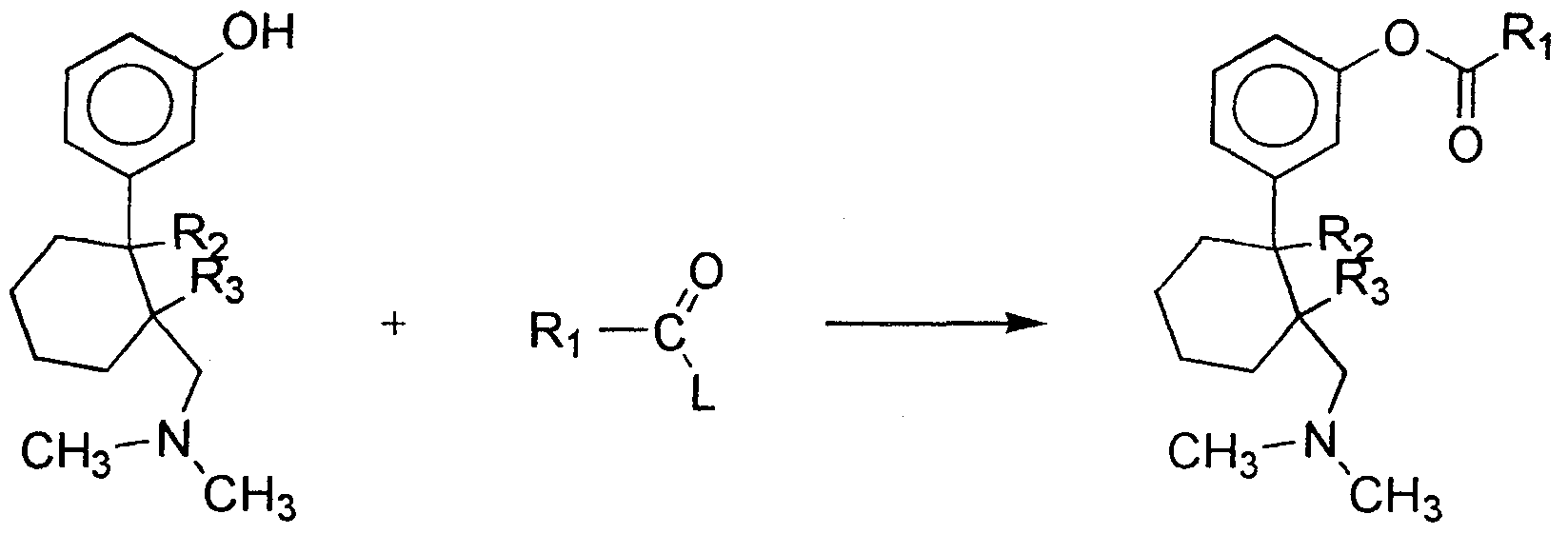
- the compounds of general formula (I) of the present invention can be obtained by a general procedure characterized by reacting a compound of general formula (II) with the corresponding acid or acid derivative of general formula III.
- R i4 C ⁇ -6 alkyl, phenyl, optionally substituted phenyl, and
- Ris Alkyl, a phenyl ring optionally substituted by one or more substituents or a heterocyclic ring optionally substituted by one or more substituents.
- L e's OH or halogen Preferably
- the reaction is carried out in an inert solvent, preferably dichloromethane, tetrahydrofuran, etc., in a range of temperatures between -20 ° and 120 ° C, preferably between 0 ° and 35 ° C and preferably in the presence of a favoring agent of condensation, such as carbonyldiimidazole, dicyclohexylcarbo-diimide, etc.
- an inert solvent preferably dichloromethane, tetrahydrofuran, etc.
- the method used is that described by Eddy N.B. and Leimbach D. (J. Phar. Exp. Ther. 107: 385-393, 1953).
- the analgesic effect of the products was assessed by analyzing the behavior of the animals on a hot surface maintained at 55 ° C ⁇ 1 ° C. Swiss male mice weighing 20-25 g were used.
- the compounds under study were administered orally or intraperitoneally 1 hour or 30 minutes before starting the test, respectively.
- the procedure consisted of placing the animals on the plate kept in a plexiglass cylinder of 25 cm high and 21 'crn high. The time it took for the animals to jump off the hot surface was determined. The animals were selected before the start of the test in such a way that those who remained for more than 10 seconds without jumping were not included in the group that would receive treatment.
- the analgesic activity on the hot plate was evaluated 1,3,6,8 and 24 hours after the administration of the product in addition to the control group that only received treatment with the vehicle.
- the baseline responses were assessed 30 and 5 minutes prior to the administration of the products.
- mice of the same batch weighing 20-25 g, are used. Before administering the products, the animals remained a 12-hour period of fast food with free access to water intake. Several subgroups of 10 randomly selected animals were administered orally and in single administration with increasing doses of the products, after which they remained for a 14-day observation period with free access to water and food. In the end, the number of dead animals in each subgroup was quantified and the value of the LD50 was calculated (1-2).
- Figure 1 shows the time course of the analgesic effect in the hot plate test in mouse, represented as the percent increase in response time with respect to the time (in hours) elapsed after product administration.
- tramadol represented in gray
- compound (I) of example 6 represented in stripes
- example 1 represented in black.
- ⁇ -RMN (CDC1 3 ): 1.20-2.25 (m, 16H) which includes 2.11 (s, 6H); 2.45 (dd, 1 H); 6.90-7.15 (m, 3H); 7.30-7.48 (m, 3H); 7.48-7.62 (m, 1 H); 8.08 (dd, 1 H); 10.55 (s, 1H, exchange with D 2 0)
- ⁇ -RMN (CDC1 3 ): 1.60-1.80 (, 4H); 2.10 (s, 6H); 2.15-2.35 (m, 4H); 2.75 (s, 2H); 6.90-7.10 (m, 5H); 7.40 (t, 1 H); 7.55 (t, 1 H); 8.10 (d, 1 H); 10.50 (sa, 1H, exchange with D 2 0).
- Table 1 shows the results of the pharmacological activity of various examples of the product of the invention, as well as Tramadol. The results are expressed as the% increase in response time in the hot plate text.
- Table 2 shows the acute toxicity values of Tramadol and examples of the product of the invention, observing the lower toxicity of the latter.
Landscapes
- Chemical & Material Sciences (AREA)
- Organic Chemistry (AREA)
- Health & Medical Sciences (AREA)
- Medicinal Chemistry (AREA)
- General Health & Medical Sciences (AREA)
- Neurology (AREA)
- Neurosurgery (AREA)
- Bioinformatics & Cheminformatics (AREA)
- Chemical Kinetics & Catalysis (AREA)
- General Chemical & Material Sciences (AREA)
- Engineering & Computer Science (AREA)
- Nuclear Medicine, Radiotherapy & Molecular Imaging (AREA)
- Veterinary Medicine (AREA)
- Pharmacology & Pharmacy (AREA)
- Life Sciences & Earth Sciences (AREA)
- Animal Behavior & Ethology (AREA)
- Biomedical Technology (AREA)
- Public Health (AREA)
- Pain & Pain Management (AREA)
- Acyclic And Carbocyclic Compounds In Medicinal Compositions (AREA)
- Organic Low-Molecular-Weight Compounds And Preparation Thereof (AREA)
- Pharmaceuticals Containing Other Organic And Inorganic Compounds (AREA)
- Nitrogen Condensed Heterocyclic Rings (AREA)
Abstract
Description




Claims


Priority Applications (28)
| Application Number | Priority Date | Filing Date | Title |
|---|---|---|---|
| UA2001063799A UA59477C2 (uk) | 1998-11-06 | 1999-04-11 | Складні ефіри, отримані із заміщених феніл-циклогексилових сполук, спосіб їх отримання |
| ES99953994T ES2207298T3 (es) | 1998-11-06 | 1999-11-04 | Nuevos esteres derivados de compuestos fenil-ciclohexil substituidos. |
| HR20010412A HRP20010412B1 (en) | 1998-11-06 | 1999-11-04 | New esters derived from substituted phenyl-cyclohexyl compounds |
| HU0104218A HUP0104218A3 (en) | 1998-11-06 | 1999-11-04 | New esters derived from substituted phenyl-cyclohexyl compounds |
| SI9930540T SI1219594T1 (en) | 1998-11-06 | 1999-11-04 | New esters derived from substituted phenyl-cyclohexyl compounds |
| NZ511739A NZ511739A (en) | 1998-11-06 | 1999-11-04 | New esters derived from substituted phenyl-cyclohexyl compounds |
| DE69911235T DE69911235T2 (de) | 1998-11-06 | 1999-11-04 | Neuartige ester abgeleitet von substituierten phenyl-cyclohexyl-verbindungen |
| JP2000580979A JP2002529442A (ja) | 1998-11-06 | 1999-11-04 | 置換フエニル−シクロヘキシル化合物由来の新規エステル |
| MXPA01004432A MXPA01004432A (es) | 1998-11-06 | 1999-11-04 | Nuevos esteres derivados de compuestos fenilciclohexil sustituidos. |
| AU10473/00A AU755681B2 (en) | 1998-11-06 | 1999-11-04 | New esters derived from substituted phenyl-cyclohexyl compounds |
| SI9930541T SI1219623T1 (en) | 1998-11-06 | 1999-11-04 | New esters derived from substituted phenyl-cyclohexyl compounds |
| PL99347492A PL347492A1 (en) | 1998-11-06 | 1999-11-04 | New esters derived from substituted phenyl-cyclohexyl compounds |
| EA200100476A EA003742B1 (ru) | 1998-11-06 | 1999-11-04 | Производные сложных эфиров о-диметилтрамадола, способ их получения и применение для получения лекарственного препарата |
| CA002349245A CA2349245A1 (en) | 1998-11-06 | 1999-11-04 | New esters derived from substituted phenyl-cyclohexyl compounds |
| AT99953994T ATE249418T1 (de) | 1998-11-06 | 1999-11-04 | Neuartige ester abgeleitet von substituierten phenyl-cyclohexyl-verbindungen |
| US09/831,177 US6455585B1 (en) | 1998-11-06 | 1999-11-04 | Esters derived from substituted phennyl-cyclohexyl compounds |
| IL14259299A IL142592A0 (en) | 1998-11-06 | 1999-11-04 | New esters derived from substituted phenyl-cyclohexyl compounds |
| APAP/P/2001/002161A AP1222A (en) | 1998-11-06 | 1999-11-04 | New esters from substituted phenyl-cyclohexyl compounds. |
| BR9915727-6A BR9915727A (pt) | 1998-11-06 | 1999-11-04 | ésteres derivados de compostos de fenil-ciclohexila substituìdos |
| SI9930450T SI1127871T1 (en) | 1998-11-06 | 1999-11-04 | New esters derived from substituted phenyl-cyclohexyl compounds |
| DK99953994T DK1127871T3 (da) | 1998-11-06 | 1999-11-04 | Nye estere afledt af substituerede phenylcyclohexylforbindelser |
| AT02075837T ATE257837T1 (de) | 1998-11-06 | 1999-11-04 | Neuartige ester abgeleitet von substituierten phenyl-zyklohexyl-verbindungen |
| EP99953994A EP1127871B1 (en) | 1998-11-06 | 1999-11-04 | New esters derived from substituted phenyl-cyclohexyl compounds |
| SK584-2001A SK284068B6 (sk) | 1998-11-06 | 1999-11-04 | Ester odvodený od substituovanej fenylcyklohexylovej zlúčeniny, spôsob jeho prípravy a použitie |
| EEP200100246A EE200100246A (et) | 1998-11-06 | 1999-11-04 | Asendatud fenüültsükloheksüülühendite uued esterderivaadid |
| IS5934A IS5934A (is) | 1998-11-06 | 2001-05-03 | Nýir esterar leiddir af útskiptum fenýlsyklóhexýlefnasamböndum |
| NO20012234A NO20012234L (no) | 1998-11-06 | 2001-05-04 | Nye estere avledet fra substituert fenyl- sykloheksylforbindelser |
| BG105556A BG105556A (en) | 1998-11-06 | 2001-06-01 | New esters derived from substituted phenyl-cyclohexyl compounds |
Applications Claiming Priority (2)
| Application Number | Priority Date | Filing Date | Title |
|---|---|---|---|
| ESP9802329 | 1998-11-06 | ||
| ES009802329A ES2141688B1 (es) | 1998-11-06 | 1998-11-06 | Nuevos esteres derivados de compuestos fenil-ciclohexil sustituidos. |
Publications (1)
| Publication Number | Publication Date |
|---|---|
| WO2000027799A1 true WO2000027799A1 (es) | 2000-05-18 |
Family
ID=8305698
Family Applications (1)
| Application Number | Title | Priority Date | Filing Date |
|---|---|---|---|
| PCT/ES1999/000352 Ceased WO2000027799A1 (es) | 1998-11-06 | 1999-11-04 | Nuevos esteres derivados de compuestos fenil-ciclohexil sustituidos |
Country Status (39)
| Country | Link |
|---|---|
| US (1) | US6455585B1 (es) |
| EP (3) | EP1219623B1 (es) |
| JP (1) | JP2002529442A (es) |
| KR (1) | KR100453613B1 (es) |
| CN (1) | CN1176902C (es) |
| AP (1) | AP1222A (es) |
| AT (3) | ATE249418T1 (es) |
| AU (1) | AU755681B2 (es) |
| BG (1) | BG105556A (es) |
| BR (1) | BR9915727A (es) |
| CA (1) | CA2349245A1 (es) |
| CR (1) | CR6368A (es) |
| CU (1) | CU23006A3 (es) |
| CZ (1) | CZ20011500A3 (es) |
| DE (3) | DE69914231T2 (es) |
| DK (3) | DK1127871T3 (es) |
| EA (1) | EA003742B1 (es) |
| EE (1) | EE200100246A (es) |
| ES (4) | ES2141688B1 (es) |
| GE (1) | GEP20033116B (es) |
| HR (1) | HRP20010412B1 (es) |
| HU (1) | HUP0104218A3 (es) |
| ID (1) | ID29017A (es) |
| IL (1) | IL142592A0 (es) |
| IS (1) | IS5934A (es) |
| MA (1) | MA26765A1 (es) |
| MX (1) | MXPA01004432A (es) |
| NO (1) | NO20012234L (es) |
| NZ (1) | NZ511739A (es) |
| OA (1) | OA11672A (es) |
| PL (1) | PL347492A1 (es) |
| PT (3) | PT1127871E (es) |
| SI (3) | SI1127871T1 (es) |
| SK (1) | SK284068B6 (es) |
| TR (3) | TR200200416T2 (es) |
| UA (1) | UA59477C2 (es) |
| WO (1) | WO2000027799A1 (es) |
| YU (1) | YU29601A (es) |
| ZA (1) | ZA200104026B (es) |
Cited By (4)
| Publication number | Priority date | Publication date | Assignee | Title |
|---|---|---|---|---|
| WO2001049650A1 (es) * | 1999-12-30 | 2001-07-12 | Vita-Invest, S. A. | Nuevos esteres derivados de (rr,ss)-2-hidroxibenzoato de 3-(2-dimetilaminometil-1-hidroxiciclohexil)fenilo |
| WO2004026291A1 (en) * | 2002-08-28 | 2004-04-01 | Shuyi Zhang | Oral formulations of ibuprofen and tramadol, methods and preparation thereof |
| EP2383255A1 (en) | 2010-04-28 | 2011-11-02 | Lacer, S.A. | New compounds, synthesis and use thereof in the treatment of pain |
| EP2530072A1 (en) | 2011-06-03 | 2012-12-05 | Lacer, S.A. | New compounds, synthesis and use thereof in the treatment of pain |
Families Citing this family (35)
| Publication number | Priority date | Publication date | Assignee | Title |
|---|---|---|---|---|
| DE10049483A1 (de) * | 2000-09-29 | 2002-05-02 | Gruenenthal Gmbh | Substituierte 1-Aminobutan-3-ol-Derivate |
| US7776314B2 (en) | 2002-06-17 | 2010-08-17 | Grunenthal Gmbh | Abuse-proofed dosage system |
| DE50312678D1 (de) | 2002-11-22 | 2010-06-10 | Gruenenthal Gmbh | Verwendung von (1R, 2R)-3-(3-Dimenthylamino-1-ethyl-2-methyl-propyl)-phenol zur Behandlung von Entzündungsschmerz |
| US20040248979A1 (en) * | 2003-06-03 | 2004-12-09 | Dynogen Pharmaceuticals, Inc. | Method of treating lower urinary tract disorders |
| US8075872B2 (en) | 2003-08-06 | 2011-12-13 | Gruenenthal Gmbh | Abuse-proofed dosage form |
| US20070048228A1 (en) | 2003-08-06 | 2007-03-01 | Elisabeth Arkenau-Maric | Abuse-proofed dosage form |
| DE102004032051A1 (de) | 2004-07-01 | 2006-01-19 | Grünenthal GmbH | Verfahren zur Herstellung einer gegen Missbrauch gesicherten, festen Darreichungsform |
| DE10336400A1 (de) | 2003-08-06 | 2005-03-24 | Grünenthal GmbH | Gegen Missbrauch gesicherte Darreichungsform |
| DE102005005446A1 (de) | 2005-02-04 | 2006-08-10 | Grünenthal GmbH | Bruchfeste Darreichungsformen mit retardierter Freisetzung |
| DE10361596A1 (de) | 2003-12-24 | 2005-09-29 | Grünenthal GmbH | Verfahren zur Herstellung einer gegen Missbrauch gesicherten Darreichungsform |
| DE102004032049A1 (de) | 2004-07-01 | 2006-01-19 | Grünenthal GmbH | Gegen Missbrauch gesicherte, orale Darreichungsform |
| DE102004034619A1 (de) * | 2004-07-16 | 2006-02-23 | Grünenthal GmbH | Substituierte Aminoverbindungen als 5-HT/NA Uptakehemmer |
| DE102005005449A1 (de) | 2005-02-04 | 2006-08-10 | Grünenthal GmbH | Verfahren zur Herstellung einer gegen Missbrauch gesicherten Darreichungsform |
| DE102007011485A1 (de) | 2007-03-07 | 2008-09-11 | Grünenthal GmbH | Darreichungsform mit erschwertem Missbrauch |
| TWI454288B (zh) | 2008-01-25 | 2014-10-01 | Gruenenthal Chemie | 藥物劑型 |
| ES2599031T3 (es) | 2008-05-09 | 2017-01-31 | Grünenthal GmbH | Proceso para la preparación de una formulación de polvo intermedia y una forma de dosificación solida final utilizando un paso de congelación por pulverización |
| BR112012001466A2 (pt) | 2009-07-22 | 2020-08-11 | Grünenthal GmbH | forma de dosagem resistente à falsificação para opioides sensíveis à oxidação, seu processo de fabricação, e embalagem |
| ES2534908T3 (es) | 2009-07-22 | 2015-04-30 | Grünenthal GmbH | Forma de dosificación de liberación controlada extruida por fusión en caliente |
| WO2012028318A1 (en) | 2010-09-02 | 2012-03-08 | Grünenthal GmbH | Tamper resistant dosage form comprising an anionic polymer |
| CA2808219C (en) | 2010-09-02 | 2019-05-14 | Gruenenthal Gmbh | Tamper resistant dosage form comprising inorganic salt |
| WO2012100423A1 (en) * | 2011-01-27 | 2012-08-02 | Eli Lilly And Company | Analgesic compounds, methods, and formulations |
| US10702485B2 (en) | 2011-07-09 | 2020-07-07 | Syntrix Biosystems Inc. | Compositions and methods for overcoming resistance to tramadol |
| BR112014002022A2 (pt) | 2011-07-29 | 2017-02-21 | Gruenenthal Gmbh | comprimido resistente à violação proporcionando liberação de fármaco imediata |
| JP6063462B2 (ja) | 2011-07-29 | 2017-01-18 | グリュネンタール・ゲゼルシャフト・ミト・ベシュレンクテル・ハフツング | 即時薬剤放出を提供するタンパーレジスタント錠剤 |
| BR112014019988A8 (pt) | 2012-02-28 | 2017-07-11 | Gruenenthal Gmbh | Forma de dosagem resistente a socamento compreendendo um composto farmacologicamente ativo e um polímero aniônico |
| LT2838512T (lt) | 2012-04-18 | 2018-11-12 | GrĆ¼nenthal GmbH | Pažeidimui atspari ir dozės atpalaidavimo nuokrypiui atspari farmacinė vaisto forma |
| US9339484B2 (en) * | 2012-05-10 | 2016-05-17 | Cellix Bio Private Limited | Compositions and methods for the treatment of restless leg syndrome and fibromyalgia |
| US10064945B2 (en) | 2012-05-11 | 2018-09-04 | Gruenenthal Gmbh | Thermoformed, tamper-resistant pharmaceutical dosage form containing zinc |
| AU2014273227B2 (en) | 2013-05-29 | 2019-08-15 | Grunenthal Gmbh | Tamper-resistant dosage form containing one or more particles |
| MX2015016254A (es) | 2013-05-29 | 2016-04-20 | Gruenenthal Gmbh | Forma de dosificacion resistente al uso indebido con perfil de liberacion bimodal. |
| AU2014289187B2 (en) | 2013-07-12 | 2019-07-11 | Grunenthal Gmbh | Tamper-resistant dosage form containing ethylene-vinyl acetate polymer |
| HK1224189A1 (zh) | 2013-11-26 | 2017-08-18 | Grünenthal GmbH | 通过低温研磨制备粉状药物组合物 |
| WO2015173195A1 (en) | 2014-05-12 | 2015-11-19 | Grünenthal GmbH | Tamper resistant immediate release capsule formulation comprising tapentadol |
| WO2016170097A1 (en) | 2015-04-24 | 2016-10-27 | Grünenthal GmbH | Tamper-resistant dosage form with immediate release and resistance against solvent extraction |
| CA2998259A1 (en) | 2015-09-10 | 2017-03-16 | Grunenthal Gmbh | Protecting oral overdose with abuse deterrent immediate release formulations |
Citations (3)
| Publication number | Priority date | Publication date | Assignee | Title |
|---|---|---|---|---|
| GB997399A (en) * | 1963-04-02 | 1965-07-07 | Gruenenthal Chemie | Phenol ethers that contain basic groups |
| US3652589A (en) * | 1967-07-27 | 1972-03-28 | Gruenenthal Chemie | 1-(m-substituted phenyl)-2-aminomethyl cyclohexanols |
| US5733936A (en) * | 1995-07-11 | 1998-03-31 | Gruenenthal Gmbh | 6-dimethylaminomethyl-1-phenyl-cyclohexane compounds as pharmaceutical active ingredients |
Family Cites Families (1)
| Publication number | Priority date | Publication date | Assignee | Title |
|---|---|---|---|---|
| DE19609847A1 (de) * | 1996-03-13 | 1997-09-18 | Gruenenthal Gmbh | Dimethyl-(3-aryl-but-3-enyl)-aminverbindungen als pharmazeutische Wirkstoffe |
-
1998
- 1998-11-06 ES ES009802329A patent/ES2141688B1/es not_active Expired - Fee Related
-
1999
- 1999-04-11 UA UA2001063799A patent/UA59477C2/uk unknown
- 1999-11-04 BR BR9915727-6A patent/BR9915727A/pt not_active IP Right Cessation
- 1999-11-04 ES ES99953994T patent/ES2207298T3/es not_active Expired - Lifetime
- 1999-11-04 EP EP02075837A patent/EP1219623B1/en not_active Expired - Lifetime
- 1999-11-04 AT AT99953994T patent/ATE249418T1/de not_active IP Right Cessation
- 1999-11-04 HR HR20010412A patent/HRP20010412B1/xx not_active IP Right Cessation
- 1999-11-04 AT AT02075838T patent/ATE257817T1/de not_active IP Right Cessation
- 1999-11-04 TR TR2002/00416T patent/TR200200416T2/xx unknown
- 1999-11-04 DE DE69914231T patent/DE69914231T2/de not_active Expired - Fee Related
- 1999-11-04 JP JP2000580979A patent/JP2002529442A/ja active Pending
- 1999-11-04 MX MXPA01004432A patent/MXPA01004432A/es unknown
- 1999-11-04 ES ES02075837T patent/ES2213731T3/es not_active Expired - Lifetime
- 1999-11-04 CN CNB998129259A patent/CN1176902C/zh not_active Expired - Fee Related
- 1999-11-04 NZ NZ511739A patent/NZ511739A/xx unknown
- 1999-11-04 DK DK99953994T patent/DK1127871T3/da active
- 1999-11-04 EP EP02075838A patent/EP1219594B1/en not_active Expired - Lifetime
- 1999-11-04 WO PCT/ES1999/000352 patent/WO2000027799A1/es not_active Ceased
- 1999-11-04 PT PT99953994T patent/PT1127871E/pt unknown
- 1999-11-04 SI SI9930450T patent/SI1127871T1/xx unknown
- 1999-11-04 EP EP99953994A patent/EP1127871B1/en not_active Expired - Lifetime
- 1999-11-04 AU AU10473/00A patent/AU755681B2/en not_active Ceased
- 1999-11-04 CZ CZ20011500A patent/CZ20011500A3/cs unknown
- 1999-11-04 EA EA200100476A patent/EA003742B1/ru not_active IP Right Cessation
- 1999-11-04 SI SI9930540T patent/SI1219594T1/xx unknown
- 1999-11-04 PT PT02075837T patent/PT1219623E/pt unknown
- 1999-11-04 DK DK02075838T patent/DK1219594T3/da active
- 1999-11-04 AP APAP/P/2001/002161A patent/AP1222A/en active
- 1999-11-04 TR TR2002/00415T patent/TR200200415T2/xx unknown
- 1999-11-04 TR TR2001/01160T patent/TR200101160T2/xx unknown
- 1999-11-04 ES ES02075838T patent/ES2213732T3/es not_active Expired - Lifetime
- 1999-11-04 YU YU29601A patent/YU29601A/sh unknown
- 1999-11-04 PT PT02075838T patent/PT1219594E/pt unknown
- 1999-11-04 AT AT02075837T patent/ATE257837T1/de not_active IP Right Cessation
- 1999-11-04 SK SK584-2001A patent/SK284068B6/sk unknown
- 1999-11-04 SI SI9930541T patent/SI1219623T1/xx unknown
- 1999-11-04 PL PL99347492A patent/PL347492A1/xx unknown
- 1999-11-04 OA OA1200100111A patent/OA11672A/en unknown
- 1999-11-04 IL IL14259299A patent/IL142592A0/xx unknown
- 1999-11-04 DE DE69914229T patent/DE69914229T2/de not_active Expired - Fee Related
- 1999-11-04 EE EEP200100246A patent/EE200100246A/xx unknown
- 1999-11-04 HU HU0104218A patent/HUP0104218A3/hu unknown
- 1999-11-04 ID IDW00200101215A patent/ID29017A/id unknown
- 1999-11-04 DK DK02075837T patent/DK1219623T3/da active
- 1999-11-04 CA CA002349245A patent/CA2349245A1/en not_active Abandoned
- 1999-11-04 US US09/831,177 patent/US6455585B1/en not_active Expired - Fee Related
- 1999-11-04 DE DE69911235T patent/DE69911235T2/de not_active Expired - Fee Related
- 1999-11-04 GE GEAP19995930A patent/GEP20033116B/en unknown
- 1999-11-04 KR KR10-2001-7005667A patent/KR100453613B1/ko not_active Expired - Fee Related
-
2001
- 2001-05-03 IS IS5934A patent/IS5934A/is unknown
- 2001-05-04 NO NO20012234A patent/NO20012234L/no unknown
- 2001-05-07 CU CU2001010920010109A patent/CU23006A3/es unknown
- 2001-05-16 CR CR6368A patent/CR6368A/es not_active Application Discontinuation
- 2001-05-17 ZA ZA200104026A patent/ZA200104026B/en unknown
- 2001-05-23 MA MA26211A patent/MA26765A1/fr unknown
- 2001-06-01 BG BG105556A patent/BG105556A/xx unknown
Patent Citations (3)
| Publication number | Priority date | Publication date | Assignee | Title |
|---|---|---|---|---|
| GB997399A (en) * | 1963-04-02 | 1965-07-07 | Gruenenthal Chemie | Phenol ethers that contain basic groups |
| US3652589A (en) * | 1967-07-27 | 1972-03-28 | Gruenenthal Chemie | 1-(m-substituted phenyl)-2-aminomethyl cyclohexanols |
| US5733936A (en) * | 1995-07-11 | 1998-03-31 | Gruenenthal Gmbh | 6-dimethylaminomethyl-1-phenyl-cyclohexane compounds as pharmaceutical active ingredients |
Non-Patent Citations (1)
| Title |
|---|
| TAKESHI ET AL: "Synthesis and Analgesic Activity of Cyclohexenylmethylamines and Related Compounds", CHEMICAL AND PHARMACEUTICAL BULLETIN, vol. 32, no. 6, 1984, pages 2279 - 2289, XP002900881 * |
Cited By (9)
| Publication number | Priority date | Publication date | Assignee | Title |
|---|---|---|---|---|
| WO2001049650A1 (es) * | 1999-12-30 | 2001-07-12 | Vita-Invest, S. A. | Nuevos esteres derivados de (rr,ss)-2-hidroxibenzoato de 3-(2-dimetilaminometil-1-hidroxiciclohexil)fenilo |
| ES2160534A1 (es) * | 1999-12-30 | 2001-11-01 | Vita Invest Sa | Nuevos esteres derivados de (rr,ss)-2-hidroxibenzoato de 3-(2-dimetilaminometil-1-hidroxiciclohexil) fenilo. |
| AP1234A (en) * | 1999-12-30 | 2003-12-28 | Laboratorios Vita S A | New esters derived from (RR,SS)-3-(2-Dimethylaminomethyl-1-hydroxycyclohexyl) phenyl 2-hydroxybenzoate. |
| US6894076B2 (en) | 1999-12-30 | 2005-05-17 | Vita-Invest, S.A. | Esters derived from (RR,SS)-2-hydroxybenzoate of 3-(2-dimethylaminomethyl-1-hydroxycyclohexyl)phenyl |
| WO2004026291A1 (en) * | 2002-08-28 | 2004-04-01 | Shuyi Zhang | Oral formulations of ibuprofen and tramadol, methods and preparation thereof |
| EP2383255A1 (en) | 2010-04-28 | 2011-11-02 | Lacer, S.A. | New compounds, synthesis and use thereof in the treatment of pain |
| WO2011135007A1 (en) | 2010-04-28 | 2011-11-03 | Lacer, S.A. | New compounds, synthesis and use thereof in the treatment of pain |
| EP2530072A1 (en) | 2011-06-03 | 2012-12-05 | Lacer, S.A. | New compounds, synthesis and use thereof in the treatment of pain |
| WO2012164055A2 (en) | 2011-06-03 | 2012-12-06 | Lacer, S.A. | New compounds, synthesis and use thereof in the treatment of pain |
Also Published As
Similar Documents
| Publication | Publication Date | Title |
|---|---|---|
| ES2213731T3 (es) | Nuevos esteres derivados de compuestos fenil-ciclohexil sustituidos. | |
| US20030100598A1 (en) | Novel esters derived from (rr,ss)-2-hydroxybenzoate of 3-(2-dimethylaminomethyl-1-hydroxycyclohexyl)phenyl | |
| US8735454B2 (en) | Deuterium-enriched bupropion | |
| ES2716048T3 (es) | Fenetilamina sustituida con actividad serotoninérgica y/o norepinefrinérgica | |
| US20090156671A1 (en) | Deuterium-enriched oxybutynin | |
| KR20220131520A (ko) | 아릴시클로헥실아민 유도체 및 정신장애 치료에서의 이의 용도 | |
| JP5666140B2 (ja) | (−)−o−デスメチルベンラファキシンを含む固形物およびそれらの使用 | |
| US20250115555A1 (en) | Solid forms of 2-(5-(4-(2-morpholinoethoxy)phenyl)pyridin-2-yl)-n-benzylacetamide | |
| WO2018014880A1 (zh) | 沃替西汀类似物及其用途和制备 | |
| CN1323074C (zh) | 哌啶衍生物以及包含哌啶衍生物作为活性成分的药物组合物 | |
| ES2304605T3 (es) | Compuestos que tienen actividad en el receptor 5ht2c y sus usos. | |
| ES2624789T3 (es) | Compuestos usados para interrumpir la recaptación de 5-hidroxitriptamina y norepinefrina o tratar enfermedades tales como depresión | |
| JP2861274B2 (ja) | アミノケトン誘導体 | |
| ES2217737T3 (es) | Derivados de alcanol de tetrahidroisoquinolina y composicones farmaceuticas que contenen los mismos. | |
| JP6143112B2 (ja) | 注意欠陥多動性障害の処置のためのファセトペラン | |
| JP2008531706A (ja) | 新規なカテプシンc阻害剤およびその使用 | |
| US20090082454A1 (en) | Deuterium-enriched disufenton |
Legal Events
| Date | Code | Title | Description |
|---|---|---|---|
| WWE | Wipo information: entry into national phase |
Ref document number: P-296/01 Country of ref document: YU Ref document number: 99812925.9 Country of ref document: CN |
|
| ENP | Entry into the national phase |
Ref document number: 2000 10473 Country of ref document: AU Kind code of ref document: A |
|
| AK | Designated states |
Kind code of ref document: A1 Designated state(s): AE AL AM AT AU AZ BA BB BG BR BY CA CH CN CR CU CZ DE DK DM EE ES FI GB GD GE GH GM HR HU ID IL IN IS JP KE KG KP KR KZ LC LK LR LS LT LU LV MA MD MG MK MN MW MX NO NZ PL PT RO RU SD SE SG SI SK SL TJ TM TR TT TZ UA UG US UZ VN YU ZA ZW |
|
| AL | Designated countries for regional patents |
Kind code of ref document: A1 Designated state(s): GH GM KE LS MW SD SL SZ TZ UG ZW AM AZ BY KG KZ MD RU TJ TM AT BE CH CY DE DK ES FI FR GB GR IE IT LU MC NL PT SE BF BJ CF CG CI CM GA GN GW ML MR NE SN TD TG |
|
| 121 | Ep: the epo has been informed by wipo that ep was designated in this application | ||
| DFPE | Request for preliminary examination filed prior to expiration of 19th month from priority date (pct application filed before 20040101) | ||
| WWE | Wipo information: entry into national phase |
Ref document number: 142592 Country of ref document: IL |
|
| WWE | Wipo information: entry into national phase |
Ref document number: PV2001-1500 Country of ref document: CZ Ref document number: 2001/01160 Country of ref document: TR |
|
| WWE | Wipo information: entry into national phase |
Ref document number: 5842001 Country of ref document: SK |
|
| ENP | Entry into the national phase |
Ref document number: 2349245 Country of ref document: CA Kind code of ref document: A |
|
| WWE | Wipo information: entry into national phase |
Country of ref document: MX Ref document number: PA/a/2001/004432 |
|
| WWE | Wipo information: entry into national phase |
Ref document number: 09831177 Country of ref document: US Ref document number: 1020017005667 Country of ref document: KR |
|
| ENP | Entry into the national phase |
Ref document number: 2000 580979 Country of ref document: JP Kind code of ref document: A |
|
| WWE | Wipo information: entry into national phase |
Ref document number: CR2001-006368 Country of ref document: CR Ref document number: 511739 Country of ref document: NZ |
|
| WWW | Wipo information: withdrawn in national office |
Ref document number: CR2001-006368 Country of ref document: CR |
|
| WWE | Wipo information: entry into national phase |
Ref document number: 1999953994 Country of ref document: EP Ref document number: 2001/04026 Country of ref document: ZA Ref document number: 200104026 Country of ref document: ZA |
|
| WWE | Wipo information: entry into national phase |
Ref document number: IN/PCT/2001/00596/MU Country of ref document: IN |
|
| WWE | Wipo information: entry into national phase |
Ref document number: 200100476 Country of ref document: EA |
|
| WWE | Wipo information: entry into national phase |
Ref document number: P20010412A Country of ref document: HR |
|
| WWE | Wipo information: entry into national phase |
Ref document number: 1200100501 Country of ref document: VN |
|
| ENP | Entry into the national phase |
Ref document number: 1999 105556 Country of ref document: BG Kind code of ref document: A |
|
| WWE | Wipo information: entry into national phase |
Ref document number: 10473/00 Country of ref document: AU |
|
| ENP | Entry into the national phase |
Ref document number: 20010474 Country of ref document: UZ Kind code of ref document: A |
|
| WWP | Wipo information: published in national office |
Ref document number: 1020017005667 Country of ref document: KR |
|
| WWP | Wipo information: published in national office |
Ref document number: 1999953994 Country of ref document: EP |
|
| REG | Reference to national code |
Ref country code: DE Ref legal event code: 8642 |
|
| WWP | Wipo information: published in national office |
Ref document number: PV2001-1500 Country of ref document: CZ |
|
| WWE | Wipo information: entry into national phase |
Ref document number: 2002/00416 Country of ref document: TR Ref document number: 2002/00415 Country of ref document: TR |
|
| ENP | Entry into the national phase |
Ref document number: 2349245 Country of ref document: CA |
|
| WWP | Wipo information: published in national office |
Ref document number: CR2001-006368 Country of ref document: CR |
|
| WWE | Wipo information: entry into national phase |
Ref document number: 15172002 Country of ref document: SK Ref document number: 15182002 Country of ref document: SK |
|
| WWG | Wipo information: grant in national office |
Ref document number: 1999953994 Country of ref document: EP |
|
| WWG | Wipo information: grant in national office |
Ref document number: 1020017005667 Country of ref document: KR |
|
| WWR | Wipo information: refused in national office |
Ref document number: PV2001-1500 Country of ref document: CZ |