WO2001055130A2 - Derives de 1,3-dihydro-2h-indol-2-one et leur utilisation en tant que ligands des recepteurs v1b ou v1b et v1a de l'arginine-vasopressine - Google Patents
Derives de 1,3-dihydro-2h-indol-2-one et leur utilisation en tant que ligands des recepteurs v1b ou v1b et v1a de l'arginine-vasopressine Download PDFInfo
- Publication number
- WO2001055130A2 WO2001055130A2 PCT/FR2001/000226 FR0100226W WO0155130A2 WO 2001055130 A2 WO2001055130 A2 WO 2001055130A2 FR 0100226 W FR0100226 W FR 0100226W WO 0155130 A2 WO0155130 A2 WO 0155130A2
- Authority
- WO
- WIPO (PCT)
- Prior art keywords
- indol
- dihydro
- radical
- oxo
- chloro
- Prior art date
- Legal status (The legal status is an assumption and is not a legal conclusion. Google has not performed a legal analysis and makes no representation as to the accuracy of the status listed.)
- Ceased
Links
- 0 *C1[Si][C@](C(*)=O)NC1 Chemical compound *C1[Si][C@](C(*)=O)NC1 0.000 description 2
Classifications
-
- C—CHEMISTRY; METALLURGY
- C07—ORGANIC CHEMISTRY
- C07D—HETEROCYCLIC COMPOUNDS
- C07D403/00—Heterocyclic compounds containing two or more hetero rings, having nitrogen atoms as the only ring hetero atoms, not provided for by group C07D401/00
- C07D403/02—Heterocyclic compounds containing two or more hetero rings, having nitrogen atoms as the only ring hetero atoms, not provided for by group C07D401/00 containing two hetero rings
- C07D403/04—Heterocyclic compounds containing two or more hetero rings, having nitrogen atoms as the only ring hetero atoms, not provided for by group C07D401/00 containing two hetero rings directly linked by a ring-member-to-ring-member bond
-
- A—HUMAN NECESSITIES
- A61—MEDICAL OR VETERINARY SCIENCE; HYGIENE
- A61K—PREPARATIONS FOR MEDICAL, DENTAL OR TOILETRY PURPOSES
- A61K31/00—Medicinal preparations containing organic active ingredients
- A61K31/33—Heterocyclic compounds
- A61K31/395—Heterocyclic compounds having nitrogen as a ring hetero atom, e.g. guanethidine or rifamycins
- A61K31/40—Heterocyclic compounds having nitrogen as a ring hetero atom, e.g. guanethidine or rifamycins having five-membered rings with one nitrogen as the only ring hetero atom, e.g. sulpiride, succinimide, tolmetin, buflomedil
- A61K31/403—Heterocyclic compounds having nitrogen as a ring hetero atom, e.g. guanethidine or rifamycins having five-membered rings with one nitrogen as the only ring hetero atom, e.g. sulpiride, succinimide, tolmetin, buflomedil condensed with carbocyclic rings, e.g. carbazole
- A61K31/404—Indoles, e.g. pindolol
- A61K31/405—Indole-alkanecarboxylic acids; Derivatives thereof, e.g. tryptophan, indomethacin
-
- A—HUMAN NECESSITIES
- A61—MEDICAL OR VETERINARY SCIENCE; HYGIENE
- A61K—PREPARATIONS FOR MEDICAL, DENTAL OR TOILETRY PURPOSES
- A61K31/00—Medicinal preparations containing organic active ingredients
- A61K31/33—Heterocyclic compounds
- A61K31/395—Heterocyclic compounds having nitrogen as a ring hetero atom, e.g. guanethidine or rifamycins
- A61K31/435—Heterocyclic compounds having nitrogen as a ring hetero atom, e.g. guanethidine or rifamycins having six-membered rings with one nitrogen as the only ring hetero atom
- A61K31/44—Non condensed pyridines; Hydrogenated derivatives thereof
- A61K31/445—Non condensed piperidines, e.g. piperocaine
- A61K31/4523—Non condensed piperidines, e.g. piperocaine containing further heterocyclic ring systems
- A61K31/454—Non condensed piperidines, e.g. piperocaine containing further heterocyclic ring systems containing a five-membered ring with nitrogen as a ring hetero atom, e.g. pimozide, domperidone
-
- A—HUMAN NECESSITIES
- A61—MEDICAL OR VETERINARY SCIENCE; HYGIENE
- A61K—PREPARATIONS FOR MEDICAL, DENTAL OR TOILETRY PURPOSES
- A61K31/00—Medicinal preparations containing organic active ingredients
- A61K31/33—Heterocyclic compounds
- A61K31/395—Heterocyclic compounds having nitrogen as a ring hetero atom, e.g. guanethidine or rifamycins
- A61K31/495—Heterocyclic compounds having nitrogen as a ring hetero atom, e.g. guanethidine or rifamycins having six-membered rings with two or more nitrogen atoms as the only ring heteroatoms, e.g. piperazine or tetrazines
- A61K31/496—Non-condensed piperazines containing further heterocyclic rings, e.g. rifampin, thiothixene or sparfloxacin
-
- A—HUMAN NECESSITIES
- A61—MEDICAL OR VETERINARY SCIENCE; HYGIENE
- A61K—PREPARATIONS FOR MEDICAL, DENTAL OR TOILETRY PURPOSES
- A61K31/00—Medicinal preparations containing organic active ingredients
- A61K31/33—Heterocyclic compounds
- A61K31/395—Heterocyclic compounds having nitrogen as a ring hetero atom, e.g. guanethidine or rifamycins
- A61K31/535—Heterocyclic compounds having nitrogen as a ring hetero atom, e.g. guanethidine or rifamycins having six-membered rings with at least one nitrogen and one oxygen as the ring hetero atoms, e.g. 1,2-oxazines
- A61K31/5375—1,4-Oxazines, e.g. morpholine
- A61K31/5377—1,4-Oxazines, e.g. morpholine not condensed and containing further heterocyclic rings, e.g. timolol
-
- A—HUMAN NECESSITIES
- A61—MEDICAL OR VETERINARY SCIENCE; HYGIENE
- A61K—PREPARATIONS FOR MEDICAL, DENTAL OR TOILETRY PURPOSES
- A61K31/00—Medicinal preparations containing organic active ingredients
- A61K31/33—Heterocyclic compounds
- A61K31/395—Heterocyclic compounds having nitrogen as a ring hetero atom, e.g. guanethidine or rifamycins
- A61K31/54—Heterocyclic compounds having nitrogen as a ring hetero atom, e.g. guanethidine or rifamycins having six-membered rings with at least one nitrogen and one sulfur as the ring hetero atoms, e.g. sulthiame
- A61K31/541—Non-condensed thiazines containing further heterocyclic rings
-
- A—HUMAN NECESSITIES
- A61—MEDICAL OR VETERINARY SCIENCE; HYGIENE
- A61P—SPECIFIC THERAPEUTIC ACTIVITY OF CHEMICAL COMPOUNDS OR MEDICINAL PREPARATIONS
- A61P1/00—Drugs for disorders of the alimentary tract or the digestive system
-
- A—HUMAN NECESSITIES
- A61—MEDICAL OR VETERINARY SCIENCE; HYGIENE
- A61P—SPECIFIC THERAPEUTIC ACTIVITY OF CHEMICAL COMPOUNDS OR MEDICINAL PREPARATIONS
- A61P1/00—Drugs for disorders of the alimentary tract or the digestive system
- A61P1/18—Drugs for disorders of the alimentary tract or the digestive system for pancreatic disorders, e.g. pancreatic enzymes
-
- A—HUMAN NECESSITIES
- A61—MEDICAL OR VETERINARY SCIENCE; HYGIENE
- A61P—SPECIFIC THERAPEUTIC ACTIVITY OF CHEMICAL COMPOUNDS OR MEDICINAL PREPARATIONS
- A61P11/00—Drugs for disorders of the respiratory system
- A61P11/06—Antiasthmatics
-
- A—HUMAN NECESSITIES
- A61—MEDICAL OR VETERINARY SCIENCE; HYGIENE
- A61P—SPECIFIC THERAPEUTIC ACTIVITY OF CHEMICAL COMPOUNDS OR MEDICINAL PREPARATIONS
- A61P13/00—Drugs for disorders of the urinary system
- A61P13/02—Drugs for disorders of the urinary system of urine or of the urinary tract, e.g. urine acidifiers
-
- A—HUMAN NECESSITIES
- A61—MEDICAL OR VETERINARY SCIENCE; HYGIENE
- A61P—SPECIFIC THERAPEUTIC ACTIVITY OF CHEMICAL COMPOUNDS OR MEDICINAL PREPARATIONS
- A61P13/00—Drugs for disorders of the urinary system
- A61P13/12—Drugs for disorders of the urinary system of the kidneys
-
- A—HUMAN NECESSITIES
- A61—MEDICAL OR VETERINARY SCIENCE; HYGIENE
- A61P—SPECIFIC THERAPEUTIC ACTIVITY OF CHEMICAL COMPOUNDS OR MEDICINAL PREPARATIONS
- A61P15/00—Drugs for genital or sexual disorders; Contraceptives
- A61P15/04—Drugs for genital or sexual disorders; Contraceptives for inducing labour or abortion; Uterotonics
-
- A—HUMAN NECESSITIES
- A61—MEDICAL OR VETERINARY SCIENCE; HYGIENE
- A61P—SPECIFIC THERAPEUTIC ACTIVITY OF CHEMICAL COMPOUNDS OR MEDICINAL PREPARATIONS
- A61P15/00—Drugs for genital or sexual disorders; Contraceptives
- A61P15/06—Antiabortive agents; Labour repressants
-
- A—HUMAN NECESSITIES
- A61—MEDICAL OR VETERINARY SCIENCE; HYGIENE
- A61P—SPECIFIC THERAPEUTIC ACTIVITY OF CHEMICAL COMPOUNDS OR MEDICINAL PREPARATIONS
- A61P15/00—Drugs for genital or sexual disorders; Contraceptives
- A61P15/12—Drugs for genital or sexual disorders; Contraceptives for climacteric disorders
-
- A—HUMAN NECESSITIES
- A61—MEDICAL OR VETERINARY SCIENCE; HYGIENE
- A61P—SPECIFIC THERAPEUTIC ACTIVITY OF CHEMICAL COMPOUNDS OR MEDICINAL PREPARATIONS
- A61P17/00—Drugs for dermatological disorders
- A61P17/06—Antipsoriatics
-
- A—HUMAN NECESSITIES
- A61—MEDICAL OR VETERINARY SCIENCE; HYGIENE
- A61P—SPECIFIC THERAPEUTIC ACTIVITY OF CHEMICAL COMPOUNDS OR MEDICINAL PREPARATIONS
- A61P25/00—Drugs for disorders of the nervous system
-
- A—HUMAN NECESSITIES
- A61—MEDICAL OR VETERINARY SCIENCE; HYGIENE
- A61P—SPECIFIC THERAPEUTIC ACTIVITY OF CHEMICAL COMPOUNDS OR MEDICINAL PREPARATIONS
- A61P25/00—Drugs for disorders of the nervous system
- A61P25/02—Drugs for disorders of the nervous system for peripheral neuropathies
-
- A—HUMAN NECESSITIES
- A61—MEDICAL OR VETERINARY SCIENCE; HYGIENE
- A61P—SPECIFIC THERAPEUTIC ACTIVITY OF CHEMICAL COMPOUNDS OR MEDICINAL PREPARATIONS
- A61P25/00—Drugs for disorders of the nervous system
- A61P25/06—Antimigraine agents
-
- A—HUMAN NECESSITIES
- A61—MEDICAL OR VETERINARY SCIENCE; HYGIENE
- A61P—SPECIFIC THERAPEUTIC ACTIVITY OF CHEMICAL COMPOUNDS OR MEDICINAL PREPARATIONS
- A61P25/00—Drugs for disorders of the nervous system
- A61P25/14—Drugs for disorders of the nervous system for treating abnormal movements, e.g. chorea, dyskinesia
- A61P25/16—Anti-Parkinson drugs
-
- A—HUMAN NECESSITIES
- A61—MEDICAL OR VETERINARY SCIENCE; HYGIENE
- A61P—SPECIFIC THERAPEUTIC ACTIVITY OF CHEMICAL COMPOUNDS OR MEDICINAL PREPARATIONS
- A61P25/00—Drugs for disorders of the nervous system
- A61P25/18—Antipsychotics, i.e. neuroleptics; Drugs for mania or schizophrenia
-
- A—HUMAN NECESSITIES
- A61—MEDICAL OR VETERINARY SCIENCE; HYGIENE
- A61P—SPECIFIC THERAPEUTIC ACTIVITY OF CHEMICAL COMPOUNDS OR MEDICINAL PREPARATIONS
- A61P25/00—Drugs for disorders of the nervous system
- A61P25/22—Anxiolytics
-
- A—HUMAN NECESSITIES
- A61—MEDICAL OR VETERINARY SCIENCE; HYGIENE
- A61P—SPECIFIC THERAPEUTIC ACTIVITY OF CHEMICAL COMPOUNDS OR MEDICINAL PREPARATIONS
- A61P25/00—Drugs for disorders of the nervous system
- A61P25/24—Antidepressants
-
- A—HUMAN NECESSITIES
- A61—MEDICAL OR VETERINARY SCIENCE; HYGIENE
- A61P—SPECIFIC THERAPEUTIC ACTIVITY OF CHEMICAL COMPOUNDS OR MEDICINAL PREPARATIONS
- A61P25/00—Drugs for disorders of the nervous system
- A61P25/28—Drugs for disorders of the nervous system for treating neurodegenerative disorders of the central nervous system, e.g. nootropic agents, cognition enhancers, drugs for treating Alzheimer's disease or other forms of dementia
-
- A—HUMAN NECESSITIES
- A61—MEDICAL OR VETERINARY SCIENCE; HYGIENE
- A61P—SPECIFIC THERAPEUTIC ACTIVITY OF CHEMICAL COMPOUNDS OR MEDICINAL PREPARATIONS
- A61P27/00—Drugs for disorders of the senses
- A61P27/02—Ophthalmic agents
- A61P27/12—Ophthalmic agents for cataracts
-
- A—HUMAN NECESSITIES
- A61—MEDICAL OR VETERINARY SCIENCE; HYGIENE
- A61P—SPECIFIC THERAPEUTIC ACTIVITY OF CHEMICAL COMPOUNDS OR MEDICINAL PREPARATIONS
- A61P29/00—Non-central analgesic, antipyretic or antiinflammatory agents, e.g. antirheumatic agents; Non-steroidal antiinflammatory drugs [NSAID]
-
- A—HUMAN NECESSITIES
- A61—MEDICAL OR VETERINARY SCIENCE; HYGIENE
- A61P—SPECIFIC THERAPEUTIC ACTIVITY OF CHEMICAL COMPOUNDS OR MEDICINAL PREPARATIONS
- A61P3/00—Drugs for disorders of the metabolism
- A61P3/06—Antihyperlipidemics
-
- A—HUMAN NECESSITIES
- A61—MEDICAL OR VETERINARY SCIENCE; HYGIENE
- A61P—SPECIFIC THERAPEUTIC ACTIVITY OF CHEMICAL COMPOUNDS OR MEDICINAL PREPARATIONS
- A61P3/00—Drugs for disorders of the metabolism
- A61P3/08—Drugs for disorders of the metabolism for glucose homeostasis
-
- A—HUMAN NECESSITIES
- A61—MEDICAL OR VETERINARY SCIENCE; HYGIENE
- A61P—SPECIFIC THERAPEUTIC ACTIVITY OF CHEMICAL COMPOUNDS OR MEDICINAL PREPARATIONS
- A61P35/00—Antineoplastic agents
-
- A—HUMAN NECESSITIES
- A61—MEDICAL OR VETERINARY SCIENCE; HYGIENE
- A61P—SPECIFIC THERAPEUTIC ACTIVITY OF CHEMICAL COMPOUNDS OR MEDICINAL PREPARATIONS
- A61P37/00—Drugs for immunological or allergic disorders
- A61P37/02—Immunomodulators
- A61P37/06—Immunosuppressants, e.g. drugs for graft rejection
-
- A—HUMAN NECESSITIES
- A61—MEDICAL OR VETERINARY SCIENCE; HYGIENE
- A61P—SPECIFIC THERAPEUTIC ACTIVITY OF CHEMICAL COMPOUNDS OR MEDICINAL PREPARATIONS
- A61P37/00—Drugs for immunological or allergic disorders
- A61P37/08—Antiallergic agents
-
- A—HUMAN NECESSITIES
- A61—MEDICAL OR VETERINARY SCIENCE; HYGIENE
- A61P—SPECIFIC THERAPEUTIC ACTIVITY OF CHEMICAL COMPOUNDS OR MEDICINAL PREPARATIONS
- A61P43/00—Drugs for specific purposes, not provided for in groups A61P1/00-A61P41/00
-
- A—HUMAN NECESSITIES
- A61—MEDICAL OR VETERINARY SCIENCE; HYGIENE
- A61P—SPECIFIC THERAPEUTIC ACTIVITY OF CHEMICAL COMPOUNDS OR MEDICINAL PREPARATIONS
- A61P5/00—Drugs for disorders of the endocrine system
- A61P5/38—Drugs for disorders of the endocrine system of the suprarenal hormones
-
- A—HUMAN NECESSITIES
- A61—MEDICAL OR VETERINARY SCIENCE; HYGIENE
- A61P—SPECIFIC THERAPEUTIC ACTIVITY OF CHEMICAL COMPOUNDS OR MEDICINAL PREPARATIONS
- A61P5/00—Drugs for disorders of the endocrine system
- A61P5/48—Drugs for disorders of the endocrine system of the pancreatic hormones
- A61P5/50—Drugs for disorders of the endocrine system of the pancreatic hormones for increasing or potentiating the activity of insulin
-
- A—HUMAN NECESSITIES
- A61—MEDICAL OR VETERINARY SCIENCE; HYGIENE
- A61P—SPECIFIC THERAPEUTIC ACTIVITY OF CHEMICAL COMPOUNDS OR MEDICINAL PREPARATIONS
- A61P7/00—Drugs for disorders of the blood or the extracellular fluid
- A61P7/04—Antihaemorrhagics; Procoagulants; Haemostatic agents; Antifibrinolytic agents
-
- A—HUMAN NECESSITIES
- A61—MEDICAL OR VETERINARY SCIENCE; HYGIENE
- A61P—SPECIFIC THERAPEUTIC ACTIVITY OF CHEMICAL COMPOUNDS OR MEDICINAL PREPARATIONS
- A61P9/00—Drugs for disorders of the cardiovascular system
-
- A—HUMAN NECESSITIES
- A61—MEDICAL OR VETERINARY SCIENCE; HYGIENE
- A61P—SPECIFIC THERAPEUTIC ACTIVITY OF CHEMICAL COMPOUNDS OR MEDICINAL PREPARATIONS
- A61P9/00—Drugs for disorders of the cardiovascular system
- A61P9/10—Drugs for disorders of the cardiovascular system for treating ischaemic or atherosclerotic diseases, e.g. antianginal drugs, coronary vasodilators, drugs for myocardial infarction, retinopathy, cerebrovascula insufficiency, renal arteriosclerosis
-
- A—HUMAN NECESSITIES
- A61—MEDICAL OR VETERINARY SCIENCE; HYGIENE
- A61P—SPECIFIC THERAPEUTIC ACTIVITY OF CHEMICAL COMPOUNDS OR MEDICINAL PREPARATIONS
- A61P9/00—Drugs for disorders of the cardiovascular system
- A61P9/12—Antihypertensives
-
- C—CHEMISTRY; METALLURGY
- C07—ORGANIC CHEMISTRY
- C07D—HETEROCYCLIC COMPOUNDS
- C07D209/00—Heterocyclic compounds containing five-membered rings, condensed with other rings, with one nitrogen atom as the only ring hetero atom
- C07D209/02—Heterocyclic compounds containing five-membered rings, condensed with other rings, with one nitrogen atom as the only ring hetero atom condensed with one carbocyclic ring
- C07D209/04—Indoles; Hydrogenated indoles
-
- C—CHEMISTRY; METALLURGY
- C07—ORGANIC CHEMISTRY
- C07D—HETEROCYCLIC COMPOUNDS
- C07D209/00—Heterocyclic compounds containing five-membered rings, condensed with other rings, with one nitrogen atom as the only ring hetero atom
- C07D209/02—Heterocyclic compounds containing five-membered rings, condensed with other rings, with one nitrogen atom as the only ring hetero atom condensed with one carbocyclic ring
- C07D209/04—Indoles; Hydrogenated indoles
- C07D209/30—Indoles; Hydrogenated indoles with hetero atoms or with carbon atoms having three bonds to hetero atoms with at the most one bond to halogen, directly attached to carbon atoms of the hetero ring
- C07D209/32—Oxygen atoms
- C07D209/34—Oxygen atoms in position 2
Definitions
- the present invention relates to new derivatives of l, 3-d ⁇ hydro-2H- ⁇ ndol-
- the compounds according to the present invention exhibit an affinity and a selectivity for the Vj b receptors or at the same time for the Vit receptors, and Vj a of arginme-vasopressme (AVP)
- AVP is a hormone known for its antidiuretic effect and its effect in the regulation of blood pressure. It stimulates several types of Vj receptors (V ⁇ d , V (b ), V 2 These receptors are located in particular in the liver, vessels (coronary, renal, cerebral), platelets, kidney, uterus, adrenal glands, pancreas, central nervous system, pituitary gland
- V ⁇ d , V (b ) Vj receptors
- Vasopressin and oxytocm receptors an overview, in Progress in Endoc ⁇ nology ⁇ IMURA and K. S ⁇ IZURNE ed, Experta Medica, Amsterdam, 1988, 1183-1 188, as well as in the following articles J Lab Clin Med, 1989, 114 (6), 617 -632 and
- Vj a AVP receptors are localized in numerous peripheral organs and in the brain. They have been cloned in rats and humans and they regulate the majority of the known effects of AVP platelet aggregation; uterine contractions; contraction of the vessels, the secretion of aldosterone, cortisol, CRF (from the English corticotropin-releasmg factor) and the adrenocorticotrophic hormone (ACT ⁇ , from the English adrenocorticotrophic hormone); hepatic glycogenolysis, cell proliferation and the main central effects of AVP (hypothermia, memory, etc.)
- Vi b receptors were initially identified in the adenohypophysis of different animal species (rats, pigs, cattle, sheep) including in humans (S JARD et al, Mol Pharmacol, 1986, 30, 171-177; Y ARSENIJEVIC et al, J Endoc ⁇ nol, 1994, 141, 383-391, J.
- AVP via these receptors would have a crucial role in certain types of adrenal pheochromocytomas secreting AVP and thereby inducing a sustained production of catecholamines at the origin of hypertension resistant to receptor antagonists angiotensin U and ACE inhibitors.
- the adrenal cortex is also rich in V la receptors involved in the production of gluco- and mineralo-corticoids (aldosterone and cortisol). Via these receptors, AVP (circulating or locally synthesized) can induce production of aldosterone with an efficiency comparable to that of angiotensin ⁇ (G. GUILLON et al., Endocrinology, 1995, 136 (3), 1285-
- Cortisol is a powerful regulator of the production of ACTH, the stress hormone.
- Vj b receptors are also considered to be a marker for ACTH secreting tumors, which are certain pituitary tumors, certain bronchial carcinomas (small cell lung cancer or SCLC), pancreatic, adrenal and thyroid, inducing Cushing's syndrome in certain cases (J. BERTHERAT et al., Eur. J. Endocrinol., 1996, 135,173;
- V ⁇ a receptors are, in turn, a more specific marker for small cell lung cancer (SCLC) (PJ WOLL et al., Biochem. Biophys. Res. Commun., 1989, 164 (1), 66-73) .
- SCLC small cell lung cancer
- the compounds according to the present invention are obvious diagnostic tools and offer a new therapeutic approach in the proliferation and detection of these tumors, at an even early stage (radiolabelling; SPECT, from the English Single Photon Emission Computed Tomography; PET Scan, from the English Positron Emission Tomography Scanner).
- SPECT Single Photon Emission Computed Tomography
- PET Scan from the English Positron Emission Tomography Scanner.
- AVP cholecystokinin
- gastrin gastrin or secretin
- T. SUGJ OTO et al. Molecular cloning and functional expression of V ⁇ receptor gene, in Neurohypophysis: Recent Progress of Vasopressin and Oxytocin Research; T. SAJTO, K. KUROKAWA and S. YOSHTDA éd., Elvesier Science, 1995, 409-
- These compounds can be used for the preparation of medicaments useful in the treatment or prevention of any pathology in which arginine-vasopressin and / or the V ⁇ receptors or both the V ⁇ receptors and the V ⁇ a receptors are involved, in particular in the treatment or prevention of conditions of the cardiovascular system, for example hypertension; of the central nervous system, by example stress, anxiety, depression, obsessive-compulsive disorder, panic attacks; renal system; of the gastric system as well as in the treatment of small cell lung cancers; obesity; type II diabetes; insulin resistance; hypertriglyceridemia; atherosclerosis; Cushing's syndrome; of all pathologies following stress and chronic stress conditions.
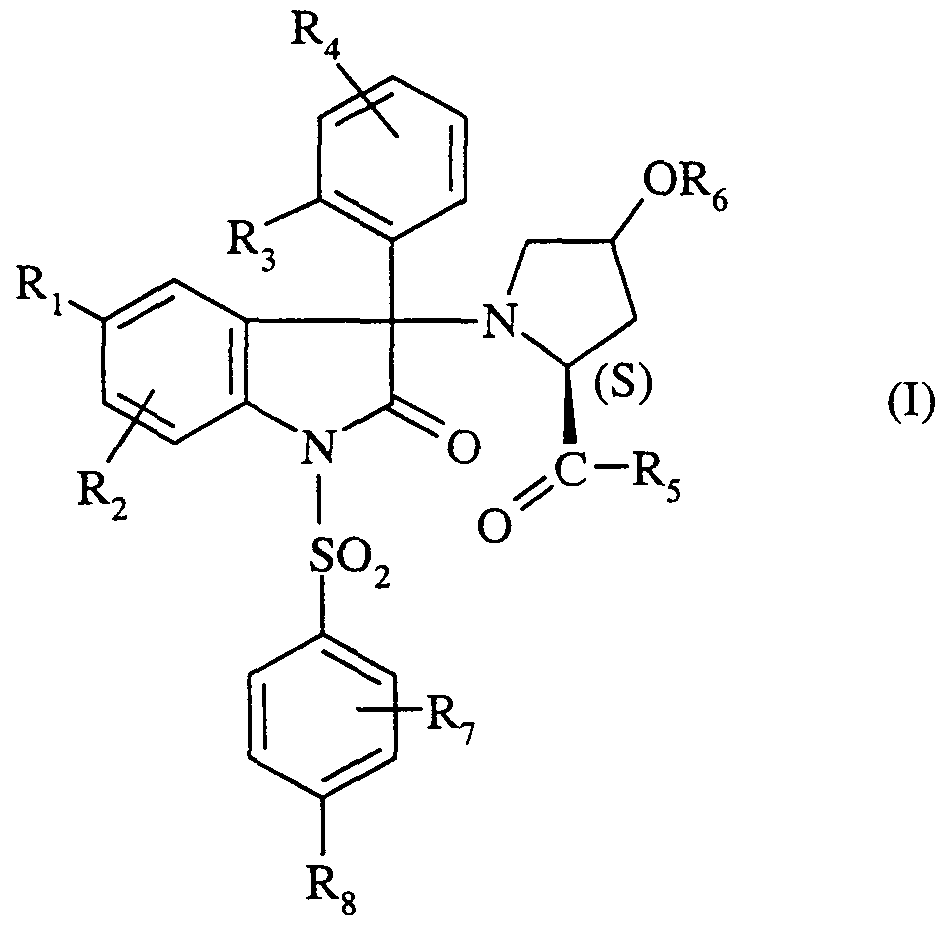
- the subject of the present invention is compounds of formula:
- - Ri represents a halogen atom; a (C ⁇ -C4) alkyl; an (C ⁇ -C_ ⁇ ) alkoxy; a trifluoromethyl radical; a trifluoromethoxy radical;
- R2 represents a hydrogen atom; a halogen atom; a (C ⁇ -C. ⁇ ) alkyl; a (C ⁇ -C_t) alkoxy; a trifluoromethyl radical;
- R1 and R2 together represent the bivalent trimethylene radical
- R3 represents a halogen atom; hydroxy; a (C ⁇ -C2) alkyl; a (C1 - C2) alkoxy; a trifluoromethoxy radical;
- R4 represents a hydrogen atom; a halogen atom; a (C ⁇ -C2) alkyl; a (C ⁇ -C2) alkoxy;
- R4 is in position -3- of phenyl and R3 and R4 together represent the methylenedioxy radical;
- - R5 represents an ethylamino group; a dimethylamino group; an azetidin-1-yl radical; a (C ⁇ -C2) alkoxy; - Rg represents a hydrogen atom; a (C ⁇ -C4) alkyl; a group - (CH2) n -CO- R9; a group -CO- (CH2) n -N ⁇ oRll;
- R7 represents a (C ⁇ -C4) alkoxy
- - Rg represents a (C ⁇ -C4) alkoxy
- - R9 represents a hydroxy
- a (C ⁇ -C4) alkoxy a group -N 12R13;
- Ri 1 each independently represent a (C ⁇ -C4) alkyl
- RI Q and Ri 1 together with the nitrogen atom to which they are linked constitute a heterocyclic radical chosen from: azetidin-1-yle, pyrrolidin-1-yle, piperidin-1-yle, piperazin-1-yle , morpholin-4-yle or thiomo holin-4-yle;
- Ri 2 represents a hydrogen or a (C ⁇ -C4) alkyl;
- Ri 3 represents a (C ⁇ -C4) alkyl; a group -C (CH3) 2CH2 ⁇ H; a group -C (CH 3 ) (CH 2 OH) 2; a group -C (CH 2 OH);
- R12 and R13 together with the nitrogen atom to which they are linked constitute a heterocyclic radical chosen from: azetidin-1-yl, pyrrolidin-1-yl, piperidin-1-yl, piperazin-1-yl, morpholin -4-yle or thiomorpholin-4-yle;
- - n is 1 or 2; as well as their solvates and / or hydrates and their optional salts with mineral or organic acids.
- halogen atom is meant a chlorine, bromine, fluorine or iodine atom.
- alkyl, or respectively alkoxy is meant an alkyl radical, or respectively an alkoxy radical, linear or branched.
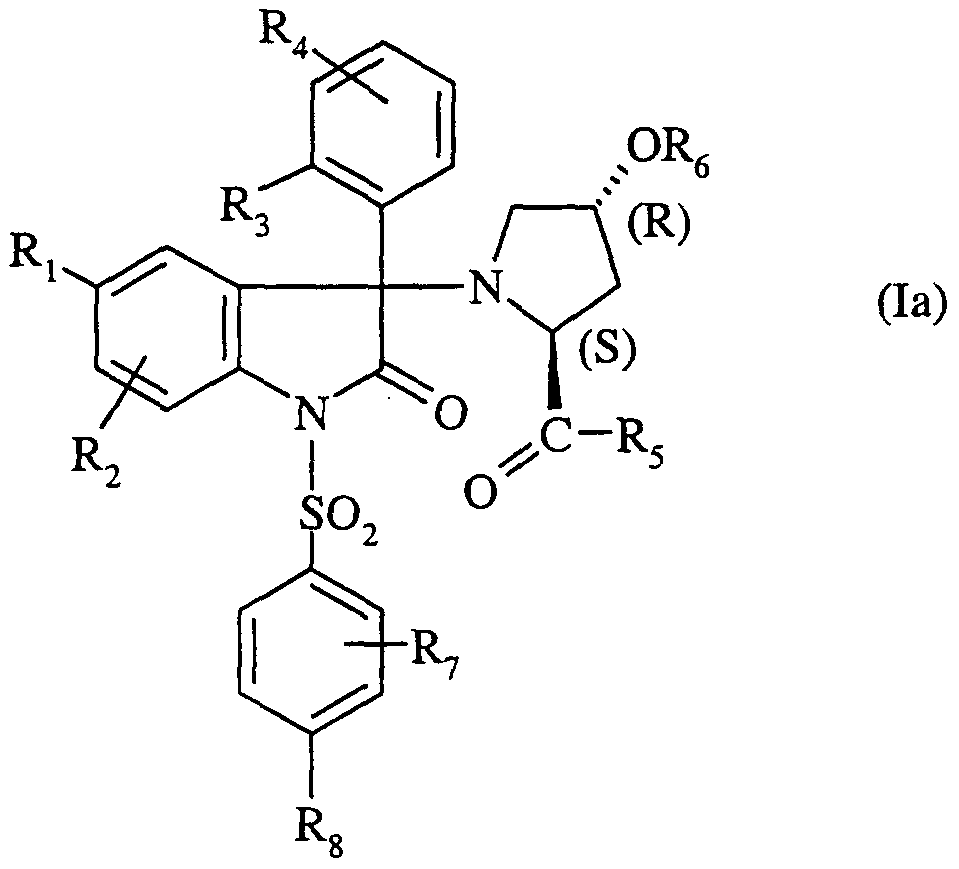
- the compounds of formula (I) comprise at least 3 asymmetric carbon atoms, the carbon atom carrying the substituent COR5 has the configuration (S), and the carbon atom carrying the substituent OR ⁇ a is the configuration (R), either the configuration (S).
- the optically pure isomers of the compounds of formula (I) and their mixtures in any proportions form part of the invention.
- the salts are generally prepared with pharmaceutically acceptable acids but the salts of other acids useful for the purification or the isolation of the compounds of formula (I) also form part of the invention.
- the salts of the pharmaceutically acceptable compounds of formula (I) are for example the hydrochloride, the hydrobromide, the sulfate, the hydrogen sulfate, the dihydrogen phosphate, the methanesulfonate, the benzenesulfonate, the naphthalenesulfonate, the para-toluenesulfonate, the maleate, the fumarate, succinate, citrate, acetate, gluconate, oxalate.
- the compounds of formula (I) are preferred in which: - ⁇ represents a halogen atom; a (C ⁇ -C4) alkyl; a trifluoromethyl radical
- - R2 represents a hydrogen atom; a halogen atom; a (C ⁇ -C4) alkyl; a (C ⁇ -C4) alkoxy; a trifluoromethyl radical;
- R2 is in position -6- of the indol-2-one ring and R and R2 together represent the bivalent trimethylene radical;
- - R3 represents a halogen atom; hydroxy; a (Ci -C2) alkoxy;
- R4 represents a hydrogen atom; a halogen atom; a (C ⁇ -C2) alkyl; a (C ⁇ -C2) alkoxy;
- R4 is in position -3- of phenyl and R3 and R4 together represent the methylenedioxy radical;
- - R5 represents an ethylamino group; a dimethylamino group; an azetidin-1-yl radical; a (C ⁇ -C2) alkoxy;
- Rg represents a hydrogen atom; a (C1-C4) alkyl;
- R7 represents a (C ⁇ -C4) alkoxy
- Rg represents a (Ci -C4) alkoxy; as well as their solvates and / or hydrates and their optional salts with mineral or organic acids.
- R 1 represents a chlorine atom, a methyl radical or a trifluoromethoxy radical.
- R2 represents a hydrogen atom or is in position -6- of indol-2-one and represents a chlorine atom, a methyl radical, a methoxy radical or a trifluoromethyl radical.
- R3 represents a chlorine atom, a fluorine atom, a methoxy radical, an ethoxy radical or a trifluoromethoxy radical.
- the compounds of formula (I) are preferred in which R4 represents a hydrogen atom or is in position -3- or -4- of phenyl and represents a fluorine atom or a methoxy radical; or else R4 is in position -3- of phenyl and together with R3 represent a methylenedioxy radical.
- the compounds of formula (I) are preferred in which
- R5 represents a dimethylamino group, an azetidin-1-yl radical or a methoxy radical.
- Rg represents a hydrogen atom, a methyl radical, an ethyl radical, a tert-butyloxycarbonylmethyl radical, a carboxymethyl radical, a [[2-hydroxy-1-] radical
- R7 is in position -2- or -3- of phenyl and represents a methoxy radical.
- the compounds of formula (I) are preferred in which Rg represents a methoxy radical.
- the compounds of formula (I) are preferred in the form of optically pure isomers.
- the levorotatory isomer of the compounds of formula (la) is preferred.
- - Ri represents a chlorine atom, a methyl radical or a trifluoromethoxy radical
- R2 represents a hydrogen atom or is in position -6- of indol-2-one and represents a chlorine atom, a methyl radical, a methoxy radical or a trifluoromethyl radical;
- - R3 represents a chlorine atom, a fluorine atom, a methoxy radical or an ethoxy radical
- - R4 represents a hydrogen atom or is in position -3- or -4- of phenyl and represents a fluorine atom or a methoxy radical
- R4 is in position -3- of phenyl and together with R3 represent a methylenedioxy radical;
- - R5 represents a dimethylamino radical or a methoxy radical;
- Rg represents a hydrogen atom; a methyl radical; an ethyl radical; a tert-butyloxycarbonylmethyl radical; a carboxymethyl radical; a [[2-hydroxy-1- (hydroxymethyl) -1-methylethyl] amino] carbonylmethyl radical; a (1-piperazinyl) carbonylmethyl radical; a (4-morpholinyl) carbonylmethyl radical; a 3- (4-morpholinyl) propanoyl radical;
- R7 is in position -2- of phenyl and represents a methoxy radical
- Rg represents a methoxy radical; as well as their salts with mineral or organic acids, their solvates and / or hydrates.
- the subject of the present invention is a process for preparing the compounds of formula (I), their optional salts with mineral or organic acids, their solvates and / or their hydrates, characterized in that: reacts, in the presence of a base, a compound of formula:
- Ri, R2, R3, R4, R5 and Rg are as defined for a compound of formula (I), with a halide of formula:.
- R7 and Rg are as defined for a compound of formula (T) and Hal represents a halogen atom.
- the compound of formula (I) is transformed into one of its salts with mineral or organic acids.
- the reaction is carried out in the presence of a strong base such as a metal hydride such as sodium hydride or an alkaline alcoholate such as potassium tert-butoxide, in an anhydrous solvent such as N, N-dimethylformamide or tetrahydrofuran and at a temperature between -70 ° C and + 60 ° C.
- a strong base such as a metal hydride such as sodium hydride or an alkaline alcoholate such as potassium tert-butoxide
- an anhydrous solvent such as N, N-dimethylformamide or tetrahydrofuran
- a compound of formula (I) in which Rg represents a (C ⁇ -C4) alkyl can also be prepared by reaction of a compound of formula (I) in which Rg represents hydrogen with a halide of (C ⁇ -C4 ) alkyl, in the presence of a base such as a metal hydride, in an inert solvent such as N, N-dimethylformamide or tetrahydrofuran according to conventional methods.
- a compound of formula (I) in which Rg represents a group - (CH2) n -CO- R9 in which R9 represents a hydroxy is preferably prepared by hydrolysis of a compound of formula (I) in which Rg represents a group - ( CH2) n -CO-R9 in which R9 represents a tert-butyloxy, in an acid medium, using a strong acid such as trifluoroacetic acid or hydrochloric acid in a solvent such as dichloromethane or dioxane and at a temperature between 0 ° C and room temperature.
- a compound of formula (I) in which Rg represents a group - (CH2) n _ O- R9 in which R9 represents a group -NR12R13 is preferably prepared by reaction of a compound of formula (I) in which R9 represents a hydroxy with an amine of formula H-NR12R13 according to the conventional methods of peptide coupling.
- the compounds of formula (I) thus obtained can be subsequently separated from the reaction medium and purified according to conventional methods, for example by crystallization or chromatography.
- the salification is carried out by treatment with the chosen acid in an organic solvent.
- an organic solvent such as diethyl ether or in an alcohol such as propan-2-ol or in acetone or in dichloromethane, or in ethyl acetate or in acetonitrile with a solution of the acid chosen in one of the abovementioned solvents, the corresponding salt is obtained which is isolated according to conventional techniques.
- the hydrochloride, the hydrobromide, the sulfate, the trifluoroacetate, the hydrogen sulfate, the dihydrogen phosphate, the methanesulfonate, the oxalate, the maleate, the succinate, the fumarate, the naphthalene-2-sulfonate, the benzenesulfonate are prepared.
- the compounds of formula (I) can be isolated in the form of one of their salts, for example the hydrochloride, or the oxalate; in this case, if necessary, the free base can be prepared by neutralizing said salt with an inorganic or organic base, such as sodium hydroxide or triethylamine or with an alkali carbonate or bicarbonate, such as carbonate or sodium or potassium bicarbonate.
- an inorganic or organic base such as sodium hydroxide or triethylamine
- an alkali carbonate or bicarbonate such as carbonate or sodium or potassium bicarbonate.
- the compounds of formula (U) are prepared by reaction of a 3-halo-1,3-dihydro-2H-indol-2-one compound of formula: in which Ri, R2, R3 and R4 are as defined for a compound of formula (I) and Hal represents a halogen atom, preferably chlorine or bromine, with a compound of formula:
- R5 and Rg are as defined for a compound of formula (1).
- the reaction is carried out in the presence of a base such as diisopropylethylamine or triethylamine, in an inert solvent such as dichloromethane or tetrahydrofuran or a mixture of these solvents and at a temperature between room temperature and the reflux temperature solvent.
- a base such as diisopropylethylamine or triethylamine
- an inert solvent such as dichloromethane or tetrahydrofuran or a mixture of these solvents
- the compounds of formula (HI) are known or prepared by known methods such as those described in EP-0 469 984 B and WO 95/18105.
- the compounds of formula (IU) can be prepared by halogenation of the corresponding benzenesulfonic acids or their salts, for example their sodium or potassium salts.
- the reaction is carried out in the presence of a halogenating agent such as phosphorus oxychloride, thionyl chloride, phosphorus trichloride, phosphorus tribromide or phosphorus pentachloride, without solvent or in an inert solvent such as a halogenated hydrocarbon or N, N-dimethylformamide and at a temperature between -10 ° C and 200 ° C.
- 2,4-Dimethoxybenzenesulfonyl chloride is prepared according to J. Am. Chem. Soc. , 1952, 74, 2008. 3,4-Dimethoxybenzenesulfonyl chloride is commercial, or prepared according to J. Med. Chem., 1977, 20 (10), 1235-1239.
- the compounds of formula (TV) are known and are prepared according to known methods such as those described in WO 95/18105.
- Ri, R2, R3 and R4 are as defined for a compound of formula (I), into a compound of formula (TV) by means of a halogenating agent such as bromine according to the method described in Farm. Zh. (Kiev), 1976, 5, 30-33.
- the compounds of formula (VI) are known and are prepared according to known methods such as those described in WO 95/18105.
- a compound of formula (VI) is prepared by reaction of a 1H-indole-2,3-dione derivative of formula:
- Ri and R2 are as defined for a compound of formula (I), with an organomagnesium derivative of formula: wherein R3 and R4 are as defined for a compound of formula (I) and Hal represents a halogen atom, preferably bromine or iodine, in an inert solvent such as tetrahydrofuran or diethyl ether.
- VUI l-indole-2,3-dione
- Organomagnesium derivatives (LX) are prepared according to conventional methods well known to those skilled in the art.
- the compounds of formula (XVII) are known or prepared according to known methods. It is also possible to prepare a compound of formula (VI), by air oxidation of a compound of formula (VU) in the presence of a base such as sodium hydride and in the presence of dimethyldisulfide.
- step a1 of SCHEME 1 a compound of formula (X) is first reacted with a lithium derivative such as n-butyllithium, in the absence or in the presence of a base such as N, N, N ', N'-tetramethylenediamine, then the lithiated intermediate thus obtained is reacted with diethyl oxalate to give the compound of formula (XI).
- the reaction is carried out in an inert solvent such as diethyl ether, tetrahydrofuran, hexane or a mixture of these solvents and at a temperature between -70 ° C and room temperature.
- step b1 a compound of formula (XII) is first reacted with two equivalents of a lithium derivative such as tert-butyllithium, then the lithiated intermediate thus obtained is reacted with the compound of formula (XL) to give the expected compound of formula (VI).
- the reaction is carried out in an inert solvent such as diethyl ether, tetrahydrofuran, pentane or a mixture of these solvents and at a temperature between -70 ° C and room temperature.
- the compounds of formula (X) are commercially available or synthesized in a conventional manner.
- the compounds of formula (XII) are prepared by reaction of the corresponding aniline derivatives with di-tert-butyldicarbonate according to conventional methods.
- the compounds of formula (VU) are known and are prepared according to known methods such as those described in WO 95/18105 or in J. Org. Chem., 1968, 33, 1640-1643.
- Rg (C ⁇ -C4) alkyl are known or are prepared according to known methods such as those described in J. Med. Chem., 1988, 31, 875-885 from the (2S, 4R) - or (2S, 4S) -4-hydroxypyrrolidine-2-carboxylic acids protected on the nitrogen atom of pyrrolidine.
- step a2 of SCHEME 2 the nitrogen atom of the 4 (R) - or 4 (S) - hydroxy- (S) -proline is protected according to conventional methods to obtain a compound of formula (XIT) .
- step d2 the compound (XTV) can be reacted with a halide of
- (C ⁇ -C4) alkyl in the presence of a base such as a metal hydride or an alkaline or alkaline earth carbonate such as K2CO3 or CS2CO3, in an inert solvent such as tetrahydrofuran or N, N-dimethylformamide and to a temperature between
- a base such as an alkali metal hydroxide, the sodium hydroxide for example
- a phase transfer catalyst such as a substituted quaternary ammonium salt, tetrabutylammonium hydrogen sulfate for example, in an inert solvent such as dichloromethane or benzene mixed with water.
- step _ the hydroxy of the compound (XUI) is alkylated by reaction with a halide of (C ⁇ -C4) alkyl under the conditions of step d2, and the acid (XVT) thus obtained is put in reaction in step g2 with ethylamine, dimethylamine or azetidine according to the conventional methods of peptide coupling to give the compound (XV).
- step a3 of SCHEME 3 a compound of formula (XVHI), prepared as previously described, is reacted with a compound of formula Hal- (CH2) n -COR9 in which Hal represents a halogen atom, preferably the chlorine or bromine, n is
- R9 represents a (C ⁇ -C4) alkoxy.
- the reaction is carried out under the conditions previously described in step d2 of SCHEME 2 and a compound (XLX) is obtained.
- the expected compounds (V) are obtained in step b_3_.
- the reaction is carried out using a strong acid such as trifluoroacetic acid or hydrochloric acid in a solvent such as dichloromethane or dioxane and at a temperature between 0 ° C and room temperature.
- step a4 of SCHEME 4 a compound of formula (XVIII) is reacted with a compound of formula Hal-CO- (CH2) n -Hal 'in which Hal and Hal' each independently represent a halogen atom, of preferably chlorine or bromine, and n is 1 or 2.
- the reaction is carried out in the presence of a base such as triethylamine or diisopropylethylamine, in a solvent such as dichloromethane or tetrahydrofuran and at a temperature between 0 ° C and the reflux temperature of the solvent.
- step b_4 the reaction of the compound of formula (XX) thus obtained with a compound of formula HNRioRn allows a compound of formula (XXI) to be obtained.
- the reaction is carried out in the presence of a base such as triethylamine or N, N-diisopropylethylamine, or using an excess of the compound HNRI QRH, d ns a solvent such as dichloromethane or tetrahydrofuran and at a temperature between 0 ° C and the reflux temperature of the solvent.
- step ç4 By deprotection of the N-protecting group of the compound (XXI), in step ç4, the expected compound of formula (V) is obtained.
- step a5 of DIAGRAM 5 a compound of formula (XVII) is reacted with acryloyl chloride, under the conditions previously described in step a4 of DIAGRAM 4, and the compound of formula (XXII) is obtained. ).
- step b_5 the reaction of the compound (XXJJ) with a compound of formula
- step ç_5 By deprotection of the N-protecting group of the compound (XXHI), in step ç_5, the compound of formula (V) is obtained.
- an optically pure compound of formula (H) is preferably reacted with a compound of formula (ET) according to the process of the invention.
- optically pure compounds of formula (II) are prepared by reacting the racemic compound of formula (TV) with an optically pure compound of formula (V), then separation of the mixture of diastereoisomers according to conventional methods, for example by crystallization or chromatography. Alternatively, the mixture of diastereoisomers of the compound of formula (II) can be reacted with the compound of formula (UT) and the mixture of diastereomers of the compound of formula (I) thus obtained can be separated.
- This protection can be carried out using conventional protective groups, such as those described in Protective Groups in Organic Chemistry, JFW McOmie, Ed. Plénum Press, 1973, in Protective Groups in Organic Synthesis, TW Greene and PGM Wutts, Ed. John Wiley et sons, 1991 or in Protecting Groups, Kocienski PJ, 1994, Georg Thieme Verlag.
- the removal of the protective groups can be carried out at a later appropriate stage using the methods known to those skilled in the art and which do not affect the rest of the molecule concerned.
- N-protective groups optionally used are the conventional N-protective groups well known to those skilled in the art, such as for example the tert-butoxycarbonyl, fluorenylmethoxycarbonyl, benzyl, benzhydrylidene or benzyloxycarbonyl group.
- the invention relates to compounds of formula:
- - Ri represents a halogen atom; a (C ⁇ -C4) alkyl; a (C ⁇ -C4) alkoxy; a trifluoromethyl radical; a trifluoromethoxy radical;
- R2 represents a hydrogen atom; a halogen atom; a (C1-C4) alkyl; a (Ci -C4) alkoxy; a trifluoromethyl radical;
- R ⁇ or R2 is in position -6- of the indol-2-one ring and R ⁇ and R2 together represent the bivalent trimethylene radical;
- R3 represents a halogen atom; hydroxy; a (C ⁇ -C2) alkyl; a (Ci -C2) alkoxy; a trifluoromethoxy radical;
- R4 represents a hydrogen atom; a halogen atom; a (C ⁇ -C2) alkyl; a (Ci -C2) alkoxy; - or else R4 is in position -3- of phenyl and R3 and R4 together represent the methylenedioxy radical;
- - R5 represents an ethylamino group; a dimethylamino group; an azetidin-1-yl radical; a (C ⁇ -C2) alkoxy; - Rg represents a hydrogen atom; a (C ⁇ -C4) alkyl; a group - (CH2) n -CO-
- R9 a group -CO- (CH2) n -NR ⁇ oRn;
- - R9 represents a hydroxy; a (C ⁇ -C4) alco y; a group -NR12R13;
- Ri 1 each independently represent a (Ci -C4) alkyl
- RI Q and Ry together with the nitrogen atom to which they are linked constitute a heterocyclic radical chosen from: azetidin-1-yl, pyrrolidin-1-yl, piperidin-
- R12 represents a hydrogen or a (C ⁇ -C4) alkyl
- R13 represents a (C ⁇ -C4) alkyl; a group -C (CH3) 2CH2 ⁇ H; a group -C (CH 3 ) (CH 2 OH) 2 ; a group -C (CH 2 OH) 3 ; - or else R12 or R13 together with the nitrogen atom to which they are linked constitute a heterocyclic radical chosen from: azetidin-1-yl, pyrrolidin-1-yl, piperidin-1-yl, piperazin-1-yl, mo ⁇ holin -4-yle or thiomorpholin-4-yle;
- - n is 1 or 2; as well as their salts with mineral or organic acids, in the form of optically pure isomers or in the form of a mixture of diastereoisomers.
- the salts of the compounds of formula (II) include those with mineral or organic acids which allow a suitable separation or crystallization of the compounds of formula (IL) such as the hydrochloride, the hydrobromide, the oxalate, the maleate, the succinate, fumarate, citrate, acetate.
- the compounds of formula (I) above also include those in which one or more hydrogen or carbon atoms have been replaced by their radioactive isotope, for example tritium, or carbon-14. Such labeled compounds are useful in research, metabolism or pharmacokinetics, in biochemical tests as a receptor ligand.
- the compounds according to the invention have been the subject of biochemical studies.
- the affinity of the compounds of formula (I) according to the invention for the V ⁇ receptors of arginine-vasopressin was determined in vitro using the method described by Y. DE KEYSER et al., Febs Letters, 1994, 356 , 215-220. This method consists in studying in vitro the displacement of tritiated arginine vasopressin ([H] -AVP) to Vj b receptors present on adenohypophysial or cellular membrane preparations carrying V ⁇ receptors from rats or humans. Inhibitory concentrations 50% (IC50) of the binding of tritiated arginine vasopressin to the compounds according to
- the invention are weak and vary from 10 to 10 M, more particularly from 10 to 10 "9 M.
- the affinity of the compounds of formula (I) according to the invention for the vasopressin V 2 receptors has also been studied (method described by M. Birnbaumer et al., Nature (Lond.), 1992, 357, 333-335 ). The compounds studied have little or no affinity for the V receptors.
- the compounds of the present invention are in particular active principles of pharmaceutical compositions, the toxicity of which is compatible with their use as medicaments.
- the present invention relates to the use of the compounds of formula (I), or one of their pharmaceutically acceptable salts, solvates and / or hydrates, for the preparation of medicaments intended to treat any pathology where the arginine-vasopressin and / or its V ⁇ receptors or both its V b receptor and its V ⁇ receptors are involved.
- the present invention relates to the use of the compounds of formula (I), or one of their pharmaceutically acceptable salts, solvates and / or hydrates for the preparation of medicaments intended for treating pathologies of the cardiovascular system , central nervous system, renal system, gastric system as well as small cell lung cancer, obesity, type H diabetes, insulin resistance, hypertriglyceridemia, atherosclerosis, Cushing's syndrome , all pathologies following stress and chronic stress conditions.
- the compounds according to the invention can be used, in humans or in animals, in the treatment or prevention of various vasopressin-dependent conditions such as cardiovascular conditions, such as hypertension, pulmonary hypertension, heart failure, myocardial infarction, or coronary vasospasm, especially in smokers, Raynaud's disease, unstable angina and PTCA (from the English percutaneous transluminal coronary angioplasty), cardiac ischemia, hemostasis disorders; central nervous system conditions such as migraine, cerebral vasospasm, cerebral hemorrhage, cerebral edema, depression, anxiety, stress, obsessive-compulsive disorder, panic attacks, psychotic states, disorders memory for example; conditions of the renal system such as renal vasospasm, necrosis of the renal cortex, nephrogenic diabetes insipidus; disorders of the gastric system such as gastric vasospasm, hepatocirrhosis, ulcers, pathology of vomiting, for example nausea including nausea due to chemotherapy, motion sickness;
- the compounds according to the invention can also be used in the treatment of disorders of sexual behavior; in women, the compounds according to the invention can be used to treat dysmenorrhea or premature labor.
- the compounds according to the invention can also be used in the treatment of small cell lung cancers; hyponatraemic encephalopathies; pulmonary syndrome, Meniere's disease; glaucoma, cataracts; obesity; type II diabetes; atherosclerosis; Cushing's syndrome; insulin resistance; hypertriglyceridemia; in post-operative treatments, especially after abdominal surgery.
- the compounds according to the invention can also be used in the treatment or prevention of all pathologies consecutive to stress such as fatigue and its syndromes, ACTH dependent disorders, cardiac disorders, pain, modifications of gastric emptying, faecal excretion (colitis, irritable bowel syndrome, Crohn's disease), acid secretion, hyperglycemia, immunosuppression, inflammatory processes (rheumatoid arthritis and osteoarthritis), multiple infections, cancers, asthma , psoriasis, allergies and various neuropsychiatric disorders such as anorexia nervosa, bulimia, mood disorders, depression, anxiety, sleep disorders, panic states, phobias, obsession, pain perception disorders (fibromyalgia), neurodegenerative diseases (Alzheimer's disease,
- the compounds according to the invention can also be used in the treatment or prevention of chronic stress conditions such as immunosuppression, fertility disorders, dysfunctions of the hypothalamic-pituitary-adrenal axis.
- the compounds according to the invention can also be used as psychostimulants, causing increased awakening, emotional reactivity to the environment and facilitating adaptation.
- the compounds of formula (I) above, or one of their pharmaceutically acceptable salts, solvates and / or hydrates can be used at daily doses of 0.01 to 100 mg per kg of body weight of the mammal to be treated, preferably at daily doses of 0.1 to 50 mg kg. In humans, the dose may preferably vary from 0.1 to 4000 mg per day, more particularly from 0.5 to 1000 mg depending on the age of the subject to be treated or the type of treatment: prophylactic or curative.
- the compounds of formula (I) are generally administered in dosage units. Said dosage units are preferably formulated in pharmaceutical compositions in which the active principle is mixed with one or more pharmaceutical excipients.
- the present invention relates to pharmaceutical compositions containing, as active principle, a compound of formula (I), or one of its pharmaceutically acceptable salts, solvates and / or hydrates.
- the active ingredients can be administered in unit administration forms, in admixture with conventional pharmaceutical carriers, animals and humans.
- Suitable unit administration forms include oral forms such as tablets, capsules, powders, granules and oral solutions or suspensions, sublingual and oral administration forms, aerosols, administration forms topical, implants, forms of subcutaneous, intramuscular, intravenous, intranasal or intraocular administration and forms of rectal administration.
- a mixture of pharmaceutical excipients can be added to the active principle, micronized or not, which can be composed of diluents such as, for example, lactose, microcrystalline cellulose, starch, dicalcium phosphate, binders such as, for example, polyvinylpyrrolidone, hydroxypropylmethylcellulose, disintegrants such as crosslinked polyvinylpyrrolidone, crosslinked carboxymethylcellulose, flow agents such as silica, talc, lubricants such as magnesium stearate, l stearic acid, glycerol tribehenate, sodium stearyl fumarate. Wetting agents or surfactants such as sodium lauryl sulfate, polysorbate 80, poloxamer 188 can be added to the formulation.
- diluents such as, for example, lactose, microcrystalline cellulose, starch, dicalcium phosphate
- binders such as, for example, polyvinylpyrrolidone, hydroxy
- the tablets can be produced by different techniques, direct compression, dry granulation, wet granulation, hot melt.
- the tablets can be naked or coated (with sucrose for example) or coated with various polymers or other suitable materials.
- the tablets can have a flash, delayed or prolonged release by producing polymer matrices or by using specific polymers in the film coating.
- the capsules can be soft or hard, film-coated or not so as to have a flash, prolonged or delayed activity (for example by an enteric form).
- They can contain not only a solid formulation formulated as above for the tablets but also liquids or semi-solids.
- a preparation in the form of a syrup or elixir may contain the active principle together with a sweetener, preferably calorie-free, methylparaben and propylparaben as an antiseptic, as well as a flavoring agent and an appropriate color.
- a sweetener preferably calorie-free, methylparaben and propylparaben as an antiseptic, as well as a flavoring agent and an appropriate color.
- the water-dispersible powders or granules may contain the active principle in admixture with dispersing agents, wetting agents or suspending agents, such as polyvinylpyrrolidone, as well as with sweeteners or flavor correctors .
- Suppositories are used for rectal administration which are prepared with binders that melt at rectal temperature, for example cocoa butter or polyethylene glycols.
- binders that melt at rectal temperature
- for parenteral, intranasal or intraocular administration aqueous suspensions, isotonic saline solutions or sterile and injectable solutions are used which contain pharmacologically compatible dispersing agents and / or solubilizing agents, for example propylene glycol.
- a cosolvent such as for example an alcohol such as ethanol or a glycol such as polyethylene glycol or propylene glycol, and a hydrophilic surfactant such as polysorbate 80 or poloxamer 188
- the active principle can be dissolved by a triglyceride or a glycerol ester.
- creams, ointments, gels, eye drops, sprays can be used.
- transdermal administration it is possible to use patches in multilaminate or reservoir form in which the active principle can be in alcoholic solution, sprays.
- an aerosol for administration by inhalation, an aerosol is used containing, for example, sorbitan trioleate or oleic acid, as well as trichlorofluoromethane, dichlorofluoromethane, dichlorotetrafluoroethane, freon substitutes or any other biologically compatible propellant; one can also use a system containing the active ingredient alone or associated with an excipient, in the form of powder.
- the active principle can also be presented in the form of a complex with a cyclodextrin, for example, oc, ⁇ , ⁇ -cyclodextrin, 2-hydroxypropyl- ⁇ -cyclodextrin.
- the active principle can also be formulated in the form of microcapsules or microspheres, optionally with one or more carriers or additives.
- implants can be used. These can be prepared in the form of an oily suspension or in the form of a suspension of microspheres in an isotonic medium.
- each dosage unit the active principle of formula (I) is present in the quantities adapted to the daily doses envisaged.
- each dosage unit is suitably adjusted according to the dosage and the type of administration intended, for example tablets, capsules and the like, sachets, ampoules, syrups and the like, drops so that such a dosage unit contains 0.1 to 1000 mg of active ingredient, preferably 0.5 to 250 mg to be administered one to four times a day.
- these dosages are examples of average situations, there may be special cases where higher or lower dosages are appropriate, such dosages also belong to the invention.
- the appropriate dosage for each patient is determined by the doctor according to the mode of administration, the age, the weight and the response of said patient.
- the compositions of the present invention may contain, in addition to the compounds of formula (I), or one of their pharmaceutically acceptable salts, solvates and / or hydrates, other active ingredients which may be useful in the treatment of disorders or diseases indicated above.
- the present invention also relates to pharmaceutical compositions containing several active principles in combination, one of which is a compound according to the invention.
- pharmaceutical compositions can be prepared containing a compound according to the invention combined with a compound acting on CRF receptors.
- the compounds according to the invention may also be used for the preparation of compositions for veterinary use.
- PS-Trisamine Tris- (2-aminoethyl) amine polystyrene crosslinked at 1% with divinylbenzene with 3.62 millimoles of amino function per gram of resin, marketed by Argonaut Technologie.
- This compound is prepared according to the procedure described in WO 95/18105.
- a solution of 2-methoxyphenylmagnesium bromide is prepared from 16 g of magnesium in 35 ml of ether and from a solution of 124 g of 1-bromo-2-methoxybenzene in 175 ml of ether.
- This solution is added dropwise under an argon atmosphere to a mixture of 30 g of 5-chloro-1H-indole-2,3-dione in 250 ml of THF, previously cooled in an ice bath, then leaves stirring while allowing the temperature to rise to RT. After 1 hour of stirring at RT, the reaction mixture is slowly poured onto a saturated NH 4 Cl solution and the THF is evaporated in vacuo. The precipitate formed is drained and washed with iso ether. 42 g of the expected product are obtained, which product is used as is in the following step.
- This compound is prepared according to the procedure described in WO 95/18105.
- a mixture of 12.71 g of the compound obtained in the preceding step in 105 ml of DCM is cooled to 0 ° C., 5.3 ml of pyridine is added and then 4.9 ml of thionyl chloride. After 30 minutes with stirring, water is added to the reaction mixture and the mixture is evaporated.
- a mixture of 2 g of the compound obtained in the preceding step in 15 ml of DCM is cooled to 0 ° C., 0.82 ml of pyridine and then 0.76 ml of thionyl chloride are added. After 20 minutes with stirring, water is added to the reaction mixture and the DCM is evaporated in vacuo. The aqueous phase is extracted with AcOEt, the organic phase is washed with water, with a saturated NaCl solution, dried over Na2S ⁇ 4 and the solvent evaporated under vacuum. 1.5 g of the expected product are obtained after crystallization from a DCM / iso ether mixture.
- a solution of 2-methoxyphenylmagnesium bromide is prepared from 1.9 g of magnesium in 4 ml of ether and from a solution of 14.54 g of 1-bromo-2-methoxybenzene in 21 ml of ether.
- This solution is added dropwise under an argon atmosphere to a mixture of 5 g of 5-trifluoromethoxy-1H-indole-2,3-dione in 26 ml of THF, previously cooled in an ice bath, then heated at reflux of the ether for 1 hour 30 minutes and leave to return to RT.
- the reaction mixture is poured slowly onto a saturated NH4Cl solution, extracted with AcOEt, the organic phase is washed with a 5% solution of K2CO3, with water, with a saturated solution of
- a mixture of 10 g of 4-chloro-3-methylaniline and 15.26 g of di-tert-butyldicarbonate in 50 ml of dioxane is left stirring for 24 hours at RT.
- the reaction mixture is concentrated under vacuum and the residue is chromatographed on silica gel, eluting with a gradient of the DCM / hexane mixture from (50/50; v / v) to (70/30; v / v). 5.6 g of the expected product are obtained, which product is used as it is.
- a suspension of 1 g of the compound obtained in the preceding step in 7 ml of DCM is cooled to 0 ° C., 0.4 ml of pyridine and then 0.37 ml of thionyl chloride are added and the mixture is left stirring for 30 minutes.
- the reaction mixture is diluted by adding 30 ml of DCM, the organic phase is washed with 20 ml of water, dried over Na2S ⁇ 4 and the solvent is partially concentrated in vacuo at a temperature below 40 ° C. This solution is used as it is in Preparations 3.13 and 3.14.
- a mixture of 27.6 g of 1,2-dimethoxybenzene in 160 ml of ether is cooled to -40 ° C., 250 ml of a 1.6 M solution of n-butyllithium in hexane, then leaves stirring for 24 hours while allowing the temperature to rise to RT.
- the reaction mixture is cooled to -20 ° C., 136 ml of diethyl oxalate are rapidly added and the mixture is stirred while allowing the temperature to rise to RT.
- the reaction mixture is poured onto a saturated NH4Cl solution, decanted, the aqueous phase is extracted with ether, the combined organic phases are washed twice with water, dried over Na2S ⁇ 4 and evaporated under empties the solvents.
- the resulting crude product is chromatographed on silica gel, eluting with a heptane / iso ether mixture (90/10; v / v). 25 g of the expected product are obtained, which product is used as it is in the next step.
- reaction mixture is cooled to -40 ° C., a solution of 14 g of the compound obtained in step A in 50 ml of THF is added over one hour and the mixture is left stirring at AT for 4 days.
- the reaction mixture is poured onto a saturated solution of NH4CI, wring out the precipitate formed and dry it. 10.2 g of the expected product are obtained, which product is used as is in the following step.
- This compound is prepared according to the procedure described in step B a) of Preparation 1.5 from 4-chloro-3-trifluoromethylaniline and from ⁇ -tert-butyldicarbonate in dioxane.
- reaction mixture is cooled to -70 ° C., a solution of 3.05 g of the compound obtained in step A of Preparation 1.5 in 15 ml of THF is added dropwise, the mixture is left stirring for 1 hour, allowing it to rise the temperature at -30 ° C and then 16 hours while allowing the temperature to rise to AT.
- Add a saturated NH4Cl solution to the reaction mixture evaporate the ether and THF, extract the resulting aqueous phase with AcOEt, wash the organic phase with water, with a saturated NaCl solution, dry over Na2SO4 and evaporate under vacuum the solvent.
- a mixture of 28 g of the compound obtained in the preceding step and 33.13 g of DL-2-chloromandelic acid in 128 ml of 1,2-dichlorobenzene is heated at 230 ° C. for 4 hours, eliminating the water formed. using a Dean-Stark device.
- the reaction mixture is partially concentrated in vacuo and left to crystallize.
- the crystallized product formed is drained and washed with iso ether. 40 g of the expected product are obtained.
- a suspension of 1.5 g of the compound obtained in the preceding step in 20 ml of DCM is cooled in an ice bath, 0.375 ml of pyridine and then 0.33 ml of thionyl chloride are added and the mixture is left stirring for 30 minutes.
- a suspension of the expected product is obtained which has precipitated in DCM and this suspension is used directly in Preparations 3.19 and 3.20.
- the mixture obtained is rechromatographed on silica gel, eluting with DCM and then with the DCM / AcOEt mixture (95/5; v / v).
- the two isomers are separated: - the least polar isomer which is 6-chloro-5-methyl-3-methylthio-1.3-dihydro-2H-indol-2-one and obtains 1.16 g.
- a solution of 2-methoxyphenylmagnesium bromide is prepared from 0.687 g of magnesium in 1.5 ml of ether and from a solution of 5.35 g of 1-bromo-2-methoxybenzene in 7.55 ml of ether. This solution is added dropwise under an argon atmosphere to a mixture of 1.4 g of the compound obtained in the preceding step in 14 ml of THF previously cooled in an ice bath, then left to stir, leaving raise the temperature to AT.
- a solution of 2-ethoxyphenylmagnesium bromide is prepared from 2.2 g of magnesium in 10 ml of ether and from a solution of 16.5 g of the compound obtained in the previous step in 40 ml of ether. This solution is added dropwise under a nitrogen atmosphere to a mixture of 5 g of 5-chloro-1H-indole-2,3-dione in 20 ml of THF, keeping the temperature of the reaction medium lower. at 35 ° C. After 2 hours of stirring at RT, the reaction mixture is poured into 200 ml of 2N HCl, extracted with AcOEt, the organic phase is dried over Na2SO4 and the solvents are evaporated under vacuum. The residue is taken up in hot iso ether and left to crystallize. The crystallized product formed is drained, washed with iso ether and dried. 5.7 g of the expected product are obtained,
- the mixture is heated for one hour at reflux. Then added at a temperature below 40 ° C, a mixture of 7.5 g of 5-chloro-1H-indole-2,3-dione in 100 ml of THF then heated to reflux for one hour. After cooling to RT, the reaction mixture is poured onto a concentrated ice / HCl mixture, extracted with AcOEt, the organic phase is washed with water with an IN NaOH solution, dried over Na2S ⁇ 4 and the solvent evaporated under vacuum. We 6.5 g of the expected product are obtained after crystallization from a DCM / iso ether mixture
- a solution of 2,4-dimethoxyphenylmagnesium bromide is prepared from 2.2 g of magnesium in 10 ml of THF and from a solution of 18 g of 1-bromo-2,4-dimethoxybenzene in 40 ml of THF. This solution is added dropwise to a mixture of 5 g of 5-chloro-1H-indole-2,3-dione in 50 ml of THF to a temperature of 30 ° C, then heats for 2 hours at reflux. The reaction mixture is cooled to RT, poured onto a saturated NH4Cl solution, extracted with AcOEt, the organic phase is washed with water, dried over Na2S ⁇ 4 and the solvent evaporated under vacuum. 7.2 g of the expected product are obtained after crystallization from hot iso ether.
- This compound is prepared according to the method described in Tetrahedron Lett., 1995, 36, 6413-6414.
- a solution of 1,3-benzodioxol-4-ylmagnesium bromide is prepared from 0.85 g of magnesium in 10 ml of THF and from a solution of 6.7 g of the compound obtained in the preceding step in 40 ml of THF. This solution is added dropwise at a temperature below 40 ° C to a mixture of 3 g of 5-chloro-1H-indole-2,3-dione in 50 ml of THF and then left stirring for one hour. . The reaction mixture is poured onto a saturated NH4Cl solution, extracted with AcOEt, the organic phase is washed with water, dried over Na2S ⁇ 4 and the solvent is evaporated in vacuo,
- a suspension of 1.5 g of the compound obtained in the preceding step in 30 ml of DCM is cooled in an ice bath, 0.56 ml of pyridine and then 0.5 ml of thionyl chloride are added. After 1 hour with stirring at RT, the reaction mixture is diluted by adding DCM, the organic phase is washed with water until neutral p ⁇ , dried over Na2S ⁇ 4 and the solvent evaporated under vacuum. 1.5 g of the expected product are obtained in the form of foams which are used as is.
- the filtrate is chromatographed on silica gel eluting with a DCM MeOH mixture (94/6; v / v) and the product obtained is rechromatographed on alumina, eluting with a DCM / MeOH mixture (96/4; v / v). 11.1 g of the expected product are obtained.
- a mixture of 7.5 g of the compound obtained in the preceding step in 100 ml of DCM is cooled to 4 ° C., 5.7 ml of DIPEA is added, then 14.4 g of BOP and the mixture is left stirring at 4 ° for 30 minutes. vs. Dimethylamine gas is then added by bubbling for 10 minutes and the mixture is left stirring for 3 hours at RT.
- the reaction mixture is concentrated under vacuum, the residue is extracted with AcOEt, the organic phase is washed with a 5% solution of KHSO4, with a 5% solution of Na2CO3, with a saturated solution of NaCl, dried over Na2SO4 and evaporated under vacuum the solvent.
- the residue is chromatographed on silica gel, eluting with a DCM / MeOH mixture (93/7; v / v). 2.4 g of the expected product are obtained.
- the compound obtained in Preparation 2.1 is dissolved in 5 ml of DCM, 1.62 g of triethylamine is added, then a suspension of 2.2 g of the compound obtained in Preparation 1.1 in 2 ml of THF and left 6 hours with stirring at RT. Then added 3 x 0.8 g of triethylamine over a 24 hour period while stirring. At the end of the reaction, the formation of an abundant precipitate is observed.
- the precipitate formed is drained, taken up in a mixture consisting of a 5% K2CO3 solution and 100 ml of AcOEt containing 10 ml of MeOH, the organic phase is washed with a 5% K2CO3 solution, with a solution saturated with NaCl, dried over Na2S ⁇ 4 and partially evaporates the solvents under vacuum.
- the precipitate formed is drained and 0.875 g of the isomer A is obtained. All the mother liquors for spinning are combined, and chromatography on alumina, eluting with the gradient of the DCM / MeOH mixture of (96/4; v / v) to (95/5; v / v).
- isomer B compound of Preparation 3.28 and obtains 0.661 g which is used as it is.
- isomer B compound of Preparation 3.30 which is recrystallized from the DCM / iso ether / hexane mixture and 1.1 g is obtained.
- a mixture of 0.4 g of the compound obtained in Preparation 1.14, 0.3 g of the compound obtained in Preparation 2.1 a) and 0.45 g of DIPEA in 20 ml of DCM is left stirring for 2 hours at RT.
- the precipitate formed corresponding to isomer A is filtered off, the least polar compound on alumina, DCM / MeOH (98/2; v / v) (compound of Preparation 3.36).
- the spin juices are concentrated in vacuo, the residue is taken up in the AcOEt / acetone mixture, left for 12 hours in the cold and the precipitate, still corresponding to the A isomer, is drained.
- the spin juices are washed with water and dried.
- R, Cl.
- R 4 H ;
- R 5 -N (CH 3 ) 2 .
- R 6 -CO-CH 2 CH 2 - NO
- a mixture of 0.5 g of the compound obtained in Example 29, 0.085 g of 2-amino-2-methyl-1,3-propanediol, 0.290 g of BOP and 0.187 g of triethylamine in 20 is left stirring at RT for 3 hours at RT. ml of DCM.
- the reaction mixture is diluted by adding DCM, the organic phase is washed with water and with a saturated Na2C ⁇ 3 solution, dried over Na2S ⁇ 4 and the solvent is evaporated in vacuo.
- step A A mixture of 0.7 g of the compound obtained in step A and 10 ml of TFA in 10 ml of DCM is left stirring for 3 hours. It is concentrated under vacuum, the residue is taken up in ether and the precipitate formed is drained. 0.6 g of the expected product is obtained,
Landscapes
- Health & Medical Sciences (AREA)
- Chemical & Material Sciences (AREA)
- Organic Chemistry (AREA)
- Medicinal Chemistry (AREA)
- Pharmacology & Pharmacy (AREA)
- Life Sciences & Earth Sciences (AREA)
- Animal Behavior & Ethology (AREA)
- General Health & Medical Sciences (AREA)
- Public Health (AREA)
- Veterinary Medicine (AREA)
- Bioinformatics & Cheminformatics (AREA)
- Engineering & Computer Science (AREA)
- Chemical Kinetics & Catalysis (AREA)
- Nuclear Medicine, Radiotherapy & Molecular Imaging (AREA)
- General Chemical & Material Sciences (AREA)
- Epidemiology (AREA)
- Neurology (AREA)
- Biomedical Technology (AREA)
- Neurosurgery (AREA)
- Diabetes (AREA)
- Endocrinology (AREA)
- Immunology (AREA)
- Heart & Thoracic Surgery (AREA)
- Psychiatry (AREA)
- Reproductive Health (AREA)
- Pulmonology (AREA)
- Pain & Pain Management (AREA)
- Cardiology (AREA)
- Hematology (AREA)
- Urology & Nephrology (AREA)
- Pregnancy & Childbirth (AREA)
- Gynecology & Obstetrics (AREA)
- Obesity (AREA)
- Ophthalmology & Optometry (AREA)
- Hospice & Palliative Care (AREA)
- Emergency Medicine (AREA)
- Rheumatology (AREA)
- Psychology (AREA)
- Vascular Medicine (AREA)
- Transplantation (AREA)
Abstract
Description


Claims



Priority Applications (27)
| Application Number | Priority Date | Filing Date | Title |
|---|---|---|---|
| SK1083-2002A SK286976B6 (sk) | 2000-01-25 | 2001-01-24 | Deriváty 1,3-dihydro-2H-indol-2-ónu, spôsob ich prípravy a farmaceutická kompozícia, ktorá ich obsahuje |
| IL15053901A IL150539A0 (en) | 2000-01-25 | 2001-01-24 | Novel 1,3-dihydro-2h-indol-2-one derivatives, preparation method and pharmaceutical compositions containing them |
| PL357553A PL204160B1 (pl) | 2000-01-25 | 2001-01-24 | Pochodne 1,3-dihydro-2H-indol-2-onu, sposób ich wytwarzania, związki pośrednie, środek farmaceutyczny i zastosowanie pochodnych 1,3-dihydro-2H-indol-2-onu |
| HR20020626A HRP20020626B1 (en) | 2000-01-25 | 2001-01-24 | Novel 1,3-dihydro-2h-indol-2-one derivatives and their use as ligands for v1b and v1a arginine-vasopressin receptors |
| HU0204242A HU229081B1 (en) | 2000-01-25 | 2001-01-24 | Novel 1,3-dihydro-2h-indol-2-one derivatives and their use as ligands for v1b and v1a arginine-vasopressin receptors |
| HK03103183.8A HK1050900B (en) | 2000-01-25 | 2001-01-24 | 1,3-dihydro-2h-indol-2-one derivatives and their use as ligands for v1b or v1b and v1a arginine-vasopressin receptors |
| JP2001560989A JP3992498B2 (ja) | 2000-01-25 | 2001-01-24 | 新規1,3−ジヒドロ−2h−インドール−2−オン誘導体、それらの製造法およびそれらを含む医薬組成物 |
| AU35594/01A AU778196B2 (en) | 2000-01-25 | 2001-01-24 | Novel 1,3-dihydro-2H-indol-2-one derivatives, preparation method and pharmaceutical compositions containing them |
| MXPA02007259A MXPA02007259A (es) | 2000-01-25 | 2001-01-24 | Derivados nuevos de 1,3-dihidro-2h-indol-2-ona, y su uso como ligantes para receptores de vasopresina-arginina v1b y v1a. |
| MEP-173/08A MEP17308A (en) | 2000-01-25 | 2001-01-24 | Novel 1,3-dihydro-2h-indol-2-one derivatives and their use as ligands for v 1b and v 1a arginine-vasopressin receptors |
| DE60103853T DE60103853T2 (de) | 2000-01-25 | 2001-01-24 | 1,3-dihydro-2h-indol-2-on derivate und deren verwendung als liganden der arginin-vasopressin rezeptoren v1b oder v1b und v1a |
| EA200200628A EA004628B1 (ru) | 2000-01-25 | 2001-01-24 | Новые производные 1,3-дигидро-2h-индол-2-она и их применение в качестве лигандов рецепторов аргинин-вазопрессина v1b и v1a |
| SI200130155T SI1255751T1 (en) | 2000-01-25 | 2001-01-24 | 1,3-dihydro-2h-indol-2-one derivatives and their use as ligands for v1b or v1b and v1a arginine-vasopressin receptors |
| US10/182,048 US6730695B2 (en) | 2000-01-25 | 2001-01-24 | 1,3-dihydro-2h-indol-2-one derivatives and their use as ligands for V1b and V1a arginine-vasopressin receptors |
| DK01907685T DK1255751T3 (da) | 2000-01-25 | 2001-01-24 | Derivater af 1,3-dihydro-2H-indol-2-on og anvendelse heraf som ligander for V1B- eller V1B- og V1A-arginin-vasopressinreceptorer |
| UA2002075477A UA74354C2 (uk) | 2000-01-25 | 2001-01-24 | Похідні 1,3-дигідро-2h-індол-2-ону, спосіб їх отримання та фармацевтична композиція, що їх містить |
| AT01907685T ATE269326T1 (de) | 2000-01-25 | 2001-01-24 | 1,3-dihydro-2h-indol-2-on derivate und deren verwendung als liganden der arginin-vasopressin rezeptoren v1b oder v1b und v1a |
| CA002396814A CA2396814C (fr) | 2000-01-25 | 2001-01-24 | Derives de 1,3-dihydro-2h-indol-2-one et procede de preparation et compositions pharmaceutiques les contenant |
| BRPI0107807-0A BR0107807B1 (pt) | 2000-01-25 | 2001-01-24 | Derivados de 1,3-dihidro-2H-indol-2-ona e composições farmacêuticas compreendendo os mesmos |
| EP01907685A EP1255751B1 (fr) | 2000-01-25 | 2001-01-24 | Derives de 1,3-dihydro-2h-indol-2-one et leur utilisation en tant que ligands des recepteurs v1b ou v1b et v1a de l'arginine-vasopressine |
| EEP200200409A EE04779B1 (et) | 2000-01-25 | 2001-01-24 | 1,3-dihüdro-2H-indool-2-ooni derivaadid, nende valmistamismeetod ja neid sisaldavad farmatseutilised kompositsioonid |
| IS6451A IS2313B (is) | 2000-01-25 | 2002-06-28 | 1,3-díhýdró-2H-indól-2-ón afleiður og notkun þeirra sem bindlar fyrir V1b eða V1b og V1a arginín-þvagtemprandi viðtaka |
| IL150539A IL150539A (en) | 2000-01-25 | 2002-07-02 | Derivatives of 1,3 dihydro-2H-indole-2-one, a process for their production and the pharmaceutical compositions containing them |
| NO20023510A NO323607B1 (no) | 2000-01-25 | 2002-07-23 | Nye 1,3-dihydro-2H-indol-2-on-derivater, fremgangsmate for deres fremstilling samt farmasoytisk preparat. |
| BG106947A BG65796B1 (bg) | 2000-01-25 | 2002-07-23 | 1,3-ДИХИДРО-2Н-ИНДОЛ-2-ОН ПРОИЗВОДНИ И ТЯХНОТО ИЗПОЛЗВАНЕ КАТО ЛИГАНДИ ЗА V1b и V1a АРГИНИН-ВАЗОПРЕСИН РЕЦЕПТОРИ |
| US10/835,209 US7129240B2 (en) | 2000-01-25 | 2004-04-29 | 1,3-dihydro-2H-indol-2one derivatives, process for preparing them and pharmaceutical compositions containing them |
| US11/462,062 US7297692B2 (en) | 2000-01-25 | 2006-08-03 | 1,3-dihydro-2H-indol-2-one derivatives, process for preparing them and pharmaceutical compositions containing them |
Applications Claiming Priority (2)
| Application Number | Priority Date | Filing Date | Title |
|---|---|---|---|
| FR0000957A FR2804114B1 (fr) | 2000-01-25 | 2000-01-25 | Nouveaux derives de 1,3-dihydro-2h-indol-2-one, un procede pour leur preparation et les compositions pharmaceutiques en contenant |
| FR00/00957 | 2000-01-25 |
Related Child Applications (4)
| Application Number | Title | Priority Date | Filing Date |
|---|---|---|---|
| US10182048 A-371-Of-International | 2001-01-24 | ||
| US10/182,048 A-371-Of-International US6730695B2 (en) | 2000-01-25 | 2001-01-24 | 1,3-dihydro-2h-indol-2-one derivatives and their use as ligands for V1b and V1a arginine-vasopressin receptors |
| US10/835,209 Division US7129240B2 (en) | 2000-01-25 | 2004-04-29 | 1,3-dihydro-2H-indol-2one derivatives, process for preparing them and pharmaceutical compositions containing them |
| US11/462,062 Division US7297692B2 (en) | 2000-01-25 | 2006-08-03 | 1,3-dihydro-2H-indol-2-one derivatives, process for preparing them and pharmaceutical compositions containing them |
Publications (2)
| Publication Number | Publication Date |
|---|---|
| WO2001055130A2 true WO2001055130A2 (fr) | 2001-08-02 |
| WO2001055130A3 WO2001055130A3 (fr) | 2002-03-14 |
Family
ID=8846307
Family Applications (1)
| Application Number | Title | Priority Date | Filing Date |
|---|---|---|---|
| PCT/FR2001/000226 Ceased WO2001055130A2 (fr) | 2000-01-25 | 2001-01-24 | Derives de 1,3-dihydro-2h-indol-2-one et leur utilisation en tant que ligands des recepteurs v1b ou v1b et v1a de l'arginine-vasopressine |
Country Status (35)
| Country | Link |
|---|---|
| US (3) | US6730695B2 (fr) |
| EP (1) | EP1255751B1 (fr) |
| JP (1) | JP3992498B2 (fr) |
| KR (1) | KR100689922B1 (fr) |
| CN (1) | CN1193025C (fr) |
| AR (1) | AR027263A1 (fr) |
| AT (1) | ATE269326T1 (fr) |
| AU (1) | AU778196B2 (fr) |
| BG (1) | BG65796B1 (fr) |
| BR (1) | BR0107807B1 (fr) |
| CA (1) | CA2396814C (fr) |
| CZ (1) | CZ300917B6 (fr) |
| DE (1) | DE60103853T2 (fr) |
| DK (1) | DK1255751T3 (fr) |
| EA (1) | EA004628B1 (fr) |
| EE (1) | EE04779B1 (fr) |
| ES (1) | ES2222342T3 (fr) |
| FR (1) | FR2804114B1 (fr) |
| HR (1) | HRP20020626B1 (fr) |
| HU (1) | HU229081B1 (fr) |
| IL (2) | IL150539A0 (fr) |
| IS (1) | IS2313B (fr) |
| ME (1) | MEP17308A (fr) |
| MX (1) | MXPA02007259A (fr) |
| NO (1) | NO323607B1 (fr) |
| PL (1) | PL204160B1 (fr) |
| PT (1) | PT1255751E (fr) |
| RS (1) | RS50290B (fr) |
| SI (1) | SI1255751T1 (fr) |
| SK (1) | SK286976B6 (fr) |
| TR (1) | TR200402344T4 (fr) |
| TW (1) | TWI283672B (fr) |
| UA (1) | UA74354C2 (fr) |
| WO (1) | WO2001055130A2 (fr) |
| ZA (1) | ZA200205224B (fr) |
Cited By (34)
| Publication number | Priority date | Publication date | Assignee | Title |
|---|---|---|---|---|
| JP2003525287A (ja) * | 2000-02-25 | 2003-08-26 | サノフィ−サンテラボ | 新規な1,3−ジヒドロ−2h−インドール−2−オン、その製造方法およびそれらを含む医薬組成物 |
| FR2842527A1 (fr) * | 2002-07-19 | 2004-01-23 | Sanofi Synthelabo | Derives d'acyloxypyrolidine, leur preparation et leur application en therapeutique |
| WO2006095014A1 (fr) * | 2005-03-11 | 2006-09-14 | N.V. Organon | 2- (4-0x0-4h-quinaz0lin-3-yl)acetamides et leur utilisation en tant qu’antagoniste v3 de la vasopressine |
| WO2006072458A3 (fr) * | 2004-12-31 | 2006-10-05 | Abbott Gmbh & Co Kg | Derives d'oxindol substitues, agents pharmaceutiques les contenant, et leur utilisation |
| WO2006100082A3 (fr) * | 2005-03-24 | 2006-12-07 | Abbott Gmbh & Co Kg | Derives d'oxindole substitues, medicaments contenant ces derives et leur utilisation |
| WO2006133242A2 (fr) | 2005-06-07 | 2006-12-14 | Pharmacopeia, Inc. | Inhibiteurs d'azinone et de diazinone v3 utilises dans les troubles lies a la depression et au stress |
| US7414052B2 (en) | 2004-03-30 | 2008-08-19 | Wyeth | Phenylaminopropanol derivatives and methods of their use |
| US7517899B2 (en) | 2004-03-30 | 2009-04-14 | Wyeth | Phenylaminopropanol derivatives and methods of their use |
| FR2927625A1 (fr) * | 2008-02-19 | 2009-08-21 | Sanofi Aventis Sa | Nouveaux derives de 3-aminoalkyl-1,3-dihydro-2h-indol-2-one, leur preparation et leur application en therapeutique |
| US7820649B2 (en) | 2006-09-11 | 2010-10-26 | N.V. Organon | Quinazolinone and isoquinolinone acetamide derivatives |
| KR100990344B1 (ko) | 2005-06-24 | 2010-10-29 | 에프. 호프만-라 로슈 아게 | 옥신돌 유도체 |
| US7902379B2 (en) | 2003-09-30 | 2011-03-08 | Abbott Gmbh & Co. Kg | Heteroaryl-substituted 1,3-dihydroindol-2-one derivatives and medicaments containing them |
| US8030499B2 (en) | 2005-01-28 | 2011-10-04 | Taisho Pharmaceutical Co., Ltd. | 1,3-dihydro-2H-indole-2-one compound and pyrrolidine-2-one compound fused with aromatic heterocycle |
| CN101258134B (zh) * | 2005-03-11 | 2011-10-12 | 欧加农股份有限公司 | 2-(4-氧代-4h-喹唑啉-3-基)乙酰胺衍生物及其作为加压素v3拮抗剂的用途 |
| US8044079B2 (en) | 2005-12-02 | 2011-10-25 | Abbott Gmbh & Co. Kg | Substituted oxindole derivatives, medicaments containing said derivatives and use thereof |
| US8119676B2 (en) | 2006-08-26 | 2012-02-21 | Abbott GmbH & Co. HG | Substituted benzimidazolone derivatives, medicaments comprising them and their use |
| US8129389B2 (en) | 2005-03-24 | 2012-03-06 | Abbott Gmbh & Co. Kg | Substituted oxindole derivatives, medicaments containing the latter and use thereof |
| WO2012043791A1 (fr) | 2010-10-01 | 2012-04-05 | 大正製薬株式会社 | Dérivé de 1,2,4-triazolone |
| US8202870B2 (en) | 2005-03-24 | 2012-06-19 | Abbott Gmbh & Co. Kg | Substituted oxindole derivatives, medicaments containing the latter and use thereof |
| US8324214B2 (en) | 2008-04-21 | 2012-12-04 | Sanofi | 1,3-dihydro-2H-pyrrolo[3,2-bpyridin-2-one derivatives, preparation thereof and therapeutic uses thereof |
| US8431567B2 (en) | 2006-08-26 | 2013-04-30 | Abbott Gmbh & Co. Kg | Substituted oxindole derivatives and their use as vasopressin and/or oxytocin receptor ligands |
| WO2013062027A1 (fr) | 2011-10-27 | 2013-05-02 | 大正製薬株式会社 | Dérivé azole |
| US8486979B2 (en) | 2006-12-12 | 2013-07-16 | Abbvie Inc. | 1,2,4 oxadiazole compounds and methods of use thereof |
| EP2623504A1 (fr) | 2007-12-07 | 2013-08-07 | Abbott GmbH & Co. KG | Dérivés oxindoliques disubstitués en positions 5 et 6 et leur utilisation pour la préparation d'un medicament pour le traitement de maladies liées à la vasopressine |
| WO2013147117A1 (fr) | 2012-03-30 | 2013-10-03 | 大正製薬株式会社 | Dérivé d'azole fondu |
| CN103342672A (zh) * | 2013-07-02 | 2013-10-09 | 扬州大学 | 取代吡咯烷-2-酮的新合成方法 |
| US8580842B2 (en) | 2003-09-30 | 2013-11-12 | Abbott Gmbh & Co. Kg | Heteroaryl-substituted 1,3-dihydroindol-2-one derivatives and medicaments containing them |
| US8629148B2 (en) | 2007-12-27 | 2014-01-14 | AbbVie Deutschland GmbH & Co. KG | Substituted oxindole-derivatives and the use thereof for the treatment of vasopressin-dependent illnesses |
| US8703774B2 (en) | 2007-12-07 | 2014-04-22 | AbbVie Deutschland GmbH & Co. KG | Carbamate-substituted oxindole derivatives and use thereof for the treatment of vasopressin-dependent diseases |
| US8703775B2 (en) | 2007-12-07 | 2014-04-22 | AbbVie Deutschland GmbH & Co. KG | Amidomethyl-substituted oxindole derivatives and the use thereof for the treatment of vasopressin-dependent illnesses |
| US8815868B2 (en) | 2006-12-30 | 2014-08-26 | Abbott Gmbh & Co. Kg | Substituted oxindole derivatives and their use as vasopressin receptor ligands |
| US9023854B2 (en) | 2007-12-07 | 2015-05-05 | AbbVie Deutschland GmbH & Co. KG | 5-halogen-substituted oxindole derivatives and use thereof for treating vasopressin-dependent diseases |
| US9040568B2 (en) | 2009-05-29 | 2015-05-26 | Abbvie Inc. | Pharmaceutical compositions for the treatment of pain |
| US9186407B2 (en) | 2006-12-12 | 2015-11-17 | Abbvie Inc. | Pharmaceutical compositions and their methods of use |
Families Citing this family (12)
| Publication number | Priority date | Publication date | Assignee | Title |
|---|---|---|---|---|
| FR2804114B1 (fr) * | 2000-01-25 | 2002-03-08 | Sanofi Synthelabo | Nouveaux derives de 1,3-dihydro-2h-indol-2-one, un procede pour leur preparation et les compositions pharmaceutiques en contenant |
| US7528124B2 (en) | 2003-08-28 | 2009-05-05 | Taisho Pharmaceutical Co., Ltd. | 1,3-dihydro-2H-indol-2-one derivative |
| US20050165082A1 (en) * | 2003-12-16 | 2005-07-28 | Wyeth | Methods of treating vasomotor symptoms |
| WO2006038119A1 (fr) * | 2004-10-08 | 2006-04-13 | Warner-Lambert Company Llc | Synthese stereoselective d'alcoxy-prolines n-protegees |
| US20080227802A1 (en) * | 2004-12-27 | 2008-09-18 | Kyoto University | Agent For Suppressing Development of Tolerance to Narcotic Analgesics |
| TR201907381T4 (tr) * | 2005-07-19 | 2019-06-21 | Azevan Pharmaceuticals Inc | Beta-laktamil fenilalanin, sistein ve serin vazopressin antagonisti. |
| CN101033209B (zh) * | 2006-03-09 | 2014-08-27 | 上海医药工业研究院 | 药物中间体(2s,4r)-4-羟基-n,n-二甲基-2-吡咯烷甲酰胺的制备方法 |
| US7427008B2 (en) * | 2006-10-25 | 2008-09-23 | Black & Decker Inc. | Depth adjusting device for a power tool |
| US20100179176A1 (en) * | 2006-12-13 | 2010-07-15 | N.V. Organon | V3 antagonists for the treatment or prevention of chronic pain |
| WO2009140484A1 (fr) * | 2008-05-15 | 2009-11-19 | Sanofi-Aventis | Procédés de préparation d’une substance médicamenteuse amorphe |
| WO2009140479A1 (fr) * | 2008-05-15 | 2009-11-19 | Sanofi-Aventis | Dispersions solides amorphes |
| TW202517632A (zh) | 2023-07-12 | 2025-05-01 | 德商Hmnc控股有限公司 | 氘代1,3二氫-2h-吲哚-2-酮衍生物 |
Family Cites Families (4)
| Publication number | Priority date | Publication date | Assignee | Title |
|---|---|---|---|---|
| US5338755A (en) * | 1990-07-31 | 1994-08-16 | Elf Sanofi | N-sulfonylindoline derivatives, their preparation and the pharmaceutical compositions in which they are present |
| FR2714378B1 (fr) * | 1993-12-24 | 1996-03-15 | Sanofi Sa | Dérivés de l'indol-2-one substitués en 3 par un groupe azoté, leur préparation, les compositions pharmaceutiques en contenant. |
| FR2804114B1 (fr) * | 2000-01-25 | 2002-03-08 | Sanofi Synthelabo | Nouveaux derives de 1,3-dihydro-2h-indol-2-one, un procede pour leur preparation et les compositions pharmaceutiques en contenant |
| FR2810320B1 (fr) * | 2000-06-19 | 2002-08-23 | Sanofi Synthelabo | Nouveaux derives de 1,3-dihydro-2h-indol-2-one, un procede pour leur preparation et les compositions pharmaceutiques en contenant |
-
2000
- 2000-01-25 FR FR0000957A patent/FR2804114B1/fr not_active Expired - Fee Related
-
2001
- 2001-01-19 TW TW090101300A patent/TWI283672B/zh not_active IP Right Cessation
- 2001-01-23 AR ARP010100275A patent/AR027263A1/es not_active Application Discontinuation
- 2001-01-24 SK SK1083-2002A patent/SK286976B6/sk not_active IP Right Cessation
- 2001-01-24 EE EEP200200409A patent/EE04779B1/xx not_active IP Right Cessation
- 2001-01-24 BR BRPI0107807-0A patent/BR0107807B1/pt not_active IP Right Cessation
- 2001-01-24 DK DK01907685T patent/DK1255751T3/da active
- 2001-01-24 EA EA200200628A patent/EA004628B1/ru not_active IP Right Cessation
- 2001-01-24 AU AU35594/01A patent/AU778196B2/en not_active Ceased
- 2001-01-24 EP EP01907685A patent/EP1255751B1/fr not_active Expired - Lifetime
- 2001-01-24 KR KR1020027009561A patent/KR100689922B1/ko not_active Expired - Fee Related
- 2001-01-24 HR HR20020626A patent/HRP20020626B1/xx not_active IP Right Cessation
- 2001-01-24 HU HU0204242A patent/HU229081B1/hu not_active IP Right Cessation
- 2001-01-24 PT PT01907685T patent/PT1255751E/pt unknown
- 2001-01-24 IL IL15053901A patent/IL150539A0/xx active IP Right Grant
- 2001-01-24 SI SI200130155T patent/SI1255751T1/xx unknown
- 2001-01-24 JP JP2001560989A patent/JP3992498B2/ja not_active Expired - Fee Related
- 2001-01-24 CN CNB018041159A patent/CN1193025C/zh not_active Expired - Lifetime
- 2001-01-24 PL PL357553A patent/PL204160B1/pl not_active IP Right Cessation
- 2001-01-24 UA UA2002075477A patent/UA74354C2/uk unknown
- 2001-01-24 US US10/182,048 patent/US6730695B2/en not_active Expired - Lifetime
- 2001-01-24 ES ES01907685T patent/ES2222342T3/es not_active Expired - Lifetime
- 2001-01-24 DE DE60103853T patent/DE60103853T2/de not_active Expired - Lifetime
- 2001-01-24 CA CA002396814A patent/CA2396814C/fr not_active Expired - Fee Related
- 2001-01-24 TR TR2004/02344T patent/TR200402344T4/xx unknown
- 2001-01-24 RS YUP-523/02A patent/RS50290B/sr unknown
- 2001-01-24 WO PCT/FR2001/000226 patent/WO2001055130A2/fr not_active Ceased
- 2001-01-24 CZ CZ20022497A patent/CZ300917B6/cs not_active IP Right Cessation
- 2001-01-24 MX MXPA02007259A patent/MXPA02007259A/es active IP Right Grant
- 2001-01-24 AT AT01907685T patent/ATE269326T1/de active
- 2001-01-24 ME MEP-173/08A patent/MEP17308A/xx unknown
-
2002
- 2002-06-28 ZA ZA200205224A patent/ZA200205224B/en unknown
- 2002-06-28 IS IS6451A patent/IS2313B/is unknown
- 2002-07-02 IL IL150539A patent/IL150539A/en not_active IP Right Cessation
- 2002-07-23 BG BG106947A patent/BG65796B1/bg unknown
- 2002-07-23 NO NO20023510A patent/NO323607B1/no not_active IP Right Cessation
-
2004
- 2004-04-29 US US10/835,209 patent/US7129240B2/en not_active Expired - Lifetime
-
2006
- 2006-08-03 US US11/462,062 patent/US7297692B2/en not_active Expired - Lifetime
Cited By (56)
| Publication number | Priority date | Publication date | Assignee | Title |
|---|---|---|---|---|
| JP2003525287A (ja) * | 2000-02-25 | 2003-08-26 | サノフィ−サンテラボ | 新規な1,3−ジヒドロ−2h−インドール−2−オン、その製造方法およびそれらを含む医薬組成物 |
| CN100425608C (zh) * | 2002-07-19 | 2008-10-15 | 赛诺菲-安万特 | 酰氧基吡咯烷衍生物,其制备及其在治疗学上的应用 |
| FR2842527A1 (fr) * | 2002-07-19 | 2004-01-23 | Sanofi Synthelabo | Derives d'acyloxypyrolidine, leur preparation et leur application en therapeutique |
| WO2004009585A3 (fr) * | 2002-07-19 | 2004-05-06 | Sanofi Synthelabo | Derives d'acyloxypyrrolidine et leur utilisation en tant que ligands des recepteurs v1b et v1a de avp |
| US7202267B2 (en) | 2002-07-19 | 2007-04-10 | Sanofi-Aventis | Acyloxypyrrolidine derivatives, preparation thereof and application thereof in therapeutic |
| EA008444B1 (ru) * | 2002-07-19 | 2007-06-29 | Санофи-Авентис | Производные ацилоксипирролидина и их применение в качестве лигандов vили vи vрецепторов |
| US7902379B2 (en) | 2003-09-30 | 2011-03-08 | Abbott Gmbh & Co. Kg | Heteroaryl-substituted 1,3-dihydroindol-2-one derivatives and medicaments containing them |
| US8350055B2 (en) | 2003-09-30 | 2013-01-08 | Abbott Gmbh & Co. Kg | Heteroaryl-substituted 1,3-dihydroindol-2-one derivatives and medicaments containing them |
| US9487505B2 (en) | 2003-09-30 | 2016-11-08 | AbbVie Deutschland GmbH & Co. KG | Heteroaryl-substituted 1,3-dihydroindol-2-one derivatives and medicaments containing them |
| US8580842B2 (en) | 2003-09-30 | 2013-11-12 | Abbott Gmbh & Co. Kg | Heteroaryl-substituted 1,3-dihydroindol-2-one derivatives and medicaments containing them |
| US7414052B2 (en) | 2004-03-30 | 2008-08-19 | Wyeth | Phenylaminopropanol derivatives and methods of their use |
| US7517899B2 (en) | 2004-03-30 | 2009-04-14 | Wyeth | Phenylaminopropanol derivatives and methods of their use |
| US7638512B2 (en) | 2004-03-30 | 2009-12-29 | Wyeth | Phenylaminopropanol derivatives and methods of their use |
| WO2006072458A3 (fr) * | 2004-12-31 | 2006-10-05 | Abbott Gmbh & Co Kg | Derives d'oxindol substitues, agents pharmaceutiques les contenant, et leur utilisation |
| US8030499B2 (en) | 2005-01-28 | 2011-10-04 | Taisho Pharmaceutical Co., Ltd. | 1,3-dihydro-2H-indole-2-one compound and pyrrolidine-2-one compound fused with aromatic heterocycle |
| US7807686B2 (en) | 2005-03-11 | 2010-10-05 | N.V. Organon | 2-(4-oxo-4H-quinazolin-3-yl)acetamides and their use as vasopressin V3 antagonists |
| CN101258134B (zh) * | 2005-03-11 | 2011-10-12 | 欧加农股份有限公司 | 2-(4-氧代-4h-喹唑啉-3-基)乙酰胺衍生物及其作为加压素v3拮抗剂的用途 |
| WO2006095014A1 (fr) * | 2005-03-11 | 2006-09-14 | N.V. Organon | 2- (4-0x0-4h-quinaz0lin-3-yl)acetamides et leur utilisation en tant qu’antagoniste v3 de la vasopressine |
| WO2006100082A3 (fr) * | 2005-03-24 | 2006-12-07 | Abbott Gmbh & Co Kg | Derives d'oxindole substitues, medicaments contenant ces derives et leur utilisation |
| US8202870B2 (en) | 2005-03-24 | 2012-06-19 | Abbott Gmbh & Co. Kg | Substituted oxindole derivatives, medicaments containing the latter and use thereof |
| US8691815B2 (en) | 2005-03-24 | 2014-04-08 | AbbVie Deutschland GmbH & Co. KG | Substituted oxindole derivatives, drugs containing said derivatives and the use thereof |
| US7803834B2 (en) | 2005-03-24 | 2010-09-28 | Abbott Gmbh & Co. Kg | Substituted oxindole derivatives, drugs containing said derivatives and the use thereof |
| US8129389B2 (en) | 2005-03-24 | 2012-03-06 | Abbott Gmbh & Co. Kg | Substituted oxindole derivatives, medicaments containing the latter and use thereof |
| WO2006133242A2 (fr) | 2005-06-07 | 2006-12-14 | Pharmacopeia, Inc. | Inhibiteurs d'azinone et de diazinone v3 utilises dans les troubles lies a la depression et au stress |
| KR100990344B1 (ko) | 2005-06-24 | 2010-10-29 | 에프. 호프만-라 로슈 아게 | 옥신돌 유도체 |
| US8044079B2 (en) | 2005-12-02 | 2011-10-25 | Abbott Gmbh & Co. Kg | Substituted oxindole derivatives, medicaments containing said derivatives and use thereof |
| US9006276B2 (en) | 2005-12-02 | 2015-04-14 | AbbVie Deutschland GmbH & Co. KG | Substituted oxindole derivatives, medicaments containing said derivatives and use thereof |
| US8119676B2 (en) | 2006-08-26 | 2012-02-21 | Abbott GmbH & Co. HG | Substituted benzimidazolone derivatives, medicaments comprising them and their use |
| US8431567B2 (en) | 2006-08-26 | 2013-04-30 | Abbott Gmbh & Co. Kg | Substituted oxindole derivatives and their use as vasopressin and/or oxytocin receptor ligands |
| US7820649B2 (en) | 2006-09-11 | 2010-10-26 | N.V. Organon | Quinazolinone and isoquinolinone acetamide derivatives |
| US8486979B2 (en) | 2006-12-12 | 2013-07-16 | Abbvie Inc. | 1,2,4 oxadiazole compounds and methods of use thereof |
| US9186407B2 (en) | 2006-12-12 | 2015-11-17 | Abbvie Inc. | Pharmaceutical compositions and their methods of use |
| US8859557B2 (en) | 2006-12-30 | 2014-10-14 | Abbott Gmbh & Co. Kg | Substituted oxindole derivatives and their use as vasopressin receptor ligands |
| US8815868B2 (en) | 2006-12-30 | 2014-08-26 | Abbott Gmbh & Co. Kg | Substituted oxindole derivatives and their use as vasopressin receptor ligands |
| US8703775B2 (en) | 2007-12-07 | 2014-04-22 | AbbVie Deutschland GmbH & Co. KG | Amidomethyl-substituted oxindole derivatives and the use thereof for the treatment of vasopressin-dependent illnesses |
| US9023854B2 (en) | 2007-12-07 | 2015-05-05 | AbbVie Deutschland GmbH & Co. KG | 5-halogen-substituted oxindole derivatives and use thereof for treating vasopressin-dependent diseases |
| US9434713B2 (en) | 2007-12-07 | 2016-09-06 | AbbVie Deutschland GmbH & Co. KG | 5,6-disubstituted oxindole-derivatives and use thereof for treating vasopressin-dependent diseases |
| US8546401B2 (en) | 2007-12-07 | 2013-10-01 | AbbVie Deutschland GmbH & Co. KG | 5,6-disubstituted oxindole-derivatives and use thereof for treating vasopressin-dependent diseases |
| US9422264B2 (en) | 2007-12-07 | 2016-08-23 | AbbVie Deutschland GmbH & Co. KG | Carbamate-substituted oxindole derivatives and use thereof for the treatment of vasopressin-dependent diseases |
| EP2623504A1 (fr) | 2007-12-07 | 2013-08-07 | Abbott GmbH & Co. KG | Dérivés oxindoliques disubstitués en positions 5 et 6 et leur utilisation pour la préparation d'un medicament pour le traitement de maladies liées à la vasopressine |
| US8703774B2 (en) | 2007-12-07 | 2014-04-22 | AbbVie Deutschland GmbH & Co. KG | Carbamate-substituted oxindole derivatives and use thereof for the treatment of vasopressin-dependent diseases |
| US9403796B2 (en) | 2007-12-07 | 2016-08-02 | AbbVie Deutschland GmbH & Co. KG | Amidomethyl-substituted oxindole derivatives and the use thereof for the treatment of vasopressin-dependent illnesses |
| US9238642B2 (en) | 2007-12-27 | 2016-01-19 | AbbVie Deutschland GmbH & Co. KG | Substituted oxindole-derivatives and the use thereof for the treatment of vasopressin-dependent illnesses |
| US8629148B2 (en) | 2007-12-27 | 2014-01-14 | AbbVie Deutschland GmbH & Co. KG | Substituted oxindole-derivatives and the use thereof for the treatment of vasopressin-dependent illnesses |
| US8362067B2 (en) | 2008-02-19 | 2013-01-29 | Sanofi | 3-aminoalkyl-1,3-dihydro-2H-indol-2-one derivatives, preparation thereof and therapeutic use thereof |
| FR2927625A1 (fr) * | 2008-02-19 | 2009-08-21 | Sanofi Aventis Sa | Nouveaux derives de 3-aminoalkyl-1,3-dihydro-2h-indol-2-one, leur preparation et leur application en therapeutique |
| WO2009115685A1 (fr) * | 2008-02-19 | 2009-09-24 | Sanofi-Aventis | Nouveaux derives de 3-aminoalkyl-1,3-dihydro-2h-indol-2-one, leur preparation et leur application en therapeutique. |
| US8324214B2 (en) | 2008-04-21 | 2012-12-04 | Sanofi | 1,3-dihydro-2H-pyrrolo[3,2-bpyridin-2-one derivatives, preparation thereof and therapeutic uses thereof |
| US9040568B2 (en) | 2009-05-29 | 2015-05-26 | Abbvie Inc. | Pharmaceutical compositions for the treatment of pain |
| US9193695B2 (en) | 2010-10-01 | 2015-11-24 | Taisho Pharmaceutical Co., Ltd. | 1, 2, 4-triazolone derivative and use thereof as an antagonist on the arginine-vasopressin 1B receptor |
| WO2012043791A1 (fr) | 2010-10-01 | 2012-04-05 | 大正製薬株式会社 | Dérivé de 1,2,4-triazolone |
| WO2013062027A1 (fr) | 2011-10-27 | 2013-05-02 | 大正製薬株式会社 | Dérivé azole |
| KR20140081824A (ko) | 2011-10-27 | 2014-07-01 | 다이쇼 세이야꾸 가부시끼가이샤 | 아졸 유도체 |
| US9522914B2 (en) | 2011-10-27 | 2016-12-20 | Taisho Pharmaceutical Co., Ltd | Azole derivative |
| WO2013147117A1 (fr) | 2012-03-30 | 2013-10-03 | 大正製薬株式会社 | Dérivé d'azole fondu |
| CN103342672A (zh) * | 2013-07-02 | 2013-10-09 | 扬州大学 | 取代吡咯烷-2-酮的新合成方法 |
Also Published As
Similar Documents
| Publication | Publication Date | Title |
|---|---|---|
| EP1255751B1 (fr) | Derives de 1,3-dihydro-2h-indol-2-one et leur utilisation en tant que ligands des recepteurs v1b ou v1b et v1a de l'arginine-vasopressine | |
| EP1419150B1 (fr) | Derives de 1-phenylsulfonyl-1,3-dihydro-2h-indol-2-one, leur preparation et leur application en therapeutique | |
| EP1296976B1 (fr) | Derives de 1,3-dihydro-2h-indol-2-one et leur utilisation en tant que ligands des recepteurs v1b et v1a de l'arginine-vasopressine | |
| EP1254134B1 (fr) | Derives de 1,3-dihydro-2h-indol-2-one et leur utilisation en tant que ligands pour les recepteurs v1b ou v1b et v1a de l'arginine-vasopressine | |
| EP1259505B1 (fr) | Derives de 1,3-dihydro-2h-indol-2-one et leur utilisation en tant que ligands des recepteurs v1b ou v1b et v1a de l'arginine-vasopressine | |
| FR2927625A1 (fr) | Nouveaux derives de 3-aminoalkyl-1,3-dihydro-2h-indol-2-one, leur preparation et leur application en therapeutique | |
| FR2930249A1 (fr) | Nouveaux derives de 3-aminoalkyl-1,3-dihydro-2h-indol-2-one, leur preparation et leur application en therapeutique. | |
| EP1525198A2 (fr) | Derives d'acyloxypyrrolidine et leur utilisation en tant que ligands des recepteurs v1b ou v1b et v1a de avp | |
| HK1050900B (en) | 1,3-dihydro-2h-indol-2-one derivatives and their use as ligands for v1b or v1b and v1a arginine-vasopressin receptors |
Legal Events
| Date | Code | Title | Description |
|---|---|---|---|
| WWE | Wipo information: entry into national phase |
Ref document number: 1200200695 Country of ref document: VN Ref document number: P-523/02 Country of ref document: YU |
|
| AK | Designated states |
Kind code of ref document: A2 Designated state(s): AE AG AL AM AT AU AZ BA BB BG BR BY BZ CA CH CN CR CU CZ DE DK DM DZ EE ES FI GB GD GE GH GM HR HU ID IL IN IS JP KE KG KP KR KZ LC LK LR LS LT LU LV MA MD MG MK MN MW MX MZ NO NZ PL PT RO RU SD SE SG SI SK SL TJ TM TR TT TZ UA UG US UZ VN YU ZA ZW |
|
| AL | Designated countries for regional patents |
Kind code of ref document: A2 Designated state(s): GH GM KE LS MW MZ SD SL SZ TZ UG ZW AM AZ BY KG KZ MD RU TJ TM AT BE CH CY DE DK ES FI FR GB GR IE IT LU MC NL PT SE TR BF BJ CF CG CI CM GA GN GW ML MR NE SN TD TG |
|
| 121 | Ep: the epo has been informed by wipo that ep was designated in this application | ||
| DFPE | Request for preliminary examination filed prior to expiration of 19th month from priority date (pct application filed before 20040101) | ||
| AK | Designated states |
Kind code of ref document: A3 Designated state(s): AE AG AL AM AT AU AZ BA BB BG BR BY BZ CA CH CN CR CU CZ DE DK DM DZ EE ES FI GB GD GE GH GM HR HU ID IL IN IS JP KE KG KP KR KZ LC LK LR LS LT LU LV MA MD MG MK MN MW MX MZ NO NZ PL PT RO RU SD SE SG SI SK SL TJ TM TR TT TZ UA UG US UZ VN YU ZA ZW |
|
| AL | Designated countries for regional patents |
Kind code of ref document: A3 Designated state(s): GH GM KE LS MW MZ SD SL SZ TZ UG ZW AM AZ BY KG KZ MD RU TJ TM AT BE CH CY DE DK ES FI FR GB GR IE IT LU MC NL PT SE TR BF BJ CF CG CI CM GA GN GW ML MR NE SN TD TG |
|
| WWE | Wipo information: entry into national phase |
Ref document number: 2002/05224 Country of ref document: ZA Ref document number: 200205224 Country of ref document: ZA |
|
| WWE | Wipo information: entry into national phase |
Ref document number: 35594/01 Country of ref document: AU |
|
| WWE | Wipo information: entry into national phase |
Ref document number: 150539 Country of ref document: IL |
|
| WWE | Wipo information: entry into national phase |
Ref document number: 519970 Country of ref document: NZ Ref document number: 200200628 Country of ref document: EA |
|
| WWE | Wipo information: entry into national phase |
Ref document number: 2396814 Country of ref document: CA |
|
| WWE | Wipo information: entry into national phase |
Ref document number: PV2002-2497 Country of ref document: CZ |
|
| ENP | Entry into the national phase |
Ref document number: 2001 560989 Country of ref document: JP Kind code of ref document: A |
|
| WWE | Wipo information: entry into national phase |
Ref document number: 2002/01872 Country of ref document: TR |
|
| ENP | Entry into the national phase |
Ref document number: 2001 106947 Country of ref document: BG Kind code of ref document: A |
|
| WWE | Wipo information: entry into national phase |
Ref document number: 10832002 Country of ref document: SK Ref document number: 10182048 Country of ref document: US |
|
| WWE | Wipo information: entry into national phase |
Ref document number: PA/a/2002/007259 Country of ref document: MX Ref document number: 018041159 Country of ref document: CN Ref document number: 1020027009561 Country of ref document: KR |
|
| WWE | Wipo information: entry into national phase |
Ref document number: 2001907685 Country of ref document: EP |
|
| WWP | Wipo information: published in national office |
Ref document number: 1020027009561 Country of ref document: KR |
|
| WWP | Wipo information: published in national office |
Ref document number: PV2002-2497 Country of ref document: CZ |
|
| WWP | Wipo information: published in national office |
Ref document number: 2001907685 Country of ref document: EP |
|
| REG | Reference to national code |
Ref country code: DE Ref legal event code: 8642 |
|
| WWP | Wipo information: published in national office |
Ref document number: 519970 Country of ref document: NZ |
|
| WWG | Wipo information: grant in national office |
Ref document number: 519970 Country of ref document: NZ |
|
| WWG | Wipo information: grant in national office |
Ref document number: 2001907685 Country of ref document: EP |
|
| WWG | Wipo information: grant in national office |
Ref document number: 35594/01 Country of ref document: AU |