WO2002006244A1 - Heterozyklisch substituierte herbizide sulfonsäureanilide - Google Patents

Heterozyklisch substituierte herbizide sulfonsäureanilide Download PDF

Info

Publication number
WO2002006244A1
WO2002006244A1 PCT/EP2001/007664 EP0107664W WO0206244A1 WO 2002006244 A1 WO2002006244 A1 WO 2002006244A1 EP 0107664 W EP0107664 W EP 0107664W WO 0206244 A1 WO0206244 A1 WO 0206244A1
Authority
WO
WIPO (PCT)
Prior art keywords
chlorine
fluorine
optionally substituted
methyl
bromine
Prior art date
Legal status (The legal status is an assumption and is not a legal conclusion. Google has not performed a legal analysis and makes no representation as to the accuracy of the status listed.)
Ceased
Application number
PCT/EP2001/007664
Other languages
English (en)
French (fr)
Inventor
Otto Schallner
Roland Andree
Hans-Georg Schwarz
Karl-Heinz Linker
Mark Wilhelm Drewes
Peter Dahmen
Dieter Feucht
Rolf Pontzen
Current Assignee (The listed assignees may be inaccurate. Google has not performed a legal analysis and makes no representation or warranty as to the accuracy of the list.)
Bayer AG
Original Assignee
Bayer AG
Priority date (The priority date is an assumption and is not a legal conclusion. Google has not performed a legal analysis and makes no representation as to the accuracy of the date listed.)
Filing date
Publication date
Application filed by Bayer AG filed Critical Bayer AG
Priority to AU2001281954A priority Critical patent/AU2001281954A1/en
Publication of WO2002006244A1 publication Critical patent/WO2002006244A1/de
Anticipated expiration legal-status Critical
Ceased legal-status Critical Current

Links

Classifications

    • C—CHEMISTRY; METALLURGY
    • C07—ORGANIC CHEMISTRY
    • C07D—HETEROCYCLIC COMPOUNDS
    • C07D231/00—Heterocyclic compounds containing 1,2-diazole or hydrogenated 1,2-diazole rings
    • C07D231/54—Heterocyclic compounds containing 1,2-diazole or hydrogenated 1,2-diazole rings condensed with carbocyclic rings or ring systems
    • C07D231/56—Benzopyrazoles; Hydrogenated benzopyrazoles
    • A—HUMAN NECESSITIES
    • A01—AGRICULTURE; FORESTRY; ANIMAL HUSBANDRY; HUNTING; TRAPPING; FISHING
    • A01N—PRESERVATION OF BODIES OF HUMANS OR ANIMALS OR PLANTS OR PARTS THEREOF; BIOCIDES, e.g. AS DISINFECTANTS, AS PESTICIDES OR AS HERBICIDES; PEST REPELLANTS OR ATTRACTANTS; PLANT GROWTH REGULATORS
    • A01N43/00—Biocides, pest repellants or attractants, or plant growth regulators containing heterocyclic compounds
    • A01N43/48—Biocides, pest repellants or attractants, or plant growth regulators containing heterocyclic compounds having rings with two nitrogen atoms as the only ring hetero atoms
    • A01N43/54—1,3-Diazines; Hydrogenated 1,3-diazines
    • C—CHEMISTRY; METALLURGY
    • C07—ORGANIC CHEMISTRY
    • C07D—HETEROCYCLIC COMPOUNDS
    • C07D213/00—Heterocyclic compounds containing six-membered rings, not condensed with other rings, with one nitrogen atom as the only ring hetero atom and three or more double bonds between ring members or between ring members and non-ring members
    • C07D213/02—Heterocyclic compounds containing six-membered rings, not condensed with other rings, with one nitrogen atom as the only ring hetero atom and three or more double bonds between ring members or between ring members and non-ring members having three double bonds between ring members or between ring members and non-ring members
    • C07D213/04—Heterocyclic compounds containing six-membered rings, not condensed with other rings, with one nitrogen atom as the only ring hetero atom and three or more double bonds between ring members or between ring members and non-ring members having three double bonds between ring members or between ring members and non-ring members having no bond between the ring nitrogen atom and a non-ring member or having only hydrogen or carbon atoms directly attached to the ring nitrogen atom
    • C07D213/06—Heterocyclic compounds containing six-membered rings, not condensed with other rings, with one nitrogen atom as the only ring hetero atom and three or more double bonds between ring members or between ring members and non-ring members having three double bonds between ring members or between ring members and non-ring members having no bond between the ring nitrogen atom and a non-ring member or having only hydrogen or carbon atoms directly attached to the ring nitrogen atom containing only hydrogen and carbon atoms in addition to the ring nitrogen atom
    • C07D213/16—Heterocyclic compounds containing six-membered rings, not condensed with other rings, with one nitrogen atom as the only ring hetero atom and three or more double bonds between ring members or between ring members and non-ring members having three double bonds between ring members or between ring members and non-ring members having no bond between the ring nitrogen atom and a non-ring member or having only hydrogen or carbon atoms directly attached to the ring nitrogen atom containing only hydrogen and carbon atoms in addition to the ring nitrogen atom containing only one pyridine ring
    • C07D213/20—Quaternary compounds thereof
    • C—CHEMISTRY; METALLURGY
    • C07—ORGANIC CHEMISTRY
    • C07D—HETEROCYCLIC COMPOUNDS
    • C07D231/00—Heterocyclic compounds containing 1,2-diazole or hydrogenated 1,2-diazole rings
    • C07D231/02—Heterocyclic compounds containing 1,2-diazole or hydrogenated 1,2-diazole rings not condensed with other rings
    • C07D231/10—Heterocyclic compounds containing 1,2-diazole or hydrogenated 1,2-diazole rings not condensed with other rings having two or three double bonds between ring members or between ring members and non-ring members
    • C07D231/14—Heterocyclic compounds containing 1,2-diazole or hydrogenated 1,2-diazole rings not condensed with other rings having two or three double bonds between ring members or between ring members and non-ring members with hetero atoms or with carbon atoms having three bonds to hetero atoms with at the most one bond to halogen, e.g. ester or nitrile radicals, directly attached to ring carbon atoms
    • C07D231/16—Halogen atoms or nitro radicals
    • C—CHEMISTRY; METALLURGY
    • C07—ORGANIC CHEMISTRY
    • C07D—HETEROCYCLIC COMPOUNDS
    • C07D239/00—Heterocyclic compounds containing 1,3-diazine or hydrogenated 1,3-diazine rings
    • C07D239/02—Heterocyclic compounds containing 1,3-diazine or hydrogenated 1,3-diazine rings not condensed with other rings
    • C07D239/24—Heterocyclic compounds containing 1,3-diazine or hydrogenated 1,3-diazine rings not condensed with other rings having three or more double bonds between ring members or between ring members and non-ring members
    • C07D239/28—Heterocyclic compounds containing 1,3-diazine or hydrogenated 1,3-diazine rings not condensed with other rings having three or more double bonds between ring members or between ring members and non-ring members with hetero atoms or with carbon atoms having three bonds to hetero atoms with at the most one bond to halogen, directly attached to ring carbon atoms
    • C07D239/46—Two or more oxygen, sulphur or nitrogen atoms
    • C07D239/52—Two oxygen atoms
    • C07D239/54—Two oxygen atoms as doubly bound oxygen atoms or as unsubstituted hydroxy radicals
    • C—CHEMISTRY; METALLURGY
    • C07—ORGANIC CHEMISTRY
    • C07D—HETEROCYCLIC COMPOUNDS
    • C07D249/00—Heterocyclic compounds containing five-membered rings having three nitrogen atoms as the only ring hetero atoms
    • C07D249/02—Heterocyclic compounds containing five-membered rings having three nitrogen atoms as the only ring hetero atoms not condensed with other rings
    • C07D249/08—1,2,4-Triazoles; Hydrogenated 1,2,4-triazoles
    • C07D249/10—1,2,4-Triazoles; Hydrogenated 1,2,4-triazoles with hetero atoms or with carbon atoms having three bonds to hetero atoms with at the most one bond to halogen, e.g. ester or nitrile radicals, directly attached to ring carbon atoms
    • C07D249/12—Oxygen or sulfur atoms
    • C—CHEMISTRY; METALLURGY
    • C07—ORGANIC CHEMISTRY
    • C07D—HETEROCYCLIC COMPOUNDS
    • C07D471/00—Heterocyclic compounds containing nitrogen atoms as the only ring hetero atoms in the condensed system, at least one ring being a six-membered ring with one nitrogen atom, not provided for by groups C07D451/00 - C07D463/00
    • C07D471/02—Heterocyclic compounds containing nitrogen atoms as the only ring hetero atoms in the condensed system, at least one ring being a six-membered ring with one nitrogen atom, not provided for by groups C07D451/00 - C07D463/00 in which the condensed system contains two hetero rings
    • C07D471/04—Ortho-condensed systems
    • C—CHEMISTRY; METALLURGY
    • C07—ORGANIC CHEMISTRY
    • C07D—HETEROCYCLIC COMPOUNDS
    • C07D513/00—Heterocyclic compounds containing in the condensed system at least one hetero ring having nitrogen and sulfur atoms as the only ring hetero atoms, not provided for in groups C07D463/00, C07D477/00 or C07D499/00 - C07D507/00
    • C07D513/02—Heterocyclic compounds containing in the condensed system at least one hetero ring having nitrogen and sulfur atoms as the only ring hetero atoms, not provided for in groups C07D463/00, C07D477/00 or C07D499/00 - C07D507/00 in which the condensed system contains two hetero rings
    • C07D513/04—Ortho-condensed systems

Definitions

  • the invention relates to new substituted sulfonic acid anilides, a process for their preparation and their use as plant treatment agents, in particular as
  • R 1 represents hydroxy, nitro, cyano, carbamoyl, thiocarbamoyl, halogen or one of the following groups -R ⁇ , -O ⁇ -R ⁇ , - ⁇ CQ -R,
  • R 2 represents in each case optionally substituted alkyl, alkenyl, alkynyl, cycloalkyl, cycloalkylalkyl, aryl, arylalkyl, heterocyclyl or heterocyclylalkyl,
  • R 3 for each optionally substituted alkyl, alkenyl, alkynyl, cycloalkyl,
  • Cycloalkylalkyl, aryl, arylalkyl, heterocyclyl or heterocyclylalkyl represents hydrogen, cyano or halogen
  • Q 1 represents O (oxygen) or S (sulfur),
  • Q 2 represents O (oxygen) or S (sulfur),
  • R 4 represents hydrogen, amino, nitro, cyano, carboxy, carbamoyl, thiocarbamoyl, halogen, or optionally substituted alkyl, alkenyl,
  • R 5 represents hydrogen, hydroxy, amino, cyano, or optionally substituted alkyl, alkoxy, alkoxycarbonyl, alkylamino, alkenyl, alkynyl, cycloalkyl, cycloalkylalkyl, phenyl or phenylalkyl,
  • Y 1 represents O (oxygen), S (sulfur), SO, SO 2 , NH, N (alkyl) or methylene and
  • Y 2 represents a single bond or O (oxygen), S (sulfur), SO, SO 2 , NH or N (alkyl),
  • hydrocarbon chains such as alkyl or alkanediyl - also in combination with heteroatoms, such as in alkoxy - are each straight-chain or branched.
  • R 1 preferably represents hydroxy, nitro, cyano, carbamoyl, thiocarbamoyl, fluorine, chlorine, bromine or one of the following groups -R 3 , O ⁇ -R 3 ,
  • R 2 preferably represents alkyl with 1 to 6 carbon atoms optionally substituted by cyano, halogen or C1-C4-alkoxy, each in each case optionally substituted by halogen alkenyl or alkynyl with 2 to 6 carbon atoms, each in each case optionally by cyano, halogen or C1- C4-alkyl substituted cycloalkyl or cycloalkylalkyl each having 3 to 6 carbon atoms in the cycloalkyl group and optionally 1 to 4
  • Carbon atoms in the alkyl part for each optionally by cyano, Nitro, halogen, C 1 -C 4 -alkyl, C 1 -C 4 haloalkyl, C 1 -C 4 -aloxy or C 1 -C 4 -haloalkoxy-substituted aryl or arylalkyl, each having 6 or 10 carbon atoms in the aryl group and optionally 1 to 4 carbon atoms in the alkyl part, or for in each case optionally substituted by cyano, nitro, halogen, C1-C4-alkyl, -CC-C4-haloalkyl, C1-C4-alkoxy or C1-C4-haloalkoxy-substituted heterocyclyl or heterocyclylalkyl each having 2 to 6 carbon atoms and 1 to 3 nitrogen atoms and / or 1 or 2 oxygen atoms in the heterocyclyl group and optionally 1 to 4 carbon atoms in the al
  • R preferably represents optionally substituted by cyano, formyl (CHO), halogen, C 1 -C 4 alkoxy or C 1 -C 4 alkoximino-C 1 -C 4 alkyl with 1 to 6 carbon atoms, each optionally substituted by halogen or alkenyl Alkynyl each having 2 to 6 carbon atoms, each substituted by cyano, halogen or C1-C4-alkyl
  • Cycloalkyl or cycloalkylalkyl each having 3 to 6 carbon atoms in the cycloalkyl group and optionally 1 to 4 carbon atoms in the alkyl part, for each optionally by cyano, nitro, halogen, -C-C4-Al yl, -C-C4-haloalkyl, C ⁇ -C4-alkoxy or C ⁇ ⁇ C4-haloalkoxy-substituted aryl or arylalkyl each having 6 or 10 carbon atoms in the aryl group and optionally 1 to 4 carbon atoms in the alkyl part, or for each optionally by cyano, nitro, halogen, C ⁇ -C4-alkyl, C1-C4- Haloalkyl, C1-C4-alkoxy or -CC-C4-haloalkoxy substituted heterocyclyl or heterocyclylalkyl each having 1 to 6 carbon atoms, optionally up to 4 nitrogen
  • X preferably represents hydrogen, cyano, fluorine, chlorine or bromine.
  • Z preferably represents one of the heterocyclic groupings below
  • Q 1 preferably represents O (oxygen).
  • Q 2 preferably represents O (oxygen).
  • R preferably represents hydrogen, Arnino, nitro, cyano, carboxy, carbamoyl, thiocarbamoyl, halogen, represents optionally cyano-, halogen- or C1-C 4 - alkoxy-substituted alkyl having 1 to 6 carbon atoms, represents in each case optionally halogen-substituted alkenyl or alkynyl with each
  • R 5 preferably represents hydrogen, hydroxy, amino, cyano, each optionally by cyano, halogen or C ⁇ .
  • Cycloalkylalkyl each having 3 to 6 carbon atoms in the cycloalkyl groups and optionally 1 to 4 carbon atoms in the alkyl part, or for each optionally by nitro, cyano, halogen, Cr-alkyl, C1-C4-haloalkyl, -C -alkoxy or C 1 -C 4 -Halogenalkoxy substituted phenyl or phenyl-C 1 -C 4 alkyl.
  • Two adjacent radicals - R 4 and R 4 , R 5 and R 5 or R 4 and R 5 - optionally together preferably represent optionally substituted by halogen and / or optionally by O (oxygen), S (sulfur) or a group from the Series -SO-, -SO2-, -NH- or -N (Cj . -C 4 - alkyl) - At the beginning (or at the end) or within the hydrocarbon chain interrupted alkanediyl or alkenediyl, each with up to 5 carbon atoms.
  • Y 1 preferably represents O (oxygen), S (sulfur), SO, SO 2 , NH, N (C 1 -C 4 alkyl) or methylene.
  • Y 2 preferably represents a single bond or O (oxygen), S (sulfur), SO, SO 2 , NH or N (C 1 -C 4 alkyl).
  • Y and Y are different in each individual case.
  • R 1 particularly preferably represents cyano, thiocarbamoyl, chlorine, bromine or trifluoromethyl.
  • R 2 particularly preferably represents methyl optionally substituted by cyano, fluorine, chlorine, bromine, methoxy, ethoxy, n- or i-propoxy,
  • Cyano nitro, fluorine, chlorine, bromine, methyl, ethyl, n- or i-propyl, n-, i-, s- or t-butyl, trifluoromethyl, methoxy, ethoxy, n- or i-propoxy, difluoromethoxy or trifluoromethoxy substituted heterocyclyl or heterocyclylalkyl from the series furyl, tetrahydrofuryl, thienyl, oxazolyl, thiazolyl, oxadiazolyl, thiadiazolyl, pyridinyl, pyrimidinyl, triazinyl, furylmethyl,
  • X particularly preferably represents hydrogen, fluorine or chlorine.
  • Z particularly preferably represents one of the heterocyclic groupings below
  • R 4 particularly preferably represents hydrogen, amino, nitro, cyano, carboxy, carbamoyl, thiocarbamoyl, fluorine, chlorine, bromine, and in each case methyl, ethyl, n- or i-propyl which is optionally substituted by cyano, fluorine, chlorine, methoxy or ethoxy , n-, i-, s- or t-butyl, for in each case optionally substituted by fluorine, chlorine or bromine, ethenyl, propenyl, butenyl,
  • Ethynyl, propynyl or butynyl for each methoxy, ethoxy, n- or i-propoxy, methoxycarbonyl, ethoxycarbonyl, n- or i-propoxycarbonyl, optionally substituted by cyano, fluorine, chlorine, methoxy or ethoxy propenyloxy, butenyloxy, propynyloxy or butynyloxy, optionally substituted by fluorine, chlorine or bromine, for methylthio, ethylthio, n- or i-propylthio, each optionally substituted by cyano, fluorine, chlorine, methoxy or ethoxy, for each optionally substituted by fluorine, Chlorine or bromine substituted propenylthio, butenylthio, propynylthio or
  • Butynylthio for me ylarnino, ethylamino, n- or i-propylamino, dimethylamino or diemylamino, or for cyclopropyl, cyclobutyl, cyclopentyl, cyclohexyl, cyclopropylethyl, optionally substituted by cyano, fluorine, chlorine, bromine, methyl or ethyl, Cyclobutylmethyl, Cyclopentylmethyl or Cyclohexylmethyl.
  • cyano particularly preferably stands for hydrogen, hydroxy, amino, cyano, for methyl, ethyl, n- or i-propyl, n-, i-, in each case optionally substituted by cyano, fluorine, chlorine, methoxy, ethoxy, n- or i-propoxy, s- or t-butyl, methoxy, ethoxy, n- or i-propoxy, methoxycarbonyl, ethoxycarbonyl, n- or i-propoxycarbonyl, methylamino, ethylamino, n- or i-propylamino, each optionally substituted by fluorine, chlorine or bromine Propenyl, butenyl, propynyl or butynyl, for cyclopropyl, cyclobutyl, cyclopentyl, cyclohexyl, cyclopropylethyl, cyclobutylmethyl,
  • Cyclopentylmethyl or cyclohexylmethyl or for each optionally by nitro, cyano, fluorine, chlorine, bromine, methyl, ethyl, n- or i-propyl, n-, i-, s- or t-butyl, trifluoromethyl, methoxy, ethoxy, n - or i-propoxy, difluoromethoxy or trifluoromethoxy substituted phenyl, benzyl or phenylethyl.
  • Two adjacent radicals - R 4 and R 4 , R 5 and R 5 or R 4 and R ⁇ - optionally together are particularly preferably optionally substituted by fluorine or chlorine and / or optionally by O (oxygen), S (sulfur) or one Grouping from the series -SO-, -SO2-, -NH- or
  • Y 1 particularly preferably represents O (oxygen), S (sulfur), SO, SO2, NH, N (methyl) or methylene.
  • Y 2 particularly preferably represents a single bond or O (oxygen), S (sulfur), SO, SO 2 , NH or N (methyl).
  • Y and Y are different in each individual case.
  • R 1 very particularly preferably represents cyano, thiocarbamoyl, chlorine or bromine.
  • R 2 very particularly preferably represents methyl, ethyl, n- or i-propyl, n-, i-, s- or t-butyl, each optionally substituted by fluorine, chlorine or bromine, each optionally substituted by fluorine, chlorine or bromine Ethenyl, propenyl, butenyl, ethynyl, propynyl or butynyl, for each cyclopropyl, cyclobutyl, cyclopentyl or cyclohexyl optionally substituted by fluorine, chlorine, bromine or methyl, each for optionally by
  • R 3 very particularly preferably represents in each case optionally, cyano
  • X very particularly preferably represents fluorine or chlorine.
  • R 4 very particularly preferably represents hydrogen, amino, cyano, fluorine, chlorine, bromine, methyl, ethyl, n- or i-propyl, n-, i-, s-, which are each optionally substituted by fluorine, chlorine, methoxy or ethoxy.
  • ethenyl, propenyl, butenyl, ethynyl, propynyl or butynyl each optionally substituted by fluorine, chlorine or bromine, for methoxy, ethoxy, n- or i-propoxy, each optionally substituted by fluorine, chlorine, methoxy or ethoxy, Methylthio, ethylthio, n- or i-propylthio, for propenyloxy, butenyloxy, propynyloxy, butynyloxy, propenylthio, butenylthio, propynylthio or butynylthio, each optionally substituted by fluorine, chlorine or bromine, or for each optionally by fluorine, chlorine or Methyl substituted cyclopropyl or cyclopropylethyl.
  • R 5 very particularly preferably represents hydrogen, amino, methyl, ethyl, n- or i-propyl, n-, i-, s- or t-butyl, each optionally substituted by fluorine, chlorine, methoxy or ethoxy, each optionally propenyl, butenyl, propynyl or butmyl substituted by fluorine, chlorine or bromine, for each cyclopropyl or cyclopropylethyl substituted by fluorine, chlorine or methyl.
  • the individual radicals R 4 and R ⁇ - insofar as they are connected to the same heterocyclic grouping more than once - can have the same or different meanings in the context of the above definitions given as preferred, particularly preferred or very particularly preferred.
  • Preferred compounds according to the invention are those of the formula (I) in which there is a combination of the meanings listed above as preferred.
  • R 1 represents cyano, thiocarbamoyl, chlorine or bromine
  • R 2 for each methyl, ethyl, n- or i-propyl, n-, i-, s- or t-butyl optionally substituted by fluorine or chlorine, for cyclopropyl optionally substituted by fluorine, chlorine, bromine or methyl, for each optionally phenyl substituted by fluorine, chlorine, bromine, methyl, ethyl, trifluoromethyl, methoxy, ethoxy, difluoromethoxy or trifluoromethoxy, or for each optionally substituted by fluorine, chlorine, bromine, methyl, ethyl, trifluoromethyl, methoxy, ethoxy, difluoromethoxy or trifluoromethoxy Heterocyclyl or heterocyclylalkyl from the series thienyl, pyrazolyl,
  • Isoxazolyl, pyridinyl, R 3 represents in each case optionally substituted by fluorine or chlorine methyl, ethyl, n- or i-propyl, n-, i-, s- or t-butyl, or represents optionally substituted by fluorine, chlorine, bromine, methyl or trifluoromethyl .
  • X represents hydrogen, fluorine or chlorine
  • R 4 for hydrogen, fluorine, chlorine, bromine, for each methyl, ethyl, n- or i-propyl optionally substituted by fluorine, chlorine, methoxy or ethoxy, for ethenyl, propenyl, butenyl, ethynyl optionally substituted by fluorine or chlorine, Propynyl or butynyl, for methoxy, ethoxy, n- or i-propoxy, methylthio, ethylthio, n- or i-propylthio, each optionally substituted by fluorine, chlorine, methoxy or ethoxy, for propenyloxy optionally substituted by fluorine or chlorine, butenyloxy,
  • R 5 represents hydrogen, amino, each optionally by fluorine, chlorine,
  • R 1 represents cyano, thiocarbamoyl, chlorine or bromine
  • R 2 for each methyl, ethyl, n- or i-propyl, n-, i-, s- or t-butyl optionally substituted by fluorine or chlorine, for optionally substituted by fluorine,
  • Chlorine, bromine or methyl substituted cyclopropyl for each phenyl optionally substituted by fluorine, chlorine, bromine, methyl, ethyl, trifluoromethyl, methoxy, ethoxy, difluoromethoxy or trifluoromethoxy, or for each optionally substituted by fluorine, chlorine, bromine, methyl, ethyl, trifraor methyl, methoxy, ethoxy, difluoromethoxy or trifluoromethoxy substituted heterocyclyl or heterocyclylalkyl from the series thienyl, pyrazolyl, isoxazolyl, pyridinyl,
  • R 3 for methyl, ethyl, n- or i-propyl, n-, i-, s- or t-butyl, each optionally substituted by fluorine or chlorine, or for optionally by
  • X represents hydrogen, fluorine or chlorine
  • R 4 "1 represents hydrogen, chlorine, bromine or methyl
  • R 4 "2 represents in each case optionally substituted by fluorine and / or chlorine methyl or ethyl
  • R 5 represents hydrogen, amino, each represents methyl, ethyl, n- or i-propyl which is optionally substituted by fluorine, chlorine, methoxy or ethoxy, or represents propenyl or propynyl which is optionally substituted by fluorine or chlorine.
  • R 1 represents cyano, thiocarbamoyl, chlorine or bromine
  • R 2 for methyl optionally substituted by fluorine or chlorine
  • R 3 represents in each case optionally substituted by fluorine or chlorine methyl, ethyl, n- or i-propyl, n-, i-, s- or t-butyl, or represents optionally substituted by fluorine, chlorine, bromine, methyl or trifluoromethyl .
  • X represents hydrogen, fluorine or chlorine
  • R 4 "1 represents hydrogen, chlorine, bromine or methyl
  • R 4 "2 represents in each case optionally substituted by fluorine and / or chlorine methyl, ethyl, methoxy or ethoxy, and
  • R 5 stands for methyl, ethyl, n- or i-propyl, each optionally substituted by fluorine, chlorine, methoxy or ethoxy, or for propenyl or propynyl, each optionally substituted by fluorine or chlorine.
  • R 1 represents cyano, thiocarbamoyl, chlorine or bromine
  • R 2 for methyl, ethyl, n- or i-propyl, n-, i-, s- or t-butyl, optionally substituted by fluorine or chlorine, for cyclopropyl optionally substituted by fluorine, chlorine, bromine or methyl, for each given - if phenyl substituted by fluorine, chlorine, bromine, methyl, ethyl, trifluoromethyl, methoxy, ethoxy, difluoromethoxy or trifluoromethoxy, or for each optionally substituted by fluorine, chlorine, bromine, methyl, ethyl, trifluoromethyl, methoxy, ethoxy, difluoromethoxy or trifluoromethoxy tes heterocyclyl or heterocyclylalkyl from the series thienyl, pyrazolyl,
  • R 3 represents in each case optionally substituted by fluorine or chlorine methyl, ethyl, n- or i-propyl, n-, i-, s- or t-butyl, or represents optionally substituted by fluorine, chlorine, bromine, methyl or trifluoromethyl .
  • X represents hydrogen, fluorine or chlorine
  • R 5 "1 stands for methyl, ethyl, n- or i-propyl, each optionally substituted by fluorine, chlorine, methoxy or ethoxy, or for propenyl or propynyl, each optionally substituted by fluorine or chlorine
  • R 5 "2 stands for methyl, ethyl, n- or i-propyl, each optionally substituted by fluorine, chlorine, methoxy or ethoxy, or for propenyl or propinyl, each optionally substituted by fluorine or chlorine.
  • R 1 represents cyano, thiocarbamoyl, chlorine or bromine
  • R 2 for methyl optionally substituted by fluorine or chlorine
  • R 3 represents in each case optionally substituted by fluorine or chlorine methyl, ethyl, n- or i-propyl, n-, i-, s- or t-butyl, or represents optionally substituted by fluorine, chlorine, bromine, methyl or trifluoromethyl .
  • X represents hydrogen, fluorine or chlorine
  • R 4 represents hydrogen, fluorine, chlorine, bromine, or methyl or substituted in each case by fluorine, chlorine, methoxy or ethoxy
  • R 1 represents cyano, thiocarbamoyl, chlorine or bromine
  • R 2 for methyl optionally substituted by fluorine or chlorine
  • R 3 for methyl optionally substituted by fluorine or chlorine
  • R 4 represents hydrogen, fluorine, chlorine, bromine, each represents methyl or ethyl optionally substituted by fluorine, chlorine, methoxy or ethoxy, or represents methoxy or ethoxy optionally substituted by fluorine, chlorine, methoxy or ethoxy, and
  • R 5 represents methyl or ethyl optionally substituted by fluorine, chlorine, methoxy or ethoxy.
  • the general or preferred radical definitions listed above apply both to the end products of the formula (I) and correspondingly to the starting or intermediate products required in each case for the preparation. These radical definitions can be combined with one another, that is to say also between the specified preferred ranges.
  • the new substituted sulfonic acid anilides of the general formula (I) have interesting biological properties. They are particularly characterized by their strong herbicidal activity.
  • R 1, R, X and Z have the meaning given above, with sulfenoalogemides of the general formula (III)
  • R 3 has the meaning given above and X 1 represents halogen
  • the sulfonic acid amides to be used as starting materials in the process according to the invention for the preparation of compounds of the general formula (I) are generally defined by the formula (H).
  • R 1 , R 2 , X and Z preferably or in particular have those meanings which are preferred or particularly preferred in connection with the description of the compounds of the general formula (I) according to the invention
  • the starting materials of the general formula (II) are known and / or can be prepared by processes known per se (cf. EP-A-408382, EP-A-563384, EP-A-609734, EP-A-648749, US Pat. A-4818275, US-A-4909831, WO-A-95/17391, WO-A-95/29158, WO-A-95/29168, WO-A-95/30661, WO-A-96/18618, WO-A-99/52878).
  • Formula (III) provides a general definition of the sulfenic acid halides to be used as starting materials in the process according to the invention for the preparation of compounds of the general formula (I).
  • R 3 preferably or in particular has the meaning which has already been mentioned above in connection with the description of the compounds of the general formula (I) according to the invention preferably or as particularly preferred for R 3 ;
  • X 1 preferably represents fluorine, chlorine or bromine, especially chlorine.
  • the starting materials of the general formula (TIT) are known organic synthetic chemicals.
  • reaction auxiliaries preferably include alkali metal or alkaline earth metal acetates, amides, carbonates, hydrogen carbonates, hydrides, hydroxides or alkanolates, such as, for example, sodium, potassium or calcium acetate, lithium, sodium, potassium or Calcium amide, sodium, potassium or calcium carbonate, sodium, potassium or calcium hydrogen carbonate, lithium, sodium, potassium or calcium hydride, lithium, sodium, potassium or calcium hydroxide, Sodium or potassium methoxide, ethanolate, n or i propanolate, n, i, s or t butanolate; basic organic nitrogen compounds such as trimethylamine, triethylamine, tripropylamine, tributylamine, ethyl diisopropylamine, N, N-dimethylcyclohexy
  • a diluent inert organic solvents are particularly suitable as diluents. These include in particular aliphatic, alicyclic or aromatic, optionally halogenated hydrocarbons, such as, for example, gasoline, benzene, toluene, xylene, chlorobenzene, dichlorobenzene, petroleum ether, hexane, cyclohexane, dichloromethane, chloroform, carbon tetrachloride; Ethers such as diethyl ether, diisopropyl ether, dioxane, tetrahydrofuran or ethylene glycol dimethyl or diethyl ether; Ketones such as acetone, butanone or methyl isobutyl ketone; Nitriles such as acetonitrile, propionitrile or butyronitrile; Amides such as N, N-
  • reaction temperatures can be varied within a substantial range when carrying out the process according to the invention. In general, temperatures between -60 ° C and + 60 ° C, preferably between -40 ° C and + 40 ° C.
  • the process according to the invention is generally carried out under normal pressure. However, it is also possible to carry out the process according to the invention under elevated or reduced pressure - generally between 0.1 bar and 10 bar.
  • the starting materials are generally used in approximately equimolar amounts. However, it is also possible to use one of the components in a larger excess.
  • the reaction is generally carried out in a suitable diluent in the presence of a reaction auxiliary and the reaction mixture is generally stirred at the required temperature for several hours. Working up is carried out according to customary methods (cf. the production examples).
  • the active compounds according to the invention can be used as defoliants, desiccants, haulm killers and in particular as weed killers. Weeds in the broadest sense are all plants that grow in places where they are undesirable. Whether the substances according to the invention act as total or selective herbicides depends essentially on the amount used.
  • the active compounds according to the invention can be used, for example, in the following plants:
  • the use of the active compounds according to the invention is by no means restricted to these genera, but extends in the same way to other plants.
  • the active compounds according to the invention are suitable for combating total weeds, for example on industrial and rail tracks and on paths and squares with and without tree growth.
  • the active compounds according to the invention for combating weeds in permanent crops for example forest, ornamental wood, fruit, wine, citrus, nut, banana, coffee, tea, rubber, oil palm,
  • the compounds of formula (I) according to the invention show strong herbicidal activity and a broad spectrum of activity when used on the soil and on above-ground parts of plants. To a certain extent, they are also suitable for the selective control of monocotyledon and dicotyledon weeds in monocotyledon and dicotyledon crops, both in the pre-emergence and in the post-emergence process.
  • the active compounds according to the invention can also be used to control animal pests and fungal or bacterial plant diseases. If appropriate, they can also be used as intermediates or precursors for the synthesis of further active compounds.
  • plants and parts of plants can be treated.
  • Plants are understood here to mean all plants and plant populations, such as desired and undesirable wild plants or crop plants (including naturally occurring crop plants).
  • Cultivated plants can be plants which can be obtained by conventional breeding and optimization methods or by biotechnological and genetic engineering methods or combinations of these methods, including the transgenic plants and including the plant cultivars which can or cannot be protected by plant breeders' rights.
  • Parts and organs of plants such as shoot, leaf, flower and root understood are, for example leaves, needles, stems, stems, flowers, fruiting bodies, fruits and seeds as well as roots, tubers and rhizomes are listed.
  • the plant parts also include crops and vegetative and generative propagation material, for example cuttings, tubers, rhizomes, offshoots and seeds.
  • all plants and their parts can be treated according to the invention.
  • wild plants weeds, harmful plants
  • conventional organic breeding methods such as e.g. Crossing or protoplast fusion, preserved plant species and plant varieties (crop plants) and their parts treated.
  • transgenic plants and plant cultivars which have been obtained by genetic engineering methods, if appropriate in combination with conventional methods (Genetically Modified Organisms) and their parts are treated.
  • the term "parts” or "parts of plants” or "plant parts” was explained above.
  • Plant varieties are cultivated plants with certain properties (“traits”) which have been obtained both by conventional breeding, by mutagenesis or by recombinant DNA techniques. These can be varieties, bio and genotypes.
  • transgenic plants or plant cultivars to be treated according to the invention include all plants which have received genetic material through the genetic engineering modification, which gives these plants particularly advantageous valuable properties (“traits”). Examples of such
  • Harvested products are an increased defense of the plants against animal and microbial pests, such as insects, mites, phytopathogenic fungi, bacteria and / or viruses, and an increased tolerance of the plants to certain herbicidal active ingredients.
  • the important crop plants such as cereals (including rice), maize, soybeans, potatoes, cotton, beets, rape,
  • Cultivated grasses such as golf and ornamental turf, fruit plants (with the fruits apples, pears, citrus fruits and grapes) and plantation crops such as olive and rubber trees are mentioned, whereby cereals (including rice), corn, soybeans, potatoes, cotton, beets and rapeseed are particularly emphasized become.
  • the traits are particularly emphasized as the increased defense of the plants against insects by toxins which arise in the plants, in particular those which are caused by the genetic material from Bacillus thuringiensis (for example by the genes Cry ⁇ A (a), CryIA (b), Cry ⁇ A (c), CryHA, CrylUA, CryIITB2, Cry9c, Cry2Ab, Cry3Bb and CrylF as well as their combinations) are produced in the plants (hereinafter "Bt plants”).
  • the traits that are particularly emphasized are the elevated ones
  • Glufosinate / phosphinotricin eg "PAT” gene
  • ALS inhibitors such as imidazoline, sulfonylureas and others
  • PPO inhibitors eg plants with acuron genes
  • 4-HPD inhibitors such as isoxazoles (eg isoxaflutole)
  • ACCase - Inhibitors such as Sethoxydim, as well as Bromoxynil.
  • genes imparting the desired properties can also occur in combinations with one another in the transgenic plants.
  • “Bt plants” are corn varieties, cotton varieties, soy varieties and potato varieties that are sold under the trade names YIELD GARD® (e.g. corn, cotton, soy), KnockOut® (e.g. corn), StarLink® (e.g. corn), Bollgard®
  • herbicide-tolerant plants are maize varieties, cotton varieties, soy varieties, cereals including rice varieties, beet varieties and rapeseed varieties, which are sold under the trade names Roundup Ready® (tolerance to glyphosates e.g. corn, cotton, soybean, beet, rapeseed), Liberty Link® (tolerance against glufosinates, eg rapeseed, maize, beets), TMI® (tolerance against imidazolinones) and STS® (tolerance against sulfonylureas eg maize).
  • the herbicide-resistant plants (conventionally bred to herbicide tolerance) include the varieties sold under the name Clearfield® (for example maize, rice).
  • the treatment according to the invention can also cause superadditive (“synergistic") effects.
  • superadditive for example, reduced application rates and / or widening of the activity spectrum and or an enhancement of the effect of the substances and agents which can be used according to the invention - also in combination with other agrochemical active substances - better plant growth of the crop plants, increased tolerance of the crop plants to high or low temperatures, Increased tolerance of the crop plants against drought or against water salt or soil salt content, increased flowering performance, easier harvesting, acceleration of ripening, higher harvest yields, higher quality and / or higher nutritional value of the harvested products, higher shelf life and / or workability of the harvested products, which is possible via the effects that are actually to be expected.
  • the plants listed can be treated according to the invention particularly advantageously with the compounds of the general formula I or the active compound mixtures according to the invention, in addition to the good control of the Weed plants have the above-mentioned synergistic effects with the plants or plant cultivars described above.
  • the preferred ranges given above for the active substances or mixtures also apply to the treatment of these plants. Plant treatment with the compounds or mixtures specifically listed in the present text should be particularly emphasized.
  • the treatment of the plants and parts of plants with the active compounds according to the invention is carried out directly or by acting on their surroundings, living space or storage space using the customary treatment methods, e.g. by dipping, spraying, vaporizing, atomizing, scattering, spreading and, in the case of propagation material, in particular seeds, furthermore by single- or multi-layer coating.
  • the active compounds can be converted into the customary formulations, such as solutions, emulsions, wettable powders, suspensions, powders, dusts, pastes, soluble powders, granules, suspension emulsion concentrates, active substance-impregnated natural and synthetic substances and very fine encapsulations in polymeric substances.
  • formulations are prepared in a known manner, e.g. B. by mixing the active ingredients with extenders, ie liquid solvents and / or solid carriers, optionally using surface-active agents, ie emulsifiers and / or dispersants and / or foam-generating agents.
  • water is used as an extender, e.g. also organic
  • Solvents are used as auxiliary solvents.
  • the following are essentially suitable as liquid solvents: aromatics, such as xylene, toluene, or alkylnaphthalenes, chlorinated aromatics and chlorinated aliphatic hydrocarbons, such as chlorobenzenes, chlorethylenes or methylene chloride, aliphatic hydrocarbons, such as cyclohexane or paraffins, e.g. Petroleum fractions, mineral and vegetable
  • Oils Oils, alcohols such as butanol or glycol and their ethers and esters, ketones such as Acetone, methyl ethyl ketone, methyl isobutyl ketone or cyclohexanone, strongly polar solvents such as dimethylformamide and dimethyl sulfoxide, and water.
  • ketones such as Acetone, methyl ethyl ketone, methyl isobutyl ketone or cyclohexanone
  • strongly polar solvents such as dimethylformamide and dimethyl sulfoxide
  • solid carriers there are suitable: for example Ammom 'umsalze and ground natural minerals, such as kaolins, clays, talc, chalk, quartz, attapulgite, montmorillonite or diatomaceous earth, and ground synthetic minerals, such as highly disperse silica, alumina and silicates, as solid carriers for granulates are possible: eg broken and fractionated natural rocks such as calcite, marble, pumice, sepiolite, dolomite as well as synthetic granules from inorganic and organic flours as well as granules from organic material such as sawdust,
  • coconut shells, corn cobs and tobacco stems as emulsifying and / or foaming agents are possible: e.g. non-ionic and anionic emulsifiers, such as polyoxyethylene fatty acid esters, polyoxyethylene fatty alcohol ethers, e.g. Alkylaryl polyglycol ethers, alkyl sulfonates, alkyl sulfates, aryl sulfonates and protein hydrolyzates; Possible dispersants are: e.g. Lignin sulfite leaching and methyl cellulose.
  • non-ionic and anionic emulsifiers such as polyoxyethylene fatty acid esters, polyoxyethylene fatty alcohol ethers, e.g. Alkylaryl polyglycol ethers, alkyl sulfonates, alkyl sulfates, aryl sulfonates and protein hydrolyzates
  • Possible dispersants are: e.g. Lignin sulfit
  • Adhesives such as carboxymethyl cellulose, natural and synthetic powdery, granular or latex-shaped polymers, such as gum arabic, polyvinyl alcohol, polyvinyl acetate, and natural phospholipids, such as cephalins and lecithins and synthetic phospholipids, can be used in the formulations.
  • Other additives can be mineral and vegetable oils.
  • Dyes such as inorganic pigments, e.g. Iron oxide, titanium oxide, ferrocyan blue and organic dyes such as alizarin, azo and metal phthalocyanine dyes and trace nutrients such as salts of iron, manganese, boron, copper, cobalt, molybdenum and zinc can be used.
  • the formulations generally contain between 0.1 and 95 percent by weight of active compound, preferably between 0.5 and 90%.
  • active compounds according to the invention can also be used in a mixture with known herbicides and / or with substances which improve crop tolerance (“safeners”) for weed control, finished formulations or tank mixes being possible. Mixtures are also possible possible with weed control agents which contain one or more known herbicides and a safener.
  • herbicides are suitable for the mixtures, for example acetochlor, acifluorfen (sodium), aclonifen, alachlor, alloxydim (sodium), ametryne, amicarbazones, amidochlor, amidosulfuron, anilofos, asulam, atrazine,
  • Pelargonic acid Pendimethalin, Pendralin, Pentoxazone, Phenmedipham, Picolinafen, Piperophos, Pretilachlor, Primisulfuron (-methyl), Profluazol, Prometryn, Propachlor, Propanil, Propaquizafop, Propisochlor, Propoxycarbazone (-sodium), Propyzarbonethyl, Prosulfuronamide, Prosulfuron ), Pyrazogyl, pyrazolate, pyrazosulfuron (-ethyl), pyrazoxyfen, pyribenzoxime, pyributicarb, pyridate, pyridatol, pyriftalid,
  • Pyriminobac (-methyl), Pyrithiobac (-sodium), Quinchlorac, Quinmerac, Quinoclamine, Quizalofop (-P-ethyl, -P-tefuryl), Rimsulfuron, Sethoxydim, Simazine, Simetryn, Sulcotrione, Sulfentrazone, Sulfometuron (-methyl) , Sulfosate, sulfosulfuron, tebutam, tebuthiuron, tepraloxydim, terbuthylazine, terbutryn, thenylchlor, thiafluamides, thiazopyr, thidiazimin, thifensulfuron (-methyl), thiobencarb, tiocarbazil, tralkoxydiasulfonuron, tronuronyluron (triallonyl), triallonyluron, triallon
  • a mixture with other known active compounds such as fungicides, insecticides, acaricides, nematicides, bird repellants, plant nutrients and agents which improve soil conditions, is also possible.
  • the active compounds can be used as such, in the form of their formulations or in the use forms prepared therefrom by further dilution, such as ready-to-use solutions, suspensions, emulsions, powders, pastes and granules become. They are used in the customary manner, for example by watering, spraying, spraying or scattering.
  • the active compounds according to the invention can be applied both before and after emergence of the plants. They can also be worked into the soil before sowing.
  • the amount of active ingredient used can vary over a wide range. It essentially depends on the type of effect desired. In general, the application rates are between 1 g and 10 kg of active ingredient per hectare of soil, preferably between 5 g and 5 kg per ha.
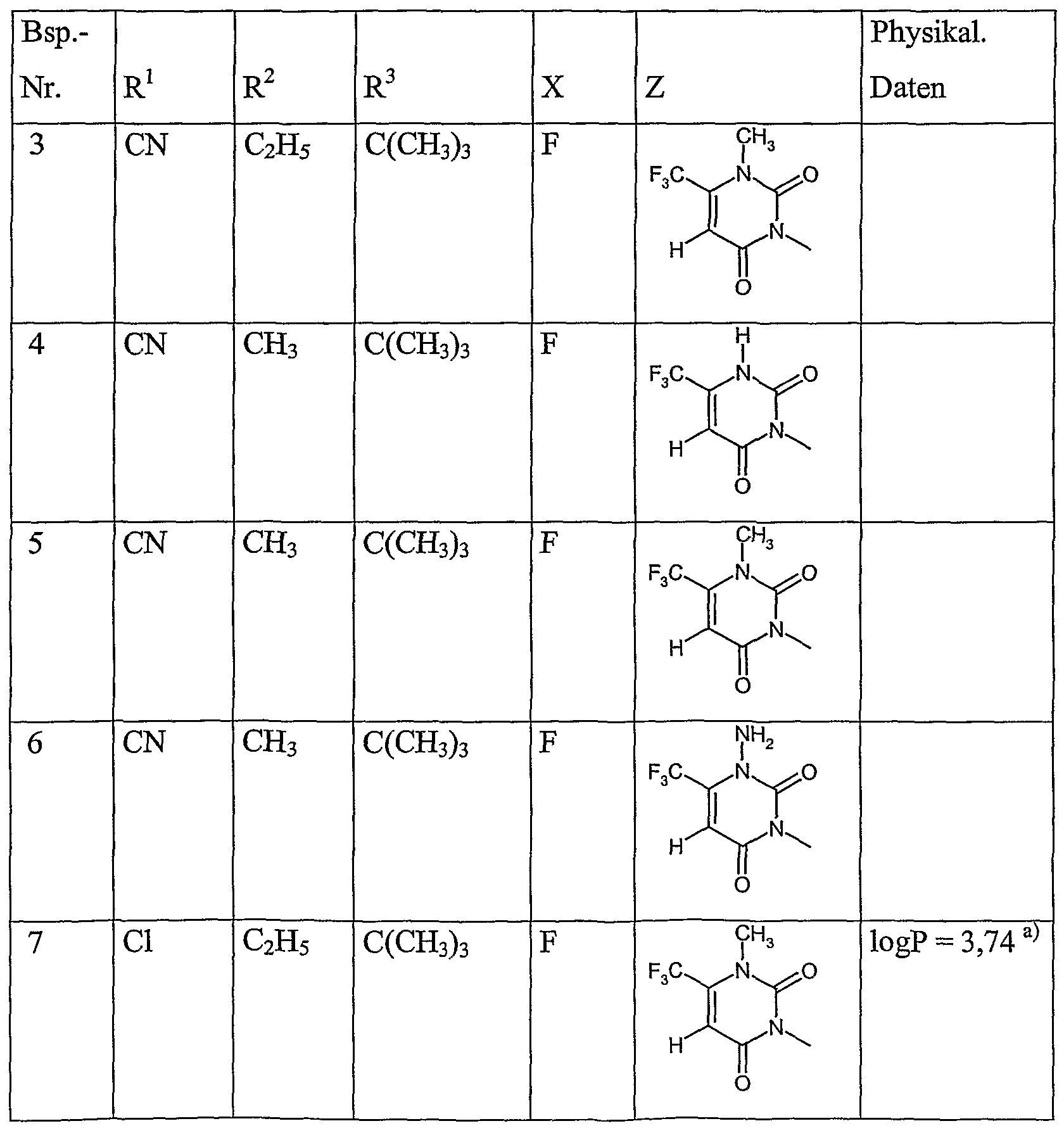
  • the reaction mixture is stirred at room temperature for 18 hours, diluted with 10 ml of dichloromethane and washed successively with 2N hydrochloric acid, saturated aqueous sodium hydrogen carbonate solution and saturated aqueous sodium chloride solution, dried over magnesium sulfate and largely freed from the solvent under reduced pressure.
  • the crude product thus obtained is purified by column chromatography on silica gel using dichloromethane as the eluent.
  • reaction mixture After a reaction time of 20 minutes, in which the reaction temperature rises to -5 ° C., the reaction mixture is mixed with 30 ml of ethyl acetate, washed successively with water and saturated aqueous sodium chloride solution and dried over magnesium sulfate. The solvent is largely removed under reduced pressure and the crude product thus obtained is purified by column chromatography over silica gel using dichloromethane as the eluent.
  • the calibration was carried out with unbranched alkan-2-ones (with 3 to 16 carbon atoms) whose logP values are known (determination of the logP values using the
  • the lambda max values were determined using the UV spectra from 200 nm to 400 nm in the maxima of the chromatographic signals.
  • Emulsifier 1 part by weight of alkylaryl polyglycol ether
  • active compound 1 part by weight of active compound is mixed with the stated amount of solvent, the stated amount of emulsifier is added and the concentrate is diluted with water to the desired concentration.
  • Seeds of the test plants are sown in normal soil. After 24 hours, the soil is sprayed with the active ingredient preparation in such a way that the desired amount of active ingredient is applied per unit area.
  • the active ingredient concentration in the spray liquor is chosen so that the desired amount of active ingredient is applied in 1000 liters of water per hectare.
  • Emulsifier 1 part by weight of alkylaryl polyglycol ether
  • Test plants which have a height of 5 to 15 cm are sprayed with the active compound preparation in such a way that the desired amounts of active compound are applied per unit area.
  • the concentration of the spray liquor is chosen so that in
  • the degree of damage to the plants is rated in% damage compared to the development of the untreated control.

Landscapes

  • Organic Chemistry (AREA)
  • Chemical & Material Sciences (AREA)
  • Life Sciences & Earth Sciences (AREA)
  • Health & Medical Sciences (AREA)
  • Plant Pathology (AREA)
  • Engineering & Computer Science (AREA)
  • Dentistry (AREA)
  • General Health & Medical Sciences (AREA)
  • Wood Science & Technology (AREA)
  • Zoology (AREA)
  • Environmental Sciences (AREA)
  • Pest Control & Pesticides (AREA)
  • Agronomy & Crop Science (AREA)
  • Agricultural Chemicals And Associated Chemicals (AREA)
  • Plural Heterocyclic Compounds (AREA)
  • Heterocyclic Carbon Compounds Containing A Hetero Ring Having Nitrogen And Oxygen As The Only Ring Hetero Atoms (AREA)

Abstract

Die Erfindung betrifft neue substituierte Sulfonsäureanilide der Formel (I), in welcher R<1> für Hydroxy, Nitro, Cyano, Carbamoyl, Thiocarbamoyl, Halogen oder für eine der nachstehenden Gruppierungen-R<3>, -Q<1>-R<3>, -Q<1>-CQ<2>-R<3> steht, R<2> für jeweils gegebenenfalls substituiertes Alkyl, Alkenyl, Alkinyl, Cycloalkyl, Cycloalkylalkyl, Aryl, Arylalkyl, Heterocyclyl oder Heterocyclylalkyl steht, R<3> für jeweils gegebenenfalls substituiertes Alkyl, Alkenyl, Alkinyl, Cycloalkyl, Cycloalkylalkyl, Aryl, Arylalkyl, Heterocyclyl oder Heterocyclylalkyl steht, X für Wasserstoff, Cyano oder Halogen steht, und Z für eine der in der Beschreibung genannten heterocyclischen Gruppierungen steht, sowie Verfahren zu deren Herstellung und deren Verwendung als Pflanzenbehandlungsmittel.

Description

HETEROZYKLISCH SUBSTITUIERTE HERBIZIDE SULFONSÄUREANILIDE
Die Erfindung betrifft neue substituierte Sulfonsäureanilide, ein Verfahren zu ihrer Herstellung und ihre Verwendung als Pflanzenbehandlungsmittel, insbesondere als
Herbizide.
Es ist bereits bekannt, daß bestimmte substituierte Sulfonsäureanilide herbizide Eigenschaften aufweisen (vgl. EP-A-408382, EP-A-563384, EP-A-609734, EP-A- 648749, US-A-4818275, US-A-4909831, O-A-95/17391, WO-A-95/29158, WO-
A-95/29168, O-A-95/30661, WO-A-96/18618). Die Eigenschaften der vorbekannten substituierten Sulfonsäureanilide genügen jedoch unter verschiedenen Aspekten nicht den hohen Anforderungen an moderne Pflanzenbehandlungsmittel.
Es wurden nun neue substituierte Sulfonsäureamlide der Formel (I),
Figure imgf000003_0001
in welcher
R1 für Hydroxy, Nitro, Cyano, Carbamoyl, Thiocarbamoyl, Halogen oder für eine der nachstehenden Gruppierungen -R^, -O^-R^, -θ CQ -R steht,
R2 für jeweils gegebenenfalls substituiertes Alkyl, Alkenyl, Alkinyl, Cycloalkyl, Cycloalkylalkyl, Aryl, Arylalkyl, Heterocyclyl oder Heterocyclylalkyl steht,
R3 für jeweils gegebenenfalls substituiertes Alkyl, Alkenyl, Alkinyl, Cycloalkyl,
Cycloalkylalkyl, Aryl, Arylalkyl, Heterocyclyl oder Heterocyclylalkyl steht, für Wasserstoff, Cyano oder Halogen steht, und
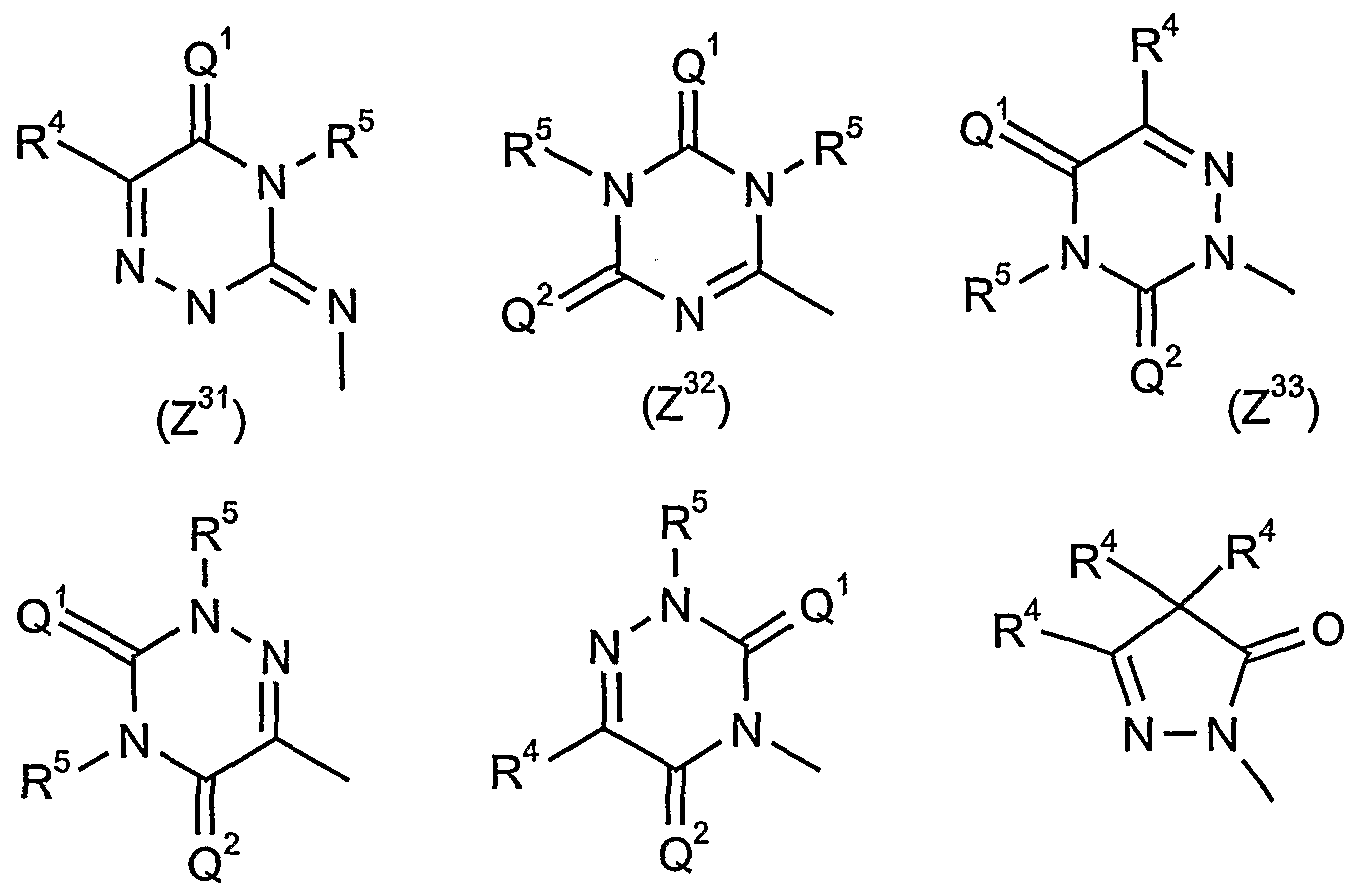
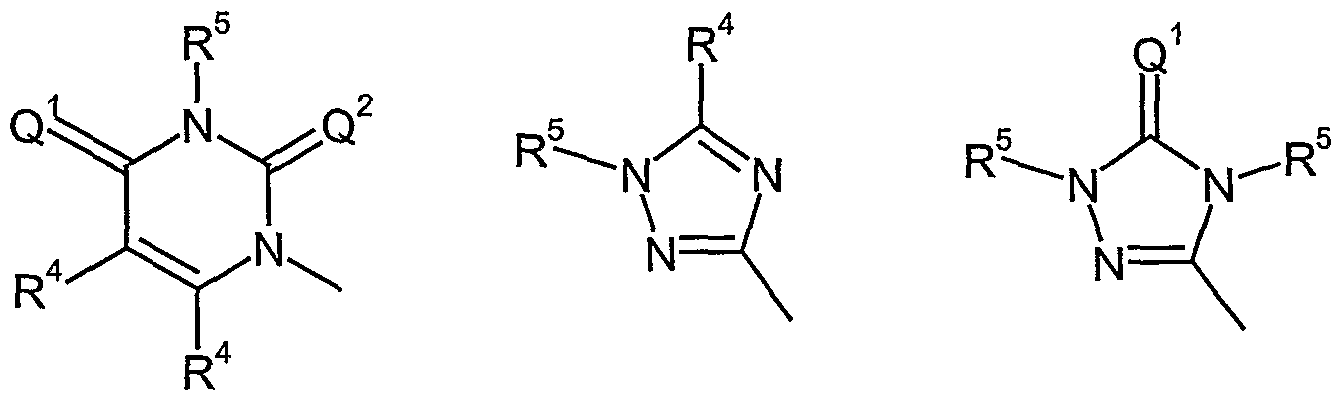
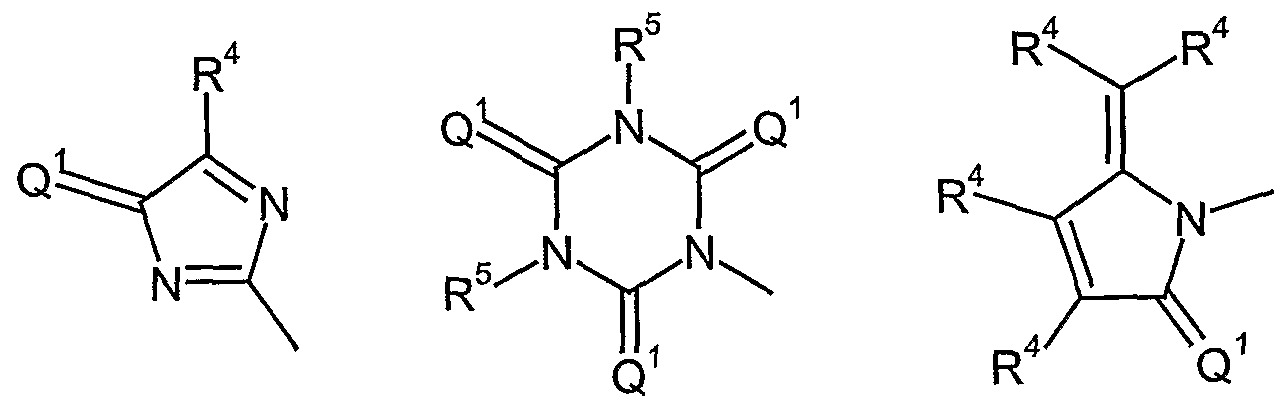
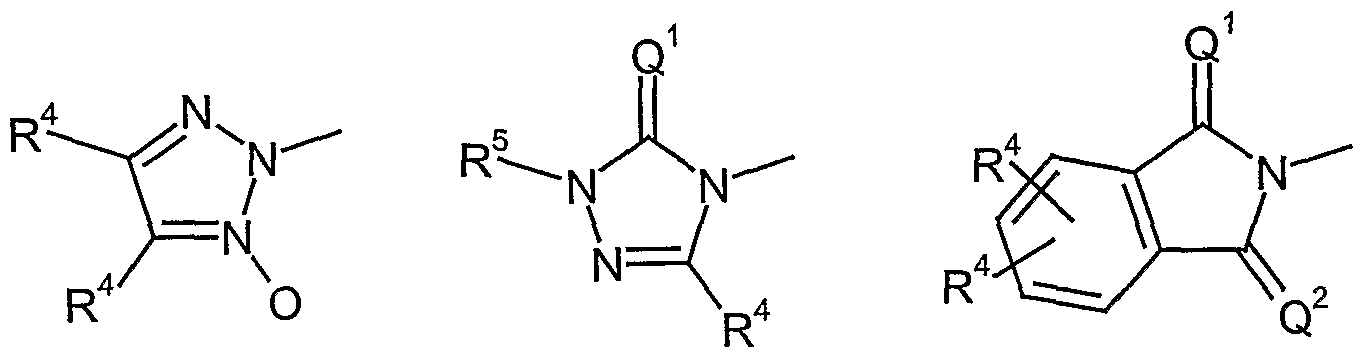
für eine der nachstehenden heterocyclischen Gruppierungen steht,
Figure imgf000004_0001
(z1) (z2) (z3)
Figure imgf000004_0002
(z4) (Z5) (Z°)
Figure imgf000004_0003
Figure imgf000005_0001
(z22) (z23) (z24)
Figure imgf000005_0002
(z28) (Z29) (z30)
Figure imgf000006_0001
(z34) (z35) (z36)
Figure imgf000006_0002
(z37) (z38) (Z39)
Figure imgf000006_0003
(z40) (z41) (z42)
Figure imgf000006_0004
(z43) (z44) (z45)
Figure imgf000007_0001
(Z46) (z47) (z48)
Figure imgf000007_0002
(Z49) (Z50) (Z51) wobei
Q1 für O (Sauerstoff) oder S (Schwefel) steht,
Q2 für O (Sauerstoff) oder S (Schwefel) steht,
R4 für Wasserstoff, Atnino, Nitro, Cyano, Carboxy, Carbamoyl, Thiocarbamoyl, Halogen, oder für jeweils gegebenenfalls substituiertes Alkyl, Alkenyl,
Alkinyl, Alkoxy, Alkoxycarbonyl, Alkenyloxy, Alkinyloxy, Alkylthio, Alkenylthio, Alkinylthio, Alkylamino, Dialkylamino, Cycloalkyl oder Cycloalkylalkyl steht,
R5 für Wasserstoff, Hydroxy, Amino, Cyano, oder für jeweils gegebenenfalls substituiertes Alkyl, Alkoxy, Alkoxycarbonyl, Alkylamino, Alkenyl, Alkinyl, Cycloalkyl, Cycloalkylalkyl, Phenyl oder Phenylalkyl steht,
wobei gegebenenfalls zwei benachbarte Reste - R^ und R^, R^ und R^ oder R^ und R^ - zusammen für gegebenenfalls substituiertes und/oder gegebenenfalls durch O (Sauerstoff), S (Schwefel) oder eine Gruppierung aus der Reihe -SO-, SO2-, -NH- oder -N(Alkyl)- am Anfang (bzw. am Ende) oder innerhalb der Kohlenwasserstoffkette unterbrochenes Alkandiyl oder Alkendiyl stehen,
Y1 für O (Sauerstoff), S (Schwefel), SO, SO2, NH, N(Alkyl) oder Methylen steht und
Y2 für eine Einfachbindung oder für O (Sauerstoff), S (Schwefel), SO, SO2, NH oder N(Alkyl) steht,
wobei Y und Y in jedem Einzelfall verschieden sind,
gefunden.
In den Definitionen sind die Kohlenwasserstoffketten, wie Alkyl oder Alkandiyl - auch in Verbindung mit Heteroatomen, wie in Alkoxy - jeweils geradkettig oder verzweigt.
Bevorzugte Substituenten bzw. bevorzugte Bereiche der in den oben und nachstehend aufgeführten Formeln vorhandenen Reste werden im Folgenden definiert.
R1 steht bevorzugt für Hydroxy, Nitro, Cyano, Carbamoyl, Thiocarbamoyl, Fluor, Chlor, Brom oder eine der nachstehenden Gruppierungen -R3, O^-R3,
-O COΛR3.
R2 steht bevorzugt für gegebenenfalls durch Cyano, Halogen oder C1 -C4- Alkoxy substituiertes Alkyl mit 1 bis 6 Kohlenstoffatomen, für jeweils gegebenenfalls durch Halogen substituiertes Alkenyl oder Alkinyl mit jeweils 2 bis 6 Kohlenstoffatomen, für jeweils gegebenenfalls durch Cyano, Halogen oder C1-C4- Alkyl substituiertes Cycloalkyl oder Cycloalkylalkyl mit jeweils 3 bis 6 Kohlenstoffatomen in der Cycloalkylgruppe und gegebenenfalls 1 bis 4
Kohlenstoffatomen im Alkylteil, für jeweils gegebenenfalls durch Cyano, Nitro, Halogen, Cι-C4-Alkyl, Cι-C4-Halogenalkyl, Cι-C4-Al oxy oder Cι-C4-Halogenalkoxy substituiertes Aryl oder Arylalkyl mit jeweils 6 oder 10 Kohlenstoffatomen in der Arylgruppe und gegebenenfalls 1 bis 4 Kohlenstoffatomen im Alkylteil, oder für jeweils gegebenenfalls durch Cyano, Nitro, Halogen, C1-C4- Alkyl, Cι-C4-Halogenalkyl, C1-C4- Alkoxy oder C1-C4- Halogenalkoxy substituiertes Heterocyclyl oder Heterocyclylalkyl mit jeweils 2 bis 6 Kohlenstoffatomen und 1 bis 3 Stickstoffatomen und/oder 1 oder 2 Sauerstoffatomen in der Heterocyclylgruppe und gegebenenfalls 1 bis 4 Kohlenstoffatomen im Alkylteil.
R steht bevorzugt für gegebenenfalls durch Cyano, Formyl (CHO), Halogen, Cι-C4-Alkoxy oder Cι-C4-Alkoximino-C1-C4-alkyl substituiertes Alkyl mit 1 bis 6 Kohlenstoffatomen, für jeweils gegebenenfalls durch Halogen substituiertes Alkenyl oder Alkinyl mit jeweils 2 bis 6 Kohlenstoffatomen, für je- weils gegebenenfalls durch Cyano, Halogen oder C1-C4- Alkyl substituiertes
Cycloalkyl oder Cycloalkylalkyl mit jeweils 3 bis 6 Kohlenstoffatomen in der Cycloalkylgruppe und gegebenenfalls 1 bis 4 Kohlenstoffatomen im Alkylteil, für jeweils gegebenenfalls durch Cyano, Nitro, Halogen, Cι-C4-Al yl, Cι-C4-Halogenalkyl, Cι-C4-Alkoxy oder Cι~C4-Halogenalkoxy substituier- tes Aryl oder Arylalkyl mit jeweils 6 oder 10 Kohlenstoffatomen in der Arylgruppe und gegebenenfalls 1 bis 4 Kohlenstoffatomen im Alkylteil, oder für jeweils gegebenenfalls durch Cyano, Nitro, Halogen, Cι-C4-Alkyl, C1-C4- Halogenalkyl, C1-C4- Alkoxy oder Cι-C4-Halogenalkoxy substituiertes Heterocyclyl oder Heterocyclylalkyl mit jeweils 1 bis 6 Kohlenstoffatomen, gegebenenfalls bis zu 4 Stickstoffatomen und gegebenenfalls bis zu 2 Sauerstoff- oder Schwefelatomen in der Heterocyclylgruppe und gegebenenfalls bis zu 4 Kohlenstoffatomen im Alkylteil.
X steht bevorzugt für Wasserstoff, Cyano, Fluor, Chlor oder Brom.
Z steht bevorzugt für eine der nachstehenden heterocyclischen Gruppierungen
Figure imgf000010_0001
(z1) (z3)
Figure imgf000010_0002
(z11) (z13)
Figure imgf000010_0003
(z46)
Q1 steht bevorzugt für O (Sauerstoff).
Q2 steht bevorzugt für O (Sauerstoff). R steht bevorzugt für Wasserstoff, Arnino, Nitro, Cyano, Carboxy, Carbamoyl, Thiocarbamoyl, Halogen, für gegebenenfalls durch Cyano, Halogen oder C1-C4- Alkoxy substituiertes Alkyl mit 1 bis 6 Kohlenstoffatomen, für jeweils gegebenenfalls durch Halogen substituiertes Alkenyl oder Alkinyl mit jeweils
2 bis 6 Kohlenstoffatomen, für jeweils gegebenenfalls durch Cyano, Halogen oder -GrAlkoxy substituiertes Alkoxy oder Alkoxycarbonyl mit jeweils 1 bis 6 Kohlenstoffatomen in den Alkylgruppen, für jeweils gegebenenfalls durch Halogen substituiertes Alkenyloxy oder Alkinyloxy mit jeweils 3 bis 6 Kohlenstoffatomen, für gegebenenfalls durch Cyano, Halogen oder C1-C4-
Alkoxy substituiertes Alkylthio mit 1 bis 6 Kohlenstoffatomen, für jeweils gegebenenfalls durch Halogen substituiertes Alkenylthio oder Alkinylthio mit jeweils 3 bis 6 Kohlenstoffatomen, für Alkylamino oder Dialkylamino mit jeweils 1 bis 6 Kohlenstoffatomen in den Alkylgruppen, oder für jeweils ge- gebenenfalls durch Cyano, Halogen oder Cι-C-4-Alkyl substituiertes Cycloalkyl oder Cycloalkylalkyl mit jeweils 3 bis 6 Kohlenstoffatomen in den Cycloalkylgruppen und gegebenenfalls 1 bis 4 Kohlenstoffatomen im Alkylteil.
R5 steht bevorzugt für Wasserstoff, Hydroxy, Amino, Cyano, für jeweils gegebenenfalls durch Cyano, Halogen oder Cι.-C -Alkoxy substituiertes Alkyl, Alkoxy, Alkoxycarbonyl oder Alkylamino mit jeweils bis zu 6 Kohlenstoffatomen, für jeweils gegebenenfalls durch Halogen substituiertes Alkenyl oder Alkinyl mit jeweils bis zu 6 Kohlenstoffatomen, für jeweils gegebenenfalls durch Cyano, Halogen oder C1-C4- Alkyl substituiertes Cycloalkyl oder
Cycloalkylalkyl mit jeweils 3 bis 6 Kohlenstoffatomen in den Cycloalkylgruppen und gegebenenfalls 1 bis 4 Kohlenstoffatomen im Alkylteil, oder für jeweils gegebenenfalls durch Nitro, Cyano, Halogen, Cr -Alkyl, C1-C4- Halogenalkyl, -C -Alkoxy oder C1-C4-Halogenalkoxy substituiertes Phenyl oder Phenyl-C1-C4-alkyl. Zwei benachbarte Reste - R4 und R4, R5 und R5 oder R4 und R5 - stehen gegebenenfalls zusammen bevorzugt für gegebenenfalls durch Halogen substituiertes und/oder gegebenenfalls durch O (Sauerstoff), S (Schwefel) oder eine Gruppierung aus der Reihe -SO-, -SO2-, -NH- oder -N(Cj.-C4- Alkyl)- am Anfang (bzw. am Ende) oder innerhalb der Kohlenwasserstoffkette unterbrochenes Alkandiyl oder Alkendiyl mit jeweils bis zu 5 Kohlenstoffatomen.
Y1 steht bevorzugt für O (Sauerstoff), S (Schwefel), SO, SO2, NH, N(Cι-C4- Alkyl) oder Methylen.
Y2 steht bevorzugt für eine Einfachbindung oder für O (Sauerstoff), S (Schwefel), SO, SO2, NH oderN(C1-C4-Alkyl).
Y undY sind dabei in jedem Einzelfall verschieden.
R1 steht besonders bevorzugt für Cyano, Thiocarbamoyl, Chlor, Brom oder Tri- fluormethyl.
R2 steht besonders bevorzugt für jeweils gegebenenfalls durch Cyano, Fluor, Chlor, Brom, Methoxy, Ethoxy, n- oder i-Propoxy substituiertes Methyl,
Ethyl, n- oder i-Propyl, n-, i-, s- oder t-Butyl, für jeweils gegebenenfalls durch Fluor, Chlor oder Brom substituiertes Ethenyl, Propenyl, Butenyl,
Ethinyl, Propinyl oder Butinyl, für jeweils gegebenenfalls durch Cyano,
Fluor, Chlor, Brom, Methyl oder Ethyl substituiertes Cyclopropyl, Cyclo- butyl, Cyclopentyl, Cyclohexyl, Cyclopropyhnethyl, Cyclobutylmethyl,
Cyclopentylmethyl oder Cyclohexylmethyl, für jeweils gegebenenfalls durch
Cyano, Nitro, Fluor, Chlor, Brom, Methyl, Ethyl, n- oder i-Propyl, n-, i-, s- oder t-Butyl, Trifluormethyl, Methoxy, Ethoxy, n- oder i-Propoxy, Difluor- methoxy oder Trifluormethoxy substituiertes Phenyl, Naphthyl, Benzyl oder Phenylethyl, oder für jeweils gegebenenfalls durch Cyano, Nitro, Fluor,
Chlor, Brom, Methyl, Ethyl, n- oder i-Propyl, n-, i-, s- oder t-Butyl, Trifluor- ethyl, Methoxy, Ethoxy, n- oder i-Propoxy, Difluormethoxy oder Trifluormethoxy substituiertes Heterocyclyl oder Heterocyclylalkyl aus der Reihe Furyl, Thienyl, Pyrrolyl, Pyrazolyl, Imidazolyl, Oxazolyl, Isoxazolyl, Thiazolyl, Pyridinyl, Pyri idinyl, Furylmethyl, Thienylmethyl, Pyrrolyl- methyl, Pyrazolylmethyl, Oxazolylmethyl, Isoxazolyhnethyl, Thiazolyl- methyl, Pyridinylmethyl, Pyrimidinylmethyl.
steht besonders bevorzugt für jeweils gegebenenfalls durch Cyano, Formyl, Fluor, Chlor, Brom, Methoxy, Ethoxy, n- oder i-Propoxy, Methoximino- methyl, Ethoxyiminomethyl, Methoximinoethyl oder Emoxyiminoethyl substituiertes Methyl, Ethyl, n- oder i-Propyl, n-, i-, s- oder t-Butyl, für jeweils gegebenenfalls durch Fluor, Chlor oder Brom substituiertes Ethenyl, Propenyl, Butenyl, Ethinyl, Propinyl oder Butmyl, für jeweils gegebenenfalls durch Cyano, Fluor, Chlor, Brom, Methyl oder Ethyl substituiertes Cyclo- propyl, Cyclobutyl, Cyclopentyl, Cyclohexyl, Cyclopropylmethyl, Cyclobutylmethyl, Cyclopentylmethyl oder Cyclohexylmethyl, für jeweils gegebenenfalls durch Cyano, Nitro, Fluor, Chlor, Brom, Methyl, Ethyl, n- oder i- Propyl, n-, i-, s- oder t-Butyl, Trifluormethyl, Methoxy, Ethoxy, n- oder i- Propoxy, Difluormethoxy oder Trifluormethoxy substituiertes Phenyl, Naphthyl, Benzyl oder Phenylethyl, oder für jeweils gegebenenfalls durch
Cyano, Nitro, Fluor, Chlor, Brom, Methyl, Ethyl, n- oder i-Propyl, n-, i-, s- oder t-Butyl, Trifluormethyl, Methoxy, Ethoxy, n- oder i-Propoxy, Difluormethoxy oder Trifluormethoxy substituiertes Heterocyclyl oder Heterocyclylalkyl aus der Reihe Furyl, Tetrahydrofuryl, Thienyl, Oxazolyl, Thiazolyl, Oxadiazolyl, Thiadiazolyl, Pyridinyl, Pyrimidinyl, Triazinyl, Furylmethyl,
Furylethyl, Furyl-(n- oder i-)-propyl, Tetrahydrofurylmethyl, Tetrahydro- furylethyl, Tetrahydrofuryl-(n- oder i-)-propyl, Dioxolanylmethyl, Di- oxolanylethyl, Dioxolanyl-(n- oder i-)-propyl, Pyridinylmethyl, Pyridinyl- ethyl, Pyridinyl-(n- oder i-)-propyl, Pyrimidinylmethyl, Pyrimidinylethyl, Pyrimidinyl-(n- oder i-)-propyl. X steht besonders bevorzugt für Wasserstoff, Fluor oder Chlor.
Z steht besonders bevorzugt für eine der nachstehenden heterocyclischen Gruppierungen
Figure imgf000014_0001
(z1) (Z3)
Figure imgf000014_0002
(z11) (z13)
Figure imgf000014_0003
R4 steht besonders bevorzugt für Wasserstoff, Amino, Nitro, Cyano, Carboxy, Carbamoyl, Thiocarbamoyl, Fluor, Chlor, Brom, für jeweils gegebenenfalls durch Cyano, Fluor, Chlor, Methoxy oder Ethoxy substituiertes Methyl, Ethyl, n- oder i-Propyl, n-, i-, s- oder t-Butyl, für jeweils gegebenenfalls durch Fluor, Chlor oder Brom substituiertes Ethenyl, Propenyl, Butenyl,
Ethinyl, Propinyl oder Butinyl, für jeweils gegebenenfalls durch Cyano, Fluor, Chlor, Methoxy oder Ethoxy substituiertes Methoxy, Ethoxy, n- oder i- Propoxy, Methoxycarbonyl, Ethoxycarbonyl, n- oder i-Propoxycarbonyl, für jeweils gegebenenfalls durch Fluor, Chlor oder Brom substituiertes Propenyl- oxy, Butenyloxy, Propinyloxy oder Butinyloxy, für jeweils gegebenenfalls durch Cyano, Fluor, Chlor, Methoxy oder Ethoxy substituiertes Methylthio, Ethylthio, n- oder i-Propylthio, für jeweils gegebenenfalls durch Fluor, Chlor oder Brom substituiertes Propenylthio, Butenylthio, Propinylthio oder
Butinylthio, für Me ylarnino, Ethylamino, n- oder i-Propylamino, Dimethyl- amino oder Diemylamino, oder für jeweils gegebenenfalls durch Cyano, Fluor, Chlor, Brom, Methyl oder Ethyl substituiertes Cyclopropyl, Cyclo- butyl, Cyclopentyl, Cyclohexyl, Cyclopropyhnethyl, Cyclobutylmethyl, Cyclopentylmethyl oder Cyclohexylmethyl.
steht besonders bevorzugt für Wasserstoff, Hydroxy, Amino, Cyano, für jeweils gegebenenfalls durch Cyano, Fluor, Chlor, Methoxy, Ethoxy, n- oder i- Propoxy substituiertes Methyl, Ethyl, n- oder i-Propyl, n-, i-, s- oder t-Butyl, Methoxy, Ethoxy, n- oder i-Propoxy, Methoxycarbonyl, Ethoxycarbonyl, n- oder i-Propoxycarbonyl, Methylamino, Ethylamino, n- oder i-Propylamino, für jeweils gegebenenfalls durch Fluor, Chlor oder Brom substituiertes Propenyl, Butenyl, Propinyl oder Butinyl, für jeweils gegebenenfalls durch Cyano, Fluor, Chlor, Brom, Methyl oder Ethyl substituiertes Cyclopropyl, Cyclobutyl, Cyclopentyl, Cyclohexyl, Cyclopropyhnethyl, Cyclobutylmethyl,
Cyclopentylmethyl oder Cyclohexylmethyl, oder für jeweils gegebenenfalls durch Nitro, Cyano, Fluor, Chlor, Brom, Methyl, Ethyl, n- oder i-Propyl, n-, i-, s- oder t-Butyl, Trifluormethyl, Methoxy, Ethoxy, n- oder i-Propoxy, Difluormethoxy oder Trifluormethoxy substituiertes Phenyl, Benzyl oder Phenylethyl.
Zwei benachbarte Reste - R4 und R4, R5 und R5 oder R4 und R^ - stehen gegebenenfalls zusammen besonders bevorzugt für gegebenenfalls durch Fluor oder Chlor substituiertes und/oder gegebenenfalls durch O (Sauerstoff), S (Schwefel) oder eine Gruppierung aus der Reihe -SO-, -SO2-, -NH- oder
-N(Methyl)- am Anfang (bzw. am Ende) oder innerhalb der Kohlenwasser- stoffkette unterbrochenes Propan-l,3-diyl (Trimethylen), Butan- 1,4-diyl (Tetramethylen), Pentan-l,5-diyl (Pentamethylen), Propen- 1,3-diyl, 1-Buten- 1,4-diyl oder 2-Buten- 1,4-diyl.
Y1 steht besonders bevorzugt für O (Sauerstoff), S (Schwefel), SO, SO2, NH, N (Methyl) oder Methylen.
Y2 steht besonders bevorzugt für eine Einfachbindung oder für O (Sauerstoff), S (Schwefel), SO, SO2, NH oder N(Methyl).
Y und Y sind dabei in jedem Einzelfall verschieden.
R1 steht ganz besonders bevorzugt für Cyano, Thiocarbamoyl, Chlor oder Brom.
R2 steht ganz besonders bevorzugt für jeweils gegebenenfalls durch Fluor, Chlor oder Brom substituiertes Methyl, Ethyl, n- oder i-Propyl, n-, i-, s- oder t- Butyl, für jeweils gegebenenfalls durch Fluor, Chlor oder Brom substituiertes Ethenyl, Propenyl, Butenyl, Ethinyl, Propinyl oder Butinyl, für jeweils gegebenenfalls durch Fluor, Chlor, Brom oder Methyl substituiertes Cyclopropyl, Cyclobutyl, Cyclopentyl oder Cyclohexyl, für jeweils gegebenenfalls durch
Cyano, Nitro, Fluor, Chlor, Brom, Methyl, Ethyl, n- oder i-Propyl, n-, i-, s- oder t-Butyl, Trifluormethyl, Methoxy, Ethoxy, n- oder i-Propoxy, Difluormethoxy oder Trifluormethoxy substituiertes Phenyl, Naphthyl oder Benzyl, oder für jeweils gegebenenfalls durch Cyano, Nitro, Fluor, Chlor, Brom, Methyl, Ethyl, n- oder i-Propyl, n-, i-, s- oder t-Butyl, Trifluormethyl,
Methoxy, Ethoxy, n- oder i-Propoxy, Difluormethoxy oder Trifluormethoxy substituiertes Heterocyclyl oder Heterocyclylalkyl aus der Reihe Thienyl, Pyrazolyl, Oxazolyl, Isoxazolyl, Thiazolyl, Pyridinyl.
R3 steht ganz besonders bevorzugt für jeweils gegebenenfalls durch, Cyano,
Formyl, Fluor, Chlor und/oder Brom, Methoxy, Ethoxy, n- oder i-Propoxy, n-, i-, s- oder t-Butoxy, Methoximinomethyl oder Ethoximinoniethyl substituiertes Methyl, Ethyl, n- oder i-Propyl, n-, i-, s- oder t-Butyl, für jeweils gegebenenfalls durch Fluor, Chlor oder Brom substituiertes Ethenyl, Propenyl, Butenyl, Ethinyl, Propinyl oder Butinyl, für jeweils gegebenenfalls durch Fluor, Chlor oder Methyl substituiertes Cyclopropyl, Cyclobutyl, Cyclopentyl oder Cyclohexyl, oder für gegebenenfalls durch Cyano, Nitro, Fluor, Chlor, Brom, Methyl, Ethyl, n- oder i-Propyl, n-, i-, s- oder t-Butyl, Trifluormethyl, Methoxy, Ethoxy, n- oder i-Propoxy, Difluormethoxy oder Trifluormethoxy substituiertes Phenyl, oder Dioxolanylmethyl.
X steht ganz besonders bevorzugt für Fluor oder Chlor.
R4 steht ganz besonders bevorzugt für Wasserstoff, Amino, Cyano, Fluor, Chlor, Brom, für jeweils gegebenenfalls durch Fluor, Chlor, Methoxy oder Ethoxy substituiertes Methyl, Ethyl, n- oder i-Propyl, n-, i-, s- oder t-Butyl, für jeweils gegebenenfalls durch Fluor, Chlor oder Brom substituiertes Ethenyl, Propenyl, Butenyl, Ethinyl, Propinyl oder Butinyl, für jeweils gegebenenfalls durch Fluor, Chlor, Methoxy oder Ethoxy substituiertes Methoxy, Ethoxy, n- oder i-Propoxy, Methylthio, Ethylthio, n- oder i-Propylthio, für jeweils gege- benenfalls durch Fluor, Chlor oder Brom substituiertes Propenyloxy, Butenyl- oxy, Propinyloxy, Butinyloxy, Propenylthio, Butenylthio, Propinylthio oder Butinylthio, oder für jeweils gegebenenfalls durch Fluor, Chlor oder Methyl substituiertes Cyclopropyl oder Cyclopropyhnethyl.
R5 steht ganz besonders bevorzugt für Wasserstoff, Amino, für jeweils gegebenenfalls durch Fluor, Chlor, Methoxy oder Ethoxy substituiertes Methyl, Ethyl, n- oder i-Propyl, n-, i-, s- oder t-Butyl, für jeweils gegebenenfalls durch Fluor, Chlor oder Brom substituiertes Propenyl, Butenyl, Propinyl oder Butmyl, für jeweils gegebenenfalls durch Fluor, Chlor oder Methyl substitu- iertes Cyclopropyl oder Cyclopropyhnethyl. Die einzelnen Reste R4 und R^ - soweit sie mehr als einmal mit der gleichen heterocyclischen Gruppierung verbunden sind - können die gleiche oder verschiedene Bedeutungen im Rahmen der obigen als bevorzugt, besonders bevorzugt oder ganz besonders bevorzugt angegebenen Definitionen haben.
Erfindungsgemäß bevorzugt sind diejenigen Verbindungen der Formel (I), bei welchen eine Kombination der vorstehend als bevorzugt aufgeführten Bedeutungen vorliegt.
Erfindungsgemäß besonders bevorzugt sind diejenigen Verbindungen der Formel (I), bei welchen eine Kombination der vorstehend als besonders bevorzugt aufgeführten Bedeutungen vorliegt.
Erfindungsgemäß ganz besonders bevorzugt sind diejenigen Verbindungen der Formel (I), bei welchen eine Kombination der vorstehend als ganz besonders bevorzugt aufgeführten Bedeutungen vorliegt.
Eine ganz besonders hervorzuhebende Gruppe sind die Verbindungen der allgemeinen Formel (I), in welcher
R1 für Cyano, Thiocarbamoyl, Chlor oder Brom steht,
R2 für jeweils gegebenenfalls durch Fluor oder Chlor substituiertes Methyl, Ethyl, n- oder i-Propyl, n-, i-, s- oder t-Butyl, für gegebenenfalls durch Fluor, Chlor, Brom oder Methyl substituiertes Cyclopropyl, für jeweils gegebenenfalls durch Fluor, Chlor, Brom, Methyl, Ethyl, Trifluormethyl, Methoxy, Ethoxy, Difluormethoxy oder Trifluormethoxy substituiertes Phenyl, oder für jeweils gegebenenfalls durch Fluor, Chlor, Brom, Methyl, Ethyl, Trifluormethyl, Methoxy, Ethoxy, Difluormethoxy oder Trifluormethoxy substituier- tes Heterocyclyl oder Heterocyclylalkyl aus der Reihe Thienyl, Pyrazolyl,
Isoxazolyl, Pyridinyl steht, R3 für jeweils gegebenenfalls durch Fluor oder Chlor substituiertes Methyl, Ethyl, n- oder i-Propyl, n-, i-, s- oder t-Butyl, oder für gegebenenfalls durch Fluor, Chlor, Brom, Methyl oder Trifluormethyl substituiertes Phenyl steht,
X für Wasserstoff, Fluor oder Chlor steht, und
Z für die nachstehende heterocyclische Gruppierung steht,
Figure imgf000019_0001
(z1) wobei
Q1 für O (Sauerstoff) steht,
R4 für Wasserstoff, Fluor, Chlor, Brom, für jeweils gegebenenfalls durch Fluor, Chlor, Methoxy oder Ethoxy substituiertes Methyl, Ethyl, n- oder i-Propyl, für jeweils gegebenenfalls durch Fluor oder Chlor substituiertes Ethenyl, Propenyl, Butenyl, Ethinyl, Propinyl oder Butinyl, für jeweils gegebenenfalls durch Fluor, Chlor, Methoxy oder Ethoxy substituiertes Methoxy, Ethoxy, n- oder i-Propoxy, Methylthio, Ethylthio, n- oder i-Propylthio, für jeweils gege- benenfalls durch Fluor oder Chlor substituiertes Propenyloxy, Butenyloxy,
Propinyloxy, Butinyloxy, Propenylthio, Butenylthio, Propinylthio oder Butinylthio, oder für jeweils gegebenenfalls durch Fluor, Chlor oder Methyl substituiertes Cyclopropyl oder Cyclopropyhnethyl steht, und
R5 für Wasserstoff, Amino, für jeweils gegebenenfalls durch Fluor, Chlor,
Methoxy oder Ethoxy substituiertes Methyl, Ethyl, n- oder i-Propyl, für jeweils gegebenenfalls durch Fluor oder Chlor substituiertes Propenyl, Butenyl, Propinyl oder Butinyl, für jeweils gegebenenfalls durch Fluor, Chlor oder Methyl substituiertes Cyclopropyl oder Cyclopropyhnethyl steht.
Eine weitere ganz besonders hervorzuhebende Gruppe sind die Verbindungen der all- gemeinen Formel (I), in welcher
R1 für Cyano, Thiocarbamoyl, Chlor oder Brom steht,
R2 für jeweils gegebenenfalls durch Fluor oder Chlor substituiertes Methyl, Ethyl, n- oder i-Propyl, n-, i-, s- oder t-Butyl, für gegebenenfalls durch Fluor,
Chlor, Brom oder Methyl substituiertes Cyclopropyl, für jeweils gegebenenfalls durch Fluor, Chlor, Brom, Methyl, Ethyl, Trifluormethyl, Methoxy, Ethoxy, Difluormethoxy oder Trifluormethoxy substituiertes Phenyl, oder für jeweils gegebenenfalls durch Fluor, Chlor, Brom, Methyl, Ethyl, Trifraor- methyl, Methoxy, Ethoxy, Difluormethoxy oder Trifluormethoxy substituiertes Heterocyclyl oder Heterocyclylalkyl aus der Reihe Thienyl, Pyrazolyl, Isoxazolyl, Pyridinyl steht,
R3 für jeweils gegebenenfalls durch Fluor oder Chlor substituiertes Methyl, Ethyl, n- oder i-Propyl, n-, i-, s- oder t-Butyl, oder für gegebenenfalls durch
Fluor, Chlor, Brom, Methyl oder Trifluormethyl substituiertes Phenyl steht,
X für Wasserstoff, Fluor oder Chlor steht, und
Z für die nachstehende heterocyclische Gruppierung steht,
Figure imgf000020_0001
(Z3) wobei Q1 für O (Sauerstoff) steht,
Q2 für O (Sauerstoff) steht,
R4"1 für Wasserstoff, Chlor, Brom oder Methyl steht,
R4"2 für jeweils gegebenenfalls durch Fluor und/oder Chlor substituiertes Methyl oder Ethyl steht, und
R5 für Wasserstoff, Amino, für jeweils gegebenenfalls durch Fluor, Chlor, Methoxy oder Ethoxy substituiertes Methyl, Ethyl, n- oder i- Propyl, oder für jeweils gegebenenfalls durch Fluor oder Chlor substituiertes Propenyl oder Propinyl steht.
Eine weitere ganz besonders hervorzuhebende Gruppe sind die Verbindungen der allgemeinen Formel (I), in welcher
R1 für Cyano, Thiocarbamoyl, Chlor oder Brom steht,
R2 für jeweils gegebenenfalls durch Fluor oder Chlor substituiertes Methyl,
Ethyl, n- oder i-Propyl, n-, i-, s- oder t-Butyl, für gegebenenfalls durch Fluor, Chlor, Brom oder Methyl substituiertes Cyclopropyl, für jeweils gegebenenfalls durch Fluor, Chlor, Brom, Methyl, Ethyl, Trifluormethyl, Methoxy, Ethoxy, Difluormethoxy oder Trifluormethoxy substituiertes Phenyl, oder für jeweils gegebenenfalls durch Fluor, Chlor, Brom, Methyl, Ethyl, Trifluormethyl, Methoxy, Ethoxy, Difluormethoxy oder Trifluormethoxy substituiertes Heterocyclyl oder Heterocyclylalkyl aus der Reihe Thienyl, Pyrazolyl, Isoxazolyl, Pyridinyl steht, R3 für jeweils gegebenenfalls durch Fluor oder Chlor substituiertes Methyl, Ethyl, n- oder i-Propyl, n-, i-, s- oder t-Butyl, oder für gegebenenfalls durch Fluor, Chlor, Brom, Methyl oder Trifluormethyl substituiertes Phenyl steht,
X für Wasserstoff, Fluor oder Chlor steht, und
Z für die nachstehende heterocyclische Gruppierung steht,
Figure imgf000022_0001
(z11) wobei
R4"1 für Wasserstoff, Chlor, Brom oder Methyl steht,
R4"2 für jeweils gegebenenfalls durch Fluor und/oder Chlor substituiertes Methyl, Ethyl, Methoxy oder Ethoxy steht, und
R5 für jeweils gegebenenfalls durch Fluor, Chlor, Methoxy oder Ethoxy substituiertes Methyl, Ethyl, n- oder i-Propyl, oder für jeweils gegebenenfalls durch Fluor oder Chlor substituiertes Propenyl oder Propinyl steht.
Eine weitere ganz besonders hervorzuhebende Gruppe sind die Verbindungen der allgemeinen Formel (I), in welcher
R1 für Cyano, Thiocarbamoyl, Chlor oder Brom steht,
R2 für jeweils gegebenenfalls durch Fluor oder Chlor substituiertes Methyl, Ethyl, n- oder i-Propyl, n-, i-, s- oder t-Butyl, für gegebenenfalls durch Fluor, Chlor, Brom oder Methyl substituiertes Cyclopropyl, für jeweils gegebenen- falls durch Fluor, Chlor, Brom, Methyl, Ethyl, Trifluormethyl, Methoxy, Ethoxy, Difluormethoxy oder Trifluormethoxy substituiertes Phenyl, oder für jeweils gegebenenfalls durch Fluor, Chlor, Brom, Methyl, Ethyl, Trifluormethyl, Methoxy, Ethoxy, Difluormethoxy oder Trifluormethoxy substituier- tes Heterocyclyl oder Heterocyclylalkyl aus der Reihe Thienyl, Pyrazolyl,
Isoxazolyl, Pyridinyl steht,
R3 für jeweils gegebenenfalls durch Fluor oder Chlor substituiertes Methyl, Ethyl, n- oder i-Propyl, n-, i-, s- oder t-Butyl, oder für gegebenenfalls durch Fluor, Chlor, Brom, Methyl oder Trifluormethyl substituiertes Phenyl steht,
X für Wasserstoff, Fluor oder Chlor steht, und
Z für die nachstehende heterocyclische Gruppierung steht,
Figure imgf000023_0001
(z13) wobei
Q1 für O (Sauerstoff) steht,
Q2 für O (Sauerstoff) steht,
R5"1 für jeweils gegebenenfalls durch Fluor, Chlor, Methoxy oder Ethoxy substituiertes Methyl, Ethyl, n- oder i-Propyl, oder für jeweils gegebenenfalls durch Fluor oder Chlor substituiertes Propenyl oder Propinyl steht, und R5"2 für jeweils gegebenenfalls durch Fluor, Chlor, Methoxy oder Ethoxy substituiertes Methyl, Ethyl, n- oder i-Propyl, oder für jeweils gegebenenfalls durch Fluor oder Chlor substituiertes Propenyl oder Propinyl steht.
Eine weitere ganz besonders hervorzuhebende Gruppe sind die Verbindungen der allgemeinen Formel (I), in welcher
R1 für Cyano, Thiocarbamoyl, Chlor oder Brom steht,
R2 für jeweils gegebenenfalls durch Fluor oder Chlor substituiertes Methyl,
Ethyl, n- oder i-Propyl, n-, i-, s- oder t-Butyl, für gegebenenfalls durch Fluor, Chlor, Brom oder Methyl substituiertes Cyclopropyl, für jeweils gegebenenfalls durch Fluor, Chlor, Brom, Methyl, Ethyl, Trifluormethyl, Methoxy, Ethoxy, Difluormethoxy oder Trifluormethoxy substituiertes Phenyl, oder für jeweils gegebenenfalls durch Fluor, Chlor, Brom, Methyl, Ethyl, Trifluormethyl, Methoxy, Ethoxy, Difluormethoxy oder Trifluormethoxy substituiertes Heterocyclyl oder Heterocyclylalkyl aus der Reihe Thienyl, Pyrazolyl, Isoxazolyl, Pyridinyl steht,
R3 für jeweils gegebenenfalls durch Fluor oder Chlor substituiertes Methyl, Ethyl, n- oder i-Propyl, n-, i-, s- oder t-Butyl, oder für gegebenenfalls durch Fluor, Chlor, Brom, Methyl oder Trifluormethyl substituiertes Phenyl steht,
X für Wasserstoff, Fluor oder Chlor steht,
Z für die nachstehende heterocyclische Gruppierung steht,
Figure imgf000025_0001
wobei
Q1 für O (Sauerstoff) steht, und
R4 für Wasserstoff, Fluor, Chlor, Brom, oder für jeweils gegebenenfalls durch Fluor, Chlor, Methoxy oder Ethoxy substituiertes Methyl oder
Ethyl steht.
Eine weitere ganz besonders hervorzuhebende Gruppe sind die Verbindungen der allgemeinen Formel (I), in welcher
R1 für Cyano, Thiocarbamoyl, Chlor oder Brom steht,
R2 für jeweils gegebenenfalls durch Fluor oder Chlor substituiertes Methyl,
Ethyl, n- oder i-Propyl, n-, i-, s- oder t-Butyl, für gegebenenfalls durch Fluor, Chlor, Brom oder Methyl substituiertes Cyclopropyl, für jeweils gegebenenfalls durch Fluor, Chlor, Brom, Methyl, Ethyl, Trifluormethyl, Methoxy, Ethoxy, Difluormethoxy oder Trifluormethoxy substituiertes Phenyl, oder für jeweils gegebenenfalls durch Fluor, Chlor, Brom, Methyl, Ethyl, Trifluormethyl, Methoxy, Ethoxy, Difluormethoxy oder Trifluormethoxy substituiertes Heterocyclyl oder Heterocyclylalkyl aus der Reihe Thienyl, Pyrazolyl, Isoxazolyl, Pyridinyl steht,
R3 für jeweils gegebenenfalls durch Fluor oder Chlor substituiertes Methyl,
Ethyl, n- oder i-Propyl, n-, i-, s- oder t-Butyl, oder für gegebenenfalls durch Fluor, Chlor, Brom, Methyl oder Trifluormethyl substituiertes Phenyl steht, X für Wasserstoff, Fluor oder Chlor steht,
Z für die nachstehende heterocyclische Gruppierung steht,
Figure imgf000026_0001
wobei
Q1 für O (Sauerstoff) steht,
Q2 für O (Sauerstoff) steht,
R4 für Wasserstoff, Fluor, Chlor, Brom, für jeweils gegebenenfalls durch Fluor, Chlor, Methoxy oder Ethoxy substituiertes Methyl oder Ethyl, oder für jeweils gegebenenfalls durch Fluor, Chlor, Methoxy oder Ethoxy substituiertes Methoxy oder Ethoxy steht, und
R5 für jeweils gegebenenfalls durch Fluor, Chlor, Methoxy oder Ethoxy substituiertes Methyl oder Ethyl steht.
Die oben aufgeführten allgemeinen oder in Vorzugsbereichen aufgeführten Restedefinitionen gelten sowohl für die Endprodukte der Formel (I) als auch entsprechend für die jeweils zur Herstellung benötigten Ausgangs- oder Zwischenprodukte. Diese Restedefinitionen können untereinander, also auch zwischen den angegebenen bevorzugten Bereichen beliebig kombiniert werden. Die neuen substituierten Sulfonsäureanilide der allgemeinen Formel (I) weisen interessante biologische Eigenschaften auf. Sie zeichnen sich insbesondere durch starke herbizide Wirksamkeit aus.
Man erhält die neuen substituierten Sulfonsäureanilide der allgemeinen Formel (I), wenn man Sulfonsäureanilide der allgemeinen Formel (II)
Figure imgf000027_0001
in welcher
R 1 , R , X und Z die oben angegebene Bedeutung haben, mit Sulfensäurehalogemden der allgemeinen Formel (III)
X^S-R3 (III) in welcher
R3 die oben angegebene Bedeutung hat und X1 für Halogen steht,
gegebenenfalls in Gegenwart eines Reaktionshilfsmittels und gegebenenfalls in Ge- genwart eines Verdünnungsmittels umsetzt.
Verwendet man beispielsweise N-[2-Cyano-5-(4-difluormethyl-3-methyl-5-oxo-4,5- dihydro- 1 H- 1 ,2,4-triazol- 1 -yl)-4-fluor-phenyl]-methansulfonamid und Fluordichlor- methansulfensäurechlorid als Ausgangsstoffe, so kann der Reaktionsablauf beim er- findungsgemäßen Verfahren durch das folgende Formelschema skizziert werden:
Figure imgf000028_0001
Die beim erfindungsgemäßen Verfahren zur Herstellung von Verbindungen der allgemeinen Formel (I) als Ausgangsstoffe zu verwendenden Sulfonsäureamlide sind durch die Formel (H) allgemein definiert. In der allgemeinen Formel (II) haben R1, R2, X und Z vorzugsweise bzw. insbesondere diejenigen Bedeutungen, die bereits oben im Zusammenhang mit der Beschreibung der erfindungsgemäßen Verbindungen der allgemeinen Formel (I) vorzugsweise bzw. als insbesondere bevorzugt
1 9 für R , R , X und Z angegeben worden sind.
Die Ausgangsstoffe der allgemeinen Formel (II) sind bekannt und/oder können nach an sich bekannten Verfahren hergestellt werden (vgl. EP-A-408382, EP-A- 563384, EP-A-609734, EP-A-648749, US-A-4818275, US-A-4909831, WO-A-95/17391, WO-A-95/29158, WO-A-95/29168, WO-A-95/30661, WO-A-96/18618, WO-A- 99/52878).
Die beim erfindungsgemäßen Verfahren zur Herstellung von Verbindungen der allgemeinen Formel (I) weiter als Ausgangsstoffe zu verwendenden Sulfensäure- halogenide sind durch die Formel (III) allgemein definiert. In der allgemeinen Formel [ITT) hat R3 vorzugsweise bzw. insbesondere diejenige Bedeutung, die bereits oben im Zusammenhang mit der Beschreibung der erfindungsgemäßen Verbindungen der allgemeinen Formel (I) vorzugsweise bzw. als insbesondere bevorzugt für R3 angegeben worden ist; X1 steht vorzugsweise für Fluor, Chlor oder Brom, insbesondere für Chlor. Die Ausgangsstoffe der allgemeinen Formel (TIT) sind bekannte organische Synthesechemikalien.
Das erfindungsgemäße Verfahren zur Herstellung der Verbindungen der allgemeinen Formel (I) wird vorzugsweise unter Verwendung eines Reaktionshilfsmittels durchgeführt. Als Reaktionshilfsmittel kommen im allgemeinen die üblichen anorganischen oder organischen Basen oder Säureakzeptoren in Betracht. Hierzu gehören vorzugsweise Alkalimetall- oder Erdalkalimetall- -acetate, -amide, -carbonate, -hydrogencarbonate, -hydride, -hydroxide oder -alkanolate, wie beispielsweise Natrium-, Kalium- oder Calcium-acetat, Lithium-, Natrium-, Kalium- oder Calciurn- amid, Natrium-, Kalium- oder Calcium-carbonat, Natrium-, Kalium- oder Calcium- hydrogencarbonat, Lithium-, Natrium-, Kalium- oder Calciu -hydrid, Lithium-, Natrium-, Kalium- oder Calcium-hydroxid, Natrium- oder Kalium- -methanolat, -ethanolat, -n- oder -i-propanolat, -n-, -i-, -s- oder -t-butanolat; weiterhin auch basische organische Stickstoffverbindungen, wie beispielsweise Trimethylamin, Tri- ethylamin, Tripropylamin, Tributylamin, Ethyl-diisopropylamin, N,N-Dimethyl- cyclohexylamin, Dicyclohexylamin, Ethyl-dicyclohexylamin, N,N-Dimethyl-anilin, N,N-Dimethyl-benzylamin, Pyridin, 2-Methyl-, 3-Methyl-, 4-Methyl-, 2,4-Di- methyl-, 2,6-Dimethyl-, 3,4-Dimethyl- und 3,5-Dimethyl-pyridin, 5-Ethyl-2-methyl- pyridin, 4-Dimethylamino-pyridin, N-Methyl-piperidin, l,4-Diazabicyclo[2.2.2]- octan (DABCO), l,5-Diazabicyclo[4.3.0]-non-5-en (DBN), oder 1,8-Diazabicyclo- [5.4.0]-undec-7-en (DBU).
Das erfindungsgemäße Verfahren zur Herstellung der Verbindungen der allgemeinen Formel (I) wird vorzugsweise unter Verwendung eines Verdünnungsmittels durchgeführt. Als Verdünnungsmittel kommen vor allem inerte organische Lösungsmittel in Betracht. Hierzu gehören insbesondere aliphatische, alicyclische oder aromatische, gegebenenfalls halogenierte Kohlenwasserstoffe, wie beispielsweise Benzin, Benzol, Toluol, Xylol, Chlorbenzol, Dichlorbenzol, Petrolether, Hexan, Cyclohexan, Dichlor- methan, Chloroform, Tetrachlorkohlenstoff; Ether, wie Diethylether, Diisopropyl- ether, Dioxan, Tetrahydrofuran oder Ethylenglykoldimethyl- oder -diethylether; Ketone, wie Aceton, Butanon oder Methyl-isobutyl-keton; Nitrile, wie Acetonitril, Propionitril oder Butyronitril; Amide, wie N,N-Dimethylformamid, N,N-Dimethyl- acetamid, N-Methyl-formanilid, N-Methyl-pyrrolidon oder Hexamethylphosphor- säuretriamid; Ester wie Essigsäuremethylester oder Essigsäureethylester; Sulfoxide, wie Dimethylsulfoxid.
Die Reaktionstemperaturen können bei der Durchführung des erfindungsgemäßen Verfahrens in einem größeren Bereich variiert werden. Im allgemeinen arbeitet man bei Temperaturen zwischen -60°C und +60°C, vorzugsweise zwischen -40°C und +40°C.
Das erfindungsgemäße Verfahren wird im allgemeinen unter Normaldruck durchgeführt. Es ist jedoch auch möglich, das erfindungsgemäße Verfahren unter erhöhtem oder vermindertem Druck - im allgemeinen zwischen 0,1 bar und 10 bar - durchzu- führen.
Zur Durchführung des erfindungsgemäßen Verfahrens werden die Ausgangsstoffe im allgemeinen in angenähert äquimolaren Mengen eingesetzt. Es ist jedoch auch möglich, eine der Komponenten in einem größeren Überschuß zu verwenden. Die Umsetzung wird im allgemeinen in einem geeigneten Verdünnungsmittel in Gegenwart eines Reaktionshilfsmittels durchgeführt und das Reaktionsgemisch wird im allgemeinen mehrere Stunden bei der erforderlichen Temperatur gerührt. Die Aufarbeitung wird nach üblichen Methoden durchgeführt (vgl. die Herstellungsbeispiele).
Die erfindungsgemäßen Wirkstoffe können als Defoliants, Desiccants, Krautab- tötungsmittel und insbesondere als Unkrautvernichtungsmittel verwendet werden. Unter Unkraut im weitesten Sinne sind alle Pflanzen zu verstehen, die an Orten aufwachsen, wo sie unerwünscht sind. Ob die erfindungsgemäßen Stoffe als totale oder selektive Herbizide wirken, hängt im wesentlichen von der angewendeten Menge ab. Die erfindungsgemäßen Wirkstoffe können z.B. bei den folgenden Pflanzen verwendet werden:
Dikotyle Unkräuter der Gattungen: Abutilon, Amaranthus, Ambrosia, Anoda, Anthemis, Aphanes, Atriplex, Bellis, Bidens, Capsella, Carduus, Cassia, Centaurea,
Chenopodium, Cirsium, Convolvulus, Datura, Desmodium, Emex, Erysimurn, Euphorbia, Galeopsis, Galinsoga, Galium, Hibiscus, Ipomoea, Kochia, Lamium, Lepidium, Lindernia, Matricaria, Mentha, Mercurialis, Mullugo, Myosotis, Papaver, Pharbitis, Plantago, Polygonum, Portulaca, Ranunculus, Raphanus, Rorippa, Rotala, Rumex, Salsola, Senecio, Sesbania, Sida, Sinapis, Solanum, Sonchus, Sphenoclea,
Stellaria, Taraxacum, Thlaspi, Trifolium, Urtica, Veronica, Viola, Xanthium.
Dikotyle Kulturen der Gattungen: Arachis, Beta, Brassica, Cucumis, Cucurbita, Helianthus, Daucus, Glycine, Gossypium, Ipomoea, Lactuca, Linum, Lycopersicon, Nicotiana, Phaseolus, Pisum, Solanum, Vicia.
Monokotyle Unkräuter der Gattungen: Aegilops, Agropyron, Agrostis, Alopecurus, Apera, Avena, Brachiaria, Bromus, Cenchrus, Commelina, Cynodon, Cyperus, Dactyloctenium, Digitaria, Echinochloa, Eleocharis, Eleusine, Eragrostis, Eriochloa, Festuca, Fimbristylis, Heteranthera, Imperata, Ischaemum, Leptochloa, Lolium,
Monochoria, Panicum, Paspalum, Phalaris, Phleu , Poa, Rottboellia, Sagittaria, Scirpus, Setaria, Sorghum.
Monokotyle Kulturen der Gattungen: Allium, Ananas, Asparagus, Avena, Hordeum, Oryza, Panicum, Saccharum, Seeale, Sorghum, Triticale, Triticum, Zea.
Die Verwendung der erfmdungsgemäßen Wirkstoffe ist jedoch keineswegs auf diese Gattungen beschränkt, sondern erstreckt sich in gleicher Weise auch auf andere Pflanzen. Die erfindungsgemäßen Wirkstoffe eignen sich in Abhängigkeit von der Konzentration zur Totalunkrautbekämpfung, z.B. auf Industrie- und Gleisanlagen und auf Wegen und Plätzen mit und ohne Baumbewuchs. Ebenso können die erfindungsgemäßen Wirkstoffe zur Unkrautbekämpfung in Dauerkulturen, z.B. Forst, Zierge- holz-, Obst-, Wein-, Citrus-, Nuß-, Bananen-, Kaffee-, Tee-, Gummi-, Ölpalm-,
Kakao-, Beerenfrucht- und Hopfenanlagen, auf Zier- und Sportrasen und Weide- flächen sowie zur selektiven Uhkrautbekämpfung in einjährigen Kulturen eingesetzt werden.
Die erfindungsgemäßen Verbindungen der Formel (I) zeigen starke herbizide Wirksamkeit und ein breites Wirkungsspektrum bei Anwendung auf dem Boden und auf oberirdische Pflanzenteile. Sie eignen sich in gewissem Umfang auch zur selektiven Bekämpfung von monokotylen und dikotylen Unkräutern in monokotylen und di- kotylen Kulturen, sowohl im Vorauflauf- als auch im Nachauflauf- Verfahren.
Die erfindungsgemäßen Wirkstoffe können in bestimmten Konzentrationen bzw. Aufwandmengen auch zur Bekämpfung von tierischen Schädlingen und pilzlichen oder bakteriellen Pflanzenkrankheiten verwendet werden. Sie lassen sich gegebenenfalls auch als Zwischen- oder Vorprodukte für die Synthese weiterer Wirkstoffe einsetzen.
Erfϊndungsgemäß können alle Pflanzen und Pflanzenteile behandelt werden. Unter Pflanzen werden hierbei alle Pflanzen und Pflanzenpopulationen verstanden, wie erwünschte und unerwünschte Wildpflanzen oder Kulturpflanzen (einschließlich natürlich vorkommender Kulturpflanzen). Kulturpflanzen können Pflanzen sein, die durch konventionelle Züchtungs- und Optimierungsmethoden oder durch biotechnologische und gentechnologische Methoden oder Kombinationen dieser Methoden erhalten werden können, einschließlich der transgenen Pflanzen und einschließlich der durch Sortenschutzrechte schützbaren oder nicht schützbaren Pflanzensorten. Unter Pflanzenteilen sollen alle oberirdischen und unterirdischen
Teile und Organe der Pflanzen, wie Sproß, Blatt, Blüte und Wurzel verstanden werden, wobei beispielhaft Blätter, Nadeln, Stengel, Stämme, Blüten, Fruchtkörper, Früchte und Samen sowie Wurzeln, Knollen und Rhizome aufgeführt werden. Zu den Pflanzenteilen gehört auch Erntegut sowie vegetatives und generatives Vermehrungsmaterial, beispielsweise Stecklinge, Knollen, Rhizome, Ableger und Samen.
Wie bereits oben erwähnt, können erfindungsgemäß alle Pflanzen und deren Teile behandelt werden. In einer bevorzugten Ausführungsform werden wild vorkommende Pflanzen (Unkräuter, Schadpflanzen) und / oder durch konventionelle biologische Zuchtmethoden, wie z.B. Kreuzung oder Protoplastenfusion, erhaltenen Pflanzenarten und Pflanzensorten (Kulturpflanzen) sowie deren Teile behandelt. In einer weiteren bevorzugten Ausführungsform werden transgene Pflanzen und Pflanzensorten, die durch gentechnologische Methoden, gegebenenfalls in Kombination mit konventionellen Methoden, erhalten wurden (Genetic Modified Organisms) und deren Teile behandelt. Der Begriff "Teile" bzw. "Teile von Pflanzen" oder "Pflanzenteile" wurde oben erläutert.
Unter Pflanzensorten versteht man Kulturpflanzen mit bestimmten Eigenschaften ("Traits"), die sowohl durch konventionelle Züchtung, durch Mutagenese oder durch rekombinante DNA-Techniken erhalten worden sind. Dies können Sorten, Bio- und Genotypen sein.
Zu den erfindungsgemäß zu behandelnden transgenen (gentechnologisch erhaltenen) Pflanzen bzw. Pflanzensorten gehören alle Pflanzen, die durch die gentechnologische Modifikation genetisches Material erhielten, welches diesen Pflanzen besondere vorteilhafte wertvolle Eigenschaften ("Traits") verleiht. Beispiele für solche
Eigenschaften sind besseres Pflanzenwachstum, erhöhte Toleranz gegenüber hohen oder niedrigen Temperaturen, erhöhte Toleranz gegen Trockenheit oder gegen Wassersalz- bzw. Bodensalzgehalt, erhöhte Blühleistung, erleichterte Ernte, Beschleunigung der Reife, höhere Ernteerträge, höhere Qualität und oder höherer Ernäh- rungswert der Ernteprodukte, höhere Lagerfähigkeit und/oder Bearbeitbarkeit der
Ernteprodukte. Weitere und besonders hervorgehobene Beispiele für solche Eigen- schaften sind eine erhöhte Abwehr der Pflanzen gegen tierische und mikrobielle Schädlinge, wie gegenüber Insekten, Milben, pflanzenpathogenen Pilzen, Bakterien und/oder Viren sowie eine erhöhte Toleranz der Pflanzen gegen bestimmte herbizide Wirkstoffe. Als Beispiele transgener Pflanzen werden die wichtigen Kulturpflanzen wie Getreide (einschließlich Reis), Mais, Soja, Kartoffel, Baumwolle, Rüben, Raps,
Kulturgräser wie Golf- und Zierrasen, Obstpflanzen (mit den Früchten Äpfel, Birnen, Zitrusfrüchten und Weintrauben) und Plantagenkulturen wie Öl- und Gummibäume erwähnt, wobei Getreide (einschl. Reis), Mais, Soja, Kartoffel, Baumwolle, Rüben und Raps besonders hervorgehoben werden. Als Eigenschaften ("Traits") werden besonders hervorgehoben die erhöhte Abwehr der Pflanzen gegen Insekten durch in den Pflanzen entstehende Toxine, insbesondere solche, die durch das genetische Material aus Bacillus Thuringiensis (z.B. durch die Gene CryΙA(a), CryIA(b), CryΙA(c), CryHA, CrylUA, CryIITB2, Cry9c Cry2Ab, Cry3Bb und CrylF sowie deren Kombinationen) in den Pflanzen erzeugt werden (im folgenden "Bt Pflanzen"). Als Eigenschaften ("Traits") werden auch besonders hervorgehoben die erhöhte
Abwehr von Pflanzen gegen Pilze, Bakterien und Viren durch Systemische Akqui- rierte Resistenz (SAR), Systemin, Phytoalexine, Elicitoren sowie Resistenzgene und entsprechend exprimierte Proteine und Toxine. Als Eigenschaften ("Traits") werden weiterhin besonders hervorgehoben die erhöhte Toleranz der Pflanzen gegenüber bestimmten herbiziden Wirkstoffen und Wirkstoffklassen wie Glyphosate oder
Glufosinate/Phosphinotricin (z.B. "PAT"-Gen), ALS -Hemmstoffe wie Imidazoli- none, Sulfonylharnstoffe und andere, PPO-Hemmstoffe (z.B. Pflanzen mit Acuron - Genen), 4-HPD-Hemmstoffe wie Isoxazole (z.B. Isoxaflutole), ACCase - Hemmstoffe wie Sethoxydim, sowie Bromoxynil.
Die jeweils die gewünschten Eigenschaften ("Traits") verleihenden Gene können auch in Kombinationen miteinander in den transgenen Pflanzen vorkommen. Als Beispiele für "Bt Pflanzen" seien Maissorten, Baumwollsorten, Sojasorten und Kartoffelsorten genannt, die unter den Handelsbezeichnungen YIELD GARD® (z.B. Mais, Baumwolle, Soja), KnockOut® (z.B. Mais), StarLink® (z.B. Mais), Bollgard®
(Baumwolle), Nucotn® (Baumwolle) und NewLeaf® (Kartoffel) vertrieben werden. Als Beispiele für Herbizid tolerante Pflanzen seien Maissorten, Baumwollsorten, Sojasorten, Getreidesorten einschließlich Reissorten, Rübensorten und Rapssorten genannt, die unter den Handelsbezeichnungen Roundup Ready® (Toleranz gegen Glyphosate z.B. Mais, Baumwolle, Soja, Rüben, Raps), Liberty Link® (Toleranz gegen Glufosinate, z.B. Raps, Mais, Rüben), TMI® (Toleranz gegen Imidazolinone) und STS® (Toleranz gegen Sulfonylharnstoffe z.B. Mais) vertrieben werden. Als Herbizid resistente (konventionell auf Herbizid-Toleranz gezüchtete) Pflanzen seien auch die unter der Bezeichnung Clearfield® vertriebenen Sorten (z.B. Mais, Reis) erwähnt.
Selbstverständlich gelten diese Aussagen auch für in der Zukunft entwickelte bzw. zukünftig auf den Markt kommende Pflanzensorten mit diesen oder zukünftig entwickelten genetischen Eigenschaften ("Traits").
Je nach Pflanzenarten bzw. Pflanzensorten, deren Standort und Wachsrumsbedingungen (Böden, Klima, Vegetationsperiode, Ernährung) können durch die erfindungsgemäße Behandlung auch überadditive ("synergistische") Effekte auftreten. So sind beispielsweise erniedrigte Aufwandmengen und/oder Erweiterungen des Wirkungsspektrums und oder eine Verstärkung der Wirkung der erfϊndungsge- maß verwendbaren Stoffe und Mittel - auch in Kombination mit anderen agrochemischen Wirkstoffen - , besseres Pflanzenwachstum der Kulturpflanzen, erhöhte Toleranz der Kulturpflanzen gegenüber hohen oder niedrigen Temperaturen, erhöhte Toleranz der Kulturpflanzen gegen Trockenheit oder gegen Wassersalz- bzw. Bodensalzgehalt, erhöhte Blühleistung, erleichterte Ernte, Beschleunigung der Reife, höhere Ernteerträge, höhere Qualität und/oder höherer Ernährungswert der Ernteprodukte, höhere Lagerfähigkeit und/oder Bearbeitbarkeit der Ernteprodukte möglich, die über die eigentlich zu erwartenden Effekte hinausgehen.
Die aufgeführten Pflanzen können besonders vorteilhaft erfindungsgemäß mit den Verbindungen der allgemeinen Formel I bzw. den erfindungsgemäßen Wirkstoffmischungen behandelt werden, wobei zusätzlich zu der guten Bekämpfung der Unkrautpflanzen die obengenannten synergistischen Effekte mit den oben beschriebenen Pflanzen oder Pflanzensorten auftreten. Die bei den Wirkstoffen bzw. Mischungen oben angegebenen Vorzugsbereiche gelten auch für die Behandlung dieser Pflanzen. Besonders hervorgehoben sei die Pflanzenbehandlung mit den im vorliegenden Text speziell aufgeführten Verbindungen bzw. Mischungen.
Die erfindungsgemäße Behandlung der Pflanzen und Pflanzenteile mit den Wirkstoffen erfolgt direkt oder durch Einwirkung auf deren Umgebung, Lebensraum oder Lagerraum nach den üblichen Behandlungsmethoden, z.B. durch Tauchen, Sprühen, Verdampfen, Vernebeln, Streuen, Aufstreichen und bei Vermehrungsmaterial, insbesondere bei Samen, weiterhin durch ein- oder mehrschichtiges Umhüllen.
Die Wirkstoffe können in die üblichen Formulierungen übergeführt werden, wie Lösungen, Emulsionen, Spritzpulver, Suspensionen, Pulver, Stäubemittel, Pasten, lösliche Pulver, Granulate, Suspensions-Emulsions-Konzentrate, Wirkstoff-imprägnierte Natur- und synthetische Stoffe sowie Feinstverkapselungen in polymeren Stoffen.
Diese Formulierungen werden in bekannter Weise hergestellt, z. B. durch Ver- mischen der Wirkstoffe mit Streckmitteln, also flüssigen Lösungsmitteln und/oder festen Trägerstoffen, gegebenenfalls unter Verwendung von oberflächenaktiven Mitteln, also Emulgiermitteln und/oder Dispergiermitteln und/oder schaumerzeugenden Mitteln.
Im Falle der Benutzung von Wasser als Streckmittel können z.B. auch organische
Lösungsmittel als Hilfslösungsmittel verwendet werden. Als flüssige Lösungsmittel kommen im wesentlichen in Frage: Aromaten, wie Xylol, Toluol, oder Alkyl- naphthaline, chlorierte Aromaten und chlorierte aliphatische Kohlenwasserstoffe, wie Chlorbenzole, Chlorethylene oder Methylenchlorid, aliphatische Kohlenwasserstoffe, wie Cyclohexan oder Paraffine, z.B. Erdölfraktionen, mineralische und pflanzliche
Öle, Alkohole, wie Butanol oder Glykol sowie deren Ether und Ester, Ketone wie Aceton, Methylethylketon, Methylisobutylketon oder Cyclohexanon, stark polare Lösungsmittel, wie Dimethylformamid und Dimethylsulfoxid, sowie Wasser.
Als feste Trägerstoffe kommen in Frage: z.B. Ammom'umsalze und natürliche Ge- steinsmehle, wie Kaoline, Tonerden, Talkum, Kreide, Quarz, Attapulgit, Mont- morillonit oder Diatomeenerde und synthetische Gesteinsmehle, wie hochdisperse Kieselsäure, Aluminiumoxid und Silikate, als feste Trägerstoffe für Granulate kommen in Frage: z.B. gebrochene und fraktionierte natürliche Gesteine wie Calcit, Marmor, Bims, Sepiolith, Dolomit sowie synthetische Granulate aus anorganischen und organischen Mehlen sowie Granulate aus organischem Material wie Sägemehl,
Kokosnußschalen, Maiskolben und Tabakstengeln; als Emulgier- und/oder schaumerzeugende Mittel kommen in Frage: z.B. nichtionogene und anionische Emulgatoren, wie Polyoxyethylen-Fettsäure-Ester, Polyoxyethylen-Fettalkohol- Ether, z.B. Alkylarylpolyglykolether, Alkylsulfonate, Alkylsulfate, Arylsulfonate so- wie Eiweißhydrolysate; als Dispergiermittel kommen in Frage: z.B. Lignin-Sulfitab- laugen und Methylcellulose.
Es können in den Formulierungen Haftmittel wie Carboxymethylcellulose, natürliche und synthetische pulvrige, körnige oder latexförmige Polymere verwendet werden, wie Gummiarabicum, Polyvinylalkohol, Polyvinylacetat, sowie natürliche Phospholipide, wie Kephaline und Lecithine und synthetische Phospholipide. Weitere Additive können mineralische und vegetabile Öle sein.
Es können Farbstoffe wie anorganische Pigmente, z.B. Eisenoxid, Titanoxid, Ferro- cyanblau und organische Farbstoffe, wie Alizarin-, Azo- und Metallphthalocyanin- farbstoffe und Spurennährstoffe wie Salze von Eisen, Mangan, Bor, Kupfer, Kobalt, Molybdän und Zink verwendet werden.
Die Formulierungen enthalten im allgemeinen zwischen 0,1 und 95 Gewichtsprozent Wirkstoff, vorzugsweise zwischen 0,5 und 90 %. Die erfindungsgemäßen Wirkstoffe können als solche oder in ihren Formulierungen auch in Mischung mit bekannten Herbiziden und/oder mit Stoffen, welche die Kulturpflanzen-Verträglichkeit verbessern („Safenern") zur Unkrautbekämpfung verwendet werden, wobei Fertigformulierungen oder Tankmischungen möglich sind. Es sind also auch Mischungen mit Unkrautbekämpfungsmitteln möglich, welche ein oder mehrere bekannte Herbizide und einen Safener enthalten.
Für die Mischungen kommen bekannte Herbizide infrage, beispielsweise Acetochlor, Acifluorfen (-sodium), Aclonifen, Alachlor, Alloxydim (-sodium), Ametryne, Amicarbazone, Amidochlor, Amidosulfuron, Anilofos, Asulam, Atrazine,
Azafenidin, Azimsulfuron, Beflubutamid, Benazolin (-ethyl), Benfuresate, Bensulf- uron (-methyl), Bentazon, Benzfendizone, Benzobicyclon, Benzofenap, Benzoylprop (-ethyl), Bialaphos, Bifenox, Bispyribac (-sodium), Bromobutide, Bromofenoxim, Bromoxynil, Butachlor, Butafenacil (-allyl), Butroxydim, Butylate, Cafenstrole, Caloxydim, Carbetamide, Carfentrazone (-ethyl), Chlomethoxyfen, Chloramben,
Chloridazon, Chlorimuron (-ethyl), Chlornitrofen, Chlorsulfuron, Chlortoluron, Cini- don (-ethyl), Cinmethylin, Cinosulfüron, Clefoxydim, Clethodim, Clodinafop (-propargyl), Clomazone, Clomeprop, Clopyralid, Clopyrasulfuron (-methyl), Clor- ansulam (-methyl), Cumyluron, Cyanazine, Cybutryne, Cycloate, Cyclosulfamuron, Cycloxydim, Cyhalofop (-butyl), 2,4-D, 2,4-DB, Desmedipham, Diallate, Dicamba,
Dichlorprop (-P), Diclofop (-methyl), Diclosulam, Diethatyl (-ethyl), Difenzoquat, Diflufenican, Diflufenzopyr, Dimefuron, Dimepiperate, Dimethachlor, Dimetha- metryn, Dimethenamid, Dimexyflam, Dimtramine, Diphenamid, Diquat, Dithiopyr, Diuron, Dymron, Epropodan, EPTC, Esprocarb, Ethalfluralin, Ethametsulfuron (-methyl), Ethofumesate, Ethoxyfen, Ethoxysulfuron, Etobenzanid, Fenoxaprop (-P- ethyl), Fentrazamide, Flamprop (-isopropyl, -isopropyl-L, -methyl), Flazasulfuron, Florasulam, Fluazifop (-P -butyl), Fluazolate, Flucarbazone (-sodium), Flufenacet, Flumetsulam, Flumiclorac (-pentyl), Flumioxazin, Flumipropyn, Fluometuron, Fluorochloridone, Fluoroglycofen (-ethyl), Flupoxam, Flupropacil, Flurpyrsulfuron (-methyl, -sodium), Flurenol (-butyl), Fluridone, Fluroxypyr (-butoxypropyl,
-meptyl), Flurprimidol, Flurtamone, Fluthiacet (-methyl), Fluthiamide, Fomesafen, Foramsulfuron, Glufosinate (-ammonium), Glyphosate (-isopropylammom'um), Halosafen, Haloxyfop (-ethoxyethyl, -P-methyl), Hexazinone, Imazamethabenz (- methyl), Imazamethapyr, Imazamox, hnazapic, Imazapyr, Imazaquin, Imazethapyr, Imazosulfuron, Iodosulfuron (-methyl, -sodium), Ioxynil, Isopropalin, Isoproturon, Isouron, Isoxaben, Isoxachlortole, Isoxaflutole, Isoxapyrifop, Lactofen, Lenacil, Lin- uron, MCPA, Mecoprop, Mefenacet, Mesotrione, Metamitron, Metazachlor, Methabenzthiazuron, Metobenzuron, Metobromuron, (alpha-) Metolachlor, Metosulam, Metoxuron, Metribuzin, Metsulfuron (-methyl), Molinate, Monolinuron, Napro- anilide, Napropamide, Neburon, Nicosulfuron, Norflurazon, Orbencarb, Oryzalin, Oxadiargyl, Oxadiazon, Oxasulfuron, Oxaziclomefone, Oxyfluorfen, Paraquat,
Pelargonsäure, Pendimethalin, Pendralin, Pentoxazone, Phenmedipham, Picolinafen, Piperophos, Pretilachlor, Primisulfuron (-methyl), Profluazol, Prometryn, Propachlor, Propanil, Propaquizafop, Propisochlor, Propoxycarbazone (-sodium), Propyzamide, Prosulfocarb, Prosulfuron, Pyraflufen (-ethyl), Pyrazogyl, Pyrazolate, Pyrazosulfuron (-ethyl), Pyrazoxyfen, Pyribenzoxim, Pyributicarb, Pyridate, Pyridatol, Pyriftalid,
Pyriminobac (-methyl), Pyrithiobac (-sodium), Quinchlorac, Quinmerac, Quin- oclamine, Quizalofop (-P-ethyl, -P-tefuryl), Rimsulfuron, Sethoxydim, Simazine, Simetryn, Sulcotrione, Sulfentrazone, Sulfometuron (-methyl), Sulfosate, Sulfosulf- uron, Tebutam, Tebuthiuron, Tepraloxydim, Terbuthylazine, Terbutryn, Thenylchlor, Thiafluamide, Thiazopyr, Thidiazimin, Thifensulfuron (-methyl), Thiobencarb, Tio- carbazil, Tralkoxydim, Triallate, Triasulfuron, Tribenuron (-methyl), Triclopyr, Tri- diphane, Trifluralin, Trifloxysulfuron, Triflusulfuron (-methyl), Tritosulfuron.
Auch eine Mischung mit anderen bekannten Wirkstoffen, wie Fungiziden, Insektiziden, Akariziden, Nematiziden, Schutzstoffen gegen Vogelfraß, Pflanzennährstoffen und Bodenstπikturverbesserungsmitteln ist möglich.
Die Wirkstoffe können als solche, in Form ihrer Formulierungen oder den daraus durch weiteres Verdünnen bereiteten Anwendungsformen, wie gebrauchsfertige Lösungen, Suspensionen, Emulsionen, Pulver, Pasten und Granulate angewandt werden. Die Anwendung geschieht in üblicher Weise, z.B. durch Gießen, Spritzen, Sprühen, Streuen.
Die erfindungsgemäßen Wirkstoffe können sowohl vor als auch nach dem Auflaufen der Pflanzen appliziert werden. Sie können auch vor der Saat in den Boden eingearbeitet werden.
Die angewandte Wirkstoffmenge kann in einem größeren Bereich schwanken. Sie hängt im wesentlichen von der Art des gewünschten Effektes ab. Im allgemeinen liegen die Aufwandmengen zwischen 1 g und 10 kg Wirkstoff pro Hektar Bodenfläche, vorzugsweise zwischen 5 g und 5 kg pro ha.
Die Herstellung und die Verwendung der erfindungsgemäßen Wirkstoffe geht aus den nachfolgenden Beispielen hervor.
Herstellungsbeispiele:
Beispiel 1
Figure imgf000041_0001
Zu einer Lösung von 0,43 g (1 mMol) N-[5-(3-Amino-3,6-dihydro-2,6-dioxo-4-tri- fluoj ιethyl-l(2H)-pyrimidinyl)-2-chlor-4-fluor-phenyl]-ethansulfonsäureamid in 6,5 ml Dichlormethan gibt man bei Raumtemperatur (ca. 20°C) nacheinander 0,09 ml (1,1 mMol) Pyridin und 0,12 ml (1,1 mMol) Dichlorfluormethansulfenylchlorid. Das
Reaktionsgemisch wird 18 Stunden bei Raumtemperatur gerührt, mit 10 ml Dichlormethan verdünnt und nacheinander mit 2N Salzsäure, gesättigter wässriger Natrium- hydrogencarbonat-Lösung und gesättigter wässriger Natriumchlorid-Lösung gewaschen, über Magnesiumsulfat getrocknet und unter vermindertem Druck weit- gehend vom Lösungsmittel befreit. Das so erhaltene Rohprodukt wird säulen- chromatographisch über Kieselgel mit Dichlormethan als Laufmittel gereinigt.
Man erhält 0,3 g (53 % der Theorie) N-[5-(3-Amino-3,6-dihydro-2,6-dioxo-4-tri- fluormethyl-l(2H)-pyrimidinyl)-2-chlor-4-fluor-phenyl]-N-dichlorfluormethan- sulfenyl-ethansulfonsäureamid
LogP (bei pH=2,3): 3,48. Beispiel 2
Figure imgf000042_0001
Zu einer Lösung von 1,24 g (2,9 mMol) N-[5-(3-Amino-3,6-dihydro-2,6-dioxo-4-tri- fluormethyl-l(2H)-pyrimidinyl)-2-chlor-4-fluor-phenyl]-ethansulfonsäureamid in
10 ml Tettahydrofuran gibt man 0,15 g (3,8 mMol) 60 % iges Natriumhydrid in Paraffinöl. Die Mischung wird ca. eine Stunde bei Raumtemperatur (ca. 20°C) gerührt und danach auf -35°C abgekühlt. Zu der gekühlten Lösung gibt man eine bei -30°C aus 0,28 g (1,55 mMol) tert.-Butyldisulfid, 0,13 ml (1,55 mMol) Sulfuryl- chlorid und 10 ml Tetrahydrofuran hergestellte Lösung von tert.-Butylsulfenyl- chlorid. Nach 20 Minuten Reaktionszeit, in der die Reaktionstemperatur auf -5°C ansteigt, wird die Reaktionsmischung mit 30 ml Essigsäureethylester versetzt, nacheinander mit Wasser und gesättigter wässriger Natriumchlorid-Lösung gewaschen und über Magnesiumsulfat getrocknet. Das Lösungsmittel wird unter vermindertem Druck weitgehend entfernt und das so erhaltene Rohprodukt säulenchromato- graphisch über Kieselgel mit Dichlormethan als Laufmittel gereinigt.
Man erhält 0,7 g (47 % der Theorie) N-[5-(3-Amino-3,6-dihydro-2,6-dioxo-4-tri- fluormethyl-l(2H)-pyrimidinyl)-2-chlor-4-fluor-phenyl]-N-tert.-butylsulfenyl-ethan- sulfonsäureamid vom Schmelzpunkt von 205°C.
Analog zu den Beispielen 1 und 2 sowie entsprechend der allgemeinen Beschreibung des erfindungsgemäßen Herstellungsverfahrens können beispielsweise auch die in der nachstehenden Tabelle 1 aufgeführten Verbindungen der allgemeinen Formel (I) hergestellt werden.
Figure imgf000043_0001
Tabelle 1: Beispiele für die Verbindungen der Formel (I)
Figure imgf000043_0002
Figure imgf000044_0001
Figure imgf000045_0001
Figure imgf000046_0001
Die Bestimmung der in Tabelle 1 angegebenen logP-Werte erfolgte gemäß EEC- Directive 79/831 Annex V.A8 durch HPLC (High Performance Liquid Chromato- graphy) an einer Phasenumkehrsäule (C 18). Temperatur: 43°C.
(a) Eluenten für die Bestimmung im sauren Bereich: 0,1 % wässrige Phosphorsäure, Acetonitril; linearer Gradient von 10 % Acetonitril bis 90 % Acetonitril - entsprechende Messergebnisse sind in Tabelle 1 mit a) markiert.
(b) Eluenten für die Bestimmung im neutralen Bereich: 0,01 -molare wässrige
Phosphatpuffer-Lösung, Acetonitril; linearer Gradient von 10 % Acetonitril bis 90 % Acetonitril - entsprechende Messergebnisse sind in Tabelle 1 mit b) markiert.
Die Eichung erfolgte mit unverzweigten Alkan-2-onen (mit 3 bis 16 Kohlenstoff- atomen), deren logP- Werte bekannt sind (Bestimmung der logP- Werte anhand der
Retentionszeiten durch lineare Interpolation zwischen zwei aufeinanderfolgenden Alkanonen).
Die lambda-max- Werte wurden an Hand der UV-Spektren von 200 nm bis 400 nm in den Maxima der chromatographischen Signale ermittelt.
Anwendungsbeispiele:
Beispiel A
Pre-emergence-Test
Lösungsmittel: 5 Gewichtsteile Aceton
Emulgator: 1 Gewichtsteil Alkylarylpolyglykolether
Zur Herstellung einer zweckmäßigen Wirkstoffzubereitung vermischt man 1 Gewichtsteil Wirkstoff mit der angegebenen Menge Lösungsmittel, gibt die angegebene Menge Emulgator zu und verdünnt das Konzentrat mit Wasser auf die gewünschte Konzentration.
Samen der Testpflanzen werden in normalen Boden ausgesät. Nach 24 Stunden wird der Boden so mit der Wirkstoffzubereitung besprüht, dass die jeweils gewünschte Wirkstoffmenge pro Flächeneinheit ausgebracht wird. Die Wirkstoffkonzentration in der Spritzbrühe wird so gewählt, dass in 1000 Liter Wasser pro Hektar die jeweils gewünschte Wirkstoffmenge ausgebracht wird.
Nach drei Wochen wird der Schädigungsgrad der Pflanzen bonitiert in % Schädigung im Vergleich zur Entwicklung der uribehandelten Kontrolle. Es bedeuten:
0 % = keine Wirkung (wie unbehandelte Kontrolle) 100 % = totale Vernichtung
In diesem Test zeigen beispielsweise die Verbindungen gemäß Herstellungsbeispiel 1, 2, 3 und 5 bei zum Teil guter Verträglichkeit gegenüber Kulturpflanzen, wie z.B. Mais und Weizen, sehr starke Wirkung gegen Unkräuter. Beispiel B
Post-emergence-Test
Lösungsmittel: 5 Gewichtsteile Aceton
Emulgator: 1 Gewichtsteil Alkylarylpolyglykolether
Zur Herstellung einer zweckmäßigen Wirkstoffzubereitung vermischt man 1 Gewichtsteil Wirkstoff mit der angegebenen Menge Lösungsmittel, gibt die angegebene Menge Emulgator zu und verdünnt das Konzentrat mit Wasser auf die gewünschte
Konzentration.
Mit der Wirkstoffzubereitung spritzt man Testpflanzen, welche eine Höhe von 5 bis 15 cm haben so, daß die jeweils gewünschten Wirkstoffmengen pro Flächeneinheit ausgebracht werden. Die Konzentration der Spritzbrühe wird so gewählt, dass in
1000 1 Wasser/ha die jeweils gewünschten Wirkstoffmengen ausgebracht werden.
Nach drei Wochen wird der Schädigungsgrad der Pflanzen bonitiert in % Schädigung im Vergleich zur Entwicklung der unbehandelten Kontrolle.
Es bedeuten:
0 % = keine Wirkung (wie unbehandelte Kontrolle) 100 % = totale Vernichtung
In diesem Test zeigen beispielsweise die Verbindungen gemäß Herstellungsbeispiel 1, 2, 3 und 5 sehr starke Wirkung gegen Unkräuter.

Claims

Patentansprüche
1. Verbindungen der Formel (I),
Figure imgf000050_0001
in welcher
R1 für Hydroxy, Nitro, Cyano, Carbamoyl, Thiocarbamoyl, Halogen oder für eine der nachstehenden Gruppierungen -R^, -Q^R^, -Q^CQ^R-^ steht,
R2 für jeweils gegebenenfalls substituiertes Alkyl, Alkenyl, Alkinyl,
Cycloalkyl, Cycloalkylalkyl, Aryl, Arylalkyl, Heterocyclyl oder
Heterocyclylalkyl steht,
R für jeweils gegebenenfalls substituiertes Alkyl, Alkenyl, Alkinyl,
Cycloalkyl, Cycloalkylalkyl, Aryl, Arylalkyl, Heterocyclyl oder
Heterocyclylalkyl steht,
X für Wasserstoff, Cyano oder Halogen steht, und
Z für eine der nachstehenden heterocyclischen Gruppierungen steht,
Figure imgf000051_0001
(Z1) (z2) (z3)
Figure imgf000051_0002
(z4) (z5) (z6)
Figure imgf000051_0003
Figure imgf000052_0001
(z22) (z23) (z24)
Figure imgf000052_0002
(z28) (z29) (Z30)
Figure imgf000053_0001
(z34) (z35) (z36)
Figure imgf000053_0002
(z37) (z38) (Z39)
Figure imgf000053_0003
(z40) (z41) (z42)
Figure imgf000053_0004
(z43) (z44) (z45)
Figure imgf000054_0001
(z46) (z47) (z48)
Figure imgf000054_0002
(Z49) (Z50) (Z51) wobei
Q1 für O (Sauerstoff) oder S (Schwefel) steht,
Q2 für O (Sauerstoff) oder S (Schwefel) steht,
R4 für Wasserstoff, Amino, Nitro, Cyano, Carboxy, Carbamoyl, Thio- carbamoyl, Halogen, oder für jeweils gegebenenfalls substituiertes
Alkyl, Alkenyl, Alkinyl, Alkoxy, Alkoxycarbonyl, Alkenyloxy, Alkinyloxy, Alkylthio, Alkenylthio, Alkinylthio, Alkylamino, Di- alkylamino, Cycloalkyl oder Cycloalkylalkyl steht,
R5 für Wasserstoff, Hydroxy, Amino, Cyano, oder für jeweils gegebenenfalls substituiertes Alkyl, Alkoxy, Alkoxycarbonyl, Alkylamino, Alkenyl, Alkinyl, Cycloalkyl, Cycloalkylalkyl, Phenyl oder Phenyl- alkyl steht,
wobei gegebenenfalls zwei benachbarte Reste - R4 und R4, R5 und
R5 oder R4 und R^ - zusammen für gegebenenfalls substituiertes und/oder gegebenenfalls durch O (Sauerstoff), S (Schwefel) oder eine Gruppierung aus der Reihe -SO-, -SO2-, -NH- oder -N(Alkyl)- am Anfang (bzw. am Ende) oder innerhalb der Kohlenwasserstoffkette unterbrochenes Alkandiyl oder Alkendiyl stehen,
Y1 für O (Sauerstoff), S (Schwefel), SO, SO2, NH, N(Alkyl) oder Methylen steht und
Y2 für eine Einfachbindung oder für O (Sauerstoff), S (Schwefel), SO, SO2, NH oderN(Alkyl) steht,
wobei Y1 und Y2 in jedem Einzelfall verschieden sind.
2. Verbindungen der Formel (I) gemäß Anspruch 1, dadurch gekennzeichnet, dass
R1 für Hydroxy, Nitro, Cyano, Carbamoyl, Thiocarbamoyl, Fluor, Chlor, Brom oder eine der nachstehenden Gruppierungen -R , Q -R , -Q - CQ2-R3 steht,
R2 für gegebenenfalls durch Cyano, Halogen oder C1-C4- Alkoxy substituiertes Alkyl mit 1 bis 6 Kohlenstoffatomen,
für jeweils gegebenenfalls durch Halogen substituiertes Alkenyl oder Alkinyl mit jeweils 2 bis 6 Kohlenstoffatomen,
für jeweils gegebenenfalls durch Cyano, Halogen oder C1-C4- Alkyl substituiertes Cycloalkyl oder Cycloalkylalkyl mit jeweils 3 bis 6 Kohlenstoffatomen in der Cycloalkylgruppe und gegebenenfalls 1 bis 4 Kohlenstoffatomen im Alkylteil, für jeweils gegebenenfalls durch Cyano, Nitro, Halogen, C1-C4- Alkyl, Cι-C4-Halogenalkyl, Cι-C4-Alkoxy oder Cι -C4-Halogen- alkoxy substituiertes Aryl oder Arylalkyl mit jeweils 6 oder 10 Kohlenstoffatomen in der Arylgruppe und gegebenenfalls 1 bis 4 Kohlenstoffatomen im Alkylteil,
oder für jeweils gegebenenfalls durch Cyano, Nitro, Halogen, C1-C4-
Alkyl, Cι~C4-Halogenalkyl, C1-C4- Alkoxy oder Cι-C4-Halogen- alkoxy substituiertes Heterocyclyl oder Heterocyclylalkyl mit jeweils 2 bis 6 Kohlenstoffatomen und 1 bis 3 Stickstoffatomen und/oder 1 oder 2 Sauerstoffatomen in der Heterocyclylgruppe und gegebenenfalls 1 bis 4 Kohlenstoffatomen im Alkylteil steht,
für gegebenenfalls durch Cyano, Formyl (CHO), Halogen, C1-C4- Alkoxy oder Cι-C4-Alkoximino-C1-C4-alkyl substituiertes Alkyl mit
1 bis 6 Kohlenstoffatomen,
für jeweils gegebenenfalls durch Halogen substituiertes Alkenyl oder Alkinyl mit jeweils 2 bis 6 Kohlenstoffatomen, für jeweils gegebenen- falls durch Cyano, Halogen oder C1-C4- Alkyl substituiertes Cycloalkyl oder Cycloalkylalkyl mit jeweils 3 bis 6 Kohlenstoffatomen in der Cycloalkylgruppe und gegebenenfalls 1 bis 4 Kohlenstoffatomen im Alkylteil,
für jeweils gegebenenfalls durch Cyano, Nitro, Halogen, C1-C4-
Alkyl, Cι -C4-Halogenalkyl, C1-C4- Alkoxy oder Cj-C4-Halogen- alkoxy substituiertes Aryl oder Arylalkyl mit jeweils 6 oder 10 Kohlenstoffatomen in der Arylgruppe und gegebenenfalls 1 bis 4 Kohlenstoffatomen im Alkylteil, oder für jeweils gegebenenfalls durch Cyano, Nitro, Halogen, CJ-C4- Alkyl, Cι-C4-Halogenalkyl, C1-C4- Alkoxy oder Cι-C4-Halogen- alkoxy substituiertes Heterocyclyl oder Heterocyclylalkyl mit jeweils 1 bis 6 Kohlenstoffatomen, gegebenenfalls bis zu 4 Stickstoffatomen und gegebenenfalls bis zu 2 Sauerstoff- oder Schwefelatomen in der Heterocyclylgruppe und gegebenenfalls bis zu 4 Kohlenstoffatomen im Alkylteil steht,
X für Wasserstoff, Cyano, Fluor, Chlor oder Brom steht, und
Z für eine der nachstehenden heterocyclischen Gruppierungen steht,
Figure imgf000057_0001
(Z1) (z3)
Figure imgf000057_0002
(Z11) (Z13)
Figure imgf000058_0001
(z46) wobei
Q1 für O (Sauerstoff) steht,
Q2 für O (Sauerstoff) steht,
R4 für Wasserstoff, Amino, Nitro, Cyano, Carboxy, Carbamoyl, Thio- carbamoyl, Halogen, für gegebenenfalls durch Cyano, Halogen oder
Cι.-C4- Alkoxy substituiertes Alkyl mit 1 bis 6 Kohlenstoffatomen,
für jeweils gegebenenfalls durch Halogen substituiertes Alkenyl oder Alkinyl mit jeweils 2 bis 6 Kohlenstoffatomen,
für jeweils gegebenenfalls durch Cyano, Halogen oder C1-C4-Alkoxy substituiertes Alkoxy oder Alkoxycarbonyl mit jeweils 1 bis 6 Kohlenstoffatomen in den Alkylgruppen,
für jeweils gegebenenfalls durch Halogen substituiertes Alkenyloxy oder Alkinyloxy mit jeweils 3 bis 6 Kohlenstoffatomen, für gegebenenfalls durch Cyano, Halogen oder - -Alkoxy substituiertes Alkylthio mit 1 bis 6 Kohlenstoffatomen,
für jeweils gegebenenfalls durch Halogen substituiertes Alkenylthio oder Alkinylthio mit jeweils 3 bis 6 Kohlenstoffatomen,
für Alkylamino oder Dialkylamino mit jeweils 1 bis 6 Kohlenstoffatomen in den Alkylgruppen,
oder für jeweils gegebenenfalls durch Cyano, Halogen oder Ci-C -
Alkyl substituiertes Cycloalkyl oder Cycloalkylalkyl mit jeweils 3 bis 6 Kohlenstoffatomen in den Cycloalkylgrappen und gegebenenfalls 1 bis 4 Kohlenstoffatomen im Alkylteil steht, und
für Wasserstoff, Hydroxy, Amino, Cyano,
für jeweils gegebenenfalls durch Cyano, Halogen oder C1-C4-Alkoxy substituiertes Alkyl, Alkoxy, Alkoxycarbonyl oder Alkylamino mit jeweils bis zu 6 Kohlenstoffatomen,
für jeweils gegebenenfalls durch Halogen substituiertes Alkenyl oder Alkinyl mit jeweils bis zu 6 Kohlenstoffatomen,
für jeweils gegebenenfalls durch Cyano, Halogen oder C1-C -Alkyl substituiertes Cycloalkyl oder Cycloalkylalkyl mit jeweils 3 bis 6
Kohlenstoffatomen in den Cycloalkylgrappen und gegebenenfalls 1 bis 4 Kohlenstoffatomen im Alkylteil,
oder für jeweils gegebenenfalls durch Nitro, Cyano, Halogen, -C4- Alkyl, Cι-C4-Halogenalkyl, d-C4-Alkoxy oder CrC4-Halogenalkoxy substituiertes Phenyl oder Phenyl-C1-C4-alkyl steht, wobei zwei benachbarte Reste - R4 und R4, R5 und R5 oder R4 und R5 - gegebenenfalls zusammen für gegebenenfalls durch Halogen substituiertes und/oder gegebenenfalls durch O (Sauerstoff), S (Schwefel) oder eine Gruppierung aus der Reihe -SO-, -SO2-, -NH- oder -N(Ci-
C4-Alkyl)- am Anfang (bzw. am Ende) oder innerhalb der Kohlenwasserstoffkette unterbrochenes Alkandiyl oder Alkendiyl mit jeweils bis zu 5 Kohlenstoffatomen stehen.
Verbindungen der Formel (I) gemäß Anspruch 1 oder 2, dadurch gekennzeichnet, dass
R1 für Cyano, Thiocarbamoyl, Chlor, Brom oder Trifluormethyl steht,
R2 für jeweils gegebenenfalls durch Cyano, Fluor, Chlor, Brom,
Methoxy, Ethoxy, n- oder i-Propoxy substituiertes Methyl, Ethyl, n- oder i-Propyl, n-, i-, s- oder t-Butyl,
für jeweils gegebenenfalls durch Fluor, Chlor oder Brom substituiertes Ethenyl, Propenyl, Butenyl, Ethinyl, Propinyl oder Butinyl,
für jeweils gegebenenfalls durch Cyano, Fluor, Chlor, Brom, Methyl oder Ethyl substituiertes Cyclopropyl, Cyclobutyl, Cyclopentyl, Cyclohexyl, Cyclopropylmethyl, Cyclobutylmethyl, Cyclopentyl- methyl oder Cyclohexylmethyl,
für jeweils gegebenenfalls durch Cyano, Nitro, Fluor, Chlor, Brom, Methyl, Ethyl, n- oder i-Propyl, n-, i-, s- oder t-Butyl, Trifluormethyl, Methoxy, Ethoxy, n- oder i-Propoxy, Difluormethoxy oder Trifluor- methoxy substituiertes Phenyl, Naphthyl, Benzyl oder Phenylethyl, oder für jeweils gegebenenfalls durch Cyano, Nitro, Fluor, Chlor, Brom, Methyl, Ethyl, n- oder i-Propyl, n-, i-, s- oder t-Butyl, Trifluormethyl, Methoxy, Ethoxy, n- oder i-Propoxy, Difluormethoxy oder Trifluormethoxy substituiertes Heterocyclyl oder Heterocyclylalkyl aus der Reihe Furyl, Thienyl, Pyrrolyl, Pyrazolyl, Imidazolyl, Oxazolyl, Isoxazolyl, Thiazolyl, Pyridinyl, Pyrimidinyl, Furylmethyl, Thienylmethyl, Pyrrolylmethyl, Pyrazolylmethyl, Oxazolylmethyl, Isoxazolylmethyl, Thiazolylmethyl, Pyridinylmethyl, Pyrimidinylmethyl steht,
für jeweils gegebenenfalls durch Cyano, Formyl, Fluor, Chlor, Brom, Methoxy, Ethoxy, n- oder i-Propoxy, Methoximinomethyl, Ethoxy- iminomethyl, Methoximinoethyl oder Ethoxyiminoethyl substituiertes Methyl, Ethyl, n- oder i-Propyl, n-, i-, s- oder t-Butyl,
für jeweils gegebenenfalls durch Fluor, Chlor oder Brom substituiertes Ethenyl, Propenyl, Butenyl, Ethinyl, Propinyl oder Butinyl,
für jeweils gegebenenfalls durch Cyano, Fluor, Chlor, Brom, Methyl oder Ethyl substituiertes Cyclopropyl, Cyclobutyl, Cyclopentyl,
Cyclohexyl, Cyclopropyhnethyl, Cyclobutylmethyl, Cyclopentylmethyl oder Cyclohexylmethyl,
für jeweils gegebenenfalls durch Cyano, Nitro, Fluor, Chlor, Brom, Methyl, Ethyl, n- oder i-Propyl, n-, i-, s- oder t-Butyl, Trifluormethyl,
Methoxy, Ethoxy, n- oder i-Propoxy, Difluormethoxy oder Trifluormethoxy substituiertes Phenyl, Naphthyl, Benzyl oder Phenylethyl,
oder für jeweils gegebenenfalls durch Cyano, Nitro, Fluor, Chlor, Brom, Methyl, Ethyl, n- oder i-Propyl, n-, i-, s- oder t-Butyl, Trifluormethyl, Methoxy, Ethoxy, n- oder i-Propoxy, Difluormethoxy oder Trifluormethoxy substituiertes Heterocyclyl oder Heterocyclylalkyl aus der Reihe Furyl, TetrahyαVofuryl, Thienyl, Oxazolyl, Thiazolyl, Oxadiazolyl, Thiadiazolyl, Pyridinyl, Pyrimidinyl, Triazinyl, Furylmethyl, Furylethyl, Furyl-(n- oder i-)-propyl, Tetrahydrofurylmethyl, Tetrahydrofxirylethyl, Tetrahydrofuryl-(n- oder i-)-propyl, Dioxolanyl- methyl, Dioxolanylethyl, Dioxolanyl-(n- oder i-)-propyl, Pyridinylmethyl, Pyridinylethyl, Pyridinyl-(n- oder i-)-propyl, Pyrimidinylmethyl, Pyrimidinylethyl, Pyrimidinyl-(n- oder i-)-propyl steht,
X für Wasserstoff, Fluor oder Chlor steht,
Z für eine der nachstehenden heterocyclischen Gruppierungen steht,
Figure imgf000062_0001
(z1) (z3)
Figure imgf000062_0002
(z11) (z13)
Figure imgf000062_0003
für Wasserstoff, Amino, Nitro, Cyano, Carboxy, Carbamoyl, Thiocarbamoyl, Fluor, Chlor, Brom,
für jeweils gegebenenfalls durch Cyano, Fluor, Chlor, Methoxy oder Ethoxy substituiertes Methyl, Ethyl, n- oder i-Propyl, n-, i-, s- oder t- Butyl,
für jeweils gegebenenfalls durch Fluor, Chlor oder Brom substituiertes Ethenyl, Propenyl, Butenyl, Ethinyl, Propinyl oder Butinyl,
für jeweils gegebenenfalls durch Cyano, Fluor, Chlor, Methoxy oder Ethoxy substituiertes Methoxy, Ethoxy, n- oder i-Propoxy, Methoxycarbonyl, Ethoxycarbonyl, n- oder i-Propoxycarbonyl,
für jeweils gegebenenfalls durch Fluor, Chlor oder Brom substituiertes
Propenyloxy, Butenyloxy, Propinyloxy oder Butinyloxy,
für jeweils gegebenenfalls durch Cyano, Fluor, Chlor, Methoxy oder Ethoxy substituiertes Methylthio, Ethylthio, n- oder i-Propylthio,
für jeweils gegebenenfalls durch Fluor, Chlor oder Brom substituiertes Propenylthio, Butenylthio, Propinylthio oder Butinylthio,
für Methylamino, Ethylamino, n- oder i-Propylamino, Dimethylamino oder Diethylamino,
oder für jeweils gegebenenfalls durch Cyano, Fluor, Chlor, Brom, Methyl oder Ethyl substituiertes Cyclopropyl, Cyclobutyl, Cyclopentyl, Cyclohexyl, Cyclopropylmethyl, Cyclobutylmethyl, Cyclo- pentylmethyl oder Cyclohexylmethyl steht, und für Wasserstoff, Hydroxy, Amino, Cyano,
für jeweils gegebenenfalls durch Cyano, Fluor, Chlor, Methoxy,
Ethoxy, n- oder i-Propoxy substituiertes Methyl, Ethyl, n- oder i- Propyl, n-, i-, s- oder t-Butyl, Methoxy, Ethoxy, n- oder i-Propoxy,
Methoxycarbonyl, Ethoxycarbonyl, n- oder i-Propoxycarbonyl, Methylamino, Ethylamino, n- oder i-Propylamino,
für jeweils gegebenenfalls durch Fluor, Chlor oder Brom substituiertes Propenyl, Butenyl, Propinyl oder Butinyl,
für jeweils gegebenenfalls durch Cyano, Fluor, Chlor, Brom, Methyl oder Ethyl substituiertes Cyclopropyl, Cyclobutyl, Cyclopentyl, Cyclohexyl, Cyclopropyhnethyl, Cyclobutylmethyl, Cyclopentyl- methyl oder Cyclohexylmethyl,
oder für jeweils gegebenenfalls durch Nitro, Cyano, Fluor, Chlor, Brom, Methyl, Ethyl, n- oder i-Propyl, n-, i-, s- oder t-Butyl, Trifluormethyl, Methoxy, Ethoxy, n- oder i-Propoxy, Difluormethoxy oder Trifluormethoxy substituiertes Phenyl, Benzyl oder Phenylethyl steht, wobei
zwei benachbarte Reste - R4 und R4, R^ und R^ oder R4 und R^ - gegebenenfalls zusammen für gegebenenfalls durch Fluor oder Chlor substituiertes und/oder gegebenenfalls durch O (Sauerstoff), S
(Schwefel) oder eine Gruppierung aus der Reihe -SO-, -SO2-, -NH- oder -N(Methyl)- am Anfang (bzw. am Ende) oder innerhalb der Kohlenwasserstoffkette unterbrochenes Propan-l,3-diyl (Trimethylen), Butan- 1,4-diyl (Tetramethylen), Pentan-l,5-diyl (Pentamethylen), Propen-l,3-diyl, 1 -Buten- 1,4-diyl oder 2-Buten- 1,4-diyl stehen. Verbindungen der Formel (I) gemäß einem der Ansprüche 1 bis 3, dadurch gekennzeichnet, dass
R1 für Cyano, Thiocarbamoyl, Chlor oder Brom steht,
R für jeweils gegebenenfalls durch Fluor, Chlor oder Brom substituiertes Methyl, Ethyl, n- oder i-Propyl, n-, i-, s- oder t-Butyl,
für jeweils gegebenenfalls durch Fluor, Chlor oder Brom substituiertes Ethenyl, Propenyl, Butenyl, Ethinyl, Propinyl oder Butinyl,
für jeweils gegebenenfalls durch Fluor, Chlor, Brom oder Methyl substituiertes Cyclopropyl, Cyclobutyl, Cyclopentyl oder Cyclohexyl,
für jeweils gegebenenfalls durch Cyano, Nitro, Fluor, Chlor, Brom,
Methyl, Ethyl, n- oder i-Propyl, n-, i-, s- oder t-Butyl, Trifluormethyl, Methoxy, Ethoxy, n- oder i-Propoxy, Difluormethoxy oder Trifluormethoxy substituiertes Phenyl, Naphthyl oder Benzyl,
oder für jeweils gegebenenfalls durch Cyano, Nitro, Fluor, Chlor,
Brom, Methyl, Ethyl, n- oder i-Propyl, n-, i-, s- oder t-Butyl, Trifluormethyl, Methoxy, Ethoxy, n- oder i-Propoxy, Difluormethoxy oder Trifluormethoxy substituiertes Heterocyclyl oder Heterocyclylalkyl aus der Reihe Thienyl, Pyrazolyl, Oxazolyl, Isoxazolyl, Thiazolyl, Pyridinyl steht,
R3 für jeweils gegebenenfalls durch Cyano, Formyl, Fluor, Chlor und/oder Brom, Methoxy, Ethoxy, n- oder i-Propoxy, n-, i-, s- oder t- Butoxy, Methoximinomethyl oder Ethoximinomethyl substituiertes Methyl, Ethyl, n- oder i-Propyl, n-, i-, s- oder t-Butyl, für jeweils gegebenenfalls durch Fluor, Chlor oder Brom substituiertes Ethenyl, Propenyl, Butenyl, Ethinyl, Propinyl oder Butinyl,
für jeweils gegebenenfalls durch Fluor, Chlor oder Methyl sub- stituiertes Cyclopropyl, Cyclobutyl, Cyclopentyl oder Cyclohexyl,
oder für gegebenenfalls durch Cyano, Nitro, Fluor, Chlor, Brom, Methyl, Ethyl, n- oder i-Propyl, n-, i-, s- oder t-Butyl, Trifluormethyl, Methoxy, Ethoxy, n- oder i-Propoxy, Difluormethoxy oder Trifluor- methoxy substituiertes Phenyl, oder Dioxolanyhnethyl steht,
X für Fluor oder Chlor steht,
R4 für Wasserstoff, Amino, Cyano, Fluor, Chlor, Brom,
für jeweils gegebenenfalls durch Fluor, Chlor, Methoxy oder Ethoxy substituiertes Methyl, Ethyl, n- oder i-Propyl, n-, i-, s- oder t-Butyl,
für jeweils gegebenenfalls durch Fluor, Chlor oder Brom substituiertes Ethenyl, Propenyl, Butenyl, Ethinyl, Propinyl oder Butinyl,
für jeweils gegebenenfalls durch Fluor, Chlor, Methoxy oder Ethoxy substituiertes Methoxy, Ethoxy, n- oder i-Propoxy, Methylthio, Ethylthio, n- oder i-Propylthio,
für jeweils gegebenenfalls durch Fluor, Chlor oder Brom substituiertes Propenyloxy, Butenyloxy, Propinyloxy, Butinyloxy, Propenylthio, Butenylthio, Propinylthio oder Butinylthio,
oder für jeweils gegebenenfalls durch Fluor, Chlor oder Methyl substituiertes Cyclopropyl oder Cyclopropylmethyl steht, und R5 für Wasserstoff, Amino, für jeweils gegebenenfalls durch Fluor, Chlor, Methoxy oder Ethoxy substituiertes Methyl, Ethyl, n- oder i- Propyl, n-, i-, s- oder t-Butyl,
für jeweils gegebenenfalls durch Fluor, Chlor oder Brom substituiertes Propenyl, Butenyl, Propinyl oder Butinyl,
oder für jeweils gegebenenfalls durch Fluor, Chlor oder Methyl sub- stituiertes Cyclopropyl oder Cyclopropyhnethyl steht.
5. Verbindungen der Formel (I) gemäß Anspruch 1, dadurch gekennzeichnet, dass
R1 für Cyano, Thiocarbamoyl, Chlor oder Brom steht,
R2 für jeweils gegebenenfalls durch Fluor oder Chlor substituiertes Methyl, Ethyl, n- oder i-Propyl, n-, i-, s- oder t-Butyl, für gegebenenfalls durch Fluor, Chlor, Brom oder Methyl substituiertes Cyclo- propyl, für jeweils gegebenenfalls durch Fluor, Chlor, Brom, Methyl,
Ethyl, Trifluormethyl, Methoxy, Ethoxy, Difluormethoxy oder Trifluormethoxy substituiertes Phenyl, oder für jeweils gegebenenfalls durch Fluor, Chlor, Brom, Methyl, Ethyl, Trifluormethyl, Methoxy, Ethoxy, Difluormethoxy oder Trifluormethoxy substituiertes Hetero- cyclyl oder Heterocyclylalkyl aus der Reihe Thienyl, Pyrazolyl,
Isoxazolyl, Pyridinyl steht,
R3 für jeweils gegebenenfalls durch Fluor oder Chlor substituiertes Methyl, Ethyl, n- oder i-Propyl, n-, i-, s- oder t-Butyl, oder für gege- benenfalls durch Fluor, Chlor, Brom, Methyl oder Trifluormethyl substituiertes Phenyl steht, X für Wasserstoff, Fluor oder Chlor steht, und
Z für die nachstehende heterocyclische Gruppierung steht,
Figure imgf000068_0001
(z1) wobei
Q1 für O (Sauerstoff) steht,
R4 für Wasserstoff, Fluor, Chlor, Brom, für jeweils gegebenenfalls durch Fluor, Chlor, Methoxy oder Ethoxy substituiertes Methyl, Ethyl, n- oder i-Propyl, für jeweils gegebenenfalls durch Fluor oder Chlor substituiertes Ethenyl, Propenyl, Butenyl, Ethinyl, Propinyl oder Butinyl, für jeweils gege- benenfalls durch Fluor, Chlor, Methoxy oder Ethoxy substituiertes Methoxy, Ethoxy, n- oder i-Propoxy, Methylthio, Ethylthio, n- oder i-Propylthio, für jeweils gegebenenfalls durch Fluor oder Chlor substituiertes Propenyloxy, Butenyloxy, Propinyloxy, Butinyloxy, Propenylthio, Butenylthio, Propinylthio oder Butinylthio, oder für jeweils gegebenenfalls durch Fluor, Chlor oder Methyl substituiertes Cyclopropyl oder Cyclopropyhnethyl steht, und
R5 für Wasserstoff, Amino, für jeweils gegebenenfalls durch Fluor, Chlor, Methoxy oder Ethoxy substituiertes Methyl,
Ethyl, n- oder i-Propyl, für jeweils gegebenenfalls durch Fluor oder Chlor substituiertes Propenyl, Butenyl, Propinyl oder Butinyl, für jeweils gegebenenfalls durch Fluor, Chlor oder Methyl substituiertes Cyclopropyl oder Cyclopropyhnethyl steht.
Verbindungen der Formel (I) gemäß Anspruch 1, dadurch gekennzeichnet, dass
R1 für Cyano, Thiocarbamoyl, Chlor oder Brom steht,
R für jeweils gegebenenfalls durch Fluor oder Chlor substituiertes
Methyl, Ethyl, n- oder i-Propyl, n-, i-, s- oder t-Butyl, für gegebenenfalls durch Fluor, Chlor, Brom oder Methyl substituiertes Cyclopropyl, für jeweils gegebenenfalls durch Fluor, Chlor, Brom, Methyl, Ethyl, Trifluormethyl, Methoxy, Ethoxy, Difluormethoxy oder Tri- fluormethoxy substituiertes Phenyl, oder für jeweils gegebenenfalls durch Fluor, Chlor, Brom, Methyl, Ethyl, Trifluormethyl, Methoxy, Ethoxy, Difluormethoxy oder Trifluormethoxy substituiertes Heterocyclyl oder Heterocyclylalkyl aus der Reihe Thienyl, Pyrazolyl, Isoxazolyl, Pyridinyl steht,
R3 für jeweils gegebenenfalls durch Fluor oder Chlor substituiertes Methyl, Ethyl, n- oder i-Propyl, n-, i-, s- oder t-Butyl, oder für gegebenenfalls durch Fluor, Chlor, Brom, Methyl oder Trifluormethyl substituiertes Phenyl steht,
X für Wasserstoff, Fluor oder Chlor steht, und
Z für die nachstehende heterocyclische Gruppierung steht,
Figure imgf000070_0001
(z3) wobei
Q1 für O (Sauerstoff) steht,
Q2 für O (Sauerstoff) steht,
R4"1 für Wasserstoff, Chlor, Brom oder Methyl steht,
R4"2 für jeweils gegebenenfalls durch Fluor und/oder Chlor substituiertes Methyl oder Ethyl steht, und
R5 für Wasserstoff, Amino, für jeweils gegebenenfalls durch
Fluor, Chlor, Methoxy oder Ethoxy substituiertes Methyl, Ethyl, n- oder i-Propyl, oder für jeweils gegebenenfalls durch
Fluor oder Chlor substituiertes Propenyl oder Propinyl steht.
7. Verbindungen der Formel (I) gemäß Anspruch 1, dadurch gekennzeichnet, dass
R1 für Cyano, Thiocarbamoyl, Chlor oder Brom steht,
R2 für jeweils gegebenenfalls durch Fluor oder Chlor substituiertes Methyl, Ethyl, n- oder i-Propyl, n-, i-, s- oder t-Butyl, für gegebenen- falls durch Fluor, Chlor, Brom oder Methyl substituiertes Cyclopropyl, für jeweils gegebenenfalls durch Fluor, Chlor, Brom, Methyl, Ethyl, Trifluormethyl, Methoxy, Ethoxy, Difluormethoxy oder Tri- fluormethoxy substituiertes Phenyl, oder für jeweils gegebenenfalls durch Fluor, Chlor, Brom, Methyl, Ethyl, Trifluormethyl, Methoxy, Ethoxy, Difluormethoxy oder Trifluormethoxy substituiertes Heterocyclyl oder Heterocyclylalkyl aus der Reihe Thienyl, Pyrazolyl, Isoxazolyl, Pyridinyl steht,
R3 für jeweils gegebenenfalls durch Fluor oder Chlor substituiertes Methyl, Ethyl, n- oder i-Propyl, n-, i-, s- oder t-Butyl, oder für gegebenenfalls durch Fluor, Chlor, Brom, Methyl oder Trifluormethyl sub- stituiertes Phenyl steht,
X für Wasserstoff, Fluor oder Chlor steht, und
Z für die nachstehende heterocyclische Gruppierung steht,
Figure imgf000071_0001
(z11) wobei
R ,4-"1 für Wasserstoff, Chlor, Brom oder Methyl steht,
R4"2 für jeweils gegebenenfalls durch Fluor und/oder Chlor substituiertes Methyl, Ethyl, Methoxy oder Ethoxy steht, und
R für jeweils gegebenenfalls durch Fluor, Chlor, Methoxy oder
Ethoxy substituiertes Methyl, Ethyl, n- oder i-Propyl, oder für jeweils gegebenenfalls durch Fluor oder Chlor substituiertes
Propenyl oder Propinyl steht. Verbindungen der Formel (I) gemäß Anspruch 1, dadurch gekennzeichnet, dass
R1 für Cyano, Thiocarbamoyl, Chlor oder Brom steht,
R2 für jeweils gegebenenfalls durch Fluor oder Chlor substituiertes Methyl, Ethyl, n- oder i-Propyl, n-, i-, s- oder t-Butyl, für gegebenenfalls durch Fluor, Chlor, Brom oder Methyl substituiertes Cyclopropyl, für jeweils gegebenenfalls durch Fluor, Chlor, Brom, Methyl, Ethyl, Trifluormethyl, Methoxy, Ethoxy, Difluormethoxy oder Trifluormethoxy substituiertes Phenyl, oder für jeweils gegebenenfalls durch Fluor, Chlor, Brom, Methyl, Ethyl, Trifluormethyl, Methoxy, Ethoxy, Difluormethoxy oder Trifluormethoxy substituiertes Heterocyclyl oder Heterocyclylalkyl aus der Reihe Thienyl, Pyrazolyl, Isoxazolyl, Pyridinyl steht,
R für jeweils gegebenenfalls durch Fluor oder Chlor substituiertes Methyl, Ethyl, n- oder i-Propyl, n-, i-, s- oder t-Butyl, oder für gegebenenfalls durch Fluor, Chlor, Brom, Methyl oder Trifluormethyl sub- stituiertes Phenyl steht,
X für Wasserstoff, Fluor oder Chlor steht, und
Z für die nachstehende heterocyclische Gruppierung steht,
Figure imgf000072_0001
(z13) wobei Q1 für O (Sauerstoff) steht,
Q2 für O (Sauerstoff) steht,
R5"1 für jeweils gegebenenfalls durch Fluor, Chlor, Methoxy oder
Ethoxy substituiertes Methyl, Ethyl, n- oder i-Propyl, oder für jeweils gegebenenfalls durch Fluor oder Chlor substituiertes Propenyl oder Propinyl steht, und
R5"2 für jeweils gegebenenfalls durch Fluor, Chlor, Methoxy oder
Ethoxy substituiertes Methyl, Ethyl, n- oder i-Propyl, oder für jeweils gegebenenfalls durch Fluor oder Chlor substituiertes Propenyl oder Propinyl steht.
Verbindungen der formel (I) gemäß Ansprach 1, dadurch gekennzeichnet, dass
R1 für Cyano, Thiocarbamoyl, Chlor oder Brom steht,
R2 für jeweils gegebenenfalls durch Fluor oder Chlor substituiertes
Methyl, Ethyl, n- oder i-Propyl, n-, i-, s- oder t-Butyl, für gegebenenfalls durch Fluor, Chlor, Brom oder Methyl substituiertes Cyclopropyl, für jeweils gegebenenfalls durch Fluor, Chlor, Brom, Methyl, Ethyl, Trifluormethyl, Methoxy, Ethoxy, Difluormethoxy oder Tri- fluormethoxy substituiertes Phenyl, oder für jeweils gegebenenfalls durch Fluor, Chlor, Brom, Methyl, Ethyl, Trifluormethyl, Methoxy, Ethoxy, Difluormethoxy oder Trifluormethoxy substituiertes Heterocyclyl oder Heterocyclylalkyl aus der Reihe Thienyl, Pyrazolyl, Isoxazolyl, Pyridinyl steht, R3 für jeweils gegebenenfalls durch Fluor oder Chlor substituiertes Methyl, Ethyl, n- oder i-Propyl, n-, i-, s- oder t-Butyl, oder für gegebenenfalls durch Fluor, Chlor, Brom, Methyl oder Trifluormethyl substituiertes Phenyl steht,
X für Wasserstoff, Fluor oder Chlor steht,
Z für die nachstehende heterocyclische Gruppierung steht,
Figure imgf000074_0001
wobei
Q1 für O (Sauerstoff) steht, und
R4 für Wasserstoff, Fluor, Chlor, Brom, oder für jeweils gege- benenfalls durch Fluor, Chlor, Methoxy oder Ethoxy substituiertes Methyl oder Ethyl steht.
10. Verbindungen der Formel (I) gemäß Ansprach 1, dadurch gekennzeichnet, dass
R1 für Cyano, Thiocarbamoyl, Chlor oder Brom steht,
R .2 für jeweils gegebenenfalls durch Fluor oder Chlor substituiertes Methyl, Ethyl, n- oder i-Propyl, n-, i-, s- oder t-Butyl, für gegebenen- falls durch Fluor, Chlor, Brom oder Methyl substituiertes Cyclopropyl, für jeweils gegebenenfalls durch Fluor, Chlor, Brom, Methyl, Ethyl, Trifluormethyl, Methoxy, Ethoxy, Difluormethoxy oder Tri- fluormethoxy substituiertes Phenyl, oder für jeweils gegebenenfalls durch Fluor, Chlor, Brom, Methyl, Ethyl, Trifluormethyl, Methoxy, Ethoxy, Difluormethoxy oder Trifluormethoxy substituiertes Heterocyclyl oder Heterocyclylalkyl aus der Reihe Thienyl, Pyrazolyl, Isoxazolyl, Pyridinyl steht,
R3 für jeweils gegebenenfalls durch Fluor oder Chlor substituiertes Methyl, Ethyl, n- oder i-Propyl, n-, i-, s- oder t-Butyl, oder für gegebenenfalls durch Fluor, Chlor, Brom, Methyl oder Trifluormethyl sub- stituiertes Phenyl steht,
X für Wasserstoff, Fluor oder Chlor steht,
Z für die nachstehende heterocyclische Gruppierung steht,
Figure imgf000075_0001
wobei
Q1 für O (Sauerstoff) steht,
Q2 für O (Sauerstoff) steht,
R4 für Wasserstoff, Fluor, Chlor, Brom, für j eweils gegebenenfalls durch Fluor, Chlor, Methoxy oder Ethoxy substituiertes
Methyl oder Ethyl, oder für jeweils gegebenenfalls durch Fluor, Chlor, Methoxy oder Ethoxy substituiertes Methoxy oder Ethoxy steht, und R5 für jeweils gegebenenfalls durch Fluor, Chlor, Methoxy oder Ethoxy substituiertes Methyl oder Ethyl steht.
11. Verfahren zum Herstellen von Verbindungen der Formel (I) gemäß Ansprach 1, dadurch gekennzeichnet, dass man Sulfonsäureanilide der allgemeinen Formel (IT)
Figure imgf000076_0001
in welcher
R1, R2, X und Z die oben angegebene Bedeutung haben, mit Sulfensäurehalogemden der allgemeinen Formel (III)
X]-S-R3 (III) in welcher
R3 die oben angegebene Bedeutung hat und
X1 für Halogen steht,
gegebenenfalls in Gegenwart eines Reaktionshilfsmittels und gegebenenfalls in Gegenwart eines Verdünnungsmittels umsetzt.
12. Herbizide Mittel, gekennzeichnet durch einen Gehalt an mindestens einer Verbindung der Formel (I) gemäß Anspruch 1.
13. Verwendung von einer oder mehrerer Verbindungen der Formel (I) gemäß
Anspruch 1 zur Bekämpfung von Unkräutern.
14. Verfahren zur Bekämpfung von Unkräutern, dadurch gekennzeichnet, dass man mindestens eine Verbindung der Formel (I) gemäß Ansprach 1 auf die Unkräuter und oder ihren Lebensraum einwirken lässt.
15. Verfahren zur Herstellung von herbiziden Mitteln, dadurch gekennzeichnet, dass man mindestens eine Verbindung der Formel (I) gemäß Ansprach 1 mit Streckmitteln und/oder oberflächenaktiven Stoffen vermischt.
16. Verwendung von herbiziden Mitteln gemäß Anspruch 12 zur Bekämpfung von Unkräutern.
PCT/EP2001/007664 2000-07-18 2001-07-05 Heterozyklisch substituierte herbizide sulfonsäureanilide Ceased WO2002006244A1 (de)

Priority Applications (1)

Application Number Priority Date Filing Date Title
AU2001281954A AU2001281954A1 (en) 2000-07-18 2001-07-05 Heterocyclic substituted herbicidal sulphonic acid anilides

Applications Claiming Priority (2)

Application Number Priority Date Filing Date Title
DE2000134803 DE10034803A1 (de) 2000-07-18 2000-07-18 Substituierte Sulfonsäureanilide
DE10034803.3 2000-07-18

Publications (1)

Publication Number Publication Date
WO2002006244A1 true WO2002006244A1 (de) 2002-01-24

Family

ID=7649259

Family Applications (1)

Application Number Title Priority Date Filing Date
PCT/EP2001/007664 Ceased WO2002006244A1 (de) 2000-07-18 2001-07-05 Heterozyklisch substituierte herbizide sulfonsäureanilide

Country Status (4)

Country Link
AR (1) AR029837A1 (de)
AU (1) AU2001281954A1 (de)
DE (1) DE10034803A1 (de)
WO (1) WO2002006244A1 (de)

Cited By (27)

* Cited by examiner, † Cited by third party
Publication number Priority date Publication date Assignee Title
US8114868B2 (en) 2008-07-25 2012-02-14 Boehringer Ingelheim International Gmbh Cyclic inhibitors of 11β-hydroxysteroid dehydrogenase 1
US8138178B2 (en) 2008-05-01 2012-03-20 Vitae Pharmaceuticals, Inc. Cyclic inhibitors of 11beta-hydroxysteroid dehydrogenase 1
US8202857B2 (en) 2008-02-11 2012-06-19 Vitae Pharmaceuticals, Inc. 1,3-oxazepan-2-one and 1,3-diazepan-2-one inhibitors of 11β-hydroxysteroid dehydrogenase 1
US8242111B2 (en) 2008-05-01 2012-08-14 Vitae Pharmaceuticals, Inc. Cyclic inhibitors of 11β-hydroxysteroid dehydrogenase 1
US8329897B2 (en) 2007-07-26 2012-12-11 Vitae Pharmaceuticals, Inc. Synthesis of inhibitors of 11β-hydroxysteroid dehydrogenase type 1
US8440658B2 (en) 2007-12-11 2013-05-14 Vitae Pharmaceuticals, Inc. Cyclic urea inhibitors of 11β-hydroxysteroid dehydrogenase 1
US8569292B2 (en) 2008-05-01 2013-10-29 Vitae Pharmaceuticals, Inc. Cyclic inhibitors of 11β-hydroxysteroid dehydrogenase 1
US8592409B2 (en) 2008-01-24 2013-11-26 Vitae Pharmaceuticals, Inc. Cyclic carbazate and semicarbazide inhibitors of 11β-hydroxysteroid dehydrogenase 1
US8592410B2 (en) 2008-05-01 2013-11-26 Vitae Pharmaceuticals, Inc. Cyclic inhibitors of 11BETA-hydroxysteroid dehydrogenase 1
US8598160B2 (en) 2008-02-15 2013-12-03 Vitae Pharmaceuticals, Inc. Cycloalkyl lactame derivatives as inhibitors of 11-beta-hydroxysteroid dehydrogenase 1
US8637505B2 (en) 2009-02-04 2014-01-28 Boehringer Ingelheim International Gmbh Cyclic inhibitors of 11beta-hydroxysteroid dehydrogenase 1
US8680093B2 (en) 2009-04-30 2014-03-25 Vitae Pharmaceuticals, Inc. Cyclic inhibitors of 11beta-hydroxysteroid dehydrogenase 1
US8680281B2 (en) 2008-01-07 2014-03-25 Vitae Pharmaceuticals, Inc. Lactam inhibitors of 11-β-hydroxysteroid dehydrogenase 1
US8765744B2 (en) 2010-06-25 2014-07-01 Boehringer Ingelheim International Gmbh Azaspirohexanones
US8835449B2 (en) 2011-11-11 2014-09-16 Pfizer Inc. 2-thiopyrimidinones
US8835426B2 (en) 2007-02-26 2014-09-16 Vitae Pharmaceuticals, Inc. Cyclic urea and carbamate inhibitors of 11β-hydroxysteroid dehydrogenase 1
US8846613B2 (en) 2010-11-02 2014-09-30 Boehringer Ingelheim International Gmbh Pharmaceutical combinations for the treatment of metabolic disorders
US8846668B2 (en) 2008-07-25 2014-09-30 Vitae Pharmaceuticals, Inc. Inhibitors of 11beta-hydroxysteroid dehydrogenase 1
US8883778B2 (en) 2009-07-01 2014-11-11 Vitae Pharmaceuticals, Inc. Cyclic inhibitors of 11 beta-hydroxysteroid dehydrogenase 1
US8927539B2 (en) 2009-06-11 2015-01-06 Vitae Pharmaceuticals, Inc. Cyclic inhibitors of 11β-hydroxysteroid dehydrogenase 1 based on the 1,3-oxazinan-2-one structure
US8933072B2 (en) 2010-06-16 2015-01-13 Vitae Pharmaceuticals, Inc. Substituted 5-,6- and 7-membered heterocycles, medicaments containing such compounds, and their use
US8969347B2 (en) 2008-06-03 2015-03-03 Intermune, Inc. Compounds and methods for treating inflammatory and fibrotic disorders
US9359379B2 (en) 2012-10-02 2016-06-07 Intermune, Inc. Anti-fibrotic pyridinones
US9527816B2 (en) 2005-05-10 2016-12-27 Intermune, Inc. Method of modulating stress-activated protein kinase system
US9771332B2 (en) 2015-05-05 2017-09-26 Pfizer Inc. 2-thiopyrimidinones
US10233195B2 (en) 2014-04-02 2019-03-19 Intermune, Inc. Anti-fibrotic pyridinones
WO2021013800A1 (de) 2019-07-22 2021-01-28 Bayer Aktiengesellschaft Substituierte n-phenyl-n-aminouracile sowie deren salze und ihre verwendung als herbizide wirkstoffe

Citations (10)

* Cited by examiner, † Cited by third party
Publication number Priority date Publication date Assignee Title
EP0609734A1 (de) * 1993-02-05 1994-08-10 Bayer Ag Substituierte Triazolinone sowie ihre Verwendung als Herbizide
EP0648749A2 (de) * 1993-08-18 1995-04-19 Bayer Ag N-Cyanoaryl-Stickstoffheterocyclen
WO1995017391A1 (de) * 1993-12-20 1995-06-29 Bayer Aktiengesellschaft N-cyanoaryl-stickstoffheterocyclen mit schwefelhaltigen gruppierungen
WO1995029158A1 (de) * 1994-04-27 1995-11-02 Bayer Aktiengesellschaft Heterocyclylbenzonitrile
WO1995029168A1 (de) * 1994-04-25 1995-11-02 Bayer Aktiengesellschaft N-cyanoaryl-stickstoffheterocyclen
WO1996007323A1 (de) * 1994-09-02 1996-03-14 Bayer Aktiengesellschaft Selektive herbizide auf basis von aryluracilen
WO1998006706A1 (de) * 1996-08-08 1998-02-19 Bayer Aktiengesellschaft Substituierte p-trifluormethylphenyluracile
WO1998028280A1 (en) * 1996-12-23 1998-07-02 Fmc Corporation Certain 3-[2,4-disubstituted-5-(substituted amino)phenyl]-1-substituted-6-trifluoromethyl-2,4-(1h,3h)-pyrimidinedione derivatives as herbicides
WO1999005125A1 (de) * 1997-07-24 1999-02-04 Bayer Aktiengesellschaft Substituierte n-aryl-n-thioxocarbonyl-sulfonamide als herbizide
WO1999052878A1 (de) * 1998-04-09 1999-10-21 Bayer Aktiengesellschaft Substituierte phenylpyridazinone

Patent Citations (10)

* Cited by examiner, † Cited by third party
Publication number Priority date Publication date Assignee Title
EP0609734A1 (de) * 1993-02-05 1994-08-10 Bayer Ag Substituierte Triazolinone sowie ihre Verwendung als Herbizide
EP0648749A2 (de) * 1993-08-18 1995-04-19 Bayer Ag N-Cyanoaryl-Stickstoffheterocyclen
WO1995017391A1 (de) * 1993-12-20 1995-06-29 Bayer Aktiengesellschaft N-cyanoaryl-stickstoffheterocyclen mit schwefelhaltigen gruppierungen
WO1995029168A1 (de) * 1994-04-25 1995-11-02 Bayer Aktiengesellschaft N-cyanoaryl-stickstoffheterocyclen
WO1995029158A1 (de) * 1994-04-27 1995-11-02 Bayer Aktiengesellschaft Heterocyclylbenzonitrile
WO1996007323A1 (de) * 1994-09-02 1996-03-14 Bayer Aktiengesellschaft Selektive herbizide auf basis von aryluracilen
WO1998006706A1 (de) * 1996-08-08 1998-02-19 Bayer Aktiengesellschaft Substituierte p-trifluormethylphenyluracile
WO1998028280A1 (en) * 1996-12-23 1998-07-02 Fmc Corporation Certain 3-[2,4-disubstituted-5-(substituted amino)phenyl]-1-substituted-6-trifluoromethyl-2,4-(1h,3h)-pyrimidinedione derivatives as herbicides
WO1999005125A1 (de) * 1997-07-24 1999-02-04 Bayer Aktiengesellschaft Substituierte n-aryl-n-thioxocarbonyl-sulfonamide als herbizide
WO1999052878A1 (de) * 1998-04-09 1999-10-21 Bayer Aktiengesellschaft Substituierte phenylpyridazinone

Cited By (42)

* Cited by examiner, † Cited by third party
Publication number Priority date Publication date Assignee Title
US10010536B2 (en) 2005-05-10 2018-07-03 Intermune, Inc. Method of modulating stress-activated protein kinase system
US9527816B2 (en) 2005-05-10 2016-12-27 Intermune, Inc. Method of modulating stress-activated protein kinase system
US8835426B2 (en) 2007-02-26 2014-09-16 Vitae Pharmaceuticals, Inc. Cyclic urea and carbamate inhibitors of 11β-hydroxysteroid dehydrogenase 1
US8575156B2 (en) 2007-07-26 2013-11-05 Vitae Pharmaceuticals, Inc. Cyclic inhibitors of 11β-hydroxysteroid dehydrogenase 1
US8329897B2 (en) 2007-07-26 2012-12-11 Vitae Pharmaceuticals, Inc. Synthesis of inhibitors of 11β-hydroxysteroid dehydrogenase type 1
US8748444B2 (en) 2007-12-11 2014-06-10 Vitae Pharmaceuticals, Inc. Cyclic urea inhibitors of 11β-hydroxysteroid dehydrogenase 1
US8440658B2 (en) 2007-12-11 2013-05-14 Vitae Pharmaceuticals, Inc. Cyclic urea inhibitors of 11β-hydroxysteroid dehydrogenase 1
US8680281B2 (en) 2008-01-07 2014-03-25 Vitae Pharmaceuticals, Inc. Lactam inhibitors of 11-β-hydroxysteroid dehydrogenase 1
US8592409B2 (en) 2008-01-24 2013-11-26 Vitae Pharmaceuticals, Inc. Cyclic carbazate and semicarbazide inhibitors of 11β-hydroxysteroid dehydrogenase 1
US8202857B2 (en) 2008-02-11 2012-06-19 Vitae Pharmaceuticals, Inc. 1,3-oxazepan-2-one and 1,3-diazepan-2-one inhibitors of 11β-hydroxysteroid dehydrogenase 1
US8598160B2 (en) 2008-02-15 2013-12-03 Vitae Pharmaceuticals, Inc. Cycloalkyl lactame derivatives as inhibitors of 11-beta-hydroxysteroid dehydrogenase 1
US8138178B2 (en) 2008-05-01 2012-03-20 Vitae Pharmaceuticals, Inc. Cyclic inhibitors of 11beta-hydroxysteroid dehydrogenase 1
US8673899B2 (en) 2008-05-01 2014-03-18 Vitae Pharmaceuticals, Inc. Cyclic inhibitors of 11beta-hydroxysteroid dehydrogenase 1
US8569292B2 (en) 2008-05-01 2013-10-29 Vitae Pharmaceuticals, Inc. Cyclic inhibitors of 11β-hydroxysteroid dehydrogenase 1
US8242111B2 (en) 2008-05-01 2012-08-14 Vitae Pharmaceuticals, Inc. Cyclic inhibitors of 11β-hydroxysteroid dehydrogenase 1
US8592410B2 (en) 2008-05-01 2013-11-26 Vitae Pharmaceuticals, Inc. Cyclic inhibitors of 11BETA-hydroxysteroid dehydrogenase 1
US8969347B2 (en) 2008-06-03 2015-03-03 Intermune, Inc. Compounds and methods for treating inflammatory and fibrotic disorders
USRE47142E1 (en) 2008-06-03 2018-11-27 Intermune, Inc. Compounds and methods for treating inflammatory and fibrotic disorders
US9290450B2 (en) 2008-06-03 2016-03-22 Intermune, Inc. Compounds and methods for treating inflammatory and fibrotic disorders
US8754076B2 (en) 2008-07-25 2014-06-17 Vitae Pharmaceuticals, Inc./Boehringer-Ingelheim Cyclic inhibitors of 11beta-hydroxysteroid dehydrogenase 1
US8114868B2 (en) 2008-07-25 2012-02-14 Boehringer Ingelheim International Gmbh Cyclic inhibitors of 11β-hydroxysteroid dehydrogenase 1
US8846668B2 (en) 2008-07-25 2014-09-30 Vitae Pharmaceuticals, Inc. Inhibitors of 11beta-hydroxysteroid dehydrogenase 1
US8637505B2 (en) 2009-02-04 2014-01-28 Boehringer Ingelheim International Gmbh Cyclic inhibitors of 11beta-hydroxysteroid dehydrogenase 1
US8680093B2 (en) 2009-04-30 2014-03-25 Vitae Pharmaceuticals, Inc. Cyclic inhibitors of 11beta-hydroxysteroid dehydrogenase 1
US8927539B2 (en) 2009-06-11 2015-01-06 Vitae Pharmaceuticals, Inc. Cyclic inhibitors of 11β-hydroxysteroid dehydrogenase 1 based on the 1,3-oxazinan-2-one structure
US8883778B2 (en) 2009-07-01 2014-11-11 Vitae Pharmaceuticals, Inc. Cyclic inhibitors of 11 beta-hydroxysteroid dehydrogenase 1
US8933072B2 (en) 2010-06-16 2015-01-13 Vitae Pharmaceuticals, Inc. Substituted 5-,6- and 7-membered heterocycles, medicaments containing such compounds, and their use
US9090605B2 (en) 2010-06-16 2015-07-28 Vitae Pharmaceuticals, Inc. Substituted 5-,6- and 7-membered heterocycles, medicaments containing such compounds, and their use
US8765744B2 (en) 2010-06-25 2014-07-01 Boehringer Ingelheim International Gmbh Azaspirohexanones
US8846613B2 (en) 2010-11-02 2014-09-30 Boehringer Ingelheim International Gmbh Pharmaceutical combinations for the treatment of metabolic disorders
US8841314B2 (en) 2011-11-11 2014-09-23 Pfizer Inc. 2-Thiopyrimidinones
US9399626B2 (en) 2011-11-11 2016-07-26 Pfizer Inc. 2-thiopyrimidinones
US9873673B2 (en) 2011-11-11 2018-01-23 Pfizer Inc. 2-thiopyrimidinones
US8835449B2 (en) 2011-11-11 2014-09-16 Pfizer Inc. 2-thiopyrimidinones
US9675593B2 (en) 2012-10-02 2017-06-13 Intermune, Inc. Anti-fibrotic pyridinones
US9359379B2 (en) 2012-10-02 2016-06-07 Intermune, Inc. Anti-fibrotic pyridinones
US10376497B2 (en) 2012-10-02 2019-08-13 Intermune, Inc. Anti-fibrotic pyridinones
US10898474B2 (en) 2012-10-02 2021-01-26 Intermune, Inc. Anti-fibrotic pyridinones
US10233195B2 (en) 2014-04-02 2019-03-19 Intermune, Inc. Anti-fibrotic pyridinones
US10544161B2 (en) 2014-04-02 2020-01-28 Intermune, Inc. Anti-fibrotic pyridinones
US9771332B2 (en) 2015-05-05 2017-09-26 Pfizer Inc. 2-thiopyrimidinones
WO2021013800A1 (de) 2019-07-22 2021-01-28 Bayer Aktiengesellschaft Substituierte n-phenyl-n-aminouracile sowie deren salze und ihre verwendung als herbizide wirkstoffe

Also Published As

Publication number Publication date
AR029837A1 (es) 2003-07-16
AU2001281954A1 (en) 2002-01-30
DE10034803A1 (de) 2002-01-31

Similar Documents

Publication Publication Date Title
EP1444208A1 (de) Substituierte pyrimidine
DE10034803A1 (de) Substituierte Sulfonsäureanilide
DE10219435A1 (de) Substituierte Pyrazolo-pyrimidin-4-one
WO2004067518A1 (de) Substituierte pyrimidine
WO2002006277A1 (de) Substituierte benzostickstoffheterocyclen und deren verwendung als herbizide
WO2002081473A1 (de) Substituierte azoloazin(thi)one
DE10000600A1 (de) Substituierte Oxazolyl- und Thiazolyl-uracile
EP1373228A1 (de) Substituierte fluoralkoxyphenylsulfonylharnstoffe
WO2001091558A1 (de) Herbizide mittel auf basis von substituierten carbonsäureamiden
WO2001090102A2 (de) 6-heterocyclyl-3-oxo-3,4-dihydro-chinoxaline
EP1244634A1 (de) Substituirte benzoicyclohexandione als herbizide
EP1208098A2 (de) Substituierte heterocyclyl-2h-chromene
EP1330443A1 (de) Substituierte phenyluracile
WO2002096884A2 (de) Substituierte benzoylketone als herbizide wirkstoffe zur verwendung asl pflanzenbehandlungsmittel
EP1395565A1 (de) Herbizidwirksame substituierte benzoylpyrazole
WO2002010160A2 (de) Substituierte heterocyclylalkylamino-1,3,5-triazine
DE10223914A1 (de) Substituierte Phenyluracile
DE10255416A1 (de) Substituierte 2-Aryl-1,2,4-triazin-3,5-di(thi)one
WO2001010853A1 (de) Substituierte 2-imino-thiazoline
WO2002020487A1 (de) Substituierte 1-aryl-pyridin-2-(thi)one
EP1204651B1 (de) Herbizide 5-chlordifluormethyl-1, 3, 4-thiadiazol-2-yl-oxyacetanilide
EP1322639A1 (de) Substituierte arylketone und ihre verwendung als herbizide
DE10206792A1 (de) Substituierte Arylketone
EP1409484A1 (de) Substituierte benzostickstoffheterocyclen
WO2001010862A2 (de) Substituierte heterocyclylbenzofurane

Legal Events

Date Code Title Description
AK Designated states

Kind code of ref document: A1

Designated state(s): AE AG AL AM AT AU AZ BA BB BG BR BY BZ CA CH CN CO CR CU CZ DE DK DM DZ EC EE ES FI GB GD GE GH GM HR HU ID IL IN IS JP KE KG KP KR KZ LC LK LR LS LT LU LV MA MD MG MK MN MW MX MZ NO NZ PL PT RO RU SD SE SG SI SK SL TJ TM TR TT TZ UA UG US UZ VN YU ZA ZW

AL Designated countries for regional patents

Kind code of ref document: A1

Designated state(s): GH GM KE LS MW MZ SD SL SZ TZ UG ZW AM AZ BY KG KZ MD RU TJ TM AT BE CH CY DE DK ES FI FR GB GR IE IT LU MC NL PT SE TR BF BJ CF CG CI CM GA GN GW ML MR NE SN TD TG

121 Ep: the epo has been informed by wipo that ep was designated in this application
REG Reference to national code

Ref country code: DE

Ref legal event code: 8642

REG Reference to national code

Ref country code: DE

Ref legal event code: 8642

122 Ep: pct application non-entry in european phase
NENP Non-entry into the national phase

Ref country code: JP