WO2002087882A1 - Method and device for regenerative processing and printing - Google Patents

Method and device for regenerative processing and printing Download PDF

Info

Publication number
WO2002087882A1
WO2002087882A1 PCT/JP2002/004144 JP0204144W WO02087882A1 WO 2002087882 A1 WO2002087882 A1 WO 2002087882A1 JP 0204144 W JP0204144 W JP 0204144W WO 02087882 A1 WO02087882 A1 WO 02087882A1
Authority
WO
WIPO (PCT)
Prior art keywords
plate
printing
image
making
support
Prior art date
Legal status (The legal status is an assumption and is not a legal conclusion. Google has not performed a legal analysis and makes no representation as to the accuracy of the status listed.)
Ceased
Application number
PCT/JP2002/004144
Other languages
English (en)
French (fr)
Inventor
Mitsuru Tabuchi
Masahiro Matsubara
Hiroaki Ikeda
Toshiyuki Urano
Takuya Uematsu
Yuji Mizuho
Current Assignee (The listed assignees may be inaccurate. Google has not performed a legal analysis and makes no representation or warranty as to the accuracy of the list.)
Mitsubishi Chemical Corp
Mitsubishi Heavy Industries Ltd
Original Assignee
Mitsubishi Chemical Corp
Mitsubishi Heavy Industries Ltd
Priority date (The priority date is an assumption and is not a legal conclusion. Google has not performed a legal analysis and makes no representation as to the accuracy of the date listed.)
Filing date
Publication date
Priority claimed from JP2001129968A external-priority patent/JP2002321334A/ja
Priority claimed from JP2001141342A external-priority patent/JP2002331637A/ja
Priority claimed from JP2001170705A external-priority patent/JP2002361819A/ja
Priority claimed from JP2001187564A external-priority patent/JP2003005350A/ja
Application filed by Mitsubishi Chemical Corp, Mitsubishi Heavy Industries Ltd filed Critical Mitsubishi Chemical Corp
Priority to EP02722786A priority Critical patent/EP1287986A4/en
Publication of WO2002087882A1 publication Critical patent/WO2002087882A1/ja
Priority to US10/323,852 priority patent/US6877428B2/en
Anticipated expiration legal-status Critical
Priority to US11/047,690 priority patent/US20050158663A1/en
Ceased legal-status Critical Current

Links

Classifications

    • BPERFORMING OPERATIONS; TRANSPORTING
    • B41PRINTING; LINING MACHINES; TYPEWRITERS; STAMPS
    • B41NPRINTING PLATES OR FOILS; MATERIALS FOR SURFACES USED IN PRINTING MACHINES FOR PRINTING, INKING, DAMPING, OR THE LIKE; PREPARING SUCH SURFACES FOR USE AND CONSERVING THEM
    • B41N3/00Preparing for use and conserving printing surfaces
    • B41N3/006Cleaning, washing, rinsing or reclaiming of printing formes other than intaglio formes
    • BPERFORMING OPERATIONS; TRANSPORTING
    • B41PRINTING; LINING MACHINES; TYPEWRITERS; STAMPS
    • B41CPROCESSES FOR THE MANUFACTURE OR REPRODUCTION OF PRINTING SURFACES
    • B41C1/00Forme preparation
    • B41C1/10Forme preparation for lithographic printing; Master sheets for transferring a lithographic image to the forme
    • B41C1/1008Forme preparation for lithographic printing; Master sheets for transferring a lithographic image to the forme by removal or destruction of lithographic material on the lithographic support, e.g. by laser or spark ablation; by the use of materials rendered soluble or insoluble by heat exposure, e.g. by heat produced from a light to heat transforming system; by on-the-press exposure or on-the-press development, e.g. by the fountain of photolithographic materials
    • BPERFORMING OPERATIONS; TRANSPORTING
    • B41PRINTING; LINING MACHINES; TYPEWRITERS; STAMPS
    • B41FPRINTING MACHINES OR PRESSES
    • B41F7/00Rotary lithographic machines
    • B41F7/02Rotary lithographic machines for offset printing
    • BPERFORMING OPERATIONS; TRANSPORTING
    • B41PRINTING; LINING MACHINES; TYPEWRITERS; STAMPS
    • B41CPROCESSES FOR THE MANUFACTURE OR REPRODUCTION OF PRINTING SURFACES
    • B41C2210/00Preparation or type or constituents of the imaging layers, in relation to lithographic printing forme preparation
    • B41C2210/02Positive working, i.e. the exposed (imaged) areas are removed
    • BPERFORMING OPERATIONS; TRANSPORTING
    • B41PRINTING; LINING MACHINES; TYPEWRITERS; STAMPS
    • B41CPROCESSES FOR THE MANUFACTURE OR REPRODUCTION OF PRINTING SURFACES
    • B41C2210/00Preparation or type or constituents of the imaging layers, in relation to lithographic printing forme preparation
    • B41C2210/04Negative working, i.e. the non-exposed (non-imaged) areas are removed
    • BPERFORMING OPERATIONS; TRANSPORTING
    • B41PRINTING; LINING MACHINES; TYPEWRITERS; STAMPS
    • B41CPROCESSES FOR THE MANUFACTURE OR REPRODUCTION OF PRINTING SURFACES
    • B41C2210/00Preparation or type or constituents of the imaging layers, in relation to lithographic printing forme preparation
    • B41C2210/08Developable by water or the fountain solution
    • BPERFORMING OPERATIONS; TRANSPORTING
    • B41PRINTING; LINING MACHINES; TYPEWRITERS; STAMPS
    • B41CPROCESSES FOR THE MANUFACTURE OR REPRODUCTION OF PRINTING SURFACES
    • B41C2210/00Preparation or type or constituents of the imaging layers, in relation to lithographic printing forme preparation
    • B41C2210/22Preparation or type or constituents of the imaging layers, in relation to lithographic printing forme preparation characterised by organic non-macromolecular additives, e.g. dyes, UV-absorbers, plasticisers
    • BPERFORMING OPERATIONS; TRANSPORTING
    • B41PRINTING; LINING MACHINES; TYPEWRITERS; STAMPS
    • B41CPROCESSES FOR THE MANUFACTURE OR REPRODUCTION OF PRINTING SURFACES
    • B41C2210/00Preparation or type or constituents of the imaging layers, in relation to lithographic printing forme preparation
    • B41C2210/24Preparation or type or constituents of the imaging layers, in relation to lithographic printing forme preparation characterised by a macromolecular compound or binder obtained by reactions involving carbon-to-carbon unsaturated bonds, e.g. acrylics, vinyl polymers
    • BPERFORMING OPERATIONS; TRANSPORTING
    • B41PRINTING; LINING MACHINES; TYPEWRITERS; STAMPS
    • B41CPROCESSES FOR THE MANUFACTURE OR REPRODUCTION OF PRINTING SURFACES
    • B41C2210/00Preparation or type or constituents of the imaging layers, in relation to lithographic printing forme preparation
    • B41C2210/26Preparation or type or constituents of the imaging layers, in relation to lithographic printing forme preparation characterised by a macromolecular compound or binder obtained by reactions not involving carbon-to-carbon unsaturated bonds
    • B41C2210/262Phenolic condensation polymers, e.g. novolacs, resols
    • BPERFORMING OPERATIONS; TRANSPORTING
    • B41PRINTING; LINING MACHINES; TYPEWRITERS; STAMPS
    • B41NPRINTING PLATES OR FOILS; MATERIALS FOR SURFACES USED IN PRINTING MACHINES FOR PRINTING, INKING, DAMPING, OR THE LIKE; PREPARING SUCH SURFACES FOR USE AND CONSERVING THEM
    • B41N1/00Printing plates or foils; Materials therefor
    • B41N1/04Printing plates or foils; Materials therefor metallic
    • B41N1/08Printing plates or foils; Materials therefor metallic for lithographic printing
    • B41N1/083Printing plates or foils; Materials therefor metallic for lithographic printing made of aluminium or aluminium alloys or having such surface layers
    • BPERFORMING OPERATIONS; TRANSPORTING
    • B41PRINTING; LINING MACHINES; TYPEWRITERS; STAMPS
    • B41NPRINTING PLATES OR FOILS; MATERIALS FOR SURFACES USED IN PRINTING MACHINES FOR PRINTING, INKING, DAMPING, OR THE LIKE; PREPARING SUCH SURFACES FOR USE AND CONSERVING THEM
    • B41N3/00Preparing for use and conserving printing surfaces
    • B41N3/03Chemical or electrical pretreatment
    • B41N3/036Chemical or electrical pretreatment characterised by the presence of a polymeric hydrophilic coating
    • BPERFORMING OPERATIONS; TRANSPORTING
    • B41PRINTING; LINING MACHINES; TYPEWRITERS; STAMPS
    • B41NPRINTING PLATES OR FOILS; MATERIALS FOR SURFACES USED IN PRINTING MACHINES FOR PRINTING, INKING, DAMPING, OR THE LIKE; PREPARING SUCH SURFACES FOR USE AND CONSERVING THEM
    • B41N3/00Preparing for use and conserving printing surfaces
    • B41N3/06Preparing for use and conserving printing surfaces by use of detergents
    • BPERFORMING OPERATIONS; TRANSPORTING
    • B41PRINTING; LINING MACHINES; TYPEWRITERS; STAMPS
    • B41PINDEXING SCHEME RELATING TO PRINTING, LINING MACHINES, TYPEWRITERS, AND TO STAMPS
    • B41P2227/00Mounting or handling printing plates; Forming printing surfaces in situ
    • B41P2227/70Forming the printing surface directly on the form cylinder
    • GPHYSICS
    • G03PHOTOGRAPHY; CINEMATOGRAPHY; ANALOGOUS TECHNIQUES USING WAVES OTHER THAN OPTICAL WAVES; ELECTROGRAPHY; HOLOGRAPHY
    • G03FPHOTOMECHANICAL PRODUCTION OF TEXTURED OR PATTERNED SURFACES, e.g. FOR PRINTING, FOR PROCESSING OF SEMICONDUCTOR DEVICES; MATERIALS THEREFOR; ORIGINALS THEREFOR; APPARATUS SPECIALLY ADAPTED THEREFOR
    • G03F7/00Photomechanical, e.g. photolithographic, production of textured or patterned surfaces, e.g. printing surfaces; Materials therefor, e.g. comprising photoresists; Apparatus specially adapted therefor
    • G03F7/16Coating processes; Apparatus therefor
    • GPHYSICS
    • G03PHOTOGRAPHY; CINEMATOGRAPHY; ANALOGOUS TECHNIQUES USING WAVES OTHER THAN OPTICAL WAVES; ELECTROGRAPHY; HOLOGRAPHY
    • G03FPHOTOMECHANICAL PRODUCTION OF TEXTURED OR PATTERNED SURFACES, e.g. FOR PRINTING, FOR PROCESSING OF SEMICONDUCTOR DEVICES; MATERIALS THEREFOR; ORIGINALS THEREFOR; APPARATUS SPECIALLY ADAPTED THEREFOR
    • G03F7/00Photomechanical, e.g. photolithographic, production of textured or patterned surfaces, e.g. printing surfaces; Materials therefor, e.g. comprising photoresists; Apparatus specially adapted therefor
    • G03F7/16Coating processes; Apparatus therefor
    • G03F7/18Coating curved surfaces
    • GPHYSICS
    • G03PHOTOGRAPHY; CINEMATOGRAPHY; ANALOGOUS TECHNIQUES USING WAVES OTHER THAN OPTICAL WAVES; ELECTROGRAPHY; HOLOGRAPHY
    • G03FPHOTOMECHANICAL PRODUCTION OF TEXTURED OR PATTERNED SURFACES, e.g. FOR PRINTING, FOR PROCESSING OF SEMICONDUCTOR DEVICES; MATERIALS THEREFOR; ORIGINALS THEREFOR; APPARATUS SPECIALLY ADAPTED THEREFOR
    • G03F7/00Photomechanical, e.g. photolithographic, production of textured or patterned surfaces, e.g. printing surfaces; Materials therefor, e.g. comprising photoresists; Apparatus specially adapted therefor
    • G03F7/20Exposure; Apparatus therefor
    • G03F7/24Curved surfaces
    • GPHYSICS
    • G03PHOTOGRAPHY; CINEMATOGRAPHY; ANALOGOUS TECHNIQUES USING WAVES OTHER THAN OPTICAL WAVES; ELECTROGRAPHY; HOLOGRAPHY
    • G03FPHOTOMECHANICAL PRODUCTION OF TEXTURED OR PATTERNED SURFACES, e.g. FOR PRINTING, FOR PROCESSING OF SEMICONDUCTOR DEVICES; MATERIALS THEREFOR; ORIGINALS THEREFOR; APPARATUS SPECIALLY ADAPTED THEREFOR
    • G03F7/00Photomechanical, e.g. photolithographic, production of textured or patterned surfaces, e.g. printing surfaces; Materials therefor, e.g. comprising photoresists; Apparatus specially adapted therefor
    • G03F7/26Processing photosensitive materials; Apparatus therefor
    • G03F7/30Imagewise removal using liquid means
    • G03F7/3035Imagewise removal using liquid means from printing plates fixed on a cylinder or on a curved surface; from printing cylinders
    • GPHYSICS
    • G03PHOTOGRAPHY; CINEMATOGRAPHY; ANALOGOUS TECHNIQUES USING WAVES OTHER THAN OPTICAL WAVES; ELECTROGRAPHY; HOLOGRAPHY
    • G03FPHOTOMECHANICAL PRODUCTION OF TEXTURED OR PATTERNED SURFACES, e.g. FOR PRINTING, FOR PROCESSING OF SEMICONDUCTOR DEVICES; MATERIALS THEREFOR; ORIGINALS THEREFOR; APPARATUS SPECIALLY ADAPTED THEREFOR
    • G03F7/00Photomechanical, e.g. photolithographic, production of textured or patterned surfaces, e.g. printing surfaces; Materials therefor, e.g. comprising photoresists; Apparatus specially adapted therefor
    • G03F7/26Processing photosensitive materials; Apparatus therefor
    • G03F7/42Stripping or agents therefor
    • G03F7/422Stripping or agents therefor using liquids only
    • GPHYSICS
    • G03PHOTOGRAPHY; CINEMATOGRAPHY; ANALOGOUS TECHNIQUES USING WAVES OTHER THAN OPTICAL WAVES; ELECTROGRAPHY; HOLOGRAPHY
    • G03FPHOTOMECHANICAL PRODUCTION OF TEXTURED OR PATTERNED SURFACES, e.g. FOR PRINTING, FOR PROCESSING OF SEMICONDUCTOR DEVICES; MATERIALS THEREFOR; ORIGINALS THEREFOR; APPARATUS SPECIALLY ADAPTED THEREFOR
    • G03F7/00Photomechanical, e.g. photolithographic, production of textured or patterned surfaces, e.g. printing surfaces; Materials therefor, e.g. comprising photoresists; Apparatus specially adapted therefor
    • G03F7/26Processing photosensitive materials; Apparatus therefor
    • G03F7/42Stripping or agents therefor
    • G03F7/422Stripping or agents therefor using liquids only
    • G03F7/425Stripping or agents therefor using liquids only containing mineral alkaline compounds; containing organic basic compounds, e.g. quaternary ammonium compounds; containing heterocyclic basic compounds containing nitrogen

Definitions

  • the present invention relates to a regenerative plate-making and printing method and a plate-making and printing apparatus. More specifically, the present invention provides a highly efficient work, suppresses stains during printing, and stably provides high-quality images.
  • Japanese Patent Application Laid-Open No. 11-16835 describes an improved plate making method on a printing press proposed by the present applicant.
  • the above plate making method on a printing press includes the steps of: (A) on a lithographic printing plate having a printing unit comprising a plate cylinder, a blanket cylinder, and an impression cylinder; The plate making treatment agent is supplied from the plate making treatment agent supply roller disposed in contact with the plate, and then (B) the plate cylinder and the blanket cylinder are brought into contact with each other to give a physical stimulus to the photosensitive lithographic printing plate.
  • This is a method for making a photosensitive lithographic printing plate on a printing press.
  • the method described above is characterized in that the blanket cylinder and the impression cylinder are separated from each other, the state in which the paper supply to the impression cylinder is stopped, and then the operation (B) is performed. .
  • Such a method is a method in which an image-exposed photosensitive lithographic printing plate is fixed on a plate cylinder and printing is performed after plate making is performed, thereby reducing paper waste (broken paper). (Print ink, dampening water, etc.)
  • the above-mentioned Japanese Patent Application Laid-Open Publication No. Sho 11-216835 only discloses a developing method using a dampening solution on a printing press as a developing method. Also, there is no description about reproducing and using a printing plate after printing. In Japanese Patent No.
  • Japanese Patent Application Laid-Open No. 9-99535 discloses a method of forming an image on a printing press using a switching polymer whose hydrophilicity and hydrophobicity change by laser irradiation as a photosensitive composition. However, it is necessary to further improve the printing durability. In the above method, a developing step independent of the printing step is not provided.
  • Japanese Patent Application Laid-Open No. 8-52949 discloses a method of repeatedly erasing and reproducing an image portion on a printing plate without removing a plate cylinder or a printing plate in a printing press. It has been disclosed. However, no specific development and printing method is described here.
  • An object of the present invention is to further improve the conventional plate making method on a printing press, to greatly improve work efficiency, and to reduce contamination during printing and to provide a reproducible plate making capable of providing a stable and high-quality image.
  • Printing method and plate making ⁇ To provide a printing device. Disclosure of the invention
  • a first gist of the present invention resides in that in the reproducible plate-making 'printing method in which the following steps (A) to (E) are sequentially performed, the developing step (C) and the printing step (D) are independent steps. And the steps (A) to (E) are repeatedly performed on the same rotating drum or conveyor.
  • a photosensitive layer coating step in which a photosensitive printing plate is supplied and coated from a printing plate supply mechanism on a support to form a photosensitive lithographic printing plate having a photosensitive layer formed thereon.
  • (C) a developing step of supplying a plate-making treatment agent from the plate-making treatment agent supply mechanism onto the image-exposed photosensitive layer to form an image.
  • (E) A support regenerating step of regenerating the support by removing the image portion on the support by the printing plate removing mechanism.
  • a second gist of the present invention is a lithographic printing press having a plate cylinder, a blanket cylinder, an impression cylinder, an ink filling device, and a dampening device, and a support for fixing a support on the plate cylinder.
  • Fixing means a plate material supply mechanism for supplying a plate material on the support, and image exposure of a photosensitive lithographic printing plate formed by supplying and coating a photosensitive plate on the support.
  • An exposure mechanism, a printing plate dissolving solution supply mechanism, a printing plate removal roller, a washing water supply mechanism, a waste liquid suction mechanism, and a pneumatic drying mechanism provided as necessary.
  • FIG. 1 is a conceptual diagram of an example of an apparatus for performing a regenerative on-press plate making and printing method according to the present invention.
  • FIG. 2 is a conceptual diagram of an example of an apparatus for performing a regenerative plate making method according to the present invention.
  • reference numeral (1) denotes a casing
  • reference numeral (1 1) denotes a dust filter
  • reference numeral (12) denotes an exhaust duct
  • reference numeral (21) denotes a plate cylinder
  • reference numeral (22) denotes a blanket cylinder
  • reference numeral (23) denotes a pressure.
  • (3) is a support (lithographic printing plate)
  • reference numeral (3 1) is support fixing means
  • reference numeral (4) is a printing plate supply mechanism
  • reference numeral (5) is an exposure mechanism
  • reference numeral (6) is an ink receiving device.
  • Reference numeral (7) denotes a dampening device
  • reference numeral (9) denotes an optical heating type drying mechanism
  • reference numeral (80) denotes a plate making agent supplying mechanism
  • reference numeral (81) denotes a plate agent dissolving liquid supply mechanism
  • reference numeral (82) denotes A plate release roller
  • reference numeral (83) indicates a washing water supply mechanism
  • reference numeral (84) indicates a waste liquid suction mechanism
  • reference numeral (85) indicates a complete air drying mechanism
  • reference numeral (86) indicates a contamination prevention tray.
  • the first invention of the present invention is a method in which each of the steps of exposure, development, printing, and reproduction is sequentially and independently performed on a rotating drum or a conveyor, and may have a development step independent of a printing step. It is a feature.
  • steps (A) to (E) are sequentially repeated on a rotating drum or a conveyor.
  • a photosensitive layer coating step in which a photosensitive printing plate is supplied and coated from a printing plate supply mechanism on a support to form a photosensitive lithographic printing plate having a photosensitive layer formed thereon.
  • (C) a developing step of forming an image by supplying a plate-making treatment agent from the plate-making treatment agent supply mechanism onto the image-exposed photosensitive layer;
  • step (D) The surface of the image obtained in step (C) is PT / shoulder 04144
  • (E) A support regenerating step of regenerating the support by removing an image portion on the support by the plate removing mechanism.
  • the support of the lithographic printing plate can be used repeatedly many times, so that the printing cost can be significantly reduced and the work is made much more efficient. It is also possible to suppress contamination during printing and to provide a stable and high-quality image.
  • the method and apparatus are not particularly limited as long as the above-described steps (A) to (E) are sequentially repeated.
  • the step (A) is performed on a plate cylinder (on a printing press) during printing.
  • To (E) are preferable in that the equipment becomes compact.
  • FIG. 1 shows an apparatus for performing a regenerative on-press plate making and printing method according to the present invention.
  • the apparatus shown in FIG. 1 includes a plate cylinder (21), a blanket cylinder (22), This is an improvement of a conventionally known lithographic printing press having an impression cylinder (23), an ink filling device (6) and a dampening device (7).
  • the apparatus shown in FIG. 1 includes a support fixing means (31) for fixing the support (3) on the plate cylinder (2 1), and supplies the plate onto the support (3).
  • the plate cylinder (21) and blanket cylinder (22) and the impression cylinder (23) can be separated from each other, the feeding of paper to the impression cylinder (23) can be controlled, and the ink Location (6) and fountain except that device (7) is made to be separate from the plate cylinder (2 1), conventionally known lithographic printing TJP02 / 04144
  • a dust filter (11) is installed on the ceiling of the casing (1).
  • the support fixing means (31) for example, a support is provided in a groove on the plate cylinder (21).
  • the agent supply mechanism (4), the plate-making treatment agent supply mechanism (80), the stencil solution supply mechanism (81), and the cleaning water supply mechanism (83) are all part of the receiving bucket and the inside of the receiving bucket.
  • the waste liquid suction mechanism (84) comprises a liquid receiving bucket and a roller capable of being sucked and partially inserted and disposed in the liquid receiving bucket.
  • rollers of approximately the same length as the support (3), and the air-type drying mechanism (85) is composed of a blower fan or an infrared lamp.
  • the plate release roller (82) can be configured, for example, by imparting appropriate tackiness to the roller surface.
  • the plate release roller (82), the washing water supply mechanism (83), the waste liquid suction mechanism (84), and the air drying mechanism (85) are arranged, for example, facing the plate cylinder (2 1).
  • Rack: 1 Mounted on a dog stand and can be configured to be able to move up and down by the gear mechanism of the rack and pinion. With such a configuration, the elements required for each of the steps of plate making, printing, and reproduction are arranged close to the plate cylinder (21) each time.
  • the exposure mechanism (5) is composed of an optical device that emits light having a wavelength suitable for the reaction of the composition constituting the photosensitive plate based on digital data of an image.
  • a pollution control tray (86) is disposed between the plate cylinder (2 1) and the blanket cylinder (22) so as to be slidable, but the pollution control tray (86) has a blanket cylinder (2).
  • the slide mechanism of the contamination prevention tray (86) can be constituted by, for example, a gear mechanism of a rack and pinion.
  • the sliding of the casing (1) having an open front can be easily performed by, for example, a guide rail (not shown) installed on the floor.
  • a guide rail not shown
  • Reference numeral (12) in FIG. 1 denotes an exhaust duct provided at the bottom of the casing (1) as necessary.
  • the separation between the plate cylinder (2 1), blanket cylinder (22) and impression cylinder (23) may be determined, for example, by using an eccentric bush for the blanket cylinder (22) and impression cylinder (23).
  • the means and mechanisms for improving the lithographic printing press as described above can be easily constructed by those skilled in the art based on well-known and commonly used means.
  • the cylinders of the plate cylinder (21), the blanket cylinder (22) and the impression cylinder (23) are separated from each other, and the feeding of the paper to the impression cylinder (23) is stopped.
  • (1) After the dog state, (A) a photosensitive plate composed of a photosensitive composition is supplied and applied from a plate supply mechanism (4) onto a support (3) fixed on a plate cylinder (21) and exposed to light. (B) After exposing the photosensitive lithographic printing plate to an image by the exposure mechanism (5), (C) plate making processing is performed on the image-exposed photosensitive lithographic printing plate from the plate making material supply mechanism.
  • a grained aluminum plate can be used as the support (3).
  • the composition constituting the photosensitive printing plate is not particularly limited, and a conventionally known composition as a photosensitive printing plate can be used without limitation.
  • the following optical composition proposed by the present applicant can be used.
  • Polymerizable compositions are a preferred example.
  • Photopolymerizable composition for blue-violet laser exposure which is a compound.
  • a photosensitive lithographic printing plate is formed by supplying and applying a photosensitive stencil composed of a photosensitive composition from a stencil supply mechanism (4) onto a support (3) fixed thereon. Coating process).
  • a photosensitive layer is provided on the support (3) to form a photosensitive image forming material
  • near-infrared light of a predetermined wavelength is emitted using a light heating type drying mechanism (9) or the like. Irradiation and thermal drying are preferred.
  • the light source for the light heating type drying mechanism (9) preferably has a light emission wavelength of 700 to 130 nm, and has a light intensity density of 10 OWcm- 12 or less, preferably 5 OWcm- 12.
  • Various light sources having a power of 1 OW cm- 12 or less can be used.
  • the irradiation time is at least 0.1 second, preferably at least 1 second.
  • Preferred light sources include lamp light sources such as halogen lamps, xenon lamps, high-pressure mercury lamps, low-pressure mercury lamps, ultra-high-pressure mercury lamps, and tungsten lamps, and laser light sources such as semiconductor lasers and YAG lasers.
  • a halogen lamp having an excellent near-infrared light emission effect is particularly preferable, and a halogen lamp having a light emission peak at 1200 nm is more preferable. Accordingly, the UV-visible light region can be shielded by the filter.
  • the reason why the light source having the above-mentioned emission wavelength and light intensity density is used as the light source of the light heating type drying mechanism (9) is as follows. That is, when the light intensity density is remarkably high in the heat treatment of the image forming material (for example, a lithographic printing plate), the photosensitive layer tends to change. Also, when the light irradiation time is extremely short, it is difficult to obtain a sufficient heating effect. Furthermore, when light irradiation with a high light intensity density is performed in a short time, the image forming action of the photosensitive layer is manifested. In the case of a negative photosensitive layer, the photosensitive layer in the non-image area tends to remain.
  • the image forming material for example, a lithographic printing plate
  • the laser plate making method of the present invention includes a printing unit including a plate cylinder (2 1), a blanket cylinder (2 2), and an impression cylinder (2 3), and repeats the steps of plate making, printing, and reproduction. It is suitably implemented on the lithographic printing press as an apparatus.
  • the laser plate making method of the present invention will be described together with the respective steps of the lithographic printing press described above.
  • a conventional printing ink or fountain solution is not used, but penetrates into an unexposed portion to reduce the adhesive strength between the support and the photosensitive layer in the unexposed portion.
  • a hydrophilic agent for example, a surfactant, an organic solvent, an alkali agent and the like can be used.
  • the developing step (C) in order to obtain a fixed developed image reproducibility, the state of formation of the image formed on the photosensitive layer is detected, and the development is performed based on the obtained information. It is preferable to adopt a method of adjusting the conditions.
  • a non-contact detecting means is suitable, and specifically, a CCD camera or the like is used.
  • the information detected is the reflection absorbance at a wavelength within the detection wavelength of 400 to 130 nm and the reflection absorbance at the image portion and the non-image portion. Used.
  • the reflected absorbance obtained by subtracting the reflected absorbance of the support from the reflected absorbance of the image part is defined as the reflected absorbance A
  • the reflected light absorbance of the non-image part is used as the information.
  • the information obtained by dividing the reflected light absorbance A by the reflected light absorbance B is at least 0.5 or more, preferably 3 or more.
  • the formation state of the image formed on the photosensitive layer is detected, and the development conditions are adjusted based on the obtained information.
  • As development conditions to be adjusted, at least one of the temperature of the developer, the development time, the supply amount of the developer, the number of supply of the developer, the rub pressure of the image forming material, the rub density and the number of rubs is selected.
  • the formation state of an image formed on the photosensitive layer of the image forming material is detected, and the above-described development conditions are adjusted based on the obtained information. Irrespective of the change of the developing solution due to the above, in the developing step (C), a constant developed image reproducibility can always be obtained.
  • the present invention is characterized by providing a developing step (C) independent of a printing step, and is characterized by providing a plate-making treatment agent supply mechanism.
  • the printing ink and dampening water are supplied from the ink filling device (6) and the dampening device (7) to the image surface on the photosensitive lithographic printing plate, respectively, and the plate cylinder ( 2 1)
  • the blanket cylinder (22) and the impression cylinder (23) are rotated in contact with each other, and printing paper is supplied between the blanket cylinder (22) and the impression cylinder (23) for printing.
  • Such an operation can be performed according to a conventionally known method.
  • the plate removing mechanism includes a plate dissolving liquid supply mechanism (81), a plate releasing roller (82) provided as needed, a washing water supply mechanism (83), and a waste liquid suction mechanism. (84) and air-type drying mechanism (85) force.
  • the photosensitive lithographic printing on the plate cylinder (21) is performed while rotating the plate cylinder (21).
  • a plate dissolving solution for example, aqueous solution
  • ⁇ Z If the image swells without dissolving it, remove the swelled image by attaching it to the plate release roller (82).
  • cleaning water is supplied from the cleaning water supply mechanism (83) to the surface of the regenerated support (3).
  • the plate solution on the surface of the support (3) is removed.
  • the same operation can be repeated by returning to the above-mentioned plate making steps (A to C). Therefore, the processes of plate making, printing, and regenerating are performed on the printing press, thereby greatly improving work efficiency.
  • the plate making is performed on the support (3) fixed on the plate cylinder (21), it is not necessary to make a particularly large modification to the plate cylinder (2 1).
  • the replacement of 3) is inexpensive and easy, so it is economically advantageous.
  • each process can be operated efficiently, and contamination of the printing press by the liquid used in the plate making / reproducing process can be prevented. Since the support is completely prevented and the support processed on the plate fixing drum is provided for plate making, the support can be replaced at low cost and easily.
  • This method uses a laser plate making / reproducing device (I) as shown in Fig. 2 and a printing machine.
  • the printing press (II) a well-known lithographic printing press having a printing unit including a plate cylinder, a blanket cylinder, and an impression cylinder can be used. Then, in the laser plate making / reproducing apparatus (I), each step of plate making and reproduction is repeatedly performed, and in the printing machine (II), the printing step is repeatedly performed.
  • the stencil printing plate manufactured by the plate-making and reproduction device (I) is a stencil printing plate manufactured by the plate-making and reproduction device (I).
  • each of the above steps is performed by sliding the casing (1) and housing the entire plate making apparatus in the casing (1).
  • casing (1) works as follows. That is, the device shown in Fig. 1
  • photosensitive plate agent various photosensitive compositions can be used as described above. casing
  • (1) has an effect of blocking illumination light inappropriate for a composition such as a photosensitive composition to be used.
  • the dust filter (11) installed on the ceiling of the casing (1) works as follows. That is, in the above-mentioned printing room, an air supply port is usually arranged near the ceiling, and an exhaust port is provided near the floor so that ventilation is possible. In this case, a ventilation airflow is formed that passes through the dust filter (11) toward the open front surface of the casing (1). As a result, mist generated in each of the steps of plate making, printing, and recycling is efficiently removed. The mist is more efficiently removed by conducting the exhaust duct (12) to the exhaust port. ⁇
  • a recycled aluminum plate support is used as a lithographic printing plate support.
  • a photosensitive lithographic printing plate having a photosensitive layer made of a positive or negative photosensitive composition formed on the surface of the aluminum plate support is used, and the photosensitive layer is exposed and developed.
  • the image is revealed, and the printing is performed on the printing material by the printing ink in a four-dog state, which is detachably fixed to the plate cylinder of the printing press, and then the aluminum plate support is fixed to the plate cylinder. The image of the surface is removed.
  • the aluminum plate aluminum or aluminum with silicon, copper, manganese, magnesium, chromium, zinc, lead, bismuth, nickel, etc. It is made of an alloy and its thickness is usually about 0.01 to LO mm, preferably about 0.05 to 1 mm, and is usually degreasing, roughening (graining), and desmutting. After treatment, anodizing treatment, sealing treatment, undercoating treatment, etc. are used.
  • the above degreasing treatment is carried out by wiping using a solvent, immersing or steam washing, immersing or spraying using an alkaline aqueous solution, then neutralizing with an acid aqueous solution, immersing using a surfactant Alternatively, it is performed according to a conventional method such as a spraying method.
  • Roughening treatment includes mechanical treatment methods such as ball polishing method, brush polishing method, blast polishing method, honing polishing method, and puff polishing method, or electrolytic etching method, chemical etching method, etc.
  • Electroetching in which electrolysis is performed in a hydrochloric acid or nitric acid electrolytic solution by alternating current or direct current is preferable.
  • the acid concentration is 0.5 to 5% by weight
  • the applied voltage is 1 to 50 V.
  • the treatment is preferably performed at a temperature of 10 to 50 ° C. with a current density of 10 to 200 A / dm 2 .
  • the surface after the surface roughening treatment has an average roughness Ra defined by JISB 0601 of 0.3 to: 1.0 m. And preferably from 0.4 to 0.8 m.
  • the average roughness Ra is less than or greater than the above range, when removing the image and regenerating the lithographic printing plate while fixing the lithographic printing plate to the plate cylinder of the printing press, As a result, it is difficult to form a re-image again stably, and the printing durability is also poor due to insufficient removal of the image and poor developability of the regenerated photosensitive layer. And so on.
  • the desmutting treatment may be performed, if necessary, with an acid such as sulfuric acid, nitric acid, hydrochloric acid, hydrofluoric acid, phosphoric acid, chromic acid, or sodium hydroxide, potassium hydroxide, sodium metasilicate, or phosphoric acid. It is carried out according to an ordinary method such as immersion or spraying using an aqueous solution of an alkali such as sodium, sodium pyrophosphate, potassium phosphate, sodium aluminate or the like.
  • an acid such as sulfuric acid, nitric acid, hydrochloric acid, hydrofluoric acid, phosphoric acid, chromic acid, or sodium hydroxide, potassium hydroxide, sodium metasilicate, or phosphoric acid. It is carried out according to an ordinary method such as immersion or spraying using an aqueous solution of an alkali such as sodium, sodium pyrophosphate, potassium phosphate, sodium aluminate or the like.
  • the anodizing treatment is carried out by a conventional method in which an aqueous solution of sulfuric acid, oxalic acid, phosphoric acid, chromic acid, malonic acid or the like is used as an electrolytic solution and electrolysis is performed using an aluminum plate as an anode. And is preferably a method of an aqueous solution of Z or phosphoric acid and the electrolyte solution, where the acid concentration 1 0-5 0 weight 0/0, the applied voltage. 1 to 1 5 0 V, the current density;! It is preferable that the treatment is performed at a temperature of 5 to 50 ° C. and an electrolysis time of 5 to 60 seconds as ⁇ ⁇ ⁇ 6 OAZ dm 2 .
  • the anodic oxidation treatment, anodized coating formed is preferably usually 1 ⁇ 1 0 O mg / dm 2 is a 1 0 ⁇ 5 O mg / dm 2.
  • the sealing treatment is performed according to a conventional method such as immersion or spraying using boiling water, steam, an aqueous solution of sodium silicate, or an aqueous solution of dichromic acid, etc., if necessary.
  • an aluminum plate support has a thin film layer of a water-soluble polymer formed on its surface by an undercoating treatment.
  • a water-soluble polymer formed on its surface by an undercoating treatment.
  • (meth) acrylic acid here, “(meth) acryl” means acryl and Z or methacryl, and the same applies hereinafter).
  • the thin film layer of the water-soluble polymer is applied or sprayed as an aqueous solution of the water-soluble polymer on the surface of the aluminum plate support after the surface treatment, or the aluminum plate support is immersed in the aqueous solution. It can be formed by drying, and its film thickness is usually 1 Om or less.
  • the aluminum plate support for the negative photosensitive lithographic printing plate preferably has a peel strength of the gum tape pressed on its surface of 500 cm or less.
  • the peeling strength of the gum tape refers to the following: After the gum tape (“SLION TAPE3” manufactured by SLI ONTEC) is pressed on the surface of the support at 25 ° C, 5 kg / cm 2 , and 50 cm / min. The support is fixed on a fixed base, and the gum tape is pulled from the surface of the support in the 180-degree direction at a speed of 30 cmZ and peeled off.
  • the photosensitive layer formed on the surface of the aluminum plate support may be composed of any of a positive photosensitive composition and a negative photosensitive composition.
  • the positive photosensitive composition constituting the photosensitive layer will be described.
  • the positive photosensitive composition a composition containing the following components (P-1) and (P-2) is preferable.
  • (P-2) A photothermal conversion material that absorbs light from an image exposure light source and converts it into heat
  • a resin having a phenolic hydroxyl group specifically, for example, a phenolic resin such as a nopolak resin or a resole resin, Polyvinyl phenol resins, copolymers of atrial acid derivatives having a phenolic hydroxyl group, and the like are preferable.
  • phenol resins such as novolak resins and resole resins or polyvinyl phenol resins are preferable, and phenol resins are preferable.
  • phenol resins are preferable.
  • Novolak resins include, for example, phenol, 0-cresol, m-cresol, p-cresol, 2,5-xylenol, 3,5-xylenol, 0-ethylphenol, m-ethylphenol, p-ethylphenol, propylphenol, n-one Butylphenol, t-butylphenol, 1-naphthol, 2-naphthol, 4,4'-biphenyldiol, bisphenol-A, pyrocatechol, resorcinol, noidroquinone, pyrogallol, 1,2,4-benzenetrio And phenols such as phloroglucinol, etc., with an acid catalyst, for example, aldehydes such as formaldehyde, acetaldehyde, propionaldehyde, benzaldehyde, furfural (instead of formaldehyde, paraformaldehyde) Or
  • phenols as phenols, 0-cresol, m-cresol, p-cresol, 2,5-xylenol, 3,5-xylenol, resorcinol, and aldehydes or ketones
  • Polycondensates of the above with formaldehyde, acetoaldehyde and propionaldehyde are preferred.
  • the mixing ratio of m-cresol: p-cresol: 2,5-xylenol: 3,5-xylenol: resorcinol is 40 to 100: 0 to 50: 0 to 20: 0 in a molar ratio.
  • the photosensitive composition of the present invention may contain a dissolution inhibitor, in which case m-cresol : P-cresol: 2,5-xylenol: 3,5-xylenol: Resorcinol in a molar ratio of 70 to 100: 0 to 30: 0 to 20: 0 to 20: 0 to 0 20 mixed phenols, or phenol: m-cresol: ⁇ -cresol in a molar ratio of 10 to 100: 0 to 60: 0 to 40 mixed phenols, and formaldehyde Are preferred.
  • m-cresol P-cresol: 2,5-xylenol: 3,5-xylenol: Resorcinol in a molar ratio of 70 to 100: 0 to 30: 0 to 20: 0 to 20: 0 to 0 20 mixed phenols
  • novolak resin has a weight average molecular weight in terms of polystyrene measured by Gerupa one permeation chromatography Chillon chromatography one measurement (MW) is 1, 0 0 0 1 5 0 0 0 also the force? Preferably, 1, 5 0 0 Those with 100, 000 are more preferred.
  • the resole resin is a resin that has been polycondensed in the same manner except that an alkali catalyst is used instead of the acid catalyst in the polycondensation of the novolak resin.
  • an alkali catalyst is used instead of the acid catalyst in the polycondensation of the novolak resin.
  • the same phenol as in the novolak resin is used.
  • their mixed compositions and aldehydes or ketones are preferred, and those having the same weight average molecular weight (MW) are preferred.
  • Polyvinyl phenol resins include, for example, 0-hydroxystyrene, m-hydroxystyrene, p-hydroxystyrene, dihydroxystyrene, trihydroxystyrene, tetrahydroxystyrene, pen hydroxyhydroxystyrene, 2- (0- Hydroxyphenyls such as hydroxyphenyl) propylene, 2- (m-hydroxyphenyl) propylene and 2- (p-hydroxyphenyl) propylene (these include chlorine, bromine, iodine, fluorine, etc.
  • a resin among which, in the present invention, an alkyl group having 1 to 4 carbon atoms on a benzene ring.
  • Polymer good Mashiku which may have as a substituent hydroxy styrenes, particularly, polymers of hydroxystyrene unsubstituted benzene ring. Further, those having a weight average molecular weight (MW) of 1,000 to 100,000 are preferred, and those having a weight average molecular weight of 1,500 to 500,000 are more preferred.
  • a phenolic hydroxyl group-containing phenolic resin is preferable, and a novolak resin is particularly preferable.
  • the photothermal conversion material of the component (P-2) constituting the positive photosensitive composition is not particularly limited as long as it is a compound that can absorb light from an image exposure light source and convert it into heat.
  • organic or inorganic dyes and pigments organic dyes, metals, metal oxides, metal carbides, metal borides, etc., having an absorption maximum in the near infrared region at a wavelength of 600 to 130 nm, light Absorbing dyes are particularly effective.
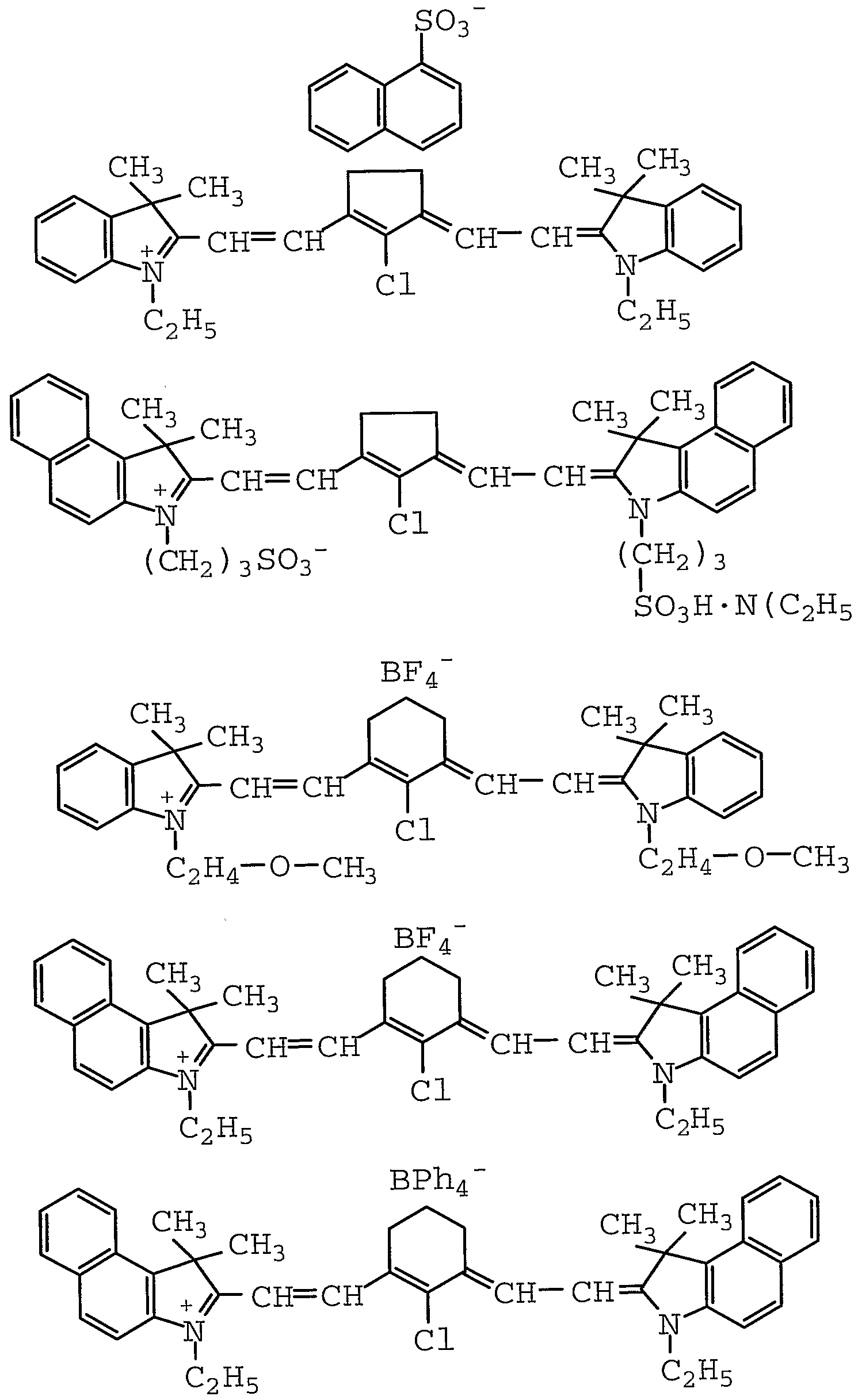
  • a so-called broad cyanine dye having a structure in which a heterocyclic ring is formed and a heterocyclic ring is bonded via a polymethine chain, specifically, for example, quinoline (so-called narrow cyanine), indole (so-called cyanine) Indocyanine), benzothiazole
  • thiocyanine pyrylium-based, thiopyrylium-based, squarylium-based, croconium-based, azurenium-based, and the like
  • polymethine-based dyes having a structure in which an acyclic heteroatom is bonded via a polymethine chain.
  • quinoline, indole, benzothiazole, pyrylium, thiopyrylium and other cyanine dyes and polymethine dyes are preferred.
  • Other light-absorbing dyes include diminium dyes and phthalocyanine dyes, among which diminium dyes are preferred.
  • quinoline-based dyes are particularly preferably those represented by the following general formulas (I), (Ib) or (Ic).
  • R 1 and R 2 each independently represent an alkyl group which may have a substituent, or an alkyl group which may have a substituent.
  • X a— indicates an anion.
  • R 1 and R 2 in the formulas (Ia), (lb) and (Ic) are alkyl groups
  • the number of carbon atoms is usually 1 to 15, preferably 1 to 10
  • alkenyl Group or alkynyl group usually has 2 to 15 carbon atoms, preferably 2 to 10 carbon atoms.
  • substituents group including, 5 usually 1-1 carbon atoms, preferably 1-1 0 alkoxy group, phenoxy group, and hydroxy group or Fuweniru group power s, as the substituents for L 1 Represents an alkyl group, an amino group, or a halogen atom having the same number of carbon atoms as described above; examples of the substituent on the quinoline ring include an alkyl group having the same number of carbon atoms, an alkoxy group having the same number of carbon atoms, a nitro group, or a halogen atom; .
  • Indole and benzothiazole dyes are particularly preferably those represented by the following general formula (II).
  • Y 1 and Y 2 each independently represent a dialkylmethylene group or a sulfur atom
  • R 3 and R 4 each independently represent an alkyl group which may have a substituent
  • L 2 represents an alkenyl group which may have a group, an alkynyl group which may have a substituent or a phenyl group which may have a substituent
  • the condensed benzene ring may have a substituent, and in this case, two adjacent substituents may be connected to each other to form a condensed benzene ring.
  • X a represents anti-anion.
  • R 3 and R 4 in the formula (II) are an alkyl group
  • the number of carbon atoms is usually 1 to 15, preferably 1 to 10
  • the number of carbon atoms is usually 2 to 15, preferably 2 to 10
  • substituents including a phenyl group include alkoxy groups having 1 to 15 carbon atoms, preferably 1 to 10 carbon atoms, and phenyl groups.
  • Phenoxy group, hydroxy group, or Hue alkenyl group force 5 'and the like is a substituent in L 2, an alkyl group of the same number of carbon atoms, such as an amino group or a halogen atom, wherein the substituted in fused base benzene ring
  • alkyl group having the same number of carbon atoms as described above an alkoxy group having the same number of carbon atoms as described above, a nitro group, and a halogen atom.
  • pyrylium-based and thiopyrylium-based dyes those represented by the following general formula (IIIa), (IIIB), or (IICI) are particularly preferable.
  • Z 1 and Z 2 each independently represent an oxygen atom or a sulfur atom
  • R 5 , R 6 , R 7 and R 8 each independently And R 5 and R 7 and R 6 and R 8 may be linked to each other to form a cycloalkene ring having 5 or 6 carbon atoms
  • L 3 represents a substituent
  • a mono, tri, penta or heptamethine group, and the two substituents on the tri, penta or heptamethine group may be linked to each other to form a cycloalkene ring having 5 to 7 carbon atoms
  • the ring and the thiapyrylium ring may have a substituent, and in that case, two adjacent substituents may be connected to each other to form a fused benzene ring.
  • X a— indicates an anion.
  • R 5 , R 6 , R 7 and R 8 in the formulas (e IIa), (e IIb) and (III c) are alkyl groups
  • the number of carbon atoms is usually 1 to 15, preferably 1 to 15.
  • Ri is 1-10 der, as the substituent in L 3, ibid alkyl group of carbon number, such as an amino group or a halo gen atom. is a substituent in the pyrylium ring and Chiapiririumu ring, phenyl group, like Ariru group power s of naphthyl groups.
  • polymethine-based dye a dye represented by the following general formula (IV) is particularly preferable.
  • R 9 , R 1Q , R 11 and R 12 each independently represent an alkyl group
  • R 13 and R 14 each independently represent an aryl group which may have a substituent.
  • L 4 represents a optionally may things be, tri, penta or heptamethine group having a substituent, the birds, the two substituents on penta or heptamethine group together They may be linked to form a cycloalkene ring having 5 to 7 carbon atoms, and the quinone ring and the benzene ring may have a substituent.
  • X a— indicates an anion.
  • the carbon number of the alkyl group of R 9 , R 1Q , R 11 and R 12 in the formula (IV) is usually 1 to 15, preferably 1 to 10, and R 13 and R 14 are aryl groups. Usually 6-20 carbon number of the time, preferably 6 to 15, specific examples of R 13 and R 14, T / JP02 / 04144
  • Phenyl group 1-naphthyl group, 2-naphthyl group, 2-furyl group, 3-furyl group, 2-thenyl group, 3-thenyl group, and the like.
  • group ibid alkoxy group carbon atoms, a dialkylamino group, such as hydro alkoxy group or a halogen atom.
  • Examples of the substituent in the ring and the benzene ring include an alkyl group having the same number of carbon atoms as described above, an alkoxy group having the same number of carbon atoms, a nitro group, and a halogen atom.
  • diminium-based dyes those represented by the following general formula (Va) or (Vb) having at least one N, N-diarylimidium salt skeleton are preferred.
  • R 15 , R 16 , R 17 and R 18 each independently represent a hydrogen atom, a halogen atom, an alkyl group which may have a substituent, or a substituent.
  • X a— indicates an anion. Note that the electronic bond (dotted line) in the formula (Vb) indicates a resonance state with other electronic bonds.
  • R 15 in the formula (Va) ⁇ Pi (Vb), R 16, R 17, R 18, R 19 and R 2 0 is an alkyl group, the carbon number of time an alkoxy group is usually 1 to 15, The number of carbon atoms when it is an alkenyl group or an alkynyl group is preferably from 1 to 10, preferably from 2 to 10, and preferably from 2 to 10.
  • Alkoxy group, carboxy group, acyloxy group, alkoxy group, hydroxy group, amino group, alkylamino group, halogenated alkyl group or halogen atom, etc., and the substituent in the benzene ring or diminoquinone ring is And an alkyl group having the same number of carbon atoms, an alkoxy group having the same number of carbon atoms, an acyl group, a nitro group and a halogen atom.
  • R 15 , R 16 , R 17 and R 18 in the above general formulas (Va) and (Vb) are alkyl groups, and R 19 and R 2 Q are also alkyl groups.
  • the anion X a— in the general formulas (I a to (:), (II), (III a to c), (IV), and (V a to b) is, for example, C 11 B r_, I one, C 10 4 one, PF 6 one, S b F 6 one, a s F 6 -, and, BF 4 -, BC 1 4, First inorganic 04144
  • Inorganic acid anions such as boric acid, benzene sulfonic acid, toluene sulfonic acid, naphthalene sulfonic acid, boric acid, and methyl, ethyl, propyl, butyl, phenyl, methoxyphenyl, naphthyl, fluorophenyl, Examples thereof include organic acids such as organic boric acid having an organic group such as difluorophenyl, pentafluorophenyl, phenyl, and pyrrolyl.
  • z 3 , zz 5 , z 6 , z 7 and Z 8 each independently represent an oxygen atom or a sulfur atom
  • R 35 and R 36 each independently A hydrogen atom, an alkyl group which may have a substituent, an alkenyl group which may have a substituent, an alkoxy group which may have a substituent or a substituent Shows a good phenyl group.
  • R 35 and R 36 in the formula (VI) are an alkyl group or an alkoxy group
  • the number of carbon atoms is usually 1 to 15, preferably 1 to 5, and when it is an alkenyl group, the number of carbon atoms is usually 2 to 15, preferably 2 to 5, preferably an alkyl group
  • specific examples of the alkyl group include a methyl group, an ethyl group, a propyl group and a butyl group.
  • the phthalocyanine dye has a basic structure in which a heterocyclic ring is bonded via an azapolymethine chain, and the phthalocyanine dye is preferably a dye represented by the following general formula (IX).
  • R 21 and R 22 each independently represent an alkoxy group, a thioalkoxy group, an aryloxy group, a thioaryloxy group, an alkylamino group, an arylamino group, a halogen atom or a hydrogen atom
  • M is, Zn, Cu, N i, SnC 1 2, a 1 C 1 or a hydrogen atom, also form a condensed ring adjacent connecting two location substituent mosquito s together in the benzene ring Good.
  • R 21 and R 22 in the formula (IX) are an alkoxy group, a thioalkoxy group or an alkylamino group
  • the number of carbon atoms is usually 1 to 10, preferably 1 to 4, and an aryloxy group, the thioaryloxy O alkoxy group or Ariruamino group, phenoxy group, etc. Chiofuenokishi group or Fuweniruamino group, and also, as the M, preferably a Z n or S n C 1 2.
  • polymethine dyes represented by the above general formula (IV) or diminium dyes represented by the above general formulas (Va-b) are preferable, and indo
  • the quinoline compound represented by the above general formula (I ac), the indole compound or benzothiazole compound represented by the above general formula (II), and the quinoline compound represented by the above general formula (III ac) Specific examples of cyanine dyes such as pyrylium or thiopyrylium, polymethine dyes represented by the above general formula (IV) and diminium dyes represented by the above general formulas (Va-b) are shown below. Show.
  • the content of the (P- 1) component of the Al Chikarari soluble resin in the positive photosensitive composition is preferably from 5 0-9 9 wt 0/0, 6 0-9 8 %, More preferably from 70 to 97% by weight.
  • the content ratio of the photothermal conversion substance of the component (P-2) is preferably 0.5 to 30% by weight, more preferably 1 to 20% by weight, and more preferably 2 to 10% by weight. It is particularly preferred that the amount is by weight.
  • a dissolution inhibitor which is not decomposed by light in the infrared region is added to the positive photosensitive composition.
  • the (P-3) component may be contained, and examples of the dissolution inhibitor include, for example, Japanese Patent Application Laid-Open Nos. Hei 10-2688512 and Japanese Patent Application Laid-Open No. Hei 11-288989. , Phosphates, aromatic carboxylic esters, aromatic disulfones, sulfonic acid anhydrides, aromatic ketones, aromatic aldehydes, aromatic amines described in detail in Lactone skeleton, N, N-diarylamide skeleton, and diarylmethylimino skeleton described in detail in JP-A-11-190903, such as aromatic ethers and compounds having a triarylmethane skeleton. Acid-color-forming dyes having a lactone skeleton, a thiolactone skeleton, and a sulfolactone skeleton, which are described in detail in JP-A-11-143076.
  • dissolution inhibitors for example, polyethylene glycols, polyethylene glycol polypropylene glycol block copolymers, polyethylene glycol alkyl ethers, polyethylene glycol polypropylene glycol alkyl ethers, polyethylene glycol alkyl phenyl ethers, polyethylene glycol fatty acids Esters, polyethylene glycol alkyl amines, polyethylene glycol alkyl amino ethers, glycerin fatty acid esters and their polyethylene oxide adducts, sorbitan fatty acid esters and their polyethylene oxide adducts, sorbit Fatty acid esters and their fatty acids
  • Nonionic surfactants such as polyethylene oxide adducts, pentaerythritol fatty acid esters and their polyethylene oxide adducts, polyglycerin fatty acid esters, etc .;
  • the content of the dissolution inhibitor of the (P_3) component in the positive photosensitive composition is preferably at 50 wt% or less, strength s and more preferably at 0.01 to 30 wt% , particularly preferably from 0.1 to 20 weight 0/0.
  • the positive photosensitive composition preferably has an organic acid having a pKa of 2 or more or an anhydride of the organic acid (P-4) for the purpose of improving developability such as imparting under developability.
  • a component may be contained. Examples of the organic acid or anhydride thereof are described in JP-A-60-88942, JP-A-63-276048, JP-A-2-9664, and the like. Glyceric acid, methylmalonic acid, dimethylmalonic acid, propylmalonic acid, succinic acid, malic acid, mesotartaric acid, glutaric acid, /?-Methylglutaric acid, ⁇ , -dimethylglutaric acid Acids, monoethyl glutaric acid, ⁇ ,?
  • aliphatic saturated carboxylic acids maleic acid
  • Huma Aliphatic unsaturated carboxylic acids such as carboxylic acid, glutaconic acid, 1,1-cyclobutanedicarboxylic acid, 1,3-cyclobutanedicarboxylic acid, 1,1-cyclopentanedicarboxylic acid, 1,2-cyclopentanedicarboxylic acid, Carbocyclic saturated carboxylic acids such as 1,1-cyclohexanedicarboxylic acid, 1,2-cyclohexanedicarboxylic acid, 1,3-cyclohexanedicarboxylic acid, and 1,4-cyclohexanedicarboxylic acid; 2-cyclohexenedicarboxylic acid, 2,3-dihydroxybenzoic acid, 3,
  • anhydride power such as glutaric anhydride, maleic anhydride, cyclohexenedicarboxylic anhydride, cyclohexanedicarboxylic anhydride, phthalic anhydride and the like can be mentioned.
  • the content of the organic acid or the anhydride thereof as the component (P-4) in the positive photosensitive composition is preferably 30% by weight or less, and more preferably 20% by weight or less. More preferably, it is particularly preferably at most 10% by weight.
  • the positive photosensitive composition includes, for example, Victoria Pure Blue (42 595), Crystal Violet (42555), Crystal Violet Trakton, Auramine 0 (41000), Katilon Brilliant Flavin ( Basic 13), Rhodamine 6 GCP (45160), Rhodamine B (451 70), Safranin ⁇ K70: 100 (50240), Elyoglaucine X (42080), Fast Black ⁇ (261500), No. Nord Yellow (2 1090), Rio Nor Yellow GRO (2 1090), Shimla First Yellow 8 GF (21 105), Benzijin Yellow 4 4-1 564 D (2 1095), Shimla Fast Red 401 5 (12355) , Lionol Red ⁇ 4401 (1 5850), Fastogen Blue TGR-L (74 160), Lionol Blue SM (26 150), etc. hand It may be.
  • the numbers in parentheses above indicate the color index (C.I.).
  • the content ratio of the colorant of the component (II-5) in the positive photosensitive composition is preferably 50% by weight or less, more preferably 0.5 to 30% by weight. It is particularly preferably 2 to 20% by weight.
  • the alkali-soluble resin is the phenolic hydroxyl group-containing phenol resin in the positive photosensitive composition
  • the resin is cross-linked by post-heating after exposure and development to give a positive image with chemical resistance.
  • a crosslinking agent (II-6) having an action of crosslinking the phenol resin may be contained, and as the crosslinking agent, typically, Methylol group as a functional group Examples thereof include an alkoxymethyl group obtained by condensing an alcohol, and an amino compound having at least two acetyloxy groups, etc.
  • melamine derivatives such as methoxymethylated melamine (manufactured by Mitsui Cytec Co., Ltd., Cymel 30). 0 series (1), etc.), benzoguanamine derivatives (methyl Z-ethyl mixed alkoxydibenzobenzoguanamine resin (Mitsui Cytec Co., Ltd., Cymel 110 series (2), etc.))), glycol peryl derivatives (tetramethylol glycol peryl) Resin (manufactured by Mitsui Cytec Co., Ltd., Cymel 110 Series (3)), urea resin derivatives, resole resins, and the like.
  • melamine derivatives such as methoxymethylated melamine (manufactured by Mitsui Cytec Co., Ltd., Cymel 30). 0 series (1), etc.), benzoguanamine derivatives (methyl Z-ethyl mixed alkoxydibenzobenzoguanamine resin (Mitsui Cytec Co., Ltd., Cymel 110
  • the content of the crosslinking agent of the component (P-6) in the positive photosensitive composition is preferably 20% by weight or less, more preferably 10% by weight or less, Less than 5% by weight is preferable for the temple.
  • the positive photosensitive composition contains a surfactant (P-7) component such as nonionic, anionic, or rainy, for the purpose of improving sensitivity and improving developability.
  • a surfactant such as nonionic, anionic, or rainy
  • various additives commonly used in photosensitive compositions such as a coatability improver, an adhesion improver, a sensitivity improver, a sensitizer, a developability improver, etc. may be further added.
  • the nonionic surfactant include polyethylene glycols such as polyethylene glycol and polyethylene glycol polypropylene glycol block copolymer, polyethylene glycol cetyl ether, polyethylene glycol stearyl ether, polyethylene glycol oleyl ether, and polyethylene glycol.
  • Polyethylene glycol alkyl ethers such as behenyl ether, polyethylene glycol polypropylene glycol cetyl ether, polyethylene glycol polypropylene glycol decyl tetradecyl ether, etc., polyethylene glycol polypropylene glycol alkyl ethers, and polyethylene glycol octyl phenyl ether , Polyethylene glycol nonylphenyl Polyethylene glycol alkylphenyl ethers such as ether, Monospace Polyethylene glycol fatty acid esters such as ethylene glycol stearate, ethylene glycol distearate, diethylene glycol stearate, polyethylene glycol distearate, polyethylene glycol monolaurate, polyethylene glycol monooleate, and glyceryl monomyristate Glyceryl monostearate, glyceryl monoisostearate, glyceryl distearate, glyceryl monooleate, glyceryl dioleate and
  • anionic surfactant examples include higher fatty acid salts such as sodium laurate, sodium stearate and sodium oleate; alkyl sulfonates such as sodium lauryl sulfonate; and alkylbenzenes such as sodium dodecylbenzene sulfonate.
  • alkyl naphthalene sulfonates such as sodium isopropyl naphthalene sulfonate, alkyl diphenyl ether disulfonates such as alkyl diphenyl ether disulfonic sulfonate, and polyoxyethylene lauryl ether sulfonate such as sodium Talent Kishech Alkyl sulfates such as lenalkyl ether sulfonates, sodium lauryl sulfate, sodium stearyl sulfate, higher alcohol sulfates such as sodium octyl alcohol sulfate, sodium lauryl alcohol sulfate, and lauryl alcohol sulfate ammonium, Aliphatic alcohol sulfates such as sodium acetyl alcohol sulfate, sodium polyoxyethylene lauryl ether sulfate, ammonium polyoxyethylene lauryl ether sulfate, polyoxyethylene alkyl
  • amphoteric surfactant examples include; —lauryl mono; N, N-dimethyl—N-carboxymethylammonium, N-stearyl mono N, N-dimethyl_N—carboxymethylammonium, N Betaine-type compounds, such as —lauryl-1-N, N-dihydroxyethyl-1-N-carboxymethylammonium, N-lauryl-1-N, N, N-tris (potassium ropoxymethyl) ammonium, 2-alkyl-1-N—potassium ruboxymethyl
  • imidazolyl salts such as N-hydroxyethylimidazolym, imidazoline-N-sodium ethylsulfonate, imidazolines such as imidazoline-N-natrimethylsulfate, aminocarboxylic acids, and aminosulfonates.
  • the content ratio of the surfactant in the positive photosensitive composition is preferably from 0/0, more preferred that from a 0.002 to 3 wt%, the force is from 0.005 to 1 weight 0/0 s particularly preferred.
  • the positive type photosensitive composition includes the above components, for example, a photosensitive composition such as a coating improver, an adhesion improver, a sensitivity improver, a sensitizer, a developability improver, and the like.
  • a photosensitive composition such as a coating improver, an adhesion improver, a sensitivity improver, a sensitizer, a developability improver, and the like.
  • Various additives commonly used in the present invention may be further contained in a range of 20% by weight or less, preferably 10% by weight or less.
  • the positive photosensitive composition does not include a compound having sensitivity to light in the ultraviolet region, such as an ionic salt, a diazonium salt, and a compound containing a quinone diazide group, and is substantially sensitive to light in the ultraviolet region. It does not have.
  • substantially insensitive to light in the ultraviolet region means that there is no substantially significant difference in solubility in an alkali developer before and after irradiation with light having a wavelength of 360 to 450 nm. Means that it has no image forming ability in a practical sense.
  • the negative photosensitive composition constituting the photosensitive layer
  • the negative photosensitive composition includes the following component (N-1):
  • a photopolymerizable composition containing the component (N-2), the component (N-3) and the component (N-4) is preferable.
  • the polymer binder of the (N_l) component constituting the photopolymerizable composition according to the present invention includes an (N-2) component ethylenically unsaturated compound, a (N-3) component sensitizer, and (N-14) ) Component as a binder such as a photopolymerization initiator.
  • the polymer binder include (meth) acrylic acid, (meth) acrylic acid ester, (meth) acrylonitrile, and ( (Meth) homo- or copolymers of acrylic amide, maleic acid, styrene, vinyl acetate, vinyl chloride, maleimide, etc.
  • polyamide polyester, polyether, polyurethane, polyvinyl butyral, polyvinylpyrrolidone, polyethylene oxide, and acetyl cellulose.
  • a carboxyl group-containing polymer is preferred from the viewpoint of alkali developability.
  • (meth) acrylic acid and (meth) alkyl acrylate (1 to 10 carbon atoms) ester or a copolymer containing styrene as a copolymer component is preferable. It is preferable that the combined acid value is 10 to 250 and the weight average molecular weight is 0.5 to 1,000,000.
  • mosquitoes those having an ethylenically unsaturated bond in the side chain are preferred, as their ethylenically unsaturated bond, in particular, the general formula (XI I a), (XII b) or Those represented by (XII c) are preferred.
  • R 38 Formula (XI I a), in (XII b) and (XI I c), R 36 represents a hydrogen atom or a methylation group
  • R 37, R 38, R 39, R 4 Q and R 41 are each Independently, a hydrogen atom, a halogen atom, an amino group, a dialkylamino group, a carboxyl group, an alkoxycarbonyl group, a sulfo group, a nitro group, a cyano group, and an optionally substituted alkyl group Group, alkoxy group which may have a substituent, alkylamino group which may have a substituent, alkylsulfonyl group which may have a substituent, aryl which may have a substituent Group, an aryloxy group which may have a substituent, an arylamino group which may have a substituent, or an arylsulfonyl group which may have a substituent
  • Z 9 is an oxygen atom
  • the alkyl group in R 3 7 ⁇ R 4 1, alkoxy group, an alkylamino group, an alkylsulfonyl group, the Ariru group, Ariruokishi group, Ariruamino group, substituents ⁇ reel sulfonyl group, e.g., an alkyl group, an alkoxy Group, an alkylthio group, an amino group, a dialkylamino group, a nitro group, a cyano group, a phenyl group, and a halogen atom.
  • the polymer binder having an ethylenically unsaturated bond in the side chain represented by the above formula (XIIa) includes a carboxyl group-containing polymer, aryl glycidyl ether, glycidyl (meth) acrylate, and aethyl.
  • Fatty acids such as glycidyl (meth) acrylate, glycidyl crotonate, glycidyl isocrotonate, crotonyl glycidyl ether, monoalkyl monoglycidyl ester of diconic acid, monoalkyl monoglycidyl fumarate, monoalkyl monoglycidyl maleate, etc.
  • an alkali-soluble resin is preferable, and a vinyl resin having a hydroxyl group is more preferable.
  • a resin having an ethylenic unsaturated bond in a side chain is preferable.
  • the (N-2) component of the ethylenically unsaturated compound constituting the negative photosensitive composition may be a component (N-4) described below when the composition is irradiated with actinic rays. Is a compound having at least one radically polymerizable ethylenically unsaturated bond in the molecule that undergoes addition polymerization by the action of a photopolymerization initiator system containing a photopolymerization initiator of is there.
  • the ethylenically unsaturated compound a compound having one ethylenically unsaturated bond in a molecule, specifically, for example, (meth) acrylic acid, crotonic acid, isocrotonic acid, maleic acid, itaconic acid And methacrylic acid such as citraconic acid and its alkyl ester, (meth) acrylonitrile, (meth) acrylamide, styrene, etc.
  • Ethylenic unsaturated bond from the viewpoint that the difference in developer solubility in the exposed area can be expanded Is preferable, and an acrylate compound whose unsaturated bond is derived from a (meth) acryloyloxy group is particularly preferable.
  • esters of an unsaturated carboxylic acid and a polyhydroxy compound typically, esters of an unsaturated carboxylic acid and a polyhydroxy compound, (meth) acryloyloxy group-containing phosphates, and hydroxy (meth) Urethane (meth) acrylates of an acrylate compound and a polyisocyanate compound, and epoxy (meth) acrylates of a (meth) acrylic acid or a hydroxy (meth) atalylate compound and a polyepoxy compound are exemplified.
  • esters include unsaturated carboxylic acids as described above, ethylene glycol, diethylene glycol, triethylene glycol, tetraethylene glycol, propylene glycol, tripropylene glycol, trimethylene glycol, and tetramethylene glycol. , Neopentyl glycol, hexamethylene glycol, nonamethylene glycol, trimethylolethane, tetramethylolethane, trimethylolproha. Glycerol, pentaerythritol, dipentaerythritol, sorbitol and their reaction products with aliphatic polyhydroxy compounds such as ethylene oxide adduct, propylene oxide adduct, diethanolamine, triethanolamine, etc.
  • Is for example, ethylene glycol di (meth) acrylate, diethylene glycol di (meth) acrylate, triethylene glycol di (meth) acrylate, tetraethylene glycol di (meth) acrylate, propylene glycol di (meth) acrylate G, tripropylene glycol di (meth) acrylate, tetramethylene glycol di (meth) acrylate, neopentyl glycol di (meth) acrylate, hexamethylene glycol (Meta) acrylate, nonamethylene glycol di (meta) acrylate, trimethylolethanetri (meta) acrylate, tetramethylolethanetri (meta) acrylate, trimethylolpropanedi (meta) acrylate, Trimethylolpropane tri (meta) atallylate, trime Tyrolpropane ethylene oxide-added tri (meth) acrylate, glycerol di (meth) ata
  • esters a reaction product of the above unsaturated carboxylic acid with an aromatic polyhydroxy compound such as hydroquinone, resorcinol, pyrogallol, bisphenol F and bisphenol A, specifically, for example, hydroquinone Di (meth) acrylate, resorcindi (meth) acrylate, pyrogallol tri (meth) acrylate, etc., and the unsaturated carboxylic acid as described above and a heterocyclic polyhydroxy compound such as tris (2-hydroxyshethyl) isocyanurate.
  • aromatic polyhydroxy compound such as hydroquinone, resorcinol, pyrogallol, bisphenol F and bisphenol A
  • the reactants specifically, for example, di (meth) acrylate of tris (2-hydroxyethyl) isocyanurate, tri (meth) atalylate and the like, and unsaturated carboxylic acid, polyvalent sulfonic acid and poly (polyurethane)
  • the reactant with the hydroxy compound specifically, for example, ( (Meth) Condensate of acrylic acid, phthalic acid and ethylene glycol, (meth) Condensate of acrylic acid, maleic acid and diethylene glycol, (meth) Condensate of acrylic acid, terephthalic acid and pentaerythritol, (meth) Examples include condensates of atarilic acid, adipic acid, butanediol, and glycerin.
  • the (meth) acryloyloxy group-containing phosphates include (meth)
  • the phosphate compound is not particularly limited as long as it is an acryloyloxy group-containing phosphate compound. Among them, a compound represented by the following general formula (Ia) or (lb) is preferable.
  • CH 2 C-C-0-(cH 2 -CH 2 -0 ⁇ -P- (OH) 3 _ m (lb)
  • R 4 2 represents a hydrogen atom or a methyl group
  • n represents 1-2 5 integer
  • m is 1, 2 or 3.
  • n is preferably from 1 to 10, particularly preferably from 1 to 4.
  • Specific examples of these include, for example, (meth) acryloyloxhetyl phosphate, bis [(meth) Acryloyloxetyl] phosphate, (meth) acryloyloxetylene glycol phosphate, and the like. These may be used alone or as a mixture.
  • urethane (meth) acrylates include, for example, hydroxymethyl (meth) acrylate, hydroxyethyl (meth) acrylate, glycerol di (meth) acrylate, pentaerythritol tri (meth) acrylate, tetra Hydroxy (meth) acrylate compounds such as methylolethanetri (meth) acrylate, and hexamethylene diisocyanate;
  • One 41-isocyanate methyl Aliphatic polyisocyanates such as leoctane, cyclohexanediisocyanate, dimethylcyclohexanediisocyanate, 4,4-methylenebis (cyclohexylisocyanate), isophorone diisocyanate, bicycloheptane
  • Alicyclic polysocyanates such as trisocyanate, p-phenylenediocyanate, 2,4-tolylene diisocyanate, 2,6-tolylene diisocyanate, xylylene diisocyanate , Tetramethylxylylene diisocyanate, 4,4 'diphenylmethane diisocyanate, trizine di
  • urethane (meth) acrylates include compounds having four or more urethan bonds [-NH-CO-II] and four or more (meth) acryloyloxy groups in one molecule.
  • the compound is preferably a compound having four or more hydroxyl groups in one molecule such as pentaerythritol and polyglycerin, for example, hexamethylene diisocyanate, trimethylhexamethylene diisocyanate, and isophorone.
  • diisocyanate compounds such as isocyanate and tolylene diisocyanate (i-11) or compounds having two or more hydroxyl groups in one molecule such as ethylene glycol “Duranate 24A-100”, “Duranate 22A_75PX”, “Duranate 21 S-75E”, “Duranate” Biuret type such as 18H-70B, Duranate P-301-75E, Duranate E-402-90TJ, Duranate E-405_80T, etc.
  • diisocyanate compounds such as isocyanate and tolylene diisocyanate (i-11) or compounds having two or more hydroxyl groups in one molecule
  • ethylene glycol “Duranate 24A-100”, “Duranate 22A_75PX”, “Duranate 21 S-75E”, “Duranate” Biuret type such as 18H-70B, Duranate P-301-75E, Duranate E-402-90TJ, Duranate E-405_80T, etc.
  • i-conjugated product (i_2) or isocyanate ethyl (meth) acrylate obtained by reacting a compound having three or more isocyanate groups in one molecule such as 4 or more, preferably 6 or more per molecule, such as compound (i-3) obtained by
  • the above compounds having an isocyanate group specifically, for example, “Duranate ME 20-100” (a) manufactured by Asahi Kasei Corporation, pentaerythritol di (meth) atalylate, pentaerythritol tri (meth) acrylate, dipentaerythritol diacrylate
  • One or more hydroxyl groups in one molecule such as (meth) acrylate, dipentaerythritol tri (meth) acrylate, dipentaerythritol tetra (meth) acrylate, dipentaerythritol penta (meth) acrylate, and the like.
  • the molecular weight of the compound (i) is preferably from 500 to 200,000, and particularly preferably from 1,000 to 150,000. Further, the molecular weight of the urethane (meth) acrylates as described above is preferably from 600 to 150,000. Further, it is preferable to have 6 or more urethane bonds, particularly preferably 8 or more, preferably 6 or more (meth) acryloyloxy groups, and particularly preferably 8 or more.
  • Such urethane (meth) acrylates can be obtained, for example, by combining the above compound (i) with the above compound (ii) in an organic solvent such as toluene or ethyl acetate with the former isocyanate group and the latter hydroxyl group. With a molar ratio of 1/10 to 10/1, using a catalyst such as n-butyltin dilaurate, if necessary, and reacting at 10 to 150 ° C for about 5 minutes to 3 hours. You can do it.
  • Ra represents a group having a repeating structure of an alkyleneoxy group or an aryleneoxy group and having 4 to 20 oxy groups capable of bonding to Rb
  • Rb and Rc are each independently Represents an alkylene group having 1 to 10 carbon atoms
  • R d represents an organic residue having 1 to 10 (meth) acryloyloxy groups
  • R a, Rb, R c and ⁇ R d are substituted X may be an integer of 4 to 20
  • y is an integer of 0 to 15
  • z is an integer of 1 to 15.
  • examples of the repeating structure of the alkyleneoxy group of Ra in the formula (II) include those derived from propylene triol, glycerin, pentaerythritol and the like, and examples of the repeating structure of the arylene group include Examples thereof include those derived from pyrogallol, 1,3,5-benzenetriol, and the like.
  • the alkylene groups of Rb and Rc each independently have 1 to 5 carbon atoms, and the number of (meth) acryloyloxy groups in Rd is 1 to 7.
  • X is preferably 4 to 15, y is 1 to: L0, and z is preferably 1 to 10, respectively.
  • R a is the following formula (where k is an integer of 2 to 10.), and Rb and R c are each independently a dimethylene group or a monomethyldimethylene group. Or a trimethylene group, and Rd is particularly preferably each of the following formulae.
  • epoxy (meth) acrylates specifically, for example, (meth) acrylic acid or the hydroxy (meth) acrylate compound as described above, (Poly) ethylene glycol polyglycidyl ether, (poly) propylene glycol polyglycidyl ether, (poly) tetramethylene glycol polyglycidyl ether, (poly) pentamethylene glycol polyglycidyl ether,
  • ethylenically unsaturated compounds other than the above include, for example, (meth) acrylamides such as ethylenbis (meth) acrylamide, aryl esters such as diaryl phthalate, and vinyl groups such as divinyl phthalate. Contained compounds. These ethylenically unsaturated compounds may be used alone or in combination of two or more.
  • the above-mentioned ethylenically unsaturated compound of the component (N-2) is an ester (meth) acrylate, a (meth) acryloyloxy group-containing phosphite or a urethane (meth) acrylate.
  • Particularly preferred are (meth) acryloyloxy group-containing phosphates or urethane (meth) acrylates.
  • the proportion of the (meth) atalyloxy group-containing phosphites is preferably 1 to 60% by weight, and more preferably 2 to 40% by weight, based on the total amount of the ethylenically unsaturated compound (N-2).
  • weight 0/0 is particularly preferred that a, also urethane proportion thereof as (meth) Akurireto compound is 0.5 to 5 0 wt% and and even good preferred, 2-4 0% Is particularly preferred.
  • the sensitizer of the (N-3) component constituting the negative-type photosensitive composition has a wavelength range of 350 nm to 130 nm, particularly, a blue ultraviolet range of 350 nm to 420 nm. Efficiently absorbs near-infrared light in the region and wavelength of 600 to 130 nm and excites the light. The energy is transmitted to the photopolymerization initiator of the component (N-4) described below, and the photopolymerization initiator is decomposed to generate active radicals that induce the polymerization of the ethylenically unsaturated compound of the component (N-2). Light absorbing dyes having a sensitizing function are preferred.
  • the light-absorbing dyes in the near-infrared region having a wavelength of 600 to 1300 nm have been mentioned in the photothermal conversion substance (P-2) component constituting the positive photosensitive composition.
  • the same light-absorbing dyes may be mentioned.
  • the phthalocyanine dye represented by formula (II) is preferable, and the indole or benzothiazole silane dye represented by formula (II) is particularly preferable.
  • the light-absorbing dye having a wavelength of 350 to 420 nm in the blue-violet region is preferably a dialkylaminobenzene-based compound.
  • a dialkylaminobenzophenone-based compound and an amino group on the benzene ring have a p-type.
  • a dialkylaminobenzene-based compound having a complex ring group as a substituent at the carbon atom at the 1-position is preferred.
  • a compound represented by the following general formula (Xa) is preferable.
  • R 23 , R 24 , R 25 and R 26 each independently represent an alkyl group
  • R 27 , R 28 , R 29 and R 3 (1 each independently represent an alkyl group
  • R 23 and R 24 , R 25 and R 26 , R 23 and R 27 , R 24 and R 28 , R 25 and R 29, R 2S and R 3 ° each independently represent a group or a hydrogen atom.
  • a nitrogen-containing heterocyclic ring may be formed.
  • the carbon number of the alkyl group of R 23 , R 24 , R 25 and R 26 in the formula (Xa), and the case where R 27 , R 28 , R 29 and R 30 are an alkyl group It preferably has 1 to 6 carbon atoms.
  • a nitrogen-containing heterocyclic ring it is preferably a 5- or 6-membered ring, and particularly preferably a 6-membered ring.
  • Specific examples of the compound represented by the above general formula (Xa) include, for example, 4,4,1-bis (dimethylamino) benzophenone, 4,4,1-bis (getylamino) benzophenone, and a compound having the following structure Is mentioned.
  • the heterocyclic group in the dialkylaminobenzene compound having a heterocyclic group as a substituent at the carbon atom at the p-position to the amino group on the benzene ring includes a nitrogen atom, an oxygen atom, or a sulfur atom
  • a 5- or 6-membered ring is preferable, and a 5-membered ring having a fused benzene ring is particularly preferable.
  • a compound represented by the following formula (Xb) is particularly preferable.
  • R 31 and R 32 each independently represent an alkyl group
  • R 33 and R 34 each independently represent an alkyl group or a hydrogen atom
  • R 31 and R 32 , R 31 And R 33 and R 32 and R 34 may each independently form a nitrogen-containing heterocyclic ring
  • Y 3 represents an oxygen atom, a sulfur atom, a dialkylmethylene group, an imino group or an alkylimino group
  • the benzene ring condensed with the heterocycle containing Y3 may have a substituent.
  • the number of carbon atoms of the alkyl group of R 31 and R 32 in the formula (Xb), and the number of carbon atoms when R 33 and R 34 are an alkyl group are preferably 1 to 6, and When forming a nitrogen heterocyclic ring, it is preferably a 5- or 6-membered ring, and particularly preferably a 6-membered ring.
  • Y is a dialkylmethylene group
  • the alkyl group preferably has 1 to 6 carbon atoms.
  • Y is an alkylimino group
  • the carbon number of the alkyl group is preferably;
  • (Xb) examples include, for example, 2- (p-dimethylaminophenyl) benzoxazole, 2- (p-dimethylaminophenyl) benzol Xazole, 2- (p-dimethylaminophenyl) benzo [4,5] benzoxazole, 2- (p-dimethylaminophenyl) benzo [6,7] benzoxazole, 2- (p —Dimethylaminophenyl) benzothiazole, 2-(p-dimethylaminophenyl) benzothiazole, 2- (p-dimethylaminophenyl) benzimidazole, 2- (p-ethylaminophenyl) benzozoimidazole, 2- (p-dimethylaminophenyl) 1,3,3-dimethyl-3 Examples include H-indole, 2 — (p-ethylaminophenyl) _ 3,3 dimethyl-3H-in
  • dialkylaminobenzene compounds having a heterocyclic group as a substituent at the carbon atom at the p-position to the amino group on the benzene ring include: For example, 2- (p-dimethylaminophenyl) pyridine, 2- (p-dimethylaminophenyl) pyridine, 2- (p-dimethylaminophenyl) quinoline, 2- (p-ethylaminophenyl) quino Lin, 2- (p-Dimethylaminophenyl) pyrimidine, 21- (p_Jetylaminophenyl) Pyrimidine, 2,5-bis (p-Jetylaminophenyl) 1,1,3,4-Oxazidazole, 2,5 —Bis (p-getylaminophenyl) -1,3,4-thiadiazole and the like.
  • trichoenyl methine leuco dyes such as glycocrystal violet toluco malachite green disclosed in U.S. Pat.
  • Photoreducing dyes such as eosin Y; and aminophenols such as Michler's ketone and aminostyryl ketone disclosed in the specifications of U.S. Pat. Nos. 3,549,367 and 3,652,275.
  • Hei 8-1-292-258 Japanese Patent Laid-Open No. Hei 8-12992-59, Japanese Patent Laid-Open No. Hei 8-146650, Japanese Patent Laid-Open No. Hei 8-2-1116 Coumarin-based pigments disclosed, ketocoumarin-based pigments disclosed in JP-A-5-12-1681, aminostyrene derivatives disclosed in JP-A-59-56403, Aminophenyl butadiene derivatives, aminophenyl heterocycles disclosed in U.S. Pat.No. 4,595,310, julolidine heterocycles disclosed in U.S. Pat.No.
  • the photopolymerization initiator of the component (N-4) constituting the negative-type photosensitive composition may be used when the composition is irradiated with light in the co-presence of the sensitizer or the like of the component (N-3).
  • a radical generator that generates an active radical typically, halomethylated s-triazine derivatives, halomethylated 1,3,4-oxadiazole derivatives, hexarylbiimidazole Derivatives, titanocene derivatives, organic borates, diaryldonium salts, carbonyl compounds, organic peroxides and the like.
  • halomethylated s-triazine derivatives, hexary Preferred are rubimidazole derivatives or organic borates.
  • halomethylated s-triazine derivative a derivative in which at least one mono-, di- or trihalogen-substituted methyl group is bonded to the s-triazine ring is preferable, and is represented by the following general formula (X).
  • X a general formula in which at least one mono-, di- or trihalogen-substituted methyl group is bonded to the s-triazine ring.
  • R 3 5 is a hydrogen atom, a halogen atom, an alkyl group or Ariru group, W is shown even better Ariru group or a heterocyclic group optionally having a substituent group, X a is C androgenic atom Where r is an integer from 0 to 2.
  • halomethylated s-triazine derivatives include, for example, 2-methyl-4,61-bis (trichloromethyl) -s-triazine, 2-n-propyl-1,4-bis ( Trichloromethyl) 1 s-triazine, 2— (hi, a, 1 trichloroethyl) 1,4,6-bis (trichloromethyl) 1 s-triazine, 2-phenyl 4,6-bis (trichloromethyl) 1 s-triazine, 2- (p-methoxyphenyl) -1,4,6-bis (trichloromethyl) -1-s-triazine, 2- (3,4-epoxyphenyl) _4,6-bis (trichloromethyl) -1s -Triazine, 2- (p-chlorophenyl) -4,6-bis (trichloromethyl) _s-triazine, 2- [1-1 (p-methoxyphenyl)
  • halomethylated 1,3,4-oxadiazole derivatives include, specifically, for example, 2- (p-methoxyphenyl) -15-trichloromethyl-1,3,4-oxadiazole, 2 — (P—Methoxystyryl) _ 5—Tricyclomethyl-1,3,4_oxadiazole, 2— (0—Venzofuryl) 1.51 Trichloromethyl-1,1,3,4—oxadiazole, 2— ⁇ - ( ⁇ _Benzofuryl) vinyl] -5-trichloromethyl-1,3,4-oxadiazole.
  • 2- (p-methoxyphenyl) -15-trichloromethyl-1,3,4-oxadiazole 2 — (P—Methoxystyryl) _ 5—Tricyclomethyl-1,3,4_oxadiazole, 2— (0—Venzofuryl) 1.51 Trichloromethyl-1,1,3,4—oxadiazole, 2— ⁇ - ( ⁇ _
  • hexarylbiimidazole derivatives include, for example, 2,2,1-bis (0-methoxyphenyl) -14,4,4,5,5,1-tetraphenylbiimidazole, 2,2 1,4-bis ( ⁇ -methoxyphenyl) 1,4,4,5,5, -tetraphenylbimidazole, 2,2,1-bis (0-chlorophenyl) -4,4,5,5 , 1-tetraphenylbiimidazole, 2,2'-bis (0-fluorophenyl) -4,4,4,5,5,5-tetraphenylbiimidazole, 2,2, -bis (0-chlorophenyl) 1-4, 4,, 5,5, -tetra ( ⁇ -methylphenyl) biimidazole, 2,2,1-bis (0-chlorophenyl) 1-4,4,4,5,5,1-tetra ( ⁇ -methoxyphenyl) Biimidazole, 2,2'-bis (0-bis (0-me
  • hexafenylbiimidazole derivatives are preferable, and those substituted with a 0-position genogen atom of a benzene ring bonded to the 2,2,1-position on the imidazole ring are preferable. It is particularly preferable that the benzene ring at the 4,4,5,5,1 position on the imidazole ring is unsubstituted or substituted with a halogen atom or an alkoxycarbonyl group.
  • titanocene derivatives include, for example, dicyclopentenyltitanium dichloride, dicyclopentagenyltitanium bisphenyl, dicyclopentagenenyltitanium bis (2,4-difluorophenyl) , Dicyclopentagenenyltitanium bis (2,6-difluorophenyl), dicyclopentagenenyltitanium bis (2,4,6-trifluorophenyl), dicyclopentagenenyltitaniumbis (2,3, 5,6-tetrafluorophenyl), dicyclopentagenenyl titanium bis (2,3,4,5,6-pentafluorophenyl), di (methylcyclopentagenenyl) titanium bis (2,4-difluoro Phenyl), di (methylcyclopentagenenyl) titanium bis (2,6-difluorophenyl), di (methylcyclopentagenenyl) titanium bis (2,4,6-trifluorophenyl), di (methyl (methylcycl
  • R 37 , R 38 , R 39 and R 4Q are each independently an alkyl group optionally having a substituent, an alkenyl group optionally having a substituent, a substituent An alkynyl group which may have a substituent, an aryl group or a heterocyclic group which may have a substituent, and these are linked to each other to form a cyclic structure, at least one of which has a substituent An alkyl group which may be Xb + is a counter cation.
  • R 37 , R 38 , R 39 and R 40 in the formula (XI) are an alkyl group
  • the number of carbon atoms is usually 1 to 15, preferably 1 to 5, an alkenyl group or an alkynyl group.
  • the number of carbon atoms is usually 2 to 15, preferably 2 to 5,
  • the number of carbon atoms in the aryl group is usually 6 to 20, preferably 6 to 15, and
  • the number of carbon atoms in the heterocyclic group is usually 4 To 20 and preferably 4 to 15, and examples of the substituent therefor include a halogen atom, an alkyl group, an alkoxy group, a trifluoromethyl group, and a trimethylsilyl group.
  • organic boron anion of the organic borate represented by the formula (XI) include, for example, n-butyl-methyl-diphenyl boron anion, n-butyl-triphenyl boron anion, n-butyl tris (2 , 4,6-Trimethylphenyl) boron anion, n-butyl tris (p-methoxyphenyl) boron anion, n-butyl tris (p-fluorophenyl) boron anion, n-butyl — tris (m-fluorophenyl) boron Anion, n-butyl tris (3-7 Luorol 4-methylphenyl) boron anion, n-butyl tris (2,6-difluorophenyl) boron anion, n-butyl tris (2,4,6-trifluorophenyl) boron anion, n- Butyl monotris (2,
  • Examples of the counter cation X b + include, for example, alkaline metal cations, ammonium cations, phosphonium cations, sulfonium cations, sulfonium cations, and the like, and pyrium cations and thiapyrylium cations. And an indolium cation, but an organic ammonium cation such as a tetraalkyl ammonium is preferred. Further, in the present invention, as a method of allowing an organic borate as a photopolymerization initiator of the (N-14) component to be present in the photosensitive composition, a method in which an organic boronate of the above organic borate is appropriately selected.
  • a method of compounding a salt formed by the organic boron anion of the above organic borate and the dye cation of the sensitizer of the (N-3) component is also employed. I can do it.
  • the content ratio of the photopolymerization initiator of the component (N-4) is 100 parts by weight of the ethylenically unsaturated compound of the component (N-2), and
  • the amount of the soluble resin is preferably from 10 to 400 parts by weight, more preferably from 20 to 200 parts by weight.
  • the sensitizer of the component (N-3) is preferably 0.01 to 20 parts by weight, more preferably 0.05 to 10 parts by weight.
  • the photopolymerization initiator of the (N-4) component is preferably 0.1 to 80 parts by weight, more preferably 0.5 to 60 parts by weight.
  • the negative photosensitive composition may contain a hydrogen-donating compound (N-5) for the purpose of improving photopolymerization initiation ability.
  • the hydrogen-donating compound include: , 2-Mercaptobenzothiazole, 21-Mercaptobenzoylmidazole, 2-Mercaptobenzozoxazole, 3-Mercapto-1,2,4-triazole, 2-Mercapto-14 (3H) -Quinazoline, -Mercaptonaphthalene , Ethylene glycol dithiopropionate, trimethylolpropane tristhiopropionate, pentaerythritol tetrakisthiopropionate, etc., mercapto group-containing compounds, hexanedithiol, trimethylolpropane tristhioglyconate, pentaerythritol tetrakiscioglyconate Multifunctional thio such as propionate Compounds, N, N-dialkylaminobenzoic acid esters, N
  • salts such as N-phenylglycine or its ammonium salt and derivatives such as esters as mentioned above.
  • the hydrogen of the (N-5) component in the negative photosensitive composition is preferably 0.1 to 50 parts by weight, preferably 0.5 to 3 parts by weight, based on 100 parts by weight of the ethylenically unsaturated compound of the above (: N-2) component. More preferably, it is 0 parts by weight.
  • the negative photosensitive composition may contain an amine compound (N-6) for the purpose of imparting storage stability to the photosensitive composition.
  • N-6 an amine compound
  • N-6 May be any of aliphatic, alicyclic or aromatic amines, and is not limited to monoamines, but may be polyamines such as diamines and triamines, and primary, secondary and tertiary amines. However, those having a pK b of 7 or less are preferred.
  • amine compounds include, for example, butyramine, dibutylamine, tributylamine, amylamine, diamylamine, triamylamine, hexylamine, dihexylamine, trihexylamine, arylamine, diarylamine, triallylamine, triethanol.
  • Aliphatic amines which may be substituted with a hydroxyl group or a phenyl group, such as amine, benzylamine, dibenzylamine and tribenzylamine; Above all, in the present invention, tribenzylamine is preferable.
  • the content ratio of the amine compound of the component (N-6) in the negative photosensitive composition is 100 parts by weight of the ethylenically unsaturated compound of the component (N_2). It is preferably from 0.1 to 20 parts by weight, more preferably from 0.5 to 10 parts by weight.
  • the negative-type photosensitive composition further includes various additives, for example, a thermal polymerization inhibitor such as hydroquinone, p-methoxyphenol, 2,6-di-t-butyl-p-cresol, and the like. But not more than 2 parts by weight based on 100 parts by weight of the ethylenically unsaturated compound (N_2) component, and not more than 20 parts by weight of a colorant comprising an organic or inorganic dye / pigment.
  • Plasticizers such as sulphide, didodecyl phthalate and tricresyl phosphate are also less than 40 parts by weight, and the sensitivity characteristics of tertiary amine dithiol etc. are improved.
  • a coating improver such as a surfactant such as a fluorine-based surfactant or a development accelerator may be contained in a proportion of 10 parts by weight or less, and a dye precursor may be contained in a proportion of 30 parts by weight or less.
  • the photosensitive composition is usually applied to the surface of the aluminum support as a solution or dispersion obtained by dissolving the above components in an appropriate solvent, followed by heating and drying.
  • the solvent is not particularly limited as long as it has sufficient solubility in the components used and gives good coating properties.
  • Examples of the solvent include methylacetosolve, ethylsilsolve, methylacesolvesolve, and ethylacetate.
  • Cellosolves such as sorbate acetate1), propylene glycol monomethyl ether, propylene glycol monoethyl ether, propylene glycol monobutyl ether, propylene glycol monomethyl ether acetate, propylene glycol monoethyl ether teracetate
  • Propylene glycol solvents such as propylene glycol monobutyl ether acetate, dipropylene glycol dimethyl ether, butylene acetate, amyl acetate, ethyl butyrate, butyl butyrate, getyloxalate, pyrvin Ethyl, ethyl 2-hydroxybutyrate, ethyl acetate acetate, methyl lactate
  • Alcohol solvents such as cyclohexanone and methylamyl ketone, highly polar solvents such as dimethylformamide, dimethylacetamide and N-methylpyrrolidone, or a mixture thereof. Examples thereof include those obtained by adding aromatic carbon hydrogen.
  • the proportion of the solvent used is usually in the range of about 1 to 20 times by weight based on the total amount of the photosensitive composition.
  • a conventionally known method for example, spin coating, wire bar coating, dip coating, air knife coating, roll coating, blade coating, curtain coating, or the like can be used.
  • the coating amount varies depending on the application, but the dry film
  • the thickness is usually in the range of 0.3 to 7, preferably 0.5 to 5 m, particularly preferably 1 to 3 / m.
  • the drying temperature at that time is, for example, about 60 to 170 ° C, preferably about 70 to 150 ° C, and the drying time is, for example, about 5 seconds to 10 minutes, preferably. Takes about 10 seconds to 5 minutes.
  • a photopolymerizable composition is formed on the photosensitive layer of the photosensitive composition formed on the aluminum plate support surface as described above.
  • An oxygen barrier layer for preventing a polymerization inhibition effect by oxygen may be formed.
  • the above-mentioned oxygen barrier layer may be composed of water or a mixed solvent of water and an alcohol such as methanol, ethanol, propanol or isononyl alcohol or a water-miscible organic solvent such as tetrahydrofuran.
  • Alcohol such as methanol, ethanol, propanol or isononyl alcohol or a water-miscible organic solvent such as tetrahydrofuran.
  • Water-soluble polymer specifically, for example, polyvinyl alcohol and its partially acetalized product, its cation modified product by quaternary ammonium salt, etc., its anion modified product by sodium sulfonate, etc., Polypinylpyrrolidone, polyethylene oxide, methylcellulose, carboxymethylcellulose, hydroxyethylcellulose, hydroxypropylcellulose and the like can be mentioned.
  • the degree of saponification 7 0 mole 0/0 or more, more in 8 0 mole 0/0 or more and a weight average molecular weight
  • those having a value of 0.2 to 500,000, more preferably 0.4 to 100,000 are preferred.
  • the content of polyvinyl alcohol and its derivative is preferably at least 30% by weight, more preferably at least 40 to 100% by weight.
  • vinylpyrrolidone-based polymers such as polyvinylpyrrolidone-vinylpyrrolidone-monovinyl acetate copolymer, acrylic polymer emulsion, diisocyanate compound, p-toluene sulfone It preferably contains an acid, hydroxyacetic acid, etc., among which vinylpyrrolidone-based polymer
  • the oxygen barrier layer in the present invention the content of the vinylpyrrolidone-based polymer is from 0.1 to 7 0 is preferably from wt 0/0, 5 to 6 0 wt 0/0 more preferable.
  • the oxygen barrier layer preferably contains an organic acid such as succinic acid, or an organic acid salt such as tetraacetic acid from the viewpoint of imparting preservability.
  • organic acid such as succinic acid, or an organic acid salt such as tetraacetic acid from the viewpoint of imparting preservability.
  • Anionic properties such as sodium dodecylbenzenesulfonate, cationic surfactants such as alkyltrimethylammonium chloride, defoaming agents, dyes, plasticizers, pH adjusters, etc. Their total content is preferably at most 10% by weight, more preferably at most 5% by weight.
  • the oxygen barrier layer is formed as a solution of water or a mixed solvent of water and a water-miscible organic solvent by the same coating method as the photosensitive layer described above.
  • the range is preferably from 10 to 10 g "m 2 , more preferably from 1.5 to 7 g / m 2 .
  • the apparatus of the present invention is particularly suitably used for a method in which a photosensitive plate comprising a positive or negative photosensitive composition is used, but other photosensitive plates are used. It can also be used for the methods used.
  • photosensitive plate agents for example, various types of conventionally known various types which can form a pattern image composed of an ink receiving area and an ink repelling area (water receiving area) by a multi-beam laser from an exposure mechanism (5) are used.
  • Photosensitive plate (polymer) Such a photosensitive plate (polymer) is used by dissolving it in a suitable solvent.
  • the photosensitive layer of the photosensitive lithographic printing plate having a photosensitive layer composed of the photosensitive composition on a support surface is scanned and exposed by a laser light source, and then developed with an alkali developing solution to form an image.
  • the laser exposure light source for example, HeNe laser, argon laser, YAG laser, HeCD laser, semiconductor laser, ruby laser
  • an indium gallium nitride semiconductor laser that oscillates at 410 nm in the former wavelength range a semiconductor laser that oscillates at 830 nm in the latter wavelength range
  • a YAG laser that oscillates at 1064 nm.
  • the scanning exposure method is not particularly limited, and examples thereof include a plane scanning exposure method, a evening drum scanning exposure method, and an inner drum scanning exposure method.
  • the output light intensity of the laser is usually 1 to 100 mW, preferably 3 to 70 mW in the former wavelength range, and usually 0.1 to 100 W, preferably 0.5 to 70 W in the latter wavelength range.
  • the beam spot diameter is usually 2 to 30 m, preferably 4 to 2 O / ⁇ m in both the former wavelength range and the latter wavelength range, and the scanning speed is usually 50 to 50 in the former wavelength range.
  • 50 Om / sec preferably 100 to 400 mZ seconds, and in the latter wavelength range, usually 0.1 to 50 Om / sec, preferably 0.3 to 400 mZ seconds, and photosensitivity.
  • laser exposure amount on the layer typically 1 to 1 00 mu J / cm 2 or less in the former wavelength range, preferably. 5 to 50 J Roh cm 2 to less become like, usually 1 in the latter wavelength range Scanning exposure is performed so as to be 20 Om J / cm 2 or less, preferably 5 to 15 Om J / cm 2 or less.
  • the developing treatment after the laser scanning exposure is performed using an alkali developing solution.
  • the alkaline developing solution include sodium silicate, potassium silicate, lithium silicate, ammonium silicate, sodium metasilicate, Potassium metasilicate, sodium hydroxide, sodium hydroxide, lithium hydroxide, sodium carbonate, sodium bicarbonate, potassium carbonate, sodium diphosphate, sodium tertiary phosphate, ammonium phosphate, tertiary phosphate
  • Inorganic alkali salts such as ammonium, sodium borate, potassium borate, and ammonium borate, monomethylamine, dimethylamine, trimethylamine, monoethylamine, getylamine, triethylamine, monoisoprop From about 0.1 to 5% by weight aqueous solution of organic amine compounds such as oral pyramine, diisopropylamine, monobutylamine, monoethanolamine, diethanolamine, triethanolamine, monoisopropanolamine and diisopropanolamine. Developer
  • an alkali metal silicate such as sodium silicate or potassium silicate which is an inorganic alkali metal salt is preferable, and the alkali metal silicate is used as silicon dioxide.
  • the ratio of the molar concentration of silicon dioxide ([Sio2]) to the molar concentration of alkali metal ([M]) ([Si0 0]) 2] Z [M]) is preferably from 0.1 to 1.5, and the content as silicon dioxide is from 0.2 to 3% by weight, and the diacid is based on the molar concentration of the alkali metal. It is particularly preferred that the ratio of the molar concentration of silicon is 0.2 to 1.0.
  • the alkaline developer contains a nonionic, anionic, cationic, or amphoteric surfactant from the viewpoint that the range of development conditions can be stably widened.
  • nonionic surfactant examples include alcohols such as cetanol, stearyl alcohol, behenyl alcohol, ethylene glycol, and glycerin, polyethylene glycol, and polyethylene glycol polypropylene daricol.
  • Polyethylene glycols such as block copolymers, polyethylene glycol cetyl ether, polyethylene glycol stearyl ether, polyethylene glycol oleyl ether, polyethylene glycol alkyl ethers such as polyethylene glycol polyester, polyethylene glycol polypropylene glycol cetyl Polyethylene glycol such as ether, polyethylene glycol poly propylene glycol decyl tetradecyl ether Polypropylene glycol alkyl ethers, polyethylene glycol O lipped Ruff enyl ether, poly such as polyethylene glycol nonylphenyl ether Ethylene glycol alkyl phenyl ethers, ethylene glycol monostearate, ethylene glycol distearate, diethylene glycol stearate, polyethylene glycol distearate, polyethylene glycol monolaurate, polyethylene glycol monostearate, polyethylene glycol monooleate, etc.
  • Glycerin fatty acid esters such as polyethylene glycol fatty acid esters, glyceryl monomyristate, glyceryl monostearate, glyceryl monoisostearate, glyceryl distearate, glyceryl monooleate, and glyceryl dioleate, and polyethylene oxide adducts thereof , Polyglycerin fatty acid esters, pentaerythritol monostearate, Pentaerythrit fatty acid esters such as pentaerythritate stearate, pentaerythrate monooleate, and pentaerythrate trioleate and their polyethylene oxide adducts, sorbitan monopalmitate, sorbitan monostearate, and tristearic acid Sorbitan fatty acid esters such as sorbitan, sorbitan monooleate, and sorbitan trioleate, and their polyethylene oxide adducts, sorbit monolaurate
  • anionic surfactant examples include, for example, higher fatty acid salts such as sodium laurate, sodium stearate and sodium oleate; alkyl sulfonates such as sodium lauryl sulfonate; and dodecylbenzene sulfonic acid Alkylbenzene sulfonates such as sodium, isopropyl naph Alkyl naphthalene sulfonates such as sodium tarene sulfonate, alkyl diphenyl ether disulfonates such as alkyl diphenyl ether disulfonic acid, polyoxyethylene alkyl sulfonates such as polyoxyethylene lauryl ether sulfonate, lauryl Alkyl sulfates such as sodium sulfate and sodium stearyl sulfate, higher alcohol sulfates such as sodium octyl alcohol sulfate, sodium lauryl alcohol sulfate, ammonium
  • Aliphatic alcohol sulfates Salts polyoxyethylene lauryl ether sodium sulfate, polyoxyethylene Ammonium persulfate, polyoxyethylene lauryl ether sulfate triethanolamine, etc., polyoxyethylene alkyl ether sulfates, polyoxyethylene nonylphenyl ether sodium sulfate, etc., polyoxyethylene alkyl phenyl ether sulfates, lauryl phosphoric acid Alkyl phosphate salts such as sodium and sodium stearyl phosphate; polyoxyethylene alkyl ether phosphates such as sodium polyoxyethylene lauryl ether phosphate and sodium polyoxyethylene stearyl ether phosphate; polyoxyethylene nonylphenyl ether phosphate Polyoxyethylene alkyl phenyl ether phosphate such as sodium phosphate, sulfosuccinic acid, unsaturated fatty acid sulfate oil, taurine salt, castor oil sulfate Acid este
  • cationic surfactant examples include, for example, lauryltrimethylammonium chloride, cetyltrimethylammonium chloride, stearyltrimethylammonium chloride, behenyltrimethylammonium chloride, diphenyl Stearyl dimethyl ammonium chloride, quaternary ammonium salts such as lanolin-derived quaternary ammonium salts, 2-year-old kutadecyl-hydroxyethyl — Examples thereof include imidazoline derivatives such as 2-imidazoline, amine salts such as N, N-getyl-stearamide-methylamine hydrochloride, and polyoxyethylene stearylamine. Among them, quaternary ammonium salts are preferred.
  • the rain surfactant examples include, for example, N-lauryl-1-N, N-dimethyl-1-N-potoxymethylammonium, N-stearyl-1-N, N-dimethyl-1-N- Betaine-type compounds such as carboxymethylammonium, N-lauryl-N, N-dihydroxyxethyl-N-caproloxymethylammonium, N-lauryl-N, N, N tris (carboxymethyl) ammonium, 2 —Imidazoline salts such as alkyl-1-N-carboxymethyl-1-N-hydroxyethylimidazolium, imidazolines such as imidazoline-1-N-sodiumethylsulfonate, imidazoline-N-natridimethylethylsulfate, and aminocarboxylic acids And aminosulfates. Of these, betaine type compounds force s preferred.
  • a nonionic surfactant an anionic surfactant or a rainy surfactant is preferable, and an amphoteric surfactant, particularly, a betaine type compound is preferable.
  • the above surfactant is preferably contained in the alkali developer in an amount of 0.0001 to 20% by weight, more preferably 0.0005 to 10% by weight, and particularly preferably 0.000 to 10% by weight. 1-5 is contained in a concentration of weight 0/0.
  • the alkaline developer may further contain a water-soluble organic solvent such as a polyhydric alcohol, an aromatic alcohol, or an alicyclic alcohol, a polyphosphate, an aminopolycarboxylate, or an organic sulfonate.
  • a water-soluble organic solvent such as a polyhydric alcohol, an aromatic alcohol, or an alicyclic alcohol, a polyphosphate, an aminopolycarboxylate, or an organic sulfonate.
  • Additives such as pH adjusters such as thioether compounds, inorganic acids, organic acids, and salts thereof, and defoamers such as organic silane compounds can be contained.
  • These additives are preferably added in
  • the development is usually performed by a known developing method such as immersing the photosensitive lithographic printing plate in the developer or spraying the developer on the photosensitive lithographic printing plate.
  • the heating is performed at a temperature of about 50 ° C, more preferably about 15 to 45 ° C, for a time of about 5 seconds to about 10 minutes.
  • the oxygen barrier layer may be removed in advance with water or the like, or may be removed during development.
  • the developing method for example, as described in JP-A-11-108287, the above-mentioned alkali developer, or the above-mentioned surfactant or soluble organic compound added thereto. Solvents or their solutions are used as penetrants to penetrate the exposed photosensitive layer, and if necessary, physical stimuli are applied to swell and dissolve the non-image areas, remove them from the support surface and develop.
  • a photosensitive lithographic printing plate is mounted on a plate cylinder of a printing press, and a printing ink is applied on the photosensitive layer, as described in a so-called penetration developing method, or as described in Japanese Patent Application Laid-Open No. H10-33333321. Supplying and transferring the ink to the blanket cylinder together with the non-image area using the adhesive force of the ink, thereby peeling off the non-image area from the surface of the support and developing the ink. You can also.
  • the printing plate After printing is performed on the lithographic printing plate on which an image has been formed by the above-described development processing, the printing plate is reproduced by removing the image portion.
  • the aluminum support is regenerated by removing the image with a release agent.
  • the pH value of the release agent is less than 10
  • the photosensitive layer is insufficiently peeled and residues of the photosensitive layer are likely to be generated, and between the non-image portion and the image portion on the support surface after peeling. This causes a difference in the hydrophilicity of the toner, which tends to cause uneven image density on the printed matter.
  • the release agent is an aqueous solution containing at least an alkaline agent, and preferably contains a nonionic, anionic or ambipolar surfactant in addition to the alkaline agent. And more preferably an aqueous solution containing a water-soluble organic solvent in addition to the alkali agent and the surfactant.
  • the alkaline agent greatly contributes to peeling of the photosensitive image, and the surfactant and the water-soluble organic solvent have a function of swelling the photosensitive layer and allowing the alkaline agent to penetrate into the photosensitive layer.
  • alkaline agent used in the release agent examples include sodium silicate, potassium silicate, lithium silicate, ammonium silicate, sodium metasilicate, potassium metasilicate, sodium hydroxide, potassium hydroxide and potassium hydroxide.
  • Inorganic alkali salts such as lithium, sodium carbonate, sodium bicarbonate, potassium carbonate, sodium diphosphate, sodium tertiary phosphate, ammonium diphosphate, ammonium tertiary phosphate, sodium borate, potassium borate, ammonium borate, etc., monomethyl Amin, dimethylamine, trimethylamine, monoethylamine, getylamine, triethylamine, monoisopropylamine, diisopropylamine, monobutylamine, monoethanolamine, diethanolamine, triethanolamine, monoisoamine It consists of a water solution of usually 0.01 to 20% by weight, preferably 0.1 to 10% by weight, more preferably 0.1 to 5% by weight of an organic amine compound such as lopanolamine
  • the surfactant in the stripping solution examples include various anionic surfactants, nonionic surfactants, cationic surfactants, and rain surfactants.
  • anionic surfactants sodium lauryl sulfate (Emal 0), higher alcohol sodium sulfate (Emal 40 paste), triethanol lauamine lauryl sulfate (Emal TD), ammonium lauryl sulfate (Emar AD ⁇ 25R)
  • fatty acid salts such as sodium dodecylbenzenesulfonate (NEOBELEX No. 25), alkyl sulfates, and alkylbenzene sulfonates.
  • alkyl naphthalene sulfonate Lithium (Belex NB'L), Sodium dialkyl sulfosuccinate (Beretx OT ⁇ P), Sodium alkyl diphenyl ether disulfonate (Beretx SS'L), Potassium alkyl phosphate (Electro stripper F), Polyoxy Alkyl naphthalene sulfonates such as sodium ethylene lauryl ether sulfate (Emal 20C), polyoxyethylene alkyl ether triethanolamine sulfate (Emal 20T), polyoxyethylene alkylaryl ether (Levenol WZ), and alkyl sulfosuccinate And alkyldiphenyl ether disulfonate.
  • anionic surfactants include sodium salts of ⁇ -naltarene sulfonic acid formalin condensate (DemoIl II), sodium salts of special aromatic sulfonic acid formalin condensate (Demol MS), and special polyacrylic acid.
  • examples of naltaresulfonate formalin condensates such as ruponic acid type polymer surfactant (Demol EP) and special polycarboxylic acid type polymer surfactants.
  • nonionic surfactants include polyoxyethylene lauryl ether (Emulgen 104P), polyoxyethylene cetyl ether (Emulgen 210P), polyoxyethylene stearyl ether (Emulgen 306P), polyoxyethylene oleyl ether, And polyoxyethylene alkyl ethers such as polyoxyethylene higher alcohol ether and polyoxyethylene noenyl phenyl ether (Emulgen 903), and polyoxyethylene alkylaryl ether.
  • nonionic surfactants include polyoxyethylene derivatives (Emulgen A-60), sorbitan monolaurate (Rhodol SP ⁇ L10), and sorbitan monolaurate (Reodol Super SP ⁇ L10). And polyoxyethylene derivatives such as sorbitan disverate (Emazole S ⁇ 20), oxishilene / oxypropylene block copolymer, and sorbitan fatty acid ester.
  • nonionic surfactants polyoxyethylene sorbitan monoperate (Reodol TW-L 120), polyoxyethylene tetraoleate Polyoxyethylen sorbitan fatty acid esters such as sorbit (Reodol 430) and glycerol monostearate; polyoxyethylene sorbitol fatty acid esters; and glycerin fatty acid esters.
  • Other nonionic surfactants include polyethylene glycol monolaurate (Emanone 112), polyoxyethylene alkylamine (Amate 105), alkyl alcohol amide (Aminone PK.02S) and the like. Examples include polyoxyethylene fatty acid esters, polyoxyethylene alkylamines, and alkylalkanolamines.
  • cationic surfactants and amphoteric surfactants include stearylamine acetate (aceamine 86), lauryltrimethylammonium chloride (coatamine 24P), and cetyltrimethylammonium chloride (co-amine). 60W), disteryldimethylammonium chloride (Cotamine D86R), alkylbenzyldimethylammonium chloride (Samisol C), laurylretaine (7-hydroxyl 24B), lauryldimethylammonium chloride And quaternary ammonium salts, alkyl betaines, and amine oxides such as amide (Amphitol 2ON), laurylcarboxymethylhydroxyshethylimidazolinium betaine (Amphitol 20Y).
  • the name in parentheses of each of the above surfactants represents a trade name of Kao Corporation.
  • water-soluble organic solvent in the stripping solution examples include water-soluble organic solvents such as isopropyl alcohol, benzyl alcohol, ethyl sorb, butyl sorb, phenyl sorb, propylene glycol, and diacetone alcohol. Can be added.
  • the amount of surfactant and a water-soluble organic solvent described above is usually from 0.01 to 50 weight 0/0, preferably 0.:! ⁇ 20 weight 0/0, more preferably from 0.1 to 1 0 by weight %.
  • the stripping step is usually preferably performed by a known method such as immersing the photosensitive lithographic printing plate in the above-mentioned stripping solution or applying the above-described stripping solution to the photosensitive lithographic printing plate.
  • the heating is performed at a temperature of about 10 to 50 ° C, more preferably about 15 to 45 ° C, for about 5 seconds to about 10 minutes.
  • the above-mentioned alkali developer, or the above-mentioned surfactant or water-soluble organic solvent added thereto, or a solution thereof or the like is used as a penetrant to penetrate the photosensitive layer after printing. This is done by applying physical stimuli as needed.
  • a photosensitive layer is formed again on the surface of the aluminum support to form a photosensitive lithographic printing plate.
  • the image portion can be easily and reliably removed by using the above-described release agent when removing the image portion after printing, and remaining on the image portion of the lithographic printing plate.
  • Electrolytic etching was performed in a hydrochloric acid aqueous solution at a temperature of 25 ° C., a current density of 6 OA / dm 2 , and a processing time of 30 seconds.
  • FIG. 1 An apparatus similar to that shown in FIG. 1 located in the printing room was used.
  • casing (1) was slid, and the entire plate making device was housed in the casing (1).
  • the ventilation of the printing room was performed as follows. By passing the exhaust duct (12) through the exhaust port provided near the floor, the air is supplied from the air supply port located near the ceiling and the dust filter (11) and the casing (1) are opened. The air introduced into the casing (1) through the front was discharged through the exhaust port through the exhaust duct (12). Then, according to the following procedure, each process of plate making, printing, and reproduction was performed. First, the plate cylinder (21), the blanket cylinder (22) and the impression cylinder (23) are separated from each other and the paper supply to the impression cylinder (23) is stopped.
  • a photosensitive printing plate composed of a positive photosensitive composition is supplied and applied from a printing plate supply mechanism (4) onto a support (3) fixed on a body (2 1), and heated at 100 ° C with hot air. After drying for 2 minutes, a positive photosensitive lithographic printing plate having a positive photosensitive composition layer having a coating film amount of 2.4 g / m 2 was prepared (Step A).
  • step C using an exposure mechanism (5) that scans a direct 20 laser beam spot at a speed of 40 m / min using a semiconductor laser with a wavelength of 830 nm (Applied Techno: 40 mW) as a light source, various exposure energies are used. Then, a 200-line, 1-99% halftone dot image was exposed (step B). Then, an alkaline developer (8 times dilution of Fuji Photo Film's “DP-4”) was supplied as a plate-making agent from the plate-making agent supply mechanism (80) onto the image-exposed photosensitive lithographic printing plate. After contacting at 28 ° C for 30 seconds, it was washed with water to form an image (Step C).
  • DP-4 Fuji Photo Film's
  • the alkaline developer and washing water are supplied by temporarily separating the inking roller of the ink filling device (6) and the dampening roller of the dampening device (7), and the plate material of the plate removing mechanism described later.
  • the solution supply mechanism (81) and the washing water supply mechanism (83) were used temporarily. That is, a plate solution dissolving solution supply mechanism (81) described later was temporarily used as an alkali developing solution supply mechanism. By such an operation, a printing plate strength which reproduced 1 to 99% of a halftone dot image was obtained.
  • the sensitivity at that time was 150 mJcm- 2 , as a result of obtaining the exposure energy amount at which 3% halftone dots were reproduced.
  • printing ink and fountain solution are supplied to the image surface on the photosensitive lithographic printing plate from the ink filling device (6) and the dampening device (7), respectively.
  • the plate cylinder (2 1), the blanket cylinder (22) and the impression cylinder (23) are rotated in contact with each other, and printing paper is supplied between the blanket cylinder (22) and the impression cylinder (23).
  • Printing was performed (D process).
  • the printing ink used was Toyo Ink's process ink “Hi-Echo Magenta-1”, and the dampening solution used was Nissan Chemical's “ASTRON NO.1 Mark II”.
  • step E After the printing process (D process) is completed, the cylinders are again separated from each other and the paper supply to the impression cylinder (23) is stopped, and then supported by the plate removal mechanism according to the following procedure.
  • the support was regenerated by removing the image portion on the body (3) (step E).
  • the photosensitive lithographic printing on the plate cylinder (21) is performed while rotating the plate cylinder (21).
  • Propylene glycol monomethyl ether was supplied as a plate solution from the plate solution supply mechanism (81) to the image surface on the plate. By this operation, the image was dissolved and the support (3) was regenerated.
  • washing water was supplied from the washing water supply mechanism (83) to the surface of the regenerated support (3).
  • the stencil solution on the surface of the support (3) was removed.
  • the surface of the support (3) was dried by the air drying mechanism (85).
  • the process returned to the plate making and printing step (A to D), and the same operation was repeated.
  • the sensitivity is the same 150 meters J cm one 2 and the high-quality prints similar to the previous reproduction printing plate was obtained.
  • the positive-type photosensitive lithographic printing plate obtained as described above is a white fluorescent lamp (Mitsubishi Electric 36 W white fluorescent lamp "Neorumi Super FLR 40S-W / M / 36").
  • a white fluorescent lamp Mitsubishi Electric 36 W white fluorescent lamp "Neorumi Super FLR 40S-W / M / 36"
  • Electrolytic etching was performed at a temperature of 25 ° C, a current density of 6 OA / dm 2 , and a processing time of 30 seconds.
  • the obtained positive-type photosensitive lithographic printing plate was exposed to 200 lines at various exposure energies using an exposure system (Creo's “Trend Setter 3244T”) using a semiconductor laser with a wavelength of 830 nm as a light source. Scanning exposure of 1-99% halftone image (Step B), and then immersed in an alkali developer (8 times dilution of “DP-4” manufactured by Fuji Photo Film Co., Ltd.) at 28 ° C for 30 seconds, and washed with water to obtain a 1-99% net A positive type lithographic printing plate reproducing the point image was produced (Step C). The sensitivity at that time was 150 mJ / cm 2 as the exposure energy for reproducing a 3% halftone image.
  • a lithographic printing machine having substantially the same structure as in FIG. 1 (“Diamond F-2” manufactured by Mitsubishi Heavy Industries, Ltd.) )), Which is detachably fixed to the plate cylinder, and on which the dampening water is supplied from the dampening water supply mechanism (Nichiken Chemical Co., Ltd. “last opening No. 1 mark II”), and the printing ink supply mechanism Printing ink (“Hi-Echo Magenta” manufactured by Toyo Ink) was supplied from the press to print 10,000 sheets (D process).
  • a positive photosensitive lithographic printing plate is prepared by applying the same positive photosensitive composition coating liquid as above using a roller of the photosensitive composition coating liquid application mechanism, and heating and drying to form a photosensitive layer.
  • Step A the photosensitive layer is scanned and exposed by a laser light source using an attached exposure mechanism (Step B). Said in on the photosensitive layer similar to the above developing solution is supplied from the plate-making process agent supply mechanism (80) to appear a positive image by development processing to prepare a positive-working lithographic printing plate (C process).
  • the sensitivity at that time, 3% and around the halftone image is determined as the exposure energy to reproduce, the same 150m JZcm 2 and before recycling, was also developed exposed with exposure light energy of the 15 OmJ / cm 2 Use a positive lithographic printing plate and do the same as above After printing 10,000 sheets, high quality printed matter was obtained (D process).
  • the positive-type photosensitive lithographic printing plate prepared using a recycled aluminum plate support was treated with a white fluorescent lamp (Mitsubishi Electric 36 W white fluorescent lamp “Neorumi Super F LR 40 S-W / M / 36 ”)), after being left for 10 hours under irradiation of light intensity of 400 lux, and then subjected to the same development processing as above, there is no substantial film reduction, and the safelight property under white light is good. Was confirmed.
  • a white fluorescent lamp Mitsubishi Electric 36 W white fluorescent lamp “Neorumi Super F LR 40 S-W / M / 36 ”.
  • a coating solution was applied to the aluminum support prepared in the same manner as in Example 2 using a wire bar, and then the plate cylinder was rotated at a peripheral speed of 2 m / min, and a blower “MF 930-BC” manufactured by Oriental Motor Co., Ltd.
  • the photosensitive layer was formed by blowing air at 25 ° C. for 5 minutes from a position 25 cm away from the rotating aluminum support on the rotating aluminum support.
  • two halogen lamps (output 1000W, luminous efficiency 85%, luminous efficiency peak 1200 nra, irradiance area 250mmX 60mm) were used at a position 3 cm away from the surface of the plate cylinder as an optical heating drying mechanism.
  • Halogen lamp was placed, and the photosensitive plate on the aluminum plate support was heated and dried for 2 minutes.
  • the halogen lamps were arranged such that the long axis (250 mm) of the rectangular irradiation surface was parallel to the axis of the plate cylinder and the short axis (60 mm) was in the circumferential direction of the plate cylinder. Then, by such heating and drying, a positive photosensitive lithographic printing plate having a photosensitive layer having a dried film thickness of 2.4 m was obtained.
  • the irradiation light intensity density during the heating and drying was 5.7 WZcm 2 , calculated from the specifications of the lamp.
  • the positive photosensitive lithographic printing plate was subjected to image exposure in the same manner as in Example 2 and then developed.
  • the exposed negative-type photosensitive lithographic printing plate was fixed on an aluminum cylinder having a diameter of 10 cm at a room temperature of 25 ° C. so that the photosensitive layer was on the outside.
  • an image detector Karl's high-speed high-performance color
  • the image sensor (a sensor consisting of a CCD camera: CV-700 and a controller with a built-in monitor: CV-750) was placed 20 cm away from the photosensitive layer.
  • the image detector calculates the reflection absorbance (reflection absorbance A) obtained by subtracting the reflection absorbance on the aluminum printing plate support from the reflection absorbance of the image area of the halftone dot area of the 200-line, 50% non-image part.
  • the signal was set to be output when the value obtained by subtracting the reflection absorbance on the aluminum printing plate support from the reflection absorbance of the sample and dividing by the reflection absorbance (reflection absorbance B) was 5 or more.
  • the value of the reflection absorbance AZ reflection absorbance B of the formed halftone dot developed image became 5 or more, and a signal was emitted from the image detector.
  • the rubber roller for supplying the developer was separated from the aluminum cylinder, and water was sprayed to wash off the alkaline developer on the cylinder.
  • An extremely high-quality photosensitive layer image was printed on the print support. Obtained.
  • printing was performed on 100 sheets in the same manner as in Example 2, and a high-quality printed matter was obtained.
  • an aqueous solution containing 10% by weight of 2-phenoxyethanol and 3% by weight of diethanol is applied to the printing plate surface after printing to dissolve the image, and the image is then wiped off with a gauze and removed.
  • the aluminum plate support was regenerated by washing with water.
  • the photosensitive composition coating liquid was applied again on the surface of the recycled aluminum plate support, and heated with a lamp to produce a positive photosensitive lithographic printing plate.
  • the positive photosensitive lithographic printing plate is exposed to a laser, and is subjected to the same developing treatment as described above to obtain an image.
  • the obtained aluminum plate support was removably fixed to the plate cylinder of a lithographic printing machine ("Mitsubishi Heavy Industries, Ltd. lithographic printing press diamond F-2") having a structure similar to that of FIG.
  • Novolak resin consisting of a polycondensate of mixed phenols and formaldehyde in a molar ratio of phenol: m-cresol: p-cresol of 50:30:20 as the alkali-soluble resin of the component (P-1) (MW 9, 400) 100 parts by weight, 3 parts by weight of the indole dye shown in the above specific example (I 1-9) as the photothermal conversion material of the component (P-2), and the component (P-5)
  • P-1 MW 9, 400
  • the indole dye shown in the above specific example (I 1-9) as the photothermal conversion material of the component (P-2)
  • the component (P-5) As a colorant, 3 parts by weight of crystal violet lactone was applied to 1000 parts by weight of methyl sorb by stirring at
  • the obtained positive-type photosensitive lithographic printing plate was exposed to light at various exposure energies using an exposure apparatus (Applied Techno, maximum output 30 mW) using a semiconductor laser with a wavelength of 830 nm as a light source.
  • the fine line image is scanned and exposed by the beam spot condensed to a diameter of 0 (step B), and then the following alkaline developer ⁇ is supplied from a plate-making processing agent supply mechanism (80), and is exposed at 28 ° C.
  • the plate was washed with water to produce a positive lithographic printing plate reproducing a fine line image (Step C).
  • the sensitivity obtained from the minimum exposure energy for reproducing the fine line image was 150 mJ / cm 2 .
  • a dampening solution (“Nichiken No. 1 Mark II” manufactured by Niken Kagaku Co., Ltd.) is supplied from the dampening solution supply mechanism onto the plate of the obtained positive type lithographic printing plate, and printing is performed from the printing ink supply mechanism.
  • Ink (“Hi-Echo Magenta” manufactured by Toyo Ink Co., Ltd.) was supplied, and 100,000 sheets were printed (Step D).
  • a positive-type photosensitive lithographic printing plate is prepared by applying a positive-type photosensitive composition coating solution similar to the above using a stirrer of the composition-coating solution application mechanism, and heating and drying to form a photosensitive layer.
  • Step A Subsequently, the photosensitive layer was scanned and exposed to a fine line image different from the above using a laser light source using an attached exposure mechanism (Step B).
  • a positive image is produced by supplying the following alkaline developers 1 to ⁇ onto the photosensitive layer from the rollers of the processing mechanism (plate-making processing agent supply mechanism) to develop a positive type lithographic printing plate. It was prepared (Step C).
  • the alkali developers I to I used in the above treatments are as follows, and the pH of each developer is 11 or more.
  • Aluminum plate (thickness 0. 2 mm), degreased with aqueous sodium hydroxide 3 weight 0/0, nitric acid bath at a concentration 18 g / L, current density 8 OA / dm 2, treatment time 15 seconds
  • Electroetching under the conditions, desmutting with a 1% by weight aqueous sodium hydroxide solution at 50 ° C for 5 seconds, neutralizing with a 10% by weight nitric acid solution at 25 ° C for 5 seconds, washing with water, and adding Anodizing was performed under the conditions of a current density of 10 AZdm 2 and a treatment time of 16 seconds, followed by washing with water and drying to prepare a hydrophilic support.
  • the formation amount of the anodized film was 2.1 g / m 2 .
  • a sensitizing dye represented by the following chemical formula, a radical generator, a polymer binder, an ethylenic monomer, and propylene glycol monomethyl ether as a coating solvent were mixed in the proportions shown in Table 1 below.
  • a photosensitive plate comprising a photopolymerizable composition was prepared.
  • the plate cylinder (21), the blanket cylinder (22) and the impression cylinder (23) are separated from each other and the paper supply to the impression cylinder (23) is stopped.
  • a photosensitive printing plate composed of a photopolymerizable composition is supplied and applied from a printing plate supply mechanism (4) onto a support (3) fixed on the body (2 1), and hot air at 100 ° C is blown for 2 minutes.
  • the photosensitive lithographic printing plate having a photosensitive layer thickness of 1 was prepared (Step A).
  • the photosensitive lithographic printing plate on the plate cylinder (21) was exposed to a helical line image by a semiconductor laser (5) (3 OmW, manufactured by Applied Techno) serving as an exposure mechanism, with a wavelength of 830 nm. That is, while rotating the plate cylinder (2 1) and keeping the distance between the plate cylinder (2 1) and the semiconductor laser (5) constant, the semiconductor laser (5) is moved in the axial direction of the plate cylinder (2 1). While moving in parallel, the photosensitive lithographic printing plate was irradiated with a laser light source focused in the form of a spot having a diameter of 2 O / m at a scanning speed of 4 Om per minute (Step B).
  • a semiconductor laser (5) 3 OmW, manufactured by Applied Techno
  • a 0.5% by weight aqueous sodium carbonate solution was supplied as a plate-making treatment agent from the plate-making treatment agent supply mechanism (80) onto the image-exposed photosensitive lithographic printing plate to swell and dissolve the unexposed portion of the photosensitive layer. After that, it was washed with water to form an image (Step C).
  • the aqueous sodium carbonate solution and washing water are supplied by the inking roller (6) and the dampening device.
  • the watering roller in (7) was temporarily separated, and the plate dissolving solution supply mechanism (81) and the washing water supply mechanism (83) of the plate material removal mechanism described later were used temporarily. That is, the plate dissolving solution supply mechanism (81) described later was temporarily used as a sodium carbonate aqueous solution supply mechanism.
  • the plate dissolving solution supply mechanism (81) described later was temporarily used as a sodium carbonate aqueous solution supply mechanism.
  • the photosensitive lithographic printing on the plate cylinder (21) is performed while rotating the plate cylinder (21).
  • 2 _ off We plate negative planographic printing plate developer for a plate material solution from the plate material solution supplying mechanism (81) to the image surface on (10 weight 0/0 Bruno butoxyethanol, 3 weight 0/0 Jietano (Aqueous solution containing luamine).
  • the image was removed from the support (3) by giving a physical stimulus to the image with the plate release roller (82).
  • washing water was supplied from the washing water supply mechanism (83) to the surface of the regenerated support (3).
  • the stencil solution on the surface of the support (3) was removed.
  • the remaining liquid on the surface of the support (3) was removed by the waste liquid suction mechanism (84)
  • the surface of the support (3) was dried by the air drying mechanism (85).
  • An aluminum plate (thickness 0. 2 mm) degreased with 3 weight 0/0 Mizusani ⁇ aqueous sodium After, in 1 8 g / l hydrochloric acid bath, 2 5 ° C, 8 0 1 5 seconds at a current density of A / dm 2, and electrolysis etching, then 1 weight 5 0 ° C 0/0 After desmutting with sodium hydroxide solution for 5 seconds, neutralize with 10% by weight hydrochloric acid aqueous solution at 25 ° C for 5 seconds, wash with water, and in a 30% by weight sulfuric acid bath at 30 ° C, 1 OA / Anodizing was performed at a current density of dm 2 for 16 seconds, washed with water, and dried to obtain an aluminum plate support having an oxide film amount of 21 mgZdm 2 . .
  • the peel strength of the gum tape on the surface of the obtained aluminum plate support was measured by the following method, and it was 300 gZcm.
  • the plate cylinder of the same lithographic printing press (Mitsubishi Heavy Industries “Diamond F-2”) was used.
  • the fountain solution (“Nichiken Kagaku's“ No. 1 Mark II Mark ”) supplied from a fountain solution supply mechanism onto the plate, and the printing ink ( “Hi-Echo Magenta” manufactured by Toyo Ink Co., Ltd.) was supplied to print 10,000 sheets.
  • the lithographic printing plate is fixed to the plate cylinder, and the printing ink on the plate is washed and removed. After that, the roller of the attached image removing mechanism is used as an image removing agent on the plate.
  • dispersed negative planographic printing plate developer (1 0 wt 0/0 2- phenoxyethanol, diethanolamine aqueous solution of 3 wt 0/0) is applied, After rubbing the image surface with a brush, wiping it off with gauze to remove the image and washing it with water, the aluminum plate support was regenerated (step E), and then attached to the surface of the recycled aluminum plate support again.
  • a negative photosensitive lithographic plate is formed by applying the same photopolymerizable composition coating liquid as above using a roller of the photopolymerizable composition coating liquid application mechanism, heating and drying to form a photosensitive layer (Step A).
  • a printing plate was prepared, and subsequently, the photosensitive layer was scanned and exposed with a laser light source using the attached exposure mechanism in the same manner as in Example 2 (Step B), and the roller (plate making) of the attached development processing mechanism was used.
  • Processing agent By revealing the Negaga image by developing treatment in the same manner as described above from the sheet mechanism) on the photosensitive layer to prepare a negative-working lithographic printing plate (C process).
  • the sensitivity at that time was determined as the minimum exposure energy to the scan line image is formed, the same 1 0 0 m JZ cm 2 before and reproduction, and its 1 0 O m J / cm 2 exposure Enerugi one Using a negative-type lithographic printing plate exposed and developed in the same manner as above, printing was performed in the same manner as above, and high-quality printed material s was obtained in printing 100,000 sheets (Step D). ).
  • Residual rate of line image is less than 1%.
  • the residual ratio of the line image is 1% or more and less than 10%.
  • the residual ratio of the line image is 10% or more and less than 70%.
  • the residual ratio of the line image is 70% or more.
  • a white fluorescent lamp 36 W white fluorescent lamp manufactured by Mitsubishi Electric Corporation, "Neorumi Super FLR40S-W / M / 36 ”
  • the photosensitive layer was completely dissolved and removed. It was confirmed that the safelight property under white light was good.
  • a negative photosensitive lithographic printing plate was prepared in the same manner as in Example 1 except that the coating solution prepared by stirring at room temperature was used and an oxygen barrier layer was not formed. Thereafter, it was fixed to the plate cylinder of a lithographic printing press, and the same process as in Example 6 was carried out except that printing and development were performed by printing 100 sheets.
  • Dipentaerythritol hexatalylate (A-4); 50 parts by weight Atalair urethane oligomer ("Ebecry 1 8301" manufactured by Radcure) (A_5); 10 parts by weight
  • the peel strength of the gum tape on the surface of the aluminum plate support was 300 g / cm, and the sensitivity of the negative photosensitive lithographic printing plate was 15 OmJZcm 2 .
  • the degree of residual of the line image after the aluminum plate support was reproduced after printing was ranked A, and the sensitivity of the negative type lithographic printing plate manufactured using the recycled aluminum plate support was the same as before the reproduction.
  • a OmJZcm 2 also exposed in the exposure energy of the 1 50 m J / cm 2 was carried out by printing using the printing developed negative-working lithographic printing plate 10, in 000 of prints of high quality A printed matter was obtained.
  • the negative light-sensitive lithographic printing plate prepared using the recycled aluminum plate support at this time also had good safelight properties under white light.
  • Example 6 After the anodic oxidation treatment was immersed for 5 seconds to 50 ppm of carboxymethylcellulose aqueous drying, outer obtained by forming a hydrophilic polymer thin film layer having a thickness of 0. 01 lambda m the surface was treated in the same manner as in Example 6 An aluminum plate support was used. Then, use the coating solution prepared by stirring the following components (A) to (D) and other components in 1090 parts by weight of cyclohexanone at room temperature, and without forming an oxygen barrier layer. was the same as in Example 6.
  • Tribenzylamine (F-1) 5 parts by weight
  • the peel strength of the gum tape on the surface of the aluminum plate support was 300 g / cm, and the sensitivity of the negative photosensitive lithographic printing plate was 150 mjZcm 2 .
  • the degree of residual of the line image after the reproduction of the aluminum plate support after printing is rank A, and the sensitivity of the negative type lithographic printing plate manufactured using the recycled aluminum plate support is the same as before the reproduction.
  • Flip 1 5 is Om jZcm 2, also the 1 50 m where JZ performed to 10, 000 sheets of printing using the negative planographic printing plate was exposed and developed with an exposure energy of cm 2, high-quality A printed matter was obtained.
  • the negative photosensitive lithographic printing plate prepared using the recycled aluminum plate support at this time also had good safelight properties under white light.
  • Example 7 was the same as Example 7 except that the polymer binder of the component (D) was changed to the following. (D) Polymer binder
  • the sensitivity of the negative-working photosensitive lithographic printing plate was 100 mJ / cm 2 , and the degree of retention of the line image after reproduction of the aluminum plate support after printing was A rank.
  • the negative photosensitive lithographic printing plate produced using the recycled aluminum plate support at this time also had good safelight properties under white light.
  • Example 8 was the same as Example 8, except that the polymer binder of component (D) was changed to the same one as used in Example 9.
  • the sensitivity of the negative-working photosensitive lithographic printing plate was 12 OmJZcm 2, and the degree of retention of the line image after reproduction of the aluminum plate support after printing was A rank.
  • the sensitivity of negative-working lithographic printing plate prepared using a playback aluminum plate support is the same 12 OmJZcm 2 and before recycling, also negative was developed exposed in the exposure energy of the 12 Om J Zc m 2 When 10,000 sheets were printed using the lithographic printing plate, high quality printed matter was obtained. In this case, the negative photosensitive lithographic printing plate prepared using the recycled aluminum plate support had good safelight property under white light.
  • Example 11 Anodizing treatment was performed using phosphoric acid instead of hydrochloric acid, except that an aluminum plate support having an acid coating film amount of 18 mg / dm 2 was used.
  • the peel strength of the gum tape on the surface of the aluminum plate support was 1,000 g / cm, and the sensitivity of the negative photosensitive lithographic printing plate was 10 OmJ / cm 2 .
  • the extent of the residual line image after reproduction of the aluminum plate support after printing was (Frank.
  • Tribenzylamine (F-1) 3 parts by weight
  • Dispersant (“DISPER BYK 161” manufactured by BYK-Chemie);
  • Example 6 The following operations were carried out in the same manner as in Example 6, except that the above negative type lithographic printing plate exposed and developed with an exposure energy of 20 J cm 2 was used.
  • the degree of residual of the line image after the reproduction of the aluminum plate support after printing is rank A, and the sensitivity of the negative type lithographic printing plate manufactured using the reproduction aluminum plate support is the same as before the reproduction 20 J / cm 2, also, when having conducted a to 10, 00 0 of prints using the negative planographic printing plate was exposed and developed with an exposure energy of 20 J / cm 2, a high-quality printed matter Obtained.
  • the negative-type photosensitive lithographic printing plate prepared using a recycled aluminum plate support was tested using a 40W yellow fluorescent lamp (Mitsubishi Electric's 40W yellow fluorescent lamp “Neorumi Super FLR40 S—Y / MJ”). After leaving for 30 minutes under irradiation of lux light intensity, the photosensitive layer was completely dissolved and removed by performing the same development treatment as above. 0204144
  • An aluminum plate support produced in the same manner as in Example 4 was detachably fixed to the plate cylinder of a lithographic printing press similar to that shown in FIG. 1, and the following surface was coated with an alkali-soluble component (N-1).
  • Pigment (Ethyl violet); 5 parts by weight Leak 2/04144
  • Step D 100,000 sheets were printed in the same manner as in Example 4 (Step D).
  • the printing ink on the plate surface was washed while the lithographic printing plate was fixed to the plate cylinder.
  • propylene glycol monomethyl ether is applied as an image remover on the plate with an image removal mechanism roller, and the image surface is rubbed with a brush, then wiped off with gauze to remove the image, and washed with water.
  • the aluminum plate support was regenerated (step E)
  • the same photopolymerizability as described above was again applied to the surface of the regenerated aluminum plate support by the rollers of the photosensitive composition coating liquid application mechanism attached thereto.
  • a negative photosensitive lithographic printing plate is prepared by applying a photosensitive composition coating solution, heating and drying to form a photosensitive layer (Step A), and then using an attached exposure mechanism.
  • a photosensitive composition coating solution heating and drying to form a photosensitive layer (Step A)
  • an attached exposure mechanism I Said photosensitive layer different fine line image and the scanning exposure to a laser light source
  • Step B A negative type lithographic printing plate is produced by supplying the same alkaline developing solution as above to the photosensitive layer from the rollers of the attached developing mechanism and developing the same to produce a negative image. did.
  • the present invention described above, the following effects can be obtained. That is, according to the present invention, it is possible to further improve the conventional plate making method on a printing press, to greatly improve work efficiency, to suppress stains during printing, and to provide a stable and high-quality image. Reproducible made Plate ⁇ Printing method and plate making 'Printing device is provided.
  • the regenerative printing press has been improved so that mist generated in the plate making, printing, and regenerating processes can be efficiently removed, and inappropriate illumination light can be blocked to respond to various photosensitive plate materials.
  • Top plate making ⁇ A printing device is provided. Such a regenerative printing press and printing machine greatly contributes to work efficiency. Industrial applicability
  • the regenerative plate-making, printing method and plate-making / printing apparatus of the present invention greatly improve the efficiency of a printing system that requires an independent developing process separately from the printing process, and provide higher quality images. It is useful for printing and is suitable for plate making and printing on regenerative printing presses.

Landscapes

  • Engineering & Computer Science (AREA)
  • Physics & Mathematics (AREA)
  • Optics & Photonics (AREA)
  • Thermal Sciences (AREA)
  • Manufacturing & Machinery (AREA)
  • Mechanical Engineering (AREA)
  • Photosensitive Polymer And Photoresist Processing (AREA)
  • Manufacture Or Reproduction Of Printing Formes (AREA)
  • Printing Plates And Materials Therefor (AREA)

Description

再生式製版 ·印刷方法および製版 ·印刷装置
技術分野
本発明は、 再生式製版 ·印刷方法および製版 ·印刷装置に関し、 詳しくは、 作 業が大幅に効率化され、 かつ、 印刷時の汚れを抑制し安定して高品質の画像を提 明
供できる再生式の製版 ·印刷方法および製版 ·印刷装置に関する。
田 背景技術
従来より、 平版印刷機を利用した製版方法、 すなわち、 印刷機上製版方法は公 知である。 例えば、 特開昭 1 1一 2 1 6 8 3 5には、 本出願人の提案による改良 された印刷機上製版方法が記載されている。 上記の印刷機上製版方法は、 版胴、 ブランケット胴およぴ圧胴から成る印刷部を備えた平版印刷機上において、 ( A ) 版胴上に固定した画像露光済み感光性平版印刷版上にそれに接触配置された製版 処理剤供給ローラーから製版処理剤を供給し、 次いで、 (B ) 版胴とブランケッ ト胴を接触回転させて上記の感光性平版印刷版上に物理的刺激を与えることによ り画像を形成させる、 感光性平版印刷版の印刷機上製版方法である。
上記の方法は、 ブランケット胴と圧胴を離間状態にし、 更に、 圧胴への紙の送 給を停止した状態とした後、 上記 (B ) の操作を行うことを特徴とする方法であ る。 斯かる方法は、 版胴上に画像露光済み感光性平版印刷版を固定して製版を行 なった後に引き続き印刷を行う方法であり、 紙の無駄 (損紙) の低減おょぴ製版 処理剤 (印刷インク、 湿し水など) へのゴミの混入低減を図ったものである。 しかしながら、 上記の特開昭 1 1— 2 1 6 8 3 5においては、 現像方法として、 印刷機上において湿し水を使用して現像する方法が開示されているのみである。 また、 印刷後の印刷版を再生して使用することについては全く記載されていない。 また、 日本特許第 3 122717号 (EP 802457A1 ) には、 感光性組 成物として光照射により疎水性に性質が変ィ匕する親水性ェマルジヨンを使用し、 溶融法により印刷機上で露光 ·現像する方法が開示されているが、 更に耐刷性を 改良する必要がある。 ここでは、 現像方法として、 印刷機上において湿し水を使 用して現像する方法が開示されているのみである。 更に、 印刷後の印刷版を再生 してもよいとの記載はあるが、 具体的にどの様にして界生するのがについては、 全く記載されていない。
特開平 9— 99535 (US P 5713287) には、 感光性組成物として、 レーザー照射により親水性と疎水性の性質が変わるスィツチングポリマーを使用 し、 印刷機上で画像を形成する方法が開示されているが、 更に耐刷性を改良する 必要がある。 上記の方法では、 印刷工程とは独立した現像工程は設けられていな い。
更に、 特開平 8— 52949 (US P 5816 16 1, EP 693371A 1) には、 印刷機内で、 版胴あるいは印刷版を取り外すことなく、 繰り返し印刷版に おける画像部の消去および再生を行う方法が開示されている。 しかしながら、 こ こでは、 具体的な現像および印刷法については全く記載されていない。
本発明の目的は、 従来の印刷機上製版方法を更に改良し、 作業が大幅に効率化 され、 かつ、 印刷時の汚れを抑制し安定して高品質の画像を提供できる再生式の 製版 ·印刷方法および製版 ·印刷装置を提供することにある。 発明の開示
本発明者等は、 上記課題を解決すべく鋭意検討した結果、 印刷工程とは独立の 別個の現像工程を必須とする印刷システムにおいて、 回転ドラム又はコンベア一 上で露光、 現像、 印刷、 再生を行い、 これらを繰り返すという新しい思想のプロ セスを使用することにより、 上記課題を解決できることを見出し、 本発明に到達 した。 すなわち、 本発明の第 1の要旨は、 下記の (A) 〜 (E ) の工程を順次行う再 生式製版'印刷方法において、 現像工程 (C ) と印刷工程 (D) とを独立の工程 として行い、 かつ、 同一の回転ドラム又はコンベア一上で (A) 〜 (E ) の工程 を繰り返し行うことを特徴とする再生式製版 ·印刷方法に存する。
(A) 支持体上に版剤供給機構から感光性版剤を供給塗布して、 感光性層が形成 された感光性平版印刷版を作製する感光性層塗布工程。
( B ) 露光機構により感光性平版印刷版の前記感光性層を画像露光する露光工程。
( C ) 画像露光済みの前記感光性層上に、 製版処理剤供給機構から製版処理剤を 供給して画像を形成する現像工程。
(D) 工程 (C ) で得られた画像表面にインク着肉装置おょぴ湿し装置からそれ ぞれ印刷インキ及ぴ湿し水を供給して印刷する印刷工程。
( E ) 版剤除去機構により支持体上の画像部分を除去して支持体を再生する支持 体再生工程。
また、 本発明の第 2の要旨は、 版胴、 ブランケット胴、 圧胴、 インク着肉装置 および湿し装置を有する平版印刷機と、 前記版胴上に支持体を固定するための支 持体固定手段と、 前記支持体上に版剤を供給するための版剤供給機構と、 前記支 持体上に感光性版剤を供給塗布して形成された感光性平版印刷版を画像露光する ための露光機構と、 版剤溶解液供給機構、 必要に応じて設けられる版剤剥離ロー ラー、 洗浄水供給機構、 廃液吸引機構およびエアー式乾燥機構から成る版剤除去 機構と、 上記の各要素の全体を収容するためのスライド可能な前面開放型のケー シングと、 当該ケーシングの天井部に設置された除塵フィルタ一とから主として 構成され、 前記版胴、 前記ブランケット胴および前記圧胴の各胴間は離間可能に なされ、 前記圧胴への紙の送給停止は制御可能になされ、 前記着肉装置および前 記湿し装置は前記版胴に対して離間可能になされていることを特徴とする再生式 の印刷機上製版 ·印刷装置に存する。 図面の簡単な説明
第 1図は、 本発明に係る再生式の印刷機上製版 ·印刷方法を行うための装置の 一例の概念図である。 第 2図は、 本発明に係る再生式の製版方法を行うための装 置の一例の概念図である。
発明を実施するための最良の形態
以下、 本発明の実施形態を図面に基づいて詳細に説明する。 図中、 符号 (1) はケーシング、 符号 (1 1) は除塵フィルター、 符号 (12) は排気ダクト、 符 号 (21) は版胴、 符号 (22) はブランケット胴、 符号 (23) は圧胴、 符号
(3) は支持体 (平板印刷版) 、 符号 (3 1) は支持体固定手段、 符号 (4) は 版剤供給機構、 符号 (5) は露光機構、 符号 (6) はインク着肉装置、 符号 (7) は湿し装置、 符号 (9) は光加熱式乾燥機構、 符号 (80) は製版処理剤供給機 構、 符号 (81) は版剤溶解液供給機構、 符号 (82) は版剤剥離ローラー、 符 号 (83) は洗浄水供給機構、 符号 (84) は廃液吸引機構、 符号 (8 5) はェ ァ一式乾燥機構、 符号 (86) は汚染防止トレーをそれぞれ示す。
本発明の第 1の発明は、 回転ドラム又はコンベア一上において露光、 現像、 印 刷、 再生の各々の工程を順次独立に行う方法であり、 印刷工程とは独立の現像ェ 程を有することが特徴である。
具体的には、 下記の (A) 〜 (E) の工程を順次回転ドラム又はコンベア一上 で繰り返し行う。
(A) 支持体上に版剤供給機構から感光性版剤を供給塗布して、 感光性層が形成 された感光性平版印刷版を作製する感光性層塗布工程。
(B) 露光機構により感光性平版印刷版の前記感光性層を画像露光する露光工程。
(C) 画像露光済みの前記感光性層上に、 製版処理剤供給機構から製版処理剤を 供給して画像を形成する現像工程。
(D) 工程 (C) で得られた画像表面にインク着肉装置および湿し装置からそれ P T/肩 04144
5 ぞれ印刷ィンキ及び湿し水を供給して印刷する印刷工程。
( E ) 版剤除去機構により支持体上の画像部分を除まして支持体を再生する支持 体再生工程。
上記の様な製版'印刷方法を採用することにより、 平版印刷版の支持体を繰り返 し多数回使用可能なため、 印刷経費の大幅な削減が可能になると共に、 作業を大 幅に効率化でき、 かつ、 印刷時の汚れを抑制し、 安定して高品質の画像を提供す ることが可能となる。
本発明においては、 上述した (A) 〜 (E) の工程を順次繰り返して行う限り、 特にその方法や装置は限定されないが、 中でも、 印刷時の版胴上 (印刷機上) で 工程 (A) 〜 (E) を実施するのが、 装置がコンパクトになるという点で好まし い
第 1図は、 本発明に係る再生式の印刷機上製版 ·印刷方法を行うための装置を 示しており、 第 1図に示す装置は、 版胴 (2 1) 、 ブランケット胴 (22) 、 圧 胴 (23) 、 インク着肉装置 (6) 及び湿し装置 (7) を有する従来公知の平版 印刷機を改良したものである。
すなわち、 第 1図に示す装置は、 版胴 (2 1) 上に支持体 (3) を固定するた めの支持体固定手段 (31) と、 支持体 (3) 上に版剤を供給するための版剤供 給機構 (4) と、 光加熱式乾燥機構 (9) 、 製版処理剤供給機構 (8 0) 、 版剤 溶解液供給機構 (81) 、 必要に応じて設けられる版剤剥離ローラー (82) 、 洗浄水供給機構 (83) 、 廃液吸引機構 (84) 及びエアー式乾燥機構 (8 5) から成る版剤除去機構と、 上記の各要素の全体を収容するためのスライド可能な 前面開放型のケ一シング (1) と、 ケーシング (1) の天井部に設置された除塵 フィルター (1 1) などの付帯装置とを配置して構成され、 版胴 (21) 、 ブラ ンケット胴 (22) 及び圧胴 (23) の各胴間が離間可能になされ、 圧胴 (23) への紙の送給停止が制御可能になされ、 インク着肉装置 (6) 及び湿し装置 (7) が版胴 (2 1) に対して離間可能になされている点を除き、 従来公知の平版印刷 TJP02/04144
6 機と同じである。 また、 第 1図に示す装置は、 その好ましい態様として、 ケーシ ング (1) の天井部に除塵フィルター (1 1) が設置されている。
支持体固定手段 (31) としては、 例えば、 版胴 (2 1 ) 上の溝内に支持体
(3) の雨端部を挿入してクサビ止めする構造を採用することが出来る。 剤供給 機構 (4) 、 製版処理剤供給機構 (80) 、 版剤溶解液供給機構 (8 1) 及び洗 浄水供給機構 (83) は、 何れも、 受液バケツトと当該受液バケツト内に部分的 に挿入配置されたローラーにて構成され、 廃液吸引機構 (84) は、 受液バケツ トと当該受液バケツト内に部分的に挿入配置された吸引可能になされたローラー
(支持体 (3) と略同一長さのローラー) にて構成され、 エアー式乾燥機構 (8 5) はブロー用ファン又は赤外ランプにて構成される。 版剤供給機構 (4) 、 製 版処理剤供給機構 (80) 、 版剤溶解液供給機構 (8 1 ) 及び洗浄水供給機構
(83) は、 上記のローラー機構の他、 スプレー装置によって構成することが出 来る。 また、 版剤剥離ローラー (82) は、 例えば、 ローラー表面に適当な粘着 性を付与して構成することが出来る。
版剤供給機構 (4) 、 製版処理剤供給機構 (80) 、 版剤溶解液供給機構 (8
1) 、 版剤剥離ローラー (82) 、 洗浄水供給機構 (83) 、 廃液吸引機構 (8 4) 及びエアー式乾燥機構 (85) は、 例えば、 版胴 (2 1) に対向して配置さ れたラック: 1犬架台に搭載され且つラック · ピニオンの歯車機構により上昇下降可 能に構成することが出来る。 斯かる構成により、 製版、 印刷、 再生の各工程に必 要な要素がその都度に版胴 (21) に近接配置される。
露光機構 (5) は、 画像のデジタルデーターに基づき、 感光性版剤を構成する 組成物の反応に適応した波長の光を照射する光学機器にて構成される。 なお、 版 胴 (2 1) とブランケット胴 (22) との間には汚染防止トレー (86) がスラ イド可能に配置されているが、 汚染防止トレー (86) は、 ブランケッ ト胴 (2
2) と圧胴 (23) との間に配置してもよい。 汚染防止トレー (86) のスライ ド機構は、 例えば、 ラック ' ピニオンの歯車機構により構成することが出来る。 また、 前面が開放されたケーシング (1) のスライドは、 例えば、 床に設置さ れた案内レール (図示せず) によって容易に行うことが出来る。 また、 ケーシン グ (1) の天井部に設置された除塵フィルター (1 1) としては、 適宜の市販品 を使用することが出来る。 なお、 第 1図中の符号 (12) は、 必要に応じてケー シング (1) の底部に設けられた排気ダクトである。
版胴 (2 1) 、 ブランケット胴 (22) 及び圧胴 (23) の各胴間の離間は、 例えば、 ブランケッ ト胴 (22) 及び圧胴 (23) に偏芯ブッシュを使用する等 の適宜の機械的手段により、 また、 版胴 (2 1) に対するインク着肉装置 (6) のインク付けローラー及び湿し装置 (7) の水付けローラーの離間は、 版胴 (2
1 ) に設けられたカムと各ローラーに設けられたリンク等の適宜の機械的手段に より行うことが出来る。
上記の様な、 平版印刷機を改良するための各手段およぴ機構などは当業者にとつ ては、 周知 ·慣用手段に基づいて容易に構築することが出来る。
本発明の方法においては、 版胴 (2 1 ) 、 ブランケッ ト胴 (22) 及び圧胴 (23) の各胴間を離間状態にし且つ圧胴 (23) への紙の送給を停止した) 1犬態 とした後、 (A) 版胴 (21) 上に固定した支持体 (3) 上に版剤供給機構 (4) から感光性組成物から成る感光性版剤を供給塗布して感光性平版印刷版となし、 次いで、 (B) 露光機構 ( 5 ) により感光性平版印刷版を画像露光した後、 ( C ) 画像露光済み感光性平版印刷版上に製版処理材供給機構から製版処理剤を供給し、 更に、 必要に応じて物理的刺激を与え、 そして、 画像を形成し、 次いで、 (D) 感光性平版印刷版上の画像表面にインク着肉装置 (6) 及び湿し装置 (7からそ れぞれ印刷インキ及び湿し水を供給した後、 版胴 (21) 、 ブランケット胴 (2
2) 及び圧胴 (23) を接触回転させると共にブランケット胴 (22) と圧胴と (23) の間に印刷紙を供給して印刷し、 続いて、 再度、 各胴間を離間状態にし 且つ圧胴 (23) への弒の送給を停止した状態とした後、 (E) 版剤除去機構に より支持体 (3) 上の画像部分を除去して支持体 (3) を再生する。 以下に、 版胴 (21) 、 ブランケット胴 (22) 及び圧胴 (23) から成る印 刷部を備えた平版印刷機上において、'製版、 印刷、 再生の各工程を繰り返し行う 場合を例にとり各工程毎に説明する。
<製版工程 (A〜C) >
支持体 (3) としては、 例えば、 砂目処理されたアルミニウム板を使用するこ とが出来る。 感光性版剤を構成する組成物としては、 特に制限されず、 感光性版 剤として従来公知の組成物を制限なく使用することが出来るが、 本出願人によつ て提案された次の光重合性組成物は好適な例である。
( 1 ) エチレン性単量体および光重合開始系を含有する光重合性組成物であつ て、 エチレン性単量体として、 一分子中に 4つ以上のウレタン結合と 4つ以上の 付加重合可能な二重結合を有するウレタン系化合物を含有する光重合性組成物。
(2) (a) エチレン性化合物、 (b) ポリメチレン鎖を介して複素環が結合 した構造のシァニン系増感色素カチオン及び/又はフタロシア二ン系増感色素、
( c ) 有機硼素ァニオン及び Z又はハロメチル基含有化合物を含有する近赤外レー ザ一露光用光重合性組成物。
(3) エチレン性不飽和化合物およぴ光重合開始系を含有する光重合性組成物 であって、 光重合開始系が、 へキサァリールビイミダゾール系化合物またはチタ ノセン化合物と、 ジアルキルアミノベンゼン系化合物である青紫色レーザー露光 用光重合性組成物。
先ず、 版胴 (2 1) 、 ブランケット胴 (22) 及び圧胴 (23) の各胴間を離 間状態にし且つ圧胴 (23) への紙の送給を停止した状態とした後、 (A) 版胴
(2 1) 上に固定した支持体 (3) 上に版剤供給機構 (4) から感光性組成物か ら成る感光性版剤を供給塗布して感光性平版印刷版となす (感光性層塗布工程) 。 本発明においては、 支持体 (3) 上に感光性層を設けて感光性画像形成材料を 構成する際、 光加熱式乾燥機構 ( 9 ) 等を使用して、 所定波長の近赤外光を照射 して熱乾燥させることが好ましい。 光加熱式乾燥機構 (9 ) の光源としては、 7 0 0〜1 3 0 0 n mの発光波長を 有するものが好ましく、 光強度密度が 1 0 O W c m一2以下、 好ましくは 5 O W c m一2以下、 更に好ましくは 1 O W c m一2以下である各種の光源を使用することが 出来る。 照射時間は 0 . 1秒以上、 好ましくは 1秒以上である。 好ましい光源と しては、 ハロゲンランプ、 キセノンランプ、 高圧水銀灯、 低圧水銀灯、 超高圧水 銀灯、 タングステンランプ等のランプ光源、 半導体レーザー、 Y A Gレーザ一等 のレーザー光源を挙げることが出来る。 上記の光源の中では、 特に、 近赤外光の 発光効果に優れるハロゲンランプが好ましく、 更には、 1 2 0 0 n mに発光ピー クを有するハロゲンランプが好ましい、 また、 これらの光源は必要に応じ、 U V 一可視光領域をフィルタ一により遮光することが出来る。
光加熱式乾燥機構 (9 ) の光源として上記の様な発光波長で且つ光強度密度の— 光源を使用する理由は次の通りである。 すなわち、 画像形成材料 (例えば平版印 刷版) の加熱処理において著しく光強度密度が高い場合は感光性層の変ィヒを生じ 易い傾向がある。 また、 光照射時間が著しく短い場合は十分な加熱効果が得にく レ噸向がある。 更に、 短時間の照射で高い光強度密度の光照射を行った場合には、 感光性層の画像形成作用が発現するため、 ポジ型感光性層であれば、 感光性画像 の膜べりを生じ易く、 また、 ネガ型感光性層であれば、 非画像部の感光性層の残 留を生じる傾向がある。
上記の様な加熱方法を採用することにより、 感光性層のみが発熱加熱されるた め、 画像形成材料のドラム支持体の大きな温度上昇を惹起することなく、 かつ、 通常の熱乾燥機を使用したのと同様の加熱効果を得ることが出来る。
本発明のレーザー製版方法は、 版胴 (2 1 ) 、 ブランケット胴 (2 2 ) 及び圧 胴 (2 3 ) から成る印刷部を備え、 製版、 印刷、 再生の各工程を繰り返し行うレー ザ一製版装置としての上記の平版印刷機上において好適に実施される。 以下、.上 記の平版印刷機の各工程と共に、 本発明のレーザー製版方法を説明する。
上記の様な感光性平版印刷版を作製した後は、 ( B ) 露光機構 ( 5 ) により感 丄 υ 光性平版印刷版を画像露光し (露光工程) 、 次いで、 (c) 画像露光済み感光性 平版印刷版上に製版処理材供給機構から製版処理剤を供給し、 更に、 必要に応じ て物理的刺激を与え、 そして、 画像を形成する (現像工程) 。
本発明において、 製版処理剤としては、 従来の様な印刷インクや湿し水を使用 せず、 未露光部に浸透して当該未露光部おける支持体と感光層との接着強度を低 下させる様な親水化剤 (浸透剤) 、 例えば、 界面活性剤、 有機溶剤、 アルカリ剤 などを使用することが出来る。
本発明においては、 現像工程 ( C ) において、 一定の現像画像再現性を得るこ とが出来る様にするため、 感光性層に形成される画像の形成状態を検知し、 得ら れる情報によって現像条件を調節する方法を採用するのが好ましい。
感光性層に形成される画像の形成状態を検知するための検知手段としては非接 触検知手段が好適であり、 具体的には C C Dカメラ等が使用される。 そして、 現 像工程 (C ) において、 検知される情報としては、 検知波長 4 0 0〜 1 3 0 0 n mの範囲内の波長の反射吸光度であって且つ画像部分と非画像部分の反射吸光度 が利用される。
より具体的には、 現像工程 (C ) において検知される情報としては、 画像部分 の反射吸光度から支持体の反射吸光度を差し引いた反射吸光度を反射吸光度 Aと し、 非画像部分の反射吸光度から支持体の反射吸光度を差し引いた反射吸光度を 反射吸光度 Bとした際に、 反射吸光度 Aを反射吸光度 Bで割つた値が少なくとも 0 . 5以上、 好ましくは 3以上である情報を使用する。 この様な情報を使用する ことにより、 感光性層における画像状態を高精度に検知することが出来る。 なお、 反射吸光度 Aを反射吸光度 Bで割った値の上限値は理論上ないが、 検知されてか ら実際に現像条件を調節するまでのタイムラグを考慮し、 1 0 0以下が実用的で ある。
現像工程 (C) においては、 上記の様に、 感光性層に形成される画像の形成状 態を検知すると共に、 得られる情報に基づいて現像条件を調節するが、 その際、 丄丄 調節すべき現像条件としては、 現像液の温度、 現像時間、 現像液供給量、 現像液 供給回数、 画像形成材料の擦り圧、 擦り密度、 擦り回数の中の少なくとも 1つが 選択される。
本発明の製版方法によれば、 画像形成材料の感光性層に形成される画像の形成 状態を検知し、 得られる情報によって上記の様な現像条件を調節するため、 空気 中の炭酸ガス吸収などによる現像液の変ィヒに拘わらず、 現像工程 (C) において、 常に一定の現像画像再現性を得ることが出来る。
本発明は、 印刷工程とは独立した現像工程 (C) を設けることに特徴があり、 製版処理剤供給機構を設けることに特徴がある。
<印刷工程 (D) >
製版工程終了後、 ( D ) 感光性平版印刷版上の画像表面にインク着肉装置 ( 6 ) 及び湿し装置 (7) からそれぞれ印刷インキ及ぴ湿し水を供給し、 そして、 版胴 (2 1) 、 ブランケット胴 (22) 及び圧胴 (23) を接触回転させると共にブ ランケット胴 (22) と圧胴 (23) との間に印刷紙を供給して印刷する。 斯か る操作は、 従来公知の方法に従って行うことが出来る。
<再生工程 (E) >
印刷工程終了後、 再度、 各胴間を離間状態にし且つ圧胴 (23) への紙の送給 を停止した状態とした後、 (E) 版剤除去機構により支持体 (3) 上の画像部分 を除去して支持体を再生する。 第 1図に示す装置において、 版剤除去機構は、 版 剤溶解液供給機構 (81) 、 必要に応じて設けられる版剤剥離ローラー (82) 、 洗浄水供給機構 (83) 、 廃液吸引機構'(84) 及びエア—式乾燥機構 (8 5) 力、ら成る。
先ず、 ブランケット胴 (22) と圧胴 (23) との間に汚染防止トレー (86) 配置をした後、 版胴 (21) を回転させながら、 版胴 (21) 上の感光性平版印 刷版上の画像表面に版剤溶解液供給機構 (81) から版剤溶解液 (例えばアル力 リ水溶液) を供給する。 この操作により、 画像が溶解し、 支持体 (3) が再生す 丄 Z る。 画像が溶解せずに膨潤する様な場合は、 版剤剥離ローラー (82) によって 膨潤した画像を付着させて除去する。
次いで、 再生された支持体 (3) の表面に洗浄水供給機構 (83) から洗浄水 を供給する。 この操作により、 支持体 (3) の表面の版剤溶解液が除去される。 続いて、 廃液吸引機構 (84) により支持体 (3) の表面の残存する液体を除去 した後、 エアー式乾燥機構 (85) により支持体 (3) の表面を乾燥する。
本発明においては、 上記の再生工程の後、 上記の製版工程 (A〜C) に戻って 同一の操作を繰り返し行なうことが出来る。 従って、 印刷機上で、 製版、 印刷、 再生の各工程が行われるため、 作業が大幅に効率化される。 しかも、 この場合、 版胴 (21) の上に固定された支持体 (3) の上に製版を行なうため、 版胴 (2 1) に特別大きな改造を加える必要がなく、 しかも、 支持体 (3) の交換は安価 かつ容易に行なうことが出来るため、 経済的にも有利である。
本発明においては、 製版 ·再生工程と印刷工程とを別々の機上で行うことによ り、 各工程を効率的に稼働させ、 また、 製版 ·再生工程で使用する液剤による印 刷機の汚染が完全に防止され、 しかも、 版固定用ドラムの上に工程された支持体 が製版に供されるため、 支持体の交換が安価に出来かつ容易となる。
この方法は、 第 2図に示す様なレーザー製版 .再生装置 (I) と共に、 印刷機
(I I) を使用する。 印刷機 (I I) としては、 版胴、 ブランケット胴および圧 胴からなる印刷部を備えた周知の平板印刷機を使用することが出来る。 そして、 レーザー製版'再生装置 (I) において、 製版と再生の各工程を繰り返し行い、 印刷機 (I I) において、 印刷工程を繰り返し行う。
具体的には、 製版 '再生装置 (I) で作製した平板印刷版を版固定用ドラム
(21) から外して、 印刷機 (I I) (図示せず) にセットして上述した方法に より印刷を行う。 次いで、 印刷機 (I I) から使用済みの平板印刷版を外して版 固定用ドラム (21) 上に固定して、 版除去機構により平板印刷版上の画像部分 を除去して支持体を再生する。 再生工程の後、 上記の製版工程 (A) 〜 (C) に 丄 ·3 戻って同一の操作を繰り返し行う。
本発明の好ましい態様においては、 上記の各工程は、 ケーシング (1 ) をスラ イドさせ、 製版装置の全体をケーシング (1 ) に収容して行われる。 斯かる態様 において、 ケ一シング (1 ) は次の様に作用する。 すなわち、 第 1図に示す装置
(平版印刷機) は印刷室内に配置される。 一方、 本発明においては、 感光性版剤 としては、 前述の通り各種の感光性組成物を使用することが出来る。 ケーシング
( 1 ) は、 使用する感光性組成物等の組成物に不適切な照明光を遮断する作用を 奏する。
また、 ケーシング ( 1 ) の天井部に設置された除塵フィルター (1 1 ) は次の 様に作用する。 すなわち、 上記の印刷室内は、 通常、 天井付近に給気口が配置さ れ且つ床付近に排気口が設けられた換気可能になされている。 この場合、 除塵フ ィルター (1 1 ) を通過してケーシング (1 ) の開放された前面に向かう換気空 気流が形成される。 その結果、 製版、 印刷、 再生の各工程で発生するミストが効 率的に除去される。 上記のミストは、 上記の排気口に排気ダクト (1 2 ) を導通 することにより一層効率的に除去される。 ·
次に、 本発明において使用できる感光性平板印刷版について、 より詳細に説明 する。
本発明のポジ型またはネガ型平版印刷版の作製方法における平版印刷版の支持 体としては再生アルミニウム板支持体が使用される。 再生アルミニウム板支持体 は、 アルミニウム板支持体表面にポジ型またはネガ型感光性組成物よりなる感光 性層が形成された感光性平版印刷版を使用し、 前記感光性層を露光、 現像処理す ることにより画像を現出させ、 印刷機の版胴に着脱自在に固定した 4犬態で印刷ィ ンキにより被印刷物への印刷を行った後、 版胴に固定した状態で、 アルミニウム 板支持体表面の画像を除去したものである。
ここで、 アルミニウム板としては、 アルミニウム、 または、 珪素、 銅、 マンガ ン、 マグネシウム、 クロム、 亜鉛、 鉛、 ビスマス、 ニッケル等とのアルミニウム 合金からなり、 その厚さが、 通常 0 . 0 1〜; L O mm程度、 好ましくは 0 . 0 5 〜 l mm程度で、 通常、 脱脂処理、 粗面化処理 (砂目立て処理) 、 デスマッ ト処 理、 陽極酸化処理、 封孔処理、 下引き処理等が施されたものが使用される。
上記の脱脂処理は、 溶剤を使用して拭き取り、 浸漬または蒸気洗诤する方法、 アルカリ水溶液を使用して浸漬または噴霧した後、 酸水溶液で中和する方法、 界 面活性剤を使用して浸漬または噴霧する方法などの常法に従つてなされる。
また、 粗面化処理 (砂目立て処理) は、 ボール研磨法、 ブラシ研磨法、 ブラス ト研磨法、 ホーニング研磨法、 パフ研磨法等の機械的処理方法、 あるいは、 電解 エッチング法、 化学エッチング法等の常法によりなされ、 中でも、 塩酸または硝 酸電解液中で交流または直流により電解を行う電解ェッチング方が好ましく、 そ の際、 酸濃度 0 . 5〜 5重量%、 印加電圧 1〜 5 0 V、 電流密度 1 0〜 2 0 0 A / d m 2として、 温度 1 0〜 5 0 °Cで処理するのが好ましい。 そして、 本発明にお いては、 この粗面化処理後の表面の、 J I S B 0 6 0 1 に規定される平均粗さ R aが、 0 . 3〜: 1 . 0 mであることが必須であり、 0 . 4〜0 . 8 mであ るのが好ましい。 平均粗さ R aが前記範囲未満および超過の何れの場合も、 平版 印刷版として、 印刷機の版胴に固定した状態で、 画像の除去および平版印刷版の 再生を行うにおいて、 支持体表面からの画像の除去が不十分となるとか、 再生し た感光層の現像性が劣る等の点から、 結果として、 再度の画像の形成が安定して 行え難くなり、 また、 耐刷性にも劣る等の問題を生じることとなる。
また、 デスマツト処理は、 必要に応じて、 硫酸、 硝酸、 塩酸、 弗酸、 燐酸、 ク ロム酸などの酸、 または、 水酸ィ匕ナトリウム、 水酸ィ匕カリウム、 メタ珪酸ナトリ ゥム、 燐酸ナトリウム、 ピロ燐酸ナトリウム、 燐酸カリウム、 アルミン酸ナトリ ゥム等のアルカリの水溶液を使用して浸漬または噴霧する等の常法に従つてなさ れる。
陽極酸化処理は、 硫酸、 修酸、 燐酸、 クロム酸、 マロン酸等の水溶液を電解液 とし、 アルミニウム板を陽極として電解を行う常法によりなされ、 中でも、 硫酸 および Zまたは燐酸の水溶液を電解液とする方法が好ましく、 その際、 酸濃度 1 0〜5 0重量0 /0、 印加電圧 1〜 1 5 0 V、 電流密度;!〜 6 O AZ d m 2として、 温 度 5〜5 0 °C、 電解時間 5〜 6 0秒で処理するのが好ましい。 この陽極酸化処理 により、 形成される酸化皮膜量は、 通常 1〜1 0 O m g / d m2 好ましくは 1 0 〜 5 O m g / d m2とされる。
封孔処理は、 必要に応じて、 沸騰水、 水蒸気、 珪酸ナトリウム水溶液、 重クロ ム酸: l 水溶液等を使用して浸漬または噴霧する等の常法に従ってなされ、 また、 下引き処理は、 必要に応じて、 カチオン性 4級アンモニゥム塩基を有する樹脂、 ポリビニルホスホン酸、 澱粉、 セルロース等の水溶性高分子、 ジルコン酸塩、 チ タン酸塩等の金属塩の水溶液等を使用して浸漬または噴霧する等の常法に従って なされる。
ネガ型の感光性平板印刷版の場合には、 アルミニウム板支持体として、 その下 引き処理により、 表面に水溶性高分子の薄膜層が形成されたものであるのが好ま しく、 その水溶性高分子としては、 具体的には、 例えば、 (メタ) ァクリル酸 (なお、 ここで、 「 (メタ) アクリル」 とは、 アクリル及ぴ Z又はメタクリルを 意味するものとし、 以降も同様とする。 ) 若しくはそのアルカリ塩、 アミン塩等 の誘導体、 ィタコン酸若しくはそのアルカリ塩、 アミン塩等の誘導体、 3—ビニ ルプロピオン酸若しくはそのアルカリ塩、 アミン塩等の誘導体、 ビニルスルホン 酸若しくはそのアルカリ塩、 アミン塩等の誘導体、 2—ヒドロキシェチル (メタ) アタリレート、 2—スルホェチル (メタ) ァクリレート、 ポリオキシエチレング リコールモノ (メタ) アタリレート、 アシッ ドホスホォキシポリオキシエチレン グリコールモノ (メタ) アタリレート、 (メタ) アクリルアミ ド、 N—メチロー ル (メタ) アクリルアミ ド、 N, N—ジメチロール (メタ) アクリルアミ ド、 2 一アクリルアミ ドー 2—メチルプロパンスルホン酸、 ァリルアミン若しくはその ハロゲン化水酸塩、 ビニルアルコール、 等の水酸基、 カルボキシル基あるいはそ の塩、 スルホン酸基あるいはその塩、 燐酸基あるいはその塩、 アミ ド基、 ァミノ 基、 エーテル基等の親水性基を有する親水性モノマーの単独重合体あるいは共重 合体およびセルロース若しくはその誘導体等の多糖類等が挙げられる。
上記の水溶性高分子の薄膜層は、 表面処理後のアルミニウム板支持体の表面に 前記水溶性高分子の水溶液として塗布または噴霧するか、 アルミニウム板支持体 をその水溶液中に浸漬する等し、 乾燥させることにより形成することができ、 そ の膜厚は、 通常 1 O m以下とされる。
そして、 本発明において、 ネガ型感光性平板印刷版用のアルミニウム板支持体 は、 その表面に圧着したガムテープの剥離強度が 500 cm以下のものであ るのが好ましい。 ここで、 ガムテープの剥離強度とは、 支持体の表面にガムテー プ (S L I ONTEC社製 「SL I ON TAPE3」 ) を 25°C、 5 k g/c m2、 50 c m/分で圧着した後、 当該支持体を固定台上に固定し、 支持体表面よ りガムテープを 180度方向に 30 cmZ分の速度で引っ張って剥離する 180 度剥離試験における最大応力をガムテープの幅で除して得られる線張力 (g/c m) を言い、 本発明においては、 その剥離強度が 500 gZcm以下であるもの が好ましく、 また、 1 g/c m以上であるのが好ましく、 10 g/cm以上であ るのが特に好ましい。 アルミニウム板支持体表面のガムテープの剥離強度が上記 の範囲を超過する場合は、 後述するアルミニウム板支持体の再生において、 ネガ 画像の除去が困難な傾向となり、 一方、 上記の範囲未満の場合は、 ネガ型平版印 刷版としての耐刷性が劣る傾向となる。
本発明において、 上記アルミニウム板支持体表面に形成される感光性層は、 ポ ジ型感光性組成物、 ネガ型感光性組成物の何れから構成されてもよい。
先ず、 感光性層を構成するポジ型感光性組成物について説明する。
本発明における感光性組成物の中で、 ポジ型感光性組成物としては、 下記の (P— 1) 成分および (P— 2) 成分を含有する組成物が好ましい。
(P— 1) アルカリ可溶性樹脂
(P-2) 画像露光光源の光を吸収して熱に変換する光熱変換物質 ここで、 ポジ型感光性組成物を構成する ( P— 1 ) 成分のアルカリ可溶性樹脂 としては、 フエノール性水酸基を有する樹脂、 具体的には、 例えば、 ノポラック 樹脂、 レゾール榭脂等のフヱノール樹脂、 ポリビニルフヱノール樹脂、 フヱノー ル性水酸基を有するアタリル酸誘導体の共重合体等が好ましく、 中でも、 ノボラッ ク樹脂、 レゾール榭脂等のフヱノール樹脂またはポリビニルフヱノール樹脂が好 ましく、 フエノール樹脂が更に好ましく、 ノボラック樹脂力 s特に好ましい。
ノボラック樹脂は、 例えば、 フエノール、 0—クレゾール、 m—クレゾール、 p—クレゾール、 2, 5—キシレノール、 3 , 5—キシレノール、 0—ェチルフエ ノール、 m—ェチルフエノール、 p _ェチルフエノール、 プロピルフエノール、 n一ブチルフエノール、 t一ブチルフエノ一ル、 1 一ナフトール、 2—ナフト一 ル、 4 , 4 ' 一ビフエニルジオール、 ビスフエノールー A、 ピロカテコール、 レ ゾルシノール、 ノヽイドロキノン、 ピロガロール、 1, 2 , 4—ベンゼントリオ一 ル、 フロログルシノ一ル等のフエノール類の少なくとも 1種を、 酸触媒下、 例え ば、 ホルムアルデヒド、 ァセトアルデヒド、 プロピオンアルデヒド、 ベンズアル デヒド、 フルフラール等のアルデヒド類 (なお、 ホルムアルデヒドに代えてパラ ホルムアルデヒドを、 ァセトアルデヒドに代えてパラアルデヒドを、 使用しても よい。 ) 、 または、 アセトン、 メチルェチルケトン、 メチルイソプチルケトン等 のケトン類、 の少なくとも 1種と重縮合させた樹脂であって、 中でも、 本発明に おいては、 フエノール類としてのフエノール、 0—クレゾール、 m—クレゾール、 p—クレゾール、 2, 5—キシレノール、 3 , 5—キシレノール、 レゾルシノー ルと、 アルデヒド類またはケトン類としてのホルムアルデヒド、 ァセトアルデヒ ド、 プロピオンァルデヒドとの重縮合体が好ましい。
特に、 m—クレゾール : p—クレゾール : 2, 5—キシレノール: 3, 5—キ シレノール : レゾルシノールの混合割合がモル比で 4 0〜1 0 0 : 0〜5 0 : 0 〜2 0 : 0〜2 0 : 0〜2 0の混合フエノール類、 または、 フエノール: m—ク レゾール : p—クレゾールの混合割合がモル比で 1〜 1 0 0 : 0〜7 0 : 0〜6 PC漏蘭 44
18
0の混合フエノ一ル類と、 ホルムアルデヒドとの重縮合体力'好ましく、 また、 後 述する如く本発明における感光性組成物は溶解抑止剤を含有していてもよく、 そ の場合、 m—クレゾール : p —クレゾール : 2 , 5—キシレノール: 3, 5—キ シレノール : レゾルシノールの混合割合がモル比で 7 0〜 1 0 0 : 0〜 3 0 : 0 〜2 0 : 0〜2 0 : 0〜2 0の混合フエノール類、 または、 フエノール: m—ク レゾール: ρ —クレゾールの混合割合がモル比で 1 0〜1 0 0 : 0〜6 0 : 0〜 4 0の混合フエノール類と、 ホルムアルデヒドとの重縮合体が好ましい。
上記ノボラック樹脂は、 ゲルパ一ミエーシヨンクロマトグラフィ一測定による ポリスチレン換算の重量平均分子量 (MW) が、 1, 0 0 0〜 1 5, 0 0 0のも の力 ?好ましく、 1, 5 0 0〜1 0, 0 0 0のものが更に好ましい。
レゾール樹脂は、 ノボラック樹脂の重縮合における酸触媒に代えてアルカリ触 '媒を使用する以外は同様にして重縮合させた樹脂であって、 本発明においては、 上記ノボラック樹脂におけると同様の、 フエノール類およぴその混合組成ならび にアルデヒド類またはケトン類が好ましく、 また、 同様の重量平均分子量 (MW) のものが好ましい。
また、 ポリビニルフエノール樹脂は、 例えば、 0—ヒ ドロキシスチレン、 m ーヒ ドロキシスチレン、 p—ヒドロキシスチレン、 ジヒドロキシスチレン、 ト リ ヒドロキシスチレン、 テトラヒドロキシスチレン、 ペン夕ヒドロキシスチレン、 2— ( 0—ヒドロキシフエニル) プロピレン、 2— (m—ヒ ドロキシフエニル) プロピレン、 2— (p—ヒドロキシフエニル) プロピレン等のヒドロキシスチレ ン類 (なお、 これらは、 ベンゼン環に塩素、 臭素、 沃素、 弗素等のハロゲン原子、 或いは炭素数 1〜4のアルキル基を置換基として有していてもよい。 ) の単独ま たは 2種以上を、 ラジカル重合開始剤またはカチオン重合開始剤の存在下で重合 させた樹脂であって、 中でも、 本発明においては、 ベンゼン環に炭素数 1〜4の アルキル基を置換基として有していてもよいヒドロキシスチレン類の重合体が好 ましく、 特に、 無置換のベンゼン環のヒドロキシスチレン類の重合体が好ましい。 また、 重量平均分子量 (MW) が、 1 , 0 0 0〜 1 0 0, 0 0 0のものが好まし く、 1, 5 0 0〜5 0, 0 0 0のものが更に好ましい。
上述したアル力リ可溶性樹脂の中で、 フエノール性水酸基含有フエノール樹脂 が好ましく、 中でも、 ノボラック樹脂が好ましい。
また、 上記ポジ型感光性組成物を構成する (P— 2 ) 成分の光熱変換物質とし ては、 画像露光光源の光を吸収して熱に変換し得る化合物であれば特に限定され ないが、 波長 6 0 0〜 1 3 0 0 n mの近赤外領域に吸収極大を有する有機または 無機の染顔料、 有機色素、 金属、 金属酸化物、 金属炭化物、 金属硼化物等が挙げ られる中で、 光吸収色素が特に有効である。
これらの光吸収色素としては、 窒素原子、 酸素原子または硫黄原子等の複素原 子がポリメチン (一 C H =) n鎖で結合された構造のものであり、 代表的には、 そ の複素原子が複素環を形成し、 ポリメチン鎖を介して複素環が結合された構造の 所謂、 広義のシァニン系色素、 具体的には、 例えば、 キノリン系 (所謂、 狭義の シァニン系) 、 インドール系 (所謂、 インドシァニン系) 、 ベンゾチアゾール系
(所謂、 チオシァニン系) 、 ピリリウム系、 チォピリリウム系、 スクァリ リウム 系、 クロコニゥム系、 ァズレニウム系等、 および、 ポリメチン鎖を介して非環式 複素原子が結合された構造の所謂、 ポリメチン系色素等が挙げられ、 中でも、 キ ノリン系、 インドール系、 ベンゾチアゾール系、 ピリリウム系、 チォピリリウム 系等のシァニン系色素またはポリメチン系色素が好ましい。 また、 その他の光吸 収色素として、 ジィミニゥム系色素、 フタロシアニン系色素等が挙げられ、 中で もジイミニゥム系色素が好ましい。
本発明においては、 上記シァニン系色素の中で、 キノリン系色素としては、 特 に、 下記の一般式 ( l ) , ( I b ) 又は (I c ) で表されるものが好ましい。
Figure imgf000022_0001
Figure imgf000022_0002
Xa
R1 式 (I a ) 、 (I b ) 及び (I c ) 中、 R 1及び R 2は各々独立して、 置換基を 有していてもよいアルキル基、 置換基を有していてもよいアルケニル基、 置換基 を有していてもよいアルキニル基、 または、 置換基を有していてもよいフエニル 基を示し、 L 1は置換基を有していてもよいトリ、 ペンタ、 ヘプタ、 ノナ又はゥン デカメチン基を示し、 当該ペンタ、 ヘプタ、 ノナ又はゥンデカメチン基上の 2つ の置換基が互いに連結して炭素数 5〜 7のシクロアルケン環を形成していてもよ く、 キノリン環は置換基を有していてもよく、 その場合、 P舞接する 2つの置換基 が互いに連結して縮合ベンゼン環を形成していてもよい。 X a—は対ァニオンを示 す。
ここで、 式 (I a ) 、 (l b ) 及ぴ (I c ) 中の R 1及び R 2がアルキル基であ るときの炭素数は通常 1〜 1 5、 好ましくは 1〜 1 0、 アルケニル基、 アルキニ ル基であるときの炭素数は通常 2〜 1 5、 好ましくは 2〜1 0であり、 フヱニル 基も含めたそれらの置換基としては、 炭素数が通常 1〜 1 5、 好ましくは 1〜 1 0のアルコキシ基、 フエノキシ基、 ヒドロキシ基またはフヱニル基等力 s挙げられ、 L 1における置換基としては、 同上炭素数のアルキル基、 アミノ基またはハロゲン 原子等が挙げられ、 キノリン環における置換基としては、 同上炭素数のアルキル 基、 同上炭素数のアルコキシ基、 ニトロ基またはハロゲン原子等が挙げられる。 また、 インドール系およびべンゾチァゾール系色素としては、 特に、 下記の一 般式 (I I ) で表されるものが好ましい。
Figure imgf000023_0001
式 (I I ) 中、 Y 1及び Y 2は各々独立して、 ジアルキルメチレン基または硫黄 原子を示し、 R 3及び R 4は各々独立して、 置換基を有していてもよいアルキル基、 置換基を有していてもよいアルケニル基、 置換基を有していてもよいアルキニル 基または置換基を有していてもよいフエ二ル基を示し、 L 2は置換基を有していて もよレ トリ、 ペンタ、 ヘプタ、 ノナ又はゥンデカメチン基を示し、 当該ペンタ、 ヘプタ、 ノナ又はゥンデカメチン基上の 2つの置換基が互いに連結して炭素数 5 〜 7のシクロアルケン環を形成していてもよく、 縮合ベンゼン環は置換基を有し ていてもよく、 その場合、 隣接する 2つの置換基が互いに連結して縮合ベンゼン 環を形成していてもよい。 X a一は対ァニオンを示す。
ここで、 式 (I I ) 中の R 3及び R 4がアルキル基であるときの炭素数は通常 1 〜 1 5、 好ましくは 1〜 1 0、 アルケニル基、 アルキニル基であるときの炭素数 は通常 2〜 1 5、 好ましくは 2〜 1 0であり、 フエ二ル基も含めたそれらの置換 基としては、 炭素数が通常 1〜 1 5、 好ましくは 1〜 1 0のアルコキシ基、 フエ ノキシ基、 ヒドロキシ基またはフエ二ル基等力5'挙げられ、 L2における置換基とし ては、 同上炭素数のアルキル基、 アミノ基またはハロゲン原子等が挙げられ、 縮 合べンゼン環における置換基としては、 同上炭素数のアルキル基、 同上炭素数の アルコキシ基、 二ト口基またはハロゲン原子等が挙げられる。
また、 ピリリウム系およびチォピリリウム系色素としては、 特に、 下言 Bの一般 式 (I I I a) 、 (I I I b) 又は (I I I c) で表されるものが好ましい。
Figure imgf000024_0001
Figure imgf000024_0002
Figure imgf000024_0003
式 (I I I a) 、 (I I I b) 及び (I I I c) 中、 Z1及び Z2は各々独立し て、 酸素原子または硫黄原子を示し、 R5、 R6、 R 7及び R8は各々独立して、 水 素原子またはアルキル基、 または、 R5と R7及び R6と R8が互いに連結して炭素 数 5又は 6のシクロアルケン環を形成していてもよく、 L3は置換基を有していて もよいモノ、 トリ、 ペンタ又はヘプタメチン基を示し、 当該トリ、 ペンタ又はへ プタメチン基上の 2つの置換基が互いに連結して炭素数 5〜 7のシクロアルケン 環を形成していてもよく、 ピリリウム環およびチアピリリウム環は置換基を有し ていてもよく、 その場合、 隣接する 2つの置換基が互いに連結して縮合ベンゼン 環を形成していてもよい。 X a—は対ァニオンを示す。
ここで、 式 (ェ I I a) 、 (ェ I I b) 及び (I I I c) 中の R5、 R6、 R7及 ぴ R 8がアルキル基であるときの炭素数は通常 1〜 15、 好ましくは 1〜 10であ り、 L3における置換基としては、 同上炭素数のアルキル基、 アミノ基またはハロ ゲン原子等が挙げられ、 ピリリウム環およびチアピリリゥム環における置換基と しては、 フエニル基、 ナフチル基等のァリール基等力 s挙げられる。
また、 ポリメチン系色素としては、 特に、 下記の一般式 (IV) で表されるも のが好ましい。
Figure imgf000025_0001
式 (IV) 中、 R9、 R1Q、 R11及び R12は各々独立して、 アルキル基を示し、 R 13及び R 14は各々独立して、 置換基を有していてもよいァリール基、 フリル基 またはチェ二ル基を示し、 L4は置換基を有していてもよいモノ、 トリ、 ペンタ又 はヘプタメチン基を示し、 当該トリ、 ペンタ又はヘプタメチン基上の 2つの置換 基が互いに連結して炭素数 5〜7のシクロアルケン環を形成していてもよく、 キ ノン環およびベンゼン環は置換基を有していてもよい。 X a—は対ァニオンを示す。 ここで、 式 (IV) 中の R9、 R1Q、 R 11及ぴ R 12のアルキル基の炭素数は通 常 1〜 15、 好ましくは 1〜 10、 R 13及び R 14がァリール基であるときの炭素 数は通常 6〜20、 好ましくは 6〜15であり、 R 13及び R 14として具体的には、 T/JP02/04144
24 フエニル基、 1一ナフチル基、 2—ナフチル基、 2—フリル基、 3—フリル基、 2—チェニル基、 3—チェニル基等が挙げられ、 それらの置換基としては、 同上 炭素数のアルキル基、 同上炭素数のアルコキシ基、 ジアルキルアミノ基、 ヒドロ キシ基またはハロゲン原子等が挙げられ、 L 4における置換基としては、 同上炭素 数のアルキル基、 アミノ基またはハロゲン原子等が挙げられ、 キノン環およびべ ンゼン環における置換基としては、 同上炭素数のアルキル基、 同上炭素数のアル コキシ基、 ニトロ基またはハロゲン原子等が挙げられる。
更に、 ジィミニゥム系色素としては、 特に、 N, N—ジァリールイミ二ゥム塩 骨格を少なくとも 1個有する下記の一般式 (V a ) 又は (V b ) で表されるもの が女子ましい。
Figure imgf000026_0001
Figure imgf000026_0002
式 (Va) 及び (Vb) 中、 R15、 R16、 R17及び R18は各々独立して、 水素 原子、 ハロゲン原子、 置換基を有していてもよいアルキル基、 置換基を有してい てもよいアルケニル基、 置換基を有していてもよいアルキニル基または置換基を 有していてもよいアルコキシ基を示し、 R19及び R2Qは各々独立して、 置換基を 有していてもよいアルキル基、 置換基を有していてもよいアルケニル基、 置換基 を有していてもよいアルキニル基、 置換基を有していてもよいアルコキシ基、 置 換基を有していてもよいァシルォキシ基または置換基を有していてもよいフエ二 ル基を示し、 ベンゼン環おょぴィミノキノン環は置換基を有していてもよい。 X a—は対ァニオンを示す。 なお、 式 (Vb) 中の電子結合 (点線) は他の電子結 合との共鳴状態を示す。
ここで、 式 (Va) 及ぴ (Vb) 中の R15、 R16、 R17、 R18、 R19及び R2 0がアルキル基、 アルコキシ基であるときの炭素数は通常 1〜 15、 好ましくは 1 〜10、 アルケニル基、 アルキニル基であるときの炭素数は通常 2〜 15、 好ま しくは 2〜 10であり、 それらにおける置換基としては、 同上炭素数のアルキル 基、 同上炭素数のアルコキシ基、 カルボキシ基、 ァシルォキシ基、 アルコキシ力 ルポ二ル基、 ヒドロキシ基、 アミノ基、 アルキルアミノ基、 ハロゲン化アルキル 基またはハロゲン原子等が挙げられ、 ベンゼン環おょぴィミノキノン環における 置換基としては、 同上炭素数のアルキル基、 同上炭素数のアルコキシ基、 ァシル 基、 ニトロ基またはハロゲン原子等が挙げられる。
これらのジィミニゥム系色素の中では、 上記の一般式 (Va) 及ぴ (Vb) 中 の R15、 R16、 R 17及ぴ R 18がアルキル基で、 R 19及ぴ R 2 Qもアルキル基であ るか、 R 19及び R 2 Qがジアルキルアミノ基を置換基として有するフエニル基であ るもの力 s、 特に好ましい。
なお、 上記の一般式 (I a〜 (:) 、 (I I) , (I I I a〜c) 、 (I V) 及 び (Va〜b) における対ァニオン X a—としては、 例えば、 C 1一、 B r_、 I一、 C 104一、 PF6一、 S b F6一、 A s F6—、 および、 BF4—、 BC 14一等の無機 04144
26 硼酸等の無機酸ァニオン、 ならびに、 ベンゼンスルホン酸、 トルエンスルホン酸、 ナフタレンスルホン酸、 酉乍酸、 および、 メチル、 ェチル、 プロピル、 ブチル、 フヱ ニル、 メ トキシフエ二ル、 ナフチル、 フルオロフェニル、 ジフルオロフェニル、 ペンタフルオロフヱニル、 チェニル、 ピロリル等の有機基を有する有機硼酸等の 有機酸ァニォンを挙げることが出来る。
また、 上記の一般式 (I a〜c) 、 (11) 、 (I I I a〜c) 及び (I V) においては、 L L2、 L 3及び L 4のポリメチン鎖上に、 下記の一般式 (VI) で表されるバルビツル酸ァニオン基またはチォバルビツル酸ァニォン基を置換基 として有することにより、 または、 L L 3及び L 4のポリメチン鎖中に、 下記の一般式 (VI I) で表されるスクェア酸ァニオン基またはチォスクェア酸 ァニオン基、 あるいは、 下記の一般式 (VI I I) で表されるクロコン酸ァニォ ン基またはチォクロコン酸ァニオン基を形成することにより、 分子内塩を形成し ていてもよい。
(VI)
Figure imgf000029_0001
Figure imgf000029_0002
(VIェェ)
Figure imgf000029_0003
式 (V I) 、 (V I I) 及び (V I I I) 中、 z 3、 z z 5、 z 6、 z 7及び Z8は各々独立して、 酸素原子または硫黄原子を示し、 R35及び R36は各々独立 して、 水素原子、 置換基を有していてもよいアルキル基、 置換基を有していても よいアルケニル基、 置換基を有していてもよいアルコキシ基または置換基を有し ていてもよいフエ二ル基を示す。
ここで、 式 (V I) 中の R35及び R36がアルキル基、 アルコキシ基であるとき の炭素数は通常 1〜15、 好ましくは 1〜5、 アルケニル基であるときの炭素数 は通常 2〜15、 好ましくは 2〜 5であるが、 アルキル基であるのが好ましく、 そのアルキル ¾として具体的には、 メチル基、 ェチル基、 プロピル基またはブチ ル基等が挙げられる。 また、 フタロシアニン系色素は、 ァザポリメチン鎖を介して複素環が結合され た構造を基本構造とするものであり、 そのフタロシアニン系色素としては、 下記 の一般式 (IX) で表されるものカ好ましい。
Figure imgf000030_0001
式 (IX) 中、 R 21及ぴ R 22は各々独立して、 アルコキシ基、 チォアルコキシ 基、 ァリールォキシ基、 チオアリールォキシ基、 アルキルアミノ基、 ァリールァ ミノ基、 ハロゲン原子または水素原子を示し、 Mは、 Zn、 Cu、 N i、 SnC 12、 A 1 C 1又は水素原子を示し、 また、 ベンゼン環における隣接する 2つの置 換基カ s互いに連結して縮合環を形成していてもよい。
ここで、 式 (IX) 中の R 21及び R 22がアルコキシ基、 チォアルコキシ基また はアルキルアミノ基であるときの炭素数は通常 1〜 10、 好ましくは 1〜4であ り、 ァリールォキシ基、 チオアリールォキシ基またはァリールアミノ基としては、 フエノキシ基、 チオフエノキシ基またはフヱニルァミノ基等が挙げられ、 また、 Mとしては、 Z n又は S n C 12であるのが好ましい。
上記の一般式 (I a〜c) で表されるキノリン系、 上記の一般式 (I I) で表 されるインドール系またはべンゾチアゾール系、 上記の一般式 (I I I a〜c) で表されるピリリウム系またはチォピリリウム系等のシァニン系色素、 上記の一 般式 (IV) で表されるポリメチン系色素、 上記の一般式 (Va〜b) で表され るジイミ二ゥム系色素および上記の一般式 (IX) で表されるフタロシアニン系 色素の中で、 本発明においては、 上記の一般式 (I a〜c) で表されるキノリン 系、 上記の一般式 (I I) で表されるインドール系またはべンゾチァゾール系、 上記の一般式 ( I I I a〜 c ) で表されるピリリウム系またはチォピリリウム系 等のシァニン系色素、 上記の一般式 (IV) で表されるポリメチン系色素または 上記の一般式 (Va〜b) で表されるジィミニゥム系色素が好ましく、 上記の一 般式 (I I) で表されるィンドール系またはべンゾチアゾ一ル系のシァニン色素 が特に好ましい。
なお、 上記の一般式 (I a〜c) で表されるキノリン系、 上記の一般式 (I I) で表されるインドール系またはべンゾチアゾール系、 上記の一般式 (I I I a〜 c) で表されるピリリウム系またはチォピリリウム系等のシァニン系色素、 上記 の一般式 (IV) で表されるポリメチン系色素および上記の一般式 (Va〜b) で表されるジィミニゥム系色素の各具体例を以下に示す。
H H
)
'
()H 2—
Figure imgf000032_0001
(11- (
Figure imgf000033_0001
(ェエー 6)
(ェエ- 7)
(ェエー 8)
(Iエー 9)
(ェエ- 10)
Figure imgf000034_0001
(ェエー 11)
Figure imgf000035_0001
(ェエ- 12)
Figure imgf000035_0002
(ェエ- 13)
Figure imgf000035_0003
(ェエー 14)
(ェエ- 15)
Figure imgf000035_0004
(ェエ- 16)
Figure imgf000036_0001
C¾ CH3 0
(ェエ- 17)
Figure imgf000036_0002
CH3S
Figure imgf000037_0001
III (ェェエー 6)
Cつ Hc
(IIエー 7)
CH30' OCHつ
(ェェエー 8)
(ェェエー 9)
(ェェエー 10)
Figure imgf000038_0001
Figure imgf000039_0001
(
(
Figure imgf000040_0001
Figure imgf000041_0001
Figure imgf000042_0001
/ OさAV: 寸
Figure imgf000043_0001
9)ΛΙ 本発明において、 上記ポジ型感光性組成物における上記 (P— 1 ) 成分のアル 力リ可溶性樹脂の含有割合は、 5 0〜 9 9重量0 /0であるのが好ましく、 6 0〜 9 8重量%であるのが更に好ましく、 7 0〜9 7重量%であるのが特に好ましい。 また、 上記 ( P - 2 ) 成分の光熱変換物質の含有割合は、 0 . 5〜3 0重量%で あるのが好ましく、 1〜2 0重量%であるのが更に好 しく、 2〜1 0重量%で あるのが特に好ましい。
また、 上記ポジ型感光性組成物には、 露光部と非露光部のアルカリ現像液に対 する溶解性の差を増大させる目的で、 赤外領域の光で分解されない溶解抑止剤
( P - 3 ) 成分が含有されていてもよく、 その溶解抑止剤としては、 例えば、 特 開平 1 0— 2 6 8 5 1 2及ぴ特開平 1 1一 2 8 8 0 8 9の各公報に詳細に記載さ れているスルホン酸エステル類、 燐酸エステル類、 芳香族カルボン酸エステル類、 芳香族ジスルホン類、 力ルポン酸無水物類、 芳香族ケトン類、 芳香族アルデヒド 類、 芳香族ァミン類、 芳香族エーテル類、 トリアリールメタン骨格を有する化合 物類等、 特開平 1 1— 1 9 0 9 0 3に詳細に記載されている、 ラクトン骨格、 N, N—ジァリールアミド骨格、 ジァリ一ルメチルイミノ骨格を有する酸発色性色素 類、 特開平 1 1— 1 4 3 0 7 6に詳細に記載されている、 ラクトン骨格、 チォラ クトン骨格、 スルホラクトン骨格を有する塩基発色性色素類等を挙げることが出
¾る。
更に、 溶解抑止剤として、 例えば、 ポリェチレングリコール類、 ポリエチレン グリコールポリプロピレングリコールブロックコポリマー類、 ポリエチレングリ コールアルキルエーテル類、 ポリエチレングリコールポリプロピレングリコール アルキルエーテル類、 ポリエチレングリコールアルキルフエニルエーテル類、 ポ リエチレングリコール脂肪酸エステル類、 ポリェチレングリコールアルキルアミ ン類、 ポリエチレングリコールアルキルアミノエ一テル類、 グリセリン脂肪酸ェ ステル及びそのポリエチレンォキサイ ド付加物類、 ソルビタン脂肪酸エステル及 びそのポリエチレンォキサイ ド付加物類、 ソルビッ ト脂肪酸エステル及びそのポ リエチレンォキサイ ド付加物類、 ペンタエリスリッ ト脂肪酸エステル及びそのポ リエチレンォキサイ ド付加物類、 ポリグリセリン脂肪酸エステル類等のノニオン 性界面活性剤力 s'挙げられる。
本発明において、 上記ポジ型感光性組成物における上記 (P_3) 成分の溶解 抑止剤の含有割合は、 50重量%以下であるのが好ましく、 0. 01〜30重量 %であるの力 s更に好ましく、 0. 1〜20重量0 /0であるのが特に好ましい。
また、 上記ポジ型感光性組成物には、 アンダー現像性の付与等の現像性の改良 を目的として、 好ましくは p K aが 2以上の有機酸またはその有機酸の無水物 (P-4) 成分が含有されていてもよく、 その有機酸またはその無水物としては、 例えば、 特開昭 60— 88942、 特開昭 63— 276048、 特開平 2— 9 6 754の各公報等に記載されたものが使用され、 具体的には、 グリセリン酸、 メ チルマロン酸、 ジメチルマロン酸、 プロピルマロン酸、 コハク酸、 リンゴ酸、 メ ソ酒石酸、 グルタル酸、 /?—メチルグルタル酸、 β , ージメチルグルタル酸、 一ェチルグルタル酸、 β , ?一ジェチルグルタル酸、 /3—プロピルグルタル酸、 β , ^—メチルプロピルグルタル酸、 ピメリン酸、 スベリン酸、 セバシン酸等の 脂肪族飽和カルボン酸、 マレイン酸、 フマル酸、 グルタコン酸等の脂肪族不飽和 カルボン酸、 1, 1ーシクロブタンジカルボン酸、 1, 3—シクロブタンジカル ボン酸、 1, 1—シクロペンタンジカルボン酸、 1, 2—シクロペンタンジカル ボン酸、 1, 1—シクロへキサンジカルボン酸、 1, 2—シクロへキサンジカル ボン酸、 1, 3—シクロへキサンジカルボン酸、 1, 4—シクロへキサンジカル ボン酸等の炭素環式飽和カルボン酸、 1, 2—シクロへキセンジカルボン酸、 2, 3—ジヒドロキシ安息香酸、 3, 4一ジメチル安息香酸、 3, 4ージメ トキシ安 息香酸、 3, 5—ジメ トキシ安息香酸、 ρ—トルィル酸、 2—ヒ ドロキシ一 ρ 一トルィル酸、 2—ヒドロキシー in—トルィル酸、 2—ヒドロキシ _ 0—トルイ ル酸、 マンデル酸、 没食子酸、 フタル酸、 イソフタル酸、 テレフタル酸等の炭素 環式不飽和カルボン酸、 および、 メルドラム酸、 ァスコルビン酸、 無水コハク酸、 無水グルタル酸、 無水マレイン酸、 シクロへキセンジカルボン酸無水物、 シクロ へキサンジカルボン酸無水物、 無水フタル酸等の無水物力 s、挙げられる。
本発明において、 上記ポジ型感光性組成物における上記 (P— 4) 成分の有機 酸またはその無水物の含有割合は、 30重量%以下であるのが好ましく、 20重 量%以下であるのが更に好ましく、 10重量%以下であるのが特に好ましい。
また、 上記ポジ型感光性組成物には、 例えば、 ビクトリアピュアブルー (42 595) 、 クリスタルバイォレッ ト (42555) 、 クリスタルバイォレツ トラ ク トン、 オーラミン 0 (41000) 、 カチロンブリリアントフラビン (ベーシッ ク 13) 、 ローダミン 6 GCP (45160) 、 ローダミン B (451 70) 、 サフラニン〇K70 : 100 (50240) 、 エリォグラウシン X (42080) 、 ファーストブラック ΗΒ (2615 0 ) 、 N o . 1 2 0Zリ オノールイェロー (2 1090) 、 リオノールイェロー GRO (2 1090) 、 シムラーファース トイエロー 8 GF (21 105) 、 ベンジジンイェロー 4 Τ一 564 D (2 1 0 95) 、 シムラーファーストレッ ド 401 5 (12355) 、 リオノールレッ ド Β 4401 (1 5850) 、 ファーストゲンブルー TGR— L (74 1 6 0 ) 、 リオノールブルー SM (26 1 50) 等の顔料または染料等の着色剤 (Ρ— 5) 成分が含有されていてもよい。 なお、 ここで、 上記の括弧内の数字はカラーイン デックス (C. I. ) を意味する。
本発明において、 上記ポジ型感光性組成物における上記 (Ρ— 5) 成分の着色 剤の含有割合は、 50重量%以下であるのが好ましく、 0. 5〜 30重量%であ るのが更に好ましく、 2〜20重量%であるのが特に好ましい。
また、 上記ポジ型感光性組成物には、 アルカリ可溶性樹脂が上記フヱノール性 水酸基含有フヱノール樹脂であるとき、 露光およぴ現像後の後加熱により当該樹 脂を架橋させてポジ画像に耐薬品性、 耐刷性等を付与することを目的として、 そ のフヱノール樹脂を架橋させる作用を有する架橋剤 (Ρ-6) 成分が含有されて いてもよく、 その架橋剤としては、 代表的には、 官能基としてメチロール基、 そ れをアルコール縮合変性したアルコキシメチル基、 その他、 ァセトキシメチル基 等を少なくとも 2個有するァミノ化合物が挙げられ、 具体的には、 メラミン誘導 体、 例えば、 メ トキシメチル化メラミン (三井サイテック社製、 サイメル 3 0 0 シリーズ ( 1 ) 等) 、 ベンゾグアナミン誘導体 (メチル Zェチル混合アルコキシ ィ匕べンゾグアナミン樹脂 (三井サイテック社製、 サイメル 1 1 0 0シリーズ (2 ) 等) ) 、 グリコールゥリル誘導体 (テトラメチロールグリコールゥリル樹脂 (三 井サイテック社製、 サイメル 1 1 0 0シリーズ (3 ) 等) ) や、 尿素樹脂誘導体、 レゾール樹脂等が挙げられる。
本発明において、 ポジ型感光性組成物における上記 (P—6 ) 成分の架橋剤の 含有割合は、 2 0重量%以下であるのが好ましく、 1 0重量%以下であるのが更 に好ましく、 5重量%以下であるの力 寺に好ましい。
また、 上記ポジ型感光性組成物には、 感度の向上や現像性の改良等を目的とし て、 ノニオン性、 ァニオン性、 或いは雨性等の界面活性剤 (P— 7 ) 成分が含有 されていてもよく、 更に、 例えば、 塗布性改良剤、 密着性改良剤、 感度改良剤、 感脂化剤、 現像性改良剤等の感光性組成物に通常使用される各種の添加剤が更に 2 0重量%以下、 好ましくは 1 0重量%以下の範囲で含有されていてもよい。 上記ノニォン性界面活性剤としては、 例えば、 ポリエチレングリコール、 ポリ エチレングリコールポリプロピレングリコ一ルブロックコポリマー等のポリェチ レングリコール類、 ポリエチレングリコールセチルエーテル、 ポリエチレングリ コールステアリルエーテル、 ポリエチレングリコールォレイルエーテル、 ポリエ チレングリコールべへニルエーテル等のポリエチレングリコールアルキルエーテ ル類、 ポリエチレングリコールポリプロピレングリコールセチルエーテル、 ポリ エチレングリコールポリプロピレングリコールデシルテトラデシルエーテル等の ポリェチレングリコールポリプロピレングリコールアルキルェ一テル類、 ポリェ チレングリコールォクチルフエニルエーテル、 ポリエチレングリコールノニルフエ ニルエーテル等のポリエチレングリコールアルキルフエニルエーテル類、 モノス テアリン酸エチレングリコール、 ジステアリン酸エチレングリコール、 ステアリ ン酸ジエチレングリコール、 ジステアリン酸ポリエチレングリコール、 モノラウ リン酸ポリエチレングリコール、 モノステアリン酸ポリエチレングリコール、 モ ノォレイン酸ポリエチレングリコール等のポリエチレングリコール脂肪酸エステ ル類、 モノミリスチン酸グリセリル、 モノステアリン酸グリセリル、 モノイソス テアリン酸グリセリル、 ジステアリン酸グリセリル、 モノォレイン酸グリセリル、 ジォレイン酸グリセリル等のグリセリン脂肪酸エステル類およびそのポリェチレ ンォキサイ ド付加物類、 ポリグリセリン脂肪酸エステル類、 モノステアリン酸べ ンタエリスリット、 トリステアリン酸ペンタエリスリット、 モノォレイン酸ペン タエリスリット、 トリオレイン酸ペンタエリスリッ ト等のペンタエリスリ ッ ト脂 肪酸エステル類おょぴそのポリエチレンォキサイド付加物類、 モノパルミチン酸 ソルビタン、 モノステアリン酸ソルビタン、 トリステアリン酸ソルビタン、 モノ ォレイン酸ソルビタン、 トリオレイン酸ソルビタン等のソルビタン脂肪酸エステ ル類およびそのポリエチレンオキサイ ド付加物類、 モノラウリン酸ソルビッ ト、 テトラステアリン酸ソルビット、 へキサステアリン酸ソルビッ ト、 テトラオレィ ン酸ソルビット等のソルビット脂肪酸エステル類おょぴそのポリエチレンォキサ ィド付加物類、 ポリエチレングリコールアルキルアミン類、 ポリエチレングリコー ルアルキルアミノエ一テル類、 ヒマシ油のポリエチレンオキサイド付加物類、 ラ ノリンのポリエチレンォキサイド付加物類等を挙げることが出来る。
また、 ァニオン性界面活性剤としては、 例えば、 ラウリン酸ナトリウム、 ステ アリン酸ナトリウム、 ォレイン酸ナトリウム等の高級脂肪酸塩類、 ラウリルスル ホン酸ナトリウム等のアルキルスルホン酸塩類、 ドデシルベンゼンスルホン酸ナ トリウム等のアルキルベンゼンスルホン酸塩類、 ィソプロピルナフタレンスルホ ン酸ナトリゥム等のアルキルナフタレンスルホン酸塩類、 アルキルジフエニルエー テルジスルホン酸ナトリゥム等のアルキルジフエニルエーテルジスルホン酸塩類、 ポリォキシエチレンラウリルエーテルスルホン酸ナトリゥム等のポリ才キシェチ レンアルキルエーテルスルホン酸塩類、 ラウリル硫酸ナトリウム、 ステアリル硫 酸ナトリゥム等のアルキル硫酸エステル塩類、 ォクチルアルコール硫酸エステル ナトリウム、 ラウリルアルコール硫酸エステルナトリウム、 ラウリルアルコール 硫酸エステルアンモニゥム等の高級アルコール硫酸エステル塩類、 ァセチルアル コール硫酸エステルナトリウム等の脂肪族アルコール硫酸ェステル塩類、 ポリォ キシエチレンラウリルエーテル硫酸ナトリゥム、 ポリオキシエチレンラウリルエー テル硫酸アンモニゥム、 ポリォキシエチレンラウリルエーテル硫酸トリエタノー ルァミン等のポリオキシエチレンアルキルエーテル硫酸塩類、 ポリオキシェチレ ンノニルフエニルエーテル硫酸ナトリウム等のポリォキシエチレンアルキルフエ ニルエーテル硫酸塩類、 ラウリル燐酸ナトリウム、 ステアリル燐酸ナトリウム等 のアルキル燐酸エステル塩類、 ポリオキシエチレンラウリルエーテル燐酸ナトリ ゥム、 ポリォキシエチレンステアリルエーテル燐酸ナトリウム等のポリォキシェ チレンアルキルエーテル燐酸塩類、 ポリォキシエチレンノニルフエニルエーテル 燐酸ナトリウム等のポリォキシエチレンアルキルフエニルエーテル燐酸塩類、 ス ルホコハク酸類、 不飽和脂肪酸硫酸化油類、 タウリン塩類、 ヒマシ油硫酸エステ ル塩類等を挙げることが出来る。
また、 両性界面活性剤としては、 例えば、 ; —ラウリル一 ; N, N—ジメチル —N—カルボキシメチルアンモニゥム、 N—ステアリル一 N, N—ジメチル _ N —カルポキシメチルアンモニゥム、 N—ラウリル一 N, N—ジヒドロキシェチル 一 N _カルボキシメチルアンモニゥム、 N—ラウリル一 N, N, N—トリス (力 ルポキシメチル) アンモニゥム等のベタイン型化合物類、 2—アルキル一 N—力 ルボキシメチルー N—ヒドロキシェチルイミダゾリゥム等のィミダゾリゥム塩類、 ィミダゾリンー N—ナトリウムェチルスルホネート、 イミダゾリンー N—ナトリ ゥムェチルスルフェート等のイミダゾリン類、 ァミノカルボン酸類、 ァミノ硫酸 エステル類等を挙げることが出来る。
本発明において、 ポジ型感光性組成物における上記界面活性剤の含有割合は、 0. 001〜 5重量0 /0であるのが好ましく、 0. 002〜3重量%であるのが更 に好ましく、 0. 005〜 1重量0 /0であるの力 s特に好ましい。
また、 ポジ型感光性組成物には、 上記の成分以^^こ、 例えば、 塗布性改良剤、 密着性改良剤、 感度改良剤、 感脂化剤、 現像性改良剤等の感光性組成物に通常使 用される各種の添加剤が更に 20重量%以下、 好ましくは 10重量%以下の範囲 で含有されていてもよい。
なお、 上記ポジ型感光性組成物は、 ォニゥム塩、 ジァゾニゥム塩、 キノンジァ ジド基含有化合物等の、 紫外線領域の光に感受性を有する化合物を含まず、 紫外 線領域の光に対して実質的に感受性を有さないものである。 ここで、 紫外線領域 の光に対して実質的に感受性を有さないとは、 360〜450 nmの波長の光に よる照射の前後で、 アルカリ現像液に対する溶解性に実質的有意差を生じず、 実 用的な意味での画像形成能を有さないことを意味する。
次に、 感光性層を構成するネガ型感光性組成物について説明する。 本発明にお ける感光性組成物の中で、 ネガ型感光性組成物としては、 下記の (N— 1) 成分、
(N— 2) 成分、 (N—3) 成分及び (N—4) 成分を含有する光重合性の組成 物が好ましい。
(N-1) 高分子結合剤
(N-2) ェチレン性不飽和化合物
(N-3) 増感剤
(N-4) 光重合開始剤
本発明における光重合性組成物を構成する (N_l) 成分の高分子結合材は、 (N-2) 成分のエチレン性不飽和化合物、 (N-3) 成分の増感剤および (N 一 4) 成分の光重合開始剤等のバインダーとしての機能を有するものであり、 そ の高分子結合材としては、 例えば、 (メタ) アクリル酸、 (メタ) アクリル酸ェ ステル、 (メタ) アクリロニトリル、 (メタ) アクリルアミ ド、 マレイン酸、 ス チレン、 酢酸ビニル、 塩ィ匕ビニリデン、 マレイミ ド等の単独または共重合体、 並 びに、 ポリアミ ド、 ポリエステル、 ポリエーテル、 ポリウレタン、 ポリビニルブ チラール、 ポリビニルピロリ ドン、 ポリエチレンオキサイ ド、 ァセチルセルロー ス等が挙げられるが、 中でも、 アルカリ現像性の面から、 カルボキシル基含有重 合体が好適であり、 具体的には、 (メタ) アクリル酸と (メタ) アクリル酸アル キル (炭素数 1〜10) エステル、 または、 更にスチレンを共重合成分として含 有する共重合体が好ましく、 このカルボキシル基含有重合体の酸価は 10〜 25 0、 重量平均分子量は 0. 5〜 100万であるのが好ましい。
更に、 高分子結合材として、 側鎖にエチレン性不飽和結合を有するものカ?好適 であり、 そのエチレン性不飽和結合として、 特に、 下記の一般式 (XI I a) 、 (X I I b) 又は (X I I c ) で表されるものが好ましい。
Figure imgf000051_0001
R 38
R 37 R36 R40 c= c一 c— z- (Xllb)
R 38 R 41
R37 R 39
C == C一 zy― (XIIc)
R 38 式 (XI I a) 、 (X I I b) 及び (XI I c) 中、 R36は水素原子またはメ チル基を示し、 R37、 R38、 R39、 R 4 Q及び R 41は各々独立して、 水素原子、 ハ ロゲン原子、 アミノ基、 ジアルキルアミノ基、 カルボキシル基、 アルコキシカル ボニル基、 スルホ基、 ニトロ基、 シァノ基、 置換基を有していてもよいアルキル 基、 置換基を有していてもよいアルコキシ基、 置換基を有していてもよいアルキ ルァミノ基、 置換基を有していてもよいアルキルスルホニル基、 置換基を有して いてもよいァリール基、 置換基を有していてもよいァリールォキシ基、 置換基を 有していてもよいァリールアミノ基、 または、 置換基を有していてもよいァリー ルスルホニル基を示し、 Z 9は酸素原子、 硫黄原子、 イミノ基、 または、 アルキル ィミノ基を示す。
ここで、 R 3 7〜R 4 1におけるアルキル基、 アルコキシ基、 アルキルアミノ基、 アルキルスルホニル基、 ァリール基、 ァリールォキシ基、 ァリールアミノ基、 ァ リールスルホニル基の置換基としては、 例えば、 アルキル基、 アルコキシ基、 ァ ルキルチオ基、 アミノ基、 ジアルキルアミノ基、 ニトロ基、 シァノ基、 フエニル 義、 および、 ハロゲン原子等が挙げられる。
上記の式 (X I I a ) で表されるエチレン性不飽和結合を側鎖に有する高分子 結合材は、 カルボキシル基含有重合体に、 ァリルグリシジルエーテル、 グリシジ ル (メタ) ァクリレート、 aーェチルグリシジル (メタ) アタリレート、 グリシ ジルクロトネート、 グリシジルイソクロトネート、 クロトニルグリシジルエーテ ル、 ィ夕コン酸モノアルキルモノグリシジルエステル、 フマル酸モノアルキルモ ノグリシジルエステル、 マレイン酸モノアルキルモノグリシジルエステル等の脂 肪族エポキシ基含有不飽和化合物、 または、 3 , 4—エポキシシクロへキシルメ チル (メタ) ァクリレート、 2, 3—エポキシシクロペンチルメチル (メタ) ァ クリレート、 7, 8 —エポキシ 〔トリシクロ 〔5 . 2 . 1 . 0〕 デシ一 2 —ィル〕
(メタ) アタリレート、 7, 8—エポキシ 〔トリシクロ 〔5 . 2 . 1 . 0〕 デシ 一 2—ィル〕 ォキシメチル (メタ) ァクリレート等の脂環式エポキシ基含有不飽 和化合物等を、 8 0〜1 2 0 °C程度の温度、 1〜5 0時間程度の時間で、 カルボ キシル基含有重合体の有する力ルポキシル基の 5〜 9 0モル%、 好ましくは 3 0 〜7 0モル0 /0程度を反応させることにより得られる。
また、 上記の式 (X I l b ) で表されるエチレン性不飽和結合を側鎖に有する 高分子結合材は、 ァリル (メタ) アタリレート、 3—ァリルォキシ一2—ヒドロ キシプロピル (メタ) ァクリレー ト、 シンナミル (メタ) アタリレート、 クロト ニル (メタ) アタリレー ト、 メタリル (メタ) ァクリレート、 N, N—ジァリル (メタ) アクリルアミ ド等の 2種以上の不飽和基を有する化合物と、 また、 上記 の式 (X I I c ) で表されるエチレン性不飽和結合を側鎖に有する高分子結合材 は、 ビニル (メタ) ァクリレー ト、 1一クロロビニル (メタ) ァクリレート、 2 —フエ二ルビニル (メタ) アタリレート、 1一プロぺニル (メタ) ァクリレート、 ビニルクロ トネー ト、 ビニル (メタ) アクリルアミ ド等の 2種以上の不飽和基を 有する化合物と、 それぞれ、 (メタ) アクリル酸等の不飽和カルボン酸または更 に不飽和カルボン酸エステルとを、 前者の不飽和基を有する化合物の全体に占め る割合を 1 0〜9 0モル0 /0、 好ましくは 3 0〜8 0モル0 /0程度となる様に共重合 させることにより得られる。
上述した高分子結合剤の中でも、 アルカリ可溶性樹脂が好ましく、 更には、 力 ルポキシル基含有ビニル系樹脂が好ましく、 特に、 側鎖にェチレン性不飽和結合 を有するものが好ましい。
本発明において、 上記ネガ型感光性組成物を構成する (N— 2 ) 成分のェチレ ン性不飽和化合物は、 組成物が活性光線の照射を受けたときに、 後述する (N - 4 ) 成分の光重合開始剤を含む光重合開始系の作用により付加重合し、 場合に より架橋、 硬ィ匕する様なラジカル重合性のエチレン性不飽和結合を分子内に少な くとも 1個有する化合物である。
ここで、 エチレン性不飽和化合物としては、 エチレン性不飽和結合を分子内に 1個有する化合物、 具体的には、 例えば、 (メタ) アクリル酸、 クロトン酸、 ィ ソクロトン酸、 マレイン酸、 ィタコン酸、 シトラコン酸等の不飽和カルボン酸お ょぴそのアルキルエステル、 (メタ) アクリロニトリル、 (メタ) アクリルアミ ド、 スチレン等、 であってもよいが、 重合性、 架橋性およびそれに伴う露光部と 非露光部の現像液溶解性の差異を拡大できる等の点から、 ェチレン性不飽和結合 を分子内に 2個以上有する化合物であるのが好ましく、 また、 その不飽和結合が (メ夕) ァクリロイルォキシ基に由来するァクリレート化合物が特に好ましい。 エチレン性不飽和結合を分子内に 2個以上有する化合物としては、 代表的には、 不飽和カルボン酸とポリヒ ドロキシ化合物とのエステル類、 (メタ) ァクリロイ ルォキシ基含有ホスフェー ト類、 ヒドロキシ (メタ) ァクリレート化合物とポリ イソシァネート化合物とのウレタン (メタ) アタリレート類、 および、 (メタ) アクリル酸またはヒ ドロキシ (メタ) アタリレー ト化合物とポリエポキシ化合物 とのエポキシ (メタ) ァクリレート類等が挙げられる。
そのエステル類としては、 具体的には、 例えば、 上記の如き不飽和カルボン酸 と、 エチレングリコール、 ジエチレングリコール、 トリエチレングリコール、 テ トラエチレングリコール、 プロピレングリコール、 トリプロピレングリコール、 トリメチレングリコール、 テトラメチレングリコール、 ネオペンチルグリコール、 へキサメチレングリコール、 ノナメチレングリコール、 トリメチロールェタン、 テトラメチロールェタン、 トリメチロールプロハ。ン、 グリセロール、 ペンタエリ スリ トール、 ジペンタエリスリ トール、 ソルビトール及ぴそれらのエチレンォキ サイ ド付加物、 プロピレンォキサイ ド付加物、 ジエタノールァミン、 トリエタノー ルァミン等の脂肪族ポリヒドロキシ化合物との反応物、 具体的には、 例えば、 ェ チレングリコールジ (メタ) ァクリレー ト、 ジエチレングリコールジ (メタ) ァ クリ レー ト、 トリエチレングリコールジ (メタ) ァクリレート、 テトラエチレン グリコールジ (メタ) アタリレート、 プロピレングリコールジ (メタ) ァクリレー ト、 トリプロピレングリコールジ (メタ) ァクリレート、 テトラメチレングリコー ルジ (メタ) ァクリレー ト、 ネオペンチルグリコールジ (メタ) アタリレート、 へキサメチレングリコ一ルジ (メタ) ァクリレー ト、 ノナメチレングリコールジ (メタ) アタリレー ト、 トリメチロールェタントリ (メタ) アタリレート、 テト ラメチロールェタントリ (メタ) ァクリレー ト、 トリメチロールプロパンジ (メ タ) ァクリレー ト、 トリメチロールプロパントリ (メタ) アタリレート、 トリメ チロールプロパンエチレンオキサイ ド付加トリ (メタ) アタリレート、 グリセロー ルジ (メタ) アタリレート、 グリセロールトリ (メタ) アタリレート、 グリセロー ルプロピレンオキサイ ド付加トリ (メタ) アタリレート、 ペンタエリスリ トール ジ (メタ) アタリレート、 ペンタエリスリ トールトリ (メタ) ァクリレート、 ぺ ンタエリスリ トールテトラ (メタ) ァクリレート、 ジペンタエリスリ トールジ (メタ) ァクリレート、 ジペンタエリスリ トールトリ (メタ) ァクリレート、 ジ ペンタエリスリ トールテトラ (メタ) ァクリレート、 ジペンタエリスリ トールべ ンタ (メタ) ァクリレート、 ジペンタエリスリ トールへキサ (メタ) ァクリレー ト、 ソルビトールトリ (メタ) アタリレート、 ソルビトールテトラ (メタ) ァク リレート、 ソルビトールペンタ (メタ) ァクリレート、 ソルビトールへキサ (メ タ) アタリレート等おょぴ同様のクロトネート、 イソクロトネート、 マレエート、 イタコネート、 シトラコネート等が挙げられる。
更に、 そのエステル類として、 上記の如き不飽和カルボン酸と、 ヒドロキノン、 レゾルシン、 ピロガロール、 ビスフエノール F、 ビスフエノール A等の芳香族ポ リヒドロキシ化合物との反応物、 具体的には、 例えば、 ヒドロキノンジ (メタ) ァクリレート、 レゾルシンジ (メタ) アタリレート、 ピロガロールトリ (メタ) ァクリレート等、 また、 上記の如き不飽和カルボン酸と、 トリス (2—ヒドロキ シェチル) ィソシァヌレート等の複素環式ポリヒドロキシ化合物との反応物、 具 体的には、 例えば、 トリス (2—ヒドロキシェチル) イソシァヌレートのジ (メ タ) ァクリレート、 トリ (メタ) アタリレート等、 又、 不飽和カルボン酸と多価 力ルポン酸とポリヒドロキシ化合物との反応物、 具体的には、 例えば、 (メタ) アクリル酸とフタル酸とエチレングリコールとの縮合物、 (メタ) アクリル酸と マレイン酸とジエチレングリコールとの縮合物、 (メタ) アクリル酸とテレフタ ル酸とペンタエリスリ トールとの縮合物、 (メタ) アタリル酸とァジピン酸とブ タンジオールとグリセリンとの縮合物等が挙げられる。
またその (メタ) ァクリロイルォキシ基含有ホスフェート類としては、 (メタ) ァクリロイルォキシ基を含有するホスフエ一ト化合物であれば特に限定されなレ が、 中でも、 下記の一般式 ( I a ) 又は (l b ) で表されるものが好ましい。
Figure imgf000056_0001
R42 0 O
II
CH2 = C - C - 0— (cH2-CH2-0^ -P- (OH)3_m (lb)
式 (l a ) 及び (l b ) 中、 R 4 2は水素原子またはメチル基を示し、 nは 1〜 2 5の整数、 mは 1、 2又は 3である。
ここで、 nは 1〜 1 0、 特に 1〜4であるのが好ましく、 これらの具体例とし ては、 例えば、 (メタ) ァクリロイルォキシェチルホスフエ一ト、 ビス 〔 (メタ) ァクリロイルォキシェチル〕 ホスフェート、 (メタ) ァクリロイルォキシェチレ ングリコールホスフエ一ト等が挙げられ、 これらはそれぞれ単独で使用されても 混合物として使用されてもよい。
また、 そのウレタン (メタ) ァクリレート類としては、 具体的には、 例えば、 ヒドロキシメチル (メタ) ァクリレート、 ヒドロキシェチル (メタ) ァクリレー ト、 グリセロールジ (メタ) ァクリレート、 ペンタエリスリ トールトリ (メタ) ァクリレート、 テトラメチロールェタントリ (メタ) ァクリレート等のヒドロキ シ (メタ) ァクリレート化合物と、 へキサメチレンジイソシァネート、 2, 4,
シァネート、 リジンメチルエステルトリイソシァネート、 ダイマー酸ジイソシァ ネート、 1, 6, 1 1一ゥンデカトリイソシァネート、 1, 3, 6—へキサメチ レントリイソシァネート、 1, 8—ジイソシァネー ト一 4一イソシァネートメチ ルオクタン等の脂肪族ポリイソシァネート、 シクロへキサンジイソシァネート、 ジメチルシクロへキサンジイソシァネー ト、 4, 4, ーメチレンビス (シクロへ キシルイソシァネート) 、 イソホロンジイソシァネート、 ビシクロヘプタントリ ィソシァネート等の脂環式ポリィソシァネート、 p—フエ二レンジィソシァネー ト、 2, 4— トリレンジイソシァネー ト、 2, 6— トリレンジイソシァネー ト、 キシリレンジイソシァネート、 テトラメチルキシリレンジイソシァネート、 4, 4 ' ージフエニルメタンジイソシァネー ト、 トリジンジイソシァネー ト、 1, 5 一ナフタレンジイソシァネー ト、 トリス (イソシァネー トフエニルメタン) 、 ト リス (イソシァネートフエニル) チォホスフェート等の芳香族ポリイソシァネー ト、 イソシァヌレート等の複素環式ポリイソシァネート、 等のポリイソシァネー ト化合物との反応物等が挙げられる。
中でも、 ウレタン (メタ) ァクリ ート類としては、 1分子中に 4個以上のゥ レタン結合 〔一 NH— CO—〇一〕 及び 4個以上の (メタ) ァクリロイルォキシ 基を有する化合物が好ましく、 当該化合物は、 例えば、 ペンタエリスリ トール、 ポリグリセリン等の 1分子中に 4個以上の水酸基を有する化合物に、 へキサメチ レンジイソシァネー ト、 トリメチルへキサメチレンジイソシァネー ト、 イソホロ ンジイソシァネート、 トリレンジイソシァネート等のジイソシァネート化合物を 反応させて得られた化合物 (i一 1) 、 あるいは、 エチレングリコール等の 1分 子中に 2個以上の水酸基を有する化合物に、 旭化成工業社製 「デユラネート 24 A— 100」 、 同 「デユラネート 22A_75 PX」 、 同 「デユラネート 2 1 S 一 75 E」 、 同 「デユラネート 18 H— 70 B」 等ビウレットタイプ、 同 「デュ ラネート P— 301— 75 E」 、 同 「デユラネート E— 4 0 2— 9 0 TJ 、 同 「デユラネート E— 405 _ 80 T」 等のァダクトタイプ等の 1分子中に 3個以 上のイソシァネート基を有する化合物を反応させて得られたィ匕合物 ( i _2) 、 あるいは、 イソシァネートェチル (メタ) ァクリレー ト等を重合若しくは共重合 させて得られた化合物 (i— 3) 等の、 1分子中に 4個以上、 好ましくは 6個以 上のイソシァネート基を有する化合物等、 具体的には、 例えば、 旭化成工業社製 「デユラネート ME 20— 100」 (i) と、 ペンタエリスリ トールジ (メタ) アタリレー ト、 ペンタエリスリ トールトリ (メタ) ァクリレート、 ジペンタエリ スリ トールジ (メタ) アタリレー ト、 ジペンタエリスリ トールトリ (メタ) ァク リレー ト、 ジペンタエリスリ トールテトラ (メタ) アタリレート、 ジペンタエリ スリ トールペンタ (メタ) アタリレート等の、 1分子中に 1個以上の水酸基およ び 2個以上、 好ましくは 3個以上の (メタ) ァクリロイルォキシ基を有する化合 物 (i i) とを、 反応させることにより得ることが出来る。
ここで、 上記の化合物 (i) の分子量は、 500〜200, 000であるのが 好ましく、 1, 000〜150, 000であるのが特に好ましい。 また、 上記の 様なウレタン (メタ) ァクリレー ト類の分子量は、 600〜 150, 000であ るのが好ましい。 また、 ウレタン結合を 6個以上有するの力好ましく、 8個以上 有するのが特に好ましく、 (メタ) ァクリロイルォキシ基を 6個以上有するのが 好ましく、 8個以上有するのが特に好ましい。
なお、 この様なウレタン (メタ) ァクリレート類は、 例えば、 上記化合物 ( i ) と上記化合物 (i i) とを、 トルエンや酢酸ェチル等の有機溶媒中で、 前者のィ ソシァネート基と後者の水酸基とのモル比を 1/10〜 10/1の割合として、 必要に応じてジラウリン酸 n—ブチル錫などの触媒を使用して、 10〜150°C で 5分〜 3時間程度反応させる方法により製造することが出来る。
本発明において、 上記ウレタン (メタ) ァクリレート類の中でも、 下記の一般 式 (I I) で表されるものが特に好ましい。
— Rd ェェ
Figure imgf000058_0001
X 式 (I I) 中、 R aはアルキレンォキシ基またはァリーレンォキシ基の繰り返 し構造を有し且つ Rbと結合し得るォキシ基を 4〜20個有する基を示し、 Rb 及び R cは各々独立して炭素数が 1〜 10のアルキレン基を示し、 R dは (メタ) ァクリロイルォキシ基を 1〜 10個有する有機残基を示し、 R a、 Rb、 R c及 ぴ R dは置換基を有していてもよく、 Xは 4〜20の整数、 yは 0〜1 5の整数、 zは 1〜1 5の整数である。
ここで、 式 (I I) 中の R aのアルキレンォキシ基の繰り返し構造としては、 例えば、 プロピレントリオール、 グリセリン、 ペンタエリスリ トール等に由来す るものが挙げられ、 また、 ァリーレンォキシ基の繰り返し構造としては、 例えば、 ピロガロール、 1, 3, 5—ベンゼントリオール等に由来するものが挙げられる。 また、 Rb及ぴ R cのアルキレン基の炭素数は、 各々独立して 1〜 5であるのが 好ましく、 また、 Rdにおける (メタ) ァクリロイルォキシ基は 1〜 7個である のが好ましい。 また、 Xは 4〜15、 yは 1〜: L 0、 zは 1〜10であるのが、 それぞれ好ましい。
更に、 R aとしては下記の式 (なお、 式中、 kは 2〜 10の整数である。 ) で あるのが、 また、 Rb及び R cとしては各々独立して、 ジメチレン基、 モノメチ ルジメチレン基、 または、 トリメチレン基であるのが、 また、 Rdとしては下記 の式であるのが、 それぞれ特に好ましい。
Ra チ 0 - CH2 -CH- CH2 - 0
0
Q Q
0 〇
C¾ C¾
Rd ;— O— CH2-C- CH2— 0— CH2- ■C - CH2-0-Q
C¾ C¾
〇 〇
Q Q
Q
o
0-CH2-C- CH2- 0— Q -0-CH2-CH-CH2— O— Q
C¾ CH2
O O
Q Q o
(但し、 Qは 一 C一 CH= CH2 ) また、 そのエポキシ (メタ) ァクリレート類としては、 具体的には、 例えば、 (メタ) アクリル酸または上記の如きヒドロキシ (メタ) アタリレート化合物と、 (ポリ) エチレングリコールポリグリシジルエーテル、 (ポリ) プロピレングリ コールポリグリシジルエーテル、 (ポリ) テトラメチレングリコールポリグリシ ジルエーテル、 (ポリ) ペンタメチレングリ コールポリグリシジルエーテル、
(ポリ) ネオペンチルグリコールポリグリシジルエーテル、 (ポリ) へキサメチ レングリコールポリグリシジルエーテル、 (ポリ) トリメチロールプロパンポリ グリシジルエーテル、 (ポリ) グリセロールポリグリシジルエーテル、 (ポリ) ソルビト一ルポリグリシジルエーテル等の脂肪族ポリエポキシ化合物、 フエノー ルノボラックポリエポキシ化合物、 ブロムィ匕フエノールノボラックポリェポキシ 化合物、 (ο—, m—, p -) クレゾ一ルノボラックポリエポキシ化合物、 ビス フエノール Aポリエポキシ化合物、 ビスフエノール Fポリエポキシ化合物等の芳 香族ポリェポキシ化合物、 ソルビタンポリグリシジルエーテル、 トリグリシジル イソシァヌレート、 トリグリシジルトリス (2—ヒドロキシェチル) イソシァヌ レー ト等の複素環式ポリエポキシ化合物、 等のポリエポキシ化合物との反応物等 が挙げられる。
また、 その他のエチレン性不飽和化合物として、 上記以外に、 例えば、 ェチレ ンビス (メタ) アクリルアミ ド等の (メタ) アクリルアミ ド類、 フタル酸ジァリ ル等のァリルエステル類、 ジビニルフタレート等のビニル基含有化合物類等が挙 げられる。 以上のエチレン性不飽和化合物は、 それぞれ単独で使用されても 2種 以上が併用されてもよい。
以上の (N— 2 ) 成分のエチレン性不飽和化合物として、 本発明においては、 エステル (メタ) ァクリレート類、 (メタ) ァクリロイルォキシ基含有ホスフエ一 ト類またはウレタン (メタ) ァクリレート類カ 子ましく、 (メタ) ァクリロイル ォキシ基含有ホスフェート類またはウレタン (メタ) ァクリレート類が特に好ま しい。 (N— 2 ) 成分のエチレン性不飽和化合物全体に対して、 (メタ) アタリ ロイルォキシ基含有ホスフエ一ト類としてはその占める割合が 1〜 6 0重量%で あるのが好ましく、 2〜4 0重量0 /0であるのが特に好ましく、 又、 ウレタン (メ タ) ァクリレート類としてはその占める割合が 0 . 5〜 5 0重量%であるのが好 ましく、 2〜4 0重量%であるのが特に好ましい。
また、 上記ネガ型感光性組成物を構成する (N— 3 ) 成分の増感剤は、 3 5 0 〜 1 3 0 0 n mの波長域、 特に波長 3 5 0〜4 2 0 n mの青紫外領域および波長 6 0 0〜 1 3 0 0 n mの近赤外領域の光を効率よく吸収すると共に、 その光励起 エネルギーを後述する (N— 4) 成分の光重合開始剤に伝え、 当該光重合開始剤 を分解し、 (N—2) 成分の上記エチレン性不飽和化合物の重合を誘起する活性 ラジカルを発生させる増感機能を有する光吸収色素が好ましい。
上記の光吸収色素の中で、 波長 600〜 1300 nmの近赤外領域の光吸収色 素としては、 上記ポジ型感光性組成物を構成する (P— 2) 成分の光熱変換物質 において挙げたと同様の光吸収色素が挙げられ、 それらの中でも、 本発明におい ては、 上記の一般式 (I a〜c) で表されるキノリン系、 上記の一般式 (I I) で表されるインドール系またはべンゾチアゾール系、 上記の一般式 (I I I a〜 c) で表されるピリリウム系またはチォピリリウム系等のシァニン系色素、 上記 の一般式 (IV) で表されるポリメチン系色素または上記の一般式 (I ) 表さ れるフタロシアニン系色素が好ましく、 上記の一般式 (I I) で表されるインドー ル系またはベンゾチァゾール系のシァ二ン色素が特に好ましい。
また、 波長 350〜420 nmの青紫夕領域の光吸収色素としては、 ジアルキ ルァミノベンゼン系化合物力好ましく、 その中でも、 ジアルキルァミノべンゾフエ ノン系化合物、 および、 ベンゼン環上のアミノ基に対して p—位の炭素原子に複 素環基を置換基として有するジアルキルァミノベンゼン系化合物が好ましい。 上記のジアルキルァミノべンゾフエノン系化合物としては、 下記の一般式 (X a) で表されるものが好ましい。
(Xa)
24
R 28
R 式 (I X a) 中、 R23、 R24、 R25及び R26は各々独立して、 アルキル基を示 し、 R27、 R28、 R 29及び R 3(1は各々独立して、 アルキル基または水素原子を示 し、 R23と R24、 R25と R26、 R23と R27、 R24と R28、 R25と R29及び R2S と R 3 °とは各々独立して、 含窒素複素環を形成していてもよい。
ここで、 式 (X a) 中の R23、 R24、 R 25及ぴ R 26のアルキル基の炭素数、 並 びに、 R27、 R28、 R 29及び R 30がアルキル基であるときの炭素数は 1〜 6であ るのが好ましく、 又、 含窒素複素環を形成する場合、 5又は 6員環であるのが好 ましく、 6員環が特に好ましい。
上言己の一般式 (Xa) で表される化合物の具体例としては、 例えば、 4, 4, 一ビス (ジメチルァミノ) ベンゾフエノン、 4, 4, 一ビス (ジェチルァミノ) ベンゾフヱノン、 および、 下記構造の化合物が挙げられる。
Figure imgf000064_0001
Figure imgf000064_0002
Figure imgf000064_0003
また、 ベンゼン環上のアミノ基に対して p—位の炭素原子に複素環基を置換基 として有するジアルキルァミノベンゼン系化合物における複素環基としては、 窒 素原子、 酸素原子または硫黄原子を含む 5又は 6員環のものが好ましく、 縮合べ ンゼン環を有する 5員環が特に好ましく、 そのジアルキルァミノベンゼン系化合 物としては下記の一般式 (X b ) で表されるものが特に好ましい。
Figure imgf000065_0001
式 (Xb) 中、 R31及ぴ R32は各々独立して、 アルキル基を示し、 R33及び R 34は各々独立して、 アルキル基または水素原子を示し、 R31と R32、 R31と R33 及び R32と R34とは各々独立して、 含窒素複素環を形成していてもよい。 Y3は、 酸素原子、 硫黄原子、 ジアルキルメチレン基、 イミノ基またはアルキルイミノ基 を示し、 当該 Y3を含む複素環に縮合するベンゼン環は置換基を有していてもよ い。
ここで、 式 (Xb) 中の R 31及び R 32のアルキル基の炭素数、 ならびに、 R33 及び R34がアルキル基であるときの炭素数は 1〜6であるのが好ましく、 又、 含 窒素複素環を形成する場合、 5又は 6員環であるのが好ましく、 6員環が特に好 ましい。 また、 Yがジアルキルメチレン基であるときのアルキル基の炭素数は 1 〜 6であるのが好ましく、 アルキルィミノ基であるときのアルキル基の炭素数は ;!〜 6であるのが好ましい。
上記の一般式 .(Xb) で表される化合物の具体例としては、 例えば、 2— (p ージメチルァミノフエニル) ベンゾォキサゾール、 2— (p—ジェチルァミノフエ ニル) ベンゾォキサゾール、 2— (p—ジメチルァミノフエニル) ベンゾ 〔4, 5〕 ベンゾォキサゾール、 2— (p—ジメチルアミノフヱニル) ベンゾ 〔6, 7〕 ベンゾォキサゾール、 2— (p—ジメチルァミノフエニル) ベンゾチアゾール、 2 - (p—ジェチルァミノフエニル) ベンゾチアゾール、 2― (p—ジメチルァ ミノフエニル) ベンゾイミダゾール、 2— (p—ジェチルァミノフエニル) ベン ゾイミダゾ一ル、 2— (p—ジメチルァミノフエニル) 一 3, 3—ジメチルー 3 H—インドール、 2 — ( p—ジェチルァミノフエニル) _ 3, 3 ジメチルー 3 H—インドール、 および、 下記構造の化合物が挙げられる。
Figure imgf000066_0001
また、 上記の一般式 (X b ) で表される化合物以外の、 ベンゼン環上のアミノ 基に対して p—位の炭素原子に複素環基を置換基として有するジアルキルァミノ ベンゼン系化合物としては、 例えば、 2 - ( p—ジメチルァミノフエニル) ピリ ジン、 2— (p—ジェチルァミノフエニル) ピリジン、 2— (p—ジメチルアミ ノフエ二ル) キノリン、 2— (p—ジェチルァミ ノフエニル) キノ リ ン、 2— ( p—ジメチルァミノフエニル) ピリミジン、 2一 ( p _ジェチルァミ ノフエ二 ル) ピリミジン、 2, 5—ビス (p—ジェチルァミ ノフエニル) 一 1, 3, 4 一ォキサジァゾール、 2 , 5—ビス (p—ジェチルァミノフエニル) 一 1, 3, 4—チアジアゾール等が挙げられる。
更に、 増感剤としては、 例えば、 米国特許第 3 4 7 9 1 8 5号に開示される口 ィコクリスタルバイオレツ トゃロイコマラカイ トグリーン等の トリフエニルメ タ ン系ロイコ色素類、 エリス口シンゃェォシン Y等の光還元性染料類、 米国特許第 3 5 4 9 3 6 7号、 同第 3 6 5 2 2 7 5号の各明細書に開示されるミヒラーズケ トンやアミノスチリルケトン等のアミノフエ二ルケトン類、 米国特許第 3 8 4 4 7 9 0号に開示される β—ジケトン類、 米国特許第 4 1 6 2 1 6 2号に開示され るインダノン類、 特開平 6— 3 0 1 2 0 8、 特開平 8— 1 2 9 2 5 8、 特開平 8 — 1 2 9 2 5 9、 特開平 8— 1 4 6 6 0 5、 特開平 8— 2 1 1 6 0 5の各公報に 開示されるクマリン系色素類、 特開昭 5 2 - 1 1 2 6 8 1 に開示されるケトクマ リン系色素類、 特開昭 5 9— 5 6 4 0 3に開示されるアミノスチレン誘導体類や アミノフヱニルブタジエン誘導体類、 米国特許第 4 5 9 4 3 1 0号に開示される ァミノフエ二ル複素環類、 米国特許第 4 9 6 6 8 3 0号に開示されるジュロリジ ン複素環類、 特開平 5— 2 4 1 3 3 8、 特開平 7— 5 6 8 5、 特開平 1 0— 1 4 4 2 4 2の各公報に開示されるピロメテン系色素類等の化合物が挙げられる。 また、 上記ネガ型感光性組成物を構成する (N— 4 ) 成分の光重合開始剤は、 組成物が (N— 3 ) 成分の上記増感剤等との共存下で光照射されたときに、 活性 ラジカルを発生するラジカル発生剤であって、 代表的には、 ハロメチル化 s—ト リアジン誘導体類、 ハロメチル化 1 , 3, 4ーォキサジァゾール誘導体類、 へキ サァリールビイミダゾール誘導体類、 チタノセン誘導体類、 有機硼素酸塩類、 ジ ァリールョー ドニゥム塩類、 カルボ二ル化合物類およぴ有機過酸化物類等が挙げ られ、 本発明においては、 ハロメチル化 s—トリアジン誘導体類、 へキサァリー ルビィミダゾール誘導体類または有機硼素酸塩類が好ましい。
ここで、 そのハロメチル化 s —トリァジン誘導体類としては、 少なくとも 1つ のモノ、 ジ又はトリハロゲン置換メチル基が s —トリアジン環に結合した誘導体 が好ましく、 下記の一般式 (X) で表されるものが特に好ましい。
Figure imgf000067_0001
式 (X) 中、 R 3 5は水素原子、 ハロゲン原子、 アルキル基またはァリール基を 示し、 Wは置換基を有していてもよいァリール基または複素環基を示し、 Xはハ ロゲン原子を示し、 rは 0〜2の整数である。 これらのハロメチル化 s— トリアジン誘導体としては、 具体的には、 例えば、 2一メチル _ 4, 6一ビス (トリクロロメチル) - s - トリアジン、 2— n—プ 口ピル一 4, 6—ビス (トリクロロメチル) 一 s— トリアジン、 2— (ひ, a , 一トリクロロェチル) 一 4, 6 _ビス (トリクロロメチル) 一 s—トリアジン、 2—フエ二ルー 4, 6—ビス (トリクロロメチル) 一 s— トリアジン、 2— (p —メ トキシフエニル) 一4, 6—ビス (トリクロロメチル) 一 s— トリアジン、 2— (3, 4一エポキシフエニル) _ 4, 6 _ビス (ト リクロロメチル) 一 s ートリアジン、 2— (p—クロ口フエニル) ー4, 6—ビス (トリクロロメチル) _ s—トリアジン、 2— 〔1一 (p—メ トキシフエニル) 一 2, 4—ブタジェニ ル〕 一 4, 6一ビス (トリクロロメチル) — s—トリァジン、 2—スチリル _ 4, 6—ビス (トリクロロメチル) 一 s—トリアジン、 2— (p—メ トキシスチリル) -4, 6 _ビス (トリクロロメチル) 一 s— トリアジン、 2— (p_ i —プロピ ルォキシスチリル) -4, 6一ビス (トリクロロメチル) _ s— トリアジン、 2 - ( p— トリル) 一 4 , 6—ビス (トリクロロメチル) _ s— ト リアジン、 2 一 (p—メ トキシナフチル) 一 4, 6一ビス (トリクロロメチル) 一 s— ト リ ア ジン、 2— (p—エトキシナフチル) 一 4, 6—ビス (トリクロロメチル) 一 s — トリアジン、 2— (p—エトキシカルポニルナフチル) 一4, 6—ビス (ト リ クロロメチル) 一 s— トリアジン、 2—フエ二ルチオ一 4, 6—ビス (トリ クロ ロメチル) 一 s— トリアジン、 2—ベンジルチオ一 4, 6 _ビス (トリクロロメ チル) 一 s— トリアジン、 2—メチルー 4, 6_ビス (トリブロモメチル) 一 s 一 トリアジン、 2—メ トキシー 4, 6—ビス (トリブロモメチル) 一 s— トリ ァ ジン等が挙げられ、 中でも、 2—メチル一4, 6—ビス (ト リクロロメチル) — s— トリアジン、 2—フエニル一 4, 6—ビス (トリクロロメチル) 一 s— ト リアジン、 2— (p—メ トキシフエニル) 一4, 6_ビス (トリクロロメチル) — s— トリアジン、 2— (3, 4—エポキシフエニル) 一 4, 6—ビス (ト リク 口ロメチル) — s— トリアジン、 2― 〔1一 (p—メ トキシフエニル) ― 2, 4 ーブタジェニル〕 一4, 6—ビス (トリクロロメチル) 一 s—トリアジン、 2 - (p—メ トキシスチリル) _4, 6 _ビス (トリクロロメチル) 一 s—トリア ジン、 2— (p _ i—プロピルォキシスチリル) 一 4, 6—ビス (トリクロロメ チル) 一 s—トリアジン等が好ましい。
また、 上記のハロメチル化 1, 3, 4—ォキサジァゾール誘導体類としては、 具体的には、 例えば、 2— (p—メ トキシフエ二ル) 一 5—トリクロロメチル — 1, 3, 4一ォキサジァゾール、 2— (p—メ トキシスチリル) _ 5—トリク 口ロメチル一 1, 3, 4_ォキサジァゾール、 2— (0—べンゾフリル) 一 5 一トリクロロメチル一 1, 3, 4—ォキサジァゾール、 2— ίβ- (ο _ベンゾ フリル) ビニル〕 一 5—トリクロロメチル一 1, 3, 4—ォキサジァゾール等が 挙げられる。 '
上記のへキサァリ一ルビイミダゾール誘導体類としては、 具体的には、 例えば、 2, 2, 一ビス (0—メ トキシフエニル) 一 4, 4, , 5, 5, 一テトラフエ二 ルビイミダゾール、 2, 2, 一ビス (ρ—メ トキシフエ二ル) 一4, 4, , 5, 5, ーテトラフェニルビィミダゾール、 2 , 2, 一ビス ( 0—クロ口フエニル) -4, 4, , 5, 5, 一テトラフエ二ルビイミダゾール、 2, 2 ' 一ビス (0 —フルオロフェニル) ー4, 4, , 5 , 5, ーテトラフエ二ルビイミダゾール、 2 , 2, -ビス ( 0—クロ口フエニル) 一4, 4, , 5, 5, —テトラ ( ρ—メ チルフエニル) ビイミダゾール、 2, 2, 一ビス (0—クロ口フエニル) 一 4, 4, , 5, 5, 一テトラ (ρ—メトキシフエニル) ビイミダゾール、 2, 2 ' 一ビス ( 0—クロ口フエニル) 一 4, 4, , 5 , 5, 一テトラ (m, m—ジメ ト キシフエニル) ビイミダゾール、 2, 2, 一ビス (0—クロ口フエニル) 一4, 4, , 5, 5, 一テトラ (p—エトキシカルボニルフエニル) ビイミダゾール、 2, 2, ―ビス ( 0—ブロモフエニル) - 4 , 4, , 5 , 5, 一テトラ ( p—ク ロロ一 p—メ トキシフエ二ル) ビイミダゾール、 2, 2 ' 一ビス (0—クロ口フエ ニル) 一 4, 4, , 5, 5, 一テトラ (p—クロ口フエニル) ビイミダゾール、 2, 2, 一ビス (o _クロ口フエニル) 一 4, 4, , 5, 5, ーテトラ (o, p ージクロ口フエニル) ビイミダゾール、 2, 2 ' —ビス ( 0—クロ口フエニル) —4, 4, , 5, 5, 一テトラ (p—フルオロフェニル) ビイミダゾール、 2, 2, 一ビス (0—クロ口フエニル) 一 4, 4, , 5 , 5 ' —テトラ (o, p—ジ ブロモフエニル) ビイミダゾール、 2, 2, 一ビス (o, p—ジクロロフエニル) 一 4, 4, , 5 , 5, ーテトラ (o, p—ジクロロフエニル) ビイミダゾール、 2, 2, _ビス (0—ブロモフエニル) 一4 , 4 ' , 5, 5, 一テトラ ( o, p ージクロ口フエニル) ビイミダゾール、 2, 2 ' —ビス ( 0—ブロモフエニル) —4, 4, , 5, 5, 一テトラ (p—ョードフエニル) ビイミダゾール、 2, 2 ' —ビス (0—ブロモフエニル) 一4 , 4, , 5, 5, ーテトラ (0—クロ n— p —メ トキシフエ二ル) ビイミダゾール、 2 , 2 ' 一ビス (0—クロ口フエニル) - 4 , 4, , 5, 5, 一テトラ (p—クロ口ナフチル) ビイミダゾ一ル等が挙げ られ、 中でも、 へキサフエ二ルビィミダゾール誘導体が好ましく、 そのイミダゾー ル環上の 2, 2, 一位に結合したベンゼン環の 0—位力 ヽロゲン原子で置換され たものが好ましく、 そのイミダゾール環上の 4, 4, , 5 , 5, 一位のベンゼン 環が無置換、 または、 ハロゲン原子あるいはアルコキシカルボニル基で置換され たものが特に好ましい。
また、 上記のチタノセン誘導体類としては、 具体的には、 例えば、 ジシクロべ ンタジェニルチタニウムジクロライド、 ジシクロペンタジェニルチタニウムビス フエニル、 ジシクロペンタジェニルチタニウムビス (2, 4—ジフルオロフェニ ル) 、 ジシクロペンタジェニルチタニウムビス (2, 6—ジフルオロフェニル) 、 ジシクロペンタジェニルチタニウムビス (2 , 4 , 6—トリフルオロフェニル) 、 ジシクロペンタジェニルチタニゥムビス ( 2 , 3 , 5 , 6—テ トラフルオロフェ ニル) 、 ジシクロペンタジェニルチタニウムビス (2, 3 , 4, 5, 6—ペンタ フルオロフェニル) 、 ジ (メチルシクロペンタジェニル) チタニウムビス (2, 4一ジフルオロフェニル) 、 ジ (メチルシクロペンタジェニル) チタニウムビス (2, 6—ジフルオロフェニル) 、 ジ (メチルシクロペンタジェニル) チタニゥ ムビス (2, 4, 6— トリフルオロフェニル) 、 ジ (メチルシクロペンタジェ二 ル) チタニウムビス (2, 3, 5, 6—テトラフルオロフヱニル) 、 ジ (メチル シクロペンタジェニル) チタニウムビス (2, 3, 4, 5, 6—ペンタフルォロ フエニル) 、 ジシクロペンタジェニルチタニウムビス 〔2, 6—ジラルオロー 3 - (1—ピロリル) フエニル〕 等が挙げら、 中でも、 ジシクロペンタジェニル構 造とビフエニル構造を有する誘導体類が好ましく、 ビフヱニル環の 0 _位がハロ ゲン原子で置換されたものが特に好ましい。
更に、 上記の有機硼素酸塩類としては、 特に、 下記の一般式 ( I) で表され るものが好ましい。
37
R
R33— B— — R 40
Xb (XI)
39
R 式 (X I) 中、 R37、 R38、 R39及び R4Qは各々独立して、 置換基を有してい てもよいアルキル基、 置換基を有していてもよいアルケニル基、 置換基を有して いてもよいアルキニル基、 置換基を有していてもよいァリール基または複素環基 を示し、 これらは互いに連結して環状構造を形成、 これらのうち少なくとも一つ は置換基を有していてもよいアルキル基である。 Xb+は対カチオンである。
ここで、 式 (X I) 中の R37、 R38、 R39及ぴ R40がアルキル基であるときの 炭素数は通常 1〜 1 5、 好ましくは 1〜 5、 アルケニル基、 アルキニル基である ときの炭素数は通常 2〜1 5、 好ましくは 2〜5、 ァリール基であるときの炭素 数は通常 6〜 20、 好ましくは 6〜15、 複素環基であるときの炭素数は通常 4 〜2 0、 好ましくは 4〜1 5であり、 それらにおける置換基としては、 ハロゲン 原子、 アルキル基、 アルコキシ基、 トリフルォロメチル基、 トリメチルシリル基 等が挙げられる。
これらの式 (X I ) で表される有機硼素酸塩の有機硼素ァニオンとしては、 具 体的には、 例えば、 n—プチルーメチル一ジフエニル硼素ァニオン、 n—ブチル 一トリフエニル硼素ァニオン、 n—ブチルートリス (2, 4 , 6—トリメチルフエ ニル) 硼素ァニオン、 n—ブチルートリス (p—メトキシフエニル) 硼素ァニォ ン、 n—ブチルートリス (p—フルオロフェニル) 硼素ァニオン、 n—ブチル —トリス (m—フルオロフェニル) 硼素ァニオン、 n—ブチルートリス ( 3 - 7 ルオロー 4—メチルフエニル) 硼素ァニオン、 n—ブチルートリス (2, 6—ジ フルオロフェニル) 硼素ァニオン、 n—ブチルートリス (2, 4, 6 _トリフル オロフェニル) 硼素ァニオン、 n—ブチル一トリス (2, 3, 4, 5, 6 —ペン タフルオロフェニル) 硼素ァニオン、 n—ブチルートリス (p—クロ口フエニル) 硼素ァニオン、 n—ブチルートリス (トリフルォロメチル) 硼素ァニオン、 n —ブチルートリス (2, 6—ジフルオロー 3—ピロリルフエニル) 一硼素ァニォ ン等が挙げられる。
また、 対カチオン X b +としては、 例えば、 アル力リ金属カチオン、 アンモニゥ ムカチオン、 ホスホニゥムカチオン、 スルホニゥムカチオン、 ョードニゥムカチ オン等のォニゥム化合物、 および、 ピリリゥムカチオン、 チアピリリウムカチォ ン、 インドリウムカチオン等を挙げることが出来るが、 テトラアルキルアンモニ ゥム等の有機アンモニゥムカチオンが好ましい。 また、 本発明において、 (N 一 4 ) 成分の光重合開始剤としての有機硼素酸塩類を感光性組成物中に存在させ る方法として、 上記有機硼素酸塩類の有機硼素ァニオンと適宜選択した対カチォ ンとの塩を配合する通常の方法の他、 上記有機硼素酸塩類の有機硼素ァニオンと ( N— 3 ) 成分の上記増感剤の色素カチオンとで形成された塩を配合する方法も 採ることが出来る。 ' 本発明において、 上記ネガ型感光性組成物における上記 (N— 1 ) 成分のアル カリ可溶性樹脂、 上記 (N— 2 ) 成分のエチレン性不飽和化合物、 上記 (N— 3 ) 成分の増感剤および上記 (N— 4 ) 成分の光重合開始剤の各含有割合は、 (N - 2 ) 成分のエチレン性不飽和化合物 1 0 0重量部に対して、 (N— 1 ) 成分の アル力リ可溶性樹脂は、 1 0〜 4 0 0重量部であるのが好ましく、 2 0〜 2 0 0 重量部であるのが更に好ましい。 また、 (N— 3 ) 成分の増感剤は、 0 . 0 1〜 2 0重量部であるの力 子ましく、 0 . 0 5〜 1 0重量部であるのが更に好ましい。 また、 (N— 4 ) 成分の光重合開始剤は、 0 . 1〜8 0重量部であるのが好まし く、 0 . 5〜6 0重量部であるのが更に好ましい。
また、 上記ネガ型感光性組成物には、 光重合開始能力の向上を目的として、 水 素供与性化合物 (N— 5 ) 成分が含有されていてもよく、 その水素供与性化合物 としては、 例えば、 2—メルカプトベンゾチ了ゾ一ル、 2一メルカプトべンゾィ ミダゾール、 2 —メルカプトべンゾォキサゾール、 3—メルカプト一 1, 2, 4 一トリァゾール、 2—メルカプト一 4 ( 3 H) —キナゾリン、 ーメルカプトナ フタレン、 エチレングリコールジチォプロピオネート、 トリメチロールプロパン トリスチォプロピオネート、 ペンタエリスリ トールテトラキスチォプロピオネー ト等のメルカプト基含有化合物類、 へキサンジチオール、 トリメチロールプロパ ントリスチォグリコネート、 ペンタエリスリ トールテトラキスチォプロピオネー ト等の多官能チオール化合物類、 N, N—ジアルキルァミノ安息香酸エステル、 N—フエ二ルグリシン又はそのアンモニゥムゃナトリウム塩等の塩、 同上のエス テル等の誘導体、 フエ二ルァラニン又はそのアンモニゥムゃナトリウム塩等の塩、 同上のエステル等の誘導体等の芳香族環を有するアミノ酸またはその誘導体類等 が挙げられる。 中でも、 本発明においては、 メルカプト基含有化合物類、 および、
N—フエ二ルグリシン又はそのアンモニゥムゃナトリゥム塩などの塩、 同上のェ ステル等の誘導体が好ましい。
本発明において、 上記ネガ型感光性組成物における上記 (N— 5 ) 成分の水素 供与性化合物の含有割合は、 上記 (: N— 2 ) 成分のエチレン性不飽和化合物 1 0 0重量部に対して、 0 . 1〜5 0重量部であるのが好ましく、 0 . 5〜3 0重量 部であるのが更に好ましい。
また、 上記ネガ型感光性組成物には、 感光性組成物に保存安定性を付与するこ とを目的として、 ァミン化合物 (N—6 ) 成分が含有されていてもよく、 そのァ ミン化合物としては、 脂肪族、 脂環式または芳香族ァミンのいずれでもよく、 又、 モノアミンに限定されず、 ジァミン、 トリアミン等のポリアミンであってもよく、 又、 第 1ァミン、 第 2ァミン、 第 3アミンのいずれであってもよいが、 p K bが 7以下であるものが好ましい。
上記ァミン化合物としては、 具体的には、 例えば、 ブチルァミン、 ジブチルァ ミン、 トリブチルァミン、 アミルァミン、 ジアミルァミン、 トリァミルアミン、 へキシルァミン、 ジへキシルァミン、 トリへキシルアミン、 ァリルァミ ン、 ジァ リルァミン、 トリアリルァミン、 トリエタノールァミン、 ベンジルァミン、 ジべ ンジルァミン、 トリベンジルァミン等の、 水酸基またはフエニル基で置換されて いてもよい脂肪族ァミンが挙げられる。 中でも、 本発明においては、 トリベンジ ルアミンが好ましい。
本発明において、 上記ネガ型感光性組成物における上記 (N— 6 ) 成分のアミ ン化合物の含有割合は、 上記 (N _ 2 ) 成分のエチレン性不飽和化合物 1 0 0重 量部に対して、 0 . 1〜2 0重量部であるのが好ましく、 0 . 5〜 1 0重量部で あるのが更に好ましい。
また、 上記ネガ型感光性組成物には、 更に、 各種添加剤、 例えば、 ハイドロキ ノン、 p—メ トキシフエノール、 2 , 6—ジ一 t 一ブチル一 p—クレゾ一ル等の 熱重合防止剤が、 上記 (N _ 2 ) 成分のエチレン性不飽和化合物 1 0 0重量部に 対して 2重量部以下、 有機または無機の染顔料からなる着色剤が同じく 2 0重量 部以下、 ジォクチルフタレート、 ジドデシルフタレ一ト、 トリクレジルホスフエー ト等の可塑剤が同じく 4 0重量部以下、 三級アミンゃチォール等の感度特性改善 剤、 フッ素系等の界面活性剤等の塗布性改良剤や現像促進剤が同じく 1 0重量部 以下、 色素前駆体が同じく 3 0重量部以下、 の割合で含有されていてもよい。 本発明において、 上記感光性組成物は、 通常、 上記各成分を適当な溶剤に溶解 させた溶液あるいは分散させた分散液として、 上記アルミニウム支持体表面に塗 布した後、 加熱、 乾燥させることにより、 アルミニウム支持体表面に前記感光性 組成物からなる感光性層が形成された感光性平版印刷版とされる。
上記の溶剤としては、 使用成分に対して十分な溶解度を持ち、 良好な塗膜性を 与えるものであれば特に制限はないが、 例えば、 メチルセ口ソルブ、 ェチルセ口 ソルブ、 メチルセ口ソルブアセテート、 ェチルセ口ソルブアセテート等のセロソ ルブ系溶斉 1』、 プロピレングリコールモノメチルエーテル、 プロピレングリコール モノェチルエーテル、 プロピレングリコールモノブチルエーテル、 プロピレング リコ一ルモノメチルエーテルァセテ一ト、 プロピレングリコールモノェチルエー テルァセテ一ト、 プロピレングリコールモノブチルエーテルァセテ一ト、 ジプロ ピレングリコールジメチルエーテル等のプロピレングリコール系溶剤、 酢酸ブチ ル、 酢酸ァミル、 酪酸ェチル、 酪酸ブチル、 ジェチルォキサレート、 ピルビン酸 ェチル、 ェチル一 2—ヒドロキシブチレート、 ェチルァセトアセテート、 乳酸メ チル、 乳酸ェチル、 3—メ トキシプロピオン酸メチル等のエステル系溶剤、 ヘプ タノール、 へキサノール、 ジアセトンアルコール、 フルフリルアルコール等のァ ルコール系溶剤、 シクロへキサノン、 メチルァミルケトン等のケトン系溶剤、 ジ メチルホルムアミ ド、 ジメチルァセトアミ ド、 N—メチルピロリ ドン等の高極性 溶剤、 或いはこれらの混合溶剤、 更にはこれらに芳香族炭ィヒ水素を添加したもの 等が挙げられる。 溶剤の使用割合は、 感光性組成物の総量に^] ·して、 通常、 重量 比で 1 〜 2 0倍程度の範囲である。
また、 上記の塗布方法としては、 従来公知の方法、 例えば、 回転塗布、 ワイヤー バー塗布、 ディップ塗布、 エアーナイフ塗布、 ロール塗布、 ブレード塗布および カーテン塗布等を使用することが出来る。 塗布量は用途により異なるが、 乾燥膜 厚として、 通常、 0 . 3〜7 、 好ましくは 0 . 5〜 5 m、 特に好ましくは l〜3 / mの範囲である。 なお、 その際の乾燥温度としては、 例えば、 6 0〜 1 7 0 °C程度、 好ましくは 7 0〜 1 5 0 °C程度、 乾燥時間としては、 例えば、 5秒 〜 1 0分間程度、 好ましくは 1 0秒〜 5分間程度が採られる。
なお、 本発明において、 ネガ型感光性平版印刷版においては、 前述の如くして 上記アルミニウム板支持体表面に形成された上記感光性組成物の感光性層上に、 光重合性の組成物の酸素による重合禁止作用を防止するための酸素遮断層が形成 されてもよい。
上記の酸素遮断層を構成するものとしては、 水、 または、 水と、 メタノール、 エタノール、 プロパノール、 ィソノニルアルコール等のアルコールゃテトラヒド ロフラン等の水混和性有機溶剤との混合溶剤に可溶の水溶性高分子であって、 具 体的には、 例えば、 ポリビニルアルコール及ぴその部分ァセタール化物、 4級ァ ンモニゥム塩等によるそのカチオン変性物、 スルホン酸ナトリゥム等によるその ァニオン変性物等の誘導体、 ポリピニルピロリ ドン、 ポリエチレンオキサイ ド、 メチルセルロース、 カルボキシメチルセルロース、 ヒドロキシェチルセルロース、 ヒドロキシプロピルセルロース等が挙げられる。
それらの中でも、 酸素遮断性等の面からポリビニルアルコール及びその誘導体 が好ましく、 また、 その験化度が、 7 0モル0 /0以上、 更には 8 0モル0 /0以上で、 その重量平均分子量が、 0 . 2〜 5 0万、 更には 0 . 4〜 1 0万であるものが好 ましい。 ' また、 上記の酸素遮断層としては、 ポリビニルアルコール及びその誘導体の含 有割合が 3 0重量%以上であるのが好ましく、 4 0〜 1 0 0重量%であるのが更 に好ましい。 又、 感光性層との密着性等の面から、 ポリビニルピロリドンゃビニ ルピロリ ドン一酢酸ビ二ル共重合体等のビ ルピロリ ドン系重合体、 アクリル系 重合体ェマルジヨン、 ジイソシァネート化合物、 p—トルエンスルホン酸、 ヒ ド ロキシ酢酸等を含有するのが好ましく、 それらの中でビニルピロリ ドン系重合体 が好ましく、 本発明における酸素遮断層としては、 ビニルピロリドン系重合体の 含有割合が 0 . 1〜7 0重量0 /0であるのが好ましく、 5〜 6 0重量0 /0であるのが 更に好ましい。
更に、 酸素遮断層としては、 保存性付与等の面から、 琥珀酸等の有機酸ゃェチ ンテトラ酢酸等の有機酸塩等を含有するのが好ましく、 また、 ポリオ ェニルエーテル等のノニオン'性、 ドデシルベンゼンスル ホン酸ナトリウム等のァニオン性、 アルキルトリメチルアンモニゥムクロライ ド 等のカチオン性等の界面活性剤、 消泡剤、 色素、 可塑剤、 p H調整剤等を含有し ていてもよく、 それらの合計含有割合は、 1 0重量%以下であるのが好ましく、 5重量%以下であるのが更に好ましい。
上記の酸素遮断層は、 水または水と水混和性有機溶剤との混合溶剤の溶液とし て、 前述の感光性層と同様の塗布法によって形成され、 その塗布量は、 乾燥膜厚 として、 1〜 1 0 g "m 2の範囲とするのが好ましく、 1 . 5〜 7 g /m2の範囲 とするのが更に好ましい。
本発明の装置は、 上述の様に、 ポジ型またはネガ型の感光性組成物から成る感 光性版剤が使用される方法に特に好適に使用されるが、 他の感光性版剤が使用さ れる方法にも使用し得る。 他の感光性版剤としては、 例えば、 露光機構 ( 5 ) か らのマルチビームレーザーにより、 インク受理区域とインク反発区域 (水受理区 域) から成るパターン像を形成し得る従来公知の各種の感光性版剤 (ポリマー) が挙げられる。斯かる感光性版剤 (ポリマー) は適当な溶媒に溶解して使用され o
そして、 上記感光性組成物からなる感光性層を支持体表面に有する上記感光性 平版印刷版の前記感光性層を、 レーザー光源により走査露光した後、 アルカリ現 像液で現像処理することにより画像を現出させた平版印刷版とされる。
ここで、 レーザー露光光源としては、 例えば、 H e N eレーザー、 アルゴンィ オンレーザ一、 Y A Gレーザー、 H e C dレーザー、 半導体レーザー、 ルビーレー ザ一等が挙げられる力?、 特に、 波長域 400〜420 nmの青紫外領域のレーザー 光を発生する光源、 または、 波長域 600〜1300 nmの近赤外領域のレーザー 光を発生する光源が好ましく、 特に限定されるものではないが、 具体的には、 前 者の波長域においては 410 nmを発振する窒化インジウムガリウム半導体レー ザ一、 後者の波長域においては 830 nmを発振する半導体レーザー、 1064 n mを発振する Y A Gレーザ一等が挙げられる。
また、 その走査露光方法も、 特に限定されるものではないが、 例えば、 平面走 査露光方式、 夕面ドラム走査露光方式、 内面ドラム走査露光方式等が挙げられる。 レーザーの出力光強度は、 前者の波長域においては通常 1〜 100mW、 好まし くは 3〜70mW、 後者の波長域においては通常 0. 1〜1 00W、 好ましくは 0. 5〜 70 Wとされ、 ビームスポット径は、 前者の波長域およぴ後者の波長域 とも、 通常 2〜30 m、 好ましくは 4〜2 O/^mとされ、 走査速度は、 前者の 波長域においては通常 50〜 50 Om/秒、 好ましくは 100〜4 0 0 mZ秒、 後者の波長域においては通常 0. 1〜 50 Om/秒、 好ましくは 0. 3〜4 0 0 m Z秒とされ、 そして、 感光性層上でのレーザー露光量が、 前者波長域において は通常 1〜 1 00 μ J /cm2以下、 好ましくは 5〜 50 Jノ cm2以下となる 様に、 後者の波長域においては通常 1〜20 Om J/cm2以下、 好ましくは 5〜 1 5 Om J/cm2以下となる様にして走査露光する。
また、 上記レーザー走査露光後の現像処理は、 アルカリ現像液を使用してなさ れるが、 そのアル力リ現像液としては、 例えば、 珪酸ナトリウム、 珪酸カリゥム、 珪酸リチウム、 珪酸アンモニゥム、 メタ珪酸ナトリウム、 メタ珪酸カリウム、 水 酸ィ匕ナトリウム、 水酸化力リウム、 水酸ィ匕リチウム、 炭酸ナトリウム、 重炭酸ナ トリウム、 炭酸カリウム、 第二燐酸ナトリウム、 第三燐酸ナトリウム、 第二燐酸 アンモニゥム、 第三燐酸アンモニゥム、 硼酸ナトリウム、 硼酸カリウム、 硼酸ァ ンモニゥム等の無機アルカリ塩、 モノメチルァミン、 ジメチルアミン、 トリメチ ルァミン、 モノェチルァミン、 ジェチルァミン、 トリェチルァミン、 モノイソプ 口ピルァミン、 ジイソプロピルァミン、 モノブチルァミン、 モノエタノールアミ ン、 ジエタノールアミン、 トリエタノールァミン、 モノィソプロパノールァミン、 ジィソプロパノールアミン等の有機アミン化合物の 0 . 1〜 5重量%程度の水溶 液からなる現像液が使用される。
中でも、 特にポジ型平版印刷版におけるアルカリ現像液としては、 無機アル力 リ塩である珪酸ナトリウム、 珪酸カリウム等のアル力リ金属の珪酸塩が好ましく、 そのアルカリ金属の珪酸塩が、 二酸化珪素としての含有量で 0 . 1〜 5重量%で あり、 かつ、 アルカリ金属のモル濃度 ( 〔M〕 ) に対する二酸ィヒ珪素のモル濃度 ( 〔S i 0 2〕 ) の比 ( 〔S i 0 2〕 Z 〔M〕 ) で 0 . 1〜 1 . 5であるのが好 ましく、 二酸化珪素としての含有量で 0 . 2〜 3重量%であり、 かつ、 アルカリ 金属のモル濃度に対する二酸ィ匕珪素のモル濃度の比で 0 . 2〜1 . 0であるのが 特に好ましい。
また、 上記アルカリ現像液には、 現像条件の幅を安定して広げ得る等の点から、 ノニオン性、 ァニオン性、 カチオン性、 或いは両性の界面活性剤を含有させるの が好ましい。
ここで、 上記のノニオン性界面活性剤としては、 具体的には、 例えば、 セタノー ル、 ステアリルアルコール、 ベへニルアルコール、 エチレングリコール、 グリセ リン等のアルコール類、 ポリエチレングリコール、 ポリエチレングリコールポリ プロピレンダリコールブロックコポリマー等のポリエチレングリコール類、 ポリ エチレングリコールセチルエーテル、 ポリエチレングリコールステアリルエーテ ル、 ポリエチレングリコールォレイルエーテル、 ポリエチレングリコールベへ二 ルェ一テル等のポリエチレングリコールアルキルェ一テル類、 ポリエチレングリ コールポリプロピレングリコールセチルエーテル、 ポリエチレングリコールポリ プロピレングリコールデシルテトラデシルエーテル等のポリエチレングリ コール ポリプロピレングリコールアルキルエーテル類、 ポリエチレングリコールォクチ ルフエニルエーテル、 ポリエチレングリコールノニルフエニルエーテル等のポリ エチレングリコールアルキルフエニルエーテル類、 モノステアリン酸エチレング リコール、 ジステアリン酸エチレングリコール、 ステアリン酸ジエチレングリコー ル、 ジステアリン酸ポリエチレングリコール、 モノラウリン酸ポリエチレングリ コール、 モノステアリン酸ポリエチレングリゴール、 モノォレイン酸ポリエチレ ングリコール等のポリエチレングリコール脂肪酸エステル類、 モノミリスチン酸 グリセリル、 モノステアリン酸グリセリル、 モノィソステアリン酸グリセリル、 ジステアリン酸グリセリル、 モノォレイン酸グリセリル、 ジォレイン酸グリセリ ル等のグリセリン脂肪酸エステル類およびそのポリエチレンォキサイ ド付加物類、 ポリグリセリン脂肪酸エステル類、 モノステアリン酸ペンタエリスリッ ト、 トリ ステアリン酸ペンタエリスリット、 モノォレイン酸ペンタエリスリット、 トリオ レイン酸ペンタエリスリット等のペンタエリスリット脂肪酸エステル類およびそ のポリエチレンオキサイ ド付加物類、 モノパルミチン酸ソルビタン、 モノステア リン酸ソルビタン、 トリステアリン酸ソルビタン、 モノォレイン酸ソルビタン、 トリオレイン酸ソルビタン等のソルビタン脂肪酸エステル類およびそのポリェチ レンオキサイ ド付加物類、 モノラウリン酸ソルビット、 テトラステアリン酸ソル ビット、 へキサステアリン酸ソルビット、 テトラオレイン酸ソルビッ ト等のソル ビット脂肪酸エステル類およびそのポリエチレンォキサイド付加物類、 ポリェチ レングリコールアルキルァミン類、 ポリエチレングリコールアルキルァミノエ一 テル類、 ヒマシ油のポリエチレンォキサイド付加物類、 ラノリンのポリェチレン オキサイ ド付加物類等を挙げることが出来る。 中でも、 アルコール類、 ポリェチ レングリコールポリプロピレングリコールアルキルエーテル類、 ポリエチレング リコールアルキルフエニルエーテル類が好ましい。
また、 ァニオン性界面活性剤としては、 具体的には、 例えば、 ラウリン酸ナト リウム、 ステアリン酸ナトリウム、 ォレイン酸ナトリウム等の高級脂肪酸塩類、 ラウリルスルホン酸ナトリゥム等のアルキルスルホン酸塩類、 ドデシルベンゼン スルホン酸ナトリゥム等のアルキルベンゼンスルホン酸塩類、 イソプロピルナフ タレンスルホン酸ナトリゥム等のアルキルナフタレンスルホン酸塩類、 アルキル ジフエニルエーテルジスルホン酸ナトリゥム等のアルキルジフエ二ルエーテルジ スルホン酸塩類、 ポリオキシエチレンラウリルエーテルスルホン酸ナトリゥム等 のポリオキシエチレンァルキルェ一テルスルホン酸塩類、 ラウリル硫酸ナトリウ ム、 ステアリル硫酸ナトリウム等のアルキル硫酸エステル塩類、 ォクチルアルコー ル硫酸エステルナトリウム、 ラウリルアルコール硫酸エステルナトリウム、 ラウ リルアルコール硫酸エステルアンモニゥム等の高級アルコール硫酸エステル塩類、 ァセチルアルコール硫酸エステルナトリウム等の脂肪族アルコール硫酸エステル 塩類、 ポリオキシエチレンラウリルエーテル硫酸ナトリウム、 ポリオキシェチレ ンラゥリルェ一テル硫酸アンモニゥム、 ポリオキシエチレンラウリルエーテル硫 酸トリエタノールアミン等のポリォキシエチレンアルキルエーテル硫酸塩類、 ポ リォキシエチレンノニルフエニルエーテル硫酸ナトリウム等のポリォキシェチレ ンアルキルフエニルエーテル硫酸塩類、 ラウリル燐酸ナトリウム、 ステアリル燐 酸ナトリウム等のアルキル燐酸エステル塩類、 ポリオキシエチレンラウリルエー テル燐酸ナトリウム、 ポリオキシエチレンステアリルェ一テル燐酸ナトリウム等 のポリォキシエチレンアルキルエーテル燐酸塩類、 ポリォキシエチレンノニルフエ ニルエーテル燐酸ナトリゥム等のポリォキシエチレンアルキルフエニルエーテル 燐酸塩類、 スルホコハク酸類、 不飽和脂肪酸硫酸ィヒ油類、 タウリン塩類、 ヒマシ 油硫酸エステル塩類等を挙げることが出来る。 中でも、 アルキルベンゼンスルホ ン酸塩類、 アルキルナフタレンスルホン酸塩類、 アルキル燐酸エステル塩類が好 ましい。
カチオン性界面活性剤としては、 具体的には、 例えば、 ラウリルトリメチルァ ンモニゥムクロライド、 セチルトリメチルアンモニゥムクロライ ド、 ステアリル トリメチルアンモニゥムクロライド、 ベへニルトリメチルアンモニゥムクロライ ド、 ジステアリルジメチルアンモニゥムク口ライド、 ラノリン誘導第 4級ァンモ 二ゥム塩等の第 4級アンモニゥム塩類、 2—才クタデシルーヒドロキシェチル — 2—イミダゾリン等のイミダゾリン誘導体類、 N, N—ジェチル一ステアロア ミ ド一メチルァミン塩酸塩、 ポリオキシエチレンステアリルアミン等のアミン塩 類等を挙げることが出来る。 中でも、 第 4級アンモニゥム塩類が好ましい。
また、 雨性界面活性剤としては、 具体的には、 例えば、 N—ラウリル一 N, N —ジメチル一N—力ルポキシメチルアンモニゥム、 N—ステアリル一 N, N—ジ メチル一N—カルボキシメチルアンモニゥム、 N—ラウリル一 N, N—ジヒ ドロ キシェチルー N—力ルポキシメチルアンモニゥム、 N—ラウリル一 N, N, N ートリス (カルボキシメチル) アンモニゥム等のベタイン型化合物類、 2—アル キル一N—カルボキシメチル一 N—ヒドロキシェチルイミダゾリウム等のィミダ ゾリゥム塩類、 ィミダゾリン一 N—ナトリウムェチルスルホネート、 イミダゾリ ンー N—ナトリゥムェチルスルフエート等のィミダゾリン類、 アミノカルボン酸 類、 ァミノ硫酸エステル類等を挙げることが出来る。 中でも、 ベタイン型化合物 類力 s好ましい。
以上の界面活性剤の中で、 ノニオン性界面活性剤、 ァニオン性界面活性剤また は雨性界面活性剤が好ましく、 特に両性界面活性剤、 就中、 ベタイン型化合物類 が好ましい。 なお、 上記界面活性剤は、 アルカリ現像液中に、 好ましくは 0 . 0 0 0 1〜2 0重量%、 更に好ましくは 0 . 0 0 0 5〜 1 0重量%、 特に好ましく は 0 . 0 0 1〜 5重量0 /0の濃度で含有させる。
また、 上記アルカリ現像液には、 必要に応じて、 更に、 多価アルコール、 芳香 族アルコール、 脂環式アルコール等の水溶性有機溶剤、 ポリ燐酸塩、 ァミノポリ カルボン酸塩、 有機スルホン酸塩等の硬水軟化剤、 フエノール性化合物、 ァミン 化合物、 亜硫酸塩、 亜燐酸塩、 チォ燐酸塩等の還元剤、 有機ホスホン酸、 ホスホ ノアルカントリカルボン酸、 それらの塩等のキレート剤、 アルカリ可溶性メルカ ブト化合物またはチォエーテル化合物、 無機酸、 有機酸、 それらの塩等の p H調 整剤、 有機シラン化合物等の消泡剤等の添加剤を含有させることが出来る。 なお、 これらの添加剤は、 アルカリ現像液中に、 好ましくは 0 . 0 0 1〜5重量%、 特 に好ましくは 0 . 0 0 5〜3重量%の濃度で含有させる。 また、 アルカリ現像液 の p Hは、 1 0以上とするのが好ましい。
なお、 現像は、 通常、 上記現像液に感光性平版印刷版を浸潰するか、 感光性平 版印刷版に上記現像液をスプレーする等の公知の現像法により、 通常、 好ましく は 1 0〜 5 0 °C程度、 更に好ましくは 1 5〜4 5 °C程度の温度で、 5秒〜 1 0分 程度の時間でなされる。 その際、 酸素遮断層は、 予め水等で除去しておいてもよ いし、 現像時に除去することとしてもよい。
また、 現像方法としては、 例えば、 特開平 1 1— 1 0 8 2 7などに記載される 様に、 前述のアルカリ現像液、 または、 それに添加される前述の界面活性剤ある いはフ 溶性有機溶剤等、 若しくはそれらの溶液などを浸透剤として露光後の感光 層に浸透させ、 必要に応じて物理的刺激を加えることにより、 非画像部を膨潤、 溶解させ、 支持体表面から除去して現像する、 所謂浸透現像法、 または、 特開平 1 0— 3 3 3 3 2 1などに記載される様に、 感光性平版印刷版を印刷機の版胴に 装着し、 感光層上に印刷インキを供給し、 インキの粘着力を利用してブランケッ ト胴に当該インキを非画像部と共に転写させることにより、 非画像部を支持体表 面から剥離させ現像する、 所謂印刷現像法などを採用することも出来る。
上記の現像処理によって画像形成された平版印刷版により印刷を行つた後は、 画像部分を除去して印刷版を再生する。 斯かる再生においては、 剥離剤により画 像を除ましてアルミニウム支持体を再生する。 本発明においては、 画像を除去す るための剥離剤として、 p H 1 0以上、 好ましくは p H 1 1〜 1 4のアル力リ性 水溶液を使用することが重要である。 剥離剤の p H値が 1 0未満では、 感光性層 の剥離が不十分となって感光性層の残渣が生じ易く、 また、 剥離後の支持体表面 の非画像部分と画像部分との間の親水性に差が生じ、 印刷物上に画像濃度むらが 発生し易くなる。
上記の剥離剤は、 少なくともアルカリ剤を含有する水溶液であり、 好ましくは アルカリ剤に加えて、 ノニオン性、 ァニオン性または両極性の界面活性剤を含有 する水溶液、 更に好ましくは、 アルカリ剤、 界面活性剤に加えて、 水溶性の有機 溶剤を含有する水溶液である。 上記アルカリ剤は、 感光性画像の剥離に大きく寄 与し、 界面活性剤と水溶性の有機溶剤は感光性層を膨潤させ、 アルカリ剤を感光 性層中に浸透させる機能を有している。
剥離剤中に使用されるアルカリ剤としては、 例えば、 珪酸ナトリウム、 珪酸カ リウム、 珪酸リチウム、 珪酸アンモニゥム、 メタ珪酸ナトリウム、 メタ珪酸カリ ゥム、 水酸化ナトリウム、 水酸ィ匕カリウム、 水酸ィ匕リチウム、 炭酸ナトリウム、 重炭酸ナトリウム、 炭酸カリウム、 第二燐酸ナトリウム、 第三燐酸ナトリ ゥム、 第二燐酸アンモニゥム、 第三燐酸アンモニゥム、 硼酸ナトリウム、 硼酸カリウム、 硼酸アンモニゥム等の無機アルカリ塩、 モノメチルァミン、 ジメチルァミン、 ト リメチルァミン、 モノェチルァミン、 ジェチルァミン、 トリェチルアモン、 モノ イソプロピルアミン、 ジイソプロピルァミン、 モノブチルァミン、 モノエタノー ルァミン、 ジエタノールァミン、 トリエタノールァミン、 モノイソプロパノール ァミン、 ジイソプロパノールァミン等の有機アミン化合物の通常 0 . 0 1〜2 0 重量%、 好ましくは 0 . 1〜 1 0重量%、 更に好ましくは 0 . 1〜5重量%の水 溶液からなるアルカリ現像液が使用される。 この中でもトリエタノールァミン、 ジェタノールァミン等の有機ァミン化合物が好ましい。
剥離液中の界面活性剤としては、 各種の陰イオン性界面活性剤、 非イオン性界 面活性剤、 陽イオン性界面活性剤および雨性界面活性剤が挙げられる。 例えば、 陰イオン性界面活性剤としては、 ラウリル硫酸ナトリウム (エマール 0 ) 、 高級 アルコール硫酸ナトリウム (エマール 4 0ペースト) 、 ラウリル硫酸トリエタノー ルァミン (エマール T D) 、 ラウリル硫酸アンモニゥム (エマール A D · 2 5 R) 、 ドデシルベンゼンスルフォン酸ナトリウム (ネオべレックス N o . 2 5 ) 等の脂 肪酸塩、 アルキル硫酸エステル塩、 アルキルベンゼンスルフォン酸塩が挙げられ る o
また、 陰イオン性界面活性剤としては、 アルキルナフタレンスルフォン酸ナト リウム (ベレックス NB ' L) 、 ジアルキルスルホコハク酸ナトリウム (ベレツ クス OT · P) 、 アルキルジフエニルエーテルジスルフォン酸ナトリウム (ベレツ クス S S ' L) 、 アルキルリン酸カリウム塩 (エレクトロストリッパー F) 、 ポ リオキシエチレンラウリルエーテル硫酸ナトリウム (エマール 20 C) 、 ポリオ キシエチレンアルキルエーテル硫酸トリエタノールアミン (エマール 20 T) 、 ポリオキシエチレンアルキルァリルエーテル (レべノール WZ) 等のアルキルナ フタレンスルフォン酸塩、 アルキルスルホコハク酸塩、 アルキルジフエニルエー テルジスルフォン酸塩が挙げられる。 更に、 陰イオン性界面活性剤としては、 β —ナルタレンスルフォン酸ホルマリン縮合物のナトリウム塩 (デモ一ル Ν) 、 特 殊芳香族スルフォン酸ホルマリン縮合物のナトリウム塩 (デモール MS) 、 特殊 ポリ力ルポン酸型高分子界面活性剤 (デモール E P ) 等のナルタレンスルフォン 酸ホルマリン縮合物、 特殊ポリカルボン酸型高分子界面活性剤が挙げられる。 非イオン性界面活性剤としては、 ポリオキシエチレンラウリルエーテル (エマ ルゲン 104 P) 、 ポリオキシエチレンセチルエーテル (ェマルゲン 2 10 P) 、 ポリオキシエチレンステアリルエーテル (ェマルゲン 306 P) 、 ポリオキシェ チレンォレイルエーテル、 ポリオキシエチレン高級アルコールエーテル、 ポリオ キシエチレンノエルフエニルエーテル (ェマルゲン 903) 等のポリオキシェチ レンアルキルエーテル、 ポリォキシエチレンアルキルァリルエーテルが挙げられ る。 また、 非イオン性界面活性剤としては、 ポリオキシエチレン誘導体 (ェマル ゲン A— 60) 、 ソルビタンモノラウレート (レオドール S P · L 10) 、 ソル ビタンモノラウレート (レオドールスーパー S P · L 1 0) 、 ソルビタンジスべ ァレート (ェマゾール S · 20) 等のポリオキシエチレン誘導体、 ォキシェチレ ン · ォキシプロピレンブロックコポリマー、 ソルビタン脂肪酸エステルが挙げら れる。
更に、 非イオン性界面活性剤としては、 ポリオキシエチレンソルビタンモノラ ゥレート (レオドール TW—L 120) 、 テトラオレイン酸ポリオキシエチレン ソルビッ ト (レオドール 430) 、 グリセロールモノステアレー ト等のポリオキ シェチレンソルビタン脂肪酸エステル、 ポリオキシェチレンソルビトール脂肪酸 エステル、 グリセリン脂肪酸エステルが挙げられる。 更に、 その他の非イオン性 界面活性剤としては、 ポリエチレングリコールモノラウレート (エマノーン 1 1 12) 、 ポリオキシエチレンアルキルアミン (ァミー ト 105) 、 アルキルアル 力ノールアミ ド (アミノーン PK . 02 S) 等のポリオキシエチレン脂肪酸エス テル、 ポリオキシエチレンアルキルァミン、 アルキルアルカノールァミ ンが挙げ られる。
陽イオン界面剤、 両性界面活性剤としては、 ステアリルアミンアセテート (ァ セ夕ミン 86) 、 ラウリルトリメチルアンモニゥムクロライ ド (コータミ ン 2 4 P) 、 セチルトリメチルアンモニゥムクロライ ド (コ一夕ミン 60W) 、 ジステ ァリルジメチルアンモニゥムクロライ ド (コータミン D86R) 、 アルキルベン ジルジメチルァンモニゥムクロライ ド (サミゾール C) 、 ラウリルレタイン (7 ンヒ トール 24 B) 、 ラウリルジメチルァミンォキサイ ド (アンヒトール 2 ON) 、 ラウリルカルボキシメチルヒ ドロキシェチルイミダゾリニゥムベタイ ン (アンヒ トール 20 Y) 等のアルキルァミン、 第 4級アンモニゥム塩、 アルキルべタイン、 ァミンオキサイドが挙げられる。 なお、 上記の各界面活性剤の括弧内の名称は花 王株式会社製の場合の商品名を表す。
また、 剥離液中の水溶性の有機溶剤としては、 イソプロピルアルコール、 ベン ジルアルコール、 ェチルセ口ソルブ、 ブチルセ口ソルブ、 フエ二ルセ口ソルプ、、 プロピレングリコール、 ジアセトンアルコール等の水溶性有機溶剤などを添加す ることが出来る。 上記の界面活性と水溶性有機溶剤の配合量は、 通常は 0. 01 〜50重量0 /0、 好ましくは 0. :!〜 20重量0 /0、 更に好ましくは 0. 1〜 1 0重 量%である。
なお、 剥離工程は、 通常、 上記の剥離液に感光性平版印刷版を浸潰するか、 感 光性平版印刷版に上記の剥離液を塗布する等の公知の方法により、 通常、 好まし くは 1 0〜 5 0 °C程度、 更に好ましくは 1 5〜 4 5 °C程度の温度で、 5秒〜 1 0 分程度の時間でなされる。
また、 他の剥離方法として、 前述のアルカリ現像液、 または、 それに添加され る前述の界面活性剤あるいは水溶性有機溶剤等、 若しくはそれらの溶液等を浸透 剤として印刷後の感光性層に浸透させ、 必要に応じて物理的刺激を加えることに より行われる。
本発明においては、 上記の様に剥離剤により画像を除去してアル二ミゥム支持 体を再生した後、 再度、 アル二ミゥム支持体表面に感光性層を形成して感光性平 版印刷版を再生する。 本発明においては、 印刷後の画像部分を除去する際の剥離 剤として上記のものを使用することにより、 容易に且つ確実に画像部分を除去で き、 そして、 平版印刷版の画像部上に残留した印刷インキが剥離処理の際に非画 像部に再付着するのを防ぎ、 非画像部分の親水性を保持できるため、 感光性平版 印刷版の再生の際に印刷インキによる汚れを一層低減できる。 従って、 再生した 平版印刷版による印刷においても、 非画像部のインキ付着による汚れがなく、 高 品質の印刷物を得ることが出来る。
実施例:
以下、 本発明を実施例により更に詳細に説明するが、 本発明は、 その要旨を超 えない限り、 以下の実施例に限定されるものではない。
実施例 1 :
<支持体の製作 >
アルミニウム板 (厚さ 0 . 2 4 mm) を、 5重量0 /0の水酸ィ匕ナトリウム水溶液 中で 6 0 °Cで 1分間脱脂処理を行った後、 0 . 5モル/リットルの濃度の塩酸水 溶液中、 温度 2 5 °C, 電流密度 6 O A/ d m 2, 処理時間 3 0秒の条件で電解エツ チング処理を行った。 次いで、 5重量%の水酸ィ匕ナトリウム水溶液中、 6 0 °C、 1 0秒間のデスマツト処理を施した後、 2 0重量%硫酸溶液中、 温度 2 0 °C、 電 流密度 3 A/ d m 2、 処理時間 1分の条件で陽極酸ィヒ処理を行った。 更に、 8 0 °C の熱水で 20秒間熱水封孔処理を行い、 支持体を作製した。
<ポジ感光性組成物から成る感光性版剤の調製 >
(a) 成分として以下の化学式 (I) で示すインドール系色素 3重量部、 (b) 成分として、 フエノール: m—クレゾール: p—クレゾールの混合割合がモル比 で 50 : 30 : 20の混合フエノール類と、 ホルムアルデヒドとの重縮合体から 成り、 重量平均分子量 9, 400のノポラック樹脂 (住友デュレズ社製 「 S K 一 188」 ) 100重量部、 クリスタルバイオレツ トラク トン 3重量部、 以下の 化学式 (I I) で示すエステル化合物 (重量平均分子量 3000) 10重量部を、 プロピレングリコールモノメチルエーテル 1000重量部に溶解してポジ感光性 組成物から成る感光性版剤を調製した。
Figure imgf000088_0001
Figure imgf000088_0002
く印刷機上製版'印刷 ·再生 >
印刷室内に配置された第 1図に示すのと同様の装置を使用した。 ケーシング (1) をスライ ドさせて製版装置の全体をケーシング (1) に収容した。 印刷室 の換気は次の様に行った。 床付近に設けられた排気口に排気ダクト (12) を導 通させることにより、 天井付近に配置された給気口から供給され且つ除塵フィル ター (1 1) 及ぴケーシング (1) の開放された前面を通してケーシング (1) 内に導かれた空気が排気ダクト (12) を通して上記の排気口から排出される様 に行った。 そして、 次の要領に従って、 製版、 印刷、 再生の各工程を行った。 先ず、 版胴 (21) 、 ブランケッ ト胴 (22) 及び圧胴 (23) の各胴間を離 間状態にし且つ圧胴 (23) への紙の送給を停止した状態とした後、 版胴 (2 1) 上に固定した支持体 (3) 上に版剤供給機構 (4) からポジ感光性組成物から成 る感光性版剤を供給塗布し、 温風にて 100 °Cで 2分間乾燥させ、 塗膜量 2. 4 g /m2のポジ型感光性組成物層を有するポジ型感光性平版印刷版を作製した ( A 工程) 。
次いで、 波長 830 nmの半導体レーザー (アプライドテクノ社製: 40 mW) を光源とする直 20 のレーザービームスポットを毎分 40m/分で走査させ る露光機構 (5) を使用し、 各種の露光エネルギーで 200線、 1〜99%の網 点画像を画像露光した (B工程) 。 その後、 画像露光済み感光性平版印刷版上に 製版処理剤供給機構 (80) から製版処理剤として、 アルカリ現像液 (富士写真 フィルム社製 「DP— 4」 の 8倍希釈液) を供給し、 28°Cで 30秒間接触させ た後、 水洗し、 画像を形成した ( C工程) 。 アルカリ現像液および洗浄水の供給 は、 インク着肉装置 (6) のインク付けローラー及び湿し装置 (7) の水付けロー ラーを一時的に離間状態とし、 後述する版剤除去機構の版剤溶解液供給機構 (8 1) と洗浄水供給機構 (83) を一時的に利用して行なった。 すなわち、 後述の 版剤溶解液供給機構 (81) を一時的にアルカリ現像液供給機構として利用した。 斯かる操作により 1〜99%の網点画像を再現させた印刷版力'得られた。 そのと きの感度は、 3 %の網点が再現する露光エネルギー量として求めた結果、 1 50 m J cm— 2であった。 製版工程 (A〜C工程) 終了後、 感光性平版印刷版上の画像表面にインク着肉 装置 (6) 及び湿し装置 (7) からそれぞれ印刷インキ及び湿し水を供給し、 そ して、 版胴 (2 1) 、 ブランケット胴 (22) 及び圧胴 (23) を接触回転させ ると共にブランケット胴 (22) と圧胴 (23) との間に印刷紙を供給して 10 000枚の印刷を行なった (D工程) 。 印刷インキとしては東洋インキ社製のプ ロセスインキ 「ハイエコーマゼンダ一」 を使用し、 湿し水としては日研化学社製 の 「ァストロン NO. 1マーク I I」 を使用した。
印刷工程 (D工程) 終了後、 再度、 各胴間を離間状態にし且つ圧胴 (2 3) へ の紙の送給を停止した状態とした後、 次の要領に従い、 版剤除去機構により支持 体 (3) 上の画像部分を除去して支持体を再生した (E工程) 。
先ず、 ブランケット胴 (22) と圧胴 (23) との間に汚染防止トレー (86) 配置をした後、 版胴 (21) を回転させながら、 版胴 (21) 上の感光性平版印 刷版上の画像表面に版剤溶解液供給機構 (81) から版剤溶解液としてプロピレ ングリーコールモノメチルエーテルを供給した。 この操作により、 画像が溶解し て支持体 (3) が再生された。
次いで、 再生された支持体 (3) の表面に洗浄水供給機構 (83) から洗浄水 を供給した。 この操作により、 支持体 (3) の表面の版剤溶解液が除去された。 そして、 廃液吸引機構 (84) により支持体 (3) の表面の残存する液体を除去 した後、 エアー式乾燥機構 (85) により支持体 (3) の表面を乾燥した。
上記の再生工程 (E工程) の後、 上記の製版 '印刷工程 (A〜D) に戻って同 一の操作を繰り返し行なった。 その結果、 感度は、 上記と同じ 150m J cm一2 であり、 再生前の印刷版と同様の高品質の印刷物が得られた。
なお、 上記に様にして得られたポジ型感光性平版印刷版は、 白色蛍光灯 (三菱 電機社製 36 W白色蛍光灯 「ネオルミスーパー FLR 40 S -W/M/ 3 6」 ) の 400ルクスの光強度照射下に 10時間放置した後、 上記と同様の現像処理を 行った場合、 実質的な膜減りはなく、 白色蛍光灯下における取扱性は良好であつ た。
実施例 2 : ' く支持体の作製 >
アルミニウム板 (厚さ 0. 24mm) を、 5重量0 /0の水酸ィヒナトリウム水溶液 中で 60°Cで 1分間脱脂処理を行った後、 0. 5モル リットルの濃度の塩酸水 溶液中で、 温度 25°C、 電流密度 6 OA/dm2, 処理時間 30秒の条件で電解エツ チング処理を行った。 次いで 5重量0 /0水酸化ナトリウム水溶液中で 60 °C、 1 0 秒間のデスマツト処理を施した後、 20重量%硫酸溶液中で、 温度 20°C, 電流 密度 3 AZdm2、 処理時間 1分の条件で陽極酸ィヒ処理を行った。 更に、 80°Cの 熱水で 20秒間熱水封孔処理を行い、 平版印刷版支持体用のアルミニウム板を作 製した。 表面粗度計 (小坂研究所社製、 「SE— 3 DH」 ) によるこの板の平均 粗さ R aの値は 0. 60 mであった。
くポジ型感光性平版印刷版の作製 >
得られたアルミニウム板支持体表面に、 (A) 成分の光熱変換物質として、 上 記具体例 (I 1— 9) で示したインドール系色素 3重量部、 (B) 成分のアル力 リ可溶性樹脂として、 フエノール : m—クレゾール: p—クレゾ一ルの混合割合 がモル比で 50 : 30 : 20の混合フエノール類と、 ホルムアルデヒドとの重縮 合体からなるノポラック樹脂 (MW9, 400) 100重量部およびクリスタル バイオレツトラクトン 3重量部を、 メチルセ口ソルブ 1000重量部に室温で攪 拌して調液した塗布液をワイヤーバ一を使用して塗布し、 100°Cで 2分間乾燥 させることにより、 乾燥膜厚 2. 4 mの感光性層を有するポジ型感光性平版印 刷版を作製した (A工程) 。
<製版 ·印刷 ·再生 >
得られたポジ型感光性平版印刷版にっき、 波長 830 n mの半導体レーザーを 光源とする露光装置 (クレオ社製 「T r e n d S e t t e r 3 2 44 T」 ) を使用して各種の露光エネルギーで 200線、 1〜99%の網点画像を走査露光 (B工程) し、 次いで、 アルカリ現像液 (富士写真フィルム社製「DP— 4」 の 8倍希釈液) に 28 °Cで 30秒間浸漬した後、 水洗することにより、 1〜 99 % の網点画像を再現させたポジ型平版印刷版を作製した (C工程) 。 そのときの感 度は、 3%の網点画像が再現する露光エネルギーとして 150mJ/cm2であつ た。
続いて、 150m J /cm2の露光エネルギーで露光し現像処理した上記のポジ 型平版印刷版を使用し、 第 1図とほぼ同様の構造の平版印刷機 (三菱重工業社製 「ダイヤ F— 2」 ) の版胴に着脱自在に固定し、 その版面上に、 湿し水供給機構 より湿し水 (日研化学社製 「ァスト口 No. 1 マーク I I」 ) を供給し、 印刷 インキ供給機構より印刷インキ (東洋インキ社製 「ハイエコーマゼンタ」 ) を供 給して、 10, 000枚の印刷を行った (D工程) 。
印刷終了後、 平版印刷版を版胴に固定した状態で、 版面上の印刷インキを洗浄、 除去した後、 版面上に、 付設した画像除去機構のローラにより画像除去剤として のプロピレングリコールモノメチルエーテルを塗布してポジ画像を溶解させ、 ガー ゼで拭き取って除去し、 水洗することにより、 アルミニウム板支持体を再生させ た (E工程) 後、 当該再生アルミニウム板支持体表面に、 再度、 付設した感光性 組成物塗布液塗布機構のローラにより上記と同様のポジ型感光性組成物塗布液を 塗布し、 加熱、 乾燥させて感光性層を形成することによりポジ型感光性平版印刷 版を作製し (A工程) 、 引き続いて、 付設した露光機構を使用して前記感光性層 をレーザー光源により走査露光し (B工程) 、 付設した現像処理機構のローラよ り前記感光層上に上記と同様の現像液を製版処理剤供給機構 (80) から供給し て現像処理することによりポジ画像を現出させてポジ型平版印刷版を作製した (C工程) 。
そのときの感度を、 3%の網点画像が再現する露光エネルギーとして求めたと ころ、 再生前と同じ 150m JZcm2であり、 又、 その 15 OmJ/cm2の露 光エネルギーで露光し現像処理したポジ型平版印刷版を使用し、 上記と同様にし て 10, 000枚の印刷を行ったところ、 高品質の印刷物が得られた (D工程) 。 なお、 再生アルミニウム板支持体を使用して作製した上記ポジ型感光性平版印 刷版について、 白色蛍光灯 (三菱電機社製 36 W白色蛍光灯 「ネオルミスーパー F LR 40 S -W/M/ 36」 ) の 400ルクスの光強度照射下に 1 0時間放置 した後、 上記と同様の現像処理を行ったところ、 実質的な膜減りはなく、 白色灯 下におけるセーフライト性は良好であることが確認できた。
実施例 3 :
<ポジ型感光性平版印刷版の作製 >
実施例 2と同様にして作製したアルミニウム支持体に対し、 ワイヤーバーによ り塗布液を塗布した後、 版胴を周速毎分 2mで回転させると共に、 オリエンタル モーター社製送風機 「MF 930— BC」 を使用し、 回転するアルミニウム支持 体上に 25 cm離間させた位置から 25°Cの空気を 5分間送風して感光性層を形 成した。 その際、 版胴の表面から 3 cm離間した位置に光加熱式乾燥機構として 2本のハロゲンランプ (出力 1000W、 発光効率 85%、 発光光ピーク 1 2 0 0 nra, 照射面積 250mmX 60mmのゥシォ電機社ハロゲンランプ) を配置 し、 アルミニウム板支持体表面の感光性版剤を 2分間加熱乾燥した。 ハロゲンラ ンプの配置は、 その長方形照射面の長軸 (250mm) が版胴の軸と平行で且つ 短軸 (60mm) が版胴の円周方向となる様な配置とした。 そして、 斯かる加熱 乾燥により、 乾燥膜厚 2. 4 mの感光性層を有するポジ型感光性平版印刷版を 得た。 上記の加熱乾燥時の照射光強度密度は、 上記のランプの仕様から算出して 5. 7WZcm2であった。
<製版 ·印刷 >
続いて、 上記ポジ型感光性平版印刷版を実施例 2と同様の方法により画像露光 した後に現像処理した。 現像処理においては、 室温 25°Cの条件下、 直径 10 c mのアルミシリンダ一の上に上記の露光済みネガ型感光性平版印刷版を感光性層 が外側となる様に固定した。 また、 画像検知器 (キーェン社製高速高機能カラー 画像センサー (C C Dカメラ : C V— 0 7 0とモニター内蔵コントローラ : C V ー 7 5 0から成るセンサー) ) を感光性層から 2 0 c m離して設置した。 画像検 知器は、 2 0 0線、 5 0 %の網点画像部の画線部分の反射吸光度からアルミ印刷 版支持体上の反射吸光度を引いた反射吸光度 (反射吸光度 A) を非画像部分の反 射吸光度からアルミ印刷版支持体上の反射吸光度を引いた反射吸光度 (反射吸光 度 B ) で割つた値が 5以上になった時に信号を出す様に設定した。
次いで、 画像検知器によって感光性層の露光部分を観測した状態とし、 アルミ シリンダーを毎分 1 0 0回転にて回転させた。 回転しているアルミシリンダー上 には、 ァニオン性界面活性剤 (花王社製べレックス N B L ) 0 . 5重量0 /0と炭酸 ナトリウム 7重量%の水溶液から成る現像液に一部分が浸潰された状態の直 径 4 c mのゴムローラーを接触させ、 アルミシリンダ一の回転によりゴムローラー を同伴回転させることにより、 2 5 °Cのアルカリ現像液を供給した。 アルカリ現 像液の供給を開始して 6 0秒経過後、 形成された網点現像画像の反射吸光度 AZ 反射吸光度 Bの値が 5以上になり、 画像検知器から信号が発せられた。 そして、 信号確認後、 現像液供給用のゴムローラーをアルミシリンダー上から離し、 水を スプレーしてシリンダー上のアルカリ現像液を洗い流したところ、 印刷支持体上 に極めて高品質な感光性層画像が得られた。 続いて、 露光した上記の印刷版を使 用し、 実施例 2と同様にして 1 0 0 0枚の印刷を行ったところ、 高品質の印刷物 が得られた。
<再生 '·製版 '印刷 >
次に、 印刷終了後の印刷版表面に対し、 2—フヱノキシエタノール 1 0重量%、 ジエタノール 3重量%を含有する水溶液を塗布して画像を溶解した後、 ガーゼで 拭き取って除去し、 水洗することにより、 アルミニウム板支持体を再生させた。 そして、 実施例 2 と同様に、 再生アルミニウム板支持体の表面に感光性組成物塗 布液を再度塗布し、 ランプ加熱してポジ型感光性平版印刷版を作製した。 次いで、 ポジ型感光性平版印刷版をレーザー露光し、 上記と同様の現像処理を行って画像 2/04144
93 形成し、 ポジ型の印刷版を作製した。 そして、 得られたポジ型印刷板を使用して
10, 000枚の印刷を行ったところ、 高品質の印刷物が得られた。
実施例 4 :
く支持体の作製 >
アルミニウム板 (厚さ 0. 24mm) を、 5重量0 /0の水酸ィ匕ナトリウム水溶液 中で 60 °Cで 1分間脱脂処理を行った後、 0. 5モル Zリットルの濃度の塩酸水 溶液中で、 温度 25°C、 電流密度 6 OA/dm2, 処理時間 30秒の条件で電解エツ チング処理を行った。 次いで、 5重量%水酸ィヒナトリウム水溶液中で 60°C、 1 0秒間のデスマット処理を施した後、 20重量%硫酸溶液中で、 温度 20° (、 電 流密度 3 AZdm2、 処理時間 1分の条件で陽極酸化処理を行った。 更に、 80 °C の熱水で 20秒間熱水封孔処理を行い、 平版印刷版支持体用のアルミニウム板を 作製した。 表面粗度計 (小坂研究所社製、 「SE— 3DH」 ) によるこの板の平 均粗さ R aの値は 0. 60 mであった。
くポジ型感光性平版印刷版の作製 >
得られたアルミニウム板支持体を第 1図とほぼ同様の構造の平版印刷機 (三菱 重工業社製 「平版印刷機ダイヤ F— 2」 ) の版胴に着脱自在に固定した後、 その 表面に、 (P— 1) 成分のアルカリ可溶性樹脂として、 フエノール: m—クレゾ一 ル : p—クレゾールの混合割合がモル比で 50 : 30 : 20の混合フヱノール類 とホルムアルデヒドとの重縮合体からなるノボラック樹脂 (MW 9, 40 0) 1 00重量、 (P— 2) 成分の光熱変換物質として、 上記具体例 (I 1-9) で示 したインドール系色素 3重量部、 および、 (P— 5) 成分の着色剤として、 クリ スタルバイォレットラクトン 3重量部を、 メチルセ口ソルブ 1000重量部に室 温で攪拌して調液した塗布液をワイヤーバ一により塗布し、 100°Cで 2分間乾 燥させることにより、 乾燥膜厚 2. 4 mの感光性層を有するポジ型感光性平版 印刷版を作製した (A工程) 。
<製版 ·印刷 ·再生 > P T/JP02/04144
94 得られたポジ型感光性平版印刷版につき、 波長 8 3 0 n mの半導体レーザーを 光源とする露光装置 (アプライドテクノ社製、 最高出力 3 0 mW) を使用して各 種の露光エネルギーで 2 0 径に集光したビームスポットにより細線画像を走 査露光し (B工程) 、 次いで、 以下に示すアルカリ現像液⑦を製版処理剤供給機 構 (8 0 ) から供給し、 2 8 °Cで 3 0秒間浸潰した後、 水洗することにより、 細 線画像を再現させたポジ型平版印刷版を作製した (C工程) 。 その際、 細線画像 が再現する最小露光エネルギーから求めた感度は 1 5 0 m J / c m 2であった。 得られたポジ型平版印刷版の版面上に、 湿し水供給機構より湿し水 (日研化学 社製 「ァスト口 N o . 1 マーク I I」 ) を供給し、 印刷インキ供給機構より印 刷インキ (東洋インキ社製 「ハイエコーマゼンタ」 ) を供給して、 1 0 , 0 0 0 枚の印刷を行った (D工程) 。
印刷終了後、 平版印刷版を版胴に固定した状態で、 版面上の印刷インキを洗浄、 除去した後、 版面上に、 付設した画像除去機構のローラにより画像除去剤として プロピレングリコールモノメチルエーテルを塗布してポジ画像を溶解させ、 ガー ゼで拭き取って除去し、 水洗することにより、 アルミニウム板支持体を再生させ た (E工程) 後、 当該再生アルミニウム板支持体表面に、 再度、 付設した感光性 組成物塗布液塗布機構の口ーラにより上記と同様のポジ型感光性組成物塗布液を 塗布し、 加熱、 乾燥させて感光性層を形成することによりポジ型感光性平版印刷 版を作製し (A工程) 、 引き続いて、 付設した露光機構を使用して前記感光性層 にレーザー光源により上記と異なる細線画像を走査露光し (B工程) 、 付設した 現像処理機構のローラ (製版処理剤供給機構) より前記感光層上に以下に示すァ ルカリ現像液①〜⑦をそれぞれ供給して現像処理することによりポジ画像を現出 させてポジ型平版印刷版を作製した (C工程) 。
次いで、 得られた各ポジ型平版印刷版を使用し、 上記と同様にして印刷を行つ た。 その際、 1, 0 0 0枚目の印刷物について、 非画像部におけるインキの付着 を目視観察したところ、 アルカリ現像液①〜⑦を使用した平版印刷版においては インキの付着は全く認められなかった。
引き続いて、 アルカリ現像液①〜⑦を使用した各平版印刷版の再生を、 細線画 像を 1回毎に異ならしめると共に、 1回毎の印刷枚数を 1, 000枚に減らして 8回実施したところ、 アルカリ現像液①及ぴ②を使用した平版印刷版においては 8回目の再生においても非画像部におけるインキの付着は全く認められなかつた が、 アルカリ現像液③〜⑦を使用した平版印刷版においては、 8回目の再生にお いて非画像部にインキの付着が僅かながら発生した。
以上の処理において使用したアルカリ現像液①〜⑦は以下の通りであり、 何れ の現像液も p Hは 11以上である。
①珪酸ナトリウム (S i C^ZNa 20=3ノ1、 以下同じ。 ) 1. 0重量0 /0、 水酸ィヒナトリウム 1. 0重量0 /0、 ベタイン型両性界面活性剤 (花王社製、 「アン ヒ トール 24B」 ) 0. 01重量0 /0を含有する水溶液。 ( 〔 S i 02〕 / 〔M〕 = 0. 37)
②珪酸ナトリウム 1. 0重量0 /0、 水酸ィ匕ナトリウム 1. 0重量0 /0、 ベタイ ン型 両性界面活性剤 (花王社製、 「アンヒトール 86B」 ) 0. 01重量0 /0を含有す る水溶液。 ( 〔S i 02〕 / 〔M〕 =0. 37)
③珪酸ナトリウム 1. 0重量0 /0、 水酸化ナトリウム 1. 0重量0 /0、 ポリオキシ アルキレン型ノニオン性界面活性剤 (花王社製、 「ェマルゲン A— 60」 ) 0. 01重量0 /0を含有する水溶液。 ( 〔S i 02〕 / 〔M〕 =0. 37)
④珪酸ナトリウム 1. 0重量0 /0、 水酸化ナトリウム 1. 0重量0 /0、 ポリオキシ アルキレン型ノ二オン性界面活性剤 (花王社製、 「ェマルゲン P P _ 1 50」 ) 0. 01重量0 /0を含有する水溶液。 ( 〔S i 02〕 / 〔M〕 = 0. 37)
⑤珪酸ナトリウム 1. 0重量0 /0、 水酸ィヒナトリウム 1. 0重量0 /0、 スルホン酸 ナトリウム型ァニオン性界面活性剤 (花王社製、 「ペレックス NBL」 ) 0. 0 1重量0 /0を含有する水溶液。 ( (S i 02〕 /〔M〕 =0. 37)
⑥珪酸ナトリウム 1. 0重量0 /0、 水酸化ナトリウム 1. 0重量0 /0、 スルホン酸 P 漏 2/04144
96 ナトリウム型ァニオン性界面活性剤 (花王社製、 「ペレックス SS— H」 ) 0. 01重量0 /0を含有する水溶液。 ( 〔S i 02〕 / CM) =0. 37)
⑦珪酸ナトリウム 1. 0重量0 /0、 水酸ィヒナトリウム 1. 0重量0 /0、 第 4級アン モニゥム塩型カチオン性界面活性剤 (花王社製、 「コータミン 24P」 ) 0. 0 1重量0 /0を含有する水溶液。 ( 〔S i 02〕 / CM] =0. 37)
実施例 5 :
<支持体の製作 >
アルミニウム板 (厚さ 0. 2 mm) を、 3重量0 /0の水酸化ナトリウム水溶液で 脱脂処理し、 濃度 18 g/Lの硝酸浴中、 電流密度 8 OA/dm2, 処理時間 15 秒の条件で電解エッチングし、 50 °Cの 1重量%の水酸化ナトリウム水溶液で 5 秒間デスマット処理し、 25 °Cの 10重量%硝酸溶液で 5秒間中和し、 水洗後、 30重量%硫酸溶液中、 電流密度 10AZdm2、 処理時間 16秒の条件で陽極酸 化し、 更に、 水洗および乾燥して親水性の支持体を作製した。 陽極酸化被膜の形 成量は 2. 1 g/m2であった。
<光重合性組成物から成る感光性版剤の調製 >
以下の化学式で表される増感色素、 ラジカル発生剤、 高分子結合剤、 エチレン 性単量体と、塗布溶剤としてのプロピレングリコールモノメチルェ一テルとを以 下の表 1に示す割合で混合し、 光重合性組成物から成る感光性版剤を調製した。
(表 1) 成 分 ' .里口^ 増感色素 ラジカル発生剤 高分子結合剤 S O Π V 化合物 1 1 丄 》J 化合物 2 5 エチレン性単量体
化合物 3 1 5 化合物 4 1 0 塗布溶剤 1000
Figure imgf000100_0001
[ラジカル発生剤]
Figure imgf000100_0002
[高分子結合剤]
Figure imgf000100_0003
[エチレン性単量体]
化合物一 1
Figure imgf000101_0001
化合物一 2
R42OCH
Figure imgf000101_0002
R 4 1〜R 4 6:ァクリロイル基
の混合物
R 4 1 ~ R 4 6:ァクリロイル基、 R 4 6 : ヒドロキシル基 化合物一 3
Figure imgf000101_0003
化合物一 4
Figure imgf000101_0004
n = 1の化合物: n = 2の化合物 = 1 : 1の混合物
ぐ印刷機上製版.印刷 ·再生 >
印刷室内に配置された第 1図に示すのと同様の装置を使用した。 ケーシング (1) をスライ ドさせて製版装置の全体をケーシング (1) に収容した。 印刷室 の換気は次の様に行った。 床付近に設けられた排気口に排気ダクト (12) を導 通させることにより、 天井付近に配置された給気口から供給され且つ除塵フィル ター (1 1) 及ぴケーシング (1) の開放された前面を通してケーシング (1) 内に導かれた空気が排気ダクト (12) を通して上記の排気口から排出される様 に行った。 そして、 次の要領に従って、 製版 (A〜C工程) 、 印刷 (D工程) 、 再生 (E工程) の各工程を行った。
先ず、 版胴 (21) 、 ブランケッ ト胴 (22) 及び圧胴 (23) の各胴間を離 間状態にし且つ圧胴 (23) への紙の送給を停止した状態とした後、 版胴 (2 1) 上に固定した支持体 (3) 上に版剤供給機構 (4) から光重合性組成物から成る 感光性版剤を供給塗布し、 100 °Cの温風を 2分間吹きつけて乾燥させ、 感光層 厚さ 1 の感光性平版印刷版を作製した (A工程) 。
次いで、 版胴 (21) の上の感光性平版印刷版に露光機構としての波長 830 nmの半導体レーザー (5) (アプライドテクノ社製: 3 OmW) によって螺旋 状線画像を露光した。 すなわち、 版胴 (2 1) を回転させ且つ版胴 (2 1) と半 導体レーザー (5) との距離を一定に保持して半導体レーザー (5) を版胴 (2 1) の軸方向に平行に移動させながら感光性平版印刷版に 2 O/ m径のスポット 状に集光したレーザー光源を毎分 4 Omの走査速度で照射した (B工程) 。 その 後、 画像露光済み感光性平版印刷版上に製版処理剤供給機構 (80) から製版処 理剤として、 0. 5重量%の炭酸ソーダ水溶液を供給して感光層の未露光部分を 膨潤溶解させた後、 水洗し、 画像を形成した (C工程) 。 炭酸ソーダ水溶液およ ぴ洗浄水の供給は、 インク着肉装置 (6) のインク付けローラー及び湿し装置
(7) の水付けローラーを一時的に離間状態とし、 後述する版剤除去機構の版剤 溶解液供給機構 (81) と洗浄水供給機構 (83) を一時的に利用して行なった。 すなわち、 後述の版剤溶解液供給機構 (81) を一時的に炭酸ソーダ水溶液供給 機構として利用した。 製版工程 (A〜C工程) 終了後、 感光性平版印刷版上の画像表面にインク着肉 装置 (6) 及び湿し装置 (7) からそれぞれ印刷インキ及び湿し水 (10°C) を 供給し、 そして、 版胴 (21) 、 ブランケット胴 (22) 及ぴ圧胴 (23) を毎 時 470回転で接触回転させると共にブランケット胴 (22) と圧胴 (23) と の間に印刷紙を供給して 3000枚印刷を行なった (D工程) 。 印刷インキとし ては東洋インキ社製の 「ハイエコー紅」 を使用し、 湿し水としては日研化学社製 の 「ァストロン NO. 1マーク I I」 (濃度 1重量0 /0、 pH5) を使用した。 印刷工程 (D工程) 終了後、 再度、 各胴間を離間状態にし且つ圧胴 (23) へ の紙の送給を停止した状態とした後、 次の要領に従い、 版剤除ま機構により支持 体 (3) 上の画像部分を除去して支持体を再生した (E工程) 。
先ず、 ブランケット胴 (22) と圧胴 (23) との間に汚染防止トレー (86) 配置をした後、 版胴 (21) を回転させながら、 版胴 (21) 上の感光性平版印 刷版上の画像表面に版剤溶解液供給機構 (81) から版剤溶解液としてネガ平板 印刷版用現像液 ( 10重量0 /0の 2 _フヱノキシエタノール、 3重量0 /0のジエタノー ルァミンを含有する水溶液) を供給した。 次いで、 版剤剥離ローラー (82) に よって画像に物理刺激を与えることにより、 支持体 (3) から画像を除去した。 次いで、 再生された支持体 (3) の表面に洗浄水供給機構 (83) から洗浄水 を供給した。 この操作により、 支持体 (3) の表面の版剤溶解液が除去された。 そして、 廃液吸引機構 (84) により支持体 (3) の表面の残存する液体を除去 した後、 エアー式乾燥機構 (85) により支持体 (3) の表面を乾燥した。
上記の再生工程 (E工程) の後、 上記の製版 '印刷工程 (A〜D) に戻って同 一の操作を繰り返し行なった。 その結果、 再生前の印刷版と同様の明瞭な螺旋状 線画像の印刷物が得られた。
実施例 6 :
<支持体の作製 >
アルミニウム板 (厚さ 0. 2mm) を 3重量0 /0水酸ィ匕ナトリウム水溶液で脱脂 した後、 1 8 g/リ ッ トル塩酸浴中で、 2 5°C、 8 0 A/ dm 2の電流密度で 1 5 秒間、 電解エツチングし、 次いで、 5 0 °Cの 1重量0 /0水酸化ナトリウム水溶液で 5秒間デスマツト処理した後、 2 5°Cの 1 0重量%塩酸水溶液で 5秒間中和し、 水洗後、 3 0重量%硫酸浴中で、 3 0°C、 1 O A/ dm2の電流密度で 1 6秒間、 陽極酸化処理し、 水洗、 乾燥して酸化皮膜量 2 1 mgZdm2となしたアルミニゥ ム板支持体を得た。 .
得られたアルミニウム板支持体表面のガムテープ剥離強度を以下に示す方法で 測定したところ、 3 0 0 gZc mであった。
ガムテープ剥離強度;
アルミニウム板支持体の表面にガムテープ (S L I ONTEC社製 「S L I 0 N TAPE 3J ) を 2 5°C、 5 k g/cm 5 0 c mZ分で圧着した後、 当該 支持体を固定台上に固定し、 支持体表面よりガムテープを 1 8 0度方向に 3 0 c mZ分の速度で引っ張って剥離する 1 8 0度剥離試験を行い、 そのときの最大応 力をガムテープの幅で除して得られる線張力 (g/c m) を測定した。
<ネガ型感光性平版印刷版の作製 >
引き続いて、 得られたアルミニウム板支持体表面に、 下記 (A) 成分のェチレ ン性不飽和化合物、 (B) 成分の増感色素、 (C) 成分の光重合開始剤、 (D) 成分の高分子結合材、 および、 その他成分をシクロへキサノン 1 0 9 0重量部に 室温で攪拌して調液した塗布液を、 バーコ一ターを使用して乾燥膜厚が 2 g/m2 となる様に塗布し、 乾燥して光重合性組成物からなる感光性層を形成し、 更にそ の上に、 ポリビニルアルコールとポリビニルピロリ ドンの混合水溶液 (ポリビニ ルアルコール : ポリビニルピロリ ドン = 9 5重量0 /o: 5重量0 /0) をバーコ一ター を使用して乾燥膜厚が 3 gZm2となる様に塗布し、 乾燥して酸素遮断層を形成す ることにより、 ネガ型感光性平版印刷版を作製した。
(A) エチレン性不飽和化合物
下記の化合物 (A— 1) ; 2 5重量部 下記の化合物 (A— 2) ; 5重量部
下記の化合物 (A— 3) ; 25重量部
Figure imgf000105_0001
(A-2)
H3C O 〇
II CH2=C-C-0-(CH2 )2— O— -P-OH
2
(A - 3)
(CH2=CHCOOCH2ト CCH20- C- — (CH2)-N-C- OCH2C— (CH200CC H=CH2)
3 O H 6 H O
(B) 増感剤
下記の化合物 (B— 1 ) ; 2重量部
(B-1)
Figure imgf000105_0002
(C) 光重合開始剤
2 - (p—メ トキシフエ二ル) 一 4, 6—ビス (トリクロロメチル) _ s 一トリァジン (C— 1) ; 5重量部
(D) 高分子結合材
メチルメタクリレート (80モル0 /0) /メタクリル酸 (20モル0 /0) 共重合 体に、 3, 4 _エポキシシクロへキシルメチルアタリレートを反応させて得られ た反応生成物 (メタクリル酸成分のカルボキシル基の 60モル%が反応、 酸価 6 0、 重量平均分子量 7. 5万) (D— 1) ; 45重量部
その他成分
顔料 (ェチルバィォレツト) ; 5重量部
<製版 ·印刷 ·再生 >
得られたネガ型感光性平版印刷版にっき、 波長 830 n mの半導体レーザーを 光源とする露光装置 (クレオ社製、 「Tr e nd S e t t e r 3244 T」 ) を使用して各種の露光エネルギーで走査露光し、 次いで、 炭酸ナトリウム 0. 8 重量0 /0及びァニオン性界面活性剤 (花王社製 「ペレックス NBL」 ) 3重量0 /0の 水溶液からなる現像液に、 25°Cで 30秒間浸漬した後、 水洗することにより、 走査線画像を形成させたネガ型平版印刷版を作製した。 走査線画像が形成される 最小露光エネルギーから求めた感度は 10 OmjZcm2であった。
その最小露光エネルギー (l O OmJZcm2) で露光し現像処理したネガ型平 版印刷版を使用し、 第 1図と同様の平版印刷機 (三菱重工業社製 「ダイヤ F— 2」) の版胴に着脱自在に固定し、 その版面上に、 湿し水供給機構より湿し水 (日研化 学社製 「ァスト口 No. 1 マーク I I」 ) を供給し、 印刷インキ供給機構より 印刷インキ (東洋インキ社製 「ハイエコーマゼンタ」 ) を供給して、 10, 00 0枚の印刷を行った。
印刷終了後、 平版印刷版を版胴に固定した状態で、 版面上の印刷インキを洗诤、 除去した後、 版面上に、 付設した画像除去機構のローラにより画像除去剤として、 1 0重量%の水酸化アルミニウム粒子を添加、 分散したネガ型平版印刷版用現像 液 ( 1 0重量0 /0 2—フエノキシエタノール、 3重量0 /0のジエタノールアミン水溶 液) を塗布し、 画像表面をブラシで擦った後、 ガーゼで拭き取って画像を除去し、 水洗することにより、 アルミニウム板支持体を再生させた (E工程) 後、 当該再 生アルミニウム板支持体表面に、 再度、 付設した光重合性組成物塗布液塗布機構 のローラにより上記と同様の光重合性組成物塗布液を塗布し、 加熱、 乾燥させて 感光性層を形成 ( A工程) することによりネガ型感光性平版印刷版を作製し、 引 き続いて、 付設した露光機構を使用して前記感光性層を実施例 2と同様にレーザー 光源により走査露光し (B工程) 、 付設した現像処理機構のローラ (製版処理剤 供給機構) より前記感光層上に上記と同様にして現像処理することによりネガ画 像を現出させてネガ型平版印刷版を作製した (C工程) 。
そのときの感度を、 走査線画像が形成される最小露光エネルギーとして求めた ところ、 再生前と同じ 1 0 0 m J Z c m 2であり、 又、 その 1 0 O m J / c m 2の 露光ェネルギ一で露光し現像処理したネガ型平版印刷版を使用し、 上記と同様に して印刷を行ったところ、 1 0 , 0 0 0枚の印刷において、 高品質の印刷物力 s得 られた (D工程) 。
なお、 そのときのアルミニウム板支持体再生後の線画像の残留の程度を、 目視 観察し、 以下のランクに従って評価したところ、 Aランクであった。
A:線画像の残留率 1 %未満。
B :線画像の残留率 1 %以上 1 0 %未満。
C :線画像の残留率 1 0 %以上 7 0 %未満。
D:線画像の残留率 7 0 %以上。
また、 再生アルミニウム板支持体を使用して作製した上記ネガ型感光性平版印 刷版について、 白色蛍光灯 (三菱電機社製 3 6 W白色蛍光灯 「ネオルミスーパー F L R 4 0 S -W/M/ 3 6」 ) の 4 0 0ルクスの光強度照射下に 1 0分間放置 した後、 上記と同様の現像処理を行ったところ、 感光性層は完全に溶解除去され、 白色灯下におけるセーフライト性は良好であることが確認できた。
実施例 7 :
塩酸の代わりに硝酸を使用して電解エッチングし、 陽極酸ィ匕処理後に 50 p p mのカルボキシメチルセルロース水溶液に 5秒間浸漬し乾燥して、 表面に膜厚 0. 01 mの親水性高分子薄膜層を形成させた外は実施例 6と同様に処理したアル ミニゥム板支持体を使用し、 かつ、 下記の (A) 〜 (D) 成分およびその他成分 をシクロへキサノン 1090重量部とメチルセ口ソルブ 100重量部とに室温で 攪拌して調液した塗布液を使用し、 酸素遮断層を形成しなかつた外は実施例 1と 同様にしてネガ型感光性平版印刷版を作製し、 更に、 レーザー走査露光後、 平版 印刷機の版胴に固定し、 100枚の印刷を行うことにより印刷現像させた外は実 施例 6と同様とした。
(A) エチレン性不飽和化合物
ジペンタエリスリ トールへキサアタリレート (A— 4) ; 50重量部 アタリレー トウレタンオリゴマー (R a d c u r e社製 「E b e c r y 1 8301」 ) (A_5) ; 1 0重量部
(B) 増感剤
下記の化合物 (B— 2) ; 2重量部 .
Figure imgf000108_0001
(C) 光重合開始剤
n—ブチルートリス (m—フルオロフェニル) 硼素ァニオンとテトラメチル アンモニゥムカチオンとの有機硼素酸塩 (C-2) ; 5重量部
(D) 高分子結合材
ポリメチルメタクリレート (重量平均分子量 3万) (D— 2) ; 40重量部 その他成分
顔料 (ェチルバィォレツト) ; 5重量部
アルミニウム板支持体表面のガムテープ剥離強度は 300 g/cmであり、 ネ ガ型感光性平版印刷版の感度は 15 OmJZcm2であった。 又、 印刷後における アルミニウム板支持体再生後の線画像の残留の程度は Aランクであり、 再生アル ミニゥム板支持体を使用して作製したネガ型平版印刷版について、 感度は再生前 と同じ 15 OmJZcm2であり、 また、 その 1 50 m J / c m 2の露光エネルギー で露光し、 印刷現像したネガ型平版印刷版を使用し印刷を行ったところ、 10, 000枚の印刷において、 高品質の印刷物が得られた。 なお、 その際の再生アル ミニゥム板支持体を使用して作製したネガ型感光性平版印刷版の白色灯下におけ るセーフライト性も良好であった。
実施例 8 :
陽極酸化処理後に 50 p p mのカルボキシメチルセルロース水溶液に 5秒間浸 漬し乾燥して、 表面に膜厚 0. 01 Λ mの親水性高分子薄膜層を形成させた外は 実施例 6と同様に処理したアルミニウム板支持体を使用した。 そして、 下記の (A) 〜 (D) 成分おょぴその他成分をシクロへキサノン 1090重量部に室温 で攪拌して調液した塗布液を使用し、 かつ、 酸素遮断層を形成しなかった外は、 実施例 6と同様とした。
(A) エチレン性不飽和化合物
下記の化合物 (A-6) ; 1 1重量部
下記の化合物 (A— 7) ; 24重量部 (A-6)
Figure imgf000110_0001
との 1 : 1混合物
(A-7)
C
Figure imgf000110_0002
(B) 増感剤
上記の化合物 (B— 1) ;
(C) 光重合開始剤
上記の化合物 (C一 1) ; 5重量部
(D) 高分子結合材
ビニルメタクリレート (40モル0 /0) /メタクリル酸 (1 5モル0 /0) /ァク リロニトリル ( 1 5モル0 /o) /3—ァリルォキシ一 2 -ヒドロキシプロピルメタ クリレート (30モル0 /0) 共重合体 (重量平均分子量 20万) (D— 3 ) ; 4 5
(F) ァミン化合物
トリベンジルァミン (F— 1) ; 5重量部
その他成分
顔料 (ェチルバィォレット) ; 5重量部
アルミニウム板支持体表面のガムテープ剥離強度は 300 g/cmであり、 ネ ガ型感光性平版印刷版の感度は 1 50mjZcm2であった。 印刷後におけるアル ミニゥム板支持体再生後の線画像の残留の程度は Aランクであり、 再生アルミ二 ゥム板支持体を使用して作製したネガ型平版印刷版について、 感度は再生前と同 じ 1 5 Om jZcm2であり、 また、 その 1 50 m J Z c m2の露光エネルギーで 露光し現像処理したネガ型平版印刷版を使用して 10, 000枚の印刷を行った ところ、 高品質の印刷物が得られた。 なお、 その際の再生アルミニウム板支持体 を使用して作製したネガ型感光性平版印刷版の白色灯下におけるセーフライト性 も良好であった。
実施例 9 :
(D) 成分の高分子結合材を以下のものに変えた外は、 実施例 7と同様とした。 (D) 高分子結合材
メチルメタクリレート ( 50モル0 /0) Zイソブチル 'メタクリレート (30モ ル0 /0) /メタクリル酸 (20モル0 /0) 共重合体に、 3, 4一エポキシシクロへキ シルメチルァクリレートを反応させて得られた反応生成物 (メタクリル酸成分の 力ルポキシル基の 50モル %が反応) ( D _ 4 ) ; 25重量部
スチレン (63モル0 /6) /アクリル酸 (3 7モル%) 共重合体に、 3, 4 —エポキシシクロへキシルメチルァクリレートを反応させて得られた反応生成物 (ァクリル酸成分の力ルボキシル基の 50モル%が反応) (D- 5) ; 25重量 部
ネガ型感光性平版印刷版の感度は 100m J /cm2であり、 また、 印刷後にお けるアルミニウム板支持体再生後の線画像の残留の程度は Aランクであつた。 再 生アルミニウム板支持体を使用して作製したネガ型平版印刷版は、 感度が再生前 と同じ 10 Om JZcm2であり、 また、 その 100 m J Z c m2の露光エネルギー で露光し現像処理したネガ型平版印刷版を使用して 10, 000枚の印刷を行つ たところ、 高品質の印刷物が得られた。 なお、 その際の再生アルミニウム板支持 体を使用して作製したネガ型感光性平版印刷版の白色灯下におけるセーフライト 性も良好であった。
実施例 10 :
(D) 成分の高分子結合材を実施例 9で使用したと同様のものに変えた外は、 実施例 8と同様とした。 ネガ型感光性平版印刷版の感度は 12 OmJZcm2であ り、 また、 印刷後におけるアルミニウム板支持体再生後の線画像の残留の程度は Aランクであった。 再生アルミニウム板支持体を使用して作製したネガ型平版印 刷版の感度は再生前と同じ 12 OmJZcm2であり、 また、 その 12 Om J Zc m2の露光エネルギーで露光し現像処理したネガ型平版印刷版を使用して 10, 0 00枚の印刷を行ったところ、 高品質の印刷物が得られた。 なお、 その際の再生 アルミニウム板支持体を使用して作製したネガ型感光性平版印刷版の白色灯下に おけるセーフライト性も良好であった。
実施例 1 1 : 塩酸の代わりに燐酸を使用して陽極酸化処理し、 その酸ィヒ皮膜量が 18mg/ dm2のアルミニウム板支持体を使用した外は、 実施例 6と同様とした。 アルミ二 ゥム板支持体表面のガムテープ剥離強度は 1, 000 g/cmであり、 ネガ型感 光性平版印刷版の感度は 10 OmJ/cm2であった。 又、 印刷後におけるアルミ 二ゥム板支持体再生後の線画像の残留の程度は (フランクであった。
実施例 1 2 :
下記の (A) 〜 (D) 成分およびその他成分をプロピレングリコールモノメチ ルエーテルァセテ一ト 400重量部とシクロへキサノン 740重量部とに室温で 攪拌して調液した塗布液を使用した外は、 実施例 6と同様にしてネガ型感光生平 版印刷版を作製した。
(A) エチレン性不飽和化合物
上記の化合物 (A— 1) ; 22重量部
上記の化合物 (A— 6) ; 1 1重量部
上記の化合物 (A— 7) ; 22重量部
(B) 増感剤
4, 4, 一ビス (ジェチルァミノ) ベンゾフエノン (B— 3) ; 9重量部
(C) 光重合開始剤
2, 2 ' —ビス (0—クロ口フエニル) 一 4, 4, , 5, 5, ーテトラフエ 二ルビイミダゾール ( C一 3 ) ; 1 5重量部
(D) 高分子結合材
メチルメタクリレート (80モル0 /0) /メタクリル酸 (20モル0 /0) 共重合 体に、 3, 4—エポキシシクロへキシルメチルァクリレートを反応させて得られ た反応生成物 (メタクリル酸成分の力ルポキシル基の 50モル %が反応、 酸価 5 3、 重量平均分子量 7万) (D— 6 ) ; 45重量部
(E) 水素供与生化合物
2—メルカプトべンゾチアゾール (E— 1) ; 5重量部 N—フエニルグリシンベンジルエステル (E— 2) ; 5重量部 (F) ァミン化合物
トリベンジルァミン (F— 1) ; 3重量部
その他成分
顔料 (銅フタロシアニン) ; 4重量部
分散剤 (ビックケミ一社製 「D i s p e r BYK 161」 ) ;
界面活性剤 (花王社製 「ェマルゲン 104 P」 ) ; 2重量部
界面活性剤 (旭硝子社製 「S— 381」 ) ; 0. 3重量部
得られたネガ型感光性平版印刷版にっき、 波長 4 10 n mのバイオレッ トレー ザ一露光機 (E s c h e r— G r a d社製 「C o b a 1 t 8」 ) を使用して各種 の露光エネルギーで走査露光し、 次いで、 炭酸ナトリウム 0. 7重量0 /0及ぴァニ オン性界面活性剤 (花王社製 「ペレックス NBL」 ) 0. 5重量0 /0の水溶液から なる現像液に、 28 °Cで 30秒間浸漬した後、 水洗することにより、 走査線画像 を形成させたネガ型平版印刷版を作製した。 走査線画像が形成される最小露光ェ ネルギ一から求めた感度は 20 μ J /cm2であった。
20 Jノ c m 2の露光エネルギーで露光し現像処理した上記のネガ型平版印刷 版を使用した外は、 実施例 6と同様にして以降の操作を実施した。 印刷後におけ るアルミニウム板支持体再生後の線画像の残留の程度は Aランクであり、 再生ァ ルミニゥム板支持体を使用して作製したネガ型平版印刷版について、 感度は再生 前と同じ 20 J/cm2であり、 また、 その 20 J /cm2の露光エネルギー で露光し現像処理したネガ型平版印刷版を使用して 10, 00 0枚の印刷を行つ たところ、 高品質の印刷物が得られた。
なお、 再生アルミニウム板支持体を使用して作製した上記ネガ型感光性平版印 刷版について、 40Wの黄色蛍光灯 (三菱電機社製 40W黄色蛍光灯 「ネオルミ スーパー FLR40 S— Y/MJ ) の 470ルクスの光強度照射下に 30分間放 置した後、 上記と同様の現像処理を行ったところ、 感光性層は完全に溶解除去さ 0204144
113 れ、 黄色灯下におけるセーフライト性は良好であることが確認できた。
実施例 13 :
実施例 4と同様にして作製したアルミニウム板支持体を第 1図と同様の平版印 刷機の版胴に着脱自在に固定した後、 その表面に、 以下の (N— 1) 成分のアル カリ可溶性樹脂、 (N— 2) 成分のエチレン性不飽和化合物、 (N— 3 ) 成分の 増感剤、 (N— 4) 成分の光重合開始剤、 および、 その他成分をシクロへキサノ ン 1 090重量部に室温で攪拌して調液した塗布液を、 ワイヤーバーにより乾燥 膜厚が 2 g/m2となる様に塗布し、 80°Cで 2分間温風乾燥して光重合性の感光 性組成物からなる感光性層を形成し、 更にその上に、 ポリビニルアルコールとポ リビニルピロリ ドンの混合水溶液 (ポリビニルアルコール : ポリビニルピロリ ド ン = 95重量0 /0: 5重量0 /0) をワイヤーバーにより乾燥膜厚が 3 g /m 2となる様 に塗布し、 80°Cで 2分間温風乾燥して酸素遮断層を形成することにより、 ネガ 型感光性平版印刷版を作製した (A工程) 。
(N— 1) アルカリ可溶性樹脂
メチルメタクリレー ト (80モル0 /0) /メタクリル酸 (20モル%) 共重合 体に、 3, 4—エポキシシクロへキシルメチルァクリレートを反応させて得られ た反応生成物 (メタクリル酸成分のカルボキシル基の 60モル%が反応、 酸価 6 0、 重量平均分子量 7. 5万) ; 45重量部
(N-2) エチレン性不飽和化合物
下記の化合物 (1) ; 25重量部
下記の化合物 (2)
下記の化合物 (3) 25重量部
(N— 3) 増感剤
下記の化合物 (4) (1)
Figure imgf000116_0001
(2)
Figure imgf000116_0002
(3) , 、 -( CH2 OCOCH=CH2)
Figure imgf000116_0003
(4)
Figure imgf000116_0004
(N-4) 光重合開始剤
2— (p—メ トキシフエニル) 一 4, 6—ビス (ト リクロロメチル) 一 s 'トリアジン (C一 1) ; 5重量部
その他成分
顔料 (ェチルバィォレッ ト) ; 5重量部 漏 2/04144
115 得られたネガ型感光性平版印刷版にっき、 実施例 4におけると同様にして各種 の露光エネルギーで細線画像を走査露光し (B工程) 、 次いで、 炭酸ナトリウム 0 . 8重量0 /0及ぴァニオン性界面活性剤 (花王社製 「ペレックス N B L」 ) 3重 量%の水溶液からなる現像液を製版処理剤供給機構から供給し、 2 5でで 3 0秒 間浸潰した後、 水洗することにより、 細線画像を再現させたネガ型平版印刷版を 作製した (。工程) 。 その際、 細線画像が再現する最小露光エネルギーから求め た感度は 1 0 0 m J Z c m2であった。
次いで、 実施例 4におけると同様にして 1 0, 0 0 0枚の印刷を行い (D工程) 、 印刷終了後、 平版印刷版を版胴に固定した状態で、 版面上の印刷インキを洗浄、 除去した後、 版面上に、 付設した画像除去機構のローラにより画像除去剤として プロピレングリコールモノメチルェ一テルを塗布し、 画像表面をブラシで擦つた 後、 ガーゼで拭き取って画像を除去し、 水洗することにより、 アルミニウム板支 持体を再生させた (E工程) 後、 当該再生アルミニウム板支持体表面に、 再度、 付設した感光性組成物塗布液塗布機構のローラにより上記と同様の光重合性の感 光性組成物塗布液を塗布し、 加熱、 乾燥させて感光性層を形成することによりネ ガ型感光性平版印刷版を作製し (A工程) 、 引き続いて、 付設した露光機構を使 用して前記感光性層をレーザー光源により上記と異なる細線画像を走査露光し
( B工程) 、 付設した現像処理機構のローラより前記感光層上に上記と同様のァ ルカリ現像液を供給して現像処理することによりネガ画像を現出させてネガ型平 版印刷版を作製した。
そして、 得られたネガ型平版印刷版を使用して、 上記と同様にして 1 0, 0 0 0枚の印刷を行い、 非画像部における前回の感光層の細線画像の残像によるイン キの付着を目視観察したところ、 インキの付着は全く認められなかった。
以上説明した本発明によれば次の様な効果が得られる。 すなわち、 本発明によ れば、 従来の印刷機上製版方法を更に改良し、 作業を大幅に効率化でき、 かつ、 印刷時の汚れを抑制し、 安定して高品質の画像を提供することが可能な再生式製 版 ·印刷方法および製版 '印刷装置が提供される。
しかも、 製版、 印刷、 再生の各工程で発生するミストが効率的に除去され、 不 適切な照明光を遮断して各種の感光性版剤に対応し得る様に改良された再生式の 印刷機上製版 ·印刷装置が提供される。 斯かる再生式の印刷機上製版 ·印刷装置 は、 作業の効率化に寄与するところが大きい。 産業上の利用可能性
以上の様に、 本発明の再生式製版,印刷方法および製版 ·印刷装置は、 印刷工 程とは別個に独立の現像工程が必要な印刷システムを大幅に効率化し、 一層高品 質の画像を印刷するのに有用であり、 再生式の印刷機上における製版、 印刷に適 している。

Claims

請 求 の 範 囲
1. 下記の (A) 〜 (E) の工程を順次行う再生式製版'印刷方法において、 現 像工程 (C) と印刷工程 (D) とを独立の工程として行い、 かつ、 同一の回転ド ラム又はコンベア一上で (A) 〜 (E) の工程を繰り返し行うことを特徴とする 再生式製版 ·印刷方法。
( A ) 支持体上に版剤供給機構から感光性版剤を供給塗布して、感光性層が形成 された感光性平版印刷版を作製する感光性層塗布工程。
( B ) 露光機構により感光性平版印刷版の前記感光性層を画像露光する露光工程。
(C) 画像露光済みの前記感光性層上に、 製版処理剤供給機構から製版処理剤を 供給して画像を形成する現像工程。
(D) 工程 (C) で得られた画像表面にインク着肉装置及び湿し装置からそれぞ れ印刷ィンキ及ぴ湿し水を供給して印刷する印刷工程。
( E ) 版剤除去機構により支持体上の画像部分を除まして支持体を再生する支持 体再生工程。
2. 工程 (A) 〜 (E) の工程を、 印刷機の版胴上で行う請求の範囲第 1項に記 載の再生式製版 ·印刷方法。
3. 感光性層塗布工程 (A) において、 支持体上に感光性版剤を供給塗布し、 次 いで熱乾燥する際に、 光強度密度 10 OWcm— 2以下の近赤外光を 0. 1秒以上 照射する請求の範囲第 1項または第 2項に記載の再生式製版 ·印刷方法。
4. 露光工程 (B) において、 レーザー光線により毎秒 0. lm以上の走査速度 で露光を行う請求の範囲第 1項〜第 3項に記載の再生式製版 ·印刷方法。
5. 現像工程 (C) の製版処理剤供給機構が、 印刷工程 (D) の湿し装置とは独 立した別個の機構である請求の範囲第 1項〜第 4項の何れかに記載の再生式製版 - 印刷方法。
6. 現像工程 ( C ) の製版処理剤として、 アルカリ現像液を使用する請求の範囲 第 1項〜第 5項の何れかに記載の再生式製版 ·印刷方法。
7 . アルカリ現像液が界面活性剤を含有する請求の範囲第 6項に記載の再生式製 版 ·印刷方法。
8 . 現像工程 (C ) において、 感光性平板印刷版の感光性層に形成される画像の 形成状態を検知し、 得られる情報によって、 現像条件を調節する請求の範囲第 1 項〜第 7項の何れかに記載の再生式製版 ·印刷方法。
9 . 現像工程 (C ) において検知される情報が、 検知波長 4 0 0〜: L 3 0 0 n m の範囲内の波長の、 画像部分と非画像部分の反射吸光度である請求の範囲第 8項 に記載の再生式製版 ·印刷方法。
1 0 . 現像工程 ( C ) において検知される情報として、 画像部分の反射吸光度か ら支持体、の反射吸光度を差し引いた反射吸光度を反射吸光度 Aとし、 非画像部分 の反射吸光度から支持体の反射吸光度を差し引いた反射吸光度を反射吸光度 Bと した際に、 反射吸光度 Aを反射吸光度 Bで割った値が少なくとも 0 . 5以上であ る情報を使用する請求の範囲第 8項または第 9項に記載の製版方法。
1 1 . 調節する現像条件が、 現像工程 (C ) における、 現像液の温度、 現像時間、 現像液供給量、 現像液供給回数、 画像形成材料の擦り圧、 擦り密度、 擦り回数の 群から選ばれる少なくとも 1つである請求の範囲第 8項〜第 1 0項に記載の製版 方法。
1 2 . 支持体再生工程 (E ) において、 剥離剤を使用する請求の範囲第 1項〜第 1 1項の何れかに記載の再生式製版 ·印刷方法。
1 3 . 剥離剤としてアルカリ水溶液を使用する請求の範囲第 1 2項に記載の再生 式製版 ·印刷方法。
1 . 剥離剤が水溶性の有機溶剤を含有する請求の範囲第 1 2項または第 1 3項 に記載の再生式製版 ·印刷方法。
1 5 . 剥離剤が界面活性剤を含有する請求の範囲第 1 2項〜第 1 4項の何れかに 記載の再生式製版 .印刷方法。
1 6. 感光性版剤が、 下記の (P— 1) 成分および (P— 2) 成分を含有するポ ジ型感光性組成物である請求の範囲第 1項〜第 1 5項の何れかに記載の再生式製 版 ·印刷方法。
(P-1) 画像露光光源の光を吸収して熱に変換する光熱変換物質
(P-2) アルカリ可溶性樹脂
1 7. (P— 1 ) 成分の光熱変換物質が、 波長域 600〜 1300 n mの一部ま たは全部に吸収帯を有する光吸収色素である請求の範囲第 1 6項に記載の再生式 製版 ·印刷方法。
18. (P— 1) 成分の光熱変換物質としての光吸収色素が、 ポリメチン鎖を介 して複素環が結合された構造のシァニン系色素である請求の範囲第 1 6項または 第 17項に記載の再生式製版 ·印刷方法。
1 9. (P-2) 成分のアルカリ可溶性樹脂がフヱノール性水酸基を有する樹脂 である請求の範囲第 16項〜第 18項の何れかに記載の再生式製版 ·印刷方法。
20. レーザー光源が、 600〜 1300 nmの波長域の光を発生する光源であ る請求の範囲第 1 6項〜第 1 9項の何れかに記載の再生式製版 ·印刷方法。
21. 感光性版剤が下記の (N— 1) 〜 (N_4) 成分を含有する光重合性組成 物であり、 感光性層を波長域 400〜 1300 nmのレーザー光源により走査露 光して現像処理することによりネガ画像を現出させる請求の範囲第 1項〜第 1 5 項の何れかに記載の再生式製版 ·印刷方法。
(N- 1) 高分子結合材
(N-2) エチレン性不飽和化合物
(N-3) 増感剤
(N— 4) 光重合開始剤
22. アルミニウム板支持体は、 その表面に圧着したガムテープの剥離強度が 5 00 g/cm以下の支持体である請求の範囲第 2 1項に記載の再生式製版.印刷 方法。
2 3 . アルミニウム板支持体は、 その表面に親水性高分子の薄膜層が形成された 支持体である請求の範囲第 2 1項または第 2 2項に記載の再生式製版 ·印刷方法。
2 4 . (N— 3 ) 成分の増感剤が、 4 0 0〜4 2 0 n mの青紫外領域に吸収極大 を有する光吸収色素であり、 かつ、 レーザー光源が、 4 0 0〜4 2 0 n mの波長 域の光を発生する光源である請求の範囲第 2 1項〜第 2 3項の何れかに記載の再 生式製版 ·印刷方法。
2 5 . (N— 3 ) 成分の増感剤が、 6 0 0〜 1 3 0 0 n mの近赤外領域に吸収極 大を有する光吸 i (又色素であり、 かつ、 レーザー光源が、 6 0 0〜 1 3 0 0 n mの 波長域の光を発生する光源である請求の範囲第 2 1項〜第 2 3項の何れかに記載 の再生式製版 ·印刷方法。
2 6 . 版固定用ドラム、 版剤供給機構、 露光機構、 製版処理剤供給機構および版 剤除去機構を有するレーザー製版 '再生装置 (I ) と、 印刷機 (I I ) とを使用 した再生式の機上製版 '印刷方法であって、 (A) 版固定用ドラム上に支持体を 固定し、 当該支持体上に版剤供給機構から感光性版剤を供給して感光性平版印刷 版となし、 次いで、 (B ) 露光機構により感光性平版印刷版を画像露光した後、
( C ) 画像露光済み感光性平版印刷版上に製版処理剤供給機構から製版処理剤を 供給し、 更に、 必要に応じて物理的刺激を与え、 そして、 画像を形成して平板印 刷版を得、 次いで、 (D) 版固定用ドラムから平板印刷版を外して印刷機にセッ トして印刷を行なった後、 (E ) 印刷機から使用済みの平板印刷版を外して版固 定用ドラム上に固定し、 版剤除去機構により平板印刷版上の画像部分を除去して 支持体を再生することを特徴とする再生式の機上製版 ·印刷方法。
2 7 . 版胴、 プランケット胴およぴ圧胴から成る印刷部を備えた平版印刷機上に おいて、 各胴間を離間 ;1犬態にし且つ圧胴への紙の送給を停止した状態とした後、
( A ) 版胴上に固定した支持体上に版剤供給機構から光重合性組成物から成る感 光性版剤を供給塗布して感光性平版印刷版となし、 次いで、 ( B ) 露光機構によ り感光性平版印刷版を画像露光した後、 (C ) 画像露光済み感光性平版印刷版上 に製版処理材供給機構から製版処理剤を供給し、 更に、 必要に応じて物理的刺激 を与え、 そして、 画像を形成し、 次いで、 (D) 感光性平版印刷版上の画像表面 にインク着肉装置および湿し装置からそれぞれ印刷インキ及ぴ湿し水を供給し、 そして、 版胴、 ブランケット胴および圧胴を接触回転させると共にブランケット 胴と圧胴との間に印刷紙を供給して印刷した後、 再度、 各胴間を離間) I犬態にし且 つ圧胴への紙の送給を停止した状態とした後、 (E) 版剤除去機構により支持体 上の画像部分を除去して支持体を再生することを特徴とする再生式製版 ·印刷方 法。
28. 版胴 (21) 、 ブランケット胴 (22) 、 圧胴 (23) 、 ィンク着肉装置 (6) 及び显し装置 (7) を有する平版印刷機と、 版胴 (21) 上に支持体 (3) を固定するための支持体固定手段 (3 1) と、 支持体 (3) 上に版剤を供給する ための版剤供給機構 (4) と、 支持体 (3) 上に感光性版剤を供給塗布して形成 された感光性平版印刷版を画像露光するための露光機構 (5) と、 製版処理剤供 給装置 (80) 、 版剤溶解液供給機構 (81) 、 必要に応じて設けられる版剤剥 離ローラー (82) 、 洗浄水供給機構 (83) 、 廃液吸引機構 (84) 及びエアー 式乾燥機構 (85) から成る版剤除去機構と、 上記の各要素の全体を収容するた めのスライド可能な前面開放型のケーシング (1) と、 ケーシング (1) の天井 部に設置された除塵フィルター (1 1) とから主として構成され、 版胴 (21) 、 ブランケッ ト胴 (22) 及び圧胴 (2 3) の各胴間は離間可能になされ、 圧胴 (23) への紙の送給停止は制御可能になされ、 インク着肉装置 (6) 及ぴ湿し 装置 (7) は版胴 (2 1) に対して離間可能になされていることを特徴とする再 生式の印刷機上製版 ·印刷装置。
29. アルミニウム板支持体表面に下記の (P— 1) 成分および (P— 2) 成分 を含有するポジ型感光性組成物よりなる感光性層が形成されたポジ型感光性平版 印刷版の前記感光性層をレーザー光源により走査露光し現像処理することにより ポジ画像を現出させたポジ型平版印刷版を、 印刷機の版胴に着脱自在に固定した 状態で印刷インキにより被印刷物への印刷を行った後、 版胴に固定した) I犬態で、 アルミニウム板支持体表面のポジ画像を除去してアルミニウム板支持体を再生し、 当該再生アルミニウム板支持体表面に、 再度、 下記の (P— 1) 成分および (P -2) 成分を含有するポジ型感光性組成物よりなる感光性層を形成し、 当該感光 性層をレーザー光源により走査露光し現像処理することによりポジ画像を現出さ せることを特徴とするポジ型平版印刷版の作製方法。
(P— 1 ) 画像露光光源の光を吸収して熱に変換する光熱変換物質
(P-2) アルカリ可溶性樹脂
30. アルミニウム板支持体表面に下記の (N— 1) 成分〜 (N— 4) 成分を含 有する光重合性組成物よりなる感光性層が形成されたネガ型感光性平版印刷版の 前記感光性層を波長域 400〜 1300 nmのレーザー光源により走査露光し現 像処理することによりネガ画像を現出させたネガ型平版印刷版を、 印刷機の版胴 に着脱自在に固定した状態で印刷インキにより被印刷物への印刷を行った後、 版 胴に固定した ;1犬態で、 アルミニウム板支持体表面のネガ画像を除去してアルミ二 ゥム板支持体を再生し、 当該再生アルミニウム板支持体表面に、 再度、 下記の (N— 1) 成分〜 (N— 4) 成分を含有する光重合性組成物よりなる感光性層を 形成し、 当該感光性層を波長域 400〜: 1300 nmのレーザー光源により走査 露光し現像処理することによりネガ画像を現出させることを特徴とするネガ型平 版印刷版の作製方法。
(N— 1) 高分子結合材
(N-2) ェチレン性不飽和化合物
(N— 3) 増感剤
(N-4) 光重合開始剤
31. 支持体上に感光性層を設けた画像形成材料を画像データに基づいて露光す る画像露光工程 (B) と、 露光した画像形成材料にアルカリ現像液を接触させて 画像を形成する現像工程 (C) からなる画像形成材料の製版方法において、 上記 現像工程 (C ) にて、 画像形成材料の感光性層に形成される画像の形成状態を検 知し、 得られる情報によって、 現像条件を調節することを特徴とする画像形成材 料の製版方法。
3 2 . 近赤外吸収色素含有の感光性層を支持体上に設け且つ光強度密度 1 0 0 W c m_2以下の近赤外光を 0 . 1秒以上照射して感光性層を熱乾燥させることによ り感光性画像形成材料を構成した後、 レーザー光線により毎秒 0 . l m以上の走 査速度で走査画像露光を行い、 次いで、 製版処理を施して感光性層により画像形 成することを特徴とするレーザー製版方法。
PCT/JP2002/004144 2001-04-26 2002-04-25 Method and device for regenerative processing and printing Ceased WO2002087882A1 (en)

Priority Applications (3)

Application Number Priority Date Filing Date Title
EP02722786A EP1287986A4 (en) 2001-04-26 2002-04-25 METHOD AND DEVICE FOR REGENERATIVE PROCESSING AND PRINTING
US10/323,852 US6877428B2 (en) 2001-04-26 2002-12-20 Regenerative plate making and printing process, and plate making and printing apparatus
US11/047,690 US20050158663A1 (en) 2001-04-26 2005-02-02 Regenerative plate making and printing process, and plate making and printing apparatus

Applications Claiming Priority (8)

Application Number Priority Date Filing Date Title
JP2001129968A JP2002321334A (ja) 2001-04-26 2001-04-26 再生式の印刷機上製版・印刷方法
JP2001-129968 2001-04-26
JP2001-141342 2001-05-11
JP2001141342A JP2002331637A (ja) 2001-05-11 2001-05-11 再生式の印刷機上製版・印刷装置
JP2001-170705 2001-06-06
JP2001170705A JP2002361819A (ja) 2001-06-06 2001-06-06 ポジ型平版印刷版の作製方法
JP2001187564A JP2003005350A (ja) 2001-06-21 2001-06-21 ネガ型平版印刷版の作製方法
JP2001-187564 2001-06-21

Related Child Applications (1)

Application Number Title Priority Date Filing Date
US10/323,852 Continuation US6877428B2 (en) 2001-04-26 2002-12-20 Regenerative plate making and printing process, and plate making and printing apparatus

Publications (1)

Publication Number Publication Date
WO2002087882A1 true WO2002087882A1 (en) 2002-11-07

Family

ID=27482242

Family Applications (1)

Application Number Title Priority Date Filing Date
PCT/JP2002/004144 Ceased WO2002087882A1 (en) 2001-04-26 2002-04-25 Method and device for regenerative processing and printing

Country Status (3)

Country Link
US (2) US6877428B2 (ja)
EP (1) EP1287986A4 (ja)
WO (1) WO2002087882A1 (ja)

Families Citing this family (22)

* Cited by examiner, † Cited by third party
Publication number Priority date Publication date Assignee Title
DE06121351T1 (de) * 2000-04-19 2009-01-29 Agfa Graphics N.V. Lichtempfindliche lithografische Druckplatte und Verfahren zur Herstellung einer Druckplatte
US6997108B2 (en) * 2001-08-21 2006-02-14 Mitsubishi Heavy Industries, Ltd. Plate-making type printing press, multi-color printing press and plate-making type printing method
US20040002019A1 (en) * 2002-06-24 2004-01-01 Fuji Photo Film Co., Ltd. Method for Preparing Lithographic Printing Plate
JP2004295009A (ja) * 2003-03-28 2004-10-21 Fuji Photo Film Co Ltd 平版印刷版の製版方法
JP2004314530A (ja) * 2003-04-18 2004-11-11 Konica Minolta Medical & Graphic Inc 平版印刷版材料の印刷機上現像方法及び印刷方法
CN100573318C (zh) 2003-09-17 2009-12-23 富士胶片株式会社 光敏平版印刷版及其制备方法
EP1682625A1 (en) * 2003-11-14 2006-07-26 Showa Denko K.K. Polishing composition and polishing method
TWI288046B (en) * 2003-11-14 2007-10-11 Showa Denko Kk Polishing composition and polishing method
JP4081052B2 (ja) * 2003-12-05 2008-04-23 三井金属鉱業株式会社 プリント配線基板の製造法
WO2006080107A1 (ja) * 2005-01-31 2006-08-03 Fujifilm Corporation 平版印刷版原版および平版印刷方法
JP4505354B2 (ja) * 2005-03-03 2010-07-21 富士フイルム株式会社 ネガ型平版印刷版原版の製版方法
JP4457034B2 (ja) * 2005-03-28 2010-04-28 富士フイルム株式会社 感光性平版印刷版
KR100961116B1 (ko) * 2005-04-14 2010-06-07 쇼와 덴코 가부시키가이샤 연마 조성물
US7524615B2 (en) * 2006-08-14 2009-04-28 Gary Ganghui Teng Negative laser sensitive lithographic printing plate having specific photosensitive composition
US7563556B2 (en) * 2006-11-17 2009-07-21 Kodak Graphic Communications Gmbh Multilayer element with low pH developer solubility
US7622241B2 (en) * 2007-06-26 2009-11-24 Eastman Kodak Company Initiator compositions, negative-working imageable elements, and methods of use
EP2225612B1 (en) * 2007-12-19 2016-11-16 Agfa Graphics N.V. A method for preparing lithographic printing plate precursors
US8828648B2 (en) * 2010-02-17 2014-09-09 Fujifilm Corporation Method for producing a planographic printing plate
EP2639637B1 (en) * 2010-11-10 2017-03-22 DIC Corporation Positive-type photoresist composition
US8647811B2 (en) * 2012-01-12 2014-02-11 Eastman Kodak Company Positive-working lithographic printing plate precursors
JP6269373B2 (ja) * 2014-07-29 2018-01-31 日立金属株式会社 エナメル線の製造方法及び製造装置
EP3543790B1 (en) 2016-11-16 2023-12-13 FUJIFILM Corporation Planographic printing plate precursor, and on-press plate-making method for a planographic printing plate

Citations (11)

* Cited by examiner, † Cited by third party
Publication number Priority date Publication date Assignee Title
JPS60122948A (ja) * 1983-12-08 1985-07-01 Fuji Photo Film Co Ltd 感光性平版印刷版の製造方法
JPS6161165A (ja) * 1984-08-31 1986-03-28 Konishiroku Photo Ind Co Ltd 感光性平版印刷版の処理方法
JPS6217749A (ja) * 1985-07-16 1987-01-26 Konishiroku Photo Ind Co Ltd 感光性平版印刷版の処理方法
JPH01283931A (ja) * 1988-05-11 1989-11-15 Mitsubishi Electric Corp レジストパターン形成方法
EP0802457A1 (en) * 1996-04-16 1997-10-22 Agfa-Gevaert N.V. Appartus for making and imaging a lithographic printing plate
US5713287A (en) * 1995-05-11 1998-02-03 Creo Products Inc. Direct-to-Press imaging method using surface modification of a single layer coating
JPH11216835A (ja) * 1998-01-30 1999-08-10 Mitsubishi Chemical Corp 印刷機上製版方法
JP2000039711A (ja) * 1998-05-21 2000-02-08 Fuji Photo Film Co Ltd 感光性平版印刷版原版
JP2000292939A (ja) * 1999-04-02 2000-10-20 Mitsubishi Chemicals Corp 画像形成方法
JP2001253038A (ja) * 2000-01-18 2001-09-18 Agfa Gevaert Nv 再使用可能な基質を用いる平版印刷法
JP2002192849A (ja) * 2000-12-27 2002-07-10 Fuji Photo Film Co Ltd 平版印刷版用原版及び印刷方法

Family Cites Families (17)

* Cited by examiner, † Cited by third party
Publication number Priority date Publication date Assignee Title
US4428659A (en) * 1981-06-02 1984-01-31 Napp Systems (Usa), Inc. Apparatus and method for removing soluble portions of a coating
EP0101266A3 (en) * 1982-08-09 1985-04-03 Milliken Research Corporation Printing method and apparatus
US5816161A (en) 1994-07-22 1998-10-06 Man Roland Druckmaschinen Ag Erasable printing plate having a smooth pore free metallic surface
US6024020A (en) * 1996-08-21 2000-02-15 Agfa Corporation Fluorescence dot area meter for measuring the halftone dot area on a printing plate
GB9710552D0 (en) * 1997-05-23 1997-07-16 Horsell Graphic Ind Ltd Planographic printing
EP0897134B1 (en) * 1997-08-13 2004-12-01 Mitsubishi Chemical Corporation Positive photosensitive composition, photosensitive lithographic printing plate and method for forming a positive image
US6153356A (en) * 1998-08-17 2000-11-28 Mitsubishi Chemical Corporation Photopolymerizable composition, photopolymerizable lithographic printing plate and process for forming an image
EP1118473B1 (en) * 2000-01-18 2004-01-28 Agfa-Gevaert Apparatus for automatically coating and cleaning lithographic printing plates
EP1142706B1 (en) * 2000-01-18 2005-09-07 Agfa-Gevaert Direct-to-plate lithographic printing method using automatic plate-coating and -cleaning
EP1188579B1 (en) * 2000-09-18 2004-01-28 Agfa-Gevaert Method of lithographic printing with a reusable substrate
US20020056388A1 (en) * 2000-09-28 2002-05-16 Naonori Makino Lithographic printing plate precursor, printing method and printing machine
US6387595B1 (en) * 2000-10-30 2002-05-14 Gary Ganghui Teng On-press developable lithographic printing plate having an ultrathin overcoat
US6694881B2 (en) * 2000-11-14 2004-02-24 Agfa-Gevaert Direct-to-plate lithographic printing method using automatic plate-coating and cleaning
US6748864B2 (en) * 2000-11-14 2004-06-15 Agfa-Gevaert Apparatus for automatic plate coating and cleaning
JP2002192848A (ja) 2000-12-27 2002-07-10 Fuji Photo Film Co Ltd 平版印刷版用支持体およびそれを用いた平版印刷版用原版
EP1228871A1 (en) * 2001-02-06 2002-08-07 Agfa-Gevaert Apparatus for cleaning a surface
US6832552B2 (en) * 2001-06-26 2004-12-21 Creo Inc. Method of automated setting of imaging and processing parameters

Patent Citations (11)

* Cited by examiner, † Cited by third party
Publication number Priority date Publication date Assignee Title
JPS60122948A (ja) * 1983-12-08 1985-07-01 Fuji Photo Film Co Ltd 感光性平版印刷版の製造方法
JPS6161165A (ja) * 1984-08-31 1986-03-28 Konishiroku Photo Ind Co Ltd 感光性平版印刷版の処理方法
JPS6217749A (ja) * 1985-07-16 1987-01-26 Konishiroku Photo Ind Co Ltd 感光性平版印刷版の処理方法
JPH01283931A (ja) * 1988-05-11 1989-11-15 Mitsubishi Electric Corp レジストパターン形成方法
US5713287A (en) * 1995-05-11 1998-02-03 Creo Products Inc. Direct-to-Press imaging method using surface modification of a single layer coating
EP0802457A1 (en) * 1996-04-16 1997-10-22 Agfa-Gevaert N.V. Appartus for making and imaging a lithographic printing plate
JPH11216835A (ja) * 1998-01-30 1999-08-10 Mitsubishi Chemical Corp 印刷機上製版方法
JP2000039711A (ja) * 1998-05-21 2000-02-08 Fuji Photo Film Co Ltd 感光性平版印刷版原版
JP2000292939A (ja) * 1999-04-02 2000-10-20 Mitsubishi Chemicals Corp 画像形成方法
JP2001253038A (ja) * 2000-01-18 2001-09-18 Agfa Gevaert Nv 再使用可能な基質を用いる平版印刷法
JP2002192849A (ja) * 2000-12-27 2002-07-10 Fuji Photo Film Co Ltd 平版印刷版用原版及び印刷方法

Non-Patent Citations (1)

* Cited by examiner, † Cited by third party
Title
See also references of EP1287986A4 *

Also Published As

Publication number Publication date
EP1287986A4 (en) 2006-11-29
US20030172828A1 (en) 2003-09-18
US20050158663A1 (en) 2005-07-21
US6877428B2 (en) 2005-04-12
EP1287986A1 (en) 2003-03-05

Similar Documents

Publication Publication Date Title
WO2002087882A1 (en) Method and device for regenerative processing and printing
US5658708A (en) Image recording material
US7291438B2 (en) Negative photosensitive composition and negative photosensitive lithographic printing plate
EP1708023B1 (en) Negative photosensitive composition and negative photosensitive lithographic printing plate
JPH07306528A (ja) ネガ型画像記録材料
JP2012529668A (ja) コントラストが向上した平版印刷版の調製
EP2888630A1 (en) Negative-working lithographic printing plate precursors and use
JP2004272182A (ja) 画像形成方法
US20090233221A1 (en) Negative-working photosensitive material and negative-working planographic printing plate precursor
JP2000089455A (ja) 光重合性画像形成材
JP3449818B2 (ja) 画像記録材料
JPH0943845A (ja) ネガ型画像記録材料
JP4098964B2 (ja) 平版印刷版原版
US8420297B2 (en) Developers and method of coloring lithographic printing members
JP2003186208A (ja) 平版印刷版の再生方法
JP2002182391A (ja) 光重合性組成物及び光重合性平版印刷版
WO2011146548A1 (en) Lithographic printing plate precursors and a method of providing a lithographic printing plate
JP2003076010A (ja) 平版印刷版原版
JP4396443B2 (ja) 感光性平版印刷版の製造方法及び使用方法
JP2003167329A (ja) 平版印刷版の作製方法
JP2002166669A (ja) 印刷現像近赤外レーザー露光用光重合性平版印刷版及び印刷版の製版方法
JPH11231515A (ja) ポジ型感光性組成物及びポジ型感光性平版印刷版
JP3717027B2 (ja) ポジ型感光性組成物及びポジ型感光性平版印刷版
JP2003207880A (ja) 平版印刷版の製版方法
JP2002182389A (ja) 光重合性組成物及び光重合性平版印刷版

Legal Events

Date Code Title Description
AK Designated states

Kind code of ref document: A1

Designated state(s): AE AG AL AU BA BB BG BR BZ CA CN CO CR CU CZ DM DZ EC EE GD GE HR HU ID IL IN IS KP KR LC LK LR LT LV MA MG MK MN MX NO NZ OM PH PL RO SG SI SK TN TT UA US UZ VN YU ZA

AL Designated countries for regional patents

Kind code of ref document: A1

Designated state(s): GH GM KE LS MW MZ SD SL SZ TZ UG ZM ZW AM AZ BY KG KZ MD RU TJ TM AT BE CH CY DE DK ES FI FR GB GR IE IT LU MC NL PT SE TR BF BJ CF CG CI CM GA GN GQ GW ML MR NE SN TD TG

WWE Wipo information: entry into national phase

Ref document number: 2002722786

Country of ref document: EP

WWE Wipo information: entry into national phase

Ref document number: 10323852

Country of ref document: US

121 Ep: the epo has been informed by wipo that ep was designated in this application
WWP Wipo information: published in national office

Ref document number: 2002722786

Country of ref document: EP

WWW Wipo information: withdrawn in national office

Ref document number: 2002722786

Country of ref document: EP