WO2003004447A2 - Verfahren zur herstellung gesättigter alkohole, ketone, aldehyde und carbonsäuren - Google Patents
Verfahren zur herstellung gesättigter alkohole, ketone, aldehyde und carbonsäuren Download PDFInfo
- Publication number
- WO2003004447A2 WO2003004447A2 PCT/EP2002/006411 EP0206411W WO03004447A2 WO 2003004447 A2 WO2003004447 A2 WO 2003004447A2 EP 0206411 W EP0206411 W EP 0206411W WO 03004447 A2 WO03004447 A2 WO 03004447A2
- Authority
- WO
- WIPO (PCT)
- Prior art keywords
- radical
- cycles
- hydrocarbon
- catalyst
- compound
- Prior art date
- Legal status (The legal status is an assumption and is not a legal conclusion. Google has not performed a legal analysis and makes no representation as to the accuracy of the status listed.)
- Ceased
Links
Classifications
-
- C—CHEMISTRY; METALLURGY
- C07—ORGANIC CHEMISTRY
- C07C—ACYCLIC OR CARBOCYCLIC COMPOUNDS
- C07C45/00—Preparation of compounds having >C = O groups bound only to carbon or hydrogen atoms; Preparation of chelates of such compounds
- C07C45/27—Preparation of compounds having >C = O groups bound only to carbon or hydrogen atoms; Preparation of chelates of such compounds by oxidation
- C07C45/32—Preparation of compounds having >C = O groups bound only to carbon or hydrogen atoms; Preparation of chelates of such compounds by oxidation with molecular oxygen
- C07C45/33—Preparation of compounds having >C = O groups bound only to carbon or hydrogen atoms; Preparation of chelates of such compounds by oxidation with molecular oxygen of CHx-moieties
- C07C45/34—Preparation of compounds having >C = O groups bound only to carbon or hydrogen atoms; Preparation of chelates of such compounds by oxidation with molecular oxygen of CHx-moieties in unsaturated compounds
-
- C—CHEMISTRY; METALLURGY
- C07—ORGANIC CHEMISTRY
- C07B—GENERAL METHODS OF ORGANIC CHEMISTRY; APPARATUS THEREFOR
- C07B41/00—Formation or introduction of functional groups containing oxygen
-
- C—CHEMISTRY; METALLURGY
- C07—ORGANIC CHEMISTRY
- C07C—ACYCLIC OR CARBOCYCLIC COMPOUNDS
- C07C29/00—Preparation of compounds having hydroxy or O-metal groups bound to a carbon atom not belonging to a six-membered aromatic ring
- C07C29/17—Preparation of compounds having hydroxy or O-metal groups bound to a carbon atom not belonging to a six-membered aromatic ring by hydrogenation of carbon-to-carbon double or triple bonds
- C07C29/175—Preparation of compounds having hydroxy or O-metal groups bound to a carbon atom not belonging to a six-membered aromatic ring by hydrogenation of carbon-to-carbon double or triple bonds with simultaneous reduction of an oxo group
-
- C—CHEMISTRY; METALLURGY
- C07—ORGANIC CHEMISTRY
- C07C—ACYCLIC OR CARBOCYCLIC COMPOUNDS
- C07C29/00—Preparation of compounds having hydroxy or O-metal groups bound to a carbon atom not belonging to a six-membered aromatic ring
- C07C29/48—Preparation of compounds having hydroxy or O-metal groups bound to a carbon atom not belonging to a six-membered aromatic ring by oxidation reactions with formation of hydroxy groups
- C07C29/50—Preparation of compounds having hydroxy or O-metal groups bound to a carbon atom not belonging to a six-membered aromatic ring by oxidation reactions with formation of hydroxy groups with molecular oxygen only
-
- C—CHEMISTRY; METALLURGY
- C07—ORGANIC CHEMISTRY
- C07C—ACYCLIC OR CARBOCYCLIC COMPOUNDS
- C07C2601/00—Systems containing only non-condensed rings
- C07C2601/18—Systems containing only non-condensed rings with a ring being at least seven-membered
- C07C2601/20—Systems containing only non-condensed rings with a ring being at least seven-membered the ring being twelve-membered
Definitions
- the invention relates to a process for the production of saturated alcohols, ketones, aldehydes or carboxylic acids by catalytic oxidation of unsaturated hydrocarbons and subsequent hydrogenation of the oxidation products.
- oxidation of hydrocarbons is an important reaction in industrial organic chemistry.
- Compounds such as KMnO 4 , CrO 3 or HNO 3 can be used as oxidants for these oxidations.
- these have the disadvantage of a relatively high price, on the other hand, their use brings with them undesirable by-products, which can lead to disposal problems and ecological pollution.
- Oxidizing agents based on peroxides or N 2 O are therefore preferably used.
- the cheapest oxidizing agent is molecular oxygen, either in pure form or as atmospheric oxygen. Oxygen on its own, however, is usually not suitable for the oxidation of hydrocarbons, since the reactivity of the O 2 molecule, which in the energetically favorable triplet Form is not sufficient.
- redox metal catalysts makes it possible to use molecular oxygen for the oxidation of organic compounds.
- a whole series of industrial processes are based on the metal-catalyzed autoxidation of hydrocarbons. So z.
- the oxidation of cyclohexane with O 2 to cyclohexanol or cyclohexanone using manganese or cobalt salts ("Industrial Organic Chemistry” 1994, 260, VCH Verlagsgesellschaft mbH Weinheim).
- These industrial processes are based on a radical chain mechanism.
- the diradical oxygen reacts with a hydrocarbon radical to form a peroxy radical and subsequent chain propagation by abstraction of an H atom from another hydrocarbon.
- organic molecules can also act as radical initiators.
- a disadvantage of these processes is that the selectivity drops very sharply with increasing sales and the processes therefore have to be operated at a low sales level.
- the oxidation of cyclohexane to cyclohexanol / cyclohexanone in one Sales of 10 to 12% carried out so that the selectivity is 80 to 85% ("Industrial Organic Chemistry” 1994, 261, VCH Verlagsgesellschaft mbH Weinheim).
- the cumene oxidation to cumene hydroperoxide the sales amount is approx 30% with a cumene hydroperoxide selectivity of approx. 90% ("Industrial Organic Chemistry” 1994, 383, VCH Verlagsgesellschaft mbH Weinheim).
- a further development of the system is the use of co-catalysts.
- Metal compounds, in particular heavy metal salts, enzymes or strong Bronsted acids can be used as co-catalysts.
- Ishii et al. Showed that NHPI in combination with metal salts as a cocatalyst can have advantages over oxidation with NHPI but without a metal salt (e.g. EP 0878234, EP 0864555, EP 0878458, EP 0858835, JP 11180913, J. Mol. Catalysis A. 1997, 117, 123-137).
- a disadvantage of this system is the high amount of NHPI used, in addition to the undesirable heavy metal content. To ensure a satisfactory reaction rate, at least 10 mol% of catalyst must be used.
- Another disadvantage is that the redox metals used partially catalyze further reactions of the products and thus reduce the selectivity of the reaction.
- R 1 , R 2 H, aliphatic or aromatic alkoxy radical, carboxyl radical, alkoxycarbonyl radical or hydrocarbon radical, each with 1 to 20 carbon atoms,
- oxidation products are reduced by a subsequent hydrogenation and saturated alcohols, ketones, aldehydes and / or carboxylic acids are formed.
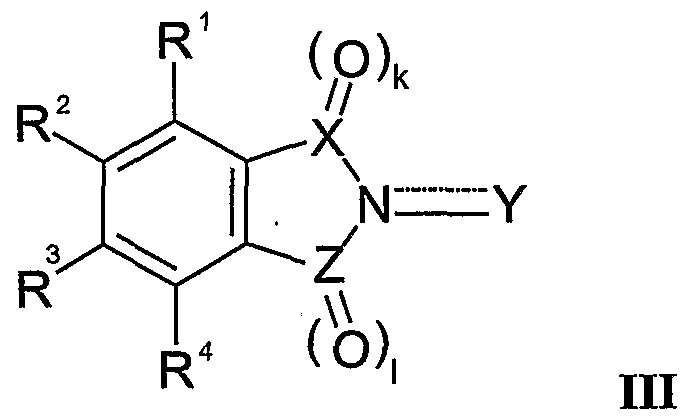
- the process according to the invention for the production of saturated alcohols, ketones, aldehydes, ketones and carboxylic acids is characterized in that an unsaturated hydrocarbon is used as the starting compound, which is first oxidized with an oxygen-containing gas using a catalyst and the presence of a radical initiator, and as a catalyst a compound of formula I.
- R 1 , R 2 H, aliphatic or aromatic alkoxy radical, carboxyl radical,
- Examples of compounds of the formula I are N-hydroxyphthalimide, 4-amino-N-hydroxyphthalimide, 3-amino-N-hydroxyphthalimide, tetrabromo-N-hydroxyphthalimide, tetrachloro-N-hydroxyphthalimide, N-hydroxyhetimide, N-hydroxyhimimide, N-hydroxytrimellitimide , N-hydroxy-benzene-1, 2,4-tricarboximide, N, N'-dihydroxy-pyromellitic acid diimide, N, N'-dihydroxy-benzophenone-3,3 ', 4,4'-tetracarboxylic acid diimide, N-hydroxymaleimide, N- Hydroxy-pyridine-2,3-dicarboximide, N-hydroxysuccinimide, N-hydroxy-tartarimide ,, N-hydroxy-5-norbonen-2,3-dicarboximide, exo-N-hydroxy-7- oxabicyclo [2.2.1] -hept- 5-en-2
- No metal compounds or enzymes are used as cocatalysts in the process according to the invention.
- the process can be carried out in bulk, but the process is preferably carried out in organic solvents in the absence of strong acids, and the use of an aqueous solution, the pH of which can vary in the slightly acidic to basic range, is also possible.
- the oxidation is preferably carried out such that the molar ratio of the catalyst to the hydrocarbon to be oxidized, that is to say the saturated and / or unsaturated cyclic hydrocarbons, is from 10 "8 to 1, preferably from 10 " 7 to 0.5, very particularly preferably from 10 "6 to 0.2 and in a special embodiment from 10 " 3 to 0.1.
- derivatives or special cases of compounds of the formula I can also be used.
- the reaction mixture can also contain a radical initiator, which is either itself a radical or decomposes to form radicals, such as a peroxy compound or an azo compound.
- a radical initiator which is either itself a radical or decomposes to form radicals, such as a peroxy compound or an azo compound.
- examples of such compounds are cumene hydroperoxide, cyclohexylbenzene hydroperoxide, cyclododecylbenzene hydroperoxide, ethylbenzene hydroperoxide, 1,4-di (2-neodecanoyl-peroxyisopropyl) benzene, acetylcyclohexane-sulfonyl-oxy-2-oxy-oxy-oxy-hexoxy (3-cyclohexyl) oxy-oxy-oxy-oxy-oxy-oxy-4-oxy-oxy-oxy-oxy-oxy-oxy-oxy-oxy-oxy-oxy-oxy-oxy-oxy-oxy-oxy-
- Diisononanoyl peroxide didecanoyl peroxide, tert-butyl peroxy-2-ethylhexanoate, tert-butyl peroxyisononanoate, 2,2'-di-tert-butyl peroxybutane, di-tert-butyl peroxybenzoate, di-tert-butyl peroxide, tert-butyl hydroperoxide, 3, 4-dimethyl-3,4-diphenylhexane, dibenzoyl peroxide, 1,4-di-tert-butylperoxycyclohexane, tert-butylperoxyethylhexyl carbonate, 1,1-di-tert-butylperoxycyclohexane, 2,2'-azobis (2,4-dimethylvaleronitrile , 2,2 '-azobis (4-methoxy-2,4-dimethylvaleronitrile 2,2'-azobis
- the concentration of the radical initiator in the process according to the invention is often lower than the concentration of the catalyst at the start of the reaction.
- an intermediate formation of radical initiators can take place in the course of the reaction, so that the concentration of radical-starting compounds can increase in the course of the reaction.
- the oxidation products formed can in principle be isolated as such, according to the invention the direct subsequent hydrogenation is the rule. This takes place either in the same reaction vessel or as a second stage in a separate reaction container.
- the process according to the invention can be carried out either batchwise or continuously.
- the process according to the invention can be carried out using an oxygen-containing gas as the oxidizing agent.
- the proportion of oxygen in the gas can be between 5 to 100% by volume.
- Atmospheric oxygen or pure oxygen is preferably used as the oxidizing agent. It is important to ensure that the liquid and gaseous phases are thoroughly mixed. This can e.g. B. in stirred tanks by a corresponding stirring speed or by internals and in tubular reactors with packing elements and with bubble columns.
- the process according to the invention can be carried out both under atmospheric pressure and under increased pressure up to 100 bar.
- a pressure of 1 bar to 50 bar is preferred, a pressure of 1 bar to 20 bar is particularly preferred.
- the hydrogenation is carried out with hydrogen, for. B. in appropriate reaction vessels under increased pressure up to 100 bar, preferably up to 50 bar, very particularly preferably up to 20 bar and in a special embodiment up to 10 bar using suitable catalysts such as. B. the so-called Ru / C catalyst (Engelhard Corp., 101 Wood Av., Iselin, NJ 08830-0770) executed.
- suitable catalysts such as. B. the so-called Ru / C catalyst (Engelhard Corp., 101 Wood Av., Iselin, NJ 08830-0770) executed.
- Ru / C catalyst Engelhard Corp., 101 Wood Av., Iselin, NJ 08830-0770
- the separation can be done in various ways, such as. B. by using a membrane or by adding a solvent in which the catalyst is insoluble and subsequent phase separation.
- solvents are, for example, chlorinated hydrocarbons such. B. carbon t
- the hydrogenation catalyst mentioned can be used, but also a large number of commercially available catalysts offered for this purpose can be used.
- the Ru / C catalyst from Engelhard is preferably used.
- 10 "5 to 10 2 mol%, particularly preferably 10 " 3 to 20 mol% and very particularly preferably 10 "2 to 10 mol% are used.
- the hydrogenation is carried out at a temperature of 0 to 500 ° C carried out, temperatures of 20 to 300 ° C are preferred, temperatures of 40 to 200 ° C are very particularly preferred.
- PhCN benzonitrile
- NHPI N-hydroxyphthalimide
- V-65 2,2'-azobis (2,4-dimethylvaleronitrile)
- V-70 2,2'-azobis (4-methoxy-2,4-dimethylvaleronitrile)
- DCP Dibenzoyl peroxide
- CDT cyclododecatriene
- Example 1 (according to the invention) 2 mmol of CDT, 5 ml of acetone, 8 mol% of NHPI, 1 mol% of V-70 are stirred in a round-bottomed flask with a reflux condenser at a temperature of 50 ° C. for 5 hours. Oxygen is passed through the mixture at a pressure of 1 bar. After hydrogenation using 5 mol% of the catalyst Ru / C in a laboratory autoclave at 10 bar pressure and a temperature of 100 ° C., with a conversion of 15% CDT in a selectivity of 98% cyclododecanone and cyclododecanol approximately in a ratio of 1: 1 received.
- Example 5 (not according to the invention, with cobalt catalyst) 2 mmol of CDT, 5 ml of PhCN, 4 mol% of NHPI and 4 mol% of Co (II) acetate are stirred in a round-bottomed flask with a reflux condenser at a temperature of 70 ° C. for 24 hours. Oxygen is passed through the mixture at a pressure of 1 bar. After hydrogenation with 5 mol% catalyst Ru / C at 100 ° C. in a laboratory autoclave at 8 bar pressure, a cyclododecanone / cyclododecanol mixture is obtained with a selectivity of 6% and a conversion of 67%.
Landscapes
- Chemical & Material Sciences (AREA)
- Organic Chemistry (AREA)
- Chemical Kinetics & Catalysis (AREA)
- Organic Low-Molecular-Weight Compounds And Preparation Thereof (AREA)
- Catalysts (AREA)
- Low-Molecular Organic Synthesis Reactions Using Catalysts (AREA)
Abstract
Description


Claims


Priority Applications (5)
| Application Number | Priority Date | Filing Date | Title |
|---|---|---|---|
| EP02743180A EP1401797B1 (de) | 2001-07-02 | 2002-06-12 | Verfahren zur herstellung gesättigter alkohole, ketone, aldehyde und carbonsäuren |
| DE50207803T DE50207803D1 (de) | 2001-07-02 | 2002-06-12 | Verfahren zur herstellung gesättigter alkohole, ketone, aldehyde und carbonsäuren |
| CA002452341A CA2452341A1 (en) | 2001-07-02 | 2002-06-12 | Process for preparing saturated alcohols, ketones, aldehydes and carboxylic acids |
| JP2003510415A JP2004533477A (ja) | 2001-07-02 | 2002-06-12 | 飽和アルコール、ケトン、アルデヒド及びカルボン酸の製造法 |
| US10/482,777 US7145041B2 (en) | 2001-07-02 | 2002-06-12 | Method for producing saturated alcohols, ketones, aldehydes and carboxylic acids |
Applications Claiming Priority (2)
| Application Number | Priority Date | Filing Date | Title |
|---|---|---|---|
| DE10131522A DE10131522A1 (de) | 2001-07-02 | 2001-07-02 | Verfahren zur Herstellung gesättigter Alkohole, Ketone, Aldehyde und Carbonsäuren |
| DE10131522.8 | 2001-07-02 |
Publications (2)
| Publication Number | Publication Date |
|---|---|
| WO2003004447A2 true WO2003004447A2 (de) | 2003-01-16 |
| WO2003004447A3 WO2003004447A3 (de) | 2003-11-20 |
Family
ID=7689996
Family Applications (1)
| Application Number | Title | Priority Date | Filing Date |
|---|---|---|---|
| PCT/EP2002/006411 Ceased WO2003004447A2 (de) | 2001-07-02 | 2002-06-12 | Verfahren zur herstellung gesättigter alkohole, ketone, aldehyde und carbonsäuren |
Country Status (8)
| Country | Link |
|---|---|
| US (1) | US7145041B2 (de) |
| EP (1) | EP1401797B1 (de) |
| JP (1) | JP2004533477A (de) |
| CN (1) | CN1547564A (de) |
| CA (1) | CA2452341A1 (de) |
| DE (2) | DE10131522A1 (de) |
| ES (1) | ES2269726T3 (de) |
| WO (1) | WO2003004447A2 (de) |
Cited By (1)
| Publication number | Priority date | Publication date | Assignee | Title |
|---|---|---|---|---|
| EP2522656A3 (de) * | 2003-07-25 | 2013-03-20 | Redx Pharma Limited | Verfahren und Intermediate zur Herstellung von Statinen, insbesondere Atorvastatin |
Families Citing this family (15)
| Publication number | Priority date | Publication date | Assignee | Title |
|---|---|---|---|---|
| ES2299304B1 (es) * | 2005-07-29 | 2009-04-01 | Carotenoid Technologies, S.A. | Procedimiento para la preparacion de astaxantina. |
| DE102009000661A1 (de) | 2009-02-06 | 2010-08-12 | Evonik Degussa Gmbh | Verfahren zur Herstellung von 2,6-Dioxabicyclo-(3.3.0)-octan-4,8-dion[1S,5S] |
| WO2011003991A1 (de) * | 2009-07-10 | 2011-01-13 | Basf Se | Verfahren zur herstellung von polyolen auf basis nachwachsender rohstoffe |
| EP2978831B1 (de) | 2013-03-28 | 2020-12-02 | The Procter and Gamble Company | Reinigungszusammensetzungen mit einem polyetheramin, einem schmutzabweisenden polymer und carboxymethylcellulose |
| EP3122850A1 (de) | 2014-03-27 | 2017-02-01 | The Procter & Gamble Company | Reinigungszusammensetzungen mit einem polyetheramin |
| CA2941253A1 (en) | 2014-03-27 | 2015-10-01 | Frank Hulskotter | Cleaning compositions containing a polyetheramine |
| EP3152288A1 (de) | 2014-06-06 | 2017-04-12 | The Procter & Gamble Company | Waschmittelzusammensetzung mit polyalkyleniminpolymeren |
| CN104151118B (zh) * | 2014-07-11 | 2015-12-30 | 郑州大学 | 一种醇选择性氧化制备醛或酮的方法 |
| JP6728132B2 (ja) | 2014-08-27 | 2020-07-22 | ザ プロクター アンド ギャンブル カンパニーThe Procter & Gamble Company | カチオン性ポリマーを含む洗剤組成物 |
| US9809782B2 (en) | 2014-08-27 | 2017-11-07 | The Procter & Gamble Company | Detergent composition comprising a cationic polymer and anionic/nonionic surfactant mixture |
| WO2016032995A1 (en) | 2014-08-27 | 2016-03-03 | The Procter & Gamble Company | Method of treating a fabric |
| CA2956095C (en) | 2014-08-27 | 2019-10-08 | The Procter & Gamble Company | Detergent composition comprising a cationic polymer |
| EP3197992B1 (de) | 2014-09-25 | 2023-06-28 | The Procter & Gamble Company | Gewebepflegezusammensetzungen mit einem polyetheramine |
| EP3901128B1 (de) * | 2020-04-22 | 2024-07-31 | Symrise AG | Verfahren zur herstellung von alfa,beta-ungesättigten ketonen |
| CA3228918A1 (en) | 2021-08-10 | 2023-02-16 | Nippon Shokubai Co., Ltd. | Polyalkylene-oxide-containing compound |
Family Cites Families (7)
| Publication number | Priority date | Publication date | Assignee | Title |
|---|---|---|---|---|
| DK173704B1 (da) * | 1985-04-17 | 2001-07-09 | Hoffmann La Roche | Fremgangsmåde til katalytisk oxidation af allyliske grupper |
| DE3824625A1 (de) * | 1988-07-20 | 1990-01-25 | Bayer Ag, 5090 Leverkusen | Verfahren zur hydrierung von (alpha),(beta)-ungesaettigten ketonen |
| WO1997028897A1 (en) * | 1996-02-07 | 1997-08-14 | Daicel Chemical Industries, Ltd. | Oxidation catalyst system and process for oxidation with the same |
| JP4756719B2 (ja) * | 1997-02-17 | 2011-08-24 | ダイセル化学工業株式会社 | 酸化触媒系、酸化方法および酸化物の製造方法 |
| ES2167106T3 (es) * | 1998-04-30 | 2002-05-01 | Creavis Tech & Innovation Gmbh | Procedimiento para preparar compuestos aromaticos que contienen grupos hidroxilo. |
| DE19841872A1 (de) * | 1998-09-14 | 2000-03-16 | Creavis Tech & Innovation Gmbh | Elektrokatalytische Selektiv-Oxidation von Kohlenwasserstoffen |
| DE10015880A1 (de) * | 2000-03-30 | 2001-10-11 | Creavis Tech & Innovation Gmbh | Verfahren zur Oxidation von Kohlenwasserstoffen |
-
2001
- 2001-07-02 DE DE10131522A patent/DE10131522A1/de not_active Withdrawn
-
2002
- 2002-06-12 US US10/482,777 patent/US7145041B2/en not_active Expired - Fee Related
- 2002-06-12 CN CNA028167112A patent/CN1547564A/zh active Pending
- 2002-06-12 DE DE50207803T patent/DE50207803D1/de not_active Expired - Fee Related
- 2002-06-12 JP JP2003510415A patent/JP2004533477A/ja not_active Withdrawn
- 2002-06-12 CA CA002452341A patent/CA2452341A1/en not_active Abandoned
- 2002-06-12 EP EP02743180A patent/EP1401797B1/de not_active Expired - Lifetime
- 2002-06-12 ES ES02743180T patent/ES2269726T3/es not_active Expired - Lifetime
- 2002-06-12 WO PCT/EP2002/006411 patent/WO2003004447A2/de not_active Ceased
Cited By (1)
| Publication number | Priority date | Publication date | Assignee | Title |
|---|---|---|---|---|
| EP2522656A3 (de) * | 2003-07-25 | 2013-03-20 | Redx Pharma Limited | Verfahren und Intermediate zur Herstellung von Statinen, insbesondere Atorvastatin |
Also Published As
| Publication number | Publication date |
|---|---|
| DE50207803D1 (de) | 2006-09-21 |
| WO2003004447A3 (de) | 2003-11-20 |
| EP1401797B1 (de) | 2006-08-09 |
| ES2269726T3 (es) | 2007-04-01 |
| DE10131522A1 (de) | 2003-01-16 |
| US7145041B2 (en) | 2006-12-05 |
| CA2452341A1 (en) | 2003-01-16 |
| JP2004533477A (ja) | 2004-11-04 |
| EP1401797A2 (de) | 2004-03-31 |
| CN1547564A (zh) | 2004-11-17 |
| US20040249197A1 (en) | 2004-12-09 |
Similar Documents
| Publication | Publication Date | Title |
|---|---|---|
| EP1268417B1 (de) | Verfahren zur herstellung von aromatischen alkoholen, insbesondere phenol | |
| EP1268367B1 (de) | Verfahren zur oxidation von kohlenwasserstoffen | |
| EP1401797B1 (de) | Verfahren zur herstellung gesättigter alkohole, ketone, aldehyde und carbonsäuren | |
| DE60002286T2 (de) | Verfahren zur Herstellung von Ketonen, Alkoholen und Hydroperoxiden | |
| EP1663932B1 (de) | Verfahren zur herstellung von cyclododecanon | |
| EP1667952B1 (de) | Verfahren zur herstellung eines ketons | |
| EP1794110B1 (de) | Verfahren zur reinigung und aufkonzentrierung von distickstoffmonoxid | |
| DE602005001366T2 (de) | Verfahren zur Herstellung von Cycloalkanol und/oder Cycloalkanon | |
| AT408546B (de) | Singlet sauerstoff oxidation von organischen substraten | |
| EP0700892B1 (de) | Verfahren zur Herstellung von Mono- oder Dicarbonsäuren aus Aldehyden, deren Vollacetalen oder Halbacetalen, sowie aus Gemischen davon | |
| AT408440B (de) | Singlet sauerstoff oxidation von organischen substanzen | |
| AT502537B1 (de) | Verfahren zur oxidation von organischen substraten mittels singlet sauerstoff bei hohen reaktionstemperaturen | |
| WO2003014074A1 (de) | Herstellung von peroxiden des ethylbenzols und deren verwendung | |
| DE10129117A1 (de) | Verfahren zur katalytischen oxidativen Spaltung zyklischer gestättigter und ungesättigter Verbindungen | |
| DE19725533A1 (de) | Verfahren zur Herstellung von 2-Cyclododecyl-1-propanol | |
| EP1053992A1 (de) | Herstellung von aliphatischen alpha, omega-Dicarbonsäuren | |
| DE69208439T2 (de) | Alkylperoxide und Verwendungen | |
| DE10163579A1 (de) | Oxidation von organischen Verbindungen unter Verwendung eines flüssigen, mehrphasigen Katalysatorsystems unter Verwendung der Oxidationsprodukte | |
| DE102006037447A1 (de) | Katalytische Oxidation von Terpenen mit Edelmetallkatalysatoren | |
| DE3636056A1 (de) | Verfahren zur aufarbeitung von cyclohexylhydroperoxid enthaltenden reaktionsgemischen | |
| DE19515991A1 (de) | Verfahren zur Herstellung von Ketonen aus olefinisch ungesättigten Verbindungen | |
| DE2031782B (de) | Verfahren zur Herstellung von Cyclododecanon |
Legal Events
| Date | Code | Title | Description |
|---|---|---|---|
| AK | Designated states |
Kind code of ref document: A2 Designated state(s): AE AG AL AM AT AU AZ BA BB BG BR BY BZ CA CH CN CO CR CU CZ DE DK DM DZ EC EE ES FI GB GD GE GH GM HR HU ID IL IN IS JP KE KG KP KR KZ LC LK LR LS LT LU LV MA MD MG MK MN MW MX MZ NO NZ OM PH PL PT RO RU SD SE SG SI SK SL TJ TM TN TR TT TZ UA UG US UZ VN YU ZA ZM ZW |
|
| AL | Designated countries for regional patents |
Kind code of ref document: A2 Designated state(s): GH GM KE LS MW MZ SD SL SZ TZ UG ZM ZW AM AZ BY KG KZ MD RU TJ TM AT BE CH CY DE DK ES FI FR GB GR IE IT LU MC NL PT SE TR BF BJ CF CG CI CM GA GN GQ GW ML MR NE SN TD TG |
|
| 121 | Ep: the epo has been informed by wipo that ep was designated in this application | ||
| DFPE | Request for preliminary examination filed prior to expiration of 19th month from priority date (pct application filed before 20040101) | ||
| WWE | Wipo information: entry into national phase |
Ref document number: 2002743180 Country of ref document: EP |
|
| WWE | Wipo information: entry into national phase |
Ref document number: 2003510415 Country of ref document: JP |
|
| WWE | Wipo information: entry into national phase |
Ref document number: 2452341 Country of ref document: CA |
|
| WWE | Wipo information: entry into national phase |
Ref document number: 20028167112 Country of ref document: CN |
|
| WWP | Wipo information: published in national office |
Ref document number: 2002743180 Country of ref document: EP |
|
| REG | Reference to national code |
Ref country code: DE Ref legal event code: 8642 |
|
| ENP | Entry into the national phase |
Ref document number: 2004112784 Country of ref document: RU Kind code of ref document: A |
|
| WWE | Wipo information: entry into national phase |
Ref document number: 10482777 Country of ref document: US |
|
| WWG | Wipo information: grant in national office |
Ref document number: 2002743180 Country of ref document: EP |