WO2003043604A1 - Procede de preparation d'un compose d'interaction de substances actives avec un support poreux par fluide supercritique - Google Patents
Procede de preparation d'un compose d'interaction de substances actives avec un support poreux par fluide supercritique Download PDFInfo
- Publication number
- WO2003043604A1 WO2003043604A1 PCT/FR2002/003474 FR0203474W WO03043604A1 WO 2003043604 A1 WO2003043604 A1 WO 2003043604A1 FR 0203474 W FR0203474 W FR 0203474W WO 03043604 A1 WO03043604 A1 WO 03043604A1
- Authority
- WO
- WIPO (PCT)
- Prior art keywords
- supercritical fluid
- active substance
- solvent
- porous support
- supercritical
- Prior art date
- Legal status (The legal status is an assumption and is not a legal conclusion. Google has not performed a legal analysis and makes no representation as to the accuracy of the status listed.)
- Ceased
Links
Classifications
-
- A—HUMAN NECESSITIES
- A61—MEDICAL OR VETERINARY SCIENCE; HYGIENE
- A61K—PREPARATIONS FOR MEDICAL, DENTAL OR TOILETRY PURPOSES
- A61K9/00—Medicinal preparations characterised by special physical form
- A61K9/14—Particulate form, e.g. powders, Processes for size reducing of pure drugs or the resulting products, Pure drug nanoparticles
- A61K9/16—Agglomerates; Granulates; Microbeadlets ; Microspheres; Pellets; Solid products obtained by spray drying, spray freeze drying, spray congealing,(multiple) emulsion solvent evaporation or extraction
- A61K9/1605—Excipients; Inactive ingredients
- A61K9/1629—Organic macromolecular compounds
- A61K9/1652—Polysaccharides, e.g. alginate, cellulose derivatives; Cyclodextrin
-
- A—HUMAN NECESSITIES
- A61—MEDICAL OR VETERINARY SCIENCE; HYGIENE
- A61P—SPECIFIC THERAPEUTIC ACTIVITY OF CHEMICAL COMPOUNDS OR MEDICINAL PREPARATIONS
- A61P1/00—Drugs for disorders of the alimentary tract or the digestive system
-
- A—HUMAN NECESSITIES
- A61—MEDICAL OR VETERINARY SCIENCE; HYGIENE
- A61P—SPECIFIC THERAPEUTIC ACTIVITY OF CHEMICAL COMPOUNDS OR MEDICINAL PREPARATIONS
- A61P1/00—Drugs for disorders of the alimentary tract or the digestive system
- A61P1/04—Drugs for disorders of the alimentary tract or the digestive system for ulcers, gastritis or reflux esophagitis, e.g. antacids, inhibitors of acid secretion, mucosal protectants
-
- A—HUMAN NECESSITIES
- A61—MEDICAL OR VETERINARY SCIENCE; HYGIENE
- A61P—SPECIFIC THERAPEUTIC ACTIVITY OF CHEMICAL COMPOUNDS OR MEDICINAL PREPARATIONS
- A61P29/00—Non-central analgesic, antipyretic or antiinflammatory agents, e.g. antirheumatic agents; Non-steroidal antiinflammatory drugs [NSAID]
-
- A—HUMAN NECESSITIES
- A61—MEDICAL OR VETERINARY SCIENCE; HYGIENE
- A61P—SPECIFIC THERAPEUTIC ACTIVITY OF CHEMICAL COMPOUNDS OR MEDICINAL PREPARATIONS
- A61P3/00—Drugs for disorders of the metabolism
-
- A—HUMAN NECESSITIES
- A61—MEDICAL OR VETERINARY SCIENCE; HYGIENE
- A61P—SPECIFIC THERAPEUTIC ACTIVITY OF CHEMICAL COMPOUNDS OR MEDICINAL PREPARATIONS
- A61P3/00—Drugs for disorders of the metabolism
- A61P3/06—Antihyperlipidemics
-
- A—HUMAN NECESSITIES
- A61—MEDICAL OR VETERINARY SCIENCE; HYGIENE
- A61P—SPECIFIC THERAPEUTIC ACTIVITY OF CHEMICAL COMPOUNDS OR MEDICINAL PREPARATIONS
- A61P35/00—Antineoplastic agents
-
- A—HUMAN NECESSITIES
- A61—MEDICAL OR VETERINARY SCIENCE; HYGIENE
- A61P—SPECIFIC THERAPEUTIC ACTIVITY OF CHEMICAL COMPOUNDS OR MEDICINAL PREPARATIONS
- A61P37/00—Drugs for immunological or allergic disorders
-
- A—HUMAN NECESSITIES
- A61—MEDICAL OR VETERINARY SCIENCE; HYGIENE
- A61P—SPECIFIC THERAPEUTIC ACTIVITY OF CHEMICAL COMPOUNDS OR MEDICINAL PREPARATIONS
- A61P37/00—Drugs for immunological or allergic disorders
- A61P37/08—Antiallergic agents
-
- A—HUMAN NECESSITIES
- A61—MEDICAL OR VETERINARY SCIENCE; HYGIENE
- A61K—PREPARATIONS FOR MEDICAL, DENTAL OR TOILETRY PURPOSES
- A61K9/00—Medicinal preparations characterised by special physical form
- A61K9/14—Particulate form, e.g. powders, Processes for size reducing of pure drugs or the resulting products, Pure drug nanoparticles
- A61K9/16—Agglomerates; Granulates; Microbeadlets ; Microspheres; Pellets; Solid products obtained by spray drying, spray freeze drying, spray congealing,(multiple) emulsion solvent evaporation or extraction
- A61K9/1682—Processes
- A61K9/1694—Processes resulting in granules or microspheres of the matrix type containing more than 5% of excipient
Definitions
- the present invention relates to a method of interaction of nanoparticulate active substance with a porous support, by the technology of supercritical fluids, in particular that of CO 2 .
- New pharmaceutical molecules with high added value, are in 40% of cases insoluble or poorly soluble in water, which affects their bioavailability.
- the increase in the specific surface area of the powders makes it possible to improve their speed of dissolution.
- Bertucco et al. (Drugs encapsulation using a compressed gas antisolvent technique - Proceedings of the 4th Italian ConfInterlea compressed gas antisolvent technique - Proceedings of the 4th Italian ConfInterlea compressed gas antisolvent technique - Proceedings of the 4th Italian ConfInterlea compressed gas antisolvent technique - Proceedings of the 4th Italian ConfInterlea compressed gas antisolvent technique - Proceedings of the 4th Italian ConfInterlea compressed gas antisolvent technique - Proceedings of the 4th Italian ConfInterlever on Supercitical Fluids and their Applications 1997, 327-334 - Ed. E. Revercho ⁇ ) describe a process in which the active substance is suspended in a solution of biopolymer playing the role of the support. This suspension, placed in the autoclave, is then placed in the presence of supercritical CO 2 to desolvate it (extraction of the solvent by supercritical fluid) and cause the complexation of the support by supersaturation on the active substance.
- This process is a batch process, in which the active substance is not precipitated
- Another technique for depositing a support consists in dissolving said support in the supercritical fluid, then in causing this support to precipitate on the active substance.
- the active substance and its support are previously placed in the agitated autoclave, and the injection of supercritical CO 2 solubilizes only the support (this implies that the support is soluble in the supercritical fluid and that the active substance does not or not), which is precipitated by modification of the pressure and the temperature within the autoclave.
- the initial structure of the active substance remains unchanged, and it is difficult to control the active substance / support ratio obtained in the precipitated complex.
- This batch process is detailed in patent application EP 706 821 by Benoît et al.
- microencapsulation process described by Shine and Gelb in their patent application WO98 / 15348 consists of: 1. mixing an active substance with an encapsulating polymer, 2. liquefying the polymer by passing a flow of supercritical fluid,
- the active substance (kava-kava, turmeric, mixture of black pepper and sweet paprika), previously extracted by supercritical fluid, is precipitated in an autoclave containing a porous support.
- the porous medium studied is maltodextrin. It is therefore a simple inclusion in a porous support without step of diffusion in static mode of the active substance in its support.
- the precipitation on a support is not sufficient to significantly improve the solubility of the active substance in an aqueous medium.
- a mixture of naproxen and L-PLA is placed in an enclosure, from which the two compounds are extracted by the supercritical fluid, and precipitated in a second autoclave, as regards the RESS process.
- the precipitation or co-precipitation of an active substance and of a support is not sufficient to significantly improve the solubility of the active substance in an aqueous medium.
- no step of molecular diffusion in static mode in order to improve the interpenetration of the active substance with its support is described in these two methods.
- the solubility of the active substance in an aqueous medium is not studied. The same is true for the co-precipitation methods described by Sze Tu et al.
- the contact phase between the solution, the suspension containing the solute, and the supercritical antisolvent is such that it generates high frequency waves, which divide the solution into a multitude of small drops.
- the particle size claimed is 0.1 to 10 ⁇ .
- coating methods are also described.
- the crystallizations of hydrocortisone, poly (D, L-lactide-glycolidic), ibuprofen and camptothecin are described.
- the precipitation or co-precipitation of an active substance and of a support is not sufficient to significantly improve the solubility of the active substance in an aqueous medium.
- this method does not describe a step of molecular diffusion in static mode making it possible to improve the bioavailability of the active substance.
- VanHees et al. (Application of supercritical carbon dioxidefor the preparation of a Piroxicam- ⁇ -cyclodextrin inclusion compound, Pharmaceutical Research, Vol. 16, N ° 12, 1999) describe in their publication a process for the inclusion of Piroxicam in ⁇ -cyclodextrins by CO 2 supercritical. The process consists in placing a mixture of Piroxicam and ⁇ -cyclodextrins (1 / 2.5 molar ratio) in a pressurized autoclave, left in static mode. After depressurization the mixture obtained is ground and homogenized before characterization.
- Kamihira M. et al. (Formation of inclusion complexes between cyclodextrins and aromatic compounds under pressurized carbon dioxide, J. of Fermentation and Bioengineering, Vol. 69, N ° 6, 350-353, 1990) describe a process for extracting volatile aromatic compounds, and trapping by inclusion in the cyclodextrins.
- the geraniol and mustard oil are thus extracted by a RESS process, and vaporized in dynamic mode in a second autoclave containing a mixture of cyclodextrin and water.
- the influence of temperature, pressure and water content parameters is studied by measuring the rate of inclusion of active substances in cyclodextrins.
- the inclusion step described in this publication is carried out in dynamic and not static mode as claimed in the present invention. Furthermore, this process does not include a washing step using supercritical fluid. Finally, the solubility of the active substance in an aqueous medium is not studied.
- the co-precipitation of an active substance and a porous support is not sufficient to significantly improve the solubility of the active substance in an aqueous medium.
- this method does not describe a step of molecular diffusion in static mode making it possible to improve the bioavailability of the active substance, and, moreover, its solubility in an aqueous medium is not studied.
- the same is true for the co-precipitation methods described by Jung et al. in their patent FR 2 815 540. It is a process for manufacturing very fine particles containing at least one active ingredient inserted in a host molecule, as well as a device allowing the implementation of this process.
- This process consists in dissolving the active principle in a first liquid solvent, and a product formed of host molecules, of the cyclodextrin or crown ether type, in a second liquid solvent.
- the solutions are then brought into contact with a fluid at supercritical pressure, so as to precipitate the molecules, according to a SAS process.
- the components as in the process described by Sze Tu L. in the article cited above, can be dissolved in the same solvent.
- the results presented by Jung et al. do not claim improvement in dissolution rate.
- the co-precipitation of an active substance and of a cyclodextrin-type support is not sufficient to significantly improve the solubility of the active substance in an aqueous medium.
- this method does not describe a step of molecular diffusion in static mode making it possible to improve the bioavailability of the active substance, and, moreover, its solubility in an aqueous medium is not studied.
- a process comprising the steps of generating an active substance sparingly soluble in an aqueous medium by a supercritical fluid, its mixture with a porous support followed by a step of molecular diffusion by the supercritical fluid in static mode and washing by the supercritical fluid made it possible to prepare an interaction compound by greatly increasing the solubility in an aqueous medium of the active substance, and therefore its bioavailability.
- the inclusion step in static mode coupled with the precipitation phase of the active substance to its support has surprisingly improved the dissolution of the active substance in an aqueous medium.
- the third phase of washing in a supercritical medium which consists in eliminating the residual solvents by passing a flow of supercritical CO 2 also surprisingly allows, in addition to washing the interaction compound, to increase the dissolution. following this step.
- these steps can be carried out in batch or continuously, as is particularly the case for diffusion and washing. This therefore makes it possible to lighten the process compared to the conventional steps which would be: 1. Crystallization 2. Solid / liquid separation
- the present invention relates to a process for the preparation of an interaction compound of an active substance poorly soluble in an aqueous medium with a porous support, characterized in that it comprises the following steps:
- step (b) implementing a molecular diffusion step by bringing a supercritical fluid into static contact with the mixture obtained in step (a) for the time necessary to improve the dissolution in an aqueous medium of the mixture obtained step (a),
- step (c) washing the interaction compound obtained in step (b) with a flow of supercritical fluid, (d) recovering the particles of the interaction compound thus formed.
- active substance sparingly soluble in an aqueous medium is meant within the meaning of the present invention any active substance sparingly or not soluble in an aqueous medium and having in particular a solubility of less than at least 20 ⁇ g / ml.
- it may be a pharmaceutical, cosmetic or nutraceutical active ingredient.
- it is an active substance chosen from the group consisting of anilide derivatives, epipodophyllotoxin derivatives, piroxicam, valeric acid, octanoic acid, lauric acid and stearic acid.
- anilide derivatives it is advantageously a derivative of general formula I below:
- Ri and R 2 which are identical or different, independently of one another represent a hydrogen atom; a linear or branched alkyl radical in dC 6 ; an aromatic group such as phenyl, naphthyl or pyridyl optionally substituted by one or more alkyl groups -C 4 alkoxy, C 1 -C 4 -alkoxy, hydroxyl or halogen,
- R 3 represents a linear or branched alkyl chain at -Qs or a phenyl group optionally substituted by one or more C 1-6 alkyl groups
- A represents a sulfur or oxygen atom or the sulfoxy group.
- R ' represents a hydrogen atom; a phosphate monoester group; a carbamate group of the -CO-N (R ⁇ R 2 ) type where N (R ⁇ R 2 ) represents aminodiacetic groups and a polycychque amine such as 3-aminoquinuclidine; an acyl group of phosphonoacetic H 2 O 3 P-CH 2 -CO type or an R radical,
- R represents an acyl group of formula AZ-CH 2 -CO where Z represents an oxygen or sulfur atom, an SO 2 group, a linear or branched C ⁇ - 4 alkylene, in this case A represents a substituted phenyl ring or no, provided that
- A represents an aromatic nucleus having a salifiable function
- R ' ⁇ R, A represents a benzyl, naphthyl, heteroaryl, phenyl radical substituted or not, in this case the phenyl being able to be substituted one or more times whatever its position on the aromatic ring by groups such as halogens, F, Cl, Br, linear or cyclic C1- ⁇ alkoxy, C 1-6 alkyl, methylene dioxy, OCF 3 , CF 3 , NO 2 , CN, OCH 2 Aryl, OH, OPO 3 H 2 , CH 2 PO 3 H 2 , PO 3 H 2 ,
- AZ can also represent an OCH 2 CO 2 H, SO 2 CH 2 COOH, PO 3 H 2 group .
- active substance generated by supercritical fluid is meant within the meaning of the present invention, any active substance as defined above which has undergone a step of generation by supercritical fluid, that is to say a step allowing thanks to the use of supercritical fluid to increase its specific surface.
- such a step consists of a RESS or SAS process.
- porous support in the sense of the present invention any suitable porous support soluble in an aqueous medium.
- the porous support is chosen from the group consisting of cyclodextrins and their mixture.
- it is ⁇ -cyclodextrin.
- supercritical fluid in the sense of the present invention any fluid used at a temperature and a pressure greater than their critical value.
- it is CO 2 .
- Static mode is meant within the meaning of the present invention a reaction or a process in which all the reagents are brought together simultaneously and where the reaction is allowed to proceed.
- a co-crystallized powder, water and supercritical CO 2 are placed in an autoclave and left to react for 16 hours. The mass of product does not change during the reaction.
- step (a) is typically a dynamic phase.
- intimate mixture is meant in the sense of the present invention a mixture of A and B in which A and B are found uniformly distributed within the mixture obtained.
- the method according to the present invention is such that the porous support is generated by supercritical fluid and that step (a) comprises the following steps:
- step (a2) continuously contacting the solution obtained in step (al) with said supercritical fluid, in order to desolvate in a controlled manner the active substance and the support, and ensure their coacervation,
- step (a) consists of coprecipitation of the active substance and of the porous support by the SAS method.
- the method according to the present invention is such that the active substance, before its use in step (a), is generated by the method comprising the following steps:
- step (i) dissolving the active substance in an organic solvent, said organic solvent being soluble in the supercritical fluid, (ii) continuously bringing the solution obtained in step (i) into contact with said supercritical fluid, in order to desolvate the active substance, and ensure its coacervation,
- step (iii) washing the particles of active substance thus formed by extraction of the residual solvent with said supercritical fluid, then proceed to the separation of the solvent in the liquid state and the supercritical fluid in the gaseous state, and that the porous support used to step (a) is in solid form.
- the active substance before its use in step (a), is generated by precipitation according to the SAS method.
- the method according to the present invention is such that the active substance, before its use in step (a) is generated by the method comprising the following steps: (i) extract the active substance by the supercritical fluid, optionally added with a co-solvent,
- step (ii) spray the supercritical mixture in order to desolvate the active substance, and ensure its coacervation,
- step (iii) wash the particles of active substance thus formed by the supercritical fluid, then optionally proceed with the separation of the co-solvent in the liquid state and supercritical fluid in the gaseous state, and that the porous support used in step (a) is in solid form.
- the active substance, before its use in step (a) is generated by precipitation according to the RESS process.
- step (a) comprises the following steps:
- step (a) consists in the precipitation by the SAS method of the active substance on the porous support.
- step (a) comprises the following steps:
- step (a3) Wash the complex thus formed by the supercritical fluid, then optionally proceed with the separation of the co-solvent in the liquid state and of the supercritical fluid in the gaseous state.
- step (a) consists of the precipitation by the RESS process of the active substance on the porous support.
- the organic solvent or the co-solvent is chosen from the group consisting of alcohols, in particular methanol or butanol, ketones, in particular acetone, methyl ethyl ketone, cyclohexanone or N-methylpyrrolidone, acetic acid, ethyl acetate, dichloromethane, acetonitrile, dimethylformamide, dimethylsulfoxide (DMSO) and their mixture.
- it is ethanol or dimethyl sulfoxide.
- step (b) of molecular diffusion of the process according to the present invention is carried out with stirring.
- step (b) of molecular diffusion of the process according to the present invention is carried out in the presence of a diffusion agent.
- a diffusion agent is meant within the meaning of the present invention any solvent promoting interaction of the active substance with the support.
- this diffusion agent is chosen from the group consisting of alcohol, water with or without surfactant and their mixtures. Even more advantageously, it is water. This diffusion agent can be added continuously or batchwise.
- step (b) The time necessary for the molecular diffusion of step (b) is determined by any suitable method. This step (b) can be repeated as many times as desired to obtain a satisfactory dissolution rate.
- step (b) lasts approximately 16 hours.
- the pressure and temperature conditions of step (b) are chosen so as to promote molecular diffusion.
- the pressure of the supercritical fluid is between 10 MPa and 40 MPa and the temperature between 0 and 120 ° C. Even more advantageously, the supercritical fluid is used at a pressure between 10 MPa and 40 MPa and at a temperature between 0 and 120 ° C in all the steps of the process according to the present invention.
- each of the steps of the method according to the present invention is implemented in a closed reactor, in particular an autoclave.
- the method according to the present invention is carried out continuously.
- the present invention also relates to an interaction compound of an active substance which is sparingly soluble in an aqueous medium with a porous support, characterized in that it is capable of being obtained by the process according to the present invention.
- the interaction compound according to the present invention is such that the active substance thus complexed has a solubility in an aqueous solution of sodium Lauryl sulphate at 5% greater than about 600 ⁇ g / ml.
- Powder of active principle obtained by RESS Powder of active principle obtained by RESS:
- rods of 1-3 ⁇ m in length and 100 to 200 nm in diameter rods of 1-3 ⁇ m in length and 100 to 200 nm in diameter
- FIG. 1 represents a SEM photo with an enlargement of lOOOx of the product F 12511 obtained after crystallization and drying by conventional means.
- FIG. 2 represents a SEM photo with a 2000x magnification of the product F 12511 obtained after crystallization and drying by the conventional route.
- FIG. 3 represents a SEM photo with an enlargement of lOOOx of the complex obtained after co-precipitation by the SAS method and washing with supercritical CO 2 of a solution of the product F 12511 and of ⁇ -cyclodextrin in DMSO.
- FIG. 4 represents a SEM photo with an enlargement of 2000 ⁇ of the complex obtained after co-precipitation by the SAS method and washing with supercritical CO 2 of a solution of the product F 12511 and of ⁇ -cyclodextrin in DMSO.
- FIG. 5 represents a SEM photo with an enlargement of lOOOx of the same complex as FIGS. 3 and 4 after 16 hours of molecular diffusion in supercritical medium, in the presence of water.
- FIG. 6 represents a SEM photo with an enlargement of 2000 ⁇ of the same complex as FIGS. 3 and 4 after 16 hours of molecular diffusion in supercritical medium, in the presence of water.
- FIG. 7 represents a histogram of the bioavailability of the product F12511 according to the formulation used (compound of interaction with 7-cyclodextrin according to the method of the present invention or crystallized product F12511) in dogs.
- the method according to the invention notably comprises a step of molecular diffusion in a supercritical medium allowing a strong interaction of the particles of active substance in the envisaged support, as shown by the photos produced with the scanning electron microscope (FIGS. 1 to 6). We can see in these photos that the structure of the compound is completely modified during the diffusion. In addition, the dissolution in an aqueous medium is also modified.
- the compound according to Figures 1 and 2 has a solubility after 2 hours of 6 ⁇ g / ml in a 5% aqueous solution of sodium lauryl sulfate.
- 3 and 4 has a solubility after 2 hours of 86 ⁇ g / ml in a 5% aqueous solution of sodium lauryl sulfate.
- the complex according to FIGS. 5 and 6 has a solubility after 2 hours of 516 ⁇ g / ml in a 5% aqueous solution of sodium lauryl sulfate.
- the objective sought during this diffusion stage is to improve the dissolution of the micro-particles of active substance.
- the next step which is a washing step using supercritical fluid, further increases the rate of dissolution of the interaction compound of the active substance in the porous support.
- the dissolution after two hours in an aqueous medium is multiplied by about 100 by the method according to the present invention.
- Spectrophotometric detector set to 220 nm.
- Inject 20 ⁇ l of each control solution Measure the area of the peak of product F12511 and graphically represent its variation as a function of the concentration. The correlation coefficient is> 0.995.
- Inject 20 ⁇ l of the test solution Measure the area of the peak of product F12511 present in the test solution, and make sure that it is between that of Tl and T5 of the range.
- sample preparation Before the measurement phase, the sample requires a degassing step. This step consists in creating a vacuum in the cell containing the sample until at least a vacuum of 0.003 mm Hg, or approximately 0.004 mbar, has been reached, and this in a stable manner. This degassing is carried out at a temperature of 50 ° C. (duration: approximately 16 hours). At the end of degassing, the cell containing the sample is filled with helium, and transferred to the measuring station, where the vacuum is refilled before analysis.
- W volume of gas adsorbed (under standard conditions of temperature and pressure (STP)) per unit mass of sample.
- Wm volume of gas adsorbed (under STP conditions) in a monolayer per unit mass of sample.
- P 0 saturation pressure.
- C constant.
- N A number of Avogadro.
- N m number of moles of nitrogen adsorbed on a monolayer per unit mass of sample, calculated from Wm.
- the flow rate of the solvent pump is 0.6 ml min.
- the temperature and pressure within the autoclave are chosen to obtain a CO 2 density equal to 0.8.
- the injections of the solute and then of CO 2 are stopped, and the wash by passing a CO 2 flow (300 bar, 50 ° c) for 3 hours.
- the autoclave is then depressurized. The yield of this stage is 87%.
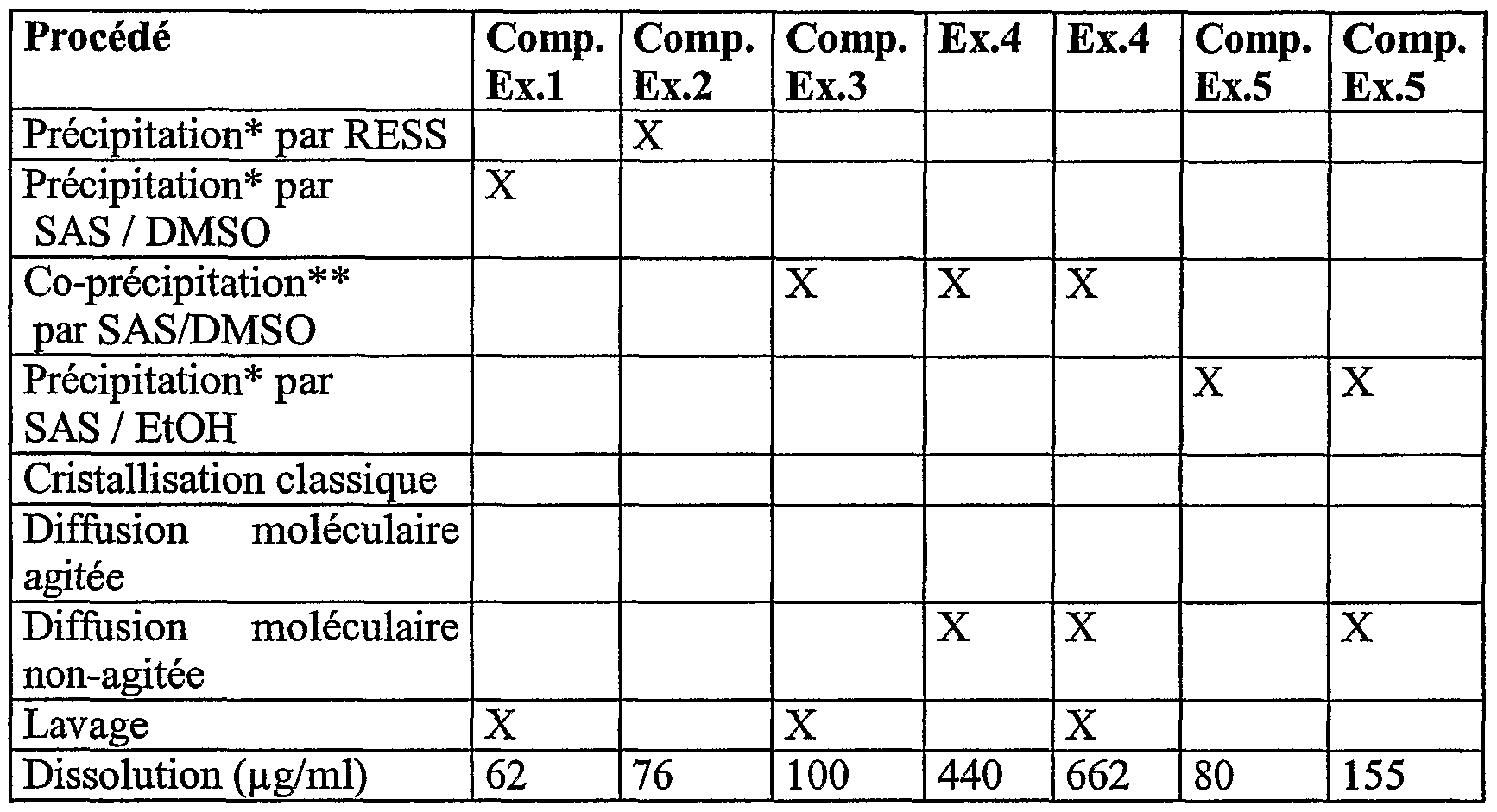
- Comparative example 3 co-precipitation of the product F12511 and of the y-cvclodextrin by SAS / DMSO
- the flow rate of the solvent pump is 0.4 ml / min.
- the temperature and pressure within the autoclave are chosen to obtain a CO 2 density equal to 0.9.
- the injections of the solute and then of CO 2 are stopped, and the powder obtained is washed by passing a stream of CO 2 (300 bars, 50 ° C) for 2 hours.
- the autoclave is then depressurized.
- the yield of this stage is 81%.
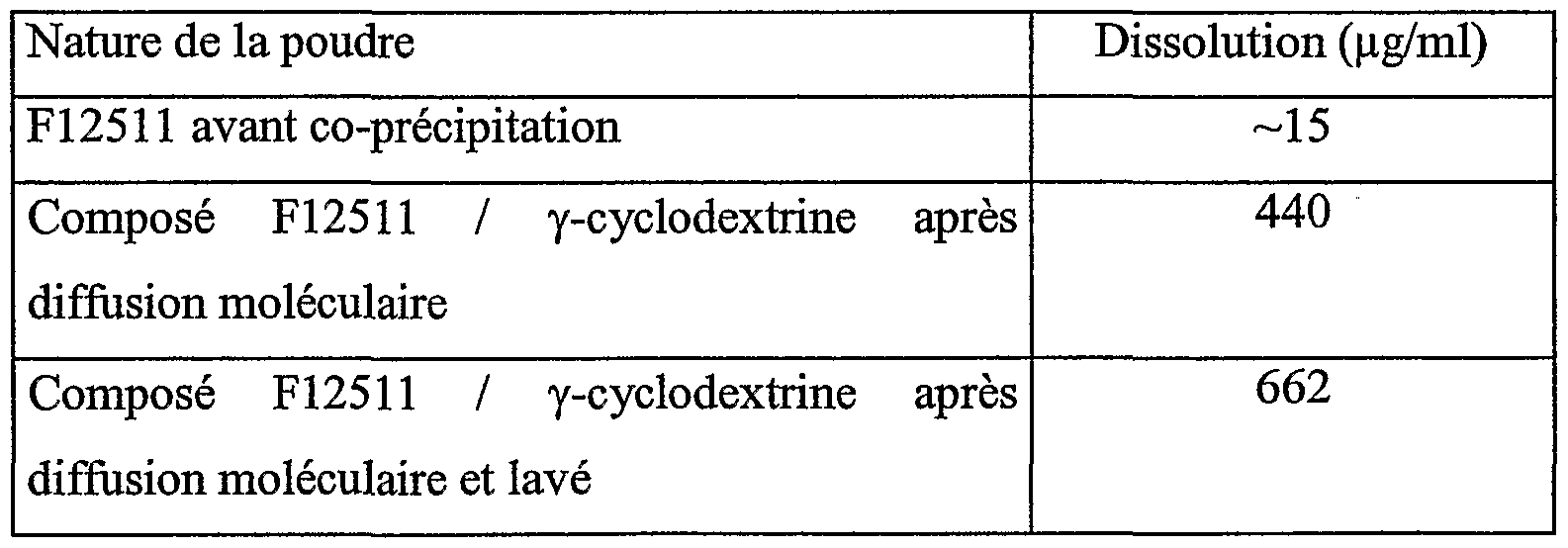
- the results of the dissolution measurements are collated in the table below:
- Example 4 Co-precipitation, inclusion and washing from a solution of the product F12511 and of y-cyclodextrin in DMSO
- the flow rate of the solvent pump is 1.1 ml / min.
- the temperature and pressure within the autoclave are chosen to obtain a CO 2 density equal to 0.9 ⁇ 0.05.
- the average yield of this stage is 94%.
- the powder co-precipitated in the previous step is mixed with reverse osmosis water
- the autoclave is closed, and the installation is inflated into supercritical CO 2 so as to have a static pressure of 300 bars, and a temperature of 65 ° C. within the autoclave.
- Soft relaxation is carried out after a night of molecular diffusion, and this step is repeated, without the addition of a diffusion agent (water) overnight.
- Comparative example 5 precipitation and inclusion in the y-cyclodextrin of the product F12511 generated by the SAS / Ethanol process
- the flow rate of the solvent pump is 41.7 ml / min.
- the temperature and pressure within the autoclave are chosen to obtain a CO density equal to 0.8.
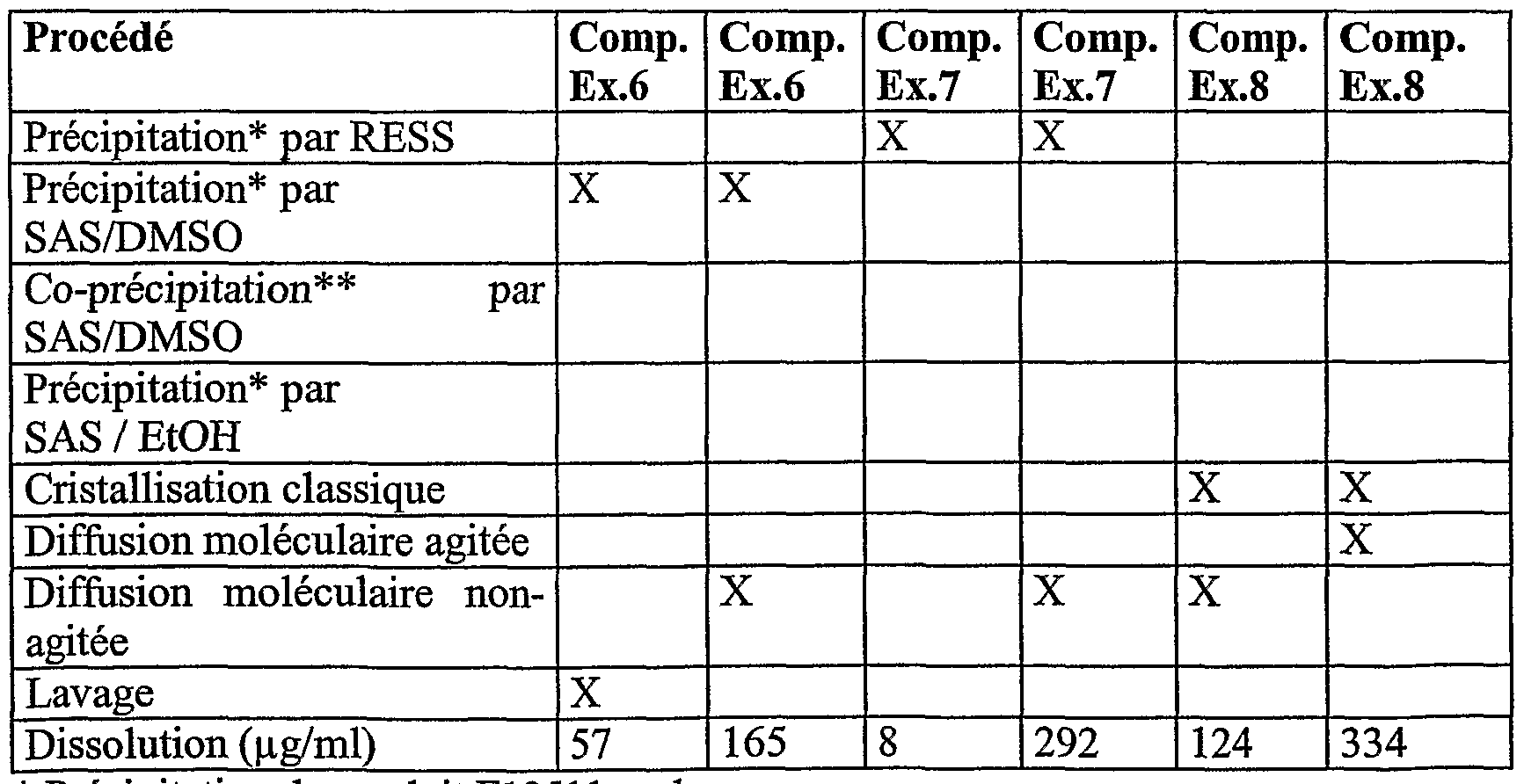
- Comparative example 6 precipitation and inclusion in the ⁇ -cyclodextrin of the product F12511 generated by the SAS / DMSO process
- a 150 ml solution of product F12511 (concentration: 200 g / 1) in DMSO is precipitated continuously by the Solvent-Anti-Solvent (SAS) process in the presence of CO 2 , in an autoclave of 21 fitted with a basket of 1.371.
- the flow rate of the solvent pump is 0.5 ml / min.
- the temperature and pressure within the autoclave are chosen to obtain a CO 2 density equal to 0.9.
- the injections of the solute and then of CO are stopped, and the system is gently expanded, so as not to liquefy the supercritical fluid.
- 1 g of the active substance precipitated in the previous step is mixed with 6 g of ⁇ -cyclodextrin and 2.33 g of reverse osmosis water, and the mixture is placed in the pore basket of 1.371, itself deposited in the precipitation autoclave of 21.
- the autoclave is closed, and the installation is inflated into supercritical CO so as to have a static pressure of 300 bars, and a temperature of 100 ° C. within the autoclave.
- Soft relaxation is carried out after 16 hours of molecular diffusion.
- Comparative Example 7 Inclusion in the y-cyclodextrin of the product F12511 generated by the RESS process
- Comparative Example 8 Inclusion in the ⁇ -cyclodextrin of the product L0081 by agitated molecular diffusion
- the mixture thus obtained is placed at the bottom of a 1 liter stirred autoclave.
- the autoclave is hermetically closed, then inflated to 300 bars with CO 2 in the supercritical state.
- the temperature was set at 50 ° C ⁇ 10 ° C.
- Stirring is started (400 rpm), the pressure and the temperature are maintained overnight. After one night, the heating and the stirring are switched off, and the autoclave is slowly depressurized. The whole of the powder is recovered, and dissolution tests are carried out which are compared with those of the powder obtained in the same conditions but without agitation:
- the process which makes it possible to obtain the greatest dissolution of the product F 12511 in an aqueous medium is the process combining the stages of generation of the product F 12511 by supercritical fluid, advantageously by co-precipitation of the product F12511 and of the ⁇ -cyclodextrin, molecular diffusion in static mode, advantageously with stirring, washing.
- Comparative tests 9 In order to validate the fact that it is indeed the entire process which allows us to obtain the final results and not one of the intermediate stages, we carried out dissolution tests as described above on various mixtures and we have obtained the following results:
- Control solution Prepare a standard solution in H 2 O. Make sure to maintain an absorbance ⁇ 2.
- Example 11 Omeprazole / ⁇ -cvclodextrin / DMSO:
- Powder analysis protocol Solution test Operating conditions: UV analysis at the wavelength of 296 nm.
- Powder analysis protocol Dissolution test Operating conditions: UV analysis at the wavelength of 296 nm.
- Control solution Prepare a standard solution in sodium lauryl sulfate at 1% (m / v) in H 2 O. Make sure to maintain an absorbance ⁇ 2. Performing the analysis:
- Powder analysis protocol Dissolution test: Operating conditions: UV analysis at the wavelength of 248 nm. Control solution:
- Control solution Prepare a standard solution in sodium lauryl sulfate at 1% (mv) in H 2 O. Make sure to maintain an absorbance ⁇ 2. Performing the analysis:
- Example 15 Terfenadine / ⁇ -cyclodextrin / DMSO:
- Powder analysis protocol Dissolution test Operating conditions: UV analysis at the wavelength of 259 nm.
- UV analysis at the wavelength of 259 nm.
- the process which makes it possible to obtain the greatest dissolution of the active ingredients in an aqueous medium is that combining the steps of mixing the active ingredient and porous support, advantageously cyclodextrin, of diffusion molecular and drying. This property is observed for different active ingredients, different types of cyclodextrins, and different solvents.
Landscapes
- Health & Medical Sciences (AREA)
- Bioinformatics & Cheminformatics (AREA)
- Engineering & Computer Science (AREA)
- Veterinary Medicine (AREA)
- Chemical & Material Sciences (AREA)
- Medicinal Chemistry (AREA)
- Pharmacology & Pharmacy (AREA)
- Life Sciences & Earth Sciences (AREA)
- Animal Behavior & Ethology (AREA)
- General Health & Medical Sciences (AREA)
- Public Health (AREA)
- Chemical Kinetics & Catalysis (AREA)
- General Chemical & Material Sciences (AREA)
- Nuclear Medicine, Radiotherapy & Molecular Imaging (AREA)
- Organic Chemistry (AREA)
- Epidemiology (AREA)
- Obesity (AREA)
- Immunology (AREA)
- Diabetes (AREA)
- Hematology (AREA)
- Rheumatology (AREA)
- Pain & Pain Management (AREA)
- Pulmonology (AREA)
- Pharmaceuticals Containing Other Organic And Inorganic Compounds (AREA)
- Steroid Compounds (AREA)
- Extraction Or Liquid Replacement (AREA)
- Medicinal Preparation (AREA)
- Medical Preparation Storing Or Oral Administration Devices (AREA)
- Acyclic And Carbocyclic Compounds In Medicinal Compositions (AREA)
- Manufacturing Of Micro-Capsules (AREA)
- Solid-Sorbent Or Filter-Aiding Compositions (AREA)
- Saccharide Compounds (AREA)
- Organic Low-Molecular-Weight Compounds And Preparation Thereof (AREA)
- Physical Or Chemical Processes And Apparatus (AREA)
Abstract
Description






Claims
Priority Applications (11)
| Application Number | Priority Date | Filing Date | Title |
|---|---|---|---|
| JP2003545285A JP4401778B2 (ja) | 2001-10-12 | 2002-10-11 | 超臨界流体を用いて活性物質と多孔質支持体とを相互反応させた物質の製造方法 |
| MXPA04003300A MXPA04003300A (es) | 2001-10-12 | 2002-10-11 | Metodo para preparar un compuesto para la interaccion de sustancias activas con un soporte poroso usando fluido supercritico. |
| DE60224215T DE60224215T2 (de) | 2001-10-12 | 2002-10-11 | Herstellungsverfahren einer interaktionverbindung von wirkstoffen mit einem porösen träger durch ein überkritisches fluidum |
| AU2002361279A AU2002361279B2 (en) | 2001-10-12 | 2002-10-11 | Method for preparing a compound for interaction of active substances with a porous support using supercritical fluid |
| BRPI0213220A BRPI0213220B1 (pt) | 2001-10-12 | 2002-10-11 | processo de preparação de compostos de interação de uma substância ativa pouco solúvel em um meio aquoso com um suporte poroso |
| HK06107158.7A HK1087019B (en) | 2001-10-12 | 2002-10-11 | Method for preparing a compound of interaction of active substances with a porous support using supercritical fluid |
| EP02796803A EP1434567B1 (fr) | 2001-10-12 | 2002-10-11 | Procede de preparation d'un compose d'interaction de substances actives avec un support poreux par fluide supercritique |
| DK02796803T DK1434567T3 (da) | 2001-10-12 | 2002-10-11 | Fremgangsmåde til fremstilling af en forbindelse til aktive stoffers interaktion med en porös bærer ved hjælp af en superkritisk væske |
| BR0213220-6A BR0213220A (pt) | 2001-10-12 | 2002-10-11 | Processo de preparação de compostos de interação de uma substância ativa pouco solúvel em um meio aquoso com um suporte poroso, e, composto de interação de interação de uma substância ativa pouco solúvel em um meio aquoso em um suporte aquoso |
| US10/492,346 US7390411B2 (en) | 2001-10-12 | 2002-10-11 | Method for preparing a compound of interaction of active substances with a porous support using supercritical fluid |
| CA2462537A CA2462537C (fr) | 2001-10-12 | 2002-10-11 | Procede de preparation d'un compose d'interaction de substances actives avec un support poreux par fluide supercritique |
Applications Claiming Priority (2)
| Application Number | Priority Date | Filing Date | Title |
|---|---|---|---|
| FR0113178A FR2830760B1 (fr) | 2001-10-12 | 2001-10-12 | Procede de preparation d'un compose d'interaction de substances actives avec un support poreux par fluide supercritique |
| FR01/13178 | 2001-10-12 |
Publications (1)
| Publication Number | Publication Date |
|---|---|
| WO2003043604A1 true WO2003043604A1 (fr) | 2003-05-30 |
Family
ID=8868228
Family Applications (1)
| Application Number | Title | Priority Date | Filing Date |
|---|---|---|---|
| PCT/FR2002/003474 Ceased WO2003043604A1 (fr) | 2001-10-12 | 2002-10-11 | Procede de preparation d'un compose d'interaction de substances actives avec un support poreux par fluide supercritique |
Country Status (17)
| Country | Link |
|---|---|
| US (1) | US7390411B2 (fr) |
| EP (1) | EP1434567B1 (fr) |
| JP (1) | JP4401778B2 (fr) |
| CN (1) | CN100396277C (fr) |
| AT (1) | ATE381318T1 (fr) |
| AU (1) | AU2002361279B2 (fr) |
| BR (2) | BR0213220A (fr) |
| CA (1) | CA2462537C (fr) |
| CY (1) | CY1107306T1 (fr) |
| DE (1) | DE60224215T2 (fr) |
| DK (1) | DK1434567T3 (fr) |
| ES (1) | ES2295446T3 (fr) |
| FR (1) | FR2830760B1 (fr) |
| MX (1) | MXPA04003300A (fr) |
| PT (1) | PT1434567E (fr) |
| WO (1) | WO2003043604A1 (fr) |
| ZA (1) | ZA200402580B (fr) |
Cited By (6)
| Publication number | Priority date | Publication date | Assignee | Title |
|---|---|---|---|---|
| FR2868315A1 (fr) * | 2004-04-01 | 2005-10-07 | Pierre Fabre Medicament Sa | Procede de preparation d'un compose d'inclusion soluble de substances actives dans une molecule hote avec l'aide d'un agent d'interaction par fluide supercritique |
| WO2005097201A3 (fr) * | 2004-04-01 | 2006-08-17 | Pf Medicament | Complexes d’inclusions comprenant du piroxicam, une cyclodextrine et l’arginine |
| WO2006095372A1 (fr) * | 2005-03-10 | 2006-09-14 | Universita' Degli Studi Di Salerno | Procédé servant à produire des membranes polymériques chargées d'ingrédients actifs |
| JP2006524670A (ja) * | 2003-04-25 | 2006-11-02 | ピエール、ファーブル、メディカマン | 分子複合体の調製のための方法 |
| JP2008517035A (ja) * | 2004-10-21 | 2008-05-22 | ピエール・ファーブル・メディカマン | メキタジンとシクロデキストリンと相互作用剤を含む複合体 |
| US8716342B2 (en) | 2009-04-09 | 2014-05-06 | Galderma Research & Development | Method for preparing molecular complexes between adapalene and cyclodextrins |
Families Citing this family (9)
| Publication number | Priority date | Publication date | Assignee | Title |
|---|---|---|---|---|
| FR2876914A1 (fr) * | 2004-10-21 | 2006-04-28 | Pierre Fabre Medicament Sa | Complexe comprenant un antibiotique, une cyclodextrine et un agent d'interaction |
| ES2345396T3 (es) * | 2006-02-10 | 2010-09-22 | Carotech Sdn. Bhd | Proceso para la produccion de fracciones altamente enriquecidas de compuestos naturales de aceite de palma con fluidos supercriticos y proximos al estado critico. |
| FR2944207B1 (fr) * | 2009-04-09 | 2011-05-06 | Galderma Res & Dev | Compositions comprenant au moins un complexe compose d'un derive d'acide naphtoique et d'au moins une cyclodestrine et leurs utilisations |
| CN106108021A (zh) * | 2011-04-22 | 2016-11-16 | 百事可乐公司 | 萃取物在多孔颗粒中的包裹 |
| EP2884523B1 (fr) * | 2013-12-16 | 2020-02-05 | IMEC vzw | Procédé d'activation de la surface d'une couche poreuse |
| CN105343893B (zh) * | 2015-12-11 | 2018-07-20 | 中国药科大学 | 对乙酰氨基酚-2-羟丙基-β-环糊精包合物制备方法 |
| CN107847642B (zh) * | 2016-01-08 | 2021-04-20 | 亚果生医股份有限公司 | 去细胞角膜及其制备方法和用途 |
| CN116688155A (zh) * | 2023-07-20 | 2023-09-05 | 内蒙古工业大学 | 一种木犀草素/γ-环糊精包合物、制备方法及应用 |
| CN118697820A (zh) * | 2024-05-31 | 2024-09-27 | 广州新征程生物科技有限公司 | 一种治疗心脑血管病的中药及制备方法 |
Citations (3)
| Publication number | Priority date | Publication date | Assignee | Title |
|---|---|---|---|---|
| JPS63141559A (ja) * | 1986-12-05 | 1988-06-14 | Kinjirushi Wasabi Kk | 香辛成分の包接化合物の製造方法 |
| WO1989009639A1 (fr) * | 1988-04-11 | 1989-10-19 | Institut National De La Recherche Agronomique (Inr | Procede d'extraction au dioxyde de carbone supercritique de composes volatiles, et composes obtenus |
| WO2002032462A1 (fr) * | 2000-10-19 | 2002-04-25 | Separex | Procede de fabrication de tres fines particules constituees d'un principe insere dans une molecule hôte |
Family Cites Families (26)
| Publication number | Priority date | Publication date | Assignee | Title |
|---|---|---|---|---|
| US189454A (en) * | 1877-04-10 | Improvement in paper boxes | ||
| GB2191715B (en) | 1986-06-17 | 1990-07-25 | Midrex Int Bv | Method and apparatus for dedusting and desulfurizing gases |
| US4822497A (en) | 1987-09-22 | 1989-04-18 | Modar, Inc. | Method for solids separation in a wet oxidation type process |
| DE3744329A1 (de) | 1987-12-28 | 1989-07-06 | Schwarz Pharma Gmbh | Verfahren zur herstellung einer mindestens einen wirkstoff und einen traeger umfassenden zubereitung |
| GB9100643D0 (en) | 1991-01-11 | 1991-02-27 | Shaffery Michael J | Filter system |
| US5389263A (en) | 1992-05-20 | 1995-02-14 | Phasex Corporation | Gas anti-solvent recrystallization and application for the separation and subsequent processing of RDX and HMX |
| ATE166573T1 (de) | 1993-03-24 | 1998-06-15 | Ciba Geigy Ag | Verfahren zur herstellung einer liposomendispersion im hochdruckbereich |
| GB9313642D0 (en) | 1993-07-01 | 1993-08-18 | Glaxo Group Ltd | Method and apparatus for the formation of particles |
| EP0706821A1 (fr) | 1994-10-06 | 1996-04-17 | Centre De Microencapsulation | Procédé pour l'enrobage de particules |
| FR2725990B1 (fr) | 1994-10-21 | 1997-01-10 | Pf Medicament | Derives hydrosolubles d'epipodophyllotoxine, leur procede de preparation, leur utilisation a titre de medicament, et leur utilisation destinee aux traitements anticancereux |
| FR2741619B1 (fr) | 1995-11-28 | 1998-02-13 | Pf Medicament | Nouveaux derives de 2,3,5-trimethyl-4-hydroxy-anilides, leur preparation et leur application en therapeutique |
| EP0885038B1 (fr) | 1996-03-01 | 2011-06-15 | The University Of Kansas | Procedes et appareil pour la precipitation et l'enrobage de particules au moyen d'antisolvants quasi-critiques et supercritiques |
| FR2753639B1 (fr) | 1996-09-25 | 1998-12-11 | Procede de preparation de microcapsules de matieres actives enrobees par un polymere et nouvelles microcapsules notamment obtenues selon le procede | |
| US5766637A (en) | 1996-10-08 | 1998-06-16 | University Of Delaware | Microencapsulation process using supercritical fluids |
| DE19711393C1 (de) | 1997-03-19 | 1998-08-13 | Fraunhofer Ges Forschung | Verfahren zum Mikroverkapseln von Partikeln |
| IT1296464B1 (it) | 1997-11-19 | 1999-06-25 | Vectorpharma Int | Composizioni farmaceutiche in forma di polveri di polimeri reticolati caricati con farmaci e relativo processo di preparazione mediante |
| GB9810559D0 (en) | 1998-05-15 | 1998-07-15 | Bradford Particle Design Ltd | Method and apparatus for particle formation |
| GB9824298D0 (en) | 1998-11-05 | 1998-12-30 | Smithkline Beecham Plc | Novel process |
| SE9804001D0 (sv) * | 1998-11-23 | 1998-11-23 | Astra Ab | New process |
| US6555139B2 (en) * | 1999-06-28 | 2003-04-29 | Wockhardt Europe Limited | Preparation of micron-size pharmaceutical particles by microfluidization |
| CN1280875A (zh) * | 1999-06-30 | 2001-01-24 | 刘士群 | 用超临界反萃剂制造微粒的方法和装置 |
| FR2798863B1 (fr) | 1999-09-27 | 2001-12-28 | Separex Sa | Procede et installation de mise a l'etat adsorbe sur un support poreux de composes actifs contenus dans un produit |
| FR2799984B1 (fr) | 1999-10-21 | 2002-05-03 | Lavipharm | Procede de fractionnement d'une matiere composee de plusieurs constituants a l'aide d'un solvant a pression supercritique |
| FR2803538B1 (fr) | 1999-12-15 | 2002-06-07 | Separex Sa | Procede et dispositif de captage de fines particules par percolation dans un lit de granules |
| US6896905B2 (en) * | 2001-02-15 | 2005-05-24 | Rohm And Haas Company | Porous particles, their aqueous dispersions, and method of preparation |
| WO2002089851A1 (fr) | 2001-03-06 | 2002-11-14 | Separex (Societe Anonyme) | Procede de fabrication de complexes hote-client |
-
2001
- 2001-10-12 FR FR0113178A patent/FR2830760B1/fr not_active Expired - Fee Related
-
2002
- 2002-10-11 US US10/492,346 patent/US7390411B2/en not_active Expired - Lifetime
- 2002-10-11 PT PT02796803T patent/PT1434567E/pt unknown
- 2002-10-11 EP EP02796803A patent/EP1434567B1/fr not_active Expired - Lifetime
- 2002-10-11 DE DE60224215T patent/DE60224215T2/de not_active Expired - Lifetime
- 2002-10-11 CN CNB028202031A patent/CN100396277C/zh not_active Expired - Fee Related
- 2002-10-11 MX MXPA04003300A patent/MXPA04003300A/es active IP Right Grant
- 2002-10-11 JP JP2003545285A patent/JP4401778B2/ja not_active Expired - Fee Related
- 2002-10-11 ES ES02796803T patent/ES2295446T3/es not_active Expired - Lifetime
- 2002-10-11 BR BR0213220-6A patent/BR0213220A/pt not_active IP Right Cessation
- 2002-10-11 AU AU2002361279A patent/AU2002361279B2/en not_active Ceased
- 2002-10-11 DK DK02796803T patent/DK1434567T3/da active
- 2002-10-11 CA CA2462537A patent/CA2462537C/fr not_active Expired - Fee Related
- 2002-10-11 WO PCT/FR2002/003474 patent/WO2003043604A1/fr not_active Ceased
- 2002-10-11 AT AT02796803T patent/ATE381318T1/de active
- 2002-10-11 BR BRPI0213220A patent/BRPI0213220B1/pt unknown
-
2004
- 2004-04-01 ZA ZA200402580A patent/ZA200402580B/en unknown
-
2008
- 2008-03-13 CY CY20081100290T patent/CY1107306T1/el unknown
Patent Citations (3)
| Publication number | Priority date | Publication date | Assignee | Title |
|---|---|---|---|---|
| JPS63141559A (ja) * | 1986-12-05 | 1988-06-14 | Kinjirushi Wasabi Kk | 香辛成分の包接化合物の製造方法 |
| WO1989009639A1 (fr) * | 1988-04-11 | 1989-10-19 | Institut National De La Recherche Agronomique (Inr | Procede d'extraction au dioxyde de carbone supercritique de composes volatiles, et composes obtenus |
| WO2002032462A1 (fr) * | 2000-10-19 | 2002-04-25 | Separex | Procede de fabrication de tres fines particules constituees d'un principe insere dans une molecule hôte |
Non-Patent Citations (5)
| Title |
|---|
| DATABASE CA [online] CHEMICAL ABSTRACTS SERVICE, COLUMBUS, OHIO, US; CHOI, YOUNG HAE ET AL: "Supercritical carbon dioxide extraction of Podophyllotoxin from Dysosma pleianthum roots", XP002203240, retrieved from STN Database accession no. 129:38803 CA * |
| DATABASE CA [online] CHEMICAL ABSTRACTS SERVICE, COLUMBUS, OHIO, US; VAN HEES, THIERRY ET AL: "Application of supercritical carbon dioxide for the preparation of a piroxicam-.beta.-cyclodextrin inclusion compound", XP002203239, retrieved from STN Database accession no. 132:185362 CA * |
| PATENT ABSTRACTS OF JAPAN vol. 012, no. 398 (C - 538) 21 October 1988 (1988-10-21) * |
| PHARMACEUTICAL RESEARCH (1999), 16(12), 1864-1870, 1999 * |
| PLANTA MEDICA (1998), 64(5), 482-483, 1998 * |
Cited By (11)
| Publication number | Priority date | Publication date | Assignee | Title |
|---|---|---|---|---|
| JP2006524670A (ja) * | 2003-04-25 | 2006-11-02 | ピエール、ファーブル、メディカマン | 分子複合体の調製のための方法 |
| FR2868315A1 (fr) * | 2004-04-01 | 2005-10-07 | Pierre Fabre Medicament Sa | Procede de preparation d'un compose d'inclusion soluble de substances actives dans une molecule hote avec l'aide d'un agent d'interaction par fluide supercritique |
| WO2005097201A3 (fr) * | 2004-04-01 | 2006-08-17 | Pf Medicament | Complexes d’inclusions comprenant du piroxicam, une cyclodextrine et l’arginine |
| RU2382654C2 (ru) * | 2004-04-01 | 2010-02-27 | Пьер Фабр Медикаман | Комплексы включения, полученные способом с использованием co2 в сверхкритическом состоянии и агента взаимодействия с комплексом |
| EP2260871A2 (fr) | 2004-04-01 | 2010-12-15 | Pierre Fabre Medicament | Complexes d'inclusions comprenant du piroxicam, une cyclodextrine et l'arginine |
| US8461133B2 (en) | 2004-04-01 | 2013-06-11 | Pierre Fabre Medicament | Inclusion complexes containing an active substance, a cyclodextrin and an agent for interaction |
| US9243076B2 (en) | 2004-04-01 | 2016-01-26 | Pierre Fabre Medicament | Inclusion complexes containing piroxicam, a cyclodextrin and arginine |
| JP2008517035A (ja) * | 2004-10-21 | 2008-05-22 | ピエール・ファーブル・メディカマン | メキタジンとシクロデキストリンと相互作用剤を含む複合体 |
| US7749982B2 (en) * | 2004-10-21 | 2010-07-06 | Pierre Fabre Medicament | Complex containing mequitazine, a cyclodextrin and an interaction agent |
| WO2006095372A1 (fr) * | 2005-03-10 | 2006-09-14 | Universita' Degli Studi Di Salerno | Procédé servant à produire des membranes polymériques chargées d'ingrédients actifs |
| US8716342B2 (en) | 2009-04-09 | 2014-05-06 | Galderma Research & Development | Method for preparing molecular complexes between adapalene and cyclodextrins |
Also Published As
| Publication number | Publication date |
|---|---|
| ATE381318T1 (de) | 2008-01-15 |
| BRPI0213220B1 (pt) | 2018-09-18 |
| CN100396277C (zh) | 2008-06-25 |
| DE60224215T2 (de) | 2008-12-04 |
| ZA200402580B (en) | 2004-11-04 |
| CA2462537A1 (fr) | 2003-05-30 |
| JP4401778B2 (ja) | 2010-01-20 |
| BR0213220A (pt) | 2004-08-31 |
| US7390411B2 (en) | 2008-06-24 |
| EP1434567A1 (fr) | 2004-07-07 |
| PT1434567E (pt) | 2008-02-08 |
| AU2002361279A1 (en) | 2003-06-10 |
| FR2830760A1 (fr) | 2003-04-18 |
| CN1713894A (zh) | 2005-12-28 |
| DK1434567T3 (da) | 2008-05-05 |
| JP2005512621A (ja) | 2005-05-12 |
| ES2295446T3 (es) | 2008-04-16 |
| MXPA04003300A (es) | 2004-07-23 |
| DE60224215D1 (de) | 2008-01-31 |
| CA2462537C (fr) | 2011-06-21 |
| AU2002361279B2 (en) | 2007-02-08 |
| EP1434567B1 (fr) | 2007-12-19 |
| CY1107306T1 (el) | 2012-11-21 |
| US20050274671A1 (en) | 2005-12-15 |
| FR2830760B1 (fr) | 2004-06-04 |
| HK1087019A1 (zh) | 2006-10-06 |
Similar Documents
| Publication | Publication Date | Title |
|---|---|---|
| EP1434567B1 (fr) | Procede de preparation d'un compose d'interaction de substances actives avec un support poreux par fluide supercritique | |
| EP0275796B1 (fr) | Procédé de préparation de systèmes colloidaux dispersibles d'une substance, sous forme du nanoparticules | |
| FR2815540A1 (fr) | Procede de fabrication de tres fines particules constituees d'un principe insere dans une molecule hote | |
| FR2914187A1 (fr) | Complexes d'ibuprofene, de cyclodextrines et d'agents ternaires, et leurs utilisations en pharmaceutique. | |
| WO2004006897A1 (fr) | Dispersions aqueuses de particules nanometriques ou micrometriques pour l'encapsulation de composes chimiques | |
| EP1638609B1 (fr) | Procede de preparation de complexes moleculaires | |
| FR2806005A1 (fr) | Procede de preparation de particules colloidales sous forme de nanocapsules | |
| WO2003030867A2 (fr) | Procede de preparation d'un compose d'interaction d'un derive anilide avec un support poreux par fluide supercritique | |
| WO2002089851A1 (fr) | Procede de fabrication de complexes hote-client | |
| CA2583783C (fr) | Complexe comprenant la mequitazine, une cyclodextrine et un agent d'interaction | |
| HK1087019B (en) | Method for preparing a compound of interaction of active substances with a porous support using supercritical fluid | |
| FR2868315A1 (fr) | Procede de preparation d'un compose d'inclusion soluble de substances actives dans une molecule hote avec l'aide d'un agent d'interaction par fluide supercritique | |
| FR2944278A1 (fr) | Procede de preparation de complexes moleculaires entre un agent retinoide et des cyclodextrines |
Legal Events
| Date | Code | Title | Description |
|---|---|---|---|
| AK | Designated states |
Kind code of ref document: A1 Designated state(s): AU BR CA CN JP MX US ZA |
|
| AL | Designated countries for regional patents |
Kind code of ref document: A1 Designated state(s): AT BE BG CH CY CZ DE DK EE ES FI FR GB GR IE IT LU MC NL PT SE SK TR |
|
| 121 | Ep: the epo has been informed by wipo that ep was designated in this application | ||
| DFPE | Request for preliminary examination filed prior to expiration of 19th month from priority date (pct application filed before 20040101) | ||
| WWE | Wipo information: entry into national phase |
Ref document number: 2002796803 Country of ref document: EP |
|
| WWE | Wipo information: entry into national phase |
Ref document number: 2462537 Country of ref document: CA Ref document number: 2002361279 Country of ref document: AU |
|
| WWE | Wipo information: entry into national phase |
Ref document number: 2004/02580 Country of ref document: ZA Ref document number: 200402580 Country of ref document: ZA |
|
| WWE | Wipo information: entry into national phase |
Ref document number: PA/A/2004/003300 Country of ref document: MX |
|
| WWE | Wipo information: entry into national phase |
Ref document number: 20028202031 Country of ref document: CN Ref document number: 2003545285 Country of ref document: JP |
|
| WWP | Wipo information: published in national office |
Ref document number: 2002796803 Country of ref document: EP |
|
| WWE | Wipo information: entry into national phase |
Ref document number: 10492346 Country of ref document: US |
|
| WWG | Wipo information: grant in national office |
Ref document number: 2002796803 Country of ref document: EP |