WO2004046813A1 - ハロゲン化銀カラー写真感光材料 - Google Patents
ハロゲン化銀カラー写真感光材料 Download PDFInfo
- Publication number
- WO2004046813A1 WO2004046813A1 PCT/JP2002/012110 JP0212110W WO2004046813A1 WO 2004046813 A1 WO2004046813 A1 WO 2004046813A1 JP 0212110 W JP0212110 W JP 0212110W WO 2004046813 A1 WO2004046813 A1 WO 2004046813A1
- Authority
- WO
- WIPO (PCT)
- Prior art keywords
- silver halide
- emulsion
- silver
- halide emulsion
- tabular
- Prior art date
- Legal status (The legal status is an assumption and is not a legal conclusion. Google has not performed a legal analysis and makes no representation as to the accuracy of the status listed.)
- Ceased
Links
Classifications
-
- G—PHYSICS
- G03—PHOTOGRAPHY; CINEMATOGRAPHY; ANALOGOUS TECHNIQUES USING WAVES OTHER THAN OPTICAL WAVES; ELECTROGRAPHY; HOLOGRAPHY
- G03C—PHOTOSENSITIVE MATERIALS FOR PHOTOGRAPHIC PURPOSES; PHOTOGRAPHIC PROCESSES, e.g. CINE, X-RAY, COLOUR, STEREO-PHOTOGRAPHIC PROCESSES; AUXILIARY PROCESSES IN PHOTOGRAPHY
- G03C7/00—Multicolour photographic processes or agents therefor; Regeneration of such processing agents; Photosensitive materials for multicolour processes
- G03C7/30—Colour processes using colour-coupling substances; Materials therefor; Preparing or processing such materials
- G03C7/3022—Materials with specific emulsion characteristics, e.g. thickness of the layers, silver content, shape of AgX grains
-
- G—PHYSICS
- G03—PHOTOGRAPHY; CINEMATOGRAPHY; ANALOGOUS TECHNIQUES USING WAVES OTHER THAN OPTICAL WAVES; ELECTROGRAPHY; HOLOGRAPHY
- G03C—PHOTOSENSITIVE MATERIALS FOR PHOTOGRAPHIC PURPOSES; PHOTOGRAPHIC PROCESSES, e.g. CINE, X-RAY, COLOUR, STEREO-PHOTOGRAPHIC PROCESSES; AUXILIARY PROCESSES IN PHOTOGRAPHY
- G03C1/00—Photosensitive materials
- G03C1/005—Silver halide emulsions; Preparation thereof; Physical treatment thereof; Incorporation of additives therein
- G03C1/06—Silver halide emulsions; Preparation thereof; Physical treatment thereof; Incorporation of additives therein with non-macromolecular additives
- G03C1/08—Sensitivity-increasing substances
- G03C1/09—Noble metals or mercury; Salts or compounds thereof; Sulfur, selenium or tellurium, or compounds thereof, e.g. for chemical sensitising
-
- G—PHYSICS
- G03—PHOTOGRAPHY; CINEMATOGRAPHY; ANALOGOUS TECHNIQUES USING WAVES OTHER THAN OPTICAL WAVES; ELECTROGRAPHY; HOLOGRAPHY
- G03C—PHOTOSENSITIVE MATERIALS FOR PHOTOGRAPHIC PURPOSES; PHOTOGRAPHIC PROCESSES, e.g. CINE, X-RAY, COLOUR, STEREO-PHOTOGRAPHIC PROCESSES; AUXILIARY PROCESSES IN PHOTOGRAPHY
- G03C1/00—Photosensitive materials
- G03C1/005—Silver halide emulsions; Preparation thereof; Physical treatment thereof; Incorporation of additives therein
- G03C1/0051—Tabular grain emulsions
- G03C2001/0055—Aspect ratio of tabular grains in general; High aspect ratio; Intermediate aspect ratio; Low aspect ratio
-
- G—PHYSICS
- G03—PHOTOGRAPHY; CINEMATOGRAPHY; ANALOGOUS TECHNIQUES USING WAVES OTHER THAN OPTICAL WAVES; ELECTROGRAPHY; HOLOGRAPHY
- G03C—PHOTOSENSITIVE MATERIALS FOR PHOTOGRAPHIC PURPOSES; PHOTOGRAPHIC PROCESSES, e.g. CINE, X-RAY, COLOUR, STEREO-PHOTOGRAPHIC PROCESSES; AUXILIARY PROCESSES IN PHOTOGRAPHY
- G03C1/00—Photosensitive materials
- G03C1/005—Silver halide emulsions; Preparation thereof; Physical treatment thereof; Incorporation of additives therein
- G03C1/0051—Tabular grain emulsions
- G03C2001/0056—Disclocations
-
- G—PHYSICS
- G03—PHOTOGRAPHY; CINEMATOGRAPHY; ANALOGOUS TECHNIQUES USING WAVES OTHER THAN OPTICAL WAVES; ELECTROGRAPHY; HOLOGRAPHY
- G03C—PHOTOSENSITIVE MATERIALS FOR PHOTOGRAPHIC PURPOSES; PHOTOGRAPHIC PROCESSES, e.g. CINE, X-RAY, COLOUR, STEREO-PHOTOGRAPHIC PROCESSES; AUXILIARY PROCESSES IN PHOTOGRAPHY
- G03C1/00—Photosensitive materials
- G03C1/005—Silver halide emulsions; Preparation thereof; Physical treatment thereof; Incorporation of additives therein
- G03C1/035—Silver halide emulsions; Preparation thereof; Physical treatment thereof; Incorporation of additives therein characterised by the crystal form or composition, e.g. mixed grain
- G03C2001/03558—Iodide content
-
- G—PHYSICS
- G03—PHOTOGRAPHY; CINEMATOGRAPHY; ANALOGOUS TECHNIQUES USING WAVES OTHER THAN OPTICAL WAVES; ELECTROGRAPHY; HOLOGRAPHY
- G03C—PHOTOSENSITIVE MATERIALS FOR PHOTOGRAPHIC PURPOSES; PHOTOGRAPHIC PROCESSES, e.g. CINE, X-RAY, COLOUR, STEREO-PHOTOGRAPHIC PROCESSES; AUXILIARY PROCESSES IN PHOTOGRAPHY
- G03C1/00—Photosensitive materials
- G03C1/005—Silver halide emulsions; Preparation thereof; Physical treatment thereof; Incorporation of additives therein
- G03C1/06—Silver halide emulsions; Preparation thereof; Physical treatment thereof; Incorporation of additives therein with non-macromolecular additives
- G03C1/08—Sensitivity-increasing substances
- G03C1/09—Noble metals or mercury; Salts or compounds thereof; Sulfur, selenium or tellurium, or compounds thereof, e.g. for chemical sensitising
- G03C2001/097—Selenium
Definitions
- the present invention relates to a silver halide emulsion photographic light-sensitive material using a silver halide emulsion having high sensitivity, excellent granularity, excellent latent image stability, and excellent storage stability.
- sensitization techniques relate to the manufacturing method of silver halide emulsions, to chemical sensitivity of silver halide emulsions, to spectral sensitivity of silver halide emulsions, to silver halide emulsions.
- Various methods are known, such as a method for designing a color photographic material and a method for developing a silver halide color photographic material.
- the most preferable and essential method is silver halide.
- the aim is to reduce the inefficiency of the crystal during the photosensitization process and improve the quantum efficiency.
- emulsion a technology to improve the sensitivity / particle size ratio per silver halide grain in a silver halide emulsion (hereinafter simply referred to as emulsion) is being studied. Have been.
- silver halide grains contained in silver halide emulsions are known to have various shapes. For example, cubic, octahedral, and tetradecahedral normal silver halide grains, tabular silver halide grains having one or more twin twin planes, non-parallel There are tetrapod-like and rod-like silver halide particles having twin planes.
- tabular silver halide grains (hereinafter, also simply referred to as tabular grains) have a color characteristic that is relatively high in photographic sensitivity as compared with intrinsic sensitivity.
- the silver halide photographic light-sensitive material has various advantages, such as improvement in sharpness (sharpness), scatter of light due to particles, and high-resolution images can be obtained.
- Japanese Patent Application Laid-Open No. 6-23049 discloses an aspect ratio of 8 to 1 in which the silver iodide content in the fringe 0 region is 1.5 to 50 times that of the silver iodide content in the central region. 0 tabular grains are disclosed.
- Japanese Patent Application Laid-Open No. 6-235988 describes a multi-structure grain comprising at least an inner shell, an intermediate shell and an outermost shell, wherein the intermediate shell has a region with a high silver iodide content of 5 to 5 regions.
- Tabular grains having an aspect ratio of 3 to 100 are disclosed.
- the outermost shell having a low silver iodide content and having a high silver iodide outer portion arranged outside the region having a high silver iodide content has a large particle fraction, the development of tabular grains having a high aspect ratio is high. It was not possible to solve problems such as deterioration of granularity caused by the acceleration.
- capri is a technology that suppresses the generation of capri, and furthermore, the development of sensitization technology that minimizes capri during storage and sensitivity fluctuation. Had been rare.
- JP-A-5-53234, JP-A-5-27360, JP-A-5-19395, and JP-A-5-17540 disclose various combinations of inhibitors. Not all problems have been solved.
- JP-A-2-837 discloses a capri prevention agent for tabular grains and a low-light-intensity failure improving agent
- JP-A-4-16838 discloses a capri prevention for selenium sensitization.
- An agent is disclosed.
- JP-A-6-19024, JP-A-6-19026, and JP-A-6-19037 disclose that a reaction-inactive chalcogen compound is effective in preventing capri.
- capri there are two problems with capri: the final capri (absolute capri) of the silver halide emulsion itself introduced into the silver halide color photographic light-sensitive material and the progress of capri during the process of optimal chemical ripening. is there. From the viewpoint of production stability, it is preferable that the progression of capri is slow, and from the viewpoint of photographic performance, a silver halide emulsion having a low absolute value of capri is considered to be ideal, but it has not reached a level satisfying both.
- a silver halide photosensitive material having high sensitivity and excellent force fray stability using a silver halide emulsion having a specific structure during selenium sensitization using a haptic silver halide emulsion. It has been proposed (see, for example, Patent Document 1).
- the grain growth in the direction perpendicular to the main grain plane of the base emulsion grains was performed using the grain-to-grain distance control method.
- a silver halide emulsion containing tabular silver silver halide particles having a specific silver halide composition distribution has been proposed (for example, Patent Document 2).
- a silver halide color photographic material having at least one red-sensitive layer, green-sensitive layer, blue-sensitive layer and non-light-sensitive layer on a support, wherein at least one of the photosensitive layers
- the layer contains a monodispersed silver halide emulsion having an average silver iodide content of 2.0 to 4.0 mo 1%, an average aspect ratio of 8.0 or more, and having dislocation lines.
- the silver halide emulsion is chemically ⁇ by selenium sensitizer, and the addition amount of ⁇ Se Ren ⁇ agent, ⁇ Haguchi Gen halide emulsion per mole, at 5.
- 0 X 1 0- 6 molar or A silver halide color photographic light-sensitive material characterized in that:
- the addition ratio of the selenium sensitizer and the sulfur sensitizer to the silver halide emulsion is 0.6 or more.
- the silver halide color photographic light-sensitive material of the present invention is a silver halide color photographic light-sensitive material having at least one layer of a red light-sensitive layer, a green light-sensitive layer, a blue light-sensitive layer and a non-light-sensitive layer on a support. Wherein at least one of the photosensitive layers has an average silver iodide content of 2.0 to 4.0 m 0 1%, an average aspect ratio of 8.0 or more, and has dislocation lines.
- a monodispersed silver silver halide emulsion, the silver halide emulsion is chemically sensitized by a selenium sensitizer, and the added amount of the selenium sensitizer is: 5. it is characterized is 0 X 1 0- 6 mol or more.
- a monodispersed silver halide milk according to the present invention having an average silver iodide content of 2.0 to 4.0 m 0 1%, an average aspect ratio of 8.0 or more, and having dislocation lines. The agent will be
- the silver halide emulsion according to the present invention is tabular silver halide grains having an average aspect ratio of 8.0 or more (hereinafter, also simply referred to as tabular grains), and the tabular grains are crystallographically twinned. are categorized.
- a twin is a crystal having one or more twin planes in one grain. This is described in detail in “P hotographishe K orrespondenz”, Vol. 99, p. 99, and vol. 100, p.
- the tabular silver halide grains according to the present invention preferably have two or more twin planes parallel to each other in the grains. These twin planes are almost parallel to the plane having the largest area among the planes forming the surface of the tabular grains (called the main plane).
- a particularly preferred embodiment according to the present invention is a case where it has two twin planes parallel to the main plane.
- the number of silver halide particles having two twin planes parallel to the main plane is preferably at least 70%, more preferably at least 80%, particularly preferably at least 90%. preferable.
- the tabular silver halide grains according to the present invention are silver halide grains having an aspect ratio determined by the following method of 8 or more, and preferably have an average aspect ratio of 8 to 500. And more preferably 10 to 500.
- the aspect ratio of silver halide grains can be obtained by the following formula by determining the grain size and the grain thickness of each silver halide grain by the following method.
- Aspect ratio particle size / particle thickness
- the tabular silver halide grains according to the present invention are preferably tabular silver halide grains having two (11 1) main planes having two twin planes parallel to the main plane.
- the average particle size of the tabular silver halide grains is preferably from 0:! To 50 m, more preferably from 0.1 to 20 m, and from 1.0 to 20 m. m is most preferred.
- the average particle size is an arithmetic average of the particle size ri.
- the grain size ri referred to here is the main size of the tabular silver halide grains. It is the diameter (projected area circle equivalent particle diameter) when the projected image viewed from the direction perpendicular to the plane is converted into a circular image of the same area.
- the particle size ri can be obtained by photographing and printing silver halide particles with an electron microscope at a magnification of 10,000 to 70,000, and printing, and then measuring the particle diameter or the projected area on the print. Can be.
- the average thickness of the tabular silver halide grains is preferably not more than 0.25 m, and is preferably from 0.05 to 0.20 m. Is more preferable, and it is particularly preferable that it is 0.005 to 0.10 ⁇ m.
- the projected area and thickness of each grain for calculating the above-described silver halide grain diameter ratio can be determined by the following method.
- a sample was prepared by coating a latex ball with a known particle size as an internal standard on a support and silver halide particles with the main plane oriented parallel to the substrate, and carbon vapor deposition was performed from a certain angle.
- a replica sample is prepared by the normal replica method.
- An electron micrograph of the sample is taken, and the projected area and thickness of each particle are determined using an image processing device or the like.
- the projected area of the particle can be calculated from the projected area of the internal standard
- the thickness of the particle can be calculated from the internal standard and the length of the shadow of the particle.
- the tabular silver halide silver halide grains according to the present invention are characterized by being monodisperse.
- the particle size distribution (coefficient of variation of particle size) is defined by the following equation, the particle size distribution is less than 30%. And more preferably less than 15%.
- Particle size distribution (%) (Standard deviation of particle size / Average particle size) X 100
- the average particle size and standard deviation shall be determined from the particle size ri defined above.
- the silver halide emulsion according to the present invention contains an average silver iodide content of silver halide grains.
- One of the features is that the prevalence is 2.0 to 4.0 mol%.
- the silver iodide content of the silver halide grains can be determined by the EPMA method (ElectronProbeMicRocAna1yzer method). Specifically, a sample in which silver halide grains are well dispersed so that they do not contact each other is prepared, and irradiated with an electron beam while cooling to below 10 o ° c with liquid nitrogen. By determining the characteristic X-ray intensity of the emitted silver and iodine, the silver iodide content of each silver halide grain can be determined. In the present invention, the average silver iodide content of the silver halide grains determined for 100 or more silver halide grains by the above method is defined as the average silver iodide content.
- the tabular silver halide silver halide grains according to the present invention has a dislocation line, and the form of the dislocation line can be appropriately selected.
- a dislocation line that exists linearly with respect to a specific direction of the crystal orientation of the grain or a dislocation line that is bent can be selected. Further, it is present over the entire particle or only at a specific part of the particle. For example, the dislocation line exists only at the fringe portion (outer periphery) of the particle, Therefore, it is possible to select from a mode in which dislocation lines are present or a mode in which dislocation lines are concentrated near the vertex.
- dislocation lines are preferably present at least in the fringe portions of the grains, and preferably have 10 or more dislocation lines in the fringe portion, and more preferably 20 or more. Is more preferable.
- the dislocation lines of the silver halide grains are, for example, JF Hamilton, P hot o. S ci. Eng. 11 (1967) 57, and T. Shi hi o awa, J. Soc. P hot .S ci .J apan 35 (1972) 2 1 3 Observation can be made by a direct method using a transmission electron microscope at a low temperature. That is, the silver halide grains taken out from the silver halide emulsion so as not to apply enough pressure to generate dislocations on the grains are placed on a mesh for an electron microscope and damaged by an electron beam (such as a printout). Observe by the transmission method in a state where the sample is cooled so as to prevent bleeding.
- the thicker the particles, the more difficult it is for the electron beam to penetrate so that a clearer observation can be obtained by using a high acceleration voltage electron microscope.
- the number and location of dislocation lines in each particle can be known from the particle photographs obtained by such a method.
- 50% preferably has 10 or more dislocation lines in the fringe portion, more preferably 70% or more, in terms of the number ratio of grains.
- the number ratio of tabular silver halide grains having a fringe dislocation line is preferably 50 to 100% by number, more preferably 60 to 100% by number, and 70 to 1%. More preferably, it is 100% by number.
- the tabular silver halide grains having dislocation lines in the fringe portion in the present invention means that there are at least 10 dislocation lines per grain near the outer periphery, near the ridgeline, or near the vertex of the tabular grains. is there.
- the fringe part is a line segment that connects the center of the main plane of the tabular grain (the center of gravity when the main plane is regarded as a two-dimensional figure) and the vertex, observing the tabular grain perpendicular to the main plane.
- the length of L is L, the area outside the figure connecting the points whose distance from the center is 0.50 L for each vertex is indicated.
- a method for introducing dislocation lines into silver halide grains for example, a method of adding an aqueous solution containing iodide ions such as potassium iodide and a water-soluble silver salt solution by double jet, or silver iodide
- a method of adding fine particles a method of adding only a solution containing iodide ions, and a method as described in JP-A-6-11781
- a known method such as a method using an iodide ion releasing agent can be used to form a dislocation at a desired position as a source of a dislocation line.
- a method in which an aqueous solution containing iodine and a water-soluble silver salt solution are added by double jet, a method in which silver iodide fine particles are added, and a method in which an iodide ion releasing agent is used are preferable.
- the iodide ion releasing agent referred to in the present invention is a compound represented by the following general formula (1), which releases iodide ion by reaction with a base or a nucleophile.
- R represents a monovalent organic group.
- R is, for example, an alkyl group, an alkenyl group, an alkynyl group, an aryl group, an aralkyl group, a heterocyclic group, an acyl group, a carbamoyl group, an alkyloxycarbonyl group, an aryloxycarbonyl group, an alkylsulfonyl group, It is preferably an arylsulfonyl group or a sulfamoyl group.
- R is preferably an organic group having 30 or less carbon atoms, more preferably 20 or less, and even more preferably 10 or less.
- R preferably has a substituent, and the substituent may be further substituted with another substituent.
- Preferred examples of the substituent include a halide, an alkyl group, an alkenyl group, an alkynyl group, an aryl group, an aralkyl group, a heterocyclic group, an acyl group, an acyloxy group, a carbamoyl group, an alkyloxycarbonyl group, and an aryloxycarbonyl group.
- iodine ion releasing agent represented by the general formula (1) include chlorides, chlorides, chlorides, chlorides, and derivatives thereof. Halogen alcohols and derivatives thereof are more preferred, and the amides substituted with a heterocyclic group are more preferred, and the most preferred example is (hydroxyacetamide) benzenesulfonate.
- examples of the nucleophile include hydroxide ion, sulfite ion, thiosulfate ion, sulfinate, and carboxylate.
- the nucleophile include hydroxide ion, sulfite ion, thiosulfate ion, sulfinate, and carboxylate.
- Ammonia, amines, alcohols, ureas, thioureas, phenols, hydrazines, sulfides, hydroxamic acids, etc. can be used.
- Thiosulfate, sulfinate, carboxylate, ammonia, and amines are preferred, and hydroxide ion and sulfite ion are more preferred.
- the reaction temperature is preferably 8 (TC to 30 ° C, more preferably 70 ° (: to 40 ° C.
- the p Ag immediately before the introduction of dislocation lines is 7.0 or more and 10.0 or less.
- the amount of the iodide ion releasing agent to be added is 1 to 5 mol% based on the total amount of silver halide after completion of grain growth.
- the pH at the time of the iodine ion releasing reaction is preferably in the range of 7.0 to 11.0, more preferably 8.0 to 10.0.
- the amount of the nucleophile is preferably 0.25 times or more and 2.0 times or less the amount of the iodide ion releasing agent.
- the temperature at which the fine grain emulsion containing silver iodide is added is preferably 80 ° C to 30 ° C, more preferably 7 ° C (more preferably TC to 40 ° C.
- Fine grain emulsion containing silver iodide to be added Is preferably 1 to 5 m 0 1% based on the total amount of silver halide after completion of grain growth.
- the silver halide emulsion according to the present invention contains at least one of a polyvalent metal atom, a polyvalent metal atom ion, a polyvalent metal atom complex and a polyvalent metal atom complex ion inside or on the surface of silver halide grains. Is preferred.
- the polyvalent metal atom, polyvalent metal atom ion, polyvalent metal atom complex or polyvalent metal atom complex ion includes Fe, Co, Ni, Ru, Rh, Pd, Re, Os, Ir, Pt, Mg, Al, Ca, Sc, Ti, V, Cr, Mn, Cu, Zn, Ga, Ge, As, Se, Sr , Y, Mo, Zr, Nb, Cd, In, Sn, Sb, Ba, La, W, Au ⁇ Hg, Tl, Pb, Bi, Ce and U, etc.
- Metal atoms, ions, their complexes and their salts (including complex salts) from the 3rd to 7th period (most commonly the 4th to 6th period) of the Periodic Table of Elements, and other compounds containing these At least one member selected from the group consisting of a single salt and a metal complex can be used.
- a metal complex When a metal complex is selected, a six-coordinate complex, a five-coordinate complex, a four-coordinate complex, and a two-coordinate complex are preferable, and an octahedral six-coordinate complex and a planar four-coordinate complex are more preferable.
- Ligands for constituting the complex CN-, CO, N0 2 - , 1, 10- Fouesnant trolley down, 2, 2 'over bipyridine, S 0 3 -, Echirenjiami down, NH 3, pyridine H 2 0, NC S—, NC O- ⁇ 0 3 ⁇ S 0 4 2 — ⁇ OH— ⁇ N 3 —, S 2 —FC 1 —, Br—, I, etc. can be used.
- ResealcDiscslosure (hereinafter abbreviated as RD), Vol. 367, January 1994, Item 36736, provides an easy-to-understand explanation of the criteria for selecting shallow electron trapped pumps.
- RD ResealcDiscslosure
- M is a charged frontier orbital polyvalent metal ion, preferably Fe 2+ , Ru 2+ , 0 s 2 Co 3+ , Rh 3+ , Ir 3+ , P d 4+ or P t it is 4+;
- L 6 represents an 6 coordination complex ligands which can be selected independent, provided that at least four ligands are Anionrigando, at least one ligand (at least three are properly preferred And optimally at least four) are more electronegative than any halide ligand; and ⁇ represents 2-, 3- or 4-.
- at least one selected from the group consisting of a polyvalent metal atom, an ion thereof, and a complex thereof is used, but Ir, Ru, Os, Fe, Rh, Co, In, G
- Each atom of a, Ge, (1 or? 1 :, etc., its ion and its complex are particularly preferably used.
- the concentration of at least one selected from the group consisting of the polyvalent metal atom, its ion, its complex, and its ion used in the present invention is generally from 1 ⁇ 10 to 7 to 1 ⁇ 10- 2 mols are suitable, more preferably 1 X 10- 6 ⁇ : in the range of LX 10 one 3 moles, 2 X 10 one 6 ⁇ 1 X 10_ 4 mols is particularly preferred.
- the silver halide emulsion according to the present invention is preferably silver bromide, silver iodobromide, or silver iodobromochloride, and particularly preferably silver iodobromide or silver iodobromochloride.
- the silver chloride content is preferably 0 to 50 mol%, more preferably 0 to 30 mol%, and still more preferably 0 to 10 mol%.
- Gelatin and hydrophilic colloid are mentioned as a dispersion medium which can be preferably used in the silver halide emulsion according to the present invention.
- the gelatin usually, an alkali-treated gelatin or an acid-treated gelatin having a molecular weight of about 100,000, an oxidized gelatin, or a Bull. Soc. S ci. P hot o. Ja ano 16.
- P30 Enzyme-treated gelatin as described in (1966) can be preferably used.
- hydrophilic colloids include gelatin derivatives, graft polymers of gelatin and other macromolecules, proteins such as albumin and casein; hydroxyxethyl cellulose, carboxymethyl cellulose, and cell monoester sulfates.
- Derivatives such as cellulose derivatives, sodium alginate, starch derivatives, etc .; polyvinyl alcohol, polyvinyl alcohol partial acetal, Various kinds of synthetic hydrophilic polymer materials such as mono- or copolymers such as N-vinylpyrrolidone, polyacrylic acid, polymethacrylic acid, polyacrylamide, polyvinylimidazole, and polyvinylazole can be used. .
- the desalting step is to wash the silver halide emulsion with water to remove soluble salts.
- the desalting step it is possible to refer to Research Disclosure (hereinafter abbreviated as RD) No. 17643, item II, and to use inorganic salts, anionic surfactants or anionic polymers-(for example, It can be preferably carried out by a flocculation method using polystyrene sulfonic acid).
- the desalting step is preferably performed at a time point of less than 10% by volume, more preferably at a time point of less than 5% by volume, based on the volume after the growth of the silver halide grains.
- the silver halide emulsion according to the present invention may be reduced.
- Reduction sensitization is carried out by adding a reducing agent to an aqueous solution of a protective colloid in which silver halide grains grow, or by adding an aqueous solution of a protective colloid in which silver halide grains grow to a low p
- the silver halide grains can be applied by ripening or growing the grains under Ag conditions or high pH conditions of pH 7.0 or higher. These methods may be appropriately combined.
- a jet method a double-jet method, a triple-jet method, or a method of supplying fine silver halide particles
- PH and pAg in the liquid phase where silver halide is formed are adjusted to the growth rate of silver halide.
- the control method can be used together.
- the formation of silver halide grains is preferably performed under conditions close to the critical growth rate.
- a seed emulsion can also be used.
- the silver halide grains in the seed emulsion may have a regular crystal structure such as cubic, octahedral, or tetradecahedral, or may have a spherical or plate-like shape. It may have an irregular crystal form. In these particles, any ratio can be used for the (100) plane and the (111) plane.
- the crystal grains may be a composite of these crystal forms, and grains of various crystal forms may be mixed, but the silver halide grains in the seed emulsion used are twin halogenated grains having twin planes. Silver grains are preferred, and twin silver halide grains having two opposed parallel twin planes are particularly preferred.
- a silver halide solvent known in the art can be used.However, if possible, the use of the silver halide solvent during the formation of base tabular grains is not required. However, it is better to avoid it except ripening after nucleation.
- any of the acidic method, the neutral method and the ammonia method can be used, but the acidic method or the neutral method is preferred.
- a halide ion and a silver ion may be mixed simultaneously, or one of them may be mixed in the presence of the other.
- halide ions and silver ions can be added sequentially or simultaneously while controlling pAg and pH in a mixing vessel.
- the halogen composition of the silver halide grains may be changed using a conversion method. .
- the silver halide fine particles are used.
- the grains may be prepared in advance of the preparation of the silver halide grains according to the present invention, or may be prepared in parallel with the preparation of the silver halide grains. When the latter is prepared in parallel, as described in JP-A-11-183417, JP-A-2-44335, etc., silver halide fine particles are reacted to form silver halide grains according to the present invention. It can be manufactured by using a mixer provided separately outside the container.However, a preparation container is provided separately from the mixer, and the silver halide fine particles once prepared by the mixer are mixed with the silver halide used here. It is preferable that the particles are arbitrarily prepared so as to be suitable for the growth environment in the reaction vessel in which the particles are prepared and then supplied to the reaction vessel.
- the silver halide emulsion according to the present invention it is preferable to carry out a concentration operation of the silver halide emulsion by an ultrafiltration method in at least a part of the growing step.
- a concentration operation of the silver halide emulsion by an ultrafiltration method in at least a part of the growing step.
- a dilution environment is preferable. Therefore, the ultrafiltration method is preferably applied in order to improve productivity.
- a silver halide emulsion production facility disclosed in JP-A-10-339923 can be preferably used.
- the present invention is characterized in that a selenium sensitizer is used in an amount of 5.0 ⁇ 10 16 mol or more per 1 mol of the silver halide emulsion, together with the silver halide emulsion having the characteristics specified in the present invention as described above. one of.
- an unstable selenium compound which can react with silver nitrate in an aqueous solution to form a silver selenide precipitate is preferably used.
- an unstable selenium compound which can react with silver nitrate in an aqueous solution to form a silver selenide precipitate is preferably used.
- Useful selenium sensitizers include colloid selenium metal, isoselenosocyanates (eg, aryliselenosinate), selenoureas (eg, N, N-dimethylselenourea, N, N, N ′).
- selenium sensitizers are selenoureas, selenoamides, and selenides. Specific examples of techniques for using these selenium sensitizers are disclosed in the following patents.
- At least one chalcogen sensitizer together with the selenium sensitizer when chemically sensitizing a silver halide emulsion having the characteristics defined in the present invention.
- the chalcogen ⁇ sensitizer referred to in the present invention is, in addition to the selenium sensitizer described above, It is a general term for well-known sulfur sensitizers and tellurium sensitizers.
- a sulfur sensitizer as a chalcogen sensitizer, and it is further preferable to use a selenium sensitizer and a sulfur sensitizer.
- sulfur sensitizer examples include thiourea derivatives such as 1,3-diphenylthiourea, triethylthiourea, 1-ethyl-3- (2-thiazolyl) thiourea, rhodanine derivatives, Preferred are dithicarbamic acids, polysulfide organic compounds, thiosulfates, and simple sulfur.
- thiourea derivatives such as 1,3-diphenylthiourea, triethylthiourea, 1-ethyl-3- (2-thiazolyl) thiourea, rhodanine derivatives
- dithicarbamic acids examples include dithicarbamic acids, polysulfide organic compounds, thiosulfates, and simple sulfur.
- simple substance of sulfur ⁇ -sulfur belonging to the orthorhombic system is preferable.
- a noble metal salt such as gold, platinum, palladium, and iridium described in RD Vol. 307, No. 307105, etc.
- gold sensitizers include, for example, chloroauric acid, gold thiosulfate, gold thiocyanate, and the like, as well as U.S. Patent Nos. 2,597,856 and 5,049,485; And organic gold compounds disclosed in JP-A No. 5748, JP-A Nos. 1-147537, 4-70650 and the like.
- an auxiliary agent such as thiosulfate, thiocyanate or thioether may be used. It is preferable to use a ligand in combination, and it is particularly preferable to use a thiocyanate.
- the above-mentioned various sensitizers can be added by dissolving them in water or an organic solvent such as methanol alone or in a mixed solvent, or by mixing them in advance with a gelatin solution
- a method disclosed in JP-A-4-14739 that is, a method of adding in the form of an emulsified dispersion of a mixed solution with an organic solvent-soluble polymer may be used.
- JP-A-7-78685 or the like can be used.
- the silver halide color photographic light-sensitive material of the present invention preferably has a specific photographic sensitivity of 200 or more, more preferably 200 to 5000, and 200 to 5000.
- Particularly preferred is 3200.
- the specific photographic sensitivity of the silver halide color photographic light-sensitive material used in the present invention is determined in accordance with a test method established in accordance with JIS K 7614-1981, which is established in accordance with the method of measuring ISO sensitivity.
- Test conditions Perform the test in a room at a temperature of 20 ⁇ 5 and a relative humidity of 60 ⁇ 10%. Leave the photosensitive material to be tested in this state for at least 1 hour before use.
- the illuminance change on the exposed surface is performed using an optical wedge.
- the optical wedge used has a variation in spectral transmission density of 360 to 700 400 nm in the nm wavelength range
- the area of less than 10% should be used within 10%, and the area of 400 nm or more should be used within 5%.
- the exposure time is 1 / 10'0 second.
- the concentration is expressed as L 0 g 1Q (00/0).
- 00 is an illumination light flux for density measurement
- ⁇ is a transmitted light flux of the measured portion.
- the geometric conditions for density measurement are based on the fact that the illumination light flux is a parallel light flux in the normal direction, and that the total light flux transmitted as a transmitted light flux and diffused into a half space is used as a reference. Perform correction using standard density strips.
- the emulsion film surface shall face the light receiving device side. Density measurement was performed with blue, green, and red status M densities.
- the spectral characteristics of the light source, optical system, optical filter, and light receiving device used in the thermometer were described in Japanese Patent Application Laid-Open No. Hei 6-67350. Paragraph number [0036] Make the value described.
- the specific photographic sensitivity is determined in the following procedure. For each of the minimum densities of blue, green, and red, the exposure amount corresponding to 0.15 higher density is expressed in lux-seconds, and is defined as HB, HO, and HR, respectively. The larger of HB and HR (lower sensitivity) is designated as HS.
- the specific photographic sensitivity S is calculated according to the following equation.
- RD ResealcDiSc1osure
- Halogen composition is not uniform 993 I-1 B
- Couplers can be used in the photosensitive layer according to the present invention, and specific examples thereof are described in the above RD. The relevant sections are described below.
- Each of the above-mentioned additives can be added 5 by a dispersion method described in RD308119 XIV.
- the silver halide color photographic light-sensitive material of the present invention may be provided with an auxiliary layer such as a filter layer or an intermediate layer described in the aforementioned RD 308 1 19VII-K.
- the silver halide color photographic light-sensitive material of the present invention may have various layer constitutions such as a forward layer, a reverse layer, and a unit constitution described in RD 308 1 19VII-K10.
- X-01 solution 1.25 mol ZL potassium bromide aqueous solution 205.7 ml
- G-01 solution alkali-treated inert gelatin (average molecular weight 100,000) 1 20.5 g and the following surfactant A 10% by weight methanol solution containing 8.8 m 1 292 1 m 1 aqueous solution
- Surfactant A HO (CH 2 CH 2 0) m [CH (CH 3) CH 2 0] 2.
- the emulsion thus obtained was a tabular emulsion having a cubic equivalent average particle size of 0.27 m, an average aspect ratio of 12.0, and a variation coefficient of particle size of 14.2%. This is designated as tabular seed emulsion 1.
- Tabular seed emulsion 1 was continuously grown according to the following procedure to prepare a tabular silver halide emulsion Em-1.
- X-11 solution aqueous solution containing 3.45 mol / L of potassium bromide and 0,05 mol / L of potassium iodide 2059 ml
- phase B After the formation of phase A, add the following solution I-111 and solution Z-111, adjust the pH to 9.7 with aqueous hydrating water solution, hold for 6 minutes, and then adjust the pH to 5 with acetic acid aqueous solution. 2.0, pAg was adjusted to 9.8 with an aqueous solution of bromide power. Subsequently, the following S- 12 solution and the following X- 12 solution were added while accelerating the addition flow rate (the ratio of the addition flow rate at the start to the end was about 2.2 times) to form the B phase. .
- 1-1-1 solution Aqueous solution containing 57.7 g of sodium p-acetoamide benzene sulphonate
- Z-11 solution Aqueous solution containing 20.0 g of sodium sulfite
- X-12 solution 3.36 mol aqueous solution containing ZL potassium bromide and 0.14 mol / L potassium iodide 726 ml
- the outermost phase was formed by adding the following S-13 solution and the following X-13 solution while accelerating the flow rates (the ratio of the flow rates at the start and end was about 1.4 times).
- Em-1 a tabular silver halide emulsion, revealed that the average grain size in cubic terms was 1.0 m, the average aspect ratio was 13.3, the variation coefficient of grain size was 14%, and the average iodine of the grains was 1. Tabular grains having a silver halide content of 3.4 mol% were obtained.
- Em-1 a tabular silver halide emulsion, has five or more dislocation lines on each side. Tabular grains were present at 82% of the total projected area.
- a tabular silver halide emulsion was prepared in the same manner except that the following liquid X-12 'was used in place of the liquid X-12 used for forming the B phase.
- a silver halide emulsion Em-2 was prepared.
- Em-2 Analysis of Em-2, a tabular silver halide emulsion, revealed that the average grain size in cubic terms was 1.0 m, the average aspect ratio was 12.9, the variation coefficient of grain size was 15%, and the average iodine of the grains was Tabular grains having a silver halide content of 4.2 mol% were obtained.
- a tabular silver halide emulsion tabular grains having 5 or more dislocation lines on each side are present at ⁇ 7% of the total projected area. confirmed.
- a tabular silver halide emulsion Em-1 was prepared in the same manner except that the liquids I-11 and Z-11 used for the formation of the B phase were omitted. 3 was prepared.
- Em-3 a tabular silver halide emulsion, revealed that the average particle size in terms of cubic was 1.0 m, the average aspect ratio was 12.3, the variation coefficient of the particle size was 15%, and the average particle size Tabular grains having a silver iodide content of 3.4 mol% were obtained.
- Em-3 a tabular silver halide emulsion, does not have tabular grains having dislocation lines.
- the average aspect ratio was A tabular silver halide emulsion Em-4 was prepared in the same manner except that the A phase, the B phase, and the p Ag at the time of forming the outermost layer were appropriately adjusted so as to obtain 6.8.
- Some of the tabular silver halide emulsion Em 1 was dissolved by heating at 55, the silver halide per mole ⁇ dye SD- 4 1. 0 X 10- 4 mole, the SD- 5 3. 5 X 10- 5 mol, SD- 6 and 6. 0 X 10 moles was added, after 20 minutes while maintaining the 55 ° C, as a chemical ⁇ agents, Chio sulfate Natoriumu pentahydrate 1. 1 X 10- 5 mol, the salt gold acid 3. 2 X 10- 5 moles and Chioshian oxide helium 3. 5 X 10- 4 mole mixture, 1Z100 seconds sensitivity were added at 2 minute intervals was ripened so as to optimize.
- the stabilizer ST-1 was added, the temperature was lowered, and the mixture was cooled and solidified to obtain a green photosensitive emulsion G-1.
- the details of SD-4, SD-5, SD-6 and ST-11 used in the above preparation will be described later.
- Se triphenylphosphine selenide
- S sodium thiosulfate pentahydrate
- Au chloroauric acid
- a silver halide color photographic light-sensitive material was prepared by sequentially forming each layer having the following composition from the support side on a 125-m-thick triacetyl cell orifice film support provided with an undercoat layer. 101 was produced.
- Silver iodobromide emulsion b 0.11 Silver iodobromide emulsion d 0.17 Silver iodobromide emulsion e 0.17
- coating aids SU-2, SU-3, dispersion aid SU-4 Viscosity modifier V-1, Stabilizer ST-1, Weight average molecular weight: 10,000 and weight average molecular weight: 100,000
- AF-1, AF-2 polyvinylpyrrolidone
- calcium chloride inhibitor AF-3, AF-4, AF-5, AF-6, AF-7
- hardeners H-1, H-2 and preservative Ase-1 were added as appropriate.
- the characteristics of each silver iodobromide emulsion other than the green photosensitive emulsion G-1 used in the preparation of Sample 101 are shown in the table below.
- the average grain size is the diameter (average value) of a circle corresponding to the same projected area for silver iodobromide emulsions c, d, e, g, and h.
- silver iodobromide emulsions a, b, and i Is represented by one side length (average value) of the cube.
- the specific photographic sensitivity was 200 as a result of measurement according to the method specified in Japanese Industrial Standard JIS K7614-1981, which was established in accordance with the above-mentioned
- the reciprocal of the exposure required to obtain a density of +0.10 from the minimum density is defined as the sensitivity, and the sample 101 The relative sensitivity was determined with the sensitivity being 100.
- each sensitivity was measured according to the above method, and the sensitivity of reference sample 2 of each sample was set to 100, and the difference in sensitivity of forcedly degraded sample 2 to this ⁇ S ⁇ the sensitivity of reference sample 2 (1 00) —Sensitivity of forcedly degraded sample 2).
- the constitution of the present invention relates to a silver halide color photographic light-sensitive material using a silver halide emulsion having high sensitivity, excellent granularity, excellent latent image stability, and excellent storage stability.
Landscapes
- Physics & Mathematics (AREA)
- General Physics & Mathematics (AREA)
- Silver Salt Photography Or Processing Solution Therefor (AREA)
Description
ハロゲン化銀力ラ一写真感光材料 技術分野
本発明は、 高感度で、 粒状性、 潜像安定性に優れ、 かつ保存安定性が良好な ハロゲン化銀乳剤を用いたハ口ゲン化銀力ラ一写真感光材料に関する。 背景技術
ハロゲン化銀カラー写真感光材料は、 極めて完成度の高い成熟製品と言われ ている一方、 要求される性能は、 高感度、 高画質、 保存条件による性能変動が 少ない等多岐にわたり、 更に今後は現像進行性などを早めた迅速処理適性を加 味する必要があり、 その要求レベルは近年益々高まってきている。
特に高感度化という点では、 昨今のデジタルカメラの技術進歩により、 ハロ ゲン化銀カラ一写真感光材料の優位性を保持するためには、 カプリを低く抑え たまま、 かつ保存性と両立する更なる高感度化が必要である。
ハロゲン化銀乳剤の高感度化技術、 すなわち増感技術はハロゲン化銀乳剤の 製造方法に関するもの、 ハロゲン化銀乳剤の化学增感に関するもの、 ハロゲン 化銀乳剤の分光增感に関するもの、 ハロゲン化銀カラ一写真感光材料の設計方 法によるもの、ハロゲン化銀カラ一感光材料の現像プロセスに関するもの等々、 各種の方法が知られているが、 その中でも最も好ましく且つ本質的な方法は、 ハロゲン化銀結晶の感光過程での非効率を軽減させ、 量子効率を向上させるこ とである。
高感度化、 高画質化を図る手段の一つとして、 ハロゲン化銀乳剤 (以下、 単 に乳剤ともいう) 中のハロゲン化銀粒子 1個当たりの感度ノ粒子サイズ比を向 上させる技術が検討されている。
一般に、 ハロゲン化銀乳剤に含まれるハロゲン化銀粒子は、 様々な形状を有 5することが知られている。 例えば、 立方体や八面体、 十四面体状の正常晶ハロ ゲン化銀粒子や、 双晶面を 1つまたは平行な双晶面を複数有する平板状ハ口ゲ ン化銀粒子、 非平行な双晶面を有するテトラポッ ト状ゃ棒状のハロゲン化銀粒 子等がある。 中でも平板状ハロゲン化銀粒子(以下、 単に平板粒子ともいう) は、 その写真特性として、 固有感度に対して色增感感度が相対的に高い、 その
10粒子形態よりハロゲン化銀写真感光材料の鮮鋭性(シャープネス) の向上を図 ることができる、 粒子による光散乱が少なく、 解像度の高い画像が得られる等 の種々の利点を有している。
平板粒子に関係する従来技術としては、 例えば、 米国特許第 4, 434, 2 26号、 同第 4, 439, 520号、 同第 4, 41 , 310号、 同第 4, 4
15 33, 048号、 同第 4, 414, 306号、 同第 4, 459, 353号、 特 公平 4·— 36374号、 同 5— 16015号、 同 6— 44132号、 特開平 6 — 43605号、 同 6— 43606号、 同 6— 214331号、 同 6— 222 488号、 同 6— 230493号、 同 6— 258745号等に、 その製造方法 並びに使用技術が開示されている。
20 平板粒子の上記利点をより効果的に引き出すためには、 高ァスぺクト比の平 板粒子を用いることが有効である。 当業界で知られているように、 沃化銀含有 率が高くなるほど高ァスぺクト比平板粒子の調製は困難となるため、 上記の様 な従来技術による平板粒子の多くは、 臭化銀もしくは沃化銀含有率の低い沃臭
化銀であった。 しかしながら、 沃化銀含有率の低いハロゲン化銀粒子は、 現像 活性となり、 加えて高アスペクト比平板粒子は、 その形状的要因によって現像 がさらに促進されるために、 同一の塗布銀量においては、 粒状劣化や自然放射 線による影響を招きやすくなり、 ァスぺクト比の高い平板粒子ほど前記平板粒 5子の利点を引き出すことが困難であった。 また、 高アスペクト比粒子になるほ ど、 粒径のばらつきが大きくなる傾向にあるため、 化学増感ゃ分光增感の適正 化が難しくなり、 その結果として、 階調の軟調化や発色濃度低下を引き起こす といった問題点も指摘されていた。
特開平 6— 2 3 0 4 9 1号では、 中心領域の沃化銀含有率に射してフリンジ0領域の沃化銀含有率が 1 . 5〜 5 0倍であるアスペク ト比 8〜 1 0 0の平板粒 子が開示されている。 しかし、 この技術では、 沃化銀含有率の高い相をフ リ ン ジ領域に配置させることによって化学増感適性が失われ、 感度低下と軟調化を 招く結果となる。 一方、 特開平 6— 2 3 5 9 8 8号には、 少なくとも内部殻、 中間殻及び最外殻からなる多重構造粒子で、 該中間殻に沃化銀含有率が高い領_5域を有するアスペク ト比 3〜1 0 0の平板粒子が開示されている。 しかし、 こ の技術では、 沃化銀含有率が高い領域の外側に配置させた沃化銀含有率の低い 最外殻の粒子分率が大きいために、 高ァスぺクト比平板粒子の現像促進性に起 因する粒状性の劣化等の問題を解決するには至らなかった。
一方、 ハ口ゲン化銀力ラ一写真感光材料の高感度化を図る他の手段として、0化学增感があり、 硫黄増感、 セレン增感、 テルル増感などのカルコゲン增感、 金などの貴金属を用いる貴金属增感、 還元剤を用いる還元增感があり、 これら を単独あるいは組み合わせて用いられている。 中でも硫黄増感、 セレン、 テル ル増感に金増感を併用すると、 著しい感度増加が得られるが、 同時にカプリも
上昇する。特に、金 .硫黄增感に比べ金 ·セレン、 テルル増感は、特にカプリ上 昇が大きく、 カプリの発生を抑える技術、 更に保存時のカプリ、 感度変動の少 なぃ増感技術開発が望まれていた。
ハ口ゲン化銀力ラ一写真感光材料の力ブリ、 保存性等を改良する方法として 抑制剤を用いる事が知られている。 例えば、 特開平 5— 53234号、 同 5— 27360号、 同 5— 19395号、 同 5— 17540号等に種々の抑制剤の 組み合わせが開示されているが、 力ブリや保存性を改良すると減感してしまう 等、 全ての問題を解決するに至っていない。 メルカプト基と水溶性基を有する 抑制剤として、 特開平 2— 837号には平板粒子のカプリ防止及び低照度不軌 改良剤が開示され、 特開平 4— 16838号にはセレン増感に対するカプリ防 止剤が開示されている。また、特開平 6— 19024号、同 6— 19026号、 同 6— 19037号には、 反応非活性カルコゲン化合物がカプリ防止に効果が ある事が開示されている。
カプリの問題としては、 ハロゲン化銀カラー写真感光材料に導入される、 最 終的なハロゲン化銀乳剤自体のカプリ (カプリ絶対値) と最適に化学熟成され る過程においてのカプリ進行の 2点がある。 製造安定性という点では、 カプリ 進行が緩慢な方が好ましく、 かつ写真性能という点では、 カプリ絶対値が低い ハロゲン化銀乳剤が理想的と考えられるが、 両者を満足するレベルには至って いない。
上記課題に対し、 セレン增感時に特定の構造を有する抑制剤を用いて化学增 感されたハ口ゲン化銀乳剤を用いて、 高感度で力ブリ安定性に優れたハロゲン 化銀感光材料が提案されている (例えば、 特許文献 1参照。)。 また、 粒子間距 離制御法を用いて、 基盤乳剤粒子の粒子主平面に対して垂直の方向に粒子成長
させ、 特定のハ口ゲン組成分布を有する平板状ハ口ゲン化銀粒子を含むハ口ゲ ン化銀乳剤が提案されている (例えば、 特許文献 2。)。
しかしながら、 上記いずれの方法も、 ある程度の高感度化は達成されるもの の、 粒状性や保存性安定性、 特に、 潜像安定性に関しては、 高品質が求められ ている現状においては、 決して充分とは言えず、 更なる品質改良が求められて いる。
(特許文献 1 )
特開 2 0 0 0 - 2 3 5 2 4 0号公報 (特許請求の範囲)
(特許文献 2 )
特開 2 0 0 1— 1 4 2 1 6 9号公報 (特許請求の範囲) 発明の開示
本発明の上記目的は、 下記の各々の構成により達成される。
( 1 ) 支持体上に、 少なくとも 1層の赤感光性層、 緑感光性層、 青感光性層 及び非感光性層を有するハロゲン化銀カラ一写真感光材料において、 該感光性 層の少なくとも 1層が、 平均沃化銀含有率が 2 . 0〜4 . 0 m o 1 %で、 平均 アスペク ト比が 8 . 0以上で、 かつ転位線を有する単分散のハロゲン化銀乳剤 を含有し、 該ハロゲン化銀乳剤がセレン増感剤により化学增感され、 かつ該セ レン增感剤の添加量が、 該ハ口ゲン化銀乳剤 1モルあたり、 5 . 0 X 1 0— 6モ ル以上であることを特徴とするハロゲン化銀カラー写真感光材料。
( 2 ) 前記ハロゲン化銀乳剤が、 前記セレン增感剤と、 少なくとも 1種の力 ルコゲン増感剤により化学増感されていることを特徴とする ( 1 ) に記載のハ 口ゲン化銀力ラー写真感光材料。
( 3 ) 前記カルコゲン増感剤の少なくとも 1種が、 硫黄増感剤であることを 特徴とする ( 1 ) または ( 2 ) に記載のハロゲン化銀カラ一写真感光材料。
( ) 前記ハロゲン化銀乳剤に対する前記セレン増感剤と前記硫黄増感剤と の添加量比 (セレン增感剤/硫黄増感剤) が、 0 . 6以上であることを特徴と する ( 3 ) に記載のハロゲン化銀カラ一写真感光材料。
( 5 ) 特定写真感度が、 2 0 0以上であることを特徴とする ( 1 ) 〜( 4 ) のいずれか 1項に記載のハ口ゲン化銀力ラー写真感光材料。 発明を実施するための最良の形態
本発明のハロゲン化銀カラー写真感光材料は、 支持体上に、 少なくとも 1層 の赤感光性層、 緑感光性層、 青感光性層及び非感光性層を有するハロゲン化銀 カラ一写真感光材料において、 該感光性層の少なくとも 1層が、 平均沃化銀含 有率が 2 . 0〜4 . 0 m 0 1 %で、 平均アスペク ト比が 8 . 0以上で、 かつ転 位線を有する単分散のハ口ゲン化銀乳剤を含有し、 該ハロゲン化銀乳剤がセレ ン増感剤により化学増感され、 かつ該セレン増感剤の添加量が、 該ハロゲン化 銀乳剤 1モルあたり、 5 . 0 X 1 0—6モル以上であることが特徴である。 はじめに、 本発明に係る平均沃化銀含有率が 2 . 0〜4 . 0 m 0 1 %で、 平 均アスペク ト比が 8 . 0以上で、 かつ転位線を有する単分散のハロゲン化銀乳 剤について説明する。
本発明に係るハロゲン化銀乳剤は、 平均アスペク ト比が 8 . 0以上の平板状 ハロゲン化銀粒子(以下、 単に平板粒子ともいう) であり、 この平板粒子は結 晶学的には双晶に分類される。 双晶とは、 一つの粒子内に一つ以上の双晶面を 有する結晶であり、 ハロゲン化銀粒子における双晶の形態の分類は、 クライン
とモイザ一による幸艮文 「P h o t o g r a p h i s h e K o r r e s p o n d e n z」 の 99卷 99頁、 同 100巻 57頁に詳しく述べられている。 本発 明に係る平板状ハロゲン化銀粒子は、 粒子内に互いに平行な 2つ以上の双晶面 を有するものが好ましい。 これらの双晶面は、 平板状粒子の表面を形成する平 面の中で最も広い面積を有する面 (主平面という) に対してほぼ平行に存在す る。 本発明における特に好ましい形態は、 主平面に平行な 2つの双晶面を有す る場合である。 本発明において、 主平面に平行な 2つの双晶面を有するハロゲ ン化銀粒子個数は 70 %以上であることが好ましく、 80 %以上であることが 更に好ましく、 90%以上であることが特に好ましい。
本発明に係る平板状ハロゲン化銀粒子は、 下記の方法により求めるァスぺク ト比が 8以上であるハロゲン化銀粒子のことであり、 好ましくはァスぺクト比 の平均が 8〜500であり、 更に好ましくは 10〜 500である。
ハロゲン化銀粒子のァスぺク ト比は、 下記の方法により粒径と粒子厚さを個 々のハロゲン化銀粒子について求め、 次式で得られる。
ァスぺクト比 =粒径/粒子厚さ
本発明に係る平板状ハロゲン化銀粒子は、 主平面に平行な双晶面を 2枚有す る ( 1 1 1 ) 主平面を持つ平板状ハロゲン化銀粒子であることが好ましい。 本発明に係るハロゲン化銀乳剤においては、 平板状ハロゲン化銀粒子の平均 粒径は 0. :!〜 50〃 mが好ましく、 0. 1〜20〃mがより好ましく、 1. 0〜20〃mが最も好ましい。
本発明において、 平均粒径とは、 粒径 r iの算術平均とする。 ただし、 有効 数字 3桁、 最小桁数字は四捨五入し、 測定粒子個数は無差別に 1, 000個以 上であることとする。 ここでいう粒径 r iとは、 平板状ハロゲン化銀粒子の主
平面に対し、 垂直な方向から見たときの投影像を同面積の円像に換算したとき の直径 (投影面積円換算粒径) である。 また、 粒径 r iは、 ハロゲン化銀粒子 を電子顕微鏡で 1〜7万倍に拡大して撮影、 プリ ントし、 そのプリ ント上の粒 子直径または投影時の面積を実測することにより得ることができる。
本発明に係るハロゲン化銀乳剤においては、 平板状ハロゲン化銀粒子の厚さ の平均は 0 . 2 5 m以下であることが好ましく、 0 . 0 0 5〜0 . 2 0〃m であることがより好ましく、 0 . 0 0 5〜0 . 1 0〃mであることが特に好ま しい。
上記説明したハロゲン化銀粒子の粒径ゃァスぺク ト比を算出するための個々 の粒子の投影面積と厚さは、 以下の方法で求めることができる。 支持体上に内 部標準となる粒径既知のラテックスボールと、 主平面が基板に平行に配向する ようにハ口ゲン化銀粒子とを塗布した試料を作製し、 ある角度からカーボン蒸 着により粒子にシャ ドーィングを行った後、 通常のレプリカ法によってレプリ 力試料を作製する。 同試料の電子顕微鏡写真を撮影し、 画像処理装置等を用い て個々の粒子の投影面積と厚さを求める。 この場合、 粒子の投影面積は内部標 準の投影面積から、 粒子の厚さは内部標準と粒子の影の長さから算出すること ができる。
本発明に係る平板状ハ口ゲン化銀粒子は、 単分散性あることが特徴であり、 下記式によって粒径分布 (粒径の変動係数) を定義した時、 粒径分布が 3 0 % 未満が好ましく、 より好ましくは 1 5 %未満である。
粒径分布 (%) = (粒径の標準偏差/平均粒径) X 1 0 0
平均粒径及び標準偏差は、 上記で定義した粒径 r iから求めるものとする。 本発明に係るハロゲン化銀乳剤において、 ハ口ゲン化銀粒子の平均沃化銀含
有率が 2. 0〜4. 0モル%であることが特徴の一つである。
上記のハロゲン化銀粒子の沃化銀含有率は、 EPMA法( E l e c t r o n P r o b e M i c r o A n a 1 y z e r法)により求めることができる。 具体的には、 ハロゲン化銀粒子を互いに接触しない様によく分散させた試料を 作製し、 液体窒素で一 10 o°c以下に冷却しながら電子ビームを照射し、 個々 のハロゲン化銀粒子から放射される銀及び沃素の特性 X線強度を求めることに より、個々のハロゲン化銀粒子の沃化銀含有率が決定することができる。なお、 本発明においては、 上記方法により 100個以上のハロゲン化銀粒子について 求めたハロゲン化銀粒子の沃化銀含有率を平均したものを平均沃化銀含有率と する。
本発明に係る平板状ハ口ゲン化銀粒子では、 転位線を有することが特徴の一 つであり、 転位線の形態は適宜選択できる。 例えば、 粒子の結晶方位の特定方 向に対して直線的に存在する転位線、或いは曲つた転位線を選ぶことができる。 更には、 粒子全体に亘つて存在する、 あるいは粒子の特定の部分にのみ存在す る、例えば、粒子のフリンジ部(外周部)に限定して転位線が存在する形態や、 主平面に限定して転位線が存在する形態あるいは頂点近傍に集中的に転位線が 存在する形態等から選ぶこともできる。 本発明に係る平板状ハ口ゲン化銀粒子 においては、少なくとも粒子のフリンジ部に転位線が存在することが好ましく、 フリンジ部に 10本以上の転位線を有することが好ましく、 20本以上である ことが更に好ましい。
ハロゲン化銀粒子が有する転位線は、 例えば、 J. F. H a m i l t o n, P h o t o. S c i . E n g. 1 1 ( 1967 ) 57や、 T. S h i ο ζ a w a , J . S o c. P h o t . S c i . J a p a n 35 ( 1972 ) 2 1 3に記
載の低温での透過型電子顕微鏡を用いた直接的な方法により観察できる。即ち、 ハロゲン化銀乳剤から粒子に転位が発生するほどの圧力をかけないように注意 して取り出したハロゲン化銀粒子を、 電子顕微鏡用のメッシュに乗せ、 電子線 による損傷 (プリ ントァゥ トなど) を防ぐように試料を冷却した状態で透過法 により観察を行う。 この時、 粒子が厚いほど電子線が透過しにく くなるので、 高加速電圧型の電子顕微鏡を用いた方がより鮮明に観察することができる。 こ のような方法によって得られた粒子写真から、 個々の粒子における転位線の数 や位置を知ることができる。
本発明に係る平板状ハロゲン化銀粒子は、 粒子個数比率で 5 0 %がフリ ンジ 部に転位線を 1 0本以上有することが好ましく、 7 0 %以上であることがより 好ましい。 また、 フリ ンジ転位線を有する平板状ハロゲン化銀粒子個数比率が 5 0〜1 0 0個数%であることが好ましく、 6 0〜 1 0 0個数%であることが より好ましく、 7 0〜1 0 0個数%であることが更に好ましい。
本発明でいう平板状ハロゲン化銀粒子がフリ ンジ部に転位線を有するとは、 平板粒子の外周部近傍や稜線近傍、 あるいは頂点近傍に転位線が 1粒子あたり 1 0本以上存在することである。 具体的には、 フリンジ部とは平板粒子を主平 面に垂直に観察し、 平板粒子の主平面の中心 (主平面を 2次元図形ととらえた 場合の重心) と頂点とを結んだ線分の長さを Lとしたとき、 各頂点に関して中 心からの距離が 0 . 5 0 Lである点を結んだ図形より外側の領域を指す。
本発明において、 ハロゲン化銀粒子への転位線の導入法としては、 例えば、 沃化カリウムのような沃素イオンを含む水溶液と水溶性銀塩溶液をダブルジェ ッ トで添加する方法、 もしくは沃化銀微粒子を添加する方法、 沃素イオンを含 む溶液のみを添加する方法、 特開平 6— 1 1 7 8 1号に記載されているような
沃化物イオン放出剤を用いる方法等の、 公知の方法を使用して所望の位置で転 位線の起源となる転位を形成することができる。 これらの方法の中では、 沃素 ィォンを含む水溶液と水溶性銀塩溶液をダブルジ ットで添加する方法ゃ沃化 銀微粒子を添加する方法、 沃化物イオン放出剤を用いる方法が好ましい。
本発明でいう沃素イオン放出剤とは、 下記一般式( 1 ) で表される塩基ある いは求核試薬との反応によって、 沃素ィォンを放出する化合物である。
一般式( 1 )
R - I
一般式( 1 ) において、 Rは 1価の有機基をあらわす。 Rは、 例えば、 アル キル基、 アルケニル基、 アルキニル基、 ァリール基、 ァラルキル基、複素環基、 ァシル基、 力ルバモイル基、 了ルキルォキシカルボ二ル基、 ァリールォキシ力 ルボニル基、 アルキルスルホニル基、 ァリ一ルスルホニル基、 スルファモイル 基であることが好ましい。 Rは炭素数 3 0以下の有機基であることが好ましく、 2 0以下であることがより好ましく、 1 0以下であることがさらに好ましい。 また、 Rは置換基を有していることが好ましく、 置換基がさらに他の置換基 で置換されていてもよい。 好ましい該置換基として、 ハラィ ド、 アルキル基、 アルケニル基、 アルキニル基、 ァリール基、 ァラルキル基、 複素環基、 ァシル 基、 ァシルォキシ基、 力ルバモイル基、 アルキルォキシ力ルボニル基、 ァリ一 ルォキシカルボニル基、 アルキルスルホニル基、 了リ一ルスルホニル基、 スル ファモイル基、 アルコキシ基、 ァリ一ルォキシ基、 アミノ基、 ァシルァミノ基、 ウレイ ド基、 ウレタン基、 スルホニルァミノ基、 スルフィニル基、 リ ン酸アミ ド基、 アルキルチオ基、 ァリ一ルチオ基、 シァノ基、 スルホ基、 カルボキシル 基、 ヒドロキシ基、 ニトロ基等が挙げられる。
一般式 ( 1 ) で表される沃素イオン放出剤としては、 ョ一ドアルカン類、 ョ ―ドアルコール、 ョ一ドカルボン酸、 ョ一ドアミ ドおよびこれらの誘導体が好 ましく、 ョ一ドアミ ド、 ョ一ドアルコールおよびこれらの誘導体がより好まし い、 複素環基で置換されたョ一ドアミ ド類がさらに好ましく、 最も好ましい例 は、 (ョ一ドアセトアミ ド) ベンゼンスルフォン酸塩である。
本発明において、 沃素イオン放出剤と求核試薬を反応させて、 沃素イオンを 放出させる場合、 求核試薬として、 例えば、 水酸化物イオン、 亜硫酸イオン、 チォ硫酸イオン、 スルフィン酸塩、 カルボン酸塩、 アンモニア、 アミ ン類、 ァ ルコール類、 尿素類、 チォ尿素類、 フヱノ一ル類、 ヒ ドラジン類、 スルフィ ド 類、 ヒ ドロキサム酸類などを用いることができ、 水酸化物イオン、 亜硫酸ィォ ン、 チォ硫酸イオン、 スルフィ ン酸塩、 カルボン酸塩、 アンモニア、 アミン類 が好ましく、 水酸化物イオン、 亜硫酸イオンがより好ましい。
本発明のハロゲン化銀乳剤に沃素イオン放出剤によって転位線を導入する場 合の好ましい反応条件の一例を以下に示す。
反応温度は 8 (TC〜30°Cであることが好ましく、 70° (:〜 40°Cであるこ とがより好ましい。 転位線導入直前の p A gは 7. 0以上 10. 0以下である ことが好ましく、 7. 5以上 9. 5以下であることがより好ましい。 添加する 沃素イオン放出剤の量は、 粒子成長終了後の総ハロゲン化銀量に対して、 1〜 5 mo 1 %であることが好ましい。また、沃素イオン放出反応時の p Hは、 7. 0以上 1 1. 0以下の条件であること好ましく、 8. 0以上 10. 0以下であ ることがより好ましい。 また、 求核剤として水酸化物イオン以外のものを用い る場合、 求核剤の量は、 沃素イオン放出剤の量の 0, 25倍以上 2. 0倍以下 であることが好ましく、 0. 5倍以上 1. 5倍以下であることがより好ましく、
0. 8倍以上 1. 2倍以下であることが好ましい。 · 本発明のハ口ゲン化銀乳剤に、 沃化銀を含む微粒子乳剤によつて転位線を導 入する場合の好ましい反応条件の一例を以下に示す。
沃化銀を含む微粒子乳剤添加する際の温度は、 80°C〜 30°Cであることが 好ましく、 7 (TC〜40°Cであることがより好ましい。 添加する沃化銀を含む 微粒子乳剤の量は、 沃化銀量にして、 粒子成長終了後の総ハロゲン化銀量に対 して、 1〜5 m 0 1 %であることが好ましい。
本発明に係るハロゲン化銀乳剤は、 ハロゲン化銀粒子の内部又は表面に、 多 価金属原子、 多価金属原子イオン、 多価金属原子錯体または多価金属原子錯体 イオンの少なくとも 1種を含有することが好ましい。
前記の多価金属原子、'多価金属原子イオン、 多価金属原子錯体または多価金 属原子錯体イオンとしては、 F e、 C o、 N i、 Ru、 R h、 P d、 R e、 O s、 I r、 P t、 Mg、 A l、 C a、 S c、 T i、 V、 C r、 Mn、 C u、 Z n、 G a、 G e、 A s、 S e、 S r、 Y、 Mo、 Z r、 Nb、 C d、 I n、 S n、 S b、 B a、 L a、 W、 A uヽ H g、 T l、 P b、 B i、 C e及び U等の 元素の周期表の第 3〜 7周期(最も一般的には第 4〜 6周期)からの金属原子、 イオン、その錯体及びこれらを含む塩(錯塩を含む)、 その他これらを含む化合 物等から選ばれる少なくとも 1種を用いることができるが、 単塩又は金属錯体 から選択することが好ましい。
金属錯体から選択する場合、 6配位錯体、 5配位錯体、 4配位錯体、 2配位 錯体が好ましく、 八面体 6配位錯体、 平面 4配位錯体がより好ましい。
錯体を構成する配位子としては、 CN―、 CO、 N02—、 1, 10—フエナン トロリ ン、 2, 2' ービピリジン、 S 03—、 エチレンジァミ ン、 NH3、 ピリジ
ン、 H20、 NC S—、 N C O-ヽ 03ヽ S 04 2—ヽ OH—ヽ N3—、 S 2— F C 1 ―、 B r -、 I 等を用いることができる。
本発明に用いられるハロゲン化銀乳剤に多価金属を含有させるには、 以下の 公知の技術が適用できる。
例えば、 B. H. C a r r o l l, 「 I r i d i u m S e n s i t ί z a t i o n, A L i t e r a t u r e R e v i e w」, P h o t o g r a p h i c S c i e n c e a d E n g i n e e r i n g, 第 24卷, 第 6号, 1 9 80年 11Z12月, 第 2 6 5〜 2 6 7頁、 米国特許第 1 , 9 51, 9 3 3号、 同第 2, 6 28, 1 6 7号、 同第 3, 6 8 7, 6 7 6号、 同第 3, 7 6 1 , 2 6 7号、 同第 3 , 8 9 0 , 1 5 4号、 同第 3, 9 0 1 , 7 1 1号、 同第 3, 9 0 1 , 7 1 3号、 同第 4, 1 7 3, 48 3号、 同第 4, 2 69 , 9 2 7 号、 同第 4, 4 1 3 , 0 5 5号、 同第 4, 47 7, 5 6 1号、 同第 4, 5 8 1 , 3 2 7号、 同第 4, 6 4 3, 9 6 5号、 同第 4, 8 0 6 , 4 6 2号、 同第 4, 8 2 8, 9 6 2号、 同第 4, 8 3 5, 0 9 3号、 同第 4, 9 0 2, 6 1 1号、 同第 4, 9 8 1 , 78 0号、 同第 4, 9 9 7, 7 5 1号、 同第 5, 0 5 7, 4 0 2号、 同第 5 , 1 3 4, 0 6 0号、 同第 5, 1 5 3, 1 1 0号、 同第 5, 1 6 4, 2 9 2号、 同第 5, 1 6 6, 0 44号、 同第 5, 2 04, 2 3 4号、 同 第 5, 1 6 6 , 0 45号、 同第 5, 2 2 9, 2 6 3号、 同第 5, 2 5 2 , 4 5 1号、 同第 5, 2 5 2 , 5 3 0号、 E P O第 0 244 1 84号、 同第 0 48 8 7 3 7号、 同第 0 48 8 6 0 1号、 同第 0 3 6 8 3 04号、 同第 04 0 5 9 3 8号、 同第 0 5 0 9 6 74号、 同第 0 5 6 3 94 6号、 特願平 2— 2 4 9 5 8 8号、 WO第 9 3 Z023 90号等に記載の技術が適用できる。 更に、 米国特 許第 4, 84 7, 1 9 1号、 同 4, 9 3 3, 2 7 2号、 同 4, 9 8 1 , 78 1
号、 同 5, 037, 732号、 同 937, 180号、 同 4, 945, 035号、 同 5, 1 12, 732号、 EP O第 0509674号、同第 0513738号、 WO第 9 1 10 166号、同第 92/16876号、 ドィッ国特許第 298, 320号、 米国特許第 5, 360, 71 2号、 同第 5, 024, 93 1号等に 記載の技術を適用することが出来る。
また、 R e s e a r c h D i s c l o s u r e (以降、 R Dと略す)第 3 67卷, 1994年 1 1月, アイテム 36736には、 浅い電子トラップド一 パントを選定する基準のわかりやすい説明がある。 本発明においては、 多価金 属原子、 そのイオン及びその錯体、 そのイオンからなる群から選ばれる少なく とも 1種の中で、 下記に示すような 6配位錯体イオンを使用することが好まし い。
[ML a ) n
式中、 Mは充満フロンティア軌道多価金属イオン、 好ましくは F e 2+、 R u 2+、 0 s 2 C o 3+、 R h3+、 I r 3+、 P d 4+もしくは P t 4+であり ; L6は独 立して選択することができる 6配位錯体リガンドを表すが、 但し、 リガンドの 少なくとも 4個はァニォンリガンドであり、 リガンドの少なくとも 1個 (好ま しくは少なくとも 3個及び最適には少なくとも 4個) は何れのハロゲン化物リ ガンドよりも電気的陰性が高く ;そして ηは 2—、 3—又は 4—を表す。
本発明において、 I r化合物を用いる場合、好ましい化合物例として、 K2 I r C 16、 K3 I r C 16、 K2 I r B r 6等がある。
本発明において、 好ましく用いられるその他の多価金属化合物の具体例とし ては、 I nC l 3、 K4F e ( CN) 6、 K3F e ( CN) 6、 K4R u ( CN) 6、 P b (NOs ) 2及びこれらの水和物等が挙げられる。
本発明においては、 多価金属原子、 そのイオン及びその錯体からなる群から 選ばれる少なくとも 1種が用いられるが、 I r、 R u、 O s、 F e、 Rh、 C o、 I n、 G a、 G e、 (1又は? 1:等の各原子、 そのイオン及びその錯体が 特に好ましく用いられる。
本発明で用いられる多価金属原子、 そのイオン及びその錯体、 そのイオンか らなる群から選ばれる少なくとも 1種の濃度としては、 一般的にハロゲン化銀 1モルあたり 1 X 10— 7〜1 X 10— 2モルの範囲が適当であり、 より好ましく は 1 X 10— 6〜: L X 10一3モルの範囲であり、 2 X 10一6〜 1 X 10_4モルの 範囲が特に好ましい。
本癸明に係るハロゲン化銀乳剤は、 臭化銀、 沃臭化銀、 沃臭塩化銀であるこ とが好ましく、 沃臭化銀、 沃臭塩化銀であることが特に好ましい。 塩化銀含有 率は 0〜50モル%であることが好ましく、 0〜30モル%であることがより 好ましく、 0〜10モル%であることが更に好ましい。
本発明に係るハロゲン化銀乳剤に好ましく用いることができる分散媒とし て、 ゼラチンと親水性コロイ ドが挙げられる。 ゼラチンとしては、 通常分子量 10万程度のアル力リ処理ゼラチンや酸処理ゼラチン、 或いは酸化処理したゼ ラチンや、 B u l l . S o c. S c i . P h o t o. J a a n. o. 1 6. P 30 ( 1966 ) に記載されたような酵素処理ゼラチンを好ましく用いるこ とができる。 親水性コロイ ドとしては、 例えば、 ゼラチン誘導体、 ゼラチンと 他の高分子とのグラフ トポリマー、 アルブミ ン、 カゼインのような蛋白質; ヒ ドロキシェチルセルロース、 カルボキシメチルセルロース、 セル口一ス硫酸ェ ステル類の如きセルロース誘導体、 アルギン酸ソーダ、 澱粉誘導体のような誘 導体; ポリ ビニルアルコール、 ポリビニルアルコール部分ァセタール、 ポリ一
N—ビニルピロリ ドン、 ポリアクリル酸、 ポリメタクリル酸、 ポリアクリルァ ミ ド、 ポリ ビニルイ ミダゾ一ル、 ポリビュルビラゾ一ルのような単一あるいは 共重合体の如き多種の合成親水性高分子物質を用いることができる。
本癸明に係るハロゲン化銀乳剤の製造において、 粒子形成の途中で 1回以上 の脱塩工程を設けることが好ましい。 ここでいう脱塩工程とは、 ハロゲン化銀 乳剤を水洗し、 可溶性塩類を除去することである。 該脱塩工程については、 リ サーチ 'ディスクロージャ一 (以下、 R Dと略す) 1 7 6 4 3号 I I項を参考に することができ、 無機塩類、 ァニオン性界面活性剤あるいはァニオン性ポリマ ― (たとえばポリスチレンスルホン酸) を用いたフロキユレ一シヨン法により 好ましく実施することができる。 脱塩工程は、 ハロゲン化銀粒子の成長後の体 積に対して、 1 0体積%未満の時点で行うことが好ましく、 5体積%未満の時 点で行うことがより好ましい。
本発明に係るハロゲン化銀乳剤は、還元增感されていてもよい。還元増感は、 ハロゲン化銀粒子成長が行われる保護コロイ ド水溶液中に還元剤を添加する か、あるいはハロゲン化銀粒子成長が行われる保護コロイ ド水溶液を p A g 7 . 0以下の低 p A g条件下で、 または p H 7 . 0以上の高 p H条件とし、 ハロゲ ン化銀粒子を熟成または粒子成長を行うことによって施すことができる。 これ らの方法は、 適宜組み合わせもよい。
本発明のハロゲン化銀乳剤の製造におけるハロゲン化銀粒子の形成には、 当 該分野でよく知られている種々の方法を用いることができる。 即ち、 シングル
- ジヱッ ト法、 ダブル · ジヱッ ト法、 ト リプル■ ジヱッ ト法あるいはハロゲン 化銀微粒子供給法等を任意に組み合わせて使用することができる。 また、 ハロ ゲン化銀が生成される液相中の P H、 p A gをハロゲン化銀の成長速度に合わ
せてコントロールする方法も併せて使用することができる。 ハロゲン化銀粒子 の形成は、 臨界成長速度に近い条件で行うのがよい。
本発明のハロゲン化銀乳剤の製造には、 種乳剤を用いることもできる。 種乳 剤を用いる場合には、 該種乳剤中のハロゲン化銀粒子は、 立方体、 八面体、 十 四面体のような規則的な結晶構造を持つものでもよいし、 球状や板状のような 変則的な結晶形を持つものでもよい。 これらの粒子において( 1 0 0 )面と( 1 1 1 ) 面の比率は任意のものが使用できる。 また、 これらの結晶形の複合であ つてもよく、 様々な結晶形の粒子の混合されていてもよいが用いられる種乳剤 中のハ口ゲン化銀粒子は双晶面を有する双晶ハロゲン化銀粒子であることが好 ましく、 二つの対向する平行な双晶面を有する双晶ハロゲン化銀粒子であるこ とが特に好ましい。
本発明のハ口ゲン化銀乳剤の製造には、 当業界で公知となっているハロゲン 化銀溶剤を使用することができるが、 できれば、 基盤平板粒子の形成時にはハ ロゲン化銀溶剤の使用は、 核形成後の熟成を除いて避けたほうがよい。
本発明のハロゲン化銀乳剤の製造には、 酸性法、 中性法、 アンモニア法のい ずれの方法をも用いることができるが、 酸性法あるいは中性法が好ましい。 本発明のハロゲン化銀乳剤の製造においては、 ハラィ ドイオンと銀イオンと を同時に混合しても、 いずれか一方が存在する中に他方を混合してもよい。 ま た、 ハロゲン化銀結晶の臨界成長速度を考慮し、 ハラィ ドイオンと銀イオンと を混合釜内の p A g、 p Hをコントロールして逐次又は同時に添加することも できる。 ハロゲン化銀形成の任意の工程でコンバージョン法を用いて、 ハロゲ ン化銀粒子のハロゲン組成を変化させてもよい。 .
本発明においては、 ハロゲン化銀微粒子を用いる場合、 該ハロゲン化銀微粒
子は、 本発明に係るハロゲン化銀粒子の調製に先立ち予め調製してもよいし、 該ハ口ゲン化銀粒子の調製と並行して調製してもよい。 後者の並行して調製す る場合には、 特開平 1一 183417号、 同 2— 44335号等に示されるよ うにハロゲン化銀微粒子を本発明に係るハロゲン化銀粒子の形成が行われる反 応容器外に別に設けられた混合器を用いることにより製造することができる が、 該混合器とは別に調製容器を設け、 混合器でいったん調製されたハロゲン 化銀微粒子を、 ここで関わるハロゲン化銀粒子の調製が行われる反応容器内の 成長環境に適するように任意に調製してから該反応容器に供給することが好ま しい。
本発明に係るハロゲン化銀乳剤の製造において、 成長工程の少なくとも一部 において、 限外濾過法によるハロゲン化銀乳剤の濃縮操作を行うことが好まし い。 本発明のハロゲン化銀乳剤ようなァスぺクト比が高い平板乳剤を製造する 場合には、 希釈環境が好ましいため、 生産性を向上するために限外濾過法の適 用は好ましい。 限外濾過法を用いたハロゲン化銀乳剤の濃縮操作を行う場合に は、 特開平 10— 339923号公報に開示されているハロゲン化銀乳剤の製 造設備を好ましく用いることができる。
本発明のハロゲン化銀乳剤の製造においては、 上記以外の条件については、 特開昭 6 1— 6643号、 同 6 1— 14630号、 同 6 1— 1 12142号、 同 62— 157024号、 同 62— 18556号、 同 63— 92942号、 同 63— 151 6 18号、 同 63— 16345 1号、 同 63— 220238号、 同 63— 3 1 1 244号、 RD 38957の I項及び III項、 RD401 45の XV項等を参考にして適切な条件を選択することができる。
次いで、 本発明に係るセレン増感剤について説明する。
本発明においては、 上記の様な本発明で規定する特性を有するハロゲン化銀 乳剤と共に、 セレン增感剤を、 ハロゲン化銀乳剤 1モルあたり、 5. 0 X 10 一6モル以上用いることが特徴の一つである。
本発明で用いるセレン增感剤としては、 特に、 水溶液中で硝酸銀と反応して 銀セレニ ドの沈殿を形成しうる不安定セレン化合物が好ましく用いられる。 例 えば、米国特許第 1, 574, 944号、 同第 1, 602, 592号、 同第 1, 623, 499号、 特開昭 60— 150046号、 特開平 4— 25832号、 同 4— 109240号、 同 4一 147250号等に記載されている。
有用なセレン增感剤としては、 コロイ ドセレン金属、 イソセレノシァネート 類(例えば、 ァリルイソセレノシァネート等)、 セレノ尿素類(例えば、 N, N 一ジメチルセレノ尿素、 N, N, Ν' 一トリェチルセレノ尿素、 Ν, Ν, Ν' ー ト リメチルー N' 一へプタフルォロセレノ尿素、 Ν, Ν, Ν' 一 ト リメチル 一 N' —ヘプタフルォロプロピルカルボ二ルセレノ尿素、 Ν, Ν, Ν' 一 ト リ メチル一 N' — 4一二トロフヱニルカルボ二ルセレノ尿素等)、セレノケ ト ン類 (例えば、セレノアセ トン、 セレノアセトフエノン等)、セレノアミ ド(例えば、 セレノァセトアミ ド、 Ν, Ν—ジメチルセレノベンズァミ ド等)、 セレノカルボ ン酸類及びセレノエステル類(例えば、 2—セレノプロピオン酸、 メチル一3 一セレノプチレ一ト等)、セレノフォスフヱート類(例えば、 トリ _ ρ—トリセ レノフォスフエート等)、 セレニド類 (例えば、 ジメチルセレニド、 トリフヱニ ノレフォスフィ ンセレニ ド、 ペンタフルォ口フエ二ル一ジフエ二ノレフォスフィ ン セレニド、 ト リフ リルフォスフィ ンセレニ ド、 ト リ ピリジルフォスフィ ンセレ ニド等) が挙げられる。 特に好ましいセレン増感剤はセレノ尿素、 セレノアミ ド類、 セレニド類である。
これらのセレン増感剤の使用技術の具体例は、 下記特許に開示されている。 米国特許第 1, 574, 944号、 同第 1, 602, 592号、 同第 1, 62 3, 499号、 同第 3, 297, 466号、 同第 3 , 297, 447号、 同第 3, 320, 069号、 同第 3, 408, 196号、 同第 3, 408, 197 号、 同第 3, 442, 653号、 同第 3, 420, 670号、 同第 3, 59 1, 385号、 フランス特許第 2, 693, 038号、 同第 2, 093, 209号、 特公昭 52— 3449 1号、 同 52— 34492号、 同 53— 295号、 同 5 7— 22090号、 特開昭 59— 180536号、 同 59— 185330号、 同 59— 18 1337号、同 59— 187338号、同 59— 192241号、 同 60— 150046号、同 60— 15 1637号、同 61— 246738号、 特開平 3— 422 1号、 同 3— 24537号、 同 3— 1 1 1 838号、 同 3— 1 16 1 32号、 同 3— 148648号、 同 3— 237450号、 同 4— 16 838号、 同 4一 25832号、 同 4一 3283 1号、 同 4— 96059号、 同 4— 109 240号、 同 4·— 140738号、 同 4— 140739号、 同 4— 147250号、 同 4— 18433 1号、 同 4— 190225号、 同 4一 1 9 1729号、 同 4一 195035号、 英国特許第 255, 846号、 同第 8 6 1, 984号、 また、 H. E. S p e n c e r等著 J o u r n a 1 o f P h o t o g r a p h i c S c i e n c e誌、 3 1卷、 1 58〜 169 ( 1 983 )等の研究論文にも開示されている。
本発明においては、 本発明で規定する特性を有するハロゲン化銀乳剤に化学 増感を施すときに、 上記セレン增感剤と共に、 少なくとも 1種のカルコゲン增 感剤を用いることが好ましい。
本発明でいうカルコゲン增感剤とは、 上記セレン増感剤の他に、 当業界でよ
く知られた硫黄増感剤、 テルル增感剤の総称であるが、 本発明では、 カルコゲ ン增感剤として、 硫黄増感剤を用いることが好ましく、 更にはセレン增感剤と 硫黄增感剤との添加量比 (セレン増感剤 Z硫黄增感剤) が、 0. 6以上である ことが好ましく、 より好ましくは 0. 6〜5. 0、特に好ましくは 0. 6〜2. 5でめる。
本発明で用いることのできる硫黄増感剤としては、 例えば、 1, 3—ジフヱ 二ルチオ尿素、 トリェチルチオ尿素、 1ーェチル— 3— ( 2—チアゾリル) チ ォ尿素などのチォ尿素誘導体、 ローダニン誘導体、 ジチカルバミン酸類、 ポリ スルフィ ド有機化合物、 チォ硫酸塩、 硫黄単体などが好ましい。 尚、 硫黄単体 としては、 斜方晶系に属する α—硫黄が好ましい。 その他、 米国特許第 1, 5 74, 944号、 同第 2, 41 0, 689号、 同第 2, 278, 947号、 同 第 2, 728, 668号、 同第 3, 50 1, 3 1 3号、 同第 3, 656, 95 5号等の各明細書、 西独出願公開 ( OL S )第 1, 422, 869号、 特開昭 56— 24937号、 同 55— 450 1 6号等に記載されている硫黄增感剤を 用いることができる。
本発明において、 上記各増感剤と共に、 RD誌 307巻 307105号など に記載されている金、 白金、 パラジウム、 イリジウムなどの貴金属塩を用いる ことが好ましく、 中でも、 特に金增感剤を併用することが好ましい。 有用な金 増感剤としては、 例えば、 塩化金酸、 チォ硫酸金、 チォシアン酸金等の他に、 米国特許第 2, 597, 856号、 同 5, 049, 485号、 特公昭 44一 1 5748号、 特開平 1— 147537号、 同 4— 70650号等に開示されて いる有機金化合物などが挙げられる。 また、 金錯塩を用いた增感法を行う場合 には、 補助剤として、 チォ硫酸塩、 チォシアン酸塩、 チォエーテルなどの金の
リガンドを併用することが好ましく、 特に、 チォシアン酸塩を用いるのが好ま しい。
セレン増感剤と共に用いる金増感剤の添加量は、 ハロゲン化銀乳剤の種類、 使用する化合物の種類、 熟成条件によって一様ではないが、 通常はハロゲン化 銀 1モル当たり 1 X 10— 9〜 1 X 10_5モルであることが好ましい。 更に好ま しくは 1 X 10_8モル〜 1 X 1 0— 4モルである。
前記の種々の增感剤の添加方法は、 使用する化合物の性質に応じて、 水また はメタノール等の有機溶媒の単独または混合溶媒に溶解して添加する方法で も、 あるいはゼラチン溶液と予め混合して添加する方法でも、 特開平 4— 14 0739号に開示されている方法、 すなわち有機溶媒可溶性の重合体との混合 溶液の乳化分散物の形態で添加する方法でもよい。
本癸明においては、 更に還元増感剤を併用する事も可能であり、 RD誌 30
7巻 307 105号ゃ特開平 7— 78685号などに記載されている還元性化 合物を用いることができる。
本発明のハロゲン化銀カラ一写真感光材料は、 特定写真感度が 200以上で あることが好ましく、 200〜5000であることがより好ましく、 200〜
3200であることが特に好ましい。
本発明でいうハロゲン化銀カラ一写真感光材料の特定写真感度とは、 I S O 感度測定方法に準じて制定された J I S K 7614- 198 1に則つた試 験方法に従い決定するものとする。
( 1 )試験条件;試験は温度 20±5で、 相対湿度 60± 10%の室内で行 レ、、 試験する感光材料はこの状態に 1時間以上放置した後使用する。
( 2 )露光;露光面における基準光の相対分光エネルギー分布は下記に示さ
れるようなものとする。 波長 n m 相対分光エネルギ一 ( 1 * ) 波長 n m 相対分光エネルギ' 360 2 370 8
380 14 390 23
400 45 10 57
420 63 430 62
440 81 450 93
460 97 470 98
480 10 1 490 97
500 100 540 02
550 103 560 100
570 97 580 98
590 90 600 93
610 94 620 92
630 88 640 89
650 86 660 86
670 89 680 85
690 75 700 77
注 ( 1 * ) 560 n mの値を 100に基準化して定めた値である 露光面における照度変化は光学くさびを用いて行ない、 用いる光学く さびは どの部分でも分光透過濃度の変動が 360〜700 n mの波長域で 400 n m
未満の領域は 10%以内、 400 nm以上の領域は 5%以内のものを用いる。 露光時間は 1/10'0秒とする。
( 3 )現像処理
露光から現像処理までの間は、 試験する感光材料を温度 20±5°C、 相対湿 度 60 ± 10 %の状態に保つ
現像処理は露光後 30分以上 6時間以内に完了させる
現像処理 B r i t i s h J o u r n a l o f P h o t o g r a p h y A n n u a 1 1988, P. 196— 198記載のイーストマンコダック 社製 C一 41処理を行なう。
( 4 )濃度測定
濃度は L 0 g 1Q ( 00/0 ) で表す。 00は濃度測定のための照明光束、 φ は被測定部の透過光束である。 濃度測定の幾何条件は照明光束が法線方向の平 行光束であり、 透過光束として透過して半空間に拡散された全光束を用いるこ とを基準とし、 これ以外の測定方法を用いる場合には標準濃度片による補正を 行なう。 また、 測定の際、 乳剤膜面は受光装置側に対面させるものとする。 濃 度測定は青、 緑、 赤のステータス M濃度とし、 その分光特性は温度計に使用す る光源、 光学系、 光学フィルタ一、 受光装置の総合的な特性としては、 特開平 6 -67350公報段落番号 [0036〕記載した値になるようにする。
( 5 )特定写真感度の決定
( 1 )〜( 4 ) に示した条件で処理、 濃度測定された結果を用いて、 以下の 手順で特定写真感度を決定する。 青、 緑、 赤の各々の最小濃度に対して、 0. 15高い濃度に対応する露光量をルックス ·秒で表してそれぞれ HB、 HO、 HRとする。 HB、 HRのうち値の大きい方 (感度の低い方) を HSとする。
特定写真感度 Sを下式に従い計算する。
S = ( 2/HGXH S ) 2
次いで、 本発明のハロゲン化銀カラ一写真感光材料の感光性層のその他の構 成要素について、 以下説明する。
本発明に係るハロゲン化銀乳剤の調製については、 R e s e a r c h D i s c 1 o s u r e (以降、 RDと略す) No. 3081 19に記載されている 各項目に記載されているものを用いることができる。
以下に記載箇所を示す。
〔項目〕 〔RD 3081 19の頁〕
沃度組成 993 I一 A項
製造方法 993 I一 A項 及び 994 E項 晶癖 正常晶 993 I— A項
日 sfe 双日日 993 I— A項
工 993 I一 A項
ハロゲン組成一様 993 I— B項
ハロゲン組成一様でない 993 I一 B項
ハロゲンコソパージョン 994 I— C項
ハロゲン置換 994 I c項
金属含有 994 D項
単分散 995 F項
溶媒添加 995 F項
潜像形成位置 表面 995 G項
潜像形成位置 内部 995 G項
適用ハロゲン化銀写真感光材料ネガ 995 I— H項
ポジ (内部カプリ粒子含) 995 I— H項
乳剤を混合している 995 I— J項
脱塩 995 II— A項
本発明においては、 ハロゲン化銀乳剤に関して、 物理熟成、 化学熟成及び分 光增感を行ったものを使用する。 この様な工程で使用される添加剤は、 RDN 0. 17643、 N o. 187 16及び N o. 308 1 19に記載されている。 以下に記載箇所を示す。
〔項目〕 〔RD 308 1 19の頁〕 〔RD 17643〕〔RD 187 16〕 化学増感剤 996 ΙΠ - A項 23 648 分光增感剤 996 IV— A— A、
B、 C、 D、 23〜24 648〜649 H I、 J項
強色増感剤 996 IV— A— E、 J項
23— 24 648〜6 9 カプリ防止剤 998 VI 24— 25 649 安定剤 998 VI 24— 25 649 本発明のハ口ゲン化銀力ラ一写真感光材料に使用できる公知の写真用添加剤 も、 上記 RDに記載されている。 以下に関連のある記載箇所を示す。
〔項目〕 [: RD 308 1 19の頁: ]〔 RD 1 7643〕 〔 RD 187 1 6〕 色濁り防止剤 1002VII - I項 25 650 色素画像安定剤 1001 VII— J項 25
増白剤 998V 24
紫外線吸収剤 1003VIII— I項、
XIII— C項 25— 26
光吸収剤 1003VIII 25— 26
光散乱剤 1003VIII
フィルタ一染料 1003VIII 25— 26
バイ ンダー 1003 IX 26 65 1 スタチック防止剤 1006 XI 11 27 650 硬膜剤 1004 X 26 65 1 可塑剤 1006X11 27 650 潤滑剤 1006X11 27 650 活性剤 ·塗布助剤 1005X1 26~27 650 マット剤 1007XVI
現像剤(ハロゲン化銀カラ一写真感光材料に含有)
1001XXB項
本癸明に係る感光性層には、 種々のカプラーを使用することが出来、 その具 体例は、 上記 RDに記載されている。 以下に関連のある記載箇所を示す。
〔項目〕 〔RD308 1 19の頁〕 〔RD 1 7643〕 イエロ一カプラー 100 1VII— D項 VIIC〜G項 マゼンタカプラ' 100 1 VII— D項 VIIC〜G項 シシアアンンカカブプララーー 100 1VII— D項 VIIC〜G項 カラ一ドカプラ · 1002 VII— G項 VIIG項
D I Rカプラー 100 1 VII— F項 VIIF項
B A Rカプラー 1002 VII— F項
その他の有用残基放出 1001 VII— F項
力プラ一
アルカ リ可溶カプラー 100 1VII— E項
上記各添加剤は、 RD308 1 19 XIVに記載されている分散法などにより、 5添加することが出来る。
本癸明のハロゲン化銀カラ一写真感光材料には、前述 RD 308 1 19VII- K項に記載されているフィルタ一層や中間層等の補助層を設けることも出来 る o
本発明のハロゲン化銀カラー写真感光材料は、前述 RD 308 1 19VII-K 10項に記載されている順層、 逆層、 ユニッ ト構成等の様々な層構成をとることが
I-ti/Nる o
本癸明のハロゲン化銀カラ一写真感光材料を現像処理するには、 例えば T. H. ジヱ一ムズ著、 セォリイ オフ'、 ザ ホトグラフイツク プロセス第 4版 ( h e T h e o r o f T h e P h o t o g r a p h i c P r o 15 c e s s F o r t h E d i t i o n ) 第 29 1〜 334頁及びジャーナル オフ、、 ザ アメ リカン ケミカル ソサェティ ( J o u r n a l o f t h e Am e r i c a n C h e m i c a l S o c i e t y ) 第 73巻、 N o. 3、 100頁 ( 195 1 ) に記載されている公知の現像剤を使用すること ができる。 また、 前述の RD 17643の 28〜 29頁、 RD 187 1 6の 6 20 1 5頁及び RD 308 1 19 XIXに記載された通常の方法によって、現像処理す ることができる。
以下、 実施例により本発明を更に具体的に説明するが、 本発明の実施態様は これらに限定されるものではない。
《ハロゲン化銀乳剤の調製》
〔平板状ハ口ゲン化銀乳剤 E m— 1の調製〕
(平板状種乳剤 1の調製)
以下の手順で、 平板状である種乳剤 1を調製した。
[核生成工程]
反応容器内で、 低分子量ゼラチン (平均分子量 1. 5万) 162. 8 gと臭 化カリウム 23. 6 gを含む 28. 3 Lの水溶液を 15 °Cに保ち、 特開昭 62 - 160 1 28号公報記載の混合撹拌装置を用いて高速に撹拌しながら、 0. 5モル/ Lの硫酸を用いて、 を 1. 90に調整した。 その後、 ダブルジェ ッ ト法を用いて下記 S— 0 1液と下記 X— 0 1液を、 一定の流量で 1分間かけ て添加し、 核形成を行ったのち、 下記 G— 0 1液を加えた。
S— 0 1液: 1. 25モル /Lの硝酸銀水溶液 205. 7m l
X— 0 1液: 1. 25モル ZLの臭化カ リウム水溶液 205. 7m l G— 0 1液:アルカリ処理不活性ゼラチン (平均分子量 10万) 1 20. 5 gと、 下記界面活性剤 Aの 10質量%メタノール溶液 8. 8 m 1を含む 292 1 m 1の水溶液
界面活性剤 A : HO ( CH2CH20 ) m [CH ( CH3 ) CH20] 2。
( CH2CH20 ) nH ( m+ n = 10 )
[熟成工程]
核生成工程終了後に、 45分間を要して 60°Cに昇温し p A gを 9. 2に調 整した。 続いて 0. 1 36モルのアンモニアを含む水溶液と水酸化力リゥム水 溶液を加えて p Hを 9. 3に調整して 6分間保持した後、 1モル/ Lの硝酸を 用いて p Hを 6. 1に調整した。
[成長工程]
熟成工程終了後、 p A gを 9. 2に保ちつつ、 ダブルジェット法を用いて、 下記 S— 02液と下記 X— 02液と'を、 流量を加速しながら (開始時と終了時 の添加流量の比が約 5倍) 20分間で添加した。
S— 02液: 1. 25モル ZLの硝酸銀水溶液 2620 m 1
ー02液: 1. 25モル ZLの臭化カ リウム 2620 m 1
上記各溶液を添加終了後、 常法に従い脱塩、 水洗処理を施し、 追加のゼラチ ンを加えてよく分散した。 以上のようにして得られた乳剤は、 立方体換算平均 粒径 0. 27 m、 平均アスペク ト比 1 2. 0、 粒径の変動係数 14. 2%の 平板状乳剤であった。 これを平板状種乳剤 1とする。
( Em- 1の調製)
平板状種乳剤 1を以下の手順で引き続き成長を行い、 平板状ハロゲン化銀乳 剤である Em— 1を調製した。
[A相の形成]
0. 2 1モル相当の平板状種乳剤 1と前記界面活性剤 Aの 10質量%メタノ ール溶液 1. 0 m 1を含む 1 %ゼラチン水溶液 1 5 Lを、 温度 60で、 p A g 8. 9に保ちつつ、 ダブルジェット法を用いて下記 S— 1 1液と下記 X— 1 1 液を流量を加速しながら (開始時と終了時の添加流量の比が約 10倍) 添加し て A相を形成した。 A相形成後の平均アスペク ト比は、 18. 4であった。
S— 1 1液: 3. 5モル/ Lの硝酸銀水溶液 2059 m 1
X - 1 1液: 3. 45モル/ Lの臭化力 リウムと 0, 05モル/ Lの沃化カ リゥムを含む水溶液 2059m l
[B相の形成]
A相形成後に、 下記 I一 1 1液と下記 Z— 1 1液を添加し、 水酸化力リゥム 水溶液で p Hを 9. 7に調整し 6分間保持した後に、 酢酸水溶液で p Hを 5. 0、 臭化力リゥム水溶液で p A gを 9. 8に調整した。 引き続いて、 下記 S— 1 2液と下記 X— 1 2液を添加流量を加速しながら (開始時と終了時の添加流 量の比が約 2. 2倍) 添加して B相を形成した。
1— 1 1液: p—ョードアセトアミ ドべンゼンスルホン酸ナトリウム 57. 7 gを含む水溶液
Z— 1 1液:亜硫酸ナトリウム 20. 0 gを含む水溶液
S _ 12液: 3. 5モル Z Lの硝酸銀水溶液 726 m l
X— 1 2液: 3. 36モル ZLの臭化カリウムと 0. 14モル/ Lの沃化カ リゥムを含む水溶液 726 m l
[最外相の形成]
B相形成に続いて、 下記 S— 13液と下記 X— 13液を流量を加速しながら (開始時と終了時の添加流量の比が約 1. 4倍)添加して最外相を形成した。
S— 13液: 1. 25モル ZLの硝酸銀水溶液 509 m 1
X— 13液: 1. 25モル ZLの臭化カリウム水溶液 509 m 1
最外相形成終了後に、 特開平 5— 72658号に記載の方法に従い、 脱塩及 び水洗処理を施し、 ゼラチンを加えて良く分散し、 40°Cにて p Hを 5. 8、 p A gを 8. 1に調整して、 平板状ハロゲン化銀乳剤 Em— 1を得た。
平板状ハロゲン化銀乳剤である Em— 1を解析した結果、 立方体換算の平均 粒径が 1. 0 m、 平均アスペク ト比が 13. 3、 粒径の変動係数 14 %、 粒 子の平均沃化銀含有率が 3. 4モル%の平板状粒子であった。 また、 平板状ハ ロゲン化銀乳剤である Em— 1には、 各辺にそれぞれ 5本以上の転位線を有す
る平板状粒子が全投影面積の 82%存在していることを確認した。
〔平板状ハ口ゲン化銀乳剤 E m— 2の調製〕
上記平板状ハ口ゲン化銀乳剤 E m— 1の調製において、 B相形成に用いた X 一 1 2液に代えて、 下記 X— 1 2' 液を用いた以外は同様にして、 平板状ハロ ゲン化銀乳剤 Em— 2を調製した。
X- 1 2' 液: 3. 25モル ZLの臭化カリウムと 0. 25モル ZLの沃化 力リウムを含む水溶液 726m l
平板状ハロゲン化銀乳剤である Em— 2を解析した結果、 立方体換算の平均 粒径が 1. 0 m、 平均アスペクト比が 12. 9、 粒径の変動係数 1 5 %、 粒 子の平均沃化銀含有率が 4. 2モル%の平板状粒子であった。 また、 平板状ハ 口ゲン化銀乳剤である E m— 2には、 各辺にそれぞれ 5本以上の転位線を有す る平板状粒子が全投影面積の Ί 7 %存在していることを確認した。
〔平板状ハ口ゲン化銀乳剤 E m— 3の調製〕
上記平板状ハロゲン化銀乳剤 E m— 1の調製において、 B相形成に用いた I- 1 1液と Z— 1 1液を除いた以外は同様にして、 平板状ハロゲン化銀乳剤 E m— 3を調製した。
平板状ハロゲン化銀乳剤である Em— 3を解析した結果、 立方体換算の平均 粒径が 1. 0 m、 平均アスペクト比が 1 2. 3、 粒径の変動係数 1 5 %、 粒 子の平均沃化銀含有率が 3. 4モル%の平板状粒子であった。 また、 平板状ハ 口ゲン化銀乳剤である Em— 3には、 転位線を有する平板状粒子が存在してい な力 つに。
〔平板状ハ口ゲン化銀乳剤 E m— 4の調製〕
上記平板状ハロゲン化銀乳剤 Em— 1の調製において、 平均ァスぺク ト比が
6. 8となるように、 A相、 B相及び最表層形成時の p A gを適宜調整した以 外は同様にして、 平板状ハ口ゲン化銀乳剤 E m— 4を調製した。
平板状ハ口ゲン化銀乳剤である Em— 4を解析した結果、 立方体換算の平均 粒径が 1. 0 m、 平均アスペク ト比が 6. 8、 粒径の変動係数 18 %、 粒子 の平均沃化銀含有率が 3. 4モル%の平板状粒子であった。 また、 平板状ハロ ゲン化銀乳剤である Em— 4には、 各辺にそれぞれ 5本以上の転位線を有する 平板状粒子が全投影面積の 76 %存在していることを確認した。
《ハ口ゲン化銀乳剤の化学增感処理》
以上のように調製した各ハロゲン化銀乳剤を用いて、 下記の方法に従って化 学増感及び分光增感を施して、 増感処理済みの緑感光性乳剤を調製した。 (緑感光性乳剤 G— 1の調製)
平板状ハロゲン化銀乳剤 Em— 1の一部を 55でに加熱溶解し、 ハロゲン化 銀 1モル当たり增感色素 S D— 4を 1. 0 X 10— 4モル、 S D— 5を 3. 5 X 10— 5モル、 S D— 6を 6. 0 X 10 モル添加し、 55 °Cに保ったまま 20 分後、 化学增感剤として、 チォ硫酸ナトリゥム五水塩 1. 1 X 10— 5モル、 塩 化金酸 3. 2 X 10— 5モルとチォシアン酸カ リウム 3. 5 X 10—4モルの混合 液を、 2分間隔で添加して 1Z100秒感度が最適となるように熟成した。 熟 成終了時に安定剤 S T— 1を添加して降温し、 冷却固化させて緑感光性乳剤 G — 1を得た。 なお、 上記調製に用いた S D— 4、 SD—5、 SD— 6及び S T 一 1の詳細については、 後述する。
(緑感光性乳剤 G— 2の調製)
上記緑感光性乳剤 G— 1の調製において、 化学增感剤として、 ハロゲン化銀 1モル当たり、 ト リフェニルフォスフィ ンセレニ ド 1. 1 X 10— eモル、 塩化
金酸 3. 2 X 1 CI—5モルとチォシアン酸カリウム 3. 5 X 1 0—4モルの混合液 を用いた以外は同様にして、 録感光性乳剤 G— 2を得た。
(緑感光性乳剤 G— 3の調製)
上記緑感光性乳剤 G— 1の調製において、 化学增感剤として、 ハロゲン化銀1モル当たり、 トリフエニルフォスフィ ンセレニド 1. 1 X 1 0— 5モル、 塩ィ匕 金酸 3. 2 X 1 CI—5モルとチォシアン酸カリウム 3. 5 X 1 0—4モルの混合液 を用いた以外は同様にして、 緑感光性乳剤 G— 3を得た。
(緑感光性乳剤 G— 4の調製)
上記緑感光性乳剤 G_ 1の調製において、 化学増感剤として、 ハロゲン化銀 1モル当たり、 チォ硫酸ナトリウム五水塩 5. 0 X 1 0— 6モル、 トリフヱニル フォスフィンセレニド 6. 0 X 1 0 6モル、 塩化金酸 3. 2 X 1 0— 5モルとチ オシアン酸力リウム 3. 5 X 1 0— 4モルの混合液を用いた以外は同様にして、 緑感光性乳剤 G— 4を得た。
(緑感光性乳剤 G— 5の調製)
上記緑感光性乳剤 G— 1の調製において、 化学増感剤として、 ハロゲン化銀 1モル当たり、 チォ硫酸ナトリウム五水塩 6. 0 X 1 0— 6モル、 トリフヱニル フォスフィンセレニド 5. 0 X 1 CI—6モル、 塩化金酸 3. 2 X 1 0— 5モルとチ オシアン酸力リウム 3. 5 X 1 0— 4モルの混合液を用いた以外は同様にして、 緑感光性乳剤 G— 5を得た。
(緑感光性乳剤 G— 6〜G— 8の調製)
上記緑感光性乳剤 G— 4の調製において、 平板状ハロゲン化銀乳剤 E m— 1 に代えて、 平板状ハ口ゲン化銀乳剤 Em— 2〜Em— 4を用いた以外は同様に して、 緑感光性乳剤 G— 6〜G— 8を得た。
以上により調製した各緑感光性乳剤の特徴を、 以下に示す (
〔ハロゲン化銀乳剤〕
乳剤 乳剤 平均沃化銀 AR 転位線 〔化学增感〕 備考 含有率 有無
(m o 1 % )
G - 1 Em— 1 3. 4 13. 3 有 S +Au 比較例
G— 2 Em— 1 3. 4 13. 3 有 S e +A u 比較例
( S e : 1. 1 X 10~Θιη o 1 % )
G - 3 Em— 1 3. 4 13. 3 有 S e +Au 本発明
( S e : 1. 1 X 10— 5 m o 1 %)
G - 4 Em— 1 3. 4 13. 3 有 S e + S + Au 本発明
( S e ZS = 1. 2 )
G - 5 Em— 1 3. 4 13. 3 有 S e + S + A u 本癸明
( S e/S = 0. 83 ) G- 6 Em- 2 4. 2 12. 9 有 S e + S + A u 比較例
( S e/S = 1. 2 )
G- 7 Em- 3 3. 4 12. 3 無 S e + S + A u 比較例
( S e /S = 1. 2 )
G- 8 Em— 4 3. 4 6. 8 有 S e + S + A u 比較例
( S e /S = 1. 2 ) 表中、 S eはトリフエニルフォスフィンセレニド、 Sはチォ硫酸ナト リウム 五水塩、 A uは塩化金酸を表す。
《ハ口ゲン化銀力ラー写真感光材料の作製》
〔試料 101の作製〕
下引き層を施した厚さ 1 25〃mのトリァセチルセル口一スフィルム支持体 上に、 下記に示すような組成の各層を順次支持体側から形成してハロゲン化銀 カラ一写真感光材料である試料 101を作製した。
下記の各素材の添加量は 1 m 2当たりのグラム数で表す。但し、ハロゲン化銀 とコロイ ド銀は銀の量に換算し、 増感色素 ( SDで示す) は銀 1モル当たりの モル数で示した。 '' (第 1層:ハレーション防止層) ( g/m2) 黒色コロイ ド銀 0. 13
U V- 1 0. 30
CM— 1 0. 1 1
0 I L - 1 0. 23 ゼラチン 1. 20 (第 2層:中間層)
0 I L - 3 0. 267 ゼラチン 0. 89 (第 3層:低感度赤感光性層)
沃臭化銀乳剤 a 0. 3 1 沃臭化銀乳剤 c 0. 22
S D— 1 1. 28 X 1 0
S D— 2 1. 78X 1 0
S D— 3 8. 40X 1 0
C- 1 0. 324
C C一 1 0. 056
D— 1 0. 0 14
A S - 2 0. 002 0 I L - 2 0. 320 ゼラチン 1, 06 (第 4層:中感度赤感光性層)
沃臭化銀乳剤 b 0. 08 沃臭化銀乳剤 d 0. 40 S D - 1 2. 56 X 1 0- 4
S D— 2 3. 50 X 1 0-5
S D - 3 1. 72 X 1 0一4
C一 1 0. 2 1 9
C C一 1 0. 044 D - 1 0, 024
D— 3 0. 00 2
A S - 2 0. 00 2
0 I L - 2 0. 00 1 ゼラチン 0. 84 (第 5層:高感度赤感光性層)
沃臭化銀乳剤 g 0. 48
S D- 1 7. 1 1 X 1 0—5
S D- 2 9. 78X 1 0
S D— 3 4. 72 X 10
C一 1 0. 046
C一 2 0. 0 1
C C - 1 0. 0 19 D— 3 0. 003
A S - 2 0. 00 1
O I L - 2 0. 088 ゼラチン 0. 84 (第 6層:中間層)
A S— 1 0. 20
0 I L - 1 0. 25 ゼラチン 0. 9 1 (第 7層:低感度緑感光性層)
沃臭化銀乳剤 b 0. 23 沃臭化銀乳剤 c 0. 10
S D - 4 1. 17 X 1 0
S D- 5 28 X 1 0
S D- 6 61 X 1 0 -5
M— 1 0. 275 CM— 1 0. 085
D- 2 0. 004
A S - 2 0. 00 1
X- 2 0. 069
A S— 3 0. 033
O I L - 1 0. 410 ゼラチン 1. 14 (第 8層:中感度緑感光性層)
沃臭化銀乳剤 c 0. 09 沃臭化銀乳剤 d 0. 33
S D-4 3. 83 X 10
S D— 5 4. 00 X 10
S D— 6 5. 00 X 10 M— 1 0 10 1
CM— 1 0 039
D- 2 0 001
D- 3 0 0 1 2
A S— 2 0 00 1 X— 2 0 0 1
A S - 3 0 007
0 I L - 1 0 280 ゼラチン 06 (第 9層:高感度緑感光性層)
緑感光性乳剤 G— 1 0. 50
S D- 4 1. 00 X 10
S D— 5 3. 50 X 10
S D- 6 6. 00 X 10
M- 1 0. 058 CM- 1 0. 0 29 A S 2 0. 00 1 X- 2 0. 0 1 5 A S— 3 0. 00 7 O I L - 1 0. 1 1 ゼラチン 1. 1 1
(第 1 0層:イエロ一フィルタ一層)
黄色コロイ ド銀 0. 06 A S— 1 0. 07
0 I L - 1 0. 09 ゼラチン 0. 90 (第 1 1層:低感度青感光性層)
沃臭化銀乳剤 b 0. 1 1 沃臭化銀乳剤 d 0. 1 7 沃臭化銀乳剤 e 0. 1 7
S D- 7 2. 78 X 1 CT4

Y— 1 0. 9 2 5 A S - 2 0. 00 3
0 I L - 1 0. 37 1 ゼラチン 1. 9 1 (第 1 2層:高感度青感光性層)
沃臭化銀乳剤 e 0. 0 3 沃臭化銀乳剤 h 0. 2 5
S D- 7 2. 78 X 1 0
S D— 8 8 3 X 1 0 Y— 1 0. 0 7 8
A S - 2 0. 0 0 1
D- 4 0. 0 3 8
O I L - 1 0. 04 7 ゼラチン 0. 6 1 (第 1 3層:第 1保護層)
沃臭化銀乳剤 i 0. 2 2
U V- 1 0, 1 0
U V - 2 0. 0 6
X— 1 0. 0 4 A F— 6 0. 0 0 3 ゼラチン 0. 7 0 (第 1 4層:第 2保護層)
PM- 1 0. 1 0
PM- 2 0. 0 1 8 WAX - 1 0. 0 2
S U— 1 0. 0 0 3 ゼラチン 0. 5 5 尚、上記の組成物の他に、塗布助剤 S U— 2、 S U— 3、分散助剤 S U— 4
粘度調整剤 V— 1、 安定剤 S T— 1、 重量平均分子量: 10, 000及び重量 平均分子量: 100, 000の 2種のポリビニルピロリ ドン ( AF— 1、 A F — 2 )、 塩化カルシウム、 抑制剤 A F— 3、 AF— 4、 AF— 5、 AF— 6、 A F— 7、 硬膜剤 H— 1、 H— 2及び防腐剤 A s e - 1を適宜添加した。
上記試料 10 1の作製に用いた緑感光性乳剤 G— 1以外の各沃臭化銀乳剤の 特徴を下表に表示する。 なお、 平均粒径は沃臭化銀乳剤 c、 d、 e、 g、 hに ついては、投影面積が同じである円相当の直径(平均値)で、沃臭化銀乳剤 a、 b、 iについては、 立方体の一辺長(平均値) で表した。 沃臭化銀乳剤 平均粒径 平均沃度含有コ 平均ァスぺクト比
( ^m) (モル%) (平均粒径/厚さ) 沃臭化銀乳剤 a 0. 27 2. 0
沃臭化銀乳剤 b 0. 28 2. 0
沃臭化銀乳剤 c 0. 6 1 3. 1 5. 43 沃臭化銀乳剤 d 0. 89 3. 7 6. 10 沃臭化銀乳剤 e 0. 95 8. 0 3. 07 沃臭化銀乳剤 g 1. 50 3. 1 6. 60 沃臭化銀乳剤 h 1. 23 7. 9 2. 85 沃臭化銀乳剤 i 0. 043 1. 9 緑感光性乳剤 G— 1、 沃臭化銀乳剤 iを除く各乳剤は、 上記に記載した各増 感色素を添加した後、 チォ硫酸ナトリウム、 塩化金酸、 チォシアン酸カリウム
等を添加し、 力プリ—感度の関係が最適になるように化学增感を施した。 なお、 特定写真感度を前述の国際規格である I S 0感度に準じ制定された日 本工業規格 J I S K7614- 198 1に規定された方法に従って測定した 結果、 200であった。
以下に、 上記試料 10 1の作製に用いた化合物の詳細を示す。

C一 1


C -1


D-4


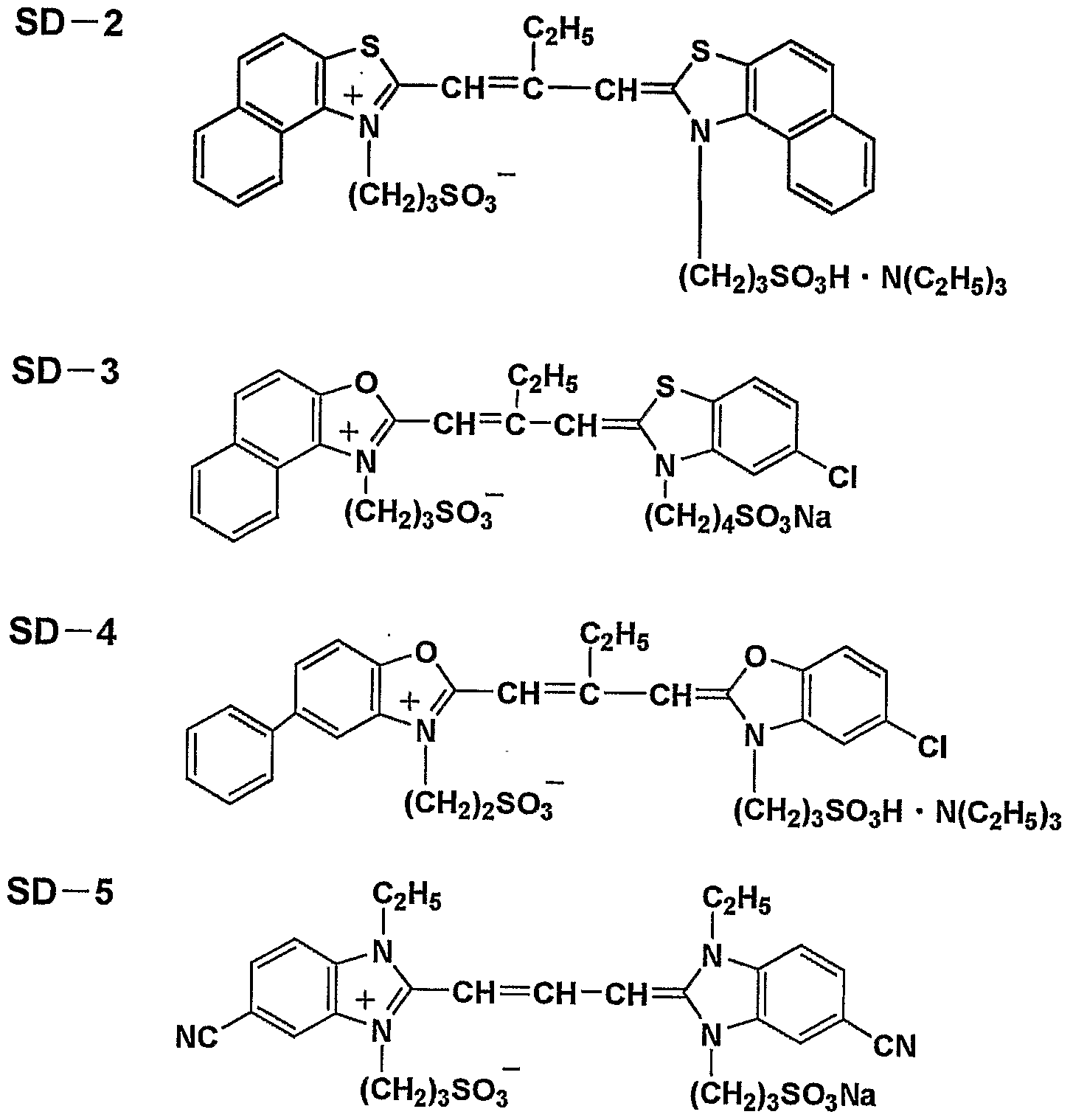


AS— 1

AS— 2

AS— 3


流動パラフィン
H9C4OOC(CH2)8COOC4H3

n:重合度

Ase― 1 (下記 3成分の混合物)
. Ν .
Cに S CH3

(成分 A) (成分 B) (成分 C) 成分 A:成分 B:成分 C=50:46:4(モル比)
H一 1
CH2=CHS02— CH2CONHC2H4NHCOCH2— S02CH=CH2
H-2
ONa
N人 N
ci人人 CI
X— 2 ί~
H29C14OOCH4C2— ^ ^N-CaH^OOC^Has
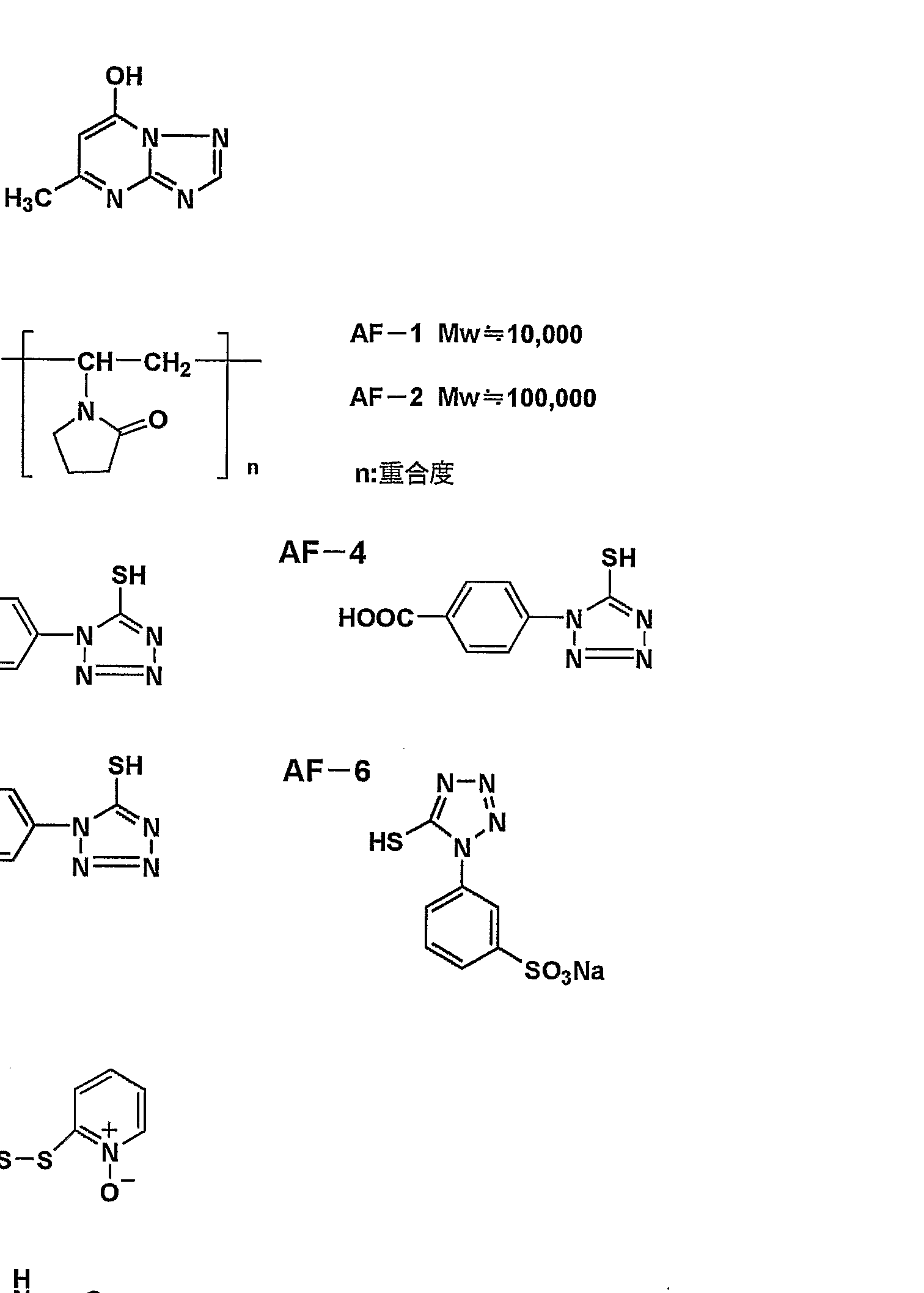
 一丄 S
一丄 S
T9
oimo麵 zdf/ェ:) d £189請 00Z OAV
SU -1 Na03S .COOCH2(CF2CF2)3H
、COOCH2(CF2CF2)3H
CH2COOCH2CH(C2H5)C4H9
ccl,
SU -3
S03Na

WAX— 1 CH3 CH3 CH3
CH3— Si— O- Si— O- -Si— CH3
I
CH3 CH3 CH3 Mw=3,000

x:y:z=3:3:4
n:重合度

〔試料 1 0 2〜1 0 8の作製〕
上記試料 1 0 1の作製において、 第 9層の高感度緑感光性層で用いた緑感光 性乳剤 G— 1に代えて、 前記調製した録感光性乳剤 G _ 2〜G— 8を用いた以
外は同様にして、 試料 102〜108を作製した。
〔各試料の露光、 現像及び特性評価〕
(露光及び現像)
以上のようにして作製した各試料を、 J I S K 76 14— 198 1に準 じて、 ゥヱッジを介して露光を行った後、 特開平 10— 1 23652号公報の 段落番号〔0220〕〜同 〔0227〕 に記載の現像処理方法に従つてカラ一 発色現像処理を行った。
(特性評価)
上記方法でカラ一発色現像処理を行つた各試料について、 透過型濃度計であ る X— r i t e社製濃度計によりイエロ一、 マゼンタ、 シアンの各透過 S t a t u sM濃度の測定を行い、 各写真用 D— L o g E特性曲線を作成した。 く緑感光性層感度の測定〉
上記作成した写真用 D— L 0 g E特性曲線のマゼンタ濃度特性曲線におい て、 最小濃度から + 0. 10の濃度を得るのに要する露光量の逆数を感度と定 義し、 試料 10 1の感度を 100とする相対感度を求めた。
く保存性の評価〉
上記作製した各試料を 2部準備し、 1部は 23° (:、 50%RHの環境下で 7 日間保存してこれを基準試料 1とし、 他の 1部は 40°C、 80%RHの環境下 で同じく 1週間の強制劣化処理を行い、 これを強制劣化試料 1とした。
上記各処理を行った試料を、 前述の方法と同様にして露光及び現像処理を行 い、 それぞれの最小マゼンタ濃度(Dm i η ) の差 ADm i n (強制劣化試料 1の Dm i n—基準試料 1の Dm i n ) を求め、 これを保存性の尺度とした。 く潜像保存性の評価〉
上記作製した各試料を 2部準備し、 1部は上記露光を施した後、 直ちに現像 処理を行いこれを基準試料 2とした。 他の一部は、 上記露光を行った後、 40 。C、 50 %RHの環境下で 1週間強制劣化を施した後現像処理を行い、 これを 強制劣化試料 2とした。
各現像済み試料について、 上記の方法に従って各感度を測定し、 各々の試料 の基準試料 2の感度を 1 00とし、 これに対する強制劣化試料 2の感度の差 Δ S {基準試料 2の感度( 1 00 ) —強制劣化試料 2の感度 } を求めた。 Δ S値 が小さいほど、 潜像保存性に優れていることを表す。
く粒状性の評価〉
上記感度の測定で用いた現像済み各試料のマゼンタ画像の粒状性について、 RMS値(カプリ濃度 + 0. 30のマゼンタ濃度を開口走査面積 2 50 m2の マイクロデンシトメ一ターで緑色フィルタ一を通して走査したときに生じる濃 度値の変動の 1 000倍値) を測定した。 粒状性は、 試料 1 0 1の RMS値を 1 00とした相対値で表し、 数値が小さいほど、 粒状性に優れていることを表 す。
以上により得られた結果を、 下表に示す。
i科 〔評価結果〕
— 番号 乳剤 相 感度 保存性 潜像保存性 状性 備考
10 1 G— 1 100 + 0. 08 一 28 100 比較例 102 G— 2 103 + 0. 08 - 24 98 比較例
103 G - 3 1 18 + 0. 07 一 18 93 本発明
104 G-4 126 + 0. 07 一 1 1 89 本発明
105 G- 5 1 21 + 0. 07 - 1 91 本発明
106 G- 6 1 10 + 0. 10 一 23 100 比較例 107 G- 7 95 + 0. 1 1 一 32 105 比較例
108 G— 8 84 + 0. 13 - 35 101 比較例 産業上の利用の可能性
以上のように、本発明の構成により、高感度で、粒状性、潜像安定性に優れ、 かつ保存安定性が良好なハロゲン化銀乳剤を用いたハロゲン化銀カラ一写真感 光材料に関する。
Claims
1 . 支持体上に、 少なくとも 1層の赤感光性層、 緑感光性層、 青感光性層及 び非感光性層を有するハロゲン化銀カラ一写真感光材料において、 該感光性層 の少なくとも 1層が、 平均沃化銀含有率が 2. 0〜4. O m o l %で、 平均ァ スぺクト比が 8 . 0以上で、 かつ転位線を有する単分散のハロゲン化銀乳剤を 含有し、 該ハロゲン化銀乳剤がセレン增感剤により化学増感され、 かつ該セレ ン増感剤の添加量が、 該ハロゲン化銀乳剤 1モルあたり、 5 . 0 X 1 0— 6モル 以上であることを特徴とするハロゲン化銀カラー写真感光材料。
2 . 前記ハロゲン化銀乳剤が、 前記セレン增感剤と、 少なくとも 1種のカル コゲン増感剤により化学増感されていることを特徴とする請求の範囲第 1項に 記載のハ口ゲン化銀力ラ一写真感光材料。
3 . 前記カルコゲン増感剤の少なくとも 1種が、 硫黄増感剤であることを特 徵とする請求の範囲第 1項または第 2項に記載のハ口ゲン化銀力ラ一写真感光 材料。
. 前記ハ口ゲン化銀乳剤に対する前記セレン增感剤と前記硫黄増感剤との 添加量比(セレン増感剤ノ硫黄増感剤) が、 0 . 6以上であることを特徴とす る請求の範囲第 3項に記載のハ口ゲン化銀力ラー写真感光材料。
5 . 特定写真感度が、 2 0 0以上であることを特徴とする請求の範囲第 1項 から第 4項のいずれか 1項に記載のハロゲン化銀カラ一写真感光材料。
Priority Applications (2)
| Application Number | Priority Date | Filing Date | Title |
|---|---|---|---|
| PCT/JP2002/012110 WO2004046813A1 (ja) | 2002-11-20 | 2002-11-20 | ハロゲン化銀カラー写真感光材料 |
| CNA028299116A CN1695086A (zh) | 2002-11-20 | 2002-11-20 | 卤化银彩色照相感光材料 |
Applications Claiming Priority (1)
| Application Number | Priority Date | Filing Date | Title |
|---|---|---|---|
| PCT/JP2002/012110 WO2004046813A1 (ja) | 2002-11-20 | 2002-11-20 | ハロゲン化銀カラー写真感光材料 |
Publications (1)
| Publication Number | Publication Date |
|---|---|
| WO2004046813A1 true WO2004046813A1 (ja) | 2004-06-03 |
Family
ID=32321502
Family Applications (1)
| Application Number | Title | Priority Date | Filing Date |
|---|---|---|---|
| PCT/JP2002/012110 Ceased WO2004046813A1 (ja) | 2002-11-20 | 2002-11-20 | ハロゲン化銀カラー写真感光材料 |
Country Status (2)
| Country | Link |
|---|---|
| CN (1) | CN1695086A (ja) |
| WO (1) | WO2004046813A1 (ja) |
Citations (7)
| Publication number | Priority date | Publication date | Assignee | Title |
|---|---|---|---|---|
| JPH09179227A (ja) * | 1995-12-21 | 1997-07-11 | Konica Corp | ハロゲン化銀写真乳剤及びハロゲン化銀写真感光材料 |
| JP2001264909A (ja) * | 2000-03-17 | 2001-09-28 | Konica Corp | ハロゲン化銀乳剤及びハロゲン化銀カラー写真感光材料 |
| JP2001318443A (ja) * | 2000-05-11 | 2001-11-16 | Konica Corp | ハロゲン化銀写真乳剤及びハロゲン化銀写真感光材料 |
| JP2002072395A (ja) * | 2000-08-29 | 2002-03-12 | Fuji Photo Film Co Ltd | ハロゲン化銀写真乳剤、およびこれを用いたハロゲン化銀写真感光材料 |
| JP2002099060A (ja) * | 2000-09-22 | 2002-04-05 | Konica Corp | ハロゲン化銀カラー写真感光材料 |
| JP2002214731A (ja) * | 2001-01-22 | 2002-07-31 | Fuji Photo Film Co Ltd | ハロゲン化銀写真乳剤 |
| JP2002287282A (ja) * | 2001-03-28 | 2002-10-03 | Fuji Photo Film Co Ltd | ハロゲン化銀写真感光材料 |
-
2002
- 2002-11-20 WO PCT/JP2002/012110 patent/WO2004046813A1/ja not_active Ceased
- 2002-11-20 CN CNA028299116A patent/CN1695086A/zh active Pending
Patent Citations (7)
| Publication number | Priority date | Publication date | Assignee | Title |
|---|---|---|---|---|
| JPH09179227A (ja) * | 1995-12-21 | 1997-07-11 | Konica Corp | ハロゲン化銀写真乳剤及びハロゲン化銀写真感光材料 |
| JP2001264909A (ja) * | 2000-03-17 | 2001-09-28 | Konica Corp | ハロゲン化銀乳剤及びハロゲン化銀カラー写真感光材料 |
| JP2001318443A (ja) * | 2000-05-11 | 2001-11-16 | Konica Corp | ハロゲン化銀写真乳剤及びハロゲン化銀写真感光材料 |
| JP2002072395A (ja) * | 2000-08-29 | 2002-03-12 | Fuji Photo Film Co Ltd | ハロゲン化銀写真乳剤、およびこれを用いたハロゲン化銀写真感光材料 |
| JP2002099060A (ja) * | 2000-09-22 | 2002-04-05 | Konica Corp | ハロゲン化銀カラー写真感光材料 |
| JP2002214731A (ja) * | 2001-01-22 | 2002-07-31 | Fuji Photo Film Co Ltd | ハロゲン化銀写真乳剤 |
| JP2002287282A (ja) * | 2001-03-28 | 2002-10-03 | Fuji Photo Film Co Ltd | ハロゲン化銀写真感光材料 |
Also Published As
| Publication number | Publication date |
|---|---|
| CN1695086A (zh) | 2005-11-09 |
Similar Documents
| Publication | Publication Date | Title |
|---|---|---|
| JPH08101475A (ja) | エピタキシャル増感方法並びにエピタキシャル増感極薄平板状粒子乳剤及びそれを含有する写真要素 | |
| JPH0749551A (ja) | 平板状粒子乳剤による電子印刷方法 | |
| WO2004046813A1 (ja) | ハロゲン化銀カラー写真感光材料 | |
| JPH07146522A (ja) | ハロゲン化銀乳剤 | |
| JPH06324446A (ja) | 写真要素の処理方法 | |
| JPH08171162A (ja) | エピタキシャル増感極薄平板状粒子乳剤及びそれを含有する写真要素 | |
| US6593071B2 (en) | Silver halide photographic emulsion and silver halide photographic light sensitive material | |
| JP3843622B2 (ja) | ハロゲン化銀写真乳剤 | |
| JP3680546B2 (ja) | ハロゲン化銀写真乳剤およびハロゲン化銀写真感光材料 | |
| JP2002287280A (ja) | ハロゲン化銀乳剤及びその製造方法 | |
| JP2002082417A (ja) | ハロゲン化銀カラー写真感光材料 | |
| JP3470242B2 (ja) | ハロゲン化銀写真感光材料 | |
| JPH08101472A (ja) | 輻射線感性乳剤及び写真要素 | |
| JPH08171164A (ja) | 輻射線感性乳剤 | |
| JP2001194740A (ja) | ハロゲン化銀カラー写真感光材料 | |
| JP2001100346A (ja) | ハロゲン化銀乳剤およびハロゲン化銀カラー写真感光材料 | |
| JP2000089426A (ja) | ハロゲン化銀カラー写真感光材料の画像形成方法 | |
| WO2004046814A1 (ja) | ハロゲン化銀カラー写真感光材料 | |
| JPH11218866A (ja) | ハロゲン化銀乳剤及びハロゲン化銀写真感光材料 | |
| JP2001100347A (ja) | ハロゲン化銀乳剤およびハロゲン化銀カラー写真感光材料 | |
| JPH1172883A (ja) | ハロゲン化銀カラー写真感光材料 | |
| JP2001059994A (ja) | 撮影用ハロゲン化銀カラー写真感光材料 | |
| JP2001100348A (ja) | ハロゲン化銀乳剤とその製造方法 | |
| JPH06175249A (ja) | ハロゲン化銀写真乳剤 | |
| JP2001264909A (ja) | ハロゲン化銀乳剤及びハロゲン化銀カラー写真感光材料 |
Legal Events
| Date | Code | Title | Description |
|---|---|---|---|
| AK | Designated states |
Kind code of ref document: A1 Designated state(s): BR CN ID IN JP KR MX PH PL RU SG US VN |
|
| AL | Designated countries for regional patents |
Kind code of ref document: A1 Designated state(s): AT BE BG CH CY CZ DE DK EE ES FI FR GB GR IE IT LU MC NL PT SE SK TR |
|
| 121 | Ep: the epo has been informed by wipo that ep was designated in this application | ||
| WWE | Wipo information: entry into national phase |
Ref document number: 20028299116 Country of ref document: CN |
|
| 122 | Ep: pct application non-entry in european phase | ||
| NENP | Non-entry into the national phase |
Ref country code: JP |
|
| WWW | Wipo information: withdrawn in national office |
Country of ref document: JP |