WO2004064519A1 - Fungizide mischungen auf der basis eines triazolopyrimidin-derivates und azolen - Google Patents
Fungizide mischungen auf der basis eines triazolopyrimidin-derivates und azolen Download PDFInfo
- Publication number
- WO2004064519A1 WO2004064519A1 PCT/EP2003/012767 EP0312767W WO2004064519A1 WO 2004064519 A1 WO2004064519 A1 WO 2004064519A1 EP 0312767 W EP0312767 W EP 0312767W WO 2004064519 A1 WO2004064519 A1 WO 2004064519A1
- Authority
- WO
- WIPO (PCT)
- Prior art keywords
- formula
- xviii
- mixtures
- fungicidal
- compound
- Prior art date
- Legal status (The legal status is an assumption and is not a legal conclusion. Google has not performed a legal analysis and makes no representation as to the accuracy of the status listed.)
- Ceased
Links
- ASMNSUBMNZQTTG-UHFFFAOYSA-N CC(CC1)CCN1c1c(-c(c(F)cc(F)c2)c2F)c(Cl)nc2ncn[n]12 Chemical compound CC(CC1)CCN1c1c(-c(c(F)cc(F)c2)c2F)c(Cl)nc2ncn[n]12 ASMNSUBMNZQTTG-UHFFFAOYSA-N 0.000 description 1
- WWVUMGGVAYZMGV-UHFFFAOYSA-N N#CC(Cc(cc1)ccc1Cl)(c1ccccc1)[n]1ncnc1 Chemical compound N#CC(Cc(cc1)ccc1Cl)(c1ccccc1)[n]1ncnc1 WWVUMGGVAYZMGV-UHFFFAOYSA-N 0.000 description 1
Classifications
-
- A—HUMAN NECESSITIES
- A01—AGRICULTURE; FORESTRY; ANIMAL HUSBANDRY; HUNTING; TRAPPING; FISHING
- A01N—PRESERVATION OF BODIES OF HUMANS OR ANIMALS OR PLANTS OR PARTS THEREOF; BIOCIDES, e.g. AS DISINFECTANTS, AS PESTICIDES OR AS HERBICIDES; PEST REPELLANTS OR ATTRACTANTS; PLANT GROWTH REGULATORS
- A01N43/00—Biocides, pest repellants or attractants, or plant growth regulators containing heterocyclic compounds
- A01N43/90—Biocides, pest repellants or attractants, or plant growth regulators containing heterocyclic compounds having two or more relevant hetero rings, condensed among themselves or with a common carbocyclic ring system
-
- A—HUMAN NECESSITIES
- A01—AGRICULTURE; FORESTRY; ANIMAL HUSBANDRY; HUNTING; TRAPPING; FISHING
- A01N—PRESERVATION OF BODIES OF HUMANS OR ANIMALS OR PLANTS OR PARTS THEREOF; BIOCIDES, e.g. AS DISINFECTANTS, AS PESTICIDES OR AS HERBICIDES; PEST REPELLANTS OR ATTRACTANTS; PLANT GROWTH REGULATORS
- A01N47/00—Biocides, pest repellants or attractants, or plant growth regulators containing organic compounds containing a carbon atom not being member of a ring and having no bond to a carbon or hydrogen atom, e.g. derivatives of carbonic acid
- A01N47/08—Biocides, pest repellants or attractants, or plant growth regulators containing organic compounds containing a carbon atom not being member of a ring and having no bond to a carbon or hydrogen atom, e.g. derivatives of carbonic acid the carbon atom having one or more single bonds to nitrogen atoms
- A01N47/28—Ureas or thioureas containing the groups >N—CO—N< or >N—CS—N<
- A01N47/38—Ureas or thioureas containing the groups >N—CO—N< or >N—CS—N< containing the group >N—CO—N< where at least one nitrogen atom is part of a heterocyclic ring; Thio analogues thereof
Definitions
- the present invention relates to fungicidal mixtures comprising as active components
- the invention also relates to a method for controlling harmful fungi with mixtures of the compound I with at least one of the compounds II to XVIII and the use of the compound I with at least one of the compounds II to XVIII for the production of such mixtures and agents which contain these mixtures.
- Triticonazole (XVII), 5- (4-chloro-benzylidene) -2, 2-dimethyl-l- [1,2,4] triazol-1-ylmethyl-cyclopentanol: EP-A 378 953; and prothioconazole (XVIII), 2- [2- (1-chloro-cyclopropyl) -3- (2-chlorophenyl) -2-hydroxypropyl] -2, 4-dihydro- [1,2,4] triazole -3-thio: WO 96/16048.
- Fungicidal mixtures are known from EP-A 531 837, EP-A 645 091 and WO 97/06678 which contain one of the azoles II to XVIII as an active ingredient component.
- the object of the present invention was to provide further means for combating harmful fungi, in particular for certain indications.
- the mixtures according to the invention contain at least one compound of the formula II to XVIII as the azole derivative.
- Triazolopyrimidine derivative and azole are preferably used in a weight ratio in the range from 100: 1 to 1: 100, preferably 20: 1 to 1:20 , in particular 10: 1 to 1:10.
- the compounds I and II to XVIII are able to form salts or adducts with inorganic or organic acids or with metal ions.
- inorganic acids examples include hydrohalic acids such as hydrogen fluoride, hydrogen chloride, hydrogen bromide and hydrogen iodide, sulfuric acid, phosphoric acid and nitric acid.
- organic acids are formic acid, carbonic acid and alkanoic acids such as acetic acid, trifluoroacetic acid,
- Trichloroacetic acid and propionic acid as well as glycolic acid, thiocyanic acid, lactic acid, succinic acid, citric acid, benzoic acid, cinnamic acid, oxalic acid, alkylsulfonic acids (sulfonic acids with straight-chain or branched alkyl radicals with 1 to 20 carbon atoms), arylsulfonic acids or disulfonic acids such as aromatic res and naphthyl which carry one or two sulfonic acid groups), alkylphosphonic acids (phosphonic acids with straight-chain or branched alkyl radicals having 1 to 20 carbon atoms), arylphosphonic acids or diphosphonic acids (aromatic radicals such as phenyl and naphthyl which carry one or two phosphoric acid radicals), the alkyl or Aryl radicals can carry further substituents, for example p-toluenesulfonic acid, salicylic acid, p-amino salicylic acid
- the ions of the elements of the first to eighth subgroups especially chromium, manganese, iron, cobalt, nickel, copper, zinc and in addition to the second main group, especially calcium and magnesium, the third and fourth main group, in particular aluminum, come as metal ions. Tin and lead into consideration.
- the metals can optionally be present in different valences. Mixtures of the triazolopyrimidine derivative of the formula I with bromuconazole are preferred.
- Mixtures of the triazolopyrimidine derivative of the formula I with triticonazole are preferred. Mixtures of the triazolopyrimidine derivative of the formula I with prothioconazole are preferred.
- the mixtures of the compounds I with at least one of the compounds II to XVIII or the compounds I and at least one of the compounds II to XVIII used simultaneously, together or separately are notable for an outstanding action against a broad spectrum of phytopathogenic fungi, in particular from the class of the Ascomycetes, Basidiomycetes, Phycomycetes and Deuteromycetes. They are partly systemically effective and can therefore also be used as leaf and soil fungicides.
- the mixtures according to the invention can preferably be used for controlling powdery mildew in cereal, vine and vegetable crops and in ornamental plants.
- the mixtures according to the invention are also preferably active against harmful fungi from the Oomycetes class, in particular against Phytophthora infestans in potatoes and tomatoes.
- the mixtures according to the invention are preferably also suitable for controlling rice pathogens.
- fungicide Due to the special cultivation conditions of rice plants, there are significantly different requirements for a rice fungicide than for fungicides that are used in cereal or fruit growing. There are serious differences in modern rice cultivation systems: in addition to the spray application common in many countries, the fungicide is applied to the soil directly during or shortly after sowing. The fungicide is absorbed into the plant via the roots and transported in the plant sap in the plant to the parts of the plant to be protected. A high system is therefore essential for rice fungicides. In cereal or fruit growing, on the other hand, the fungicide is usually applied to the leaves or the fruits, so the systemics of the active ingredients play a significantly smaller role in these crops.
- Rhizoctonia solani is the causative agents of the most important diseases of rice plants. Rhizoctonia solani is the only agronomically important pathogen within the Agaricomycetidae subclass. This fungus does not attack the plant via spores like most other fungi, but via a mycelial infection.
- the compound I and at least one of the compounds II to XVIII can be applied simultaneously, that is jointly or separately, or in succession, the sequence in the case of separate application generally not having any effect on the success of the control measures.
- the application rates of the mixtures according to the invention are 5 to 2000 g / ha, preferably 50 to 1500 g / ha, in particular 50 to 750 g / ha, depending on the type of effect desired.
- the application rates for compound I are 1 to 1000 g / ha, preferably 10 to 900 g / ha, in particular 20 to 750 g / ha.
- the application rates for the compounds II to XVIII are accordingly from 1 to 1000 g / ha, preferably 10 to 900 g / ha, in particular 20 to 750 g / ha.
- application rates of mixture of 1 to 1000 g / 100 kg of seed preferably 1 to 200 g / 100 kg, in particular 5 to 100 g / 100 kg, are generally used.
- the compounds I and at least one of the compounds II to XVIII or their mixtures of the compounds I and at least one of the compounds II to XVIII are applied separately or together by spraying or dusting the seeds, the plants or the soil before or after sowing the plants or before or after the emergence of the plants.
- the fungicidal synergistic mixtures according to the invention or the compound I and at least one of the compounds II to XVIII can be used, for example, in the form of directly sprayable solutions, powders and suspensions or in the form of high-strength aqueous, oily or other suspensions, dispersions, emulsions, oil dispersions, Pastes, dusts, scattering agents or granules are prepared and used by spraying, atomizing, dusting, scattering or pouring.
- the form of application depends on the intended use; in any case, it should ensure as fine and uniform a distribution of the mixture according to the invention as possible.
- the compounds I and II to XVIII, the mixtures or the corresponding formulations are used in such a way that the harmful fungi, their habitat or the plants, seeds, soils, areas, materials or spaces to be kept free from them are mixed with a fungicidally effective amount of the mixture, or of the compounds I and at least one of the compounds II to XVIII treated separately.
- the application can take place before or after the infestation by the harmful fungi.
- the formulations are prepared in a known manner, for example by stretching the active ingredient with solvents and / or carriers, if desired using emulsifiers and dispersants.
- solvents / auxiliaries Water, aromatic solvents (e.g. Solvesso products, xylene), paraffins (e.g. petroleum fractions), alcohols (e.g. methanol, butanol, pentanol, benzyl alcohol), ketones (e.g.
- Carriers such as natural stone powder (e.g. kaolins, clays, talc, chalk) and synthetic stone powder (e.g. highly disperse silica, silicates); Emulsifiers such as nonionic and anionic emulsifiers (e.g. polyoxyethylene fatty alcohol ethers, alkyl sulfonates and aryl sulfonates) and dispersants such as lignin sulfite liquors and methyl cellulose.
- natural stone powder e.g. kaolins, clays, talc, chalk
- synthetic stone powder e.g. highly disperse silica, silicates
- Emulsifiers such as nonionic and anionic emulsifiers (e.g. polyoxyethylene fatty alcohol ethers, alkyl sulfonates and aryl sulfonates) and dispersants such as lignin sulfite liquors and methyl cellulose.
- Suitable surfactants are alkali metal, alkaline earth metal and ammonium salts of lignosulfonic acid, naphthalenesulfonic acid, phenolsulfonic acid, dibutylnaphthalenesulfonic acid, alkylaryl sulfonates, alkyl sulfates, alkylsulfonates, fatty alcohol sulfates, fatty acids and sulfated fatty alcohol glycol ethers, furthermore condensates of sulfonated naphthalene and naphthalene derivatives with formaldehyde, condensates of naphthalene or the naphthalene sulfonic acid with phenol and formaldehyde, polyoxyetylenoctylphenol ether, ethoxylated isooctylphenol, octylphenol, nonylphenol, alkylphenol polyglycol ether, tributylphenylpol
- Mineral oil fractions of medium to high boiling point such as kerosene or diesel oil, are also used to produce directly sprayable solutions, emulsions, pastes or oil dispersions
- Coal tar oils as well as oils of vegetable or animal origin, aliphatic, cyclic and aromatic hydrocarbons, e.g. Toluene, xylene, paraffin, tetrahydronaphthalene, alkylated naphthalenes or their derivatives, methanol, ethanol, propanol, butanol, cyclohexanol, cyclohexanone, isophorone, strongly polar solvents, e.g. Dimethyl sulfoxide, N-methylpyrrolidone or water into consideration.
- aliphatic, cyclic and aromatic hydrocarbons e.g. Toluene, xylene, paraffin, tetrahydronaphthalene, alkylated naphthalenes or their derivatives, methanol, ethanol, propanol, butanol, cyclohexanol, cyclohexanone, isophorone, strongly polar solvents, e
- Powders, materials for spreading and dusts can be prepared by mixing or grinding the active substances together with a solid carrier.
- Granules for example coated granules, impregnated granules and homogeneous granules, can be prepared by binding the active ingredients to solid carriers.
- Solid carriers are, for example, mineral earths, such as silica gels, silicates, talc, kaolin, Attaclay, limestone, lime, chalk, bolus, loess, clay, dolomite, diatomaceous earth, calcium and magnesium sulfate, magnesium oxide, ground plastics, fertilizers, such as ammonium sulfate , Ammonium phosphate, ammonium nitrate, ureas and vegetable products such as cereal flour, tree bark, wood and nutshell flour, cellulose powder and other solid carriers.
- mineral earths such as silica gels, silicates, talc, kaolin, Attaclay, limestone, lime, chalk, bolus, loess, clay, dolomite, diatomaceous earth, calcium and magnesium sulfate, magnesium oxide, ground plastics, fertilizers, such as ammonium sulfate , Ammonium phosphate, ammonium nitrate, ureas and vegetable products
- the formulations generally contain between 0.01 and 95% by weight, preferably between 0.1 and 90% by weight, of the active ingredients.
- the active ingredients are used in a purity of 90% to 100%, preferably 95% to 100% (according to the NMR spectrum).
- formulations are: 1. Products for dilution in water
- Water-dispersible and water-soluble granules 50 parts by weight of the active ingredients are finely ground with the addition of dispersing and wetting agents and are produced using technical equipment (e.g. extrusion, spray tower, fluidized bed) as water-dispersible or water-soluble granules. Dilution in water results in a stable dispersion or solution of the active ingredient.
- WP, SP Water-dispersible and water-soluble powders 75 parts by weight of the active ingredients are ground in a rotor-strator mill with the addition of dispersing and wetting agents and silica gel. Dilution in water results in a stable dispersion or solution of the active ingredient.
- active ingredients as such, in the form of their formulations or the use forms prepared therefrom, e.g. in the form of directly sprayable solutions, powders, suspensions or
- Dispersions, emulsions, oil dispersions, pastes, dusts, sprinkling agents, granules by spraying, atomizing, dusting, scattering or pouring can be used.
- the application forms depend entirely on the purposes; in any case, they should ensure the finest possible distribution of the active compounds according to the invention.
- Aqueous application forms can be prepared from emulsion concentrates, pastes or wettable powders (wettable powders, old dispersions) by adding water.
- To prepare emulsions, pastes or oldispersions the substances as such or dissolved in an oil or solvent can be homogenized in water by means of wetting agents, adhesives, dispersants or emulsifiers.
- concentrates consisting of an active substance, wetting agents, adhesives, dispersants or emulsifiers and possibly solvents or oil can also be prepared which are suitable for dilution with water.
- the active ingredient concentrations in the ready-to-use preparations can be varied over a wide range. In general, they are between 0.0001 and 10%, preferably between 0.01 and 1%.
- the active ingredients can also be used with great success in the ultra-low-volume process (ULV), it being possible to apply formulations with more than 95% by weight of active ingredient or even the active ingredient without additives.
- UUV ultra-low-volume process
- Oils of various types, wetting agents, adjuvants, herbicides, fungicides, other pesticides, bactericides can be added to the active compounds, if appropriate also only immediately before use (tank mix). These agents are usually added to the agents according to the invention in a weight ratio of 1:10 to 10: 1.
- the active substances were formulated separately or together as a stock solution with 0.25% by weight of active substance in acetone or DMSO. 1% by weight of emulsifier Uniperol® EL (wetting agent with emulsifying and dispersing action based on ethoxylated alkylphenols) was added to this solution. The active substances or mixtures were diluted with water in accordance with the stated concentration.
- emulsifier Uniperol® EL wetting agent with emulsifying and dispersing action based on ethoxylated alkylphenols
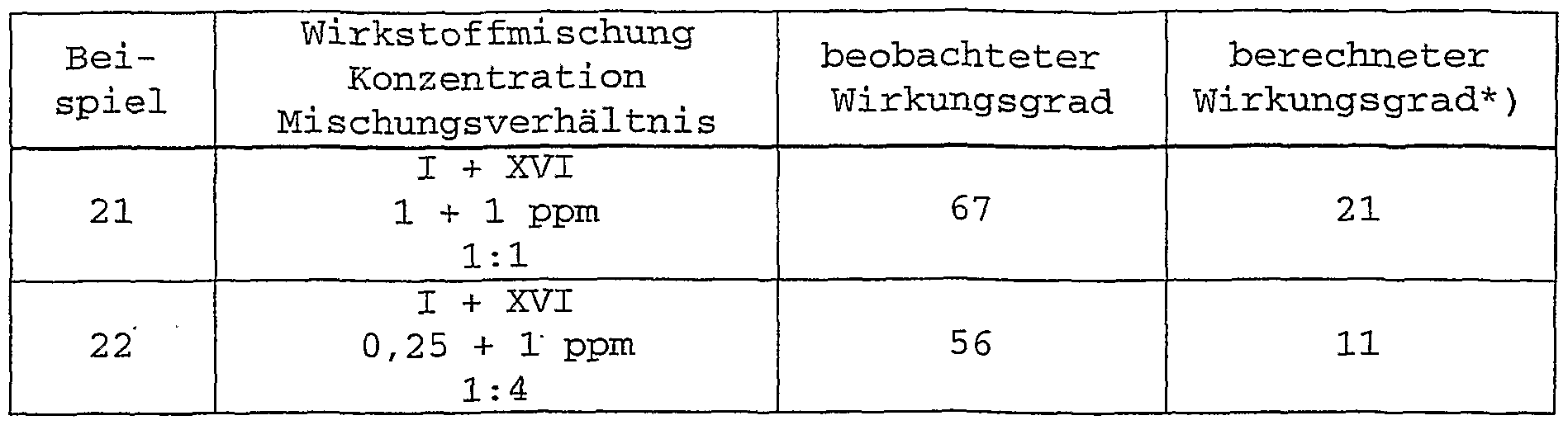
- ⁇ corresponds to the fungal attack of the treated plants in% and ß corresponds to the fungal attack of the untreated (control) plants in%
- the infection of the treated plants corresponds to that of the untreated control plants; at an efficiency of 100, the treated plants showed no infection.
- Leaves of potted vines were sprayed to runoff point with an aqueous suspension in the active ingredient concentration given below.
- the undersides of the leaves were inoculated with an aqueous sporangia suspension of Plasmopara viticola.
- the vines were then placed for 48 hours in a steam-saturated chamber at 24 ° C and then for 5 days in a greenhouse at temperatures between 20 and 30 ° C. After this time, the plants were again in one for 16 hours in order to accelerate the sporangium carrier outbreak damp chamber. The extent of the development of the infestation on the undersides of the leaves was then determined visually.
Landscapes
- Life Sciences & Earth Sciences (AREA)
- Agronomy & Crop Science (AREA)
- Pest Control & Pesticides (AREA)
- Plant Pathology (AREA)
- Health & Medical Sciences (AREA)
- Engineering & Computer Science (AREA)
- Dentistry (AREA)
- General Health & Medical Sciences (AREA)
- Wood Science & Technology (AREA)
- Zoology (AREA)
- Environmental Sciences (AREA)
- Agricultural Chemicals And Associated Chemicals (AREA)
Abstract
Description




Claims


Priority Applications (15)
| Application Number | Priority Date | Filing Date | Title |
|---|---|---|---|
| HR20050550A HRP20050550A2 (en) | 2002-11-15 | 2003-11-14 | Fungicidal mixtures based on a triazolopyrimidine derivative and azoles |
| MXPA05004548A MXPA05004548A (es) | 2002-11-15 | 2003-11-14 | Mezclas fungicidas con base en trazolopirimidinas y azol. |
| AU2003303097A AU2003303097A1 (en) | 2002-11-15 | 2003-11-14 | Fungicidal mixtures based on a triazolopyrimidine derivative and azoles |
| YUP-2005/0358A RS20050358A (sr) | 2002-11-15 | 2003-11-14 | Fungicidne smeše na bazi derivata triazolopirimidina i azola |
| NZ540472A NZ540472A (en) | 2002-11-15 | 2003-11-14 | Fungicidal mixtures based on triazolopyrimidine derivative and azoles |
| AP2005003312A AP2005003312A0 (en) | 2002-11-15 | 2003-11-14 | Fungicidal mixtures based on a triazolopyrimidine and azoles |
| CA002505588A CA2505588A1 (en) | 2002-11-15 | 2003-11-14 | Fungicidal mixtures based on a triazolopyrimidine derivative and azoles |
| BR0316273-7A BR0316273A (pt) | 2002-11-15 | 2003-11-14 | Misturas e agentes fungicidas, processo para combater fungos nocivos, semente, e, uso dos compostos |
| EA200500722A EA200500722A1 (ru) | 2002-11-15 | 2003-11-14 | Фунгицидные смеси на основе триазолопиримидинов и азолов |
| EP03814404A EP1562428A1 (de) | 2002-11-15 | 2003-11-14 | Fungizide mischungen auf der basis eines triazolopyrimidin-derivates und azolen |
| UAA200505922A UA80731C2 (en) | 2002-11-15 | 2003-11-14 | Fungicidal mixture based on triazolopyrimidines and azoles, fungicidal agent, controlling method, seed and using compounds |
| US10/532,755 US20060111320A1 (en) | 2002-11-15 | 2003-11-14 | Fungicidal mixtures based on a triazolopyrimidine derivative and azoles |
| JP2004566760A JP2006517521A (ja) | 2002-11-15 | 2003-11-14 | トリアゾロピリミジン誘導体とアゾールに基づく殺菌性混合物 |
| NO20051926A NO20051926L (no) | 2002-11-15 | 2005-04-20 | Fungicide blandinger basert pa et triazolopyrimidinderivat og azoler. |
| EGNA2005000186 EG23743A (en) | 2002-11-15 | 2005-05-03 | Fungicidal mixtures based on triazolpyrimidines and azoles |
Applications Claiming Priority (2)
| Application Number | Priority Date | Filing Date | Title |
|---|---|---|---|
| DE10253584.1 | 2002-11-15 | ||
| DE10253584 | 2002-11-15 |
Publications (1)
| Publication Number | Publication Date |
|---|---|
| WO2004064519A1 true WO2004064519A1 (de) | 2004-08-05 |
Family
ID=32747416
Family Applications (1)
| Application Number | Title | Priority Date | Filing Date |
|---|---|---|---|
| PCT/EP2003/012767 Ceased WO2004064519A1 (de) | 2002-11-15 | 2003-11-14 | Fungizide mischungen auf der basis eines triazolopyrimidin-derivates und azolen |
Country Status (26)
| Country | Link |
|---|---|
| US (1) | US20060111320A1 (de) |
| EP (1) | EP1562428A1 (de) |
| JP (1) | JP2006517521A (de) |
| KR (1) | KR100717675B1 (de) |
| CN (1) | CN1711019A (de) |
| AP (1) | AP2005003312A0 (de) |
| AR (1) | AR042055A1 (de) |
| AU (1) | AU2003303097A1 (de) |
| BR (1) | BR0316273A (de) |
| CA (1) | CA2505588A1 (de) |
| CO (1) | CO5570637A2 (de) |
| CR (1) | CR7837A (de) |
| EA (1) | EA200500722A1 (de) |
| EC (1) | ECSP055760A (de) |
| EG (1) | EG23743A (de) |
| HR (1) | HRP20050550A2 (de) |
| MA (1) | MA27494A1 (de) |
| MX (1) | MXPA05004548A (de) |
| NO (1) | NO20051926L (de) |
| OA (1) | OA12956A (de) |
| PL (1) | PL377178A1 (de) |
| RS (1) | RS20050358A (de) |
| TW (1) | TW200505342A (de) |
| UA (1) | UA80731C2 (de) |
| WO (1) | WO2004064519A1 (de) |
| ZA (1) | ZA200504842B (de) |
Cited By (2)
| Publication number | Priority date | Publication date | Assignee | Title |
|---|---|---|---|---|
| WO2005032256A1 (de) * | 2003-10-01 | 2005-04-14 | Basf Aktiengesellschaft | Fungizide mischungen |
| WO2007141010A1 (en) * | 2006-06-08 | 2007-12-13 | Syngenta Participations Ag, | A method of protecting a plant propagation material, a plant, parts of a plant and/or plant organs |
Families Citing this family (3)
| Publication number | Priority date | Publication date | Assignee | Title |
|---|---|---|---|---|
| CN101617669B (zh) * | 2009-07-28 | 2012-07-04 | 陕西汤普森生物科技有限公司 | 一种含氟菌唑与戊唑醇的杀菌组合物 |
| CN102165957B (zh) * | 2011-03-05 | 2014-03-05 | 陕西美邦农药有限公司 | 一种含有腈苯唑与三唑类化合物的增效杀菌组合物 |
| GB201610264D0 (en) * | 2016-06-13 | 2016-07-27 | Syngenta Participations Ag | Pesticidal compositions |
Citations (4)
| Publication number | Priority date | Publication date | Assignee | Title |
|---|---|---|---|---|
| WO1997006678A1 (de) * | 1995-08-17 | 1997-02-27 | Basf Aktiengesellschaft | Fungizide mischungen eines oximethercarbonsäureamids mit azolderivaten |
| WO1998046607A1 (en) * | 1997-04-14 | 1998-10-22 | American Cyanamid Company | Fungicidal trifluorophenyl-triazolopyrimidines |
| EP0988790A1 (de) * | 1998-09-25 | 2000-03-29 | American Cyanamid Company | Fungizide Mischungen |
| WO2003084330A1 (de) * | 2002-04-05 | 2003-10-16 | Basf Aktiengesellschaft | Fungizide mischungen auf der basis von benzamidoxim-derivaten und azolen |
Family Cites Families (5)
| Publication number | Priority date | Publication date | Assignee | Title |
|---|---|---|---|---|
| GB1469772A (en) * | 1973-06-21 | 1977-04-06 | Boots Co Ltd | Fungicidal imidazole derivatives |
| DE4130298A1 (de) * | 1991-09-12 | 1993-03-18 | Basf Ag | Fungizide mischungen |
| DK0645091T3 (da) * | 1993-09-24 | 1996-05-13 | Basf Ag | Fungicide blandinger |
| JPH0988790A (ja) * | 1995-09-29 | 1997-03-31 | Nissan Motor Co Ltd | 内燃機関の電子制御装置 |
| US6268371B1 (en) * | 1998-09-10 | 2001-07-31 | American Cyanamid Co. | Fungicidal mixtures |
-
2003
- 2003-11-14 US US10/532,755 patent/US20060111320A1/en not_active Abandoned
- 2003-11-14 JP JP2004566760A patent/JP2006517521A/ja not_active Withdrawn
- 2003-11-14 BR BR0316273-7A patent/BR0316273A/pt not_active IP Right Cessation
- 2003-11-14 WO PCT/EP2003/012767 patent/WO2004064519A1/de not_active Ceased
- 2003-11-14 OA OA1200500138A patent/OA12956A/en unknown
- 2003-11-14 AU AU2003303097A patent/AU2003303097A1/en not_active Abandoned
- 2003-11-14 CN CNA2003801032118A patent/CN1711019A/zh active Pending
- 2003-11-14 EP EP03814404A patent/EP1562428A1/de not_active Withdrawn
- 2003-11-14 CA CA002505588A patent/CA2505588A1/en not_active Abandoned
- 2003-11-14 HR HR20050550A patent/HRP20050550A2/hr not_active Application Discontinuation
- 2003-11-14 AP AP2005003312A patent/AP2005003312A0/xx unknown
- 2003-11-14 KR KR1020057008581A patent/KR100717675B1/ko not_active Expired - Fee Related
- 2003-11-14 RS YUP-2005/0358A patent/RS20050358A/sr unknown
- 2003-11-14 MX MXPA05004548A patent/MXPA05004548A/es not_active Application Discontinuation
- 2003-11-14 PL PL377178A patent/PL377178A1/pl not_active Application Discontinuation
- 2003-11-14 UA UAA200505922A patent/UA80731C2/uk unknown
- 2003-11-14 EA EA200500722A patent/EA200500722A1/ru unknown
- 2003-11-17 AR ARP030104240A patent/AR042055A1/es not_active Application Discontinuation
- 2003-11-17 TW TW092132370A patent/TW200505342A/zh unknown
-
2005
- 2005-04-20 NO NO20051926A patent/NO20051926L/no not_active Application Discontinuation
- 2005-04-26 EC EC2005005760A patent/ECSP055760A/es unknown
- 2005-05-03 EG EGNA2005000186 patent/EG23743A/xx active
- 2005-05-11 CR CR7837A patent/CR7837A/es not_active Application Discontinuation
- 2005-05-30 MA MA28304A patent/MA27494A1/fr unknown
- 2005-06-14 CO CO05057637A patent/CO5570637A2/es not_active Application Discontinuation
- 2005-06-14 ZA ZA200504842A patent/ZA200504842B/en unknown
Patent Citations (4)
| Publication number | Priority date | Publication date | Assignee | Title |
|---|---|---|---|---|
| WO1997006678A1 (de) * | 1995-08-17 | 1997-02-27 | Basf Aktiengesellschaft | Fungizide mischungen eines oximethercarbonsäureamids mit azolderivaten |
| WO1998046607A1 (en) * | 1997-04-14 | 1998-10-22 | American Cyanamid Company | Fungicidal trifluorophenyl-triazolopyrimidines |
| EP0988790A1 (de) * | 1998-09-25 | 2000-03-29 | American Cyanamid Company | Fungizide Mischungen |
| WO2003084330A1 (de) * | 2002-04-05 | 2003-10-16 | Basf Aktiengesellschaft | Fungizide mischungen auf der basis von benzamidoxim-derivaten und azolen |
Cited By (2)
| Publication number | Priority date | Publication date | Assignee | Title |
|---|---|---|---|---|
| WO2005032256A1 (de) * | 2003-10-01 | 2005-04-14 | Basf Aktiengesellschaft | Fungizide mischungen |
| WO2007141010A1 (en) * | 2006-06-08 | 2007-12-13 | Syngenta Participations Ag, | A method of protecting a plant propagation material, a plant, parts of a plant and/or plant organs |
Also Published As
| Publication number | Publication date |
|---|---|
| MXPA05004548A (es) | 2005-07-26 |
| AU2003303097A1 (en) | 2004-08-13 |
| NO20051926L (no) | 2005-06-14 |
| EG23743A (en) | 2007-07-29 |
| CN1711019A (zh) | 2005-12-21 |
| PL377178A1 (pl) | 2006-01-23 |
| BR0316273A (pt) | 2005-10-11 |
| CR7837A (es) | 2007-11-23 |
| OA12956A (en) | 2006-10-13 |
| ECSP055760A (es) | 2006-04-19 |
| UA80731C2 (en) | 2007-10-25 |
| EP1562428A1 (de) | 2005-08-17 |
| JP2006517521A (ja) | 2006-07-27 |
| AR042055A1 (es) | 2005-06-08 |
| US20060111320A1 (en) | 2006-05-25 |
| EA200500722A1 (ru) | 2005-12-29 |
| CO5570637A2 (es) | 2005-10-31 |
| AP2005003312A0 (en) | 2005-06-30 |
| KR100717675B1 (ko) | 2007-05-14 |
| CA2505588A1 (en) | 2004-08-05 |
| ZA200504842B (en) | 2006-08-30 |
| HRP20050550A2 (en) | 2005-10-31 |
| RS20050358A (sr) | 2007-11-15 |
| MA27494A1 (fr) | 2005-08-01 |
| KR20050075002A (ko) | 2005-07-19 |
| TW200505342A (en) | 2005-02-16 |
Similar Documents
| Publication | Publication Date | Title |
|---|---|---|
| EP1835804A1 (de) | Fungizide mischungen enthaltend enestroburin und mindestens einen wirkstoff der gruppe der azole | |
| EP1947941B1 (de) | Fungizide mischungen enthaltend boscalid und pyrimethanil | |
| EP1830645A1 (de) | Fungizide mischungen | |
| DD257575A5 (de) | Fungizide mittel | |
| EP1494531A1 (de) | Fungizide mischungen auf der basis von benzamidoxim-derivaten und azolen | |
| EP1562426B1 (de) | Fungizide mischungen zur bekämpfung von reispathogenen | |
| EP1937070B1 (de) | Fungizide und bioregulatorische mischungen | |
| EP1947944B1 (de) | Verwendung von pyraclostrobin als safener für triticonazol für die bekämpfung von schadpilzen | |
| EP1567011A2 (de) | Fungizide mischungen auf der basis eines triazolopyrimidin-derivates und amidverbindungen | |
| WO2007065843A2 (de) | Verwendung von gibberellin als safener für azole zur bekämpfung von schadpilzen | |
| EP1562428A1 (de) | Fungizide mischungen auf der basis eines triazolopyrimidin-derivates und azolen | |
| AU2006311031B2 (en) | Fungicidal mixtures | |
| EP1928241A1 (de) | Fungizide mischungen auf der basis von triazolen | |
| EP1933623B1 (de) | Fungizide und bioregulatorische mischungen | |
| WO2007028753A2 (de) | Fungizide mischungen auf der basis von triazolen | |
| EP1928240B1 (de) | Fungizide mischungen auf der basis von triazolen | |
| WO2007088116A2 (de) | Fungizide mischungen enthaltend epoxiconazol und metiram | |
| WO2004045288A2 (de) | Fungizide mischungen zur bekämpfung von reispathogenen | |
| WO2004045289A1 (de) | Fungizide mischungen | |
| EP1585390A1 (de) | Fungizide mischungen auf der basis von imidazolderivaten | |
| EP1926376A1 (de) | Fungizide mischungen auf der basis von triazolen | |
| WO2007031487A2 (de) | Fungizide mischungen auf der basis von triazolen | |
| EP1684586A1 (de) | Fungizide mischungen zur bek mpfung von reispathogenen | |
| EP1926375A1 (de) | Fungizide mischungen auf der basis von triazolen | |
| WO2007028757A1 (de) | Fungizide mischungen auf der basis von triazolen |
Legal Events
| Date | Code | Title | Description |
|---|---|---|---|
| WWE | Wipo information: entry into national phase |
Ref document number: P-2005/0358 Country of ref document: YU |
|
| AK | Designated states |
Kind code of ref document: A1 Designated state(s): AE AG AL AM AT AU AZ BA BB BG BR BY BZ CA CH CN CO CR CU CZ DE DK DM DZ EC EE ES FI GB GD GE GH GM HR HU ID IL IN IS JP KE KG KP KR KZ LC LK LR LS LT LU LV MA MD MG MK MN MW MX MZ NI NO NZ OM PG PH PL PT RO RU SC SD SE SG SK SL SY TJ TM TN TR TT TZ UA UG US UZ VC VN YU ZA ZM ZW |
|
| AL | Designated countries for regional patents |
Kind code of ref document: A1 Designated state(s): BW GH GM KE LS MW MZ SD SL SZ TZ UG ZM ZW AM AZ BY KG KZ MD RU TJ TM AT BE BG CH CY CZ DE DK EE ES FI FR GB GR HU IE IT LU MC NL PT RO SE SI SK TR BF BJ CF CG CI CM GA GN GQ GW ML MR NE SN TD TG |
|
| DFPE | Request for preliminary examination filed prior to expiration of 19th month from priority date (pct application filed before 20040101) | ||
| 121 | Ep: the epo has been informed by wipo that ep was designated in this application | ||
| WWE | Wipo information: entry into national phase |
Ref document number: 168094 Country of ref document: IL |
|
| WWE | Wipo information: entry into national phase |
Ref document number: 2003814404 Country of ref document: EP |
|
| ENP | Entry into the national phase |
Ref document number: 2006111320 Country of ref document: US Kind code of ref document: A1 |
|
| WWE | Wipo information: entry into national phase |
Ref document number: 10532755 Country of ref document: US |
|
| WWE | Wipo information: entry into national phase |
Ref document number: PA/a/2005/004548 Country of ref document: MX |
|
| WWE | Wipo information: entry into national phase |
Ref document number: 2505588 Country of ref document: CA |
|
| WWE | Wipo information: entry into national phase |
Ref document number: 2004566760 Country of ref document: JP |
|
| WWE | Wipo information: entry into national phase |
Ref document number: 377178 Country of ref document: PL Ref document number: 20038A32118 Country of ref document: CN Ref document number: 1020057008581 Country of ref document: KR |
|
| WWE | Wipo information: entry into national phase |
Ref document number: 2003303097 Country of ref document: AU |
|
| WWE | Wipo information: entry into national phase |
Ref document number: 200500722 Country of ref document: EA |
|
| WWE | Wipo information: entry into national phase |
Ref document number: 540472 Country of ref document: NZ Ref document number: 1200500754 Country of ref document: VN |
|
| WWE | Wipo information: entry into national phase |
Ref document number: 1220/CHENP/2005 Country of ref document: IN |
|
| WWE | Wipo information: entry into national phase |
Ref document number: 2005/04842 Country of ref document: ZA Ref document number: 05057637 Country of ref document: CO Ref document number: 200504842 Country of ref document: ZA |
|
| WWE | Wipo information: entry into national phase |
Ref document number: P20050550A Country of ref document: HR |
|
| WWP | Wipo information: published in national office |
Ref document number: 1020057008581 Country of ref document: KR |
|
| WWP | Wipo information: published in national office |
Ref document number: 2003814404 Country of ref document: EP |
|
| ENP | Entry into the national phase |
Ref document number: PI0316273 Country of ref document: BR |
|
| WWE | Wipo information: entry into national phase |
Ref document number: 1-2005-500905 Country of ref document: PH |
|
| WWP | Wipo information: published in national office |
Ref document number: 10532755 Country of ref document: US |