WO2004106237A1 - Verfahren zur herstellung sphärischer zinkoxidpartikel - Google Patents
Verfahren zur herstellung sphärischer zinkoxidpartikel Download PDFInfo
- Publication number
- WO2004106237A1 WO2004106237A1 PCT/EP2004/005795 EP2004005795W WO2004106237A1 WO 2004106237 A1 WO2004106237 A1 WO 2004106237A1 EP 2004005795 W EP2004005795 W EP 2004005795W WO 2004106237 A1 WO2004106237 A1 WO 2004106237A1
- Authority
- WO
- WIPO (PCT)
- Prior art keywords
- solution
- zinc oxide
- zinc
- oxide particles
- weight
- Prior art date
- Legal status (The legal status is an assumption and is not a legal conclusion. Google has not performed a legal analysis and makes no representation as to the accuracy of the status listed.)
- Ceased
Links
Classifications
-
- A—HUMAN NECESSITIES
- A61—MEDICAL OR VETERINARY SCIENCE; HYGIENE
- A61Q—SPECIFIC USE OF COSMETICS OR SIMILAR TOILETRY PREPARATIONS
- A61Q19/00—Preparations for care of the skin
-
- C—CHEMISTRY; METALLURGY
- C08—ORGANIC MACROMOLECULAR COMPOUNDS; THEIR PREPARATION OR CHEMICAL WORKING-UP; COMPOSITIONS BASED THEREON
- C08K—Use of inorganic or non-macromolecular organic substances as compounding ingredients
- C08K3/00—Use of inorganic substances as compounding ingredients
- C08K3/18—Oxygen-containing compounds, e.g. metal carbonyls
- C08K3/20—Oxides; Hydroxides
- C08K3/22—Oxides; Hydroxides of metals
-
- A—HUMAN NECESSITIES
- A61—MEDICAL OR VETERINARY SCIENCE; HYGIENE
- A61K—PREPARATIONS FOR MEDICAL, DENTAL OR TOILETRY PURPOSES
- A61K8/00—Cosmetics or similar toiletry preparations
- A61K8/02—Cosmetics or similar toiletry preparations characterised by special physical form
- A61K8/0241—Containing particulates characterized by their shape and/or structure
-
- A—HUMAN NECESSITIES
- A61—MEDICAL OR VETERINARY SCIENCE; HYGIENE
- A61K—PREPARATIONS FOR MEDICAL, DENTAL OR TOILETRY PURPOSES
- A61K8/00—Cosmetics or similar toiletry preparations
- A61K8/18—Cosmetics or similar toiletry preparations characterised by the composition
- A61K8/19—Cosmetics or similar toiletry preparations characterised by the composition containing inorganic ingredients
- A61K8/27—Zinc; Compounds thereof
-
- B—PERFORMING OPERATIONS; TRANSPORTING
- B82—NANOTECHNOLOGY
- B82Y—SPECIFIC USES OR APPLICATIONS OF NANOSTRUCTURES; MEASUREMENT OR ANALYSIS OF NANOSTRUCTURES; MANUFACTURE OR TREATMENT OF NANOSTRUCTURES
- B82Y30/00—Nanotechnology for materials or surface science, e.g. nanocomposites
-
- C—CHEMISTRY; METALLURGY
- C01—INORGANIC CHEMISTRY
- C01G—COMPOUNDS CONTAINING METALS NOT COVERED BY SUBCLASSES C01D OR C01F
- C01G9/00—Compounds of zinc
- C01G9/02—Oxides; Hydroxides
-
- C—CHEMISTRY; METALLURGY
- C08—ORGANIC MACROMOLECULAR COMPOUNDS; THEIR PREPARATION OR CHEMICAL WORKING-UP; COMPOSITIONS BASED THEREON
- C08L—COMPOSITIONS OF MACROMOLECULAR COMPOUNDS
- C08L11/00—Compositions of homopolymers or copolymers of chloroprene
-
- C—CHEMISTRY; METALLURGY
- C08—ORGANIC MACROMOLECULAR COMPOUNDS; THEIR PREPARATION OR CHEMICAL WORKING-UP; COMPOSITIONS BASED THEREON
- C08L—COMPOSITIONS OF MACROMOLECULAR COMPOUNDS
- C08L61/00—Compositions of condensation polymers of aldehydes or ketones; Compositions of derivatives of such polymers
- C08L61/04—Condensation polymers of aldehydes or ketones with phenols only
-
- C—CHEMISTRY; METALLURGY
- C09—DYES; PAINTS; POLISHES; NATURAL RESINS; ADHESIVES; COMPOSITIONS NOT OTHERWISE PROVIDED FOR; APPLICATIONS OF MATERIALS NOT OTHERWISE PROVIDED FOR
- C09C—TREATMENT OF INORGANIC MATERIALS, OTHER THAN FIBROUS FILLERS, TO ENHANCE THEIR PIGMENTING OR FILLING PROPERTIES ; PREPARATION OF CARBON BLACK ; PREPARATION OF INORGANIC MATERIALS WHICH ARE NO SINGLE CHEMICAL COMPOUNDS AND WHICH ARE MAINLY USED AS PIGMENTS OR FILLERS
- C09C1/00—Treatment of specific inorganic materials other than fibrous fillers; Preparation of carbon black
- C09C1/04—Compounds of zinc
- C09C1/043—Zinc oxide
-
- C—CHEMISTRY; METALLURGY
- C09—DYES; PAINTS; POLISHES; NATURAL RESINS; ADHESIVES; COMPOSITIONS NOT OTHERWISE PROVIDED FOR; APPLICATIONS OF MATERIALS NOT OTHERWISE PROVIDED FOR
- C09J—ADHESIVES; NON-MECHANICAL ASPECTS OF ADHESIVE PROCESSES IN GENERAL; ADHESIVE PROCESSES NOT PROVIDED FOR ELSEWHERE; USE OF MATERIALS AS ADHESIVES
- C09J11/00—Features of adhesives not provided for in group C09J9/00, e.g. additives
- C09J11/02—Non-macromolecular additives
- C09J11/04—Non-macromolecular additives inorganic
-
- A—HUMAN NECESSITIES
- A61—MEDICAL OR VETERINARY SCIENCE; HYGIENE
- A61K—PREPARATIONS FOR MEDICAL, DENTAL OR TOILETRY PURPOSES
- A61K2800/00—Properties of cosmetic compositions or active ingredients thereof or formulation aids used therein and process related aspects
- A61K2800/40—Chemical, physico-chemical or functional or structural properties of particular ingredients
- A61K2800/41—Particular ingredients further characterized by their size
- A61K2800/413—Nanosized, i.e. having sizes below 100 nm
-
- C—CHEMISTRY; METALLURGY
- C01—INORGANIC CHEMISTRY
- C01P—INDEXING SCHEME RELATING TO STRUCTURAL AND PHYSICAL ASPECTS OF SOLID INORGANIC COMPOUNDS
- C01P2004/00—Particle morphology
- C01P2004/01—Particle morphology depicted by an image
- C01P2004/04—Particle morphology depicted by an image obtained by TEM, STEM, STM or AFM
-
- C—CHEMISTRY; METALLURGY
- C01—INORGANIC CHEMISTRY
- C01P—INDEXING SCHEME RELATING TO STRUCTURAL AND PHYSICAL ASPECTS OF SOLID INORGANIC COMPOUNDS
- C01P2004/00—Particle morphology
- C01P2004/60—Particles characterised by their size
- C01P2004/64—Nanometer sized, i.e. from 1-100 nanometer
-
- C—CHEMISTRY; METALLURGY
- C01—INORGANIC CHEMISTRY
- C01P—INDEXING SCHEME RELATING TO STRUCTURAL AND PHYSICAL ASPECTS OF SOLID INORGANIC COMPOUNDS
- C01P2006/00—Physical properties of inorganic compounds
- C01P2006/10—Solid density
Definitions
- the present invention relates to a method for producing rounded zinc oxide particles and their use.
- DE-A 199 07 704 first described a process which makes it possible to produce zinc oxides with an average diameter of 5 to 30 nm and to formulate them as concentrated dispersions in organic solvents and / or water by redispersion, the dispersed zinc oxide in essentially as isolated primary particles, ie agglomerate-free. Due to their fine particle size, these particles are ideal as inorganic UV absorbers in transparent coatings or as co-activators for latex vulcanization.
- the zinc oxides produced in this way have the advantage over those produced by the calcination process that their primary particles are not present, or if at all reversibly agglomerated, so that they can be introduced homogeneously, primarily in particulate form, into gaseous, liquid or solid media by suitable measures.
- their primary particles have grown together due to the thermal load to form secondary particles or agglomerates with a significantly larger particle size, which cannot be broken down physically, mechanically or chemically back into the primary particles. Therefore, the two types differ fundamentally, which is why for both of them completely different Non-overlapping areas of application exist.
- the invention therefore relates to processes for the batchwise production of zinc oxide particles, in which
- R represents a C C ⁇ o radical or H
- Another object of the invention is a process for the continuous production of zinc oxide particles, in which
- R represents a C 1 -C 10 radical or H
- the mixture which forms in the mixing element is homogeneous, i.e. to a mixture with uniform density, is mixed,
- the invention also relates to a process for the batchwise production of zinc oxide particles in which
- R represents a C] -C ⁇ 0 radical or H
- A2) a sodium hydroxide solution, which optionally contains dissolved KOH, with a concentration of 1 to 10 mol OH per kg solution
- the invention also relates to a process for the continuous production of zinc oxide particles, in which
- R represents a -Cio radical or H
- a sodium hydroxide solution which optionally contains dissolved KOH, with a concentration of 1 to 10 mol OH per kg solution is brought together and mixed in a mixing element in such a way that
- the mixture which forms in the mixing element is homogeneous, i.e. to a mixture with uniform density, is mixed,
- the precipitation solution thus formed is ripened by heating to 40 to 65 ° C. over a period of 5 to 50 minutes and finally cooled down to a temperature of ⁇ 25 ° C.
- the zinc oxides produced according to the invention preferably have an average primary particle size of 5 to 50 nm, very particularly preferably 5 to 20 nm.
- the particle size is determined by ultracentrifuge measurements (HG Müller, Colloid. Polym. Sei., 267, 1113-1116 (1989) ).
- the particles have essentially, i.e. at least 60%, preferably at least 80%, particularly preferably at least 95%, a spherical, almost spherical surface, the percentages being based on the number of particles mentioned, based on the total number of particles in a volume increment.
- TEM images of the methanolic zinc oxide precipitates produced according to the invention are made and the images are evaluated visually.
- the zinc oxide precipitation or dispersion to be examined is diluted approximately 1: 1000 with a mixture of 2 parts by weight of ethylene glycol and 1 part by weight of water, dripped onto a TEM grid and dried.
- ZnO particles whose length to width ratio is 3: 1-1: 1, preferably 2: 1-1: 1, particularly preferably 1.5: are understood to be “spherical” or “almost spherical” in the sense of the invention. 1-1: 1 is.
- the proportion of secondary particles (hard, irreversibly agglomerated primary particles) in the process according to the invention is 20 20% by weight, preferably ⁇ 5% by weight, particularly preferably 2 2% by weight, based on the total amount of the zinc oxide precipitated.
- a 10% by weight ZnO dispersion is prepared analogously to exemplary embodiment 6, stored for 5 days at room temperature and then filtered through a 0.2 ⁇ m cellulose membrane filter. The filter residues are dried and weighed. The agglomerate fraction is then obtained by dividing the amount of solids thus determined by the amount of ZnO used in the determination.
- Mixtures of methanol with organic solvents and / or water are used as solvents in the process according to the invention.
- Methanol / water are preferred Mixtures used.
- the use of methanol with less than 1% by weight, preferably less than 0.5% by weight, of water is particularly preferred.
- the use of methanol-free solvent systems does not lead to the formation of zinc oxide particles in the sense of the invention.
- the zinc salt solution AI) or B1) used in the process according to the invention is obtained by simply dissolving the corresponding commercially available zinc salt in a methanolic solvent described above.
- coarse-particle zinc oxide can also be placed in a methanolic solvent and converted into a zinc salt solution by adding the appropriate acid and, if necessary, water.
- the radical R in formula (I) is preferably aliphatic or cycloaliphatic in nature or hydrogen and particularly preferably represents H, CH 3 , C 2 H 5 or C 3 H 7 .
- zinc acetate is particularly preferably used, if appropriate, as the dihydrate or the reaction product of ZnO with acetic acid in AI) or B1) as the zinc salt.
- These solutions have a zinc ion concentration of preferably 1 to 2 mol Zn per kg of solution.
- the hydroxide solutions A2) or B2) have a hydroxide ion concentration of preferably 3 to 6 mol OH per kg solution.
- a methanolic potassium hydroxide solution instead of a methanolic potassium hydroxide solution, a methanolic or aqueous sodium hydroxide solution, which optionally contains potassium hydroxide in solution, can be used.
- KOH-containing precipitation media KOH and NaOH / KOH-containing solutions
- pure NaOH-containing precipitation media is therefore usually preferred.
- the zinc salt solution AI) or B1) is heated to a temperature of 30 to 65 ° C., preferably 50 to 65 ° C., particularly preferably 55 to 58 ° C.
- the hydroxide solutions A2) or B2) have a temperature of 10 to 65 ° C, preferably 15 to 30 ° C, particularly preferably 18 to 25 ° C.
- the molar ratio of base (OH) to Zn is preferably 1.7-1.8, particularly preferably 1.72-1.78. In principle, ratios of less than 1.7 or more than 1.8 are also possible. Particles with the sizes, shapes and properties described at the beginning can also be obtained at ⁇ 1.7, but the amount of Zn which is not converted to ZnO is too large (poor space-time yield), so that the process is unnecessary comparable is expensive and this embodiment is not preferred. At> 1.8, in particular> 1.9, the precipitation can no longer be controlled in such a way that particles with the shapes and properties described above are obtained. Therefore> 1.8 is also not preferred.
- substances can also be added before, during or after the precipitation to control the particle growth or the particle morphology (shape, surface structure).
- alkoxysilanes such as tetraethyl orthosilicate, zwitterionic compounds such as "betaine” (carboxytrimethylammonium), 6-aminohexanoic acid or the surface-active substances familiar to those skilled in the art of colloid chemistry.
- betaine carboxytrimethylammonium
- 6-aminohexanoic acid or the surface-active substances familiar to those skilled in the art of colloid chemistry.
- anionic, cationic or nonionic surfactants, emulsifiers and / or stabilizers with carboxylate, sulafonate, ammonium or polyether groups should be mentioned explicitly.
- the process according to the invention is usually carried out at normal pressure (1013 mbar), but can also be carried out at higher or lower pressures.
- the process temperatures must then be adjusted accordingly so that, under these conditions, they are not above the boiling point of the component with the lowest boiling point in the process.
- the specified upper temperature limit of the process of 65 ° C (corresponding to the boiling point of methanol at this pressure)
- An upper temperature limit in the process of> 65 ° C is therefore possible.
- the energy input of the mentioned agitators is generally 0.1 to 3 watts per liter, preferably 0.2 to 0.8 watts per liter.
- Solution A2 is preferably added to AI) within less than 6 minutes, particularly preferably within less than 4 minutes, very particularly preferably within less than 3 minutes.
- the temperature during the precipitation process is preferably ⁇ 65 ° C, particularly preferably ⁇ 60 ° C, very particularly preferably 55 to 60 ° C.
- the subsequent ripening process is carried out by further stirring the precipitation solution at preferably 50 to 65 ° C., particularly preferably 55 to 60 ° C. for preferably 20 to 40 min, particularly preferably 30 to 35 min.
- the 40 ° C indicated in all process variants as the lower limit of the ripening temperature is the temperature from which the ripening takes place satisfactorily and from which the ripening process is therefore usually carried out. However, this does not exclude that maturing temperatures of ⁇ 40 ° C can be used.
- the final cooling down is achieved by external cooling with a suitable medium such as cold water or brine, the final temperature preferably being 10 to 25 ° C., particularly preferably 15 to 20 ° C., as a result of which the particles continue to grow to primary particles> 50 nm Formation of particles with e.g. rod-shaped morphology and / or the agglomeration to secondary particles is prevented.
- the cooling process of the entire precipitation solution preferably takes less than 60 minutes.
- the two solutions B1) and B2) are continuously combined and mixed in a mixing element of the type of a static mixer or a T or Y connecting piece, optionally with a downstream mixing section.
- the mixing elements and the flow rate of the educt solutions or the precipitation solution are designed such that homogeneous mixing is achieved within preferably less than 6, particularly preferably less than 4, very particularly preferably less than 3 seconds.
- the delivery rate of the solutions B1) and B2) in the process according to the invention is to be set such that, for a given starting temperature of B1) and B2), the temperature of the precipitation solution is preferably ⁇ 65 ° C., particularly preferably ⁇ 60 ° C. and very particularly preferably 55 is up to 60 ° C and the criterion of mixing time described above is met.
- the subsequent particle ripening can be carried out by guiding the precipitation solution over a residence time temperature preferably at 50 to 65 ° C., preferably 55 to 60 ° C., the latter being designed so that the residence time of a volume increment of the precipitation solution is preferably 20 to 40 min, particularly preferably Is 30 to 35 min.
- the final cooling down to preferably 10 to 25 ° C., particularly preferably 15 to 20 ° C. can be done, for example, by collecting the precipitation solution emerging at the residence time in a boiler with sufficient jacket cooling or via heat exchangers of the prior art known per se to the person skilled in the art.
- a residence time can be dispensed with, the entire precipitation solution obtained after the mixing being collected in a stirred kettle cooled to 20 20 ° C., preferably ⁇ 10 ° C. (effective internal temperature) and after a desired point in time without further addition of precipitation solution while stirring preferably 50 to 65 ° C, particularly preferably 55 to 60 ° C and heated for preferably 20 to 40 min, particularly preferably 30 to 35 min (semi-continuous process).
- the final cooling down is achieved by external cooling with a suitable medium such as cold water or brine, the final temperature preferably being 15 to 25 ° C., particularly preferably 15 to 20 ° C.
- a suitable medium such as cold water or brine
- the cooling process of the entire precipitation solution preferably takes less than 60 minutes.
- the zinc oxide precipitations produced and matured according to the invention are produced by sedimentation in a centrifugal or earth's gravity field or by cross-flow membrane filtration (nanofiltration or ultrafiltration by means of ceramic membranes in a multichannel element, average pore diameter 5 nm, from Membraflow, operating temperature 20-65 ° C., preferably 40-55 ° C, membrane overflow 1-10 m / s, device for permeate backwashing) freed of dissolved substances and concentrated.
- Dispersions in various organic or aqueous solvents or mixtures if appropriate with the aid of mechanical or chemical dispersants, such as ionic or nonionic surfactants, and / or surface-modifying compounds such as alkanoic acids and alkanoates, can be obtained from the zinc oxides or their precipitations produced by the processes according to the invention with preferably 3 to 25 carbon atoms, such as Oleic acid, amines, amino alcohols, alkoxysilanes or products of the hydrolysis of one or more alkoxysilanes by aqueous acids.
- mechanical or chemical dispersants such as ionic or nonionic surfactants, and / or surface-modifying compounds such as alkanoic acids and alkanoates
- the above-mentioned dispersions are prepared by stirring the methanolic zinc oxide precipitates obtainable according to the invention into organic and / or aqueous solvents or their mixtures, if appropriate with the aid of surface-modifying substances.
- the methanol contained in the dispersions is removed by distillation to improve the state of dispersion of the particles.
- water, monoalcohols, diols, aminoalcohols, alkanes, ethers, esters and mixtures thereof are used as solvents.
- haloalkanes and haloalkane-alcohol mixtures in particular dichloromethane-methanol and chloroform-methanol mixtures, it being possible here in most cases to dispense with the addition of surface-modifying compounds.
- alkanoic acids and alkanoates with preferably 3 to 25 carbon atoms, such as e.g. Oleic acid, amines, preferably alkyl, dialkyl or trialkylamines, as stabilizers, it is possible to provide the zinc oxide particles produced according to the invention as a stable, finely divided dispersion in nonpolar solvents, such as oils, alkanes and or aromatics.
- nonpolar solvents such as oils, alkanes and or aromatics.
- % Triethanolamine added and after stirring for 30 minutes the contained methanol removed by distillation.
- the solids concentration of the zinc oxide precipitations used for the dispersion formulation is typically 5 to 80% by weight, preferably 15 to 40% by weight.
- the conductivity of the methanolic phase of these precipitations is less than 200 mS / cm, preferably less than 15 mS / cm, in particular 0.005 to 5 mS / cm.
- mechanical homogenization methods belonging to the prior art can be used, in which devices such as high-speed stirrers (e.g. IKA-Ultra-Turrax ® T25 basic, IKA-Werke GmbH & Co KG, D-79219 Staufen), ultrasonic dispersers (e.g. UP200S, UP400S, Dr. Hielscher GmbH, D-14513 Berlin) and / or jet dispersers (Chem. Ing. Tech. (69), 6/97, pp. 793-798; EP-A 0 766 7997) can be used.
- high-speed stirrers e.g. IKA-Ultra-Turrax ® T25 basic, IKA-Werke GmbH & Co KG, D-79219 Staufen
- ultrasonic dispersers e.g. UP200S, UP400S, Dr. Hielscher GmbH, D-14513 Berlin
- jet dispersers e.g. UP or jet dispersers
- the invention furthermore relates to zinc oxides obtainable by the process according to the invention and to dispersions prepared from the same.
- Shaped bodies and / or coatings for example with a UV-absorbing and / or biocidal effect, can be used using these dispersions of primarily redispersed zinc oxides produce.
- Coatings are understood to mean polymer systems for coating or bonding materials such as metals, plastics or glass as well as creams, ointments, gels or similar solid or flowable formulations for use in the cosmetic or pharmaceutical field.
- the zinc oxides according to the invention can be used in plastics, rubbers, sealants and / or adhesives as fillers and / or additives with, for example, acid-binding or catalyzing action.
- the redispersible nanoparticulate zinc oxides according to the invention can - as mentioned - be used as vulcanization co-activators in the production of latices based on all kinds of natural and synthetic rubbers.
- the rubbers which can be used for the production of latexes include, in addition to the most varied of natural latex settings, synthetic rubbers, such as natural latex and synthetic polyisoprene, optionally carboxylated and or self-crosslinking groups having acrylonitrile-butadiene copolymers, optionally carboxylated and or self-crosslinking groups styrene -Butadiene copolymers, optionally carboxylated and / or self-crosslinking groups having acrylonitrile-butadiene-styrene copolymers, and optionally carboxylated chlorobutadiene latices.
- synthetic rubbers such as natural latex and synthetic polyisoprene, optionally carboxylated and or self-crosslinking groups having acrylonitrile-butadiene copolymers, optionally carboxylated and or self-crosslinking groups styrene -Butadiene copolymers, optionally carboxylated and / or
- the zinc oxide dispersion according to the invention is used in the vulcanization in quantities of 2.0 to 0.01, preferably 0.5 to 0.05 parts by weight, based on 100 parts by weight of a latex mixture (dry / dry).
- the zinc oxide dispersions used typically have a ZnO content of 5 to 40% by weight, preferably 15 to 35% by weight, all aqueous media, preferably mixtures of ethylene glycol / water, triethanolamine / water or ethylene glycol / water, being the dispersion medium / Triethanolamine should be considered.
- the weight ratio of ethylene glycol / water is preferably 5: 1 to 1: 1, particularly preferably 2.5: 1 to 1.5: 1.
- the weight ratio of triethanolamine / water is preferably 1: 5 to 1: 1, particularly preferably 1 : 2.5 to 1: 1.5.
- the weight ratio of ethylene glycol / water / triethanolamine is preferably 10: 5: 5 to 10: 5: 0.1, particularly preferably 10: 5: 2 to 10: 5: 0.5. Examples:
- the zinc oxide content was determined analogously to DE-A 199 07 704 by UV spectroscopic absorption measurements or after dissolving the zinc oxide with glacial acetic acid or ammonia by volumetric titration with EDTA using indicator buffer tablets.
- the actual precipitation was initiated by transferring the main amount of the methanolic KOH solution within 5 minutes. The temperature rose to 58 ° C. When the transfer was complete, the mixture was heated to 60 ° C. and the temperature was kept at 35 ° C. The mixture was then cooled to 20 ° C. by external cold water cooling.
- Example 3 Cleaning and Concentration of a ZnO Precipitation Prepared According to Example 1
- the particles were compacted by sedimentation of the ZnO particles of the precipitates produced according to Example 1 for a period of 12 hours in the earth's gravity field, then the clear methanolic supernatant was removed via a lance with a connected pump, 550 g with stirring fresh methanol added and left to sediment for a further 12 hours. This procedure was repeated 4 more times until the conductivity of the methanol taken off was 1.9 mS / cm.
- the compressed zinc oxide precipitation had a ZnO content of 37.0% by weight.
- Example 5 Preparation of a sol in triethanolamine / water
- Example 7 Preparation of a sol in ethylene glycol / water
- Example 3 62.5 g (ZnO content: 32.0% by weight, corresponding to 20 g ZnO) of a precipitation washed according to Example 3 were dispersed in 180 g of a 2: 1 mixture (based on weight) of ethylene glycol / water. The total amount of the dispersion was then concentrated to 200 g using a rotary evaporator at a bath temperature of 45 ° C. and a pressure of 100 mbar, a translucent, long-term-stable dispersion of primarily redispersed particles being obtained.
- Example 8 Preparation of an organosol in CH? C
- a ZnO precipitation prepared according to Example 1 was allowed to sit for 4 hours.
- the supernatant (2043 g, conductivity 24.3 mS) was removed and the sediment was stirred with 600 g of methanol for 30 minutes.
- the dispersion of primary redispersible particles was then centrifuged for 30 minutes at 5500 rpm in a laboratory centrifuge (Haraeus Variofuge RF, rotor radius 20.4 cm).
- the transparent supernatant (837 g, conductivity 15.7 mS) was decanted off.
- the solid residue (263.1 g) was redispersed with 263.1 g dichloromethane.
- the dispersion of primary redispersed ZnO particles had a weight of 508.3 g. After settling for 72 h, this was centrifuged for 30 minutes at 5500 rpm and pressure filtered through a 1 ⁇ m filter. The result was a translucent, long-term stable dispersion of primary particulate redispersed particles
- Example 10 Redispersible zinc oxides in latex moldings
- 167 g of a natural latex of type HA (according to ISO 2004 specification) were added with 5.0 parts by weight of a 10% by weight aqueous potassium hydroxide solution and with 0.70 parts by weight of a 20% by weight potassium laurate solution as stabilizer Room temperature mixed with stirring.
- a vulcanizing paste consisting of 1.5 parts by weight of colloidal sulfur, 0.6 parts by weight of zinc dithiocarbamate (ZDBC), 1.5 parts by weight of zinc mercapto-benzothiazole ( ZMBT), 1.5 parts by weight of a phenol-based anti-aging agent, and 15.5 parts by weight of a 5% strength by weight aqueous solution of a dispersant consisting of a Na salt of a condensation product of naphthalene sulfonic acid and formaldehyde.
- the parts by weight refer to 100 parts by weight of dry rubber substance, this corresponds to 167 parts by weight of wet natural latex.
- the ZnO vulcanization co-activator has now been added in two different ways:
- Test series 10-B with 2.0 parts by weight of zinc oxide white seal (surface 10m 2 / g; manufacturer Grillo Zinkoxid GmbH, DE; powder form) (comparison)
- Test series 10-C with 1.0 part by weight of zinc oxide active surface area at least 45 m 2 / g; manufacturer Bayer AG, DE; powder form) (comparison)
- test specimens obtained were subjected to a material test without aging, the moduli (M300: modulus at 300% elongation), the strength (F-Max) and the elongation at break (break D: elongation until break) were determined (Zwick test device measured according to DIN 53 504, test specimen S2, and ISO 37).
- moduli M300: modulus at 300% elongation
- strength F-Max
- break D elongation until break
- the results show that the zinc oxide produced according to the invention delivers strength values which are comparable to those obtained when using 2.0 parts by weight of zinc oxide white seals or 1.0 parts by weight of a zinc oxide with a high surface area, despite the substantially lower dosage.
- the modulus at 300% elongation when using the zinc oxide produced according to the invention is significantly lower than in the comparison samples with zinc oxides not used according to the invention. This effect leads to a higher wearing comfort, which is important, for example, for the production of latex gloves.
- the elongation at break in the case of the test series 10-A according to the invention likewise shows higher values than that of the comparative tests 10-B and 10-C.
- test specimens were then stored in hot air at 100 ° C for 8 and 16 h and the above. Strength values determined again:
- the assessment after aging shows significant improvements in stability after 8 and 16 hours of storage in hot air at 100 ° C. in the case of the test series 10-A a) and b) (better aging resistance).
- 167 g of a natural latex of type HA (according to ISO 2004 specification) were added with 5.0 parts by weight of a 10% strength by weight aqueous potassium hydroxide solution and with 1.25 parts by weight of a 20% strength by weight potassium laurate solution as stabilizer Room temperature mixed with stirring.
- a vulcanization paste consisting of 1.0 part by weight of colloidal sulfur, 0.6 part by weight of zinc dithiocarbamate (ZDBC), 0.3 part by weight of zinc mercapto-benzothiazole (ZMBT ), 1.0 part by weight of a phenol-based anti-aging agent, and addition of 4.9 parts by weight of a 5% strength by weight aqueous solution of a dispersant consisting of a Na salt of a condensation product of naphthalene sulfonic acid and formaldehyde.
- ZDBC zinc dithiocarbamate
- ZMBT zinc mercapto-benzothiazole
- 11-B 0.05 part by weight of a zinc oxide produced according to DE-A 199 07 704 10% by weight in ethylene glycol / water (1: 1)),
- 11-C 1.0 part by weight of zinc oxide WS (surface 10 m g, manufacturer Grillo Zinkoxid GmbH, DE;
- Powder form used as 50% by weight aqueous paste 11-D: 0.5 part by weight of active zinc oxide (surface area at least 45 m / g; Bayer AG, DE; powder form), used as 5% by weight watery paste
- test specimens obtained were subjected to a material test without aging, whereby the moduli (M300 or M700: module with 300 or 700% elongation), the strength (F-Max) and the elongation at break (fracture D : Elongation in% until break) were determined (Zwick test device measured according to DIN 53 504, test specimen S2, and ISO 37).
- the nanoparticulate zinc oxide according to the invention according to Example 6 shows higher strengths, a lower modulus and a higher elongation at break compared to the nanoparticulate zinc oxide already described, but also compared to the zinc oxide types used in practice.
- test specimens were then stored in hot air at 100 ° C for 8 and 16 h and the above-mentioned strength values were determined again: Table 5: Strength values after thermal aging, 8h at 100 ° C
Landscapes
- Chemical & Material Sciences (AREA)
- Health & Medical Sciences (AREA)
- Organic Chemistry (AREA)
- Life Sciences & Earth Sciences (AREA)
- Chemical Kinetics & Catalysis (AREA)
- Medicinal Chemistry (AREA)
- Polymers & Plastics (AREA)
- Veterinary Medicine (AREA)
- Engineering & Computer Science (AREA)
- Animal Behavior & Ethology (AREA)
- General Health & Medical Sciences (AREA)
- Public Health (AREA)
- Inorganic Chemistry (AREA)
- Birds (AREA)
- Epidemiology (AREA)
- Nanotechnology (AREA)
- Dermatology (AREA)
- Composite Materials (AREA)
- Condensed Matter Physics & Semiconductors (AREA)
- General Physics & Mathematics (AREA)
- Materials Engineering (AREA)
- Crystallography & Structural Chemistry (AREA)
- Physics & Mathematics (AREA)
- Compositions Of Macromolecular Compounds (AREA)
- Adhesives Or Adhesive Processes (AREA)
- Inorganic Compounds Of Heavy Metals (AREA)
- Sealing Material Composition (AREA)
Abstract
Die vorliegende Erfindung betrifft ein Verfahren zur Herstellung kugelförmiger Zinkoxidpartikel und deren Verwendung.
Description
Verfahren zur Herstellung sphärischer Zinkoxidpartikel
Die vorliegenden Erfindung betrifft ein Verfahren zur Herstellung rundlicher Zinkoxidpartikel und deren Verwendung.
In DE-A 199 07 704 wurde erstmals ein Verfahren beschrieben, das es ermöglicht, Zinkoxide mit einem mittleren Durchmesser von 5 bis 30 nm herzustellen und diese als konzentrierte Dispersionen in organischen Lösemitteln und/oder Wasser durch Redispergieren zu formulieren, wobei das dispergierte Zinkoxid im wesentlichen als isolierte Primärpartikel, d.h. agglomeratfrei, vorliegt. Diese Partikel eignen sich aufgrund ihrer Feinteiligkeit hervorragend als anorganische UV-Absorber in transparenten Beschichtungen oder als Coaktivatoren für die Latexvulkanisation.
Die auf diese Weise hergestellten Zinkoxide haben gegenüber jenen hergestellt nach Calzinierungsverfahren den Vorteil, dass ihre Primärpartikel nicht oder wenn überhaupt reversibel agglomeriert vorliegen, so dass sie sich durch geeignete Maßnahmen homogen, primärpartikulär dispers in gasförmige, flüssige oder feste Medien einbringen lassen. Bei thermisch hergestellten Partikeln sind dagegen ihre Primärteilchen aufgrund der thermischen Belastung zu Sekundär- teilchen oder Agglomeraten mit wesentlich höherer Partikelgröße verwachsen, die sich auf ökonomischem Weg weder physikalisch, mechanisch noch chemisch wieder in die Primärteilchen spalten lassen. Daher unterscheiden sich beide Typen grundlegend, weshalb für beide völlig unterschiedliche i.d.R. nicht-überlappende Einsatzgebiete existieren.
Es konnte nun gefunden werden, dass durch eine besondere Vorgehensweise bei der Partikelher- Stellung ZnO-Teilchen mit sphärischer, nahezu kugelförmiger Oberfläche erhalten werden, die sich bei gleicher Einsatzmenge durch eine verbesserte Vulkanisationsaktivität verglichen mit Zinkoxiden, die nach DE-A 199 07 704 hergestellt wurden, auszeichnen und zu verbesserten Materialeigenschaften der Vulkanisate fuhren.
Gegenstand der Erfindung ist daher Verfahren zur batch-weisen Herstellung von Zinkoxidpar- tikeln, bei dem
AI) eine methanolische Lösung von Zinksalzen der allgemeinen Formel (I)

wobei
R für einen C Cιo-Rest oder H steht,
mit einer Zn-Konzentration von 0,01 bis 5 mol Zn pro kg Lösung mit
A2) einer methanolischen Kaliumhydroxid-Lösung mit einer Konzentration von 1 bis 10 mol OH pro kg Lösung
in einem molaren Verhältnis von OH zu Zn von 1,5 bis 1,8 unter Rühren versetzt wird, die nach beendeter Zugabe erhaltene Fällungslösung bei einer Temperatur von 40 bis 65°C über einen Zeitraum von 5 bis 50 min gereift und abschließend auf eine Temperatur von < 25°C heruntergekühlt wird.
Ein weiterer Gegenstand der Erfindung ist ein Verfahren zur kontinuierlichen Herstellung von Zinkoxidpartikeln, bei dem
Bl) eine methanolische Lösung von Zinksalzen der allgemeinen Formel (I)

wobei
R für einen Cι-C10-Rest oder H steht,
mit einer Zn-Konzentration von 0,01 bis 5 mol Zn pro kg Lösung mit
B2) einer methanolischen Kaliumhydroxid-Lösung mit einer Konzentration von 1 bis 10 mol OH pro kg Lösung
so in einem Mischelement zusammengeführt und vermischt wird, dass
bl) das molare Verhältnis von OH zu Zn 1,5 bis 1,8 beträgt,
b2) die sich bildende Mischung im Mischelement homogen, d.h. zu einer Mischung mit einheitlicher Dichte, vermischt wird,
die so gebildete Fällungslösung durch Temperierung auf 40 bis 65°C über einen Zeitraum von 5 bis 50 min gereift und abschließend auf eine Temperatur von <25°C heruntergekühlt wird.
Außerdem ist Gegenstand der Erfindung ein Verfahren zur batch-weisen Herstellung von Zinkoxidpartikeln bei dem
AI) eine methanolische Lösung von Zinksalzen der allgemeinen Formel I

wobei
R für einen C]-Cι0-Rest oder H steht,
mit einer Zn-Konzentration von 0,01 bis 5 mol Zn pro kg Lösung mit
A2) einer Natriumhydroxid-Lösung, welche optional gelöstes KOH enthält, mit einer Konzentration von 1 bis 10 mol OH pro kg Lösung
in einem molaren Verhältnis von OH zu Zn von 1,5 bis 1,8 unter Rühren versetzt wird, die nach beendeter Zugabe erhaltene Fällungslösung bei einer Temperatur von 40 bis 65°C über einen Zeitraum von 5 bis 50 min gereift und abschließend auf eine Temperatur von <25°C heruntergekühlt wird.
Darüber hinaus ist Gegenstand der Erfindung ein Verfahren zur kontinuierlichen Herstellung von Zinkoxidpartikeln, bei dem
B 1) eine methanolische Lösung von Zinksalzen der allgemeinen Formel I
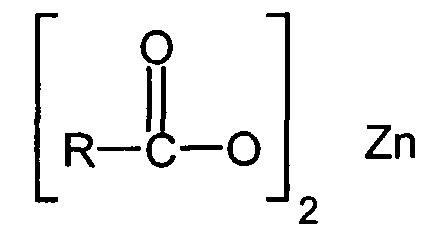
wobei
R für einen -Cio-Rest oder H steht,
mit einer Zn-Konzentration von 0,01 bis 5 mol pro kg Lösung mit
B2) einer Natriumhydroxid-Lösung, welche optional gelöstes KOH enthält, mit einer Konzentration von 1 bis 10 mol OH pro kg Lösung
so in einem Mischelement zusammengeführt und vermischt wird, dass
bl) das molare Verhältnis von OH zu Zn 1,5 bis 1,8 beträgt,
b2) die sich bildende Mischung im Mischelement homogen, d.h. zu einer Mischung mit einheitlicher Dichte, vermischt wird,
die so gebildete Fällungslösung durch Temperierung auf 40 bis 65°C über einen Zeitraum von 5 bis 50 min gereift und abschließend auf eine Temperatur von < 25°C heruntergekühlt wird.
Die erfindungsgemäß hergestellten Zinkoxide haben bevorzugt eine mittlere Primärpartikelgröße von 5 bis 50 nm, ganz besonders bevorzugt von 5 bis 20 nm. Die Bestimmung der Partikelgröße erfolgt durch Ultrazentrifugenmessungen (H.G. Müller, Colloid. Polym. Sei., 267, 1113-1116 (1989)).
Die Partikel haben im wesentlichen, d.h. zu mindestens 60 %, bevorzugt mindestens 80 %, besonders bevorzugt mindestens 95 %, eine sphärische, nahezu kugelförmige Oberfläche, wobei die %-Angaben sich auf die Anzahl genannter Partikel bezogen auf die Gesamtzahl in einem Volumeninkrement befindlichen Teilchen berechnen. Als Bestimmungsmethode werden hierzu TEM- Aufnahmen der erfindungsgemäß hergestellten methanolischen Zinkoxid-Fällungen angefertigt und die Aufnahmen visuell ausgewertet. Zur Probenpräparation wird die zu untersuchende Zinkoxid-Fällung oder Dispersion etwa 1 :1000 mit einer Mischung aus 2 Gewichtsteilen Ethylen- glycol und 1 Gewichtsteil Wasser verdünnt, auf ein TEM-Grid aufgetropft und getrocknet.
Als "sphärisch" bzw. "nahezu kugelförmig" im Sinne der Erfindung werden ZnO-Partikel ver- standen, deren Längen- zu Breitenverhältnis 3:1-1 :1, bevorzugt 2:1-1 :1, besonders bevorzugt 1,5:1-1:1 ist.
Der Anteil an Sekundärpartikeln (hart, irreversibel agglomerierte Primärteilchen) liegt bei den erfindungsgemäßen Verfahren ≤ 20 Gew.-%, bevorzugt < 5 Gew.-%, besonders bevorzugt ≤ 2 Gew.-%, bezogen auf die Gesamtmenge des ausgefällten Zinkoxids. Zu Bestimmung dieses Anteils wird eine 10 gew.-%-ige ZnO Dispersion analog dem Ausfuhrungsbeispiel 6 hergestellt, für 5 Tage bei Raumtemperatur gelagert und anschließend über einen 0,2 μm Cellulose- Membranfilter filtriert. Die Filterrückstände werden getrocknet und gewogen. Der Agglomerat- anteil wird anschließend durch Division der so ermittelten Feststoffmenge durch die in die Bestimmung eingesetzte ZnO-Menge erhalten.
Als Lösungsmittel im erfindungsgemäßen Verfahren werden Mischungen von Methanol mit organischen Lösungsmitteln und/oder Wasser eingesetzt. Bevorzugt werden Methanol/Wasser-
Mischungen verwendet. Besonders bevorzugt ist die Verwendung von Methanol mit weniger als 1 Gew.-%, bevorzugt weniger als 0,5 Gew.-% Wasser. Die Verwendung methanolfreier Lösemittelsysteme führt nicht zur Bildung von Zinkoxid-Partikeln im Sinne der Erfindung.
Die im erfindungsgemäßen Verfahren eingesetzte Zinksalz-Lösung AI) bzw. Bl) wird durch einfaches Lösen des entsprechenden käuflichen Zinksalzes in einem vorstehend beschriebenen methanolischen Lösungsmittel erhalten. Aus ökonomischen Gründen kann auch grobteiliges Zinkoxid in einem methanolischen Lösungsmittel vorgelegt werden und durch Zugabe der entsprechenden Säure und ggf. Wasser in eine Zinksalz-Lösung überführt werden.
Der Rest R in Formel (I) ist bevorzugt aliphatischer oder cycloaliphatischer Natur oder Wasserstoff und steht besonders bevorzugt für H, CH3, C2H5 oder C3H7.
Besonders bevorzugt wird im erfindungsgemäßen Verfahren Zinkacetat ggf. als Dihydrat oder das Reaktionsprodukt aus ZnO mit Essigsäure in AI) bzw. Bl) als Zinksalz eingesetzt.
Diese Lösungen weisen eine Zinkionen-Konzentration von bevorzugt 1 bis 2 mol Zn pro kg Lösung auf.
Die Hydroxid-Lösungen A2) bzw. B2) haben eine Hydroxidionen-Konzentration von bevorzugt 3 bis 6 mol OH pro kg Lösung.
Grundsätzlich kann statt einer methanolischen Kaliumhydroxidlösung auch eine methanolische oder wässrige Natriumhydroxidlösung, die optional Kaliumhydroxid gelöst enthält, verwendet werden. Die Verwendung KOH-haltiger Fällungsmedien (KOH und NaOH/KOH-haltige Lösungen) ist jedoch vorteilhafter gegenüber rein NaOH-haltiger Fällungsmedien und wird daher üblicherweise bevorzugt eingesetzt.
Zur Fällungsreaktion wird die Zinksalz-Lösung AI) bzw. Bl) auf eine Temperatur von 30 bis 65°C, bevorzugt 50 bis 65°C, besonders bevorzugt 55 bis 58°C temperiert.
Die Hydroxid-Lösungen A2) bzw. B2) haben eine Temperatur von 10 bis 65°C, bevorzugt 15 bis 30°C, besonders bevorzugt 18 bis 25°C.
Im erfindungsgemäßen Verfahren beträgt das molare Verhältnis von Base (OH) zu Zn bevorzugt 1,7 - 1,8, besonders bevorzugt 1,72 - 1,78. Grundsätzlich möglich sind auch Verhältnisse von weniger als 1,7 oder mehr als 1,8. Auch bei < 1,7 können Partikel mit den eingangs beschriebenen Größen, Formen und Eigenschaften erhalten werden, jedoch ist die Menge an Zn, welches nicht zu ZnO umgesetzt wird, zu groß (schlechte Raum-Zeit- Ausbeute), so dass das Verfahren unnötig ver-
teuert wird und diese Ausführungsform nicht bevorzugt ist. Bei > 1,8, insbesondere > 1,9 ist die Fällung nicht mehr so zu steuern, dass Partikel mit den eingangs beschriebenen Formen und Eigenschaften erhalten werden. Daher ist >1,8 ebenfalls nicht bevorzugt.
Grundsätzlich können zur Steuerung des Partikelwachstums bzw. der Partikelmorphologie (Form, Oberflächenstruktur) auch Stoffe vor, während oder nach der Fällung zugegeben werden. Dies können Alkoxysilane wie Tetraethylorthosilicat, zwitterionische Verbindungen wie "Betain" (Carboxytrimethylammonium), 6-Aminohexansäure oder die dem Fachmann aus der Kolloidchemie an sich vertrauten oberflächenaktive Substanzen sein. In diesem Zusammenhang sind explizit anionische, kationische oder nichtionische Tenside, Emulgatoren und/oder Stabilisatoren mit Carboxylat-, Sulafonat-, Ammonium- bzw. Polyethergruppen zu nennen.
Das erfindungsgemäße Verfahren wird üblicherweise bei Normaldruck (1013 mbar) durchgeführt, kann aber ebenso bei höheren oder tieferen Drücken durchgeführt werden. Die Verfahrenstemperaturen sind dann dabei entsprechend so anzupassen, dass sie bei diesen Bedingungen nicht oberhalb des Siedepunktes der am leichtesten siedenden Komponente im Verfahren liegen. Für die angegebene Temperaturobergrenze des Verfahrens von 65°C (entsprechend dem Siedepunkt von Methanol bei diesem Druck) bedeutet dies, dass bei Drücken > 1013 mbar die Verfahrensobergrenze der Temperatur entsprechend auf den Siedepunkt des Methanols bei dem dann herrschenden Druck zu steigern bzw. bei niedrigeren Drücken entsprechend zu erniedrigen ist. Eine Temperaturobergrenze im Verfahren von > 65°C ist daher möglich.
Zur Vermischung können im Batch- Verfahren alle zum Stand der Technik zählenden Rühr- und Mischtechniken eingesetzt werden, bevorzugt ist der Einsatz von radial- und horizontal-wirkenden Mischern wie Kreuzbalken- oder MIG-Rührern mit angestellten Blättern in Verbindung mit Stromstörem.
Der Energieeintrag der genannten Rührwerke liegt allgemein bei 0,1 bis 3 Watt pro Liter, bevor- zugt 0,2 bis 0,8 Watt pro Liter.
Die Lösung A2) wird bevorzugt innerhalb von weniger als 6 Minuten zu AI) zugegeben, besonders bevorzugt innerhalb von weniger als 4 Minuten, ganz besonders bevorzugt innerhalb von weniger als 3 Minuten.
Die Temperatur während des Fällungsvorganges beträgt bevorzugt < 65 °C, besonders bevorzugt < 60°C, ganz besonders bevorzugt 55 bis 60°C.
Der anschließende Reifungsprozess wird durch Weiterrühren der Fällungslösung bei bevorzugt 50 bis 65°C, besonders bevorzugt 55 bis 60°C für bevorzugt 20 bis 40 min, besonders bevorzugt 30 bis 35 min durchgeführt.
Die in allen Verfahrensvarianten als Untergrenze der Reifungstemperatur angegebenen 40°C ist die Temperatur ab der die Reifung befriedigend abläuft und ab der daher üblicherweise der Reifungsprozess auch durchgeführt wird. Dies schließt jedoch nicht aus, dass Reifungstemperaturen von < 40°C angewendet werden können.
Das abschließende Herunterkühlen wird durch äußere Kühlung mit einem geeigneten Medium wie Kaltwasser oder Sole erreicht, wobei die Endtemperatur bevorzugt 10 bis 25°C, besonders bevor- zugt 15 bis 20°C beträgt, wodurch ein Weiterwachsen der Partikel zu Primärteilchen > 50 nm, die Bildung von Partikeln mit z.B. stäbchenförmiger Morphologie und/oder das Agglomerieren zu Sekundärpartikeln verhindert wird. Bevorzugt dauert der Kühlungsvorgang der gesamten Fällungslösung weniger als 60 min.
Im kontinuierlich betriebenen Verfahren werden die beiden Lösungen Bl) und B2) in einem Mischelement vom Typ eines statischen Mischers oder eines T- oder Y- Verbindungsstücks ggf. mit nachgeschalteter Mischstrecke kontinuierlich zusammengeführt und vermischt. Die Mischelemente und die Strömungsgeschwindigkeit der Eduktlösungen bzw. die Fällungslösung werden dabei so ausgelegt, dass eine homogene Vermischung innerhalb von bevorzugt weniger als 6, besonders bevorzugt weniger als 4, ganz besonders bevorzugt weniger als 3 Sekunden erreicht wird. Die Zeit bezieht sich dabei auf ein Volumeninkrement, dass zum Zeitpunkt t = 0 beim Zusammentreffen von a) und b) gebildet wird und nach bevorzugt t < 6, besonders bevorzugt < 4, ganz besonders bevorzugt < 3 Sekunden eine einheitliche Dichte aufweist.
Die Fördermenge der Lösungen Bl) und B2) ist bei dem erfindungsgemäßen Verfahren so einzustellen, dass bei gegebener Ausgangstemperatur von Bl) und B2) die Temperatur der Fällungs- lösung bevorzugt < 65°C, besonders bevorzugt < 60°C und ganz besonders bevorzugt 55 bis 60°C beträgt und das vorstehend beschriebene Kriterium der Mischzeit erfüllt ist.
Die anschließende Partikelreifung kann durch Führen der Fällungslösung über eine auf bevorzugt auf 50 bis 65°C, bevorzugt 55 bis 60°C temperierte Verweilzeitstrecke erfolgen, wobei letztere so auszulegen ist, dass die Verweilzeit eines Volumeninkrements der Fällungslösung bevorzugt 20 bis 40 min, besonders bevorzugt 30 bis 35 min beträgt. Das abschließende Herunterkühlen auf bevorzugt 10 bis 25°C, besonders bevorzugt 15 bis 20°C kann z.B. durch Auffangen der an der Verweilzeitstrecke austretenden Fällungslösung in einem Kessel mit ausreichender Mantelkühlung
oder über dem Fachmann an sich bekannte Wärmetauscher des Standes der Technik erfolgen. Alternativ kann auf eine Verweilzeitstrecke verzichtet werden, wobei die gesamte nach der Vermischung anfallende Fällungslösung in einem auf ≤ 20°C, bevorzugt < 10°C (effektive Innentemperatur) gekühlten Rührkessel gesammelt wird und nach einem gewünschten Zeitpunkt ohne weitere Zufuhr von Fällungslösung unter Rühren auf bevorzugt 50 bis 65°C, besonders bevorzugt 55 bis 60°C aufgeheizt wird und für bevorzugt 20 bis 40 min, besonders bevorzugt 30 bis 35 min gereift wird (semi-kontinuierliches Verfahren).
Ebenfalls möglich ist die Fällung in einem Rührkessel unter den bei Batch-Prozess angegebenen Bedingungen, wobei die anfallende Fällung jedoch kontinuierlich abgeführt wird und entweder in einem zweiten Kessel bei Temperaturen < 20°C, bevorzugt < 10°C (effektive Innentemperatur) gesammelt und abschließend gereift wird (vgl. semikontinuierliches Verfahren) oder in einer geeignet ausgelegten Rührkesselkaskade kontinuierlich gereift wird.
Das abschließende Herunterkühlen wird durch äußere Kühlung mit einem geeigneten Medium wie Kaltwasser oder Sole erreicht, wobei die Endtemperatur bevorzugt 15 bis 25°C, besonders bevor- zugt 15 bis 20°C beträgt. Bevorzugt dauert der Kühlungsvorgang der gesamten Fällungslösung weniger als 60 min.
In einer bevorzugten Ausfuhrungsform der Erfindung werden die erfindungsgemäß hergestellten und gereiften Zinkoxid-Fällungen durch Sedimentation im Zentrifugal- oder Erdschwerefeld oder durch Querstrommembranfiltration (Nanofiltration oder Ultrafiltration mittels Keramikmembranen im Multikanalelement, mittlerer Porendurchmesser 5 nm, Fa. Membraflow, Betriebstemperatur 20-65°C, bevorzugt 40-55°C, Membranüberströmung 1-10 m/s, Einrichtung zur Permeatrückspülung) von gelösten Substanzen befreit und aufkonzentriert.
Aus den nach den erfindungsgemäßen Verfahren hergestellten Zinkoxiden bzw. deren Fällungen können Dispersionen in verschiedenen organischen oder wässrigen Lösungsmitteln bzw. -gemischen gegebenenfalls unter Zuhilfenahme von mechanischen oder chemischen Disper- gatoren, wie ionische oder nichtionische Tenside, und/oder oberflächenmodifizierenden Verbindungen wie Alkansäuren und Alkanoaten mit bevorzugt 3 bis 25 C-Atomen, wie z.B. Ölsäure, Aminen, Aminoalkoholen, Alkoxysilanen oder Produkten der Hydrolyse von einem oder mehreren Alkoxysilanen durch wässrige Säuren hergestellt werden.
Die Herstellung der vorstehend genannten Dispersionen erfolgt durch Einrühren der erfindungsgemäß erhältlichen methanolischen Zinkoxid-Fällungen in organische und/oder wässrige Lösemittel bzw. deren Gemische ggfs. unter Zuhilfenahme oberflächenmodifizierender Substanzen.
In einer bevorzugten Ausführungsform wird zur Verbesserung des Dispersionszustandes der Partikel das in den Dispersionen enthaltene Methanol destillativ entfernt.
In einer weiteren bevorzugten Ausführungsform der Erfindung werden Wasser, Monoalkohole, Diole, Aminoalkohole, Alkane, Ether, Ester wie auch deren Mischungen als Lösemittel verwendet.
Ebenfalls bevorzugt ist die Verwendung von Halogenalkanen und Halogenalkan-Alkohol- Mischungen, insbesondere hier Dichlormethan-Methanol und Chloroform-Methanol-Mischungen, wobei hier meist auf einen Zusatz oberflächenmodifizierender Verbindungen verzichtet werden kann.
Durch die Verwendung von Alkansäuren und Alkanoaten mit bevorzugt 3 bis 25 C-Atomen, wie z.B. Ölsäure, Aminen, bevorzugt Alkyl-, Dialkyl- oder Trialkylaminen, als Stabilisatoren ist es möglich, die erfindungsgemäß hergestellten Zinkoxidpartikel auch in unpolaren Lösungsmitteln, wie Ölen, Alkanen und oder Aromaten, als stabile feinteilige Dispersion bereitzustellen.
In einer ebenfalls bevorzugten Ausführungsform wird eine erfindungsgemäß hergestellte Zinkoxid-Fällung unter Rühren mit 10 Gew.-% Wasser bezogen auf das enthaltene ZnO (trocken) versetzt, anschließend wird eine Mischung aus einem Monoalkohol, bevorzugt n-Butanol, mit höchstens 5 Gew.-% Triethanolamin zugegeben und nach 30 minütigem Rühren das enthaltene Methanol destillativ entfernt.
Die Feststoffkonzentration der zur Dispersionsformulierung eingesetzten Zinkoxid-Fällungen beträgt typischerweise 5 bis 80 Gew.-%, bevorzugt 15 bis 40 Gew.-%. Die Leitfähigkeit der methanolischen Phase dieser Fällungen liegt dabei unter 200 mS/cm, bevorzugt unter 15 mS/cm, insbesondere beträgt sie 0,005 bis 5 mS/cm.
Zur Verbesserung des Dispersionsgrades der Partikel können zum Stand der Technik gehörende mechanische Homogenisierungsverfahren verwendet werden, bei denen Geräte wie Hochgeschwindigkeitsrührer (z.B. IKA-Ultra-Turrax® T25 basic, IKA- Werke GmbH & Co KG, D-79219 Staufen), Ultraschalldispergatoren (z.B. UP200S, UP400S, Dr. Hielscher GmbH, D-14513 Berlin) und/oder Strahldispergatoren (Chem. Ing. Tech. (69), 6/97, S. 793-798; EP-A 0 766 7997) eingesetzt werden.
Ein weiterer Gegenstand der Erfindung sind Zinkoxide erhältlich nach dem erfindungsgemäßen Verfahren sowie Dispersionen hergestellt aus denselben.
Unter Verwendung dieser Dispersionen primäφartikulär redispergierter Zinkoxide lassen sich Formkörper und/oder Überzüge beispielsweise mit UV-absorbierender und/oder biozider Wirkung
herstellen. Unter Überzügen werden sowohl Polymere-Systeme zur Beschichtung oder Verklebung von Werkstoffen wie Metalle, Kunststoffe oder Glas als auch Cremes, Salben, Gele oder ähnliche feste oder fließfähige Formulierungen zur Verwendung im kosmetischen oder pharmazeutischen Bereich verstanden. Ebenso können die erfindungsgemäßen Zinkoxide in Kunststoffen, Kau- tschuken, Dicht- und/oder Verklebungsmassen als Füll- und/oder Zusatzstoffe mit z.B. säurebindender oder katalysierender Wirkung eingesetzt werden.
Bevorzugt ist die Verwendung der erfindungsgemäßen Zinkoxide als Vulkanisationscoaktivatoren in Kautschuken und/oder Latexformköφern.
Die erfindungsgemäßen redispergierbaren nanopartikulärem Zinkoxide können - wie erwähnt - als Vulkanisationscoaktivatoren bei der Herstellung von Latices auf Basis von natürlichen und synthetischen Kautschuken aller Art eingesetzt werden.
Als Kautschuke, die für die Herstellung von Latices verwendet werden können, kommen neben den verschiedensten Naturlatexeinstellungen synthetische Kautschuke, wie Naturlatex und synthetische Polyisoprene, gegebenenfalls carboxylierte und oder selbstvernetzende Gruppen aufwei- sende Acrylnitril-Butadien-Copolymerisate, gegebenenfalls carboxylierte und oder selbstvernetzende Gruppen aufweisende Styrol-Butadien-Copolymersate, gegebenenfalls carboxylierte und/oder selbstvernetzende Gruppen aufweisende Acrylnitril-Butadien-Styrol-Copolymerisate, sowie gegebenenfalls carboxylierte Chlorbutadienlatices in Frage. Bevorzugt sind jedoch Naturlatex, carboxylierte Acrylnitril-Butadien-Copolymerisate und Chlorbutadienlatices sowie carboxylierte Chlorbutadienlatices.
Bei der Vulkanisation der verschiedenen Kautschuklatices werden die erfindungsgemäßen Zinkoxiddispersion in Mengen von 2,0 bis 0,01, bevorzugt von 0,5 bis 0,05 Gewichtsteilen, bezogen auf 100 Gewichtsteile einer Latexmischung (trocken/trocken) bei der Vulkanisation eingesetzt.
Die eingesetzten Zinkoxiddispersionen haben typischerweise einen ZnO-Gehalt von 5 bis 40 Gew.-%, bevorzugt 15 bis 35 Gew.-%, wobei als Dispersionsmedium alle wässrigen Medien, bevorzugt Mischungen aus Ethylenglycol/Wasser, Triethanolamin/Wasser oder Ethylengly- col/Wasser/Triethanolamin in Betracht kommen. Das Gewichtsverhältnis von Ethylenglycol/Wasser beträgt dabei bevorzugt 5 : 1 bis 1 : 1 , besonders bevorzugt 2,5 : 1 bis 1 ,5 : 1. Das Gewichtsverhältnis von Triethanolamin/Wasser beträgt bevorzugt 1 : 5 bis 1 : 1, besonders bevorzugt 1 : 2,5 bis 1 : 1,5. Das Gewichtsverhältnis von Ethylenglycol/Wasser/Triethanolamin beträgt bevorzugt 10 : 5 : 5 bis 10 : 5 : 0,1, besonders bevorzugt 10 : 5 : 2 bis 10 : 5 : 0,5.
Beispiele:
Der Gehalt an Zinkoxid wurde analog DE-A 199 07 704 über UV-spektroskopische Absoφtions- messungen oder nach Lösen des Zinkoxids mit Eisessig oder Ammoniak über volumetrische Titration mit EDTA unter Verwendung von Indikatoφuffertabletten bestimmt.
Beispiel 1: Herstellung von nano-ZnO aus Zinkoxid
240,35 g Zinkoxid (techn. 99,8 Gew.-%) wurden in 1320 g Methanol (techn. 99,9 Gew.-%) vorgelegt und auf 50°C temperiert. Durch Zugabe von 355,74 g Eisessig (techn. 99,9 Gew.-%) und 51,15 g VE-Wasser wurde der Feststoff gelöst und anschließend auf 55°C temperiert. Zur Beseitigung ungelöster Anteile ZnO wurde in 3 Portionen insgesamt 34,36 g KOH (techn. 90,22 Gew.-%) zugegeben. Man ließ 40 Minuten nachrühren und gab anschließend innerhalb von 2 Minuten eine Lösung von 290,00 g KOH (techn. 90,22 Gew.-%) in 660,00 g Methanol zu. Während des gesamten Fällungsvorganges betrug die Reaktionstemperatur 60°C. Nach einer Reifungszeit von 35 min. wurde der Reaktionsansatz innerhalb von 10 Minuten durch äußere Eiskühlung auf Raumtemperatur gekühlt.
Beispiel 2: Herstellung von nano-ZnO aus Zinkacetatdihydrat
In einem Kessel wurden unter Stickstoffbeschleierung 19800 g Methanol vorgelegt und 9626 g KOH vorsichtig unter äußerer Kaltwasserkühlung portionsweise zugegeben. Nach 60 minütigem Nachrühren war der Lösungsvorgang beendet. In einem zweiten Kessel wurden bei Raumtemperatur ebenfalls unter inerten Bedingungen 19338 g Zinkacetatdihydrat in 39600 g Methanol vorgelegt. Dann wurde unter intensivem Rühren (MIG-Rührer, 0,5 W/1) auf 50°C erhitzt und für 30 min gerührt. Nach 60 min wurde die Innentemperatur auf 55°C gesteigert und 3130 g der hergestellten KOH/MeOH-Lösung wurde zu der kräftig gerührten Zinkacetatlösung gegeben. Dabei klarte der Ansatz weitgehend auf. Nach insgesamt 30 min nach KOH-Zugabe wurde die eigentliche Fällung durch Überführung der Hauptmenge der methanolischen KOH-Lösung inner- halb von 5 min eingeleitet. Dabei stiegt die Temperatur auf 58°C. Nach beendeter Überführung wurde auf 60°C aufgeheizt und die Temperatur für 35°C gehalten. Anschließend wurde durch äußere Kaltwasserkühlung auf 20°C abgekühlt.
Beispiel 3: Reinigung und Aufkonzentration einer ZnO-Fällung hergestellt nach Beispiel 1
Durch Sedimentation der ZnO-Teilchen der nach Beispiel 1 hergestellten Fällungen für die Dauer von 12 Stunden im Erdschwerefeld wurden die Partikel verdichtet, anschließend der klare methanolische Überstand über eine Lanze mit angeschlossener Pumpe abgehoben, unter Rühren 550 g
frisches Methanol zugegeben und für weitere 12 Stunden sedimentieren gelassen. Diese Prozedur wurde noch 4 mal wiederholt bis die Leitfähigkeit des abgehobenen Methanols bei 1 ,9 mS/cm war. Die verdichtete Zinkoxid-Fällung hatte einen ZnO-Gehalt von 37.0 Gew.-%.
Beispiel 4: Herstellung eines 6-Aminohexansäure stabilisierten Hydrosols
54,1 g (Gehalt ZnO: 37,0 Gew.-%, entsprechend 20 g ZnO) der gewaschenen Fällung aus Beispiel 3 wurden mit einer Lösung aus 1 g 6-Aminohexansäure in 200 g dispergiert. Anschließend wurde die Gesamtmenge der Dispersion mittels Rotationsverdampfer, bei 45°C Badtemperatur und 100 mbar Druck auf 200 g eingeengt, wobei eine transluzente, langzeitstabile Dispersion primäφartikulär redispergierter Teilchen erhalten wurde.
Beispiel 5: Herstellung eines Sols in Triethanolamin/Wasser
54,1 g (Gehalt ZnO: 37,0 Gew.-%, entsprechend 20 g ZnO) der gewaschenen Fällung aus Beispiel 3 wurden in 180 g einer Mischung aus Triethanolamin und destilliertem Wasser (Gewichts-Verhältnis 1:1) dispergiert. Anschließend wurde die Gesamtmenge der Dispersion mittels Rotationsverdampfer bei 45°C Badtemperatur und 100 mbar Druck auf 200 g eingeengt, wobei eine transluzente, langzeitstabile Dispersion primäφartikulär redispergierter Teilchen erhalten wurde.
Beispiel 6: Herstellung eines Sols in Ethylenglykol/Wasser/Triethanolamin
62,5 g (Gehalt ZnO: 32,0 Gew.-%, entsprechend 20 g ZnO) einer nach Beispiel 3 ZnO Fällung wurden in 180 g einer Mischung aus Ethylenglycol/Wasser/Triethanolamin (Gewichts-Verhältnis 10:5:1) dispergiert. Anschließend wurde die Gesamtmenge der Dispersion mittels Rotationsver- dampfer bei 45°C Badtemperatur und 100 mbar Druck auf 200 g eingeengt, wobei eine transluzente, langzeitstabile Dispersion primäφartikulär redispergierter Teilchen erhalten wurde.
Beispiel 7: Herstellung eines Sols in Ethylenglykol/Wasser
62,5 g (Gehalt ZnO: 32,0 Gew.-%, entsprechend 20 g ZnO) einer nach Beispiel 3 gewaschenen Fällung wurden in 180 g einer 2:1 -Mischung (bezogen auf Gewicht) aus Ethylenglycol/Wasser dispergiert. Anschließend wurde die Gesamtmenge der Dispersion mittels Rotationsverdampfer bei 45°C Badtemperatur und 100 mbar Druck auf 200 g eingeengt, wobei eine transluzente, langzeitstabile Dispersion primäφartikulär redispergierter Teilchen erhalten wurde.
Beispiel 8: Herstellung eines Organosols in CH?C
Eine nach Beispiel 1 hergestellte ZnO-Fällung wurde 4 Stunden absitzen gelassen. Der Überstand (2043 g , Leitfähigkeit 24,3 mS) wurde abgehoben und der Bodensatz für 30 Minuten mit 600 g Methanol gerührt. Die Dispersion primäφartikulär redispergierbarer Teilchen wurde anschließend für 30 Minuten bei 5500 U/min in einer Laborzentrifuge (Firma Haraeus Variofuge RF, Rotorradius 20,4 cm) zentrifugiert. Der transparente Überstand (837 g, Leitfähigkeit 15,7 mS) wurde abdekantiert. Der feste Rückstand (263,1 g) wurde mit 263,1 g Dichlormethan redispergiert. Die hergestellte Dispersion primäφartikulär redispergierter ZnO-Partikel hatte ein Gewicht von 508,3 g. Nach Absetzen über 72 h wurde diese für 30 Minuten bei 5500 U/min zentrifugiert und über einen 1 μm Filter druckfiltriert. Es entstand eine transluzente, langzeitstabile Dispersion primärpartikulär redispergierter Teilchen.
Beispiel 9: Herstellung eines Organosols in Butanol Triethanolamin
71,6 g einer nach Beispiel 1 hergestellten und nach Beispiel 3 gewaschenen Fällung (34,8 Gew.-% ZnO, Leitfähigkeit der flüssigen Phase 3 mS/cm) wurde mit 28,4 g einer 4 gew.-%-igen Lösung von Triethanolamin in n-Butanol unter Rühren versetzt. Zur Verbesserung des Dispersionsgrades der Primäφartikel wurde die erhaltene Dispersion durch einmalige Behandlung mit einem Düsenstrahldispergator bei 400 bar homogenisiert. Es entstand eine transluzente, langzeitstabile Dispersion primäφartikulär redispergierter Teilchen.
Beispiel 10: Redispergierbare Zinkoxide in Latexformkörpern
Verwendung der aus Beispiel 6 erhaltenen Dispersion zur Herstellung von Latexformköφern
167 g eines Naturlatex der Type HA (nach ISO 2004 Spezifikation) wurde mit 5,0 Gewichtsteilen einer 10 gew.-%-igen wässrigen Kalilauge Lösung und mit 0,70 Gewichtsteilen einer 20 gew.-%- igen Kaliumlaurat-Lösung als Stabilisator bei Raumtemperatur unter Rühren gemischt. Dann wurden 20,6 Gewichtsteile einer Vulkanisationspaste, bestehend aus 1,5 Gew.-Teilen kolloidalem Schwefel, 0,6 Gew.-Teilen Zink-Dithiocarbamat (ZDBC), 1,5 Gew.-Teilen Zink-Merkapto-benzo- thiazol (ZMBT), 1,5 Gew.-Teilen eines Alterungsschutzmittels auf Phenolbasis, sowie 15,5 Gew.- Teile einer 5 gew.-%-igen wässrigen Lösung eines Dispergators bestehend aus einem Na-Salz eines Kondensationsproduktes aus Naphtalinsulfonsäure und Formaldehyd zugesetzt. Zusätzlich wurden 0,25 Gew.-Teile einer im Handel befindlichen Colophonium Wax Emulsion (Michemlube® 124, Michelman, Inc., 9080 Shell Road, Cincinnati, Ohio 45236-1299 USA) zugesetzt.
Der Feststoffgehalt dieses Latexcompounds betrug 56 Gew.-%.
Die Angabe Gew.-Teile (Gewichtsteile) bezieht sich auf 100 Gewichtsteile Kautschuk Trockensubstanz, dies entspricht 167 Gewichtsteilen Naturlatex nass.
Der Vulkanisationscoaktivator ZnO wurde nun auf zwei unterschiedliche Weisen zugegeben:
a) Die entsprechende Menge Zinkoxid wurde unmittelbar in Anschluss an die vorstehenden
Schritte oder
b) erst 2 h nach den vorstehenden Schritte unter Rühren zugegeben.
Einsatzmengen Zinkoxid:
Versuchsreihe 10-A mit 0,05 Gew.-Teilen Zinkoxid, hergestellt nach Beispiel 6 (erfindungs- gemäß)
Versuchsreihe 10-B mit 2,0 Gew.-Teilen Zinkoxid Weißsiegel (Oberfläche 10m2/g; Hersteller Grillo Zinkoxid GmbH, DE; Pulverform) (Vergleich)
Versuchsreihe 10-C mit 1,0 Gew.-Teilen Zinkoxyd aktiv (Oberfläche mindestens 45 m2/g; Hersteller Bayer AG, DE; Pulverform) (Vergleich)
In Anschluss daran erfolgte jeweils der Reifungsprozess (Maturation) für 48 Stunden unter ständigem Rühren bei 50 U/min bei einer Temperatur von 40°C. Dieser gereifte Compound wurde danach über ein 100 μm Filter filtriert, um eventuelle Koagulatanteile zu beseitigen. Nach 10 minütigem Stehenlassen des filtrierten Latex erfolgte der Tauchprozess zur Herstellung von Probe- köφern. Dazu wurden leicht sandgestrahlte Glasplatten (Dimension 100x180x4 mm) für 10 Sekunden in eine 15 gew.-%-ige Calciumnitratlösung als Koagulantlösung getaucht und getrocknet. Auf diese Weise wurde eine Filmabscheidung von ca. 0,30 mm erreicht. Die so hergestellten Filme wurden dann bei 80°C in Heißluft für Dauer 30 min getrocknet und anschließend bei 120°C für 15 min vulkanisiert.
Nach einer Konditionierungsphase von 24 h im Normklima wurden die erhaltenen Probeköφer ungealtert einer Materialprüfung unterzogen, wobei die Modulis (M300: Modul bei 300 % Dehnung), die Festigkeit (F-Max) und die Bruchdehnung (Bruch-D: Dehnung bis zum Bruch) ermittelt wurden (Zwick Prüfgerät gemessen nach DIN 53 504, Probeköφer S2, sowie ISO 37).
Tabelle 1: Festigkeitswerte ohne Thermoalterung
Beispiel M300 F-Max Bruch-D
TMPal fMPal r%ι
10-A a) 1,7 21,9 774
10-A b) 1,5 24,9 832
10-B a) 2,0 18,3 619
10-B b) 1,5 21,6 774
10-C a) 2,3 15,7 569
10-C b) 2,4 14,1 552
Die Ergebnisse zeigen, dass das erfindungsgemäß hergestellte Zinkoxid trotz wesentlich niedrigerer Dosierung vergleichbare Festigkeitswerte liefert wie bei Verwendung von 2,0 Gew.-Teilen Zinkoxid Weißsiegel oder 1,0 Gew.-Teilen eines Zinkoxides mit hoher Oberfläche. Der Modul bei 300 % Dehnung ist bei Verwendung des erfindungsgemäß hergestellten Zinkoxids deutlich niedriger als bei den Vergleichsproben mit nicht erfindungsgemäß eingesetztem Zinkoxiden. Dieser Effekt führt zu einem höheren Tragekomfort, der zum Beispiel bei für die Herstellung von Latexhandschuhen von Bedeutung ist. Die Bruchdehnung im Fall der erfindungsgemäßen Versuchsreihe 10-A zeigt ebenfalls höhere Werte als die der Vergleichsprüfungen 10-B und 10-C.
Zur Beurteilung der Alterungsbeständigkeit wurden die Probenköφer anschließend in Heißluft bei 100°C für 8 und 16 h gelagert und die o.g. Festigkeitswerte erneut bestimmt:
Tabelle 2: Festigkeitswerte nach Thermoalterung, 8h bei 100°C
Beispiel M300 F-Max Bruch-D
TMPal [MPal r%ι
10-A a) 1,7 18,6 745
10-A b) 1,5 23,2 816
10-B a) 2,5 15,4 566
10-B b) 1,4 20,5 798
10-C a) 2,8 11,8 510
10-C b) 2,8 12,1 495
Tabelle 3: Festigkeitswerte nach Thermoalterung, 16h bei 100°C
Beispiel M300 F-Max Bruch-D
TMPal TMPal r%ι
10-A a) 1,7 17,3 728
10-A b) 1,6 21,4 789
10-B a) 2,6 13,2 526
10-B b) 1,4 18,7 785
10-C a) 2,9 10,1 478
10-C b) 2,8 6,2 453
Die Beurteilung nach der Alterung zeigt deutliche Verbesserungen in der Stabilität nach 8 und 16 Stunden Lagerung in Heißluft bei 100°C im Fall der Versuchsreihen 10-A a) und b) (bessere Alterungsbeständigkeit).
Beispiel 11
167 g eines Naturlatex der Type HA (nach ISO 2004 Spezifikation) wurde mit 5,0 Gewichtsteilen einer 10 gew.-%-igen wässrigen Kalilauge Lösung und mit 1,25 Gewichtsteilen einer 20 gew.-%- igen Kaliumlaurat-Lösung als Stabilisator bei Raumtemperatur unter Rühren gemischt. Dann wurden 7,8 Gewichtsteile einer Vulkanisationspaste bestehend aus 1 ,0 Gew.-Teilen kolloidalem Schwefel, 0,6 Gew.-Teilen Zink-Dithiocarbamat (ZDBC), 0,3 Gew.-Teilen Zink-Merkapto-benzo- thiazol (ZMBT), 1 ,0 Gew.-Teilen eines Alterungsschutzmittels auf Phenolbasis, sowie Zugabe von 4,9 Gew.-Teile einer 5 gew.-%-igen wässrigen Lösung eines Dispergators bestehend aus einem Na-Salz eines Kondensationsproduktes aus Naphtalinsulfonsäure und Formaldehyd zugesetzt.
Anschließend wurden unter Rühren die angegebenen Mengen Zinkoxid zugegeben. 11-A: 0,05 Gew.-Teile eines nach Beispiel 6 und
11-B: 0,05 Gew.-Teile eines nach DE-A 199 07 704 hergestellten Zinkoxids 10 Gew.-% in Ethylenglycol/Wasser (1 : 1)),
11-C: 1,0 Gew.Teile Zinkoxid WS (Oberfläche 10 m g, Hersteller Grillo Zinkoxid GmbH, DE;
Pulverform), eingesetzt als 50 gew.-%-ige wässrige Paste 11-D: 0,5 Gew.-Teile Zinkoxyd aktiv (Oberfläche mindestens 45 m /g; Bayer AG, DE; Pulverform), eingesetzt als 5 gew.-%-ige wässrige Paste
Diesen Mischungen wurde dann durch Zugabe von Wasser auf eine Feststoffkonzentration von 45 Gew.-% eingestellt.
Im Anschluss daran erfolgte jeweils der Reifungsprozess (Maturation) für 48 Stunden unter ständigem Rühren bei 50 U/min bei einer Temperatur von 40°C. Dieser gereifte Compound wurde danach über ein 100 μm Filter filtriert, um eventuelle Koagulatanteile zu beseitigen. Nach 10 minütigem Stehenlassen des filtrierten Latex erfolgte der Tauchprozess zur Herstellung von Probeköφern. Dazu wurden Glasplatten (wie in Beispiel 10 beschrieben) für 10 Sekunden in eine 15 gew.-%-ige Calciumnitratlösung als Koagulantlösung getaucht und getrocknet. Auf diese Weise wurde eine Filmabscheidung von ca. 0,30 mm erreicht. Die so hergestellten Filme wurden dann bei 80°C in Heißluft für Dauer 30 min getrocknet und anschließend bei 120°C für 15 min vulkanisiert.
Nach einer Konditionierungsphase von 24 h im Normklima wurden die erhaltenen Probeköφer ungealtert einer Materialprüfung unterzogen, wobei die Modulis (M300 bzw. M700: Modul bei 300 bzw. 700 % Dehnung), die Festigkeit (F-Max) und die Bruchdehnung (Bruch-D: Dehnung in % bis zum Bruch) ermittelt wurden (Zwick Prüfgerät gemessen nach DIN 53 504, Probeköφer S2, sowie ISO 37).
Tabelle 4: Festigkeitswerte ohne Thermoalterung
Beispiel M300 M 700 F-Max Bruch-D
[MPal TMPal [MPal [%1
HA 1,1 7,1 23,6 934
11B 1,4 8,6 22,1 857
11C 1,5 13,4 26,2 829
HD 1,6 19,1 21,7 725
Das erfindungsgemäße nanopartikuläre Zinkoxid nach Beispiel 6 zeigt höhere Festigkeiten, einen niedrigeren Modul und eine höhere Bruchdehnung dies im Vergleich zu dem bereits beschriebenen nanopartikulären Zinkoxid aber auch gegenüber den in der Praxis eingesetzten Zinkoxid Typen.
Zur Beurteilung der Alterungsbeständigkeit wurden die Probenköφer anschließend in Heißluft bei 100°C für 8 und 16 h gelagert und die o.g. Festigkeitswerte erneut bestimmt:
Tabelle 5: Festigkeitswerte nach Thermoalterung, 8h bei 100°C
Beispiel M300 M 700 F-Max Bruch-D
TMPal TMPa rMPal r%ι
HA 1,2 6,7 23,6 923
11B 1,5 12,1 18,7 764
11C 1,5 12,1 22,7 797
HD 1,7 17,2 21,2 735
Tabelle 6: Festigkeitswerte nach Thermoalterung, 16h bei 100°C
Beispiel M300 M 700 F-Max Bruch-D
PVIPal TMPal TMPal F%1
HA 1,1 5,9 21,4 921
11B 1,5 10,7 17,3 770
11C 1,6 17,2 21,8 734
HD 1,8 18,8 669
Auch nach der Alterung zeigt sich erneut die verbesserte Alterungsbeständigkeit. Dies kommt insbesondere zum Ausdruck auf die kaum vorhanden Einbuße in der Festigkeit gegenüber allen anderen Zinkoxid Typen und im besonderen ist kein Anstieg in den Modulwerten zu erkennen. Die ermittelte Bruchdehnung ist nahezu unverändert, hingegen nimmt die Bruchdehnung bei den zu vergleichenden Zinkoxid Typen deutlich bis zu 100 % ab.
Claims
Patentansprüche
1. Verfahren zur batch- weisen Herstellung von Zinkoxidpartikeln bei dem
AI) eine methanolische Lösung von Zinksalzen der allgemeinen Formel (I)

wobei
R für einen Cι-Cιo-Rest oder H steht,
mit einer Zinkionen-Konzentration von 0,01 bis 5 mol Zn pro kg Lösung mit
A2) einer methanolischen Kaliumhydroxid-Lösung mit einer Hydroxidionen-Konzentration von 1 bis 10 mol OH pro kg Lösung
in einem molaren Verhältnis von OH zu Zn von 1,5 bis 1,8 unter Rühren versetzt wird, die nach beendeter Zugabe erhaltene Fällungslösung bei einer Temperatur von 40 bis 65°C über einen Zeitraum von 5 bis 50 min gereift und abschließend auf eine Temperatur von <25°C heruntergekühlt wird.
Verfahren zur kontinuierlichen Herstellung von Zinkoxidpartikeln, bei dem
Bl) eine methanolische Lösung von Zinksalzen der allgemeinen Formel I

wobei
R für einen C Cι0-Rest oder H steht,
mit einer Zinkionen-Konzentration von 0,01 bis 5 mol Zn pro kg Lösung mit
B2) einer methanolischen Kaliumhydroxid-Lösung mit einer Hydroxidionen-Konzentration von 1 bis 10 mol OH pro kg Lösung
so in einem Mischelement zusammengeführt und vermischt wird, dass
bl) das molare Verhältnis von OH zu Zn 1,5 bis 1,8 beträgt,
b2) die sich bildende Mischung im Mischelement homogen, d.h. zu einer Mischung mit einheitlicher Dichte, vermischt wird,
die so gebildete Fällungslösung durch Temperierung auf 40 bis 65°C über einen Zeitraum von 5 bis 50 min gereift und abschließend auf eine Temperatur von < 25°C heruntergekühlt wird.
3. Verfahren zur batch- weisen Herstellung von Zinkoxidpartikeln bei dem
AI) eine methanolische Lösung von
Zinksalzen der allgemeinen Formel I

wobei
R für einen Cι-Cιo-Rest oder H steht,
mit einer Zinkionen-Konzentration von 0,01 bis 5 mol Zn pro kg Lösung mit
A2) einer Natriumhydroxid-Lösung, welche optional gelöstes KOH enthält, mit einer
Hydroxidionen-Konzentration von 1 bis 10 mol OH pro kg Lösung
in einem molaren Verhältnis von OH zu Zn von 1,5 bis 1,8 unter Rühren versetzt wird, die nach beendeter Zugabe erhaltene Fällungslösung bei einer Temperatur von 40 bis 65°C über einen Zeitraum von 5 bis 50 min gereift und abschließend auf eine Temperatur von < 25°C heruntergekühlt wird.
4. Verfahren zur kontinuierlichen Herstellung von Zinkoxidpartikeln, bei dem
B 1 ) eine methanolische Lösung von
Zinksalzen der allgemeinen Formel I

wobei
R für einen -Cio-Rest oder H steht,
mit einer Zinkionen-Konzentration von 0,01 bis 5 mol Zn pro kg Lösung mit
B2) einer Natriumhydroxid-Lösung, welche optional gelöstes KOH enthält, mit einer Hydroxidionen-Konzentration von 1 bis 10 mol OH pro kg Lösung
so in einem Mischelement zusammengeführt und vermischt wird, dass
bl) das molare Verhältnis von OH zu Zn 1,5 bis 1,8 beträgt,
b2) die sich bildende Mischung im Mischelement homogen, d.h. zu einer Mischung mit einheitlicher Dichte, vermischt wird,
die so gebildete Fällungslösung durch Temperierung auf 40 bis 65 °C über einen Zeitraum von 5 bis 50 min gereift und abschließend auf eine Temperatur von < 25°C heruntergekühlt wird.
5. Verfahren nach einem der Ansprüche 1 bis 4, dadurch gekennzeichnet, dass das Verhältnis von OH:Zn 1,7-1,8 beträgt und als methanolische Zinksalzlösung eine methanolische
Zinkacetatlösung verwendet wird.
6. Zinkoxidpartikel erhältlich nach einem Verfahren gemäß einem der Ansprüche 1 bis 5.
7. Dispersionen enthaltend Zinkoxidpartikel gemäß Anspruch 6.
8. Dispersionen gemäß Anspruch 7, dadurch gekennzeichnet, dass sie einen Gehalt an Zink- oxid von 5 bis 40 Gew.-% aufweisen.
9. Dispersionen gemäß Anspruch 7 oder 8, dadurch gekennzeichnet, dass sie als Dispersionsmedium Wasser in Abmischungen mit Ethylenglycol und/oder Triethanolamin enthalten.
10. Verwendung der Zinkoxidpartikel nach Anspruch 6 als Füll- und/oder Zusatzstoffe in Kunststoffen, Kautschuken, Dicht- und oder Verklebungsmassen.
11. Verwendung der Zinkoxidpartikel nach Anspruch 6 als Vulkanisationscoaktivator in Kautschuken.
12. Verwendung der Zinkoxidpartikel nach Anspruch 6 als UV- Absorber.
13. Verwendung der Zinkoxidpartikel nach Anspruch 6 als fungizider und/oder biozider Wirkstoff.
14. Überzüge und Formköφer enthaltend Zinkoxidpartikel nach Anspruch 6.
Applications Claiming Priority (2)
| Application Number | Priority Date | Filing Date | Title |
|---|---|---|---|
| DE10324305.4 | 2003-05-30 | ||
| DE10324305A DE10324305A1 (de) | 2003-05-30 | 2003-05-30 | Verfahren zur Herstellung sphärischer Zinkoxidpartikel |
Publications (1)
| Publication Number | Publication Date |
|---|---|
| WO2004106237A1 true WO2004106237A1 (de) | 2004-12-09 |
Family
ID=33441441
Family Applications (2)
| Application Number | Title | Priority Date | Filing Date |
|---|---|---|---|
| PCT/EP2004/005795 Ceased WO2004106237A1 (de) | 2003-05-30 | 2004-05-28 | Verfahren zur herstellung sphärischer zinkoxidpartikel |
| PCT/EP2004/005798 Ceased WO2004106423A2 (de) | 2003-05-30 | 2004-05-28 | Lösemittelhaltige zusammensetzungen auf basis von polychloropren |
Family Applications After (1)
| Application Number | Title | Priority Date | Filing Date |
|---|---|---|---|
| PCT/EP2004/005798 Ceased WO2004106423A2 (de) | 2003-05-30 | 2004-05-28 | Lösemittelhaltige zusammensetzungen auf basis von polychloropren |
Country Status (9)
| Country | Link |
|---|---|
| US (2) | US20040241085A1 (de) |
| EP (1) | EP1633809A2 (de) |
| JP (1) | JP4339357B2 (de) |
| KR (1) | KR100806014B1 (de) |
| CN (2) | CN1842563B (de) |
| CA (1) | CA2527561C (de) |
| DE (1) | DE10324305A1 (de) |
| TW (2) | TW200505799A (de) |
| WO (2) | WO2004106237A1 (de) |
Cited By (3)
| Publication number | Priority date | Publication date | Assignee | Title |
|---|---|---|---|---|
| CN109133151A (zh) * | 2018-10-31 | 2019-01-04 | 江苏伊顿航天材料股份有限公司 | 一种制备密封圈用氧化锌的方法 |
| CN111484817A (zh) * | 2020-05-27 | 2020-08-04 | 广东泰强化工实业有限公司 | 一种高性能水性氯丁喷胶及其制备方法 |
| JP7801107B2 (ja) | 2017-05-05 | 2026-01-16 | ティコナ・エルエルシー | 耐化学薬品性であるポリオキシメチレンポリマー組成物 |
Families Citing this family (20)
| Publication number | Priority date | Publication date | Assignee | Title |
|---|---|---|---|---|
| US7683098B2 (en) * | 1996-09-03 | 2010-03-23 | Ppg Industries Ohio, Inc. | Manufacturing methods for nanomaterial dispersions and products thereof |
| DE102005025719A1 (de) * | 2005-06-04 | 2006-12-07 | Solvay Infra Bad Hönningen GmbH | Verfahren zum Erzeugen einer Dispersion von desagglomeriertem Bariumsulfat in Kunststoffen oder Kunststoffvorstufen |
| CN100348673C (zh) * | 2005-06-15 | 2007-11-14 | 中国科学院金属研究所 | 一种高固含量贮存稳定的纳米氧化锌浓缩浆及其制备工艺 |
| EP1818380A1 (de) * | 2006-02-08 | 2007-08-15 | Solvay Infra Bad Hönningen GmbH | Dispersionsklebstoff |
| DE102006045384A1 (de) * | 2006-09-26 | 2008-04-03 | H.C. Starck Gmbh | Wässrige Siliciumdioxid Dispersionen für Klebstoffformulierungen |
| CN100420632C (zh) * | 2007-01-22 | 2008-09-24 | 南京大学 | 一种氧化锌纳微别针的合成方法 |
| BRPI0703285B1 (pt) * | 2007-07-26 | 2017-06-20 | Oxiteno S/A Indústria e Comércio | Balanced solutions of non-toluene solvents for polychloroprene resin based contact adhesives comprising a plurality of miscible solvents |
| DE102008009390A1 (de) * | 2007-08-24 | 2009-02-26 | Bayer Materialscience Ag | Niedrigviskose wässrige Klebstoff-Polymer-Dispersionen |
| BRPI0821878A2 (pt) | 2008-01-04 | 2019-09-10 | Bard Inc C R | composições, métodos de cura de látex de poliisopreno sintético e cateter de drenagem urinária não residente |
| US8795573B2 (en) | 2008-06-30 | 2014-08-05 | C.R. Bard, Inc. | Polyurethane/polyisoprene blend catheter |
| EP2328842A1 (de) * | 2008-08-13 | 2011-06-08 | Basf Se | Verfahren zur herstellung von nanopartikelförmigem zinkoxid |
| JP5270395B2 (ja) * | 2009-02-12 | 2013-08-21 | 東洋ゴム工業株式会社 | スチールコード被覆用ゴム組成物及び空気入りタイヤ |
| DE102010035110A1 (de) * | 2010-08-23 | 2012-02-23 | Osram Opto Semiconductors Gmbh | Polymerkomposit, Verwendung des Polymerkomposits und optoelektronisches Bauelement enthaltend das Polymerkomposit |
| CN103972466B (zh) * | 2014-05-15 | 2016-05-04 | 武汉瀚兴日月电源有限公司 | 一种高温锂亚硫酰氯电池的正极及其制备方法 |
| US10011333B2 (en) * | 2016-06-01 | 2018-07-03 | Shei Chung Hsin Ind. Co., Ltd. | Multi-layer wetsuit material and wetsuit |
| WO2020089163A1 (de) * | 2018-10-31 | 2020-05-07 | Covestro Deutschland Ag | Kompositbauteil enthaltend ein polychloropren- und/oder polyurethan-bindemittel |
| CN111592840A (zh) * | 2020-07-01 | 2020-08-28 | 邹小平 | 一种氯丁型高闪点的胶粘剂及其制备方法 |
| CN112409656A (zh) * | 2020-10-15 | 2021-02-26 | 扬州千裕电气有限公司 | 一种陶瓷橡胶密封材料 |
| EP4308662B1 (de) | 2021-03-17 | 2025-01-15 | Henkel AG & Co. KGaA | Kontaktklebstoffzusammensetzung auf basis von chloroprenkautschuk |
| WO2023170014A1 (en) | 2022-03-11 | 2023-09-14 | Arlanxeo Deutschland Gmbh | Eco-friendly adhesive formulation containing 2-methyl tetrahydrofuran |
Citations (5)
| Publication number | Priority date | Publication date | Assignee | Title |
|---|---|---|---|---|
| JPS57149827A (en) * | 1981-03-06 | 1982-09-16 | Osaki Kogyo Kk | Manufacture of zinc oxide |
| JP2000290014A (ja) * | 1999-04-01 | 2000-10-17 | Kao Corp | 酸化亜鉛分散液の製造方法 |
| WO2001083603A1 (en) * | 2000-05-04 | 2001-11-08 | Elementis Uk Ltd | Biostatic agent |
| US20010044020A1 (en) * | 2000-04-14 | 2001-11-22 | Steffen Hofacker | Plastics stabilized with zinc oxide-containing, abrasion-resistant multilayers |
| EP1157064A1 (de) * | 1999-02-23 | 2001-11-28 | Bayer Aktiengesellschaft | Nanopartikuläre, redispergierbare zinkoxidgele |
Family Cites Families (24)
| Publication number | Priority date | Publication date | Assignee | Title |
|---|---|---|---|---|
| US1253668A (en) | 1917-03-09 | 1918-01-15 | Andrew J Chappell | Vehicle-brake. |
| US2234215A (en) | 1939-03-28 | 1941-03-11 | Du Pont | Plastic polymeric derivatives of chloroprene and process of producing the same |
| US3397173A (en) | 1964-03-10 | 1968-08-13 | Du Pont | Stable chloroprene-sulfur copolymer |
| US3422045A (en) | 1966-07-27 | 1969-01-14 | Du Pont | Process for improved flex-resistance of sulfur-modified polychloroprene |
| US3920623A (en) | 1972-02-18 | 1975-11-18 | Du Pont | Treatment of chloroprene-sulfur copolymers with benzothiazole sulfenamides |
| US3887539A (en) * | 1973-04-30 | 1975-06-03 | Union Carbide Corp | Adhesive compositions |
| US4141875A (en) | 1974-02-13 | 1979-02-27 | E. I. Du Pont De Nemours And Company | Polychloroprene-polyvinyl alcohol latex |
| US3929752A (en) | 1974-04-05 | 1975-12-30 | Du Pont | Preparation of sol chloroprene polymers |
| US3932355A (en) | 1974-06-19 | 1976-01-13 | E. I. Du Pont De Nemours And Company | Preparation of sol chloroprene polymers |
| US4124754A (en) | 1976-12-14 | 1978-11-07 | E. I. Du Pont De Nemours And Company | Polymerization process with subsequent peptization |
| US4410446A (en) * | 1979-06-07 | 1983-10-18 | Petrolite Corporation | Zinc oxide dispersions by decomposition of zinc acetate |
| US4288254A (en) * | 1979-07-27 | 1981-09-08 | Nl Chem Canada Inc. | Predispersed slurry of titanium dioxide |
| US4704441A (en) | 1982-12-17 | 1987-11-03 | Bayer Aktiengesellschaft | Process for the polymerization of chloroprene |
| JPS6031510A (ja) | 1983-07-28 | 1985-02-18 | Toyo Soda Mfg Co Ltd | 硫黄変性クロロプレン重合体の製法 |
| US4808398A (en) * | 1985-02-14 | 1989-02-28 | The Dow Chemical Company | Narrow size distribution zinc oxide |
| AU2158695A (en) | 1994-03-11 | 1995-09-25 | Pq Corporation | Colloidal zinc oxide |
| WO1995033688A1 (en) * | 1994-06-06 | 1995-12-14 | Nippon Shokubai Co., Ltd. | Fine zinc oxide particles, process for producing the same, and use thereof |
| US5891237A (en) * | 1997-10-08 | 1999-04-06 | Millennium Inorganic Chemicals, Ltd. | Production of free flowing spheres using partially neutralized fatty acid |
| JP3957384B2 (ja) * | 1998-01-21 | 2007-08-15 | 電気化学工業株式会社 | クロロプレンラテックス組成物及び接着剤組成物 |
| US5993533A (en) * | 1998-07-02 | 1999-11-30 | E. I. Du Pont De Nemours And Company | Continuous wet treatment process to prepare durable, high gloss titanium dioxide pigment |
| GB0015381D0 (en) * | 2000-06-26 | 2000-08-16 | Acma Ltd | Particulate metal oxide |
| DE10118309C2 (de) | 2001-04-12 | 2003-03-20 | Bayer Ag | Anionisch stabilisierte, wässrige Dispersionen von nanopartikulärem Zinkoxid, Verfahren zu deren Herstellung sowie deren Verwendung |
| DE10163256A1 (de) | 2001-12-21 | 2003-07-10 | Henkel Kgaa | Oberflächenmodifiziertes Zinkoxid zur Herstellung nanopartikulärer Dispersionen |
| DE10212121A1 (de) * | 2002-03-15 | 2003-09-25 | Bayer Ag | Verfahren zur Herstellung von nano-Zinkoxid-Dispersionen stabilisiert durch hydroxylgruppenhaltige anorganische Polymere |
-
2003
- 2003-05-30 DE DE10324305A patent/DE10324305A1/de not_active Withdrawn
-
2004
- 2004-05-28 EP EP04735201A patent/EP1633809A2/de not_active Withdrawn
- 2004-05-28 TW TW093115296A patent/TW200505799A/zh unknown
- 2004-05-28 JP JP2006529947A patent/JP4339357B2/ja not_active Expired - Fee Related
- 2004-05-28 CN CN2004800218646A patent/CN1842563B/zh not_active Expired - Fee Related
- 2004-05-28 US US10/856,668 patent/US20040241085A1/en not_active Abandoned
- 2004-05-28 TW TW093115299A patent/TWI336339B/zh not_active IP Right Cessation
- 2004-05-28 WO PCT/EP2004/005795 patent/WO2004106237A1/de not_active Ceased
- 2004-05-28 CA CA002527561A patent/CA2527561C/en not_active Expired - Fee Related
- 2004-05-28 WO PCT/EP2004/005798 patent/WO2004106423A2/de not_active Ceased
- 2004-05-28 US US10/856,915 patent/US7144936B2/en not_active Expired - Fee Related
- 2004-05-28 KR KR1020057022950A patent/KR100806014B1/ko not_active Expired - Fee Related
- 2004-05-28 CN CNB200480021955XA patent/CN100528947C/zh not_active Expired - Fee Related
Patent Citations (5)
| Publication number | Priority date | Publication date | Assignee | Title |
|---|---|---|---|---|
| JPS57149827A (en) * | 1981-03-06 | 1982-09-16 | Osaki Kogyo Kk | Manufacture of zinc oxide |
| EP1157064A1 (de) * | 1999-02-23 | 2001-11-28 | Bayer Aktiengesellschaft | Nanopartikuläre, redispergierbare zinkoxidgele |
| JP2000290014A (ja) * | 1999-04-01 | 2000-10-17 | Kao Corp | 酸化亜鉛分散液の製造方法 |
| US20010044020A1 (en) * | 2000-04-14 | 2001-11-22 | Steffen Hofacker | Plastics stabilized with zinc oxide-containing, abrasion-resistant multilayers |
| WO2001083603A1 (en) * | 2000-05-04 | 2001-11-08 | Elementis Uk Ltd | Biostatic agent |
Non-Patent Citations (2)
| Title |
|---|
| PATENT ABSTRACTS OF JAPAN vol. 0062, no. 57 (C - 140) 16 December 1982 (1982-12-16) * |
| PATENT ABSTRACTS OF JAPAN vol. 2000, no. 13 5 February 2001 (2001-02-05) * |
Cited By (4)
| Publication number | Priority date | Publication date | Assignee | Title |
|---|---|---|---|---|
| JP7801107B2 (ja) | 2017-05-05 | 2026-01-16 | ティコナ・エルエルシー | 耐化学薬品性であるポリオキシメチレンポリマー組成物 |
| CN109133151A (zh) * | 2018-10-31 | 2019-01-04 | 江苏伊顿航天材料股份有限公司 | 一种制备密封圈用氧化锌的方法 |
| CN111484817A (zh) * | 2020-05-27 | 2020-08-04 | 广东泰强化工实业有限公司 | 一种高性能水性氯丁喷胶及其制备方法 |
| CN111484817B (zh) * | 2020-05-27 | 2021-06-22 | 广东泰强化工实业有限公司 | 一种高性能水性氯丁喷胶及其制备方法 |
Also Published As
| Publication number | Publication date |
|---|---|
| EP1633809A2 (de) | 2006-03-15 |
| CN100528947C (zh) | 2009-08-19 |
| JP2007505196A (ja) | 2007-03-08 |
| US7144936B2 (en) | 2006-12-05 |
| DE10324305A1 (de) | 2004-12-16 |
| WO2004106423A3 (de) | 2005-05-12 |
| JP4339357B2 (ja) | 2009-10-07 |
| KR20060058767A (ko) | 2006-05-30 |
| WO2004106423A2 (de) | 2004-12-09 |
| TW200505989A (en) | 2005-02-16 |
| KR100806014B1 (ko) | 2008-02-26 |
| CA2527561C (en) | 2009-09-29 |
| TWI336339B (en) | 2011-01-21 |
| CN1842563A (zh) | 2006-10-04 |
| CA2527561A1 (en) | 2004-12-09 |
| US20040241085A1 (en) | 2004-12-02 |
| US20040254283A1 (en) | 2004-12-16 |
| TW200505799A (en) | 2005-02-16 |
| CN1842563B (zh) | 2010-05-26 |
| CN1829767A (zh) | 2006-09-06 |
Similar Documents
| Publication | Publication Date | Title |
|---|---|---|
| WO2004106237A1 (de) | Verfahren zur herstellung sphärischer zinkoxidpartikel | |
| EP1157064B1 (de) | Verfahren zur Herstellung von NANOPARTIKULÄRE, REDISPERGIERBARE ZINKOXIDGELE | |
| DE10118309C2 (de) | Anionisch stabilisierte, wässrige Dispersionen von nanopartikulärem Zinkoxid, Verfahren zu deren Herstellung sowie deren Verwendung | |
| DE69501872T2 (de) | Wässrige fluorpolymeremulsion und verfahren zu dessen herstellung | |
| EP1943296B1 (de) | Verfahren zur herstellung von ultrafeinen pulvern auf basis von polyamiden, ultrafeinen polyamidpulvern sowie deren verwendung | |
| DE69106865T2 (de) | Mit Estern behandelte Titandioxyde und deren Herstellung. | |
| DE68920708T2 (de) | Hoch dispergierbares Magnesiumoxid und Verfahren zur Herstellung davon. | |
| DE10163256A1 (de) | Oberflächenmodifiziertes Zinkoxid zur Herstellung nanopartikulärer Dispersionen | |
| DE69014379T2 (de) | Verfahren zur Herstellung von anorganischen Oxydteilchen. | |
| DE102006027915B4 (de) | Verfahren zur Herstellung von Mg(OH)2-Nanopartikeln | |
| EP2079664A2 (de) | Verfahren zur herstellung oberflächenmodifizierter nanopartikulärer metalloxide, metallhydroxide und/oder metalloxidhydroxide | |
| DE3685782T2 (de) | Magnesiumhydroxyd und verfahren zu seiner herstellung. | |
| DE102006012268A1 (de) | Feinkristalliner Böhmit und Verfahren zu dessen Herstellung | |
| DE2809037A1 (de) | Verfahren zur herstellung von aluminiumoxidsolen | |
| WO2007036475A1 (de) | Verfahren zur herstellung oberflächenmodifizierter nanopartikulärer metalloxide, metallhydroxide und/oder metalloxidhydroxide | |
| DE2531780B2 (de) | Verfahren zur Herstellung von verpastbaren Polymeren des Vinylchlorids | |
| EP1720933B1 (de) | Verfahren zur herstellung von gut in wasser redispergierbaren polymerisatpulvern | |
| EP0195328B1 (de) | Aminobernsteinsäurederivate und ihre Verwendung als Emulgatoren für Polymerdispersionen | |
| DE102008026268A1 (de) | Verfahren zur Herstellung eines lagerstabilen Bariumsulfats mit guter Dispergierbarkeit | |
| DE2704310A1 (de) | Verfahren zur herstellung waessriger suspensionen von feinteiligen, zum kationenaustausch befaehigten wasserunloeslichen silikaten | |
| DE3324740C2 (de) | Verfahren zur Darstellung von Kieselsäuregel | |
| EP1177223B1 (de) | Wässrige kunststoff-dispersionen mit erhöhter stabilität | |
| DE3881797T2 (de) | Verfahren zum hydrophobieren von kieselerde. | |
| DE602005000423T2 (de) | Wasserfreies Zinkantimonat-Sol und Verfahren zu seiner Herstellung | |
| DE68923836T2 (de) | Verfahren zur Herstellung von wässrigen Zusammensetzungen von Silikonelastomeren. |
Legal Events
| Date | Code | Title | Description |
|---|---|---|---|
| AK | Designated states |
Kind code of ref document: A1 Designated state(s): AE AG AL AM AT AU AZ BA BB BG BR BW BY BZ CA CH CN CO CR CU CZ DE DK DM DZ EC EE EG ES FI GB GD GE GH GM HR HU ID IL IN IS JP KE KG KP KR KZ LC LK LR LS LT LU LV MA MD MG MK MN MW MX MZ NA NI NO NZ OM PG PH PL PT RO RU SC SD SE SG SK SL SY TJ TM TN TR TT TZ UA UG US UZ VC VN YU ZA ZM ZW |
|
| AL | Designated countries for regional patents |
Kind code of ref document: A1 Designated state(s): GM KE LS MW MZ NA SD SL SZ TZ UG ZM ZW AM AZ BY KG KZ MD RU TJ TM AT BE BG CH CY CZ DE DK EE ES FI FR GB GR HU IE IT LU MC NL PL PT RO SE SI SK TR BF BJ CF CG CI CM GA GN GQ GW ML MR NE SN TD TG |
|
| 121 | Ep: the epo has been informed by wipo that ep was designated in this application | ||
| 122 | Ep: pct application non-entry in european phase |