WO2004108659A1 - Nouveau procede de synthese de composes de type ceramide - Google Patents
Nouveau procede de synthese de composes de type ceramide Download PDFInfo
- Publication number
- WO2004108659A1 WO2004108659A1 PCT/FR2004/001375 FR2004001375W WO2004108659A1 WO 2004108659 A1 WO2004108659 A1 WO 2004108659A1 FR 2004001375 W FR2004001375 W FR 2004001375W WO 2004108659 A1 WO2004108659 A1 WO 2004108659A1
- Authority
- WO
- WIPO (PCT)
- Prior art keywords
- synthesis
- carried out
- acid
- amide
- cis
- Prior art date
- Legal status (The legal status is an assumption and is not a legal conclusion. Google has not performed a legal analysis and makes no representation as to the accuracy of the status listed.)
- Ceased
Links
Classifications
-
- A—HUMAN NECESSITIES
- A61—MEDICAL OR VETERINARY SCIENCE; HYGIENE
- A61K—PREPARATIONS FOR MEDICAL, DENTAL OR TOILETRY PURPOSES
- A61K31/00—Medicinal preparations containing organic active ingredients
- A61K31/16—Amides, e.g. hydroxamic acids
- A61K31/164—Amides, e.g. hydroxamic acids of a carboxylic acid with an aminoalcohol, e.g. ceramides
-
- C—CHEMISTRY; METALLURGY
- C07—ORGANIC CHEMISTRY
- C07C—ACYCLIC OR CARBOCYCLIC COMPOUNDS
- C07C231/00—Preparation of carboxylic acid amides
- C07C231/02—Preparation of carboxylic acid amides from carboxylic acids or from esters, anhydrides, or halides thereof by reaction with ammonia or amines
-
- A—HUMAN NECESSITIES
- A61—MEDICAL OR VETERINARY SCIENCE; HYGIENE
- A61K—PREPARATIONS FOR MEDICAL, DENTAL OR TOILETRY PURPOSES
- A61K8/00—Cosmetics or similar toiletry preparations
- A61K8/18—Cosmetics or similar toiletry preparations characterised by the composition
- A61K8/30—Cosmetics or similar toiletry preparations characterised by the composition containing organic compounds
-
- A—HUMAN NECESSITIES
- A61—MEDICAL OR VETERINARY SCIENCE; HYGIENE
- A61K—PREPARATIONS FOR MEDICAL, DENTAL OR TOILETRY PURPOSES
- A61K8/00—Cosmetics or similar toiletry preparations
- A61K8/18—Cosmetics or similar toiletry preparations characterised by the composition
- A61K8/30—Cosmetics or similar toiletry preparations characterised by the composition containing organic compounds
- A61K8/68—Sphingolipids, e.g. ceramides, cerebrosides, gangliosides
-
- A—HUMAN NECESSITIES
- A61—MEDICAL OR VETERINARY SCIENCE; HYGIENE
- A61P—SPECIFIC THERAPEUTIC ACTIVITY OF CHEMICAL COMPOUNDS OR MEDICINAL PREPARATIONS
- A61P17/00—Drugs for dermatological disorders
-
- A—HUMAN NECESSITIES
- A61—MEDICAL OR VETERINARY SCIENCE; HYGIENE
- A61Q—SPECIFIC USE OF COSMETICS OR SIMILAR TOILETRY PREPARATIONS
- A61Q19/00—Preparations for care of the skin
- A61Q19/08—Anti-ageing preparations
-
- A—HUMAN NECESSITIES
- A61—MEDICAL OR VETERINARY SCIENCE; HYGIENE
- A61Q—SPECIFIC USE OF COSMETICS OR SIMILAR TOILETRY PREPARATIONS
- A61Q5/00—Preparations for care of the hair
-
- C—CHEMISTRY; METALLURGY
- C07—ORGANIC CHEMISTRY
- C07C—ACYCLIC OR CARBOCYCLIC COMPOUNDS
- C07C233/00—Carboxylic acid amides
- C07C233/01—Carboxylic acid amides having carbon atoms of carboxamide groups bound to hydrogen atoms or to acyclic carbon atoms
- C07C233/16—Carboxylic acid amides having carbon atoms of carboxamide groups bound to hydrogen atoms or to acyclic carbon atoms having the nitrogen atom of at least one of the carboxamide groups bound to a carbon atom of a hydrocarbon radical substituted by singly-bound oxygen atoms
- C07C233/17—Carboxylic acid amides having carbon atoms of carboxamide groups bound to hydrogen atoms or to acyclic carbon atoms having the nitrogen atom of at least one of the carboxamide groups bound to a carbon atom of a hydrocarbon radical substituted by singly-bound oxygen atoms with the substituted hydrocarbon radical bound to the nitrogen atom of the carboxamide group by an acyclic carbon atom
- C07C233/18—Carboxylic acid amides having carbon atoms of carboxamide groups bound to hydrogen atoms or to acyclic carbon atoms having the nitrogen atom of at least one of the carboxamide groups bound to a carbon atom of a hydrocarbon radical substituted by singly-bound oxygen atoms with the substituted hydrocarbon radical bound to the nitrogen atom of the carboxamide group by an acyclic carbon atom having the carbon atom of the carboxamide group bound to a hydrogen atom or to a carbon atom of an acyclic saturated carbon skeleton
-
- C—CHEMISTRY; METALLURGY
- C07—ORGANIC CHEMISTRY
- C07C—ACYCLIC OR CARBOCYCLIC COMPOUNDS
- C07C233/00—Carboxylic acid amides
- C07C233/01—Carboxylic acid amides having carbon atoms of carboxamide groups bound to hydrogen atoms or to acyclic carbon atoms
- C07C233/16—Carboxylic acid amides having carbon atoms of carboxamide groups bound to hydrogen atoms or to acyclic carbon atoms having the nitrogen atom of at least one of the carboxamide groups bound to a carbon atom of a hydrocarbon radical substituted by singly-bound oxygen atoms
- C07C233/17—Carboxylic acid amides having carbon atoms of carboxamide groups bound to hydrogen atoms or to acyclic carbon atoms having the nitrogen atom of at least one of the carboxamide groups bound to a carbon atom of a hydrocarbon radical substituted by singly-bound oxygen atoms with the substituted hydrocarbon radical bound to the nitrogen atom of the carboxamide group by an acyclic carbon atom
- C07C233/20—Carboxylic acid amides having carbon atoms of carboxamide groups bound to hydrogen atoms or to acyclic carbon atoms having the nitrogen atom of at least one of the carboxamide groups bound to a carbon atom of a hydrocarbon radical substituted by singly-bound oxygen atoms with the substituted hydrocarbon radical bound to the nitrogen atom of the carboxamide group by an acyclic carbon atom having the carbon atom of the carboxamide group bound to a carbon atom of an acyclic unsaturated carbon skeleton
-
- C—CHEMISTRY; METALLURGY
- C07—ORGANIC CHEMISTRY
- C07C—ACYCLIC OR CARBOCYCLIC COMPOUNDS
- C07C235/00—Carboxylic acid amides, the carbon skeleton of the acid part being further substituted by oxygen atoms
- C07C235/02—Carboxylic acid amides, the carbon skeleton of the acid part being further substituted by oxygen atoms having carbon atoms of carboxamide groups bound to acyclic carbon atoms and singly-bound oxygen atoms bound to the same carbon skeleton
-
- C—CHEMISTRY; METALLURGY
- C07—ORGANIC CHEMISTRY
- C07C—ACYCLIC OR CARBOCYCLIC COMPOUNDS
- C07C235/00—Carboxylic acid amides, the carbon skeleton of the acid part being further substituted by oxygen atoms
- C07C235/02—Carboxylic acid amides, the carbon skeleton of the acid part being further substituted by oxygen atoms having carbon atoms of carboxamide groups bound to acyclic carbon atoms and singly-bound oxygen atoms bound to the same carbon skeleton
- C07C235/04—Carboxylic acid amides, the carbon skeleton of the acid part being further substituted by oxygen atoms having carbon atoms of carboxamide groups bound to acyclic carbon atoms and singly-bound oxygen atoms bound to the same carbon skeleton the carbon skeleton being acyclic and saturated
- C07C235/08—Carboxylic acid amides, the carbon skeleton of the acid part being further substituted by oxygen atoms having carbon atoms of carboxamide groups bound to acyclic carbon atoms and singly-bound oxygen atoms bound to the same carbon skeleton the carbon skeleton being acyclic and saturated having the nitrogen atom of at least one of the carboxamide groups bound to an acyclic carbon atom of a hydrocarbon radical substituted by singly-bound oxygen atoms
-
- C—CHEMISTRY; METALLURGY
- C07—ORGANIC CHEMISTRY
- C07C—ACYCLIC OR CARBOCYCLIC COMPOUNDS
- C07C235/00—Carboxylic acid amides, the carbon skeleton of the acid part being further substituted by oxygen atoms
- C07C235/02—Carboxylic acid amides, the carbon skeleton of the acid part being further substituted by oxygen atoms having carbon atoms of carboxamide groups bound to acyclic carbon atoms and singly-bound oxygen atoms bound to the same carbon skeleton
- C07C235/04—Carboxylic acid amides, the carbon skeleton of the acid part being further substituted by oxygen atoms having carbon atoms of carboxamide groups bound to acyclic carbon atoms and singly-bound oxygen atoms bound to the same carbon skeleton the carbon skeleton being acyclic and saturated
- C07C235/12—Carboxylic acid amides, the carbon skeleton of the acid part being further substituted by oxygen atoms having carbon atoms of carboxamide groups bound to acyclic carbon atoms and singly-bound oxygen atoms bound to the same carbon skeleton the carbon skeleton being acyclic and saturated having the nitrogen atom of at least one of the carboxamide groups bound to an acyclic carbon atom of a hydrocarbon radical substituted by carboxyl groups
-
- C—CHEMISTRY; METALLURGY
- C12—BIOCHEMISTRY; BEER; SPIRITS; WINE; VINEGAR; MICROBIOLOGY; ENZYMOLOGY; MUTATION OR GENETIC ENGINEERING
- C12P—FERMENTATION OR ENZYME-USING PROCESSES TO SYNTHESISE A DESIRED CHEMICAL COMPOUND OR COMPOSITION OR TO SEPARATE OPTICAL ISOMERS FROM A RACEMIC MIXTURE
- C12P13/00—Preparation of nitrogen-containing organic compounds
- C12P13/02—Amides, e.g. chloramphenicol or polyamides; Imides or polyimides; Urethanes, i.e. compounds comprising N-C=O structural element or polyurethanes
Definitions
- the present invention relates to the field of the chemistry of fatty substances and more particularly to the methods of enzymatic synthesis of compounds of ceramide type.
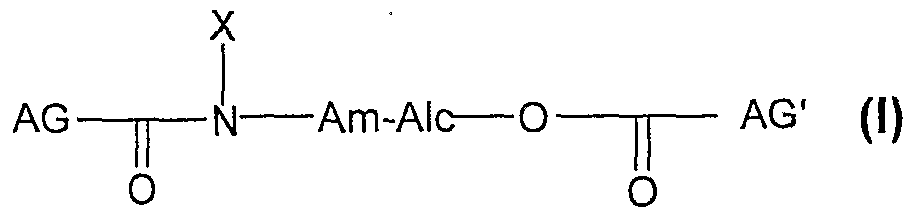
- the present invention essentially resides in the synthesis of ceramide-type compounds of general formula (I):
- the Am-Alc group represents a preferably saturated, linear, optionally branched hydrocarbon chain, comprising from 2 to 6 carbon atoms, and derived from an amino alcohol
- X represents a hydrogen or a carbon chain containing from 1 to 4 carbon atoms, optionally hydroxylated on the carbons in position 2 'and / or following of the amine function
- the groups AG and AG 'each denote a hydrocarbon chain, saturated or unsaturated, originating from a fatty acid and comprising from 4 to 30 carbon atoms and optionally hydroxylated; the two groups AG and AG 'can be identical or different.
- the subject of the present invention is a new process for the enzymatic synthesis of these ceramide-type compounds, from fatty acids and / or fatty acid esters, and amino alcohols, comprising at least one amidation step and an esterification step, both carried out enzymatically, in any order.
- Ceramides are among the most important lipid constituents of the stratum corneum. They consist of a long carbon chain, linked to a fatty acid via an amide bond. They are naturally present in traces in the tissues where they have significant biological effects.
- ceramides are closely linked to skin aging. Indeed, we know that the appearance of the skin is essentially linked to the constitution of water in its different layers. However, the alteration of membrane lipids, in particular due to the use of detergents often responsible for their elimination, has the consequence of increasing water loss. In addition, this destruction of the skin barrier leads to an increase in skin sensitivity and to potential irritation. ((Kersher M. et al., Eur. J. Dermatol, 1991, 139-43; Imokawa G. et al, J. Soc-Cosmet. Chem., 1989, 40, 273-285).
- ceramides Natural constituents of almost all living things, ceramides can be obtained by extraction from animals (Lambes H., 2 nd ASCS, 1995, 106-125), plants (WO 9221321, Rousset G., Inocosm. Lab ) or yeasts (WO 9410131, Casey J. et al., Unilever).
- animals Libes H., 2 nd ASCS, 1995, 106-125
- plants WO 9221321, Rousset G., Inocosm. Lab
- yeasts WO 9410131, Casey J. et al., Unilever
- pseudo-ceramides Many analogs of natural ceramides, called pseudo-ceramides, have therefore been synthesized chemically. Pseudo-ceramides or ceramide-type compounds resemble ceramides, but are not identical to them. Thus, in patent EP028281 (Ohashi Yukihiro et al., Kao Corp., 1988), a process for the synthesis of pseudo-ceramides has been described by reaction between a glycidyl ether and an amino alcohol, which is then substituted with a fatty acid via an amide bond. Three consecutive steps are thus required to obtain the pseudo-ceramide.
- patent EPO 968 998 (Elf Atochem SA) describes a process for the chemical synthesis of analogous ceramide compounds from acylating agent and amino alcohol. This synthesis process however has the disadvantage of being very selective, so that a molar yield of less than 75% is obtained. It is mentioned that the synthetic steps can also be carried out by the enzymatic route and in particular by conventional esterases, in particular lipases and proteases, without further details as to their implementation or as to an expected advantage for this route.
- the subject of the present invention is a process for the synthesis of ceramide-type compounds comprising at least one step of amidification carried out by the enzyme Lipase B from Candida antartica and an esterification step, also carried out with a lipase type enzyme, said ceramide type compounds being of general formula (I):
- the group Am-Alc represents a saturated, linear, optionally branched hydrocarbon chain comprising from 2 to 6 carbon atoms, derived from an amino alcohol
- X represents a hydrogen or a carbon chain containing from 1 to 4 carbon atoms, optionally hydroxylated on the carbons in position 2 'and / or following of the amine function
- the groups denoted AG and AG ′ each denote a carbon chain, saturated or unsaturated, optionally hydroxylated and comprising from 4 to 30 carbon atoms, derived from a fatty acid and / or from a fatty acid ester; the two groups AG and AG 'can be identical or different.
- the ceramide-type compounds obtained according to the present invention constitute a particular category of pseudo-ceramides.
- the term “pseudo-ceramides” generally means compounds comprising an amide function and another bond.
- the pseudo-ceramides of formula (I) are distinguished by the fact that the additional bond is of the ester type. This ester bond is specifically oriented in the molecule.
- these ceramide-type compounds are particularly close to natural ceramides or pseudo-ceramides derived from chemical syntheses. Because of their similar chemical groups, they often have the same properties.
- quantitative yield is meant according to the invention a yield greater than 93%. An almost 100% yield is even obtained during the amidation step.
- the two steps, described below more fully, are independent and can be carried out successively and / or simultaneously, in a different order, without this having any consequence on the structure of the synthesized product.
- the term “amidification step” means the step which consists in reacting an amino alcohol with a fatty acid and / or a fatty acid ester.
- reaction scheme (A) leading to obtaining intermediate compounds of formula (II):
- R denotes a hydrogen or a carbon chain containing from 1 to 5 carbon atoms, such as in particular a methyl, ethyl, propyl, butyl, pentyl group, optionally substituted such as a glycerol group (trihydroxypropane).
- R can also be any chemical group, provided that it does not cause steric hindrance capable of impairing the accessibility of the carboxyl function of the fatty acid or ester of the fatty acid ester.
- R will preferably be chosen such that the alcohol ROH formed is volatile, such as, for example, ethanol, isopropanol. Otherwise, a purification step will be necessary and may for example be done by high performance liquid chromatography (HPLC), by chromatography on a silica column or by crystallization.
- HPLC high performance liquid chromatography
- the amide bond is formed between the carbonyl function of a fatty acid or the corresponding ester, and the primary or secondary amine function of an amino alcohol or of an amino ester.
- alcohol by a lipase type enzyme. More particularly, lipase B of Candida antartica is used, belonging to the classes of triacylglycerol hydrolases and carboxylesterases (enzymatic class EC 3.1.1.3). It may in particular be the lipase marketed by the company Novozymes SA, under the name Novozym® 435, produced by fermentation of the genetically modified microorganism Aspergillus oryzae and advantageously immobilized on a support. The implementation is not limited to the use of the enzyme currently marketed by this Company. However, it should be noted that it must be this type of lipase to obtain a good yield, in accordance with the present invention.
- the reagents will be used under stoichiometric conditions so that, in these proportions, all of the reagents are consumed, in order to avoid the residual reagents.
- esterification step is understood according to the invention, the reaction by which a fatty acid or a fatty acid ester is grafted onto the free alcohol function, terminal or otherwise, of an amino alcohol. Considering the case where this step follows amidification, it can be represented by the following reaction scheme (E): XX
- R denotes a hydrogen or a carbon chain comprising from 1 to 5 carbon atoms, such as in particular a methyl, ethyl, propyl, butyl, isobutyl, terbutyl, pentyl, isopentyl group, optionally substituted such as a group glycerol (trihydroxypropane) or trimethylolpropane.
- R could be any inert chemical group as long as it does not cause steric hindrance capable of impairing the accessibility of the carboxyl function of the fatty acid or ester of the fatty acid ester.
- R must be such that the alcohol ROH formed is volatile such as ethanol, isopropanol. Otherwise, a purification step would be necessary and could be done, for example, by distillation.
- the ester bond is produced between * the hydroxyl group of the compound of formula (II) (amide-alcohol), and the carboxyl group of the fatty acid or the fatty acid ester, saturated or unsaturated, by a lipase type enzyme and more particularly by a lipase belonging to the class of triacylglycerol hydrolases (enzymatic class EC 3.1.1.3).
- Rhizomucor miehei lipase is particularly preferred. Indeed, it has also been discovered that this enzyme does not require a solvent and because of its specificity, has the advantage of carrying out the conversion into an ester with a very good yield. It thus contributes to improving the yield of the overall process for synthesizing ceramides according to the present invention.
- lipase B of Candida antartica is used during the amidation step and lipiz of Rhizomucor miehei during the esterification step.
- These two enzymes have, in fact, a very high selectivity.
- Novozym® 435 only performs the amidation step and Lipozyme® RM IM only the esterification step. It is therefore important to note that the sequence of steps with these two enzymes can be reversed without affecting the nature of the product and with a similar yield.
- lipases immobilized on an inert organic support are advantageously used, which makes it possible to remove them easily from the reaction medium and then to be able to recycle them.
- they will be adsorbed on a macroporous resin such as the enzymes Novozym® 435 and Lipozyme®.RM IM.
- the cost of this process is, in fact, very advantageously reduced by recycling the enzyme. It has thus been found that Novozym® 435 can be recycled about ten times without loss of ? activity for the amidification reaction according to this process.
- the step of forming the amide takes place by mixing, under stoichiometric conditions, the fatty acid or the corresponding ester, with an amino alcohol, in the presence of a lipase such as Novozym® 435.
- the reaction is carried out at a temperature between 40 and 100 ° C, and preferably between 55 and 85 ° C. It can be carried out at atmospheric pressure or using a vacuum of between 500 and 1 mbar, preferably between 200 and 30 mbar. To obtain a minimum quantitative yield of at least about 93% under these conditions, the reaction is continued for at least 16 hours, and preferably for at least 20 hours.
- the step of formation of the ester function is carried out by reacting the amide obtained during the first step with a fatty acid or the corresponding ester, in the presence of a lipase such as Lipozyme® RM IM.
- the fatty acid ester to amide-alcohol ratio is between 1 and 2, but preferably between 1 and 1.5.
- the reaction is carried out at a temperature between 40 and 90 ° C, preferably between 50 and 70 ° C. It is carried out at atmospheric pressure or using a partial vacuum of between 500 and 1 mbar and preferably between 200 and 30 mbar. To obtain a minimum quantitative yield of around 93% in these • 3 /
- reaction is continued for at least 18 hours, and preferably for at least 24 hours.
- each step is carried out under a partial vacuum of between 200 and 30 mbar.
- a vacuum makes it possible to eliminate the water or the alcohol formed during the condensation progressively, and to considerably accelerate the kinetics of the reaction.
- vacuum by vacuum, the degradation of a large number of oxidizable fatty acids is limited.
- the synthesis can be carried out according to a first esterification step which can be represented by the following reaction scheme (E '):
- This esterification step is carried out between an amino alcohol, and a fatty acid and / or fatty acid ester in order to obtain a fatty acid amino ester, under the conditions previously described for carrying out the reaction E , favorable to esterification.
- the second step will be the amidation reaction which can be represented by the following reaction scheme (A '):
- This second synthesis step is carried out between the fatty acid amino ester previously obtained and a fatty acid or the fatty acid ester, under the conditions previously described for carrying out reaction A.
- the compounds of formula (I) are obtained in the form of a mixture with fatty acids and / or esters of residual fatty acids such as, for example, ethyl palmitate.
- This residual compound does not constitute a drawback for a formulation in the form of cosmetic or dermatological compositions.
- the compound of formula (I) can be purified according to the usual separation methods such as in particular by high performance liquid chromatography (HPLC) or by passage over a column of silica or cellulose, or by crystallization.
- HPLC high performance liquid chromatography
- the method according to the invention thus advantageously comprises a reduced number of steps, at least one or two (amidation and esterification, simultaneously or successively).
- the compounds of formula (I) being particularly stable, other stages can however be added, in particular after the two stages of amidation and esterification, such as the formation of derivatives of alkylation, oxidation or reduction.
- the maximum reaction temperatures are determined by the recycling capacities of the enzymes. Generally, a person skilled in the art will understand that the synthesis conditions can vary as a function of several factors, in particular the concentration of enzymes and reagents, the pH, the temperature. During each step, we will try to approach the optimal conditions for enzyme activity. By way of example, but without this being limiting, reference will be made to the methods described in Examples 1 to 21.
- the fatty acids and / or fatty acid esters which can be used according to the process of the present invention have a carbon chain AG or AG ', preferably linear, containing between 4 and 30 carbon atoms, saturated or unsaturated, and optionally hydroxylated. Preferably, we will choose those which consist of 10 to 22 carbon atoms.
- the fatty acids do not carry alpha hydroxylation of the carboxylic or ester function of the fatty acid, in order to avoid parallel acylations, in particular during esterification. Mention may in particular be made, as examples of preferred fatty acids, of:
- linoleic acid octadeca-9,12-dienoic acid
- linolenic acid ⁇ : octadeca-9,12,15-trienoic acid or ⁇ : octadeca-6,9,12-trienoic acid
- eicosapentaenoic acid eicosa-5,8, 11, 14, 17-pentaenoic acid
- the fatty acids or the fatty acid esters can be used pure or in the form of a mixture of fatty acids, in particular extracts of micro-algae such as spirulina, of a vegetable oil, such as for example, evening primrose oil, borage oil, or animal oil such as fish oils. It may especially be a mixture of fatty acids from the saponification of oils.
- the amino alcohols which can be used, according to the process of the present invention have one or more primary or secondary hydroxyl groups.
- the amino function can be primary or secondary.
- an amino alcohol having a primary amine function will preferably be used.
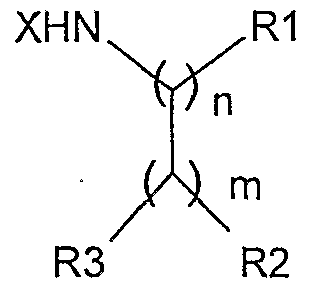
- the amino alcohols which can be used, according to the process of the present invention correspond to the general formula (IV):
- - n is an integer chosen from values 1, 2 and 3
- m is an integer chosen from values 1, 2 and 3.
- -X is chosen from hydrogen and a carbon chain containing from 1 to 4 carbon atoms, optionally hydroxylated on the carbons in position 2 ′ and / or following of the amine function
- -RI is chosen from hydrogen
- -R2 is chosen from hydrogen, a hydroxyl, an NH 2 group and an alkyl chain containing from 1 to 4 atoms of carbon, preferably saturated, linear, optionally branched and / or hydroxylated
- - R3 is chosen from hydrogen, a hydroxyl and a CH 2 OH group and in which at least one of the groups RI, R2 or R3 contains a hydroxyl group.
- This process by the very selective enzymes which it implements, has the advantage of allowing the synthesis of ceramide-type compounds of formula (I) with a very good yield, including when the amino-alcohol reagent contains only 'a single hydroxyl group.
- a single group RI, R2 or R3 contains a hydroxyl group.
- the amino alcohols are therefore linear, possibly branched, preferably saturated and contain from 2 to 6 carbon atoms. Preferably, they are partially soluble in the fatty acid or in its fatty acid ester which constitutes the initial reagent. Examples of preferred amino alcohols that may be mentioned include: 1-amino-2-propanol
- Am-Alc denotes a preferably saturated, linear, optionally branched carbon chain comprising from 2 to 6 carbon atoms, preferably not hydroxylated
- X represents a hydrogen or a carbon chain containing from 1 to 4 carbon atoms, optionally hydroxylated.
- the groups AG and AG ′ each representing a carbon chain, saturated or unsaturated, optionally hydroxylated, comprising from 4 to 30 carbon atoms, preferably from 10 to 22 carbons, the two groups AG and AG ′ being able to be identical or different.
- These compounds of formula (I) therefore necessarily contain two oxy groups, separated by at least one amide bond and one ester bond, and by a carbon chain Am-Aie. They also contain two carbon chains AG and AG ′ which may be identical or different depending on the fatty acids and / or esters of fatty acids used as reactants.
- the compounds of formula (I) have a melting point of the order of 60 to 65 ° C. which makes it possible to synthesize them at high temperature and to facilitate their incorporation into the formulations. These compounds also have good preservation properties, superior to those of the corresponding simple amide of formula (II).
- the method can be used on optically active compounds. This selectivity is indeed retained in the final compound (I). When they have at least one asymmetric carbon atom, these new compounds can be split into their isomers or their diastereoisomers erythro and threo.
- the group Am-Alc represents a saturated, linear, optionally branched hydrocarbon chain comprising from 2 to 6 carbon atoms, derived from an amino alcohol
- X represents a hydrogen or a carbon chain containing from 1 to 4 carbon atoms, optionally hydroxylated on the carbons in position 2 'and / or following of the amine function
- the group AG denotes a linear hydrocarbon chain, saturated or not, comprising from 4 to 30 carbon atoms, preferably from 10 to 22 carbon atoms and originating from a fatty acid.
- These intermediate compounds are obtained by amidation between the carboxyl function of fatty acids and / or fatty acid esters and the amino function of amino alcohols according to the reaction scheme (A) of the process which is the subject of the present invention. This step is thus carried out by the lipase B of Candida antartica under the conditions previously described. These intermediate compounds are particularly advantageous in that they make it possible to obtain the new ceramide-type compounds in a single esterification step (E) described according to the present invention.
- esterification step according to said process is the first synthesis step
- ester intermediate compounds are obtained and have the general formula (III):
- the Am-Alc group represents a saturated, linear, optionally branched, hydrocarbon chain comprising from 2 to 6 carbon atoms, derived from an amino alcohol
- X represents a hydrogen or a carbon chain containing from 1 to 4 carbon atoms, optionally hydroxylated on the carbons in position 2 ′ and / or following of the amine function
- the group AG ′ denotes a linear hydrocarbon chain, saturated or not, comprising from 4 to 30 carbon atoms, preferably from 10 to 22 carbon atoms and originating from a fatty acid.
- the ceramide-type compounds of formula (I) can be used as active compounds in cosmetic and / or pharmaceutical, and more specifically dermatological, compositions. These compositions can contain from 0.01 to 90% of said compounds, preferably from 0.1 to 30% by total weight of the composition and preferably from 0.1 to 5%.
- compositions may contain the usual and cosmetically acceptable vehicles, in particular as diluent, dispersing agent, gelling agent, ceramide support agent, solid emollient, gums, resins, surfactants, sun protection agents, solvents, fillers such as rice starch, pigments, preservatives, essential oils, antioxidants, dyes, pigments, nacres, perfumes, odor absorbers, pH regulating agents or neutralizing agents , thickeners, such as those usually used.
- vehicles in particular as diluent, dispersing agent, gelling agent, ceramide support agent, solid emollient, gums, resins, surfactants, sun protection agents, solvents, fillers such as rice starch, pigments, preservatives, essential oils, antioxidants, dyes, pigments, nacres, perfumes, odor absorbers, pH regulating agents or neutralizing agents , thickeners, such as those usually used.
- compositions are in a form suitable for application to the skin and / or the integuments such as gel, lotion, in particular hair lotion and varnish, emulsion or dispersion, in particular of the oil-in-water or water-in-oil type.
- cream including mascara cream, ointment, milk, foam, sticks (stick), especially in the form of a lip balm, lipstick.
- the composition according to the invention contains emulsifiers and coemulsifiers usually used by a person skilled in the art.
- suitable emulsifiers and coemulsifiers are fatty acid esters of polyol such as glyceryl stearate, fatty acid esters of polyethylene glycol such as PEG-20 stearate.
- the concentration of emulsifier and coemulsifier is between 0.3 and 30% relative to the total weight of the composition, preferably between 0.5 and 5%.
- compositions are thus useful for the care and / or treatment and / or protection of the epidermis and / or of its formations (hair, hair, nails, etc.) in humans and / or animals. by restoring the skin lipid balance, they repair the alterations in the skin's protective layer and control water loss. They are therefore particularly useful for preventing or solving skin problems such as dryness, wrinkles and skin folds, flaking, cracks and chapped skin and for maintaining supple, soft, hydrated and elastic skin and combating the signs of aging. skin.
- the cosmetic or dermatological compositions have no toxicity and do not cause any local intolerance. They are also not allergenic.
- the concentrations are given as a percentage relative to the total weight of the composition.
- the amidation reaction is carried out by lipase B from Candida antarctica immobilized on inert carrier used in the form of the product marketed by Novozyme SA under the name Novozym ® 435. This product is heat stable, and exhibits optimal activity at 40-80 ° C.
- esterification activity of approximately 10,000 units of Propyl Laurate per gram (PLU / g)
- the esterification reaction is carried out by Rhizomucor miehei lipase, immobilized on an inert support, used in the form of product sold by the Novozym Company under the name Lipozyme ® RM IM.
- This product has an optimal activity of 30 to 70 ° C and has an activity of about 150 IUN / g.
- Example 6 Synthesis of (2,3-dihydroxy-propyl) amide of tetradecanoic acid -In a 500 ml flask, 91.1 lg of 3-amino-1,2-propane diol (1 mol) are introduced respectively. 256.42 g of ethyl myristate (1 mole). The mixture, with stirring, is heated to 70 ° C. before introducing 5 g of Novozym® 435. The reaction medium is then placed under reduced pressure (50 mbar) to remove the ethanol formed. -After 24 hours of synthesis, the enzyme is eliminated by filtration.
- Example 9 Synthesis of (2,3-dihydroxy-propyl) amide of octadec-9-cis-enoic acid -In a 500 ml flask, 91.11 g of 3-amino-1,2-propane diol are introduced respectively (1 mole) and 310.51 g of ethyl oleate (1 mole). The mixture, with stirring, is heated to 65 ° C. before introducing the 5 g of Novozym® 435. The reaction medium is then placed under reduced pressure (50 mbar) to remove the ethanol formed. -After 24 hours of synthesis, the enzyme is eliminated by filtration. The conversion of ethyl oleate to amide is greater than 99%.
- the enzyme is eliminated by filtration.
- the conversion of ethyl ricinoleate to amide is greater than 99%.
- the product obtained is in the form of a beige-colored wax.
- Example 14 Synthesis of (3-tetradecanoyloxy) -2-hydroxy propyl amide of octadeca-9,12-cis-cis-dienoic acid -In a 1000 ml flask, 353.54 g of (2.3 -dihydroxy-propyl) amide of octadeca-9,12-cis-cis-dienoic acid (1 mole) and 384.63 g of ethyl myristate (1.5 moles). The mixture, with stirring, is heated to 65 ° C. before introducing 30 g of Lipozyme® RM IM. The reaction medium is then placed under reduced pressure (50 mbar) to remove the ethanol formed.
- the enzyme is eliminated by filtration.
- the conversion of linoleic acid (2,3-dihydroxy-propyl) amide is greater than 93%).
- the product obtained is in the form of a white wax.
- Example 16 Synthesis of (3-octadecanoyloxy) -2-hydroxy propyl amide of octadeca-9,12-cis-cis-dienoic acid -In a 1000 ml flask, 353.54 g of (2.3 -dihydroxy-propyl) amide of octadeca-9,12-cis-cis-dienoic acid (1 mole) and 468.79 g of ethyl stearate (1.5 moles). The stirred mixture is. heated to 65 ° C before introducing the 30g of Lipozyme® RM IM. The reaction medium is then placed under reduced pressure (50 mbar) to remove the ethanol formed.
- Example 19 Synthesis of (3-octadeca-12-hydroxy-9 dienoyloxy) -2-hydroxy propyl amide of octadeca-9,12-cis-cis-dienoic acid -In a 1000 ml flask, 353 are introduced respectively , 54 g of (2,3-dihydroxy-propyl) amide of octadeca-9,12-cis-cis-dienoic acid (1 mole) and 489.76 g of ethyl ricinoleate (1.5 moles). The mixture, with stirring, is heated to 65 ° C. before introducing the 30 g of Lipozyme® RM IM.
- the reaction medium is then placed under reduced pressure (50 mbar) to remove the ethanol formed.
- the enzyme is eliminated by filtration.
- the conversion of (2,3-dihydroxy-propyl) amide of linoleic acid is greater than 93%>.
- the product obtained is in the form of a cream-colored wax.
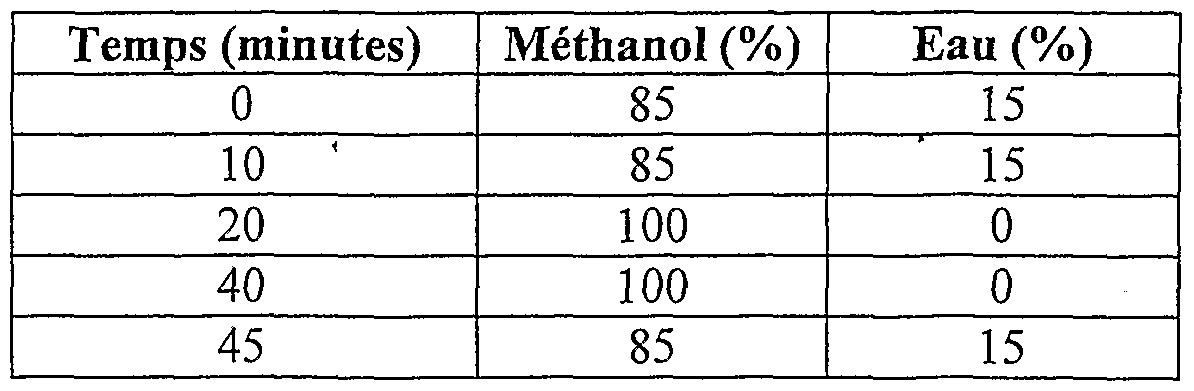
- Product retention time in HPLC 26.05 minutes
Landscapes
- Chemical & Material Sciences (AREA)
- Organic Chemistry (AREA)
- Health & Medical Sciences (AREA)
- Life Sciences & Earth Sciences (AREA)
- General Health & Medical Sciences (AREA)
- Animal Behavior & Ethology (AREA)
- Public Health (AREA)
- Veterinary Medicine (AREA)
- Engineering & Computer Science (AREA)
- Epidemiology (AREA)
- Wood Science & Technology (AREA)
- Zoology (AREA)
- Chemical Kinetics & Catalysis (AREA)
- Pharmacology & Pharmacy (AREA)
- Dermatology (AREA)
- Birds (AREA)
- General Chemical & Material Sciences (AREA)
- Bioinformatics & Cheminformatics (AREA)
- Medicinal Chemistry (AREA)
- Biochemistry (AREA)
- Microbiology (AREA)
- Gerontology & Geriatric Medicine (AREA)
- Biotechnology (AREA)
- General Engineering & Computer Science (AREA)
- Genetics & Genomics (AREA)
- Biophysics (AREA)
- Molecular Biology (AREA)
- Nuclear Medicine, Radiotherapy & Molecular Imaging (AREA)
- Organic Low-Molecular-Weight Compounds And Preparation Thereof (AREA)
- Preparation Of Compounds By Using Micro-Organisms (AREA)
- Cosmetics (AREA)
- Acyclic And Carbocyclic Compounds In Medicinal Compositions (AREA)
Abstract
Description



Claims


Priority Applications (5)
| Application Number | Priority Date | Filing Date | Title |
|---|---|---|---|
| US10/559,713 US7344868B2 (en) | 2003-06-03 | 2004-06-03 | Method for synthesizing ceramide-type compounds |
| EP04767243A EP1644318B1 (fr) | 2003-06-03 | 2004-06-03 | Procede de synthese de composes de type ceramide |
| DE602004013590T DE602004013590D1 (de) | 2003-06-03 | 2004-06-03 | Verfahren zur synthese von verbindungen vom ceramidtyp |
| JP2006508353A JP4638413B2 (ja) | 2003-06-03 | 2004-06-03 | セラミド型化合物の新規な合成方法 |
| KR1020057023263A KR101129996B1 (ko) | 2003-06-03 | 2004-06-03 | 세라미드 유형 화합물의 합성 방법 |
Applications Claiming Priority (2)
| Application Number | Priority Date | Filing Date | Title |
|---|---|---|---|
| FR0306661A FR2855823B1 (fr) | 2003-06-03 | 2003-06-03 | Nouveaux composes de type ceramide, leur procede de synthese, et compositions cosmetiques et/ou pharmaceutiques en contenant |
| FR03/06661 | 2003-06-03 |
Publications (1)
| Publication Number | Publication Date |
|---|---|
| WO2004108659A1 true WO2004108659A1 (fr) | 2004-12-16 |
Family
ID=33443104
Family Applications (1)
| Application Number | Title | Priority Date | Filing Date |
|---|---|---|---|
| PCT/FR2004/001375 Ceased WO2004108659A1 (fr) | 2003-06-03 | 2004-06-03 | Nouveau procede de synthese de composes de type ceramide |
Country Status (8)
| Country | Link |
|---|---|
| US (1) | US7344868B2 (fr) |
| EP (1) | EP1644318B1 (fr) |
| JP (1) | JP4638413B2 (fr) |
| KR (1) | KR101129996B1 (fr) |
| AT (1) | ATE394365T1 (fr) |
| DE (1) | DE602004013590D1 (fr) |
| FR (1) | FR2855823B1 (fr) |
| WO (1) | WO2004108659A1 (fr) |
Cited By (5)
| Publication number | Priority date | Publication date | Assignee | Title |
|---|---|---|---|---|
| FR2908299A1 (fr) * | 2006-11-10 | 2008-05-16 | Biochimie Appliquee Sa Soc | Compositions cosmetiques et/ou dermatologiques contenant un derive d'acide gras et leurs utilisations |
| FR2908308A1 (fr) * | 2006-11-10 | 2008-05-16 | Biochimie Appliquee Sa Soc | Compositions cosmetiques et/ou dermatologiques contenant un pseudo-ceramide et leur utilisation contre le stress cutane |
| FR2909378A1 (fr) * | 2006-12-05 | 2008-06-06 | Biochimie Appliquee Sa Soc | Ceramides ou pseudo-ceramides quaternises et les compositions cosmetiques en contenant |
| WO2009047618A1 (fr) * | 2007-10-11 | 2009-04-16 | Societe La Biochimie Appliquee Solabia S.A. | Compositions cosmétiques et/ou dermatologiques et leur utilisation pour la dépigmentation |
| CN120923366A (zh) * | 2025-10-10 | 2025-11-11 | 重庆智合生物医药有限公司 | 基于长链脂肪酸的神经酰胺化合物的合成控制方法及系统 |
Families Citing this family (28)
| Publication number | Priority date | Publication date | Assignee | Title |
|---|---|---|---|---|
| FR2924428A1 (fr) * | 2007-02-15 | 2009-06-05 | Biochimie Appliquee Sa Soc | Pseudo-ceramides derives d'huiles vegetales et les compositions cosmetiques et/ou dermatologiques en contenant |
| US8816110B2 (en) * | 2007-02-15 | 2014-08-26 | Scf Pharma Inc. | Polyunsaturated fatty acid monoglycerides, derivatives, and uses thereof |
| EP2136844B1 (fr) | 2007-03-20 | 2018-10-31 | SCF Pharma Inc. | Compositions comprenant des monoglycérides d'acides gras polyinsaturés ou des dérivés de ceux-ci et leurs utilisations |
| FR2926462B1 (fr) * | 2008-01-22 | 2016-06-24 | Soc La Biochimie Appliquee | Compositions cosmetiques et/ou dermatologiques contenant des inhibiteurs d'elastase |
| FR2926725B1 (fr) * | 2008-01-25 | 2010-09-03 | Biochimie Appliquee Soc | Compositions cosmetiques et/ou dermatologiques cicatrisantes |
| DE102008002410A1 (de) * | 2008-06-13 | 2009-12-17 | Evonik Goldschmidt Gmbh | Enzymatische Synthese von Sphingolipiden |
| DE102008002409A1 (de) * | 2008-06-13 | 2009-12-17 | Evonik Goldschmidt Gmbh | Enzymatische Synthese von Sphingolipiden |
| EP2233128A1 (fr) * | 2009-03-25 | 2010-09-29 | Cognis IP Management GmbH | Composition cosmétique |
| FR2966041B1 (fr) * | 2010-10-18 | 2025-11-14 | La Biochimie Appliquee Solabia | Nouvelles compositions capillaires et leurs utilisations |
| US9861702B2 (en) | 2012-10-22 | 2018-01-09 | Wisconsin Alumni Research Foundation | Lipid-conjugated rhamnose for immune system recruitment and oncotherapy |
| KR102014964B1 (ko) * | 2012-11-30 | 2019-08-28 | (주)아모레퍼시픽 | 신규한 유사 세라마이드 화합물 및 그 제조방법 |
| KR102088802B1 (ko) * | 2012-11-30 | 2020-03-16 | (주)아모레퍼시픽 | 신규한 유사 세라마이드 화합물 및 그 제조방법 |
| KR101338237B1 (ko) | 2013-08-23 | 2013-12-06 | 주식회사 더마랩 | 세라마이드 유사 화합물, 이의 제조방법 및 이를 포함하는 화장료 조성물 |
| KR101510683B1 (ko) | 2013-09-03 | 2015-04-10 | (주)네오팜 | 카나비노이드 수용체에 길항작용을 가지는 신규한 유사 세라마이드 유도체 및 이를 포함하는 약학 또는 화장품 조성물 |
| US9447020B2 (en) | 2013-10-31 | 2016-09-20 | Scf Pharma Inc. | Polyunsaturated fatty acid monoglycerides, derivatives, and uses thereof |
| KR101545527B1 (ko) * | 2014-01-13 | 2015-08-19 | (주)네오팜 | 신규한 유사 세라마이드 화합물, 이를 포함하는 약학 조성물 및 화장료 조성물 |
| KR101681654B1 (ko) * | 2014-10-31 | 2016-12-01 | 한국과학기술연구원 | 효소적 위치선택반응에 의한 디아세틸세라마이드 유도체의 제조방법 |
| KR101641702B1 (ko) * | 2014-11-14 | 2016-07-21 | 애경산업(주) | 신규 유사세라마이드 화합물 및 이를 포함하는 조성물 |
| CN107405305B (zh) * | 2015-01-20 | 2020-12-25 | 泰特拉德姆集团有限责任公司 | 提供粘膜和皮肤屏障恢复的通用局部药物递送载体和多因子组织保湿剂 |
| KR101809614B1 (ko) | 2017-09-08 | 2017-12-15 | (주)삼경코스텍 | 이소세리놀 아미드 유도체 및 이를 포함하는 조성물 |
| CN111971041A (zh) | 2018-02-07 | 2020-11-20 | Scf制药股份有限公司 | 多不饱和脂肪酸单甘油酯、组合物、方法及其用途 |
| CN112384212A (zh) | 2018-05-03 | 2021-02-19 | Scf制药股份有限公司 | 多不饱和脂肪酸单甘油酯、其组合物、方法和用途 |
| US12226390B2 (en) | 2019-07-21 | 2025-02-18 | Scf Pharma Inc. | Cannabinoids compositions with polyunsaturated fatty acid monoglycerides, methods and uses thereof |
| KR102225519B1 (ko) * | 2019-09-05 | 2021-03-11 | 한국생명공학연구원 | 칸디다 안타티카 리파제 b의 변이체 및 이의 이용 |
| KR102254208B1 (ko) * | 2019-09-27 | 2021-05-21 | 주식회사 대한뷰티산업진흥원 | 효소촉매 리파제로 제조된 제주 천연오일 유래의 유사세라마이드 복합체 및 이를 포함하는 기능성 화장품 원료 |
| AU2020375734B2 (en) * | 2019-10-28 | 2026-04-09 | Geron Corporation | Crystalline solids of 3-palmitoyl-amido-1,2-propanediol and 3-palmitoyl-amido-2-hydroxy-1-dimethoxytriphenylmethylether-propane and methods of making and using the same |
| KR102861357B1 (ko) | 2019-10-28 | 2025-09-18 | 제론 코포레이션 | 비정질 고체 석신일화 3-(지방산 아미도)-2-하이드록시-1-(보호된 하이드록시)-프로판 염 및 이를 제조하는 방법 |
| KR102301101B1 (ko) * | 2021-04-05 | 2021-09-09 | 박명화 | 천연 오일 및 천연 추출물을 포함하는 화장료 조성물 |
Citations (1)
| Publication number | Priority date | Publication date | Assignee | Title |
|---|---|---|---|---|
| EP0968998A1 (fr) * | 1998-07-03 | 2000-01-05 | Elf Atochem S.A. | Compositions cosmétiques, nouveaux analogues de céramides à activité anti-élastase, procédé de préparation et utilisations |
Family Cites Families (3)
| Publication number | Priority date | Publication date | Assignee | Title |
|---|---|---|---|---|
| JPH09241143A (ja) * | 1996-03-04 | 1997-09-16 | Lion Corp | セラミド誘導体およびそれを含有する化粧料 |
| JP3886738B2 (ja) * | 2001-05-24 | 2007-02-28 | 花王株式会社 | 洗浄剤組成物 |
| JP4030746B2 (ja) * | 2001-11-14 | 2008-01-09 | 花王株式会社 | パール光沢付与剤 |
-
2003
- 2003-06-03 FR FR0306661A patent/FR2855823B1/fr not_active Expired - Lifetime
-
2004
- 2004-06-03 WO PCT/FR2004/001375 patent/WO2004108659A1/fr not_active Ceased
- 2004-06-03 JP JP2006508353A patent/JP4638413B2/ja not_active Expired - Fee Related
- 2004-06-03 KR KR1020057023263A patent/KR101129996B1/ko not_active Expired - Lifetime
- 2004-06-03 US US10/559,713 patent/US7344868B2/en not_active Expired - Lifetime
- 2004-06-03 DE DE602004013590T patent/DE602004013590D1/de not_active Expired - Fee Related
- 2004-06-03 AT AT04767243T patent/ATE394365T1/de not_active IP Right Cessation
- 2004-06-03 EP EP04767243A patent/EP1644318B1/fr not_active Expired - Lifetime
Patent Citations (1)
| Publication number | Priority date | Publication date | Assignee | Title |
|---|---|---|---|---|
| EP0968998A1 (fr) * | 1998-07-03 | 2000-01-05 | Elf Atochem S.A. | Compositions cosmétiques, nouveaux analogues de céramides à activité anti-élastase, procédé de préparation et utilisations |
Non-Patent Citations (2)
| Title |
|---|
| BIOTECHNOLOGY AND BIOENGINEERING, vol. 75, no. 6, 2001, pages 676 - 681, XP001180633 * |
| MAUGARD T ET AL: "Enzymatic synthesis of glycamide surfactants by amidification reaction", TETRAHEDRON, ELSEVIER SCIENCE PUBLISHERS, AMSTERDAM, NL, vol. 53, no. 14, 7 April 1997 (1997-04-07), pages 5185 - 5194, XP004105565, ISSN: 0040-4020 * |
Cited By (6)
| Publication number | Priority date | Publication date | Assignee | Title |
|---|---|---|---|---|
| FR2908299A1 (fr) * | 2006-11-10 | 2008-05-16 | Biochimie Appliquee Sa Soc | Compositions cosmetiques et/ou dermatologiques contenant un derive d'acide gras et leurs utilisations |
| FR2908308A1 (fr) * | 2006-11-10 | 2008-05-16 | Biochimie Appliquee Sa Soc | Compositions cosmetiques et/ou dermatologiques contenant un pseudo-ceramide et leur utilisation contre le stress cutane |
| FR2909378A1 (fr) * | 2006-12-05 | 2008-06-06 | Biochimie Appliquee Sa Soc | Ceramides ou pseudo-ceramides quaternises et les compositions cosmetiques en contenant |
| WO2009047618A1 (fr) * | 2007-10-11 | 2009-04-16 | Societe La Biochimie Appliquee Solabia S.A. | Compositions cosmétiques et/ou dermatologiques et leur utilisation pour la dépigmentation |
| FR2922102A1 (fr) * | 2007-10-11 | 2009-04-17 | Biochimie Appliquee Solabia Sa | Compositions cosmetiques et/ou dermatologiques et leur utilisation pour la depigmentation |
| CN120923366A (zh) * | 2025-10-10 | 2025-11-11 | 重庆智合生物医药有限公司 | 基于长链脂肪酸的神经酰胺化合物的合成控制方法及系统 |
Also Published As
| Publication number | Publication date |
|---|---|
| US20060121583A1 (en) | 2006-06-08 |
| KR101129996B1 (ko) | 2012-04-23 |
| JP2006526400A (ja) | 2006-11-24 |
| US7344868B2 (en) | 2008-03-18 |
| EP1644318A1 (fr) | 2006-04-12 |
| DE602004013590D1 (de) | 2008-06-19 |
| KR20060027322A (ko) | 2006-03-27 |
| JP4638413B2 (ja) | 2011-02-23 |
| FR2855823A1 (fr) | 2004-12-10 |
| ATE394365T1 (de) | 2008-05-15 |
| FR2855823B1 (fr) | 2007-09-21 |
| EP1644318B1 (fr) | 2008-05-07 |
Similar Documents
| Publication | Publication Date | Title |
|---|---|---|
| EP1644318B1 (fr) | Procede de synthese de composes de type ceramide | |
| EP0500437B1 (fr) | Céramides, leur procédé de préparation et leurs applications en cosmétique et en dermopharmacie | |
| EP0420722B1 (fr) | Nouveaux composés lipidiques dérivés des sphingosines, leur procédé de préparation et leurs applications, notamment en cosmétique et en dermopharmacie | |
| FR2766176A1 (fr) | Compositions a base de derives de resveratrol | |
| EP0659755A1 (fr) | Phospholipides vecteurs de molécules actives, leur préparation et leur utilisation dans des compositions cosmétiques ou dermatologiques | |
| EP0485251A1 (fr) | Composition cosmétique, pharmaceutique ou alimentaire comportant une dispersion de vésicules lipidiques | |
| EP0624599A2 (fr) | Dérivés de mono (6-amino 6-désoxy)cyclodextrine substituée en position 6 par un reste d'alpha-aminoacide, leur procédé de préparation et leurs utilisations | |
| CA2276902A1 (fr) | Compositions cosmetiques, nouveaux analogues de ceramides a activite anti-elastase, procede de preparation et utilisations | |
| EP0804148B1 (fr) | Acide hydroxyle lipophile, son utilisation en cosmetique et en pharmacie, et son procede de preparation | |
| EP3031925A1 (fr) | Procédé de préparation d'un excipient à base de cire par catalyse enzymatique | |
| EP0677288B1 (fr) | Composition cosmétique ou pharmaceutique contenant un carbamate d'alkyle en tant qu'agent hydratant | |
| FR2756565A1 (fr) | Nouveaux derives d'histidine et leur utilisation en cosmetique ou en pharmacie | |
| FR2700267A1 (fr) | N-acyl amino déoxy alditols, et leur utilisation dans des compositions cosmétiques ou dermopharmaceutiques. | |
| EP0737508A1 (fr) | Utilisation d'un composé hydrofluorocarboné dans une émulsion, émulsion et composition comprenant un tel composé | |
| EP1502909B1 (fr) | Utilisation d'un dérivé d'acide (dihydro)jasmonique comme agent desquamant | |
| EP1023039B1 (fr) | Utilisation d'alkyl monoglucosides en tant que vecteurs moleculaires | |
| WO1998053795A1 (fr) | Compositions cosmetiques et dermopharmaceutiques contenant des derives de threonine ou de serine | |
| WO2014203219A1 (fr) | Composition lipidique à base de triacylglycérol | |
| EP0962453A1 (fr) | Nouveaux dérivés d'histidine, procédé de préparation et utilisations | |
| WO2004093832A2 (fr) | Composition cosmetique ou pharmaceutique comprenant l’association d’au moins un diacylglycerol et d’au moins un alcool gras | |
| FR2696467A1 (fr) | Procédé de préparation de monoesters d'acides gras du D-fructose et leur utilisation dans les domaines cosmétique, bucco-dentaire, pharmaceutique et alimentaire. | |
| EP3268339A1 (fr) | Procede de synthese de nouveaux composes derives d'acide 3-hydroxy-cyclopentyl acetique | |
| WO1994002484A1 (fr) | Famille de substances a noyau porphinique, leur procede d'obtention a partir de cyanophycees, et leurs applications en tant que produits cosmetiques et en tant que produits therapeutiques | |
| WO1999047504A1 (fr) | Nouveaux derives d'histidine, procede de preparation et utilisations | |
| WO2010094992A1 (fr) | Derives d ' acide punicique et leur utilisation dans des compositions cosmetiques et/0u dermatologiques a visee amincissante |
Legal Events
| Date | Code | Title | Description |
|---|---|---|---|
| AK | Designated states |
Kind code of ref document: A1 Designated state(s): AE AG AL AM AT AU AZ BA BB BG BR BW BY BZ CA CH CN CO CR CU CZ DE DK DM DZ EC EE EG ES FI GB GD GE GH GM HR HU ID IL IN IS JP KE KG KP KR KZ LC LK LR LS LT LU LV MA MD MG MK MN MW MX MZ NA NI NO NZ OM PG PH PL PT RO RU SC SD SE SG SK SL SY TJ TM TN TR TT TZ UA UG US UZ VC VN YU ZA ZM ZW |
|
| AL | Designated countries for regional patents |
Kind code of ref document: A1 Designated state(s): BW GH GM KE LS MW MZ NA SD SL SZ TZ UG ZM ZW AM AZ BY KG KZ MD RU TJ TM AT BE BG CH CY CZ DE DK EE ES FI FR GB GR HU IE IT LU MC NL PL PT RO SE SI SK TR BF BJ CF CG CI CM GA GN GQ GW ML MR NE SN TD TG |
|
| 121 | Ep: the epo has been informed by wipo that ep was designated in this application | ||
| WWE | Wipo information: entry into national phase |
Ref document number: 2004767243 Country of ref document: EP |
|
| WWE | Wipo information: entry into national phase |
Ref document number: 1020057023263 Country of ref document: KR |
|
| ENP | Entry into the national phase |
Ref document number: 2006121583 Country of ref document: US Kind code of ref document: A1 |
|
| WWE | Wipo information: entry into national phase |
Ref document number: 10559713 Country of ref document: US Ref document number: 2006508353 Country of ref document: JP |
|
| WWP | Wipo information: published in national office |
Ref document number: 1020057023263 Country of ref document: KR |
|
| WWP | Wipo information: published in national office |
Ref document number: 2004767243 Country of ref document: EP |
|
| WWP | Wipo information: published in national office |
Ref document number: 10559713 Country of ref document: US |
|
| WWG | Wipo information: grant in national office |
Ref document number: 2004767243 Country of ref document: EP |