WO2006006290A1 - 1-オキサセファロスポリン-7α-メトキシ-3-クロルメチル誘導体の製法 - Google Patents
1-オキサセファロスポリン-7α-メトキシ-3-クロルメチル誘導体の製法 Download PDFInfo
- Publication number
- WO2006006290A1 WO2006006290A1 PCT/JP2005/007517 JP2005007517W WO2006006290A1 WO 2006006290 A1 WO2006006290 A1 WO 2006006290A1 JP 2005007517 W JP2005007517 W JP 2005007517W WO 2006006290 A1 WO2006006290 A1 WO 2006006290A1
- Authority
- WO
- WIPO (PCT)
- Prior art keywords
- compound
- chemical
- formula
- defined above
- reaction
- Prior art date
- Legal status (The legal status is an assumption and is not a legal conclusion. Google has not performed a legal analysis and makes no representation as to the accuracy of the status listed.)
- Ceased
Links
Classifications
-
- C—CHEMISTRY; METALLURGY
- C07—ORGANIC CHEMISTRY
- C07D—HETEROCYCLIC COMPOUNDS
- C07D505/00—Heterocyclic compounds containing 5-oxa-1-azabicyclo [4.2.0] octane ring systems, i.e. compounds containing a ring system of the formula:, e.g. oxacephalosporins; Such ring systems being further condensed, e.g. 2,3-condensed with an oxygen-, nitrogen- or sulfur-containing hetero ring
-
- Y—GENERAL TAGGING OF NEW TECHNOLOGICAL DEVELOPMENTS; GENERAL TAGGING OF CROSS-SECTIONAL TECHNOLOGIES SPANNING OVER SEVERAL SECTIONS OF THE IPC; TECHNICAL SUBJECTS COVERED BY FORMER USPC CROSS-REFERENCE ART COLLECTIONS [XRACs] AND DIGESTS
- Y02—TECHNOLOGIES OR APPLICATIONS FOR MITIGATION OR ADAPTATION AGAINST CLIMATE CHANGE
- Y02P—CLIMATE CHANGE MITIGATION TECHNOLOGIES IN THE PRODUCTION OR PROCESSING OF GOODS
- Y02P20/00—Technologies relating to chemical industry
- Y02P20/50—Improvements relating to the production of bulk chemicals
- Y02P20/55—Design of synthesis routes, e.g. reducing the use of auxiliary or protecting groups
Definitions
- the present invention relates to a method for producing a synthetic intermediate of 1-year-old xacephalosporin useful as an antibacterial agent.
- 1-Oxacephalosporin as a key intermediate for industrially efficient production of 1-oxacephalosporin such as Latamoxefa flomoxef, etc. 7 ⁇ Methoxy 1-3 chloromethyl derivative (hereinafter referred to as 7 ⁇ (Also referred to as methoxy-3-chloromethyl).
- the production method was as follows: C1 was added to the raw 3 exomethylene body by light irradiation, then 7-
- Non-Patent Document 1 describes the following reaction.
- Non-Patent Documents 2 and 3 describe the following methods.
- Patent Document 1 a production method for avoiding photoreaction is described in Patent Document 1. The outline of the reaction is shown below.
- intermediate 6 is synthesized and isolated in order to obtain 7-methoxy-3-chloromethyl body 4 from 3-exomethylene body 1 and is not a one-pot reaction. Further, in Example 4, the yield of power obtained by reacting the intermediate 6 with the 3exomethylene 1 in the presence of quinoline in the presence of quinoline is about 9.6%, which is extremely poor. In Example 5, although chlorination was performed using picoline as a base, a photoreaction was used in combination, and the yield was not preferable.
- the process from Intermediate 6 to 4 uses NaMeZMeOH as a methoxylating agent, but uses column chromatography to remove by-products, which is industrially advantageous. It's not a method.
- Patent Document 1 Japanese Patent Laid-Open No. 59-67289
- Non-Patent Document 1 Tetrahedron Letters Vol. 21, pp351-354, 1980
- Non-Patent Document 2 Kinki Chemical Industry (June 1988, P10)
- Non-Patent Document 3 Journal of Pharmaceutical Sciences (1991 111 (2), P77)
- a 3-exomethylene compound is used as a starting material, and it is preferably a continuous reaction, more preferably a high yield even in a one-pot reaction without using a light irradiation reaction.
- the inventors have found that a methoxy-3-chloromethyl compound can be obtained, and completed the following invention.
- R is an acyl residue; R 1 represents a carboxy protecting group
- a step of adding a reducing agent after completion of the second step characterized in that:
- R is an acyl residue; R 1 represents a carboxy protecting group
- MOMe M is an alkali metal; Me is methyl
- R is an optionally substituted file
- R 1 is a Benthhydryl! The manufacturing method according to any of the above.
- reaction temperature in the first step is 0 ° C to 5 ° C
- reaction temperature in the second step is 40 to 1600C.
- a compound (IV) which is a 7 ⁇ -methoxy-1-3-halogenomethyl compound can be easily produced in a high yield from the compound (I) which is a 3-exomethylene isomer.
- the reaction is preferably performed as a continuous reaction, more preferably a one-pot reaction.
- a reaction stopping reagent is preferably unnecessary, and it is not necessary to perform operations such as concentration of the reaction solution, extraction in the middle of the process, and solvent substitution. Is advantageous.
- the present invention also provides compound (III) which is a novel intermediate in the production method. This production method can be used for industrial production of various 7 ⁇ -methoxyoxacepheme compounds.
- a compound ( ⁇ ) represented by is synthesized.
- Organic bases include aromatic amines, preferably pyridine derivatives (eg, pyridine, 4-dimethylaminopyridine, picoline (eg, 2-picoline), lutidine (eg, 2, 6-lutidine), collidine (eg, 2).
- aromatic amines particularly pyridine derivatives, especially pyridine, 2-picoline, 2,6-lutidine, 2,4,6-collidine and the like.
- the amount of the base to be used is about 1-5 molar equivalents, preferably about 1-1.5 molar equivalents, relative to compound (I).
- the reaction is promoted by the addition of the base, it also has an effect of capturing the by-product salt-hydrogen and keeping the reaction solution neutral, and suppressing the decomposition of starting materials and products.
- Examples of the hydrogenating agent include chlorine and bromine, with chlorine being preferred.
- the amount of the rogenating agent used is 3 mole equivalents or more, preferably 3 to 5 mole equivalents, more preferably 3 to 4 mole equivalents, particularly preferably 3.1 to 3.5 mole equivalents relative to Compound (I). is there.
- the use of a halogenating agent is necessary only for the conversion from compound (I) to compound (II).
- a theoretical amount of 2 molar equivalents is sufficient.
- reaction solvent various solvents can be used as long as they do not adversely influence the reaction, such as methylene chloride, acetonitrile, ethyl acetate, toluene, chloroform, tetrahydrofuran, dimethylformamide, dimethylacetamide or the like. Selected from a mixed solvent of methylene chloride, preferably methylene chloride.
- the reaction temperature is generally 20 ° C to 50 ° C, preferably 10 ° C to room temperature, more preferably 0 ° C to around room temperature.
- the reaction time is several hours to several tens of hours, preferably 2 to 3 hours.
- Compound (II) produced in the first step may be once isolated, but it is also possible to proceed to the next step as it is without isolation.
- a compound ( ⁇ ) represented by is synthesized.
- the rogenating agent examples include those described above.
- the halogenating agent remaining after the completion of the first step is preferably used as it is as described above.
- the amount of the rogenating agent used is 1 molar equivalent or more, preferably about 1 to 2 with respect to the compound ( ⁇ ). Molar equivalent.
- a part of the halogen forms a salt (MX, where X is a halogen atom) with an alkali metal derived from MOMe.
- M (alkali metal) of MOMe examples include Li and Na, and Li is preferable.
- Mg (OMe) or the like can also be used as a methoxylating agent.
- the amount of MOMe used is at least 4 molar equivalents, preferably about 4-6 molar equivalents, more preferably about 4.5-5.2 molar equivalents, relative to compound (II).
- the halogenating agent is preferably used in an amount of 3 to 4 molar equivalents, particularly preferably 3.1 to 3.5 molar equivalents relative to compound (I), and compound ( ⁇ ).
- the halogenating agent is preferably used in an amount of 3 to 4 molar equivalents, particularly preferably 3.1 to 3.5 molar equivalents relative to compound (I), and compound ( ⁇ ).
- MOMe is preferably added as a methanol solution.
- reaction solvent the same solvent as described above can be used if desired.
- the reaction temperature is usually 70 ° C to 20 ° C, preferably 60 ° C to 30 ° C, more preferably 50 ° C to 40 ° C.
- the reaction time is several hours to several tens of hours, preferably 2 to 3 hours.
- the compound (III) produced in the second step may be isolated once, but it is also possible to proceed to the next step as it is without isolation.
- Compound (III) is a novel compound and is an intermediate useful for this production method.
- the compound (IV) shown by is synthesized.
- reducing agents can be used as long as N—C1 at the 7-position of compound (III) can be reduced to NH.
- Sodium sulfite or sodium thiosulfate is preferred.
- sodium sulfite it is preferably added as an aqueous solution of about 1 to 10%, more preferably about 5 to 10%.
- the amount of the reducing agent to be used is about 1-10 molar equivalents, preferably about 1-6 molar equivalents, relative to compound (III).
- the reaction temperature is usually 0 ° C to 50 ° C, preferably 5 ° C to room temperature.
- the reaction time is several minutes to several hours, preferably 10 minutes to 1 hour.
- this production method is characterized by the fact that compound (III) is produced from compound (II) by controlling the reaction conditions, thereby suppressing the generation of by-products.
- the target compound (IV) is obtained in a high yield (eg, 75% or more, preferably 80% or more, more preferably 90% or more) in three steps.
- the acyl residue represented by R can be generally used in the field of cephalosporinology, and various acyl residues can be used as long as they are derived from an acyl group capable of binding to the 7-position amino group of the oxaceform skeleton. It can be used.
- the acyl may be a acyl forming the 7-position side chain of the target antibacterial compound, or it may be a acyl as an amino protecting group in the step of synthesizing the acyl.
- R is preferably an acyl residue derived from an amino protecting group, for example, substituted or phenyl or benzyl (substituent: lower alkyl (eg, methyl, ethyl), halogen, Nitro, lower alkoxy (eg, methoxy)), phenoxymethyl and the like are exemplified, but preferably substituted or phenyl.
- Carboxy protecting groups represented by R 1 include force loxy protecting groups that are well known to those skilled in the art as being detachable without causing adverse changes to other parts of the molecule in the field of cephalosporinology. It is.
- Typical examples are alkyls having 1 to 8 carbon atoms that are ester forming groups (methyl, methoxymethyl, ethyl, ethoxymethyl, odoethyl, propyl, isopropyl, butyl, isobutyl, ethoxyethyl, methylthioethyl, methanesulfonylethyl).
- the compound (IV) obtained by this production method is useful as a synthetic intermediate for oxacehum antibacterial agents.
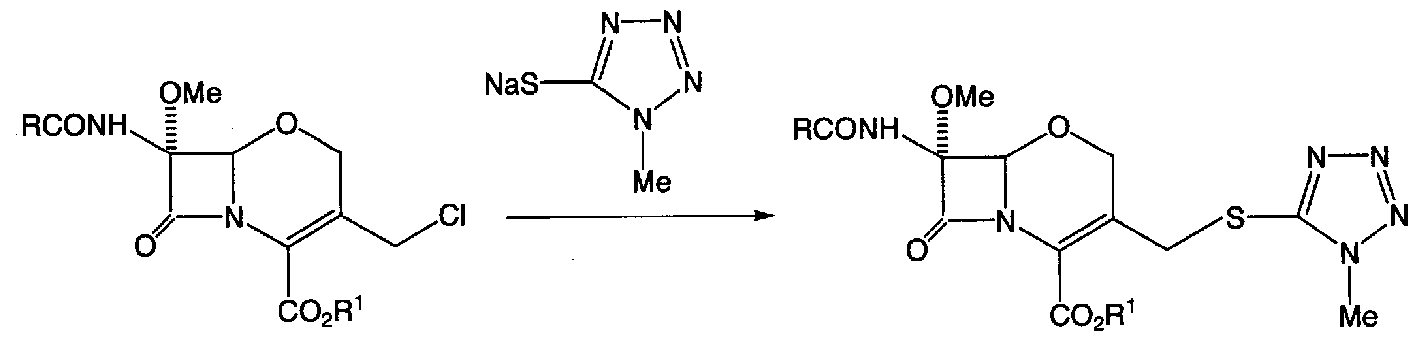
- 3-position side chain formation reaction eg, nucleophilic reaction for 3-position methylene
- 7-position deacylation reaction eg, amino group
- 7-position side chain formation reaction eg, acylation reaction to amino group
- 4-position carboxy deprotection reaction e.g, 5) 4-position carboxy esterification reaction, and Z or 6)
- the desired 7 ⁇ -methoxy-oxseneph can be obtained by appropriately combining salt formation reactions and the like.
- Compound 6 is useful, for example, as a synthesis intermediate of flomoxef described in JP-A-59-139385.
Landscapes
- Chemical & Material Sciences (AREA)
- Organic Chemistry (AREA)
- Pharmaceuticals Containing Other Organic And Inorganic Compounds (AREA)
- Cephalosporin Compounds (AREA)
- Nitrogen And Oxygen Or Sulfur-Condensed Heterocyclic Ring Systems (AREA)
Description



Claims


Priority Applications (2)
| Application Number | Priority Date | Filing Date | Title |
|---|---|---|---|
| EP05734618.1A EP1767538B1 (en) | 2004-07-08 | 2005-04-20 | Process for producing 1-oxacephalosporin-7alpha-methoxy-3-chloromethyl derivative |
| CN2005800230055A CN1980939B (zh) | 2004-07-08 | 2005-04-20 | 1-氧杂头孢菌素-7α-甲氧基-3-氯甲基衍生物的生产方法 |
Applications Claiming Priority (2)
| Application Number | Priority Date | Filing Date | Title |
|---|---|---|---|
| JP2004201578A JP3771566B2 (ja) | 2004-07-08 | 2004-07-08 | 1−オキサセファロスポリン−7α−メトキシ−3−クロルメチル誘導体の製法 |
| JP2004-201578 | 2004-07-08 |
Publications (1)
| Publication Number | Publication Date |
|---|---|
| WO2006006290A1 true WO2006006290A1 (ja) | 2006-01-19 |
Family
ID=34792648
Family Applications (1)
| Application Number | Title | Priority Date | Filing Date |
|---|---|---|---|
| PCT/JP2005/007517 Ceased WO2006006290A1 (ja) | 2004-07-08 | 2005-04-20 | 1-オキサセファロスポリン-7α-メトキシ-3-クロルメチル誘導体の製法 |
Country Status (5)
| Country | Link |
|---|---|
| EP (1) | EP1767538B1 (ja) |
| JP (1) | JP3771566B2 (ja) |
| CN (1) | CN1980939B (ja) |
| TW (1) | TWI302534B (ja) |
| WO (1) | WO2006006290A1 (ja) |
Cited By (6)
| Publication number | Priority date | Publication date | Assignee | Title |
|---|---|---|---|---|
| CN103183688A (zh) * | 2011-12-30 | 2013-07-03 | 浙江新和成股份有限公司 | 7β-酰胺基-7α-甲氧基-1-氧代-3-头孢烯化合物的制备方法 |
| JP2015524426A (ja) * | 2012-07-25 | 2015-08-24 | ジェ イル ファルマシューティカル シーオー., エルティーディー.Je Il Pharmaceutical Co., Ltd. | 1−オキサセファロスポリン誘導体の新規な製造方法 |
| CN106188097A (zh) * | 2016-07-08 | 2016-12-07 | 郑州大学 | 一种3‑氯甲基氧头孢烯类抗生素母核的制备方法 |
| US20190077812A1 (en) * | 2017-09-13 | 2019-03-14 | Dongdo Co., Ltd. | METHOD FOR MANUFACTURING 7alpha-ALKOXYOXACEPHEM INTERMEDIATE COMPOUND |
| CN109485660A (zh) * | 2018-12-21 | 2019-03-19 | 齐鲁安替制药有限公司 | 一种氧头孢母核的合成方法 |
| CN116813644A (zh) * | 2023-05-19 | 2023-09-29 | 广东立国制药有限公司 | 一种氟氧头孢母核的制备方法 |
Families Citing this family (11)
| Publication number | Priority date | Publication date | Assignee | Title |
|---|---|---|---|---|
| CN103183686B (zh) * | 2011-12-30 | 2016-06-29 | 浙江新和成股份有限公司 | 7β-氨基-7α-甲氧基-3-头孢烯化合物的制备方法 |
| CN102952149B (zh) * | 2012-11-09 | 2015-06-24 | 浙江新和成股份有限公司 | 一种氟氧头孢中间体的一锅合成法 |
| CN104610278A (zh) * | 2015-01-09 | 2015-05-13 | 郑州大学 | 一种氧头孢烯类抗生素中间体亚砜酯的安全生产方法 |
| CN105037393B (zh) * | 2015-06-24 | 2017-11-10 | 浙江永宁药业股份有限公司 | 一种氟氧头孢钠的制备方法 |
| CN105399755B (zh) * | 2015-11-03 | 2018-05-11 | 浙江永宁药业股份有限公司 | 一种氟氧头孢酸的合成方法 |
| CN106749335B (zh) * | 2016-11-29 | 2019-02-12 | 浙江新和成股份有限公司 | 一种卤代氧头孢类中间体的制备方法和应用 |
| CN107118224B (zh) * | 2017-06-15 | 2019-09-17 | 浙江新和成股份有限公司 | 一种氧头孢母核中间体的制备方法、其溶剂化合物及其制备方法 |
| CN110003242A (zh) * | 2019-04-23 | 2019-07-12 | 山西千岫制药有限公司 | 一种氟氧头孢酸杂质标准品的制备方法 |
| CN110003241A (zh) * | 2019-04-23 | 2019-07-12 | 山西千岫制药有限公司 | 一种拉氧头孢母核的制备方法 |
| CN114805395B (zh) * | 2022-04-27 | 2023-03-28 | 陕西友帮生物医药科技有限公司 | 一种氧头孢烯母核中间体的制备方法 |
| CN116496298A (zh) * | 2023-05-04 | 2023-07-28 | 深圳六合六医疗器械有限公司 | 一锅法制备氟氧头孢中间体的方法 |
Citations (3)
| Publication number | Priority date | Publication date | Assignee | Title |
|---|---|---|---|---|
| JPS53101391A (en) * | 1977-02-15 | 1978-09-04 | Shionogi & Co Ltd | 1-oxadithiacephem compounds |
| JPS5967289A (ja) * | 1982-10-08 | 1984-04-16 | Shionogi & Co Ltd | N−ハロアシルアミノオキサセフアム誘導体 |
| JPS61246187A (ja) * | 1985-09-05 | 1986-11-01 | Shionogi & Co Ltd | 1―オキサデチアセファム化合物の製造方法 |
Family Cites Families (1)
| Publication number | Priority date | Publication date | Assignee | Title |
|---|---|---|---|---|
| US4604460A (en) * | 1977-02-15 | 1986-08-05 | Shionogi & Co., Ltd. | 1-oxadethiacepham compounds |
-
2004
- 2004-07-08 JP JP2004201578A patent/JP3771566B2/ja not_active Expired - Fee Related
-
2005
- 2005-04-20 CN CN2005800230055A patent/CN1980939B/zh not_active Expired - Fee Related
- 2005-04-20 EP EP05734618.1A patent/EP1767538B1/en not_active Expired - Lifetime
- 2005-04-20 WO PCT/JP2005/007517 patent/WO2006006290A1/ja not_active Ceased
- 2005-07-06 TW TW094122786A patent/TWI302534B/zh not_active IP Right Cessation
Patent Citations (3)
| Publication number | Priority date | Publication date | Assignee | Title |
|---|---|---|---|---|
| JPS53101391A (en) * | 1977-02-15 | 1978-09-04 | Shionogi & Co Ltd | 1-oxadithiacephem compounds |
| JPS5967289A (ja) * | 1982-10-08 | 1984-04-16 | Shionogi & Co Ltd | N−ハロアシルアミノオキサセフアム誘導体 |
| JPS61246187A (ja) * | 1985-09-05 | 1986-11-01 | Shionogi & Co Ltd | 1―オキサデチアセファム化合物の製造方法 |
Non-Patent Citations (3)
| Title |
|---|
| CHANG C.K. ET AL: "The conversion of 3-exo-methylenecephalosporin to 3-halomethylcephems; a convenient synthesis of 3'-substituted cephalosporins from penicillins", JOURNAL OF THE AMERICAN CHEMICAL SOCIETY, vol. 99, no. 8, 13 April 1977 (1977-04-13), pages 2822 - 2823, XP000918383 * |
| NAGATA W. ET AL: "Studies on Oxacephems, an Artificial Type of beta-Lactam Antibiotics", JOURNAL OF THE PHARMACEUTICAL SOCIETY OF JAPAN, vol. 111, no. 2, 25 February 1991 (1991-02-25), pages 77 - 102, XP002996648 * |
| YOSHIOKA M. ET AL: "Stereocontrolled, straightforward synthesis of 3-substituted methyl 7alpha-methoxy-1-oxacephems", TETRAHEDRON LETTERS, vol. 21, no. 4, 1980, pages 351 - 354, XP002996649 * |
Cited By (8)
| Publication number | Priority date | Publication date | Assignee | Title |
|---|---|---|---|---|
| CN103183688A (zh) * | 2011-12-30 | 2013-07-03 | 浙江新和成股份有限公司 | 7β-酰胺基-7α-甲氧基-1-氧代-3-头孢烯化合物的制备方法 |
| CN103183688B (zh) * | 2011-12-30 | 2016-01-20 | 浙江新和成股份有限公司 | 7β-酰胺基-7α-甲氧基-1-氧代-3-头孢烯化合物的制备方法 |
| JP2015524426A (ja) * | 2012-07-25 | 2015-08-24 | ジェ イル ファルマシューティカル シーオー., エルティーディー.Je Il Pharmaceutical Co., Ltd. | 1−オキサセファロスポリン誘導体の新規な製造方法 |
| CN106188097A (zh) * | 2016-07-08 | 2016-12-07 | 郑州大学 | 一种3‑氯甲基氧头孢烯类抗生素母核的制备方法 |
| US20190077812A1 (en) * | 2017-09-13 | 2019-03-14 | Dongdo Co., Ltd. | METHOD FOR MANUFACTURING 7alpha-ALKOXYOXACEPHEM INTERMEDIATE COMPOUND |
| US10533019B2 (en) * | 2017-09-13 | 2020-01-14 | Dongdo Co., Ltd. | Method for manufacturing 7alpha-alkoxyoxacephem intermediate compound |
| CN109485660A (zh) * | 2018-12-21 | 2019-03-19 | 齐鲁安替制药有限公司 | 一种氧头孢母核的合成方法 |
| CN116813644A (zh) * | 2023-05-19 | 2023-09-29 | 广东立国制药有限公司 | 一种氟氧头孢母核的制备方法 |
Also Published As
| Publication number | Publication date |
|---|---|
| CN1980939B (zh) | 2012-05-30 |
| JP3771566B2 (ja) | 2006-04-26 |
| CN1980939A (zh) | 2007-06-13 |
| EP1767538A4 (en) | 2010-04-28 |
| JP2005179336A (ja) | 2005-07-07 |
| EP1767538B1 (en) | 2014-05-07 |
| EP1767538A1 (en) | 2007-03-28 |
| TW200606167A (en) | 2006-02-16 |
| TWI302534B (en) | 2008-11-01 |
Similar Documents
| Publication | Publication Date | Title |
|---|---|---|
| WO2006006290A1 (ja) | 1-オキサセファロスポリン-7α-メトキシ-3-クロルメチル誘導体の製法 | |
| CN113039175A (zh) | 芳基磺酰基丙烯腈的制备方法 | |
| JP2505981B2 (ja) | 新規なチア(ジア)ゾル酢酸の反応性チオホスフェ―ト誘導体及びその製造方法 | |
| EP0504404A1 (en) | Process for producing 3-substituted thio-3-cephem compound | |
| KR100899325B1 (ko) | 1-옥사세팔로스포린-7α-메톡시-3-클로로메틸 유도체의제조 방법 | |
| JPH0214358B2 (ja) | ||
| JPWO2008020597A1 (ja) | 1−メチルカルバペネム類製造中間体の製造方法 | |
| JPH09249983A (ja) | 3−アルコキシメチルセフェム化合物の製造法 | |
| JP2004149412A (ja) | 7−[2−(2−アミノチアゾール−4−イル)−2−低級アルコキシカルボニルメトキシイミノアセトアミド]−3−セフェム化合物の製造法 | |
| JP2945155B2 (ja) | アクリル酸誘導体の製造方法 | |
| JP3775820B2 (ja) | ハロゲン化β−ラクタム化合物の製造法 | |
| JP4289829B2 (ja) | 4−アルキル−チアゾール化合物の製造法 | |
| JP4659959B2 (ja) | 3−セフェム化合物及びその製造法 | |
| KR950013567B1 (ko) | 세펨유도체의 제조방법 | |
| GB2125807A (en) | Preparation of penicillin and cephalosporin compounds and novel intermediates useful therein | |
| CN110914250B (zh) | 用于合成非罗考昔的新工艺 | |
| JP2003335758A (ja) | ピリジン誘導体、その製造方法、及び除草剤中間体としての用途 | |
| JP4483183B2 (ja) | 6,7−ジヒドロキシクマリン−3−カルボン酸誘導体の製法及びその中間体 | |
| JP4481255B2 (ja) | ビンドリンとのカップリング反応によりビンブラスチン類を合成する中間体製造用化合物 | |
| JP2007536328A (ja) | スピロラクタム類およびそれらの合成 | |
| JPH0653747B2 (ja) | セフアロスポリン化合物の製法 | |
| JP2007084449A (ja) | 1,2,4−オキサジアゾール誘導体の製造方法 | |
| JPS6210994B2 (ja) | ||
| JPS6219432B2 (ja) | ||
| JP2001081080A (ja) | 4(5)−クロロメチル−2−フェニル−1,2,3−トリアゾール誘導体の製造法 |
Legal Events
| Date | Code | Title | Description |
|---|---|---|---|
| AK | Designated states |
Kind code of ref document: A1 Designated state(s): AE AG AL AM AT AU AZ BA BB BG BR BW BY BZ CA CH CN CO CR CU CZ DE DK DM DZ EC EE EG ES FI GB GD GE GH GM HR HU ID IL IN IS KE KG KM KP KR KZ LC LK LR LS LT LU LV MA MD MG MK MN MW MX MZ NA NI NO NZ OM PG PH PL PT RO RU SC SD SE SG SK SL SM SY TJ TM TN TR TT TZ UA UG US UZ VC VN YU ZA ZM ZW |
|
| AL | Designated countries for regional patents |
Kind code of ref document: A1 Designated state(s): BW GH GM KE LS MW MZ NA SD SL SZ TZ UG ZM ZW AM AZ BY KG KZ MD RU TJ TM AT BE BG CH CY CZ DE DK EE ES FI FR GB GR HU IE IS IT LT LU MC NL PL PT RO SE SI SK TR BF BJ CF CG CI CM GA GN GQ GW ML MR NE SN TD TG |
|
| 121 | Ep: the epo has been informed by wipo that ep was designated in this application | ||
| WWE | Wipo information: entry into national phase |
Ref document number: 1020077000345 Country of ref document: KR Ref document number: 2005734618 Country of ref document: EP |
|
| WWE | Wipo information: entry into national phase |
Ref document number: 200580023005.5 Country of ref document: CN Ref document number: 87/CHENP/2007 Country of ref document: IN |
|
| NENP | Non-entry into the national phase |
Ref country code: DE |
|
| WWW | Wipo information: withdrawn in national office |
Ref document number: DE |
|
| WWP | Wipo information: published in national office |
Ref document number: 1020077000345 Country of ref document: KR |
|
| WWP | Wipo information: published in national office |
Ref document number: 2005734618 Country of ref document: EP |