WO2006022426A1 - 電着塗料及び塗装物品 - Google Patents
電着塗料及び塗装物品 Download PDFInfo
- Publication number
- WO2006022426A1 WO2006022426A1 PCT/JP2005/015954 JP2005015954W WO2006022426A1 WO 2006022426 A1 WO2006022426 A1 WO 2006022426A1 JP 2005015954 W JP2005015954 W JP 2005015954W WO 2006022426 A1 WO2006022426 A1 WO 2006022426A1
- Authority
- WO
- WIPO (PCT)
- Prior art keywords
- compound
- electrodeposition paint
- acid
- group
- sodium
- Prior art date
- Legal status (The legal status is an assumption and is not a legal conclusion. Google has not performed a legal analysis and makes no representation as to the accuracy of the status listed.)
- Ceased
Links
Classifications
-
- C—CHEMISTRY; METALLURGY
- C09—DYES; PAINTS; POLISHES; NATURAL RESINS; ADHESIVES; COMPOSITIONS NOT OTHERWISE PROVIDED FOR; APPLICATIONS OF MATERIALS NOT OTHERWISE PROVIDED FOR
- C09D—COATING COMPOSITIONS, e.g. PAINTS, VARNISHES OR LACQUERS; FILLING PASTES; CHEMICAL PAINT OR INK REMOVERS; INKS; CORRECTING FLUIDS; WOODSTAINS; PASTES OR SOLIDS FOR COLOURING OR PRINTING; USE OF MATERIALS THEREFOR
- C09D175/00—Coating compositions based on polyureas or polyurethanes; Coating compositions based on derivatives of such polymers
- C09D175/04—Polyurethanes
-
- C—CHEMISTRY; METALLURGY
- C09—DYES; PAINTS; POLISHES; NATURAL RESINS; ADHESIVES; COMPOSITIONS NOT OTHERWISE PROVIDED FOR; APPLICATIONS OF MATERIALS NOT OTHERWISE PROVIDED FOR
- C09D—COATING COMPOSITIONS, e.g. PAINTS, VARNISHES OR LACQUERS; FILLING PASTES; CHEMICAL PAINT OR INK REMOVERS; INKS; CORRECTING FLUIDS; WOODSTAINS; PASTES OR SOLIDS FOR COLOURING OR PRINTING; USE OF MATERIALS THEREFOR
- C09D5/00—Coating compositions, e.g. paints, varnishes or lacquers, characterised by their physical nature or the effects produced; Filling pastes
- C09D5/08—Anti-corrosive paints
- C09D5/082—Anti-corrosive paints characterised by the anti-corrosive pigment
- C09D5/084—Inorganic compounds
-
- C—CHEMISTRY; METALLURGY
- C09—DYES; PAINTS; POLISHES; NATURAL RESINS; ADHESIVES; COMPOSITIONS NOT OTHERWISE PROVIDED FOR; APPLICATIONS OF MATERIALS NOT OTHERWISE PROVIDED FOR
- C09D—COATING COMPOSITIONS, e.g. PAINTS, VARNISHES OR LACQUERS; FILLING PASTES; CHEMICAL PAINT OR INK REMOVERS; INKS; CORRECTING FLUIDS; WOODSTAINS; PASTES OR SOLIDS FOR COLOURING OR PRINTING; USE OF MATERIALS THEREFOR
- C09D5/00—Coating compositions, e.g. paints, varnishes or lacquers, characterised by their physical nature or the effects produced; Filling pastes
- C09D5/44—Coating compositions, e.g. paints, varnishes or lacquers, characterised by their physical nature or the effects produced; Filling pastes for electrophoretic applications
- C09D5/4419—Coating compositions, e.g. paints, varnishes or lacquers, characterised by their physical nature or the effects produced; Filling pastes for electrophoretic applications with polymers obtained otherwise than by polymerisation reactions only involving carbon-to-carbon unsaturated bonds
- C09D5/443—Polyepoxides
- C09D5/4457—Polyepoxides containing special additives, e.g. pigments, polymeric particles
Definitions
- the present invention relates to an electrodeposition paint excellent in anticorrosion properties of a coating film, electrodeposition paintability on a steel sheet, finish, and coating stability.
- Japanese Patent Application Laid-Open No. 7-166 1111 describes water dispersion of water-dispersible and electrodepositable at least partially neutralized cationic resins.
- An electrodeposition coating composition comprising a liquid and a water-soluble salt of zinc has been disclosed, but an electrodeposition coating containing a water-soluble salt of zinc, for example, zinc lactate or zinc acetate, has paint stability and finish. There is a problem. Disclosure of the invention
- An object of the present invention is to provide an electrodeposition paint excellent in the anticorrosion property of a coating film, electrodeposition paintability on a steel sheet, finish, and paint stability.
- the present inventors have achieved the above object by using a specific metal ion, an oxymetal ion of the metal, or a fluoro metal ion as an anti-fouling component of the electrodeposition paint.
- the present invention provides at least one antifungal component selected from the group consisting of ions of a metal selected from zirconium, titanium, cobalt, vanadium, tandastene and molybdenum, an oxymetal ion of the metal, and a fluoro metal ion.
- An electrodeposition paint characterized by containing (A) and a resin component (B) is provided.
- the electrodeposition paint of the present invention is excellent in coating film performance such as corrosion resistance and finish, and has good paint stability.
- the electrodeposition paint of the present invention is excellent in paint stability, the anticorrosion property and finish quality do not change even after being used in a paint line for a long time.
- the reason why the electrodeposition paint of the present invention is excellent in paint stability and coating film performance as described above is not clear, but metal ions such as zirconium, titanium and molybdenum, oxy metal ions or fluoro metal ions are covered. It is presumed that the metal oxide film formed from the ions easily contributes to the suppression of corrosion under the coating film because it easily precipitates at the interface between the coating and the electrodeposition coating film.
- the electrodeposition coating material of the present invention prevents metal ions selected from zirconium, titanium, cobalt, vanadium, tandasten and molybdenum, and at least one selected from the group consisting of oxymetal ions and fluoro metal ions of the metals. It is contained as ⁇ component (A).
- These anti-mold components (A) can be imparted to the electrodeposition paint by blending a compound that generates the ions in the electrodeposition paint (hereinafter referred to as “metal ion compound”).
- Examples of compounds that generate zirconium ions in electrodeposition paints include dinoleconium nitrate, zirconium sulfate, and zirconyl chloride; examples of compounds that generate oxymetal ions include, for example, zirconyl nitrate, zirconyl acetate, and sulfuric acid. Zirconyl and the like; Examples of compounds that generate fluoro metal ions include For example, zirconium hydrofluoric acid, zirconium hydrofluoric acid salt (for example, sodium salt, potassium salt, lithium salt, ammonium salt, etc.) and the like can be mentioned.
- Examples of compounds that generate titanium ions in electrodeposition paints include titanium chloride and titanium sulfate; examples of compounds that generate fluoro metal ions include titanium hydrofluoric acid and titanium hydrofluoride. (For example, sodium salt, strong rhodium salt, lithium salt, ammonium salt, etc.).
- Examples of the compound that generates cobalt ions in the electrodeposition coating material include cobalto chloride, cobalt bromide, cobalt iodide, cobalt nitrate, cobalt sulfate, cobalt acetate, and ammonium sulfate.
- Examples of compounds that generate vanadium oxymetal ions in electrodeposition paints include lithium orthovanadate, sodium orthovanadate, lithium metavanadate, potassium metavanadate, sodium metavanadate, ammonium metavanadate, sodium pyrovanadate, Examples include vanadyl chloride and vanadyl sulfate.
- Examples of compounds that generate oxymetal ions of tungsten in electrodeposition coatings include lithium tungstate, sodium tungstate, potassium tungstate, sodium metatungstate, sodium paratungstate, ammonium pentatungstate, ammonium heptungstate. And sodium phosphotungstate and borotungstate.
- Examples of compounds that generate molybdenum oxymetal ions in electrodeposition paints include lithium molybdate, sodium molybdate, potassium molybdate, ammonium heptamolybdate, calcium molybdate, magnesium molybdate, strontium molybdate, molybdenum Examples include barium acid, phosphomolybdate, sodium phosphomolybdate, and zinc phosphomolybdate.
- metalion compounds can be used alone or in combination of two or more.
- zirconium hydrofluoric acid, titanium hydrofluoric acid, and zirconyl nitrate are particularly preferable.
- the blending ratio of these metal ion compounds to the electrodeposition paint can be changed as appropriate according to the purpose of use of the paint, but generally, the total solid content of the resin component (B) is considered from the viewpoint of paint stability. On the other hand, it is in the range of 0.01 to 10% by weight, particularly 0.03 to 50% by weight, more particularly 0.1 to 20% by weight, and 1 in terms of metal. 0 ppm to 10 wt%, especially 30 pp ⁇ ! It is preferable to be within a range of ⁇ 5% by weight, more particularly 100 p 111 ⁇ 2% by weight.
- Examples of the method of blending the metal ion compound into the electrodeposition paint include the methods (1) to (3) described below.
- a pigment dispersion paste is prepared in advance by adding a pigment, a catalyst, other additives, and water to a metal ion compound and dispersing it.
- pigments and catalysts include coloring pigments such as titanium white and carbon black; extender pigments such as clay, tanorek and barita; anti-mold pigments such as aluminum trihydrogenphosphate and aluminum phosphomolybdate; dibutyltin Organic tin compounds such as Oxide and Dioctyltin Oxide; Dibutyltin dilaurate, Dioctyltin dilaurate, Dibutyltin diacetate, Dioctyltin benzoateoxy, Dibutyltin benzoate, Dioctyltin dibenzoate, Dibutyltin dibenzoate, etc. And tin compounds such as dialkyl tin aliphatic or aromatic carboxylates.
- the electrodeposition paint that can be blended with the above-mentioned antifungal component (A) may be either an anion electrodeposition paint or a cationic electrodeposition paint. Paint is preferred.
- a cationic resin is used as the base resin in the resin component (B), and as the cationic resin, conventionally known cationic resins for cationic electrodeposition coatings can be used in the same manner. it can.
- the force thione resin include a resin having a group that can be cationized in an aqueous medium such as amino group, ammonium base, sulfonium base, and phosphonium base in a molecule.
- the base resin for the electrodeposition paint include those usually used, such as epoxy resins, acrylic resins, polybutadiene resins, alkyd resins, and polyester resins.
- an amine-added epoxy resin obtained by addition reaction of an amino group-containing compound with a polyepoxide compound is suitable.
- Examples of the above-mentioned amine-added epoxy resins include: (1) Adducts of polyepoxide compounds with primary mono- and polyamines, secondary mono- and polyamines, or primary and secondary mixed polyamines (for example, the United States). (2) Adducts of polyepoxide compounds with ketiminated primary mono- and polyamines having primary amino groups (eg, US Patent No. 3 9 8 4 2 9 9) (3) A reaction product obtained by etherification of a polyepoxide compound and a hydroxy compound having a primary amino group that has been ketiminated (for example, see Japanese Patent Application Laid-Open No. Sho 5). 9-4 3 0 1 3) and the like.
- the polyepoxide compound used in the production of the above-described amine-added epoxy resin is a compound having one or more, preferably two or more epoxy groups in one molecule, and is generally at least 200, preferably 400 to 4 , 0 0 0, more preferably from 8 0 0 to 2, 5 0 0, and at least 1 6 0, preferably
- those having an epoxy equivalent weight in the range of 180 to 2,500, more preferably 400 to 1,500 are suitable, particularly those obtained by the reaction of a polyphenol compound and epichlorohydrin. preferable.
- Epoxy resin (b) having at least two epoxy group-containing functional groups represented by the formula (B), a resin obtained by reacting an amino compound (b 2 ) and a Z or phenol compound (b 3 ) (B-1)
- Epoxy resin (b) a resin obtained by reacting an amino compound (b 2 ) and a Z or phenol compound (b 3 )
- Epoxy resin having an epoxy group-containing functional group (bj can be known per se, for example, JP-A-6 0-1 70620, JP-A-62-1 3 546 7, JP 60-1 6 6 6 75, JP 60-1 6 1 97 3, JP 2 26 5 9 75, etc. You can use what you have.
- epoxy resin (bj includes those having a residue of a polymerization initiating component, that is, an active hydrogen-containing organic compound residue, bonded to the terminal.
- an active hydrogen-containing organic compound that is a precursor thereof For example, aliphatic monohydric alcohols, aromatic monohydric alcohols, alcohols such as divalent or higher aliphatic or alicyclic polyhydric alcohols; phenols; fatty acids; aliphatic, alicyclic or aromatic 2 Basic acid Or polybasic acid; oxyacid; polybulu alcohol, polyacetate partial hydrolyzate, starch, cenorelose, cellulose acetate, cellulose acetate butyrate, hydroxyxetyl cellulose, aryl polyol resin, styrene-aryl alcohol Examples thereof include polymers, alkyd resins, polyester polyol resins, and poly force prolatathon polyol resins.
- These active hydrogen-containing organic compounds may have a structure in which unsaturated double bonds are epoxid
- Epoxy resin (bj is, for example, the above-mentioned active hydrogen-containing organic compound as an initiator, in the presence of 4-bicyclocyclohexene 1-oxide alone or in combination with other epoxy group-containing compounds. Ring-opening (co) polymerization with epoxy groups contained in each of them to form a polyether resin, and then the bur group present in the side chain in the resin is converted into peracids, hydroperoxides, etc. It can be produced by epoxidation with an oxidizing agent.
- 4-Vinylcyclohexene 1_oxide can be obtained, for example, by partially epoxidizing butylcyclohexene obtained by dimerization of butadiene with peracetic acid.
- the other epoxy group-containing compound that can be copolymerized is not particularly limited as long as it is a compound having an epoxy group, but is preferably a compound having one epoxy group in one molecule for production.
- An oxide of unsaturated compounds such as styrene oxide; allylic glycidyl ether, 2-ethylhexyl glycidyl ether tenole, methinoleglicidinore ether, butyldaricidinole Ether, veniguri
- examples thereof include glycidyl ethers of compounds having a hydroxyl group such as sidyl ethers; glycidyl esters of organic acids such as fatty acids.
- the other epoxy group-containing compound further includes an alicyclic oxysilane group-containing vinyl monomer having an unsaturated bond, and specific examples include the following.
- R 3 represents a hydrogen atom or a methyl group
- R 4 represents a divalent aliphatic saturated hydrocarbon group having 1 to 6 carbon atoms
- 1 to 5 carbon divalent C1-10 Represents a hydrogen group.
- the divalent aliphatic saturated hydrocarbon group having 1 to 6 carbon atoms represented by R 4 includes, for example, a linear or branched alkylene group such as methylene, ethylene, propylene, te And tramethylene, ethynoleethylene, and pentamethylene groups.
- Examples of the divalent hydrocarbon group having 1 to 10 carbon atoms represented by R 5 include methylene, ethylene, propylene, tetramethylene, ethynoleethylene, pentamethylene, hexamethylene, polymethylene, polyethylene,
- R 3 and R 4 have the same meaning as above,
- a compound having an alicyclic unsaturated group as shown by can be used as another epoxy group-containing compound.
- 4-vinylcycloheptene (Burnorbornene) can also be used.
- Ring opening (co) polymerization of the epoxy group in the presence of 4-vinyl hexene-1-oxoside alone or in combination with another epoxy group-containing compound is carried out in the presence of an active hydrogen-containing organic compound and It is preferable to use a catalyst.
- the catalyst examples include amines such as methylamine, ethylamine, propylamine, and piperazine; organic bases such as pyridines and imidazoles; organic acids such as formic acid, acetic acid, and propionic acid; inorganic acids such as sulfuric acid and hydrochloric acid; alkali metal alcoholate Ichito such as sodium Umumechira one DOO; KOH, n a Al force Li such as OH; BF 3 S n C l 2, a 1 CI 3, a Lewis acid or its complexes such as S n C 1 4 And organometallic compounds such as triethylaluminum and jetylzinc.
- amines such as methylamine, ethylamine, propylamine, and piperazine
- organic bases such as pyridines and imidazoles
- organic acids such as formic acid, acetic acid, and propionic acid
- inorganic acids such as sulfuric acid and hydrochloric acid
- the ring-opening (co) polymerization reaction can generally be carried out at a temperature in the range of 170 to 200 ° C, preferably in the range of 30 to 10000 ° C. This reaction is preferably carried out in a solvent, and a normal organic solvent having no active hydrogen can be used as the solvent.
- the polyether resin thus obtained (ring-opening (co) polymer) then epoxidizes the vinyl group (—CH ⁇ CH 2 ) directly attached to the carbon atom of the alicyclic structure of the side chain.
- the epoxy resin having the functional group represented by the formula (1) can be obtained (b).
- Epoxidation can be carried out using peracids or hydroperoxides.
- peracids include sulphate, peracetic acid, perbenzoic acid, and trifluoroperacetic acid.
- hydroperoxides include hydrogen peroxide, tert-butyl peroxide, and cupum. Oxide etc. can be used.
- the epoxidation reaction can be carried out in the presence of a catalyst, if necessary.
- the vinyl group contained in the compound may also be epoxidized. It is different from the functional group shown in.
- the ratio of these modified substituents varies depending on the type of epoxidizing agent, the molar ratio of the epoxidizing agent to the bur group, the reaction conditions, and the like.
- an epoxy resin (b) a commercially available product can be used, and examples thereof include EHPE 3 150 (trade name, manufactured by Daicel Chemical Industries, Ltd.). This is an epoxidized vinyl group in the ring-opening polymer of 4-vinylcyclohexene_1-oxide, and its average degree of polymerization is in the range of 15-25.
- epoxy group-containing functional group represented by the formula (1) is present in at least two epoxy resins (bj is a molecule, and epoxy resin (bj is generally preferably 140 to 1,000, More preferably, epochs within the range of 1 70-30 Xy equivalent weight, and preferably a number average molecular weight (Note 1) in the range of 200-50000, more preferably 1 000-10000.
- the epoxy resin (amino compound (b 2 ) reacted with bj is a cationic component for introducing an amino group into an epoxy resin substrate to cationize the epoxy resin.
- (b 2 ) one containing at least one, preferably 1 to 5, active hydrogens that react with an epoxy group is used.
- Examples of the amino compound (b 2 ) include mono- or di-alkylamines such as monomethylamine, dimethylamine, monoethylamine, jetylamine, monoisopropylamine, di-sodium pyramine, monobutylamine, and dibutylamine; monoethanolamine, diethanolamine Alkanolamines such as amine, mono (2-hydroxypropyl) amine, di (2-hydroxypropyl) amine, tri (2-hydroxypropyl) amine, monomethylaminoethanol, monoethylaminoethanol; ethylenediamine, Propylene diamine, Butylene diamine, Hexamethylene diamine, Tetraethylene pentamine, Pentaethylene hexamine, Jetylamino propylamine, Jetylene triamine, Tone Alkylene polyamines and these ketimine of a polyamine, such as tetraethylenepentamine; Echirenimin, ⁇ such as propylene I Min Lucyleneimine; cyclic amines
- n is an integer of 1 to 6
- R 2 represents a carbon number that may have a hydroxyl group and / or a polymerizable unsaturated bond.
- the compound shown by can be used.
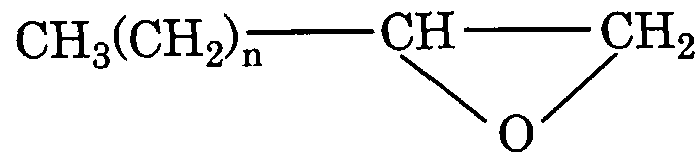
- R 2 and n have the same meaning as above,
- FIG. 1 it is produced by adding about 1 mol of a monocarboxylic acid having 5 to 37 carbon atoms, preferably 8 to 23 carbon atoms, to about 1 mol of N-hydroxyalkylalkylenediamine.
- a monocarboxylic acid having 5 to 37 carbon atoms preferably 8 to 23 carbon atoms
- N-hydroxyalkylalkylenediamine can do.
- diamines used in this reaction include hydroxychetyl aminoethylamine, N-hydroxyxetylethylenediamine, N-hydroxychetylpropylenediamine, N-hydroxyxylbutyrenediamine.
- hydroxychetylaminoethyl Amines and N-hydroxychetylpropylene diamines are preferred.
- Monocarboxylic acids include, for example, coconut oil fatty acid, castor oil fatty acid, rice bran oil fatty acid, soybean oil fatty acid, tall oil fatty acid, dehydrated castor oil fatty acid, safflower oil fatty acid, sweet fatty acid fatty acid, tung oil fatty acid, etc.
- Force prillic acid, force puric acid, lauric acid, myristic acid, palmitic acid, stearic acid, oleic acid, ricinoleic acid, linoleic acid, linolenic acid, eleostearic acid, 12-hydroxystearic acid, behenine An acid etc. are mentioned. Of these, stearic acid, oleic acid, 12-hydroxystearic acid and mixed fatty acids containing these acids are particularly preferred.
- N-hydroxyalkylalkylenediamine and monocarboxylic acid is, for example, by mixing the two components in an approximately equimolar ratio and using an organic solvent such as toluene-methyl isobutyl ketone.
- the reaction product water is removed and the remaining organic solvent is removed by a vacuum method or the like.
- phenol compound (b 3 ) one having at least one, preferably 1 to 5, phenolic 14 hydroxyl groups can be used.
- polyphenol compounds such as Sijifuenorenorehon, Phenenorenovolak, and Cresomonorenovolak.
- monophenol compounds such as phenol, nonylphenol, ⁇ - or] 3-naphthol, ⁇ -tert-octinolephenol, o_ or p-phenolenophenol can also be used.
- the fuunol compound (b 3 ) can be used in particular as bisphenol A [2,2-bis (p-hydroxyphenyl) puffed bread] or bisphenol F [ It is preferable to use a reaction product of bisphenols such as bis (p-hydroxyphenyl) methane] and epichlorohydrin.
- the number average molecular weight is at least 200, preferably in the range of about 800 to about 300, and an average of 2 or less per molecule is preferable.
- those represented by the following formulas containing from 0.8 to 1.2 phenolic hydroxyl groups are suitable.
- n is an average number from 0 to 7, and R 6 represents a residue of an active hydrogen compound.
- Examples of the active hydrogen-containing compound that is a precursor of R 6 in the above formula include amines such as secondary amines; phenols such as nonylphenol; organic acids such as fatty acids; thiols; Alcohols such as alcohol, cellosolve, butyl cellosolve, carbitol; compounds such as inorganic acids It is done.
- amines such as secondary amines
- phenols such as nonylphenol
- organic acids such as fatty acids
- thiols Alcohols such as alcohol, cellosolve, butyl cellosolve, carbitol
- compounds such as inorganic acids It is done.
- particularly preferred are monophenols such as dialkanolamine, which is a secondary amine having a primary hydroxyl group, nonylphenol, phenylphenol, and phenol.
- curability is improved
- monophenol stability is improved.
- R 6 — and OH are bonded to both ends, but it does not matter if both ends have only R 6 — or OH.
- the phenolic compound (b 3 ) for example, 1 mol of a bisphenol A diglycidyl ether type polyepoxide having a molecular weight of 200 or more, preferably in the range of 3800 to 200,000, and a molecular weight of 2 0 mol or more, preferably 1 mol of bisphenol A type polyphenol in the range of 200 to 200, and 1 mol of a compound having active hydrogen, if necessary in the presence of a catalyst or a solvent.
- those obtained by reacting at a temperature of 30 to 300 ° C., preferably 70 to 180 ° C. can be used. These reaction molar ratios are merely examples, and are not limited to these, and can be arbitrarily selected.
- polyols such as dimer diol, ethylene glycol, propylene glycol and butylene glycol
- polyether darcols such as polyethylene glycolate, polypropylene glycolone and polybutylene glycolate
- Polyester polyols such as prolatathone
- polycarboxylic acids such as polycarboxylic acids
- polyisocyanates such as monoisocyanates
- oxides of unsaturated compounds such as ethylene oxide, propylene oxide, butylene oxide, styrene oxide
- Daricidyl ether Polypropylene Dalicol Diglycidinoreether, 2-Ethylhexylglycininoreethenole, Methinoreglicinodinoatenore, Butinoreglycidinoreatenore, Et - Dali ethers of compounds having a hydroxyl group such as glycidyl ether; glycidyl esters of organic acids such as fatty acids; a etc.
- alicyclic Okishiran containing compounds may also be used those obtained by reacting the bisphenol A. Furthermore, A compound obtained by graft-polymerizing such a compound with ⁇ _4_prolacton, acrylic monomer, or the like can also be used.
- Resin (B-1) is composed of the above-mentioned epoxy resin (b and amino compound).
- Such resin (B-1) has the advantage of superior corrosion resistance and suitability for electrodeposition coating on galvannealed steel sheets compared to those obtained by reaction with conventional bisphenol A type epoxy resins. Yes.
- the reaction ratio of the epoxy resin (bj, amino compound (b 2 ), and phenol compound (b 3 ) is not particularly limited and can be appropriately selected according to the use of the resulting coating resin.
- the epoxy resin (bj epoxy group-containing functional group per mole of the amino compound (b 2 ) has a primary or secondary amino group of 0.:! To 1 mole, especially 0.4 to 0.9.
- the phenolic compound (b 3 ) is used in a molar range such that the phenolic hydroxyl group in the molar range is 0.02 to 0.4 mol, particularly 0.1 to 0.3 mol.
- the total number of moles of the primary or secondary amino group of the amino compound (b 2 ) and the phenolic hydroxyl group of the phenol compound (b 3 ) is the epoxy resin (the epoxy group-containing functional group in b). 0.7 mol to 1.5 mol, especially 0.8 to 1.2 mol per mol of group Preferably in the range.
- the reaction between the epoxy resin (bj and the amino compound (b 2 ) and Z or the phenol compound (b 3 ) can be carried out, for example, at a temperature in the range of 50 to 300 ° C., particularly 70 to 200 ° C.
- the reaction sequence is not particularly limited, and all components may be charged simultaneously and reacted, or epoxy resin (each other component may be added to b ⁇ in any order and reacted sequentially).
- Fatty acids (B-1) are generally amines in the range 20 to: 1 50 mg KOH / g, especially 30 to 1 2 5 mg KOHZg, more particularly 35 to 100 mg KOH, g 3 0 0 to 1 0 0 0 mg KOH / g, in particular 3 25 to 85 50 mg KO HZ g, more particularly in the range 3 5 0 to 70 0 O mg KO HZ g; 80 It is preferable to have a number average molecular weight (Note 1) in the range of 0 to 1 5 0 0 0 0, particularly 9 0 0 to 1 0 0 0 0 0, more particularly 1 0 0 0 to 6 0 0 0.
- resin (B-1) Unlike conventional cationic resins, resin (B-1) has excellent water dispersibility because the hydrophobic part and the hydrophilic part are co-polarized. For this reason, the electrodeposition coating material of the present invention containing the resin (B-1) as a base resin comprises a metal ion selected from zirconium, titanium, cobalt, vanadium, tungsten, and molybdenum, an oxy metal ion, and a fluoro metal ion. Even if at least one antifungal component (A) selected from the group is present, the coating stability is excellent.
- the resin (B-1) can be further reacted with the following cationizing agent, if necessary, during or after its production.
- cationizing agent examples include triethylamine, triethanolamine, N, N-dimethylethanolamine, N, N-methinoresethanolamine, N, N-jetylethanolamine, N- Tertiary amines such as tiljetanolamine can be used. These can be protonated beforehand with an acid and reacted with an epoxy group to form a quaternary salt.
- salts of sulfides such as jetyl sulfide, diphenyl sulfide, tetramethylene sulfide, and thiodiethanol with boric acid, carbonic acid, organic monocarboxylic acid, and the like are used as epoxy groups. It can also be reacted as a tertiary sulfonium salt.
- a quaternary phosphonium obtained by reacting a salt of a tertiary phosphine such as triethylphosphine, phenylenodimethylphosphine, diphenylenomethylphosphine, or triphenylphosphine with an acid such as formic acid, acetic acid, lactic acid, or glycolic acid. Salt can also be used as a cationizing agent.
- a salt of a tertiary phosphine such as triethylphosphine, phenylenodimethylphosphine, diphenylenomethylphosphine, or triphenylphosphine
- an acid such as formic acid, acetic acid, lactic acid, or glycolic acid.
- Salt can also be used as a cationizing agent.
- Blocked polyisocyanate compound (B-2) The electrodeposition coating material of the present invention is a blocked polyisocyanate, which is an addition reaction product of a polyisocyanate compound and a blocking agent as a part (curing agent) of the resin component (B) in a substantially stoichiometric amount. Cyanate compound (B-2) can be contained.
- polyisocyanate compound used here those known per se can be used.
- tolylene diisocyanate, xylylene diisocyanate, phenylene diisocyanate, diphenylmethane 1, 2, 4 'One diisocyanate, diphenylmethane one 4,4' — diisocyanate usually
- MD I Cluide MD I
- Bis (isocyanate methyl) cyclohexane Tetramethylene diisocyanate
- Hexamethylene diisocyanate Methylene diisocyanate
- Isophorone diiso Aromatic, aliphatic or alicyclic polyisocyanate compounds such as cyanate; cyclized polymers of these polyisocyanate compounds, isocyanate biuret bodies; ethylene glycol in excess of these polyisocyanate compounds, Examples thereof include terminal isocyanate-containing compounds obtained by reacting low-molecular active hydrogen-containing compounds such as propylene glycol, trimethylol, propane, hexanetriol, and castor oil. These can be used alone or in combination of two or more.
- the blocking agent is added to the isocyanate group of the polyisocyanate compound to block, and the block polyisocyanate compound produced by the addition is stable at room temperature, but the baking temperature of the coating film (usually When heated to about 100 to about 200 ° C.), it is desirable that the blocking agent can dissociate to regenerate the free isocyanate group.
- blocking agents examples include lactam compounds such as ⁇ -force prolactam and ⁇ -butyrolactam; oxime compounds such as methyl ethyl ketoxime and cyclohexanone oxime; phenol, para-tert-butino Phenolic compounds such as lephenol and cresol; aliphatic alcohols such as n-butanol and 2-ethylhexanol; aromatic alkyl alcohols such as phenylcarbinol and methylphenylcarbinol; ethylene glycol Examples thereof include ether alcohol compounds such as cornenomonobutinoylenotenole and diethyleneglycolenomonoenochineoatenore.
- lactam compounds such as ⁇ -force prolactam and ⁇ -butyrolactam
- oxime compounds such as methyl ethyl ketoxime and cyclohexanone oxime
- phenol, para-tert-butino Phenolic compounds such as
- a diol having a molecular weight of 76 to 150 or a carboxyl group-containing diol having a molecular weight of 106 to 500 is used as the block homo U. You can also.
- the diol is composed of two hydroxyl groups having different reactivity, for example, a combination of a primary hydroxyl group and a secondary hydroxyl group, a primary hydroxyl group and a tertiary hydroxyl group, and a combination of a secondary hydroxyl group and a tertiary hydroxyl group.
- a combination of a primary hydroxyl group and a secondary hydroxyl group and a secondary hydroxyl group for example, propylene glycol, dipropylene glycol, 1,3_butanediol, 1,2—, and the like.
- carboxyl group-containing diol examples include 2,2-dimethylolpropionic acid, 2,2-dimethylolbutanoic acid, dimethylolvaleric acid, and glyceric acid.
- the electrodeposition paint of the present invention may further contain other additives such as coloring pigments, extender pigments, antifungal pigments as necessary.
- Organic solvents, pigment dispersants, surface conditioners, surfactants, acids, catalysts, etc. can be contained in the amounts usually used.
- the electrodeposition coating material of the present invention can be prepared by dispersing each component described above in an aqueous medium and appropriately diluting with an aqueous medium according to a conventional method.
- the electrodeposition paint prepared as described above can be applied to the desired substrate surface by electrodeposition coating.
- Electrodeposition coating is generally performed by diluting with a deionized water or the like so that the bath solids concentration is about 5 to about 40% by weight, and further adjusting the pH within the range of 3.0 to 9.0. It is possible to use a paint bath, usually under conditions of a bath temperature of 15 to 45 ° C and an applied voltage of 10 to 400 V.
- the film thickness of the coating film formed using the electrodeposition coating material of the present invention is not particularly limited, but is generally in the range of 5 to 40 ⁇ , particularly 10 to 30 ⁇ , based on the cured coating film.
- the inside is preferable.
- the baking temperature of the coating film is usually within the range of about 120 to about 200 ° C, preferably about 140 to about 180 ° C on the surface of the object, and the baking time is 5 to 5 ° C. It can be 60 minutes, preferably about 10 to 30 minutes.
- Production examples 4 to 10 Production examples of pigment dispersion paste No. 2 to No. 8
- Pigment dispersion pastes No. 2 to No. 8 were obtained in the same manner as in Production Example 3, except that the compounds shown in Table 1 below were used instead of zirconium hydrofluoric acid.
- Production Example 3 Production Example 4 Production Example 5 Production Example 6 Production Example 7 Production Example 8 Production Example 9 Production Example 1 0 Pigment Dispersion Best No.1 No.2 No.3 No.4 No.5 No.6 No. 7 No.8 Pigment dispersion resin Solid content 80% 4.4 4.4 4.4 4.4 4.4 4.4 4.4 4.4 4.4 4.4 4.4 4.4 4.4 4.4 4.4 4.4
- Zinc lactate 3 Color pigment JR-600E (Note 4) 14.5 14.5 14.5 14.5 14.5 14.5 14.5 14.5 14.5 14.5 14.5 14.5 14.5 14.5 14.5 14.5
- Carbon MA-7 Product name, carbon black, manufactured by Mitsubishi Kasei.
- Emulsion No. 1 2 94 parts (solid content 100 parts), facial dispersion paste No. 1 5 3. 3 parts (solid content 29.3 parts) obtained in Production Example 1 and deionized water 2 9 9. Two parts were added to obtain an electrodeposition paint No. 1 having a solid content of 20%. Examples 2-5, comparative example:! ⁇ 3
- Electrodeposition paints No. 2 to No. 8 were obtained in the same manner as in Example 1 with the formulation shown in Table 2 below.
- the cold-rolled steel sheet was subjected to chemical conversion treatment (Palbond # 3 0 20 0, Nippon Parkerizing Co., Ltd., trade name, zinc phosphate treatment agent), and the film thickness was 20 using the electrodeposition paint obtained in Examples or Comparative Examples
- the applied voltage was adjusted so that ⁇ ⁇ 1 and electrodeposition coating was performed for 3 minutes. Next, it was baked at 170 ° C. for 20 minutes with an electric dryer to obtain a test plate.
- the electrodeposited coating film was cut with a knife so that it reached the base of the test plate, and this was subjected to a salt water resistance test for 120 hours according to JISZ-2 3 71.
- the evaluation was made according to the following criteria based on the wrinkles and blister width from the knife scratch.
- ⁇ The maximum width of ⁇ and blisters is less than 2 mm from the cut part (one side)
- ⁇ is ⁇
- the maximum width of the blister is 2 mm or more from the cut part and less than 3 mm (one side)
- ⁇ is ⁇
- the maximum width of swelling is 3 mm or more and less than 4 mm from the cut part
- Electrodeposition paints of examples and comparative examples on coated materials that have been subjected to chemical conversion treatment (pal bond # 3 0 20 0, product name, zinc phosphate treatment agent) on alloyed zinc-plated steel sheets was applied at a bath temperature of 28 ° C. at a voltage to obtain a B-thickness of 20 xm, and baked and dried at 170 ° C. for 20 minutes. Then, the number of pinholes in the coated plate (10 cm x 10 cm) was counted.
- ⁇ is 1-5 occurrences
- X represents occurrence of 6 or more.
- ⁇ indicates that the surface roughness value (Ra) is less than 0.2
- ⁇ is a surface roughness value (Ra) of 0.2 or more and less than 0.3
- X represents a surface roughness value (Ra) of 0.3 or more.
- the amount of filtration residue was measured using a 400 mesh filter screen.
- ⁇ is less than 1 Omg / L
- ⁇ is 1 Omg / L or more and less than 1 Smg / L
- X represents I SmgZL or more.
- Example 1 Example 2 Example 3 Example 4 Example 5 Comparative Example 1 Comparative Example 2 Comparative Example 3 Electrodeposition Paint No.1 No.2 No.3 No.4 No.5 No.6 No.7 No. 8 Corrosion resistance (Note 7) ⁇ ⁇ ⁇ O ⁇ ⁇ ⁇ X Suitability for electrodeposition coating of steel plate (Note 8) ⁇ ⁇ o O ⁇ ⁇ ⁇ O Finishability (Note 9) oo ⁇ ⁇ ⁇ ⁇ ⁇ ⁇ ⁇ (Note 1 0) ⁇ ⁇ o O ⁇ ⁇ ⁇ ⁇ ⁇ ⁇
Landscapes
- Chemical & Material Sciences (AREA)
- Life Sciences & Earth Sciences (AREA)
- Engineering & Computer Science (AREA)
- Materials Engineering (AREA)
- Wood Science & Technology (AREA)
- Organic Chemistry (AREA)
- Chemical Kinetics & Catalysis (AREA)
- Health & Medical Sciences (AREA)
- Molecular Biology (AREA)
- Inorganic Chemistry (AREA)
- Paints Or Removers (AREA)
Abstract
Description







Claims

Priority Applications (4)
| Application Number | Priority Date | Filing Date | Title |
|---|---|---|---|
| CN2005800285467A CN101006150B (zh) | 2004-08-26 | 2005-08-25 | 电沉积涂料和涂装物品 |
| EP05777077A EP1788051A4 (en) | 2004-08-26 | 2005-08-25 | COMPOSITION FOR COATING OF ELECTRICALLY DESIGNED AND COATED ARTICLES |
| US11/661,144 US20070256592A1 (en) | 2004-08-26 | 2005-08-25 | Electrodeposition Paint and Painted Article |
| JP2006532767A JP4637846B2 (ja) | 2004-08-26 | 2005-08-25 | 電着塗料及び塗装物品 |
Applications Claiming Priority (2)
| Application Number | Priority Date | Filing Date | Title |
|---|---|---|---|
| JP2004247130 | 2004-08-26 | ||
| JP2004/247130 | 2004-08-26 |
Publications (1)
| Publication Number | Publication Date |
|---|---|
| WO2006022426A1 true WO2006022426A1 (ja) | 2006-03-02 |
Family
ID=35967620
Family Applications (1)
| Application Number | Title | Priority Date | Filing Date |
|---|---|---|---|
| PCT/JP2005/015954 Ceased WO2006022426A1 (ja) | 2004-08-26 | 2005-08-25 | 電着塗料及び塗装物品 |
Country Status (5)
| Country | Link |
|---|---|
| US (1) | US20070256592A1 (ja) |
| EP (1) | EP1788051A4 (ja) |
| JP (1) | JP4637846B2 (ja) |
| CN (1) | CN101006150B (ja) |
| WO (1) | WO2006022426A1 (ja) |
Cited By (7)
| Publication number | Priority date | Publication date | Assignee | Title |
|---|---|---|---|---|
| JP2006257268A (ja) * | 2005-03-17 | 2006-09-28 | Kansai Paint Co Ltd | 電着塗料及び塗装方法と塗装物品 |
| JP2008063658A (ja) * | 2006-08-08 | 2008-03-21 | Kansai Paint Co Ltd | 表面処理皮膜の形成方法 |
| JP2008274392A (ja) * | 2006-08-04 | 2008-11-13 | Kansai Paint Co Ltd | 表面処理皮膜の形成方法 |
| JP2009114468A (ja) * | 2007-11-01 | 2009-05-28 | Nippon Paint Co Ltd | 電着塗膜形成方法および複層塗膜形成方法 |
| JP2009280884A (ja) * | 2008-05-26 | 2009-12-03 | Kansai Paint Co Ltd | 皮膜形成方法 |
| JP2011084729A (ja) * | 2009-09-15 | 2011-04-28 | Kansai Paint Co Ltd | カチオン電着塗料組成物 |
| JP2016519693A (ja) * | 2013-03-15 | 2016-07-07 | ヘンケル・アクチェンゲゼルシャフト・ウント・コムパニー・コマンディットゲゼルシャフト・アウフ・アクチェンHenkel AG & Co. KGaA | 自動析出性ポリマーの電着 |
Families Citing this family (5)
| Publication number | Priority date | Publication date | Assignee | Title |
|---|---|---|---|---|
| US7972533B2 (en) | 2006-04-04 | 2011-07-05 | United Technologies Corporation | Chromate free waterborne corrosion resistant primer with non-carcinogenic corrosion inhibiting additive |
| EP1889952B1 (en) | 2006-08-08 | 2012-05-30 | Kansai Paint Co., Ltd. | Method for forming surface-treating film |
| JP5634145B2 (ja) * | 2009-07-31 | 2014-12-03 | 関西ペイント株式会社 | カチオン電着塗料組成物 |
| CN114058235A (zh) * | 2020-08-03 | 2022-02-18 | 广东华润涂料有限公司 | 无铬防腐涂料组合物以及由其制成的制品 |
| CN112064075A (zh) * | 2020-09-24 | 2020-12-11 | 蚌埠飞宇轴承有限公司 | 一种改善汽车轴承表面耐磨性能的处理工艺 |
Citations (11)
| Publication number | Priority date | Publication date | Assignee | Title |
|---|---|---|---|---|
| JPS4856232A (ja) * | 1971-11-18 | 1973-08-07 | ||
| JPS49128029A (ja) * | 1973-04-09 | 1974-12-07 | ||
| JPS63295682A (ja) * | 1987-05-27 | 1988-12-02 | Toagosei Chem Ind Co Ltd | 防食塗料組成物 |
| JPH02265975A (ja) * | 1989-04-07 | 1990-10-30 | Kansai Paint Co Ltd | カチオン電着塗料 |
| JPH06220371A (ja) * | 1993-01-27 | 1994-08-09 | Kansai Paint Co Ltd | カチオン電着塗料組成物 |
| JPH06340831A (ja) * | 1993-05-28 | 1994-12-13 | Kansai Paint Co Ltd | カチオン電着塗装方法 |
| JP2000290542A (ja) * | 1999-04-12 | 2000-10-17 | Nof Corp | カチオン電着塗料組成物および塗膜 |
| JP2002030458A (ja) * | 2000-07-12 | 2002-01-31 | Nisshin Steel Co Ltd | 塗膜に非クロム化合物防錆顔料を使用した塗装金属板 |
| JP2002275644A (ja) * | 2001-03-15 | 2002-09-25 | Kansai Paint Co Ltd | 金属表面処理組成物 |
| JP2002294493A (ja) * | 2001-03-29 | 2002-10-09 | Nippon Paint Co Ltd | 電着塗装装置の腐蝕防止方法 |
| JP2004203902A (ja) * | 2002-12-20 | 2004-07-22 | Kansai Paint Co Ltd | 塗料組成物 |
Family Cites Families (19)
| Publication number | Priority date | Publication date | Assignee | Title |
|---|---|---|---|---|
| US4064028A (en) * | 1971-11-18 | 1977-12-20 | Kansai Paint Co., Ltd. | Process for electrocoating |
| US4016129A (en) * | 1974-07-30 | 1977-04-05 | Kansai Paint Company, Ltd. | Hardenable coating composition |
| JP2997562B2 (ja) * | 1991-04-25 | 2000-01-11 | 関西ペイント株式会社 | カチオン電着塗料及び塗膜形成方法 |
| ES2158946T3 (es) * | 1992-04-01 | 2001-09-16 | Henkel Corp | Composicion y proceso para tratamiento de metales. |
| US5769967A (en) * | 1992-04-01 | 1998-06-23 | Henkel Corporation | Composition and process for treating metal |
| US5356490A (en) * | 1992-04-01 | 1994-10-18 | Henkel Corporation | Composition and process for treating metal |
| US6464800B1 (en) * | 1998-10-30 | 2002-10-15 | Henkel Corporation | Visible chromium- and phosphorus-free conversion coating for aluminum and its alloys |
| US6168868B1 (en) * | 1999-05-11 | 2001-01-02 | Ppg Industries Ohio, Inc. | Process for applying a lead-free coating to untreated metal substrates via electrodeposition |
| US6217674B1 (en) * | 1999-05-11 | 2001-04-17 | Ppg Industries Ohio, Inc. | Compositions and process for treating metal substrates |
| US6736908B2 (en) * | 1999-12-27 | 2004-05-18 | Henkel Kommanditgesellschaft Auf Aktien | Composition and process for treating metal surfaces and resulting article |
| JP3860697B2 (ja) * | 1999-12-27 | 2006-12-20 | 日本パーカライジング株式会社 | 金属表面処理剤、金属材料の表面処理方法及び表面処理金属材料 |
| US6890648B2 (en) * | 2000-02-03 | 2005-05-10 | Nisshin Steel Co., Ltd. | CR-free paint compositions and painted metal sheets |
| JP4099307B2 (ja) * | 2000-04-20 | 2008-06-11 | 日本ペイント株式会社 | アルミニウム用ノンクロム防錆処理剤、防錆処理方法および防錆処理されたアルミニウム製品 |
| JP2001335954A (ja) * | 2000-05-31 | 2001-12-07 | Nippon Parkerizing Co Ltd | 金属表面処理剤、金属表面処理方法及び表面処理金属材料 |
| JP3844643B2 (ja) * | 2000-08-21 | 2006-11-15 | 日本パーカライジング株式会社 | 下地処理剤、及び下地処理方法 |
| JP2002086052A (ja) * | 2000-09-20 | 2002-03-26 | Kansai Paint Co Ltd | 複層塗膜形成方法 |
| JP4078044B2 (ja) * | 2001-06-26 | 2008-04-23 | 日本パーカライジング株式会社 | 金属表面処理剤、金属材料の表面処理方法及び表面処理金属材料 |
| CN1460561B (zh) * | 2002-02-28 | 2012-01-04 | 关西涂料株式会社 | 汽车车体的涂饰方法 |
| JP4473755B2 (ja) * | 2005-03-17 | 2010-06-02 | 関西ペイント株式会社 | 電着塗料及び塗装方法と塗装物品 |
-
2005
- 2005-08-25 US US11/661,144 patent/US20070256592A1/en not_active Abandoned
- 2005-08-25 CN CN2005800285467A patent/CN101006150B/zh not_active Expired - Fee Related
- 2005-08-25 JP JP2006532767A patent/JP4637846B2/ja not_active Expired - Fee Related
- 2005-08-25 EP EP05777077A patent/EP1788051A4/en not_active Withdrawn
- 2005-08-25 WO PCT/JP2005/015954 patent/WO2006022426A1/ja not_active Ceased
Patent Citations (11)
| Publication number | Priority date | Publication date | Assignee | Title |
|---|---|---|---|---|
| JPS4856232A (ja) * | 1971-11-18 | 1973-08-07 | ||
| JPS49128029A (ja) * | 1973-04-09 | 1974-12-07 | ||
| JPS63295682A (ja) * | 1987-05-27 | 1988-12-02 | Toagosei Chem Ind Co Ltd | 防食塗料組成物 |
| JPH02265975A (ja) * | 1989-04-07 | 1990-10-30 | Kansai Paint Co Ltd | カチオン電着塗料 |
| JPH06220371A (ja) * | 1993-01-27 | 1994-08-09 | Kansai Paint Co Ltd | カチオン電着塗料組成物 |
| JPH06340831A (ja) * | 1993-05-28 | 1994-12-13 | Kansai Paint Co Ltd | カチオン電着塗装方法 |
| JP2000290542A (ja) * | 1999-04-12 | 2000-10-17 | Nof Corp | カチオン電着塗料組成物および塗膜 |
| JP2002030458A (ja) * | 2000-07-12 | 2002-01-31 | Nisshin Steel Co Ltd | 塗膜に非クロム化合物防錆顔料を使用した塗装金属板 |
| JP2002275644A (ja) * | 2001-03-15 | 2002-09-25 | Kansai Paint Co Ltd | 金属表面処理組成物 |
| JP2002294493A (ja) * | 2001-03-29 | 2002-10-09 | Nippon Paint Co Ltd | 電着塗装装置の腐蝕防止方法 |
| JP2004203902A (ja) * | 2002-12-20 | 2004-07-22 | Kansai Paint Co Ltd | 塗料組成物 |
Non-Patent Citations (1)
| Title |
|---|
| See also references of EP1788051A4 * |
Cited By (9)
| Publication number | Priority date | Publication date | Assignee | Title |
|---|---|---|---|---|
| JP2006257268A (ja) * | 2005-03-17 | 2006-09-28 | Kansai Paint Co Ltd | 電着塗料及び塗装方法と塗装物品 |
| JP2008274392A (ja) * | 2006-08-04 | 2008-11-13 | Kansai Paint Co Ltd | 表面処理皮膜の形成方法 |
| JP2008063658A (ja) * | 2006-08-08 | 2008-03-21 | Kansai Paint Co Ltd | 表面処理皮膜の形成方法 |
| JP2009114468A (ja) * | 2007-11-01 | 2009-05-28 | Nippon Paint Co Ltd | 電着塗膜形成方法および複層塗膜形成方法 |
| JP2009280884A (ja) * | 2008-05-26 | 2009-12-03 | Kansai Paint Co Ltd | 皮膜形成方法 |
| WO2009145203A1 (ja) * | 2008-05-26 | 2009-12-03 | 関西ペイント株式会社 | 皮膜形成方法 |
| US8414753B2 (en) | 2008-05-26 | 2013-04-09 | Toyota Jidosha Kabushiki Kaisha | Method for forming coating film |
| JP2011084729A (ja) * | 2009-09-15 | 2011-04-28 | Kansai Paint Co Ltd | カチオン電着塗料組成物 |
| JP2016519693A (ja) * | 2013-03-15 | 2016-07-07 | ヘンケル・アクチェンゲゼルシャフト・ウント・コムパニー・コマンディットゲゼルシャフト・アウフ・アクチェンHenkel AG & Co. KGaA | 自動析出性ポリマーの電着 |
Also Published As
| Publication number | Publication date |
|---|---|
| JP4637846B2 (ja) | 2011-02-23 |
| JPWO2006022426A1 (ja) | 2008-05-08 |
| US20070256592A1 (en) | 2007-11-08 |
| EP1788051A4 (en) | 2009-10-21 |
| CN101006150A (zh) | 2007-07-25 |
| CN101006150B (zh) | 2010-06-16 |
| EP1788051A1 (en) | 2007-05-23 |
Similar Documents
| Publication | Publication Date | Title |
|---|---|---|
| JP4473755B2 (ja) | 電着塗料及び塗装方法と塗装物品 | |
| US10961403B2 (en) | Electrodepositable coating compositions containing 1,1-di-activated vinyl compounds | |
| JPWO1999031187A1 (ja) | カチオン電着塗料組成物 | |
| EP0456270B1 (en) | Resin composition for cationically electrodepositable paint | |
| EP0768327B1 (en) | Coating resin composition | |
| JP4637846B2 (ja) | 電着塗料及び塗装物品 | |
| JP4825841B2 (ja) | 皮膜形成方法 | |
| WO2016143707A1 (ja) | カチオン電着塗料組成物 | |
| KR910000834B1 (ko) | 조절된 필름 형성 에폭시 피복물 | |
| US6617030B2 (en) | Cationic electro-coating bath composition | |
| JP2015187199A (ja) | 電着塗料組成物 | |
| JP5473983B2 (ja) | カチオン電着塗料組成物及び塗装物品 | |
| JPWO1993015157A1 (ja) | 水性塗料用樹脂組成物 | |
| JP6406848B2 (ja) | 電着塗料組成物 | |
| JPWO2014054549A1 (ja) | カチオン電着塗料組成物 | |
| JPH05295318A (ja) | 水性塗料用樹脂組成物 | |
| JP3685297B2 (ja) | 鉛フリーカチオン電着塗膜の暴露耐食性を向上させる方法 | |
| CA2012422C (en) | Cationically electrodepositable resin | |
| JP2022129794A (ja) | カチオン電着塗料組成物 | |
| JPH0657184A (ja) | カチオン電着塗料組成物 | |
| JP3602828B2 (ja) | カチオン電着浴組成物 | |
| JPH05222157A (ja) | 水性塗料用樹脂組成物 | |
| JP6719185B2 (ja) | カチオン電着塗料組成物の調製方法 | |
| JP4516723B2 (ja) | 亜鉛メッキ鋼板の防食性に優れたカチオン電着塗料組成物及び塗装物品 | |
| JP3920873B2 (ja) | カチオン電着塗料組成物 |
Legal Events
| Date | Code | Title | Description |
|---|---|---|---|
| AK | Designated states |
Kind code of ref document: A1 Designated state(s): AE AG AL AM AT AU AZ BA BB BG BR BW BY BZ CA CH CN CO CR CU CZ DE DK DM DZ EC EE EG ES FI GB GD GE GH GM HR HU ID IL IN IS JP KE KG KM KP KR KZ LC LK LR LS LT LU LV MA MD MG MK MN MW MX MZ NA NG NI NO NZ OM PG PH PL PT RO RU SC SD SE SG SK SL SM SY TJ TM TN TR TT TZ UA UG US UZ VC VN YU ZA ZM ZW |
|
| AL | Designated countries for regional patents |
Kind code of ref document: A1 Designated state(s): BW GH GM KE LS MW MZ NA SD SL SZ TZ UG ZM ZW AM AZ BY KG KZ MD RU TJ TM AT BE BG CH CY CZ DE DK EE ES FI FR GB GR HU IE IS IT LT LU LV MC NL PL PT RO SE SI SK TR BF BJ CF CG CI CM GA GN GQ GW ML MR NE SN TD TG |
|
| 121 | Ep: the epo has been informed by wipo that ep was designated in this application | ||
| WWE | Wipo information: entry into national phase |
Ref document number: 2006532767 Country of ref document: JP |
|
| WWE | Wipo information: entry into national phase |
Ref document number: 200580028546.7 Country of ref document: CN |
|
| WWE | Wipo information: entry into national phase |
Ref document number: 11661144 Country of ref document: US |
|
| NENP | Non-entry into the national phase |
Ref country code: DE |
|
| WWE | Wipo information: entry into national phase |
Ref document number: 2005777077 Country of ref document: EP |
|
| WWP | Wipo information: published in national office |
Ref document number: 2005777077 Country of ref document: EP |
|
| WWP | Wipo information: published in national office |
Ref document number: 11661144 Country of ref document: US |