WO2006131221A2 - Carboxamide - Google Patents
Carboxamide Download PDFInfo
- Publication number
- WO2006131221A2 WO2006131221A2 PCT/EP2006/005070 EP2006005070W WO2006131221A2 WO 2006131221 A2 WO2006131221 A2 WO 2006131221A2 EP 2006005070 W EP2006005070 W EP 2006005070W WO 2006131221 A2 WO2006131221 A2 WO 2006131221A2
- Authority
- WO
- WIPO (PCT)
- Prior art keywords
- alkyl
- methyl
- chlorine
- fluorine
- haloalkyl
- Prior art date
- Legal status (The legal status is an assumption and is not a legal conclusion. Google has not performed a legal analysis and makes no representation as to the accuracy of the status listed.)
- Ceased
Links
- GZNCWLFUAXRBFQ-UHFFFAOYSA-N CC(C)CC(C)c(cccc1)c1NC(c1c[n](C)cc1C(F)(F)F)=O Chemical compound CC(C)CC(C)c(cccc1)c1NC(c1c[n](C)cc1C(F)(F)F)=O GZNCWLFUAXRBFQ-UHFFFAOYSA-N 0.000 description 1
- LBWGCYNZIUGHGN-UHFFFAOYSA-N CC(CC(C)(C)C)c(cccc1)c1NC(c(c(C(F)(F)F)n[n]1C)c1F)=O Chemical compound CC(CC(C)(C)C)c(cccc1)c1NC(c(c(C(F)(F)F)n[n]1C)c1F)=O LBWGCYNZIUGHGN-UHFFFAOYSA-N 0.000 description 1
- KKJAYAKCRSKZKO-UHFFFAOYSA-N Cc(cc1)ccc1-c1c(NC(c2c[n](C)nc2C(F)(F)F)=O)[s]cc1 Chemical compound Cc(cc1)ccc1-c1c(NC(c2c[n](C)nc2C(F)(F)F)=O)[s]cc1 KKJAYAKCRSKZKO-UHFFFAOYSA-N 0.000 description 1
Classifications
-
- A—HUMAN NECESSITIES
- A01—AGRICULTURE; FORESTRY; ANIMAL HUSBANDRY; HUNTING; TRAPPING; FISHING
- A01N—PRESERVATION OF BODIES OF HUMANS OR ANIMALS OR PLANTS OR PARTS THEREOF; BIOCIDES, e.g. AS DISINFECTANTS, AS PESTICIDES OR AS HERBICIDES; PEST REPELLANTS OR ATTRACTANTS; PLANT GROWTH REGULATORS
- A01N43/00—Biocides, pest repellants or attractants, or plant growth regulators containing heterocyclic compounds
- A01N43/48—Biocides, pest repellants or attractants, or plant growth regulators containing heterocyclic compounds having rings with two nitrogen atoms as the only ring hetero atoms
- A01N43/56—1,2-Diazoles; Hydrogenated 1,2-diazoles
-
- A—HUMAN NECESSITIES
- A01—AGRICULTURE; FORESTRY; ANIMAL HUSBANDRY; HUNTING; TRAPPING; FISHING
- A01N—PRESERVATION OF BODIES OF HUMANS OR ANIMALS OR PLANTS OR PARTS THEREOF; BIOCIDES, e.g. AS DISINFECTANTS, AS PESTICIDES OR AS HERBICIDES; PEST REPELLANTS OR ATTRACTANTS; PLANT GROWTH REGULATORS
- A01N43/00—Biocides, pest repellants or attractants, or plant growth regulators containing heterocyclic compounds
- A01N43/72—Biocides, pest repellants or attractants, or plant growth regulators containing heterocyclic compounds having rings with nitrogen atoms and oxygen or sulfur atoms as ring hetero atoms
- A01N43/74—Biocides, pest repellants or attractants, or plant growth regulators containing heterocyclic compounds having rings with nitrogen atoms and oxygen or sulfur atoms as ring hetero atoms five-membered rings with one nitrogen atom and either one oxygen atom or one sulfur atom in positions 1,3
- A01N43/78—1,3-Thiazoles; Hydrogenated 1,3-thiazoles
Definitions
- the present invention relates to known carboxamides and their use for controlling unwanted microorganisms.
- A is optionally substituted aryl or an aromatic or non-aromatic, 5- or 6-membered carbocyclic or heterocyclic ring having 1 to 3 heteroatoms, which may be O, N or S, and the carbocycle or heterocycle is 1, 2 or 3
- Substitu - Can carry ducks which are selected from alkyl, halogen, haloalkyl, alkylthio, alkylsulfinyl or
- Alkylsulfonyl are selected,
- R 1 represents hydrogen, C, -C 8 alkyl, C r C 6 alkylsulfinyl, C r C 6 alkylsulfonyl, C 1 -C 4 -alkoxy-C 1 -C 4 - alkyl, C 3 -C 8 cycloalkyl ; C r C 6 haloalkyl, C r C 4 haloalkylthio, C r C 4 haloalkyl sulfinyl, C r C 4 -haloalkylsulfonyl, halo-Ci-C 4 -alkoxy-C r C 4 alkyl, C 3 -C 8 -halogeno-cycloalkyl having in each case 1 to 9 fluorine, chlorine and / or bromine atoms; Formyl, FOmVyI-C 1 -C 3 - alkyl, (Ci-C 3 alkyl) carbonyl-C r C 3 alkyl
- Cycloalkyl carbonyl; (Ci-C 6 haloalkyl) carbonyl, (C r C 6 haloalkoxy) carbonyl, (Ci-
- C 6 haloalkylthio) carbonyl (halo-Ci-C 4 -alkoxy-C r C 4 alkyl) carbonyl, (C 3 -C 6 -HaIo- genalkenyloxy) carbonyl, (C 3 -C 6 haloalkynyloxy) carbonyl, (C 3 -C 8 -halocycloalkyl) - carbonyl having in each case 1 to 9 fluorine, chlorine and / or bromine atoms; or -CH 2 -C ⁇ C-R "A ,
- R IA is hydrogen, C r C 6 alkyl, C r C 6 haloalkyl, C 2 -C 6 alkenyl, C 2 -C 6 alkynyl, C 3 -C 7 -
- Cycloalkyl (C 1 -C 4 -alkoxy) carbonyl, (C 3 -C 6 -alkenyloxy) carbonyl, (C 3 -C 6 -alkynyloxy) -carbonyl or cyano,
- R 2 is hydrogen, C r C 8 alkyl, C r C 8 alkoxy, C r C 4 alkoxy-C, -C 4 alkyl, C 3 -C 8 cycloalkyl; Ci-C ö haloalkyl, Cj-Q-haloalkoxy, halo-Ci-C4-alkoxy-Ci-C 4 alkyl, C 3 -C 8 -HaIo- gencycloalkyl each having 1 to 9 fluorine, chlorine and / or bromine atoms stands,
- R 3 and R 4 are each independently hydrogen, C r C 8 alkyl, C r C 4 alkoxy-Ci-C 4 alkyl, C 3 -C 8 cycloalkyl; C, -C 8 -haloalkyl, halo-Ci-C 4 alkyl alkoxy-Ci-C 4, C 3 -C 8 cycloalkyl-halo with in each case 1 to 9 fluorine, chlorine and / or bromine atoms,
- R 3 and R 4 together with the nitrogen atom to which they are attached, form a saturated heterocycle having 5 to 8 ring atoms which is optionally monosubstituted or polysubstituted, identically or differently by halogen or C 1 -C 4 -alkyl, where the heterocycle 1 or 2 further, non-adjacent heteroatoms from the series oxygen, sulfur or NR 7 may contain
- R 5 and R 6 are independently hydrogen, C r C 8 alkyl, C 3 -C 8 cycloalkyl; C r C 8-halo, C 3 -C 8 halocycloalkyl are alkyl having in each case 1 to 9 fluorine, chlorine and / or bromine atoms, R 5 and R 6 furthermore together with the nitrogen atom to which they are attached form a optionally mono- or polysubstituted, identically or differently, by halogen or C 1 -C 4 -alkyl-substituted saturated heterocycle having 5 to 8 ring atoms, wherein the heterocycle may contain 1 or 2 further non-adjacent heteroatoms from the series oxygen, sulfur or NR 7 , R 7 is hydrogen or C 1 -C 6 -alkyl,
- R 8 represents hydrogen, fluorine, Chlorine, methyl, isopropyl, methylthio or trifluoromethyl
- R 8 "8 is hydrogen, fluorine, chlorine, C r C 4 alkyl or C, -C 4 haloalkyl
- Q is a direct bond
- R 9 is hydrogen, C r C 8 alkyl, Ci-C4-alkoxy-Ci-C 4 alkyl, C 1 -C 4 alkylthio-C, -C 4 -allcyl, C 2 -C 8
- Each R is optionally substituted phenyl, cycloalkyl or bicycloalkyl; or unsubstituted C 2 -C 2 o is alkyl or optionally substituted Ci-C2o-alkyl,
- the carboxamides of the formula (I) may optionally be used as mixtures of various possible isomeric forms, in particular of stereoisomers, such as. B. E and Z, threo and erythro, and optical isomers, but optionally also of tautomers.
- Formula (I) includes both the E and Z isomers, as well as the threo and erythro, as well as the optical isomers, any mixtures of these isomers, as well as the possible tautomeric forms.
- the carboxamides which can be used according to the invention are generally defined by the formula (I). Preferred radical definitions are given below.
- A is preferably one of the following radicals Al to Al
- R 12 represents hydrogen, cyano, halogen, nitro, C r C 4 alkyl, C r C 4 -alkoxy, Ci-C 4 alkylthio, C 3 -C 6 -
- Cycloalkyl, Ci-C 4 haloalkyl, Ci-C4-haloalkoxy or C r C is 4 -haloalkylthio having in each case 1 to 5 halogen atoms, aminocarbonyl or aminocarbonyl-Ci-C 4 alkyl, R 13 is hydrogen, halogen, cyano, C 1 -C 4 -alkyl, C 1 -C 4 -alkoxy or C 1 -C 4 -alkylthio,
- R 14 represents hydrogen, Ci-Q-alkyl, hydroxy-Ci-C 4 alkyl, C 2 -C 6 alkenyl, C 3 -C 6 cycloalkyl, C 1 -C 4 -
- R 15 and R 16 are independently hydrogen, halogen, Ci-C 4 alkyl or C r C 4 -halogenoalkyl having 1 to 5 halogen atoms
- R 17 is halogen, cyano or C r C 4 alkyl
- Ci-C 4 haloalkyl or Ci-C is 4 -haloalkoxy having 1 to 5 halogen atoms
- R 18 and R 19 are independently hydrogen, halogen, CRQ alkyl or C r C 4 -halogenoalkyl having 1 to 5 halogen atoms,
- R 20 is hydrogen, halogen, C r C 4 alkyl or Ci-C4-haloalkyl having 1 to 5 halogen atoms
- R 21 is hydrogen, halogen, hydroxy, cyano, Ci-C 6 alkyl, C r C 4 - haloalkyl, Ci-C 4 logenalkoxy -Ha- or QQ-halogenoalkylthio each having 1 to 5 halogen atoms
- R 22 is halogen, hydroxy, cyano, C r C 4 alkyl, C r C 4 alkoxy, C, -C 4 Alkylthio, C 1 -C 4 -
- Halogen atoms, R 23 is hydrogen, halogen, cyano, C r C 4 alkyl, C r C 4 alkoxy, C r C 4 alkylthio, C 1 -C 4 -
- R 24 is C 1 -C 4 -alkyl or QQ-haloalkyl having 1 to 5 halogen atoms
- R 25 is C 1 -C -alkyl
- Q 1 is S (sulfur), SO, SO 2 or CH 2
- p is 0, 1 or 2 wherein R 25 is identical or different radicals when p is 2
- R 26 is CrQ-alkyl or C r C 4 -haloalkyl having 1 to 5 halogen atoms
- R 27 is CrQ-alkyl or C r C 4 -halogenoalkyl having 1 to 5 halogen atoms
- R 28 and R 29 are independently hydrogen, halogen, amino, C r C 4 alkyl or CpC 4 -
- Halogenoalkyl having 1 to 5 halogen atoms
- R 30 4 alkyl or Cj-Q-haloalkyl represents hydrogen, halogen, C r C with 1 to 5 halogen atoms, R 31 and R 32 independently of one another represent hydrogen, halogen, amino, nitro, C 1 -C 4 -alkyl or
- R 33 is hydrogen, halogen, C r C 4 alkyl or Ci-C is 4 -halogenoalkyl having 1 to 5 halogen atoms
- R 34 is hydrogen, halogen, amino, QC 4 - Alkylamino, di- (QC 4 -alkyl) amino, cyano, QC 4 -
- R 35 is halogen, QC 4 alkyl or QC 4 -haloalkyl having 1 to 5 halogen atoms
- R 36 is hydrogen, halogen, amino, C 1 -C 4 -alkylamino, di- (QC 4 -alkyl) amino, cyano, QC 4 -
- R 37 is 4 -halogenoalkyl having 1 to 5 halogen atoms, halogen, QQ-alkyl or Ci-C
- R 38 is halogen, QC 4 alkyl or QC 4 - halogenoalkyl having 1 to 5 halogen atoms
- R 39 is hydrogen or C r C 4 alkyl
- R 40 is 4 alkyl or halogen QC
- R 41 is C 4 alkyl or C] -C 4 -halogenoalkyl having 1 to 5 halogen atoms
- R 42 is hydrogen, halogen, QC 4 alkyl or Ci-C4-haloalkyl having 1 to 5 halogen atoms
- R 43 represents halogen, hydroxyl, C r C 4 alkyl, C, -C 4 alkoxy, C, -C 4 alkylthio, C r C 4 haloalkyl, C 1 -
- R 44 represents hydrogen, cyano, Ci-C 4 alkyl, QQ-halogenoalkyl having 1 to 5 halogen atoms, QC 4 - alkoxy-QC 4 alkyl, hydroxyC r C 4 alkyl, C r C 4 alkylsulfonyl, di (QC 4 alkyl) aminosulfonyl,
- R 45 is hydrogen, halogen, QC 4 alkyl or QC is 4 -halogenoalkyl having 1 to 5 halogen atoms
- R 46 is hydrogen, halogen, cyano, alkyl or QQ QC 4 -haloalkyl having 1 to 5 halogen atoms
- R 47 represents hydrogen, halogen, QQ-alkyl or QC 4 -haloalkyl having 1 to 5 halogen atoms
- R 48 is QC 4 alkyl.
- A17 or A18 A very particularly preferably represents one of the radicals
- A is particularly preferably the radical A 1.
- A is more particularly preferably the radical A2.
- A is also particularly preferred for the remainder A4.
- A is moreover preferably the radical A5.
- A is moreover preferably the radical A6.
- A is moreover preferably the radical A9.
- A is moreover preferably the radical Al 1.
- A is moreover preferably the radical A 16.
- A is moreover preferably the radical A 18.
- R 1 preferably represents hydrogen, C, -C 6 alkyl, C r C 4 alkylsulfinyl, C r C 4 alkylsulfonyl, C, - C 3 alkoxy-C r C 3 alkyl, C 3 -C 6 - cycloalkyl; C r C 4 -haloalkyl, C r C 4 -haloalkylthio, C, -
- -CH 2 -CH CH-R 1 ⁇
- R 1 is particularly preferably hydrogen, methyl, ethyl, n- or iso-propyl, n-, iso-, sec- or tert-butyl, pentyl or hexyl, methylsulfinyl, ethylsulfinyl, n- or iso-propylsulfinyl, n-, iso-, sec- or tert-butylsulfinyl, methylsulfonyl, ethylsulfonyl, n- or iso-propylsulfonyl, n-, iso-, sec- or tert-butylsulfonyl, methoxymethyl, methoxyethyl, ethoxymethyl, ethoxyethyl, cyclopropyl, cyclopentyl, cyclohexyl, Trifluoromethyl, trichloromethyl, trifluoroethy
- R 1 A is preferably hydrogen, C r C 4 alkyl, C r C 4 haloalkyl, C 2 -C 4 alkenyl, C 2 -C 4 -
- R IA particularly preferably represents hydrogen, methyl or ethyl.
- R 2 preferably represents hydrogen, C r C 6 alkyl, C, -C 4 alkoxy, C r C 3 alkoxy-C r C 3 alkyl, C 3 - C 6 cycloalkyl; Ci-C 4 haloalkyl, Ci-C4 haloalkoxy, halogen-C r C 3 alkoxy-C
- R 2 is particularly preferably hydrogen, methyl, ethyl, n- or iso-propyl, tert-butyl, methoxy, ethoxy, n- or iso-propoxy, tert-butoxy, methoxymethyl, cyclopropyl; Trifluoromethyl, trifluoromethoxy.
- R 3 and R 4 independently of one another preferably represent hydrogen, Ci-C ⁇ alkyl, Ci-C 3 alkoxy-C) - C 3 alkyl, C 3 -C 6 cycloalkyl; C r C 4 haloalkyl, halo-C, -C 3 alkoxy-C r C 3 alkyl, C 3 -C 6 -
- Halogencycloalkyl having in each case 1 to 9 fluorine, chlorine and / or bromine atoms.
- R 3 and R 4 also form, together with the nitrogen atom to which they are bonded, preferably one to four times, identically or differently, by halogen or
- R 3 and R 4 independently of one another particularly preferably represent hydrogen, methyl, ethyl, n- or iso-propyl, n-, iso-, sec- or tert-butyl, methoxymethyl, methoxyethyl, ethoxymethyl, ethoxyethyl, cyclopropyl, cyclopentyl, cyclohexyl ; Trifluoromethyl, trichloromethyl, trifluoroethyl, trifluoromethoxymethyl.
- R 3 and R 4 together with the nitrogen atom to which they are attached, moreover preferably form an optionally monosubstituted to quadruple, identical or different, by fluorine,
- Thiomorpholine or piperazine wherein the piperazine on the second nitrogen atom may be substituted by R 7 .
- R 5 and R 6 independently of one another preferably represent hydrogen, C r C 6 alkyl, C 3 -C 6 cycloalkyl; C 1 -C 4 -haloalkyl, C 1 -C 6 -halocycloalkyl having in each case 1 to 9 fluorine, chlorine and / or bromine atoms.
- R 5 and R 6 also form, together with the nitrogen atom to which they are bonded, preferably a saturated heterocycle having 5 or 6 ring atoms which is optionally mono- or polysubstituted, identically or differently by halogen or C 1 -C 4 -alkyl, where the heterocycle 1 or 2 further, non-adjacent heteroatoms from the series oxygen, sulfur or NR 7 may contain.
- R 5 and R 6 independently of one another particularly preferably represent hydrogen, methyl, ethyl, n- or isopropyl, n-, iso-, sec- or tert-butyl, methoxymethyl, methoxyethyl, ethoxymethyl, ethoxyethyl, cyclopropyl, cyclopentyl, cyclohexyl ; Trifluoromethyl, trichloromethyl, trifluoroethyl, trifluoromethoxyethyl.
- R 5 and R 6 together with the nitrogen atom to which they are attached moreover preferably form a saturated heterocycle from the series morpholine, thiomorpholine or piperazine, optionally monosubstituted to trisubstituted, identically or differently by fluorine, chlorine, bromine or methyl the piperazine may be substituted on the second nitrogen atom by R 7 .
- R 7 is preferably hydrogen or C 1 -C 4 -alkyl.
- R 7 is particularly preferably hydrogen, methyl, ethyl, n- or iso-propyl, n-, iso-, sec- or tert-butyl.
- M is preferably one of the following cycles
- M-14 M-15 M-16 M-17 wherein the bond marked with "*" is linked to the amide M is particularly preferably a ring selected from MI, M-7, M-12, M-14, M -15 or
- M very particularly preferably represents the ring M-1.
- M is also very particularly preferably the ring M-7.
- M is also most preferably the ring M-12.
- M is also most preferably ring M-14.
- M is also very particularly preferred for the ring M-15.
- M is also most preferably the ring M-17.
- M is 0, 1 or 2.
- n is 0, 1, 2, 3 or 4.
- r is 0 or 1.
- R 8 is preferably hydrogen.
- R 8 is in the case that M is MI, moreover preferably fluorine, fluorine being particularly preferably in the 4-, 5- or 6-position, most preferably in the 4- or 6-position, in particular in the 4-position ,
- R 8 is for the case that M is MI, moreover preferably chlorine, chlorine being particularly preferably in the 4- or 6-position.
- R 8 is for the case that M stands for MI, furthermore preferably for methyl, wherein methyl is particularly preferably in the 3-position.
- R 8 is for the case that M stands for MI, furthermore preferably for trifluoromethyl, where
- Trifluoromethyl is particularly preferably in the 4- or 6-position.
- R 8 is furthermore preferably fluorine, with fluorine being particularly preferably in the 6-position (M-2, M-3) or in the 3-position (M-4, M-5).
- R 8 is also preferably chlorine in the case where M is M-2, M-3, M-4 or M-5, chlorine being particularly preferably in the 6-position (M-2, M-3) or in the 3-position (M-4, M-5).
- R 8 is also preferably methyl in the case where M stands for M-2, M-3, M-4 or M-5, where methyl is particularly preferably in the 4-position (M-2) or in the 3-position (M-3,
- R 8 stands for the case that M stands for M-6, moreover preferably for methyl, with methyl being particularly preferably in the 3-position.
- R 8 stands for the case that M stands for M-6, moreover preferably for trifluoromethyl, trifluoromethyl being particularly preferably in the 3-position.
- R 8 is also for the case that M is M-7, M-8 or M-9, also preferably chlorine, wherein
- Chlorine is particularly preferably in the 5-position (M-7, M-8) or in the 3-position (M-9).
- R 8 is also preferably methyl in the case where M is M-7, M-8 or M-9, with methyl being particularly preferably in the 5-position (M-7, M-8) or in the 3-position (M-9) stands.
- R 8 B is preferably fluorine, chlorine, methyl, ethyl, n- or iso-propyl, n-, iso-, sec- or tert-
- Q is preferably a direct bond.
- Q furthermore preferably represents -CH 2 -, - (CH 2 ) 2 -, - (CH 2 ) 3 -, -CH (CH 3 ) -, -C (CH 3 ) T , particularly preferably -CH 2 -, - (CH 2 ) 2 -, -CH (CH 3 ) -.
- Q is also preferably SO.
- Q is also preferably SO 2 .
- Q is also preferably NR 9 , more preferably NH.
- R 9 preferably represents hydrogen, C r C 6 alkyl, dCj-alkoxy-Ci-Cralkyl, C, -C 3 alkylthio-C r
- R 9 is particularly preferably hydrogen, methyl, ethyl, n- or iso-propyl, n-, sec-, iso- or tert-butyl, methoxymethyl, ethoxymethyl, methoxyethyl, ethoxyethyl, methylthiomethyl, ethylthiomethyl, methylthioethyl, ethylthioethyl or cyclopropyl.
- R 9 is very particularly preferably hydrogen, methyl, ethyl, n- or iso-propyl, iso- or tert-butyl, methoxymethyl or methylthiomethyl.
- R is preferably phenyl which may be monosubstituted to trisubstituted by identical or different substituents, the substituents being selected from the list W 1 .
- R is particularly preferably monosubstituted phenyl, wherein the substituents from the
- R is also particularly preferably phenyl which is monosubstituted, identically or differently substituted, the substituents being selected from the list W 1 .
- R is also particularly preferably triply, identically or differently substituted phenyl, where the substituents are selected from list W 1 .
- R is very particularly preferably phenyl which is monosubstituted in the 4-position, where the
- Substituents are selected from the list W 1 .
- R very particularly preferably represents phenyl which is monosubstituted, identically or differently substituted in the 3,4-position, the substituents being selected from the list W 1 .
- R very particularly preferably represents phenyl which is monosubstituted, identically or differently substituted in the 2,4-position, the substituents being selected from the list W 1 .
- R very particularly preferably represents phenyl monosubstituted, identically or differently substituted in the 3,5-position, the substituents being selected from the list W 1 .
- R is very particularly preferably phenyl which is triply, identically or differently substituted in the 2,4,6-position, the substituents being selected from the list W 1 .
- W 1 is halogen, cyano, nitro, amino, hydroxy, formyl, carboxyl, carbamoyl, thiocarbamoyl; in each case straight-chain or branched alkyl, hydroxyalkyl, oxoalkyl, alkoxy, alkoxyalkyl,
- Cycloalkyl or cycloalkyloxy each having 3 to 6 carbon atoms; in each case optionally monosubstituted to trisubstituted, identically or differently, by fluorine, chlorine, oxo, methyl, trifluoromethyl or ethyl, in each case doubly linked alkylene having 3 or 4 carbon atoms, oxyalkylene having 2 or 3 carbon atoms or dioxyalkylene having 1 or 2 carbon atoms; or a grouping -C (Q ') NQ 2 , wherein Q 1 is hydrogen, hydroxy, alkyl of 1 to 4 carbon atoms, haloalkyl of 1 to 4 carbon atoms and 1 to 9 identical or different halogen atoms or cycloalkyl of 1 to 6 carbon atoms and
- Q 2 is hydroxy, amino, methylamino, phenyl, benzyl or each optionally substituted by halogen, cyano, hydroxy, alkoxy, alkylthio, alkylamino, dialkylamino or
- Q 1 is hydrogen, methyl, ethyl, trifluoromethyl or cyclopropyl and Q 2 is hydroxy, methoxy, ethoxy, propoxy or isopropoxy.
- R furthermore preferably represents cycloalkyl or bicycloalkyl which is optionally monosubstituted to monosubstituted, identically or differently by C 1 -C 4 -alkyl and in each case has 3 to 10 carbon atoms.
- R is moreover particularly preferably cyclopentyl, cyclohexyl, cycloheptyl, cyclooctyl, cyclononyl, bicyclo [2.2.1] heptyl or bicyclo [2.2.2] octyl.
- R is also preferably unsubstituted C 2 -C 2 o-alkyl or mono- or polysubstituted by identical or different fluorine, chlorine, bromine, iodine and / or C 3 -C 6 -cycloalkyl-substituted Ci-C 2 o-alkyl in which the cycloalkyl moiety in turn may optionally be monosubstituted, identical or different by fluorine, chlorine, bromine, iodine, C 1 -C 4 -alkyl and / or C 1 -C 4 -
- Haloalkyl may be substituted.
- R is also particularly preferably unsubstituted C 2 -C 2 o-alkyl.
- R is furthermore particularly preferably chlorine, cyclopropyl, dichlorocyclopropyl,
- R 12 preferably represents hydrogen, cyano, fluorine, chlorine, bromine, iodine, methyl, ethyl, isopropyl, methoxy, ethoxy, methylthio, ethylthio, cyclopropyl, C r C 2 -haloalkyl, C 1 -C 2 -haloalkoxy with in each case 1 to 5 fluorine, chlorine and / or bromine atoms, trifluoromethylthio, di-fluoromethylthio, aminocarbonyl, aminocarbonylmethyl or aminocarbonylethyl.
- R 12 particularly preferably represents hydrogen, fluorine, chlorine, bromine, iodine, methyl, ethyl, isopropyl, monofluoromethyl, monofluoroethyl, difluoromethyl, trifluoromethyl, difluorochloromethyl, trichloromethyl, dichloromethyl, cyclopropyl, methoxy, ethoxy, trifluoromethoxy, trichloromethoxy, Methylthio, ethylthio, trifluoromethylthio or difluoromethylthio.
- R 12 is very particularly preferably hydrogen, fluorine, chlorine, bromine, iodine, methyl, isopropyl, monofluoromethyl, monofluoroethyl, difluoromethyl, trifluoromethyl, difluorochloromethyl or
- R 12 is particularly preferably methyl, difluoromethyl, trifluoromethyl or 1-fluoroethyl.
- R 13 is preferably hydrogen, fluorine, chlorine, bromine, iodine, methyl, ethyl, methoxy, ethoxy, methylthio or ethylthio.
- R 13 particularly preferably represents hydrogen, fluorine, chlorine, bromine, iodine or methyl.
- R 13 very particularly preferably represents hydrogen, fluorine, chlorine or methyl.
- R 14 preferably represents hydrogen, methyl, ethyl, n-propyl, isopropyl, C 1 -C 2 -haloalkyl having 1 to 5 fluorine, chlorine and / or bromine atoms, hydroxymethyl, hydroxyethyl, cyclopropyl,
- R 14 particularly preferably represents hydrogen, methyl, ethyl, isopropyl, trifluoromethyl, difluoromethyl, hydroxymethyl, hydroxyethyl or phenyl.
- R 14 very particularly preferably represents hydrogen, methyl, trifluoromethyl or phenyl.
- R 14 is particularly preferably methyl.
- R 15 and R 16 independently of one another preferably represent hydrogen, fluorine, chlorine, bromine, methyl,
- R 15 and R 16 are particularly preferably each hydrogen.
- R> 17 is preferably fluorine, chlorine, bromine, cyano, methyl, ethyl, C r C 2 -haloalkyl or C r C 2 haloalkoxy having in each case 1 to 5 fluorine, chlorine and / or bromine atoms.
- R 17 particularly preferably represents fluorine, chlorine, bromine, cyano, methyl, trifluoromethyl,
- R 17 is very particularly preferably fluorine, chlorine, bromine, iodine, methyl, trifluoromethyl or trifluoromethoxy.
- R 17 is particularly preferably methyl.
- R 17 is particularly preferably trifluoromethyl.
- R 18 and R 19 independently of one another preferably represent hydrogen, fluorine, chlorine, bromine, methyl, ethyl or C 1 -C 2 -haloalkyl having 1 to 5 fluorine, chlorine and / or bromine atoms.
- R 18 and R 19 independently of one another particularly preferably represent hydrogen, fluorine, chlorine, bromine, methyl, ethyl, difluoromethyl, trifluoromethyl, difluorochloromethyl or trichloromethyl.
- R 18 and R 19 independently of one another very particularly preferably represent hydrogen, fluorine, chlorine, bromine, methyl, ethyl, difluoromethyl, trifluoromethyl or trichloromethyl.
- R 18 and R 19 are particularly preferably each hydrogen.
- R 20 preferably represents hydrogen, fluorine, chlorine, bromine, methyl, ethyl or C r C 2 -haloalkyl having 1 to 5 fluorine, chlorine and / or bromine atoms.
- R 20 particularly preferably represents hydrogen, fluorine, chlorine, bromine, iodine, methyl or
- R 20 is very particularly preferably methyl.
- R 20 particularly preferably represents trifluoromethyl.
- R 21 preferably represents hydrogen, fluorine, chlorine, bromine, iodine, hydroxy, cyano, C 1 -C 4 -alkyl, Q-C 2 -haloalkyl, C 2 -haloalkoxy or C 2 -haloalkylthio having in each case 1 to 5 fluorine, chlorine and / or bromine atoms.
- R 21 particularly preferably represents hydrogen, fluorine, chlorine, bromine, iodine, hydroxyl, cyano, methyl, ethyl, n-propyl, isopropyl, n-buryl, isobutyl, sec-butyl, tert-butyl, difluoromethyl, Trifluoromethyl, difluorochloromethyl, trichloromethyl, trifluoromethoxy, difluoromethoxy, difluorochloromethoxy, trichloromethoxy, trifluoromethylthio, difluoromethylthio, difluorochloromethylthio or trichloromethylthio.
- R 21 very particularly preferably represents hydrogen, fluorine, chlorine, bromine, iodine, methyl, difluoromethyl, trifluoromethyl or trichloromethyl.
- R 21 is particularly preferably iodine. Methyl. Difluoromethyl or trifluoromethyl.
- R 22 is preferably fluorine, chlorine, bromine, iodine, hydroxyl, cyano, C 1 -C 4 -alkyl, methoxy, ethoxy, methylthio, ethylthio, difluoromethylthio, trifluoromethylthio, C 1 -C 2 -haloalkyl or C 1 -C 2 -haloalkoxy, in each case with 1 to 5 fluorine, chlorine and / or bromine atoms.
- R 22 particularly preferably represents fluorine, chlorine, bromine, iodine, hydroxyl, cyano, methyl, ethyl, n-propyl, isopropyl, n-butyl, isobutyl, sec-butyl, tert-butyl, trifluoromethyl, difluoromethyl,
- Difluorochloromethyl trichloromethyl, methoxy, ethoxy, methylthio, ethylthio, difluoromethylthio, trifluoromethylthio, trifluoromethoxy, difluoromethoxy, difluorochloromethoxy or trichloromethoxy.
- R 22 very particularly preferably represents fluorine, chlorine, bromine, iodine, methyl, trifluoromethyl, di-fluoromethyl or trichloromethyl.
- R 23 preferably represents hydrogen, fluorine, chlorine, bromine, iodine, cyano, C r C 4 alkyl, methoxy, ethoxy, methylthio, ethylthio, Ci-C 2 haloalkyl or Ci-C2 haloalkoxy, each with 1 to 5 Fluorine, chlorine and / or bromine atoms, C 1 -C 2 -alkylsulphinyl or C 1 -C 2 -alkylsulphonyl.
- R 23 particularly preferably represents hydrogen, fluorine, chlorine, bromine, iodine, cyano, n-propyl, isopropyl, n-butyl, isobutyl, sec-butyl, tert-butyl, trifluoromethyl, difluoromethyl, difluorochloromethyl, trichloromethyl, Methoxy, ethoxy, methylthio, ethylthio, trifluoromethoxy, difluoromethoxy, difluorochloromethoxy, trichloromethoxy, methylsulphinyl or methylsulphonyl.
- R 23 very particularly preferably represents hydrogen, fluorine, chlorine, bromine, iodine, n-propyl, isopropyl, n-butyl, isobutyl, sec-butyl, tert-butyl, trifluoromethyl, difluoromethyl, trichloromethyl, methylsulphinyl or methylsulphonyl ,
- R 23 is particularly preferably hydrogen.
- R 24 is preferably methyl, ethyl or C 1 -C 2 -haloalkyl having 1 to 5 fluorine, chlorine and / or bromine atoms.
- R 24 particularly preferably represents methyl, ethyl, trifluoromethyl, difluoromethyl, difluorochloromethyl or trichloromethyl.
- R 25 is preferably methyl or ethyl.
- R 25 particularly preferably represents methyl.
- Q 1 is preferably S (sulfur), SO 2 or CH 2 .
- Q 1 particularly preferably represents S (sulfur) or CH 2 .
- Q 1 very particularly preferably represents S (sulfur).
- p is preferably 0 or 1. p is particularly preferably 0.
- R 26 is preferably methyl, ethyl or C 1 -C 2 -haloalkyl having 1 to 5 fluorine, chlorine and / or
- R 26 particularly preferably represents methyl, ethyl, trifluoromethyl, difluoromethyl, difluorochloromethyl or trichloromethyl.
- R 26 is very particularly preferably methyl, trifluoromethyl, difluoromethyl or trichloromethyl.
- R 27 is preferably methyl, ethyl or C] -C 2 -haloalkyl having 1 to 5 fluorine, chlorine and / or
- R 27 particularly preferably represents methyl, ethyl, trifluoromethyl, difluoromethyl, difluorochloromethyl or trichloromethyl.
- R 27 is very particularly preferably methyl, trifluoromethyl, difluoromethyl or trichloromethyl.
- R 28 and R 29 independently of one another preferably represent hydrogen, fluorine, chlorine, bromine, amino, methyl, ethyl or C 1 -C 2 -haloalkyl having 1 to 5 fluorine, chlorine and / or bromine atoms.
- R 28 and R 29 independently of one another particularly preferably represent hydrogen, fluorine, chlorine, bromine, methyl, ethyl, trifluoromethyl, difluoromethyl, difluorochloromethyl or trichloromethyl.
- R 28 and R 29 independently of one another very particularly preferably represent hydrogen, fluorine, chlorine, bromine, methyl, trifluoromethyl, difluoromethyl or trichloromethyl.
- R 28 and R 29 are particularly preferably each hydrogen.
- R 30 preferably represents hydrogen, fluorine, chlorine, bromine, iodine, methyl, ethyl or C 1 -C 2 -haloalkyl having 1 to 5 fluorine, chlorine and / or bromine atoms.
- R 30 particularly preferably represents hydrogen, fluorine, chlorine, bromine, iodine, methyl, ethyl, trifluoromethyl, difluoromethyl, difluorochloromethyl or trichloromethyl.
- R 30 very particularly preferably represents hydrogen, fluorine, chlorine, bromine, iodine, methyl, trifluoromethyl, difluoromethyl or trichloromethyl.
- R 30 is particularly preferably methyl.
- R 31 and R 32 independently of one another preferably represent hydrogen, fluorine, chlorine, bromine, amino, nitro, methyl, ethyl or C ⁇ -halogenoalkyl having 1 to 5 fluorine, chlorine and / or bromine atoms.
- R 31 and R 32 independently of one another particularly preferably represent hydrogen, fluorine, chlorine, Bromine, nitro, methyl, ethyl, trifluoromethyl, difluoromethyl, difluorochloromethyl or trichloromethyl.
- R 31 and R 32 independently of one another very particularly preferably represent hydrogen, fluorine, chlorine,
- R 31 and R 32 are particularly preferably each hydrogen.
- R 33 preferably represents hydrogen, fluorine, chlorine, bromine, methyl, ethyl or C 1 -C 2 -haloalkyl having 1 to 5 fluorine, chlorine and / or bromine atoms.
- R 33 particularly preferably represents hydrogen, fluorine, chlorine, bromine, methyl, ethyl, trifluoromethyl, difluoromethyl, difluorochloromethyl or trichloromethyl.
- R 33 very particularly preferably represents hydrogen, fluorine, chlorine, bromine, methyl, trifluoromethyl,
- R 33 is particularly preferably methyl.
- R 34 is preferably hydrogen, fluorine, chlorine, bromine, amino, C 1 -C 4 -alkylamino, di (C 1 -C 4 -alkyl) amino, cyano, methyl, ethyl or C 1 -C 2 -haloalkyl having 1 to 5 fluorine, Chlorine and / or bromine atoms.
- R 34 particularly preferably represents hydrogen, fluorine, chlorine, bromine, amino, methylamino, dimethylamino, cyano, methyl, ethyl, trifluoromethyl, difluoromethyl, difluorochloromethyl or trichloromethyl.
- R 34 very particularly preferably represents hydrogen, fluorine, chlorine, bromine, amino, methylamino,
- R 34 particularly preferably represents amino, methylamino, dimethylamino, methyl or
- R 35 is preferably fluorine, chlorine, bromine, methyl, ethyl or C r C 2 -haloalkyl having 1 to 5
- R 35 particularly preferably represents fluorine, chlorine, bromine, methyl, ethyl, trifluoromethyl,
- R 35 very particularly preferably represents fluorine, chlorine, bromine, methyl, trifluoromethyl, difluoromethyl or trichloromethyl.
- R 35 particularly preferably represents methyl, trifluoromethyl or difluoromethyl.
- R 36 preferably represents hydrogen, fluorine, chlorine, bromine, amino, C r C 4 alkylamino, di (C 1 -C 4 - alkyl) amino, cyano, methyl, ethyl or C 2 haloalkyl having 1 to 5 fluorine, Chlorine and / or bromine atoms.
- R 36 particularly preferably represents hydrogen, fluorine, chlorine, bromine, amino, methylamino, dimethylamino, cyano, methyl, ethyl, trifluoromethyl, difluoromethyl, difluorochloromethyl or trichloromethyl.
- R 36 very particularly preferably represents hydrogen, fluorine, chlorine, bromine, amino, methylamino, dimethylamino, methyl, trifluoromethyl, difluoromethyl or trichloromethyl.
- R 36 particularly preferably represents amino, methylamino, dimethylamino, methyl or trifluoromethyl.
- R 37 is preferably fluorine, chlorine, bromine, methyl, ethyl or C r C 2 haloalkyl having 1 to 5 fluorine, chlorine and / or bromine atoms.
- R 37 particularly preferably represents fluorine, chlorine, bromine, methyl, ethyl, trifluoromethyl,
- R 37 very particularly preferably represents fluorine, chlorine, bromine, methyl, trifluoromethyl,
- R 37 is particularly preferably methyl. Trifluoromethyl or difluoromethyl.
- R 38 is preferably fluorine, chlorine, bromine, methyl, ethyl or C r C 2 -haloalkyl having 1 to 5
- Fluorine, chlorine and / or bromine atoms Fluorine, chlorine and / or bromine atoms.
- R 38 particularly preferably represents fluorine, chlorine, bromine, methyl, ethyl, trifluoromethyl, difluoromethyl, difluorochloromethyl or trichloromethyl.
- R 38 very particularly preferably represents fluorine, chlorine, bromine, methyl, trifluoromethyl
- R 39 is preferably hydrogen, methyl or ethyl.
- R 39 particularly preferably represents methyl.
- R 40 is preferably fluorine, chlorine, bromine, methyl or ethyl.
- R 40 particularly preferably represents fluorine, chlorine or methyl.
- R 41 is preferably methyl, ethyl or C 1 -C 2 -haloalkyl having 1 to 5 fluorine, chlorine and / or
- R 41 particularly preferably represents methyl, ethyl, trifluoromethyl, difluoromethyl, difluorochloromethyl or trichloromethyl.
- R 41 very particularly preferably represents methyl, trifluoromethyl, difluoromethyl or trichloromethyl.
- R 41 is particularly preferably methyl or trifluoromethyl.
- R 42 preferably represents hydrogen, fluorine, chlorine, bromine, methyl, ethyl or C 1 -C 2 -haloalkyl having 1 to 5 fluorine, chlorine and / or bromine atoms.
- R 42 particularly preferably represents hydrogen, fluorine, chlorine, bromine, methyl or trifluoromethyl.
- R 43 is preferably fluorine, chlorine, bromine, iodine, hydroxyl, C 1 -C 4 -alkyl, methoxy, ethoxy,
- R 43 particularly preferably represents fluorine, chlorine, bromine, iodine, methyl, ethyl, n-propyl, isopropyl, n-butyl, isobutyl, sec-butyl, tert-butyl, trifluoromethyl, difluoromethyl, difluorochloromethyl or trichloromethyl.
- R 43 very particularly preferably represents fluorine, chlorine, bromine, iodine, methyl, trifluoromethyl,
- R 44 preferably represents hydrogen, methyl, ethyl, Ci-C 2 haloalkyl having 1 to 5 fluorine, chlorine and / or bromine atoms, Ci-C 2 alkoxy-C r C 2 alkyl, hydroxymethyl, hydroxyethyl, methylsulfonyl or dimethylaminosulfonyl.
- R 44 particularly preferably represents hydrogen, methyl, ethyl, trifluoromethyl, methoxymethyl, ethoxymethyl, hydroxymethyl or hydroxyethyl.
- R 44 is very particularly preferably methyl or methoxymethyl.
- R 45 preferably represents hydrogen, fluorine, chlorine, bromine, methyl, ethyl or C r C 2 -haloalkyl having 1 to 5 fluorine, chlorine and / or bromine atoms.
- R 45 particularly preferably represents hydrogen, fluorine, chlorine, bromine, methyl, ethyl, trifluoromethyl, difluoromethyl or trichloromethyl.
- R 45 is very particularly preferably hydrogen or methyl.
- R 46 is preferably hydrogen, fluorine, chlorine, bromine, iodine, cyano, methyl, ethyl, iso-propyl or C 1 -C 2 -haloalkyl having 1 to 5 fluorine, chlorine and / or bromine atoms.
- R 46 is particularly preferably hydrogen, fluorine, chlorine, bromine, cyano, methyl, ethyl, iso-propyl, trifluoromethyl, difluoromethyl, difluorochloromethyl or trichloromethyl.
- R 46 very particularly preferably represents hydrogen, methyl, difluoromethyl or trifluoromethyl.
- R 47 is preferably hydrogen, fluorine, chlorine, bromine, methyl, ethyl or C r C 2 -haloalkyl having 1 to 5 fluorine, chlorine and / or bromine atoms.
- R 47 particularly preferably represents hydrogen, fluorine, chlorine, bromine, iodine, methyl or
- R 47 is very particularly preferably hydrogen.
- R 48 is preferably methyl, ethyl, n-propyl or iso-propyl.
- R 48 is particularly preferably methyl or ethyl.
- Penthiopyrad (known from EP-A 0 737 682) of the formula
- C 1 -C 20 -alkyl encompasses the largest range defined herein for an alkyl radical.
- this definition includes the meanings methyl, ethyl, n-, iso-propyl, n-, iso-, sec-, tert-
- Saturated or unsaturated hydrocarbon radicals such as alkyl or alkenyl
- heteroatoms e.g. in alkoxy
- doubly bonded hydrocarbon radicals such as alkylene (alkanediyl) may be straight-chain or branched as far as possible.
- dialkylamino also includes an unsymmetrically alkyl-substituted amino group, such as e.g. Methyl ethylamino.
- Halogen substituted radicals e.g. Haloalkyl
- Halogen substituted radicals are halogenated singly or multiply.
- the halogen atoms may be the same or different.
- Halogen stands for fluorine, chlorine, bromine and iodine, in particular fluorine, chlorine and bromine.
- the substances according to the invention have a strong microbicidal activity and can be used for controlling certain rust fungi, such as soybean rust and coffee rust, in crop protection.
- the following diseases of soybean plants can be controlled: Alternaria leaf spot (Alternaria spec. Atrans tenuissima), Anthracnose (Colletotrichum gloeosporoides dematium var. Truncatum), Brown spot (Septoria glycines), Cercospora leaf spot and blight (Cercospora kikuchii), Dandelion leaf leaf (Dactuliophora glycines), Downy Mildew (Peronospora manshurica), Drechslera blight (Drechslera glycini), Frogeye leaf spot (Cercospora sojina), Leptosphaerulina leaf spot (Leptosphaerulina trifolii) Phyllostica Leaf Spot (Phyllosticta sojaecola), Powdery Mildew (Microsphaera diffusa), Pyrenochaeta Leaf Spot (Pyrenochaeta glycines), Rh
- Rust Phakopsora pachyrhizi
- Scab Sphaceloma glycines
- Stemphylium Leaf Blight Stemphylium bo- tryosum
- Target Spot Corynespora cassiicola
- Black Root Red Calonectria crotalariae
- Charcoal Red Macrophomina phaseolina
- Fusarium Blight or Wiit Root Red
- Pod and Collar red Fusarium oxysporum, Fusarium orthoceras, Fusarium semi- titectum, Fusarium equiseti
- Mycoleptodiscus root red Mycoleptodiscus terrestris
- Neocosmospora Neocosmopspora vasinfecta
- Pod and Star Blight Dia- porthe phaseolorum
- Star Canker Diaporthe phaseolorum var.
- Undesirable microorganisms in the present case are the organisms mentioned above.
- the substances according to the invention can therefore be used to protect plants within a certain period of time after the treatment against the infestation by the said pathogens.
- the period of time within which protection is afforded generally extends from 1 to 10 days, preferably 1 to 7 days after the treatment of the plants with the active ingredients.
- the good plant tolerance of the active ingredients in the necessary concentrations for controlling plant diseases allows treatment of aboveground plant parts, of plant and seed, and the soil.
- the carboxamides of the formula (I) can be used to combat soy diseases, for example against Phakopsora species, with particularly good results.
- the carboxamides of the formula (I) are also suitable for increasing crop yield. They are also low toxicity and have good plant tolerance.
- plants are understood as meaning all plants and plant populations, such as desired and undesired wild plants or crop plants (including naturally occurring crop plants).
- Crop plants can be plants which can be obtained by conventional breeding and optimization methods or by biotechnological and genetic engineering methods or combinations of these methods, including the transgenic plants and including plant varieties which can or can not be protected by plant variety rights.
- Under plant parts everyone should Above-ground and underground parts and organs of the plants, such as shoot, leaf, flower and root are understood, with examples of leaves, needles, stems, stems, flowers, fruiting bodies, fruits and seeds and roots, tubers and rhizomes are listed.
- the plant parts also include crops and vegetative and generative propagation material, such as cuttings, tubers, rhizomes, offshoots and seeds.
- the treatment according to the invention of the plants and plant parts with the active ingredients is carried out directly or by acting on their environment, habitat or storage space according to the usual treatment methods, e.g. by dipping, spraying, vaporizing, atomizing, spreading, spreading and in propagation material, in particular in seeds, further by single or multi-layer wrapping.
- the active compounds can be converted into the customary formulations, such as solutions, emulsions, suspensions, powders, foams, pastes, granules, aerosols, ultrafine encapsulations in polymeric substances and in seed coating compositions, as well as ULV -KaIt- and warm mist formulations.
- customary formulations such as solutions, emulsions, suspensions, powders, foams, pastes, granules, aerosols, ultrafine encapsulations in polymeric substances and in seed coating compositions, as well as ULV -KaIt- and warm mist formulations.
- formulations are prepared in a known manner, for example by mixing the active compounds with extenders, ie liquid solvents, liquefied gases under pressure and / or solid carriers, optionally with the use of surface-active agents, ie emulsifiers and / or dispersants and / or foam-forming agents.
- extenders ie liquid solvents, liquefied gases under pressure and / or solid carriers
- surface-active agents ie emulsifiers and / or dispersants and / or foam-forming agents.
- organic solvents as auxiliary solvents.
- Suitable liquid solvents are essentially: aromatics such as xylene, toluene or alkylnaphthalenes, chlorinated aromatics or chlorinated aliphatic hydrocarbons such as chlorobenzenes, chloroethylenes or methylene chloride, aliphatic hydrocarbons such as cyclohexane or paraffins, eg petroleum fractions, alcohols such as butanol or glycol and their ethers and esters, ketones, such as acetone, methyl ethyl ketone, methyl isobutyl ketone or cyclohexanone, strongly polar solvents, such as dimethylformamide and dimethyl sulfoxide, and water.
- aromatics such as xylene, toluene or alkylnaphthalenes
- chlorinated aromatics or chlorinated aliphatic hydrocarbons such as chlorobenzenes, chloroethylenes or methylene chloride
- aliphatic hydrocarbons such
- liquefied gaseous diluents or carriers are meant those liquids which are gaseous at normal temperature and under normal pressure, for example aerosol propellants, such as halogenated hydrocarbons as well as butane, propane, nitrogen and carbon dioxide.
- Suitable solid carriers are: for example ground natural minerals, such as kaolins, clays, talc, chalk, quartz, attapulgite, montmorillonite or diatomaceous earth, and ground synthetic minerals, such as finely divided silica, alumina and silicates.
- solid carriers for granules are: for example, broken and fractionated natural rocks such as calcite, pumice, marble, sepiolite, dolomite and synthetic granules of inorganic and organic flours and granules of organic material such as sawdust, coconut shells, corn cobs and tobacco stalks.
- Emulsifying and / or foam-forming agents are suitable: for example nonionic and anionic emulsifiers, such as polyoxyethylene fatty acid esters, polyoxyethylene fatty alcohol ethers, for example alkylaryl polyglycol ethers, alkylsulfonates, alkyl sulfates, arylsulfonates and protein hydrolysates.
- Suitable dispersants are: for example lignin-sulphite liquors and methylcellulose.
- Adhesives such as carboxymethyl cellulose, natural and synthetic powdery, granular or latex polymers may be used in the formulations, such as gum arabic, polyvinyl alcohol, polyvinyl acetate, as well as natural phospholipids such as cephalins and lecithins, and synthetic phospholipids.
- Other additives may be mineral and vegetable oils.
- Dyes such as inorganic pigments, e.g. Iron oxide, titanium oxide, ferrocyan blue and organic dyes such as alizarin, azo and metal phthalocyanine dyes and trace nutrients such as salts of iron, manganese, boron, copper, cobalt, molybdenum and zinc.
- inorganic pigments e.g. Iron oxide, titanium oxide, ferrocyan blue and organic dyes such as alizarin, azo and metal phthalocyanine dyes and trace nutrients such as salts of iron, manganese, boron, copper, cobalt, molybdenum and zinc.
- the formulations generally contain between 0.1 and 95% by weight of active ingredient, preferably between 0.5 and 90%.
- the carboxamides of the formula (I) can be used as such or in their formulations also in admixture with known fungicides, bactericides, acaricides, nematicides or insecticides, so as to obtain e.g. to broaden the spectrum of action or to prevent development of resistance. In many cases synergistic effects, i. E. the effectiveness of the mixture is greater than the effectiveness of the individual components.
- Fungicides are suitable as mixed partners: Fungicides:
- Acetylcholinesterase (AChE) inhibitors 1.1 carbamates (eg alanycarb, aldicarb, aldoxycarb, allyxycarb, aminocarb, azamethiphos, bendocarb, benfuracarb, bufencarb, butacarb, butocarboxime, butoxycarboxime, carbaryl, carbofiirane, carbosulfan, chloethocarb, coumaphos, cyanofenphos, cyanophos, dimetilane, ethiofencarb, fenobucarb, fenothiocarb, Formetanate, furathiocarb, isoprocarb, metam-sodium, methiocarb, methomyl, metolcarb, oxamyl, pirimicarb, promecarb, propoxur, thiodicarb, thiofanox, triazamate, trimethacarb
- organophosphates eg acephates, azamethiphos, azinphos (-methyl, -ethyl), bromophos-ethyl, bromfenvinfos (-methyl), butathiofos, cadusafos, carbophenothion, chloroethoxyfos, chlorfenvinphos, chlormephos, chlo ⁇ yrifos (-methyl / -ethyl), Coumaphos, Cyanofenphos, Cyanophos, Chlorfenvinphos, Demeton-S-methyl, Demeton-S-methylsulphone, Dialifos, Diazinon, Dichlofenthione, Dichlorvos / DDVP, Dicrotophos, Dimethoates, Dimethylvinphos, Dioxabenzofos, Disulfoton, EPN, Ethion, Ethoprophos, Etrimfos, Famphur, Fenamiphos, Fenitro
- Pyrethroids eg acrinathrin, allethrin (d-cis-trans, d-trans), beta-cyfluthrin, bifenthrin, biotethrin, bioallethrin-S-cyclopentyl isomer, bioethanomethrin, biopermethrin, bioresmethrin, chlorovaporthrin, cis-cypermethrin , Cis-resmethrin, cis-permethrin, clocthrin, cycloprothrin, cyfluthrin, cyhalothrin, cypermethrin (alpha-, beta-, theta-, zeta-), cyphenothrin, DDT, deltamethrin, pentan-in (IR-isomer), esfenvalerate , Etofenprox, fenfluthrin, fen
- Oxadiazines e.g., indoxacarb
- chloronicotinyls / neonicotinoids for example, acetamiprid, clothianidin, dinotefiran, imidacloprid, nitrepyram, nithiazines, thiacloprid, thiamethoxam
- Nicotine Bensultap, Cartap
- Mectins for example, abamectin, avermectin, emamectin, emamectin benzoate, ivermectin, milkmectin, milbemycin
- Juvenile hormone mimetics e.g., diofenolan, epofenonans, fenoxycarb, hydroprene, kinoprenes, methoprenes, pyriproxifen, triprenes
- Diacylhydrazines e.g., Chromafenozide, Halofenozide, Methoxyfenozide, Tebufenozide
- Diflubenzuron Fluazuron, Flucycloxuron, Flufenoxuron, Hexaflumuron, Lufenuron, Novaluron, Noviflumuron, Penflurone, Teflubenzuron, Triflumuron
- Bistrifluron Chlofluazuron, Diflubenzuron, Fluazuron, Flucycloxuron, Flufenoxuron, Hexaflumuron, Lufenuron, Novaluron, Noviflumuron, Penflurone, Teflubenzuron, Triflumuron
- Cyromazines 10. Inhibitors of oxidative phosphorylation, ATP disruptors
- Organotin e.g., azocyclotin, cyhexatin, fenbutatin oxides
- METI's e.g., Fenazaquin, Fenpyroximate, Pyrimidifen, Pyridaben, Tebufenpyrad, Tolfenpyrad
- Tetronic acids e.g., spirodiclofen, spiromesifen
- 16.2 tetramic acids [e.g. 3- (2,5-Dimethylphenyl) -8-methoxy-2-oxo-1-azaspiro [4.5] dec-3-en-4-yl ethyl carbonate (also known as: Carbonic acid, 3- (2,5-dimethylphenyl) -8-methoxy-2-oxo-1-azaspiro [4.5] dec-3-en-4-yl ethyl ester, CAS Reg.
- Carboxamides e.g., flonicamid
- fumigants e.g., aluminum phosphides, methyl bromides, sulfuryl fluorides
- mite growth inhibitors e.g., clofentezine, etoxazole, hexythiazox
- the active compounds can be used as such, in the form of their formulations or the formulations prepared therefrom. - Forms such as ready-to-use solutions, suspensions, wettable powders, pastes, soluble powders, dusts and granules are used.
- the application is done in a conventional manner, for example by pouring, spraying, spraying, scattering, dusting, foaming, brushing, etc. It is also possible to apply the active ingredients by the ultra-low-volume method or the active ingredient preparation or the active ingredient itself in the Inject soil. It can also be the seed of the plants to be treated.
- the application rates of active ingredient can be varied within a relatively wide range, depending on the mode of application.
- the application rates of active ingredient are generally between 0.1 and 10,000 g / ha, preferably between 10 and 1,000 g / ha.
- the application rates of active ingredient are generally between 0.001 and 50 g per kilogram of seed, preferably between 0.01 and 10 g per kilogram of seed.
- the application rates of active ingredient are generally between 0.1 and 10,000 g / ha, preferably between 1 and 5,000 g / ha.
- plants and their parts can be treated.
- wild species or plant species obtained by conventional biological breeding methods such as crossing or protoplast fusion
- plant varieties and their parts are treated.
- transgenic plants and plant cultivars which have been obtained by genetic engineering methods, if appropriate in combination with conventional methods (Genetically Modified Organisms), and parts thereof are treated.
- the term “parts” or “parts of plants” or “plant parts” has been explained above.
- Plant varieties are understood to be plants having new traits which have been bred either by conventional breeding, by mutagenesis or by recombinant DNA techniques, which may be varieties, breeds, biotypes and genotypes.
- the treatment according to the invention may also give rise to superadditive ("synergistic") effects, for example reduced application rates and / or extensions of the activity spectrum and / or a Enhancement of the effect of the substances and agents which can be used according to the invention, better plant growth, increased tolerance to high or low temperatures, increased tolerance to drought or to water. or soil salt content, increased flowering power, easier harvesting, acceleration of ripeness, higher crop yields, higher quality and / or higher nutritional value of the harvested products, higher shelf life and / or workability of the harvested products possible, which go beyond the actual expected effects.
- superadditive for example reduced application rates and / or extensions of the activity spectrum and / or a Enhancement of the effect of the substances and agents which can be used according to the invention, better plant growth, increased tolerance to high or low temperatures, increased tolerance to drought or to water. or soil salt content, increased flowering power, easier harvesting, acceleration of ripeness, higher crop yields, higher quality and / or higher nutritional value of the harvested products, higher shelf life
- the preferred plants or plant cultivars to be treated according to the invention include all plants which have obtained genetic material by the genetic engineering modification which gives these plants particularly advantageous valuable properties ("traits") Examples of such properties are better plant growth. increased tolerance to high or low temperatures, increased tolerance to dryness or to bottoms, increased flowering efficiency, easier harvesting, acceleration of ripeness, higher crop yields, higher quality and / or higher nutritional value of the harvested products, higher shelf life and / or machinability Further and particularly emphasized examples of such properties are an increased defense of the plants against animal and microbial pests, such as insects, mites, phytopathogenic fungi, bacteria and / or viruses as well as an increased tolerance of the plants against certain herbicidal active substances.
- microbial pests such as insects, mites, phytopathogenic fungi, bacteria and / or viruses
- transgenic plants include the important crops, such as cereals (wheat, rice), maize, soya, potato, cotton, tobacco, oilseed rape and fruit plants (with the fruits apples, pears, citrus fruits and grapes), with maize, soya Potato, cotton, tobacco and oilseed rape are particularly emphasized.
- Traits that are particularly emphasized are the increased defense of the plants against insects, arachnids, nematodes and snails by toxins produced in the plants, in particular those which are produced by the genetic material from Bacillus thuringiensis (eg by the genes Cry ⁇ A (a) , CryIA (b), Cry ⁇ A (c), CryllA, CryHIA, CryIIIB2, Cry9c Cry2Ab, Cry3Bb and CrylF and combinations thereof) in the plants (hereinafter "Bt plants”). Traits also highlight the increased defense of plants against fungi, bacteria and viruses by systemic acquired resistance (SAR), systemin, phytoalexins, elicitors and resistance genes and correspondingly expressed proteins and toxins.
- SAR systemic acquired resistance
- genes conferring the desired properties may also be present in combinations with one another in the transgenic plants
- Examples of "3t plants” are corn, cotton, soy and potato varieties sold under the trade names YDELD GARD® (eg maize , Cotton, soybean), KnockOut® (eg corn), StarLink® (eg corn), Bollgard® (cotton), Nucoton® (cotton) and NewLeaf® (potato).
- herbicide tolerant plants are maize varieties, cotton varieties and Soya varieties known under the trade names Roundup Ready® (tolerance to glyphosate eg maize, cotton, soy), Liberty Link® (tolerance to phosphinotricin, eg rapeseed), IMI® (tolerance to imidazolinone) and STS® (tolerance to sulfonylureas eg corn).
- Herbicide-resistant (conventionally grown on herbicide tolerance) plants are also the varieties marketed under the name Clearfield® (eg corn) mentioned. Of course, these statements also apply to future or future marketed plant varieties with these or future developed genetic traits.
- the plants listed can be treated particularly advantageously according to the invention with the compounds of general formula (I) or the Wirkstoffrnischungen invention.
- the preferred ranges given above for the active compounds or mixtures also apply to the treatment of these plants.
- Particularly emphasized is the plant treatment with the compounds or mixtures specifically mentioned in the present text.
- Soybeans (variety: Enrei) were cultivated in plastic containers of 7.5 cm diameter. For the seedlings which had reached the 2.3 leaf stage, 6 ml of the test substance (preparation as described above) were sprayed per 3 containers. One day after spraying, the leaves were inoculated with a urediniosporen suspension (1 x 10 5 urediniospores / ml) of Phakopsora pachyrhizi. Fourteen days after inoculation, the severity of infestation per vessel was evaluated and the efficiency calculated. Phytotoxicity was also controlled.
Landscapes
- Life Sciences & Earth Sciences (AREA)
- Agronomy & Crop Science (AREA)
- Pest Control & Pesticides (AREA)
- Plant Pathology (AREA)
- Health & Medical Sciences (AREA)
- Engineering & Computer Science (AREA)
- Dentistry (AREA)
- General Health & Medical Sciences (AREA)
- Wood Science & Technology (AREA)
- Zoology (AREA)
- Environmental Sciences (AREA)
- Agricultural Chemicals And Associated Chemicals (AREA)
- Thiazole And Isothizaole Compounds (AREA)
- Plural Heterocyclic Compounds (AREA)
- Pharmaceuticals Containing Other Organic And Inorganic Compounds (AREA)
- Organic Low-Molecular-Weight Compounds And Preparation Thereof (AREA)
Abstract
Description




Claims


Priority Applications (6)
| Application Number | Priority Date | Filing Date | Title |
|---|---|---|---|
| US11/916,436 US8431600B2 (en) | 2005-06-07 | 2006-05-26 | Carboxamides |
| EP06743073A EP1890540A2 (de) | 2005-06-07 | 2006-05-26 | Carboxamide |
| JP2008515089A JP5069679B2 (ja) | 2005-06-07 | 2006-05-26 | カルボキサミド類 |
| BRPI0613488A BRPI0613488B1 (pt) | 2005-06-07 | 2006-05-26 | carboxamidas |
| CN2006800203758A CN101212899B (zh) | 2005-06-07 | 2006-05-26 | 甲酰胺 |
| US13/799,237 US20130190375A1 (en) | 2005-06-07 | 2013-03-13 | Carboxamides |
Applications Claiming Priority (2)
| Application Number | Priority Date | Filing Date | Title |
|---|---|---|---|
| DE102005025989A DE102005025989A1 (de) | 2005-06-07 | 2005-06-07 | Carboxamide |
| DE102005025989.8 | 2005-06-07 |
Related Child Applications (1)
| Application Number | Title | Priority Date | Filing Date |
|---|---|---|---|
| US91643608A Continuation | 2005-06-07 | 2008-11-07 |
Publications (2)
| Publication Number | Publication Date |
|---|---|
| WO2006131221A2 true WO2006131221A2 (de) | 2006-12-14 |
| WO2006131221A3 WO2006131221A3 (de) | 2007-08-23 |
Family
ID=37310570
Family Applications (1)
| Application Number | Title | Priority Date | Filing Date |
|---|---|---|---|
| PCT/EP2006/005070 Ceased WO2006131221A2 (de) | 2005-06-07 | 2006-05-26 | Carboxamide |
Country Status (10)
| Country | Link |
|---|---|
| US (2) | US8431600B2 (de) |
| EP (1) | EP1890540A2 (de) |
| JP (1) | JP5069679B2 (de) |
| KR (1) | KR20080018912A (de) |
| CN (1) | CN101212899B (de) |
| AR (1) | AR054280A1 (de) |
| BR (1) | BRPI0613488B1 (de) |
| DE (1) | DE102005025989A1 (de) |
| TW (1) | TW200715967A (de) |
| WO (1) | WO2006131221A2 (de) |
Cited By (12)
| Publication number | Priority date | Publication date | Assignee | Title |
|---|---|---|---|---|
| WO2007071656A1 (de) * | 2005-12-20 | 2007-06-28 | Basf Aktiengesellschaft | Verfahren zur bekämpfung des rostbefalls bei leguminosen |
| EP2027773A1 (de) * | 2007-08-24 | 2009-02-25 | Bayer CropScience AG | Verwendung von N-[2-(1,3-Dimethylbutyl)phenyl]-5-fluor-1,3-dimethyl-1H-pyrazol-4-carboxamid |
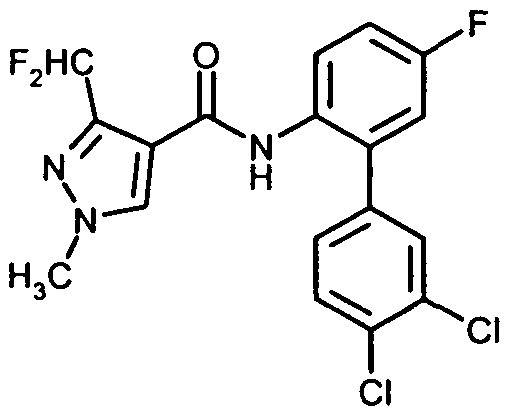
| EP2071953A1 (de) | 2007-12-21 | 2009-06-24 | Bayer CropScience AG | Verwendung von N-(3',4'-Dichlor-5-fluor-1,1'-biphenyl-2-yl)-3-(difluormethyl)-1-methyl-1H-pyrazol-4-carboxamid (Bixafen) |
| WO2010025832A1 (en) * | 2008-09-03 | 2010-03-11 | Bayer Cropscience Ag | Use of fungicidal compound compositions for controlling certain rust fungi |
| EP2353387A1 (de) | 2010-02-05 | 2011-08-10 | Bayer CropScience AG | Verwendung von Succinat-Dehydrogenase (SDH)-Inhibitoren in der Behandlung von Pflanzenarten der Familie der Süßgräser |
| WO2010139410A3 (de) * | 2009-06-02 | 2012-04-12 | Bayer Cropscience Ag | Verwendung von succinat dehydrogenase inhibitoren zur kontrolle von sclerotinia ssp |
| EP2443928A1 (de) * | 2010-10-25 | 2012-04-25 | LANXESS Deutschland GmbH | Fungizide Penflufen Mischungen |
| WO2012055674A1 (de) * | 2010-10-25 | 2012-05-03 | Lanxess Deutschland Gmbh | Fungizide penflufen mischungen |
| EP2524596A1 (de) * | 2011-05-18 | 2012-11-21 | Basf Se | Samenbehandlungsverwendungen |
| WO2014206953A1 (en) * | 2013-06-26 | 2014-12-31 | Bayer Cropscience Ag | N-cycloalkyl-n-[(bicyclylphenyl)methylene]-(thio)carboxamide derivatives |
| WO2017042142A1 (en) | 2015-09-07 | 2017-03-16 | Bayer Cropscience Aktiengesellschaft | Substituted 2-difluoromethyl-nicotin(thio)carhoxanilide derivatives and their use as fungicides |
| WO2018077711A2 (en) | 2016-10-26 | 2018-05-03 | Bayer Cropscience Aktiengesellschaft | Use of pyraziflumid for controlling sclerotinia spp in seed treatment applications |
Families Citing this family (41)
| Publication number | Priority date | Publication date | Assignee | Title |
|---|---|---|---|---|
| DE10347090A1 (de) | 2003-10-10 | 2005-05-04 | Bayer Cropscience Ag | Synergistische fungizide Wirkstoffkombinationen |
| DE102004059725A1 (de) | 2004-12-11 | 2006-06-22 | Bayer Cropscience Ag | 2-Alkyl-cycloalk(en)yl-carboxamide |
| DE102005009458A1 (de) | 2005-03-02 | 2006-09-07 | Bayer Cropscience Ag | Pyrazolylcarboxanilide |
| DE102005035300A1 (de) * | 2005-07-28 | 2007-02-01 | Bayer Cropscience Ag | Synergistische fungizide Wirkstoffkombinationen |
| EP2272345A1 (de) * | 2009-07-07 | 2011-01-12 | Bayer CropScience AG | Verfahren für erhöhtes Wachstum von Setzlingen und/oder frühes Aufgehen von Saat |
| CA2805806A1 (en) * | 2010-07-20 | 2012-01-26 | Ruediger Fischer | Use of anthranilic acid amide derivatives for increasing the stress tolerance in plants to abiotic stress |
| CN103391925B (zh) * | 2010-11-15 | 2017-06-06 | 拜耳知识产权有限责任公司 | 5‑卤代吡唑甲酰胺 |
| AR083875A1 (es) * | 2010-11-15 | 2013-03-27 | Bayer Cropscience Ag | N-aril pirazol(tio)carboxamidas |
| HK1203412A1 (en) | 2011-12-28 | 2015-10-30 | Global Blood Therapeutics, Inc. | Substituted heteroaryl aldehyde compounds and methods for their use in increasing tissue oxygenation |
| WO2013102142A1 (en) | 2011-12-28 | 2013-07-04 | Global Blood Therapeutics, Inc. | Substituted benzaldehyde compounds and methods for their use in increasing tissue oxygenation |
| EP2662363A1 (de) * | 2012-05-09 | 2013-11-13 | Bayer CropScience AG | 5-Halogenpyrazol-Biphenyl-Carboxamide |
| US9458139B2 (en) | 2013-03-15 | 2016-10-04 | Global Blood Therapeutics, Inc. | Compounds and uses thereof for the modulation of hemoglobin |
| US10266551B2 (en) | 2013-03-15 | 2019-04-23 | Global Blood Therapeutics, Inc. | Compounds and uses thereof for the modulation of hemoglobin |
| SG10201802911RA (en) | 2013-03-15 | 2018-05-30 | Global Blood Therapeutics Inc | Compounds and uses thereof for the modulation of hemoglobin |
| US9422279B2 (en) | 2013-03-15 | 2016-08-23 | Global Blood Therapeutics, Inc. | Compounds and uses thereof for the modulation of hemoglobin |
| WO2014145040A1 (en) | 2013-03-15 | 2014-09-18 | Global Blood Therapeutics, Inc. | Substituted aldehyde compounds and methods for their use in increasing tissue oxygenation |
| US9604999B2 (en) | 2013-03-15 | 2017-03-28 | Global Blood Therapeutics, Inc. | Compounds and uses thereof for the modulation of hemoglobin |
| EP3919056B1 (de) | 2013-03-15 | 2024-08-28 | Global Blood Therapeutics, Inc. | Verbindungen und verwendungen davon zur modulation von hämoglobin |
| US9802900B2 (en) | 2013-03-15 | 2017-10-31 | Global Blood Therapeutics, Inc. | Bicyclic heteroaryl compounds and uses thereof for the modulation of hemoglobin |
| AP2015008718A0 (en) | 2013-03-15 | 2015-09-30 | Global Blood Therapeutics Inc | Compounds and uses thereof for the modulation of hemoglobin |
| US8952171B2 (en) | 2013-03-15 | 2015-02-10 | Global Blood Therapeutics, Inc. | Compounds and uses thereof for the modulation of hemoglobin |
| CN103333113B (zh) * | 2013-06-14 | 2018-09-28 | 南开大学 | 氟唑菌酰胺类似衍生物的制备及应用研究 |
| CN103333164B (zh) * | 2013-06-14 | 2018-06-15 | 南开大学 | 吡噻菌胺类似衍生物的制备及应用研究 |
| CN103333112B (zh) * | 2013-06-14 | 2018-09-28 | 南开大学 | 联苯吡菌胺类衍生物的制备及应用 |
| CN103450179B (zh) * | 2013-09-10 | 2015-08-19 | 湖南科技大学 | N-(1,3,4-噻二唑基)噻唑甲酰胺类化合物及其用途 |
| EA202092627A1 (ru) | 2013-11-18 | 2021-09-30 | Глобал Блад Терапьютикс, Инк. | Соединения и их применения для модуляции гемоглобина |
| ES2860648T5 (es) | 2014-02-07 | 2024-11-27 | Global Blood Therapeutics Inc | Polimorfos cristalinos de la base libre de 2-hidroxi-6-((2-(1-isopropil-1H-pirazol-5-il)piridin-3-il)metoxi)benzaldehído |
| US11020382B2 (en) | 2015-12-04 | 2021-06-01 | Global Blood Therapeutics, Inc. | Dosing regimens for 2-hydroxy-6-((2-(1-isopropyl-1h-pyrazol-5-yl)pyridin-3-yl)methoxy)benzaldehyde |
| TWI825524B (zh) | 2016-05-12 | 2023-12-11 | 美商全球血液治療公司 | 用於合成2-羥基-6-((2-(1-異丙基-1h-吡唑-5-基)-吡啶-3-基)甲氧基)苯甲醛之方法 |
| TW202332423A (zh) | 2016-10-12 | 2023-08-16 | 美商全球血液治療公司 | 包含2-羥基-6-((2-(1-異丙基-1h-吡唑-5-基)吡啶-3-基)甲氧基)-苯甲醛之片劑 |
| CN108069905B (zh) * | 2016-11-09 | 2020-08-04 | 沈阳中化农药化工研发有限公司 | 一种吡唑酰胺类化合物及其应用 |
| CN108059614B (zh) * | 2016-11-09 | 2020-09-01 | 沈阳中化农药化工研发有限公司 | 吡唑酰胺类化合物及其应用 |
| CN108069915B (zh) * | 2016-11-15 | 2020-05-15 | 华中师范大学 | 一种吡嗪酰胺类化合物及其制备方法和应用以及一种杀菌剂 |
| CN109666003B (zh) * | 2017-10-13 | 2020-08-21 | 华中师范大学 | 含碘元素的吡嗪酰胺类化合物及其制备方法和应用以及杀菌剂 |
| CN109666004B (zh) * | 2017-10-13 | 2020-08-21 | 华中师范大学 | 含有三氟甲基的吡嗪酰胺类化合物及其制备方法和应用以及杀菌剂 |
| EP3717479B1 (de) * | 2017-11-29 | 2023-07-05 | Syngenta Participations AG | Mikrobiozide thiazolderivate |
| EP3860975B1 (de) | 2018-10-01 | 2023-10-18 | Global Blood Therapeutics, Inc. | Modulatoren von hämoglobin zur behandlung von sichelzellenanämie |
| CN109553578A (zh) * | 2018-12-20 | 2019-04-02 | 西安近代化学研究所 | 一种联苯类化合物及制备方法和应用 |
| US12479816B2 (en) | 2019-02-08 | 2025-11-25 | University of Pittsburgh—of the Commonwealth System of Higher Education | 20-HETE formation inhibitors |
| US11937601B2 (en) | 2020-08-13 | 2024-03-26 | Globachem Nv | Method for treatment of soybean rust |
| CN114380767A (zh) * | 2022-01-19 | 2022-04-22 | 安徽理工大学 | 一种含二苯胺基的噻唑酰胺类化合物及其制备方法与应用 |
Family Cites Families (32)
| Publication number | Priority date | Publication date | Assignee | Title |
|---|---|---|---|---|
| US3505055A (en) * | 1966-12-07 | 1970-04-07 | Uniroyal Inc | Method of controlling plant growth with carboxamidothiazoles |
| IL103614A (en) * | 1991-11-22 | 1998-09-24 | Basf Ag | Carboxamides for controlling botrytis and certain novel such compounds |
| ES2169773T3 (es) * | 1995-04-11 | 2002-07-16 | Mitsui Chemicals Inc | Derivados de tiofeno sustituido y fungicidas agricolas y horticolas que contienen dichos derivados como ingrediente activo. |
| JPH09132567A (ja) * | 1995-11-08 | 1997-05-20 | Mitsui Toatsu Chem Inc | ピラゾールカルボン酸アニリド誘導体およびこれを有効成分とする農園芸用殺菌剤 |
| US5869427A (en) * | 1996-06-11 | 1999-02-09 | Mitsui Chemicals, Inc. | Substituted thiophene derivative and plant disease control agent comprising the same as active ingredient |
| JP3982879B2 (ja) * | 1996-08-15 | 2007-09-26 | 三井化学株式会社 | 置換カルボン酸アニリド誘導体およびこれを有効成分とする植物病害防除剤 |
| JPH10130268A (ja) * | 1996-10-29 | 1998-05-19 | Mitsui Chem Inc | 置換チオフェン誘導体およびこれを有効成分とする農園芸用殺菌剤 |
| JP2001302605A (ja) * | 2000-04-20 | 2001-10-31 | Sumitomo Chem Co Ltd | ビフェニル化合物およびその用途 |
| DE10136065A1 (de) * | 2001-07-25 | 2003-02-13 | Bayer Cropscience Ag | Pyrazolylcarboxanilide |
| DE10204391A1 (de) * | 2002-02-04 | 2003-08-14 | Bayer Cropscience Ag | Difluormethylthiazolylcarboxanilide |
| DE10215292A1 (de) * | 2002-02-19 | 2003-08-28 | Bayer Cropscience Ag | Disubstitutierte Pyrazolylcarbocanilide |
| KR100818540B1 (ko) * | 2002-03-05 | 2008-04-01 | 신젠타 파티서페이션즈 아게 | O-사이클로프로필-카복스아닐리드 및 이를 포함하는 살진균 조성물 |
| GB0225554D0 (en) * | 2002-11-01 | 2002-12-11 | Syngenta Participations Ag | Chemical compounds |
| DE10303589A1 (de) * | 2003-01-29 | 2004-08-12 | Bayer Cropscience Ag | Pyrazolylcarboxanilide |
| WO2004103975A1 (de) * | 2003-05-21 | 2004-12-02 | Bayer Cropscience Aktiengesellschaft | Iodpyrazolylcarboxanilide |
| DE10347090A1 (de) * | 2003-10-10 | 2005-05-04 | Bayer Cropscience Ag | Synergistische fungizide Wirkstoffkombinationen |
| DE10349502A1 (de) * | 2003-10-23 | 2005-05-25 | Bayer Cropscience Ag | 1,3-Dimethylbutylcarboxanilide |
| MXPA06004308A (es) * | 2003-10-23 | 2006-06-05 | Bayer Cropscience Ag | Isopentilcarboxanilidas para la lucha contra los microorganismos indeseables. |
| DE10349501A1 (de) * | 2003-10-23 | 2005-05-25 | Bayer Cropscience Ag | Synergistische fungizide Wirkstoffkombinationen |
| DE102004005787A1 (de) * | 2004-02-06 | 2005-08-25 | Bayer Cropscience Ag | Carboxamide |
| DE102004012901A1 (de) * | 2004-03-17 | 2005-10-06 | Bayer Cropscience Ag | Silylierte Carboxamide |
| US20080108686A1 (en) * | 2004-06-18 | 2008-05-08 | Basf Aktiengesellschaft | N-(Ortho-Phenyl)-1-Methyl-3-Difluoromethylpyrazole-4-Carboxanilides And Their Use As Fungicides |
| DE102004029972A1 (de) * | 2004-06-21 | 2006-01-05 | Bayer Cropscience Ag | Beizmittel zur Bekämpfung von phytopathogenen Pilzen |
| GB0422401D0 (en) * | 2004-10-08 | 2004-11-10 | Syngenta Participations Ag | Fungicidal compositions |
| DE102005009458A1 (de) * | 2005-03-02 | 2006-09-07 | Bayer Cropscience Ag | Pyrazolylcarboxanilide |
| DE102005015850A1 (de) * | 2005-04-07 | 2006-10-12 | Bayer Cropscience Ag | Synergistische fungizide Wirkstoffkombinationen |
| DE102005022147A1 (de) * | 2005-04-28 | 2006-11-02 | Bayer Cropscience Ag | Wirkstoffkombinationen |
| DE102005035300A1 (de) * | 2005-07-28 | 2007-02-01 | Bayer Cropscience Ag | Synergistische fungizide Wirkstoffkombinationen |
| DE102005060462A1 (de) * | 2005-12-17 | 2007-06-28 | Bayer Cropscience Ag | Biphenylcarboxamide |
| DE102005060467A1 (de) * | 2005-12-17 | 2007-06-21 | Bayer Cropscience Ag | Carboxamide |
| DE102005060464A1 (de) * | 2005-12-17 | 2007-06-28 | Bayer Cropscience Ag | Pyrazolylcarboxamide |
| CN102595889A (zh) * | 2009-06-02 | 2012-07-18 | 拜耳作物科学公司 | 琥珀酸脱氢酶抑制剂在控制核盘菌属真菌中的应用 |
-
2005
- 2005-06-07 DE DE102005025989A patent/DE102005025989A1/de not_active Withdrawn
-
2006
- 2006-05-26 US US11/916,436 patent/US8431600B2/en active Active
- 2006-05-26 WO PCT/EP2006/005070 patent/WO2006131221A2/de not_active Ceased
- 2006-05-26 EP EP06743073A patent/EP1890540A2/de not_active Withdrawn
- 2006-05-26 CN CN2006800203758A patent/CN101212899B/zh not_active Expired - Fee Related
- 2006-05-26 JP JP2008515089A patent/JP5069679B2/ja not_active Expired - Fee Related
- 2006-05-26 KR KR1020077030454A patent/KR20080018912A/ko not_active Ceased
- 2006-05-26 BR BRPI0613488A patent/BRPI0613488B1/pt active IP Right Grant
- 2006-06-05 AR AR20060102336A patent/AR054280A1/es unknown
- 2006-06-06 TW TW095119939A patent/TW200715967A/zh unknown
-
2013
- 2013-03-13 US US13/799,237 patent/US20130190375A1/en not_active Abandoned
Cited By (19)
| Publication number | Priority date | Publication date | Assignee | Title |
|---|---|---|---|---|
| WO2007071656A1 (de) * | 2005-12-20 | 2007-06-28 | Basf Aktiengesellschaft | Verfahren zur bekämpfung des rostbefalls bei leguminosen |
| EP2027773A1 (de) * | 2007-08-24 | 2009-02-25 | Bayer CropScience AG | Verwendung von N-[2-(1,3-Dimethylbutyl)phenyl]-5-fluor-1,3-dimethyl-1H-pyrazol-4-carboxamid |
| EP2071953A1 (de) | 2007-12-21 | 2009-06-24 | Bayer CropScience AG | Verwendung von N-(3',4'-Dichlor-5-fluor-1,1'-biphenyl-2-yl)-3-(difluormethyl)-1-methyl-1H-pyrazol-4-carboxamid (Bixafen) |
| WO2010025832A1 (en) * | 2008-09-03 | 2010-03-11 | Bayer Cropscience Ag | Use of fungicidal compound compositions for controlling certain rust fungi |
| US9232794B2 (en) | 2009-06-02 | 2016-01-12 | Bayer Intellectual Property Gmbh | Use of succinate dehydrogenase inhibitors for controlling Sclerotinia ssp |
| WO2010139410A3 (de) * | 2009-06-02 | 2012-04-12 | Bayer Cropscience Ag | Verwendung von succinat dehydrogenase inhibitoren zur kontrolle von sclerotinia ssp |
| US9877482B2 (en) | 2009-06-02 | 2018-01-30 | Bayer Intellectual Property Gmbh | Use of succinate dehydrogenase inhibitors for controlling Sclerotinia ssp |
| EA023833B1 (ru) * | 2009-06-02 | 2016-07-29 | Байер Интеллектуэль Проперти Гмбх | Применение ингибиторов сукцинатдегидрогеназы для контроля sclerotinia ssp. |
| EP2353387A1 (de) | 2010-02-05 | 2011-08-10 | Bayer CropScience AG | Verwendung von Succinat-Dehydrogenase (SDH)-Inhibitoren in der Behandlung von Pflanzenarten der Familie der Süßgräser |
| WO2011095496A2 (de) | 2010-02-05 | 2011-08-11 | Bayer Cropscience Ag | VERWENDUNG VON SUCCINAT-DEHYDROGENASE (SDH)-INHIBITOREN IN DER BEHANDLUNG VON PFLANZENARTEN DER FAMILIE DER SÜßGRÄSER |
| WO2012055674A1 (de) * | 2010-10-25 | 2012-05-03 | Lanxess Deutschland Gmbh | Fungizide penflufen mischungen |
| CN103179858B (zh) * | 2010-10-25 | 2015-11-25 | 朗盛德国有限责任公司 | 杀真菌剂戊苯吡菌胺混合物 |
| CN103179858A (zh) * | 2010-10-25 | 2013-06-26 | 朗盛德国有限责任公司 | 杀真菌剂戊苯吡菌胺混合物 |
| EP2443928A1 (de) * | 2010-10-25 | 2012-04-25 | LANXESS Deutschland GmbH | Fungizide Penflufen Mischungen |
| EP2524596A1 (de) * | 2011-05-18 | 2012-11-21 | Basf Se | Samenbehandlungsverwendungen |
| WO2014206953A1 (en) * | 2013-06-26 | 2014-12-31 | Bayer Cropscience Ag | N-cycloalkyl-n-[(bicyclylphenyl)methylene]-(thio)carboxamide derivatives |
| US9770022B2 (en) | 2013-06-26 | 2017-09-26 | Bayer Cropscience Ag | N-cycloalkyl-N-[(bicyclylphenyl)methylene]-(thio)carboxamide derivatives |
| WO2017042142A1 (en) | 2015-09-07 | 2017-03-16 | Bayer Cropscience Aktiengesellschaft | Substituted 2-difluoromethyl-nicotin(thio)carhoxanilide derivatives and their use as fungicides |
| WO2018077711A2 (en) | 2016-10-26 | 2018-05-03 | Bayer Cropscience Aktiengesellschaft | Use of pyraziflumid for controlling sclerotinia spp in seed treatment applications |
Also Published As
| Publication number | Publication date |
|---|---|
| KR20080018912A (ko) | 2008-02-28 |
| AR054280A1 (es) | 2007-06-13 |
| JP5069679B2 (ja) | 2012-11-07 |
| BRPI0613488B1 (pt) | 2016-04-12 |
| BRPI0613488A2 (pt) | 2011-01-11 |
| US20130190375A1 (en) | 2013-07-25 |
| US8431600B2 (en) | 2013-04-30 |
| CN101212899A (zh) | 2008-07-02 |
| EP1890540A2 (de) | 2008-02-27 |
| US20090105311A1 (en) | 2009-04-23 |
| CN101212899B (zh) | 2012-11-21 |
| DE102005025989A1 (de) | 2007-01-11 |
| JP2008545763A (ja) | 2008-12-18 |
| TW200715967A (en) | 2007-05-01 |
| WO2006131221A3 (de) | 2007-08-23 |
Similar Documents
| Publication | Publication Date | Title |
|---|---|---|
| EP1890540A2 (de) | Carboxamide | |
| EP1856054B1 (de) | Pyrazolylcarboxanilide | |
| DE102005060462A1 (de) | Biphenylcarboxamide | |
| EP1887868B1 (de) | Fungizide wirkstoffkombination | |
| WO2009000407A1 (de) | Verfahren zur reduktion der phytotoxizität von azolen auf dikotylen pflanzen durch zugabe von additiven | |
| DE102005060467A1 (de) | Carboxamide | |
| EP1786795A2 (de) | Biphenylthiazolcarboxamide | |
| EP1966147B1 (de) | Carboxamide zur bekämpfung von mikroorganismen im pflanzen- und materialschutz | |
| EP1966161B1 (de) | Carboxamide zur bekämpfung unerwünschter mikroorganismen im pflanzenschutz | |
| EP1786794A2 (de) | Biphenylthiazolcarboxamide | |
| EP2216332B1 (de) | Siliziumhaltige 2-Alkyl-cycloalk(en)yl-carboxamide und ihre Verwendung als Fungizide | |
| DE102005060464A1 (de) | Pyrazolylcarboxamide | |
| EP1737299B1 (de) | Fungizide wirkstoffkombinationen | |
| EP1965640A2 (de) | Thienylpyridylcarboxamide | |
| MX2008007856A (en) | Biphenyl carboxamides for controlling micro-organisms |
Legal Events
| Date | Code | Title | Description |
|---|---|---|---|
| 121 | Ep: the epo has been informed by wipo that ep was designated in this application | ||
| WWE | Wipo information: entry into national phase |
Ref document number: 2006743073 Country of ref document: EP |
|
| WWE | Wipo information: entry into national phase |
Ref document number: 2008515089 Country of ref document: JP |
|
| WWE | Wipo information: entry into national phase |
Ref document number: 200680020375.8 Country of ref document: CN |
|
| NENP | Non-entry into the national phase |
Ref country code: DE |
|
| WWW | Wipo information: withdrawn in national office |
Ref document number: DE |
|
| WWE | Wipo information: entry into national phase |
Ref document number: 1020077030454 Country of ref document: KR |
|
| WWE | Wipo information: entry into national phase |
Ref document number: 11916436 Country of ref document: US |
|
| ENP | Entry into the national phase |
Ref document number: PI0613488 Country of ref document: BR Kind code of ref document: A2 Effective date: 20071207 |