WO2007123086A1 - トナー用ポリエステル - Google Patents
トナー用ポリエステル Download PDFInfo
- Publication number
- WO2007123086A1 WO2007123086A1 PCT/JP2007/058285 JP2007058285W WO2007123086A1 WO 2007123086 A1 WO2007123086 A1 WO 2007123086A1 JP 2007058285 W JP2007058285 W JP 2007058285W WO 2007123086 A1 WO2007123086 A1 WO 2007123086A1
- Authority
- WO
- WIPO (PCT)
- Prior art keywords
- rosin
- polyester
- toner
- acid
- acrylic acid
- Prior art date
- Legal status (The legal status is an assumption and is not a legal conclusion. Google has not performed a legal analysis and makes no representation as to the accuracy of the status listed.)
- Ceased
Links
Classifications
-
- G—PHYSICS
- G03—PHOTOGRAPHY; CINEMATOGRAPHY; ANALOGOUS TECHNIQUES USING WAVES OTHER THAN OPTICAL WAVES; ELECTROGRAPHY; HOLOGRAPHY
- G03G—ELECTROGRAPHY; ELECTROPHOTOGRAPHY; MAGNETOGRAPHY
- G03G9/00—Developers
- G03G9/08—Developers with toner particles
- G03G9/087—Binders for toner particles
- G03G9/08742—Binders for toner particles comprising macromolecular compounds obtained otherwise than by reactions only involving carbon-to-carbon unsaturated bonds
- G03G9/08755—Polyesters
-
- C—CHEMISTRY; METALLURGY
- C08—ORGANIC MACROMOLECULAR COMPOUNDS; THEIR PREPARATION OR CHEMICAL WORKING-UP; COMPOSITIONS BASED THEREON
- C08G—MACROMOLECULAR COMPOUNDS OBTAINED OTHERWISE THAN BY REACTIONS ONLY INVOLVING UNSATURATED CARBON-TO-CARBON BONDS
- C08G63/00—Macromolecular compounds obtained by reactions forming a carboxylic ester link in the main chain of the macromolecule
- C08G63/02—Polyesters derived from hydroxycarboxylic acids or from polycarboxylic acids and polyhydroxy compounds
- C08G63/12—Polyesters derived from hydroxycarboxylic acids or from polycarboxylic acids and polyhydroxy compounds derived from polycarboxylic acids and polyhydroxy compounds
- C08G63/52—Polycarboxylic acids or polyhydroxy compounds in which at least one of the two components contains aliphatic unsaturation
- C08G63/54—Polycarboxylic acids or polyhydroxy compounds in which at least one of the two components contains aliphatic unsaturation the acids or hydroxy compounds containing carbocyclic rings
- C08G63/553—Acids or hydroxy compounds containing cycloaliphatic rings, e.g. Diels-Alder adducts
-
- G—PHYSICS
- G03—PHOTOGRAPHY; CINEMATOGRAPHY; ANALOGOUS TECHNIQUES USING WAVES OTHER THAN OPTICAL WAVES; ELECTROGRAPHY; HOLOGRAPHY
- G03G—ELECTROGRAPHY; ELECTROPHOTOGRAPHY; MAGNETOGRAPHY
- G03G9/00—Developers
- G03G9/08—Developers with toner particles
- G03G9/087—Binders for toner particles
- G03G9/08784—Macromolecular material not specially provided for in a single one of groups G03G9/08702 - G03G9/08775
- G03G9/08791—Macromolecular material not specially provided for in a single one of groups G03G9/08702 - G03G9/08775 characterised by the presence of specified groups or side chains
-
- G—PHYSICS
- G03—PHOTOGRAPHY; CINEMATOGRAPHY; ANALOGOUS TECHNIQUES USING WAVES OTHER THAN OPTICAL WAVES; ELECTROGRAPHY; HOLOGRAPHY
- G03G—ELECTROGRAPHY; ELECTROPHOTOGRAPHY; MAGNETOGRAPHY
- G03G9/00—Developers
- G03G9/08—Developers with toner particles
- G03G9/087—Binders for toner particles
- G03G9/08784—Macromolecular material not specially provided for in a single one of groups G03G9/08702 - G03G9/08775
- G03G9/08795—Macromolecular material not specially provided for in a single one of groups G03G9/08702 - G03G9/08775 characterised by their chemical properties, e.g. acidity, molecular weight, sensitivity to reactants
-
- G—PHYSICS
- G03—PHOTOGRAPHY; CINEMATOGRAPHY; ANALOGOUS TECHNIQUES USING WAVES OTHER THAN OPTICAL WAVES; ELECTROGRAPHY; HOLOGRAPHY
- G03G—ELECTROGRAPHY; ELECTROPHOTOGRAPHY; MAGNETOGRAPHY
- G03G9/00—Developers
- G03G9/08—Developers with toner particles
- G03G9/087—Binders for toner particles
- G03G9/08784—Macromolecular material not specially provided for in a single one of groups G03G9/08702 - G03G9/08775
- G03G9/08797—Macromolecular material not specially provided for in a single one of groups G03G9/08702 - G03G9/08775 characterised by their physical properties, e.g. viscosity, solubility, melting temperature, softening temperature, glass transition temperature
Definitions
- the present invention relates to a polyester for toner used as a binder resin for toner used for developing a latent image formed in, for example, an electrophotographic method, an electrostatic recording method, an electrostatic printing method, and the like, and the polyester
- the present invention relates to a toner containing toner.
- toners with excellent low-temperature fixability and storage stability are required, and contain linear polyester resin that defines physical properties such as molecular weight.
- Toner see Patent Document 1
- a toner containing non-linear cross-linked polyester resin using rosins as an acid component in polyester see Patent Document 2
- rosin modified with maleic acid see Patent Document 3
- Patent Document 3 a toner with improved fixing properties
- Patent Document 1 Japanese Patent Application Laid-Open No. 2004-245854
- Patent Document 2 JP-A-4 70765
- Patent Document 3 Japanese Patent Laid-Open No. 4-307557
- the present invention relates to a polyester for toner obtained by condensation polymerization of an alcohol component and a carboxylic acid component containing a (meth) acrylic acid-modified rosin, and a toner comprising the polyester for toner. .
- the present invention relates to a polyester for toner that is excellent in low-temperature fixability and storage stability, and also reduces the generation of odor and a toner containing the polyester. Furthermore, the present invention relates to a polyester for toner that is excellent in anti-offset property in addition to low-temperature fixability and storage stability, and a toner containing the polyester.
- a toner containing the polyester for toner of the present invention is excellent in low-temperature fixability and storage stability, and has an excellent effect of reducing odor generation. Further, in the case where the polyester of the present invention is obtained by using an alcohol component containing an aliphatic polyhydric alcohol, in addition to the above effects, an excellent effect in offset resistance can be obtained. It is.
- a polyester for toner obtained by condensation polymerization of an alcohol component and a carboxylic acid component contains a (meth) acrylic acid-modified rosin in the carboxylic acid component.
- (Meth) acrylic acid-modified rosin enables fixing at an extremely low temperature and improves storage stability.
- a maleic modified rosin modified with maleic acid which is a modified rosin conventionally used, has three functional groups and functions as a crosslinking agent. For this reason, the polyester obtained by using a strong rubonic acid component containing a large amount of maleic-modified rosin to enhance the fixability contains a large amount of low and high molecular weight components. It is difficult to achieve both.
- the (meth) acrylic acid-modified rosin used in the present invention is a rosin having two functional groups, it can extend the molecular chain as part of the main chain of the polyester and increase the molecular weight.
- the (meth) acrylic acid-modified rosin in the present invention is a rosin modified with (meth) acrylic acid. It can be obtained by adding (meth) acrylic acid to rosin whose main component is abietic acid, neoabietic acid, parastrinic acid, pimaric acid, isopimaric acid, sandaracopimaric acid, dehydroabietic acid, repopimaric acid, etc. Specifically, among the main components of rosin, Diels-Alda under heating with repopimaric acid, abietic acid, neoabietic acid and parastrinic acid having a conjugated double bond, and (meth) acrylic acid. It can be obtained through the Diels-Alder reaction.
- (meth) acryl means acrylic or methacrylic. Therefore, (meth) acrylic acid means acrylic acid or methacrylic acid, and “(meth) acrylic acid-modified rosin” means rosin modified with acrylic acid or rosin modified with methacrylic acid.
- the (meth) acrylic acid-modified rosin in the present invention is preferably an acrylic acid-modified rosin modified with acrylic acid with little steric hindrance from the viewpoint of reaction activity in the Diels-Alder reaction! / ,.
- the degree of modification of rosin with (meth) acrylic acid ((meth) acrylic acid modification degree) is preferably 5 to 105 from the viewpoint of increasing the molecular weight of the polyester and reducing the low molecular weight oligomer component. 2 0 to 105 is more preferable 40 to 105 is more preferable 60 to 105 is more preferable.
- X is the SP value of (meth) acrylic acid-modified rosin for calculating the degree of modification
- X is (meth) acrylic
- the SP value means a softening point measured by a ring and ball automatic softening point tester described later.
- the saturated SP value means the SP value when the reaction between (meth) acrylic acid and rosin is reacted until the SP value of the obtained (meth) acrylic acid-modified rosin reaches the saturation value.
- the molecule of formula (A) means the degree of increase in the SP value of rosin modified with (meth) acrylic acid, and the larger the value of formula (A), the higher the degree of modification. .
- the method for producing the (meth) acrylic acid-modified rosin is not particularly limited.
- the rosin and (meth) acrylic acid are mixed and heated to about 180 to 260 ° C, whereby the Diels-Alder reaction is performed.
- (meth) acrylic acid-modified rosin can be obtained by adding (meth) acrylic acid to an acid having a conjugated double bond contained in rosin.
- the (meth) acrylic acid-modified rosin may be used as it is, or may be used after purification through an operation such as distillation!
- the rosin used for the (meth) acrylic acid-modified rosin in the present invention is abietic acid such as natural rosin obtained from pine, isomerized rosin, dimerized rosin, polymerized rosin, disproportionated rosin, etc. From the viewpoint of color strength, any known rosin can be used without particular limitation as long as it is a rosin mainly composed of neoabietic acid, parastrinic acid, pimaric acid, isopimaric acid, sandaraco pimaric acid, dehydroabietic acid, lepopimaric acid, etc.
- natural rosins such as tall rosin obtained from tall oil obtained as a by-product in the process of producing natural rosin pulp, natural rosin such as gum rosin obtained, pine stump strength, wood rosin obtained Tall rosin is more preferred.
- the (meth) acrylic acid-modified rosin in the present invention is obtained through a Diels-Alder reaction under heating, so that impurities that cause odor are reduced and the odor is low.
- (meth) acrylic acid modified rosin is preferably obtained by modifying rosin (purified rosin) whose impurities have been reduced by the purification process with (meth) acrylic acid. More preferred is a product obtained by modifying purified tall rosin with (meth) acrylic acid.
- the purified rosin in the present invention is a rosin in which impurities are reduced by a purification process.
- the main impurities are 2-methylpropane, acetoaldehyde, 3-methyl-2-butanone, 2-methylpropanoic acid, butanoic acid, pentanoic acid, n-hexanal, octane, hexanoic acid, benzaldehyde, 2 -Pentylfuran, 2,6-dimethylcyclohexanone, 1-methyl-2- (1-methylethyl) benzene, 3,5-dimethyl-2-cyclohexene, 4- (1-methylethyl) benzaldehyde, etc. .
- the peak intensity detected as a volatile component by the headspace GC-MS method of three types of impurities, hexanoic acid, pentanoic acid, and benzaldehyde is used as an indicator of purified rosin.
- the absolute amount of impurities The specific volatile component is used as an index because the use of the purified rosin in the present invention makes the odor one of the problems of improvement over the conventional polyester using the rosin.
- the purified rosin in the present invention means that the peak intensity of hexanoic acid is 0.8 ⁇ 10 7 or less and the peak intensity of pentanoic acid is 0.4 ⁇ 10 7 under the measurement conditions of the headspace GC-MS method described later. It is 7 or less and a benzaldehyde peak intensity of 0.4 ⁇ 10 7 or less. Further, the peak intensity of hexanoic acid from the viewpoint of storage stability and odor, the is more preferably 0.6 X 10 7 or less preferably fixture 0.5 X 10 7 or less. The peak intensity of pentanoic acid is more preferably 0.3 X 1 0 7 below preferably fixture 0.2 X 10 7 or less. Peak intensity of benzaldehyde, 0. 3 X 10 7 or less preferably fixture 0.2 X 10 7 or less, more preferably.
- n-hexanal and 2-pentylfuran are reduced in addition to the above three substances.
- peak intensity of Kisanaru to n- is, 1 .7 X 10 7 or less preferably fixture 1.6 X 10 7 or less, more preferably tool 1.5 X 10 7 or less is more preferable.
- 2-peak intensity of pentylfuran is more preferably 1.0 X 10 7 is preferably less tool 0.9 X 10 7 or less preferably Ri good tool 0.8 X 10 7 or less.
- distillation As a method for purifying rosin, known methods can be used, and methods such as distillation, recrystallization, extraction and the like can be mentioned, and purification by distillation is preferable.
- a distillation method for example, the method described in JP-A-7-286139 can be used, and examples thereof include vacuum distillation, molecular distillation, steam distillation and the like, but purification by vacuum distillation is preferable.
- distillation is usually carried out at a pressure of not more than 6.67 kPa at a still temperature of 200 to 300 ° C, and ordinary simple distillation, thin film distillation, rectification, and other methods are applied.
- 2 to 10% by weight of the high molecular weight product is removed as a pitch component with respect to the charged rosin, 2 to 10% by weight of the initial fraction is simultaneously removed.
- the softening point of the rosin before modification is preferably 50 to 100 ° C, more preferably 60 to 90 ° C, and further preferably 65 to 85 ° C.
- the soft spot of rosin in the present invention is a softness point measured when the rosin is once melted and naturally cooled for one hour in an environment of a temperature of 25 ° C. and a relative humidity of 50% by the method described later. It means a saddle point.
- the acid value of rosin before modification is preferably 100 to 200 mg KOH / g 130 to 180 mg KO H / g is more preferable, and 150 to 170 mg KOH / g is more preferable!
- the content of the (meth) acrylic acid-modified rosin is preferably 5% by weight or more and more preferably 10% by weight or more from the viewpoint of low-temperature fixability in the carboxylic acid component. Further, from the viewpoint of preservability, 85% by weight or less is preferable, 65% by weight or less is more preferable, and 50% by weight or less is more preferable. From these viewpoints, the content of the (meth) acrylic acid-modified rosin is preferably 5 to 85% by weight, more preferably 5 to 65% by weight, and further preferably 10 to 50% by weight in the carboxylic acid component. .
- Carboxylic acid compounds other than (meth) acrylic acid-modified rosin contained in the carboxylic acid component include oxalic acid, malonic acid, maleic acid, fumaric acid, citraconic acid, itaconic acid, glutaconic acid, and succinic acid.
- Aliphatic dicarboxylic acids such as adipic acid, sebacic acid, azelaic acid, n-dodecyl succinic acid, n-dodecyl succinic acid; aromatic dicarboxylic acids such as phthalic acid, isophthalic acid, terephthalic acid; cyclohexanedicarboxylic acid, etc.
- Such acids, anhydrides of these acids, and alkyl esters of these acids are collectively referred to herein as carboxylic acid compounds.
- the alcohol component preferably contains an aliphatic polyhydric alcohol from the viewpoint of offset resistance. Since the aliphatic polyhydric alcohol component is molecularly compact and highly reactive, a polyester having a large number average molecular weight can be obtained even when using a (meth) acrylic acid-modified rosin that is molecularly bulky and has low reactivity. . That is, by polycondensing an alcohol component containing an aliphatic polyhydric alcohol and a carboxylic acid component containing a (meth) acrylic acid-modified rosin, the low molecular weight component is reduced and the number average molecular weight is large. Therefore, it is presumed that low-temperature fixability, offset resistance, and storage properties are compatible with contradictory physical properties.
- the aliphatic polyhydric alcohol is preferably a divalent to hexavalent aliphatic polyhydric alcohol from the viewpoint of reactivity with a carboxylic acid containing a modified rosin. Is more preferable.
- the aliphatic polyhydric alcohol preferably contains an aliphatic polyhydric alcohol having 2 to 6 carbon atoms and a more compact molecular structure and high reactivity.
- Aliphatic polyhydric alcohols include ethylene glycol, neopentyl glycol, 1,2-propanediol, 1,3-propanediol, 1,4-butanediol, 1,6-hexanediol, 2,3-butane Examples include diol, pentaerythritol, trimethylolpropane, sonorebitol, glycerin and the like. Among these, 1,2-propanediol, 1,3-propanediol and glycerin are preferable.
- the content of aliphatic polyhydric alcohol having 2 to 6 carbon atoms is preferably 60 mol% or more, more preferably 80 mol% or more, more preferably 90 mol% or more in aliphatic polyhydric alcohol. 100 mol% is more preferable.
- the content of the aliphatic polyhydric alcohol is preferably 50 mol% or more, more preferably 60 mol% or more in the alcohol component. More preferably, mol% or more is substantially preferred, and substantially 100 mol% is more preferred.
- the alcohol component includes the formula (I):
- RO is an alkylene oxide
- R is an alkylene group having 2 or 3 carbon atoms
- X and y are positive numbers indicating the average mole number of alkylene oxide, and The sum is 1-16, preferably 1-8, more preferably 1.5-4)
- the alkylene oxide adduct of bisphenol A represented by the formula (I) includes polyoxypropylene (2.2) -2,2-bis (4-hydroxyphenol) propane, polyoxyethylene (2.2)- Examples include adducts of alkylene (carbon number 2 to 3) oxide (average number of moles 1 to 16) of bisphenol A such as 2,2-bis (4-hydroxyphenol) propane.
- the content of the compound represented by the formula (I) is preferably 30 mol% or more, more preferably 50 mol% or more, more preferably 80 mol% in the alcohol component, from the viewpoint of chargeability and durability.
- the above is more preferable, and substantially 100 mol% is further preferable.
- an alcohol component other than the aliphatic polyhydric alcohol and the compound represented by the formula (I) examples thereof include 1,4-cyclohexanedimethanol, hydrogenated carbphenol A, and their alkylene (carbon number 2 to 4) oxide (average number of added moles 1 to 16) adducts.
- the polyester of the present invention includes a trihydric or higher polyhydric alcohol and Z or a trivalent or higher, in order to reduce residual monomers and fixability, and from the viewpoint of improving offset resistance, as long as storage stability is not impaired. It is preferable that the polyvalent carboxylic acid compound is contained in the alcohol component and the Z or carboxylic acid component. Since the (meth) acrylic acid-modified rosin used in the present invention is a rosin having two functional groups, it is possible to use a raw material monomer having a valence of 3 or more without impairing the low-temperature fixability of the rosin. In addition, while maintaining low-temperature fixability, residual monomers can be reduced, and further, storage stability and offset resistance can be improved.
- the content of the trivalent or higher polyvalent carboxylic acid compound is preferably 0.001 to 40 mol, more preferably 0.1 to 25 mol per 100 mol of the alcohol component, and more preferably trivalent or higher.
- the content of polyhydric alcohol is in the alcohol component, preferably is 0.001 to 40 mol 0/0 device 0.1-25 molar% is more preferable.
- Trivalent or higher polyvalent carboxylic acid compound, trimellitic acid and its derivatives are preferred as trivalent or higher raw material monomers.
- Trivalent and higher polyhydric alcohols include glycerin and pentaerythritol. , Trimethylolpropane, sorbitol, and their alkylene (2 to 4 carbon) oxide (average number of added moles 1 to 16) adducts. Glycerin, trimellitic acid and derivatives thereof are preferred because they are effective in improving low-temperature fixability as well as acting.
- the polycondensation of the alcohol component and the carboxylic acid component is preferably performed in the presence of an ester catalyst.
- the ester catalyst in the present invention include a titanium compound and a Sn (-C) bond, and a tin (II) compound, which is used alone or in combination.
- titanium compound a compound having an alkoxy group having 1 to 28 carbon atoms, an alkenyloxy group, or an acyloxy group is more preferable, which is preferable for a titanium compound having a Ti-O bond. .
- titanium compounds include titanium diisopropylate bistriethanolamate [Ti (CHON) (CHO)], titanium diisopropylate bisdiethanolamate. [Ti (CHON) (CHO)], titanium dipentylate bistriethanolamate [Ti (C), titanium diisopropylate bistriethanolamate [Ti (C), titanium dipentylate bistriethanolamate [Ti (C), titanium dipentylate bistriethanolamate [Ti (C
- titanium compounds include tetra-n-butyl titanate [Ti (C H
- Tetrastearyl titanate, tetramyristyl titanate, tetraoctyl titanate and dioctyl dihydroxyoctyl titanate are preferred, which can be obtained, for example, by reacting titanium halide with the corresponding alcohol. It is also available as a commercial product.
- the amount of the titanium compound present is preferably 0.01 to 1.0 part by weight and more preferably 0.1 to 0.7 part by weight with respect to 100 parts by weight of the total amount of the alcohol component and the carboxylic acid component.
- the tin (II) compound having no Sn-C bond includes a tin (II) compound having a Sn-O bond, and a tin (II) having a Sn-X bond (X represents a halogen atom).
- Compounds are preferred, and tin (II) compounds having a Sn-O bond are more preferred.
- Tin (II) compounds having a Sn-O bond include tin oxalate (11), tin diacetate (11), tin dioctanoate (11), tin dilaurate (11), tin distearate (11 ), Tin dioleate (II), etc., and carboxylic acid tin (II) having a carboxylic acid group having 2 to 28 carbon atoms; dioctyloxytin (11), dilauryloxytin (II), distearate oxytin (11 ), Dioleic oxytin (II) and the like having an alkoxy group having 2 to 28 carbon atoms Dialkoxytin (II); acid ⁇ tin (II); tin sulfate (II), etc., has a Sn-X (X represents a halogen atom) bond.
- halogen bromide (II) such as tin bromide (
- R 1 represents a fatty acid tin represented by an alkyl group or a alkenyl group having 5 to 19 carbon atoms (11), (R 2 0) Sn (where R 2 is an alkyl group having 6 to 20 carbon atoms or Represents a alkenyl group)
- Dialkoxytin ( ⁇ ) and acid ⁇ tin (II) represented by SnO are preferred (R'COO) represented by Sn
- the existing amount of the tin (II) compound is preferably from 0.01 to 1.0 part by weight, more preferably from 0.1 to 0.7 part by weight, based on 100 parts by weight of the total amount of the alcohol component and the carboxylic acid component.
- the total amount of the titanium compound and the tin ( ⁇ ) compound is 0.01 to 1.0 part by weight with respect to 100 parts by weight of the total amount of the alcohol component and the carboxylic acid component. 0.1 to 0.7 parts by weight is more preferable.
- the polycondensation of the alcohol component and the carboxylic acid component can be performed, for example, in the presence of the esterification catalyst in an inert gas atmosphere at a temperature of 180 to 250 ° C.
- the soft spot of the polyester is preferably 90 to 160 ° C, more preferably 95 to 155 ° C, and even more preferably 100 to 150 ° C, from the viewpoint of fixability, storage stability and durability.
- the glass transition point is preferably 45 to 75 ° C., more preferably 50 to 70 ° C. from the viewpoints of fixing property, storage stability and durability.
- the acid value is preferably 1 to 80 mgKOH / g, more preferably 5 to 60 mgKOH / g, and more preferably 5 to 50 mgKOH / g. 80 mg KOH / g is preferred 8-50 mg KOH / g is more preferred 8-40 mg KOH / g is more preferred.
- 12% or less is preferable, 10% or less is more preferable, 9% or less is more preferable, and 8% or less is more preferable.
- the content of the low molecular weight component can be reduced by a method such as increasing the degree of modification of rosin with (meth) acrylic acid.
- polyester of the present invention has been modified to the extent that it does not substantially impair its properties! Polyester may be used.
- the modified polyester include graft candy and blocked with phenol, urethane, epoxy, etc. by the method described in JP-A-11-133668, JP-A-10-239903, JP-A-8-20636, etc. Polyester.
- the polyester of the present invention As a binder resin for toner, it is possible to obtain a toner that is excellent in both low-temperature fixability and storage stability and also has reduced odor during fixing.
- binder resins such as vinyl resin such as styrene-acrylic resin, epoxy resin, polycarbonate, polyurethane, and the like may be used without departing from the effects of the present invention.
- a resin may be used in combination, but the content of the polyester of the present invention is preferably 70% by weight or more, more preferably 80% by weight or more, more preferably 90% by weight or more in the binder resin, More preferably, it is substantially 100% by weight.
- the toner of the present invention further includes a colorant, a release agent, a charge control agent, magnetic powder, a fluidity improver, a conductivity modifier, an extender pigment, a reinforcing filler such as a fibrous substance, and an antioxidant.
- Additives such as an agent, an anti-aging agent, and a cleaning property improver may be appropriately contained.
- the colorant all of dyes and pigments used as toner colorants can be used. Carbon black, phthalocyanine blue, permanent brown FG, brilliant first scarlet, pigment green B, Rhodamine B base, Sonorent red 49, Solvent red 146, Solvent blue 35, quinacridone, carmine 6B, disazo yellow and the like can be used, and the toner of the present invention may be either black toner or color toner.
- the content of the colorant is preferably 1 to 40 parts by weight and more preferably 2 to 10 parts by weight with respect to 100 parts by weight of the binder resin.
- Examples of the release agent include low molecular weight polyolefins such as polyethylene, polypropylene, and polybutene; silicones; fatty acid amides such as oleic acid amide, ergic acid amide, ricinoleic acid amide, and stearic acid amide; Plant waxes such as wax, rice wax, candelilla wax, tree wax, jojoba oil; animal waxes such as beeswax; montan wax, ozokerite, ceresin, paraffin lux, microcrystalline wax, fistia and tropsch wax Minerals such as petroleum waxes. These release agents may be used alone or in combination of two or more. [0055] The melting point of the release agent may be 50 ° C.
- the content of the release agent is preferably 1 to 20 parts by weight, more preferably 2 to 100 parts by weight with respect to 100 parts by weight of the binding resin in consideration of the effect on the low temperature offset and the influence on the chargeability. 15 parts by weight, more preferably 2 to 10 parts by weight.
- any one of negative chargeability and positive chargeability can be used.
- the negatively chargeable charge control agent include metal-containing azo dyes, copper phthalocyanine dyes, metal complexes of alkyl derivatives of salicylic acid, nitroimidazole derivatives, and the like.
- the positively chargeable charge control agent include Niguchi syn dye, triphenylmethane dye, quaternary ammonia salt compound, polyamine resin, imidazole derivative and the like.
- a high-molecular type such as rosin can also be used.
- the content of the charge control agent is preferably 0.1 to 8 parts by weight and more preferably 0.2 to 5 parts by weight with respect to 100 parts by weight of the binder resin.
- the toner of the present invention may be a toner obtained by any conventionally known method such as a melt-kneading method, an emulsion phase inversion method, or a polymerization method. From the viewpoint, a pulverized toner by a melt kneading method is preferable. In the case of pulverized toner by the melt-kneading method, the raw materials such as binder resin, colorant, charge control agent, etc.
- the volume median particle diameter (D) of the toner is preferably 3 to 15 ⁇ m. In this specification, the volume-median particle size (D) is
- the toner of the present invention is externally added with an external additive such as inorganic fine particles such as silica, alumina, titer, zirconium oxide, tin oxide and zinc oxide, and organic fine particles such as resin fine particles. Processing may be applied.
- an external additive such as inorganic fine particles such as silica, alumina, titer, zirconium oxide, tin oxide and zinc oxide, and organic fine particles such as resin fine particles. Processing may be applied.
- silica having a small specific gravity is preferable from the viewpoint of embedding prevention.
- the silica is preferably hydrophobic silica that has been subjected to a hydrophobic treatment.
- the hydrophobization method is not particularly limited, and hexamethyldisilazane (HM DS), dimethyldichlorosilane (DMDS), silicone oil, methyltriethoxysilane and the like.
- the treatment amount of the hydrophobizing agent is preferably 1 to 7 mg / m 2 per surface area of the inorganic fine particles.
- the number average particle diameter of the external additive is preferably 3 to 300 nm, more preferably 5 to 100 nm, from the viewpoint of chargeability and prevention of scratches on the photoreceptor.
- the content of the external additive is preferably 0.01 to 10 parts by weight and more preferably 0.1 to 5 parts by weight with respect to 100 parts by weight of the toner base particles.
- the toner of the present invention can be used as a one-component developing toner or as a two-component developer mixed with a carrier.
- a carrier with low saturation magnetization that weakens the contact with the magnetic brush.
- Saturation magnetization of the carrier is more preferably 40 ⁇ 100Am 2 / kg is preferred instrument 50 ⁇ 90Am 2 / kg.
- Saturation magnetization adjusts the hardness of the magnetic brush, from the viewpoint of maintaining the gradation reproducibility, in terms of 100 Am 2 / kg or less to prevent the preferred tool carrier adhesion and toner scattering, 40 Am 2 / kg or more preferred ,.
- a material having a known material strength can be used without particular limitation.
- a ferromagnetic metal such as iron, cobalt, nickel, magnetite, hematite, ferrite, copper- Examples include alloys and compounds such as zinc-magnesium ferrite, manganese ferrite, and magnesium ferrite, and glass beads.
- iron powder, magnetite, ferrite, copper-zinc-magnesium ferrite From the viewpoint of image quality that manganese ferrite and magnesium ferrite are preferred, ferrite, copper-zinc-magnesium ferrite, manganese ferrite and magnesium ferrite are more preferred.
- the surface of the carrier is preferably coated with rosin.
- the resin that coats the carrier surface varies depending on the toner material.
- fluorine resin such as polytetrafluoroethylene, monochlorotrifluoroethylene polymer, polyvinylidene fluoride, and silicone resin such as polydimethylsiloxane.
- examples include fats, polyesters, styrene resins, acrylic resins, polyamides, polybutyl petitals, amino acrylate resins, and the like. These can be used alone or in combination of two or more.
- silicone resin Is preferred.
- the method of coating the core material with the resin is not particularly limited, for example, a method in which a coating material such as resin is dissolved or suspended in a solvent and applied to the core material, or simply mixed with powder. .
- the weight ratio of the toner to the carrier is preferably 1/99 to 10/90. ⁇ 7/93 is more preferred.
- a flow tester Shiadzu Corporation, CFT-500D
- CFT-500D Using a flow tester (Shimadzu Corporation, CFT-500D), while applying a load of 1.96 MPa with a plunger while heating an lg sample at a heating rate of 6 ° C / min, a nose with a diameter of lmm and a length of lmm Luka is also extruded. Plot the plunger descent amount of the flow tester against the temperature, and use the temperature at which half of the sample flows out as the soft spot.
- the molecular weight distribution is measured by gel permeation chromatography (GPC). Add 10 ml of tetrahydrofuran to 30 mg of toner, mix with a ball mill for 1 hour, and filter using a fluorine resin filter FP-200 (manufactured by Sumitomo Electric Industries, Ltd.) with a pore size of 2 m to remove insoluble components. Prepare a sample solution.
- GPC gel permeation chromatography
- Tetrahydrofuran is used as an eluent at a flow rate of 1 ml / min, the column is stabilized in a constant temperature bath at 40 ° C, and the sample solution 1001 is injected to perform measurement.
- the analytical column is ⁇ GMHLX + G3000HXLJ (manufactured by Tosoichi Co., Ltd.), and the molecular weight calibration curves are several types of monodisperse polystyrene (2.63 X 10 3 , manufactured by Tosoichi Co., Ltd. 2.10 ⁇ 10 3 , 7.00 ⁇ 10 3 , 5.04 ⁇ 10 4 ) manufactured by GL Sciences are prepared as standard samples.
- the content (%) of low molecular weight components with a molecular weight of 00 or less is the ratio of the area of the corresponding area in the chart area obtained by the RI (refractive index) detector to the total chart area (area of the corresponding area). (Z total chart area).
- the molten sample 2 pour lg into the specified ring, cool to room temperature, and perform measurement under the following conditions based on JIS B7 410.
- Measuring machine Ring and ball type automatic soft saddle point tester ASP-MGK2 (manufactured by Meitec)
- Measuring solvent Glycerin [0077] (Degree of (meth) acrylic acid modification of rosin]
- the saturated SP value means the SP value when the reaction of (meth) acrylic acid and rosin is reacted until the SP value of the obtained (meth) acrylic acid-modified rosin reaches the saturation value.
- the molecular weight of the rosin 1 mol, when the acid value x (mg KOH / g), water acid potassium respect rosin lg (molecular weight: 56.1) is then xmg (x X 10- 3 g) reaction, Ru Forces, formula)): Molecular weight 56100 ⁇ x (B)
- the sample was heated to 200 ° C and cooled to 0 ° C at a temperature drop rate of 10 ° CZ for 10 ° CZ min. The temperature is raised at, and the maximum peak temperature of the heat of fusion is taken as the melting point.
- Number average particle size (nm) 6 / (p X specific surface area (m 2 / g)) X 1000
- p is the specific gravity of the inorganic fine powder or the external additive
- the specific surface area is the BET specific surface area determined by the nitrogen adsorption method of the raw material, and in the case of the external additive, the raw material before the hydrophobization treatment. It is.
- the specific gravity of silica is 2.2 and the specific gravity of titanium oxide is 4.2.
- Diameter of apachiya 100 m
- Electrolyte Isoton II (Beckman Coulter, Inc.)
- Emulgen 109P (Kao Corporation, polyoxyethylene lauryl ether, HLB: 13.6) 5% electrolyte
- Dispersion condition Add 10 mg of measurement sample to 5 ml of dispersion, disperse for 1 minute with an ultrasonic disperser, then add 25 ml of electrolyte, and disperse for 1 minute with an ultrasonic disperser.
- Measurement conditions Add 100 ml of electrolyte solution and dispersion into a beaker, measure 30,000 particles at a concentration that can measure the particle size of 30,000 particles in 20 seconds, and determine the median volume from the particle size distribution Find the particle size (D)
- tall rosin subjected to purification is referred to as unpurified rosin
- oral rosin collected as the main fraction is referred to as purified rosin.
- EI electron impact
- Ion source temperature 230 ° C
- Quadrupole temperature 150 ° C
- a 1000 ml flask equipped with a fractionation tube, reflux condenser and receiver was charged with 332 g (l mol) of unpurified rosin (SP value: 77.0 ° C) and 72 g (l mol) of acrylic acid at 160 ° C.
- the temperature was raised to 230 ° C over 8 hours, and after confirming that the SP value did not increase at 230 ° C, unreacted acrylic acid and low-boiling substances were distilled off under a reduced pressure of 5.3 kPa. And acrylic acid-modified rosin was obtained.
- the SP value of the obtained acrylic acid-modified rosin that is, the saturated SP value of acrylic acid-modified rosin using unpurified rosin was 110.1 ° C.
- Purified rosin (SP value: 7 6.8 ° C) 338 g (l mol) and acrylic acid 72 g (l mol) in a 1000 ml flask equipped with a fractionation tube, reflux condenser and receiver, and 160 ° C After heating up to 230 ° C over 8 hours and confirming that the SP value did not increase at 230 ° C, unreacted acrylic acid and low-boiling substances were distilled off under a reduced pressure of 5.3 kPa. And acrylic acid-modified rosin was obtained.
- the SP value of the acrylic acid-modified rosin obtained that is, the saturated SP value of the acrylic acid-modified rosin using purified rosin was 110.4 ° C.
- Purified rosin (SP value: 76.8) in a 10 L flask equipped with a fractionation tube, reflux condenser and receiver (C) 6084 g (18 mol) and acrylic acid 259.4 g (3.6 mol) were added, heated from 160 ° C to 220 ° C over 8 hours, reacted at 220 ° C for 2 hours, Further, distillation was performed under a reduced pressure of 5.3 kPa to obtain acrylic acid-modified rosin C.
- the SP value of acrylic acid-modified rosin C was 91.9 ° C, and the degree of acrylic acid modification was 44.9.
- the alcohol component, carboxylic acid component other than fumaric acid, and esterification catalyst shown in Table 2 were placed in a 4-liter four-flask flask equipped with a nitrogen introduction tube, a dehydration tube, a stirrer, and a thermocouple. After the condensation polymerization reaction at 230 ° C for 10 hours, the reaction was performed at 230 ° C and 8 kPa for 1 hour. After cooling to 180 ° C, the fumaric acid shown in Table 2 was added, the temperature was raised to 210 ° C over 5 hours, and the reaction was continued at 210 ° C and lOkPa until the desired soft spot was reached. As a result, I obtained a polyester.
- D volume median particle size
- Test example A1 low temperature fixability
- the toner is mounted on the printer “Page Presto N-4” (Casio Computer Co., Ltd., fixing: contact fixing method, developing method: non-magnetic one-component developing method, developing roll diameter: 2.3 cm), and the toner adhesion amount is 0.6 mg /
- An unfixed image was obtained by adjusting to cm 2 .
- the fixing machine (fixing speed: 250 mm / s) was improved so that the fixing machine of the AR-505 copier, which is a contact fixing type, can be fixed outside the machine.
- the fixing roll was fixed by fixing the unfixed image while increasing the temperature of the fixing roll from 100 ° C to 240 ° C by 5 ° C.
- the image obtained at each fixing temperature is pasted with UNICEF Cellophane (Mitsubishi Pencil Co., Ltd., width 18mm, JIS Z-1522) and passed through the fixing roll of the above fixing machine set at 30 ° C. Thereafter, the tape was peeled off, and the optical reflection density before and after the tape peeling was measured using a reflection densitometer “RD-915” (manufactured by Macbeth).
- the fixing roller temperature at which the ratio between the two (after peeling and before Z peeling) first exceeded 90% was set as the minimum fixing temperature, and the low-temperature fixing property was evaluated according to the following evaluation criteria. The results are shown in Table 3.
- Minimum fixing temperature is less than 150 ° C
- Minimum fixing temperature is 170 ° C or higher and lower than 180 ° C
- A 40 ° C, 55 ° C! No toner aggregation is observed even in a misaligned environment.
- ⁇ No toner aggregation is observed in an environment of 40 ° C, but toner aggregation particles are slightly observed in an environment of 55 ° C.
- Toner agglomeration particles are slightly observed in an environment of 40 ° C, and agglomeration is clearly observed in an environment of 55 ° C.
- the toner containing the polyesters of Examples A1 to A8 obtained using (meth) acrylic acid-modified rosin in the carboxylic acid component is excellent in low-temperature fixation even under high-speed printing. It can be seen that it has good storage stability even under severe conditions.
- the toner containing the polyester of Comparative Example A1 using unpurified rosin is poor in storage stability due to many low molecular weight components in the polyester, and has a problem with odor. .
- trimellitic anhydride is added and reacted at normal pressure (101.3kPa) for 1 hour, then heated to 210 ° C and until the desired soft spot is reached at 40kPa Reaction was performed to obtain a polyester.
- Toner B1 B7 and Comparative Toner B1 were obtained in the same manner as in Toner Production Example A1, using 100 parts by weight of the polyester obtained in each of Example B1 B7 and Comparative Example Bl shown in Table 4.
- Hot offset does not occur even at 240 ° C!
- Hot offset occurs at 220 ° C or higher and 240 ° C or lower
- Hot offset occurs at 190 ° C or higher and lower than 220 ° C
- Hot offset occurs below 190 ° C.
- the toner containing the polyesters of Examples ⁇ 1 to ⁇ 7 obtained using an aliphatic polyhydric alcohol in the alcohol component and (meth) acrylic acid-modified rosin in the carboxylic acid component It can be seen that, even under high-speed printing, it is excellent not only in low-temperature fixability but also in offset resistance, and has excellent storage stability even in harsh environments. On the other hand, the toner containing the polyester of Comparative Example B1 using unpurified rosin has a problem with the odor that is insufficient in preservability due to the large amount of low molecular weight components in the polyester. .
- the polyester for toner of the present invention is used, for example, as a binder resin for toner used for developing a latent image formed in electrophotography, electrostatic recording method, electrostatic printing method and the like. Is.
Landscapes
- Physics & Mathematics (AREA)
- Spectroscopy & Molecular Physics (AREA)
- General Physics & Mathematics (AREA)
- Chemical & Material Sciences (AREA)
- Chemical Kinetics & Catalysis (AREA)
- Health & Medical Sciences (AREA)
- Medicinal Chemistry (AREA)
- Polymers & Plastics (AREA)
- Organic Chemistry (AREA)
- Developing Agents For Electrophotography (AREA)
Abstract
アルコール成分と、(メタ)アクリル酸変性ロジンを含有したカルボン酸成分とを縮重合させて得られるトナー用ポリエステル及び該トナー用ポリエステルを含有してなるトナー。本発明のトナー用ポリエステルは、例えば、電子写真法、静電記録法、静電印刷法等において形成される潜像の現像等に用いられるトナーの結着樹脂等として用いられるものである。
Description
明 細 書
トナー用ポリエステル
技術分野
[0001] 本発明は、例えば、電子写真法、静電記録法、静電印刷法等において形成される 潜像の現像に用いられるトナーの結着榭脂として用いられるトナー用ポリエステル及 び該ポリエステルを含有したトナーに関する。
背景技術
[0002] 電子写真技術の発展に伴!ヽ、低温定着性や保存性 (耐ブロッキング性)に優れたト ナ一が要求されており、分子量等の物性を規定した線状ポリエステル榭脂を含有し たトナー (特許文献 1参照)、ポリエステル中に酸成分としてロジン類を使用した非線 状架橋型ポリエステル榭脂を含有したトナー (特許文献 2参照)、さらにマレイン酸で 変性したロジンを使用し、定着性を改良したトナー (特許文献 3参照)等が報告されて いる。
特許文献 1:特開 2004— 245854号公報
特許文献 2:特開平 4 70765号公報
特許文献 3:特開平 4— 307557号公報
発明の要約
[0003] 本発明は、アルコール成分と、(メタ)アクリル酸変性ロジンを含有したカルボン酸成 分とを縮重合させて得られるトナー用ポリエステル、及び該トナー用ポリエステルを含 有してなるトナーに関する。
発明の詳細な説明
[0004] しかし、近年のマシンの更なる高速化'省エネ化により、従来のトナー用結着榭脂 では市場の要求に対しては不十分であることが判明した。即ち、定着工程での定着 時間の短縮化及び定着機から供給される加熱温度の低温化により、十分な定着強 度を維持することが非常に困難になっている。
[0005] 一方、低温定着性を高めるために榭脂の軟ィ匕点を下げるなどすると、オフセットが 発生し、ガラス転移点の低下を必然的に伴うため、トナーが凝集してしまうなどの保存
性に劣る結果となる。
[0006] また、特許文献 2や特許文献 3で用いられているロジン類は低温定着性の向上に は有効であるものの、保存性に対してはさらなる改善が求められるとともに、ロジンの 種類によっては臭気が発生しやす 、と 、う欠点も有して 、る。
[0007] 本発明は、低温定着性及び保存性に優れ、臭気の発生も低減されるトナー用ポリ エステル及び該ポリエステルを含有したトナーに関する。さらに、本発明は、低温定 着性及び保存性に加え、耐オフセット性にも優れたトナー用ポリエステル及び該ポリ エステルを含有したトナーに関する。
[0008] 本発明のトナー用ポリエステルを含有したトナーは、低温定着性及び保存性に優 れ、臭気の発生も低減されるという優れた効果を奏するものである。また、本発明のポ リエステルが脂肪族多価アルコールを含有したアルコール成分を用 、て得られたも のである場合には、前記効果に加えて、耐オフセット性においても優れた効果を奏す るものである。
[0009] 本発明は、アルコール成分とカルボン酸成分とを縮重合させて得られるトナー用ポ リエステルにお 、て、カルボン酸成分中に (メタ)アクリル酸変性ロジンが含有されて ヽ る点に大きな特徴を有する。(メタ)アクリル酸変性ロジンにより、極めて低い温度での 定着が可能となり、保存性が向上する。従来使用されている変性ロジンであるマレイ ン酸で変性されたマレイン変性ロジンは、 3つの官能基を有するため、架橋剤として 機能する。このため、定着性を高めるためにマレイン変性ロジンを多量に含有した力 ルボン酸成分を用いて得られるポリエステルは、低分子量成分及び高分子量成分を 多量に含有するため、保存性と低温定着性の両立が困難である。逆に、マレイン変 性ロジンの量を低減すると、得られるポリエステルの低温定着性が低下する。しかし ながら、本発明で用いられる (メタ)アクリル酸変性ロジンは 2つの官能基を有するロジ ンであるために、ポリエステルの主鎖の一部として分子鎖を伸ばし、分子量を上げる ことができる一方、分子量 500以下の低分子量成分、すなわち、残存モノマー成分や オリゴマー成分が低減されるため、低温定着性と保存性という相反する物性の両立 が可能となるという驚くべき効果を奏されるものと推定される。
[0010] 本発明における (メタ)アクリル酸変性ロジンとは、(メタ)アクリル酸で変性されたロジン
であり、ァビエチン酸、ネオアビェチン酸、パラストリン酸、ピマール酸、イソピマール 酸、サンダラコピマール酸、デヒドロアビエチン酸、レポピマール酸等を主成分とする ロジンに、(メタ)アクリル酸を付加反応させて得られるものであり、具体的には、ロジン の主成分の中で共役二重結合を有するレポピマール酸、ァビエチン酸、ネオアビェ チン酸及びパラストリン酸と、(メタ)アクリル酸とによる加熱下でのディールス-アルダ 一 (Diels-Alder)反応を経て得ることができる。
[0011] なお、本明細書において、「(メタ)アクリル」は、アクリル又はメタクリルを意味する。従 つて、(メタ)アクリル酸は、アクリル酸又はメタクリル酸を意味し、「(メタ)アクリル酸変性 ロジン」は、アクリル酸で変性されたロジン又はメタクリル酸で変性されたロジンを意味 する。本発明における (メタ)アクリル酸変性ロジンとしては、ディールス-アルダー (Diel s-Alder)反応における反応活性の観点から、立体障害の少な 、アクリル酸で変性し たアクリル酸変性ロジンが好まし!/、。
[0012] (メタ)アクリル酸によるロジンの変性度 ((メタ)アクリル酸変性度)は、ポリエステルの分 子量を高め、低分子量のオリゴマー成分を低減させる観点から、 5〜105が好ましぐ 2 0〜105がより好ましぐ 40〜105がさらに好ましぐ 60〜105がさらに好ましい。
[0013] (メタ)アクリル酸変性度は、式 (A) :
[0014] [数 1]
(メタ)アクリル酸変性度 = x 100 (A)
[0015] (式中、 Xは変性度を算出する (メタ)アクリル酸変性ロジンの SP値、 Xは (メタ)アクリル
1 2
酸 1モルとロジン 1モルとを反応させて得られる (メタ)アクリル酸変性ロジンの飽和 SP値 、 Yはロジンの SP値を示す)
により算出される。ここで、 SP値とは、後述の環球式自動軟化点試験器で測定される 軟化点を意味する。また、飽和 SP値とは、(メタ)アクリル酸とロジンとの反応を、得られ る (メタ)アクリル酸変性ロジンの SP値が飽和値に達するまで反応させたときの SP値を 意味する。式 (A)の分子は、(メタ)アクリル酸で変性したロジンの SP値の上昇度を意味 するものであり、式 (A)の値が大き 、ほど変性の度合 、が高 、ことを示す。
[0016] (メタ)アクリル酸変性ロジンの製造方法は特に限定されないが、例えば、ロジンと (メ タ)アクリル酸を混合し、 180〜260°C程度に加熱することで、ディールス-アルダー反 応により、ロジンに含まれる共役二重結合を有する酸に (メタ)アクリル酸を付加させて 、(メタ)アクリル酸変性ロジンを得ることができる。(メタ)アクリル酸変性ロジンは、そのま ま使用してもよく、さらに蒸留等の操作を経て精製して使用してもよ!ヽ。
[0017] 本発明における (メタ)アクリル酸変性ロジンに使用されるロジンは、松類から得られ る天然ロジン、異性化ロジン、二量化ロジン、重合ロジン、不均化ロジン等の、ァビエ チン酸、ネオアビェチン酸、パラストリン酸、ピマール酸、イソピマール酸、サンダラコ ピマール酸、デヒドロアビエチン酸、レポピマール酸等を主成分とするロジンであれば 、公知のロジンを特に限定することなく使用できる力 色目の観点から、天然ロジンパ ルプを製造する工程で副産物として得られるトール油から得られるトールロジン、生 松ャ-力 得られるガムロジン、松の切株力 得られるウッドロジン等の天然ロジンが 好ましぐ低温定着性の観点からトールロジンがより好ま 、。
[0018] 本発明における (メタ)アクリル酸変性ロジンは、加熱下でのディールス-アルダー反 応を経て得られるため臭気の原因となる不純物が低減されており、臭気が少ないもの であるが、さらに臭気を低減し保存性を向上させる観点から、(メタ)アクリル酸変性口 ジンは精製工程により不純物が低減されたロジン (精製ロジン)を (メタ)アクリル酸で変 性して得られるものが好ましく、精製トールロジンを (メタ)アクリル酸で変性して得られ るものがより好ましい。
[0019] 本発明における精製ロジンは、精製工程により不純物が低減されたロジンである。
ロジンを精製することにより、ロジンに含まれる不純物が除去される。主な不純物とし ては、 2-メチルプロパン、ァセトアルデヒド、 3-メチル -2-ブタノン、 2-メチルプロパン酸 、ブタン酸、ペンタン酸、 n-へキサナール、オクタン、へキサン酸、ベンズアルデヒド、 2-ペンチルフラン、 2,6-ジメチルシクロへキサノン、 1-メチル - 2-(1-メチルェチル)ベン ゼン、 3, 5-ジメチル 2-シクロへキセン、 4-(1-メチルェチル)ベンズアルデヒド等が挙げ られる。本発明においては、これらのうち、へキサン酸、ペンタン酸及びべンズアルデ ヒドの 3種類の不純物の、ヘッドスペース GC-MS法により揮発成分として検出されるピ ーク強度を精製ロジンの指標として用いることができる。なお、不純物の絶対量では
なく特定の揮発成分を指標とするのは、本発明における精製ロジンの使用が、ロジン を使用した従来のポリエステルに対して、臭気を改良の課題の 1つとしていることによ る。
[0020] 即ち、本発明における精製ロジンとは、後述のヘッドスペース GC— MS法の測定 条件において、へキサン酸のピーク強度が 0.8 X 10⁷以下であり、ペンタン酸のピーク 強度が 0.4 X 10⁷以下であり、ベンズアルデヒドのピーク強度が 0.4 X 10⁷以下である口 ジンをいう。さらに、保存性及び臭気の観点から、へキサン酸のピーク強度は、 0.6 X 10⁷以下が好ましぐ 0.5 X 10⁷以下がより好ましい。ペンタン酸のピーク強度は、 0.3 X 1 07以下が好ましぐ 0.2 X 10⁷以下がより好ましい。ベンズアルデヒドのピーク強度は、 0. 3 X 10⁷以下が好ましぐ 0.2 X 10⁷以下がより好まし 、。
[0021] さらに、保存性及び臭気の観点から、上記 3種の物質にカ卩え、 n-へキサナールと 2- ペンチルフランが低減されていることが好ましい。 n-へキサナールのピーク強度は、 1 .7 X 107以下が好ましぐ 1.6 X 10⁷以下がより好ましぐ 1.5 X 10⁷以下がさらに好ましい 。また、 2-ペンチルフランのピーク強度は 1.0 X 10⁷以下が好ましぐ 0.9 X 10⁷以下がよ り好ましぐ 0.8 X 10⁷以下がさらに好ましい。
[0022] ロジンの精製方法としては、公知の方法が利用可能であり、蒸留、再結晶、抽出等 による方法が挙げられ、蒸留によって、精製するのが好ましい。蒸留の方法としては、 例えば特開平 7— 286139号公報に記載されている方法が利用でき、減圧蒸留、分 子蒸留、水蒸気蒸留等が挙げられるが、減圧蒸留によって精製するのが好ましい。 例えば、蒸留は通常 6.67kPa以下の圧力で 200〜300°Cのスチル温度で実施され、通 常の単蒸留をはじめ、薄膜蒸留、精留等の方法が適用され、通常の蒸留条件下で は仕込みロジンに対し 2〜10重量%の高分子量物がピッチ分として除去すると同時 に 2〜10重量%の初留分を同時に除去する。
[0023] 変性前のロジンの軟化点は、 50〜100°Cが好ましぐ 60〜90°Cがより好ましぐ 65〜8 5°Cがさらに好ましい。本発明におけるロジンの軟ィ匕点とは、後述記載の方法により、 ロジンを一度溶融させ、温度 25°C、相対湿度 50%の環境下で 1時間自然冷却させた 際に測定される軟ィ匕点を意味する。
[0024] さらに、変性前のロジンの酸価は、 100〜200mgKOH/gが好ましぐ 130〜180mgKO
H/gがより好ましく、 150〜 170mgKOH/gがさらに好まし!、。
[0025] (メタ)アクリル酸変性ロジンの含有量は、カルボン酸成分中、低温定着性の観点か ら、 5重量%以上が好ましぐ 10重量%以上がより好ましい。また、保存性の観点から は、 85重量%以下が好ましぐ 65重量%以下がより好ましぐ 50重量%以下がさらに 好ましい。これらの観点から、(メタ)アクリル酸変性ロジンの含有量は、カルボン酸成 分中、 5〜85重量%が好ましぐ 5〜65重量%がより好ましぐ 10〜50重量%がさらに 好ましい。
[0026] カルボン酸成分に含有される、(メタ)アクリル酸変性ロジン以外のカルボン酸化合物 としては、シユウ酸、マロン酸、マレイン酸、フマル酸、シトラコン酸、ィタコン酸、グル タコン酸、コハク酸、アジピン酸、セバシン酸、ァゼライン酸、 n-ドデシルコハク酸、 n- ドデセ -ルコハク酸等の脂肪族ジカルボン酸;フタル酸、イソフタル酸、テレフタル酸 等の芳香族ジカルボン酸;シクロへキサンジカルボン酸等の脂環式ジカルボン酸;トリ メリット酸、ピロメリット酸等の 3価以上の多価カルボン酸;及びこれらの酸の無水物、 アルキル (炭素数 1〜3)エステル等が挙げられる。上記のような酸、これらの酸の無水 物、及び酸のアルキルエステルを、本明細書では総称してカルボン酸化合物と呼ぶ
[0027] アルコール成分には、耐オフセット性の観点から、脂肪族多価アルコールが含有さ れていることが好ましい。脂肪族多価アルコール成分は、分子的にコンパクトで反応 性が高いため、分子的に嵩高ぐ反応性の低い (メタ)アクリル酸変性ロジンを用いて いても、数平均分子量の大きなポリエステルが得られる。すなわち、脂肪族多価アル コールを含有したアルコール成分と、(メタ)アクリル酸変性ロジンを含有したカルボン 酸成分とを縮重合させることにより、低分子量成分が低減されかつ数平均分子量の 大き 、ポリエステルが得られるため、低温定着性と耐オフセット性及び保存性と ヽぅ相 反する物性の両立が可能となるものと推定される。
[0028] 脂肪族多価アルコールとしては、変性ロジンを含むカルボン酸との反応性の観点か ら、 2〜6価の脂肪族多価アルコールが好ましぐ 2〜3価の脂肪族多価アルコールが より好ましい。脂肪族多価アルコールは、分子構造がよりコンパクトで反応性に富む 炭素数 2〜6の脂肪族多価アルコールを含有して 、ることが好ま 、。炭素数 2〜6の
脂肪族多価アルコールとしては、エチレングリコール、ネオペンチルグリコール、 1,2- プロパンジオール、 1,3-プロパンジオール、 1,4-ブタンジオール、 1,6-へキサンジォ ール、 2,3-ブタンジオール、ペンタエリスリトール、トリメチロールプロパン、ソノレビトー ル、グリセリン等が挙げられ、これらの中では、 1,2-プロパンジオール、 1,3-プロパン ジオール及びグリセリンが好まし 、。炭素数 2〜6の脂肪族多価アルコールの含有量 は、脂肪族多価アルコール中、 60モル%以上が好ましぐ 80モル%以上がより好まし ぐ 90モル%以上がさらに好ましぐ実質的に 100モル%がさらに好ましい。
[0029] 脂肪族多価アルコールの含有量は、(メタ)アクリル酸変性ロジンとの反応性の観点 から、アルコール成分中、 50モル%以上が好ましぐ 60モル%以上がより好ましぐ 85 モル%以上がさらに好ましく、実質的に 100モル%がさらに好ま U、。
[0030] 一方、帯電性と耐久性の観点からは、アルコール成分には、式 (I) :
[0031] [化 1]

[0032] (式中、 ROはアルキレンオキサイドであり、 Rは炭素数 2又は 3のアルキレン基、 X及び yはアルキレンオキサイドの平均付カ卩モル数を示す正の数であり、 Xと yの和は 1〜16 、好ましくは 1〜8、より好ましくは 1.5〜4である)
で表されるビスフエノール Aのアルキレンオキサイド付加物が含有されていることが好 ましい。
[0033] 式 (I)で表されるビスフエノール Aのアルキレンオキサイド付加物としては、ポリオキシ プロピレン (2.2)-2,2-ビス (4-ヒドロキシフエ-ル)プロパン、ポリオキシエチレン (2.2)-2, 2-ビス (4-ヒドロキシフエ-ル)プロパン等のビスフエノール Aのアルキレン(炭素数 2〜 3)オキサイド (平均付加モル数 1〜16)付加物等が挙げられる。
[0034] 式 (I)で表される化合物の含有量は、帯電性と耐久性の観点から、アルコール成分 中、 30モル%以上が好ましぐ 50モル%以上がより好ましぐ 80モル%以上がさらに 好ましく、実質的に 100モル%がさらに好ま U、。
[0035] 前記脂肪族多価アルコール及び式 (I)で表される化合物以外のアルコール成分とし
ては、 1,4-シクロへキサンジメタノール、水素添カ卩ビスフエノール A、及びそれらのァ ルキレン (炭素数 2〜4)オキサイド (平均付加モル数 1〜16)付加物等が挙げられる。
[0036] 本発明のポリエステルには、残存モノマー低減及び定着性のため、また耐オフセッ ト性向上の観点から、保存性を損なわない範囲で、 3価以上の多価アルコール及び Z又は 3価以上の多価カルボン酸ィヒ合物がアルコール成分及び Z又はカルボン酸 成分に含まれて 、ることが好ま 、。本発明にお 、て用いられる (メタ)アクリル酸変性 ロジンは、 2つの官能基を有するロジンであるために、ロジンの低温定着性を損なうこ となく 3価以上の原料モノマーを使用することができ、低温定着性を維持しつつ、残 存モノマーを低減し、さらに保存性ゃ耐オフセット性を向上することができる。これら の観点から、 3価以上の多価カルボン酸化合物の含有量は、アルコール成分 100モ ルに対して、 0.001〜40モルが好ましぐ 0.1〜25モルがより好ましぐ 3価以上の多価 アルコールの含有量は、アルコール成分中、 0.001〜40モル0 /0が好ましぐ 0.1〜25モ ル%がより好ましい。
[0037] 3価以上の原料モノマーにおいて、 3価以上の多価カルボン酸ィ匕合物としては、トリ メリット酸及びその誘導体が好ましぐ 3価以上の多価アルコールとしては、グリセリン 、ペンタエリスリトール、トリメチロールプロパン、ソルビトール、及びそれらのアルキレ ン (炭素数 2〜4)オキサイド (平均付加モル数 1〜16)付加物等が挙げられるが、これら の中では、分岐部位となる又は架橋剤として作用するだけでなく低温定着性の向上 にも有効であることから、グリセリン、トリメリット酸及びその誘導体が好ましい。
[0038] アルコール成分とカルボン酸成分との縮重合は、エステルイ匕触媒の存在下で行うこ とが好ましい。本発明におけるエステルイ匕触媒の好適例としては、チタン化合物及び Sn-C結合を有して 、な 、錫 (II)化合物が挙げられ、これらはそれぞれ単独で又は両 者を併用して用いられる。
[0039] チタンィ匕合物としては、 Ti-O結合を有するチタンィ匕合物が好ましぐ総炭素数 1〜2 8のアルコキシ基、ァルケ-ルォキシ基又はァシルォキシ基を有する化合物がより好 ましい。
[0040] チタン化合物の具体例としては、チタンジイソプロピレートビストリエタノールァミネ ート〔Ti(C H O N) (C H O)〕、チタンジイソプロピレートビスジエタノールアミネート
〔Ti(C H O N) (C H O)〕、チタンジペンチレートビストリエタノールアミネート〔Ti(C
4 10 2 2 3 7 2 6
H O N) (C H O)〕、チタンジェチレートビストリエタノールアミネート〔Ti(C H O N
14 3 2 5 11 2 6 14 3
) (C H O)〕、チタンジヒドロキシォクチレートビストリエタノールアミネート〔Ti(C H O
2 2 5 2 6 14 3
N) (OHC H O) ] ,チタンジステアレートビストリエタノールアミネート〔Ti(C H O N)
2 8 16 2 6 14 3
(C H O)〕、チタントリイソプロピレートトリエタノールアミネー HTi(C H O N) (C
2 18 37 2 6 14 3 1 3
H O) ] ,チタンモノプロピレートトリス (トリエタノールアミネート丌 Ti(C H O N) (C H
7 3 6 14 3 3 3 7 o)〕等が挙げられ、これらの中ではチタンジイソプロピレートビストリエタノールァミネ
1
ート、チタンジイソプロピレートビスジエタノールアミネート及びチタンジペンチレートビ ストリエタノールアミネートが好ましぐこれらは、例えばマツモト交商 (株)の市販品とし ても入手可能である。
[0041] 他の好まし!/、チタン化合物の具体例としては、テトラ- n-ブチルチタネート〔Ti(C H
4 9
O)〕、テトラプロピルチタネート〔Ti(C H O) ] ,テトラステアリルチタネート〔Ti(C H
4 3 7 4 18 37
O)〕、テトラミリスチルチタネート〔Ti(C H O) ] ,テトラオクチルチタネート〔Ti(C H
4 14 29 4 8 17
O)〕、ジォクチルジヒドロキシォクチルチタネート〔Ti(C H O) (OHC H O) ] ,ジミリ
4 8 17 2 8 16 2 スチルジォクチルチタネート〔Ti(C H O) (C H O)〕等で挙げられ、これらの中で
14 29 2 8 17 2
はテトラステアリルチタネート、テトラミリスチルチタネート、テトラオクチルチタネート及 びジォクチルジヒドロキシォクチルチタネートが好ましぐこれらは、例えばハロゲン化 チタンを対応するアルコールと反応させることにより得ることもできる力 -ッソ一社等 の市販品としても入手可能である。
[0042] チタン化合物の存在量は、アルコール成分とカルボン酸成分の総量 100重量部に 対して、 0.01〜1.0重量部が好ましぐ 0.1〜0.7重量部がより好ましい。
[0043] Sn-C結合を有していない錫 (II)化合物としては、 Sn-O結合を有する錫 (II)化合物、 Sn-X(Xはハロゲン原子を示す)結合を有する錫 (II)化合物等が好ましく、 Sn-O結合 を有する錫 (II)化合物がより好ま 、。
[0044] Sn-O結合を有する錫 (II)化合物としては、シユウ酸錫 (11)、ジ酢酸錫 (11)、ジオクタン 酸錫 (11)、ジラウリル酸錫 (11)、ジステアリン酸錫 (11)、ジォレイン酸錫 (II)等の炭素数 2〜 28のカルボン酸基を有するカルボン酸錫 (II);ジォクチ口キシ錫 (11)、ジラウ口キシ錫 (II) 、ジステア口キシ錫 (11)、ジォレイ口キシ錫 (II)等の炭素数 2〜28のアルコキシ基を有す
るジアルコキシ錫 (II) ;酸ィ匕錫 (II) ;硫酸錫 (II)等が、 Sn-X(Xはハロゲン原子を示す)結 合を有する化合物としては、塩ィ匕錫 (11)、臭化錫 (II)等のハロゲンィ匕錫 (II)等が挙げら れ、これらの中では、帯電立ち上がり効果及び触媒能の点から、 (R^OO) Sn (ここで
2
R1は炭素数 5〜19のアルキル基又はァルケ-ル基を示す)で表される脂肪酸錫 (11)、( R20) Sn (ここで R2は炭素数 6〜20のアルキル基又はァルケ-ル基を示す)で表され
2
るジアルコキシ錫 (Π)及び SnOで表される酸ィ匕錫 (II)が好ましぐ (R'COO) Snで表さ
2 れる脂肪酸錫 (II)及び酸ィ匕錫 (II)がより好ましぐジオクタン酸錫 (11)、ジステアリン酸錫 ( II)及び酸ィ匕錫 (II)がさらに好ま 、。
[0045] 錫 (II)化合物の存在量は、アルコール成分とカルボン酸成分の総量 100重量部に対 して、 0.01〜1.0重量部が好ましぐ 0.1〜0.7重量部がより好ましい。
[0046] チタン化合物と錫 (Π)化合物を併用する場合、チタン化合物と錫 (Π)化合物の総存在 量は、アルコール成分とカルボン酸成分の総量 100重量部に対して、 0.01〜1.0重量 部が好ましぐ 0.1〜0.7重量部がより好ましい。
[0047] アルコール成分とカルボン酸成分との縮重合は、例えば、前記エステル化触媒の 存在下、不活性ガス雰囲気中にて、 180〜250°Cの温度で行うことができる。
[0048] ポリエステルの軟ィ匕点は、定着性、保存性及び耐久性の観点から、 90〜160°Cが好 ましぐ 95〜155°Cがより好ましぐ 100〜150°Cがさらに好ましい。ガラス転移点は、定 着性、保存性及び耐久性の観点から、 45〜75°Cが好ましぐ 50〜70°Cがより好ましい 。帯電性と環境安定性の観点から、酸価は、 l〜80mgKOH/gが好ましぐ 5〜60mgK OH/gがより好ましぐ 5〜50mgKOH/gがさらに好ましぐ水酸基価は、 l〜80mgKOH/ gが好ましぐ 8〜50mgKOH/gがより好ましぐ 8〜40mgKOH/gがさらに好ましい。
[0049] 本発明のポリエステルにお 、て、低温定着性、保存性及び耐オフセット性の観点か ら、残存モノマー成分やオリゴマー成分等に起因する分子量が 500以下の低分子量 成分の含有量が、ポリエステル中、 12%以下であることが好ましぐ 10%以下であるこ とがより好ましぐ 9%以下であることがさらに好ましぐ 8%以下であることがさらに好ま しい。低分子量成分の含有量は、ロジンの (メタ)アクリル酸変性度を高める等の方法 により、低減することができる。
[0050] なお、本発明のポリエステルは、実質的にその特性を損なわな!/、程度に変性された
ポリエステルであってもよい。変性されたポリエステルとしては、例えば、特開平 11— 133668号公報、特開平 10— 239903号公報、特開平 8— 20636号公報等に記載 の方法によりフエノール、ウレタン、エポキシ等によりグラフトイ匕やブロック化したポリエ ステルをいう。
[0051] 本発明のポリエステルをトナー用結着榭脂として用いることにより、低温定着性及び 保存性のいずれにも優れ、定着時の臭気も低減されるトナーを得ることができる。本 発明のトナーには、本発明の効果を損なわない範囲で、公知の結着榭脂、例えば、 スチレン-アクリル榭脂等のビニル系榭脂、エポキシ榭脂、ポリカーボネート、ポリウレ タン等の他の樹脂が併用されていてもよいが、本発明のポリエステルの含有量は、結 着榭脂中、 70重量%以上が好ましぐ 80重量%以上がより好ましぐ 90重量%以上が さらに好ましく、実質的に 100重量%であることがさらに好まし 、。
[0052] 本発明のトナーには、さらに、着色剤、離型剤、荷電制御剤、磁性粉、流動性向上 剤、導電性調整剤、体質顔料、繊維状物質等の補強充填剤、酸化防止剤、老化防 止剤、クリーニング性向上剤等の添加剤が適宜含有されて 、てもよ 、。
[0053] 着色剤としては、トナー用着色剤として用いられて 、る染料、顔料等のすべてを使 用することができ、カーボンブラック、フタロシアニンブルー、パーマネントブラウン FG 、ブリリアントファーストスカーレット、ピグメントグリーン B、ローダミン Bベース、ソノレ ベントレッド 49、ソルベントレッド 146、ソルベントブルー 35、キナクリドン、カーミン 6B、 ジスァゾエロー等が用いることができ、本発明のトナーは、黒トナー、カラートナーの いずれであってもよい。着色剤の含有量は、結着榭脂 100重量部に対して、 1〜40重 量部が好ましぐ 2〜10重量部がより好ましい。
[0054] 離型剤としては、ポリエチレン、ポリプロピレン、ポリブテン等の低分子量ポリオレフィ ン類;シリコーン類;ォレイン酸アミド、エル力酸アミド、リシノール酸アミド、ステアリン 酸アミド等の脂肪酸アミド類;カルナパロウワックス、ライスワックス、キャンデリラヮック ス、木ロウ、ホホバ油等の植物系ワックス;ミツロウ等の動物系ワックス;モンタンヮック ス、ォゾケライト、セレシン、パラフィンラックス、マイクロクリスタリンワックス、フイツシャ 一トロプシュワックス等の鉱物.石油系ワックス等が挙げられる。これらの離型剤は 1種 単独で用いてもよぐ 2種以上を併用してもよい。
[0055] 離型剤の融点は、耐ブロッキング性及び結着樹脂の低温定着性への影響を考慮 すると、 50〜120°Cが好ましぐ結着樹脂の軟ィ匕点以下であることがより好ましい。離 型剤の含有量は、低温オフセットへの効果、帯電性への影響等の影響を考慮すると 、結着榭脂 100重量部に対して、好ましくは 1〜20重量部、より好ましくは 2〜15重量 部、さらに好ましくは 2〜10重量部である。
[0056] 荷電制御剤としては、負帯電性及び正帯電性のいずれのものも使用することができ る。負帯電性荷電制御剤としては、例えば、含金属ァゾ染料、銅フタロシアニン染料 、サリチル酸のアルキル誘導体の金属錯体、ニトロイミダゾール誘導体等が挙げられ る。正帯電性荷電制御剤としては、例えば、ニグ口シン染料、トリフエニルメタン系染 料、 4級アンモ-ゥム塩ィ匕合物、ポリアミン榭脂、イミダゾール誘導体等が挙げられる。 また、榭脂等の高分子タイプのものを使用することもできる。荷電制御剤の含有量は 、結着榭脂 100重量部に対して、 0.1〜8重量部が好ましぐ 0.2〜5重量部がより好まし い。
[0057] 本発明のトナーは、溶融混練法、乳化転相法、重合法等の従来より公知のいずれ の方法により得られたトナーであってもよいが、生産性や着色剤の分散性の観点から 、溶融混練法による粉砕トナーが好ましい。溶融混練法による粉砕トナーの場合、結 着榭脂、着色剤、荷電制御剤等の原料をヘンシェルミキサー等の混合機で均一に 混合した後、密閉式-一ダー、 1軸もしくは 2軸の押出機、オープンロール型混練機 等で溶融混練し、冷却、粉砕、分級して製造することが出来る。トナーの体積中位粒 径 (D )は、 3〜15 μ mが好ましい。なお、本明細書において、体積中位粒径 (D )とは
50 50
、体積分率で計算した累積体積頻度が粒径の小さ 、方から計算して 50%になる粒径 を意味する。
[0058] さらに、本発明のトナーには、シリカ、アルミナ、チタ-ァ、ジルコユア、酸化錫、酸 化亜鉛等の無機微粒子や、榭脂微粒子等の有機微粒子等の外添剤で、外添処理 が施されていてもよい。
[0059] 外添剤としては、埋め込み防止の観点から、比重の小さいシリカが好ましい。シリカ は、環境安定性の観点から、疎水化処理された疎水性シリカであるのが好ましい。疎 水化の方法は特に限定されず、疎水化処理剤としては、へキサメチルジシラザン (HM
DS)、ジメチルジクロロシラン (DMDS)、シリコーンオイル、メチルトリエトキシシラン等が 挙げられる。疎水化処理剤の処理量は、無機微粒子の表面積当たり l〜7mg/m2が好 ましい。
[0060] 外添剤の個数平均粒径は、帯電性及び感光体への傷防止の観点から、 3〜300nm が好ましぐ 5〜100nmがより好ましい。
[0061] 外添剤の含有量は、トナー母粒子 100重量部に対して、 0.01〜10重量部が好ましく 、 0.1〜5重量部がより好ましい。
[0062] 本発明のトナーは、一成分現像用トナーとして、又はキャリアと混合して二成分現像 剤として用いることができる。
[0063] 本発明において、キャリアとしては、画像特性の観点から、磁気ブラシのあたりが弱 くなる飽和磁化の低いキャリアが用いられるのが好ましい。キャリアの飽和磁化は、 40 〜100Am2/kgが好ましぐ 50〜90Am2/kgがより好ましい。飽和磁化は、磁気ブラシの 固さを調節し、階調再現性を保持する観点から、 100Am2/kg以下が好ましぐキャリア 付着やトナー飛散を防止する観点から、 40Am2/kg以上が好ま 、。
[0064] キャリアのコア材としては、公知の材料力もなるものを特に限定することなく用いるこ とができ、例えば、鉄、コバルト、ニッケル等の強磁性金属、マグネタイト、へマタイト、 フェライト、銅-亜鉛-マグネシウムフェライト、マンガンフェライト、マグネシウムフェライ ト等の合金や化合物、ガラスビーズ等が挙げられ、これらの中では、帯電性の観点か ら、鉄粉、マグネタイト、フェライト、銅-亜鉛-マグネシウムフェライト、マンガンフェライ ト及びマグネシウムフェライトが好ましぐ画質の観点から、フェライト、銅-亜鉛-マグ ネシゥムフェライト、マンガンフェライト及びマグネシウムフェライトがより好まし 、。
[0065] キャリアの表面は、キャリア汚染低減の観点から、榭脂で被覆されて 、るのが好まし い。キャリア表面を被覆する榭脂としては、トナー材料により異なるが、例えばポリテト ラフルォロエチレン、モノクロ口トリフルォロエチレン重合体、ポリフッ化ビ-リデン等の フッ素榭脂、ポリジメチルシロキサン等のシリコーン榭脂、ポリエステル、スチレン系榭 脂、アクリル系榭脂、ポリアミド、ポリビュルプチラール、アミノアクリレート榭脂等が挙 げられ、これらは単独であるいは 2種以上を併用して用いることができる力 トナーが 負帯電性である場合には、帯電性及び表面エネルギーの観点から、シリコーン榭脂
が好ましい。榭脂によるコア材の被覆方法は、例えば、榭脂等の被覆材を溶剤中に 溶解もしくは懸濁させて塗布し、コア材に付着させる方法、単に粉体で混合する方法 等、特に限定されない。
[0066] トナーとキャリアとを混合して得られる本発明の二成分現像剤において、トナーとキ ャリアの重量比 (トナー Zキャリア)は、 1/99〜10/90が好ましぐ 5/95〜7/93がより好ま しい。
実施例
[0067] 以下、本発明の態様を実施例によりさらに記載し、開示する。この実施例は、単なる 本発明の例示であり、何ら限定を意味するものではな 、。
[0068] 〔榭脂の軟化点〕
フローテスター(島津製作所、 CFT-500D)を用い、 lgの試料を昇温速度 6°C/分で 加熱しながら、プランジャーにより 1.96MPaの荷重を与え、直径 lmm、長さ lmmのノズ ルカも押出する。温度に対し、フローテスターのプランジャー降下量をプロットし、試 料の半量が流出した温度を軟ィ匕点とする。
[0069] 〔榭脂のガラス転移点〕
示差走査熱量計 (セイコー電子工業社製、 DSC210)を用いて、試料を 0.01〜0.02g をアルミパンに計量し、 200°Cまで昇温し、その温度から降温速度 10°CZ分で 0°Cま で冷却したサンプルを昇温速度 10°CZ分で昇温し、吸熱の最高ピーク温度以下の ベースラインの延長線とピークの立ち上がり部分力 ピークの頂点までの最大傾斜を 示す接線との交点の温度とする。
[0070] 〔ロジンの軟化点〕
(1) 試料の調製
ロジン 10gを、 170°Cで 2時間ホットプレートで溶融する。その後、開封状態で温度 25 。C、相対湿度 50%の環境下で 1時間自然冷却させ、コーヒーミル (National MK-61M )で 10秒間粉砕する。
(2) 測定
フローテスター(島津製作所、 CFT-500D)を用い、 lgの試料を昇温速度 6°C/分で 加熱しながら、プランジャーにより 1.96MPaの荷重を与え、直径 lmm、長さ lmmのノズ
ルカも押出する。温度に対し、フローテスターのプランジャー降下量をプロットし、試 料の半量が流出した温度を軟ィ匕点とする。
[0071] 〔榭脂及びロジンの酸価〕
JIS K0070の方法に基づき測定する。但し、測定溶媒のみ JIS K0070の規定のェタノ ールとエーテルの混合溶媒から、アセトンとトルエンの混合溶媒 (アセトン:トルエン =
1:1(容量比》に変更した。
[0072] 〔榭脂の水酸基価〕
JIS K0070の方法に基づき測定する。
[0073] 〔分子量が 500以下の低分子量成分の含有量〕
ゲルパーミエーシヨンクロマトグラフィー (GPC)により分子量分布を測定する。トナー 30mgにテトラヒドロフラン 10mlをカ卩え、ボールミルで 1時間混合後、ポアサイズ 2 mの フッ素榭脂フィルター「FP-200」 (住友電気工業 (株)製)を用いて濾過して不溶解成分 を除き、試料溶液を調製する。
[0074] 溶離液としてテトラヒドロフランを毎分 lmlの流速で流し、 40°Cの恒温槽中でカラムを 安定させ、試料溶液 100 1を注入して測定を行う。なお、分析カラムには「GMHLX+ G3000HXLJ (東ソ一 (株)製)を使用し、分子量の検量線は数種類の単分散ポリスチレ ン (東ソ一 (株)製の 2.63 X 10³、 2.06 Χ
 ジーエルサイエンス社製の 2.10 X 10³、 7.00 X 10³、 5.04 X 10⁴)を標準試料として作成する。
[0075] 分子量力 00以下の低分子量成分の含有量 (%)は、 RI (屈折率)検出器により得られ たチャート面積における該当領域の面積の、全チャート面積に対する割合 (該当領 域の面積 Z全チャート面積)として算出する。
[0076] 〔ロジンの SP値〕
溶融した状態の試料 2. lgを所定のリングに流し込んだ後、室温まで冷却後、 JIS B7 410に基づき、下記の条件で測定を行う。
測定機:環球式自動軟ィ匕点試験器 ASP-MGK2((株)メイテック製)
昇温速度: 5。C/min
昇温開始温度: 40°C
測定溶剤:グリセリン
[0077] 〔ロジンの (メタ)アクリル酸変性度〕
式 (A) :
[0078] [数 2]
(メタ)アクリル酸変性度 = ν 100 (A)
[0079] (式中、 Xは変性度を算出する (メタ)アクリル酸変性ロジンの SP値、 Xは (メタ)アクリル
1 2
酸 1モルとロジン 1モルとを反応させて得られる (メタ)アクリル酸変性ロジンの飽和 SP値 、 Yはロジンの SP値を示す)
により算出する。飽和 SP値とは、(メタ)アクリル酸とロジンの反応を、得られる (メタ)ァク リル酸変性ロジンの SP値が飽和値に達するまで反応させたときの SP値を意味する。 なお、ロジン 1モルの分子量は、酸価を x(mgKOH/g)とすると、ロジン lgに対して水酸 化カリウム (分子量: 56.1)が xmg(x X 10— 3g)反応して 、ることになる力ら、式 ): 分子量 =56100÷x (B)
により算出することができる。
[0080] 〔離型剤の融点〕
示差走査熱量計 (セイコー電子工業社製、 DSC210)を用いて 200°Cまで昇温し、そ の温度から降温速度 10°CZ分で 0°Cまで冷却したサンプルを昇温速度 10°CZ分で 昇温し、融解熱の最大ピーク温度を融点とする。
[0081] 〔外添剤の個数平均粒径〕
下記式より求める。
個数平均粒径 (nm) = 6/( p X比表面積 (m2/g)) X 1000
式中、 pは無機微粉末又は外添剤の比重であり、比表面積は原体の、外添剤の場 合は疎水化処理前の原体の、窒素吸着法により求められた BET比表面積である。例 えば、シリカの比重は 2.2であり、酸ィ匕チタンの比重は 4.2である。
なお、上記式は、粒径 Rの球と仮定して、
BET比表面積 =S X (l/m)
m (粒子の重さ) = 4/3 X π X (R/2)3 X密度
S (表面積) = 4 TU (R/2)2
力 得られる式である。
[0082] 〔トナーの体積中位粒径 (D )〕
50
測定機:コールターマルチサイザ一 II (ベックマンコールター社製)
ァパチヤ一径: 100 m
解析ソフト:コールターマルチサイザ一アキュコンプバージョン 1.19 (ベックマンコー ルター社製)
電解液:ァイソトン II (ベックマンコールター社製)
分散液:ェマルゲン 109P (花王社製、ポリオキシエチレンラウリルエーテル、 HLB : 13. 6) 5%電解液
分散条件:分散液 5mlに測定試料 10mgを添加し、超音波分散機にて 1分間分散させ 、その後、電解液 25mlを添加し、さらに、超音波分散機にて 1分間分散させる。
測定条件:ビーカーに電解液 100mlと分散液を加え、 3万個の粒子の粒径を 20秒で測 定できる濃度で、 3万個の粒子を測定し、その粒度分布カゝら体積中位粒径 (D )を求
50 める。
[0083] ロジンの精製例
分留管、還流冷却器及び受器を装備した 2000ml容の蒸留フラスコに 1000gのトール ロジンを加え、 lkPaの減圧下で蒸留を行い、 195〜250°Cでの留出分を主留分として 採取した。以下、精製に供したトールロジンを未精製ロジン、主留分として採取した口 ジンを精製ロジンとする。
[0084] ロジン 20gをコーヒーミル(National MK-61M)で 5秒間粉砕し、目開き lmmの篩!、を 通したものをヘッドスペース用バイアル (20ml)に 0.5g測りとつた。ヘッドスペースガスを サンプリングして、未精製ロジン及び精製ロジン中の不純物を、ヘッドスペース GC— MS法により分析した結果を表 1に示す。
[0085] 〔ヘッドスペース GC— MS法の測定条件〕
A. ヘッドスペースサンプラー(Agilent社製、 HP7694)
サンプル温度: 200°C
ノレープ温度: 200°C
トランスファーライン温度: 200°C
サンプル加熱平衡時間: 30min
バイャルカ卩圧ガス: ヘリウム (He)
バイャル加圧時間: 0.3min
ループ充填時間: 0.03min
ノレープ平衡時間: 0.3min
注入時間: lmin X
[0086] B. GC (ガスクロマトグラフィー)(Agilent社製、 HP6890)
卜 ,ヽ '
分析カラム: DB- l(60m- 320 μ m- 5 μ m)
キャリアー: ヘリウム (He)
流量条件: lml/min
注入口温度: 210°C
カラムヘッド圧: 34.2kPa
注人モード: split
スプリット比: 10:1
オーブン温度条件: 45°C(3min)-10°C/min-280°C(15min) i
[0087] C. MS (質量分析法)(Agilent社製、 HP5973)
イオン化法: EI (電子衝撃)法
インターフェイス温度: 280°C
イオン源温度: 230°C
四重極温度: 150°C
検出モード: Scan 29-350m/s
[0088] [表 1]
1-Kンチル 1モルの へキサン酸 へ'ンタン酸 へキ
フラン 軟化点 分子暈 (° )
77.0
未精製ロシ' 0.9X10' 0.6X10' 0.6X10' 1.8X10' 1.1X10⁷ 169 332
74.3
76.8
精製ロシ'ン 0.4X10⁷ 0.2X10' 1.4X10' 0.7 107 166 338
75.1
[0089] 未精製ロジンを使用したアクリル酸変性ロジンの飽和 SP値の測定
分留管、還流冷却器及び受器を装備した 1000ml容のフラスコに未精製ロジン (SP値 : 77.0°C)332g(lモル)とアクリル酸 72g(lモル)をカ卩え、 160°Cから 230°Cに 8時間かけて 昇温し、 230°Cにて SP値が上がらなくなつたことを確認した後に、 5.3kPaの減圧下で 未反応のアクリル酸及び低沸点物の留去を行い、アクリル酸変性ロジンを得た。得ら れたアクリル酸変性ロジンの SP値、即ち未精製ロジンを使用したアクリル酸変性ロジ ンの飽和 SP値は 110.1°Cであった。
[0090] 精製ロジンを使用したアクリル酸変性ロジンの飽和 SP値の測定
分留管、還流冷却器及び受器を装備した 1000ml容のフラスコに精製ロジン (SP値 : 7 6.8°C)338g(lモル)とアクリル酸 72g(lモル)をカ卩え、 160°C力 230°Cに 8時間かけて昇 温し、 230°Cにて SP値が上がらなくなつたことを確認した後に、 5.3kPaの減圧下で未 反応のアクリル酸及び低沸点物の留去を行い、アクリル酸変性ロジンを得た。得られ たアクリル酸変性ロジンの SP値、即ち精製ロジンを使用したアクリル酸変性ロジンの 飽和 SP値は 110.4°Cであった。
[0091] アクリル酸変性ロジンの製造例 1
分留管、還流冷却器及び受器を装備した 10L容のフラスコに精製ロジン (SP値 : 76.8 °C)6084g(18モル)とアクリル酸 907.9g(12.6モル)をカ卩え、 160°Cから 220°Cに 8時間かけ て昇温し、 220°Cにて 2時間反応させた後、さらに 5.3kPaの減圧下で蒸留を行い、ァク リル酸変性ロジン Aを得た。アクリル酸変性ロジン Aの SP値は 110.4°C、アクリル酸変 性度は 100であった。
[0092] アクリル酸変性ロジンの製造例 2
分留管、還流冷却器及び受器を装備した 10L容のフラスコに精製ロジン (SP値 : 76.8 °C)6084g(18モル)とアクリル酸 648.5g(9.0モル)をカ卩え、 160°Cから 220°Cに 8時間かけ て昇温し、 220°Cにて 2時間反応させた後、さらに 5.3kPaの減圧下で蒸留を行い、ァク リル酸変性ロジン Bを得た。アクリル酸変性ロジン Bの SP値は 99.1°C、アクリル酸変性 度は 66.4であった。
[0093] アクリル酸変性ロジンの製造例 3
分留管、還流冷却器及び受器を装備した 10L容のフラスコに精製ロジン (SP値 : 76.8
°C)6084g(18モル)とアクリル酸 259.4g(3.6モル)をカ卩え、 160°Cから 220°Cに 8時間かけ て昇温し、 220°Cにて 2時間反応させた後、さらに 5.3kPaの減圧下で蒸留を行い、ァク リル酸変性ロジン Cを得た。アクリル酸変性ロジン Cの SP値は 91.9°C、アクリル酸変性 度は 44.9であった。
[0094] アクリル酸変性ロジンの製造例 4
分留管、還流冷却器及び受器を装備した 10L容のフラスコに未精製ロジン (SP値 : 7 7.0°C)5976g(18モル)とアクリル酸 907.6g(12.6モル)をカ卩え、 160°Cから 220°Cに 8時間 かけて昇温し、 250°Cにて 2時間反応させた後、さらに 5.3kPaの減圧下で蒸留を行い 、アクリル酸変性ロジン Dを得た。アクリル酸変性ロジン Dの SP値は 110.1°C、アクリル 酸変性度は 100であった。
[0095] 実施例 A1〜A5、 A7、 A8及び比較例 Al
表 2に示すアルコール成分、無水トリメリット酸以外のカルボン酸成分及びエステル 化触媒を、窒素導入管、脱水管、攪拌器及び熱電対を装備した 5リットル容の四つ口 フラスコに入れ、窒素雰囲気下、 230°Cで 10時間縮重合反応させた後、 230°C、 8kPa にて 1時間反応を行った。 220°Cまで冷却した後、表 2に示す無水トリメリット酸を投入 し、 1時間常圧 (101.3kPa)で反応させた後に、 220°C、 20kPaにて所望の軟ィ匕点に達 するまで反応を行ってポリエステルを得た。
[0096] 実施例 A6
表 2に示すアルコール成分、フマル酸以外のカルボン酸成分及びエステル化触媒 を、窒素導入管、脱水管、攪拌器及び熱電対を装備した 5リットル容の四つロフラス コに入れ、窒素雰囲気下、 230°Cで 10時間縮重合反応させた後、 230°C、 8kPaにて 1 時間反応を行った。 180°Cまで冷却した後、表 2に示すフマル酸を投入し、 210°Cまで 5時間かけて昇温を行い、 210°C、 lOkPaにて所望の軟ィ匕点に達するまで反応を行つ て、ポリエステノレを得た。
[0097] [表 2]
 トナーの製造例 A1
表 3に示す実施例 A1〜A8及び比較例 A1のそれぞれにおいて得られたポリエステ ル 100重量部、カーボンブラック「M0GUL L」 (キャボット社製) 4重量部、負帯電性荷
電制御剤「ボントロン S-34」 (オリエント化学工業社製) 1重量部及びポリプロピレンヮッ タス「NP-105」 (三井化学社製、融点: 105°C)1重量部をヘンシェルミキサーで十分混 合した後、同方向回転二軸押出し機を用い、ロール回転速度を 200r/min、ロール内 の加熱温度を 80°Cで溶融混練した。得られた溶融混練物を冷却、粗粉砕した後、ジ エツトミルにて粉砕し、分級して、体積中位粒径 (D )が 8.0 /z mの粉体を得た。
50
[0099] 得られた粉体 100重量部に、外添剤として「ァエロジル R-972J (日本ァエロジル社 製、個数平均粒径: 16nm)1.0重量部を添加し、ヘンシェルミキサーで混合して、トナ 一 A 1〜 A8及び比較トナー A1を得た。
[0100] 試験例 A1〔低温定着性〕
プリンター「ページプレスト N- 4」(カシオ計算機社製、定着:接触定着方式、現像 方式:非磁性一成分現像方式、現像ロール径: 2.3cm)にトナーを実装し、トナー付着 量を 0.6mg/cm2に調整して未定着画像を得た。得られた未定着画像を接触定着方式 の複写機「AR-505」 (シャープ社製)の定着機を装置外での定着が可能なように改良 した定着機 (定着速度: 250mm/s)を用いて、定着ロールの温度を 100°Cから 240°Cへと 5°Cずつ上昇させながら未定着画像を定着させ、定着試験を行った。
[0101] 各定着温度で得られた画像を、「ユニセフセロハン」 (三菱鉛筆社製、幅 18mm、 JIS Z-1522)を貼りつけ、 30°Cに設定した上記定着機の定着ロールを通過させた後、テー プを剥し、テープ剥離前後の光学反射密度を反射濃度計「RD-915」 (マクベス社製) を用いて測定した。両者の比率 (剥離後 Z剥離前)が最初に 90%を超える定着ロー ラーの温度を最低定着温度とし、以下の評価基準に従って、低温定着性を評価した 。結果を表 3に示す。
[0102] 〔評価基準〕
◎:最低定着温度が 150°C未満
〇:最低定着温度が 150°C以上、 170°C未満
△:最低定着温度が 170°C以上、 180°C未満
X:最低定着温度が 180°C以上
[0103] 試験例 A2〔保存性〕
トナー 4gを、直径 5cm、高さ 2cmの開封系の円筒容器に入れたサンプルを 2個用意
し、一方は温度 40°C、相対湿度 60%の環境下に、他方は温度 55°C、相対湿度 60% の環境下に、 72時間放置した。放置後、トナーを入れた容器を軽く振り、トナーの凝 集発生の有無を目視により観察し、以下の評価基準に従って保存性を評価した。結 果を表 3に示す。
[0104] 〔評価基準〕
◎: 40°C、 55°Cの!、ずれの環境下でもトナーの凝集は全く認められな 、。 〇:40°Cの環境下ではトナーの凝集は全く認められないが、 55°Cの環境下ではトナ 一の凝集の粒が僅かに観測される。
△ :40°Cの環境下ではトナーの凝集の粒が僅かに観測され、 55°Cの環境下では明 らかに凝集が認められる。
X :40°C、 55°Cのいずれの環境下で明らかに凝集が認められる。
[0105] 試験例 A3〔臭気〕
トナー 20gをアルミカップに測り取り、 150°Cに加熱したホットプレートの上に 30分間 静置し、トナー力 発生する臭気を以下の評価基準に従って評価した。結果を表 3に 示す。
[0106] 〔評価基準〕
◎:臭気は全く感じられない。
〇:臭気はほとんど感じられな 、。
臭気が若干感じられるが、実用上問題ない。
X:臭気が強く感じられる。
[0107] [表 3]
ポリエステル 低温定着性 保存性 臭気
トナー Al 実施例 A1 ◎ ◎ ◎
トナー A2 実施例 A2 ◎ 〇 ◎
トナー A3 実施例 A3 ◎ 〇 ◎
トナー A4 実施例 M 〇 ◎ ◎
卜ナー A5 実施例 A5 ◎ 〇 ◎
卜ナ一 A6 実施例 A6 ◎ 〇 ◎
トナー A7 実施例 A7 © 〇 ◎
トナー A8 実施例 A8 ◎ Δ Δ
比較トナー A1 比較例 A1 〇 X X
[0108] 以上の結果より、カルボン酸成分中に (メタ)アクリル酸変性ロジンを用いて得られた 実施例 A1〜A8のポリエステルを含有したトナーは、高速印字下においても低温定 着性に優れ、厳しい環境下でも良好な保存性を有することが分かる。これに対して、 未精製のロジンを使用した比較例 A1のポリエステルを含有したトナーは、ポリエステ ル中の低分子量成分が多いために保存性が十分でなく、臭気にも問題があることが 分かる。
[0109] 実施例 B1〜B5、 B7及び比較例 B1
表 4に示すアルコール成分、無水トリメリット酸以外のカルボン酸成分及びエステル 化触媒を、室温の冷水を通水した還流冷却管を上部に装備した 98°Cの温水を通水 した分溜管、窒素導入管、脱水管、攪拌器及び熱電対を装備した 5リットル容の四つ 口フラスコに入れ、窒素雰囲気下、 160°Cで 2時間縮重合反応させた後、 6時間かけ て 210°Cまで昇温し、その後 66kPaにて 1時間反応を行った。 200°Cまで冷却した後、 無水トリメリット酸を投入し、 1時間常圧 (101.3kPa)で反応させた後に、 210°Cに昇温し 、40kPaにて所望の軟ィ匕点に達するまで反応を行ってポリエステルを得た。
[0110] 実施例 B6
表 4に示すグリセリンを除くアルコール成分、無水トリメリット酸を除くカルボン酸成分
及びエステル化触媒を、室温の冷水を通水した還流冷却管を上部に装備した 98°C の温水を通水した分溜管、窒素導入管、脱水管、攪拌器及び熱電対を装備した 5リツ トル容の四つ口フラスコに入れ、窒素雰囲気下、 160°Cで 2時間縮重合反応させた後 、 6時間かけて 210°Cまで昇温し、その後 66kPaにて 1時間反応を行った。 180°Cまで冷 却した後、グリセリンを投入して、 200°Cまで 5°C/30分にて昇温した。さらに、 200°Cに て、 1時間常圧 (101.3kPa)で反応させた後に、 66kPaにて 1時間反応を行った。その後 、無水トリメリット酸を投入し、 1時間常圧 (101.3kPa)で反応させた後に、 210°Cに昇温 し、 40kPaにて所望の軟ィ匕点に達するまで反応を行ってポリエステルを得た。
[表 4]

[0112] 表 4に示す実施例 B1 B7及び比較例 Blのそれぞれにおいて得られたポリエステ ル 100重量部を用い、トナー製造例 A1と同様にして、トナー B1 B7及び比較トナー B1を得た。
[0113] 試験例 A1 A3と同様にして、低温定着性、保存性及び臭気を評価した。さらに試 験例 A1においては、同時に、ホットオフセットの発生を目視にて観察し、以下の評価 基準に従って耐オフセット性を評価した。結果を表 5に示す。
[0114] 〔耐オフセット性の評価基準〕
◎: 240°Cでもホットオフセットは発生しな!、。
〇:220°C以上、 240°C以下でホットオフセットが発生する,
△: 190°C以上、 220°C未満でホットオフセットが発生する,
X: 190°C未満でホットオフセットが発生する。
[0115] [表 5]
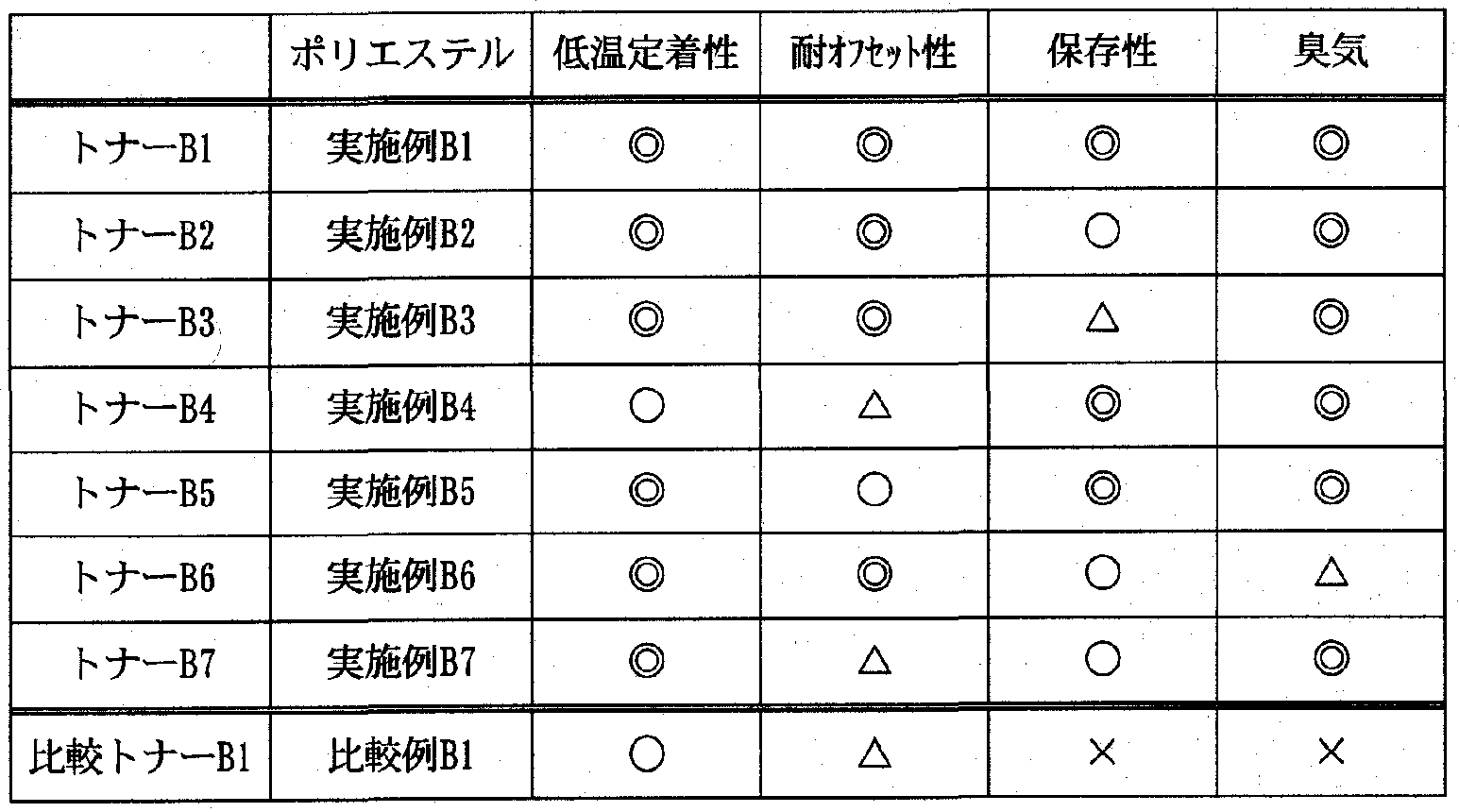
[0116] 以上の結果より、アルコール成分中に脂肪族多価アルコールを、カルボン酸成分 中に (メタ)アクリル酸変性ロジンを用いて得られた実施例 Β1〜Β7のポリエステルを含 有したトナーは、高速印字下においても低温定着性だけでなく耐ォフセット性にも優 れ、厳しい環境下でも良好な保存性を有することが分かる。これに対して、未精製の ロジンを使用した比較例 B1のポリエステルを含有したトナーは、ポリエステル中の低 分子量成分が多いために保存性が十分でなぐ臭気にも問題があることが分力る。
[0117] 本発明のトナー用ポリエステルは、例えば、電子写真法、静電記録法、静電印刷法 等において形成される潜像の現像等に用いられるトナーの結着榭脂等として用いら れるものである。
Claims
[1] アルコール成分と、(メタ)アクリル酸変性ロジンを含有したカルボン酸成分とを縮重 合させて得られるトナー用ポリエステル。
[2] (メタ)アクリル酸変性ロジンの含有量力 カルボン酸成分中、 5〜85重量%である、 請求項 1記載のトナー用ポリエステル。
[3] (メタ)アクリル酸変性ロジン力 精製ロジンを (メタ)アクリル酸で変性して得られるもの である、請求項 1又は 2記載のトナー用ポリエステル。
[4] アルコール成分が脂肪族多価アルコールを含有してなる請求項 1〜3 、ずれか記 載のトナー用ポリエステル。
[5] 脂肪族多価アルコールが炭素数 2〜6の脂肪族多価アルコールを含有してなる、請 求項 4記載のトナー用ポリエステノレ。
[6] アルコール成分及び Z又はカルボン酸成分力 3価以上のアルコール及び Z又は 3価以上のカルボン酸ィ匕合物を含有してなる、請求項 1〜5いずれか記載のトナー用 ポリエステル。
[7] 分子量が 500以下の低分子量成分の含有量が、ポリエステル中、 12%以下である、 請求項 1〜6いずれか記載のトナー用ポリエステル。
[8] 縮重合を、チタンィ匕合物及び Z又は Sn— C結合を有していない錫 (II)化合物の存 在下で行う請求項 1〜7いずれか記載のトナー用ポリエステル。
[9] 請求項 1〜8いずれか記載のトナー用ポリエステルを含有してなるトナー。
Priority Applications (3)
| Application Number | Priority Date | Filing Date | Title |
|---|---|---|---|
| CN2007800132687A CN101421676B (zh) | 2006-04-21 | 2007-04-16 | 调色剂用聚酯 |
| EP07741721.0A EP2012184B1 (en) | 2006-04-21 | 2007-04-16 | Toner |
| US12/297,946 US8309291B2 (en) | 2006-04-21 | 2007-04-16 | Polyester for toner |
Applications Claiming Priority (4)
| Application Number | Priority Date | Filing Date | Title |
|---|---|---|---|
| JP2006-117305 | 2006-04-21 | ||
| JP2006-117306 | 2006-04-21 | ||
| JP2006117306A JP4749210B2 (ja) | 2006-04-21 | 2006-04-21 | トナー |
| JP2006117305A JP4749209B2 (ja) | 2006-04-21 | 2006-04-21 | トナー |
Publications (1)
| Publication Number | Publication Date |
|---|---|
| WO2007123086A1 true WO2007123086A1 (ja) | 2007-11-01 |
Family
ID=38624986
Family Applications (1)
| Application Number | Title | Priority Date | Filing Date |
|---|---|---|---|
| PCT/JP2007/058285 Ceased WO2007123086A1 (ja) | 2006-04-21 | 2007-04-16 | トナー用ポリエステル |
Country Status (3)
| Country | Link |
|---|---|
| US (1) | US8309291B2 (ja) |
| EP (1) | EP2012184B1 (ja) |
| WO (1) | WO2007123086A1 (ja) |
Cited By (3)
| Publication number | Priority date | Publication date | Assignee | Title |
|---|---|---|---|---|
| JP2009003116A (ja) * | 2007-06-20 | 2009-01-08 | Kao Corp | トナー |
| JP2009098534A (ja) * | 2007-10-19 | 2009-05-07 | Kao Corp | トナー用ポリエステルの製造方法 |
| CN103224616A (zh) * | 2012-01-26 | 2013-07-31 | 施乐公司 | 用于聚酯树脂方法的基于松香酸的大分子单体的合成 |
Families Citing this family (8)
| Publication number | Priority date | Publication date | Assignee | Title |
|---|---|---|---|---|
| JP4749925B2 (ja) * | 2006-04-21 | 2011-08-17 | 株式会社リコー | 画像形成装置、画像形成方法、及びプロセスカートリッジ |
| EP2028551B1 (en) * | 2006-06-02 | 2014-07-23 | Kao Corporation | Toner for electrophotography |
| US8329370B2 (en) * | 2007-10-19 | 2012-12-11 | Ricoh Company, Ltd. | Toner, image forming apparatus, image forming method, and process cartridge |
| JP5436251B2 (ja) | 2010-02-08 | 2014-03-05 | 富士フイルム株式会社 | デヒドロアビエチン酸重合体、成形体、デヒドロアビエチン酸重合体の製造方法、及びデヒドロアビエチン酸化合物 |
| US8580472B2 (en) | 2011-01-17 | 2013-11-12 | Xerox Corporation | Rosin-based resin and toner containing same |
| US8431303B2 (en) * | 2011-01-17 | 2013-04-30 | Xerox Corporation | Rosin-based resin and toner containing same |
| US9141011B2 (en) | 2012-10-25 | 2015-09-22 | Kao Corporation | Method for producing toner for electrostatic image development |
| US9581924B2 (en) * | 2014-11-14 | 2017-02-28 | Xerox Corporation | Bio-based acrylate and (meth)acrylate resins |
Citations (12)
| Publication number | Priority date | Publication date | Assignee | Title |
|---|---|---|---|---|
| JPH01133668A (ja) | 1987-11-20 | 1989-05-25 | Kenji Kondo | プリント基板の保持搬送方法およびその装置 |
| JPH0470765A (ja) | 1990-07-11 | 1992-03-05 | Arakawa Chem Ind Co Ltd | 電子写真用トナー組成物 |
| JPH04307557A (ja) | 1991-04-04 | 1992-10-29 | Nippon Synthetic Chem Ind Co Ltd:The | トナー用のバインダー樹脂 |
| JPH07286139A (ja) | 1994-04-15 | 1995-10-31 | Harima Chem Inc | 色調安定性に優れるロジンエステルの製造法 |
| JPH0820636A (ja) | 1994-07-07 | 1996-01-23 | Mitsubishi Rayon Co Ltd | トナー用架橋ポリエステル樹脂 |
| JPH10239903A (ja) | 1997-02-27 | 1998-09-11 | Sanyo Chem Ind Ltd | 静電荷像現像用トナーバインダー |
| JP2003105071A (ja) * | 2001-09-27 | 2003-04-09 | Arakawa Chem Ind Co Ltd | ポリエステル樹脂、その製造法、印刷インキ用バインダーおよび印刷インキ |
| JP2004155908A (ja) * | 2002-11-06 | 2004-06-03 | Arakawa Chem Ind Co Ltd | ポリエステル樹脂、その製造法、印刷インキ用バインダーおよび印刷インキ |
| JP2004245854A (ja) | 2002-12-20 | 2004-09-02 | Mitsubishi Rayon Co Ltd | トナー用線状ポリエステル樹脂およびトナー |
| JP2004264318A (ja) * | 2002-07-30 | 2004-09-24 | Sekisui Chem Co Ltd | トナー用樹脂組成物及びトナー |
| JP2005115352A (ja) * | 2003-09-18 | 2005-04-28 | Ricoh Co Ltd | カラー画像形成用トナー及びトナーキット |
| JP2005290084A (ja) * | 2004-03-31 | 2005-10-20 | Toyo Ink Mfg Co Ltd | 平版印刷インキ組成物 |
Family Cites Families (16)
| Publication number | Priority date | Publication date | Assignee | Title |
|---|---|---|---|---|
| US2973332A (en) * | 1955-12-21 | 1961-02-28 | Basf Ag | Production of unsaturated polyester resins and of copolymers therefrom |
| US3652474A (en) * | 1970-02-27 | 1972-03-28 | Us Agriculture | Hot-melt adhesive composition containing rosin polyester |
| JPH083663B2 (ja) * | 1986-11-10 | 1996-01-17 | 東洋インキ製造株式会社 | 低温定着性に優れた電子写真用トナ−組成物 |
| JPH08311409A (ja) * | 1995-05-18 | 1996-11-26 | Harima Chem Inc | ロジン樹脂の色調安定性の改良方法 |
| JPH11133668A (ja) | 1997-10-31 | 1999-05-21 | Sanyo Chem Ind Ltd | トナーバインダー |
| EP1519242A3 (en) | 1997-10-31 | 2007-09-26 | Sanyo Chemical Industries, Ltd. | Toner and toner binder |
| JP2000169563A (ja) | 1998-12-07 | 2000-06-20 | Toyo Ink Mfg Co Ltd | 樹脂および印刷インキ |
| GB9912210D0 (en) * | 1999-05-25 | 1999-07-28 | Acma Ltd | Esterification catalysts |
| US6447973B1 (en) | 1999-08-24 | 2002-09-10 | Ricoh Company, Ltd. | Liquid developer for developing electrostatic image and image forming method |
| EP1550915B1 (en) | 2002-07-30 | 2012-08-29 | Mitsui Chemicals, Inc. | Resin composition for toner, and toners |
| WO2004057419A2 (ja) | 2002-12-20 | 2004-07-08 | Mitsubishi Rayon Co.,Ltd. | トナー用ポリエステル樹脂組成物およびトナー |
| JP3780254B2 (ja) | 2002-12-25 | 2006-05-31 | 東洋インキ製造株式会社 | トナー用ポリエステル樹脂、静電荷像現像用トナーおよび画像形成方法 |
| JP4702590B2 (ja) | 2003-03-24 | 2011-06-15 | 星光Pmc株式会社 | 印刷インキ用樹脂及び該印刷インキ用樹脂を使用した印刷インキ |
| US7183029B2 (en) | 2003-09-18 | 2007-02-27 | Ricoh Company, Limited. | Dry toner, toner kit, and image forming apparatus and process cartridge using the dry toner |
| JP2005350597A (ja) | 2004-06-11 | 2005-12-22 | Mitsui Chemicals Inc | トナー用バインダー樹脂及び電子写真用トナー |
| JP4870587B2 (ja) | 2007-01-31 | 2012-02-08 | 花王株式会社 | トナー用ポリエステル |
-
2007
- 2007-04-16 EP EP07741721.0A patent/EP2012184B1/en not_active Ceased
- 2007-04-16 WO PCT/JP2007/058285 patent/WO2007123086A1/ja not_active Ceased
- 2007-04-16 US US12/297,946 patent/US8309291B2/en not_active Expired - Fee Related
Patent Citations (12)
| Publication number | Priority date | Publication date | Assignee | Title |
|---|---|---|---|---|
| JPH01133668A (ja) | 1987-11-20 | 1989-05-25 | Kenji Kondo | プリント基板の保持搬送方法およびその装置 |
| JPH0470765A (ja) | 1990-07-11 | 1992-03-05 | Arakawa Chem Ind Co Ltd | 電子写真用トナー組成物 |
| JPH04307557A (ja) | 1991-04-04 | 1992-10-29 | Nippon Synthetic Chem Ind Co Ltd:The | トナー用のバインダー樹脂 |
| JPH07286139A (ja) | 1994-04-15 | 1995-10-31 | Harima Chem Inc | 色調安定性に優れるロジンエステルの製造法 |
| JPH0820636A (ja) | 1994-07-07 | 1996-01-23 | Mitsubishi Rayon Co Ltd | トナー用架橋ポリエステル樹脂 |
| JPH10239903A (ja) | 1997-02-27 | 1998-09-11 | Sanyo Chem Ind Ltd | 静電荷像現像用トナーバインダー |
| JP2003105071A (ja) * | 2001-09-27 | 2003-04-09 | Arakawa Chem Ind Co Ltd | ポリエステル樹脂、その製造法、印刷インキ用バインダーおよび印刷インキ |
| JP2004264318A (ja) * | 2002-07-30 | 2004-09-24 | Sekisui Chem Co Ltd | トナー用樹脂組成物及びトナー |
| JP2004155908A (ja) * | 2002-11-06 | 2004-06-03 | Arakawa Chem Ind Co Ltd | ポリエステル樹脂、その製造法、印刷インキ用バインダーおよび印刷インキ |
| JP2004245854A (ja) | 2002-12-20 | 2004-09-02 | Mitsubishi Rayon Co Ltd | トナー用線状ポリエステル樹脂およびトナー |
| JP2005115352A (ja) * | 2003-09-18 | 2005-04-28 | Ricoh Co Ltd | カラー画像形成用トナー及びトナーキット |
| JP2005290084A (ja) * | 2004-03-31 | 2005-10-20 | Toyo Ink Mfg Co Ltd | 平版印刷インキ組成物 |
Non-Patent Citations (1)
| Title |
|---|
| See also references of EP2012184A4 * |
Cited By (3)
| Publication number | Priority date | Publication date | Assignee | Title |
|---|---|---|---|---|
| JP2009003116A (ja) * | 2007-06-20 | 2009-01-08 | Kao Corp | トナー |
| JP2009098534A (ja) * | 2007-10-19 | 2009-05-07 | Kao Corp | トナー用ポリエステルの製造方法 |
| CN103224616A (zh) * | 2012-01-26 | 2013-07-31 | 施乐公司 | 用于聚酯树脂方法的基于松香酸的大分子单体的合成 |
Also Published As
| Publication number | Publication date |
|---|---|
| EP2012184B1 (en) | 2013-08-21 |
| EP2012184A1 (en) | 2009-01-07 |
| EP2012184A4 (en) | 2012-01-04 |
| US8309291B2 (en) | 2012-11-13 |
| US20090069530A1 (en) | 2009-03-12 |
Similar Documents
| Publication | Publication Date | Title |
|---|---|---|
| WO2007123090A1 (ja) | トナー用ポリエステル | |
| US7824832B2 (en) | Toner for electrophotography | |
| US8309291B2 (en) | Polyester for toner | |
| JP6373049B2 (ja) | 電子写真用トナー | |
| CN101317135B (zh) | 色调剂 | |
| CN101460898B (zh) | 电子照相用调色剂 | |
| CN101421676B (zh) | 调色剂用聚酯 | |
| JP5709262B2 (ja) | トナー | |
| JP5101180B2 (ja) | トナー | |
| JP6319843B2 (ja) | 電子写真用トナー | |
| JP5893942B2 (ja) | トナー用結着樹脂 | |
| JP4749241B2 (ja) | 電子写真用トナー | |
| JP5859825B2 (ja) | トナー | |
| JP4749239B2 (ja) | 電子写真用トナー | |
| JP2007292816A (ja) | トナー用ポリエステル | |
| JP5859824B2 (ja) | トナー | |
| JP4699191B2 (ja) | トナー用架橋ポリエステル | |
| JP4749240B2 (ja) | 電子写真用トナー | |
| JP4749246B2 (ja) | トナー用結着樹脂 | |
| JP2023006786A (ja) | トナー用結着樹脂の製造方法 | |
| JP2011039233A (ja) | 電子写真用トナー |
Legal Events
| Date | Code | Title | Description |
|---|---|---|---|
| 121 | Ep: the epo has been informed by wipo that ep was designated in this application |
Ref document number: 07741721 Country of ref document: EP Kind code of ref document: A1 |
|
| WWE | Wipo information: entry into national phase |
Ref document number: 200780013268.7 Country of ref document: CN |
|
| WWE | Wipo information: entry into national phase |
Ref document number: 12297946 Country of ref document: US |
|
| NENP | Non-entry into the national phase |
Ref country code: DE |
|
| WWE | Wipo information: entry into national phase |
Ref document number: 2007741721 Country of ref document: EP |