WO2008003620A2 - Elektrochemische herstellung sterisch gehinderter amine - Google Patents

Elektrochemische herstellung sterisch gehinderter amine Download PDF

Info

Publication number
WO2008003620A2
WO2008003620A2 PCT/EP2007/056390 EP2007056390W WO2008003620A2 WO 2008003620 A2 WO2008003620 A2 WO 2008003620A2 EP 2007056390 W EP2007056390 W EP 2007056390W WO 2008003620 A2 WO2008003620 A2 WO 2008003620A2
Authority
WO
WIPO (PCT)
Prior art keywords
alkyl
group
oxime derivative
oxime
ring
Prior art date
Legal status (The legal status is an assumption and is not a legal conclusion. Google has not performed a legal analysis and makes no representation as to the accuracy of the status listed.)
Ceased
Application number
PCT/EP2007/056390
Other languages
English (en)
French (fr)
Other versions
WO2008003620A3 (de
Inventor
Ulrich Griesbach
Siegfried R. Waldvogel
Itamar Malkowsky
Joerg Kulisch
Current Assignee (The listed assignees may be inaccurate. Google has not performed a legal analysis and makes no representation or warranty as to the accuracy of the list.)
BASF SE
Original Assignee
BASF SE
Priority date (The priority date is an assumption and is not a legal conclusion. Google has not performed a legal analysis and makes no representation as to the accuracy of the date listed.)
Filing date
Publication date
Priority to KR1020087031927A priority Critical patent/KR101374491B1/ko
Priority to US12/306,616 priority patent/US7863486B2/en
Priority to CA2655862A priority patent/CA2655862C/en
Priority to EP07786853A priority patent/EP2041336B1/de
Priority to JP2009517180A priority patent/JP4938848B2/ja
Priority to CN2007800251489A priority patent/CN101517128B/zh
Application filed by BASF SE filed Critical BASF SE
Priority to DE502007006121T priority patent/DE502007006121D1/de
Priority to AT07786853T priority patent/ATE493522T1/de
Publication of WO2008003620A2 publication Critical patent/WO2008003620A2/de
Anticipated expiration legal-status Critical
Publication of WO2008003620A3 publication Critical patent/WO2008003620A3/de
Ceased legal-status Critical Current

Links

Classifications

    • CCHEMISTRY; METALLURGY
    • C07ORGANIC CHEMISTRY
    • C07CACYCLIC OR CARBOCYCLIC COMPOUNDS
    • C07C209/00Preparation of compounds containing amino groups bound to a carbon skeleton
    • C07C209/30Preparation of compounds containing amino groups bound to a carbon skeleton by reduction of nitrogen-to-oxygen or nitrogen-to-nitrogen bonds
    • CCHEMISTRY; METALLURGY
    • C25ELECTROLYTIC OR ELECTROPHORETIC PROCESSES; APPARATUS THEREFOR
    • C25BELECTROLYTIC OR ELECTROPHORETIC PROCESSES FOR THE PRODUCTION OF COMPOUNDS OR NON-METALS; APPARATUS THEREFOR
    • C25B3/00Electrolytic production of organic compounds
    • C25B3/20Processes
    • C25B3/25Reduction
    • CCHEMISTRY; METALLURGY
    • C07ORGANIC CHEMISTRY
    • C07CACYCLIC OR CARBOCYCLIC COMPOUNDS
    • C07C2601/00Systems containing only non-condensed rings
    • C07C2601/12Systems containing only non-condensed rings with a six-membered ring
    • C07C2601/14The ring being saturated

Definitions

  • the present invention relates to a process for the preparation of an amine by cathodic reduction of a corresponding oxime derivative.
  • Organic compounds with multiple chiral centers are often important building blocks and auxiliaries in the synthesis of other organic compounds in order to introduce into the latter chiral centers or to build a non-racemic stereocenter in them.
  • compounds are often selected as auxiliaries, which have a relatively rigid skeleton and also contain bulky groups that can exert a directing effect in the synthesis of other organic compounds.
  • Cyclic compounds derived from the so-called “chiral pool” are frequently of interest here. Particular mention may be made of cyclic terpenoids.
  • 8-phenylmenthol which is used, for example, as an auxiliary in the asymmetric Diels-Alder reaction (Corey, E., Angew Chem 114 (2002), 1724-1741; KC Nicolaou, Angew Chem., 114 (2002 ), 1742-1773).
  • the hydroxyl group of the menthol serves as a functional group to introduce the auxiliary into a molecule, so that in a subsequent chemical reaction, a prochiral center is converted into a chiral center under the directing action of the auxiliary.
  • the menthol which can be used for example as the alcohol component of an ester, comparatively labile and is therefore not the method of choice for each reaction.
  • the amine analogue of menthol and 8-methylmenthol is described, for example, by M.C. Schopohl et al., Angew. Chem. 115 (2003), 2724-2727, to study the enantiofacial differentiation of individual caffeine guest molecules.
  • MC Schopohl et al., Synthesis 17 (2003), 2689-2694 propose to prepare the corresponding amine starting from (+) - pulegone.
  • the ethylenic double bond is reacted with a Grignard reagent to introduce a residue in the 8-position. This allows derivatization at said 8-position. Due to the reaction, a chiral center is generated at the ring carbon in 4-position, the Grignard reaction is not suitable to discriminate between R and S form. This results in a Epimerengemisch in the reaction.
  • the recovery of the (4S) epimer succeeds.
  • the oxime function is converted to an amino function with the amino function being in the 4-position in trans configuration with respect to the alkyl radical.
  • the heterogeneous reduction of transition metal catalysts either results in no reaction or the corresponding amine is accompanied by the equimolar amount of an epimeric amine, which is difficult to separate.
  • the object is achieved by a process for the preparation of an amine containing the step
  • R C- ⁇ -6 alkyl or C 2 -6 alkenyl tuenten optionally substituted with one or more substi- independently selected from the group consisting of phenyl, 0-Ci-6-alkyl, NH-Ci-6-alkyl, N (Ci - 6 alkyl) 2 , OH and NH 2 is substituted;
  • Ci is -6 alkyl or C (O) -Ci -6 alkyl and
  • the oxime derivative has an excess of the R or S form of at least 10%.
  • substituent or substituents phenyl, O-Ci-6-alkyl, NH-Ci-6-alkyl, N (Ci -6 alkyl) 2, OH and NH 2 are suitable. If several substituents are present, they can be selected independently of one another from the above-mentioned group.
  • the radical R is a Ci -6 alkyl or C 2-6 alkenyl which is unsubstituted or at most has a substituent.
  • an alkyl radical in the present invention, an alkyl radical, the term "Ci -6 alkyl" means having 1 to 6 carbon atoms and is unbranched or branched. Examples of such substituents are methyl, ethyl, n-propyl, isopropyl, n-1-butyl, n-2-butyl, sec-butyl, tert-butyl, n-1-pentyl, n-2-pentyl, n- 3-pentyl, n-hexyl.
  • C 2-6 alkenyl is to be understood as meaning an alkenyl radical which has 2 to 6 carbon atoms and which is unreacted. branched or branched. Examples of these are vinyl, allyl, n-1-propenyl, n-2-propenyl, butenyl, pentenyl, hexenyl.
  • R is an unsubstituted C- ⁇ -alkyl, an unsubstituted C 2-6 - alkenyl or a phenyl-substituted CI_ 6 alkyl.
  • R is isopropyl, tert-butyl or 1-phenyl-1-methylethyl.
  • the oxime derivative of general formula (I) may be an oxime as such.
  • the hydrogen of the oxime 6 alkyl radical may be replaced by a Ci -6 alkyl or C (O) -Ci_.
  • the oxime derivative is an oxime.
  • the oxime derivative of the general formula (I) has a ring A.
  • ring A has 5, 6 or 7 ring atoms.
  • the ring A is a hydrocarbon ring which is saturated or has a double bond.
  • the ring A may be a cyclopentane, cyclopentene, cyclohexane, cyclohexene, cycloheptane or a cycloheptene ring.
  • one CH 2 group of the ring A by -O-, -S-, -NH- or -N be substituted - (Ci -6 - alkyl). It is also possible that several CH 2 groups are replaced by one of the above-mentioned heteroatoms. In the event that several heteroatoms are present as ring atoms in ring A, these may be selected independently of one another. If a double bond is present in ring A, in the event that at least one CH 2 group is replaced by a heteroatom, and this represents at least one heteroatom nitrogen, this can occur as imino nitrogen. There may also be more of these nitrogens.
  • Ring A may have no, one or more substituents beyond the radical R and the oxime group or their analogue.
  • the substituent or substituents can be selected from the group consisting of phenyl, -Ci -6 -alkyl, OCie-alkyl, NH-Ci -6- alkyl, N (Ci -6- alkyl) 2 , OH and NH 2 . If several substituents are present, these may be selected independently from the above-mentioned group.
  • the substituent is preferably a C 1-6 -alkyl group. Especially preferred is methyl.
  • the ring A preferably has exactly one further substituent.
  • the ring A is not formed exclusively from carbon atoms, the ring may be, for example, a tetrahydrofuran, dihydrothiophene, dihydrofuran, dihydropyrrole, oxane, thian, piperidine, dihydropyran or tetrahydropyridine.
  • the ring A preferably has no heteroatoms.
  • ring A is cyclohexane or cyclohexene, especially cyclohexane.
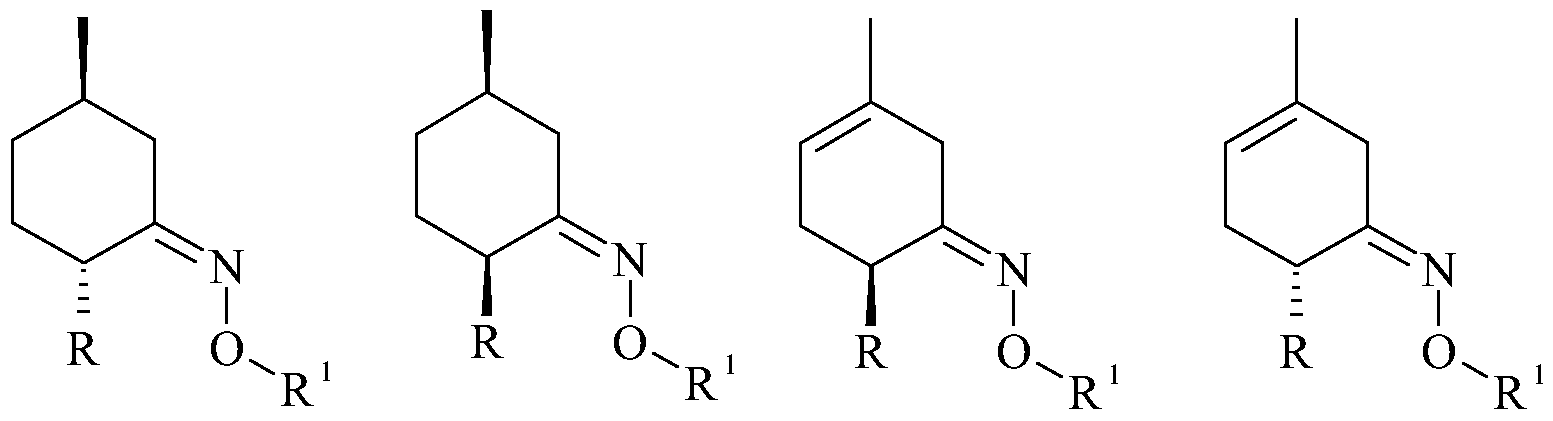
  • the oxime derivative of the general formula (I) is a methyl-substituted oxime derivative selected from the group consisting of
  • oxime derivatives of the general formula (I) which after the reduction give menthylamine, 8-methylmenthylamine or 8-phenylmenthylamine.
  • radicals R, R 1 have the meaning given above.
  • oxime derivatives for the process according to the invention are accessible via preparation processes known in the art.
  • a precursor is typically the corresponding ketone.
  • One way to make it is to start from the corresponding aromatic system bearing the desired substituents to build up the desired oxime derivative after reduction and diastereomer separation. If a double bond is present in ring A, this could be obtained by stepwise reduction or via a reduction / elimination reaction. Separations are described, for example, by H. Feltkamp et al., Liebigs Ann. Chem. 707 (1967), 78-86. The synthesis preferably takes place to the oxime using the so-called "chiral pool". Such a strategy is described, for example, by MC Schopohl et al., Synthesis 17 (2003), 2689-2694. A preferred starting material is pulegone or menthone.
  • the aim of the present invention is to provide a process for the cathodic reduction of an oxime derivative to a corresponding amine, in which the oxime function or the oxime analogue in ⁇ -position has a radical R, wherein after reduction the amino function to the radical R predominantly in Trans- Position is.
  • this presupposes that the chiral ring C atom, which has the radical R, is not in racemic form.
  • an excess of the R or S form of at least 10% should therefore be present in the oxime derivative of the general formula (I), preferably at least 50%, more preferably at least 75%, even more preferably at least 90%. , more preferably at least 95%, more preferably at least 98%, even more preferably at least 99%, especially at least 99.9%.
  • the ring carbon having the substituent R is present exclusively in the R or S form.
  • % 1 100, n R + n s
  • E denotes the excess in% and n respectively represents the amount of substance of the R or S form with respect to the ring carbon which carries the substituent R.
  • the ring carbon having the substituent R is the only stereocenter in the oxime derivative of the general formula (I), it is the enantiomeric excess of the oxime derivative.
  • the excess is an epimeric excess relative to the ring carbon having the substituent R.
  • the determination of the above quantities to determine the excess is possible by means of methods known in the art. If there is an excess of enantiomers, a corresponding evaluation can be made using common methods such as circular dichroism. Another method for the determination would be by derivatization of the oxime derivative of the general formula (I), so that the product obtained is present as a diastereomer and the usual methods for diastereomers are used. One of the most common methods is nuclear magnetic resonance spectroscopy.
  • the excess is at least 10%, more preferably at least 50%, especially at least 60%.
  • the reduction can be carried out, for example, in a divided or undivided flow cell.
  • a split flow cell is used.
  • the catholyte contains a solvent in addition to the amine formed in the course of the reaction and the oxime derivative.
  • these are the inert solvents which are generally customary in organic chemistry, such as dimethyl carbonate, propylene carbonate, tetrahydrofuran, dimethoxyethane, acetonitrile or dimethylformamide.
  • the solvent used is preferably a C 1 -C 4 -alkyl alcohol.
  • C 5 -C 7 -hydrocarbons, such as, for example, hexane, are also suitable in combination with the abovementioned solvents.
  • cyclic or acyclic ethers can be used.
  • water can be used.
  • mixtures of the abovementioned solvents can be used.
  • Alcohols, water, ethers or mixtures thereof are preferred. This can form a single- or multi-phase system.
  • alcohols which are optionally present in mixtures with one another and / or water and are d- 4- alkanols, such as methanol, ethanol, n-propanol, isopropanol, n-butanol, sec-butanol, tert-butanol; Diols such as glycol, triols such as glycerol, polyols, polyethers or alkoxyalkanols such as ethylene glycol monomethyl ether or dimethoxyethane. Very particular preference is dimethoxyethane.
  • the catholyte generally contains a mineral acid, preferably sulfuric acid or an alkali (C 1 to C 4 ) alkyl alcoholate, preferably sodium methoxide.
  • an electrolyte salt is added to the anolyte and optionally also to the catholyte (in addition to one of the above-mentioned conductivity-producing agents).
  • These are generally alkali metal, tetra (C 1 -C 6 -alkyl) ammonium, preferably Tn (C 1 -C 6 -alkyl) -methylammonium salts.
  • Suitable counterions are sulfate, hydrogensulfate, alkyl sulfates, aryl sulfates, halides, phosphates, carbonates, alkyl phosphates, alkyl carbonates, nitrates, alcoholates, tetrafluoroborate, hexafluorophosphate or perchlorate.
  • MTBS methyltributylammonium methylsulfates
  • methyltriethylammonium methylsulfate methyltri-propylammonium methylsulfates.
  • the anolyte preferably also contains a solvent containing water, one or more alcohols, or a mixture of two or more of the solvents.
  • a solvent containing water one or more alcohols, or a mixture of two or more of the solvents.
  • the same alcohols are suitable for the anolyte as for the catholyte, but these may also be different from the catholyte.
  • the process according to the invention can preferably be carried out in all customary divided types of electrolysis cell in order to be able to exclude within the scope of the process according to the invention that reactants such as products undergo chemical side reactions by the cathode process.
  • reactants such as products undergo chemical side reactions by the cathode process.
  • one works continuously in divided flow cells.
  • Divided cells with plane-parallel electrode arrangement are preferably used.
  • separation media ion exchange membranes, microporous membranes, diaphragms, filter fabrics of non-electron conducting materials, glass frits and porous ceramics can be used.
  • ion exchange membranes in particular cation exchange membranes, are used.
  • These conductive membranes are commercially available, e.g. available under the trade name Nafion® (ET. DuPont de Nemours and Company) and Gore Select® (W.L. Gore & Associates, Inc.).
  • the cathodes used are preferably those in which the cathode surface is formed from a material with high hydrogen overvoltage, for example from lead, zinc, tin, nickel, mercury, cadmium, copper or alloys of these metals or glassy cabon, graphite or diamond. Particular preference is given to diamond electrodes, as described, for example, in EP-A-1036863.
  • anodes preferably those which are also referred to as cathode materials.
  • acidic anolyte preference is given to using platinum, diamond, glassy carbon or graphite anodes or the dimensionally stable anodes (DSA) known to the person skilled in the art. If the anolyte is basic, preferably stainless steel is used.
  • the anode reaction can be chosen freely, preferably the solvent, for example a CrC 4 -AlkOhOl is oxidized.
  • a CrC 4 -AlkOhOl is oxidized.
  • methanol methyl formate, formaldehyde dimethyl acetal or dimethyl carbonate is formed.
  • a sulfuric acid solution diluted with a CrC 4 alcohol serves for this purpose.
  • the current densities at which the process is carried out are generally 1 to 1000, preferably 10 to 100 mA / cm 2 .
  • working at atmospheric pressure In general, working at atmospheric pressure. Higher pressures are preferably used when operating at higher temperatures to avoid boiling of the starting compounds or solvents.
  • the electrolyte solution is worked up by general separation methods.
  • the catholyte is generally first distilled and recovered the individual compounds in the form of different fractions separately. Further purification can be carried out, for example, by crystallization, distillation or by chromatography.
  • anolyte and catholyte are electrochemically reacted according to the variants given below at a current density of 67 mA / cm 2 , wherein 8 F / mol are fed (equivalent to 2 equivalents).
  • the electrolysis is carried out at room temperature; the divided cell is constructed from two flange cells, with the anode and cathode half spaces separated by a Nafion-324 membrane.
  • Anode material is platinum, lead is used as the cathode.
  • the combined organic basic extracts are dried with 10% strength sodium hydroxide solution (2 ⁇ 100 ml) and over calcium oxide and freed from the solvent on a rotary evaporator. Further purification can be carried out, for example, by column chromatography or distillation.
  • Cathode material mercury Current density: 23.3 mA / cm 2 Temperature: -14 - - 18 0 C
  • Anolyte 50 mL 0.162 MH 2 SO 4 in methanol (equivalent to 2% by weight).
  • Electrolysis apparatus divided electrolysis cell
  • the (-) - (E) - (1R, 4S) -8-phenylmenthyloxime is dissolved in the catholyte and transferred to the cathode half cell.
  • the anode half-cell is filled with the anolyte.
  • the electrolysis is carried out galvanostatically at a current density of 12.5 mA / cm 2 and a temperature of 20-22 ° C.
  • the anode is platinum, the cathode lead.
  • an excess charge of 1966 C (10 F / mol (-) - (£) - (1 f, 4S) -8-phenylmenthyloxime, 2.5 equivalents)
  • the electrolysis is terminated.
  • the reaction mixture is transferred from the cathode half-cell into a flask and the cell is rinsed with a total of 50 ml of methanol and 50 ml of water.
  • the clamping voltage during the electrolysis is high (up to 20.6 V). After some time, a coating forms on the cathode. Whereas at the beginning only a small amount of gas is observed at the cathode, it becomes more and more intense as the formation of deposits increases.
  • A Apparatus: GC2010 Fa. Shimadzu, Japan.

Landscapes

  • Chemical & Material Sciences (AREA)
  • Organic Chemistry (AREA)
  • Engineering & Computer Science (AREA)
  • Chemical Kinetics & Catalysis (AREA)
  • Electrochemistry (AREA)
  • Materials Engineering (AREA)
  • Metallurgy (AREA)
  • Organic Low-Molecular-Weight Compounds And Preparation Thereof (AREA)
  • Electrolytic Production Of Non-Metals, Compounds, Apparatuses Therefor (AREA)
  • Hydrogenated Pyridines (AREA)

Abstract

Verfahren zur Herstellung eines Amins enthält die kathodische Reduktion eines entsprechenden Oximderivates der allgemeinen Formel (I) wobei R C1-6 Alkyl oder C2-6 Alkenyl, das gegebenenfalls mit einem oder mehreren Substi tuenten unabhängig ausgewählt aus der Gruppe bestehend aus Phenyl, 0-C1-6 Alkyl, NH-C1-6 Alkyl, N(C1-6 Alkyl)2, OH und NH2 substituiert ist; R1 H; C1-6 Alkyl oder C(O)-C1-6 Alkyl ist und A einen 5-, 6- oder 7-gliedrigen Kohlenwasserstoffring darstellt, der gesättigt ist oder eine Doppelbindung aufweist und bei dem gegebenenfalls mindestens eine CH2- Gruppe durch -O-, -S- -NH-, -N=, oder -N(C1-6 Alkyl)- ersetzt ist und der gegebenenfalls mit einem oder mehreren weiteren Substituenten unabhängig ausgewählt aus der Gruppe bestehend aus Phenyl, C1-6 Alkyl, O-C1-6 Alkyl, NH-C1-6-Alkyl, N(C1-6 Alkyl)2, OH und NH2 substituiert ist; und wobei in Bezug auf den Ringkohlenstoff, der den Substituenten R aufweist, das Oximderivat einen Überschuss der R- oder S-Form von mindestens 10 % aufweist.

Description

Elektrochemische Herstellung sterisch gehinderter Amine
Beschreibung
Die vorliegende Erfindung betrifft ein Verfahren zur Herstellung eines Amins durch kathodische Reduktion eines entsprechenden Oximderivates.
Organische Verbindungen mit mehreren chiralen Zentren sind häufig wichtige Bausteine und Auxiliare in der Synthese anderer organischer Verbindungen, um in die letztge- nannten chirale Zentren einzuführen oder um bei diesen ein nicht racemisches Stereozentrum aufzubauen. Hierbei werden häufig Verbindungen als Auxiliare gewählt, die ein vergleichsweise starres Grundgerüst aufweisen und zudem voluminöse Gruppen enthalten, die eine dirigierende Wirkung bei der Synthese anderer organischer Verbindungen ausüben können.
Hierbei sind häufig cyclische Verbindungen von Interesse, die aus dem sogenannten "chiral pool" stammen. Dabei sind insbesondere cyclische Terpenoide zu nennen.
Ein solches Beispiel ist 8-Phenylmenthol, das beispielsweise als Auxiliar bei der asymmetrischen Diels-Alder-Reaktion eingesetzt wird (E. Corey, Angew. Chem. 114 (2002), 1724-1741 ; K.C. Nicolaou, Angew. Chem. 114 (2002), 1742-1773).
Hierbei dient die Hydroxylgruppe des Menthols als funktionelle Gruppe, um das Auxiliar in ein Molekül einzuführen, damit bei einer anschließenden chemischen Reaktion ein prochirales Zentrum in ein chirales Zentrum unter der dirigierenden Wirkung des Auxi- liars umgewandelt wird. Hierbei ist jedoch das Menthol, das beispielsweise als Alkoholkomponente eines Esters eingesetzt werden kann, vergleichsweise labil und ist daher nicht für jede Reaktion das Mittel der Wahl.
Es besteht daher ein Bedarf, ein Aminanalogon zu Menthol, dessen Derivaten oder analoger chiraler Auxiliare bereitzustellen.
Das Aminanalogon von Menthol und 8-Methylmenthol wird beispielsweise von M. C. Schopohl et al., Angew. Chem. 115 (2003), 2724-2727 eingesetzt, um die enantiofacia- Ie Differenzierung einzelner Koffein-Gastmoleküle zu untersuchen.
Um zu Aminanaloga des Menthols zu gelangen, schlagen M. C. Schopohl et al., Syn- thesis 17 (2003), 2689-2694 vor, das entsprechende Amin ausgehend von (+)-Pulegon herzustellen. Als erster Schritt wird bei der Synthese die ethylenische Doppelbindung mit einem Grignard-Reagenz umgesetzt, um einen Rest in 8-Position einzufügen. Dies ermöglicht die Derivatisierung an besagter 8-Position. Aufgrund der Reaktion wird ein chirales Zentrum am Ring-Kohlenstoff in 4-Position erzeugt, wobei die Grignard- Reaktion nicht geeignet ist, zwischen R- und S-Form zu diskriminieren. Hierdurch entsteht ein Epimerengemisch bei der Reaktion. Nach Überführung der Ketofunktion in ein Oxim gelingt die Gewinnung des (4S)-Epimers. Bei der nachfolgenden Beauvault- Blanc-Reaktion mit Natrium in Toluol wird die Oximfunktion in eine Aminofunktion umgewandelt, wobei die Aminofunktion in Bezug auf den Alkylrest in 4-Stellung in TransKonfiguration vorliegt.
Dies stellt einen entscheidenden Schritt in der Synthese dar, um eine Konfiguration entsprechend der des Menthols zu erhalten.
Im Gegensatz zu der oben beschriebenen Reduktion mit Natrium ergibt sich bei der heterogenen Reduktion an Übergangsmetallkatalysatoren entweder keine Umsetzung oder das entsprechende Amin wird von der äquimolaren Menge eines epimeren Amins begleitet, das sich nur schwer abtrennen lässt.
Nachteilig an der oben beschriebenen Reaktion ist jedoch der Einsatz des Natriums, das zudem in vergleichsweise großen Mengen eingesetzt wird.
Eine Aufgabe der vorliegenden Erfindung liegt somit darin, ein alternatives Verfahren zur Herstellung eines Amins mit Hilfe eines entsprechenden Oximderivates bereitzustellen, das eine Diskriminierung der R- beziehungsweise S-Form an einem Ring- Kohlenstoff, welches die Oximfunktion oder ein Derivat hiervon trägt und welches in α- Position einen Substituenten aufweist, ermöglicht.
Die Aufgabe wird gelöst durch ein Verfahren zur Herstellung eines Amins den Schritt enthaltend
kathodische Reduktion eines entsprechenden Oximderivates der allgemeinen Formel (I)
Figure imgf000003_0001
N-OR1
(I), wobei R C-ι-6 Alkyl oder C2-6 Alkenyl, das gegebenenfalls mit einem oder mehreren Substi- tuenten unabhängig ausgewählt aus der Gruppe bestehend aus Phenyl, 0-Ci-6 Alkyl, NH-Ci-6 Alkyl, N(Ci-6 Alkyl)2, OH und NH2 substituiert ist;
R1 H; Ci-6 Alkyl oder C(O)-Ci-6 Alkyl ist und
A einen 5-, 6- oder 7-gliedrigen Kohlenwasserstoffring darstellt, der gesättigt ist oder eine Doppelbindung aufweist und bei dem gegebenenfalls mindestens eine CH2- Gruppe durch -O-, -S- -NH-, -N=, oder -N(Ci-6 Alkyl)- ersetzt ist und der gegebenenfalls mit einem oder mehreren weiteren Substituenten unabhängig ausgewählt aus der Gruppe bestehend aus Phenyl, Ci-6 Alkyl, 0-Ci-6 Alkyl, NH-Ci-6 Alkyl, N(Ci-6 Alkyl)2, OH und NH2 substituiert ist;
und wobei in Bezug auf den Ringkohlenstoff, der den Substituenten R aufweist, das Oximderivat einen Überschuss der R- oder S-Form von mindestens 10 % aufweist.
Es wurde nämlich gefunden, dass überraschenderweise die kathodische Reduktion eines entsprechenden Oximderivates die gewünschte, oben beschriebene Diskriminierung erlaubt und so eine elektrochemische Herstellung von entsprechenden Aminen, bei denen in α-Position sich ein Rest R befindet, der zur Aminfunktion in Trans-Position steht, zu ermöglichen, ohne dass beispielsweise elementares Natrium eingesetzt werden müsste.
Bei dem Oximderivat der allgemeinen Formel (I) stellt der Rest R, der in α-Position zur späteren Aminfunktion steht, einen Ci-6-Alkyl- oder C2-6-Alkenyl-Rest dar, der unsubsti- tuiert ist oder einen oder mehrere Substituenten aufweist. Als Möglichkeiten für den oder die Substituenten kommen Phenyl, O-Ci-6-Alkyl, NH-Ci-6-Alkyl, N(Ci-6-Alkyl)2, OH und NH2 in Frage. Sofern mehrere Substituenten vorhanden sind, können diese unabhängig voneinander aus der oben genannten Gruppe ausgewählt werden.
Vorzugsweise ist der Rest R ein Ci-6-Alkyl oder C2-6-Alkenyl, das unsubstituiert ist oder höchstens einen Substituenten aufweist.
Im Rahmen der vorliegenden Erfindung ist unter dem Begriff "Ci-6-Alkyl" ein Alkylrest zu verstehen, der 1 bis 6 C-Atome aufweist und unverzweigt oder verzweigt ist. Beispiele solcher Substituenten sind Methyl, Ethyl, n-Propyl, Isopropyl, n-1-Butyl, n-2- Butyl, sec.-Butyl, tert.-Butyl, n-1-Pentyl, n-2-Pentyl, n-3-Pentyl, n-Hexyl.
Weiterhin ist im Rahmen der vorliegenden Erfindung unter dem Begriff "C2-6-Alkenyl" ein Alkenylrest zu verstehen, der 2 bis 6 Kohlenstoffatome aufweist und der unver- zweigt oder verzweigt ist. Beispiele hierfür sind Vinyl, AIIyI, n-1-Propenyl, n-2-Propenyl, Butenyl, Pentenyl, Hexenyl.
Vorzugsweise ist der Rest R ein unsubstituiertes d-β-Alkyl, ein unsubstituiertes C2-6- Alkenyl oder ein phenylsubstituiertes Ci_6-Alkyl.
Ganz besonders bevorzugt ist R Isopropyl, tert.-Butyl oder 1-Phenyl-1-methylethyl.
Bei dem Oximderivat der allgemeinen Formel (I) kann es sich um ein Oxim als solches handeln. Darüber hinaus kann der Wasserstoff der Oximgruppe durch einen Ci-6-Alkyl- oder C(O)-Ci_6-Alkyl-Rest ersetzt sein. Vorzugsweise handelt es sich bei dem Oximderivat um ein Oxim (R1 = H) oder R1 ist Methyl oder Acetyl. Ganz besonders bevorzugt handelt es sich bei dem Oximderivat um ein Oxim.
Weiterhin weist das Oximderivat der allgemeinen Formel (I) einen Ring A auf. Dieser beinhaltet den Kohlenstoff, der das Oxim oder ein Analogon des Oxims aufweist, sowie die diesem Kohlenstoff direkt benachbarten Kohlenstoffe. Insgesamt weist der Ring A 5, 6 oder 7 Ringatome auf. Es handelt sich bei dem Ring A um einen Kohlenwasserstoffring, der gesättigt ist oder eine Doppelbindung aufweist. Hierbei kann der Ring A ein Cyclopentan-, Cyclopenten-, Cyclohexan-, Cyclohexen-, Cycloheptan- oder ein Cyclohepten-Ring sein.
Darüber hinaus kann eine CH2-Gruppe des Rings A durch -O-, -S-, -NH- oder -N(Ci-6- Alkyl)- ersetzt sein. Es ist ebenfalls möglich, dass mehrere CH2-Gruppen durch eines der oben genannten Heteroatome ersetzt sind. Für den Fall, dass mehrere Heteroato- me als Ringatome im Ring A vorhanden sind, können diese unabhängig voneinander ausgewählt sein. Sofern eine Doppelbindung im Ring A vorhanden ist, kann für den Fall, dass mindestens eine CH2-Gruppe durch ein Heteroatom ausgetauscht ist, und dieses mindestens eine Heteroatom Stickstoff darstellt, dieses als Iminostickstoff auf- treten. Es können auch mehrere dieser Stickstoffe vorhanden sein.
Der Ring A kann über den Rest R und die Oximgruppe beziehungsweise deren Analogon hinaus keinen, einen oder mehrere Substituenten aufweisen. Der oder die Substi- tuenten können ausgewählt werden aus der Gruppe bestehend aus Phenyl, -Ci-6-Alkyl, O-C-i-e-Alkyl, NH-Ci-6-Alkyl, N(Ci-6-Alkyl)2, OH und NH2. Sofern mehrere Substituenten vorhanden sind, können diese unabhängig aus der oben genannten Gruppe ausgewählt sein. Vorzugsweise handelt es sich bei dem Substituenten um eine Ci-6- Alkylgruppe. Insbesondere bevorzugt ist Methyl.
Der Ring A weist vorzugsweise genau einen weiteren Substituenten auf. Selbstverständlich weist der Ring A des Oximderivates der allgemeinen Formel (I) in jedem Falle den Rest R sowie das Oxim beziehungsweise das Oximanalogon als Sub- stituenten auf.
Sofern der Ring A nicht ausschließlich aus Kohlenstoffatomen gebildet wird, kann der Ring beispielsweise ein Tetrahydrofuran, Dihydrothiophen, Dihydrofuran, Dihydro- pyrrol, Oxan, Thian, Piperidin, Dihydropyran oder Tetrahydropyridin sein. Vorzugsweise weist der Ring A jedoch keine Heteroatome auf. Ganz besonders bevorzugt handelt es sich bei dem Ring A um Cyclohexan oder Cyclohexen, insbesondere Cyclohexan.
Ganz besonders bevorzugt handelt es sich bei dem Oximderivat der allgemeinen Formel (I) um ein methylsubstituiertes Oximderivat ausgewählt aus der Gruppe bestehend aus
Figure imgf000006_0001
Ganz besonders bevorzugt sind Oximderivate der allgemeinen Formel (I), die nach der Reduktion Menthylamin, 8-Methylmenthylamin oder 8-Phenylmenthylamin liefern.
Hierbei haben die Reste R, R1 die oben bezeichnete Bedeutung.
Die Oximderivate für das erfindungsgemäße Verfahren sind über im Stand der Technik bekannte Herstellverfahren zugänglich. Hierbei ist typischerweise eine Vorstufe das entsprechende Keton.
Eine Möglichkeit zur Herstellung besteht darin, von dem entsprechenden aromatischen System auszugehen, das die gewünschten Substituenten trägt, um nach Reduktion und Diastereomerentrennung das gewünschte Oximderivat aufzubauen. Sofern im Ring A eine Doppelbindung vorhanden ist, könnte diese durch stufenweise Reduktion oder über eine Reduktions-/Eliminierungsreaktion erhalten werden. Trennungen sind beispielsweise von H. Feltkamp et al., Liebigs Ann. Chem. 707 (1967), 78-86 beschrieben. Vorzugsweise erfolgt die Synthese zum Oxim unter Verwendung des sogenannten "Chiral Pools". Eine solche Strategie wird beispielsweise von M. C. Schopohl et al., Synthesis 17 (2003), 2689-2694 beschrieben. Ein bevorzugtes Ausgangsmaterial ist Pulegon oder Menthon.
Ziel der vorliegenden Erfindung ist es, ein Verfahren zur kathodischen Reduktion eines Oximderivates zu einem entsprechenden Amin bereitzustellen, bei dem die Oximfunk- tion oder das Oximanalogon in α-Position einen Rest R aufweist, wobei nach Reduktion die Aminofunktion zum Rest R überwiegend in Trans-Position steht. Dies setzt je- doch voraus, dass das chirale Ring-C-Atom, welches den Rest R aufweist, nicht in ra- cemischer Form vorliegt.
Es soll daher im Rahmen der vorliegenden Erfindung ein Überschuss der R- oder S- Form von mindestens 10 % im Oximderivat der allgemeinen Formel (I) vorliegen, vor- zugsweise mindestens 50 %, weiterhin bevorzugt mindestens 75 %, weiterhin mehr bevorzugt mindestens 90 %, weiterhin mehr bevorzugt mindestens 95 %, weiterhin mehr bevorzugt mindestens 98 %, weiterhin mehr bevorzugt mindestens 99 %, insbesondere mindestens 99,9 %. Ganz besonders bevorzugt liegt der Ringkohlenstoff, der den Substituenten R aufweist, ausschließlich in der R- oder S-Form vor.
Sind darüber hinaus in dem Oximderivat weitere Stereozentren vorhanden, gilt für diese das Analoge.
Der Überschuss der R- oder S-Form ergibt sich aus der Formel
nR - ns
%1= 100, nR + ns
wobei E den Überschuss in % bezeichnet und n jeweils die Stoffmenge der R- oder S- Form in Bezug auf den Ringkohlenstoff, der den Substituenten R trägt, bedeutet.
Sofern der Ringkohlenstoff, der den Substituenten R aufweist, das einzige Stereozentrum im Oximderivat der allgemeinen Formel (I) ist, handelt es sich um den Enantiome- renüberschuss des Oximderivats.
Sofern darüber hinaus mindestens ein weiteres Stereozentrum vorhanden ist, handelt es sich bei dem Überschuss um einen Epimerenüberschuss in Bezug auf den Ringkohlenstoff, der den Substituenten R aufweist. Die Bestimmung der obigen Größen zur Ermittlung des Überschusses ist mit Hilfe von im Stand der Technik bekannten Methoden möglich. Sofern es sich um einen Enantio- merenüberschuss handelt, kann eine entsprechende Auswertung über gängige Methoden wie beispielsweise Circulardichroismus erfolgen. Eine weitere Methode zur Ermitt- lung wäre durch eine Derivatisierung des Oximderivates der allgemeinen Formel (I) gegeben, so dass das erhaltene Produkt als Diastereomer vorliegt und die gängigen Methoden für Diastereomere angewendet werden. Eine der gängigsten Methoden ist die Kernresonanzspektroskopie.
Nach Reduktion des Oxims zum Amin liegt ein weiteres chirales Kohlenstoffatom vor, wobei aufgrund der elektrochemischen Reduktion eine Diskriminierung zwischen R- und S-Form erfolgt, so dass ein Überschuss in Bezug auf dieses Kohlenstoffatom erzielt wird, der größer 0 % ist. Vorzugsweise beträgt der Überschuss mindestens 10 %, mehr bevorzugt mindestens 50 %, insbesondere mindestens 60 %.
Die elektrochemische Reduktion von Oximen an einer Kathode ist aus WO-A 2006/005531 bekannt.
Die Reduktion kann beispielsweise in einer geteilten oder ungeteilten Durchflusszelle erfolgen. Vorzugsweise findet eine geteilte Durchflusszelle Anwendung.
Gegebenenfalls enthält der Katholyt neben dem im Laufe der Reaktion gebildeten A- min und dem Oximderivat ein Lösungsmittel. Dabei handelt es sich um die in der organischen Chemie allgemein üblichen inerten Lösungsmittel wie Dimethylcarbonat, Pro- pylencarbonat, Tetra h yd rofu ran, Dimethoxyethan, Acetonitril oder Dimethylformamid. Bevorzugt wird als Lösungsmittel ein CrC4-Alkylalkohol eingesetzt. In Kombination mit den genannten Lösungsmitteln eignen sich auch C5-C7-KoIi lenwasserstoffe wie z.B. Hexan als Lösungsmittel. Ebenso sind cyclische oder acyclische Ether einsetzbar. E- benso kann Wasser eingesetzt werden. Zudem können Mischungen der oben genann- ten Lösemittel eingesetzt werden.
Bevorzugt sind Alkohole, Wasser, Ether oder Mischungen davon. Hierbei kann sich ein ein- oder mehrphasiges System ausbilden.
Ganz besonders bevorzugt sind Alkohole, die gegebenenfalls in Mischungen miteinander und/oder Wasser vorliegen und d-4-Alkanole, wie Methanol, Ethanol, n-Propanol, i-Propanol, n-Butanol, sec-Butanol, tert.-Butanol; Diole wie Glykol, Triole wie Glycerin, Polyole, Polyether oder Alkoxyalkanole wie Ethylenglykolmonomethylether oder Dimethoxyethan. Ganz besonders bevorzugt ist Dimethoxyethan. Zur Herstellung der Leitfähigkeit enthält der Katholyt im Allgemeinen eine Mineralsäure, bevorzugt Schwefelsäure oder ein Alkali(Ci-bis C4)-alkylalkoholat, bevorzugt Natri- um-Methanolat.
Im Allgemeinen setzt man dem Anolyt und ggf. auch dem Katholyt (zusätzlich zu einem der oben genannten die Leitfähigkeit herstellenden Mittel) ein Leitsalz zu. Dabei handelt es sich im Allgemeinen um Alkali, Tetra(C1-C6-alkyl)ammonium-, bevorzugt Tn(Cr C6-alkyl)-methylammoniumsalze. Als Gegenion kommen Sulfat, Hydrogensulfat, Alkyl- sulfate, Arylsulfate, Halogenide, Phosphate, Carbonate, Alkylphosphate, Alkylcarbona- te, Nitrat, Alkoholate, Tetrafluoroborat, Hexafluorophosphat oder Perchlorat in Betracht.
Bevorzugt sind Methyltributylammoniummethylsulfate (MTBS), Methyltriethylammoni- ummethylsulfat oder Methyl-tri-propylammoniummethylsulfate.
Der Anolyt enthält vorzugsweise ebenfalls ein Lösemittel, das Wasser, einen Alkohol oder mehrere Alkohole oder eine Mischung von zwei oder mehreren der Lösemittel enthält. Prinzipiell kommen für den Anolyten die gleichen Alkohole in Betracht wie für den Katholyt, diese können jedoch auch verschieden zum Katholyten sein.
Das erfindungsgemäße Verfahren kann vorzugsweise in allen üblichen geteilten Elektrolysezellentypen durchgeführt werden, um im Rahmen des erfindungsgemäßen Verfahrens ausschließen zu können, dass Edukte wie Produkte durch den Kathodenpro- zess chemische Nebenreaktionen unterlaufen. Vorzugsweise arbeitet man kontinuierlich in geteilten Durchflusszellen.
Geteilte Zellen mit planparalleler Elektrodenanordnung kommen bevorzugt zum Einsatz. Als Trennmedien können lonenaustauschermembranen, mikroporöse Membranen, Diaphragmen, Filtergewebe aus nicht elektronenleitenden Materialien, Glasfritten, sowie poröse Keramiken eingesetzt werden. Vorzugsweise werden lonenaustau- schermembranen, insbesondere Kationaustauschermembranen verwendet. Diese leitfähigen Membranen sind handelsüblich z.B. unter dem Handelsnamen Nafion® (Fa. ET. DuPont de Nemours and Company) und Gore Select® (Fa. W. L. Gore & Associates, Inc.) erhältlich.
Als Kathoden verwendet man bevorzugt solche, bei denen die Kathodenoberfläche gebildet ist aus einem Material mit hoher Wasserstoffüberspannung, z.B. aus Blei, Zink, Zinn, Nickel, Quecksilber, Cadmium, Kupfer oder Legierungen dieser Metalle oder Glassy Cabon, Grafit oder Diamant. Besonders bevorzugt sind Diamantelektroden, wie z.B. in der EP-A-1036863 beschrieben sind.
Als Anoden kommen grundsätzlich alle üblichen Materialien in Betracht, bevorzugt die, die auch als Kathodenmaterialien genannt. Im sauren Anolyten werden bevorzugt Platin-, Diamant-, Glassy Carbon- oder Grafitanoden oder die dem Fachmann bekannte dimensionsstabile Anoden (DSA) eingesetzt. Ist der Anolyt basisch, wird bevorzugt Edelstahl verwendet.
Die Anodenreaktion kann frei gewählt werden, bevorzugt wird das Lösungsmittel, beispielsweise ein CrC4-AIkOhOl oxidiert. Bei der Verwendung von Methanol wird Methyl- formiat, Formaldehyd-Dimethylacetal bzw. Dimethylcarbonat gebildet. Hierzu dient z.B. eine mit einem CrC4-Alkohol verdünnte Schwefelsäurelösung.
Die Stromdichten, bei denen man das Verfahren durchführt, betragen im allgemeinen 1 bis 1000, bevorzugt 10 bis 100 mA/cm2. Im Allgemeinen wird bei Normaldruck gearbeitet. Höhere Drücke werden bevorzugt dann angewandt, wenn bei höheren Temperaturen gearbeitet werden soll, um eine Sieden der Ausgangsverbindungen bzw. Lösungsmittel zu vermeiden.
Nach Beendigung der Reaktion wird die Elektrolytlösung nach allgemeinen Trennmethoden aufgearbeitet. Hierzu wird der Katholyt im Allgemeinen zunächst destilliert und die einzelnen Verbindungen in Form von unterschiedlichen Fraktionen getrennt gewonnen. Eine weitere Reinigung kann beispielsweise durch Kristallisation, Destillation oder chromatographisch erfolgen.
Beispiele Beispiel 1
Elektrochemische Reduktion von (-)-Menthonoxim
Figure imgf000010_0001
In einer geteilten Elektrolysezelle werden Anolyt und Katholyt nach den unten angegebenen Varianten bei einer Stromdichte von 67 mA/cm2 elektrochemisch umgesetzt, wobei 8 F/mol eingespeist werden (entspricht 2 Äquivalenten). Die Elektrolyse wird bei Raumtemperatur durchgeführt; die geteilte Zelle wird aus zwei Flanschzellen konstruiert, wobei Anoden- und Kathodenhalbraum durch eine Nafion-324-Membran getrennt werden. Anodenmaterial ist Platin, als Kathode wird Blei verwendet.
Zur Aufarbeitung wird das Reaktionsgemisch mit Wasser (50 ml_) verdünnt, mit konzentrierter Schwefelsäure auf pH = 1 eingestellt und mit Cyclohexan gewaschen (4 x 30 ml_). Die wässrige Phase wird anschließend mit 50 %iger Kalilauge auf pH = 12 gebracht und erneut mit TBME extrahiert (4 x 50 ml_). Die vereinigten organischen ba- sischen Extrakte werden mit 10 %iger Natronlauge (2 x 100 ml_) und über Calciumoxid getrocknet und am Rotationsverdampfer vom Lösungsmittel befreit. Eine weitere Aufreinigung kann zum Beispiel durch Säulenchromatographie oder Destillation erfolgen.
Variante A: Selektiv für 2
Anolyt: 20 ml_ 1 M H2SO4
20 ml_ Methanol Katholyt: 2.05 g (-)-Menthonoxim (1 ) (12,1 mmol)
20 mL 1 M H2SO4 20 mL DME
Kathodenmaterial: Quecksilber Stromdichte: 23.3 mA/cm2 Temperatur: -14 - - 18 0C
Q/n: 6.6 F/mol 1 (entspricht 1 ,65 Äquivalenten) Ausbeute: 56 % (1 ,06 g, 6,8 mmol); 2:3 = 4:1 (Epimerenverhältnis aus chromatographisch Untersuchungen der quantitativ zu Acetamiden umgesetzten Produkte bestimmt (Epimerenüberschuss de = 60%)
Variante B: Selektiv für 3
Anolyt: 50 mL 1 M H2SO4
50 mL Methanol Katholyt: 2.26 g (-)-Menthonoxim (1 ) (13 mmol)
25 mL 1 M H2SO4 75 mL Ethylenglykolmonomethylether
Kathodenmaterial: Blei Stromdichte: 50 mA/cm2 Q/n: 6 F/mol 1 (entspricht 1 ,5 Äquivalenten) Ausbeute: 13 % (0,93 g, 6 mmol); 2:3 = 1 : 0.57 (Epimerenverhältnis aus chromatographisch Untersuchungen der zu Acetamiden umgesetzten Produkte bestimmt)
Variante C: Epimerengemisch
Anolyt: 40 ml_ 1 M H2SO4
Katholyt: 3.26 g (-)-Methonoxim (1 ) (21 ,7 mmol)
20 ml_ 1 M H2SO4 20 ml_ 1 ,4-Dioxan
Kathodenmaterial: Blei Ausbeute: 50 % (1 ,69 g, 10,9 mmol); 2:3 = 5:4 (Epimerenverhältnis durch NMR bestimmt) (de = 1 1 %)
Beispiel 2
Elektrochemische Reduktion von (-)-(E)-(1 R,4S)-8-Phenylmenthyloxim
Verwendung von Leitsalzen als Additiv
Anolyt: 50 mL 0.162 M H2SO4 in Methanol (entspricht 2 Gew.-%).
Katholyt: 0.51 g (-)-(E)-(1 R,4S)-8-Phenylmenthyloxim (0.002 mol) 5O mL 0.162 M H2SO4,
0.017 M Triethylmethylammoniummethylsulfat in Methanol (entspricht 2 Gew.-%, 0,5 Gew.-%)
Kathodenmaterial: Blei
Stromdichte: 12.5 mA/cm2 Q/n: 10 F/mol (-)-(E)-(1 R,4S)-8-Phenylmenthyloxim (entspricht 2.5
Äquivalenten)
Temperatur: 20 - 22°C
Ausbeute: 94 % (0.45 g, 0.002 mol); Diastereomerenverhältnis (-)-
(1 R3R4S)-8-Phenylmenthylamin : (+)-(1 R,3R4R)-8- Phenylmenthylamin 6.5 : 1 (bestimmt aus 1H-NMR- spektroskopischen Untersuchungen), de = 73 %
Elektrolyseapparatur: geteilte Elektrolysezelle
Trennmedium: Nation® Durchführung:
Das (-)-(E)-(1 R,4S)-8-Phenylmenthyloxim wird im Katholyt gelöst und in die Kathoden- halbzelle überführt. Die Anodenhalbzelle wird mit dem Anolyten befüllt. Die Elektrolyse erfolgt galvanostatisch bei einer Stromdichte von 12.5 mA/cm2 und einer Temperatur von 20-22°C. Als Anode dient Platin, als Kathode Blei. Nach einer übergegangenen Ladungsmenge von 1966 C (10 F/mol (-)-(£)-(1 f?,4S)-8-Phenylmenthyloxim, 2.5 Äquivalenten) wird die Elektrolyse beendet.
Aufarbeitung:
Das Reaktionsgemisch wird aus der Kathodenhalbzelle in einen Kolben überführt und die Zelle mit insgesamt 50 ml_ Methanol und 50 ml_ Wasser gespült. Der gesamte Ka- thodenaustrag wird mit konzentrierter Schwefelsäure auf pH = 1 eingestellt und unter vermindertem Druck von Methanol befreit. Es wird mit Cyclohexan gewaschen (4 x 30 ml_) und der pH-Wert der wässrige Phase im Folgenden mit 50%iger Kalilauge auf pH = 12 eingestellt. Es wird mit TBME extrahiert (4 x 50 ml_), die vereinigte organische Phase über Calciumoxid getrocknet und am Rotationsverdampfer von Lösungsmittel befreit. Das (1 R,3/?)-8-Phenylmenthylamin wird als leicht gelbe Flüssigkeit erhalten.
Beobachtungen:
Die Klemmspannung während der Elektrolyse liegt hoch (bis zu 20.6 V). Nach einiger Zeit bildet sich an der Kathode ein Belag aus. Wohingegen zu Anfang nur eine geringe Gasentwicklung an der Kathode zu beobachten ist, wird diese mit zunehmender Be- lagbildung immer stärker.
Analytische Daten:
(-)-(1 f?,3f?,4S)-8-Phenylmenthylamin
Figure imgf000013_0001
tR A = 20.20 min 1H-NMR (400 MHz; CDCI3) δ (ppm) = 0.75 (m, "I H, 2-Ha); 0.87 (d, 3H, 7-H, 3J7 i = 6.5 Hz); 0.91 - 0.95 (m, 1 H, 5-Ha); 1.06 - 1.16 (m, 1 H, 6-Ha); 1.22 (s, 3H, 10-H); 1.38 (s, 3H, 9-H); 1.40 - 1.41 (m, 1 H, 1-Ha); 1.62 - 1.73 (m, 3 H, 2-He, 4-Ha, 6-He); 1.79 - 1.85 (m, 1 H, 5-He); 2.60 - 2.66 (m, 1 H, 3-Ha); 7.13 - 7.17, 7.28 - 7.32, 7.37 - 7.40 (m, 5H, Ar-H).
13C-NMR (100 MHz; CDCI3) δ (ppm) = 22.2 (C-7); 22.7 (C-9); 27.0 (C-5); 30.6 (C-10); 32.0 (C-1 ); 35.3 (C-6); 39.9 (C-8); 46.7 (C-2); 53.2 (C-3); 54.2 (C-4); 125.3 (CH-Ar); 128.3 (2*CH-Ar); 152.9 (Cq-Ar).
A: Gerät: GC2010 Fa. Shimadzu, Japan. Säule: Quarzkappilaresäule HP-5 Fa. Agilent, USA (Länge 30 m; Innendurchmesser: 0.25 mm; Filmdicke der kovalent gebundenen stationären Phase: 0.25 μm; Trägergas: Wasserstoff; Injektortemperatur: 250°C; Detektortemperatur: 300°C; Säulenvordruck: 106 kPa). Programm: 50°(10°-80)(2°-100)(15°-270)5'.

Claims

Patentansprüche
1. Verfahren zur Herstellung eines Amins den Schritt enthaltend
kathodische Reduktion eines entsprechenden Oximderivates der allgemeinen Formel (I)
Figure imgf000015_0001
N-OR1 (I), wobei
R Ci-6 Alkyl oder C2-6 Alkenyl, das gegebenenfalls mit einem oder mehreren
Substituenten unabhängig ausgewählt aus der Gruppe bestehend aus Phenyl, 0-Ci-6 Alkyl, NH-Ci-6 Alkyl, N(Ci-6 Alkyl)2, OH und NH2 substituiert ist;
R1 H; Ci-6 Alkyl oder C(O)-Ci-6 Alkyl ist und
A einen 5-, 6- oder 7-gliedrigen Kohlenwasserstoffring darstellt, der gesättigt ist oder eine Doppelbindung aufweist und bei dem gegebenenfalls mindestens eine CH2-Gruppe durch -O-, -S- -NH-, -N=, oder -N(Ci-6 Alkyl)- ersetzt ist und der gegebenenfalls mit einem oder mehreren weiteren Substituenten unabhängig aus- gewählt aus der Gruppe bestehend aus Phenyl, Ci-6 Alkyl, 0-Ci-6 Alkyl, NH-Ci-6-
Alkyl, N(Ci-6 Alkyl)2, OH und NH2 substituiert ist;
und wobei in Bezug auf den Ringkohlenstoff, der den Substituenten R aufweist, das Oximderivat einen Überschuss der R- oder S-Form von mindestens 10 % aufweist.
2. Verfahren nach Anspruch 1 , dadurch gekennzeichnet, dass R Isopropyl, tert- Butyl oder 2-Phenyl-2-propyl ist.
3. Verfahren nach Anspruch 1 oder 2, dadurch gekennzeichnet, dass R1 Wasserstoff ist.
4. Verfahren nach einem der Ansprüche 1 bis 3, dadurch gekennzeichnet, dass A ein Cyclohexan oder Cyclohexen ist, das gegebenenfalls mit einem oder mehreren Methylgruppen substituiert ist.
5. Verfahren nach einem der Ansprüche 1 bis 4, dadurch gekennzeichnet, dass in Bezug auf den Ringkohlenstoff, der den Substituenten R aufweist, das Oximderi- vat einen Epimerenüberschuss von mindestens 98 % aufweist.
6. Verfahren nach einem der Ansprüche 1 bis 5, dadurch gekennzeichnet, dass das Oximderivat ausgewählt ist aus der Gruppe bestehend aus
Figure imgf000016_0001
7. Verfahren nach einem der Ansprüche 1 bis 6, dadurch gekennzeichnet, dass das erhaltene Produkt Menthylamin, 8-Methylmenthylamin oder 8-Phenylmenthyl- amin ist.
8. Verfahren nach einem der Ansprüche 1 bis 7, dadurch gekennzeichnet, dass die Reduktion in einer geteilten Durchflusszelle erfolgt.
9. Verfahren nach einem der Ansprüche 1 bis 8, dadurch gekennzeichnet, dass der Katolyt Wasser, mindestens einen Alkohol oder Ether oder Mischungen davon enthält.
10. Verfahren nach einem der Ansprüche 1 bis 9, dadurch gekennzeichnet, dass der Anolyt Wasser, mindestens ein Alkohol oder eine Mischung davon enthält.
PCT/EP2007/056390 2006-07-04 2007-06-27 Elektrochemische herstellung sterisch gehinderter amine Ceased WO2008003620A2 (de)

Priority Applications (8)

Application Number Priority Date Filing Date Title
US12/306,616 US7863486B2 (en) 2006-07-04 2007-06-27 Electrochemical preparation of sterically hindered amines
CA2655862A CA2655862C (en) 2006-07-04 2007-06-27 Electrochemical production of sterically hindered amines
EP07786853A EP2041336B1 (de) 2006-07-04 2007-06-27 Elektrochemische herstellung sterisch gehinderter amine
JP2009517180A JP4938848B2 (ja) 2006-07-04 2007-06-27 立体障害したアミンの電気化学的製造
CN2007800251489A CN101517128B (zh) 2006-07-04 2007-06-27 空间位阻胺的电化学生产
KR1020087031927A KR101374491B1 (ko) 2006-07-04 2007-06-27 입체 장애 아민의 전기화학적 제조
DE502007006121T DE502007006121D1 (de) 2006-07-04 2007-06-27 Elektrochemische herstellung sterisch gehinderter amine
AT07786853T ATE493522T1 (de) 2006-07-04 2007-06-27 Elektrochemische herstellung sterisch gehinderter amine

Applications Claiming Priority (2)

Application Number Priority Date Filing Date Title
EP06116551.0 2006-07-04
EP06116551 2006-07-04

Publications (2)

Publication Number Publication Date
WO2008003620A2 true WO2008003620A2 (de) 2008-01-10
WO2008003620A3 WO2008003620A3 (de) 2009-05-14

Family

ID=38740549

Family Applications (1)

Application Number Title Priority Date Filing Date
PCT/EP2007/056390 Ceased WO2008003620A2 (de) 2006-07-04 2007-06-27 Elektrochemische herstellung sterisch gehinderter amine

Country Status (10)

Country Link
US (1) US7863486B2 (de)
EP (1) EP2041336B1 (de)
JP (1) JP4938848B2 (de)
KR (1) KR101374491B1 (de)
CN (1) CN101517128B (de)
AT (1) ATE493522T1 (de)
CA (1) CA2655862C (de)
DE (1) DE502007006121D1 (de)
ES (1) ES2357569T3 (de)
WO (1) WO2008003620A2 (de)

Cited By (2)

* Cited by examiner, † Cited by third party
Publication number Priority date Publication date Assignee Title
WO2013030316A2 (de) 2011-09-01 2013-03-07 Johannes Gutenberg-Universität Mainz Verfahren zur kathodischen desoxygenierung von amiden und estern
US10262734B2 (en) 2008-01-15 2019-04-16 Micron Technology, Inc. Memory cells, memory cell programming methods, memory cell reading methods, memory cell operating methods, and memory devices

Families Citing this family (3)

* Cited by examiner, † Cited by third party
Publication number Priority date Publication date Assignee Title
CN110438521B (zh) * 2019-07-15 2021-09-21 华南理工大学 一种电化学条件下n-甲基-n-(2-氰乙基)苯胺选择性脱甲基的方法
CN110923744A (zh) * 2019-11-25 2020-03-27 五邑大学 一种通过电化学醛的还原胺化反应构建仲胺类化合物的方法
CN121620613A (zh) * 2023-08-01 2026-03-06 伯拉考成像股份公司 通过底物的电解生产多羟基胺

Family Cites Families (5)

* Cited by examiner, † Cited by third party
Publication number Priority date Publication date Assignee Title
DE2208155A1 (de) * 1972-02-22 1973-08-30 Basf Ag Verfahren zur herstellung von 4-endotricyclo(5,2,1,0 hoch 2,6-endo)-decylamin
JPS57174478A (en) * 1981-04-22 1982-10-27 Asahi Chem Ind Co Ltd Electrolytically reducing method
DE4325455A1 (de) * 1993-07-29 1995-02-02 Basf Ag Verfahren zur Herstellung von weitgehend salzfreien wäßrigen Lösungen von Bis-aminooxy-alkanen
DE19620861A1 (de) * 1996-05-23 1997-11-27 Basf Ag Verfahren zur elektrochemischen Reduktion organischer Verbindungen
DE102004033718A1 (de) * 2004-07-13 2006-02-16 Basf Ag Verfahren zur Herstellung von primären Aminen mit einer an ein aliphatisches oder cycloaliphatisches C-Atom gebunden primären Aminogruppe und einer Cyclopropyl-Einheit

Cited By (2)

* Cited by examiner, † Cited by third party
Publication number Priority date Publication date Assignee Title
US10262734B2 (en) 2008-01-15 2019-04-16 Micron Technology, Inc. Memory cells, memory cell programming methods, memory cell reading methods, memory cell operating methods, and memory devices
WO2013030316A2 (de) 2011-09-01 2013-03-07 Johannes Gutenberg-Universität Mainz Verfahren zur kathodischen desoxygenierung von amiden und estern

Also Published As

Publication number Publication date
CN101517128A (zh) 2009-08-26
CA2655862C (en) 2014-09-02
DE502007006121D1 (de) 2011-02-10
KR101374491B1 (ko) 2014-03-14
ES2357569T3 (es) 2011-04-27
JP2009541595A (ja) 2009-11-26
KR20090034831A (ko) 2009-04-08
JP4938848B2 (ja) 2012-05-23
US7863486B2 (en) 2011-01-04
CN101517128B (zh) 2011-04-13
WO2008003620A3 (de) 2009-05-14
EP2041336A2 (de) 2009-04-01
EP2041336B1 (de) 2010-12-29
ATE493522T1 (de) 2011-01-15
US20090253937A1 (en) 2009-10-08
CA2655862A1 (en) 2008-01-10

Similar Documents

Publication Publication Date Title
EP2225219B1 (de) Verfahren zur herstellung von cis-rosenoxid
EP2748353B1 (de) Verfahren zur elektrochemischen darstellung von gamma-hydroxycarbonsäureestern und gamma-lactonen
EP2041336B1 (de) Elektrochemische herstellung sterisch gehinderter amine
DE69319342T2 (de) Elektrokatalytische asymmetrische dihydroxylierung von olefinen
EP2411564B1 (de) Elektrochemisches verfahern zur herstellung von 3-tert.-butylbenzaldehyd-dimethylacetal
EP1863781A1 (de) Verfahren zur herstellung von alkoxylierten 2,5-dihydrofuran- oder tetra-1,1,4,4-alkoxylierten but-2-enderivaten
EP2534281B1 (de) Verfahren zur herstellung von 4-isopropylcyclohexylmethanol
EP1769103B1 (de) Elektrochemisches verfahren zur herstellung cyclopropylbenzylaminen
EP1413565B1 (de) Verfahren zur Racematsspaltung von 3-Aminopentannitril
WO2002020446A1 (de) Verfahren zur herstellung von orthocarbonsäuretrialkylestern
EP1619273A1 (de) Verfahren zur Herstellung von 2-Alkin-1-acetalen
EP1913178A1 (de) Verfahren zur herstellung von 1,1,4,4-tetraalkoxy-but-2-enderivaten
EP0167097B1 (de) Verfahren zur Herstellung von Chlorolefinen
EP4632111A2 (de) Verfahren zur herstellung von acetalen von alpha-chlor- oder alpha-brom-aldehyden
DE2331711A1 (de) Verfahren zur selektiven elektrolytischen entbromierung
DE69001626T2 (de) Optisch aktive verbindung.
CH651285A5 (de) Cyclohexadien-derivate und verfahren zur herstellung derselben.
EP0621352A2 (de) Verfahren zur Herstellung von Terephthalaldehydtetraalkylacetalen
EP0085158A2 (de) Verfahren zur Herstellung von Cycloalkenonderivaten
JP2003321789A (ja) フッ素化ラクトン及び/又はフッ素化シクロヘミアセタールの製造方法

Legal Events

Date Code Title Description
WWE Wipo information: entry into national phase

Ref document number: 200780025148.9

Country of ref document: CN

121 Ep: the epo has been informed by wipo that ep was designated in this application

Ref document number: 07786853

Country of ref document: EP

Kind code of ref document: A2

ENP Entry into the national phase

Ref document number: 2655862

Country of ref document: CA

WWE Wipo information: entry into national phase

Ref document number: 1020087031927

Country of ref document: KR

WWE Wipo information: entry into national phase

Ref document number: 10/CHENP/2009

Country of ref document: IN

WWE Wipo information: entry into national phase

Ref document number: 2009517180

Country of ref document: JP

NENP Non-entry into the national phase

Ref country code: DE

WWE Wipo information: entry into national phase

Ref document number: 2007786853

Country of ref document: EP

NENP Non-entry into the national phase

Ref country code: RU

WWE Wipo information: entry into national phase

Ref document number: 12306616

Country of ref document: US