WO2008065736A1 - Resin composition for toner, and toner using the resin composition - Google Patents
Resin composition for toner, and toner using the resin composition Download PDFInfo
- Publication number
- WO2008065736A1 WO2008065736A1 PCT/JP2007/001178 JP2007001178W WO2008065736A1 WO 2008065736 A1 WO2008065736 A1 WO 2008065736A1 JP 2007001178 W JP2007001178 W JP 2007001178W WO 2008065736 A1 WO2008065736 A1 WO 2008065736A1
- Authority
- WO
- WIPO (PCT)
- Prior art keywords
- toner
- resin composition
- resin
- molecular weight
- mass
- Prior art date
- Legal status (The legal status is an assumption and is not a legal conclusion. Google has not performed a legal analysis and makes no representation as to the accuracy of the status listed.)
- Ceased
Links
Classifications
-
- G—PHYSICS
- G03—PHOTOGRAPHY; CINEMATOGRAPHY; ANALOGOUS TECHNIQUES USING WAVES OTHER THAN OPTICAL WAVES; ELECTROGRAPHY; HOLOGRAPHY
- G03G—ELECTROGRAPHY; ELECTROPHOTOGRAPHY; MAGNETOGRAPHY
- G03G9/00—Developers
- G03G9/08—Developers with toner particles
-
- C—CHEMISTRY; METALLURGY
- C08—ORGANIC MACROMOLECULAR COMPOUNDS; THEIR PREPARATION OR CHEMICAL WORKING-UP; COMPOSITIONS BASED THEREON
- C08G—MACROMOLECULAR COMPOUNDS OBTAINED OTHERWISE THAN BY REACTIONS ONLY INVOLVING UNSATURATED CARBON-TO-CARBON BONDS
- C08G18/00—Polymeric products of isocyanates or isothiocyanates
- C08G18/06—Polymeric products of isocyanates or isothiocyanates with compounds having active hydrogen
- C08G18/28—Polymeric products of isocyanates or isothiocyanates with compounds having active hydrogen characterised by the compounds used containing active hydrogen
- C08G18/40—High-molecular-weight compounds
- C08G18/62—Polymers of compounds having carbon-to-carbon double bonds
-
- C—CHEMISTRY; METALLURGY
- C08—ORGANIC MACROMOLECULAR COMPOUNDS; THEIR PREPARATION OR CHEMICAL WORKING-UP; COMPOSITIONS BASED THEREON
- C08G—MACROMOLECULAR COMPOUNDS OBTAINED OTHERWISE THAN BY REACTIONS ONLY INVOLVING UNSATURATED CARBON-TO-CARBON BONDS
- C08G18/00—Polymeric products of isocyanates or isothiocyanates
- C08G18/06—Polymeric products of isocyanates or isothiocyanates with compounds having active hydrogen
- C08G18/08—Processes
- C08G18/0895—Manufacture of polymers by continuous processes
-
- C—CHEMISTRY; METALLURGY
- C08—ORGANIC MACROMOLECULAR COMPOUNDS; THEIR PREPARATION OR CHEMICAL WORKING-UP; COMPOSITIONS BASED THEREON
- C08G—MACROMOLECULAR COMPOUNDS OBTAINED OTHERWISE THAN BY REACTIONS ONLY INVOLVING UNSATURATED CARBON-TO-CARBON BONDS
- C08G18/00—Polymeric products of isocyanates or isothiocyanates
- C08G18/06—Polymeric products of isocyanates or isothiocyanates with compounds having active hydrogen
- C08G18/28—Polymeric products of isocyanates or isothiocyanates with compounds having active hydrogen characterised by the compounds used containing active hydrogen
- C08G18/40—High-molecular-weight compounds
- C08G18/62—Polymers of compounds having carbon-to-carbon double bonds
- C08G18/6216—Polymers of alpha-beta ethylenically unsaturated carboxylic acids or of derivatives thereof
- C08G18/622—Polymers of esters of alpha-beta ethylenically unsaturated carboxylic acids
- C08G18/6225—Polymers of esters of acrylic or methacrylic acid
- C08G18/6229—Polymers of hydroxy groups containing esters of acrylic or methacrylic acid with aliphatic polyalcohols
-
- C—CHEMISTRY; METALLURGY
- C08—ORGANIC MACROMOLECULAR COMPOUNDS; THEIR PREPARATION OR CHEMICAL WORKING-UP; COMPOSITIONS BASED THEREON
- C08G—MACROMOLECULAR COMPOUNDS OBTAINED OTHERWISE THAN BY REACTIONS ONLY INVOLVING UNSATURATED CARBON-TO-CARBON BONDS
- C08G18/00—Polymeric products of isocyanates or isothiocyanates
- C08G18/06—Polymeric products of isocyanates or isothiocyanates with compounds having active hydrogen
- C08G18/70—Polymeric products of isocyanates or isothiocyanates with compounds having active hydrogen characterised by the isocyanates or isothiocyanates used
- C08G18/72—Polyisocyanates or polyisothiocyanates
- C08G18/74—Polyisocyanates or polyisothiocyanates cyclic
- C08G18/76—Polyisocyanates or polyisothiocyanates cyclic aromatic
- C08G18/7614—Polyisocyanates or polyisothiocyanates cyclic aromatic containing only one aromatic ring
- C08G18/7621—Polyisocyanates or polyisothiocyanates cyclic aromatic containing only one aromatic ring being toluene diisocyanate including isomer mixtures
-
- C—CHEMISTRY; METALLURGY
- C08—ORGANIC MACROMOLECULAR COMPOUNDS; THEIR PREPARATION OR CHEMICAL WORKING-UP; COMPOSITIONS BASED THEREON
- C08L—COMPOSITIONS OF MACROMOLECULAR COMPOUNDS
- C08L75/00—Compositions of polyureas or polyurethanes; Compositions of derivatives of such polymers
- C08L75/04—Polyurethanes
-
- G—PHYSICS
- G03—PHOTOGRAPHY; CINEMATOGRAPHY; ANALOGOUS TECHNIQUES USING WAVES OTHER THAN OPTICAL WAVES; ELECTROGRAPHY; HOLOGRAPHY
- G03G—ELECTROGRAPHY; ELECTROPHOTOGRAPHY; MAGNETOGRAPHY
- G03G9/00—Developers
- G03G9/08—Developers with toner particles
- G03G9/087—Binders for toner particles
-
- G—PHYSICS
- G03—PHOTOGRAPHY; CINEMATOGRAPHY; ANALOGOUS TECHNIQUES USING WAVES OTHER THAN OPTICAL WAVES; ELECTROGRAPHY; HOLOGRAPHY
- G03G—ELECTROGRAPHY; ELECTROPHOTOGRAPHY; MAGNETOGRAPHY
- G03G9/00—Developers
- G03G9/08—Developers with toner particles
- G03G9/087—Binders for toner particles
- G03G9/08702—Binders for toner particles comprising macromolecular compounds obtained by reactions only involving carbon-to-carbon unsaturated bonds
- G03G9/08706—Polymers of alkenyl-aromatic compounds
- G03G9/08708—Copolymers of styrene
- G03G9/08711—Copolymers of styrene with esters of acrylic or methacrylic acid
-
- G—PHYSICS
- G03—PHOTOGRAPHY; CINEMATOGRAPHY; ANALOGOUS TECHNIQUES USING WAVES OTHER THAN OPTICAL WAVES; ELECTROGRAPHY; HOLOGRAPHY
- G03G—ELECTROGRAPHY; ELECTROPHOTOGRAPHY; MAGNETOGRAPHY
- G03G9/00—Developers
- G03G9/08—Developers with toner particles
- G03G9/087—Binders for toner particles
- G03G9/08775—Natural macromolecular compounds or derivatives thereof
- G03G9/08782—Waxes
-
- G—PHYSICS
- G03—PHOTOGRAPHY; CINEMATOGRAPHY; ANALOGOUS TECHNIQUES USING WAVES OTHER THAN OPTICAL WAVES; ELECTROGRAPHY; HOLOGRAPHY
- G03G—ELECTROGRAPHY; ELECTROPHOTOGRAPHY; MAGNETOGRAPHY
- G03G9/00—Developers
- G03G9/08—Developers with toner particles
- G03G9/087—Binders for toner particles
- G03G9/08784—Macromolecular material not specially provided for in a single one of groups G03G9/08702 - G03G9/08775
- G03G9/08793—Crosslinked polymers
-
- G—PHYSICS
- G03—PHOTOGRAPHY; CINEMATOGRAPHY; ANALOGOUS TECHNIQUES USING WAVES OTHER THAN OPTICAL WAVES; ELECTROGRAPHY; HOLOGRAPHY
- G03G—ELECTROGRAPHY; ELECTROPHOTOGRAPHY; MAGNETOGRAPHY
- G03G9/00—Developers
- G03G9/08—Developers with toner particles
- G03G9/087—Binders for toner particles
- G03G9/08784—Macromolecular material not specially provided for in a single one of groups G03G9/08702 - G03G9/08775
- G03G9/08795—Macromolecular material not specially provided for in a single one of groups G03G9/08702 - G03G9/08775 characterised by their chemical properties, e.g. acidity, molecular weight, sensitivity to reactants
-
- Y—GENERAL TAGGING OF NEW TECHNOLOGICAL DEVELOPMENTS; GENERAL TAGGING OF CROSS-SECTIONAL TECHNOLOGIES SPANNING OVER SEVERAL SECTIONS OF THE IPC; TECHNICAL SUBJECTS COVERED BY FORMER USPC CROSS-REFERENCE ART COLLECTIONS [XRACs] AND DIGESTS
- Y10—TECHNICAL SUBJECTS COVERED BY FORMER USPC
- Y10S—TECHNICAL SUBJECTS COVERED BY FORMER USPC CROSS-REFERENCE ART COLLECTIONS [XRACs] AND DIGESTS
- Y10S525/00—Synthetic resins or natural rubbers -- part of the class 520 series
- Y10S525/91—Polymer from ethylenic monomers only, having terminal unsaturation
-
- Y—GENERAL TAGGING OF NEW TECHNOLOGICAL DEVELOPMENTS; GENERAL TAGGING OF CROSS-SECTIONAL TECHNOLOGIES SPANNING OVER SEVERAL SECTIONS OF THE IPC; TECHNICAL SUBJECTS COVERED BY FORMER USPC CROSS-REFERENCE ART COLLECTIONS [XRACs] AND DIGESTS
- Y10—TECHNICAL SUBJECTS COVERED BY FORMER USPC
- Y10S—TECHNICAL SUBJECTS COVERED BY FORMER USPC CROSS-REFERENCE ART COLLECTIONS [XRACs] AND DIGESTS
- Y10S525/00—Synthetic resins or natural rubbers -- part of the class 520 series
- Y10S525/941—Polymer mixture containing block copolymer is mixed or reacted with chemical treating agent
Definitions
- the present invention relates to a toner resin composition used for electrophotography, electrostatic printing, and the like, and a toner using the resin composition.
- a heat roll fixing method is used for electrophotography in copying machines and printers. Specifically, an electrostatic latent image is formed on the photoconductor, then the latent image is developed with toner, the toner image is transferred onto a fixing sheet such as paper, and then heated with a heat roll. A method of crimping is performed.
- this heat roll fixing method there is a demand for a toner having a good fixing property that can be fixed at a lower temperature in order to improve the economics such as power consumption, increase the copying speed, and prevent paper rolls.
- the prior art has proposed improvements in the molecular weight and molecular weight distribution of binder resins. Specifically, attempts have been made to lower the fixing temperature by lowering the molecular weight of the binder resin.
- Patent Document 1 describes a copolymer having an acrylic acid or methacrylic acid ester monomer and a monomer having active hydrogen as a structural unit.
- this method still has the problem that the resulting resin has a high gel fraction and the fixing temperature becomes high.
- Patent Document 2 tries to achieve both low-temperature fixability and hot offset resistance by making the molecular weight distribution of the binder resin and the high and low melt viscosity of the binder resin within a specific range. To do.
- Patent Document 1 Japanese Patent Application Laid-Open No. 6 3-2 20 17 70
- Patent Document 2 Japanese Patent Laid-Open No. 2 0 0 1 _ 9 2 1 8 2
- the present invention solves such problems of conventional toners, and provides a toner resin composition and a toner excellent in low-temperature fixability, offset resistance, and productivity. is there.
- the present invention includes a styrenic polymer (A) containing an active hydrogen group and having a peak molecular weight (M p) of 30,000 or more and 200000 or less, and a force lupoxyl group, and having a peak molecular weight A resin (D) obtained by reacting a styrene polymer (B) having a (M p) of 2,000 or more and 20,000 or less and a crosslinkable compound (C) having an isocyanate group.
- the present invention relates to a resin composition for toner.
- the present invention also relates to a resin composition for toner, wherein the ratio of the number of active hydrogen groups in (A) to the number of isocyanate groups in (C) is 2: “! To 10: 1”. .
- the present invention relates to a resin composition for toner, wherein the active hydrogen group in (A) is a hydroxyl group.
- the present invention also relates to a resin composition for toner, wherein a 1/2 flow-out temperature (Tm) by a flow tester is 1 15 ° C. or higher and 1 35 ° C. or lower.
- Tm 1/2 flow-out temperature
- the present invention relates to a resin composition for toner, wherein the number of active hydrogen groups in (A) is from 0.01 mol to 0.2 mol per 1 (A) 1 O O g.
- the present invention also relates to a resin composition for toner, wherein the glass transition temperature (T g) of (B) is from 40 ° O ° to 75 ° C.
- the present invention relates to a resin composition for a toner having a gel fraction of 0.1% by mass to 3.0% by mass.
- the present invention provides the toner (D), which is obtained by adding (C) to the liquid containing the mixture of the resin (D) force (A) and (B) and causing the mixture to react.
- the present invention relates to a resin composition.
- the present invention includes at least one of a natural wax or a polyolefin wax having a melting point of 60 ° C. or more and 1 45 ° C. or less, and the wax is contained in an amount of 0.1% by mass or more with respect to the resin (D).
- the present invention relates to a resin composition for toner that is contained in an amount of not more than mass%.
- the present invention relates to a toner comprising the toner resin composition of the present invention and at least a colorant.
- a toner resin composition having good low-temperature fixability, offset resistance, and productivity and a toner using the resin composition are provided.
- the term “polymerization” may include the meaning of copolymerization.
- the term may include the meaning of a copolymer.
- the resin (D) contained in the toner resin composition of the present invention contains an active hydrogen group, and has a peak molecular weight (M p) of 30,000 or more and 2,000,000 or less (A) And a styrenic polymer (B) containing a strong lpoxyl group and having a peak molecular weight (M p) of 2,000 or more and 20,000 or less, and a crosslinkable compound (C) having an isocyanate group. Can be obtained.
- the present invention provides a resin composition for a toner excellent in low-temperature fixability and offset resistance by using a high molecular weight and low molecular weight styrenic polymer in combination with a crosslinkable compound.
- the present invention is characterized in that the high molecular weight styrene polymer contains an active hydrogen group. By containing an active hydrogen group, a toner resin composition with improved productivity is provided.
- the low molecular weight styrene-based polymer contains a strong lpoxyl group, a resin composition for toner having excellent reactivity was achieved. By including a strong lpoxyl group in the low molecular weight styrenic polymer, separation of the low molecular polymer and the high molecular polymer can be prevented, and the reactivity with the isocyanate can be improved.
- the styrene polymer (A) containing an active hydrogen group and having a peak molecular weight (M p) of 30,000 or more and 2 million or less includes a styrene monomer as a main structural unit.
- copolymerization may be performed using other polymerizable compounds as necessary.
- the peak molecular weight (Mp) of the active hydrogen group-containing styrenic polymer (A) preferably has a lower limit of 30,000 or more. Further, the upper limit value of M p is preferably 2 million or less, and more preferably, the upper limit value of M p is 100 million or less.
- the peak molecular weight (M p) is within the above range, the cohesive force of the toner resin composition is improved, and the offset resistance is good, which is preferable. If the peak molecular weight (M p) is smaller than the above range, it takes time to increase the molecular weight, resulting in a decrease in productivity, and a viscosity when used as a toner. Insufficient offset resistance may not be exhibited.
- the styrene polymer (A) and the styrene polymer (B) may be separated, and the viscosity may be insufficient when used as a toner.
- the peak molecular weight (M p) is measured by gel permeation chromatography (GPC) under the conditions described later.
- Examples of the styrenic monomer include, but are not limited to, the following. Examples include styrene, monomethyl styrene, halogenated styrene, vinyl toluene, 4-sulfonamide styrene, 4-styrene sulfonic acid, and the like.
- Examples of the active hydrogen group in the active hydrogen group-containing styrenic polymer (A) include a hydroxyl group, an amino group, a strong propyl group, a mercapto group, and the like, and a hydroxyl group is preferable.
- the active hydrogen group is a hydroxyl group, the reaction rate of the resin is increased, and productivity can be further improved.
- Preferred examples of the compound containing a hydroxyl group used in the production of the active hydrogen group-containing styrenic polymer (A) include a hydroxyl group-containing methacrylate.
- Preferred examples of the hydroxyl group-containing methacrylate include hydroxyethyl methacrylate, hydroxypropyl methacrylate, 2,3-dihydroxypropyl methacrylate, hydroxyethyl acrylate, hydroxypropyl acrylate, and the like.
- the styrenic polymer (B) containing a strong lpoxyl group and having a peak molecular weight (M p) of 2,000 or more and 20,000 or less is mainly composed of a styrenic monomer.
- the structural unit includes a structural unit derived from a styrenic monomer and a structural unit derived from a compound having at least one strong lpoxyl group in the molecule. At this time, copolymerization may be performed using another polymerizable compound as necessary. Since the styrene polymer (B) as a low molecular weight substance contains a carboxy group, the reaction rate can be increased and the productivity is improved.
- Styrenic monomer contained in styrene polymer (B) containing strong l-poxyl group As the structural unit derived from styrene, the same styrene monomer as that used in the active hydrogen group-containing styrene polymer (A) can be used.
- the lower limit of the peak molecular weight (M p) of the styrene polymer (B) having a strong lpoxyl group is preferably 200,000 or more, more preferably 4,00,000 or more.
- the upper limit value of M p is preferably 20,000 or less, and more preferably 14 or 400 or less.
- Monomers having at least one carboxy group in the molecule used as a raw material for the styrene polymer (B) having a strong lpoxyl group include, for example, unsaturated monocarboxylic acids such as acrylic acid and methacrylic acid, and maleic acid. Examples thereof include unsaturated dicarboxylic acids such as acid, fumaric acid, citraconic acid and itaconic acid, and monoesters thereof.
- the other polymerizable compound used in the production of the styrene polymer (A) or (B) is a compound having a polymerizable double bond other than styrene (styrene monomer). What is illustrated can be used.
- An aromatic vinyl compound such as vinyltoluene, monomethylstyrene, or chlorostyrene; an unsaturated dibasic acid dialkylester such as dibutyl maleate, dioctyl maleate, dibutyl fumarate, or dioctyl fumarate; Vinyl esters such as vinyl acetate and vinyl propionate; acrylonitrile, methacrylonitrile, acrylamide, methacrylamide, N—substituted acrylamide, N_substituted methacryl Nitrogen-containing polymerizable compounds such as amides
- Bifunctional polymerizable compounds such as divinylbenzene, (poly) ethylene glycol diacrylate, (poly) ethylene glycol dimethacrylate; conjugated-gen compounds such as butadiene, black-opened plane, isoprene, and at least of these vinyl monomers
- Particular preferred polymerizable compounds are aromatic vinyl compounds, acrylic esters, methacrylic esters, dialkyl esters of fumaric acid, acrylonitrile, acrylic amide, methacrylic amide and the like.
- the crosslinkable compound (C) having an isocyanate group is a compound having two or more isocyanate groups in one molecule, and a plurality of isocyanate compounds may react with each other. In the case where a plurality of isocyanate compounds are reacted, the isocyanate compounds may be the same as or different from each other.
- Examples of the crosslinkable compound (C) having an isocyanate group include diphenylmethane diisocyanate (M D I) and polymethylene polyphenyl isocyanate.
- Polymeric MDI tolylene diisocyanate
- aromatic diisocyanates and polyisocyanates such as naphthalene diisocyanate, hexamethylene diisocyanate (HDI), tetramethylene diisocyanate
- Aliphatic isocyanates such as lysine methyl ester diisocyanate and polyisocyanates
- hydrogenated diphenylmethane diisocyanate Cycloaliphatic isocyanates such as isophorone diisocyanate (IPDI), norbornene diisocyanate (NBD I), hydrogenated diphenylmethane diisocyanate, hydrogenated tolylene diisocyanate, and polyisocyanate
- Examples include aralkyl diisocyanates such as sulfonates and xylylene diisocyanate (XDI), with TDI and MDI being preferred.
- modified polyisocyanates obtained by subjecting the various polyisocyanates to various modifications such as biuret modification, allophanate modification, isocyanurate modification, and urethane modification.
- aromatic disoocyanate is one of the most useful polyisocyanates because it is highly reactive and inexpensive.
- the resin composition for toner of the present invention comprises a ratio of the number of active hydrogen groups in the active hydrogen group-containing styrenic polymer (A) to the number of isocyanate groups in the crosslinkable compound (C) having an isocyanate group. It is preferably obtained by reacting at 1 to 10: 1.
- the range of the ratio is more preferably 2: 1 to 6: 1. Within such a range, it is possible to obtain a toner resin composition having excellent offset resistance and productivity.
- the number of active hydrogen groups in the active hydrogen group-containing styrenic polymer (A) is preferably 0.001 mol or more per 100 g of (A).
- the number of active hydrogen groups is preferably 0.2 mol or less per 100 g of (A), more preferably 0.1 mol or less.
- the active hydrogen group-containing styrenic polymer (A) having a peak molecular weight (M p) of 30,000 or more and 2 million or less is based on the total mass of (A) and (B). % To 50% by mass is preferable. When (A) is included in such a range, more excellent offset resistance can be obtained.
- the styrene-based polymer (B) having a peak molecular weight (MP) of 2,000 or more and 20,000 or less is 50% by mass or more based on the total mass of (A) and (B). It is preferably 5% by mass or less. When (B) is included in such a range, the fixing property and the reactivity with the first issue are further improved.
- a toner resin composition having an excellent balance of offset resistance and fixability can be obtained without impairing each other's characteristics. Can do.
- the T g of the styrene-based polymer (B) containing a strong lpoxyl group is preferably 40 ° C or higher and 75 ° C or lower.
- Tg is within this range, further advantageous fixation and cold offset resistance can be obtained.
- Tg is too low, the Tg of the binder resin for toner described later becomes low, and the storage stability of the obtained toner may be deteriorated.
- the Tg is too high, the Tg of the resin after urethane elongation becomes too high and the fixability may deteriorate.
- styrene polymer (A) or (B) in the present invention two or more kinds of resins having different peak molecular weights (Mp), Tg, compositions, etc. may be used in combination. At this time, even if the peak molecular weight (Mp), Tg, composition, etc. of each resin are outside the above preferred ranges, the preferred styrenic polymer (A) or (B ) Can be used.
- the 1/2 outflow temperature (Tm) of the resin composition for toner of the present invention by a flow tester is preferably 115 ° C or higher, more preferably 120 ° C or higher. Further, Tm is preferably not more than 135 ° C, more preferably not more than 130 ° C. When the Tm is within this range, a viscosity excellent in the balance between the fixing property and the offset resistance can be obtained.
- the resin composition for toner of the present invention preferably has a gel fraction of 0.1% by mass or more, and preferably 3.0% by mass or less, and more preferably 1 . 5% by mass or less.
- a gel fraction of 0.1% by mass or more, and preferably 3.0% by mass or less, and more preferably 1 . 5% by mass or less.
- the active hydrogen group-containing styrenic polymer (A) and the carboxyl group-containing styrenic polymer (B) in the present invention are produced by known methods such as solution polymerization, bulk polymerization, suspension polymerization, and emulsion polymerization. I can do it. Among them, using organic solvent The solution polymerization method is preferably used because of its simplicity. In the above solution polymerization, the type of solvent is not particularly limited, but aromatic carbonization such as benzene, toluene, ethylbenzene, orthoxylene, metaxylene, paraxylene, cumene, etc. from the viewpoints of solubility and economical efficiency of raw materials and the resulting resin. It is preferred to use hydrogen. These solvents may be used alone or in combination, and other solvents can be used in combination.
- the reaction method described above is not limited.
- the liquid containing a mixture of an active hydrogen group-containing styrene polymer (A) and a force loxyl group-containing styrene polymer (B) has a crosslinkability having an isocyanate group in a liquid. It can be obtained by adding compound (C) and reacting. In this case, (C) dissolves quickly in the liquid, the reaction rate of the isocyanate group in (C) and the hydroxyl group in (A) increases, and productivity is improved.
- a preferable range of the above reaction temperature is 100 ° C or higher, more preferably 140 ° C or higher, and 2200 ° C or lower, more preferably 1900 ° C or lower. The If the temperature is too low, urethane elongation may be insufficient and offset resistance may deteriorate, and if the temperature is too high, the resin may decompose due to heat.
- the use amount of the crosslinkable compound (C) having an isocyanate group is preferably a total of 100 masses of the active hydrogen group-containing styrene polymer (A) and the strong loxyl group-containing styrene polymer (B).
- a polymerization initiator it is preferable to use a polymerization initiator.
- a radical polymerization initiator is used.
- azo initiators such as methyl ketyl ketone Ketone peroxides such as 1 and 1 _bis (t-butyl carboxy) _3,3,5-trimethylcyclohexane, 1,1 _bis ( Peroxyketals such as butyl butyl hexane; t_butyl hydride peroxide, cumene hydrate peroxide, etc
- the type and amount can be appropriately selected depending on the reaction temperature, monomer concentration and the like.
- the amount used is usually from 0.01 to 10 parts by mass per 100 parts by mass of charged monomers. Further, by appropriately selecting the reaction temperature and the like, the polymerization can be carried out without using a polymerization initiator.
- the resin composition for toner of the present invention may further contain at least one of natural wax, or a polyolefin wax such as polyethylene wax or polypropylene wax.
- the amount added to the resin (D), is favored properly be 0 wt% or more, more preferably 1 mass 0/0 above 0.5, and preferably is 1 0 wt% or less .
- the polyolefin wax used in the present invention has a melting point of 60 ° C or higher.
- It is preferably 1 45 ° C or lower.
- Specific product names of the above polyolefin waxes include Mitsui Chemicals high wax 800 P, 400 P, 200 P, 100 P, 720 P, 420 P, 320 P, 405 MP, 320 MP, 405 1 E 2203 A, 1 1 40 H, N 1 — 800, NP 055, NP 1 05, NP 505, NP 805, and the like, but are not limited thereto.
- Examples of natural waxes used in the present invention include, for example, ceramic wax, rice wax, sugar wax, urushi wax, beeswax, strong lunaba wax, candelilla wax, and montan wax.
- the toner of the present invention includes at least the above-described resin composition for toner of the present invention and a colorant. Furthermore, the toner of the present invention may contain a charge control agent (CCA), a surface treatment agent and the like.
- CCA charge control agent
- the amount of the resin composition for toner of the present invention is preferably 50% by mass to 95% by mass in the toner.
- the colorant conventionally known dyes and pigments can be used. Specifically, for example, Kiichi Pump Rack, Magnetite, Phthalocyanine One, Pi-Cock Bull One, Permanent Red, Rake Red, Rhodamine Rake, Hansaero I, Pa Manentoiero I, Benzijin Iero I, Nigguchi Shin Dye ( C. I. No.
- lamp black C.I.No. 77266
- rose bengal C.I.No. 45435
- oil black azo oil black, etc.
- the addition amount is preferably 3 parts by mass to 15 parts by mass with respect to 100 parts by mass of the resin composition for toner.
- charge control agent known charge control agents such as Niguchi Shin, quaternary ammonium salt metal-containing azo dyes can be appropriately selected and used.
- the amount used is usually from 0.1 parts by mass to 10 parts by mass with respect to 100 parts by mass of the resin composition for toner.
- the surface treatment agent When the surface treatment agent is added to the toner, the surface treatment agent is present between the toner and the carrier or between the toners. As a result, the powder fluidity of the imaging agent is improved, and the life of the developer can be further improved.
- Specific examples include fine powders such as colloidal silica, alumina, titanium oxide, polytetrafluoroethylene, polyvinylidene chloride, polymethyl methacrylate, polystyrene ultrafine particles, and silicone.
- Product names include AE ROS IL 1 30, 200, 200 V, 200 CF, 200 FAD, 300, 300 CF, 380.
- the surface area of the surface treatment agent, the specific surface area by nitrogen adsorption by the BET method is 30 m 2 / g or more, even the good particularly the range of 50 to 400 m 2 / g.
- the addition amount of the surface treatment agent is preferably 0.1% by mass to 20% by mass with respect to the mass of the toner resin composition.
- the toner of the present invention may contain a wax such as polyolefin wax and natural wax, and the amount is preferably 0 to 10 parts by mass with respect to 100 parts by mass of the resin composition for toner.
- the resin composition for toner of the present invention for example, the resin composition for toner of the present invention, a colorant, and, if necessary, other additives are sufficiently mixed by a powder mixer. . Thereafter, the components are sufficiently mixed by melting and kneading using a kneader such as a heating roll, a two-sided heater or an extruder. After cooling this, pulverization and classification are carried out to collect particles usually in the range of 5 to 2 Om, and a toner is obtained by applying a surface treatment agent by a powder mixing method.
- a kneader such as a heating roll, a two-sided heater or an extruder.
- the toner of the present invention can be used in various development processes, for example, a cascade development method, a magnetic brush method, a powder cloud method, a touch-down development method, a so-called microtoning method using a magnetic toner produced by grinding as a carrier. It can be used in a so-called bipolar monomagnetic toner method that obtains a necessary toner charge by frictional charging between magnetic toners, but is not limited thereto.
- the toner of the present invention can also be used in various fixing methods other than the oilless fixing method. Specifically, it can be used for oil-coated heat roll method, flash method, oven method, pressure fixing method and the like. Furthermore, the toner of the present invention can be used in various cleaning methods such as the so-called fur brush method and blade method.
- the molecular weight and molecular weight distribution were measured using GPC. Measurement was performed using commercially available monodisperse standard polystyrene as a standard, and was performed under the following conditions: Detector; S HODEX R I-7 1 S-type refractive index measuring device (Showa Denko) Solvent; Tetrahydrofuran
- the glass transition point (Tg) in this example is a differential scanning calorimetry.
- the 1/2 flow-out temperature (Tm) by the flow tester in this example is the elevated flow tester _C FT_500 manufactured by Shimadzu Corporation, the die pore system 1m mO * 1 mm, pressurization 20 K 1 c under the conditions of g / cm 2 and heating rate of 6 ° C / min It means a temperature corresponding to 1/2 of the height of the flow ending point from the flow starting point for a sample of m 3 was melted runoff.
- Resin (A) and Resin (B) into a batch kneader (Lapoplast Mill; manufactured by Toyo Seiki Seisakusho) and knead at 1 75 ° C * 1 50 rpm.
- the cross-linking agent (C) is injected to measure the torque of the second. The time from when the cross-linking agent is introduced until the torque equilibrates is taken as the reaction rate.
- the offset resistance was evaluated according to the measurement of the minimum fixing temperature. That is, after an unfixed image is created by the copying machine, the toner image is transferred and fixed by the above-mentioned heat roller fixing device, and then a blank transfer paper is heated under the same conditions. An operation of visually observing whether or not the toner smears on the transfer paper was sent to a roller fixed landing device. At this time, visual observation was repeated in a state where the set temperature of the heat roller of the heat roller fixing device was sequentially increased, and the lowest set temperature at which the toner was smeared was determined as the offset generation temperature. Based on this offset generation temperature, the offset resistance was evaluated according to the following rules. The environmental conditions were normal temperature and normal pressure (temperature 22 ° C, relative humidity 55%).
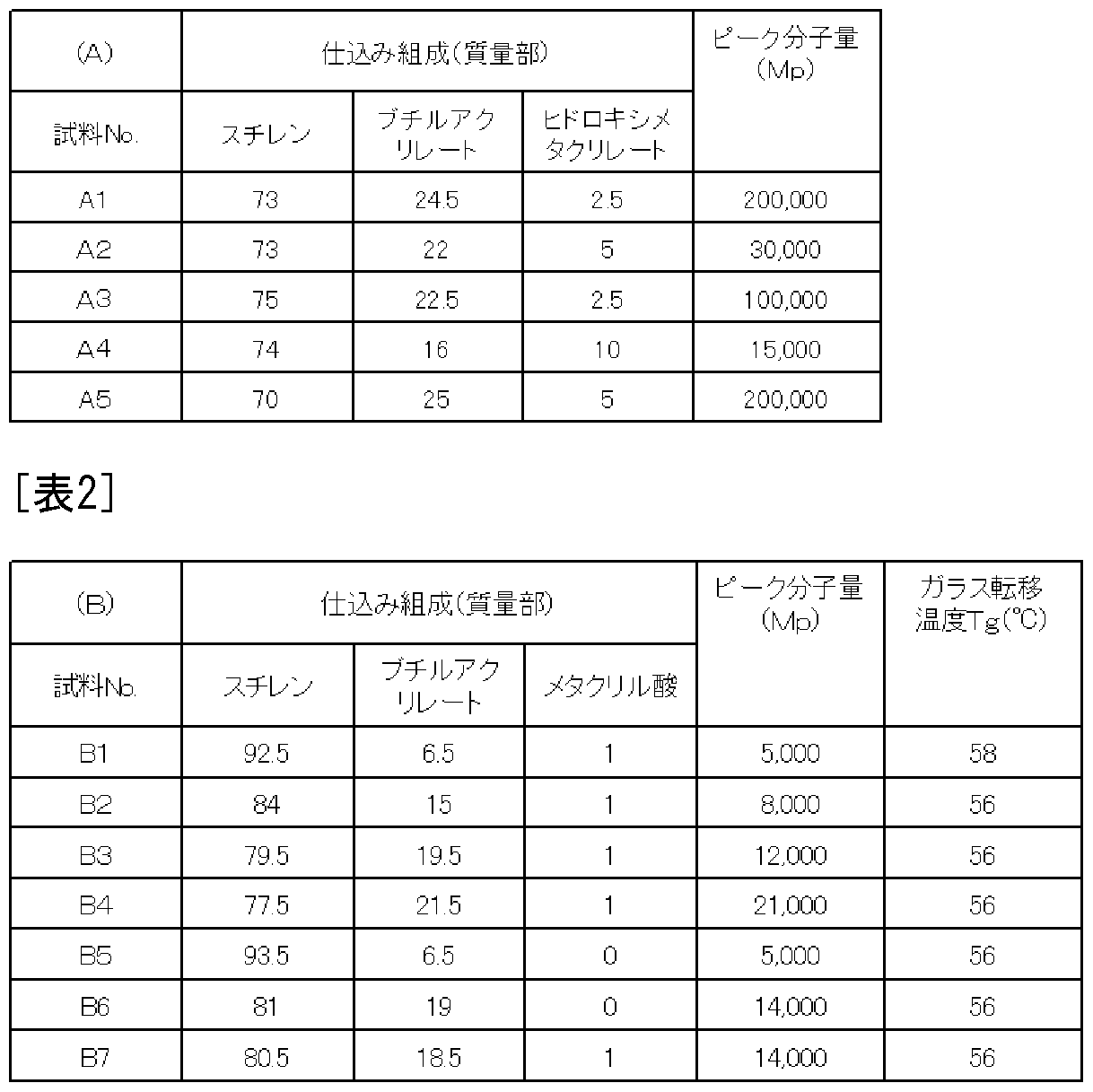
- styrenic polymers A2 to A5 were obtained as high molecular weight polymers in the same manner as in Production Example 1 with the charging compositions shown in Table 1.
- Resins 2 to 7 were obtained in the same manner as in Example 1 using the components described in Tables 1 and 2.
- Table 3 shows the physical properties of this resin.
- Resins 8 to 10 were obtained in the same manner as in Example 1 using the components described in Tables 1 and 2.
- Table 3 shows the physical properties of this resin.
- Tsukichi Pump Rack (REGA L 330 R; manufactured by CABOT) 1.0 part, charge control agent (T_77; manufactured by Hodogaya Chemical Co.) 1.0 part, polypropylene wax (high Wax ⁇ 1 05; manufactured by Mitsui Chemicals Co., Ltd.) 2. 5 parts were premixed with a hensil mixer. Thereafter, using a twin-screw kneader ( ⁇ CM30; manufactured by Ikegai Iron Works Co., Ltd.), the mixture was kneaded at 120 ° C., cooled, and coarsely pulverized with a hammer mill.
- ⁇ CM30 twin-screw kneader
- a toner was obtained in the same manner as in Example 8, except that the resins 2 to 7 obtained in Examples 2 to 7 were used.
- the evaluation results of the obtained toner are shown in Table 4. [0073] (Comparative Examples 4 to 6)
- a toner was obtained in the same manner as in Example 8 except that the resins 8 to 10 obtained in Comparative Examples 1 to 3 were used.
- the evaluation results of the obtained toner are shown in Table 4.
- Resins 11 and 12 having similar compositions to each other but having a difference in the presence or absence of strong lpoxyl groups were obtained in the same manner as in Example 1 using the components shown in Tables 1 and 2.
- Table 3 shows the physical properties of this resin.
- the low-molecular-weight styrene copolymer of Reference Example 1 does not contain a strong lpoxyl group. 11 The reaction time is long and the productivity is inferior. .
- Resin 8 obtained in Comparative Example 1 had a high peak molecular weight of the low molecular weight product, and the toner of Comparative Example 4 obtained using Resin 8 had poor fixability.
- the resin 9 obtained in Comparative Example 2 has a low molecular weight peak molecular weight, and the toner of Comparative Example 5 using the resin 9 has an offset.
- the resin composition for toner and the toner of the present invention have an excellent balance of fixing property, offset resistance and productivity.
- the resin composition for toner and the toner of the present invention it is possible to provide a resin composition for toner and a toner excellent in low-temperature fixability, offset resistance, and productivity.
Landscapes
- Physics & Mathematics (AREA)
- Chemical & Material Sciences (AREA)
- Chemical Kinetics & Catalysis (AREA)
- Spectroscopy & Molecular Physics (AREA)
- General Physics & Mathematics (AREA)
- Medicinal Chemistry (AREA)
- Health & Medical Sciences (AREA)
- Polymers & Plastics (AREA)
- Organic Chemistry (AREA)
- Engineering & Computer Science (AREA)
- Manufacturing & Machinery (AREA)
- Developing Agents For Electrophotography (AREA)
- Polyurethanes Or Polyureas (AREA)
Description


Claims
Priority Applications (4)
| Application Number | Priority Date | Filing Date | Title |
|---|---|---|---|
| US12/514,128 US8163454B2 (en) | 2006-11-29 | 2007-10-29 | Resin composition for toner, and toner using the resin composition |
| CA2671119A CA2671119C (en) | 2006-11-29 | 2007-10-29 | Resin composition for toner, and toner using the resin composition |
| EP07827957.7A EP2088472B1 (en) | 2006-11-29 | 2007-10-29 | Resin composition for toner, and toner using the resin composition |
| JP2008546868A JP4956549B2 (ja) | 2006-11-29 | 2007-10-29 | トナー用樹脂組成物および該樹脂組成物を用いたトナー |
Applications Claiming Priority (2)
| Application Number | Priority Date | Filing Date | Title |
|---|---|---|---|
| JP2006-322423 | 2006-11-29 | ||
| JP2006322423 | 2006-11-29 |
Publications (1)
| Publication Number | Publication Date |
|---|---|
| WO2008065736A1 true WO2008065736A1 (en) | 2008-06-05 |
Family
ID=39467539
Family Applications (1)
| Application Number | Title | Priority Date | Filing Date |
|---|---|---|---|
| PCT/JP2007/001178 Ceased WO2008065736A1 (en) | 2006-11-29 | 2007-10-29 | Resin composition for toner, and toner using the resin composition |
Country Status (7)
| Country | Link |
|---|---|
| US (1) | US8163454B2 (ja) |
| EP (1) | EP2088472B1 (ja) |
| JP (1) | JP4956549B2 (ja) |
| KR (1) | KR101032223B1 (ja) |
| CA (1) | CA2671119C (ja) |
| TW (1) | TW200836028A (ja) |
| WO (1) | WO2008065736A1 (ja) |
Citations (9)
| Publication number | Priority date | Publication date | Assignee | Title |
|---|---|---|---|---|
| JPS63220170A (ja) | 1987-03-09 | 1988-09-13 | Sekisui Chem Co Ltd | トナ−用樹脂の製造方法 |
| JPH06258869A (ja) * | 1993-03-09 | 1994-09-16 | Dainippon Ink & Chem Inc | トナーおよびその製造方法 |
| JPH0764321A (ja) * | 1993-08-30 | 1995-03-10 | Tomoegawa Paper Co Ltd | 電子写真用トナー |
| JPH0915906A (ja) * | 1995-06-29 | 1997-01-17 | Bando Chem Ind Ltd | 静電潜像現像用トナーの製造方法 |
| JP2000081730A (ja) * | 1998-07-03 | 2000-03-21 | Sanyo Chem Ind Ltd | 電子写真用トナ―バインダ― |
| JP2001092182A (ja) | 1998-07-22 | 2001-04-06 | Sanyo Chem Ind Ltd | 電子写真用トナーバインダー組成物及びトナー組成物 |
| EP1197805A2 (en) | 2000-10-12 | 2002-04-17 | Mitsui Chemicals, Inc. | A toner binder for electrophotography and toner for electrophotography |
| JP2004138672A (ja) * | 2002-10-15 | 2004-05-13 | Mitsui Chemicals Inc | トナー用バインダー樹脂及び該樹脂を用いた静電荷現像用電子写真トナー |
| JP2006038959A (ja) * | 2004-07-22 | 2006-02-09 | Mitsui Chemicals Inc | トナー用バインダー樹脂及び該樹脂を用いた静電荷現像用電子写真トナー |
Family Cites Families (6)
| Publication number | Priority date | Publication date | Assignee | Title |
|---|---|---|---|---|
| BE1006371A4 (nl) * | 1991-12-16 | 1994-08-02 | Wetenschappelijk En Tech Ct Vo | Vegetatie-remmend produkt voor aanplant. |
| JPH07168397A (ja) | 1993-12-13 | 1995-07-04 | Tomoegawa Paper Co Ltd | トナー用樹脂組成物およびそれを用いた電子写真用トナー |
| JP4043475B2 (ja) | 2002-08-08 | 2008-02-06 | 三井化学株式会社 | トナー用バインダー樹脂およびトナー |
| CN100383669C (zh) | 2003-05-29 | 2008-04-23 | 三井化学株式会社 | 调色剂用粘合剂树脂及电子照相用调色剂 |
| US7306888B2 (en) * | 2004-06-30 | 2007-12-11 | Samsung Electronics Company | Dry electrophotographic toners comprising amphipathic copolymers having acidic functionality |
| JP4910294B2 (ja) * | 2005-02-17 | 2012-04-04 | 大日本印刷株式会社 | カラーフィルタ基板および液晶表示パネル |
-
2007
- 2007-10-29 US US12/514,128 patent/US8163454B2/en not_active Expired - Fee Related
- 2007-10-29 EP EP07827957.7A patent/EP2088472B1/en not_active Not-in-force
- 2007-10-29 JP JP2008546868A patent/JP4956549B2/ja active Active
- 2007-10-29 WO PCT/JP2007/001178 patent/WO2008065736A1/ja not_active Ceased
- 2007-10-29 CA CA2671119A patent/CA2671119C/en not_active Expired - Fee Related
- 2007-10-29 KR KR1020097013415A patent/KR101032223B1/ko not_active Expired - Fee Related
- 2007-11-02 TW TW096141587A patent/TW200836028A/zh unknown
Patent Citations (9)
| Publication number | Priority date | Publication date | Assignee | Title |
|---|---|---|---|---|
| JPS63220170A (ja) | 1987-03-09 | 1988-09-13 | Sekisui Chem Co Ltd | トナ−用樹脂の製造方法 |
| JPH06258869A (ja) * | 1993-03-09 | 1994-09-16 | Dainippon Ink & Chem Inc | トナーおよびその製造方法 |
| JPH0764321A (ja) * | 1993-08-30 | 1995-03-10 | Tomoegawa Paper Co Ltd | 電子写真用トナー |
| JPH0915906A (ja) * | 1995-06-29 | 1997-01-17 | Bando Chem Ind Ltd | 静電潜像現像用トナーの製造方法 |
| JP2000081730A (ja) * | 1998-07-03 | 2000-03-21 | Sanyo Chem Ind Ltd | 電子写真用トナ―バインダ― |
| JP2001092182A (ja) | 1998-07-22 | 2001-04-06 | Sanyo Chem Ind Ltd | 電子写真用トナーバインダー組成物及びトナー組成物 |
| EP1197805A2 (en) | 2000-10-12 | 2002-04-17 | Mitsui Chemicals, Inc. | A toner binder for electrophotography and toner for electrophotography |
| JP2004138672A (ja) * | 2002-10-15 | 2004-05-13 | Mitsui Chemicals Inc | トナー用バインダー樹脂及び該樹脂を用いた静電荷現像用電子写真トナー |
| JP2006038959A (ja) * | 2004-07-22 | 2006-02-09 | Mitsui Chemicals Inc | トナー用バインダー樹脂及び該樹脂を用いた静電荷現像用電子写真トナー |
Non-Patent Citations (1)
| Title |
|---|
| See also references of EP2088472A4 |
Also Published As
| Publication number | Publication date |
|---|---|
| US20100003611A1 (en) | 2010-01-07 |
| KR20090083955A (ko) | 2009-08-04 |
| CA2671119C (en) | 2011-11-29 |
| KR101032223B1 (ko) | 2011-05-02 |
| EP2088472B1 (en) | 2013-10-02 |
| JPWO2008065736A1 (ja) | 2010-03-04 |
| EP2088472A1 (en) | 2009-08-12 |
| US8163454B2 (en) | 2012-04-24 |
| CA2671119A1 (en) | 2008-06-05 |
| JP4956549B2 (ja) | 2012-06-20 |
| TW200836028A (en) | 2008-09-01 |
| EP2088472A4 (en) | 2010-09-08 |
Similar Documents
| Publication | Publication Date | Title |
|---|---|---|
| CN106462094B (zh) | 色调剂粘结剂和色调剂 | |
| JP6316855B2 (ja) | トナーバインダーおよびトナー | |
| JP2004302323A (ja) | トナーの製造方法 | |
| JP2017032980A (ja) | トナーバインダー及びトナー | |
| JP2529971B2 (ja) | 電子写真用トナ−組成物 | |
| JP3304812B2 (ja) | トナー用結着樹脂の製造方法 | |
| EP1458793B1 (en) | Binder resin for toner and electrophotographic toner for electrostatic developing using said resin | |
| WO2008065736A1 (en) | Resin composition for toner, and toner using the resin composition | |
| JP5202108B2 (ja) | トナー用樹脂組成物および該樹脂組成物を用いたトナー | |
| KR100496352B1 (ko) | 토너용 수지조성물 및 토너 | |
| JP2019139213A (ja) | トナーバインダー及びトナー | |
| JP4267533B2 (ja) | トナー用バインダー樹脂及び該樹脂を用いた静電荷現像用電子写真トナー | |
| CN107250919A (zh) | 色调剂粘结剂和色调剂 | |
| JP4047693B2 (ja) | トナー用バインダー樹脂及び該樹脂を用いた静電荷現像用電子写真トナー | |
| JPWO2006131960A1 (ja) | 静電荷像現像用トナー用結着樹脂の製造方法及びそれを用いたトナーの製造方法 | |
| JP7207326B2 (ja) | 静電荷像現像用トナーおよびその製造方法 | |
| JP6600192B2 (ja) | 静電荷像現像用トナー用結着樹脂の製造方法 | |
| WO2001029097A1 (fr) | Resine a limitation de charge, composition de resine pour toner electrophotographique et toner electrophotographique | |
| JP2000314989A (ja) | 電子写真用トナーバインダー組成物 | |
| WO2000005626A1 (fr) | Composition de liant pour toner et composition de toner destinee a l'electrophotographie | |
| JP2010175876A (ja) | トナー用バインダー樹脂の製造方法、該製造方法で製造されるトナー用バインダー樹脂、および該バインダー樹脂を含有するトナー |
Legal Events
| Date | Code | Title | Description |
|---|---|---|---|
| 121 | Ep: the epo has been informed by wipo that ep was designated in this application |
Ref document number: 07827957 Country of ref document: EP Kind code of ref document: A1 |
|
| WWE | Wipo information: entry into national phase |
Ref document number: 2008546868 Country of ref document: JP |
|
| WWE | Wipo information: entry into national phase |
Ref document number: 12514128 Country of ref document: US |
|
| WWE | Wipo information: entry into national phase |
Ref document number: 2007827957 Country of ref document: EP |
|
| WWE | Wipo information: entry into national phase |
Ref document number: 2671119 Country of ref document: CA |
|
| NENP | Non-entry into the national phase |
Ref country code: DE |
|
| WWE | Wipo information: entry into national phase |
Ref document number: 1020097013415 Country of ref document: KR |