WO2009053058A2 - Salze des 2-iodo-n-[(4-methoxy-6-methyl-1,3,5-triazin-2-yl)carbamoyl]benzolsulfonamids, verfahren zu deren herstellung, sowie deren verwendung als herbizide und pflanzenwachstumsregulatoren - Google Patents

Salze des 2-iodo-n-[(4-methoxy-6-methyl-1,3,5-triazin-2-yl)carbamoyl]benzolsulfonamids, verfahren zu deren herstellung, sowie deren verwendung als herbizide und pflanzenwachstumsregulatoren Download PDF

Info

Publication number
WO2009053058A2
WO2009053058A2 PCT/EP2008/008947 EP2008008947W WO2009053058A2 WO 2009053058 A2 WO2009053058 A2 WO 2009053058A2 EP 2008008947 W EP2008008947 W EP 2008008947W WO 2009053058 A2 WO2009053058 A2 WO 2009053058A2
Authority
WO
WIPO (PCT)
Prior art keywords
ion
alkyl
methyl
radicals
alkoxy
Prior art date
Legal status (The legal status is an assumption and is not a legal conclusion. Google has not performed a legal analysis and makes no representation as to the accuracy of the status listed.)
Ceased
Application number
PCT/EP2008/008947
Other languages
English (en)
French (fr)
Other versions
WO2009053058A3 (de
Inventor
Christian Waldraff
Klaus-Helmut Müller
R.F. Ernst Gesing
Jan Dittgen
Dieter Feucht
Hansjörg Krähmer
Martin Hills
Georg Bonfig-Picard
Martin Hess
Dominique Schreiber
Christopher Rosinger
Current Assignee (The listed assignees may be inaccurate. Google has not performed a legal analysis and makes no representation or warranty as to the accuracy of the list.)
Bayer CropScience AG
Original Assignee
Bayer CropScience AG
Priority date (The priority date is an assumption and is not a legal conclusion. Google has not performed a legal analysis and makes no representation as to the accuracy of the date listed.)
Filing date
Publication date
Priority to JP2010530339A priority Critical patent/JP2011500745A/ja
Priority to CA2703589A priority patent/CA2703589A1/en
Priority to US12/738,366 priority patent/US20100285964A1/en
Priority to BRPI0818390-2A2A priority patent/BRPI0818390A2/pt
Priority to AU2008315608A priority patent/AU2008315608A1/en
Priority to EP08841543A priority patent/EP2205091A2/de
Priority to EA201000445A priority patent/EA201000445A1/ru
Priority to MX2010004531A priority patent/MX2010004531A/es
Application filed by Bayer CropScience AG filed Critical Bayer CropScience AG
Priority to CN2008801129991A priority patent/CN101932244A/zh
Publication of WO2009053058A2 publication Critical patent/WO2009053058A2/de
Priority to ZA2010/02341A priority patent/ZA201002341B/en
Priority to TN2010000174A priority patent/TN2010000174A1/fr
Priority to IL205180A priority patent/IL205180A0/en
Priority to MA32792A priority patent/MA31791B1/fr
Anticipated expiration legal-status Critical
Publication of WO2009053058A3 publication Critical patent/WO2009053058A3/de
Ceased legal-status Critical Current

Links

Classifications

    • AHUMAN NECESSITIES
    • A01AGRICULTURE; FORESTRY; ANIMAL HUSBANDRY; HUNTING; TRAPPING; FISHING
    • A01NPRESERVATION OF BODIES OF HUMANS OR ANIMALS OR PLANTS OR PARTS THEREOF; BIOCIDES, e.g. AS DISINFECTANTS, AS PESTICIDES OR AS HERBICIDES; PEST REPELLANTS OR ATTRACTANTS; PLANT GROWTH REGULATORS
    • A01N47/00Biocides, pest repellants or attractants, or plant growth regulators containing organic compounds containing a carbon atom not being member of a ring and having no bond to a carbon or hydrogen atom, e.g. derivatives of carbonic acid
    • A01N47/08Biocides, pest repellants or attractants, or plant growth regulators containing organic compounds containing a carbon atom not being member of a ring and having no bond to a carbon or hydrogen atom, e.g. derivatives of carbonic acid the carbon atom having one or more single bonds to nitrogen atoms
    • A01N47/28Ureas or thioureas containing the groups >N—CO—N< or >N—CS—N<
    • A01N47/36Ureas or thioureas containing the groups >N—CO—N< or >N—CS—N< containing the group >N—CO—N< directly attached to at least one heterocyclic ring; Thio analogues thereof
    • AHUMAN NECESSITIES
    • A61MEDICAL OR VETERINARY SCIENCE; HYGIENE
    • A61PSPECIFIC THERAPEUTIC ACTIVITY OF CHEMICAL COMPOUNDS OR MEDICINAL PREPARATIONS
    • A61P13/00Drugs for disorders of the urinary system
    • CCHEMISTRY; METALLURGY
    • C07ORGANIC CHEMISTRY
    • C07CACYCLIC OR CARBOCYCLIC COMPOUNDS
    • C07C311/00Amides of sulfonic acids, i.e. compounds having singly-bound oxygen atoms of sulfo groups replaced by nitrogen atoms, not being part of nitro or nitroso groups
    • C07C311/65N-sulfonylisocyanates
    • CCHEMISTRY; METALLURGY
    • C07ORGANIC CHEMISTRY
    • C07DHETEROCYCLIC COMPOUNDS
    • C07D251/00Heterocyclic compounds containing 1,3,5-triazine rings
    • C07D251/02Heterocyclic compounds containing 1,3,5-triazine rings not condensed with other rings
    • C07D251/12Heterocyclic compounds containing 1,3,5-triazine rings not condensed with other rings having three double bonds between ring members or between ring members and non-ring members
    • C07D251/26Heterocyclic compounds containing 1,3,5-triazine rings not condensed with other rings having three double bonds between ring members or between ring members and non-ring members with only hetero atoms directly attached to ring carbon atoms
    • C07D251/40Nitrogen atoms
    • C07D251/42One nitrogen atom

Definitions

  • This invention relates to salts of 2-iodo-N - [(4-methoxy-6-methyl-1,3,5-triazin-2-yl) carbamoyl] benzenesulfonamide, to a process for their preparation and to their use as herbicides, in particular as Herbicides for the selective control of undesired weed plants in crops, permanent crops or non-crops, as well as plant growth regulators alone, or with safeners and / or in combination with other herbicides, their use for controlling unwanted weeds (such as weeds / grass weeds) in specific crops or known as crop protection regulators is, with simultaneous and / or sequential application, either as a ready-made formulation or as a tank mix.
  • substituted phenylsulfonylureas have herbicidal properties. These are e.g. phenyl derivatives which are monosubstituted or polysubstituted (for example US 4127405, WO 9209608, BE 853374, WO 9213845, EP 84020, WO 9406778, WO 02072560, US 4169719, US 4629494, DE 4038430). From WO 2006/114220 it is furthermore known that sulphonamides iodinated on the phenyl ring have herbicidal properties.
  • salts of 2-iodo-N - [(4-methoxy-6-methyl-1,3,5-triazin-2-yl) carbamoyl] benzenesulfonamide are particularly advantageously suitable as herbicides and / or plant growth regulators ,
  • the present invention thus provides agrochemically active salts of 2-iodo-N - [(4-methoxy-6-methyl-1,3,5-triazin-2-yl) carbamoyl] benzenesulfonamide.
  • the preferred subject matter of the present invention are compounds of the general formula (I)
  • cation (M + ) (a) is an ion of the alkali metals, preferably lithium, sodium, potassium, or
  • transition metals preferably manganese, copper, zinc and iron, or
  • a sulfonium ion preferably tri - ((C 1 -C 4 ) alkyl) sulfonium, or (g) an oxonium ion, preferably tri - ((C 1 -C 4 ) -alkyl) -oxonium, or (h) a saturated or unsaturated / aromatic N-, optionally mono- or polysubstituted and / or (C 1 -C 4 ) -alkyl-substituted containing heterocyclic ionic compound having 1-10 C atoms in the ring system.
  • transition metals preferably manganese, copper, zinc and iron
  • ammonium ion in which optionally one, two, three or all four hydrogen atoms are represented by identical or different radicals from the group CJ) -alkyl, hydroxy- (C 1 -C 4 ) -alkyl, (C 3 -C 4 ) -cycloalkyl, (C 1 -C 2 ) -alkoxy- (C 1 -C 2 ) -alkyl, hydroxy- ( CrC 2 ) alkoxy- (Ci-C 2 ) -alkyl, (dC 2 ) -Mercaptoalkyl, phenyl or benzyl are substituted, the aforementioned
  • Radicals optionally substituted by one or more identical or different radicals from the group halogen, such as F, Cl, Br or I, nitro, cyano, azido, (dC ⁇ alkyl, (C r C 2) -haloalkyl, (C 3 - C 4 ) -cycloalkyl, (C 1 -C 2 ) -alkoxy, (C r C 2 ) -haloalkoxy and phenyl are substituted, and wherein in each case two substituents on the N-
  • DBU 1,8-diazabicyclo [5.4.0] undec-7-ene
  • Imidazolium ion a morpholinium ion, a 1,8-diazabicyclo [5.4.0] undec-7-enium-ion.
  • cation (M + ) is a sodium ion, a potassium ion, a magnesium ion, a calcium ion, or an NH 4 + ion.
  • the carbon-containing radicals such as alkyl, alkoxy may each be straight-chain or branched, e.g. Methyl, ethyl, n- or i-propyl, n-, i-, t- or 2-butyl.
  • Cycloalkyl means a carbocyclic saturated ring system preferably having 3-6 C atoms, e.g. Cyclopropyl, cyclobutyl, cyclopentyl or cyclohexyl.
  • the compounds of the formula (I) can exist as stereoisomers.
  • the possible stereoisomers defined by their specific spatial form, such as enantiomers, diastereomers, Z and E isomers, are all encompassed by the formula (I). For example, if one or more alkenyl groups are present, then
  • Diastereomers (Z and E isomers) occur. For example, if one or more asymmetric carbon atoms are present, then enantiomers and Diastereomers occur.
  • Stereoisomers can be obtained from the mixtures obtained in the preparation by customary separation methods, for example by chromatographic separation methods. Similarly, stereoisomers can be selectively prepared by using stereoselective reactions using optically active sources and / or adjuvants. The invention thus also relates to all stereoisomers which comprises the general formula (I), but are no longer specified with their specific stereoform, and their mixtures.
  • radicals or ranges of radicals which fall under the general terms such as "alkyl” are not exhaustive.
  • the general terms also include the definitions given below for residue regions in groups of preferred compounds, in particular residue regions which comprise specific residues from the table examples.
  • the present invention also provides processes for the preparation of the salts according to the invention, in particular of compounds of the general formula (I).
  • R * is a substituted or unsubstituted (CrC 2 O) hydrocarbon radical such as aryl or alkyl, preferably optionally substituted phenyl or optionally substituted (C r C4) alkyl,
  • R ** is a substituted or unsubstituted (CrC 2 O) hydrocarbon radical such as aryl or alkyl, preferably optionally substituted phenyl or optionally substituted (Ci-C 4) -alkyl,
  • the base heterocycle of formula (V) is first base catalysed with a carbonic acid ester, e.g. Diphenyl carbonate, reacted and the intermediate formed in a one-pot reaction with 2-iodobenzenesulfonamide (II) (see variant a)) (see JP1989221366), or
  • Hal is a halogen atom, preferably chlorine (Villa), or fluorine (VIIIb), or bromine (VIIIc), with a cyanate, for example a metal cyanate, in particular an alkali metal cyanate, such as sodium cyanate, to the isocyanate of the formula (VI) or a solvated ( stabilized) derivative thereof, and then reacted with the amino heterocycle of formula (V) implements,
  • a cyanate for example a metal cyanate, in particular an alkali metal cyanate, such as sodium cyanate
  • R * is a substituted or unsubstituted (C 1 -C 2 0 ) hydrocarbon radical such as aryl or alkyl, preferably optionally substituted phenyl or optionally substituted (C 1 -C 4 ) -alkyl (see WO 96/22284),
  • Carbonic acid esters e.g. Diphenylcarbamat
  • the reaction of the compounds of the formulas (II) and (III) according to variant a) is preferably carried out under base catalysis in an inert organic solvent such as dichloromethane, acetonitrile, dioxane or THF at temperatures between 0 0 C and the boiling point of the solvent, preferably at room temperature
  • DBU 1,8-diazabicyclo [
  • 2-iodobenzenesulfonyl isocyanate is a novel compound which, as well as its preparation and its use for the preparation of compounds of formula (I), are the subject of the present invention.
  • 2-iodobenzenesulfonamide (II) can be e.g. as shown in the following Schemes 1 to 7.
  • 2-nitroaniline can, for example by diazotization of the amino group with an alkali metal nitrite, such as. As sodium nitrite, in the presence of hydrochloric acid at temperatures between -1O 0 C and 10 0 C and subsequent exchange of the resulting diazo z. B. with sulfur dioxide in the presence of a diluent, such as. For example, dichloromethane, 1, 2-dichloroethane or acetic acid, and in the presence of a catalyst such.
  • an alkali metal nitrite such as sodium nitrite
  • hydrochloric acid at temperatures between -1O 0 C and 10 0 C and subsequent exchange of the resulting diazo z.
  • sulfur dioxide in the presence of a diluent, such as.
  • a diluent such as.
  • N-tert-butyl-2-nitrobenzenesulfonamide (X) can be obtained.
  • the sulfonamide is, for example, in inert solvents such as dichloromethane, tetrahydrofuran (THF), dioxane, toluene or dimethylformamide (DMF) at temperatures between -70 0 C to the boiling point of the solvent used, preferably carried out at 25 0 C.
  • inert solvents such as dichloromethane, tetrahydrofuran (THF), dioxane, toluene or dimethylformamide (DMF)
  • THF tetrahydrofuran
  • DMF dimethylformamide
  • Aniline (XI) can be diazotised under standard conditions for diazotization reactions and then converted into N-tert-butyl-2-iodobenzenesulfonamide (XII).
  • the diazotization takes place in the presence of the acid H + X " , where X " is preferably Cl “ , I “ or HSO 4 " , in aqueous solution, if appropriate using an organic solvent which is inert under the reaction conditions, with a nitrite an alkali metal nitrite such as NaNO 2 (sodium nitrite) in amounts of from 1.0 to 1.2 mol of nitrite, preferably from 0.01 to 1.05 mol of nitrite, per mole of aniline (XI)
  • Suitable acids are mineral acids or strong organic acids, preferably hydrochloric acid or sulfuric acid.
  • the solvent is water or a mixture of water and an inert organic solvent under the reaction conditions.
  • the reaction temperature is generally between -5 0 C and 5O 0 C, preferably 1O 0 C to 2O 0 C.
  • the reaction of the diazonium salts obtained for iodine compound (XII) is usually carried out without isolation and is carried out in the same aqueous or aqueous-organic solvent or solvent mixture as the diazotization.
  • alkali metal iodide preferably sodium iodide or potassium iodide.
  • the amount of iodide is, for example, 1.1 to 1.5 moles of iodide per mole of originally used aniline (XI).
  • the reaction temperature amounts to here generally 1O 0 C to 4O 0 C, preferably 15 0 C to 3O 0 C (see. This example, DE 19625831 and Bioorg. Med. Chem. 2004, 12, 2079) (Scheme 3).
  • the cleavage of the tert-butyl protecting group in (XII) to give 2-iodobenzenesulfonamide (II) takes place, for example, by treatment with a strong acid (see WO 89/10921).
  • strong acids are mineral acids, such as H 2 SO 4 or HCl, or strong organic acids, such as trifluoroacetic acid.
  • the reaction takes place for example at temperatures from -20 0 C to the respective reflux temperature of the reaction mixture, preferably at 0 C to 40 0 C.
  • the reaction can be in bulk or in an inert solvent such as dichloromethane or trichloromethane, are carried out (Scheme 4).
  • N-tert-butyl-2-iodobenzenesulfonic acid amide (XII) can also be obtained by reacting N-tert-butyl-benzenesulfonic acid amide (XIV), which is prepared by reacting commercially available benzenesulfonyl chloride (XIII) with tert-butylamine (see Scheme 1) can be obtained with an organometallic compound, such as alkyl or aryllithium, preferably ⁇ - or sec-butyllithium in hexane, optionally in the presence of a (further) inert diluent, such as tetrahydrofuran, and under an inert gas atmosphere, such as under argon or nitrogen, at temperatures between -70 0 C and 2O 0 C metallated - ie replaced in (XIV) in ortho position to S ⁇ 2 NH-tert-butyl group replaced by a metal atom - and then in the same reaction medium with
  • 2-iodobenzenesulfonamide (II) can also be obtained (Scheme 6) by dissolving 2-iodobenzenesulfonyl chloride (Villa) by diazotizing the amino group in 2-iodoaniline (XV) and then replacing the resulting diazo group with a chlorosulfonyl group (as in Scheme 1 described in more detail) is produced, reacted with ammonia.
  • ammonia gas is introduced in inert solvent, preferably dichloromethane or tetrahydrofuran, until no more ammonia is absorbed.
  • 2-iodobenzenesulfonyl chloride Villa
  • XII N-tert-butyl-2-iodobenzenesulfonamide
  • tert-butylamine analogous to Schemes 1 and 5
  • the tert-butyl protective group is then removed by means of acid (analogous to Scheme 4) to obtain 2-iodobenzenesulfonamide (II).
  • the aminoheterocycles of formula (V) are known, in part commercially available synthetic chemicals.
  • the reaction of the sulfonylcarbamates of the formula (IV) with the aminoheterocycles of the formula (V) is carried out by known processes (cf., for example, WO 2003 091228) (Scheme 7).
  • 2-iodobenzenesulfonyl isocyanate of the formula (VI) is a novel compound and is therefore also the subject of this invention. It can be prepared by processes known per se from 2-iodobenzenesulfonamide (II) (cf., DE 3208189, EP 23422, EP 64322, EP 44807, EP 216504).
  • the sulfonyl isocyanate of the formula (VI) is obtained when 2-iodobenzenesulfonamide (II) with phosgene, diphosgene or thiophosgene, if appropriate in the presence of an alkyl isocyanate, such as butyl isocyanate, optionally in the presence of a reaction auxiliary, such as a tertiary amine, preferably a diazabicyclo [2.2.2] octane, and in the presence of a Verkowsmiteis, such as toluene, XyIoI or chlorobenzene, at temperatures between 80 0 C and 150 0 C reacted and after the completion of the reaction, if appropriate, the volatile components distilled off under reduced pressure (Scheme 8 ).
  • an alkyl isocyanate such as butyl isocyanate
  • a reaction auxiliary such as a tertiary amine, preferably a diazabicyclo [
  • the isocyanates of the general formula (VII) are obtained, for example, from the aminoheterocycles of the type (V) by treatment with oxalyl chloride or phosgene (in analogy to Angew. Chem. 1971, 83, p. 407, EP 388 873).
  • the reaction of the isocyanate of type (VII) with 2-iodobenzenesulfonamide (II) takes place, for example, in analogy to variant c) (Scheme 10).
  • 2-iodobenzenesulphonic acid fluoride (VIIIb) can be prepared by various methods known from the literature: i) from 2-iodobenzenesulphonamide (II) by diazotization with alkali metal nitrite, for example sodium nitrite, and subsequent reaction with hydrogen fluoride (J.Am.Chem. Soc. 1951, 73, 1857 ); ii) reaction of 2-iodobenzenesulfonyl chloride (Villa) with potassium fluoride (J. Chem. Soc, Perkin Trans.
  • reaction mixture obtained by reaction of the sulfonic acid halide (VIII) with a cyanate is used directly for the coupling with the aminotriazine of the formula (V) for the synthesis of the precursor (neutral compound) of the formula (I) (cf. WO 2003 091228 and US 5550238).
  • the salts according to the invention can be selected from the neutral form of the sulphonylurea or sulphonylurea metal salts, in particular alkali metal salts (see for example EP-A-30138, EP-A-7687) or also starting from sulphonamide salts e.g. in the following way:
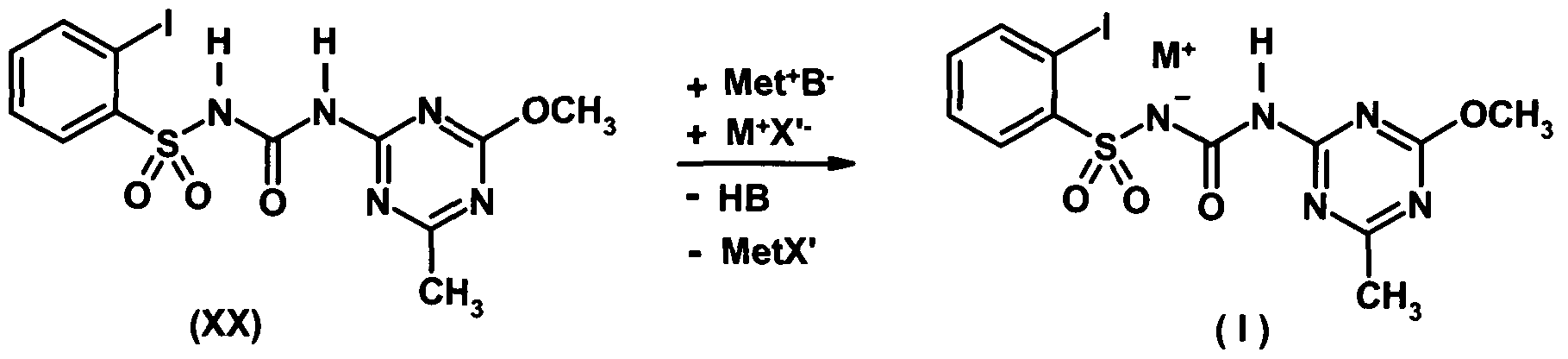
  • the sulfonylurea of the formula (I) is dissolved or suspended in an inert solvent or solvent mixture and reacted with one equivalent of M + B " at temperatures between -2O 0 C and 100 0 C, preferably between -10 0 C and 5O 0 C. ,
  • alkali metal salts such as NaCl
  • the neutral Sulfonalharnstoff (XX) is dissolved in an inert solvent or solvent mixture and reacted with one equivalent of the reagents M + X ' and MetB.
  • the by-produced metal salt in particular alkali metal salt (eg NaCl) can be separated off by filtration.
  • R is a (CrC 2 o) -carbon radical such as (C 1 -C 4) -alkyl
  • R 'and R are identical or different and are hydrogen or (C 1 -C 30) -hydrocarbon radicals such as (C 1 -C 10) -alkyl
  • m is an integer of 0 to 100.
  • the neutral sulfonylurea (XX) is reacted with a zwitterionin, as indicated, for example, in Scheme 14, in an inert solvent such as methanol, tetrahydrofuran or methylene chloride or solvent mixture at temperatures between -2O 0 C and 100 0 C, preferably -1O 0 C and 8O 0 C reacted in equimolar ratios.
  • a zwitterionin as indicated, for example, in Scheme 14
  • the reaction takes place in an inert solvent or solvent mixture - such as. B. tetrahydrofuran - at temperatures between -2O 0 C and 100 0 C, preferably between -1O 0 C and 7O 0 C, by reacting the isocyanate (VII) equimolar with the sulfonic acid amide salt of the formula (IIa).
  • the sulfonic acid amide salt of the formula (IIa) can be used directly or be formed in situ - z.
  • the reaction is carried out in an inert solvent (or solvent mixture) - such as tetrahydrofuran - at temperatures between -2O 0 C and 100 0 C, preferably between -1O 0 C and 70 0 C by reacting the carbamate of the formula (III) equimolar with with the sulfonic acid amide salt of the formula (IIa).
  • the sulfonic acid amide salt of the formula (IIa) can be used directly or formed in situ - z.
  • Haloalkoxy and phenyl are substituted, and wherein in each case two substituents on the N atom together optionally form an unsubstituted, optionally a substituted ring, or
  • (C) a possibly singly or multiply fused and / or (C 1 -C 4 ) alkyl substituted saturated or unsaturated / aromatic N-containing heterocyclic ionic compound having 1-10 carbon atoms in the ring system correspond
  • This reaction takes place between temperatures of -2O 0 C to 100 0 C, preferably between -1O 0 C and 5O 0 C, in inert solvent, such as.
  • inert solvent such as tetrahydrofuran, methylene chloride or methanol or mixtures of solvents instead.
  • inert solvents denoted in the above process variants are meant in each case solvents which are inert under the respective reaction conditions, but need not be inert under any reaction conditions.
  • Collections of salts according to the invention in particular those of the formula (I) which can be synthesized after the abovementioned reactions, can also be prepared in a parallelized manner, this being manual, in part automated or completely automated way. It is possible, for example, to automate the reaction procedure, the work-up or the purification of the products or intermediates. Overall, this is understood as an approach as described, for example, by SH DeWitt in "Annual Reports in Combinatorial Chemistry and Molecular Diversity:"
  • a microwave oven e.g. Model "Discover” by the company CEM GmbH Microwave Analysis, Carl-Friedrich-Gauss-Str. 9, 47475 Kamp-Lintfort be used.
  • the listed equipment leads to a modular procedure, in which the individual work steps are automated, but between the work steps, manual operations must be performed.
  • This can be circumvented by the use of partially or fully integrated automation systems in which the respective automation modules are operated, for example, by robots.
  • Such automation systems may be obtained, for example, from Zymark Corporation, Zymark Center, Hopkinton, MA 01748, USA.
  • the preparation of the salts according to the invention, in particular of compounds of the general formula (I) can be carried out completely or partially by methods supported by solid phases.
  • individual intermediates or all intermediates of the synthesis or adapted for the appropriate approach synthesis are bound to a synthetic resin.
  • Solid-phase assisted synthetic methods are well described in the literature, eg Barry A. Bunin in "The Combinatorial Index", Academic Press, 1998.
  • solid-phase assisted synthesis methods allows a number of protocols known from the literature, which in turn can be carried out manually or automatically.
  • the "teabag method” Houghten, US 4,631,211; Houghten et al., Proc Natl Acad. Sei, 1985, 82, 5131-51305
  • IRORI 11149 North Torrey Pines Road, La JoIIa , CA 92037, USA.
  • the automation of solid-phase assisted parallel synthesis succeeds, for example, by equipment of the companies Argonaut Technologies, Inc., 887 Industrial Road, San Carlos, CA 94070, USA or MultiSynTech GmbH, Wullener Feld 4, 58454 Witten, Germany.
  • the preparation according to the processes described herein provides the salts according to the invention, in particular compounds of the formula (I), in the form of substance collections called libraries.
  • the present invention also provides libraries containing at least two compounds of the invention, in particular compounds of formula (I).
  • the salts according to the invention in particular compounds of the formula (I), have excellent herbicidal activity against a broad spectrum of economically important monocotyledonous and dicotyledonous harmful plants. Even difficult to control perennial weeds, which expel from rhizomes, rhizomes or other permanent organs, are well detected by the active ingredients. It is It does not matter whether the substances are applied in pre-sowing, pre-emergence or post-emergence procedures.
  • salts according to the invention in particular compounds of the formula (I) are applied to the surface of the earth before germination, then either the emergence of the weed seedlings is completely prevented or the weeds grow up to the cotyledon stage, but then cease their growth and finally die after expiration from three to four weeks completely off.
  • active ingredients are applied to the green parts of the plants postemergence, a drastic growth stop also occurs very rapidly after the treatment, and the weed plants remain in the position reached at the time of application
  • the salts according to the invention in particular the compounds of the formula (I), have excellent herbicidal activity against monocotyledonous and dicotyledonous weeds, crops of economically important crops, e.g. Wheat, barley, rye, oats, rice, maize, sugarcane, flax and other plantation crops are marginally or not at all damaged.
  • crops of economically important crops e.g. Wheat, barley, rye, oats, rice, maize, sugarcane, flax and other plantation crops are marginally or not at all damaged.
  • the present compounds are very well suited for the selective control of undesired plant growth in agricultural crops.
  • salts according to the invention in particular compounds of the formula (I) have very advantageous properties with regard to the behavior in the environment, in particular with respect to the reproduction behavior, i. towards the compounds according to the invention of the formula (I) otherwise sensitive cultures, such as sugar beet, sunflower or Cruciferen, such as rapeseed, mustard and turnip rape.
  • the salts according to the invention in particular the compounds of the formula (I), have excellent growth-regulatory properties in crop plants. They regulate in the plant's own Metabolism and can thus be used for the targeted influencing of plant ingredients and to facilitate harvesting, such as by triggering desiccation and stunted growth. Furthermore, they are also suitable for the general control and inhibition of unwanted vegetative growth, without killing the plants. Inhibition of vegetative growth plays an important role in many monocotyledonous and dicotyledonous cultures, as storage can be reduced or completely prevented.
  • the active compounds can also be used for controlling harmful plants in crops of known or yet to be developed genetically modified plants.
  • the transgenic plants are usually characterized by particular advantageous properties, for example by resistance to certain pesticides, especially certain herbicides, resistance to plant diseases or pathogens of plant diseases such as certain insects or microorganisms such as fungi, bacteria or viruses.
  • Other special properties relate to z. B. the crop in terms of quantity, quality, shelf life, composition and special ingredients.
  • the active compounds can also be used to control harmful plants in crops of known or yet to be developed mutant-selected plants.
  • the salts according to the invention in particular of compounds of the formula (I), in economically important transgenic or mutant-selected crops of useful and ornamental plants, eg.
  • crops of useful and ornamental plants eg.
  • cereals such as wheat, barley, rye, oats, millet, rice, cassava and corn or even crops of rapeseed, potato, tomato, pea and other vegetables.
  • the salts according to the invention, in particular the compounds of the formula (I) can be used as herbicides in crops which are resistant to the phytotoxic effects of the herbicides or have been made genetically resistant, or obtained by mutant selection.
  • the salts according to the invention in particular the compounds of the formula (I), can likewise be used as herbicides in crops which represent a cross product of genetically resistant plants and plants obtained by mutant selection, as described, for example, in WO 2007/024782.
  • new plants with altered properties can be produced by means of genetic engineering methods (see, for example, EP-A-0221044, EP-A-0131624).
  • genetic modifications of cultivated plants have been described for the purpose of modifying the starch synthesized in the plants (eg WO 92/11376, WO 92/14827, WO 91/19806), transgenic crop plants which are resistant to certain glufosinate-type herbicides (US Pat.
  • nucleic acid molecules can be introduced into plasmids that allow mutagenesis or sequence alteration by recombination of DNA sequences.
  • z For example, base substitutions are made, partial sequences are removed, or natural or synthetic sequences are added.
  • adapters or linkers can be attached to the fragments.
  • the production of plant cells having a reduced activity of a gene product can be achieved, for example, by the expression of at least one corresponding antisense RNA, a sense RNA to obtain a cosuppression effect or the expression of at least one appropriately engineered ribozyme which specifically cleaves transcripts of the above gene product.
  • DNA molecules may be used which comprise the entire coding sequence of a gene product, including any flanking sequences that may be present, as well as DNA molecules which comprise only parts of the coding sequence, which parts must be long enough to be present in the cells to cause an antisense effect. Also possible is the use of DNA sequences encoding a high degree of homology to the ones
  • the synthesized protein may be located in any compartment of the plant cell. But to achieve the localization in a particular compartment, z.
  • the coding region can be linked to DNA sequences that ensure localization in a particular compartment.
  • sequences are known to the person skilled in the art (see, for example, Braun et al., EMBO J. 11 (1992), 3219- 3227; Wolter et al., Proc. Natl. Acad. Be. USA 85 (1988), 846-850; Sonnewald et al., Plant J. 1 (1991), 95-106).
  • the transgenic plant cells can be regenerated to whole plants by known techniques.
  • the transgenic plants may, in principle, be plants of any plant species, that is, both monocotyledonous and dicotyledonous plants.
  • the salts according to the invention in particular compounds of the formula (I), can preferably be employed in transgenic or mutant-selected cultures or crosses / hybrids thereof which are resistant to herbicides from the group of sulfonylureas, glufosinate-ammonium or glyphosate isopropylammonium and analogous active substances.
  • the active compounds according to the invention in addition to the effects observed in other cultures on harmful plants, effects which are specific for the application in the respective transgenic or mutant selection-derived cultures or crosses thereof are often present, For example, a modified or specially extended weed spectrum that can be controlled, changed application rates that can be used for the application, preferably good compatibility with the herbicides to which the transgenic culture is resistant, and influencing the growth and yield of transgenic crops.
  • the invention therefore also relates to the use of the salts according to the invention, in particular of compounds of the formula (I), as herbicides for controlling harmful plants in transgenic or mutant-selected crop plants or crosses thereof.
  • the compounds according to the invention can be used in the form of wettable powders, emulsifiable concentrates, sprayable solutions, dusts or granules in the customary formulations.
  • the invention therefore also provides herbicidal and plant growth-regulating agents which contain the compounds of the formula (I).
  • the salts according to the invention in particular the compounds of the formula (I), can be formulated in various ways, depending on which biological and / or chemical-physical parameters are predetermined.
  • Possible formulation options are, for example: wettable powder (WP), water-soluble powders (SP), water-soluble concentrates, emulsifiable concentrates (EC), emulsions (EW), such as oil-in-water and water-in-oil emulsions, sprayable solutions , Suspension concentrates (SC), oil or water based dispersions, oil miscible solutions, capsule suspensions (CS), dusts (DP), mordants, granules for litter and soil application, granules (GR) in the form of micro, spray, elevator and adsorption granules, water dispersible
  • WP wettable powder
  • SP water-soluble powders
  • EC emulsifiable concentrates
  • EW emulsions
  • SC Suspension concentrates
  • SC oil or water
  • WG Granules
  • SG water-soluble granules
  • ULV formulations microcapsules and waxes.
  • Injectable powders are preparations which are uniformly dispersible in water and contain surfactants of the ionic and / or nonionic type (wetting agent, dispersing agent) in addition to the active ingredient, apart from a diluent or inert substance.
  • surfactants of the ionic and / or nonionic type (wetting agent, dispersing agent) in addition to the active ingredient, apart from a diluent or inert substance.
  • the herbicidal active compounds are finely ground, for example, in customary apparatus such as hammer mills, blower mills and air-jet mills and mixed simultaneously or subsequently with the formulation auxiliaries.
  • Emulsifiable concentrates are prepared by dissolving the active ingredient in an organic solvent, e.g. Butanol, cyclohexanone, dimethylformamide, xylene or else higher-boiling aromatics or hydrocarbons or mixtures of the organic solvents with the addition of one or more ionic and / or nonionic surfactants (emulsifiers).
  • organic solvent e.g. Butanol, cyclohexanone, dimethylformamide, xylene or else higher-boiling aromatics or hydrocarbons or mixtures of the organic solvents with the addition of one or more ionic and / or nonionic surfactants (emulsifiers).
  • emulsifiers which can be used are: alkylarylsulfonic acid calcium salts such as calcium dodecylbenzenesulfonate or nonionic emulsifiers such as fatty acid polyglycol esters, alkylaryl polyglycol ethers,
  • Propylene oxide-ethylene oxide condensation products alkyl polyethers, sorbitan esters such as e.g. Sorbitan fatty acid esters or polyoxethylenesorbitan esters such as e.g.
  • Dusts are obtained by grinding the active substance with finely divided solid substances, for example talc, natural clays, such as kaolin, bentonite and pyrophyllite, or diatomaceous earth.
  • Suspension concentrates may be water or oil based. They can be prepared, for example, by wet grinding by means of commercial bead mills and, if appropriate, addition of surfactants, as already listed above, for example, in the other formulation types.
  • Emulsions e.g. Oil-in-water emulsions (EW) can be prepared, for example, by means of stirrers, colloid mills and / or static mixers using aqueous organic solvents and optionally surfactants, as described e.g. listed above for the other formulation types.
  • Granules can either be prepared by atomizing the active ingredient on adsorptive, granulated inert material or by applying active substance concentrates by means of adhesives, e.g. Polyvinyl alcohol, polyacrylic acid sodium or mineral oils, on the surface of carriers such as sand, kaolinites or granulated inert material.
  • Water-dispersible granules are generally prepared by the usual methods such as spray drying, fluidized bed granulation, plate granulation, mixing with high-speed mixers and extrusion without solid inert material.
  • spray drying fluidized bed granulation
  • plate granulation mixing with high-speed mixers and extrusion without solid inert material.
  • the agrochemical preparations generally contain from 0.1 to 99% by weight, preferably from 0.1 to 95% by weight, particularly preferably from 0.5 to 90% by weight of active ingredient of the salts according to the invention, in particular of the compounds of the formula (I) ,
  • the active ingredient concentration is for example about 10 to 90 wt .-%, the remainder to 100 wt .-% consists of conventional formulation components.
  • the active ingredient concentration may be about 1 to 90, preferably 5 to 80 wt .-%.
  • Dusty formulations contain 1 to 30 wt .-% of active ingredient, preferably usually 5 to 20 wt .-% of active ingredient, sprayable solutions contain about 0.05 to 80, preferably 2 to 50 wt .-% of active ingredient.
  • the active ingredient content depends, in part, on whether the active compound is liquid or solid and which granulating aids, fillers, etc. are used.
  • the content of active ingredient is, for example, between 1 and 95% by weight, preferably between 10 and 80% by weight.
  • the active substance formulations mentioned optionally contain the customary adhesive, wetting, dispersing, emulsifying, penetrating, preserving, antifreezing and solvent, fillers, carriers and dyes, antifoams, evaporation inhibitors and the pH and the Viscosity-influencing agent.
  • organic solvents can also be used as auxiliary solvents.
  • Suitable liquid solvents are essentially: aromatics, such as xylene, toluene, or alkylnaphthalenes, chlorinated aromatics and chlorinated aliphatic hydrocarbons, such as chlorobenzenes, chloroethylenes or methylene chloride, aliphatic hydrocarbons, such as cyclohexane or paraffins, for example petroleum fractions, mineral and vegetable oils , Alcohols such as butanol or glycol and their ethers and esters, ketones such as acetone, methyl ethyl ketone, methyl isobutyl ketone or cyclohexanone, strongly polar solvents such as dimethylformamide and dimethyl sulfoxide, and water.
  • aromatics such as xylene, toluene, or alkylnaphthalenes
  • chlorinated aromatics and chlorinated aliphatic hydrocarbons such as chlorobenzenes, chloroethylenes or methylene chloride
  • Suitable solid carriers are: for example, ammonium salts and ground natural minerals, such as kaolins, clays, talc, chalk, quartz, attapulgite, montmorillonite or diatomaceous earth, and ground synthetic minerals, such as finely divided silica, alumina and silicates, as solid carriers for granules: For example, broken and fractionated natural rocks such as calcite, marble, pumice, sepiolite, dolomite and synthetic granules of inorganic and organic flours and granules of organic material such as sawdust, coconut shells, corn cobs and tobacco stalks; suitable emulsifiers and / or foam formers are: for example nonionic and anionic emulsifiers, such as polyoxyethylene fatty acid esters, polyoxyethylene fatty alcohol ethers, for example alkylaryl polyglycol ethers, alkylsulfonates, alkyl sulfates, arylsulfonates and
  • adhesives such as carboxymethyl cellulose, natural and synthetic powdery, gromige or latices, such as gum arabic, polyvinyl alcohol, polyvinyl acetate, and natural
  • Phospholipids such as cephalins and lecithins and synthetic phospholipids.
  • the herbicidal activity of the herbicidal combinations according to the invention may be e.g. also be improved by surface-active substances, preferably by wetting agents from the series of fatty alcohol polyglycol ethers.
  • the fatty alcohol preferably by wetting agents from the series of fatty alcohol polyglycol ethers.
  • Polyglycol ethers preferably contain 10 to 18 C atoms in the fatty alcohol radical and 2 to 20 ethylene oxide units in the polyglycol ether section.
  • the fatty alcohol polyglycol ethers may be nonionic, or ionic, e.g. in the form of fatty alcohol polyglycol ether sulfates, e.g. as alkali salts (e.g., sodium and potassium salts) or ammonium salts, or as alkaline earth salts such as
  • Magnesium salts can be used, such as C 2 / C 4 fatty alcohol diglykolethersulfat- sodium (Genapol ® LRO, Clariant GmbH); See, for example, EP-A-0476555, EP-A-0048436, EP-A-0336151 or US-A-4,400,196 and Proc. EWRS Symp. "Factors Affecting Herbicidal Activity and Selectivity", 227-232 (1988).
  • Nonionic fatty alcohol polyglycol ethers are, for example, 2 to 20, preferably 3 to 15,
  • Genapol ® X series such as Genapol ® X-030, Genapol ® X-060, Genapol ® X-080 or Genapol ® X-150 (all from Clariant GmbH).
  • the present invention further comprises the combination of components A and B with the previously mentioned wetting agents from the series of fatty alcohol Polyglycol ethers which preferably contain 10 to 18 C atoms in the fatty alcohol radical and 2 to 20 ethylene oxide units in the polyglycol ether part and may be present nonionically or ionically (for example as fatty alcohol polyglycol ether sulfates).
  • Polyglycol ethers which preferably contain 10 to 18 C atoms in the fatty alcohol radical and 2 to 20 ethylene oxide units in the polyglycol ether part and may be present nonionically or ionically (for example as fatty alcohol polyglycol ether sulfates).
  • Genapol ® X series such as Genapol ® X-030, Genapol ® X - C 2 / Ci4-fatty alcohol diglycol ether sulfate sodium (Genapol ® LRO, Clariant GmbH) and isotridecyl alcohol polyglycol ether having 3 are preferably 060, Genapol ® X-080 and Genapol ® X-150 (all from Clariant GmbH).
  • fatty alcohol polyglycol ethers such as nonionic or ionic fatty alcohol polyglycol ethers (eg fatty alcohol Polyglykolethersulfate) as a penetration aid and enhancer for a number of other herbicides, including for
  • Herbicides from the series of imidazolinones are suitable (see for example EP-A-0502014).
  • fatty alcohol polyglycol ethers such as nonionic or ionic fatty alcohol polyglycol ethers (eg fatty alcohol polyglycol ether) are also suitable as penetration aids and effect enhancers for a number of other herbicides, including for herbicides from the series of imidazolinones (see for example EP-A -0,502,014).
  • the herbicidal action of the herbicidal combinations according to the invention can also be enhanced by the use of vegetable oils.
  • vegetable oils refers to oils from oil-supplying plant species such as soybean oil, rapeseed oil, corn oil, sunflower oil, cottonseed oil, linseed oil, coconut oil, palm oil, thistle oil or castor oil, in particular rapeseed oil, and their transesterification products, e.g. Alkyl esters such as rapeseed oil methyl ester or rapeseed oil ethyl ester.
  • the vegetable oils are preferably esters of C1 -C22- 0, preferably C12-C-20 fatty acids.
  • the C O -C 2 2-fatty acid ester are, for example, esters of unsaturated or saturated Cio-C 22 fatty acids, especially with an even number of carbon atoms, for example erucic acid, lauric acid, palmitic acid and in particular C-
  • C 10 -C 22 fatty acid esters are esters obtained by reacting glycerol or glycol with the C O -C 22 fatty acids, as they are, for example, in oils from oil-plant species, or -C 2 o alkyl -CioC22 fatty acid esters, as for example, by transesterification of the aforementioned glycerol or glycol Ci 0 -C 22 fatty acid esters with CrC 2 o-alcohols (eg, methanol, ethanol, propanol or
  • Butanol can be obtained.
  • the transesterification can be carried out by known methods, such as e.g. are described in Rompp Chemie Lexikon, 9th edition, Volume 2, page 1343, Thieme Verlag Stuttgart.
  • Preferred as CrC 2 o-alkyl-Cio-C 22 fatty acid esters are methyl esters, ethyl esters, propyl esters, butyl esters, 2-ethylhexyl esters and dodecyl esters.
  • Preferred glycol- and glycerol-Cio-C 22 fatty acid esters the uniform or mixed Glykolester and Glycerinester of Cio-C 22 fatty acids are preferred, in particular fatty acids having an even number of carbon atoms, for example erucic acid, lauric acid, palmitic acid and in particular C 8 Fatty acids such as stearic acid, oleic acid, linoleic acid or linolenic acid.
  • the vegetable oils can be present in the inventive herbicidal compositions, for example in the form of commercially available oil-containing formulation additives, in particular those based on rapeseed oil such as Hasten ® (Victorian Chemical Company, Australia, hereinbelow termed Hasten, main ingredient: rapeseed oil ethyl ester), Actirob ® B (Novance, France, hereinafter called ActirobB, main ingredient: Rapsölmethylester), Rako-binol ® (Bayer AG, Germany, referred to as Rako-binol called main constituent: rapeseed oil), Renol ® (Stefes, Germany, termed Renol, vegetable oil ingredient: Rapsölmethylester) or Stefes Mero ® (Stefes , Germany, hereinafter referred to as Mero, main component: rapeseed oil methyl ester) may be contained.
  • Hasten ® Vanictorian Chemical Company, Australia, hereinbelow termed
  • the present invention comprises combinations with the abovementioned vegetable oils, such as rapeseed oil, preferably in the form of commercially available oil-containing formulation additives, in particular those based on rapeseed oil, such as Hasten® (Victorian Chemical Company, Australia, below Hasten mentioned, main ingredient: rapeseed oil ethyl ester), Actirob ® B (Novance, France, hereinafter ActirobB called Main Ingredient: (rapeseed oil), Renol ®: Rapsölmethylester), Rako-Binol ® (Bayer AG, Germany, termed Rako-Binol, main ingredient , hereinafter referred Stefes, Germany Renol, vegetable oil ingredient: Rapsölmethylester) or Stefes Mero ® (Stefes, Germany, termed Mero called main ingredient: Rapsölmethylester).
  • Hasten® Victorian Chemical Company, Australia, below Hasten mentioned, main ingredient: rapeseed oil
  • Dyes such as inorganic pigments, e.g. Iron oxide, titanium oxide, ferrocyan blue and organic dyes such as alizarin, azo and
  • Metal phthalocyanine dyes and trace nutrients such as salts of iron, manganese, boron, copper, cobalt, molybdenum and zinc can be used.
  • the salts according to the invention in particular the compounds of the formula (I), can be used as such or in the form of their formulations (formulations) with other pesticide-active substances, such as.
  • pesticide-active substances such as insecticides, acaricides, nematicides, herbicides, fungicides, safeners, fertilizers and / or growth regulators
  • insecticides e.g. B. as a ready-made formulation or as tank mixes.
  • Suitable combination partners for the salts according to the invention are, for example, known, preferably herbicidal active ingredients which are based on inhibition of, for example, acetolactate synthase, acetyl-coenzyme A carboxylase, PS I, PS II, HPPDO, phytoene desaturase, protoporphyrinogen oxidase, glutamine synthetase, cellulose biosynthesis, 5-enolpyruvylshikimate-3-phosphate synthetase.
  • herbicidal active ingredients which are based on inhibition of, for example, acetolactate synthase, acetyl-coenzyme A carboxylase, PS I, PS II, HPPDO, phytoene desaturase, protoporphyrinogen oxidase, glutamine synthetase, cellulose biosynthesis, 5-enolpyruvylshikimate-3-phosphate synthetase.
  • salts also include those which are formed by replacement of a hydrogen atom on the sulfonamide group by a cation.
  • Ester derivatives e.g., butyl ester, DEH-112; cyperquat; cyprazine; cyprazole; daimuron;
  • SAN-582H dimethenamide-P; dimethylarsinic acid; dimethipin; dimetrasulfuron; dimexyflam; dinitramine; dinoseb; dinoterb; diphenamid; dipropetryn; diquat salts; dithiopyr; diuron; DNOC; eglinazine-ethyl; EL 77, i.
  • 310 i. 4- (2,4-dichlorobenzoyl) -1-methyl-5-benzyloxypyrazol; neburon; nicosulfuron; nipyraclofen; nitralin; nitrofen; nitrophenolate mixture; nitrofluorfen; nonanoic acid; norflurazon; orbencarb; orthosulfamuron; oxabetrinil; oryzalin; oxadiargyl
  • RP-020630 oxadiazon; oxasulfuron; oxaziclomefone; oxyfluorfen; paclobutrazol; paraquat (dichlorides); pebulate; pelargonic acid; pendimethalin; penoxulam; pentachlorophenol; Pentanochlor; pentoxazone; perfluidone; pethoxamid; phenisopham; phenmedipham; picloram; picolinafen; pinoxaden; piperophos; piributicarb; pirifenop-butyl; pretilachlor; primisulfuron (-methyl); probenazole; procarbazone- (sodium); procyazine; prodi amines; profluralin; profoxydim; Prohexadione (-Calcium); prohydrojasmon; proglinazine (-ethyl); prometon; prometryne; propachlor;
  • ICI-A0224 sulfosulfuron; TCA (-sodium); tebutam (GCP-5544); tebuthiuron; tecnacene; tefuryltrione; tembotrione; tepraloxydim; terbacil; terbucarb; terbuchlor; terbumeton; Terbuthylazine; terbutryn; TFH 450, i.
  • trimeturon trinexapac; tritosulfuron; tsitodef; Uniconazole; vernolate; WL
  • salts according to the invention in particular the compounds of the formula (I) already have very good to sufficient selectivity in many cultures, phytotoxicities on the crop plants can in principle in some cultures and above all also in the case of mixtures with other herbicides which are less selective occur.
  • the safeners which are used in an antidote effective content, reduce the phytotoxic side effects of the herbicides / pesticides used, eg. B. in economically important crops such as cereals (wheat, barley, rye, corn, rice, millet), sugar beet, sugar cane, rapeseed, cotton and soybeans, preferably cereals.
  • the safeners are preferably selected from the group consisting of:
  • ⁇ A is a natural number from 0 to 5, preferably 0 to 3;
  • RA 1 is halogen, (CrC 4) alkyl, (dC 4) -alkoxy, nitro or (C r C 4) -haloalkyl; WA is an unsubstituted or substituted divalent heterocyclic radical from the group of unsaturated or unsaturated five-membered ring heterocycles having 1 to 3 hetero-ring atoms of the type N or O, at least one N-atom and at most one O-atom in the ring, preferably a radical from the group (W A 1 ) to (W A 4 ),
  • RA 2 is ORA 3 , SR A 3 or NR A 3 R A 4 or a saturated or unsaturated 3- to 7-membered heterocycle having at least one
  • N atom and up to 3 heteroatoms preferably from the group O and S, which is connected via the N-atom with the carbonyl group in (SI) and is unsubstituted or substituted by radicals from the group (C 1 -C 4 ) -alkyl, (C 1 -C 4 ) -alkoxy or optionally substituted phenyl, preferably a radical of the formula OR A 3 , NHR A 4 or N (CH 3 ) 2> in particular of the formula OR A 3 ;
  • RA 3 is hydrogen or an unsubstituted or substituted aliphatic hydrocarbon radical, preferably having in total 1 to 18 carbon atoms;
  • RA 4 is hydrogen, (C 1 -C 6 ) -alkyl, (C 1 -C 6 ) -alkoxy or substituted or unsubstituted phenyl;
  • RA 5 is H, (CrC 8) alkyl, C r C 8 (haloalkyl), (Ci-C 4) alkoxy (CrC 8) -alkyl, cyano or COOR 9, wherein R A 9 is hydrogen, (C r C 8 ) -alkyl, (C 1 -C 8 ) -haloalkyl, (C 1 -C 4 ) -
  • RA 6 , RA 7 , RA 8 are identical or different hydrogen, (C 1 -C 8 ) -alkyl,
  • a) compounds of the type dichlorophenylpyrazoline-3-carboxylic acid preferably compounds such as 1- (2,4-dichlorophenyl) -5- (ethoxycarbonyl) -5-methyl-2-pyrazoline-3-carboxylic acid ethyl ester (S1-1 ) ("Mefenpyr-diethyl", see Pestic.
  • dichlorophenylpyrazolecarboxylic acid preferably compounds such as ethyl 1- (2,4-dichlorophenyl) -5-methyl-pyrazole-3-carboxylate (S1 -2), 1- (2,4-dichlorophenyl) -5-isopropyl-pyrazole 3-carboxylic acid ethyl ester (S1-3),
  • RB 1 is halogen, (dC 4) alkyl, (C 1 -C 4 J -alkoxy, nitro or (C r C 4) -haloalkyl;
  • n B is a natural number from 0 to 5, preferably 0 to 3;
  • Radicals from the group (C 1 -C 4 ) -alkyl, (C 1 -C 4 ) -alkoxy or optionally substituted phenyl preferably a radical of the formula ORB 3 , NHRB 4 or N (CH 3 ) 2 , in particular of the formula ORB 3 ;
  • RB 3 is hydrogen or an unsubstituted or substituted aliphatic hydrocarbon radical, preferably having a total of 1 to 18 C atoms;
  • RB 4 is hydrogen, (C 1 -C 6 ) -alkyl, (C 1 -C 6 ) -alkoxy or substituted or unsubstituted phenyl.
  • TB is a (Ci or C 2 ) alkanediyl chain which is unsubstituted or substituted by one or two (C 1 -C 4 ) -alkyl radicals or by [(C 1 -C 3 ) -alkoxy] -carbonyl;
  • S2 8-quinolinoxyacetic acid
  • Rc 1 is (C r C4) alkyl, (C r C4) -haloalkyl, (C 2 -C 4) alkenyl, (C 2 -C 4) haloalkenyl, (C 3 -C 7 ) -cycloalkyl, preferably dichloromethyl;
  • Rc 2, rc 3 is identical or different hydrogen, (C r C4) alkyl, (C 2 -C 4) alkenyl, (C 2 -C 4) -alkynyl, (C r C4) -haloalkyl, (C 2 -C 4) haloalkenyl, (dC ⁇ O-alkylcarbamoyl (Ci-C 4) alkyl, (C 2 -C 4) -Alkenylcarbamoyl- (Ci-C 4) alkyl, (C r C4) alkoxy- (Ci-C4) alkyl
  • active agents of the dichloroacetamide type preferably: active agents of the dichloroacetamide type, often as pre-emergence safeners
  • R-29148 S-dichloroacetyl ⁇ . ⁇ -trimethyl-I .S-oxazolidine from Stauffer
  • R-28725" 3-dichloroacetyl-2,2, -dimethyl-1,3-oxazolidine from Stauffer
  • Benoxacor see Pestic. Man.
  • PPG-1292 N-allyl-N-KI.S-dioxolane) -y-O-methyl-J-dichloroacetamide from the company
  • DKA-24 N-allyl-N-kallylaminocarbonyO-methyll-dichloroacetamide from Sagro-Chem
  • TI-35 1-dichloroacetyl-azepane from TRI-Chemical RT
  • X 0 is CH or N;
  • R D 1 is CO-NRD 5 RD 6 or NHCO-R 0 7 ;
  • RD 2 is halogen, (C r C4) -haloalkyl, (Ci-C 4) -haloalkoxy, nitro, (CrC 4) alkyl, (C r C4) alkoxy, (Ci-C 4) alkylsulfonyl, (C 1 -C 4 ) alkoxycarbonyl or (C 1 -C 4 ) -alkylcarbonyl;
  • R 0 3 is hydrogen, (C 1 -C 4 ) -alkyl, (C 2 -C 4 ) -alkenyl or (C 2 -C 4 ) -alkynyl;
  • R 0 4 is halogen, nitro, (C r C4) alkyl, (C r C4) -haloalkyl, (C r C 4) -haloalkoxy, (C 3 - C 6) cycloalkyl, phenyl, (CrC 4 ) alkoxy, cyan
  • R 0 6 is hydrogen, (C 1 -C 6 ) -alkyl, (C 2 -C 6 ) -alkenyl or (C 2 -C 6 ) -alkynyl, where the last three radicals mentioned are represented by VD radicals from the group consisting of halogen, hydroxy, (Cr C 4 ) alkyl, (dC 4 ) alkoxy and (dC 4 ) alkylthio substituted, or
  • RD 7 is hydrogen, (C 1 -C 4 ) -alkylamino, di- (C 1 -C 4 ) -alkylamino, (C 1 -C 6 ) -alkyl, (C 3 -C 6 ) -cycloalkyl, where the 2 last-mentioned radicals are represented by VD substituents from the group Group halogen, (Ci-C 4 ) alkoxy, halogen (CrC 6 ) alkoxy and (CrC 4 ) alkylthio and in the case of cyclic radicals are also (Ci-C 4 ) alkyl and (CrC 4 ) haloalkyl substituted ;
  • V 0 is 0, 1, 2 or 3;
  • R 0 4 is halogen, (C r C 4 ) alkyl, (C r C 4 ) alkoxy, CF 3; rn D is 1 or 2; v D is 0, 1, 2 or 3;
  • R 0 8 u ⁇ ⁇ n nd A DD R 9 are independently hydrogen, (Ci-C ⁇ ) alkyl, (C 3 -C 8) -cycloalkyl, (C 3 -C 6) -alkenyl, (C 3 -C 6) -alkynyl,
  • R 0 4 is halogen, (C 1 -C 4 ) -alkyl, (C 1 -C 4 ) -alkoxy, CF 3 m D 1 or 2;
  • H) active compounds from the class of 1, 2-Dihydrochinoxalin-2-ones for example 1-methyl-3- (2-thienyl) -1, 2-dihydroquinoxalin-2-one, 1-methyl-3- (2-thienyl ) -1,2-dihydroquinoxaline-2-thione, 1- (2-aminoethyl) -3- (2-thienyl) -1,2-dihydroquinoxalin-2-one-hydro- Chloride, 1- (2-methylsulfonylaminoethyl) -3- (2-thienyl) -1,2-dihydro-quinoxalin-2-one, as described in WO 2005/12630,
  • R ⁇ 1, R K 2 are each independently halo, (Ci -CO-Al kyl, (CrC 4) alkoxy, (Cr C4) -haloalkyl, (C r C4) - Alkylamino, di- (C 1 -C 4 ) -alkylamino, nitro;
  • a ⁇ COORK 3 or COOR K 4 RK 3 are independently halo, (Ci -CO-Al kyl, (CrC 4) alkoxy, (Cr C4) -haloalkyl, (C r C4) - Alkylamino, di- (C 1 -C 4 ) -alkylamino, nitro.
  • RK 4 independently of one another are hydrogen, (C 1 -C 4 ) -alkyl, (C 2 -C 6 ) -alkenyl, (C 2 -C 4 ) -alkynyl, cyanoalkyl, (C 1 -C 4 ) -haloalkyl, phenyl, nitrophenyl, Benzyl, halobenzyl, pyridinylalkyl and alkylammonium, n ⁇ 1 0 or 1 n « 2 , n ⁇ 3 independently of one another 0, 1 or 2
  • RL 1 is halogen, (C r C4) alkyl, (C r C4) -haloalkyl, (C r C4) alkoxy, (C r C4) haloalkoxy,
  • R L 2 is hydrogen or (C r C 4) alkyl
  • R L 3 is hydrogen, (Ci-C 8) alkyl, (C 2 -C 4) alkenyl, (C 2 -C 4) alkynyl, or aryl wherein each of the aforementioned C-containing radicals is unsubstituted or substituted by one or more, preferably up to three, identical or different radicals selected from the group consisting of halogen and alkoxy; or their salts.
  • R N 1 is halogen, (C r C 4 ) alkyl, methoxy, nitro, cyano, CF 3 , OCF 3 Y, Z are each independently O or S, n N is an integer from 0 to 4,
  • RN 2 (CRCI 6) alkyl, (C2 -Ce) -alkenyl, (C 3 -C 6) -cycloalkyl, aryl; Benzyl, halobenzyl, R N 3 is hydrogen, (Ci-C 6 ) alkyl;
  • a mixture with other known active ingredients such as fungicides, insecticides, acaricides, nematicides, bird repellents, plant nutrients and soil conditioners is also possible.
  • Some of the safeners are already known as herbicides and therefore, in addition to the herbicidal effect on harmful plants, also have a protective effect on the crop plants.
  • the weight ratio of herbicide (mixture) to safener generally depends on the application rate of herbicide and the effectiveness of the particular safener and can vary within wide limits, for example in the range from 200: 1 to 1: 200, preferably 100: 1 to 1: 100, in particular 20: 1 to 1:20.
  • the safeners can be formulated analogously to the compounds of the formula (I) or mixtures thereof with further herbicides / pesticides and provided and used as finished formulation or tank mixture with the herbicides.
  • the type of herbicide used u.a. varies the required application rate of the compounds of formula (I). It can vary within wide limits, e.g. between 0.001 and 10000 g / ha or more of active substance, but is preferably between 0.5 and 5000 g / ha, preferably between 0.5 and
  • the active compounds of the invention may e.g. used in the following plants:
  • the salts according to the invention are also suitable, depending on the concentration, for total weed control, e.g. on industrial and railway tracks and on paths and squares with and without tree cover.
  • the active compounds of the present invention may be used for weed control in permanent crops, e.g. Forest, ornamental, fruit, wine, citrus, nut, banana, coffee, tea, gum, oil palm, cocoa, berry fruit and
  • Hop plants on ornamental and sports turf and grazing areas and for selective weed control in annual crops are used.
  • the salts according to the invention in particular the compounds of the formula (I), show strong herbicidal activity and a broad spectrum of activity when applied to the soil and above-ground parts of plants. To a certain extent, they are also suitable for the selective control of monocotyledonous and dicotyledonous weeds in monocotyledonous and dicotyledonous crops, both preemergence and postemergence, or in sequential use.
  • the salts according to the invention show a favorable influence on subsequent cultures (reproduction behavior), i. there was no or extremely low phytotoxicity (such as in the form of (a) light green to yellow leaf veins, (b) yellowing of whole plants, (c) retarded plant growth, (d) abnormal development of younger plant parts or the whole plant) on different subsequent cultures , which are sensitive to the salts according to the invention, in particular the compounds of formula (I), such as sugar beet, sunflower or Cruciferen, such as oilseed rape, mustard and turnip greens observed.
  • a dust is obtained by mixing 10 parts by weight of a salt according to the invention, in particular a compound of formula (I) and 90 parts by weight of talc as an inert material and comminuted in a hammer mill.
  • a wettable powder readily dispersible in water is obtained by reacting 25 parts by weight of a salt according to the invention, in particular a compound of the formula (I), 64 parts by weight of kaolin-containing quartz as inert material,
  • a dispersion concentrate readily dispersible in water is obtained by reacting 20 parts by weight of a salt according to the invention, in particular a compound of the formula (I) with 6 parts by weight of alkylphenol polyglycol ether ( ⁇ Triton X 207), 3 parts by weight of isotridecanol polyglycol ether (8 EO) and 71 parts by weight of paraffinic mineral oil (boiling range, for example, about 255 to about 277 C) mixed and ground in a ball mill to a fineness of less than 5 microns.
  • a salt according to the invention in particular a compound of the formula (I) with 6 parts by weight of alkylphenol polyglycol ether ( ⁇ Triton X 207), 3 parts by weight of isotridecanol polyglycol ether (8 EO) and 71 parts by weight of paraffinic mineral oil (boiling range, for example, about 255 to about 277 C) mixed and ground in a ball mill to a fineness of less
  • An emulsifiable concentrate is obtained from 15 parts by weight of a compound of the formula (I), 75 parts by weight of cyclohexanone as solvent and 10 parts by weight of ethoxylated nonylphenol as emulsifier.
  • a compound according to the invention in particular a compound of the formula (I), 10 parts by weight of calcium lignosulfonate,
  • Seeds or rhizome pieces of monocotyledonous and dicotyledonous weed plants were placed in sandy soil in cardboard pots and covered with soil.
  • the compounds of the invention formulated in the form of wettable powders or emulsion concentrates were then applied to the surface of the cover soil as aqueous suspensions or emulsions having a water application rate of 100 to 800 l / ha in different dosages.
  • Table 1 very good herbicidal activity against harmful plants such as, Matricaria inodora, Papaver rhoeas, Stellaria media, and Viola tricolor pre-emergence at an application rate of 0.08 kg and less active ingredient per hectare.
  • compositions according to the invention also have a good herbicidal activity against a broad spectrum of economically important weed grasses and weeds in postemergence.
  • compounds Nos. 1-1, 1-2, 1-3, 1-4, 1-12, 1-18, 1-19 of Table 1 have very good herbicidal activity against harmful plants such as Amaranthus retroflexus, Lolium multiflorum, abutilon theophrasti, Matricaria inodora, Ipomoea purpurea, Panicum minor, Stellaria media, Solanum nigrum, Veronica persica and Viola tricolor postemergence at an application rate of 0.08 kg and less active ingredient per hectare. 3. Post-emergence weed action - EXPERIMENTAL DESCRIPTION field
  • Table A-1 presents the results obtained which clearly demonstrate the weed control improved by the compounds of formula (I) according to the invention, both with respect to monocot and dicotyledon weeds.
  • Table A-2 shows the results obtained which clearly demonstrate the weed control over the free acid improved by compound I-2 according to the invention.
  • test substances were incorporated into the soil in various dosages. Thereafter, various crops were sown in plastic pots with the treated soil and grown in the greenhouse at a day / night rhythm of 22 ° C / 14 ° C. Four weeks later, the rating was as follows.
  • Tables B1-1 to B1-5 contain the results when sampling sugar beet when using (a) the compound I-2 according to the invention and (b) metsulfuron-methyl at various application rates.
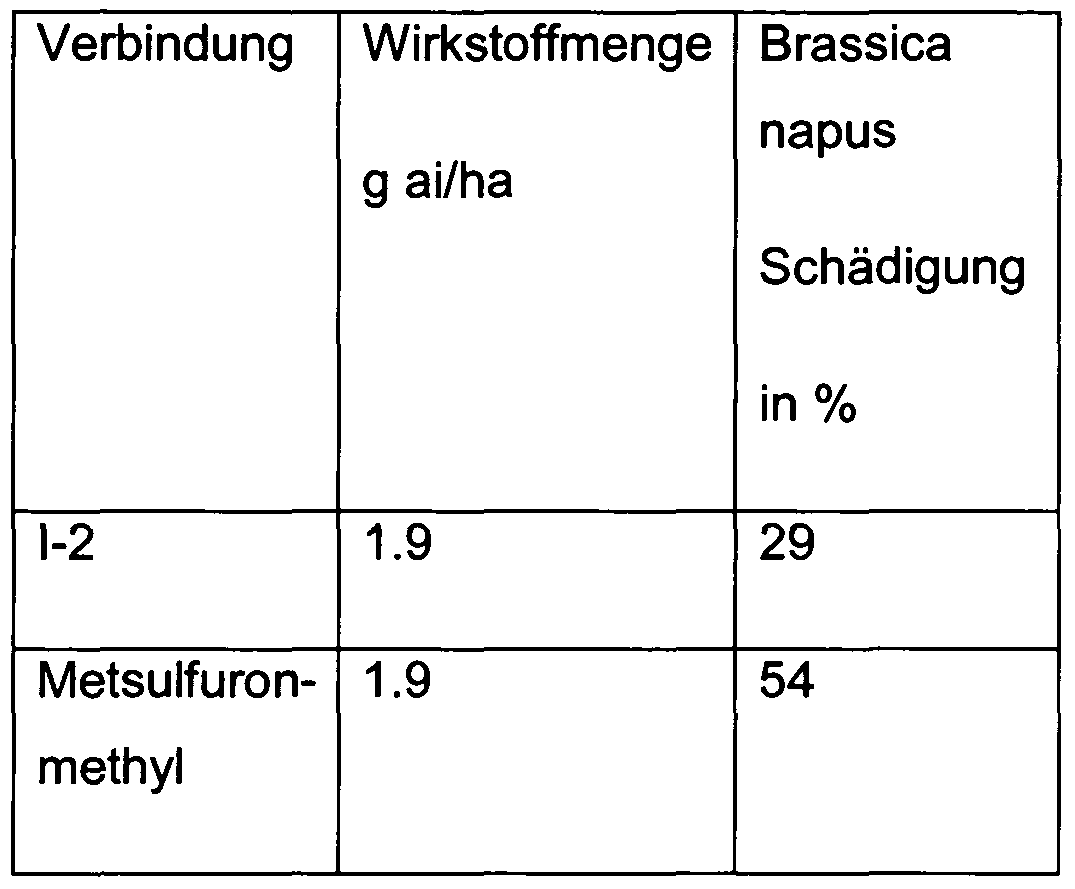
  • Tables B2-1 to B2-5 contain the results of sampling of rape (Brassica napus) in the application of (a) the compound I-2 according to the invention and (b) metsulfuron-methyl at various application rates.
  • Tables B3-1 to B3-5 contain the results when sampling the field bean (Vicia faba) when using (a) the compound I-2 according to the invention and (b) metsulfuron-methyl at various application rates.

Landscapes

  • Chemical & Material Sciences (AREA)
  • Organic Chemistry (AREA)
  • Life Sciences & Earth Sciences (AREA)
  • Health & Medical Sciences (AREA)
  • General Health & Medical Sciences (AREA)
  • Engineering & Computer Science (AREA)
  • Zoology (AREA)
  • Wood Science & Technology (AREA)
  • Dentistry (AREA)
  • Plant Pathology (AREA)
  • Environmental Sciences (AREA)
  • Pest Control & Pesticides (AREA)
  • Agronomy & Crop Science (AREA)
  • General Chemical & Material Sciences (AREA)
  • Public Health (AREA)
  • Veterinary Medicine (AREA)
  • Animal Behavior & Ethology (AREA)
  • Pharmacology & Pharmacy (AREA)
  • Nuclear Medicine, Radiotherapy & Molecular Imaging (AREA)
  • Medicinal Chemistry (AREA)
  • Chemical Kinetics & Catalysis (AREA)
  • Urology & Nephrology (AREA)
  • Bioinformatics & Cheminformatics (AREA)
  • Agricultural Chemicals And Associated Chemicals (AREA)
  • Organic Low-Molecular-Weight Compounds And Preparation Thereof (AREA)

Abstract

Diese Erfindung betrifft Salze des 2-lodo-N-[(4-methoxy-6-methyl-1,3,5-triazin-2- yl)carbamoyl]benzolsulfonamids, Verfahren zu deren Herstellung, sowie deren Verwendung als Herbizide, insbesondere als Herbizide zur selektiven Bekämpfung unerwünschter Schadpflanzen in Nutzpflanzenkulturen, Dauerkulturen oder Nichtkulturland, sowie als Pflanzenwachstumsregulatoren allein, oder mit Safenern und/oder in Kombination mit anderen Herbiziden, deren Anwendung zur Bekämpfung unerwünschter Schadpflanzen (wie beispielsweise Unkräuter/Ungräser) in speziellen Pflanzenkulturen oder als Pflanzenschutzregulatoren bekannt ist, bei gleichzeitiger und/oder sequentieller Anwendung, entweder als Fertigformulierung oder als Tankmix.

Description

Salze des 2-lodo-N-[(4-methoxy-6-methyl-1 ,3,5-triazin-2- yl)carbamoyl]benzolsulfonamids, Verfahren zu deren Herstellung, sowie deren Verwendung als Herbizide und Pflanzenwachstumsregulatoren
Beschreibung
Diese Erfindung betrifft Salze des 2-lodo-N-[(4-methoxy-6-methyl-1 ,3,5-triazin-2- yl)carbamoyl]benzolsulfonamids, Verfahren zu deren Herstellung, sowie deren Verwendung als Herbizide, insbesondere als Herbizide zur selektiven Bekämpfung unerwünschter Schadpflanzen in Nutzpflanzenkulturen, Dauerkulturen oder Nichtkulturland, sowie als Pflanzenwachstumsregulatoren allein, oder mit Safenem und/oder in Kombination mit anderen Herbiziden, deren Anwendung zur Bekämpfung unerwünschter Schadpflanzen (wie beispielsweise Unkräuter/Ungräser) in speziellen Pflanzenkulturen oder als Pflanzenschutzregulatoren bekannt ist, bei gleichzeitiger und/oder sequentieller Anwendung, entweder als Fertigformulierung oder als Tankmix.
Es ist bekannt, daß substituierte Phenylsulfonylharnstoffe, herbizide Eigenschaften aufweisen. Dabei handelt es sich z.B. um Phenylderivate, die einfach oder mehrfach substituiert sind (z.B. US 4127405, WO 9209608, BE 853374, WO 9213845, EP 84020, WO 9406778, WO 02072560, US 4169719, US4629494, DE 4038430). Aus WO 2006/114220 ist weiterhin bekannt, dass am Phenylring jodierte Sulfonamide herbizide Eigenschaften aufweisen.
Überraschenderweise wurden nun gefunden, dass Salze des 2-lodo-N-[(4-methoxy- 6-methyl-1 ,3,5-triazin-2-yl)carbamoyl]benzolsulfonamids, sich besonders vorteilhaft als Herbizide und/oder Pflanzenwachstumsregulatoren eignen.
Gegenstand der vorliegenden Erfindung sind somit agrochemisch wirksame Salze des 2-lodo-N-[(4-methoxy-6-methyl-1 ,3,5-triazin-2-yl)carbamoyl]benzolsulfonamids. Bevorzugter Gegenstand der vorliegenden Erfindung sind Verbindungen der allgemeinen Formel (I)
Figure imgf000003_0001
wobei das Kation (M+) (a) ein Ion der Alkalimetalle, bevorzugt Lithium, Natrium, Kalium, oder
(b) ein Ion der Erdalkalimetalle, bevorzugt Calcium und Magnesium, oder
(c) ein Ion der Übergangsmetalle, bevorzugt Mangan, Kupfer, Zink und Eisen, oder
(d) ein Ammonium-Ion, bei dem gegebenenfalls ein, zwei, drei oder alle vier Wasserstoffatome, durch gleiche oder verschiedene Reste aus der Gruppe (Ci-C4)-Alkyl, Hydroxy-(Cr
C4)-Alkyl, (C3-C6)-Cycloalkyl, (CrC4)-Alkoxy-(Ci-C4)-alkyl, Hydroxy-(CrC4)-alkoxy-(Ci-C4)-alkyl, (Ci-C6)-Mercaptoalkyl, Phenyl oder Benzyl substituiert sind, wobei die zuvor genannten Reste gegebenenfalls durch einen oder mehrere, gleiche oder verschiedene Reste aus der Gruppe Halogen, wie F, Cl, Br oder I, Nitro, Cyano, Azido, (CrC6)-Alkyl, (CrC6)-Haloalkyl, (C3- C6)-Cycloalkyl, (CrC6)-Alkoxy, (CrC6)-Haloalkoxy und Phenyl substituiert sind, und wobei jeweils zwei Substituenten am N- Atom zusammen gegebenfalls einen unsubstituierten oder substituierten Ring bilden, oder
(e) ein Phosphonium-Ion, oder
(f) ein Sulfonium-Ion, bevorzugt Tri-((Ci-C4)-alkyl)-sulfonium, oder (g) ein Oxonium-Ion, bevorzugt Tri-((CrC4)-alkyl)-oxonium, oder (h) eine gegebenenfalls einfach oder mehrfach anneliierte und/oder durch (CrC4)-Alkyl substituierte gesättigte oder ungesättigte/aromatische N-haltige heterocyclische ionische Verbindung mit 1-10 C-Atomen im Ringsystem ist.
Weiter bevorzugt sind Verbindungen der Formel (I), in denen das Kation (M+)
(a) ein Ion der Alkalimetalle, bevorzugt Lithium, Natrium, Kalium, oder
(b) ein Ion der Erdalkalimetalle, bevorzugt Calcium und Magnesium, oder
(c) ein Ion der Übergangsmetalle, bevorzugt Mangan, Kupfer, Zink und Eisen, oder (d) ein Ammonium-Ion, bei dem gegebenenfalls ein, zwei, drei oder alle vier Wasserstoffatome, durch gleiche oder verschiedene Reste aus der Gruppe (Ci-C-J)-Al kyl, Hydroxy-(Ci- C4)-Alkyl, (C3-C4)-Cycloalkyl, (C1-C2)-Alkoxy-(C1-C2)-alkyl, Hydroxy-(CrC2)-alkoxy-(Ci-C2)-alkyl, (d-C2)-Mercaptoalkyl, Phenyl oder Benzyl substituiert sind, wobei die zuvor genannten
Reste gegebenenfalls durch einen oder mehrere, gleiche oder verschiedene Reste aus der Gruppe Halogen, wie F, Cl, Br oder I, Nitro, Cyano, Azido, (d-C^-Alkyl, (CrC2)-Haloalkyl, (C3- C4)-Cycloalkyl, (Ci-C2)-Alkoxy, (CrC2)-Haloalkoxy und Phenyl substituiert sind, und wobei jeweils zwei Substituenten am N-
Atom zusammen gegebenfalls einen unsubstituierten oder substituierten Ring bilden, oder
(e) ein quartäres Phosphonium-Ion, bevorzugt Tetra-((Ci-C4)- alkyl)-phosphonium und Tetraphenyl-phosponium, wobei die (CrC4)-Alkylreste und die Phenylreste gegebenenfalls einfach oder mehrfach mit gleichen oder verschiedenen Resten aus der Gruppe Halogen, wie F, Cl, Br oder I, (CrC2)-Alkyl, (CrC2)- Haloalkyl, (C3-C4)-Cycloalkyl, (CrC2)-Alkoxy und (CrC2)- Haloalkoxy substituiert sind, oder (T) ein tertiäres Sulfonium-Ion, bevorzugt Ti-((CrC4)-akyl)- sulfonium oder Triphenyl-sulfonium, wobei die (CrC4)-Alkylreste und die Phenylreste gegebenenfalls einfach oder mehrfach mit gleichen oder verschiedenen Resten aus der Gruppe Halogen, wie F, Cl, Br oder I, (d-C2)-Alkyl, (CrC2)-Haloalkyl, (C3-C4)- Cycloalkyl, (d-C2)-Alkoxy und (CrC2)-Haloalkoxy substituiert sind, oder (g) ein tertiäres Oxonium-Ion, bevorzugt Tri-((CrC4)-alkyl)- oxonium, wobei die (CrC4)-Alkylreste gegebenenfalls einfach oder mehrfach mit gleichen oder verschiedenen Resten aus der Gruppe Halogen, wie F, Cl, Br oder I, (CrC2)-Alkyl, (C1-C2)- Haloalkyl, (C3-C4)-Cycloalkyl, (CrC2)-Alkoxy und (CrC2)- Haloalkoxy substituiert sind, oder
(h) ein Kation aus der Reihe der folgenden heterocyclischen Verbindungen, wie beispielsweise Pyridin, Chinolin, 2- Methylpyridin, 3-Methylpyridin, 4-Methylpyridin, 2,4- Dimethylpyridin, 2,5-Dimethylpyridin, 2,6-Dimethylpyridin, 5- Ethyl-2-methylpyridin, Piperidin, Pyrrolidin, Morpholin,
Thiomorpholin, Pyrrol, Imidazol, 1 ,5-Diazabicyclo[4.3.0]non-5-en
(DBN), 1 ,8-Diazabicyclo[5.4.0]undec-7-en (DBU) ist.
Bevorzugt sind Verbindungen der Formel (I), in denen das Kation (M+) ein Natrium- Ion, ein Kalium-Ion, ein Lithium-Ion, ein Magnesium-Ion, ein Calcium-Ion, ein NH4 +- lon, ein (2-Hydroxyeth-1-yl)ammonium-lon, Bis-N,N-(2-hydroxyeth-1-yl)ammonium- lon, Tris-N,N,N-(2-hydroxyeth-1-yl)ammonium-lon, ein Methylammonium-Ion, ein Dimethylammonium-Ion, ein Trimethylamrnonium-ton, ein Tetramethylammonium- Ion ein Ethylammonium-Ion, ein Diethylammonium-Ion, ein Triethylammonium-Ion, ein Tretraethylammonium-Ion ein Isopropylammonium-Ion, ein Diisopropylammonium-Ion, ein Tetrapropylammonium-Ion, ein Tetrabutylammonium- Ion, ein 2-(2-Hydroxyeth-1-oxy)eth-1-yl-ammonium-lon, ein Di-(2-hydroxyeth-1-yl)- ammonium-lon, ein Trimethylbenzylammonium-Ion, ein Tri-((Ci-C4)-alkyl)-sulfonium- lon, oder ein Tri-((CrC4)-alkyl)-oxonium-lon, ein Benzylammonium-Ion, ein 1- Phenylethylammonium-Ion, ein 2-Phenylethylammonium-lon, ein Diisopropylethylammonium-Ion, ein Pyridinium-Ion, ein Piperidinium-Ion, ein
Imidazolium-Ion, ein Morpholinium-Ion, ein 1 ,8-Diazabicyclo[5.4.0]undec-7-enium- lon ist.
Weiter bevorzugt sind Verbindungen der Formel (I) in denen das Kation (M+) ein Natrium-Ion, ein Kalium-Ion, ein Magnesium-Ion, ein Calcium-Ion, oder ein NH4 +-lon ist.
Besonders bevorzugt sind Verbindungen der Formel (I), in denen das Kation (M+) ein Natrium-Ion, ein Kalium-Ion oder ein NH4 +-lon ist.
Ganz besonders bevorzugt sind Verbindungen der Formel (I), in denen das Kation (M+) ein Natrium-Ion oder ein Kalium-Ion ist.
In Formel (I) und allen nachfolgenden Formeln können die kohlenstoffhaltigen Reste wie Alkyl, Alkoxy jeweils geradkettig oder verzweigt sein z.B. Methyl, Ethyl, n- oder i-Propyl, n-, i-, t- oder 2-Butyl.
Cycloalkyl bedeutet ein carbocyclisches, gesättigtes Ringsystem mit vorzugsweise 3-6 C-Atomen, z.B. Cyclopropyl, Cyclobutyl, Cyclopentyl oder Cyclohexyl.
Die Verbindungen der Formel (I) können je nach Art und Verknüpfung der Substituenten als Stereoisomere vorliegen. Die durch ihre spezifische Raumform definierten möglichen Stereoisomere, wie Enantiomere, Diastereomere, Z- und E- Isomere sind alle von der Formel (I) umfasst. Sind beispielsweise eine oder mehrere Alkenylgruppen vorhanden, so können
Diastereomere (Z- und E-Isomere) auftreten. Sind beispielsweise ein oder mehrere asymmetrische Kohlenstoffatome vorhanden, so können Enantiomere und Diastereomere auftreten. Stereoisomere lassen sich aus den bei der Herstellung anfallenden Gemischen nach üblichen Trennmethoden, beispielsweise durch chromatographische Trennverfahren, erhalten. Ebenso können Stereoisomere durch Einsatz stereoselektiver Reaktionen unter Verwendung optisch aktiver Ausgangs- und/oder Hilfsstoffe selektiv hergestellt werden. Die Erfindung betrifft somit auch alle Stereoisomeren, die von der allgemeinen Formel (I) umfasst, jedoch nicht mehr mit ihrer spezifischen Stereoform angegeben sind, und deren Gemische.
Die vorstehenden Beispiele für Reste oder Restebereiche, die unter die allgemeinen Begriffe wie "Alkyl" fallen, bedeuten keine vollständige Aufzählung. Die allgemeinen Begriffe umfassen auch die weiter unten angeführten Definitionen für Restebereiche in Gruppen bevorzugter Verbindungen, insbesondere Restebereiche, welche spezifische Reste aus den Tabellenbeispielen umfassen.
Die oben aufgeführten allgemeinen oder in Vorzugsbereichen aufgeführten Restedefinitionen gelten sowohl für die Endprodukte der Formel (I) als auch entsprechend für die jeweils zur Herstellung benötigten Ausgangs- oder Zwischenprodukte. Diese Restedefinitionen können untereinander, also auch zwischen den angegebenen bevorzugten Bereichen beliebig kombiniert werden.
Gegenstand der vorliegenden Erfindung sind auch Verfahren zur Herstellung der erfindungsgemäßen Salze, insbesondere von Vebindungen der allgemeinen Formel (I).
wobei man
a) 2-lodbenzolsulfonamid (II)
Figure imgf000007_0001
mit einem heterocyclischen Carbamat der Formel (IM) H
NγγCH3 ( III )
OCH,
worin R* ein substituierter oder unsubstituierter (CrC2o)-Kohlenwasserstoffrest wie Aryl oder Alkyl, vorzugsweise gegebenenfalls substituiertes Phenyl oder gegebenenfalls substituiertes (CrC4)-Alkyl bedeutet,
umsetzt, oder
b) ein Sulfonylcarbamat der Formel (IV),
Figure imgf000008_0001
worin R** ein substituierter oder unsubstituierter (CrC2o)-Kohlenwasserstoffrest wie Aryl oder Alkyl, vorzugsweise gebenenfalls substituiertes Phenyl oder gegebenenfalls substituiertes (Ci-C4)-Alkyl bedeutet,
mit einem 2-Amino-4-methoxy-6-methyl-triazin der Formel (V)
Figure imgf000008_0002
umsetzt, oder
c) 2-lodbenzolsulfonsäureisocyanat (VI)
Figure imgf000009_0001
mit dem Aminoheterocyclus der Formel (V) umsetzt, oder
d) 2-lodbenzolsulfonamid (II) mit dem lsocyanat (VII)
>NγNγCH3 ( VII )
OCH,
in Gegenwart einer Base umsetzt, oder
e) den Aminoheterocyclus der Formel (V) zunächst basenkatalysiert mit einem Kohlensäureester, z.B. Diphenylcarbonat, umsetzt und das gebildete Intermediat in einer Eintopfreaktion mit 2-lodbenzolsulfonamid (II) (siehe Variante a)) umsetzt (vgl. JP1989221366), oder
f) ein 2-lodbenzolsulfonsäurehalogenid der Formel (VIII),
Figure imgf000009_0002
wobei HaI ein Halogenatom, vorzugsweise Chlor (Villa), oder Fluor (VIIIb), oder Brom (VIIIc) ist, mit einem Cyanat, beispielsweise einem Metallcyanat, insbesondere einem Alkalimetallcyanat, wie Natriumcyanat, zum lsocyanat der Formel (VI) oder einem solvatisierten (stabilisierten) Derivat davon umsetzt, und anschließend mit dem Aminoheterocyclus der Formel (V) umsetzt,
g) 2-lodbenzolsulfonamid (II) mit einem heterocyclischen Biscarbamat der Formel
(MIa),
Figure imgf000010_0001
worin R* ein substituierter oder unsubstituierter (C1-C20)- Kohlenwasserstoffrest wie Aryl oder Alkyl, vorzugsweise gegebenenfalls substituiertes Phenyl oder gegebenenfalls substituiertes (Ci-C4)-Alkyl bedeutet, umsetzt (siehe WO 96/22284),
h) 2-lodbenzolsulfonamid (II) zunächst basenkatalysiert mit einem
Kohlensäureester, z.B. Diphenylcarbamat, umsetzt und das gebildete Intermediat in einer Eintopfreaktion mit dem Aminoheterocyclus der Formel (V)
(siehe Variante b)) umsetzt.
Die Umsetzung der Verbindungen der Formeln (II) und (III) gemäß Variante a) erfolgt vorzugsweise basenkatalysiert in einem inerten organischen Lösungsmittel, wie z.B. Dichlormethan, Acetonitril, Dioxan oder THF bei Temperaturen zwischen 00C und dem Siedepunkt des Lösungsmittels, vorzugsweise bei Raumtemperatur. Als Base werden dabei beispielsweise organische Aminbasen, wie 1 ,8-Diazabicyclo[5.4.0]undec-7-en (DBU), Alkali-tert.-butylat, wie z.B. NaO-tert.- butylat, oder Alkalihydroxide, wie z.B. NaOH, insbesondere bei R* = (subst.) Phenyl (vgl. EP-A-44 807), oder Trialkylaluminium wie Trimethylaluminium oder Triethylaluminium, letzter insbesondere bei R* = Alkyl (vgl. EP-A-166 516) verwendet. Die jeweilige Base wird dabei beispielsweise im Bereich von 1 bis 3 Moläquivalenten, bezogen auf die Verbindung der Formel (II), eingesetzt. 2-lodbenzolsulfonylisocyanat ist eine neue Verbindung, die ebenso wie ihre Herstellung und ihre Verwendung zur Herstellung von Verbindungen der Formel (I) Gegenstand der vorliegenden Erfindung sind.
Man kann 2-lodbenzolsulfonamid (II) z.B. erhalten, wie in den nachfolgenden Schemata 1 bis 7 gezeigt.
Schema 1
Butyl
Figure imgf000011_0001
( IX ) ( IXa ) ( X )
Ausgehend vom kommerziell erhältlichen 2-Nitroanilin (IX) können, z.B. durch Diazotierung der Aminogruppe mit einem Alkalinitrit, wie z. B. Natriumnitrit, in Gegenwart von Salzsäure bei Temperaturen zwischen -1O0C und 100C und nachfolgendem Austausch der resultierenden Diazogruppe z. B. mit Schwefeldioxid in Gegenwart eines Verdünnungsmittels, wie z. B. Dichlormethan, 1 ,2-Dichlorethan oder Essigsäure, und in Gegenwart eines Katalysators, wie z. B. Kupfer(l)chlorid und/oder Kupfer(ll)chlorid, bei Temperaturen zwischen -1O0C und 5O0C 2- Nitrobenzolsulfonsäurechlorid (IXa) erhalten werden (vgl. Meerwein, Chem. Ber. 1957, 90, 841) (Schema 1 ). Alternativ zur Verwendung von Schwefeldioxid kann auch Na2S2O5 (Natriummetabisulfit) als SO2-Quelle eingesetzt werden.
Durch Behandlung von (IXa) mit tert.-Butylamin kann N-tert.-Butyl-2-nitrobenzol- sulfonamid (X) erhalten werden. Die Sulfonamidbildung wird beispielsweise in inerten Lösungsmitteln wie z.B. Dichlormethan, Tetrahydrofuran (THF), Dioxan, Toluol oder Dimethylformamid (DMF) bei Temperaturen zwischen -7O0C bis zum Siedepunkt des verwendeten Lösungsmittels, vorzugsweise bei 250C durchgeführt. Dabei kommt bevorzugt eine Aminmenge von 1.5 - 2.5 Äquivalenten bezogen auf das verwendete Sulfochlorid zum Einsatz. Schema 2
Figure imgf000012_0001
Die Reduktion von (X) zu N-tert.-Butyl-2-aminobenzolsulfonamid (Xl) erfolgt analog zu bekannten Methoden (vgl. hierzu Houben-Weyl, „Methoden der Organischen Chemie", 4. Aufl. Bd. XI/1 S. 360 ff., Thieme Verlag Stuttgart, 1957) (Schema 2).
Schema 3
Figure imgf000012_0002
Anilin (Xl) kann unter üblichen Bedingungen für Diazotierungsreaktionen diazotiert und anschließend in N-tert.-Butyl-2-iodbenzolsulfonamid (XII) überführt werden. Beispielsweise erfolgt die Diazotierung in Gegenwart der Säure H+X", wobei X" vorzugsweise Cl", I" oder HSO4 " ist, in wässriger Lösung, gegebenenfalls unter Einsatz eines unter den Reaktionsbedingungen inerten organischen Lösungsmittels mit einem Nitrit. Beispielsweise diazotiert man mit einem Alkalimetallnitrit wie NaNO2 (Natriumnitrit) in Mengen von 1.0 - 1.2 Mol Nitrit, vorzugsweise 1 ,01 - 1.05 Mol Nitrit, pro Mol Anilin (Xl). Als Säuren eignen sich Mineralsäuren oder starke organische Säuren, bevorzugt sind Salzsäure, oder Schwefelsäure. Das Lösungsmittel ist Wasser oder eine Mischung aus Wasser und einem unter den Reaktionsbedingungen inerten organischen Lösungsmittel. Die Reaktionstemperatur beträgt in der Regel zwischen -50C und 5O0C, vorzugsweise 1O0C bis 2O0C. Die Umsetzung der erhaltenen Diazoniumsalze zur lodverbindung (XII) erfolgt in der Regel ohne Isolierung und wird im gleichen wässrigen oder wässrig-organischen Lösungsmittel oder Lösungsmittelgemisch wie die Diazotierung durchgeführt. Bei der Umsetzung wird die Diazoniumgruppe durch das lodatom ausgetauscht, entweder durch das Anion des Diazoniumsalzes (wenn in der Säure X" = I") oder (falls X" nicht I" ist) durch die Reaktion mit zugefügtem lodid, z. B. Alkalimetalliodid, vorzugsweise Natriumiodid oder Kaliumiodid. Die Menge an lodid beträgt dabei beispielsweise 1.1 bis 1.5 Mol lodid pro Mol ursprünglich eingesetztem Anilin (Xl). Die Reaktionstemperatur beläuft sich dabei im Allgemeinen auf 1O0C bis 4O0C, vorzugsweise 150C bis 3O0C (vgl. hierzu z.B. DE 19625831 und Bioorg. Med. Chem. 2004, 12, 2079) (Schema 3).
Schema 4
Figure imgf000013_0001
( XII ) ( H )
Die Abspaltung der tert.-Butyl-Schutzgruppe in (XII) zu 2-lodbenzolsulfonamid (II) erfolgt z.B. durch Behandlung mit einer starken Säure (siehe WO 89/10921 ). Als starke Säuren kommen z.B. Mineralsäuren, wie H2SO4 oder HCl, oder starke organische Säuren, wie Trifluoressigsäure in Frage. Die Reaktion erfolgt beispielsweise bei Temperaturen von -200C bis zur jeweiligen Rückflußtemperatur des Reaktionsgemisches, vorzugsweise bei O0C bis 400C. Die Umsetzung kann in Substanz oder auch in einem inerten Solvens, wie z.B. Dichlormethan oder Trichlormethan, durchgeführt werden (Schema 4). Schema 5
Figure imgf000014_0001
N-tert.-Butyl-2-iodbenzolsulfonsäureamid (XII) kann auch erhalten werden, indem man N-tert.-Butyl-benzolsulfonsäureamid (XIV), welches durch Umsetzung von kommerziell erhältlichem Benzolsulfonsäurechlorid (XIII) mit tert.-Butylamin (siehe Schema 1 ) erhalten werden kann, mit einer metallorganischen Verbindung, wie z.B. Alkyl- oder Aryllithium, vorzugsweise π- oder sec-Butyllithium in Hexan, gegebenfalls in Gegenwart eines (weiteren) inerten Verdünnungsmittels, wie z.B. Tetrahydrofuran, und unter Inertgasatmosphäre, wie z.B. unter Argon oder Stickstoff, bei Temperaturen zwischen -7O0C und 2O0C metalliert - d. h. das in (XIV) in ortho- Position zur Sθ2NH-tert.-Butyl-Gruppe befindliche Wasserstoffatom durch ein Metallatom ersetzt - und dann im gleichen Reaktionsmedium mit lod bei Temperaturen zwischen -1000C und 4O0C, vorzugsweise zwischen -7O0C und 2O0C umsetzt, wodurch das Metallatom durch lod ersetzt (Schema 5) wird (siehe hierzu auch: V. Snieckus et al., J. Org. Chem. 2001 , 66, 3662 und Synlett 2000, (9), 1294).
Figure imgf000014_0002
( XV ) (Villa) ( » )
2-lodbenzolsulfonamid (II) kann auch erhalten werden (Schema 6), indem man 2-lod benzolsulfonsäurechlorid (Villa), welches durch Diazotierung der Aminogruppe in 2-lodanilin (XV) und nachfolgendem Austausch der resultierenden Diazogruppe durch eine Chlorsulfonylgruppe (wie in Schema 1 näher beschrieben) herstellt wird, mit Ammoniak umsetzt. Hierzu wird in inerte Lösungsmittel, vorzugsweise Dichlormethan oder Tetrahydrofuran, solange Ammoniakgas eingeleitet, bis kein Ammoniak mehr aufgenommen wird.
Alternativ kann 2-lodbenzolsulfonsäurechlorid (Villa) auch durch Reaktion mit tert- Butylamin (analog Schemata 1 und 5) in das N-tert-Butyl-2-iodbenzolsulfonamid (XII) überführt werden. Nachfolgend wird dann die tert.-Butyl-Schutzgruppe mitttels Säure entfernt (analog Schema 4) um 2-lodbenzolsulfonamid (II) zu erhalten.
Die Sulfonylcarbamate der allgemeinen Formel (IV) werden in Analogie zu an sich bekannten Reaktionen (vgl. EP-A-120 814) hergestellt. Man kann z.B. auch
2-lodbenzolsulfonylisocyanat der Formel (VI) in glatter Reaktion in einem inerten Lösungsmittel, vorzugsweise Diethylether oder Dichlormethan mit Phenol in die Carbamate der Formel (IV) überführen. Die Aminoheterocyclen der Formel (V) sind bekannte, zum Teil im Handel erhältliche Synthesechemikalien. Die Umsetzung der Sulfonylcarbamate der Formel (IV) mit den Aminoheterocyclen der Formel (V) erfolgt nach bekannten Verfahren (vgl. z.B. WO 2003 091228) (Schema 7).
Schema 7
Figure imgf000015_0001
2-lodbenzolsulfonylisocyanat der Formel (VI) ist eine neue Verbindung und ist somit ebenfalls Gegenstand dieser Erfindung. Sie kann nach an sich bekannten Verfahren aus 2-lodbenzolsulfonamid (II) hergestellt werden (vgl. DE 3208189, EP 23422, EP 64322, EP 44807, EP 216504). Man erhält das Sulfonylisocyanat der Formel (VI), wenn man 2-lodbenzolsulfonamid (II) mit Phosgen, Diphosgen bzw. Thiophosgen, gegebenenfalls in Gegenwart eines Alkylisocyanats, wie z.B. Butylisocyanat, gegebenenfalls in Gegenwart eines Reaktionshilfsmittels, wie eines tertiären Amins, bevorzugt einem Diazabicyclo[2.2.2]octan, und in Gegenwart eines Verdünnungsmiteis, wie Toluol, XyIoI oder Chlorbenzol, bei Temperaturen zwischen 800C und 1500C umsetzt und nach Ende der Umsetzung gegebenenfalls die flüchtigen Komponenten unter vermindertem Druck abdestilliert (Schema 8).
Schema 8
( "I ) ( VI )
Die Umsetzung von 2-lodbenzolsulfonylisocyanaten der Formel (VI) mit dem Aminotriazin der Formel (V) erfolgt z.B. nach bekannten Verfahren (vgl. WO 2003 091228) (Schema 9).
Schema 9
Figure imgf000016_0002
Die Isocyanate der allgemeinen Formel (VII) erhält man z.B. aus den Aminoheterocyclen des Typs (V) durch Behandlung mit Oxalylchlorid oder Phosgen (in Analogie nach Angew. Chem. 1971 , 83, S. 407; EP 388 873). Die Umsetzung des Isocyanats des Typs (VII) mit 2-lodbenzolsulfonamid (II) erfolgt z.B. in Analogie nach Variante c) (Schema 10). Schema 10
Figure imgf000017_0001
2-lodbenzolsulfonsäurefluorid (VIIIb) kann auf verschiedene literaturbekannte Methoden hergestellt werden: i) aus 2-lodbenzolsulfonamid (II) durch Diazotierung mit Alkalinitrit, beispielsweise Natriumnitrit, und nachfolgender Umsetzung mit Fluorwasserstoff (J. Am. Chem. Soc. 1951 , 73, 1857); ii) Umsetzung von 2- lodbenzolsulfonsäurechlorid (Villa) mit Kaliumfluorid (J. Chem. Soc, Perkin Trans. 1 , 1998, 5, 875); iii) Reaktion von 2-lodbenzolsulfonsäure (XVII) mit Fluorsulfonsäure (US 2686202). 2-lodbenzolsulfonsäurebromid (VIIIc) kann beispielsweise durch Umsetzung von 2- lodbenzolsulfonsäurechlorid (Villa) mit Bromwasserstoff in Essigsäure synthetisiert werden (Dokl. Akad. Nauk SSR 1955, 103, 627).
In einer Ausführungsform der Variante f) wird die durch Umsetzung des Sulfonsäurehalogenids (VIII) mit einem Cyanat erhaltene Reaktionsmischung direkt für die Kupplung mit dem Aminotriazin der Formel (V) zur Synthese der Vorstufe (Neutralverbindung) der Formel (I) eingesetzt (vgl. hierzu WO 2003 091228 und US 5550238).
Die erfindungsgemäßen Salze, insbesondere solche der Formel (I) lassen sich aus der Neutralform des Sulfonylharnstoffs oder Sulfonylharnstoffmetallsalzen, insbesondere Alkalimetallsalzen (siehe z.B. EP-A-30138, EP-A-7687) oder auch ausgehend von Sulfonamidsalzen z.B. auf folgende Weise herstellen:
1. Deprotonierung des neutralen Sulfonylharnstoffs (XX) mit einer geeigneten Base der Formel M+B" (Schema 11 ), wobei B" zum Beispiel Hydrid, Hydroxy- oder Alkoxyanionen, wie Methoxy, Ethoxy, n-Propoxy, i-Propoxy, n-Butoxy oder t-Butoxy darstellen.
Schema 11
Figure imgf000018_0001
Hierzu wird der Sulfonylharnstoff der Formel (I) in einem inerten Lösungsmittel oder Lösungsmittelgemisch gelöst oder suspendiert und mit einem Äquivalent an M+B" bei Temperaturen zwischen -2O0C uns 1000C, vorzugsweise zwischen -100C und 5O0C umgesetzt.
2. Umsalzung von Metallsalzen des Sulfonylharnstoffs der Formel (Ia), worin Met+ ein Metallkation, bevorzugt ein Alkalimetallion wie Na+ oder K+ ist, mit geeigneten Reagentien der Formel M+X' (Schema 12), wobei M+ ein Ammoniumion ist und X' ein Anion, beispielsweise ein Halogenanion wie F', Cl" oder Br' bedeutet oder ein Phosphat-, Sulfat- oder Carboxylatanion sein kann, wobei diese Definition anorganische sowie organische Salze einschließt, wie sie z. B. in der Tensidchemie gebräuchlich sind (z. B. organische Phosphatanionen, Phosphonatanionen, Sulfatanionen, Sulfonatanionen, Carboxylate).
Figure imgf000018_0002
Hierzu werden die erfindungsgemäßen Metallsalze, z. B. Alkalisalze (z.B. Met+ = Na+, K+) des Sulfonylharnstoffs in einem inerten Lösungsmittel oder Lösungsmittelgemisch gelöst und mit einem Äquivalent der Reagenz M+X' umgesetzt. Nach beendeter Reaktion kann durch Filtration das als Nebenprodukt anfallende Salz, z. B. Alkalisalz (wie NaCI) abgetrennt werden.
3. In-situ Deprotonierung und Umsalzung (Schema 13), ausgehend vom neutalen Sulfonylharnstoff (XX) mit geeigneten Reagentien a) der Formel M+X', wobei M+ ein Ammoniumion ist und X" ein Anion beispielsweise ein Halogenanion wie F", Cl" oder Br' bedeutet oder ein Phosphat-, Sulfat- oder Carboxylatanion sein kann, wobei diese Definition anorganische sowie organische Salze einschließt, wie sie z. B. in der Tensidchemie gebräuchlich sind (z. B. organische Phosphatanionen, Phosphonatanionen, Sulfatanionen, Sulfonatanionen, Carboxylate) und b) der Formel Met+ B", worin Met+ ein Metallkation, insbesondere ein Alkalimetallkation wie Na+ oder K+ ist und B" eine geeignete Base, z. B. ein Hydroxy- oder Alkoxyanion wie Methoxy, Ethoxy, n-Propoxy, /-Propoxy oder n-Butoxy oder das Anion eines alkoxylierten, z. B. ethoxylierten oder propoxylierten, (Ca-C4o)-Alkohols ist.
Schema 13
Figure imgf000019_0001
Hierzu wird der neutrale Sulfonalharnstoff (XX) in einem inerten Lösungsmittel oder Lösungsmittelgemisch gelöst und mit je einem Äquivalent der Reagentien M+X' und MetB umgesetzt. Nach beendeter Reaktion kann durch Filtration das als Nebenprodukt anfallende Metallsalz, insbesondere Alkalisalz (z. B. NaCI) abgetrennt werden.
4. Umsetzungen des neutralen Sulfonylharnstoffs (XX) mit geeigneten Zwitterionen, z. B. (Schema 14) Schema 14
Figure imgf000020_0001
wobei R ein (CrC2o)-Kohlenstoffrest wie (CrCio)-Alkyl ist, R' und R" gleich oder voneinander verschieden sind und Wasserstoff oder (Ci-C3o)-Kohlenwasserstoff- reste wie (Ci-Cio)-Alkyl sind und m eine ganze Zahl von 0 bis 100 ist. Hierzu wird der neutrale Sulfonylharnstoff (XX) mit einem Zwitterion wie z. B. im Schema 14 angegeben in einem inerten Lösungsmittel z. B. Methanol, Tetrahydrofuran oder Methylenchlorid oder Lösungsmittelgemisch bei Temperaturen zwischen -2O0C und 1000C, vorzugsweise -1O0C und 8O0C in äquimolaren Verhältnissen umgesetzt.
5. Umsetzung eines Sulfonsäureamidsalzes der Formel (IIa) mit dem Isocyanat (VII) (Schema 15).
Schema 15
Figure imgf000020_0002
Die Umsetzung erfolgt in einem inerten Lösungsmittel oder Lösungsmittelgemisch - wie z. B. Tetrahydrofuran - bei Temperaturen zwischen -2O0C und 1000C, vorzugsweise zwischen -1O0C und 7O0C, indem man das lsocyanat (VII) äquimolar mit dem Sulfonsäureamidsalz der Formel (IIa) umsetzt. Dabei kann das Sulfonsäureamidsalz der Formel (IIa) direkt eingesetzt werden oder in-situ gebildet werden - z. B. durch Reaktion des entsprechenden Sulfonsäureamids der Formel (II) mit einer geeigneten Base M+X", worin M+ ein Ammoniumion ist und X' z. B. ein Hydroxy- oder Alkoxyanion.
6. Umsetzung eines Sulfonsäureamidsalzes der Formel (IIa) mit einem Carbamat der allgemeinen Formel (IM) (Schema 16)
Figure imgf000021_0001
Die Umsetzung erfolgt in einem inerten Lösungsmittel (oder Lösungsmittelgemisch) - wie z.B. Tetrahydrofuran - bei Temperaturen zwischen -2O0C und 1000C, vorzugsweise zwischen -1O0C und 700C, indem man das Carbamat der Formel (III) äquimolar mit mit dem Sulfonsäureamidsalz der Formel (IIa) umsetzt. Dabei kann das Sulfonsäureamidsalz der Formel (IIa) direkt eingesetzt oder in-situ gebildet werden - z. B. durch Reaktion des entsprechenden Sulfonsäureamids mit einer geeigneten Base M+X", worin M+ ein Ammoniumion ist und X" z. B. ein Hydroxy- oder Alkoxyanion.
7. Umsetzung des neutralen Sulfonylharnstoffs (XX) mit einem primären, sekundären oder tertiären Amin NRR'R" (Schema 17), worin R, R' und R" einem gleichen oder verschiedenenen Rest ausgwählt aus der Gruppe bestehend aus: (a) H,
(b) einem Ammonium-Ion, bei dem gegebenenfalls ein, zwei, drei oder alle vier Wasserstoffatome, durch gleiche oder verschiedene Reste aus der Gruppe (CrC4)-Alkyl, Hydroxy-(CrC4)-Alkyl, (C3-C6)-Cycloalkyl, (CrC4)-Alkoxy-(Cr C4)-alkyl, Hydroxy-(CrC4)-alkoxy-(CrC4)-alkyl, (CrC6)-Mercaptoalkyl, Phenyl oder Benzyl substituiert sind, wobei die zuvor genannten Reste gegebenenfalls durch einen oder mehrere, gleiche oder verschiedene Reste aus der Gruppe Halogen, wie F, Cl, Br oder I1 Nitro, Cyano, Azido, (C-i-Cβ)- Alkyl, (d-CeJ-Haloalkyl, (C3-C6)-Cycloalkyl, (CrC6)-Alkoxy, (C1-C6)-
Haloalkoxy und Phenyl substituiert sind, und wobei jeweils zwei Substituenten am N-Atom zusammen gegebenfalls einen unsubstituierten gegebenenfalls einem substituierten Ring bilden, oder
(c) einer gegebenenfalls einfach oder mehrfach annellierten und/oder durch (Cr C4)-Alkyl substituierten gesättigten oder ungesättigten/aromatischen N- haltigen heterocyclischen ionischen Verbindung mit 1-10 C-Atomen im Ringsystem entsprechen
Figure imgf000022_0001
Diese Umsetzung erfolgt zwischen Temperaturen von -2O0C bis 1000C, bevorzugt zwischen -1O0C und 5O0C, in inerten Lösungsmittel, wie z. B. Tetrahydrofuran, Methylenchlorid oder Methanol oder Gemischen aus Lösungsmitteln, statt.
Mit den in den vorstehenden Verfahrensvarianten bezeichneten "inerten Lösungsmitteln" sind jeweils Lösungsmittel gemeint, die unter den jeweiligen Reaktionsbedingungen inert sind, jedoch nicht unter beliebigen Reaktionsbedingungen inert sein müssen.
Kollektionen aus erfindungsgemäßen Salzen, insbesondere solchen der Formel (I), die nach den oben genannten Reaktionen synthetisiert werden können, können auch in parallelisierter Weise hergestellt werden, wobei dies in manueller, teilweise automatisierter oder vollständig automatisierter Weise geschehen kann. Dabei ist es beispielsweise möglich, die Reaktionsdurchführung, die Aufarbeitung oder die Reinigung der Produkte bzw. Zwischenstufen zu automatisieren. Insgesamt wird hierunter eine Vorgehensweise verstanden, wie sie beispielsweise durch S. H. DeWitt in "Annual Reports in Combinatorial Chemistry and Molecular Diversity:
Automated Synthesis", Band 1 , Verlag Escom 1997, Seite 69 bis 77 beschrieben ist.
Für die Durchführung mikrowellenunterstützter Synthesen kann ein Mikrowellengerät, z.B. Modell „Discover" der Firma CEM GmbH Mikrowellen- Analysentechnik, Carl-Friedrich-Gauß-Str. 9, 47475 Kamp-Lintfort verwendet werden.
Zur parallelisierten Reaktionsdurchführung und Aufarbeitung können eine Reihe von im Handel erhältlichen Geräten verwendet werden, wie sie beispielsweise von den Firmen Stern Corporation, Woodrolfe road, Tollesbury, Essex, England, H+P
Labortechnik GmbH, Bruckmannring 28, 85764 Oberschleißheim, Deutschland oder der Firma Radleys, Shirehill, Saffron Waiden, Essex, CB 11 3AZ, England angeboten werden. Für die parallelisierte Aufreinigung von Verbindungen der allgemeinen Formel (I) beziehungsweise von bei der Herstellung anfallenden Zwischenprodukten stehen unter anderem Chromatographieapparaturen zur
Verfügung, beispielsweise der Firma ISCO, Inc., 4700 Superior Street, Lincoln, NE 68504, USA.
Die aufgeführten Apparaturen führen zu einer modularen Vorgehensweise, bei der die einzelnen Arbeitsschritte automatisiert sind, zwischen den Arbeitsschritten jedoch manuelle Operationen durchgeführt werden müssen. Dies kann durch den Einsatz von teilweise oder vollständig integrierten Automationssystemen umgangen werden, bei denen die jeweiligen Automationsmodule beispielsweise durch Roboter bedient werden. Derartige Automationssysteme können zum Beispiel von der Firma Zymark Corporation, Zymark Center, Hopkinton, MA 01748, USA bezogen werden. Neben den hier beschriebenen Methoden kann die Herstellung der erfindungsgemäßen Salze, insbesondere von Verbindungen der allgemeinen Formel (I) vollständig oder partiell durch Festphasen unterstützte Methoden erfolgen. Zu diesem Zweck werden einzelne Zwischenstufen oder alle Zwischenstufen der Synthese oder einer für die entsprechende Vorgehensweise angepassten Synthese an ein Syntheseharz gebunden. Festphasenunterstützte Synthesemethoden sind in der Fachliteratur hinreichend beschrieben, z.B. Barry A. Bunin in "The Combinatorial Index", Verlag Academic Press, 1998.
Die Verwendung von festphasenunterstützten Synthesemethoden erlaubt eine Reihe von literaturbekannten Protokollen, die wiederum manuell oder automatisiert ausgeführt werden können. Zum Beispiel kann die "Teebeutelmethode" (Houghten, US 4,631 ,211 ; Houghten et al., Proc. Natl. Acad. Sei, 1985, 82, 5131-5135) mit Produkten der Firma IRORI, 11149 North Torrey Pines Road, La JoIIa, CA 92037, USA teilweise automatisiert werden. Die Automatisierung von Festphasen unterstützten Parallelsynthesen gelingt beispielsweise durch Apparaturen der Firmen Argonaut Technologies, Inc., 887 Industrial Road, San Carlos, CA 94070, USA oder MultiSynTech GmbH, Wullener Feld 4, 58454 Witten, Deutschland.
Die Herstellung gemäß der hier beschriebenen Verfahren liefert die erfindungsgemäßen Salze, insbesondere Verbindungen der Formel (I), in Form von Substanzkollektionen, die Bibliotheken genannt werden. Gegenstand der vorliegenden Erfindung sind auch Bibliotheken, die mindestens zwei erfindungsgemäße Verbindungen, insbesondere Verbindungen der Formel (I) enthalten.
Die erfindungsgemäßen Salze, insbesondere Verbindungen der Formel (I), weisen eine ausgezeichnete herbizide Wirksamkeit gegen ein breites Spektrum wirtschaftlich wichtiger mono- und dikotyler Schadpflanzen auf. Auch schwer bekämpfbare perennierende Unkräuter, die aus Rhizomen, Wurzelstöcken oder anderen Dauerorganen austreiben, werden durch die Wirkstoffe gut erfaßt. Dabei ist es gleichgültig, ob die Substanzen im Vorsaat-, Vorauflauf- oder Nachauflaufverfahren ausgebracht werden.
Werden die erfindungsgemäßen Salze, insbesondere Verbindungen der Formel (I), vor dem Keimen auf die Erdoberfläche appliziert, so wird entweder das Auflaufen der Unkrautkeimlinge vollständig verhindert oder die Unkräuter wachsen bis zum Keimblattstadium heran, stellen jedoch dann ihr Wachstum ein und sterben schließlich nach Ablauf von drei bis vier Wochen vollkommen ab. Bei Applikation der Wirkstoffe auf die grünen Pflanzenteile im Nachauflaufverfahren tritt ebenfalls sehr rasch nach der Behandlung ein drastischer Wachstumsstop ein, und die Unkrautpflanzen bleiben in dem zum Applikationszeitpunkt erreichten
Wachstumsstadium stehen oder sterben nach einer gewissen Zeit ganz ab, so dass auf diese Weise eine für die Kulturpflanzen schädliche Unkrautkonkurrenz sehr früh und nachhaltig beseitigt wird.
Obgleich die erfindungsgemäßen Salze, insbesondere die Verbindungen der Formel (I), eine ausgezeichnete herbizide Aktivität gegenüber mono- und dikotylen Unkräutern aufweisen, werden Kulturpflanzen wirtschaftlich bedeutender Kulturen wie z.B. Weizen, Gerste, Roggen, Hafer, Reis, Mais, Zuckerrohr, Flachs und andere Plantagenkulturen nur unwesentlich oder gar nicht geschädigt. Die vorliegenden Verbindungen eignen sich aus diesen Gründen sehr gut zur selektiven Bekämpfung von unerwünschtem Pflanzenwuchs in landwirtschaftlichen Nutzpflanzungen.
Weiterhin weisen die erfindungsgemäßen Salze, insbesondere Verbindungen der Formel (I) sehr vorteilhafte Eigenschaften hinsichtlich des Verhaltens in der Umwelt, insbesondere bzgl. des Nachbauverhaltens auf, d.h. gegenüber den erfindungsgemäßen Verbindungen der Formel (I) ansonsten empfindlichen Kulturen, wie beispielsweise Zuckerrübe, Sonnenblume oder Cruciferen, wie beispielsweise Raps, Senf und Rübsen.
Darüberhinaus weisen die erfindungsgemäßen Salze, insbesondere die Verbindungen der Formel (I), hervorragende wachstumsregulatorische Eigenschaften bei Kulturpflanzen auf. Sie greifen regulierend in den pflanzeneigenen Stoffwechsel ein und können damit zur gezielten Beeinflussung von Pflanzeninhaltsstoffen und zur Ernteerleichterung wie z.B. durch Auslösen von Desikkation und Wuchsstauchung eingesetzt werden. Desweiteren eignen sie sich auch zur generellen Steuerung und Hemmung von unerwünschtem vegetativem Wachstum, ohne dabei die Pflanzen abzutöten. Eine Hemmung des vegetativen Wachstums spielt bei vielen mono- und dikotylen Kulturen eine große Rolle, da das Lagern hierdurch verringert oder völlig verhindert werden kann.
Aufgrund ihrer herbiziden und pflanzenwachstumsregulatorischen Eigenschaften können die Wirkstoffe auch zur Bekämpfung von Schadpflanzen in Kulturen von bekannten oder noch zu entwickelnden gentechnisch veränderten Pflanzen eingesetzt werden. Die transgenen Pflanzen zeichnen sich in der Regel durch besondere vorteilhafte Eigenschaften aus, beispielsweise durch Resistenzen gegenüber bestimmten Pestiziden, vor allem bestimmter Herbizide, Resistenzen gegenüber Pflanzenkrankheiten oder Erregern von Pflanzenkrankheiten wie bestimmten Insekten oder Mikroorganismen wie Pilzen, Bakterien oder Viren. Andere besondere Eigenschaften betreffen z. B. das Erntegut hinsichtlich Menge, Qualität, Lagerfähigkeit, Zusammensetzung und spezieller Inhaltsstoffe. So sind transgene Pflanzen mit erhöhtem Stärkegehalt oder veränderter Qualität der Stärke oder solche mit anderer Fettsäurezusammensetzung des Ernteguts bekannt. Gleichermaßen können die Wirkstoffe aufgrund ihrer herbiziden und pflanzenwachstumsregulatorischen Eigenschaften auch zur Bekämpfung von Schadpflanzen in Kulturen von bekannten oder noch zu entwickelnden durch Mutatantenselektion erhaltenen Pflanzen eingesetzt werden.
Bevorzugt ist die Anwendung der erfindungsgemäßen Salze, insbesondere von Verbindungen der Formel (I), in wirtschaftlich bedeutenden transgenen oder durch Mutantenselektion erhaltenen Kulturen von Nutz- und Zierpflanzen, z. B. von Getreide wie Weizen, Gerste, Roggen, Hafer, Hirse, Reis, Maniok und Mais oder auch Kulturen von Raps, Kartoffel, Tomate, Erbse und anderen Gemüsesorten. Vorzugsweise können die erfindungsgemäßen Salze, insbesondere die Verbindungen der Formel (I), als Herbizide in Nutzpflanzenkulturen eingesetzt werden, welche gegenüber den phytotoxischen Wirkungen der Herbizide resistent sind bzw. gentechnisch resistent gemacht worden sind, oder durch Mutantenselektion erhalten wurden. Ebenso bevorzugt können die erfindungsgemäßen Salze, insbesondere die Verbindungen der Formel (I), als Herbizide in Nutzpflanzenkulturen eingesetzt werden, die ein Kreuzungsprodukt aus gentechnisch resistent gemachten Pflanzen und durch Mutantenselektion erhaltenen Pflanzen darstellen, wie z.B. in WO 2007/024782 beschrieben.
Allgemein bekannte Wege zur Herstellung neuer Pflanzen, die im Vergleich zu bisher vorkommenden Pflanzen modifizierte Eigenschaften aufweisen, bestehen beispielsweise in klassischen Züchtungsverfahren und der Erzeugung von Mutanten.
Ebenso können neue Pflanzen mit veränderten Eigenschaften mit Hilfe gentechnischer Verfahren erzeugt werden (siehe z. B. EP-A-0221044, EP-A- 0131624). Beschrieben wurden beispielsweise in mehreren Fällen gentechnische Veränderungen von Kulturpflanzen zwecks Modifikation der in den Pflanzen synthetisierten Stärke (z. B. WO 92/11376, WO 92/14827, WO 91/19806), transgene Kulturpflanzen, welche gegen bestimmte Herbizide vom Typ Glufosinate (vgl. z. B. EP-A-0242236, EP-A-242246) oder Glyphosate (WO 92/00377) oder der Sulfonylharnstoffe (EP-A-0257993, US-A-5013659) resistent sind, - transgene Kulturpflanzen, beispielsweise Baumwolle, mit der Fähigkeit
Bacillus thuringiensis-Toxine (Bt-Toxine) zu produzieren, welche die Pflanzen gegen bestimmte Schädlinge resistent machen (EP-A-0142924, EP-A-
0193259). transgene Kulturpflanzen mit modifizierter Fettsäurezusammensetzung (WO 91/13972). Zahlreiche molekularbiologische Techniken, mit denen neue transgene Pflanzen mit veränderten Eigenschaften hergestellt werden können, sind im Prinzip bekannt; siehe z.B. Sambrook et al., 1989, Molecular Cloning, A Laboratory Manual, 2. Aufl. CoId Spring Harbor Laboratory Press, CoId Spring Harbor, NY; oder Winnacker "Gene und Klone", VCH Weinheim 2. Auflage 1996 oder Christou, "Trends in Plant Science" 1 (1996) 423-431).
Für derartige gentechnische Manipulationen können Nucleinsäuremoleküle in Plasmide eingebracht werden, die eine Mutagenese oder eine Sequenzveränderung durch Rekombination von DNA-Sequenzen erlauben. Mit Hilfe der obengenannten Standardverfahren können z. B. Basenaustausche vorgenommen, Teilsequenzen entfernt oder natürliche oder synthetische Sequenzen hinzugefügt werden. Für die Verbindung der DNA-Fragmente untereinander können an die Fragmente Adaptoren oder Linker angesetzt werden. Die Herstellung von Pflanzenzellen mit einer verringerten Aktivität eines Genprodukts kann beispielsweise erzielt werden durch die Expression mindestens einer entsprechenden antisense-RNA, einer sense-RNA zur Erzielung eines Cosuppressionseffektes oder die Expression mindestens eines entsprechend konstruierten Ribozyms, das spezifisch Transkripte des obengenannten Genprodukts spaltet. Hierzu können zum einen DNA-Moleküle verwendet werden, die die gesamte codierende Sequenz eines Genprodukts einschließlich eventuell vorhandener flankierender Sequenzen umfassen, als auch DNA-Moleküle, die nur Teile der codierenden Sequenz umfassen, wobei diese Teile lang genug sein müssen, um in den Zellen einen antisense-Effekt zu bewirken. Möglich ist auch die Verwendung von DNA-Sequenzen, die einen hohen Grad an Homologie zu den codiereden
Sequenzen eines Genprodukts aufweisen, aber nicht vollkommen identisch sind. Bei der Expression von Nucleinsäuremolekülen in Pflanzen kann das synthetisierte Protein in jedem beliebigen Kompartiment der pflanzlichen Zelle lokalisiert sein. Um aber die Lokalisation in einem bestimmten Kompartiment zu erreichen, kann z. B. die codierende Region mit DNA-Sequenzen verknüpft werden, die die Lokalisierung in einem bestimmten Kompartiment gewährleisten. Derartige Sequenzen sind dem Fachmann bekannt (siehe beispielsweise Braun et al., EMBO J. 11 (1992), 3219- 3227; Wolter et al., Proc. Natl. Acad. Sei. USA 85 (1988), 846-850; Sonnewald et al., Plant J. 1 (1991 ), 95-106).
Die transgenen Pflanzenzellen können nach bekannten Techniken zu ganzen Pflanzen regeneriert werden. Bei den transgenen Pflanzen kann es sich prinzipiell um Pflanzen jeder beliebigen Pflanzenspezies handeln, d.h., sowohl monokotyle als auch dikotyle Pflanzen.
So sind transgene Pflanzen erhältlich, die veränderte Eigenschaften durch Überexpression, Suppression oder Inhibierung homologer (= natürlicher) Gene oder Gensequenzen oder Expression heterologer (= fremder) Gene oder Gensequenzen aufweisen.
Vorzugsweise können die erfindungsgemäßen Salze, insbesondere Verbindungen der Formel (I) in transgenen oder durch Mutantenselektion erhaltenen Kulturen oder Kreuzungen/Hybriden derselben eingesetzt werden, welche gegen Herbizide aus der Gruppe der Sulfonylharnstoffe, Glufosinate-ammonium oder Glyphosate- isopropylammonium und analoge Wirkstoffe resistent sind.
Bei der Anwendung der erfindungsgemäßen Wirkstoffe in transgenen oder durch Mutantenselektion erhaltenen Kulturen oder Kreuzungen derselben treten neben den in anderen Kulturen zu beobachtenden Wirkungen gegenüber Schadpflanzen oftmals Wirkungen auf, die für die Applikation in der jeweiligen transgenen oder durch Mutantenselektion erhaltenen Kulturen oder Kreuzungen derselben spezifisch sind, beispielsweise ein verändertes oder speziell erweitertes Unkrautspektrum, das bekämpft werden kann, veränderte Aufwandmengen, die für die Applikation eingesetzt werden können, vorzugsweise gute Kombinierbarkeit mit den Herbiziden, gegenüber denen die transgene Kultur resistent ist, sowie Beeinflussung von Wuchs und Ertrag der transgenen Kulturpflanzen. Gegenstand der Erfindung ist deshalb auch die Verwendung der erfindungsgemäßen Salzen, insbesondere von Verbindungen der Formel (I), als Herbizide zur Bekämpfung von Schadpflanzen in transgenen oder durch Mutantenselektion erhaltenen Kulturpflanzen oder Kreuzungen derselben . Die erfindungsgemäßen Verbindungen können in Form von Spritzpulvern, emulgierbaren Konzentraten, versprühbaren Lösungen, Stäubemitteln oder Granulaten in den üblichen Zubereitungen angewendet werden. Gegenstand der Erfindung sind deshalb auch herbizide und pflanzenwachstumsregulierende Mittel, die die Verbindungen der Formel (I) enthalten.
Die erfindungsgemäßen Salze, insbesondere die Verbindungen der Formel (I), können auf verschiedene Arten formuliert werden, je nachdem welche biologischen und/oder chemisch-physikalischen Parameter vorgegeben sind. Als Formulierungsmöglichkeiten kommen beispielsweise in Frage: Spritzpulver (WP), wasserlösliche Pulver (SP), wasserlösliche Konzentrate, emulgierbare Konzentrate (EC), Emulsionen (EW), wie Öl-in-Wasser- und Wasser-in-ÖI-Emulsionen, versprühbare Lösungen, Suspensionskonzentrate (SC), Dispersionen auf Öl- oder Wasserbasis, ölmischbare Lösungen, Kapselsuspensionen (CS), Stäubemittel (DP), Beizmittel, Granulate für die Streu- und Bodenapplikation, Granulate (GR) in Form von Mikro-, Sprüh-, Aufzugs- und Adsorptionsgranulaten, wasserdispergierbare
Granulate (WG), wasserlösliche Granulate (SG), ULV-Formulierungen, Mikrokapseln und Wachse.
Diese einzelnen Formulierungstypen sind im Prinzip bekannt und werden beispielsweise beschrieben in: Winnacker-Küchler, "Chemische Technologie", Band 7, C. Hanser Verlag München, 4. Aufl. 1986, Wade van Valkenburg, "Pesticide Formulations", Marcel Dekker, N.Y., 1973; K. Martens, "Spray Drying" Handbook, 3rd Ed. 1979, G. Goodwin Ltd. London.
Die notwendigen Formulierungshilfsmittel wie Inertmaterialien, Tenside, Lösungsmittel und weitere Zusatzstoffe sind ebenfalls bekannt und werden beispielsweise beschrieben in: Watkins, "Handbook of Insecticide Dust Diluents and Carriers", 2nd Ed., Darland Books, Caldwell N.J., H.v. Olphen, "Introduction to Clay Colloid Chemistry"; 2nd Ed., J. Wiley & Sons, N.Y.; C. Marsden, "Solvents Guide"; 2nd Ed., Interscience, N.Y. 1963; McCutcheon's "Detergents and Emulsifiers Annual", MC Publ. Corp., Ridgewood N.J.; Sisley and Wood, "Encyclopedia of Surface Active Agents", Chem. Publ. Co. Inc., N.Y. 1964; Schönfeldt,
"Grenzflächenaktive Äthylenoxidaddukte", Wiss. Verlagsgesell., Stuttgart 1976; Winnacker-Küchler, "Chemische Technologie", Band 7, C. Hanser Verlag München, 4. Aufl. 1986.
Auf der Basis dieser Formulierungen lassen sich auch Kombinationen mit anderen Pestizid wirksamen Stoffen, wie z.B. Insektiziden, Akariziden, Herbiziden, Fungiziden, sowie mit Safenern, Düngemitteln und/oder Wachstumsregulatoren herstellen, z.B. in Form einer Fertigformulierung oder als Tankmix. Spritzpulver sind in Wasser gleichmäßig dispergierbare Präparate, die neben dem Wirkstoff außer einem Verdünnungs- oder Inertstoff noch Tenside ionischer und/oder nichtionischer Art (Netzmittel, Dispergiermittel), z.B. polyoxyethylierte Alkylphenole, polyoxethylierte Fettalkohole, polyoxethylierte Fettamine,
Fettalkoholpolyglykolethersulfate, Alkansulfonate, Alkylbenzolsulfonate, ligninsulfonsaures Natrium, 2,2'-dinaphthylmethan-6,6'-disulfonsaures Natrium, dibutylnaphthalin-sulfonsaures Natrium oder auch oleoylmethyltaurinsaures Natrium enthalten. Zur Herstellung der Spritzpulver werden die herbiziden Wirkstoffe beispielsweise in üblichen Apparaturen wie Hammermühlen, Gebläsemühlen und Luftstrahlmühlen feingemahlen und gleichzeitig oder anschließend mit den Formulierungshilfsmitteln vermischt.
Emulgierbare Konzentrate werden durch Auflösen des Wirkstoffes in einem organischen Lösungsmittel z.B. Butanol, Cyclohexanon, Dimethylformamid, XyIoI oder auch höhersiedenden Aromaten oder Kohlenwasserstoffen oder Mischungen der organischen Lösungsmittel unter Zusatz von einem oder mehreren Tensiden ionischer und/oder nichtionischer Art (Emulgatoren) hergestellt. Als Emulgatoren können beispielsweise verwendet werden: Alkylarylsulfonsaure Calcium-Salze wie Ca-dodecylbenzolsulfonat oder nichtionische Emulgatoren wie Fettsäurepolyglykolester, Alkylarylpolyglykolether, Fettalkoholpolyglykolether,
Propylenoxid-Ethylenoxid-Kondensationsprodukte, Alkylpolyether, Sorbitan-ester wie z.B. Sorbitanfettsäureester oder Polyoxethylensorbitanester wie z.B.
Polyoxyethylensorbitanfettsäureester.
Stäubemittel erhält man durch Vermählen des Wirkstoffes mit fein verteilten festen Stoffen, z.B. Talkum, natürlichen Tonen, wie Kaolin, Bentonit und Pyrophyllit, oder Diatomeenerde. Suspensionskonzentrate können auf Wasser- oder Ölbasis sein. Sie können beispielsweise durch Nass-Vermahlung mittels handelsüblicher Perlmühlen und gegebenenfalls Zusatz von Tensiden, wie sie z.B. oben bei den anderen Formulierungstypen bereits aufgeführt sind, hergestellt werden.
Emulsionen, z.B. ÖI-in-Wasser-Emulsionen (EW), lassen sich beispielsweise mittels Rührern, Kolloidmühlen und/oder statischen Mischern unter Verwendung von wäßrigen organischen Lösungsmitteln und gegebenenfalls Tensiden, wie sie z.B. oben bei den anderen Formulierungstypen bereits aufgeführt sind, herstellen. Granulate können entweder durch Verdüsen des Wirkstoffes auf adsorptionsfähiges, granuliertes Inertmaterial hergestellt werden oder durch Aufbringen von Wirkstoffkonzentraten mittels Klebemitteln, z.B. Polyvinylalkohol, polyacrylsaurem Natrium oder auch Mineralölen, auf die Oberfläche von Trägerstoffen wie Sand, Kaolinite oder von granuliertem Inertmaterial. Auch können geeignete Wirkstoffe in der für die Herstellung von Düngemittelgranulaten üblichen Weise - gewünschtenfalls in Mischung mit Düngemitteln - granuliert werden. Wasserdispergierbare Granulate werden in der Regel nach den üblichen Verfahren wie Sprühtrocknung, Wirbelbett-Granulierung, Teller-Granulierung, Mischung mit Hochgeschwindigkeitsmischern und Extrusion ohne festes Inertmaterial hergestellt. Zur Herstellung von Teller-, Fließbett-, Extruder- und Sprühgranulate siehe z.B.
Verfahren in "Spray-Drying Handbook" 3rd ed. 1979, G. Goodwin Ltd., London; J.E. Browning, "Agglomeration", Chemical and Engineering 1967, Seiten 147 ff; "Perry's Chemical Engineer's Handbook", 5th Ed., McGraw-Hill, New York 1973, S. 8-57. Für weitere Einzelheiten zur Formulierung von Pflanzenschutzmitteln siehe z.B. G. C. Klingman, "Weed Control as a Science", John Wiley and Sons, Inc., New York,
1961 , Seiten 81-96 und J. D. Freyer, S.A. Evans, "Weed Control Handbook", 5th Ed., Blackwell Scientific Publications, Oxford, 1968, Seiten 101-103. Die agrochemischen Zubereitungen enthalten in der Regel 0,1 bis 99 Gew.-%, vorzugsweise 0,1 bis 95 Gew.-%, insbesondere bevorzugt 0.5 bis 90 Gew.-% Wirkstoff der erfindungsgemäßen Salze, insbesondere der Verbindungen der Formel (I). In Spritzpulvern beträgt die Wirkstoffkonzentration z.B. etwa 10 bis 90 Gew.-%, der Rest zu 100 Gew.-% besteht aus üblichen Formulierungsbestandteilen. Bei emulgierbaren Konzentraten kann die Wirkstoffkonzentration etwa 1 bis 90, vorzugsweise 5 bis 80 Gew.-% betragen. Staubförmige Formulierungen enthalten 1 bis 30 Gew.-% Wirkstoff, vorzugsweise meistens 5 bis 20 Gew.-% an Wirkstoff, versprühbare Lösungen enthalten etwa 0,05 bis 80, vorzugsweise 2 bis 50 Gew.-% Wirkstoff. Bei wasserdispergierbaren Granulaten hängt der Wirkstoffgehalt zum Teil davon ab, ob die wirksame Verbindung flüssig oder fest vorliegt und welche Granulierhilfsmittel, Füllstoffe usw. verwendet werden. Bei den in Wasser dispergierbaren Granulaten liegt der Gehalt an Wirkstoff beispielsweise zwischen 1 und 95 Gew.-%, vorzugsweise zwischen 10 und 80 Gew.-%. Daneben enthalten die genannten Wirkstoffformulierungen gegebenenfalls die jeweils üblichen Haft-, Netz-, Dispergier-, Emulgier-, Penetrations-, Konservierungs-, Frostschutz- und Lösungsmittel, Füll-, Träger- und Farbstoffe, Entschäumer, Verdunstungshemmer und den pH-Wert und die Viskosität beeinflussende Mittel. Im Falle der Benutzung von Wasser als Streckmittel können z.B. auch organische Lösungsmittel als Hilfslösungsmittel verwendet werden. Als flüssige Lösungsmittel kommen im wesentlichen in Frage: Aromaten, wie XyIoI, Toluol, oder Alkyl- naphthaline, chlorierte Aromaten und chlorierte aliphatische Kohlenwasserstoffe, wie Chlorbenzole, Chlorethylene oder Methylenchlorid, aliphatische Kohlenwasserstoffe, wie Cyclohexan oder Paraffine, z.B. Erdölfraktionen, mineralische und pflanzliche Öle, Alkohole, wie Butanol oder Glykol sowie deren Ether und Ester, Ketone wie Aceton, Methylethylketon, Methylisobutylketon oder Cyclohexanon, stark polare Lösungsmittel, wie Dimethylformamid und Dimethylsulfoxid, sowie Wasser.
Als feste Trägerstoffe kommen in Frage: z.B. Ammoniumsalze und natürliche Gesteinsmehle, wie Kaoline, Tonerden, Talkum, Kreide, Quarz, Attapulgit, Montmorillonit oder Diatomeenerde und synthetische Gesteinsmehle, wie hochdisperse Kieselsäure, Aluminiumoxid und Silikate, als feste Trägerstoffe für Granulate kommen in Frage: z.B. gebrochene und fraktionierte natürliche Gesteine wie Calcit, Marmor, Bims, Sepiolith, Dolomit sowie synthetische Granulate aus anorganischen und organischen Mehlen sowie Granulate aus organischem Material wie Sägemehl, Kokosnußschalen, Maiskolben und Tabakstengeln; als Emulgier- und/oder schaumerzeugende Mittel kommen in Frage: z.B. nichtionogene und anionische Emulgatoren, wie Polyoxyethylen-Fettsäure-Ester, Polyoxyethylen-Fett- alkohol-Ether, z.B. Alkylarylpolyglykolether, Alkylsulfonate, Alkylsulfate, Arylsulfonate sowie Eiweißhydrolysate; als Dispergiermittel kommen in Frage: z.B. Lignin- Sulfitablaugen und Methylcellulose.
Es können in den Formulierungen Haftmittel wie Carboxymethylcellulose, natürliche und synthetische pulvrige, kömige oder latexförmige Polymere verwendet werden, wie Gummiarabicum, Polyvinylalkohol, Polyvinylacetat, sowie natürliche
Phospholipide, wie Kephaline und Lecithine und synthetische Phospholipide.
Die herbizide Wirkung der erfindungsgemäßen Herbizid-Kombinationen kann z.B. auch durch oberflächenaktive Substanzen verbessert werden, vorzugsweise durch Netzmittel aus der Reihe der Fettalkohol-Polyglykolether. Die Fettalkohol-
Polyglykolether enthalten vorzugsweise 10 - 18 C-Atome im Fettalkoholrest und 2 - 20 Ethylenoxideinheiten im Polyglykoletherteil. Die Fettalkohol-Polyglykolether können nichtionisch vorliegen, oder ionisch, z.B. in Form von Fettalkohol- Polyglykolethersulfaten, vorliegen, die z.B. als Alkalisalze (z.B. Natrium- und Kaliumsalze) oder Ammoniumsalze, oder auch als Erdalkalisalze wie
Magnesiumsalze verwendet werden, wie Ci2/Ci4-Fettalkohol-diglykolethersulfat- Natrium (Genapol® LRO, Clariant GmbH); siehe z.B. EP-A-0476555, EP-A-0048436, EP-A-0336151 oder US-A-4,400,196 sowie Proc. EWRS Symp. "Factors Affecting Herbicidal Activity and Selectivity", 227 - 232 (1988). Nichtionische Fettalkohol- Polyglykolether sind beispielsweise 2 - 20, vorzugsweise 3 - 15,
Ethylenoxideinheiten enthaltende (do- Ci8)-, vorzugsweise (Ci0-Ci4)-Fettalkohol- Polyglykolether (z.B. Isotridecylalkohol-Polyglykolether) z.B. aus der Genapol® X- Reihe wie Genapol® X-030, Genapol® X-060, Genapol® X-080 oder Genapol® X-150 (alle von Clariant GmbH).
Die vorliegende Erfindung umfaßt ferner die Kombination von Komponenten A und B mit den vorgängig genannten Netzmitteln aus der Reihe der Fettalkohol- Polyglykolether, die vorzugsweise 10 - 18 C-Atome im Fettalkoholrest und 2 - 20 Ethylenoxideinheiten im Polyglykoletherteil enthalten und nichtionisch oder ionisch (z.B. als Fettalkohol-polyglykolethersulfate) vorliegen können. Bevorzugt sind Ci2/Ci4-Fettalkohol-diglykolethersulfat-Natrium (Genapol® LRO, Clariant GmbH) und Isotridecylalkohol-Polyglykolether, mit 3 - 15 Ethylenoxideneinheiten, z.B. aus der Genapol® X-Reihe wie Genapol® X-030, Genapol® X-060, Genapol® X-080 und Genapol® X-150 (alle von Clariant GmbH). Weiterhin ist bekannt, daß Fettalkohol- Polyglykolether wie nichtionische oder ionische Fettalkohol-polyglykolether (z.B. Fettalkohol-Polyglykolethersulfate) auch als Penetrationshilfsmittel und Wirkungsverstärker für eine Reihe anderer Herbizide, unter anderem auch für
Herbizide aus der Reihe der Imidazolinone geeignet sind (siehe z.B. EP-A-0502014).
Weiterhin ist bekannt, daß Fettalkohol-Polyglykolether wie nichtionische oder ionische Fettalkohol-Polyglykolether (z.B. Fettalkohol-Polyglykolethersulfate) auch als Penetrationshilfsmittel und Wirkungsverstärker für eine Reihe anderer Herbizide, unter anderem auch für Herbizide aus der Reihe der Imidazolinone geeignet sind (siehe z.B. EP-A-0502014).
Die herbizide Wirkung der erfindungsgemäßen Herbizid-Kombinationen kann auch durch die Verwendung von Pflanzenölen verstärkt werden. Unter dem Begriff Pflanzenöle werden Öle aus ölliefernden Pflanzenarten wie Sojaöl, Rapsöl, Maiskeimöl, Sonnenblumenöl, Baumwollsaatöl, Leinöl, Kokosöl, Palmöl, Distelöl oder Rhizinusöl, insbesondere Rapsöl verstanden, sowie deren Umesterungsprodukte, z.B. Alkylester wie Rapsölmethylester oder Rapsölethylester.
Die Pflanzenöle sind bevorzugt Ester von C10-C22-, vorzugsweise C12-C-20- Fettsäuren. Die CiO-C22-Fettsäureester sind beispielsweise Ester ungesättigter oder gesättigter Cio-C22-Fettsäuren, insbesondere mit gerader Kohlenstoffatomzahl, z.B. Erucasäure, Laurinsäure, Palmitinsäure und insbesondere C-|8-Fettsäuren wie Stearinsäure, Ölsäure, Linolsäure oder Linolensäure. Beispiele für C10-C22-Fettsäure-Ester sind Ester, die durch Umsetzung von Glycerin oder Glykol mit den CiO-C22-Fettsäuren erhalten werden, wie sie z.B. in Ölen aus ölliefernden Pflanzenarten enthalten sind, oder CrC2o-Alkyl-CioC22-Fettsäure-Ester, wie sie z.B. durch Umesterung der vorgenannten Glycerin- oder Glykol-Ci0-C22- Fettsäure-Ester mit CrC2o-Alkoholen (z.B. Methanol, Ethanol, Propanol oder
Butanol) erhalten werden können. Die Umesterung kann nach bekannten Methoden erfolgen, wie sie z.B. beschrieben sind im Römpp Chemie Lexikon, 9. Auflage, Band 2, Seite 1343, Thieme Verlag Stuttgart.
Als CrC2o-Alkyl-Cio-C22-Fettsäure-Ester bevorzugt sind Methylester, Ethylester, Propylester, Butylester, 2-ethyl-hexylester und Dodecylester. Als Glykol- und Glycerin-Cio-C22-Fettsäure-Ester bevorzugt sind die einheitlichen oder gemischten Glykolester und Glycerinester von Cio-C22-Fettsäuren, insbesondere solcher Fettsäuren mit gerader Anzahl an Kohlenstoffatomen, z.B. Erucasäure, Laurinsäure, Palmitinsäure und insbesondere Ci8-Fettsäuren wie Stearinsäure, Ölsäure, Linolsäure oder Linolensäure.
Die Pflanzenöle können in den erfindungsgemäßen herbiziden Mitteln z.B. in Form kommerziell erhältlicher ölhaltiger Formulierungszusatzstoffe, insbesondere solcher auf Basis von Rapsöl wie Hasten® (Victorian Chemical Company, Australien, nachfolgend Hasten genannt, Hauptbestandteil: Rapsölethylester), Actirob®B (Novance, Frankreich, nachfolgend ActirobB genannt, Hauptbestandteil: Rapsölmethylester), Rako-Binol® (Bayer AG, Deutschland, nachfolgend Rako-Binol genannt, Hauptbestandteil: Rapsöl), Renol® (Stefes, Deutschland, nachfolgend Renol genannt, Pflanzenölbestandteil: Rapsölmethylester) oder Stefes Mero® (Stefes, Deutschland, nachfolgend Mero genannt, Hauptbestandteil: Rapsölmethylester) enthalten sein.
Die vorliegende Erfindung umfasst in einer weiteren Ausführungsform Kombinationen mit den vorgängig genannten Pflanzenölen wie Rapsöl, bevorzugt in Form kommerziell erhältlicher ölhaltiger Formulierungszusatzstoffe, insbesondere solcher auf Basis von Rapsöl wie Hasten® (Victorian Chemical Company, Australien, nachfolgend Hasten genannt, Hauptbestandteil: Rapsölethylester), Actirob®B (Novance, Frankreich, nachfolgend ActirobB genannt, Hauptbestandteil: Rapsölmethylester), Rako-Binol® (Bayer AG, Deutschland, nachfolgend Rako-Binol genannt, Hauptbestandteil: Rapsöl), Renol® (Stefes, Deutschland, nachfolgend Renol genannt, Pflanzenölbestandteil: Rapsölmethylester) oder Stefes Mero® (Stefes, Deutschland, nachfolgend Mero genannt, Hauptbestandteil: Rapsölmethylester).
Es können Farbstoffe wie anorganische Pigmente, z.B. Eisenoxid, Titanoxid, Ferrocyanblau und organische Farbstoffe, wie Alizarin-, Azo- und
Metallphthalocyaninfarbstoffe und Spurennährstoffe wie Salze von Eisen, Mangan, Bor, Kupfer, Kobalt, Molybdän und Zink verwendet werden.
Die erfindungsgemäßen Salze, insbesondere die Verbindungen der Formel (I), können als solche oder in Form ihrer Zubereitungen (Formulierungen) mit anderen Pestizid wirksamen Stoffen, wie z. B. Insektiziden, Akariziden, Nematiziden, Herbiziden, Fungiziden, Safenern, Düngemitteln und/oder Wachstumsregulatoren kombiniert eingesetzt werden, z. B. als Fertigformulierung oder als Tankmischungen.
Als Kombinationspartner für die erfindungsgemäßen Salze, insbesondere für die Verbindungen der Formel (I) in Mischungsformulierungen oder im Tank-Mix sind beispielsweise bekannte, vorzugsweise herbizide Wirkstoffe, die auf einer Inhibition von beispielsweise Acetolactat-Synthase, Acetyl-Coenzym-A-Carboxylase, PS I, PS II, HPPDO, Phytoene-Desaturase, Protoporphyrinogen-Oxidase, Glutamine- Synthetase, Cellulosebiosynthese, 5-Enolpyruvylshikimat-3-phosphat-Synthetase beruhen, einsetzbar. Solche Verbindungen und auch andere einsetzbare Verbindungen mit teilweise unbekanntem oder anderem Wirkungsmechanismus sind z.B. in Weed Research 26, 441-445 (1986), oder in dem Handbuch "The Pesticide Manual", 12. Auflage 2000, oder 13. Auflage 2003 oder 14. Auflage 2006/2007, oder in dem entsprechenden „e-Pesticide Manual", Version 4 (2006), jeweils herausgegeben vom British Crop Protection Council, (im Folgenden auch kurz "PM"), und dort zitierter Literatur beschrieben. Listen von „Common names" sind auch in „The Compendium of Pesticide Common Names" im Internet verfügbar. Als literaturbekannte Herbizide, die mit den Verbindungen der Formel (I) kombiniert werden können, sind z.B. die nachfolgend aufgeführten Wirkstoffe zu nennen:
(Anmerkung: Die Herbizide sind dabei entweder mit dem "common name" nach der International Organization for Standardization (ISO) oder mit dem chemischen
Namen, ggf. zusammen mit einer üblichen Codenummer bezeichnet und umfassen stets sämtliche Anwendungsformen wie Säuren, Salze, Ester und Isomere wie
Stereoisomere und optische Isomere, insbesondere die handelsübliche Form bzw. die handelsüblichen Formen, soweit sich nicht aus dem Zusammenhang etwas anderes ergibt. Bei Sulfonamiden wie Sulfonylharnstoffen sind mit Salzen auch die umfasst, die durch Austausch eines Wasserstoffatoms an der Sulfonamidgruppe durch ein Kation entstehen. Dabei sind eine und zum Teil auch mehrere
Anwendungsformen genannt): acetochlor; acibenzolar-S-methyl; acifluorfen(-sodium); aclonifen; AD-67; AKH 7088, d.h. [[[1 -[5-[2-Chloro-4-(trifluoromethyl)-phenoxy]-2-nitrophenyl]-
2-methoxyethylidene]-amino]-oxy]-essigsäure und -essigsäuremethylester; alachlor; alloxydim(-sodium); ametryn; amicarbazone, amidochlor, amidosulfuron; aminopyralid; amitrol; ammonium pelargonate; AMS, d.h. ammonium sulfamat; ancimidol; anilofos; asulam; atrazine; aviglycine; azafenidin, azimsulfuron (DPX- A8947); aziprotryn; barban; BAS 516 H, d.h. 5-Fluor-2-phenyl-4H-3,1-benzoxazin-4- on; beflubutamid (UBH-509), benazolin(-ethyl); bencarbazone; benfluralin; benfuresate; bensulfuron(-methyl); bensulide; bentazone; benzfendizone; benzobicyclon, benzofenap; benzofluor; benzoylprop(-ethyl); benzthiazuron; bialaphos; bifenox; bispyribac(-sodium) (KIH-2023); borax; bromacil; bromobutide; bromofenoxim; bromoxynil; bromuron; buminafos; busoxinone; butachlor; butafenacil; butamifos; butenachlor (KH-218); buthidazole; butralin; butroxydim; butylate; cafenstrole (CH-900); caloxydim; carbetamide; carfentrazone(-ethyl); catechin; CDAA, d.h. 2-Chlor-N,N-di-2-propenylacetamid; CDEC, d.h.
Diethyldithiocarbaminsäure-2-chlorallylester; chlormesulon; chlomethoxyfen; chloramben; chlorazifop-butyl; chlorbromuron; chlorbufam; chlorfenac; chlorfenprop; chlorflurecol(-methyl); chlorflurenol(-methyl); chloridazon; chlorimuron(-ethyl); chlormequat(-chloride); chlomitrofen; chlorophthalim (MK-616); chlorotoluron; chloroxuron; chlorpropham; chlorsulfuron; chlorthal-dimethyl; chlorthiamid; chlortoluron; cinidon(-methyl und -ethyl); cinmethylin; cinosulfuron; clefoxydim; clethodim; clodinafop und dessen Esterderivate (z.B. clodinafop-propargyl); clofencet; clomazone; clomeprop; cloprop; cloproxydim; clopyralid; clopyrasulfuron(- methyl); cloransulam(-methyl); cumyluron (JC 940); cyanamide; cyanazine; cycloate; cyclosulfamuron (AC 104); cycloxydim; cycluron; cyhalofop und dessen
Esterderivate (z.B. Butylester, DEH-112); cyperquat; cyprazine; cyprazole; daimuron;
2,4-D; 2,4-DB; dalapon; daminozide; dazomet; n-decanol; desmedipham; desmetryn; di-allate; dicamba; dichlobenil; dichlormid; dichlorprop(-P)-salze; diclofop und dessen Ester wie diclofop-methyl; diclofop-P(-methyl); diclosulam; diethatyl(-ethyl); difenoxuron; difenzoquat(-metilsulfate); diflufenican; diflufenzopyr(-sodium); dimefuron; dimepiperate; dimethachlor; dimethametryn; dimethazone; dimethenamid
(SAN-582H); dimethenamide-P; dimethylarsinic acid; dimethipin; dimetrasulfuron; dimexyflam; dinitramine; dinoseb; dinoterb; diphenamid; dipropetryn; diquat-salze; dithiopyr; diuron; DNOC; eglinazine-ethyl; EL 77, d.h.
5-Cyano-1-(1 ,1-dimethylethyl)-N-methyl-1 H-pyrazole-4-carboxamid; endothal; epoprodan; EPTC; esprocarb; ethalfluralin; ethametsulfuron-methyl; ethephon; ethidimuron; ethiozin; ethofumesate; ethoxyfen und dessen Ester (z.B. Ethylester,
HN-252); ethoxysulfuron; etobenzanid (HW 52); F5231 , d.h. N-[2-Chlor-4-fluor-5-[4- (3-fluorpropyl)-4,5-dihydro-5-oxo-1 H-tetrazol-1 -yl]-phenyl]-ethansulfonamid; fenchlorazole(-ethyl); fenclorim; fenoprop; fenoxan, fenoxaprop und fenoxaprop-P sowie deren Ester, z.B. fenoxaprop-P-ethyl und fenoxaprop-ethyl; fenoxydim; fentrazamide; fenuron; ferrous sulfate; flamprop(-methyl oder -isopropyl oder
-isopropyl-L); flamprop-M(-methyl oder -isopropyl); flazasulfuron; floazulate (JV-485); florasulam; fluazifop und fluazifop-P und deren Ester, z.B. fluazifop-butyl und fluazifop-P-butyl; fluazolate; flucarbazone(-sodium); flucetosulfuron; fluchloralin; flufenacet; flufenpyr(-ethyl); flumetralin; flumetsulam; flumeturon; flumiclorac(-pentyl); flumioxazin (S-482); flumipropyn; fluometuron; fluorochloridone; fluorodifen; fluoroglycofen(-ethyl); flupoxam (KNW-739); flupropacil (UBIC-4243); flupropanoate; flupyrsulfuron(-methyl)(-sodium); flurenol(-butyl); fluridone; flurochloridone; fluroxypyr(-meptyl); fluφrimidol; flurtamone; fluthiacet(-methyl) (KIH-9201 ); fluthiamide; fluxofenim; fomesafen; foramsulfuron; forchlorfenuron; fosamine; furyloxyfen; gibberillic acid; glufosinate(-ammonium); glyphosate(- isopropylammonium); halosafen; halosulfuron(-methyl); haloxyfop und dessen Ester; haloxyfop-P (= R-haloxyfop) und dessen Ester; HC-252; hexazinone; HNPC-C9908, d.h. 2-[[[[[4-Methoxy-6-(methylthio)-2-pyrimidinyl]amino]carbonyl]amino]sulfonyl]- benzoesäuremethylester; imazamethabenz(-methyl); imazamox; imazapic; imazapyr; imazaquin und Salze wie das Ammoniumsalz; imazethapyr; imazosulfuron; inabenfide; indanofan; iodosulfuron-methyl(-sodium); ioxynil; isocarbamid; isopropalin; isoproturon; isouron; isoxaben; isoxachlortole; isoxaflutole; isoxapyrifop; karbutilate; lactofen; lenacil; linuron; Maleinsäurehydrazid (MH); MBTA; MCPA; MCPB; mecoprop(-P); mefenacet; mefluidide; mepiquat(-chloride); mesosulfuron(- methyl); mesotrione; metam; metamifop; metamitron; metazachlor; methabenzthiazuron; metham; methazole; methoxyphenone; methylarsonic acid; methyl-cyclopropene; methyldymron; methylisothiocyanate; methabenzthiazuron; metobenzuron; metobromuron; (alpha-)metolachlor; metosulam (XRD 511); metoxuron; metribuzin; metsulfuron-methyl; molinate; monalide; monocarbamide dihydrogensulfate; monolinuron; monuron; monosulfuron; MT 128, d.h. 6-Chlor-N-(3- chlor-2-propenyl)-5-methyl-N-phenyl-3-pyridazinamin; MT 5950, d.h. N-[3-Chlor-4-(1- methylethyl)-phenyl]-2-methylpentanamid; naproanilide; napropamide; naptalam; NC
310, d.h. 4-(2,4-dichlorbenzoyl)-1-methyl-5-benzyloxypyrazol; neburon; nicosulfuron; nipyraclofen; nitralin; nitrofen; nitrophenolate mixture; nitrofluorfen; nonanoic acid; norflurazon; orbencarb; orthosulfamuron; oxabetrinil; oryzalin; oxadiargyl
(RP-020630); oxadiazon; oxasulfuron; oxaziclomefone; oxyfluorfen; paclobutrazol; paraquat(-dichloride); pebulate; pelargonic acid; pendimethalin; penoxulam; pentachlorophenol; pentanochlor; pentoxazone; perfluidone; pethoxamid; phenisopham; phenmedipham; picloram; picolinafen; pinoxaden; piperophos; piributicarb; pirifenop-butyl; pretilachlor; primisulfuron(-methyl); probenazole; procarbazone-(sodium); procyazine; prodiamine; profluralin; profoxydim; prohexadione(-calcium); prohydrojasmon; proglinazine(-ethyl); prometon; prometryn; propachlor; propanil; propaquizafop und dessen Ester; propazine; propham; propisochlor; propoxycarbazone(-sodium) (MKH-6561 ); propyzamide; prosulfalin; prosulfocarb; prosulfuron (CGA-152005); prynachlor; pyraclonil; pyraflufen(-ethyl)
(ET-751 ); pyrasulfotole; pyrazolynate; pyrazon; pyrazosulfuron(-ethyl); pyrazoxyfen; pyribambenz-isopropyl (ZJ 0702); pyrimbambenz-propyl (ZJ 0273); pyribenzoxim; pyributicarb; pyridafol; pyridate; pyriftalid; pyriminobac(-methyl) (KIH-6127); pyrimisulfan (KIH-5996); pyrithiobac(-sodium) (KIH-2031 ); pyroxasulfone (KIH-485); pyroxofop und dessen Ester (z.B. Propargylester); pyroxsulam; quinclorac; quinmerac; quinoclamine; quinofop und dessen Esterderivate, quizalofop und quizalofop-P und deren Esterderivate z.B. quizalofop-ethyl; quizalofop-P-tefuryl und
-ethyl; renriduron; rimsulfuron (DPX-E 9636); S 275, d.h. 2-[4-Chlor-2-fluor-5-(2- propynyloxy)-phenyl]-4,5,6,7-tetrahydro-2H-indazol; secbumeton; sethoxydim; siduron; simazine; simetryn; sintofen; SN 106279, d.h. 2-[[7-[2-Chlor-4-(trifluor- methyl)-phenoxy]-2-naphthalenyl]-oxy]-propansäure und -methylester; sulcotrione; sulfentrazone (FMC-97285, F-6285); sulfazuron; sulfometuron(-methyl); sulfosate
(ICI-A0224); sulfosulfuron; TCA(-sodium); tebutam (GCP-5544); tebuthiuron; tecnacene; tefuryltrione; tembotrione; tepraloxydim; terbacil; terbucarb; terbuchlor; terbumeton; terbuthylazine; terbutryn; TFH 450, d.h. N,N-Diethyl-3-[(2-ethyl-6- methylphenyl)-sulfonyl]-1 H-1 ,2,4-triazol-1 -carboxamid; thenylchlor (NSK-850); thiafluamide, thiazafluron; thiazopyr (Mon-13200); thidiazimin (SN-24085); thidiazuron; thiencarbazone(-methyl); thifensulfuron(-methyl); thiobencarb; Ti 35; tiocarbazil; topramezone; tralkoxydim; tri-allate; triasulfuron; triaziflam; triazofenamide; tribenuron(-methyl); triclopyr; tridiphane; trietazine; trifloxysulfuron(-sodium); trifluralin; triflusulfuron und Ester (z.B. Methylester, DPX-
66037); trimeturon; trinexapac; tritosulfuron; tsitodef; uniconazole; vernolate; WL
110547, d.h. 5-Phenoxy-1-[3-(trifluormethyl)-phenyl]-1 H-tetrazol; D-489; ET-751 ;
KIH-218; KIH-485; KIH-509; KPP-300; LS 82-556; NC-324; NC-330; DPX-N8189;
SC-0774; DOWCO-535; DK-8910; V-53482; PP-600; MBH-001; TH-547; SYN-523; IDH-100; SYP-249; HOK-201 ; IR-6396; MTB-951 ; NC-620.
Von besonderem Interesse ist die selektive Bekämpfung von Schadpflanzen in Kulturen von Nutz- und Zierpflanzen. Obgleich die erfindungsgemäßen Salze, insbesondere die Verbindungen der Formel (I) bereits in vielen Kulturen sehr gute bis ausreichende Selektivität aufweisen, können prinzipiell in einigen Kulturen und vor allem auch im Falle von Mischungen mit anderen Herbiziden, die weniger selektiv sind, Phytotoxizitäten an den Kulturpflanzen auftreten. Diesbezüglich sind Kombinationen erfindungsgemäßer Salze, insbesonder von Verbindungen der Formel (I) von besonderem Interesse, welche die erfindungsgemäßen Salze, insbesonder die Verbindungen der Formel (I) bzw. deren Kombinationen mit anderen Herbiziden oder Pestiziden und Safenern enthalten. Die Safener, welche in einem antidotisch wirksamen Gehalt eingesetzt werden, reduzieren die phytotoxischen Nebenwirkungen der eingesetzten Herbizide/Pestizide, z. B. in wirtschaftlich bedeutenden Kulturen wie Getreide (Weizen, Gerste, Roggen, Mais, Reis, Hirse), Zuckerrübe, Zuckerrohr, Raps, Baumwolle und Soja, vorzugsweise Getreide.
Die Safener sind vorzugsweise ausgewählt aus der Gruppe bestehend aus:
A) Verbindungen der Formel (S-I),
Figure imgf000042_0001
wobei die Symbole und Indizes folgende Bedeutungen haben: ΠA ist eine natürliche Zahl von 0 bis 5, vorzugsweise 0 bis 3;
RA1 ist Halogen, (CrC4)-Alkyl, (d-C4)-Alkoxy, Nitro oder (CrC4)-Haloalkyl; WA ist ein unsubstituierter oder substituierter divalenter heterocyclischer Rest aus der Gruppe der teilungesättigten oder aromatischen Fünfring-Heterocyclen mit 1 bis 3 Heteroringatomen des Typs N oder O, wobei mindestens ein N-Atom und höchstens ein O-Atom im Ring enthalten ist, vorzugsweise ein Rest aus der Gruppe (WA 1) bis (WA 4),
Figure imgf000042_0002
(WA1) (WA2) (WA 3) (W/) mA ist 0 oder 1 ;
RA2 ist ORA3, SRA 3 oder NRA 3RA 4 oder ein gesättigter oder ungesättigter 3- bis 7-gliedriger Heterocyclus mit mindestens einem
N-Atom und bis zu 3 Heteroatomen, vorzugsweise aus der Gruppe O und S, der über das N-Atom mit der Carbonylgruppe in (S-I) verbunden ist und unsubstituiert oder durch Reste aus der Gruppe (CrC4)-Alkyl, (Ci-C4)-Alkoxy oder gegebenenfalls substituiertes Phenyl substituiert ist, vorzugsweise ein Rest der Formel ORA 3, NHRA 4 oder N(CH3)2> insbesondere der Formel ORA 3; RA3 ist Wasserstoff oder ein unsubstituierter oder substituierter aliphatischer Kohlenwasserstoffrest, vorzugsweise mit insgesamt 1 bis 18 C-Atomen;
RA4 ist Wasserstoff, (Ci-C6)-Alkyl, (C-i-CβJ-Alkoxy oder substituiertes oder unsubstituiertes Phenyl;
RA5 ist H, (CrC8)-Alkyl, CrC8(Haloalkyl), (Ci-C4)-Alkoxy(CrC8)-Alkyl, Cyano oder COORA9, worin RA 9 Wasserstoff, (CrC8)-Alkyl, (Ci-C8)-Haloalkyl, (C1-C4)-
Alkoxy-(Ci-C4)-alkyl, (Ci-C6)-Hydroxyalkyl, (C3-Ci2)-Cycloalkyl oder Tn-(Cr C4)-alkyl-silyl ist;
RA6, RA7, RA8 sind gleich oder verschieden Wasserstoff, (CrC8)-Alkyl,
(C-ι-Ca)-Haloalkyl, (C3-Ci2)-Cycloalkyl oder substituiertes oder unsubstituiertes Phenyl;
vorzugsweise: a) Verbindungen vom Typ der Dichlorphenylpyrazolin-3-carbonsäure, vorzugsweise Verbindungen wie 1-(2,4-Dichlorphenyl)-5-(ethoxycarbonyl)-5-methyl-2-pyrazolin-3-carbonsäure- ethylester (S1-1 ) ("Mefenpyr-diethyl", siehe Pestic. Man.), und verwandte Verbindungen, wie sie in der WO 91/07874 beschrieben sind; b) Derivate der Dichlorphenylpyrazolcarbonsäure, vorzugsweise Verbindungen wie 1 -(2,4-Dichlorphenyl)-5-methyl-pyrazol-3-carbonsäureethylester (S1 -2), 1-(2,4-Dichlorphenyl)-5-isopropyl-pyrazol-3-carbonsäureethylester (S1-3),
1-(2,4-Dichlorphenyl)-5-(1 ,1-dimethyl-ethyl)pyrazol-3-carbonsäureethyl-ester (S1-4), 1 -(2,4-Dichlorphenyl)-5-phenyl-pyrazol-3-carbonsäureethylester (S1 -5) und verwandte Verbindungen, wie sie in EP-A-333 131 und EP-A-269 806 beschrieben sind; c) Verbindungen vom Typ der Triazolcarbonsäuren, vorzugsweise Verbindungen wie Fenchlorazol(-ethylester), d.h. 1-(2,4-Dichlorphenyl)-5-trichlormethyl-(1 H)-1 ,2,4- triazol-3-carbonsäureethylester (S1-6), und verwandte Verbindungen wie sie in EP-A-174 562 und EP-A-346 620 beschrieben sind; d) Verbindungen vom Typ der 5-Benzyl- oder 5-Phenyl-2-isoxazolin-3- carbonsäure, oder der 5,5-Diphenyl-2-isoxazolin-3-carbonsäure vorzugsweise Ver- bindungen wie 5-(2,4-Dichlorbenzyl)-2-isoxazolin-3-carbonsäureethylester (S1 -7) oder 5-Phenyl-2-isoxazolin-3-carbonsäureethylester (S1-8) und verwandte Verbindungen, wie sie in WO 91/08202 beschrieben sind, bzw. der 5,5-Diphenyl-2- isoxazolin-carbonsäureethylester (S1-9) ("Isoxadifen-ethyl") oder -n-propylester (S1- 10) oder der 5-(4-Fluorphenyl)-5-phenyl-2-isoxazolin-3-carbonsäureethylester (S1- 11 ), wie sie in der Patentanmeldung WO-A-95/07897 beschrieben sind.
B) Chinolinderivate der Formel (S-Il),
Figure imgf000044_0001
(S-Il) wobei die Symbole und Indizes folgende Bedeutungen haben: RB1 Halogen, (d-C4)-Alkyl, (C1-C4J-AIkOXy, Nitro oder (CrC4)-Haloalkyl; nB ist eine natürliche Zahl von 0 bis 5, vorzugsweise 0 bis 3;
RB2 ORB3, SRB 3 oder NR8 3RB4 oder ein gesättigter oder ungesättigter 3- bis 7-gliedriger Heterocyclus mit mindestens einem N-Atom und bis zu 3 Heteroatomen, vorzugsweise aus der Gruppe O und S, der über das N- Atom mit der Carbonylgruppe in (S-Il) verbunden ist und unsubstituiert oder durch
Reste aus der Gruppe (CrC4)-Alkyl, (d-C4)-Alkoxy oder gegebenenfalls substituiertes Phenyl substituiert ist, vorzugsweise ein Rest der Formel ORB3, NHRB4 oder N(CH3)2, insbesondere der Formel ORB3;
RB3 ist Wasserstoff oder ein unsubstituierter oder substituierter aliphatischer Kohlenwasserstoffrest, vorzugsweise mit insgesamt 1 bis 18 C-Atomen;
RB4 ist Wasserstoff, (CrC6)-Alkyl, (Ci -Ce)-Al koxy oder substituiertes oder unsubstituiert.es Phenyl; TB ist eine (Ci oder C2)-Alkandiylkette, die unsubstituiert oder mit einem oder zwei (Ci-C4)-Alkylresten oder mit [(Ci-C3)-Alkoxy]-carbonyl substituiert ist;
vorzugsweise: a) Verbindungen vom Typ der 8-Chinolinoxyessigsäure (S2), vorzugsweise
(5-Chlor-8-chinolinoxy)essigsäure-(1-methylhexyl)-ester (Common name
"Cloquintocet-mexyl" (S2-1 ) (siehe Pestic. Man.),
(5-Chlor-8-chinolinoxy)essigsäure-(1 ,3-dimethyl-but-1 -yl)-ester (S2-2),
(5-Chlor-8-chinolinoxy)essigsäure-4-allyl-oxy-butylester (S2-3), (5-Chlor-8-chinolinoxy)essigsäure-1 -allyloxy-prop-2-ylester (S2-4),
(5-Chlor-8-chinolinoxy)essigsäureethylester (S2-5),
(5-Chlor-8-chinolinoxy)essigsäuremethylester (S2-6),
(5-Chlor-8-chinolinoxy)essigsäureallylester (S2-7),
(5-Chlor-8-chinolinoxy)essigsäure-2-(2-propyliden-iminoxy)-1 -ethylester (S2-8), (5- Chlor-8-chinolinoxy)essigsäure-2-oxo-prop-1 -ylester (S2-9) und verwandte
Verbindungen, wie sie in EP-A-86 750, EP-A-94 349 und EP-A-191 736 oder EP-A-O
492 366 beschrieben sind, sowie deren Hydrate und Salze wie sie in der WO-A-
2002/034048 beschrieben sind. b) Verbindungen vom Typ der (5-Chlor-8-chinolinoxy)malonsäure, vorzugsweise Verbindungen wie (5-Chlor-8-chinolinoxy)malonsäurediethylester,
(5-Chlor-8-chinolinoxy)malonsäurediallylester,
(5-Chlor-8-chinolinoxy)malonsäure-methyl-ethylester und verwandte Verbindungen, wie sie in EP-A-O 582 198 beschrieben sind.
C) Verbindungen der Formel (S-III)
Figure imgf000045_0001
wobei die Symbole und Indizes folgende Bedeutungen haben: Rc1 ist (CrC4)-Alkyl, (CrC4)-Haloalkyl, (C2-C4)-Alkenyl, (C2-C4)-Haloalkenyl, (C3-C7)-Cycloalkyl, vorzugsweise Dichlormethyl; Rc2, Rc3 ist gleich oder verschieden Wasserstoff, (CrC4)-Alkyl, (C2-C4)-Alkenyl, (C2-C4)-Alkinyl, (CrC4)-Haloalkyl, (C2-C4)-Haloalkenyl, (d-C^O-Alkylcarbamoyl- (Ci-C4)-alkyl, (C2-C4)-Alkenylcarbamoyl-(Ci-C4)-alkyl, (CrC4)-Alkoxy-(Ci-C4)-alkyl, Dioxolanyl-(Ci-C4)-alkyl, Thiazolyl, Furyl, Furylalkyl, Thienyl, Piperidyl, substituiertes oder unsubstituiertes Phenyl, oder Rc2 und Rc3 bilden zusammen einen substituierten oder unsubstituierten heterocyclischen Ring, vorzugsweise einen Oxazolidin-, Thiazolidin-, Piperidin-, Morpholin-, Hexahydropyrimidin- oder Benzoxazinring;
vorzugsweise: Wirkstoffe vom Typ der Dichloracetamide, die häufig als Vorauflaufsafener
(bodenwirksame Safener) angewendet werden, wie z. B.
"Dichlormid" (siehe Pestic.Man.) (= N,N-Diallyl-2,2-dichloracetamid),
"R-29148" (= S-Dichloracetyl^^.δ-trimethyl-I .S-oxazolidin von der Firma Stauffer),
"R-28725" (= 3-Dichloracetyl-2,2,-dimethyl-1 ,3-oxazolidin von der Firma Stauffer), "Benoxacor" (siehe Pestic. Man.) (= 4-Dichloracetyl-3,4-dihydro-3-methyl-2H-1 ,4- benzoxazin),
"PPG-1292" (= N-Allyl-N-KI .S-dioxolan^-yO-methylJ-dichloracetamid von der Firma
PPG Industries),
"DKA-24" (= N-Allyl-N-KallylaminocarbonyO-methyll-dichloracetamid von der Firma Sagro-Chem),
"AD-67" oder "MON 4660" (= 3-Dichloracetyl-1-oxa-3-aza-spiro[4,5]decan von der
Firma Nitrokemia bzw. Monsanto),
"TI-35" (= 1-Dichloracetyl-azepan von der Firma TRI-Chemical RT)
"Diclonon" (Dicyclonon) oder "BAS145138" oder "LAB145138" (= 3-Dichloracetyl- 2,5,5-trimethyM ,3-diazabicyclo[4.3.0]nonan von der Firma BASF) und
"Furilazol" oder "MON 13900" (siehe Pestic. Man.) (= (RS)-3-Dichloracetyl-5-(2- furyl)-2,2-dimethyloxazolidin)
D) N-Acylsulfonamide der Formel (S-IV) und ihre Salze,
Figure imgf000047_0001
worin
X0 ist CH oder N; RD 1 ist CO-NRD5RD6 oder NHCO-R0 7;
RD2 ist Halogen, (CrC4)-Haloalkyl, (Ci-C4)-Haloalkoxy, Nitro, (CrC4)-Alkyl, (Cr C4)-Alkoxy, (Ci-C4)-Alkylsulfonyl, (CrC4)-Alkoxycarbonyl oder (CrC4)-Alkylcarbonyl; R0 3 ist Wasserstoff, (d-C4)-Alkyl, (C2-C4)-Alkenyl oder (C2-C4)-Alkinyl; R0 4 ist Halogen, Nitro, (CrC4)-Alkyl, (CrC4)-Haloalkyl, (CrC4)-Haloalkoxy, (C3- C6)-Cycloalkyl, Phenyl, (CrC4)-Alkoxy, Cyano, (CrC4)-Alkylthio, (CrC4)-Alkyl- sulfinyl, (CrC4)-Alkylsulfonyl, (CrC4)-Alkoxycarbonyl oder (CrC4)-Alkylcarbonyl; R0 5 ist Wasserstoff, (CrC6)-Alkyl, (C3-C6)-Cycloalkyl, (C2-Ce)-Al kenyl, (C2-C6)- Alkinyl, (C5-C6)-Cycloalkenyl, Phenyl oder 3- bis 6-gliedriges Heterocyclyl enthaltend V0 Heteroatome aus der Gruppe Stickstoff, Sauerstoff und Schwefel, wobei die sieben letztgenannten Reste durch VD Substituenten aus der Gruppe Halogen, (Cr C6)-Alkoxy, (CrC6)-Haloalkoxy, (CrC2)-Alkylsulfinyl, (CrC2)-Alkylsulfonyl, (C3-C6)- Cycloalkyl, (CrC4)-Alkoxycarbonyl, (CrC4)-Alkylcarbonyl und Phenyl und im Falle cyclischer Reste auch (CrC4)-Alkyl und (CrC4)-Haloalkyl substituiert sind;
R0 6 ist Wasserstoff, (CrC6)-Alkyl, (C2-C6)-Alkenyl oder (C2-C6)-Alkinyl, wobei die drei letztgenannten Reste durch VD Reste aus der Gruppe Halogen, Hydroxy, (Cr C4)-Alkyl, (d-C4)-Alkoxy und (d-C4)-Alkylthio substituiert sind, oder
RD5 und RD6 bilden gemeinsam mit dem dem sie tragenden Stickstoffatom einen Pyrrolidinyl- oder Piperidinyl-Rest;
RD7 ist Wasserstoff, (CrC4)-Alkylamino, Di-(CrC4)-alkylamino, (d-C6)-Alkyl, (C3- C6)-Cycloalkyl, wobei die 2 letztgenannten Reste durch VD Substituenten aus der Gruppe Halogen, (Ci-C4)-Alkoxy, Halogen-(CrC6)-alkoxy und (CrC4)-Alkylthio und im Falle cyclischer Reste auch (Ci-C4)-Alkyl und (CrC4)-Haloalkyl substituiert sind;
nD ist 0, 1 oder 2; mD ist 1 oder 2;
V0 ist 0, 1 , 2 oder 3;
davon bevorzugt sind Verbindungen von Typ der N-Acylsulfonamide, z.B. der nachfolgenden Formel (S-V), die z. B. bekannt sind aus WO 97/45016
Figure imgf000048_0001
worin
RD7 (Ci-Cβ)Alkyl, (C3-C6)Cycloalkyl, wobei die 2 letztgenannten Reste durch VD
Substituenten aus der Gruppe Halogen, (C1-C4)AIkOXy, Halogen-(Ci-C6)alkoxy und
(CVC4)Alkylthio und im Falle cyclischer Reste auch (d-C4)Alkyl und (C1-
C4)Haloalkyl substituiert sind;
R0 4 Halogen, (CrC4)-Alkyl, (CrC4)-Alkoxy, CF3; rnD 1 oder 2 bedeutet; vD ist 0, 1 , 2 oder 3;
sowie
Acylsulfamoylbenzoesäureamide, z.B. der nachfolgenden Formel (S-Vl), die z.B. bekannt sind aus WO 99/16744,
Figure imgf000048_0002
z.B. solche worin
R0 5 = Cyclo-Propyl und (R0 4) = 2-OMe ist ("Cyprosulfamide", S3-1 ),
R0 5 = Cyclo-Propyl und (R0 4) = 5-CI-2-OMe ist (S3-2),
R0 5 = Ethyl und (R0 4) = 2-OMe ist(S3-3), R0 5 = iso-Propyl und (R0 4) = 5-CI-2-OMe ist (S3-4) und R0 5 = iso-Propyl und (R0 4) = 2-OMe ist(S3-5);
sowie
Verbindungen vom Typ der N-Acylsulfamoylphenylharnstoffe der Formel (S-VII), die z.B. bekannt sind aus der EP-A-365484,
Figure imgf000049_0001
worin
R0 8 ι uιnndA R DD 9 unabhängig voneinander Wasserstoff, (Ci-Cβ)-Alkyl, (C3-C8)-Cycloalkyl, (C3-C6)-Alkenyl, (C3-C6)-Alkinyl,
R0 4 Halogen, (CrC4)-Alkyl, (C1-C4J-AIkOXy, CF3 mD 1 oder 2 bedeutet;
davon insbesondere 1 -[4-(N-2-Methoxybenzoylsulfamoyl)phenyl]-3-methylharnstoff, 1-[4-(N-2-Methoxybenzoylsulfamoyl)phenyl]-3,3-dimethylharnstoff, 1-[4-(N-4,5-Dimethylbenzoylsulfamoyl)phenyl]-3-methylharnstoff, 1-[4-(N-Naphthoylsulfamoyl)phenyl]-3,3-dimethylharnstoff,
G) Wirkstoffe aus der Klasse der Hydroxyaromaten und der aromatisch- aliphatischen Carbonsäurederivate, z.B.
3,4,5-Triacetoxybenzoesäureethylester, 3,5-Dimethoxy-4-hydroxybenzoesäure, 3,5- Dihydroxybenzoesäure, 4-Hydroxysalicylsäure, 4-Fluorsalicyclsäure, 1 ,2-Dihydro-2- oxo-6-trifluoromethylpyridin-3-carboxamid, 2-Hydroxyzimtsäure, 2,4-Dichlorzimt- säure, wie sie in der WO 2004084631 , WO 2005015994, WO 2006007981 , WO 2005016001 beschrieben sind;
H) Wirkstoffe aus der Klasse der 1 ,2-Dihydrochinoxalin-2-one, z.B. 1 -Methyl-3-(2-thienyl)-1 ,2-dihydrochinoxalin-2-on, 1 -Methyl-3-(2-thienyl)-1 ,2-dihydro- chinoxalin-2-thion, 1-(2-Aminoethyl)-3-(2-thienyl)-1 ,2-dihydro-chinoxalin-2-on-hydro- Chlorid, 1-(2-Methylsulfonylaminoethyl)-3-(2-thienyl)-1 ,2-dihydro-chinoxalin-2-on, wie sie in der WO 2005112630 beschrieben sind,
I) Wirkstoffe, die neben einer herbiziden Wirkung gegen Schadpflanzen auch Safenerwirkung an Kulturpflanzen wie Reis aufweisen, wie z. B.
"Dimepiperate" oder "MY-93" (siehe Pestic. Man.) (= Piperidin-1-thiocarbonsäure-S- 1-methyl-1-phenylethylester), das als Safener für Reis gegen Schäden des Herbizids Molinate bekannt ist, "Daimuron" oder "SK 23" (siehe Pestic. Man.) (= 1-(1-Methyl-1-phenylethyl)-3-p-tolyl- harnstoff), das als Safener für Reis gegen Schäden des Herbizids Imazosulfuron bekannt ist,
"Cumyluron" = "JC-940" (= 3-(2-Chlorphenylmethyl)-1 -(1 -methyl-1 -phenyl- ethyl)harnstoff, siehe JP-A-60087254), das als Safener für Reis gegen Schäden einiger Herbizide bekannt ist, "Methoxyphenon" oder "NK 049" (= 3,3'-Dimethyl-4-methoxy-benzophenon), das als Safener für Reis gegen Schäden einiger Herbizide bekannt ist, "CSB" (= 1-Brom-4-(chlormethylsulfonyl)benzol) (CAS-Reg. Nr. 54091-06-4 von Kumiai), das als Safener gegen Schäden einiger Herbizide in Reis bekannt ist,
K) Verbindungen der Formel (S-IX), wie sie in der WO-A-1998/38856 beschrieben sind
Figure imgf000050_0001
worin die Symbole und Indizes folgende Bedeutungen haben: Rκ 1, RK 2 unabhängig voneinander Halogen, (Ci -C-O-Al kyl, (CrC4)-Alkoxy, (Cr C4)-Haloalkyl, (CrC4)-Alkylamino, Di-(CrC4)-Alkylamino, Nitro; Aκ COORK3 oder COORK 4 RK3. RK4 unabhängig voneinander Wasserstoff, (Ci-C4)-Alkyl, (C2-C6)-Alkenyl, (C2-C4)-Alkinyl, Cyanoalkyl, (Ci-C4)-Haloalkyl, Phenyl, Nitrophenyl, Benzyl, Halobenzyl, Pyridinylalkyl und Alkylammonium, nκ 1 0 oder 1 n«2, nκ 3 unabhängig voneinander 0, 1 oder 2
vorzugsweise: Methyl-(diphenylmethoxy)acetat (CAS-Regno: 41858-19-9),
L) Verbindungen der Formel (S-X), wie sie in der WO A-98/27049 beschrieben sind
Figure imgf000051_0001
worin die Symbole und Indizes folgende Bedeutungen haben:
XL CH oder N, nι_ für den Fall, dass X=N ist, eine ganze Zahl von 0 bis 4 und für den Fall, dass X=CH ist, eine ganze Zahl von 0 bis 5,
RL1 Halogen, (CrC4)-Alkyl, (CrC4)-Haloalkyl, (CrC4)-Alkoxy, (CrC4)-Haloalkoxy,
Nitro, (CrC4)-Alkylthio, (CrC4)-Alkylsulfonyl, (d-C4)-Alkoxycarbonyl, ggf. substituiertes. Phenyl, ggf. substituiertes Phenoxy,
RL 2 Wasserstoff oder (CrC4)-Alkyl, RL 3 Wasserstoff, (Ci-C8)-Alkyl, (C2-C4)-Alkenyl, (C2-C4)-Alkinyl, oder Aryl, wobei jeder der vorgenannten C-haltigen Reste unsubstituiert oder durch einen oder mehrere, vorzugsweise bis zu drei gleiche oder verschiedene Reste aus der Gruppe, bestehend aus Halogen und Alkoxy substituiert ist; oder deren Salze.
M) Wirkstoffe aus der Klasse der 3-(5-Tetrazolylcarbonyl)-2-chinolone, z.B. 1 ,2-Dihydro-4-hydroxy-1 -ethyl-3-(5-tetrazolylcarbonyl)-2-chinolon (CAS-Regno: 219479-18-2), 1 ,2-Dihydro-4-hydroxy-1-methyl-3-(5-tetrazolyl-carbonyl)-2-chinolon (CAS-Regno: 95855-00-8), wie sie in der WO-A-1999000020 beschrieben sind, N) Verbindungen der Formeln (S-Xl) oder (S-XII) wie sie in der WO-A-2007023719 und WO-A-2007023764 beschrieben sind
Figure imgf000052_0001
(S-Xl) (S-XII) worin RN 1 Halogen, (CrC4)-Alkyl, Methoxy, Nitro, Cyano, CF3, OCF3 Y, Z unabhängig voneinander O oder S, nN eine ganze Zahl von 0 bis 4,
RN2 (CrCi6)-Alkyl, (C2-Ce)-Al kenyl, (C3-C6)-Cycloalkyl, Aryl; Benzyl, Halogenbenzyl, RN 3 Wasserstoff, (Ci-C6)Alkyl bedeuten;
O) eine oder mehreren Verbindungen aus Gruppe:
1 ,8-Naphthalsäureanhydrid,
O,O-Diethyl S-2-ethylthioethyl phosphordithioat (Disulfoton), 4-Chlorphenyl-methylcarbamat (Mephenate),
O,O-Diethyl-O-phenylphosphorotioat (Dietholate),
4-Carboxy-3,4-dihydro-2H-1 -benzopyran-4-essigsäure (CL-304415, CAS-Regno:
31541-57-8),
2-propenyl 1-oxa-4-azaspiro[4.5]decane-4-carbodithioate (MG-838, CAS-Regno: 133993-74-5),
Methyl-[(3-oxo-1 H-2-benzothiopyran-4(3H)-yliden)methoxy]acetate (aus WO-A-
98/13361 ; CAS-Regno: 205121-04-6),
Cyanomethoxyimino(phenyl)acetonitril (Cyometrinil),
1 ,3-Dioxolan-2-ylmethoxyimino(phenyl)acetonitril (Oxabetrinil), 4'-Chlor-2,2,2-trifluoracetophenon-O-1 ,3-dioxolan-2-ylmethyloxim (Fluxofenim),
4,6-Dichlor-2-phenylpyrimidin (Fenclorim),
Benzyl-2-chlor-4-trifluormethyl-1 ,3-thiazol-5-carboxylat (Flurazole), 2-Dichlormethyl-2-methyl-1 ,3-dioxolan (MG-191 ),
einschließlich der Stereoisomeren und der in der Landwirtschaft gebräuchlichen Salze.
Auch eine Mischung mit anderen bekannten Wirkstoffen, wie Fungiziden, Insektiziden, Akariziden, Nematiziden, Schutzstoffen gegen Vogelfraß, Pflanzennährstoffen und Bodenstrukturverbesserungsmitteln ist möglich.
Einige der Safener sind bereits als Herbizide bekannt und entfalten somit neben der Herbizidwirkung bei Schadpflanzen zugleich auch Schutzwirkung bei den Kulturpflanzen.
Die Gewichtsverhältnisse von Herbizid(mischung) zu Safener hängt im Allgemeinen von der Aufwandmenge an Herbizid und der Wirksamkeit des jeweiligen Safeners ab und kann innerhalb weiter Grenzen variieren, beispielsweise im Bereich von 200:1 bis 1 :200, vorzugsweise 100:1 bis 1 :100, insbesondere 20:1 bis 1 :20. Die Safener können analog den Verbindungen der Formel (I) oder deren Mischungen mit weiteren Herbiziden/Pestiziden formuliert werden und als Fertigformulierung oder Tankmischung mit den Herbiziden bereitgestellt und angewendet werden.
Mit den äußeren Bedingungen wie Temperatur, Feuchtigkeit, der Art des verwendeten Herbizids, u.a. variiert die erforderliche Aufwandmenge der Verbindungen der Formel (I). Sie kann innerhalb weiter Grenzen schwanken, z.B. zwischen 0,001 und 10000 g/ha oder mehr Aktivsubstanz, vorzugsweise liegt sie jedoch zwischen 0,5 und 5000 g/ha, bevorzugt zwischen 0.5 und
1000 g/ha und ganz besonders bevorzugt zwischen 0.5 und 500 g/ha.
Die erfindungsgemäßen Wirkstoffe können z.B. bei den folgenden Pflanzen verwendet werden:
Dikotyle Unkräuter der Gattungen: Abutilon, Amaranthus, Ambrosia, Anoda, Anthemis, Aphanes, Atriplex, Bellis, Bidens, Capsella, Carduus, Cassia, Centaurea, Chenopodium, Cirsium, Convolvulus, Datura, Desmodium, Emex, Erysimum, Euphorbia, Galeopsis, Galinsoga, Hibiscus, Ipomoea, Kochia, Lamium, Lepidium, Lindernia, Matricaria, Mentha, Mercurialis, Mullugo, Myosotis, Papaver, Pharbitis, Plantago, Polygonum, Portulaca, Ranunculus, Raphanus, Rorippa, Rotala, Rumex, Salsola, Senecio, Sesbania, Sida, Sinapis, Solarium, Sonchus, Sphenoclea, Stellaria, Taraxacum, Thlaspi, Trifolium, Urtica, Veronica, Viola, Xanthium.
Dikotyle Kulturen der Gattungen: Arachis, Cucumis, Cucurbita, Daucus, Glycine, Gossypium, Linum, Lycopersicon, Nicotiana, Pisum, Solanum, Vicia.
Monokotyle Unkräuter der Gattungen: Aegilops, Agropyron, Agrostis, Alopecurus, Apera, Avena, Brachiaria, Bromus, Cenchrus, Commelina, Cynodon, Cyperus, Dactyloctenium, Digitaria, Echinochloa, Eleocharis, Eleusine, Eragrostis, Eriochloa, Festuca, Fimbristylis, Heteranthera, Imperata, Ischaemum, Leptochloa, Lolium, Monochoria, Panicum, Paspalum, Phalaris, Phleum, Poa, Rottboellia, Sagittaria, Scirpus, Setaria, Sorghum.
Monokotyle Kulturen der Gattungen: Allium, Ananas, Asparagus, Avena, Hordeum, Oryza, Panicum, Saccharum, Seeale, Sorghum, Triticale, Triticum, Zea.
Die Verwendung der erfindungsgemäßen Wirkstoffe ist jedoch keineswegs auf diese Gattungen beschränkt, sondern erstreckt sich in gleicher Weise auch auf andere Pflanzen.
Die erfindungsgemäßen Salze, insbesondere die Verbindungen der Formel (I), eignen sich in Abhängigkeit von der Konzentration auch zur Totalunkrautbekämpfung, z.B. auf Industrie- und Gleisanlagen und auf Wegen und Plätzen mit und ohne Baumbewuchs. Ebenso können die erfindungsgemäßen Wirkstoffe zur Unkrautbekämpfung in Dauerkulturen, z.B. Forst, Ziergehölz-, Obst-, Wein-, Citrus-, Nuß-, Bananen-, Kaffee-, Tee-, Gummi-, Ölpalm-, Kakao-, Beerenfrucht- und
Hopfenanlagen, auf Zier- und Sportrasen und Weideflächen sowie zur selektiven Unkrautbekämpfung in einjährigen Kulturen eingesetzt werden. Die erfindungsgemäßen Salze, insbesondere die Verbindungen der Formel (I), zeigen starke herbizide Wirksamkeit und ein breites Wirkungsspektrum bei Anwendung auf dem Boden und auf oberirdische Pflanzenteile. Sie eignen sich in ge- wissem Umfang auch zur selektiven Bekämpfung von monokotylen und dikotylen Unkräutern in monokotylen und dikotylen Kulturen, sowohl im Vorauflauf- als auch im Nachauflauf- Verfahren, bzw. in der sequentiellen Anwendung.
Die erfindungsgemäßen Salze, insbesondere die Verbindungen der Formel (I), zeigen einen günstigen Einfluss auf Nachfolgekulturen (Nachbauverhalten), d.h. es wurde keine oder eine extrem niedrige Phytotoxität (wie beispielsweise in Form (a) hellgrüner bis gelber Blattaderungen, (b) des Vergilbens ganzer Pflanzen, (c) retardierten Pflanzenwachstums, (d) anormaler Entwicklungen jüngerer Pflanzenteile oder der ganzen Pflanze) auf verschiedene Folgekulturen, die gegenüber den erfindungsgemäßen Salzen, insbesondere den Verbindungen der Formel (I) empfindlich sind, wie beispielsweise Zuckerrübe, Sonnenblume oder Cruciferen, wie Raps, Senf und Rübsen, beobachtet.
Die Herstellung und die Verwendung der erfindungsgemäßen Wirkstoffe gehen aus den nachfolgenden Beispielen hervor.
A. Synthesebeispiele
2-lodbenzolsulfonamid
Eine Lösung von 10 g (46.88 mmol) N-terf-Butylbenzolsulfonamid in 150 ml wasserfreiem Tetrahydrofuran wird bei -7O0C langsam mit 61.5 ml (98.45 mmol) einer 1.6 molaren /i-Butyllithium-Lösung in Tetrahydrofuran versetzt. Danach wird die Lösung kurz auf -3O0C erwärmt und wieder auf -7O0C abgekühlt, anschliessend werden 13.09 g (51.57 mmol) lod gelöst in 80 ml Tetrahydrofuran zugegeben. Nach der Zugabe wird die Lösung langsam auf Raumtemperatur erwärmt und bei dieser Temperatur 3h gerührt. Danach wird mit 50%iger wässriger Natriumthiosulfat- Lösung und mit Wasser gewaschen. Die organische Phase wird getrocknet und eingedampft. Man erhält 4.3 g (27% d. Th.) N-tert-Butyl-2-iodbenzolsulfonamid. 4.3 g (12.68 mmol) N-fe/f-Butyl-2-iodbenzolsulfonamid werden bei Raumtemperatur in 15 ml Trifluoressigsäure 6h gerührt. Der nach dem Eindampfen der Lösung resultierende Feststoff wird mit Wasser gewaschen. Man erhält 3.1 g (86% d. Th.) 2- lodbenzolsulfonamid.
2-lodbenzolsulfonylisocyanat
Zu einer Lösung von 5.0 g (17.66 mmol) 2-lodbenzolsulfonamid in 50 ml XyIoI werden 2.1 g (21.2 mmol) n-Butylisocyanat und 0.04 g (0.35 mmol) 1 ,4-
Diazabicyclo[2.2.2]octan zugegeben und 1 h bei 15O0C (Rückfluss) gerührt. Danach wird eine Lösung von 2.27 g (11.48 mmol) Chlorameisensäuretrichlormethylester in 10 ml XyIoI innerhalb von 1.5h bei 120-1250C zugetropft. Danach wird bei 15O0C 1h nachgerührt. Schliesslich werden das Lösungsmittel und alle flüchtigen Bestandteile durch Vakuumdestillation entfernt. Der Rückstand (5.0 g) wird ohne weitere Reinigung für weitere Umsetzungen verwendet. 2-lodbenzolsulfonylisocyanat kann mittels IR-Spektroskopie durch das Vorhandensein einer starken NCO-Schwingungsbande bei 2238 cm"1 nachgewiesen werden. 1 H-NMR-Daten: (400 MHz, CDCI3, δ, ppm): 8.19 (dd, J = 1.6, 7.6, 1 H);
8.17 (dd, J = 1.6, 7.6, 1 H); 7.57 (dt, J = 1.6, 8.0, 1 H); 7.33 (dt, J = 2.0, 8.0, 1 H)
2-lodo-N-[(4-methoxy-6-methyl-1 ,3,5-triazin-2-yl)carbamoyl]benzolsulfonamid 250 mg (0.88 mmol) 2-lodbenzolsulfonamid werden mit 253 mg (0.97 mmol) 2-(N- phenyloxycarbonyl)amino-4-methoxy-6-methyl-1 ,3,5-triazin in 3 ml Acetonitril vorgelegt. Dann werden 0.26 ml (1.77 mmol) 1 ,8-Diazabicyclo[5.4.0]undec-7-en zugesetzt, und die Lösung wird 1h bei Raumtemperatur gerührt. Die Lösung wird dann mittles 2N Salzsäure langsam auf pH 1 eingestellt. Der ausgefallene Feststoff wird abgesaugt, mit Diisopropylether gewaschen und getrocknet. Man erhält 360 mg (90% d. Th.) 2-lodo-N-[(4-methoxy-6-methyl-1 ,3,5-triazin-2-yl)carbamoyl]benzol- sulfonamid. 2-lodo-N-[(4-methoxy-6-methyl-1 ,3,5-triazin-2yl)carbamoyl]benzolsulfonamid- Natriumsalz (= Verbindung I-2 der nachfolgenden Tabelle 1) Zu einer Lösung von 5.0 g (11.13 mmol) 2-lodo-N-[(4-methoxy-6-methyl-1 ,3,5- triazin-2-yl)carbamoyl]benzolsulfonamid in 500 ml Acetonitril und 50 ml Wasser werden 0.47 (11.69 mmol) Natriumhydroxid gegeben. Die Lösung wird bei Raumtemperatur über Nacht gerührt. Nach Eindampfen der Lösungsmittel und Trocknung am Hochvakuum erhält man das Natriumsalz in quantitativer Ausbeute. 1 H-NMR-Daten: (300 MHz, d6-DMSO, δ, ppm): 8.97 (br. s, 1 H); 8.03 (dd, J = 1.7, 7.9, 1 H); 7.94 (dd, J = 1.1 , 7.8, 1 H); 7.44 (dt, J = 1.2, 7.4, 1 H); 7.10 (dt, J = 1.7, 7.4, 1 H); 3.83 (s, 3H); 2.29 (s, 3H).
In analoger Weise werden erhalten:
2-lodo-N-[(4-methoxy-6-methyl-1 ,3,5-triazin-2yl)carbamoyl]benzolsulfonamid- Kaliumsalz (= Verbindung I-3 der nachfolgenden Tabelle 1 ) durch Reaktion mit
Kaliumhydroxid.
1 H-NMR-Daten: (300 MHz, d6-DMSO, δ, ppm): 9.06 (br. s, 1 H); 8.04 (dd, J = 1.6,
7.9, 1 H); 7.94 (dd, J = 1.0, 7.8, 1 H); 7.45 (dt, J = 1.2, 7.7, 1 H); 7.11 (dt, J = 1.5, 7.6,
1 H); 3.84 (s, 3H); 2.29 (s, 3H).
2-lodo-N-[(4-methoxy-6-methyl-1 ,3,5-triazin-2yl)carbamoyl]benzolsulfonamid-
Lithiumsalz (= Verbindung 1-1 der nachfolgenden Tabelle 1) durch Reaktion mit
Lithiumhydroxid.
1 H-NMR-Daten: (300 MHz, d6-DMSO, δ, ppm): 9.56 (br. s, 1 H); 8.05 (dd, J = 1.6, 7.9, 1 H); 7.95 (dd, J = 1.1 , 7.8, 1 H); 7.46 (ddd, J = 1.2, 7.4, 7.8, 1 H); 7.11 (dt, J =
1.7, 7.7, 1 H); 3.86 (s, 3H); 2.30 (s, 3H).
2-lodo-N-[(4-methoxy-6-methyl-1 ,3,5-triazin-2yl)carbamoyl]benzolsulfonamid- Magnesiumsalz (= Verbindung I-4 der nachfolgenden Tabelle 1 ) durch Reaktion mit Magnesiumhydroxid. 1 H-NMR-Daten: (300 MHz, d6-DMSO, δ, ppm): 8.96 (br. s , 1 H); 8.05 (dd, J = 1.6, 7.9, 1 H); 7.94 (dd, J = 1.1 , 7.8, 1 H); 7.44 (dt, J = 1.2, 7.7, 1 H); 7.10 (dt, J = 1.7, 7.5, 1 H); 3.84 (s, 3H); 2.30 (s, 3H).
2-lodo-N-[(4-methoxy-6-methyl-1 ,3,5-triazin-2yl)carbamoyl]benzolsulfonamid-
Kalziumsalz (= Verbindung I-5 der nachfolgenden Tabelle 1 ) durch Reaktion mit Kalziumhydroxid.
1 H-NMR-Daten: (300 MHz, d6-DMSO, δ, ppm): 8.87 (br. s , 1 H); 8.02 (dd, J = 1.7, 7.9, 1 H); 7.93 (dd, J = 1.2, 7.8, 1 H); 7.43 (dt, J = 1.2, 7.7, 1 H); 7.08 (dt, J = 1.7, 7.6, 1 H); 3.83 (s, 3H); 2.28 (S1 3H).
2-lodo-N-[(4-methoxy-6-methyl-1 ,3,5-triazin-2yl)carbamoyl]benzolsulfonamid-(2- Hydroxyeth-1-yl)ammoniumsalz (= Verbindung 1-19 der nachfolgenden Tabelle 1) durch Reaktion mit 2-Aminoethanol. 1 H-NMR-Daten: (300 MHz, d6-DMSO, δ, ppm): 8.03 (dd, J = 1.7, 7.9, 1 H); 7.93 (dd, J = 1.2, 7.8, 1H); 7.71 (br. s, 1 H); 7.44 (dt, J = 1.2, 7.8, 1H); 7.09 (dt, J = 1.7, 7.6, 1 H); 5.11 (br. s, 1 H); 3.83 (s, 3H); 3.57 (t, J = 5.3, 2H); 2.85 (t, J = 5.5, 2H); 2.28 (s, 3H).
2-lodo-N-[(4-methoxy-6-methyl-1 )3,5-triazin-2yl)carbamoyl]benzolsulfonamid-Bis- N,N-(2-hydroxyeth-1-yl)ammoniumsalz (= Verbindung I-20 der nachfolgenden Tabelle 1 ) durch Reaktion mit 2,2'-lminodiethanol.
1 H-NMR-Daten: (300 MHz, d6-DMSO, δ, ppm): 8.02 (dd, J = 1.7, 7.9, 1 H); 7.93 (dd, J = 1.2, 7.8, 1 H); 7.43 (dt, J = 1.2, 7.7, 1 H); 7.08 (dt, J = 1.7, 7.5, 1 H); 5.13 (br. s, 2H); 3.83 (s, 3H); 3.64 (t, J = 5.2, 4H); 2.98 (t, J = 5.5, 4H); 2.28 (s, 3H).
2-lodo-N-[(4-methoxy-6-methyl-1 ,3,5-triazin-2yl)carbamoyl]benzolsulfonamid-Tris- N,N,N-(2-hydroxyeth-1-yl)ammoniumsalz (= Verbindung 1-21 der nachfolgenden Tabelle 1) durch Reaktion mit 2,2,2'"-Nitrilotriethanol. 1 H-NMR-Daten: (300 MHz, d6-DMSO, δ, ppm): 9.05 (br. s, 1 H); 8.05 (dd, J = 1.4, 7.8, 1H); 7.97 (br. d, J = 8.1 , 1 H); 7.47 (br. t, J = 7.6, 1 H); 7.14 (br. t, J = 8.2, 1 H); 4.99 (br. s, 3H); 3.86 (s, 3H); 3.65 (br. s, 6H); 3.08 (br. s, 6H); 2.31 (s, 3H). 2-lodo-N-[(4-methoxy-6-methyl-1 ,3l5-triazin-2yl)carbamoyl]benzolsulfonamid- Ammoniumsalz (= Verbindung I-6 der nachfolgenden Tabelle 1 ) durch Reaktion mit Ammoniak. 1 H-NMR-Daten: (300 MHz, d6-DMSO, δ, ppm): 9.33 (br. s, 1 H); 8.08 (dd, J = 1.6, 7.9, 1 H); 8.00 (d, J = 7.6, 1 H); 7.50 (t, J = 7.8, 1 H); 7.18 (br. t, J = 7.3, 1 H); 7.12 (br. s, 3H); 3.87 (s, 3H); 2.34 (s, 3H).
2-lodo-N-[(4-methoxy-6-methyl-1 ,3,5-triazin-2yl)carbamoyl]benzolsulfonamid- Isopropylammoniumsalz (= Verbindung 1-15 der nachfolgenden Tabelle 1 ) durch Reaktion mit Isopropylamin.
1H-NMR-Daten: (300 MHz, d6-DMSO, δ, ppm): 9.06 (br. s, 1 H); 8.04 (dd, J = 1.6, 7.9, 1 H); 7.95 (dd, J = 0.9, 7.7, 1 H); 7.63 (br s, 3H); 7.46 (dt, J = 1.0, 7.8, 1 H); 7.12 (dt, J = 1.1 , 7.4, 1 H); 3.84 (s, 3H); 3.26 (spt, J = 6.6, 1 H); 2.30 (s, 3H); 1.15 (d, J = 6.5, 6H).
2-lodo-N-[(4-methoxy-6-methyl-1 ,3,5-triazin-2yl)carbamoyl]benzolsulfonamid- Tetraethylammoniumsalz (= Verbindung 1-12 der nachfolgenden Tabelle 1 ) durch Reaktion mit Tetraethylammoniumhydroxid. 1 H-NMR-Daten: (300 MHz, d6-DMSO, δ, ppm): 8.78 (br. s, 1 H); 8.02 (dd, J = 1.6, 7.9, 1 H); 7.93 (dd, J = 1.1 , 7.8, 1 H); 7.43 (ddd, J = 1.3, 7.4, 7.8, 1H); 7.08 (ddd, J = 1.7, 7.4, 7.7, 1 H); 3.82 (s, 3H); 3.19 (m, 8H); 2.27 (s, 3H); 1.15 (m, 12H).
2-lodo-N-[(4-methoxy-6-methyl-1 ,3,5-triazin-2yl)carbamoyl]benzolsulfonamid- Tetrapropylammoniumsalz (= Verbindung 1-14 der nachfolgenden Tabelle 1 ) durch Reaktion mit Tetrapropylammoniumhydroxid.
1 H-NMR-Daten: (300 MHz, d6-DMSO, δ, ppm): 8.76 (br. s, 1 H); 8.02 (dd, J = 1.6, 7.9, 1 H); 7.92 (dd, J = 1.1 , 7.8, 1 H); 7.43 (ddd, J = 1.3, 7.4, 7.8, 1 H); 7.08 (ddd, J = 1.7, 7.4, 7.7, 1 H); 3.82 (s, 3H); 3.12 (m, 8H); 2.27 (s, 3H); 1.60 (m, 8H); 0.89 (t, J = 7.3, 12H). 2-lodo-N-[(4-methoxy-6-methyl-1 ,3,5-triazin-2yl)carbamoyl]benzolsulfonamid- Tetrabutylammoniumsalz (= Verbindung 1-18 der nachfolgenden Tabelle 1 ) durch Reaktion mit Tetrabutylammoniumhydroxid.
1 H-NMR-Daten: (300 MHz, d6-DMSO, δ, ppm): 8.76 (br. s, 1 H); 8.02 (dd, J = 1.7, 7.9, 1H); 7.92 (dd, J = 1.2, 7.8, 1H); 7.42 (dt, J = 1.3, 7.7, 1H); 7.07 (dt, J = 1.7, 7.6, 1 H); 3.82 (s, 3H); 3.16 (m, 8H); 2.26 (s, 3H); 1.57 (m, 8H); 1.31 (m, 8H); 0.93 (t, J = 7.5, 12H).
Die in der nachfolgenden Tabelle 1 beschriebenen Verbindungen werden wie direkt zuvor beschrieben oder analog zu den obigen Beispielen erhalten.
Tabelle 1 : Verbindungen der allgemeinen Formel ( I ), wobei durch M+ das jeweilige Salz der bezeichnet ist
Figure imgf000060_0001
Figure imgf000060_0002
Figure imgf000061_0001
B. Formulierungsbeispiele
a) Ein Stäubemittel wird erhalten, indem man 10 Gew.-Teile eines erfindungsgemäßen Salzen, insbesondere einer Verbindung der Formel (I) und 90 Gew.-Teile Talkum als Inertstoff mischt und in einer Schlagmühle zerkleinert.
b) Ein in Wasser leicht dispergierbares, benetzbares Pulver wird erhalten, indem man 25 Gewichtsteile eines erfindungsgemäßen Salzen, insbesondere einer Verbindung der Formel (I), 64 Gew.-Teile kaolinhaltigen Quarz als Inertstoff,
10 Gewichtsteile ligninsulfonsaures Kalium und 1 Gew.-Teil oleoylmethyltaurinsaures Natrium als Netz- und Dispergiermittel mischt und in einer Stiftmühle mahlt.
c) Ein in Wasser leicht dispergierbares Dispersionskonzentrat wird erhalten, indem man 20 Gew.-Teile eines erfindungsgemäßen Salzes, insbesondere einer Verbindung der Formel (I) mit 6 Gew.-Teilen Alkylphenolpolyglykolether (©Triton X 207), 3 Gew.-Teilen Isotridecanolpolyglykolether (8 EO) und 71 Gew.-Teilen paraffinischem Mineralöl (Siedebereich z.B. ca. 255 bis über 277 C) mischt und in einer Reibkugelmühle auf eine Feinheit von unter 5 Mikron vermahlt.
d) Ein emulgierbares Konzentrat wird erhalten aus 15 Gew.-Teilen einer Verbindung der Formel (I), 75 Gew.-Teilen Cyclohexanon als Lösungsmittel und 10 Gew.-Teilen oxethyliertes Nonylphenol als Emulgator.
e) Ein in Wasser dispergierbares Granulat wird erhalten indem man
75 Gew.-Teile einer erfindungsgemäßen Verbindung, insbesondere einer Verbindung der Formel (I), 10 Gew.-Teile ligninsulfonsaures Calcium,
5 Gew.-Teile Natriumlaurylsulfat, 3 Gew.-Teile Polyvinylalkohol und 7 Gew. -Teile Kaolin mischt, auf einer Stiftmühle mahlt und das Pulver in einem Wirbelbett durch
Aufsprühen von Wasser als Granulierflüssigkeit granuliert.
f) Ein in Wasser dispergierbares Granulat wird auch erhalten, indem man
25 Gew. -Teile einer erfindungsgemäßen Verbindung, insbesondere einer
Verbindung der Formel (I)1
5 Gew. -Teile 2,2'-dinaphthylmethan-6,6'-disulfonsaures Natrium
2 Gew.-Teile oleoylmethyltaurinsaures Natrium, 1 Gew.-Teil Polyvinylalkohol,
17 Gew.-Teile Calciumcarbonat und
50 Gew.-Teile Wasser auf einer Kolloidmühle homogenisiert und vorzerkleinert, anschließend auf einer Perlmühle mahlt und die so erhaltene Suspension in einem Sprühturm mittels einer Einstoffdüse zerstäubt und trocknet.
C. Biologische Beispiele
1. Unkrautwirkung im Vorauflauf
Samen bzw. Rhizomstücke von mono- und dikotylen Unkrautpflanzen wurden in Papptöpfen in sandiger Lehmerde ausgelegt und mit Erde abgedeckt. Die in Form von benetzbaren Pulvern oder Emulsionskonzentraten formulierten erfindungsgemäßen Verbindungen wurden dann als wässrige Suspensionen bzw. Emulsionen mit einer Wasseraufwandmenge von umgerechnet 100 bis 800 l/ha in unterschiedlichen Dosierungen auf die Oberfläche der Abdeckerde appliziert.
Nach der Behandlung wurden die Töpfe im Gewächshaus aufgestellt und unter guten Wachstumsbedingungen für die Unkräuter gehalten. Die optische Bonitur der Pflanzen- bzw. Auflaufschäden erfolgte nach dem Auflaufen der Versuchspflanzen nach einer Versuchszeit von 3 bis 4 Wochen im Vergleich zu unbehandelten Kontrollen. Wie die Ergebnisse zeigen, weisen erfindungsgemäße Verbindungen eine gute herbizide Vorauflaufwirksamkeit gegen ein breites Spektrum von Ungräsern und Unkräutern auf.
Beispielsweise haben die Verbindungen Nr. 1-1 , 1-2, 1-3, 1-4, 1-12, 1-18, 1-19 aus
Tabelle 1 sehr gute herbizide Wirkung gegen Schadpflanzen wie, Matricaria inodora, Papaver rhoeas, Stellaria media, und Viola tricolor im Vorauflaufverfahren bei einer Aufwandmenge von 0.08 kg und weniger Aktivsubstanz pro Hektar.
2. Unkrautwirkung im Nachauflauf - Gewächshaus
Samen bzw. Rhizomstücke von mono- und dikotylen Unkräutern wurden in Plastiktöpfen in sandigem Lehmboden ausgelegt, mit Erde abgedeckt und im Gewächshaus unter guten Wachstumsbedingungen angezogen. Drei Wochen nach der Aussaat wurden die Versuchspflanzen im Dreiblattstadium behandelt. Die als Spritzpulver bzw. als Emulsionskonzentrate formulierten erfindungsgemäßen Verbindungen wurden in verschiedenen Dosierungen mit einer Wasseraufwandmenge von umgerechnet 100 bis 800 l/ha auf die grünen Pflanzenteile gesprüht. Nach ca. 10 bis 28 Tagen Standzeit der Versuchspflanzen im Gewächshaus unter optimalen Wachstumsbedingungen wurde die Wirkung der Präparate optisch im Vergleich zu unbehandelten Kontrollen bonitiert. Die erfindungsgemäßen Mittel weisen auch im Nachauflauf eine gute herbizide Wirksamkeit gegen ein breites Spektrum wirtschaftlich wichtiger Ungräser und Unkräuter auf.
Beispielsweise weisen die Verbindungen Nr. 1-1 , 1-2, 1-3, 1-4, 1-12, 1-18, 1-19 aus Tabelle 1 sehr gute herbizide Wirkung gegen Schadpflanzen wie Amaranthus retroflexus, Lolium multiflorum, Abuthilon theophrasti, Matricaria inodora, Ipomoea purpurea, Panicum minor, Stellaria media, Solanum nigrum, Veronica persica und Viola tricolor im Nachauflaufverfahren bei einer Aufwandmenge von 0.08 kg und weniger Aktivsubstanz pro Hektar auf. 3. Unkrautwirkung im Nachauflauf - Feld VERSUCHSBESCHREIBUNG
In einem direkten Vergleich wurden unter Feldversuchsbedingungen
(Applikationszeitpunkt 3-5 Blattstadium der getesteten Unkräuter) die Wirksamkeiten der Unkrautkontrolle der aus DE 27 15 786 bekannten freien Säure „2-lodo-N-[(4- methoxy-6-methyl-1 ,3,5-triazin-2-yl)carbamoyl]benzolsulfonamids" gegenüber einzelnen erfindingsgemäßen Salzen des 2-lodo-N-[(4-methoxy-6-methyl-1 ,3,5- triazin-2-yl)carbamoyl]benzolsulfonamids (Verbindung I-3 (Kaliumsalz des 2-lodo-N- [(4-methoxy-6-methyl-1 ,3,5-triazin-2-yl)carbamoyl]benzolsulfonamids und I-4 (Magnesiumsalz des 2-lodo-N-[(4-methoxy-6-methyl-1 ,3,5-triazin-2- yl)carbamoyl]benzolsulfonamids) erfasst, wobei die Bewertung 25 Tage nach Applikation erfolgte. Hinsichtlich der Wirksamkeit wurden sowohl ein Repräsentant eines monokotylen (Panicum minor) wie auch eines dikotyledonen (Solarium nigrum) Unkrauts nach folgenden Schema bonitiert:
0 % = Keine Kontrolle 100% = Vollständige Kontrolle
In der nachstehenden Tabelle A-1 sind die erhaltenen Ergebnisse dargestellt, die eindeutig die durch die erfindungsgemäßen Verbindungen der Formel (I) verbesserte Unkrautkontrolle sowohl hinsichtlich monokotyledoner wie auch dikotyledoner Unkräuter belegen. Tabelle A-1
Figure imgf000066_0001
In einem weitern direkten Vergleich wurden unter Feldversuchsbedingungen (Applikationszeitpunkt 2-4 Blattstadium der getesteten Unkräuter) die Wirksamkeiten der Unkrautkontrolle der aus DE 27 15 786 bekannten freien Säure „2-lodo-N-[(4- methoxy-6-methyl-1 ,3,5-triazin-2-yl)carbamoyl]benzolsulfonamids" gegenüber dem erfindingsgemäßen Na+ -Salz des 2-lodo-N-[(4-methoxy-6-methyl-1 ,3,5-triazin-2- yl)carbamoyl]benzolsulfonamids (erfindungsgemäße Verbindung I-2) bei verschiedenen Aufwandmengen erfasst, wobei die Bewertung 28 Tage nach Applikation erfolgte. Hinsichtlich der Wirksamkeit wurden die Unkräuter Chenopodium album, Fagopyron repens und Pennisetum glauca nach folgenden Schema bonitiert:
0 % = Keine Kontrolle 100% = Vollständige Kontrolle
In der nachstehenden Tabelle A-2 sind die erhaltenen Ergebnisse dargestellt, die eindeutig die durch die erfindungsgemäße Verbindung I-2 verbesserte Unkrautkontrolle gegenüber der freien Säure belegen. Tabelle A-2
Figure imgf000067_0001
4. Kulturpflanzenverträglichkeit
In weiteren Versuchen im Gewächshaus wurden Samen einer größeren Anzahl von Kulturpflanzen und Unkräutern in sandigem Lehmboden ausgelegt und mit Erde abgedeckt. Ein Teil der Töpfe wurde sofort wie unter Abschnitt 1 beschrieben behandelt, die übrigen im Gewächshaus aufgestellt, bis die Pflanzen zwei bis drei echte Blätter entwickelt haben und dann wie unter Abschnitt 2 beschrieben mit den erfindungsgemäßen Verbindungen in unterschiedlichen Dosierungen besprüht. Vier bis fünf Wochen nach der Applikation und Standzeit im Gewächshaus wurde mittels optischer Bonitur festgestellt, dass erfindungsgemäße Verbindungen Gramineen-Kulturen wie Gerste, Hafer, Roggen oder Weizen im Vor- und
Nachauflaufverfahren selbst bei hohen Wirkstoffdosierungen ungeschädigt ließen. Die erfindungsgemäßen Salze zeigen teilweise eine hohe Selektivität und eignen sich deshalb zur Bekämpfung von unerwünschten Pflanzenwuchs in landwirtschaftlichen Kulturen.
5. Nachbauverhalten
In weiteren Versuchen wurden die Prüfsubstanzen in verschiedenen Dosierungen in die Erde eingearbeitet. Danach wurden verschiedene Kulturpflanzen in Plastiktöpfen mit der behandelten Erde ausgesät und im Gewächshaus bei einem Tag-/Nacht- Rhythmus von 22°C/14°C angezogen. Vier Wochen später wurde nach folgendem Schema bonitiert.
0% = Keine Schädigung 100% = Vollständige Schädigung
Tabellen B1-1 bis B1-5 enthalten die Ergebnisse bei Beprobung von Zuckerrüben bei Anwendung (a) der erfindungsgemäßen Verbindung I-2 und (b) Metsulfuron- methyl bei verschiedenen Aufwandmengen.
Tabelle B1-1
Figure imgf000068_0001
Figure imgf000069_0001
Tabelle B1 -3
Figure imgf000069_0002
Tabelle B1-4
Figure imgf000070_0001
Tabelle B1 -5
Figure imgf000070_0002
Tabellen B2-1 bis B2-5 enthalten die Ergebnisse bei Beprobung von Raps (Brassica napus) bei der Anwendung (a) der erfindungsgemäßen Verbindung I-2 und (b) Metsulfuron-methyl bei verschiedenen Aufwandmengen. Tabelle B2-1
Figure imgf000071_0001
Tabelle B2-2
Figure imgf000071_0002
Tabelle B2-3
Figure imgf000072_0001
Tabelle B2-4
Figure imgf000072_0002
Tabelle B2-5
Figure imgf000073_0001
Tabellen B3-1 bis B3-5 enthalten die Ergebnisse bei Beprobung der Ackerbohne (Vicia faba) bei der Anwendung (a) der erfindungsgemäßen Verbindung I-2 und (b) Metsulfuron-methyl bei verschiedenen Aufwandmengen.
Tabelle B3-1
Figure imgf000073_0002
Tabelle B3-2
Figure imgf000074_0001
Figure imgf000074_0002
Tabelle B3-4
Figure imgf000074_0003
Tabelle B3-5
Figure imgf000075_0001

Claims

Patentansprüche
1. Agrochemisch wirksame Salze des 2-lodo-N-[(4-methoxy-6-methyl-1 ,3,5- triazin-2-yl)carbamoyl]benzolsulfonamids.
2. Agrochemisch wirksame Salze gemäß Anspruch 1 mit der allgemeinen Formel (I)
Figure imgf000076_0001
wobei das Kation (M+)
(a) ein Ion der Alkalimetalle, bevorzugt Lithium, Natrium, Kalium, oder
(b) ein Ion der Erdalkalimetalle, bevorzugt Calcium und Magnesium, oder
(c) ein Ion der Übergangsmetalle, bevorzugt Mangan, Kupfer, Zink und Eisen, oder
(d) ein Ammonium-Ion, bei dem gegebenenfalls ein, zwei, drei oder alle vier Wasserstoffatome, durch gleiche oder verschiedene Reste aus der Gruppe
Figure imgf000076_0002
Hydroxy-(CrC4)-Alkyl, (C3-C6)-
Cycloalkyl, (Ci-C4)-Alkoxy-(Ci-C4)-alkyl, Hydroxy-(d-C4)-alkoxy- (CrC4)-alkyl, (CrC6)-Mercaptoalkyl, Phenyl oder Benzyl substituiert sind, wobei die zuvor genannten Reste gegebenenfalls durch einen oder mehrere, gleiche oder verschiedene Reste aus der Gruppe Halogen, wie F, Cl, Br oder I, Nitro, Cyano, Azido, (C1-
C6)-Alkyl, (CrC6)-Haloalkyl, (C3-C6)-Cycloalkyl, (C1-Ce)-AIkOXy, (C1- Cβ)-Haloalkoxy und Phenyl substituiert sind, und wobei jeweils zwei Substituenten am N-Atom zusammen gegebenfalls einen unsubstituierten oder substituierten Ring bilden, oder
(e) ein Phosphonium-Ion, oder
(f) ein Sulfonium-Ion, bevorzugt Tri-((CrC4)-alkyl)-sulfonium, oder (g) ein Oxonium-Ion, bevorzugt Tri-((Ci-C4)-alkyl)-oxonium, oder
(h) eine gegebenenfalls einfach oder mehrfach anneliierte und/oder durch (C-i-C-O-Alkyl substituierte gesättigte oder ungesättigte/aromatische N-haltige heterocyclische ionische Verbindung mit 1-10 C-Atomen im Ringsystem ist.
3. Verbindungen gemäß Anspruch 2, dadurch gekennzeichnet, dass das Kation (M+)
(a) ein Ion der Alkalimetalle, bevorzugt Lithium, Natrium, Kalium, oder
(b) ein Ion der Erdalkalimetalle, bevorzugt Calcium und Magnesium, oder
(c) ein Ion der Übergangsmetalle, bevorzugt Mangan, Kupfer, Zink und Eisen, oder (d) ein Ammonium-Ion, bei dem gegebenenfalls ein, zwei, drei oder alle vier Wasserstoffatome, durch gleiche oder verschiedene Reste aus der Gruppe (CrC4)-Alkyl, Hydroxy-^-OO-Alkyl, (C3-C4)- Cycloalkyl, (d-C2)-Alkoxy-(Ci-C2)-alkyl, Hydroxy-(CrC2)-alkoxy- (CrC2)-alkyl, (CrC2)-Mercaptoalkyl, Phenyl oder Benzyl substituiert sind, wobei die zuvor genannten Reste gegebenenfalls durch einen oder mehrere, gleiche oder verschiedene Reste aus der Gruppe Halogen, wie F, Cl, Br oder I, Nitro, Cyano, Azido, (Cr C2)-Alkyl, (CrC2)-Haloalkyl, (C3-C4)-Cycloalkyl, (CrC2)-Alkoxy, (C1- C2)-Haloalkoxy und Phenyl substituiert sind, und wobei jeweils zwei Substituenten am N-Atom zusammen gegebenfalls einen unsubstituierten oder substituierten Ring bilden, oder (e) ein quartäres Phosphonium-Ion, bevorzugt Tetra-((CrC4)-alkyl)- phosphonium und Tetraphenyl-phosponium, wobei die (CrC4)- Alkylreste und die Phenylreste gegebenenfalls einfach oder mehrfach mit gleichen oder verschiedenen Resten aus der Gruppe Halogen, wie F, Cl, Br oder I1 (CrC2)-Alkyl, (Ci-C2)-Haloalkyl, (C3-
C4)-Cycloalkyl, (Ci -C2J-AIkOXy und (CrC2)-Haloalkoxy substituiert sind, oder
(f) ein tertiäres Sulfonium-Ion, bevorzugt Tri-((Ci-C4)-alkyl)-sulfonium oder Triphenyl-sulfonium, wobei die (CrC4)-Alkylreste und die Phenylreste gegebenenfalls einfach oder mehrfach mit gleichen oder verschiedenen Resten aus der Gruppe Halogen, wie F, Cl, Br oder I1 (CrC2)-Alkyl, (CrC2)-Haloalkyl, (C3-C4)-Cycloalkyl, (C1-C2)- Alkoxy und (CrC2)-Haloalkoxy substituiert sind, oder
(g) ein tertiäres Oxonium-Ion, bevorzugt Tri-((Ci-C4)-alkyl)-oxonium, wobei die (CrC4)-Alkylreste gegebenenfalls einfach oder mehrfach mit gleichen oder verschiedenen Resten aus der Gruppe Halogen, wie F, Cl, Br oder I1 (CrC2)-Alkyl, (CrC2)-Haloalkyl, (C3-C4)- Cycloalkyl, (CrC2)-Alkoxy und (CrC2)-Haloalkoxy substituiert sind, oder (h) ein Kation aus der Reihe der folgenden heterocyclischen
Verbindungen, wie beispielsweise Pyridin, Chinolin, 2- Methylpyridin, 3-Methylpyridin, 4-Methylpyridin, 2,4- Dimethylpyridin, 2,5-Dimethylpyridin, 2,6-Dimethylpyridin, 5-Ethyl- 2-methylpyridin, Piperidin, Pyrrolidin, Morpholin, Thiomorpholin, Pyrrol, Imidazol, 1 ,5-Diazabicyclo[4.3.0]non-5-en (DBN), 1 ,8-
Diazabicyclo[5.4.0]undec-7-en (DBU) ist.
4. Verbindungen gemäß Anspruch 2, dadurch gekennzeichnet, dass das Kation (M+) ein Natrium-Ion, ein Kalium-Ion, ein Lithium-Ion, ein Magnesium-Ion, ein Calcium-Ion, ein NH4 +-lon, ein (2-Hydroxyeth-1-yl)arnmonium-lon, Bis-N,N-(2- hydroxyeth-1 -yl)ammonium-lon, Tris-N,N,N-(2-hydroxyeth-1 -yl)ammonium- lon, ein Methylammonium-Ion, ein Dimethylammonium-Ion, ein Trimethylammonium-Ion, ein Tetramethylammonium-Ion, ein Ethylammonium- lon, ein Diethylammonium-Ion, ein Triethylammonium-Ion, ein Tretraethylammonium-Ion, ein Isopropylammonium-Ion, ein
Diisopropylammonium-Ion, ein Tetrapropylammonium-Ion, ein Tetrabutylammonium-Ion, ein 2-(2-Hydroxyeth-1 -oxy)eth-1 -yl-ammonium-lon, ein Di-(2-hydroxyeth-1-yl)-ammonium-lon, ein Trimethylbenzylammonium-Ion, ein Tri-((CrC4)-alkyl)-sulfonium-lon, oder ein Tri-^CrC^-alkyO-oxonium-lon, ein Benzylammonium-Ion, ein 1-Phenylethylammonium-lon, ein 2-
Phenylethylammonium-Ion, ein Diisopropylethylammonium-Ion, ein Pyridinium-Ion, ein Piperidinium-Ion, ein Imidazolium-Ion, ein Morpholinium- lon, ein 1.δ-DiazabicycloIδAOJundec-Z-enium-lon ist.
5. Verbindungen gemäß Anspruch 2, dadurch gekennzeichnet, dass das
Kation (M+) ein Natrium-Ion, ein Kalium-Ion, ein Magnesium-Ion, ein Calcium- lon, oder ein NH4 +-IOn ist.
6. Verbindungen gemäß Anspruch 2, dadurch gekennzeichnet, dass das Kation (M+) ein Natrium-Ion oder ein Kalium-Ion ist.
7. Verfahren zur Herstellung von Verbindungen des Anspruchs 2
8. Verfahren zum Bekämpfen von unerwünschtem Pflanzenwuchs, dadurch gekennzeichnet, dass man mindestens eine Verbindung gemäß einem der
Ansprüche 1 bis 6 auf unwerwünschte Pflanzen und/oder ihren Lebensraum einwirken lässt.
9. Verwendung von mindestens einer Verbindung gemäß einem der Ansprüche 1 bis 6 zum Bekämpfen von unerwünschten Pflanzen.
10. Herbizides Mittel, gekennzeichnet durch einen Gehalt an einer Verbindung gemäß einem der Ansprüche 1 bis 6 und üblichen Streckmitteln und/oder oberflächenaktiven Mitteln.
11. 2-lodbenzolsulfonylisocyanat der Formel (VI)
Figure imgf000080_0001
12. Verfahren zur Herstellung von 2-lodbenzolsulfonylisocyanat, dadurch gekennzeichnet, dass: lodbenzolsulfonamid der Formel (II)
( H ) mit Phosgen, Diphosgen, oder Thiophosgen bei Temperaturen zwischen 80 0C und 150 0C umgesetzt wird.
13. Herbizides Mittel, gekennzeichet durch einen Gehalt an einer Verbindung gemäß einem der Ansprüche 1 bis 6 und einem oder mehrerer weiterer agrochemischer Wirkstoffe.
PCT/EP2008/008947 2007-10-24 2008-10-22 Salze des 2-iodo-n-[(4-methoxy-6-methyl-1,3,5-triazin-2-yl)carbamoyl]benzolsulfonamids, verfahren zu deren herstellung, sowie deren verwendung als herbizide und pflanzenwachstumsregulatoren Ceased WO2009053058A2 (de)

Priority Applications (13)

Application Number Priority Date Filing Date Title
MX2010004531A MX2010004531A (es) 2007-10-24 2008-10-22 Sales de la 2-yodo-n-[(4-metoxi-6-metil-1,3,5,-triazin-2-il)carbam oil]-benceno-sulfonamida, procedimientos para su preparacion, asi como su uso como herbicidas y agentes reguladores del crecimiento de las plantas.
CA2703589A CA2703589A1 (en) 2007-10-24 2008-10-22 Salts of 2-iodo-n-[(4-methoxy-6-methyl-1,3,5-triazine-2-yl)carbamoyl]benzenesulfonamide, method for the production thereof and use thereof as herbicides and plant growth regulators
US12/738,366 US20100285964A1 (en) 2007-10-24 2008-10-22 Salts of 2-iodo-n-[(4-methoxy-6-methyl-1,3, 5-triazine-2-yl) carbamoyl] benzenesulfonamide, method for the production thereof and use thereof as herbicides and plant growth regulators
BRPI0818390-2A2A BRPI0818390A2 (pt) 2007-10-24 2008-10-22 Sais da 2-iodo-[(4-metoxi-6-metil-1,3,5-triazin-2-il)carbamoil]be nzenossulfonamida, prcessos para a sua preparação, bem como seu uso como herbicidas e reguladores do crescimento de plantas
AU2008315608A AU2008315608A1 (en) 2007-10-24 2008-10-22 Salts of 2-iodo-N-[(4-methoxy-6-methyl-1,3,5-triazine-2-yl)carbamoyl]benzenesulfonamide, method for the production thereof and use thereof as herbicides and plant growth regulators
EP08841543A EP2205091A2 (de) 2007-10-24 2008-10-22 Salze des 2-iodo-n-[(4-methoxy-6-methyl-1,3,5-triazin-2-yl)carbamoyl]benzolsulfonamids, verfahren zu deren herstellung, sowie deren verwendung als herbizide und pflanzenwachstumsregulatoren
EA201000445A EA201000445A1 (ru) 2007-10-24 2008-10-22 Соли 2-иод-n-[(4-метокси-6-метил-1,3,5-триазин-2-ил)карбамоил]бензолсульфонамида, способы их получения, а также их применение в качестве гербицидов и регуляторов роста растений
JP2010530339A JP2011500745A (ja) 2007-10-24 2008-10-22 2−ヨード−n−[(4−メトキシ−6−メチル−1,3,5−トリアジン−2−イル)カルバモイル]ベンゼンスルホンアミドの塩、それらの製造法、並びにそれらの除草剤および植物成長調節剤としての使用
CN2008801129991A CN101932244A (zh) 2007-10-24 2008-10-22 2-碘-n-[(4-甲氧基-6-甲基-1, 3, 5-三嗪-2-基)氨基甲酰基]苯磺酰胺的盐、制备该盐的方法及其作为除草剂和植物生长调节剂的用途
ZA2010/02341A ZA201002341B (en) 2007-10-24 2010-04-01 Salts of 2-iodo-n-[(4-methoxy-6-methyl-1,3,5-triazine-2-yl)carbamoyl]benzenesulfonamide, method for the production thereof and use thereof as herbicideas and plant growth regulators
TN2010000174A TN2010000174A1 (en) 2007-10-24 2010-04-16 Salts of 2-iodo-n-[(4-methoxy-6-methyl-1,3,5-triazin-2-yl)carbamoyl]benzenesulfonamide, process for their preparation and their use as herbicides and plant growth regulators
IL205180A IL205180A0 (en) 2007-10-24 2010-04-18 Salts of 2 - iodo - n - [(4 - methoxy - 6 - methyl - 1, 3, 5 - triazin - 2 - yl) carbamoyl] benzene - sulfonamide, processes for their preparation and their use as herbicides and plant growth regulators
MA32792A MA31791B1 (fr) 2007-10-24 2010-04-23 Sels de 2-iodo-n-[(4-méthoxy-6-méthyl-1,3,5-triazine-2-yle)carbamoyl]benzenesulfonamide, procédés de production et utilisation en tant qu'herbicides et régulateurs de croissance de plantes.

Applications Claiming Priority (2)

Application Number Priority Date Filing Date Title
EP07020807.9 2007-10-24
EP07020807A EP2052604A1 (de) 2007-10-24 2007-10-24 Salz des 2-lodo-N-[(4-methoxy-6-methyl-1,3,5-triazin-2-yl)carbamoyl] benzolsulfonamids,Verfahren zu deren Herstellung, sowie deren Verwendung als Herbizide und Pflanzenwachstumregulatoren

Publications (2)

Publication Number Publication Date
WO2009053058A2 true WO2009053058A2 (de) 2009-04-30
WO2009053058A3 WO2009053058A3 (de) 2010-05-20

Family

ID=39367466

Family Applications (1)

Application Number Title Priority Date Filing Date
PCT/EP2008/008947 Ceased WO2009053058A2 (de) 2007-10-24 2008-10-22 Salze des 2-iodo-n-[(4-methoxy-6-methyl-1,3,5-triazin-2-yl)carbamoyl]benzolsulfonamids, verfahren zu deren herstellung, sowie deren verwendung als herbizide und pflanzenwachstumsregulatoren

Country Status (18)

Country Link
US (1) US20100285964A1 (de)
EP (2) EP2052604A1 (de)
JP (1) JP2011500745A (de)
KR (1) KR20100088611A (de)
CN (1) CN101932244A (de)
AR (1) AR068955A1 (de)
AU (1) AU2008315608A1 (de)
BR (1) BRPI0818390A2 (de)
CA (1) CA2703589A1 (de)
CL (1) CL2008003142A1 (de)
CO (1) CO6270189A2 (de)
EA (1) EA201000445A1 (de)
IL (1) IL205180A0 (de)
MA (1) MA31791B1 (de)
MX (1) MX2010004531A (de)
TN (1) TN2010000174A1 (de)
WO (1) WO2009053058A2 (de)
ZA (1) ZA201002341B (de)

Cited By (7)

* Cited by examiner, † Cited by third party
Publication number Priority date Publication date Assignee Title
WO2011107445A1 (de) 2010-03-04 2011-09-09 Bayer Cropscience Ag Hydrat und wasserfreie kristallform des natriumsalzes des 2-iodo-n-[(4-methoxy-6-methyl-1,3,5-triazin-2-yl)carbamoyl]benzolsulfonamids, verfahren zu deren herstellung, sowie deren verwendung als herbizide und pflanzenwachstumsregulatoren
WO2012049266A1 (en) 2010-10-15 2012-04-19 Bayer Cropscience Ag Use of als inhibitor herbicides for control of unwanted vegetation in als inhibitor herbicide tolerant beta vulgaris plants
WO2012150333A1 (en) 2011-05-04 2012-11-08 Bayer Intellectual Property Gmbh Use of als inhibitor herbicides for control of unwanted vegetation in als inhibitor herbicide tolerant brassica, such as b. napus, plants
CN102816043A (zh) * 2011-06-07 2012-12-12 安徽广信农化股份有限公司 磺酰基异氰酸酯的生产方法
WO2014090760A1 (en) 2012-12-13 2014-06-19 Bayer Cropscience Ag Use of als inhibitor herbicides for control of unwanted vegetation in als inhibitor herbicide tolerant beta vulgaris plants
CN112334446A (zh) * 2018-05-15 2021-02-05 拜耳公司 2-溴-6-烷氧基苯基取代的吡咯啉-2-酮及其作为除草剂的用途
WO2023062184A1 (en) 2021-10-15 2023-04-20 KWS SAAT SE & Co. KGaA Als inhibitor herbicide tolerant beta vulgaris mutants

Families Citing this family (59)

* Cited by examiner, † Cited by third party
Publication number Priority date Publication date Assignee Title
WO2011076731A1 (de) 2009-12-23 2011-06-30 Bayer Cropscience Ag Flüssige formulierung von 2-iodo-n-[(4-methoxy-6-methyl-1,3,5-triazin-2-yl)carbamoyl] benzolsulfonamid
US11079725B2 (en) 2019-04-10 2021-08-03 Deere & Company Machine control using real-time model
US11641800B2 (en) 2020-02-06 2023-05-09 Deere & Company Agricultural harvesting machine with pre-emergence weed detection and mitigation system
US11653588B2 (en) 2018-10-26 2023-05-23 Deere & Company Yield map generation and control system
US11240961B2 (en) 2018-10-26 2022-02-08 Deere & Company Controlling a harvesting machine based on a geo-spatial representation indicating where the harvesting machine is likely to reach capacity
US11467605B2 (en) 2019-04-10 2022-10-11 Deere & Company Zonal machine control
US12069978B2 (en) 2018-10-26 2024-08-27 Deere & Company Predictive environmental characteristic map generation and control system
US11672203B2 (en) 2018-10-26 2023-06-13 Deere & Company Predictive map generation and control
US11589509B2 (en) 2018-10-26 2023-02-28 Deere & Company Predictive machine characteristic map generation and control system
US11957072B2 (en) 2020-02-06 2024-04-16 Deere & Company Pre-emergence weed detection and mitigation system
US11178818B2 (en) 2018-10-26 2021-11-23 Deere & Company Harvesting machine control system with fill level processing based on yield data
US11234366B2 (en) 2019-04-10 2022-02-01 Deere & Company Image selection for machine control
US11778945B2 (en) 2019-04-10 2023-10-10 Deere & Company Machine control using real-time model
US12035648B2 (en) 2020-02-06 2024-07-16 Deere & Company Predictive weed map generation and control system
US12329148B2 (en) 2020-02-06 2025-06-17 Deere & Company Predictive weed map and material application machine control
US12225846B2 (en) 2020-02-06 2025-02-18 Deere & Company Machine control using a predictive map
US11477940B2 (en) 2020-03-26 2022-10-25 Deere & Company Mobile work machine control based on zone parameter modification
US11889788B2 (en) 2020-10-09 2024-02-06 Deere & Company Predictive biomass map generation and control
US12550802B2 (en) 2020-10-08 2026-02-17 Deere & Company Predictive machine characteristic map generation and control system
US11474523B2 (en) 2020-10-09 2022-10-18 Deere & Company Machine control using a predictive speed map
US11635765B2 (en) 2020-10-09 2023-04-25 Deere & Company Crop state map generation and control system
US11675354B2 (en) 2020-10-09 2023-06-13 Deere & Company Machine control using a predictive map
US11727680B2 (en) 2020-10-09 2023-08-15 Deere & Company Predictive map generation based on seeding characteristics and control
US11825768B2 (en) 2020-10-09 2023-11-28 Deere & Company Machine control using a predictive map
US11844311B2 (en) 2020-10-09 2023-12-19 Deere & Company Machine control using a predictive map
US11874669B2 (en) 2020-10-09 2024-01-16 Deere & Company Map generation and control system
US11592822B2 (en) 2020-10-09 2023-02-28 Deere & Company Machine control using a predictive map
US11864483B2 (en) 2020-10-09 2024-01-09 Deere & Company Predictive map generation and control system
US11711995B2 (en) 2020-10-09 2023-08-01 Deere & Company Machine control using a predictive map
US11983009B2 (en) 2020-10-09 2024-05-14 Deere & Company Map generation and control system
US11650587B2 (en) 2020-10-09 2023-05-16 Deere & Company Predictive power map generation and control system
US12419220B2 (en) 2020-10-09 2025-09-23 Deere & Company Predictive map generation and control system
US12178158B2 (en) 2020-10-09 2024-12-31 Deere & Company Predictive map generation and control system for an agricultural work machine
US12069986B2 (en) 2020-10-09 2024-08-27 Deere & Company Map generation and control system
US12013245B2 (en) 2020-10-09 2024-06-18 Deere & Company Predictive map generation and control system
US11849671B2 (en) 2020-10-09 2023-12-26 Deere & Company Crop state map generation and control system
US12422847B2 (en) 2020-10-09 2025-09-23 Deere & Company Predictive agricultural model and map generation
US11946747B2 (en) 2020-10-09 2024-04-02 Deere & Company Crop constituent map generation and control system
US12386354B2 (en) 2020-10-09 2025-08-12 Deere & Company Predictive power map generation and control system
US11927459B2 (en) 2020-10-09 2024-03-12 Deere & Company Machine control using a predictive map
US11871697B2 (en) 2020-10-09 2024-01-16 Deere & Company Crop moisture map generation and control system
US11845449B2 (en) 2020-10-09 2023-12-19 Deere & Company Map generation and control system
US11895948B2 (en) 2020-10-09 2024-02-13 Deere & Company Predictive map generation and control based on soil properties
US11849672B2 (en) 2020-10-09 2023-12-26 Deere & Company Machine control using a predictive map
US11889787B2 (en) 2020-10-09 2024-02-06 Deere & Company Predictive speed map generation and control system
US12250905B2 (en) 2020-10-09 2025-03-18 Deere & Company Machine control using a predictive map
US12127500B2 (en) 2021-01-27 2024-10-29 Deere & Company Machine control using a map with regime zones
US12229886B2 (en) 2021-10-01 2025-02-18 Deere & Company Historical crop state model, predictive crop state map generation and control system
US12310286B2 (en) 2021-12-14 2025-05-27 Deere & Company Crop constituent sensing
US12302791B2 (en) 2021-12-20 2025-05-20 Deere & Company Crop constituents, predictive mapping, and agricultural harvester control
US12245549B2 (en) 2022-01-11 2025-03-11 Deere & Company Predictive response map generation and control system
US12520759B2 (en) 2022-01-26 2026-01-13 Deere & Company Systems and methods for predicting material dynamics
US12082531B2 (en) 2022-01-26 2024-09-10 Deere & Company Systems and methods for predicting material dynamics
US12295288B2 (en) 2022-04-05 2025-05-13 Deere &Company Predictive machine setting map generation and control system
US12058951B2 (en) 2022-04-08 2024-08-13 Deere & Company Predictive nutrient map and control
US12298767B2 (en) 2022-04-08 2025-05-13 Deere & Company Predictive material consumption map and control
US12358493B2 (en) 2022-04-08 2025-07-15 Deere & Company Systems and methods for predictive power requirements and control
US12284934B2 (en) 2022-04-08 2025-04-29 Deere & Company Systems and methods for predictive tractive characteristics and control
US12582035B2 (en) 2022-04-08 2026-03-24 Deere & Company Systems and methods for predictive power requirements and control

Family Cites Families (73)

* Cited by examiner, † Cited by third party
Publication number Priority date Publication date Assignee Title
US2094917A (en) * 1937-04-12 1937-10-05 William G Dunn Wind driven generator structure
US2686202A (en) 1951-03-19 1954-08-10 Pennsylvania Salt Mfg Co Production of aromatic sulfonyl fluorides
OA05625A (fr) 1976-04-07 1981-04-30 Du Pont N-(hétérocyclique aminocarbonyl) aryl sulfonamides herbicides, compositions les contenant et procédés les utilisant .
US4169719A (en) 1976-04-07 1979-10-02 E. I. Du Pont De Nemours And Co. Herbicidal sulfonamides
DK163123C (da) 1978-05-30 1992-06-09 Du Pont Benzensulfonylurinstoffer til anvendelse som herbicider eller plantevaekstregulatorer, praeparat indeholdende dem samt deres anvendelse
US4452628A (en) 1979-07-26 1984-06-05 E. I. Du Pont De Nemours And Company Herbicidal sulfonamides
DE3070691D1 (en) 1979-07-26 1985-06-27 Du Pont Benzenesulfonyl isocyanates, isothiocyanates, chlorides, and sulfonamides having a fluorinated substituent
ZA806970B (en) 1979-11-30 1982-06-30 Du Pont Agricultural sulfonamides
CA1330438C (en) 1980-07-17 1994-06-28 Willy Meyer N-phenylsulfonyl-n'-pyrimidinyl-and-triazinylureas
DE3035554A1 (de) 1980-09-20 1982-05-06 Hoechst Ag, 6000 Frankfurt Herbizide mittel
US4629494A (en) 1981-12-07 1986-12-16 E. I. Du Pont De Nemours And Company Herbicidal sulfonamides
MA19680A1 (fr) 1982-01-11 1983-10-01 Novartis Ag N- arylsulfonyl - n' - pyrimidinylurees.
MA19709A1 (fr) 1982-02-17 1983-10-01 Ciba Geigy Ag Application de derives de quinoleine a la protection des plantes cultivees .
DE3208189A1 (de) 1982-03-06 1983-09-08 Hoechst Ag, 6230 Frankfurt 2-aminomethyl-6-sulfamoylphenolderivate, verfahren zu ihrer herstellung, ihre verwendung sowie pharmazeutische praeparate auf basis dieser verbindungen
ATE103902T1 (de) 1982-05-07 1994-04-15 Ciba Geigy Ag Verwendung von chinolinderivaten zum schuetzen von kulturpflanzen.
EP0131624B1 (de) 1983-01-17 1992-09-16 Monsanto Company Plasmide zur transformation von pflanzenzellen
ATE35888T1 (de) 1983-03-28 1988-08-15 Ciba Geigy Ag N-phenylsulfonyl-n'-pyrimidinyl- und triazinylharnstoffe.
BR8404834A (pt) 1983-09-26 1985-08-13 Agrigenetics Res Ass Metodo para modificar geneticamente uma celula vegetal
JPS6087254A (ja) 1983-10-19 1985-05-16 Japan Carlit Co Ltd:The 新規尿素化合物及びそれを含有する除草剤
CA1222746A (en) 1984-05-07 1987-06-09 E. I. Du Pont De Nemours And Company Novel phenyl-substituted sulfonamides
DE3525205A1 (de) 1984-09-11 1986-03-20 Hoechst Ag, 6230 Frankfurt Pflanzenschuetzende mittel auf basis von 1,2,4-triazolderivaten sowie neue derivate des 1,2,4-triazols
BR8600161A (pt) 1985-01-18 1986-09-23 Plant Genetic Systems Nv Gene quimerico,vetores de plasmidio hibrido,intermediario,processo para controlar insetos em agricultura ou horticultura,composicao inseticida,processo para transformar celulas de plantas para expressar uma toxina de polipeptideo produzida por bacillus thuringiensis,planta,semente de planta,cultura de celulas e plasmidio
DE3680212D1 (de) 1985-02-14 1991-08-22 Ciba Geigy Ag Verwendung von chinolinderivaten zum schuetzen von kulturpflanzen.
US4631211A (en) 1985-03-25 1986-12-23 Scripps Clinic & Research Foundation Means for sequential solid phase organic synthesis and methods using the same
USH386H (en) 1985-08-27 1987-12-01 E. I. Du Pont De Nemours And Company Herbicidal sulfonamides
ATE80182T1 (de) 1985-10-25 1992-09-15 Monsanto Co Pflanzenvektoren.
ATE57390T1 (de) 1986-03-11 1990-10-15 Plant Genetic Systems Nv Durch gentechnologie erhaltene und gegen glutaminsynthetase-inhibitoren resistente pflanzenzellen.
IL83348A (en) 1986-08-26 1995-12-08 Du Pont Nucleic acid fragment encoding herbicide resistant plant acetolactate synthase
US5013659A (en) 1987-07-27 1991-05-07 E. I. Du Pont De Nemours And Company Nucleic acid fragment encoding herbicide resistant plant acetolactate synthase
DE3633840A1 (de) 1986-10-04 1988-04-14 Hoechst Ag Phenylpyrazolcarbonsaeurederivate, ihre herstellung und verwendung als pflanzenwachstumsregulatoren und safener
JPH01221366A (ja) 1987-09-01 1989-09-04 Takeda Chem Ind Ltd スルホニルウレア誘導体の製造方法
DE3808896A1 (de) 1988-03-17 1989-09-28 Hoechst Ag Pflanzenschuetzende mittel auf basis von pyrazolcarbonsaeurederivaten
DE3809159A1 (de) 1988-03-18 1989-09-28 Hoechst Ag Fluessige herbizide mittel
US5160363A (en) 1988-05-12 1992-11-03 E. I. Du Pont De Nemours And Company Herbicidal sulfonamides
DE3817192A1 (de) 1988-05-20 1989-11-30 Hoechst Ag 1,2,4-triazolderivate enthaltende pflanzenschuetzende mittel sowie neue derivate des 1,2,4-triazols
EP0365484B1 (de) 1988-10-20 1993-01-07 Ciba-Geigy Ag Sulfamoylphenylharnstoffe
DE3909146A1 (de) 1989-03-21 1990-10-18 Basf Ag Herbizide ((1,3,5-triazin-2-yl) aminosulfonyl)benzoesaeureester, verfahren zu ihrer herstellung und ihre verwendung
DE3938564A1 (de) 1989-11-21 1991-05-23 Hoechst Ag Herbizide mittel
DE3939010A1 (de) 1989-11-25 1991-05-29 Hoechst Ag Isoxazoline, verfahren zu ihrer herstellung und ihre verwendung als pflanzenschuetzende mittel
DE3939503A1 (de) 1989-11-30 1991-06-06 Hoechst Ag Neue pyrazoline zum schutz von kulturpflanzen gegenueber herbiziden
ATE241007T1 (de) 1990-03-16 2003-06-15 Calgene Llc Dnas, die für pflanzliche desaturasen kodieren und deren anwendungen
EP0536293B1 (de) 1990-06-18 2002-01-30 Monsanto Technology LLC Erhöhter stärkegehalt in pflanzen
CA2083948C (en) 1990-06-25 2001-05-15 Ganesh M. Kishore Glyphosate tolerant plants
DE4029304A1 (de) 1990-09-15 1992-03-19 Hoechst Ag Synergistische herbizide mittel
DE4038430A1 (de) 1990-12-01 1992-06-04 Basf Ag Herbizide n-((1,3,5-triazin-2-yl)-aminocarbonyl) benzolsulfonamide
EP0492366B1 (de) 1990-12-21 1997-03-26 Hoechst Schering AgrEvo GmbH Neue 5-Chlorchinolin-8-oxyalkancarbonsäurederivate, Verfahren zu ihrer Herstellung und ihre Verwendung als Antidots von Herbiziden
SE467358B (sv) 1990-12-21 1992-07-06 Amylogene Hb Genteknisk foeraendring av potatis foer bildning av staerkelse av amylopektintyp
ZA92970B (en) 1991-02-12 1992-10-28 Hoechst Ag Arylsulfonylureas,processes for their preparation,and their use as herbicides and growth regulators
DE4104782B4 (de) 1991-02-13 2006-05-11 Bayer Cropscience Gmbh Neue Plasmide, enthaltend DNA-Sequenzen, die Veränderungen der Karbohydratkonzentration und Karbohydratzusammensetzung in Pflanzen hervorrufen, sowie Pflanzen und Pflanzenzellen enthaltend dieses Plasmide
TW259690B (de) 1992-08-01 1995-10-11 Hoechst Ag
DE4230933A1 (de) 1992-09-16 1994-03-17 Hoechst Ag Hydroxylamino-phenylsulfonylharnstoffe, Darstellung und Verwendung als Herbizide und Pflanzenwachstumsregulatoren
DE4331448A1 (de) 1993-09-16 1995-03-23 Hoechst Schering Agrevo Gmbh Substituierte Isoxazoline, Verfahren zu deren Herstellung, diese enthaltende Mittel und deren Verwendung als Safener
DE19501174A1 (de) 1995-01-17 1996-07-18 Bayer Ag Verfahren zur Herstellung von Sulfonylharnstoffen
US5550238A (en) 1995-08-23 1996-08-27 E. I. Du Pont De Nemours And Company Process for preparing sulfonylureas
DE19621522A1 (de) 1996-05-29 1997-12-04 Hoechst Schering Agrevo Gmbh Neue N-Acylsulfonamide, neue Mischungen aus Herbiziden und Antidots und deren Verwendung
DE19625831A1 (de) 1996-06-28 1998-01-02 Hoechst Schering Agrevo Gmbh 4-Jod-2-[N-(N-alkyl-aminocarbonyl)- aminosulfonyl)]-benzoesäuremethylester und -derivate und Verfahren zu deren Herstellung
US6294504B1 (en) 1996-09-26 2001-09-25 Syngenta Crop Protection, Inc. Herbicidal composition
DE19652961A1 (de) 1996-12-19 1998-06-25 Hoechst Schering Agrevo Gmbh Neue 2-Fluoracrylsäurederivate, neue Mischungen aus Herbiziden und Antidots und deren Verwendung
US6071856A (en) 1997-03-04 2000-06-06 Zeneca Limited Herbicidal compositions for acetochlor in rice
DE19727410A1 (de) 1997-06-27 1999-01-07 Hoechst Schering Agrevo Gmbh 3-(5-Tetrazolylcarbonyl)-2-chinolone und diese enthaltende nutzpflanzenschützende Mittel
DE19742951A1 (de) 1997-09-29 1999-04-15 Hoechst Schering Agrevo Gmbh Acylsulfamoylbenzoesäureamide, diese enthaltende nutzpflanzenschützende Mittel und Verfahren zu ihrer Herstellung
AR031027A1 (es) 2000-10-23 2003-09-03 Syngenta Participations Ag Composiciones agroquimicas
DE10111649A1 (de) 2001-03-12 2002-09-19 Bayer Ag Substituierte Fluoralkoxyphenylsulfonylharnstoffe
DE10218704B4 (de) 2002-04-26 2006-11-30 Bayer Cropscience Gmbh Halosulfonylbenzoesäurehalogenide, Verfahren zu deren Herstellung und deren Verwendung zur Herstellung von substituierten Phenylsulfonylharnstoffen
CN1764374B (zh) 2003-03-26 2010-09-22 拜尔作物科学股份公司 芳族羟基化合物用作安全剂的用途
DE10335726A1 (de) 2003-08-05 2005-03-03 Bayer Cropscience Gmbh Verwendung von Hydroxyaromaten als Safener
DE10335725A1 (de) 2003-08-05 2005-03-03 Bayer Cropscience Gmbh Safener auf Basis aromatisch-aliphatischer Carbonsäuredarivate
DE102004023332A1 (de) 2004-05-12 2006-01-19 Bayer Cropscience Gmbh Chinoxalin-2-on-derivate, diese enthaltende nutzpflanzenschützende Mittel und Verfahren zu ihrer Herstellung und deren Verwendung
DE102004035137A1 (de) 2004-07-20 2006-02-16 Bayer Cropscience Gmbh Wirkstoffe zur Steigerung der Pathogenabwehr in Pflanzen und Methoden zu ihrer Auffindung
EP1717232A1 (de) * 2005-04-28 2006-11-02 Bayer CropScience GmbH Phenylsulfonylharnstoffe mit herbizider Wirkung
WO2007023719A1 (ja) 2005-08-22 2007-03-01 Kumiai Chemical Industry Co., Ltd. 薬害軽減剤及び薬害が軽減された除草剤組成物
BRPI0615087A2 (pt) 2005-08-24 2011-05-03 Pioneer Hi Bred Int métodos e composições para a expressão de um polinucleotìdeo de interesse
WO2007023764A1 (ja) 2005-08-26 2007-03-01 Kumiai Chemical Industry Co., Ltd. 薬害軽減剤及び薬害が軽減された除草剤組成物

Cited By (11)

* Cited by examiner, † Cited by third party
Publication number Priority date Publication date Assignee Title
WO2011107445A1 (de) 2010-03-04 2011-09-09 Bayer Cropscience Ag Hydrat und wasserfreie kristallform des natriumsalzes des 2-iodo-n-[(4-methoxy-6-methyl-1,3,5-triazin-2-yl)carbamoyl]benzolsulfonamids, verfahren zu deren herstellung, sowie deren verwendung als herbizide und pflanzenwachstumsregulatoren
WO2012049266A1 (en) 2010-10-15 2012-04-19 Bayer Cropscience Ag Use of als inhibitor herbicides for control of unwanted vegetation in als inhibitor herbicide tolerant beta vulgaris plants
EP3284346A1 (de) 2010-10-15 2018-02-21 Bayer Intellectual Property GmbH Verwendung von als-hemmenden herbiziden gegen unkräutern in als-herbizid toleranten beta vulgaris pflanzen
US10544426B2 (en) 2010-10-15 2020-01-28 Bayer Intellectual Property Gmbh Methods of using ALS inhibitor herbicides for control of unwanted vegetation in ALS inhibitor herbicide tolerant beta vulgaris plants
US11371057B2 (en) 2010-10-15 2022-06-28 Bayer Intellectual Property Gmbh Methods of using ALS inhibitor herbicides for control of unwanted vegetation in ALS inhibitor herbicide tolerant beta vulgaris plants
WO2012150333A1 (en) 2011-05-04 2012-11-08 Bayer Intellectual Property Gmbh Use of als inhibitor herbicides for control of unwanted vegetation in als inhibitor herbicide tolerant brassica, such as b. napus, plants
US9370183B2 (en) 2011-05-04 2016-06-21 Bayer Intellectual Property Gmbh Use of ALS inhibitor herbicides for control of unwanted vegetation in ALS inhibitor herbicide tolerant Brassica, such as B. napus, plants
CN102816043A (zh) * 2011-06-07 2012-12-12 安徽广信农化股份有限公司 磺酰基异氰酸酯的生产方法
WO2014090760A1 (en) 2012-12-13 2014-06-19 Bayer Cropscience Ag Use of als inhibitor herbicides for control of unwanted vegetation in als inhibitor herbicide tolerant beta vulgaris plants
CN112334446A (zh) * 2018-05-15 2021-02-05 拜耳公司 2-溴-6-烷氧基苯基取代的吡咯啉-2-酮及其作为除草剂的用途
WO2023062184A1 (en) 2021-10-15 2023-04-20 KWS SAAT SE & Co. KGaA Als inhibitor herbicide tolerant beta vulgaris mutants

Also Published As

Publication number Publication date
EA201000445A1 (ru) 2010-12-30
WO2009053058A3 (de) 2010-05-20
IL205180A0 (en) 2010-11-30
KR20100088611A (ko) 2010-08-09
EP2205091A2 (de) 2010-07-14
ZA201002341B (en) 2010-12-29
CN101932244A (zh) 2010-12-29
CA2703589A1 (en) 2009-04-30
AU2008315608A1 (en) 2009-04-30
AR068955A1 (es) 2009-12-16
JP2011500745A (ja) 2011-01-06
EP2052604A1 (de) 2009-04-29
MX2010004531A (es) 2010-07-05
US20100285964A1 (en) 2010-11-11
CO6270189A2 (es) 2011-04-20
BRPI0818390A2 (pt) 2014-10-07
TN2010000174A1 (en) 2011-11-11
MA31791B1 (fr) 2010-10-01
CL2008003142A1 (es) 2009-03-06

Similar Documents

Publication Publication Date Title
EP2205091A2 (de) Salze des 2-iodo-n-[(4-methoxy-6-methyl-1,3,5-triazin-2-yl)carbamoyl]benzolsulfonamids, verfahren zu deren herstellung, sowie deren verwendung als herbizide und pflanzenwachstumsregulatoren
EP2052613A1 (de) Herbizid-Kombination
EP2265121A1 (de) Ausgewählte salze des 3-(5,6-dihydro-1,4,2-dioxazin-3-yl)-n-[(4,6- dimethoxypyrimidin-2-yl)carbamoyl]pyridin-2-sulfonamids, verfahren zu deren herstellung, sowie deren verwendung als herbizide und pflanzenwachstumsregulatoren
US20110237436A1 (en) Hydrate and anhydrous crystal form of the sodium salt of 2-iodo-N-[(4-methoxy-6-methyl-1,3,5-triazin-2-yl)carbamoyl]benzenesulfonamide, process for preparation thereof and use thereof as herbicides and plant growth regulators
US20100311592A1 (en) Use of 2-iodo-n 4-methoxy-6-methyl-1,3,5-triazine-2-yl carbamoyl benzenesulfonamide and/or salts thereof for combating undesired plant growth in selected useful plant crops or non-cultivated land
EP2225234A1 (de) Herbizide verbindungen auf basis von n-azinyl-n&#39;-pyridylsulfonyl-harnstoffen
CN101835382A (zh) 除草剂结合物
EP2052609A1 (de) Herbizid-Kombination
EP2205092A2 (de) Herbizid-kombination
EP2278881A1 (de) Herbizide verbindungen auf basis von n-azinyl-n&#39;-phenylsulfonyl-harnstoffen
WO2009053057A2 (de) Herbizid-kombination
EP2205095A2 (de) Herbizid-kombination
EP2052614A1 (de) Herbizid-Kombination
WO2009053059A2 (de) Herbizid-kombination
DE102008006005A1 (de) Herbizide Verbindungen auf Basis von N-Azinyl-N&#39;-pyridylsulfonyl-harnstoffen

Legal Events

Date Code Title Description
WWE Wipo information: entry into national phase

Ref document number: 200880112999.1

Country of ref document: CN

121 Ep: the epo has been informed by wipo that ep was designated in this application

Ref document number: 08841543

Country of ref document: EP

Kind code of ref document: A2

WWE Wipo information: entry into national phase

Ref document number: 2008841543

Country of ref document: EP

WWE Wipo information: entry into national phase

Ref document number: 205180

Country of ref document: IL

WWE Wipo information: entry into national phase

Ref document number: 2260/CHENP/2010

Country of ref document: IN

WWE Wipo information: entry into national phase

Ref document number: 584820

Country of ref document: NZ

Ref document number: 2008315608

Country of ref document: AU

ENP Entry into the national phase

Ref document number: 1001076

Country of ref document: KE

WWE Wipo information: entry into national phase

Ref document number: 10047559

Country of ref document: CO

Ref document number: 201000445

Country of ref document: EA

WWE Wipo information: entry into national phase

Ref document number: 2703589

Country of ref document: CA

Ref document number: 2010530339

Country of ref document: JP

WWE Wipo information: entry into national phase

Ref document number: MX/A/2010/004531

Country of ref document: MX

NENP Non-entry into the national phase

Ref country code: DE

WWE Wipo information: entry into national phase

Ref document number: PI 2010001404

Country of ref document: MY

ENP Entry into the national phase

Ref document number: 20107010549

Country of ref document: KR

Kind code of ref document: A

WWE Wipo information: entry into national phase

Ref document number: DZP2010000284

Country of ref document: DZ

ENP Entry into the national phase

Ref document number: 2008315608

Country of ref document: AU

Date of ref document: 20081022

Kind code of ref document: A

WWE Wipo information: entry into national phase

Ref document number: a201004908

Country of ref document: UA

WWE Wipo information: entry into national phase

Ref document number: 12738366

Country of ref document: US

DPE1 Request for preliminary examination filed after expiration of 19th month from priority date (pct application filed from 20040101)
ENP Entry into the national phase

Ref document number: PI0818390

Country of ref document: BR

Kind code of ref document: A2

Effective date: 20100422