WO2009092714A2 - Schäumbare copolymere auf basis nachwachsender rohstoffe - Google Patents
Schäumbare copolymere auf basis nachwachsender rohstoffe Download PDFInfo
- Publication number
- WO2009092714A2 WO2009092714A2 PCT/EP2009/050609 EP2009050609W WO2009092714A2 WO 2009092714 A2 WO2009092714 A2 WO 2009092714A2 EP 2009050609 W EP2009050609 W EP 2009050609W WO 2009092714 A2 WO2009092714 A2 WO 2009092714A2
- Authority
- WO
- WIPO (PCT)
- Prior art keywords
- acid
- copolymers
- glycol
- foamable
- compounds
- Prior art date
- Legal status (The legal status is an assumption and is not a legal conclusion. Google has not performed a legal analysis and makes no representation as to the accuracy of the status listed.)
- Ceased
Links
Classifications
-
- C—CHEMISTRY; METALLURGY
- C08—ORGANIC MACROMOLECULAR COMPOUNDS; THEIR PREPARATION OR CHEMICAL WORKING-UP; COMPOSITIONS BASED THEREON
- C08F—MACROMOLECULAR COMPOUNDS OBTAINED BY REACTIONS ONLY INVOLVING CARBON-TO-CARBON UNSATURATED BONDS
- C08F220/00—Copolymers of compounds having one or more unsaturated aliphatic radicals, each having only one carbon-to-carbon double bond, and only one being terminated by only one carboxyl radical or a salt, anhydride ester, amide, imide or nitrile thereof
- C08F220/02—Monocarboxylic acids having less than ten carbon atoms; Derivatives thereof
- C08F220/04—Acids; Metal salts or ammonium salts thereof
- C08F220/06—Acrylic acid; Methacrylic acid; Metal salts or ammonium salts thereof
-
- C—CHEMISTRY; METALLURGY
- C08—ORGANIC MACROMOLECULAR COMPOUNDS; THEIR PREPARATION OR CHEMICAL WORKING-UP; COMPOSITIONS BASED THEREON
- C08F—MACROMOLECULAR COMPOUNDS OBTAINED BY REACTIONS ONLY INVOLVING CARBON-TO-CARBON UNSATURATED BONDS
- C08F222/00—Copolymers of compounds having one or more unsaturated aliphatic radicals, each having only one carbon-to-carbon double bond, and at least one being terminated by a carboxyl radical and containing at least one other carboxyl radical in the molecule; Salts, anhydrides, esters, amides, imides, or nitriles thereof
- C08F222/04—Anhydrides, e.g. cyclic anhydrides
-
- C—CHEMISTRY; METALLURGY
- C08—ORGANIC MACROMOLECULAR COMPOUNDS; THEIR PREPARATION OR CHEMICAL WORKING-UP; COMPOSITIONS BASED THEREON
- C08J—WORKING-UP; GENERAL PROCESSES OF COMPOUNDING; AFTER-TREATMENT NOT COVERED BY SUBCLASSES C08B, C08C, C08F, C08G or C08H
- C08J9/00—Working-up of macromolecular substances to porous or cellular articles or materials; After-treatment thereof
- C08J9/0066—Use of inorganic compounding ingredients
-
- C—CHEMISTRY; METALLURGY
- C08—ORGANIC MACROMOLECULAR COMPOUNDS; THEIR PREPARATION OR CHEMICAL WORKING-UP; COMPOSITIONS BASED THEREON
- C08F—MACROMOLECULAR COMPOUNDS OBTAINED BY REACTIONS ONLY INVOLVING CARBON-TO-CARBON UNSATURATED BONDS
- C08F222/00—Copolymers of compounds having one or more unsaturated aliphatic radicals, each having only one carbon-to-carbon double bond, and at least one being terminated by a carboxyl radical and containing at least one other carboxyl radical in the molecule; Salts, anhydrides, esters, amides, imides, or nitriles thereof
- C08F222/04—Anhydrides, e.g. cyclic anhydrides
- C08F222/06—Maleic anhydride
-
- C—CHEMISTRY; METALLURGY
- C08—ORGANIC MACROMOLECULAR COMPOUNDS; THEIR PREPARATION OR CHEMICAL WORKING-UP; COMPOSITIONS BASED THEREON
- C08J—WORKING-UP; GENERAL PROCESSES OF COMPOUNDING; AFTER-TREATMENT NOT COVERED BY SUBCLASSES C08B, C08C, C08F, C08G or C08H
- C08J2201/00—Foams characterised by the foaming process
- C08J2201/02—Foams characterised by the foaming process characterised by mechanical pre- or post-treatments
- C08J2201/024—Preparation or use of a blowing agent concentrate, i.e. masterbatch in a foamable composition
-
- C—CHEMISTRY; METALLURGY
- C08—ORGANIC MACROMOLECULAR COMPOUNDS; THEIR PREPARATION OR CHEMICAL WORKING-UP; COMPOSITIONS BASED THEREON
- C08J—WORKING-UP; GENERAL PROCESSES OF COMPOUNDING; AFTER-TREATMENT NOT COVERED BY SUBCLASSES C08B, C08C, C08F, C08G or C08H
- C08J2333/00—Characterised by the use of homopolymers or copolymers of compounds having one or more unsaturated aliphatic radicals, each having only one carbon-to-carbon double bond, and only one being terminated by only one carboxyl radical, or of salts, anhydrides, esters, amides, imides, or nitriles thereof; Derivatives of such polymers
- C08J2333/02—Homopolymers or copolymers of acids; Metal or ammonium salts thereof
-
- C—CHEMISTRY; METALLURGY
- C08—ORGANIC MACROMOLECULAR COMPOUNDS; THEIR PREPARATION OR CHEMICAL WORKING-UP; COMPOSITIONS BASED THEREON
- C08K—Use of inorganic or non-macromolecular organic substances as compounding ingredients
- C08K5/00—Use of organic ingredients
- C08K5/16—Nitrogen-containing compounds
- C08K5/17—Amines; Quaternary ammonium compounds
-
- C—CHEMISTRY; METALLURGY
- C08—ORGANIC MACROMOLECULAR COMPOUNDS; THEIR PREPARATION OR CHEMICAL WORKING-UP; COMPOSITIONS BASED THEREON
- C08K—Use of inorganic or non-macromolecular organic substances as compounding ingredients
- C08K5/00—Use of organic ingredients
- C08K5/16—Nitrogen-containing compounds
- C08K5/17—Amines; Quaternary ammonium compounds
- C08K5/175—Amines; Quaternary ammonium compounds containing COOH-groups; Esters or salts thereof
-
- C—CHEMISTRY; METALLURGY
- C08—ORGANIC MACROMOLECULAR COMPOUNDS; THEIR PREPARATION OR CHEMICAL WORKING-UP; COMPOSITIONS BASED THEREON
- C08K—Use of inorganic or non-macromolecular organic substances as compounding ingredients
- C08K5/00—Use of organic ingredients
- C08K5/16—Nitrogen-containing compounds
- C08K5/20—Carboxylic acid amides
-
- C—CHEMISTRY; METALLURGY
- C08—ORGANIC MACROMOLECULAR COMPOUNDS; THEIR PREPARATION OR CHEMICAL WORKING-UP; COMPOSITIONS BASED THEREON
- C08L—COMPOSITIONS OF MACROMOLECULAR COMPOUNDS
- C08L25/00—Compositions of, homopolymers or copolymers of compounds having one or more unsaturated aliphatic radicals, each having only one carbon-to-carbon double bond, and at least one being terminated by an aromatic carbocyclic ring; Compositions of derivatives of such polymers
- C08L25/02—Homopolymers or copolymers of hydrocarbons
- C08L25/04—Homopolymers or copolymers of styrene
- C08L25/06—Polystyrene
Definitions
- the invention relates to a process for the preparation of foamable copolymers, the foamable copolymers themselves and foam-like polymer structures.
- thermoplastics and foamable thermoplastic compositions suitable for use in such processes are known.
- the foaming processes to obtain a foamed structure typically involve melting the thermoplastic resin, introducing a gas (blowing agent) or a gas source (e.g., chemical blowing agent) into the resin before or after melting and then extruding the molten thermoplastic through a nozzle.
- a gas blowing agent
- a gas source e.g., chemical blowing agent
- Expandable polystyrene products use physical blowing agents such as pentane, which can diffuse out of the polymer matrix during storage, creating an inflammable or explosive atmosphere.
- incombustible, polymer-bound and polymerizable blowing agents avoids such risks and entails considerable safety and economic advantages.
- the self-initiated release of the blowing agent is an established method for the production of foams based on polyurethane, polyureas, polycarbonates, organopolysiloxanes, polyesters, polyamides, polyimides, polyacetal foams and foamable polyphenol-based resins.
- the decarboxylation of unstable carboxylic acids or unstable anhydrides bound in the polymer matrix is described in a variety of references.
- EP 0 850 981 A1 describes a process for the preparation of water-absorbent, foam-like polymers whose foam is formed by decarboxylation of organic compounds such as citric acid contained in a perfluoropolymer.
- BE Tate in [BE Tate, Advanced Polymer Science, 1967, 5, 214-232] teaches that polyvinyl mers and copolymers consisting of itaconic acid and acrylic acid or itaconic acid, styrenesulfonic rol and vinyl acetate under mild temperature conditions of about 100 0 C slowly dca - boxylate.
- JP 419192 describes the use of copolymerizable itaconic acid as blowing agent for the preparation of polyacrylamide and polyacrylic acid-based foams.
- the object is to provide foamable copolymers which do not have the disadvantages known from the prior art. Furthermore, the object is to provide a process for the preparation of foamable copolymers and of foam-like polymer structures available. This object is achieved by foamable copolymers obtainable from the reaction of
- the foamable copolymers according to the invention are a material which can be stored virtually indefinitely in comparison with polystyrene and which can be foamed if required.
- Suitable monomers A1 are in principle all ethylenically unsaturated monomers which are free-radically copolymerizable with the monomers A2, for example ethylenically unsaturated, in particular ⁇ , ⁇ -monoethylenically unsaturated C3 to C6, preferably C3 or C4 mono- or dicarboxylic acids and their water-soluble salts, in particular their alkali metal or ammonium salts, such as, for example, acrylic acid, methacrylic acid, ethylacrylic acid, allylacetic acid, crotonic acid, vinylacetic acid, fumaric acid, maleic acid, maleic anhydride, methylmaleic acid and the ammonium, sodium or potassium salts of the abovementioned acids.
- ethylenically unsaturated in particular ⁇ , ⁇ -monoethylenically unsaturated C3 to C6, preferably C3 or C4 mono- or dicarboxylic acids and their water-soluble salts
- monomers A1 include, for example, vinylaromatic monomers such as styrene, ⁇ -methylstyrene, o-chlorostyrene or vinyltoluenes, vinyl halides such as vinyl chloride or vinylidene chloride, esters of vinyl alcohol and monocarboxylic acids having 1 to 18 C atoms, such as vinyl acetate, vinyl propionate, Vinyl-n-butyrate, vinyl laurate and vinyl stearate, esters of ⁇ , ⁇ -monoethylenically unsaturated mono- and dicarboxylic acids preferably having 3 to 6 carbon atoms, in particular acrylic acid, methacrylic acid, maleic acid, fumaric acid and itaconic acid, with in general 1 to 12, preferably alkanols having from 1 to 8 and in particular from 1 to 4 carbon atoms, such as, in particular, methyl acrylate and methacrylic acid, ethyl, n-butyl, isobuty
- suitable monomers A1 are those ethylenically unsaturated monomers which either have at least one sulfonic acid group and / or their corresponding anion or at least one amino, amido, ureido or N-heterocyclic group and / or their nitrogen-protonated or alkylated Am - contain monium derivatives.
- Examples include acrylamide and methacrylamide, also vinylsulfonic acid, 2-acrylamido-2-methylpropanesulfonic acid, styrenesulfonic acid and its water-soluble salts and N-vinylpyrrolidone, 2-vinylpyridine, 4-vinylpyridine, 2-vinylimidazole, 2- (N, N-dimethylamino) ethyl acrylate , 2- (N, N dimethylamino) ethyl methacrylate, 2- (N, N-diethylamino) ethyl acrylate, 2- (N, N-diethylamino) ethyl methacrylate, 2- (N-tert-butylamino) ethyl methacrylate, N- (3-N ', N'-dimethylaminopropyl) methacrylamide and 2- (1-imidazolin-2-onyl) ethyl methacrylate, glycidy
- Preferred monoethylenically unsaturated monomeric compounds or optionally their anhydrides or esters are styrene, ⁇ -methylstyrene, o-chlorostyrene, vinyl chloride, vinylidene chloride, vinyl acetate, vinyl propionate, vinyl n-butyrate, vinyl laurate, vinyl stearate, itaconic acid, acrylonitrile, methacrylonitrile, fumaronitrile , Maleic acid dinitrile, 1,3-butadiene (butadiene), isoprene, acrylamide and methacrylamide, vinylsulfonic acid, acrylic acid, methacrylic acid, maleic acid, ethacrylic acid, ⁇ -chloroacrylic acid, ⁇ -cyanoacrylic acid, ⁇ -methylacrylic acid (crotonic acid), ⁇ -phenylacrylic acid, ⁇ Acryloxypropionic acid, sorbic acid, ⁇ -chlorosorbic acid, 2'-methyliso
- Suitable monomers A 2 are itaconic acid, mesaconic acid, fumaric acid, maleic acid, aconitic acid, glutaconic acid and salts thereof, anhydrides and / or alkyl esters.
- alkyl esters are to be understood as meaning both the corresponding monoalkyl esters and the di- or trialkyl esters, in particular the corresponding C 1 -C 20 -alkyl esters, preferably the mono- or dimethyl or -ethyl esters.
- the corresponding salts of the abovementioned acids such as, for example, the alkali metal, alkaline earth metal or ammonium salts, in particular the corresponding sodium, potassium or ammonium salts, should also be included according to the invention.
- itaconic acid or itaconic anhydride is used, but itaconic acid is particularly preferred.
- the reaction mixture (a) contains 0.1 to 70 wt .-%, preferably 1 to 50 wt .-% and particularly preferably 1 to 25 wt .-%, of at least one monomer A2 in copolymerized form.
- the percentages are in each case based on the entire copolymer.
- the K value of the copolymer present in the reaction mixture (a), determined according to Fikenscher, see page 15, is typically 19 to 80, preferably 30 to 50, particularly preferably 32 to 38 (1% in deionized water).
- the number average molecular weight the copolymer contained in the reaction mixture (a) is 15,000 to 5,000,000 g / mol, preferably 150,000 to 600,000 g / mol, more preferably 300,000 to 400,000 g / mol, particularly preferably 300,000 to 400,000 g / mol.
- Crosslinking agents of feature (b) which are preferred according to the invention are compounds which have at least two functional groups which can react with free functional groups of the copolymers present in the reaction mixture (a) in a condensation reaction or in an addition reaction.
- crosslinkers of the feature (b) are polyols, for example ethylene glycol, polyethylene glycol such as diethylene glycol, triethylene glycol and tetraethylene glycol, propylene glycol, polypropylene glycol such as dipropylene glycol, tripropylene glycol or tetrapropylene glycol, 1,3-butanediol, 1,4-butanediol, 1, 5-pentanediol, 2,4-pentanediol, 1,6-hexanediol, 2,5-hexanediol, glycerol, polyglycerol, trimethylolpropane, polyoxypropylene, oxyethylenepropylene block copolymers, sorbitan fatty acid esters, polyoxyethylene sorbitan fatty acid esters, pentaerythritol, polyvinyl alcohol and sorbitol, Amino alcohols, for example ethanolamine, diethanolamine, tri
- the polyol compound may in principle be a compound having a molecular weight ⁇ 1000 g / mol or a polymeric compound having a molecular weight> 1000 g / mol.
- suitable polymeric compounds having at least 2 hydroxyl groups are polyvinyl alcohol, partially hydrolyzed polyvinyl acetate, homopolymers or copolymers of hydroxyalkyl acrylates or hydroxyalkyl methacrylates, such as, for example, hydroxyethyl acrylate or methacrylate or hydroxypropyl acrylate or methacrylate.
- Examples of other polymeric polyols can be found, inter alia. in WO 97/45461, page 3, line 3 to page 14, line 33.
- Suitable polyols having a molecular weight ⁇ 1000 g / mol are all those organic compounds which have at least 2 hydroxyl groups and a molecular weight ⁇ 1000 g / mol.
- Examples include ethylene glycol, 1, 2-propylene glycol, glycerol, 1, 2- or 1, 4-butanediol, pentaerythritol, trimethylolpropane, sorbitol, sucrose, glucose, 1, 2, 1, 3 or 1, 4- Dihydroxybenzene, 1, 2,3-trihydroxybenzene, 1, 2, 1, 3 or 1, 4-dihydroxycyclohexane and preferably alkanolamines, such as compounds of general formula I.
- R 2 is an H atom, a Ci-Cio-alkyl group or a C 2 -Ci 0 -Hydroxyalkyl distr and R 2 and R 3 is a C 2 -Cio hydroxyalkyl group.
- R 2 and R 3 are independently a C 2 to C 5 hydroxyalkyl group and R 1 is an H atom, a C 1 to C 5 alkyl group or a C 2 to C 5 hydroxyalkyl group.
- Diethanolamine, triethanolamine, diisopropanolamine, triisopropanolamine, methyldiethanolamine, butyldiethanolamine and / or methyldiisopropanolamine may be mentioned in particular as compounds of the formula I.
- polyols having a molecular weight ⁇ 1000 g / mol can also be found in WO 97/45461, page 3, line 3 to page 14, line 33.
- the polyol is preferably selected from the group comprising diethanolamine, triethanolamine, diisopropanolamine, triisopropanolamine, methyldiethanolamine, butyldiethanolamine and / or methyldiisopropanolamine, with triethanolamine being particularly preferred.
- crosslinking agents are triethanolamine, N, N, N, N-tetrakis (2-hydroxyethyl) ethylenediamine, and triisopropanolamine.
- reaction mixture (a) and the crosslinker of the feature (b) are preferably used in such a quantitative ratio to one another that the weight ratio of reaction mixture to crosslinker 1: 10 to 100: 1, preferably 1: 5 to 50: 1 and in particular advantageously 1: 1 to 20: 1.
- crosslinker (s) (b) in an amount in a range of 5 to 65 wt .-%, preferably in a range of 20 to 60 wt .-%, particularly preferably in a range of 20 to 30 wt .-%, in each case based on the total copolymers are used.
- the foamable copolymers of the invention are generally obtainable by reacting at least one component (a) and at least one component (b).
- other components in the implementation of components (a) and (b) can be used.
- the nucleating agent are preferably talcum (magnesium silicate), magnesium carbonate, calcium carbonate, huntite, hydromagnesite and KMgAl silicates or mixtures thereof. Most preferably, the nucleating agent is talc.
- the other components are contained in the reaction mixture comprising (a) and (b) in an amount ranging from 0.1 to 5% by weight, preferably in an amount ranging from 0.5 to 2% by weight. -%, more preferably in an amount in the range of 1 to 1, 5 wt .-%, based on the total mass of the reactants used.
- the foamable copolymers of the invention are advantageously characterized in that due to the incomplete crosslinking reaction part of the carboxylic acid groups remains in free form in the polymer, wherein the hydrophilicity of the copolymers of the invention is due.
- the hydrophilic properties of the copolymers can be regulated by varying the proportion of itaconic acid, the nature and concentration of the crosslinker and / or by admixing further polymers.
- these polymers are polystyrene, polyesters, thermoplastics, polyamides, as well as mixtures of several of the aforementioned polymers.
- the potential blowing agent bound in the polymer decomposes by decarboxylation of the free carboxyl groups of itaconic acid, mesaconic acid, fumaric acid, maleic acid, aconitic acid or glutaronic acid.
- the decarboxylation releases CO 2 in sufficient amount to cause the foaming of the copolymers of the invention.
- the copolymers according to the invention provide their own blowing agent and, to some extent, are "self-foaming" in this sense.
- the foams or foam-like polymer structures obtained by foaming the copolymers of the invention are characterized by a density in the range from 40 to 300 g / l, preferably in the range from 50 to 200 g / l.
- the thermal conductivity of the resulting foams or foam-like polymer structures is generally in the range from 0.04 W / mK to 0.09 W / mK.
- foams or foam-like polymer structures whose thermal conductivity at 0.0467 W / mK (use of THEED as crosslinker), 0.079 W / mK (using TEA as crosslinker) and 0.0575 W / mK (using TiPA as Crosslinker).
- the invention further relates to a process for the preparation of the foamable copolymers according to the invention comprising the steps:
- step (ii) reacting at least one of the copolymers obtained in step (i) with one or more crosslinker (s).
- the preparation of the reaction mixture in step (i) can be carried out by various free-radical polymerization processes known to the person skilled in the art. Radical polymerization in a homogeneous phase, in particular in aqueous solution, is preferred as so-called gel polymerization or polymerization in an organic solvent. Further possibilities are the precipitation polymerization from organic solvents, for example from alcohols or the suspension, emulsion or microemulsion polymerization. In addition to the polymerization initiators, further adjuvants, for example chain regulators such as mercaptoethanol, may be used in the polymerization.
- the radical polymerization in step (i) is usually carried out in the presence of free-radical-forming compounds, known as initiators.
- Such radical-forming compounds are usually used in amounts of up to 30 wt .-%, preferably 0.05 to 15 wt .-%, in particular 0.2 to 8 wt .-%, based on the starting materials to be polymerized.
- initiators comprising several constituents (initiator systems, for example redox initiator systems)
- the above weights are based on the sum of the components.
- Suitable initiators are, for example, organic peroxides and hydroperoxides, furthermore peroxide sulfates, percarbonates, peroxide esters, hydrogen peroxide and azo compounds.
- Examples of such initiators are hydrogen peroxide, dicyclohexyl peroxide dicarbonate, diacetyl peroxide, di-tert-butyl peroxide, diamyl peroxide, dioctanoyl peroxide, didecanoyl peroxide, dilauroyl peroxide, dibenzoyl peroxide, bis (o-toluyl) peroxide, succinyl peroxide, methyl ethyl ketone peroxide, di-tert-butyl hydroperoxide , Acetylacetone peroxide, butyl peracetate, tert-butyl per- limate, tert-butyl isobutyrate, tert-butyl perpivalate, ter
- Redox initiator systems contain at least one peroxide-containing compound in combination with a redox coinitiator, for example a reducing sulfur compound such as bisulfites, sulfites, thiosulfates, dithionites and tetrathionates of alkali metals or of ammonium compounds.
- a reducing sulfur compound such as bisulfites, sulfites, thiosulfates, dithionites and tetrathionates of alkali metals or of ammonium compounds.
- peroxodisulfates with alkali metal or ammonium hydrogen sulfites, for example ammonium peroxodisulfate and ammonium disulfite.
- the amount of peroxide-containing compounds to the redox coinitiator is generally from 30: 1 to 0.05: 1.
- the initiators can be both water-soluble and in water not, or only slightly soluble.
- Water-soluble initiators that is to say initiators which are soluble in the aqueous polymerization medium in the concentration customarily used for the polymerization, are preferably used for the free-radical polymerization in aqueous medium. These include peroxodisulfates, azo initiators with ionic groups, organic hydroperoxides having up to 6 carbon atoms, acetone hydroperoxide, methyl ethyl ketone hydroperoxide and hydrogen peroxide, as well as the abovementioned redox initiators.
- transition metal catalysts for example salts of iron, cobalt, nickel, copper, vanadium and manganese.
- Suitable salts are, for example, iron sulfate, cobalt (II) chloride, nickel (II) sulfate or copper (I) chloride.
- the reducing transition metal salt is used in a concentration of 0.1 ppm to 1000 ppm. So you can use combinations of hydrogen peroxide with iron (II) salts, for example, 0.5 to 30% hydrogen peroxide and 0.1 to 500 ppm Mohr's salt.
- redox coinitiators and / or transition metal catalysts can also be used in combination with the abovementioned initiators, for example benzoin, dimethylaniline, ascorbic acid and complexes of heavy metals, such as copper, cobalt, iron, which are soluble in organic solvents. Manganese, nickel and chrome.
- the amounts of redox coinitiators or transition metal catalysts usually used are about 0.1 to 1000 ppm, based on the amounts of monomers used.
- the radical copolymerization can also be carried out by the action of ultraviolet radiation, optionally in the presence of UV initiators.
- UV initiators are, for example, compounds such as benzoin and benzoin ethers, ⁇ -methylbenzoin or ⁇ -phenylbenzoin.
- triplet sensitizers such as benzyldiketals, can also be used.
- sources of UV radiation for example, in addition to high-energy UV lamps such as carbon arc lamps, mercury vapor lamps or xenon lamps also UV-poor light sources such as fluorescent tubes with high blue content.
- Regulators may be used for this purpose, in particular compounds containing organic SH groups, in particular water-soluble compounds containing SH groups such as 2-mercaptoethanol, 2-mercaptopropanol, 3-mercaptopropionic acid, cysteine, N-acetylcysteine, furthermore phosphorus (III) or phosphorus (I.
- Compounds such as alkali metal or alkaline earth metal hypophosphites, for example sodium hypophosphite, as well as hydrogen sulfites such as sodium hydrogen sulfite.
- the polymerization regulators are generally used in amounts of from 0.05 to 10% by weight, in particular from 0.1 to 2% by weight, based on the monomers.
- Preferred regulators are the abovementioned compounds bearing SH groups, in particular water-soluble SH groups Compounds such as 2-mercaptoethanol, 2-mercaptopropanol, 3-mercaptopropionic acid, cysteine and N-acetylcysteine. In these compounds, it has proven useful to use these in an amount of 0.05 to 2 wt .-%, in particular 0.1 to 1 wt .-% based on the monomers.
- the abovementioned phosphorus (III) compounds and phosphorus (I) compounds, as well as the hydrogen sulfites, are usually added in relatively large amounts, for example from 0.5 to 10% by weight and in particular from 1 to 8% by weight, based on the polymer to be polymerized Monomers used. Also by the choice of the appropriate solvent can be influenced on the average molecular weight. Thus, the polymerization in the presence of diluents with benzylic or allylic H atoms by chain transfer leads to a reduction in the average molecular weight.
- the radical copolymerization in step (i) can be carried out by the usual polymerization processes, including solution, precipitation, suspension or bulk polymerization.
- the method of solution polymerization i. the polymerization in solvents or diluents.
- Suitable solvents or diluents include both aprotic solvents, for example aromatics such as toluene, o-xylene, p-xylene, cumene, chlorobenzene, ethylbenzene, technical mixtures of alkylaromatics, aliphatics and cycloaliphatics such as cyclohexane and technical aliphatic mixtures, ketones such as Acetone, cyclohexanone and methyl ethyl ketone, ethers such as tetrahydrofuran, dioxane, diethyl ether, tert-butyl methyl ether, and C 1 -C 4 -alkyl esters of aliphatic dC 4 -carboxylic acids such as methyl acetate and ethyl acetate, furthermore protic solvents such as glycols and glycol derivatives, polyalkylene glycols and their derivatives, Ci C 4 alkanols
- the radical copolymerization process according to the invention is preferably carried out in water or a mixture of water with up to 60% by weight of C 1 -C 4 -alkanols or glycols as solvent or diluent. Particular preference is given to using water as the sole solvent.
- the copolymerization process can be carried out in the presence of surfactants.
- surfactants anionic, cationic, nonionic or ambivalent surfactants or mixtures thereof can be used. Both low molecular weight and polymeric surfactants can be used.
- Nonionic surfactants are, for example, addition products of alkylene oxides, in particular ethylene oxide, propylene oxide and / or butylene oxide with alcohols, amines, phenols, naphthols or carboxylic acids.
- the addi- Ons consist contain the alkylene oxide units in the form of blocks or in random distribution.
- cationic surfactants are suitable.
- these are the dimethyl sulfate-quaternized reaction products of 6.5 mol of ethylene oxide with 1 mol of oleylamine, distearyldimethylammonium chloride, laurylmethylammonium chloride or cetylpyridinium bromide and triethanolamine stearate triethanolamine quaternized with dimethyl sulfate.
- the surfactants are preferably contained in the copolymerization composition in amounts ranging from 0.01 to 15% by weight, more preferably in a range of 0.1 to 5% by weight, based on the weight of the composition.
- Stabilizers, thickeners, fillers or cell nucleating agents or mixtures thereof can be used as further auxiliaries in process step (i).
- the auxiliaries are preferably in an amount in a range of 0.01 to 15 wt .-%, particularly preferably in an amount in a range of 0.1 to 5 wt .-%, respectively based on the total weight of the composition.
- the radical copolymerization process is preferably carried out with substantial or complete exclusion of oxygen, preferably in an inert gas stream, for example a nitrogen stream.
- the process according to the invention can be carried out in the apparatuses customary for polymerization methods. These include stirred tanks, stirred tank cascades, autoclaves, tube reactors and kneaders.
- the radical copolymerization is carried out, for example, in stirred tanks equipped with an armature, blade, impeller or multistage pulse countercurrent stirrer. Particularly suitable are apparatuses which permit the direct isolation of the solid product after the polymerization, eg. B. paddle dryer.
- the polymer suspensions obtained can be dried directly in evaporators, for example belt dryers, paddle dryers, spray dryers or fluid bed dryers.
- the radical copolymerization is usually carried out at temperatures in the range of
- the polymerization time is usually in the range of 0.5 hours to 15 hours and in particular in the range from 2 to 6 hours.
- the pressure prevailing in the radical copolymerization is of minor importance for the success of the polymerization and is generally in the range from 800 mbar to 2 bar and often at ambient pressure. When using volatile solvents or volatile monomers, the pressure may be higher.
- the copolymers obtained in process step (i) are reacted in process step (ii) with one or more crosslinker (s).
- the reaction is optionally carried out in the presence of a solvent or diluent.
- Suitable solvents or diluents include both aprotic solvents, for example aromatics such as toluene, o-xylene, p-xylene, cumene, chlorobenzene, ethylbenzene, technical mixtures of alkylaromatics, aliphatics and cycloaliphatics such as cyclohexane and technical aliphatics.
- ketones such as acetone, cyclohexanone and methyl ethyl ketone, ethers such as tetrahydrofuran, dioxane, diethyl ether, tert-butyl methyl ether, and C 1 -C 4 -alkyl esters of aliphatic C 1 -C 4 -carboxylic acids such as methyl acetate and ethyl acetate, furthermore protic solvents such as glycols and glycol derivatives, Polyalkylene glycols and their derivatives, C 1 -C 4 -alkanols, for example n-propanol, n-butanol, isopropanol, ethanol or methanol, and water and mixtures of water with dC 4 -alkanols, for example isopropanol-water mixtures.
- ethers such as tetrahydrofuran, dioxane, diethyl ether, ter
- the reaction in process step (ii) is preferably carried out in water or a mixture of water with up to 60% by weight of C 1 -C 4 -alkanols or glycols as solvent or diluent. Particular preference is given to using water as the sole solvent.
- the reaction in process step (ii) is usually carried out at temperatures in the range of 0 0 C to 100 0 C, preferably in the range of 20 to 80 0 C.
- the reaction time is usually in the range of 0.5 hours to 15 hours and in particular in the range from 1 to 2 hours.
- the pressure prevailing during the reaction is of secondary importance for the success of the reaction and is generally in the range from 800 mbar to 2 bar and frequently at ambient pressure.
- the process step (ii) can be carried out as well as process step (i) in the above-described apparatuses customary for polymerization methods. Reference is made to the comments on radical copolymerization.
- Another object of the present invention is the production of foams from the foamable copolymers of the invention.
- Copolymers can be further processed in different ways.
- they can be foamed directly, without prior purification, as poly merisate in order to obtain a foam therefrom.
- these are spray-dried or freeze-dried, if necessary milled and then foamed.
- the foamable copolymers of the invention can also be cast as a polymer on a support to form a film and after several days of drying at temperatures of about 40 0 C in a suitable mill to a powder to be ground, which is then further processed into a foam.
- the copolymers according to the invention at a temperature in the range of 50 to 300 0 C, preferably at a temperature in the range of 100 to 250 0 C, more preferably at a temperature in the range of 140 to 230 0 C. foamed.
- the duration of the foaming process varies depending on the temperature.
- the holding time of the temperature is usually in the range of 65 minutes.
- the copolymers according to the invention are generally foamed under an energy input of 360 to 800 W over a period of 6 to 20 minutes at room temperature.
- the foamable copolymers according to the invention are blended with a further component before foaming.
- a further component Preferably, the further component is polystyrene.
- the hydrophilicity, structure and mechanical properties of the foamable copolymers according to the invention can be adjusted depending on the requirements of the resulting foam.
- the further components are mixed with the foamable copolymers according to the invention and are preferably present in amounts ranging from 1 to 99% by weight, more preferably in amounts ranging from 10 to 70% by weight, based in each case on Weight of the composition, included.
- the foams obtained by foaming the foamable copolymers according to the invention have a density in the range from 40 to 300 g / l, preferably in the range from 50 to 200 g / l.
- the average foam cell size is in the range of 50 to 500 .mu.m, preferably in the range of 100 to 200 .mu.m.
- FIG. 1 shows the scanning electron micrograph of a foam of an itaconic / acrylic acid copolymer (1: 3 [wt .-%]), which was crosslinked in the presence of 1 wt .-% TaI- cum with 30 wt .-% TEA.
- Talc was cross-linked with 30% by weight THEED.
- Figure 3 the scanning electron micrograph of a foam of a
- Figure 4 the inclusion of a foam of an itaconic acid / acrylic acid copolymer (1: 3 [wt .-%]), which was crosslinked in the presence of 1 wt .-% talc with 30 wt .-% TRIPA.
- Copolymer (1: 3 [wt .-%]), which was crosslinked in the presence of 1 wt .-% talc with 30 wt .-% TRIPA and 10 wt .-% polystyrene.
- FIG. 6 shows the inclusion of a foam which comprises 90% by weight of a foamable copolymer of an itaconic acid / acrylic acid copolymer (1: 3 [wt
- Presence of 1 wt .-% talc was crosslinked with 30 wt .-% TRIPA and 30 wt .-% polystyrene.
- Copolymer (1: 3 [wt .-%]), which was crosslinked in the presence of 1 wt .-% talc with 30 wt .-% TRIPA and 50 wt .-% polystyrene.
- the K values of the aqueous solutions of the copolymers were determined according to H. Fikenscher, Cellos-Chemie, Vol. 13, 48 to 64 and 71 to 74 (1932) in aqueous solution at a pH of 7, a temperature of 25 ° C and a polymer concentration of the copolymer of 1 wt .-% determined in deionized water.
- B Preparation of the copolymers by free-radical copolymerization of one or more monoethylenically unsaturated monomeric compounds with itaconic acid
- Example 1 Copolymer of acrylic acid / itaconic acid
- feed 1 consisting of 210 g of acrylic acid in 380 g of deionized water and within 6 hours feed 2, consisting of 4.2 g
- NaPS sodium peroxodisulfate
- the syntheses were carried out in an A 100-3 ChemSpeed plant in 100 ml reactors.
- the parameters for the syntheses are shown in Tables 1 and 2.
- the reaction times were between 6 and 8 hours.
- the initiator concentration was in the range of 150% and 200%, compared with Example 1 above.
- the initiator was added over a period of 30 minutes to the initially charged itaconic acid, followed by metered addition of the acrylic acid via a ramp.
- the parameters of the ramps are shown in Table 2.
- a pale yellow, clear polymer solution having a weight-average molecular weight of from 38,000 to 175,000 Da is obtained.
- a crosslinker is added to a copolymer of itaconic acid (molecular weight> 200,000).
- the mixture is treated with demineralized water and 1 wt .-% nucleating agent and stirred.
- the whole solution is mixed vigorously with a magnetic stirrer over a period of 1 hour.
- a colorless powder is obtained.
- the powder is weighed into a mold and foamed at 140 ° C. for at least 30 minutes.
- the copolymers used are the copolymers indicated in Table 3.
- crosslinkers used were the copolymers indicated in Table 4:
- talc magnesium silicate
- magnesium carbonate magnesium carbonate
- calcium carbonate calcium carbonate
- huntite / hydromagnesite KMgAl silicates
- the foams showed a closed-cell structure with a density in the range of 50 to 200 g / l.
- a crosslinker is added to a copolymer of itaconic acid (molecular weight> 200,000).
- the mixture is treated with deionized water and 1 wt .-% nucleating agent and stirred.
- the whole solution is mixed vigorously with a magnetic stirrer over a period of 1 hour.
- a colorless powder is obtained.
- the powder is blended with 10 wt .-%, 30 wt .-% or 50 wt .-% polystyrene or starch, weighed into a mold and foamed at 140 0 C over a period of at least 30 minutes.
- FIG. 5 to 7 show electron micrographs of foams made from blends of the foamable copolymers of the invention and styrene.
- foamable copolymers according to the invention with 10% by weight (FIG. 5), 30% by weight (FIG. 6) and 50% by weight (FIG. 7) were blended with polystyrene and then foamed.
- the foams show an open-cellular structure with a density of 122 g / l, 280 g / l and 270 g / l, respectively.
- the foam shown in Figure 1 (itaconic acid / acrylic acid (1: 3 [wt.%]), TEA (30 wt.%), Talc (1 wt.%)) Shows a closed cell structure with a density of 109 g / l. The size of the cells varies between 50 and 400 ⁇ m.
- the foam shown in Figure 2 (itaconic acid / acrylic acid (1: 3 [wt.%]), THEED (30 wt.%), Talc (1 wt.%)) Shows a closed cell structure with a density of 130 g / l. The size of the cells varies between 100 and 400 ⁇ m.
- the foam shown in FIG. 3 (itaconic acid / acrylic acid (1: 3 [wt.%]), TRIPA (30 wt.%), Talc (1 wt.%)) Exhibits an open-cellular structure with a density between 100 and 200 g / l.
- FIG. 4 shows a photograph of the foam shown in FIG.
Landscapes
- Chemical & Material Sciences (AREA)
- Health & Medical Sciences (AREA)
- Chemical Kinetics & Catalysis (AREA)
- Medicinal Chemistry (AREA)
- Polymers & Plastics (AREA)
- Organic Chemistry (AREA)
- Engineering & Computer Science (AREA)
- Materials Engineering (AREA)
- Inorganic Chemistry (AREA)
- Addition Polymer Or Copolymer, Post-Treatments, Or Chemical Modifications (AREA)
- Manufacture Of Porous Articles, And Recovery And Treatment Of Waste Products (AREA)
Abstract
Die Erfindung betrifft ein Verfahren zur Herstellung von schäumbaren Copolymeren, schäumbare Copolymere sowie schaumförmige Polymergebilde auf Basis von Itaconsäure, Mesaconsäure, Fumarsäure, Maleinsäure, Aconitsäure und Glutaconsäure.
Description
Schäumbare Copolymere auf Basis nachwachsender Rohstoffe
Die Erfindung betrifft ein Verfahren zur Herstellung von schäumbaren Copolymeren, die schäumbaren Copolymeren selbst sowie schaumförmige Polymergebilde.
Verfahren zum Schäumen von Thermoplasten und schäumbare thermoplastische Zusammensetzungen, die zum Einsatz in derartigen Verfahren geeignet sind, sind bekannt. Die Schäumungsverfahren, um eine geschäumte Struktur zu erhalten, umfassen typischerweise das Schmelzen des thermoplastischen Harzes, das Einbringen eines Gases (Treibmit- tel) oder einer Gasquelle (zum Beispiel chemisches Treibmittel) in das Harz vor oder nach dem Schmelzen und dann Extrudieren des geschmolzenen Thermoplasten durch eine Düse. In expandierbaren Polystyrolprodukten kommen physikalische Treibmittel wie Pentan zum Einsatz, das während der Lagerung aus der Polymermatrix diffundieren kann, wodurch eine entzündliche bzw. explosive Atmosphäre entstehen kann. Der Einsatz von un- brennbaren, polymergebundenen und polymerisierbaren Treibmitteln vermeidet derartige Risiken und bringt erhebliche sicherheitstechnische und ökonomische Vorteile mit sich.
Die selbst-initiierte Freisetzung des Treibmittels (beispielsweise von CO2) ist eine etablierte Methode für die Herstellung von Schäumen auf Basis von Polyurethan, Polyharnstoffen, Polycarbonaten, Organopolysiloxanen, Polyestern, Polyamiden, Polyimiden, Polyacetal- schäumen und schäumbaren Polyphenol-basierten Harzen. Die Decarboxylierung instabiler Carbonsäuren oder instabiler Anhydride, die in der Polymermatrix gebunden sind, ist in einer Vielzahl von Druckschriften beschrieben.
EP 0 850 981 A1 beschreibt ein Verfahren zur Herstellung von Wasser absorbierenden, schaumförmigen Polymeren, deren Schaum durch Decarboxylierung von organischen Verbindungen wie Zitronensäure, die in einem Perfluorpolymer enthalten sind, gebildet wird.
B. E. Täte in [B.E. Täte, Advanced Polymer Science, 1967, 5, 214 bis 232] lehrt, dass Po- lymere und Copolymere bestehend aus Itaconsäure und Acrylsäure oder Itaconsäure, Sty- rol und Vinylacetat unter milden Temperaturbedingungen von etwa 100 0C langsam decar- boxylieren.
JP 419192 beschreibt den Einsatz von copolymerisierbarer Itaconsäure als Treibmittel für die Herstellung von Polyacrylamid- und Polyacrylsäure-basierten Schäumen.
Es besteht die Aufgabe, schäumbare Copolymere zur Verfügung zu stellen, welche die aus dem Stand der Technik bekannten Nachteile nicht aufweisen. Weiterhin besteht die Aufgabe, ein Verfahren zur Herstellung von schäumbaren Copolymeren sowie von schaumförmi- gen Polymergebilden zur Verfügung zu stellen.
Diese Aufgabe wird gelöst durch schäumbare Copolymere erhältlich aus der Umsetzung von
(a) zumindest einem Reaktionsgemisch enthaltend zumindest ein durch radikalische Copolymerisation einer oder mehrerer monoethylenisch ungesättigter monomeren
Verbindung(en) oder deren Anhydrid(e) (Monomere A1 ) mit einer oder mehreren Verbindung(en) ausgewählt aus der Gruppe Itaconsäure, Mesaconsäure, Fumarsäu- re, Maleinsäure, Aconitsäure, Glutaconsäure sowie deren Salzen, Estern und Anhydriden (Monomere A2) erhaltenes Copolymer
mit
(b) einem oder mehreren Vernetzern.
Es stellt sich nämlich im Rahmen der Untersuchungen der schäumbaren Copolymere überraschend heraus, dass es sich bei den erfindungsgemäßen schäumbaren Copolymeren um ein im Vergleich zu Styropor nahezu unbegrenzt lagerfähiges Material handelt, welches bei Bedarf geschäumt werden kann.
Als Monomere A1 kommen prinzipiell alle ethylenisch ungesättigten Monomere in Betracht, welche mit den Monomeren A2 radikalisch copolymerisierbar sind, wie beispielsweise ethylenisch ungesättigte, insbesondere α,ß-monoethylenisch ungesättigte C3- bis C6-, bevorzugt C3- oder C4-Mono- oder Dicarbonsäuren sowie deren wasserlöslichen Salze, insbesondere deren Alkalimetall- oder Ammoniumsalze, wie beispielsweise Acrylsäure, Methac- rylsäure, Ethylacrylsäure, Allylessigsäure, Crotonsäure, Vinylessigsäure, Fumarsäure, Maleinsäure, Maleinsäureanhydrid, Methylmaleinsäure sowie die Ammonium-, Natriumoder Kaliumsalze der vorgenannten Säuren.
Daneben kommen als Monomere A1 beispielsweise auch vinylaromatische Monomere, wie Styrol, α-Methylstyrol, o-Chlorstyrol oder Vinyltoluole, Vinylhalogenide, wie Vinylchlorid oder Vinylidenchlorid, Ester aus Vinylalkohol und 1 bis 18 C-Atome aufweisenden Mono- carbonsäuren, wie Vinylacetat, Vinylpropionat, Vinyl-n-butyrat, Vinyllaurat und Vinylstearat, Ester aus vorzugsweise 3 bis 6 C-Atome aufweisenden α,ß-monoethylenisch ungesättigten Mono- und Dicarbonsäuren, wie insbesondere Acrylsäure, Methacrylsäure, Maleinsäure, Fumarsäure und Itaconsäure, mit im allgemeinen 1 bis 12, vorzugsweise 1 bis 8 und insbesondere 1 bis 4 C-Atome aufweisenden Alkanolen, wie besonders Acrylsäure- und Me- thacrylsäuremethyl-, -ethyl-, -n-butyl-, -iso-butyl-, pentyl-, -hexyl-, -heptyl-, -octyl-, -nonyl-, - decyl- und -2-ethylhexylester, Fumar- und Maleinsäuredimethylester oder -di-n-butylester, Nitrile α,ß-monoethylenisch ungesättigter Carbonsäuren, wie Acrylnitril, Methacrylnitril, Fu- marsäuredinitril, Maleinsäuredinitril sowie C4-8-konjugierte Diene, wie 1 ,3-Butadien (Buta-
dien) und Isopren in Betracht. Weiterhin kommen als Monomere A1 solche ethylenisch ungesättigten Monomere in Betracht, die entweder wenigstens eine Sulfonsäuregruppe und/oder deren entsprechendes Anion bzw. wenigstens eine Amino-, Amido-, Ureido- oder N-heterocyclische Gruppe und/oder deren am Stickstoff protonierten oder alkylierten Am- moniumderivate enthalten. Beispielhaft genannt seien Acrylamid und Methacrylamid, ferner Vinylsulfonsäure, 2-Acrylamido-2-methylpropansulfonsäure, Styrolsulfonsäure und deren wasserlösliche Salze sowie N-Vinylpyrrolidon, 2-Vinylpyridin, 4-Vinylpyridin, 2- Vinylimidazol, 2-(N,N-Dimethylamino)ethylacrylat, 2-(N, N Dimethylamino)ethylmethacrylat, 2-(N,N-Diethylamino)ethylacrylat, 2-(N,NDiethylamino)ethylmethacrylat, 2-(N-tert- Butylamino)ethylmethacrylat, N-(3-N',N'-Dimethylaminopropyl)methacrylamid und 2-(1- lmidazolin-2-onyl)ethylmethacrylat, Glycidylacrylat.
Vorzugsweise finden als monoethylenisch ungesättigte monomere Verbindungen oder gegebenenfalls deren Anhydride oder Ester Styrol, α-Methylstyrol, o-Chlorstyrol, Vinylchlorid, Vinylidenchlorid, Vinylacetat, Vinylpropionat, Vinyl-n-butyrat, Vinyllaurat, Vinylstearat, Ita- consäure, Acrylnitril, Methacrylnitril, Fumarsäuredinitril, Maleinsäuredinitril, 1 ,3-Butadien (Butadien), Isopren, Acrylamid und Methacrylamid, Vinylsulfonsäure, Acrylsäure, Methac- rylsäure, Maleinsäure, Ethacrylsäure, α-Chloracrylsäure, α-Cyanoacrylsäure, ß- Methylacrylsäure (Crotonsäure), α-Phenylacrylsäure, ß-Acryloxypropionsäure, Sorbinsäu- re, α-Chlorsorbinsäure, 2'-Methylisocrotonsäure, Zimtsäure, p-Chlorzimtsäure, ß- Stearylsäure, Citraconsäure, Aconitsäure, Fumarsäure, Tricarboxyethylen- und Maleinsäureanhydrid, wobei Acrylsäure sowie Methacrylsäure, Styrol und Methyl(meth)acrylat besonders bevorzugt sind, Verwendung.
Als Monomere A 2 kommen Itaconsäure, Mesaconsäure, Fumarsäure, Maleinsäure, Aconitsäure, Glutaconsäure sowie deren Salze, Anhydride und/oder Alkylester in Betracht. Dabei sollen unter Alkylester sowohl die entsprechenden Monoalkylester, wie auch die Di- bzw. Trialkylester, insbesondere die entsprechenden CrC2o-Alkylester, bevorzugt die Mono- oder dimethyl bzw. -ethylester verstanden werden. Selbstverständlich sollen auch die entsprechenden Salze der vorstehend genannten Säuren, wie beispielsweise die Alkalimetall-, Erdalkalimetall oder die Ammoniumsalze, insbesondere die entsprechenden Natrium-, Kalium oder Ammoniumsalze erfindungsmäßig umfasst sein. Gemäß einer bevorzugten Ausführungsform der Erfindung wird Itaconsäure oder Itaconsäureanhydrid eingesetzt, wobei jedoch Itaconsäure insbesondere bevorzugt ist.
Das Reaktionsgemisch (a) enthält 0,1 bis 70 Gew.-%, bevorzugt 1 bis 50 Gew.-% und insbesondere bevorzugt 1 bis 25 Gew.-%, wenigstens eines Monomeren A2 in einpolymeri- sierter Form.
Gemäß einer bevorzugten Ausführungsform liegt das Verhältnis der monoethylenisch ungesättigten Verbindung (Monomere A1 ) zu der einen oder den mehreren Verbindungen ausgewählt aus der Gruppe Itaconsäure, Mesaconsäure, Glutaconsäure, Fumarsäure, Maleinsäure, Aconitsäure sowie deren Salzen, Estern und Anhydriden (Monomere A2) im Bereich von 1 bis 50 Gew.-% wenigstens eines Monomeren A2, und 50 bis 99 Gew.-% wenigstens eines Monomeren A1 und mit besonderem Vorteil 1 bis 25 Gew.-% wenigstens eines Monomeren A2, und 75 bis 99 Gew.-% wenigstens eines Monomeren A1. Dabei sind die Angaben in Gewichtsprozent jeweils auf das gesamte Copolymer bezogen.
Der K-Wert des in dem Reaktionsgemisch (a), bestimmt nach Fikenscher, siehe Seite 15, enthaltenen Copolymers beträgt (1%ig in entionisiertem Wasser) typischerweise 19 bis 80, vorzugsweise 30 bis 50, besonders bevorzugt 32 bis 38. Das zahlenmittlere Molekulargewicht der in dem Reaktionsgemisch (a) enthaltenen Copolymere beträgt 15.000 bis 5.000.000 g/Mol, bevorzugt 150.000 bis 600.000 g/Mol, besonders bevorzugt 300.000 bis 400.000 g/Mol, insbesondere bevorzugt 300.000 bis 400.000 g/Mol.
Erfindungsgemäß bevorzugte Vernetzer des Merkmals (b) sind Verbindungen, die mindestens zwei funktionelle Gruppen aufweisen, die mit freien funktionellen Gruppen der in dem Reaktionsgemisch (a) enthaltenen Copolymere in einer Kondensationsreaktion oder in ei- ner Additionsreaktion reagieren können.
Als Vernetzer des Merkmals (b) seien als Beispiele genannt Polyole, beispielsweise Ethy- lenglykol, Polyethylenglykol wie Diethylenglykol, Triethylenglykol und Tetraethylenglykol, Propylenglykol, Polypropylenglykol wie Dipropylenglykol, Tripropylenglykol oder Tetrapro- pylenglykol, 1 ,3-Butandiol, 1 ,4-Butandiol, 1 ,5-Pentandiol, 2,4-Pentandiol, 1 ,6-Hexandiol, 2,5-Hexandiol, Glycerin, Polyglycerin, Trimethylolpropan, Polyoxypropylen, Oxy- ethylenoxypropylen-Blockcopolymere, Sorbitanfettsäureester, Polyoxyethylensorbitanfett- säureester, Pentaerythrit, Polyvinylalkohol und Sorbitol, Aminoalkohole, beispielsweise Ethanolamin, Diethanolamin, Triethanolamin oder Propanolamin, Polyaminverbindungen, beispielsweise Ethylendiamin, Diethylentetraamin, Triethylentetraamin, Tetraethylenpen- tamin oder Pentaethylenhexaamin, N,N,N,N-tetrakis(2-Hydroxyethyl)ethylendiamin (THEED), N,N,N,N-tetrakis(2-Hydroxyethyl)adipamid (THEAA), Triisopropanolamin (TRI- PA), Polyglycidether-Verbindungen wie Ethylenglykoldiglycidylether, Polyethylenglykol- diglycidylether, Glycerinpolyglycidylether, Pentaerithrytpolyglycidylether, Propylenglykol- diglycidylether, Polypropylenglykoldiglycidylether, Neopentylglykoldiglycidylether, Hexandi- olglycidylether, Trimethylolpropanolglycidylether, Sorbitolpolyglycidylether, Phthalsäure- diglycidylether, Adipinsäurediglycidylether, Glycidol, Polyisocyanate, vorzugsweise Diiso- cyanate wie 2,4-Toluoldiisocyanat und Hexamethylendiisocyanat, Polyaziridinverbindungen wie 2,2-bis-Hydroxymethylbutanol-tris[3-(1 -aziridinyl)propionat], 1 ,6-Hexamethylendiethy- lenharnstoff und Diphenylmethan-bis-4,4'-N,N'-diethylenharnstoff, Halogenperoxide wie
Epichlor- und Epibromhydrin und α-Methylepichlorhydrin, Alkylencarbonate wie 1 ,3- Dioxolan-2-on(ethylencarbonat), 4-Methyl-1 ,3-dioxolan-2-on(propylencarbonat), polyquar- täre Amine wie Kondensationsprodukte von Dimethylaminen und Epichlorhydrin, Di-, Tri- und Polyamine sowie Polyolverbindungen mit wenigstens zwei Hydroxylgruppen.
Dabei kann die Polyolverbindung, nachfolgend Polyol genannt, prinzipiell eine Verbindung mit einem Molekulargewicht < 1000 g/mol oder eine polymere Verbindung mit einem Molekulargewicht > 1000 g/mol sein. Als polymere Verbindungen mit wenigstens 2 Hydroxylgruppen seien beispielhaft Polyvinylalkohol, teilhydrolysiertes Polyvinylacetat, Homo- oder Copolymerisate von Hydroxyalkylacrylaten oder Hydroxyalkylmethacrylaten, wie beispielsweise Hydroxyethylacrylat bzw. -methacrylat oder Hydroxypropylacrylat bzw. - methacrylat genannt. Beispiele weiterer polymerer Polyole finden sich u.a. in WO 97/45461 , Seite 3, Zeile 3 bis Seite 14, Zeile 33.
Als Polyol mit einem Molekulargewicht < 1000 g/mol kommen alle die organischen Verbindung in Betracht, die wenigstens 2 Hydroxylgruppen und ein Molekulargewicht < 1000 g/mol aufweisen. Beispielhaft genannt seien Ethylenglykol, 1 ,2-Propylenglykol, Glyzerin, 1 ,2- bzw. 1 ,4-Butandiol, Pentaerythrit, Trimethylolpropan, Sorbit, Saccharose, Glucose, 1 ,2-, 1 ,3- bzw. 1 ,4-Dihydroxybenzol, 1 ,2,3-Trihydroxybenzol, 1 ,2-, 1 ,3- bzw. 1 ,4- Dihydroxycyclohexan sowie bevorzugt Alkanolamine, wie beispielsweise Verbindungen der allgemeinen Formel I
R2
R1 — N— R3 (I)
in der R2 für ein H-Atom, eine Ci-Cio-Alkylgruppe oder eine C2-Ci0-Hydroxyalkylgruppe steht und R2 und R3 für eine C2-Cio-Hydroxyalkylgruppe stehen.
Besonders bevorzugt stehen R2 und R3 unabhängig voneinander für eine C2- bis C5- Hydroxyalkylgruppe und R1 für ein H-Atom, eine C1- bis C5-Alkylgruppe oder eine C2-Ms C5-Hydroxyalkylgruppe.
Als Verbindungen der Formel I seien insbesondere Diethanolamin, Triethanolamin, Dii- sopropanolamin, Triisopropanolamin, Methyldiethanolamin, Butyldiethanolamin und/oder Methyldiisopropanolamin genannt.
Beispiele weiterer Polyole mit einem Molekulargewicht < 1000 g/mol finden sich ebenfalls in WO 97/45461 , Seite 3, Zeile 3 bis Seite 14, Zeile 33.
Bevorzugt wird das Polyol ausgewählt aus der Gruppe umfassend Diethanolamin, Trietha- nolamin, Diisopropanolamin, Triisopropanolamin, Methyldiethanolamin, Butyldiethanolamin und/oder Methyldiisopropanolamin, wobei Triethanolamin besonders bevorzugt ist.
Besonders bevorzugt als Vernetzer sind Triethanolamin, N,N,N,N-tetrakis(2- Hydroxyethyl)ethylendiamin, und Triisopropanolamin.
Allgemein werden das Reaktionsgemisch (a) und der Vernetzer des Merkmals (b) bevorzugt in einem solchen Mengenverhältnis zueinander eingesetzt, dass das Gewichtsverhält- nis von Reaktionsgemisch zu Vernetzer 1 :10 bis 100:1 , vorteilhaft 1 :5 bis 50:1 und insbesondere vorteilhaft 1 :1 bis 20:1 beträgt.
Es ist bevorzugt, dass der oder die Vernetzer (b) in einer Menge in einem Bereich von 5 bis 65 Gew.-%, bevorzugt in einem Bereich von 20 bis 60 Gew.-%, besonders bevorzugt in einem Bereich von 20 bis 30 Gew.-%, jeweils bezogen auf das gesamte Copolymere eingesetzt werden.
Die erfindungsgemäßen schäumbaren Copolymere sind allgemein erhältlich durch Umsetzung von zumindest einer Komponente (a) und zumindest einer Komponente (b). Darüber hinaus können jedoch noch weitere Komponenten bei der Umsetzung der Komponenten (a) und (b) eingesetzt werden. Beispielsweise ist es vorteilhaft, die Umsetzung der Komponenten (a) und (b) in Gegenwart eines Nukleierungsmittels durchzuführen. Durch geeignete Auswahl des Nukleierungsmittels lassen sich die Struktur der Schäume, Porengrößen und die Porenverteilung je nach Anwendungszweck des jeweiligen Schaumes variieren. Als Nukleierungsmittel werden vorzugsweise Talkum (Magnesiumsilikat), Magnesiumcar- bonat, Calciumcarbonat, Huntit, Hydromagnesit und KMgAI-Silikate oder deren Mischungen eingesetzt. Insbesondere bevorzugt ist das Nukleierungsmittel Talkum.
Die weiteren Komponenten wie die Nukleierungsmittel werden in dem Reaktionsgemisch umfassend (a) und (b) in einer Menge in einem Bereich von 0,1 bis 5 Gew.-%, bevorzugt in einer Menge in einem Bereich von 0,5 bis 2 Gew.-%, besonders bevorzugt in einer Menge im Bereich von 1 bis 1 ,5 Gew.-%, bezogen auf die Gesamtmasse der Reaktanden, eingesetzt.
Die erfindungsgemäßen schäumbaren Copolymere zeichnen sich in vorteilhafter Weise dadurch aus, dass bedingt durch die unvollständig ablaufende Vernetzungsreaktion ein Teil der Carbonsäuregruppen in freier Form im Polymer verbleibt, worin die Hydrophilie der erfindungsgemäßen Copolymere begründet ist. Die hydrophilen Eigenschaften der Copolymere lassen sich durch Variation des Itaconsäureanteils, der Natur und Konzentration des Vernetzers und/oder durch Zumischung weiterer Polymere regulieren. Bei den weite-
ren Polymeren handelt es sich dabei um Polystyrol, Polyester, Thermoplaste, Polyamide, sowie um Mischungen mehrerer der vorstehend genannten Polymere.
Während der Schäumung des erfindungsgemäßen schäumbaren Copolymers zersetzt sich das im Polymer gebundene potentielle Treibmittel durch Decarboxylierung der freien Car- boxylgruppen der Itaconsäure, Mesaconsäure, Fumarsäure, Maleinsäure, Aconitsäure bzw. Glutaronsäure. Die Decarboxylierung setzt CO2 in hinreichender Menge frei, um das Aufschäumen der erfindungsgemäßen Copolymere zu bewirken. So stellen die erfindungsgemäßen Copolymere ihr eigenes Treibmittel bereit und sind in diesem Sinne gewisser- maßen "selbstschäumend". Die durch Aufschäumen der erfindungsgemäßen Copolymere erhaltenen Schäume bzw. schaumförmigen Polymergebilde zeichnen sich durch eine Dichte im Bereich von 40 bis 300 g/l, bevorzugt im Bereich von 50 bis 200 g/l aus. Die Wärmeleitfähigkeit der erhaltenen Schäume bzw. schaumförmigen Polymergebilde liegt allgemein im Bereich von 0,04 W/mK bis 0,09 W/mK. Im Rahmen der Beispiele wurden Schäume bzw. schaumförmigen Polymergebilde deren Wärmeleitfähigkeit bei 0,0467 W/mK (Verwendung von THEED als Vernetzer), 0,079 W/mK (Verwendung von TEA als Vernetzer) und 0,0575 W/mK (Verwendung von TiPA als Vernetzer) lag.
Die Erfindung betrifft ferner ein Verfahren zur Herstellung der erfindungsgemäßen schäumbaren Copolymere enthaltend die Schritte:
(i) Herstellung zumindest eines Reaktionsgemisches (a) durch radikalische Copolymeri- sation einer oder mehrerer monoethylenisch ungesättigter monomeren Verbindungen) (Monomere A1 ) mit einer oder mehreren Verbindung(en) ausgewählt aus der Gruppe bestehend aus Itaconsäure, Mesaconsäure, Glutaconsäure, Fumarsäure,
Maleinsäure und Aconitsäure sowie deren Salzen, Estern und Anhydriden (Monomere A2), und
(ii) Umsetzung von zumindest einem der in Schritt (i) erhaltenen Copolymere mit einem oder mehreren Vernetzer(n).
Die Herstellung des Reaktionsgemisches in Schritt (i) kann nach verschiedenen, dem Fachmann bekannten radikalischen Polymerisationsverfahren erfolgen. Bevorzugt ist die radikalische Polymerisation in homogener Phase, insbesondere in wässriger Lösung als sogenannte Gel-Polymerisation oder die Polymerisation in einem organischen Lösungsmittel. Weitere Möglichkeiten sind die Fällungs-Polymerisation aus organischen Lösungsmitteln, beispielsweise aus Alkoholen oder die Suspensions-, Emulsions- oder Mikroemulsi- ons-Polymerisation. Bei der Polymerisation können neben den Polymerisationsinitiatoren weitere Adjuvantien, beispielsweise Kettenregler wie Mercaptoethanol, eingesetzt werden.
Die radikalische Polymerisation in Schritt (i) erfolgt üblicherweise in Gegenwart von Radikale bildenden Verbindungen, sogenannten Initiatoren.
Derartige Radikale bildende Verbindungen werden üblicherweise in Mengen von bis zu 30 Gew.-%, vorzugsweise 0,05 bis 15 Gew.-%, insbesondere 0,2 bis 8 Gew.-%, bezogen auf die zu polymerisierenden Ausgangsstoffe eingesetzt. Bei aus mehreren Bestandteilen bestehenden Initiatoren (Initiatorsysteme z. B. Redox-Initiatorsystemen) beziehen sich die vorstehenden Gewichtsangaben auf die Summe der Komponenten.
Geeignete Initiatoren sind beispielsweise organische Peroxide und Hydroperoxide, weiterhin Peroxidsulfate, Percarbonate, Peroxidester, Wasserstoffperoxid und Azoverbindungen. Beispiele für solche Initiatoren sind Wasserstoffperoxid, Dicyclohexylperoxiddicarbonat, Diacetylperoxid, Di-tert.-Butylperoxid, Diamylperoxid, Dioctanoylperoxid, Didecanoylpero- xid, Dilauroylperoxid, Dibenzoylperoxid, Bis(o-toluyl)peroxid, Succinylperoxid, Methylethyl- ketonperoxid, Di-tert.-Butylhydroperoxid, Acetylacetonperoxid, Butylperacetat, tert.-Butyl- permaleinat, tert.-Butylisobutyrat, tert.-Butylperpivalat, tert.-Butylperoctoat, tert.-Butylper- neodecanoat, tert.-Butylperbenzoat, tert.-Butylhydroperoxid, Cumolhydroperoxid, tert.-Bu- tylperneodecanoat, tert.-Amylperpivalat, tert.-Butylperpivalat, tert.-Butoxi-2-ethylhexanoat und Diisopropylperoxidicarbamat; weiterhin Lithium-, Natrium-, Kalium- und Ammoniumpe- roxodisulfat, Azoinitiatoren 2,2'-Azobis-isobutyronitril, 2,2'-Azobis(2-methylbutyronitril), 2,2'- Azobis[2-methyl-N-(-2-hydroxyethyl)propionamid, 1 ,1 '-Azobis(1-cyclohexancarbomitril), 2,2'-Azobis(2,4-dimethylvaleronitril), 2,2'-Azobis(N,N'-dimethylenisobutyroamidin)dihydro- chlorid, und 2,2'-Azobis(2-amidinopropan)dihydrochlorid, sowie im folgenden erläutete Re- dox-lnitiatorsysteme.
Redox-Initiatorsysteme enthalten mindestens eine peroxidhaltige Verbindung in Kombination mit einem Redox-Coinitiator, zum Beispiel eine reduzierend wirkende Schwefelverbindung wie Bisulfite, Sulfite, Thiosulfate, Dithionite und Tetrathionate von Alkalimetallen oder von Ammoniumverbindungen. So kann man Kombinationen von Peroxodisulfaten mit Alka- limetall- oder Ammoniumhydrogensulfiten einsetzen, zum Beispiel Ammoniumperoxodisul- fat und Ammoniumdisulfit. Die Menge der peroxidhaltigen Verbindungen zum Redox- Coinitiator beträgt im Allgemeinen 30 : 1 bis 0,05 : 1.
Die Initiatoren können allein oder in Mischung untereinander angewendet werden, zum Beispiel Mischungen aus Wasserstoffperoxid und Natriumperoxodisulfat.
Die Initiatoren können sowohl wasserlöslich als auch in Wasser nicht, oder nur gering löslich sein. Für die radikalische Polymerisation in wässrigem Medium werden bevorzugt wasserlösliche Initiatoren eingesetzt, das heißt Initiatoren, die in der zur Polymerisation übli- cherweise eingesetzten Konzentration im wässrigen Polymerisationsmedium löslich sind.
Hierzu zählen Peroxodisulfate, Azoinitiatoren mit ionischen Gruppen, organische Hydroperoxide mit bis zu 6 C-Atomen, Acetonhydroperoxid, Methylethylketonhydroperoxid und Wasserstoffperoxid, sowie die vorstehend genannten Redoxinitiatoren.
In Kombination mit den Initiatoren beziehungsweise mit den Redox-Initiatorsystemen können zusätzlich Übergangsmetallkatalysatoren eingesetzt werden, zum Beispiel Salze von Eisen, Kobalt, Nickel, Kupfer, Vanadium und Mangan. Geeignete Salze sind zum Beispiel Eisensulfat, Kobalt(ll)chlorid, Nickel(ll)sulfat oder Kupfer(l)chlorid. Bezogen auf die Monomeren wird das reduzierend wirkende Übergangsmetallsalz in einer Konzentration von 0,1 ppm bis 1000 ppm eingesetzt. So kann man Kombinationen von Wasserstoffperoxid mit Eisen(ll)Salzen einsetzen, beispielsweise 0,5 bis 30% Wasserstoffperoxid und 0,1 bis 500 ppm Mohrsches Salz.
Auch bei der radikalischen Copolymerisation in organischen Lösungsmitteln können in Kombination mit den oben genannten Initiatoren Redox-Coinitiatoren und/oder Übergangsmetallkatalysatoren mit verwendet werden, zum Beispiel Benzoin, Dimethylanilin, Ascorbinsäure sowie in organischen Lösungsmitteln lösliche Komplexe von Schwermetallen, wie Kupfer, Kobalt, Eisen, Mangan, Nickel und Chrom. Die üblicherweise verwendeten Mengen an Redox-Coinitiatoren beziehungsweise Übergangsmetallkatalysatoren betragen etwa 0,1 bis 1000 ppm, bezogen auf die eingesetzten Mengen an Monomeren.
Die radikalische Copolymerisation kann auch durch Einwirkung von ultravioletter Strahlung, gegebenenfalls in Gegenwart von UV-Initiatoren durchgeführt werden. Solche Initiatoren sind beispielsweise Verbindungen wie Benzoin und Benzoinether, α-Methylbenzoin oder α- Phenylbenzoin. Auch so genannte Triplett-Sensibilisatoren, wie Benzyldiketale, können verwendet werden. Als UV-Strahlungsquellen dienen beispielsweise neben energiereichen UV-Lampen wie Kohlebogenlampen, Quecksilberdampflampen oder Xenonlampen auch UV-arme Lichtquellen wie Leuchtstoffröhren mit hohem Blauanteil.
Um das mittlere Molekulargewicht der radikalischen Polymerisation in Verfahrensschritt (i) zu kontrollieren, ist es oft zweckmäßig, die radikalische Copolymerisation in Gegenwart von Reglern durchzuführen. Hierzu können Regler verwendet werden, insbesondere organische SH-Gruppen enthaltende Verbindungen, insbesondere wasserlösliche SH-Gruppen enthaltende Verbindungen wie 2-Mercaptoethanol, 2-Mercaptopropanol, 3- Mercaptopropionsäure, Cystein, N-Acetylcystein, weiterhin Phosphor(lll)- oder Phosphor(l)- Verbindungen wie Alkalimetall- oder Erdalkalimetallhypophosphite, zum Beispiel Natrium- hypophosphit, sowie Hydrogensulfite wie Natriumhydrogensulfit. Die Polymerisationsregler werden im Allgemeinen in Mengen von 0,05 bis 10 Gew.-%, insbesondere 0,1 bis 2 Gew.- %, bezogen auf die Monomere eingesetzt. Bevorzugte Regler sind die vorgenannten SH- Gruppen tragenden Verbindungen, insbesondere wasserlösliche SH-Gruppen tragende
Verbindungen wie 2-Mercaptoethanol, 2-Mercaptopropanol, 3-Mercaptopropionsäure, Cystein und N-Acetylcystein. Bei diesen Verbindungen hat es sich bewährt, diese in einer Menge von 0,05 bis 2 Gew.-%, insbesondere 0,1 bis 1 Gew.-% bezogen auf die Monomere einzusetzen. Die vorgenannten Phosphor(lll)- und Phosphor(l)-Verbindungen, sowie die Hydrogensulfite, werden üblicherweise in größeren Mengen zum Beispiel 0,5 bis 10 Gew.- % und insbesondere 1 bis 8 Gew.-%, bezogen auf die zu polymerisierenden Monomere, eingesetzt. Auch durch die Wahl des geeigneten Lösungsmittels kann auf das mittlere Molekulargewicht Einfluss genommen werden. So führt die Polymerisation in Gegenwart von Verdünnungsmitteln mit benzylischen oder allylischen H-Atomen durch Kettenübertragung zu einer Verringerung des mittleren Molekulargewichtes.
Die radikalische Copolymerisation in Schritt (i) kann nach den üblichen Polymerisationsverfahren erfolgen, einschließlich Lösungs-, Fällungs-, Suspensions- oder Substanz- Polymerisation. Bevorzugt ist die Methode der Lösungs-Polymerisation, d.h. die Polymeri- sation in Lösungs- oder Verdünnungsmitteln.
Zu den geeigneten Lösungs- oder Verdünnungsmitteln zählen sowohl aprotische Lösungsmittel, zum Beispiel Aromaten wie Toluol, o-Xylol, p-Xylol, Cumol, Chlorbenzol, E- thylbenzol, technische Mischungen von Alkylaromaten, Aliphaten und Cycloaliphaten wie Cyclohexan und technische Aliphatenmischungen, Ketone wie Aceton, Cyclohexanon und Methylethylketon, Ether wie Tetrahydrofuran, Dioxan, Diethylether, tert.-Butylmethylether, und Ci-C4-Alkylester aliphatischer d-C4-Carbonsäuren wie Essigsäuremethylester und Essigsäureethylester, weiterhin protische Lösungsmittel wie Glykole und Glykolderivate, Polyalkylenglykole und deren Derivate, Ci-C4-Alkanole, z.B. n-Propanol, n-Butanol, Isopro- panol, Ethanol oder Methanol, sowie Wasser und Mischungen von Wasser mit CrC4- Alkanolen, zum Beispiel Isopropanol-Wasser-Mischungen. Vorzugsweise erfolgt das erfindungsgemäße radikalische Copolymerisationsverfahren in Wasser oder einer Mischung aus Wasser mit bis zu 60 Gew.-% an d-C4-Alkanolen oder Glykolen als Lösungs- oder Verdünnungsmittel. Besonders bevorzugt wird Wasser als alleiniges Lösungsmittel einge- setzt.
Ferner kann das Copolymerisationsverfahren in Anwesenheit von Tensiden durchgeführt werden. Als Tenside können anionische, kationische, nichtionische oder ambivalente Ten- side oder deren Mischungen verwendet werden. Es können sowohl niedermolekulare als auch polymere Tenside eingesetzt werden. Nichtionische Tenside sind beispielsweise Additionsprodukte von Alkylenoxiden, insbesondere Ethylenoxid, Propylenoxid und/oder Buty- lenoxid an Alkohole, Amine, Phenole, Naphthole oder Carbonsäuren. Vorteilhaft setzt man als Tenside Additionsproduke von Ethylenoxid und/oder Propylenoxid an mindestens 10 Kohlenstoffatome enthaltende Alkohole ein, wobei die Additionsprodukte pro Mol Alkohol 3 bis 200 Mol Ethylenoxid und/oder Propylenoxid angelagert enthalten können. Die Additi-
onsprodukte enthalten die Alkylenoxid-Einheiten in Form von Blöcken oder in statistischer Verteilung.
Auch kationische Tenside sind geeignet. Beispiele hierfür sind die mit Dimethylsulfat quar- ternierten Umsetzungsprodukte von 6,5 Mol Ethylenoxid mit 1 Mol Oleylamin, Distearyldi- methylammoniumchlorid, Laurylmethylammoniumchlorid oder Cetylpyridiniumbromid und mit Dimethylsulfat quarternierte Stearinsäuretriethanolaminester.
Die Tenside sind in der Copolymerisationszusammensetzung vorzugsweise in Mengen in einem Bereich von 0,01 bis 15 Gew.-%, besonders bevorzugt in einem Bereich von 0,1 bis 5 Gew.-%, jeweils bezogen auf das Gewicht der Zusammensetzung, enthalten.
Als weitere Hilfsstoffe können in dem Verfahrensschritt (i) Stabilisatoren, Verdicker, Füllstoffe oder Zellkeimbildner oder Mischungen dieser eingesetzt werden.
Die Hilfsstoffe sind in der in Verfahrensschritt (i) eingesetzten Zusammensetzung vorzugsweise in einer Menge in einem Bereich von 0,01 bis 15 Gew.-%, insbesondere bevorzugt in einer Menge in einem Bereich von 0,1 bis 5 Gew.-%, jeweils bezogen auf das Gesamtgewicht der Zusammensetzung, enthalten.
Das radikalische Copolymerisationsverfahren wird bevorzugt unter weitgehendem oder vollständigem Ausschluss von Sauerstoff, vorzugsweise in einem Inertgasstrom, zum Beispiel einem Stickstoffstrom, durchgeführt.
Das erfindungsgemäße Verfahren kann in den für Polymerisationsmethoden üblichen Apparaturen durchgeführt werden. Hierzu zählen Rührkessel, Rührkesselkaskaden, Autoklaven, Rohrreaktoren und Kneter. Die radikalische Copolymerisation wird beispielsweise in Rührkesseln durchgeführt, die mit einem Anker-, Blatt-, Impeller- oder Mehrstufenimpuls- gegenstromrührer ausgestattet sind. Besonders geeignet sind Apparaturen, die im An- Schluss an die Polymerisation die direkte Isolierung des Festprodukts gestatten, wie z. B. Schaufeltrockner. Die erhaltenen Polymerisat-Suspensionen können direkt in Verdampfern, beispielsweise Bandtrocknern, Schaufeltrocknern, Sprühtrocknern oder Wirbelbetttrocknern, getrocknet werden. Man kann aber auch durch Filtrieren oder Zentrifugieren die Hauptmenge des inerten Lösungsmittels abtrennen und gegebenenfalls durch Nach- waschen mit frischem Lösungsmittel Reste von Initiatoren, Monomeren und Schutzkolloiden - sofern vorhanden - entfernen und die Copolymere erst danach trocknen.
Die radikalische Copolymerisation erfolgt üblicherweise bei Temperaturen im Bereich von
00C bis 3000C, vorzugsweise im Bereich von 40 bis 1200C. Die Polymerisationsdauer liegt üblicherweise im Bereich von 0,5 Stunden bis 15 Stunden und insbesondere im Bereich
von 2 bis 6 Stunden. Der bei der radikalischen Copolymerisation herrschende Druck ist für den Erfolg der Polymerisation von untergeordneter Bedeutung und liegt in der Regel im Bereich von 800 mbar bis 2 bar und häufig bei Umgebungsdruck. Bei Einsatz leichtflüchtiger Lösungsmittel oder leichtflüchtiger Monomere kann der Druck auch höher sein.
Die in Verfahrensschritt (i) erhaltenen Copolymere werden in Verfahrensschritt (ii) mit einem oder mehreren Vernetzer(n) umgesetzt. Die Umsetzung erfolgt gegebenenfalls in Gegenwart eines Lösungs- bzw. Verdünnungsmittels. Zu den geeigneten Lösungs- oder Verdünnungsmitteln zählen sowohl aprotische Lösungsmittel, zum Beispiel Aromaten wie To- luol, o-Xylol, p-Xylol, Cumol, Chlorbenzol, Ethylbenzol, technische Mischungen von Alkyla- romaten, Aliphaten und Cycloaliphaten wie Cyclohexan und technischen Aliphatenmi- schungen, Ketone wie Aceton, Cyclohexanon und Methylethylketon, Ether wie Tetrahydro- furan, Dioxan, Diethylether, tert.-Butylmethylether, und d-C4-Alkylester aliphatischer d- C4-Carbonsäuren wie Essigsäuremethylester und Essigsäureethylester, weiterhin protische Lösungsmittel wie Glykole und Glykolderivate, Polyalkylenglykole und deren Derivate, d- C4-Alkanole, z.B. n-Propanol, n-Butanol, Isopropanol, Ethanol oder Methanol, sowie Wasser und Mischungen von Wasser mit d-C4-Alkanolen, zum Beispiel Isopropanol-Wasser- Mischungen. Vorzugsweise erfolgt die Umsetzung in Verfahrensschritt (ii) in Wasser oder einer Mischung aus Wasser mit bis zu 60 Gew.-% an d-C4-Alkanolen oder Glykolen als Lösungs- oder Verdünnungsmittel. Besonders bevorzugt wird Wasser als alleiniges Lösungsmittel eingesetzt.
Die Umsetzung in Verfahrensschritt (ii) erfolgt üblicherweise bei Temperaturen im Bereich von 00C bis 1000C, vorzugsweise im Bereich von 20 bis 800C. Die Umsetzungsdauer liegt üblicherweise im Bereich von 0,5 Stunden bis 15 Stunden und insbesondere im Bereich von 1 bis 2 Stunden. Der bei der Umsetzung herrschende Druck ist für den Erfolg der Umsetzung von untergeordneter Bedeutung und liegt in der Regel im Bereich von 800 mbar bis 2 bar und häufig bei Umgebungsdruck.
Der Verfahrensschritt (ii) kann wie auch Verfahrensschritt (i) in den vorstehend beschriebenen für Polymerisationsmethoden üblichen Apparaturen durchgeführt werden. Hierbei wird auf die Ausführungen zur radikalischen Copolymerisation verwiesen.
Ein weiterer Gegenstand der vorliegenden Erfindung ist die Herstellung von Schäumen aus den erfindungsgemäßen schäumbaren Copolymeren.
Hierzu können die erfindungsgemäßen, in Verfahrensschritt (ii) erhaltenen schäumbaren
Copolymere auf unterschiedliche Art und Weise weiterverarbeitet werden. So können diese gemäß einer Ausführungsform der Erfindung direkt, ohne vorherige Aufreinigung als PoIy- merisat geschäumt werden, um daraus einen Schaum zu erhalten. Gemäß einer weiteren
Ausführungsform werden diese sprüh- oder gefriergetrocknet, falls notwendig gemahlen und anschließend geschäumt. Alternativ können die erfindungsgemäßen schäumbaren Copolymere ebenfalls als Polymerisat auf einen Träger zu einem Film gegossen werden und nach mehrtägiger Trocknung bei Temperaturen von etwa 400C in einer geeigneten Mühle zu einem Pulver vermählen werden, welches anschließend zu einem Schaum weiterverarbeitet wird.
Gemäß einer allgemeinen Ausführungsform der Erfindung werden die erfindungsgemäßen Copolymere bei einer Temperatur im Bereich von 50 bis 300 0C, bevorzugt bei einer Tem- peratur im Bereich von 100 bis 250 0C, besonders bevorzugt bei einer Temperatur im Bereich von 140 bis 230 0C geschäumt. Die Zeitdauer des Schäumvorganges variiert in Abhängigkeit der Temperatur. Die Haltezeit der Temperatur liegt üblicherweise im Bereich von 65 Minuten. Gemäß einer weiteren Ausführungsform der Erfindung ist es möglich, die schäumbaren Copolymere unter Einwirkung von Mikrowellenstrahlung zu schäumen. Bei der Verwendung von Mikrowellenstrahlung werden die erfindungsgemäßen Copolymere allgemein unter einem Energieeintrag von 360 bis 800 W über einen Zeitraum von 6 bis 20 Minuten bei Raumtemperatur geschäumt.
Gemäß einer weiteren Ausführungsform der Erfindung werden die erfindungsgemäßen schäumbaren Copolymere vor dem Schäumen mit einer weiteren Komponente geblendet. Als weitere Komponente kommen hierbei beispielsweise Polystyrol, Stärke, Polyester, Po- lyole, Polyamide, Polyacrylate, sowie Mischungen (Blends) dieser in Betracht. Bevorzugt ist die weitere Komponente Polystyrol. Vorteilhafterweise lassen sich durch Zugabe der vorstehend genannten weiteren Komponente(n) je nach Auswahl der jeweiligen Kompo- nente(n) die Hydrophilie, Struktur und die mechanischen Eigenschaften der erfindungsgemäßen schäumbaren Copolymere, je nach Anforderung an den resultierenden Schaum, einstellen.
Die weiteren Komponenten werden dabei mit den erfindungsgemäßen schäumbaren Copo- lymeren gemischt und sind vorzugsweise in Mengen in einem Bereich von 1 bis 99 Gew.- %, besonders bevorzugt in Mengen in einem Bereich von 10 bis 70 Gew.-%, jeweils bezogen auf das Gewicht der Zusammensetzung, enthalten.
Die durch Schäumung der erfindungsgemäßen schäumbaren Copolymere erhaltenen Schäume weisen eine Dichte im Bereich von 40 bis 300 g/l, bevorzugt im Bereich von 50 bis 200 g/l aus. Die mittlere Schaumzellengröße liegt im Bereich von 50 bis 500 μm, bevorzugt im Bereich von 100 bis 200 μm.
Die folgenden Beispiele und Figuren sollen die Erfindung verdeutlichen.
Es zeigt:
Figur 1 : die Rasterelektronenmikroskopaufnahme eines Schaums aus einem Itaconsäu- re/Acrylsäure-Copolymer (1 : 3 [Gew.-%]), das in Gegenwart von 1 Gew.-% TaI- kum mit 30 Gew.-% TEA vernetzt wurde.
Figur 2: die rasterelektronenmikrospische Aufnahme eines Schaums aus einem Itacon- säure/Acrylsäure-Copolymer (1 : 3 [Gew.-%]), das in Gegenwart von 1 Gew.-%
Talkum mit 30 Gew.-% THEED vernetzt wurde.
Figur 3: die rasterelektronenmikroskopische Aufnahme eines Schaums aus einem
Itaconsäure/Acrylsäure-Copolymer (1 : 3 [Gew.-%]), das in Gegenwart von 1
Gew.-% Talkum mit 30 Gew.-% TRIPA vernetzt wurde.
Figur 4: die Aufnahme eines Schaums aus einem Itaconsäure/Acrylsäure-Copolymer (1 : 3 [Gew.-%]), das in Gegenwart von 1 Gew.-% Talkum mit 30 Gew.-% TRIPA vernetzt wurde.
Figur 5 die rasterelektronenmikroskopische Aufnahme eines Schaums, der aus 90 Gew.-% eines schäumbaren Copolymers aus einem Itaconsäure/Acrylsäure-
Copolymer (1 : 3 [Gew.-%]), das in Gegenwart von 1 Gew.-% Talkum mit 30 Gew.-% TRIPA vernetzt wurde und 10 Gew.-% Polystyrol besteht.
Figur 6 die Aufnahme eines Schaums, der aus 90 Gew.-% eines schäumbaren Copo- lymers aus einem Itaconsäure/Acrylsäure-Copolymer (1 : 3 [Gew.-%]), das in
Gegenwart von 1 Gew.-% Talkum mit 30 Gew.-% TRIPA vernetzt wurde und 30 Gew.-% Polystyrol besteht.
Figur 7: die rasterelektronenmikroskopische Aufnahme eines Schaums, der aus 90 Gew.-%) eines schäumbaren Copolymers aus einem Itaconsäure/Acrylsäure-
Copolymer (1 : 3 [Gew.-%]), das in Gegenwart von 1 Gew.-% Talkum mit 30 Gew.-% TRIPA vernetzt wurde und 50 Gew.-% Polystyrol besteht.
A Analytik: a) Bestimmung des K-Wertes:
Die K-Werte der wässrigen Lösungen der Copolymere wurden nach H. Fikenscher, CeIIu- lose-Chemie, Band 13, 48 bis 64 und 71 bis 74 (1932) in wässriger Lösung bei einem pH- Wert von 7, einer Temperatur von 25°C und einer Polymerkonzentration des Copolymers von 1 Gew.-% in deionisiertem Wasser bestimmt.
B Herstellung der Copolymere durch radikalische Copolymerisation einer oder mehrerer monoethylenisch ungesättigter monomeren Verbindungen mit Ita- consäure
Beispiel 1 Copolymer aus Acrylsäure/Itaconsäure
In einem Rührtopf mit Blattrührer werden 70 g Itaconsäure in 575 g deionisiertem Wasser gelöst und bei einer Temperatur von 98°C zum leichten Rückfluss erhitzt. Anschließend werden über einen Zeitraum von 5 Stunden Zulauf 1 , bestehend aus 210 g Acrylsäure in 380 g deionisiertem Wasser und innerhalb von 6 Stunden Zulauf 2, bestehend aus 4,2 g
Natriumperoxodisulfat (NaPS) in 124 g deionisiertem Wasser der Vorlage hinzugegeben.
Nach Beendigung der Zugabe über Zulauf 1 wird für weitere 2 Stunden bei 98 0C gerührt.
Man erhält eine hellgelbe, klare Polymerlösung mit einem Feststoffgehalt von 25,7 g und einem K-Wert (1%ig in entionisiertem Wasser) von 35,4.
Beispiel 2 Copolymere aus Acrylsäure/Itaconsäure - Acrylsäurezudosierung über eine Rampe
Die Synthesen wurden in einer A 100-3 ChemSpeed Anlage in jeweils 100 ml-Reaktoren durchgeführt.
Die Parameter für die Synthesen sind den Tabellen 1 und 2 dargestellt. Die Reaktionszeiten betrugen zwischen 6 und 8 Stunden. Die Initiatorkonzentration lag im Bereich von 150 % und 200 %, verglichen mit dem vorstehenden Beispiel 1. Der Initiator wurde über einen Zeitraum von 30 Minuten der vorgelegten Itaconsäure hinzugegeben, anschließend erfolgt die Zudosierung der Acrylsäure über eine Rampe. Die Parameter der Rampen sind in Tabelle 2 dargestellt.
Man erhält eine hellgelbe, klare Polymerlösung mit einem gewichtsmittleren Molekularge- wicht von 38.000 bis 175.000 Da.


Beispiel 1
Zu einem Copolymer aus Itaconsäure (Molekulargewicht > 200000) wird ein Vernetzer hinzugegeben. Die Mischung wird mit VE-Wasser und 1 Gew.-% Nukleierungsmittel versetzt und gerührt. Die Gesamtlösung wird mit einem Magnetrührer über einen Zeitraum von 1 Stunde kräftig gemischt. Durch Gefrier- oder Sprühtrocknung wird ein farbloses Pulver erhalten. Das Pulver wird in eine Form eingewogen und bei 140 0C für mindestens 30 Minuten geschäumt. Als Copolymere werden die in Tabelle 3 angegebenen Copolymere eingesetzt.
Tabelle 3

IS = Itaconsäure; AS = Acrylsäure
Als Vernetzer wurden die in Tabelle 4 angegebenen Copolymere eingesetzt:
Tabelle 4
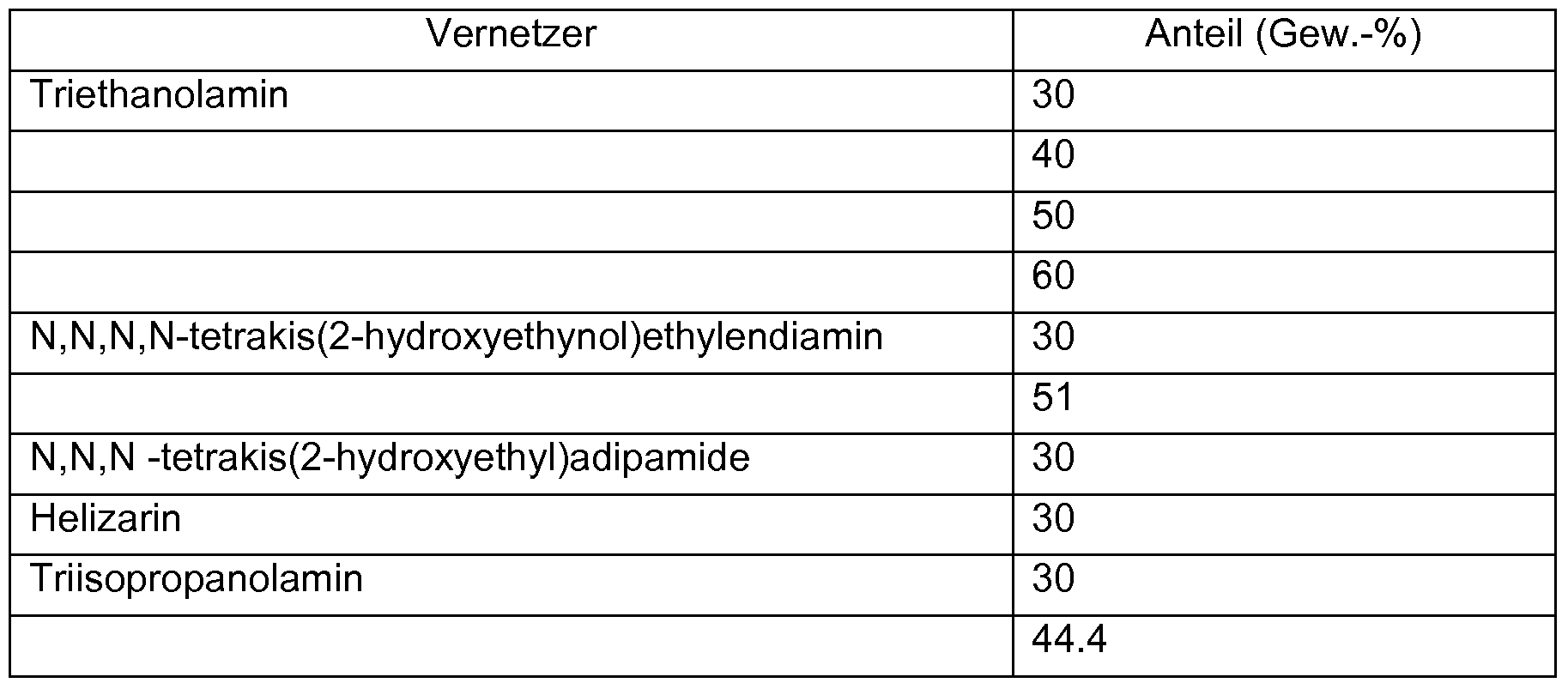
Die Schäume zeigten eine geschlossenzellige Struktur mit einer Dichte im Bereich von 50 bis 200 g/l.
C2
Zu einem Copolymer aus Itaconsäure (Molekulargewicht > 200000) wird ein Vernetzer gegeben. Die Mischung wird mit deionisiertem Wasser und 1 Gew.-% Nukleierungsmittel versetzt und gerührt. Die Gesamtlösung wird mit einem Magnetrührer über einen Zeitraum von 1 Stunde kräftig gemischt. Durch Gefrier- oder Sprühtrocknung wird ein farbloses Pulver erhalten. Das Pulver wird mit 10 Gew.-%, 30 Gew.-% bzw. 50 Gew.-% Polystyrol oder Stärke geblendet, in eine Form eingewogen und bei 140 0C über einen Zeitraum von mindestens 30 Minuten geschäumt.
Die Figuren 5 bis 7 zeigen elektronenmikroskopische Aufnahmen von Schäumen, die aus Blends der erfindungsgemäßen schäumbaren Copolymere und Styrol hergestellt wurden. Bei der Herstellung der Schäume wurden erfindungsgemäße schäumbare Copolymere mit 10 Gew.-% (Figur 5), 30 Gew.-% (Figur 6) und 50 Gew.-% (Figur 7) mit Polystyrol geblendet und anschließend geschäumt. Die Schäume zeigen eine geöffnet-zellige Struktur mit einer Dichte von 122 g/l, 280 g/l bzw. 270 g/l.
Aufnahmen einiger der in den Beispielen erhaltenen Schäume sind in den Figuren 1 bis 7 gezeigt.
Der in Figur 1 dargestellte Schaum (Itaconsäure/Acrylsäure (1 : 3 [Gew.-%]), TEA (30 Gew.-%), Talkum (1 Gew.-%)) zeigt eine geschlossen-zellige Struktur mit einer Dichte von 109 g/l. Die Größe der Zellen schwankt zwischen 50 und 400 μm.
Der in Figur 2 dargestellte Schaum (Itaconsäure/Acrylsäure (1 : 3 [Gew.-%]), THEED (30 Gew.-%), Talkum (1 Gew.-%)) zeigt eine geschlossen-zellige Struktur mit einer Dichte von 130 g/l. Die Größe der Zellen schwankt zwischen 100 und 400 μm.
Der in Figur 3 dargestellte Schaum (Itaconsäure/Acrylsäure (1 : 3 [Gew.-%]), TRIPA (30 Gew.-%), Talkum (1 Gew.-%)) zeigt eine geöffnet-zellige Struktur mit einer Dichte zwischen 100 und 200 g/l.
Figur 4 zeigt eine Lichtbildaufnahme des in Figur 3 gezeigten Schaumes.
Claims
1. Verfahren zur Herstellung von schäumbaren Copolymeren, enthaltend die Schritte:
(i) Herstellung zumindest eines Reaktionsgemisches (a) durch radikalische Copo- lymerisation einer oder mehrerer monoethylenisch ungesättigter monomeren Verbindung(en) (Monomer(e) A1 ) mit einer oder mehreren Verbindung(en) ausgewählt aus der Gruppe Itaconsäure, Mesaconsäure, Fumarsäure, Maleinsäure, Aconitsäure, Glutaconsäure sowie deren Salzen, Estern und Anhydriden (Monomer(e) A2), und
(ii) Umsetzung von zumindest einem der in Schritt (i) erhaltenen Copolymere mit einem oder mehreren Vernetzer(n) (b).
2. Verfahren nach Anspruch 1 , wobei die monoethylenisch ungesättigte(n) Verbindungen) (Monomer(e) A1 ) ausgewählt ist oder sind aus der Gruppe Styrol, α- Methylstyrol, o-Chlorstyrol, Vinylchlorid, Vinylidenchlorid, Vinylacetat, Me- thyl(meta)acrylat, Vinylpropionat, Vinyl-n-butyrat, Vinyllaurat, Vinylstearat, Itaconsäure, Acry In itri I, Methacrylnitril, Fumarsäuredinitril, Maleinsäuredinitril, 1 ,3-Butadien (Bu- tadien), Isopren, Acrylamid, Methacrylamid, Vinylsulfonsäure, Acrylsäure, Methacryl- säure, Maleinsäure, Ethacrylsäure, α-Chloracrylsäure, α-Cyanoacrylsäure, ß- Methylacrylsäure (Crotonsäure), α-Phenylacrylsäure, ß-Acryloxypropionsäure, Sorbinsäure, α-Chlorsorbinsäure, 2'-Methylisocrotonsäure, Zimtsäure, p-Chlorzimtsäure, ß-Stearylsäure, Citraconsäure, Aconitsäure, Fumarsäure, Tricarboxyethylen- und Ma- leinsäureanhydrid.
3. Verfahren nach einem der Ansprüche 1 oder 2, wobei der eine oder die mehreren Vernetzer (b) ausgewählt ist oder sind aus der Gruppe Polyole, beispielsweise Ethy- lenglykol, Polyethylenglykol wie Diethylenglykol, Triethylenglykol und Tetraethylen- glykol, Propylenglykol, Polypropylenglykol wie Dipropylenglykol, Tripropylenglykol oder Tetrapropylenglykol, 1 ,3-Butandiol, 1 ,4-Butandiol, 1 ,5-Pentandiol, 2,4- Pentandiol, 1 ,6-Hexandiol, 2,5-Hexandiol, Glycerin, Polyglycerin, Trimethylolpropan, Polyoxypropylen, Oxyethylenoxypropylen-Blockcopolymere, Sorbitanfettsäureester, Polyoxyethylensorbitanfettsäureester, Pentaerythrit, Polyvinylalkohol und Sorbitol, Aminoalkohole, beispielsweise Ethanolamin, Diethanolamin, Triethanolamin oder
Propanolamin, Polyaminverbindungen, beispielsweise Ethylendiamin, Diethylen- tetraamin, Triethylentetraamin, Tetraethylenpentanamin oder Pentaethylenhexaamin, N,N,N,N-tetrakis(2-Hydroxyethyl)ethylendiamin (THEED), N,N,N,N-tetrakis(2- Hydroxyethyl)adipamid (THEAA), Triisopropanolamin (TRIPA), Polyglycidether- Verbindungen wie Ethylenglykoldiglycidylether, Polyethylenglykoldiglycidylether, GIy- cerinpolyglycidylether, Pentaerithrytpolyglycidylether, Propylenglykoldiglycidylether, Polypropylenglykoldiglycidylether, Neopentylglykoldiglycidylether, Hexandiolglycidy- lether, Trimethylolpropanolglycidylether, Sorbitolpolyglycidylether, Phthalsäuredigly- cidylether, Adipinsäurediglycidylether, Glycidol, Polyisocyanate, vorzugsweise Diiso- cyanate wie 2,4-Toluoldiisocyanat und Hexamethylendiisocyanat, Polyacyridinverbin- dungen wie 2,2-bis-Hydroxymethylbutanol-tris[3-(1-aciridinyl)propionat], 1 ,6- Hexamethylendiethylenharnstoff und Diphenylmethan-bis-4,4'-N,N'- diethylenharnstoff, Halogenperoxide wie Epichlor- und Epibromhydrin und α- Methylepichlorhydrin, Alkylencarbonate wie 1 ,3-Dioxolan-2-on(ethylencarbonat), A- Methyl-1 ,3-dioxolan-2-on(propylencarbonat), polyquartäre Amine wie Kondensationsprodukte von Dimethylaminen und Epichlorhydrin, Di-, Tri- und Polyamine sowie Polyolverbindungen mit wenigstens zwei Hydroxylgruppen.
4. Verfahren nach einem der Ansprüche 1 bis 3, wobei in Verfahrensschritt (i) die Mo- nomeren A1 in einer Menge von 50 bis 99 Gew.-% und die Monomeren A2 in einer
Menge von 1 bis 50 Gew.-% eingesetzt werden.
5. Verfahren nach einem der Ansprüche 1 bis 4, wobei das Gewichtsverhältnis von Reaktionsgemisch (a) zu Vernetzer (b) 1 :10 bis 100:1 beträgt.
6. Verfahren nach einem der Ansprüche 1 bis 5, wobei bei der Umsetzung des Reaktionsgemisches (a) mit dem einen oder den mehreren Vernetzern (b) ein Nukleie- rungsmittel eingesetzt wird.
7. Verfahren nach Anspruch 6, wobei als Nukleierungsmittel Talkum eingesetzt wird.
8. Verfahren nach einem der Ansprüche 1 bis 7, wobei in Schritt (ii) zumindest ein Co- polymer aus Schritt (i) mit einem zahlenmittleren Molekulargewicht von 15.000 bis 1.000.000 g/Mol eingesetzt wird.
9. Verfahren nach einem der Ansprüche 1 bis 8, wobei die schäumbaren Copolymere in einem weiteren Verfahrensschritt geschäumt werden.
10. Verfahren nach Anspruch 9, wobei die schäumbaren Copolymere bei einer Tempera- tur von 50 bis 3000C geschäumt werden.
1 1. Verfahren nach Anspruch 9, wobei die schäumbaren Copolymere unter Einwirkung von Mikrowellenstrahlung geschäumt werden.
12. Schäumbare Copolymere herstellbar nach dem Verfahren gemäß einem der Ansprüche 1 bis 8
13. Polymerschaum mit einer Dichte von 40 bis 200 g/l, herstellbar nach einem der An- Sprüche 8 bis 11.
Priority Applications (4)
| Application Number | Priority Date | Filing Date | Title |
|---|---|---|---|
| AT09704779T ATE552282T1 (de) | 2008-01-23 | 2009-01-21 | Schäumbare copolymere auf basis nachwachsender rohstoffe |
| JP2010543477A JP2011510146A (ja) | 2008-01-23 | 2009-01-21 | 再生可能な原材料に基づく発泡性コポリマー |
| US12/863,734 US20110015285A1 (en) | 2008-01-23 | 2009-01-21 | Foamable copolymers based on renewable raw materials |
| EP09704779A EP2238180B1 (de) | 2008-01-23 | 2009-01-21 | Schäumbare copolymere auf basis nachwachsender rohstoffe |
Applications Claiming Priority (2)
| Application Number | Priority Date | Filing Date | Title |
|---|---|---|---|
| EP08150529.9 | 2008-01-23 | ||
| EP08150529 | 2008-01-23 |
Publications (2)
| Publication Number | Publication Date |
|---|---|
| WO2009092714A2 true WO2009092714A2 (de) | 2009-07-30 |
| WO2009092714A3 WO2009092714A3 (de) | 2009-09-24 |
Family
ID=40809792
Family Applications (1)
| Application Number | Title | Priority Date | Filing Date |
|---|---|---|---|
| PCT/EP2009/050609 Ceased WO2009092714A2 (de) | 2008-01-23 | 2009-01-21 | Schäumbare copolymere auf basis nachwachsender rohstoffe |
Country Status (5)
| Country | Link |
|---|---|
| US (1) | US20110015285A1 (de) |
| EP (1) | EP2238180B1 (de) |
| JP (1) | JP2011510146A (de) |
| AT (1) | ATE552282T1 (de) |
| WO (1) | WO2009092714A2 (de) |
Cited By (3)
| Publication number | Priority date | Publication date | Assignee | Title |
|---|---|---|---|---|
| JPWO2011078298A1 (ja) * | 2009-12-24 | 2013-05-09 | 株式会社日本触媒 | ポリアクリル酸系吸水性樹脂粉末及びその製造方法 |
| US9243079B2 (en) | 2009-02-17 | 2016-01-26 | Nippon Shokubai Co., Ltd. | Polyacrylic acid-based water-absorbing resin powder and method for producing the same |
| CN111138679A (zh) * | 2019-12-31 | 2020-05-12 | 青岛科凯达新能源科技有限公司 | 一种生物基液体温拌剂及其制备方法和应用 |
Families Citing this family (1)
| Publication number | Priority date | Publication date | Assignee | Title |
|---|---|---|---|---|
| CN106046210B (zh) * | 2016-07-15 | 2018-04-03 | 南京大学 | 一种均孔阴离子交换树脂及其制备方法和应用 |
Family Cites Families (10)
| Publication number | Priority date | Publication date | Assignee | Title |
|---|---|---|---|---|
| US2324739A (en) * | 1939-09-22 | 1943-07-20 | Carbide & Carbon Chem Corp | Enamel coating |
| US3484393A (en) * | 1966-03-21 | 1969-12-16 | Gulf Oil Corp | Foamable polymer composition and process of foaming same |
| NL7414576A (nl) * | 1973-11-14 | 1975-05-16 | Dow Chemical Co | Met latex bekleed elektrostatisch vel. |
| US4360640A (en) * | 1981-06-17 | 1982-11-23 | Mobil Oil Corporation | Acrylic modified anionic water dispersible styrene allyl alcohol copolymers |
| DE19621026A1 (de) * | 1996-05-24 | 1997-11-27 | Basf Ag | Pyridonfarbstoffe |
| US6194531B1 (en) * | 1996-06-05 | 2001-02-27 | Nippon Shokubai Co., Ltd. | Method for production of cross-linked polymer |
| US6254990B1 (en) * | 1998-02-18 | 2001-07-03 | Nippon Shokubai Co., Ltd. | Surface-crosslinking process for water-absorbent resin |
| DE19809540A1 (de) * | 1998-03-05 | 1999-09-09 | Basf Ag | Wasserabsorbierende, schaumförmige, vernetzte Polymerisate, Verfahren zu ihrer Herstellung und ihre Verwendung |
| AU2003244472A1 (en) * | 2002-02-04 | 2003-09-02 | Basf Aktiengesellschaft | A process for the reduction of the residual monomer content of water-absorbent foam |
| US7803849B2 (en) * | 2006-04-26 | 2010-09-28 | Jsp Corporation | Acrylic resin expanded beads, acrylic resin expandable beads, and method for manufacturing foamed molded article of acrylic resin expanded beads |
-
2009
- 2009-01-21 AT AT09704779T patent/ATE552282T1/de active
- 2009-01-21 JP JP2010543477A patent/JP2011510146A/ja not_active Withdrawn
- 2009-01-21 US US12/863,734 patent/US20110015285A1/en not_active Abandoned
- 2009-01-21 EP EP09704779A patent/EP2238180B1/de not_active Not-in-force
- 2009-01-21 WO PCT/EP2009/050609 patent/WO2009092714A2/de not_active Ceased
Cited By (5)
| Publication number | Priority date | Publication date | Assignee | Title |
|---|---|---|---|---|
| US9243079B2 (en) | 2009-02-17 | 2016-01-26 | Nippon Shokubai Co., Ltd. | Polyacrylic acid-based water-absorbing resin powder and method for producing the same |
| JPWO2011078298A1 (ja) * | 2009-12-24 | 2013-05-09 | 株式会社日本触媒 | ポリアクリル酸系吸水性樹脂粉末及びその製造方法 |
| US9334376B2 (en) | 2009-12-24 | 2016-05-10 | Nippon Shokubai Co., Ltd | Water-absorbable polyacrylic acid resin powder, and process for production thereof |
| CN111138679A (zh) * | 2019-12-31 | 2020-05-12 | 青岛科凯达新能源科技有限公司 | 一种生物基液体温拌剂及其制备方法和应用 |
| CN111138679B (zh) * | 2019-12-31 | 2021-10-19 | 青岛科凯达新能源科技有限公司 | 一种生物基液体温拌剂及其制备方法和应用 |
Also Published As
| Publication number | Publication date |
|---|---|
| ATE552282T1 (de) | 2012-04-15 |
| JP2011510146A (ja) | 2011-03-31 |
| EP2238180A2 (de) | 2010-10-13 |
| EP2238180B1 (de) | 2012-04-04 |
| WO2009092714A3 (de) | 2009-09-24 |
| US20110015285A1 (en) | 2011-01-20 |
Similar Documents
| Publication | Publication Date | Title |
|---|---|---|
| EP1034191B2 (de) | Verfahren zur herstellung von synthetischen polymerisaten mit sehr niedrigem restmonomergehalt, danach hergestellte produkte und deren verwendung | |
| EP2238180B1 (de) | Schäumbare copolymere auf basis nachwachsender rohstoffe | |
| EP3867304A1 (de) | Polyetherblockamid-poly(meth)acrylat-schäume | |
| AU746368B2 (en) | Method for producing water-soluble or water-swellable polymerizates with a very low residual monomer content, products produced according to this method and the use thereof | |
| EP1951773B1 (de) | Verfahren zur herstellung von pfropfpolymerisaten | |
| EP1789455A1 (de) | Verfahren zur herstellung von polymeren durch sprühpolymerisation | |
| EP2158266B1 (de) | Verfahren zur herstellung von formkörpern | |
| EP2072578A1 (de) | Wässriges Bindemittel für faserförmige oder körnige Substrate | |
| CN101735369B (zh) | 一种制备无皂疏水聚合物多孔材料的反相乳液模板法 | |
| JP2017520632A (ja) | 水溶性塩を含む高吸水性樹脂およびその製造方法 | |
| WO2001068727A1 (de) | Verfahren zur einstellung der teilchengrösse von popcornpolymeren während der popcornpolymerisation | |
| CN115947980A (zh) | 一种软质pvc发泡用钙锌热稳定剂及其应用 | |
| CN111087558A (zh) | 一种改性丙烯酸基高强度耐盐高吸收性树脂及其制备方法 | |
| EP0027936B1 (de) | Verfahren zur Herstellung von pulverförmigen Polymerisaten | |
| EP0373439A2 (de) | Verfahren zur Steuerung der Teilchengrösse bei der Herstellung von pulverförmigen Polymerisaten | |
| WO2010108791A1 (de) | Verwendung von schutzkolloid-stabilisierten polymerisaten als low-profile-additive (lpa) | |
| EP1761622A1 (de) | Verfahren zur herstellung von granulären oder pulverförmigen waschmittelzusammensetzungen | |
| EP0746575A1 (de) | Verfahren zur herstellung von copolymerisaten aus vinylestern und monoethylenisch ungesättigten carbonsäuren und ihre verwendung | |
| DE2820947C2 (de) | ||
| EP1151072A2 (de) | Verwendung von vernetzten polymerisaten zur erhöhung der zerfallsgeschwindigkeit von kompakten, teilchenförmigen wasch- und reinigungsmitteln | |
| CN116171299A (zh) | 超吸收性聚合物的制备方法 | |
| EP2804893B1 (de) | Verwendung von funktionalisierten polymerisaten als low-profile-additive (lpa) | |
| JP2011256269A (ja) | 水溶性重合体の製造方法 | |
| WO1995034587A1 (de) | Vinylformiateinheiten enthaltende copolymerisate, verfahren zu ihrer herstellung und ihre verwendung in wasch- und reinigungsmitteln | |
| JPS5945633B2 (ja) | 徐溶性肥料 |
Legal Events
| Date | Code | Title | Description |
|---|---|---|---|
| 121 | Ep: the epo has been informed by wipo that ep was designated in this application |
Ref document number: 09704779 Country of ref document: EP Kind code of ref document: A2 |
|
| WWE | Wipo information: entry into national phase |
Ref document number: 2010543477 Country of ref document: JP |
|
| NENP | Non-entry into the national phase |
Ref country code: DE |
|
| WWE | Wipo information: entry into national phase |
Ref document number: 2009704779 Country of ref document: EP |
|
| WWE | Wipo information: entry into national phase |
Ref document number: 12863734 Country of ref document: US |