WO2009122931A1 - Procédé et dispositif d'authentification utilisant une mesure de débit sanguin sous-cutané - Google Patents
Procédé et dispositif d'authentification utilisant une mesure de débit sanguin sous-cutané Download PDFInfo
- Publication number
- WO2009122931A1 WO2009122931A1 PCT/JP2009/055580 JP2009055580W WO2009122931A1 WO 2009122931 A1 WO2009122931 A1 WO 2009122931A1 JP 2009055580 W JP2009055580 W JP 2009055580W WO 2009122931 A1 WO2009122931 A1 WO 2009122931A1
- Authority
- WO
- WIPO (PCT)
- Prior art keywords
- blood flow
- finger
- image sensor
- laser
- pixel
- Prior art date
- Legal status (The legal status is an assumption and is not a legal conclusion. Google has not performed a legal analysis and makes no representation as to the accuracy of the status listed.)
- Ceased
Links
Images


Classifications
-
- G—PHYSICS
- G06—COMPUTING OR CALCULATING; COUNTING
- G06V—IMAGE OR VIDEO RECOGNITION OR UNDERSTANDING
- G06V40/00—Recognition of biometric, human-related or animal-related patterns in image or video data
- G06V40/10—Human or animal bodies, e.g. vehicle occupants or pedestrians; Body parts, e.g. hands
- G06V40/12—Fingerprints or palmprints
- G06V40/13—Sensors therefor
- G06V40/1312—Sensors therefor direct reading, e.g. contactless acquisition
-
- A—HUMAN NECESSITIES
- A61—MEDICAL OR VETERINARY SCIENCE; HYGIENE
- A61B—DIAGNOSIS; SURGERY; IDENTIFICATION
- A61B5/00—Measuring for diagnostic purposes; Identification of persons
- A61B5/48—Other medical applications
- A61B5/4887—Locating particular structures in or on the body
- A61B5/489—Blood vessels
-
- A—HUMAN NECESSITIES
- A61—MEDICAL OR VETERINARY SCIENCE; HYGIENE
- A61B—DIAGNOSIS; SURGERY; IDENTIFICATION
- A61B5/00—Measuring for diagnostic purposes; Identification of persons
- A61B5/68—Arrangements of detecting, measuring or recording means, e.g. sensors, in relation to patient
- A61B5/6801—Arrangements of detecting, measuring or recording means, e.g. sensors, in relation to patient specially adapted to be attached to or worn on the body surface
- A61B5/6813—Specially adapted to be attached to a specific body part
- A61B5/6825—Hand
- A61B5/6826—Finger
-
- A—HUMAN NECESSITIES
- A61—MEDICAL OR VETERINARY SCIENCE; HYGIENE
- A61B—DIAGNOSIS; SURGERY; IDENTIFICATION
- A61B5/00—Measuring for diagnostic purposes; Identification of persons
- A61B5/68—Arrangements of detecting, measuring or recording means, e.g. sensors, in relation to patient
- A61B5/6801—Arrangements of detecting, measuring or recording means, e.g. sensors, in relation to patient specially adapted to be attached to or worn on the body surface
- A61B5/683—Means for maintaining contact with the body
- A61B5/6838—Clamps or clips
-
- G—PHYSICS
- G06—COMPUTING OR CALCULATING; COUNTING
- G06F—ELECTRIC DIGITAL DATA PROCESSING
- G06F21/00—Security arrangements for protecting computers, components thereof, programs or data against unauthorised activity
- G06F21/30—Authentication, i.e. establishing the identity or authorisation of security principals
- G06F21/31—User authentication
- G06F21/32—User authentication using biometric data, e.g. fingerprints, iris scans or voiceprints
-
- G—PHYSICS
- G07—CHECKING-DEVICES
- G07C—TIME OR ATTENDANCE REGISTERS; REGISTERING OR INDICATING THE WORKING OF MACHINES; GENERATING RANDOM NUMBERS; VOTING OR LOTTERY APPARATUS; ARRANGEMENTS, SYSTEMS OR APPARATUS FOR CHECKING NOT PROVIDED FOR ELSEWHERE
- G07C9/00—Individual registration on entry or exit
- G07C9/30—Individual registration on entry or exit not involving the use of a pass
- G07C9/32—Individual registration on entry or exit not involving the use of a pass in combination with an identity check
- G07C9/37—Individual registration on entry or exit not involving the use of a pass in combination with an identity check using biometric data, e.g. fingerprints, iris scans or voice recognition
-
- A—HUMAN NECESSITIES
- A61—MEDICAL OR VETERINARY SCIENCE; HYGIENE
- A61B—DIAGNOSIS; SURGERY; IDENTIFICATION
- A61B5/00—Measuring for diagnostic purposes; Identification of persons
- A61B5/02—Detecting, measuring or recording for evaluating the cardiovascular system, e.g. pulse, heart rate, blood pressure or blood flow
- A61B5/026—Measuring blood flow
- A61B5/0261—Measuring blood flow using optical means, e.g. infrared light
-
- G—PHYSICS
- G06—COMPUTING OR CALCULATING; COUNTING
- G06V—IMAGE OR VIDEO RECOGNITION OR UNDERSTANDING
- G06V40/00—Recognition of biometric, human-related or animal-related patterns in image or video data
- G06V40/10—Human or animal bodies, e.g. vehicle occupants or pedestrians; Body parts, e.g. hands
- G06V40/14—Vascular patterns
Definitions
- the present invention relates to a personal identification method characterized by measuring subcutaneous blood flow and a device used therefor.
- the present invention relates to a method for performing personal authentication by extracting a pattern or the like corresponding to a fingerprint from a blood flow map of a finger pad and a device used therefor.
- a variety of systems for analyzing and inputting patterns as images into a computer using a laser or the like have been developed to date, in place of the long-standing visual identification method for fingerprint identification.
- a large number of techniques have been proposed for the sensor part that detects fingerprints, and an optical method for incorporating a fingerprint pattern directly into an image sensor by combining the difference in scattering angle between peaks and valleys and total reflection conditions, or the difference in charge distribution on the contact surface
- a method of extracting a pattern by using a semiconductor sensor that detects the is also put to practical use.
- a method of personal authentication by extracting a vein pattern of a finger tip or a palm using near infrared light has been proposed, and commercialization is also in progress (for example, see Patent Documents 1 to 3).
- a fingerprint pattern is more complicated in shape than a vein pattern, so it may be possible to construct a more accurate personal identification system.
- the fingerprint is made of a material such as silicon, it is possible to forge the same shape as the finger pad , There is a risk of false certification.
- Patent Documents 10 and 11 when the blood flow of the fingertip is imaged by laser blood flow imaging, the fingerprint pattern appears in the blood flow map because the blood flow in the valley portion of the fingerprint is faster than the mountain portion. Is used to certify that it is the finger of the person who is alive (Patent Document 10). In addition, by using near-infrared laser light, the blood flow distribution inside the finger is detected, and the accuracy of identification and exclusion of others is increased, or the blood flow of the fingertip fluctuates in synchronization with the heartbeat. There is also proposed a method of analyzing the waveform to determine whether it is a living finger or a simulated finger (Patent Document 11).
- the inventor has found that it is better to measure blood flow by weighting changes in blood flow inside rather than the surface layer of the skin, and in order to realize this, create the following technical matters It is (1) By shifting the region irradiated by the laser and the region to be observed by the image sensor, the light signal component detected after passing through the inside of the surface layer is increased. (2) Irradiate the finger with a laser and place the image sensor on the fingertip side or vice versa.
- the laser passes through the inside of the finger for a sufficiently long distance, Can accurately capture the changes in blood flow in (3)
- the laser scattering wave interferes and a fixed pattern is superimposed on the pattern formed on the image sensor, and the dispersion value between each pixel Will increase. Then, it is possible to determine whether the finger is a simulated finger by using the difference in variance between pixels.
- the invention described in claim 1 spreads the laser beam and irradiates the finger pad, and the light reflected from the blood vessel layer present subcutaneously is bound as laser speckle on the image sensor using the optical system.
- An image is generated to calculate an amount representing the speed of time-dependent change in the amount of light received at each pixel of laser speckle, the numerical value is converted into a two-dimensional map to obtain a blood flow map of a finger pad, and the blood flow map
- the personal identification method using subcutaneous blood flow measurement characterized by comparing and collating with personal data registered in advance, the laser deviated from the irradiation site of the laser as the observation area of the image sensor, the laser on the image sensor It is a personal identification method using subcutaneous blood flow measurement characterized by imaging speckle.
- the invention described in claim 2 uses a laser beam as a linear spot, uses a line sensor as an image sensor, and sets the observation area of the line sensor to be parallel to the linear spot. It is a personal identification method using the subcutaneous blood flow measurement according to claim 1 characterized by the above.
- the invention described in claim 3 is characterized in that the central part of the finger pad is irradiated with a laser, and the observation region of the image sensor is set on the fingertip side of the finger pad. It is the personal authentication method used.
- the invention described in claim 4 is characterized in that the fingertip portion of the finger pad is irradiated with a laser, and the observation area of the image sensor is set in the central part of the finger pad. It is the personal authentication method used.
- the invention described in claim 5 detects a signal waveform representing the intensity distribution of the light reception amount in each pixel of at least one row on the image sensor, and the signal waveform is a signal waveform of a finger of a living body preset. 5.
- the invention described in claim 6 has one or two irradiation means for expanding a laser beam and irradiating the finger pad, and a large number of pixels for receiving light reflected from the blood vessel layer under the finger pad.
- a second storage unit for storing, as a blood flow map, a two-dimensional distribution of calculation results obtained in each of the pixels, and personal data registered in advance for the blood flow map stored in the second storage unit
- the irradiating means and the light receiving means are disposed such that the irradiation site of the laser and the observation area of the reflected light by the image sensor are deviated.
- Subcutaneous blood flow measurement It is the personal authentication device.
- the invention described in claim 7 detects a signal waveform representing the intensity distribution of the light reception amount in each pixel of at least one row on the image sensor, and the signal waveform is a signal waveform of a finger of a living body preset.
- a laser beam is expanded and irradiated to the finger pad, and light reflected from a blood vessel layer under the skin is imaged as a laser speckle on an image sensor using an optical system, and a laser An amount representing the speed of temporal change of the light reception amount at each pixel of speckle is calculated, the numerical value is converted to a two-dimensional map to obtain a blood flow map of the finger pad, and the blood flow map is registered in advance
- Subcutaneous blood flow measurement characterized by comparing and collating with personal data in use and determining the time-dependent change of the average blood flow in the whole or a certain area, and comparing and judging the obtained value with a predetermined standard.
- the invention according to claim 9 has one or two irradiation means for expanding a laser beam and irradiating the finger pad, and a large number of pixels to receive light reflected from the blood vessel layer under the finger pad.
- a second storage unit for storing, as a blood flow map, a two-dimensional distribution of calculation results obtained in each of the pixels, and personal data registered in advance for the blood flow map stored in the second storage unit
- a personal authentication apparatus comprising means for comparing / determining with and calculating means of temporal change of average blood flow in the whole or a certain area and comparing / determining the obtained value with a predetermined reference
- the irradiating means and the light receiving means It is the personal authentication device using subcutaneous blood flow measurement, characterized in that observation area of the light reflected by the irradi
- the invention described in claim 10 detects a signal waveform representing the intensity distribution of the light reception amount in each pixel of at least one row on the image sensor, and the signal waveform is a signal waveform of a finger of a living body preset.
- a laser beam is expanded to irradiate the finger pad, and light reflected from a blood vessel layer under the skin is imaged as a laser speckle on an image sensor using an optical system, and a laser An amount representing the speed of temporal change of the light reception amount at each pixel of speckle is calculated, the numerical value is converted to a two-dimensional map to obtain a blood flow map of the finger pad, and the blood flow map is registered in advance
- the personal identification method using subcutaneous blood flow measurement characterized by comparing and collating with personal data, at least one row on the image sensor using time zones before, after or during these operations
- a subcutaneous function characterized by detecting a signal waveform representing the intensity distribution of the amount of light received in each pixel, comparing the signal waveform with a signal waveform of a finger of a living body set in advance, and detecting a simulated finger.
- Blood flow measurement Is the use the personal authentication method.
- the invention described in claim 12 has one or two irradiation means for expanding a laser beam and irradiating the finger pad, and a large number of pixels to receive light reflected from the blood vessel layer under the finger pad.
- a second storage unit for storing, as a blood flow map, a two-dimensional distribution of calculation results obtained in each of the pixels, and personal data registered in advance for the blood flow map stored in the second storage unit
- detecting a signal waveform representing an intensity distribution of the amount of light received in each pixel of at least one row on the image sensor and detecting the signal waveform by a finger of a living body set in advance.
- a personal authentication device using subcutaneous blood flow measurement characterized in that the addition means for detecting.
- the invention described in claim 13 spreads a laser beam and irradiates a finger pad, and light reflected from a blood vessel layer under the skin is imaged as a laser speckle on an image sensor using an optical system, and a laser An amount representing the speed of time change of the light reception amount at each pixel of speckle is calculated, and the numerical value is used as a two-dimensional map to obtain a blood flow map of the finger pad, and the blood flow map is preregistered personal data
- a laser beam is passed through a shielding plate having a large number of long slits to form a grid-like laser spot on the finger pad.
- Projection aligning the direction of the spot and the scanning line of the sensor, and analyzing the data on the spot to detect a blood flow map of the surface portion of the finger pad and its change over time, or A personal authentication method utilizing subcutaneous blood flow measurements and detecting the blood flow map and its change with time of the inner layer portion of the data to analyze the finger pad between the pot.
- the invention described in claim 14 spreads a laser beam and irradiates a finger pad, and light reflected from a blood vessel layer under the skin is imaged as a laser speckle on an image sensor using an optical system, and a laser An amount representing the speed of time change of the light reception amount at each pixel of speckle is calculated, and the numerical value is used as a two-dimensional map to obtain a blood flow map of the finger pad, and the blood flow map is preregistered personal data An individual who uses subcutaneous blood flow measurement characterized by comparing and comparing with a subject, determining the time-dependent change of the average blood flow in the whole or a certain area, and comparing and judging the obtained value with a predetermined reference.
- the authentication method by passing the laser through a shield having a large number of long slits, a grid-like laser spot is projected onto the finger pad, and the spot and the scanning line of the sensor are aligned. Analyzing the data on the spot to detect the blood flow map of the surface layer of the finger pad and its change over time, or analyzing the data between the spots and the blood flow map of the inner layer of the finger pad and It is a personal identification method using subcutaneous blood flow measurement characterized by detecting change over time.
- Personal identification technology using fingerprint patterns based on laser specks of fingers and the like draws fingerprint patterns using blood flow information specific to the living body, and the patterns are synchronized with the heartbeat and temporally It is based on fluctuating, and thus, a model combining a two-dimensional pattern and a time axis is very difficult to forge.
- a simulated finger imitating the unevenness of a fingerprint with silicone resin or the like, or a thin sheet that is attached to the finger is erroneously recognized as a real finger.
- blood flow information in the inside of the finger can be extracted more accurately, and even if the blood flow is low due to cold in a cold area or the like, the internal blood flow signal can be reliably obtained. Being able to pick up allows a clear distinction between the simulated finger and the finger of a standard person.
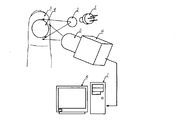
- FIG. 1 shows a conceptual diagram of conventional laser speckle-based personal identification technology.
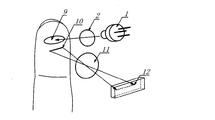
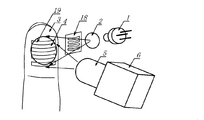
- FIG. 1 shows a conceptual diagram of the laser speckle-based personal identification technique of the present invention. It is a figure which shows an example of the irradiation spot of the laser in this invention, and the relationship of the observation position of an image sensor. It is a figure which shows the other example of the relationship between the irradiation spot of the laser in this invention, and the observation position of an image sensor. It is a figure which shows the signal of the line sensor obtained from the blood-vessel layer and the stratum corneum of a finger. It is a figure which shows the example in the case of making the grid
- the personal identification technology using fingerprint pattern etc. based on the laser speckle of the finger pad is to measure the subcutaneous blood flow spatially modulated by the unevenness of the fingerprint by the blood flow measurement technology using laser scattering.
- a laser beam is expanded to irradiate the finger pad, and light reflected from the blood vessel layer present subcutaneously is imaged as a speckle pattern on the image sensor using an optical system. .
- speckles are continuously scanned using an image sensor, and an amount representing the speed of time change of the light reception amount at each pixel, for example, the light reception integrated according to the average time change rate or the exposure time of the image sensor
- the reciprocal of the amount variation is calculated, and the obtained numerical values are converted into a two-dimensional map to obtain a finger belly blood flow map.
- a fingerprint pattern or the like that appears as a blood flow map is compared and determined with personal data registered in advance.
- the time-dependent change of the average blood flow in the whole or a certain area is calculated, and the process of comparing and judging with a predetermined standard is also added.
- the present invention is a further improvement of the personal identification technology using a fingerprint pattern or the like based on the laser speckle of the finger pad described above, and an observation area of the reflected light by the image sensor from the area shifted from the laser irradiation site.
- FIG. 1 shows a conceptual diagram of a conventional personal identification technology using a fingerprint pattern or the like based on laser speckle based on finger blood flow measurement.
- 1 is a small laser light source such as a semiconductor laser
- 2 is an optical system
- 3 is a finger pad
- 4 is a laser spot (irradiated spot) or an observation area
- 5 is an imaging optical system
- 6 is an image sensor or CCD camera
- 7 is An analysis personal computer
- 8 shows a display.
- a small-sized laser light source 1 such as a semiconductor laser is spread through an optical system 2 and irradiated to a wide area (irradiated spot 4) of a finger pad 3.
- the irradiation spot is imaged on a light receiving surface such as an image sensor or a CCD camera 6 through an imaging optical system 5.
- a video signal obtained from an image sensor or a CCD camera is A / D converted and taken into the analyzing personal computer 7, and an amount representing the speed of time change of the light receiving amount in each pixel, for example, an average time change rate or an image
- the reciprocal of the degree of variation of the light reception amount integrated in accordance with the exposure time of the sensor is calculated, and if necessary, it is displayed on the display 8 in the form of a map to make blood flow map data.
- a fingerprint pattern or the like comes out, so this data is compared with data registered in advance to perform personal authentication.
- a method / means for comparing / determining a fingerprint pattern or the like appearing as a blood flow map with personal data registered in advance it is not necessary to be special one, and it is possible to use conventionally known methods / means it can.
- FIG. 2 shows a conceptual view in which laser speckles are imaged on the image sensor by shifting the observation field of the reflected light by the image sensor and the irradiation site of the laser.
- 1 is a semiconductor laser
- 2 is an optical system
- 9 is a laser spot
- 10 is a linear observation area
- 11 is an imaging lens
- 12 is a line sensor.
- the laser spot is a horizontally long oval, but may be a linear spot.
- the observation area does not have to be linear, and the sensor may be a two-dimensional image sensor. It is preferable that the laser beam be a linear spot, a line sensor be used as an image sensor, and the observation area of the line sensor and the linear spot be parallel.
- a laser may be irradiated to the finger tip portion of the finger pad, and the observation region of the image sensor may be set in the center portion of the finger pad.
- a signal waveform representing the intensity distribution of the light reception amount in each pixel of at least one row on the image sensor is detected, and this signal waveform is compared with a signal waveform of a finger of a living body set in advance. It is also a preferable aspect to add a function of detecting a simulated finger. This will be described with reference to FIG.
- 15 is a subcutaneous blood vessel layer
- 16 is a stratum corneum
- 17 is a thin film such as silicon.
- FIG. 5 is a line sensor signal obtained from the subcutaneous blood vessel layer 15 and the stratum corneum 16 of a normal finger, the horizontal axis P of the graph is the pixel position (pixel) and the vertical axis I is the light signal intensity.
- Show. (B) of FIG. 5 is a signal obtained when the thin film 17 such as silicon is attached to the surface of the finger, and the contrast of the waveform is high as can be seen from the graph.
- the laser strikes a layer having no blood flow, ie, a layer having no movement of scattering particles inside, stationary speckles are formed when the reflected scattered light interferes at the image plane. Therefore, when the light intensity distribution is scanned by a line sensor or the like, a signal waveform with high contrast is obtained as shown in the graph of FIG. 5B, and since the pattern is stationary, the waveform does not change.
- the interference condition changes every moment at each point on the image plane (because it interferes in the same phase in some cases and in the opposite phase in some cases), the pattern of light and dark changes over time To go.
- the pattern changes quickly to several kilohertz, it is integrated within the exposure time of the image sensor, resulting in a blurred image, and the contrast decreases as shown in the graph of FIG. 5A.
- the motionless scattering particle is on the near side so that it is close to a stationary speckle image, and a scanning signal with high contrast is obtained as in the graph of FIG. Be
- This effect can be used, for example, to set a certain reference value that can be taken by the living body, and to identify an artifact that deviates therefrom.
- the function of detecting a simulated finger can be used in addition to the inventions described in claims 1 to 4 of the present invention.
- such an embodiment may be combined directly with conventional personal identification methods using subcutaneous blood flow measurement. That is, in the conventional personal identification method, a signal waveform representing the intensity distribution of the light reception amount in each pixel of at least one row on the image sensor is utilized using time zones before and after or during the progress of each operation for authentication.
- a function of detecting a simulated finger can be added and combined by detecting and comparing the signal waveform with a signal waveform of a predetermined finger of a living body. This allows for a clearer distinction between a simulated finger and a standard human finger.
- the lattice-like laser spot 19 may be projected on the finger pad by passing the laser through a shielding plate 18 having a large number of horizontally long slits.
- the distribution of the blood flow in the surface layer and its change over time can be detected by analyzing the data on the spot by aligning the horizontally long spot with the direction of the scanning line of the camera.
- a laser beam is expanded to irradiate the finger pad, and light reflected from a blood vessel layer under the skin is imaged as laser speckle on an image sensor using an optical system, and each pixel of the laser speckle is Calculate an amount representing the speed of temporal change of received light amount, convert the numerical value into a two-dimensional map to obtain a blood flow map of the finger pad, and compare the blood flow map with personal data registered in advance
- one laser beam of a specific wavelength is irradiated to the finger pad, or a plurality of different laser beams of a specific wavelength is irradiated to the finger pad simultaneously or sequentially, and subcutaneous and internal It also includes a method and means for determining a superposition or plurality of blood flow velocity maps for reflected light from the blood vessel layer in the tissue.
- Lasers have different tissue penetrations depending on the wavelength, and short wavelength such as visible light has distribution of blood flow near the surface, that is, only fingerprint pattern can be obtained but long wavelength such as near infrared light
- short wavelength such as visible light
- long wavelength such as near infrared light
- the blood flow map reflecting the blood flow distribution inside can be obtained because it deeply penetrates inside the tissue. Since there is individual difference in the internal blood flow distribution and forgery is difficult, if this is added to the authentication data, the individual matching accuracy can be improved by a synergy effect.
- the present invention is also applicable to such prior art.
- the blood flow map of the finger can be obtained by the reflected light
- the irradiation spot of each laser and the observation area may be shifted.
- an apparatus for performing the above-described personal authentication method comprises one or two irradiation means for expanding a laser beam and irradiating the finger pad, a light receiving means having a large number of pixels and receiving reflected light from the blood vessel layer under the finger pad, Storage means for storing the output of each pixel obtained by the light receiving means; computing means for computing an amount representing the speed of time change of the light reception amount in each pixel from the storage contents of the storage means; A second storage unit for storing the two-dimensional distribution of the calculation result obtained in step as a blood flow map, and comparing the blood flow map stored in the second storage unit with personal data registered in advance
- the irradiating means and the light receiving means are arranged so that the irradiation site of the laser and the observation field of the reflected light by the image sensor are deviated.
- Personal recognition using It is a device.
- another apparatus has one or two irradiation means for expanding a laser beam and irradiating the finger pad, and has a large number of pixels to receive the reflected light from the blood vessel layer under the finger pad.
- Light receiving means storage means for storing the output of each of the pixels obtained by the light receiving means, and arithmetic means for calculating an amount representing the speed of time change of the light receiving amount in each of the pixels from the storage contents of the storage means
- a second storage unit for storing, as a blood flow map, a two-dimensional distribution of the calculation result obtained in each of the pixels, and an individual whose blood flow map stored in the second storage unit is registered in advance
- a personal identification device comprising means for comparing and judging data, and additionally, means for calculating the time-dependent change of average blood flow in the whole or a certain area, and comparing and judging with a predetermined reference
- the light emitting means and the light receiving And the step is a personal authentication device using subcutaneous blood flow measurement, characterized in that it is arranged so
- a signal waveform representing the intensity distribution of the light reception amount in each pixel of at least one row on the image sensor is detected, and the signal waveform is preset.
- a means for detecting a simulated finger can be added as compared to the signal waveform of the finger of the living body.
- Yet another aspect of the apparatus of the present invention comprises one or two irradiation means for expanding a laser beam and irradiating the finger pad, and a large number of pixels to receive reflected light from the blood vessel layer under the finger pad.
- Light receiving means storage means for storing the output of each of the pixels obtained by the light receiving means, and arithmetic means for calculating an amount representing the speed of time change of the light receiving amount in each of the pixels from the storage contents of the storage means
- a second storage unit for storing, as a blood flow map, a two-dimensional distribution of the calculation result obtained in each of the pixels, and an individual whose blood flow map stored in the second storage unit is registered in advance
- the personal identification device equipped with means for comparing and judging data, a signal waveform representing the intensity distribution of the amount of light received in each pixel of at least one row on the image sensor is detected, and the signal waveform is preset Compared to the finger signal waveform, ⁇ a personal authentication device using subcutaneous blood flow measurement, characterized in that the addition
- an irradiation means for example, light emitted from a semiconductor laser is spread through a lens, and a wide area of the finger pad is irradiated at one time.
- An image sensor such as a line sensor or an area sensor is used as the light receiving unit.
- the electrical signal from the sensor is A / D converted and then stored in the storage unit of the microcomputer or personal computer.
- An image signal is continuously taken into the storage unit for several seconds, and a difference between two consecutive images is obtained by a program preset in a microcomputer or a personal computer, and the speed of time change of the light reception amount is calculated.
- the speed of light reception is calculated using the blurring rate of the image, that is, when the light quantity changes at high speed within the exposure time of the image sensor, the signal is integrated and the difference between the two screens decreases. Do.
- the calculation result can also be displayed as a two-dimensional color map on the screen of the personal computer according to the arrangement of each pixel.
- Various conventionally known means can be used as means for comparing / determining the calculated value or the fingerprint pattern displayed on the display means with the fingerprint pattern of an individual registered in advance.
- the temporal change over a few seconds of the blood flow value averaged for a certain area of the finger pad can be determined, and for example, the wave shape, amplitude, period, etc. of this blood flow change can be used.
- the personal identification method and apparatus according to the present invention is difficult to forge because it combines complex fingerprint patterns and biometric information. By taking advantage of this advantage, it can be used for entry and exit monitoring of facilities that require a high degree of security management, and immigration control.
Landscapes
- Engineering & Computer Science (AREA)
- Health & Medical Sciences (AREA)
- Life Sciences & Earth Sciences (AREA)
- Physics & Mathematics (AREA)
- Molecular Biology (AREA)
- General Health & Medical Sciences (AREA)
- General Physics & Mathematics (AREA)
- Biophysics (AREA)
- Pathology (AREA)
- Biomedical Technology (AREA)
- Heart & Thoracic Surgery (AREA)
- Medical Informatics (AREA)
- Theoretical Computer Science (AREA)
- Surgery (AREA)
- Animal Behavior & Ethology (AREA)
- Veterinary Medicine (AREA)
- Public Health (AREA)
- Computer Security & Cryptography (AREA)
- Human Computer Interaction (AREA)
- Vascular Medicine (AREA)
- Computer Hardware Design (AREA)
- Software Systems (AREA)
- General Engineering & Computer Science (AREA)
- Multimedia (AREA)
- Measurement Of The Respiration, Hearing Ability, Form, And Blood Characteristics Of Living Organisms (AREA)
- Collating Specific Patterns (AREA)
- Image Input (AREA)
Abstract
Priority Applications (2)
| Application Number | Priority Date | Filing Date | Title |
|---|---|---|---|
| JP2010505609A JP5340262B2 (ja) | 2008-04-03 | 2009-03-23 | 皮下血流測定を利用した個人認証方法及び個人認証装置 |
| US12/936,142 US8494228B2 (en) | 2008-04-03 | 2009-03-23 | Personal authentication method using subcutaneous bloodstream measurement and personal authentication device |
Applications Claiming Priority (2)
| Application Number | Priority Date | Filing Date | Title |
|---|---|---|---|
| JP2008-096679 | 2008-04-03 | ||
| JP2008096679 | 2008-04-03 |
Publications (1)
| Publication Number | Publication Date |
|---|---|
| WO2009122931A1 true WO2009122931A1 (fr) | 2009-10-08 |
Family
ID=41135313
Family Applications (1)
| Application Number | Title | Priority Date | Filing Date |
|---|---|---|---|
| PCT/JP2009/055580 Ceased WO2009122931A1 (fr) | 2008-04-03 | 2009-03-23 | Procédé et dispositif d'authentification utilisant une mesure de débit sanguin sous-cutané |
Country Status (3)
| Country | Link |
|---|---|
| US (1) | US8494228B2 (fr) |
| JP (1) | JP5340262B2 (fr) |
| WO (1) | WO2009122931A1 (fr) |
Cited By (6)
| Publication number | Priority date | Publication date | Assignee | Title |
|---|---|---|---|---|
| WO2012143977A1 (fr) * | 2011-04-22 | 2012-10-26 | 株式会社日立製作所 | Dispositif de capture d'image de vaisseaux sanguins, et dispositif d'authentification d'organe |
| JP2014099065A (ja) * | 2012-11-14 | 2014-05-29 | Fujitsu Ltd | 画像処理装置、画像処理システム、画像処理方法及びプログラム |
| WO2016132628A1 (fr) * | 2015-02-17 | 2016-08-25 | ソニー株式会社 | Unité optique, système de mesure et procédé de mesure |
| JP2019171225A (ja) * | 2019-07-23 | 2019-10-10 | 京セラ株式会社 | 測定装置及び測定方法 |
| WO2022202051A1 (fr) * | 2021-03-22 | 2022-09-29 | ソニーグループ株式会社 | Système d'observation biologique, procédé d'observation biologique et dispositif d'irradiation |
| WO2024142398A1 (fr) | 2022-12-28 | 2024-07-04 | 日本電気株式会社 | Dispositif de traitement d'informations, système de traitement d'informations, procédé de traitement d'informations, et support d'enregistrement |
Families Citing this family (20)
| Publication number | Priority date | Publication date | Assignee | Title |
|---|---|---|---|---|
| JP3252938B2 (ja) | 1994-03-02 | 2002-02-04 | 日本電信電話株式会社 | シールドセグメントの継手構造 |
| US8489178B2 (en) * | 2006-06-29 | 2013-07-16 | Accuvein Inc. | Enhanced laser vein contrast enhancer with projection of analyzed vein data |
| CN102357033B (zh) * | 2011-09-27 | 2013-07-24 | 华中科技大学 | 一种激光散斑血流成像处理系统及方法 |
| US9848787B2 (en) | 2012-02-07 | 2017-12-26 | Laser Associated Sciences, Inc. | Perfusion assessment using transmission laser speckle imaging |
| US9396402B2 (en) * | 2012-10-09 | 2016-07-19 | Terence Vardy | System and methods for identification and fraud prevention |
| US8966616B2 (en) * | 2013-04-01 | 2015-02-24 | Microsoft Corporation | Leveraging biometrics for authentication and touch differentiation |
| KR102255303B1 (ko) | 2014-10-13 | 2021-05-24 | 삼성전자주식회사 | 대상물을 인증하기 위한 구조 및 방법과 이를 적용한 장치 |
| KR102299365B1 (ko) | 2014-11-03 | 2021-09-07 | 삼성전자주식회사 | 스페클을 이용한 인증 장치, 이를 포함하는 인증 시스템 및 스페클을 이용한 인증 방법 |
| KR102359907B1 (ko) | 2014-12-27 | 2022-02-08 | 가디언 옵티컬 테크놀로지스 엘티디. | 표면 진동 감지 시스템 및 방법 |
| US11747135B2 (en) * | 2015-02-13 | 2023-09-05 | Carnegie Mellon University | Energy optimized imaging system with synchronized dynamic control of directable beam light source and reconfigurably masked photo-sensor |
| US9722793B2 (en) * | 2015-09-09 | 2017-08-01 | Microsoft Technology Licensing, Llc | Personal identification via acoustically stimulated biospeckles |
| US9916433B2 (en) * | 2016-02-10 | 2018-03-13 | ContinUse Biometrics Ltd. | Condition authentication based upon temporal-spatial analysis of vibrational responsivity |
| US11709120B2 (en) | 2016-04-06 | 2023-07-25 | Covidien Ag | System for blood flow measurement with affixed laser speckle contrast analysis |
| KR102560710B1 (ko) | 2016-08-24 | 2023-07-27 | 삼성전자주식회사 | 광학적 스펙클을 이용하는 장치 및 방법 |
| WO2018126081A1 (fr) * | 2016-12-28 | 2018-07-05 | Shadd Warren M | Systèmes et procédés d'authentification biométrique d'un utilisateur à l'aide de données d'authentification et de données de vivacité |
| US10813597B2 (en) | 2017-04-14 | 2020-10-27 | The Regents Of The University Of California | Non-invasive hemodynamic assessment via interrogation of biological tissue using a coherent light source |
| CN107981855B (zh) * | 2017-12-29 | 2024-06-25 | 深圳开立生物医疗科技股份有限公司 | 一种血流成像装置及内窥镜 |
| CN111611952B (zh) * | 2020-05-27 | 2023-07-14 | 深圳市汇顶科技股份有限公司 | 指纹识别装置和电子设备 |
| CN115581445B (zh) * | 2022-09-09 | 2024-08-06 | 华侨大学 | 一种基于能量调制的激光散斑血流成像方法及装置 |
| CN118351601B (zh) * | 2024-04-26 | 2025-05-20 | 浙江工业大学 | 基于散斑方差的光学相干层析成像的手指活体防伪方法 |
Citations (5)
| Publication number | Priority date | Publication date | Assignee | Title |
|---|---|---|---|---|
| WO2005122896A1 (fr) * | 2004-06-18 | 2005-12-29 | Kyushu Institute Of Technology | Méthode d’identification personnelle par mesure du flux sanguin sous-cutané et dispositif d’identification personnelle |
| JP2006026427A (ja) * | 2005-08-25 | 2006-02-02 | Hitachi Ltd | 個人認証装置 |
| WO2007027579A2 (fr) * | 2005-09-01 | 2007-03-08 | Lumidigm, Inc. | Capteurs biometriques |
| WO2007097129A1 (fr) * | 2006-02-22 | 2007-08-30 | Kyushu Institute Of Technology | Procede d'authentification de personne et dispositif d'authentification de personne utilisant la mesure du flux sanguin a l'extremite d'un doigt par un rayon laser |
| JP2008054787A (ja) * | 2006-08-30 | 2008-03-13 | Hitachi Ltd | 指静脈認証入力装置 |
Family Cites Families (15)
| Publication number | Priority date | Publication date | Assignee | Title |
|---|---|---|---|---|
| JPS528133B2 (fr) | 1972-09-05 | 1977-03-07 | ||
| JPH01124437A (ja) | 1987-11-07 | 1989-05-17 | Hitoshi Fujii | 血流モニタ装置 |
| AU608807B2 (en) * | 1987-03-03 | 1991-04-18 | Hitoshi Fujii | Apparatus for monitoring bloodstream |
| GB8907101D0 (en) | 1989-03-29 | 1989-05-10 | Nat Res Dev | Blood flow determination |
| JP2813899B2 (ja) | 1989-09-26 | 1998-10-22 | 仁 藤居 | 眼科測定装置 |
| KR920007329B1 (ko) | 1990-05-30 | 1992-08-31 | 금성사 주식회사 | 지문인식기용 광학장치 |
| JPH0816752A (ja) | 1994-06-27 | 1996-01-19 | Nec Corp | 指紋画像入力装置およびその入力方法 |
| JPH08112262A (ja) | 1994-10-19 | 1996-05-07 | Hitoshi Fujii | 血流計 |
| US7536557B2 (en) * | 2001-03-22 | 2009-05-19 | Ensign Holdings | Method for biometric authentication through layering biometric traits |
| JP2003164431A (ja) | 2001-11-30 | 2003-06-10 | Hitoshi Fujii | 血流速度測定装置 |
| JP3855024B2 (ja) | 2001-12-13 | 2006-12-06 | 国立大学法人九州工業大学 | 血流速度測定装置 |
| JP4200687B2 (ja) | 2002-05-13 | 2008-12-24 | 株式会社日立製作所 | 生体認証装置および該装置実現のためのプログラム |
| KR100662782B1 (ko) * | 2004-04-14 | 2007-01-02 | 엘지.필립스 엘시디 주식회사 | 레이저 마스크 및 이를 이용한 결정화방법 |
| US7844083B2 (en) | 2004-06-18 | 2010-11-30 | Kyushu Institute Of Technology | Method for acquiring personal identification data, personal identification method, apparatus for acquiring personal identification data, and personal identification apparatus |
| JP5028134B2 (ja) | 2007-04-24 | 2012-09-19 | デルタ工業株式会社 | チップアップ・スライド式自動車用シート |
-
2009
- 2009-03-23 WO PCT/JP2009/055580 patent/WO2009122931A1/fr not_active Ceased
- 2009-03-23 US US12/936,142 patent/US8494228B2/en active Active
- 2009-03-23 JP JP2010505609A patent/JP5340262B2/ja active Active
Patent Citations (5)
| Publication number | Priority date | Publication date | Assignee | Title |
|---|---|---|---|---|
| WO2005122896A1 (fr) * | 2004-06-18 | 2005-12-29 | Kyushu Institute Of Technology | Méthode d’identification personnelle par mesure du flux sanguin sous-cutané et dispositif d’identification personnelle |
| JP2006026427A (ja) * | 2005-08-25 | 2006-02-02 | Hitachi Ltd | 個人認証装置 |
| WO2007027579A2 (fr) * | 2005-09-01 | 2007-03-08 | Lumidigm, Inc. | Capteurs biometriques |
| WO2007097129A1 (fr) * | 2006-02-22 | 2007-08-30 | Kyushu Institute Of Technology | Procede d'authentification de personne et dispositif d'authentification de personne utilisant la mesure du flux sanguin a l'extremite d'un doigt par un rayon laser |
| JP2008054787A (ja) * | 2006-08-30 | 2008-03-13 | Hitachi Ltd | 指静脈認証入力装置 |
Cited By (9)
| Publication number | Priority date | Publication date | Assignee | Title |
|---|---|---|---|---|
| WO2012143977A1 (fr) * | 2011-04-22 | 2012-10-26 | 株式会社日立製作所 | Dispositif de capture d'image de vaisseaux sanguins, et dispositif d'authentification d'organe |
| JP5816682B2 (ja) * | 2011-04-22 | 2015-11-18 | 株式会社日立製作所 | 血管画像撮影装置及び生体認証装置 |
| JP2014099065A (ja) * | 2012-11-14 | 2014-05-29 | Fujitsu Ltd | 画像処理装置、画像処理システム、画像処理方法及びプログラム |
| WO2016132628A1 (fr) * | 2015-02-17 | 2016-08-25 | ソニー株式会社 | Unité optique, système de mesure et procédé de mesure |
| US10932681B2 (en) | 2015-02-17 | 2021-03-02 | Sony Corporation | Optical unit, measurement system, and measurement method |
| JP2019171225A (ja) * | 2019-07-23 | 2019-10-10 | 京セラ株式会社 | 測定装置及び測定方法 |
| WO2022202051A1 (fr) * | 2021-03-22 | 2022-09-29 | ソニーグループ株式会社 | Système d'observation biologique, procédé d'observation biologique et dispositif d'irradiation |
| WO2024142398A1 (fr) | 2022-12-28 | 2024-07-04 | 日本電気株式会社 | Dispositif de traitement d'informations, système de traitement d'informations, procédé de traitement d'informations, et support d'enregistrement |
| EP4645214A1 (fr) | 2022-12-28 | 2025-11-05 | NEC Corporation | Dispositif de traitement d'informations, système de traitement d'informations, procédé de traitement d'informations, et support d'enregistrement |
Also Published As
| Publication number | Publication date |
|---|---|
| US8494228B2 (en) | 2013-07-23 |
| US20110026783A1 (en) | 2011-02-03 |
| JPWO2009122931A1 (ja) | 2011-07-28 |
| JP5340262B2 (ja) | 2013-11-13 |
Similar Documents
| Publication | Publication Date | Title |
|---|---|---|
| JP5340262B2 (ja) | 皮下血流測定を利用した個人認証方法及び個人認証装置 | |
| JP4769952B2 (ja) | レーザー光による指先血流測定を利用した個人認証方法及び個人認証装置 | |
| CN101460097B (zh) | 基于激光眼底血流测定的个人认证方法及个人认证装置 | |
| US7708695B2 (en) | Apparatus and method for detecting blood flow | |
| KR100900901B1 (ko) | 피하 혈류 측정에 근거하는 개인 인증 방법 및 개인 인증장치 | |
| US7925056B2 (en) | Optical speckle pattern investigation | |
| JP5521304B2 (ja) | 撮像装置、撮像プログラム、撮像方法、認証装置、認証プログラム及び認証方法 | |
| JP5763160B2 (ja) | 生体認証装置及び個人認証システム | |
| JP2007249296A (ja) | 指紋認証装置、生体指判定装置および生体指判定方法 | |
| US9916433B2 (en) | Condition authentication based upon temporal-spatial analysis of vibrational responsivity | |
| JP2008529705A (ja) | 汗管の整合方法及び装置 | |
| KR100904902B1 (ko) | 광학식 지문영상 취득 장치의 모조지문 식별방법 및 장치 | |
| Zhang et al. | Optimized liveness detection for fast and accurate fingerprint anti-spoofing with optical coherence tomography | |
| KR100607578B1 (ko) | 레이저를 이용한 모조지문 판별방법 및 장치 |
Legal Events
| Date | Code | Title | Description |
|---|---|---|---|
| 121 | Ep: the epo has been informed by wipo that ep was designated in this application |
Ref document number: 09726435 Country of ref document: EP Kind code of ref document: A1 |
|
| WWE | Wipo information: entry into national phase |
Ref document number: 2010505609 Country of ref document: JP |
|
| WWE | Wipo information: entry into national phase |
Ref document number: 12936142 Country of ref document: US |
|
| NENP | Non-entry into the national phase |
Ref country code: DE |
|
| 122 | Ep: pct application non-entry in european phase |
Ref document number: 09726435 Country of ref document: EP Kind code of ref document: A1 |