WO2010016585A1 - エポキシ基含有共重合体、及びこれを用いたエポキシ(メタ)アクリレート共重合体、並びにそれらの製造方法 - Google Patents
エポキシ基含有共重合体、及びこれを用いたエポキシ(メタ)アクリレート共重合体、並びにそれらの製造方法 Download PDFInfo
- Publication number
- WO2010016585A1 WO2010016585A1 PCT/JP2009/064051 JP2009064051W WO2010016585A1 WO 2010016585 A1 WO2010016585 A1 WO 2010016585A1 JP 2009064051 W JP2009064051 W JP 2009064051W WO 2010016585 A1 WO2010016585 A1 WO 2010016585A1
- Authority
- WO
- WIPO (PCT)
- Prior art keywords
- epoxy
- group
- copolymer
- formula
- hydrogen atom
- Prior art date
- Legal status (The legal status is an assumption and is not a legal conclusion. Google has not performed a legal analysis and makes no representation as to the accuracy of the status listed.)
- Ceased
Links
- 0 *C(C(*)=C)OC(C(*)(C(*)C1*)C(*)C2(*)OC12S)=O Chemical compound *C(C(*)=C)OC(C(*)(C(*)C1*)C(*)C2(*)OC12S)=O 0.000 description 4
- QXAITYIHHIHILL-UHFFFAOYSA-N CC1(C2)OC1CCC2C(OCC=C)=O Chemical compound CC1(C2)OC1CCC2C(OCC=C)=O QXAITYIHHIHILL-UHFFFAOYSA-N 0.000 description 2
- HFPJZKRKFXTRGI-UHFFFAOYSA-N CC1(CC2OC2CC1)C(OCC=C)=O Chemical compound CC1(CC2OC2CC1)C(OCC=C)=O HFPJZKRKFXTRGI-UHFFFAOYSA-N 0.000 description 2
- ZYSAXMFDYLSTIA-UHFFFAOYSA-N C=CCCC(C1CC2OC2CC1)=O Chemical compound C=CCCC(C1CC2OC2CC1)=O ZYSAXMFDYLSTIA-UHFFFAOYSA-N 0.000 description 1
- WRGWYAZIVRHPFP-UHFFFAOYSA-N C=CCOC(C1CC2OC2CC1)=O Chemical compound C=CCOC(C1CC2OC2CC1)=O WRGWYAZIVRHPFP-UHFFFAOYSA-N 0.000 description 1
- RTOJSKXJJNDNQE-UHFFFAOYSA-N CC(C1)(CC2)C1CC2(C)C(OCC=C)=O Chemical compound CC(C1)(CC2)C1CC2(C)C(OCC=C)=O RTOJSKXJJNDNQE-UHFFFAOYSA-N 0.000 description 1
- JIUZZPCPSXHQHM-UHFFFAOYSA-N CC1(C2)OC1CCC2(C)C(CCC=C)=O Chemical compound CC1(C2)OC1CCC2(C)C(CCC=C)=O JIUZZPCPSXHQHM-UHFFFAOYSA-N 0.000 description 1
- ZPKNNFZDHBQSTJ-UHFFFAOYSA-N CC1(C2)OC1CCC2(C)C(OCC=C)=O Chemical compound CC1(C2)OC1CCC2(C)C(OCC=C)=O ZPKNNFZDHBQSTJ-UHFFFAOYSA-N 0.000 description 1
- PXWKUYWIYXKXEW-UHFFFAOYSA-N CC1(CC2)OC1CC2(C)C(OCC=C)=O Chemical compound CC1(CC2)OC1CC2(C)C(OCC=C)=O PXWKUYWIYXKXEW-UHFFFAOYSA-N 0.000 description 1
- SHIWAPPVLBZCJZ-UHFFFAOYSA-N CC1(CC2)OC1CC2C(OCC=C)=C Chemical compound CC1(CC2)OC1CC2C(OCC=C)=C SHIWAPPVLBZCJZ-UHFFFAOYSA-N 0.000 description 1
- VCXNXGOUBVEIFT-UHFFFAOYSA-N CC1(CC2)OC1CC2C(OCC=C)=O Chemical compound CC1(CC2)OC1CC2C(OCC=C)=O VCXNXGOUBVEIFT-UHFFFAOYSA-N 0.000 description 1
Images

Classifications
-
- C—CHEMISTRY; METALLURGY
- C08—ORGANIC MACROMOLECULAR COMPOUNDS; THEIR PREPARATION OR CHEMICAL WORKING-UP; COMPOSITIONS BASED THEREON
- C08F—MACROMOLECULAR COMPOUNDS OBTAINED BY REACTIONS ONLY INVOLVING CARBON-TO-CARBON UNSATURATED BONDS
- C08F220/00—Copolymers of compounds having one or more unsaturated aliphatic radicals, each having only one carbon-to-carbon double bond, and only one being terminated by only one carboxyl radical or a salt, anhydride ester, amide, imide or nitrile thereof
- C08F220/02—Monocarboxylic acids having less than ten carbon atoms; Derivatives thereof
- C08F220/10—Esters
- C08F220/12—Esters of monohydric alcohols or phenols
- C08F220/16—Esters of monohydric alcohols or phenols of phenols or of alcohols containing two or more carbon atoms
- C08F220/18—Esters of monohydric alcohols or phenols of phenols or of alcohols containing two or more carbon atoms with acrylic or methacrylic acids
-
- C—CHEMISTRY; METALLURGY
- C08—ORGANIC MACROMOLECULAR COMPOUNDS; THEIR PREPARATION OR CHEMICAL WORKING-UP; COMPOSITIONS BASED THEREON
- C08F—MACROMOLECULAR COMPOUNDS OBTAINED BY REACTIONS ONLY INVOLVING CARBON-TO-CARBON UNSATURATED BONDS
- C08F220/00—Copolymers of compounds having one or more unsaturated aliphatic radicals, each having only one carbon-to-carbon double bond, and only one being terminated by only one carboxyl radical or a salt, anhydride ester, amide, imide or nitrile thereof
- C08F220/02—Monocarboxylic acids having less than ten carbon atoms; Derivatives thereof
- C08F220/10—Esters
- C08F220/26—Esters containing oxygen in addition to the carboxy oxygen
- C08F220/32—Esters containing oxygen in addition to the carboxy oxygen containing epoxy radicals
-
- C—CHEMISTRY; METALLURGY
- C08—ORGANIC MACROMOLECULAR COMPOUNDS; THEIR PREPARATION OR CHEMICAL WORKING-UP; COMPOSITIONS BASED THEREON
- C08F—MACROMOLECULAR COMPOUNDS OBTAINED BY REACTIONS ONLY INVOLVING CARBON-TO-CARBON UNSATURATED BONDS
- C08F218/00—Copolymers of compounds having one or more unsaturated aliphatic radicals, each having only one carbon-to-carbon double bond, and at least one being terminated by an acyloxy radical of a saturated carboxylic acid, of carbonic acid or of a haloformic acid
- C08F218/02—Esters of monocarboxylic acids
- C08F218/12—Esters of monocarboxylic acids with unsaturated alcohols containing three or more carbon atoms
-
- C—CHEMISTRY; METALLURGY
- C08—ORGANIC MACROMOLECULAR COMPOUNDS; THEIR PREPARATION OR CHEMICAL WORKING-UP; COMPOSITIONS BASED THEREON
- C08F—MACROMOLECULAR COMPOUNDS OBTAINED BY REACTIONS ONLY INVOLVING CARBON-TO-CARBON UNSATURATED BONDS
- C08F224/00—Copolymers of compounds having one or more unsaturated aliphatic radicals, each having only one carbon-to-carbon double bond, and at least one being terminated by a heterocyclic ring containing oxygen
-
- C—CHEMISTRY; METALLURGY
- C08—ORGANIC MACROMOLECULAR COMPOUNDS; THEIR PREPARATION OR CHEMICAL WORKING-UP; COMPOSITIONS BASED THEREON
- C08F—MACROMOLECULAR COMPOUNDS OBTAINED BY REACTIONS ONLY INVOLVING CARBON-TO-CARBON UNSATURATED BONDS
- C08F8/00—Chemical modification by after-treatment
- C08F8/14—Esterification
-
- H—ELECTRICITY
- H01—ELECTRIC ELEMENTS
- H01B—CABLES; CONDUCTORS; INSULATORS; SELECTION OF MATERIALS FOR THEIR CONDUCTIVE, INSULATING OR DIELECTRIC PROPERTIES
- H01B3/00—Insulators or insulating bodies characterised by the insulating materials; Selection of materials for their insulating or dielectric properties
- H01B3/18—Insulators or insulating bodies characterised by the insulating materials; Selection of materials for their insulating or dielectric properties mainly consisting of organic substances
- H01B3/30—Insulators or insulating bodies characterised by the insulating materials; Selection of materials for their insulating or dielectric properties mainly consisting of organic substances plastics; resins; waxes
- H01B3/40—Insulators or insulating bodies characterised by the insulating materials; Selection of materials for their insulating or dielectric properties mainly consisting of organic substances plastics; resins; waxes epoxy resins
-
- C—CHEMISTRY; METALLURGY
- C08—ORGANIC MACROMOLECULAR COMPOUNDS; THEIR PREPARATION OR CHEMICAL WORKING-UP; COMPOSITIONS BASED THEREON
- C08F—MACROMOLECULAR COMPOUNDS OBTAINED BY REACTIONS ONLY INVOLVING CARBON-TO-CARBON UNSATURATED BONDS
- C08F220/00—Copolymers of compounds having one or more unsaturated aliphatic radicals, each having only one carbon-to-carbon double bond, and only one being terminated by only one carboxyl radical or a salt, anhydride ester, amide, imide or nitrile thereof
- C08F220/02—Monocarboxylic acids having less than ten carbon atoms; Derivatives thereof
- C08F220/10—Esters
- C08F220/12—Esters of monohydric alcohols or phenols
- C08F220/14—Methyl esters, e.g. methyl (meth)acrylate
-
- C—CHEMISTRY; METALLURGY
- C08—ORGANIC MACROMOLECULAR COMPOUNDS; THEIR PREPARATION OR CHEMICAL WORKING-UP; COMPOSITIONS BASED THEREON
- C08F—MACROMOLECULAR COMPOUNDS OBTAINED BY REACTIONS ONLY INVOLVING CARBON-TO-CARBON UNSATURATED BONDS
- C08F2810/00—Chemical modification of a polymer
- C08F2810/20—Chemical modification of a polymer leading to a crosslinking, either explicitly or inherently
Definitions
- the present invention relates to a novel epoxy group-containing copolymer excellent in electrical insulation, which is expected to be used in fields such as solder resists and interlayer insulation films, electrical insulation materials, IC and VLSI sealing materials, and laminates. And a manufacturing method thereof.
- the present invention provides an electrical material such as a solder resist or an interlayer insulating film obtained by reacting such an epoxy group-containing copolymer with (meth) acrylic acid without containing a low-volatile monomer such as styrene. Both photocuring and thermosetting, which are expected to be used in fields such as insulating materials, IC and VLSI sealing materials, and laminates, are possible.
- the present invention also relates to an epoxy (meth) acrylate copolymer excellent in properties, adhesion, water resistance, heat resistance, chemical resistance, electrical insulation, and the like, and a method for producing the same.
- epoxy resins have a wide range of industrial uses as thermosetting resins or other reactive resins, and have been studied and developed from various fields.
- the epoxy resin currently most widely used in the industry is a bisphenol A type epoxy resin produced by the reaction of bisphenol A and epichlorohydrin.
- This resin has a wide range of products from liquid to solid, and is excellent in reactivity, chemical resistance, toughness, adhesiveness, heat resistance, etc., and is widely used in civil engineering, architecture, paints, adhesives, etc.
- the bisphenol A type epoxy resin reacts with bisphenol A and epichlorohydrin, the resin contains several tens of ppm to 100 ppm of chlorine, which deteriorates the electrical characteristics of electrical components.
- the ratio of flexible wiring boards has increased, and the insulating resin itself has also been required to be flexible in order to reduce the weight of the thin film. Accordingly, there is a need for an epoxy resin that does not contain chlorine and has a good balance of electrical properties, heat resistance, and flexibility.
- Aliphatic epoxy resins are known as resins that do not contain chlorine, and are represented by the following formula (e) or formula (f): What is represented by these is industrially manufactured and used as a raw material of an alicyclic epoxy resin. However, these have a high glass transition temperature and excellent heat resistance, but have a problem of low flexibility.
- epoxy resins with reduced residual halogen include, for example, epoxy resins in which 4-vinyl-cyclohexane oxide is subjected to ring-opening polymerization and then epoxidized with vinyl groups (see Patent Document 1 below), 4-vinyl- A resin obtained by epoxidizing a compound obtained by alternating copolymerization of cyclohexane oxide and acid anhydride (refer to Patent Document 2 below), and obtained by polymerizing methacrylic acid ester of epoxycyclohexane methanol with other methacrylic or acrylic acid esters.
- thermosetting resins such as unsaturated polyester resins and epoxy (meth) acrylate resins are used as base materials for FRP (fiber reinforced plastic) used in electronic materials, construction materials, transportation equipment, industrial equipment, etc. Widely used in castings, paints, adhesives, resin concrete, decorative panels, etc.
- Unsaturated polyester resins are generally obtained by polycondensing an alcohol component composed of a polyhydric alcohol and an acid component composed of an ⁇ , ⁇ -unsaturated polyvalent carboxylic acid and a saturated polyvalent carboxylic acid or an aromatic polyvalent carboxylic acid. It is a viscous liquid resin obtained by blending a radical polymerizable monomer such as styrene with the unsaturated polyester.
- an unsaturated polyester resin composition having physical properties suitable for various purposes of use or capable of being molded by a molding method suitable for the purpose of use can be produced.
- Epoxy (meth) acrylate resin is derived from polyphenol type epoxy resin such as bisphenol type epoxy resin and novolac type epoxy resin and (meth) acrylic acid, and has excellent moldability in terms of curability and workability. In general, these resins are also widely used in combination with a radical polymerizable crosslinking agent such as styrene.
- the monomer blending amount is reduced (for example, low styrene) by lowering the molecular weight of the thermosetting resin such as unsaturated polyester resin and epoxy acrylate resin while keeping the molecular weight low.
- the thermosetting resin such as unsaturated polyester resin and epoxy acrylate resin
- the reaction is controlled to keep the molecular weight low, and the dicyclopentadiene modification is performed to block the molecular end to keep the molecular weight low (for example, the following Patent Document 5 and Patent Document 6), and a method of keeping a molecular weight low by replacing a part of a polyhydric alcohol with a monoalcohol and blocking a molecular end (for example, refer to Patent Document 7 below) There is.
- the absolute amount of styrene contained in the unsaturated polyester resin can be reduced to about 30% by mass, the instability of the suppression effect of styrene, which is seen when using a paraffin wax-based additive, There is no decrease in secondary adhesiveness, and a stable suppression effect of styrene is obtained.
- the viscosity can be reduced by these methods, so that the molding workability such as the injection property and filling property of RTM molding can be improved, and the moldability such as fluidity and filling property when used for resin concrete.
- the amount of filler can be increased without impairing the condition.
- JP-A-60-166675 Japanese Patent Laid-Open No. 06-41275 Japanese Patent Laid-Open No. 08-291214 JP 2007-204642 A JP-A-54-159492 JP-A-53-092888 JP 52-003686 A
- Patent Document 1 or Patent Document 2 the epoxy group of 4-vinyl-epoxycyclohexane is polymerized by ring-opening polymerization to form an epoxy resin using peracid in the next step. Is industrially high in yield and difficult to convert all double bonds to epoxy groups.
- Patent Document 3 it is difficult to control the molecular weight of a radical polymerized polymer of epoxycyclohexane acrylic acid ester or methacrylic acid ester, and if the molecular weight becomes too large, there may be a problem in compatibility, solubility, and the like.
- an object of the present invention is to provide a novel epoxy-containing copolymer that has good electrical insulation and can control physical properties such as flexibility and adhesion.
- the problem to be solved by the present invention is to contain a low-volatile monomer such as styrene in view of the problems related to the thermosetting resins such as unsaturated polyester resins and epoxy (meth) acrylate resins of the prior art described above. Without curing, both photocuring and thermal curing by irradiation with active energy rays are possible. In addition to balanced flexibility and toughness, low dielectric properties, water resistance, heat resistance, chemical resistance, electrical insulation It is to provide an epoxy (meth) acrylate copolymer capable of controlling physical properties such as property and good moldability, and a method for producing the same.
- the present inventors have unexpectedly discovered that the epoxidized fat is not allylated by hydrogen peroxide oxidation or peracetic acid oxidation instead of the allyl group and / or vinyl group and halohydrin method.
- a compound having a cyclic epoxy group as a base by carrying out radical copolymerization with a terminal olefin compound consisting only of hydrocarbons, an epoxy group-containing polymer with a low halogen concentration can be obtained, and it has high hydrophobicity and good electrical insulation.
- the present invention was completed by successfully obtaining an epoxy group-containing polymer.
- the present inventors based on a compound having both an alicyclic epoxy group and an allyl group epoxidized by hydrogen peroxide oxidation or peracetic acid oxidation instead of the halohydrin method, a terminal olefin compound consisting of only hydrocarbons and By carrying out radical copolymerization, an epoxy group-containing polymer having a low halogen concentration is obtained, and by reacting this epoxy group-containing copolymer with (meth) acrylic acid, it is useful for applications such as solder resists on flexible printed circuit boards.
- the present invention provides an epoxy-containing copolymer obtained by radical copolymerization of a compound having both an alicyclic epoxy group and an allyl group and / or a vinyl group, and a terminal olefin consisting only of hydrocarbons as described below. And a manufacturing method thereof. Furthermore, the present invention relates to an epoxy group-containing copolymer obtained by radical copolymerization of a compound having both an alicyclic epoxy group and an allyl group and a terminal olefin consisting only of hydrocarbon, and (meth) acrylic acid as follows: The present invention also relates to an epoxy (meth) acrylate copolymer obtained by the reaction with and a method for producing the same. Specifically, the present invention is the following [1] to [17]:
- the epoxy equivalent of the copolymer is 190 g / eq. ⁇ 3,000 g / eq.
- the repeating unit represented by the formula (a) is at least one of the repeating units represented by the following formulas (a1) to (a6), and the repeating unit represented by the formula (c)
- the acrylic equivalent of the copolymer is 300 g / eq. To 3500 g / eq.
- the epoxy (meth) acrylate copolymer as described in [11] above.
- the sum of the repeating units represented by the formula (a1 ′), (a2 ′), (b1) or (b2) in the copolymer is 10 to 90 mol%, and the formula (d)
- the repeating unit represented is 5 to 90 mol%, and is represented by the sum of the repeating units represented by the formula (a1 ′), (a2 ′), (b1) or (b2) and the formula (d).
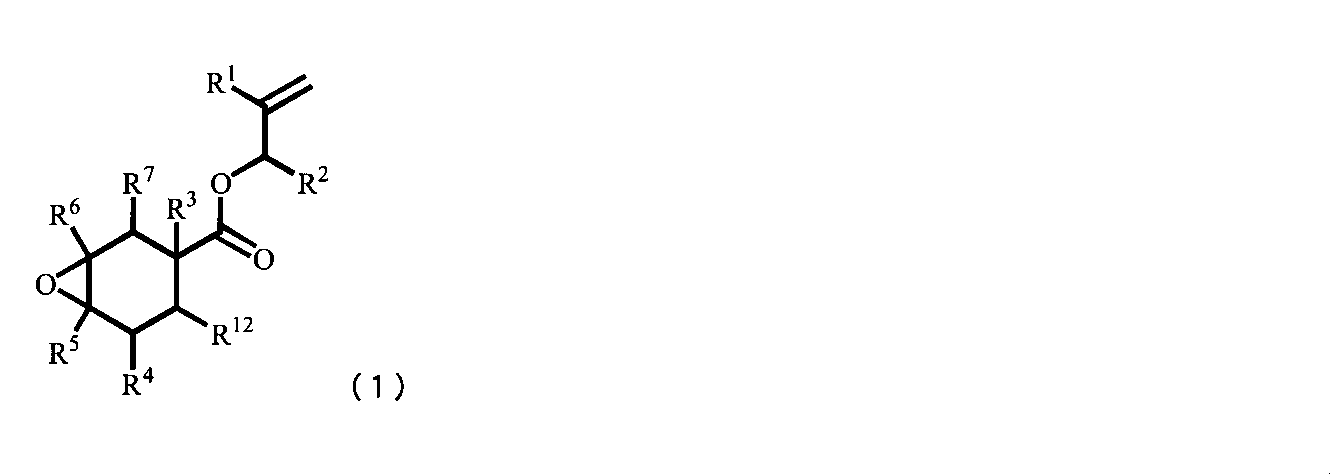
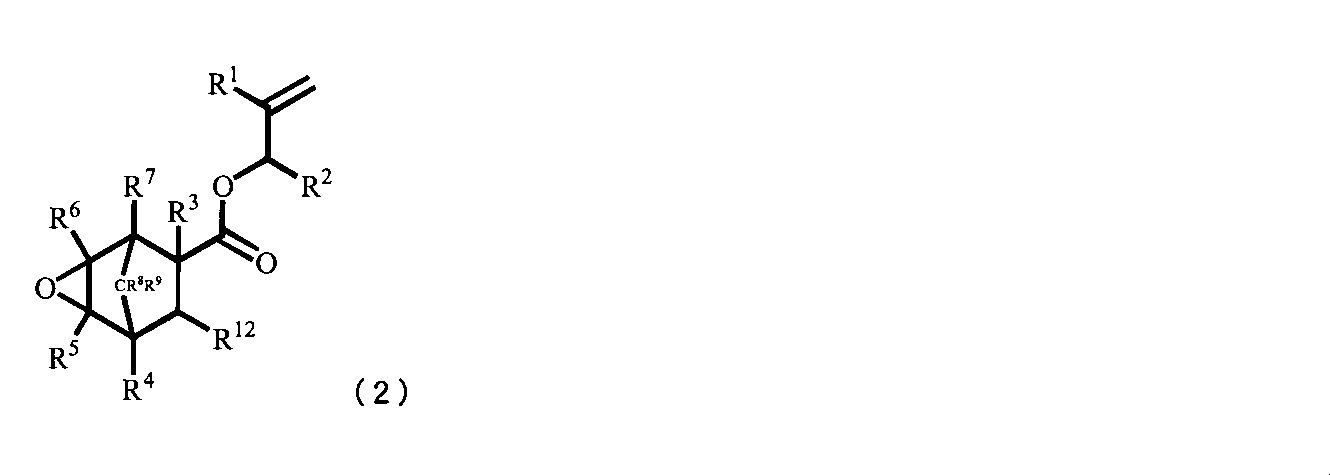
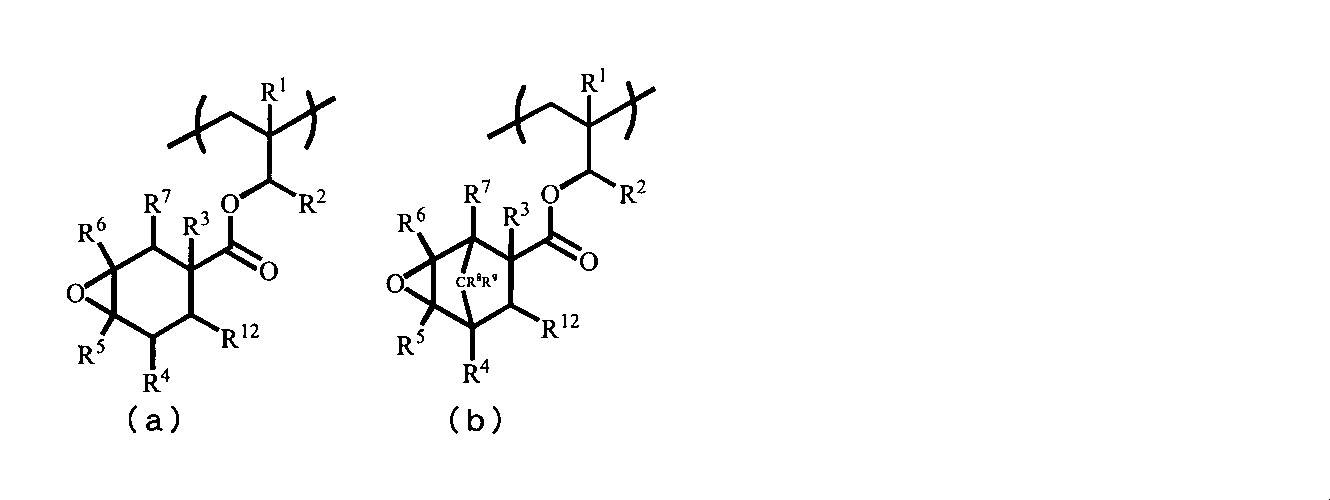
- the copolymer is represented by the following formula (a) or (b): ⁇ Wherein R 1 to R 9 are a hydrogen atom or a methyl group, and R 12 is a hydrogen atom, a methyl group or a phenyl group.
- R 1 to R 9 are a hydrogen atom or a methyl group
- R 12 is a hydrogen atom, a methyl group or a phenyl group.
- An epoxy group-containing copolymer containing at least one repeating unit represented by formula (d) and a repeating unit represented by the formula (d) is obtained by reacting with (meth) acrylic acid.
- the epoxy (meth) acrylate copolymer according to any one of [13].
- An epoxy containing at least one repeating unit represented by the formula (a) or (b) and a repeating unit represented by the formula (d) by radical copolymerization Obtaining a group-containing copolymer; And a step of reacting the epoxy group-containing copolymer with (meth) acrylic acid.
- the monomer containing an epoxy group and an allyl group includes 3,4-epoxycyclohexane-1-carboxylic acid allyl ester, 3,4-epoxy-1-methylcyclohexanecarboxylic acid allyl ester, and 3,4-epoxy.
- the present invention is a novel epoxy group-containing polymer excellent in electrical insulation, which is expected to be used in fields such as electrical insulation materials such as solder resists and interlayer insulation films, IC and VLSI sealing materials, and laminates. And a manufacturing method thereof.
- the epoxy (meth) acrylate copolymer according to the present invention can be either photocured or heat-cured. In addition to balanced flexibility and toughness, low dielectric properties, adhesion, water resistance, Since cured products with excellent heat resistance, chemical resistance, electrical insulation, etc. can be obtained, it can be applied to a wide range of fields such as electrical insulation materials such as solder resists and interlayer insulation films, IC and VLSI sealing materials, and laminates. it can.
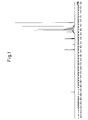
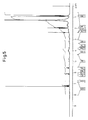
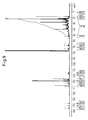
- 1 is a 13 C-NMR spectrum diagram of an oligomer obtained in Example 1.
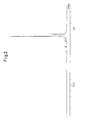
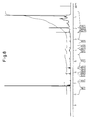
- FIG. It is IR spectrum chart. 1 is a 1 H-NMR spectrum diagram of an oligomer obtained in Example 1.
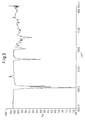
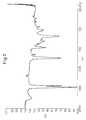
- FIG. 2 is an IR spectrum diagram of the oligomer obtained in Example 1.
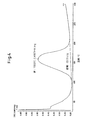
- FIG. 2 is a DSC chart of a mixture of the oligomer obtained in Example 1 and a cationic polymerization initiator.
- 1 is a 1 H-NMR spectrum of a compound (epoxy (meth) acrylate copolymer) obtained in Example 27.
- 2 is a 13 C-NMR spectrum and an IR spectrum of the compound (epoxy (meth) acrylate copolymer) obtained in Example 27.
- Example 4 is an IR spectrum of the compound (epoxy (meth) acrylate copolymer) obtained in Example 27.
- 1 is a 1 H-NMR spectrum of a compound (epoxy (meth) acrylate copolymer) obtained in Example 28.
- 3 is a 13 C-NMR spectrum of the compound (epoxy (meth) acrylate copolymer) obtained in Example 28.
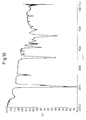
- It is IR spectrum of the compound (epoxy (meth) acrylate copolymer) obtained in Example 28.
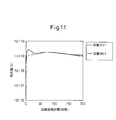
- It is a graph which shows the insulation resistance measurement result of the test pieces a1 and b1 obtained in Examples 38 and 39.
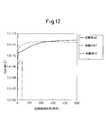
- It is a graph which shows the insulation resistance measurement result of the test pieces a2 and b2 obtained in Examples 38 and 39 and the test piece c2 obtained in Comparative Example 2.
- the epoxy group-containing copolymer of the present invention has the following formula (a), (b) or (c): ⁇ Wherein R 1 to R 11 are a hydrogen atom or a methyl group, and R 12 is a hydrogen atom, a methyl group or a phenyl group.
- R 1 to R 11 are a hydrogen atom or a methyl group
- R 12 is a hydrogen atom, a methyl group or a phenyl group.
- the repeating unit containing the alicyclic epoxy group and allyl group and / or vinyl group is preferably at least one of the following repeating units.
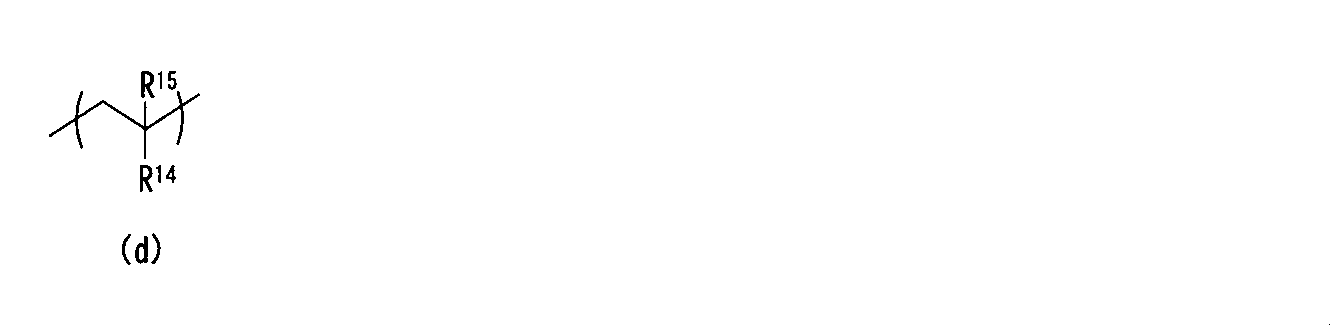
- the repeating unit represented by the formula (d) is preferably derived from ethylene and / or an unsaturated hydrocarbon having 8 or more carbon atoms.
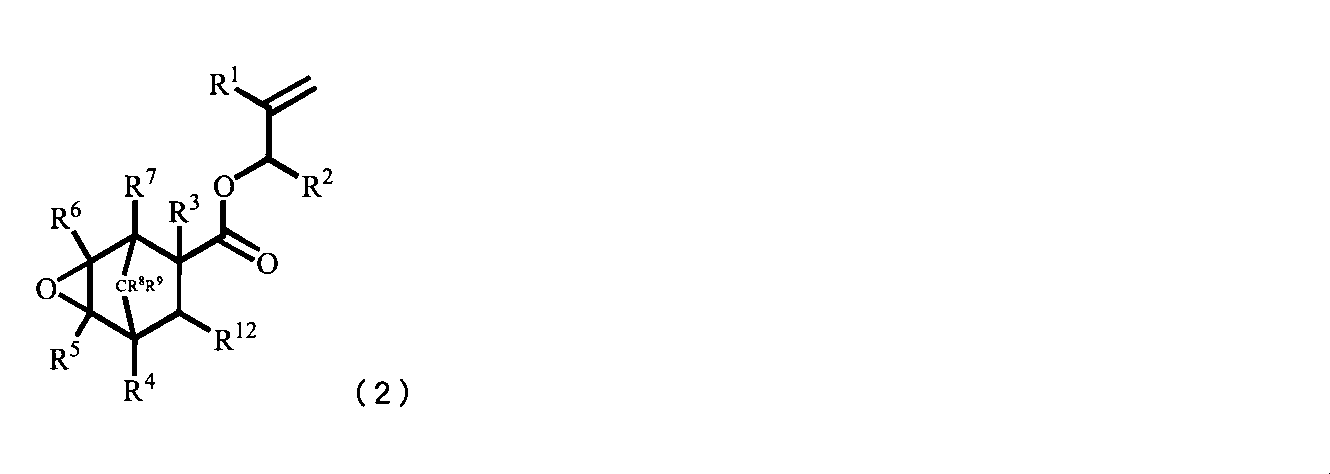
- the copolymer containing the unit is represented by the following formula (1), (2) or (3): ⁇ Wherein R 1 to R 11 are a hydrogen atom or a methyl group, and R 12 is a hydrogen atom, a methyl group or a phenyl group.
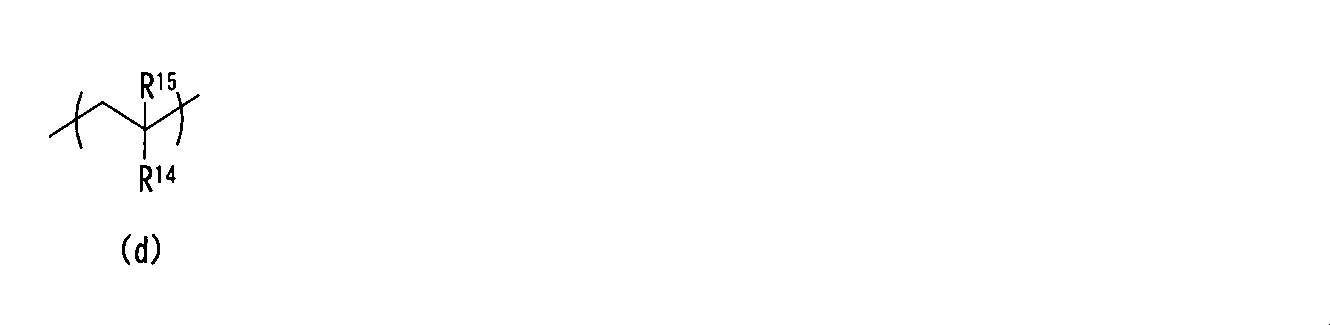
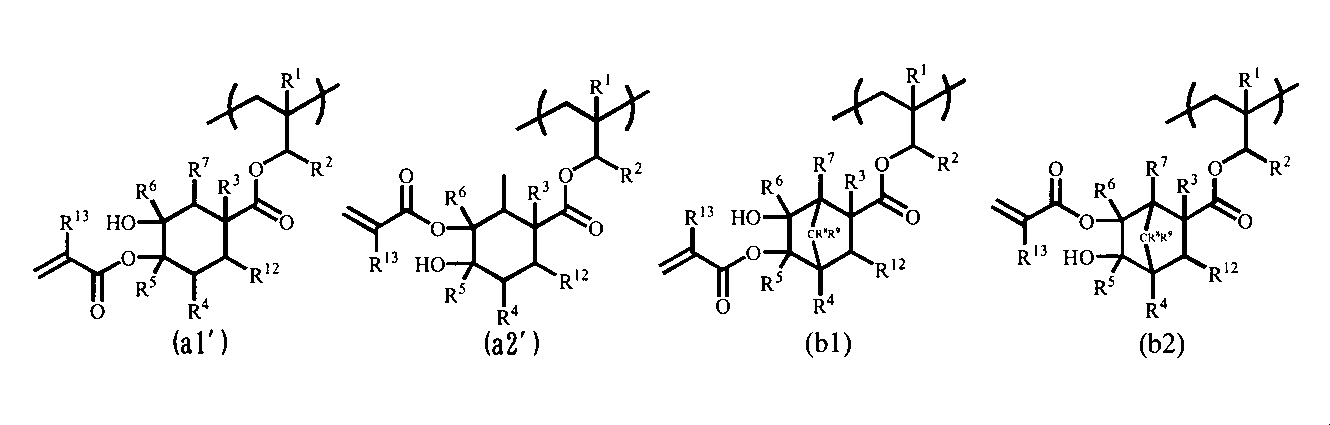
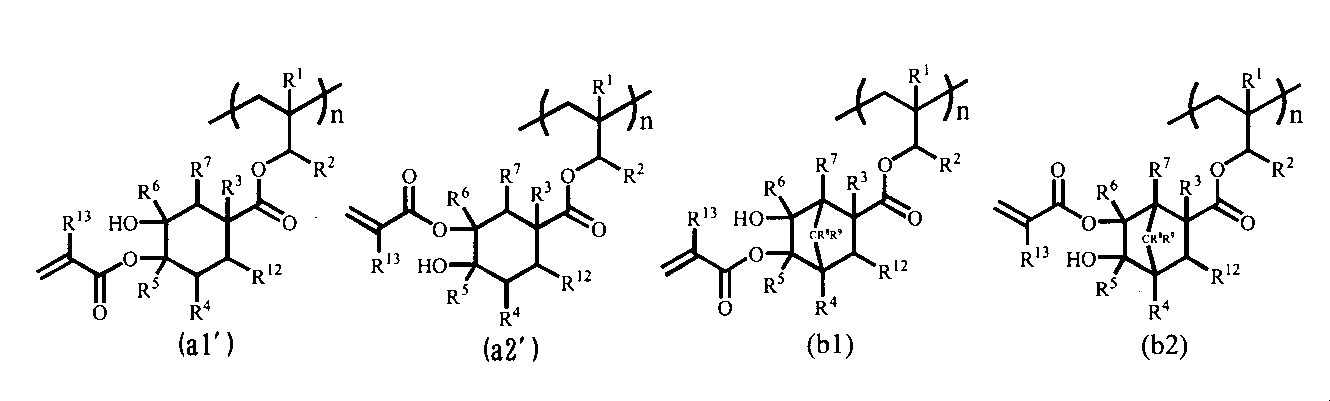
- the epoxy (meth) acrylate copolymer according to the present invention has the following formula (a1 ′), (a2 ′), (b1) or (b2): ⁇ Wherein R 1 to R 9 and R 13 are a hydrogen atom or a methyl group, and R 12 is a hydrogen atom, a methyl group or a phenyl group. ⁇ And at least one repeating unit represented by the following formula (d): ⁇ Wherein R 14 represents a hydrogen atom or a methyl group, and R 15 represents a hydrogen atom or a saturated or unsaturated hydrocarbon group having 24 or less carbon atoms. ⁇ , And a repeating unit represented by:
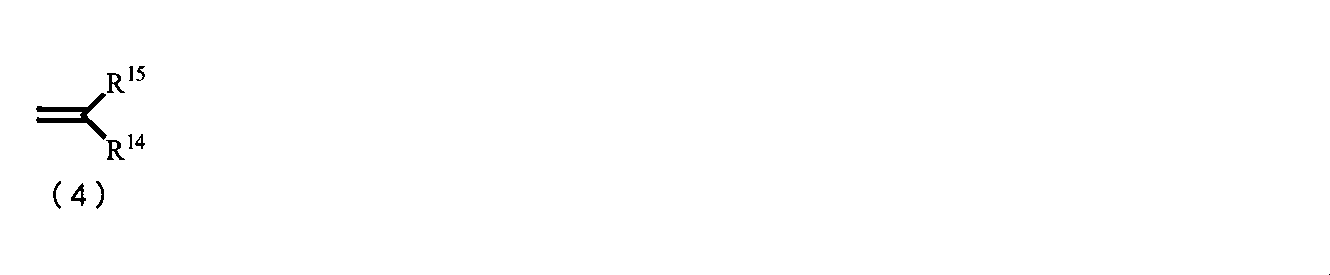
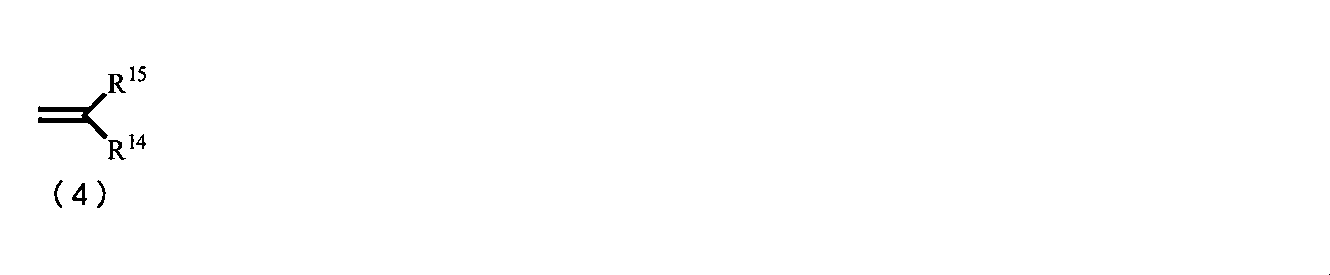
- This epoxy (meth) acrylate copolymer has the following formula (1) or (2): ⁇ Wherein R 1 to R 9 are a hydrogen atom or a methyl group, and R 12 is a hydrogen atom, a methyl group or a phenyl group. ⁇ , At least one of the monomers containing an epoxy group and an allyl group represented by the following formula (4): ⁇ Wherein R 14 is a hydrogen atom or a methyl group, and R 15 is a hydrogen atom or a saturated or unsaturated hydrocarbon group having 24 or less carbon atoms.
- epoxy (meth) acrylate refers to both epoxy acrylate and epoxy methacrylate.
- (meth) acrylic acid refers to both methacrylic acid and acrylic acid.
- a reaction product of butadiene or cyclopentadiene with (meth) acrylic acid is used from the viewpoint of industrial use.
- the precursor include a monoepoxy compound obtained by performing a regioselective epoxidation reaction after allyl esterification.
- More preferable examples include 3,4-epoxycyclohexane-1-carboxylic acid allyl ester, 3,4-epoxy-1-methylcyclohexanecarboxylic acid allyl ester, 3,4-epoxy-6-phenylcyclohexanecarboxylic acid allyl ester, and the like. It is done.
- vinylcyclohexene oxide and limonene monooxide containing an alicyclic epoxy group represented by the formula (3) and a vinyl group are also included.
- the following formula (5) At least one of monomers containing an epoxy group and an allyl group or a vinyl group, more preferably 3,4-epoxycyclohexane-1-carboxylic acid allyl ester, 3,4-epoxy-1 -At least one of allyl esters of methylcyclohexanecarboxylic acid.
- these compounds have an alicyclic epoxy group, they have higher storage stability than glycidyl type epoxy compounds and are easy to use industrially. Furthermore, the alicyclic epoxy group has a very advantageous characteristic in the world of electronic materials that require curing at a lower temperature and in a shorter time because the cationic polymerizability with a carboxyl group is higher than that of a normal glycidyl group. .
- Preferred specific examples of the olefin compound having a terminal double bond represented by the formula (4) include ethylene, propylene, isobutene, 1-butene, 3-methylbutene-1,1-pentene, and 2-methyl-1-pentene.
- a polyepoxy compound having excellent moisture absorption resistance can be obtained by radical reaction of a double bond of the epoxy compound and an olefin compound having a terminal double bond made of only hydrocarbon.
- copolymerizable monomers can be used as long as the physical properties of the copolymer (resin) itself are not adversely affected.
- Such copolymerizable monomers include allyl hexanoate, allyl cyclohexane, allyl cyclohexylpropionate, allyl benzoate, allyl phenylacetate, allyl phenoxyacetate, allyl trifluoroacetate, allyl methyl carbonate, allyl ethyl carbonate Allyl groups such as allyl methyl ether, allyl glycidyl ether, allyl benzyl ether, allyloxytrimethylsilane, diallyl adipate, diallyl maleate, diallyl malonate, diallyl itaconate, 1,2-dialyloxyethane, diallyl phthalate Containing compounds, vinyl acetate, vinyl n-hexanoate, vinyl cyclohexan
- the blending ratio at the time of radical polymerization can be freely determined depending on the hydrophobic group, aromatic ring, functional group, etc. to be added to the finally obtained epoxy resin composition.
- the total number of repeating units represented by the formula (a), (b) or (c) in the copolymer can be freely determined depending on the level of the epoxy group content desired to be imparted to the epoxy resin Is 10 to 90 mol%, the repeating unit represented by the formula (d) is 5 to 90 mol%, and the sum of the repeating units represented by the formula (a), (b) or (c) and the formula
- the blending ratio is preferably such that the sum of the repeating units represented by (d) is 100% by mass or less.
- the shortage is an epoxy group possessed by another copolymerizable monomer or a repeating unit represented by the formula (a), (b) or (c) used in combination as necessary.
- it is derived from a modified product of a monomer such as a skeleton which is mixed as an impurity during polymerization or is ring-opened by water, alcohol or carboxylic acid derived from an initiator.
- the preferred epoxy equivalent of the copolymer according to the present invention is 190 to 3,000 g / eq. And more preferably 250 to 1,000 g / eq. It is.
- the epoxy equivalent is lower than 190, the heat resistance such as the glass transition temperature is increased, but the flexibility is impaired. On the other hand, if it exceeds 3,000, the heat resistance is lowered and the crosslinking density is lowered, so that the physical properties such as solvent resistance are lowered.
- the acrylic equivalent of the epoxy (meth) acrylate copolymer which is the final product to which (meth) acrylic acid has been added, is 300 g / eq. To 3500 g / eq. become.
- the acrylic equivalent is a theoretical value when all the epoxy groups are acryloyl groups.
- Radical polymerization can be carried out without solvent.
- a solvent there is no particular limitation as long as it can dissolve the monomer and polymer, and it is desirable that the solvent be inert to the epoxy group.
- aromatic hydrocarbons such as benzene, toluene, xylene, ketones such as acetone, methyl ethyl ketone, methyl isobutyl ketone, ethers such as diethyl ether, dibutyl ether, t-butyl methyl ether, dioxane, ethyl acetate, isobutyl acetate , Esters such as ethylene glycol monoacetate, propylene glycol monoacetate, propylene glycol monomethyl ether acetate, dipropylene glycol monoacetate, lactones such as ⁇ -butyrolactone, ⁇ -valerolactone, ⁇ -caprolactone, ethylene glycol monoalkyl ethers , Diethylene glycol
- an ordinary radical polymerization initiator can be used.
- azo such as 2,2′-azobisisobutyronitrile, 2,2′-azobis- (2,4-dimethylvaleronitrile), etc. System, lauroyl peroxide, diisopropyl peroxydicarbonate, bis (4-t-butylcyclohexyl) peroxydicarbonate, t-butylperoxy (2-ethylhexanoate), 1,1-di (t-hexylperoxide Oxy) -3,3,5-trimethylcyclohexane, 1,1-di (t-butylperoxy) cyclohexane, t-butylperoxyisopropyl monocarbonate, di-t-butyl peroxide, di-t-hexylper Oxide, dicumyl peroxide, methyl ethyl ketone peroxide, benzoyl peroxide Side,
- the polymerization initiator is desirably blended in the range of 0.1 mol% to 30 mol% with respect to the total number of moles of monomers.
- the reaction temperature depends on the kind of the polymerization initiator, but can be appropriately selected between ⁇ 10 to 220 ° C., and is preferably 10 to 160 ° C. from the viewpoint of the stability of the epoxy group and the ease of handling. desirable.
- the reaction pressure when a gaseous compound such as ethylene is reacted at room temperature, it is necessary to pressurize. However, when an olefin that is liquid at room temperature is used, the reaction can be performed at normal pressure.
- the molecular weight of the copolymer to be produced is determined by the reaction temperature, the dropping rate of the monomer or polymerization initiator, the monomer concentration, the type of monomer, and the like.
- the molecular weight of the epoxy group-containing copolymer after radical polymerization is preferably 400 to 8,000 in terms of number average molecular weight. If the molecular weight is too high, the workability is lowered. On the other hand, if the molecular weight is too low, sufficient performance cannot be obtained after curing. When this epoxy group-containing copolymer is converted to epoxy (meth) acrylate, the number average molecular weight becomes about 500 to 10,000.
- a diol derivative in which an epoxy group is hydrolyzed, or a glycol monoester derivative in which an epoxy group reacts with an organic acid derived from an initiator may be produced as a by-product, particularly when a perester is used. Mixing of this derivative lowers the heat resistance, but may improve the mechanical strength, and is not a problem as long as the overall physical properties are good.
- the epoxy group-containing copolymer obtained as described above can have various physical properties necessary for a solder resist, an interlayer insulating film, etc. by changing the molecular weight and the type of monomer to be introduced.
- the reaction liquid after radical polymerization can be used as it is depending on the application.
- polymerization is performed in a high boiling point solvent such as diethylene glycol monoethyl ether acetate or ⁇ -butyrolactone, and additives such as silica, talc, pigments, antifoaming agents, and leveling agents are added as they are.
- a disperser such as a three-roll machine.
- the reaction solution containing the epoxy group-containing copolymer obtained as described above can be used as it is depending on the application, but the olefin compound represented by the formula (4) is (meth) acrylic acid. Since the polymerization may be adversely affected when the acryloyl group is polymerized after the addition of olefin, the unreacted remaining olefin compound should be distilled off by distillation or the like. In addition, epoxy allyl monomer and other low-molecular compounds that coexist may reduce physical properties and increase the shrinkage of cure, so residual monomers and low-molecular weight oligomers can be removed using a thin-film evaporator or molecular distillation device. Distilling is a very effective technique.
- the olefin-based residual monomer when used in the absence of a solvent, does not participate in the subsequent curing of the epoxy, so after distilling off as necessary, an epoxy initiator is added directly to the polymerization solution. After adding the necessary additives, it can be molded by cast polymerization or the like.
- Epoxy monomers also remain after polymerization, so distill the remaining monomers and low molecular weight oligomers using a thin film evaporator or molecular distillation device, especially when improving shrinkage and mechanical properties. Is an effective technique.
- the thin film evaporation apparatus is an apparatus that makes a processing solution into a thin film and evaporates it under a vacuum at a lower temperature without affecting the heat.
- a falling film thin film evaporation apparatus, a stirring thin film evaporation apparatus, a centrifugal thin film Evaporation devices and the like are known.
- the pressure is operated from 0.01 kPa to 10 kPa, and the temperature is operated from 50 ° C to 250 ° C.
- a molecular evaporation device is maintained at a very high vacuum, the liquid film on the evaporation surface is as thin as possible so that extremely quiet evaporation occurs from the evaporation surface, and the distance between the evaporation surface and the condensation surface is less than the mean free path of action of the molecule By keeping a sufficient temperature difference between the evaporation surface and the condensation surface, it is possible to suppress the return of molecules to the condensation surface as much as possible.
- Pot molecular distillation device, falling film type molecular distillation device, centrifugal molecule A distillation apparatus, an experimental centrifugal molecular distillation apparatus, and the like are known.
- the epoxy group-containing copolymer obtained as described above is measured for epoxy equivalent and the epoxy group concentration is quantified, it is reacted with (meth) acrylic acid to obtain the desired epoxy (meth) acrylate resin.
- (meth) acrylic acid is reacted with (meth) acrylic acid to obtain the desired epoxy (meth) acrylate resin.
- Acrylic acid and methacrylic acid can be used alone or in combination.
- an unsaturated group-containing monocarboxylic acid is blended at a ratio of 0.2 to 1.3 mole per mole of epoxy group, and usually at a temperature in the range of 50 to 150 ° C. for about 1 to 15 hours Do.
- the catalyst include amines such as triethylamine, dimethylbutylamine and tri-n-butylamine, quaternary salts such as tetramethylammonium salt, tetraethylammonium salt, tetrabutylammonium salt and benzyltriethylammonium salt, and quaternary phosphonium.
- salts and other phosphines such as triphenylphosphine, and imidazoles such as 2-methylimidazole and 2-ethyl-4-methylimidazole.
- alcohols such as methanol, ethanol, propanol, butanol, ethylene glycol, methyl cellosolve and ethyl cellosolve, esters such as methyl cellosolve acetate and ethyl cellosolve acetate, ketone solvents such as methyl ethyl ketone and methyl isobutyl ketone, ⁇ -butyrolactone
- a lactone solvent such as benzene, toluene, chlorobenzene, dichlorobenzene and other aromatic compounds can be used as the reaction solvent.
- a polymerizable diluent monomer such as styrene or methyl methacrylate can also be used as a solvent.
- hydroquinone, methylhydroquinone, hydroquinone monomethyl ether, 4-methylquinoline, phenothiazine, or the like may be allowed to coexist in the reaction system as a polymerization inhibitor. Furthermore, in order to suppress the polymerization reaction due to the unsaturated bond, the reaction may be performed under an air stream such as air. At that time, an antioxidant such as 2,6-di-t-butyl-4-methylphenol may be used in combination in order to prevent an oxidation reaction by air.
- the reaction solution after the epoxy (meth) acrylate conversion can be used as it is depending on the application.
- a high boiling point solvent such as diethylene glycol monoethyl ether acetate or ⁇ -butyrolactone, and it is necessary to use such as silica, talc, pigment, antifoaming agent, and leveling agent. It can be used after adding additives and kneading in a disperser such as a three-roll machine.
- the solvent can be distilled off and used as a solvent-free photocuring and thermosetting resin.
- the epoxy (meth) acrylate copolymer according to the present invention is used alone or in combination with other photosensitive (meth) acrylate compounds, as in the case of ordinary photosensitive (meth) acrylate compounds.
- a polymerization initiator can be blended and cured by irradiation with active energy rays.
- Examples of the photosensitive (meth) acrylate compound include hydroxyl group-containing acrylates such as 2-hydroxyethyl acrylate, 2-hydroxypropyl acrylate, pentaerythritol triacrylate, and dipentaerythritol pentaacrylate; polyethylene glycol diacrylate, polypropylene glycol Water-soluble acrylates such as diacrylate; polyfunctional polyester acrylates of polyfunctional alcohols such as trimethylolpropane triacrylate, pentaerythritol tetraacrylate, dipentaerythritol hexaacrylate; polyfunctionality such as trimethylolpropane and hydrogenated bisphenol A Addition of ethylene oxide to polyfunctional phenols such as alcohol or bisphenol A and biphenol Or an acrylate of a propylene oxide adduct; a polyfunctional or monofunctional polyurethane acrylate which is an isocyanate modification of the above hydroxyl group-containing acrylate; a (meth) acrylic
- photopolymerization initiator examples include benzoin and benzoin alkyl ethers such as benzoin, benzoin methyl ether, benzoin ethyl ether, and benzoin isopropyl ether; acetophenone, 2,2-dimethoxy-2-phenylacetophenone, 2,2-diethoxy- Acetophenones such as 2-phenylacetophenone and 1,1-dichloroacetophenone; 2-methyl-1- [4- (methylthio) phenyl] -2-morpholinoaminopropanone-1, 2-benzyl-2-dimethylamino-1 Aminoacetophenones such as-(4-morpholinophenyl) -butan-1-one and N, N-dimethylaminoacetophenone; 2-methylanthraquinone, 2-ethylanthraquinone, 2-t-butylanthraquinone, 1-chloroant Anthraquinones such as quinone;
- photopolymerization initiators can be used alone or as a mixture of two or more thereof.
- N, N-dimethylaminobenzoic acid ethyl ester, N, N-dimethylaminobenzoic acid isoamyl ester, pentyl-4-dimethylamino Photoinitiator aids such as tertiary amines such as benzoate, triethylamine, and triethanolamine can also be added.
- a titanocene compound such as CGI-784 (manufactured by Ciba Specialty Chemicals Co., Ltd.) having absorption in the visible light region can also be added to promote the photoreaction.
- photopolymerization initiators are 2-methyl-1- [4- (methylthio) phenyl] -2-morpholinoaminopropanone-1,2-benzyl-2-dimethylamino-1- (4-morpholinophenyl)- Butan-1-one, 1-hydroxy-cyclohexyl-phenyl-ketone, etc., but are not limited to these, and absorbs light in the ultraviolet or visible region, and is unsaturated such as (meth) acryloyl group
- radicals are radically polymerized, they are not limited to photopolymerization initiators and photoinitiators, and can be used alone or in combination.
- the epoxy (meth) acrylate copolymer of the present invention can be used alone or in combination with other (meth) acrylates and styrene compounds, by heat polymerization using an organic peroxide or an azo compound, It can be cured by a room temperature polymerization method using an accelerator.
- Organic peroxides include t-butyl peroxybenzoate, t-butyl peroxy-2-ethylhexanoate, benzoyl peroxide, cyclohexanone peroxide, methyl ethyl ketone peroxide, bis-4-t-butylcyclohexyl peroxydi
- azo compound known compounds such as azobisisobutylonitrile can be used alone or in admixture of two or more.
- Accelerators include known ones such as salts of polyvalent metals such as octyl acid and naphthenic acid salts such as cobalt, iron and manganese, and organic amines such as dimethylaniline, diethylaniline, p-toluidine and ethanolamine. These can be used alone or in admixture of two or more.
- polyvalent metals such as octyl acid and naphthenic acid salts such as cobalt, iron and manganese
- organic amines such as dimethylaniline, diethylaniline, p-toluidine and ethanolamine.
- the epoxy (meth) acrylate copolymer according to the present invention is used alone or in combination with a photocuring component and / or a thermosetting component and cured by irradiation with active energy rays and / or heating to cure the epoxy (meth) acrylate copolymer.
- an epoxy (meth) acrylate resin composition in which an epoxy (meth) acrylate copolymer according to the present invention, a photopolymerization initiator, or further an epoxy resin, a curing agent, and further a sensitizer, a curing accelerator, etc. are blended as necessary.
- the product can be easily made into a cured product by a method similar to a conventionally known method.
- the epoxy (meth) acrylate copolymer according to the present invention and the curing agent, filler, and other additives are sufficiently mixed using an extruder, kneader, roll, or the like as necessary until uniform.
- an epoxy (meth) acrylate resin composition and after melting the epoxy (meth) acrylate resin composition, it is molded using a casting or transfer molding machine, and further heated to 20 to 200 ° C., A cured product can be obtained.
- a prepreg obtained by dissolving an epoxy resin composition in a solvent and impregnating a base material such as glass fiber, carbon fiber, polyester fiber, polyamide fiber, alumina fiber, paper, and the like by heat drying is subjected to hot press molding, or A cured product can also be obtained by irradiation with active energy rays.
- various compounding agents, such as an inorganic or organic filler can be mixed as needed.
- the epoxy (meth) acrylate copolymer according to the present invention a photopolymerization initiator, a curing agent, and an epoxy (meth) acrylate resin composition containing a curing accelerator if necessary are dissolved in a solvent,
- the viscosity can be adjusted to suit the application method.
- Examples of such a solvent include ketones such as methyl ethyl ketone and cyclohexanone; aromatic hydrocarbons such as toluene, xylene and tetramethylbenzene; cellosolve, methyl cellosolve, butyl cellosolve, carbitol, methyl carbitol, butyl carbitol, Glycol ethers such as propylene glycol monomethyl ether, propylene glycol monoethyl ether, dipropylene glycol diethyl ether, triethylene glycol monoethyl ether; ethyl acetate, butyl acetate, cellosolve acetate, butyl cellosolve acetate, carbitol acetate, butyl carbitol acetate, Vinegar such as propylene glycol monomethyl ether acetate and dipropylene glycol monomethyl ether acetate Esters; ethanol, propanol, ethylene glycol, alcohol
- the epoxy equivalent of the epoxy group-containing copolymer is measured by the following method.
- the amount of remaining hydrochloric acid is determined by reacting hydrochloric acid with an epoxy group and titrated with an alkali to determine the amount of reacted hydrochloric acid, and the amount of epoxy present in the resin is calculated.
- a sample having an epoxy group amount of 2 to 4 mmol equivalent, which is less than the amount of hydrochloric acid used is accurately weighed and placed in a 200 ml stoppered Erlenmeyer flask, and 0.2 M hydrochloric acid-dioxane solution is placed in this container.
- Epoxy equivalent (g / eq.) (10000 ⁇ S) / [(BA) ⁇ f]
- S Sample collection amount (g) A: Amount of 0.1M potassium hydroxide-ethanol solution used (ml) B: Amount of 0.1 M potassium hydroxide-ethanol solution used in the blank test (ml) f: Factor of 0.1M potassium hydroxide-ethanol solution
- the number average molecular weight Mn was measured by gel permeation chromatography (hereinafter abbreviated as GPC), and was calculated as a value converted to polystyrene (standard sample, STANDARD SM-105 manufactured by Showa Denko KK).
- GPC gel permeation chromatography
- the measurement conditions for GPC are as follows.
- Device name HPLC unit HSS-2000 manufactured by JASCO Corporation
- Mobile phase Tetrahydrofuran Flow rate: 1.0 mL / min Detector: RI-2031Plus manufactured by JASCO Corporation Temperature: 40.0 ° C
- Sample volume 100 ⁇ l of sample loop
- Sample concentration prepared at around 0.1% by mass
- Example 1 Tokyo Rika Machinery's personal organic synthesizer PPV-4060 (simple autoclave) was charged with 9.11 g (50 mmol) of 3,4-epoxycyclohexane-1-carboxylic acid allyl ester (hereinafter abbreviated as CEA), 1-decene, 36. 6 g (Linearene-10 purity 96.6% 250 mmol manufactured by Idemitsu Kosan Co., Ltd.) and 2.238 g of di-t-butyl peroxide (Perbutyl-D purity 98% 15 mmol manufactured by NOF Corporation) were substituted with nitrogen. The reaction vessel was sealed and reacted at 144 ° C. for 3 hours.
- CEA 3,4-epoxycyclohexane-1-carboxylic acid allyl ester
- the polymerization liquid obtained by repeating the same operation 8 times was used with a monomer at a vacuum of 0.3 Pa and a column temperature of 110 ° C. using a molecular distillation apparatus (MS-FL special model, manufactured by Otsuka Industry Co., Ltd.).
- MS-FL special model manufactured by Otsuka Industry Co., Ltd.
- a small amount of the low molecular weight oligomer was distilled off to obtain a viscous oligomer having an epoxy equivalent of 572.4.
- NMR (JC EX-270 manufactured by JEOL Ltd.) spectrum of this oligomer is shown in FIG. 1 ( 13 C-NMR) and FIG. 2 ( 1 H-NMR), and IR (Spectrum GX manufactured by Perkin Elmer) is shown in FIG. Shown in
- CEA monomer from olefins 1- Desenmonoma Since no absorption at 1438 cm ⁇ 1 was observed, it was confirmed that this compound was an epoxy compound comprising a copolymer of CEA monomer and 1-decene monomer having an alicyclic epoxy unit and an ester unit in the molecular structure. did it.
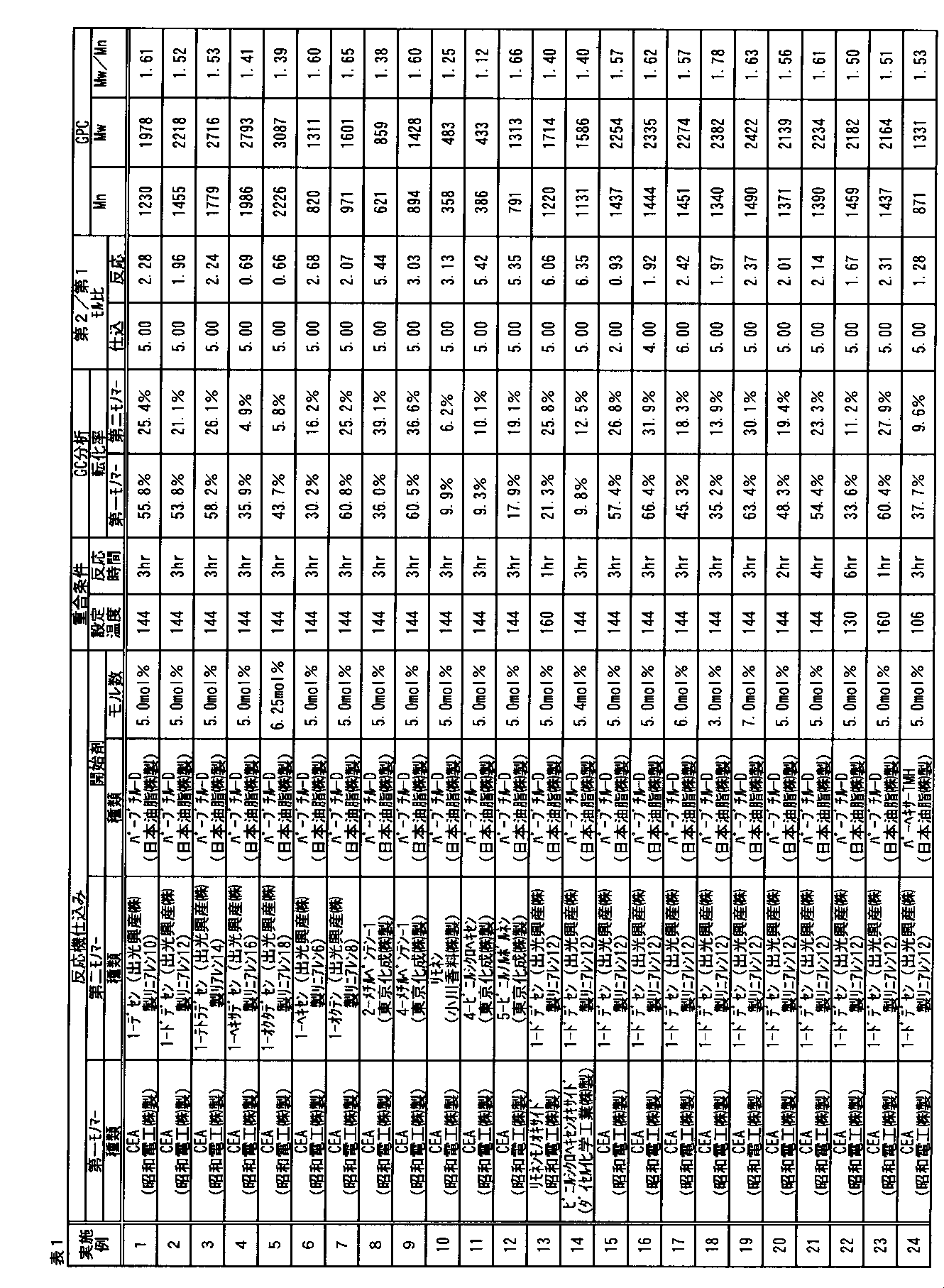
- Example 1 shows the results of polymerization using various epoxy group-containing monomers (first monomer) and olefin (second monomer), with the polymerization conditions changed, and with a charge weight of approximately 50 g as in Example 1. The results are shown in Table 1 below. It can be seen that the copolymerization proceeds under any condition.
- thermosetting resin composition [Evaluation as a thermosetting composition for overcoat] ⁇ Preparation of thermosetting resin composition> Example 25
- the copolymer obtained in Example 1 was blended with components other than the fluorosurfactant and leveling agent among the components shown below, and kneaded using three rolls. After kneading with three rolls, a surfactant and a leveling agent were added and mixed with a resin mixer to prepare a thermosetting resin composition.
- the substrate was allowed to stand for a predetermined time by applying a bias voltage of 100 V under a high temperature and high humidity atmosphere (85 ° C., relative humidity 85%), and the insulation resistance value and the presence or absence of migration were evaluated.
- the insulation resistance value before treatment in a high temperature and high humidity atmosphere was 10 10 ⁇ or more, and the insulation resistance value was maintained at 10 10 ⁇ even after 200 hours of treatment in a high temperature and high humidity atmosphere. Further, no migration was observed after 200 hours of treatment in a high temperature and high humidity atmosphere. Since the present invention uses a copolymer based on a compound having an alicyclic epoxy group epoxidized by hydrogen peroxide oxidation or peracetic acid oxidation instead of the halohydrin method, the electrical insulation of the obtained cured plate is It was good.
- Example 26 In a 1 L four-necked flask equipped with a thermometer, oil bath, and reflux condenser, 300.0 (g) CEA (Showa Denko KK, 1.65 mol) and 277.1 (g) -Dodecene (Idemitsu Kosan Co., Ltd., 1.65 mol) was charged and mixed by stirring. The oil bath was heated while stirring was continued, and the internal temperature was set to 160 ° C. Thereto, 24.6 (g) of di-t-butyl peroxide (manufactured by NOF Corporation) was dropped over 1 hour from the dropping funnel and aged for 2 hours. After completion of the reaction, the residual amount of monomer was measured by Agilent Technologies Gas Chromatography 6850GC Series II. As a result, 85.8% of CEA and 57.6% of 1-dodecene were reacted (copolymerization ratio 1: 0.67).
- the polymerization solution obtained by repeating the same operation twice was used with a molecular distillation apparatus (MS-FL special model, manufactured by Daishin Kogyo Co., Ltd.) at a vacuum of 0.3 Pa and a column temperature of 110 ° C.
- the low molecular weight oligomer was distilled off to obtain a viscous oligomer having an epoxy equivalent of 323.3.
- methylhexahydrophthalic anhydride 318.18 (g) HN-5500E manufactured by Hitachi Chemical Co., Ltd.
- 2-ethyl-4-methylimidazole 9.92 (g) Shikoku Chemical Industries) Co., Ltd.
- SUS mold with spacer of specified thickness sandwiched is heated to 60 ° C, and after pouring hardening liquid a, it is cured over 80 ° C-1 hour, 120 ° C-2 hours, 150 ° C-2 hours, and colorless.
- a transparent cured plate was obtained.
- the obtained cured plates were 4 square plates of 220 mm ⁇ 220 mm ⁇ 3 mm and 12 block plates of 100 mm ⁇ 10 mm ⁇ 4 mm.
- test piece of JIS K7113 No. 1 was created from the resulting cured plate, and the test speed was 5 mm / min, the distance between marked lines was 50 mm, chuck using a method compliant with JIS K7113, manufactured by Toyo Seiki Seisakusho.
- Comparative Example 1 139 parts by weight of Celoxide 2021P (manufactured by Daicel Chemical Industries, Ltd.), 164 parts by weight of methylhexahydrophthalic anhydride (HN-5500E, manufactured by Hitachi Chemical Co., Ltd.), and 9.92 (g) of 2-ethyl-4-methylimidazole 6.06 parts by weight (manufactured by Shikoku Kasei Kogyo Co., Ltd.) was mixed and vacuum degassed to prepare a curing solution b. The curable liquid b was poured into a mold heated to 100 ° C.
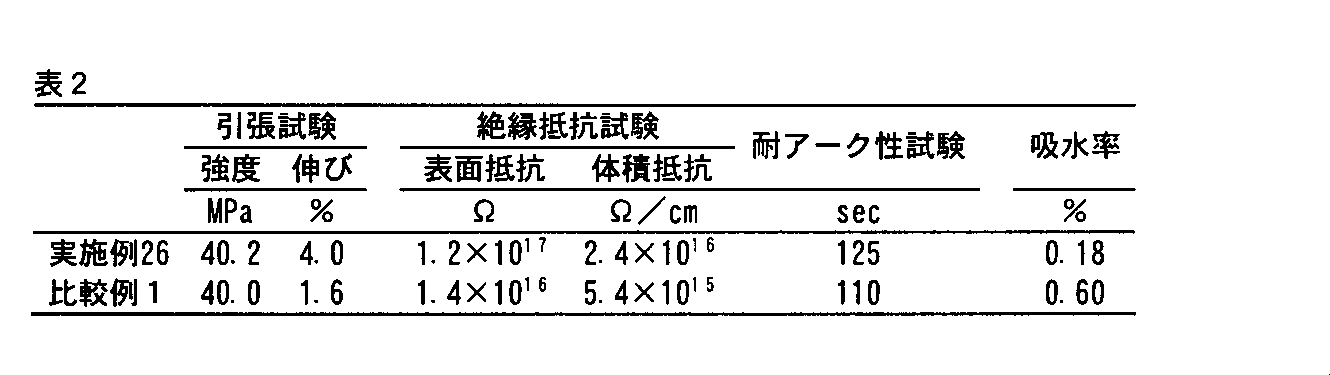
- Example 26 in the same manner as in Example 26, and then cured over 100 ° C.-1 hour, 120 ° C.-6 hours, 150 ° C.-1 hour, 180 ° C.-1 hour. I let you. A test piece similar to that in Example 26 was prepared from the obtained cured plate, a tensile test (strength / elongation), an insulation resistance test, an arc resistance test, and a water absorption rate were measured. The results are summarized in Table 2 below.
- the epoxy resin obtained in the present invention has improved flexibility, improved insulation resistance, improved heat resistance, and low water absorption compared to existing alicyclic epoxy compounds. I understand.
- Synthesis example 1 21 A 3,4-epoxycyclohexane-1-carboxylic acid allyl ester (hereinafter abbreviated as CEA, manufactured by Showa Denko KK) in a personal organic synthesizer PPV-4060 (simple autoclave) manufactured by Tokyo Rika Kikai Co., Ltd. 9 g (120 mmol), 1-octene 34: 25 g (Idemitsu Kosan Co., Ltd. linearene-8 purity 98.3% 300 mmol), di-t-butyl peroxide 3.13 g (Nippon Oil Co., Ltd.
- CEA 3,4-epoxycyclohexane-1-carboxylic acid allyl ester
- the monomer was distilled off using a rotary evaporator N-1000 manufactured by Tokyo Rika Kikai Co., Ltd. at a vacuum degree of 20 hPa and a water temperature of 25 ° C. to 60 ° C. Further, the residual monomer and a small amount of low molecular weight oligomer were distilled off at a vacuum degree of 0.3 Pa and a column temperature of 100 ° C. using a molecular distillation apparatus MS-FL special model manufactured by Daishin Kogyo Co., Ltd. to obtain an epoxy equivalent of 388. 6 viscous oligomers were obtained. The number average molecular weight was 1200 and the weight average molecular weight was 1980 as analyzed by GPC. CEA used as a raw material was produced by the production method described in JP-A-2006-316034.
- the monomer was distilled off using a rotary evaporator N-1000 manufactured by Tokyo Rika Kikai Co., Ltd. at a vacuum degree of 20 hPa and a water temperature of 25 ° C. to 60 ° C. Further, the residual monomer and a small amount of low molecular weight oligomer were distilled off at a vacuum degree of 0.3 Pa and a column temperature of 120 ° C. using a molecular distillation apparatus MS-FL special model manufactured by Daishin Kogyo Co., Ltd. 8 viscous oligomers were obtained. The number average molecular weight was 1100 and the weight average molecular weight was 1760 as determined by GPC analysis.
- the monomer was distilled off from the obtained polymerization solution using a vacuum pump at a degree of vacuum of 2 Torr and a bath temperature of 150 ° C. Furthermore, using a molecular distillation apparatus MS-FL special model manufactured by Daishin Kogyo Co., Ltd., the residual monomer and a small amount of low molecular weight oligomer were distilled off at a vacuum of 0.3 Pa and a column temperature of 120 ° C. to obtain an epoxy equivalent of 480. 8 viscous oligomers were obtained. In GPC analysis, the number average molecular weight was 1600 and the weight average molecular weight was 2550.
- Synthesis example 4 In a 1 L four-necked flask equipped with a reflux tube, thermometer, dropping funnel and ball stopper, CEA 180.0 g (Showa Denko 0.99 mol), 1-tetradecene 103.3 g (Idemitsu Kosan Co., Ltd.) Linearene-14 purity 93.9% 0.49 mol) and di-t-butyl peroxide 11.1 g (manufactured by NOF Corporation, Perbutyl-D purity 98% 74 mmol) were charged. This mixed solution was heated and stirred in an oil bath at 160 ° C. and reacted for 3 hours.
- the monomer was distilled off from the obtained polymerization solution using a vacuum pump at a degree of vacuum of 2 Torr and a bath temperature of 150 ° C. Furthermore, using a molecular distillation apparatus MS-FL special model manufactured by Daishin Kogyo Co., Ltd., the monomer and a small amount of low molecular weight oligomer were distilled off at a vacuum of 0.3 Pa and a column temperature of 100 ° C. to obtain an epoxy equivalent of 276.1. A viscous oligomer was obtained. In GPC analysis, the number average molecular weight was 1500 and the weight average molecular weight was 2900.
- Synthesis example 5 In a 1 L four-necked flask equipped with a reflux tube, thermometer, dropping funnel and ball stopper, 91.1 g of CEA (0.50 mol, manufactured by Showa Denko KK), 441.1 g of 1-dodecene (manufactured by Idemitsu Kosan Co., Ltd.) Linearene-12 purity 95.4% 2.50 mol) and di-t-butyl peroxide 22.4 g (manufactured by NOF Corporation, Perbutyl-D purity 98% 0.15 mol) were charged. This mixed solution was heated and stirred in an oil bath at 160 ° C. and reacted for 3 hours.
- the monomer was distilled off from the obtained polymerization solution using a vacuum pump at a degree of vacuum of 2 Torr and a bath temperature of 150 ° C. Furthermore, using a molecular distillation apparatus MS-FL special model manufactured by Daishin Kogyo Co., Ltd., the monomer and a small amount of low molecular weight oligomer were distilled off at a vacuum of 0.3 Pa and a column temperature of 90 ° C. to obtain an epoxy equivalent of 778.2. A viscous oligomer was obtained. In GPC analysis, the number average molecular weight was 1500 and the weight average molecular weight was 2400.
- the monomer was distilled off from the obtained polymerization solution using a vacuum pump at a degree of vacuum of 2 Torr and a bath temperature of 150 ° C. Furthermore, using a molecular distillation apparatus MS-FL special model manufactured by Daishin Kogyo Co., Ltd., the monomer and a small amount of low molecular weight oligomer were distilled off at a vacuum of 0.3 Pa and a column temperature of 100 ° C. to obtain an epoxy equivalent of 328.1. A viscous oligomer was obtained. In GPC analysis, the number average molecular weight was 1,400 and the weight average molecular weight was 2,200.
- Synthesis example 7 In a 500 mL polyethylene container, 120 g CEA (0.66 mol, Showa Denko KK), 138.56 g 4-methyl-1-pentene (1.65 mol, Mitsui Chemicals), and 16.68 g di-t-butyl peroxide (NOF Co., Ltd., 0.11 mol) was charged and mixed well to prepare a synthetic raw material solution. 68.88g of the synthesis raw material solution was charged into a personal organic synthesizer PPV-4060 (simple autoclave) manufactured by Tokyo Rika Kikai Co., Ltd., the reaction vessel was purged with nitrogen, sealed, and reacted at an external temperature of 160 ° C for 3 hours. .
- PPV-4060 simple autoclave
- the reaction solutions obtained by repeating the same reaction three times were combined and purified by removing the monomer and the low molecular weight oligomer in the same manner as in Synthesis Example 2 to obtain a viscous CEA-4-methyl-1 having an epoxy equivalent of 307.76. -A pentene copolymer was obtained.
- Synthesis example 8 A viscous CEA-1-dodecene copolymer having an epoxy equivalent of 350.98 was prepared in the same manner as in Synthesis Example 6 except that CEA770.92 g, 1-dodecene 712.01 g and di-t-butyl peroxide 61.82 g were used. Got.
- Example 27 A CEA-1-dodecene copolymer of Synthesis Example 3 (3.0 g), methacrylic acid (0.54 g), triphenylphosphine (0.03 g), hydroquinone monomethyl ether (0.0071 g) and toluene (3.6 g) were charged and placed in an oil bath at 120 ° C. The reaction was performed for 2 hours. Toluene was distilled off from the resulting reaction solution using a vacuum pump at a degree of vacuum of 1 Torr and an oil bath temperature of 100 ° C.
- the 1 H-NMR spectrum, 13 C-NMR spectrum, and IR spectrum of the obtained compound are shown in FIGS. 5 to 7, respectively.
- the obtained compounds have the formulas (a1 ′) and (a2 ′) ⁇ wherein R 1 to R 7 and R 12 are hydrogen atoms, and R 13 is a methyl group. ⁇ As a repeating unit was confirmed.
- Example 28 A CEA-4-methyl-1-pentene copolymer of Synthesis Example 2 (3.0 g), methacrylic acid (0.81 g), triphenylphosphine (0.03 g), hydroquinone monomethyl ether (0.0077 g), and toluene (3.8 g) were charged. It was placed in an oil bath and allowed to react for 2 hours. Toluene was distilled off from the resulting reaction solution using a vacuum pump at a degree of vacuum of 1 Torr and an oil bath temperature of 100 ° C.
- FIGS. 8 to 10 show the 1 H-NMR spectrum, 13 C-NMR spectrum, and IR spectrum of the obtained compound, respectively.
- the obtained compounds have the formulas (a1 ′) and (a2 ′) ⁇ wherein R 1 to R 7 and R 12 are hydrogen atoms, and R 13 is a methyl group. ⁇ As a repeating unit was confirmed.
- Example 29 A CEA-4-methyl-1-pentene copolymer of Synthesis Example 2 (3.0 g), acrylic acid (0.67 g), triphenylphosphine (0.03 g), hydroquinone monomethyl ether (0.0074 g), and toluene (3.7 g) were charged. It was placed in an oil bath and allowed to react for 2 hours. Toluene was distilled off from the resulting reaction solution using a vacuum pump at a vacuum degree of 1 Torr and an oil bath temperature of 100 ° C., and the formulas (a1 ′) and (a2 ′) ⁇ wherein R 1 to R 7 , R 12 and R 13 are hydrogen atoms. ⁇ As a repeating unit.
- Example 30 A CEA-1-dodecene copolymer of Synthesis Example 3 (3.0 g), acrylic acid (0.45 g), triphenylphosphine (0.031 g), hydroquinone monomethyl ether (0.0070 g), and toluene (3.5 g) were charged and placed in an oil bath at 120 ° C. The reaction was performed for 2 hours. Toluene was distilled off from the resulting reaction solution using a vacuum pump at a vacuum degree of 1 Torr and an oil bath temperature of 100 ° C., and the formulas (a1 ′) and (a2 ′) ⁇ wherein R 1 to R 7 , R 12 and R 13 are hydrogen atoms. ⁇ As a repeating unit.
- Example 31 A CEA-1-octene copolymer of Synthesis Example 1 (3.0 g), methacrylic acid (0.665 g), triphenylphosphine (0.03 g), hydroquinone monomethyl ether (0.0074 g), and toluene (3.7 g) were charged and placed in an oil bath at 120 ° C. The reaction was performed for 6 hours. From the resulting reaction solution, ethyl acetate was distilled off using a vacuum pump at a vacuum degree of 1 Torr and an oil bath temperature of 100 ° C., and the formulas (a1 ′) and (a2 ′) ⁇ wherein R 1 to R 7 , And R 12 is a hydrogen atom, and R 13 is a methyl group. ⁇ As a repeating unit.
- Example 32 60 g of CEA-1-tetradecene copolymer of Synthesis Example 4, 18.7 g of methacrylic acid, 0.6 g of triphenylphosphine, 0.159 g of hydroquinone monomethyl ether, and 79 g of ethyl acetate were placed in a 100 ° C. oil bath and reacted for 6 hours. I let you.
- Example 33 A CEA-1-dodecene copolymer of Synthesis Example 5 (80.0 g), methacrylic acid (8.86 g), triphenylphosphine (0.8 g), hydroquinone monomethyl ether (0.18 g), and ethyl acetate (89 g) were placed in an oil bath at 100 ° C. Reacted for hours.
- ethyl acetate was distilled off using a vacuum pump at a vacuum degree of 1 Torr and an oil bath temperature of 80 ° C., and a mixture having the formulas (a1 ′) and (a2 ′) as repeating units ⁇ wherein R 1 to R 7 and R 12 are hydrogen atoms, and R 13 is a methyl group. ⁇ .
- the viscosity after distillation was 980 mPa ⁇ s.
- the number average molecular weight was 1500 and the weight average molecular weight was 2400.
- Example 34 A CEA-1-dodecene copolymer of Synthesis Example 6 25.0 g, methacrylic acid 6.56 g, triphenylphosphine 0.25 g, hydroquinone monomethyl ether 0.06 g, and ethyl acetate 32 g were charged in an oil bath at 100 ° C. Reacted for hours. Ethyl acetate was distilled off from the resulting reaction solution using a vacuum pump at a vacuum of 1 Torr and an oil bath temperature of 80 ° C., and a mixture having the formulas (a1 ′) and (a2 ′) as repeating units ⁇ wherein R 1 to R 7 and R 12 are hydrogen atoms, and R 13 is a methyl group. ⁇ .
- the viscosity after distillation was 4460 mPa ⁇ s, and as a result of GPC analysis, the number average molecular weight was 1500 and the weight average molecular weight was 2300.
- Example 1 7 g of the resin synthesized in Example 34 and 3 g of KAYARAD DPHA (manufactured by Nippon Kayaku Co., Ltd .: reaction product of dipentaerythritol and acrylic acid) were weighed into a 150 mL lidded plastic container. To this, 0.3 g of hydroxycyclohexyl phenyl ketone (Irgacure 184, manufactured by Ciba Japan Co., Ltd.) and 0.5 g of fumed silica (AEROSIL R974, manufactured by Nippon Aerosil Co., Ltd.) were added.
- KAYARAD DPHA manufactured by Nippon Kayaku Co., Ltd .: reaction product of dipentaerythritol and acrylic acid
- a curable composition A was obtained by kneading with a revolutionary hybrid mixer under conditions of stirring for 5 minutes and defoaming for 5 minutes.
- the obtained composition was applied to a polyethylene terephthalate film (Comoshine A4100, manufactured by Toyobo Co., Ltd.) with a bar coater so as to have a thickness of 50 ⁇ m, and a UV irradiator (metal halide lamp output 800 W: measured value with an illuminometer) 17.7 mW / cm 2 ) and cured by UV irradiation for 180 seconds.
- a polyethylene terephthalate film Comoshine A4100, manufactured by Toyobo Co., Ltd.
- a UV irradiator metal halide lamp output 800 W: measured value with an illuminometer
- Example 2 10 g of the resin synthesized in Example 34 and 0.2 g of dicumyl peroxide (Park Mill-D, manufactured by NOF Corporation) were mixed thoroughly, and the mixture was placed between two 10 cm square glass plates. A 0.3 mm ⁇ silicone tube was poured into the spacer and cured at 100 ° C.-1 hr, 130 ° C.-1 hr, 160 ° C.-1 hr.
- Resins synthesized in other Examples 32 and 33 were cured in the same manner as shown in Table 3 below.
- Table 3 shows the results of measurement of Tg and bending strength of the obtained cured product according to JIS-K6911.
- the volume shrinkage was calculated by measuring the density of the blended composition before and after curing.
- the liquid before curing was measured with a vibration digital density meter DM-4500 (manufactured by Anton Paar Co., Ltd.).
- the cured product was measured by Archimedes method.
- Example 35 90.38 g of CEA-4-methyl-1-pentene copolymer synthesized in Synthesis Example 7 in a 300 mL separable flask equipped with a Teflon (registered trademark) stirring blade connected to an oil bath and a three-one motor, 21.16 g of special grade Acrylic acid (purchased from Tokyo Chemical Industry Co., Ltd.), 1.12 g of triphenylphosphine (purchased from Tokyo Chemical Industry Co., Ltd.), and 0.12 (g) of hydroquinone monomethyl ether were charged.
- Teflon registered trademark
- Example 36 A reaction similar to that of Example 35 was performed except that the copolymer was 121.08 g of CEA-1-dodecene copolymer obtained in Synthesis Example 8, and the formulas (a1 ′) and (a2 ′) ⁇ wherein R 1 to R 7 , R 12 , and R 13 are hydrogen atoms. ⁇ As a repeating unit.
- Example 37 Except that the copolymer was 65.02 g of the CEA-1-dodecene copolymer obtained in Synthesis Example 3, the same reaction as in Example 35 was performed, and the formulas (a1 ′) and (a2 ′) ⁇ wherein R 1 to R 7 , R 12 , and R 13 are hydrogen atoms. ⁇ As a repeating unit.
- Example 38 Resin 6.27 (g) synthesized in Example 35 was weighed into a 150 mL polyethylene container with a lid. A solution of 1-hydroxy-cyclohexyl-phenyl-ketone (Irgacure184, manufactured by Ciba (Ciba Japan)) in 30% by mass of propylene glycol monomethyl ether acetate (manufactured by Daicel Chemical Industries, Ltd.) 0.63 (g), 0.32 (g) Aerosil R974 (obtained from Nippon Aerosil) and 0.77 (g) propylene glycol monomethyl ether acetate were added, and the mixture was stirred and degassed by a rotating / revolving hybrid mixer to obtain a coating liquid a.
- Irgacure184 1-hydroxy-cyclohexyl-phenyl-ketone
- the electrode surface was sealed with a cured product of the coating liquid a by irradiating with a metal halide lamp type ultraviolet irradiation device (17.7 mW / cm 2 ) for 60 seconds to obtain insulating test pieces a1 to a2.
- the insulation test piece a1 was placed in a constant temperature / humidity bath adjusted to 120 ° C. and 95% RH atmosphere, and 100 (V) was applied to the electrode to continuously measure the insulation resistance. The results are shown in FIG.
- Example 39 A coating solution b and insulating test pieces b1 to b2 were obtained in the same manner as in Example 38 except that the resin 10.86 (g) obtained in Example 37 was used, and the insulation resistance was continuously measured. The results are shown in FIG.
- Example 40 The insulation test pieces a2 and b2 were placed in a constant temperature / humidity bath adjusted to 85 ° C. and 85% RH, and 100 (V) was applied to the electrodes to continuously measure the insulation resistance. The results are shown in FIG.
- Comparative Example 2 A coating solution c and insulating test pieces c1 to c2 were obtained in the same manner as in Example 38, except that a commercially available bisphenol A type epoxy resin epoxy acrylate (EBECRYL600, manufactured by Daicel Cytec Co., Ltd.) was used. Install specimens c1 and c2 in a constant temperature / humidity chamber adjusted to 120 ° C / 95% RH and 85 ° C / 85% RH, respectively, and apply 100 (V) to the electrodes to continuously increase the insulation resistance. It was measured.
- the test piece c1 had a resistance value of 1.0 ⁇ 10 6 ( ⁇ ) or less, which was set as the lower limit threshold before the applied voltage reached the predetermined 100 (V), and the insulation could be evaluated.
- test piece c2 also had a resistance value of 1.0 ⁇ 10 6 ( ⁇ ) or less, which was set as the lower limit threshold in a short time, and the insulation performance was poor.
- the result of the test piece c2 is shown in FIG.
Landscapes
- Chemical & Material Sciences (AREA)
- Health & Medical Sciences (AREA)
- Chemical Kinetics & Catalysis (AREA)
- Medicinal Chemistry (AREA)
- Polymers & Plastics (AREA)
- Organic Chemistry (AREA)
- General Chemical & Material Sciences (AREA)
- Physics & Mathematics (AREA)
- Spectroscopy & Molecular Physics (AREA)
- Addition Polymer Or Copolymer, Post-Treatments, Or Chemical Modifications (AREA)
- Epoxy Resins (AREA)
Abstract
Description

したがって、本発明は電気絶縁性が良好であり可とう性、密着性等の物性を制御することができる新規なエポキシ含有共重合体を提供することを課題とする。
具体的には、本発明は、以下の[1]~[17]である:

以下の式(d):
を含むことを特徴とするエポキシ基含有共重合体。


以下の式(4):

をラジカル共重合させることを特徴とする、前記[1]~[6]のいずれか1項に記載のエポキシ基含有共重合体の製造方法。

エチレン、4-メチル-1-ペンテン、1-オクテン、1-デセン、1-ドデセン、1-テトラデセン、1-ヘキサデセン、1-オクタデセン、4-ビニルシクロヘキセン、及びリモネンの内の少なくとも1つと、
をラジカル共重合させることを特徴とする、前記[1]~[6]のいずれかに記載のエポキシ基含有共重合体の製造方法。
4-メチル-1-ペンテン、1-デセン、1-ドデセン、1-テトラデセン、1-ヘキサデセン、及び1-オクタデセンの内の少なくとも1つと、
をラジカル共重合させることを特徴とする、前記[1]~[6]のいずれかに記載のエポキシ基含有共重合体の製造方法。



該エポキシ基含有共重合体に(メタ)アクリル酸を反応させる工程と、を含むことを特徴とする、前記[14]に記載のエポキシ(メタ)アクリレート共重合体の製造方法。
また、本発明に係るエポキシ(メタ)アクリレート共重合体は、光硬化と熱硬化のいずれも可能であり、バランスのとれたフレキシブル性と強靭性に加え、低誘電特性、密着性、耐水性、耐熱性、耐薬品性、電気絶縁性等に優れた硬化物が得られるので、ソルダーレジストや層間絶縁膜等の電気絶縁材料、ICや超LSIの封止材料、積層板などの広い分野に適用できる。
本発明のエポキシ基含有共重合体は、以下の式(a)、(b)又は(c):

以下の式(d):
を含む。
前記脂環式エポキシ基とアリル基及び/又はビニル基を含む繰返し単位は、以下の繰返し単位の内の少なくとも1つであることが好ましい。


以下の式(4):

をラジカル共重合させることにより得られる。



該エポキシ基含有共重合体に(メタ)アクリル酸を反応させる工程と、を含む方法により製造されうる。
式(1)又は(2)で表される脂環式エポキシ基とアリル基を含む好ましい化合物としては、工業的に使用する観点から、ブタジエンやシクロペンタジエンと(メタ)アクリル酸との反応物を前駆体として、アリルエステル化後の位置選択的なエポキシ化反応を行うことにより得られるモノエポキシ化合物を挙げることができる。このようなものとしては、3,4-エポキシシクロヘキサン-1-カルボン酸(メタ)アリルエステル、3,4-エポキシ-1-メチルシクロヘキサンカルボン酸(メタ)アリルエステル、3,4-エポキシ-6-メチルシクロヘキサンカルボン酸(メタ)アリルエステル、3,4-エポキシ-6-フェニルシクロヘキサンカルボン酸(メタ)アリルエステル、5,6-エポキシノルボルナン-2-カルボン酸(メタ)アリルエステル、5,6-エポキシ-2-メチルノルボルナン-2-カルボン酸(メタ)アリルエステル、5,6-エポキシ-3-メチルノルボルナン-2-カルボン酸(メタ)アリルエステル、5,6-エポキシ-3-フェニルノルボルナン-2-カルボン酸(メタ)アリルエステル等が挙げられる。より好ましくは、3,4-エポキシシクロヘキサン-1-カルボン酸アリルエステル、3,4-エポキシ-1-メチルシクロヘキサンカルボン酸アリルエステル、3,4-エポキシ-6-フェニルシクロヘキサンカルボン酸アリルエステル等が挙げられる。また合成法は異なるが、式(3)で表される脂環式エポキシ基とビニル基を含むビニルシクロヘキセンオキサイド、リモノネンモノオキサイド等も挙げられる。これらの中でより好ましくは、以下の式(5):

反応温度は、重合開始剤の種類によるが、-10~220℃の間で適宜選択することができ、エポキシ基の安定性や取り扱いのし易さの観点から、10~160℃であることが望ましい。
反応圧力については、特にエチレンのような常温でガス状の化合物を反応させる場合には加圧する必要があるが、常温で液状であるオレフィンを用いる場合には常圧で反応を行うことができる。
S:試料の採取量(g)
A:0.1M水酸化カリウム-エタノール溶液使用量(ml)
B:空試験での0.1M水酸化カリウム-エタノール溶液使用量(ml)
f:0.1M水酸化カリウム-エタノール溶液のファクター
なお、GPCの測定条件は以下のとおりである。
装置名:日本分光(株)製HPLCユニット HSS-2000
カラム:ShodexカラムLF-804
移動相:テトラヒドロフラン
流速:1.0mL/min
検出器:日本分光(株)製 RI-2031Plus
温度:40.0℃
試料量:サンプルループ 100μリットル
試料濃度:0.1質量%前後に調製
東京理化機械のパーソナル有機合成装置PPV-4060(簡易オートクレーブ)に、3,4-エポキシシクロヘキサン-1-カルボン酸アリルエステル(以下、CEAと略する)9.11g(50mmol)、1-デセン36.6g(出光興産(株)製リニアレン-10 純度96.6% 250mmol)、ジ-t-ブチルパーオキサイド2.238g(日本油脂(株)製パーブチル-D 純度98% 15mmol)を仕込み、窒素置換後反応容器を密閉し、144℃で3時間反応させた。反応終了後、Agilent Technologies社製のガスクロマトグラフィー(GC)6850 Series IIによりモノマー残量を測定した結果、3,4-エポキシシクロヘキサン-1-カルボン酸アリルエステルが55.8%、1-デセンが25.4%反応しており(共重合比1:2.28)、GPCの分析で、数平均分子量1230、重量平均分子量1980であった。なお、原料として使用したCEAは特開2006-316034号公報に記載の製造方法により製造した。
種々のエポキシ基含有モノマー(第1モノマー)とオレフィン(第二モノマー)を用いて、重合条件を変更して、実施例1同様に仕込み重量がおおよそ50gの条件で重合させた結果を実施例1の結果を含めて以下の表1に示す。いずれの条件でも共重合が進行していることがわかる。
<熱硬化性樹脂組成物の調製>
実施例25
実施例1で得られた共重合体に、以下に示す成分のうちフッ素系界面活性剤とレベリング剤以外の成分を配合し、3本ロールを用いて混練りした。3本ロールでの混練後、界面活性剤とレベリング剤を加え、レジンミキサーにて混合し、熱硬化性樹脂組成物を調製した。
実施例1の共重合体: 28.6質量部
酸無水物: HN-5500E(日立化成工業(株)製) 8.4質量部
硬化剤: 2E4MZ(四国化成工業(株)製) 0.37質量部
チクソ剤: アエロジルR974(日本アエロジル(株)製) 1.85質量部
硫酸バリウム: B94(堺化学工業(株)製) 7.4質量部
シリコーンパウダー: X-52-854(信越化学工業(株)製) 1.85質量部
フッ素系界面活性剤: PolyFOX PF6520(オムノバ社製)0.11質量部
レベリング剤: ディスパロン230HF(楠本化成(株)製) 0.56質量部
〔電気絶縁の長期信頼性〕
基材に市販の基板(IPC規格)のIPC-C(100μmピッチ櫛型パターン:ライン/スペース=50μm/50μm)を用い、上記熱硬化性樹脂組成物をスクリーン版ST250-30、印刷スピード100mm/秒、印刷版と基材とのクリアランス2.0mm、スキージ高度80度、スキージ角度70度の条件で、基材に印刷して80℃で30分間乾燥した後、150℃で1時間熱硬化した。その基板を高温高湿雰囲気(85℃、相対湿度85%)下において100Vのバイアス電圧を印加して所定時間放置し、絶縁抵抗値およびマイグレーション有無を評価した。
温度計、オイルバス、及び還流冷却管を備えた1Lの四つ口フラスコに、窒素雰囲気下、300.0(g)のCEA (昭和電工(株)製、1.65mol)、及び277.1(g)の1-ドデセン (出光興産(株)製、1.65mol)を仕込んで撹拌によって混合した。撹拌を継続しながらオイルバスを昇温し、内部温度を160℃とした。そこに滴下ロートより24.6(g)のジ-t-ブチルパーオキサイド(日油(株)製)を一時間掛けて滴下し、2時間熟成させた。反応終了後、AgilentTechnologies社製のガスクロマトグラフィー6850GC SeriesIIによりモノマー残量を測定した結果、CEAが85.8%、1-ドデセンが57.6%反応していた(共重合比1:0.67)。
また、このオリゴマー673.5(g)に、無水メチルヘキサヒドロフタル酸318.18(g)(日立化成工業(株)製HN-5500E)、及び2 - エチル-4- メチルイミダゾール9.92(g)(四国化成工業(株)製)を加え、混合・真空脱泡し、硬化液aを調製した。所定厚のスペーサーを挟み込んだSUS製金型を60℃に加温し、硬化液aを流し込んだ後、80℃-1時間、120℃-2時間、150℃-2時間かけて硬化させ、無色透明な硬化板を得た。得られた硬化板は220mm×220mm×3mmの角板が4枚、100mm×10mm×4mmのブロック板が12枚であった。
また得られた硬化板から100mm×100mm×3mmの試験片を作成し、23±2℃、50±5%RHの環境に48時間放置して状態調節を行った後に、JIS K6911;1995に準拠した方法で、アドバンテスト(株)製デジタル超高抵抗/微少電流計R8340A(主電極φ50mm、ガード電極内径/外径=φ70mm/80mm)を用いて、印加電圧500(V)、印加時間1分、試験温度23℃、試験数n=3の条件で絶縁抵抗試験を行った。結果を以下の表2に示す。
またさらに得られた硬化板から100mm×100mm×3mmの試験片を作成し、JIS K7209 A法に準拠した方法で、試験数n=3の条件で吸水率を測定した。具体的には試験片を乾燥機中で50℃×24時間乾燥させ、デシケータ中で放冷後、電子天秤にて初期重量(M1)を測定し、その後、試験片を蒸留水中に24時間浸漬してから取り出し、濾紙にてサンプル表面の水分を拭き取った後に吸水後重量(M2)を測定した。吸水率は、測定した重量を次式に当てはめることにより計算した。
吸水率(%)={(M2-M1)/M1}×100
結果を以下の表2に示す。
セロキサイド2021P(ダイセル化学工業(株)製)139重量部、無水メチルヘキサヒドロフタル酸(日立化成工業(株)製HN-5500E)164重量部、及び2 - エチル-4- メチルイミダゾール9.92(g)(四国化成工業(株)製)6.06重量部を混合・真空脱泡し、硬化液bを調製した。その硬化液bを実施例26と同様に100℃に加温した金型に流し込んだ後に、100℃-1時間、120℃-6時間、150℃-1時間、180℃-1時間かけて硬化させた。
得られた硬化板から実施例26と同様の試験片を作成し、引張試験(強度・伸び)、絶縁抵抗試験、耐アーク性試験を実施、及び吸水率を測定した。結果を以下の表2にまとめた。
東京理化機械(株)製のパーソナル有機合成装置PPV-4060(簡易オートクレーブ)に、3,4-エポキシシクロヘキサン-1-カルボン酸アリルエステル(以下、CEAと略する昭和電工(株)製)21.9g(120mmol)、1-オクテン34:25g(出光興産(株)製リニアレン-8 純度98.3% 300mmol)、ジ-t-ブチルパーオキサイド3.13g(日油(株)製パーブチル-D 純度98% 21mmol)を、仕込み、窒素置換後、反応容器を密閉し、160℃で3時間反応させた。反応終了後、Agilent Technologies社製のガスクロマトグラフィー(GC)6850 Series IIによりモノマー残量を測定した結果、CEAが75.3%、1-オクテンが37.3%反応していた(共重合比:CEA/1-オクテン=1/1.24)。
東京理化機械(株)製のパーソナル有機合成装置PPV-4060(簡易オートクレーブ)に、CEA25.5g(昭和電工(株)製 140mmol)、4-メチル-1-ペンテン42.55g(三井化学(株)製4MP-1 純度98% 300mmol)、ジ-t-ブチルパーオキサイド3.66g(日油(株)製パーブチル-D 純度98% 24.5mmol)を仕込み、窒素置換後、反応容器を密閉し、160℃で3時間反応させた。反応終了後、Agilent Technologies社製のガスクロマトグラフィー(GC)6850 Series IIによりモノマー残量を測定した結果、CEAが76.6%、4-メチル-1-ペンテンが46.7%反応していた(共重合比:CEA/4-メチル-1-ペンテン=1/1.52)。
還流管、温度計、玉栓を具備した1Lの4ツ口フラスコに、CEA167.6g(昭和電工(株)製 0.92mol)、1-ドデセン405.8g(出光興産(株)リニアレン-12 純度95.4% 2.3mol)、ジ-t-ブチルパーオキサイド24.0g(日油(株)製パーブチル-D 純度98% 0.16mol)を仕込んだ。この混合液を160℃のオイルバスで加熱撹拌し、3時間反応させた。反応後、Agilent Technologies社製のガスクロマトグラフィー(GC)6850 Series IIによりモノマー残量を測定した結果、CEAが76.5%、1-ドデセンが43.7%反応していた(共重合比:CEA/1-ドデセン=1/1.43)。
還流管、温度計、滴下ロート、玉栓を具備した1Lの4ツ口フラスコに、CEA180.0g(昭和電工(株)製 0.99mol)、1-テトラデセン103.3g(出光興産(株)製リニアレン-14 純度93.9% 0.49mol)、ジ-t-ブチルパーオキサイド11.1g(日油(株)製パーブチル-D 純度98% 74mmol)を仕込んだ。この混合液を160℃のオイルバスで加熱撹拌し、3時間反応させた。反応後、Agilent Technologies社製のガスクロマトグラフィー(GC)6850 Series IIによりモノマー残量を測定した結果、CEAが77.3%、1-テトラデセンが48.3%反応していた(共重合比:CEA/1-テトラデセン=1/0.31)。
還流管、温度計、滴下ロート、玉栓を具備した1Lの4ツ口フラスコに、CEA91.1g(昭和電工(株)製 0.50mol)、1-ドデセン441.1g(出光興産(株)製リニアレン-12 純度95.4% 2.50mol)、ジ-t-ブチルパーオキサイド22.4g(日油(株)製パーブチル-D 純度98% 0.15mol)を仕込んだ。この混合液を160℃のオイルバスで加熱撹拌し、3時間反応させた。反応後、Agilent Technologies社製のガスクロマトグラフィー(GC)6850 Series IIによりモノマー残量を測定した結果、CEAが76.6%、1-ドデセンが39.6%反応していた(共重合比:CEA/1-ドデセン=1/2.59)。
還流管、温度計、滴下ロート、玉栓を具備した1Lの4ツ口フラスコに、CEA236.9g(昭和電工(株)製 1.30mol)、1-ドデセン229.4g(出光興産(株)製リニアレン-12 純度95.4% 1.30mol)、ジ-t-ブチルパーオキサイド19.4g(日油(株)製パーブチル-D 純度98% 0.13mol)を仕込んだ。この混合液を160℃のオイルバスで加熱撹拌し、3時間反応させた。反応後、Agilent Technologies社製のガスクロマトグラフィー(GC)6850 Series IIによりモノマー残量を測定した結果、CEAが71.0%、1-ドデセンが43.1%反応していた(共重合比:CEA/1-ドデセン=1/0.61)。
500mLのポリエチレン製容器に、CEA120g(昭和電工(株)製 0.66mol)、4-メチル-1-ペンテン138.56g(三井化学(株)製、1.65mol)、及びジ-t-ブチルパーオキサイド16.68g(日油(株)製、0.11mol)を仕込み、よく混合することで合成原料溶液を調製した。東京理化機械(株)製のパーソナル有機合成装置PPV-4060(簡易オートクレーブ)に、合成原料溶液68.88gを仕込み、反応容器内を窒素置換後、密閉し、外温160℃で3時間反応させた。反応終了後、反応溶液をAgilentTechnologies社製7890AGCによりモノマー残量を定量した結果、CEAが79.03%、4-メチル-1-ペンテンが49.28%反応しており、共重合比はCEA/4-メチル-1-ペンテン=1/1.37であった。
同様の反応を3回繰り返して得られた反応溶液を合わせ、合成例2と同様にしてモノマー及び低分子量オリゴマーを除去することで精製し、エポキシ当量307.76の粘稠なCEA-4-メチル-1-ペンテン共重合体を得た。
CEA770.92g、1-ドデセン712.01gおよびジ-t-ブチルパーオキサイド61.82gを用いた以外は、合成例6と同様の操作を行い、エポキシ当量350.98の粘稠なCEA-1-ドデセン共重合体を得た。
合成例3のCEA-1-ドデセン共重合体3.0g、メタクリル酸0.54g、トリフェニルホスフィン0.03g、ハイドロキノンモノメチルエーテル0.0071g、トルエン3.6gを仕込み、120℃のオイルバスにつけて2時間反応させた。得られた反応液から、真空ポンプを用いて真空度1Torr、オイルバス温度100℃で、トルエンを留去した。
合成例2のCEA-4-メチル-1-ペンテン共重合体3.0g、メタクリル酸0.81g、トリフェニルホスフィン0.03g、ハイドロキノンモノメチルエーテル0.0077g、トルエン3.8gを仕込み、120℃のオイルバスにつけて2時間反応させた。得られた反応液から、真空ポンプを用いて真空度1Torr、オイルバス温度100℃で、トルエンを留去した。
合成例2のCEA-4-メチル-1-ペンテン共重合体3.0g、アクリル酸0.67g、トリフェニルホスフィン0.03g、ハイドロキノンモノメチルエーテル0.0074g、トルエン3.7gを仕込み、120℃のオイルバスにつけて2時間反応させた。得られた反応液から、真空ポンプを用いて真空度1Torr、オイルバス温度100℃で、トルエンを留去し、式(a1’)及び(a2’){式中、R1~R7、R12、及びR13は、水素原子である。}を繰り返し単位として有する混合物を得た。
合成例3のCEA-1-ドデセン共重合体3.0g、アクリル酸0.45g、トリフェニルホスフィン0.031g、ハイドロキノンモノメチルエーテル0.0070g、トルエン3.5gを仕込み、120℃のオイルバスにつけて2時間反応させた。得られた反応液から、真空ポンプを用いて真空度1Torr、オイルバス温度100℃で、トルエンを留去し、式(a1’)及び(a2’){式中、R1~R7、R12、及びR13は、水素原子である。}を繰り返し単位として有する混合物を得た。
合成例1のCEA-1-オクテン共重合体3.0g、メタクリル酸0.665g、トリフェニルホスフィン0.03g、ハイドロキノンモノメチルエーテル0.0074g、トルエン3.7gを仕込み、120℃のオイルバスにつけて6時間反応させた。得られた反応液から、真空ポンプを用いて真空度1Torr、オイルバス温度100℃で、酢酸エチルを留去し、式(a1’)及び(a2’){式中、R1~R7、及びR12は、水素原子であり、そしてR13は、メチル基である。}を繰り返し単位として有する混合物を得た。
合成例4のCEA-1-テトラデセン共重合体60g、メタクリル酸18.7g、トリフェニルホスフィン0.6g、ハイドロキノンモノメチルエーテル0.159g、酢酸エチル79gを仕込み、100℃のオイルバスにつけて6時間反応させた。得られた反応液から、真空ポンプを用いて真空度1Torr、オイルバス温度80℃で、酢酸エチルを留去し、式(a1’)及び(a2’){式中、R1~R7、及びR12は、水素原子であり、そしてR13は、メチル基である。}を繰り返し単位として有する混合物を得た。
合成例5のCEA-1-ドデセン共重合体80.0g、メタクリル酸8.86g、トリフェニルホスフィン0.8g、ハイドロキノンモノメチルエーテル0.18g、酢酸エチル89gを仕込み、100℃のオイルバスにつけて6時間反応させた。得られた反応液から、真空ポンプを用いて真空度1Torr、オイルバス温度80℃で、酢酸エチルを留去し、式(a1’)及び(a2’)を繰り返し単位として有する混合物{式中、R1~R7、及びR12は、水素原子であり、そしてR13は、メチル基である。}を得た。留去後の粘度は980mPa・sであり、GPCの分析の結果、数平均分子量1500、重量平均分子量2400であった。
合成例6のCEA-1-ドデセン共重合体25.0g、メタクリル酸6.56g、トリフェニルホスフィン0.25g、ハイドロキノンモノメチルエーテル0.06g、酢酸エチル32gを仕込み、100℃のオイルバスにつけて6時間反応させた。得られた反応液から、真空ポンプを用いて真空度1Torr、オイルバス温度80℃で酢酸エチルを留去し、式(a1’)及び(a2’)を繰り返し単位として有する混合物{式中、R1~R7、及びR12は、水素原子であり、そしてR13は、メチル基である。}を得た。留去後の粘度は4460mPa・sであり、GPCの分析の結果、数平均分子量1500、重量平均分子量2300であった。
150mLの蓋付きポリ容器に、実施例34で合成した樹脂7gとKAYARAD DPHA(日本化薬(株)製:ジペンタエリスリトールとアクリル酸の反応物)3gを量り取った。そこに0.3gのヒドロキシシクロへキシルフェニルケトン(Irgacure 184、チバ・ジャパン(株)社製)及び0.5gのフュームドシリカ(AEROSIL R974、日本アエロジル(株)社製)を加え、自転・公転ハイブリッドミキサーにて、撹拌5分間及び脱泡5分間の条件で混練し、硬化性組成物Aを得た。得られた組成物をバーコーターによりポリエチレンテレフタレートフィルム(コモシャインA4100、東洋紡(株)社製)に50μ厚になるように塗布して、UV照射機(メタルハライドランプ出力800W:照度計での実測値で17.7mW/cm2のもの)で180秒間のUV照射することにより硬化した。
実施例34で合成した樹脂10g、及びジクミルパーオキサイド(パークミル-D、日油(株)社製)0.2gを十分に混合し、混合物を、10cm角のガラス板2枚の間に、0.3mmφのシリコーンチューブをスペーサーに用いて流し込み、100℃-1hr、130℃-1hr、160℃-1hrで硬化させた。
体積収縮率は、配合組成物の硬化前後の密度を測定して算出した。なお、硬化前の液状のものは、振動式デジタル密度計DM-4500(アントンパール(株)製)にて測定した。また硬化物はアルキメデス法にて測定した。

オイルバス及びスリーワンモーターに接続したテフロン(登録商標)製撹拌翼を備えた300mLセパラブルフラスコに合成例7で合成した90.38 gのCEA-4-メチル-1-ペンテン共重合体、21.16 gの特級アクリル酸(東京化成工業(株)から購入)、1.12gのトリフェニルホスフィン(東京化成工業(株)から購入)、及び0.12 (g)のハイドロキノンモノメチルエーテルを仕込んだ。乾燥空気雰囲気下において浴温80(℃)で2時間激しく撹拌し、式(a1’)及び(a2’){式中、R1~R7、R12、及びR13は水素原子である。}を繰り返し単位として有する混合物を得た。
共重合体を合成例8で得たCEA-1-ドデセン共重合体121.08gとした以外は、実施例35と同様の反応を行い、式(a1’)及び(a2’){式中、R1~R7、R12、及びR13は水素原子である。}を繰り返し単位として有する混合物を得た。
共重合体を合成例3で得たCEA-1-ドデセン共重合体65.02gとした以外は、実施例35と同様の反応を行い、式(a1’)及び(a2’){式中、R1~R7、R12、及びR13は水素原子である。}を繰り返し単位として有する混合物を得た。
実施例35で合成した樹脂6.27(g)を150mLの蓋付きポリエチレン製容器に秤取った。そこに30質量%に調製した1-ヒドロキシ-シクロヘキシル-フェニル-ケトン(Irgacure184、Ciba(チバ・ジャパン)製)のプロピレングリコールモノメチルエーテルアセテート(ダイセル化学工業(株)製)溶液0.63(g)、0.32(g)のアエロジルR974(日本アエロジルより入手)、及び0.77(g)のプロピレングリコールモノメチルエーテルアセテートを加え、自転・公転ハイブリッドミキサーによって撹拌・脱泡し、塗工液aを得た。フレキシブル銅張り積層板(商品名:UPISEL-N BE1310(グレード名)、宇部興産(株)製)をエッチングして製造した櫛形基板(L/S=50/50(μm))に塗工液aをバーコート法によって乾燥後膜厚50(μm)で塗工した後、80℃の熱風恒温槽中で5分間乾燥させた。メタルハライドランプ式紫外線照射装置(17.7mW/cm2)で60秒間照射することで電極表面を塗工液aの硬化物で封止し、絶縁性試験片a1~a2を得た。
絶縁性試験片a1を120℃、95%RHの雰囲気に調整した恒温・恒湿槽内に設置し、電極に100(V)を印加させて絶縁抵抗を継続的に測定した。結果を図11に示す。
実施例37で得た樹脂10.86(g)を用いた以外は、実施例38と同様の操作で塗工液b、及び絶縁性試験片b1~b2を得て絶縁抵抗を継続的に測定した。結果を図11に示す。
絶縁性試験片a2及びb2を85℃、85%RHに調整した恒温・恒湿槽内に設置し、電極に100(V)を印加させて絶縁抵抗を継続的に測定した。結果を図12に示す。
市販のビスフェノールA型エポキシ樹脂のエポキシアクリレート(EBECRYL600、ダイセルサイテック社製)を用いた以外は、実施例38と同様に塗工液c及び絶縁性試験片c1~c2を得た。
試験片c1及びc2をそれぞれ120℃/95%RH、及び85℃/85%RHに調整した恒温・恒湿槽内に設置し、電極に100(V)を印加させて絶縁抵抗を継続的に測定した。試験片c1は印加電圧を所定の100(V)に達する前に抵抗値が下限の閾値として設定していた1.0×106(Ω)以下の値となってしまい、絶縁性を評価することが不可能な状態であった。また、試験片c2も短時間で抵抗値が下限の閾値として設定していた1.0×106(Ω)以下の値となってしまい、絶縁性能は不良であった。試験片c2の結果を図12に示す。
Claims (17)
- 以下の式(a)、(b)又は(c):
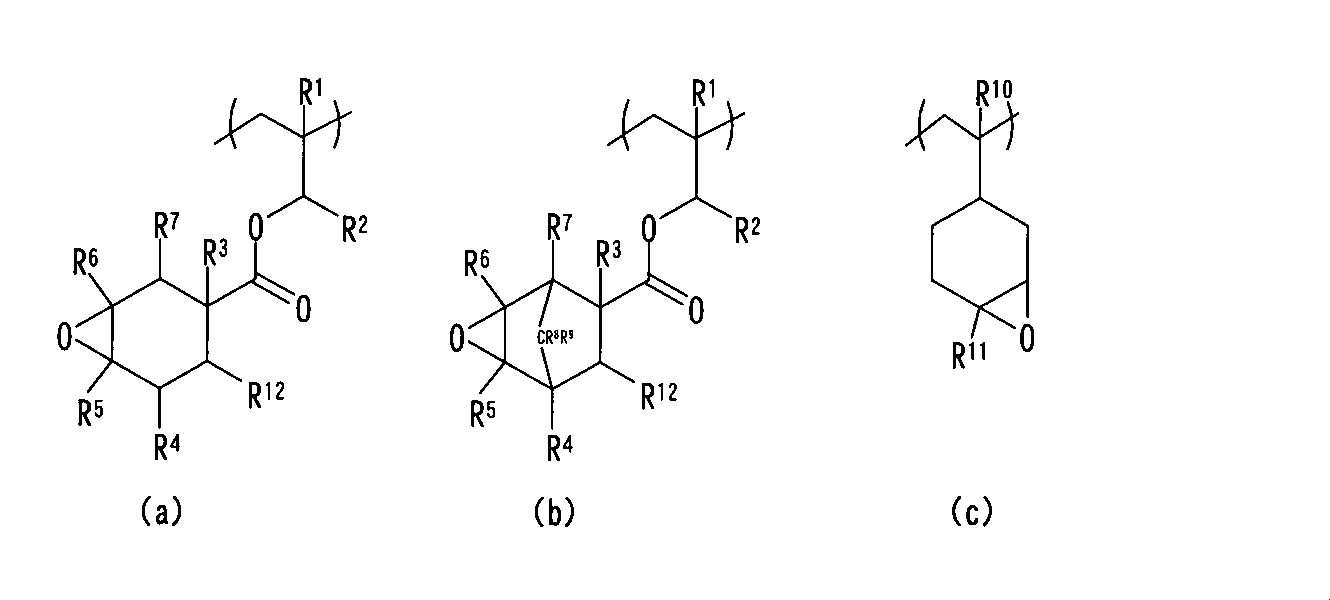
以下の式(d):
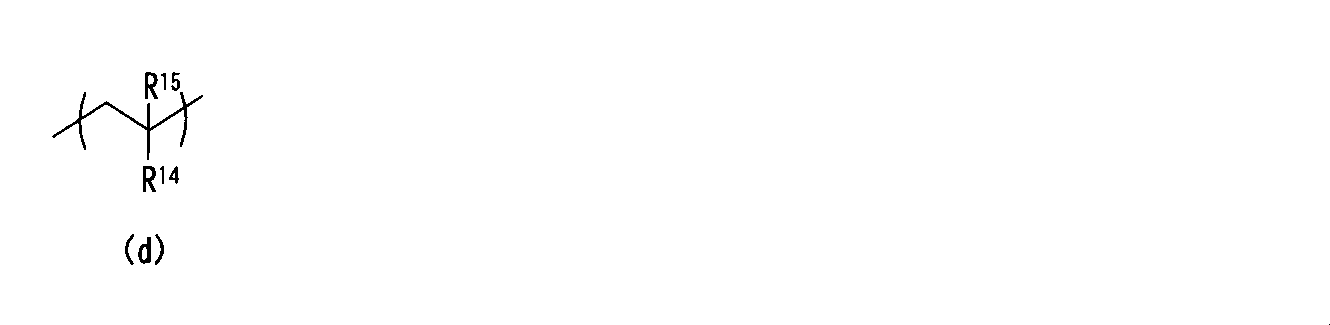
を含むことを特徴とするエポキシ基含有共重合体。 - 前記共重合体のエポキシ当量が190g/eq.~3,000g/eq.である、請求項1に記載のエポキシ基含有共重合体。
- 前記共重合体の数平均分子量が400~10,000である、請求項1に記載のエポキシ基含有共重合体。
- 前記共重合体中における式(a)、(b)又は(c)で表される繰返し単位の総和が10~90モル%であり、式(d)で表される繰返し単位が5~90モル%であり、かつ、式(a)、(b)又は(c)で表される繰返し単位の総和と式(d)で表される繰返し単位の総和が100モル%以下である、請求項1に記載のエポキシ基含有共重合体。
- 式(a)で表される繰返し単位が以下の式(a1)~式(a6)で表される繰返し単位の内の少なくとも1つであり、そして式(c)で表される繰返し単位が以下の式(c1)又は式(c2)で表される繰返し単位の内の少なくとも1つである、請求項1に記載のエポキシ基含有共重合体。

- 式(d)で表される繰返し単位が、エチレン及び/又は炭素数が8以上の不飽和炭化水素に由来する、請求項1に記載のエポキシ基含有共重合体。
- 以下の式(1)、(2)又は(3):
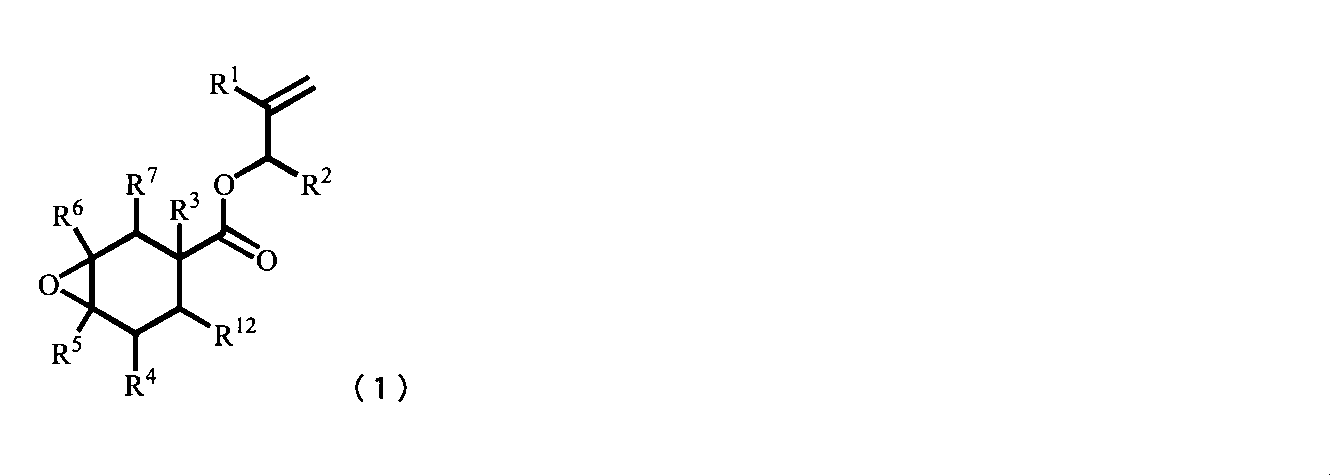
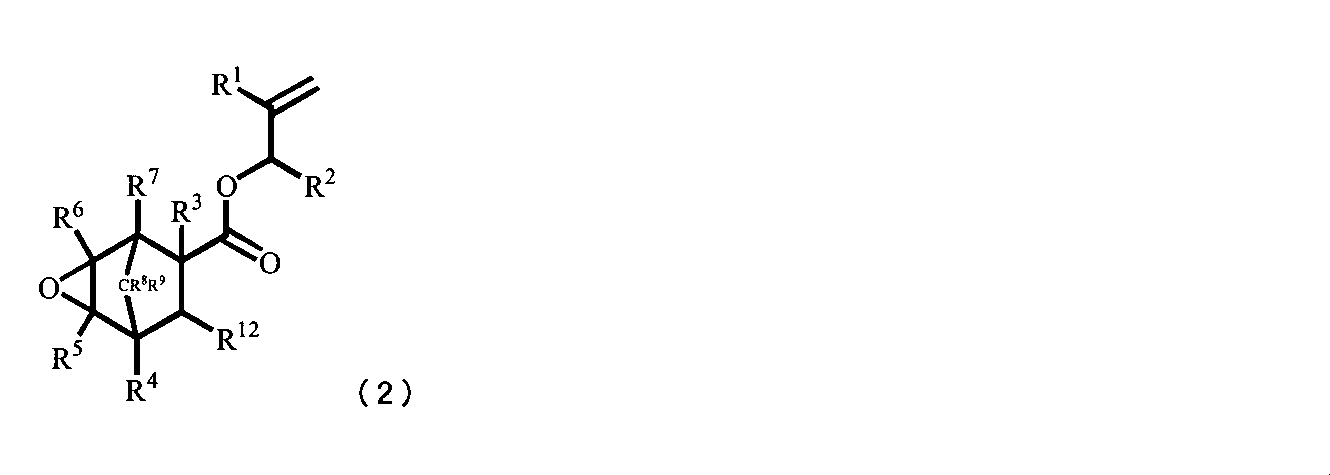

以下の式(4):
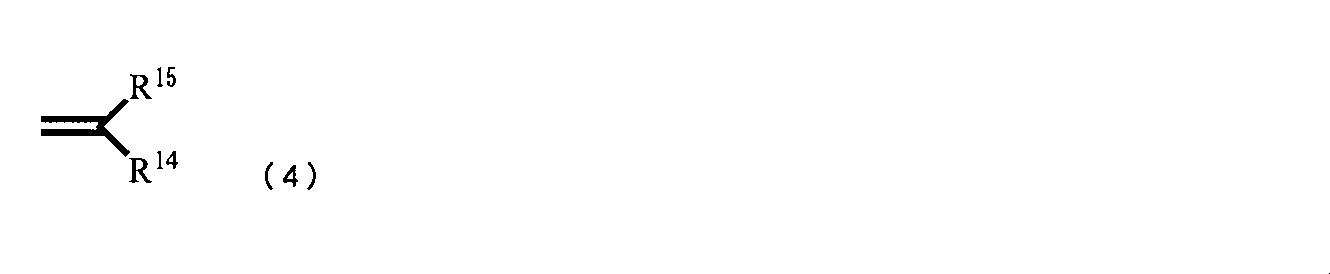
をラジカル共重合させることを特徴とする、請求項1に記載のエポキシ基含有共重合体の製造方法。 - 以下の式(5):
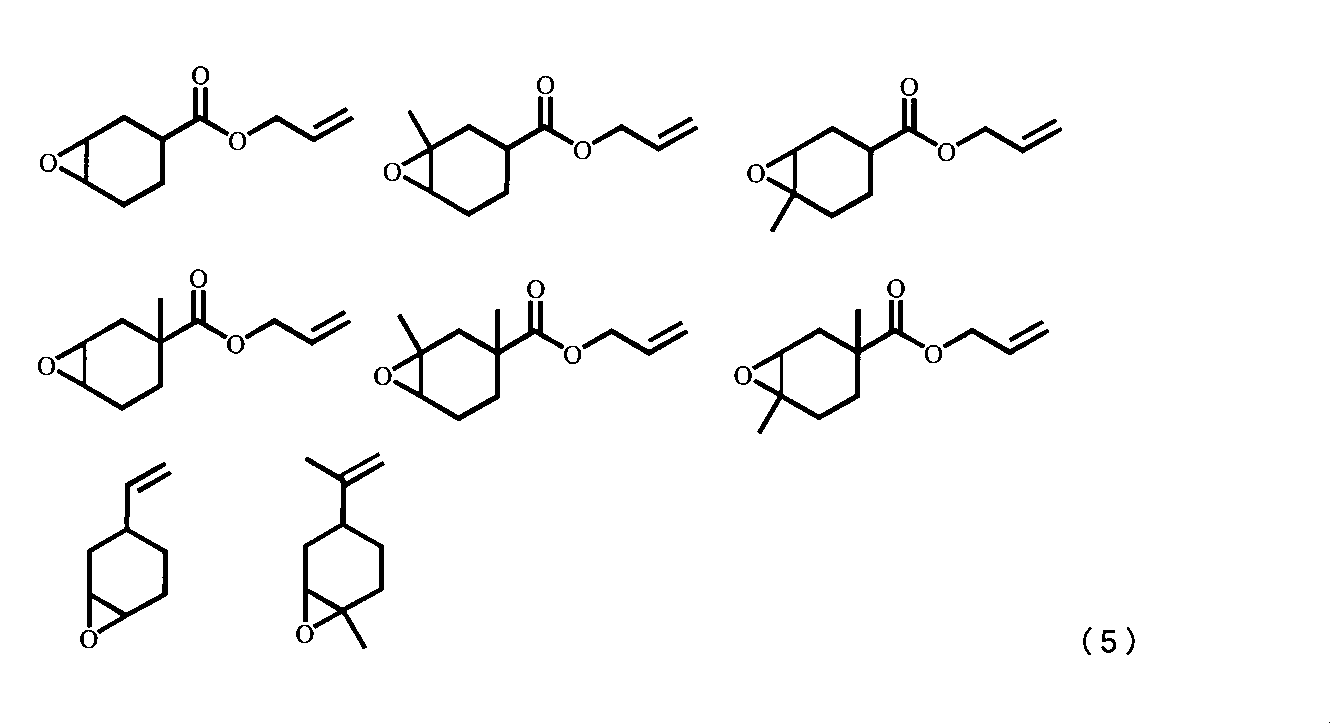
エチレン、4-メチル-1-ペンテン、1-オクテン、1-デセン、1-ドデセン、1-テトラデセン、1-ヘキサデセン、1-オクタデセン、4-ビニルシクロヘキセン、及びリモネンの内の少なくとも1つと、
をラジカル共重合させることを特徴とする、請求項1に記載のエポキシ基含有共重合体の製造方法。 - 3,4-エポキシシクロヘキサン-1-カルボン酸アリルエステル、3,4-エポキシ-1-メチルシクロヘキサンカルボン酸アリルエステル、及び3,4-エポキシ-6-フェニルシクロヘキサンカルボン酸アリルエステルの内の少なくとも1つと、4-メチル-1-ペンテン、1-デセン、1-ドデセン、1-テトラデセン、1-ヘキサデセン、及び1-オクタデセンの内の少なくとも1つと、
をラジカル共重合させることを特徴とする、請求項1に記載のエポキシ基含有共重合体の製造方法。 - 前記共重合後に薄膜蒸発装置又は分子蒸留装置を用いてモノマーを含む低分子成分を留去する、請求項7~9のいずれか1項に記載のエポキシ基含有共重合体の製造方法。
- 以下の式(a1’)、(a2’)、(b1)又は(b2):
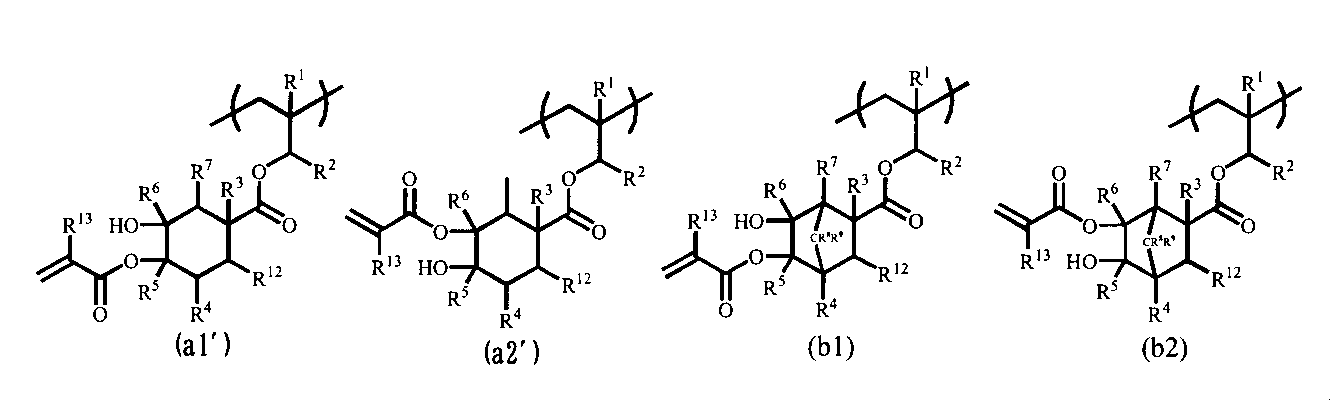

- 前記共重合体のアクリル当量が300g/eq.~3500g/eq.である、請求項11に記載のエポキシ(メタ)アクリレート共重合体。
- 前記共重合体中の式(a1’)、(a2’)、(b1)又は(b2)で表される繰返し単位の総和が、10~90モル%であり、式(d)で表される繰返し単位が、5~90モル%であり、かつ、式(a1’)、(a2’)、(b1)又は(b2)で表される繰返し単位の総和と式(d)で表される繰返し単位の総和が100モル%以下である、請求項11に記載のエポキシ(メタ)アクリレート共重合体。
- 前記共重合体が、以下の式(a)又は(b):

- 以下の式(1)又は(2):

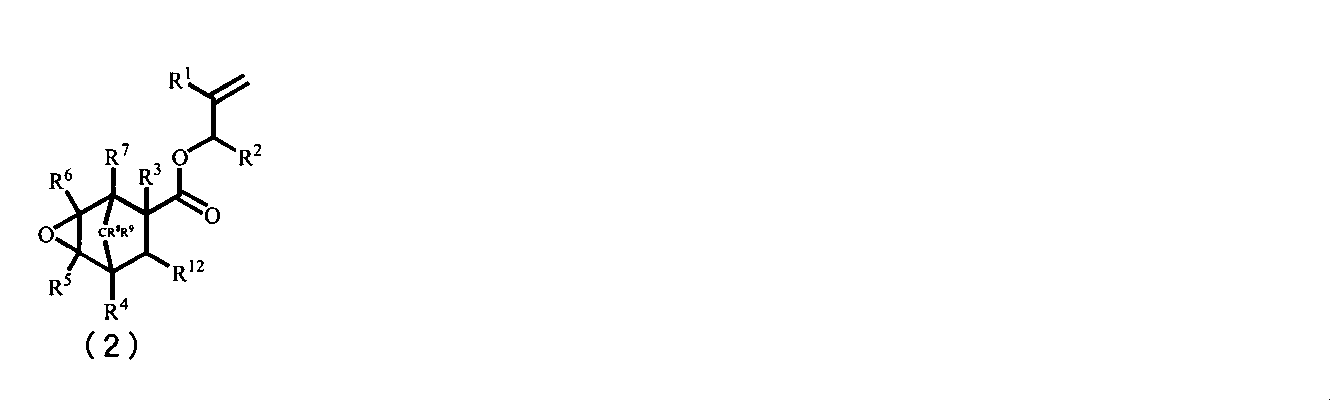
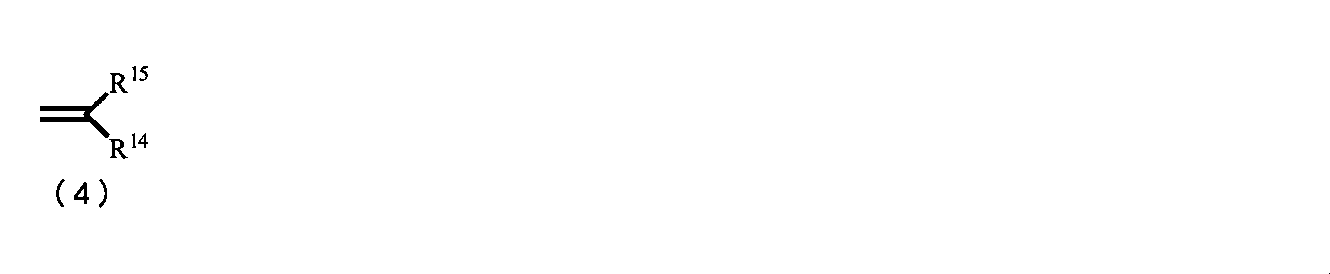
該エポキシ基含有共重合体に(メタ)アクリル酸を反応させる工程と、を含むことを特徴とする、請求項14に記載のエポキシ(メタ)アクリレート共重合体の製造方法。 - 前記エポキシ基とアリル基を含有するモノマーが、3,4-エポキシシクロヘキサン-1-カルボン酸アリルエステル、3,4-エポキシ-1-メチルシクロヘキサンカルボン酸アリルエステル、及び3,4-エポキシ-6-フェニルシクロヘキサンカルボン酸アリルエステルの内の少なくとも1つであり、前記オレフィンが、エチレン、4-メチル-1-ペンテン、1-ヘキセン、1-オクテン、1-デセン、1-ドデセン、1-テトラデセン、1-ヘキサデセン、及び1-オクタデセンの内の少なくとも1つである、請求項15に記載のエポキシ(メタ)アクリレート共重合体の製造方法。
- 前記エポキシ基含有共重合体のエポキシ当量が190~3000g/eqである、請求項15に記載のエポキシ(メタ)アクリレート共重合体の製造方法。
Priority Applications (6)
| Application Number | Priority Date | Filing Date | Title |
|---|---|---|---|
| JP2010523902A JP5562241B2 (ja) | 2008-08-08 | 2009-08-07 | エポキシ基含有共重合体、及びこれを用いたエポキシ(メタ)アクリレート共重合体、並びにそれらの製造方法 |
| US13/057,425 US8541508B2 (en) | 2008-08-08 | 2009-08-07 | Epoxy group-containing copolymer, epoxy (meth)acrylate copolymer using the same and their production processes |
| EP09805067.7A EP2314634B1 (en) | 2008-08-08 | 2009-08-07 | Epoxy-group-containing copolymer, epoxy (meth)acrylate copolymer using same, and processes for producing the copolymers |
| CN2009801302985A CN102112505A (zh) | 2008-08-08 | 2009-08-07 | 含环氧基的共聚物、和使用它制造的环氧(甲基)丙烯酸酯共聚物以及它们的制造方法 |
| KR1020117002331A KR101267289B1 (ko) | 2008-08-08 | 2009-08-07 | 에폭시기 함유 공중합체, 이것을 사용한 에폭시(메타)아크릴레이트 공중합체, 및 그것들의 제조 방법 |
| US13/964,428 US20130331531A1 (en) | 2008-08-08 | 2013-08-12 | Epoxy-group-containing copolymer, epoxy (meth)acrylate copolymer using the same, and their production processes |
Applications Claiming Priority (4)
| Application Number | Priority Date | Filing Date | Title |
|---|---|---|---|
| JP2008206114 | 2008-08-08 | ||
| JP2008-206114 | 2008-08-08 | ||
| JP2008-305179 | 2008-11-28 | ||
| JP2008305179 | 2008-11-28 |
Related Child Applications (1)
| Application Number | Title | Priority Date | Filing Date |
|---|---|---|---|
| US13/964,428 Division US20130331531A1 (en) | 2008-08-08 | 2013-08-12 | Epoxy-group-containing copolymer, epoxy (meth)acrylate copolymer using the same, and their production processes |
Publications (1)
| Publication Number | Publication Date |
|---|---|
| WO2010016585A1 true WO2010016585A1 (ja) | 2010-02-11 |
Family
ID=41663797
Family Applications (1)
| Application Number | Title | Priority Date | Filing Date |
|---|---|---|---|
| PCT/JP2009/064051 Ceased WO2010016585A1 (ja) | 2008-08-08 | 2009-08-07 | エポキシ基含有共重合体、及びこれを用いたエポキシ(メタ)アクリレート共重合体、並びにそれらの製造方法 |
Country Status (7)
| Country | Link |
|---|---|
| US (2) | US8541508B2 (ja) |
| EP (1) | EP2314634B1 (ja) |
| JP (1) | JP5562241B2 (ja) |
| KR (1) | KR101267289B1 (ja) |
| CN (1) | CN102112505A (ja) |
| TW (1) | TWI412538B (ja) |
| WO (1) | WO2010016585A1 (ja) |
Cited By (3)
| Publication number | Priority date | Publication date | Assignee | Title |
|---|---|---|---|---|
| US20120168074A1 (en) * | 2010-02-10 | 2012-07-05 | Lg Hausys, Ltd. | Sheet for forming hard coating |
| CN102892806A (zh) * | 2010-05-27 | 2013-01-23 | 昭和电工株式会社 | 含氟和环氧基的共聚物和其制造方法 |
| JP2022116592A (ja) * | 2021-01-29 | 2022-08-10 | 東亞合成株式会社 | 重合体の製造方法 |
Families Citing this family (11)
| Publication number | Priority date | Publication date | Assignee | Title |
|---|---|---|---|---|
| KR101346643B1 (ko) * | 2010-08-02 | 2014-01-02 | 연세대학교 산학협력단 | 화합물, 이를 포함하는 접착 조성물 및 이를 이용하여 제조한 접착제 |
| CN103068556B (zh) | 2010-08-06 | 2015-07-22 | 综研化学株式会社 | 纳米压印用树脂制模具及其制造方法 |
| JP5685149B2 (ja) * | 2010-10-25 | 2015-03-18 | 富士フイルム株式会社 | 半硬化物、硬化物およびそれらの製造方法、光学部品、硬化樹脂組成物 |
| KR101291937B1 (ko) * | 2011-04-15 | 2013-07-31 | (주)엘지하우시스 | 하드코팅용 조성물 및 이를 이용한 저온 성형성 및 슬립성이 우수한 하드코팅 형성용 시트 |
| JP5898551B2 (ja) * | 2012-03-29 | 2016-04-06 | 富士フイルム株式会社 | 半硬化物、硬化物およびそれらの製造方法、光学部品、硬化樹脂組成物 |
| JP6130693B2 (ja) * | 2012-03-30 | 2017-05-17 | 太陽インキ製造株式会社 | 積層構造体、ドライフィルムおよび積層構造体の製造方法 |
| JP2016006822A (ja) * | 2014-06-20 | 2016-01-14 | 株式会社巴川製紙所 | 複合磁性体 |
| CN108369376B (zh) * | 2015-12-25 | 2022-05-03 | 东丽株式会社 | 感光性树脂组合物、固化膜、层叠体、触控面板用构件和固化膜的制造方法 |
| TWI570180B (zh) | 2016-03-03 | 2017-02-11 | 國立高雄應用科技大學 | 紫外光硬化樹脂組成物 |
| JP6490850B1 (ja) * | 2018-03-02 | 2019-03-27 | 株式会社有沢製作所 | プリプレグ及びプリプレグ成形品の製造方法 |
| CN115850564B (zh) * | 2022-11-03 | 2024-02-06 | 广东三求光固材料股份有限公司 | 感光碱显影树脂及其制备方法和应用 |
Citations (13)
| Publication number | Priority date | Publication date | Assignee | Title |
|---|---|---|---|---|
| JPS523686A (en) | 1975-06-27 | 1977-01-12 | Kuraray Co Ltd | Flame-retarded unsaturated polyester resin compsotions |
| JPS5392888A (en) | 1977-01-25 | 1978-08-15 | Hitachi Chem Co Ltd | High solids resin composition |
| JPS54159492A (en) | 1978-06-07 | 1979-12-17 | Hitachi Chem Co Ltd | Resin composition with a low content of volatile polymerizable monomer |
| JPS60166675A (ja) | 1984-01-30 | 1985-08-29 | Daicel Chem Ind Ltd | 新規なエポキシ樹脂 |
| JPH0641275A (ja) | 1992-04-06 | 1994-02-15 | Daicel Chem Ind Ltd | 新規なエポキシ樹脂およびその製造方法 |
| JPH08291214A (ja) | 1995-04-21 | 1996-11-05 | Daicel Chem Ind Ltd | 新規多官能エポキシ樹脂組成物およびそれを用いた光硬化性樹脂組成物 |
| JP2002284842A (ja) * | 2001-03-23 | 2002-10-03 | Taiyo Ink Mfg Ltd | エポキシアクリレート化合物、これを含有する硬化性樹脂組成物及びその硬化物 |
| JP2004051860A (ja) * | 2002-07-23 | 2004-02-19 | Nippon Kayaku Co Ltd | エポキシカルボキシレート化合物及びそれを用いた感光性樹脂組成物 |
| JP2006316034A (ja) | 2005-05-16 | 2006-11-24 | Showa Denko Kk | ジオレフィン化合物の選択酸化による2官能性エポキシモノマーの製造方法 |
| JP2007204642A (ja) | 2006-02-02 | 2007-08-16 | Showa Denko Kk | エポキシ基含有重合体及びその製法 |
| WO2007132724A1 (ja) * | 2006-05-11 | 2007-11-22 | Nippon Kayaku Kabushiki Kaisha | 反応性カルボキシレート化合物、それを用いた硬化型樹脂組成物、およびその用途 |
| JP2007310060A (ja) * | 2006-05-17 | 2007-11-29 | Fujifilm Corp | 感光性樹脂組成物、及び感光性フィルム、並びに、永久パターン形成方法、及びプリント配線板 |
| JP2008297448A (ja) * | 2007-05-31 | 2008-12-11 | Showa Denko Kk | 硬化性樹脂組成物およびその硬化物 |
Family Cites Families (7)
| Publication number | Priority date | Publication date | Assignee | Title |
|---|---|---|---|---|
| US799913A (en) | 1905-06-29 | 1905-09-19 | Jordan Stewart Mayse | Wheel-straightening machine. |
| BE550474A (ja) * | 1955-08-22 | |||
| DE68923014T2 (de) | 1988-03-03 | 1995-11-30 | Daicel Chem | Zusammensetzungen auf der Basis von Polyetherverbindungen und Epoxydverbindungen und Verfahren für ihre Herstellung. |
| JP2926429B2 (ja) | 1990-05-18 | 1999-07-28 | ダイセル化学工業株式会社 | α―オレフィン共重合体およびその製造方法 |
| JPH0786726A (ja) | 1993-09-13 | 1995-03-31 | Tamura Kaken Kk | プリント配線板の製造方法 |
| US7585516B2 (en) * | 2001-11-12 | 2009-09-08 | Advanced Cardiovascular Systems, Inc. | Coatings for drug delivery devices |
| JP2008069205A (ja) * | 2006-09-12 | 2008-03-27 | Showa Denko Kk | 新規熱硬化性重合液及びそれを用いた熱硬化性樹脂 |
-
2009
- 2009-08-07 CN CN2009801302985A patent/CN102112505A/zh active Pending
- 2009-08-07 WO PCT/JP2009/064051 patent/WO2010016585A1/ja not_active Ceased
- 2009-08-07 KR KR1020117002331A patent/KR101267289B1/ko not_active Expired - Fee Related
- 2009-08-07 EP EP09805067.7A patent/EP2314634B1/en not_active Not-in-force
- 2009-08-07 JP JP2010523902A patent/JP5562241B2/ja not_active Expired - Fee Related
- 2009-08-07 US US13/057,425 patent/US8541508B2/en not_active Expired - Fee Related
- 2009-08-10 TW TW098126753A patent/TWI412538B/zh not_active IP Right Cessation
-
2013
- 2013-08-12 US US13/964,428 patent/US20130331531A1/en not_active Abandoned
Patent Citations (13)
| Publication number | Priority date | Publication date | Assignee | Title |
|---|---|---|---|---|
| JPS523686A (en) | 1975-06-27 | 1977-01-12 | Kuraray Co Ltd | Flame-retarded unsaturated polyester resin compsotions |
| JPS5392888A (en) | 1977-01-25 | 1978-08-15 | Hitachi Chem Co Ltd | High solids resin composition |
| JPS54159492A (en) | 1978-06-07 | 1979-12-17 | Hitachi Chem Co Ltd | Resin composition with a low content of volatile polymerizable monomer |
| JPS60166675A (ja) | 1984-01-30 | 1985-08-29 | Daicel Chem Ind Ltd | 新規なエポキシ樹脂 |
| JPH0641275A (ja) | 1992-04-06 | 1994-02-15 | Daicel Chem Ind Ltd | 新規なエポキシ樹脂およびその製造方法 |
| JPH08291214A (ja) | 1995-04-21 | 1996-11-05 | Daicel Chem Ind Ltd | 新規多官能エポキシ樹脂組成物およびそれを用いた光硬化性樹脂組成物 |
| JP2002284842A (ja) * | 2001-03-23 | 2002-10-03 | Taiyo Ink Mfg Ltd | エポキシアクリレート化合物、これを含有する硬化性樹脂組成物及びその硬化物 |
| JP2004051860A (ja) * | 2002-07-23 | 2004-02-19 | Nippon Kayaku Co Ltd | エポキシカルボキシレート化合物及びそれを用いた感光性樹脂組成物 |
| JP2006316034A (ja) | 2005-05-16 | 2006-11-24 | Showa Denko Kk | ジオレフィン化合物の選択酸化による2官能性エポキシモノマーの製造方法 |
| JP2007204642A (ja) | 2006-02-02 | 2007-08-16 | Showa Denko Kk | エポキシ基含有重合体及びその製法 |
| WO2007132724A1 (ja) * | 2006-05-11 | 2007-11-22 | Nippon Kayaku Kabushiki Kaisha | 反応性カルボキシレート化合物、それを用いた硬化型樹脂組成物、およびその用途 |
| JP2007310060A (ja) * | 2006-05-17 | 2007-11-29 | Fujifilm Corp | 感光性樹脂組成物、及び感光性フィルム、並びに、永久パターン形成方法、及びプリント配線板 |
| JP2008297448A (ja) * | 2007-05-31 | 2008-12-11 | Showa Denko Kk | 硬化性樹脂組成物およびその硬化物 |
Non-Patent Citations (1)
| Title |
|---|
| See also references of EP2314634A4 |
Cited By (9)
| Publication number | Priority date | Publication date | Assignee | Title |
|---|---|---|---|---|
| US20120168074A1 (en) * | 2010-02-10 | 2012-07-05 | Lg Hausys, Ltd. | Sheet for forming hard coating |
| US9233495B2 (en) * | 2010-02-10 | 2016-01-12 | Lg Hausys, Ltd. | Sheet for forming hard coating |
| CN102892806A (zh) * | 2010-05-27 | 2013-01-23 | 昭和电工株式会社 | 含氟和环氧基的共聚物和其制造方法 |
| US20130035461A1 (en) * | 2010-05-27 | 2013-02-07 | Showa Denko K.K. | Fluorine and epoxy group-containing copolymer, and method for producing same |
| EP2578612A4 (en) * | 2010-05-27 | 2013-12-04 | Showa Denko Kk | FLUOROUS AND EPOXY-GROUP-CONTAINING COPOLYMER AND METHOD FOR THE PRODUCTION THEREOF |
| US9034997B2 (en) | 2010-05-27 | 2015-05-19 | Showa Denko K.K. | Fluorine and epoxy group-containing copolymer, and method for producing same |
| CN102892806B (zh) * | 2010-05-27 | 2015-09-02 | 昭和电工株式会社 | 含氟和环氧基的共聚物和其制造方法 |
| JP2022116592A (ja) * | 2021-01-29 | 2022-08-10 | 東亞合成株式会社 | 重合体の製造方法 |
| JP7725824B2 (ja) | 2021-01-29 | 2025-08-20 | 東亞合成株式会社 | 重合体の製造方法 |
Also Published As
| Publication number | Publication date |
|---|---|
| JP5562241B2 (ja) | 2014-07-30 |
| TW201018700A (en) | 2010-05-16 |
| EP2314634A4 (en) | 2012-11-07 |
| US8541508B2 (en) | 2013-09-24 |
| JPWO2010016585A1 (ja) | 2012-01-26 |
| US20130331531A1 (en) | 2013-12-12 |
| KR20110038079A (ko) | 2011-04-13 |
| CN102112505A (zh) | 2011-06-29 |
| TWI412538B (zh) | 2013-10-21 |
| US20110144279A1 (en) | 2011-06-16 |
| EP2314634A1 (en) | 2011-04-27 |
| KR101267289B1 (ko) | 2013-05-24 |
| EP2314634B1 (en) | 2014-05-07 |
Similar Documents
| Publication | Publication Date | Title |
|---|---|---|
| JP5562241B2 (ja) | エポキシ基含有共重合体、及びこれを用いたエポキシ(メタ)アクリレート共重合体、並びにそれらの製造方法 | |
| EP2308905A1 (en) | Curable copolymer and curable resin composition | |
| WO2002077058A1 (en) | Resin curable with actinic energy ray, photocurable/thermosetting resin composition containing the same, and cured article obtained therefrom | |
| WO2001073510A1 (en) | Photocurable/thermosetting resin composition, photosensitive dry film formed therefrom, and method of forming pattern with the same | |
| EP2147937A1 (en) | Photo- and/or thermo-curable copolymer, curable resin compositions, and cured articles | |
| JP3953854B2 (ja) | 光硬化性・熱硬化性樹脂組成物 | |
| KR101468341B1 (ko) | 감광성 수지의 제조방법 및 감광성 수지 조성물 | |
| JPH1143524A (ja) | カリックスアレーン誘導体及びそれを含有する硬化性樹脂組成物 | |
| EP4071182A1 (en) | Alicyclic acrylate compound, alicyclic epoxy acrylate compound, curable composition, and cured article | |
| WO2001053375A1 (en) | Polynuclear epoxy compound, resin obtained therefrom curable with actinic energy ray, and photocurable/thermosetting resin composition containing the same | |
| JP5726181B2 (ja) | フッ素及びエポキシ基含有共重合体及びその製造方法 | |
| JP2002284842A (ja) | エポキシアクリレート化合物、これを含有する硬化性樹脂組成物及びその硬化物 | |
| JP2009001730A (ja) | 高分子化合物およびその製造方法 | |
| JP6530281B2 (ja) | フォトレジスト用活性エネルギー線硬化性組成物 | |
| CN120383727B (zh) | 一种脂环聚醚酰亚胺高性能光固化材料及其制备方法 | |
| JP2006016448A (ja) | エポキシ樹脂組成物 | |
| JP2004331768A (ja) | エポキシ基含有多分岐化合物、それを含有する硬化性組成物及び該硬化性組成物を用いたプリント配線板 | |
| JP2002293878A (ja) | 光硬化性・熱硬化性樹脂組成物及びその硬化物 | |
| KR100188182B1 (ko) | 감광성 에폭시 아크릴레이트의 제조방법 | |
| JP2021095461A (ja) | ラジカル重合性化合物、硬化性組成物および硬化物 | |
| CN113227062A (zh) | 高纯度甲基丙烯酸3,4-环氧环己基甲酯 | |
| JP2025085432A (ja) | 水溶性エポキシ(メタ)アクリレート組成物の製造方法、乳化物、コーティング組成物、塗膜及び硬化塗膜 | |
| JP2021095462A (ja) | 脂環式エポキシアクリレート型重合性単量体、エポキシ基含有(メタ)アクリル重合体、硬化性組成物および硬化物 | |
| JP2007204642A (ja) | エポキシ基含有重合体及びその製法 | |
| JP2021095347A (ja) | 脂環式アクリレート型重合性単量体、脂環式エポキシアクリレート型重合性単量体、硬化性組成物および硬化物 |
Legal Events
| Date | Code | Title | Description |
|---|---|---|---|
| WWE | Wipo information: entry into national phase |
Ref document number: 200980130298.5 Country of ref document: CN |
|
| 121 | Ep: the epo has been informed by wipo that ep was designated in this application |
Ref document number: 09805067 Country of ref document: EP Kind code of ref document: A1 |
|
| WWE | Wipo information: entry into national phase |
Ref document number: 2010523902 Country of ref document: JP |
|
| WWE | Wipo information: entry into national phase |
Ref document number: 2009805067 Country of ref document: EP |
|
| ENP | Entry into the national phase |
Ref document number: 20117002331 Country of ref document: KR Kind code of ref document: A |
|
| WWE | Wipo information: entry into national phase |
Ref document number: 13057425 Country of ref document: US |
|
| WWE | Wipo information: entry into national phase |
Ref document number: 219/MUMNP/2011 Country of ref document: IN |
|
| NENP | Non-entry into the national phase |
Ref country code: DE |