WO2010073595A1 - 難燃性ポリアミド組成物 - Google Patents
難燃性ポリアミド組成物 Download PDFInfo
- Publication number
- WO2010073595A1 WO2010073595A1 PCT/JP2009/007076 JP2009007076W WO2010073595A1 WO 2010073595 A1 WO2010073595 A1 WO 2010073595A1 JP 2009007076 W JP2009007076 W JP 2009007076W WO 2010073595 A1 WO2010073595 A1 WO 2010073595A1
- Authority
- WO
- WIPO (PCT)
- Prior art keywords
- flame retardant
- polyamide composition
- flame
- mass
- retardant polyamide
- Prior art date
- Legal status (The legal status is an assumption and is not a legal conclusion. Google has not performed a legal analysis and makes no representation as to the accuracy of the status listed.)
- Ceased
Links
Images

Classifications
-
- C—CHEMISTRY; METALLURGY
- C08—ORGANIC MACROMOLECULAR COMPOUNDS; THEIR PREPARATION OR CHEMICAL WORKING-UP; COMPOSITIONS BASED THEREON
- C08L—COMPOSITIONS OF MACROMOLECULAR COMPOUNDS
- C08L77/00—Compositions of polyamides obtained by reactions forming a carboxylic amide link in the main chain; Compositions of derivatives of such polymers
-
- C—CHEMISTRY; METALLURGY
- C08—ORGANIC MACROMOLECULAR COMPOUNDS; THEIR PREPARATION OR CHEMICAL WORKING-UP; COMPOSITIONS BASED THEREON
- C08K—Use of inorganic or non-macromolecular organic substances as compounding ingredients
- C08K5/00—Use of organic ingredients
- C08K5/49—Phosphorus-containing compounds
- C08K5/51—Phosphorus bound to oxygen
- C08K5/53—Phosphorus bound to oxygen bound to oxygen and to carbon only
- C08K5/5313—Phosphinic compounds, e.g. R2=P(:O)OR'
-
- C—CHEMISTRY; METALLURGY
- C08—ORGANIC MACROMOLECULAR COMPOUNDS; THEIR PREPARATION OR CHEMICAL WORKING-UP; COMPOSITIONS BASED THEREON
- C08L—COMPOSITIONS OF MACROMOLECULAR COMPOUNDS
- C08L81/00—Compositions of macromolecular compounds obtained by reactions forming in the main chain of the macromolecule a linkage containing sulfur with or without nitrogen, oxygen or carbon only; Compositions of polysulfones; Compositions of derivatives of such polymers
- C08L81/06—Polysulfones; Polyethersulfones
-
- C—CHEMISTRY; METALLURGY
- C08—ORGANIC MACROMOLECULAR COMPOUNDS; THEIR PREPARATION OR CHEMICAL WORKING-UP; COMPOSITIONS BASED THEREON
- C08K—Use of inorganic or non-macromolecular organic substances as compounding ingredients
- C08K3/00—Use of inorganic substances as compounding ingredients
- C08K3/18—Oxygen-containing compounds, e.g. metal carbonyls
- C08K3/20—Oxides; Hydroxides
- C08K3/22—Oxides; Hydroxides of metals
-
- C—CHEMISTRY; METALLURGY
- C08—ORGANIC MACROMOLECULAR COMPOUNDS; THEIR PREPARATION OR CHEMICAL WORKING-UP; COMPOSITIONS BASED THEREON
- C08K—Use of inorganic or non-macromolecular organic substances as compounding ingredients
- C08K3/00—Use of inorganic substances as compounding ingredients
- C08K3/32—Phosphorus-containing compounds
-
- C—CHEMISTRY; METALLURGY
- C08—ORGANIC MACROMOLECULAR COMPOUNDS; THEIR PREPARATION OR CHEMICAL WORKING-UP; COMPOSITIONS BASED THEREON
- C08K—Use of inorganic or non-macromolecular organic substances as compounding ingredients
- C08K3/00—Use of inorganic substances as compounding ingredients
- C08K3/38—Boron-containing compounds
-
- C—CHEMISTRY; METALLURGY
- C08—ORGANIC MACROMOLECULAR COMPOUNDS; THEIR PREPARATION OR CHEMICAL WORKING-UP; COMPOSITIONS BASED THEREON
- C08K—Use of inorganic or non-macromolecular organic substances as compounding ingredients
- C08K7/00—Use of ingredients characterised by shape
- C08K7/02—Fibres or whiskers
- C08K7/04—Fibres or whiskers inorganic
- C08K7/14—Glass
-
- C—CHEMISTRY; METALLURGY
- C08—ORGANIC MACROMOLECULAR COMPOUNDS; THEIR PREPARATION OR CHEMICAL WORKING-UP; COMPOSITIONS BASED THEREON
- C08L—COMPOSITIONS OF MACROMOLECULAR COMPOUNDS
- C08L81/00—Compositions of macromolecular compounds obtained by reactions forming in the main chain of the macromolecule a linkage containing sulfur with or without nitrogen, oxygen or carbon only; Compositions of polysulfones; Compositions of derivatives of such polymers
- C08L81/02—Polythioethers; Polythioether-ethers
Definitions
- the present invention relates to a halogen-free flame retardant polyamide composition.
- a polyamide resin that can be molded into a predetermined shape by heating and melting has been used as a material for forming an electronic component.
- Widely used polyamides include aliphatic polyamides such as 6 nylon and 66 nylon. Such aliphatic polyamides have good moldability, but on the other hand, sufficient heat resistance as a raw material for surface mount components such as connectors, which are manufactured through high temperature exposure processes such as reflow soldering processes. Does not have.
- 46 nylon was developed as a polyamide having high heat resistance.
- 46 nylon has a problem that the water absorption rate is high. Therefore, the dimensions of electrical and electronic parts molded using the 46 nylon resin composition may change due to water absorption. If the molded body absorbs water, problems such as blistering, so-called blistering, occur due to heating in the reflow soldering process.
- the surface mounting method using lead-free solder is being shifted. Lead-free solder has a higher melting point than conventional lead solder. Accordingly, the mounting temperature has inevitably increased by 10 to 20 ° C., and the use of 46 nylon has become difficult.
- Aromatic polyamides derived from aromatic dicarboxylic acids such as terephthalic acid and aliphatic alkylenediamines have been developed.
- Aromatic polyamide is more excellent in heat resistance and low water absorption than aliphatic polyamide such as 46 nylon.
- Halogen-containing flame retardants such as brominated polyphenylene ether, brominated polystyrene, and polybrominated styrene are feared to generate dioxin compounds during combustion. For this reason, there is a demand from the market to provide a flame-retardant polyamide composition containing a halogen-free flame retardant from a halogen-containing flame retardant.
- phosphinate compounds has attracted attention (see Patent Documents 1 to 3).
- thermoplastic resin such as polyphenylene sulfide
- the toughness of the resin composition and physical properties such as reflow heat resistance are liable to be reduced, so that addition to a heat-resistant polyamide resin has been difficult.
- JP-T-2006-522842 Japanese Patent Laid-Open No. 2005-036231 Special table 2007-507595 Japanese Patent Laid-Open No. 2001-247751
- the inventor is a flame retardant when a high melting point polyamide composition containing a phosphinate compound as a flame retardant is molded under a high temperature condition such that the processing temperature is 270 ° C. or higher, particularly 300 ° C. or higher. It has been found that some phosphinate compounds may be thermally decomposed and corrode steel materials such as screws and cylinders of extruders and molding machines. In particular, when used in a polyamide resin to which a hard filler component such as glass fiber is added, the steel corrosion layer is polished with the filler to form a new corrosion layer, and the corrosion layer is polished again with the filler. As described above, there has been a problem that the corrosion wear of the steel material is remarkably accelerated by the repeated formation and polishing of the corrosion layer.
- a flame retardant polyamide composition containing a halogen-free flame retardant and a metal oxide, and a flame retardant polyamide composition containing a phosphinate compound as a flame retardant are known.
- the composition of No. 1 does not pay attention to the reduction of the corrosion wear of the steel material, and does not sufficiently exhibit the effect of reducing the corrosion wear of the steel material.
- the present invention is a halogen-free flame-retardant polyamide composition that does not generate halogen compounds during combustion, has excellent thermal stability during molding under high temperature conditions, and exhibits high flame resistance during combustion. Furthermore, the present invention provides a flame retardant polyamide composition capable of suppressing corrosion wear of steel materials such as screws and cylinders of extruders and molding machines.
- the present inventors have found that a polyamide composition containing a polyamide resin, a phosphinate compound as a flame retardant, and a specific thermoplastic resin has toughness, reflow heat resistance, and molding stability.
- the present invention has been completed by finding that the property, flame retardance, and corrosion wear of steel materials can be suppressed. That is, the first of the present invention relates to the following flame retardant polyamide composition.
- a flame retardant polyamide composition comprising 100% by mass of a total of each component, containing 0% by mass, and 0-50% by mass of the reinforcing material (D),
- the thermoplastic resin (B) satisfies UL94V-0 standard
- thermoplastic resin (B) according to [1], which has a melting point and / or glass transition point of 200 ° C. or higher and 400 ° C. or lower and satisfies the UL94 V-0 standard at a thickness of 0.8 mm.
- Flame retardant polyamide composition [3] The flame retardant polyamide composition according to [1], wherein a mass content of the thermoplastic resin (B) is not less than a mass content of the flame retardant (C).
- thermoplastic resin (B) is polyphenylene sulfide.
- the flame retardant polyamide composition further contains a metal compound component selected from a metal hydroxide (E-1) and a metal oxide (E-2) having an average particle size of 0.01 to 20 ⁇ m.
- a metal compound component selected from a metal hydroxide (E-1) and a metal oxide (E-2) having an average particle size of 0.01 to 20 ⁇ m.
- the metal compound component selected from the metal hydroxide (E-1) and the metal oxide (E-2) is at least one selected from the group consisting of metal oxides and zinc composite oxides
- the flame-retardant polyamide composition according to [5] which is a compound of
- the present inventor has found that the polyamide composition containing a polyamide resin, a phosphinate compound as a flame retardant, and a metal compound component of a specific element has good molding stability, flame retardancy, and corrosion resistance of steel materials. As a result, the present invention was completed. That is, the second of the present invention relates to the following polyamide composition.
- a flame retardant polyamide composition comprising 0.05 to 2% by mass of a metal compound component selected from (E-1) and a metal oxide (E-2),
- the flame retardant (C) is a phosphinate compound
- the metal hydroxide (E-1) and the metal oxide (E-2) are compounds containing elements existing in Groups 2 to 12 of the periodic table of elements, and the metal hydroxide (E-1) And an average particle size of the metal oxide (E-2) is 0.01 to 20 ⁇ m.
- the metal oxide (E-2) is at least one selected from the group consisting of iron oxide, magnesium oxide, zinc oxide, and zinc composite oxide.
- the flame retardant polyamide composition of the present invention preferably has the following aspects.
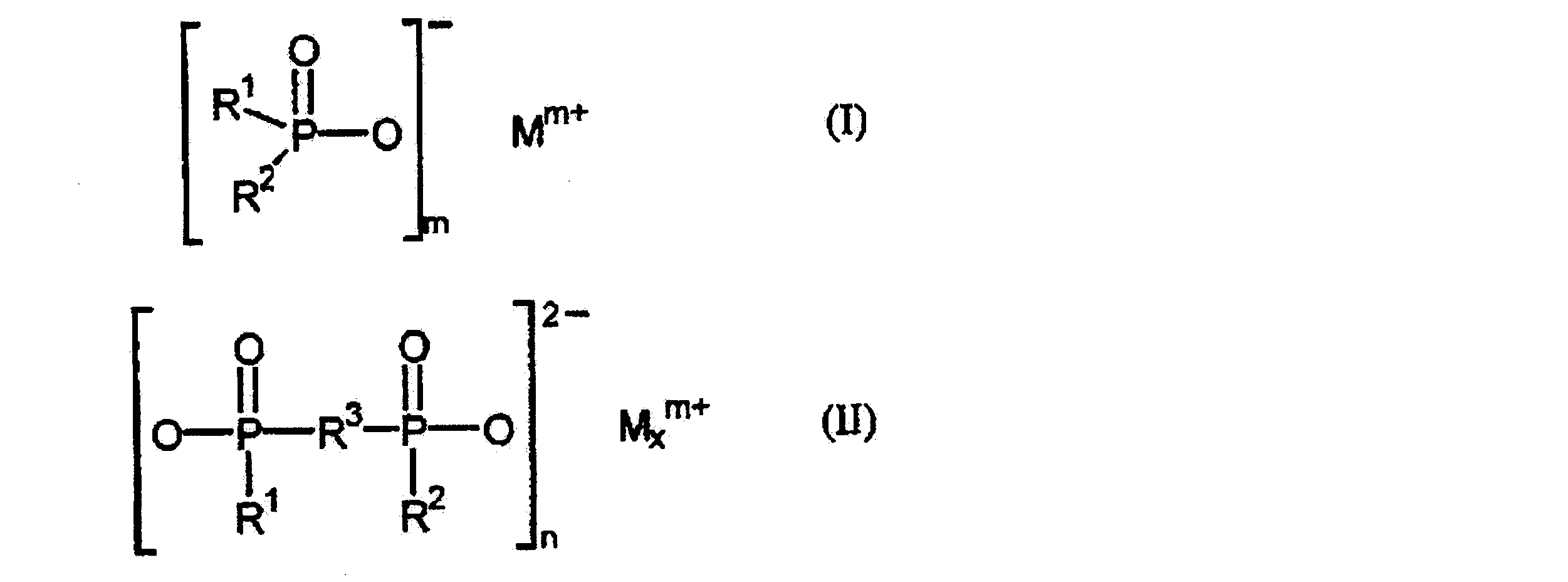
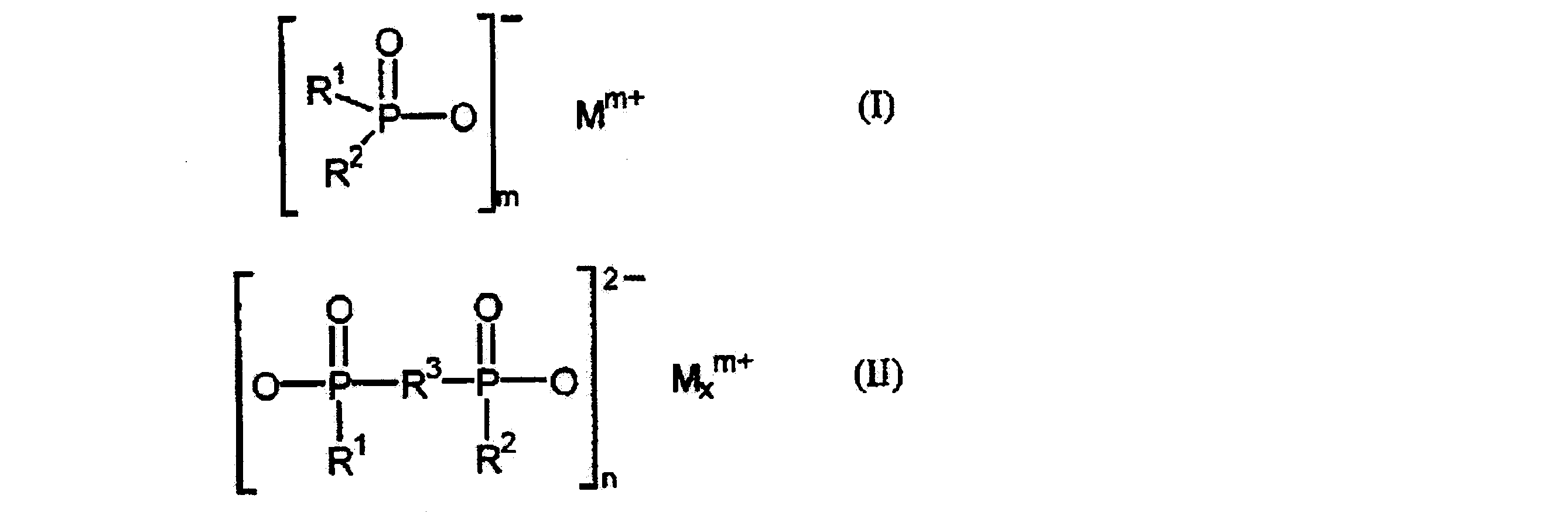
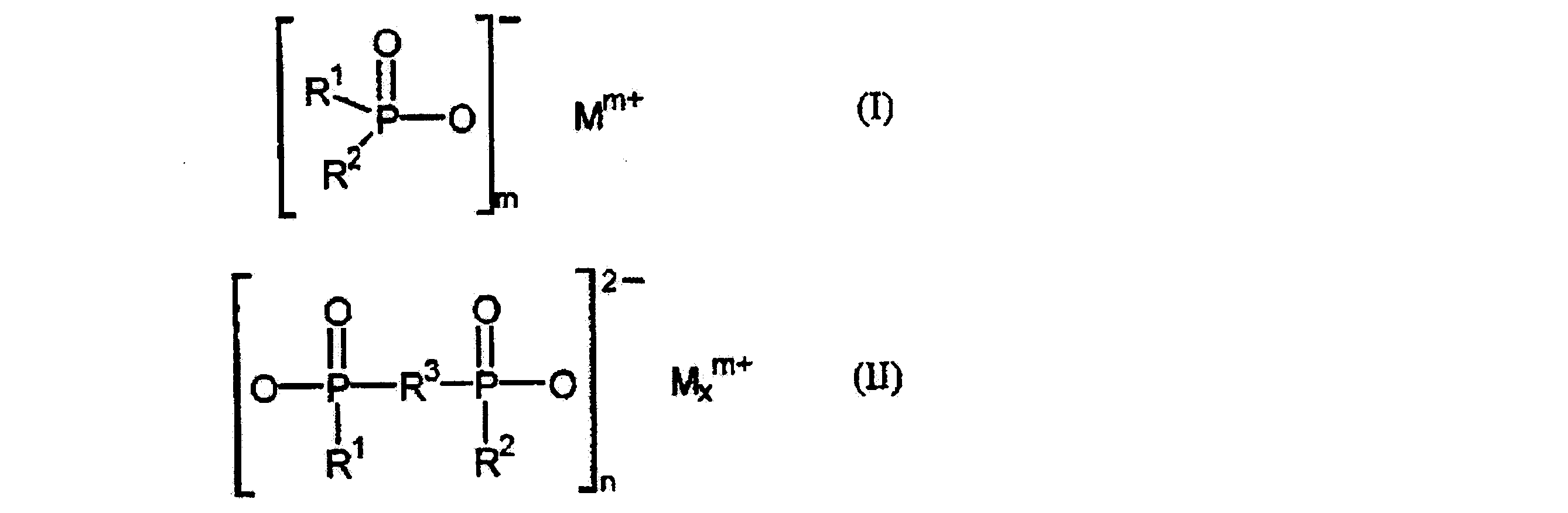
- the flame retardant (C) is a flame retardant comprising a phosphinate compound of the formula (I) and / or a bisphosphinate compound of the formula (II) and / or a polymer thereof.
- R 1 and R 2 are the same or different from each other and are linear or branched C 1 -C 6 alkyl and / or aryl;
- R 3 is linear or branched C 1 -C 10 alkylene, C 6 -C 10 arylene, C 6 -C 10 alkyl arylene or C 6 -C 10 aryl alkylene;
- M is Mg, Ca, Al, Sb, Sn, Ge, Ti, Zn, Fe, Zr , Ce, Bi, Sr, Mn, Li, Na, K and / or protonated nitrogen base;
- m is 1-4;
- n is 1-4;
- x is 1-4
- the polyamide resin (A) contains 40 to 100 mol% of terephthalic acid component units, 0 to 30 mol% of aromatic polyfunctional carboxylic acid component units other than terephthalic acid, and / or 4 to 20 carbon atoms.
- a polyfunctional carboxylic acid component unit (a-1) composed of 0 to 60 mol% of an aliphatic polyfunctional carboxylic acid component unit and a polyfunctional amine component unit (a-2) having 4 to 25 carbon atoms,
- a method for producing a molded article of a polyamide composition comprising a step of injection molding the flame-retardant polyamide composition according to [1] or [7] in the presence of an inert gas.
- the flame-retardant polyamide composition of the present invention is halogen-free, does not generate hydrogen halide during combustion, and has reduced environmental impact; has mechanical properties such as toughness, and heat resistance in the reflow soldering process Excellent in fire resistance and flame retardancy. Furthermore, the flame retardant polyamide composition of the present invention exhibits excellent thermal stability and flame retardancy even during molding, and does not corrode and wear steel materials of screws and cylinders of extruders and molding machines. Can be obtained. Thus, the industrial value of the flame retardant polyamide composition of the present invention is extremely high.
- the molded product of the flame retardant polyamide composition of the present invention is particularly preferably used as an electric / electronic component such as a fine pitch connector having a thin wall and a short distance between connector terminals; and a high melting point solder such as a lead-free solder is used.
- an electric / electronic component such as a fine pitch connector having a thin wall and a short distance between connector terminals; and a high melting point solder such as a lead-free solder is used.
- a high melting point solder such as a lead-free solder
- the flame retardant polyamide composition of the present invention contains a polyamide resin (A).
- the polyamide resin (A) is not particularly limited as long as it is a polyamide resin that can withstand the reflow soldering process, but the following polyfunctional carboxylic acid component unit (a-1), polyfunctional amine component unit (a-2), The structure containing is preferable.
- Polyfunctional carboxylic acid component unit (a-1) The polyfunctional carboxylic acid component unit (a-1) constituting the polyamide resin (A) contained in the flame retardant polyamide composition of the present invention is based on the total amount of the polyfunctional carboxylic acid component unit (a-1). 40 to 100 mol% of terephthalic acid component units, 0 to 30 mol% of aromatic polyfunctional carboxylic acid component units other than terephthalic acid, and / or 0 to 60 aliphatic polyfunctional carboxylic acid component units having 4 to 20 carbon atoms Having mol%.
- aromatic polyfunctional carboxylic acid component units other than terephthalic acid for example, isophthalic acid, 2-methylterephthalic acid, naphthalenedicarboxylic acid, phthalic anhydride, trimellitic acid, pyromellitic acid, trimellitic anhydride, pyrone anhydride
- units derived from isophthalic acid are preferred. These may be used alone or in combination of two or more.
- the addition amount is such that the resin does not gel, and specifically, it is preferably 10 mol% or less in a total of 100 mol% of all carboxylic acid component units.
- the aliphatic polyfunctional carboxylic acid component unit is a unit derived from an aliphatic polyfunctional carboxylic acid compound having 4 to 20, preferably 4 to 12, and more preferably 6 to 10 carbon atoms.
- examples of such compounds include adipic acid, suberic acid, azelaic acid, sebacic acid, decanedicarboxylic acid, undecanedicarboxylic acid, dodecanedicarboxylic acid and the like.
- adipic acid is particularly preferable from the viewpoint of improving mechanical properties.
- a polyfunctional carboxylic acid compound having three or more functional groups can be used as necessary.
- the trifunctional or higher polyfunctional carboxylic acid compound should be kept in such an amount that the resin does not gel. Specifically, it is preferably 10 mol% or less with respect to the total of all carboxylic acid component units. .
- the terephthalic acid component unit is 40 to 100 mol%, preferably 50 to 100 mol%, more preferably 60 to 60 mol% based on the total amount of the polyfunctional carboxylic acid component units (a-1). Contained in an amount of 100 mol%, more preferably 60-70 mol%; aromatic polyfunctional carboxylic acid component units other than terephthalic acid are contained in an amount of 0-30 mol%, preferably 0-10 mol% It is preferable.
- the polyamide resin (A) of the polyamide composition used in the reflow soldering process using lead-free solder preferably contains 55 mol% or more, preferably 60 mol% or more of terephthalic acid component units.
- the polyamide resin (A) is an amount of 0 to 60 mol%, preferably 0 to 50 mol%, more preferably 30 to 40 mol% of the aliphatic polyfunctional carboxylic acid component unit having 4 to 20 carbon atoms. It is preferable to include.
- the polyfunctional amine component unit (a-2) constituting the polyamide resin (A) contained in the flame-retardant polyamide composition of the present invention has 4 to 25 carbon atoms having a straight chain and / or a side chain, preferably a straight chain. Examples thereof include polyfunctional amine component units having a chain and / or a side chain and having 4 to 10 carbon atoms, more preferably a straight chain having 4 to 8 carbon atoms. Furthermore, the polyfunctional amine component unit (a-2) may contain an alicyclic polyfunctional amine component unit.
- linear polyfunctional amine component units include 1,4-diaminobutane, 1,6-diaminohexane, 1,7-diaminoheptane, 1,8-diaminooctane, 1,9-diaminononane, , 10-diaminodecane, 1,11-diaminoundecane, 1,12-diaminododecane.
- 1,6-diaminohexane is preferable.
- linear aliphatic diamine component unit having a side chain examples include 2-methyl-1,5-diaminopentane, 2-methyl-1,6-diaminohexane, and 2-methyl-1,7-diamino.
- Examples include heptane, 2-methyl-1,8-diaminooctane, 2-methyl-1,9-diaminononane, 2-methyl-1,10-diaminodecane, 2-methyl-1,11-diaminoundecane, and the like. Of these, 2-methyl-1,5-diaminopentane and 2-methyl-1,8-diaminooctane are preferred.
- 1,3-diaminocyclohexane, 1,4-diaminocyclohexane, bis (aminomethyl) cyclohexane, bis (4-aminocyclohexyl) methane, 4,4′-diamino-3 3,3′-dimethyldicyclohexylmethane is preferred; in particular 1,3-diaminocyclohexane, 1,4-diaminocyclohexane, bis (4-aminocyclohexyl) methane, 1,3-bis (aminocyclohexyl) methane, 1,3- Component units derived from alicyclic diamines such as bis (aminomethyl) cyclohexane are preferred.
- the addition amount is such that the resin does not gel, specifically, 10 mol% or less of the total 100 mol% of
- the polyfunctional amine component unit (a-2) is particularly preferably composed of only the above-mentioned linear polyfunctional amine component unit.
- Specifically preferred linear polyfunctional amine components are 1,4-diaminobutane, 1,6-diaminohexane, 1,7-diaminoheptane, 1,8-diaminooctane, 1,9-diaminononane, 1,10-. Examples include diaminodecane, 1,11-diaminoundecane, and 1,12-diaminododecane. Among these, 1,6-diaminohexane is preferable. Use of these linear polyfunctional amine components is preferred because the reflow heat resistance tends to improve.
- the polyamide resin (A) contained in the flame retardant polyamide composition of the present invention has an intrinsic viscosity [ ⁇ ] measured in a temperature of 25 ° C. and 96.5% sulfuric acid of 0.5 to 1.25 dl / g. More preferably, it is 0.75 to 1.15 dl / g, and still more preferably 0.75 to 1.05 dl / g.
- an intrinsic viscosity [ ⁇ ] of the polyamide resin (A) is in this range, a polyamide composition excellent in fluidity, reflow heat resistance and high toughness can be obtained.
- the polyamide resin (A) contained in the flame retardant polyamide composition of the present invention has a melting point because it is crystalline.
- the melting point of the polyamide resin (A) can be measured as the melting point (Tm) of the polyamide resin (A) by using an endothermic peak based on melting when the temperature is raised at 10 ° C./min using a differential scanning calorimeter (DSC). .
- the melting point of the polyamide resin (A) thus measured is preferably 270 to 340 ° C., more preferably 300 to 340 ° C., and further preferably 315 to 330 ° C.
- the polyamide resin (A) having a melting point in such a range has particularly excellent heat resistance. Further, when the melting point is 270 ° C.
- the flame-retardant polyamide composition of the present invention is used in a lead-free reflow soldering process, particularly a lead-free solder having a high melting point. Even when used in the soldering process, sufficient heat resistance is achieved.
- the melting point is 340 ° C. or lower, the melting point is lower than 350 ° C., which is the decomposition point of polyamide, so that generation of decomposition gas and discoloration of the molded product do not occur during molding, and sufficient thermal stability is achieved. Obtainable.
- the flame retardant polyamide composition of the present invention may contain a thermoplastic resin (B).
- the molded body made of the flame-retardant polyamide composition of the present invention containing the thermoplastic resin (B) can have both high toughness, fluidity, reflow heat resistance and flame retardancy.
- Thermoplastic resin (B) meets UL94V-0 standard. Specifically, it is preferable that the flame retardancy of the thermoplastic resin (B) alone satisfies the UL94V-0 standard under the condition of 0.8 mm thickness. If the flame retardancy of the thermoplastic resin (B) satisfies this standard, the polyamide composition of the present invention also has the flame resistance of UL94V-0 standard without impairing toughness, fluidity, and reflow heat resistance. Can be satisfied.
- the melting point and / or glass transition point of the thermoplastic resin (B) is preferably 200 ° C. or higher and 400 ° C. or lower.
- the molded body of the flame retardant polyamide composition of the present invention containing the thermoplastic resin (B) in this range can ensure reflow heat resistance during surface mounting, particularly when surface mounting using lead-free solder.
- the MFR of the thermoplastic resin (B) is preferably a value of 5 to 6000 g / 10 minutes when the load is 5 kg, the temperature is 316 ° C., and the other measurement conditions are measured in accordance with ASTM D1238 procureure B. It is more preferably 50 to 3000 g / 10 minutes, further preferably 50 to 2000 g / 10 minutes, and particularly preferably 50 to 1700 g / 10 minutes.
- the thermoplastic resin (B) having an MFR in this range is easily finely dispersed in the flame retardant polyamide composition of the present invention.
- the flame-retardant polyamide composition which has the effect which suppresses steel materials corrosion, such as a screw of an extruder and a molding machine, is obtained.
- the thermoplastic resin (B) interacts with the flame retardant (C) described later and includes the flame retardant (C). Conceivable.
- the flame retardant (C) or the decomposed product of the flame retardant (C) suppresses corrosion of the steel material of the extruder or the molding machine.
- thermoplastic resin (B) examples include polyphenylene sulfide (PPS), liquid crystal polyester (LCP), polyethersulfone (PES), polyetheretherketone (PEEK), polyimide, and polyamideimide. These thermoplastic resins (B) can be used alone or in combination with a plurality of them. Among them, polyphenylene sulfide is preferable; and moreover, linear polyphenylene sulfide is more preferable than crosslinked polyphenylene sulfide because it can impart both higher reflow heat resistance and high fluidity to the polyamide composition.
- thermoplastic resin (B) is incompatible with the polyamide resin (A), and the thermoplastic resin (B) has a number average particle size of 0.1 to 20 ⁇ m in the matrix of the polyamide resin (A). It is preferable to be dispersed within a range.
- the preferable lower limit of the number average particle diameter is 0.5 ⁇ m; the preferable upper limit is 10 ⁇ m, and further 5 ⁇ m.
- the temperature during molding of the flame-retardant polyamide composition of the present invention is 270 ° C. or higher
- the phosphinic acid salt compound (C) described later is included in the thermoplastic resin (B).
- molding machine can further be anticipated.
- thermoplastic resin (B) satisfies the dispersion diameter in the above range, and is preferably a linear polyphenylene sulfide, in order to achieve both flame retardancy, particularly reflow heat resistance, toughness and reduction of steel corrosion wear. .
- chlorine and bromine contained in the flame-retardant polyamide composition of the present invention are often derived from the thermoplastic resin (B).
- the content of the element contained in the thermoplastic resin (B) is 10,000 ppm or less, preferably 5000 ppm or less, more preferably 3000 ppm or less, more preferably 2000 ppm or less.
- the flame retardant (C) having no halogen group in the molecule used in the present invention is added for the purpose of reducing the flammability of the resin.
- the flame retardant (C) is preferably a phosphinate compound, more preferably a phosphinic acid metal salt compound.
- flame retardant (C) examples include compounds represented by the following formula (I) and / or formula (II).
- R 1 and R 2 are the same or different from each other and are linear or branched C 1 -C 6 alkyl and / or aryl;
- R 3 is a linear or branched C 1 -C 10 alkylene, C 6 -C 10 arylene, C 6 -C 10 alkylarylene or C 6 -C 10 aryl alkylene;
- M is Mg, Ca, Al, Sb, Sn, Ge, Ti, Zn, Fe, Zr, Ce, Bi, Sr, Mn, Li, Na, K and / or a protonated nitrogen base;
- N is 1 to 4;
- x is 1 to 4.
- the phosphinate compound include calcium dimethylphosphinate, magnesium dimethylphosphinate, aluminum dimethylphosphinate, zinc dimethylphosphinate, calcium ethylmethylphosphinate, magnesium ethylmethylphosphinate, aluminum ethylmethylphosphinate, ethyl Zinc methylphosphinate, calcium diethylphosphinate, magnesium diethylphosphinate, aluminum diethylphosphinate, zinc diethylphosphinate, calcium methyl-n-propylphosphinate, magnesium methyl-n-propylphosphinate, methyl-n-propylphosphinic acid
- Representative examples of the flame retardant (C) containing a phosphinate compound used in the present invention include, for example, EXOLIT OP1230 and OP930 manufactured by Clariant Japan.
- the flame retardant polyamide composition of the present invention may contain a reinforcing material (D), and has various inorganic fillings having shapes such as fibrous, powdery, granular, plate-like, needle-like, cloth-like, and mat-like.
- a material can be used, and it can be used alone or in combination with a plurality of materials.
- the reinforcing material (D) include inorganic fibers such as aramid fibers and organic fibers such as carbon fibers. Of these, the reinforcing material (D) is preferably a fibrous material, more preferably glass fiber.
- the moldability of the polyamide composition of the present invention is improved, and mechanical properties such as tensile strength, bending strength, and flexural modulus of the molded body are improved.
- heat resistance characteristics such as heat distortion temperature are improved.
- the average length of the glass fiber is usually in the range of 0.1 to 20 mm, preferably 0.2 to 6 mm.
- the aspect ratio of glass fiber (L (average length of glass fiber) / D (average outer diameter of glass fiber)) is usually in the range of 10 to 5000, preferably 2000 to 3000. Glass fibers having an average length and an aspect ratio within such a range are preferably used.
- the different diameter ratio (ratio of major axis to minor axis) of the fiber cross section is larger than 1, preferably the different diameter ratio is It is effective to use a fibrous material of 1.5 to 6.0.
- the filler can be used after being treated with a silane coupling agent or a titanium coupling agent.
- a silane coupling agent such as vinyltriethoxysilane, 2-aminopropyltriethoxysilane, or 2-glycidoxypropyltriethoxysilane.
- the fibrous filler may be coated with a sizing agent.
- sizing agents include acrylic compounds represented by (meth) acrylic acid and (meth) acrylic acid esters, carboxylic acid compounds having a carbon-carbon double bond other than methacrylic acid such as maleic anhydride, and epoxy compounds. , Urethane compounds and amine compounds.
- Preferred combinations include acrylic compound / carboxylic acid compound, urethane compound / carboxylic acid compound, and urethane compound / amine compound combination.
- the surface treatment agent may be used in combination with a sizing agent, and the combined use improves the binding between the fibrous filler in the composition of the present invention and other components in the composition, and the appearance and strength characteristics are improved. improves.
- the reinforcing material (D) is preferably added to the flame-retardant polyamide composition of the present invention in a proportion of 0 to 50% by mass, preferably 10 to 45% by mass.
- the flame retardant polyamide composition of the present invention may contain a metal compound component selected from a metal hydroxide (E-1) and a metal oxide (E-2), preferably a metal oxide (E -2). By containing these, the corrosion wear of the steel material by a polyamide composition can be suppressed more.
- the metal hydroxide (E-1) and the metal oxide (E-2) can be used alone or in combination of a plurality of compounds.
- the metal of the metal hydroxide (E-1) and the metal oxide (E-2) is preferably a Group 1-12 metal in the periodic table, more preferably the second to the second in the periodic table.
- a Group 12 metal is preferred.
- the metal oxide (E-2) is preferably an oxide of a group 2 to 12 element of the periodic table, more preferably a group 4 to 12 element, and still more preferably a group 7 to 12 element. It is an oxide.
- Metal hydroxide (E-1) and metal oxide (E-2), in particular metal oxide (E-2), are used to produce a flame retardant polyamide composition, It is effective in suppressing the corrosion wear of steel materials such as screws, cylinders, dies, nozzles, etc., used in molding machines used to obtain molded bodies. In particular, a high suppression effect is achieved under conditions of high temperature such that the processing temperature is 270 ° C. or higher.
- a metal compound component selected from the metal hydroxide (E-1) and the metal oxide (E-2) is used, 0.05 to 2% by mass in the flame retardant polyamide composition, preferably 0.8%. It can be used at a ratio of 1 to 1% by mass, more preferably 0.1 to 0.5% by mass. If the content of the compound is less than 0.05% by mass, the effect of suppressing corrosion wear is not sufficient; if it exceeds 2% by mass, the effect of suppressing corrosion wear is improved, but flame retardancy, reflow heat resistance, and molding are improved. The thermal stability at the time tends to decrease.
- the metal hydroxide (E-1) and the metal oxide (E-2) may be particles having an average particle size of 0.01 to 20 ⁇ m, an average particle size of 0.01 to 10 ⁇ m, more preferably 0.8. It is preferable to use particles of 01 to 5 ⁇ m, more preferably 0.01 to 3 ⁇ m, particularly preferably 0.01 to 1 ⁇ m, particularly preferably 0.01 to 0.3 ⁇ m. This is to obtain a higher corrosion wear suppression effect.
- the BET specific surface area of the metal oxide (E-2) or metal hydroxide (E-1) may be 1 to 50 m 2 / g, preferably 3 to 40 m 2 / g, more preferably 5 ⁇ 40 m 2 / g.
- the average particle diameter and the BET specific surface area are in the above ranges, it is often possible to obtain a molded article in which corrosion wear of the steel material is suppressed and excellent in flame retardancy and reflow heat resistance. If the average particle diameter exceeds 20 ⁇ m or the BET specific surface area is less than 1 m 2 / g, the corrosion wear suppressing effect may not be sufficiently obtained. On the other hand, if the average particle diameter is less than 0.01 ⁇ m or the BET specific surface area exceeds 50 m 2 / g, the corrosion wear suppression effect can be obtained, but flame retardancy, reflow heat resistance, and thermal stability during molding. Tend to decrease.
- Preferred metal elements of the metal hydroxide (E-1) and metal oxide (E-2) used in the present invention include iron, magnesium and zinc, more preferably magnesium and zinc, and particularly preferably Is zinc.
- Preferred examples of the metal hydroxide (E-1) or metal oxide (E-2) include magnesium hydroxide, magnesium oxide, and zinc oxide.
- Other preferred examples include metal composite oxides, more preferably zinc composite oxides such as zinc stannate and zinc hydroxystannate.
- zinc oxide, zinc stannate, magnesium oxide, and magnesium hydroxide are preferable.
- a normal single metal oxide is preferable to the composite oxide, and a particularly preferable specific example is zinc oxide.
- borate which is one of the complex oxides is not regarded as the metal oxide (E-2) in the present invention.
- an element having a Lewis acid potential such as boron
- the trapping effect of the decomposition product of the flame retardant described later is reduced, so that it is presumed that corrosion resistance is hardly exhibited.
- the flame retardant polyamide composition of the present invention includes, in addition to the above components, flame retardant aids, flame retardants, antioxidants, radical scavengers, and heat stabilizers other than those described above, as long as the object of the present invention is not impaired , Weathering stabilizer, fluidity improver, plasticizer, thickener, antistatic agent, release agent, pigment, dye, inorganic or organic filler, nucleating agent, fiber reinforcing agent, carbon black, talc, clay, mica Various known compounding agents such as an inorganic compound may be contained. Moreover, the flame-retardant polyamide composition of the present invention may contain additives such as commonly used ion scavengers.
- the flame-retardant polyamide composition of the present invention further improves heat resistance, flame retardancy, rigidity, tensile strength, bending strength, and impact strength by containing a fiber reinforcing agent.
- a flame retardant aid it is effective for exhibiting a high flame retardant effect with a small amount of added flame retardant.
- Specific examples include metal oxides and metal hydroxides, and these compounds can be used alone or in combination with a plurality of compounds. Specifically, zinc borate, boehmite, zinc stannate, iron oxide, and tin oxide are preferable, and zinc borate is more preferable.
- the flame retardant aid When a metal oxide or metal hydroxide is used as the flame retardant aid, it is 0.5 to 5% by mass, preferably 1 to 3% by mass in the flame retardant polyamide composition of the present invention.
- a flame retardant aid within the above range, stable flame retardancy and thermal stability during molding can be imparted to the flame retardant polyamide composition.
- phosphorus / nitrogen compounds typified by melamine phosphate compounds, melamine compounds and their condensates, and nitrogen compounds typified by melamine cyanurate are known. Under such high temperatures that the processing temperature is 270 ° C. or higher, the decomposition of the resin and the flame retardant is accelerated, and the thermal stability may be inferior.
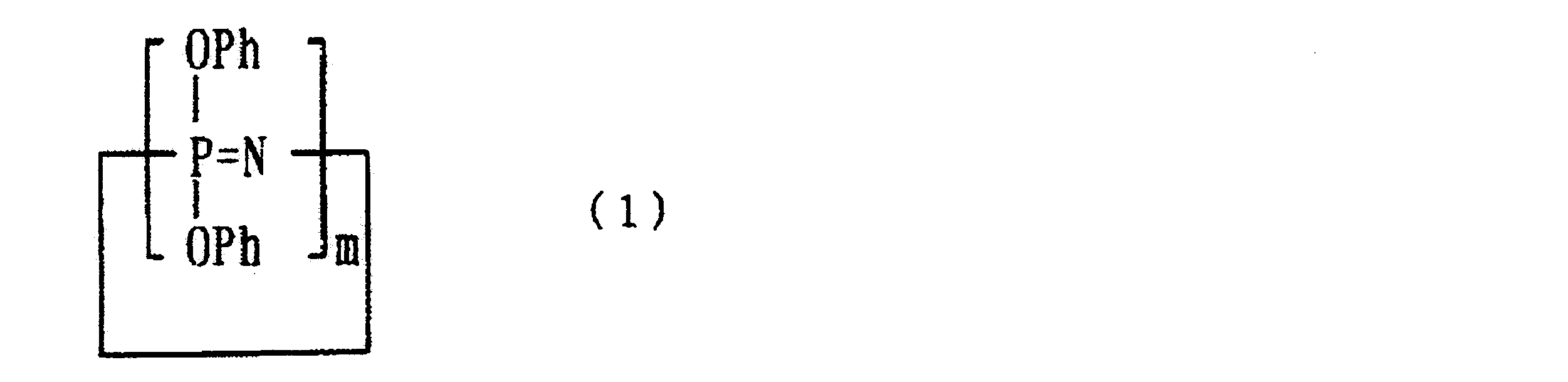
- the flame retardant aid may be at least one selected from the group consisting of, for example, a cyclic phosphazene compound represented by the formula (1) and / or a linear phosphazene compound represented by the formula (2).
- the content of these phosphazene compounds is 0.01 to 10% by mass, more preferably 0.5 to 5% by mass in the flame retardant polyamide composition.
- m represents an integer of 3 to 25. Ph represents a phenyl group.
- X represents a group —N ⁇ P (OPh) 3 or a group —N ⁇ P (O) OPh
- Y represents a group —P (OPh) 4 or a group —P (O) (OPh) 2 .
- n represents an integer of 3 to 1000. Ph represents a phenyl group.
- the flame retardant polyamide composition of the present invention may contain other polymers as long as the object of the present invention is not impaired.
- other polymers include polyethylene, polypropylene, poly-4-methyl-1-pentene, ethylene / 1-butene copolymer, propylene / ethylene copolymer, propylene / 1-butene copolymer, and polyolefin elastomer.
- Polyolefins such as polystyrene, polyamide, polycarbonate, polyacetal, polysulfone, polyphenylene oxide, fluorine resin, silicone resin, SEBS, and Teflon (registered trademark).
- modified polyolefins and the like can be mentioned.
- the modified polyolefin is, for example, a polyolefin modified with a carboxyl group, an acid anhydride group, an amino group, or the like.
- modified polyolefins include modified polyethylene elastomers, modified aromatic vinyl compounds / conjugated diene copolymers such as modified SEBS or their hydrides, and modified polyolefin elastomers such as modified ethylene / propylene copolymers. These components preferably do not meet the UL94V-0 standard.
- the content of these polymers is preferably 4% by mass or less, more preferably 2% by mass or less, and still more preferably. Is 1% by mass or less.
- the polyamide composition of the present invention contains the above-mentioned polyamide resin (A) and the flame retardant (C) as essential components, and also includes a thermoplastic resin (B) other than the polyamide resin (A) as essential components. Thus, it is roughly divided into two modes.
- the first flame retardant polyamide composition of the present invention is characterized by containing the above-mentioned thermoplastic resin (B) as an essential component.
- the first flame-retardant polyamide composition preferably contains 20 to 60% by mass, preferably 35 to 50% by mass of the polyamide resin (A) based on the total amount of the polyamide composition.
- the content of the polyamide resin (A) in the flame retardant polyamide composition is 20% by mass or more, sufficient toughness can be obtained; when it is 60% by mass or less, a sufficient flame retardant can be included, A resin composition satisfying a predetermined flame retardancy standard can be obtained.
- the first flame-retardant polyamide composition contains 5 to 40% by mass, preferably 5 to 30% by mass of the thermoplastic resin (B) with respect to the total amount of the polyamide composition.
- the content of the thermoplastic resin (B) is 5% by mass or more, sufficient flame retardancy can be ensured even with a small amount of flame retardant, and corrosion wear of the steel material can be suppressed.
- the said content is 40 mass% or less, without the toughness and reflow heat resistance of a flame-retardant polyamide composition falling.
- the total amount of elemental chlorine and elemental bromine contained in the flame retardant polyamide composition of the present invention is preferably 1000 ppm or less.
- the content of chlorine element and bromine element contained in the thermoplastic resin (B) is preferably 10,000 ppm or less, more preferably 5000 ppm or less, Preferably it is 3000 ppm or less, Most preferably, it is 2000 ppm or less.
- the first flame retardant polyamide composition contains 3 to 15% by mass, preferably 3 to 12% by mass, more preferably 5 to 10% by mass of the flame retardant (C) with respect to the total amount of the polyamide composition. If the content of the flame retardant (C) in the flame retardant polyamide composition is 3% by mass or more, sufficient flame retardancy can be obtained; if it is 15% by mass or less, the corrosion wear of the steel material is suppressed. An effect can be obtained. Moreover, the corrosion wear of steel materials can be suppressed more as the mass content rate of the said thermoplastic resin (B) is more than the mass content rate of a flame retardant (C).
- the total amount of the thermoplastic resin (B) and the flame retardant (C) in the first flame retardant polyamide composition is preferably 16 to 45% by mass.
- the flame-retardant polyamide composition can obtain sufficient flame retardancy; This is preferable because the toughness and reflow heat resistance of the polyamide composition do not deteriorate.
- the first flame retardant polyamide composition preferably contains 0 to 50 mass%, preferably 10 to 45 mass% of the reinforcing material (D) with respect to the total amount of the polyamide composition. It is preferable that the content of the reinforcing material (D) is 50% by mass or less without lowering the fluidity at the time of injection molding.
- the first flame retardant polyamide composition preferably uses a metal compound component selected from the metal hydroxide (E-1) and metal oxide (E-2) described above. Is preferably contained in a proportion of 0.05 to 2% by mass, more preferably 0.1 to 1% by mass, and still more preferably 0.1 to 0.5% by mass.
- the metal hydroxide (E-1) and metal oxide (E-2) are preferably particles having an average particle diameter of 0.01 to 20 ⁇ m, and more preferably an average particle diameter of 0.01 to 10 ⁇ m. More preferably, particles having a size of 0.01 to 5 ⁇ m, more preferably 0.01 to 3 ⁇ m, still more preferably 0.01 to 1 ⁇ m, and particularly preferably 0.01 to 0.3 ⁇ m are used.
- the metal hydroxide (E-1) and the metal oxide (E-2) can give the first flame-retardant polyamide composition an effect of suppressing corrosion wear of the steel material.
- the cause of the effect is presumed to be due to trapping decomposition products of the flame retardant (C), as in the case of the second flame retardant polyamide composition described later.
- the second flame-retardant polyamide composition of the present invention preferably contains 20 to 80% by mass, preferably 35 to 60% by mass of the polyamide resin (A) based on the total amount of the polyamide composition.
- the content of the polyamide resin (A) in the second flame retardant polyamide composition is 20% by mass or more, sufficient toughness can be obtained; and when it is 80% by mass or less, a sufficient flame retardant The flame retardancy can be obtained.
- the second flame-retardant polyamide composition preferably contains 5 to 40% by mass, preferably 7 to 20% by mass, of the flame retardant (C) with respect to the total amount of the polyamide composition.
- the content of the flame retardant (C) in the second flame retardant polyamide composition is 5% by mass or more, sufficient flame retardancy can be obtained; It is preferable that the fluidity of the resin does not decrease.
- the second flame-retardant polyamide composition preferably contains the reinforcing material (D) in a proportion of 0 to 50% by mass, preferably 10 to 45% by mass, based on the total amount of the polyamide composition.
- the ratio is 50% by mass or less, the fluidity at the time of injection molding is preferably not deteriorated.
- the second flame retardant polyamide composition is a metal compound component selected from metal hydroxide (E-1) and metal oxide (E-2), preferably metal oxide, based on the total amount of the polyamide composition.
- (E-2) is preferably contained in a proportion of 0.05 to 2% by mass, preferably 0.1 to 1% by mass, and 0.1 to 0.5% by mass.
- the content of the metal compound component selected from the metal hydroxide (E-1) and the metal oxide (E-2) in the flame retardant polyamide composition is 0.05% by mass or more, the corrosion wear of the steel material A sufficient effect for suppression is obtained, and when it is 10% by mass or less, flame retardancy, reflow heat resistance, and thermal stability during molding are not deteriorated, which is preferable.
- the metal hydroxide (E-1) and the metal oxide (E-2) are preferably compounds containing metal elements of Groups 2 to 12 of the periodic table.
- the average particle size may be 0.01 to 20 ⁇ m, the average particle size is 0.01 to 10 ⁇ m, more preferably 0.01 to 5 ⁇ m, still more preferably 0.01 to 3 ⁇ m, and particularly preferably 0. Particles of 0.01 to 1 ⁇ m, particularly preferably 0.01 to 0.3 ⁇ m.
- the metal compound component selected from the metal hydroxide (E-1) and the metal oxide (E-2) is a decomposition product of the flame retardant (C). Presumed to be trapping. Since the trap of the decomposition product of the flame retardant (C) is considered to occur mainly on the surface of the metal hydroxide (E-1) and metal oxide (E-2) components, the particle size is small. A component having a high specific surface area is considered advantageous. Therefore, the metal hydroxide (E-1) and the metal oxide (E-2) having a specific particle size range (for example, particles having an average particle size of 0.01 to 20 ⁇ m) are not subject to the corrosion wear that is the subject of the present application. It is considered advantageous for suppression.
- the flame-retardant polyamide composition of the present invention has a flammability evaluation of V-0 according to the UL94 standard. More specifically, it is preferable that the flame-retardant polyamide composition of the present invention has a flammability evaluation of V-0 in accordance with UL94 standard at a thickness of 0.8 mm or less.
- the heat resistance temperature for reflow after absorbing moisture at a temperature of 40 ° C. and a relative humidity of 95% for 96 hours is preferably 245 to 280 ° C., more preferably 250 to 280 ° C., still more preferably 255 to 280 ° C.
- the temperature is preferably 255 to 270 ° C.
- the fracture energy which is an indicator of mechanical properties, ie toughness, is preferably 25 to 70 mJ, more preferably 40 to 70 mJ, and even more preferably 40 to 60 mJ.
- the flow length obtained by injection molding of the resin into the bar flow mold is preferably 30 to 90 mm, more preferably 40 to 70 mm.
- the screw corrosion wear rate is preferably 0.01 to 2.7%, more preferably 0.01 to 2.5%, and still more preferably 0.8. 01-2.2%.
- the flame-retardant polyamide composition of the present invention has extremely excellent characteristics and is halogen-free (that is, the content of chlorine and bromine is low), so that the risk of dioxin generation is low and high. It has excellent thermal stability during molding under temperature conditions, and can exhibit high flame retardancy during combustion. Furthermore, even if the flame-retardant polyamide composition of the present invention is processed by an extruder or a molding machine, it can suppress corrosion wear of steel materials such as screws, cylinders and dies.
- the flame-retardant polyamide composition of the present invention can be suitably used particularly for electric and electronic parts.
- the flame retardant polyamide composition of the present invention can be produced by using the above-described components using a known resin kneading method. For example, a method of mixing each of the above components with a Henschel mixer, a V blender, a ribbon blender, a tumbler blender, or the like; Or the method of grind
- the flame-retardant polyamide composition of the present invention can be molded into various molded products by using known molding methods such as compression molding, injection molding, and extrusion molding.
- the injection molding method is suitable, and molding is performed in an inert gas atmosphere typified by nitrogen, argon, and helium, specifically, for example, at a flow rate of 0.1 to 10 ml / min.
- an inert gas atmosphere typified by nitrogen, argon, and helium, specifically, for example, at a flow rate of 0.1 to 10 ml / min.
- the flame-retardant polyamide composition of the present invention is excellent in terms of thermal stability during molding, reflow heat resistance, and suppression of corrosion wear of steel materials. Therefore, the flame retardant polyamide composition of the present invention can be used in fields where these characteristics are required, or in precision molding fields. Specific examples include electric parts for automobiles, current breakers, connectors, switches, jacks, plugs, breakers, and electric and electronic parts such as LED reflecting materials, and various molded articles such as coil bobbins and housings.
- each property was measured and evaluated by the following methods.
- [Intrinsic viscosity [ ⁇ ]] In accordance with JIS K6810-1977, 0.5 g of polyamide resin was dissolved in 50 ml of 96.5% sulfuric acid solution, and the sample solution was allowed to flow under conditions of 25 ⁇ 0.05 ° C. using an Ubbelohde viscometer. It was measured. From the measurement results, the intrinsic viscosity [ ⁇ ] of the polyamide resin was calculated based on the following formula.
- MFR MFR of each thermoplastic resin (B) was measured under conditions of a temperature of 316 ° C. and a load of 5 kg.
- the test piece subjected to the humidity conditioning treatment was placed on a glass epoxy substrate having a thickness of 1 mm.
- a temperature sensor was installed on this substrate.
- the glass epoxy substrate on which the test piece was placed was set in an air reflow soldering apparatus (AIS-20-82-C manufactured by Atec Techtron Co., Ltd.), and the temperature profile reflow step shown in FIG. 1 was performed. As shown in FIG. 1, the temperature is raised to a temperature of 230 ° C.
- a predetermined set temperature (a is 270 ° C., b is 265 ° C., c is 260 ° C., d is 255 ° C., e was heated to 235 ° C .; then the temperature was lowered to 230 ° C.
- the maximum value of the set temperature at which the test piece did not melt and blisters did not occur on the surface was determined, and the maximum value of the set temperature was defined as the reflow heat resistance temperature.
- the reflow heat resistance temperature of the moisture-absorbed test piece tends to be inferior to that of the absolutely dry state. Further, the reflow heat resistant temperature tends to decrease as the ratio of the polyamide resin / flame retardant amount decreases.
- the prepared test piece was allowed to stand at a temperature of 23 ° C. under a nitrogen atmosphere for 24 hours.
- a bending test was performed in an atmosphere of a temperature of 23 ° C. and a relative humidity of 50% at a bending test machine: AB5, span 26 mm, bending speed 5 mm / min.
- the energy (toughness) required for breaking the test piece was determined from the bending strength, strain amount and elastic modulus.
- Corrosion wear rate (%) ⁇ (screw part weight before injection molding ⁇ screw part weight after injection molding) / screw part weight before injection molding ⁇ ⁇ 100
- thermoplastic resin (B) other than polyamide resin (A), flame retardant (C), reinforcing material (D), metal hydroxide (E-1), Metal oxide (E-2) and other components are shown.
- Polyamide resin (A) (Polyamide resin (A-1)) Composition: dicarboxylic acid component unit (terephthalic acid: 62.5 mol%, adipic acid: 37.5 mol%), diamine component unit (1,6-diaminohexane: 100 mol%) Intrinsic viscosity [ ⁇ ]: 0.8 dl / g Melting point: 320 ° C.
- polyamide resin (A-2) Composition: dicarboxylic acid component unit (terephthalic acid: 55 mol%, adipic acid: 45 mol%), diamine component unit (1,6-diaminohexane: 100 mol%) Intrinsic viscosity [ ⁇ ]: 0.8 dl / g Melting point: 310 ° C (polyamide resin (A-3)) Composition: dicarboxylic acid component unit (terephthalic acid: 55 mol%, adipic acid: 45 mol%), diamine component unit (1,6-diaminohexane: 100 mol%) Intrinsic viscosity [ ⁇ ]: 1.0 dl / g Melting point: 310 ° C (polyamide resin (A-4)) Composition: dicarboxylic acid component unit (terephthalic acid: 100 mol%), diamine component unit (2-methyl-1,5-pentanediamine: 50 mol%, 1,6-diamino
- Thermoplastic resin (B) As described in Tables 1 to 4, several types of polyphenylene sulfide (PPS) were used. Tables 1 to 4 show the amount of chlorine, MFR, and cross-linked / linear type. The melting point of any polyphenylene sulfide was 280 ° C.
- Examples 1 to 22 and [Comparative Examples 1 to 6]
- the above-mentioned components were mixed at the quantitative ratios shown in Tables 1 to 4, charged into a twin screw vented extruder set at a temperature of 320 ° C., and melt-kneaded to obtain a pellet-like composition.
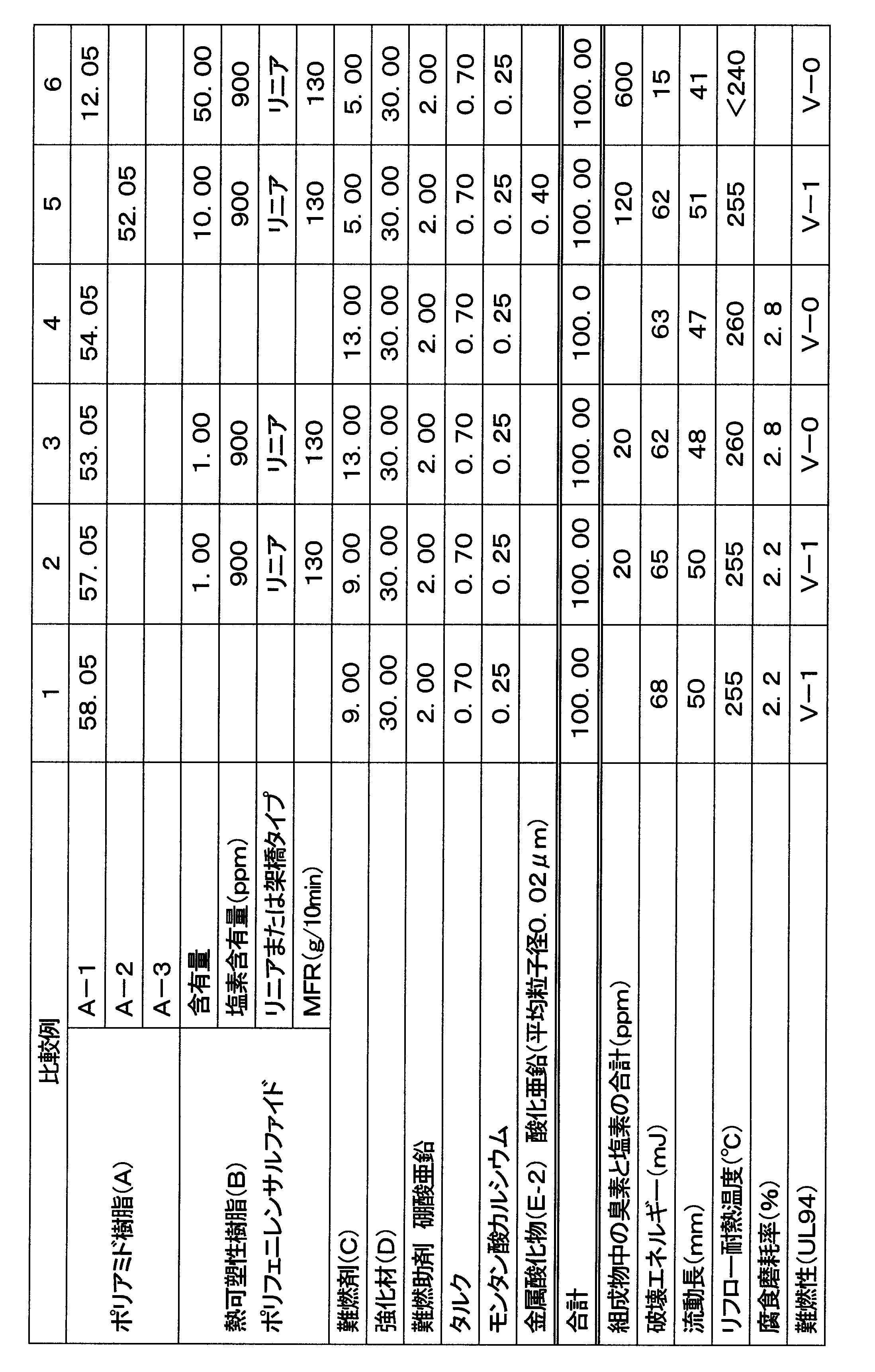
- the properties of the obtained flame retardant polyamide composition were evaluated, and the results are shown in Examples 1 to 22 in Tables 1 to 3 and Comparative Examples 1 to 6 in Table 4.
- Examples 23 to 33 [Comparative Examples 7 to 12] and [Reference Example 13] Each of the above components were mixed at a quantitative ratio as shown in Table 5 and Table 6, charged into a twin screw vented extruder set at a temperature of 320 ° C., and melt-kneaded to obtain a pellet-shaped composition. Next, the properties of the obtained flame-retardant polyamide composition were evaluated, and the results are shown in Examples 23 to 33 in Table 5, Comparative Examples 7 to 12 in Table 6, and Reference Example 13.
- the average particle size of zinc oxide (E-2-1) used in Example 32 was 0.02 ⁇ m and the specific surface area was 37 m 2 / g; the average particle size of zinc oxide (E-2-5) was 15 0.000 ⁇ m and the specific surface area is 2 m 2 / g.
- thermoplastic resin (B) As shown in Tables 1 to 3, in Examples 1 to 22, since containing appropriate amounts of the thermoplastic resin (B) and the flame retardant (C), the flame retardancy is high and the reflow heat resistance temperature is also high. It can also be seen that the corrosion wear rate is low. On the other hand, as shown in Table 4, when the thermoplastic resin (B) is not included or the total amount of the thermoplastic resin (B) and the flame retardant (C) is small (Comparative Examples 1 to 5), It can be seen that the flame retardancy is not sufficient and the corrosion wear rate is high. On the other hand, when the excess thermoplastic resin (B) is contained (Comparative Example 6), the fracture energy is lowered and the halogen (bromine and chlorine) content is increased.
- the flame retardant polyamide composition of the present invention does not contain a halogen-based flame retardant; it has excellent toughness, reflow heat resistance, and flame retardancy.
- the flame-retardant polyamide composition of the present invention can suppress corrosion wear of steel materials such as a molding machine and an extruder for molding.
- it can be used for electrical and electronic applications in which components are assembled by surface mounting using high melting point solder such as lead-free solder.
- it can be applied to the field of thin-walled parts for the above applications.
- it can be favorably used for applications in the precision molding field.
Landscapes
- Chemical & Material Sciences (AREA)
- Health & Medical Sciences (AREA)
- Chemical Kinetics & Catalysis (AREA)
- Medicinal Chemistry (AREA)
- Polymers & Plastics (AREA)
- Organic Chemistry (AREA)
- Compositions Of Macromolecular Compounds (AREA)
- Manufacture Of Macromolecular Shaped Articles (AREA)
Abstract
Description
前記熱可塑性樹脂(B)は、UL94V-0規格を満たし、
前記難燃剤(C)は、ホスフィン酸塩化合物であり、かつ
前記熱可塑性樹脂(B)と前記難燃剤(C)の合計が、16~45質量%である、難燃性ポリアミド組成物。
[2] 前記熱可塑性樹脂(B)は、200℃以上400℃以下の融点および/またはガラス転移点を有し、かつ厚み0.8mmにおいてUL94 V-0規格を満たす、[1]に記載の難燃性ポリアミド組成物。
[3] 前記熱可塑性樹脂(B)の質量含有率が、前記難燃剤(C)の質量含有率以上である、[1]に記載の難燃性ポリアミド組成物。
[4] 前記熱可塑性樹脂(B)が、ポリフェニレンスルフィドである、[1]に記載の難燃性ポリアミド組成物。
[5] 前記難燃性ポリアミド組成物は、平均粒子径が0.01~20μmの金属水酸化物(E-1)および金属酸化物(E-2)から選ばれる金属化合物成分をさらに含有する、[1]に記載の難燃性ポリアミド組成物。
[6] 前記金属水酸化物(E-1)および金属酸化物(E-2)から選ばれる金属化合物成分が、金属酸化物、および亜鉛の複合酸化物からなる群から選択される1種以上の化合物である、[5]に記載の難燃性ポリアミド組成物。
難燃剤(C)は、ホスフィン酸塩化合物であり、
金属水酸化物(E-1)および金属酸化物(E-2)は、元素周期律表の第2~12族に存在する元素を含む化合物であり、かつ金属水酸化物(E-1)および金属酸化物(E-2)の平均粒子径は、0.01~20μmである、難燃性ポリアミド組成物。
[8] 前記金属化合物成分が金属酸化物(E-2)である、[7]に記載の難燃性ポリアミド組成物。
[9] 前記ポリアミド樹脂(A)の含有率が20~60質量%であり、前記難燃剤(C)の含有率が5~15質量%である、[7]に記載の難燃性ポリアミド組成物。
[10] 前記金属酸化物(E-2)の平均粒子径が、0.01~10μmである、[8]に記載の難燃性ポリアミド組成物。
[11] 前記金属酸化物(E-2)は、鉄の酸化物、マグネシウムの酸化物、亜鉛の酸化物、および亜鉛の複合酸化物からなる群から選択される1種以上である、[8]に記載の難燃性ポリアミド組成物。
[12] 前記亜鉛の複合酸化物が錫酸亜鉛である、[11]に記載の難燃性ポリアミド組成物。
[13] 前記ポリアミド樹脂(A)の融点が270~340℃である、[1]または[7]に記載の難燃性ポリアミド組成物。
[14] 前記難燃剤(C)が、式(I)のホスフィン酸塩化合物、および/または式(II)のビスホスフィン酸塩化合物、および/またはこれらのポリマーを含む難燃剤である、[1]または[7]に記載の難燃性ポリアミド組成物。
[16] 前記強化材(D)は繊維状物質である、[1]または[7]に記載の難燃性ポリアミド組成物。
[17] 前記[1]または[7]に記載の難燃性ポリアミド組成物を成形して得られる成形体。
[18] 前記[1]または[7]に記載の難燃性ポリアミド組成物を、不活性ガスの存在下で射出成形する工程を含む、ポリアミド組成物の成形体の製造方法。
[19] 前記[1]または[7]に記載の難燃性ポリアミド組成物を成形して得られる電気電子部品。
[ポリアミド樹脂(A)]
本発明の難燃性ポリアミド組成物はポリアミド樹脂(A)を含む。ポリアミド樹脂(A)は、リフローはんだ工程に耐えうるポリアミド樹脂であれば特に制限はないが、下記の多官能カルボン酸成分単位(a-1)と、多官能アミン成分単位(a-2)とを含む構造が好ましい。
本発明の難燃性ポリアミド組成物に含まれるポリアミド樹脂(A)を構成する多官能カルボン酸成分単位(a-1)は、多官能カルボン酸成分単位(a-1)の合計量に対して、テレフタル酸成分単位40~100モル%、テレフタル酸以外の芳香族多官能カルボン酸成分単位0~30モル%、および/または炭素原子数4~20の脂肪族多官能カルボン酸成分単位0~60モル%を有する。
本発明の難燃性ポリアミド組成物に含まれるポリアミド樹脂(A)を構成する多官能アミン成分単位(a-2)は、直鎖およびまたは側鎖を有する炭素原子数4~25、好ましくは直鎖およびまたは側鎖を有する炭素原子数4~10、より好ましくは直鎖の炭素原子数が4~8の多官能アミン成分単位が挙げられる。さらに、多官能アミン成分単位(a-2)は、脂環族多官能アミン成分単位を含んでいてもよい。
本発明の難燃性ポリアミド組成物は、熱可塑性樹脂(B)を含みうる。熱可塑性樹脂(B)を含む本発明の難燃性ポリアミド組成物からなる成形体は、高い靭性、流動性、リフロー耐熱性および難燃性を併せ持つことができる。
本発明で用いられる、分子中にハロゲン基を有さない難燃剤(C)は、樹脂の燃焼性を低下させる目的で添加するものである。難燃剤(C)は、好ましくはホスフィン酸塩化合物であり、より好ましくはホスフィン酸金属塩化合物である。
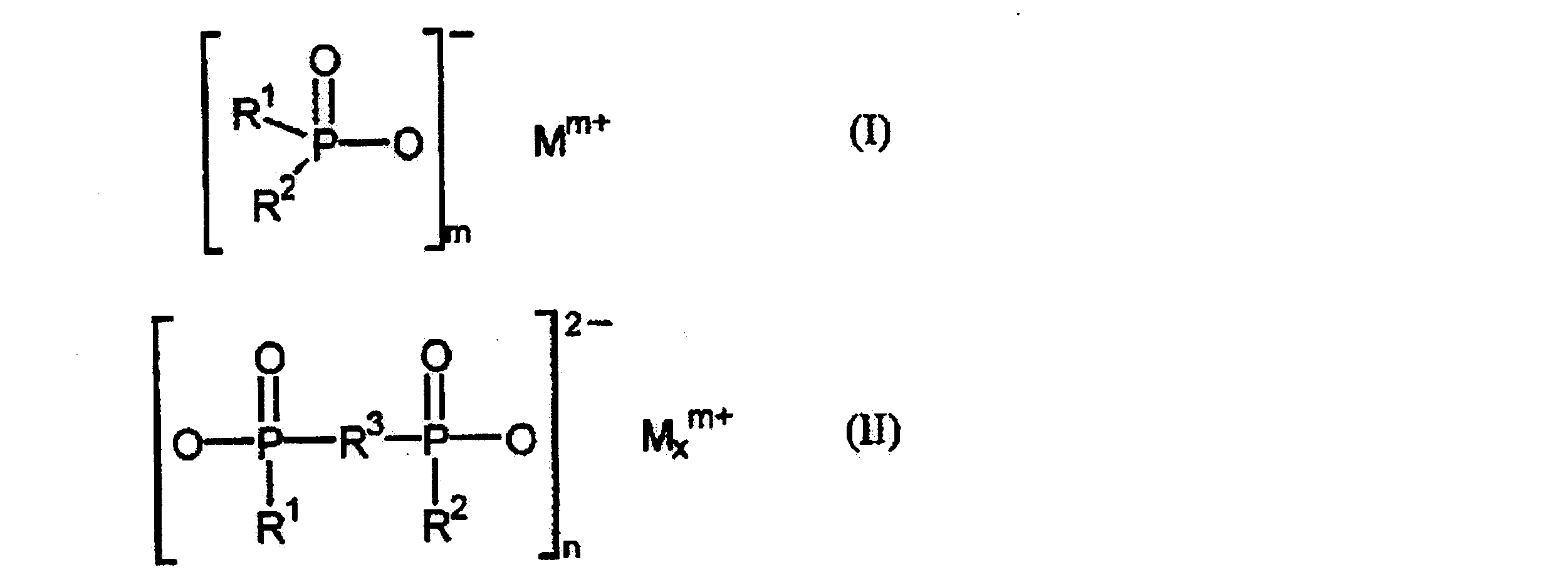
R3は直鎖状のまたは枝分かれしたC1-C10アルキレン、C6-C10アリーレン、C6-C10アルキルアリーレンまたはC6-C10アリールアルキレンであり;
Mは、Mg、Ca、Al、Sb、Sn、Ge、Ti、Zn、Fe、Zr、Ce、Bi、Sr、Mn、Li、Na、Kおよび/またはプロトン化窒素塩基であり;mは1~4であり;nは1~4であり;xは1~4である。
本発明の難燃性ポリアミド組成物は強化材(D)を含有してもよく、繊維状、粉状、粒状、板状、針状、クロス状、マット状などの形状を有する種々の無機充填材を使用することができ、単独あるいは複数のものと併用して使用することが可能である。さらに詳述すると、シリカ、シリカアルミナ、炭酸カルシウム、二酸化チタン、タルク、ワラストナイト、ケイソウ土、クレー、カオリン、球状ガラス、マイカ、セッコウ、ベンガラなどの粉状あるいは板状の無機化合物;チタン酸カリウムなどの針状の無機化合物;ガラス繊維(グラスファイバー)、チタン酸カリウム繊維、金属被覆ガラス繊維、セラミックス繊維、ワラストナイト、炭素繊維、金属炭化物繊維、金属硬化物繊維、アスベスト繊維およびホウ素繊維などの無機繊維;さらにはアラミド繊維、炭素繊維のような有機繊維が、強化材(D)として挙げられる。強化材(D)は、なかでも繊維状物質が好ましく、より好ましくはガラス繊維が挙げられる。
本発明の難燃性ポリアミド組成物は、金属水酸化物(E-1)および金属酸化物(E-2)から選ばれる金属化合物成分を含有していてもよく、好ましくは金属酸化物(E-2)を含有する。これらを含有することで、ポリアミド組成物による鋼材の腐食磨耗を、より抑制することができる。金属水酸化物(E-1)および金属酸化物(E-2)は、単独または複数の化合物を併用することができる。
本発明の難燃性ポリアミド組成物は、上記各成分に加えて、本発明の目的を損なわない範囲で、上記以外の難燃助剤、難燃剤、酸化防止剤、ラジカル捕捉剤、耐熱安定剤、耐候安定剤、流動性向上剤、可塑剤、増粘剤、帯電防止剤、離型剤、顔料、染料、無機あるいは有機充填剤、核剤、繊維補強剤、カーボンブラック、タルク、クレー、マイカ等無機化合物などの、種々公知の配合剤を含有していてもよい。また、本発明の難燃性ポリアミド組成物は、通常用いられるイオン捕捉剤などの添加剤を含有してもよい。イオン捕捉剤としては、例えばハイドロタルサイト、ゼオライトが知られている。特に本発明の難燃性ポリアミド組成物は、上記のうち繊維補強剤を含有していることにより、より一層耐熱性、難燃性、剛性、引張強度、曲げ強度、衝撃強度が向上される。

本発明のポリアミド組成物は、前述のポリアミド樹脂(A)と、難燃剤(C)とを必須成分として含みつつ、ポリアミド樹脂(A)以外の熱可塑性樹脂(B)を必須成分として含むかどうかで、二つの態様に大別される。
本発明の第一の難燃性ポリアミド組成物は、前述の熱可塑性樹脂(B)を必須成分として含むことを特徴とする。
本発明の第二の難燃性ポリアミド組成物は、ポリアミド組成物の総量に対して、ポリアミド樹脂(A)を20~80質量%、好ましくは35~60質量%の割合で含むことが好ましい。第二の難燃性ポリアミド組成物中のポリアミド樹脂(A)の含有量が20質量%以上であると、十分な靭性を得ることができ;また、80質量%以下であると十分な難燃剤を含むことができ、難燃性を得ることができる。
本発明の難燃性ポリアミド組成物は、前記の各成分を公知の樹脂混練方法を用いて製造することができる。例えば前記の各成分を、ヘンシェルミキサー、Vブレンダー、リボンブレンダー、タンブラーブレンダーなどで混合する方法;あるいは、混合後さらに一軸押出機、多軸押出機、ニーダー、バンバリーミキサーなどで溶融混練後、造粒あるいは粉砕する方法を採用することができる。
本発明の難燃性ポリアミド組成物は、圧縮成形法、射出成形法、押出成形法などの公知の成形法を利用することにより、各種成形体に成形することができる。特に、射出成形法が好適で、窒素、アルゴン、ヘリウムに代表される不活性ガスの雰囲気下、具体的には例えば0.1~10ml/分の流量下で成形することで、成形機のシリンダー、スクリュー等の鋼材の腐食磨耗をさらに低減させることが可能となる。
[極限粘度[η]]
JIS K6810-1977に準拠して、ポリアミド樹脂0.5gを96.5%硫酸溶液50mlに溶解し、ウベローデ粘度計を使用し、25±0.05℃の条件下で試料溶液の流下秒数を測定した。測定結果から、以下の式に基づいてポリアミド樹脂の極限粘度[η]を算出した。
[η]=ηSP/[C(1+0.205ηSP)]
ηSP=(t-t0)/t0
[η]:極限粘度(dl/g)
ηSP:比粘度、C:試料濃度(g/dl)
t:試料溶液の流下秒数(秒)
t0:ブランク硫酸の流下秒数(秒)
ポリアミド樹脂の試料を、PerkinElemer社製DSC7を用いて加熱し、一旦330℃で5分間保持し、次いで10℃/分の速度で23℃まで降温せしめた後、10℃/分で昇温した。このときの融解に基づく吸熱ピークをポリアミド樹脂の融点とした。
ASTM D1238 procedure Bに準拠し、温度316℃、荷重5kgの条件下で各熱可塑性樹脂(B)のMFRを測定した。
表1~表4、および表5~表6に示される量比で各成分を混合したポリアミド組成物を、以下の条件で射出成形して、1/32インチ×1/2×5インチの試験片を調製した。調製した試験片を用いて、UL94規格(1991年6月18日付のUL Test No.UL94)に準拠して、垂直燃焼試験を行い、難燃性を評価した。
成形機:(株)ソディック プラステック、ツパールTR40S3A
成形機シリンダー温度:各ポリアミド樹脂の融点+10℃
金型温度:120℃
表1~表4、および表5~表6に示される量比で各成分を混合したポリアミド組成物を、以下の条件で射出成形して、長さ64mm、幅6mm、厚さ0.8mmの試験片を調製した。調製した試験片を温度40℃、相対湿度95%で96時間調湿した。
成形機:(株)ソディック プラステック、ツパールTR40S3A
成形機シリンダー温度:各ポリアミド樹脂の融点+10℃
金型温度:100℃
表1~表4、および表5~表6に示される量比で各成分を混合したポリアミド組成物を、以下の条件で射出成形して長さ64mm、幅6mm、厚さ0.8mmの試験片を調製した。
成形機:(株)ソディック プラステック、ツパールTR40S3A
成形機シリンダー温度:各ポリアミド樹脂の融点+10℃
金型温度:100℃
表1~表4、および表5~表6に示される量比で各成分を混合したポリアミド組成物を、幅10mm、厚み0.5mmのバーフロー金型を使用して、以下の条件で射出し、金型内の樹脂の流動長(mm)を測定した。
射出成形機:(株)ソディック プラステック、ツパールTR40S3A
射出設定圧力:2000kg/cm2
シリンダー設定温度:各ポリアミド樹脂の融点+10℃
金型温度:120℃
端子数14のコネクター金型(スプルーとランナーを含む成形品重量:1g)を用いて、連続射出成形を10000ショット実施した。
射出成形機:住友重機械工業(株)、SE50DU
成形機シリンダー設定温度:各ポリアミド樹脂の融点+10℃
金型温度:100℃
腐食磨耗率(%)={(射出成形前のスクリュー部品重量 - 射出成形後のスクリュー部品重量)/射出成形前のスクリュー部品重量} × 100
上記流動長の測定時に、成形時のガス発生量を目視で評価した。ガス発生量がないものを○、若干ガス発生が見受けられたものを△、ガス発生量が多く使用に問題があるもの、または樹脂が分解して成形に問題があるものを×と評価した。樹脂組成物の熱安定性に優れるものは、ガス発生量が少なく金型汚染が良好となるため、成形性が良好であると判断される。
組成:ジカルボン酸成分単位(テレフタル酸:62.5モル%、アジピン酸:37.5モル%)、ジアミン成分単位(1,6-ジアミノヘキサン:100モル%)
極限粘度[η]:0.8dl/g
融点:320℃(ポリアミド樹脂(A-2))
組成:ジカルボン酸成分単位(テレフタル酸:55モル%、アジピン酸:45モル%)、ジアミン成分単位(1,6-ジアミノヘキサン:100モル%)
極限粘度[η]:0.8dl/g
融点:310℃(ポリアミド樹脂(A-3))
組成:ジカルボン酸成分単位(テレフタル酸:55モル%、アジピン酸:45モル%)、ジアミン成分単位(1,6-ジアミノヘキサン:100モル%)
極限粘度[η]:1.0dl/g
融点:310℃(ポリアミド樹脂(A-4))
組成:ジカルボン酸成分単位(テレフタル酸:100モル%)、ジアミン成分単位(2-メチル1,5ペンタンジアミン:50モル%、1,6-ジアミノヘキサン:50モル%)
極限粘度[η]:0.9dl/g
融点:300℃
表1~表4に記載した通り、いくつかの種類のポリフェニレンサルファイド(PPS)を使用した。表1~表4に、塩素量や、MFRや、架橋型/リニア型かを示した。いずれのポリフェニレンサルファイドの融点も、280℃であった。
クラリアントジャパン株式会社製、EXOLIT OP1230(ホスフィン酸塩化合物)
リン含有量:23.8質量%
ガラス繊維/オーウェンスコーニングジャパン(株)製、CS 03JA FT789
表1~表6に、金属水酸化物および金属酸化物の種類、平均粒子径および必要に応じてBET比表面積を示した。
上記各成分を、表1~表4に示すような量比で混合し、温度320℃に設定した二軸ベント付押出機に装入し、溶融混練してペレット状組成物を得た。次いで、得られた難燃性ポリアミド組成物について各性状を評価し、その結果を表1~表3の実施例1~22、および表4の比較例1~6に示す。
上記各成分を、表5および表6に示すような量比で混合し、温度320℃に設定した二軸ベント付押出機に装入し、溶融混練してペレット状組成物を得た。次いで、得られた難燃性ポリアミド組成物について各性状を評価し、その結果を表5の実施例23~33、および表6の比較例7~12、参考例13に示す。
実施例32で用いられた酸化亜鉛(E-2-1)の平均粒子径は0.02μm、比表面積は37m2/gであり;酸化亜鉛(E-2-5)の平均粒子径は15.00μmであり、比表面積は2m2/gである。




Claims (26)
- ポリアミド樹脂(A)20~60質量%、ポリアミド樹脂(A)以外の熱可塑性樹脂(B)5~40質量%、分子中にハロゲン基を有さない難燃剤(C)3~15質量%、および強化材(D)0~50質量%を含有する、各成分の合計が100質量%からなる難燃性ポリアミド組成物であって、
前記熱可塑性樹脂(B)は、UL94V-0規格を満たし、
前記難燃剤(C)は、ホスフィン酸塩化合物であり、かつ
前記熱可塑性樹脂(B)と前記難燃剤(C)の合計が、16~45質量%である、難燃性ポリアミド組成物。 - 前記熱可塑性樹脂(B)は、200℃以上400℃以下の融点および/またはガラス転移点を有し、かつ厚み0.8mmにおいてUL94 V-0規格を満たす、請求項1に記載の難燃性ポリアミド組成物。
- 前記熱可塑性樹脂(B)の質量含有率が、前記難燃剤(C)の質量含有率以上である、請求項1に記載の難燃性ポリアミド組成物。
- 前記熱可塑性樹脂(B)が、ポリフェニレンスルフィドである、請求項1に記載の難燃性ポリアミド組成物。
- 前記難燃性ポリアミド組成物は、平均粒子径が0.01~20μmの金属水酸化物(E-1)および金属酸化物(E-2)から選ばれる金属化合物成分をさらに含有する、請求項1に記載の難燃性ポリアミド組成物。
- 前記金属水酸化物(E-1)および金属酸化物(E-2)から選ばれる金属化合物成分が、金属酸化物、および亜鉛の複合酸化物からなる群から選択される1種以上の化合物である、請求項5に記載の難燃性ポリアミド組成物。
- ポリアミド樹脂(A)20~80質量%、分子中にハロゲン基を有さない難燃剤(C)5~40質量%、強化材(D)0~50質量%、および金属水酸化物(E-1)および金属酸化物(E-2)から選ばれる金属化合物成分0.05~2質量%を含む難燃性ポリアミド組成物であって、
難燃剤(C)は、ホスフィン酸塩化合物であり、
金属水酸化物(E-1)および金属酸化物(E-2)は、元素周期律表の第2~12族に存在する元素を含む化合物であり、かつ金属水酸化物(E-1)および金属酸化物(E-2)の平均粒子径は、0.01~20μmである、難燃性ポリアミド組成物。 - 前記金属化合物成分が金属酸化物(E-2)である、請求項7に記載の難燃性ポリアミド組成物。
- 前記ポリアミド樹脂(A)の含有率が20~60質量%であり、前記難燃剤(C)の含有率が5~15質量%である、請求項7に記載の難燃性ポリアミド組成物。
- 前記金属酸化物(E-2)の平均粒子径が、0.01~10μmである、請求項8に記載の難燃性ポリアミド組成物。
- 前記金属酸化物(E-2)は、鉄の酸化物、マグネシウムの酸化物、亜鉛の酸化物、および亜鉛の複合酸化物からなる群から選択される1種以上である、請求項8に記載の難燃性ポリアミド組成物。
- 前記亜鉛の複合酸化物が錫酸亜鉛である、請求項11に記載の難燃性ポリアミド組成物。
- 前記ポリアミド樹脂(A)の融点が270~340℃である、請求項1に記載の難燃性ポリアミド組成物。
- 前記難燃剤(C)が、式(I)のホスフィン酸塩化合物、および/または式(II)のビスホスフィン酸塩化合物、および/またはこれらのポリマーを含む難燃剤である、請求項1に記載の難燃性ポリアミド組成物。
- 前記ポリアミド樹脂(A)が、テレフタル酸成分単位を40~100モル%、テレフタル酸以外の芳香族多官能カルボン酸成分単位0~30モル%、および/または炭素原子数4~20の脂肪族多官能カルボン酸成分単位0~60モル%からなる多官能カルボン酸成分単位(a-1)と、炭素原子数4~25の多官能アミン成分単位(a-2)とを含む、請求項1に記載の難燃性ポリアミド組成物。
- 前記強化材(D)は繊維状物質である、請求項1に記載の難燃性ポリアミド組成物。
- 請求項1に記載の難燃性ポリアミド組成物を成形して得られる成形体。
- 請求項1に記載の難燃性ポリアミド組成物を、不活性ガスの存在下で射出成形する工程を含む、ポリアミド組成物の成形体の製造方法。
- 請求項1に記載の難燃性ポリアミド組成物を成形して得られる電気電子部品。
- 前記ポリアミド樹脂(A)の融点が270~340℃である、請求項7に記載の難燃性ポリアミド組成物。
- 前記難燃剤(C)が、式(I)のホスフィン酸塩化合物、および/または式(II)のビスホスフィン酸塩化合物、および/またはこれらのポリマーを含む難燃剤である、請求項7に記載の難燃性ポリアミド組成物。
- 前記ポリアミド樹脂(A)が、テレフタル酸成分単位を40~100モル%、テレフタル酸以外の芳香族多官能カルボン酸成分単位0~30モル%、および/または炭素原子数4~20の脂肪族多官能カルボン酸成分単位0~60モル%からなる多官能カルボン酸成分単位(a-1)と、炭素原子数4~25の多官能アミン成分単位(a-2)とを含む、請求項7に記載の難燃性ポリアミド組成物。
- 前記強化材(D)は繊維状物質である、請求項7に記載の難燃性ポリアミド組成物。
- 請求項7に記載の難燃性ポリアミド組成物を成形して得られる成形体。
- 請求項7に記載の難燃性ポリアミド組成物を、不活性ガスの存在下で射出成形する工程を含む、ポリアミド組成物の成形体の製造方法。
- 請求項7に記載の難燃性ポリアミド組成物を成形して得られる電気電子部品。
Priority Applications (5)
| Application Number | Priority Date | Filing Date | Title |
|---|---|---|---|
| US13/141,251 US20110257313A1 (en) | 2008-12-22 | 2009-12-21 | Flame-retardant polyamide composition |
| EP09834406.2A EP2361952A4 (en) | 2008-12-22 | 2009-12-21 | FLAME-REDUCING POLYAMIDE COMPOSITION |
| JP2010543843A JP5761998B2 (ja) | 2008-12-22 | 2009-12-21 | 難燃性ポリアミド組成物 |
| KR1020117014153A KR101323507B1 (ko) | 2008-12-22 | 2009-12-21 | 난연성 폴리아마이드 조성물 |
| CN200980151792XA CN102257071A (zh) | 2008-12-22 | 2009-12-21 | 阻燃性聚酰胺组合物 |
Applications Claiming Priority (6)
| Application Number | Priority Date | Filing Date | Title |
|---|---|---|---|
| JP2008325384 | 2008-12-22 | ||
| JP2008-325384 | 2008-12-22 | ||
| JP2009001709 | 2009-01-07 | ||
| JP2009-001709 | 2009-01-07 | ||
| JP2009227687 | 2009-09-30 | ||
| JP2009-227687 | 2009-09-30 |
Publications (1)
| Publication Number | Publication Date |
|---|---|
| WO2010073595A1 true WO2010073595A1 (ja) | 2010-07-01 |
Family
ID=42287245
Family Applications (1)
| Application Number | Title | Priority Date | Filing Date |
|---|---|---|---|
| PCT/JP2009/007076 Ceased WO2010073595A1 (ja) | 2008-12-22 | 2009-12-21 | 難燃性ポリアミド組成物 |
Country Status (7)
| Country | Link |
|---|---|
| US (1) | US20110257313A1 (ja) |
| EP (1) | EP2361952A4 (ja) |
| JP (1) | JP5761998B2 (ja) |
| KR (1) | KR101323507B1 (ja) |
| CN (1) | CN102257071A (ja) |
| TW (1) | TWI470027B (ja) |
| WO (1) | WO2010073595A1 (ja) |
Cited By (6)
| Publication number | Priority date | Publication date | Assignee | Title |
|---|---|---|---|---|
| JP2014521765A (ja) * | 2011-07-27 | 2014-08-28 | ディーエスエム アイピー アセッツ ビー.ブイ. | 難燃性ポリアミド組成物 |
| US20150158991A1 (en) * | 2012-07-12 | 2015-06-11 | S.A. Lhoist Recherche Et Developpement | Flame-Retardant and Fire-Resistant Polymer Compositions Made From Lime Having a High Specific Surface |
| JP2016050247A (ja) * | 2014-08-29 | 2016-04-11 | 三井化学株式会社 | 難燃性ポリアミド樹脂組成物およびその成形体 |
| JP2017141395A (ja) * | 2016-02-12 | 2017-08-17 | 三井化学株式会社 | ヒューズハウジング用樹脂組成物、及びヒューズハウジング |
| JP2019530758A (ja) * | 2016-10-18 | 2019-10-24 | アセンド・パフォーマンス・マテリアルズ・オペレーションズ・リミテッド・ライアビリティ・カンパニーAscend Performance Materials Operations Llc | 熱老化に対する耐性を有する低ハロゲンの難燃性のポリアミド組成物 |
| CN114957977A (zh) * | 2022-04-08 | 2022-08-30 | 北京理工大学 | 一种微孔-微核功能化阻燃聚酰胺树脂 |
Families Citing this family (14)
| Publication number | Priority date | Publication date | Assignee | Title |
|---|---|---|---|---|
| US8781278B2 (en) * | 2011-03-02 | 2014-07-15 | E I Du Pont De Nemours And Company | Low smoke halogen free flame retardant thermoplastic elastomer compositions containing zeolites |
| WO2013046682A1 (ja) * | 2011-09-30 | 2013-04-04 | 東レ株式会社 | ポリフェニレンスルフィド樹脂組成物、その製造方法、およびその成形体 |
| WO2013048676A1 (en) * | 2011-09-30 | 2013-04-04 | Ticona Llc | Electrical conduit containing a fire-resisting thermoplastic composition |
| CN102604382A (zh) * | 2012-04-06 | 2012-07-25 | 南京同辉新型材料科技有限公司 | 高耐热高刚性高杻矩的pa合金材料及制备方法 |
| CN103387745A (zh) * | 2012-05-10 | 2013-11-13 | 合肥杰事杰新材料股份有限公司 | 一种阻燃的玻纤增强聚酰胺/聚苯硫醚合金材料及制备方法 |
| EP2746341B2 (de) * | 2012-12-21 | 2018-11-14 | Ems-Patent Ag | Schmutzabweisende Artikel und ihre Verwendung |
| KR101805230B1 (ko) * | 2013-03-13 | 2017-12-05 | 롯데첨단소재(주) | 난연성 폴리아미드 수지 조성물 및 이를 이용한 성형품 |
| KR20160083011A (ko) * | 2013-11-06 | 2016-07-11 | 솔베이 스페셜티 폴리머즈 유에스에이, 엘.엘.씨. | 실내 조명용 난연성 led |
| KR102113191B1 (ko) * | 2013-12-16 | 2020-05-20 | 엘지이노텍 주식회사 | 열전도성 수지 조성물 및 이를 이용하는 힛 싱크 |
| JP6519591B2 (ja) * | 2013-12-20 | 2019-05-29 | ディーエスエム アイピー アセッツ ビー.ブイ.Dsm Ip Assets B.V. | ファインピッチコネクタソケット |
| US10767012B2 (en) | 2017-04-10 | 2020-09-08 | Firestone Fibers & Textiles Company, Llc | Functionalized polyamides and methods of preparing the same |
| KR102716628B1 (ko) | 2017-10-17 | 2024-10-15 | 셀라니즈 세일즈 저머니 게엠베하 | 난연성 폴리아미드 조성물 |
| JP7280146B2 (ja) * | 2018-09-28 | 2023-05-23 | 旭化成株式会社 | ポリアミド組成物及びその製造方法、並びに、成形品 |
| CN112194895B (zh) * | 2020-09-30 | 2023-04-11 | 特塑(大连)高分子材料有限公司 | 一种玻纤增强pps合金改性材料及制备方法 |
Citations (13)
| Publication number | Priority date | Publication date | Assignee | Title |
|---|---|---|---|---|
| JPH03182550A (ja) * | 1989-12-12 | 1991-08-08 | Japan Synthetic Rubber Co Ltd | 難燃性樹脂組成物 |
| JPH0541664A (ja) * | 1991-08-07 | 1993-02-19 | Nec Ic Microcomput Syst Ltd | 周波数シンセサイザ |
| JPH0649356A (ja) * | 1992-11-30 | 1994-02-22 | Toray Ind Inc | ポリフェニレンスルフィド樹脂組成物 |
| JPH083327A (ja) * | 1994-06-21 | 1996-01-09 | Japan Synthetic Rubber Co Ltd | コネクター |
| JP2001247751A (ja) | 1999-12-28 | 2001-09-11 | Daicel Chem Ind Ltd | 難燃性樹脂組成物 |
| JP2005036231A (ja) | 2003-07-14 | 2005-02-10 | Clariant Gmbh | 難燃性ポリアミド |
| JP2005325358A (ja) * | 2004-05-11 | 2005-11-24 | Clariant Gmbh | ジアルキルホスフィン酸塩、その用途およびその製造方法 |
| JP2006522842A (ja) | 2003-04-11 | 2006-10-05 | エムス ヒェミー アーゲー | 耐炎性ポリアミド成形組成物 |
| JP2007023207A (ja) * | 2005-07-20 | 2007-02-01 | Asahi Kasei Chemicals Corp | 難燃性ポリアミド樹脂組成物 |
| JP2007507595A (ja) | 2003-10-03 | 2007-03-29 | イー・アイ・デュポン・ドウ・ヌムール・アンド・カンパニー | 耐燃焼性芳香族ポリアミド樹脂組成物、およびそれから形成された物品 |
| JP2008007742A (ja) * | 2005-12-28 | 2008-01-17 | Dainippon Ink & Chem Inc | 耐熱性樹脂組成物、その製造方法、耐熱性樹脂成形物、及び表面実装用電子部品 |
| WO2009096401A1 (ja) * | 2008-01-31 | 2009-08-06 | Dic Corporation | ポリアリーレンスルフィド樹脂組成物、その製造方法及び表面実装用電子部品 |
| JP2009270107A (ja) * | 2008-04-30 | 2009-11-19 | Cheil Industries Inc | 難燃性熱可塑性樹脂組成物 |
Family Cites Families (13)
| Publication number | Priority date | Publication date | Assignee | Title |
|---|---|---|---|---|
| CA2056976A1 (en) * | 1990-12-05 | 1992-06-06 | Sanehiro Yamamoto | Aromatic polyamide resin composition |
| DE19607635A1 (de) * | 1996-02-29 | 1997-09-04 | Hoechst Ag | Schwerentflammbare Polyamidformmassen |
| ES2205500T3 (es) * | 1997-06-04 | 2004-05-01 | Alcan International Limited | Productos de estannato metalico divalente. |
| EP1024167B1 (de) * | 1999-01-30 | 2005-12-21 | Clariant GmbH | Flammschutzmittel-Kombination für thermoplastische Polymere I |
| CA2386717A1 (en) * | 2001-05-21 | 2002-11-21 | Kuraray Co., Ltd. | Polyamide composition |
| CA2425238C (en) * | 2002-04-15 | 2010-10-12 | Kuraray Co., Ltd. | Polyamide resin composition |
| WO2005056681A1 (ja) * | 2003-12-09 | 2005-06-23 | Mitsui Chemicals, Inc. | 反射板用樹脂組成物および反射板 |
| JP2006008952A (ja) * | 2004-06-29 | 2006-01-12 | Toray Ind Inc | ポリアミド樹脂発泡成形品 |
| DE102004035508A1 (de) * | 2004-07-22 | 2006-02-16 | Clariant Gmbh | Flammgeschützte Polymerformmassen |
| WO2005121234A2 (en) * | 2005-08-22 | 2005-12-22 | Solvay Advanced Polymers, L.L.C. | Flame retarded polymer composition with improved thermal stability |
| DE102005041966A1 (de) * | 2005-09-03 | 2007-03-08 | Clariant Produkte (Deutschland) Gmbh | Polymere Formmassen auf Basis von thermoplastischen Polyamiden |
| US8710132B2 (en) * | 2006-11-20 | 2014-04-29 | Mitsui Chemicals, Inc. | Flame-retardant polyamide composition |
| US8541489B2 (en) * | 2008-07-01 | 2013-09-24 | E I Du Pont De Nemours And Company | Flame resistant semiaromatic polyamide resin composition including zinc stannate, and articles therefrom |
-
2009
- 2009-12-21 CN CN200980151792XA patent/CN102257071A/zh active Pending
- 2009-12-21 TW TW98143928A patent/TWI470027B/zh active
- 2009-12-21 US US13/141,251 patent/US20110257313A1/en not_active Abandoned
- 2009-12-21 JP JP2010543843A patent/JP5761998B2/ja active Active
- 2009-12-21 EP EP09834406.2A patent/EP2361952A4/en not_active Withdrawn
- 2009-12-21 WO PCT/JP2009/007076 patent/WO2010073595A1/ja not_active Ceased
- 2009-12-21 KR KR1020117014153A patent/KR101323507B1/ko active Active
Patent Citations (13)
| Publication number | Priority date | Publication date | Assignee | Title |
|---|---|---|---|---|
| JPH03182550A (ja) * | 1989-12-12 | 1991-08-08 | Japan Synthetic Rubber Co Ltd | 難燃性樹脂組成物 |
| JPH0541664A (ja) * | 1991-08-07 | 1993-02-19 | Nec Ic Microcomput Syst Ltd | 周波数シンセサイザ |
| JPH0649356A (ja) * | 1992-11-30 | 1994-02-22 | Toray Ind Inc | ポリフェニレンスルフィド樹脂組成物 |
| JPH083327A (ja) * | 1994-06-21 | 1996-01-09 | Japan Synthetic Rubber Co Ltd | コネクター |
| JP2001247751A (ja) | 1999-12-28 | 2001-09-11 | Daicel Chem Ind Ltd | 難燃性樹脂組成物 |
| JP2006522842A (ja) | 2003-04-11 | 2006-10-05 | エムス ヒェミー アーゲー | 耐炎性ポリアミド成形組成物 |
| JP2005036231A (ja) | 2003-07-14 | 2005-02-10 | Clariant Gmbh | 難燃性ポリアミド |
| JP2007507595A (ja) | 2003-10-03 | 2007-03-29 | イー・アイ・デュポン・ドウ・ヌムール・アンド・カンパニー | 耐燃焼性芳香族ポリアミド樹脂組成物、およびそれから形成された物品 |
| JP2005325358A (ja) * | 2004-05-11 | 2005-11-24 | Clariant Gmbh | ジアルキルホスフィン酸塩、その用途およびその製造方法 |
| JP2007023207A (ja) * | 2005-07-20 | 2007-02-01 | Asahi Kasei Chemicals Corp | 難燃性ポリアミド樹脂組成物 |
| JP2008007742A (ja) * | 2005-12-28 | 2008-01-17 | Dainippon Ink & Chem Inc | 耐熱性樹脂組成物、その製造方法、耐熱性樹脂成形物、及び表面実装用電子部品 |
| WO2009096401A1 (ja) * | 2008-01-31 | 2009-08-06 | Dic Corporation | ポリアリーレンスルフィド樹脂組成物、その製造方法及び表面実装用電子部品 |
| JP2009270107A (ja) * | 2008-04-30 | 2009-11-19 | Cheil Industries Inc | 難燃性熱可塑性樹脂組成物 |
Non-Patent Citations (1)
| Title |
|---|
| See also references of EP2361952A4 |
Cited By (10)
| Publication number | Priority date | Publication date | Assignee | Title |
|---|---|---|---|---|
| JP2014521765A (ja) * | 2011-07-27 | 2014-08-28 | ディーエスエム アイピー アセッツ ビー.ブイ. | 難燃性ポリアミド組成物 |
| US11015054B2 (en) | 2011-07-27 | 2021-05-25 | Dsm Ip Assets B.V. | Flame retardant polyamide composition |
| US20150158991A1 (en) * | 2012-07-12 | 2015-06-11 | S.A. Lhoist Recherche Et Developpement | Flame-Retardant and Fire-Resistant Polymer Compositions Made From Lime Having a High Specific Surface |
| US10266667B2 (en) * | 2012-07-12 | 2019-04-23 | S. A. Lhoist Recherche Et Developpement | Flame-retardant and fire-resistant polymer compositions made from lime having a high specific surface |
| JP2016050247A (ja) * | 2014-08-29 | 2016-04-11 | 三井化学株式会社 | 難燃性ポリアミド樹脂組成物およびその成形体 |
| JP2017141395A (ja) * | 2016-02-12 | 2017-08-17 | 三井化学株式会社 | ヒューズハウジング用樹脂組成物、及びヒューズハウジング |
| JP2019530758A (ja) * | 2016-10-18 | 2019-10-24 | アセンド・パフォーマンス・マテリアルズ・オペレーションズ・リミテッド・ライアビリティ・カンパニーAscend Performance Materials Operations Llc | 熱老化に対する耐性を有する低ハロゲンの難燃性のポリアミド組成物 |
| JP7128743B2 (ja) | 2016-10-18 | 2022-08-31 | アセンド・パフォーマンス・マテリアルズ・オペレーションズ・リミテッド・ライアビリティ・カンパニー | 熱老化に対する耐性を有する低ハロゲンの難燃性のポリアミド組成物 |
| US11851564B2 (en) | 2016-10-18 | 2023-12-26 | Ascend Performance Materials Operations Llc | Low-halogen flame retardant polyamide compositions resistant to heat aging |
| CN114957977A (zh) * | 2022-04-08 | 2022-08-30 | 北京理工大学 | 一种微孔-微核功能化阻燃聚酰胺树脂 |
Also Published As
| Publication number | Publication date |
|---|---|
| US20110257313A1 (en) | 2011-10-20 |
| EP2361952A4 (en) | 2013-10-23 |
| KR20110094077A (ko) | 2011-08-19 |
| TW201030093A (en) | 2010-08-16 |
| JP5761998B2 (ja) | 2015-08-12 |
| JPWO2010073595A1 (ja) | 2012-06-07 |
| EP2361952A1 (en) | 2011-08-31 |
| TWI470027B (zh) | 2015-01-21 |
| KR101323507B1 (ko) | 2013-10-29 |
| CN102257071A (zh) | 2011-11-23 |
Similar Documents
| Publication | Publication Date | Title |
|---|---|---|
| JP5761998B2 (ja) | 難燃性ポリアミド組成物 | |
| JP5276000B2 (ja) | 難燃性ポリアミド組成物 | |
| CN101652429B (zh) | 阻燃性聚酰胺组合物 | |
| JP7356432B2 (ja) | ポリアミド及びポリアミド組成物 | |
| JP7152592B2 (ja) | 難燃性ポリアミド樹脂組成物 | |
| EP2414446B1 (en) | Flame resistant semiaromatic polyamide resin composition and articles therefrom | |
| US7989538B2 (en) | Flame resistant semiaromatic polyamide resin compositions and processes for the preparation of the compositions exhibiting increased melt flow and articles therefrom | |
| JP5275999B2 (ja) | 難燃性ポリアミド組成物 | |
| US7645825B2 (en) | Flame-retardant polyamide composition | |
| WO2011126794A2 (en) | Flame resistant polyamide resin composition and articles comrpising the same | |
| JP6420995B2 (ja) | 難燃性ポリアミド樹脂組成物およびその成形体 | |
| JP2005350581A (ja) | 強靭性に優れた難燃性ポリアミド系樹脂組成物 | |
| JP2005240022A (ja) | 難燃性ポリアミド組成物およびその用途 |
Legal Events
| Date | Code | Title | Description |
|---|---|---|---|
| WWE | Wipo information: entry into national phase |
Ref document number: 200980151792.X Country of ref document: CN |
|
| 121 | Ep: the epo has been informed by wipo that ep was designated in this application |
Ref document number: 09834406 Country of ref document: EP Kind code of ref document: A1 |
|
| WWE | Wipo information: entry into national phase |
Ref document number: 2010543843 Country of ref document: JP |
|
| ENP | Entry into the national phase |
Ref document number: 20117014153 Country of ref document: KR Kind code of ref document: A |
|
| WWE | Wipo information: entry into national phase |
Ref document number: 13141251 Country of ref document: US |
|
| NENP | Non-entry into the national phase |
Ref country code: DE |
|
| WWE | Wipo information: entry into national phase |
Ref document number: 2009834406 Country of ref document: EP |