WO2010116679A1 - アルミニウム多孔質焼結体の製造方法およびアルミニウム多孔質焼結体 - Google Patents
アルミニウム多孔質焼結体の製造方法およびアルミニウム多孔質焼結体 Download PDFInfo
- Publication number
- WO2010116679A1 WO2010116679A1 PCT/JP2010/002298 JP2010002298W WO2010116679A1 WO 2010116679 A1 WO2010116679 A1 WO 2010116679A1 JP 2010002298 W JP2010002298 W JP 2010002298W WO 2010116679 A1 WO2010116679 A1 WO 2010116679A1
- Authority
- WO
- WIPO (PCT)
- Prior art keywords
- aluminum
- powder
- titanium
- sintered body
- porous
- Prior art date
- Legal status (The legal status is an assumption and is not a legal conclusion. Google has not performed a legal analysis and makes no representation as to the accuracy of the status listed.)
- Ceased
Links
Images



Classifications
-
- B—PERFORMING OPERATIONS; TRANSPORTING
- B22—CASTING; POWDER METALLURGY
- B22F—WORKING METALLIC POWDER; MANUFACTURE OF ARTICLES FROM METALLIC POWDER; MAKING METALLIC POWDER; APPARATUS OR DEVICES SPECIALLY ADAPTED FOR METALLIC POWDER
- B22F3/00—Manufacture of workpieces or articles from metallic powder characterised by the manner of compacting or sintering; Apparatus specially adapted therefor ; Presses and furnaces
- B22F3/10—Sintering only
- B22F3/11—Making porous workpieces or articles
-
- B—PERFORMING OPERATIONS; TRANSPORTING
- B22—CASTING; POWDER METALLURGY
- B22F—WORKING METALLIC POWDER; MANUFACTURE OF ARTICLES FROM METALLIC POWDER; MAKING METALLIC POWDER; APPARATUS OR DEVICES SPECIALLY ADAPTED FOR METALLIC POWDER
- B22F1/00—Metallic powder; Treatment of metallic powder, e.g. to facilitate working or to improve properties
-
- B—PERFORMING OPERATIONS; TRANSPORTING
- B22—CASTING; POWDER METALLURGY
- B22F—WORKING METALLIC POWDER; MANUFACTURE OF ARTICLES FROM METALLIC POWDER; MAKING METALLIC POWDER; APPARATUS OR DEVICES SPECIALLY ADAPTED FOR METALLIC POWDER
- B22F3/00—Manufacture of workpieces or articles from metallic powder characterised by the manner of compacting or sintering; Apparatus specially adapted therefor ; Presses and furnaces
- B22F3/10—Sintering only
-
- B—PERFORMING OPERATIONS; TRANSPORTING
- B22—CASTING; POWDER METALLURGY
- B22F—WORKING METALLIC POWDER; MANUFACTURE OF ARTICLES FROM METALLIC POWDER; MAKING METALLIC POWDER; APPARATUS OR DEVICES SPECIALLY ADAPTED FOR METALLIC POWDER
- B22F3/00—Manufacture of workpieces or articles from metallic powder characterised by the manner of compacting or sintering; Apparatus specially adapted therefor ; Presses and furnaces
- B22F3/10—Sintering only
- B22F3/11—Making porous workpieces or articles
- B22F3/1121—Making porous workpieces or articles by using decomposable, meltable or sublimatable fillers
- B22F3/1125—Making porous workpieces or articles by using decomposable, meltable or sublimatable fillers involving a foaming process
-
- B—PERFORMING OPERATIONS; TRANSPORTING
- B22—CASTING; POWDER METALLURGY
- B22F—WORKING METALLIC POWDER; MANUFACTURE OF ARTICLES FROM METALLIC POWDER; MAKING METALLIC POWDER; APPARATUS OR DEVICES SPECIALLY ADAPTED FOR METALLIC POWDER
- B22F5/00—Manufacture of workpieces or articles from metallic powder characterised by the special shape of the product
-
- B—PERFORMING OPERATIONS; TRANSPORTING
- B22—CASTING; POWDER METALLURGY
- B22F—WORKING METALLIC POWDER; MANUFACTURE OF ARTICLES FROM METALLIC POWDER; MAKING METALLIC POWDER; APPARATUS OR DEVICES SPECIALLY ADAPTED FOR METALLIC POWDER
- B22F7/00—Manufacture of composite layers, workpieces, or articles, comprising metallic powder, by sintering the powder, with or without compacting wherein at least one part is obtained by sintering or compression
- B22F7/002—Manufacture of composite layers, workpieces, or articles, comprising metallic powder, by sintering the powder, with or without compacting wherein at least one part is obtained by sintering or compression of porous nature
- B22F7/004—Manufacture of composite layers, workpieces, or articles, comprising metallic powder, by sintering the powder, with or without compacting wherein at least one part is obtained by sintering or compression of porous nature comprising at least one non-porous part
- B22F7/006—Manufacture of composite layers, workpieces, or articles, comprising metallic powder, by sintering the powder, with or without compacting wherein at least one part is obtained by sintering or compression of porous nature comprising at least one non-porous part the porous part being obtained by foaming
-
- B—PERFORMING OPERATIONS; TRANSPORTING
- B22—CASTING; POWDER METALLURGY
- B22F—WORKING METALLIC POWDER; MANUFACTURE OF ARTICLES FROM METALLIC POWDER; MAKING METALLIC POWDER; APPARATUS OR DEVICES SPECIALLY ADAPTED FOR METALLIC POWDER
- B22F9/00—Making metallic powder or suspensions thereof
- B22F9/02—Making metallic powder or suspensions thereof using physical processes
- B22F9/04—Making metallic powder or suspensions thereof using physical processes starting from solid material, e.g. by crushing, grinding or milling
-
- C—CHEMISTRY; METALLURGY
- C22—METALLURGY; FERROUS OR NON-FERROUS ALLOYS; TREATMENT OF ALLOYS OR NON-FERROUS METALS
- C22C—ALLOYS
- C22C1/00—Making non-ferrous alloys
- C22C1/04—Making non-ferrous alloys by powder metallurgy
- C22C1/0408—Light metal alloys
- C22C1/0416—Aluminium-based alloys
-
- C—CHEMISTRY; METALLURGY
- C22—METALLURGY; FERROUS OR NON-FERROUS ALLOYS; TREATMENT OF ALLOYS OR NON-FERROUS METALS
- C22C—ALLOYS
- C22C1/00—Making non-ferrous alloys
- C22C1/08—Alloys with open or closed pores
-
- C—CHEMISTRY; METALLURGY
- C22—METALLURGY; FERROUS OR NON-FERROUS ALLOYS; TREATMENT OF ALLOYS OR NON-FERROUS METALS
- C22C—ALLOYS
- C22C21/00—Alloys based on aluminium
-
- C—CHEMISTRY; METALLURGY
- C22—METALLURGY; FERROUS OR NON-FERROUS ALLOYS; TREATMENT OF ALLOYS OR NON-FERROUS METALS
- C22C—ALLOYS
- C22C21/00—Alloys based on aluminium
- C22C21/003—Alloys based on aluminium containing at least 2.6% of one or more of the elements: tin, lead, antimony, bismuth, cadmium, and titanium
-
- H—ELECTRICITY
- H01—ELECTRIC ELEMENTS
- H01G—CAPACITORS; CAPACITORS, RECTIFIERS, DETECTORS, SWITCHING DEVICES, LIGHT-SENSITIVE OR TEMPERATURE-SENSITIVE DEVICES OF THE ELECTROLYTIC TYPE
- H01G11/00—Hybrid capacitors, i.e. capacitors having different positive and negative electrodes; Electric double-layer [EDL] capacitors; Processes for the manufacture thereof or of parts thereof
- H01G11/66—Current collectors
- H01G11/68—Current collectors characterised by their material
-
- H—ELECTRICITY
- H01—ELECTRIC ELEMENTS
- H01G—CAPACITORS; CAPACITORS, RECTIFIERS, DETECTORS, SWITCHING DEVICES, LIGHT-SENSITIVE OR TEMPERATURE-SENSITIVE DEVICES OF THE ELECTROLYTIC TYPE
- H01G11/00—Hybrid capacitors, i.e. capacitors having different positive and negative electrodes; Electric double-layer [EDL] capacitors; Processes for the manufacture thereof or of parts thereof
- H01G11/66—Current collectors
- H01G11/70—Current collectors characterised by their structure
-
- H—ELECTRICITY
- H01—ELECTRIC ELEMENTS
- H01G—CAPACITORS; CAPACITORS, RECTIFIERS, DETECTORS, SWITCHING DEVICES, LIGHT-SENSITIVE OR TEMPERATURE-SENSITIVE DEVICES OF THE ELECTROLYTIC TYPE
- H01G11/00—Hybrid capacitors, i.e. capacitors having different positive and negative electrodes; Electric double-layer [EDL] capacitors; Processes for the manufacture thereof or of parts thereof
- H01G11/74—Terminals, e.g. extensions of current collectors
-
- H—ELECTRICITY
- H01—ELECTRIC ELEMENTS
- H01M—PROCESSES OR MEANS, e.g. BATTERIES, FOR THE DIRECT CONVERSION OF CHEMICAL ENERGY INTO ELECTRICAL ENERGY
- H01M4/00—Electrodes
- H01M4/02—Electrodes composed of, or comprising, active material
- H01M4/64—Carriers or collectors
- H01M4/66—Selection of materials
- H01M4/661—Metal or alloys, e.g. alloy coatings
-
- H—ELECTRICITY
- H01—ELECTRIC ELEMENTS
- H01M—PROCESSES OR MEANS, e.g. BATTERIES, FOR THE DIRECT CONVERSION OF CHEMICAL ENERGY INTO ELECTRICAL ENERGY
- H01M4/00—Electrodes
- H01M4/02—Electrodes composed of, or comprising, active material
- H01M4/64—Carriers or collectors
- H01M4/70—Carriers or collectors characterised by shape or form
- H01M4/80—Porous plates, e.g. sintered carriers
-
- H—ELECTRICITY
- H01—ELECTRIC ELEMENTS
- H01M—PROCESSES OR MEANS, e.g. BATTERIES, FOR THE DIRECT CONVERSION OF CHEMICAL ENERGY INTO ELECTRICAL ENERGY
- H01M4/00—Electrodes
- H01M4/02—Electrodes composed of, or comprising, active material
- H01M4/64—Carriers or collectors
- H01M4/70—Carriers or collectors characterised by shape or form
- H01M4/80—Porous plates, e.g. sintered carriers
- H01M4/801—Sintered carriers
- H01M4/803—Sintered carriers of only powdered material
-
- B—PERFORMING OPERATIONS; TRANSPORTING
- B22—CASTING; POWDER METALLURGY
- B22F—WORKING METALLIC POWDER; MANUFACTURE OF ARTICLES FROM METALLIC POWDER; MAKING METALLIC POWDER; APPARATUS OR DEVICES SPECIALLY ADAPTED FOR METALLIC POWDER
- B22F2998/00—Supplementary information concerning processes or compositions relating to powder metallurgy
-
- H—ELECTRICITY
- H01—ELECTRIC ELEMENTS
- H01G—CAPACITORS; CAPACITORS, RECTIFIERS, DETECTORS, SWITCHING DEVICES, LIGHT-SENSITIVE OR TEMPERATURE-SENSITIVE DEVICES OF THE ELECTROLYTIC TYPE
- H01G9/00—Electrolytic capacitors, rectifiers, detectors, switching devices, light-sensitive or temperature-sensitive devices; Processes of their manufacture
- H01G9/004—Details
- H01G9/04—Electrodes or formation of dielectric layers thereon
- H01G9/048—Electrodes or formation of dielectric layers thereon characterised by their structure
- H01G9/052—Sintered electrodes
-
- H—ELECTRICITY
- H01—ELECTRIC ELEMENTS
- H01G—CAPACITORS; CAPACITORS, RECTIFIERS, DETECTORS, SWITCHING DEVICES, LIGHT-SENSITIVE OR TEMPERATURE-SENSITIVE DEVICES OF THE ELECTROLYTIC TYPE
- H01G9/00—Electrolytic capacitors, rectifiers, detectors, switching devices, light-sensitive or temperature-sensitive devices; Processes of their manufacture
- H01G9/004—Details
- H01G9/04—Electrodes or formation of dielectric layers thereon
- H01G9/048—Electrodes or formation of dielectric layers thereon characterised by their structure
- H01G9/052—Sintered electrodes
- H01G9/0525—Powder therefor
-
- Y—GENERAL TAGGING OF NEW TECHNOLOGICAL DEVELOPMENTS; GENERAL TAGGING OF CROSS-SECTIONAL TECHNOLOGIES SPANNING OVER SEVERAL SECTIONS OF THE IPC; TECHNICAL SUBJECTS COVERED BY FORMER USPC CROSS-REFERENCE ART COLLECTIONS [XRACs] AND DIGESTS
- Y02—TECHNOLOGIES OR APPLICATIONS FOR MITIGATION OR ADAPTATION AGAINST CLIMATE CHANGE
- Y02E—REDUCTION OF GREENHOUSE GAS [GHG] EMISSIONS, RELATED TO ENERGY GENERATION, TRANSMISSION OR DISTRIBUTION
- Y02E60/00—Enabling technologies; Technologies with a potential or indirect contribution to GHG emissions mitigation
- Y02E60/10—Energy storage using batteries
-
- Y—GENERAL TAGGING OF NEW TECHNOLOGICAL DEVELOPMENTS; GENERAL TAGGING OF CROSS-SECTIONAL TECHNOLOGIES SPANNING OVER SEVERAL SECTIONS OF THE IPC; TECHNICAL SUBJECTS COVERED BY FORMER USPC CROSS-REFERENCE ART COLLECTIONS [XRACs] AND DIGESTS
- Y02—TECHNOLOGIES OR APPLICATIONS FOR MITIGATION OR ADAPTATION AGAINST CLIMATE CHANGE
- Y02E—REDUCTION OF GREENHOUSE GAS [GHG] EMISSIONS, RELATED TO ENERGY GENERATION, TRANSMISSION OR DISTRIBUTION
- Y02E60/00—Enabling technologies; Technologies with a potential or indirect contribution to GHG emissions mitigation
- Y02E60/13—Energy storage using capacitors
-
- Y—GENERAL TAGGING OF NEW TECHNOLOGICAL DEVELOPMENTS; GENERAL TAGGING OF CROSS-SECTIONAL TECHNOLOGIES SPANNING OVER SEVERAL SECTIONS OF THE IPC; TECHNICAL SUBJECTS COVERED BY FORMER USPC CROSS-REFERENCE ART COLLECTIONS [XRACs] AND DIGESTS
- Y10—TECHNICAL SUBJECTS COVERED BY FORMER USPC
- Y10T—TECHNICAL SUBJECTS COVERED BY FORMER US CLASSIFICATION
- Y10T428/00—Stock material or miscellaneous articles
- Y10T428/12—All metal or with adjacent metals
- Y10T428/12479—Porous [e.g., foamed, spongy, cracked, etc.]
Definitions
- the present invention particularly relates to a porous aluminum sintered body suitable for use as a buffer material when joining a current collector of a lithium ion secondary battery or an electric double layer capacitor, or an aluminum alloy having a different thermal expansion coefficient, and its It relates to a manufacturing method.
- This application claims priority based on Japanese Patent Application No. 2009-082498 filed in Japan on March 30, 2009 and Japanese Patent Application No. 2009-186616 filed on August 11, 2009 in Japan. , The contents of which are incorporated herein.
- a foam melting method is known.
- a thickening agent is added to molten aluminum to increase the viscosity, and then titanium hydride is added as a blowing agent, and the molten aluminum is produced using hydrogen gas generated by a thermal decomposition reaction of titanium hydride.
- the foamed aluminum obtained by this method has large closed pores of several mm.
- a foamed aluminum having a sponge skeleton by press-fitting aluminum into a mold having sponge urethane as a core and filling aluminum into a cavity formed by burning out urethane.
- a foamed aluminum having a pore diameter of 40 PPI or less that is, a pore diameter of 40 cells or less per inch (pore diameter of about 600 ⁇ m or more) is obtained.
- Patent Document 4 As a third method, aluminum alloy is pressed and infiltrated into a reinforcing material made of hollow ceramics to have closed pores having a pore diameter of 500 ⁇ m or less according to the size of the reinforcing material. There is also a method for obtaining foamed aluminum.
- Patent Document 5 as a fourth method, aluminum is foamed by decomposition of TiH 2 powder by heating and rolling a mixed powder of AlSi alloy powder and TiH 2 powder between aluminum plates. There is a way to make it.
- the foamed aluminum obtained by this method has a large pore size of several mm.
- Patent Document 6 as a fifth method, a metal whose eutectic temperature with aluminum is lower than the melting point of aluminum is mixed with aluminum, and is higher than the eutectic temperature and higher than the melting point of aluminum. There is a method of baking at a low temperature.
- the foamed aluminum obtained by this method has a small porosity of around 40% even though the pore diameter can be reduced. For this reason, the amount of the positive electrode active material and the negative electrode active material penetrating into the pores of the foamed aluminum as the current collector is small, and the desired high output and high energy density cannot be achieved.
- sponge urethane is used as a method for producing foamed aluminum having fine open pores that can achieve the purpose of high output and high energy density.
- a second method of press-fitting aluminum into the core mold can be employed.
- Patent Document 7 As a method for producing a foam metal having a high porosity having a small pore size / size open pores in which a large number of minute open pores are evenly arranged, as shown in Patent Document 7, There is a slurry foaming method in which a foamable slurry containing a foaming agent is foamed, dried and then sintered. According to this method, if a raw material powder that can be sintered is available, a high-porosity foam metal having dimensionally open pores having an arbitrary pore size ranging from about 10 PPI to about 500 PPI, that is, a pore size ranging from 2.5 mm to 50 ⁇ m. Can be easily manufactured.
- foaming is performed by containing a foaming agent, or foaming is performed by injecting gas or stirring to sinter the foamable slurry as described above in the foamed state.
- foaming is performed by containing a foaming agent, or foaming is performed by injecting gas or stirring to sinter the foamable slurry as described above in the foamed state.
- the metal powder is sintered by free sintering that is sintered without applying stress such as compression, to obtain a foam metal.
- the aluminum powder has a surface covered with a dense aluminum oxide film having a thickness of several nanometers to several tens of nanometers, which inhibits sintering regardless of a solid phase or a liquid phase. For this reason, it is difficult to sinter with free sintering. Therefore, homogeneous foamed aluminum cannot be obtained by the slurry foaming method.
- a method for free sintering this aluminum powder a method in which a slurry foaming method is combined with the fifth method described above can be used.
- copper powder which is a metal whose eutectic temperature with aluminum is lower than the melting point of aluminum
- foaming material is mixed with aluminum together with foaming material, and then heated and fired to a temperature higher than the eutectic temperature and lower than the melting point of aluminum.
- Get aluminum aluminum.
- aluminum droplets ooze out on the surface, and the droplets solidify to form a large number of hemispherical aluminum lumps.
- the foamed aluminum is in the form of a thin plate, as shown in FIG. 4, formation of aluminum lumps was remarkable, and the desired homogeneous foamed aluminum could not be produced.
- Japanese Patent No. 3591055 JP 2009-43536 A Japanese Patent Laid-Open No. 08-209265 JP 2007-238971 A Special table 2003-520292 Japanese Patent Publication No. 61-48566 Japanese Patent No. 3535282
- the present invention has been made in view of such circumstances, and an aluminum porous body capable of obtaining a high porosity homogeneous porous aluminum having fine and sized open pores having a pore diameter of 40 PPI or more, that is, 600 ⁇ m or less. It aims at providing the manufacturing method of a sintered compact. Also, a porous aluminum sintered body that can be suitably used as a positive electrode current collector for batteries and capacitors that require high output and high energy density, and as a buffer material when joining aluminum alloys having different thermal expansion coefficients It is an issue to provide.
- the inventors of the present invention sintered without forming a lump of droplets even in free sintering.
- the present inventors have found that there are conditions that can be achieved, and have completed the present invention.
- the method for producing an aluminum porous sintered body according to the present invention comprises a step of mixing a sintering aid powder containing a sintering aid element with aluminum powder to obtain an aluminum mixed raw material powder, And a step of producing a porous sintered body of aluminum by heating and firing the pre-sintered molded body in a non-oxidizing atmosphere,
- the auxiliary element is titanium and the temperature at which the aluminum mixed raw material powder starts to melt is Tm (° C.)
- Tm temperature at which the aluminum mixed raw material powder starts to melt
- the non-oxidizing atmosphere means an atmosphere that does not oxidize the aluminum mixed raw material powder, including an inert atmosphere or a reducing atmosphere.
- the above-described heating and firing temperature is not the temperature of the aluminum mixed raw material powder, that is, the reaction temperature of the aluminum mixed raw material powder or the like, and means the holding temperature around the aluminum mixed raw material powder.
- the average particle diameter of the aluminum powder may be 2 to 200 ⁇ m.
- the r and W are 1 ( ⁇ m) ⁇ r ⁇ 30 ( ⁇ m), 1 ⁇ W ⁇ 20 (mass%), and 0.1 ⁇ W / r ⁇ 2 may be satisfied.
- the sintering aid powder may be either one or both of titanium and titanium hydride.
- the aluminum porous sintered body of the present invention has an aluminum sintered body in which an Al—Ti compound is dispersed and distributed, and the aluminum sintered body is a sintered body of aluminum particles and aluminum particles, and
- the Al—Ti compound is an Al—Ti compound particle produced by a sintering synthesis reaction of aluminum particles and titanium particles, and the Al—Ti compound particles are sintered with the aluminum particles of the aluminum sintered base.
- voids are formed between the aluminum particles of the aluminum sintered base, so that the overall porosity is 10 to 70%.
- an aluminum mixed raw material powder obtained by mixing aluminum powder with a sintering aid powder containing titanium is set to Tm ⁇ 10 (° C.) ⁇ T ⁇ 685 (° C.).
- An aluminum porous sintered body having two or more openings per linear length of 100 ⁇ m can be obtained by heating and firing at a temperature T to be satisfied.
- the reason for limiting the heating and firing temperature to Tm-10 (° C.) or higher is that the temperature at which the aluminum powder contained in the aluminum mixed raw material powder and the sintering aid powder containing titanium start the reaction is Tm-10 (° C. That's why.
- the melting point of aluminum is described as Tm because the pure aluminum melting point is 660 ° C., but industrially utilized aluminum contains iron and silicon as impurities, so the melting point is lower than 660 ° C. is there.
- the reason why the heating and firing temperature is limited to 685 ° C. or less is that when heated and held at a temperature higher than that temperature, a drop-shaped lump of aluminum is generated in the sintered body.
- the pre-sintered molded body which is so viscous that the viscous composition can be molded into a desired shape and dried in a state where air bubbles are mixed with the viscous composition, has a desired handling strength.
- the aluminum powder is prepared. That is, when the average particle diameter becomes small, it is necessary to increase the mass of the water-soluble resin binder with respect to the mass of the aluminum powder to ensure the viscosity and handling strength. However, when the mass of the water-soluble resin binder increases, the amount of carbon remaining in the aluminum increases when the pre-sintered molded body is heated and fired, thereby inhibiting the sintering reaction.
- the average particle diameter of the aluminum powder is 2 ⁇ m or more, thereby preventing the sintering reaction from being hindered by increasing the mass of the water-soluble resin binder. Furthermore, it is preferable to set it as 200 micrometers or less, and this ensures the intensity
- the blending ratio W of the sintering aid powder exceeds 20% by mass, the sintering aid powder has contact points in the aluminum mixed raw material powder, and the reaction heat of aluminum and titanium cannot be controlled and is desired. No porous sintered body can be obtained. For this reason, 0.1 (mass%) ⁇ W ⁇ 20 (mass%). More preferably, 1 (mass%) ⁇ W ⁇ 20 (mass%).
- the reaction heat of aluminum and titanium may become too large, In some cases, the temperature of the aluminum melted by the heat of reaction further increases, the viscosity decreases, and droplets are generated.
- titanium hydride as a sintering aid powder has a titanium content of 95% by mass or more and is dehydrogenated at 470 to 530 ° C. to be titanium, so that it is thermally decomposed by the above-mentioned heating and firing. It becomes titanium. For this reason, reaction efficiency with aluminum powder can be improved by using titanium and / or titanium hydride as a sintering aid powder.
- a highly porous homogeneous foamed aluminum porous material having fine pores having a pore size smaller than 600 ⁇ m and a fine pore size is obtained. It is possible to obtain a quality sintered body.
- the aluminum mixed raw material powder is mixed with a water-soluble resin binder, water, and a plasticizer composed of at least one of polyhydric alcohol, ether, and ester to obtain a viscous composition.
- the viscous composition is dried in a state where the bubbles are mixed to obtain the green body before sintering.
- this pre-sintered compact is heated and fired to produce an aluminum porous sintered body. Accordingly, a porous body having two different types of pores, that is, pores surrounded by a sponge skeleton formed by the slurry foaming method and pores formed in the sponge skeleton itself by the sintering method of the present invention. can get.
- the viscous composition can be foamed by adding a water-insoluble hydrocarbon-based organic solvent having 5 to 8 carbon atoms to mix bubbles.
- the water-soluble binder when the water-soluble binder is contained in excess of 7% of the mass of the aluminum mixed raw material powder, the amount of carbon remaining in the pre-sintered molded body during heating and firing is increased, and the sintering reaction is caused. Be inhibited. On the other hand, if it is less than 0.5%, the handling strength of the green body before sintering cannot be ensured. Therefore, it is preferably contained within the range of 0.5% to 7% of the mass of the aluminum mixed raw material powder.
- the viscous composition is stretched to a thickness of 0.05 mm to 5 mm to form a pre-sintered molded body as a plate-shaped molded body, and the plate-shaped molded body is sintered, so that a lithium ion secondary battery or A real aluminum sintered body having a total porosity of 70 to 90%, which is suitable as a current collector of an electric double layer capacitor, can be obtained.
- the sintering aid powder containing the sintering aid element in the aluminum powder is brought into a non-oxidizing atmosphere.
- T heating and firing temperature
- the aluminum porous sintered body obtained in this way uses the titanium particles as a sintering aid, so that the titanium particles exhibit a sintering promoting effect in the sintering reaction with the aluminum particles.
- aluminum particles of the aluminum sintered base and a sintered Al—Ti compound are further formed as reactants.
- the Al—Ti compound particles have a high melting point (about 1350 ° C.), and the aluminum porous sintered body has an overall porosity of 10 to 70%. When the alloys are joined by brazing or the like, it can be suitably used as a buffer material between them.
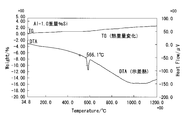
- FIG. 2 is a SEM photograph of foamed aluminum of Example 1. It is a partially expanded SEM photograph figure of FIG. 2 is an SEM photograph of foamed aluminum of Comparative Example 1. It is the photograph of the foamed aluminum obtained by the method which combined the slurry foaming method with the 5th method in the prior art as a method of free sintering aluminum powder. It is a graph which shows the thermal-analysis result of the aluminum porous sintered compact concerning this invention. It is a graph which shows the thermal analysis result of the conventional Al-Si type aluminum porous body. It is a graph which shows the thermal-analysis result of the conventional Al-Cu type aluminum porous body.
- the aluminum production method of the present embodiment includes an aluminum mixed raw material powder preparation step in which aluminum and titanium hydride are mixed with aluminum powder to obtain an aluminum mixed raw material powder, and a water-soluble resin binder is added to the aluminum mixed raw material powder.
- a viscous composition preparation step for preparing a slurry-like viscous composition containing bubbles by mixing water and the like, a pre-sintering step for drying the viscous composition to obtain a pre-sintered compact, and pre-sintering molding
- a sintering step in which the body is heated and fired in a non-oxidizing atmosphere at Tm ⁇ 10 (° C.) ⁇ heating and firing temperature T ⁇ 685 (° C.).
- Tm (° C.) is a temperature at which the aluminum mixed raw material powder starts to melt.
- aluminum powder having an average particle size of 2 to 200 ⁇ m is used. This is because when the average particle size is small, a large amount of water-soluble resin binder is added to the aluminum powder, and the viscous composition has a viscosity that can be molded into a desired shape, and is a pre-sintered compact. Needs to have handling strength. However, when a large amount of the water-soluble resin binder is added, the amount of carbon remaining in the aluminum is increased when the pre-sintered molded body is heated and fired, thereby inhibiting the sintering reaction. On the other hand, when the particle diameter of the aluminum powder is too large, the strength of the aluminum porous sintered body is lowered. Therefore, as the aluminum powder, those having an average particle diameter in the range of 2 to 200 ⁇ m, more preferably in the range of 7 to 40 ⁇ m are used as described above.
- titanium and / or titanium hydride are mixed with the aluminum powder. This is because the aluminum powder is mixed with titanium, and the pre-sintered compact is heated and fired at a heating and firing temperature T satisfying Tm ⁇ 10 (° C.) ⁇ heating and firing temperature T ⁇ 685 (° C.). This is because it is possible to perform free sintering of aluminum without generating a lump of aluminum.
- titanium hydride (TiH 2 ) has a titanium content of 47.88 (molecular weight of titanium) / (47.88 + 1 (molecular weight of hydrogen) ⁇ 2) of 95% by mass or more and 470 to 530. Since it is dehydrogenated at titanium and becomes titanium, it is thermally decomposed by the above-mentioned heating and baking to titanium. Accordingly, free sintering of aluminum is possible without generating droplet lumps even when titanium hydride is mixed.
- the average particle diameter of titanium or titanium hydride is r ( ⁇ m) and the blending ratio of titanium or titanium hydride is W (mass%), 1 ( ⁇ m) ⁇ r ⁇ 30 ( ⁇ m), 0 0.1 (mass%) ⁇ W ⁇ 20 (mass%) and 0.1 ⁇ W / r ⁇ 2. That is, in the case of titanium hydride powder having an average particle size of 4 ⁇ m, since 0.1 ⁇ W / 4 ⁇ 2, the compounding ratio W is 0.4 to 8% by mass. In the case of titanium powder having an average particle diameter of 20 ⁇ m, since 0.1 ⁇ W / 20 ⁇ 2, the compounding ratio W is 2 to 40% by mass. However, from 0.1 (mass%) ⁇ W ⁇ 20 (mass%), 2 to 20 mass%.
- the average particle diameter of titanium hydride is 0.1 ( ⁇ m) ⁇ r ⁇ 30 ( ⁇ m), preferably 1 ( ⁇ m) ⁇ r ⁇ 30 ( ⁇ m), more preferably 4 ( ⁇ m). ⁇ r ⁇ 20 ( ⁇ m). If it is 1 ⁇ m or less, there is a risk of spontaneous ignition. On the other hand, if it exceeds 30 ⁇ m, the titanium hydride becomes titanium particles coated with a compound of aluminum and titanium after sintering. This is because the compound phase of aluminum and titanium is easily peeled off from the titanium particles, and a desired strength cannot be obtained in the sintered body. *
- the reaction heat of aluminum and titanium may become too large depending on the particle size of the sintering aid powder, In some cases, the temperature of the aluminum melted by heat is further increased, the viscosity is lowered, and droplets are generated.
- the average particle diameter of titanium is r
- the number of titanium particles is N
- the added mass of titanium is Assuming that w, the specific gravity of titanium is D, and the amount of decrease in the titanium particle size due to the reaction with aluminum is d, the heat of reaction Q is proportional to the volume of the reacted titanium, and therefore Q ⁇ 4 ⁇ r 2 dN.
- the viscous composition preparing step In the aluminum mixed raw material powder, at least one or more of polyvinyl alcohol, methyl cellulose and ethyl cellulose as a water-soluble resin binder, and at least one or more of polyethylene glycol, glycerin and di-N-butyl phthalate as a plasticizer And distilled water and alkylbetaine as a surfactant are added.
- the addition amount is set within the range of 0.5% to 7% of the mass of the aluminum mixed raw material powder.
- the content exceeds 7% of the mass of the aluminum mixed raw material powder, the amount of carbon remaining in the pre-sintered molded body or the like during heating and firing is increased and the sintering reaction is inhibited. If it is less than 0.5%, the handling strength of the green body before sintering cannot be ensured.
- 0.02% to 3% of the mass of the aluminum mixed raw material powder is added to the alkylbetaine.
- bubbles are effectively generated when mixing the water-insoluble hydrocarbon organic solvent described later.
- inhibition of the sintering reaction due to an increase in the amount of carbon remaining in the pre-sintered compact or the like is prevented.
- the mixture is further foamed by mixing a water-insoluble hydrocarbon organic solvent having 5 to 8 carbon atoms to prepare a viscous composition in which bubbles are mixed.
- a water-insoluble hydrocarbon organic solvent having 5 to 8 carbon atoms at least one of pentane, hexane, heptane and octane can be used.
- an aluminum porous sintered body that has an overall porosity of 10 to 70% and is suitably used as a buffer material between aluminum or aluminum alloys having different compositions from each other is obtained.
- the viscous composition preparation step at least the water-soluble resin binder and distilled water are added to the aluminum mixed raw material powder to form a slurry.
- the slurry-like viscous composition contains only air bubbles mixed at the time of mixing, and is not actively bubbled and encapsulated in this step.
- the viscous composition is stretched and applied to the thickness of 0.05 mm to 5 mm on the surface of the strip-shaped polyethylene sheet. Then, the ambient temperature and humidity are controlled for a certain period of time, the bubbles are sized, and then dried at a temperature of 70 degrees in an air dryer. At that time, the viscous composition is applied by a doctor blade method, a slurry extrusion method, a screen printing method, or the like.
- the dried viscous composition is peeled off from the polyethylene sheet and cut into a predetermined shape such as a circle having a diameter of 100 mm as necessary to obtain a green body before sintering.
- the above-mentioned sintered compact is placed on an alumina setter on which zirconia powder is spread, and is heated and held at 520 ° C. for 1 hour in an argon atmosphere with a dew point of ⁇ 20 ° C. or lower.
- Pre-baking is performed.
- the water-soluble resin binder component of the pre-sintered molded body, and if added, the binder is removed to fly the binder solution of the plasticizer component, distilled water and alkyl betaine, and the sintering aid
- titanium hydride is used as the powder, dehydrogenation is performed.
- the pre-sintered molded body after the temporary firing is heated and fired at a heating and firing temperature T satisfying Tm-10 (° C.) ⁇ heating and firing temperature T ⁇ 685 (° C.) to obtain aluminum foam.
- Tm-10 (° C.) ⁇ heating and firing temperature T ⁇ 685 (° C.)
- Tm-10 (° C.) ⁇ melting and firing temperature
- the pre-sintered molded body may be once heated and held in air at 300 ° C. to 400 ° C. for about 10 minutes to remove the binder, and then heated to a predetermined temperature in an argon atmosphere and fired. .
- the foamed aluminum thus obtained has a metal skeleton having a three-dimensional network structure made of a porous metal sintered body, and has pores between the metal skeletons. Further, the Al—Ti compound is dispersed in the porous metal sintered body, and 20 or more pores are formed per 1 cm of the linear length, and the total porosity is 70 to 90%. It is suitably used as a current collector for secondary batteries and electric double layer type capacitors.
- a sintering aid powder other than titanium or titanium hydride may be used, and sintering including titanium as a sintering aid element.
- An auxiliary powder may be used.
- Examples 1 to 16 an Al powder having an average particle size of 2.1 ⁇ m, 9.4 ⁇ m, 24 ⁇ m, 87 ⁇ m and 175 ⁇ m, a Ti powder having an average particle size of 9.8 ⁇ m, 24 ⁇ m and 42 ⁇ m, an average particle size of 4.2 ⁇ m, 9.1 ⁇ m and A 21 ⁇ m TiH 2 powder is prepared. Then, according to the above-mentioned embodiment, Ti powder and / or TiH 2 powder are mixed with Al powder at a ratio shown in Table 1 to prepare aluminum mixed raw material powders 1 to 10, and a binder solution with the composition shown in Table 2 1-5 were prepared. These and a water-insoluble hydrocarbon-based organic solvent were kneaded in the proportions shown in Table 3 to produce viscous compositions of Examples 1 to 16.
- the viscous compositions of Examples 1 to 16 were applied to a polyethylene sheet coated with a release agent by stretching using a doctor blade method, and the temperature and humidity were controlled to be maintained for a certain period of time. Was sized. Then, it was dried at a temperature of 70 ° C. with an air dryer. Table 3 shows the application thickness of the viscous composition and the temperature, humidity and holding time. Then, the dried viscous composition was peeled off from the polyethylene sheet and cut into a circle having a diameter of 100 mm to obtain pre-sintered molded bodies of Examples 1 to 16.
- the shrinkage rate and porosity of the foamed aluminum of Examples 1 to 16 obtained as described above were calculated. Further, the number of three-dimensional vacancies was measured from a stereoscopic microscope photograph, and the number of pores in the skeleton was measured from a scanning electron microscope (SEM) photograph. The obtained SEM photograph confirmed the presence or absence of droplet solidification. Furthermore, the presence of an Al—Ti compound was confirmed on the surface of the skeleton of the foamed aluminum by surface analysis using an electron beam microanalyzer (EPMA). The results are shown in Table 5, the SEM photograph of the foamed aluminum of Example 1 is shown in FIG. 1, and a partially enlarged photograph thereof is shown in FIG.
- each of the aluminum foams of Examples 1 to 16 was subjected to a roll rolling test at a rolling reduction of 20%, and the presence or absence of cracks was visually confirmed. Then, it cut out into the rectangular shape of 20 mm x 50 mm, and measured the electrical resistance between opposing corner parts. Next, these rectangular aluminum foams were respectively wound around the outer periphery of a cylindrical body having a diameter of 5 mm, and the presence or absence of cracks was visually confirmed. The results are shown in Table 5.
- Comparative Examples 1 to 9 Next, the comparative aluminum mixed raw material powders 31 to 35 prepared by preparing the same Al powder, Ti powder and TiH 2 powder as in the examples or the aluminum mixed raw material powder 1 of the present invention were used. 5 and foamed aluminum of Comparative Examples 1 to 9 were produced in the same manner as in the Example except that the water-insoluble hydrocarbon-based organic solvent was kneaded at a ratio shown in Table 4. The results of evaluating the foamed aluminum of Comparative Examples 1 to 9 in the same manner as in the Examples are shown in Table 5, and the SEM photographs of the foamed aluminum of Comparative Example 1 are shown in FIG.
- the foamed aluminum of Examples 1 to 16 has 2 to 4 holes per 100 ⁇ m of the skeleton length of the porous metal sintered body and 1-dimensional pores between the metal skeletons. There are 52 or more per inch, that is, 20 or more per 1 cm. Further, no droplet-like lump was formed in the foamed aluminum, the electric resistance was low, and there was no cracking due to the winding test. Therefore, it is suitable for a positive current collector of a battery or a capacitor that requires high output and high energy density.
- LiCoO 2 lithium cobaltate
- PVdE polyvinylidene fluoride
- artificial graphite powder as a conductive material
- This positive electrode agent was mixed with N-methyl-2pyrrolidone as a solvent to prepare a positive electrode active material slurry.
- cylindrical bodies having diameters of 1 mm, 1.5 mm, 2 mm, 2.5 mm, 3 mm, 3.5 mm, 4 mm, 4.5 mm, and 5 mm were prepared, and the lithium ion batteries of Examples 1 to 16 and Conventional Example 1 were prepared. No. positive electrode was wound. Then, whether or not the active material is peeled is visually observed, and the minimum diameter at which no peeling is observed is shown in Table 5.
- the mixture was kneaded without adding the water-insoluble hydrocarbon-based organic solvent shown in Table 3, and was similarly stretched and applied to a polyethylene sheet coated with a release agent by the doctor blade method and dried. . Then, it peeled from the polyethylene sheet and obtained the molded object before sintering.
- This pre-sintered compact is placed on an alumina setter with a zirconia base powder and debindered in an argon stream or in the air, and then heated and fired to form a porous aluminum sintered body.
- TG / DTA thermal analysis
- FIG. 5 shows the thermal analysis results of the aluminum porous sintered body according to the present invention.
- FIGS. 6 and 7 are Al—Si and Al—Cu aluminum porous bodies, respectively, which are comparative examples. It shows the thermal analysis result of the body.
- aluminum mixed with 1.0% by weight of Ti, Si, and Cu components having the same amount was used.
- the positions of the endothermic peaks indicating the melting points of the alloys are 566.1 ° C. and 534.8 respectively.
- the Al—Ti porous sintered body according to the present invention shown in FIG. 5 had a high melting point of 644.6 ° C.
- Al—Ti porous sintered body according to the present invention when aluminum or aluminum alloys having excellent heat resistance and different compositions are joined by brazing or the like, they are used as a buffer material between them. As a result, it can be seen that the reliability of bonding can be greatly improved.
- foamed aluminum In addition to being used as a method for producing foamed aluminum, it can also be used as a method for producing a current collector for lithium ion secondary batteries and electric double layer capacitors, or a buffer material for joining aluminum alloys having different thermal expansion coefficients.
Landscapes
- Engineering & Computer Science (AREA)
- Chemical & Material Sciences (AREA)
- Mechanical Engineering (AREA)
- Materials Engineering (AREA)
- Power Engineering (AREA)
- Organic Chemistry (AREA)
- Metallurgy (AREA)
- Manufacturing & Machinery (AREA)
- Chemical Kinetics & Catalysis (AREA)
- Electrochemistry (AREA)
- General Chemical & Material Sciences (AREA)
- Microelectronics & Electronic Packaging (AREA)
- Composite Materials (AREA)
- Powder Metallurgy (AREA)
- Cell Electrode Carriers And Collectors (AREA)
Abstract
Description
本願は、2009年3月30日に、日本に出願された特願2009-082498号、及び2009年8月11日に、日本に出願された特願2009-186616号に基づき優先権を主張し、その内容をここに援用する。
その理由について述べると、このスラリー発泡法では、金属粉末に圧縮等の応力をかけることなく焼結するフリーシンタリングによって焼結して発泡金属を得ることになる。しかし、アルミニウム粉末は表面に数nm~数10nmの緻密な酸化アルミニウム被膜で覆われており、それが固相、液相を問わずに焼結を阻害する。そのためにフリーシンタリンングでは焼結が困難であり、そのためスラリー発泡法で均質な発泡アルミニウムが得られなかった。
ところが、この種の多孔質アルミニウム合金を用いた場合においても、液相発生によって融点が低下する。この結果、上記接合時の耐熱性が低下し、このため使用条件(特に、使用される温度条件)によっては、実際の使用に耐え得ないことがあった。
これは、以下の理由による。焼結助剤粉末の配合比Wが20質量%を超えると、アルミニウム混合原料粉末中で焼結助剤粉末同士が接点を持つようになって、アルミニウムとチタンの反応熱を制御できなくなるとともに所望の多孔質焼結体が得られないようになる。このため、0.1(質量%)≦W≦20(質量%)とする。更に好ましくは1(質量%)≦W≦20(質量%)である。
このAl-Ti化合物粒子は、高融点(約1350℃)であるとともに、上記アルミニウム多孔質焼結体は、全体気孔率が10~70%であるために、上述した互いに組成の異なるアルミニウムまたはアルミニウム合金同士をロウ付け等によって接合する際に、両者間の緩衝材として好適に用いることができる。
これは、以下の理由による。焼結前成形体を融解温度Tm(℃)まで加熱することにより、アルミニウムとチタンとの反応が開始するものと考えられる。しかし、実際にはアルミニウムは不純物としてFeやSiなどの共晶合金元素を微量に含有しており、融点が低下する。このため、Tm-10(℃)まで加熱することにより、アルミニウムとチタンとの反応が開始して発泡アルミニウムを形成するものと考えられるためである。実際に、アルミニウムの融点が660℃であるのに対して、純アルミニウム粉として流通している純度98%~99.7%程度のアトマイズ粉では650℃前後が溶解開始温度となる。
次に、平均粒子径2.1μm、9.4μm、24μm、87μmおよび175μmのAl粉と、平均粒子径9.8μm、24μmおよび42μmのTi粉と、平均粒子径4.2μm、9.1μmおよび21μmのTiH2粉とを用意する。そして、上述の実施の形態に従って、表1に示す割合でAl粉にTi粉および/またはTiH2粉を混合してアルミニウム混合原料粉末1~10を調製し、表2に示す配合組成でバインダー溶液1~5を調製した。それらと非水溶性炭化水素系有機溶剤を表3に示す割合で混練して実施例1~16の粘性組成物を製造した。


次いで、実施例と同一のAl粉、Ti粉およびTiH2粉を用意して調製した比較アルミニウム混合原料粉末31~35又は本発明アルミニウム混合原料粉末1を用いて、表2に示すバインダー溶液1~5と、非水溶性炭化水素系有機溶剤を表4に示す割合で混練した以外は、実施例と同様にして比較例1~9の発泡アルミニウムを製造した。そして、比較例1~9の発泡アルミニウムを実施例と同様の方法にて評価した結果を表5に示すとともに、比較例1の発泡アルミニウムのSEM写真を図3に示した。


次に、表3で示した非水溶性炭化水素系有機溶剤を添加せずに混練して、同様にドクターブレード法にて、剥離剤が塗布されたポリエチレンシートに引き伸ばして塗布し、乾燥させた。その後に、ポリエチレンシートから剥がして焼結前成形体を得た。この焼結前成形体を、ジルコニア敷粉を敷いたアルミナセッターの上に載置して、アルゴン気流雰囲気中または大気中で脱バインダーを行った後に、加熱焼成して、アルミニウム多孔質焼結体を得た。
ちなみに、本実施例においては、一例としてアルミニウムに、各々同量となる1.0重量%のTi、Si、Cu成分を配合したものを用いた。
Claims (5)
- アルミニウム粉末に焼結助剤元素を含む焼結助剤粉末を混合してアルミニウム混合原料粉末とする工程と、
前記アルミニウム混合原料粉末を、気孔を含む焼結前成形体とする工程と、
前記焼結前成形体を非酸化性雰囲気にて加熱焼成することによりアルミニウムの多孔質焼結体を製造する工程を有し、
前記焼結助剤元素がチタンであり、かつ前記アルミニウム混合原料粉末が融解を開始する温度をTm(℃)としたときに、前記加熱焼成の温度T(℃)がTm-10(℃)≦T≦685(℃)を満たすことを特徴とするアルミニウム多孔質焼結体の製造方法。 - 前記アルミニウム粉末の平均粒子径が2~200μmであることを特徴とする請求項1に記載のアルミニウム多孔質焼結体の製造方法。
- 前記焼結助剤粉末の平均粒子径をr(μm)、前記焼結助剤粉末の配合比をW(質量%)としたときに、前記r及び前記Wは、1(μm)≦r≦30(μm)、1≦W≦20(質量%)、かつ0.1≦W/r≦2を満たすことを特徴とする請求項1に記載のアルミニウム多孔質焼結体の製造方法。
- 前記焼結助剤粉末は、チタンおよび水素化チタンのうちのいずれか一方又は両方であることを特徴とする請求項1に記載のアルミニウム多孔質焼結体の製造方法。
- Al-Ti化合物が分散して分布したアルミニウム焼結素地を有し、
前記アルミニウム焼結素地は、アルミニウム粒子とアルミニウム粒子との焼結体であり、かつ前記Al-Ti化合物は、アルミニウム粒子とチタン粒子の焼結合成反応によって生成されたAl-Ti化合物粒子であり、
前記Al-Ti化合物粒子は、前記アルミニウム焼結素地の前記アルミニウム粒子と焼結しており、かつ前記アルミニウム焼結素地のアルミニウム粒子間に空隙が形成されることにより、全体気孔率が10~70%であることを特徴とするアルミニウム多孔質焼結体。
Priority Applications (4)
| Application Number | Priority Date | Filing Date | Title |
|---|---|---|---|
| KR1020117022553A KR101321247B1 (ko) | 2009-03-30 | 2010-03-30 | 알루미늄 다공질 소결체의 제조 방법 및 알루미늄 다공질 소결체 |
| CN201080014886.5A CN102365143B (zh) | 2009-03-30 | 2010-03-30 | 铝多孔烧结体的制造方法和铝多孔烧结体 |
| US13/260,843 US9589732B2 (en) | 2009-03-30 | 2010-03-30 | Process for producing porous sintered aluminum, and porous sintered aluminum |
| EP10761385.3A EP2415542B1 (en) | 2009-03-30 | 2010-03-30 | Process for producing porous sintered aluminum, and porous sintered aluminum |
Applications Claiming Priority (4)
| Application Number | Priority Date | Filing Date | Title |
|---|---|---|---|
| JP2009-082498 | 2009-03-30 | ||
| JP2009082498 | 2009-03-30 | ||
| JP2009-186616 | 2009-08-11 | ||
| JP2009186616A JP5402380B2 (ja) | 2009-03-30 | 2009-08-11 | アルミニウム多孔質焼結体の製造方法 |
Publications (1)
| Publication Number | Publication Date |
|---|---|
| WO2010116679A1 true WO2010116679A1 (ja) | 2010-10-14 |
Family
ID=42935978
Family Applications (1)
| Application Number | Title | Priority Date | Filing Date |
|---|---|---|---|
| PCT/JP2010/002298 Ceased WO2010116679A1 (ja) | 2009-03-30 | 2010-03-30 | アルミニウム多孔質焼結体の製造方法およびアルミニウム多孔質焼結体 |
Country Status (7)
| Country | Link |
|---|---|
| US (1) | US9589732B2 (ja) |
| EP (1) | EP2415542B1 (ja) |
| JP (1) | JP5402380B2 (ja) |
| KR (1) | KR101321247B1 (ja) |
| CN (1) | CN102365143B (ja) |
| TW (1) | TWI468525B (ja) |
| WO (1) | WO2010116679A1 (ja) |
Cited By (9)
| Publication number | Priority date | Publication date | Assignee | Title |
|---|---|---|---|---|
| JP2012094737A (ja) * | 2010-10-28 | 2012-05-17 | Mitsubishi Materials Corp | 電気二重層型キャパシタ |
| US20120315540A1 (en) * | 2011-02-18 | 2012-12-13 | Sumitomo Electric Toyama Co., Ltd. | Three-dimensional network aluminum porous body for current collector, electrode using the aluminum porous body, and nonaqueous electrolyte battery, nonaqueous electrolytic solution capacitor and lithium-ion capacitor each using the electrode |
| WO2014133079A1 (ja) * | 2013-03-01 | 2014-09-04 | 三菱マテリアル株式会社 | 焼結用アルミニウム原料、焼結用アルミニウム原料の製造方法及び多孔質アルミニウム焼結体の製造方法 |
| WO2014133077A1 (ja) * | 2013-03-01 | 2014-09-04 | 三菱マテリアル株式会社 | 多孔質アルミニウム焼結体 |
| CN104797361A (zh) * | 2012-12-27 | 2015-07-22 | 三菱综合材料株式会社 | 铝多孔体及其制造方法 |
| WO2015174541A1 (ja) * | 2014-05-16 | 2015-11-19 | 三菱マテリアル株式会社 | 多孔質アルミニウム焼結体及び多孔質アルミニウム焼結体の製造方法 |
| WO2015174542A1 (ja) * | 2014-05-16 | 2015-11-19 | 三菱マテリアル株式会社 | 多孔質アルミニウム焼結体及び多孔質アルミニウム焼結体の製造方法 |
| JP2016173934A (ja) * | 2015-03-17 | 2016-09-29 | 住友電気工業株式会社 | アルミニウム多孔体、アルミニウム多孔体の製造方法、電極、電気二重層キャパシタ、リチウムイオンキャパシタ及びリチウムイオン電池 |
| US10543531B2 (en) | 2014-10-30 | 2020-01-28 | Mitsubishi Materials Corporation | Porous aluminum sintered material and method of producing porous aluminum sintered material |
Families Citing this family (26)
| Publication number | Priority date | Publication date | Assignee | Title |
|---|---|---|---|---|
| WO2010116682A1 (ja) | 2009-03-30 | 2010-10-14 | 三菱マテリアル株式会社 | アルミニウム多孔質焼結体の製造方法およびアルミニウム多孔質焼結体 |
| JP5428546B2 (ja) | 2009-06-04 | 2014-02-26 | 三菱マテリアル株式会社 | アルミニウム多孔質焼結体を有するアルミニウム複合体の製造方法 |
| JP5526941B2 (ja) * | 2010-03-31 | 2014-06-18 | 三菱マテリアル株式会社 | アルミニウム多孔質焼結体の製造方法 |
| JP5526940B2 (ja) * | 2010-03-31 | 2014-06-18 | 三菱マテリアル株式会社 | アルミニウム多孔質焼結体の製造方法 |
| JP5526938B2 (ja) * | 2010-03-31 | 2014-06-18 | 三菱マテリアル株式会社 | アルミニウム多孔質焼結体の製造方法 |
| JP5526939B2 (ja) * | 2010-03-31 | 2014-06-18 | 三菱マテリアル株式会社 | アルミニウム多孔質焼結体の製造方法 |
| WO2012111667A1 (ja) * | 2011-02-18 | 2012-08-23 | 住友電気工業株式会社 | 三次元網状アルミニウム多孔体及び該アルミニウム多孔体を用いた電極並びに該電極を用いた非水電解質電池、非水電解液を用いたキャパシタ及びリチウムイオンキャパシタ |
| CN102560176B (zh) * | 2011-12-29 | 2013-11-06 | 东南大学 | 浸浆烧结制备多孔金属的方法 |
| JP6149031B2 (ja) * | 2012-03-30 | 2017-06-14 | 株式会社Uacj | 非水電解質二次電池用電極の製造方法 |
| TWI586461B (zh) * | 2012-08-29 | 2017-06-11 | 日本特殊陶業股份有限公司 | An alumina sintered body and a method for producing the same |
| JP6165499B2 (ja) * | 2012-09-07 | 2017-07-19 | 東邦チタニウム株式会社 | 多孔質チタン薄膜の製造方法 |
| JP2015151609A (ja) * | 2014-02-18 | 2015-08-24 | 三菱マテリアル株式会社 | 多孔質アルミニウム焼結体 |
| JP6477254B2 (ja) * | 2014-05-30 | 2019-03-06 | 三菱マテリアル株式会社 | 多孔質アルミニウム複合体及び多孔質アルミニウム複合体の製造方法 |
| JP6237500B2 (ja) | 2014-07-02 | 2017-11-29 | 三菱マテリアル株式会社 | 多孔質アルミニウム熱交換部材 |
| CN104070164B (zh) * | 2014-07-16 | 2016-08-24 | 哈尔滨工业大学 | 粉末烧结合成多孔钛铝金属间化合物的方法 |
| US11165067B2 (en) | 2016-03-11 | 2021-11-02 | Honda Motor Co., Ltd. | Porous current collector and electrode for an electrochemical battery |
| DE102017211638B4 (de) | 2017-07-07 | 2019-07-11 | Federal-Mogul Wiesbaden Gmbh | Verfahren zur Herstellung eines Gleitlagers und Gleitlager |
| CN107442770B (zh) * | 2017-08-31 | 2019-03-08 | 安徽青花坊瓷业股份有限公司 | 一种发泡铝粉末的制备工艺及其应用 |
| CN110640136B (zh) * | 2018-06-27 | 2021-10-22 | 南京理工大学 | 铝粉/聚偏二氟乙烯复合粒子及其制备方法和应用 |
| CN109108280A (zh) * | 2018-09-26 | 2019-01-01 | 江西理工大学 | 一种新型泡沫铝及其制备方法 |
| CN109652689A (zh) * | 2019-02-26 | 2019-04-19 | 国际铝业(厦门)有限公司 | 一种具有高抗弯强度的铝合金型材及其制备方法 |
| RU2710697C1 (ru) * | 2019-07-18 | 2020-01-09 | Евгений Викторович Орлов | Способ смешивания горячего порошка алюминиевого сплава с порофором |
| RU2710751C1 (ru) * | 2019-07-18 | 2020-01-13 | Евгений Викторович Орлов | Способ изготовления листовых изделий из пеноалюминия |
| DE102019213989A1 (de) * | 2019-09-13 | 2021-03-18 | Federal-Mogul Wiesbaden Gmbh | Gleitlager und Verfahren zur Herstellung eines Gleitlagers |
| CN114408986B (zh) * | 2022-01-21 | 2024-02-13 | 陕西彩虹新材料有限公司 | 一种纳米级单晶三元正极材料及其制备方法 |
| CN115121797B (zh) * | 2022-06-17 | 2024-01-30 | 北京有研粉末新材料研究院有限公司 | 一种多孔铝复合板的制备方法 |
Citations (13)
| Publication number | Priority date | Publication date | Assignee | Title |
|---|---|---|---|---|
| JPS5677301A (en) * | 1979-11-27 | 1981-06-25 | N D C Kk | Sintering method of al or its alloy powder |
| JPS5910555B2 (ja) | 1978-03-22 | 1984-03-09 | 松下電器産業株式会社 | シ−ズヒ−タの製造方法 |
| JPS6148566B2 (ja) | 1980-04-15 | 1986-10-24 | Ndc Kk | |
| JPH04231403A (ja) * | 1990-06-08 | 1992-08-20 | Fraunhofer Ges | 発泡可能な金属体の製造方法 |
| JPH08209265A (ja) | 1995-02-01 | 1996-08-13 | Hitachi Cable Ltd | 発泡アルミニウムの製造方法 |
| JPH08325661A (ja) * | 1995-05-31 | 1996-12-10 | Ndc Co Ltd | 多孔質アルミニウム焼結材 |
| JP2003520292A (ja) | 2000-01-19 | 2003-07-02 | コラス・アルミニウム・バルツプロドウクテ・ゲーエムベーハー | 2枚の金属層の間にある金属粉末と発泡材の積層材 |
| JP2004035961A (ja) * | 2002-07-04 | 2004-02-05 | Japan Steel Works Ltd:The | 多孔質金属体の製造方法 |
| JP3535282B2 (ja) | 1995-09-27 | 2004-06-07 | 三菱マテリアル株式会社 | 多孔質焼結金属板の製造方法 |
| JP2004218035A (ja) * | 2003-01-17 | 2004-08-05 | Honda Motor Co Ltd | 発泡体を充填した閉断面構造体の製造方法 |
| JP2007100176A (ja) * | 2005-10-05 | 2007-04-19 | Honda Motor Co Ltd | 発泡アルミニウムの製造方法 |
| JP2007238971A (ja) | 2006-03-06 | 2007-09-20 | Taiheiyo Cement Corp | 多孔質アルミニウム複合材及びその製造方法 |
| JP2009043536A (ja) | 2007-08-08 | 2009-02-26 | Toyota Motor Corp | リチウム二次電池 |
Family Cites Families (39)
| Publication number | Priority date | Publication date | Assignee | Title |
|---|---|---|---|---|
| GB1289690A (ja) | 1969-06-21 | 1972-09-20 | ||
| US3677721A (en) | 1970-12-07 | 1972-07-18 | Union Carbide Corp | Porous metal bodies of uniform porosity |
| JPS5811497B2 (ja) * | 1978-10-04 | 1983-03-03 | 日本電気株式会社 | Ti↓−Al多孔質合金及びその製造方法 |
| JPS592316A (ja) | 1982-06-28 | 1984-01-07 | 日本電気株式会社 | 電解コンデンサ用多孔質体の製造方法 |
| JPS60246618A (ja) | 1984-05-22 | 1985-12-06 | 日本電気株式会社 | 電解コンデンサの製造方法 |
| US4758272A (en) * | 1987-05-27 | 1988-07-19 | Corning Glass Works | Porous metal bodies |
| DE4018360C1 (en) * | 1990-06-08 | 1991-05-29 | Fraunhofer-Gesellschaft Zur Foerderung Der Angewandten Forschung Ev, 8000 Muenchen, De | Porous metal body prodn. - involves compaction at low temp. followed by heating to near melting point of metal |
| JP3568052B2 (ja) * | 1994-12-15 | 2004-09-22 | 住友電気工業株式会社 | 金属多孔体、その製造方法及びそれを用いた電池用極板 |
| KR0183227B1 (ko) * | 1995-03-17 | 1999-04-01 | 와다 아끼히로 | 금속소결체 복합재료 및 그 제조방법 |
| JP3191665B2 (ja) | 1995-03-17 | 2001-07-23 | トヨタ自動車株式会社 | 金属焼結体複合材料及びその製造方法 |
| JPH09143511A (ja) | 1995-11-29 | 1997-06-03 | Mitsubishi Materials Corp | 大きな比表面積を有する多孔質金属体 |
| JP3591055B2 (ja) | 1995-06-12 | 2004-11-17 | 旭硝子株式会社 | 電気二重層キャパシタ、その製造方法及びそのための電極の製造方法 |
| JPH0972015A (ja) | 1995-09-04 | 1997-03-18 | Mitsubishi Materials Corp | 壁用建材およびその製造方法 |
| KR970073821A (ko) | 1995-09-27 | 1997-12-10 | 아키모토 유미 | 다공질 소결금속판의 제조방법 및 제조장치 |
| JPH09157060A (ja) | 1995-12-06 | 1997-06-17 | Sumitomo Chem Co Ltd | 無機焼結多孔体およびフィルタ |
| US5951791A (en) | 1997-12-01 | 1999-09-14 | Inco Limited | Method of preparing porous nickel-aluminum structures |
| EP1038994A1 (en) | 1998-09-14 | 2000-09-27 | Mitsui Mining & Smelting Co., Ltd. | Porous copper foil, use thereof and method for preparation thereof |
| GB9903276D0 (en) * | 1999-02-12 | 1999-04-07 | Boc Group Plc | Reticulated foam structutes |
| JP2000297334A (ja) * | 1999-04-14 | 2000-10-24 | Sekisui Chem Co Ltd | 焼結多孔質体の製造方法および焼結多孔質体 |
| JP4514265B2 (ja) * | 1999-12-28 | 2010-07-28 | 三洋電機株式会社 | 電極及び非水電解液二次電池 |
| JP4144185B2 (ja) | 2001-03-12 | 2008-09-03 | 三菱マテリアル株式会社 | 延性に優れた多孔質金属体の製造方法 |
| ATE357304T1 (de) * | 2001-05-19 | 2007-04-15 | Goldschmidt Gmbh | Herstellung von metallschäumen |
| TWI259849B (en) | 2001-06-11 | 2006-08-11 | Sumitomo Electric Industries | Porous metal, metallic composite using it and method for manufacturing the same |
| JP2003086463A (ja) | 2001-09-10 | 2003-03-20 | Matsushita Electric Ind Co Ltd | 固体電解コンデンサの製造方法 |
| DE10150948C1 (de) * | 2001-10-11 | 2003-05-28 | Fraunhofer Ges Forschung | Verfahren zur Herstellung gesinterter poröser Körper |
| US6852273B2 (en) | 2003-01-29 | 2005-02-08 | Adma Products, Inc. | High-strength metal aluminide-containing matrix composites and methods of manufacture the same |
| AT6727U1 (de) | 2003-01-30 | 2004-03-25 | Plansee Ag | Verfahren zur herstellung poröser sinterformkörper |
| US7516529B2 (en) * | 2003-12-17 | 2009-04-14 | General Motors Corporation | Method for producing in situ metallic foam components |
| JP4178246B2 (ja) * | 2004-03-31 | 2008-11-12 | 独立行政法人産業技術総合研究所 | 高気孔率発泡焼結体の製造方法 |
| JP2005294013A (ja) * | 2004-03-31 | 2005-10-20 | Sanyo Electric Co Ltd | 前駆体電池及び非水電解質二次電池 |
| ES2816523T3 (es) | 2005-05-30 | 2021-04-05 | Grillo Werke Ag | Cuerpo de espuma metálica poroso |
| JP4535281B2 (ja) * | 2005-08-09 | 2010-09-01 | 三菱マテリアル株式会社 | 高強度発泡チタン焼結体の製造方法 |
| US20070081911A1 (en) | 2005-10-07 | 2007-04-12 | Charles Douglas K | High porosity metal biporous foam |
| JP4986259B2 (ja) | 2006-10-24 | 2012-07-25 | 三菱マテリアル株式会社 | 発泡速度の速い多孔質金属焼結体製造用混合原料 |
| TW200825368A (en) | 2006-12-11 | 2008-06-16 | Metal Ind Res & Dev Ct | Optical measuring apparatus applied to the in-plane displacement |
| JP2009174016A (ja) | 2008-01-25 | 2009-08-06 | Muroran Institute Of Technology | エアベアリング用多孔質焼結体の製造方法及びエアベアリング用多孔質焼結体 |
| WO2010116682A1 (ja) * | 2009-03-30 | 2010-10-14 | 三菱マテリアル株式会社 | アルミニウム多孔質焼結体の製造方法およびアルミニウム多孔質焼結体 |
| JP5428546B2 (ja) * | 2009-06-04 | 2014-02-26 | 三菱マテリアル株式会社 | アルミニウム多孔質焼結体を有するアルミニウム複合体の製造方法 |
| JP5402381B2 (ja) | 2009-08-11 | 2014-01-29 | 三菱マテリアル株式会社 | アルミニウム多孔質焼結体の製造方法 |
-
2009
- 2009-08-11 JP JP2009186616A patent/JP5402380B2/ja not_active Expired - Fee Related
-
2010
- 2010-03-30 CN CN201080014886.5A patent/CN102365143B/zh not_active Expired - Fee Related
- 2010-03-30 US US13/260,843 patent/US9589732B2/en not_active Expired - Fee Related
- 2010-03-30 TW TW99109629A patent/TWI468525B/zh not_active IP Right Cessation
- 2010-03-30 EP EP10761385.3A patent/EP2415542B1/en active Active
- 2010-03-30 KR KR1020117022553A patent/KR101321247B1/ko active Active
- 2010-03-30 WO PCT/JP2010/002298 patent/WO2010116679A1/ja not_active Ceased
Patent Citations (13)
| Publication number | Priority date | Publication date | Assignee | Title |
|---|---|---|---|---|
| JPS5910555B2 (ja) | 1978-03-22 | 1984-03-09 | 松下電器産業株式会社 | シ−ズヒ−タの製造方法 |
| JPS5677301A (en) * | 1979-11-27 | 1981-06-25 | N D C Kk | Sintering method of al or its alloy powder |
| JPS6148566B2 (ja) | 1980-04-15 | 1986-10-24 | Ndc Kk | |
| JPH04231403A (ja) * | 1990-06-08 | 1992-08-20 | Fraunhofer Ges | 発泡可能な金属体の製造方法 |
| JPH08209265A (ja) | 1995-02-01 | 1996-08-13 | Hitachi Cable Ltd | 発泡アルミニウムの製造方法 |
| JPH08325661A (ja) * | 1995-05-31 | 1996-12-10 | Ndc Co Ltd | 多孔質アルミニウム焼結材 |
| JP3535282B2 (ja) | 1995-09-27 | 2004-06-07 | 三菱マテリアル株式会社 | 多孔質焼結金属板の製造方法 |
| JP2003520292A (ja) | 2000-01-19 | 2003-07-02 | コラス・アルミニウム・バルツプロドウクテ・ゲーエムベーハー | 2枚の金属層の間にある金属粉末と発泡材の積層材 |
| JP2004035961A (ja) * | 2002-07-04 | 2004-02-05 | Japan Steel Works Ltd:The | 多孔質金属体の製造方法 |
| JP2004218035A (ja) * | 2003-01-17 | 2004-08-05 | Honda Motor Co Ltd | 発泡体を充填した閉断面構造体の製造方法 |
| JP2007100176A (ja) * | 2005-10-05 | 2007-04-19 | Honda Motor Co Ltd | 発泡アルミニウムの製造方法 |
| JP2007238971A (ja) | 2006-03-06 | 2007-09-20 | Taiheiyo Cement Corp | 多孔質アルミニウム複合材及びその製造方法 |
| JP2009043536A (ja) | 2007-08-08 | 2009-02-26 | Toyota Motor Corp | リチウム二次電池 |
Non-Patent Citations (1)
| Title |
|---|
| See also references of EP2415542A4 |
Cited By (17)
| Publication number | Priority date | Publication date | Assignee | Title |
|---|---|---|---|---|
| JP2012094737A (ja) * | 2010-10-28 | 2012-05-17 | Mitsubishi Materials Corp | 電気二重層型キャパシタ |
| US20120315540A1 (en) * | 2011-02-18 | 2012-12-13 | Sumitomo Electric Toyama Co., Ltd. | Three-dimensional network aluminum porous body for current collector, electrode using the aluminum porous body, and nonaqueous electrolyte battery, nonaqueous electrolytic solution capacitor and lithium-ion capacitor each using the electrode |
| CN103460322A (zh) * | 2011-02-18 | 2013-12-18 | 住友电气工业株式会社 | 集电体用三维网状铝多孔体、采用该铝多孔体的电极、以及分别采用该电极的非水电解质电池、非水电解液电容器和锂离子电容器 |
| JPWO2012111705A1 (ja) * | 2011-02-18 | 2014-07-07 | 住友電気工業株式会社 | 集電体用三次元網状アルミニウム多孔体及び該アルミニウム多孔体を用いた電極並びに該電極を用いた非水電解質電池、非水電解液キャパシタ及びリチウムイオンキャパシタ |
| CN104797361A (zh) * | 2012-12-27 | 2015-07-22 | 三菱综合材料株式会社 | 铝多孔体及其制造方法 |
| CN104903031A (zh) * | 2013-03-01 | 2015-09-09 | 三菱综合材料株式会社 | 多孔铝烧结体 |
| JP2014194074A (ja) * | 2013-03-01 | 2014-10-09 | Mitsubishi Materials Corp | 多孔質アルミニウム焼結体 |
| WO2014133077A1 (ja) * | 2013-03-01 | 2014-09-04 | 三菱マテリアル株式会社 | 多孔質アルミニウム焼結体 |
| WO2014133079A1 (ja) * | 2013-03-01 | 2014-09-04 | 三菱マテリアル株式会社 | 焼結用アルミニウム原料、焼結用アルミニウム原料の製造方法及び多孔質アルミニウム焼結体の製造方法 |
| US9669462B2 (en) | 2013-03-01 | 2017-06-06 | Mitsubishi Materials Corporation | Porous aluminum sintered compact |
| US10035187B2 (en) | 2013-03-01 | 2018-07-31 | Mitsubishi Materials Corporation | Aluminum material for sintering, method for producing aluminum material for sintering, and method for producing porous aluminum sintered compact |
| WO2015174541A1 (ja) * | 2014-05-16 | 2015-11-19 | 三菱マテリアル株式会社 | 多孔質アルミニウム焼結体及び多孔質アルミニウム焼結体の製造方法 |
| WO2015174542A1 (ja) * | 2014-05-16 | 2015-11-19 | 三菱マテリアル株式会社 | 多孔質アルミニウム焼結体及び多孔質アルミニウム焼結体の製造方法 |
| US10478895B2 (en) | 2014-05-16 | 2019-11-19 | Mitsubishi Materials Corporation | Porous aluminum sintered compact and method of producing porous aluminum sintered compact |
| US10981228B2 (en) | 2014-05-16 | 2021-04-20 | Mitsubishi Materials Corporation | Porous aluminum sintered compact and method of producing porous aluminum sintered compact |
| US10543531B2 (en) | 2014-10-30 | 2020-01-28 | Mitsubishi Materials Corporation | Porous aluminum sintered material and method of producing porous aluminum sintered material |
| JP2016173934A (ja) * | 2015-03-17 | 2016-09-29 | 住友電気工業株式会社 | アルミニウム多孔体、アルミニウム多孔体の製造方法、電極、電気二重層キャパシタ、リチウムイオンキャパシタ及びリチウムイオン電池 |
Also Published As
| Publication number | Publication date |
|---|---|
| TWI468525B (zh) | 2015-01-11 |
| EP2415542A4 (en) | 2018-03-28 |
| US20120094142A1 (en) | 2012-04-19 |
| EP2415542A1 (en) | 2012-02-08 |
| TW201107492A (en) | 2011-03-01 |
| CN102365143A (zh) | 2012-02-29 |
| KR101321247B1 (ko) | 2013-11-13 |
| EP2415542B1 (en) | 2021-07-28 |
| CN102365143B (zh) | 2014-03-12 |
| KR20110122207A (ko) | 2011-11-09 |
| JP5402380B2 (ja) | 2014-01-29 |
| US9589732B2 (en) | 2017-03-07 |
| JP2010255089A (ja) | 2010-11-11 |
Similar Documents
| Publication | Publication Date | Title |
|---|---|---|
| JP5402380B2 (ja) | アルミニウム多孔質焼結体の製造方法 | |
| CN102438778B (zh) | 铝多孔烧结体的制造方法和铝多孔烧结体 | |
| JP5428546B2 (ja) | アルミニウム多孔質焼結体を有するアルミニウム複合体の製造方法 | |
| JP5402381B2 (ja) | アルミニウム多孔質焼結体の製造方法 | |
| JP5310450B2 (ja) | 非水系電気化学セルの集電体およびそれを用いた電極 | |
| JP2010283042A (ja) | 電気二重層型キャパシタ用電極およびその製造方法 | |
| JP2011049023A (ja) | 非水電解質二次電池用電極およびその製造方法 | |
| JP5825311B2 (ja) | アルミニウム多孔質焼結体 | |
| JP2016089189A (ja) | 多孔質アルミニウム焼結体及び多孔質アルミニウム焼結体の製造方法 | |
| JP2018053312A (ja) | 多孔質アルミニウム焼結体およびその製造方法 | |
| JP2017179417A (ja) | アルミニウム板 | |
| JP2018154862A (ja) | アルミニウム多孔質焼結体を有するアルミニウム複合体の製造方法 |
Legal Events
| Date | Code | Title | Description |
|---|---|---|---|
| WWE | Wipo information: entry into national phase |
Ref document number: 201080014886.5 Country of ref document: CN |
|
| 121 | Ep: the epo has been informed by wipo that ep was designated in this application |
Ref document number: 10761385 Country of ref document: EP Kind code of ref document: A1 |
|
| ENP | Entry into the national phase |
Ref document number: 20117022553 Country of ref document: KR Kind code of ref document: A |
|
| NENP | Non-entry into the national phase |
Ref country code: DE |
|
| WWE | Wipo information: entry into national phase |
Ref document number: 2010761385 Country of ref document: EP |
|
| WWE | Wipo information: entry into national phase |
Ref document number: 13260843 Country of ref document: US |