WO2010143494A1 - Titanate d'aluminium colonnaire, son procédé de production, et structure en nid d'abeille - Google Patents
Titanate d'aluminium colonnaire, son procédé de production, et structure en nid d'abeille Download PDFInfo
- Publication number
- WO2010143494A1 WO2010143494A1 PCT/JP2010/058108 JP2010058108W WO2010143494A1 WO 2010143494 A1 WO2010143494 A1 WO 2010143494A1 JP 2010058108 W JP2010058108 W JP 2010058108W WO 2010143494 A1 WO2010143494 A1 WO 2010143494A1
- Authority
- WO
- WIPO (PCT)
- Prior art keywords
- aluminum titanate
- columnar
- honeycomb structure
- columnar aluminum
- number average
- Prior art date
- Legal status (The legal status is an assumption and is not a legal conclusion. Google has not performed a legal analysis and makes no representation as to the accuracy of the status listed.)
- Ceased
Links
Images






Classifications
-
- B—PERFORMING OPERATIONS; TRANSPORTING
- B01—PHYSICAL OR CHEMICAL PROCESSES OR APPARATUS IN GENERAL
- B01D—SEPARATION
- B01D46/00—Filters or filtering processes specially modified for separating dispersed particles from gases or vapours
- B01D46/24—Particle separators, e.g. dust precipitators, using rigid hollow filter bodies
- B01D46/2403—Particle separators, e.g. dust precipitators, using rigid hollow filter bodies characterised by the physical shape or structure of the filtering element
- B01D46/2418—Honeycomb filters
- B01D46/2425—Honeycomb filters characterized by parameters related to the physical properties of the honeycomb structure material
- B01D46/24494—Thermal expansion coefficient, heat capacity or thermal conductivity
-
- C—CHEMISTRY; METALLURGY
- C01—INORGANIC CHEMISTRY
- C01G—COMPOUNDS CONTAINING METALS NOT COVERED BY SUBCLASSES C01D OR C01F
- C01G23/00—Compounds of titanium
- C01G23/003—Titanates
-
- B—PERFORMING OPERATIONS; TRANSPORTING
- B01—PHYSICAL OR CHEMICAL PROCESSES OR APPARATUS IN GENERAL
- B01D—SEPARATION
- B01D39/00—Filtering material for liquid or gaseous fluids
- B01D39/14—Other self-supporting filtering material ; Other filtering material
- B01D39/20—Other self-supporting filtering material ; Other filtering material of inorganic material, e.g. asbestos paper, metallic filtering material of non-woven wires
- B01D39/2068—Other inorganic materials, e.g. ceramics
- B01D39/2072—Other inorganic materials, e.g. ceramics the material being particulate or granular
- B01D39/2075—Other inorganic materials, e.g. ceramics the material being particulate or granular sintered or bonded by inorganic agents
-
- B—PERFORMING OPERATIONS; TRANSPORTING
- B01—PHYSICAL OR CHEMICAL PROCESSES OR APPARATUS IN GENERAL
- B01D—SEPARATION
- B01D46/00—Filters or filtering processes specially modified for separating dispersed particles from gases or vapours
- B01D46/24—Particle separators, e.g. dust precipitators, using rigid hollow filter bodies
- B01D46/2403—Particle separators, e.g. dust precipitators, using rigid hollow filter bodies characterised by the physical shape or structure of the filtering element
- B01D46/2418—Honeycomb filters
- B01D46/2425—Honeycomb filters characterized by parameters related to the physical properties of the honeycomb structure material
- B01D46/2429—Honeycomb filters characterized by parameters related to the physical properties of the honeycomb structure material of the honeycomb walls or cells
-
- B—PERFORMING OPERATIONS; TRANSPORTING
- B01—PHYSICAL OR CHEMICAL PROCESSES OR APPARATUS IN GENERAL
- B01D—SEPARATION
- B01D46/00—Filters or filtering processes specially modified for separating dispersed particles from gases or vapours
- B01D46/24—Particle separators, e.g. dust precipitators, using rigid hollow filter bodies
- B01D46/2403—Particle separators, e.g. dust precipitators, using rigid hollow filter bodies characterised by the physical shape or structure of the filtering element
- B01D46/2418—Honeycomb filters
- B01D46/2451—Honeycomb filters characterized by the geometrical structure, shape, pattern or configuration or parameters related to the geometry of the structure
- B01D46/2455—Honeycomb filters characterized by the geometrical structure, shape, pattern or configuration or parameters related to the geometry of the structure of the whole honeycomb or segments
-
- B—PERFORMING OPERATIONS; TRANSPORTING
- B01—PHYSICAL OR CHEMICAL PROCESSES OR APPARATUS IN GENERAL
- B01D—SEPARATION
- B01D46/00—Filters or filtering processes specially modified for separating dispersed particles from gases or vapours
- B01D46/24—Particle separators, e.g. dust precipitators, using rigid hollow filter bodies
- B01D46/2403—Particle separators, e.g. dust precipitators, using rigid hollow filter bodies characterised by the physical shape or structure of the filtering element
- B01D46/2418—Honeycomb filters
- B01D46/2451—Honeycomb filters characterized by the geometrical structure, shape, pattern or configuration or parameters related to the geometry of the structure
- B01D46/2476—Monolithic structures
-
- B—PERFORMING OPERATIONS; TRANSPORTING
- B01—PHYSICAL OR CHEMICAL PROCESSES OR APPARATUS IN GENERAL
- B01D—SEPARATION
- B01D46/00—Filters or filtering processes specially modified for separating dispersed particles from gases or vapours
- B01D46/24—Particle separators, e.g. dust precipitators, using rigid hollow filter bodies
- B01D46/2403—Particle separators, e.g. dust precipitators, using rigid hollow filter bodies characterised by the physical shape or structure of the filtering element
- B01D46/2418—Honeycomb filters
- B01D46/2451—Honeycomb filters characterized by the geometrical structure, shape, pattern or configuration or parameters related to the geometry of the structure
- B01D46/2482—Thickness, height, width, length or diameter
-
- B—PERFORMING OPERATIONS; TRANSPORTING
- B01—PHYSICAL OR CHEMICAL PROCESSES OR APPARATUS IN GENERAL
- B01D—SEPARATION
- B01D53/00—Separation of gases or vapours; Recovering vapours of volatile solvents from gases; Chemical or biological purification of waste gases, e.g. engine exhaust gases, smoke, fumes, flue gases, aerosols
- B01D53/34—Chemical or biological purification of waste gases
- B01D53/92—Chemical or biological purification of waste gases of engine exhaust gases
- B01D53/94—Chemical or biological purification of waste gases of engine exhaust gases by catalytic processes
- B01D53/944—Simultaneously removing carbon monoxide, hydrocarbons or carbon making use of oxidation catalysts
-
- C—CHEMISTRY; METALLURGY
- C04—CEMENTS; CONCRETE; ARTIFICIAL STONE; CERAMICS; REFRACTORIES
- C04B—LIME, MAGNESIA; SLAG; CEMENTS; COMPOSITIONS THEREOF, e.g. MORTARS, CONCRETE OR LIKE BUILDING MATERIALS; ARTIFICIAL STONE; CERAMICS; REFRACTORIES; TREATMENT OF NATURAL STONE
- C04B35/00—Shaped ceramic products characterised by their composition; Ceramics compositions; Processing powders of inorganic compounds preparatory to the manufacturing of ceramic products
- C04B35/01—Shaped ceramic products characterised by their composition; Ceramics compositions; Processing powders of inorganic compounds preparatory to the manufacturing of ceramic products based on oxide ceramics
- C04B35/46—Shaped ceramic products characterised by their composition; Ceramics compositions; Processing powders of inorganic compounds preparatory to the manufacturing of ceramic products based on oxide ceramics based on titanium oxides or titanates
- C04B35/462—Shaped ceramic products characterised by their composition; Ceramics compositions; Processing powders of inorganic compounds preparatory to the manufacturing of ceramic products based on oxide ceramics based on titanium oxides or titanates based on titanates
- C04B35/478—Shaped ceramic products characterised by their composition; Ceramics compositions; Processing powders of inorganic compounds preparatory to the manufacturing of ceramic products based on oxide ceramics based on titanium oxides or titanates based on titanates based on aluminium titanates
-
- C—CHEMISTRY; METALLURGY
- C04—CEMENTS; CONCRETE; ARTIFICIAL STONE; CERAMICS; REFRACTORIES
- C04B—LIME, MAGNESIA; SLAG; CEMENTS; COMPOSITIONS THEREOF, e.g. MORTARS, CONCRETE OR LIKE BUILDING MATERIALS; ARTIFICIAL STONE; CERAMICS; REFRACTORIES; TREATMENT OF NATURAL STONE
- C04B38/00—Porous mortars, concrete, artificial stone or ceramic ware; Preparation thereof
- C04B38/0006—Honeycomb structures
-
- B—PERFORMING OPERATIONS; TRANSPORTING
- B01—PHYSICAL OR CHEMICAL PROCESSES OR APPARATUS IN GENERAL
- B01D—SEPARATION
- B01D2255/00—Catalysts
- B01D2255/20—Metals or compounds thereof
- B01D2255/207—Transition metals
- B01D2255/20707—Titanium
-
- B—PERFORMING OPERATIONS; TRANSPORTING
- B01—PHYSICAL OR CHEMICAL PROCESSES OR APPARATUS IN GENERAL
- B01D—SEPARATION
- B01D2255/00—Catalysts
- B01D2255/20—Metals or compounds thereof
- B01D2255/209—Other metals
- B01D2255/2092—Aluminium
-
- B—PERFORMING OPERATIONS; TRANSPORTING
- B01—PHYSICAL OR CHEMICAL PROCESSES OR APPARATUS IN GENERAL
- B01D—SEPARATION
- B01D2255/00—Catalysts
- B01D2255/90—Physical characteristics of catalysts
- B01D2255/92—Dimensions
- B01D2255/9202—Linear dimensions
-
- C—CHEMISTRY; METALLURGY
- C01—INORGANIC CHEMISTRY
- C01P—INDEXING SCHEME RELATING TO STRUCTURAL AND PHYSICAL ASPECTS OF SOLID INORGANIC COMPOUNDS
- C01P2002/00—Crystal-structural characteristics
- C01P2002/70—Crystal-structural characteristics defined by measured X-ray, neutron or electron diffraction data
- C01P2002/72—Crystal-structural characteristics defined by measured X-ray, neutron or electron diffraction data by d-values or two theta-values, e.g. as X-ray diagram
-
- C—CHEMISTRY; METALLURGY
- C04—CEMENTS; CONCRETE; ARTIFICIAL STONE; CERAMICS; REFRACTORIES
- C04B—LIME, MAGNESIA; SLAG; CEMENTS; COMPOSITIONS THEREOF, e.g. MORTARS, CONCRETE OR LIKE BUILDING MATERIALS; ARTIFICIAL STONE; CERAMICS; REFRACTORIES; TREATMENT OF NATURAL STONE
- C04B2235/00—Aspects relating to ceramic starting mixtures or sintered ceramic products
- C04B2235/02—Composition of constituents of the starting material or of secondary phases of the final product
- C04B2235/30—Constituents and secondary phases not being of a fibrous nature
- C04B2235/32—Metal oxides, mixed metal oxides, or oxide-forming salts thereof, e.g. carbonates, nitrates, (oxy)hydroxides, chlorides
- C04B2235/3217—Aluminum oxide or oxide forming salts thereof, e.g. bauxite, alpha-alumina
-
- C—CHEMISTRY; METALLURGY
- C04—CEMENTS; CONCRETE; ARTIFICIAL STONE; CERAMICS; REFRACTORIES
- C04B—LIME, MAGNESIA; SLAG; CEMENTS; COMPOSITIONS THEREOF, e.g. MORTARS, CONCRETE OR LIKE BUILDING MATERIALS; ARTIFICIAL STONE; CERAMICS; REFRACTORIES; TREATMENT OF NATURAL STONE
- C04B2235/00—Aspects relating to ceramic starting mixtures or sintered ceramic products
- C04B2235/02—Composition of constituents of the starting material or of secondary phases of the final product
- C04B2235/30—Constituents and secondary phases not being of a fibrous nature
- C04B2235/34—Non-metal oxides, non-metal mixed oxides, or salts thereof that form the non-metal oxides upon heating, e.g. carbonates, nitrates, (oxy)hydroxides, chlorides
- C04B2235/3427—Silicates other than clay, e.g. water glass
- C04B2235/3463—Alumino-silicates other than clay, e.g. mullite
-
- C—CHEMISTRY; METALLURGY
- C04—CEMENTS; CONCRETE; ARTIFICIAL STONE; CERAMICS; REFRACTORIES
- C04B—LIME, MAGNESIA; SLAG; CEMENTS; COMPOSITIONS THEREOF, e.g. MORTARS, CONCRETE OR LIKE BUILDING MATERIALS; ARTIFICIAL STONE; CERAMICS; REFRACTORIES; TREATMENT OF NATURAL STONE
- C04B2235/00—Aspects relating to ceramic starting mixtures or sintered ceramic products
- C04B2235/02—Composition of constituents of the starting material or of secondary phases of the final product
- C04B2235/50—Constituents or additives of the starting mixture chosen for their shape or used because of their shape or their physical appearance
- C04B2235/52—Constituents or additives characterised by their shapes
- C04B2235/5296—Constituents or additives characterised by their shapes with a defined aspect ratio, e.g. indicating sphericity
-
- C—CHEMISTRY; METALLURGY
- C04—CEMENTS; CONCRETE; ARTIFICIAL STONE; CERAMICS; REFRACTORIES
- C04B—LIME, MAGNESIA; SLAG; CEMENTS; COMPOSITIONS THEREOF, e.g. MORTARS, CONCRETE OR LIKE BUILDING MATERIALS; ARTIFICIAL STONE; CERAMICS; REFRACTORIES; TREATMENT OF NATURAL STONE
- C04B2235/00—Aspects relating to ceramic starting mixtures or sintered ceramic products
- C04B2235/70—Aspects relating to sintered or melt-casted ceramic products
- C04B2235/74—Physical characteristics
- C04B2235/78—Grain sizes and shapes, product microstructures, e.g. acicular grains, equiaxed grains, platelet-structures
- C04B2235/786—Micrometer sized grains, i.e. from 1 to 100 micron
-
- C—CHEMISTRY; METALLURGY
- C04—CEMENTS; CONCRETE; ARTIFICIAL STONE; CERAMICS; REFRACTORIES
- C04B—LIME, MAGNESIA; SLAG; CEMENTS; COMPOSITIONS THEREOF, e.g. MORTARS, CONCRETE OR LIKE BUILDING MATERIALS; ARTIFICIAL STONE; CERAMICS; REFRACTORIES; TREATMENT OF NATURAL STONE
- C04B2235/00—Aspects relating to ceramic starting mixtures or sintered ceramic products
- C04B2235/70—Aspects relating to sintered or melt-casted ceramic products
- C04B2235/74—Physical characteristics
- C04B2235/78—Grain sizes and shapes, product microstructures, e.g. acicular grains, equiaxed grains, platelet-structures
- C04B2235/787—Oriented grains
-
- C—CHEMISTRY; METALLURGY
- C04—CEMENTS; CONCRETE; ARTIFICIAL STONE; CERAMICS; REFRACTORIES
- C04B—LIME, MAGNESIA; SLAG; CEMENTS; COMPOSITIONS THEREOF, e.g. MORTARS, CONCRETE OR LIKE BUILDING MATERIALS; ARTIFICIAL STONE; CERAMICS; REFRACTORIES; TREATMENT OF NATURAL STONE
- C04B2235/00—Aspects relating to ceramic starting mixtures or sintered ceramic products
- C04B2235/70—Aspects relating to sintered or melt-casted ceramic products
- C04B2235/74—Physical characteristics
- C04B2235/78—Grain sizes and shapes, product microstructures, e.g. acicular grains, equiaxed grains, platelet-structures
- C04B2235/788—Aspect ratio of the grains
-
- C—CHEMISTRY; METALLURGY
- C04—CEMENTS; CONCRETE; ARTIFICIAL STONE; CERAMICS; REFRACTORIES
- C04B—LIME, MAGNESIA; SLAG; CEMENTS; COMPOSITIONS THEREOF, e.g. MORTARS, CONCRETE OR LIKE BUILDING MATERIALS; ARTIFICIAL STONE; CERAMICS; REFRACTORIES; TREATMENT OF NATURAL STONE
- C04B2235/00—Aspects relating to ceramic starting mixtures or sintered ceramic products
- C04B2235/70—Aspects relating to sintered or melt-casted ceramic products
- C04B2235/80—Phases present in the sintered or melt-cast ceramic products other than the main phase
-
- C—CHEMISTRY; METALLURGY
- C04—CEMENTS; CONCRETE; ARTIFICIAL STONE; CERAMICS; REFRACTORIES
- C04B—LIME, MAGNESIA; SLAG; CEMENTS; COMPOSITIONS THEREOF, e.g. MORTARS, CONCRETE OR LIKE BUILDING MATERIALS; ARTIFICIAL STONE; CERAMICS; REFRACTORIES; TREATMENT OF NATURAL STONE
- C04B2235/00—Aspects relating to ceramic starting mixtures or sintered ceramic products
- C04B2235/70—Aspects relating to sintered or melt-casted ceramic products
- C04B2235/96—Properties of ceramic products, e.g. mechanical properties such as strength, toughness, wear resistance
Definitions
- the present invention relates to a columnar aluminum titanate, a manufacturing method thereof, and a honeycomb structure manufactured using the columnar aluminum titanate.
- Aluminum titanate is expected to be a porous material used in automobile exhaust gas treatment catalyst carriers, diesel particulate filters (DPFs), etc. because of its low thermal expansion, excellent thermal shock resistance, and high melting point. Development is underway.
- Patent Document 1 an aluminum titanate sintered body having high strength and less mechanical strength deterioration with respect to repeated thermal history is obtained without impairing the high melting point and low thermal expansion property of aluminum titanate. Therefore, it has been proposed to sinter aluminum titanate added with magnesium oxide and silicon oxide.
- Patent Document 2 discloses that an exhaust gas filter is manufactured using columnar aluminum titanate, and when the longitudinal direction of the columnar particles has a negative thermal expansion coefficient, the direction perpendicular to the longitudinal direction is positive thermal expansion. It has been proposed to manufacture an exhaust gas filter that has a coefficient or a negative thermal expansion coefficient in the direction perpendicular to the longitudinal direction when the longitudinal direction of the columnar particles has a positive thermal expansion coefficient.
- a sintered body such as a honeycomb structure obtained by sintering aluminum titanate, it is required to increase the mechanical strength of the sintered body.
- An object of the present invention is to provide a columnar aluminum titanate capable of producing a sintered body such as a honeycomb structure having a small thermal expansion coefficient and excellent mechanical strength, a method for producing the same, and the columnar aluminum titanate. It is to apply the honeycomb structure to be manufactured.
- mullite 5 to 25% by weight of mullite and 2 to 10% by weight of aluminum oxide are attached to the surface with respect to the columnar aluminum titanate.
- Aluminum oxide functions as a sintering aid, and a sintered body having high mechanical strength can be obtained.
- the upper limit of the average aspect ratio is not particularly limited, but is generally 5 or less.
- the amount of mullite deposited is 5 to 25% by weight based on the columnar aluminum titanate as described above. Therefore, 5 to 25 parts by weight of mullite adheres to the surface of the aluminum titanate with respect to 100 parts by weight of the columnar aluminum titanate.
- the amount of mullite attached is less than 5% by weight, a sintered body having high mechanical strength cannot be obtained. If the adhesion amount of mullite exceeds 25% by weight, the thermal expansion coefficient of mullite is larger than that of aluminum titanate, so that the thermal expansion coefficient of the sintered body cannot be reduced.
- the adhesion amount of aluminum oxide is 2 to 10% by weight, more preferably 4 to 6% by weight, based on the columnar aluminum titanate as described above. Therefore, 2 to 10 parts by weight of aluminum oxide is adhered to the surface of aluminum titanate with respect to 100 parts by weight of columnar aluminum titanate.
- the adhesion amount of aluminum oxide is less than 2% by weight, a sintered body having high mechanical strength cannot be obtained.
- the adhesion amount of aluminum oxide exceeds 10 parts by weight, the thermal expansion coefficient of aluminum oxide is larger than that of aluminum titanate, so that the thermal expansion coefficient of the sintered body cannot be reduced.
- the number average minor axis diameter of the columnar aluminum titanate is preferably 10 ⁇ m or less.
- the number average minor axis diameter is more preferably in the range of 5 to 10 ⁇ m.
- the number average major axis diameter is preferably in the range of 7 to 17 ⁇ m.
- the number average major axis diameter and the number average minor axis diameter of the columnar aluminum titanate can be measured by, for example, a flow type particle image analyzer.
- the mullite and aluminum oxide adhering to the surface of the columnar aluminum titanate are fine particles, and generally have an average particle diameter in the range of 50 nm to 500 nm, more preferably 100 nm to 300 nm. It has an average particle size within the range.
- the average particle size of mullite and aluminum oxide can be measured by observation with a scanning electron microscope (SEM).
- the production method of the present invention is a method capable of producing the columnar aluminum titanate of the present invention, wherein the raw material containing a titanium source, an aluminum source, a silicon source, and a magnesium source is mixed while being mechanochemically ground. And a step of firing the pulverized mixture.
- Aluminum titanate (Al 2 TiO 5 ) contains 2 moles of aluminum (Al) with respect to 1 mole of titanium (Ti). By mixing the titanium source and the aluminum source so that the amount of Al is more than 2 mol per 1 mol of Ti, Al exceeding 2 mol becomes mullite and aluminum oxide adhering to the surface of the columnar aluminum titanate. Since mullite (Al 6 Si 2 O 13 ) contains silicon (Si), it is necessary to include a silicon source in the raw material. Part of the silicon source contained in the raw material becomes silicon constituting mullite.
- the columnar aluminum titanate of the present invention is produced by using a raw material containing a titanium source and an aluminum source so that Al is more than 2 mol relative to 1 mol of Ti, and further containing a silicon source. Can do.
- the average aspect ratio is 1.3 or more by firing the pulverized mixture.
- a columnar aluminum titanate can be produced. That is, columnar aluminum titanate can be produced by using a pulverized mixture that contains a magnesium source in the raw material and is mixed while being mechanochemically pulverized.
- the temperature for firing the pulverized mixture is preferably a temperature in the range of 1300 to 1600 ° C. By firing within such a temperature range, the columnar aluminum titanate of the present invention can be produced more efficiently.
- Calcination time is not particularly limited, but it is preferably performed within a range of 0.5 hours to 20 hours.
- the mechanochemical pulverization includes a method of pulverizing while giving a physical impact.
- pulverization by a vibration mill can be mentioned.
- the disruption of atomic arrangement and the decrease in interatomic distance occur simultaneously due to the shear stress caused by the grinding of the mixed powder, resulting in atomic movement of the contact part of different particles, resulting in a metastable phase.
- a pulverized mixture with high reaction activity is obtained, and the columnar aluminum titanate of the present invention can be produced by firing the pulverized mixture with high reaction activity.
- the mechanochemical pulverization in the present invention is generally performed as a dry process without using water or a solvent.
- the mixing treatment time by mechanochemical pulverization is not particularly limited, but generally it is preferably within the range of 0.1 to 6 hours.
- the raw materials used in the present invention include a titanium source, an aluminum source, a silicon source, and a magnesium source.
- a titanium source a compound containing titanium oxide can be used. Specific examples include titanium oxide, rutile ore, titanium hydroxide wet cake, and hydrous titania.
- the aluminum source a compound that generates aluminum oxide by heating can be used.
- Specific examples include aluminum oxide, aluminum hydroxide, and aluminum sulfate. Among these, aluminum oxide is particularly preferably used.
- magnesium source a compound that generates magnesium oxide by heating can be used, and specific examples include magnesium hydroxide, magnesium oxide, and magnesium carbonate. Among these, magnesium hydroxide and magnesium oxide are particularly preferably used.
- the magnesium source is preferably contained in the raw material so as to be in the range of 0.5 to 2.0% by weight in terms of oxide with respect to the total of the titanium source and the aluminum source. If it is less than 0.5% by weight, a sintered body having a low coefficient of thermal expansion and high mechanical strength may not be obtained. On the other hand, if it exceeds 2.0% by weight, columnar aluminum titanate having an average aspect ratio of 1.3 or more may not be obtained.
- the raw material further contains a silicon source.
- mullite By including the silicon source, mullite can be deposited on the surface of the aluminum titanate, decomposition of the aluminum titanate can be suppressed, and columnar aluminum titanate having excellent high-temperature stability can be produced. it can.
- Examples of the silicon source include silicon oxide and silicon. Among these, silicon oxide is particularly preferably used.
- the content of the silicon source in the raw material is preferably in the range of 3 to 7% by weight in terms of the respective oxides with respect to the total of the titanium source and the aluminum source. By setting it within such a range, columnar aluminum titanate can be more stably produced.
- the aluminum source contains, in the raw material, an amount in which Al is more than 2 mol relative to 1 mol of Ti. In consideration of the amount of mullite and aluminum oxide deposited on the surface, the amount of the aluminum source that is excessive with respect to Ti is adjusted.
- the sintered body obtained by sintering the columnar aluminum titanate of the present invention has mullite and aluminum oxide attached to the surface, and since the mullite and aluminum oxide serve as a sintering aid, mechanical strength is increased. High sintered body.
- the honeycomb structure of the present invention is a honeycomb structure manufactured using the columnar aluminum titanate of the present invention, and has a thermal expansion coefficient of 1.0 ⁇ 10 6 between 30 and 800 ° C. in the extrusion direction of the honeycomb structure. It is ⁇ 6 / ° C. or less, and the crystal orientation ratio of the C axis with respect to the honeycomb extrusion direction is 0.75 or more.
- the thermal expansion coefficient between 30 and 800 ° C. in the extrusion direction of the honeycomb structure is 1.0 ⁇ 10 ⁇ 6 / ° C. or less, it is possible to obtain characteristics excellent in thermal shock resistance.
- the lower limit value of the thermal expansion coefficient in the extrusion direction of the honeycomb structure is not particularly limited, but is generally ⁇ 1.0 ⁇ 10 ⁇ 6 / ° C. or more.
- the crystal orientation ratio of the C axis with respect to the honeycomb extrusion direction is 0.75 or more.
- the thermal expansion coefficient in the extrusion direction of the honeycomb structure can be reduced.
- the crystal orientation ratio of the C axis relative to the honeycomb extrusion direction in the present invention can be obtained from the following equation.
- I 002 and I 230 are the extrusion surface for extrusion direction, the peak intensity of the (002) plane when the X-ray diffraction vertical plane in the vertical direction (I 002) and (230) plane peak intensity (I 230 ).
- the C axis extends along the longitudinal direction of the columnar body. For this reason, when the honeycomb structure is extruded, the C-axis is aligned in the extrusion direction, so that the thermal expansion coefficient in the extrusion direction can be lowered.
- the honeycomb structure of the present invention is produced by preparing a mixed composition in which, for example, a pore forming agent, a binder, a dispersant, and water are added to aluminum titanate, and this is used to form a honeycomb structure using, for example, an extruder. It can shape
- Examples of pore-forming agents include graphite, graphite, wood powder, and polyethylene.
- Examples of the binder include methyl cellulose, ethyl cellulose, and polyvinyl alcohol.
- Examples of the dispersant include fatty acid soap and ethylene glycol. The amount of pore-forming agent, binder, dispersant, and water can be adjusted as appropriate.
- a sintered body such as a honeycomb structure having a low thermal expansion coefficient and excellent mechanical strength can be manufactured.
- the columnar aluminum titanate of the present invention can be efficiently produced.
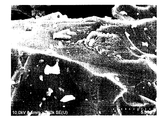
- FIG. 1 is a scanning electron micrograph showing columnar aluminum titanate obtained in an example according to the present invention.
- FIG. 2 is an enlarged scanning electron micrograph showing columnar aluminum titanate obtained in an example according to the present invention.
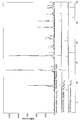
- FIG. 3 is a diagram showing an X-ray diffraction chart of the columnar aluminum titanate obtained in Example 1 according to the present invention.
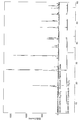
- FIG. 4 is a view showing an X-ray diffraction chart of the columnar aluminum titanate obtained in Example 2 according to the present invention.
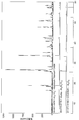
- FIG. 5 is an X-ray diffraction chart of the columnar aluminum titanate obtained in Example 3 according to the present invention.
- 6 is a diagram showing an X-ray diffraction chart of the aluminum titanate obtained in Comparative Example 1.
- FIG. 7 is an X-ray diffraction chart of the aluminum titanate obtained in Comparative Example 2.
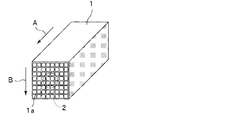
- FIG. 8 is a perspective view showing a honeycomb structure.
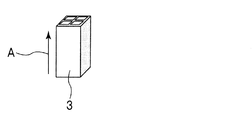
- FIG. 9 is a perspective view showing a measurement sample cut out from the honeycomb structure.
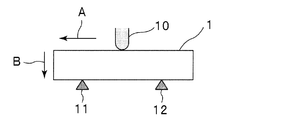
- FIG. 10 is a schematic diagram for explaining a method for measuring the bending strength of a honeycomb structure.
- FIG. 11 is a perspective view showing a measurement sample cut out from the honeycomb structure.
- FIG. 12 is a perspective view showing a honeycomb structure.
- FIG. 13 is a perspective view showing a measurement sample for measuring the X-ray diffraction of the extruded surface cut out from the honeycomb structure.
- FIG. 14 is a perspective view showing a honeycomb structure.
- FIG. 15 is a perspective view showing a measurement sample for measuring the X-ray diffraction of the vertical plane cut out from the honeycomb structure.
- Example 1 322.7 g of titanium oxide, 428.9 g of aluminum oxide, 17.5 g of magnesium hydroxide and 30.9 g of silicon oxide were mixed for 2.0 hours while being pulverized with a vibration mill.
- Aluminum oxide is mixed so that the amount of Al in the aluminum oxide is more than 2 mol relative to 1 mol of Ti in the titanium oxide.
- aluminum oxide and titanium oxide are mixed so that the aluminum oxide is about 10% by weight excess with respect to 100 parts by weight of aluminum titanate.
- 500 g of the pulverized mixed powder obtained as described above was charged in a crucible and baked at 1500 ° C. for 4 hours in an electric furnace.
- FIG. 3 An X-ray diffraction chart of the obtained product is shown in FIG. As shown in FIG. 3, the obtained products were Al 2 TiO 5 , Al 6 Si 2 O 13, and Al 2 O 3 . The peaks shown in the lower part of FIG. 3 are peaks of Al 2 TiO 5 , Al 6 Si 2 O 13 and Al 2 O 3 of JCPDS, respectively.
- the contents of Al 6 Si 2 O 13 and Al 2 O 3 contained in the obtained product were determined by quantification of an internal standard.
- the content of Al 6 Si 2 O 13 was 5.3% by weight with respect to Al 2 TiO 5
- the content of Al 2 O 3 was 5.1% by weight with respect to Al 2 TiO 5 .
- Example 2 295.3 g of titanium oxide, 447.8 g of aluminum oxide, 16.0 g of magnesium hydroxide and 40.9 g of silicon oxide were mixed for 2.0 hours while being pulverized with a vibration mill.
- Aluminum oxide is mixed so that the amount of Al in the aluminum oxide is more than 2 mol relative to 1 mol of Ti in the titanium oxide.
- aluminum oxide and titanium oxide are mixed so as to be about 20 wt% excess as aluminum oxide with respect to 100 parts by weight of aluminum titanate.
- 500 g of the pulverized mixed powder obtained as described above was charged in a crucible and baked at 1500 ° C. for 4 hours in an electric furnace.
- FIG. 4 An X-ray diffraction chart of the obtained product is shown in FIG. As shown in FIG. 4, the obtained products were Al 2 TiO 5 , Al 6 Si 2 O 13, and Al 2 O 3 . The peaks shown in the lower part of FIG. 4 are peaks of JCPDS Al 2 TiO 5 , Al 6 Si 2 O 13 and Al 2 O 3 , respectively.
- the contents of Al 6 Si 2 O 13 and Al 2 O 3 contained in the obtained product were determined by quantification of an internal standard.
- the content of Al 6 Si 2 O 13 was 16.7 wt% with respect to Al 2 TiO 5
- the content of Al 2 O 3 was 4.8 wt% with respect to Al 2 TiO 5 .
- Example 3 272.2 g of titanium oxide, 463.8 g of aluminum oxide, 14.7 g of magnesium hydroxide and 49.3 g of silicon oxide were mixed for 2.0 hours while being pulverized with a vibration mill.
- Aluminum oxide is mixed so that the amount of Al in the aluminum oxide is more than 2 mol relative to 1 mol of Ti in the titanium oxide.
- aluminum oxide and titanium oxide are mixed so as to be about 30% by weight as aluminum oxide with respect to 100 parts by weight of aluminum titanate.
- 500 g of the pulverized mixed powder obtained as described above was charged in a crucible and baked at 1500 ° C. for 4 hours in an electric furnace.
- FIG. 5 An X-ray diffraction chart of the obtained product is shown in FIG. As shown in FIG. 5, the obtained products were Al 2 TiO 5 , Al 6 Si 2 O 13, and Al 2 O 3 . The peaks shown in the lower part of FIG. 5 are those of JCPDS Al 2 TiO 5 , Al 6 Si 2 O 13 and Al 2 O 3 , respectively.
- the contents of Al 6 Si 2 O 13 and Al 2 O 3 contained in the obtained product were determined by quantification of an internal standard.
- the content of Al 6 Si 2 O 13 was 23.1 wt% with respect to Al 2 TiO 5
- the content of Al 2 O 3 was 5.3 wt% with respect to Al 2 TiO 5 .
- Aluminum oxide is mixed so that Al in aluminum oxide is 2 mol with respect to 1 mol of Ti in titanium oxide.
- 500 g of the pulverized mixed powder obtained as described above was charged in a crucible and baked at 1500 ° C. for 4 hours in an electric furnace.
- FIG. 6 An X-ray diffraction chart of the obtained product is shown in FIG. As shown in FIG. 6, the product obtained was Al 2 TiO 5 . The peaks shown in the lower part of FIG. 6 are those of JCPDS Al 2 TiO 5 and Al 2 O 3 , respectively.
- Aluminum oxide is mixed so that the amount of Al in the aluminum oxide is more than 2 mol relative to 1 mol of Ti in the titanium oxide.
- aluminum is mixed with titanium oxide so as to be about 35% by weight as aluminum oxide with respect to 100 parts by weight of aluminum titanate.
- 500 g of the pulverized mixed powder obtained as described above was charged in a crucible and baked in an electric furnace at 1500 ° C. for 4 hours.
- FIG. 7 An X-ray diffraction chart of the obtained product is shown in FIG. As shown in FIG. 7, the obtained products were Al 2 TiO 5 , Al 6 Si 2 O 13, and Al 2 O 3 . The peaks shown in the lower part of FIG. 7 are the peaks of Al 2 TiO 5 , Al 6 Si 2 O 13 and Al 2 O 3 of JCPDS, respectively.
- the contents of Al 6 Si 2 O 13 and Al 2 O 3 contained in the obtained product were determined by quantification of an internal standard.
- the content of Al 6 Si 2 O 13 was 28.6 wt% with respect to Al 2 TiO 5
- the content of Al 2 O 3 was 5.5 wt% with respect to Al 2 TiO 5 .
- Example 3 The columnar aluminum titanate obtained in Example 1 was ground in an automatic mortar for 50 hours to obtain granular aluminum titanate.
- FIG. 1 is a scanning electron micrograph (magnification 1000 times) showing this aluminum titanate. As is apparent from FIG. 1, columnar aluminum titanate is obtained.
- FIG. 2 is a scanning electron microscope (magnification: 7000 times) showing the above-mentioned aluminum titanate in an enlarged manner. As shown in FIG. 2, mullite and aluminum oxide are attached to the surface of the aluminum titanate.
- honeycomb sintered body Using the aluminum titanate obtained in each of the above Examples and Comparative Examples, a honeycomb sintered body was manufactured as follows.
- the obtained kneaded material was extruded to form a honeycomb structure with an extrusion molding machine, and then dried with a hot air dryer, and then the resulting molded body was fired at 1500 ° C. to obtain a honeycomb sintered body. Obtained.
- FIG. 8 is a perspective view showing a honeycomb sintered body (honeycomb structure). As shown in FIG. 8, the honeycomb sintered body 1 has 8 ⁇ 8 cells, and the end face 1a has a size of 1.8 cm in length and 1.8 cm in width. An arrow A indicates the extrusion direction, and an arrow B indicates a direction perpendicular to the extrusion direction A.
- the porosity was measured by cutting a portion corresponding to 2 ⁇ 2 cells from the center portion 2 of the above 8 ⁇ 8 cell honeycomb sintered body 1 so that the length along the extrusion direction A was about 2 cm. It was.
- FIG. 9 is a perspective view showing the measurement sample 3. Using the measurement sample 3 shown in FIG. 9, the porosity was measured in accordance with JIS R1634.
- the length along the extrusion direction A from the central portion 2 of the 8 ⁇ 8 cell honeycomb sintered body 1 is about 2 cm. It cut out so that it might become, and it was set as the measurement sample 3. As shown in FIG. 11, the linear expansion coefficient in the extrusion direction A of the measurement sample 3 was measured according to JIS R1618.
- Crystal orientation ratio The C-axis crystal orientation ratio of the obtained honeycomb sintered body was measured as the crystal orientation ratio.
- the crystal orientation ratio was calculated from the crystal orientation degree in the extrusion direction and the crystal orientation degree in the direction perpendicular to the extrusion direction (vertical crystal orientation degree) as shown in the following formula.
- Crystal orientation ratio Crystal orientation in extrusion direction / (Crystal orientation in extrusion direction + Crystal orientation in vertical direction)
- the degree of crystal orientation was determined by X-ray diffraction.
- the crystal orientation degree in the vertical direction was calculated by measuring X-ray diffraction of the vertical surface of the honeycomb sintered body and obtaining I (002) and I (230) in the same manner as described above.
- 12 and 13 are perspective views showing the production of a measurement sample for measuring the X-ray diffraction of the extruded surface.
- the region 4 including the end face 1a of the honeycomb sintered body 1 was cut out to produce a measurement sample shown in FIG.
- the measurement sample 5 shown in FIG. 13 the X-ray diffraction of the extruded surface 5a of the measurement sample 5 was measured.
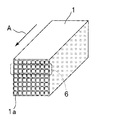
- FIG. 14 and 15 are perspective views showing the production of a sample for measuring X-ray diffraction on a vertical plane, that is, a plane perpendicular to the extrusion plane.
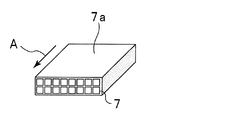
- a region 6 corresponding to 8 ⁇ 2 cells of the honeycomb sintered body 1 was cut out along the extrusion direction A to obtain a measurement sample 7 shown in FIG.
- the measurement of the X-ray diffraction of the surface (extruded surface) 7a along the extrusion direction A of the measurement sample 7 was performed.
- the (002) plane is a plane perpendicular to the C axis, and the high strength of the (002) plane means that the C axis is oriented.
- the honeycomb sintered body using the columnar aluminum titanate of Examples 1 to 3 according to the present invention has higher bending strength than the honeycomb sintered body using the columnar aluminum titanate of Comparative Example 1. have. This is because the columnar aluminum titanate according to the present invention has mullite fine particles and aluminum oxide fine particles attached to the surface, and the mullite fine particles and aluminum oxide present on the surface act as a sintering aid and have excellent mechanical strength. This is considered to be because a sintered body is obtained.
- the sintered bodies of Examples 1 to 3 have a lower linear expansion coefficient than the sintered body of Comparative Example 3. Since the crystal orientation ratio of Comparative Example 3 is lower than that of Examples 1 to 3, since the aspect ratio of Comparative Example 3 is small, the C-axis direction of aluminum titanate is not aligned with the extrusion direction of the honeycomb sintered body and is low. It is considered that the linear expansion coefficient was not obtained. In contrast, since the columnar aluminum titanates of Examples 1 to 3 have a large aspect ratio, the C-axis direction of aluminum titanate is aligned with the extrusion direction of the honeycomb sintered body, and a low linear expansion coefficient is obtained. It is considered a thing.
- Comparative Example 2 since the mullite content is more than 25% by weight, the linear expansion coefficient is high. In addition, since the amount of mullite adhering is large, the aspect ratio of the powder is also small, which makes it difficult for aluminum titanate to be oriented in the extrusion direction, which also increases the linear expansion coefficient. It seems to be.
- honeycomb sintered body honeycomb structure
- DESCRIPTION OF SYMBOLS 1a End face of honeycomb structure 2 ... Center part of honeycomb structure 3 ... Measurement sample cut out from honeycomb structure 4 ... Area near end face of honeycomb structure 5 . X-ray diffraction measurement of extruded surface of honeycomb structure Sample 5a ... extruded surface 6 ... 8 ⁇ 2 cell region of honeycomb structure 7 ... Sample 7a ... vertical surface for X-ray diffraction measurement of vertical surface of honeycomb structure
Landscapes
- Chemical & Material Sciences (AREA)
- Physics & Mathematics (AREA)
- Geometry (AREA)
- Chemical Kinetics & Catalysis (AREA)
- Engineering & Computer Science (AREA)
- Ceramic Engineering (AREA)
- Organic Chemistry (AREA)
- Inorganic Chemistry (AREA)
- Life Sciences & Earth Sciences (AREA)
- Geology (AREA)
- Materials Engineering (AREA)
- Structural Engineering (AREA)
- Thermal Sciences (AREA)
- Environmental & Geological Engineering (AREA)
- Health & Medical Sciences (AREA)
- Manufacturing & Machinery (AREA)
- Combustion & Propulsion (AREA)
- General Life Sciences & Earth Sciences (AREA)
- Biomedical Technology (AREA)
- Analytical Chemistry (AREA)
- General Chemical & Material Sciences (AREA)
- Oil, Petroleum & Natural Gas (AREA)
- Compositions Of Oxide Ceramics (AREA)
- Filtering Materials (AREA)
- Exhaust Gas Treatment By Means Of Catalyst (AREA)
- Inorganic Compounds Of Heavy Metals (AREA)
- Catalysts (AREA)
Abstract
La présente invention a pour objet un titanate d'aluminium colonnaire qui permet la production d'un corps fritté tel qu'une structure en nid d'abeille qui possède un faible coefficient d'expansion thermique et une excellente résistance mécanique. La présente invention concerne également un procédé de production du titanate d'aluminium colonnaire, et une structure en nid d'abeille qui est produite au moyen du titanate d'aluminium colonnaire. La présente invention concerne spécifiquement un titanate d'aluminium colonnaire ayant un rapport d'aspect moyen (= (longueur de l'axe majeur moyenne en nombre) / (longueur de l'axe mineur moyenne en nombre)) pas inférieur à 1,3, qui est caractérisé en ce que de 5 à 25 % en poids de mullite et de 2 à 10 % en poids d'oxyde d'aluminium, respectivement par rapport au titanate d'aluminium colonnaire, adhèrent à la surface du titanate d'aluminium colonnaire.
Applications Claiming Priority (2)
| Application Number | Priority Date | Filing Date | Title |
|---|---|---|---|
| JP2009138033A JP5380706B2 (ja) | 2009-06-09 | 2009-06-09 | 柱状チタン酸アルミニウム及びその製造方法並びにハニカム構造体 |
| JP2009-138033 | 2009-06-09 |
Publications (1)
| Publication Number | Publication Date |
|---|---|
| WO2010143494A1 true WO2010143494A1 (fr) | 2010-12-16 |
Family
ID=43308754
Family Applications (1)
| Application Number | Title | Priority Date | Filing Date |
|---|---|---|---|
| PCT/JP2010/058108 Ceased WO2010143494A1 (fr) | 2009-06-09 | 2010-05-13 | Titanate d'aluminium colonnaire, son procédé de production, et structure en nid d'abeille |
Country Status (2)
| Country | Link |
|---|---|
| JP (1) | JP5380706B2 (fr) |
| WO (1) | WO2010143494A1 (fr) |
Cited By (1)
| Publication number | Priority date | Publication date | Assignee | Title |
|---|---|---|---|---|
| WO2012046577A1 (fr) * | 2010-10-04 | 2012-04-12 | 大塚化学株式会社 | Filtre d'épuration de gaz d'échappement, et son procédé de production |
Families Citing this family (1)
| Publication number | Priority date | Publication date | Assignee | Title |
|---|---|---|---|---|
| KR102522430B1 (ko) * | 2018-07-26 | 2023-04-18 | 디아이씨 가부시끼가이샤 | 판상 알루미나 입자, 및 판상 알루미나 입자의 제조 방법 |
Citations (5)
| Publication number | Priority date | Publication date | Assignee | Title |
|---|---|---|---|---|
| JPH03242371A (ja) * | 1990-02-21 | 1991-10-29 | Ngk Insulators Ltd | 鋳ぐるみ用セラミック材の製造方法 |
| JPH04228471A (ja) * | 1990-06-22 | 1992-08-18 | Bayer Ag | アルミニウムチタネートに基づく焼結したセラミツク材料、それらの製造方法およびそれらの使用 |
| JPH0687651A (ja) * | 1992-09-02 | 1994-03-29 | Toshiba Corp | チタン酸アルミニウム焼結体の製造方法 |
| JPH0725662A (ja) * | 1993-06-25 | 1995-01-27 | Kawasaki Steel Corp | チタン酸アルミニウムセラミック粉末及びその焼結体製造方法 |
| JP2004026508A (ja) * | 2002-04-26 | 2004-01-29 | Tsutomu Fukuda | チタン酸アルミニウム系焼結体の製造方法 |
Family Cites Families (4)
| Publication number | Priority date | Publication date | Assignee | Title |
|---|---|---|---|---|
| US7959704B2 (en) * | 2005-11-16 | 2011-06-14 | Geo2 Technologies, Inc. | Fibrous aluminum titanate substrates and methods of forming the same |
| JP2010155728A (ja) * | 2008-12-26 | 2010-07-15 | Sumitomo Chemical Co Ltd | チタン酸アルミニウム系セラミックス焼結体の製造方法およびチタン酸アルミニウム系セラミックス焼結体 |
| JP5554934B2 (ja) * | 2009-03-15 | 2014-07-23 | 国立大学法人岐阜大学 | スピネル前駆体ゾルの製造方法、及びスピネルがコーティングされたチタン酸アルミニウム焼結体の製造方法 |
| JP5365794B2 (ja) * | 2009-06-19 | 2013-12-11 | 大塚化学株式会社 | 触媒担持用セラミックフィルタ及びその製造方法 |
-
2009
- 2009-06-09 JP JP2009138033A patent/JP5380706B2/ja not_active Expired - Fee Related
-
2010
- 2010-05-13 WO PCT/JP2010/058108 patent/WO2010143494A1/fr not_active Ceased
Patent Citations (5)
| Publication number | Priority date | Publication date | Assignee | Title |
|---|---|---|---|---|
| JPH03242371A (ja) * | 1990-02-21 | 1991-10-29 | Ngk Insulators Ltd | 鋳ぐるみ用セラミック材の製造方法 |
| JPH04228471A (ja) * | 1990-06-22 | 1992-08-18 | Bayer Ag | アルミニウムチタネートに基づく焼結したセラミツク材料、それらの製造方法およびそれらの使用 |
| JPH0687651A (ja) * | 1992-09-02 | 1994-03-29 | Toshiba Corp | チタン酸アルミニウム焼結体の製造方法 |
| JPH0725662A (ja) * | 1993-06-25 | 1995-01-27 | Kawasaki Steel Corp | チタン酸アルミニウムセラミック粉末及びその焼結体製造方法 |
| JP2004026508A (ja) * | 2002-04-26 | 2004-01-29 | Tsutomu Fukuda | チタン酸アルミニウム系焼結体の製造方法 |
Cited By (2)
| Publication number | Priority date | Publication date | Assignee | Title |
|---|---|---|---|---|
| WO2012046577A1 (fr) * | 2010-10-04 | 2012-04-12 | 大塚化学株式会社 | Filtre d'épuration de gaz d'échappement, et son procédé de production |
| US9238197B2 (en) | 2010-10-04 | 2016-01-19 | Otsuka Chemical Co., Ltd. | Exhaust gas purification filter, and method for producing same |
Also Published As
| Publication number | Publication date |
|---|---|
| JP2010285294A (ja) | 2010-12-24 |
| JP5380706B2 (ja) | 2014-01-08 |
Similar Documents
| Publication | Publication Date | Title |
|---|---|---|
| JP5564677B2 (ja) | 多孔質チタン酸アルミニウム及びその焼結体並びにその製造方法 | |
| JP5572102B2 (ja) | 異方性多孔質セラミック物品およびその製造 | |
| US20100300053A1 (en) | Ceramic honeycomb structures | |
| JP5485764B2 (ja) | チタン酸アルミニウム系セラミックス体の製造方法 | |
| CN102333741A (zh) | 钛酸铝系陶瓷烧结体的制造方法及钛酸铝系陶瓷烧结体 | |
| JP2011005417A (ja) | ハニカムフィルタ及びその製造方法 | |
| JP5587420B2 (ja) | 排ガス浄化フィルタ及びその製造方法 | |
| JP2019522615A (ja) | チタン酸アルミニウム組成物、チタン酸アルミニウム物品、及びその製造方法 | |
| JP4774445B2 (ja) | アルミニウムチタネートセラミックスの製造方法 | |
| CN102378745A (zh) | 钛酸铝系陶瓷体的制造方法 | |
| JP5365794B2 (ja) | 触媒担持用セラミックフィルタ及びその製造方法 | |
| JP2010116289A (ja) | チタン酸アルミニウム系セラミックスの製造方法 | |
| JP5380706B2 (ja) | 柱状チタン酸アルミニウム及びその製造方法並びにハニカム構造体 | |
| CN102811972B (zh) | 柱状钛酸铝及其制造方法 | |
| JP5380707B2 (ja) | 柱状チタン酸アルミニウム及びその製造方法並びにハニカム構造体 | |
| JP5274209B2 (ja) | 柱状チタン酸アルミニウム及びその製造方法 | |
| JP5445997B2 (ja) | ハニカムフィルタ | |
| JP5695127B2 (ja) | 柱状チタン酸アルミニウム粉体の製造方法 |
Legal Events
| Date | Code | Title | Description |
|---|---|---|---|
| 121 | Ep: the epo has been informed by wipo that ep was designated in this application |
Ref document number: 10786025 Country of ref document: EP Kind code of ref document: A1 |
|
| NENP | Non-entry into the national phase |
Ref country code: DE |
|
| 122 | Ep: pct application non-entry in european phase |
Ref document number: 10786025 Country of ref document: EP Kind code of ref document: A1 |