WO2010146871A1 - ポリプロピレン系樹脂予備発泡粒子及びその製造方法 - Google Patents
ポリプロピレン系樹脂予備発泡粒子及びその製造方法 Download PDFInfo
- Publication number
- WO2010146871A1 WO2010146871A1 PCT/JP2010/004065 JP2010004065W WO2010146871A1 WO 2010146871 A1 WO2010146871 A1 WO 2010146871A1 JP 2010004065 W JP2010004065 W JP 2010004065W WO 2010146871 A1 WO2010146871 A1 WO 2010146871A1
- Authority
- WO
- WIPO (PCT)
- Prior art keywords
- polypropylene resin
- weight
- parts
- fatty acid
- particles
- Prior art date
- Legal status (The legal status is an assumption and is not a legal conclusion. Google has not performed a legal analysis and makes no representation as to the accuracy of the status listed.)
- Ceased
Links
Classifications
-
- C—CHEMISTRY; METALLURGY
- C08—ORGANIC MACROMOLECULAR COMPOUNDS; THEIR PREPARATION OR CHEMICAL WORKING-UP; COMPOSITIONS BASED THEREON
- C08J—WORKING-UP; GENERAL PROCESSES OF COMPOUNDING; AFTER-TREATMENT NOT COVERED BY SUBCLASSES C08B, C08C, C08F, C08G or C08H
- C08J9/00—Working-up of macromolecular substances to porous or cellular articles or materials; After-treatment thereof
- C08J9/0014—Use of organic additives
- C08J9/0023—Use of organic additives containing oxygen
-
- C—CHEMISTRY; METALLURGY
- C08—ORGANIC MACROMOLECULAR COMPOUNDS; THEIR PREPARATION OR CHEMICAL WORKING-UP; COMPOSITIONS BASED THEREON
- C08J—WORKING-UP; GENERAL PROCESSES OF COMPOUNDING; AFTER-TREATMENT NOT COVERED BY SUBCLASSES C08B, C08C, C08F, C08G or C08H
- C08J9/00—Working-up of macromolecular substances to porous or cellular articles or materials; After-treatment thereof
- C08J9/16—Making expandable particles
- C08J9/18—Making expandable particles by impregnating polymer particles with the blowing agent
-
- C—CHEMISTRY; METALLURGY
- C08—ORGANIC MACROMOLECULAR COMPOUNDS; THEIR PREPARATION OR CHEMICAL WORKING-UP; COMPOSITIONS BASED THEREON
- C08J—WORKING-UP; GENERAL PROCESSES OF COMPOUNDING; AFTER-TREATMENT NOT COVERED BY SUBCLASSES C08B, C08C, C08F, C08G or C08H
- C08J9/00—Working-up of macromolecular substances to porous or cellular articles or materials; After-treatment thereof
- C08J9/22—After-treatment of expandable particles; Forming foamed products
- C08J9/228—Forming foamed products
- C08J9/232—Forming foamed products by sintering expandable particles
-
- C—CHEMISTRY; METALLURGY
- C08—ORGANIC MACROMOLECULAR COMPOUNDS; THEIR PREPARATION OR CHEMICAL WORKING-UP; COMPOSITIONS BASED THEREON
- C08J—WORKING-UP; GENERAL PROCESSES OF COMPOUNDING; AFTER-TREATMENT NOT COVERED BY SUBCLASSES C08B, C08C, C08F, C08G or C08H
- C08J2203/00—Foams characterized by the expanding agent
- C08J2203/06—CO2, N2 or noble gases
-
- C—CHEMISTRY; METALLURGY
- C08—ORGANIC MACROMOLECULAR COMPOUNDS; THEIR PREPARATION OR CHEMICAL WORKING-UP; COMPOSITIONS BASED THEREON
- C08J—WORKING-UP; GENERAL PROCESSES OF COMPOUNDING; AFTER-TREATMENT NOT COVERED BY SUBCLASSES C08B, C08C, C08F, C08G or C08H
- C08J2323/00—Characterised by the use of homopolymers or copolymers of unsaturated aliphatic hydrocarbons having only one carbon-to-carbon double bond; Derivatives of such polymers
- C08J2323/02—Characterised by the use of homopolymers or copolymers of unsaturated aliphatic hydrocarbons having only one carbon-to-carbon double bond; Derivatives of such polymers not modified by chemical after treatment
- C08J2323/10—Homopolymers or copolymers of propene
Definitions
- the present invention relates to pre-expanded polypropylene resin particles and a method for producing the same. More specifically, the present invention relates to a polypropylene resin pre-foamed particle that can be suitably used for an in-mold foam molded article having good antistatic performance and a method for producing the same.
- Polypropylene resin foams are used in various fields such as packaging materials, cushioning materials, heat insulating materials, and building materials because they are excellent in physical properties such as buffering properties and heat insulating properties.
- the in-mold foam molding method that fills the mold with pre-expanded polypropylene resin particles and heats them with water vapor to fuse the pre-expanded particles together to obtain a foam with a predetermined shape is a comparison of products with complex shapes. Therefore, it is used for many purposes.
- cushioning packaging material for electronic parts and machine parts such as OA equipment, which may hate dust and static electricity.
- OA equipment which may hate dust and static electricity.
- it consists of pre-expanded polypropylene resin particles with antistatic performance.
- In-mold foam moldings are used.
- a method for imparting antistatic performance to an in-mold foam molded body As a general method for imparting antistatic performance to an in-mold foam molded body, a method of applying a surfactant to the surface of the in-mold foam molded body, or a method in which a surfactant is kneaded in advance in a mold A method for producing a molded body is representative.
- the latter method of producing an in-mold foam molded article from a pre-kneaded surfactant in a resin is more antistatic than the method of applying a surfactant to the surface of the in-mold foam molded article. It is often used because it is excellent and the working method is easy to simplify.
- Non-crosslinked polyolefin resin containing 0.1 to 5% by weight of nonionic surfactant having antistatic ability and an average molecular weight of 200 to 1000 is used as a base resin as pre-expanded polypropylene resin particles having antistatic performance
- the technique to do is disclosed (patent document 1).
- Patent Document 2 A technique related to the polypropylene resin pre-expanded particles that appears is disclosed (Patent Document 2).
- nonionic surfactant glycerin ester of higher fatty acid is shown.
- Higher fatty acid glycerin esters are relatively safer than other surfactants and are often used as nonionic surfactants.
- Higher fatty acid glycerin esters can be broadly classified into monoesters, diesters, and triesters depending on the type of higher fatty acid binding. However, only monoesters are disclosed as glycerin esters of higher fatty acids described in Patent Documents 1 and 2.
- pre-expanded particles used for in-mold foam molding are prepared by placing resin pellets, aqueous dispersion medium, dispersant, dispersion aid, foaming agent, etc. in a pressure-resistant container, and heating and pressurizing to impregnate the foaming agent into the resin pellets.
- this production method is also referred to as “depressurization foaming method”.
- the dispersant is added for the purpose of preventing mutual adhesion of the resin pellets in the pressure vessel.
- the dispersant in the state where the dispersant remains, it interferes with the fusion of the pre-expanded particles at the time of in-mold foam molding. For this reason, it is desired that the dispersant is not attached to the surface of the pre-expanded particles as much as possible. Therefore, for example, a process of washing the pre-foamed particles after the pre-foaming is necessary.
- the polypropylene resin pre-expanded particles containing a surfactant for imparting antistatic performance tend to be difficult to clean the dispersant as compared with the case where the surfactant is not included.
- a technique is disclosed in which the residual dispersant per 100 parts by weight of pre-expanded particles can be reduced to 0.2 parts by weight or less by washing with a 2N nitric acid solution (Patent Document 3).
- thermoplastic polymer foam beads obtained by extrusion foaming, and is obtained by decompression foaming. Since it is not a technology relating to thermoplastic polymer foam beads, there is no mention of the effect of the permeability adjusting additive on the amount of dispersant adhering to the surface of the thermoplastic polymer foam beads (pre-expanded particles).
- Patent Document 5 it is described that a mixture of monostearic acid glycerin ester and distearic acid glycerin ester is used as the fatty acid glycerin ester. However, the ratio between the two is not mentioned, and further, it was obtained.
- the pre-expanded particles are washed with sodium metaphosphate having a concentration of 30 ppm, and it is difficult to clean the dispersant on the surface of the pre-expanded particles when a glycerin ester of fatty acid is used as an antistatic agent.
- JP-A-3-28239 Japanese Patent Laid-Open No. 7-304895 JP-A-8-92408 JP-A-4-23840 Japanese Patent Laid-Open No. 2002-146082
- the present invention provides a polypropylene resin in-mold foam molded article that can be used for in-mold foam molding without washing with chemicals such as nitric acid and sodium metaphosphate, and that exhibits good antistatic performance.
- An object of the present invention is to provide pre-expanded polypropylene resin particles.
- the present inventor has earnestly researched on a technology for obtaining polypropylene resin pre-expanded particles that can be suitably used for in-mold foam molding without washing with chemicals such as nitric acid and sodium metaphosphate while having antistatic performance.
- the glycerin monoester of a fatty acid having 6 to 24 carbon atoms and the glycerin diester of a fatty acid having 6 to 24 carbon atoms are used on the surface of the polypropylene resin pre-expanded particles by using a certain ratio. It has been found that the amount of the dispersing agent to be reduced can be reduced to such an extent that it can be satisfactorily subjected to in-mold foam molding without special washing. Moreover, when the polyglycerol fatty acid ester which polymerized glycerol was also examined, it discovered that the same effect was acquired and came to complete this invention.
- a pressure vessel is used, and the resin and aqueous dispersion are heated and pressurized in a specific temperature range according to the raw material resin to be used, and the atmosphere is lower than the pressure vessel internal pressure. It has been found that by releasing downward, it is in an appropriate elution state capable of exhibiting the surface resistivity performance, and the amount of the dispersant remaining on the surface of the polypropylene resin pre-foamed particles can be reduced.
- this invention consists of the following structures.
- A A glycerin monoester of a fatty acid having 6 to 24 carbon atoms and / or a polyglycerol monoester of a fatty acid having 6 to 24 carbon atoms
- B a fatty acid having 6 to 24 carbon atoms
- polypropylene resin pre-expanded particles according to [1], wherein the polyglycerol constituting the polyglycerol monoester of a fatty acid having 6 to 24 carbon atoms is a polymer of 2 to 10 glycerol.
- the polypropylene resin particles are pressurized in a temperature range of ⁇ 20 ° C. or higher and melting point + 20 ° C. or less to allow the polypropylene resin particles to contain a foaming agent, and the aqueous dispersion is placed in an atmosphere at a lower pressure than in the pressure vessel.
- the pre-expanded polypropylene resin particles of the present invention have a small amount of adhering dispersant on the surface of the pre-expanded polypropylene resin particles without washing with a chemical such as nitric acid or sodium metaphosphate. Therefore, it is possible to satisfactorily use the polypropylene resin pre-foamed particles for in-mold foam molding without washing with a chemical such as nitric acid or sodium metaphosphate. And the polypropylene resin in-mold foam-molded product obtained by in-mold foam molding of the polypropylene resin pre-expanded particles of the present invention exhibits good antistatic performance.
- the polypropylene resin in the present invention comprises a propylene monomer as a main monomer.
- ethylene-propylene random copolymer, butene-1-propylene random copolymer, ethylene-butene-1-propylene Random terpolymers, ethylene-propylene block copolymers, homopolypropylene and the like can be mentioned. These may be used alone or in combination of two or more.
- At least one of ethylene-propylene random copolymer, butene-1-propylene random copolymer, and ethylene-butene-1-propylene random terpolymer is preferably used for in-mold foam molding. This is preferable from the viewpoint of easily obtainable polypropylene resin pre-expanded particles.
- the melt index of the polypropylene resin in the present invention (hereinafter sometimes referred to as “MI”) is preferably 1 g / 10 min or more and 50 g / 10 min or less.
- MI melt index of the polypropylene resin
- the polypropylene resin pre-expanded particles of the present invention comprise (A) a glycerol monoester of a fatty acid having 6 to 24 carbon atoms and / or a polyglycerol monoester of a fatty acid having 6 to 24 carbon atoms (hereinafter simply referred to as “( (B) a glycerin diester of a fatty acid having 6 to 24 carbon atoms and / or a polyglycerin diester of a fatty acid having 6 to 24 carbon atoms (hereinafter simply referred to as “A) glycerin monoester”). (Sometimes abbreviated as “(B) glyceneline diester”).
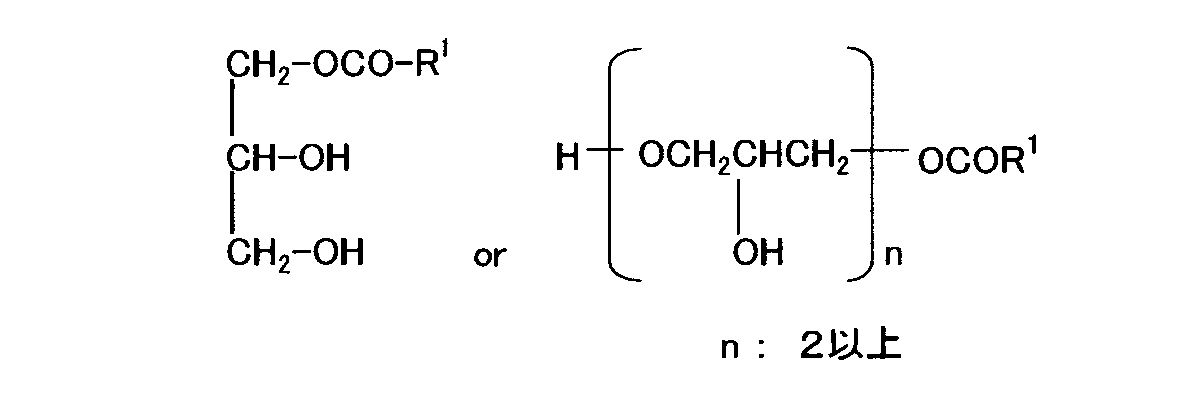
- a glycerin monoester of a fatty acid having 6 to 24 carbon atoms and / or a polyglycerin monoester of a fatty acid having 6 to 24 carbon atoms is a compound represented by Chemical Formula 1, and is antistatic. Has performance.
- R 1 is an alkyl group comprising at least one methyl group and 5 to 23 methylene groups and / or methine groups.
- the carbon number of the fatty acid constituting the glycerol monoester and / or polyglycerol monoester of the present invention is 6 or more and 24 or less.
- the number of carbon atoms of the fatty acid is less than the above range, the molecular weight is low, so that it is easy to elute into the resin surface layer, but the melting point is low, and care must be taken during processing.
- there are more carbon numbers of a fatty acid than the said range it takes time for elution to a resin surface layer.
- the number of carbon atoms of the fatty acid is inexpensive because it exists in nature, and is more preferably from 8 to 22 carbon atoms from the viewpoint of antistatic performance and its immediate effect and sustainability. Most preferred is 22 or less.
- the polyglycerin constituting the polyglycerin monoester of a fatty acid having 6 to 24 carbon atoms is a polymer of 2 or more of glycerin, and preferably 2 or more and 10 or less of glycerin is polymerized as shown in Chemical formula 2. Use what you did.
- R 1 is an alkyl group comprising at least one methyl group and 5 to 23 methylene groups and / or methine groups.
- polyglycerin monoesters of fatty acids having 6 to 24 carbon atoms with a low degree of polymerization tend to have the same properties as glycerin monoesters.
- Polyglycerol obtained by polymerization of 2 or more and 10 or less glycerin and monoester of fatty acid having 6 or more and 24 or less carbon atoms are as good as glycerin monoester of fatty acid having 6 or more and 24 or less carbon atoms corresponding to polymerization degree 1
- the antistatic performance tends to have a good antistatic performance, so that it is preferably used in the present invention.
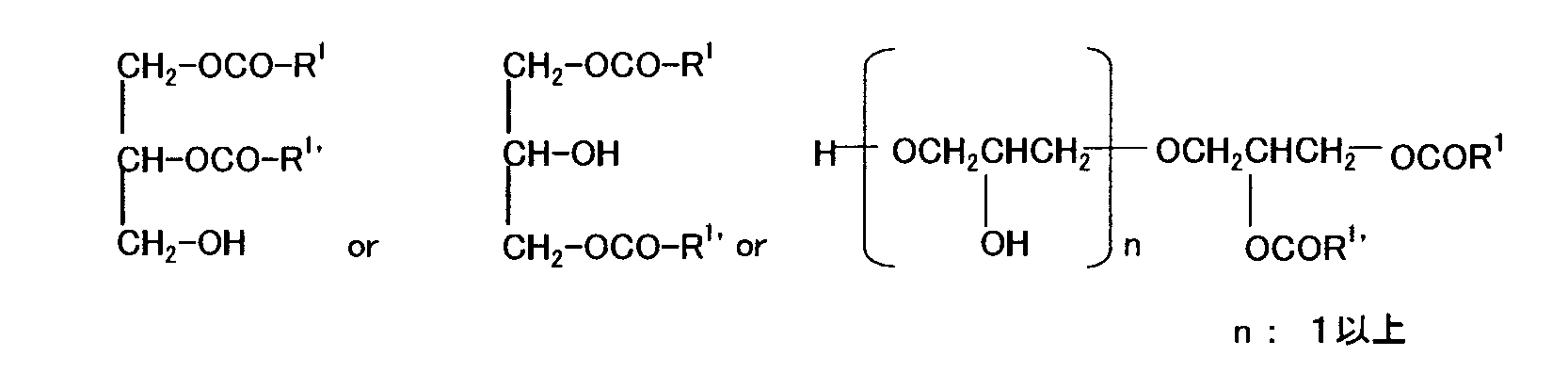
- the glycerin diester of a fatty acid having 6 to 24 carbon atoms and / or the polyglycerin diester of a fatty acid having 6 to 24 carbon atoms used in the present invention is a compound represented by Chemical Formula 3.
- R 1 and R 1 ′ are alkyl groups comprising at least one methyl group and 5 to 23 methylene groups and / or methine groups.
- a glycerin diester of a fatty acid having 6 to 24 carbon atoms may exist as a mixture in the production raw material of glycerin monoester having antistatic performance, but since antistatic performance cannot be expected so much, a high performance antistatic agent In general, it is a substance to be removed.
- the number of carbon atoms of the fatty acid constituting the glycerol diester and / or polyglycerol diester of the present invention is 6 or more and 24 or less.
- As the number of carbon atoms of the fatty acid there are many carbon atoms having 8 to 22 carbon atoms in nature, so that it is inexpensive and suitable.
- Diesters in the present invention are preferably used since those having the same or close carbon number as the monoester have advantages such as high compatibility between the monoester and the diester and ease of processing.
- the polyglycerin constituting the polyglycerin diester of a fatty acid having 6 to 24 carbon atoms is a polymer of 2 or more of glycerin, and preferably 2 or more and 10 or less of glycerin is polymerized as shown in Chemical formula 4. Use things.
- R 1 and R 1 ′ are alkyl groups comprising at least one methyl group and 5 to 23 methylene groups and / or methine groups.
- polyglycerin diesters of fatty acids having 6 to 24 carbon atoms with a low degree of polymerization tend to have the same properties as glycerin diesters.
- Polyglycerol obtained by polymerization of 2 or more and 10 or less glycerin and fatty acid diester having 6 or more and 24 or less carbon atoms have the same properties as glycerin diester of fatty acid having 6 or more and 24 or less carbon atoms corresponding to a polymerization degree of 1. Therefore, it is preferably used in the present invention.
- the foamed molded article has more excellent antistatic performance and is 10 or less, the resulting polypropylene resin pre-foamed particles can be satisfactorily used for in-mold foam molding without washing with a chemical such as nitric acid.
- the antistatic performance of the polypropylene resin in-mold foam molded product obtained by in-mold foaming compared to less than 0.3 parts by weight
- the obtained polypropylene resin pre-expanded particles can be used for in-mold foam molding without washing with a chemical such as nitric acid.
- the order of mixing (A) glycerin monoester and (B) glycerin diester, the way of mixing, etc. are not particularly limited.
- a master batch having a high content of (A) and (B) in advance (for example, a content of 5 (About 40 wt%) is preferably mixed with polypropylene resin and then extruded with a single or twin screw extruder.
- An organic pigment may be added to the polypropylene resin pre-expanded particles in the present invention, if necessary.
- organic pigment examples include, but are not limited to, perylene-based, polyazo-based, and quinacridone-based organic pigments.
- the content of the organic pigment is preferably 0.001 part by weight or more and 0.1 part by weight or less with respect to 100 parts by weight of the polypropylene resin from the viewpoint of dispersibility and antistatic property.
- the content of the organic pigment is less than 0.001 part by weight, it is difficult to color the polypropylene resin in-mold foam molded product obtained from the polypropylene resin pre-expanded particles to a desired color if the content is less than 0.001 part by weight. Tend to be.
- the content of the organic pigment exceeds 0.1 parts by weight, the cell diameter of the polypropylene resin pre-foamed particles becomes fine, and the surface property of the polypropylene resin in-mold foam molded product obtained from the polypropylene resin pre-foamed particles is It tends to be inferior and look bad.
- the polypropylene resin used in the present invention is usually made of polypropylene resin particles so as to be easily used for preliminary foaming.
- Such polypropylene-based resin particles are obtained by melt-kneading a polypropylene-based resin using an extruder, kneader, Banbury mixer, roll, etc., and then desired particles such as cylindrical, elliptical, spherical, cubic, and rectangular parallelepiped shapes. It can be obtained by molding into a shape.
- the average particle diameter of the polypropylene resin particles is preferably from 0.1 mm to 10 mm, more preferably from 0.5 mm to 5 mm.
- the average weight of the polypropylene resin particles is preferably from 0.1 mg / grain to 100 mg / grain, more preferably from 0.3 mg / grain to 10 mg / grain.
- additives such as (A) glycerin monoester, (B) glycerin diester and organic pigment are usually preferably added to the molten resin in the process of producing resin particles.
- 100 parts by weight of the polypropylene resin contains (A) glycerin monoester and (B) glycerin diester, and is contained in the polypropylene resin pre-expanded particles.
- polypropylene resin particles comprising a polypropylene resin composition that is 0.3 parts by weight or more and 5 parts by weight or less together with water, a dispersant, and a foaming agent in a pressure-resistant container
- the polydisperse was made into an aqueous dispersion, and the polypropylene resin particles were pressurized in a temperature range of -20 ° C to 20 ° C.
- the propylene-based resin particles contain a blowing agent, a method is preferred than the pressure vessel the water-based dispersion may be released into the low pressure atmosphere.
- the polypropylene resin pre-expanded particles obtained by such a method are preferable because they have good in-mold foam moldability and tend to improve the mechanical strength and heat resistance of the obtained in-mold foam molded article.
- the pressure vessel is not particularly limited, and any vessel that can withstand the pressure and temperature to be used can be used. Specific examples of the pressure vessel include an autoclave type pressure vessel.
- the dispersant is not particularly limited, but a poorly water-soluble inorganic substance such as tricalcium phosphate, kaolin, barium sulfate, titanium oxide, magnesium phosphate is often used.
- a poorly water-soluble inorganic substance such as tricalcium phosphate, kaolin, barium sulfate, titanium oxide, magnesium phosphate is often used.
- tricalcium phosphate, kaolin, and barium sulfate are preferable because the aqueous dispersion can be stably released even with a small amount of use.
- an anionic surfactant such as sodium dodecylbenzene sulfonate or sodium ⁇ -olefin sulfonate can be used as a dispersion aid.
- the amount of the dispersant used is preferably 0.1 parts by weight or more and 5 parts by weight or less with respect to 100 parts by weight of the polypropylene resin particles.
- the amount of the dispersion aid used is preferably 0.001 part by weight or more and 0.3 part by weight or less with respect to 100 parts by weight of the polypropylene resin particles.
- a nonionic system such as a modified dimethylpolysiloxane described in JP 2009-209334 A
- a surfactant or dimethylpolysiloxane may be added to the pressure vessel.
- the proportion of the polypropylene resin particles in the aqueous dispersion is preferably 20 parts by weight or more and 100 parts by weight or less with respect to 100 parts by weight of water, and the quality stability of the resulting polypropylene resin pre-expanded particles From the viewpoint of productivity, etc., it is determined as appropriate.
- the foaming agent is not particularly limited, and from the viewpoint of the environment, it is preferable to use an inorganic foaming agent such as air, nitrogen, carbon dioxide or the like, or water, and a high foaming ratio is easily obtained. From the aspect, it is preferable to use volatile organic foaming agents such as n-butane, iso-butane, pentane and the like.
- the melting point of the polypropylene resin particles is determined by using a differential scanning calorimeter [for example, DSC6200 type manufactured by Seiko Denshi Kogyo Co., Ltd.]
- the resin particles are melted by raising the temperature from 40 ° C. to 220 ° C. at a rate, and then crystallized by cooling from 220 ° C. to 40 ° C. at a rate of 10 ° C./min. From the DSC curve obtained when the temperature is increased from 40 ° C. to 220 ° C. at the rate of temperature increase, the melting peak temperature at the second temperature increase is obtained.
- the temperature of the aqueous dispersion in the pressure vessel is preferably in the temperature range of the melting point of the polypropylene resin particles from ⁇ 20 ° C. to the melting point + 20 ° C.
- the melting point of the polypropylene resin particles is lower than ⁇ 20 ° C.
- the expansion ratio of the obtained polypropylene resin pre-expanded particles tends to be limited to an extremely low magnification, and unexpanded resin particles tend to coexist.
- the melting point of the polypropylene resin particles exceeds + 20 ° C., the polypropylene resin particles melt and solidify in the pressure resistant container, and it becomes difficult to obtain the polypropylene resin pre-expanded particles.
- the foaming agent is impregnated by pressurizing at the temperature. It is done.
- the heating temperature tends to be low, and when an inorganic foaming agent is used, the heating temperature tends to be high.
- the higher the heating temperature the higher the expansion ratio of the polypropylene resin pre-expanded particles obtained.
- the internal pressure in the pressure-resistant container during pressurization is preferably 1 MPa-G or more and 5 MPa-G or less (where G represents a gauge pressure). If the internal pressure in the pressure-resistant container during pressurization is less than 1 MPa-G, pre-expanded particles having a high expansion ratio tend to be difficult to obtain, and if it exceeds 5 MPa-G, there are no particular problems with the obtained pre-expanded particles. Since a high pressure resistant container is required, there is a demerit that the equipment cost becomes high.
- the atmosphere under a pressure lower than that in the pressure vessel is generally as long as it is a condition adopted as a low pressure atmosphere for releasing the aqueous dispersion in the pressure vessel when producing the pre-expanded particles.
- the atmosphere under a pressure lower than that in the pressure vessel is generally as long as it is a condition adopted as a low pressure atmosphere for releasing the aqueous dispersion in the pressure vessel when producing the pre-expanded particles.
- the atmosphere when it is released into the atmosphere, it corresponds to the atmosphere, and when it is released into the closed system in order to recover the volatile foaming agent, it corresponds to the atmosphere within the closed system.
- the average weight of the polypropylene resin pre-expanded particles of the present invention obtained by the production method of the present invention is preferably 0.1 mg / particle or more and 100 mg / particle or less, and 0.3 mg / particle or more and 10 mg / particle or less. More preferably.
- the expansion ratio of the polypropylene resin pre-expanded particles obtained by the production method of the present invention is preferably 2 to 60 times, more preferably 3 to 40 times.
- the expansion ratio here is a true magnification that can be calculated from the density of the resin particles before foaming, the weight of the polypropylene resin pre-expanded particles and the submerged volume.
- the pre-expanded polypropylene resin particles of the present invention have little residual dispersant on the surface without special cleaning treatment such as cleaning with nitric acid, and as a result, can be suitably used for in-mold foam molding.
- the amount of the adhering dispersant in the polypropylene resin pre-expanded particles of the present invention is preferably 0.20 parts by weight or less, more preferably 0.18 parts by weight or less per 100 parts by weight of the polypropylene resin pre-expanded particles. It becomes.
- the amount of the adhering dispersant on the surface of the polypropylene resin pre-expanded particles can be appropriately measured according to the characteristics of the dispersant used.
- the amount of adhering dispersant can be quantified simply by quantifying phosphorus by a colorimetric method. Specifically, 50.0 ml of an aqueous solution (colorimetric solution) containing 0.022% by weight of ammonium metavanadate, 0.54% by weight of ammonium molybdate, and 3% by weight of nitric acid, and W (g) pre-expanded particles (usually About 0.5 g) is put into a conical beaker and stirred for 1 minute and then left for 10 minutes.
- the obtained liquid phase is placed in a quartz cell having a channel length of 1.0 cm, and the absorbance at 410 nm is measured using a spectrophotometer.
- the amount of the adhering dispersant can be determined by calculation using the absorbance coefficient ⁇ (g / L ⁇ cm) at 410 nm of the phosphate compound measured in advance for the same colorimetric liquid.
- kaolin when used as the dispersant, it can be quantified by the method described in International Publication No. WO2002 / 100929, for example.
- the polypropylene resin pre-expanded particles of the present invention obtained as described above become a polypropylene resin in-mold foam-molded product by general in-mold foam molding.
- the polypropylene resin pre-foamed particles are used for in-mold foam molding, a) a method of using the same as it is, b) a method of previously injecting an inorganic gas such as air into the pre-foamed particles to give foaming ability, c) Conventionally known methods such as a method of filling pre-expanded particles in a mold in a compressed state and molding can be used.
- the method for producing the expanded foam in the polypropylene resin mold from the pre-expanded polypropylene resin particles produced in the present invention is not particular limitation.
- the polypropylene resin pre-expanded particles are filled in a mold that can be closed but cannot be sealed, and 0.05 to 0.5 MPa-G (where G is a gauge pressure) using water vapor or the like as a heating medium. Molding is performed at a heating steam pressure of about 3 to 30 seconds with a heating steam pressure of about 3 to 30 seconds, and the polypropylene resin pre-expanded particles are fused together, and then the molding die is subjected to in-mold foam molding by water cooling.
- the method include a method in which the mold is opened after cooling to such an extent that the deformation of the in-mold foam molded product after the body is taken out can be suppressed, and the like.
- the obtained polypropylene resin-in-mold foam-molded article of the present invention has antistatic performance, and stably exhibits good antistatic performance even in a normally used atmosphere of about 50% humidity. That is, the polypropylene-based resin-molded foam-molded body stably exhibits good antistatic performance with a surface resistivity of 10 12 ⁇ or less, but more preferably 5 ⁇ 10 11 ⁇ or less.
- the surface specific resistance value is a value measured in accordance with JIS K6911 after being stored for 24 hours under conditions of a temperature of 23 ° C. and a humidity of 50%.
- the melting point of the resin particles was determined by using a differential scanning calorimeter [Seiko Electronics Co., Ltd., DSC6200 type], and using polypropylene (polyethylene) resin particles 5 to 6 mg at a temperature rising rate of 10 ° C./min, 40 ° C. to 220 ° C.
- the resin particles are melted by raising the temperature to 0 ° C., and then crystallized by cooling to 220 ° C. to 40 ° C. at a temperature lowering rate of 10 ° C./min. From the DSC curve obtained when the temperature was raised to ⁇ 220 ° C., the melting peak temperature at the second temperature rise was obtained.
- Foaming ratio of in-mold foam molding d ⁇ V / W
- the obtained liquid phase was placed in a quartz cell having a channel length of 1.0 cm, and the absorbance A at 410 nm was measured with a spectrophotometer.
- the remaining per 100 parts by weight of the polypropylene resin pre-expanded particles is calculated from the following equation using the absorbance coefficient ⁇ (g / L ⁇ cm) of tricalcium phosphate measured at 410 nm in advance. The amount of dispersant (parts) was determined.
- Adhesive dispersant amount (parts) 5.0 ⁇ ⁇ ⁇ A / Y ⁇ When using kaolin as a dispersant> It describes about the method of quantifying the kaolin which remain
- the polypropylene resin expanded particles are dried in an oven at 60 ° C. for 24 hours, and then the expanded particles taken out of the oven are immediately left in a room set at a temperature of 23 ° C. and a relative humidity of 50% for 72 hours.
- the weight of 100 g of the foamed particles was accurately measured to the third decimal place (rounded off to the third decimal place), and the weight of the foamed particles to which the dispersant was attached: F (g ).
- the entire amount of the foamed particles used for the above weight measurement is immersed in 5 L of 1N aqueous hydrochloric acid and washed, then immersed in 5 L of ion exchange water to wash out the hydrochloric acid solution, and then 5 L of 1 N aqueous sodium hydroxide solution. After immersing in and washing, sodium hydroxide is washed by immersing in 5 L of ion exchange water.
- the entire amount of the expanded particles is dried in an oven at 60 ° C. for 24 hours, then taken out of the oven and immediately left in a room set at 23 ° C. and 50% relative humidity for 72 hours.
- the weight of the expanded particles: S (g) is obtained in the same manner as described above.
- the difference between the weight F and the weight S was defined as the amount of the dispersant adhering to the surface of the foamed particles, and this was determined as the amount of residual dispersant (parts) per 100 parts by weight of the foamed particles to which the dispersant was adhered. .
- a cut having a depth of 10 mm was made in the center of the in-mold foam molded body having a thickness of 50 mm, the molded body was divided along the cut, and the fracture surface was observed and evaluated according to the following criteria.
- ⁇ The ratio of the broken particles is 60% or more.
- X The rate at which the particles are broken is less than 60%.
- the obtained in-mold foam molded article was stored for 24 hours under conditions of a temperature of 23 ° C. and a humidity of 50%, or under conditions of a temperature of 20 ° C. and a humidity of 65% for 24 hours, and conditioned by JIS K6911.
- the surface specific resistance was measured using Hiresta MCP-HT201 manufactured by Mitsubishi Yuka Co., Ltd.
- the aqueous dispersion was discharged under atmospheric pressure through a 3 mm ⁇ orifice provided at the bottom of the pressure vessel to obtain pre-expanded particles.
- About 10 g of the pre-expanded particles obtained for the determination of the residual dispersant are collected, about 5 g of which is taken into a spherical Amikago with a diameter of 10 cm, and the surface residue is dehydrated and removed with air using high-pressure air. A sample for quantitative determination of the agent was used.
- HMP sodium hexametaphosphate
- the moisture content is again reduced to 10 parts by weight or less using a dehydrator, and then dried in an atmosphere at 80 ° C. until the moisture content is less than 1 part by weight. Foamed particles were obtained.
- the pre-expanded particles obtained were charged into a 1 m 3 pressure-resistant container, pressurized to 0.5 MPa-G (where G represents a gauge pressure), and maintained for 8 hours. Was increased to 0.1 MPa-G.
- the pre-expanded particles after the application of internal pressure are filled into a 400 mm ⁇ 300 mm ⁇ 50 mm mold, and the pre-expanded particles are heated and fused together with 0.3 MPa-G water vapor to obtain an in-mold expanded molded body. Removed from mold. The in-mold foam molded product taken out from the mold was dried and cured in a dryer at 70 ° C. for 24 hours, and then the physical properties of the in-mold foam molded product were measured. The results are shown in Table 1.
- the aqueous dispersion was discharged under atmospheric pressure through a 3 mm ⁇ orifice provided at the lower part of the pressure vessel to obtain pre-expanded particles.
- the resin particles in the pressure vessel were coalesced to form a lump of resin, and pre-expanded particles could not be obtained.
- the temperature in the pressure vessel was too low, so that the pre-expanded particles had a foaming ratio of less than 2 times, and many unexpanded resin particles were mixed.
- Example 7 [Production of propylene-based resin particles] In the same manner as in Example 2, polypropylene resin particles were produced. [Production of pre-expanded propylene resin particles] A 300 liter pressure vessel was charged with 300 parts by weight of water, 100 parts by weight of the obtained resin particles, 0.8 part by weight of kaolin as a dispersing agent and 0.03 part by weight of norman paraffin sulphonate as a dispersion aid. 10 parts by weight of gas was charged, and the mixture was kept under stirring at the temperature and internal pressure shown in Table 1 for 30 minutes.
- Example 2 Thereafter, while maintaining the internal pressure of the pressure vessel with carbon dioxide gas, the aqueous dispersion was discharged under atmospheric pressure through a 3 mm ⁇ orifice provided at the lower part of the pressure vessel to obtain pre-expanded particles.
- Preparation of the residual dispersant quantification sample, the HMP washed sample, and the pre-expanded particles for molding for in-mold foaming was carried out in the same manner as in Example 2.
- Example 2 Manufacture of in-mold foam moldings
- the in-mold foam was produced, dried and cured to obtain an in-mold foam molded article. Table 1 shows the results of measuring the physical properties of the obtained in-mold foam molded article.
- Example 8 [Production of propylene-based resin particles] Resin particles (1.2 mg / particle) were produced in the same manner as in Example 1 except that the perylene-based organic pigment was not added. The melting point of the obtained resin particles is shown in Table 1.
- a 300 liter pressure vessel is charged with 300 parts by weight of water, 100 parts by weight of the obtained resin particles, 0.8 parts by weight of tribasic calcium phosphate as a dispersing agent, and 0.03 parts by weight of norman paraffin sodium sulfonate as a dispersing aid, Carbon dioxide gas was charged in an amount of 10 parts by weight, and the mixture was kept under stirring at the temperature and internal pressure shown in Table 1 for 30 minutes.
- Example 1 shows the results of measuring the physical properties of the obtained in-mold foam molded article.
- the aqueous dispersion was discharged under a saturated water vapor pressure of 0.05 MPa-G through a 3 mm ⁇ orifice provided at the lower part of the pressure vessel while maintaining the pressure inside the pressure vessel with air to obtain pre-expanded particles.
- Preparation of the residual dispersant quantification sample, the HMP washed sample, and the pre-expanded particles for molding for in-mold foaming was carried out in the same manner as in Example 1.
- Example 1 shows the results of measuring the physical properties of the obtained in-mold foam molded article.
- (B) Glycerol distearate as glycerin diester, perylene organic pigment (trade name: Pigment Red) and 0.1 part by weight of talc were mixed. The obtained mixture was melt-kneaded at a resin temperature of 220 ° C. using a 50 mm ⁇ single-screw extruder, and then granulated to produce resin particles (1.2 mg / grain).
- the melting point of the obtained resin particles was as shown in Table 1.
- a 300 liter pressure vessel was charged with 300 parts by weight of water, 100 parts by weight of the obtained resin particles, 1.2 parts by weight of calcium triphosphate as a dispersing agent and 0.05 parts by weight of norman paraffin sodium sulfonate as a dispersing aid, Then, 15 parts by weight of isobutane was charged, and the mixture was kept under stirring at the temperature and internal pressure shown in Table 1 for 30 minutes.
- Example 1 shows the results of measuring the physical properties of the obtained in-mold foam molded article.
- Example 1 shows the results of measuring the physical properties of the obtained in-mold foam molded article.
- Example 12 [Production of propylene resin particles]
- Example 1 shows the results of measuring the physical properties of the obtained in-mold foam molded article.
- the melting point of the obtained resin particles was as shown in Table 1.
- a 300 liter pressure vessel was charged with 300 parts by weight of water, 100 parts by weight of the obtained resin particles, 0.8 parts by weight of tribasic calcium phosphate as a dispersant and 0.03 parts by weight of norman paraffin sulfonate sodium as a dispersion aid, Further, 10 parts by weight of carbon dioxide gas was added, and the mixture was kept under stirring at the temperature and internal pressure shown in Table 1 for 30 minutes.
- Example 1 shows the results of measuring the physical properties of the obtained in-mold foam molded article.
- the melting point of the obtained resin particles was as shown in Table 1.
- a 300 liter pressure vessel was charged with 300 parts by weight of water, 100 parts by weight of the obtained resin particles, 1.2 parts by weight of calcium triphosphate as a dispersant, and 0.05 parts by weight of sodium norman paraffin sulfonate as a dispersion aid, Furthermore, 15 parts by weight of isobutane was charged, and the mixture was kept under stirring at the temperature and internal pressure shown in Table 1 for 30 minutes.
- Example 1 shows the results of measuring the physical properties of the obtained in-mold foam molded article.
- polypropylene resin pre-expanded particles of 3 parts by weight or more and 5 parts by weight or less are used, the residual dispersant is small while exhibiting good antistatic performance of 10 12 ⁇ or less even in an atmosphere of 23 ° C. and 50% humidity. When used for in-mold foam molding, it exhibits good fusing properties.
Landscapes
- Chemical & Material Sciences (AREA)
- Health & Medical Sciences (AREA)
- Engineering & Computer Science (AREA)
- Materials Engineering (AREA)
- Chemical Kinetics & Catalysis (AREA)
- Medicinal Chemistry (AREA)
- Polymers & Plastics (AREA)
- Organic Chemistry (AREA)
- Emergency Medicine (AREA)
- Manufacture Of Porous Articles, And Recovery And Treatment Of Waste Products (AREA)
- Compositions Of Macromolecular Compounds (AREA)
Abstract
Description
しかし、前記透過性調節用添加剤は、押出し発泡して得られる熱可塑性ポリマー発泡ビーズに含まれる発泡剤の透過性を調節するための添加剤として用いられており、除圧発泡して得られる熱可塑性ポリマー発泡ビーズに関する技術ではないことから、該透過性調節用添加剤が、熱可塑性ポリマー発泡ビーズ(予備発泡粒子)表面に付着する分散剤量へ及ぼす影響については、何ら言及されていない。
また、グリセリンを重合したポリグリセリンの脂肪酸エステルについても検討したところ、同様の効果が得られることを見出し、本発明を完成するに至った。
[1] (A)炭素数が6以上24以下の脂肪酸のグリセリンモノエステルおよび/または炭素数が6以上24以下の脂肪酸のポリグリセリンモノエステル、および
(B)炭素数が6以上24以下の脂肪酸のグリセリンジエステルおよび/または炭素数が6以上24以下の脂肪酸のポリグリセリンジエステルを含有するポリプロピレン系樹脂予備発泡粒子であって、
該予備発泡粒子中に含有されるの(A)と(B)の重量比[=(A)/(B)]が1.3以上10以下であり、かつ、合計含有量[=(A)+(B)]がポリプロピレン系樹脂100重量部に対して0.3重量部以上5重量部以下である、ポリプロピレン系樹脂予備発泡粒子。
[2] 炭素数が6以上24以下の脂肪酸のポリグリセリンモノエステルを構成するポリグリセリンが、2以上10以下のグリセリンが重合したものである、[1]記載のポリプロピレン系樹脂予備発泡粒子。
[3] 炭素数が6以上24以下の脂肪酸のポリグリセリンジエステルを構成するポリグリセリンが、2以上10以下のグリセリンが重合したものである、[1]または[2]に記載のポリプロピレン系樹脂予備発泡粒子。
[4] ポリプロピレン系樹脂予備発泡粒子100重量部あたり、付着分散剤量が0.20重量部以下である、[1]~[3]の何れか一項に記載のポリプロピレン系樹脂予備発泡粒子。
[5] [1]~[4]の何れか一項に記載のポリプロピレン系樹脂予備発泡粒子を金型に充填し、加熱して得られ、
温度23℃、湿度50%の条件下で24時間保存した後、JIS K6911に準拠して測定される表面固有抵抗値が5×10¹¹Ω以下である、ポリプロピレン系樹脂型内発泡成形体。
[6] (A)炭素数が6以上24以下の脂肪酸のグリセリンモノエステルおよび/または炭素数が6以上24以下の脂肪酸のポリグリセリンモノエステルと、(B)炭素数が6以上24以下の脂肪酸のグリセリンジエステルおよび/または炭素数が6以上24以下の脂肪酸のポリグリセリンジエステルとを含有し、含有される(A)と(B)の重量比[=(A)/(B)]が1.3以上10以下であり、かつ合計含有量[=(A)+(B)]がポリプロピレン系樹脂100重量部に対し0.3重量部以上5重量部以下であるポリプロピレン系樹脂組成物からなるポリプロピレン系樹脂粒子を、
耐圧容器内に水、分散剤、発泡剤と共に仕込み水系分散物となし、
該ポリプロピレン系樹脂粒子の融点-20℃以上融点+20℃以下の温度範囲で加圧することにより、該ポリプロピレン系樹脂粒子に発泡剤を含有させ、該水系分散物を耐圧容器内よりも低圧の雰囲気下に放出して得られることを特徴とする、ポリプロピレン系樹脂予備発泡粒子の製造方法。
[7] 発泡剤が炭酸ガスである、[6]に記載のポリプロピレン系樹脂予備発泡粒子の製造方法。

本発明におけるジエステルは、前記モノエステルと炭素数が同じ、もしくは、近いものが、モノエステルとジエステルの相溶性が高く加工しやすいなどのメリットがあるため、好ましく用いられる。

(A)と(B)の重量比[=(A)/(B)]が1.3以上であれば、1.3未満の場合に比べて型内発泡して得られるポリプロピレン系樹脂型内発泡成形体の帯電防止性能がより優れ、10以下であると、得られるポリプロピレン系樹脂予備発泡粒子を硝酸等の薬剤で洗浄を行なわずとも、良好に型内発泡成形に用いることができる。
(A)と(B)の合計含有量が0.3重量部以上であると、0.3重量部未満に比べて型内発泡して得られるポリプロピレン系樹脂型内発泡成形体の帯電防止性能がより優れ、5重量部以下であると、得られたポリプロピレン系樹脂予備発泡粒子を硝酸等の薬剤で洗浄を行なわずとも、菱光に型内発泡成形に用いることができる。
ただし、(A)グリセリンモノエステルおよび(B)グリセリンジエステルをポリプロピレン系樹脂中に均一に分散させやすいという点から、予め(A)および(B)の含有率の高いマスターバッチ(例えば、含有率5~40重量%)を調整してポリプロピレン系樹脂と混合した後、一軸あるいは二軸押出機で押出する方法が好ましい。
前記ポリプロピレン系樹脂粒子の平均粒径は、好ましくは0.1mm以上10mm以下、より好ましくは0.5mm以上5mm以下である。
前記ポリプロピレン系樹脂粒子の平均重量は、好ましくは0.1mg/粒以上100mg/粒以下、より好ましくは0.3mg/粒以上10mg/粒以下である。
その際、(A)グリセリンモノエステル、(B)グリセリンジエステルおよび、有機顔料などの添加剤は、通常、樹脂粒子の製造過程において溶融した樹脂中に添加することが好ましい。
具体的には、メタバナジン酸アンモニウム0.022重量%、モリブデン酸アンモニウム0.54重量%、硝酸3重量%を含む水溶液(比色液)50.0mlと、W(g)の予備発泡粒子(通常約0.5g)をコニカルビーカーにとり、1分間攪拌した後10分間放置する。得られた液相を航路長1.0cmの石英セルにとり、分光光度計を用いて410nmでの吸光度を測定する。付着分散剤量は、同一の比色液について、予め測定しておいたリン酸塩化合物の410nmでの吸光度係数ε(g/L・cm)を用いて、算出して求めることができる。
なお、前記表面固有抵抗値は、温度23℃、湿度50%の条件下に24時間保存して状態調節した後、JIS K6911に準拠して測定した値である。
樹脂粒子の融点は、示差走査熱量計[セイコー電子工業(株)製、DSC6200型]を用いて、ポリプロピレン(ポリエチレン)系樹脂粒子5~6mgを10℃/minの昇温速度で40℃~220℃まで昇温することにより樹脂粒子を融解し、その後10℃/minの降温速度で220℃~40℃まで冷却することにより結晶化させた後に、さらに10℃/minの昇温速度で40℃~220℃まで昇温したときに得られるDSC曲線から、2回目の昇温時の融解ピーク温度として求めた。
嵩体積約50cm3のポリプロピレン系樹脂予備発泡粒子の重量w(g)およびエタノール水没体積v(cm3)を求め、発泡前の樹脂粒子の密度d(g/cm3)から次式により求める。
予備発泡粒子の発泡倍率=d×v/w
型内発泡成形体の重量W(g)と型内発泡成形体の体積V(cm3)を求め、次式により求める。
型内発泡成形体の発泡倍率=d×V/W
<分散剤として第三リン酸カルシウムを用いた場合>
ポリプロピレン系樹脂予備発泡粒子表面に残存する第三リン酸カルシウムを定量する方法について記載する。
メタバナジン酸アンモニウム0.022重量%、モリブデン酸アンモニウム0.54重量%、硝酸3重量%を含む水溶液(比色液)50.0mlとY(g)の予備発泡粒子(通常約0.5g)をコニカルビーカーにとり、1分間攪拌した後10分間放置した。得られた液相を航路長1.0cmの石英セルにとり、分光光度計により410nmでの吸光度Aを測定した。
同一の比色液について、予め測定しておいた第三リン酸カルシウムの410nmでの吸光度係数ε(g/L・cm)を用いて、下式より、ポリプロピレン系樹脂予備発泡粒子100重量部あたりの残存分散剤量(部)を求めた。
付着分散剤量(部)=5.0・ε・A/Y
<分散剤としてカオリンを用いた場合>
ポリプロピレン系樹脂予備発泡粒子表面に残存するカオリンを定量する方法について記載する。
ポリプロピレン系樹脂発泡粒子を60℃のオーブンで24時間乾燥させ、次いで、オーブンから取り出した発泡粒子を直ちに温度23℃、相対湿度50%に設定された室内に72時間放置する。次に、同じ条件に設定された室内において、発泡粒子100gを小数点3桁まで正確に重量を測定(小数点3桁目を四捨五入)した値を、分散剤が付着した発泡粒子の重量:F(g)とする。
次に、上記の重量測定に使用した発泡粒子の全量を、5Lの1N塩酸水溶液に浸漬して洗浄した後、5Lイオン交換水に浸漬して塩酸溶液を洗い落とし、次いで5Lの1N水酸化ナトリウム水溶液に浸漬して洗浄した後、5Lのイオン交換水に浸漬して水酸化ナトリウムを洗浄する。この作業を2回繰り返した後、発泡粒子全量を60℃のオーブンで24時間乾燥した後、オーブンから取り出し、直ちに23℃ 、相対湿度50%に設定された室内に72時間放置する。続いて、同じ条件に設定された室内で、上記と同様に発泡粒子の重量:S(g)を求める。
重量Fと重量Sとの差を発泡粒子に表面に付着している分散剤の量とし、これを分散剤が付着している発泡粒子100重量部あたりの残存分散剤量(部)として求めた。
厚み50mmの型内発泡成形体の中央に深さ10mmの切込みを入れ、切り込みにそって成形体を割り、破断面を観察して以下の基準で評価した。
○:粒子が破断している割合が60%以上。
×:粒子が破断している割合が60%未満。
得られた型内発泡成形体を、温度23℃、湿度50%の条件下に24時間、もしくは、温度20℃、湿度65%の条件下に24時間保存して、状態調節した後、JIS K6911に準拠して、表面固有抵抗を、三菱油化(株)製ハイレスタMCP-HT201を用いて測定した。
[プロピレン系樹脂粒子の製造]
エチレン含有率3.6重量%、MI=6.0g/10分のエチレン-プロピレンランダム共重合体100重量部に対して、表1に示す量の(A)グリセリンモノエステルとしてのグリセリンモノステアレート、(B)グリセリンジエステルとしてのグリセリンジステアレート、ペリレン系有機顔料(商品名:ピグメントレッド)、ポリエチレングリコール0.5重量部およびタルク0.1重量部を混合した。得られた混合物を、50mmφの単軸押出機を用いて、樹脂温度220℃にて溶融混練した後、造粒し、樹脂粒子(1.2mg/粒)を製造した。得られた樹脂粒子の融点は、表1に示すとおりであった。
[プロピレン系樹脂予備発泡粒子の製造]
300リットル耐圧容器に、水300重量部、得られた樹脂粒子100重量部、分散剤として第三リン酸カルシウム0.8重量部および分散助剤としてノルマンパラフィンスルフォン酸ソーダ0.03重量部を仕込み、さらに、炭酸ガスを10重量部仕込み、撹拌下、表1に示す温度および内圧で30分間保持した。その後、耐圧容器内を炭酸ガスで前記内圧に保持しながら、耐圧容器の下部に設けた3mmφオリフィスを通して水系分散物を大気圧下に放出し、予備発泡粒子を得た。
残存分散剤定量のため得られた予備発泡粒子を約10g採取し、そのうち約5gを直径10cmの球形アミカゴにとり、高圧エアーを用いて表面残存物をエアーで脱水除去し、脱水のみでの残存分散剤定量用サンプルとした。また、残りの約5gも直径10cmの球形アミカゴにとり、300ppmのヘキサメタリン酸ソーダ(以下、HMP)水溶液で30秒間水洗し、さらに純水にて30秒間水洗した後、高圧エアーを用いて表面残存物をエアーで脱水除去し、HMP洗浄サンプルとした。
残存分散剤定量に用いた以外の予備発泡粒子は、脱水機を用いて、予備発泡粒子100重量部に対して含水量が10重量部となるまで脱水し、さらに100重量部の水を塗布しなじませた後、再度脱水機を用いて含水率を10重量部以下とした後、80℃の雰囲気にて含水量が1重量部未満となるまで乾燥処理を行ない、型内発泡成形用の予備発泡粒子とした。
[型内発泡成形体の製造]
次に、得られた予備発泡粒子を1m3の耐圧容器に仕込み、0.5MPa-G(ここで、Gはゲージ圧であることを示す。)に加圧し、8時間保持して予備発泡粒子の内圧を0.1MPa-Gに高めた。内圧付与後の予備発泡粒子を、400mm×300mm×50mmの金型に充填し、予備発泡粒子同士を0.3MPa-Gの水蒸気にて加熱、融着させ、型内発泡成形体を得、金型から取り出した。金型から取り出した型内発泡成形体を70℃の乾燥器中で24時間乾燥、養生した後、型内発泡成形体の物性を測定した。結果を表1に示す。
[プロピレン系樹脂粒子の作製]
実施例2と同様にして、ポリプロピレン系樹脂粒子を作製した。
[プロピレン系樹脂予備発泡粒子の製造]
300リットル耐圧容器に、水300重量部、得られた樹脂粒子100重量部、分散剤として第三リン酸カルシウム0.8重量部および分散助剤としてノルマンパラフィンスルフォン酸ソーダ0.03重量部を仕込み、さらに、炭酸ガスを10重量部仕込み、撹拌下、表1に示す温度および内圧で30分間保持した。その後、耐圧容器内を炭酸ガスで前記内圧に保持しながら、耐圧容器の下部に設けた3mmφオリフィスを通して、水系分散物を大気圧下に放出し、予備発泡粒子を得た。
但し、参考例1では、耐圧容器中の温度を昇温中に、耐圧容器中の樹脂粒子同士が合着し、樹脂の塊となり、予備発泡粒子を得ることはできなかった。
また、参考例2では、耐圧容器内の温度が低すぎることから、発泡倍率2倍未満の予備発泡粒子になると共に、未発泡の樹脂粒子が多く混じっていた。
[プロピレン系樹脂粒子の作製]
実施例2と同様にして、ポリプロピレン系樹脂粒子を作製した。
[プロピレン系樹脂予備発泡粒子の製造]
300リットル耐圧容器に、水300重量部、得られた樹脂粒子100重量部、分散剤としてカオリン0.8重量部および分散助剤としてノルマンパラフィンスルフォン酸ソーダ0.03重量部を仕込み、さらに、炭酸ガスを10重量部仕込み、撹拌下、表1に示す温度および内圧で30分間保持した。その後、耐圧容器内を炭酸ガスで前記内圧に保持しながら、耐圧容器の下部に設けた3mmφオリフィスを通して、水系分散物を大気圧下に放出し、予備発泡粒子を得た。
残存分散剤定量用サンプル、HMP洗浄サンプル、型内発泡用成型用予備発泡粒子の調製は、実施例2と同様の操作により行った。
[型内発泡成形体の製造]
実施例2と同様の操作により、型内発泡体の製造、乾燥・養生を行い、型内発泡成形体を得た。得られた型内発泡成形体の物性を測定した結果を、表1に示す。
[プロピレン系樹脂粒子の作製]
ペリレン系有機顔料を添加しなかった以外は、実施例1と同様にして、樹脂粒子(1.2mg/粒)を製造した。得られた樹脂粒子の融点は、表1に示す。
[プロピレン系樹脂予備発泡粒子の製造]
300リットル耐圧容器に、水300重量部、得られた樹脂粒子100重量部、分散剤として第三リン酸カルシウム0.8重量部および分散助剤としてノルマンパラフィンスルフォン酸ソーダ0.03重量部を仕込み、さらに、炭酸ガスを10重量部仕込み、撹拌下、表1に示す温度および内圧で30分間保持した。その後、耐圧容器内を炭酸ガスで前記内圧に保持しながら、耐圧容器の下部に設けた3mmφオリフィスを通して水系分散物を大気圧下に放出し、予備発泡粒子を得た。
残存分散剤定量用サンプル、HMP洗浄サンプル、型内発泡用成型用予備発泡粒子の調製は、実施例1と同様の操作により行った。
[型内発泡成形体の製造]
実施例1と同様の操作により、型内発泡体の製造、乾燥・養生を行い、型内発泡成形体を得た。得られた型内発泡成形体の物性を測定した結果を、表1に示す。
[プロピレン系樹脂粒子の作製]
ブテン-1含有量4.2重量%、MI=8.0g/10分のブテン-1-プロピレンランダム共重合体100重量部に対して、表1に示す量の(A)グリセリンモノエステルとしてのグリセリンモノステアレート、(B)グリセリンジエステルとしてのグリセリンジステアレート、ペリレン系有機顔料(商品名:ピグメントレッド)、含水剤としてメラミン0.5重量部および、タルク0.3重量部を混合した。得られた混合物を、50mmφの単軸押出機を用いて、樹脂温度220℃にて溶融混練した後、造粒し、樹脂粒子(1.2mg/粒)を製造した。得られた樹脂粒子の融点は表1に示すとおりであった。
[プロピレン系樹脂予備発泡粒子の製造]
300リットル耐圧容器に、水300重量部、得られた樹脂粒子100重量部、分散剤として第三リン酸カルシウム0.5重量部および分散助剤としてノルマンパラフィンスルフォン酸ソーダ0.02重量部を仕込み、撹拌下、表1に示す温度とし、さらに空気で加圧することにより表1記載の内圧とした上で30分間保持し、含水させた。その後、耐圧容器内を空気で前記内圧に保持しながら、耐圧容器の下部に設けた3mmφオリフィスを通して水系分散物を圧力0.05MPa-Gの飽和水蒸気圧下に放出し、予備発泡粒子を得た。
残存分散剤定量用サンプル、HMP洗浄サンプル、型内発泡用成型用予備発泡粒子の調製は、実施例1と同様の操作により行った。
[型内発泡成形体の製造]
実施例1と同様の操作により、型内発泡体の製造、乾燥・養生を行い、型内発泡成形体を得た。得られた型内発泡成形体の物性を測定した結果を、表1に示す。
[プロピレン系樹脂粒子の製造]
エチレン含有率3.6重量%、MI=6.0g/10分のエチレン-プロピレンランダム共重合体100重量部に対して、表1に示す量の(A)グリセリンモノエステルとしてのグリセリンモノステアレート、(B)グリセリンジエステルとしてのグリセリンジステアレート、ペリレン系有機顔料(商品名:ピグメントレッド)および、タルク0.1重量部を混合した。得られた混合物を、50mmφの単軸押出機を用いて、樹脂温度220℃にて溶融混練した後、造粒し、樹脂粒子(1.2mg/粒)を製造した。得られた樹脂粒子の融点は表1に示すとおりであった。
[プロピレン系樹脂予備発泡粒子の製造]
300リットル耐圧容器に、水300重量部、得られた樹脂粒子100重量部、分散剤として第三リン酸カルシウム1.2重量部および分散助剤としてノルマンパラフィンスルフォン酸ソーダ0.05重量部を仕込み、さらに、イソブタンを15重量部仕込み、撹拌下、表1に示す温度および内圧で30分間保持した。その後、耐圧容器内をイソブタンで前記内圧に保持しながら、耐圧容器の下部に設けた5mmφオリフィスを通して水系分散物を大気圧下に放出し、予備発泡粒子を得た。
残存分散剤定量用サンプル、HMP洗浄サンプル、型内発泡用成型用予備発泡粒子の調製は、実施例1と同様の操作により行った。
[型内発泡成形体の製造]
実施例1と同様の操作により、型内発泡体の製造、乾燥・養生を行い、型内発泡成形体を得た。得られた型内発泡成形体の物性を測定した結果を、表1に示す。
[プロピレン系樹脂粒子の製造]
エチレン含有率3.6重量%、MI=6.0g/10分のエチレン-プロピレンランダム共重合体100重量部に対して、表1に示す量の(A)グリセリンモノエステルとしてのグリセリンモノパルミテート、(B)グリセリンジエステルとしてのグリセリンジパルミテート、キグナリドン系有機顔料(商品名:キナクリドンマゼンダ)、ポリエチレングリコール0.5重量部、および、タルク0.1重量部を混合した。得られた混合物を、50mmφの単軸押出機を用いて、樹脂温度220℃にて溶融混練した後、造粒し、樹脂粒子(1.2mg/粒)を製造した。得られた樹脂粒子の融点は表1に示すとおりであった。
[プロピレン系樹脂予備発泡粒子の製造]
300リットル耐圧容器に、水300重量部、得られた樹脂粒子100重量部、分散剤として第三リン酸カルシウム0.8重量部および分散助剤としてノルマンパラフィンスルフォン酸ソーダ0.03重量部とを仕込み、さらに、炭酸ガスを10重量部仕込み、撹拌下、表1に示す温度および内圧で30分間保持した。その後、耐圧容器内を炭酸ガスで前記内圧に保持しながら耐圧容器の下部に設けた3mmφオリフィスを通して水系分散物を大気圧下に放出し、予備発泡粒子を得た。
残存分散剤定量用サンプル、HMP洗浄サンプル、型内発泡用成型用予備発泡粒子の調製は、実施例1と同様の操作により行った。
[型内発泡成形体の製造]
実施例1と同様の操作により、型内発泡体の製造、乾燥・養生を行い、型内発泡成形体を得た。得られた型内発泡成形体の物性を測定した結果を、表1に示す。
[プロピレン系樹脂粒子の製造]
エチレン含有率3.6重量%、MI=6.0g/10分のエチレン-プロピレンランダム共重合体100重量部に対して、表1に示す(A)グリセリンモノエステルとしてのグリセリンモノベヘネート、(B)グリセリンジエステルとしてのグリセリンジベヘネート、キグナリドン系有機顔料(商品名:キナクリドンマゼンダ)、ポリエチレングリコール0.5重量部、および、タルク0.1重量部を混合した。得られた混合物を、50mmφの単軸押出機を用いて、樹脂温度220℃にて溶融混練した後、造粒し、樹脂粒子(1.2mg/粒)を製造した。得られた樹脂粒子の融点は表1に示すとおりであった。
[プロピレン系樹脂予備発泡粒子の製造]
300リットル耐圧容器に、水300重量部、得られた樹脂粒子100重量部、分散剤として第三リン酸カルシウム0.8重量部および分散助剤としてノルマンパラフィンスルフォン酸ソーダ0.03重量部とを仕込み、さらに、炭酸ガスを10重量部仕込み、撹拌下、表1に示す温度および内圧で30分間保持した。その後、耐圧容器内を炭酸ガスで前記内圧に保持しながら、耐圧容器の下部に設けた3mmφオリフィスを通して、水系分散物を大気圧下に放出し、予備発泡粒子を得た。
残存分散剤定量用サンプル、HMP洗浄サンプル、型内発泡用成型用予備発泡粒子の調製は、実施例1と同様の操作により行った。
[型内発泡成形体の製造]
実施例1と同様の操作により、型内発泡体の製造、乾燥・養生を行い、型内発泡成形体を得た。得られた型内発泡成形体の物性を測定した結果を、表1に示す。
[プロピレン系樹脂粒子の製造]
エチレン含有率3.6重量%、MI=6.0g/10分のエチレン-プロピレンランダム共重合体100重量部に対して、表1に示す量の(A)グリセリンモノエステルとしてのジグリセリンモノステアレート、(B)グリセリンジエステルとしてのジグリセリンジステアレート、ペリレン系有機顔料(商品名:ピグメントレッド)、ポリエチレングリコール0.5重量部およびタルク0.1重量部を混合した。得られた混合物を、50mmφの単軸押出機を用いて、樹脂温度220℃にて溶融混練した後、造粒し、樹脂粒子(1.2mg/粒)を製造した。得られた樹脂粒子の融点は表1に示すとおりであった。
[プロピレン系樹脂予備発泡粒子の製造]
300リットル耐圧容器に、水300重量部、得られた樹脂粒子100重量部、分散剤として第三リン酸カルシウム0.8重量部および分散助剤としてノルマンパラフィンスルフォン酸ソーダ0.03重量部とを仕込み、さらに、炭酸ガスを10重量部仕込み、撹拌下、表1に示す温度および内圧で30分間保持した。その後、耐圧容器内を炭酸ガスで前記内圧に保持しながら耐圧容器の下部に設けた3mmφオリフィスを通して水系分散物を大気圧下に放出し、予備発泡粒子を得た。
残存分散剤定量用サンプル、HMP洗浄サンプル、型内発泡用成型用予備発泡粒子の調製は、実施例1と同様の操作により行った。
[型内発泡成形体の製造]
実施例1と同様の操作により、型内発泡体の製造、乾燥・養生を行い、型内発泡成形体を得た。得られた型内発泡成形体の物性を測定した結果を、表1に示す。
[エチレン系樹脂粒子の製造]
密度0.93g/cm3、MI=2.0g/10分の直鎖状低密度ポリエチレン100重量部に対して、表1に示す量の(A)グリセリンモノエステルとしてのグリセリンモノステアレート、(B)グリセリンジエステルとしてのグリセリンジステアレート、ペリレン系有機顔料(商品名:ピグメントレッド)と、タルク0.1重量部を混合た。得られた混合物を、50mmφの単軸押出機を用いて、樹脂温度210℃にて溶融混練した後、造粒し、樹脂粒子(1.2mg/粒)を製造した。得られた樹脂粒子の融点は表1に示すとおりであった。
[エチレン系樹脂予備発泡粒子の製造]
300リットル耐圧容器に、水300重量部、得られた樹脂粒子100重量部、分散剤として第三リン酸カルシウム1.2重量部および分散助剤としてノルマンパラフィンスルフォン酸ソーダ0.05重量部とを仕込み、さらに、イソブタンを15重量部仕込み、撹拌下、表1に示す温度および内圧で30分間保持した。その後、耐圧容器内をイソブタンで前記内圧に保持しながら、耐圧容器の下部に設けた5mmφオリフィスを通して水系分散物を大気圧下に放出し、予備発泡粒子を得た。
残存分散剤定量用サンプル、HMP洗浄サンプル、型内発泡用成型用予備発泡粒子の調製は、実施例1と同様の操作により行った。
[型内発泡成形体の製造]
実施例1と同様の操作により、型内発泡体の製造、乾燥・養生を行い、型内発泡成形体を得た。得られた型内発泡成形体の物性を測定した結果を、表1に示す。

比較例4に示されるように、(A)グリセンリンモノエステルおよび(B)グリセンリンジエステルを含有するポリプロピレン系樹脂予備発泡粒子であっても、該予備発泡粒子中の(A)と(B)の合計含有量[=(A)+(B)]が5重量部を超えるポリプロピレン系樹脂予備発泡粒子を用いた場合、脱水のみの洗浄では残存分散剤が多く、型内発泡成形に用いる場合に融着しにくくなる。
Claims (7)
- (A)炭素数が6以上24以下の脂肪酸のグリセリンモノエステルおよび/または炭素数が6以上24以下の脂肪酸のポリグリセリンモノエステルと、(B)炭素数が6以上24以下の脂肪酸のグリセリンジエステルおよび/または炭素数が6以上24以下の脂肪酸のポリグリセリンジエステルとを含有するポリプロピレン系樹脂予備発泡粒子であって、
該予備発泡粒子中に含有される(A)と(B)の重量比[=(A)/(B)]が1.3以上10以下であり、かつ合計含有量[=(A)+(B)]がポリプロピレン系樹脂100重量部に対して0.3重量部以上5重量部以下である、ポリプロピレン系樹脂予備発泡粒子。 - 炭素数が6以上24以下の脂肪酸のポリグリセリンモノエステルを構成するポリグリセリンが、2以上10以下のグリセリンが重合したものである、請求項1記載のポリプロピレン系樹脂予備発泡粒子。
- 炭素数が6以上24以下の脂肪酸のポリグリセリンジエステルを構成するポリグリセリンが、2以上10以下のグリセリンが重合したものである請求項1または2記載のポリプロピレン系樹脂予備発泡粒子。
- ポリプロピレン系樹脂予備発泡粒子100重量部あたり、付着分散剤量が0.20重量部以下である、請求項1~3の何れか一項に記載のポリプロピレン系樹脂予備発泡粒子。
- 請求項1~4の何れか一項に記載のポリプロピレン系樹脂予備発泡粒子を金型に充填し、加熱して得られ、
温度23℃、湿度50%の室内に24時間保存した後、JIS K6911に準拠して測定される表面固有抵抗値が5×10¹¹Ω以下である、ポリプロピレン系樹脂型内発泡成形体。 - (A)炭素数が6以上24以下の脂肪酸のグリセリンモノエステルおよび/または炭素数が6以上24以下の脂肪酸のポリグリセリンモノエステルと、(B)炭素数が6以上24以下の脂肪酸のグリセリンジエステルおよび/または炭素数が6以上24以下の脂肪酸のポリグリセリンジエステルとを含有し、(A)と(B)の重量比[=(A)/(B)]が1.3以上10以下であり、かつ合計含有量[=(A)+(B)]がポリプロピレン系樹脂100重量部に対し0.3重量部以上5重量部以下であるポリプロピレン系樹脂組成物からなるポリプロピレン系樹脂粒子を、
耐圧容器内に水、分散剤、発泡剤と共に仕込み、水系分散物となし、
該ポリプロピレン系樹脂粒子の融点-20℃以上融点+20℃以下の温度範囲で加圧することにより、
該ポリプロピレン系樹脂粒子に発泡剤を含有させ、該水系分散物を耐圧容器内よりも低圧の雰囲気下に放出して得られることを特徴とする、ポリプロピレン系樹脂予備発泡粒子の製造方法。 - 発泡剤が炭酸ガスである、請求項6記載のポリプロピレン系樹脂予備発泡粒子の製造方法。
Priority Applications (4)
| Application Number | Priority Date | Filing Date | Title |
|---|---|---|---|
| EP10789250.7A EP2444454B1 (en) | 2009-06-18 | 2010-06-17 | Pre-expanded polypropylene resin beads and process for producing same |
| US13/377,848 US8785508B2 (en) | 2009-06-18 | 2010-06-17 | Pre-expanded polypropylene resin beads and process for producing same |
| JP2011519575A JP5577332B2 (ja) | 2009-06-18 | 2010-06-17 | ポリプロピレン系樹脂予備発泡粒子及びその製造方法 |
| CN201080026462.0A CN102459438B (zh) | 2009-06-18 | 2010-06-17 | 聚丙烯系树脂预发泡颗粒及其制造方法 |
Applications Claiming Priority (2)
| Application Number | Priority Date | Filing Date | Title |
|---|---|---|---|
| JP2009-144973 | 2009-06-18 | ||
| JP2009144973 | 2009-06-18 |
Publications (1)
| Publication Number | Publication Date |
|---|---|
| WO2010146871A1 true WO2010146871A1 (ja) | 2010-12-23 |
Family
ID=43356201
Family Applications (1)
| Application Number | Title | Priority Date | Filing Date |
|---|---|---|---|
| PCT/JP2010/004065 Ceased WO2010146871A1 (ja) | 2009-06-18 | 2010-06-17 | ポリプロピレン系樹脂予備発泡粒子及びその製造方法 |
Country Status (5)
| Country | Link |
|---|---|
| US (1) | US8785508B2 (ja) |
| EP (1) | EP2444454B1 (ja) |
| JP (1) | JP5577332B2 (ja) |
| CN (1) | CN102459438B (ja) |
| WO (1) | WO2010146871A1 (ja) |
Cited By (2)
| Publication number | Priority date | Publication date | Assignee | Title |
|---|---|---|---|---|
| JP2015108030A (ja) * | 2013-12-03 | 2015-06-11 | 株式会社カネカ | ポリオレフィン系樹脂発泡粒子およびポリオレフィン系樹脂型内発泡成形体 |
| JPWO2014185245A1 (ja) * | 2013-05-14 | 2017-02-23 | 株式会社ダイセル | ポリグリセリンジ脂肪族カルボン酸エステル |
Families Citing this family (2)
| Publication number | Priority date | Publication date | Assignee | Title |
|---|---|---|---|---|
| JP6730979B2 (ja) * | 2015-03-13 | 2020-07-29 | 株式会社カネカ | ポリプロピレン系樹脂発泡粒子およびその製造方法 |
| CN112490684A (zh) * | 2020-11-24 | 2021-03-12 | 四川九洲电器集团有限责任公司 | 用于龙伯透镜天线的eps预发泡方法及龙伯透镜天线 |
Citations (10)
| Publication number | Priority date | Publication date | Assignee | Title |
|---|---|---|---|---|
| JPH0328239A (ja) | 1989-06-26 | 1991-02-06 | Jsp Corp | オレフィン系樹脂予備発泡粒子 |
| JPH0423840A (ja) | 1990-05-15 | 1992-01-28 | Astro Valcour Inc | モールド成型可能な収縮した熱可塑性ポリマー発泡ビーズ |
| JPH07304895A (ja) | 1994-05-09 | 1995-11-21 | Jsp Corp | ポリプロピレン系樹脂発泡粒子及びその製造方法 |
| JPH0892408A (ja) | 1994-09-28 | 1996-04-09 | Mitsubishi Chem Basf Co Ltd | 帯電防止性を有するポリプロピレン系樹脂型内発泡成形体 |
| JP2002146082A (ja) | 2000-11-10 | 2002-05-22 | Kanegafuchi Chem Ind Co Ltd | 帯電防止性能を有するポリエチレン系樹脂予備発泡粒子およびその型内発泡成形体 |
| WO2002100929A1 (en) | 2001-06-11 | 2002-12-19 | Jsp Corporation | Method for producing polypropylene type resin foamed particle |
| JP2005272542A (ja) * | 2004-03-23 | 2005-10-06 | Daicel Chem Ind Ltd | 無架橋ポリオレフィン系樹脂組成物及びそれを用いた発泡体 |
| JP2007182500A (ja) * | 2006-01-06 | 2007-07-19 | Daicel Novafoam Ltd | 発泡体用樹脂組成物及び発泡体 |
| JP2008189707A (ja) * | 2007-02-01 | 2008-08-21 | Daicel Novafoam Ltd | 敷寝具用発泡体及びその製造方法 |
| JP2009209334A (ja) | 2008-03-06 | 2009-09-17 | Kaneka Corp | ポリプロピレン系樹脂発泡粒子の製造方法 |
Family Cites Families (5)
| Publication number | Priority date | Publication date | Assignee | Title |
|---|---|---|---|---|
| US3644230A (en) * | 1968-02-19 | 1972-02-22 | Haskon Inc | Extrusion process for polyolefin foam |
| US5026736A (en) | 1987-02-24 | 1991-06-25 | Astro-Valcour, Inc. | Moldable shrunken thermoplastic polymer foam beads |
| US5605937A (en) * | 1994-09-30 | 1997-02-25 | Knaus; Dennis A. | Moldable thermoplastic polymer foam beads |
| JP3530333B2 (ja) * | 1997-02-06 | 2004-05-24 | 鐘淵化学工業株式会社 | 帯電防止性を有するポリプロピレン系樹脂予備発泡粒子の製造法 |
| US6005015A (en) * | 1997-04-02 | 1999-12-21 | Sealed Air Coporation | Polyolefin products and process additives therefor having reduced transfer to substrates |
-
2010
- 2010-06-17 EP EP10789250.7A patent/EP2444454B1/en not_active Not-in-force
- 2010-06-17 WO PCT/JP2010/004065 patent/WO2010146871A1/ja not_active Ceased
- 2010-06-17 JP JP2011519575A patent/JP5577332B2/ja active Active
- 2010-06-17 US US13/377,848 patent/US8785508B2/en active Active
- 2010-06-17 CN CN201080026462.0A patent/CN102459438B/zh active Active
Patent Citations (10)
| Publication number | Priority date | Publication date | Assignee | Title |
|---|---|---|---|---|
| JPH0328239A (ja) | 1989-06-26 | 1991-02-06 | Jsp Corp | オレフィン系樹脂予備発泡粒子 |
| JPH0423840A (ja) | 1990-05-15 | 1992-01-28 | Astro Valcour Inc | モールド成型可能な収縮した熱可塑性ポリマー発泡ビーズ |
| JPH07304895A (ja) | 1994-05-09 | 1995-11-21 | Jsp Corp | ポリプロピレン系樹脂発泡粒子及びその製造方法 |
| JPH0892408A (ja) | 1994-09-28 | 1996-04-09 | Mitsubishi Chem Basf Co Ltd | 帯電防止性を有するポリプロピレン系樹脂型内発泡成形体 |
| JP2002146082A (ja) | 2000-11-10 | 2002-05-22 | Kanegafuchi Chem Ind Co Ltd | 帯電防止性能を有するポリエチレン系樹脂予備発泡粒子およびその型内発泡成形体 |
| WO2002100929A1 (en) | 2001-06-11 | 2002-12-19 | Jsp Corporation | Method for producing polypropylene type resin foamed particle |
| JP2005272542A (ja) * | 2004-03-23 | 2005-10-06 | Daicel Chem Ind Ltd | 無架橋ポリオレフィン系樹脂組成物及びそれを用いた発泡体 |
| JP2007182500A (ja) * | 2006-01-06 | 2007-07-19 | Daicel Novafoam Ltd | 発泡体用樹脂組成物及び発泡体 |
| JP2008189707A (ja) * | 2007-02-01 | 2008-08-21 | Daicel Novafoam Ltd | 敷寝具用発泡体及びその製造方法 |
| JP2009209334A (ja) | 2008-03-06 | 2009-09-17 | Kaneka Corp | ポリプロピレン系樹脂発泡粒子の製造方法 |
Non-Patent Citations (1)
| Title |
|---|
| See also references of EP2444454A4 |
Cited By (2)
| Publication number | Priority date | Publication date | Assignee | Title |
|---|---|---|---|---|
| JPWO2014185245A1 (ja) * | 2013-05-14 | 2017-02-23 | 株式会社ダイセル | ポリグリセリンジ脂肪族カルボン酸エステル |
| JP2015108030A (ja) * | 2013-12-03 | 2015-06-11 | 株式会社カネカ | ポリオレフィン系樹脂発泡粒子およびポリオレフィン系樹脂型内発泡成形体 |
Also Published As
| Publication number | Publication date |
|---|---|
| JPWO2010146871A1 (ja) | 2012-11-29 |
| EP2444454A1 (en) | 2012-04-25 |
| EP2444454B1 (en) | 2014-07-23 |
| US8785508B2 (en) | 2014-07-22 |
| CN102459438B (zh) | 2013-08-21 |
| CN102459438A (zh) | 2012-05-16 |
| JP5577332B2 (ja) | 2014-08-20 |
| US20120088854A1 (en) | 2012-04-12 |
| EP2444454A4 (en) | 2013-05-01 |
Similar Documents
| Publication | Publication Date | Title |
|---|---|---|
| JP5553476B2 (ja) | ポリプロピレン系樹脂発泡粒子の製造方法およびポリプロピレン系樹脂発泡粒子 | |
| JP6225707B2 (ja) | 帯電防止性能を有する無架橋ポリエチレン系樹脂発泡粒子及び無架橋ポリエチレン系樹脂発泡成形体 | |
| EP3055351A1 (de) | Verfahren zur herstellung von expandierten polyester-schaumstoffpartikeln | |
| WO2007099833A1 (ja) | スチレン改質ポリプロピレン系樹脂粒子、発泡性スチレン改質ポリプロピレン系樹脂粒子、スチレン改質ポリプロピレン系樹脂発泡粒子、スチレン改質ポリプロピレン系樹脂発泡成形体及びそれらの製造方法 | |
| US8648122B2 (en) | Method of foaming polyolefin using acrylated epoxidized fatty acid and foam produced therefrom | |
| JP5976098B2 (ja) | ポリプロピレン系樹脂発泡粒子およびポリプロピレン系樹脂発泡粒子からなる型内発泡成形体、並びに、これらの製造方法 | |
| JP5577332B2 (ja) | ポリプロピレン系樹脂予備発泡粒子及びその製造方法 | |
| WO2011086938A1 (ja) | 無架橋ポリエチレン系樹脂発泡粒子及び無架橋ポリエチレン系樹脂発泡成形体 | |
| JP6670850B2 (ja) | ポリプロピレン系樹脂発泡粒子の製造方法、ポリプロピレン系樹脂発泡粒子および型内発泡成形体 | |
| CN114245814B (zh) | 用于泡沫挤出的预干燥聚苯乙烯/氧化铝配混物 | |
| WO2018190353A1 (ja) | ポリプロピレン系樹脂発泡粒子の製造方法、ポリプロピレン系樹脂発泡粒子およびポリプロピレン系樹脂型内発泡成形体 | |
| JP6609559B2 (ja) | 防汚染性および成形性に優れる導電性ポリプロピレン系樹脂発泡粒子およびポリプロピレン系樹脂発泡粒子の製造方法およびポリプロピレン系樹脂発泡成形体 | |
| JP5290027B2 (ja) | ポリオレフィン系樹脂予備発泡粒子及びその製造方法 | |
| JP5021857B2 (ja) | 帯電防止性能を有するポリエチレン系樹脂予備発泡粒子およびその型内発泡成形体 | |
| JP5670816B2 (ja) | ポリオレフィン系樹脂発泡粒子の製造方法 | |
| JP5295592B2 (ja) | ポリプロピレン系樹脂予備発泡粒子の製造方法 | |
| KR101494482B1 (ko) | 팽창성 미립자 스티렌 중합체를 위한 코팅 제형물 | |
| JP5064745B2 (ja) | 摩擦音が低減されたポリプロピレン系樹脂予備発泡粒子 | |
| JP6847584B2 (ja) | 帯電防止性能を有するポリエチレン系樹脂発泡粒子及びポリエチレン系樹脂発泡成形体およびその製造方法 | |
| JP5256664B2 (ja) | 付着分散剤量が低減されたポリオレフィン系樹脂予備発泡粒子の製造方法 | |
| CN119529364A (zh) | 发泡颗粒及其制造方法、以及发泡成型体 | |
| JP5410080B2 (ja) | ポリオレフィン系樹脂発泡粒子表面に付着した難水溶性無機化合物を低減させる方法 | |
| CN119529365A (zh) | 发泡颗粒及其制造方法、以及发泡成型体 | |
| JP2015168780A (ja) | ポリプロピレン系樹脂予備発泡粒子、及び型内発泡成形体 |
Legal Events
| Date | Code | Title | Description |
|---|---|---|---|
| WWE | Wipo information: entry into national phase |
Ref document number: 201080026462.0 Country of ref document: CN |
|
| 121 | Ep: the epo has been informed by wipo that ep was designated in this application |
Ref document number: 10789250 Country of ref document: EP Kind code of ref document: A1 |
|
| WWE | Wipo information: entry into national phase |
Ref document number: 2011519575 Country of ref document: JP |
|
| WWE | Wipo information: entry into national phase |
Ref document number: 9249/CHENP/2011 Country of ref document: IN |
|
| WWE | Wipo information: entry into national phase |
Ref document number: 13377848 Country of ref document: US |
|
| NENP | Non-entry into the national phase |
Ref country code: DE |
|
| WWE | Wipo information: entry into national phase |
Ref document number: 2010789250 Country of ref document: EP |