WO2011080821A1 - 防汚塗料用樹脂分散体の製造方法 - Google Patents
防汚塗料用樹脂分散体の製造方法 Download PDFInfo
- Publication number
- WO2011080821A1 WO2011080821A1 PCT/JP2009/071755 JP2009071755W WO2011080821A1 WO 2011080821 A1 WO2011080821 A1 WO 2011080821A1 JP 2009071755 W JP2009071755 W JP 2009071755W WO 2011080821 A1 WO2011080821 A1 WO 2011080821A1
- Authority
- WO
- WIPO (PCT)
- Prior art keywords
- acrylate
- meth
- polymer
- unsaturated monomer
- ethylenically unsaturated
- Prior art date
- Legal status (The legal status is an assumption and is not a legal conclusion. Google has not performed a legal analysis and makes no representation as to the accuracy of the status listed.)
- Ceased
Links
Classifications
-
- C—CHEMISTRY; METALLURGY
- C09—DYES; PAINTS; POLISHES; NATURAL RESINS; ADHESIVES; COMPOSITIONS NOT OTHERWISE PROVIDED FOR; APPLICATIONS OF MATERIALS NOT OTHERWISE PROVIDED FOR
- C09D—COATING COMPOSITIONS, e.g. PAINTS, VARNISHES OR LACQUERS; FILLING PASTES; CHEMICAL PAINT OR INK REMOVERS; INKS; CORRECTING FLUIDS; WOODSTAINS; PASTES OR SOLIDS FOR COLOURING OR PRINTING; USE OF MATERIALS THEREFOR
- C09D5/00—Coating compositions, e.g. paints, varnishes or lacquers, characterised by their physical nature or the effects produced; Filling pastes
- C09D5/16—Antifouling paints; Underwater paints
- C09D5/1656—Antifouling paints; Underwater paints characterised by the film-forming substance
- C09D5/1662—Synthetic film-forming substance
- C09D5/1668—Vinyl-type polymers
-
- C—CHEMISTRY; METALLURGY
- C08—ORGANIC MACROMOLECULAR COMPOUNDS; THEIR PREPARATION OR CHEMICAL WORKING-UP; COMPOSITIONS BASED THEREON
- C08F—MACROMOLECULAR COMPOUNDS OBTAINED BY REACTIONS ONLY INVOLVING CARBON-TO-CARBON UNSATURATED BONDS
- C08F220/00—Copolymers of compounds having one or more unsaturated aliphatic radicals, each having only one carbon-to-carbon double bond, and only one being terminated by only one carboxyl radical or a salt, anhydride ester, amide, imide or nitrile thereof
- C08F220/02—Monocarboxylic acids having less than ten carbon atoms; Derivatives thereof
- C08F220/04—Acids; Metal salts or ammonium salts thereof
- C08F220/06—Acrylic acid; Methacrylic acid; Metal salts or ammonium salts thereof
-
- C—CHEMISTRY; METALLURGY
- C08—ORGANIC MACROMOLECULAR COMPOUNDS; THEIR PREPARATION OR CHEMICAL WORKING-UP; COMPOSITIONS BASED THEREON
- C08F—MACROMOLECULAR COMPOUNDS OBTAINED BY REACTIONS ONLY INVOLVING CARBON-TO-CARBON UNSATURATED BONDS
- C08F220/00—Copolymers of compounds having one or more unsaturated aliphatic radicals, each having only one carbon-to-carbon double bond, and only one being terminated by only one carboxyl radical or a salt, anhydride ester, amide, imide or nitrile thereof
- C08F220/02—Monocarboxylic acids having less than ten carbon atoms; Derivatives thereof
- C08F220/10—Esters
- C08F220/12—Esters of monohydric alcohols or phenols
- C08F220/16—Esters of monohydric alcohols or phenols of phenols or of alcohols containing two or more carbon atoms
- C08F220/18—Esters of monohydric alcohols or phenols of phenols or of alcohols containing two or more carbon atoms with acrylic or methacrylic acids
-
- C—CHEMISTRY; METALLURGY
- C08—ORGANIC MACROMOLECULAR COMPOUNDS; THEIR PREPARATION OR CHEMICAL WORKING-UP; COMPOSITIONS BASED THEREON
- C08F—MACROMOLECULAR COMPOUNDS OBTAINED BY REACTIONS ONLY INVOLVING CARBON-TO-CARBON UNSATURATED BONDS
- C08F220/00—Copolymers of compounds having one or more unsaturated aliphatic radicals, each having only one carbon-to-carbon double bond, and only one being terminated by only one carboxyl radical or a salt, anhydride ester, amide, imide or nitrile thereof
- C08F220/02—Monocarboxylic acids having less than ten carbon atoms; Derivatives thereof
- C08F220/10—Esters
- C08F220/12—Esters of monohydric alcohols or phenols
- C08F220/16—Esters of monohydric alcohols or phenols of phenols or of alcohols containing two or more carbon atoms
- C08F220/18—Esters of monohydric alcohols or phenols of phenols or of alcohols containing two or more carbon atoms with acrylic or methacrylic acids
- C08F220/1802—C2-(meth)acrylate, e.g. ethyl (meth)acrylate
-
- C—CHEMISTRY; METALLURGY
- C08—ORGANIC MACROMOLECULAR COMPOUNDS; THEIR PREPARATION OR CHEMICAL WORKING-UP; COMPOSITIONS BASED THEREON
- C08F—MACROMOLECULAR COMPOUNDS OBTAINED BY REACTIONS ONLY INVOLVING CARBON-TO-CARBON UNSATURATED BONDS
- C08F220/00—Copolymers of compounds having one or more unsaturated aliphatic radicals, each having only one carbon-to-carbon double bond, and only one being terminated by only one carboxyl radical or a salt, anhydride ester, amide, imide or nitrile thereof
- C08F220/02—Monocarboxylic acids having less than ten carbon atoms; Derivatives thereof
- C08F220/10—Esters
- C08F220/12—Esters of monohydric alcohols or phenols
- C08F220/16—Esters of monohydric alcohols or phenols of phenols or of alcohols containing two or more carbon atoms
- C08F220/18—Esters of monohydric alcohols or phenols of phenols or of alcohols containing two or more carbon atoms with acrylic or methacrylic acids
- C08F220/1804—C4-(meth)acrylate, e.g. butyl (meth)acrylate, isobutyl (meth)acrylate or tert-butyl (meth)acrylate
-
- C—CHEMISTRY; METALLURGY
- C09—DYES; PAINTS; POLISHES; NATURAL RESINS; ADHESIVES; COMPOSITIONS NOT OTHERWISE PROVIDED FOR; APPLICATIONS OF MATERIALS NOT OTHERWISE PROVIDED FOR
- C09D—COATING COMPOSITIONS, e.g. PAINTS, VARNISHES OR LACQUERS; FILLING PASTES; CHEMICAL PAINT OR INK REMOVERS; INKS; CORRECTING FLUIDS; WOODSTAINS; PASTES OR SOLIDS FOR COLOURING OR PRINTING; USE OF MATERIALS THEREFOR
- C09D133/00—Coating compositions based on homopolymers or copolymers of compounds having one or more unsaturated aliphatic radicals, each having only one carbon-to-carbon double bond, and at least one being terminated by only one carboxyl radical, or of salts, anhydrides, esters, amides, imides, or nitriles thereof; Coating compositions based on derivatives of such polymers
- C09D133/04—Homopolymers or copolymers of esters
- C09D133/06—Homopolymers or copolymers of esters of esters containing only carbon, hydrogen and oxygen, the oxygen atom being present only as part of the carboxyl radical
- C09D133/062—Copolymers with monomers not covered by C09D133/06
- C09D133/064—Copolymers with monomers not covered by C09D133/06 containing anhydride, COOH or COOM groups, with M being metal or onium-cation
-
- C—CHEMISTRY; METALLURGY
- C09—DYES; PAINTS; POLISHES; NATURAL RESINS; ADHESIVES; COMPOSITIONS NOT OTHERWISE PROVIDED FOR; APPLICATIONS OF MATERIALS NOT OTHERWISE PROVIDED FOR
- C09D—COATING COMPOSITIONS, e.g. PAINTS, VARNISHES OR LACQUERS; FILLING PASTES; CHEMICAL PAINT OR INK REMOVERS; INKS; CORRECTING FLUIDS; WOODSTAINS; PASTES OR SOLIDS FOR COLOURING OR PRINTING; USE OF MATERIALS THEREFOR
- C09D133/00—Coating compositions based on homopolymers or copolymers of compounds having one or more unsaturated aliphatic radicals, each having only one carbon-to-carbon double bond, and at least one being terminated by only one carboxyl radical, or of salts, anhydrides, esters, amides, imides, or nitriles thereof; Coating compositions based on derivatives of such polymers
- C09D133/04—Homopolymers or copolymers of esters
- C09D133/06—Homopolymers or copolymers of esters of esters containing only carbon, hydrogen and oxygen, the oxygen atom being present only as part of the carboxyl radical
- C09D133/08—Homopolymers or copolymers of acrylic acid esters
-
- C—CHEMISTRY; METALLURGY
- C09—DYES; PAINTS; POLISHES; NATURAL RESINS; ADHESIVES; COMPOSITIONS NOT OTHERWISE PROVIDED FOR; APPLICATIONS OF MATERIALS NOT OTHERWISE PROVIDED FOR
- C09D—COATING COMPOSITIONS, e.g. PAINTS, VARNISHES OR LACQUERS; FILLING PASTES; CHEMICAL PAINT OR INK REMOVERS; INKS; CORRECTING FLUIDS; WOODSTAINS; PASTES OR SOLIDS FOR COLOURING OR PRINTING; USE OF MATERIALS THEREFOR
- C09D151/00—Coating compositions based on graft polymers in which the grafted component is obtained by reactions only involving carbon-to-carbon unsaturated bonds; Coating compositions based on derivatives of such polymers
- C09D151/08—Coating compositions based on graft polymers in which the grafted component is obtained by reactions only involving carbon-to-carbon unsaturated bonds; Coating compositions based on derivatives of such polymers grafted on to macromolecular compounds obtained otherwise than by reactions only involving carbon-to-carbon unsaturated bonds
-
- C—CHEMISTRY; METALLURGY
- C09—DYES; PAINTS; POLISHES; NATURAL RESINS; ADHESIVES; COMPOSITIONS NOT OTHERWISE PROVIDED FOR; APPLICATIONS OF MATERIALS NOT OTHERWISE PROVIDED FOR
- C09D—COATING COMPOSITIONS, e.g. PAINTS, VARNISHES OR LACQUERS; FILLING PASTES; CHEMICAL PAINT OR INK REMOVERS; INKS; CORRECTING FLUIDS; WOODSTAINS; PASTES OR SOLIDS FOR COLOURING OR PRINTING; USE OF MATERIALS THEREFOR
- C09D5/00—Coating compositions, e.g. paints, varnishes or lacquers, characterised by their physical nature or the effects produced; Filling pastes
- C09D5/16—Antifouling paints; Underwater paints
- C09D5/1606—Antifouling paints; Underwater paints characterised by the anti-fouling agent
- C09D5/1637—Macromolecular compounds
Definitions
- the present invention relates to a method for producing a resin dispersion for an antifouling paint using a water-dispersed metal-containing resin. More specifically, the present invention relates to a method for producing a resin dispersion for an antifouling paint capable of forming a coating film that prevents adhesion of marine organisms and seaweeds to underwater structures, fishing nets, and ship bottoms.
- the coating film formed from the antifouling paint exhibits an antifouling effect as the antifouling chemical component contained therein elutes into the sea.
- a coating film formed from a disintegrating antifouling paint using a rosin compound is immersed in the sea for a long time, the amount of elution gradually decreases and the amount of non-elution increases. For this reason, a coating-film surface becomes uneven
- the coating film formed from the self-polishing antifouling paint has a long-term antifouling effect because the coating surface is gradually renewed (self-polishing) and the antifouling component is always exposed on the coating film surface. Demonstrated.
- these paints contain a large amount of various organic solvents such as xylene and alcohol, and various antifouling paints that can replace these have been studied due to the recent VOC (Volatile Organic Compound) problem.
- Patent Document 1 discloses an antifouling paint composition containing a resin composition containing a resin having a metal atom-containing group at the end of a side chain as a vehicle. Moreover, Zn, Cu, and Te are described as this metal atom.
- Patent Document 2 proposes an aqueous antifouling paint composition characterized by containing a resin containing a divalent metal, water, a basic compound, and further containing an alcohol compound.
- a resin containing a divalent metal As the divalent metal, Cu, Zn, Mg, Ca and ammonia and amine are described as basic compounds.
- a resin containing a divalent metal is obtained by polymerizing a monomer mixture containing a polymerizable monomer containing a divalent metal.
- Patent Document 3 proposes an aqueous resin dispersion having a unit having a divalent metal and a unit derived from a reactive emulsifier.
- the divalent metal Cu, Zn, Mg and Ca are described, and the resin aqueous dispersion is a mixed solution containing a polymerizable monomer containing a divalent metal, a reactive emulsifier and an organic solvent. It is described that it is obtained by solution polymerization, solvent removal treatment as necessary, and mixing with water.
- Patent Document 4 an aqueous resin emulsion containing a carboxyl group and / or a metal carboxylate group in a resin molecule and having a resin acid value of 10 to 300 mgKOH / g obtained by emulsion polymerization, and optionally a carboxylic acid
- An aqueous antifouling paint containing an aqueous metal complex having a divalent or higher valent metal has been proposed.
- this metal Cu, Zn, Ca, Mg, Zr, and Fe are described.
- Patent Document 5 a metal carboxylate structure formed so that an equivalent ratio of a carboxyl group to a divalent metal in a base resin having an acid value of 10 to 300 mgKOH / g is 0.1 to 5 is intramolecular and / or
- an aqueous antifouling resin composition comprising an aqueous resin emulsion obtained by dispersing a resin having intermolecular water in an emulsifier as an antifouling binder.
- Cu, Zn, Ca, and Mg are described as the divalent metal.
- Patent Document 1 the antifouling paint described in Patent Document 1 is used in a state of being dissolved in a general organic solvent, and does not satisfy the water-based treatment desired in recent years for environmental hygiene.
- the water-based antifouling paint of Patent Document 2 contains a large amount of a basic compound that coordinates to a divalent metal, the basic compound remains in the coating film, has low water resistance, and improves the adhesion of the coating film. There are challenges.
- Patent Document 3 Since the water-based antifouling paint of Patent Document 3 uses a reactive emulsifier as a constituent unit of a copolymer, a hydrophilic unit such as an alkylene oxide derived from the emulsifier remains in the coating film. There is a problem.
- the aqueous antifouling resin composition of Patent Document 5 is formed by adding an emulsifier to a resin dissolved in an organic solvent such as xylene or butyl acetate and diluting with water to forcibly emulsify, and the resin component easily precipitates. Since the aqueous layer and the resin-containing layer are separated and solidified during storage, there is a problem in the storage stability of the emulsion.
- the object of the present invention is to provide a resin dispersion for antifouling paints that has excellent storage stability, water resistance in seawater, can exhibit an antifouling effect over a long period of time, and has excellent self-polishing properties with excellent adhesion. Is to provide.
- the method for producing a resin dispersion for an antifouling paint of the present invention comprises a step of producing a polymer (A) containing a divalent metal and a dispersion medium comprising the polymer (A) comprising water or a water / organic solvent mixture.
- a method for producing a resin dispersion for an antifouling paint comprising a step of dispersing in a polymer, wherein the polymer (A) containing a divalent metal is a divalent metal-containing ethylenically unsaturated monomer (a1) 1 to 40% by mass, carboxyl group-containing ethylenically unsaturated monomer (a2) 0 to 8% by mass, hydroxyl group-containing ethylenically unsaturated monomer (a3) 0 to 40% by mass, other ethylenically unsaturated monomers (A4) A polymer obtained by solution polymerization of 99 to 22% by mass in two or more stages.
- the polymer (A) containing a divalent metal is a divalent metal-containing ethylenically unsaturated monomer (a1) 1 to 40% by mass, carboxyl group-containing ethylenically unsaturated monomer (a2) 0 to 8% by mass, hydroxyl group-containing ethy
- the resin dispersion for an antifouling paint has excellent storage stability, water resistance in seawater, can exhibit an antifouling effect over a long period of time, and has excellent self-polishing properties with excellent adhesion. Can be provided.
- the method for producing a resin dispersion for an antifouling paint of the present invention comprises a step of producing a polymer (A) containing a divalent metal and a dispersion medium comprising the polymer (A) comprising water or a water / organic solvent mixture.
- a method for producing a resin dispersion for an antifouling paint comprising a step of dispersing in a polymer, wherein the polymer (A) containing a divalent metal is a divalent metal-containing ethylenically unsaturated monomer (a1) 1 to 40% by mass, carboxyl group-containing ethylenically unsaturated monomer (a2) 0 to 8% by mass, hydroxyl group-containing ethylenically unsaturated monomer (a3) 0 to 40% by mass, other ethylenically unsaturated monomers (A4) A polymer obtained by solution polymerization of 99 to 22% by mass in two or more stages.
- the polymer (A) containing a divalent metal is a divalent metal-containing ethylenically unsaturated monomer (a1) 1 to 40% by mass, carboxyl group-containing ethylenically unsaturated monomer (a2) 0 to 8% by mass, hydroxyl group-containing ethy
- the amount of the divalent metal-containing ethylenically unsaturated monomer (a1) used as one of the raw materials when preparing the polymer (A) is the amount used as the raw material for the polymer (A) (a1) to
- the total amount of (a4) is in the range of 1 to 40% by mass with respect to 100% by mass.
- the antifouling effect improves more.
- it is 25 mass% or less, More preferably, it is 20 mass% or less.
- the divalent metal-containing ethylenically unsaturated monomer (a1) is a monomer having a carboxyl group that ion-bonds with a divalent metal and has two unsaturated groups.
- a monomer (a1a) and / or a divalent metal-containing ethylenically unsaturated monomer (a1b) represented by the following general formula (I) is preferable.
- CH 2 C (R 1 ) -COO-MR 2 (I) (In formula (I), M represents a divalent metal, R 1 represents a hydrogen atom or a methyl group, and R 2 represents an organic acid residue).
- the divalent metal contained in the divalent metal-containing ethylenically unsaturated monomer (a1) it is possible to use at least one metal selected from the group consisting of Mg, Ca, Zn and Cu. From the viewpoint of solubility in water, it is preferable. From the viewpoint of the transparency of the resulting polymer (A), Mg, Ca, and Zn are more preferable, and Zn is still more preferable.
- the said metal may use 1 type and may use 2 or more types together.
- the monomer (a1a) can be used by appropriately selecting one kind or two or more kinds as necessary. Among these, when (meth) zinc acrylate is used, it is preferable because the polymer (A) obtained by solution polymerization is highly transparent and the color tone of the coating film of the antifouling paint tends to be beautiful.
- (Meth) acrylic acid means “acrylic acid” or “methacrylic acid”.
- the monomer (a1a) is a reactive dilution having an inorganic metal compound and a carboxyl group-containing ethylenically unsaturated monomer (for example, acrylic acid, methacrylic acid), a diluent such as an organic solvent, or a polymerizable unsaturated group. It is obtained by the method of reacting in the agent.
- the reactant containing the monomer (a1a) component obtained by the above method is preferable because it is easily compatible with an organic solvent and other monomers and can be easily polymerized.
- the reaction is preferably performed in the presence of water, and the water content in the reaction product is preferably in the range of 0.01 to 30% by mass.
- Examples of the organic acid residue of R 2 of the monomer (a1b) include monochloroacetic acid, monofluoroacetic acid, acetic acid, propionic acid, octylic acid, versatic acid, isostearic acid, palmitic acid, crestic acid, ⁇ -naphthoic acid, Derived from monovalent organic acids such as ⁇ -naphthoic acid, benzoic acid, 2,4,5-trichlorophenoxyacetic acid, 2,4-dichlorophenoxyacetic acid, quinoline carboxylic acid, nitrobenzoic acid, nitronaphthalene carboxylic acid, and puruvic acid Residue.
- a fatty acid (aliphatic monocarboxylic acid) -based residue for example, carbon number 1 ⁇ 20 fatty acid residues are preferred.
- the organic acid residue of R 2 in the formula (I) refers to a portion remaining after removal of a proton from the carboxyl group of an organic acid, and metal M and ionic bonds instead of the proton.
- the monomer (a1b) include monochloro magnesium acetate (meth) acrylate, monochloro calcium acetate (meth) acrylate, monochloro zinc acetate (meth) acrylate, monochloro copper acetate (meth) acrylate; monofluoro magnesium acetate (meth) ) Acrylate, calcium monofluoroacetate (meth) acrylate, zinc monofluoroacetate (meth) acrylate, copper monofluoroacetate (meth) acrylate; magnesium acetate (meth) acrylate, calcium acetate (meth) acrylate, zinc acetate (meth) acrylate , Copper acetate (meth) acrylate; magnesium propionate (meth) acrylate, calcium propionate (meth) acrylate, zinc propionate (meth) acrylate, copper propionate (meta Acrylate; Magnesium octylate (meth) acrylate, Calcium oc
- These monomers (a1b) can be mentioned.
- These monomers (a1b) can be used by appropriately selecting one kind or two or more kinds as necessary.
- the use of a zinc-containing monomer is preferable because the obtained resin component becomes highly transparent and the color tone of the coating film becomes beautiful.
- fatty acid zinc (meth) acrylate (M in formula (I) is zinc and R 2 is a fatty acid residue) from the viewpoint of the durability of the coating film.
- “(Meth) acrylate” means “acrylate” or “methacrylate”.
- the monomer (a1b) is an organic solvent comprising an inorganic metal compound, a carboxyl group-containing ethylenically unsaturated monomer, and a non-polymerizable organic acid corresponding to the organic acid residue R 2 in the formula (I). Or a reactive diluent having a polymerizable unsaturated group or the like.
- the self-polishing property of the coating film formed is prolonged. It is preferable from the standpoint that it is maintained and the coating film is sufficiently consumed and good antifouling properties are obtained.
- a (meth) zinc acrylate as monomer (a1a) the monomer (a1b) as fatty acid zinc (meth) acrylate (M in formula (I) is zinc, R 2 is a fatty acid residue) and The combination of is more preferable.
- the monomer (a1a) and the monomer (a1b) are used in combination as the divalent metal-containing ethylenically unsaturated monomer (a1)
- the monomer (a1a) and the monomer (a1b) are preferably in the range of 10/90 to 90/10.
- the range is more preferably 20/80 to 80/20, and still more preferably 30/70 to 70/30.
- the monomer mixture containing the monomer (a1a) and the monomer (a1b) includes an inorganic metal compound, a carboxyl group-containing ethylenically unsaturated monomer, and an organic acid in the formula (I). It can be obtained by reacting a non-polymerizable organic acid corresponding to the residue R 2 in a diluent such as an organic solvent or a reactive diluent having a polymerizable unsaturated group.
- a diluent such as an organic solvent or a reactive diluent having a polymerizable unsaturated group.
- the amount of the non-polymerizable organic acid used is preferably in the range of 0.01 to 3 times mol, more preferably in the range of 0.01 to 0.95 times mol with respect to the inorganic metal compound. .
- the amount of non-polymerizable organic acid used is 0.01 times mol or more, solid precipitation in the monomer mixture production process is suppressed, and the self-polishing property and crack resistance of the coating film become better. preferable.
- it is 3 times mole or less since the antifouling property of a coating film is maintained for a long period of time, it is preferable.
- a more preferable use amount of the non-polymerizable organic acid is 0.1 to 0.7 times mol.
- the unit corresponding to (a1) can be contained in the polymer (A) also by carrying out sequentially.
- the first stage polymerization is performed using the monomer mixture (b1) containing the carboxyl group-containing ethylenically unsaturated monomer (a2) as the first stage raw material.
- a divalent metal is introduced into the first-stage polymer by reacting the polymer obtained in the first stage with a divalent metal compound.
- the second-stage polymerization is performed using the monomer mixture (b3) containing the carboxyl group-containing ethylenically unsaturated monomer (a2) as the second-stage raw material.
- Carboxyl group-containing ethylenically unsaturated monomer (a2) The amount of the carboxyl group-containing ethylenically unsaturated monomer (a2) used as one kind of raw material when preparing the polymer (A) is selected from (a1) to ( The total content of a4) is in the range of 0 to 8% by mass with respect to 100% by mass. 1 mass% or more is preferable at the point from which storage stability becomes favorable, and 2 mass% or more is more preferable. Moreover, when it exceeds 8 mass%, while the viscosity of a polymer will become very high, the water resistance of a coating film and adhesiveness will fall. Preferably it is 7 mass% or less, More preferably, it is 6 mass% or less.
- the carboxyl group-containing ethylenically unsaturated monomer (a2) is an optional component.
- carboxyl group-containing ethylenically unsaturated monomer (a2) monobasic acid or dibasic acid such as methacrylic acid, acrylic acid, crotonic acid, vinyl benzoic acid, fumaric acid, itaconic acid, maleic acid, citraconic acid, etc.
- Monomers monomethyl maleate, monoethyl maleate, monobutyl maleate, monooctyl maleate, monomethyl itaconate, monoethyl itaconate, monobutyl itaconate, monooctyl itaconate, monomethyl fumarate, monoethyl fumarate, monobutyl fumarate, Monooctyl fumarate, monoethyl citraconic acid, monohydroxyethyl tetrahydrophthalate (meth) acrylate, monohydroxypropyl tetramethaphthalate (meth) acrylate, monohydroxybutyl tetrahydrophthalate (meth) acrylate Monohydroxyethyl phthalate (meth) acrylate, monohydroxypropyl phthalate (meth) acrylate, monohydroxyethyl succinate (meth) acrylate, monohydroxypropyl succinate (meth) acrylate maleate,
- the amount of the hydroxyl group-containing ethylenically unsaturated monomer (a3) used as one of the raw materials when preparing the polymer (A) is selected from (a1) to ( The total amount of a4) is in the range of 0 to 40% by mass with respect to 100% by mass.
- the hydroxyl group-containing ethylenically unsaturated monomer (a3) is an optional component, but when it is 40% by mass or less, the water resistance of the coating film is improved and the adhesion tends to be good. 30 mass% or less is preferable and 20 mass% or less is more preferable.
- Examples of the hydroxyl group-containing ethylenically unsaturated monomer (a3) include 2-hydroxyethyl (meth) acrylate, 2-hydroxypropyl (meth) acrylate, 3-hydroxypropyl (meth) acrylate, 2-hydroxybutyl (meth) Addition of hydroxyl group-containing (meth) acrylate monomers such as acrylate and 4-hydroxybutyl (meth) acrylate, 2-hydroxyethyl (meth) acrylate and ethylene oxide, propylene oxide, ⁇ -butyrolactone or ⁇ -caprolactone Products, dimers or trimers such as 2-hydroxyethyl (meth) acrylate and 2-hydroxypropyl (meth) acrylate, monomers having a plurality of hydroxyl groups such as glycerol (meth) acrylate, ethylene glycol allyl ether, propylene And terminal hydroxyallylated polyether monomers such as polyethylene glycol allyl ether, polyethylene glycol
- the amount of the other ethylenically unsaturated monomer (a4) used as one of the raw materials when preparing the polymer (A) is the same as that used for the raw material of the polymer (A) (a1) to (a4).
- the total amount is set to a range of 99 to 22% by mass with respect to 100% by mass.
- ethylenically unsaturated monomers (a4) include the divalent metal-containing ethylenically unsaturated monomer (a1), the carboxyl group-containing ethylenically unsaturated monomer (a2), and the hydroxyl group-containing ethylenically unsaturated monomer.
- the monomer is not particularly limited as long as it is a monomer having a polymerizable (C ⁇ C) double bond different from the saturated monomer (a3).
- the polymer (A) has a unit derived from other ethylenically unsaturated monomer (a4), the flexibility of the coating film to be formed, crack resistance / peeling resistance, and long-term self-polishing properties are achieved. Good balance can be achieved.
- ethylenically unsaturated monomers (a4) include methyl (meth) acrylate, ethyl (meth) acrylate, 2-methoxyethyl (meth) acrylate, 2-ethoxyethyl (meth) acrylate, 2-butoxyethyl (meta ) Acrylate, butoxydiethylene glycol (meth) acrylate, methoxytriethylene glycol (meth) acrylate, methoxypolyethylene glycol (meth) acrylate, phenoxyethyl (meth) acrylate, 2- (2-ethylhexaoxy) ethyl (meth) acrylate, 1 -Methyl-2-methoxyethyl (meth) acrylate, 3-methoxybutyl (meth) acrylate, 3-methyl-3-methoxybutyl (meth) acrylate, m-methoxyphenyl (meth) acrylate, p-me Xi
- a reactive emulsifier that functions as an emulsifier at the time of the polymerization reaction and copolymerizes with the monomer to form a constituent unit of the obtained copolymer is also used. Can do.
- a reactive emulsifier is introduced into the polymer (A)
- units derived from the reactive emulsifier contribute to an improvement in dispersibility.
- a surfactant having a radically polymerizable carbon-carbon double bond (C ⁇ C) can be used, and preferably, a radically polymerizable carbon-carbon double bond (C ⁇ C).
- Nonionic surfactants or anionic surfactants having) can be used.
- reactive emulsifiers examples include “ANTOX MS60” manufactured by Nippon Emulsifier Co., Ltd., “AQUALON HS-05”, “AQUALON HS-10”, “AQUALON HS-20” manufactured by Daiichi Kogyo Seiyaku Co., Ltd.
- Anionic reactive emulsifiers such as “ADEKA rear soap SE10”, “ADEKA rear soap SR10”, “ADEKA rear soap SR20” manufactured by ADEKA, “ELEMINOL JS2” manufactured by Sanyo Chemical Industries, Ltd., Daiichi Kogyo Seiyaku Co., Ltd.
- hydroxyl group-containing ethylenically unsaturated monomers (a3) or other ethylenically unsaturated monomers (a4) allylated polyethers having poor radical polymerizability compared to (meth) acrylate monomers
- the monomer can also be used as a reactive diluent at the time of synthesizing the polymer (A) when synthesizing the divalent metal-containing ethylenically unsaturated monomer (a1).
- a diluent such as an organic solvent
- the polymer (A) contained in the antifouling paint resin dispersion produced by the method of the present invention is synthesized by polymerizing the monomers (a1) to (a4) in two or more stages.
- the polymer (A) first, a part of the monomers (a1) to (a4) used as a raw material is added to the first stage in the presence of a polymerization initiator in a diluent that dissolves the polymer (A). Polymerization is performed, and then the second and subsequent polymerizations are performed on the remainder of the monomers (a1) to (a4).
- the polymer (A) includes a step of solution polymerization of a monomer mixture (b1) containing at least one carboxyl group-containing ethylenically unsaturated monomer (a2), and a carboxyl group-containing ethylenically unsaturated monomer.
- (A1) is preferably (a1a) or (a1b).
- the order of polymerization of the monomer mixture (b1) and (b2) is not limited, but after the monomer mixture (b1) is polymerized, (b2) is polymerized in that the dispersion stability of the polymer over time is excellent. It is preferable to make it.
- the monomer mixture (b2) is polymerized first and then the monomer mixture (b1) is polymerized, a part of the produced metal ester part is transesterified by the action of the carboxyl group and dissociated and stable. May decrease.
- the polymer (A) includes a first-stage polymerization and a first-stage polymerization in which a monomer mixture (b1) containing at least one carboxyl group-containing ethylenically unsaturated monomer (a2) is solution-polymerized.
- a step of reacting the polymer obtained in step 1 with a divalent metal compound, and a monomer mixture containing at least one carboxyl group-containing ethylenically unsaturated monomer (a2) in the presence of the reactant in the step It can be obtained by multistage solution polymerization including at least the second stage polymerization for polymerizing (b3).
- the divalent metal-containing ethylenically unsaturated monomer (a1) is not used as a raw material, the carboxyl group of the polymer obtained by the first stage polymerization is reacted with the divalent metal compound.
- a unit of the divalent metal-containing ethylenically unsaturated monomer (a1) can be introduced into the polymer.
- a method for adding a metal to the carboxyl group of the polymer obtained by the first stage polymerization for example, according to known methods described in JP-A-62-257464 and JP-A-8-209005. It can be carried out. Specifically, a polymer obtained by the first stage polymerization, a divalent metal oxide, a divalent metal hydroxide or a divalent metal chloride, a monovalent organic acid or water, It can be carried out by heating and stirring at a temperature below the decomposition temperature of the polymer.
- the diluent used in the polymerization reaction is not particularly limited, but specific examples include methyl alcohol, ethyl alcohol, n-propyl alcohol, isopropyl alcohol, n-butyl alcohol, isobutyl alcohol, tertiary butyl alcohol, Monohydric alcohols such as 2-butyl alcohol, 2-methoxyethanol, 3-methyl-3-methoxybutanol, ethylene glycol, 1,2-propylene glycol, 1,3-butylene glycol, 2,3-butylene glycol, 2 -Polyhydric alcohols such as methyl-2,4-pentanediol, 2,4-pentanediol, 2,5-hexanediol, 2,4-heptanediol, diethylene glycol, dipropylene glycol, triethylene glycol, glycerol, , Ketones such as methyl ethyl ketone and acetylacetone, ethers such as methyl e
- diluents may be used individually by 1 type, or may use 2 or more types together. However, since the production stability and water dispersion stability of the polymer (A) are improved, it is preferable to contain an alcohol compound.
- an allylated polyether monomer is preferable from the viewpoint of reducing the amount of the organic solvent.
- the polymerization initiator is not particularly limited, and a known polymerization initiator can be used.
- organic peroxides such as t-butylperoxy-2-ethylhexanoate, di-t-butyl peroxide, lauryl peroxide, benzoyl peroxide, t-butyl peroctoate, 2,2′-azo
- examples thereof include azo compounds such as bisisobutyronitrile (AIBN) and 2,2′-azobis (2-methylbutyronitrile) (AMBN).
- a polymerization initiator may be used individually by 1 type, and may use 2 or more types together.
- the usage-amount of a polymerization initiator is not specifically limited, It can set suitably.
- a known chain transfer agent may be used for the polymerization reaction.
- the molecular weight of the polymer (A) obtained as described above can be determined as appropriate according to the desired properties, but can be set, for example, in the range of weight average molecular weight (Mw) of 1,000 to 50,000.
- the polymer (A) is obtained after solution polymerization using at least the carboxyl group-containing ethylenically unsaturated monomer (a2) in the presence or absence of a diluent that dissolves the polymer (A). From the viewpoint of smooth transition to the aqueous phase, it is preferable that some or all of the carboxyl groups in the polymer are neutralized and then dispersed in the dispersion medium.
- the neutralization is performed by adding a basic compound to the polymer (A).
- the basic compound to be used is not particularly limited.
- ammonia aqueous solution
- trimethylamine triethylamine, diisopropylethylamine
- alkylamines such as butylamine, dimethylethanolamine, dimethylisopropanolamine, methyldiethanolamine, diethylethanolamine, triethanol
- alcohol amines such as amine and butanolamine, morpholine, and isophoronediamine.
- the basic compound may be used alone or in combination of two or more. These basic compounds are added in a blending amount such that the degree of neutralization (that is, the molar ratio of the neutralizing agent to the acid) is 40 to 150%, preferably 60 to 120%.
- the pH of the resin dispersion for antifouling paints according to the present invention is 6.0 to 11.0, preferably 6.5 to 9.0.
- the polymer (A) is solution polymerized using at least the hydroxyl group-containing ethylenically unsaturated monomer (a3), and the polymer (A) is dispersed in the dispersion medium. It is preferable to add a crosslinkable crosslinking agent to crosslink to improve the film performance such as toughness and water resistance.
- the hydroxyl functional crosslinking agent is not particularly limited, and known ones can be used. Examples thereof include amino resins such as melamine resin and benzoguanamine resin, polyisocyanates such as aliphatic isocyanate, alicyclic isocyanate, and aromatic isocyanate. In particular, the use of polyisocyanate is preferable from the viewpoint of reaction temperature and physical properties of the coating film, and the use of a water-soluble or water-dispersed hydroxyl functional crosslinking agent is more preferable.
- the amount of the hydroxyl functional cross-linking agent used is not particularly limited, but can be used within a range that does not deteriorate handling, film-forming property, and antifouling property.
- the resin dispersion for antifouling paint preferably contains the polymer (A) in the range of 20 to 60% by mass from the viewpoint of film forming property and antifouling property.
- the dispersion medium water or a water / organic solvent mixture can be used.
- a diluent used in the polymerization reaction of the polymer (A) can be used.
- alcohol compounds such as alcohols and glycol ethers exemplified as the diluent used in the polymerization reaction are preferable from the viewpoint of dispersibility.
- alcohols are monohydric alcohols having 1 to 6 carbon atoms, preferably 2 to 4 carbon atoms having a relatively low boiling point
- glycol ethers are those having 3 to 11 carbon atoms, preferably 3 to 8 carbon atoms.
- Glycol ether can be preferably used.
- the content of the diluent in the resin dispersion for antifouling paint is preferably 0 to 20% by mass, and more preferably 0 to 10% by mass.
- the diluent content exceeds the above range due to the diluent used in the polymerization reaction of the polymer (A), and it is necessary to lower the diluent content, the diluent may be removed by distillation under reduced pressure as necessary. The removal operation (solvent removal treatment) may be performed.
- the resin dispersion for antifouling paints of the present invention may contain other antifouling agents as required.
- this antifouling agent it can be appropriately selected and used according to the required performance.
- copper-based antifouling agents such as cuprous oxide, thiocyanic copper, copper powder, lead, zinc, nickel, etc.
- Metal compounds, amine derivatives such as diphenylamine, nitrile compounds, benzothiazole compounds, maleimide compounds, pyridine compounds, and the like. These can be used individually by 1 type or in combination of 2 or more types.
- the resin dispersion for antifouling paints according to the present invention contains silicon compounds such as dimethylpolysiloxane and silicone oil, and fluorocarbons for the purpose of imparting lubricity to the coating surface and preventing the adhesion of organisms.
- silicon compounds such as dimethylpolysiloxane and silicone oil
- fluorocarbons for the purpose of imparting lubricity to the coating surface and preventing the adhesion of organisms.
- a fluorine compound or the like can be blended.
- the resin dispersion for antifouling paints comprises various pigments, antifoaming agents, pigment dispersants, leveling agents, anti-sagging agents, matting agents, ultraviolet absorbers, antioxidants, and heat resistance improvers. , Slip agents, preservatives, plasticizers, other emulsion resins, water-soluble resins, viscosity control agents, and the like.
- the coating film using the resin dispersion for an antifouling paint according to the present invention is directly on the surface of a substrate such as an underwater structure such as a ship, various fishing nets, a port facility, an oil fence, a bridge, a submarine base, or the like. It can be formed via an undercoat.
- the undercoat film can be formed using a wash primer, a chlorinated rubber-based or epoxy-based primer, an intermediate coating, or the like.
- the coating film is formed by applying the resin dispersion for antifouling paint of the present invention on the surface of the substrate or the base coating on the substrate by means of brush coating, spray coating, roller coating, submersion coating or the like. Can be applied.
- the coating amount can be generally set to an amount that gives a thickness of 10 to 400 ⁇ m as a dry coating film.
- the coating film can be usually dried at room temperature, and may be heat-dried as necessary.
- the part in an Example represents a mass part. Evaluation of the resin dispersion for antifouling paints prepared in this example was performed by the following method.
- the storage stability of the antifouling paint resin dispersion was evaluated by storing the antifouling paint resin dispersion at a temperature of 40 ° C. for 3 days, 10 days, and 1 month, and visually checking for the presence of precipitates. . Evaluation was performed according to the following criteria. ⁇ : The resin component does not precipitate / separate after a lapse of a predetermined time, and no solidified product is formed. ⁇ : There is a small amount of precipitate, but disperses by stirring. Not distributed.
- a test plate was prepared by applying a resin dispersion for antifouling paint so that the dry film thickness was 120 ⁇ m on a substrate made of a sandblasted steel sheet to which a rust preventive paint had been applied in advance. After immersing the test plate in sterilized filtered seawater for one month, the test plate was dried at room temperature of 20 ° C. for one week, and the surface of the coating film was observed. Evaluation was performed according to the following criteria. A: No cracks and peeling are observed. O: A few cracks are observed. ⁇ : Some cracks and peeling are observed. X: Cracks and peeling are observed on the entire surface.
- Cross-cut peelability test A test plate produced in the same manner as in the water resistance test was immersed in sterilized filtered seawater for 1 month, and then the test plate was dried at room temperature of 20 ° C. for 1 week to perform a cross-cut peel test.
- Cross-cut peel test crosscut reaching the base material at 2mm intervals to the test plate, the crosscut of 2mm 2 25 pieces making, peeled rapidly paste cellophane tape thereon and peeling The state of the grid was observed. Evaluation was performed according to the following criteria.
- Step 1> Thereafter, a mixture of the following raw materials was dropped at a constant rate over 1 hour, and a copolymerization reaction was further performed for 0.5 hour (hereinafter, this reaction step is referred to as step 1).
- Acrylic acid (AA) 1 part
- Ethyl acrylate (EA) 14 parts Chain transfer agent (trade name: “NOFMER MSD”, manufactured by NOF Corporation)
- 0.5 part initiator trade name: “Perbutyl O”, manufactured by NOF Corporation) 1 part.
- step 2 a mixture comprising the following raw materials was dropped at a constant rate in 3 hours, and a copolymerization reaction was further carried out for 0.5 hours (hereinafter, this reaction step is referred to as step 2).
- Divalent metal-containing ethylenically unsaturated monomer mixture M1 9.1 parts (divalent metal-containing ethylenically unsaturated monomer solids 5 parts) Methyl methacrylate (MMA) 25 parts Ethyl acrylate (EA) 45 parts n-Butyl acrylate (BA) 10 parts Chain transfer agent (trade name: “NOFMER MSD”, manufactured by NOF Corporation) 1 part initiator (trade name: “Perbutyl” O ", manufactured by NOF Corporation) 5 parts.
- Production Example P8 after the same steps as in Production Example P1, 7 parts of a hydroxy functional crosslinking agent (trade name: “Hihijoule VPLS2336”, manufactured by Bayer) was further added and stirred for 2 hours. Subsequently, a polymer (A) aqueous dispersion P8 was obtained.
- a hydroxy functional crosslinking agent trade name: “Hihijoule VPLS2336”, manufactured by Bayer
- the monomer mixture containing the carboxyl group-containing ethylenically unsaturated monomer (a2) and the divalent metal-containing ethylenically unsaturated monomer mixture (M1) is not used without performing step 2. Polymerized in stages.
- PKA5006 Methoxypolyethylene glycol allyl ether (trade name: “Uniox PKA5006”, manufactured by NOF Corporation)
- PKA5001 Polyethylene glycol allyl ether (trade name: “Uniox PKA5001”, manufactured by NOF Corporation)
- AG Ethylene glycol allyl ether (manufactured by Nippon Emulsifier Co., Ltd.)
- SR10 “ADEKA rear soap SR10” (manufactured by ADEKA) * In parentheses are parts by mass of monomer components only.
- Example 1 To 222.2 parts of the polymer (A) aqueous dispersion P1 obtained in Production Example P1, 30 parts of water was mixed to obtain a resin dispersion for antifouling paint.
- Table 3 shows the blending amount of each raw material, the results of the degree of wear test, the water resistance test, and the cross-cut peel test of the resulting antifouling paint resin dispersion.
- Examples 2 to 9 In the same manner as in Example 1, antifouling paint resin dispersions were prepared and evaluated for Production Examples P2 to P9. The results are shown in Table 3.
- the polymer (A) water dispersion P10 prepared by polymerizing the monomer mixture in one stage without performing step 2 has a very high viscosity (Table 2)
- the polymer (A) water dispersion The resin dispersion for antifouling paints using P10 had low water resistance and adhesion (Table 3).
- the resin dispersion for antifouling paint (Comparative Example 2) using the polymer (A) aqueous dispersion P11 prepared without using the divalent metal-containing ethylenically unsaturated monomer (a1) is self-polishing. (Table 3).
- the resin dispersion for antifouling paint (Comparative Example 3) using the polymer (A) water dispersion P12 using 10% by mass of the carboxyl group-containing ethylenically unsaturated monomer (a2) has a very high viscosity. High (Table 2), both water resistance and adhesion were low (Table 3).
Landscapes
- Chemical & Material Sciences (AREA)
- Organic Chemistry (AREA)
- Life Sciences & Earth Sciences (AREA)
- Engineering & Computer Science (AREA)
- Materials Engineering (AREA)
- Wood Science & Technology (AREA)
- Chemical Kinetics & Catalysis (AREA)
- Health & Medical Sciences (AREA)
- Medicinal Chemistry (AREA)
- Polymers & Plastics (AREA)
- Paints Or Removers (AREA)
- Addition Polymer Or Copolymer, Post-Treatments, Or Chemical Modifications (AREA)
Abstract
Description
前記重合体(A)を調製する際に原料の1種として用いられる2価金属含有エチレン性不飽和単量体(a1)の量は、重合体(A)の原料として用いられる(a1)~(a4)の合計量100質量%に対し、1~40質量%の範囲とする。これは、1質量%以上とすることにより、形成される塗膜により優れた自己研磨性が付与される。5質量%以上が好ましく、10質量%以上がより好ましい。また、40質量%以下とすることによって、密着性と加水分解性のバランスが優れると共に、長期の自己研磨性を維持し、防汚効果がより向上する。好ましくは25質量%以下、より好ましくは20質量%以下である。
CH2=C(R1)-COO-M-R2 (I)
(式(I)中、Mは2価金属、R1は水素原子又はメチル基、R2は有機酸残基を示す)。
(i)1段目の原料としてカルボキシル基含有エチレン性不飽和単量体(a2)を含む単量体混合物(b1)を用いて1段目の重合を行う。
(ii)1段目で得られた重合体と2価の金属化合物とを反応することで、1段目の重合体に2価金属を導入する。
(iii)前記反応物の存在下、2段目の原料としてカルボキシル基含有エチレン性不飽和単量体(a2)を含む単量体混合物(b3)を用い、2段目の重合を行う。
前記重合体(A)を調製する際に原料の1種として用いられるカルボキシル基含有エチレン性不飽和単量体(a2)の量は、重合体(A)の原料として用いられる(a1)~(a4)の合計量100質量%に対し、0~8質量%の範囲とする。貯蔵安定性が良好になる点で1質量%以上が好ましく、2質量%以上がより好ましい。また、8質量%を超えると、重合体の粘度が極めて高くなると共に、塗膜の耐水性、密着性が低下する。好ましくは7質量%以下、より好ましくは6質量%以下である。なお、カルボキシル基含有エチレン性不飽和単量体(a2)は任意成分である。
前記重合体(A)を調製する際に原料の1種として用いられるヒドロキシル基含有エチレン性不飽和単量体(a3)の量は、重合体(A)の原料として用いられる(a1)~(a4)の合計量100質量%に対し、0~40質量%の範囲とする。ヒドロキシル基含有エチレン性不飽和単量体(a3)は任意の成分であるが、40質量%以下とすることにより、塗膜の耐水性が向上し、密着性が良好となる傾向にある。30質量%以下が好ましく、20質量%以下がより好ましい。
前記重合体(A)を調製する際に原料の1種として用いられるその他エチレン性不飽和単量体(a4)の量は、重合体(A)の原料として用いられる(a1)~(a4)の合計量100質量%に対し、99~22質量%の範囲とする。
本発明の方法により製造される防汚塗料用樹脂分散体に含まれる重合体(A)は、前記(a1)~(a4)の単量体を、2段以上で重合することにより合成する。
以上のようにして得た重合体(A)を、水又は水/有機溶剤混合物からなる分散媒に分散することにより、本発明に係る防汚塗料用樹脂分散体を得ることができる。
防汚塗料用樹脂分散体の貯蔵安定性の評価は、防汚塗料用樹脂分散体を温度40℃の条件で3日間、10日間、1ヶ月間保存し、沈殿物の有無を目視で確認した。評価は以下の基準で行った。
○:所定時間経過後に樹脂成分が沈殿・分離せず、凝固物の形成なし
△:少量沈殿物があるが、攪拌により分散する
×:樹脂成分が沈殿・分離、凝固し、攪拌しても再分散せず。
防汚塗料用樹脂分散体を、それぞれ50mm×50mm×2mm(厚さ)の硬質塩化ビニル板に、乾燥膜厚120μmになるようにアプリケーターで塗布して試験板を作製し、該試験板を海水中に設置した回転ドラムに取り付け、周速7.7m/s(15ノット)で回転させて1カ月後及び3ヶ月後の消耗膜厚を測定した。
あらかじめ防錆塗料が塗布してあるサンドブラスト鋼板からなる基板上に、防汚塗料用樹脂分散体を乾燥膜厚が120μmになるように塗布して試験板を作製した。該試験板を、滅菌濾過海水中に1ヶ月間浸漬した後、該試験板を温度20℃の室温で1週間乾燥し、塗膜表面を観察した。評価は以下の基準で行った。
◎:クラック及び剥離が全く観察されない
○:クラックがわずかに観察される
△:一部にクラック、剥離が観察される
×:クラック、剥離が全面に観察される。
前記耐水性試験と同様に作製した試験板を、滅菌濾過海水中に1ヶ月間浸漬した後、該試験板を温度20℃の室温で1週間乾燥し、碁盤目剥離試験を行った。碁盤目剥離試験は、該試験板に対し2mm間隔で基材まで達するクロスカットを入れ、2mm2の碁盤目を25個作り、その上にセロテープ(登録商標)を貼り付け急激に剥がし、剥離した碁盤目の状態を観察した。評価は以下の基準で行った。
◎:碁盤目の剥離及び碁盤目の角の剥がれが全く観察されない
○:碁盤目の剥離はないが、碁盤目の角のみが剥がれる
△:1~12個碁盤目が剥離する
×:13~25個碁盤目が剥離する。
撹拌機、温度調整機、滴下装置を備えた反応容器に、MFDG(ジプロピレングリコールモノメチルエーテル)66.3部及び酸化亜鉛(ZnO)41部を仕込み、撹拌しながら75℃に昇温した。そこへ、
メタクリル酸(MAA) 43部
アクリル酸(AA) 36部
水 5部
からなる混合物を3時間かけて等速滴下した。滴下終了後、反応溶液は乳白色状態から透明となった。さらに2時間撹拌した後、MFDGを10部添加して、透明な2価金属含有エチレン性不飽和単量体混合物M1を得た。各原料の仕込み量、得られた2価金属含有エチレン性不飽和単量体混合物M1の金属含有量及び固形分濃度を表1に示す。
製造例M1と同様の方法で、表1に示す仕込み量で2価金属含有エチレン性不飽和単量体混合物M2、M3を製造した。但し、MFDGに代えて、製造例M2ではPKA5001を、製造例M3ではAGを用いた。

撹拌機、温度調整機、滴下装置を備えた反応容器に、MFDG(ジプロピレングリコールモノメチルエーテル)25.9部を仕込み、撹拌しながら130℃に昇温した。
その後、下記原料からなる混合物を、1時間かけて等速滴下し、更に0.5時間共重合反応を行った(以下、この反応工程を工程1と称する)。
アクリル酸(AA) 1部
エチルアクリレート(EA) 14部
連鎖移動剤(商品名:「ノフマーMSD」、日本油脂社製) 0.5部
開始剤(商品名:「パーブチルO」、日本油脂社製) 1部。
次いで、下記原料からなる混合物を3時間で等速滴下し、更に0.5時間共重合反応を行った(以下、この反応工程を工程2と称する)。
2価金属含有エチレン性不飽和単量体混合物M1 9.1部 (2価金属含有エチレン性不飽和単量体固形分 5部)
メチルメタクリレート(MMA) 25部
エチルアクリレート(EA) 45部
n-ブチルアクリレート(BA) 10部
連鎖移動剤(商品名:「ノフマーMSD」、日本油脂社製) 1部
開始剤(商品名:「パーブチルO」、日本油脂社製) 5部。
製造例P1と同様の方法で、表2に示す仕込み量で重合体(A)水分散体P2~P12を製造した。
バーサチック酸から水素原子を除いた分子量:174
水酸化亜鉛の式量:99.4
亜鉛原子量:65.4
AA部分:7.6部×71/72=7.49部
水酸化亜鉛部分:7.1部×65.4/99.4=4.67部
バーサチック酸部分:7部×174/175=6.96部
7.49+4.67+6.96=19.12。
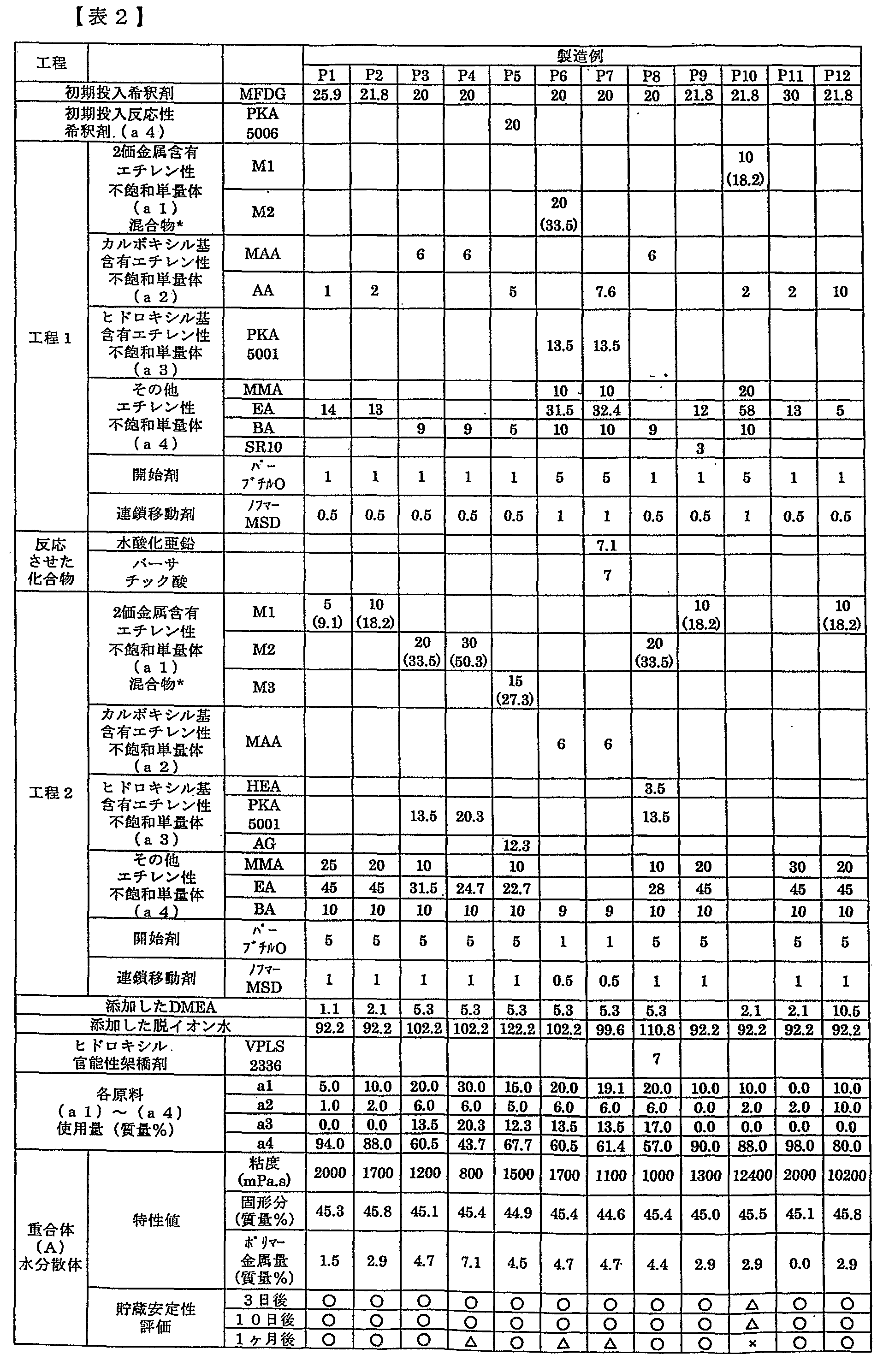
PKA5001:ポリエチレングリコールアリルエーテル(商品名:「ユニオックスPKA5001」、日本油脂社製)
AG:エチレングリコールアリルエーテル(日本乳化剤社製)
SR10:「アデカリアソープSR10」(ADEKA社製)
*括弧内は単量体成分のみの質量部。
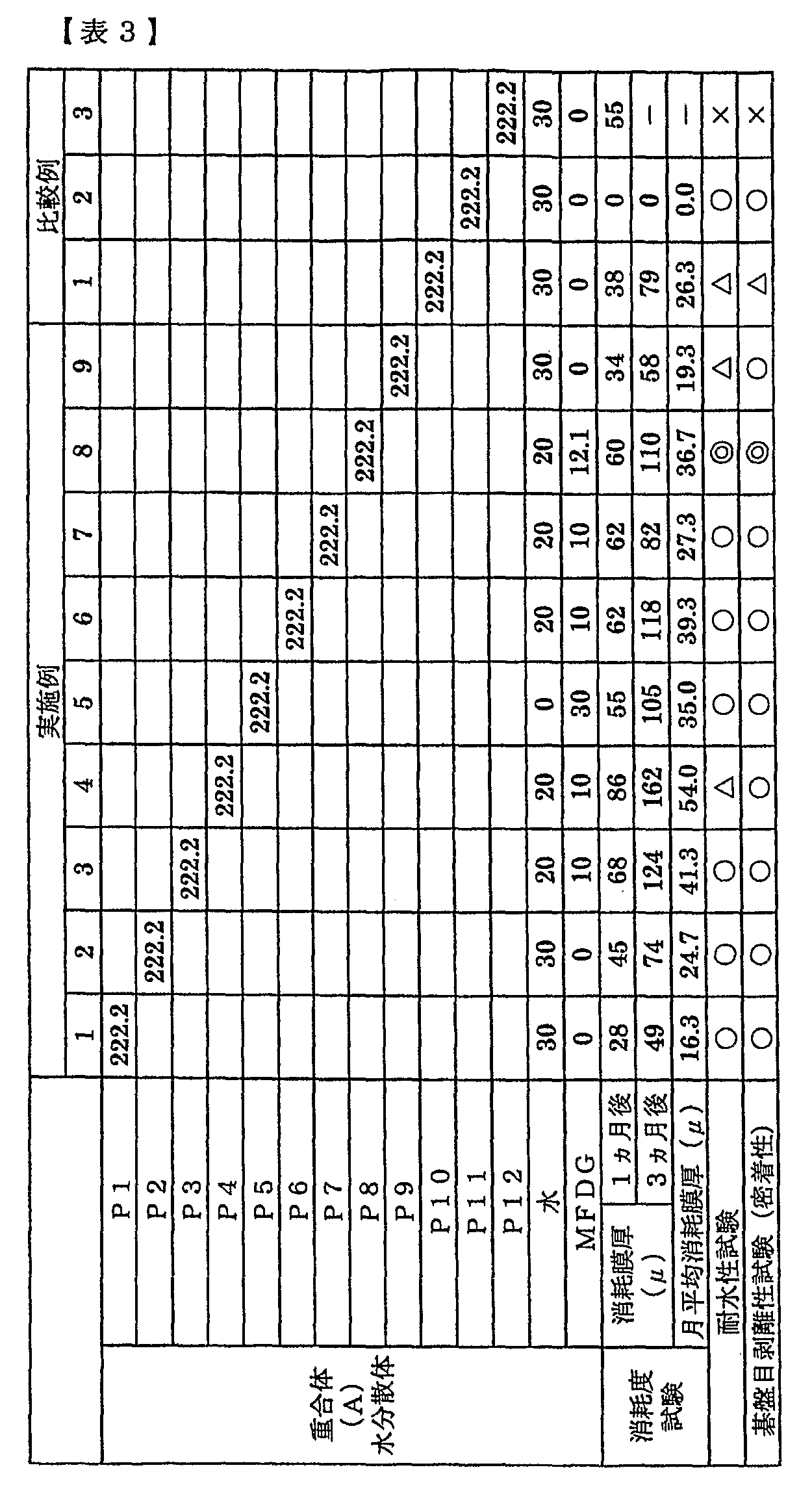
製造例P1で得られた重合体(A)水分散体P1の222.2部に対し、水30部を混合し、防汚塗料用樹脂分散体を得た。各原料の配合量、得られた防汚塗料用樹脂分散体の消耗度試験、耐水性試験及び碁盤目剥離性試験の結果を表3に示す。
実施例1同様に、製造例P2~P9について防汚塗料用樹脂分散体を調製し、評価を行った。結果を表3に示す。
実施例1同様に、製造例P10~P12について防汚塗料用樹脂分散体を調製し、評価を行った。結果を表3に示す。
Claims (6)
- 2価の金属を含有する重合体(A)を製造する工程及び該重合体(A)を水又は水/有機溶剤混合物からなる分散媒に分散する工程を含む防汚塗料用樹脂分散体の製造方法であって、
2価の金属を含有する重合体(A)が、
2価金属含有エチレン性不飽和単量体(a1) 1~40質量%
カルボキシル基含有エチレン性不飽和単量体(a2) 0~8質量%
ヒドロキシル基含有エチレン性不飽和単量体(a3) 0~40質量%
その他エチレン性不飽和単量体(a4) 99~22質量%
を2段以上の多段で溶液重合して得られる重合体である防汚塗料用樹脂分散体の製造方法。 - 前記重合体(A)が、少なくとも1種のカルボキシル基含有エチレン性不飽和単量体(a2)を含む単量体混合物(b1)を溶液重合する工程と、カルボキシル基含有エチレン性不飽和単量体(a2)を含まず、かつ2価金属含有エチレン性不飽和単量体(a1)を含む単量体混合物(b2)を溶液重合する工程を含む2段以上の多段で溶液重合して得られる請求項1記載の防汚塗料用樹脂分散体の製造方法。
- 前記重合体(A)が、少なくとも1種のカルボキシル基含有エチレン性不飽和単量体(a2)を含む単量体混合物(b1)を溶液重合する1段目重合と、1段目重合で得られた重合体と2価の金属化合物を反応する工程と、前記工程の反応物の存在下に少なくとも1種のカルボキシル基含有エチレン性不飽和単量体(a2)を含む単量体混合物(b3)を重合する2段目重合を少なくとも含む多段溶液重合で得られる請求項1記載の防汚塗料用樹脂分散体の製造方法。
- 前記重合体(A)が、重合体(A)を溶解する希釈剤の存在下又は非存在下、カルボキシル基含有エチレン性不飽和単量体(a2)を少なくとも用いて溶液重合した後、得られた重合体中のカルボキシル基の一部又は全てを中和後、前記分散媒に分散して得られる請求項1~3のいずれかに記載の防汚塗料用樹脂分散体の製造方法。
- 前記重合体(A)が、ヒドロキシル基含有エチレン性不飽和単量体(a3)を少なくとも用いて溶液重合され、該重合体(A)を前記分散媒中に分散した後、更にヒドロキシル官能性架橋剤を加えて架橋してなる請求項1~4のいずれかに記載の防汚塗料用樹脂分散体の製造方法。
- 請求項1~5のいずれかに記載の方法により製造される防汚塗料用樹脂分散体を含む防汚塗料。
Priority Applications (7)
| Application Number | Priority Date | Filing Date | Title |
|---|---|---|---|
| PCT/JP2009/071755 WO2011080821A1 (ja) | 2009-12-28 | 2009-12-28 | 防汚塗料用樹脂分散体の製造方法 |
| US13/519,719 US20120294824A1 (en) | 2009-12-28 | 2009-12-28 | Method for producing antifouling coating resin dispersion |
| SG2012047643A SG181964A1 (en) | 2009-12-28 | 2009-12-28 | Method for producing resin dispersion for antifouling coating |
| KR1020177024158A KR101851918B1 (ko) | 2009-12-28 | 2009-12-28 | 방오 도료용 수지 분산체의 제조 방법 |
| EP09852799.7A EP2520620B1 (en) | 2009-12-28 | 2009-12-28 | Method for producing resin dispersion for antifouling coating |
| CN200980163199.7A CN102686680B (zh) | 2009-12-28 | 2009-12-28 | 防污涂料用树脂分散体的制造方法 |
| KR1020127019883A KR20120110143A (ko) | 2009-12-28 | 2009-12-28 | 방오 도료용 수지 분산체의 제조 방법 |
Applications Claiming Priority (1)
| Application Number | Priority Date | Filing Date | Title |
|---|---|---|---|
| PCT/JP2009/071755 WO2011080821A1 (ja) | 2009-12-28 | 2009-12-28 | 防汚塗料用樹脂分散体の製造方法 |
Publications (1)
| Publication Number | Publication Date |
|---|---|
| WO2011080821A1 true WO2011080821A1 (ja) | 2011-07-07 |
Family
ID=44226256
Family Applications (1)
| Application Number | Title | Priority Date | Filing Date |
|---|---|---|---|
| PCT/JP2009/071755 Ceased WO2011080821A1 (ja) | 2009-12-28 | 2009-12-28 | 防汚塗料用樹脂分散体の製造方法 |
Country Status (6)
| Country | Link |
|---|---|
| US (1) | US20120294824A1 (ja) |
| EP (1) | EP2520620B1 (ja) |
| KR (2) | KR101851918B1 (ja) |
| CN (1) | CN102686680B (ja) |
| SG (1) | SG181964A1 (ja) |
| WO (1) | WO2011080821A1 (ja) |
Cited By (4)
| Publication number | Priority date | Publication date | Assignee | Title |
|---|---|---|---|---|
| WO2012070552A1 (ja) * | 2010-11-25 | 2012-05-31 | 三菱レイヨン株式会社 | 防汚塗料用組成物及び防汚塗料 |
| CN102617795A (zh) * | 2012-03-31 | 2012-08-01 | 海洋化工研究院 | 水性自抛光防污涂料基体树脂及用该树脂制备的防污涂料 |
| CN104053690A (zh) * | 2012-01-18 | 2014-09-17 | 三菱丽阳株式会社 | 乙烯基系聚合物的制造方法和包含乙烯基系聚合物的水性防污涂料用树脂组合物 |
| CN120699228A (zh) * | 2025-08-28 | 2025-09-26 | 湖北科郢新材料科技有限公司 | 自抛光聚氨酯防污树脂及其制备方法、本征自抛光聚氨酯防污涂料和应用 |
Families Citing this family (6)
| Publication number | Priority date | Publication date | Assignee | Title |
|---|---|---|---|---|
| MX2016003090A (es) * | 2013-09-27 | 2016-05-31 | Rohm & Haas | Desintegracion activada por fuerza ionica de peliculas y de particulas. |
| WO2021139215A1 (zh) * | 2020-01-10 | 2021-07-15 | 中国科学院化学研究所 | 一种自修复或可重复使用的制品及其制备方法与应用 |
| CN112062921A (zh) * | 2020-08-24 | 2020-12-11 | 无锡市耀得信化工产品有限公司 | 含锌盐的丙烯酸聚氨酯树脂及其制备方法和应用 |
| CN112062922B (zh) * | 2020-08-24 | 2022-04-29 | 无锡市耀得信化工产品有限公司 | 一种聚脲改性的含有机锌盐丙烯酸树脂及其制备方法和应用 |
| TWI850575B (zh) * | 2021-08-02 | 2024-08-01 | 南亞塑膠工業股份有限公司 | 水性壓克力樹脂及其製造方法 |
| CN116217782B (zh) * | 2022-12-31 | 2024-10-01 | 黄山华惠科技有限公司 | 一种粉末涂料用高柔韧性丙烯酸树脂及其制备方法 |
Citations (9)
| Publication number | Priority date | Publication date | Assignee | Title |
|---|---|---|---|---|
| JPS6257464A (ja) | 1985-05-17 | 1987-03-13 | Nippon Paint Co Ltd | 金属含有樹脂組成物 |
| JPH08209005A (ja) | 1995-02-08 | 1996-08-13 | Kansai Paint Co Ltd | 防汚性樹脂組成物及びその製造方法 |
| JPH11172159A (ja) | 1997-12-11 | 1999-06-29 | Kansai Paint Co Ltd | 水性防汚樹脂組成物 |
| JP2000109729A (ja) | 1998-10-06 | 2000-04-18 | Kansai Paint Co Ltd | 水性防汚塗料 |
| JP2003049123A (ja) | 2001-08-07 | 2003-02-21 | Mitsubishi Rayon Co Ltd | 水性防汚塗料組成物 |
| JP2004197101A (ja) * | 2002-12-19 | 2004-07-15 | Rohm & Haas Co | 除去可能なコーティング組成物 |
| JP2004277491A (ja) * | 2003-03-13 | 2004-10-07 | Mitsubishi Rayon Co Ltd | 水性低汚染被覆材 |
| JP2007023243A (ja) | 2005-07-21 | 2007-02-01 | Mitsubishi Rayon Co Ltd | 水性防汚塗料組成物及びその製造方法 |
| JP2009221243A (ja) * | 2008-03-13 | 2009-10-01 | Nippon Paint Co Ltd | 水分散型樹脂、二液型熱硬化性樹脂組成物及びこれらの製造方法 |
Family Cites Families (8)
| Publication number | Priority date | Publication date | Assignee | Title |
|---|---|---|---|---|
| JPS62295914A (ja) * | 1986-06-13 | 1987-12-23 | Hitachi Chem Co Ltd | グラフト共重合体の製造法 |
| PL339260A1 (en) * | 1997-09-08 | 2000-12-04 | Basf Ag | Application of mixtures consisting of polymers and aminothiazoles as biocidal agents |
| EP1167398B1 (en) * | 2000-06-28 | 2005-11-09 | Mitsubishi Rayon Co., Ltd. | Metal-containing monomer dissolved mixture, metal-containing resin and antifouling paint composition |
| US7312268B2 (en) * | 2001-06-29 | 2007-12-25 | Stockhausen Gmbh | Water-absorbent carboxyl-containing polymers with low monomer content |
| JP4475880B2 (ja) * | 2003-03-13 | 2010-06-09 | 東邦テナックス株式会社 | エポキシ樹脂組成物 |
| US7419707B2 (en) * | 2005-02-21 | 2008-09-02 | Fujifilm Corporation | Coating composition for the formation of low refractive index layer, antireflection film, polarizing plate and liquid crystal display device |
| JP5415945B2 (ja) * | 2006-07-11 | 2014-02-12 | ローディア インコーポレイティド | 固体表面上に特有の性質を付与する且つ無機固体粒子及びコポリマーを含む複合コアセルベートの水性分散液 |
| US8012539B2 (en) * | 2008-05-09 | 2011-09-06 | Kraton Polymers U.S. Llc | Method for making sulfonated block copolymers, method for making membranes from such block copolymers and membrane structures |
-
2009
- 2009-12-28 EP EP09852799.7A patent/EP2520620B1/en active Active
- 2009-12-28 CN CN200980163199.7A patent/CN102686680B/zh active Active
- 2009-12-28 US US13/519,719 patent/US20120294824A1/en not_active Abandoned
- 2009-12-28 KR KR1020177024158A patent/KR101851918B1/ko active Active
- 2009-12-28 KR KR1020127019883A patent/KR20120110143A/ko not_active Ceased
- 2009-12-28 SG SG2012047643A patent/SG181964A1/en unknown
- 2009-12-28 WO PCT/JP2009/071755 patent/WO2011080821A1/ja not_active Ceased
Patent Citations (9)
| Publication number | Priority date | Publication date | Assignee | Title |
|---|---|---|---|---|
| JPS6257464A (ja) | 1985-05-17 | 1987-03-13 | Nippon Paint Co Ltd | 金属含有樹脂組成物 |
| JPH08209005A (ja) | 1995-02-08 | 1996-08-13 | Kansai Paint Co Ltd | 防汚性樹脂組成物及びその製造方法 |
| JPH11172159A (ja) | 1997-12-11 | 1999-06-29 | Kansai Paint Co Ltd | 水性防汚樹脂組成物 |
| JP2000109729A (ja) | 1998-10-06 | 2000-04-18 | Kansai Paint Co Ltd | 水性防汚塗料 |
| JP2003049123A (ja) | 2001-08-07 | 2003-02-21 | Mitsubishi Rayon Co Ltd | 水性防汚塗料組成物 |
| JP2004197101A (ja) * | 2002-12-19 | 2004-07-15 | Rohm & Haas Co | 除去可能なコーティング組成物 |
| JP2004277491A (ja) * | 2003-03-13 | 2004-10-07 | Mitsubishi Rayon Co Ltd | 水性低汚染被覆材 |
| JP2007023243A (ja) | 2005-07-21 | 2007-02-01 | Mitsubishi Rayon Co Ltd | 水性防汚塗料組成物及びその製造方法 |
| JP2009221243A (ja) * | 2008-03-13 | 2009-10-01 | Nippon Paint Co Ltd | 水分散型樹脂、二液型熱硬化性樹脂組成物及びこれらの製造方法 |
Non-Patent Citations (1)
| Title |
|---|
| See also references of EP2520620A4 |
Cited By (8)
| Publication number | Priority date | Publication date | Assignee | Title |
|---|---|---|---|---|
| WO2012070552A1 (ja) * | 2010-11-25 | 2012-05-31 | 三菱レイヨン株式会社 | 防汚塗料用組成物及び防汚塗料 |
| JPWO2012070552A1 (ja) * | 2010-11-25 | 2014-05-19 | 三菱レイヨン株式会社 | 防汚塗料用組成物及び防汚塗料 |
| US9139741B2 (en) | 2010-11-25 | 2015-09-22 | Mitsubishi Rayon Co., Ltd. | Antifouling paint composition and antifouling paint |
| CN104053690A (zh) * | 2012-01-18 | 2014-09-17 | 三菱丽阳株式会社 | 乙烯基系聚合物的制造方法和包含乙烯基系聚合物的水性防污涂料用树脂组合物 |
| CN104053690B (zh) * | 2012-01-18 | 2016-05-25 | 三菱丽阳株式会社 | 乙烯基系聚合物的制造方法和包含乙烯基系聚合物的水性防污涂料用树脂组合物 |
| TWI585110B (zh) * | 2012-01-18 | 2017-06-01 | 三菱麗陽股份有限公司 | 乙烯系聚合物及其製造方法、以及水性防污塗料用樹脂組成物 |
| CN102617795A (zh) * | 2012-03-31 | 2012-08-01 | 海洋化工研究院 | 水性自抛光防污涂料基体树脂及用该树脂制备的防污涂料 |
| CN120699228A (zh) * | 2025-08-28 | 2025-09-26 | 湖北科郢新材料科技有限公司 | 自抛光聚氨酯防污树脂及其制备方法、本征自抛光聚氨酯防污涂料和应用 |
Also Published As
| Publication number | Publication date |
|---|---|
| EP2520620A1 (en) | 2012-11-07 |
| US20120294824A1 (en) | 2012-11-22 |
| EP2520620B1 (en) | 2015-09-16 |
| CN102686680A (zh) | 2012-09-19 |
| KR101851918B1 (ko) | 2018-04-24 |
| KR20170103020A (ko) | 2017-09-12 |
| SG181964A1 (en) | 2012-08-30 |
| CN102686680B (zh) | 2015-11-25 |
| EP2520620A4 (en) | 2013-05-15 |
| KR20120110143A (ko) | 2012-10-09 |
Similar Documents
| Publication | Publication Date | Title |
|---|---|---|
| CN102686680B (zh) | 防污涂料用树脂分散体的制造方法 | |
| CN104053690B (zh) | 乙烯基系聚合物的制造方法和包含乙烯基系聚合物的水性防污涂料用树脂组合物 | |
| JP5722919B2 (ja) | アクリル酸亜鉛コポリマーの合成 | |
| WO2005116155A1 (ja) | 塗料組成物、塗膜及び水中摩擦低減方法 | |
| JP5144389B2 (ja) | 水性防汚塗料用樹脂組成物 | |
| CN103917614B (zh) | 防污涂料组合物、防污涂膜和防污基材、及防污基材的制造方法 | |
| JP5207264B2 (ja) | 水性防汚塗料組成物及びその製造方法 | |
| JP2016172875A (ja) | 防汚塗料用組成物及び防汚塗料 | |
| JP5162066B2 (ja) | 水性防汚塗料組成物の製造方法 | |
| JP2016210881A (ja) | 防汚塗料用樹脂組成物および防汚塗膜 | |
| CN113631378B (zh) | 防污涂料组合物 | |
| TWI468480B (zh) | 防污塗料用樹脂分散體的製造方法 | |
| JP2017014490A (ja) | 防汚塗料組成物 | |
| JP5497351B2 (ja) | 防汚塗料用金属含有共重合体の製造方法および防汚塗料組成物 | |
| JP5048929B2 (ja) | 水性船底用防汚塗料組成物 | |
| JP4829428B2 (ja) | 水性金属含有樹脂組成物の製造方法および被膜樹脂 | |
| JPH04283278A (ja) | 防汚塗料用樹脂の製造方法および防汚塗料用樹脂組成物 | |
| JP2017075329A (ja) | 防汚塗料用金属含有共重合体および防汚塗料組成物 | |
| JP2015178640A (ja) | 防汚塗料用金属含有共重合体および防汚塗料組成物 | |
| JP2013234329A (ja) | 防汚塗料用金属含有共重合体および防汚塗料組成物 |
Legal Events
| Date | Code | Title | Description |
|---|---|---|---|
| WWE | Wipo information: entry into national phase |
Ref document number: 200980163199.7 Country of ref document: CN |
|
| 121 | Ep: the epo has been informed by wipo that ep was designated in this application |
Ref document number: 09852799 Country of ref document: EP Kind code of ref document: A1 |
|
| WWE | Wipo information: entry into national phase |
Ref document number: 2009852799 Country of ref document: EP |
|
| NENP | Non-entry into the national phase |
Ref country code: DE |
|
| WWE | Wipo information: entry into national phase |
Ref document number: 13519719 Country of ref document: US |
|
| WWE | Wipo information: entry into national phase |
Ref document number: 6536/CHENP/2012 Country of ref document: IN |
|
| ENP | Entry into the national phase |
Ref document number: 20127019883 Country of ref document: KR Kind code of ref document: A |
|
| NENP | Non-entry into the national phase |
Ref country code: JP |