WO2011122062A1 - インクジェットインク及びインクジェット画像形成方法 - Google Patents
インクジェットインク及びインクジェット画像形成方法 Download PDFInfo
- Publication number
- WO2011122062A1 WO2011122062A1 PCT/JP2011/050508 JP2011050508W WO2011122062A1 WO 2011122062 A1 WO2011122062 A1 WO 2011122062A1 JP 2011050508 W JP2011050508 W JP 2011050508W WO 2011122062 A1 WO2011122062 A1 WO 2011122062A1
- Authority
- WO
- WIPO (PCT)
- Prior art keywords
- ink
- resin
- inkjet
- mass
- manufactured
- Prior art date
- Legal status (The legal status is an assumption and is not a legal conclusion. Google has not performed a legal analysis and makes no representation as to the accuracy of the status listed.)
- Ceased
Links
Classifications
-
- C—CHEMISTRY; METALLURGY
- C09—DYES; PAINTS; POLISHES; NATURAL RESINS; ADHESIVES; COMPOSITIONS NOT OTHERWISE PROVIDED FOR; APPLICATIONS OF MATERIALS NOT OTHERWISE PROVIDED FOR
- C09D—COATING COMPOSITIONS, e.g. PAINTS, VARNISHES OR LACQUERS; FILLING PASTES; CHEMICAL PAINT OR INK REMOVERS; INKS; CORRECTING FLUIDS; WOODSTAINS; PASTES OR SOLIDS FOR COLOURING OR PRINTING; USE OF MATERIALS THEREFOR
- C09D11/00—Inks
- C09D11/30—Inkjet printing inks
- C09D11/38—Inkjet printing inks characterised by non-macromolecular additives other than solvents, pigments or dyes
-
- C—CHEMISTRY; METALLURGY
- C09—DYES; PAINTS; POLISHES; NATURAL RESINS; ADHESIVES; COMPOSITIONS NOT OTHERWISE PROVIDED FOR; APPLICATIONS OF MATERIALS NOT OTHERWISE PROVIDED FOR
- C09D—COATING COMPOSITIONS, e.g. PAINTS, VARNISHES OR LACQUERS; FILLING PASTES; CHEMICAL PAINT OR INK REMOVERS; INKS; CORRECTING FLUIDS; WOODSTAINS; PASTES OR SOLIDS FOR COLOURING OR PRINTING; USE OF MATERIALS THEREFOR
- C09D11/00—Inks
- C09D11/02—Printing inks
- C09D11/10—Printing inks based on artificial resins
-
- C—CHEMISTRY; METALLURGY
- C09—DYES; PAINTS; POLISHES; NATURAL RESINS; ADHESIVES; COMPOSITIONS NOT OTHERWISE PROVIDED FOR; APPLICATIONS OF MATERIALS NOT OTHERWISE PROVIDED FOR
- C09D—COATING COMPOSITIONS, e.g. PAINTS, VARNISHES OR LACQUERS; FILLING PASTES; CHEMICAL PAINT OR INK REMOVERS; INKS; CORRECTING FLUIDS; WOODSTAINS; PASTES OR SOLIDS FOR COLOURING OR PRINTING; USE OF MATERIALS THEREFOR
- C09D11/00—Inks
- C09D11/30—Inkjet printing inks
- C09D11/34—Hot-melt inks
Definitions
- the present invention relates to an inkjet ink, and more particularly to an inkjet ink and an inkjet image forming method using the inkjet ink.
- Inkjet recording is a recording method in which ink droplets are ejected from a fine nozzle head and printed on a substrate. Energy saving and compact printer design are possible, so it is widely used for homes and offices. ing.
- the ink used in such a recording method is roughly classified into an aqueous type and a non-aqueous type.
- water-based types water-soluble dyes and water-soluble pigments dissolved in glycol-based water-soluble solvents and water are often used.
- printed matter printed with water-based inks generally has poor water resistance, and The cellulose, which is a component of plain paper, interacts with the solvent, and curling and cockling often occur after the solvent is dried. This becomes a big problem in the printed matter for preservation in the office.
- double-sided printing is widely performed in office document printing from the viewpoint of resource saving.
- an oil-based ink using vegetable oil or the like as a main solvent is known (for example, see Patent Document 1).
- the oil-based ink has a low interaction with cellulose, and therefore can prevent curling and cockling on plain paper and has excellent water resistance.
- plain paper printed matter recorded with oil-based ink is in a state where a low-volatile oil-based solvent is present together with a pigment as a color material on the paper surface or inside the paper.
- a low-volatile oil-based solvent is present together with a pigment as a color material on the paper surface or inside the paper.
- the strength of the image is weak and the image is easily scratched due to rubbing between the printing papers, and color transfer is likely to occur.
- oil-based inks have high penetrability with respect to plain paper, and show-through increases.
- measures such as limiting the ink placement amount are taken, but there has been a problem that satisfactory print quality cannot be obtained because the optical density is reduced by limiting the ink placement amount.
- due to the high permeability to plain paper there is a problem that bleeding on the printing surface is likely to occur, and fine lines and characters at small points are crushed, resulting in poor image reproducibility.
- UV curable ink that forms an image by ultraviolet irradiation after the ink is discharged onto a substrate.
- UV curable ink requires the installation of a light source, the printer becomes expensive and large in size, and cannot fully utilize the merit of inkjet as a compact printer.
- the time interval at which adjacent ink droplets land on the recording medium is shortened.
- the time interval at which adjacent droplets land on the recording medium is particularly short.
- JP 2005-290035 A Japanese Patent Laid-Open No. 9-194779
- the present invention has been made in view of the above-mentioned problems, and the object of the present invention is to reduce the system load because it has a lower melting point than so-called hot melt ink, has excellent continuous ejection stability, high suitability for plain paper, character quality, An object of the present invention is to provide an ink-jet ink and an ink-jet image forming method excellent in fixing property and image texture.
- the unsaturated fatty acid ester and the compound capable of reversibly gelling the ink composition are 0.5 to 20% by mass with respect to the total mass of the ink, and the resin is 10 to 30% by mass with respect to the total mass of the ink.
- An ink-jet ink comprising:
- an ink-jet ink and an ink-jet image forming method that have low system load, excellent continuous ejection stability, high plain paper suitability, and excellent character quality and fixability.
- the unsaturated fatty acid ester and the compound capable of reversibly gelling the ink composition are 0.5 to 20% by mass with respect to the total mass of the ink, and 10 to 30% by mass of the inkjet ink. It is characterized by including these.
- the inkjet ink of the present invention contains 0.5 to 20% by mass of a compound capable of reversibly gelling an unsaturated fatty acid ester and an ink composition (hereinafter also referred to as a gelling agent) with respect to the total mass of the ink. 10 to 30% by mass of the ink.
- a gelling agent an ink composition
- thermoreversible gel ink in a gel state is obtained at room temperature.
- this gel ink is heated to a phase transition point or higher, ink jet recording is performed in a sol (liquid) state. After landing on a recording medium having a temperature lower than the phase transition temperature of the gel ink, the temperature immediately decreases and the gel state is restored. .
- the penetration of ink on plain paper is suppressed, the back-through and the like are improved, and the reproducibility of high optical density, fine lines, and small point characters is improved.
- the liquid can be suppressed more than the liquid caused by attracting droplets, it is possible to suppress image deterioration such as beading and bleeding caused by liquid generated during high-speed recording such as single pass printing. .
- An image formed in a gel state has low strength, but the hardness of the image increases as the unsaturated fatty acid ester contained in the ink undergoes oxidative polymerization to increase the molecular weight. Furthermore, by including a resin in the ink, the image hardness before oxidative polymerization was increased, and the image hardness after being cured by oxidative polymerization could be increased to a hardness sufficient as a printed matter.
- the ink of the present invention is characterized in that the ink contains a gelling agent and a resin, and in particular, the content of the gelling agent is 0.5 to 20.0% by mass.
- the content of the gelling agent is 0.5 to 20.0% by mass.
- the unsaturated fatty acid ester is polymerized to have a high molecular weight, whereby a strong image film resistant to rubbing can be formed. It is presumed that once the gel state of an appropriate hardness is taken and then the hardness is increased within a period of several hours to several days, the time required for leveling on the image surface can be obtained and a good image texture can be obtained.
- hot melt inks are solid inks that are hard at room temperature by containing a large amount of wax and resin components that also function as gelling agents in the present invention, and are recorded on paper. Has a certain degree of abrasion resistance immediately after printing.
- the viscosity rapidly increases on the paper, so that there is not enough time for the landed ink dots to level and the texture remains uneven.
- the ink is usually used by utilizing the phase transition of the ink due to temperature. It can gel before penetrating excessively on paper to prevent bleeding. It is considered that the gel structure forms a polymer network due to hydrogen bonds and intermolecular interactions in a state where the ink composition is held.
- the amount of the compound capable of reversibly gelling the ink composition in the ink is preferably 0.5 to 20.0% by mass. If it is 0.5% by mass or more, it is preferable from the viewpoint of preventing bleeding and character quality. When the content is 20.0% by mass or less, the quality of the printed image is good, the ink phase transition temperature is prevented from rising, the load on the printer is prevented, and the ejection failure due to the polymerization reaction on the nozzle surface is prevented. From the viewpoint of
- the gel referred to in the present invention means that the solute has independent mobility due to the interaction such as lamellar structure, polymer network formed by covalent bond or hydrogen bond, polymer network formed by physical aggregation, and aggregate structure of fine particles. It has a structure that has been lost and assembled, and is a solidified or semi-solidified state with a sudden increase in viscosity and a significant increase in elasticity.
- a gel becomes a fluid solution (sometimes called a sol) by heating, a thermoreversible gel that returns to the original gel when cooled, and once gelled, it can be heated again after heating. There is a heat irreversible gel that does not return.
- the gel formed by the gelling agent according to the present invention is a thermoreversible gel.
- the sol-gel phase transition temperature (hereinafter also referred to as phase transition temperature) of the ink is preferably 40 ° C. or higher and 80 ° C. or lower, more preferably 45 ° C. or higher and 70 ° C. or lower. is there. If the phase transition temperature of the ink is 40 ° C. or higher, when the ink droplets are ejected from the recording head, a stable light emission can be obtained without being affected by the printing environment temperature, and if it is 80 ° C. or lower. For example, it is not necessary to heat the ink jet recording apparatus to an excessively high temperature, and the load on the head of the ink jet recording apparatus and the members of the ink supply system can be reduced.
- the melting point of the gelling agent used is preferably 20 to 250 ° C., more preferably 40 to 90 ° C.
- the phase transition temperature of ink means the temperature at which the viscosity suddenly changes from a fluid solution state to a gel state.
- Gel transition temperature, gel dissolution temperature, gel softening temperature, sol-gel phase transition temperature which is synonymous with the term called gel point.
- the method for measuring the phase transition temperature of the ink of the present invention is, for example, a method in which a small iron piece sealed in a glass tube is placed in an dilatometer, and the point at which the ink liquid does not naturally fall in response to a temperature change is referred to as a phase transition temperature.
- a phase transition temperature J. Polym. Sci., 21, 57 (1956)
- the gelling agent of the present invention may be a high molecular compound or a low molecular compound, but is preferably a low molecular compound from the viewpoint of use in ink.
- Low molecule means that the molecular weight is 200-2000.
- Specific examples of the low molecular weight compound include 12-hydroxystearic acid, behenic acid / glycosyl eicosane diacid, inulin stearate, stearamide, N-lauroyl-L-glutamic acid- ⁇ , ⁇ -dibutyramide, stearone, anhydrous And silicic acid.
- the ink viscosity at a temperature of the ink phase transition temperature + 5 ° C. is preferably 1 to 10 mPa ⁇ s, more preferably 1 to 5.0 mPa ⁇ s. . If the ink viscosity at the ink phase transition temperature + 5 ° C. is in the range of 1 to 10 mPa ⁇ s, stable emission characteristics can be obtained.
- the unsaturated fatty acid ester of the present invention is polymerized by causing a chain reaction when the unsaturated bond and oxygen molecules in the air act to generate radicals.
- Unsaturated fatty acid esters have higher reactivity as the iodine value is higher. If the reactivity is too high, in the case of the ink jet recording method, a polymerization reaction occurs on the surface of the discharge nozzle, which may be a fatal defect in the ink jet recording method of defective discharge. Therefore, the iodine value of the unsaturated fatty acid ester of the present invention is preferably 130 to 200. Furthermore, it is preferable to use an unsaturated fatty acid ester which has been deaerated and has a reduced oxygen concentration as much as possible.
- the iodine value referred to here is a numerical value expressed as a percentage of the unsaturated fatty acid ester by converting the amount of halogen absorbed when the halogen is allowed to act on the unsaturated fatty acid ester into iodine. Specifically, it is determined by the Wiis method using iodine monochloride as a reagent.
- the iodine value is a numerical value obtained from potentiometric titration based on JIS K0070.
- the unsaturated fatty acid ester of the present invention include vegetable oils such as camellia oil, linseed oil, palm oil, soybean oil, sunflower oil, camellia oil, olive oil, castor oil, and the like. ⁇ oil fatty acid, linseed oil fatty acid, palm oil fatty acid, soybean oil fatty acid, sunflower oil fatty acid, camellia oil fatty acid, olive oil fatty acid, castor oil fatty acid, palm oil fatty acid Palm oil fatty acid, rapeseed oil fatty acid, coconut fatty acid ethyl, propyl, butyl, hexyl, 2-ethylhexyl, heptyl, octyl, nonyl, decyl, undecyl ester.
- vegetable oils such as camellia oil, linseed oil, palm oil, soybean oil, sunflower oil, camellia oil, olive oil, castor oil, and the like.
- the amount of unsaturated fatty acid ester added to the ink is preferably 40% by mass or more from the viewpoint of fixability and 90% by mass or less from the viewpoint of ejection stability.
- the ink of the present invention can contain a metal soap.
- the metal soap of the present invention is added as a reaction catalyst that accelerates the oxidative polymerization of unsaturated fatty acid esters to accelerate the polymerization of the ejected ink and cures and fixes the ink image.
- a reaction rate that can withstand the actual machine can be obtained.
- the amount of metal soap added to the ink is preferably 0.2% by mass or more from the viewpoint of fixability and 3% by mass or less from the viewpoint of ejection stability.
- the ink of the present invention contains a resin. By including this resin in the ink, the fixability can be improved.
- Examples of the resin of the present invention include acrylic resins, urethane resins, cellulose resins, rosin resins (rosin ester resins, rosin modified alkyd resins, rosin modified phenolic resin petroleum resins), coumarone resins, amide resins, hydrocarbon resins, Examples thereof include alkyd resins and terpene resins. Of these, rosin resin and terpene resin are preferable.
- rosin resins examples include the Hariphenol series (rosin-modified phenolic resin) and Harimac series (rosin-modified maleic resin) manufactured by Sanyo Kasei Co., Ltd. (Rosin-modified maleic acid resin) and the like.
- examples of the terpene resin include YS resin series (terpene resin) and clearon series (hydrogenated terpene resin) manufactured by Yasuhara Chemical.
- a rosin resin and a terpene resin in combination.
- the addition amount of the resin is 10% by mass or more and 30% by mass or less with respect to the ink from the viewpoint of injection property and fixing property.
- the weight average molecular weight of the resin is preferably 1000 to 50000.
- a relatively high-molecular resin can be added as an ink-jet ink for heating during ejection.
- the ink of the present invention it is preferable to form an inkjet image using the ink of the present invention in a state where the ink temperature in the recording head is higher than the temperature of the recording medium.
- the ink of the present invention that has landed on the recording medium can be gelled by a decrease in temperature and can be effectively fixed.
- the temperature difference between the temperature of the ink in the recording head and the temperature of the recording medium is preferably 10 ° C. or more.
- a method of fixing the ink by lowering the temperature by heating the head, ink tank, and ink flow path used for inkjet recording to a predetermined temperature and landing on the recording medium There is a method of fixing the ink by landing the ink on the recording medium sprayed onto the recording medium by lowering the temperature.
- the method of heating the head, ink tank, and ink flow path to a predetermined temperature is simple and preferable.
- the recording head and ink are heated to 35 to 120 ° C., more preferably 60 to 100 ° C., and then discharged.
- the ink of the present invention has a large viscosity fluctuation range due to temperature fluctuations, and the viscosity fluctuations directly affect the droplet size and droplet ejection speed and cause image quality degradation. Therefore, the ink temperature is raised to a predetermined range. It is preferable to keep in and emit in that state.
- the predetermined temperature range is preferably set temperature ⁇ 5 ° C., more preferably set temperature ⁇ 2 ° C., and further preferably set temperature ⁇ 1 ° C.
- the set temperature here refers to a reference temperature set as the temperature of ink when ink is ejected.
- a dye or a pigment can be used without limitation as a color material constituting the ink, but a pigment having good dispersion stability with respect to the ink component and excellent weather resistance is used. It is preferable. Although it does not necessarily limit as a pigment, For example, the organic or inorganic pigment of the following number described in a color index can be used for this invention.
- red or magenta pigments examples include Pigment Red 3, 5, 19, 22, 31, 38, 43, 48: 1, 48: 2, 48: 3, 48: 4, 48: 5, 49: 1, and 53: 1. 57: 1, 57: 2, 58: 4, 63: 1, 81, 81: 1, 81: 2, 81: 3, 81: 4, 88, 104, 108, 112, 122, 123, 144, 146 149, 166, 168, 169, 170, 177, 178, 179, 184, 185, 208, 216, 226, 257, Pigment Violet 3, 19, 23, 29, 30, 37, 50, 88, Pigment Orange 13 16, 20, 36, Examples of blue or cyan pigments include Pigment Blue 1, 15, 15: 1, 15: 2, 15: 3, 15: 4, 15: 6, 16, 17-1, 22, 27, 28, 29, 36, 60.
- Pigment Green 7, 26, 36, 50 as a green pigment
- Pigment Yellow 1, 3, 12, 13, 14, 17, 34, 35, 37, 55, 74, 81, 83, 93 as a yellow pigment 94, 95, 97, 108, 109, 110, 137, 138, 139, 153, 154, 155, 157, 166, 167, 168, 180, 185, 193,
- As the black pigment Pigment Black 7, 28, 26 and the like can be used depending on the purpose.
- Specific product names include, for example, chromo fine yellow 2080, 5900, 5930, AF-1300, 2700L, chromo fine orange 3700L, 6730, chromo fine scarlet 6750, chromo fine magenta 6880, 6886, 6891N, 6790, 6887.
- Chromofine Violet RE Chromofine Red 6820, 6830, Chromofine Blue HS-3, 5187, 5108, 5197, 5085N, SR-5020, 5026, 5050, 4920, 4927, 4937, 4824, 4933GN-EP, 4940, 4973, 5205, 5208, 5214, 5221, 5000P, Chromofine Green 2GN, 2GO, 2G-550D, 5310, 5370, 6830, Ku Mofine Black A-1103, Seika Fast Yellow 10GH, A-3, 2035, 2054, 2200, 2270, 2300, 2400 (B), 2500, 2600, ZAY-260, 2700 (B), 2770, Seika Fast Red 8040 , C405 (F), CA120, LR-116, 1531B, 8060R, 1547, ZAW-262, 1537B, GY, 4R-4016, 3820, 3891, ZA-215, Seika Fast Carmine 6B1476T-7, 1483LT,
- a ball mill, sand mill, attritor, roll mill, agitator, Henschel mixer, colloid mill, ultrasonic homogenizer, pearl mill, wet jet mill, paint shaker, or the like can be used.
- a dispersant when dispersing the pigment.
- a polymer dispersant is preferably used.
- the polymer dispersant include Avecia's Solsperse series and Ajinomoto Fine-Techno's PB series. Furthermore, the following are mentioned.
- the pigment dispersant examples include a hydroxyl group-containing carboxylic acid ester, a salt of a long chain polyaminoamide and a high molecular weight acid ester, a salt of a high molecular weight polycarboxylic acid, a salt of a long chain polyaminoamide and a polar acid ester, a high molecular weight unsaturated acid ester, Polymer copolymer, modified polyurethane, modified polyacrylate, polyether ester type anionic activator, naphthalene sulfonic acid formalin condensate salt, aromatic sulfonic acid formalin condensate salt, polyoxyethylene alkyl phosphate ester, polyoxyethylene nonyl Examples thereof include phenyl ether, stearylamine acetate, and pigment derivatives.
- Nekkor T106 polyoxyethylene sorbitan monooleate
- M S-IEX polyoxyethylene monostearate
- Hexagline4-0 hexaglyceryl ruthenate Huwei rate
- pigment dispersants are preferably contained in the ink in the range of 0.1 to 20% by mass.
- a synergist according to various pigments as a dispersion aid.
- These dispersants and dispersion aids are preferably added in an amount of 1 to 50 parts by mass with respect to 100 parts by mass of the pigment.
- the dispersion medium can be performed using a polymerizable compound or a solvent.
- the pigment is preferably dispersed so that the average particle diameter of the pigment particles is 0.08 to 0.5 ⁇ m, and the maximum particle diameter is 0.3 to 10 ⁇ m, preferably 0.3 to 3 ⁇ m.
- the selection of the dispersion medium, the dispersion conditions, and the filtration conditions are appropriately set. By controlling the particle size, clogging of the head nozzle can be suppressed, and ink storage stability, ink transparency, and curing sensitivity can be maintained.
- oil-soluble dyes preferably oil-soluble dyes
- specific examples of oil-soluble dyes that can be used in the present invention are given below, but the present invention is not limited to these.
- Blue GL-5 200 Light Blue BGL-5 200 (manufactured by Nippon Kayaku Co., Ltd.), DAIWA Blue 7000, Olesol Fast Blue GL (manufactured by Daiwa Kasei), DIARESIN Blue P (manufactured by Mitsubishi Kasei), SUDAN Blue 670, NEOPEN Blue 808, ZAPON Blue 806 (above, manufactured by BASF Japan).
- the amount of pigment or oil-soluble dye added is preferably 0.1 to 20% by mass, more preferably 0.4 to 10% by mass. If it is 0.1% by mass or more, good image quality can be obtained, and if it is 20% by mass or less, an appropriate ink viscosity in ink ejection can be obtained. Further, two or more kinds of color materials can be appropriately mixed and used for color adjustment or the like.
- the output stability, print head and ink cartridge compatibility, storage stability, image storage stability, and other various performance improvement objectives are known.
- Various additives for example, a viscosity modifier, a specific resistance modifier, a film forming agent, an ultraviolet absorber, a fading inhibitor, an antibacterial agent, and a rust inhibitor can be appropriately selected and used.
- an antioxidant in order to prevent oxidative polymerization in the vicinity of the nozzle.
- the antioxidant include amine compounds such as alkylphenol compounds, phenylenediamine, hindered phenol compounds, hydroquinone compounds, hydroxylamine compounds, and the like.
- the ink of the present invention increases the amount of ink of the present invention that has landed on the recording medium by lowering the temperature by forming an image with a difference between the ink temperature in the recording head and the temperature of the recording medium. It is preferable to fix by sticking or particularly gelation, and then fix the present invention by oxidative polymerization of unsaturated fatty acid ester.
- Example ⁇ Preparation of ink >> (Preparation of ink 1) 2 parts by mass of Solsperse 28000 (manufactured by Lubrizol) was dissolved in 67.5 parts by mass of linseed oil, and 5 parts by mass of carbon black MA7 (manufactured by Mitsubishi Chemical) was added and premixed. Thereafter, it was dispersed in a bead mill for about 20 minutes to obtain an ink.
- Solsperse 28000 manufactured by Lubrizol
- carbon black MA7 manufactured by Mitsubishi Chemical
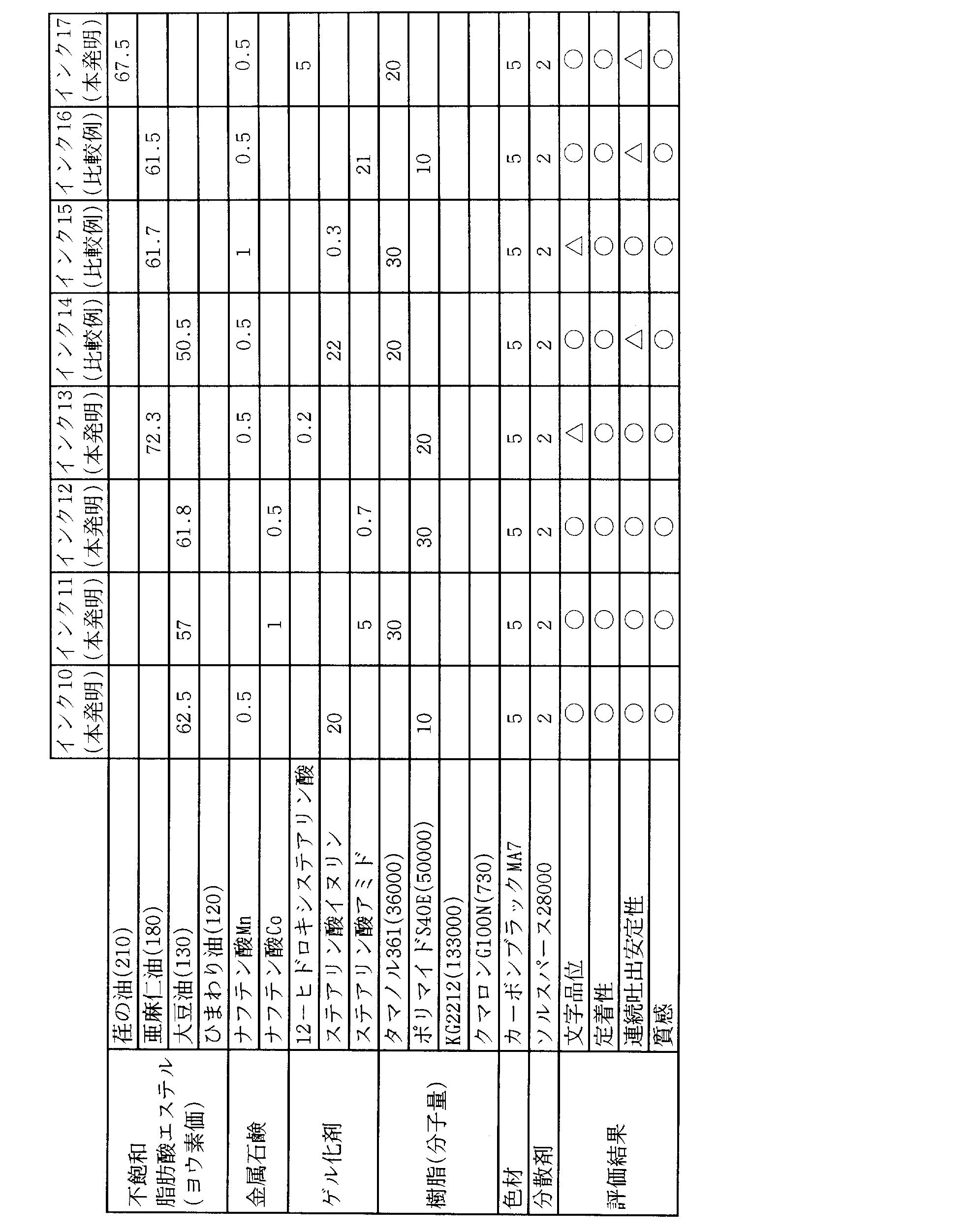
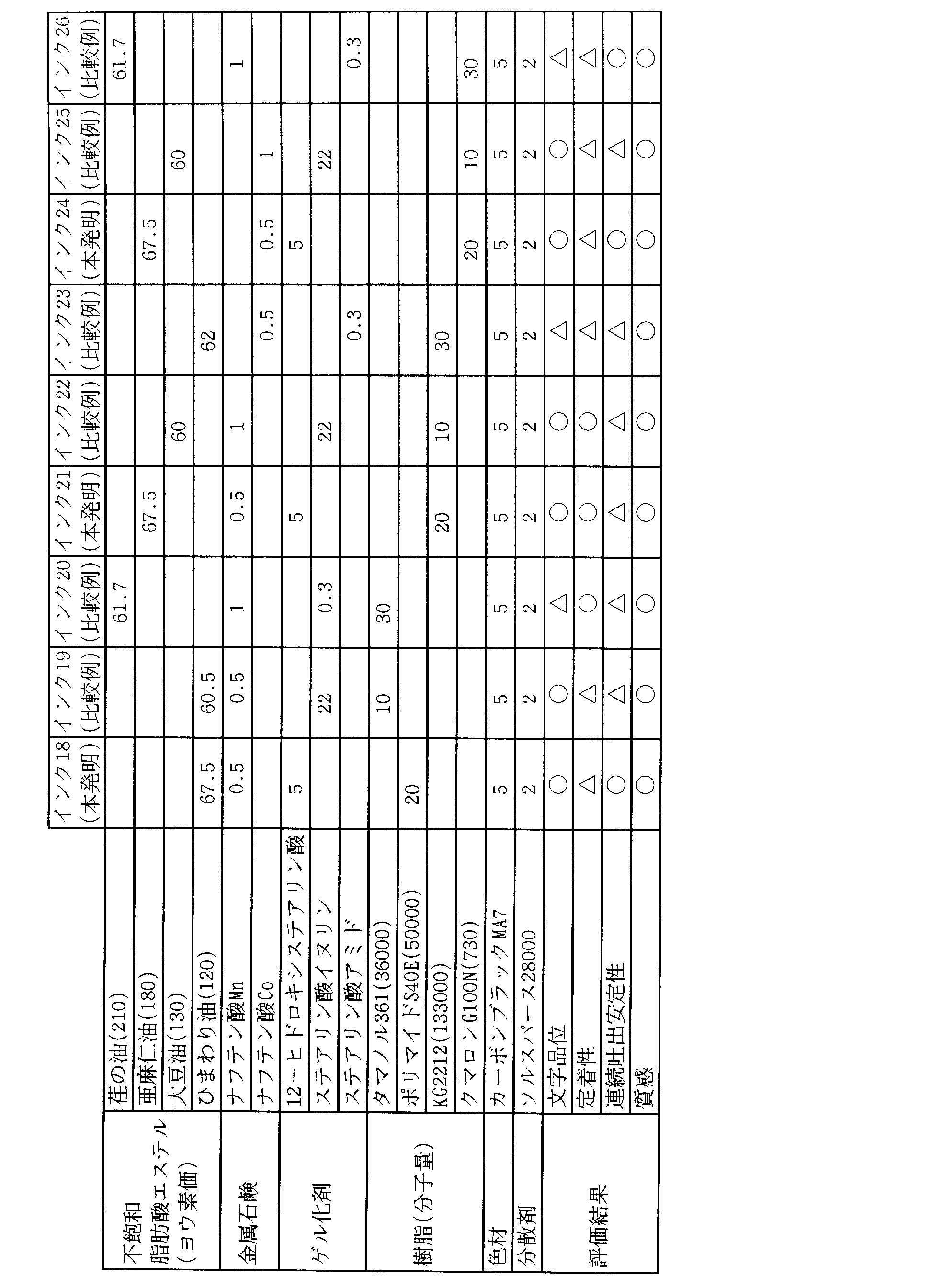
- Tables 1 to 3 are the same as ink 1 except that the types and amounts of unsaturated fatty acid esters, metal soaps, gelling agents, resins, colorants, and dispersants described in Tables 1 to 3 were used. Inks 2 to 26 were obtained, respectively.
- inks 1 to 13, 17, 18, 21, and 24 are inks of the present invention, and inks 14 to 16, 19, 20, 22, 23, 25, and 26 were used as comparative inks.
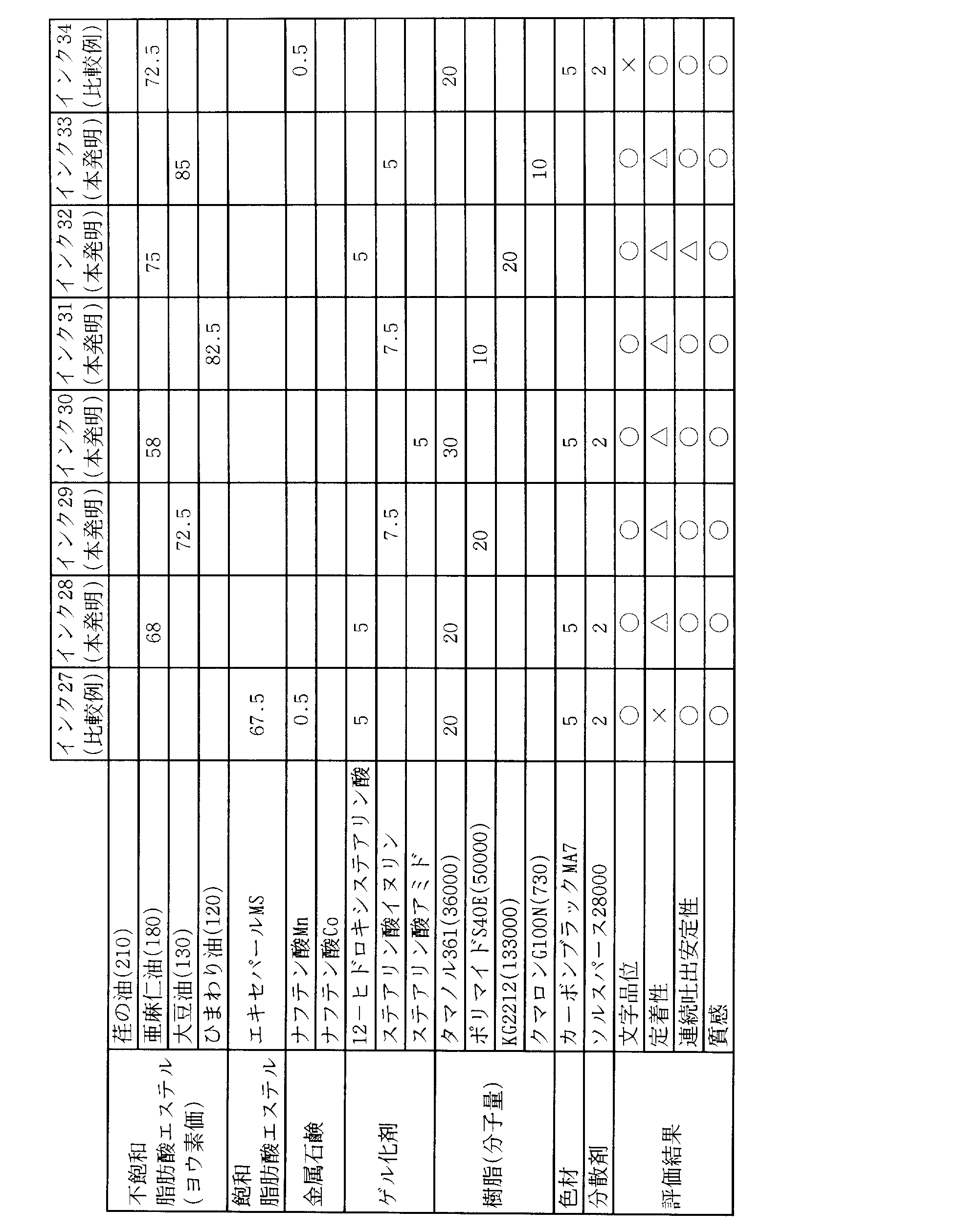
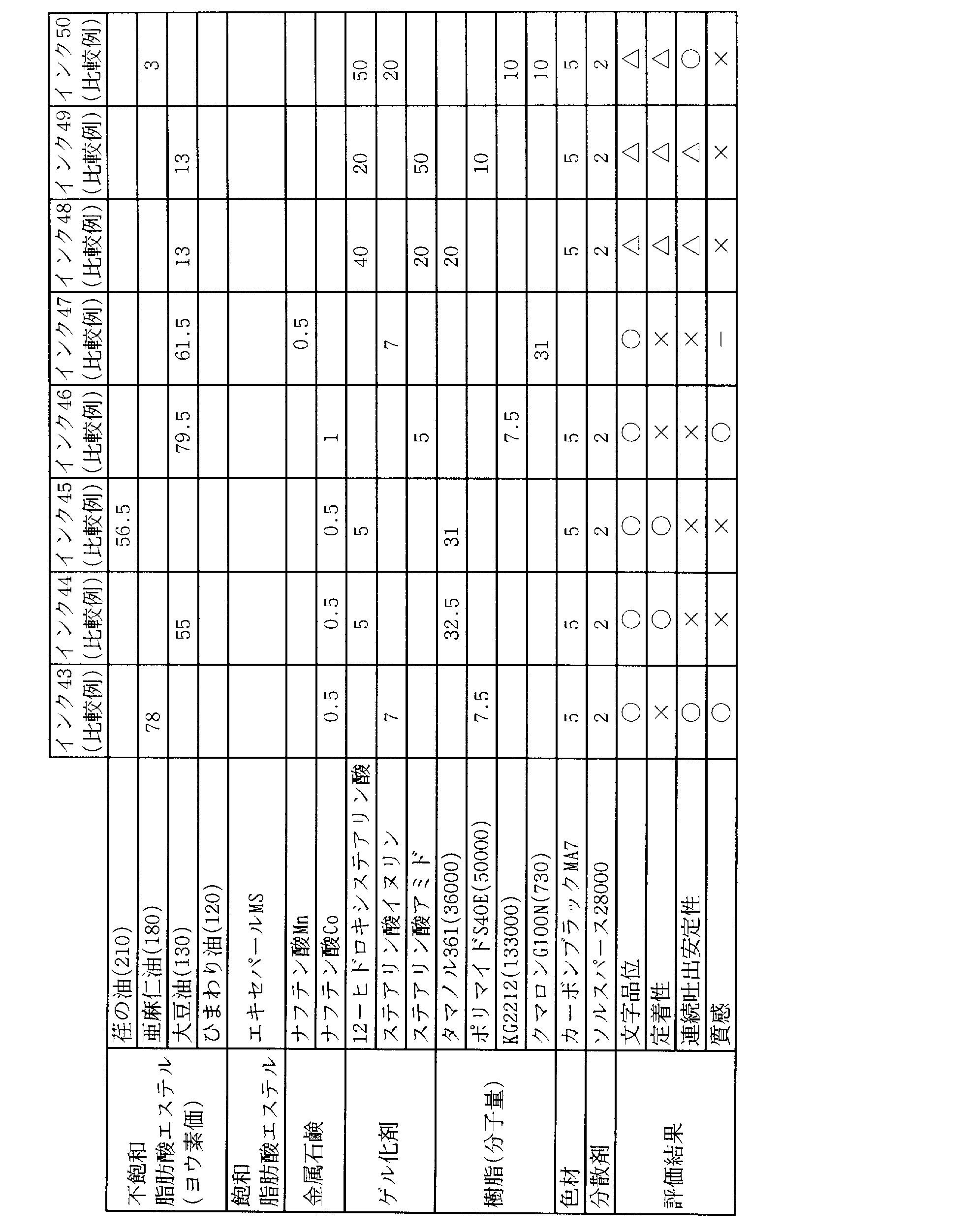
- Tables 4 to 6 were the same as ink 1 except that the types and amounts of unsaturated fatty acid esters, saturated fatty acid esters, metal soaps, gelling agents, colorants, and dispersants described in Tables 4 to 6 were used.
- Ink 27 to 50 described in 1) were obtained.
- the inks 28 to 33 are the inks of the present invention, and the inks 27 and 34 to 50 are comparative inks.
- the ink supply system consists of an ink tank, a supply pipe, a front chamber ink tank immediately before the print head, a pipe with a filter, and a piezo head.
- the ink supply system insulates from the front chamber tank to the print head and increases the gel transition temperature of ink to + 30 ° C. Warm up.
- the piezo head also has a built-in heater, and the ink temperature in the recording head is heated to the gel transition temperature + 30 ° C. For the ink that does not cause gelation, the ink was uniformly heated to 70 ° C.
- the piezo head has a nozzle diameter of 20 ⁇ m and 512 nozzles (256 nozzles ⁇ 2 rows, staggered arrangement, 1 row nozzle pitch of 360 dpi (dpi indicates the number of dots per 2.54 cm)), and one drop of liquid each Printing was performed at a recording resolution of 1440 dpi ⁇ 1440 dpi by ejecting at a droplet velocity of about 6 m / sec under the condition that the droplet volume was 2.5 pl. Each recording medium was at room temperature (23 ° C.).
- the resolution is 1400 dpi x 1440 dpi on a PPC paper (manufactured by JPAPER Konica Minolta Business Solutions), 3 points, 4 points and 5 points of MS Mincho, and the Chinese character "mouth, four, day, times ", Cause, trouble, solid, country, eyes, figure, country” were printed, the printed character image was visually observed, and character quality was evaluated according to the following evaluation criteria.
- ⁇ The printing surface does not change, and no ink adheres to the rubbed paper.
- ⁇ The printing surface is scratched, but the ink does not adhere to the rubbed paper.
- Xx The ink drastically drops from the printing surface, and the image is distorted. A large amount of ink adheres to the rubbed paper.
- ⁇ Continuous discharge stability> Using a piezo-type inkjet head, with the ink supply system and the piezo head heated to the gel transition temperature of the ink + 30 ° C., a drop volume of 2.5 pl and a drop speed of about 6 m / sec are 1 The time was continuously emitted, and the number of ink droplet ejection nozzles was observed with a microscope.
- the percentage of (number of nozzles ⁇ number of missing / bent nozzles after 1 h of continuous injection) / (number of nozzles) was determined and the continuous discharge stability was evaluated based on the following evaluation criteria.
- the piezo head used a nozzle diameter of 20 ⁇ m and 512 nozzles (256 nozzles ⁇ 2 rows, staggered arrangement, 1 row nozzle pitch 360 dpi).
- the discharge nozzle ratio is 85% or more and 100% ⁇ : The discharge nozzle ratio is 70% or more and less than 85% ⁇ : The discharge nozzle ratio is less than 70% ⁇ Evaluation of texture> A sample in which a solid image was printed on PPC paper (manufactured by JP PAPER Konica Minolta Business Solutions Co., Ltd.) with the above ink was prepared, and the texture of the image was evaluated.
- EXCEPARL MS (methyl stearate, manufactured by Kao Corporation)
- the ink of the present invention is excellent in continuous ejection stability, character quality, and fixability.
- the present invention can eject an inkjet head without raising the temperature, and since the ink is cured to such an extent that the back-through is suppressed, the system load is small, the continuous discharge stability is excellent, and plain paper It can be seen that an ink-jet ink having high aptitude and excellent character quality and fixability can be provided.
Landscapes
- Chemical & Material Sciences (AREA)
- Life Sciences & Earth Sciences (AREA)
- Engineering & Computer Science (AREA)
- Materials Engineering (AREA)
- Wood Science & Technology (AREA)
- Organic Chemistry (AREA)
- Inks, Pencil-Leads, Or Crayons (AREA)
- Ink Jet Recording Methods And Recording Media Thereof (AREA)
- Ink Jet (AREA)
Abstract
Description
本発明においては、本発明のインク組成物を可逆にゲル化させることができる化合物(以下、ゲル化剤ともいう)を添加することにより、温度によるインクの相転移を利用して、インクが普通紙上で過度に浸透する前にゲル化し、滲みを防ぐことができる。ゲル構造はインク組成物を抱え込んだ状態で水素結合、分子間相互作用による高分子網目を形成していると考えられる。
本発明の不飽和脂肪酸エステルは、その不飽和結合と空気中の酸素分子が作用し、ラジカルが生成することで連鎖反応を起し重合する。この酸化重合方法を用いることで、特別な光源や乾燥装置が不要なコンパクトなプリンタの設計が可能となる。
本発明のインクには金属石鹸を含有させることができる。
また、本発明のインクにおいては樹脂を含有する。この樹脂をインクに含有させることで、定着性を上げることができる。
《インクの各構成要素》
次いで、本発明のインクについて、上記項目を除いた各構成要素について説明する。
本発明のインクにおいては、インクを構成する色材としては、染料あるいは顔料を制限なく用いることができるが、インク成分に対し良好な分散安定性を有し、かつ耐候性に優れた顔料を用いることが好ましい。顔料としては、特に限定されるわけではないが、本発明には、例えば、カラーインデックスに記載される下記の番号の有機又は無機顔料が使用できる。
青又はシアン顔料としては、Pigment Blue 1、15、15:1、15:2、15:3、15:4、15:6、16、17-1、22、27、28、29、36、60、
緑顔料としては、Pigment Green 7、26、36、50、 黄顔料としては、Pigment Yellow 1、3、12、13、14、17、34、35、37、55、74、81、83、93、94,95、97、108、109、110、137、138、139、153、154、155、157、166、167、168、180、185、193、
黒顔料としては、Pigment Black 7、28、26などが目的に応じて使用できる。
MS Magenta VP、MS Magenta HM-1450、MS Magenta HSo-147(以上、三井東圧社製)、AIZENSOT Red-1、AIZEN SOT Red-2、AIZEN SOTRed-3、AIZEN SOT Pink-1、SPIRON Red GEH SPECIAL(以上、保土谷化学社製)、RESOLIN Red FB 200%、MACROLEX Red Violet R、MACROLEX ROT5B(以上、バイエルジャパン社製)、KAYASET Red B、KAYASET Red 130、KAYASET Red 802(以上、日本化薬社製)、PHLOXIN、ROSE BENGAL、ACID Red(以上、ダイワ化成社製)、HSR-31、DIARESIN Red K(以上、三菱化成社製)、Oil Red(BASFジャパン社製)。
MS Cyan HM-1238、MS Cyan HSo-16、Cyan HSo-144、MS Cyan VPG(以上、三井東圧社製)、AIZEN SOT Blue-4(保土谷化学社製)、RESOLIN BR.Blue BGLN 200%、MACROLEX Blue RR、CERES Blue GN、SIRIUS SUPRATURQ.Blue Z-BGL、SIRIUS SUPRA TURQ.Blue FB-LL 330%(以上、バイエルジャパン社製)、KAYASET Blue FR、KAYASET Blue N、KAYASET Blue 814、Turq.Blue GL-5 200、Light Blue BGL-5 200(以上、日本化薬社製)、DAIWA Blue 7000、Oleosol Fast Blue GL(以上、ダイワ化成社製)、DIARESIN Blue P(三菱化成社製)、SUDAN Blue 670、NEOPEN Blue 808、ZAPON Blue 806(以上、BASFジャパン社製)。
MS Yellow HSm-41、Yellow KX-7、Yellow EX-27(三井東圧)、AIZEN SOT Yellow-1、AIZEN SOT YelloW-3、AIZEN SOT Yellow-6(以上、保土谷化学社製)、MACROLEX Yellow 6G、MACROLEX FLUOR.Yellow 10GN(以上、バイエルジャパン社製)、KAYASET Yellow SF-G、KAYASET Yellow2G、KAYASET Yellow A-G、KAYASET Yellow E-G(以上、日本化薬社製)、DAIWA Yellow 330HB(ダイワ化成社製)、HSY-68(三菱化成社製)、SUDAN Yellow 146、NEOPEN Yellow 075(以上、BASFジャパン社製)。
MS Black VPC(三井東圧社製)、AIZEN SOT Black-1、AIZEN SOT Black-5(以上、保土谷化学社製)、RESORIN Black GSN 200%、RESOLIN BlackBS(以上、バイエルジャパン社製)、KAYASET Black A-N(日本化薬社製)、DAIWA Black MSC(ダイワ化成社製)、HSB-202(三菱化成社製)、NEPTUNE Black X60、NEOPEN Black X58(以上、BASFジャパン社製)等である。
本発明のインクでは、上記説明した以外に、必要に応じて、出射安定性、プリントヘッドやインクカートリッジ適合性、保存安定性、画像保存性、その他の諸性能向上の目的に応じて、公知の各種添加剤、例えば、粘度調整剤、比抵抗調整剤、皮膜形成剤、紫外線吸収剤、退色防止剤、防バイ剤、防錆剤等を適宜選択して用いることができる。
《インクの作製》
(インク1の作製)
亜麻仁油67.5質量部に、ソルスパース28000(ルーブリゾール社製)2質量部を溶解し、さらにカーボンブラックMA7(三菱化学社製)5質量部を添加してプレミックスした。その後ビーズミルにて約20分間で分散してインクを得た。
表1~表3に記載した種類、量の不飽和脂肪酸エステル、金属石鹸、ゲル化剤、樹脂、色材、分散剤を用いた以外は、インク1と同様にして表1~表3記載のインク2~26をそれぞれ得た。ここで、インク1~13、17、18、21、24は本発明のインクであり、インク14~16、19、20、22、23、25、26を比較用のインクとした。
表4~表6に記載した種類、量の不飽和脂肪酸エステル、飽和脂肪酸エステル、金属石鹸、ゲル化剤、色材、分散剤を用いた以外は、インク1と同様にして表4~表6に記載のインク27~50をそれぞれ得た。ここで、インク28~33は本発明のインクであり、インク27、34~50を比較用のインクとした。
《インクジェット画像の形成》
ピエゾ型インクジェットノズルを備えたインクジェット記録装置に、上記で作製したインクを装填し、PPC用紙(J PAPER コニカミノルタビジネスソリューションズ社製)に、抜き文字、ベタ画像を印字した。
<文字品位>
上記のインクで、PPC用紙(J PAPER コニカミノルタビジネスソリューションズ社製)に対して解像度1400dpi×1440dpiで、3ポイント、4ポイントおよび5ポイントのMS明朝体で、漢字「口、四、日、回、因、困、固、国、目、図、國」の抜き文字を印字し、印字した文字画像を目視観察し、下記の評価基準に従って文字品位の評価を行った。
△:3ポイントの抜き文字は一部しか判読できないが、4ポイントの抜き文字全てが判読可能である
×:4ポイントの抜き文字は一部しか判読できない
<定着性>
上記インクで、PPC用紙(J PAPER コニカミノルタビジネスソリューションズ社製)にベタ画像を印字したサンプルを40℃、60%RHの環境で一昼夜自然乾燥させた後、サンプルの印字部に印刷していないPPC用紙を重ね、100g/cm2の荷重をかけた状態で10回往復させ、サンプルおよびサンプルに当てて擦った用紙の状態を観察し、以下の基準に基づいて定着性の評価を行った。
△:印字面に傷が付くが、擦った用紙にはインクは付着しない
×:印字面のインクが落ち、僅かに擦った用紙に付着する
××:印字面からインクが激しく落ち、画像が乱れる。擦った用紙にインクが多量に付着する。
<連続吐出安定性>
ピエゾ型インクジェットヘッドを用い、インク供給系及びピエゾヘッドをインクのゲル転移温度+30℃に加温した状態で、1滴の液滴量が2.5pl、液滴速度約6m/secの条件で1時間連続出射し、インク滴吐出ノズル数をマイクロスコープで観測した。
△:吐出ノズル比が、70%以上、85%未満である
×:吐出ノズル比が、70%未満である
<質感の評価>
上記インクで、PPC用紙(J PAPER コニカミノルタビジネスソリューションズ社製)にベタ画像を印字したサンプルを作成し、画像の質感を評価した。
×:凹凸や表面の光の反射に違和感がある
結果を併せて表1~表6に示す。

(金属石鹸)
ナフテン酸Mn:ナフテン酸マンガン
ナフテン酸Co:ナフテン酸コバルト
(樹脂)
タマノル361(36000):タマノル361(ロジン変性フェノール樹脂、荒川化学社製、分子量36000)
ポリマイドS40E(50000):ポリマイドS40E(ポリアミド樹脂、三洋化成社製、分子量50000)
KG2212(133000):KG2212(ロジン変性フェノール樹脂、荒川化学社製、分子量133000)
クマロンG100N(730):クマロンG100N(クマロン樹脂、日塗化学社製、分子量730)
(色材)
カーボンブラックMA7:カーボンブラックMA7(三菱化学社製)
(分散剤)
ソルスパース28000:ソルスパース28000(ルーブリゾール社製)
(飽和脂肪酸エステル)
エキセパールMS:エキセパールMS(ステアリン酸メチル、花王社製)

Claims (7)
- 不飽和脂肪酸エステルと、インク組成物を可逆にゲル化させることができる化合物をインク全質量に対して0.5~20質量%と、樹脂をインク全質量に対して10~30質量%とを含むことを特徴とするインクジェットインク。
- 金属石けんを含有することを特徴とする請求項1に記載のインクジェットインク。
- 前記樹脂の重量平均分子量が1000~50000であることを特徴とする請求項1または請求項2に記載のインクジェットインク。
- 前記不飽和脂肪酸エステルのヨウ素価が130~200であることを特徴とする請求項1~3のいずれか1項に記載のインクジェットインク。
- 前記樹脂がロジン樹脂またはテルペン樹脂から選ばれることを特徴とする請求項1~4のいずれか1項に記載のインクジェットインク。
- 前記樹脂がロジン樹脂とテルペン樹脂を併用することを特徴とする請求項1~5のいずれか1項に記載のインクジェットインク。
- 請求項1~6のいずれか1項に記載の前記インクジェットインクを用い、記録媒体の温度よりも高い温度のインクジェットインクを前記記録媒体に吐出して画像形成を行うことを特徴とするインクジェット画像形成方法。
Priority Applications (3)
| Application Number | Priority Date | Filing Date | Title |
|---|---|---|---|
| US13/636,186 US20130010040A1 (en) | 2010-03-31 | 2011-01-14 | Inkjet ink and method for forming inkjet image |
| EP11762303.3A EP2554610B1 (en) | 2010-03-31 | 2011-01-14 | Inkjet ink and method for forming inkjet image |
| JP2012508110A JP6211269B2 (ja) | 2010-03-31 | 2011-01-14 | インクジェットインク及びインクジェット画像形成方法 |
Applications Claiming Priority (2)
| Application Number | Priority Date | Filing Date | Title |
|---|---|---|---|
| JP2010080721 | 2010-03-31 | ||
| JP2010-080721 | 2010-03-31 |
Publications (1)
| Publication Number | Publication Date |
|---|---|
| WO2011122062A1 true WO2011122062A1 (ja) | 2011-10-06 |
Family
ID=44711815
Family Applications (1)
| Application Number | Title | Priority Date | Filing Date |
|---|---|---|---|
| PCT/JP2011/050508 Ceased WO2011122062A1 (ja) | 2010-03-31 | 2011-01-14 | インクジェットインク及びインクジェット画像形成方法 |
Country Status (4)
| Country | Link |
|---|---|
| US (1) | US20130010040A1 (ja) |
| EP (1) | EP2554610B1 (ja) |
| JP (1) | JP6211269B2 (ja) |
| WO (1) | WO2011122062A1 (ja) |
Cited By (4)
| Publication number | Priority date | Publication date | Assignee | Title |
|---|---|---|---|---|
| JP2013227410A (ja) * | 2012-04-25 | 2013-11-07 | Konica Minolta Inc | 活性光線硬化型インクジェットインク |
| JP2017088857A (ja) * | 2015-11-02 | 2017-05-25 | セイコーエプソン株式会社 | 油性記録液 |
| JP2018154734A (ja) * | 2017-03-17 | 2018-10-04 | セイコーエプソン株式会社 | 油性インクジェット記録液 |
| EP3406677A1 (en) | 2017-05-24 | 2018-11-28 | Riso Kagaku Corporation | Oil-based inkjet ink |
Families Citing this family (10)
| Publication number | Priority date | Publication date | Assignee | Title |
|---|---|---|---|---|
| WO2015134024A1 (en) | 2014-03-06 | 2015-09-11 | Hewlett-Packard Development Company, L.P. | Non-newtonian inkjet inks |
| WO2015134029A1 (en) | 2014-03-06 | 2015-09-11 | Hewlett-Packard Development Company, L.P. | Orthogonal non-newtonian inkjet inks |
| WO2016048360A1 (en) | 2014-09-26 | 2016-03-31 | Hewlett-Packard Development Company, L.P. | Non-newtonian photo-curable ink composition |
| US10077370B2 (en) | 2014-09-26 | 2018-09-18 | Hewlett-Packard Development Company, L.P. | Non-Newtonian photo-curable ink composition |
| WO2016048361A1 (en) | 2014-09-26 | 2016-03-31 | Hewlett-Packard Development Company, L.P. | Non-newtonian photo-curable ink composition |
| US10392523B2 (en) | 2014-12-11 | 2019-08-27 | Hewlett-Packard Development Company, L.P. | Non-Newtonian photo-curable ink composition |
| EP3296110B1 (en) * | 2015-05-11 | 2020-07-15 | Konica Minolta, Inc. | Ink jet recording apparatus |
| EP3517582B1 (en) * | 2018-01-30 | 2022-12-07 | Canon Production Printing Holding B.V. | Radiation-curable inkjet ink composition |
| JP7214989B2 (ja) * | 2018-06-26 | 2023-01-31 | コニカミノルタ株式会社 | 活性光線硬化型インクジェットインク、活性光線硬化型インクジェットインクの製造方法および画像形成方法 |
| JP2024160511A (ja) * | 2023-05-01 | 2024-11-14 | ブラザー工業株式会社 | インクジェット記録用水性インク、インクジェット記録装置、及びインクジェット記録方法 |
Citations (15)
| Publication number | Priority date | Publication date | Assignee | Title |
|---|---|---|---|---|
| JPS555896A (en) * | 1978-06-26 | 1980-01-17 | M & T Chemicals Inc | Printing ink and method of printing |
| JPH02132168A (ja) * | 1988-11-11 | 1990-05-21 | Ricoh Co Ltd | インクジェット記録用インク組成物 |
| JPH0649399A (ja) * | 1992-07-30 | 1994-02-22 | Canon Inc | インク、これを用いたインクジェット記録方法及びかかるインクを用いた機器 |
| JPH09194779A (ja) | 1996-01-11 | 1997-07-29 | Brother Ind Ltd | ホットメルト型インクジェット用インク組成物 |
| JPH10140060A (ja) * | 1996-11-13 | 1998-05-26 | Dainippon Ink & Chem Inc | ジェットプリンター用インク |
| JPH10279862A (ja) * | 1997-03-31 | 1998-10-20 | Brother Ind Ltd | 熱溶融性インク |
| JPH10292142A (ja) * | 1997-04-17 | 1998-11-04 | Brother Ind Ltd | 熱溶融性インク |
| JP2002060661A (ja) * | 2000-08-17 | 2002-02-26 | Dainippon Ink & Chem Inc | ジェットプリンター用インク組成物 |
| JP2002226737A (ja) * | 2001-01-29 | 2002-08-14 | Toppan Forms Co Ltd | インクジェットインク受容層形成用インクおよびそれを用いた記録用シート |
| JP2003105241A (ja) * | 2001-06-29 | 2003-04-09 | Konica Corp | インクジェット記録用インク及びインクジェット記録方法 |
| JP2005126508A (ja) * | 2003-10-22 | 2005-05-19 | Konica Minolta Holdings Inc | インクジェット用インクとインクジェット記録方法 |
| JP2005126509A (ja) * | 2003-10-22 | 2005-05-19 | Konica Minolta Holdings Inc | インクジェット用インク及びそれを用いたインクジェット記録方法 |
| JP2005290035A (ja) | 2004-03-31 | 2005-10-20 | Riso Kagaku Corp | 非水系インクジェットインク |
| JP2008221781A (ja) * | 2007-03-15 | 2008-09-25 | Seiko Epson Corp | インクセット、インクジェット記録方法及び記録物 |
| JP2009510184A (ja) * | 2005-09-01 | 2009-03-12 | オセ−テクノロジーズ・ベー・ヴエー | 放射線硬化性インクジェットインクおよびこのインクを用いて被印刷物を印刷する方法 |
Family Cites Families (15)
| Publication number | Priority date | Publication date | Assignee | Title |
|---|---|---|---|---|
| ATE224936T1 (de) * | 1993-07-01 | 2002-10-15 | Tonejet Corp Pty Ltd | Flüssige tinte für den tintenstrahldruck |
| JPH07278477A (ja) * | 1994-04-11 | 1995-10-24 | Brother Ind Ltd | インクジェットプリンタ用ホットメルトインク |
| US6022947A (en) * | 1998-09-18 | 2000-02-08 | Union Camp Corporation | Light-colored, low molecular weight phenolic-modified rosin esters |
| EP1323794A4 (en) * | 2000-09-08 | 2004-11-17 | Sakata Inx Corp | INK COMPOSITION FOR OFFSET PRINTING |
| JP4277986B2 (ja) * | 2002-06-27 | 2009-06-10 | 理想科学工業株式会社 | 非水系インクジェットインク及びその製造方法 |
| CN100545221C (zh) * | 2002-08-30 | 2009-09-30 | 大日本油墨化学工业株式会社 | 印刷油墨用催干剂和含该催干剂的印刷油墨 |
| JP4563714B2 (ja) * | 2004-04-08 | 2010-10-13 | 理想科学工業株式会社 | 非水系インクジェットインク |
| WO2006135048A1 (ja) * | 2005-06-17 | 2006-12-21 | Sakata Inx Corp. | ヒートセット型オフセット印刷用インキ組成物 |
| JP2008094976A (ja) * | 2006-10-12 | 2008-04-24 | Mimaki Engineering Co Ltd | 浸透防止剤、浸透防止方法及び溶剤インク |
| JP2008150527A (ja) * | 2006-12-19 | 2008-07-03 | Mitsubishi Paper Mills Ltd | スクラッチ発色用インキおよび不可視情報印刷シート |
| JP4986261B2 (ja) * | 2007-03-15 | 2012-07-25 | セイコーエプソン株式会社 | インクジェット記録方法 |
| US7842102B2 (en) * | 2007-11-05 | 2010-11-30 | Sunbelt Corporation | Liquid dye formulations in non-petroleum based solvent systems |
| JP5712501B2 (ja) * | 2010-04-20 | 2015-05-07 | コニカミノルタ株式会社 | インクジェットインク |
| WO2011136009A1 (ja) * | 2010-04-28 | 2011-11-03 | コニカミノルタホールディングス株式会社 | 印刷物製造方法 |
| EP2607433B1 (en) * | 2010-08-19 | 2020-11-11 | Konica Minolta Holdings, Inc. | Active ray-curable ink and active ray-curable inkjet recording method |
-
2011
- 2011-01-14 WO PCT/JP2011/050508 patent/WO2011122062A1/ja not_active Ceased
- 2011-01-14 JP JP2012508110A patent/JP6211269B2/ja active Active
- 2011-01-14 US US13/636,186 patent/US20130010040A1/en not_active Abandoned
- 2011-01-14 EP EP11762303.3A patent/EP2554610B1/en active Active
Patent Citations (15)
| Publication number | Priority date | Publication date | Assignee | Title |
|---|---|---|---|---|
| JPS555896A (en) * | 1978-06-26 | 1980-01-17 | M & T Chemicals Inc | Printing ink and method of printing |
| JPH02132168A (ja) * | 1988-11-11 | 1990-05-21 | Ricoh Co Ltd | インクジェット記録用インク組成物 |
| JPH0649399A (ja) * | 1992-07-30 | 1994-02-22 | Canon Inc | インク、これを用いたインクジェット記録方法及びかかるインクを用いた機器 |
| JPH09194779A (ja) | 1996-01-11 | 1997-07-29 | Brother Ind Ltd | ホットメルト型インクジェット用インク組成物 |
| JPH10140060A (ja) * | 1996-11-13 | 1998-05-26 | Dainippon Ink & Chem Inc | ジェットプリンター用インク |
| JPH10279862A (ja) * | 1997-03-31 | 1998-10-20 | Brother Ind Ltd | 熱溶融性インク |
| JPH10292142A (ja) * | 1997-04-17 | 1998-11-04 | Brother Ind Ltd | 熱溶融性インク |
| JP2002060661A (ja) * | 2000-08-17 | 2002-02-26 | Dainippon Ink & Chem Inc | ジェットプリンター用インク組成物 |
| JP2002226737A (ja) * | 2001-01-29 | 2002-08-14 | Toppan Forms Co Ltd | インクジェットインク受容層形成用インクおよびそれを用いた記録用シート |
| JP2003105241A (ja) * | 2001-06-29 | 2003-04-09 | Konica Corp | インクジェット記録用インク及びインクジェット記録方法 |
| JP2005126508A (ja) * | 2003-10-22 | 2005-05-19 | Konica Minolta Holdings Inc | インクジェット用インクとインクジェット記録方法 |
| JP2005126509A (ja) * | 2003-10-22 | 2005-05-19 | Konica Minolta Holdings Inc | インクジェット用インク及びそれを用いたインクジェット記録方法 |
| JP2005290035A (ja) | 2004-03-31 | 2005-10-20 | Riso Kagaku Corp | 非水系インクジェットインク |
| JP2009510184A (ja) * | 2005-09-01 | 2009-03-12 | オセ−テクノロジーズ・ベー・ヴエー | 放射線硬化性インクジェットインクおよびこのインクを用いて被印刷物を印刷する方法 |
| JP2008221781A (ja) * | 2007-03-15 | 2008-09-25 | Seiko Epson Corp | インクセット、インクジェット記録方法及び記録物 |
Non-Patent Citations (3)
| Title |
|---|
| J. POLYM. SCI., vol. 21, 1956, pages 57 |
| JOUMA, NIPPON RHEOLOGY GAKKAI, vol. 17, 1989, pages 86 |
| See also references of EP2554610A4 |
Cited By (5)
| Publication number | Priority date | Publication date | Assignee | Title |
|---|---|---|---|---|
| JP2013227410A (ja) * | 2012-04-25 | 2013-11-07 | Konica Minolta Inc | 活性光線硬化型インクジェットインク |
| JP2017088857A (ja) * | 2015-11-02 | 2017-05-25 | セイコーエプソン株式会社 | 油性記録液 |
| JP2018154734A (ja) * | 2017-03-17 | 2018-10-04 | セイコーエプソン株式会社 | 油性インクジェット記録液 |
| EP3406677A1 (en) | 2017-05-24 | 2018-11-28 | Riso Kagaku Corporation | Oil-based inkjet ink |
| US11193033B2 (en) | 2017-05-24 | 2021-12-07 | Riso Kagaku Corporation | Oil-based inkjet ink |
Also Published As
| Publication number | Publication date |
|---|---|
| JP6211269B2 (ja) | 2017-10-11 |
| EP2554610B1 (en) | 2017-11-15 |
| EP2554610A4 (en) | 2015-08-26 |
| JPWO2011122062A1 (ja) | 2013-07-08 |
| EP2554610A1 (en) | 2013-02-06 |
| US20130010040A1 (en) | 2013-01-10 |
Similar Documents
| Publication | Publication Date | Title |
|---|---|---|
| JP6211269B2 (ja) | インクジェットインク及びインクジェット画像形成方法 | |
| JP3542425B2 (ja) | インクジェット記録用水系分散インク、これを用いるインクジェット記録方法、インクカートリッジ、記録ユニットおよび記録装置 | |
| JP2990378B2 (ja) | インクジェットプリンターのインク組成物 | |
| CN103608414B (zh) | 光化射线固化型喷墨用油墨及使用其的图像记录方法 | |
| JP3102269B2 (ja) | インクジェット記録方法 | |
| JP4460222B2 (ja) | 非水系インク組成物 | |
| WO2012023368A1 (ja) | 活性光線硬化型インク及び活性光線硬化型インクジェット記録方法 | |
| JP4277986B2 (ja) | 非水系インクジェットインク及びその製造方法 | |
| JP5811021B2 (ja) | 光硬化型インクジェットインクおよびそれを用いた画像形成方法 | |
| JP2011236419A (ja) | 水性インクジェットインク | |
| WO2007102285A1 (ja) | 非水系インクジェットインク及びインクジェット記録方法 | |
| JP2008019409A (ja) | 非水系インクジェット用インクセット及びインクジェット記録方法 | |
| CN107922761A (zh) | 水性油墨组合物 | |
| JP5944634B2 (ja) | 非水系インク及びその製造方法 | |
| JP6733659B2 (ja) | 共晶を形成する二種のワックスを含む活性光線硬化型インクジェットインクおよびインクジェット記録方法 | |
| JP5712501B2 (ja) | インクジェットインク | |
| CN102964905B (zh) | 非水系墨 | |
| JP2007291257A (ja) | 非水系インクジェットインク及びインクジェット記録方法 | |
| JP4899293B2 (ja) | 油性インクジェットインクとそれを用いたインクジェット記録方法 | |
| JP6392662B2 (ja) | インクジェット用非水系インク | |
| JP2005330309A (ja) | 水性インクジェットインクとそれを用いたインクジェット記録方法 | |
| JP2012153781A (ja) | 油性インク及びインクジェット印刷法 | |
| JP6031827B2 (ja) | インクジェット記録用水性インクセット | |
| JP2011012149A (ja) | インクジェット用非水系インクセット及びインクジェット記録方法 | |
| JP5553104B2 (ja) | 画像形成方法 |
Legal Events
| Date | Code | Title | Description |
|---|---|---|---|
| 121 | Ep: the epo has been informed by wipo that ep was designated in this application |
Ref document number: 11762303 Country of ref document: EP Kind code of ref document: A1 |
|
| WWE | Wipo information: entry into national phase |
Ref document number: 2012508110 Country of ref document: JP |
|
| WWE | Wipo information: entry into national phase |
Ref document number: 13636186 Country of ref document: US |
|
| REEP | Request for entry into the european phase |
Ref document number: 2011762303 Country of ref document: EP |
|
| WWE | Wipo information: entry into national phase |
Ref document number: 2011762303 Country of ref document: EP |
|
| NENP | Non-entry into the national phase |
Ref country code: DE |