WO2012000608A2 - Neue beta-aminoaldehyd-derivate, verfahren zu ihrer herstellung und ihre chemische verwendung als reaktive intermediate - Google Patents
Neue beta-aminoaldehyd-derivate, verfahren zu ihrer herstellung und ihre chemische verwendung als reaktive intermediate Download PDFInfo
- Publication number
- WO2012000608A2 WO2012000608A2 PCT/EP2011/002923 EP2011002923W WO2012000608A2 WO 2012000608 A2 WO2012000608 A2 WO 2012000608A2 EP 2011002923 W EP2011002923 W EP 2011002923W WO 2012000608 A2 WO2012000608 A2 WO 2012000608A2
- Authority
- WO
- WIPO (PCT)
- Prior art keywords
- group
- branched
- straight
- chain
- halogen
- Prior art date
- Legal status (The legal status is an assumption and is not a legal conclusion. Google has not performed a legal analysis and makes no representation as to the accuracy of the status listed.)
- Ceased
Links
- NSELYKZLLNWRED-UHFFFAOYSA-N C=C1CCOCC1 Chemical compound C=C1CCOCC1 NSELYKZLLNWRED-UHFFFAOYSA-N 0.000 description 1
- 0 CC(*)(C(C)(*)N1*)C1=O Chemical compound CC(*)(C(C)(*)N1*)C1=O 0.000 description 1
- BZPBJPAPXUHKJG-UHFFFAOYSA-N CC(C)(C)OC(N(C(Cc1ccccc1)C1)C1=O)=O Chemical compound CC(C)(C)OC(N(C(Cc1ccccc1)C1)C1=O)=O BZPBJPAPXUHKJG-UHFFFAOYSA-N 0.000 description 1
- ROQDOXSVAYXAGZ-UHFFFAOYSA-N CC(C)(C)OC(N(C1(C2)CCOCC1)C2=O)=O Chemical compound CC(C)(C)OC(N(C1(C2)CCOCC1)C2=O)=O ROQDOXSVAYXAGZ-UHFFFAOYSA-N 0.000 description 1
- ZWRQMOUYJQQRHZ-KALYDTEFSA-N CC(C)(C)OC(N([C@]1(C)[C@H]2C[C@H]3C(C)(C)[C@@H]1C3)C2=O)=O Chemical compound CC(C)(C)OC(N([C@]1(C)[C@H]2C[C@H]3C(C)(C)[C@@H]1C3)C2=O)=O ZWRQMOUYJQQRHZ-KALYDTEFSA-N 0.000 description 1
- BIUYWIKFGQHAFZ-UHFFFAOYSA-N CC(C)(C)OC(NC(CC=O)Cc1ccccc1)=O Chemical compound CC(C)(C)OC(NC(CC=O)Cc1ccccc1)=O BIUYWIKFGQHAFZ-UHFFFAOYSA-N 0.000 description 1
- IJKVPVDYBHYHIF-UHFFFAOYSA-N CC(C)(C)OC(NC1(CC=O)CCOCC1)=O Chemical compound CC(C)(C)OC(NC1(CC=O)CCOCC1)=O IJKVPVDYBHYHIF-UHFFFAOYSA-N 0.000 description 1
- AACRBBPMCOXWLI-UHFFFAOYSA-N CC(C)(C)OC(NC1OCOC1C=O)=O Chemical compound CC(C)(C)OC(NC1OCOC1C=O)=O AACRBBPMCOXWLI-UHFFFAOYSA-N 0.000 description 1
- MAGOATLRDZTFAN-KZTGVZKYSA-N CC(C)(C)OC(N[C@@](C)([C@@H](C1)C(C)(C)[C@@H]1C1)[C@@H]1C=O)=O Chemical compound CC(C)(C)OC(N[C@@](C)([C@@H](C1)C(C)(C)[C@@H]1C1)[C@@H]1C=O)=O MAGOATLRDZTFAN-KZTGVZKYSA-N 0.000 description 1
- KUAXJPRPFKYSME-OFHVYEONSA-N CC(C)([C@@H](C1)C[C@H]23)[C@H]1[C@]2(C)NC3=O Chemical compound CC(C)([C@@H](C1)C[C@H]23)[C@H]1[C@]2(C)NC3=O KUAXJPRPFKYSME-OFHVYEONSA-N 0.000 description 1
- OBWNQXOVRLYCEL-UHFFFAOYSA-N CC(C)C(CC=O)NC(OC(C)(C)C)=O Chemical compound CC(C)C(CC=O)NC(OC(C)(C)C)=O OBWNQXOVRLYCEL-UHFFFAOYSA-N 0.000 description 1
- IGHHXILTFKWPDY-UHFFFAOYSA-N CC(C)C(CCOC1)N1C(OC(C)(C)C)=O Chemical compound CC(C)C(CCOC1)N1C(OC(C)(C)C)=O IGHHXILTFKWPDY-UHFFFAOYSA-N 0.000 description 1
- JMQYTSNBHHLUQK-UHFFFAOYSA-N O=C(C1)NC11CCOCC1 Chemical compound O=C(C1)NC11CCOCC1 JMQYTSNBHHLUQK-UHFFFAOYSA-N 0.000 description 1
Classifications
-
- C—CHEMISTRY; METALLURGY
- C07—ORGANIC CHEMISTRY
- C07C—ACYCLIC OR CARBOCYCLIC COMPOUNDS
- C07C269/00—Preparation of derivatives of carbamic acid, i.e. compounds containing any of the groups, the nitrogen atom not being part of nitro or nitroso groups
- C07C269/06—Preparation of derivatives of carbamic acid, i.e. compounds containing any of the groups, the nitrogen atom not being part of nitro or nitroso groups by reactions not involving the formation of carbamate groups
-
- C—CHEMISTRY; METALLURGY
- C07—ORGANIC CHEMISTRY
- C07C—ACYCLIC OR CARBOCYCLIC COMPOUNDS
- C07C271/00—Derivatives of carbamic acids, i.e. compounds containing any of the groups, the nitrogen atom not being part of nitro or nitroso groups
- C07C271/06—Esters of carbamic acids
- C07C271/08—Esters of carbamic acids having oxygen atoms of carbamate groups bound to acyclic carbon atoms
- C07C271/10—Esters of carbamic acids having oxygen atoms of carbamate groups bound to acyclic carbon atoms with the nitrogen atoms of the carbamate groups bound to hydrogen atoms or to acyclic carbon atoms
- C07C271/18—Esters of carbamic acids having oxygen atoms of carbamate groups bound to acyclic carbon atoms with the nitrogen atoms of the carbamate groups bound to hydrogen atoms or to acyclic carbon atoms to carbon atoms of hydrocarbon radicals substituted by doubly-bound oxygen atoms
-
- C—CHEMISTRY; METALLURGY
- C07—ORGANIC CHEMISTRY
- C07C—ACYCLIC OR CARBOCYCLIC COMPOUNDS
- C07C271/00—Derivatives of carbamic acids, i.e. compounds containing any of the groups, the nitrogen atom not being part of nitro or nitroso groups
- C07C271/06—Esters of carbamic acids
- C07C271/08—Esters of carbamic acids having oxygen atoms of carbamate groups bound to acyclic carbon atoms
- C07C271/24—Esters of carbamic acids having oxygen atoms of carbamate groups bound to acyclic carbon atoms with the nitrogen atom of at least one of the carbamate groups bound to a carbon atom of a ring other than a six-membered aromatic ring
-
- C—CHEMISTRY; METALLURGY
- C07—ORGANIC CHEMISTRY
- C07D—HETEROCYCLIC COMPOUNDS
- C07D211/00—Heterocyclic compounds containing hydrogenated pyridine rings, not condensed with other rings
- C07D211/04—Heterocyclic compounds containing hydrogenated pyridine rings, not condensed with other rings with only hydrogen or carbon atoms directly attached to the ring nitrogen atom
- C07D211/06—Heterocyclic compounds containing hydrogenated pyridine rings, not condensed with other rings with only hydrogen or carbon atoms directly attached to the ring nitrogen atom having no double bonds between ring members or between ring members and non-ring members
- C07D211/36—Heterocyclic compounds containing hydrogenated pyridine rings, not condensed with other rings with only hydrogen or carbon atoms directly attached to the ring nitrogen atom having no double bonds between ring members or between ring members and non-ring members with hetero atoms or with carbon atoms having three bonds to hetero atoms with at the most one bond to halogen, e.g. ester or nitrile radicals, directly attached to ring carbon atoms
- C07D211/56—Nitrogen atoms
- C07D211/58—Nitrogen atoms attached in position 4
-
- C—CHEMISTRY; METALLURGY
- C07—ORGANIC CHEMISTRY
- C07D—HETEROCYCLIC COMPOUNDS
- C07D213/00—Heterocyclic compounds containing six-membered rings, not condensed with other rings, with one nitrogen atom as the only ring hetero atom and three or more double bonds between ring members or between ring members and non-ring members
- C07D213/02—Heterocyclic compounds containing six-membered rings, not condensed with other rings, with one nitrogen atom as the only ring hetero atom and three or more double bonds between ring members or between ring members and non-ring members having three double bonds between ring members or between ring members and non-ring members
- C07D213/04—Heterocyclic compounds containing six-membered rings, not condensed with other rings, with one nitrogen atom as the only ring hetero atom and three or more double bonds between ring members or between ring members and non-ring members having three double bonds between ring members or between ring members and non-ring members having no bond between the ring nitrogen atom and a non-ring member or having only hydrogen or carbon atoms directly attached to the ring nitrogen atom
- C07D213/24—Heterocyclic compounds containing six-membered rings, not condensed with other rings, with one nitrogen atom as the only ring hetero atom and three or more double bonds between ring members or between ring members and non-ring members having three double bonds between ring members or between ring members and non-ring members having no bond between the ring nitrogen atom and a non-ring member or having only hydrogen or carbon atoms directly attached to the ring nitrogen atom with substituted hydrocarbon radicals attached to ring carbon atoms
- C07D213/44—Radicals substituted by doubly-bound oxygen, sulfur, or nitrogen atoms, or by two such atoms singly-bound to the same carbon atom
- C07D213/46—Oxygen atoms
- C07D213/48—Aldehydo radicals
-
- C—CHEMISTRY; METALLURGY
- C07—ORGANIC CHEMISTRY
- C07D—HETEROCYCLIC COMPOUNDS
- C07D223/00—Heterocyclic compounds containing seven-membered rings having one nitrogen atom as the only ring hetero atom
- C07D223/02—Heterocyclic compounds containing seven-membered rings having one nitrogen atom as the only ring hetero atom not condensed with other rings
- C07D223/06—Heterocyclic compounds containing seven-membered rings having one nitrogen atom as the only ring hetero atom not condensed with other rings with hetero atoms or with carbon atoms having three bonds to hetero atoms with at the most one bond to halogen, e.g. ester or nitrile radicals, directly attached to ring carbon atoms
- C07D223/12—Nitrogen atoms not forming part of a nitro radical
-
- C—CHEMISTRY; METALLURGY
- C07—ORGANIC CHEMISTRY
- C07D—HETEROCYCLIC COMPOUNDS
- C07D265/00—Heterocyclic compounds containing six-membered rings having one nitrogen atom and one oxygen atom as the only ring hetero atoms
- C07D265/04—1,3-Oxazines; Hydrogenated 1,3-oxazines
- C07D265/06—1,3-Oxazines; Hydrogenated 1,3-oxazines not condensed with other rings
-
- C—CHEMISTRY; METALLURGY
- C07—ORGANIC CHEMISTRY
- C07D—HETEROCYCLIC COMPOUNDS
- C07D277/00—Heterocyclic compounds containing 1,3-thiazole or hydrogenated 1,3-thiazole rings
- C07D277/02—Heterocyclic compounds containing 1,3-thiazole or hydrogenated 1,3-thiazole rings not condensed with other rings
- C07D277/20—Heterocyclic compounds containing 1,3-thiazole or hydrogenated 1,3-thiazole rings not condensed with other rings having two or three double bonds between ring members or between ring members and non-ring members
- C07D277/22—Heterocyclic compounds containing 1,3-thiazole or hydrogenated 1,3-thiazole rings not condensed with other rings having two or three double bonds between ring members or between ring members and non-ring members with only hydrogen atoms, hydrocarbon or substituted hydrocarbon radicals, directly attached to ring carbon atoms
- C07D277/28—Radicals substituted by nitrogen atoms
-
- C—CHEMISTRY; METALLURGY
- C07—ORGANIC CHEMISTRY
- C07D—HETEROCYCLIC COMPOUNDS
- C07D307/00—Heterocyclic compounds containing five-membered rings having one oxygen atom as the only ring hetero atom
- C07D307/02—Heterocyclic compounds containing five-membered rings having one oxygen atom as the only ring hetero atom not condensed with other rings
- C07D307/04—Heterocyclic compounds containing five-membered rings having one oxygen atom as the only ring hetero atom not condensed with other rings having no double bonds between ring members or between ring members and non-ring members
- C07D307/10—Heterocyclic compounds containing five-membered rings having one oxygen atom as the only ring hetero atom not condensed with other rings having no double bonds between ring members or between ring members and non-ring members with substituted hydrocarbon radicals attached to ring carbon atoms
- C07D307/14—Radicals substituted by nitrogen atoms not forming part of a nitro radical
-
- C—CHEMISTRY; METALLURGY
- C07—ORGANIC CHEMISTRY
- C07D—HETEROCYCLIC COMPOUNDS
- C07D309/00—Heterocyclic compounds containing six-membered rings having one oxygen atom as the only ring hetero atom, not condensed with other rings
- C07D309/02—Heterocyclic compounds containing six-membered rings having one oxygen atom as the only ring hetero atom, not condensed with other rings having no double bonds between ring members or between ring members and non-ring members
- C07D309/08—Heterocyclic compounds containing six-membered rings having one oxygen atom as the only ring hetero atom, not condensed with other rings having no double bonds between ring members or between ring members and non-ring members with hetero atoms or with carbon atoms having three bonds to hetero atoms with at the most one bond to halogen, e.g. ester or nitrile radicals, directly attached to ring carbon atoms
- C07D309/14—Nitrogen atoms not forming part of a nitro radical
-
- C—CHEMISTRY; METALLURGY
- C07—ORGANIC CHEMISTRY
- C07D—HETEROCYCLIC COMPOUNDS
- C07D311/00—Heterocyclic compounds containing six-membered rings having one oxygen atom as the only hetero atom, condensed with other rings
- C07D311/02—Heterocyclic compounds containing six-membered rings having one oxygen atom as the only hetero atom, condensed with other rings ortho- or peri-condensed with carbocyclic rings or ring systems
- C07D311/04—Benzo[b]pyrans, not hydrogenated in the carbocyclic ring
- C07D311/58—Benzo[b]pyrans, not hydrogenated in the carbocyclic ring other than with oxygen or sulphur atoms in position 2 or 4
- C07D311/68—Benzo[b]pyrans, not hydrogenated in the carbocyclic ring other than with oxygen or sulphur atoms in position 2 or 4 with nitrogen atoms directly attached in position 4
-
- C—CHEMISTRY; METALLURGY
- C07—ORGANIC CHEMISTRY
- C07D—HETEROCYCLIC COMPOUNDS
- C07D317/00—Heterocyclic compounds containing five-membered rings having two oxygen atoms as the only ring hetero atoms
- C07D317/08—Heterocyclic compounds containing five-membered rings having two oxygen atoms as the only ring hetero atoms having the hetero atoms in positions 1 and 3
- C07D317/10—Heterocyclic compounds containing five-membered rings having two oxygen atoms as the only ring hetero atoms having the hetero atoms in positions 1 and 3 not condensed with other rings
- C07D317/32—Heterocyclic compounds containing five-membered rings having two oxygen atoms as the only ring hetero atoms having the hetero atoms in positions 1 and 3 not condensed with other rings with hetero atoms or with carbon atoms having three bonds to hetero atoms with at the most one bond to halogen, e.g. ester or nitrile radicals, directly attached to ring carbon atoms
-
- C—CHEMISTRY; METALLURGY
- C07—ORGANIC CHEMISTRY
- C07D—HETEROCYCLIC COMPOUNDS
- C07D333/00—Heterocyclic compounds containing five-membered rings having one sulfur atom as the only ring hetero atom
- C07D333/02—Heterocyclic compounds containing five-membered rings having one sulfur atom as the only ring hetero atom not condensed with other rings
- C07D333/04—Heterocyclic compounds containing five-membered rings having one sulfur atom as the only ring hetero atom not condensed with other rings not substituted on the ring sulphur atom
- C07D333/06—Heterocyclic compounds containing five-membered rings having one sulfur atom as the only ring hetero atom not condensed with other rings not substituted on the ring sulphur atom with only hydrogen atoms, hydrocarbon or substituted hydrocarbon radicals, directly attached to the ring carbon atoms
- C07D333/22—Radicals substituted by doubly bound hetero atoms, or by two hetero atoms other than halogen singly bound to the same carbon atom
-
- C—CHEMISTRY; METALLURGY
- C07—ORGANIC CHEMISTRY
- C07D—HETEROCYCLIC COMPOUNDS
- C07D335/00—Heterocyclic compounds containing six-membered rings having one sulfur atom as the only ring hetero atom
- C07D335/02—Heterocyclic compounds containing six-membered rings having one sulfur atom as the only ring hetero atom not condensed with other rings
-
- C—CHEMISTRY; METALLURGY
- C07—ORGANIC CHEMISTRY
- C07D—HETEROCYCLIC COMPOUNDS
- C07D493/00—Heterocyclic compounds containing oxygen atoms as the only ring hetero atoms in the condensed system
- C07D493/02—Heterocyclic compounds containing oxygen atoms as the only ring hetero atoms in the condensed system in which the condensed system contains two hetero rings
- C07D493/08—Bridged systems
-
- C—CHEMISTRY; METALLURGY
- C07—ORGANIC CHEMISTRY
- C07C—ACYCLIC OR CARBOCYCLIC COMPOUNDS
- C07C2601/00—Systems containing only non-condensed rings
- C07C2601/04—Systems containing only non-condensed rings with a four-membered ring
-
- C—CHEMISTRY; METALLURGY
- C07—ORGANIC CHEMISTRY
- C07C—ACYCLIC OR CARBOCYCLIC COMPOUNDS
- C07C2601/00—Systems containing only non-condensed rings
- C07C2601/06—Systems containing only non-condensed rings with a five-membered ring
- C07C2601/08—Systems containing only non-condensed rings with a five-membered ring the ring being saturated
-
- C—CHEMISTRY; METALLURGY
- C07—ORGANIC CHEMISTRY
- C07C—ACYCLIC OR CARBOCYCLIC COMPOUNDS
- C07C2601/00—Systems containing only non-condensed rings
- C07C2601/06—Systems containing only non-condensed rings with a five-membered ring
- C07C2601/10—Systems containing only non-condensed rings with a five-membered ring the ring being unsaturated
-
- C—CHEMISTRY; METALLURGY
- C07—ORGANIC CHEMISTRY
- C07C—ACYCLIC OR CARBOCYCLIC COMPOUNDS
- C07C2601/00—Systems containing only non-condensed rings
- C07C2601/12—Systems containing only non-condensed rings with a six-membered ring
- C07C2601/14—The ring being saturated
-
- C—CHEMISTRY; METALLURGY
- C07—ORGANIC CHEMISTRY
- C07C—ACYCLIC OR CARBOCYCLIC COMPOUNDS
- C07C2601/00—Systems containing only non-condensed rings
- C07C2601/18—Systems containing only non-condensed rings with a ring being at least seven-membered
-
- C—CHEMISTRY; METALLURGY
- C07—ORGANIC CHEMISTRY
- C07C—ACYCLIC OR CARBOCYCLIC COMPOUNDS
- C07C2602/00—Systems containing two condensed rings
- C07C2602/02—Systems containing two condensed rings the rings having only two atoms in common
- C07C2602/14—All rings being cycloaliphatic
- C07C2602/18—All rings being cycloaliphatic the ring system containing six carbon atoms
-
- C—CHEMISTRY; METALLURGY
- C07—ORGANIC CHEMISTRY
- C07C—ACYCLIC OR CARBOCYCLIC COMPOUNDS
- C07C2602/00—Systems containing two condensed rings
- C07C2602/02—Systems containing two condensed rings the rings having only two atoms in common
- C07C2602/14—All rings being cycloaliphatic
- C07C2602/20—All rings being cycloaliphatic the ring system containing seven carbon atoms
-
- C—CHEMISTRY; METALLURGY
- C07—ORGANIC CHEMISTRY
- C07C—ACYCLIC OR CARBOCYCLIC COMPOUNDS
- C07C2602/00—Systems containing two condensed rings
- C07C2602/02—Systems containing two condensed rings the rings having only two atoms in common
- C07C2602/14—All rings being cycloaliphatic
- C07C2602/24—All rings being cycloaliphatic the ring system containing nine carbon atoms, e.g. perhydroindane
-
- C—CHEMISTRY; METALLURGY
- C07—ORGANIC CHEMISTRY
- C07C—ACYCLIC OR CARBOCYCLIC COMPOUNDS
- C07C2602/00—Systems containing two condensed rings
- C07C2602/02—Systems containing two condensed rings the rings having only two atoms in common
- C07C2602/14—All rings being cycloaliphatic
- C07C2602/26—All rings being cycloaliphatic the ring system containing ten carbon atoms
-
- C—CHEMISTRY; METALLURGY
- C07—ORGANIC CHEMISTRY
- C07C—ACYCLIC OR CARBOCYCLIC COMPOUNDS
- C07C2603/00—Systems containing at least three condensed rings
- C07C2603/56—Ring systems containing bridged rings
- C07C2603/58—Ring systems containing bridged rings containing three rings
- C07C2603/60—Ring systems containing bridged rings containing three rings containing at least one ring with less than six members
- C07C2603/62—Ring systems containing bridged rings containing three rings containing at least one ring with less than six members containing three- or four-membered rings
-
- C—CHEMISTRY; METALLURGY
- C07—ORGANIC CHEMISTRY
- C07C—ACYCLIC OR CARBOCYCLIC COMPOUNDS
- C07C2603/00—Systems containing at least three condensed rings
- C07C2603/56—Ring systems containing bridged rings
- C07C2603/58—Ring systems containing bridged rings containing three rings
- C07C2603/60—Ring systems containing bridged rings containing three rings containing at least one ring with less than six members
- C07C2603/66—Ring systems containing bridged rings containing three rings containing at least one ring with less than six members containing five-membered rings
-
- C—CHEMISTRY; METALLURGY
- C07—ORGANIC CHEMISTRY
- C07C—ACYCLIC OR CARBOCYCLIC COMPOUNDS
- C07C2603/00—Systems containing at least three condensed rings
- C07C2603/56—Ring systems containing bridged rings
- C07C2603/58—Ring systems containing bridged rings containing three rings
- C07C2603/70—Ring systems containing bridged rings containing three rings containing only six-membered rings
- C07C2603/74—Adamantanes
-
- C—CHEMISTRY; METALLURGY
- C07—ORGANIC CHEMISTRY
- C07C—ACYCLIC OR CARBOCYCLIC COMPOUNDS
- C07C2603/00—Systems containing at least three condensed rings
- C07C2603/56—Ring systems containing bridged rings
- C07C2603/58—Ring systems containing bridged rings containing three rings
- C07C2603/76—Ring systems containing bridged rings containing three rings containing at least one ring with more than six ring members
- C07C2603/78—Ring systems containing bridged rings containing three rings containing at least one ring with more than six ring members containing seven-membered rings
Definitions
- the present invention describes novel beta-aminoaldehyde derivatives of the formulas (I), (II) and (III),
- Beta-aminoaldehyde derivatives are a class of compounds with a wide range of applications in modern chemistry. These reactive compounds can serve as versatile synthons or reactive intermediates for the preparation of potentially biologically active molecules, eg, novel peptidomimetics, coupling reagents, etc.
- a particular advantage of these beta-aminoaldehyde derivatives is mainly due to their carbonyl and amino functionality, which give them bifunctional properties and a valuable dual reactivity. Due to this dual reactivity, the substance class of the beta-aminoaldehyde derivatives is predestined for a large number of synthetic transformations on carrier resins or in the liquid phase. Furthermore, these can beta-aminoaldehyde derivatives confer valuable properties via further functional reactive groups.
- Beta-aminoaldehyde derivatives are derived formally from beta-amino acids in which the carboxyl group is transformed into an aldehyde group and the amino functionality carries a protective group.
- Known methods for the preparation of such amino aldehydes in general are, for. Example, the reduction of the corresponding methyl ester with diisobutylaluminum hydride (Ito et al, Chem. Pharm. Bull. 1975, 23, 3081).
- Another known method uses the reduction of Weinrebamides with LiAlH 4 (Fehrentz et al, Synthesis 1983, 676).
- beta-aminoaldehyde derivatives include the electrochemical reduction of N 2 -Boc-amino acids (Maeda et al, Tetrahedron Letters, 1992, 33, 1347) and the reductive cleavage of Fmoc-Aminoklarenbenzylthioester with the system triethylsilanes / Pd (Pak et al, Journal of Org. Chem. 1993, 58, 2313).
- beta-aminoaldehyde derivatives which preferably have improved variability with respect to compounds, in particular beta-aminoaldehyde derivatives, from the prior art.
- a further object of the present invention was to provide novel processes for preparing such novel beta-aminoaldehyde derivatives which enable a good or preferably better yield than previous processes
- A is C 3 -C 24 cycloalkyl, optionally containing at least one or more
- Carbon atoms e.g. 2, 3, 4, 5, 6, 7, 8, 9, 10, etc., are substituted by nitrogen, oxygen and / or sulfur atoms; or
- an adamantyl is; are the same or different and R and R 2 are each independently hydrogen,
- a C 3 -C 6 -cycloalkyl which is optionally substituted by at least one halogen, at least one straight-chain or branched C 1 -C 6 -alkoxy group or at least one hydroxyl group,
- R 6 and R 7 are the same or different and each independently represents a hydrogen or a straight or branched C, -C 6 - alkyl, or
- R, and R 2 together or independently with any atom or any two atoms of the ring A is a saturated, unsaturated or aromatic fused homo- or heterocyclic ring having 4 to 100, 4 to 50, 4 to 30, or 4 to 20 carbon atoms and 3 to 1 form 5, 3 to 10 or 3 to 5 members, wherein the heterocyclic ring optionally contains at least one or more heteroatom (s), eg 2, 3, 4, 5, 6, 7, 8, 9, 10, etc ., from the group N, S or O and / or the homo- or heterocyclic rings are optionally substituted by straight-chain or branched C, -C 8 -alkyl; is a protective group for amines, preferably selected from (conventional) protecting groups for amines, including, but not limited to, eg allyloxycarbonyl (aloe), benzyl (Bn), benzyloxycarbonyl (Cbz), benzyloxymethyl (BOM), tert-butoxycarbonyl (Boc )
- ⁇ is a hydrogen, a C 3 -C 6 -cycloalkyl which is optionally substituted by at least one halogen, at least one straight-chain or branched C 1 -C 6 -alkoxy group or at least one hydroxyl group,
- Q is alkoxy group or at least one hydroxy group, is a straight-chain or branched [C 2 -C 8 -] alkenyl
- phenyl or benzyl which is optionally in each case by at least one halogen, at least one nitro group, at least one cyano group, at least one boronyl group, at least one carboxy group, or at least one straight-chain or branched QQ-alkyl, C, -C 6 -alkoxy, C, -Q-acyl or C, -C 6 alkoxycarbonyl group are substituted,
- heteroaryl radical which may contain one or more heteroatoms from the N, S or O series
- R 4 and R 5 may together form a saturated, unsaturated or aromatic homo- or heterocyclic ring having 4 to 100, 4 to 50, 4 to 30, or 4 to 20 carbon atoms and 3 to 15, 3 to 10 or 3 to 5 members in which the heterocyclic ring contains at least one or more heteroatoms (e), for example 2, 3, 4, 5, 6, 7, 8, 9, 10, etc., from the group consisting of N, S or O, or a C 2 C 9 alkenyl radical optionally substituted with C 1 -C 5 alkyl groups and containing at least one double bond.
- the object underlying the present invention is achieved by novel beta-aminoaldehyde derivatives of the formula (II):
- C 3 -C 24 cycloalkyl is C 3 -C 24 cycloalkyl, optionally substituted by at least one or more carbon atoms, eg 2, 3, 4, 5, 6, 7, 8, 9, 10, etc., by nitrogen, oxygen and / or sulfur atoms are; or
- R and R 2 are the same or different and R and R 2 are each independently hydrogen
- a C 3 -C 6 -cycloalkyl which is optionally substituted by at least one halogen, at least one straight-chain or branched C 1 -C 6 -alkoxy group or at least one hydroxyl group,
- Q-alkoxy group and / or at least one hydroxy group is substituted is a halogen, is a hydroxy group
- R 6 and R 7 are the same or different and each independently Is hydrogen or a straight or branched C, -Q-alkyl, or
- R, and R 2 together or independently with any atom or any two atoms of the ring A is a saturated, unsaturated or aromatic fused homo- or heterocyclic ring having 4 to 100, 4 to 50, 4 to 30, or 4 to 20 carbon atoms and 3 to 15, 3 to 10 or 3 to 5 members, said heterocyclic ring optionally having at least one or more heteroatoms (e), eg 2, 3, 4, 5, 6, 7, 8, 9, 10, etc. , from the group N, S or O and / or the homo- or heterocyclic rings are optionally substituted by straight-chain or branched C, -C 8 -alkyl; is a protective group for amines, preferably selected from (common)
- Amines protecting groups include, but are not limited to, for example, allyloxycarbonyl (aloe), benzyl (Bn), benzyloxycarbonyl (Cbz), benzyloxymethyl (BOM), tert -butoxycarbonyl (Boc), tert -butyldimethylsilyl (TBS), tert -butyldiphenylsilyl (TBDPS), p-methoxybenzyl (PMB), metho-methyl (MOM), p-methoxyphenyl (PMP), tosyl (Ts), 2-tosylethoxycarbonyl (Tsoc), 2- (trimethylsilyl) ethoxycarbonyl (Teoc), triisopropylsilyl (TIPS), and Trityl (Tr), etc.
- the object underlying the present invention is achieved by novel beta-aminoaldehyde derivatives of the formula (III):
- R and R 2 are the same or different and R and R 2 are each independently hydrogen
- a C 3 -C 6 -cycloalkyl which is optionally substituted by at least one halogen, at least one straight-chain or branched C 1 -C 6 -alkoxy group or at least one hydroxyl group,
- linkage is directly or via the bridging members -CH 2 - or - CH 2 -CH 2 - or -CH 2 -CH 2 -CH 2 - can be carried out is a phenyl or benzyl, each being optionally substituted by at least one halogen, at least one nitro group, at least one cyano group, at least one boronic acid group, at least one carboxy group, at least one straight-chain or branched C, -C 6 alkyl, C, -C 6 Alkoxy, C, -C 6 acyl or C, -Q-alkoxycarbonyl group, is a heteroaryl radical, where the heteroaryl radical optionally contains at least one or more heteroatoms (e), for example 2, 3, 4, 5, 6, 7, 8, 9, 10, etc., from the group N, S or O, and wherein the linkage is direct or via the bridge members -CH 2 -, -CH 2 -CH 2 - or -CH 2 -CH 2 -CH 2
- heterocyclic ring having 4 to 100, 4 to 50, 4 to 30, or 4 to 20 carbon atoms and 3 to 15, 3 to 10 or 3 to 5 members, wherein the heterocyclic ring is optional at least one or more heteroatom (s), eg 2, 3, 4, 5, 6, 7, 8, 9, 10, etc., from the group N, S or O, is a protective group for amines, optionally selected from (conventional) protecting groups for amines, comprising, without to be limited to, for example Allyloxycarbonyl (aloe), benzyl (Bn), benzyloxycarbonyl (Cbz), benzyloxymethyl (BOM), tert -butoxycarbonyl (Boc), tert -butyldimethylsilyl (TBS), tert -butyldiphenylsilyl (TBDPS), p -methoxybenzyl (PMB), metho-methyl ( MOM), p
- ⁇ is a straight-chain or branched C 1 -C 40 -alkyl which is optionally substituted by at least one halogen, at least one straight-chain or branched C 1 -C 6 -alkoxy group or at least one hydroxyl group, is a straight-chain or branched [C 2 -C 8 ] -alkenyl,
- aryl which is optionally substituted by at least one halogen, at least one nitro group, at least one cyano group, at least one boronyl group, at least one carboxy group, and / or at least one straight or branched C, -C 6 alkyl, C, -C 6 - Alkoxy, C 1 -C 6 -acyl or C 1 -C 6 -alkoxycarbonyl group is substituted,
- heteroaryl radical is a heteroaryl radical, wherein the heteroaryl radical optionally contains at least one or more heteroatoms (e), e.g. 2, 3, 4, 5, 6, 7, 8, 9, 10, etc., from the
- Group N, S or O contains, wherein the linkage of the heteroaryl radical directly or via the bridge members -CH 2 -, -CH 2 -CH 2 - or -CH 2 -CH 2 -CH 2 - can be carried out
- CH 2 - can be done
- a C 1 -C 40 alkyl typically comprises linear or branched C, -C 40 , C, -C 30 , C, -C 20 , CC 10 , C, -C 6 -, C 10 -C 40 -, C 20 -C 40 -, C 30 -C 40 -, Ci _ C 10 -, C 5 -C 15 -, C 10 -C 20 -, C 1S -C 2 5- , C 20 -C 30 , C 25 -C 35 , C 30 -C 40 , C 35 -C 45 , or C 40 -C 50 -alkyl groups or any combination of these ranges or any single integer value of these ranges.
- Similarly typically comprises a QQ-alkyl, linear or branched C, -C 8 -, C, to C 7 -, C, -C 6 -, C, to C 5 -, QQ, C, -C 3 -, C, -C 2 -, or C 1 -, alkyl groups or any combination of these ranges or any integer value of these ranges, a C 1 -C 6 -alkyl typically linear or branched C, -C 6 -, C, -C 5 -, C , -C 4 , C 1 -C 3 , C 1 -C 2 , or C 1 -C 6 alkyl groups or any combination of these ranges and a C 1 -C 5 -alkyl, typically linear or branched C, -C 3 , QQ, C, -C 3 , C, -C 2 , or C, alkyl groups or any combination of these ranges or any single integer value of these ranges.
- alkyl groups include, but are not limited to, methyl, ethyl, propyl, isopropyl, butyl, s and t-butyl, neopentyl, isoamyl, isobutyl, pentyl, hexyl, Heptyl, octyl, decyl, etc., with.
- alkenyls and alkynyls are preferably defined as hereinbefore defined alkyl groups from 2 carbon atoms, alkenyls typically having at least one double bond and alkynyls typically having at least one triple bond.
- alkenyls or alkynyls of the present invention preferably comprise C 2 -C 40 -alkenyls having at least one double bond or C 2 -C 40 -alkyls having at least one triple bond, typically linear or branched C 2 -C 40 -, C 2 - C 30 -, C 2 -C 20 -, C 2 -C 10 -, C 10 -C 40 -, C 20 -C 40 -, C 30 -C 40 -, C J -C I Q- / C 5 - C 15 -, C 10 - Q ⁇ r, C 15 -C 25 -, Q 0 -C 30 -, C 25 -C 35 -, C 30 -C 40 -, C 35 -C 45 -, or C 40 - C 50 alkenyl groups or alkynyl groups or any combination of these ranges or any single integer value of these ranges.
- a C 2 -C 8 alkenyl or C 2 -C 8 alkynyl typically includes linear or branched C 2 -C 8 , C 2 -C 7 , C 2 -C 6 , C 2 -C 5 -, C 2 -C 4 , C 2 -C 3 or C 2 alkenyl groups or alkynyl groups or any combination of these ranges or any single integer value of these ranges, a C 2 -C 6 alkyl typically linear or branched C 2 - C 6 , C 2 -C 5 , C 2 -C 4 , C 2 -C 3 , or C 2 alkenyl groups or alkynyl groups or any combination of these ranges or any single integer value of these ranges and a C 2 C 5 alkyl typically linear or branched C, -C 5 , C, -C 4 , C, -C 3 , C, -C 2 , or C, alkyl groups or any combination of these ranges or any
- alkenyl groups include, but are not limited to, methenyl, ethenyl, propenyl, isopropenyl, butenyl, s and t-butenyl, pentenyl, hexenyl, octenyl, and decenyl groups, etc. with a.
- An alkyl, alkenyl or alkynyl group further comprises also a heteroalkyl, a heteroalkenyl, a heteroalkynyl, or having a C, -C 40 alkyl as defined above, C 2 -C 40 - alkenyl or C 2 -C 40 - Alkynyl group in which at least one carbon atom, for example, 2, 3, 4, 5, 6, 7, 8, 9, 10, etc., are replaced by a heteroatom such as oxygen, nitrogen or sulfur.
- An alkyl, alkenyl or alkynyl group preferably also includes an arylalkyl, an arylalkenyl or an arylalkynyl.
- An arylalkyl, an arylalkenyl or an arylalkynyl is preferably a defined Q-Qo-alkyl, C 2 -C 40 -alkenyl or a C 2 -C 40 -alkynyl group as defined above, to which an aryl or heteroaryl as defined herein is bound.
- arylalkyl radicals include, but are not limited to, benzyl, Phenethyl, pyridinylmethyl, pyrimidinylethyl, pyridazinyl, indolyl, imidazolyl, quinolyl, pyrrolyl, thienyl, furanyl, pyranyl, oxepanyl, naphthyridinyl, isoxazoyl, etc., with.
- a C 3 -C 2 4-cycloalkyl is preferably a sub-group of the alkyls defined herein and includes cyclic hydrocarbon groups of 3 to 24 carbon atoms, for example C 3 -C 5 -, C 5 -C 15 - , C 10 - C 15 -C 2o 2 4- C 20 -C 4 -, C3-C20 / C 3 -C 10 -, C3-C9, C 3 -C 8 -, C 3 -C 7 - , C 3 -C 6 -, C 3 -C 5 -, C 3 -C 4 -, C 3 , C 4 , 5, C 6 , C 7 , C 8 , Cg, C 10 , C 11, C 12 / C 13 , C 14 , C 15 , C 16 , C) 7 , C 18 , C 19 , C 20 , C 2 i, C 22 , C 23 , or C 24 -
- C 3 -C 24 -cycloalkyls also include tetra-, penta-, hexa- or even heptacyclic ring systems or ring systems having even more cycles.
- Examples of cycloalkyl groups include cyclopropyl, cyclobutyl, cyclopentyl, norbornyl, cyclohexyl, cycloheptyl, etc.
- C 3 -C 24 -cycloalkyls as defined above also include C 3 -C 24 -cycloalkenyls and C 3 -C 24 -cycloalkynyls, ie C 3 -C 24 -cycloalkyls as previously defined having at least one double or triple bond.
- Examples of cycloalkenyl groups include, but are not limited to, cyclopropenyl, cyclobutenyl, cyclopentenyl groups, etc.
- C 3 -C 24 cycloalkyls as defined above also include heterocycles, preferably C 3 -C 24 cycloalkyls as defined above in which at least one carbon atom is replaced by a heteroatom such as oxygen, nitrogen or sulfur.
- Heterocycles include, but are not limited to, pyrrolidine, tetrahydrofuran, dioxane, tetrahydrothiophene, etc.
- alkoxy groups according to the present invention refer to groups of typically 1 to 8, preferably 1 to 6, hydrocarbon atoms of unbranched, branched or cyclic configuration and combinations thereof linked via an oxygen atom (to the main compound). Examples include, for example, but not limited to, methoxy, ethoxy, propoxy, isopropoxy, cyclopropyloxy, cyclopentyloxy, cyclohexyloxy, etc.
- alkoxy or alkoxyl groups according to the present invention also include alkenoxy or alkenoxyl groups preferably of 1 to 8 carbon atoms of an unbranched, a branched or a cyclic unsaturated configuration and combinations thereof linking to the main compound through an oxygen atom are.
- alkoxycarbonyl groups refer to alkoxy groups as defined herein, which preferably contain a carbonyl group.
- Aryls and heteroaryls according to the present invention relate, for example, to a 5-, 6-, 7-, 8-, 9- or 10-membered aromatic or heteroaromatic ring containing, for example, 0-5 heteroatoms, for example 0, 1, 2, 3 , 4 or 5, selected from O, N, or S; to a bicyclic 8, 9, 10, 11, 12 or 12 membered aromatic or heteroaromatic ring system containing, for example, 0-6 heteroatoms, for example 0, 1, 2, 3, 4, 5 or 6, selected from O , N, or S; or a tricyclic 12-, 13-, 14-, 15- or 16-membered aromatic or heteroaromatic ring system containing, for example, 0-7 heteroatoms, for example 0, 1, 2, 3, 4, 5, 6 or 7, selected from O, N, or S, but also tetra-, penta-, hexa- or even heptacyclic ring systems or ring systems with even more cycles, for example 0-7 heteroatoms, for example 0, 1, 2, 3,
- Aryls and heteroaryls include, for example, 5- or 6- to 14-membered aromatic ring systems, for example, but not limited to, benzene, naphthalene, indane, tetralin, and fluorene, and to 10-membered aromatic heterocyclic rings, for example, but not limited to, imidazole, pyridine, indole, thiophene, benzopyranone, thiazole, furan, benzimidazole, quinoline, isoquinoline, quinoxaline, pyrimidine, pyrazine, tetrazole and pyrazole.
- heteroaryls falling within the scope of this invention include, but are not limited to, pyrazole, pyrrole, indole, quinoline, isoquinoline, tetrahydroisoquinoline, benzofuran, benzodioxane, benzodioxole (commonly referred to as methylenedioxyphenyl when it occurs as a substituent ), Tetrazole, morpholine, thiazole, pyridine, pyridazine, pyrimidine, thiophene, furan, oxazole, oxazoline, isoxazole, and the like.
- Acyls according to the present invention preferably refer to groups of 1 to 6 hydrocarbon atoms of the form RCO, but R may be any of the above mentioned QG ⁇ alkyl, C 2 -C 40 alkenyl or C 2 -C 40 alkynyl groups, but also any of the above-mentioned C 3 -C 24 -cycloalkyls, C 3 -C 24 -cycloalkenyls or C 3 -C 24 -cycloalkynyls.
- Exemplary acyl groups of the present invention include, but are not limited to, methanoyl, acetyl, ethanoyl, propanoyl, butanoyl, malonyl, benzoyl groups, etc.
- All the beta-aminoaldehyde derivatives of the formulas (I), (II) and (III) according to the present invention and the intermediates for the preparation of these compounds e.g. Compounds of formulas (IV), (V) and (VI) and compounds of formulas (VII), (VIII) and (IX) may contain one or more asymmetric centers and therefore enantiomers which behave as image and mirror image, diastereomers, which do not behave like image and mirror image, and form other stereoisomeric forms designated (R) -or (S) - according to the terms of absolute stereochemistry.
- the present invention includes such possible isomers as well as their pure and racemic forms, the antipodes of such compounds as well as diastereomeric or enantiomeric mixtures.
- Optically active (R) or (S) isomers can be prepared using stereoselective methods or resolved using standard techniques.
- the racemate forms as well as the diastereomers can be separated in a known manner into the stereoisomerically uniform constituents (cf., E.L. Eliel, Stereochemistry of Carbon Compounds, McGraw Hill, 1962).
- E.L. Eliel Stereochemistry of Carbon Compounds, McGraw Hill, 1962.
- geometric E and Z isomers are also included.
- all tautomeric forms are included according to the invention.
- beta-aminoaldehyde derivatives of the formulas (I), (II) and (III) according to the invention preferably have the following specific structures: Table 1: Examples of beta-aminoaldehyde derivatives of the formula of the invention
- beta-aminoaldehyde derivatives of the general formula (III) according to the invention examples of beta-aminoaldehyde derivatives of the general formula (III) according to the invention (specific formulas (61) to (III))
- the underlying object is achieved by a novel synthetic route which, via the selective reductive ring opening of beta-lactams, enables the preparation of novel beta-aminoaldehyde derivatives of the general formulas (I), (II) and (III) With a very large variety of structures and with surprisingly high yields and sometimes even quantitatively possible.
- the presentation of the compounds according to the invention differs fundamentally from methods known from the literature.
- the compounds according to the invention are preferably prepared by the process according to the invention for the synthesis of the inventive beta-aminoaldehyde derivatives of the general formulas (I), (II) or (III) shown below.
- This process according to the invention for the synthesis of the beta-aminoaldehyde derivatives of the general formulas (I), (II) or (III) according to the invention preferably comprises the following process steps a) to d):
- step b) reductive ring opening of the protected beta-lactam obtained in step b) by reacting the protected beta-lactam with a reducing agent, preferably a (complex hydride), preferably in a temperature range from -90 ° C to -10 ° C, to give a protected beta-aminoaldehyde derivative of the general formulas (I), (II) or (III);
- a reducing agent preferably a (complex hydride), preferably in a temperature range from -90 ° C to -10 ° C
- step a) optional isolation and / or purification of the protected beta-aminoaldehyde derivative of the general formulas (I), (II) or (III) obtained from step c).
- the process according to the invention for the synthesis of the beta-aminoaldehyde derivatives of the general formulas (I), (II) or (III) according to the invention preferably comprises in a first step a) the preparation of beta-lactams of the general formulas (VII), (VIII) or (IX);
- step a) may be effected by addition of chlorosulfonyl isocyanate (CSI) to a linear or cyclic olefin, preferably of the general formulas (X), (XI) or (XII) and conversion to a beta-lactam of the general formulas (VII), (VIII) or (IX).
- CSI chlorosulfonyl isocyanate
- step a) is carried out as described in Barrett et al., Graf et al., Erasmuset et al. or Nativi et al. Chem. 1985, 50, 169-1 75, R. Graf, Angew Chem. 1968, 1 79-189, Wilsonet et al, J. Med. Chem. 1999, 42 , 2358-2363, Nativi et al., Tetrahedron Lett., 1991, 32, 2265-2268).
- the reactant used is preferably a linear or cyclic olefin of the general formulas (X), (XI) or (XII):
- radicals of the general formula (XI) preferably have the meanings given in the description of the radicals of the general formula (II) of the invention.
- radicals of the general formula (XII) preferably have the meanings mentioned in the description of the radicals of the general formula (III) of the same name.
- radicals of the general formula (VIII) preferably have the meanings mentioned in the description of the radicals of the general formula (II) of the invention.
- radicals of the general formula (IX) preferably have the meanings mentioned in the description of the radicals of the general formula (III) of the same name.
- the reaction of the starting material of the general formula (X) in step a) with CSI leads to a beta-lactam of the general formula (VII). Furthermore, the reaction of the starting material of the general formula (XI) in step a) with CSI leads to a beta-lactam of the general formula (VIII). Finally, the reaction of the starting material of the general formula (XII) in step a) with CSI leads to a beta-lactam of the general formula (IX).
- the beta-lactams of the general formula (X), (XI) and (XII) thus represent intermediates of the reaction according to the invention, which are also included within the scope of the present invention.
- step a) may be accomplished by the cyclization of ketenes or zwitterionic enolates with imines.
- Such cyclization of ketenes or zwitterionic enolates with imines is preferably carried out as described in France et al. or in Hart et al. Res. 2004, 37, 592-500, Hart et al., Chem. Rev. 1989, 89, 1447-1465, Tetrahedron Lett., 1991, 32, 5187-5190).
- the second alternative also leads to the formation of a beta-lactam of the general formulas (VII), (VIII) or (IX), as described above.
- step a) can alternatively be carried out by a radical cyclization.
- a radical cyclization is preferably carried out as in Alcaide et al. (see Alcaide et al., Synthesis 2005, 2335-2340).
- the third alternative also results in the formation of a beta-lactam of general formulas (VII), (VIII) or (IX) as previously described.
- the -NH group of the beta-lactams obtained from step a) is obtained by reaction of these beta-lactams with an amino-protecting group -R 3 to form a beta-lactam of the general formulas (IV), (V ) or (VI).
- the amino-protecting group -R 3 is preferably a (customary) protecting group for amines known to a person skilled in the art, more preferably selected from (customary) protective groups for amines, including, but not limited to, for example allyloxycarbonyl (aloe), benzyl (Bn) , Benzyloxycarbonyl (Cbz), benzyloxymethyl (BOM), tert-butoxycarbonyl (Boc), tert-butyldimethylsilyl (TBS), tert-butyldiphenylsilyl (TBDPS), p-methoxybenzyl (PMB), metho-methyl (MOM), p-methoxyphenyl (PMP) , Tosyl (Ts), 2-tosylethoxycarbonyl (Tsoc), 2- (trimethylsilyl) ethoxycarbonyl (Teoc), triisopropylsilyl (TIPS), and
- step b) of the synthesis process according to the invention leads to a protected beta-lactam of the general formulas (IV), (V) or (VI), which preferably have the following structures:
- radicals of the general formula (V) preferably have the meanings mentioned in the description of the radicals of the general formula (II) of the invention.
- radicals of the general formula (VI) preferably have the meanings given in the description of the radicals of the general formula (III) of the same name.
- the reaction of the beta-lactam of the general formula (VII) in step b) of the process according to the invention leads to a protected beta-lactam of the general formula (IV).
- the reaction of the beta-lactam of the general formula (VIII) in step b) of the process according to the invention leads to a protected beta-lactam of the general formula (V).
- the reaction of the beta-lactam of the general formula (IX) in step b) of the process according to the invention leads to a protected beta-lactam of the general formula (VI).
- the beta-lactams of the general formulas (IV), (V) and (VI) thus represent intermediates of the reaction according to the invention, which are also included within the scope of the present invention.
- step c) of the process according to the invention the protected beta-lactam of the general formulas (IV), (V) or (VI) obtained in step b) is subjected to a reductive ring opening by reacting the protected beta-lactam with a reducing agent which to give a protected beta-aminoaldehyde derivative of the general formulas (I), (II) or (III).
- a (complex) hydride is preferably used as the reducing agent, more preferably a hydride which is known to a person skilled in the art for the reductive ring opening or hydrogenation is.
- hydrides include, but are not limited to, diisobutylaluminum hydride (DIBAL), lithium aluminum hydride (LiAlH 4 ), sodium borohydride (NaBH 4 ), etc. DIBAL is most preferably used.
- the reducing agent in particular the (complex) hydride preferably used as the reducing agent in step c) of the process according to the invention, is generally used in an amount of from 1 mol to 10 mol, preferably from 2 mol to 4 mol, relative to 1 mol of the compounds of the general formula (IV), (V) or (VI) used.
- the solvent used is typically also an inert solvent or a combination of inert solvents.
- inert solvents are typically suitable and customary organic solvents which do not change under the reaction conditions, in particular the reaction conditions of the synthesis reaction according to the invention.
- such inert solvents in step c) of the process according to the invention typically comprise ethers, such as, for example, diethyl ether, butyl methyl ether, dioxane or tetrahydrofuran, or (aromatic) hydrocarbons, for example benzene, toluene or xylene, or mixtures of the abovementioned solvents , preferably mixtures of two or three of the aforementioned solvents.
- ethers such as, for example, diethyl ether, butyl methyl ether, dioxane or tetrahydrofuran, or (aromatic) hydrocarbons, for example benzene, toluene or xylene, or mixtures of the abovementioned solvents , preferably mixtures of two or three of the aforementioned solvents.
- tetrahydrofuran as the inert solvent.
- Such inert solvents can also be used in other steps of the process.
- the reaction according to step c) of the process according to the invention is typically carried out in a temperature range from -90 ° C to -10 ° C, preferably from -80 ° C to -30 ° C, even more preferably from -75 ° C to -60 ° C. , eg about -70 ° C.
- This low temperature choice allows a nearly quantitative conversion not achieved by the prior art and thus outstanding yield with a high purity of the products obtained.
- the reaction is also typically carried out at atmospheric pressure. However, it is also possible to carry out the reaction at elevated or reduced pressure, for example in a range of e.g. 0.5 to 5 bar, or in a range of 0.5 bar to 1 bar or in a range of 1 bar to about 5 bar.
- the reaction in step c) of the process according to the invention is preferably carried out under protective gas, such as nitrogen or argon.
- the reaction is preferably allowed to continue for a further 10 minutes to 5 hours, more preferably 10 minutes to 1.5 hours, in order to complete the reaction.
- the reaction mixture is preferably added dropwise with an amount of 10 to 30 mol of water based on one mole of the compounds of general formulas (IV), (V) or (VI). Thereafter, the reaction mixture is preferably allowed to warm to room temperature.
- step d) of the process according to the invention the protected beta-aminoaldehyde derivative of the general formulas (I), (II) or (III) obtained in step c) is preferably isolated and / or purified.
- the beta-aminoaldehyde derivatives of the general formulas (I), (II) or (III) prepared by the process according to the invention can be isolated by literature methods, for example crystallization, extraction or by chromatographic methods.
- the crude product from step c) of the process according to the invention after removal of the solvent is of very high purity and can be used for further reactions, e.g. for olefination reactions and other reactions.
- the beta-aminoaldehyde derivatives of the general formulas (I), (II) or (III) prepared by the process according to the invention may additionally or alternatively still be purified, e.g. by recrystallization, etc.
- the process according to the invention for preparing a beta-aminoaldehyde derivative of the general formula (I) according to the invention can be carried out by way of example.
- the olefin (1 12) prepared by standard methods (Organikum, 22nd edition, Wiley-VCH Verlag GmbH & C. KGaA, page 539) is preferably prepared according to Graf (R. Graf, Angew. Chem -189) with CSI for Lactam (1 13) and then transformed with Boc 2 0 to the protected lactam (1 14) (PJ Kocienski, Protecting Groups, Georg Thieme Verlag Stuttgart, 1994 (pp 192-195)).
- the compound (6) of the present invention is quantitatively obtained by reduction with diisobutylaluminum hydride (DIBALH).
- DIBALH diisobutylaluminum hydride
- the compound (6) of the present invention is a specific compound of the beta-aminoaldehyde derivative of the general formula (I), s. Table.
- the process according to the invention for preparing a beta-aminoaldehyde derivative of the general formula (II) according to the invention can be carried out by way of example.
- the enantiomerically pure terpene ( ⁇ -pinene) (1 15) is preferably transformed into the beta-lactam (1 16) and then to the protected compound (1 1 7). Reduction with DIBALH gives the enantiomerically pure beta-aminoaldehyde (38) in high yields.
- the compound (38) of the present invention is a specific compound of the beta-aminoaldehyde derivative of the general formula (II), s. Table 2.
- the process according to the invention for preparing a beta-aminoaldehyde derivative of the general formula (III) according to the invention can be carried out.
- the natural product isoprene ((1 18)) is transformed to the lactam (1 19) and then to the Boc-protected compound (120). Reduction with DIBALH quantitatively provides the highly functionalized, protected aldehyde (77).
- the compound (77) of the present invention is a specific compound of the beta-aminoaldehyde derivative of the general formula (III) (see Table 3).
- the process according to the invention for the synthesis of the beta-aminoaldehyde derivatives of the general formulas (I), (II) or (III) according to the invention can also be carried out exclusively on the basis of process steps c) and d) (ie a) and b ) are optional), wherein for step c) only the end products described in step b) must be provided.
- the object underlying the present invention is achieved by novel uses of the compounds according to the invention, in particular the inventive beta-aminoaldehyde derivatives of the general formulas (I), (II) and (III), as well as the inventive beta-lactams general formulas (IV), (V) and (VI) or the inventive beta-lactams of the general formulas (VII), (VIII) and (IX) and their specific compounds of the formulas (1) - (1 1 1) (s Tables 1, 2 and 3).
- the compounds of the formulas (X), (XI) or (XII), the inventive beta-lactams of the general formulas (VII), (VIII) or (IX), and / or the compounds according to the invention Beta-lactams of the general formulas (IV), (V) or (VI), and their specific compounds of the formulas (1) - (11) (see Table 1, 2 and 3) for the preparation of the beta- aminoaldehyde according to the invention Derivatives of general formulas (I), (II) and (III).
- the beta-aminoaldehyde derivatives of the general formulas (I), (II) and (III) according to the invention the inventive beta-lactams of the general formulas (IV), (V) and (VI) and /or the inventive beta-lactams of the general formulas (VII), (VIII) and (IX), and their specific compounds of the formulas (1) - (11) (see Table 1, 2 and 3) for the preparation of reactive intermediates or used as reactive intermediates themselves.
- Such reactive intermediates can be used, for example, as a peptidomimetic, eg for diagnostic purposes in vivo or in vitro, as a coupling agent, for example for chemical synthesis, as a synthon, for example as a synthon in chemical synthesis, etc.
- Such peptidomimetics can be used, for example, in medicine, for example in prophylaxis, diagnostics or therapy, preferably in the prophylaxis, diagnosis or therapy of specific diseases, for example in tumor therapy, or in infectious diseases, e.g. in viral and / or bacterial infectious diseases or in infectious diseases caused by pathogenic agents, etc.
- a medicament in the form of a peptidomimetic for example, used for the prophylaxis, diagnosis or therapy of specific diseases such as, for example, cancer or infectious diseases, e.g. in viral and / or bacterial infectious diseases or in infectious diseases caused by pathogenic agents, etc.
- the inventive beta-aminoaldehyde derivatives of the general formulas (I), (II) and (III) and their specific compounds of the formulas (1) - (1 1 1) see Table 1, 2 and 3
- the compounds of the formulas (X), (XI) or (XII) the beta- Lactams of the general formulas (VII), (VIII) or (IX)
- the inventive beta-lactams of the general formulas (IV), (V) or (VI) used for the preparation of coupling agents or as coupling agents themselves.
- Such coupling agents can be used, for example, in medicine, for example in prophylaxis, diagnostics or therapy, preferably in the prophylaxis, diagnosis or therapy of specific diseases as described above.
- the process conditions mentioned in the description were used, especially the process conditions mentioned using CSI in process step a).
- the olefin (1 12) prepared by standard methods (Organikum, 22nd edition, Wiley-VCH Verlag GmbH & C. KGaA, page 539) by Graf (R. Graf, Angew Chem, 1968, 1 79-189) with CSI to lactam (1 1 3) and then transformed with Boc 2 O to the protected lactam (1 14) (PJ Kocienski Protecting Groups, Georg Thieme Verlag Stuttgart, 1994 (pp 192-195)).
- the compound (6) of the present invention was quantitatively obtained by reduction with diisobutylaluminum hydride (DIBALH).
- the aqueous phase is extracted 2 x diethyl ether and then the organic phases are combined and then extracted by shaking 1 x with water, 1 x with sodium bicarbonate, 1 x with water and finally 2 x with brine. After drying over sodium sulfate, the organic phase i.vak. concentrated and the residue was purified on silica gel (petroleum ether / diethyl ether 3: 1). This gives 18.2 g of (6) as a colorless oil. Yield: 76%.
Landscapes
- Chemical & Material Sciences (AREA)
- Organic Chemistry (AREA)
- Chemical Kinetics & Catalysis (AREA)
- Organic Low-Molecular-Weight Compounds And Preparation Thereof (AREA)
Abstract
Die vorliegende Erfindung beschreibt neue beta-Aminoaldehyd-Derivate der Formeln (I), (II) und (III),in welchen die Substituenten R1 bis R5 und A die in der Beschreibung angegebene Bedeutung haben, ein neues Verfahren zur deren Herstellung, dessen Zwischenprodukte, sowie Verwendungen dieser neuen beta-Aminoaldehyd-Derivate, z.B. zur (chemischen) Verwendung als reaktive Intermediate, zur Verwendung in der Medizin, z.B. als Peptidomimetikum, als Kopplungsagens, etc.
Description
Neue beta-Aminoaldehyd-Derivate. Verfahren zu ihrer Herstellung und ihre chemische
Verwendung als reaktive Intermediate
Die vorliegende Erfindung beschreibt neue beta-Aminoaldehyd-Derivate der Formeln (I), (II) und (III),

(I) 00 ("0 in welchen die Substituenten R, bis R5 und A die in der Beschreibung angegebene Bedeutung haben, ein neues Verfahren zur deren Herstellung, dessen Zwischenprodukte, sowie Verwendungen dieser neuen beta-Aminoaldehyd-Derivate, z.B. zur (chemischen) Verwendung als reaktive Intermediate, zur Verwendung in der Medizin, z.B. als Peptidomimetikum, als Kopplungsagens, etc.
beta-Aminoaldehyd-Derivate sind eine Substanzklasse reaktiver Verbindungen mit großem Einsatzspektrum in der modernen Chemie. Diese reaktiven Verbindungen können als vielseitig verwendbare Synthone oder reaktive Intermediate zur Darstellung von potenziell biologisch aktiven Molekülen, z.B. von neuartigen Peptidomimetika, Kopplungsreagenzien, etc., dienen. Ein besonderer Vorteil dieser beta-Aminoaldehyd-Derivate liegt v.a. in ihrer Carbonyl- und Aminofunktionalität begründet, die ihnen bifunktionale Eigenschaften und eine wertvolle duale Reaktivität verleihen. Durch diese duale Reaktivität ist die Substanzklasse der beta-Aminoaldehyd-Derivate für eine Vielzahl von synthetischen Transformationen an Trägerharzen oder in flüssiger Phase prädestiniert. Ferner können diese
beta-Aminoaldehyd-Derivate über weitere funktionale reaktive Gruppen wertvolle Eigenschaften vermitteln. beta-Aminoaldehyd-Derivate leiten sich formal von beta-Aminosäuren ab, in denen die Carboxylgruppe in eine Aldehydgruppe transformiert wird und die Aminofunktionalität eine Schutzgruppe trägt. Bekannte Methoden zur Darstellung solcher Aminoaldehyde im Allgemeinen sind z. B. die Reduktion der entsprechenden Methylester mit Diisobutylaluminiumhydrid (Ito et al, Chem. Pharm. Bull. 1975, 23, 3081 ). Eine weitere bekannte Methode bedient sich der Reduktion des Weinrebamides mit LiAlH4 (Fehrentz et al, Synthesis 1983, 676). Desweiteren führt die Oxidation eines entsprechenden N- geschützten Aminoalkohols mit der Pfitzer-Moffat Methode (Saeki et al, Chem. Pharm. Bull 1973, 21 , 163) zu den geschützten Aminoaldehyden. Weniger bekannte Methoden zur Darstellung von beta-Aminoaldehyd-Derivaten sind z.B. die elektrochemische Reduktion von N2-Boc-aminosäuren (Maeda et al, Tetrahedron Letters, 1992, 33, 1347) und die reduktive Spaltung von Fmoc-Aminosäurenbenzylthioester mit dem System Triethylsilane/Pd (Pak et al, Journal of Org. Chem. 1993, 58, 2313).
Zusätzlich werden beispielhaft folgende Literaturbeispiele zur Synthese und insbesondere zur synthetischen Anwendung von beta-Aminoaldehyden aufgeführt, die die große Anwendungsbreite dieser Verbindungsklasse zu verdeutlichen. So offenbart Pasunooti et al. bspw. die Synthese von 4-substituierten Lysinen (Pasunooti et al, Bioorganic & Medicinal Chemistry Letters 2009, 19, 22, 6268-6271 ), Weiner, et al. beschreibt die Synthese von beta3-Aminosäuren (Weiner, et al Journal of the American Chemical Society 2009,131 , 27, 9473-9474), und List et al. ein Verfahren zur prolinkatalysierten Mannich-Reaktion (List, et al. PCT Int. Appl. 2008, WO 2008009275 A1 ). In Clive et al. wird eine Synthese von bicyclischen Stickstoffverbindungen beschrieben (Clive, et al. Can. Journal of Organic Chemistry 2007, 72,15, 5608-561 7), in Lesma et al. eine Synthese von cyclischen beta- Aminosäuren (Lesma, et al, Journal of Organic Chemistry ,2006, 71 ,8, 331 7-3320), und Calveras et al offenbart eine Aldolase katalysierte Addition von Diacetonphosphat an Aminoaldehyden (Calveras et al, Tetrahedron 2006, 62,1 1 , 2648-2656). In Wang et al. wird eine Synthese von Spindelprotein Inhibitoren dargestellt (Wang et al, PCT Int. Appl. 2006, WO 2006002236 A1 ). Christianson et al. beschreibt eine Synthese von Arginaseinhibitoren (Christianson et at. U.S. Pat. Appl. 2002, US 6387890 B1 ), White et al.
offenbaren eine intramolekulare Nitron-Cycloaddition (White et al., Journal of the American Chemical Society 2002, 124,18, 4950-4951 ), und Fujiwara et al. die Totalsynthese von Lipogrammistin-A (Fujiwara et al, Syniett 2000, 1 1 , 1667-1669). Toujas et al. erläutern die Synthese von N-Boc-beta-Aminoalkoholen (Toujas et al., Tetrahedron 2000, 56,1 7, 2665- 2672), Davis et al. die Synthese von beta-Aminoaldehyden (Davis et al, Tetrahedron Letters 1998, 39, 33, 5951 -5954) und Toujas et al. in einer weiteren Druckschrift die Synthese von N-Boc-aminoaldehyden ausgehend von N-Boc-Aminonitrilen (Toujas et al, Bulletin de la Societe Chimique de France 1997, 134, 7, 713-71 7). Werner et al. offenbart eine Synthese von 4-Oxo-L-norvalinen (Werner et al. Journal of Organic Chemistry 1997, 62,23, 8243- 8246). In Coulter et al. und in Tudor et al. wird die Synthese von Aspartatsemialdehyd beschrieben (Coulter et al, Tetrahedron 1996, 52,20, 7127-7136; und Tudor et al, Synthesis 1993, 1 1 , 1061 -2), in Tong etal. die Synthese von Phosphoraminosäuren (Tong et al, Australian Journal of Chemistry 1 992, 45, 8,1225-40), sowie in Jurczak et al. die Totalsynthese von L-Daunosaminen (Jurczak etal, Tetrahedron 1992, 48,20, 4231 -8.
Alle diese Synthesen führen allerdings entweder zu sehr spezifischen beta-Aminoaldehyd- Derivaten mit eingeschränkter Variabilität und/oder erlauben lediglich geringe Ausbeuten in der chemischen Synthese. Eine Aufgabe der vorliegenden Erfindung ist es daher, neue beta-Aminoaldehyd-Derivate zur Verfügung zu stellen, die bevorzugt eine verbesserte Variabilität gegenüber Verbindungen, insbesondere beta-Aminoaldehyd-Derivaten, aus dem Stand der Technik aufweisen. Ferner lag der vorliegenden Erfindung die Aufgabe zugrunde, neue Verfahren zur Darstellung solcher neuer beta-Aminoaldehyd-Derivaten bereitzustellen, die eine gute oder bevorzugt bessere Ausbeute als bisherige Verfahren ermöglichen
Die der vorliegenden Erfindung zugrundeliegende Aufgabe wird durch die beigefügten Ansprüche, bevorzugt durch einen neuen Syntheseweg für beta-Aminoaldehyd-Derivate, durch neue beta-Aminoaldehyd-Derivate sowie deren spezifische Verwendung(en) gemäß den beigefügten Ansprüchen gelöst.
Gemäß einer ersten Ausführungsform wird die der vorliegenden Erfindung zugrundeliegende Aufgabe durch neue beta-Aminoaldehyd-Derivate der Formel (I) gelöst:

A ein C3-C24-Cycloalkyl ist, wobei optional mindestens ein oder mehrere
Kohlenstoffatome, z.B. 2, 3, 4, 5, 6, 7, 8, 9, 10, etc., durch Stickstoff-, Sauerstoff- und/oder Schwefelatome substituiert sind; oder
ein C3-C24-Cycloalkenyl ist, das eine oder mehrere Doppelbindungen und optional eine oder mehrere Dreifachbindungen enthält, wobei optional mindestens ein oder mehrere Kohlenstoffatome, z.B. 2, 3, 4, 5, 6, 7, 8, 9, 10, etc., durch Stickstoff-, Sauerstoff- und/oder Schwefelatome substituiert sind; oder
ein Adamantyl ist; gleich oder verschieden sind und R, und R2 jeweils unabhängig voneinander ein Wasserstoff ist,
ein C3-C6-Cycloalkyl ist, das optional durch mindestens ein Halogen, mindestens eine geradkettige oder verzweigte C,-C6-Alkoxygruppe oder mindestens eine Hydroxygruppe substituiert ist,
ein geradkettiges oder verzweigtes C,-C8-Alkyl ist, das optional durch mindestens ein Halogen, mindestens eine geradkettige oder verzweigte C,-
C6-Alkoxygruppe und/oder mindestens eine Hydroxygruppe substituiert ist, ein Halogen ist,
eine Hydroxygruppe ist,
eine Aminogruppe ist,
ein Phenyl ist, das optional durch mindestens ein Halogen (F, Cl, Br, I), mindestens eine Nitrogruppe (-N02), mindestens eine Cyanogruppe (-CN), mindestens eine Boronsäuregruppe (-B(OH)2), mindestens eine Carboxygruppe (-COOH), mindestens eine geradkettige oder verzweigte C,- Q-Alkyl-, C,-C6-Alkoxy-, C,-C6-Acyl- oder Q-Q-Alkoxycarbonylgruppe und/oder durch mindestens eine Gruppe der Formel -NR6R7 substituiert ist, worin R6 und R7 gleich oder verschieden sind und jeweils unabhängig voneinander ein Wasserstoff oder ein geradkettiges oder verzweigtes C,-C6- Alkyl ist, oder
R, und R2 gemeinsam oder unabhängig voneinander mit einem beliebigen Atom oder zwei beliebigen Atomen des Ringes A einen gesättigten, ungesättigten oder aromatischen kondensierten homo- oder heterocyclischen Ring mit 4 bis 100, 4 bis 50, 4 bis 30, oder 4 bis 20 Kohlenstoffatomen und 3 bis 1 5, 3 bis 10 oder 3 bis 5 Gliedern bilden, wobei der heterocyclische Ring optional mindestens ein oder mehrere Heteroatom(e), z.B. 2, 3, 4, 5, 6, 7, 8, 9, 10, etc., aus der Gruppe N, S oder O enthält und/oder die homo- oder heterocyclischen Ringe optional mit geradkettigem oder verzweigtem C,-C8- Alkyl substituiert sind; eine Schutzgruppe für Amine ist, bevorzugt ausgewählt aus (gebräuchlichen) Schutzgruppen für Amine, umfassend, ohne darauf beschränkt zu sein, z.B. Allyloxycarbonyl (Aloe), Benzyl (Bn), Benzyloxycarbonyl (Cbz), Benzyloxymethyl (BOM), tert-Butoxycarbonyl (Boc), tert-Butyldimethylsilyl (TBS), tert-Butyldiphenylsilyl (TBDPS), p-Methoxybenzyl (PMB), Methoymethyl (MOM), p-Methoxyphenyl (PMP), Tosyl (Ts), 2- Tosylethoxycarbonyl (Tsoc), 2-(Trimethylsilyl)ethoxycarbonyl (Teoc), Triisopropylsilyl (TIPS), und Trityl (Tr), etc.; und R5 gleich oder verschieden sind und jeweils unabhängig voneinander
ein Wasserstoff ist,
ein C3-C6-Cycloalkyl ist, das optional durch mindestens ein Halogen, mindestens eine geradkettige oder verzweigte C,-C6-Alkoxygruppe oder mindestens eine Hydroxygruppe substituiert ist,
ein geradkettiges oder verzweigtes C,-C8-Alkyl ist, das optional durch mindestens ein Halogen, mindestens eine geradkettige oder verzweigte C,-
Q-Alkoxygruppe oder mindestens eine Hydroxygruppe substituiert ist, ein geradkettiges oder verzweigtes [C2-C8-]Alkenyl ist,
ein geradkettiges oder verzweigtes [C2-C8-]Alkinyl ist,
ein Halogen ist,
ein Hydroxygruppe ist,
eine Aminogruppe ist,
ein Phenyl oder Benzyl ist, die optional jeweils durch mindestens ein Halogen, mindestens eine Nitrogruppe, mindestens eine Cyanogruppe, mindestens eine Boronylgruppe, mindestens eine Carboxygruppe, oder mindestens eine geradkettige oder verzweigte Q-Q-Alkyl-, C,-C6-Alkoxy-, C,-Q-Acyl- oder C,-C6-Alkoxycarbonylgruppe substituiert sind,
oder
ein Heteroaryl-Rest ist, der ein Heteroatom oder mehrere Heteroatome aus der Reihe N, S oder O enthalten kann
wobei die Verknüpfung direkt
oder über die Brückenglieder -CH2- oder -CH2-CH2- oder -CH2-CH2-CH2- erfolgen kann; oder
R4 und R5 gemeinsam einen gesättigten, ungesättigten oder aromatischen homo- oder heterocyclischen Ring mit 4 bis 100, 4 bis 50, 4 bis 30, oder 4 bis 20 Kohlenstoffatomen und 3 bis 15, 3 bis 10 oder 3 bis 5 Gliedern bilden können, wobei der heterocyclische Ring mindestens ein oder mehrere Heteroatome(e), z.B. 2, 3, 4, 5, 6, 7, 8, 9, 10, etc., aus der Gruppe N, S oder O enthält, oder ein C2-C9-Alkenyl-Rest ist, der optional mit C,-C5- Alkylgruppen substituiert ist und mindestens eine Doppelbindung enthält.
Gemäß einer zweiten Ausführungsform wird die der vorliegenden Erfindung zugrundeliegende Aufgabe wird durch neue beta-Aminoaldehyd-Derivate der Formel (II) gelöst:

ein C3-C24-Cycloalkyl ist, wobei optional mindestens ein oder mehrere Kohlenstoffatome, z.B. 2, 3, 4, 5, 6, 7, 8, 9, 10, etc., durch Stickstoff-, Sauerstoff- und/oder Schwefelatome substituiert sind; oder
ein C3-C24-Cycloalkenyl ist, das eine oder mehrere Doppelbindungen und optional eine oder mehrere Dreifachbindungen enthält, wobei optional mindestens ein oder mehrere Kohlenstoffatome, z.B. 2, 3, 4, 5, 6, 7, 8, 9, 10, etc., durch Stickstoff-, Sauerstoff- und/oder Schwefelatome substituiert sind; oder
ein Adamantyl ist;
R, und R2 gleich oder verschieden sind und R, und R2 jeweils unabhängig voneinander ein Wasserstoff ist,
ein C3-C6-Cycloalkyl ist, das optional durch mindestens ein Halogen, mindestens eine geradkettige oder verzweigte C,-C6-Alkoxygruppe oder mindestens eine Hydroxygruppe substituiert ist,
ein geradkettiges oder verzweigtes C,-C8-Alkyl ist, das optional durch mindestens ein Halogen, mindestens eine geradkettige oder verzweigte C,-
Q-Alkoxygruppe und/oder mindestens eine Hydroxygruppe substituiert ist, ein Halogen ist,
eine Hydroxygruppe ist,
eine Aminogruppe ist, ein Phenyl ist, das optional durch mindestens ein Halogen, mindestens eine Nitrogruppe, mindestens eine Cyanogruppe, mindestens eine Boronsäuregruppe, mindestens eine Carboxygruppe, mindestens eine geradkettige oder verzweigte C,-Q-Alkyl-, C,-C6-Alkoxy-, C,-Q-Acyl- oder C,-C6-Alkoxycarbonylgruppe und/oder durch mindestens eine Gruppe der Formel -NR6R7 substituiert ist, worin R6 und R7 gleich oder verschieden sind und jeweils unabhängig voneinander ein Wasserstoff oder ein geradkettiges oder verzweigtes C,-Q-Alkyl ist, oder
R, und R2 gemeinsam oder unabhängig voneinander mit einem beliebigen Atom oder zwei beliebigen Atomen des Ringes A einen gesättigten, ungesättigten oder aromatischen kondensierten homo- oder heterocyclischen Ring mit 4 bis 100, 4 bis 50, 4 bis 30, oder 4 bis 20 Kohlenstoffatomen und 3 bis 15, 3 bis 10 oder 3 bis 5 Gliedern bilden, wobei der heterocyclische Ring optional mindestens ein oder mehrere Heteroatome(e), z.B. 2, 3, 4, 5, 6, 7, 8, 9, 10, etc., aus der Gruppe N, S oder O enthält und/oder die homo- oder heterocyclischen Ringe optional mit geradkettigem oder verzweigtem C,-C8- Alkyl substituiert sind; eine Schutzgruppe für Amine ist, bevorzugt ausgewählt aus (gebräuchlichen)
Schutzgruppen für Amine, umfassend, ohne darauf beschränkt zu sein, z.B. Allyloxycarbonyl (Aloe), Benzyl (Bn), Benzyloxycarbonyl (Cbz), Benzyloxymethyl (BOM), tert-Butoxycarbonyl (Boc), tert-Butyldimethylsilyl (TBS), tert-Butyldiphenylsilyl (TBDPS), p-Methoxybenzyl (PMB), Methoymethyl (MOM), p-Methoxyphenyl (PMP), Tosyl (Ts), 2- Tosylethoxycarbonyl (Tsoc), 2-(Trimethylsilyl)ethoxycarbonyl (Teoc), Triisopropylsilyl (TIPS), und Trityl (Tr), etc.
Gemäß einer dritten Ausführungsform wird die der vorliegenden Erfindung zugrundeliegende Aufgabe wird durch neue beta-Aminoaldehyd-Derivate der Formel (III) gelöst:

(III) wobei
R, und R2 gleich oder verschieden sind und R, und R2 jeweils unabhängig voneinander ein Wasserstoff ist,
ein C3-C6-Cycloalkyl ist, das optional durch mindestens ein Halogen, mindestens eine geradkettige oder verzweigte C,-C6-Alkoxygruppe oder mindestens eine Hydroxygruppe substituiert ist,
ein geradkettiges oder verzweigtes C,-C8-Alkyl ist, das optional durch mindestens ein Halogen, mindestens eine geradkettige oder verzweigte C,-
C6-Alkoxygruppe und/oder mindestens eine Hydroxygruppe substituiert ist, ein geradkettiges oder verzweigtes [C2-C8-]Alkenyl ist,
ein geradkettiges oder verzweigtes [C2-C8-]Alkinyl ist,
ein Halogen ist,
eine Hydroxygruppe ist,
eine Aminogruppe ist,
eine Silylgruppe ist,
wobei die Verknüpfung direkt oder über die Brückenglieder -CH2- oder - CH2-CH2- oder -CH2-CH2-CH2- erfolgen kann
ein Phenyl oder ein Benzyl ist, die jeweils optional durch mindestens ein Halogen, mindestens eine Nitrogruppe, mindestens eine Cyanogruppe, mindestens eine Boronsäuregruppe, mindestens eine Carboxygruppe, mindestens eine geradkettige oder verzweigte C,-C6-Alkyl-, C,-C6-Alkoxy-, C,-C6-Acyl- oder C,-Q-Alkoxycarbonylgruppe substituiert sind, ein Heteroaryl-Rest ist, wobei der Heteroarylrest optional mindestens ein oder mehrere Heteroatome(e), z.B. 2, 3, 4, 5, 6, 7, 8, 9, 10, etc., aus der Gruppe N, S oder O enthält, und wobei die Verknüpfung direkt oder über die Brückenglieder -CH2-, -CH2-CH2- oder -CH2-CH2-CH2- erfolgen kann, oder
R, und R2 gemeinsam
einen gesättigten, ungesättigten oder aromatischen kondensierten homo- oder heterocyclischen Ring mit 4 bis 100, 4 bis 50, 4 bis 30, oder 4 bis 20 Kohlenstoffatomen und 3 bis 15, 3 bis 10 oder 3 bis 5 Gliedern bilden, wobei der heterocyclische Ring optional mindestens ein oder mehrere Heteroatom(e), z.B. 2, 3, 4, 5, 6, 7, 8, 9, 10, etc., aus der Gruppe N, S oder O enthält, eine Schutzgruppe für Amine ist, optional ausgewählt aus (gebräuchlichen) Schutzgruppen für Amine, umfassend, ohne darauf beschränkt zu sein, z.B. Allyloxycarbonyl (Aloe), Benzyl (Bn), Benzyloxycarbonyl (Cbz), Benzyloxymethyl (BOM), tert-Butoxycarbonyl (Boc), tert-Butyldimethylsilyl (TBS), tert-Butyldiphenylsilyl (TBDPS), p-Methoxybenzyl (PMB), Methoymethyl (MOM), p-Methoxyphenyl (PMP), Tosyl (Ts), 2- Tosylethoxycarbonyl (Tsoc), 2-(Trimethylsilyl)ethoxycarbonyl (Teoc), Triisopropylsilyl (TIPS), und Trityl (Tr), etc.; gleich oder verschieden sind und jeweils unabhängig voneinander ein Wasserstoff ist,
ein geradkettiges oder verzweigtes C,-C40-Alkyl ist, das optional durch mindestens ein Halogen, mindestens eine geradkettige oder verzweigte Q- C6-Alkoxygruppe oder mindestens eine Hydroxygruppe substituiert ist,
ein geradkettiges oder verzweigtes [C2-C8-]Alkenyl ist,
ein geradkettiges oder verzweigtes [C2-C„-]Alkinyl ist,
ein Aryl ist, das optional durch mindestens ein Halogen, mindestens eine Nitrogruppe, mindestens eine Cyanogruppe, mindestens eine Boronylgruppe, mindestens eine Carboxygruppe, und/oder mindestens eine geradkettige oder verzweigte C,-C6-Alkyl-, C,-C6-Alkoxy-, C,-C6-Acyl- oder C,-C6- Alkoxycarbonylgruppe substituiert ist,
oder
ein Heteroaryl-Rest ist, wobei der Heteroarylrest optional mindestens ein oder mehrere Heteroatome(e), z.B. 2, 3, 4, 5, 6, 7, 8, 9, 1 0, etc., aus der
Gruppe N, S oder O enthält, wobei die Verknüpfung des Heteroarylrestes direkt oder über die Brückenglieder -CH2-, -CH2-CH2- oder -CH2-CH2-CH2- erfolgen kann
eine Silylgruppe ist,
wobei die Verknüpfung direkt
oder über die Brückenglieder -CH2- oder -CH2-CH2- oder -CH2-CH2-
CH2- erfolgen kann,
Im Zusammenhang mit der vorliegenden Erfindung umfasst ein C,-C40-Alkyl, typischerweise lineare oder verzweigte C,-C40-, C,-C30-, C,-C20-, C C10-, C,-C6-, C10-C40-, C20-C40-, C30-C40-, Ci_C10-, C5-C15-, C10-C20-, C1S-C25-, C20-C30-, C25-C35-, C30-C40-, C35-C45-, oder C40-C50- Alkylgruppen oder jegliche Kombination dieser Bereiche oder jeden einzelnen ganzzahligen Wert dieser Bereiche. Gleichermaßen umfasst ein Q-Q-Alkyl typischerweise lineare oder verzweigte C,-C8-, C,-C7-, C,-C6-, C,-C5-, Q-Q-, C,-C3-, C,-C2-, oder C,- Alkylgruppen oder jegliche Kombination dieser Bereiche oder jeden einzelnen ganzzahligen Wert dieser Bereiche, ein C,-C6-Alkyl typischerweise lineare oder verzweigte C,-C6-, C,-C5-, C,-C4-, C,-C3-, C,-C2-, oder C,-Alkylgruppen oder jegliche Kombination dieser Bereiche und ein C,-C5-Alkyl typischerweise lineare oder verzweigte C,-C3-, Q-Q-, C,-C3-, C,-C2-, oder C,-Alkylgruppen oder jegliche Kombination dieser Bereiche oder jeden einzelnen ganzzahligen Wert dieser Bereiche. Jeder der hier in der Beschreibung genannten Bereiche schließt die einzelnen Ziffern explizit mit ein, z.B. umfasst C,-C6- C,-, C2-, C3-, C4-, C5- und/oder C6-, etc. Spezifische Beispiele für Alkylgruppen schließen bspw., ohne darauf beschränkt zu sein, Methyl-, Ethyl-, Propyl-, Isopropyl-, Butyl-, s-und t-Butyl-, Neopentyl-, Isoamyl , Isobutyl, Pentyl, Hexyl, Heptyl, Octyl, Decyl etc., mit ein.
Ferner sind im Zusammenhang mit der vorliegenden Erfindung Alkenyle und Alkinyle bevorzugt wie hier zuvor definierte Alkylgruppen ab 2 Kohlenstoffatomen definiert, wobei Alkenyle typischerweise mindestens eine Doppelbindung und Alkinyle typischerweise mindestens eine Dreifachbindung aufweisen. So umfassen bspw. Alkenyle oder Alkinyle der vorliegenden Erfindung bevorzugt C2-C40-Alkenyle mit mindestens einer Doppelbindung bzw. C2-C40-Alkinyle mit mindestens einer Dreifachbindung, typischerweise lineare oder verzweigte C2-C40-, C2-C30-, C2-C20-, C2-C10-, C10-C40-, C20-C40-, C30-C40-, CJ-CIQ-/ C5-C15-, C10- Q<r, C15-C25-, Q0-C30-, C25-C35-, C30-C40-, C35-C45-, oder C40-C50-Alkenylgruppen oder - Alkinylgruppen oder jegliche Kombination dieser Bereiche oder jeden einzelnen ganzzahligen Wert dieser Bereiche. Gleichermaßen umfasst ein C2-C8-Alkenyl oder C2-C8- Alkinyl typischerweise lineare oder verzweigte C2-C8-, C2-C7-, C2-C6-, C2-C5-, C2-C4-, C2-C3-, oder C2-Alkenylgruppen oder -Alkinylgruppen oder jegliche Kombination dieser Bereiche oder jeden einzelnen ganzzahligen Wert dieser Bereiche, ein C2-C6-Alkyl typischerweise lineare oder verzweigte C2-C6-, C2-C5-, C2-C4-, C2-C3-, oder C2-Alkenylgruppen oder - Alkinylgruppen oder jegliche Kombination dieser Bereiche oder jeden einzelnen ganzzahligen Wert dieser Bereiche und ein C2-C5-Alkyl typischerweise lineare oder verzweigte C,-C5-, C,-C4-, C,-C3-, C,-C2-, oder C,-Alkylgruppen oder jegliche Kombination dieser Bereiche oder jeden einzelnen ganzzahligen Wert dieser Bereiche. Beispiele von Alkenylgruppen schließen bspw., ohne darauf beschränkt zu sein, Methenyl-, Ethenyl-, Propenyl-, Isopropenyl-, Butenyl-, s- und t-Butenyl-, Pentenyl-, Hexenyl-, Octenyl-, und Decenylgruppen, etc. mit ein.
Eine Alkyl-, Alkenyl- oder Alkinylgruppe umfasst weiterhin ebenfalls ein Heteroalkyl, ein Heteroalkenyl oder ein Heteroalkinyl, das eine wie oben definierte C,-C40-Alkyl-, C2-C40- Alkenyl- oder eine C2-C40-Alkinylgruppe umfasst, in welcher mindestens ein Kohlenstoffatom, z.B. 2, 3, 4, 5, 6, 7, 8, 9, 10, etc., gegen ein Heteroatom wie beispielsweise Sauerstoff, Stickstoff oder Schwefel ausgetauscht sind. Eine Alkyl-, Alkenyl- oder Alkinylgruppe umfasst bevorzugt ebenfalls ein Arylalkyl, ein Arylalkenyl oder ein Arylalkinyl. Dabei ist ein Arylalkyl, ein Arylalkenyl oder ein Arylalkinyl bevorzugt ein wie oben definierte definierte Q-Qo-Alkyl-, C2-C40-Alkenyl- oder eine C2-C40-Alkinylgruppe, an die ein wie hier definiertes Aryl oder Heteroaryl gebunden ist. Beispiele von Arylalkylresten schließen bspw., ohne darauf beschränkt zu sein, Benzyl,
Phenethyl, Pyridinylmethyl, Pyrimidinylethyl, Pyridazinyl, Indolyl, Imidazolyl, Quinolyl, Pyrrolyl, Thienyl, Furanyl, Pyranyl, Oxepanyl, Naphthyridinyl, Isoxazoyl etc., mit ein.
Im Zusammenhang mit der vorliegenden Erfindung ist weiterhin ein C3-C24-Cycloalkyl bevorzugt eine Untergruppe der hier definierten Alkyle und schließt zyklische Kohlenwasserstoffgruppen von 3 bis 24 Kohlenstoffatomen mit ein, z.B. C3-C5-, C5-C15-, C10- C-2o 15-C24- C20-C 4-, C3-C20-/ C3-C10-, C3-C9-, C3-C8-, C3-C7-, C3-C6-, C3-C5-, C3-C4-, C3, C4, 5, C6, C7, C8, Cg, C10, C11, C12/ C13, C14, C15, C16, C)7, C18, C19, C20, C2i, C22, C23, oder C24- Cycloalkylgruppen oder jegliche Kombination dieser Bereiche oder Werte oder jeden einzelnen ganzzahligen Wert dieser Bereiche. In diesem Zusammenhang schließen C3-C24- Cycloalkyle, wie zuvor definiert, auch tetra-, penta-, hexa- oder gar heptacyclische Ringsysteme oder Ringsysteme mit noch mehr Cyclen ein. Beispiele von Cycloalkylgruppen schließen Cyclopropyl, Cyclobutyl, Cyclopentyl, Norbornyl, Cyclohexyl, Cycloheptyl etc. mit ein. C3-C24-Cycloalkyle, wie zuvor definiert, schließen auch C3-C24-Cycloalkenyle und C3-C24-Cycloalkinyle mit ein, d.h. wie zuvor definierte C3-C24-Cycloalkyle mit mindestens einer Doppel- bzw. Dreifachbindung. Beispiele von Cycloalkenylgruppen schließen bspw., ohne darauf beschränkt zu sein, Cyclopropenyl-, Cyclobutenyl-, Cyclopentenylgruppen, etc., mit ein. C3-C24-Cycloalkyle, wie zuvor definiert, schließen auch Heterocyclen mit ein, bevorzugt C3-C24-Cycloalkyle, wie zuvor definiert, in welchem mindestens ein Kohlenstoffatom gegen ein Heteroatom wie beispielsweise Sauerstoff, Stickstoff oder Schwefel ausgetauscht sind. Heterocyclen schließen bspw., ohne darauf beschränkt zu sein, Pyrrolidin, Tetrahydrofuran, Dioxan, Tetrahydrothiophen, etc., mit ein.
Ferner beziehen sich Alkoxygruppen gemäß der vorliegenden Erfindung auf Gruppen aus typischerweise 1 bis 8, bevorzugt 1 bis 6 Kohlenwasserstoffatomen einer unverzweigten, einer verzweigten oder einer zyklischen Konfiguration sowie Kombinationen davon, die über ein Sauerstoffatom (mit der Hauptverbindung) verknüpft sind. Beispiele schließen bspw., ohne darauf beschränkt zu sein, Methoxy-, Ethoxy-, Propoxy-, Isopropoxy-, Cyclopropyloxy-, Cyclopentyloxy-, Cyclohexyloxygruppen, etc. mit ein. Solche Alkoxy- oder Alkoxyl-Gruppen gemäß der vorliegenden Erfindung schließen auch Alkenoxy- oder Alkenoxyl-Gruppen aus bevorzugt aus 1 bis 8 Kohlenstoffatomen einer un verzweigten, einer verzweigten oder einer zyklischen ungesättigten Konfiguration sowie Kombinationen davon ein, die über ein Sauerstoffatom mit der Hauptverbindung verknüpft sind. Beispiele schließen bspw., ohne darauf beschränkt zu sein, Methenoxy-, Ethenoxy-, Propenoxy-,
Isopropenoxy-, Cyclopropenyloxy-, Cyclohexenyloxygruppen, etc. mit ein. In obigem Zusammenhang beziehen sich Alkoxycarbonylgruppen auf wie hier definierte Alkoxygruppen, die bevorzugt eine Carbonylgruppe enthalten. Aryle und Heteroaryle gemäß der vorliegenden Erfindung beziehen sich bspw. auf einen 5-, 6-, 7-, 8-, 9- oder 10-gliedrigen aromatischen oder heteroaromatischen Ring enthaltend z.B. 0-5 Heteroatome, z.B. 0, 1 , 2, 3, 4 oder 5, ausgewählt aus O, N, oder S; auf ein bicyclisches 8,- 9-, 10-, 1 1 -, oder 12-gliedriges aromatisches oder heteroaromatisches Ringsystem enthaltend z.B. 0-6 Heteroatome, z.B. 0, 1 , 2, 3, 4, 5, oder 6, ausgewählt aus O, N, oder S; oder ein tricyclisches 12,- 13-, 14-, 15- oder 16-gliedriges aromatisches oder heteroaromatisches Ringsystem enthaltend z.B. 0-7 Heteroatome, z.B. 0, 1 , 2, 3, 4, 5, 6 oder 7, ausgewählt aus O, N, oder S, aber auch tetra-, penta-, hexa- oder gar heptacyclische Ringsysteme oder Ringsysteme mit noch mehr Cyclen, z.B. 0-7 Heteroatome, z.B. 0, 1 , 2, 3, 4, 5, 6 oder 7, ausgewählt aus O, N, oder S. Aryle und Heteroaryle schließen bspw. 5- oder 6- bis 14-gliedrige aromatische Ringsysteme mit ein, z.B., ohne darauf beschränkt zu sein, Benzol, Naphthalen, Indan, Tetralin, und Fluoren, und 5- bis 10-gliedrige aromatische heterocyclische Ringe, z.B., ohne darauf beschränkt zu sein, Imidazol, Pyridin, Indol, Thiophen, Benzopyranon, Thiazol, Furan, Benzimidazol, Chinolin, Isochinolin, Chinoxalin, Pyrimidin, Pyrazin, Tetrazol und Pyrazol mit ein. Beispiele von Heteroarylen, die unter den Schutzbereich dieser Erfindung fallen, schließen bspw., ohne darauf beschränkt zu sein, Pyrazol, Pyrrol, Indol, Chinolin, Isochinolin, Tetrahydroisochinolin, Benzofuran, Benzodioxan, Benzodioxol (allgemein als Methylendioxyphenyl bezeichnet, wenn es als Substituent auftritt), Tetrazol, Morpholin, Thiazol, Pyridin, Pyridazin, Pyrimidin, Thiophen, Furan, Oxazol, Oxazolin, Isoxazol, und Ähnliches mit ein.
Acyle gemäß der vorliegenden Erfindung beziehen sich bevorzugt auf Gruppen aus 1 bis 6 Kohlenwasserstoffatomen der Form RCO, wobei R jede der oben genannten Q-G^-Alkyl-, C2-C40-Alkenyl oder C2-C40-Alkinylgruppen sein kann aber auch jede der oben genannten C3-C24-Cycloalkyle, C3-C24-Cycloalkenyle oder C3-C24-Cycloalkinyle. Beispielhafte Acylgruppen der vorliegenden Erfindung schließen, ohne darauf beschränkt zu sein, Methanoyl-, Acetyl-, Ethanoyl-, Propanoyl-, Butanoyl-, Malonyl-, Benzoylgruppen, etc. mit ein.
Alle genannten Reste und Substituenten der Verbindungen der vorliegenden Erfindung können substituiert sein. Dabei werden bevorzugt mindestens 1 H- oder mindestens 1 C-
Atom eines hier beschriebenen Restes mit mindestens einem Halogen, einer Hydroxygruppe, einer Aminogruppe, SH, SO, SO2, SO3, HSO3, SR1, SR^2, Br, CX3, CHX2, CH2X, CR'X2, CR2 CR3' CN, CO, COOH, COOR1, NH, NH2, NHR1, NR1 R2, NO, NO2, NOH, NOR1, CH3, (CH2)n, (CH2)nCH3; (CH2)n R\ OCH3, O(CH2)n, O(CH2)nCH3; O(CH2)nR1, (CH2)nOH, substituiert werden, wobei R1 oder R2 unabhängig voneinander ausgewählt werden können aus einem wie hier beschriebenen Alkyl, Alkenyl, Alkinyl, Cycloalkyl, Cycloalkenyl, Cycloalkinyl, Aryl, Heteroaryl, Arylalkyl, oder einem sonstigen hier genannten Substituenten, oder mit -NR6R7, wobei R6 und R7 wie oben definiert sind. Ein Halogen, wie hier definiert, umfasst typischerweise die Halogene F, Cl, Br, und I. Alternativ können anstelle der genannten Halogene auch die Pseudohaiogene CN, NC oder CO eingesetzt werden.
Alle gemäß der vorliegenden Erfindung beschriebenen erfindungsgemäßen beta- Aminoaldehyd-Derivate der Formeln (I), (II) und (III) sowie die Intermediate zur Darstellung dieser Verbindungen, z.B. Verbindungen der Formeln (IV), (V) und (VI) und Verbindungen der Formeln (VII), (VIII) und (IX) können ein oder mehrere asymmetrische Zentren enthalten und daher Enantiomere, die sich wie Bild und Spiegelbild verhalten, Diastereomere, die sich nicht wie Bild und Spiegelbild verhalten, und andere stereoisomere Formen ausbilden, die gemäß den Begriffen der absoluten Stereochemie mit (R)-oder (S)- bezeichnet werden. Die vorliegende Erfindung umfasst solche möglichen Isomere, sowie deren reine und racemischen Formen, die Antipoden solcher Verbindungen sowie auch Diastereomeren- oder Enantiomerengemische. Optisch aktive (R)-oder (S)-Isomere können unter Verwendung von stereoselektiven Verfahren hergestellt werden oder unter Verwendung von Standardverfahren aufgetrennt werden. So können bspw. die Racematformen ebenso wie die Diastereomeren in bekannter Weise in die stereoisomer einheitlichen Bestandteile getrennt werden (vgl. E.L. Eliel, Stereochemistry of Carbon Compounds, McGraw Hill, 1962). Enthalten die hier beschriebenen Verbindungen olefinische Doppelbindungen oder andere Zentren geometrischer Asymmetrie, werden, soweit nicht anders beschrieben, sowohl geometrische E und Z Isomere mit umfasst. In analoger Weise werden erfindungsgemäß alle tautomeren Formen mit umfasst.
Gemäß einer besonderen Ausführungsform umfassen erfindungsgemäße beta- Aminoaldehyd-Derivate der Formeln (I), (II) und (III) bevorzugt folgende spezifische Strukturen:
abelle 1: Beispiele von erfindungsgemäßen beta-Aminoaldehyd-Derivaten der Formel

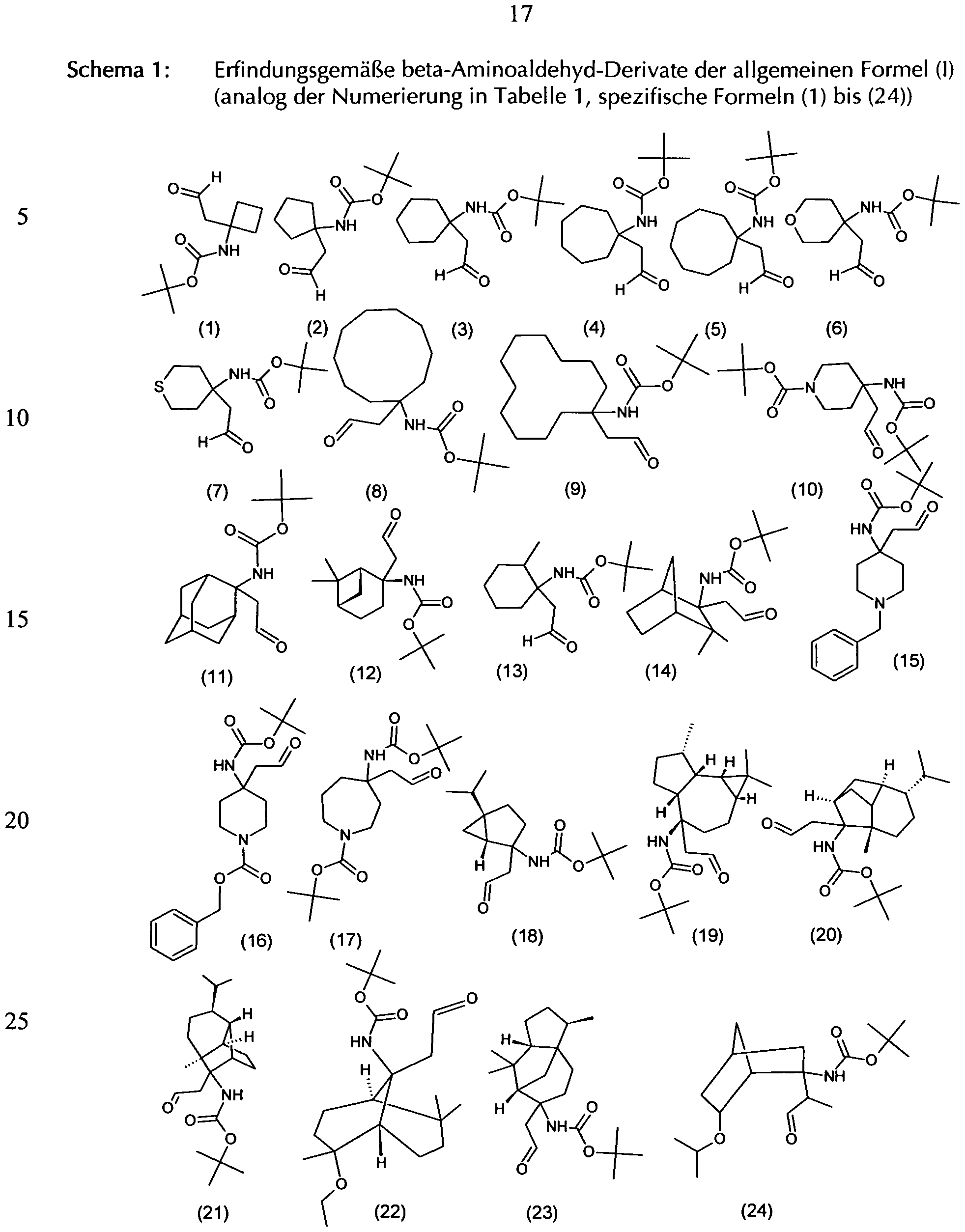


Formeln (II) (analog der Numerierung in Tabelle 2) (spezifische Formeln (56) bis (60))

Beispiele von erfindungsgemäßen beta-Aminoaldehyd-Derivaten allgemeinen Formel (III) (spezifische Formeln (61 ) bis (111))

(III)


Schema

(80) (81) (82)
Schema 3 (Forts.): Erfindungsgemäße beta-Aminoaldehyd-Derivate der allgemeinen
Formel (III) (Fortsetzung) (analog der Numerierung in Tabelle 3) (spezifische Formeln (85) bis (100)

(97) (98) (99) (100)
Schema 3 (Forts.): Erfindungsgemäße beta-Aminoaldehyd-Derivate der allgemeinen
Formel (III) (Fortsetzung) (analog der Numerierung in Tabelle 3) (s ezifische Formeln (101) bis (111)

(111)
Gemäß einer weiteren Ausführungsform der vorliegenden Erfindung wird die zugrundeliegende Aufgabe durch einen neuen Syntheseweg gelöst, der über die selektive reduktive Ringöffnung von beta-Laktamen die Darstellung von neuen beta-Aminoaldehyd- Derivaten der allgemeinen Formeln (I), (II) und (III) mit einer sehr großen Strukturvielfalt und mit überraschend großen Ausbeuten und zum Teil sogar quantitativ ermöglicht. Dabei unterscheidet sich die Darstellung der erfindungsgemäßen Verbindungen grundlegend von literaturbekannten Methoden. Die erfindungsgemäßen Verbindungen werden dabei bevorzugt durch das im Folgenden dargestellte erfindungsgemäße Verfahren zur Synthese der erfindungsgemäßen beta-Aminoaldehyd-Derivate der allgemeinen Formeln (I), (II) oder (III) hergestellt.
Bevorzugt umfasst dieses erfindungsgemäße Verfahren zur Synthese der erfindungsgemäßen beta-Aminoaldehyd-Derivate der allgemeinen Formeln (I), (II) oder (III) folgende Verfahrensschritte a) bis d):
a) Bildung eines beta-Laktams der allgemeinen Formeln (VII), (VIII) oder (IX), bevorzugt durch Addition von Chlorsulfonylisocyanat (CSI) an ein lineares oder cyclisches Olefin der allgemeinen Formeln (X), (XI) oder (XII) und Umsetzung zu einem beta- Laktam der allgemeinen Formeln (VII), (VIII) oder (IX);
b) Schutz der -NH-Gruppe der erhaltenen beta-Lactame aus Schritt a) durch Umsetzung dieser beta-Laktame mit einer Aminoschutzgruppe -R3 zu einem beta- Laktam der allgemeinen Formeln (IV), (V) oder (VI); und
c) reduktive Ringöffnung des in Schritt b) erhaltenen geschützten beta-Lactams durch Umsetzung des geschützten beta-Lactams mit einem Reduktionsmittel, bevorzugt einem (komplexen Hydrid), bevorzugt in einem Temperaturbereich von -90°C bis - 10°C, zu einem geschützten beta-Aminoaldehyd-Derivat der allgemeinen Formeln (I), (II) oder (III);
d) optionale Isolation und/oder Aufreinigung des aus Schritt c) erhaltenen geschützten beta-Aminoaldehyd-Derivats der allgemeinen Formeln (I), (II) oder (III). Das erfindungsgemäße Verfahren zur Synthese der erfindungsgemäßen beta-Aminoaldehyd- Derivate der allgemeinen Formeln (I), (II) oder (III) umfasst in einem ersten Schritt a) bevorzugt die Herstellung von beta-Laktamen der allgemeinen Formeln (VII), (VIII) oder (IX);
Gemäß einer ersten Alternative kann Schritt a) durch Addition von Chlorsulfonylisocyanat (CSI) an ein lineares oder cyclisches Olefin bevorzugt der allgemeinen Formeln (X), (XI) oder (XII) und Umsetzung zu einem beta-Laktam der allgemeinen Formeln (VII), (VIII) oder (IX) erfolgen. Bevorzugt erfolgt Schritt a), wie in Barrett at al, Graf et al, Füret et al. oder Nativi et al. beschrieben (siehe Barett et al, J. Org. Chem. 1985, 50, 169-1 75, R. Graf, Angew. Chem. 1968, 1 79-189, Füret et al, J. Med. Chem. 1999, 42, 2358-2363, Nativi et al. Tetrahedron Lett. 1991 , 32, 2265-2268).
Gemäß der ersten Alternative wird als Edukt bevorzugt ein lineares oder cyclisches Olefin der allgemeinen Formeln (X), (XI) oder (XII) ein esetzt:

(X) (XI) (XII) wobei die Reste der allgemeinen Formel (X) bevorzugt die in der Beschreibung genannten Bedeutungen der gleichnamigen Reste der allgemeinen Formel (I) haben,
die Reste der allgemeinen Formel (XI) bevorzugt die in der Beschreibung genannten Bedeutungen der gleichnamigen Reste der allgemeinen Formel (II) haben, und
die Reste der allgemeinen Formel (XII) bevorzugt die in der Beschreibung genannten Bedeutungen der gleichnamigen Reste der allgemeinen Formel (III) haben.
Weiterhin führt gemäß der ersten Alternative die Umsetzung des linearen oder cyclischen Olefins der allgemeinen Formeln (X), (XI) oder (XII) zu einem beta-Laktam der allgemeinen Formeln (VII), (VIII) oder (IX):

(VII) (VIII) (IX)
wobei die Reste der allgemeinen Formel (VII) bevorzugt die in der Beschreibung genannten Bedeutungen der gleichnamigen Reste der allgemeinen Formel (I) haben,
die Reste der allgemeinen Formel (VIII) bevorzugt die in der Beschreibung genannten Bedeutungen der gleichnamigen Reste der allgemeinen Formel (II) haben, und
die Reste der allgemeinen Formel (IX) bevorzugt die in der Beschreibung genannten Bedeutungen der gleichnamigen Reste der allgemeinen Formel (III) haben.
Dabei führt die Umsetzung des Edukts der allgemeinen Formel (X) in Schritt a) mit CSI zu einem beta-Laktam der allgemeinen Formel (VII). Weiterhin führt die Umsetzung des Edukts der allgemeinen Formel (XI) in Schritt a) mit CSI zu einem beta-Laktam der allgemeinen Formel (VIII). Abschließend führt die Umsetzung des Edukts der allgemeinen Formel (XII) in Schritt a) mit CSI zu einem beta-Laktam der allgemeinen Formel (IX). Die beta-Laktame der allgemeinen Formel (X), (XI) und (XII) stellen damit Intermediate der erfindungsgemäßen Reaktion dar, die ebenfalls vom Schutzbereich der vorliegenden Erfindung umfasst sind.
Gemäß einer zweiten Alternative kann Schritt a) alternativ durch die Cyclisierung von Ketenen oder zwitterionischen Enolaten mit Iminen erfolgen. Eine solche Cyclisierung von Ketenen oder zwitterionischen Enolaten mit Iminen wird bevorzugt durchgeführt wie in France et al. oder in Hart et al. beschrieben (siehe France et al. Acc. Chem. Res. 2004, 37, 592-500, Hart et al. Chem. Rev. 1989, 89, 1447-1465, Tetrahedron Lett. 1991 , 32, 5187- 5190). Auch die zweite Alternative führt zur Bildung eines beta-Laktams der allgemeinen Formeln (VII), (VIII) oder (IX), wie zuvor beschrieben.
Gemäß einer dritten Alternative kann Schritt a) alternativ durch eine radikalische Cyclisierung erfolgen. Eine solche radikalische Cyclisierung wird bevorzugt durchgeführt wie in Alcaide et al. beschrieben (siehe Alcaide et al. Synthesis 2005, 2335-2340). Die dritte Alternative führt ebenfalls zur Bildung eines beta-Laktams der allgemeinen Formeln (VII), (VIII) oder (IX), wie zuvor beschrieben. In einem zweiten Schritt b) des erfindungsgemäßen Syntheseverfahrens wird die -NH- Gruppe der aus Schritt a) erhaltenen beta-Lactame durch Reaktion dieser beta-Laktame mit einer Aminoschutzgruppe -R3 zu einem beta-Laktam der allgemeinen Formeln (IV), (V) oder (VI) umgesetzt.
In diesem Zusammenhang ist die Aminoschutzgruppe -R3 bevorzugt eine einem Fachmann bekannte (gebräuchliche) Schutzgruppe für Amine, stärker bevorzugt ausgewählt aus (gebräuchlichen) Schutzgruppen für Amine, umfassend, ohne darauf beschränkt zu sein, z.B. Allyloxycarbonyl (Aloe), Benzyl (Bn), Benzyloxycarbonyl (Cbz), Benzyloxymethyl (BOM), tert-Butoxycarbonyl (Boc), tert-Butyldimethylsilyl (TBS), tert-Butyldiphenylsilyl (TBDPS), p-Methoxybenzyl (PMB), Methoymethyl (MOM), p-Methoxyphenyl (PMP), Tosyl (Ts), 2-Tosylethoxycarbonyl (Tsoc), 2-(Trimethylsilyl)ethoxycarbonyl (Teoc), Triisopropylsilyl (TIPS), und Trityl (Tr), etc.;
Die Reaktion gemäß Schritt b) des erfindungsgemäßen Syntheseverfahrens führt zu einem geschützten beta-Laktam der allgemeinen Formeln (IV), (V) oder (VI), die bevorzugt folgende Strukturen aufweisen:

(IV) (V) (VI) wobei die Reste der allgemeinen Formel (IV) bevorzugt die in der Beschreibung genannten Bedeutungen der gleichnamigen Reste der allgemeinen Formel (I) haben,
die Reste der allgemeinen Formel (V) bevorzugt die in der Beschreibung genannten Bedeutungen der gleichnamigen Reste der allgemeinen Formel (II) haben, und
die Reste der allgemeinen Formel (VI) bevorzugt die in der Beschreibung genannten Bedeutungen der gleichnamigen Reste der allgemeinen Formel (III) haben.
Dabei führt die Umsetzung des beta-Laktams der allgemeinen Formel (VII) in Schritt b) des erfindungsgemäßen Verfahrens zu einem geschützten beta-Laktam der allgemeinen Formel (IV). Weiterhin führt die Umsetzung des beta-Laktams der allgemeinen Formel (VIII) in Schritt b) des erfindungsgemäßen Verfahrens zu einem geschützten beta-Laktam der allgemeinen Formel (V). Abschließend führt die Umsetzung des beta-Laktams der allgemeinen Formel (IX) in Schritt b) des erfindungsgemäßen Verfahrens zu einem
geschützten beta-Laktam der allgemeinen Formel (VI). Die beta-Laktame der allgemeinen Formeln (IV), (V) und (VI) stellen damit Intermediate der erfindungsgemäßen Reaktion dar, die ebenfalls vom Schutzbereich der vorliegenden Erfindung umfasst sind. In einem weiteren Schritt c) des erfindungsgemäßen Verfahrens wird das in Schritt b) erhaltene geschützte beta-Lactam der allgemeinen Formeln (IV), (V) oder (VI) einer reduktiven Ringöffnung durch Umsetzung des geschützten beta-Lactams mit einem Reduktionsmittel unterworfen, die zu einem geschützten beta-Aminoaldehyd-Derivat der allgemeinen Formeln (I), (II) oder (III) führt.

Das Reduktionsmittel, insbesondere das als Reduktionsmittel bevorzugt verwendete (komplexe) Hydrid in Schritt c) des erfindungsgemäßen Verfahrens, wird im Allgemeinen in einer Menge von 1 mol bis 10 mol, bevorzugt von 2 mol bis 4 mol bezogen auf 1 mol der Verbindungen der allgemeinen Formel (IV), (V) oder (VI) eingesetzt.
In Schritt c) des erfindungsgemäßen Verfahrens wird ferner als Lösungsmittel typischerweise ein inertes Lösungsmittel oder eine Kombination aus inerten Lösungsmitteln eingesetzt. Als
inertes Lösemittel eignen sich erfindungsgemäß typischerweise einem Fachmann bekannte und übliche organische Lösemittel, die sich unter den Reaktionsbedingungen, insbesondere den Reaktionsbedingungen der erfindungsgemäßen Synthesereaktion, nicht verändern. Ohne darauf beschränkt zu sein, umfassen solche inerten Lösungsmittel in Schritt c) des erfindungsgemäßen Verfahrens typischerweise Ether, wie bspw. Diethylether, Butylmethylether, Dioxan oder Tetrahydrofuran, oder (aromatische) Kohlenwasserstoffe wie bspw. Benzol, Toluol oder Xylol, oder Gemische der vorgenannten Lösemittel, bevorzugt Gemische aus zwei oder drei der vorgenannten Lösungsmittel. Bevorzugt wird in Schritt c) des erfindungsgemäßen Verfahrens Tetrahydrofuran als inertes Lösungsmittel eingesetzt. Solche inerten Lösungsmittel können auch in anderen Schritten des Verfahrens eingesetzt werden.
Die Umsetzung gemäß Schritt c) des erfindungsgemäßen Verfahrens erfolgt typischerweise in einem Temperaturbereich von -90°C bis -10°C, bevorzugt von -80°C bis -30°C, noch stärker bevorzugt von -75°C bis -60°C, z.B. etwa -70°C. Diese tiefe Temperaturwahl ermöglicht eine vom bisherigen Stand der Technik nicht erreichte nahezu quantitative Umsetzung und damit herausragende Ausbeute mit einer hohen Reinheit der erhaltenen Produkte. Die Umsetzung wird ferner typischerweise bei Normaldruck durchgeführt. Es ist jedoch ebenso möglich, die Umsetzung bei erhöhtem oder erniedrigtem Druck durchzuführen, bspw. in einem Bereich von z.B. 0,5 bis 5 bar, oder in einem Bereich von 0,5 bar bis 1 bar oder in einem Bereich von 1 bar bis etwa 5 bar. Die Reaktion in Schritt c) des erfindungsgemäßen Verfahrens wird bevorzugt unter Schutzgas, wie Stickstoff oder Argon durchgeführt.
Nach Ende der Zugabe aller Bestandteile in Schritt c) des erfindungsgemäßen Verfahrens lässt man vorzugsweise noch 10 min bis 5 h, besonders bevorzugt 10 min bis 1 ,5 h nachreagieren, um die Reaktion zu vervollständigen.
Nach erfolgter Umsetzung in Schritt c) des erfindungsgemäßen Verfahrens wird die Reaktionsmischung bevorzugt tropfenweise mit einer Menge von 10 bis 30 mol Wasser
bezogen auf ein mol der Verbindungen allgemeinen Formeln (IV), (V) oder (VI) versetzt. Danach lässt man bevorzugt die Reaktionsmischung auf Raumtemperatur erwärmen.
In einem weiteren optionalen Schritt d) des erfindungsgemäßen Verfahrens wird das in Schritt c) erhaltene geschützte beta-Aminoaldehyd-Derivat der allgemeinen Formeln (I), (II) oder (III), bevorzugt isoliert und/oder aufgereinigt.
Beispielsweise können die mit dem erfindungsgemäßen Verfahren hergestellten erfindungsgemäßen beta-Aminoaldehyd-Derivate der allgemeinen Formeln (I), (II) oder (III) nach literaturbekannten Methoden, bspw. Kristallisation, Extraktion oder mit chromatographischen Verfahren isoliert werden. In den meisten Fällen ist das Rohprodukt aus Schritt c) des erfindungsgemäßen Verfahrens nach Entfernen des Lösungsmittels von sehr hoher Reinheit und kann für weitere Reaktionen, z.B. für Olefinierungsreaktionen und andere Umsetzungen, eingesetzt werden. Falls notwendig können die mit dem erfindungsgemäßen Verfahren hergestellten erfindungsgemäßen beta-Aminoaldehyd- Derivate der allgemeinen Formeln (I), (II) oder (III) zusätzlich oder alternativ noch aufgereinigt werden, z.B. durch Umkristallisation, etc.
Gemäß einer besonderen Ausführungsform kann das erfindungsgemäße Verfahren zur Herstellung eines erfindungsgemäßen beta-Aminoaldehyd-Derivats der allgemeinen Formel (I), wie im Folgenden durch folgendes Formelschema 4 beispielhaft beschrieben, durch eführt werden.

(112) (113) (114) (6)
Für die oben genannte besondere Ausführungsform können alle zuvor beschriebenen Verfahrensbedingungen, v.a. unter Verwendung von CSI in Verfahrensschritt a), angewendet werden. Gemäß der besonderen Ausführungsform wird bevorzugt das nach Standardmethoden (Organikum, 22. Auflage, Wiley-VCH Verlag GmbH &C. KGaA, S. 539) hergestellte Olefin (1 12) nach Graf (R. Graf, Angew. Chem. 1968, 1 79-189) mit CSI zum
Laktam (1 13) umgesetzt und anschließend mit Boc20 zum geschützten Laktam (1 14) transformiert (P. J. Kocienski, Protecting Groups, Georg Thieme Verlag Stuttgart, 1994 (S. 192-195)). Die erfindungsgemäße Verbindung (6) wird quantitativ durch Reduktion mit Diisobutylaluminiumhydrid (DIBALH) erhalten. Die erfindungsgemäße Verbindung (6) ist eine spezifische Verbindung des beta-Aminoaldehyd-Derivats der allgemeinen Formel (I), s. Tabellel .
Gemäß einer weiteren besonderen Ausführungsform kann das erfindungsgemäße Verfahren zur Herstellung eines erfindungsgemäßen beta-Aminoaldehyd-Derivats der allgemeinen Formel (II), wie im Folgenden durch folgendes Formelschema 5 beispielhaft beschrieben, durch eführt werden.

Für die oben genannte besondere Ausführungsform können ebenfalls alle zuvor beschriebenen Verfahrensbedingungen, v.a. unter Verwendung von CSI in Verfahrensschritt a), angewendet werden. Gemäß der besonderen Ausführungsform wird bevorzugt das enantiomerenreine Terpen (a-Pinen) (1 15) zum beta-Lactam (1 16) und anschließend zur geschützten Verbindung (1 1 7) transformiert. Die Reduktion mit DIBALH ergibt den enantiomeren-reinen beta-Aminoaldehyd (38) in hohen Ausbeuten. Die erfindungsgemäße Verbindung (38) ist eine spezifische Verbindung des beta-Aminoaldehyd-Derivats der allgemeinen Formel (II), s. Tabelle 2.
Gemäß einer anderen besonderen Ausführungsform kann das erfindungsgemäße Verfahren zur Herstellung eines erfindungsgemäßen beta-Aminoaldehyd-Derivats der allgemeinen Formel (III), wie im Folgenden durch folgendes Formelschema 6 beispielhaft beschrieben, durchgeführt werden.

(118) (119) (120) (77)
Für die oben genannte besondere Ausführungsform können ebenfalls alle zuvor beschriebenen Verfahrensbedingungen, v.a. unter Verwendung von CSI in Verfahrensschritt a), angewendet werden. Gemäß der besonderen Ausführungsform wird der Naturstoff Isopren ((1 18)) zum Lactam (1 19) und anschließend zur Boc-geschützten Verbindung (120) transformiert. Die Reduktion mit DIBALH liefert quantitativ den hochfunktionalisierten, geschützten Aldehyd (77). Die erfindungsgemäße Verbindung (77) ist eine spezifische Verbindung des beta- Aminoaldehyd-Derivats der allgemeinen Formel (III) (s. Tabelle 3).
Gemäß einer anderen besonderen Ausführungsform kann das erfindungsgemäße Verfahren zur Synthese der erfindungsgemäßen beta-Aminoaldehyd-Derivate der allgemeinen Formeln (I), (II) oder (III) auch ausschließlich auf Basis der Verfahrensschritte c) und d) erfolgen (i. e. a) und b) sind optional), wobei für Schritt c) lediglich die in Schritt b) beschriebenen Endprodukte bereitgestellt werden müssen.
Gemäß einer weiteren Ausführungsform wird die der vorliegenden Erfindung zugrundeliegende Aufgabe durch neuartige Verwendungen der erfindungsgemäßen Verbindungen gelöst, insbesondere der erfindungsgemäßen beta-Aminoaldehyd-Derivate der allgemeinen Formeln (I), (II) und (III), sowie auch der erfindungsgemäßen beta-Lactame der allgemeinen Formeln (IV), (V) und (VI) oder der erfindungsgemäßen beta-Lactame der allgemeinen Formeln (VII), (VIII) und (IX) sowie deren spezifische Verbindungen der Formeln (1 )-(1 1 1 ) (s. Tabelle 1 , 2 und 3).
Gemäß einer ersten besonderen Ausführungsform der vorliegenden Erfindung werden die Verbindungen der Formeln (X), (XI) oder (XII), die erfindungsgemäßen beta-Lactame der allgemeinen Formeln (VII), (VIII) oder (IX), und/oder die erfindungsgemäßen beta-Lactame der allgemeinen Formeln (IV), (V) oder (VI), sowie deren spezifische Verbindungen der Formeln (1 )-(1 1 1 ) (s. Tabelle 1 , 2 und 3) zur Herstellung der erfindungsgemäßen beta- Aminoaldehyd-Derivate der allgemeinen Formeln (I), (II) und (III) verwendet.
Gemäß einer besonderen Ausführungsform der vorliegenden Erfindung werden die erfindungsgemäßen beta-Aminoaldehyd-Derivate der allgemeinen Formeln (I), (II) und (III), die erfindungsgemäßen beta-Lactame der allgemeinen Formeln (IV), (V) und (VI) und/oder
die erfindungsgemäßen beta-Lactame der allgemeinen Formeln (VII), (VIII) und (IX), sowie deren spezifische Verbindungen der Formeln (1 )-(1 1 1 ) (s. Tabelle 1 , 2 und 3) zur Herstellung von reaktiven Intermediaten oder als reaktive Intermediate selbst verwendet. Solche reaktiven Intermediate können beispielsweise z.B. als Peptidomimetikum, z.B. für Diagnosezwecke in vivo oder in vitro, als Kopplungsagens, z.B. zur chemischen Synthese, als Synthon, bspw. als Synthon in der chemischen Synthese, etc., verwendet werden.
Gemäß einer weiteren besonderen Ausführungsform der vorliegenden Erfindung werden die erfindungsgemäßen beta-Aminoaldehyd-Derivate der allgemeinen Formeln (I), (II) und (III), sowie deren spezifische Verbindungen der Formeln (1 )-(1 1 1 ) (s. Tabelle 1 , 2 und 3), und ggf. ebenfalls die Verbindungen der Formeln (X), (XI) oder (XII), die erfindungsgemäßen beta-Lactame der allgemeinen Formeln (VII), (VIII) oder (IX), und/oder die erfindungsgemäßen beta-Lactame der allgemeinen Formeln (IV), (V) oder (VI), zur Herstellung von Peptidomimetika oder als Peptidomimetika selbst verwendet. Solche Peptidomimetika können beispielsweise in der Medizin, bspw. in der Prophylaxe, Diagnostik oder Therapie, bevorzugt in der Prophylaxe, Diagnostik oder Therapie spezifischer Erkrankungen wie bspw. in der Tumortherapie, oder bei Infektionskrankheiten eingesetzt werden, z.B. bei viralen und/oder bakteriellen Infektionskrankheiten oder bei Infektionskrankheiten, die durch pathogene Erreger verursacht werden, etc.
Gemäß einer besonderen Ausführungsform werden daher die erfindungsgemäßen beta- Aminoaldehyd-Derivate der allgemeinen Formeln (I), (II) und (III), sowie deren spezifische Verbindungen der Formeln (1 )-(1 1 1 ) (s. Tabelle 1 , 2 und 3), und ggf. ebenfalls die Verbindungen der Formeln (X), (XI) oder (XII), die erfindungsgemäßen beta-Lactame der allgemeinen Formeln (VII), (VIII) oder (IX), und/oder die erfindungsgemäßen beta-Lactame der allgemeinen Formeln (IV), (V) oder (VI), z.B. als Peptidomimetika oder als Medikament, z.B. als Medikament in Form eines Peptidomimetikums, bspw. zur Prophylaxe, Diagnostik oder Therapie spezifischer Erkrankungen wie bspw. Krebs, oder Infektionskrankheiten eingesetzt, z.B. bei viralen und/oder bakteriellen Infektionskrankheiten oder bei Infektionskrankheiten, die durch pathogene Erreger verursacht werden, etc.
Gemäß einer anderen besonderen Ausführungsform der vorliegenden Erfindung werden die erfindungsgemäßen beta-Aminoaldehyd-Derivate der allgemeinen Formeln (I), (II) und (III),
sowie deren spezifische Verbindungen der Formeln (1 )-(1 1 1 ) (s. Tabelle 1 , 2 und 3), und ggf. ebenfalls die Verbindungen der Formeln (X), (XI) oder (XII), die erfindungsgemäßen beta-Lactame der allgemeinen Formeln (VII), (VIII) oder (IX), und/oder die erfindungsgemäßen beta-Lactame der allgemeinen Formeln (IV), (V) oder (VI), zur Herstellung von Kopplungsagentien oder als Kopplungsagentien selbst verwendet. Solche Kopplungsagentien können beispielsweise in der Medizin, bspw. in der Prophylaxe, Diagnostik oder Therapie, bevorzugt in der Prophylaxe, Diagnostik oder Therapie spezifischer, wie oben beschriebener, Erkrankungen verwendet werden.
Alle in dieser Beschreibung genannten Alternativen oder Ausführungsformen können miteinander verknüpft werden, soweit nicht anders angegeben. Ferner wird der Inhalt der zitierten Literaturstellen durch Verweis vollumfänglich in der vorliegenden Beschreibung aufgenommen.
Beispiele:
Die vorliegenden Beispiele sollen lediglich die Erfindung veranschaulichen und sind in keiner Weise beschränkend auszulegen.
Beispiel 1
In einem ersten Experiment wurde ein erfindungsgemäßes beta-Aminoaldehyd-Derivat der allgemeinen Formel (I) wie folgt hergestellt:

Für die Synthese wurden die in der Beschreibung genannten Verfahrensbedingungen verwendet, v.a. die unter Verwendung von CSI in Verfahrensschritt a) genannten Verfahrensbedingungen. Dabei wurde das nach Standardmethoden (Organikum, 22. Auflage, Wiley-VCH Verlag GmbH &C. KGaA, S. 539) hergestellte Olefin (1 12) nach Graf (R. Graf, Angew. Chem. 1968, 1 79-189) mit CSI zum Laktam (1 1 3) umgesetzt und anschließend mit Boc2O zum geschützten Laktam (1 14) transformiert (P. J. Kocienski, Protecting Groups, Georg Thieme Verlag Stuttgart, 1994 (S. 192-195)). Die erfindungsgemäße Verbindung (6) wurde quantitativ durch Reduktion mit Diisobutylaluminiumhydrid (DIBALH) erhalten.
Beispiel 2
In einem zweiten Experiment wurde ein erfindungsgemäßes beta-Aminoaldehyd-Derivat der

(115) (116) (117) (38)
Für die Synthese wurden die in der Beschreibung genannten Verfahrensbedingungen verwendet, v.a. die unter Verwendung von CSI in Verfahrensschritt a) genannten Verfahrensbedingungen. Dabei wurde das enantiomerenreine Terpen (a-Pinen) (1 15) zum beta-Lactam (1 16) und anschließend zur geschützten Verbindung (1 1 7) transformiert. Die Reduktion mit DIBALH ergab den enantiomeren-reinen beta-Aminoaldehyd 38) in hohen Ausbeuten.
Beispiel 3
In einem dritten Experiment wurde ein erfindungsgemäßes beta-Aminoaldehyd-Derivat der allgemeinen Formel (III) wie folgt hergestellt:

(118) (119) (120) (77)
Für die Synthese wurden die in der Beschreibung genannten Verfahrensbedingungen verwendet, v.a. die unter Verwendung von CSI in Verfahrensschritt a) genannten Verfahrensbedingungen. Dabei wurde der Naturstoff Isopren (1 18) zum Lactam (1 19) und anschließend zur Boc -geschützten Verbindung (120) transformiert. Die Reduktion mit DIBALH liefert quantitativ den hochfunktionalisierten, geschützten Aldehyd (77). Beispiel 4
Synthese von fe -butyl i4-(2-oxoethyl)tetrahydro-2^-pyran-4-yllcarbamate (6)

(114) (6)
24.1 g (0.1 mol) tert-buty\ 2-oxo-7-oxa-1 -azaspiro[3.5] nonane-1 -carboxylate (1 14) wird unter Argon in 300 ml Tetrahydrofuran (wasserfrei) vorgelegt und auf -70°C abgekühlt. Dazu gibt man vorsichtig und portionsweise via Transfernadel 42 g (0.3 mol) Diisobutylaluminiumhydrid (DIBALH) gelöst in 300 ml Toluol (auf -70°C vorgekühlt) hinzu. Danach rührt man das Gemisch noch weitere 2 h bei - 70°C. Danach gibt man tropfenweise zuerst 100 ml Essigsäureethylester und danach 100 ml Methanol dazu. Die Temperatur der Reaktionsmischung wird dabei auf -70°C gehalten. Man rührt dann noch 60 min bei -70° C. Anschließend wird (zuerst tropfenweise) 300 ml Wasser hinzugefügt, die Kühlung entfernt und noch 300 ml Diethylether zu der Mischung gegeben und lässt schließlich den Ansatz auf Raumtemperatur erwärmen. Mit 1 N HCl wird dann die wässrige Lösung auf pH 4 eingestellt und die organische Phase abgetrennt. Die wässrige Phase wird 2 x Diethylether extrahiert und anschließend werden die organischen Phasen vereinigt und dann 1 x mit Wasser, 1 x mit Natriumbicarbonat, 1 x mit Wasser und schießlich 2 x mit Brine ausgeschüttelt. Nach Trockung über Natriumsulfat wird die organische Phase i.vak. eingeengt und der Rückstand an Kieselgel gereinigt (Petrolether/Diethylether 3: 1 ). Man erhält 18.2 g von (6) als farbloses Öl. Ausbeute: 76 %.
Die NMR Daten wurden wie folgt bestimmt:
'H-NMR (500 MHz, CDCI3) δ (ppm) = 9.71 (s, (br) 1 H, CHO), 4.7 (s, (br), 1 H, NH), 3.71 (m, 4H), 2.82 (m, 2H), 1 .91 (m, 2H), 1 .71 (m, 2H), 1 .44 (s, 9H).
Beispiel 5
Synthese von fe/f-butyl f(1 ,25,3^.55)-3-formyl-2,6.6-trimethylbicyclo[3.1 .1 lhept-2- yllcarbamate (38)

In analoger Weise, wie in Beispiel 4 beschrieben, erhält man aus 1 7 g (0.06 mol) (terf-butyl (1 ,25,5 ?,75)-2,8,8-trimethyl-4-oxo-3-azatricyclo[5.1 .1 .02 S]nonane-3-carboxylate (1 1 7) 15 g der Titelverbindung (38) als weißes Pulver. Ausbeute: 88 %
Die NMR Daten wurden wie folgt bestimmt:
Ή-NMR (500 MHz, CDCI3) δ (ppm) = 9.74 (d, J=7.6 Hz, 1 H, CHO), 4.75 (s, (br), 1 H, NH), 2.92 (m, 1 H), 2.69 (m, 1 H), 2.30 (m, 1 H), 2.2-2.8 (m, 4H), 1 .51 (s, 9H), 1 .49 (s, 3H), 1 .31 (s, 3H), 1 .05 (s, 3H).
Beispiel 6
Synthese von fe -butyl (3-methyl-5-oxopent-1 -en-3-yl)carbamate (77)

(120) (77)
In analoger Weise, wie in Beispiel 4 beschrieben, erhält man aus 56 g (0.265 mol) tert-buty] 2-ethenyl-2-methyl-4-oxoazetidine-1 -carboxylate (120) 51 g der Titelverbindung (77) als farbloses Öl. Ausbeute: 91 %
Die NMR Daten wurden wie folgt bestimmt:
'H-NMR (500 MHz, CDCI3) δ (ppm) = 9.74 (d, J=4.9 Hz, 1 H, CHO), 5.8 (m, 1 H) 5.7 (s, (br), 1 H, NH), 5.2 (m, 2H), 2.79 (dd, J = 13.8, 4.5 Hz, 1 H), 2.54 (d, J = 13.8 Hz, 1 H), 1 .75 (s, 3H), 1 .51 (s, 9H).
Beispiel 7
Synthese von te/f-butyl (3-oxo-1 -phenylpropyDcarbamate (62)

(121) (62)
In analoger Weise, wie in Beispiel 4 beschrieben, erhält man aus 67 g (0.271 mol) tert- butyl 2-oxo-4-phenylazetidine-1 -carboxylate (121 ) 53 g der Titelverbindung (62) als amorphes Pulver.
Ausbeute: 79 %
Die NMR Daten wurden wie folgt bestimmt:
Ή-NMR (500 MHz, CDCI3) δ (ppm) = 9.75 (s, (br) 1 H, CHO), 7.30 (m, 5H), 5.20 (s, (br), 1 H) 5.08 (s, (br), 1 H, NH), 2.93 (m, 2H), 1 .42 (s, 9H).
Beispiel 8
Synthese von fe/f-butyl (4-oxo-1 -phenylbutan-2-yl)carbamate (61 )

(122) (61)
In analoger Weise, wie in Beispiel 4 beschrieben, erhält man aus 180 g (0.689 mol) tert- butyl 2-benzyl-4-oxoazetidine-1 -carboxylate (122) 167 g der Titelverbindung (61 ) als amorphes Pulver.
Ausbeute: 93 %
Die NMR Daten wurden wie folgt bestimmt:
Ή-NMR (500 MHz, CDCI3) δ (ppm) = 9.71 (s, (br) 1 H, CHO), 7.35 (m, 5H), 4.78 (s, (br), 1 H) 4.25 (s, (br), 1 H), 2.95 (m, 1 H), 2.79 (m, 1 H), 2.55 (m, 2H) 1 .40 (s, 9H).
Beispiel 9
Synthese von fe/f-butyl (5-methyl-1 -oxohexan-3-yl)carbamate (75)

(123) (75)
In analoger Weise, wie in Beispiel 4 beschrieben, erhält man aus 50 g (0.22 mol) i i-butyl 2-(2-methylpropyl)-4-oxoazetidine-1 -carboxylate (123) 41 g der Titelverbindung (75) als amorphes Pulver. Ausbeute: 82%
Die NMR Daten wurden wie folgt bestimmt:
'H-NMR (500 MHz, CDCI3) δ (ppm) = 9.75 (s, (br) 1 H, CHO), 4.58 (s, (br), 1 H) 4.10 (s, (br), 1 H), 2.51 (m, 2H), 1 .63 (m, 2H), 1 .49 (s, 9H), 1 .18 (m, 1 H), 0.90 (d, J=7Hz, 6H).
Beispiel 10
Synthese von e/?-butyl (4,4-dimethyl-1 -oxopentan-3-yl)carbamate (72)

(124) (72)
In analoger Weise, wie in Beispiel 4 beschrieben, erhält man aus 28 g (0.123 mol) tert-buty\ 2-fe/?-butyl-4-oxoazetidine-1 -carboxylate 24 g der Titelverbindung (72) als amorphes Pulver. Ausbeute: 85%
Die NMR Daten wurden wie folgt bestimmt:
Ή-NMR (500 MHz, CDCI3) δ (ppm) = 9.72 (s, (br), 1 H, CHO), 4.50 (s, (br), 1 H) 4.00 (s, (br), 1 H), 2.60 (m, 1 H), 2.21 (m, 1 H), 1 .50 (s, 9H), 1 .18 (m, 1 H), 0.90 (2, 9H).
Beispiel 1 1
Synthese von tert-buty\ (4-methyl-l -oxopentan-3-yl)carbamate (73)

(125) (73)
In analoger Weise, wie in Beispiel 4 beschrieben, erhält man aus 30 g (0.14 mol) ie/T-butyl 2-oxo-4-(propan-2-yl)azetidine-1 -carboxylate 28 g der Titelverbindung (73) als öligen Feststoff. Ausbeute: 93%
Die NMR Daten wurden wie folgt bestimmt:
'H-NMR (500 MHz, CDCI3) δ (ppm) = 9.75 (s, (br), 1 H, CHO), 4.55 (s, (br), 1 H) 4.10 (s, (br), 1 H), 2.60 (m, 2H), 1.62 (m, 1 H), 1 .46 (s, 9H), 0.90 (d, J=7Hz, 6H). Beispiel 12
Synthese von fc/?-butyl f1 -(2-oxoethyl)cyclohexyllcarbamate (3)

(126) (3)
In analoger Weise, wie in Beispiel 4 beschrieben, erhält man aus 55 g(0.22 mol) tert- 2-oxo-1 -azaspiro[3.5]nonane-1 -carboxylate (126) 44 g der Titelverbindung (3) glasartigen Feststoff. Ausbeute 80%.
Die NMR Daten wurden wie folgt bestimmt:
'H-NMR (500 MHz, CDCI3) δ (ppm) = 9.80 (s, (br), 1 H, CHO), 4.54 (s, (br), 1 H), 2.80 (m, 2H), 2.00 (m, 2H), 1 .55 (m, 8H), 1 .49 (s, 9H)..
Beispiel 13
Synthese von fe -butyl Γ(1 ^.2^.55)-6.6-dimethyl-2-(2-oxoethyl)bicyclor3.1.llhept-2- yhcarbamate (12)

(127) (12)
In analoger Weise, wie in Beispiel 4 beschrieben, erhält man aus 10.5 g (0.039 mol) tert- butyl (l'^^/^S'iJ-e'^'-dimethyl^-oxo-l y-spiroIazetidine^^'-bicyclo .l.llheptanel-l- carboxylate (127 ) 8.3 g der Titelverbindung (12) als farbloses Öl. Ausbeute: 79%
Die NMR Daten wurden wie folgt bestimmt:
1H-NMR (500 MHz, CDCI3) δ (ppm) = 9.76 (s, (br), 1H, CHO), 4.77 (s, (br), 1 H), 3.05 (m, 2H), 2.35 (m, 1H), 2.20 (m, 1H), 1.91 (m, 5H), 1.40(2, 9H), 1.33( m, 1 H), 1.25 (s, 3H), 1- 00 (s, 3H).
Beispiel 14
Synthese von fe -butyl f(1 .35.4^.6^-4-formyl-3,7,7-trimethylbicyclor4.1.01hept-3- yllcarbamate (42)

(128) (42)
In analoger Weise, wie in Beispiel 4 beschrieben, erhält man aus 23 g (0.082 mol) ie/7-butyl (1 ?,3 ?,55,7 )-4,4,7-trimethyl-9-oxo-8-azatricyclo[5.2.0.03'5]nonane-8-carboxylate
(128 ) 19.3 g der Titelverbindung (12) als farbloses Öl. Ausbeute: 82%
Die NMR Daten wurden wie folgt bestimmt:
'H-NMR (500 MHz, CDCI3) δ (ppm) = 9.73 (s, (br), 1 H, CHO), 4.65 (s, (br), 1 H), 2.60 (m, 3H), 1 .70 (m, 2H), 1 .50 (s, 9H), 1 .49 ( s, 3H), 1 .25 (s, 3H), 1 -05 (s, 3H), 0.91 (m, 2H).
Beispiel 15
Synthese von tert-butyl 9-(2-oxoethyl)heptadecan-9-ylcarbamate (92)

In analoger Weise, wie in Beispiel 4 beschrieben, erhält man aus 1 1 g (0.028 mol) tert- butyl-(2,2)-dioctyl-4-oxaazetidine-1 -carboxylatenonane-8-carboxylate (129 ) 9.5 g der Titelverbindung (12) als farbloses Öl. Ausbeute: 86%
Die NMR Daten wurden wie folgt bestimmt:
'H-NMR (500 MHz, CDCI3) δ (ppm) = 9.78 (s, (br), 1 H, CHO), 4.65 (s, (br), 1 H), 2.67 (m, 2H), 1 .75 (t, J=7.5Hz, 4H), 1 .45 (s, 9H), 1 .30 ( m, 24H), 0.91 (t, J= 6.0 Hz, 6H).3H).
Claims
Ansprüche Verfahren zur Synthese der beta-Aminoaldehyd-Derivate der Formeln (I), (II) oder (III),
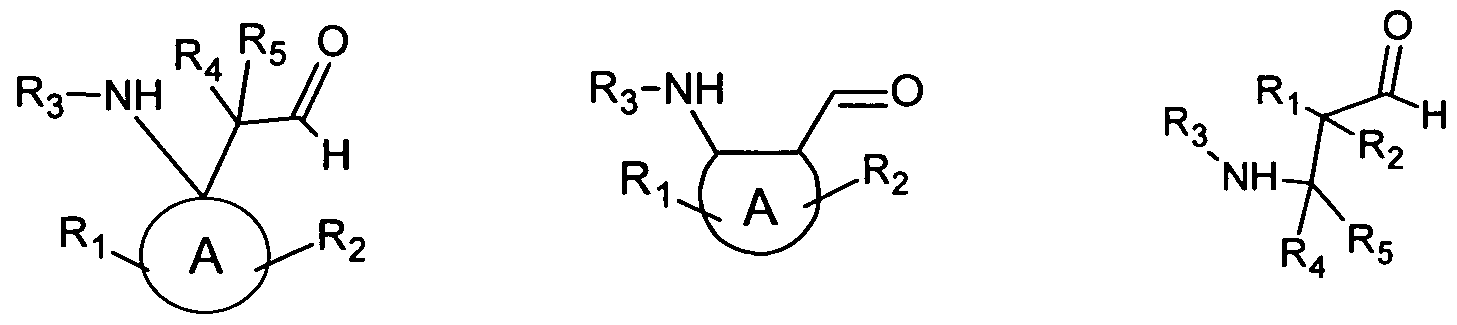
(I) (II) ("') wobei:
in Formel (I):
A ein C3-C24-Cycloalkyl ist, wobei optional mindestens ein oder mehrere Kohlenstoffatome durch Stickstoff-, Sauerstoff- und/oder Schwefelatome substituiert sind; oder
ein C3-C24-Cycloalkenyl ist, das eine oder mehrere Doppelbindungen und optional eine oder mehrere Dreifachbindungen enthält, wobei optional mindestens ein oder mehrere Kohlenstoffatome durch Stickstoff-, Sauerstoff- und/oder Schwefelatome substituiert sind; oder
ein Adamantyl ist;
R, und R2 gleich oder verschieden sind und R, und R2 jeweils unabhängig voneinander
ein Wasserstoff ist,
ein C3-C6-Cycloalkyl ist, das optional durch mindestens ein Halogen, mindestens eine geradkettige oder verzweigte Q-Q- Alkoxygruppe oder mindestens eine Hydroxygruppe substituiert ist,
ein geradkettiges oder verzweigtes C,-C„-Alkyl ist, das optional durch mindestens ein Halogen, mindestens eine
geradkettige oder verzweigte C,-C6-Alkoxygruppe und/oder mindestens eine Hydroxygruppe substituiert ist,
ein Halogen ist,
eine Hydroxygruppe ist,
eine Aminogruppe ist,
ein Phenyl ist, das optional durch mindestens ein Halogen (F, Cl, Br, I), mindestens eine Nitrogruppe (-N02), mindestens eine Cyanogruppe (-CN), mindestens eine Boronsäuregruppe (-B(OH)2, mindestens eine Carboxygruppe (-COOH), mindestens eine geradkettige oder verzweigte Q-Q-Alkyl-, Q- Q-Alkoxy-, C,-C6-Acyl- oder C,-C6-Alkoxycarbonylgruppe und/oder durch mindestens eine Gruppe der Formel -NR6R7 substituiert ist, worin R6 und R7 gleich oder verschieden sind und jeweils unabhängig voneinander ein Wasserstoff oder ein geradkettiges oder verzweigtes C,-C6-Alkyl ist, oder
R, und R2 gemeinsam oder unabhängig voneinander mit einem beliebigen Atom oder zwei beliebigen Atomen des Ringes A einen gesättigten, ungesättigten oder aromatischen kondensierten homo- oder heterocyclischen Ring mit 4 bis 100 Kohlenstoffatomen und 3- bis 15 Gliedern bilden, wobei der heterocyclische Ring optional mindestens ein oder mehrere Heteroatome(e) aus der Gruppe N, S oder O enthält und/oder die homo- oder heterocyclischen Ringe optional mit geradkettigem oder verzweigtem C,-C8-Alkyl substituiert sind; eine Schutzgruppe für Amine ist, ausgewählt aus Schutzgruppen für Amine, umfassend Allyloxycarbonyl (Aloe), Benzyl (Bn), Benzyloxycarbonyl (Cbz), Benzyloxymethyl (BOM), tert-Butoxycarbonyl (Boc), tert- Butyldimethylsilyl (TBS), tert-Butyldiphenylsilyl (TBDPS), p- Methoxybenzyl (PMB), Methoymethyl (MOM), p-
Methoxyphenyl (PMP), Tosyl (Ts), 2-Tosylethoxycarbonyl (Tsoc), 2-(Trimethylsilyl)ethoxycarbonyl (Teoc),
Triisopropylsilyl (TIPS), und Trityl (Tr); gleich oder verschieden sind und jeweils unabhängig voneinander
ein Wasserstoff ist,
ein C3-C6-Cycloalkyl ist, das optional durch mindestens ein Halogen, mindestens eine geradkettige oder verzweigte C,-C6- Alkoxygruppe oder mindestens eine Hydroxygruppe substituiert ist,
ein geradkettiges oder verzweigtes C,-C8-Alkyl ist, das optional durch mindestens ein Halogen, mindestens eine geradkettige oder verzweigte C,-C6-Alkoxygruppe oder mindestens eine Hydroxygruppe substituiert ist,
ein geradkettiges oder verzweigtes [C2-C8-]Alkenyl ist, ein geradkettiges oder verzweigtes [C2-C8-]Alkinyl ist, ein Halogen ist,
ein Hydroxygruppe ist,
eine Aminogruppe ist,
ein Phenyl oder Benzyl ist, die optional jeweils durch mindestens ein Halogen, mindestens eine Nitrogruppe, mindestens eine Cyanogruppe, mindestens eine Boronylgruppe, mindestens eine Carboxygruppe, oder mindestens eine geradkettige oder verzweigte C,-C6-Alkyl-, C,-C6-Alkoxy-, C,-C6-Acyl- oder C,-C6-Alkoxycarbonylgruppe substituiert sind,
oder
ein Heteroaryl-Rest ist, der ein Heteroatom oder mehrere Heteroatome aus der Reihe N, S oder O enthalten kann wobei die Verknüpfung direkt
oder über die Brückenglieder -CH2- oder -CH2-CH2- oder - CH2-CH2-CH2- erfolgen kann;
oder
R4 und R5 gemeinsam einen gesättigten, ungesättigten oder aromatischen homo- oder heterocyclischen Ring mit 4 bis 100 Kohlenstoffatomen und mit 3- bis 15 Gliedern bilden können, wobei der heterocyclische Ring mindestens ein oder mehrere Heteroatome(e) aus der Gruppe N, S oder O enthält, oder ein C2-C9-Alkenyl-Rest ist, der optional mit C,-C5- Alkylgruppen substituiert ist und mindestens eine Doppelbindung enthält; in Formel (II)
A ein C3-C24-Cycloalkyl ist, wobei optional mindestens ein oder mehrere Kohlenstoffatome durch Stickstoff-, Sauerstoff- und/oder Schwefelatome substituiert sind; oder ein C3-C24-Cycloalkenyl ist, das eine oder mehrere Doppelbindungen und optional eine oder mehrere Dreifachbindungen enthält, wobei optional mindestens ein oder mehrere Kohlenstoffatome durch Stickstoff-, Sauerstoff- und/oder Schwefelatome substituiert sind; oder ein Adamantyl ist;
R, und R2 gleich oder verschieden sind und R, und R2 jeweils unabhängig voneinander
ein Wasserstoff ist,
ein C3-C6-Cycloalkyl ist, das optional durch mindestens ein Halogen, mindestens eine geradkettige oder verzweigte C,-C6- Alkoxygruppe oder mindestens eine Hydroxygruppe substituiert ist,
ein geradkettiges oder verzweigtes Q-Q-Alkyl ist, das optional durch mindestens ein Halogen, mindestens eine
geradkettige oder verzweigte Q-Q-Alkoxygruppe und/oder mindestens eine Hydroxygruppe substituiert ist,
ein Halogen ist,
eine Hydroxygruppe ist,
eine Aminogruppe ist, ein Phenyl ist, das optional durch mindestens ein Halogen, mindestens eine Nitrogruppe, mindestens eine Cyanogruppe, mindestens eine Boronylgruppe, mindestens eine Carboxygruppe, mindestens eine geradkettige oder verzweigte C,-C6-Alkyl-, C,-C6-Alkoxy-, Q-Q-Acyl- oder C,-C6- Alkoxycarbonylgruppe und/oder durch mindestens eine Gruppe der Formel -NR6R7 substituiert ist, worin R6 und R7 gleich oder verschieden sind und jeweils unabhängig voneinander ein Wasserstoff oder ein geradkettiges oder verzweigtes Q-Q-Alkyl ist, oder
R, und R2 gemeinsam mit einem beliebigen Atom oder zwei beliebigen Atomen des Ringes A einen gesättigten, ungesättigten oder aromatischen kondensierten homo- oder heterocyclischen Ring mit 4 bis 100 Kohlenstoffatomen und 3- bis 15 Gliedern bilden, wobei der heterocyclische Ring optional mindestens ein oder mehrere Heteroatome(e) aus der Gruppe N, S oder O enthält und/oder die homo- oder heterocyclischen Ringe optional mit geradkettigem oder verzweigtem C,-C8-Alkyl substituiert sind; eine Schutzgruppe für Amine ist, ausgewählt aus Schutzgruppen für Amine, umfassend Allyloxycarbonyl (Aloe), Benzyl (Bn), Benzyloxycarbonyl (Cbz), Benzyloxymethyl (BOM), tert-Butoxycarbonyl (Boc), tert-Butyldimethylsilyl
(TBS), tert-Butyldiphenylsilyl (TBDPS), p-Methoxybenzyl (PMB), Methoymethyl (MOM), p-Methoxyphenyl (PMP), Tosyl (Ts), 2-Tosylethoxycarbonyl (Tsoc), 2-
(Trimethylsilyl)ethoxycarbonyl (Teoc), Triisopropylsilyl (TIPS), und Trityl (Tr); und in Formeln (III):
R, und R2 gleich oder verschieden sind und R, und R2 jeweils unabhängig voneinander
ein Wasserstoff ist,
ein C3-C6-Cycloalkyl ist, das optional durch mindestens ein Halogen, mindestens eine geradkettige oder verzweigte C,-C6- Alkoxygruppe oder mindestens eine Hydroxygruppe substituiert ist
ein geradkettiges oder verzweigtes C,-C8-Alkyl ist, das optional durch mindestens ein Halogen, mindestens eine geradkettige oder verzweigte C,-C6-Alkoxygruppe und/oder mindestens eine Hydroxygruppe substituiert ist, ein geradkettiges oder verzweigtes [C2-C8-]Alkenyl ist , ein geradkettiges oder verzweigtes [C2-C8-]Alkinyl ist ein Halogen ist,
eine Hydroxygruppe ist,
eine Aminogruppe ist,
eine Silylgruppe ist,
wobei die Verknüpfung direkt
oder über die Brückenglieder -CH2- oder -CH2-CH2- oder - CH2-CH2-CH2- erfolgen kann,
ein Phenyl oder ein Benzyl ist, die jeweils optional durch mindestens ein Halogen, mindestens eine Nitrogruppe, mindestens eine Cyanogruppe, mindestens eine Boronylgruppe, mindestens eine Carboxygruppe, mindestens
eine geradkettige oder verzweigte C,-C6-Alkyl-, Q-Q-Alkoxy-, C,-Q-Acyl- oder C,-C6-Alkoxycarbonylgruppe substituiert sind, ein Heteroaryl-Rest ist, wobei der Heteroarylrest optional mindestens ein oder mehrere Heteroatome(e) aus der Gruppe N, S oder O enthält, wobei die Verknüpfung der Heteroatome direkt oder über die Brückenglieder -CH2-, -CH2-CH2- oder -CH2-CH2-CH2- erfolgen kann, oder
R, und R2 gemeinsam
einen gesättigten, ungesättigten oder aromatischen kondensierten homo- oder heterocyclischen Ring mit 4 bis 100 Kohlenstoffatomen und 3- bis 15 Gliedern bilden, wobei der heterocyclische Ring optional mindestens ein oder mehrere Heteroatome(e) aus der Gruppe N, S oder O enthält¬ eine Schutzgruppe für Amine ist, ausgewählt aus Schutzgruppen für Amine, umfassend, Allyloxycarbonyl (Aloe), Benzyl (Bn), Benzyloxycarbonyl (Cbz), Benzyloxymethyl (BOM), tert-Butoxycarbonyl (Boc), tert-Butyldimethylsilyl (TBS), tert-Butyldiphenylsilyl (TBDPS), p-Methoxybenzyl (PMB), Methoymethyl (MOM), p-Methoxyphenyl (PMP), Tosyl (Ts), 2- Tosylethoxycarbonyl (Tsoc), 2-(Trimethylsilyl)ethoxycarbonyl (Teoc), Triisopropylsilyl (TIPS), und Trityl (Tr); gleich oder verschieden sind und jeweils unabhängig voneinander
ein Wasserstoff ist,
ein geradkettiges oder verzweigtes C,-C40-Alkyl ist, das optional durch mindestens ein Halogen, mindestens eine geradkettige oder verzweigte C,-C6-Alkoxygruppe oder mindestens eine Hydroxygruppe substituiert ist,
ein geradkettiges oder verzweigtes [C2-C8-]Alkenyl ist ein geradkettiges oder verzweigtes [C2-C8-]Alkinyl ist , ein Aryl ist, das optional durch mindestens ein Halogen, mindestens eine Nitrogruppe, mindestens eine Cyanogruppe, mindestens eine Boronylgruppe, mindestens eine
Carboxygruppe, und/oder mindestens eine geradkettige oder verzweigte C,-C6-Alkyl-, C,-C6-Alkoxy-, Q-Q-Acyl- oder C,-C6-
Alkoxycarbonylgruppe substituiert ist,
oder
ein Heteroaryl-Rest ist, wobei der Heteroarylrest optional mindestens ein oder mehrere Heteroatome(e) aus der Gruppe N, S oder O enthält, wobei die Verknüpfung des Heteroarylrestes direkt oder über die Brückenglieder -CH2-, -CH2-CH2- oder -CH2-CH2-CH2- erfolgen kann
eine Silylgruppe ist,
wobei die Verknüpfung direkt oder über die Brückenglieder - CH2- oder -CH2-CH2- oder -CH2-CH2-CH2- erfolgen kann. das Verfahren umfassend folgende Verfahrensschritte:
a) Addition von Chlorsulfonylisocyanat (CSI) an ein lineares oder cyclisches Olefin der Formeln (X), (XI) oder (XII)

(X) (XI) ( U) und Umsetzung zu einem beta-Laktam der Formeln (VII), (VIII) oder (IX);

(VII) (VIII) (IX)
wobei
die Reste der Formeln (X) und (VII) die genannten Bedeutungen der gleichnamigen Reste der Formel (I) haben,
die Reste der Formeln (XI) und (VIII) die genannten Bedeutungen der gleichnamigen Reste der Formel (II) haben,
die Reste der Formeln (XII) und (IX) die genannten Bedeutungen der gleichnamigen Reste der Formel (III) haben.
Schutz der -NH-Gruppe der erhaltenen beta-Lactame aus Schritt a) durch Umsetzung dieser beta-Laktame mit einer Aminoschutzgruppe -R3 zu einem beta-Laktam der Formeln (IV), (V) oder (VI);

(V)
(IV) (VI) wobei
die Reste der Formel (IV) die genannten Bedeutungen der gleichnamigen Reste der Formel (I) haben,
die Reste der Formel (V) die genannten Bedeutungen der gleichnamigen Reste der Formel (II) haben, und
die Reste der Formel (VI) die genannten Bedeutungen der gleichnamigen Reste der Formel (III) haben; und reduktive Ringöffnung des in Schritt b) erhaltenen geschützten beta-Lactams durch Umsetzung des geschützten beta-Lactams mit einem Reduktionsmittel zu einem geschützten beta-Aminoaldehyd-Derivat der Formeln (I), (II) oder

(") (II) (HD
d) optionale Isolation und/oder Aufreinigung des aus Schritt c) erhaltenen geschützten beta-Aminoaldehyd-Derivats der Formeln (I), (II) oder (III).
Verfahren gemäß Anspruch 1 , dadurch gekennzeichnet, dass Schritt c) in einem Temperaturbereich von -90°C bis -10°C durchgeführt wird.
Verfahren gemäß Anspruch 1 oder 2, dadurch gekennzeichnet, dass das Reduktionsmittel in Schritt c) ausgewählt wird aus einem (komplexen) Hydrid, ausgewählt aus der Gruppe umfassend Diisobutylaluminiumhydrid (DIBAL), Lithiumaluminiumhydrid (LiAlHJ, und Natriumborhydrid (NaBH4), bevorzugt DIBAL.
Verfahren gemäß einem der Ansprüche 1 bis 3, dadurch gekennzeichnet, dass das Reduktionsmittel in Schritt c) in einer Menge von 1 mol bis 10 mol, bevorzugt von 2 mol bis 4 mol bezogen auf 1 mol der Verbindungen der Formeln (IV), (V) oder (VI) eingesetzt wird.
Verfahren gemäß einem der Ansprüche 1 bis 4, dadurch gekennzeichnet, dass als Lösungsmittel in Schritt c) ein inertes Lösungsmittel oder eine Kombination aus inerten Lösungsmitteln eingesetzt wird ausgewählt aus der Gruppe umfassend Ether, Diethylether, Butylmethylether, Dioxan, Tetrahydrofuran, (aromatische) Kohlenwasserstoffe, Benzol, Toluol, Xylol, und Gemische von zwei oder mehr der vorgenannten Lösemittel, bevorzugt Tetrahydrofuran.
Verfahren gemäß einem der Ansprüche 1 bis 5, dadurch gekennzeichnet, dass Schritt c) bei Normaldruck, bei erhöhtem oder erniedrigtem Druck durchgeführt wird, bevorzugt in einem Bereich von 0,5 bis 5 bar, in einem Bereich von 0,5 bar bis 1 bar oder in einem Bereich von 1 bar bis etwa 5 bar.
Verfahren gemäß einem der Ansprüche 1 bis 6, dadurch gekennzeichnet, dass nach Ende der Zugabe aller Bestandteile in Schritt c) die Reaktion noch 10 min bis 5 h oder 10 min bis 1 ,5 h nachreagieren lässt, um die Reaktion zu vervollständigen.
Verfahren gemäß einem der Ansprüche 1 bis 7, dadurch gekennzeichnet, dass nach erfolgter Umsetzung in Schritt c) die Reaktionsmischung tropfenweise mit einer Menge von 10 bis 30 mol Wasser bezogen auf ein mol der Verbindungen Formeln (IV), (V) oder (VI) versetzt wird und anschließend die Reaktionsmischung bevorzugt auf Raumtemperatur erwärmen lässt.
Verfahren gemäß einem der Ansprüche 1 bis 8, umfassend folgendes Reaktionsschema:

(112) (113) (114)
10. Verfahren gemäß einem der Ansprüche 1 bis 1 1 , umfassend folgendes Reaktionsschema:

(115) (116) (117) (38)
1 1 . Verfahren gemäß einem der Ansprüche 1 bis 10, umfassend folgendes Reaktionsschema:

(118) (119) (120) (77)
12. beta-Aminoaldehyd-Derivat der Formel (I):

ein C3-C24-Cycloalkyl ist, wobei optional mindestens ein oder mehrere Kohlenstoffatome durch Stickstoff-, Sauerstoff- und/oder Schwefelatome substituiert sind; oder
ein C3-C24-Cycloalkenyl ist, das eine oder mehrere Doppelbindungen und optional eine oder mehrere Dreifachbindungen enthält, wobei optional mindestens ein oder mehrere Kohlenstoffatome durch Stickstoff-, Sauerstoff- und/oder Schwefelatome substituiert sind; oder ein Adamantyl ist; gleich oder verschieden sind und R, und R2 jeweils unabhängig voneinander
ein Wasserstoff ist,
ein C3-C6-Cycloalkyl ist, das optional durch mindestens ein Halogen, mindestens eine geradkettige oder verzweigte Q-Q-Alkoxygruppe oder mindestens eine Hydroxygruppe substituiert ist,
ein geradkettiges oder verzweigtes C,-C8-Alkyl ist, das optional durch mindestens ein Halogen, mindestens eine geradkettige oder verzweigte C,-C6-Alkoxygruppe und/oder mindestens eine
Hydroxygruppe substituiert ist,
ein Halogen ist,
eine Hydroxygruppe ist,
eine Aminogruppe ist,
ein Phenyl ist, das optional durch mindestens ein Halogen (F, Cl, Br, I), mindestens eine Nitrogruppe (-N02), mindestens eine Cyanogruppe (-CN), mindestens eine Boronsäuregruppe (-B(OH)2, mindestens eine Carboxygruppe (-COOH), mindestens eine geradkettige oder verzweigte C,-C6-Alkyl-, C,-C6-Alkoxy-, C,-C6-Acyl- oder C,-C6-Alkoxycarbonylgruppe und/oder durch mindestens eine Gruppe der Formel -NR6R7 substituiert ist, worin R6 und R7 gleich oder verschieden sind und jeweils unabhängig voneinander ein Wasserstoff oder ein geradkettiges oder verzweigtes C,-C6-Alkyl ist, oder
R, und R2 gemeinsam oder unabhängig voneinander mit einem beliebigen Atom oder zwei beliebigen Atomen des Ringes A einen gesättigten, ungesättigten oder aromatischen kondensierten homo- oder heterocyclischen Ring mit 4 bis 100 Kohlenstoffatomen und 3- bis 15 Gliedern bilden, wobei der heterocyclische Ring optional mindestens ein oder mehrere Heteroatome(e) aus der Gruppe N, S oder O enthält und/oder die homo- oder heterocyclischen Ringe optional mit geradkettigem oder verzweigtem C,-C8-Alkyl substituiert sind; eine Schutzgruppe für Amine ist, ausgewählt aus Schutzgruppen für Amine, umfassend Allyloxycarbonyl (Aloe), Benzyl (Bn), Benzyloxycarbonyl (Cbz), Benzyloxymethyl (BOM), tert- Butoxycarbonyl (Boc), tert-Butyldimethylsilyl (TBS), tert- Butyldiphenylsilyl (TBDPS), p-Methoxybenzyl (PMB), Methoymethyl (MOM), p-Methoxyphenyl (PMP), Tosyl (Ts), 2-Tosylethoxycarbonyl (Tsoc), 2-(Trimethylsilyl)ethoxycarbonyl (Teoc), Triisopropylsilyl (TIPS), und Trityl (Tr);
R4 und R5 gleich oder verschieden sind und jeweils unabhängig voneinander
ein Wasserstoff ist,
ein C3-C6-Cycloalkyl ist, das optional durch mindestens ein Halogen, mindestens eine geradkettige oder verzweigte C,-C6-Alkoxygruppe oder mindestens eine Hydroxygruppe substituiert ist,
ein geradkettiges oder verzweigtes C,-C8-Alkyl ist, das optional durch mindestens ein Halogen, mindestens eine geradkettige oder verzweigte C,-C6-Alkoxygruppe oder mindestens eine Hydroxygruppe substituiert ist,
ein geradkettiges oder verzweigtes [C2-C8-]Alkenyl ist,
ein geradkettiges oder verzweigtes [C2-C8-]Alkinyl ist,
ein Halogen ist,
ein Hydroxygruppe ist,
eine Aminogruppe ist,
ein Phenyl oder Benzyl ist, die optional jeweils durch mindestens ein Halogen, mindestens eine Nitrogruppe, mindestens eine Cyanogruppe, mindestens eine Boronylgruppe, mindestens eine Carboxygruppe, oder mindestens eine geradkettige oder verzweigte C,-C6-Alkyl-, C,-C6-Alkoxy-, C,-Q-Acyl- oder C,-C6- Alkoxycarbonylgruppe substituiert sind,
oder
ein Heteroaryl-Rest ist, der ein Heteroatom oder mehrere Heteroatome aus der Reihe N, S oder O enthalten kann
wobei die Verknüpfung direkt
oder über die Brückenglieder -CH2- oder -CH2-CH2- oder -CH2-CH2- CH2- erfolgen kann; oder
R4 und R5 gemeinsam einen gesättigten, ungesättigten oder aromatischen homo- oder heterocyclischen Ring mit 4 bis 100 Kohlenstoffatomen und mit 3- bis 1 5 Gliedern bilden können, wobei der heterocyclische Ring mindestens ein oder mehrere Heteroatome(e) aus der Gruppe N, S oder O enthält, oder ein C2-C9-
Alkenyl-Rest ist, der optional mit Q-Q-Alkylgruppen substituiert ist und mindestens eine Doppelbindung enthält.
13. beta-Aminoaldehyd-Derivat der Formel (II):

(II) wobei
A ein C3-C24-Cycloalkyl ist, wobei optional mindestens ein oder mehrere Kohlenstoffatome durch Stickstoff-, Sauerstoff- und/oder Schwefelatome substituiert sind; oder
ein C3-C24-Cycloalkenyl ist, das eine oder mehrere Doppelbindungen und optional eine oder mehrere Dreifachbindungen enthält, wobei optional mindestens ein oder mehrere Kohlenstoffatome durch Stickstoff-, Sauerstoff- und/oder Schwefelatome substituiert sind; oder ein Adamantyl ist; gleich oder verschieden sind und R, und R2 jeweils unabhängig voneinander
ein Wasserstoff ist,
ein C3-C6-Cycloalkyl ist, das optional durch mindestens ein Halogen, mindestens eine geradkettige oder verzweigte Q-Q-Alkoxygruppe oder mindestens eine Hydroxygruppe substituiert ist [?],
ein geradkettiges oder verzweigtes C,-C8-Alkyl ist, das optional durch mindestens ein Halogen, mindestens eine geradkettige oder verzweigte C,-C6-Alkoxygruppe und/oder mindestens eine
Hydroxygruppe substituiert ist,
ein Halogen ist,
eine Hydroxygruppe ist,
eine Aminogruppe ist, ein Phenyl ist, das optional durch mindestens ein Halogen, mindestens eine Nitrogruppe, mindestens eine Cyanogruppe, mindestens eine Boronylgruppe, mindestens eine Carboxygruppe, mindestens eine geradkettige oder verzweigte C,-C6-Alkyl-, C,-C6- Alkoxy-, C,-C6-Acyl- oder C,-C6-Alkoxycarbonylgruppe und/oder durch mindestens eine Gruppe der Formel -NR6R7 substituiert ist, worin R6 und R7 gleich oder verschieden sind und jeweils unabhängig voneinander ein Wasserstoff oder ein geradkettiges oder verzweigtes C,-C6-Alkyl ist, oder
R, und R2 gemeinsam mit einem beliebigen Atom oder zwei beliebigen Atomen des Ringes A einen gesättigten, ungesättigten oder aromatischen kondensierten homo- oder heterocyclischen Ring mit 4 bis 100 Kohlenstoffatomen und 3- bis 15 Gliedern bilden, wobei der heterocyclische Ring optional mindestens ein oder mehrere Heteroatome(e) aus der Gruppe N, S oder O enthält und/oder die homo- oder heterocyclischen Ringe optional mit geradkettigem oder verzweigtem C,-C8-Alkyl substituiert sind; eine Schutzgruppe für Amine ist, ausgewählt aus Schutzgruppen für Amine, umfassend Allyloxycarbonyl (Aloe), Benzyl (Bn), Benzyloxycarbonyl (Cbz), Benzyloxymethyl (BOM), tert- Butoxycarbonyl (Boc), tert-Butyldimethylsilyl (TBS), tert- Butyldiphenylsilyl (TBDPS), p-Methoxybenzyl (PMB), Methoymethyl (MOM), p-Methoxyphenyl (PMP), Tosyl (Ts), 2-Tosylethoxycarbonyl (Tsoc), 2-(Trimethylsilyl)ethoxycarbonyl (Teoc), Triisopropylsilyl (TIPS), und Trityl (Tr).
14. beta-Aminoaldehyd-Derivat der Formel (III):

(III) wobei
R, und R2 gleich oder verschieden sind und R, und R2 jeweils unabhängig voneinander
ein Wasserstoff ist,
ein C3-C6-Cycloalkyl ist, das optional durch mindestens ein Halogen, mindestens eine geradkettige oder verzweigte C,-C6-Alkoxygruppe oder mindestens eine Hydroxygruppe substituiert ist
ein geradkettiges oder verzweigtes C,-C8-Alkyl ist, das optional durch mindestens ein Halogen, mindestens eine geradkettige oder verzweigte C,-C6-Alkoxygruppe und/oder mindestens eine Hydroxygruppe substituiert ist,
ein geradkettiges oder verzweigtes IC2-C8-]Alkenyl ist ,
ein geradkettiges oder verzweigtes [C2-C8-]Alkinyl ist
ein Halogen ist,
eine Hydroxygruppe ist,
eine Aminogruppe ist,
eine Silylgruppe ist,
wobei die Verknüpfung direkt
oder über die Brückenglieder -CH2- oder -CH2-CH2- oder -CH2-CH2- CH2- erfolgen kann,
ein Phenyl oder ein Benzyl ist, die jeweils optional durch mindestens ein Halogen, mindestens eine Nitrogruppe, mindestens eine Cyanogruppe, mindestens eine Boronylgruppe, mindestens eine
Carboxygruppe, mindestens eine geradkettige oder verzweigte C,-C6- Alkyl-, C,-C6-Alkoxy-, C,-C6-Acyl- oder Q-Q-Alkoxycarbonylgruppe substituiert sind,
ein Heteroaryl-Rest ist, wobei der Heteroarylrest optional mindestens ein oder mehrere Heteroatome(e) aus der Gruppe N, S oder O enthält, wobei die Verknüpfung der Heteroatome direkt oder über die Brückenglieder -CH2-, -CH2-CH2- oder -CH2-CH2-CH2- erfolgen kann, oder
R, und R2 gemeinsam
einen gesättigten, ungesättigten oder aromatischen kondensierten homo- oder heterocyclischen Ring mit 4 bis 100 Kohlenstoffatomen und 3- bis 1 5 Gliedern bilden, wobei der heterocyclische Ring optional mindestens ein oder mehrere Heteroatome(e) aus der Gruppe N, S oder O enthält; eine Schutzgruppe für Amine ist, ausgewählt aus Schutzgruppen für Amine, umfassend, Allyloxycarbonyl (Aloe), Benzyl (Bn), Benzyloxycarbonyl (Cbz), Benzyloxymethyl (BOM), tert- Butoxycarbonyl (Boc), tert-Butyldimethylsilyl (TBS), tert- Butyldiphenylsilyl (TBDPS), p-Methoxybenzyl (PMB), Methoymethyl (MOM), p-Methoxyphenyl (PMP), Tosyl (Ts), 2-Tosylethoxycarbonyl (Tsoc), 2-(Trimethylsilyl)ethoxycarbonyl (Teoc), Triisopropylsilyl (TIPS), und Trityl Ob¬ gleich oder verschieden sind und jeweils unabhängig voneinander ein Wasserstoff ist,
ein geradkettiges oder verzweigtes Q-Qo-Alkyl ist, das optional durch mindestens ein Halogen, mindestens eine geradkettige oder verzweigte Q-Q-Alkoxygruppe oder mindestens eine Hydroxygruppe substituiert ist,
ein geradkettiges oder verzweigtes [C2-C8-]Alkenyl ist
ein geradkettiges oder verzweigtes [C2-C8-]Alkinyl ist , ein Aryl ist, das optional durch mindestens ein Halogen, mindestens eine Nitrogruppe, mindestens eine Cyanogruppe, mindestens eine
Boronylgruppe, mindestens eine Carboxygruppe, und/oder mindestens eine geradkettige oder verzweigte C,-Q-Alkyl-, C,-C6-
Alkoxy-, Q-Q-Acyl- oder C,-C5-Alkoxycarbonylgruppe substituiert ist,
oder
ein Heteroaryl-Rest ist, wobei der Heteroarylrest optional mindestens ein oder mehrere Heteroatome(e) aus der Gruppe N, S oder O enthält, wobei die Verknüpfung des Heteroarylrestes direkt oder über die Brückenglieder -CH2-, -CH2-CH2- oder -CH2-CH2-CH2- erfolgen kann
eine Silylgruppe ist,
wobei die Verknüpfung direkt
oder über die Brückenglieder -CH2- oder -CH2-CH2- oder -CH2-CH2- CH2- erfolgen kann,
15. beta-Aminoaldehyd-Derivat der Formel (I), (II) oder (III) gemäß einer der Ansprüche 12 bis 14, ausgewählt aus einer der folgenden Formeln (1 ) bis (1 1 1 ):
65


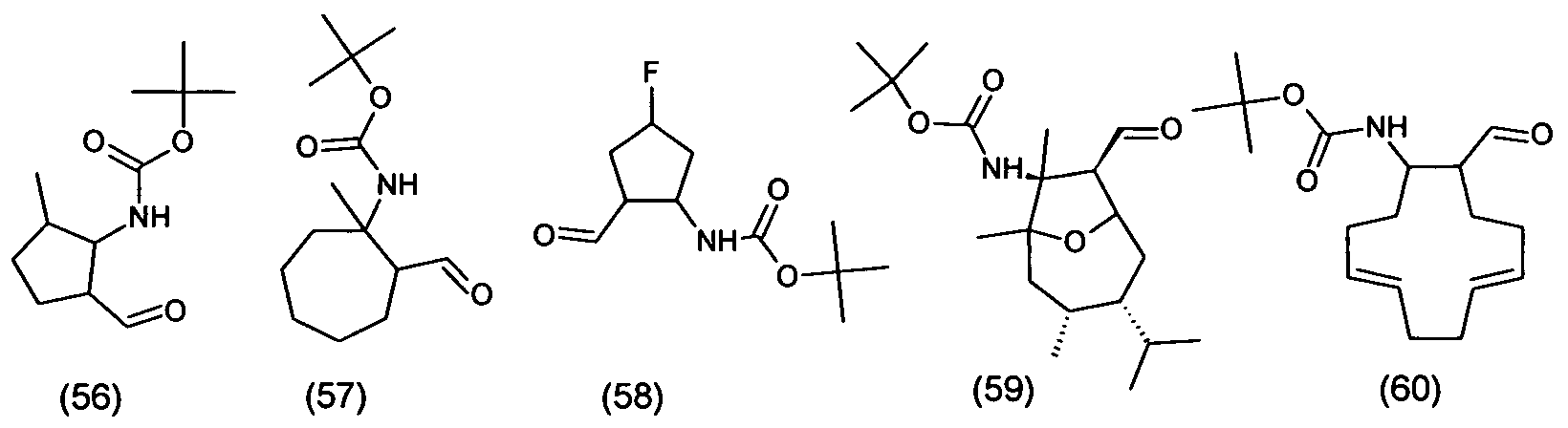
68


(11 1)
Verwendung eines beta-Aminoaldehyd-Derivats der Formel (I), (II) oder (III), eines beta-Lactams der Formel (IV), (V) oder(VI), eines beta-Lactams der Formel (VII), (VIII) oder (IX) und/oder einer Verbindung ausgewählt aus einer der Formeln (1 ) bis (1 1 1 ), gemäß einer der Ansprüche 12 bis 15, als reaktives Intermediat oder zur Herstellung von reaktiven Intermediaten, als Kopplungsagens, zur chemischen Synthese, als Synthon, als Synthon in der chemischen Synthese, oder als Peptidomimetikum.
Applications Claiming Priority (2)
| Application Number | Priority Date | Filing Date | Title |
|---|---|---|---|
| DE102010025663.3 | 2010-06-30 | ||
| DE102010025663A DE102010025663A1 (de) | 2010-06-30 | 2010-06-30 | Neue beta-Aminoaldehyd-Derivate, Verfahren zu ihrer Herstellung und ihre chemische Verwendung als reaktive Intermediate |
Publications (2)
| Publication Number | Publication Date |
|---|---|
| WO2012000608A2 true WO2012000608A2 (de) | 2012-01-05 |
| WO2012000608A3 WO2012000608A3 (de) | 2012-03-08 |
Family
ID=44627753
Family Applications (1)
| Application Number | Title | Priority Date | Filing Date |
|---|---|---|---|
| PCT/EP2011/002923 Ceased WO2012000608A2 (de) | 2010-06-30 | 2011-06-14 | Neue beta-aminoaldehyd-derivate, verfahren zu ihrer herstellung und ihre chemische verwendung als reaktive intermediate |
Country Status (2)
| Country | Link |
|---|---|
| DE (1) | DE102010025663A1 (de) |
| WO (1) | WO2012000608A2 (de) |
Citations (3)
| Publication number | Priority date | Publication date | Assignee | Title |
|---|---|---|---|---|
| US6387890B1 (en) | 1997-10-10 | 2002-05-14 | Trustees Of The University Of Pennsylvania | Compositions and methods for inhibiting arginase activity |
| WO2006002236A1 (en) | 2004-06-18 | 2006-01-05 | Novartis Vaccines And Diagnostics Inc. | N- (1- (1-benzyl -4-phenyl-1h-imidazol-2-yl) -2,2-dymethylpropyl) benzamide derivatives and related compounds as kinesin spindle protein (ksp) inhibitors for the treatment of cancer |
| WO2008009275A1 (de) | 2006-07-19 | 2008-01-24 | Studiengesellschaft Kohle Mbh | Verfahren zur herstellung von chiralen aminocarbonylverbindungen |
Family Cites Families (13)
| Publication number | Priority date | Publication date | Assignee | Title |
|---|---|---|---|---|
| SU1203092A1 (ru) * | 1984-06-07 | 1986-01-07 | Московский Ордена Трудового Красного Знамени Институт Тонкой Химической Технологии Им.М.В.Ломоносова | Способ получени алкилзамещенных тетрагидро-1,3,-оксазин-2-онов |
| JP2005526722A (ja) * | 2002-02-14 | 2005-09-08 | ミリアド・ジェネティックス・インコーポレイテッド | β−シートミメティックならびにそれに関連する組成物および方法 |
| AU2003243574A1 (en) * | 2002-06-17 | 2003-12-31 | Theravance, Inc. | PROCESS FOR PREPARING N-PROTECTED Beta-AMINO ALDEHYDE COMPOUNDS |
| CN101134757A (zh) * | 2002-11-06 | 2008-03-05 | 安姆根有限公司 | 稠合杂环化合物 |
| MY141220A (en) * | 2003-11-17 | 2010-03-31 | Astrazeneca Ab | Pyrazole derivatives as inhibitors of receptor tyrosine kinases |
| ATE394361T1 (de) * | 2003-12-19 | 2008-05-15 | Dsm Fine Chem Austria Gmbh | Verfahren zur herstellung von chiralen oder enantiomerenangereicherten beta-aminosaeuren, - aldehyden, - ketonen und gamma-aminoalkoholen |
| ATE382623T1 (de) * | 2004-06-09 | 2008-01-15 | Hoffmann La Roche | Octahydropyrrolo(3,4-c)pyrrolderivate und deren verwendung als antivirale mitteln |
| WO2006064340A2 (en) * | 2004-12-13 | 2006-06-22 | Pfizer Limited | Process for the preparation of n-acyl beta-aminoaldehydes |
| RU2008136756A (ru) * | 2006-02-15 | 2010-03-20 | Ф.Хоффманн-Ля Рош Аг (Ch) | Гетеробициклические противовирусные соединения |
| TW200815351A (en) * | 2006-05-02 | 2008-04-01 | Astrazeneca Ab | Novel compounds |
| ATE532789T1 (de) * | 2006-07-06 | 2011-11-15 | Array Biopharma Inc | Dihydrothienopyrimidine als akt-proteinkinase- inhibitoren |
| WO2008043798A1 (en) * | 2006-10-10 | 2008-04-17 | Organoclick Ab | A PROCESS FOR THE PREPARATION OF β-AMINO ALDEHYDES AND DERIVATIVES THEREOF. |
| CA2723751A1 (en) * | 2008-05-05 | 2009-11-12 | Allergan, Inc. | Alpha2b and alpha2c agonists |
-
2010
- 2010-06-30 DE DE102010025663A patent/DE102010025663A1/de not_active Withdrawn
-
2011
- 2011-06-14 WO PCT/EP2011/002923 patent/WO2012000608A2/de not_active Ceased
Patent Citations (3)
| Publication number | Priority date | Publication date | Assignee | Title |
|---|---|---|---|---|
| US6387890B1 (en) | 1997-10-10 | 2002-05-14 | Trustees Of The University Of Pennsylvania | Compositions and methods for inhibiting arginase activity |
| WO2006002236A1 (en) | 2004-06-18 | 2006-01-05 | Novartis Vaccines And Diagnostics Inc. | N- (1- (1-benzyl -4-phenyl-1h-imidazol-2-yl) -2,2-dymethylpropyl) benzamide derivatives and related compounds as kinesin spindle protein (ksp) inhibitors for the treatment of cancer |
| WO2008009275A1 (de) | 2006-07-19 | 2008-01-24 | Studiengesellschaft Kohle Mbh | Verfahren zur herstellung von chiralen aminocarbonylverbindungen |
Non-Patent Citations (32)
| Title |
|---|
| "Organikum", vol. 22, WILEY-VCH VERLAG GMBH &C. KGAA, pages: 539 |
| ALCAIDE ET AL., SYNTHESIS, 2005, pages 2335 - 2340 |
| BARETT ET AL., J. ORG. CHEM., vol. 50, 1985, pages 169 - 175 |
| CALVERAS ET AL., TETRAHEDRON, vol. 62, no. 11, 2006, pages 2648 - 2656 |
| CLIVE ET AL., CAN. JOURNAL OF ORGANIC CHEMISTRY, vol. 72, no. 15, 2007, pages 5608 - 5617 |
| COULTER ET AL., TETRAHEDRON, vol. 52, no. 20, 1996, pages 7127 - 7136 |
| DAVIS ET AL., TETRAHEDRON LETTERS, vol. 39, no. 33, 1998, pages 5951 - 5954 |
| FEHRENTZ ET AL., SYNTHESIS, 1983, pages 676 |
| FRANCE ET AL., ACC. CHEM. RES., vol. 37, 2004, pages 592 - 500 |
| FUJIWARA ET AL., SYNLETT, vol. 11, 2000, pages 1667 - 1669 |
| FURET ET AL., J. MED. CHEM., vol. 42, 1999, pages 2358 - 2363 |
| HART ET AL., CHEM. REV., vol. 89, 1989, pages 1447 - 1465 |
| ITO ET AL., CHEM. PHARM. BULL., vol. 23, 1975, pages 3081 |
| JURCZAK ET AL., TETRAHEDRON, vol. 48, no. 20, 1992, pages 4231 - 8 |
| LESMA ET AL., JOURNAL OF ORGANIC CHEMISTRY, vol. 71, no. 8, 2006, pages 3317 - 3320 |
| LIST ET AL., PCT INT. APPL., 2008 |
| MAEDA ET AL., TETRAHEDRON LETTERS, vol. 33, 1992, pages 1347 |
| NATIVI, TETRAHEDRON LETT., vol. 32, 1991, pages 2265 - 2268 |
| P. J. KOCIENSKI: "Protecting Groups", 1994, GEORG THIEME VERLAG, pages: 192 - 195 |
| PAK ET AL., JOURNAL OF ORG. CHEM., vol. 58, 1993, pages 2313 |
| PASUNOOTI ET AL., BIOORGANIC & MEDICINAL CHEMISTRY LETTERS, vol. 19, no. 22, 2009, pages 6268 - 6271 |
| R. GRAF, ANGEW. CHEM., 1968, pages 179 - 189 |
| SAEKI ET AL., CHEM. PHARM. BULL, vol. 21, 1973, pages 163 |
| TETRAHEDRON LETT., vol. 32, 1991, pages 5187 - 5190 |
| TONG ET AL., AUSTRALIAN JOURNAL OF CHEMISTRY, vol. 45, no. 8, 1992, pages 1225 - 40 |
| TOUJAS ET AL., BULLETIN DE LA SOCIETE CHIMIQUE DE FRANCE, vol. 134, no. 7, 1997, pages 713 - 717 |
| TOUJAS ET AL., TETRAHEDRON, vol. 56, no. 17, 2000, pages 2665 - 2672 |
| TUDOR ET AL., SYNTHESIS, vol. 11, 1993, pages 1061 - 2 |
| WANG ET AL., PCT INT. APPL., 2006 |
| WEINER ET AL., JOURNAL OF THE AMERICAN CHEMICAL SOCIETY, vol. 131, no. 27, 2009, pages 9473 - 9474 |
| WERNER ET AL., JOURNAL OF ORGANIC CHEMISTRY, vol. 62, no. 23, 1997, pages 8243 - 8246 |
| WHITE ET AL., JOURNAL OF THE AMERICAN CHEMICAL SOCIETY, vol. 124, no. 18, 2002, pages 4950 - 4951 |
Also Published As
| Publication number | Publication date |
|---|---|
| WO2012000608A3 (de) | 2012-03-08 |
| DE102010025663A1 (de) | 2012-01-05 |
Similar Documents
| Publication | Publication Date | Title |
|---|---|---|
| EP0173199B1 (de) | cis, endo-2-Azabicycloalkan-3-carbonsäure-Derivate, Verfahren zu deren Herstellung, deren Verwendung sowie Zwischenprodukte bei deren Herstellung | |
| DE4213919A1 (de) | Cyclische iminoderivate, verfahren zu ihrer herstellung und diese verbindungen enthaltende arzneimittel | |
| DE102005027517A1 (de) | Verfahren zur Herstellung von Dihydrochinazolinen | |
| DE10232572A1 (de) | Neue 2,5-disubstituierte Pyrimidinderivate | |
| DE69533284T2 (de) | Neue cyclische und acyclische amide zur erhöhung der neurotransmitter ausschüttung | |
| DE3002367A1 (de) | 2-substituierte trans-5-aryl-2,3,4,4a,5, 9b-hexahydro-1h-pyrido eckige klammer auf 4,3-b eckige klammer zu indole | |
| EP0270982B1 (de) | Derivate bicyclischer Aminocarbonsäuren, Verfahren und Zwischenprodukte zu deren Herstellung sowie deren Verwendung | |
| EP0496238A1 (de) | Substituierte Benzoxazepine und Benzthiazepine, Verfahren zu ihrer Herstellung und ihre Verwendung in Arzneimitteln | |
| WO2001047899A1 (de) | Substituierte piperazinderivateals inhibitoren des mtp | |
| EP0192255B1 (de) | Bi-2H-pyrroli(di)ndione | |
| DE69804212T2 (de) | Verfahren und zwischenprodukte zur herstellung substituierter indazolderivate | |
| EP0300278A2 (de) | Verfahren zur Herstellung von 2-substituierten Pyrrolen | |
| EP0266308B1 (de) | Indolo-pyrazino-benzodiazepin-Derivate | |
| WO2012000608A2 (de) | Neue beta-aminoaldehyd-derivate, verfahren zu ihrer herstellung und ihre chemische verwendung als reaktive intermediate | |
| DE69630184T2 (de) | Verfahren zur Herstellung von 1-substituierten Pyrrol-3-carbonsäure-Derivaten | |
| DE19827633A1 (de) | Verfahren zur Herstellung von enantiomerenreinem N-Methyl-N-[(1S)-1-phenyl-2-((3S)-3-hydroxypyrrolidin-1-yl)ethyl]-2,2-diphenylacetamid | |
| EP0128120A2 (de) | Trisubstituierte Oxazolidinone | |
| CH556837A (de) | Verfahren zur herstellung neuer spiroindanpyrrolidinderivate. | |
| DE2653251A1 (de) | Azabicyclo eckige klammer auf 3.1.o eckige klammer zu hexan-derivate, ihre herstellung und verwendung | |
| EP0001585B1 (de) | Piperazino-pyrrolobenzodiazepine, Verfahren zu ihrer Herstellung sowie pharmazeutische Präparate enthaltend diese Verbindungen | |
| DE19853558A1 (de) | Verfahren zur Herstellung von 2,3-Dihydroindolen (Indolinen), neuartige 2,3-Dihydroindole sowie deren Verwendung | |
| DD216013A5 (de) | Verfahren zur herstellung neuer ethendiamin- und guanidin-derivate | |
| EP1047686A1 (de) | Substituierte bicyclische lactone | |
| WO2005123712A1 (de) | Verfahren zur herstellung von 4-(alpha-hydroxyalkyl)-1,3-dioxan-5-onen | |
| AT375079B (de) | Verfahren zur herstellung von neuen trans-2,3,4,4a ,5,9b-hexahydro-1h-pyrido(4,3-b)indolen und ihren pharmazeutisch annehmbaren salzen |
Legal Events
| Date | Code | Title | Description |
|---|---|---|---|
| 121 | Ep: the epo has been informed by wipo that ep was designated in this application |
Ref document number: 11728777 Country of ref document: EP Kind code of ref document: A2 |
|
| NENP | Non-entry into the national phase |
Ref country code: DE |
|
| 122 | Ep: pct application non-entry in european phase |
Ref document number: 11728777 Country of ref document: EP Kind code of ref document: A2 |