WO2012036152A1 - Héparine de pureté élevée et procédé de production associé - Google Patents
Héparine de pureté élevée et procédé de production associé Download PDFInfo
- Publication number
- WO2012036152A1 WO2012036152A1 PCT/JP2011/070851 JP2011070851W WO2012036152A1 WO 2012036152 A1 WO2012036152 A1 WO 2012036152A1 JP 2011070851 W JP2011070851 W JP 2011070851W WO 2012036152 A1 WO2012036152 A1 WO 2012036152A1
- Authority
- WO
- WIPO (PCT)
- Prior art keywords
- heparin
- ethanol
- nitrite
- mucopolysaccharide
- volume
- Prior art date
- Legal status (The legal status is an assumption and is not a legal conclusion. Google has not performed a legal analysis and makes no representation as to the accuracy of the status listed.)
- Ceased
Links
Images




Classifications
-
- C—CHEMISTRY; METALLURGY
- C08—ORGANIC MACROMOLECULAR COMPOUNDS; THEIR PREPARATION OR CHEMICAL WORKING-UP; COMPOSITIONS BASED THEREON
- C08B—POLYSACCHARIDES; DERIVATIVES THEREOF
- C08B37/00—Preparation of polysaccharides not provided for in groups C08B1/00 - C08B35/00; Derivatives thereof
- C08B37/006—Heteroglycans, i.e. polysaccharides having more than one sugar residue in the main chain in either alternating or less regular sequence; Gellans; Succinoglycans; Arabinogalactans; Tragacanth or gum tragacanth or traganth from Astragalus; Gum Karaya from Sterculia urens; Gum Ghatti from Anogeissus latifolia; Derivatives thereof
- C08B37/0063—Glycosaminoglycans or mucopolysaccharides, e.g. keratan sulfate; Derivatives thereof, e.g. fucoidan
- C08B37/0075—Heparin; Heparan sulfate; Derivatives thereof, e.g. heparosan; Purification or extraction methods thereof
-
- C—CHEMISTRY; METALLURGY
- C08—ORGANIC MACROMOLECULAR COMPOUNDS; THEIR PREPARATION OR CHEMICAL WORKING-UP; COMPOSITIONS BASED THEREON
- C08B—POLYSACCHARIDES; DERIVATIVES THEREOF
- C08B37/00—Preparation of polysaccharides not provided for in groups C08B1/00 - C08B35/00; Derivatives thereof
-
- A—HUMAN NECESSITIES
- A61—MEDICAL OR VETERINARY SCIENCE; HYGIENE
- A61K—PREPARATIONS FOR MEDICAL, DENTAL OR TOILETRY PURPOSES
- A61K31/00—Medicinal preparations containing organic active ingredients
- A61K31/70—Carbohydrates; Sugars; Derivatives thereof
- A61K31/715—Polysaccharides, i.e. having more than five saccharide radicals attached to each other by glycosidic linkages; Derivatives thereof, e.g. ethers, esters
- A61K31/726—Glycosaminoglycans, i.e. mucopolysaccharides
- A61K31/727—Heparin; Heparan
-
- A—HUMAN NECESSITIES
- A61—MEDICAL OR VETERINARY SCIENCE; HYGIENE
- A61P—SPECIFIC THERAPEUTIC ACTIVITY OF CHEMICAL COMPOUNDS OR MEDICINAL PREPARATIONS
- A61P21/00—Drugs for disorders of the muscular or neuromuscular system
-
- A—HUMAN NECESSITIES
- A61—MEDICAL OR VETERINARY SCIENCE; HYGIENE
- A61P—SPECIFIC THERAPEUTIC ACTIVITY OF CHEMICAL COMPOUNDS OR MEDICINAL PREPARATIONS
- A61P29/00—Non-central analgesic, antipyretic or antiinflammatory agents, e.g. antirheumatic agents; Non-steroidal antiinflammatory drugs [NSAID]
-
- A—HUMAN NECESSITIES
- A61—MEDICAL OR VETERINARY SCIENCE; HYGIENE
- A61P—SPECIFIC THERAPEUTIC ACTIVITY OF CHEMICAL COMPOUNDS OR MEDICINAL PREPARATIONS
- A61P35/00—Antineoplastic agents
- A61P35/04—Antineoplastic agents specific for metastasis
-
- A—HUMAN NECESSITIES
- A61—MEDICAL OR VETERINARY SCIENCE; HYGIENE
- A61P—SPECIFIC THERAPEUTIC ACTIVITY OF CHEMICAL COMPOUNDS OR MEDICINAL PREPARATIONS
- A61P37/00—Drugs for immunological or allergic disorders
- A61P37/02—Immunomodulators
- A61P37/06—Immunosuppressants, e.g. drugs for graft rejection
-
- A—HUMAN NECESSITIES
- A61—MEDICAL OR VETERINARY SCIENCE; HYGIENE
- A61P—SPECIFIC THERAPEUTIC ACTIVITY OF CHEMICAL COMPOUNDS OR MEDICINAL PREPARATIONS
- A61P37/00—Drugs for immunological or allergic disorders
- A61P37/08—Antiallergic agents
-
- A—HUMAN NECESSITIES
- A61—MEDICAL OR VETERINARY SCIENCE; HYGIENE
- A61P—SPECIFIC THERAPEUTIC ACTIVITY OF CHEMICAL COMPOUNDS OR MEDICINAL PREPARATIONS
- A61P7/00—Drugs for disorders of the blood or the extracellular fluid
- A61P7/02—Antithrombotic agents; Anticoagulants; Platelet aggregation inhibitors
-
- A—HUMAN NECESSITIES
- A61—MEDICAL OR VETERINARY SCIENCE; HYGIENE
- A61P—SPECIFIC THERAPEUTIC ACTIVITY OF CHEMICAL COMPOUNDS OR MEDICINAL PREPARATIONS
- A61P9/00—Drugs for disorders of the cardiovascular system
-
- A—HUMAN NECESSITIES
- A61—MEDICAL OR VETERINARY SCIENCE; HYGIENE
- A61P—SPECIFIC THERAPEUTIC ACTIVITY OF CHEMICAL COMPOUNDS OR MEDICINAL PREPARATIONS
- A61P9/00—Drugs for disorders of the cardiovascular system
- A61P9/10—Drugs for disorders of the cardiovascular system for treating ischaemic or atherosclerotic diseases, e.g. antianginal drugs, coronary vasodilators, drugs for myocardial infarction, retinopathy, cerebrovascula insufficiency, renal arteriosclerosis
-
- A—HUMAN NECESSITIES
- A61—MEDICAL OR VETERINARY SCIENCE; HYGIENE
- A61P—SPECIFIC THERAPEUTIC ACTIVITY OF CHEMICAL COMPOUNDS OR MEDICINAL PREPARATIONS
- A61P9/00—Drugs for disorders of the cardiovascular system
- A61P9/12—Antihypertensives
-
- C—CHEMISTRY; METALLURGY
- C08—ORGANIC MACROMOLECULAR COMPOUNDS; THEIR PREPARATION OR CHEMICAL WORKING-UP; COMPOSITIONS BASED THEREON
- C08B—POLYSACCHARIDES; DERIVATIVES THEREOF
- C08B37/00—Preparation of polysaccharides not provided for in groups C08B1/00 - C08B35/00; Derivatives thereof
- C08B37/0003—General processes for their isolation or fractionation, e.g. purification or extraction from biomass
-
- C—CHEMISTRY; METALLURGY
- C08—ORGANIC MACROMOLECULAR COMPOUNDS; THEIR PREPARATION OR CHEMICAL WORKING-UP; COMPOSITIONS BASED THEREON
- C08B—POLYSACCHARIDES; DERIVATIVES THEREOF
- C08B37/00—Preparation of polysaccharides not provided for in groups C08B1/00 - C08B35/00; Derivatives thereof
- C08B37/006—Heteroglycans, i.e. polysaccharides having more than one sugar residue in the main chain in either alternating or less regular sequence; Gellans; Succinoglycans; Arabinogalactans; Tragacanth or gum tragacanth or traganth from Astragalus; Gum Karaya from Sterculia urens; Gum Ghatti from Anogeissus latifolia; Derivatives thereof
- C08B37/0063—Glycosaminoglycans or mucopolysaccharides, e.g. keratan sulfate; Derivatives thereof, e.g. fucoidan
- C08B37/0075—Heparin; Heparan sulfate; Derivatives thereof, e.g. heparosan; Purification or extraction methods thereof
- C08B37/0078—Degradation products
-
- G—PHYSICS
- G01—MEASURING; TESTING
- G01N—INVESTIGATING OR ANALYSING MATERIALS BY DETERMINING THEIR CHEMICAL OR PHYSICAL PROPERTIES
- G01N30/00—Investigating or analysing materials by separation into components using adsorption, absorption or similar phenomena or using ion-exchange, e.g. chromatography or field flow fractionation
- G01N30/02—Column chromatography
- G01N30/04—Preparation or injection of sample to be analysed
- G01N30/06—Preparation
- G01N30/14—Preparation by elimination of some components
-
- G—PHYSICS
- G01—MEASURING; TESTING
- G01N—INVESTIGATING OR ANALYSING MATERIALS BY DETERMINING THEIR CHEMICAL OR PHYSICAL PROPERTIES
- G01N30/00—Investigating or analysing materials by separation into components using adsorption, absorption or similar phenomena or using ion-exchange, e.g. chromatography or field flow fractionation
- G01N30/02—Column chromatography
- G01N30/88—Integrated analysis systems specially adapted therefor, not covered by a single one of the groups G01N30/04 - G01N30/86
-
- Y—GENERAL TAGGING OF NEW TECHNOLOGICAL DEVELOPMENTS; GENERAL TAGGING OF CROSS-SECTIONAL TECHNOLOGIES SPANNING OVER SEVERAL SECTIONS OF THE IPC; TECHNICAL SUBJECTS COVERED BY FORMER USPC CROSS-REFERENCE ART COLLECTIONS [XRACs] AND DIGESTS
- Y10—TECHNICAL SUBJECTS COVERED BY FORMER USPC
- Y10T—TECHNICAL SUBJECTS COVERED BY FORMER US CLASSIFICATION
- Y10T436/00—Chemistry: analytical and immunological testing
- Y10T436/14—Heterocyclic carbon compound [i.e., O, S, N, Se, Te, as only ring hetero atom]
-
- Y—GENERAL TAGGING OF NEW TECHNOLOGICAL DEVELOPMENTS; GENERAL TAGGING OF CROSS-SECTIONAL TECHNOLOGIES SPANNING OVER SEVERAL SECTIONS OF THE IPC; TECHNICAL SUBJECTS COVERED BY FORMER USPC CROSS-REFERENCE ART COLLECTIONS [XRACs] AND DIGESTS
- Y10—TECHNICAL SUBJECTS COVERED BY FORMER USPC
- Y10T—TECHNICAL SUBJECTS COVERED BY FORMER US CLASSIFICATION
- Y10T436/00—Chemistry: analytical and immunological testing
- Y10T436/14—Heterocyclic carbon compound [i.e., O, S, N, Se, Te, as only ring hetero atom]
- Y10T436/142222—Hetero-O [e.g., ascorbic acid, etc.]
-
- Y—GENERAL TAGGING OF NEW TECHNOLOGICAL DEVELOPMENTS; GENERAL TAGGING OF CROSS-SECTIONAL TECHNOLOGIES SPANNING OVER SEVERAL SECTIONS OF THE IPC; TECHNICAL SUBJECTS COVERED BY FORMER USPC CROSS-REFERENCE ART COLLECTIONS [XRACs] AND DIGESTS
- Y10—TECHNICAL SUBJECTS COVERED BY FORMER USPC
- Y10T—TECHNICAL SUBJECTS COVERED BY FORMER US CLASSIFICATION
- Y10T436/00—Chemistry: analytical and immunological testing
- Y10T436/14—Heterocyclic carbon compound [i.e., O, S, N, Se, Te, as only ring hetero atom]
- Y10T436/142222—Hetero-O [e.g., ascorbic acid, etc.]
- Y10T436/143333—Saccharide [e.g., DNA, etc.]
Definitions
- the present invention relates to high-purity heparin that is substantially free of a causative agent of a side effect, is highly safe, and is useful as a pharmaceutical, a cosmetic, a research reagent, and the like, and a method for producing the same.
- Heparin is an acidic mucopolysaccharide present in the liver, small intestine, lungs, skin and the like, including sulfated D-glucosamine, D-glucuronic acid, L-iduronic acid and the like. Heparin has strong blood anticoagulant activity, treatment of generalized intravascular blood coagulation syndrome (DIC), various thromboembolism (venous thrombosis, myocardial infarction, pulmonary embolism, cerebral embolism, In addition to the treatment and prevention of limb arterial thromboembolism, intraoperative and postoperative thromboembolism, etc., blood during use of extracorporeal circulation devices such as hemodialysis and cardiopulmonary bypass, blood vessel catheter insertion, blood transfusion and blood tests, etc.
- DIC generalized intravascular blood coagulation syndrome
- various thromboembolism venous thrombosis, myocardial infarction, pulmonary embolism, cerebral embolism
- extracorporeal circulation devices such as hemodia
- heparin Used to prevent coagulation.
- heparin has lipoprotein lipase activation, antiplatelet aggregation, blood pressure lowering, anticomplement, cancer metastasis, degranulation inhibition from mast cells, local inflammation It is also known to have many physiological activities such as suppression, analgesia, and blood circulation promoting action of muscle tissue.
- Heparin is mainly produced by extraction / fractionation from the tissues of healthy edible animals, but since the BSE (bovine spongiform encephalopathy) problem, the origin of heparin as a pharmaceutical is almost derived from porcine small intestinal mucosa.
- porcine small intestinal mucosa is suspended in an aqueous solvent, digested with protein, and then adsorbent is added (Non-patent Document 1) to combine heparin and other mucopolysaccharides (mainly chondroitin sulfate family, heparan sulfate, etc.) Extract as a body to make a crude material. This is then batch mixed / fractionated to obtain heparin (so-called “unfractionated heparin”).
- Heparin (unfractionated heparin) obtained by the above method contains mucopolysaccharides (mainly heparan sulfate, chondroitin sulfate B and C) other than heparin, and it is known that the content varies depending on the raw material and the production method. It is. However, the approximate side effects of the impurities have been identified and tolerated, so that unfractionated heparin has long been used as a pharmaceutical.
- mucopolysaccharides mainly heparan sulfate, chondroitin sulfate B and C
- Non-Patent Documents 2 to 4 This is a substance that does not exist in nature, and is said to have a high possibility of being mixed during the manufacture of the drug substance.
- Non-Patent Document 5 In Japan, OSCS is identified as a causative substance of an adverse event, and confirmation / purity tests are being conducted by the government and pharmaceutical manufacturers (Non-patent Documents 7 and 8).
- Patent Document 1 As a method for producing or purifying heparin, methods described in 1) Non-Patent Documents 1, 2) Non-Patent Document 9, 3) Non-Patent Document 10, 4) Patent Document 1, etc. are known. However, a method that can easily and effectively remove impurities such as OSCS and chondroitin sulfate from heparin has not been known so far. Furthermore, there is no known method for easily detecting or measuring such impurities in heparin.
- An object of the present invention is to provide high-purity heparin that is substantially free of impurities such as OSCS and chondroitin sulfate and has high safety, a method for producing the same, and a method for confirming the purity of heparin in the production process.
- the present inventors fractionated heparin using an organic solvent such as ethanol under predetermined conditions, thereby easily and effectively removing impurities such as OSCS and chondroitin sulfate. Furthermore, since these impurities are resistant to nitrous acid decomposition under given conditions, the presence and amount of these impurities can be determined by HPLC analysis after the nitrous acid decomposition. The inventors have found that it can be confirmed and measured, and have completed the present invention. That is, the present invention includes the following: [1] Heparin substantially free of nitrite degradation resistant impurities.
- a 0.2 to 1 volume (volume) of an organic solvent selected from ethanol, methanol, isopropanol, acetone and a mixed solvent thereof is mixed with a 5 to 30% by weight heparin aqueous solution.
- the heparin according to [3], wherein the salt is selected from sodium chloride and sodium acetate.
- heparin according to any one of the above [1] to [5], which has a molecular weight in the range of 3000 to 30000 daltons.
- a 5 to 30% by weight heparin aqueous solution is mixed with 0.2 to 1 volume (volume) of an organic solvent selected from ethanol, methanol, isopropanol, acetone, and a mixed solvent thereof.
- a method for producing heparin comprising obtaining a colloidal precipitate.
- An organic solvent selected from 0.2 to 1 volume (volume) of ethanol, methanol, isopropanol, acetone and a mixed solvent thereof is mixed with 5 to 30% by weight of heparin aqueous solution, and heparin is added.
- a 0.2 to 1 volume (volume) of an organic solvent selected from ethanol, methanol, isopropanol, acetone and a mixed solvent thereof is mixed with 5 to 30% by weight of heparin aqueous solution, A method for producing heparin, comprising obtaining a supernatant liquid.
- a medicament comprising the heparin according to any one of [1] to [6] and [8] to [11].
- a pharmaceutical composition comprising the heparin according to any one of [1] to [6] and [8] to [11].
- a method for detecting or measuring a nitrite-resistant mucopolysaccharide or a nitrite-decomposable mucopolysaccharide contained in the mucopolysaccharide which comprises decomposing the mucopolysaccharide into nitrite.
- the high-purity heparin of the present invention does not contain OSCS or the like which is a causative agent of side effects, it has high safety and can be used very suitably as a pharmaceutical product, cosmetics, research reagent or the like.
- the method for producing heparin of the present invention high-purity heparin substantially free of nitrite degradation resistant impurities can be obtained easily.
- the said method can be utilized industrially.
- the mucopolysaccharide detection or measurement method of the present invention the presence or absence of other mucopolysaccharides having different characteristics against nitrite degradation can be easily confirmed in the mucopolysaccharide product. Safety and the like can be ensured.
- the process of producing the target mucopolysaccharide it is possible to easily confirm the contamination of other mucopolysaccharides that exhibit different properties against nitrite degradation, so that the production process of the target mucopolysaccharide can be effectively performed. It can be managed and contamination of other mucopolysaccharides in the intermediate material and the final product can be avoided.
- FIG. 1 shows the ethanol content of unfractionated heparin (Na salt, UFN-SP) containing other mucopolysaccharides (mainly heparan sulfate (HS) / chondroitin sulfate B (CSB) / chondroitin sulfate C (CSC)).
- HS heparan sulfate
- CSB chondroitin sulfate B
- CSC chondroitin sulfate C
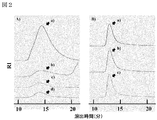
- FIG. 2 shows an OSCS control substance by nitrous acid decomposition, that is, OSCS-containing unfractionated heparin (Na salt, OSHP-SH, OSCS content about 12.5%), OSCS standard product (OSCS-STD), OSCS and chondroitin sulfate
- OSCS-STD OSCS standard product
- OSCS chondroitin sulfate
- OSHP-SH and OSCS-STD are as follows: A) OSHP-SH and OSCS-STD a) OSHP-SH before nitrous acid decomposition (solid line) b) OSHP-SH after nitrous acid decomposition (dashed line) c) OSCS-STD before nitrous acid decomposition (dotted line) d) OSCS-STD after nitrous acid decomposition (one-dot broken line) B) CSMS-CE1 and -CE2 a) CSMS-CE1 after nitrous acid decomposition (solid line) b) Nitrous acid CSMS-CE2 (broken line) after disassembly c) CSB-STD (dotted line) FIG.
- FIG. 3 is a HPLC chart showing the molecular weight changes of mucopolysaccharide control substances, ie, chondroitin sulfate family (CSA, CSB, CSC, CSD and CSE), heparan sulfate (HS) and keratan sulfate (KS) due to nitrite degradation. is there.
- CSA chondroitin sulfate family
- CSC heparan sulfate
- KS keratan sulfate
- FIG. 4 is a HPLC chart showing the molecular weight distribution of each unfractionated heparin Na salt (UFN 1-5) and Ca salt (UFC) before nitrous acid decomposition before ethanol fractionation.
- UFN 1-5 unfractionated heparin Na salt
- UAC Ca salt
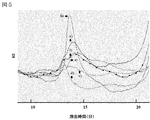
- FIG. 5 is a HPLC chart showing the molecular weight distribution after nitrous acid decomposition of Na salt (UFN 1 to 5) and Ca salt (UFC) of each unfractionated heparin before ethanol fractionation. Each symbol in FIG.
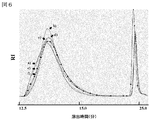
- FIG. 6 is a HPLC chart showing the molecular weight distribution of each unfractionated heparin Na salt (UFN 1-5) and Ca salt (UFC) before ethanol decomposition after ethanol fractionation. Each symbol in FIG.
- FIG. 7 is a HPLC chart showing the molecular weight distribution after nitrous acid decomposition of Na salt (UFN 1 to 5) and Ca salt (UFC) of each unfractionated heparin after ethanol fractionation. Each symbol in FIG.
- UFN7 is as follows: a) UFN1 (solid line), b) UFN2 (dashed line), c) UFN3 (dotted line), d) UFN4 (one-dot chain line), e) UFN5 (two-dot chain line) , F) UFC ( ⁇ solid line)
- the high-purity heparin of the present invention is characterized by being substantially free of nitrite degradation resistance impurities.
- the “heparin” in the present invention is not particularly limited and may be obtained from conventionally known raw materials and production methods. For example, so-called “unfractionated heparin”, “low molecular weight heparin”, and “heparin” Among “heparan sulfate” having a similar constituent sugar composition and binding mode, “heparan sulfate” having a high molecular weight or a high sulfuric acid content is particularly mentioned.
- unfractionated heparin means heparin that has not been depolymerized and usually has a molecular weight in the range of 3000 to 30000 daltons.
- the “low molecular weight heparin” is obtained by depolymerizing unfractionated heparin to reduce the molecular weight, and usually has a molecular weight in the range of 1500 to 12,000 daltons.
- the “heparan sulfate” usually has a molecular weight in the range of 3000 to 30000 daltons.
- the heparin in the present invention generally exhibits a physiological activity or pharmacological activity substantially the same as the free form in vivo, for example, heparin derivatives and pharmaceutically acceptable salts, addition salts, hydration Things etc. are included in the technical scope of the present invention.
- the molecular weight here is a weight average molecular weight determined by an HPLC method by size exclusion gel chromatography using an aqueous solvent.
- Nirite decomposition in the present invention may be any nitrous acid decomposition treatment under conditions that substantially decompose heparin and do not decompose impurities such as OSCS and chondroitin sulfate described later. pH 1.0 to 7.0 (preferably pH 2.0 to 5.0), reaction temperature ⁇ 10 to 40 ° C. (preferably ⁇ 5 to 10 ° C.), reaction time 0.5 to 60 minutes (preferably 5 to 15) Min), the amount of nitrous acid (especially sodium nitrite) used per 1 g of the target substance (heparin, etc.), such as 10 to 1000 mg (preferably 50 to 100 mg), etc. It means nitrous acid decomposition treatment.
- nitrite degradation resistant impurity means an impurity in heparin that is resistant to the above nitrous acid degradation.
- heparin is subjected to HPLC (for example, under conditions described later) after the above nitrous acid degradation.
- HPLC for example, under conditions described later
- it means a substance eluted at a position corresponding to the elution position of heparin before nitrite decomposition.
- chondroitin sulfate examples include persulfated chondroitin sulfate (OSCS), chondroitin sulfate A (chondroitin-4-sulfate: CSA), B (dermatan sulfate: CSB), C (chondroitin-6-sulfate: CSC), Disaccharide unit structure of galactosamine and uronic acid (glucuronic acid or iduronic acid) in mucopolysaccharides such as D (chondroitin-2,6-sulfate: CSD), E (chondroitin-4,6-sulfate: CSE), etc. And keratan sulfate (KC) having a disaccharide unit structure of glucosamine and galactose in the basic skeleton.
- OSCS persulfated chondroitin sulfate
- A chondroitin-4-sulfate: CSA
- B dermatan sulfate: CSB
- C chon
- the target heparin is “molecular weight” of the “parnaparin sodium” standard test method described in the 15th Amendment Manual of the Japanese Pharmacy Law. Detected by the refractive index (RI) appearing at the elution position of heparin obtained when analyzed by high performance liquid chromatography (HPLC) with reference to the conditions (for example, in the following specific examples, the elution time is 10 to 20 minutes)
- RI refractive index
- HPLC high performance liquid chromatography
- the total area value of the peak appearing at the elution position of heparin is 5% or less, preferably It means 1% or less, more preferably 0.5% or less.
- HPLC conditions include the following conditions: Detection system: SHIMADZU management system (LC solution), differential refractometer (RI: RID-10A) Column and guard column: TSK gel G-2000SWXL and TSK guard column SWXL manufactured by TOSO Column temperature: 40 ° C Mobile phase: 0.2 mol / L Na sulfate (pH 5.0) Flow rate: 0.5 mL / min.
- the high-purity heparin of the present invention can be produced, for example, by a method including fractionating raw material heparin containing nitrite degradation-resistant impurities and the like using an organic solvent such as ethanol under predetermined conditions.
- organic solvent such as ethanol
- examples of the organic solvent used for the fractionation include ethanol, methanol, isopropanol, acetone, and mixtures thereof. Among these, ethanol is most preferable in consideration of the residue in the final product.
- the ethanol fraction is 0.2 to 1 times (preferably 0.4 to 0.6 times) of 5 to 30% by weight (preferably 10 to 20% by weight) heparin aqueous solution ( Volumetric ethanol is mixed to obtain a colloidal precipitate of heparin.
- This method is simple and industrially applicable.
- ethanol precipitation is used to obtain heparin as a white precipitate.
- the heparin concentration in the heparin aqueous solution to which the conventional ethanol precipitation method is applied is 1 to 5% by weight, which is significantly lower than the ethanol fraction in the present invention.
- the amount of ethanol mixed in the heparin aqueous solution is 2 to 10 times (volume), which is significantly larger than the ethanol fraction in the present invention. That is, the ethanol fraction in the present invention is clearly distinguished from the conventional ethanol precipitation method.
- the raw material heparin in the ethanol fraction is not particularly limited, and various purification steps such as raw material of unfractionated heparin, unfractionated heparin, low molecular weight heparin, and heparin having an impurity concentration can be used.
- the molecular weight of the raw material heparin is preferably 3000 to 30000 daltons, more preferably 5000 to 15000 daltons.
- the raw material heparin is dissolved in water such as purified water and water for injection so as to be in the above concentration range to prepare a heparin aqueous solution.
- the above heparin aqueous solution has an acidic to neutral pH because the precipitation of the solvent is more sensitive as the pH of the aqueous solution increases due to the properties of heparin, and the precipitation of the solvent is slower as the pH decreases. It is preferably near, for example, pH 2.5 to 7.5, preferably pH 4.0 to 7.0.
- the above heparin aqueous solution is more sensitive to precipitation due to the solvent as the ionic strength increases due to the properties of heparin, and more slowly when the ionic strength decreases, and when the salt concentration is low. Since it is difficult to form a colloidal precipitate and a centrifugal operation or the like is required, it is preferable that the salt is dissolved.
- the salt concentration is, for example, 50 to 500 mM, preferably 100 to 250 mM.
- the salt include pharmaceutically acceptable salts such as sodium chloride and sodium acetate because heparin is mainly used as a medicine. Therefore, the heparin aqueous solution may be one in which heparin is dissolved in physiological saline.
- the treatment temperature and treatment time in the ethanol fraction are not particularly limited as long as the colloidal precipitate of heparin can be obtained, but it is, for example, ⁇ 10 to 40 ° C. (preferably 5 to 25 ° C.).
- the temperature can be, for example, 0.5 to 48 hours (preferably 4 to 24 hours).
- nitrite degradation resistant impurities which are impurities, remain in the supernatant, but heparin is colloidal and precipitates. Therefore, by separating the colloidal precipitate from the supernatant, high-purity heparin that is substantially free of nitrite degradation resistant impurities can be obtained.
- the “colloidal” heparin or “colloidal” precipitate in the present invention is one in which heparin forms a colloidal dispersed phase, and in the mixture of water and organic solvent used in the fractionation in the present invention.
- a filter paper such as an ultrafiltration membrane (for example, a molecular weight cut size of 500 to 50,000 MW) is used instead of a commonly used micro order molecular size sieve.
- the fractionation with an organic solvent such as ethanol is preferably carried out as follows.
- the organic solvent used for the fractionation include ethanol, methanol, isopropanol, acetone, or a mixture thereof. Among these, ethanol is most preferable in consideration of the residue in the final product.
- the above raw material heparin is dissolved in water such as purified water and water for injection so as to be in the above concentration range to prepare a heparin aqueous solution.
- the pH is acidic to neutral, from the viewpoint that the precipitation by the solvent becomes more sensitive as the pH of the aqueous solution increases, and the precipitation by the solvent becomes slower as the pH decreases.
- the pH is 2.5 to 7.5, preferably pH 4.0 to 7.0.
- the precipitation by the solvent becomes more sensitive as the ionic strength increases, and the precipitation by the solvent becomes slower as the ionic strength decreases. Since the operation and the like are necessary, it is not suitable for batch operation, and therefore it is preferable that the salt is dissolved.
- the salt concentration is, for example, 50 to 500 mM, preferably 100 to 250 mM.
- the salt include pharmaceutically acceptable salts such as sodium chloride and sodium acetate.
- the ethanol fraction is 0.2 to 1 volume (preferably 0.25 to 0.6 volume) (volume) of 5 to 30 wt% (preferably 10 to 20 wt%) heparin aqueous solution.
- Ethanol is mixed to obtain a precipitate of nitrite decomposition resistant impurities.
- nitrite degradation resistant impurities which are impurities, precipitate, but heparin remains in the supernatant. Therefore, by separating the supernatant from the precipitate, it is possible to obtain high-purity heparin that is substantially free of nitrite degradation resistant impurities.
- high-purity heparin substantially free of nitrite degradation-resistant impurities is obtained by performing purification treatment (ethanol precipitation method, etc.), drying treatment (vacuum drying, etc.), etc. according to conventional methods. It can be obtained as a white powder.
- the high-purity heparin obtained according to the present invention is highly safe because it does not substantially contain impurities such as OSCS, which is a causative agent of side effects, and exhibits the same physiological activity as conventional heparin. It can be very suitably applied to the same pharmaceutical use.
- the high-purity heparin of the present invention has strong blood anticoagulant activity, treatment of generalized intravascular blood coagulation syndrome (DIC), various thromboembolism (venous thrombosis, myocardial infarction, lung In addition to the treatment and prevention of embolism, cerebral embolism, extremity thromboembolism, intraoperative and postoperative thromboembolism, etc., when using extracorporeal circulators such as hemodialysis and cardiopulmonary bypass, inserting a vascular catheter or transfusion It can be used to prevent blood coagulation during blood tests.
- DIC generalized intravascular blood coagulation syndrome
- various thromboembolism venous thrombosis, myocardial infarction, lung
- extracorporeal circulators such as hemodialysis and cardiopulmonary bypass
- the high-purity heparin of the present invention has a lipoprotein lipase activation action, an antiplatelet aggregation action, a blood pressure lowering action, an anti-complement action, a cancer metastasis inhibiting action, a degranulation inhibiting action from mast cells, a local inflammation inhibition, an analgesic. Since it has many physiological activities such as blood circulation promoting action of muscle tissue, it can also be used as an agent for preventing or treating various diseases based on these actions.
- the high-purity heparin of the present invention can be formulated by an ordinary method and administered as an injection or an oral preparation, like conventional heparin.
- it is administered by the following administration method, and the dose or administration rate is usually determined by measuring the whole blood coagulation time or whole blood activated partial thromboplastin time after administration of this drug, and the age, case, indication area Or it is determined by the purpose.
- an amount corresponding to 5,000 to 50,000 heparin units of heparin is diluted with 1,000 ml of 5% glucose injection solution, physiological saline or Ringer's solution, and 20 to 30 drops per minute.
- Intravenous infusion at the rate of front and back.
- heparin is injected intravenously every 4 to 8 hours in an amount corresponding to 5,000 to 50,000 heparin units.
- heparin corresponding to 5,000 to 10,000 heparin units is injected subcutaneously or intramuscularly every 4 hours.
- the appropriate amount for each patient in the artificial kidney is calculated based on the results of a heparin sensitivity test before dialysis.
- heparin Prior to dialysis, heparin is administered in an amount corresponding to 1,000 to 3,000 heparin units. After starting dialysis, an amount corresponding to 500 to 1,500 heparin units is continuously or every hour. The amount corresponding to 500 to 1,500 heparin units is intermittently added to the above. In the case of the local heparinization method, an amount corresponding to 1,500 to 2,500 heparin units per hour is continuously infused.
- an amount corresponding to 150 to 300 heparin units / kg is administered depending on the surgical method and method, and additional administration is appropriately performed according to the extension of the extracorporeal circulation time.
- heparin equivalent to 500 to 2,000 heparin units / g once or several times a day In the case of an external preparation, it is used as an ointment of heparin in an amount corresponding to 100 to 500 heparin units / g, and an appropriate amount is applied to a rubbing or gauze once to several times a day.
- heparin in an amount equivalent to 1,000 to 4,000 heparin units / g is applied to the anus or vagina once or twice a day.
- the high-purity heparin of the present invention can be suitably used as cosmetics, research reagents and the like, as in the case of conventional heparin.
- the present invention also provides a method for detecting or measuring a nitrite-resistant mucopolysaccharide or a nitrite-decomposable mucopolysaccharide contained in the mucopolysaccharide, which comprises nitrite-degrading the mucopolysaccharide.
- a nitrite-resistant mucopolysaccharide or a nitrite-decomposable mucopolysaccharide contained in the mucopolysaccharide which comprises nitrite-degrading the mucopolysaccharide.
- the “nitrite degradation resistant mucopolysaccharide” in the above method include mucopolysaccharides exemplified as the nitrite degradation resistant impurity.
- “Nitrite-decomposable mucopolysaccharide” means a mucopolysaccharide that is degraded by nitrous acid decomposition, and examples thereof include heparin and he
- the “nitrous acid decomposition” in the above method is the same as the above nitrous acid decomposition.
- the mucopolysaccharide used in the above method is not particularly limited, and examples thereof include heparin, heparan sulfate, chondroitin sulfate, and keratan sulfate.
- the above-mentioned HPLC method can be used to detect or measure nitrite-resistant mucopolysaccharide or nitrite-decomposable mucopolysaccharide contained in the mucopolysaccharide. That is, when the target mucopolysaccharide is analyzed by HPLC after the above nitrous acid decomposition, the target mucopolysaccharide is a nitrite-decomposable mucopolysaccharide (heparin, etc.), and the nitrite-degrading mucopolysaccharide (chondroitin sulfate) is contained in the subject.
- the peak corresponding to the nitrite-decomposable mucopolysaccharide before nitrite decomposition disappears, and the peak corresponding to the nitrite-decomposable mucopolysaccharide is detected.
- the target mucopolysaccharide is a nitrite-resistant mucopolysaccharide (such as chondroitin sulfate) and the target contains nitrite-degradable mucopolysaccharide (such as heparin)
- nitrite-resistant mucopolysaccharide such as chondroitin sulfate
- nitrite-degradable mucopolysaccharide such as heparin
- the presence or absence of other mucopolysaccharides having different properties against nitrous acid degradation can be easily confirmed in the mucopolysaccharide product. Etc. can be secured.
- Nitrous acid decomposition In order to reduce side reactions in a weakly acidic region (around pH 4.0) at high temperatures, this treatment was all performed under ice cooling. Moreover, in order to avoid accumulation
- HPLC method The molecular weight distribution of the substance contained in each sample was confirmed by the HPLC method.
- the conditions of the HPLC method were in accordance with the “Molecular weight” section of the “Parnaparin sodium” standard test method described in the 15th Amendment Manual of the Japanese Pharmacy Law.
- the HPLC conditions used are shown below.
- Detection system SHIMADZU management system (LC solution), differential refractometer (RI: RID-10A) Column and guard column: TSK gel G-2000SWXL and TSK guard column SWXL manufactured by TOSO Column temperature: 40 ° C
- Mobile phase 0.2 mol / L Na sulfate (pH 5.0)
- Flow rate 0.5 mL / min.
- OSCS Persulfated chondroitin sulfate
- OSCS-STD Japan Public Standards Association
- OSCS-containing unfractionated heparin Na salt, OSHP-SH, OSCS content about 12.5%, lot No. 1060 manufactured by C company
- CSMS-CE1 and -CE2 crude OSCS which is a mixture of OSCS and chondroitin sulfate family
- OSCS-containing unfractionated heparin Na salt: Lot No.
- Example 1 As a sample, unfractionated heparin (Na salt, UFN-SP, Lot No. 1035-0792 manufactured by C Co.) (500 g) containing other mucopolysaccharides (mainly heparan sulfate / chondroitin sulfate B / chondroitin sulfate C) was used. Weighed into a 10 L chemical enamel tank and added physiological saline (Japanese Pharmacopoeia compatible product) to 5 L (pH 6.0).
- physiological saline Japanese Pharmacopoeia compatible product
- Ethanol 2.5 L; Wako Pure Chemical Industries, Ltd., special grade reagent
- the supernatant was transferred to a 30 L chemical enamel tank, ethanol (20 L) was added, and the mixture was vigorously stirred.
- the colloidal precipitate was transferred to a 30 L chemical enamel tank and added with physiological saline (3 L) and stirred, and then ethanol (20 L) was added and stirred vigorously. After each treatment, it was allowed to stand for 24 hours.
- the obtained product is subjected to nitrous acid decomposition by the above method, and the amount of substances (heparin and nitrite decomposition resistant impurities) contained in the product before and after nitrous acid decomposition is subjected to HPLC by the above method.
- the total area of peaks appearing during the elution time of 10 to 20 minutes was obtained. The results are shown in Table 1.
- Examples 2 to 7 For the same samples as in Comparative Examples 1 to 6, ethanol fractionation was performed in the same manner as in Example 1. Next, each product obtained was subjected to nitrous acid decomposition by the above method. The distribution of substances contained in the sample before and after nitrous acid decomposition was confirmed by the HPLC method (FIGS. 6 and 7). In addition, the amount of substances (heparin and nitrite decomposition resistant impurities) contained in the product before and after nitrite decomposition was subjected to HPLC by the above method, and the total of peaks that appeared during the elution time of 10 to 20 minutes was measured. Calculated as area. The results are shown in Table 1.
Landscapes
- Health & Medical Sciences (AREA)
- Chemical & Material Sciences (AREA)
- Life Sciences & Earth Sciences (AREA)
- General Health & Medical Sciences (AREA)
- Medicinal Chemistry (AREA)
- Organic Chemistry (AREA)
- Chemical Kinetics & Catalysis (AREA)
- Engineering & Computer Science (AREA)
- Pharmacology & Pharmacy (AREA)
- Animal Behavior & Ethology (AREA)
- Public Health (AREA)
- Veterinary Medicine (AREA)
- Biochemistry (AREA)
- Molecular Biology (AREA)
- Nuclear Medicine, Radiotherapy & Molecular Imaging (AREA)
- Bioinformatics & Cheminformatics (AREA)
- General Chemical & Material Sciences (AREA)
- Polymers & Plastics (AREA)
- Materials Engineering (AREA)
- Immunology (AREA)
- Cardiology (AREA)
- Heart & Thoracic Surgery (AREA)
- Physics & Mathematics (AREA)
- Pathology (AREA)
- General Physics & Mathematics (AREA)
- Analytical Chemistry (AREA)
- Dermatology (AREA)
- Epidemiology (AREA)
- Sustainable Development (AREA)
- Pulmonology (AREA)
- Transplantation (AREA)
- Pain & Pain Management (AREA)
- Vascular Medicine (AREA)
- Urology & Nephrology (AREA)
- Oncology (AREA)
- Neurology (AREA)
- Rheumatology (AREA)
- Physical Education & Sports Medicine (AREA)
- Orthopedic Medicine & Surgery (AREA)
- Hematology (AREA)
Abstract
Priority Applications (12)
| Application Number | Priority Date | Filing Date | Title |
|---|---|---|---|
| JP2012534011A JPWO2012036152A1 (ja) | 2010-09-14 | 2011-09-13 | 高純度ヘパリンおよびその製造方法 |
| KR1020177007476A KR101794877B1 (ko) | 2010-09-14 | 2011-09-13 | 고순도 헤파린 및 그 제조방법 |
| KR1020187009094A KR102082276B1 (ko) | 2010-09-14 | 2011-09-13 | 고순도 헤파린 및 그 제조방법 |
| US13/822,825 US8932867B2 (en) | 2010-09-14 | 2011-09-13 | High purity heparin and production method therefor |
| AU2011303081A AU2011303081B2 (en) | 2010-09-14 | 2011-09-13 | High purity heparin and production method therefor |
| CN201180054488.0A CN103209997B (zh) | 2010-09-14 | 2011-09-13 | 高纯度肝素及其制备方法 |
| DK11825154.5T DK2617737T3 (en) | 2010-09-14 | 2011-09-13 | HIGH PURPOSE HEPARIN AND PREPARATION PROCEDURE |
| EP11825154.5A EP2617737B1 (fr) | 2010-09-14 | 2011-09-13 | Héparine de pureté élevée et procédé de production associé |
| CA2811186A CA2811186C (fr) | 2010-09-14 | 2011-09-13 | Heparine de purete elevee et procede de production associe |
| EP16191158.1A EP3144325B1 (fr) | 2010-09-14 | 2011-09-13 | Héparine de haute pureté et son procédé de production |
| KR1020137007805A KR101847846B1 (ko) | 2010-09-14 | 2011-09-13 | 고순도 헤파린 및 그 제조방법 |
| US14/565,671 US9540454B2 (en) | 2010-09-14 | 2014-12-10 | High purity heparin and production method therefor |
Applications Claiming Priority (2)
| Application Number | Priority Date | Filing Date | Title |
|---|---|---|---|
| JP2010205310 | 2010-09-14 | ||
| JP2010-205310 | 2010-09-14 |
Related Child Applications (2)
| Application Number | Title | Priority Date | Filing Date |
|---|---|---|---|
| US13/822,825 A-371-Of-International US8932867B2 (en) | 2010-09-14 | 2011-09-13 | High purity heparin and production method therefor |
| US14/565,671 Division US9540454B2 (en) | 2010-09-14 | 2014-12-10 | High purity heparin and production method therefor |
Publications (1)
| Publication Number | Publication Date |
|---|---|
| WO2012036152A1 true WO2012036152A1 (fr) | 2012-03-22 |
Family
ID=45831611
Family Applications (1)
| Application Number | Title | Priority Date | Filing Date |
|---|---|---|---|
| PCT/JP2011/070851 Ceased WO2012036152A1 (fr) | 2010-09-14 | 2011-09-13 | Héparine de pureté élevée et procédé de production associé |
Country Status (9)
| Country | Link |
|---|---|
| US (2) | US8932867B2 (fr) |
| EP (2) | EP2617737B1 (fr) |
| JP (5) | JPWO2012036152A1 (fr) |
| KR (3) | KR102082276B1 (fr) |
| CN (1) | CN103209997B (fr) |
| AU (1) | AU2011303081B2 (fr) |
| CA (3) | CA2974062C (fr) |
| DK (2) | DK3144325T3 (fr) |
| WO (1) | WO2012036152A1 (fr) |
Cited By (3)
| Publication number | Priority date | Publication date | Assignee | Title |
|---|---|---|---|---|
| CN103145877A (zh) * | 2012-12-08 | 2013-06-12 | 青岛九龙生物医药有限公司 | 正丙醇萃取法降低肝素钠中的半乳糖胺含量的方法 |
| CN103923230A (zh) * | 2013-01-11 | 2014-07-16 | 青岛亚博生物科技有限公司 | 一种肝素钠的精制方法 |
| CN117362479A (zh) * | 2023-10-24 | 2024-01-09 | 河北常山生化药业股份有限公司 | 一种羊源依诺肝素钠的制备方法 |
Families Citing this family (5)
| Publication number | Priority date | Publication date | Assignee | Title |
|---|---|---|---|---|
| KR102298179B1 (ko) | 2017-11-27 | 2021-09-06 | (주)우리비앤비 | 비분획 헤파린의 제조방법 |
| CN112005110B (zh) * | 2018-07-24 | 2022-11-29 | 深圳市海普瑞药业集团股份有限公司 | 一种达肝素钠亚硝酸降解产物的分析方法及其应用 |
| CN109232773A (zh) * | 2018-11-29 | 2019-01-18 | 淮安麦德森制药有限公司 | 肝素锂的制备方法 |
| KR102104367B1 (ko) | 2019-09-02 | 2020-04-24 | 팜앤바이오 주식회사 | 헤파린나트륨의 제조장치 및 제조방법 |
| KR20220147996A (ko) | 2021-04-28 | 2022-11-04 | 주식회사 휴메딕스 | 고순도 헤파린나트륨의 제조방법 |
Citations (2)
| Publication number | Priority date | Publication date | Assignee | Title |
|---|---|---|---|---|
| JP2002293804A (ja) | 2001-03-28 | 2002-10-09 | Itoham Foods Inc | 低分子量ヘパリンの製造法 |
| JP2010205310A (ja) | 2009-02-27 | 2010-09-16 | Sony Corp | シャーシ構造及び電子機器 |
Family Cites Families (33)
| Publication number | Priority date | Publication date | Assignee | Title |
|---|---|---|---|---|
| IT1192564B (it) | 1977-08-08 | 1988-04-20 | Choay Sa | Composizioni di eparina esenti da sali minerali,in particolare ossalati,e procedimento per produrle |
| GB1602439A (en) * | 1977-08-08 | 1981-11-11 | Choay Sa | Purified heparin |
| FR2482611B1 (fr) * | 1980-05-14 | 1986-03-07 | Pharmindustrie | Nouveaux polysaccharides sulfates, procedes pour leur preparation et leur utilisation comme medicaments |
| FR2482603A1 (fr) * | 1980-05-14 | 1981-11-20 | Pharmindustrie | Nouveaux esters d'heparine utilisables pour la preparation de medicaments, et procedes pour leur preparation |
| FR2572080B1 (fr) * | 1984-10-18 | 1987-06-26 | Dropic | Procede de preparation de compositions de mucopolysaccharides dotees d'une activite antithrombotique elevee, les compositions obtenues et leur application en tant que medicaments |
| IT1214609B (it) * | 1985-05-17 | 1990-01-18 | Opocrin Spa | Esosaminoglicani solfati depolimerizzati ad attivita'antitrombotica, fibrinolitica, antinfiammatoria, loro procedimento di preparazione e composizioni farmaceutiche che li contengono. |
| JPS624703A (ja) * | 1985-07-02 | 1987-01-10 | Tooa Eiyoo Kk | 低分子量へパリン画分の製法 |
| IT1234508B (it) * | 1988-06-10 | 1992-05-19 | Alfa Wassermann Spa | Derivati eparinici e procedimento per la loro preparazione |
| FR2634485B1 (fr) * | 1988-07-21 | 1992-02-28 | Sanopi | Glycosaminoglycanes selectivement o-acyles, leur preparation et compositions pharmaceutiques les contenant |
| IT1234826B (it) * | 1989-01-30 | 1992-05-29 | Alfa Wassermann Spa | Derivati eparinici e procedimento per la loro preparazione |
| FR2675806B1 (fr) * | 1991-04-23 | 1994-06-10 | Rhone Poulenc Rorer Sa | Polysaccharides sulfates, procede de preparation, composition pharmaceutique et utilisation. |
| FR2687158B1 (fr) * | 1992-02-07 | 1995-06-30 | Rhone Poulenc Rorer Sa | Polysaccharides sulfates, procede de preparation, composition pharmaceutique et utilisation. |
| IT1260137B (it) | 1992-04-17 | 1996-03-28 | Alfa Wassermann Spa | Glicosaminoglicani semisintetici a struttura eparinica od eparanica modificati nella posizione 2 dell'acido alfa-l-iduronico-2-0-solfato |
| IT1260136B (it) | 1992-04-17 | 1996-03-28 | Alfa Wassermann Spa | Glicosaminoglicani semisintetici contenenti acido alfa-l-galatturonicosostituito con radicali nucleofili in posizione 3 |
| FR2704861B1 (fr) | 1993-05-07 | 1995-07-28 | Sanofi Elf | Fractions d'héparine purifiées, procédé d'obtention et compositions pharmaceutiques les contenant. |
| JP4897991B2 (ja) * | 1999-07-23 | 2012-03-14 | ラボラトリオス ファルマセウティコス ロビ ソシエダッド アノニマ | 超低分子量ヘパリン組成物 |
| JP2001187740A (ja) * | 2000-01-05 | 2001-07-10 | Seikagaku Kogyo Co Ltd | 創傷治療剤 |
| JP4585072B2 (ja) * | 2000-02-29 | 2010-11-24 | 扶桑薬品工業株式会社 | ヘパリン解重合法、解重合ヘパリン、その誘導体および医薬組成物 |
| FR2811992B1 (fr) * | 2000-07-21 | 2003-07-04 | Aventis Pharma Sa | Melanges de polysaccharides derives d'heparine, leur preparation et les compositions pharmaceutiques les contenant |
| DE60138115D1 (de) * | 2000-09-12 | 2009-05-07 | Massachusetts Inst Technology | Verfahren und produkte, die mit niedermolekularem heparin assoziiert sind |
| JP2003096104A (ja) * | 2001-09-26 | 2003-04-03 | Chisso Corp | 低分子ヘパリンまたはその塩の製造方法 |
| JP4186460B2 (ja) | 2001-12-06 | 2008-11-26 | チッソ株式会社 | 精製された、ヘパリン、その塩もしくはヘパリン誘導体の製造方法および精製された、低分子ヘパリン、その塩もしくはヘパリン誘導体の製造方法 |
| US7575886B2 (en) * | 2002-03-11 | 2009-08-18 | Momenta Pharmaceuticals, Inc. | Analysis of sulfated polysaccharides |
| FR2845686B1 (fr) * | 2002-10-10 | 2013-08-30 | Aventis Pharma Sa | Melanges de polysaccharides derives d'heparine, leur preparation et les compositions pharmaceutiques les contenant |
| FR2857971B1 (fr) * | 2003-07-24 | 2005-08-26 | Aventis Pharma Sa | Melanges d'oligosaccharides derives d'heparine, leur preparation et les compositions pharmaceutiques les contenant |
| AR043110A1 (es) * | 2004-02-04 | 2005-07-20 | Syntex Sa | Sal de heparina de bajo peso molecular con trietanolamina util como agente terapeutico-antitrombotico de administracion topica, procedimientos para preparar dichas sales, proceso para la eliminacion de la higroscopicidad de la sal de heparina, composiciones farmaceuticas para uso topico en terapia a |
| US7468358B2 (en) * | 2004-06-16 | 2008-12-23 | Paringenix, Inc. | Method and medicament for sulfated polysaccharide treatment of heparin-induced thrombocytopenia (HIT) syndrome |
| FR2912408A1 (fr) * | 2007-02-14 | 2008-08-15 | Sanofi Aventis Sa | Heparine comprenant au moins une liaison covalente avec la biotine ou un derive de la biotine,leur procede de preparation,leur utilisation |
| CN101575385B (zh) * | 2008-05-09 | 2011-01-12 | 青岛九龙生物医药有限公司 | 萃取法分离肝素钠中的多硫酸软骨素的方法 |
| US8435799B2 (en) * | 2008-09-03 | 2013-05-07 | Momenta Pharmaceuticals, Inc. | Evaluating heparin preparations for pharmaceutical use |
| GB0818255D0 (en) * | 2008-10-06 | 2008-11-12 | Agency Science Tech & Res | Isolation and identification of glycosaminoglycans |
| AU2010236222B2 (en) * | 2009-04-16 | 2015-10-15 | Momenta Pharmaceuticals, Inc. | Methods of assessing activity of a polysaccharide composition |
| CN101824098B (zh) * | 2010-02-12 | 2011-06-22 | 淮安麦德森化学有限公司 | 快速沉淀分离肝素钠中多硫酸软骨素的方法 |
-
2011
- 2011-09-13 EP EP11825154.5A patent/EP2617737B1/fr active Active
- 2011-09-13 KR KR1020187009094A patent/KR102082276B1/ko active Active
- 2011-09-13 CA CA2974062A patent/CA2974062C/fr not_active Expired - Fee Related
- 2011-09-13 US US13/822,825 patent/US8932867B2/en active Active
- 2011-09-13 CA CA2811186A patent/CA2811186C/fr not_active Expired - Fee Related
- 2011-09-13 AU AU2011303081A patent/AU2011303081B2/en not_active Ceased
- 2011-09-13 CA CA3020369A patent/CA3020369C/fr not_active Expired - Fee Related
- 2011-09-13 DK DK16191158.1T patent/DK3144325T3/da active
- 2011-09-13 CN CN201180054488.0A patent/CN103209997B/zh active Active
- 2011-09-13 DK DK11825154.5T patent/DK2617737T3/en active
- 2011-09-13 KR KR1020137007805A patent/KR101847846B1/ko active Active
- 2011-09-13 EP EP16191158.1A patent/EP3144325B1/fr active Active
- 2011-09-13 KR KR1020177007476A patent/KR101794877B1/ko active Active
- 2011-09-13 WO PCT/JP2011/070851 patent/WO2012036152A1/fr not_active Ceased
- 2011-09-13 JP JP2012534011A patent/JPWO2012036152A1/ja active Pending
-
2014
- 2014-12-10 US US14/565,671 patent/US9540454B2/en active Active
-
2015
- 2015-03-09 JP JP2015046245A patent/JP6082416B2/ja active Active
-
2016
- 2016-08-05 JP JP2016154813A patent/JP6511418B2/ja active Active
-
2019
- 2019-01-22 JP JP2019008601A patent/JP6755980B2/ja active Active
- 2019-01-22 JP JP2019008602A patent/JP2019065306A/ja active Pending
Patent Citations (2)
| Publication number | Priority date | Publication date | Assignee | Title |
|---|---|---|---|---|
| JP2002293804A (ja) | 2001-03-28 | 2002-10-09 | Itoham Foods Inc | 低分子量ヘパリンの製造法 |
| JP2010205310A (ja) | 2009-02-27 | 2010-09-16 | Sony Corp | シャーシ構造及び電子機器 |
Non-Patent Citations (13)
| Title |
|---|
| BEYER, T. ET AL., JOURNAL OF PHARMACEUTICAL AND BIOMEDICAL ANALYSIS, vol. 48, 2008, pages 13 - 19 |
| GUERRINI, M. ET AL., NATURE BIOTECHNOLOGY, vol. 26, 2008, pages 669 - 675 |
| GUERRINI, M. ET AL.: "Orthogonal analytical approaches to detect potential contaminants in heparin", PROCEEDINGS OF THE NATIONAL ACADEMY OF SCIENCES OF THE UNITED STATES OF AMERICA, vol. 106, no. 40, 6 October 2009 (2009-10-06), pages 16956 - 16961, XP002551175 * |
| HASHII NORITAKA ET AL., IYAKU KENKYU, vol. 39, no. 10, 2008, pages 651 - 659 |
| JIA, H., NATURE BIOTECHNOLOGY, vol. 26, 2008, pages 477 - 478 |
| NATURE BIOTECHNOLOGY, vol. 26, 2008, pages 669 - 675 |
| RODEN, L.; DORFMAN, A., ACTA CHEMI. SCAND., vol. 13, 1959, pages 2121 |
| SCHILLER, S. ET AL., J. BIOL. CHEM., vol. 236, 1961, pages 983 |
| SCHMIDT, M; DMOCHOWSKI, A, BIOCHIM. BIOPHYS. ACTA, vol. 83, 1964, pages 137 |
| See also references of EP2617737A4 * |
| THE NEW ENGLAND JOURNAL OF MEDICINE, vol. 358, 2008, pages 2457 - 2467 |
| THE NEW ENGLAND JOURNAL OF MEDICINE, vol. 359, 2008, pages 2674 - 2684 |
| ZHANG Z. ET AL.: "Analysis of Pharmaceutical Heparins and Potential Contaminants Using 1H-NMR and PAGE", JOURNAL OF PHARMACEUTICAL SCIENCES, vol. 98, no. 11, 2009, pages 4017 - 4026, XP055080932 * |
Cited By (4)
| Publication number | Priority date | Publication date | Assignee | Title |
|---|---|---|---|---|
| CN103145877A (zh) * | 2012-12-08 | 2013-06-12 | 青岛九龙生物医药有限公司 | 正丙醇萃取法降低肝素钠中的半乳糖胺含量的方法 |
| CN103145877B (zh) * | 2012-12-08 | 2016-01-27 | 青岛九龙生物医药有限公司 | 正丙醇萃取法降低肝素钠中的半乳糖胺含量的方法 |
| CN103923230A (zh) * | 2013-01-11 | 2014-07-16 | 青岛亚博生物科技有限公司 | 一种肝素钠的精制方法 |
| CN117362479A (zh) * | 2023-10-24 | 2024-01-09 | 河北常山生化药业股份有限公司 | 一种羊源依诺肝素钠的制备方法 |
Also Published As
Similar Documents
| Publication | Publication Date | Title |
|---|---|---|
| JP6082416B2 (ja) | 高純度ヘパリンおよびその製造方法 | |
| RS57214B1 (sr) | Upotreba derivata hemijski modifikovanog heparina za bolest srpastih ćelija | |
| WO2000006608A1 (fr) | Nouveau glycosaminoglycan et compositions medicamenteuses le contenant | |
| CN101218259B (zh) | 制备低分子量肝素的方法 | |
| JPH03243601A (ja) | 血液凝固の制御能をもつムコ多糖組成物およびその製造方法 | |
| CN103285031B (zh) | 解聚海参糖胺聚糖在制备防治血栓栓塞疾病药物中的应用 | |
| ITCO960031A1 (it) | Fucani a basso peso molecolare aventi attivita' anticoagulante antitrombinica e antitrombotica | |
| AU2015203727B2 (en) | High Purity Heparin and Production Method Therefor | |
| US5547945A (en) | Remitting agent for nephrotic syndrome and hepatopathy symptoms | |
| JP3638967B2 (ja) | ネフローゼ症候群及び肝障害症状の寛解剤 | |
| US20160082051A1 (en) | Use of sea cucumber glycosaminoglycan in preparing medicine for prevention and treatment of thromboembolic disease | |
| JPH0748403A (ja) | 丹参由来多糖類、その製造法および用途 | |
| CN104147039A (zh) | 黑海参糖胺聚糖在制备防治血栓栓塞疾病药物中的应用 |
Legal Events
| Date | Code | Title | Description |
|---|---|---|---|
| WWE | Wipo information: entry into national phase |
Ref document number: 201180054488.0 Country of ref document: CN |
|
| 121 | Ep: the epo has been informed by wipo that ep was designated in this application |
Ref document number: 11825154 Country of ref document: EP Kind code of ref document: A1 |
|
| ENP | Entry into the national phase |
Ref document number: 2811186 Country of ref document: CA |
|
| ENP | Entry into the national phase |
Ref document number: 2012534011 Country of ref document: JP Kind code of ref document: A |
|
| WWE | Wipo information: entry into national phase |
Ref document number: 13822825 Country of ref document: US |
|
| NENP | Non-entry into the national phase |
Ref country code: DE |
|
| REEP | Request for entry into the european phase |
Ref document number: 2011825154 Country of ref document: EP |
|
| WWE | Wipo information: entry into national phase |
Ref document number: 2011825154 Country of ref document: EP |
|
| ENP | Entry into the national phase |
Ref document number: 20137007805 Country of ref document: KR Kind code of ref document: A |
|
| ENP | Entry into the national phase |
Ref document number: 2011303081 Country of ref document: AU Date of ref document: 20110913 Kind code of ref document: A |