WO2012043716A1 - 化粧料組成物 - Google Patents
化粧料組成物 Download PDFInfo
- Publication number
- WO2012043716A1 WO2012043716A1 PCT/JP2011/072365 JP2011072365W WO2012043716A1 WO 2012043716 A1 WO2012043716 A1 WO 2012043716A1 JP 2011072365 W JP2011072365 W JP 2011072365W WO 2012043716 A1 WO2012043716 A1 WO 2012043716A1
- Authority
- WO
- WIPO (PCT)
- Prior art keywords
- acid
- cosmetic composition
- metal
- composition according
- sodium
- Prior art date
- Legal status (The legal status is an assumption and is not a legal conclusion. Google has not performed a legal analysis and makes no representation as to the accuracy of the status listed.)
- Ceased
Links
Images


Classifications
-
- A—HUMAN NECESSITIES
- A61—MEDICAL OR VETERINARY SCIENCE; HYGIENE
- A61K—PREPARATIONS FOR MEDICAL, DENTAL OR TOILETRY PURPOSES
- A61K8/00—Cosmetics or similar toiletry preparations
- A61K8/18—Cosmetics or similar toiletry preparations characterised by the composition
- A61K8/30—Cosmetics or similar toiletry preparations characterised by the composition containing organic compounds
- A61K8/58—Cosmetics or similar toiletry preparations characterised by the composition containing organic compounds containing atoms other than carbon, hydrogen, halogen, oxygen, nitrogen, sulfur or phosphorus
-
- A—HUMAN NECESSITIES
- A61—MEDICAL OR VETERINARY SCIENCE; HYGIENE
- A61K—PREPARATIONS FOR MEDICAL, DENTAL OR TOILETRY PURPOSES
- A61K8/00—Cosmetics or similar toiletry preparations
- A61K8/18—Cosmetics or similar toiletry preparations characterised by the composition
- A61K8/19—Cosmetics or similar toiletry preparations characterised by the composition containing inorganic ingredients
-
- A—HUMAN NECESSITIES
- A61—MEDICAL OR VETERINARY SCIENCE; HYGIENE
- A61K—PREPARATIONS FOR MEDICAL, DENTAL OR TOILETRY PURPOSES
- A61K8/00—Cosmetics or similar toiletry preparations
- A61K8/18—Cosmetics or similar toiletry preparations characterised by the composition
- A61K8/30—Cosmetics or similar toiletry preparations characterised by the composition containing organic compounds
- A61K8/49—Cosmetics or similar toiletry preparations characterised by the composition containing organic compounds containing heterocyclic compounds
-
- A—HUMAN NECESSITIES
- A61—MEDICAL OR VETERINARY SCIENCE; HYGIENE
- A61K—PREPARATIONS FOR MEDICAL, DENTAL OR TOILETRY PURPOSES
- A61K8/00—Cosmetics or similar toiletry preparations
- A61K8/18—Cosmetics or similar toiletry preparations characterised by the composition
- A61K8/30—Cosmetics or similar toiletry preparations characterised by the composition containing organic compounds
- A61K8/49—Cosmetics or similar toiletry preparations characterised by the composition containing organic compounds containing heterocyclic compounds
- A61K8/494—Cosmetics or similar toiletry preparations characterised by the composition containing organic compounds containing heterocyclic compounds with more than one nitrogen as the only hetero atom
-
- A—HUMAN NECESSITIES
- A61—MEDICAL OR VETERINARY SCIENCE; HYGIENE
- A61Q—SPECIFIC USE OF COSMETICS OR SIMILAR TOILETRY PREPARATIONS
- A61Q19/00—Preparations for care of the skin
-
- A—HUMAN NECESSITIES
- A61—MEDICAL OR VETERINARY SCIENCE; HYGIENE
- A61Q—SPECIFIC USE OF COSMETICS OR SIMILAR TOILETRY PREPARATIONS
- A61Q19/00—Preparations for care of the skin
- A61Q19/007—Preparations for dry skin
-
- A—HUMAN NECESSITIES
- A61—MEDICAL OR VETERINARY SCIENCE; HYGIENE
- A61Q—SPECIFIC USE OF COSMETICS OR SIMILAR TOILETRY PREPARATIONS
- A61Q19/00—Preparations for care of the skin
- A61Q19/08—Anti-ageing preparations
-
- A—HUMAN NECESSITIES
- A61—MEDICAL OR VETERINARY SCIENCE; HYGIENE
- A61K—PREPARATIONS FOR MEDICAL, DENTAL OR TOILETRY PURPOSES
- A61K2800/00—Properties of cosmetic compositions or active ingredients thereof or formulation aids used therein and process related aspects
- A61K2800/40—Chemical, physico-chemical or functional or structural properties of particular ingredients
- A61K2800/58—Metal complex; Coordination compounds
-
- A—HUMAN NECESSITIES
- A61—MEDICAL OR VETERINARY SCIENCE; HYGIENE
- A61Q—SPECIFIC USE OF COSMETICS OR SIMILAR TOILETRY PREPARATIONS
- A61Q19/00—Preparations for care of the skin
- A61Q19/10—Washing or bathing preparations
-
- A—HUMAN NECESSITIES
- A61—MEDICAL OR VETERINARY SCIENCE; HYGIENE
- A61Q—SPECIFIC USE OF COSMETICS OR SIMILAR TOILETRY PREPARATIONS
- A61Q5/00—Preparations for care of the hair
- A61Q5/02—Preparations for cleaning the hair
Definitions
- the present invention relates to a cosmetic composition.
- wrinkles and tarmi on human skin is considered to be caused by a decrease in the elasticity of the skin, and factors such as aging, drying, oxidation, and the effects of sunlight (ultraviolet rays) are involved.
- Specific histological phenomena include changes in extracellular matrix components such as collagen, elastin and glycosaminoglycans in the dermis.
- it may be caused by a decrease in moisture retention of the skin.
- a metal phthalocyanine derivative is an artificially synthesized water-soluble blue pigment, and is widely used for dyeing fibers and pigments. In addition, safety is high.
- Patent Documents 1 to 3 Metal phthalocyanine derivatives are also known to have functions such as an antibacterial effect, a deodorizing effect, an allergen decomposition effect, and an effect of suppressing pruritus (see Patent Documents 1 to 3). For this reason, anti-allergy countermeasure underwear and masks using fibers dyed with metal phthalocyanine derivatives have been studied and implemented (Patent Document 4). Further, there are cases where phthalocyanine pigments are used as makeup cosmetics (Patent Document 5), but they are only for the purpose of coloring and are not used for the purpose of preventing skin aging or moisturizing. On the other hand, Patent Document 6 discloses a cosmetic for decomposing lipid peroxide containing sulfonated phthalocyanine or a metal salt thereof.
- a cosmetic composition having a moisturizing effect containing a collagen peptide is already known.
- a technique for degrading a collagen component with cysteine protease to obtain a peptide composition is shown, which is useful for cosmetics and the like (see, for example, Patent Document 7).
- Patent Document 7 a technique for degrading a collagen component with cysteine protease to obtain a peptide composition.
- JP 2001-303437 A Japanese Patent Laid-Open No. 06-32177 JP 2005-144219 A JP 2004-321409 A JP 2003-335976 A Japanese Patent Laid-Open No. 03-50285 JP 2006-342107 A
- An object of the present invention is to provide a highly moisturizing cosmetic composition having an effect of improving elasticity and elasticity, an effect of improving wrinkles, and an effect of improving the texture.
- a cosmetic composition comprising a metal phthalocyanine derivative represented by the general formula [I].
- R1 to R4 are carboxyl groups, and n1 to n4 Are integers of 0 to 4 and satisfy 1 ⁇ n1 + n2 + n3 + n4 ⁇ 8.
- R1 to R4 are carboxyl groups, and n1 to n4 are the same 1 or 2, and the active ingredient contains a metal phthalocyanine derivative.
- the cosmetic composition according to 1. 3. A metal phthalocyanine derivative in which M is Fe in the formula [I] is contained as an active ingredient. Or 2. The cosmetic composition according to 1. 4). The cosmetic composition is for basic cosmetics. ⁇ 3.
- the metal phthalocyanine derivative is iron phthalocyanine tetracarboxylic acid or a salt thereof. ⁇ 4.
- the metal phthalocyanine derivative is iron phthalocyanine octacarboxylic acid or a salt thereof. ⁇ 4.
- the cosmetic composition according to any one of the above. 7. A cosmetic composition comprising a metal phthalocyanine derivative represented by the formula [I] and a metal sequestering agent or a component having a metal sequestering effect. 8).
- Metal sequestering agent is one or more substances selected from EDTA-2 sodium, EDTA-3 sodium, EDTA-4 sodium, etidronic acid, etidronic acid 4 sodium, hydroxyethane diphosphonic acid solution, citric acid, and has a sequestering effect 6.
- the component is one or more substances selected from succinic acid, phytic acid, ascorbic acid, gluconic acid, phosphoric acid, sodium polyphosphate, and sodium metaphosphate.
- the cosmetic composition as described. 9. 6. In the above formula [I], R1 to R4 are carboxyl groups, and n1 to n4 are the same 1 or 2 as an active ingredient. Or 8.
- a metal phthalocyanine derivative in which M is Fe, Co or Mn in the above formula [I] is contained as an active ingredient.
- the cosmetic composition is for basic cosmetics.
- the metal phthalocyanine derivative is iron phthalocyanine tetracarboxylic acid or a salt thereof.
- the metal phthalocyanine derivative is iron phthalocyanine octacarboxylic acid or a salt thereof.
- the cosmetic composition of the present invention has improved wrinkles, elasticity and elasticity, improved texture, dullness, and moisturizing, and as a basic cosmetic, the skin aging can be improved as a whole.
- the cosmetic composition of the present invention can maintain a state in which the color tone of phthalocyanine is stable for a long period of time.
- the cosmetic composition of the present invention is characterized by containing a metal phthalocyanine carboxylic acid. Thereby, it can be set as the cosmetic composition which has the outstanding moisturizing effect and the skin aging prevention effect.
- skin aging prevention in the present invention refers to preventing changes that occur in the skin tissue due to aging, ultraviolet irradiation, etc., for example, improvement of wrinkles, texture, skin elasticity, dullness, moisturizing feeling and The maintenance and improvement of elasticity can be mentioned.
- the cosmetic composition of the present invention may be any of an aqueous composition, an oily composition, and an emulsion composition.
- the aqueous composition include skin lotion, cosmetic liquid, and aqueous gel
- examples of the oil composition include cleansing oil and oily gel.
- examples of emulsion compositions include creams, emulsions, sunscreens, and the like.
- Emulsion forms include O / W, W / O, multilayer emulsions (W / O / W, O / W / O). ) Etc.
- the cosmetic composition of the present invention has the following formula [I]:
- n1 to n4 are each an integer of 0 to 4 and satisfy 1 ⁇ n1 + n2 + n3 + n4 ⁇ 8, and n1 to n4 are preferably the same 1 or 2, and M is Fe, Co, Mn, It is a metal selected from Ti, V, Ni, Cu, Zn, Mo, W, and Os.
- the substituents R1 to R4 are preferably carboxyl groups.
- Metal phthalocyanine carboxylic acid or its salt has catalytic activity against aldehyde compounds that are said to have an adverse effect on the skin, and has a decomposing action, so it has effects on fine lines, beams / elasticity, texture, dullness, and moisture retention. Estimated. Moreover, it is estimated that the metal phthalocyanine carboxylic acid or a salt thereof has higher hydrophilicity than sulfonated phthalocyanine and has an effect on moisture retention.
- the metal phthalocyanine tetracarboxylic acid or a salt thereof represented by is particularly effective.
- a metal phthalocyanine octacarboxylic acid represented by the formula (1) or a salt thereof is also particularly effective.
- the central metal M in the formulas [I] to [III] is defined as described above, but is preferably a high spin type of Fe, Co or Mn, and more preferably Fe.
- iron phthalocyanine tetracarboxylic acid or a salt thereof is iron phthalocyanine carboxylic acid or a salt thereof. Since iron phthalocyanine carboxylic acid or a salt thereof has low irritation to the skin, it can be preferably used as a cosmetic ingredient.
- metal phthalocyanine sulfonic acid or a salt thereof is unfavorable for use as a cosmetic ingredient because it causes irritation to the skin because the sulfonic acid or a salt thereof is a strong acid or a strong acid salt.
- Examples of the salt of the metal phthalocyanine carboxylic acid include a salt with an inorganic base and a salt with an organic base.
- Preferable examples of the salt with an inorganic base include alkali metal salts such as sodium salt and potassium salt; alkaline earth metal salts such as calcium salt and magnesium salt; and copper (II) salt and ammonium salt.
- Preferable examples of the salt with an organic base include salts with trimethylamine, triethylamine, pyridine, picoline, ethanolamine, diethanolamine, triethanolamine, dicyclohexylamine and the like.
- the metal phthalocyanine derivative of the chemical formula (I) may be a commercially available product or a product produced by a known method. For example, it can be produced by the method described in “Phthalocyanine -Chemistry and Function-” (Saiyoshi Shirai, Nagao Kobayashi, published by IPC Co., Ltd., published on February 28, 1997).
- iron phthalocyanine tetracarboxylic acid can be obtained as follows. Add trimellitic anhydride, urea, ammonium molybdate, and ferric chloride anhydride to nitrobenzene, stir and heat to reflux to obtain a precipitate. Add alkali to the resulting precipitate and add water.
- Cobalt phthalocyanine octacarboxylic acid which is also a preferred example is pyromellitic anhydride instead of trimellitic anhydride which is a raw material of iron phthalocyanine tetracarboxylic acid, and ferric cobalt chloride instead of ferric chloride anhydride. And can be manufactured in a similar manner.
- iron phthalocyanine octacarboxylic acid which is a preferred example, can be produced by the same method using pyromellitic anhydride instead of trimellitic anhydride which is a raw material of the iron phthalocyanine tetracarboxylic acid.
- metal phthalocyanine derivatives The details of the method for producing the metal phthalocyanine derivative are disclosed in several documents including JP-A-56-63355.
- the most preferable one is iron phthalocyanine tetracarboxylic acid or iron phthalocyanine octacarboxylic acid as described above.
- the content of the metal phthalocyanine derivative compound is preferably 0.00001% by mass to 20% by mass, more preferably 0.00005% by mass to 10% by mass with respect to the total mass of the composition.
- 0.0001% by mass to 2% by mass is particularly preferable. It is preferable from a viewpoint of moisture retention by setting it as 0.00001 mass% or more.
- the color tone of the composition is dark blue to black, and there is no problem in terms of functionality, but it is not preferable in terms of the aesthetic characteristics of a cosmetic product, and is preferably 2% by mass or less.
- iron phthalocyanine tetracarboxylic acid or iron phthalocyanine octacarboxylic acid when blended, a concentration of 0.005% by mass to 0.1% by mass is preferable. At this concentration, the composition exhibits a beautiful amber or blue color.
- the surfactant that can be used in the aqueous dispersion in the present invention is not particularly limited as long as it is a water-soluble surfactant that dissolves in an aqueous medium.
- a nonionic interface having an HLB of 10 or more, preferably 12 or more. Activators are preferred. If the HLB is less than 10, the emulsifying power may be insufficient. From the viewpoint of emulsion stability, the HLB is preferably 16 or less.
- the surfactant that can be used in the present invention is not particularly limited, but a nonionic surfactant is preferable.
- nonionic surfactants include glycerin fatty acid esters, organic acid monoglycerides, polyglycerin fatty acid esters, propylene glycol fatty acid esters, polyglycerin condensed ricinoleic acid esters, sorbitan fatty acid esters, and sucrose fatty acid esters. More preferred are polyglycerin fatty acid esters, sorbitan fatty acid esters, and sucrose fatty acid esters.
- the surfactant described above is not necessarily highly purified by distillation or the like, and may be a reaction mixture.
- polyglycerin fatty acid ester used in the present invention examples include polyglycerin having an average degree of polymerization of 2 or more, preferably 6 to 15, more preferably 8 to 10 and fatty acid having 8 to 18 carbon atoms such as caprylic acid and caprin. Esters with acids, lauric acid, myristic acid, palmitic acid, stearic acid, oleic acid, and linoleic acid.
- polyglycerol fatty acid esters include hexaglycerol monooleate, hexaglycerol monostearate, hexaglycerol monopalmitate, hexaglycerol monomyristate, hexaglycerol monolaurate, decaglycerol monooleate , Decaglycerin monostearic acid ester, decaglycerin monopalmitic acid ester, decaglycerin monomyristic acid ester, decaglycerin monolauric acid ester and the like. These polyglycerin fatty acid esters can be used alone or in combination.
- Examples of commercially available products include Nikko Chemicals Co., Ltd., NIKKOLKDGMS, NIKKOL DGMO-CV, NIKOL DGMO-90V, NIKKOL DGDO, NIKKOL DGMIS, NIKKOL DGTIS, NIKKOL DGTIS, NIKOGL DGTIS Tetraglyn 3-S, NIKKOL Tetraglyn 5-S, NIKKOL Tetraglyn 5-O, NIKKOL Hexaglyn 1-L, NIKKOL Hexaglyn 1-M, NIKKOL Hexaglyn 1-SV, NIKKOL Hexaglyn 1-O, NIKKOL Hexaglyn 3-S, NIKKOL Hexaglyn 4 -B, NIKKOL Hex aglyn 5-S, NIKKOL Hexaglyn 5-O, NIKKOL Hexaglyn PR-15, NIKKOL Decaglyn 1-L, NIKKOL Decag
- the sorbitan fatty acid ester used in the present invention preferably has 8 or more carbon atoms, more preferably 12 or more.
- Preferred examples of the sorbitan fatty acid ester include sorbitan monocaprylate, sorbitan monolaurate, sorbitan monostearate, sorbitan tristearate, sorbitan tristearate, sorbitan isostearate, sorbitan sesquiisostearate, sorbitan oleate, sorbitan sesquioleate And sorbitan trioleate.
- These sorbitan fatty acid esters can be used alone or in combination.
- Examples of commercially available products include Nikko Chemicals Corporation's NIKKOL SL-10, SP-10V, SS-10V, SS-10MV, SS-15V, SS-30V, SI-10RV, SI-15RV, SO-15 10V, SO-15MV, SO-15V, SO-30V, SO-10R, SO-15R, SO-30R, SO-15EX, manufactured by Daiichi Kogyo Seiyaku Co., Ltd., Sorgen 30V, 40V, 50V, 90, 110 or the like.
- the sucrose fatty acid ester used in the present invention preferably has a fatty acid having 12 or more carbon atoms, more preferably 12-20.
- Preferred examples of sucrose fatty acid esters include sucrose dioleate, sucrose distearate, sucrose dipalmitate, sucrose dimyristic ester, sucrose dilaurate, sucrose monooleate, sucrose Examples thereof include sugar monostearate, sucrose monopalmitate, sucrose monomyristate, and sucrose monolaurate. In the present invention, these sucrose fatty acid esters can be used alone or in combination.
- Examples of commercially available products include Ryoto Sugar Ester S-070, S-170, S-270, S-370, S-370F, S-570, S-770, S-970 manufactured by Mitsubishi Chemical Foods Corporation. , S-1170, S-1170F, S-1570, S-1670, P-070, P-170, P-1570, P-1670, M-1695, O-170, O-1570, OWA-1570, L -195, L-595, L-1695, LWA-1570, B-370, B-370F, ER-190, ER-290, POS-135, DK ester SS manufactured by Daiichi Kogyo Seiyaku Co., Ltd.
- the addition amount of these surfactants is preferably 0.1 to 50% by mass, more preferably 0.5 to 20% by mass, and further preferably 1 to 15% by mass with respect to the aqueous dispersion.
- the addition amount is preferably 0.1 to 50% by mass, more preferably 0.5 to 20% by mass, and further preferably 1 to 15% by mass with respect to the aqueous dispersion.
- the particle diameter of the emulsion particles in the aqueous dispersion is 200 nm or less, preferably 150 nm or less, more preferably 100 nm or less, as a volume average particle diameter (median diameter).
- the particle size depends on factors such as the type and amount used of the additive component, emulsification conditions (shearing force, temperature, pressure) in the production method, the amount of additive used, the ratio of oil phase to water phase, and the amount of surfactant used. Although it varies, there is no practical problem if the particle diameter of the present invention is used.
- the particle diameter can be measured with a commercially available particle size distribution meter or the like.
- Emulsion particle size distribution measurement methods include optical microscopy, confocal laser microscopy, electron microscopy, atomic force microscopy, static light scattering, laser diffraction, dynamic light scattering, centrifugal sedimentation, electricity
- a pulse measurement method, a chromatography method, an ultrasonic attenuation method, and the like are known, and apparatuses corresponding to the respective principles are commercially available.
- the dynamic light scattering method is preferred for the emulsion particle size measurement of the present invention.
- the measurement temperature may be any temperature usually used for measuring the particle diameter, but is preferably 20 ° C.
- the particle diameter in the present invention is a value measured using the dynamic light scattering particle size distribution measuring apparatus at a measurement temperature of 20 ° C.
- the cosmetic composition of the present invention contains water, polyhydric alcohols, water-soluble polymer compounds, oil-soluble components (oils, waxes), preservatives, antioxidants, fragrances and the like that are usually used in cosmetic compositions. It can mix
- the cosmetic composition of the present invention preferably contains an antioxidant in order to maintain stability.
- examples of usable antioxidants include, but are not limited to, compounds including polyphenols, radical scavengers, tocopherols, and ascorbic acids.
- a hydrophilic antioxidant and / or an oil-soluble antioxidant can be used alone or in combination.
- the antioxidant preferably contains at least one selected from ascorbic acid and ascorbic acid derivatives, and tocopherol and tocopherol derivatives.
- the antioxidant may be added to the aqueous phase or the oil phase of the cosmetic composition.
- the content of the antioxidant in the cosmetic composition is not particularly limited.
- Ascorbic acid or its derivatives include ascorbic acid, sodium ascorbate, potassium ascorbate, calcium ascorbate, L-ascorbic acid phosphate ester, magnesium ascorbyl phosphate, sodium ascorbyl phosphate, ascorbyl sulfate, ascorbyl sulfate disodium salt And ascorbyl-2-glucoside.
- erythorbic acid or a derivative thereof such as erythorbic acid, sodium erythorbate, potassium erythorbate, calcium erythorbate, erythorbic acid phosphate, and erythorbic acid sulfate can also be included in the ascorbic acid or derivative thereof in the present invention.
- magnesium ascorbyl phosphate, sodium ascorbyl phosphate, ascorbyl-2-glucoside, and sodium ascorbate are preferred, and magnesium ascorbyl phosphate and ascorbyl phosphate are preferred.
- Sodium is particularly preferred.
- L-ascorbic acid Takeda Pharmaceutical, Fuso Chemical, BASF Japan, Daiichi Pharmaceutical, etc.
- L-ascorbic acid Na Takeda Pharmaceutical, Fuso Chemical, BASF Japan, Daiichi Pharmaceutical, etc.
- Ascorbic acid 2-glucoside Product name: AA-2G: Hayashibara Biochemical Laboratories
- Mg-L-ascorbate phosphate Product name: Ascorbic acid PM “SDK” (Showa Denko)
- Product name: NIKKOL VC-PMG Nikko Chemicals
- Product name Seamate (Takeda) Pharmaceutical industry)
- tocopherol or its derivative Usable tocopherols are not particularly limited and are selected from the group of compounds consisting of tocopherols or derivatives thereof.
- the compound group consisting of tocopherol or its derivatives includes dl- ⁇ -tocopherol, dl- ⁇ -tocopherol, dl- ⁇ -tocopherol, dl- ⁇ -tocopherol, dl- ⁇ -tocopherol acetate, nicotinic acid-dl- ⁇ -tocopherol , Linoleic acid-dl- ⁇ -tocopherol, tocopherols such as dl- ⁇ -tocopherol succinate and derivatives thereof, ⁇ -tocotrienol, ⁇ -tocotrienol, ⁇ -tocotrienol, ⁇ -tocotrienol and the like.
- tocopherol (dl- ⁇ -tocopherol, dl- ⁇ -tocopherol, dl- ⁇ -tocopherol, dl- ⁇ -tocopherol), tocotrienol ( ⁇ -tocotrienol, ⁇ -tocotrienol, ⁇ -tocotrienol, ⁇ -tocotrienol) Is preferred.
- tocopherol (dl- ⁇ -tocopherol, dl- ⁇ -tocopherol, dl- ⁇ -tocopherol, dl- ⁇ -tocopherol), tocotrienol ( ⁇ -tocotrienol, ⁇ -tocotrienol, ⁇ -tocotrienol, ⁇ -tocotrienol)
- tocotrienol ⁇ -tocotrienol, ⁇ -tocotrienol, ⁇ -tocotrienol, ⁇ -tocotrienol
- extracted tocopherol mixed tocopherol or the like.
- antioxidants The compound group consisting of polyphenols that can be used as antioxidants includes flavonoids (catechin, anthocyanin, flavone, isoflavone, flavan, flavanone, rutin), phenolic acids (chlorogenic acid, ellagic acid, gallic acid, propyl gallate) ), Lignans, curcumins, coumarins and the like. Moreover, since these compounds are contained in a large amount in the following natural product-derived extracts, they can be used in the form of extracts.
- licorice extract cucumber extract, quette extract, gentian (gentian) extract, Gentian extract, cholesterol and its derivatives, hawthorn extract, peonies extract, ginkgo biloba extract, sorghum (ogon) extract, carrot Extract, Maikaika (Maika, Hamanasu) extract, Sunpens (Kawara-Ketsumei) extract, Tormentilla extract, Parsley extract, Button (Buttonpi) extract, Mokka (Bokeh) extract, Melissa extract, Yashajitsu (Yasha) extract Products, saxifrage extract, rosemary (mannenrou) extract, lettuce extract, tea extract (Oolong tea, black tea, green tea, etc.), microbial fermentation metabolites, Rakan fruit extract, etc. (in parentheses are plant aliases) , Herbal medicine name etc. were described.) Among these polyphenols, catechin, rosemary extract, glucosyl rutin, ellagic acid, and gallic acid are particularly preferable
- antioxidant used in the present invention a commercially available product can be appropriately used.
- ellagic acid WHO Pure Chemicals, etc.
- rosemary extract trade names RM-21A, RM-21E: Mitsubishi Chemical Foods, etc.
- catechin trade names: Sankatol W-5, No. 1: Taiyo Kagaku, etc.
- Na gallate trade name: Sankatol: Taiyo Kagaku, etc.
- rutin / glucosylrutin / enzymatic degradation rutin (trade name: rutin K-2, P-10: Kiriya Chemical, trade name ⁇ G rutin: Hayashibara Biochemical Research) Etc.).
- the cosmetic composition in the present invention can contain other oil-soluble components that dissolve in the oil-based medium.
- oil-soluble components usually UV absorbers, antioxidants, anti-inflammatory agents, moisturizers, hair protecting agents, dispersants, solvents, whitening agents, anti-staining agents, cell activators, emollients, keratolytics
- oils such as olive oil, camellia oil, macadamia nut oil, castor oil , Hydrocarbons such as liquid paraffin, paraffin, petrolatum, ceresin, microcrystalline wax, squalane, carnauba wax, candelilla wax, jojoba oil, beeswax, lanolin and other waxes, isopropyl myristate, 2-octyldodecyl myristate, 2 -Esters such as cetyl ethylhexanoate and diisostearyl malate Fatty acids such as palmitic acid, stearic acid, isostearic acid, higher alcohols such as cetyl alcohol, stearyl alcohol, isostearyl alcohol, 2-octyldodecanol, silicone oils such as methylpolysiloxane and methylphenylpolysiloxane, fatty acids of glycerin Examples include esters, other polymers,
- various plant-derived oils and animal-derived oils that are mixtures thereof are also included.
- Other preferable oil-soluble components used in the present invention include vitamin Es (other than the above-mentioned tocopherol and derivatives thereof), coenzyme Qs, ⁇ -3 oils and fats (oils and fats including EPA, DHA, linolenic acid, etc.) and the like. Can be mentioned.
- the cosmetic composition of the present invention preferably contains a polyhydric alcohol in order to exhibit a moisturizing function and a viscosity adjusting function. Moreover, the addition of a polyhydric alcohol can reduce the water activity of the cosmetic composition and suppress the growth of microorganisms.
- the polyhydric alcohol that can be used in the present invention is not particularly limited as long as it is a dihydric or higher alcohol.
- examples of the polyhydric alcohol include glycerin, diglycerin, triglycerin, polyglycerin, 3-methyl-1,3-butanediol, 1,3-butylene glycol, isoprene glycol, polyethylene glycol, and 1,2-pentanediol.
- 1,2-hexanediol propylene glycol, dipropylene glycol, polypropylene glycol, ethylene glycol, diethylene glycol, pentaerythritol, neopentyl glycol, maltitol, reduced starch syrup, fructose, glucose, sucrose, lactitol, palatinit, erythritol, sorbitol, Mannitol, xylitol, xylose, glucose, lactose, mannose, maltose, galactose, fructose, inositol, pentaerythritol Lumpur, maltotriose, sorbitol, sorbitan, trehalose, starch degradation sugars, starch decomposing sugar reduced alcohol and the like, these may be used alone or in the form of a plurality of kinds of mixtures.
- Water-soluble polymer compound As the water-soluble polymer compound, any of synthetic polymers, natural polymers, and semi-synthetic polymers can be widely used. Particularly preferred are saccharides, proteins and complexes thereof.
- saccharides include, but are not limited to, monosaccharides, disaccharides, oligosaccharides, polysaccharides, dextrins, starch derivatives, gums, mucopolysaccharides, and celluloses.
- agarose arabinose, amylose, amylopectin, acacia gum
- gum arabic arabinogalactan
- alkyl glycoside alginic acid, sodium alginate, propylene glycol alginate, aldose, inulin, oligosaccharide, gati gum , Curdlan, carrageenan, galactomannan, galactose, xanthan gum, xylose, xyloglucan, chitin, chitosan, guar gum, cluster dextrin, ⁇ -glucan, glucuronic acid, glycogen, glycosaminoglycan, glyceraldehyde, glucosamine, glucose, gluco Mannan, ketose, chondroitin sulfate, psyllium seed gum, gellan gum, cyclodextrin, sucrose, hydroxyethyl Cellulose, hydroxypropylcellulose, carboxymethyl
- gums and polysaccharides are preferable from the viewpoint of dispersion stability due to increase in viscosity, and xanthan gum, gum arabic, pullulan and the like are more preferable from the viewpoint of stability of carotenoids.
- Proteins include simple proteins composed of amino acids and complex proteins containing components other than amino acids, and both can be used. Examples of simple proteins include gelatin, casein, fibroin, sericin, keratin, protamine and the like.
- complex proteins include glycoproteins that bind to carbohydrates, lipoproteins that bind to lipids, metal proteins that bind to metal ions, nucleoproteins that bind to ribonucleic acid, and phosphates. There are phosphoproteins that are proteins bound to groups.
- protein raw material it is often referred to as a protein raw material, and examples include animal muscle protein, milk protein, egg protein, rice protein, wheat protein (wheat gluten), soy protein, yeast protein, and bacterial protein. .
- Such proteins may be used as a mixture.
- the cosmetic composition of the present invention can contain an amino acid or a derivative thereof.
- amino acids that can be blended or derivatives thereof those that can be used as constituents of cosmetics are not particularly limited and can be used.
- the amino acids or derivatives thereof include glycine, alanine, valine, leucine, isoleucine, serine, threonine, aspartic acid, glutamic acid, cystine, methionine, lysine, hydroxylysine, arginine, histidine, phenylalanine, tyrosine, tryptophan, proline, hydroxyproline.
- amino acids such as acetylhydroxyproline and derivatives thereof.
- the amino acid or derivative thereof is preferably hydroxyproline or acetylhydroxyproline.
- the amino acid or derivative thereof may be synthesized using a conventionally known method or may be commercially available. These may be used alone or in combination.
- the content of the amino acid or derivative thereof is not particularly limited, but is preferably 0.00001 to 10% by mass, more preferably 0.0001 to 5% by mass, and more preferably, based on the total mass of the cosmetic composition.
- the amount is preferably 0.0005 to 1% by mass.
- the cosmetic composition of the present invention may further contain a fragrance.
- a fragrance any of animal-based, plant-based, mineral-based natural fragrance and synthetic fragrance can be used.
- rose extract, chamomile extract, green tea fragrance lavender oil, geranium And oil, jasmine oil, bergamot oil, musk oil, ylang ylang oil, limonene, linalool, citral, cyclopentadecanone, eugenol, rose oxide and the like.
- the cosmetic composition of the present invention sometimes fades under the influence of light or heat.
- the stability of the color tone of the metal phthalocyanine derivative is improved by incorporating a component having a metal sequestering effect such as a metal sequestering agent into the cosmetic in addition to the components constituting the cosmetic.
- a component having a metal sequestering effect such as a metal sequestering agent
- the sequestering agent or sequestering component include EDTA-2 sodium, EDTA-3 sodium, EDTA-4 sodium, etidronate, etidronate tetrasodium, hydroxyethanediphosphonate, Acid, succinic acid, phytic acid, ascorbic acid, gluconic acid, phosphoric acid, sodium polyphosphate, sodium metaphosphate, etc.
- the sequestering agent or the component having a sequestering effect exhibits a fading prevention effect by containing 0.01% by mass to 1% by mass, preferably 0.05% by mass to 0.5% by mass, per cosmetic composition. .
- Iron phthalocyanine tetracarboxylic acid optimal concentration confirmation test (1) Preparation of test cosmetic liquid
- various concentrations Example 1: 0.001%, Example 2: 0.003%, Example 3: 0.005%, Example 4: 0.01%, Example 5: 0.02%, Example 6: 0.05%, Example 7: 0.1 %, Example 8: 0.2%, Example 9: 0.5%) was prepared by a conventional method.
- the formulation is shown in Table 1 below.
- Test cosmetics The test cosmetics of Examples were used by subjects. The test cosmetics were given only symbols so that the subjects did not know the details of the examples. The base of the test cosmetics ensures safety and stability quality.
- Table 2 shows the results of skin aging prevention effect and appearance evaluation by questionnaire after use of the cosmetic liquid containing the iron phthalocyanine tetracarboxylic acid of the present invention.
- the anti-skin aging effect of the cosmetic liquid containing the iron phthalocyanine tetracarboxylic acid of each prescription when the blending concentration is 0.001% and 0.003%, 60% feels the effect, 0.005 In the case of% or more, the result is that 80% or more feels real. That is, the effect of the essence of 0.001% to 0.5% concentration used in the test was fully realized.
- the appearance evaluation of the cosmetic liquid if it is 0.1% or less, it is suitable for cosmetics as an appearance, and there is no problem, but if it is 0.2% or more, it is unsuitable for appearance as cosmetics.
- Comparison test with iron phthalocyanine tetracarboxylic acid-free prescription (1) Preparation of test cosmetic liquid As shown in the following Table 3, a cosmetic liquid containing the iron phthalocyanine tetracarboxylic acid of the present invention was prepared by a conventional method. . Carboxyvinyl polymer is dissolved in a part of purified water, and raw materials such as glycerin and dipropylene glycol are sequentially added and sufficiently stirred with a homomixer. After cooling, the mixture was neutralized with potassium hydroxide, added with a fragrance, and then the remaining purified water was added to prepare a gel composition.
- Test cosmetic test The use test of the cosmetic liquids of Examples and Comparative Examples obtained above was conducted on 21 subjects, and the feeling of use and effects after use were evaluated by a questionnaire for the subjects.
- the test method is as follows. (1) Subjects: Subjects were excluded from subjects who were adult and healthy women, those with extremely sensitive skin, atopic dermatitis, and those with skin diseases at the site of cosmetic use. (2) Test cosmetics: Subjects were allowed to use two types of test cosmetics, Examples and Comparative Examples. The test cosmetics were given only symbols so that the subjects did not understand the distinction between the examples and comparative examples. The base of the test cosmetics ensures safety and stability, and there is no difference in use between the two cosmetics.
- the use test of the cosmetic liquid of Example 10 obtained above was conducted on 21 subjects, and the feeling of use and effects after use were evaluated by a questionnaire for the subjects.
- the test method was the same as in the previous example.
- the test method is as follows. (1) Subjects: Subjects were excluded from subjects who were adult and healthy women, those with extremely sensitive skin, atopic dermatitis, and those with skin diseases at the site of cosmetic use. (2) Test cosmetics: The test cosmetics of Examples were used by subjects. The test cosmetics were given only symbols so that the subjects did not know the details of the examples. The base of the test cosmetics ensures safety and stability quality. (3) Method of use: The cosmetics usually used by the subjects were kept away from the emulsion, cream, and serum, and the test cosmetics were used.
- Example 11 Use test of serum containing iron phthalocyanine tetracarboxylic acid [Preparation of test serum]
- a gel cosmetic liquid (Example 11) containing 0.005% by mass of the iron phthalocyanine tetracarboxylic acid of the present invention was prepared by a conventional method according to the formulation shown below.
- Test cosmetics The test cosmetics of Examples were used by subjects. The test cosmetics were given only symbols so that the subjects did not know the details of the examples. The base of the test cosmetics ensures safety and stability quality.
- Method of use The cosmetics usually used by the subjects were kept away from the emulsion, cream, and serum, and the test cosmetics were used.
- Example 12 Test for inhibiting fading of iron phthalocyanine tetracarboxylic acid
- the cosmetic composition of the present invention contains a component having a metal sequestering effect such as a metal sequestering agent in the cosmetic. Improves color stability.
- Example 4 In the formulation of Example 4 (Table 3) containing 0.01% iron phthalocyanine tetracarboxylic acid, phytic acid 0.05%, 0.1%, or EDTA-2 sodium 0.1%, 0.2% A cosmetic liquid formulated with was prepared by a conventional method.
- Table 6 shows the results of examining the fading prevention effect by blending the sequestering effect component with the cosmetic liquid containing 0.01% iron phthalocyanine tetracarboxylic acid.
- Cream A cream was prepared in the same manner with the same amount except that iron phthalocyanine tetracarboxylic acid was replaced with iron phthalocyanine octacarboxylic acid in the cream formulation of prescription example 4. The resulting cream had good stability.
- Body soap 1,2-pentanediol 2%, diglycerin 15%, maltitol 10%, N-lauroyl-L-sodium glutamate 15%, polyoxyethylene (20EO) sorbitan monolaurate 1%, Palm oil fatty acid polyoxyethylene (7EO) glyceryl 1%, ethanol 12%, carboxymethylcellulose sodium 1%, iron phthalocyanine tetracarboxylic acid 0.01%, perfume appropriate amount, phenoxyethanol 0.9%, purified water residue Body soap was manufactured by the method. The stability of the obtained body soap was good.
- the cosmetic composition of the present invention can be applied to, for example, uses such as cosmetic liquid (water-based, gel-based), lotion, milky lotion, cream, foundation, shampoo, body soap, and bath preparation.
- cosmetic liquid water-based, gel-based
- lotion milky lotion
- cream foundation
- shampoo body soap, and bath preparation.
Landscapes
- Health & Medical Sciences (AREA)
- Life Sciences & Earth Sciences (AREA)
- Veterinary Medicine (AREA)
- Animal Behavior & Ethology (AREA)
- General Health & Medical Sciences (AREA)
- Public Health (AREA)
- Birds (AREA)
- Epidemiology (AREA)
- Dermatology (AREA)
- Gerontology & Geriatric Medicine (AREA)
- Chemical & Material Sciences (AREA)
- Inorganic Chemistry (AREA)
- Cosmetics (AREA)
Abstract
Description
金属フタロシアニン誘導体は人工的に合成された水溶性の青色色素であり、繊維の染色や、顔料として広く用いられている。また、安全性も高い。金属フタロシアニン誘導体は、抗菌効果や脱臭効果、アレルゲンの分解効果、掻痒感の抑制効果(特許文献1~3参照。)などの機能を有することも知られている。このため、金属フタロシアニン誘導体で染色した繊維を用いた抗アレルギー対策肌着やマスクが検討・実施されている(特許文献4)。またメークアップ化粧料としてフタロシアニン色素を使用しているケースがある(特許文献5)が、あくまで着色を目的としたものであって、皮膚の老化予防や保湿の目的では使用されていない。一方特許文献6にはスルフォン化フタロシアニン又はその金属塩を配合した過酸化脂質を分解する化粧料が開示されている。
即ち、本発明は以下の構成である。
1.一般式 [I] で示される金属フタロシアニン誘導体を含有することを特徴とする化粧料組成物。

2.前記[I]式中、R1~R4はカルボキシル基であり、n1~n4は同一の1または2である金属フタロシアニン誘導体を有効成分に含むことを特徴とする1.に記載の化粧料組成物。
3.前記[I]式中、MがFeである金属フタロシアニン誘導体を有効成分に含むことを特徴とする1.又は2.に記載の化粧料組成物。
4.化粧料組成物が、基礎化粧料用である1.~3.のいずれかに記載の化粧料組成物。
5.金属フタロシアニン誘導体が鉄フタロシアニンテトラカルボン酸又はその塩である1.~4.のいずれかに記載の化粧料組成物。
6.金属フタロシアニン誘導体が鉄フタロシアニンオクタカルボン酸又はその塩である1.~4.のいずれかに記載の化粧料組成物。
7.前記式 [I] で示される金属フタロシアニン誘導体と金属封鎖剤又は金属封鎖効果のある成分を含有することを特徴とする化粧料組成物。
8.金属封鎖剤がEDTA-2ナトリウム、EDTA-3ナトリウム、EDTA-4ナトリウム、エチドロン酸、エチドロン酸4ナトリウム、ヒドロキシエタンジホスホン酸液、クエン酸から選択される1以上の物質、金属封鎖効果のある成分がコハク酸、フィチン酸、アスコルビン酸、グルコン酸、リン酸、ポリリン酸ナトリウム、メタリン酸ナトリウムから選択される1以上の物質である7.記載の化粧料組成物。
9.前記[I]式中、R1~R4はカルボキシル基であり、n1~n4は同一の1または2である金属フタロシアニン誘導体を有効成分に含むことを特徴とする7.又は8.に記載の化粧料組成物。
10.前記 [I]式中、MがFe、CoまたはMnである金属フタロシアニン誘導体を有効成分に含むことを特徴とする7.~9.のいずれかに記載の化粧料組成物。
11.化粧料組成物が、基礎化粧料用である7.~10.のいずれかに記載の化粧料組成物。
12.金属フタロシアニン誘導体が鉄フタロシアニンテトラカルボン酸又はその塩である7.~11.のいずれかに記載の化粧料組成物。
13.金属フタロシアニン誘導体が鉄フタロシアニンオクタカルボン酸又はその塩である7.~11.のいずれかに記載の化粧料組成物。
これにより、優れた保湿効果と皮膚老化防止効果を有する化粧料組成物とすることができる。
ここで本発明における「皮膚老化防止」とは、加齢や紫外線照射等によって皮膚組織に生じる変化を防止することをいい、例えば、シワ、肌理、肌のはり、くすみの改善や、保湿感及び弾力性の維持・向上を挙げることができる。
水性組成物の例としては、化粧水、美容液、水性ジェル等が挙げられ、油性組成物としては、クレンジングオイル、油性ジェル等が挙げられる。また、エマルジョン組成物の例としては、クリーム、乳液、サンスクリーン等があり、エマルジョンの形態としては、O/W、W/Oの他、多層エマルジョン(W/O/W、O/W/O)などがあげられる。

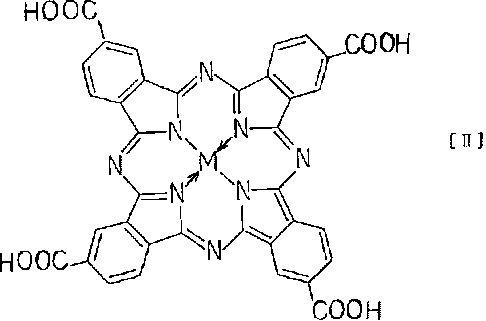

同じく好ましい例であるコバルトフタロシアニンオクタカルボン酸は、上記鉄フタロシアニンテトラカルボン酸の原料であるトリメリット酸無水物に代えてピロメリット酸無水物、塩化第二鉄無水物に代えて塩化第二コバルトを用いて同様の方法で製造可能である。
同じく好ましい例である鉄フタロシアニンオクタカルボン酸は、上記鉄フタロシアニンテトラカルボン酸の原料であるトリメリット酸無水物に代えてピロメリット酸無水物を用いて同様の方法で製造可能である 。
なお、金属フタロシアニン誘導体の製造方法については、特開昭56-63355号公報をはじめいくつかの文献に詳細が開示されている。
金属フタロシアニンの誘導体の構造中、最も好ましいものは、上述したとおり鉄フタロシアニンテトラカルボン酸または鉄フタロシアニンオクタカルボン酸である。
0.00001質量%以上とすることにより、保湿性の観点で好ましい。ただ、高濃度配合をした場合に、組成物の色調が濃紺~黒色を呈し、機能性上はなんら問題ないが化粧料という製品の美的特性上好ましくなく、2質量%以下にすることが好ましい。例えばこの観点からは、鉄フタロシアニンテトラカルボン酸または鉄フタロシアニンオクタカルボン酸を配合する場合は、0.005質量%~0.1質量%の濃度が好ましい。この濃度であれば、組成物は美しい紺色または青色を呈する。
本発明における水分散物に使用することができる界面活性剤としては、水性媒体に溶解する水溶性界面活性剤であれば特に限定は無いが、例えばHLBが10以上、好ましくは12以上のノニオン界面活性剤が好ましい。HLBが10未満の場合には、乳化力が不十分となることがある。また乳化安定性の観点からHLBは16以下であることが好ましい。
0.1質量%以上の添加量とすることによって、より微細な粒子径の乳化物を得ることができると共に乳化物の安定性を充分に確保することができ、また、50質量%以下の添加量とすることによって、乳化物の泡立ちを適切な範囲に調整することができる点で好ましい。
水分散物におけるエマルジョン粒子の粒子径は、透明性の観点から、体積平均粒子径(メジアン径)として200nm以下であり、好ましくは150nm以下、更に好ましくは100nm以下である。
粒子径は、添加成分の種類及び使用量、製造方法における乳化条件(せん断力・温度・圧力)や、添加剤の使用量、油相と水相比率、界面活性剤の使用量などの要因によって変動するが、本発明の粒子径であれば、実用上問題ない。
本発明における粒径範囲および測定の容易さから、本発明のエマルション粒径測定では動的光散乱法が好ましい。動的光散乱を用いた市販の測定装置としては、ナノトラックUPA(日機装(株))、動的光散乱式粒径分布測定装置LB-550((株)堀場製作所)、濃厚系粒径アナライザーFPAR-1000(大塚電子(株))等が挙げられる。また測定温度としては、粒子径の測定に通常用いられる温度であればよいが、20℃であることが好ましい。
本発明における粒子径は、測定温度を20℃とし、前記動的光散乱式粒径分布測定装置を用いて測定した値とする。
本発明の化粧料組成物には安定性を保持するために酸化防止剤を配合することが好ましい。使用可能な酸化防止剤としては、特に限定されないが、例えば、ポリフェノール類からなる化合物群、ラジカル捕捉剤、トコフェロール類、アスコルビン酸類を挙げることができる。本発明で使用可能な酸化防止剤は、親水性の酸化防止剤、及び/又は、油溶性の酸化防止剤を、単独又は併用して使用することができる。
前記酸化防止剤としては、アスコルビン酸及びアスコルビン酸誘導体、並びにトコフェロール及びトコフェロール誘導体から選ばれる少なくとも1種を含有することが好ましい。酸化防止剤の添加は、化粧料組成物の水相に添加しても油相に添加してもよい。
化粧料組成物における酸化防止剤の含有量としては、特に限定されない。
アスコルビン酸又はアスコルビン酸誘導体としては、アスコルビン酸、アスコルビン酸ナトリウム、アスコルビン酸カリウム、アスコルビン酸カルシウム、L-アスコルビン酸リン酸エステル、リン酸アスコルビルマグネシウム、リン酸アスコルビルナトリウム、硫酸アスコルビル、硫酸アスコルビル2ナトリウム塩、及びアスコルビル-2-グルコシド等が挙げられる。また、エリソルビン酸又はその誘導体、例えばエリソルビン酸、エリソルビン酸ナトリウム、エリソルビン酸カリウム、エリソルビン酸カルシウム、リン酸エリソルビン酸、及び硫酸エリソルビン酸なども、本発明におけるアスコルビン酸又はその誘導体に含むことができる。
これらのうち、カロテノイドの褪色防止やエマルジョン粒子の分散安定性の観点から、リン酸アスコルビルマグネシウム、リン酸アスコルビルナトリウム、アスコルビル-2-グルコシド、アスコルビン酸ナトリウムが好ましく、リン酸アルコルビルマグネシウム及びリン酸アスコルビルナトリウムが特に好ましい。
これらのアスコルビン酸又はその誘導体は、一般に市販されているものを適宜用いることができる。例えば、L-アスコルビン酸(武田薬品工業、扶桑化学、BASFジャパン、第一製薬ほか)、L-アスコルビン酸Na(武田薬品工業、扶桑化学、BASFジャパン、第一製薬ほか)、アスコルビン酸2-グルコシド(商品名 AA-2G:林原生物化学研究所)、L-アスコルビン酸燐酸Mg(商品名 アスコルビン酸PM「SDK」(昭和電工)、商品名 NIKKOL VC-PMG(日光ケミカルズ)、商品名 シーメート(武田薬品工業))等が挙げられる。
使用可能なトコフェロールとしては、特に限定されず、トコフェロールまたはその誘導体からなる化合物群から選ばれるものである。
トコフェロールまたはその誘導体からなる化合物群としては、dl-α-トコフェロール、dl-β-トコフェロール、dl-γ-トコフェロール、dl-δ-トコフェロール、酢酸dl-α-トコフェロール、ニコチン酸-dl-α-トコフェロール、リノール酸-dl-α-トコフェロール、コハク酸dl-α-トコフェロール等のトコフェロール及びその誘導体、α-トコトリエノール、β-トコトリエノール、γ-トコトリエノール、δ-トコトリエノール等が挙げられる。これらのなかでも、トコフェロール(dl-α-トコフェロール、dl-β-トコフェロール、dl-γ-トコフェロール、dl-δ-トコフェロール)、トコトリエノール(α-トコトリエノール、β-トコトリエノール、γ-トコトリエノール、δ-トコトリエノール)が好ましい。
これらは、混合物の状態で使用する場合が多く、抽出トコフェロール、ミックストコフェロールなどと呼ばれる状態で使用できる。
使用可能な酸化防止剤であるポリフェノール類からなる化合物群としては、フラボノイド類(カテキン、アントシアニン、フラボン、イソフラボン、フラバン、フラバノン、ルチン)、フェノール酸類(クロロゲン酸、エラグ酸、没食子酸、没食子酸プロピル)、リグナン類、クルクミン類、クマリン類などを挙げることができる。また、これらの化合物は、以下のような天然物由来の抽出物中に多く含まれるため、抽出物という状態で利用することができる。
本発明における化粧料組成物は、油性媒体に溶解するその他の油溶性成分を含むことができる。
前記その他の油溶性成分として、通常、紫外線吸収剤、抗酸化剤、抗炎症剤、保湿剤、毛髪保護剤、分散剤、溶剤、美白剤、抗シミ剤、細胞賦活剤、エモリエント剤、角質溶解剤、帯電防止剤、ビタミン類、メタボリックシンドローム改善剤、降圧剤、鎮静剤などとして使用されている他の成分も使用することができ、例えば、オリーブ油、ツバキ油、マカデミアナッツ油、ヒマシ油などの油脂類、流動パラフィン、パラフィン、ワセリン、セレシン、マイクロクリスタリンワックス、スクワランなどの炭化水素、カルナウバロウ、キャンデリラロウ、ホホバ油、ミツロウ、ラノリンなどのロウ類、ミリスチン酸イソプロピル、ミリスチン酸2-オクチルドデシル、2-エチルヘキサン酸セチル、リンゴ酸ジイソステアリルなどのエステル類、パルミチン酸、ステアリン酸、イソステアリン酸などの脂肪酸類、セチルアルコール、ステアリルアルコール、イソステアリルアルコール、2-オクチルドデカノールなどの高級アルコール類、メチルポリシロキサン、メチルフェニルポリシロキサンなどのシリコーン油、グリセリンの脂肪酸エステル類、その他、高分子類、油溶性色素類、油溶性蛋白質などを挙げることができる。また、それらの混合物である各種の植物由来油、動物由来油も含まれる。本発明に用いられる好ましい他の油溶性成分としては、ビタミンE類(前述のトコフェロール及びその誘導体以外)、コエンザイムQ類、ω-3油脂類(EPA、DHA、リノレン酸等を含む油脂)などを挙げることができる。
本発明の化粧料組成物は、保湿機能や粘度調整機能等を発揮するため多価アルコールを含有することが好ましい。また、多価アルコールの添加により、化粧料組成物の水分活性を下げることができ、微生物の繁殖を抑えることができる。
前記多価アルコールとしては、例えば、グリセリン、ジグリセリン、トリグリセリン、ポリグリセリン、3-メチル-1,3-ブタンジオール、1,3-ブチレングリコール、イソプレングリコール、ポリエチレングリコール、1,2-ペンタンジオール、1,2-ヘキサンジオール、プロピレングリコール、ジプロピレングリコール、ポリプロピレングリコール、エチレングリコール、ジエチレングリコール、ペンタエリスリトール、ネオペンチルグリコール、マルチトール、還元水あめ、果糖、ブドウ糖、蔗糖、ラクチトール、パラチニット、エリスリトール、ソルビトール、マンニトール、キシリトール、キシロース、グルコース、ラクトース、マンノース、マルトース、ガラクトース、フルクトース、イノシトール、ペンタエリスリトール、マルトトリオース、ソルビトール、ソルビタン、トレハロース、澱粉分解糖、澱粉分解糖還元アルコール等が挙げられ、これらを、単独又は複数種の混合物の形態で用いることが出来る。
水溶性高分子化合物としては、広く合成高分子、天然高分子、半合成高分子のいずれも用いることができる。特に糖類、タンパク質類およびそれらの複合体が好ましい。
これらの中で、代表的なものは、アガロース、アラビノース、アミロース、アミロペクチン、アカシアガム、アラビアガム、アラビノガラクタン、アルキルグリコシド、アルギン酸、アルギン酸ナトリウム、アルギン酸プロピレングリコールエステル、アルドース、イヌリン、オリゴ糖、ガッティガム、カードラン、カラギーナン、ガラクトマンナン、ガラクトース、キサンタンガム、キシロース、キシログルカン、キチン、キトサン、グアーガム、クラスターデキストリン、β-グルカン、グルクロン酸、グリコーゲン、グリコサミノグリカン、グリセルアルデヒド、グルコサミン、グルコース、グルコマンナン、ケトース、コンドロイチン硫酸、サイリウムシードガム、ジェランガム、シクロデキストリン、スクロース、ヒドロキシエチルセルロース、ヒドロキシプロピルセルロース、カルボキシメチルセルロース、メチルセルロース、セロビオース、ソルビトール、デオキシリボース、デキストリン、転化糖、デンプン、大豆多糖類、糖アルコール、糖タンパク質、トラガントガム、トレハロース、ヒアルロン酸、フコース、フルクトース、プルラン、ペクチン、ヘパリン、ヘミセルロース、マルトース、マンニトール、マンナン、ラクトース、リボース等が挙げられるが、これに限定されるものではない。
これらの糖類の中では、粘度増加による分散安定性の観点からガム類、多糖類が好ましく、カロテノイド類の安定性の観点から、キサンタンガム、アラビアガム、プルランなどが更に好ましい。
タンパク質にはアミノ酸からなる単純タンパク質と、アミノ酸以外の構成成分を含む複合タンパク質とがあり、いずれも用いることが出来る。単純タンパク質の例としては、ゼラチン、カゼイン、フィブロイン、セリシン、ケラチン、プロタミン等が挙げられる。また複合タンパク質としては、炭水化物に結合したタンパク質である糖タンパク質、脂質に結合したタンパク質であるリポタンパク質、金属イオンに結合したタンパク質である金属タンパク質、リボ核酸に結合したタンパク質である核タンパク質、リン酸基に結合したタンパク質であるリンタンパク質等がある。
一方、一般的には、タンパク質原料から呼称される場合も多く、動物性筋肉タンパク質、乳タンパク質、卵タンパク質、米タンパク質、小麦タンパク質(小麦グルテン)、大豆タンパク質、酵母タンパク質、細菌タンパク質等が挙げられる。
なお、このようなタンパク質は、混合物としても使用してもよい。
本発明の化粧料組成物には、アミノ酸またはその誘導体を含有させることができる。配合可能なアミノ酸又はその誘導体としては、化粧料の構成成分として用いることができるものは、特に限定されず用いることができる。
前記アミノ酸又はその誘導体としては、グリシン、アラニン、バリン、ロイシン、イソロイシン、セリン、スレオニン、アスパラギン酸、グルタミン酸、シスチン、メチオニン、リジン、ヒドロキシリジン、アルギニン、ヒスチジン、フェニルアラニン、チロシン、トリプトファン、プロリン、ヒドロキシプロリン、アセチルヒドロキシプロリン等のアミノ酸及びそれらの誘導体が挙げられる。
前記アミノ酸又はその誘導体としては、前記の中でも、ヒドロキシプロリン、アセチルヒドロキシプロリンが好ましい。
前記アミノ酸又はその誘導体は、従来公知の方法を用いて合成されたものでも、市販されているものでもよい。
これらは単独で用いても、複数を併用してもよい。
前記アミノ酸又はその誘導体の含有量としては、特に限定されないが、化粧料組成物全質量に対して0.00001~10質量%であることが好ましく、より好ましくは0.0001~5質量%、更に好ましくは0.0005~1質量%である。
本発明で使用可能な香料としては、動物系、植物系、鉱物系の天然香料および合成香料のいずれも使用可能であり、例えば、ローズ抽出エキス、カモミール抽出エキス、グリーンティー香料、ラベンダー油、ゼラニウム油、ジャスミン油、ベルガモット油、ムスク油、イランイラン油、リモネン、リナロール、シトラール、シクロペンタデカノン、オイゲノール、ローズオキサイドなどを挙げることができる 。
本発明で使用可能な金属封鎖剤または金属封鎖効果のある成分としては、EDTA-2ナトリウム、EDTA-3ナトリウム、EDTA-4ナトリウム、エチドロン酸、エチドロン酸4ナトリウム、ヒドロキシエタンジホスホン酸液、クエン酸、コハク酸、フィチン酸、アスコルビン酸、グルコン酸、リン酸、ポリリン酸ナトリウム、メタリン酸ナトリウムなどが安定性の向上に効果があるが、特にフィチン酸が安定性の向上効果が高く、鉄フタロシアニン誘導体の退色防止効果が高い。金属封鎖剤又は金属封鎖効果のある成分は化粧料組成物あたり0.01質量%~1質量%、好ましくは0.05質量%~0.5質量%を含有させることで退色防止効果を発揮する。
(1)試験用美容液の調製
鉄フタロシアニンテトラカルボン酸配合美容液の最適濃度を確認するため、各種の濃度で(実施例1:0.001%、実施例2:0.003%、実施例3:0.005%、実施例4:0.01%、実施例5:0.02%、実施例6:0.05%、実施例7:0.1%、実施例8:0.2%、実施例9:0.5%)、で配合した美容液を常法によって調製した。配合処方を下記表1に示す。

各濃度の鉄フタロシアニンテトラカルボン酸配合美容液の使用試験を1群の被験者10名で実施し、使用後の使用感と効果を被験者に対するアンケートで評価した。
試験方法は次の通り。
(1)被験者 : 対象となる被験者は、成人で健康な女性で、極度の敏感肌、アトピー性皮膚炎の者、化粧料使用部位に皮膚疾患のある者は除外した。
(2)試験化粧料: 実施例の試験化粧料を被験者に使用させた。試験化粧料は記号のみを付け、被験者に実施例の詳細がわからないようにした。試験化粧料のべースは安全性・安定性の品質が確保されたものである。
(3)使用方法 : 被験者が通常使用している化粧料の、乳液、クリーム、美容液は控えさせ、試験化粧料を使用させた。その他の洗顔料などの化粧料は、モニター試験中通常通りに使用させた。
(4)使用部位 : 配布する化粧料は、通常使用している乳液、クリーム、美容液の代わりに継続使用させた。
(5)使用期間 : 1日2回(朝・晩)使用し、連続10日間連用させた。
(6)使用量 : 1回の使用量は通常の化粧料の使用量と同様とした。
(7)評価 :
〔老化防止効果〕
判定は被験者が使用した際の実感を次の五段階評価とした。
1 効果ない
2 殆ど効果を感じない
3 やや効果を感じた
4 効果を感じた
5 顕著な効果を感じた
試験化粧品の総合評価として、「やや効果を感じた」、「効果を感じた」、「顕著な効果を感じた」と回答した被験者の合計人数が10人中8人以上の場合「◎」、6人以上の場合、「○」、5~4人の場合「△」、3人以下の場合「×」とした。
〔外観〕
試験に用いた美容液の外観評価は、専門の評価者2人による目視評価で行い、総合判定した。
× 化粧品として不適当である
△ 化粧品の外観上やや不適当であり、問題がある。
○ 化粧品の外観上適当かつ優れており、問題なし
◎ 化粧品の外観上非常に優れている。
本発明の鉄フタロシアニンテトラカルボン酸を配合する美容液の使用後のアンケートによる皮膚老化防止効果と外観評価の結果を表2に示す。
各処方の鉄フタロシアニンテトラカルボン酸を配合する美容液の皮膚老化防止効果は、配合濃度が0.001%と0.003%の場合、60%の方が効果を実感しており、0.005%以上の場合、80%以上の方が実感するという結果であった。
即ち、試験に用いた0.001%~0.5%濃度の美容液は効果が十分実感できた。一方、美容液の外観評価では、0.1%以下では化粧品として外観上適当であり、問題がないレベルであるが、0.2%以上では、化粧品として外観上不適当な色あいであった。

(1)試験用美容液の調製
下記表3に示す処方の通りに、本発明の鉄フタロシアニンテトラカルボン酸を配合する美容液を常法によって調製した。
カルボキシビニルホリマーを精製水の一部に溶解し、グリセリン、ジプロピレングリコール等の原料を順次加えホモミキサーにて十分に攪拌する。冷却後、水酸化カリウムで中和し、香料を添加した後に、残りの精製水を加えて、ジェル状組成物を調製した。
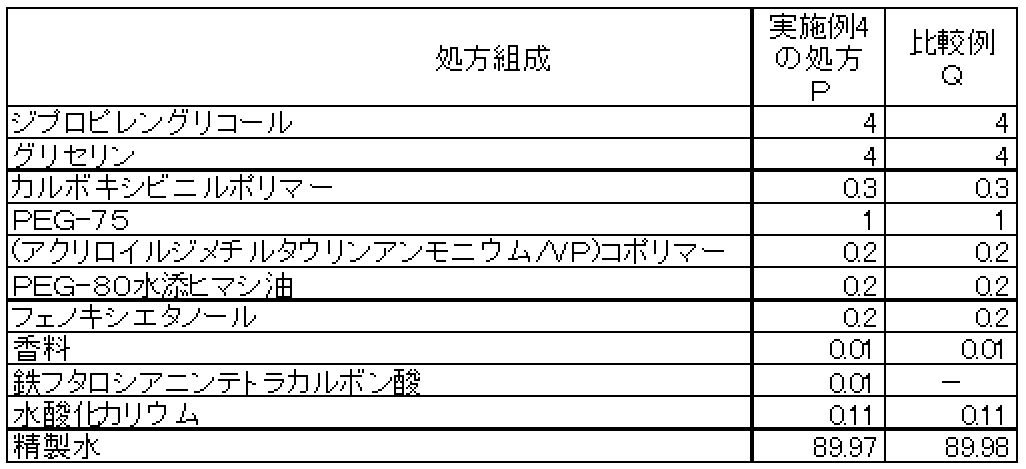
鉄フタロシアニンテトラカルボン酸を添加しない以外は実施例4と同様に作製し、美容液を得た。
上記で得られた実施例・比較例の美容液の使用試験を、被験者21名を対象として実施し、使用後の使用感と効果を被験者に対するアンケートで評価した。
試験方法は次の通り。
(1)被験者 : 対象となる被験者は、成人で健康な女性で、極度の敏感肌、アトピー性皮膚炎の者、化粧料使用部位に皮膚疾患のある者は除外した。
(2)試験化粧料: 実施例と比較例の2種類の試験化粧料を被験者に使用させた。
試験化粧料は記号のみを付け、被験者に実施例・比較例の区別がわからないようにした。試験化粧料のべースは安全性・安定性の品質が確保されたものであり、両化粧料には使用上の差はない。
(3)使用方法 : 被験者が通常使用している化粧料の、乳液、クリーム、美容液は控えさせ、試験化粧料を使用させた。その他の洗顔料などの化粧料は、モニター試験中通常通りに使用させた。
(4)使用部位 : 配布する化粧料は、通常使用している乳液、クリーム、美容液の代わりに、どちらか一方を片側の半顔に、もう一方を反対側の半顔に継続使用させた。
(5)使用期間 : 1日2回(朝・晩)使用し、連続10日間連用させた。
(6)使用量 : 1回の使用量は通常の化粧料の使用量と同様とした。
(7)評価 : 効果判定は使用した際の実感を次ぎの五段階評価とした
1 効果ない
2 殆ど効果を感じない
3 やや効果を感じた
4 効果を感じた
5 顕著な効果を感じた
(8)アンケート:アンケート内容は試験結果を示す下記の表に記載の通り。なお、統計解析は、EXCELソフトのt検定「分散が等しくないと仮定した2標本による検定法」を用いて行った。
下記の表4及び図1、2に示す通り、実施例の本発明の鉄フタロシアニンテトラカルボン酸を配合する美容液は、比較例の鉄フタロシアニンテトラカルボン酸を配合しない美容液と比較して、「保湿の実感」、「くすみ改善の実感」、「キメ改善の実感」、「小じわ改善の実感」、「ハリ弾力改善の実感」、「全体的な肌改善効果の実感」の項目で、肌改善効果の実感が有意に高かった。特に「保湿改善の実感」、「キメ改善の実感」、「全体的な肌改善効果の実感」が顕著に高いことが分った(1%有意)。
また、総合的に評価して、実施例と比較例のどちらに肌改善効果の実感があったかとの質問をした結果、「実施例の方がよい」と回答した者が21人中14人、「実施例の方がややよい」と回答した者が同じく4人、「違いがない」と回答した者が同じく3人という結果であり、圧倒的に実施例の方が肌改善効果が高いことが分った。
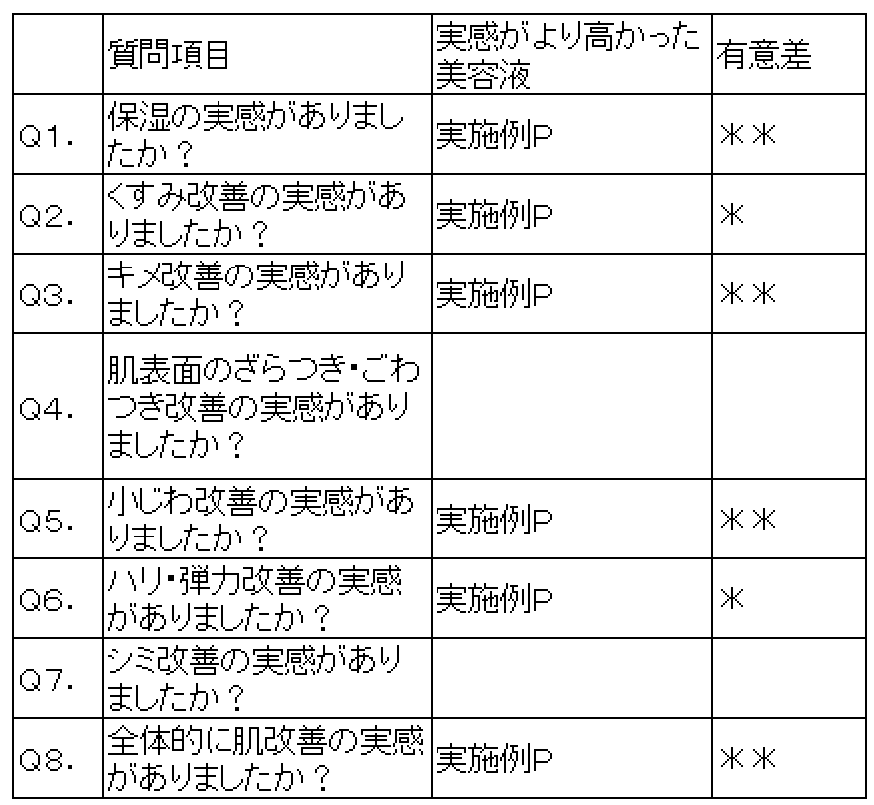
**:1%有意
実施例10
[美容液の調製]
前述記載の実施例4の鉄フタロシアニンテトラカルボン酸を鉄フタロシアニンオクタカルボン酸に代えた以外は同じ処方の美容液を常法によって調製した。
上記で得られた実施例10の美容液の使用試験を、被験者21名を対象として実施し、使用後の使用感と効果を被験者に対するアンケートで評価した。
試験方法は前述の実施例と同様に行った。
試験方法は次の通り。
(1)被験者 : 対象となる被験者は、成人で健康な女性で、極度の敏感肌、アトピー性皮膚炎の者、化粧料使用部位に皮膚疾患のある者は除外した。
(2)試験化粧料: 実施例の試験化粧料を被験者に使用させた。試験化粧料は記号のみを付け、被験者に実施例の詳細がわからないようにした。試験化粧料のべースは安全性・安定性の品質が確保されたものである。
(3)使用方法 : 被験者が通常使用している化粧料の、乳液、クリーム、美容液は控えさせ、試験化粧料を使用させた。その他の洗顔料などの化粧料は、モニター試験中通常通りに使用させた。
(4)使用部位 : 配布する化粧料は、通常使用している乳液、クリーム、美容液の代わりに継続使用させた。
(5)使用期間 : 前記と同様
(6)使用量 : 前記と同様
(7)評価 : モニター品を使用した後に「ハリ・弾力の改善」、「保湿」、「小ジワ改善」、「くすみ改善」、「肌表面のざらつき・ごわつき改善」、「キメ改善」、「シミ改善」及び「全体的な肌改善」の各項目について、使用前と比較して下記の二段階で本人に評価させた。
1 実感がなかった
2 実感があった
実施例の本発明の鉄フタロシアニンオクタカルボン酸を配合する美容液の使用後のアンケートの下記の各質問に対する被験者の回答を括弧内に人数と割合を示す。
・ハリ・弾力改善の実感がありましたか? (あった:17人、81%)
・保湿の実感がありましたか? (あった:17人、81%)
・小じわ改善の実感がありましたか? (あった:9人、43%)
・くすみ改善の実感がありましたか? (あった:9人、43%)
・肌表面のざらつき ・ごわつき改善の実感がありましたか? (あった:11人、52%)
・キメ改善の実感がありましたか? (あった:13人、62%)
・シミ改善の実感がありましたか? (あった:5人、24%)
・全体的に肌改善の実感がありましたか? (あった:19人、91%)
実施例の本発明の鉄フタロシアニンオクタカルボン酸を配合する美容液は、「ハリ弾力改善の実感」と「保湿の実感」があったと回答した者の割合が、80%以上と顕著に効果が高く、次いで「キメ改善効果の実感」があったと回答した者の割合が60%以上と効果高いことがわかった。「全体的な肌改善効果の実感」があったと回答した者の割合は、91%であり顕著に高い結果であった。
鉄フタロシアニンテトラカルボン酸配合美容液の使用試験
[試験用美容液の調製〕
下記に示す処方の通りに、本発明の鉄フタロシアニンテトラカルボン酸0.005質量%を配合したジェル状美容液(実施例11)を常法によって調製した。
グリセリン 10%、1,3-ブチレングリコール 6%、ジグリセリン 4%、シクロヘキサンジカルボン酸ビスエトキシジグリコール 1%、ラフィノース 3%、ジプロピレングリコール 2%、コハク酸ビスエトキシジグリコール 0.8%、グルコシルトレハロース 1.5%、ポリソルベート80 0.5%、カルボマー 0.4%、キサンタンガム 0.3%、加水分解ヒアルロン酸 0.01%、アセチルヒアルロン酸Na 0.01%、フィチン酸 0.1%、アスコルビルグルコシド 0.05%、美容成分 適量、香気成分 適量、フェノキシエタノール 0.6%、鉄フタロシアニンテトラカルボン酸 0.005%、精製水 残余
この処方により得られたジェル状美容液の安定性は良好であった。
実施例11の美容液の使用試験を、被験者25名を対象として使用後の使用感と効果を被験者に対するアンケートで評価した。試験方法は次の通り。
(1)被験者 : 対象となる被験者は、成人で健康な女性で、極度の敏感肌、アトピー性皮膚炎の者、化粧料使用部位に皮膚疾患のある者は除外した。
(2)試験化粧料: 実施例の試験化粧料を被験者に使用させた。試験化粧料は記号のみを付け、被験者に実施例の詳細がわからないようにした。試験化粧料のべースは安全性・安定性の品質が確保されたものである。
(3)使用方法 : 被験者が通常使用している化粧料の、乳液、クリーム、美容液は控えさせ、試験化粧料を使用させた。その他の洗顔料などの化粧料は、モニター試験中通常通りに使用させた。
(4)使用部位 :配布する化粧料は、通常使用している乳液、クリーム、美容液の代わりに同様の使用部位に継続使用させた。
(5)使用期間 :1日2回(朝・晩)使用し、連続10日間連用させた。
(6)使用量 :1回の使用量は通常の化粧料の使用量と同様とした。
(7)評価 :使用した後の、「肌のハリ・弾力の改善」、「ツヤ」、「保湿」、「キメ」、「肌表面のざらつき・ごわつき」、「小じわ」、「シミ」及び「全体的改善」の実感を、使用前と比較して下記の五段階で本人に評価させた。また、使用中の化粧品による肌への実感についても、試験開始前に同様の項目を評価させた。
1 感じない
2 あまり感じない
3 どちらともいえない
4 やや感じる
5 感じる
実施例11処方の鉄フタロシアニンテトラカルボン酸を配合する美容液の使用後の実感、及び現在使用中の化粧品に関する使用実感について各質問における「感じる」+「やや感じる」と回答した者の人数と割合を下記の表5に示す。

鉄フタロシアニンテトラカルボン酸の退色抑制効果試験
本発明の化粧料組成物は、上述したとおり金属封鎖剤などの金属封鎖効果のある成分を化粧料中に配合することにより、本発明の金属フタロシアニン誘導体の色調の安定性が向上する。
この美容液を50℃で1週間保管し、調製直後の美容液と対比して目視により安定性を評価した。
評価基準は次の通り。
〔退色防止効果〕
専門の試験担当者が次の3段階で試験美容液を判定した。
× 退色が顕著である
△ やや退色している。
○ 殆ど退色がない
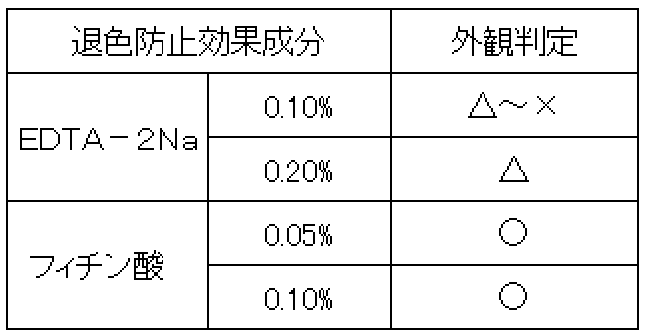
鉄フタロシアニンテトラカルボン酸0.01%を配合した美容液に金属封鎖効果成分を配合し、退色防止効果を調べた結果を表6に示す。EDTA-2Naを配合した場合、0.1%では顕著な退色が認められ、0.2%でもやや退色がみられた。EDTA-2Naを処方する場合は化粧料組成物あたり0.2質量%添加する必要があることがわかった。一方、フィチン酸を配合した場合0.05%、0.1%ともに殆ど退色が認められず、退色防止効果が高いことが分かった。
エタノール 3質量%、グリセリン 5%、1,3-ブチレングリコール 2%、モノステアリン酸POEソルビタン 3%、鉄フタロシアニンテトラカルボン酸 0.005%、精製水 残余
上記処方にて常法により、化粧水を製造した。得られた化粧水の安定性は良好であった。
処方例3の化粧水の処方中で、鉄フタロシアニンテトラカルボン酸を鉄フタロシアニンオクタカルボン酸に置き換えた以外は同様の配合量で、常法により化粧水を製造した。得られた化粧水の安定性は良好であった。
スクワラン 6質量%、セチルアルコール 1%、オリーブ油 1.5%、マカデミアナッツ油1.5%、グリセリン 3%、1,3-ブチレングリコール 3%、 カルボキシビニルポリマー 0.5%、水酸化ナトリウム 0.15%、モノステアリン酸デカグリセリル 2%、鉄フタロシアニンテトラカルボン酸 0.01%、香料 適量、フェノキシエタノール 0.8%、精製水 残余
上記処方にて常法により、乳液を製造した。得られた乳液の安定性は良好であった。
スクワラン 10質量%、オクチルドデカノール 5%、グリセロールトリ2-エチルヘキサン酸エステル 30%、ミツロウ 3%、ワセリン 2%、1,3-ブチレングリコール 4%、モノステアリン酸プロピレングリコール 5%、鉄フタロシアニンテトラカルボン酸 0.01%、香料 適量、フェノキシエタノール 0.8%、精製水 残余
上記処方にて常法により、クリームを製造した。得られたクリームの安定性は良好であった。
処方例4のクリームの処方中で、鉄フタロシアニンテトラカルボン酸を鉄フタロシアニンオクタカルボン酸に置き換えた以外は同様の配合量で、常法によりクリームを製造した。得られたクリームの安定性は良好であった。
硫酸ナトリウム 50質量%、炭酸水素ナトリウム 49.98%、鉄フタロシアニンテトラカルボン酸 0.01%、香料 0.01%
上記処方にて常法により、入浴剤を製造した。得られた入浴剤の安定性は良好であった。
グリセリン 40質量%、N-ヤシ油脂肪酸アシル-L-グルタミン酸カリウム12%、N-ラウロイル-β-メチルアラニンナトリウム 3%、2-アルキル-N-カルボキシメチル-N-ヒドロキシエチルイミダゾリニウムベタイン 10%、ラウリン酸ジエタノールアミド 1%、エタノール 5%、カルボキシメチルセルロースナトリウム 1%、鉄フタロシアニンテトラカルボン酸 0.01%、香料 適量、フェノキシエタノール 0.9%、精製水 残余
上記処方にて常法により、シャンプーを製造した。得られたシャンプーの安定性は良好であった。
1,2-ペンタンジオール 2%、ジグリセリン 15%、マルチトール 10%、N-ラウロイル-L-グルタミン酸ナトリウム 15%、ポリオキシエチレン(20EO)ソルビタンモノラウレート 1%、ヤシ油脂肪酸ポリオキシエチレン(7EO)グリセリル 1%、エタノール 12%、カルボキシメチルセルロースナトリウム 1%、鉄フタロシアニンテトラカルボン酸 0.01%、香料 適量、フェノキシエタノール 0.9%、精製水 残余
上記処方にて常法により、ボディソープを製造した。得られたボディソープの安定性は良好であった。
Claims (13)
- 下記式 [I] で示される金属フタロシアニン誘導体を含有することを特徴とする化粧料組成物。

- 前記[I]式中、R1~R4はカルボキシル基であり、n1~n4は同一の1または2である金属フタロシアニン誘導体を有効成分に含むことを特徴とする請求項1に記載の化粧料組成物。
- 前記 [I]式中、MがFe、CoまたはMnである金属フタロシアニン誘導体を有効成分に含むことを特徴とする請求項1又は2に記載の化粧料組成物。
- 化粧料組成物が、基礎化粧料用である請求項1~3のいずれかに記載の化粧料組成物。
- 金属フタロシアニン誘導体が鉄フタロシアニンテトラカルボン酸又はその塩である請求項1~4のいずれかに記載の化粧料組成物。
- 金属フタロシアニン誘導体が鉄フタロシアニンオクタカルボン酸又はその塩である請求項1~4のいずれかに記載の化粧料組成物。
- 前記式 [I] で示される金属フタロシアニン誘導体と金属封鎖剤又は金属封鎖効果のある成分を含有することを特徴とする化粧料組成物。
- 金属封鎖剤がEDTA-2ナトリウム、EDTA-3ナトリウム、EDTA-4ナトリウム、エチドロン酸、エチドロン酸4ナトリウム、ヒドロキシエタンジホスホン酸液、クエン酸から選択される1以上の物質、金属封鎖効果のある成分がコハク酸、フィチン酸、アスコルビン酸、グルコン酸、リン酸、ポリリン酸ナトリウム、メタリン酸ナトリウムから選択される1以上の物質である請求項7記載の化粧料組成物。
- 前記[I]式中、R1~R4はカルボキシル基であり、n1~n4は同一の1または2である金属フタロシアニン誘導体を有効成分に含むことを特徴とする請求項7又は8に記載の化粧料組成物。
- 前記 [I]式中、MがFe、CoまたはMnである金属フタロシアニン誘導体を有効成分に含むことを特徴とする請求項7~9のいずれかに記載の化粧料組成物。
- 化粧料組成物が、基礎化粧料用である請求項7~10のいずれかに記載の化粧料組成物。
- 金属フタロシアニン誘導体が鉄フタロシアニンテトラカルボン酸又はその塩である請求項7~11のいずれかに記載の化粧料組成物。
- 金属フタロシアニン誘導体が鉄フタロシアニンオクタカルボン酸又はその塩である請求項7~11のいずれかに記載の化粧料組成物。
Priority Applications (7)
| Application Number | Priority Date | Filing Date | Title |
|---|---|---|---|
| KR1020137010878A KR20130086611A (ko) | 2010-10-01 | 2011-09-29 | 화장료 조성물 |
| EP11829269.7A EP2623092A4 (en) | 2010-10-01 | 2011-09-29 | COSMETIC COMPOSITION |
| HK14100607.9A HK1187537B (en) | 2010-10-01 | 2011-09-29 | Cosmetic composition |
| JP2012536544A JP5718348B2 (ja) | 2010-10-01 | 2011-09-29 | 化粧料組成物 |
| CN201180047699.1A CN103249396B9 (zh) | 2010-10-01 | 2011-09-29 | 化妆品组合物 |
| US13/822,253 US20130178508A1 (en) | 2010-10-01 | 2011-09-29 | Cosmetic composition |
| US15/391,737 US20170105920A1 (en) | 2010-10-01 | 2016-12-27 | Cosmetic method using metal phthalocyanine derivative |
Applications Claiming Priority (2)
| Application Number | Priority Date | Filing Date | Title |
|---|---|---|---|
| JP2010224114 | 2010-10-01 | ||
| JP2010-224114 | 2010-10-01 |
Related Child Applications (2)
| Application Number | Title | Priority Date | Filing Date |
|---|---|---|---|
| US13/822,253 A-371-Of-International US20130178508A1 (en) | 2010-10-01 | 2011-09-29 | Cosmetic composition |
| US15/391,737 Continuation US20170105920A1 (en) | 2010-10-01 | 2016-12-27 | Cosmetic method using metal phthalocyanine derivative |
Publications (1)
| Publication Number | Publication Date |
|---|---|
| WO2012043716A1 true WO2012043716A1 (ja) | 2012-04-05 |
Family
ID=45893155
Family Applications (1)
| Application Number | Title | Priority Date | Filing Date |
|---|---|---|---|
| PCT/JP2011/072365 Ceased WO2012043716A1 (ja) | 2010-10-01 | 2011-09-29 | 化粧料組成物 |
Country Status (6)
| Country | Link |
|---|---|
| US (2) | US20130178508A1 (ja) |
| EP (1) | EP2623092A4 (ja) |
| JP (1) | JP5718348B2 (ja) |
| KR (1) | KR20130086611A (ja) |
| TW (1) | TWI559935B (ja) |
| WO (1) | WO2012043716A1 (ja) |
Cited By (3)
| Publication number | Priority date | Publication date | Assignee | Title |
|---|---|---|---|---|
| JP2013224274A (ja) * | 2012-04-20 | 2013-10-31 | Iforet:Kk | ヒドロキシラジカル消去能を有する組成物 |
| JP2015209396A (ja) * | 2014-04-25 | 2015-11-24 | 株式会社アイフォーレ | 金属フタロシアニン誘導体含有化粧料 |
| JP2023056765A (ja) * | 2021-10-08 | 2023-04-20 | 花王株式会社 | 水性化粧料 |
Families Citing this family (8)
| Publication number | Priority date | Publication date | Assignee | Title |
|---|---|---|---|---|
| DE102011077045A1 (de) * | 2011-06-07 | 2012-12-13 | Beiersdorf Ag | Kosmetische oder dermatologische Zubereitungen mit verbesserter mikrobiologischer Stabilität |
| EP2717968A2 (de) * | 2011-06-07 | 2014-04-16 | Beiersdorf AG | Kosmetische oder dermatologische emulsionszubereitungen mit verbesserter parfumfreisetzung |
| KR101659896B1 (ko) * | 2015-10-23 | 2016-09-26 | (주)씨앤씨인터내셔널 | 필오프타입 눈썹 착색용 조성물 및 이의 제조방법 |
| JP7179534B2 (ja) | 2018-08-30 | 2022-11-29 | ロレアル | 油を含む発泡性組成物 |
| JP7179533B2 (ja) | 2018-08-30 | 2022-11-29 | ロレアル | 自己回復又は自己修復膜形成組成物 |
| JP7179535B2 (ja) * | 2018-08-30 | 2022-11-29 | ロレアル | 高内油相エマルション組成物-ゲル |
| WO2021056086A1 (pt) * | 2019-09-27 | 2021-04-01 | Mmf&T Desenvolvimento Tecnológico E Inovação Ltda. | Composição para saúde oral e processo de elaboração de composição para saúde oral |
| FR3104987B1 (fr) * | 2019-12-18 | 2023-06-30 | Lvmh Rech | Composition cosmétique comprenant de l’acide 2-glucoside ascorbique et de l’acide hyaluronique acétylé ou l’un de ses sels |
Citations (4)
| Publication number | Priority date | Publication date | Assignee | Title |
|---|---|---|---|---|
| JPH0350285A (ja) * | 1989-07-18 | 1991-03-04 | Shiseido Co Ltd | 過酸化脂質分解剤組成物 |
| JP2000512267A (ja) * | 1996-05-09 | 2000-09-19 | ノボ ノルディスク アクティーゼルスカブ | 抗微生物ペルオキシダーゼ組成物 |
| JP2003501451A (ja) * | 1999-06-10 | 2003-01-14 | コティ ビー.ヴィ. | 酵素を含む化粧品組成物 |
| JP2004321409A (ja) * | 2003-04-23 | 2004-11-18 | Ueda Shiinomikai | アレルギー症状緩和マスク |
Family Cites Families (20)
| Publication number | Priority date | Publication date | Assignee | Title |
|---|---|---|---|---|
| US2991228A (en) * | 1958-03-07 | 1961-07-04 | Lawrence Richard Bruce Inc | Composition for bleaching hair |
| US3592581A (en) * | 1968-08-08 | 1971-07-13 | Del Lab | Dyeing of human hair with insoluble phthalocyanine dyestuffs in a cationic dispersion |
| US4828912A (en) * | 1981-07-20 | 1989-05-09 | Kimberly-Clark Corporation | Virucidal product having virucidal and/or germicidal properties |
| US4456585A (en) * | 1983-05-16 | 1984-06-26 | Colgate-Palmolive Company | Visually clear pigment-colored dentifrice composition |
| JPS6016837A (ja) * | 1983-07-04 | 1985-01-28 | Hitachi Cable Ltd | プラスチツク被覆光フアイバ |
| US4800092A (en) * | 1986-02-07 | 1989-01-24 | Union Oil Company Of California | Method for producing a solid animal feed supplement |
| JPH0622548B2 (ja) * | 1986-06-10 | 1994-03-30 | 日清製粉株式会社 | 金属フタロシアニンを構成成分とする消臭剤 |
| JPH0482559A (ja) * | 1990-07-25 | 1992-03-16 | Daiwabo Create Kk | 消臭剤 |
| JPH06321711A (ja) * | 1993-05-07 | 1994-11-22 | Nippon Oil & Fats Co Ltd | 殺菌剤および殺菌方法 |
| JP2813547B2 (ja) * | 1994-06-04 | 1998-10-22 | 憲司 中村 | 化粧料用機能性粉粒体 |
| US5536499A (en) * | 1995-02-24 | 1996-07-16 | Chesebrough-Pond's Usa Co., Division Of Conopco, Inc. | Cosmetic compositions for reducing or preventing signs of cellulite |
| US5589507A (en) * | 1995-11-17 | 1996-12-31 | Minntech Corporation | Method for sterilizing medical devices utilizing a room temperature sterilant |
| US6382132B1 (en) * | 1996-07-11 | 2002-05-07 | Ralph J. Steckel | Animal litter having the property of detecting urinary infection in felines |
| US6287550B1 (en) * | 1996-12-17 | 2001-09-11 | The Procter & Gamble Company | Animal care system and litter with reduced malodor impression |
| US6673756B2 (en) * | 2000-09-20 | 2004-01-06 | Symrise Gmbh & Co. Kg | Multiphase soaps |
| JP2002097497A (ja) * | 2000-09-22 | 2002-04-02 | Berubikku:Kk | 固形石鹸 |
| ATE520756T1 (de) * | 2003-11-12 | 2011-09-15 | Shinshu Tlo Co Ltd | Allergenzersetzer und antiallergene feder |
| WO2006081926A1 (en) * | 2005-02-04 | 2006-08-10 | Unilever N.V. | Multiphase toothpaste composition |
| US20070017453A1 (en) * | 2005-07-25 | 2007-01-25 | Fritter Charles F | Animal litter containing activated carbon |
| US20100221307A1 (en) * | 2008-02-20 | 2010-09-02 | Daiwabo Holdings Co., Ltd. | Antiviral agents, antiviral fibers and antiviral fiber structures |
-
2011
- 2011-09-29 WO PCT/JP2011/072365 patent/WO2012043716A1/ja not_active Ceased
- 2011-09-29 JP JP2012536544A patent/JP5718348B2/ja active Active
- 2011-09-29 US US13/822,253 patent/US20130178508A1/en not_active Abandoned
- 2011-09-29 EP EP11829269.7A patent/EP2623092A4/en not_active Withdrawn
- 2011-09-29 KR KR1020137010878A patent/KR20130086611A/ko not_active Withdrawn
- 2011-09-30 TW TW100135453A patent/TWI559935B/zh not_active IP Right Cessation
-
2016
- 2016-12-27 US US15/391,737 patent/US20170105920A1/en not_active Abandoned
Patent Citations (4)
| Publication number | Priority date | Publication date | Assignee | Title |
|---|---|---|---|---|
| JPH0350285A (ja) * | 1989-07-18 | 1991-03-04 | Shiseido Co Ltd | 過酸化脂質分解剤組成物 |
| JP2000512267A (ja) * | 1996-05-09 | 2000-09-19 | ノボ ノルディスク アクティーゼルスカブ | 抗微生物ペルオキシダーゼ組成物 |
| JP2003501451A (ja) * | 1999-06-10 | 2003-01-14 | コティ ビー.ヴィ. | 酵素を含む化粧品組成物 |
| JP2004321409A (ja) * | 2003-04-23 | 2004-11-18 | Ueda Shiinomikai | アレルギー症状緩和マスク |
Non-Patent Citations (1)
| Title |
|---|
| See also references of EP2623092A4 * |
Cited By (3)
| Publication number | Priority date | Publication date | Assignee | Title |
|---|---|---|---|---|
| JP2013224274A (ja) * | 2012-04-20 | 2013-10-31 | Iforet:Kk | ヒドロキシラジカル消去能を有する組成物 |
| JP2015209396A (ja) * | 2014-04-25 | 2015-11-24 | 株式会社アイフォーレ | 金属フタロシアニン誘導体含有化粧料 |
| JP2023056765A (ja) * | 2021-10-08 | 2023-04-20 | 花王株式会社 | 水性化粧料 |
Also Published As
| Publication number | Publication date |
|---|---|
| KR20130086611A (ko) | 2013-08-02 |
| US20170105920A1 (en) | 2017-04-20 |
| TW201219061A (en) | 2012-05-16 |
| JP5718348B2 (ja) | 2015-05-13 |
| EP2623092A1 (en) | 2013-08-07 |
| TWI559935B (en) | 2016-12-01 |
| JPWO2012043716A1 (ja) | 2014-02-24 |
| US20130178508A1 (en) | 2013-07-11 |
| CN103249396A (zh) | 2013-08-14 |
| CN103249396B (zh) | 2016-02-10 |
| HK1187537A1 (zh) | 2014-04-11 |
| EP2623092A4 (en) | 2015-12-02 |
Similar Documents
| Publication | Publication Date | Title |
|---|---|---|
| JP5718348B2 (ja) | 化粧料組成物 | |
| KR102193902B1 (ko) | 안티에이징용 피부 외용 조성물 및 그 제조방법 | |
| JP5101193B2 (ja) | 化粧品組成物 | |
| JP5089887B2 (ja) | 生理活性物質含有複合体 | |
| EP2047842A1 (en) | Cosmetic and method for production thereof | |
| JP5093998B2 (ja) | 色素沈着予防又は改善剤 | |
| JP2015209396A (ja) | 金属フタロシアニン誘導体含有化粧料 | |
| JP2004035440A (ja) | くすみ抑制剤及び肌質改善用皮膚外用剤 | |
| JP2003048846A (ja) | コラゲナーゼ阻害剤及び抗老化用化粧料 | |
| JP2011046701A (ja) | 乳化剤及び分散安定剤並びにそれを含有する皮膚外用剤 | |
| KR20210153853A (ko) | 쌀겨왁스의 안정화 방법 및 고 함량의 쌀겨왁스를 안정화한 나노에멀젼을 함유하는 화장료 조성물 | |
| JP5514268B2 (ja) | 色素沈着予防又は改善剤 | |
| WO2012017733A1 (ja) | 皮膚化粧料 | |
| JP2005104894A (ja) | 油性化粧料 | |
| KR20170062961A (ko) | 폴리페놀계 유효 성분 안정화용 조성물 | |
| JP2005089427A (ja) | 皮膚外用剤 | |
| JP2010150173A (ja) | 美白剤、メラニン産生抑制剤、及び美白用皮膚外用剤 | |
| JP2009203190A (ja) | 細胞賦活剤及び老化防止用皮膚外用剤 | |
| CN103249396B9 (zh) | 化妆品组合物 | |
| KR102537101B1 (ko) | 스쿠알렌을 포함하는 나노 에멀젼 조성물, 이를 포함하는 화장료 조성물 및 이의 제조 방법 | |
| JP2021104968A (ja) | オートファジー誘導剤 | |
| HK1187537B (en) | Cosmetic composition | |
| JP2008094799A (ja) | 硫酸化グリコサミノグリカン産生促進剤およびこれを含有する皮膚外用剤 | |
| JP2021088529A (ja) | 浸透促進剤及びそれを含有する化粧料 | |
| JP2010150174A (ja) | 抗酸化剤、ラジカル消去剤、及び抗酸化用皮膚外用剤 |
Legal Events
| Date | Code | Title | Description |
|---|---|---|---|
| 121 | Ep: the epo has been informed by wipo that ep was designated in this application |
Ref document number: 11829269 Country of ref document: EP Kind code of ref document: A1 |
|
| WWE | Wipo information: entry into national phase |
Ref document number: 13822253 Country of ref document: US |
|
| ENP | Entry into the national phase |
Ref document number: 2012536544 Country of ref document: JP Kind code of ref document: A |
|
| NENP | Non-entry into the national phase |
Ref country code: DE |
|
| ENP | Entry into the national phase |
Ref document number: 20137010878 Country of ref document: KR Kind code of ref document: A |
|
| REEP | Request for entry into the european phase |
Ref document number: 2011829269 Country of ref document: EP |
|
| WWE | Wipo information: entry into national phase |
Ref document number: 2011829269 Country of ref document: EP |