WO2012115116A1 - Composition adhésive sensible à la pression et feuille adhésive - Google Patents
Composition adhésive sensible à la pression et feuille adhésive Download PDFInfo
- Publication number
- WO2012115116A1 WO2012115116A1 PCT/JP2012/054165 JP2012054165W WO2012115116A1 WO 2012115116 A1 WO2012115116 A1 WO 2012115116A1 JP 2012054165 W JP2012054165 W JP 2012054165W WO 2012115116 A1 WO2012115116 A1 WO 2012115116A1
- Authority
- WO
- WIPO (PCT)
- Prior art keywords
- pressure
- sensitive adhesive
- mass
- adhesive composition
- resin
- Prior art date
- Legal status (The legal status is an assumption and is not a legal conclusion. Google has not performed a legal analysis and makes no representation as to the accuracy of the status listed.)
- Ceased
Links
Images
Classifications
-
- C—CHEMISTRY; METALLURGY
- C09—DYES; PAINTS; POLISHES; NATURAL RESINS; ADHESIVES; COMPOSITIONS NOT OTHERWISE PROVIDED FOR; APPLICATIONS OF MATERIALS NOT OTHERWISE PROVIDED FOR
- C09J—ADHESIVES; NON-MECHANICAL ASPECTS OF ADHESIVE PROCESSES IN GENERAL; ADHESIVE PROCESSES NOT PROVIDED FOR ELSEWHERE; USE OF MATERIALS AS ADHESIVES
- C09J123/00—Adhesives based on homopolymers or copolymers of unsaturated aliphatic hydrocarbons having only one carbon-to-carbon double bond; Adhesives based on derivatives of such polymers
- C09J123/02—Adhesives based on homopolymers or copolymers of unsaturated aliphatic hydrocarbons having only one carbon-to-carbon double bond; Adhesives based on derivatives of such polymers not modified by chemical after-treatment
- C09J123/18—Homopolymers or copolymers of hydrocarbons having four or more carbon atoms
- C09J123/20—Homopolymers or copolymers of hydrocarbons having four or more carbon atoms having four to nine carbon atoms
- C09J123/22—Copolymers of isobutene; Butyl rubber ; Homo- or copolymers of other iso-olefines
-
- C—CHEMISTRY; METALLURGY
- C09—DYES; PAINTS; POLISHES; NATURAL RESINS; ADHESIVES; COMPOSITIONS NOT OTHERWISE PROVIDED FOR; APPLICATIONS OF MATERIALS NOT OTHERWISE PROVIDED FOR
- C09J—ADHESIVES; NON-MECHANICAL ASPECTS OF ADHESIVE PROCESSES IN GENERAL; ADHESIVE PROCESSES NOT PROVIDED FOR ELSEWHERE; USE OF MATERIALS AS ADHESIVES
- C09J11/00—Features of adhesives not provided for in group C09J9/00, e.g. additives
- C09J11/02—Non-macromolecular additives
- C09J11/06—Non-macromolecular additives organic
-
- C—CHEMISTRY; METALLURGY
- C09—DYES; PAINTS; POLISHES; NATURAL RESINS; ADHESIVES; COMPOSITIONS NOT OTHERWISE PROVIDED FOR; APPLICATIONS OF MATERIALS NOT OTHERWISE PROVIDED FOR
- C09J—ADHESIVES; NON-MECHANICAL ASPECTS OF ADHESIVE PROCESSES IN GENERAL; ADHESIVE PROCESSES NOT PROVIDED FOR ELSEWHERE; USE OF MATERIALS AS ADHESIVES
- C09J7/00—Adhesives in the form of films or foils
- C09J7/20—Adhesives in the form of films or foils characterised by their carriers
Definitions
- the present invention relates to a light-transmitting pressure-sensitive adhesive composition whose color tone reversibly changes and a pressure-sensitive adhesive sheet having a pressure-sensitive adhesive layer made of this pressure-sensitive adhesive composition.
- a light-shielding sheet that is used in a window glass, a wall surface, a partition glass, a transparent resin plate, a vehicle such as an automobile, a bus, and a train, a lens such as sunglasses, and glasses, and is used for the purpose of adjusting light transmittance. Proposed.
- a light-shielding sheet is sufficient when used on a window of a vehicle such as an automobile, a bus, or a train because the light transmission is low indoors, rainy or cloudy, at night or in a tunnel. There was a problem in terms of safety because the field of view could not be secured.
- Patent Documents 1 to 4 a light shielding sheet using a photochromic dye has been proposed (see Patent Documents 1 to 4).
- the photochromic dye reversibly changes its color tone upon light irradiation. That is, the photochromic dye has a characteristic that it is colored by irradiating ultraviolet rays such as sunlight, and returns to colorless in an environment where the ultraviolet rays are not irradiated. Since the light shielding sheets disclosed in Patent Documents 1 to 4 use such a photochromic dye for the light shielding sheet, they exhibit light shielding properties only in an environment irradiated with ultraviolet rays, and in other environments. It is said to show transparency.
- the light-shielding sheets disclosed in Patent Documents 1 to 4 have a problem in that the speed of color tone change from colored to colorless is slow.
- the amount of ultraviolet rays is sufficient when running outdoors during the day.
- the speed of returning to colorless is slow, so the visual field of the window is not secured, and there is a possibility of causing a traffic accident or the like.
- these light-shielding sheets have problems such as deterioration of the photochromic performance (coloring property) of the dyes contained when used for a long time, and discoloration even in the environment of non-ultraviolet irradiation that should be colorless. .
- the present invention has been made in order to solve the above problems, has a high speed of color tone change from colored to colorless, has excellent weather resistance that can withstand long-term use, and peels from a release sheet It aims at providing the adhesive composition and adhesive sheet which were excellent also in the property.
- a pressure-sensitive adhesive composition containing a pressure-sensitive adhesive containing 70 to 95% by mass of a rubber resin and a photochromic dye selected from the group consisting of at least an oxazine compound and a naphthopyran compound, the photochromic dye Is a pressure-sensitive adhesive composition having a content of 0.40 to 2.50 parts by mass with respect to 100 parts by mass of the pressure-sensitive adhesive.
- the pressure-sensitive adhesive further contains a tackifier, and the content of the tackifier is 5 to 30% by mass with respect to all components of the pressure-sensitive adhesive.
- a pressure-sensitive adhesive sheet having a pressure-sensitive adhesive layer comprising the pressure-sensitive adhesive composition according to any one of [1] to [3].
- the pressure-sensitive adhesive composition and pressure-sensitive adhesive sheet of the present invention have a high color change rate from colored to colorless, have excellent weather resistance that can withstand long-term use, and are excellent in releasability from a release sheet. Yes.
- the pressure-sensitive adhesive composition of the present invention comprises a specific pressure-sensitive adhesive containing 70 to 90% by mass of a rubber-based resin and at least a photochromic dye selected from the group consisting of an oxazine dye and a naphthopyran dye at a predetermined ratio. By containing, it can be set as the adhesive composition which has the said effect. Moreover, the adhesive composition of this invention can contain other additives, such as antioxidant and a ultraviolet absorber, further.
- the pressure-sensitive adhesive, photochromic dye, antioxidant, and other additives contained in the pressure-sensitive adhesive composition of the present invention will be described in detail.
- the pressure-sensitive adhesive composition of the present invention contains a rubber-based resin as a pressure-sensitive adhesive.
- a rubber-based resin By containing the rubber-based resin, it is possible to suppress a decrease in photochromic performance due to the photochromic dye coming into contact with moisture.
- the content of the rubber-based resin is 70 to 95% by mass, preferably 73 to 90% by mass, more preferably 75 to 85% by mass, based on all components of the pressure-sensitive adhesive. If it is less than 70% by mass, zipping occurs, which is not preferable. Moreover, since it exists in the tendency for adhesive force to fall when it exceeds 95 mass%, it is unpreferable.
- Rubber resin As the rubber resin, synthetic rubber such as polyisobutylene resin, styrene-butadiene copolymer resin and polybutyl resin, and natural rubber can be used, and polyisobutylene resin is preferable.
- Polyisobutylene resins include polyisobutylene, which is a homopolymer of isobutylene, isobutylene and isoprene, isobutylene and n-butene, a copolymer of isobutylene and butadiene, and a halogenated copolymer obtained by bromination or chlorination of these copolymers. Examples include coalescence.
- the content of the polyisobutylene resin in the rubber resin is preferably 60 to 100% by mass, more preferably 80 to 100% by mass, still more preferably 95 to 100% by mass, and still more preferably substantially 100% by mass. .
- the weight average molecular weight of the rubber-based resin is preferably 20,000 or more, more preferably 50,000 to 6,000,000, still more preferably, from the viewpoint of improving the cohesive force of the pressure-sensitive adhesive composition and preventing contamination of the adherend. Is 150,000 to 500,000.
- the weight average molecular weight means a value in terms of polystyrene measured by a gel permeation chromatography (GPC) method.
- a polyisobutylene resin having a large weight average molecular weight (hereinafter also referred to as “PIB resin (A)”) and the PIB resin (A)
- PIB resin (B) a polyisobutylene resin having a small weight average molecular weight
- the PIB resin (A) and the PIB resin (B) are compatible with each other, and the PIB resin is appropriately added. It is considered that the resin (A) can be plasticized, and as a result, the wettability of the resulting pressure-sensitive adhesive to the adherend can be improved, and the pressure-sensitive adhesive properties, flexibility, holding power and the like can be improved.
- the weight average molecular weight of the PIB-based resin (A) is preferably 300,000 to 500,000, more preferably 320,000 to 480,000, from the viewpoint of the balance between cohesive force and flexibility and fluidity of the pressure-sensitive adhesive composition. More preferably, it is 330,000-450,000.
- the weight average molecular weight is 300,000 or more, the cohesive force of the pressure-sensitive adhesive composition is sufficient, and contamination of the adherend with the pressure-sensitive adhesive can be prevented.
- an adhesive composition can have moderate softness
- the solubility with respect to the solvent of PIB-type resin (A) also becomes favorable.
- the weight average molecular weight of the PIB resin (B) is preferably from 1,000 to 280,000, more preferably from the viewpoint of good compatibility with the PIB resin (A) and appropriate plasticization of the PIB resin (A). Is from 5,000 to 250,000, more preferably from 10,000 to 220,000. When the weight average molecular weight is 1000 or more, contamination of the adherend due to separation of the PIB resin (B) as a low molecular weight component can be prevented. Moreover, if it is 280,000 or less, PIB-type resin (A) can fully be plasticized, and the adhesive physical property of a pressure-sensitive adhesive obtained, a softness
- the content of the PIB resin (B) is preferably 2 to 100 parts by mass, more preferably 6 to 100 parts by mass with respect to 100 parts by mass of the PIB resin (A), from the viewpoint of the balance between adhesive force and cohesive force. Part, more preferably 10 to 100 parts by weight. If the content of the PIB resin (B) is 2 parts by mass or more, the PIB resin (A) can be sufficiently plasticized, the wettability of the resulting adhesive to the adherend is increased, and the adhesive physical properties , Flexibility, holding power and the like can be improved. Moreover, if it is 100 mass parts or less, the cohesive force of an adhesive composition is enough and can prevent the contamination to a to-be-adhered body.
- the adhesive used by this invention contains a tackifier further from a viewpoint of improving the adhesive force of the adhesive composition obtained.
- the tackifier include known tackifiers, and hydrogenated petroleum resins are preferred from the viewpoint of improving the weather resistance of the adhesive composition and maintaining photochromic performance.
- the hydrogenated petroleum resin means a hydrogenated petroleum resin such as an aliphatic petroleum resin, an aromatic petroleum resin or a cyclopentadiene petroleum resin using a hydrogenation catalyst.
- hydrogenated petroleum resins include hydrogenated terpene resins, hydrogenated rosins and hydrogenated rosin ester resins, disproportionated rosins, disproportionated rosin ester resins, pentenes generated by thermal decomposition of petroleum naphtha, and isoprene.
- Hydrogenated dicyclopentadiene resin which is a hydrogenated resin of C5 petroleum resin obtained by copolymerizing C5 fractions such as piperine and 1.3-pentadiene, partially hydrogenated aromatic modified dicyclopentadiene resin, Resin obtained by hydrogenating C9 petroleum resin obtained by copolymerizing C9 fraction such as indene, vinyltoluene, ⁇ - or ⁇ -methylstyrene produced by thermal decomposition of petroleum naphtha, C5 fraction and C9 fraction described above For example, a resin obtained by hydrogenation of a copolymerized petroleum resin.
- the content of the tackifier is preferably 5 to 30% by mass, more preferably 10 to 28% by mass, and further preferably 15 to 25% by mass with respect to all components of the adhesive. If it is 5 mass% or more, sufficient adhesive force can be provided to the obtained adhesive composition. Moreover, if it is 30 mass% or less, the adhesive composition which has sufficient softness
- the pressure-sensitive adhesive composition used in the present invention can contain other additives as long as the effects of the present invention are not impaired.
- Other additives include liquid paraffin, vegetable oils (eg olive oil, soybean oil, beef oil, lard), polybutene, lower isoprene, wax and other adhesive / holding power adjusting agents, ultraviolet absorbers, infrared / near Infrared absorbers, antiseptic / antifungal agents, freeze / thaw stabilizers, rust inhibitors, plasticizers, high-boiling solvents, pigments, fillers, and the like.
- the pressure-sensitive adhesive composition of the present invention contains a photochromic dye.
- the photochromic dye used in the present invention is a dye having photochromic performance and selected from the group consisting of at least an oxazine compound and a naphthopyran compound.
- the oxazine-based compound means a compound containing at least a 6-membered heterocyclic ring containing one oxygen atom and one nitrogen atom. Examples of the oxazine-based compound include naphthospiroxazine.
- naphthospiroxazine examples include 1,3,3-trimethylspiro [indoline-2,3 ′-(3H) -naphtho- (2,1-b) (1,4) -oxazine], 6′-indolino -1,3,3-trimethylspiro [indoline-2,3 ′-(3H) -naphtho- (2,1-b) (1,4) -oxazine], 5-chloro-1,3,3-trimethyl Spiro [indoline-2,3 ′-(3H) -naphtho- (2,1-b) (1,4) -oxazine], 6′-piperidino-1,3,3-trimethylspiro [indoline-2,3 '-(3H) -naphtho- (2,1-b) (1,4) -oxazine], 1-benzyl-3,3-dimethylspiro [indoline-2,
- the naphthopyran compound means a compound containing a naphthalene ring and a 6-membered ring heterocycle having one oxygen atom.
- Examples of naphthopyran compounds include 2,2-diphenylnaphtho- (2,1-b) -pyran, 2,2-di (p-methoxyphenyl) naphtho- (2,1-b) -pyran, 1, 3,3-triphenylspiro [indoline-2,3 ′-(3H) -naphtho- (2,1-b) -pyran], 1- (2,3,4,5,6-pentamethylbenzyl)- 3,3-dimethylspiro [indoline-2,3 ′-(3H) -naphtho- (2,1-b) -pyran], 1- (2-nitrobenzyl) -3,3-dimethylspiro [indoline-2] , 3 ′-(
- photochromic dyes may be used alone or in combination of two or more.
- the content of the photochromic dye in the pressure-sensitive adhesive composition of the present invention is 0.40 to 2.50 parts by weight, preferably 0.50 to 2.20 parts by weight with respect to 100 parts by weight of the pressure-sensitive adhesive. More preferably, it is 0.60 to 1.80 parts by mass, and still more preferably 0.65 to 1.50.
- the amount is less than 0.40 parts by mass, sufficient photochromic performance cannot be expressed with respect to the obtained pressure-sensitive adhesive composition.
- it exceeds 2.50 mass parts the weather resistance of the adhesive composition and adhesive sheet obtained will fall. Further, depending on the type of dye used, when a pressure-sensitive adhesive sheet with a release sheet is produced, the release from the release sheet tends to be difficult.
- the pressure-sensitive adhesive composition of the present invention can further contain an antioxidant.
- the pressure-sensitive adhesive composition of the present invention can be made into a pressure-sensitive adhesive composition excellent in durability against high-humidity heat without impairing photochromic performance or the like even when an antioxidant is added.
- a hindered phenol antioxidant is preferable from the viewpoint of improving the durability of the pressure-sensitive adhesive composition to high-humidity heat.
- the hindered phenol antioxidant include triethylene glycol-bis [3- (3-tert-butyl-5-methyl-4-hydroxyphenyl) propionate], 1,6-hexanediol-bis [3- (3,5-di-tert-butyl-4-hydroxyphenyl) propionate], pentaerythrityl tetrakis [3- (3,5-di-tert-butyl-4-hydroxyphenyl) propionate], 2,2- Thio-diethylenebis [3- (3,5-di-t-butyl-4-hydroxyphenyl) propionate], octadecyl-3- (3,5-di-t-butyl-4-hydroxyphenyl) propionate, N, N′-hexamethylenebis (3,5-di-t-butyl-4-hydroxy-
- a hindered phenol-based antioxidant having a branched alkyl group is preferable, and both of the beta positions of the hindered phenol groups are t.
- -A hindered phenolic antioxidant which is a butyl group is more preferred.
- Hindered phenolic antioxidants in which both of the hindered phenol groups are t-butyl groups are antioxidants that improve durability, especially when used in long-term driving or outdoor driving environments. Excellent performance as an agent.
- antioxidants include 1,6-hexanediol-bis [3- (3,5-di-tert-butyl-4-hydroxyphenyl) propionate], pentaerythrityl tetrakis [3- ( 3,5-di-t-butyl-4-hydroxyphenyl) propionate], 2,2-thio-diethylenebis [3- (3,5-di-t-butyl-4-hydroxyphenyl) propionate], octadecyl- 3- (3,5-di-t-butyl-4-hydroxyphenyl) propionate, N, N′-hexamethylenebis (3,5-di-t-butyl-4-hydroxy-hydroxynnamamide), 1 , 3,5-trimethyl-2,4,6-tris (3,5
- antioxidants examples include Yoshinox BHT (manufactured by Yoshitomi Fine Chemical), IRGANOX 565 (manufactured by Ciba Specialty Chemicals), and IRGANOX 1010 (manufactured by BASF).
- the content of the antioxidant in the pressure-sensitive adhesive composition of the present invention is preferably 0.01 to 1.0 with respect to 100 parts by mass of the pressure-sensitive adhesive from the viewpoint of improving the durability of the pressure-sensitive adhesive composition to high-humidity heat.
- Part by mass more preferably 0.03 to 0.5 part by mass, and still more preferably 0.04 to 0.3 part by mass. If it is 0.01 mass part or more, durability of the obtained adhesive composition can fully be improved. On the other hand, if it is 1.0 mass part or less, the phenomenon which isolate
- the pressure-sensitive adhesive composition of the present invention may further contain other additives as long as the effects of the present invention are not impaired and properties such as adhesive strength are not impaired.
- other additives include ultraviolet absorbers, light stabilizers, resin stabilizers, fillers, pigments, extenders and the like. These additives may be used alone or in combination of two or more.
- the ultraviolet absorber examples include hindered amine compounds, benzotriazole compounds, oxazolyac acid amide compounds, benzophenone compounds, and the like.
- Examples of commercially available products include Tinuvin 765 (manufactured by BASS, hindered amine compounds).
- the content of the ultraviolet absorber in the pressure-sensitive adhesive composition of the present invention is preferably 0.01 to 3.0 parts by weight, more preferably 0.03 to 2.0 parts by weight, with respect to 100 parts by weight of the pressure-sensitive adhesive. More preferably, it is 0.04 to 1.0 part by mass.
- Examples of the light stabilizer include hindered amine light stabilizers, benzophenone light stabilizers, and benzotriazole light stabilizers.
- the content of the light stabilizer in the adhesive composition of the present invention is preferably 0.01 to 2 parts by mass with respect to 100 parts by mass of the adhesive.
- the resin stabilizer examples include an imidazole resin stabilizer, a dithiocarbamate resin stabilizer, a phosphorus resin stabilizer, and a sulfur ester resin stabilizer.
- the content of the resin stabilizer in the adhesive composition of the present invention is preferably 0.01 to 3 parts by mass with respect to 100 parts by mass of the adhesive.
- the pressure-sensitive adhesive sheet of the present invention has a pressure-sensitive adhesive layer comprising the above-mentioned pressure-sensitive adhesive composition of the present invention on a substrate.
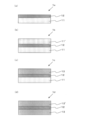
- the structure of the adhesive sheet of this invention is not specifically limited, It is not restricted to the adhesive sheet which formed the adhesive layer 12 on the base material 11 like the adhesive sheet 1a shown by Fig.1 (a).
- a pressure-sensitive adhesive sheet or the like in which a peelable release material 13 is formed on the pressure-sensitive adhesive layer 12 formed on the substrate 11 can be used. Moreover, it is good also as an adhesive sheet which clamped the adhesive layer 12 with the peeling material 13 and another peeling material 13 'without using a base material like the adhesive sheet 1d shown by FIG.1 (d). .
- the release material 13 and the release material 13 ′ may use the same type of release material, or may use different types of release materials, but the release material 13 and the release material 13 ′. It is preferable to adjust so that the difference in the peel strength between the two is different.
- the thickness of the pressure-sensitive adhesive layer of the pressure-sensitive adhesive sheet is appropriately selected depending on the application and the like, but is preferably 0.5 to 100 ⁇ m, more preferably 1 to 60 ⁇ m, and further preferably 3 to 40 ⁇ m.
- the thickness of the pressure-sensitive adhesive layer is 0.5 ⁇ m or more, good adhesive force can be obtained for the adherend.
- it is 100 micrometers or less, it is advantageous in terms of productivity and can be an easy-to-handle pressure-sensitive adhesive sheet.
- Base material It does not specifically limit as a base material, According to the intended purpose of an adhesive sheet, it selects suitably.
- the base material include various papers such as paper base materials such as fine paper, art paper, coated paper, glassine paper, laminated paper obtained by laminating a thermoplastic resin such as polyethylene on these paper base materials; Metal foil such as aluminum foil, copper foil, iron foil, etc .; base material made of porous material such as nonwoven fabric; polyolefin resin such as polyethylene resin and polypropylene resin; polyester resin such as polybutylene terephthalate resin and polyethylene terephthalate resin; acetate resin , A resin such as ABS resin, polystyrene resin, vinyl chloride resin, and a plastic film or plastic sheet made of a mixture or laminate thereof.
- the plastic film, the plastic sheet, and the like may be unstretched, or may be stretched in a uniaxial direction or a biaxial direction such as longitudinal or lateral.
- the base material used is not colored, a base material that sufficiently transmits ultraviolet rays is preferable, and a base material that is colorless and transparent in the visible light region is more preferable.
- the base material may further contain an ultraviolet absorber, a light stabilizer, an antioxidant, an antistatic agent, a slip agent, an antiblocking agent, a colorant and the like.
- the substrate may be provided with a heat-sensitive recording layer, a print image receiving layer capable of performing thermal transfer, ink jetting, laser printing, and the like, a printability improving layer, and the like.
- a plastic material When a plastic material is used as the base material, surface treatment such as an oxidation method or a roughening method may be applied to the base material surface as necessary in order to improve the adhesion between the base material and the pressure-sensitive adhesive layer.
- the oxidation method is not particularly limited, and examples thereof include a corona discharge treatment method, a plasma treatment method, chromic acid oxidation (wet), flame treatment, hot air treatment, and ozone / ultraviolet irradiation treatment.
- corrugated method For example, a sandblasting method, a solvent processing method, etc. are mentioned.
- These surface treatments are appropriately selected according to the type of the substrate, but the corona discharge treatment method is preferred from the viewpoint of improving the adhesion with the pressure-sensitive adhesive layer and operability.
- primer treatment can also be performed.
- a sealing layer may be provided between the base material and the pressure-sensitive adhesive layer as desired.
- this sealing layer is used to further improve the adhesion between the base material and the pressure-sensitive adhesive layer, or when the base material is too soft with papers, Provided to provide rigidity.
- the sealing layer is not particularly limited. For example, styrene-butadiene copolymer, acrylic resin, polyester resin, polyurethane resin, polystyrene resin, etc. are used as main components, and clay, silica can be used as necessary. And a layer made of a filler added with fillers such as calcium carbonate, titanium oxide, and zinc oxide.
- the thickness of the sealing layer is not particularly limited, but is usually in the range of 0.1 to 30 ⁇ m.
- the thickness of the substrate is not particularly limited, but is usually 10 to 250 ⁇ m, preferably 15 to 200 ⁇ m, more preferably 20 to 150 ⁇ m from the viewpoint of ease of handling.
- Examples of the release material include those manufactured by applying a release agent on a release material substrate, and a release sheet subjected to a double-sided release process, a release sheet subjected to a single-sided release process, and the like can be used.
- Examples of the base material for the release material include paper base materials such as glassine paper, coated paper, and high-quality paper; laminated paper obtained by laminating a thermoplastic resin such as polyethylene on these paper base materials; polyethylene terephthalate resin, polybutylene terephthalate resin And polyester resin films such as polyethylene naphthalate resin, and plastic films such as polypropylene resin and polyolefin resin films such as polyethylene resin.
- Examples of the release agent include rubber elastomers such as silicone resins, olefin resins, isoprene resins, and butadiene resins, long chain alkyl resins, alkyd resins, and fluorine resins.
- the thickness of the release material is not particularly limited, but is usually 20 to 200 ⁇ m, preferably 25 to 150 ⁇ m.
- the method for producing the pressure-sensitive adhesive sheet of the present invention is not particularly limited.
- a solution of the pressure-sensitive adhesive composition by blending an organic solvent such as toluene, ethyl acetate or methyl ethyl ketone with the pressure-sensitive adhesive composition of the present invention.
- a method of obtaining a pressure-sensitive adhesive sheet by applying and drying the solution on a substrate or a release treatment surface of a release material to form a pressure-sensitive adhesive layer.
- the adhesive sheet 1b shown by FIG.1 (b) can be produced.
- the pressure-sensitive adhesive sheet 1d shown in 1 (d) can be obtained.
- the solid content concentration of the pressure-sensitive adhesive composition solution is preferably 10 to 60% by mass, more preferably 10 to 45% by mass, and still more preferably 15 to 30% by mass. If the said solid content concentration is 10 mass% or more, applicability
- the coating method examples include known methods such as spin coating, spray coating, bar coating, knife coating, roll coating, blade coating, die coating, and gravure coating. Further, in order to prevent the solvent and low-boiling components from remaining in the pressure-sensitive adhesive layer formed after applying a solution in which the pressure-sensitive adhesive composition is dissolved in an organic solvent to the release layer surface of the base material or release material, It is preferable to dry by heating at a temperature of 150 ° C. for 30 seconds to 5 minutes.
- Example 1 (1) Preparation of pressure-sensitive adhesive As rubber-based resin in the pressure-sensitive adhesive, PIB-based resin (A) (manufactured by BASF, product name “Opanol B50”, weight average molecular weight 350,000) 70 parts by mass (solid content ratio), and Using 7 parts by mass (solid content ratio) of PIB resin (B) (manufactured by BASF, product name “Opanol B30”, weight average molecular weight 200,000), hydrogenated petroleum resin (manufactured by Arakawa Chemical Industries, Ltd.) as a tackifier
- the product name “Alcon P-100”, molecular weight 500 to 1000) was used in an amount of 23 parts by mass (solid content ratio), and these were dissolved in toluene to prepare an adhesive solution having a solid content concentration of about 25% by mass.
- Example 2 In the pressure-sensitive adhesive composition of Example 1, 0.70 parts by mass of the oxazine dye (product name “T1259” manufactured by Tokyo Chemical Industry Co., Ltd.) represented by the above formula (1) used as a photochromic dye was used. A pressure-sensitive adhesive composition was prepared in the same manner as in Example 1 except that (solid content ratio) was used, and a pressure-sensitive adhesive sheet was prepared using the composition. [Example 3] In the pressure-sensitive adhesive composition of Example 1, 0.06 parts by mass (solid content ratio) of the UV absorber (manufactured by BASF, product name “Tinvin 765”, hindered amine system) with respect to 100 parts by mass of the pressure-sensitive adhesive.
- the UV absorber manufactured by BASF, product name “Tinvin 765”, hindered amine system
- Example 4 In the pressure-sensitive adhesive composition of Example 1, 0.96 parts by mass (solid content ratio) of a naphthopyran dye (product name “D3197” manufactured by Tokyo Chemical Industry Co., Ltd.) represented by the following formula (2) as a photochromic dye: ) A pressure-sensitive adhesive composition was prepared in the same manner as in Example 1 except that it was added, and a pressure-sensitive adhesive sheet was prepared using the composition.
- a naphthopyran dye product name “D3197” manufactured by Tokyo Chemical Industry Co., Ltd.
- Example 5 In the pressure-sensitive adhesive composition of Example 4, 0.06 parts by mass (solid content ratio) of UV absorber (product name “Tinuvin 765”, hindered amine type, manufactured by BASF AG) with respect to 100 parts by mass of the solid content of the pressure-sensitive adhesive. And an antioxidant (manufactured by BASF, product name “IRGANOX1010”) 0.06 parts by mass (solid content ratio) was added in the same manner as in Example 4 to prepare a pressure-sensitive adhesive composition, A pressure-sensitive adhesive sheet was prepared using the composition.
- UV absorber product name “Tinuvin 765”, hindered amine type, manufactured by BASF AG
- an antioxidant manufactured by BASF, product name “IRGANOX1010” 0.06 parts by mass (solid content ratio
- a pressure-sensitive adhesive composition was prepared in the same manner as in Example 1 except that (solid content ratio) was used, and a pressure-sensitive adhesive sheet was prepared using the composition.
- Comparative Example 3 In the pressure-sensitive adhesive composition of Comparative Example 2, with respect to 100 parts by mass of the solid content of the pressure-sensitive adhesive, 0.06 parts by mass (solid content ratio) of an ultraviolet absorber (manufactured by BASF, product name “Tinuvin 765”, hindered amine system) And an antioxidant (manufactured by BASF, product name “IRGANOX1010”) 0.06 parts by mass (solid content ratio) was added in the same manner as in Comparative Example 2 to prepare a pressure-sensitive adhesive composition, A pressure-sensitive adhesive sheet was prepared using the composition.
- an ultraviolet absorber manufactured by BASF, product name “Tinuvin 765”, hindered amine system
- antioxidant manufactured by BASF, product name “IRGANOX1010”
- Example 4 In the pressure-sensitive adhesive composition of Example 4, the addition amount of the naphthopyran dye (product name “D3197”, manufactured by Tokyo Chemical Industry Co., Ltd.) represented by the above formula (2) used as the photochromic dye was 2.88 parts by mass. A pressure-sensitive adhesive composition was prepared in the same manner as in Example 4 except that (solid content ratio) was used, and a pressure-sensitive adhesive sheet was prepared using the composition.
- the naphthopyran dye product name “D3197”, manufactured by Tokyo Chemical Industry Co., Ltd.
- Example 6 In the pressure-sensitive adhesive composition of Example 1, 0.96 parts by mass (solid content ratio) of a spiropyran dye represented by the following formula (3) (product name “T0366”, manufactured by Tokyo Chemical Industry Co., Ltd.) is used as a photochromic dye. ) A pressure-sensitive adhesive composition was prepared in the same manner as in Example 1 except that it was added, and a pressure-sensitive adhesive sheet was prepared using the composition.
- a spiropyran dye represented by the following formula (3) product name “T0366”, manufactured by Tokyo Chemical Industry Co., Ltd.
- a hexaarylbisimidazole (HABI) dye represented by the following formula (4) (manufactured by Kanto Chemical Co., Ltd., product name “Pseudogem-bis (3,3 ′) , 4,4′-tetramethoxydiphenylimidazole) [2.2] paracyclophene ”) was added in the same manner as in Example 1 except that 0.96 parts by mass (solid content ratio) was added.
- the pressure-sensitive adhesive sheet was prepared using the composition.
- Comparative Example 13 In the pressure-sensitive adhesive composition of Comparative Example 12, the amount of the oxazine dye represented by the above formula (1) used as a photochromic dye (product name “T1259” manufactured by Tokyo Chemical Industry Co., Ltd.) was 2.88 parts by mass. A pressure-sensitive adhesive composition was prepared in the same manner as in Comparative Example 12 except that (solid content ratio) was used, and a pressure-sensitive adhesive sheet was prepared using the composition.
- Comparative Example 15 In the pressure-sensitive adhesive composition of Comparative Example 14, the amount of the oxazine dye represented by the above formula (1) used as a photochromic dye (manufactured by Tokyo Chemical Industry Co., Ltd., product name “T1259”) was 2.88 parts by mass. A pressure-sensitive adhesive composition was prepared in the same manner as in Comparative Example 14 except that (solid content ratio) was used, and a pressure-sensitive adhesive sheet was prepared using the composition.
- a pressure-sensitive adhesive composition was prepared in the same manner as in Comparative Example 12 except that an average molecular weight of 800,000 and a solid content concentration of 34% by mass were added, and a pressure-sensitive adhesive sheet was prepared using the composition.
- Comparative Example 17 In the pressure-sensitive adhesive composition of Comparative Example 16, the addition amount of the oxazine dye represented by the above formula (1) used as a photochromic dye (product name “T1259” manufactured by Tokyo Chemical Industry Co., Ltd.) was 2.88 parts by mass. A pressure-sensitive adhesive composition was prepared in the same manner as in Comparative Example 16 except that (solid content ratio) was used, and a pressure-sensitive adhesive sheet was prepared using the composition.
- Example 18 In the pressure-sensitive adhesive composition of Example 1, an acrylic made of butyl acrylate (BA), isobutyl acrylate (iBA), vinyl acetate (VAc), 2-hydroxyethyl methacrylate (HEMA), and methacrylic acid (MAA) was used as the pressure-sensitive adhesive.
- BA butyl acrylate
- iBA isobutyl acrylate
- VAc vinyl acetate
- HEMA 2-hydroxyethyl methacrylate
- MAA methacrylic acid
- Example 20 In the pressure-sensitive adhesive composition of Example 1, an acrylic copolymer (BA / EA / VAc) composed of butyl acrylate (BA), ethyl acrylate (EA), vinyl acetate (VAc), and acrylamide (AAm) was used as the pressure-sensitive adhesive.
- BA acrylic copolymer
- EA ethyl acrylate
- VAc vinyl acetate
- AAm acrylamide
- /AAm 56.0/27.0/17.0/2.0 (mass%), weight average molecular weight 1 million, solid content concentration 24.6 mass%), and 100 parts by mass of the solid content of the pressure-sensitive adhesive
- a cross-linking agent as a tolylene diisocyanate-based cross-linking agent (manufactured by Nippon Polyurethane Co., Ltd., product name “Coronate L”, solid content concentration: 75% by mass), 3.05 parts by mass (solid content ratio), and photochromic dye Except that 0.96 parts by mass (solid content ratio) of spiropyran dye represented by the above formula (3) (manufactured by Tokyo Chemical Industry Co., Ltd., product name “T0366”) was added.
- the pressure-sensitive adhesive composition was prepared, to prepare a pressure-sensitive adhesive sheet using the composition.
- Comparative Example 21 In the pressure-sensitive adhesive composition of Comparative Example 20, the added amount of the spiropyran dye represented by the above formula (3) used as a photochromic dye (product name “T1259” manufactured by Tokyo Chemical Industry Co., Ltd.) was 2.88 parts by mass. A pressure-sensitive adhesive composition was prepared in the same manner as in Comparative Example 20 except that (solid content ratio) was used, and a pressure-sensitive adhesive sheet was prepared using the composition.
- the evaluation method of the pressure-sensitive adhesive sheet produced as described above is as follows. The evaluation results are shown in Tables 1 and 2.
- the pressure-sensitive adhesive sheets prepared in Examples and Comparative Examples were cut into a size of 20 mm ⁇ 20 mm, the release sheet was removed, and the pressure-sensitive adhesive surface and glass plate (NSG Precision)
- NSG Precision A product name “Corning Glass Eagle XG”, 150 mm ⁇ 70 mm ⁇ 2 mm) manufactured by the company was attached using a squeegee to produce a sample for evaluation of appearance.
- the sample for evaluation was visually confirmed, and whether or not it was colored was evaluated based on the following criteria.
- the evaluation results are listed in the “immediately after production” column in Tables 1 and 2. Furthermore, using the light resistance tester (product name “UV Fade Meter U48” manufactured by Suga Test Instruments Co., Ltd., light source: carbon arc lamp (hereinafter also referred to as “FOM”)), the sample for evaluation was irradiated for 75 hours, The sample for evaluation was visually confirmed, and whether or not it was colored was evaluated based on the following criteria. The evaluation results are listed in the column “FOM75h” in Tables 1 and 2. (Evaluation criteria for appearance) A: Coloring is not recognized and is colorless. B: Slight coloration of light yellow, light red, light brown, etc. is recognized. C: Coloring of yellow, red, brown, etc. is clearly recognized. D: Whitening of the pressure-sensitive adhesive layer is observed.
- the pressure-sensitive adhesive sheets of Examples 1 to 5 were suppressed in coloring even after being irradiated with ultraviolet rays for 75 hours, and the appearance was good. Further, the decoloring time is less than 10 seconds, and it can be seen that the speed of color tone change from colored to colorless is fast. Furthermore, there is no problem in the peelability from the release sheet. In addition, excellent results were obtained with respect to long-term weather resistance, and the effect was particularly remarkable when the oxazine dyes of Examples 1 to 3 were used. On the other hand, as shown in Tables 1 and 2, the pressure-sensitive adhesive sheets of Comparative Examples 1 to 21 were inferior in any of the appearance, weather resistance, color erasing time, and peelability from the release sheet.
- the pressure-sensitive adhesive composition and pressure-sensitive adhesive sheet of the present invention have a high color change rate from colored to colorless, have excellent weather resistance that can withstand long-term use, and are excellent in peelability from a release sheet. ing. Therefore, the pressure-sensitive adhesive sheet of the present invention is affixed for the purpose of adjusting light transmission in window glass, wall surfaces, partition glass, transparent resin plates, vehicles such as automobiles, buses, trains, sunglasses, and glasses. This is suitable for use as a light shielding sheet.
Landscapes
- Chemical & Material Sciences (AREA)
- Organic Chemistry (AREA)
- Adhesives Or Adhesive Processes (AREA)
- Adhesive Tapes (AREA)
Abstract
La présente invention concerne une composition adhésive sensible à la pression, qui comprend un adhésif contenant une résine de caoutchouc en une quantité allant de 70 à 97 % en masse, et un colorant photochromique choisi dans le groupe consistant en au moins un composé à base d'oxazine et un composé naphtopyrane, la teneur en colorant photochromique étant de 0,40 à 2,50 parties en masse par rapport à 100 parties en masse de l'adhésif. La feuille adhésive, qui contient une couche adhésive sensible à la pression composée de la composition adhésive sensible à la pression, présente une vitesse rapide de changement de couleur depuis l'état coloré jusqu'à l'état non coloré, une excellente résistance aux intempéries pour supporter une utilisation prolongée, et une excellente aptitude à se détacher de la feuille de libération.
Priority Applications (1)
| Application Number | Priority Date | Filing Date | Title |
|---|---|---|---|
| JP2013501077A JP5973988B2 (ja) | 2011-02-22 | 2012-02-21 | 粘着剤組成物、及び粘着シート |
Applications Claiming Priority (2)
| Application Number | Priority Date | Filing Date | Title |
|---|---|---|---|
| JP2011036421 | 2011-02-22 | ||
| JP2011-036421 | 2011-02-22 |
Publications (1)
| Publication Number | Publication Date |
|---|---|
| WO2012115116A1 true WO2012115116A1 (fr) | 2012-08-30 |
Family
ID=46720893
Family Applications (1)
| Application Number | Title | Priority Date | Filing Date |
|---|---|---|---|
| PCT/JP2012/054165 Ceased WO2012115116A1 (fr) | 2011-02-22 | 2012-02-21 | Composition adhésive sensible à la pression et feuille adhésive |
Country Status (3)
| Country | Link |
|---|---|
| JP (1) | JP5973988B2 (fr) |
| TW (1) | TWI523930B (fr) |
| WO (1) | WO2012115116A1 (fr) |
Citations (4)
| Publication number | Priority date | Publication date | Assignee | Title |
|---|---|---|---|---|
| JPH02686A (ja) * | 1987-11-30 | 1990-01-05 | Kendall Co:The | 新規接着剤 |
| JPH09227845A (ja) * | 1996-02-21 | 1997-09-02 | Sony Chem Corp | フォトクロミック性を有する接着剤組成物及び接着シート |
| JPH10330708A (ja) * | 1997-06-05 | 1998-12-15 | Kiroku Sozai Sogo Kenkyusho:Kk | 変色性接着剤組成物 |
| WO2005019281A1 (fr) * | 2003-08-18 | 2005-03-03 | Adhesives Research, Inc. | Compositions adhesives autocollantes photochromiques |
-
2012
- 2012-02-21 WO PCT/JP2012/054165 patent/WO2012115116A1/fr not_active Ceased
- 2012-02-21 JP JP2013501077A patent/JP5973988B2/ja active Active
- 2012-02-22 TW TW101105791A patent/TWI523930B/zh active
Patent Citations (4)
| Publication number | Priority date | Publication date | Assignee | Title |
|---|---|---|---|---|
| JPH02686A (ja) * | 1987-11-30 | 1990-01-05 | Kendall Co:The | 新規接着剤 |
| JPH09227845A (ja) * | 1996-02-21 | 1997-09-02 | Sony Chem Corp | フォトクロミック性を有する接着剤組成物及び接着シート |
| JPH10330708A (ja) * | 1997-06-05 | 1998-12-15 | Kiroku Sozai Sogo Kenkyusho:Kk | 変色性接着剤組成物 |
| WO2005019281A1 (fr) * | 2003-08-18 | 2005-03-03 | Adhesives Research, Inc. | Compositions adhesives autocollantes photochromiques |
Also Published As
| Publication number | Publication date |
|---|---|
| JPWO2012115116A1 (ja) | 2014-07-07 |
| JP5973988B2 (ja) | 2016-08-23 |
| TW201241138A (en) | 2012-10-16 |
| TWI523930B (zh) | 2016-03-01 |
Similar Documents
| Publication | Publication Date | Title |
|---|---|---|
| KR100225664B1 (ko) | 압력 민감 점착 조성물 및 이것을 사용한 압력 민감 점착 테이프 또는 시트 | |
| JP5295533B2 (ja) | 表面保護フィルムおよび表面保護フィルム付き光学フィルム | |
| JP2713519B2 (ja) | 表面保護フィルム | |
| CN102108265B (zh) | 表面保护片 | |
| JP5941906B2 (ja) | 粘着剤組成物、及び粘着シート | |
| JPH10298514A (ja) | 表面保護フィルム | |
| TWI579362B (zh) | 黏著劑組成物及黏著片 | |
| JPH07233354A (ja) | 表面保護フィルム | |
| JP5814037B2 (ja) | 粘着テープ | |
| JP5155527B2 (ja) | 表面保護フィルム | |
| JP2009057469A (ja) | 表面保護フィルム | |
| JP5973988B2 (ja) | 粘着剤組成物、及び粘着シート | |
| JP5961426B2 (ja) | 粘着剤組成物、及び粘着シート | |
| JP5102226B2 (ja) | 表面保護シート | |
| JP5961427B2 (ja) | 粘着剤組成物、及び粘着シート | |
| KR100225665B1 (ko) | 압력민감점착제조성물및이것을사용한압력민감점착테이프또는시이트 | |
| JP5961428B2 (ja) | 粘着剤組成物、及び粘着シート | |
| JP3004550B2 (ja) | 塗膜の表面保護フィルム | |
| WO2023127235A1 (fr) | Composition adhésive contenant un matériau indicateur de température et thermomètre à timbre cutané l'utilisant | |
| JPH0812948A (ja) | 粘着フィルムもしくはテープ | |
| JPH0994904A (ja) | 自動車用塗膜保護フィルム | |
| JPH09272187A (ja) | 表面保護フイルム |
Legal Events
| Date | Code | Title | Description |
|---|---|---|---|
| 121 | Ep: the epo has been informed by wipo that ep was designated in this application |
Ref document number: 12749160 Country of ref document: EP Kind code of ref document: A1 |
|
| ENP | Entry into the national phase |
Ref document number: 2013501077 Country of ref document: JP Kind code of ref document: A |
|
| NENP | Non-entry into the national phase |
Ref country code: DE |
|
| 122 | Ep: pct application non-entry in european phase |
Ref document number: 12749160 Country of ref document: EP Kind code of ref document: A1 |