WO2012127777A1 - 無機繊維用接着剤 - Google Patents
無機繊維用接着剤 Download PDFInfo
- Publication number
- WO2012127777A1 WO2012127777A1 PCT/JP2012/001133 JP2012001133W WO2012127777A1 WO 2012127777 A1 WO2012127777 A1 WO 2012127777A1 JP 2012001133 W JP2012001133 W JP 2012001133W WO 2012127777 A1 WO2012127777 A1 WO 2012127777A1
- Authority
- WO
- WIPO (PCT)
- Prior art keywords
- adhesive
- cao
- sio
- point
- inorganic fibers
- Prior art date
- Legal status (The legal status is an assumption and is not a legal conclusion. Google has not performed a legal analysis and makes no representation as to the accuracy of the status listed.)
- Ceased
Links
Images

Classifications
-
- C—CHEMISTRY; METALLURGY
- C09—DYES; PAINTS; POLISHES; NATURAL RESINS; ADHESIVES; COMPOSITIONS NOT OTHERWISE PROVIDED FOR; APPLICATIONS OF MATERIALS NOT OTHERWISE PROVIDED FOR
- C09J—ADHESIVES; NON-MECHANICAL ASPECTS OF ADHESIVE PROCESSES IN GENERAL; ADHESIVE PROCESSES NOT PROVIDED FOR ELSEWHERE; USE OF MATERIALS AS ADHESIVES
- C09J1/00—Adhesives based on inorganic constituents
-
- C—CHEMISTRY; METALLURGY
- C09—DYES; PAINTS; POLISHES; NATURAL RESINS; ADHESIVES; COMPOSITIONS NOT OTHERWISE PROVIDED FOR; APPLICATIONS OF MATERIALS NOT OTHERWISE PROVIDED FOR
- C09J—ADHESIVES; NON-MECHANICAL ASPECTS OF ADHESIVE PROCESSES IN GENERAL; ADHESIVE PROCESSES NOT PROVIDED FOR ELSEWHERE; USE OF MATERIALS AS ADHESIVES
- C09J11/00—Features of adhesives not provided for in group C09J9/00, e.g. additives
- C09J11/02—Non-macromolecular additives
- C09J11/04—Non-macromolecular additives inorganic
-
- C—CHEMISTRY; METALLURGY
- C09—DYES; PAINTS; POLISHES; NATURAL RESINS; ADHESIVES; COMPOSITIONS NOT OTHERWISE PROVIDED FOR; APPLICATIONS OF MATERIALS NOT OTHERWISE PROVIDED FOR
- C09J—ADHESIVES; NON-MECHANICAL ASPECTS OF ADHESIVE PROCESSES IN GENERAL; ADHESIVE PROCESSES NOT PROVIDED FOR ELSEWHERE; USE OF MATERIALS AS ADHESIVES
- C09J201/00—Adhesives based on unspecified macromolecular compounds
Definitions
- the present invention relates to a novel adhesive for inorganic fibers, and particularly to an adhesive suitable for bonding a molded body made of biosoluble inorganic fibers.
- Inorganic fibers are lightweight, easy to handle, and excellent in heat resistance. For example, they are used as heat-resistant sealing materials.
- problems have recently been pointed out that inorganic fibers are inhaled into the human body and enter the lungs. Therefore, biosoluble inorganic fibers have been developed that do not cause problems even when inhaled by the human body, or hardly cause them.
- These biosoluble inorganic fibers are processed into a molded body such as a mat or a block, and bonded to each other with an adhesive, and then applied to a furnace wall or the like while being bonded. Since the molded body of the biosoluble inorganic fiber is used at 1100 ° C. or higher, the adhesive is also required to have the same heat resistance.
- various inorganic adhesives have been proposed (for example, Patent Documents 1 to 5), but there are few adhesives for molded bodies of biosoluble inorganic fibers.
- the present invention has been made in view of the above problems, and an object of the present invention is to provide an adhesive having high heat resistance at the bonded portion.
- the present inventors have found that the inorganic compound contained in the adhesive and the biosoluble inorganic fiber react with each other, and as a result, the inorganic fiber melts and the bonded portion is easily peeled off.
- the present invention has been completed by ascertaining that the composition of the inorganic compound contained in the adhesive affects the melting reaction.
- the following adhesives and the like are provided. 1.
- the adhesive includes a solvent;
- the adhesive for inorganic fibers according to any one of 1 to 4, wherein the solid content ratio contained in the adhesive represented by the following formula is 5 to 85% by weight. Solid content ratio weight of adhesive after removal of solvent (weight after drying) ⁇ 100 / weight of adhesive (weight before drying) 6).
- the adhesive for inorganic fibers according to any one of 1 to 5 for adhering a molded article containing biosoluble inorganic fibers. 7.
- the adhesive for inorganic fibers according to any one of 1 to 5 for bonding a molded article containing inorganic fibers having the following composition. SiO 2 50 to 82% by weight Total 10 to 43% by weight of CaO and MgO 9.
- a kit comprising a molded article containing inorganic fibers and the adhesive for inorganic fibers according to any one of 1 to 8. 10.
- a cured adhesive obtained by curing the adhesive for inorganic fibers according to any one of 10.1 to 8 by drying or heating.
- FIG. 3 is a SiO 2 —Al 2 O 3 —CaO phase diagram showing the adhesive of the present invention.
- the adhesive of the present invention is in a range excluding range I surrounded by point A, point 8, point 18, point 19, and point 20 in the phase diagram of SiO 2 —Al 2 O 3 —CaO shown in FIG.
- composition % by weight
- SiO 2 , CaO, Al 2 O 3 are included.
- the total of SiO 2 , CaO, and Al 2 O 3 is 100%.
- the adhesive having this composition hardly interacts with inorganic fibers at a high temperature and hardly dissolves. This is considered because the inorganic component contained in the adhesive does not dissolve and react with the fibers.
- Range II Range surrounded by point 1, point 7, point 28, point 17, point 14, and point 13
- Range III Range surrounded by point 1, point 13, point 54, point 58, point 21, point 28, and point 7
- range IV Range surrounded by point 1, point 22, point 23, point 27, point 61, point 26, point 60, point 57, point 21, point 28, and point 7
- SiO 2 is preferably contained at 10% or more, more preferably 20% or more, further preferably 30% or more, and particularly preferably 50% or more. Further, it may be 100% or less, 98% or less, or 95% or less. Unless otherwise specified,% in the present specification means% by weight.
- CaO is preferably contained in an amount of 80% or less, more preferably 50% or less, and still more preferably 40% or less. Further, it may be 0% or more, 3% or more, or 5% or more.
- Al 2 O 3 is preferably contained in an amount of 80% or less, more preferably 50% or less, and even more preferably 40% or less. Further, it may be 0% or more, 3% or more, or 5% or more.
- the inorganic component is SiO 2, CaO, may be composed of only Al 2 O 3, SiO 2, CaO, other Al 2 O 3, Na 2 O , S, and Cl, etc.
- a trace amount (for example, 3% or 2% or less of the total amount of SiO 2 , CaO, Al 2 O 3 ) can be contained.
- it contains 0.5 to 2.0% of Na 2 O and 0.1 to 1.0% of others.
- Na 2 O is colloidal silica, inorganic compounds, derived from the organic binder.
- the adhesive of the present invention does not need to contain MgO, inorganic microballoons, and zeolite.
- the adhesive of the present invention preferably contains an inorganic binder.
- inorganic binders include clay minerals and colloidal silica. 1 type (s) or 2 or more types can be used. Colloidal silica is preferred because the strength of the adhesive is increased.
- a suitable content of the colloidal silica is 0 to 98% by weight, more preferably 0 to 65% by weight in 100% by weight of the adhesive.
- the adhesive of the present invention further contains an organic binder and a solvent in addition to the inorganic components as necessary.
- Organic binders include, for example, cellulose (carboxymethylcellulose (CMC), methylcellulose (MC)), albumin, casein, alginic acid, agar, starch, polysaccharides, vinyl, vinylidene, polyester, polyamide, polyether, Examples include polyglycol-based, polyvinyl alcohol-based, polyalkylene oxide-based, and polyacrylic acid-based compounds.
- a cellulose type is preferable. 1 type (s) or 2 or more types can be used.
- the amount of the organic binder is preferably 0 to 10% by weight, more preferably 0.1 to 5% by weight in 100% by weight of the adhesive.
- Examples of the solvent include polar organic solvents and water.
- Examples of the polar organic solvent include monovalent alcohols such as ethanol and propanol, and divalent alcohols such as ethylene glycol, and examples of water include distilled water, purified water, Examples include ion exchange water, industrial water, tap water, and groundwater. 1 type (s) or 2 or more types can be used. These solvents are not particularly limited, but water is preferable from the viewpoint of working environment and environmental load.
- the amount of the solvent is preferably 15 to 95% by weight, more preferably 18 to 92% by weight in 100% by weight of the adhesive.
- the adhesive of the present invention can further contain water glass, iron powder, SUS powder, pulp, preservatives and the like in addition to the above-described components within a range not impairing the effects of the present invention.
- the ratio of the solid content contained in the adhesive represented by the following formula is usually 5 to 85% by weight, preferably 8 to 71% by weight.
- Solid content ratio weight of adhesive after removal of solvent (weight after drying) ⁇ 100 / weight of adhesive (weight before drying)
- the adhesive of the present invention can be produced by adjusting the amount of raw materials and mixing so that SiO 2 , CaO, and Al 2 O 3 have the above composition.
- each material may be mixed at room temperature, may be mixed while being heated, or may be mixed by introducing a preheated material or the like.
- a plurality of stirrers can also be used.
- Inorganic compounds SiO 2, CaO, combined Al 2 O 3 may become the above composition contained in the raw material such as (minerals) and a binder.
- the raw material such as (minerals) and a binder.
- silica, colloidal silica, wollastonite (CaSiO 3 ), mullite (3Al 2 O 3 ⁇ 2SiO 2 ), kaolinite, mica, talc, bentonite, clay, and the like can be used.
- calcium oxide, calcium hydroxide, calcium carbonate, and alumina cement can be used as the CaO raw material.
- alumina, alumina sol, kaolinite, talc, mica, and alumina cement can be used as the raw material for Al 2 O 3 .
- silica, colloidal silica, wollastonite, mullite, alumina, kaolinite and bentonite are combined for production.
- the average particle size of the components contained in the adhesive of the present invention is derived from the raw material.
- fused silica, alumina, mullite, calcium carbonate and the like are less than 10 ⁇ m (for example, 0.1 to 8 ⁇ m), and wollastonite and the like are more than 30 ⁇ m (for example, 33 to 58 ⁇ m).
- the viscosity of the adhesive is influenced by the solid content concentration, the particle size, the amount of the organic binder, etc., but is usually 1,000 to 50,000 cP.
- the molded body may have any shape such as paper, block, board, mat, or felt. Adhesion can be strengthened by drying the adhesive after bonding. The molded body bonded in this way maintains its adhesion even when used at high temperatures.
- the adhesive of the present invention is suitable for bonding a molded body containing inorganic fibers, particularly biosoluble inorganic fibers. Specifically, it is suitable for bonding a molded body containing inorganic fibers having the following composition. 50 to 82% by weight of SiO 2 , Al 2 O 3 , ZrO 2 and TiO 2 Total of CaO and MgO 18-50% by weight
- SiO 2 50 to 82% by weight
- Biologically soluble fibers can be broadly classified into Mg silicate fibers rich in MgO and Ca silicate fibers rich in CaO.
- the following composition can be illustrated as Mg silicate fiber. SiO 2 66-82% by weight CaO 1-9% by weight MgO 10-30% by weight Al 2 O 3 3 wt% or less Other oxides Less than 2 wt%
- the following composition can be illustrated as Ca silicate fiber. Fibers having the following composition are excellent in biosolubility and fire resistance after heating. Such fibers are dissolved and peeled off by the conventional adhesive, but are not peeled by the adhesive of the present invention. That is, the adhesive of the present invention is particularly effective for such fibers.
- SiO 2 66-82 wt% (for example, 68-82 wt%, 70-82 wt%, 70-80 wt%, 71-80 wt%, or 71.25-76 wt%)
- CaO 10-34% by weight (for example, it can be 18-30% by weight, 20-27% by weight or 21-26% by weight)
- MgO 3 wt% or less eg, 1 wt% or less
- Al 2 O 3 5 wt% or less for example, 3.5 wt% or less or 3 wt% or less.
- the total of SiO 2 , CaO, MgO and Al 2 O 3 may be more than 98 wt% or more than 99 wt%.
- the biosoluble inorganic fiber includes alkali metal oxides (K 2 O, Na 2 O, Li 2 O, etc.), Sc, La, Ce, Pr, Nd, Sm, Eu, Gd, Tb as other components. , Dy, Ho, Er, Tm, Yb, Lu, Y, or a mixture thereof, Fe 2 O 3 , ZrO 2 , TiO 2 , P 2 O 5 , B 2 O 3 , MnO, One or more of ZnO, SrO, BaO, Cr 2 O 3 and the like may or may not be included. Other oxides may be 1.0 wt% or less, 0.2 wt% or less, or 0.1 wt% or less, respectively.
- the alkali metal oxide may contain 1.0% by weight or less, 0.2% by weight or less, or 0.1% by weight or less of each oxide.
- the total of the alkali metal oxides may be 1.0% by weight or less, 0.2% by weight or less, or 0.1% by weight or less.
- the biologically soluble inorganic fiber is, for example, an inorganic fiber having a physiological saline dissolution rate at 40 ° C. of 1% or more.
- the physiological saline dissolution rate is measured, for example, as follows. That is, first, 1 g of a sample prepared by pulverizing inorganic fibers to 200 mesh or less and 150 mL of physiological saline are placed in an Erlenmeyer flask (volume: 300 mL) and placed in an incubator at 40 ° C. Next, a horizontal vibration of 120 revolutions per minute is continuously applied to the Erlenmeyer flask for 50 hours.
- the concentration (mg / L) of each element contained in the filtrate obtained by filtration is measured with an ICP emission analyzer. Then, based on the measured concentration of each element and the content (% by mass) of each element in the inorganic fiber before dissolution, the physiological saline dissolution rate (%) is calculated. That is, for example, when the measurement element is silicon (Si), magnesium (Mg), calcium (Ca), and aluminum (Al), the physiological saline dissolution rate C (%) is calculated by the following equation.
- C (%) [filtrate amount (L) ⁇ (a1 + a2 + a3 + a4) ⁇ 100] / [mass of inorganic fiber before dissolution (mg) ⁇ (b1 + b2 + b3 + b4) / 100].
- a1, a2, a3 and a4 are the measured concentrations of silicon, magnesium, calcium and aluminum (mg / L), respectively, and b1, b2, b3 and b4 are respectively in the inorganic fibers before dissolution. It is content (mass%) of silicon, magnesium, calcium, and aluminum.
- the molded body can contain an organic binder, an inorganic binder, an inorganic compound, and the like in addition to inorganic fibers. As long as they do not impair the effects of the present invention, those usually used can be used.
- organic binder starch, acrylic emulsion, pulp, paper strength enhancer, organic fiber, flocculant and the like are used as the inorganic binder.
- colloidal silica, alumina sol, clay mineral, aluminum salt, and the like are used as the inorganic binder.
- the adhesive of the present invention can exhibit a certain degree of adhesiveness by adhering the applied molded bodies to each other, but the adhesive is cured by drying or baking, so that stronger adhesion can be achieved.
- the adhesive of the present invention can be provided in combination with a molded body (as a kit).
- Example 1 [Manufacture of adhesives] Fused silica 24 wt%, colloidal silica (inorganic binder) 21 wt%, CMC (organic binder) (Sunrose, Nippon Paper Chemicals) 1.7 wt%, water (solvent) 53 wt%, preservative (Deltop Manufactured by Nippon Enviro Chemicals Co., Ltd.) 0.3% by weight (formulation 1) was mixed to produce an adhesive. The composition of the inorganic component contained in the obtained adhesive was 98 wt% SiO 2 , 1.1 wt% Na, and 0.9 wt% other.
- the inorganic component contained in the adhesive is a component obtained by drying and baking the adhesive and removing the solvent and the organic binder.
- the obtained inorganic component was measured by fluorescent X-ray analysis to obtain the composition.
- the viscosity measured with a B-type viscometer was about 30 to 40 Pa ⁇ S.
- Samples that could not be coated with an adhesive were marked with ⁇ , and samples that could be coated smoothly were marked with ⁇ .
- Samples that have not been bonded after drying (before heating) x, samples that do not break in the destructive test after drying, and samples that peel off at the adhesive interface, samples that break in the destructive test after drying was marked ⁇ .
- Samples that were not already bonded after heating were marked with ⁇ , samples that did not break in the destructive test after heating and peeled at the interface of the adhesive were marked with ⁇ , and samples that broke in the destructive test after heating were marked with ⁇ .
- the sample of ⁇ has better adhesive strength than the sample of ⁇ because the sample breaks. However, this does not mean that the sample of ⁇ cannot be used practically.
- Table 1 The evaluation results are shown in Table 1.
- the adhesive of the present invention can be used to bond a molded body made of inorganic fibers.
Landscapes
- Chemical & Material Sciences (AREA)
- Organic Chemistry (AREA)
- Inorganic Chemistry (AREA)
- Adhesives Or Adhesive Processes (AREA)
- Glass Compositions (AREA)
- Paper (AREA)
Abstract
Description
これらの生体溶解性無機繊維は、例えばマット、ブロック等の成形体に加工し、接着剤により互いに接着させてから、また接着しながら炉壁等に施工する。生体溶解性無機繊維の成形体は、1100℃以上で使用されるため、接着剤にも同様の耐熱性が求められる。
従来、様々な無機質用接着剤が提案されているが(例えば特許文献1~5)、生体溶解性無機繊維の成形体用の接着剤は少ない。
本発明によれば、以下の接着剤等が提供される。
1.図1に示す、SiO2-Al2O3-CaOの状態図において、
以下の点A、点8、点18、点19、点20で囲まれる範囲Iを除いた範囲内のSiO2、CaO、Al2O3を含み、ただしゼオライトを含まない無機繊維用接着剤。
点A :SiO2(0%) Al2O3(100%) CaO(0%)
点8 :SiO2(20.8%) Al2O3(79.2%) CaO(0%)
点18:SiO2(46.3%) Al2O3(35.8%) CaO(17.9%)
点19:SiO2(31.5%) Al2O3(53.6%) CaO(14.9%)
点20:SiO2(25.2%) Al2O3(57.5%) CaO(17.3%)
2.図1に示す、SiO2-Al2O3-CaOの状態図において、
以下の点1、点7、点28、点17、点14、点13で囲まれる範囲II内のSiO2、CaO、Al2O3を含む1記載の無機繊維用接着剤。
点1 :SiO2(100%) Al2O3(0%) CaO(0%)
点7 :SiO2(30.7%) Al2O3(69.3%) CaO(0%)
点28:SiO2(51.7%) Al2O3(40.8%) CaO(7.5%)
点17:SiO2(64.2%) Al2O3(21.5%) CaO(14.3%)
点14:SiO2(64.2%) Al2O3(17.9%) CaO(17.9%)
点13:SiO2(58.3%) Al2O3(0%) CaO(41.7%)
3.有機バインダーが、接着剤中に0.5~10重量%含有される1又は2記載の無機繊維用接着剤。
4.コロイダルシリカが、接着剤中に0~98重量%含有される1~3のいずれか記載の無機繊維用接着剤。
5.前記接着剤が溶媒を含み、
下記式で表わされる、接着剤中に含有される固形分比率が、5~85重量%である1~4のいずれか記載の無機繊維用接着剤。
固形分比率=溶媒を除去した接着剤重量(乾燥後重量)×100/接着剤重量(乾燥前重量)
6.生体溶解性無機繊維を含む成形体を接着するための1~5のいずれか記載の無機繊維用接着剤。
7.以下の組成の無機繊維を含む成形体を接着するための1~5のいずれか記載の無機繊維用接着剤。
SiO2とAl2O3とZrO2とTiO2との合計 50~82重量%
CaOとMgOとの合計 18~50重量%
8.以下の組成の無機繊維を含む成形体を接着するための1~5のいずれか記載の無機繊維用接着剤。
SiO2 50~82重量%
CaOとMgOとの合計 10~43重量%
9.無機繊維を含む成形体と、1~8のいずれか記載の無機繊維用接着剤からなるキット。
10.1~8のいずれか記載の無機繊維用接着剤が乾燥又は加熱されて硬化した硬化接着剤。
11.無機繊維を含む成形体が、1~8のいずれか記載の無機繊維用接着剤又は10記載の硬化接着剤で接着された接着成形体。
この組成にある接着剤は、高温において無機繊維と相互作用して溶解し難い。これは、接着剤中に含有される無機成分が繊維と溶解反応しないためと考えられる。
[範囲II]
点1、点7、点28、点17、点14、点13で囲まれる範囲
[範囲III]
点1、点13、点54、点58、点21、点28、点7で囲まれる範囲
[範囲IV]
点1、点22、点23、点27、点61、点26、点60、点57、点21、点28、点7で囲まれる範囲
CaOは、好ましくは80%以下、より好ましくは50%以下、さら好ましくは40%以下含む。また0%以上、3%以上又は5%以上としてよい。
Al2O3は、好ましくは80%以下、より好ましくは50%以下、さら好ましくは40%以下含む。また0%以上、3%以上又は5%以上としてよい。
本発明の接着剤は、MgO、無機質マイクロバルーン、ゼオライトを含む必要はない。
固形分比率=溶媒を除去した接着剤重量(乾燥後重量)×100/接着剤重量(乾燥前重量)
接着剤の製造方法は、室温下で各材料を混合してもよいし、加熱しながら混合してもよいし、予め加熱した材料等を投入し混合してもよい。攪拌機を複数用いることもできる。
SiO2の原料として、シリカ、コロイダルシリカ、ワラストナイト(CaSiO3)、ムライト(3Al2O3・2SiO2)、カオリナイト、マイカ、タルク、ベントナイト、クレー等を用いることができる。
CaOの原料として、上記の他、酸化カルシウム、水酸化カルシウム、炭酸カルシウム、アルミナセメントを用いることができる。
Al2O3の原料として、上記の他、アルミナ、アルミナゾル、カオリナイト、タルク、マイカ、アルミナセメントを用いることができる。
好ましくはシリカ、コロイダルシリカ、ワラストナイト、ムライト、アルミナ、カオリナイト、ベントナイトを組み合わせて製造する。
SiO2とAl2O3とZrO2とTiO2との合計 50~82重量%
CaOとMgOとの合計 18~50重量%
SiO2 50~82重量%
CaOとMgOとの合計 10~43重量%
SiO2 66~82重量%
CaO 1~9重量%
MgO 10~30重量%
Al2O3 3重量%以下
他の酸化物 2重量%未満
SiO2 66~82重量%(例えば、68~82重量%、70~82重量%、70~80重量%、71~80重量%又は71.25~76重量%とできる)
CaO 10~34重量%(例えば、18~30重量%、20~27重量%又は21~26重量%とできる)
MgO 3重量%以下(例えば、1重量%以下とできる)
Al2O3 5重量%以下(例えば3.5重量%以下又は3重量%以下とできる。また、0.1重量%以上、0.5重量%以上、1.1重量%以上又は2.0重量%以上とできる)
他の酸化物 2重量%未満
生理食塩水溶解率は、例えば、次のようにして測定される。すなわち、先ず、無機繊維を200メッシュ以下に粉砕して調製された試料1g及び生理食塩水150mLを三角フラスコ(容積300mL)に入れ、40℃のインキュベーターに設置する。次に、三角フラスコに、毎分120回転の水平振動を50時間継続して加える。その後、ろ過により得られた濾液に含有されている各元素の濃度(mg/L)をICP発光分析装置により測定する。そして、測定された各元素の濃度と、溶解前の無機繊維における各元素の含有量(質量%)と、に基づいて、生理食塩水溶解率(%)を算出する。すなわち、例えば、測定元素が、ケイ素(Si)、マグネシウム(Mg)、カルシウム(Ca)及びアルミニウム(Al)である場合には、次の式により、生理食塩水溶解率C(%)を算出する;C(%)=[ろ液量(L)×(a1+a2+a3+a4)×100]/[溶解前の無機繊維の質量(mg)×(b1+b2+b3+b4)/100]。この式において、a1、a2、a3及びa4は、それぞれ測定されたケイ素、マグネシウム、カルシウム及びアルミニウムの濃度(mg/L)であり、b1、b2、b3及びb4は、それぞれ溶解前の無機繊維におけるケイ素、マグネシウム、カルシウム及びアルミニウムの含有量(質量%)である。
本発明の接着剤は、成形体と組み合わせて(キットとして)提供できる。
[接着剤の製造]
溶融シリカ24重量%、コロイダルシリカ(無機バインダー)21重量%、CMC(有機バインダー)(サンローズ、日本製紙ケミカル社製)1.7重量%、水(溶媒)53重量%、防腐剤(デルトップ、日本エンバイロケミカルズ社製)0.3重量%(配合1)を混合して、接着剤を製造した。
得られた接着剤に含有される無機成分の組成は、SiO298重量%、Na1.1重量%、その他0.9重量%であった。接着剤に含有される無機成分は、接着剤を乾燥、焼成し、溶媒及び有機バインダーを除去した成分である。得られた無機成分は、蛍光X線分析により測定して組成を求めた。粘度をB型粘度計で測定したところ約30~40Pa・Sであった。
生体溶解性繊維(SiO2含有量が73質量%、CaO含有量が25質量%、MgO含有量が0.3質量%、Al2O3含有量が2質量%)からなる縦7200mm、横600mm、厚み25mmのブランケットを製造した。
このブランケットから長さ150mm×横50mm×厚さ25mmに切り出し、接着試験用サンプルを2つ用意した。2つのサンプルのそれぞれ横50mm×厚さ25mmの面に接着剤を満遍なく塗布し、塗布した2つの面を接着した。その後、105℃で8時間乾燥した後、1200℃で24時間加熱して接着部を目視で観察した。接着部の破壊試験としては、引張試験又は3点曲げ試験を実施した。
乾燥後(加熱前)にすでに接着していないサンプルは×、乾燥後の破壊試験においてサンプルが破壊せずに接着剤の界面で剥離するサンプルは○、乾燥後の破壊試験においてサンプルが破壊するサンプルは◎とした。
加熱後にすでに接着していないサンプルは×、加熱後の破壊試験においてサンプルが破壊せずに接着剤の界面で剥離するサンプルは○、加熱後の破壊試験においてサンプルが破壊するサンプルは◎とした。
破壊試験において、◎のサンプルは、サンプルが破壊することから、○のサンプルよりも接着強度が優れているといえる。ただし、○のサンプルが実用上に使用できないことではない。
評価結果を表1に示す。
[接着剤の製造と評価]
実施例1と同様にして、表1~5に示す配合で接着剤を製造し、評価した。評価結果を表1~5に示す。


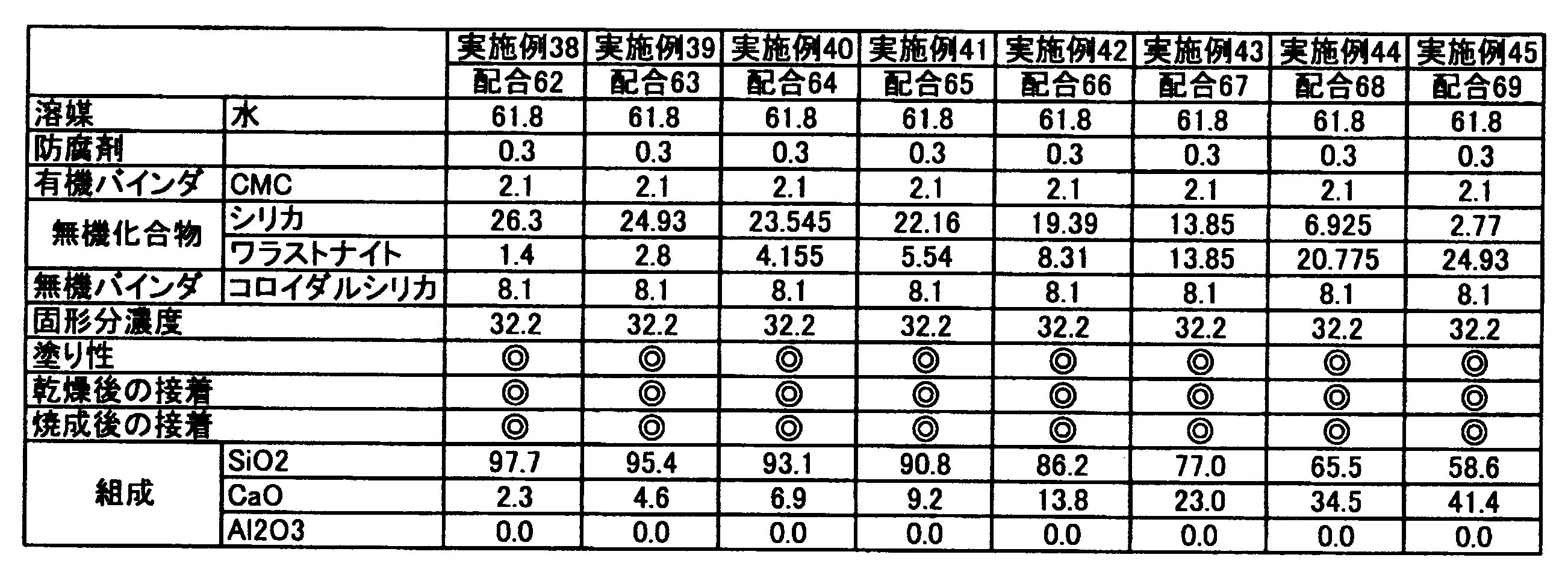
上記に本発明の実施形態及び/又は実施例を幾つか詳細に説明したが、当業者は、本発明の新規な教示及び効果から実質的に離れることなく、これら例示である実施形態及び/又は実施例に多くの変更を加えることが容易である。従って、これらの多くの変更は本発明の範囲に含まれる。
Claims (11)
- 図1に示す、SiO2-Al2O3-CaOの状態図において、
以下の点A、点8、点18、点19、点20で囲まれる範囲Iを除いた範囲内のSiO2、CaO、Al2O3を含み、ただしゼオライトを含まない無機繊維用接着剤。
点A :SiO2(0%) Al2O3(100%) CaO(0%)
点8 :SiO2(20.8%) Al2O3(79.2%) CaO(0%)
点18:SiO2(46.3%) Al2O3(35.8%) CaO(17.9%)
点19:SiO2(31.5%) Al2O3(53.6%) CaO(14.9%)
点20:SiO2(25.2%) Al2O3(57.5%) CaO(17.3%) - 図1に示す、SiO2-Al2O3-CaOの状態図において、
以下の点1、点7、点28、点17、点14、点13で囲まれる範囲II内のSiO2、CaO、Al2O3を含む請求項1記載の無機繊維用接着剤。
点1 :SiO2(100%) Al2O3(0%) CaO(0%)
点7 :SiO2(30.7%) Al2O3(69.3%) CaO(0%)
点28:SiO2(51.7%) Al2O3(40.8%) CaO(7.5%)
点17:SiO2(64.2%) Al2O3(21.5%) CaO(14.3%)
点14:SiO2(64.2%) Al2O3(17.9%) CaO(17.9%)
点13:SiO2(58.3%) Al2O3(0%) CaO(41.7%) - 有機バインダーが、接着剤中に0.5~10重量%含有される請求項1又は2記載の無機繊維用接着剤。
- コロイダルシリカが、接着剤中に0~98重量%含有される請求項1~3のいずれか記載の無機繊維用接着剤。
- 前記接着剤が溶媒を含み、
下記式で表わされる、接着剤中に含有される固形分比率が、5~85重量%である請求項1~4のいずれか記載の無機繊維用接着剤。
固形分比率=溶媒を除去した接着剤重量(乾燥後重量)×100/接着剤重量(乾燥前重量) - 生体溶解性無機繊維を含む成形体を接着するための請求項1~5のいずれか記載の無機繊維用接着剤。
- 以下の組成の無機繊維を含む成形体を接着するための請求項1~5のいずれか記載の無機繊維用接着剤。
SiO2とAl2O3とZrO2とTiO2との合計 50~82重量%
CaOとMgOとの合計 18~50重量% - 以下の組成の無機繊維を含む成形体を接着するための請求項1~5のいずれか記載の無機繊維用接着剤。
SiO2 50~82重量%
CaOとMgOとの合計 10~43重量% - 無機繊維を含む成形体と、請求項1~8のいずれか記載の無機繊維用接着剤からなるキット。
- 請求項1~8のいずれか記載の無機繊維用接着剤が乾燥又は加熱されて硬化した硬化接着剤。
- 無機繊維を含む成形体が、請求項1~8のいずれか記載の無機繊維用接着剤又は請求項10記載の硬化接着剤で接着された接着成形体。
Priority Applications (4)
| Application Number | Priority Date | Filing Date | Title |
|---|---|---|---|
| KR1020137024430A KR101428434B1 (ko) | 2011-03-18 | 2012-02-21 | 무기 섬유용 접착제 |
| EP12760901.4A EP2687567B1 (en) | 2011-03-18 | 2012-02-21 | Adhesive for inorganic fibers |
| CN201280006587.6A CN103339211B (zh) | 2011-03-18 | 2012-02-21 | 无机纤维用粘接剂 |
| AU2012232627A AU2012232627B2 (en) | 2011-03-18 | 2012-02-21 | Adhesive for inorganic fibers |
Applications Claiming Priority (4)
| Application Number | Priority Date | Filing Date | Title |
|---|---|---|---|
| JP2011060931 | 2011-03-18 | ||
| JP2011-060931 | 2011-03-18 | ||
| JP2011067079A JP4814402B1 (ja) | 2011-03-18 | 2011-03-25 | 無機繊維用接着剤 |
| JP2011-067079 | 2011-03-25 |
Publications (1)
| Publication Number | Publication Date |
|---|---|
| WO2012127777A1 true WO2012127777A1 (ja) | 2012-09-27 |
Family
ID=45326998
Family Applications (1)
| Application Number | Title | Priority Date | Filing Date |
|---|---|---|---|
| PCT/JP2012/001133 Ceased WO2012127777A1 (ja) | 2011-03-18 | 2012-02-21 | 無機繊維用接着剤 |
Country Status (6)
| Country | Link |
|---|---|
| EP (1) | EP2687567B1 (ja) |
| JP (1) | JP4814402B1 (ja) |
| KR (1) | KR101428434B1 (ja) |
| CN (1) | CN103339211B (ja) |
| AU (1) | AU2012232627B2 (ja) |
| WO (1) | WO2012127777A1 (ja) |
Families Citing this family (2)
| Publication number | Priority date | Publication date | Assignee | Title |
|---|---|---|---|---|
| JP5166598B1 (ja) * | 2011-12-28 | 2013-03-21 | ニチアス株式会社 | 柔軟性の高い無機繊維質定形体 |
| EP4222229A4 (en) * | 2020-09-30 | 2024-06-12 | Materion Precision Optics (Shanghai) Limited | HIGH TEMPERATURE RESISTANT BINDER |
Citations (5)
| Publication number | Priority date | Publication date | Assignee | Title |
|---|---|---|---|---|
| JPS5399239A (en) | 1977-02-14 | 1978-08-30 | Sumitomo Chem Co Ltd | Inorganic adhesive and sealing compound |
| JPS5910345A (ja) | 1983-06-06 | 1984-01-19 | Nichias Corp | 触媒の担体 |
| JPH07138081A (ja) | 1993-09-20 | 1995-05-30 | Asahi Glass Co Ltd | セラミックス接合用組成物と接合方法 |
| JPH10273625A (ja) | 1997-03-28 | 1998-10-13 | Nichias Corp | 無機質接着剤組成物 |
| JPH11166158A (ja) | 1997-12-04 | 1999-06-22 | Nippon Muki Co Ltd | 無機質接着剤 |
Family Cites Families (10)
| Publication number | Priority date | Publication date | Assignee | Title |
|---|---|---|---|---|
| US4090881A (en) * | 1976-06-30 | 1978-05-23 | The Babcock & Wilcox Company | High temperature refractory adhesive |
| US5753358A (en) * | 1994-08-25 | 1998-05-19 | W. L. Gore & Associates, Inc. | Adhisive-filler polymer film composite |
| CN1120059A (zh) * | 1994-09-16 | 1996-04-10 | 淄博市新材料研究所 | 一种无机粘合剂及制备方法和用途 |
| US5766686A (en) * | 1996-03-01 | 1998-06-16 | North American Refractories Co. | Spray insulating coating for refractory articles |
| CN1120870C (zh) * | 2000-09-22 | 2003-09-10 | 北京金发工贸公司 | 一种制粒用粘结剂及其制造方法 |
| CN100453511C (zh) * | 2005-03-28 | 2009-01-21 | 揖斐电株式会社 | 蜂窝结构体及密封材料 |
| CN1854226A (zh) * | 2005-04-28 | 2006-11-01 | 攀钢集团钢城企业总公司 | 用于瓦斯灰造球的粘结剂及其制造方法 |
| JP5485546B2 (ja) * | 2006-03-30 | 2014-05-07 | 日本碍子株式会社 | 接合体、ハニカムセグメント接合体、及びそれを用いたハニカム構造体 |
| US8092624B2 (en) * | 2006-12-07 | 2012-01-10 | Ngk Insulators, Ltd. | Bonding material composition and method for manufacturing the same, and joined body and method for manufacturing the same |
| CN101701136B (zh) * | 2009-10-30 | 2012-01-25 | 河南城建学院 | 一种用于计算机领域中的无机粘结剂及其制备方法 |
-
2011
- 2011-03-25 JP JP2011067079A patent/JP4814402B1/ja active Active
-
2012
- 2012-02-21 WO PCT/JP2012/001133 patent/WO2012127777A1/ja not_active Ceased
- 2012-02-21 CN CN201280006587.6A patent/CN103339211B/zh active Active
- 2012-02-21 KR KR1020137024430A patent/KR101428434B1/ko active Active
- 2012-02-21 EP EP12760901.4A patent/EP2687567B1/en active Active
- 2012-02-21 AU AU2012232627A patent/AU2012232627B2/en active Active
Patent Citations (5)
| Publication number | Priority date | Publication date | Assignee | Title |
|---|---|---|---|---|
| JPS5399239A (en) | 1977-02-14 | 1978-08-30 | Sumitomo Chem Co Ltd | Inorganic adhesive and sealing compound |
| JPS5910345A (ja) | 1983-06-06 | 1984-01-19 | Nichias Corp | 触媒の担体 |
| JPH07138081A (ja) | 1993-09-20 | 1995-05-30 | Asahi Glass Co Ltd | セラミックス接合用組成物と接合方法 |
| JPH10273625A (ja) | 1997-03-28 | 1998-10-13 | Nichias Corp | 無機質接着剤組成物 |
| JPH11166158A (ja) | 1997-12-04 | 1999-06-22 | Nippon Muki Co Ltd | 無機質接着剤 |
Also Published As
| Publication number | Publication date |
|---|---|
| AU2012232627B2 (en) | 2014-10-23 |
| EP2687567A1 (en) | 2014-01-22 |
| KR20130129285A (ko) | 2013-11-27 |
| JP2012211209A (ja) | 2012-11-01 |
| JP4814402B1 (ja) | 2011-11-16 |
| EP2687567B1 (en) | 2018-11-28 |
| CN103339211B (zh) | 2016-08-10 |
| AU2012232627A1 (en) | 2013-06-20 |
| EP2687567A4 (en) | 2015-05-27 |
| KR101428434B1 (ko) | 2014-08-07 |
| CN103339211A (zh) | 2013-10-02 |
Similar Documents
| Publication | Publication Date | Title |
|---|---|---|
| US8641868B2 (en) | Inorganic fiber paper and method of producing the same | |
| KR20170029573A (ko) | 생체 용해성 무기섬유 | |
| JP4937414B1 (ja) | 硬化定形物 | |
| CN103459685B (zh) | 湿润压火料 | |
| KR20170015981A (ko) | 생체 용해성 무기섬유 | |
| JP4971518B1 (ja) | 無機繊維ブロック | |
| JP4814402B1 (ja) | 無機繊維用接着剤 | |
| CN105431389A (zh) | 耐热无机纤维 | |
| WO2014115550A1 (ja) | 生体溶解性無機繊維及びその組成物 | |
| JP5945596B2 (ja) | Si−Mg系無機繊維及びその組成物 | |
| JP6212040B2 (ja) | 耐熱無機繊維 | |
| US8821626B2 (en) | Adhesive for inorganic fiber | |
| WO2013111232A1 (ja) | 無機繊維質定形体及びその硬度の調整方法 | |
| WO2013080456A1 (ja) | 不定形組成物 | |
| JP2014058423A (ja) | 耐熱性を有する生体溶解性無機繊維及びその組成物 | |
| JPWO2014049988A1 (ja) | 生体溶解性無機繊維及びその組成物 | |
| WO2018047801A1 (ja) | 無機繊維質成形体 | |
| JP5856541B2 (ja) | 生理食塩水に可溶なAl−Ca系無機繊維及びその組成物 | |
| JP2014028709A (ja) | Si/Al/Ca含有無機繊維 |
Legal Events
| Date | Code | Title | Description |
|---|---|---|---|
| 121 | Ep: the epo has been informed by wipo that ep was designated in this application |
Ref document number: 12760901 Country of ref document: EP Kind code of ref document: A1 |
|
| WWE | Wipo information: entry into national phase |
Ref document number: 2012760901 Country of ref document: EP |
|
| ENP | Entry into the national phase |
Ref document number: 2012232627 Country of ref document: AU Date of ref document: 20120221 Kind code of ref document: A |
|
| ENP | Entry into the national phase |
Ref document number: 20137024430 Country of ref document: KR Kind code of ref document: A |
|
| NENP | Non-entry into the national phase |
Ref country code: DE |