WO2012128161A1 - Composition à base d'un copolymère séquencé de polyester pour bottes souples - Google Patents
Composition à base d'un copolymère séquencé de polyester pour bottes souples Download PDFInfo
- Publication number
- WO2012128161A1 WO2012128161A1 PCT/JP2012/056622 JP2012056622W WO2012128161A1 WO 2012128161 A1 WO2012128161 A1 WO 2012128161A1 JP 2012056622 W JP2012056622 W JP 2012056622W WO 2012128161 A1 WO2012128161 A1 WO 2012128161A1
- Authority
- WO
- WIPO (PCT)
- Prior art keywords
- block copolymer
- polyester block
- mass
- composition
- copolymer composition
- Prior art date
- Legal status (The legal status is an assumption and is not a legal conclusion. Google has not performed a legal analysis and makes no representation as to the accuracy of the status listed.)
- Ceased
Links
Images

Classifications
-
- C—CHEMISTRY; METALLURGY
- C08—ORGANIC MACROMOLECULAR COMPOUNDS; THEIR PREPARATION OR CHEMICAL WORKING-UP; COMPOSITIONS BASED THEREON
- C08L—COMPOSITIONS OF MACROMOLECULAR COMPOUNDS
- C08L67/00—Compositions of polyesters obtained by reactions forming a carboxylic ester link in the main chain; Compositions of derivatives of such polymers
- C08L67/02—Polyesters derived from dicarboxylic acids and dihydroxy compounds
- C08L67/025—Polyesters derived from dicarboxylic acids and dihydroxy compounds containing polyether sequences
-
- C—CHEMISTRY; METALLURGY
- C08—ORGANIC MACROMOLECULAR COMPOUNDS; THEIR PREPARATION OR CHEMICAL WORKING-UP; COMPOSITIONS BASED THEREON
- C08G—MACROMOLECULAR COMPOUNDS OBTAINED OTHERWISE THAN BY REACTIONS ONLY INVOLVING UNSATURATED CARBON-TO-CARBON BONDS
- C08G59/00—Polycondensates containing more than one epoxy group per molecule; Macromolecules obtained by polymerising compounds containing more than one epoxy group per molecule using curing agents or catalysts which react with the epoxy groups
- C08G59/18—Macromolecules obtained by polymerising compounds containing more than one epoxy group per molecule using curing agents or catalysts which react with the epoxy groups ; e.g. general methods of curing
- C08G59/20—Macromolecules obtained by polymerising compounds containing more than one epoxy group per molecule using curing agents or catalysts which react with the epoxy groups ; e.g. general methods of curing characterised by the epoxy compounds used
- C08G59/32—Epoxy compounds containing three or more epoxy groups
Definitions
- the present invention relates to a polyester block copolymer composition having excellent mechanical properties despite its high flexibility. Furthermore, the present invention relates to a polyester block copolymer composition that is excellent in bending fatigue resistance and chemical resistance in a high-temperature environment and excellent in moldability, particularly extrusion processability and blow moldability. The present invention also relates to a blow molded product molded from the polyester block copolymer composition. More specifically, the present invention relates to a molded article requiring flexibility such as a constant velocity joint boot of an automobile excellent in bending fatigue resistance and chemical resistance in a high temperature environment.
- Polyester block copolymers are used as an alternative to conventional rubber because of the environmental advantages of recyclability, the performance of bending fatigue resistance, and the cost advantages of productivity. Its applications are wide, and the performance required for it varies widely, including high chemical resistance, high heat resistance, and high bending fatigue resistance.
- a constant velocity joint boot made of a polyester block copolymer (polyester block copolymer) having a polybutylene terephthalate which is a crystalline aromatic polyester as a hard segment and an aliphatic polyester or polyalkylene glycol as a soft segment, Excellent rubbery elasticity and bending fatigue resistance.
- polyester block copolymer polyester block copolymer having a polybutylene terephthalate which is a crystalline aromatic polyester as a hard segment and an aliphatic polyester or polyalkylene glycol as a soft segment
- Excellent rubbery elasticity and bending fatigue resistance
- the use environment temperature of constant velocity joint boots has risen due to higher performance of automobiles and downsizing of functional parts, and conventional polyester block copolymers have insufficient flex fatigue resistance under the required high temperature environment. Met.
- the grease used in the constant velocity joint boot is also improved in heat resistance and performance, and the conventional polyester block copolymer may have insufficient chemical resistance.
- the bending fatigue resistance can be increased by increasing the molecular weight of the polyalkylene glycols contained in the soft segment or by increasing the molecular weight of the polyester block copolymer itself. It is known to improve the properties.
- Patent Document 1 For the purpose of improving bending fatigue resistance at 100 ° C., a bifunctional or higher functional glycidyl ester is blended. However, no mention is made of bending fatigue resistance at high temperatures exceeding 100 ° C.
- Patent Document 2 Another way to deal with high temperature environments is to improve the heat resistance of the hard segment.
- a bifunctional or higher functional epoxy and a liquid lubricant are added to a polyester block copolymer to ensure sealing properties and durability.
- a resin composition using polybutylene naphthalate having high heat resistance for the hard segment is mentioned, it is not specifically disclosed.
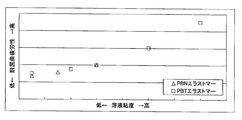
- FIG. 1 shows the relationship between the molecular weight (solution viscosity) of a polyester block copolymer and bending fatigue resistance under a conventional high temperature environment (100 ° C.). From FIG.
- An object of the present invention is to provide a flexible boot using a polyester block copolymer composition exhibiting good bending fatigue resistance when used in a higher temperature environment that could not be solved by conventional methods.
- the object is to exhibit good bending fatigue resistance at 140 ° C. and sufficient chemical resistance.
- the present inventors diligently researched and examined. As a result, the bending fatigue resistance under the use environment (100 ° C.) of the conventional constant velocity joint boot is improved to the heat resistance by the skeleton of the hard segment.
- the contribution of the molecular length of the polyester block copolymer itself to the bending fatigue resistance was greater than that of the polybutylene naphthalate in the use environment at 140 ° C. It has been found that a polyester block copolymer having a hard segment as a hard segment is superior to a polyester block copolymer having a polybutylene terephthalate as a hard segment, and finally the present invention has been completed.
- the present invention relates to a polyfunctional epoxy compound of 0.05 to 1.0 with respect to 100 parts by mass of a polyester block copolymer having a polybutylene naphthalate component as a hard segment and a polyoxytetramethylene glycol component as a soft segment.
- a flexible boot comprising a composition containing parts by mass, and having a bellows-shaped test piece molded from the composition having a bending fatigue resistance of 4 million times or more by a dematcher bending fatigue tester Polyester block copolymer composition.
- the number average molecular weight of the polyoxytetramethylene glycol in the polyester block copolymer is 1100 to 1400, and the content of the polyoxytetramethylene glycol in the polyester block copolymer is 35 to 55% by mass. Preferably there is.
- the polyfunctional epoxy compound is preferably a divalent or tetravalent epoxy compound having a naphthalene structure as a skeleton, or a trivalent epoxy compound having a triazine structure as a skeleton.
- the present invention is a flexible boot formed using the above polyester block copolymer composition.
- the polyester block copolymer composition of the present invention exhibits good bending fatigue resistance under a further high temperature environment (140 ° C.) required by the market, and exhibits sufficient chemical resistance. It can be used optimally.
- FIG. 1 shows the relationship between the molecular weight (solution viscosity) of the polyester block copolymer and the bending fatigue resistance in a 100 ° C. environment.
- the PBN elastomer is a polyester block copolymer using polybutylene naphthalate units as hard segments.
- the PBT elastomer is a polyester block copolymer using a polybutylene terephthalate unit as a hard segment.
- FIG. 2 shows the relationship between the test temperature and the bending fatigue resistance of the polyester block copolymer composition obtained in one embodiment (Example 1) and a comparative embodiment (Comparative Example 5) of the present invention.
- the PBN elastomer is Example 1, and the PBT elastomer is Comparative Example 5.
- the polyester block copolymer according to the present invention comprises a hard segment and a soft segment.
- the hard segment is a polyester having butylene naphthalate as a repeating unit. From the viewpoint of physical properties and availability, polybutylene naphthalate comprising 2,6-naphthalenedicarboxylic acid (or an alkyl ester thereof) and 1,4-butanediol is preferred.
- the soft segment is made of polyoxytetramethylene glycol.
- terephthalic acid, isophthalic acid or the like may be used as a copolymerization component in addition to naphthalene dicarboxylic acid as the dicarboxylic acid constituting the hard segment polyester.
- the amount is preferably less than 30 mol% of the total dicarboxylic acid component, more preferably less than 20 mol%, and even more preferably less than 10 mol%.
- polyester block copolymer in the polyester block copolymer according to the present invention, ethylene glycol, 1,3-propylene glycol, 1,6-hexanediol other than 1,4-butanediol can be used as the low molecular weight glycol constituting the hard segment polyester.
- 1,4-cyclohexanedimethanol, dimer glycol or the like may be used as a copolymerization component.
- the amount is preferably less than 30 mol% of the total low molecular weight glycol component, more preferably less than 20 mol%, and even more preferably less than 10 mol%.
- the preferred number average molecular weight of polyoxytetramethylene glycol which is a component constituting the soft segment in the polyester block copolymer used in the present invention, is 1100 to 1400. If the number average molecular weight is 1100 or more, the cohesion of the hard segment is increased for improving heat resistance, and if the number average molecular weight is 1400 or less, phase separation between the hard segment and the soft segment does not occur. A range is desirable. As long as the properties of the present invention are not impaired, other poly (oxyalkylene) glycols or aliphatic polyester glycols may be used as a part of the soft segment, and the amount thereof is less than 30% by mass of the total soft segment components.
- the number average molecular weight of the desired polyoxytetramethylene glycol may be achieved by mixing high molecular weight polyoxytetramethylene glycol and low molecular weight polyoxytetramethylene glycol.
- the polyester block copolymer according to the present invention is obtained by reacting a hard segment and a soft segment.
- the mass ratio of the soft segment is preferably 5 to 80% by mass capable of exhibiting elastomer performance.
- the mass ratio of the soft segment is more preferably 35 to 55% by mass.
- the above reaction can be carried out by arbitrarily determining a combination of reaction temperature, catalyst concentration, and reaction time. That is, the appropriate values of the reaction conditions vary depending on various factors such as the types and amount ratios of the hard segments and soft segments to be used, the shape of the apparatus to be used, and the stirring conditions.
- the polyester block copolymer used in the present invention may contain a tri- or higher functional polycarboxylic acid or polyol only in a small amount.
- a tri- or higher functional polycarboxylic acid or polyol only in a small amount.
- trimellitic anhydride, benzophenone tetracarboxylic acid, trimethylolpropane, glycerin and the like can be used.
- the solution viscosity of the polyester block copolymer is preferably 1.4 to 2.6 dl / g.
- the solution viscosity of the polyester block copolymer is more preferably 1.6 to 2.4 dl / g, still more preferably 1.7 to 2.3 dl / g.
- the solution viscosity is measured by the method described in the item of Examples described later. If the solution viscosity is less than 1.4 dl / g, it is difficult to maintain the shape during heating, and if it exceeds 2.6 dl / g, the fluidity is significantly lowered.
- any known method can be employed as a method for obtaining the polyester block copolymer according to the present invention.
- any of a melt polymerization method, a solution polymerization method, a solid phase polymerization method and the like can be used as appropriate.
- a melt polymerization method a transesterification method or a direct polymerization method may be used.
- a catalyst used for the reaction an antimony catalyst, a germanium catalyst, and a titanium catalyst are preferable.
- a titanium catalyst is preferable.
- tetraalkyl titanates such as tetrabutyl titanate and tetramethyl titanate
- metal oxalates such as potassium titanium oxalate
- the other catalyst is not particularly limited as long as it is a known catalyst, and examples thereof include tin compounds such as dibutyltin oxide and dibutyltin dilaurate, and lead compounds such as lead acetate.
- the polyfunctional epoxy compound refers to a compound having two or more epoxy groups.
- Specific examples of the polyfunctional epoxy compound include 1,6-dihydroxynaphthalenediglycidyl ether having two epoxy groups, 1,3-bis (oxiranylmethoxy) benzene, 1,3 having three epoxy groups.
- a divalent or tetravalent epoxy compound having a naphthalene structure as a skeleton, or a trivalent epoxy compound having a triazine structure as a skeleton is preferable.
- a bifunctional or trifunctional epoxy compound is preferred from the degree of increase in the solution viscosity of the polyester block copolymer itself and the degree of gelation caused by aggregation and solidification of the epoxy itself.
- the polyester block copolymer composition is a mixture of the polyester block copolymer and the polyfunctional epoxy compound.
- the polyester block copolymer is a composition in which 0.05 to 1.0 parts by mass of the polyfunctional epoxy compound is blended with 100 parts by mass. If it is less than 0.05 parts by mass, it is difficult to maintain the shape during blow molding, and if it exceeds 1.0 parts by mass, irregularities are generated on the surface due to the cohesive hardening of the polyfunctional epoxy itself.
- the polyester block copolymer composition of the present invention must have a bending fatigue resistance (number of times until breakage) of 4 million times or more by a dematcher type bending fatigue tester at 140 ° C.
- the bending fatigue resistance by the Dematcher type bending fatigue tester is measured by the method described in the item of an example described later. This bending fatigue resistance can be achieved when the polyester block copolymer composition has the above-described configuration.
- polyester block copolymer or polyester block copolymer composition used in the present invention can be blended with various additives depending on the purpose to obtain a composition.
- Additives include known hindered phenol-based, sulfur-based, phosphorus-based, amine-based antioxidants, hindered amine-based, triazole-based, benzophenone-based, benzoate-based, nickel-based, salicyl-based light stabilizers, antistatic agents, etc.
- polyester block copolymer composition of the present invention preferably occupies 80% by mass or more, more preferably 90% by mass or more in total of the polyester block copolymer and the polyfunctional epoxy compound.
- blending can be performed using a kneader such as a heating roll, an extruder, or a Banbury mixer. Moreover, it can add and mix in the oligomer before the transesterification reaction or polycondensation reaction at the time of manufacturing a polyester block copolymer.
- a kneader such as a heating roll, an extruder, or a Banbury mixer. Moreover, it can add and mix in the oligomer before the transesterification reaction or polycondensation reaction at the time of manufacturing a polyester block copolymer.
- Phase separation The polyester block copolymer composition was observed with an extruder for the transparency of the strand before cooling during melting and kneading. Evaluation was made according to the following criteria. ⁇ : The strand is transparent by visual inspection. ⁇ : White turbidity is confirmed by visual inspection.
- a sheet having a width of 150 mm and a thickness of 200 ⁇ m was prepared from the polyester block copolymer composition melted and kneaded by an extruder using a uniaxial sheet extruder, and the unevenness of the sheet surface was observed. Evaluation was made according to the following criteria. ⁇ : The number of irregularities in a 150 mm square sheet is 10 or less ⁇ ; The number of irregularities in a 150 mm square sheet is more than 10
- a dumbbell piece according to ASTM D638 was prepared and immersed in a constant velocity joint grease used with a flexible boot at 140 ° C. for 300 hours, and then the strength at tensile break was measured and compared with that before immersion.
- ⁇ Strength retention before and after immersion is 70% or more ⁇ ; Strength retention before and after immersion is less than 70%
- polyester block copolymer [A1] 350 g of dimethyl 2,6-naphthalenedicarboxylate (NDCM), 240 g of 1,4-butanediol (BD), 240 g of polytetramethylene glycol (PTMG, number average molecular weight 1250), Irganox-1330 (manufactured by Ciba Japan) 8 g and 1.0 g of tetrabutyl titanate (TBT) were charged into a 4 L autoclave, and the temperature was increased from room temperature to 220 ° C. over 3 hours to conduct a transesterification reaction. Next, the inside of the can was gradually depressurized and further heated, and an initial condensation reaction was performed at 250 ° C.
- NDCM dimethyl 2,6-naphthalenedicarboxylate
- BD 1,4-butanediol
- PTMG polytetramethylene glycol
- Irganox-1330 manufactured by Ciba Japan
- the collected polyester block copolymer [A1] had a soft segment mass ratio of 45%.
- polyester block copolymer [A2] 350 g of dimethyl 2,6-naphthalenedicarboxylate (NDCM), 240 g of 1,4-butanediol (BD), 230 g of polytetramethylene glycol (PTMG, number average molecular weight 1100), Irganox-1330 (manufactured by Ciba Japan) 8 g and 1.0 g of tetrabutyl titanate (TBT) were charged into a 4 L autoclave, and the temperature was increased from room temperature to 220 ° C. over 3 hours to conduct a transesterification reaction. Next, the inside of the can was gradually depressurized and further heated, and an initial condensation reaction was performed at 250 ° C.
- NDCM dimethyl 2,6-naphthalenedicarboxylate
- BD 1,4-butanediol
- PTMG polytetramethylene glycol
- Irganox-1330 manufactured by Ciba Japan
- the collected polyester block copolymer [A2] had a soft segment mass ratio of 45%.
- polyester block copolymer [A3] 350 g of dimethyl 2,6-naphthalenedicarboxylate (NDCM), 240 g of 1,4-butanediol (BD), 250 g of polytetramethylene glycol (PTMG, number average molecular weight 1400), Irganox-1330 (manufactured by Ciba Japan) 8 g and 1.0 g of tetrabutyl titanate (TBT) were charged into a 4 L autoclave, and the temperature was increased from room temperature to 220 ° C. over 3 hours to conduct a transesterification reaction. Next, the inside of the can was gradually depressurized and further heated, and an initial condensation reaction was performed at 250 ° C.
- NDCM dimethyl 2,6-naphthalenedicarboxylate
- BD 1,4-butanediol
- PTMG polytetramethylene glycol
- Irganox-1330 manufactured by Ciba Japan
- the collected polyester block copolymer [A3] had a soft segment mass ratio of 45%.
- polyester block copolymer [B1] 350 g of dimethyl 2,6-naphthalenedicarboxylate (NDCM), 240 g of 1,4-butanediol (BD), 230 g of polytetramethylene glycol (PTMG, number average molecular weight 1000), Irganox-1330 (manufactured by Ciba Japan) 8 g and 1.0 g of tetrabutyl titanate (TBT) were charged into a 4 L autoclave, and the temperature was increased from room temperature to 220 ° C. over 3 hours to conduct a transesterification reaction. Next, the inside of the can was gradually depressurized and further heated, and an initial condensation reaction was performed at 250 ° C.
- NDCM dimethyl 2,6-naphthalenedicarboxylate
- BD 1,4-butanediol
- PTMG polytetramethylene glycol
- Irganox-1330 manufactured by Ciba Japan
- the collected polyester block copolymer [B1] had a soft segment mass ratio of 45%.
- polyester block copolymer [B2] 350 g of dimethyl 2,6-naphthalenedicarboxylate (NDCM), 240 g of 1,4-butanediol (BD), 250 g of polytetramethylene glycol (PTMG, number average molecular weight 1500), Irganox-1330 (manufactured by Ciba Japan) 8 g and 1.0 g of tetrabutyl titanate (TBT) were charged into a 4 L autoclave, and the temperature was increased from room temperature to 220 ° C. over 3 hours to conduct a transesterification reaction. Next, the inside of the can was gradually depressurized and further heated, and an initial condensation reaction was performed at 250 ° C.
- NDCM dimethyl 2,6-naphthalenedicarboxylate
- BD 1,4-butanediol
- PTMG polytetramethylene glycol
- Irganox-1330 manufactured by Ciba Japan
- the collected polyester block copolymer [B2] had a soft segment mass ratio of 45%.
- polyester block copolymer [C1] 320 g of dimethyl terephthalate (DMT), 260 g of 1,4-butanediol (BD), 250 g of polytetramethylene glycol (PTMG, molecular weight 2000), 1.8 g of Irganox-1330 (manufactured by Ciba Japan), tetrabutyl titanate (TBT) 1.0 g was charged into a 4 L autoclave, and the temperature was increased from room temperature to 220 ° C. over 3 hours to conduct a transesterification reaction. Next, the inside of the can was gradually depressurized and further heated, and an initial condensation reaction was performed at 250 ° C.
- DMT dimethyl terephthalate
- BD 1,4-butanediol
- PTMG polytetramethylene glycol
- Irganox-1330 manufactured by Ciba Japan
- TBT tetrabutyl titanate
- the collected polyester elastomer [C1] had a soft segment mass ratio of 45%.
- Example 1 For 100 parts by mass of the polyester block copolymer [A1] obtained above, 0.3 part by mass of 1,6-dihydroxynaphthalenediglycidyl ether is melted and kneaded in an extruder, and then passed through cold water to form a cooled strand. A polyester block copolymer composition was obtained. Various measurements and evaluations were performed. The results are shown in Table 1.
- Example 2 1,3,5-tris (2,3-epoxypropyl) -1,3,5-triazine-2,4,6 (1H, 100 parts by mass of the polyester block copolymer [A1] obtained above.
- a polyester block copolymer composition was obtained by melting and kneading 0.3 part by mass of 3H, 5H) -trione in an extruder and passing through cold water to form a cooling strand. Various measurements and evaluations were performed. The results are shown in Table 1.
- Example 4 With respect to 100 parts by mass of the polyester block copolymer [A1] obtained above, 0.3 part by mass of 1-chloro-2,3-epoxypropane / formaldehyde / 2,7-naphthalenediol polycondensate is melted in an extruder. -After kneading, a polyester block copolymer composition was obtained by passing through cold water to form a cooling strand. Various measurements and evaluations were performed. The results are shown in Table 1.
- Example 5 For 100 parts by mass of the polyester block copolymer [A1] obtained above, 0.05 part by mass of 1,6-dihydroxynaphthalenediglycidyl ether is melted and kneaded in an extruder and then passed through cold water to form a cooled strand. A polyester block copolymer composition was obtained. Various measurements and evaluations were performed. The results are shown in Table 1.
- Example 6 For 100 parts by mass of the polyester block copolymer [A1] obtained above, 1.0 part by mass of 1,6-dihydroxynaphthalenediglycidyl ether was melted and kneaded in an extruder, and then passed through cold water to form a cooled strand. A polyester block copolymer composition was obtained. Various measurements and evaluations were performed. The results are shown in Table 1.
- Example 7 For 100 parts by mass of the polyester block copolymer [A2] obtained above, 0.3 part by mass of 1,6-dihydroxynaphthalenediglycidyl ether is melted and kneaded in an extruder, and then passed through cold water to form a cooled strand. A polyester block copolymer composition was obtained. Various measurements and evaluations were performed. The results are shown in Table 1.
- Example 8 For 100 parts by mass of the polyester block copolymer [A3] obtained above, 0.3 parts by mass of 1,6-dihydroxynaphthalenediglycidyl ether is melted and kneaded in an extruder, and then passed through cold water to form a cooled strand. A polyester block copolymer composition was obtained. Various measurements and evaluations were performed. The results are shown in Table 1.
- the polyester elastomer resin composition obtained in the examples had a bending fatigue resistance of at least 4 million times by a dematcher bending fatigue tester at 140 ° C.
- FIG. 2 shows the bending fatigue resistance of the polyester block copolymer composition obtained in Example 1 and the polyester block copolymer composition obtained in Comparative Example 5 measured at each temperature.
- the polyester block copolymer composition of the present invention has achieved good bending fatigue resistance under a high temperature environment, and is optimal for, for example, a constant velocity joint boot.
Landscapes
- Chemical & Material Sciences (AREA)
- Health & Medical Sciences (AREA)
- Chemical Kinetics & Catalysis (AREA)
- Medicinal Chemistry (AREA)
- Polymers & Plastics (AREA)
- Organic Chemistry (AREA)
- Polyesters Or Polycarbonates (AREA)
- Footwear And Its Accessory, Manufacturing Method And Apparatuses (AREA)
- Compositions Of Macromolecular Compounds (AREA)
Abstract
Cette invention permet d'obtenir des bottes souples à l'aide d'une composition à base d'un copolymère séquencé de polyester qui fait preuve d'une bonne résistance à la fatigue en flexion quand elle est utilisée dans un environnement à températures élevées, ce qui n'avait pas été résolu par les procédés classiques, la composition à base d'un copolymère séquencé de polyester pour bottes souples selon l'invention étant une composition contenant 0,05 à 1,0 partie en poids d'un composé époxy polyfonctionnel pour 100 parties en poids d'un copolymère séquencé de polyester comprenant un composant de naphtalate de polybutylène à titre de segment dur et un composant de polyoxytétraméthylène glycol à titre de segment mou. Cette invention concerne également une pièce d'essai en forme d'accordéon formée à l'aide de cette composition ayant une résistance à la fatigue en flexion de 4 millions de fois ou plus quand elle est testée à l'aide d'une machine d'essai de fatigue en flexion DeMattia.
Priority Applications (1)
| Application Number | Priority Date | Filing Date | Title |
|---|---|---|---|
| JP2012515239A JP5146623B2 (ja) | 2011-03-18 | 2012-03-15 | フレキシブルブーツ用ポリエステルブロック共重合体組成物 |
Applications Claiming Priority (2)
| Application Number | Priority Date | Filing Date | Title |
|---|---|---|---|
| JP2011060253 | 2011-03-18 | ||
| JP2011-060253 | 2011-03-18 |
Publications (1)
| Publication Number | Publication Date |
|---|---|
| WO2012128161A1 true WO2012128161A1 (fr) | 2012-09-27 |
Family
ID=46879312
Family Applications (1)
| Application Number | Title | Priority Date | Filing Date |
|---|---|---|---|
| PCT/JP2012/056622 Ceased WO2012128161A1 (fr) | 2011-03-18 | 2012-03-15 | Composition à base d'un copolymère séquencé de polyester pour bottes souples |
Country Status (2)
| Country | Link |
|---|---|
| JP (1) | JP5146623B2 (fr) |
| WO (1) | WO2012128161A1 (fr) |
Cited By (2)
| Publication number | Priority date | Publication date | Assignee | Title |
|---|---|---|---|---|
| WO2013099803A1 (fr) * | 2011-12-26 | 2013-07-04 | 東洋紡株式会社 | Composition à base d'un copolymère séquencé de polyester pour bottes souples |
| JP2022500513A (ja) * | 2019-08-14 | 2022-01-04 | エルジー・ケム・リミテッド | 熱可塑性共重合体組成物及びそれから製造される成形品 |
Citations (7)
| Publication number | Priority date | Publication date | Assignee | Title |
|---|---|---|---|---|
| JP2000159991A (ja) * | 1999-01-01 | 2000-06-13 | Du Pont Toray Co Ltd | 樹脂製フレキシブルブ―ツ |
| WO2007072642A1 (fr) * | 2005-12-21 | 2007-06-28 | Daicel Chemical Industries, Ltd. | Composition de resine de polyester et corps moule |
| JP2007191665A (ja) * | 2006-01-23 | 2007-08-02 | Toyobo Co Ltd | 熱可塑性ポリエステルエラストマーの製造方法および熱可塑性ポリエステルエラストマー |
| JP2007191666A (ja) * | 2006-01-23 | 2007-08-02 | Toyobo Co Ltd | 熱可塑性ポリエステルエラストマーの製造方法および熱可塑性ポリエステルエラストマー |
| WO2007111059A1 (fr) * | 2006-03-24 | 2007-10-04 | Daicel Chemical Industries, Ltd. | Composition de resine de polyester et corps moule |
| WO2008093574A1 (fr) * | 2007-01-29 | 2008-08-07 | Toyo Boseki Kabushiki Kaisha | Procédé de fabrication d'un élastomère de polyester thermoplastique de type polyester-polycarbonate et élastomère de polyester thermoplastique de type polyester-polycarbonate |
| JP2008309304A (ja) * | 2007-06-18 | 2008-12-25 | Toyobo Co Ltd | フレキシブルブーツ |
Family Cites Families (1)
| Publication number | Priority date | Publication date | Assignee | Title |
|---|---|---|---|---|
| WO2008093677A1 (fr) * | 2007-01-29 | 2008-08-07 | Santen Pharmaceutical Co., Ltd. | Nouveaux dérivés d'oxadiazole et dérivés de thidiazole ayant une activité inhibant la néovascularisation |
-
2012
- 2012-03-15 WO PCT/JP2012/056622 patent/WO2012128161A1/fr not_active Ceased
- 2012-03-15 JP JP2012515239A patent/JP5146623B2/ja not_active Expired - Fee Related
Patent Citations (7)
| Publication number | Priority date | Publication date | Assignee | Title |
|---|---|---|---|---|
| JP2000159991A (ja) * | 1999-01-01 | 2000-06-13 | Du Pont Toray Co Ltd | 樹脂製フレキシブルブ―ツ |
| WO2007072642A1 (fr) * | 2005-12-21 | 2007-06-28 | Daicel Chemical Industries, Ltd. | Composition de resine de polyester et corps moule |
| JP2007191665A (ja) * | 2006-01-23 | 2007-08-02 | Toyobo Co Ltd | 熱可塑性ポリエステルエラストマーの製造方法および熱可塑性ポリエステルエラストマー |
| JP2007191666A (ja) * | 2006-01-23 | 2007-08-02 | Toyobo Co Ltd | 熱可塑性ポリエステルエラストマーの製造方法および熱可塑性ポリエステルエラストマー |
| WO2007111059A1 (fr) * | 2006-03-24 | 2007-10-04 | Daicel Chemical Industries, Ltd. | Composition de resine de polyester et corps moule |
| WO2008093574A1 (fr) * | 2007-01-29 | 2008-08-07 | Toyo Boseki Kabushiki Kaisha | Procédé de fabrication d'un élastomère de polyester thermoplastique de type polyester-polycarbonate et élastomère de polyester thermoplastique de type polyester-polycarbonate |
| JP2008309304A (ja) * | 2007-06-18 | 2008-12-25 | Toyobo Co Ltd | フレキシブルブーツ |
Cited By (4)
| Publication number | Priority date | Publication date | Assignee | Title |
|---|---|---|---|---|
| WO2013099803A1 (fr) * | 2011-12-26 | 2013-07-04 | 東洋紡株式会社 | Composition à base d'un copolymère séquencé de polyester pour bottes souples |
| JP2022500513A (ja) * | 2019-08-14 | 2022-01-04 | エルジー・ケム・リミテッド | 熱可塑性共重合体組成物及びそれから製造される成形品 |
| JP7104236B2 (ja) | 2019-08-14 | 2022-07-20 | エルジー・ケム・リミテッド | 熱可塑性共重合体組成物及びそれから製造される成形品 |
| US12024626B2 (en) | 2019-08-14 | 2024-07-02 | Lg Chem, Ltd. | Thermoplastic copolymer composition and molded article manufactured using the same |
Also Published As
| Publication number | Publication date |
|---|---|
| JPWO2012128161A1 (ja) | 2014-07-24 |
| JP5146623B2 (ja) | 2013-02-20 |
Similar Documents
| Publication | Publication Date | Title |
|---|---|---|
| JP6361819B2 (ja) | 耐グリース性に優れたポリエステルエラストマー樹脂組成物 | |
| JP7063263B2 (ja) | ポリエステルエラストマー樹脂組成物 | |
| TWI596133B (zh) | 聚酯彈性體 | |
| JPH11323110A (ja) | ポリエステルエラストマ樹脂組成物 | |
| JP3939255B2 (ja) | ポリエステル系熱可塑性樹脂組成物及び成形品 | |
| WO2005073315A1 (fr) | Composition d'elastomere de polyester | |
| JP5146623B2 (ja) | フレキシブルブーツ用ポリエステルブロック共重合体組成物 | |
| TW202428690A (zh) | 來自生質資源之聚酯彈性體 | |
| JP2015164983A (ja) | エラストマー組成物、およびそれからなる成形体 | |
| JP6036013B2 (ja) | 熱可塑性ポリエステルエラストマー、およびそれからなる成形体 | |
| JP5991312B2 (ja) | フレキシブルブーツ用ポリエステルブロック共重合体組成物 | |
| JPH058941B2 (fr) | ||
| JP2000191894A (ja) | ポリエステルエラストマ樹脂組成物 | |
| KR101731397B1 (ko) | 열가소성 폴리에스테르 엘라스토머 | |
| JP2000159985A (ja) | 熱可塑性ポリエステルエラストマー組成物 | |
| JP7842975B2 (ja) | 熱可塑性ポリエステルエラストマー、かかるエラストマーを含有する樹脂組成物、及びそれらから得られる成形品 | |
| JP2000290835A (ja) | 弾性糸 | |
| JPH11315192A (ja) | 熱可塑性ポリエステルエラストマー | |
| JP4200396B2 (ja) | 熱可塑性ポリエステルエラストマー組成物 | |
| JP7702084B1 (ja) | ポリエステルエラストマー樹脂組成物 | |
| JP2011241265A (ja) | 熱可塑性ポリエステル樹脂組成物およびそれからなる成形体 | |
| JP4694661B2 (ja) | ポリエステル型ブロック共重合体 | |
| KR100795169B1 (ko) | 열가소성 엘라스토머 수지 | |
| JP2000007771A (ja) | 熱可塑性ポリエステルエラストマー | |
| WO2024176874A1 (fr) | Composition de résine élastomère de polyester |
Legal Events
| Date | Code | Title | Description |
|---|---|---|---|
| ENP | Entry into the national phase |
Ref document number: 2012515239 Country of ref document: JP Kind code of ref document: A |
|
| 121 | Ep: the epo has been informed by wipo that ep was designated in this application |
Ref document number: 12761450 Country of ref document: EP Kind code of ref document: A1 |
|
| NENP | Non-entry into the national phase |
Ref country code: DE |
|
| 122 | Ep: pct application non-entry in european phase |
Ref document number: 12761450 Country of ref document: EP Kind code of ref document: A1 |