WO2012133177A1 - ゴム組成物及び空気入りタイヤ - Google Patents
ゴム組成物及び空気入りタイヤ Download PDFInfo
- Publication number
- WO2012133177A1 WO2012133177A1 PCT/JP2012/057498 JP2012057498W WO2012133177A1 WO 2012133177 A1 WO2012133177 A1 WO 2012133177A1 JP 2012057498 W JP2012057498 W JP 2012057498W WO 2012133177 A1 WO2012133177 A1 WO 2012133177A1
- Authority
- WO
- WIPO (PCT)
- Prior art keywords
- group
- carbon atoms
- represented
- atom
- formula
- Prior art date
- Legal status (The legal status is an assumption and is not a legal conclusion. Google has not performed a legal analysis and makes no representation as to the accuracy of the status listed.)
- Ceased
Links
- 0 CC(CC(C)(C)N)C(*)=O Chemical compound CC(CC(C)(C)N)C(*)=O 0.000 description 3
- XNEXLHCRVIJVCE-UHFFFAOYSA-N C[N](C)(C)O[N](C)(C)[N+](C)(C)[O-] Chemical compound C[N](C)(C)O[N](C)(C)[N+](C)(C)[O-] XNEXLHCRVIJVCE-UHFFFAOYSA-N 0.000 description 1
Classifications
-
- C—CHEMISTRY; METALLURGY
- C08—ORGANIC MACROMOLECULAR COMPOUNDS; THEIR PREPARATION OR CHEMICAL WORKING-UP; COMPOSITIONS BASED THEREON
- C08K—Use of inorganic or non-macromolecular organic substances as compounding ingredients
- C08K3/00—Use of inorganic substances as compounding ingredients
- C08K3/34—Silicon-containing compounds
- C08K3/36—Silica
-
- B—PERFORMING OPERATIONS; TRANSPORTING
- B60—VEHICLES IN GENERAL
- B60C—VEHICLE TYRES; TYRE INFLATION; TYRE CHANGING; CONNECTING VALVES TO INFLATABLE ELASTIC BODIES IN GENERAL; DEVICES OR ARRANGEMENTS RELATED TO TYRES
- B60C1/00—Tyres characterised by the chemical composition or the physical arrangement or mixture of the composition
- B60C1/0016—Compositions of the tread
-
- C—CHEMISTRY; METALLURGY
- C08—ORGANIC MACROMOLECULAR COMPOUNDS; THEIR PREPARATION OR CHEMICAL WORKING-UP; COMPOSITIONS BASED THEREON
- C08C—TREATMENT OR CHEMICAL MODIFICATION OF RUBBERS
- C08C19/00—Chemical modification of rubber
- C08C19/30—Addition of a reagent which reacts with a hetero atom or a group containing hetero atoms of the macromolecule
- C08C19/42—Addition of a reagent which reacts with a hetero atom or a group containing hetero atoms of the macromolecule reacting with metals or metal-containing groups
- C08C19/44—Addition of a reagent which reacts with a hetero atom or a group containing hetero atoms of the macromolecule reacting with metals or metal-containing groups of polymers containing metal atoms exclusively at one or both ends of the skeleton
-
- C—CHEMISTRY; METALLURGY
- C08—ORGANIC MACROMOLECULAR COMPOUNDS; THEIR PREPARATION OR CHEMICAL WORKING-UP; COMPOSITIONS BASED THEREON
- C08F—MACROMOLECULAR COMPOUNDS OBTAINED BY REACTIONS ONLY INVOLVING CARBON-TO-CARBON UNSATURATED BONDS
- C08F236/00—Copolymers of compounds having one or more unsaturated aliphatic radicals, at least one having two or more carbon-to-carbon double bonds
- C08F236/02—Copolymers of compounds having one or more unsaturated aliphatic radicals, at least one having two or more carbon-to-carbon double bonds the radical having only two carbon-to-carbon double bonds
- C08F236/04—Copolymers of compounds having one or more unsaturated aliphatic radicals, at least one having two or more carbon-to-carbon double bonds the radical having only two carbon-to-carbon double bonds conjugated
- C08F236/14—Copolymers of compounds having one or more unsaturated aliphatic radicals, at least one having two or more carbon-to-carbon double bonds the radical having only two carbon-to-carbon double bonds conjugated containing elements other than carbon and hydrogen
-
- C—CHEMISTRY; METALLURGY
- C08—ORGANIC MACROMOLECULAR COMPOUNDS; THEIR PREPARATION OR CHEMICAL WORKING-UP; COMPOSITIONS BASED THEREON
- C08K—Use of inorganic or non-macromolecular organic substances as compounding ingredients
- C08K5/00—Use of organic ingredients
- C08K5/16—Nitrogen-containing compounds
-
- C—CHEMISTRY; METALLURGY
- C08—ORGANIC MACROMOLECULAR COMPOUNDS; THEIR PREPARATION OR CHEMICAL WORKING-UP; COMPOSITIONS BASED THEREON
- C08L—COMPOSITIONS OF MACROMOLECULAR COMPOUNDS
- C08L15/00—Compositions of rubber derivatives
-
- C—CHEMISTRY; METALLURGY
- C08—ORGANIC MACROMOLECULAR COMPOUNDS; THEIR PREPARATION OR CHEMICAL WORKING-UP; COMPOSITIONS BASED THEREON
- C08F—MACROMOLECULAR COMPOUNDS OBTAINED BY REACTIONS ONLY INVOLVING CARBON-TO-CARBON UNSATURATED BONDS
- C08F230/00—Copolymers of compounds having one or more unsaturated aliphatic radicals, each having only one carbon-to-carbon double bond, and containing phosphorus, selenium, tellurium or a metal
- C08F230/04—Copolymers of compounds having one or more unsaturated aliphatic radicals, each having only one carbon-to-carbon double bond, and containing phosphorus, selenium, tellurium or a metal containing a metal
- C08F230/08—Copolymers of compounds having one or more unsaturated aliphatic radicals, each having only one carbon-to-carbon double bond, and containing phosphorus, selenium, tellurium or a metal containing a metal containing silicon
- C08F230/085—Copolymers of compounds having one or more unsaturated aliphatic radicals, each having only one carbon-to-carbon double bond, and containing phosphorus, selenium, tellurium or a metal containing a metal containing silicon the monomer being a polymerisable silane, e.g. (meth)acryloyloxy trialkoxy silanes or vinyl trialkoxysilanes
-
- Y—GENERAL TAGGING OF NEW TECHNOLOGICAL DEVELOPMENTS; GENERAL TAGGING OF CROSS-SECTIONAL TECHNOLOGIES SPANNING OVER SEVERAL SECTIONS OF THE IPC; TECHNICAL SUBJECTS COVERED BY FORMER USPC CROSS-REFERENCE ART COLLECTIONS [XRACs] AND DIGESTS
- Y02—TECHNOLOGIES OR APPLICATIONS FOR MITIGATION OR ADAPTATION AGAINST CLIMATE CHANGE
- Y02T—CLIMATE CHANGE MITIGATION TECHNOLOGIES RELATED TO TRANSPORTATION
- Y02T10/00—Road transport of goods or passengers
- Y02T10/80—Technologies aiming to reduce greenhouse gasses emissions common to all road transportation technologies
- Y02T10/86—Optimisation of rolling resistance, e.g. weight reduction
Definitions
- the present invention relates to a rubber composition and a pneumatic tire produced using the rubber composition.
- rubber compositions used for automobile tires are also required to have excellent fuel efficiency.
- rubber compositions for automobile tires rubber compositions containing conjugated diene polymers such as polybutadiene and butadiene-styrene copolymers and fillers such as carbon black and silica are used.
- Patent Document 1 proposes a method using a diene rubber (modified rubber) modified with an organosilicon compound containing an amino group and an alkoxy group.
- a modified rubber when a modified rubber is used, the Mooney viscosity becomes too high, and the processability may deteriorate.
- the performance required for the rubber composition for automobile tires includes wet grip performance and wear resistance, and these performances generally have a contradiction to low fuel consumption. Therefore, a method for improving fuel economy, wet grip performance, wear resistance, and workability in a high-dimensional and balanced manner is demanded.
- Patent Document 2 proposes a method for improving processability, low fuel consumption, and the like using a specific silane coupling agent having a mercapto group, but low fuel consumption, wet grip performance, wear resistance and There is still room for improvement in terms of improving workability in a balanced manner.
- An object of the present invention is to solve the above-mentioned problems and to provide a rubber composition that can improve fuel economy, wet grip performance, wear resistance, and workability in a well-balanced manner, and a pneumatic tire using the rubber composition.
- the present invention contains a rubber component, silica and a compound represented by the following formula (1), and among 100% by mass of the rubber component, a structural unit based on a conjugated diene and a structural unit represented by the following formula (I)
- the present invention relates to a rubber composition in which the content of the conjugated diene polymer modified at one end is 5% by mass or more and the silica content is 5 to 150 parts by mass with respect to 100 parts by mass of the rubber component.
- X 1 , X 2 and X 3 each independently represent a group represented by the following formula (Ia), a hydroxyl group, a hydrocarbyl group or a substituted hydrocarbyl group, and at least one of X 1 , X 2 and X 3 One is a group or a hydroxyl group represented by the following formula (Ia).
- R 1 and R 2 each independently represent a hydrocarbyl group having 1 to 6 carbon atoms, a substituted hydrocarbyl group having a carbon number of 1-6, a silyl group, or a substituted silyl group, R 1 and R 2 may be bonded to form a ring structure with the nitrogen atom.
- n represents an integer of 1 to 10
- R 11 , R 12 and R 13 each independently represents a hydrocarbyl group having 1 to 4 carbon atoms or a hydrocarbyloxy group having 1 to 4 carbon atoms. Wherein at least one of R 11 , R 12 and R 13 is a hydrocarbyloxy group, and A 1 represents a functional group having a nitrogen atom.
- p represents an integer of 0 or 1
- T represents a hydrocarbylene group having 1 to 20 carbon atoms or a substituted hydrocarbylene group having 1 to 20 carbon atoms
- a 2 represents nitrogen.
- a functional group having an atom is represented.
- R 21 represents a hydrogen atom, a hydrocarbyl group having 1 to 6 carbon atoms or a substituted hydrocarbyl group having 1 to 6 carbon atoms
- a 3 represents Represents an oxygen atom or —NR 22 — group (R 22 represents a hydrogen atom or a hydrocarbyl group having 1 to 10 carbon atoms)
- a 4 represents a functional group having a nitrogen atom and / or an oxygen atom.
- w represents an integer of 1 to 11
- a 5 represents a functional group having a nitrogen atom.
- R 101 represents a hydrogen atom, a branched or unbranched alkyl group having 1 to 30 carbon atoms, a branched or unbranched alkenyl group having 2 to 30 carbon atoms, a branched or unbranched carbon group having 6 to 30 carbon atoms, Represents an aryl group or a hydroxyl group.
- R 102 and R 103 are the same or different and are a hydrogen atom, a branched or unbranched alkyl group having 1 to 30 carbon atoms, a branched or unbranched carbon group having 2 to 30 carbon atoms, a branched or unbranched carbon number.
- the hydrogen atom possessed by may be substituted with a hydroxyl group or a carboxyl group.
- R 101 and R 102 , R 101 and R 103 , or R 102 and R 103 may form a ring structure.
- d 1 represents an integer of 0 to 8. ]
- R 104 represents a branched or unbranched alkylene group having 1 to 30 carbon atoms.
- R 105 is a hydrogen atom, a branched or unbranched alkyl group having 1 to 30 carbon atoms, a branched or unbranched alkenyl group having 2 to 30 carbon atoms, a branched or unbranched aryl group having 6 to 30 carbon atoms, or Represents a hydroxyl group.
- d 2 represents an integer of 0 to 10.
- R 1 and R 2 in formula (Ia) are preferably hydrocarbyl groups having 1 to 6 carbon atoms.
- Two of X 1 , X 2 and X 3 in the formula (I) are preferably a group or a hydroxyl group represented by the formula (Ia).
- a 1 in formula (II) is preferably a group represented by the following formula (IIa).
- R 14 and R 15 each independently have 1 to 6 carbon atoms which may have at least one atom selected from the group consisting of a nitrogen atom, an oxygen atom and a silicon atom.
- R 14 and R 15 may be bonded to form a ring structure with the nitrogen atom, and R 14 and R 15 may be the same group bonded to the nitrogen by a double bond.
- the group represented by the formula (III) is preferably a group represented by the following formula (IIIa).
- a compound having a group represented by the formula (III) is represented by a compound represented by the following formula (IIIa-1), a compound represented by the following formula (IIIa-2), and the following formula (IIIa-3):
- the compound is at least one compound selected from the group consisting of the following compounds.
- R 31 represents a hydrogen atom, a hydrocarbyl group having 1 to 10 carbon atoms, a substituted hydrocarbyl group having 1 to 10 carbon atoms, or a heterocycle having a nitrogen atom and / or an oxygen atom as a hetero atom.
- Each of R 32 and R 33 independently has 1 to 10 carbon atoms which may have at least one atom selected from the group consisting of a nitrogen atom, an oxygen atom and a silicon atom.
- R 32 and R 33 may be bonded to form a ring structure with the nitrogen atom, and R 32 and R 33 may be the same group bonded to the nitrogen by a double bond.
- e represents an integer of 0 to 10
- R 34 and R 35 each independently represents a hydrocarbyl group having 1 to 20 carbon atoms or a substituted hydrocarbyl group having 1 to 20 carbon atoms.
- R 36 represents a hydrocarbyl group having 1 to 20 carbon atoms or a substituted hydrocarbyl group having 1 to 20 carbon atoms.
- the compound having a group represented by the formula (III) is preferably a compound represented by the following formula (IIIb-1).
- R 37 represents a hydrogen atom, a hydrocarbyl group having 1 to 10 carbon atoms, a substituted hydrocarbyl group having 1 to 10 carbon atoms, or a heterocycle having a nitrogen atom and / or an oxygen atom as a hetero atom.
- R 38 and R 39 each independently have 1 to 10 carbon atoms which may have at least one atom selected from the group consisting of a nitrogen atom, an oxygen atom and a silicon atom.
- R 38 and R 39 may be bonded to form a ring structure together with the nitrogen atom, R 38 and R 39 may be the same group bonded to the nitrogen by a double bond, and T Represents a hydrocarbylene group having 1 to 20 carbon atoms or a substituted hydrocarbylene group having 1 to 20 carbon atoms.
- the compound represented by the formula (IIIb-1) is at least selected from the group consisting of a compound represented by the following formula (IIIb-1-1) and a compound represented by the following formula (IIIb-1-2):
- a single compound is preferred.
- r denotes an integer of 1 or 2
- Y 1 is a substituent on the benzene ring, represents a functional group having a nitrogen atom, if Y 1 is more, a plurality of Y 1 are the same But it can be different.
- s represents an integer of 1 or 2
- t represents an integer of 0 to 2
- Y 2 and Y 3 represent substituents on the benzene ring and represent a functional group having a nitrogen atom, If the Y 2 there is a plurality, Y 2 there are a plurality of, may be the same or different, if Y 3 is more, plural Y 3 may be the same or different.
- a 4 in the formula (IV) is preferably a group or a hydroxyl group represented by the following formula (IVa).
- R 23 and R 24 each independently have 1 to 6 carbon atoms which may have at least one atom selected from the group consisting of a nitrogen atom, an oxygen atom and a silicon atom.
- R 23 and R 24 may be bonded to form a ring structure together with a nitrogen atom, and R 23 and R 24 may be the same group bonded to nitrogen by a double bond.
- the silicon compound has a group represented by the following formula (VIII).
- R 41, R 42 and R 43 each independently carbon atoms is a hydrocarbyl group or a number of carbon atoms of 1 to 4 represent hydrocarbyl group of 1 to 4, R 41, R 42 and R At least one of 43 is a hydrocarbyloxy group.
- the silicon compound has a group represented by the following formula (Va). [Wherein, h represents an integer of 1 to 10, and R 44 , R 45 and R 46 each independently represents a hydrocarbyl group having 1 to 4 carbon atoms or a hydrocarbyloxy group having 1 to 4 carbon atoms. And at least one of R 44 , R 45 and R 46 is a hydrocarbyloxy group. ]
- the compound having a group represented by the formula (VII) is preferably a compound represented by the following formula (VII-1).
- z represents an integer of 0 to 10
- R 71 represents a hydrocarbyl group having 1 to 5 carbon atoms
- R 72 , R 73 , R 74 and R 75 each independently represent a hydrogen atom
- a hydrocarbyl group having 1 to 5 carbon atoms, a substituted hydrocarbyl group having 1 to 5 carbon atoms, or a hydrocarbyloxy group having 1 to 5 carbon atoms, and a plurality of R 72 and R 73 are present.
- R 72 and a plurality of R 73 may be the same or different, and R 76 and R 77 are each independently at least one selected from the group consisting of a nitrogen atom, an oxygen atom and a silicon atom. atom represent good number of carbon atoms even if the groups 1-6 has, R 76 and R 77 may form a ring structure with a nitrogen atom bonded to, R 76 and R 77 is a nitrogen With double bond It may be the same group if. ]
- R 74 and R 75 in formula (VII-1) is preferably a hydrogen atom.
- the vinyl bond content of the conjugated diene polymer is preferably 10 mol% or more and 80 mol% or less, with the content of structural units based on the conjugated diene being 100 mol%.
- the rubber composition preferably contains natural rubber and / or butadiene rubber.
- Silica has a nitrogen adsorption specific surface area of preferably 40 to 400 m 2 / g.
- the content of the compound represented by the formula (1) with respect to 100 parts by mass of silica is preferably 0.1 to 20 parts by mass.
- the rubber composition is preferably used as a tread rubber composition.
- the present invention also relates to a pneumatic tire produced using the rubber composition.
- the present invention since it is a rubber composition containing a specific conjugated diene polymer, silica, and a compound represented by the above formula (1), low fuel consumption, wet grip performance, wear resistance And a pneumatic tire with improved workability in a well-balanced manner.
- the rubber composition of the present invention has a structural unit based on a conjugated diene and a structural unit represented by the following formula (I), a compound represented by the following formula (II), and represented by the following formula (III): A compound having a group, a compound represented by the following formula (IV), a silicon compound having a group represented by the following formula (V) and / or a group represented by the following formula (VI), and the following formula (VII): A conjugated diene polymer in which at least one end of the polymer is modified with at least one compound selected from the group consisting of compounds having a group represented by formula (I), silica, and the above formula (1). A compound.
- X 1 , X 2 and X 3 each independently represent a group represented by the following formula (Ia), a hydroxyl group, a hydrocarbyl group or a substituted hydrocarbyl group, and at least one of X 1 , X 2 and X 3 One is a group or a hydroxyl group represented by the following formula (Ia).
- R 1 and R 2 each independently represent a hydrocarbyl group having 1 to 6 carbon atoms, a substituted hydrocarbyl group having a carbon number of 1-6, a silyl group, or a substituted silyl group, R 1 and R 2 may be bonded to form a ring structure with the nitrogen atom.
- n represents an integer of 1 to 10
- R 11 , R 12 and R 13 each independently represents a hydrocarbyl group having 1 to 4 carbon atoms or a hydrocarbyloxy group having 1 to 4 carbon atoms. Wherein at least one of R 11 , R 12 and R 13 is a hydrocarbyloxy group, and A 1 represents a functional group having a nitrogen atom.
- p represents an integer of 0 or 1
- T represents a hydrocarbylene group having 1 to 20 carbon atoms or a substituted hydrocarbylene group having 1 to 20 carbon atoms
- a 2 represents nitrogen.
- a functional group having an atom is represented.
- R 21 represents a hydrogen atom, a hydrocarbyl group having 1 to 6 carbon atoms or a substituted hydrocarbyl group having 1 to 6 carbon atoms
- a 3 represents Represents an oxygen atom or —NR 22 — group (R 22 represents a hydrogen atom or a hydrocarbyl group having 1 to 10 carbon atoms)
- a 4 represents a functional group having a nitrogen atom and / or an oxygen atom.
- w represents an integer of 1 to 11
- a 5 represents a functional group having a nitrogen atom.
- conjugated diene based on the conjugated diene examples include 1,3-butadiene, isoprene, 1,3-pentadiene, 2,3-dimethyl-1,3-butadiene, 1,3-hexadiene, and the like. These may be one type or two or more types. From the viewpoint of availability, 1,3-butadiene and isoprene are preferred.
- X 1 , X 2 and X 3 in formula (I) of the structural unit represented by formula (I) each independently represent a group represented by formula (Ia), a hydroxyl group, a hydrocarbyl group or a substituted hydrocarbyl group.
- X 1 , X 2 and X 3 are a group represented by the formula (Ia) or a hydroxyl group.
- R 1 and R 2 of formula (Ia) represent each independently, a hydrocarbyl group having 1 to 6 carbon atoms, a substituted hydrocarbyl group having a carbon number of 1-6, a silyl group, or a substituted silyl group, R 1 And R 2 may be bonded together to form a ring structure together with the nitrogen atom.
- a hydrocarbyl group represents a monovalent hydrocarbon residue.
- the hydrocarbon residue represents a group obtained by removing hydrogen from a hydrocarbon.
- a substituted hydrocarbyl group represents a group in which one or more hydrogen atoms of a monovalent hydrocarbon residue are substituted with a substituent.
- the hydrocarbyloxy group represents a group in which a hydrogen atom of a hydroxyl group is substituted with a hydrocarbyl group, and the substituted hydrocarbyloxy group represents a group in which one or more hydrogen atoms of the hydrocarbyloxy group are substituted with a substituent.
- the hydrocarbylene group represents a divalent hydrocarbon residue.
- the substituted hydrocarbylene group represents a group in which one or more hydrogen atoms of a divalent hydrocarbon residue are substituted with a substituent.
- the substituted silyl group represents a group in which one or more hydrogen atoms of the silyl group are substituted with a substituent.
- Examples of the hydrocarbyl group having 1 to 6 carbon atoms in R 1 and R 2 include methyl group, ethyl group, n-propyl group, isopropyl group, n-butyl group, sec-butyl group, tert-butyl group, n- Examples thereof include alkyl groups such as pentyl group, neopentyl group, isopentyl group and n-hexyl group; cycloalkyl groups such as cyclohexyl group; phenyl groups and the like.
- the substituted hydrocarbyl group having 1 to 6 carbon atoms in R 1 and R 2 is at least one group selected from the group consisting of a group having a nitrogen atom, a group having an oxygen atom, and a group having a silicon atom.
- the substituted hydrocarbyl group which has as a substituent can be mentioned.
- Examples of the group having a nitrogen atom group as a substituent include dialkylaminoalkyl groups such as a dimethylaminoethyl group and a diethylaminoethyl group.
- Examples of the group having an oxygen atom group as a substituent include methoxymethyl Group, methoxyethyl group, ethoxymethyl group, alkoxyalkyl group such as ethoxyethyl group, and the like.
- a silicon atom group as a substituent a trialkylsilylalkyl group such as trimethylsilylmethyl group, etc. Can be mentioned.
- Examples of the substituted silyl group for R 1 and R 2 include trialkylsilyl groups such as a trimethylsilyl group, a triethylsilyl group, and a t-butyldimethylsilyl group.
- the group to which R 1 and R 2 are bonded is a divalent group having 1 to 12 carbon atoms which may have at least one atom selected from the group consisting of a nitrogen atom, an oxygen atom and a silicon atom.
- Groups for example, an alkylene group such as a trimethylene group, a tetramethylene group, a pentamethylene group, or a hexamethylene group; an oxydialkylene group such as an oxydiethylene group or an oxydipropylene group; —CH 2 CH 2 —NH—CH 2 — And a nitrogen-containing group such as a group represented by —CH 2 CH 2 —N ⁇ CH—.
- the group to which R 1 and R 2 are bonded is preferably a nitrogen-containing group, a group represented by —CH 2 CH 2 —NH—CH 2 —, a group represented by —CH 2 CH 2 —N ⁇ CH—. Is more preferable.
- the hydrocarbyl group of R 1 and R 2 is preferably an alkyl group, more preferably an alkyl group having 1 to 4 carbon atoms, more preferably a methyl group, an ethyl group, an n-propyl group, or an n-butyl group. And the group n-butyl is particularly preferred.
- the substituted hydrocarbyl group for R 1 and R 2 is preferably an alkoxyalkyl group, more preferably an alkoxyalkyl group having 1 to 4 carbon atoms.
- the substituted silyl group for R 1 and R 2 is preferably a trialkylsilyl group, and more preferably a trimethylsilyl group.
- R 1 and R 2 are preferably an alkyl group, an alkoxyalkyl group, a substituted silyl group, or a nitrogen-containing group to which R 1 and R 2 are bonded, more preferably an alkyl group, still more preferably carbon. It is an alkyl group having 1 to 4 atoms, and more preferably a methyl group, an ethyl group, an n-propyl group, or an n-butyl group.
- Examples of the group represented by the formula (Ia) include an acyclic amino group and a cyclic amino group.
- Examples of the acyclic amino group include dimethylamino group, diethylamino group, di (n-propyl) amino group, di (isopropyl) amino group, di (n-butyl) amino group, di (sec-butyl) amino group, di ( dialkylamino groups such as tert-butyl) amino group, di (neopentyl) amino group, ethylmethylamino group; di (methoxymethyl) amino group, di (methoxyethyl) amino group, di (ethoxymethyl) amino group, di ( And di (alkoxyalkyl) amino groups such as ethoxyethyl) amino group; and di (trialkylsilyl) amino groups such as di (trimethylsilyl) amino group and di (t-butyldimethylsilyl) amino group.
- Examples of the cyclic amino group include 1-pyrrolidinyl group, 1-piperidino group, 1-hexamethyleneimino group, 1-heptamethyleneimino group, 1-octamethyleneimino group, 1-decamethyleneimino group, 1-dodecamethyleneimino group. Mention may be made of 1-polymethyleneimino groups such as groups.
- Examples of the cyclic amino group include 1-imidazolyl group, 4,5-dihydro-1-imidazolyl group, 1-imidazolidinyl group, 1-piperazinyl group, morpholino group and the like.
- the group represented by the formula (Ia) is preferably an acyclic amino group, more preferably a dialkylamino group, and still more preferably a carbon atom number of 1 to 1, in view of economy and availability.
- Examples of the hydrocarbyl group of X 1 to X 3 in the formula (I) include alkyl groups such as methyl group, ethyl group, n-propyl group, isopropyl group, n-butyl group, sec-butyl group, and tert-butyl group. be able to.
- examples of the substituted hydrocarbyl group include alkoxyalkyl groups such as a methoxymethyl group, an ethoxymethyl group, a methoxyethyl group, and an ethoxyethyl group.
- the hydrocarbyl group of X 1 to X 3 is preferably an alkyl group, more preferably an alkyl group having 1 to 4 carbon atoms, and still more preferably a methyl group or an ethyl group.
- the substituted hydrocarbyl group of X 1 to X 3 is preferably an alkoxyalkyl group, more preferably an alkoxyalkyl group having 1 to 4 carbon atoms.
- the hydrocarbyl group and substituted hydrocarbyl group represented by X 1 to X 3 are preferably an alkyl group or an alkoxyalkyl group, more preferably an alkyl group having 1 to 4 carbon atoms or an alkyl group having 1 to 4 carbon atoms.
- At least one of X 1 , X 2 and X 3 in the formula (I) is a group or a hydroxyl group represented by the formula (Ia).
- X 1 , X 2 and X 3 are a group or a hydroxyl group represented by the formula (Ia), more preferably two of X 1 , X 2 and X 3 are represented by the formula (Ia ) Or a hydroxyl group.
- fuel economy, wet grip performance, abrasion resistance and workability in terms of good balance is obtained at a high level, preferably at least one of hydroxyl group of X 1, X 2 and X 3, X 1, It is more preferable that two or more of X 2 and X 3 are hydroxyl groups, and it is more preferable that two of X 1 , X 2 and X 3 are hydroxyl groups.
- X 1 , X 2 and X 3 are an acyclic amino group or A structural unit that is a hydroxyl group is preferred.
- X 1 , X 2 and X 3 are acyclic amino groups
- bis (dialkylamino) alkylvinylsilane units are preferred, bis (dimethylamino) methylvinylsilane units, bis (diethylamino) methylvinylsilane units, Bis (di (n-propyl) amino) methylvinylsilane units and bis (di (n-butyl) amino) methylvinylsilane units are more preferred.
- X 1 , X 2 and X 3 are hydroxyl groups
- a dihydroxyalkylvinylsilane unit is preferable, and a dihydroxymethylvinylsilane unit is more preferable.
- the content of the structural unit represented by the formula (I) in the conjugated diene polymer is preferably per polymer unit mass from the viewpoint of improving fuel economy, wet grip performance, wear resistance and workability in a balanced manner.
- At least one end of the polymer is modified with a specific compound (modifiers 1 to 5).
- a specific compound modifiers 1 to 5
- n represents an integer of 1 to 10
- R 11 , R 12 and R 13 each independently represents a hydrocarbyl group having 1 to 4 carbon atoms or a hydrocarbyloxy group having 1 to 4 carbon atoms.
- at least one of R 11 , R 12 and R 13 is a hydrocarbyloxy group
- a 1 represents a functional group having a nitrogen atom.
- R 11 , R 12 and R 13 in the formula (II) each independently represent a hydrocarbyl group having 1 to 4 carbon atoms or a hydrocarbyloxy group having 1 to 4 carbon atoms, and R 11 , R 12 and At least one of R 13 is a hydrocarbyloxy group.
- Examples of the hydrocarbyl group of R 11 , R 12 and R 13 include alkyl groups such as methyl group, ethyl group, n-propyl group, isopropyl group, n-butyl group, sec-butyl group and tert-butyl group. Can do.
- the hydrocarbyloxy group of R 11 , R 12 and R 13 is an alkoxy group such as a methoxy group, an ethoxy group, an n-propoxy group, an isopropoxy group, an n-butoxy group, a sec-butoxy group or a t-butoxy group. Can be mentioned.
- the hydrocarbyl group of R 11 , R 12 and R 13 is preferably an alkyl group, more preferably an alkyl group having 1 to 3 carbon atoms, still more preferably a methyl group or an ethyl group.
- the hydrocarbyloxy group of R 11 , R 12 and R 13 is preferably an alkoxy group, more preferably an alkoxy group having 1 to 3 carbon atoms, and still more preferably a methoxy group, ethoxy group It is a group.
- the R 11, R 12 and R 13 fuel economy, wet grip performance, from the viewpoint of enhancing well-balanced abrasion resistance and workability, preferably, at least two hydrocarbyloxy groups of R 11, R 12 and R 13 More preferably, three of R 11 , R 12 and R 13 are hydrocarbyloxy groups.
- N in the formula (II) represents an integer of 1 to 10. From the viewpoint of improving fuel economy, wet grip performance, wear resistance and workability in a well-balanced manner, it is preferably 3 or more, and preferably 4 or less from the viewpoint of improving economy. Particularly preferred is 3.
- a 1 in the formula (II) is a functional group having a nitrogen atom, and examples thereof include an amino group, an isocyano group, a cyano group, a pyridyl group, a piperidyl group, a pyrazinyl group, and a morpholino group.
- a 1 is preferably a group represented by the following formula (IIa).
- R 14 and R 15 each independently have 1 to 6 carbon atoms which may have at least one atom selected from the group consisting of a nitrogen atom, an oxygen atom and a silicon atom.
- R 14 and R 15 may be bonded to form a ring structure with the nitrogen atom, and R 14 and R 15 may be the same group bonded to the nitrogen by a double bond.
- R 14 and R 15 in the formula (IIa) include a hydrocarbyl group having 1 to 6 carbon atoms, a substituted hydrocarbyl group having 1 to 6 carbon atoms, and a substituted silyl group.
- Examples of the hydrocarbyl group of R 14 and R 15 include methyl group, ethyl group, n-propyl group, isopropyl group, n-butyl group, sec-butyl group, tert-butyl group, n-pentyl group, neopentyl group, and isopentyl group.
- alkyl groups such as n-hexyl group; cycloalkyl groups such as cyclohexyl group; phenyl groups and the like.
- the substituted hydrocarbyl group of R 14 and R 15 is a substituted hydrocarbyl group having at least one group selected from the group consisting of a group having a nitrogen atom, a group having an oxygen atom and a group having a silicon atom as a substituent.
- a group having a nitrogen atom group as a substituent include dialkylaminoalkyl groups such as a dimethylaminoethyl group and a diethylaminoethyl group.
- Examples of the group having an oxygen atom group as a substituent include methoxymethyl Group, alkoxyalkyl group such as methoxyethyl group, ethoxymethyl group, ethoxyethyl group; alkylene oxide group such as epoxy group, tetrahydrofuranyl group; alkylene oxide alkyl group such as glycidyl group, tetrahydrofurfuryl group, etc.
- Examples of the group having a group having a silicon atom as a substituent include a trialkylsilylalkyl group such as a trimethylsilylmethyl group.
- the alkylene oxide group represents a monovalent group obtained by removing a hydrogen atom from a ring of a cyclic ether compound.
- the alkylene oxide alkyl group represents a group in which one or more hydrogen atoms of the alkyl group are substituted with an alkylene oxide group.
- Examples of the substituted silyl group for R 14 and R 15 include trialkylsilyl groups such as trimethylsilyl group, triethylsilyl group, and t-butyldimethylsilyl group; trialkoxysilyl groups such as trimethoxysilyl group.
- the group to which R 14 and R 15 are bonded is a divalent group having 2 to 12 carbon atoms which may have at least one atom selected from the group consisting of a nitrogen atom, an oxygen atom and a silicon atom.
- Groups for example, an alkylene group such as a trimethylene group, a tetramethylene group, a pentamethylene group, or a hexamethylene group; an oxydialkylene group such as an oxydiethylene group or an oxydipropylene group; —CH 2 CH 2 —NH—CH 2 — And a nitrogen-containing group such as a group represented by —CH 2 CH 2 —N ⁇ CH—.
- the group to which R 14 and R 15 are bonded is preferably a nitrogen-containing group, a group represented by —CH 2 CH 2 —NH—CH 2 —, a group represented by —CH 2 CH 2 —N ⁇ CH—. Is more preferable.
- the number of carbon atoms optionally having at least one atom selected from the group consisting of a nitrogen atom, an oxygen atom and a silicon atom 2 to 12 divalent groups.
- examples thereof include an ethylidene group, 1-methylpropylidene group, 1,3-dimethylbutylidene group, 1-methylethylidene group, 4-N, N-dimethylaminobenzylidene group.
- the hydrocarbyl group of R 14 and R 15 is preferably an alkyl group, more preferably an alkyl group having 1 to 4 carbon atoms, still more preferably a methyl group, an ethyl group, or an n-propyl group. N-butyl group, more preferably a methyl group or an ethyl group.
- the substituted hydrocarbyl group for R 14 and R 15 is preferably an alkoxyalkyl group, an alkylene oxide group, or an alkylene oxide alkyl group.
- the substituted silyl group for R 14 and R 15 is preferably a trialkylsilyl group or a trialkoxysilyl group, more preferably a trialkylsilyl group, still more preferably a trimethylsilyl group or a triethylsilyl group. .
- R 14 and R 15 are preferably a nitrogen-containing group, an alkyl group, an alkoxyalkyl group, an alkylene oxide group, an alkylene oxide alkyl group or a substituted silyl group to which R 14 and R 15 are bonded, and more preferably an alkyl group.
- Examples of the group represented by the formula (IIa) include an acyclic amino group and a cyclic amino group.
- Examples of the acyclic amino group include dimethylamino group, diethylamino group, di (n-propyl) amino group, di (isopropyl) amino group, di (n-butyl) amino group, di (sec-butyl) amino group, di ( dialkylamino groups such as tert-butyl) amino group, di (neopentyl) amino group, ethylmethylamino group; di (methoxymethyl) amino group, di (methoxyethyl) amino group, di (ethoxymethyl) amino group, di ( And di (alkoxyalkyl) amino groups such as ethoxyethyl) amino group; and di (trialkylsilyl) amino groups such as di (trimethylsilyl) amino group and di (t-butyldimethylsilyl) amino group.
- di (alkylene oxide) amino groups such as di (epoxy) amino groups and di (tetrahydrofuranyl) amino groups
- di (alkylene oxide alkyl) amino groups such as di (glycidyl) amino groups and di (tetrahydrofurfuryl) amino groups
- the group can be mentioned.
- an ethylideneamino group, a 1-methylpropylideneamino group, a 1,3-dimethylbutylideneamino group, a 1-methylethylideneamino group, a 4-N, N-dimethylaminobenzylideneamino group and the like can also be mentioned.
- the di (alkylene oxide) amino group represents an amino group in which two hydrogen atoms bonded to a nitrogen atom are substituted with two alkylene oxide groups
- the di (alkylene oxide alkyl) amino group Represents an amino group in which two hydrogen atoms bonded to a nitrogen atom are substituted with two alkylene oxide alkyl groups.
- Examples of the cyclic amino group include 1-pyrrolidinyl group, 1-piperidino group, 1-hexamethyleneimino group, 1-heptamethyleneimino group, 1-octamethyleneimino group, 1-decamethyleneimino group, 1-dodecamethyleneimino group. Mention may be made of 1-polymethyleneimino groups such as groups.
- Examples of the cyclic amino group include 1-imidazolyl group, 4,5-dihydro-1-imidazolyl group, 1-imidazolidinyl group, 1-piperazinyl group, morpholino group and the like.
- the group represented by the formula (IIa) is preferably an acyclic amino group, more preferably from the viewpoint of low fuel consumption, wet grip performance, wear resistance, workability, long-term stability and availability of the compound.
- a dialkylamino group a di (alkylene oxide) amino group, a di (alkylene oxide alkyl) amino group, and a di (trialkylsilyl) amino group.
- the formula (IIa) is a dialkylamino group, a di (alkoxyalkyl) amino group, a di (alkyleneoxide) amino group, a di (alkyleneoxidealkyl) amino group, a trialkylsilyl group. And a compound that is an acyclic amino group such as a group.
- [3- (dialkylamino) propyl] trialkoxysilane is preferred, [3- (dimethylamino) propyl] trimethoxysilane, [3- (diethylamino) propyl] trimethoxysilane, [3- (dimethylamino) propyl] triethoxysilane, [3- (Diethylamino) propyl] triethoxysilane is more preferred.
- the formula (IIa) is a 1-piperidino group, 1-hexamethyleneimino group, 1-imidazolyl group, 4,5-dihydro-1-imidazolyl group, 1-piperidino group, 1-hexamethyleneimino group, 1-imidazolyl group, 4,5-dihydro-1-imidazolyl group, Examples thereof include compounds that are cyclic amino groups such as piperazinyl group and morpholino group.
- Examples of the compound in which the formula (IIa) is a 1-piperidino group include 3- (1-piperidino) propyltrimethoxysilane, 3- (1-piperidino) propyltriethoxysilane, 3- (1-piperidino) propylmethyldimethoxysilane, 3- (1-piperidino) propylethyldimethoxysilane, 3- (1-piperidino) propylmethyldiethoxysilane, And 3- (1-piperidino) propylethyldiethoxysilane.
- Examples of the compound in which the formula (IIa) is a 1-hexamethyleneimino group include 3- (1-hexamethyleneimino) propyltrimethoxysilane, 3- (1-hexamethyleneimino) propyltriethoxysilane, 3- (1-hexamethyleneimino) propylmethyldimethoxysilane, 3- (1-hexamethyleneimino) propylethyldimethoxysilane, 3- (1-hexamethyleneimino) propylmethyldiethoxysilane, Examples include 3- (1-hexamethyleneimino) propylethyldiethoxysilane.
- N- (3-trimethoxysilylpropyl) imidazole examples thereof include N- (3-triethoxysilylpropyl) imidazole.
- T represents a hydrocarbylene group having 1 to 20 carbon atoms or a substituted hydrocarbylene group having 1 to 20 carbon atoms.
- a 2 represents a functional group having a nitrogen atom, and examples thereof include an amino group, an isocyano group, a cyano group, a pyridyl group, a piperidyl group, a pyrazinyl group, and a morpholino group.
- Examples of the compound having a group represented by the formula (III) include a compound having a group represented by the following formula (IIIa) in which p in the formula (III) is 0 and A 2 is an amino group. it can.
- Examples of the compound having a group represented by the formula (IIIa) include carboxylic acid amide compounds such as formamide, acetamide, and propionamide. Moreover, cyclic compounds, such as imidazolidinone and its derivative (s), and lactams, can be mentioned.
- Examples of the compound having a group represented by the formula (IIIa) include a carboxylic acid amide compound represented by the following formula (IIIa-1).
- R 31 represents a hydrogen atom, a hydrocarbyl group having 1 to 10 carbon atoms, a substituted hydrocarbyl group having 1 to 10 carbon atoms, or a heterocycle having a nitrogen atom and / or an oxygen atom as a hetero atom.
- Each of R 32 and R 33 independently has 1 to 10 carbon atoms which may have at least one atom selected from the group consisting of a nitrogen atom, an oxygen atom and a silicon atom.
- R 32 and R 33 may be bonded to form a ring structure with the nitrogen atom, and R 32 and R 33 may be the same group bonded to the nitrogen by a double bond.
- hydrocarbyl group of R 31 examples include methyl groups, ethyl groups, n-propyl groups, isopropyl groups, n-butyl groups, sec-butyl groups, t-butyl groups and the like; phenyl groups, methylphenyl groups, ethylphenyl groups An aryl group such as a naphthyl group; and an aralkyl group such as a benzyl group.
- Examples of the substituted hydrocarbyl group for R 31 include a substituted hydrocarbyl group having as a substituent at least one group selected from the group consisting of a group having a nitrogen atom and a group having an oxygen atom.
- Examples of the group having a nitrogen atom group as a substituent include dialkylaminoalkyl groups such as a dimethylaminoethyl group and a diethylaminoethyl group.
- Examples of the group having an oxygen atom group as a substituent include methoxymethyl And alkoxyalkyl groups such as methoxyethyl group, ethoxymethyl group, and ethoxyethyl group.
- the heterocyclic group having a nitrogen atom and / or oxygen atom as a hetero atom of R 31 represents a heterocyclic compound residue containing a nitrogen atom and / or oxygen atom in the ring, and the group includes 2-pyridyl Group, 3-pyridyl group, 4-pyridyl group, 2-furyl group and the like.
- R 31 is preferably a hydrocarbyl group having 1 to 10 carbon atoms, a substituted hydrocarbyl group having 1 to 10 carbon atoms, more preferably an alkyl group having 1 to 4 carbon atoms, Particularly preferred are a methyl group, an ethyl group, an n-propyl group, and an n-butyl group.
- R 32 and R 33 in formula (IIIa-1) include a hydrocarbyl group having 1 to 10 carbon atoms and a substituted hydrocarbyl group having 1 to 10 carbon atoms.
- the hydrocarbyl group of R 32 and R 33 include an alkyl group such as a methyl group, an ethyl group, an n-propyl group, an isopropyl group, an n-butyl group, a sec-butyl group, a t-butyl group; a phenyl group, a methylphenyl group Aryl groups such as ethylphenyl group and naphthyl group; and aralkyl groups such as benzyl group.
- Examples of the substituted hydrocarbyl group of R 32 and R 33 include a substituted hydrocarbyl group having at least one group selected from the group consisting of a group having a nitrogen atom and a group having an oxygen atom as a substituent.
- Examples of the group having a nitrogen atom group as a substituent include dialkylaminoalkyl groups such as a dimethylaminoethyl group and a diethylaminoethyl group.
- Examples of the group having an oxygen atom group as a substituent include methoxymethyl And alkoxyalkyl groups such as methoxyethyl group, ethoxymethyl group, and ethoxyethyl group.
- the group to which R 32 and R 33 are bonded is a divalent group having 2 to 20 carbon atoms which may have at least one atom selected from the group consisting of a nitrogen atom, an oxygen atom and a silicon atom.
- Groups for example, an alkylene group such as a trimethylene group, a tetramethylene group, a pentamethylene group, or a hexamethylene group; an oxydialkylene group such as an oxydiethylene group or an oxydipropylene group; —CH 2 CH 2 —NH—CH 2 — And a nitrogen-containing group such as a group represented by —CH 2 CH 2 —N ⁇ CH—.
- the number of carbon atoms which may have at least one atom selected from the group consisting of a nitrogen atom and an oxygen atom is 2 to 12 divalent groups. Examples thereof include an ethylidene group, 1-methylpropylidene group, 1,3-dimethylbutylidene group, 1-methylethylidene group, 4-N, N-dimethylaminobenzylidene group.
- R 32 and R 33 are preferably a hydrocarbyl group, more preferably an alkyl group, still more preferably an alkyl group having 1 to 4 carbon atoms, and particularly preferably a methyl group, an ethyl group Group, n-propyl group, n-butyl group.
- Examples of the carboxylic acid amide compound represented by the formula (IIIa-1) include formamide compounds such as formamide, N, N-dimethylformamide, N, N-diethylformamide; Acetamide, N, N-dimethylacetamide, N, N-diethylacetamide, aminoacetamide, N, N-dimethyl-N ′, N′-dimethylaminoacetamide, N, N-dimethylaminoacetamide, N-ethylaminoacetamide, N Acetamide compounds such as N, N-dimethyl-N′-ethylaminoacetamide, N, N-dimethylaminoacetamide, N-phenyldiacetamide; Propionamide compounds such as propionamide, N, N-dimethylpropionamide; Pyridylamide compounds such as 4-pyridylamide, N, N-dimethyl-4-pyridylamide; Benzamide, N, N-dimethylbenzamide, N ′
- Examples of the cyclic compound having a group represented by the formula (IIIa) include compounds represented by the following formula (IIIa-2) or the following formula (IIIa-3).
- e represents an integer of 0 to 10
- R 34 and R 35 each independently represents a hydrocarbyl group having 1 to 20 carbon atoms or a substituted hydrocarbyl group having 1 to 20 carbon atoms.
- f represents an integer of 0 to 10
- R 36 represents a hydrocarbyl group having 1 to 20 carbon atoms or a substituted hydrocarbyl group having 1 to 20 carbon atoms.
- R 34 , R 35 and R 36 in formula (IIIa-2) and formula (IIIa-3) are each independently a hydrocarbyl group having 1 to 20 carbon atoms or a substituted hydrocarbyl group having 1 to 20 carbon atoms. Represents.
- Examples of the hydrocarbyl group of R 34 , R 35 and R 36 include an alkyl group such as methyl group, ethyl group, n-propyl group, isopropyl group, n-butyl group, sec-butyl group, t-butyl group; phenyl group, An aryl group such as a methylphenyl group, an ethylphenyl group, and a naphthyl group; and an aralkyl group such as a benzyl group.
- alkyl group such as methyl group, ethyl group, n-propyl group, isopropyl group, n-butyl group, sec-butyl group, t-butyl group
- phenyl group An aryl group such as a methylphenyl group, an ethylphenyl group, and a naphthyl group
- an aralkyl group such as a benzyl group.
- the substituted hydrocarbyl group of R 34 , R 35 and R 36 is a substituent having at least one group selected from the group consisting of a group having a nitrogen atom, a group having an oxygen atom and a group having a silicon atom as a substituent. Mention may be made of hydrocarbyl groups. Examples of the group having a nitrogen atom group as a substituent include dialkylaminoalkyl groups such as a dimethylaminoethyl group and a diethylaminoethyl group.
- Examples of the group having an oxygen atom group as a substituent include methoxymethyl Groups, alkoxyalkyl groups such as methoxyethyl group, ethoxymethyl group, ethoxyethyl group; alkoxyaryl groups such as methoxyphenyl group, ethoxyphenyl group, and the like. , Trimethylsilylmethyl group, t-butyldimethylsilyloxymethyl group, trimethoxysilylpropyl group, and the like.
- R 34 and R 35 in formula (IIIa-2) are preferably hydrocarbyl groups, more preferably alkyl groups, and still more preferably methyl groups.
- R 36 in formula (IIIa-3) is preferably a hydrocarbyl group, more preferably an alkyl group or an aryl group, still more preferably a methyl group or a phenyl group.
- E and f in the formula (IIIa-2) and the formula (IIIa-3) each represents an integer of 0 to 10. From the viewpoint of improving fuel economy, wet grip performance, wear resistance, and workability in a well-balanced manner, it is preferably 2 or more, and preferably 7 or less from the viewpoint of improving economy during production.
- Examples of the compound represented by the formula (IIIa-2) include 1,3-dimethyl-2-imidazolidinone, 1,3-diethyl-2-imidazolidinone, 1,3-di (n-propyl) -2. -Mentioning 1,3-hydrocarbyl-substituted-2-imidazolidinones such as imidazolidinone, 1,3-di (t-butyl) -2-imidazolidinone, 1,3-diphenyl-2-imidazolidinone Can do.
- 1,3-substituted-2-imidazolidinone is preferred, 1,3-hydrocarbyl substituted-2-imidazolidinone is more preferred, and 1,3-dialkyl-2-imidazolidinone is more preferred. It is non.
- 1,3-dialkyl-2-imidazolidinone preferably 1,3-dimethyl-2-imidazolidinone, 1,3-diethyl-2-imidazolidinone, 1,3-di (n-propyl) ) -2-imidazolidinone, more preferably 1,3-dimethyl-2-imidazolidinone.
- Examples of the compound represented by the formula (IIIa-3) include ⁇ -propiolactam, N-methyl- ⁇ -propiolactam, N- (t-butyl) - ⁇ -propiolactam, N-phenyl- ⁇ -propiolactam, and the like.
- the compound represented by the formula (IIIa-3) is preferably a 2-pyrrolidone compound or an ⁇ -caprolactam compound, more preferably a 1-hydrocarbyl substituted-2-pyrrolidone or an N-hydrocarbyl substituted- ⁇ -caprolactam.
- Examples of the compound having a group represented by the formula (III) include a compound having a group represented by the following formula (IIIb) in which p in the formula (III) is 1 and A 2 is an amino group. it can.
- T represents a hydrocarbylene group having 1 to 20 carbon atoms or a substituted hydrocarbylene group having 1 to 20 carbon atoms.
- Examples of the compound having a group represented by the formula (IIIb) include benzaldehyde compounds, acetophenone compounds, and benzophenone compounds.
- Examples of the compound having a group represented by the formula (IIIb) include a compound represented by the following formula (IIIb-1).
- R 37 represents a hydrogen atom, a hydrocarbyl group having 1 to 10 carbon atoms, a substituted hydrocarbyl group having 1 to 10 carbon atoms, or a heterocycle having a nitrogen atom and / or an oxygen atom as a hetero atom.
- R 38 and R 39 each independently have 1 to 10 carbon atoms which may have at least one atom selected from the group consisting of a nitrogen atom, an oxygen atom and a silicon atom.
- R 38 and R 39 may be bonded to form a ring structure together with the nitrogen atom, R 38 and R 39 may be the same group bonded to the nitrogen by a double bond, and T Represents a hydrocarbylene group having 1 to 20 carbon atoms or a substituted hydrocarbylene group having 1 to 20 carbon atoms.
- Examples of the hydrocarbyl group of R 37 include methyl groups, ethyl groups, n-propyl groups, isopropyl groups, n-butyl groups, sec-butyl groups, t-butyl groups and the like alkyl groups; phenyl groups, methylphenyl groups, ethylphenyl groups An aryl group such as a naphthyl group; and an aralkyl group such as a benzyl group.
- Examples of the substituted hydrocarbyl group represented by R 37 include a substituted hydrocarbyl group having as a substituent at least one group selected from the group consisting of a group having a nitrogen atom and a group having an oxygen atom.
- Examples of the group having a nitrogen atom group as a substituent include dialkylaminoalkyl groups such as a dimethylaminoethyl group and a diethylaminoethyl group.
- Examples of the group having an oxygen atom group as a substituent include methoxymethyl And alkoxyalkyl groups such as methoxyethyl group, ethoxymethyl group, and ethoxyethyl group.
- the heterocyclic group having a nitrogen atom and / or oxygen atom as a hetero atom of R 37 represents a heterocyclic compound residue containing a nitrogen atom and / or oxygen atom in the ring, and the group includes 2-pyridyl Group, 3-pyridyl group, 4-pyridyl group, 2-furyl group and the like.
- R 37 is preferably a hydrogen atom, a hydrocarbyl group having 1 to 10 carbon atoms, or a substituted hydrocarbyl group having 1 to 10 carbon atoms.
- the hydrocarbyl group having 1 to 10 carbon atoms is preferably an alkyl group or phenyl group having 1 to 4 carbon atoms, and particularly preferably a methyl group, an ethyl group, an n-propyl group, or an n-butyl group. Group, a phenyl group.
- the substituted hydrocarbyl group having 1 to 10 carbon atoms is preferably an aryl group having a nitrogen atom group as a substituent, more preferably a dialkylaminophenyl group or a 4-morpholinophenyl group. .
- R 38 and R 39 in formula (IIIb-1) include a hydrocarbyl group having 1 to 10 carbon atoms and a substituted hydrocarbyl group having 1 to 10 carbon atoms.
- Examples of the hydrocarbyl group of R 38 and R 39 include a methyl group, an ethyl group, an n-propyl group, an isopropyl group, an n-butyl group, a sec-butyl group, and a t-butyl group; a phenyl group, a methylphenyl group Aryl groups such as ethylphenyl group and naphthyl group; and aralkyl groups such as benzyl group.
- Examples of the substituted hydrocarbyl group of R 38 and R 39 include a substituted hydrocarbyl group having as a substituent at least one group selected from the group consisting of a group having a nitrogen atom and a group having an oxygen atom.
- Examples of the group having a nitrogen atom group as a substituent include dialkylaminoalkyl groups such as a dimethylaminoethyl group and a diethylaminoethyl group.
- Examples of the group having an oxygen atom group as a substituent include methoxymethyl And alkoxyalkyl groups such as methoxyethyl group, ethoxymethyl group, and ethoxyethyl group.
- the group to which R 38 and R 39 are bonded is a divalent group having 2 to 20 carbon atoms which may have at least one atom selected from the group consisting of a nitrogen atom, an oxygen atom and a silicon atom.
- Groups for example, an alkylene group such as a trimethylene group, a tetramethylene group, a pentamethylene group, or a hexamethylene group; an oxydialkylene group such as an oxydiethylene group or an oxydipropylene group; —CH 2 CH 2 —NH—CH 2 — And a nitrogen-containing group such as a group represented by —CH 2 CH 2 —N ⁇ CH—.
- the number of carbon atoms which may have at least one atom selected from the group consisting of a nitrogen atom and an oxygen atom is 2 to 12 divalent groups. Examples thereof include an ethylidene group, 1-methylpropylidene group, 1,3-dimethylbutylidene group, 1-methylethylidene group, 4-N, N-dimethylaminobenzylidene group.
- R 38 and R 39 are preferably a hydrocarbyl group, more preferably an alkyl group, still more preferably an alkyl group having 1 to 4 carbon atoms, and particularly preferably a methyl group, ethyl group Group, n-propyl group, n-butyl group.
- hydrocarbylene group of T examples include alkylene groups such as methylene group, ethylene group, trimethylene group, tetramethylene group, pentamethylene group, hexamethylene group; phenylene group, methylphenylene group, ethylphenyllene group, naphthylene group, etc.
- An arylene group can be mentioned.
- Examples of the substituted hydrocarbylene group for T include a substituted hydrocarbylene group having as a substituent at least one group selected from the group consisting of a group having a nitrogen atom and a group having an oxygen atom.
- Examples of the group having a nitrogen atom as a substituent include dialkylaminoalkylene groups such as dimethylaminoethylene group and diethylaminoethylene group; dialkylaminoarylene groups such as dimethylaminophenylene group and diethylaminophenylene group,
- Examples of the group having a group having an oxygen atom as a substituent include alkoxyalkylene groups such as a methoxymethylene group, a methoxyethylene group, an ethoxymethylene group, and an ethoxyethylene group.
- T is preferably a hydrocarbylene group, more preferably an arylene group, and still more preferably a phenylene group.
- Examples of the compound represented by the formula (IIIb-1) include dialkylamino-substituted benzaldehyde compounds such as 4-dimethylaminobenzaldehyde, 4-diethylaminobenzaldehyde, 3,5-bis (dihexylamino) -benzaldehyde; 4-dimethylaminoacetophenone, Dialkylamino-substituted acetophenone compounds such as 4-diethylaminoacetophenone; 4-morpholinoacetophenone, heterocyclic group-substituted acetophenone compounds such as 4′-imidazol-1-yl-acetophenone, 4-pyrazolylacetophenone; 4,4′-bis (dimethylamino) ) -Benzophenone, 4,4'-bis (diethylamino) -benzophenone, 4-dimethylaminobenzophenone, 4-diethylaminobenzophenone, 3-dimethylamin
- the compound represented by the formula (IIIb-1) is preferably a substituted acetophenone compound or a substituted benzophenone compound, represented by the following formula (IIIb-1-1) or the following formula (IIIb-1-2):
- a compound can be mentioned.
- r denotes an integer of 1 or 2
- Y 1 is a substituent on the benzene ring, represents a functional group having a nitrogen atom, if Y 1 is more, a plurality of Y 1 are the same But it can be different.
- s represents an integer of 1 or 2
- t represents an integer of 0 to 2
- Y 2 and Y 3 represent substituents on the benzene ring and represent a functional group having a nitrogen atom, If the Y 2 there is a plurality, Y 2 there are a plurality of, may be the same or different, if Y 3 is more, plural Y 3 may be the same or different.
- Y 1 , Y 2 and Y 3 in formula (IIIb-1-1) and formula (IIIb-1-2) represent a functional group having a nitrogen atom, and are an amino group, isocyano group, cyano group, pyridyl group, piperidyl Group, pyrazinyl group, pyrimidinyl group, pyrrolyl group, imidazolyl group, pyrazolyl group, morpholino group and the like.
- Preferred are a dialkylamino group, an imidazolyl group, and a morpholino group.
- the alkyl group of the dialkylamino group is preferably an alkyl group having 1 to 10 carbon atoms.
- the compound represented by the formula (IIIb-1) is more preferably a heterocyclic group-substituted acetophenone compound, a dialkylamino-substituted benzophenone compound, or a heterocyclic group-substituted benzophenone compound, and particularly preferably 4′-imidazole-1 -Yl-acetophenone, 4-morpholinoacetophenone, 4-dimethylaminobenzophenone, 4-diethylaminobenzophenone, 4,4'-bis (dimethylamino) -benzophenone, 4,4'-bis (diethylamino) -benzophenone, 4-morpholinobenzophenone It is.
- R 21 represents a hydrogen atom, a hydrocarbyl group having 1 to 6 carbon atoms or a substituted hydrocarbyl group having 1 to 6 carbon atoms
- a 3 represents Represents an oxygen atom or —NR 22 — group
- R 22 represents a hydrogen atom or a hydrocarbyl group having 1 to 10 carbon atoms
- a 4 represents a functional group having a nitrogen atom and / or an oxygen atom.
- g represents an integer of 1 to 10. From the viewpoint of improving the fuel efficiency, wet grip performance, wear resistance and workability in a well-balanced manner, it is preferably 2 or more, and preferably 4 or less from the viewpoint of improving economy during production. Particularly preferred is 3.
- R 21 in formula (IV) represents a hydrogen atom, a hydrocarbyl group having 1 to 6 carbon atoms, or a substituted hydrocarbyl group having 1 to 6 carbon atoms.
- hydrocarbyl group of R 21 examples include alkyl groups such as methyl group, ethyl group, n-propyl group, isopropyl group, n-butyl group, sec-butyl group, and t-butyl group.
- Examples of the substituted hydrocarbyl group of R 21 include a substituted hydrocarbyl group having as a substituent at least one group selected from the group consisting of a group having a nitrogen atom, a group having an oxygen atom, and a group having a silicon atom. it can.
- Examples of the group having a nitrogen atom group as a substituent include dialkylaminoalkyl groups such as a dimethylaminoethyl group and a diethylaminoethyl group.
- Examples of the group having an oxygen atom group as a substituent include methoxymethyl
- An alkoxyalkyl group such as a methoxyethyl group, an ethoxymethyl group and an ethoxyethyl group, and a group having a silicon atom group as a substituent includes a trialkylsilylalkyl group such as a trimethylsilylmethyl group; -Trialkylsilyloxyalkyl groups such as butyldimethylsiloxymethyl group; trialkoxysilylalkyl groups such as trimethoxysilylpropyl group.
- the hydrocarbyl group for R 21 is preferably an alkyl group, more preferably an alkyl group having 1 to 4 carbon atoms, still more preferably a methyl group or an ethyl group, still more preferably It is a methyl group.
- the substituted hydrocarbyl group for R 21 is preferably an alkoxyalkyl group, more preferably an alkoxyalkyl group having 1 to 4 carbon atoms, still more preferably a methoxymethyl group or an ethoxyethyl group. More preferably a methoxymethyl group.
- R 21 is preferably a hydrogen atom, an alkyl group, or an alkoxyalkyl group, more preferably a hydrogen atom, from the viewpoint of improving fuel economy, wet grip performance, wear resistance, and workability in a well-balanced manner and economy.
- a 3 in the formula (IV) represents an oxygen atom or a —NR 22 — group
- R 22 represents a hydrogen atom or a hydrocarbyl group having 1 to 10 carbon atoms.
- hydrocarbyl group of R 22 examples include methyl groups, ethyl groups, n-propyl groups, isopropyl groups, n-butyl groups, sec-butyl groups, t-butyl groups and the like; phenyl groups, methylphenyl groups, ethylphenyl groups An aryl group such as a naphthyl group; and an aralkyl group such as a benzyl group.
- the hydrocarbyl group for R 22 is preferably an alkyl group, more preferably an alkyl group having 1 to 4 carbon atoms, and still more preferably a methyl group or an ethyl group.
- R 22 is preferably a hydrogen atom or an alkyl group, more preferably a hydrogen atom or an alkyl group having 1 to 4 carbon atoms, still more preferably a hydrogen atom, a methyl group or an ethyl group. And more preferably a hydrogen atom or a methyl group.
- a 4 in formula (IV) represents a functional group having a nitrogen atom and / or an oxygen atom.
- the functional group having a nitrogen atom include an amino group, an isocyano group, a cyano group, a pyridyl group, a piperidyl group, a piperazinyl group, and a morpholino group.
- Examples of the functional group having an oxygen atom include an alkoxy group such as a methoxy group, an ethoxy group, an n-propoxy group, an isopropoxy group, an n-butoxy group, a sec-butoxy group, and a t-butoxy group; a methoxymethyl group, a methoxyethyl group And alkoxyalkyl groups such as ethoxymethyl group and ethoxyethyl group; alkoxyaryl groups such as methoxyphenyl group and ethoxyphenyl group; and alkylene oxide groups such as epoxy group and tetrahydrofuranyl group.
- trialkylsilyloxy groups such as trimethylsilyloxy group, triethylsilyloxy group, and t-butyldimethylsilyloxy group can be given.
- a hydroxyl group can be mentioned.
- a 4 is preferably a group or a hydroxyl group represented by the following formula (IVa), more preferably a group represented by the following formula (IVa).
- R 23 and R 24 each independently have 1 to 6 carbon atoms which may have at least one atom selected from the group consisting of a nitrogen atom, an oxygen atom and a silicon atom.
- R 23 and R 24 may be bonded to form a ring structure together with a nitrogen atom, and R 23 and R 24 may be the same group bonded to nitrogen by a double bond.
- R 23 and R 24 in formula (IVa) include a hydrocarbyl group having 1 to 6 carbon atoms, a substituted hydrocarbyl group having 1 to 6 carbon atoms, and a substituted silyl group.
- Examples of the hydrocarbyl group of R 23 and R 24 include methyl group, ethyl group, n-propyl group, isopropyl group, n-butyl group, sec-butyl group, tert-butyl group, n-pentyl group, neopentyl group, and isopentyl group.
- alkyl groups such as n-hexyl group; cycloalkyl groups such as cyclohexyl group; phenyl groups and the like.
- the substituted hydrocarbyl group of R 23 and R 24 includes a substituted hydrocarbyl group having as a substituent at least one group selected from the group consisting of a group having a nitrogen atom, a group having an oxygen atom, and a group having a silicon atom.
- a group having a nitrogen atom group as a substituent include dialkylaminoalkyl groups such as a dimethylaminoethyl group and a diethylaminoethyl group.
- Examples of the group having an oxygen atom group as a substituent include methoxymethyl Group, alkoxyalkyl group such as methoxyethyl group, ethoxymethyl group, ethoxyethyl group; alkylene oxide group such as epoxy group, tetrahydrofuranyl group; alkylene oxide alkyl group such as glycidyl group, tetrahydrofurfuryl group, etc.
- Examples of the group having a group having a silicon atom as a substituent include a trialkylsilylalkyl group such as a trimethylsilylmethyl group.
- the alkylene oxide group represents a monovalent group obtained by removing a hydrogen atom from a ring of a cyclic ether compound.
- the alkylene oxide alkyl group represents a group in which one or more hydrogen atoms of the alkyl group are substituted with an alkylene oxide group.
- Examples of the substituted silyl group for R 23 and R 24 include trialkylsilyl groups such as trimethylsilyl group, triethylsilyl group and t-butyldimethylsilyl group; trialkoxysilyl groups such as trimethoxysilyl group.
- the group to which R 23 and R 24 are bonded is a divalent group having 2 to 12 carbon atoms, which may have at least one atom selected from the group consisting of a nitrogen atom, an oxygen atom and a silicon atom.
- Groups for example, an alkylene group such as a trimethylene group, a tetramethylene group, a pentamethylene group, or a hexamethylene group; an oxydialkylene group such as an oxydiethylene group or an oxydipropylene group; —CH 2 CH 2 —NH—CH 2 — And a nitrogen-containing group such as a group represented by —CH 2 CH 2 —N ⁇ CH—.
- the group to which R 23 and R 24 are bonded is preferably a nitrogen-containing group, a group represented by —CH 2 CH 2 —NH—CH 2 —, a group represented by —CH 2 CH 2 —N ⁇ CH—. Is more preferable.
- the same group bonded to the nitrogen of R 23 and R 24 with a double bond is the number of carbon atoms optionally having at least one atom selected from the group consisting of a nitrogen atom, an oxygen atom and a silicon atom 2 to 12 divalent groups.
- Examples thereof include an ethylidene group, 1-methylpropylidene group, 1,3-dimethylbutylidene group, 1-methylethylidene group, 4-N, N-dimethylaminobenzylidene group.
- the hydrocarbyl group of R 23 and R 24 is preferably an alkyl group, more preferably an alkyl group having 1 to 4 carbon atoms, still more preferably a methyl group, an ethyl group, or an n-propyl group. N-butyl group, more preferably a methyl group or an ethyl group.
- the substituted hydrocarbyl group for R 23 and R 24 is preferably an alkoxyalkyl group, an alkylene oxide group, or an alkylene oxide alkyl group.
- the substituted silyl group for R 23 and R 24 is preferably a trialkylsilyl group or a trialkoxysilyl group, more preferably a trialkylsilyl group, still more preferably a trimethylsilyl group or a triethylsilyl group. .
- R 23 and R 24 are preferably a nitrogen-containing group to which R 23 and R 24 are bonded, an alkyl group, an alkoxyalkyl group, an alkylene oxide group, an alkylene oxide alkyl group, or a substituted silyl group, and more preferably an alkyl group.
- Examples of the group represented by the formula (IVa) include an acyclic amino group and a cyclic amino group.
- Examples of the acyclic amino group include dimethylamino group, diethylamino group, di (n-propyl) amino group, di (isopropyl) amino group, di (n-butyl) amino group, di (sec-butyl) amino group, di ( dialkylamino groups such as tert-butyl) amino group, di (neopentyl) amino group, ethylmethylamino group; di (methoxymethyl) amino group, di (methoxyethyl) amino group, di (ethoxymethyl) amino group, di ( And di (alkoxyalkyl) amino groups such as ethoxyethyl) amino group; and di (trialkylsilyl) amino groups such as di (trimethylsilyl) amino group and di (t-butyldimethylsilyl) amino group.
- di (alkylene oxide) amino groups such as di (epoxy) amino groups and di (tetrahydrofuranyl) amino groups
- di (alkylene oxide alkyl) amino groups such as di (glycidyl) amino groups and di (tetrahydrofurfuryl) amino groups
- the group can be mentioned.
- an ethylideneamino group, a 1-methylpropylideneamino group, a 1,3-dimethylbutylideneamino group, a 1-methylethylideneamino group, a 4-N, N-dimethylaminobenzylideneamino group and the like can also be mentioned.
- the di (alkylene oxide) amino group represents an amino group in which two hydrogen atoms bonded to a nitrogen atom are substituted with two alkylene oxide groups
- the di (alkylene oxide alkyl) amino group Represents an amino group in which two hydrogen atoms bonded to a nitrogen atom are substituted with two alkylene oxide alkyl groups.
- Examples of the cyclic amino group include 1-pyrrolidinyl group, 1-piperidino group, 1-hexamethyleneimino group, 1-heptamethyleneimino group, 1-octamethyleneimino group, 1-decamethyleneimino group, 1-dodecamethyleneimino group. Mention may be made of 1-polymethyleneimino groups such as groups.
- Examples of the cyclic amino group include 1-imidazolyl group, 4,5-dihydro-1-imidazolyl group, 1-imidazolidinyl group, 1-piperazinyl group, morpholino group and the like.
- the group represented by the formula (IVa) is preferably an acyclic amino group, more preferably from the viewpoint of low fuel consumption, wet grip performance, wear resistance, workability, long-term stability and availability of the compound.
- a dialkylamino group a di (alkylene oxide) amino group, a di (alkylene oxide alkyl) amino group, and a di (trialkylsilyl) amino group.
- Examples of the compound represented by the formula (IV) include acrylamide compounds and methacrylamide compounds as compounds in which A 3 is a secondary amino group.
- acrylamide compound in which A 4 is an oxygen atom-containing group N- (3-methoxypropyl) acrylamide, N- (3-ethoxypropyl) acrylamide, N- (propoxymethyl) acrylamide, N- (butoxymethyl) acrylamide, N-glycidyl acrylamide, Examples thereof include N-tetrahydrofurfuryl acrylamide.
- methacrylamide compound in which A 4 is an oxygen atom-containing group N- (3-methoxypropyl) methacrylamide, N- (3-ethoxypropyl) methacrylamide, N- (propoxymethyl) methacrylamide, N- (butoxymethyl) methacrylamide, N-glycidyl methacrylamide, Examples thereof include N-tetrahydrofurfuryl methacrylamide.
- N- (3-di (glycidyl) aminopropyl) acrylamide As the acrylamide compound in which A 4 is a group containing a nitrogen atom and an oxygen atom, N- (3-di (glycidyl) aminopropyl) acrylamide, And N- (3-di (tetrahyhydrofurfuryl) aminopropyl) acrylamide.
- the compound represented by Formula (IV), a compound A 3 is an oxygen atom include acrylate compounds, methacrylate compounds, and the like.
- acrylate compound in which A 4 is a nitrogen atom-containing group 2-dimethylaminoethyl acrylate, 2-diethylaminoethyl acrylate, 3-dimethylaminopropyl acrylate, 3-diethylaminopropyl acrylate, 4-dimethylaminobutyl acrylate, Examples include 4-diethylaminobutyl acrylate.
- a 4 is a group containing a nitrogen atom
- Examples include 4-diethylaminobutyl methacrylate.
- acrylate compound in which A 4 is an oxygen atom-containing group 2-ethoxyethyl acrylate, 2-propoxyethyl acrylate, 2-butoxyethyl acrylate, 3-methoxypropyl acrylate, 3-ethoxypropyl acrylate, Glycidyl acrylate, And tetrahydrofurfuryl acrylate.
- methacrylate compound in which A 4 is an oxygen atom-containing group 2-ethoxyethyl methacrylate, 2-propoxyethyl methacrylate, 2-butoxyethyl methacrylate, 3-methoxypropyl methacrylate, 3-ethoxypropyl methacrylate, Glycidyl methacrylate, Examples include tetrahydrofurfuryl methacrylate.
- acrylate compound in which A 4 is a group containing a nitrogen atom and an oxygen atom 3-di (glycidyl) aminopropyl acrylate, And 3-di (tetrahydrofurfuryl) aminopropyl acrylate.
- methacrylate compound in which A 4 is a group containing a nitrogen atom and an oxygen atom 3-di (glycidyl) aminopropyl methacrylate, Examples include 3-di (tetrahydrofurfuryl) aminopropyl methacrylate.
- a 4 is a group represented by the formula (IVa), More preferably, it is a compound in which A 3 is an amino group and A 4 is a group represented by the formula (IVa), More preferred is a compound wherein A 3 is a secondary amino group (—NH—) and A 4 is a group represented by the formula (IVa).
- N- (3-dialkylaminopropyl) acrylamide N- (3-dialkylaminopropyl) methacrylamide
- Examples of the group having a group represented by the formula (V) include an amide group, a carboxylic ester group, a methacryloyl group, and an acryloyl group.
- Examples of the group having a group represented by the formula (VI) include oxydialkylene groups such as oxydimethylene group and oxydiethylene group; alkylene oxide groups such as epoxy group and tetrahydrofuranyl group.
- the alkylene oxide group represents a monovalent group obtained by removing a hydrogen atom from a ring of a cyclic ether compound.
- the silicon compound preferably has a group represented by the following formula (VIII).
- R 41, R 42 and R 43 each independently carbon atoms is a hydrocarbyl group or a number of carbon atoms of 1 to 4 represent hydrocarbyl group of 1 to 4, R 41, R 42 and R At least one of 43 is a hydrocarbyloxy group.
- examples of the hydrocarbyl group of R 41 , R 42 and R 43 include a methyl group, an ethyl group, an n-propyl group, an isopropyl group, an n-butyl group, a sec-butyl group, and a tert-butyl group.
- An alkyl group etc. can be mentioned.
- the hydrocarbyloxy group of R 41 , R 42 and R 43 is an alkoxy group such as a methoxy group, an ethoxy group, an n-propoxy group, an isopropoxy group, an n-butoxy group, a sec-butoxy group or a t-butoxy group. Can be mentioned.
- the hydrocarbyl group of R 41 , R 42 and R 43 is preferably an alkyl group, more preferably an alkyl group having 1 to 3 carbon atoms, still more preferably a methyl group or an ethyl group.
- the hydrocarbyloxy group of R 41 , R 42 and R 43 is preferably an alkoxy group, more preferably an alkoxy group having 1 to 3 carbon atoms, still more preferably a methoxy group, ethoxy group It is a group.
- the R 41, R 42 and R 43 fuel economy, wet grip performance, from the viewpoint of enhancing well-balanced abrasion resistance and workability, preferably, at least two hydrocarbyloxy groups R 41, R 42 and R 43 More preferably, three of R 41 , R 42 and R 43 are hydrocarbyloxy groups.
- Examples of the silicon compound having a group represented by the formula (V) and a group represented by the formula (VIII) include a silicon compound having a group represented by the following formula (Va). [Wherein, h represents an integer of 1 to 10, and R 44 , R 45 and R 46 each independently represents a hydrocarbyl group having 1 to 4 carbon atoms or a hydrocarbyloxy group having 1 to 4 carbon atoms. And at least one of R 44 , R 45 and R 46 is a hydrocarbyloxy group. ]
- h represents an integer of 1 to 10. From the viewpoint of improving the fuel efficiency, wet grip performance, wear resistance and workability in a well-balanced manner, it is preferably 2 or more, and preferably 4 or less from the viewpoint of improving economy during production. Particularly preferred is 3.
- R 44 , R 45 and R 46 the exemplified groups and preferred groups are the same as the exemplified groups and preferred groups described above for R 41 , R 42 and R 43 of formula (VIII).
- Examples of the silicon compound having a group represented by the formula (Va) include a compound represented by the following formula (Va-1) or the following formula (Va-2).
- i represents an integer of 1 to 10
- R 47 , R 48 and R 49 each independently represents a hydrocarbyl group having 1 to 4 carbon atoms or a hydrocarbyloxy group having 1 to 4 carbon atoms.
- R 50 and R 51 are each independently a hydrocarbyl group having 1 to 10 carbon atoms, and 1 to 10 carbon atoms.
- a substituted hydrocarbyloxy group having 1 to 10 carbon atoms or a substituted hydrocarbyloxy group having 1 to 10 carbon atoms, and R 50 and R 51 may be bonded to each other.
- R 52 to R 60 each independently represents a hydrocarbyl group having 1 to 4 carbon atoms or 1 carbon atom.
- R 52 , R 53 and R 54 is a hydrocarbyloxy group
- at least one of R 55 , R 56 and R 57 is a hydrocarbyloxy group
- at least one of R 60 is a hydrocarbyloxy group.
- I in the formula (Va-1) represents an integer of 1 to 10. From the viewpoint of improving the fuel efficiency, wet grip performance, wear resistance and workability in a well-balanced manner, it is preferably 2 or more, and preferably 4 or less from the viewpoint of improving economy during production. Particularly preferred is 3.
- the hydrocarbyl groups of R 47 , R 48 and R 49 are methyl group, ethyl group, n-propyl group, isopropyl group, n-butyl group, sec-butyl group, tert-butyl group And alkyl groups such as
- the hydrocarbyloxy group of R 47 , R 48 and R 49 is an alkoxy group such as a methoxy group, an ethoxy group, an n-propoxy group, an isopropoxy group, an n-butoxy group, a sec-butoxy group or a t-butoxy group. Can be mentioned.
- the hydrocarbyl group of R 47 , R 48 and R 49 is preferably an alkyl group, more preferably an alkyl group having 1 to 3 carbon atoms, still more preferably a methyl group or an ethyl group.
- the hydrocarbyloxy group of R 47 , R 48 and R 49 is preferably an alkoxy group, more preferably an alkoxy group having 1 to 3 carbon atoms, and still more preferably a methoxy group, ethoxy group It is a group.
- R 47 , R 48 and R 49 are preferably at least two of R 47 , R 48 and R 49 are hydrocarbyloxy groups from the viewpoint of improving fuel economy, wet grip performance, wear resistance and workability in a balanced manner. More preferably, three of R 47 , R 48 and R 49 are hydrocarbyloxy groups.
- Examples of the hydrocarbyl group of R 50 and R 51 include alkyl groups such as methyl group, ethyl group, n-propyl group, isopropyl group, n-butyl group, sec-butyl group, and tert-butyl group.
- the substituted hydrocarbyl group of R 50 and R 51 is a substituted hydrocarbyl group having as a substituent at least one group selected from the group consisting of a group having a nitrogen atom, a group having an oxygen atom, and a group having a silicon atom.
- a group having a nitrogen atom group as a substituent include dialkylaminoalkyl groups such as a dimethylaminoethyl group and a diethylaminoethyl group.
- Examples of the group having an oxygen atom group as a substituent include methoxymethyl Groups, methoxyethyl groups, ethoxymethyl groups, alkoxyalkyl groups such as ethoxyethyl groups, etc., and groups having silicon atoms as substituents include trialkylsilylmethyl groups, triethylsilylmethyl groups, etc.
- a silylalkyl group etc. can be mentioned.
- Examples of the hydrocarbyloxy group of R 50 and R 51 include alkoxy groups such as a methoxy group, an ethoxy group, an n-propoxy group, an isopropoxy group, an n-butoxy group, a sec-butoxy group, and a t-butoxy group.
- Examples of the substituted hydrocarbyloxy group for R 50 and R 51 include alkoxyalkoxy groups such as a methoxymethoxy group, a methoxyethoxy group, an ethoxymethoxy group, and an ethoxyethoxy group.
- the group to which R 50 and R 51 are bonded is a divalent group having 2 to 12 carbon atoms, which may have at least one atom selected from the group consisting of a nitrogen atom, an oxygen atom and a silicon atom.
- Groups for example, an alkylene group such as a trimethylene group, a tetramethylene group, a pentamethylene group, or a hexamethylene group; an oxydialkylene group such as an oxydiethylene group or an oxydipropylene group; —CH 2 CH 2 —NH—CH 2 — And a nitrogen-containing group such as a group represented by —CH 2 CH 2 —N ⁇ CH—.
- R 50 is preferably an alkyl group, more preferably an alkyl group having 1 to 4 carbon atoms, and still more preferably a methyl group or an ethyl group.
- R 51 is preferably an alkyl group, more preferably an alkyl group having 1 to 4 carbon atoms, and still more preferably a methyl group and an ethyl group.
- J, k and l in the formula (Va-2) each independently represents an integer of 1 to 10. From the viewpoint of improving the fuel efficiency, wet grip performance, wear resistance and workability in a well-balanced manner, it is preferably 2 or more, and preferably 4 or less from the viewpoint of improving economy during production. Particularly preferred is 3.
- the hydrocarbyl groups of R 52 to R 60 include alkyl groups such as methyl group, ethyl group, n-propyl group, isopropyl group, n-butyl group, sec-butyl group, and tert-butyl group. Examples include groups. Examples of the hydrocarbyloxy group of R 52 to R 60 include alkoxy groups such as a methoxy group, an ethoxy group, an n-propoxy group, an isopropoxy group, an n-butoxy group, a sec-butoxy group, and a t-butoxy group. Can do.
- the hydrocarbyl group of R 52 to R 60 is preferably an alkyl group, more preferably an alkyl group having 1 to 3 carbon atoms, and still more preferably a methyl group or an ethyl group.
- the hydrocarbyloxy group of R 52 to R 60 is preferably an alkoxy group, more preferably an alkoxy group having 1 to 3 carbon atoms, and still more preferably a methoxy group or an ethoxy group. .
- the R 52, R 53 and R 54, fuel economy, wet grip performance, from the viewpoint of enhancing well-balanced abrasion resistance and workability preferably, at least two hydrocarbyloxy groups R 52, R 53 and R 54 More preferably, three of R 52 , R 53 and R 54 are hydrocarbyloxy groups.
- R 55 , R 56 and R 57 are preferably at least two of R 55 , R 56 and R 57 are hydrocarbyloxy groups from the viewpoint of improving fuel economy, wet grip performance, wear resistance and workability in a balanced manner. More preferably, three of R 55 , R 56 and R 57 are hydrocarbyloxy groups.
- R 58, R 59 and R 60 fuel economy, wet grip performance, from the viewpoint of enhancing well-balanced abrasion resistance and workability, preferably, at least two R 58, R 59 and R 60 is hydrocarbyl More preferably three of R 58 , R 59 and R 60 are hydrocarbyloxy groups.
- N-alkyl-N-trialkoxysilylalkyl-substituted carboxylic acid amide More preferably, N-alkyl-N-trialkoxysilylalkyl-propionamide, More preferably, N-methyl-N- (3-trimethoxysilylpropyl) -propionamide, N-methyl-N- (3-triethoxysilylpropyl) -propionamide.
- Examples of the silicon compound having a group represented by the formula (VI) and a group represented by the formula (VIII) include a silicon compound represented by the following formula (VIa).
- v represents an integer of 1 to 10
- R 61 , R 62 and R 63 each independently represents a hydrocarbyl group having 1 to 4 carbon atoms or a hydrocarbyloxy group having 1 to 4 carbon atoms.
- at least one of R 61 , R 62 and R 63 is a hydrocarbyloxy group
- R 64 represents a hydrocarbyl group having 1 to 10 carbon atoms or a substituted hydrocarbyl group having 1 to 10 carbon atoms.
- V in the formula (VIa) represents an integer of 1 to 10. From the viewpoint of improving the fuel efficiency, wet grip performance, wear resistance and workability in a well-balanced manner, it is preferably 2 or more, and preferably 4 or less from the viewpoint of improving economy during production. Particularly preferred is 3.
- examples of the hydrocarbyl group of R 61 , R 62 and R 63 include a methyl group, an ethyl group, an n-propyl group, an isopropyl group, an n-butyl group, a sec-butyl group, and a tert-butyl group.
- An alkyl group etc. can be mentioned.
- the hydrocarbyloxy groups of R 61 , R 62 and R 63 include alkoxy groups such as a methoxy group, an ethoxy group, an n-propoxy group, an isopropoxy group, an n-butoxy group, a sec-butoxy group and a t-butoxy group. Can be mentioned.
- the hydrocarbyl group of R 61 , R 62 and R 63 is preferably an alkyl group, more preferably an alkyl group having 1 to 3 carbon atoms, still more preferably a methyl group or an ethyl group.
- the hydrocarbyloxy group of R 61 , R 62 and R 63 is preferably an alkoxy group, more preferably an alkoxy group having 1 to 3 carbon atoms, still more preferably a methoxy group, ethoxy group It is a group.
- R 61 , R 62 and R 63 are preferably at least two of R 61 , R 62 and R 63 are hydrocarbyloxy groups from the viewpoint of improving fuel economy, wet grip performance, wear resistance and workability in a balanced manner. More preferably, three of R 61 , R 62 and R 63 are hydrocarbyloxy groups.
- hydrocarbyl group of R 64 examples include alkyl groups such as methyl group, ethyl group, n-propyl group, isopropyl group, n-butyl group, sec-butyl group, and tert-butyl group.
- Examples of the substituted hydrocarbyl group represented by R 64 include a substituted hydrocarbyl group having, as a substituent, at least one group selected from the group consisting of a group having a nitrogen atom, a group having an oxygen atom, and a group having a silicon atom. it can.
- Examples of the group having a nitrogen atom group as a substituent include dialkylaminoalkyl groups such as a dimethylaminoethyl group and a diethylaminoethyl group.
- Examples of the group having an oxygen atom group as a substituent include methoxymethyl Groups, methoxyethyl groups, ethoxymethyl groups, alkoxyalkyl groups such as ethoxyethyl groups; alkylene oxide alkyl groups such as glycidyl groups, tetrahydrofurfuryl groups, etc., and groups having silicon atom groups as substituents May include a trialkylsilylalkyl group such as a trimethylsilylmethyl group.
- the alkylene oxide alkyl group represents a group in which one or more hydrogen atoms of the alkyl group are substituted with an alkylene oxide group.
- R 64 is preferably an alkylene oxide alkyl group, more preferably a glycidyl group or a tetrahydrofurfuryl group.
- R 64 is an alkyl group
- 3- (methoxy) propyltrimethoxysilane, 3- (ethoxy) propyltrimethoxysilane, 3- (n-propoxy) propyltrimethoxysilane, 3- (isopropoxy) propyltrimethoxysilane, 3- (n-butoxy) propyltrimethoxysilane, 3- (sec-butoxy) propyltrimethoxysilane Mention may be made of 3- (alkoxy) propyltrialkoxysilanes such as 3- (t-butoxy) propyltrimethoxysilane.
- R 64 is an alkylene oxide alkyl group
- Glycidoxyalkyltrialkoxysilanes such as 3-glycidoxypropyltriethoxysilane
- 2-tetrahydrofurfuryloxyethyltrimethoxysilane 3-tetrahydrofurfuryloxypropyltrimethoxysilane
- 2-tetrahydrofurfuryloxyethyl triethoxysilane Mention may be made of tetrahydrofurfuryloxyalkyltrialkoxysilanes such as 3-tetrahydrofurfuroxylpropyl ethoxytriethoxysilane.
- R 64 is an alkoxyalkyl group
- the compound represented by the formula (VIa) is preferably a compound in which R 64 is an alkylene oxide alkyl group, more preferably 3-glycidoxypropyltrimethoxysilane, 3-glycidoxypropyltriethoxysilane, 3-tetrahydrofurfuryloxypropyltrimethoxysilane, 3-tetrahydrofurfuryloxypropyltriethoxysilane.
- Examples of the silicon compound having a group represented by the formula (V), a group represented by the formula (VI), and a group represented by the formula (VIII) include acryloxyalkyltrialkoxysilane and methacryloxyalkyltrialkoxysilane. Can be mentioned.
- Examples of the acryloxyalkyltrialkoxysilane include 3-acryloxypropyltrialkoxysilane such as 3-acryloxypropyltrimethoxysilane and 3-acryloxypropyltriethoxysilane.
- Examples of the methacryloxyalkyltrialkoxysilane include 3-methacryloxypropyltrialkoxysilane such as 3-methacryloxypropyltrimethoxysilane and 3-methacryloxypropyltriethoxysilane.
- Examples of the silicon compound having a group represented by the formula (V), a group represented by the formula (VI), and a group represented by the formula (VIII) include trialkoxysilylalkyl succinic anhydride and trialkoxysilylalkyl. Mention may be made of maleic anhydride.
- trialkoxysilylalkyl succinic anhydride examples include 3-trialkoxysilylpropyl succinic anhydride such as 3-trimethoxysilylpropyl succinic anhydride and 3-triethoxysilylpropyl succinic anhydride.
- trialkoxysilylalkyl maleic anhydride examples include 3-trialkoxysilylpropyl maleic anhydride such as 3-trimethoxysilylpropyl maleic anhydride and 3-triethoxysilylpropyl maleic anhydride.
- a 5 is a functional group having a nitrogen atom, and examples thereof include an amino group, an isocyano group, a cyano group, a pyridyl group, a piperidyl group, a pyrazinyl group, and a morpholino group.
- Examples of the compound having a group represented by the formula (VII) include a compound represented by the following formula (VII-1).
- z represents an integer of 0 to 10
- R 71 represents a hydrocarbyl group having 1 to 5 carbon atoms
- R 72 , R 73 , R 74 and R 75 each independently represent a hydrogen atom
- a hydrocarbyl group having 1 to 5 carbon atoms, a substituted hydrocarbyl group having 1 to 5 carbon atoms, or a hydrocarbyloxy group having 1 to 5 carbon atoms, and a plurality of R 72 and R 73 are present.
- R 72 and a plurality of R 73 may be the same or different, and R 76 and R 77 are each independently at least one selected from the group consisting of a nitrogen atom, an oxygen atom and a silicon atom. atom represent good number of carbon atoms even if the groups 1-6 has, R 76 and R 77 may form a ring structure with a nitrogen atom bonded to, R 76 and R 77 is a nitrogen With double bond It may be the same group if. ]
- Z in the formula (VII-1) represents an integer of 0 to 10. From the viewpoint of improving economy, it is preferably 3 or less, more preferably 0.
- R 71 in formula (VII-1) represents a hydrocarbyl group having 1 to 5 carbon atoms.
- the hydrocarbyl group of R 71 include alkyl groups such as methyl group, ethyl group, n-propyl group, isopropyl group, n-butyl group, sec-butyl group, and t-butyl group.
- the hydrocarbyl group represented by R 71 is preferably an alkyl group, more preferably an alkyl group having 1 to 4 carbon atoms, and still more preferably a methyl group or an ethyl group.
- R 72 to R 75 in formula (VII-1) are each independently a hydrogen atom, a hydrocarbyl group having 1 to 5 carbon atoms, a substituted hydrocarbyl group having 1 to 5 carbon atoms, or 1 to 5 carbon atoms.
- 5 represents a hydrocarbyloxy group, and when there are a plurality of R 72 and R 73 , the plurality of R 72 and the plurality of R 73 may be the same or different.
- Examples of the hydrocarbyl group of R 72 to R 75 include alkyl groups such as a methyl group, an ethyl group, an n-propyl group, an isopropyl group, an n-butyl group, a sec-butyl group, and a t-butyl group.
- Examples of the substituted hydrocarbyl group of R 72 to R 75 include a substituted hydrocarbyl group having as a substituent at least one group selected from the group consisting of a group having a nitrogen atom and a group having an oxygen atom.
- Examples of the group having a nitrogen atom group as a substituent include dialkylaminoalkyl groups such as a dimethylaminoethyl group and a diethylaminoethyl group.
- Examples of the group having an oxygen atom group as a substituent include methoxymethyl And alkoxyalkyl groups such as a methoxyethyl group, an ethoxymethyl group, and an ethoxyethyl group.
- Examples of the hydrocarbyloxy group of R 72 to R 75 include alkoxy groups such as a methoxy group, an ethoxy group, an n-propoxy group, an isopropoxy group, an n-butoxy group, a sec-butoxy group, and a t-butoxy group. .
- the hydrocarbyl group of R 72 to R 75 is preferably an alkyl group, more preferably an alkyl group having 1 to 4 carbon atoms, and still more preferably a methyl group or an ethyl group.
- the substituted hydrocarbyl group of R 72 to R 75 is preferably an alkoxyalkyl group, more preferably an alkoxyalkyl group having 1 to 4 carbon atoms, still more preferably a methoxymethyl group or an ethoxyethyl group. .
- the hydrocarbyloxy group of R 72 to R 75 is preferably an alkoxy group, more preferably an alkoxy group having 1 to 3 carbon atoms, and still more preferably a methoxy group or an ethoxy group.
- one of R 74 and R 75 is preferably a hydrogen atom. More preferably, one of R 74 and R 75 is a hydrogen atom, and the other is an alkyl group or an alkoxy group. More preferably, one of R 74 and R 75 is a hydrogen atom, and the other is an alkoxy group. Particularly preferred are a methoxy group and an ethoxy group.
- R 76 and R 77 in formula (VII-1) each independently have 1 carbon atom which may have at least one atom selected from the group consisting of a nitrogen atom, an oxygen atom and a silicon atom. And R 76 and R 77 may be bonded to form a ring structure with the nitrogen atom, and R 76 and R 77 may be the same group bonded to the nitrogen by a double bond. Good.
- R 76 and R 77 in the formula (VII-1) include a hydrocarbyl group having 1 to 6 carbon atoms, a substituted hydrocarbyl group having 1 to 6 carbon atoms, and a substituted silyl group.
- Examples of the hydrocarbyl group of R 76 and R 77 include methyl group, ethyl group, n-propyl group, isopropyl group, n-butyl group, sec-butyl group, tert-butyl group, n-pentyl group, neopentyl group, and isopentyl group. And alkyl groups such as n-hexyl group; cycloalkyl groups such as cyclohexyl group; phenyl groups and the like.
- the substituted hydrocarbyl group of R 76 and R 77 is a substituted hydrocarbyl group having at least one group selected from the group consisting of a group having a nitrogen atom, a group having an oxygen atom and a group having a silicon atom as a substituent.
- a group having a nitrogen atom group as a substituent include dialkylaminoalkyl groups such as a dimethylaminoethyl group and a diethylaminoethyl group.
- Examples of the group having an oxygen atom group as a substituent include methoxymethyl Group, alkoxyalkyl group such as methoxyethyl group, ethoxymethyl group, ethoxyethyl group; alkylene oxide group such as epoxy group, tetrahydrofuranyl group; alkylene oxide alkyl group such as glycidyl group, tetrahydrofurfuryl group, etc.
- Examples of the group having a group having a silicon atom as a substituent include a trialkylsilylalkyl group such as a trimethylsilylmethyl group.
- the alkylene oxide group represents a monovalent group obtained by removing a hydrogen atom from a ring of a cyclic ether compound.
- the alkylene oxide alkyl group represents a group in which one or more hydrogen atoms of the alkyl group are substituted with an alkylene oxide group.
- Examples of the substituted silyl group for R 76 and R 77 include a trialkylsilyl group such as a trimethylsilyl group, a triethylsilyl group, and a t-butyldimethylsilyl group; a trialkoxysilyl group such as a trimethoxysilyl group.
- the group to which R 76 and R 77 are bonded is a divalent group having 2 to 12 carbon atoms, which may have at least one atom selected from the group consisting of a nitrogen atom, an oxygen atom and a silicon atom.
- Groups for example, an alkylene group such as a trimethylene group, a tetramethylene group, a pentamethylene group, or a hexamethylene group; an oxydialkylene group such as an oxydiethylene group or an oxydipropylene group; —CH 2 CH 2 —NH—CH 2 — And a nitrogen-containing group such as a group represented by —CH 2 CH 2 —N ⁇ CH—.
- the group to which R 76 and R 77 are bonded is preferably a nitrogen-containing group, a group represented by —CH 2 CH 2 —NH—CH 2 —, a group represented by —CH 2 CH 2 —N ⁇ CH—. Is more preferable.
- the same group bonded to the nitrogen of R 76 and R 77 with a double bond is the number of carbon atoms optionally having at least one atom selected from the group consisting of a nitrogen atom, an oxygen atom and a silicon atom 2 to 12 divalent groups.
- Examples thereof include an ethylidene group, 1-methylpropylidene group, 1,3-dimethylbutylidene group, 1-methylethylidene group, 4-N, N-dimethylaminobenzylidene group.
- the hydrocarbyl group of R 76 and R 77 is preferably an alkyl group, more preferably an alkyl group having 1 to 4 carbon atoms, still more preferably a methyl group, an ethyl group, or an n-propyl group. N-butyl group, more preferably a methyl group or an ethyl group.
- the substituted hydrocarbyl group for R 76 and R 77 is preferably an alkoxyalkyl group, an alkylene oxide group, or an alkylene oxide alkyl group.
- the substituted silyl group for R 76 and R 77 is preferably a trialkylsilyl group or a trialkoxysilyl group, more preferably a trialkylsilyl group, still more preferably a trimethylsilyl group or a triethylsilyl group. .
- R 76 and R 77 are preferably an alkyl group, an alkoxyalkyl group, a substituted silyl group, or a nitrogen-containing group to which R 76 and R 77 are bonded, and more preferably an alkyl group having 1 to 4 carbon atoms. More preferred are a methyl group, an ethyl group, an n-propyl group, and an n-butyl group, and even more preferred are a methyl group and an ethyl group.
- Examples of the amino group in which R 76 and R 77 are bonded to a nitrogen atom include an acyclic amino group and a cyclic amino group.
- Examples of the acyclic amino group include dimethylamino group, diethylamino group, di (n-propyl) amino group, di (isopropyl) amino group, di (n-butyl) amino group, di (sec-butyl) amino group, di ( dialkylamino groups such as tert-butyl) amino group, di (neopentyl) amino group, ethylmethylamino group; di (methoxymethyl) amino group, di (methoxyethyl) amino group, di (ethoxymethyl) amino group, di ( And di (alkoxyalkyl) amino groups such as ethoxyethyl) amino group; and di (trialkylsilyl) amino groups such as di (trimethylsilyl) amino group and di (t-butyldimethylsilyl) amino group.
- di (alkylene oxide) amino groups such as di (epoxy) amino groups and di (tetrahydrofuranyl) amino groups
- di (alkylene oxide alkyl) amino groups such as di (glycidyl) amino groups and di (tetrahydrofurfuryl) amino groups
- the group can be mentioned.
- an ethylideneamino group, a 1-methylpropylideneamino group, a 1,3-dimethylbutylideneamino group, a 1-methylethylideneamino group, a 4-N, N-dimethylaminobenzylideneamino group and the like can also be mentioned.
- Examples of the cyclic amino group include 1-pyrrolidinyl group, 1-piperidino group, 1-hexamethyleneimino group, 1-heptamethyleneimino group, 1-octamethyleneimino group, 1-decamethyleneimino group, 1-dodecamethyleneimino group. Mention may be made of 1-polymethyleneimino groups such as groups.
- Examples of the cyclic amino group include 1-imidazolyl group, 4,5-dihydro-1-imidazolyl group, 1-imidazolidinyl group, 1-piperazinyl group, morpholino group and the like.
- the amino group in which R 76 and R 77 are bonded to the nitrogen atom is preferably an acyclic amino group from the viewpoint of low fuel consumption, wet grip performance, wear resistance, processability, long-term stability and availability of the compound. More preferably a dialkylamino group, still more preferably a dimethylamino group or a diethylamino group.
- Examples of the compound represented by the formula (VII-1) include N, N-dialkyl-substituted carboxylic acid amide dialkyl acetal compounds.
- N, N-dialkyl-substituted carboxylic acid amide dialkyl acetal compound N, N-dimethylformamide dimethyl acetal, N, N-diethylformamide dimethyl acetal, N, N-di (n-propyl) formamide dimethyl acetal, N, N-dimethylformamide diethyl acetal, N, N-diethylformamide diethyl acetal, N, N-di (n-propyl) formamide diethyl acetal, N, N-dialkylformamide dialkyl acetals such as N, N-dimethylformamide ethyl methyl acetal, N, N-diethylformamide ethyl methyl acetal, N, N-di (n-propyl) formamide ethyl methyl acetal;
- N, N-dialkylformamide dialkyl acetal More preferably, N, N-dimethylformamide dimethyl acetal, N, N-diethylformamide dimethyl acetal, N, N-dimethylformamide diethyl acetal, N, N-diethylformamide diethyl acetal.
- the conjugated diene polymer may have a constituent unit based on another monomer in addition to the constituent unit based on the conjugated diene (conjugated diene unit).
- the other monomer include aromatic vinyl, vinyl nitrile, and unsaturated carboxylic acid ester.
- the aromatic vinyl include styrene, ⁇ -methylstyrene, vinyl toluene, vinyl naphthalene, divinyl benzene, trivinyl benzene, and divinyl naphthalene.
- Examples of the vinyl nitrile include acrylonitrile, and examples of the unsaturated carboxylic acid ester include methyl acrylate, ethyl acrylate, methyl methacrylate, and ethyl methacrylate. Among these, aromatic vinyl is preferable, and styrene is more preferable.
- the conjugated diene polymer preferably has a structural unit based on aromatic vinyl (aromatic vinyl unit) from the viewpoint of wear resistance.
- the content of the aromatic vinyl unit is preferably a conjugated diene unit.
- the total amount of aromatic vinyl units is 100% by mass, preferably 10% by mass or more (conjugated diene unit content is 90% by mass or less), more preferably 15% by mass or more (conjugate diene unit content) Is 85% by mass or less).
- the content of the aromatic vinyl unit is preferably 50% by mass or less (the content of the conjugated diene unit is 50% by mass or more), more preferably 45% by mass or less (conjugated diene).
- the unit content is 55% by mass or more).
- the vinyl bond content of the conjugated diene polymer is preferably 80 mol% or less, more preferably 70 mol% or less from the viewpoint of fuel efficiency, with the content of the conjugated diene unit being 100 mol%. Moreover, from a viewpoint of wet grip performance, Preferably it is 10 mol% or more, More preferably, it is 15 mol% or more, More preferably, it is 20 mol% or more, Most preferably, it is 40 mol% or more.
- the vinyl bond amount is determined from the absorption intensity in the vicinity of 910 cm ⁇ 1, which is the absorption peak of the vinyl group, by infrared spectroscopy.
- the molecular weight distribution of the conjugated diene polymer is preferably 1 to 5 and more preferably 1 to 2 from the viewpoint of low fuel consumption.
- the molecular weight distribution is obtained by measuring the number average molecular weight (Mn) and the weight average molecular weight (Mw) by gel permeation chromatography (GPC) method and dividing Mw by Mn.
- Step A A monomer containing a conjugated diene and a vinyl compound represented by the following formula (IX) is polymerized with an alkali metal catalyst in a hydrocarbon solvent, and the monomer unit based on the conjugated diene
- X 4 , X 5 and X 6 each independently represent a group represented by the following formula (IXa), a hydrocarbyl group or a substituted hydrocarbyl group, wherein at least one of X 4 , X 5 and X 6 is And a group represented by the following formula (IXa).
- R 81 and R 82 each independently represent a hydrocarbyl group having 1 to 6 carbon atoms, a substituted hydrocarbyl group having a carbon number of 1-6, a silyl group, or a substituted silyl group, R 81 and R 82 may be bonded to form a ring structure with the nitrogen atom.
- Step B A step of reacting the polymer obtained in Step A with at least one of the modifiers 1 to 5.
- Examples of the alkali metal catalyst used in (Step A) include an alkali metal, an organic alkali metal compound, a complex of an alkali metal and a polar compound, an oligomer having an alkali metal, and the like.
- Examples of the alkali metal include lithium, sodium, potassium, rubidium, cesium and the like.
- organic alkali metal compound examples include ethyl lithium, n-propyl lithium, iso-propyl lithium, n-butyl lithium, sec-butyl lithium, t-octyl lithium, n-decyl lithium, phenyl lithium, 2-naphthyl lithium, 2 -Butylphenyllithium, 4-phenylbutyllithium, cyclohexyllithium, 4-cyclopentyllithium, dimethylaminopropyllithium, diethylaminopropyllithium, t-butyldimethylsiloxypropyllithium, N-morpholinopropyllithium, lithium hexamethyleneimide, lithium pyrrole Zido, lithium piperidide, lithium heptamethylene imide, lithium dodecamethylene imide, 1,4-dilithio-2-butene, sodium naphthalenide, sodium Bifenirido, such as potassium napthalenide can be
- Examples of the complex of alkali metal and polar compound include potassium-tetrahydrofuran complex and potassium-diethoxyethane complex.
- Examples of the oligomer having alkali metal include sodium salt of ⁇ -methylstyrene tetramer. Can do. Among these, an organic lithium compound or an organic sodium compound is preferable, and an organic lithium compound or an organic sodium compound having 2 to 20 carbon atoms is more preferable.
- the hydrocarbon solvent used in (Step A) is a solvent that does not deactivate the organic alkali metal compound catalyst, and examples thereof include aliphatic hydrocarbons, aromatic hydrocarbons, and alicyclic hydrocarbons.
- examples of the aliphatic hydrocarbon include propane, n-butane, iso-butane, n-pentane, iso-pentane, n-hexane, propene, 1-butene, iso-butene, trans-2-butene, cis-2- Examples include butene, 1-pentene, 2-pentene, 1-hexene, and 2-hexene.
- examples of the aromatic hydrocarbon include benzene, toluene, xylene, and ethylbenzene
- examples of the alicyclic hydrocarbon include cyclopentane and cyclohexane. These may be used alone or in combination of two or more. Of these, hydrocarbons having 2 to 12 carbon atoms are preferable.
- a monomer containing a conjugated diene and a vinyl compound represented by the formula (IX) is polymerized, and a conjugated diene polymer having an alkali metal derived from the above-mentioned alkali metal catalyst at the end of the polymer chain.
- the conjugated diene include 1,3-butadiene, isoprene, 1,3-pentadiene, 2,3-dimethyl-1,3-butadiene, and 1,3-hexadiene. Used in combination of more than one species. Of these, 1,3-butadiene and isoprene are preferred from the viewpoint of availability.
- X 4 , X 5 and X 6 in the formula (IX) each independently represent a group represented by the formula (IXa), a hydrocarbyl group or a substituted hydrocarbyl group, and at least one of X 4 , X 5 and X 6 Is a group represented by the formula (IXa).
- R 81 and R 82 of formula (IXa) represent each independently, a hydrocarbyl group having 1 to 6 carbon atoms, a substituted hydrocarbyl group having a carbon number of 1-6, a silyl group, or a substituted silyl group, R 81 And R 82 may combine with each other to form a ring structure together with the nitrogen atom.
- Examples of the hydrocarbyl group having 1 to 6 carbon atoms in R 81 and R 82 include methyl group, ethyl group, n-propyl group, isopropyl group, n-butyl group, sec-butyl group, tert-butyl group, n- Examples thereof include alkyl groups such as pentyl group, neopentyl group, isopentyl group and n-hexyl group; cycloalkyl groups such as cyclohexyl group; phenyl groups and the like.
- the substituted hydrocarbyl group having 1 to 6 carbon atoms in R 81 and R 82 is at least one group selected from the group consisting of a group having a nitrogen atom, a group having an oxygen atom, and a group having a silicon atom.
- the substituted hydrocarbyl group which has as a substituent can be mentioned.
- Examples of the group having a nitrogen atom group as a substituent include dialkylaminoalkyl groups such as a dimethylaminoethyl group and a diethylaminoethyl group.
- Examples of the group having an oxygen atom group as a substituent include methoxymethyl Group, methoxyethyl group, ethoxymethyl group, alkoxyalkyl group such as ethoxyethyl group, and the like.
- a silicon atom group as a substituent a trialkylsilylalkyl group such as trimethylsilylmethyl group, etc. Can be mentioned.
- Examples of the substituted silyl group for R 81 and R 82 include trialkylsilyl groups such as a trimethylsilyl group, a triethylsilyl group, and a t-butyldimethylsilyl group.
- the group to which R 81 and R 82 are bonded is a divalent group having 1 to 12 carbon atoms that may have at least one atom selected from the group consisting of a nitrogen atom, an oxygen atom and a silicon atom.
- Groups for example, an alkylene group such as a trimethylene group, a tetramethylene group, a pentamethylene group, or a hexamethylene group; an oxydialkylene group such as an oxydiethylene group or an oxydipropylene group; —CH 2 CH 2 —NH—CH 2 — And a nitrogen-containing group such as a group represented by —CH 2 CH 2 —N ⁇ CH—.
- the group to which R 81 and R 82 are bonded is preferably a nitrogen-containing group, a group represented by —CH 2 CH 2 —NH—CH 2 —, a group represented by —CH 2 CH 2 —N ⁇ CH—. Is more preferable.
- the hydrocarbyl group of R 81 and R 82 is preferably an alkyl group, more preferably an alkyl group having 1 to 4 carbon atoms, more preferably a methyl group, an ethyl group, an n-propyl group, or an n-butyl group. And the group n-butyl is particularly preferred.
- the substituted hydrocarbyl group for R 81 and R 82 is preferably an alkoxyalkyl group, more preferably an alkoxyalkyl group having 1 to 4 carbon atoms.
- the substituted silyl group for R 81 and R 82 is preferably a trialkylsilyl group, and more preferably a trimethylsilyl group.
- R 81 and R 82 are preferably an alkyl group, an alkoxyalkyl group, a substituted silyl group, or a nitrogen-containing group to which R 81 and R 82 are bonded, more preferably an alkyl group, still more preferably carbon. It is an alkyl group having 1 to 4 atoms, and more preferably a methyl group, an ethyl group, an n-propyl group, or an n-butyl group.
- Examples of the group represented by the formula (IXa) include an acyclic amino group and a cyclic amino group.
- Examples of the acyclic amino group include dimethylamino group, diethylamino group, di (n-propyl) amino group, di (isopropyl) amino group, di (n-butyl) amino group, di (sec-butyl) amino group, di ( dialkylamino groups such as tert-butyl) amino group, di (neopentyl) amino group, ethylmethylamino group; di (methoxymethyl) amino group, di (methoxyethyl) amino group, di (ethoxymethyl) amino group, di ( And di (alkoxyalkyl) amino groups such as ethoxyethyl) amino group; and di (trialkylsilyl) amino groups such as di (trimethylsilyl) amino group and di (t-butyldimethylsilyl) amino group.
- Examples of the cyclic amino group include 1-pyrrolidinyl group, 1-piperidino group, 1-hexamethyleneimino group, 1-heptamethyleneimino group, 1-octamethyleneimino group, 1-decamethyleneimino group, 1-dodecamethyleneimino group. Mention may be made of 1-polymethyleneimino groups such as groups.
- Examples of the cyclic amino group include 1-imidazolyl group, 4,5-dihydro-1-imidazolyl group, 1-imidazolidinyl group, 1-piperazinyl group, morpholino group and the like.
- the group represented by the formula (IXa) is preferably an acyclic amino group, more preferably a dialkylamino group, and still more preferably a carbon atom number of 1 to 1, in view of economy and availability.
- Examples of the hydrocarbyl group of X 4 to X 6 in the formula (IX) include alkyl groups such as methyl group, ethyl group, n-propyl group, isopropyl group, n-butyl group, sec-butyl group, and tert-butyl group. be able to.
- examples of the substituted hydrocarbyl group include alkoxyalkyl groups such as a methoxymethyl group, an ethoxymethyl group, a methoxyethyl group, and an ethoxyethyl group.
- the hydrocarbyl group of X 4 to X 6 is preferably an alkyl group, more preferably an alkyl group having 1 to 4 carbon atoms, and still more preferably a methyl group or an ethyl group.
- the substituted hydrocarbyl group of X 4 to X 6 is preferably an alkoxyalkyl group, more preferably an alkoxyalkyl group having 1 to 4 carbon atoms.
- the hydrocarbyl group and substituted hydrocarbyl group of X 4 to X 6 are preferably an alkyl group or an alkoxyalkyl group, and more preferably an alkyl group having 1 to 4 carbon atoms or an alkyl group having 1 to 4 carbon atoms.
- At least one of X 4 , X 5 and X 6 in the formula (IX) is a group represented by the formula (IXa).
- X 4 , X 5 and X 6 are groups represented by the formula (IXa), more preferably two of X 4 , X 5 and X 6 are represented by the formula (IXa) It is a group represented.
- one of X 4 to X 6 is an acyclic amino group represented by the formula (IXa), and two are hydrocarbyl groups or substituted hydrocarbyls.
- the group-containing compound include (dialkylamino) dialkylvinylsilane, ⁇ di (trialkylsilyl) amino ⁇ dialkylvinylsilane, (dialkylamino) dialkoxyalkylvinylsilane, and the like.
- (Dialkylamino) dialkylvinylsilanes include (dimethylamino) dimethylvinylsilane, (ethylmethylamino) dimethylvinylsilane, (diethylamino) dimethylvinylsilane, (ethyl-n-propylamino) dimethylvinylsilane, (ethylisopropylamino) dimethylvinylsilane, ( Di (n-propyl) amino) dimethylvinylsilane, (diisopropylamino) dimethylvinylsilane, (n-butyl-n-propylamino) dimethylvinylsilane, (di (n-butyl) amino) dimethylvinylsilane, (dimethylamino) diethylvinylsilane, (Ethylmethylamino) diethylvinylsilane, (diethylamino) diethyl
- ⁇ Di (trialkylsilyl) amino ⁇ dialkylvinylsilane includes ⁇ di (trimethylsilyl) amino ⁇ dimethylvinylsilane, ⁇ di (t-butyldimethylsilyl) amino ⁇ dimethylvinylsilane, ⁇ di (trimethylsilyl) amino ⁇ diethylvinylsilane, ⁇ di And (t-butyldimethylsilyl) amino ⁇ diethylvinylsilane.
- (Dialkylamino) dialkoxyalkylvinylsilane includes (dimethylamino) dimethoxymethylvinylsilane, (dimethylamino) dimethoxyethylvinylsilane, (dimethylamino) diethoxymethylvinylsilane, (dimethylamino) diethoxyethylvinylsilane, (diethylamino) dimethoxymethyl Examples include vinylsilane, (diethylamino) dimethoxyethylvinylsilane, (diethylamino) diethoxymethylvinylsilane, (diethylamino) diethoxyethylvinylsilane, and the like.
- Compounds in which two of X 4 to X 6 are acyclic amino groups represented by the formula (IXa) and one is a hydrocarbyl group or a substituted hydrocarbyl group include bis (dialkylamino) alkylvinylsilane, bis ⁇ di (trialkyl Silyl) amino ⁇ alkylvinylsilane, bis (dialkylamino) alkoxyalkylvinylsilane, and the like.
- Bis (dialkylamino) alkylvinylsilanes include bis (dimethylamino) methylvinylsilane, bis (ethylmethylamino) methylvinylsilane, bis (diethylamino) methylvinylsilane, bis (ethyl-n-propylamino) methylvinylsilane, and bis (ethylisopropyl).
- bis ⁇ di (trialkylsilyl) amino ⁇ alkylvinylsilane examples include bis ⁇ di (trimethylsilyl) amino ⁇ methylvinylsilane, bis ⁇ di (t-butyldimethylsilyl) amino ⁇ methylvinylsilane, bis ⁇ di (trimethylsilyl) amino ⁇ ethyl
- examples thereof include vinyl silane and bis ⁇ di (t-butyldimethylsilyl) amino ⁇ ethyl vinyl silane.
- Bis (dialkylamino) alkoxyalkylvinylsilanes include bis (dimethylamino) methoxymethylvinylsilane, bis (dimethylamino) methoxyethylvinylsilane, bis (dimethylamino) ethoxymethylvinylsilane, bis (dimethylamino) ethoxyethylvinylsilane, and bis (diethylamino).
- Methoxymethylvinylsilane bis (diethylamino) methoxyethylvinylsilane, bis (diethylamino) ethoxymethylvinylsilane, bis (diethylamino) ethoxyethylvinylsilane, and the like.
- Examples of the compound in which three of X 4 to X 6 are acyclic amino groups represented by the formula (IXa) include tri (dialkylamino) vinylsilane.
- tri (dimethylamino) vinylsilane, tri (ethylmethylamino) vinylsilane, tri (diethylamino) vinylsilane, tri (ethylpropylamino) vinylsilane, tri (dipropylamino) vinylsilane, tri (butylpropylamino) vinylsilane Can do.
- Compounds in which two of X 4 to X 6 are cyclic amino groups represented by the formula (IXa) and one is a hydrocarbyl group or a substituted hydrocarbyl group include bis (morpholino) methylvinylsilane, bis (piperidino) methylvinylsilane, bis (4,5-dihydroimidazolyl) methylvinylsilane, bis (hexamethyleneimino) methylvinylsilane and the like can be mentioned.
- X 4 is a group represented by 2 Exemplary ethynylphenylbiadamantane derivatives (IXa) of X 6, preferably, two of the non-cyclic X 4, X 5 and X 6
- Methyl vinyl silane bis (diethylamino) methyl vinyl silane, bis (di (n-propyl) amino) methyl vinyl silane, bis (di (n-butyl) amino) methyl vinyl silane.
- bis (diethylamino) methylvinylsilane and bis (di (n-butyl) amino) methylvinylsilane are preferable from the viewpoint of availability of the compound.
- another monomer may be combined with the conjugated diene and the vinyl compound represented by the formula (IX) for polymerization.
- Other monomers include aromatic vinyl, vinyl nitrile, unsaturated carboxylic acid ester, and the like.
- aromatic vinyl include styrene, ⁇ -methylstyrene, vinyl toluene, vinyl naphthalene, divinyl benzene, trivinyl benzene, and divinyl naphthalene.
- the vinyl nitrile include acrylonitrile
- examples of the unsaturated carboxylic acid ester include methyl acrylate, ethyl acrylate, methyl methacrylate, and ethyl methacrylate.
- aromatic vinyl is preferable, and styrene is more preferable.
- Polymerization in (Step A) is an agent that adjusts the vinyl bond amount of the conjugated diene unit, and an agent that adjusts the distribution of constituent units based on monomers other than the conjugated diene unit and the conjugated diene in the conjugated diene polymer chain. (Hereinafter collectively referred to as “regulator”) or the like.
- regulatory include ether compounds, tertiary amines, and phosphine compounds.
- the ether compound examples include cyclic ethers such as tetrahydrofuran, tetrahydropyran, and 1,4-dioxane; aliphatic monoethers such as diethyl ether and dibutyl ether; ethylene glycol dimethyl ether, ethylene glycol diethyl ether, ethylene glycol dibutyl ether, and diethylene glycol diethyl ether. And aliphatic diethers such as diethylene glycol dibutyl ether; aromatic ethers such as diphenyl ether and anisole.
- cyclic ethers such as tetrahydrofuran, tetrahydropyran, and 1,4-dioxane
- aliphatic monoethers such as diethyl ether and dibutyl ether
- ethylene glycol dimethyl ether ethylene glycol diethyl ether
- ethylene glycol dibutyl ether ethylene glycol dibutyl ether
- Examples of the tertiary amine include triethylamine, tripropylamine, tributylamine, N, N, N ′, N′-tetramethylethylenediamine, N, N-diethylaniline, pyridine, quinoline and the like.
- Examples of the phosphine compound include trimethylphosphine, triethylphosphine, triphenylphosphine, and the like. These may be used alone or in combination of two or more.
- the polymerization temperature in (Step A) is usually 25 to 100 ° C., preferably 35 to 90 ° C. More preferably, it is 50 to 80 ° C.
- the polymerization time is usually 10 minutes to 5 hours.
- the amount of modifiers 1 to 5 to be brought into contact with the polymer prepared in Step A is usually 0.1 to 3 moles per mole of alkali metal derived from the organic alkali metal catalyst, preferably Is 0.5 to 2 moles, more preferably 0.7 to 1.5 moles, and still more preferably 1 to 1.5 moles.
- the temperature at which the polymer prepared in Step A is brought into contact with at least one of the modifiers 1 to 5 is usually 25 to 100 ° C., preferably 35 to 90 ° C. More preferably, it is 50 to 80 ° C.
- the contact time is usually 60 seconds to 5 hours, preferably 5 minutes to 1 hour, more preferably 15 minutes to 1 hour.
- a coupling agent may be added to the hydrocarbon solution of the conjugated diene polymer in the polymerization termination from the start of polymerization of the monomer using an alkali metal catalyst, if necessary.
- the coupling agent include compounds represented by the following formula (X).
- R 91 a ML 4-a (X) [Wherein R 91 represents an alkyl group, an alkenyl group, a cycloalkenyl group or an aromatic residue, M represents a silicon atom or a tin atom, L represents a halogen atom or a hydrocarbyloxy group, and a represents 0 to 2 Represents an integer. ]
- the aromatic residue represents a monovalent group obtained by removing hydrogen bonded to an aromatic ring from an aromatic hydrocarbon.
- silicon tetrachloride methyltrichlorosilane, dimethyldichlorosilane, trimethylchlorosilane, tin tetrachloride, methyltrichlorotin, dimethyldichlorotin, trimethylchlorotin, tetramethoxysilane, methyl Examples include trimethoxysilane, dimethoxydimethylsilane, methyltriethoxysilane, ethyltrimethoxysilane, dimethoxydiethylsilane, diethoxydimethylsilane, tetraethoxysilane, ethyltriethoxysilane, and diethoxydiethylsilane.
- the addition amount of the coupling agent is preferably 0.03 mol or more, more preferably 0.05 mol or more, from the viewpoint of processability of the conjugated diene polymer per 1 mol of alkali metal derived from the alkali metal catalyst. is there. Moreover, from a viewpoint of low fuel consumption, Preferably it is 0.4 mol or less, More preferably, it is 0.3 mol or less.
- Conjugated diene polymers can be collected by known recovery methods, for example, (1) a method of adding a coagulant to a hydrocarbon solution of a conjugated diene polymer, and (2) adding steam to a hydrocarbon solution of a conjugated diene polymer.
- the conjugated diene polymer can be recovered from the hydrocarbon solution.
- the recovered conjugated diene polymer may be dried by a known dryer such as a band dryer or an extrusion dryer.
- the treatment may be performed in the state of the polymer alone or in the state of the composition as described below.
- Examples of the hydrolysis method include known methods such as a method by steam stripping.
- the conjugated diene polymer can be used in the rubber composition of the present invention as a rubber component, and is preferably used in combination with other rubber components and additives.
- general diene rubbers can be used, for example, styrene-butadiene copolymer rubber (SBR), polybutadiene rubber (BR), butadiene-isoprene copolymer rubber, butyl rubber and the like. Can be mentioned.
- natural rubber (NR), ethylene-propylene copolymer, ethylene-octene copolymer and the like can also be mentioned. Two or more of these rubber components may be used in combination. Among them, it is preferable to use NR and / or BR, and more preferable to use both components of NR and BR from the viewpoint that fuel economy, wet grip performance, wear resistance and workability can be improved in a well-balanced manner. .
- the content of the conjugated diene polymer in 100% by mass of the rubber component is 5% by mass or more, preferably 10% by mass or more, more preferably 30% by mass or more, and further preferably 50% by mass or more.
- the content of the conjugated diene polymer is preferably 90% by mass or less, more preferably 85% by mass or less, still more preferably 80% by mass or less, and particularly preferably 70% by mass or less.
- the content of the conjugated diene polymer exceeds 90% by mass, the wear resistance is lowered and the cost tends to be high.
- the NR is not particularly limited.
- SIR20, RSS # 3, TSR20, deproteinized natural rubber (DPNR), high-purity natural rubber (HPNR), etc. which are common in the tire industry can be used.
- the content of NR in 100% by mass of the rubber component is preferably 5% by mass or more, more preferably 10% by mass or more, and further preferably 15% by mass or more. If it is less than 5% by mass, the wear resistance tends to decrease.
- the NR content is preferably 70% by mass or less, more preferably 60% by mass or less, and still more preferably 30% by mass or less. If it exceeds 70% by mass, the wet grip performance tends to decrease.
- the BR is not particularly limited.
- BR1220 manufactured by Nippon Zeon Co., Ltd., BR130B manufactured by Ube Industries, Ltd., BR150B having high cis content such as BR150B, VCR412 manufactured by Ube Industries, Ltd., VCR617, etc.
- Commonly used in the tire industry such as BR containing syndiotactic polybutadiene crystals, can be used.
- the content of BR in 100% by mass of the rubber component is preferably 5% by mass or more, more preferably 10% by mass or more, and further preferably 15% by mass or more. If it is less than 5% by mass, the wear resistance tends to decrease.
- the BR content is preferably 60% by mass or less, more preferably 50% by mass or less, still more preferably 35% by mass or less, still more preferably 30% by mass or less, and particularly preferably 25% by mass or less. If it exceeds 60% by mass, the wet grip performance tends to decrease.
- the total content of NR and BR in 100% by mass of the rubber component is preferably 10% by mass or more, more preferably 20% by mass or more, and further preferably 30% by mass or more. If it is less than 10% by mass, the wear resistance tends to decrease.
- the total content is preferably 70% by mass or less, more preferably 50% by mass or less. If it exceeds 70% by mass, the wet grip performance tends to decrease.
- the rubber composition of the present invention contains a compound represented by the following formula (1).
- R 101 represents a hydrogen atom, a branched or unbranched alkyl group having 1 to 30 carbon atoms, a branched or unbranched alkenyl group having 2 to 30 carbon atoms, a branched or unbranched carbon group having 6 to 30 carbon atoms, Represents an aryl group or a hydroxyl group.
- R 102 and R 103 are the same or different and are a hydrogen atom, a branched or unbranched alkyl group having 1 to 30 carbon atoms, a branched or unbranched carbon group having 2 to 30 carbon atoms, a branched or unbranched carbon number.
- the hydrogen atom possessed by may be substituted with a hydroxyl group or a carboxyl group.
- R 101 and R 102 , R 101 and R 103 , or R 102 and R 103 may form a ring structure.
- d 1 represents an integer of 0 to 8. ]
- R 104 represents a branched or unbranched alkylene group having 1 to 30 carbon atoms.
- R 105 is a hydrogen atom, a branched or unbranched alkyl group having 1 to 30 carbon atoms, a branched or unbranched alkenyl group having 2 to 30 carbon atoms, a branched or unbranched aryl group having 6 to 30 carbon atoms, or Represents a hydroxyl group.
- d 2 represents an integer of 0 to 10.
- Examples of the branched or unbranched alkyl group of R 101 having 1 to 30 carbon atoms include, for example, a methyl group , Ethyl group, n-propyl group, isopropyl group, n-butyl group, iso-butyl group, sec-butyl group, tert-butyl group, pentyl group, hexyl group, heptyl group, 2-ethylhexyl group, octyl group , Nonyl group, decyl group, undecyl group, dodecyl group, tridecyl group, tetradecyl group, pentadecyl group, octadecyl group and the like.
- Examples of the branched or unbranched alkenyl group of R 101 having 2 to 30 carbon atoms include, for example, a vinyl group 1-propenyl group, 2-propenyl group, 1-butenyl group, 2-butenyl group, 1-pentenyl group, 2-pentenyl group, 1-hexenyl group, 2-hexenyl group, 1-octenyl group, decenyl group, undecenyl Group, dodecenyl group, tridecenyl group, tetradecenyl group, pentadecenyl group, octadecenyl group and the like.
- Examples of the branched or unbranched aryl group having 6 to 30 carbon atoms (preferably 6 to 10 carbon atoms) of R 101 include a phenyl group, a tolyl group, a xylyl group, a naphthyl group, and a biphenyl group.
- R 101 is preferably a hydrogen atom, a branched or unbranched alkyl group having 1 to 30 carbon atoms, or a hydroxyl group (—OH), and more preferably the above alkyl group.
- R 102 and R 103 have 1 to 30 branched or unbranched carbon atoms (preferably 1 to 25 carbon atoms, more preferably 1 to 20 carbon atoms, still more preferably 1 to 10 carbon atoms, and particularly preferably 1 to carbon atoms).
- Examples of the alkyl group of 5) include the same groups as the branched or unbranched alkyl group having 1 to 30 carbon atoms of R 101 .
- R 102 and R 103 have 2 to 30 branched or unbranched carbon atoms (preferably 2 to 25 carbon atoms, more preferably 2 to 20 carbon atoms, still more preferably 2 to 10 carbon atoms, particularly preferably 2 to 2 carbon atoms).
- Examples of the alkenyl group of 5) include the same groups as the branched or unbranched C 2-30 alkenyl group of R 101 .
- R 102 and R 103 have 2 to 30 branched or unbranched carbon atoms (preferably 2 to 25 carbon atoms, more preferably 2 to 20 carbon atoms, still more preferably 2 to 10 carbon atoms, particularly preferably 2 to 2 carbon atoms).
- Examples of the alkynyl group of 5) include an ethynyl group, a propynyl group, a butynyl group, a pentynyl group, a hexynyl group, a heptynyl group, an octynyl group, a nonynyl group, a decynyl group, an undecynyl group, and the like.
- Examples of the branched or unbranched aryl group having 6 to 30 carbon atoms (preferably 6 to 10 carbon atoms) of R 102 and R 103 include the branched or unbranched aryl group having 6 to 30 carbon atoms of R 11 described above. The same group can be mentioned.
- R 102 and R 103 include a hydrogen atom, a branched or unbranched alkyl group having 1 to 30 carbon atoms, a branched or unbranched alkyl group having 1 to 30 carbon atoms substituted with a hydroxyl group or a carboxyl group, a hydroxyl group or a carboxyl group.
- a branched or unbranched aryl group having 6 to 30 carbon atoms substituted with a group and a group represented by the above formula (2) are preferable, and the above alkyl group substituted with an alkyl group, a hydroxyl group or a carboxyl group is more preferable.
- a combination of the alkyl group and the alkyl group substituted with a hydroxyl group or a carboxyl group is more preferable.
- d 1 represents an integer of 0 to 8.
- d 1 is preferably 0 to 3, and more preferably 0.
- Examples of the branched or unbranched alkylene group having 1 to 30 carbon atoms (preferably 1 to 15 carbon atoms, more preferably 1 to 3 carbon atoms) of R 104 include, for example, a methylene group, an ethylene group, a propylene group, and a butylene group. Pentylene group, hexylene group, heptylene group, octylene group, nonylene group, decylene group, undecylene group, dodecylene group, tridecylene group, tetradecylene group, pentadecylene group, hexadecylene group, heptadecylene group, octadecylene group and the like.
- Examples of the branched or unbranched alkyl group having 1 to 30 carbon atoms (preferably 3 to 25 carbon atoms, more preferably 10 to 20 carbon atoms) of R 105 include, for example, the branched or unbranched carbon number of R 101 described above. Examples thereof include the same groups as 1 to 30 alkyl groups.
- Examples of the branched or unbranched alkenyl group having 2 to 30 carbon atoms (preferably 3 to 25 carbon atoms, more preferably 10 to 20 carbon atoms) of R 105 include, for example, the branched or unbranched carbon number of R 101 described above. Examples thereof include the same groups as 2 to 30 alkenyl groups.
- Examples of the branched or unbranched aryl group having 6 to 30 carbon atoms (preferably 6 to 10 carbon atoms) of R 105 are the same as the branched or unbranched aryl group having 6 to 30 carbon atoms of R 101 .
- the group can be mentioned.
- R 105 is preferably a branched or unbranched alkyl group having 1 to 30 carbon atoms.
- d 2 represents an integer of 0 to 10.
- d 2 is preferably 0 to 3, and more preferably 0.
- Examples of the compound represented by the above formula (1) include N, N-dimethylformamide, octadecanamide, N- (4-hydroxyphenyl) octadecanamide, ⁇ -caprolactam, sarcosine, N-lauroyl sarcosine, N-octadecyl.
- Examples include sarcosine, N, N′-ethylenebisoctadecanamide, N- (1-oxooctadecyl) sarcosine and the like. These may be used alone or in combination of two or more.
- the content of the compound represented by the formula (1) is preferably 0.1 parts by mass or more, more preferably 1.5 parts by mass or more, further preferably 2 parts by mass or more, with respect to 100 parts by mass of silica. More preferably, it is 2.5 parts by mass or more, and particularly preferably 3.5 parts by mass or more. If it is less than 0.1 part by mass, the effect obtained by blending the compound represented by the formula (1) may not be sufficiently obtained. Further, the content is preferably 20 parts by mass or less, more preferably 10 parts by mass or less, still more preferably 8 parts by mass or less, still more preferably 5.5 parts by mass or less, particularly 100 parts by mass of silica. Preferably it is 4 mass parts or less, Most preferably, it is 3.5 mass parts or less. When the amount exceeds 20 parts by mass, the hardness after vulcanization is lowered, and the steering stability may be deteriorated.
- an amino acid derivative is preferably further blended.
- the dispersibility of a silica can be improved and the improvement effect of each performance can be heightened.
- HT254 manufactured by Schill + Seilacher which is commercially available as a mixture of the compound represented by the above formula (1) and the amino acid derivative. Etc. may be used.
- the total content of the compound represented by the above formula (1) and the amino acid derivative is preferably 0.2 parts by mass or more, more preferably 1.5 parts by mass or more, further preferably 2 with respect to 100 parts by mass of silica.
- the amount is at least 3.5 parts by mass, more preferably at least 2.5 parts by mass, particularly preferably at least 3.5 parts by mass. If it is less than 0.2 parts by mass, the effects obtained by blending the compound represented by the above formula (1) and the amino acid derivative may not be sufficiently obtained.
- the total content is preferably 20 parts by mass or less, more preferably 10 parts by mass or less, still more preferably 8 parts by mass or less, and still more preferably 5.5 parts by mass or less, relative to 100 parts by mass of silica. Particularly preferred is 4 parts by mass or less, and most preferred is 3.5 parts by mass or less. If it exceeds 20 parts by mass, the hardness after vulcanization may be reduced, and the steering stability may be deteriorated.
- the rubber composition of the present invention is characterized by compounding silica as a reinforcing agent.
- the amount (content) of silica is 5 to 150 parts by mass with respect to 100 parts by mass of the rubber component. If the amount of silica is less than 5 parts by mass, the wear resistance tends to be insufficient, while if the amount of silica exceeds 150 parts by mass, the workability tends to deteriorate.
- the blending amount of silica is preferably 10 parts by mass or more, more preferably 15 parts by mass or more, further preferably 45 parts by mass or more, preferably 120 parts by mass or less, more preferably 100 parts by mass or less.
- Silica may be used alone or in combination of two or more.
- the content of silica in a total of 100% by mass of silica and carbon black is preferably 60% by mass or more, more preferably 85% by mass or more, preferably 98% by mass or less, more preferably 95% by mass or less. . If it is in the said range, low-fuel-consumption property, wet-grip performance, abrasion resistance, and workability can be improved with a high degree of balance.
- the nitrogen adsorption specific surface area (N 2 SA) of silica is preferably 40 m 2 / g or more, more preferably 50 m 2 / g or more, still more preferably 60 m 2 / g or more, and particularly preferably 150 m 2 / g or more. Yes, preferably 400 m 2 / g or less, more preferably 360 m 2 / g or less, still more preferably 300 m 2 / g or less, particularly preferably 200 m 2 / g or less.
- Silica having a nitrogen adsorption specific surface area of less than 40 m 2 / g has a small reinforcing effect and tends to have low wear resistance, and silica having a nitrogen adsorption specific surface area of more than 400 m 2 / g has poor dispersibility, increases hysteresis loss, and lowers fuel efficiency.
- the nitrogen adsorption specific surface area of silica is a value measured by the BET method according to ASTM D3037-81.
- silane coupling agent a silane coupling agent having a sulfide group such as bis (3-triethoxysilylpropyl) tetrasulfide and 3-trimethoxysilylpropylbenzothiazolyltetrasulfide from the viewpoint of improving the reinforcing property
- a silane coupling agent having a mercapto group such as 3-mercaptopropyltrimethoxysilane is preferable, and a silane coupling agent having a mercapto group is more preferable.
- Examples of the silane coupling agent having a mercapto group include a compound represented by the following formula (3) and / or a binding unit A represented by the following formula (4) and a binding unit B represented by the following formula (5).
- the compound containing can be used conveniently.
- R 201 to R 203 each represents a branched or unbranched alkyl group having 1 to 12 carbon atoms, a branched or unbranched alkoxy group having 1 to 12 carbon atoms, or —O— (R 211 —. O) b —R 212
- b R 211 represents a branched or unbranched divalent hydrocarbon group having 1 to 30 carbon atoms.
- the b R 211 may be the same or different from each other.
- R 212 represents a branched or unbranched alkyl group having 1 to 30 carbon atoms, a branched or unbranched alkenyl group having 2 to 30 carbon atoms, an aryl group having 6 to 30 carbon atoms, or an aralkyl group having 7 to 30 carbon atoms.
- B represents an integer of 1 to 30).
- R 201 to R 203 may be the same or different.
- R 204 represents a branched or unbranched alkylene group having 1 to 6 carbon atoms.
- R 301 is hydrogen, halogen, branched or unbranched alkyl group having 1 to 30 carbon atoms, branched or unbranched alkenyl group having 2 to 30 carbon atoms, branched or unbranched. Represents an alkynyl group having 2 to 30 carbon atoms or a group in which hydrogen at the terminal of the alkyl group is substituted with a hydroxyl group or a carboxyl group.
- R 302 represents a branched or unbranched alkylene group having 1 to 30 carbon atoms, a branched or unbranched alkenylene group having 2 to 30 carbon atoms, or a branched or unbranched alkynylene group having 2 to 30 carbon atoms.
- R 301 and R 302 may form a ring structure.
- silane coupling agent represented by the formula (3) wet grip performance and rolling resistance characteristics (low fuel consumption) can be further improved.
- R 201 to R 203 are each a branched or unbranched alkyl group having 1 to 12 carbon atoms, a branched or unbranched alkoxy group having 1 to 12 carbon atoms, or —O— (R 211 —O) b —R 212 . Represents the group represented.
- At least one of R 201 to R 203 is preferably a group represented by —O— (R 211 —O) b —R 212 , and two of them are — More preferably, it is a group represented by O— (R 211 —O) b —R 212 , and one is a branched or unbranched alkoxy group having 1 to 12 carbon atoms.
- Examples of the branched or unbranched alkyl group having 1 to 12 carbon atoms (preferably 1 to 5 carbon atoms) represented by R 201 to R 203 include, for example, a methyl group, an ethyl group, an n-propyl group, an isopropyl group, and n-butyl. Group, iso-butyl group, sec-butyl group, tert-butyl group, pentyl group, hexyl group, heptyl group, 2-ethylhexyl group, octyl group, nonyl group and the like.
- Examples of the branched or unbranched alkoxy group having 1 to 12 carbon atoms (preferably 1 to 5 carbon atoms) of R 201 to R 203 include, for example, a methoxy group, an ethoxy group, an n-propoxy group, an isopropoxy group, n- Examples include butoxy, iso-butoxy, sec-butoxy, tert-butoxy, pentyloxy, hexyloxy, heptyloxy, 2-ethylhexyloxy, octyloxy, nonyloxy and the like.
- R 211 represents a branched or unbranched carbon number of 1 to 30 (preferably having a carbon number of 1 to 15, more preferably a carbon number of 1).
- a divalent hydrocarbon group examples include a branched or unbranched alkylene group having 1 to 30 carbon atoms, a branched or unbranched alkenylene group having 2 to 30 carbon atoms, and a branched or unbranched alkynylene group having 2 to 30 carbon atoms. And an arylene group having 6 to 30 carbon atoms. Of these, branched or unbranched alkylene groups having 1 to 30 carbon atoms are preferred.
- Examples of the branched or unbranched alkylene group having 1 to 30 carbon atoms (preferably 1 to 15 carbon atoms, more preferably 1 to 3 carbon atoms) of R 211 include, for example, a methylene group, an ethylene group, a propylene group, and a butylene group. Pentylene group, hexylene group, heptylene group, octylene group, nonylene group, decylene group, undecylene group, dodecylene group, tridecylene group, tetradecylene group, pentadecylene group, hexadecylene group, heptadecylene group, octadecylene group and the like.
- Examples of the branched or unbranched C 2-30 alkenylene group of R 211 include, for example, vinylene group, 1-propenylene group, 2-propenylene group. Group, 1-butenylene group, 2-butenylene group, 1-pentenylene group, 2-pentenylene group, 1-hexenylene group, 2-hexenylene group, 1-octenylene group and the like.
- Examples of the branched or unbranched alkynylene group having 2 to 30 carbon atoms (preferably 2 to 15 carbon atoms, more preferably 2 to 3 carbon atoms) of R 211 include, for example, an ethynylene group, a propynylene group, a butynylene group, and a pentynylene group. Hexynylene group, heptynylene group, octynylene group, noninylene group, decynylene group, undecynylene group, dodecynylene group and the like.
- Examples of the arylene group having 6 to 30 carbon atoms (preferably 6 to 15 carbon atoms) of R 211 include a phenylene group, a tolylene group, a xylylene group, and a naphthylene group.
- b represents an integer of 1 to 30 (preferably 2 to 20, more preferably 3 to 7, still more preferably 5 to 6).
- R 212 represents a branched or unbranched alkyl group having 1 to 30 carbon atoms, a branched or unbranched alkenyl group having 2 to 30 carbon atoms, an aryl group having 6 to 30 carbon atoms, or an aralkyl group having 7 to 30 carbon atoms. To express. Of these, branched or unbranched alkyl groups having 1 to 30 carbon atoms are preferred.
- Examples of the branched or unbranched alkyl group having 1 to 30 carbon atoms (preferably 3 to 25 carbon atoms, more preferably 10 to 15 carbon atoms) of R 212 include, for example, a methyl group, an ethyl group, an n-propyl group, Isopropyl, n-butyl, iso-butyl, sec-butyl, tert-butyl, pentyl, hexyl, heptyl, 2-ethylhexyl, octyl, nonyl, decyl, undecyl , Dodecyl group, tridecyl group, tetradecyl group, pentadecyl group, octadecyl group and the like.
- Examples of the branched or unbranched alkenyl group having 2 to 30 carbon atoms (preferably 3 to 25 carbon atoms, more preferably 10 to 15 carbon atoms) for R 212 include, for example, vinyl group, 1-propenyl group, 2-propenyl group. Group, 1-butenyl group, 2-butenyl group, 1-pentenyl group, 2-pentenyl group, 1-hexenyl group, 2-hexenyl group, 1-octenyl group, decenyl group, undecenyl group, dodecenyl group, tridecenyl group, tetradecenyl group Group, pentadecenyl group, octadecenyl group and the like.
- Examples of the aryl group having 6 to 30 carbon atoms (preferably 10 to 20 carbon atoms) of R 212 include a phenyl group, a tolyl group, a xylyl group, a naphthyl group, and a biphenyl group.
- Examples of the aralkyl group having 7 to 30 carbon atoms (preferably 10 to 20 carbon atoms) of R 212 include a benzyl group and a phenethyl group.
- —O— (R 211 —O) b —R 212 include, for example, —O— (C 2 H 4 —O) 5 —C 11 H 23 , —O— (C 2 H 4 —O) 5 —C 12 H 25 , —O— (C 2 H 4 —O) 5 —C 13 H 27 , —O— (C 2 H 4 —O) 5 —C 14 H 29 , —O -(C 2 H 4 -O) 5 -C 15 H 31 , -O- (C 2 H 4 -O) 3 -C 13 H 27 , -O- (C 2 H 4 -O) 4 -C 13 H 27 , —O— (C 2 H 4 —O) 6 —C 13 H 27 , —O— (C 2 H 4 —O) 7 —C 13 H 27, and the like.
- —O— (C 2 H 4 —O) 5 —C 11 H 23 , —O— (C 2 H 4 —O) 5 —C 13 H 27 , —O— (C 2 H 4 —O) 5 —C 15 H 31 , —O— (C 2 H 4 —O) 6 —C 13 H 27 are preferred.
- Examples of the branched or unbranched alkylene group having 1 to 6 carbon atoms (preferably 1 to 5 carbon atoms) of R 204 include the same groups as the branched or unbranched alkylene group having 1 to 30 carbon atoms of R 111. Can be mentioned.
- Examples of the compound represented by the above formula (3) include 3-mercaptopropyltrimethoxysilane, 3-mercaptopropyltriethoxysilane, 2-mercaptoethyltrimethoxysilane, 2-mercaptoethyltriethoxysilane,
- the compound represented by the following formula (Si363 manufactured by Evonik Degussa) and the like can be used, and the compound represented by the following formula can be preferably used. These may be used alone or in combination of two or more.
- the compound containing the bond unit A represented by the formula (4) and the bond unit B represented by the formula (5) is more viscous during processing than a polysulfide silane such as bis- (3-triethoxysilylpropyl) tetrasulfide.
- a polysulfide silane such as bis- (3-triethoxysilylpropyl) tetrasulfide.
- the rise is suppressed. This is presumably because the increase in Mooney viscosity is small because the sulfide portion of the bond unit A is a C—S—C bond and is thermally stable compared to tetrasulfide and disulfide.
- the shortening of the scorch time is suppressed as compared with mercaptosilane such as 3-mercaptopropyltrimethoxysilane.
- the bonding unit B has a mercaptosilane structure, but the —C 7 H 15 portion of the bonding unit A covers the —SH group of the bonding unit B, so that it is difficult to react with the polymer. it is conceivable that. Therefore, even when the amount of the vulcanization accelerator is increased or SBR which is easily scorched is blended, good processability can be obtained.
- the content of the bond unit A is preferably 30 from the viewpoint that the effect of suppressing the increase in viscosity during processing and the effect of suppressing the shortening of the scorch time can be enhanced. It is at least mol%, more preferably at least 50 mol%, preferably at most 99 mol%, more preferably at most 90 mol%. Further, the content of the binding unit B is preferably 1 mol% or more, more preferably 5 mol% or more, still more preferably 10 mol% or more, preferably 70 mol% or less, more preferably 65 mol% or less, More preferably, it is 55 mol% or less.
- the total content of the binding units A and B is preferably 95 mol% or more, more preferably 98 mol% or more, and particularly preferably 100 mol%.
- the content of the bond units A and B is an amount including the case where the bond units A and B are located at the terminal of the silane coupling agent.
- the form in the case where the bonding units A and B are located at the end of the silane coupling agent is not particularly limited as long as the units corresponding to the formulas (4) and (5) indicating the bonding units A and B are formed. .
- halogen of R 301 examples include chlorine, bromine, and fluorine.
- Examples of the branched or unbranched alkyl group having 1 to 30 carbon atoms of R 301 and R 302 include a methyl group, an ethyl group, an n-propyl group, an isopropyl group, an n-butyl group, an iso-butyl group, and a sec-butyl group. Tert-butyl group, pentyl group, hexyl group, heptyl group, 2-ethylhexyl group, octyl group, nonyl group, decyl group and the like.
- the alkyl group preferably has 1 to 12 carbon atoms.
- Examples of the branched or unbranched alkylene group having 1 to 30 carbon atoms of R 301 and R 302 include ethylene group, propylene group, butylene group, pentylene group, hexylene group, heptylene group, octylene group, nonylene group, decylene group, Examples include an undecylene group, a dodecylene group, a tridecylene group, a tetradecylene group, a pentadecylene group, a hexadecylene group, a heptadecylene group, and an octadecylene group.
- the alkylene group preferably has 1 to 12 carbon atoms.
- Examples of the branched or unbranched alkenyl group having 2 to 30 carbon atoms of R 301 and R 302 include a vinyl group, 1-propenyl group, 2-propenyl group, 1-butenyl group, 2-butenyl group, 1-pentenyl group, Examples include 2-pentenyl group, 1-hexenyl group, 2-hexenyl group, 1-octenyl group and the like.
- the alkenyl group preferably has 2 to 12 carbon atoms.
- Examples of the branched or unbranched C 2-30 alkenylene group of R 301 and R 302 include vinylene group, 1-propenylene group, 2-propenylene group, 1-butenylene group, 2-butenylene group, 1-pentenylene group, Examples include 2-pentenylene group, 1-hexenylene group, 2-hexenylene group, 1-octenylene group and the like.
- the alkenylene group preferably has 2 to 12 carbon atoms.
- Examples of the branched or unbranched alkynyl group having 2 to 30 carbon atoms of R 301 and R 302 include ethynyl group, propynyl group, butynyl group, pentynyl group, hexynyl group, heptynyl group, octynyl group, noninyl group, decynyl group, An undecynyl group, a dodecynyl group, etc. are mentioned.
- the alkynyl group preferably has 2 to 12 carbon atoms.
- Examples of the branched or unbranched alkynylene group having 2 to 30 carbon atoms of R 301 and R 302 include ethynylene group, propynylene group, butynylene group, pentynylene group, hexynylene group, heptynylene group, octynylene group, noninylene group, decynylene group, An undecynylene group, a dodecynylene group, etc. are mentioned.
- the alkynylene group preferably has 2 to 12 carbon atoms.
- the repetition of the total of the repeating number (x) of the bonding unit A and the repeating number (y) of the bonding unit B is preferably in the range of 3 to 300. Within this range, the mercaptosilane of the bond unit B is covered with —C 7 H 15 of the bond unit A, so that it is possible to suppress the scorch time from being shortened and to have good reactivity with silica and rubber components. Can be secured.
- NXT-Z30, NXT-Z45, NXT-Z60 manufactured by Momentive, etc. may be used as the compound containing the binding unit A represented by the formula (4) and the coupling unit B represented by the formula (5). Can do. These may be used alone or in combination of two or more.
- the content of the silane coupling agent is preferably 0.5 parts by mass or more, more preferably 1.5 parts by mass or more, still more preferably 2.5 parts by mass or more, and further preferably 100 parts by mass of silica. It is 4 parts by mass or more, particularly preferably 6 parts by mass or more, and most preferably 8 parts by mass or more. If it is less than 0.5 mass part, it may become difficult to disperse
- the content of the silane coupling agent is preferably 20 parts by mass or less, more preferably 15 parts by mass or less, and still more preferably 10 parts by mass or less. If it exceeds 20 parts by mass, the improvement effect commensurate with the amount added cannot be obtained, and the cost may increase unnecessarily. In addition, the scorch time is shortened, and the workability in the kneading process and the extrusion process tends to deteriorate.
- additives can be used, such as sulfur vulcanizing agents; thiazole vulcanization accelerators, thiuram vulcanization accelerators, sulfenamide vulcanization accelerators, guanidine vulcanization accelerators.
- Vulcanization accelerators such as stearic acid and zinc oxide; organic peroxides; fillers such as carbon black, calcium carbonate, talc, alumina, clay, aluminum hydroxide and mica; Examples include processing aids such as lubricants; anti-aging agents.
- the carbon black examples include furnace black (furness carbon black) such as SAF, ISAF, HAF, MAF, FEF, SRF, GPF, APF, FF, CF, SCF and ECF; acetylene black (acetylene carbon black); FT and Examples thereof include thermal black (thermal carbon black) such as MT; channel black (channel carbon black) such as EPC, MPC and CC; graphite. These can be used alone or in combination of two or more. From the viewpoint that fuel economy, wet grip performance, wear resistance and processability can be improved in a well-balanced manner, the carbon black content is preferably 1 part by mass or more with respect to 100 parts by mass of the rubber component. The amount is preferably 3 parts by mass or more, preferably 60 parts by mass or less, more preferably 50 parts by mass or less, still more preferably 30 parts by mass or less, and particularly preferably 10 parts by mass or less.
- Nitrogen adsorption specific surface area (N 2 SA) of carbon black is preferably 5 m 2 / g or more, more preferably 30 m 2 / g or more, more preferably 50 m 2 / g or more, particularly preferably be 70m 2 / g or more , Preferably 250 m 2 / g or less, more preferably 200 m 2 / g or less, still more preferably 150 m 2 / g or less.
- the dibutyl phthalate (DBP) absorption amount of carbon black is preferably 5 ml / 100 g or more, more preferably 80 ml / 100 g or more, preferably 300 ml / 100 g or less, more preferably 180 ml / 100 g or less. If the N 2 SA or DBP absorption amount of the carbon black is less than the lower limit of the above range, the reinforcing effect tends to be small and the wear resistance tends to decrease. If the upper limit of the above range is exceeded, dispersibility is poor and hysteresis loss increases. There is a tendency for fuel efficiency to decrease.
- the nitrogen adsorption specific surface area is measured according to ASTM D4820-93, and the DBP absorption is measured according to ASTM D2414-93.
- product name SHIEST 6 SEAST 7HM, SEAST KH, Evonik Degussa product name CK3, Special Black 4A, etc. can be used.
- the extending oil examples include aromatic mineral oil (viscosity specific gravity constant (VGC value) 0.900 to 1.049), naphthenic mineral oil (VGC value 0.850 to 0.899), paraffinic mineral oil (VGC value 0.790 to 0.849), and the like.
- the polycyclic aromatic content of the extender oil is preferably less than 3% by mass, more preferably less than 1% by mass.
- the polycyclic aromatic content is measured according to the British Petroleum Institute 346/92 method.
- the aromatic compound content (CA) of the extending oil is preferably 20% by mass or more. These extending oils may be used in combination of two or more.
- vulcanization accelerator examples include thiazole vulcanization accelerators such as 2-mercaptobenzothiazole, dibenzothiazyl disulfide, and N-cyclohexyl-2-benzothiazylsulfenamide; tetramethylthiuram monosulfide, tetramethylthiuram Thiuram vulcanization accelerators such as disulfides; N-cyclohexyl-2-benzothiazole sulfenamide, Nt-butyl-2-benzothiazole sulfenamide, N-oxyethylene-2-benzothiazole sulfenamide, N -Sulfenamide vulcanization accelerators such as oxyethylene-2-benzothiazole sulfenamide and N, N'-diisopropyl-2-benzothiazole sulfenamide; diphenylguanidine, diortolylguanidine, orthotolylbiguanidine What guanidine-based
- a known method for example, using a known mixer such as a roll or a banbury for each component.
- a kneading method can be used.
- the kneading temperature is usually 50 to 200 ° C., preferably 80 to 190 ° C., and the kneading time is usually 30 seconds. -30 minutes, and preferably 1-30 minutes.
- the kneading temperature is usually 100 ° C. or lower, preferably room temperature to 80 ° C.
- a composition containing a vulcanizing agent and a vulcanization accelerator is usually used after vulcanization treatment such as press vulcanization.
- the vulcanization temperature is usually 120 to 200 ° C, preferably 140 to 180 ° C.
- the rubber composition of the present invention is excellent in the balance of low fuel consumption, wet grip performance, wear resistance and processability, and can provide a remarkable improvement effect of these performances.
- the rubber composition of the present invention can be suitably used for each member of a tire, and can be particularly suitably used for a tread.
- the pneumatic tire of the present invention is produced by a usual method using the rubber composition. That is, a rubber composition containing various additives as necessary is extruded according to the shape of the tread of the tire at an unvulcanized stage, and molded by a normal method on a tire molding machine, Laminate together with other tire members to form an unvulcanized tire. This unvulcanized tire can be heated and pressurized in a vulcanizer to produce the pneumatic tire of the present invention.
- the pneumatic tire of the present invention can be suitably used as a tire for passenger cars and a tire for trucks and buses (heavy load tire).
- Vinyl bond amount (unit: mol%) The amount of vinyl bonds in the polymer was determined from the absorption intensity near 910 cm ⁇ 1, which is the absorption peak of the vinyl group, by infrared spectroscopy.
- Styrene unit content (unit: mass%) According to JIS K6383 (1995), the content of styrene units in the polymer was determined from the refractive index.
- Production Example 1 (Synthesis of Polymer 1) 5. The inside of a stainless steel polymerization reactor having an internal volume of 20 liters was washed, dried, and replaced with dry nitrogen, and hexane (specific gravity 0.68 g / cm 3 ) 10.2 kg, 1,3-butadiene 547 g, styrene 173 g, tetrahydrofuran 6. 1 ml and ethylene glycol diethyl ether 5.0 ml were charged into the polymerization reactor.
- the obtained polymer solution was stirred at a stirring speed of 130 rpm, and 11.1 mmol of 3-diethylaminopropyltriethoxysilane was added and stirred for 15 minutes.
- 20 ml of hexane solution containing 0.54 ml of methanol was added to the polymer solution, and the polymer solution was further stirred for 5 minutes.
- the obtained polymer solution was stirred at a stirring speed of 130 rpm, and 11.1 mmol of 3-diethylaminopropyltriethoxysilane was added and stirred for 15 minutes.
- 20 ml of hexane solution containing 0.54 ml of methanol was added to the polymer solution, and the polymer solution was further stirred for 5 minutes.
- the obtained polymer solution was stirred at a stirring speed of 130 rpm, and 11.0 mmol of 1,3-dimethyl-2-imidazolidinone was added and stirred for 15 minutes.
- 20 ml of hexane solution containing 0.54 ml of methanol was added to the polymer solution, and the polymer solution was further stirred for 5 minutes.
- the obtained polymer solution was stirred at a stirring speed of 130 rpm, and 11.0 mmol of 1,3-dimethyl-2-imidazolidinone was added and stirred for 15 minutes.
- 20 ml of hexane solution containing 0.54 ml of methanol was added to the polymer solution, and the polymer solution was further stirred for 5 minutes.
- the evaluation results of the polymer 5 are shown in Table 2.
- the content of the structural unit represented by the formula (I) in the polymer calculated from the input amount and the supply amount of the raw material into the polymerization reactor is 0.006 mmol / g polymer per polymer unit mass. there were.
- the obtained polymer solution was stirred at a stirring speed of 130 rpm, and 10.5 mmol of N- (3-dimethylaminopropyl) acrylamide was added and stirred for 15 minutes.
- 20 ml of hexane solution containing 0.54 ml of methanol was added to the polymer solution, and the polymer solution was further stirred for 5 minutes.
- Production Example 7 (Synthesis of Polymer 7) 5. The inside of a stainless steel polymerization reactor having an internal volume of 20 liters was washed, dried, and replaced with dry nitrogen, and hexane (specific gravity 0.68 g / cm 3 ) 10.2 kg, 1,3-butadiene 547 g, styrene 173 g, tetrahydrofuran 6. 1 ml and ethylene glycol diethyl ether 5.0 ml were charged into the polymerization reactor. Next, 12.9 mmol of n-butyllithium was added as an n-hexane solution, and 1,3-butadiene and styrene were copolymerized for 0.83 hours.
- hexane specific gravity 0.68 g / cm 3
- the stirring speed was 130 rpm
- the temperature in the polymerization reactor was 65 ° C.
- the monomer was continuously fed into the polymerization reactor.
- 10.5 mmol of bis (diethylamino) methylvinylsilane was added as a cyclohexane solution, and the mixture was charged into the polymerization reactor under the conditions of a stirring speed of 130 rpm and a polymerization reactor temperature of 65 ° C.
- the monomer was continuously supplied into the polymerization reactor, and 1,3-butadiene and styrene were copolymerized for 1.67 hours.
- the stirring speed was 130 rpm, and the temperature in the polymerization reactor was 65 ° C.
- the amount of 1,3-butadiene supplied in the entire polymerization was 821 g, and the amount of styrene supplied was 259 g.
- the obtained polymer solution was stirred at a stirring speed of 130 rpm, and 10.5 mmol of N- (3-dimethylaminopropyl) acrylamide was added and stirred for 15 minutes. 20 ml of hexane solution containing 0.54 ml of methanol was added to the polymer solution, and the polymer solution was further stirred for 5 minutes.
- Production Example 8 (Synthesis of Polymer 8) 5. The inside of a stainless steel polymerization reactor having an internal volume of 20 liters was washed, dried, and replaced with dry nitrogen, and hexane (specific gravity 0.68 g / cm 3 ) 10.2 kg, 1,3-butadiene 547 g, styrene 173 g, tetrahydrofuran 6. 1 ml and ethylene glycol diethyl ether 5.0 ml were charged into the polymerization reactor.
- the amount of 1,3-butadiene supplied in the entire polymerization was 821 g, and the amount of styrene supplied was 259 g.
- the obtained polymer solution was stirred at a stirring speed of 130 rpm, and 10.5 mmol of N- (3-dimethylaminopropyl) acrylamide was added and stirred for 15 minutes.
- Production Example 9 (Synthesis of Polymer 9) 5. The inside of a stainless steel polymerization reactor having an internal volume of 20 liters was washed, dried, and replaced with dry nitrogen, and hexane (specific gravity 0.68 g / cm 3 ) 10.2 kg, 1,3-butadiene 547 g, styrene 173 g, tetrahydrofuran 6. 1 ml and ethylene glycol diethyl ether 5.0 ml were charged into the polymerization reactor.
- the obtained polymer solution was stirred at a stirring speed of 130 rpm, and 10.5 mmol of N- (3-dimethylaminopropyl) acrylamide was added and stirred for 15 minutes.
- 20 ml of hexane solution containing 0.54 ml of methanol was added to the polymer solution, and the polymer solution was further stirred for 5 minutes.
- the stirring speed was 130 rpm
- the temperature in the polymerization reactor was 65 ° C.
- the monomer was continuously fed into the polymerization reactor.
- the amount of 1,3-butadiene supplied was 205 g
- the amount of styrene supplied was 65 g.
- 2.8 mmol of bis (diethylamino) methylvinylsilane as a cyclohexane solution was added into the polymerization reactor under a stirring speed of 130 rpm and a polymerization reactor internal temperature of 65 ° C. and stirred for 30 minutes. .
- 20 ml of a hexane solution containing 0.14 ml of methanol was put into the polymerization reactor, and the polymer solution was stirred for 5 minutes.
- Production Example 12 (Synthesis of Polymer 12) 5. The inside of a stainless steel polymerization reactor having an internal volume of 20 liters was washed, dried, and replaced with dry nitrogen, and hexane (specific gravity 0.68 g / cm 3 ) 10.2 kg, 1,3-butadiene 547 g, styrene 173 g, tetrahydrofuran 6. 1 ml and ethylene glycol diethyl ether 5.0 ml were charged into the polymerization reactor. Next, 14.9 mmol of n-butyllithium was added as an n-hexane solution to initiate polymerization.
- hexane specific gravity 0.68 g / cm 3
- the stirring speed was 130 rpm
- the temperature in the polymerization reactor was 65 ° C.
- 1,3-butadiene and styrene were copolymerized for 3 hours while continuously supplying the monomer into the polymerization reactor.
- the amount of 1,3-butadiene supplied in the entire polymerization was 821 g
- the amount of styrene supplied was 259 g.
- the obtained polymer solution was stirred at a stirring speed of 130 rpm, and 10.5 mmol of N- (3-dimethylaminopropyl) acrylamide was added and stirred for 15 minutes. 20 ml of hexane solution containing 0.54 ml of methanol was added to the polymer solution, and the polymer solution was further stirred for 5 minutes.
- Production Example 14 (Synthesis of Polymer 14) 5. The inside of a stainless steel polymerization reactor having an internal volume of 20 liters was washed, dried, and replaced with dry nitrogen, and hexane (specific gravity 0.68 g / cm 3 ) 10.2 kg, 1,3-butadiene 547 g, styrene 173 g, tetrahydrofuran 6. 1 ml and ethylene glycol diethyl ether 5.0 ml were charged into the polymerization reactor.
- the obtained polymer solution was stirred at a stirring speed of 130 rpm, and 10.5 mmol of N- (3-dimethylaminopropyl) acrylamide was added and stirred for 15 minutes.
- 20 ml of hexane solution containing 0.54 ml of methanol was added to the polymer solution, and the polymer solution was further stirred for 5 minutes.
- the obtained polymer solution was stirred at a stirring speed of 130 rpm, and 4.0 mmol of 1,3,5-tris (3-trimethoxysilylpropyl) isocyanurate was added and stirred for 15 minutes.
- 20 ml of hexane solution containing 0.80 ml of methanol was added to the polymer solution, and the polymer solution was further stirred for 5 minutes.
- the stirring speed was 130 rpm
- the temperature in the polymerization reactor was 65 ° C.
- the monomer was continuously fed into the polymerization reactor.
- 14.4 mmol of bis (diethylamino) methylvinylsilane was added as a cyclohexane solution, and the mixture was charged into the polymerization reactor under the conditions of a stirring speed of 130 rpm and a polymerization reactor temperature of 65 ° C.
- the monomer was continuously fed into the polymerization reactor, and 1,3-butadiene and styrene were copolymerized for 0.5 hour.
- the stirring speed was 130 rpm, and the temperature in the polymerization reactor was 65 ° C.
- 14.4 mmol of bis (diethylamino) methylvinylsilane was added as a cyclohexane solution, and the mixture was charged into the polymerization reactor under the conditions of a stirring speed of 130 rpm and a polymerization reactor internal temperature of 65 ° C.
- the monomer was continuously fed into the polymerization reactor, and 1,3-butadiene and styrene were copolymerized for 0.5 hour.
- the stirring speed was 130 rpm, and the temperature in the polymerization reactor was 65 ° C.
- the amount of 1,3-butadiene supplied in the entire polymerization was 821 g, and the amount of styrene supplied was 259 g.
- the obtained polymer solution was stirred at a stirring rate of 130 rpm, and 3.6 mmol of 1,3,5-tris (3-trimethoxysilylpropyl) isocyanurate was added and stirred for 15 minutes.
- 20 ml of hexane solution containing 0.80 ml of methanol was added to the polymer solution, and the polymer solution was further stirred for 5 minutes.
- the stirring speed was 130 rpm
- the temperature in the polymerization reactor was 65 ° C.
- the monomer was continuously fed into the polymerization reactor.
- the amount of 1,3-butadiene supplied was 205 g
- the amount of styrene supplied was 65 g.
- 2.8 mmol of bis (diethylamino) methylvinylsilane as a cyclohexane solution was added into the polymerization reactor under a stirring speed of 130 rpm and a polymerization reactor temperature of 65 ° C., and stirred for 30 minutes. did.
- 20 ml of a hexane solution containing 0.14 ml of methanol was put into the polymerization reactor, and the polymer solution was stirred for 5 minutes.
- Production Example 18 (Synthesis of Polymer 18) 5. The inside of a stainless steel polymerization reactor having an internal volume of 20 liters was washed, dried, and replaced with dry nitrogen, and hexane (specific gravity 0.68 g / cm 3 ) 10.2 kg, 1,3-butadiene 547 g, styrene 173 g, tetrahydrofuran 6. 1 ml and ethylene glycol diethyl ether 5.0 ml were charged into the polymerization reactor.
- the stirring speed was 130 rpm
- the temperature in the polymerization reactor was 65 ° C.
- 1,3-butadiene and styrene were copolymerized for 3 hours while continuously supplying the monomer into the polymerization reactor.
- the amount of 1,3-butadiene supplied in the entire polymerization was 821 g
- the amount of styrene supplied was 259 g.
- the obtained polymer solution was stirred at a stirring speed of 130 rpm, and 4.0 mmol of 1,3,5-tris (3-trimethoxysilylpropyl) isocyanurate was added and stirred for 15 minutes. 20 ml of hexane solution containing 0.80 ml of methanol was added to the polymer solution, and the polymer solution was further stirred for 5 minutes.
- the obtained polymer solution was stirred at a stirring speed of 130 rpm, and 4.0 mmol of 1,3,5-tris (3-trimethoxysilylpropyl) isocyanurate was added and stirred for 15 minutes.
- 20 ml of hexane solution containing 0.80 ml of methanol was added to the polymer solution, and the polymer solution was further stirred for 5 minutes.
- the evaluation results of the polymer 21 are shown in Table 4.
- the content of the structural unit represented by the formula (I) in the polymer calculated from the input amount and the supply amount of the raw material into the polymerization reactor is 0.009 mmol / g polymer per polymer unit mass. there were.
- the obtained polymer solution was stirred at a stirring speed of 130 rpm, and 4.0 mmol of 3- (methoxy) propyltrimethoxysilane was added and stirred for 15 minutes.
- 20 ml of hexane solution containing 0.80 ml of methanol was added to the polymer solution, and the polymer solution was further stirred for 5 minutes.
- the obtained polymer solution was stirred at a stirring speed of 130 rpm, 11.5 mmol of N, N-dimethylformamide dimethyl acetal was added, and the mixture was stirred for 15 minutes.
- 20 ml of hexane solution containing 0.54 ml of methanol was added to the polymer solution, and the polymer solution was further stirred for 5 minutes.
- the stirring speed was 130 rpm
- the temperature in the polymerization reactor was 65 ° C.
- the monomer was continuously fed into the polymerization reactor.
- 11.0 mmol of bis (diethylamino) methylvinylsilane was added as a cyclohexane solution, and the mixture was charged into the polymerization reactor under the conditions of a stirring speed of 130 rpm and a polymerization reactor temperature of 65 ° C.
- the monomer was continuously fed into the polymerization reactor, and 1,3-butadiene and styrene were copolymerized for 0.5 hour.
- the stirring speed was 130 rpm, and the temperature in the polymerization reactor was 65 ° C.
- 11.0 mmol of bis (diethylamino) methylvinylsilane was added as a cyclohexane solution, and the mixture was charged into the polymerization reactor under the conditions of a stirring speed of 130 rpm and a polymerization reactor internal temperature of 65 ° C.
- the monomer was continuously fed into the polymerization reactor, and 1,3-butadiene and styrene were copolymerized for 0.5 hour.
- the stirring speed was 130 rpm, and the temperature in the polymerization reactor was 65 ° C.
- the amount of 1,3-butadiene supplied in the entire polymerization was 821 g, and the amount of styrene supplied was 259 g.
- the obtained polymer solution was stirred at a stirring speed of 130 rpm, 11.0 mmol of N, N-dimethylformamide dimethylacetal was added, and the mixture was stirred for 15 minutes.
- 20 ml of hexane solution containing 0.54 ml of methanol was added to the polymer solution, and the polymer solution was further stirred for 5 minutes.
- the stirring speed was 130 rpm
- the temperature in the polymerization reactor was 65 ° C.
- the monomer was continuously fed into the polymerization reactor.
- the amount of 1,3-butadiene supplied was 205 g
- the amount of styrene supplied was 65 g.
- 2.8 mmol of bis (diethylamino) methylvinylsilane as a cyclohexane solution was added into the polymerization reactor under a stirring speed of 130 rpm and a polymerization reactor internal temperature of 65 ° C. and stirred for 30 minutes. .
- 20 ml of a hexane solution containing 0.14 ml of methanol was put into the polymerization reactor, and the polymer solution was stirred for 5 minutes.
- NR1 RSS # 3 NR2: SIR20 BR: Ubepol BR150B manufactured by Ube Industries, Ltd.
- SBR Nipol NS116R manufactured by Zeon Corporation (vinyl content: 60% by mass, styrene content: 20% by mass)
- Polymers 1 to 25 Production examples 1 to 25 above
- Oil 2 X-140 manufactured by JX Nippon Oil & Energy Corporation Oil 3: NH70-S manufactured by Idemitsu Kosan Co., Ltd.
- Anti-aging agent 1 Antigen 3C manufactured by Sumitomo Chemical Co., Ltd.
- Anti-aging agent 2 Antigen 6C manufactured by Sumitomo Chemical Co., Ltd.
- Stearic acid Beads manufactured by NOF Corporation
- Zinc stearate zinc oxide 1 Zinc oxide manufactured by Mitsui Mining & Smelting Co., Ltd. (Zinc Hua 1)
- Zinc oxide 2 Zinc oxide type 2 wax manufactured by Mitsui Mining & Smelting Co., Ltd .: Sunnock N manufactured by Ouchi Shinsei Chemical Co., Ltd.
- Sulfur 1 Powder sulfur sulfur manufactured by Tsurumi Chemical Co., Ltd. 2: 5% oil-treated powder sulfur vulcanization accelerator manufactured by Tsurumi Chemical Industry Co., Ltd. 1: Soxinol CZ manufactured by Sumitomo Chemical Co., Ltd.
- Vulcanization accelerator 2 Soxinol D manufactured by Sumitomo Chemical Co., Ltd.
- Example 1 to 5 The obtained unvulcanized rubber composition, vulcanized rubber composition and test tire were used for evaluation by the following test methods. Each test result is shown in Table 6.
- the manufactured test tire was mounted on all the wheels of a vehicle (domestic FF2000cc) and allowed to run on an actual vehicle, and the steering stability was evaluated by sensory evaluation of the driver. Evaluation was made with a reference comparative example of 6 points, and a relative evaluation was performed with a maximum of 10 points. It shows that it is excellent in steering stability, so that the rating of steering stability is large.
- Examples in which the compounds 1 and 2), silica, and the compound represented by the above formula (1) (amide compound 1) are used in combination have lower fuel consumption, wet grip performance, and wear resistance than the comparative examples.
- the workability was improved in a well-balanced manner, and good steering stability was also obtained.
- the Mooney viscosity was at a satisfactory level.
- Example 6 to 9 and Comparative Examples 5 to 8 The obtained unvulcanized rubber composition and vulcanized rubber composition were used and evaluated by the following test methods. The test results are shown in Table 7.
- Examples in which a combination (polymers 4 and 5), silica, and a compound represented by the above formula (1) (amide compound 1) are used in combination have low fuel consumption, wet grip performance, Abrasion resistance and workability were improved synergistically, and these performances were obtained in a high-dimensional and well-balanced manner.
- Example 10 to 16 and Comparative Examples 9 to 23 Using the obtained unvulcanized rubber composition and the test tire, the following test methods were used for evaluation. The respective test results are shown in Tables 8 and 9.
- Mooney viscosity The unvulcanized rubber composition was measured at 130 ° C. according to the Mooney viscosity measuring method based on JIS K6300-1: 2001.
- Rolling resistance Using a rolling resistance tester, the rolling resistance when a test tire is run at a rim (15 ⁇ 6JJ), internal pressure (230 kPa), load (3.43 kN), speed (80 km / h) is measured and compared. It was displayed as an index when Example 16 was taken as 100. The larger the index, the lower the rolling resistance and the better the fuel efficiency.
- Examples in which (polymers 6 to 9, 14), silica, and the compound represented by the above formula (1) (amide compound 1) are used in combination have lower fuel consumption and wet grip performance than the comparative examples.
- wear resistance and workability were improved in a well-balanced manner, and in particular, low fuel consumption and workability were greatly improved.
- Tan ⁇ A strip-shaped test piece having a width of 1 mm or 2 mm and a length of 40 mm was punched out from the sheet-like vulcanized rubber composition and subjected to the test. Using a spectrometer manufactured by Ueshima Seisakusho, tan ⁇ was measured at a dynamic strain amplitude of 1%, a frequency of 10 Hz, and a temperature of 50 ° C. The reciprocal value of tan ⁇ was expressed as an index with Comparative Example 24 set to 100. Larger values indicate lower rolling resistance and better fuel efficiency.
- Example 24 (Rolling resistance) Using a rolling resistance tester, the rolling resistance when a test tire is run at a rim (15 ⁇ 6JJ), internal pressure (230 kPa), load (3.43 kN), speed (80 km / h) is measured and compared.
- Example 24 is expressed as an index when 100 is assumed. Larger values indicate lower rolling resistance and better fuel efficiency.
- LAT wear test Using a LAT tester (Laboratory Abbreviation and Skid Tester), the volume loss of each vulcanized rubber composition was measured under the conditions of a load of 50 N, a speed of 20 km / h, and a slip angle of 5 °.
- the numerical values (wear resistance index) in Tables 10 and 11 are relative values when the volume loss amount of Comparative Example 24 is 100. The larger the value, the better the wear resistance.
- Mooney viscosity The unvulcanized rubber composition was measured at 130 ° C. according to the Mooney viscosity measuring method based on JIS K6300-1: 2001.
- a polymer having a terminal modified with a silicon compound having a silicon compound having a group represented by formula (polymers 15, 16, 21, 22), silica, and a compound represented by the above formula (1) (amide compound) 1 and 2) were improved in a well-balanced manner in terms of fuel efficiency, wet grip performance, wear resistance and workability as compared with the comparative example.
- the improvement effect of each performance tended to be large.
- Tan ⁇ A strip-shaped test piece having a width of 1 mm or 2 mm and a length of 40 mm was punched out from the sheet-like vulcanized rubber composition and subjected to the test. Using a spectrometer manufactured by Ueshima Seisakusho, tan ⁇ was measured at a dynamic strain amplitude of 1%, a frequency of 10 Hz, and a temperature of 50 ° C. The reciprocal value of tan ⁇ was expressed as an index with Comparative Example 36 set to 100. The larger the value, the lower the rolling resistance and the lower the fuel consumption.
- Rolling resistance tester was used to measure the rolling resistance when the test tire was run at a rim (15 ⁇ 6JJ), internal pressure (230 kPa), load (3.43 kN), speed (80 km / h), and a comparative example. Expressed as an index when 36 is 100. A larger index is better (low fuel consumption).
- the volume loss of each vulcanized rubber composition was measured under the conditions of a load of 50 N, a speed of 20 km / h, and a slip angle of 5 °.
- the numerical values (wear resistance index) in Table 12 are relative values when the volume loss amount of Comparative Example 36 is 100. The larger the value, the better the wear resistance.
- the terminal was modified with a compound having a structural unit based on a conjugated diene and a structural unit represented by the above formula (I) and having a group represented by the above formula (VII).
- An example in which the polymer (polymers 23 and 24), silica, and the compound represented by the above formula (1) (amide compound 1) are used in combination with the fuel efficiency, wet grip performance, The wear resistance and workability were improved in a well-balanced manner, and in particular, wet grip performance, wear resistance and workability were greatly improved.
- Comparative Example 34 was inferior in workability because the polymers 1 and 2 were not used although the amide compound 1 was blended. Since Comparative Examples 35 and 36 did not contain the amide compound 1, the processability was inferior, and other performances were also inferior.
Landscapes
- Chemical & Material Sciences (AREA)
- Health & Medical Sciences (AREA)
- Chemical Kinetics & Catalysis (AREA)
- Medicinal Chemistry (AREA)
- Polymers & Plastics (AREA)
- Organic Chemistry (AREA)
- General Chemical & Material Sciences (AREA)
- Engineering & Computer Science (AREA)
- Mechanical Engineering (AREA)
- Compositions Of Macromolecular Compounds (AREA)
- Tires In General (AREA)
Abstract
Description




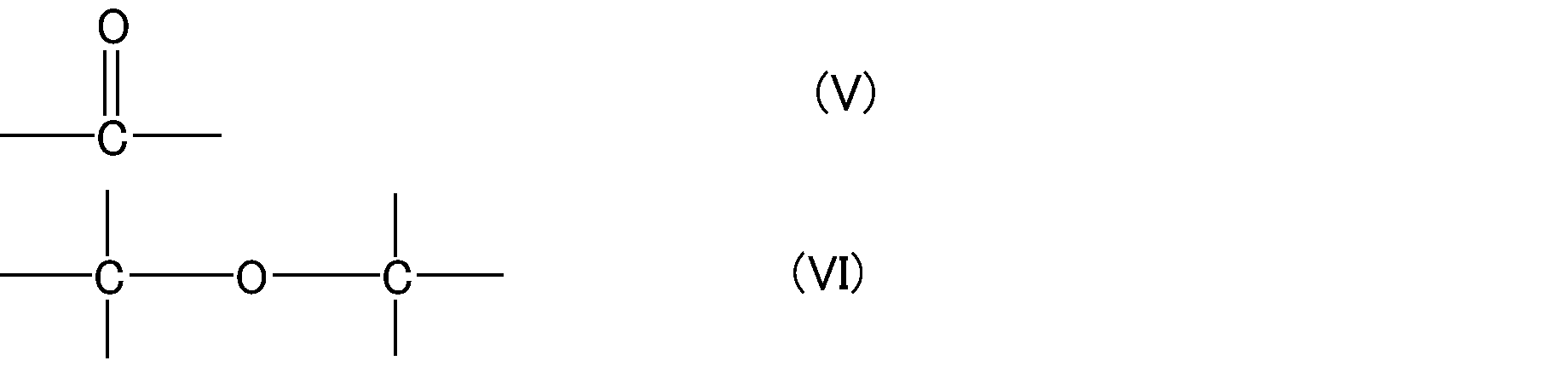













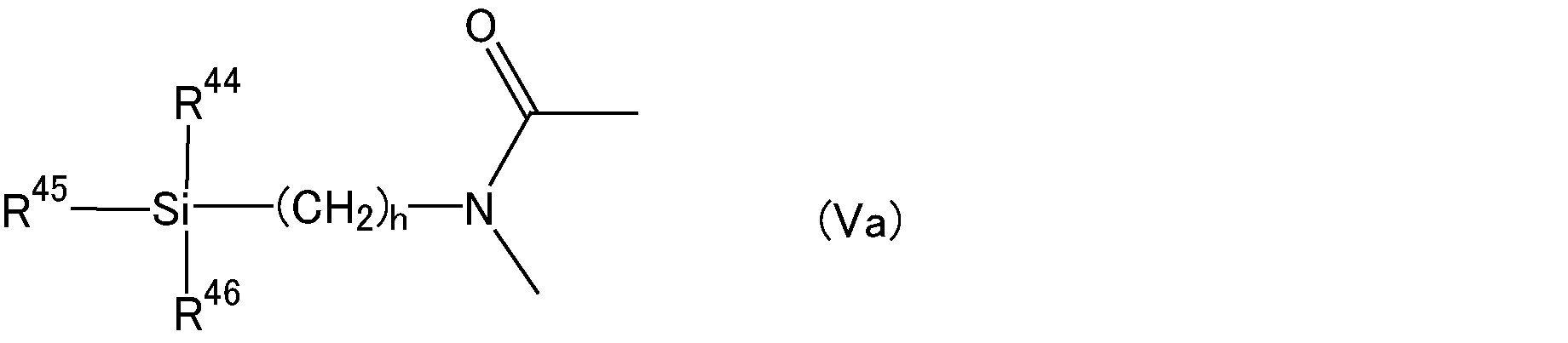






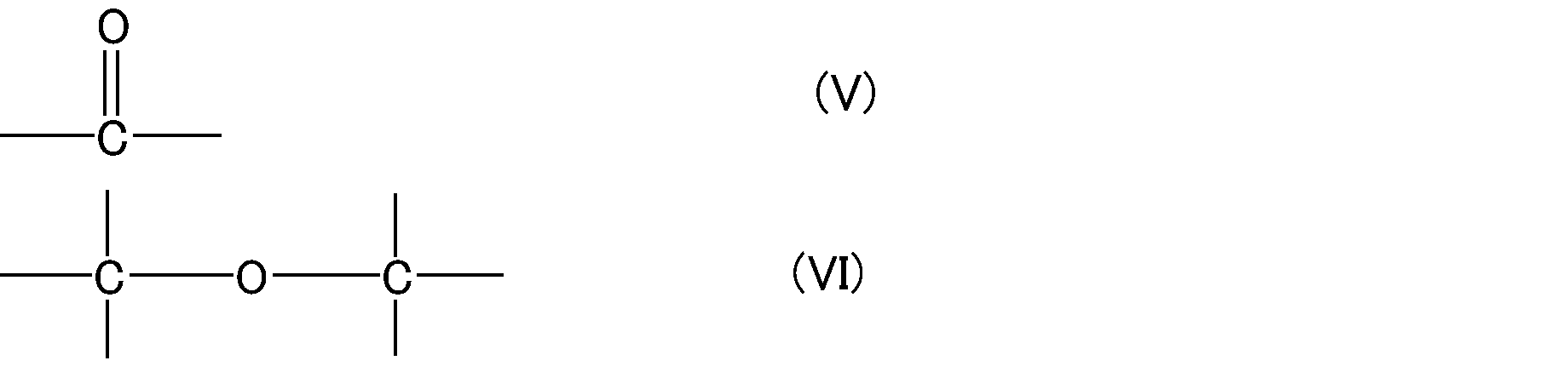



なお、本明細書において、アルキレンオキシド基は、環状エーテル化合物の環から水素原子を除いた1価の基を表す。また、アルキレンオキシドアルキル基は、アルキル基の1つ以上の水素原子がアルキレンオキシド基で置換されている基を表す。
なお、本明細書において、ジ(アルキレンオキシド)アミノ基は、窒素原子に結合している2つの水素原子が2つのアルキレンオキシド基に置換されたアミノ基を表し、ジ(アルキレンオキシドアルキル)アミノ基は、窒素原子に結合している2つの水素原子が2つのアルキレンオキシドアルキル基に置換されたアミノ基を表す。
[3-(ジメチルアミノ)プロピル]トリメトキシシラン、
[3-(ジエチルアミノ)プロピル]トリメトキシシラン、
[3-(エチルメチルアミノ)プロピル]トリメトキシシラン、
[3-(ジメチルアミノ)プロピル]トリエトキシシラン、
[3-(ジエチルアミノ)プロピル]トリエトキシシラン、
[3-(エチルメチルアミノ)プロピル]トリエトキシシランなどの
[3-(ジアルキルアミノ)プロピル]トリアルコキシシラン;
[3-(ジエチルアミノ)プロピル]メチルジメトキシシラン、
[3-(エチルメチルアミノ)プロピル]メチルジメトキシシラン、
[3-(ジメチルアミノ)プロピル]エチルジメトキシシラン、
[3-(ジエチルアミノ)プロピル]エチルジメトキシシラン、
[3-(エチルメチルアミノ)プロピル]エチルジメトキシシラン、
[3-(ジメチルアミノ)プロピル]メチルジエトキシシラン、
[3-(ジエチルアミノ)プロピル]メチルジエトキシシラン、
[3-(エチルメチルアミノ)プロピル]メチルジエトキシシラン、
[3-(ジメチルアミノ)プロピル]エチルジエトキシシラン、
[3-(ジエチルアミノ)プロピル]エチルジエトキシシラン、
[3-(エチルメチルアミノ)プロピル]エチルジエトキシシランなどの
[3-(ジアルキルアミノ)プロピル]アルキルジアルコキシシラン;
[3-(ジエチルアミノ)プロピル]ジメチルメトキシシラン、
[3-(ジメチルアミノ)プロピル]ジエチルメトキシシラン、
[3-(ジエチルアミノ)プロピル]ジエチルメトキシシラン、
[3-(ジメチルアミノ)プロピル]ジメチルエトキシシラン、
[3-(ジエチルアミノ)プロピル]ジメチルエトキシシラン、
[3-(ジメチルアミノ)プロピル]ジエチルエトキシシラン、
[3-(ジエチルアミノ)プロピル]ジエチルエトキシシランなどの
[3-(ジアルキルアミノ)プロピル]ジアルキルアルコキシシランを挙げることができる。
{3-[ジ(メトキシメチル)アミノ]プロピル}トリメトキシシラン、
{3-[ジ(エトキシメチル)アミノ]プロピル}トリメトキシシラン、
{3-[ジ(メトキシエチル)アミノ]プロピル}トリメトキシシラン、
{3-[ジ(エトキシエチル)アミノ]プロピル}トリメトキシシラン、
{3-[ジ(メトキシメチル)アミノ]プロピル}トリエトキシシラン、
{3-[ジ(エトキシメチル)アミノ]プロピル}トリエトキシシラン、
{3-[ジ(メトキシエチル)アミノ]プロピル}トリエトキシシラン、
{3-[ジ(エトキシエチル)アミノ]プロピル}トリエトキシシランなどの
{3-[ジ(アルコキシアルキル)アミノ]プロピル}トリアルコキシシラン;
{3-[ジ(エトキシメチル)アミノ]プロピル}メチルジメトキシシラン、
{3-[ジ(メトキシエチル)アミノ]プロピル}メチルジメトキシシラン、
{3-[ジ(エトキシエチル)アミノ]プロピル}メチルジメトキシシラン、
{3-[ジ(メトキシメチル)アミノ]プロピル}エチルジメトキシシラン、
{3-[ジ(エトキシメチル)アミノ]プロピル}エチルジメトキシシラン、
{3-[ジ(メトキシエチル)アミノ]プロピル}エチルジメトキシシラン、
{3-[ジ(エトキシエチル)アミノ]プロピル}エチルジメトキシシラン、
{3-[ジ(メトキシメチル)アミノ]プロピル}メチルジエトキシシラン、
{3-[ジ(エトキシメチル)アミノ]プロピル}メチルジエトキシシラン、
{3-[ジ(メトキシエチル)アミノ]プロピル}メチルジエトキシシラン、
{3-[ジ(エトキシエチル)アミノ]プロピル}メチルジエトキシシラン、
{3-[ジ(メトキシメチル)アミノ]プロピル}エチルジエトキシシラン、
{3-[ジ(エトキシメチル)アミノ]プロピル}エチルジエトキシシラン、
{3-[ジ(メトキシエチル)アミノ]プロピル}エチルジエトキシシラン、
{3-[ジ(エトキシエチル)アミノ]プロピル}エチルジエトキシシランなどの
{3-[ジ(アルコキシアルキル)アミノ]プロピル}アルキルジアルコキシシラン;
{3-[ジ(エトキシメチル)アミノ]プロピル}ジメチルメトキシシラン、
{3-[ジ(メトキシエチル)アミノ]プロピル}ジメチルメトキシシラン、
{3-[ジ(エトキシエチル)アミノ]プロピル}ジメチルメトキシシラン、
{3-[ジ(メトキシメチル)アミノ]プロピル}ジエチルメトキシシラン、
{3-[ジ(エトキシメチル)アミノ]プロピル}ジエチルメトキシシラン、
{3-[ジ(メトキシエチル)アミノ]プロピル}ジエチルメトキシシラン、
{3-[ジ(エトキシエチル)アミノ]プロピル}ジエチルメトキシシラン、
{3-[ジ(メトキシメチル)アミノ]プロピル}ジメチルエトキシシラン、
{3-[ジ(エトキシメチル)アミノ]プロピル}ジメチルエトキシシラン、
{3-[ジ(メトキシエチル)アミノ]プロピル}ジメチルエトキシシラン、
{3-[ジ(エトキシエチル)アミノ]プロピル}ジメチルエトキシシラン、
{3-[ジ(メトキシメチル)アミノ]プロピル}ジエチルエトキシシラン、
{3-[ジ(エトキシメチル)アミノ]プロピル}ジエチルエトキシシラン、
{3-[ジ(メトキシエチル)アミノ]プロピル}ジエチルエトキシシラン、
{3-[ジ(エトキシエチル)アミノ]プロピル}ジエチルエトキシシランなどの
{3-[ジ(アルコキシアルキル)アミノ]プロピル}ジアルキルアルコキシシランを挙げることができる。
{3-[ジ(エポキシ)アミノ]プロピル}トリメトキシシラン、
{3-[ジ(エポキシ)アミノ]プロピル}トリエトキシシラン、
{3-[ジ(エポキシ)アミノ]プロピル}メチルジメトキシシラン、
{3-[ジ(エポキシ)アミノ]プロピル}エチルジメトキシシラン、
{3-[ジ(エポキシ)アミノ]プロピル}メチルジエトキシシラン、
{3-[ジ(エポキシ)アミノ]プロピル}エチルジエトキシシラン、
{3-[ジ(エポキシ)アミノ]プロピル}ジメチルメトキシシラン、
{3-[ジ(エポキシ)アミノ]プロピル}ジエチルメトキシシラン、
{3-[ジ(エポキシ)アミノ]プロピル}ジメチルエトキシシラン、
{3-[ジ(エポキシ)アミノ]プロピル}ジエチルエトキシシランなどの
式(IIa)がジ(エポキシ)アミノ基である化合物;
{3-[ジ(テトラヒドロフラニル)アミノ]プロピル}トリエトキシシラン、
{3-[ジ(テトラヒドロフラニル)アミノ]プロピル}メチルジメトキシシラン、
{3-[ジ(テトラヒドロフラニル)アミノ]プロピル}エチルジメトキシシラン、
{3-[ジ(テトラヒドロフラニル)アミノ]プロピル}メチルジエトキシシラン、
{3-[ジ(テトラヒドロフラニル)アミノ]プロピル}エチルジエトキシシラン、
{3-[ジ(テトラヒドロフラニル)アミノ]プロピル}ジメチルメトキシシラン、
{3-[ジ(テトラヒドロフラニル)アミノ]プロピル}ジエチルメトキシシラン、
{3-[ジ(テトラヒドロフラニル)アミノ]プロピル}ジメチルエトキシシラン、
{3-[ジ(テトラヒドロフラニル)アミノ]プロピル}ジエチルエトキシシランなどの
式(IIa)がジ(テトラヒドロフラニル)アミノ基である化合物を挙げることができる。
{3-[ジ(グリシジル)アミノ]プロピル}トリメトキシシラン、
{3-[ジ(グリシジル)アミノ]プロピル}トリエトキシシラン、
{3-[ジ(グリシジル)アミノ]プロピル}メチルジメトキシシラン、
{3-[ジ(グリシジル)アミノ]プロピル}エチルジメトキシシラン、
{3-[ジ(グリシジル)アミノ]プロピル}メチルジエトキシシラン、
{3-[ジ(グリシジル)アミノ]プロピル}エチルジエトキシシラン、
{3-[ジ(グリシジル)アミノ]プロピル}ジメチルメトキシシラン、
{3-[ジ(グリシジル)アミノ]プロピル}ジエチルメトキシシラン、
{3-[ジ(グリシジル)アミノ]プロピル}ジメチルエトキシシラン、
{3-[ジ(グリシジル)アミノ]プロピル}ジエチルエトキシシランなどの
式(IIa)がジ(グリシジル)アミノ基である化合物;
{3-[ジ(テトラヒドロフルフリル)アミノ]プロピル}トリエトキシシラン、
{3-[ジ(テトラヒドロフルフリル)アミノ]プロピル}メチルジメトキシシラン、
{3-[ジ(テトラヒドロフルフリル)アミノ]プロピル}エチルジメトキシシラン、
{3-[ジ(テトラヒドロフルフリル)アミノ]プロピル}メチルジエトキシシラン、
{3-[ジ(テトラヒドロフルフリル)アミノ]プロピル}エチルジエトキシシラン、
{3-[ジ(テトラヒドロフルフリル)アミノ]プロピル}ジメチルメトキシシラン、
{3-[ジ(テトラヒドロフルフリル)アミノ]プロピル}ジエチルメトキシシラン、
{3-[ジ(テトラヒドロフルフリル)アミノ]プロピル}ジメチルエトキシシラン、
{3-[ジ(テトラヒドロフルフリル)アミノ]プロピル}ジエチルエトキシシランなどの
式(IIa)がジ(テトラヒドロフルフリル)アミノ基である化合物を挙げることができる。
{3-[ジ(トリメチルシリル)アミノ]プロピル}トリメトキシシラン、
{3-[ジ(t-ブチルジメチルシリル)アミノ]プロピル}トリメトキシシラン、
{3-[ジ(トリメチルシリル)アミノ]プロピル}トリエトキシシラン、
{3-[ジ(t-ブチルジメチルシリル)アミノ]プロピル}トリエトキシシランなどの
{3-[ジ(トリアルキルシリル)アミノ]プロピル}トリアルコキシシラン;
{3-[ジ(t-ブチルジメチルシリル)アミノ]プロピル}メチルジメトキシシラン、
{3-[ジ(トリメチルシリル)アミノ]プロピル}メチルジエトキシシラン、
{3-[ジ(t-ブチルジメチルシリル)アミノ]プロピル}メチルジエトキシシランなどの
{3-[ジ(トリアルキルシリル)アミノ]プロピル}アルキルジアルコキシシラン;
{3-[ジ(t-ブチルジメチルシリル)アミノ]プロピル}ジメチルメトキシシラン、
{3-[ジ(トリメチルシリル)アミノ]プロピル}ジメチルエトキシシラン、
{3-[ジ(t-ブチルジメチルシリル)アミノ]プロピル}ジメチルエトキシシランなどの
{3-[ジ(トリアルキルシリル)アミノ]プロピル}ジアルキルアルコキシシランを挙げることができる。
[3-(ジメチルアミノ)プロピル]トリメトキシシラン、
[3-(ジエチルアミノ)プロピル]トリメトキシシラン、
[3-(ジメチルアミノ)プロピル]トリエトキシシラン、
[3-(ジエチルアミノ)プロピル]トリエトキシシラン
がより好ましい。
3-(1-ピペリジノ)プロピルトリメトキシシラン、
3-(1-ピペリジノ)プロピルトリエトキシシラン、
3-(1-ピペリジノ)プロピルメチルジメトキシシラン、
3-(1-ピペリジノ)プロピルエチルジメトキシシラン、
3-(1-ピペリジノ)プロピルメチルジエトキシシラン、
3-(1-ピペリジノ)プロピルエチルジエトキシシランなどを挙げることができる。
3-(1-ヘキサメチレンイミノ)プロピルトリメトキシシラン、
3-(1-ヘキサメチレンイミノ)プロピルトリエトキシシラン、
3-(1-ヘキサメチレンイミノ)プロピルメチルジメトキシシラン、
3-(1-ヘキサメチレンイミノ)プロピルエチルジメトキシシラン、
3-(1-ヘキサメチレンイミノ)プロピルメチルジエトキシシラン、
3-(1-ヘキサメチレンイミノ)プロピルエチルジエトキシシランなどを挙げることができる。
N-(3-トリメトキシシリルプロピル)イミダゾール、
N-(3-トリエトキシシリルプロピル)イミダゾールなどを挙げることができる。
N-(3-トリメトキシシリルプロピル)-4,5-ジヒドロイミダゾール、
N-(3-トリエトキシシリルプロピル)-4,5-ジヒドロイミダゾールなどを挙げることができる。
3-(1-ピペラジニル)プロピルトリメトキシシラン、
3-(1-ピペラジニル)プロピルトリエトキシシラン、
3-(1-ピペラジニル)プロピルメチルジメトキシシラン、
3-(1-ピペラジニル)プロピルエチルジメトキシシラン、
3-(1-ピペラジニル)プロピルメチルジエトキシシラン、
3-(1-ピペラジニル)プロピルエチルジエトキシシランなどを挙げることができる。
3-モルホリノプロピルトリメトキシシラン、
3-モルホリノプロピルトリエトキシシラン、
3-モルホリノプロピルメチルジメトキシシラン、
3-モルホリノプロピルエチルジメトキシシラン、
3-モルホリノプロピルメチルジエトキシシラン、
3-モルホリノプロピルエチルジエトキシシランなどを挙げることができる。
N-(3-トリメトキシシリルプロピル)イミダゾール、
N-(3-トリエトキシシリルプロピル)イミダゾール、
N-(3-トリメトキシシリルプロピル)-4,5-ジヒドロイミダゾール、
N-(3-トリエトキシシリルプロピル)-4,5-ジヒドロイミダゾール
がより好ましい。



アセトアミド、N,N-ジメチルアセトアミド、N,N-ジエチルアセトアミド、アミノアセトアミド、N,N-ジメチル-N’,N’-ジメチルアミノアセトアミド、N,N-ジメチルアミノアセトアミド、N-エチルアミノアセトアミド、N,N-ジメチル-N’-エチルアミノアセトアミド、N,N-ジメチルアミノアセトアミド、N-フェニルジアセトアミドなどのアセトアミド化合物;
プロピオンアミド、N,N-ジメチルプロピオンアミドなどのプロピオンアミド化合物;
4-ピリジルアミド、N,N-ジメチル-4-ピリジルアミドなどのピリジルアミド化合物;
ベンズアミド、N,N-ジメチルベンズアミド、N’,N’-(p-ジメチルアミノ)ベンズアミド、N’,N’-(p-ジエチルアミノ)ベンズアミド、N,N-ジメチル-N’,N’-(p-ジメチルアミノ)ベンズアミド、N,N-ジメチル-N’,N’-(p-ジエチルアミノ)ベンズアミドなどのベンズアミド化合物;
N,N-ジメチルアクリルアミド、N,N-ジエチルアクリルアミドなどのアクリルアミド化合物;
N,N-ジメチルメタクリルアミド、N,N-ジエチルメタクリルアミドなどのメタクリルアミド化合物;
N,N-ジメチルニコチンアミド、N,N-ジエチルニコチンアミドなどのニコチンアミド化合物;
N,N,N’,N’-テトラメチルフタルアミド、N,N,N’,N’-テトラエチルフタルアミドなどのフタルアミド化合物;
N-メチルフタルイミド、N-エチルフタルイミドなどのフタルイミド化合物などを挙げることができる。


1-メチル-2-ピロリドン、1-(t-ブチル)-2-ピロリドン、1-フェニル-2-ピロリドン、1-(p-メチルフェニル)-2-ピロリドン、1-(p-メトキシフェニル)-2-ピロリドン、1-ベンジル-2-ピロリドン、1-ナフチル-2-ピロリドン、1-フェニル-5-メチル-2-ピロリドン、1-(t-ブチル)-5-メチル-2-ピロリドン、1-(t-ブチル)-1,3-ジメチル-2-ピロリドンなどの2-ピロリドン化合物;
1-(t-ブチル)-2-ピペリドン、1-フェニル-2-ピペリドン、1-(p-メチルフェニル)-2-ピペリドン、1-(p-メトキシフェニル)-2-ピペリドン、1-ナフチル-2-ピペリドンなどの2-ピペリドン化合物;
N-メチル-ε-カプロラクタム、N-エチル-ε-カプロラクタム、N-(n-プロピル)-ε-カプロラクタム、N-フェニル-ε-カプロラクタム、N-(p-メトキシフェニル)-ε-カプロラクタム、N-ベンジル-ε-カプロラクタムなどのε-カプロラクタム化合物;
N-フェニル-ω-ラウリロラクタムなどのω-ラウリロラクタム化合物を挙げることができる。

式(IIIb)で表される基を有する化合物としては、ベンズアルデヒド化合物、アセトフェノン化合物、ベンゾフェノン化合物を挙げることができる。





なお、本明細書において、アルキレンオキシド基は、環状エーテル化合物の環から水素原子を除いた1価の基を表す。また、アルキレンオキシドアルキル基は、アルキル基の1つ以上の水素原子がアルキレンオキシド基で置換されている基を表す。
なお、本明細書において、ジ(アルキレンオキシド)アミノ基は、窒素原子に結合している2つの水素原子が2つのアルキレンオキシド基に置換されたアミノ基を表し、ジ(アルキレンオキシドアルキル)アミノ基は、窒素原子に結合している2つの水素原子が2つのアルキレンオキシドアルキル基に置換されたアミノ基を表す。
N-(2-ジメチルアミノエチル)アクリルアミド、
N-(2-ジエチルアミノエチル)アクリルアミド、
N-(3-ジメチルアミノプロピル)アクリルアミド、
N-(3-ジエチルアミノプロピル)アクリルアミド、
N-(4-ジメチルアミノブチル)アクリルアミド、
N-(4-ジエチルアミノブチル)アクリルアミド、
N-(3-モルホリノプロピル)アクリルアミド、
N-(3-シアノプロピル)アクリルアミドなどが挙げられる。
N-(2-ジメチルアミノエチル)メタクリルアミド、
N-(2-ジエチルアミノエチル)メタクリルアミド、
N-(3-ジメチルアミノプロピル)メタクリルアミド、
N-(3-ジエチルアミノプロピル)メタクリルアミド、
N-(4-ジメチルアミノブチル)メタクリルアミド、
N-(4-ジエチルアミノブチル)メタクリルアミド、
N-(3-モルホリノプロピル)メタクリルアミド、
N-(3-シアノプロピル)メタクリルアミドなどが挙げられる。
N-(3-メトキシプロピル)アクリルアミド、
N-(3-エトキシプロピル)アクリルアミド、
N-(プロポキシメチル)アクリルアミド、
N-(ブトキシメチル)アクリルアミド、
N-グリシジルアクリルアミド、
N-テトラヒドロフルフリルアクリルアミドなどが挙げられる。
N-(3-メトキシプロピル)メタクリルアミド、
N-(3-エトキシプロピル)メタクリルアミド、
N-(プロポキシメチル)メタクリルアミド、
N-(ブトキシメチル)メタクリルアミド、
N-グリシジルメタクリルアミド、
N-テトラヒドロフルフリルメタクリルアミドなどが挙げられる。
N-(3-ジ(グリシジル)アミノプロピル)アクリルアミド、
N-(3-ジ(テトラヒヒドロフルフリル)アミノプロピル)アクリルアミドなどが挙げられる。
N-(3-ジ(グリシジル)アミノプロピル)メタクリルアミド、
N-(3-ジ(テトラヒヒドロフルフリル)アミノプロピル)メタクリルアミドなどが挙げられる。
2-ジメチルアミノエチルアクリレート、
2-ジエチルアミノエチルアクリレート、
3-ジメチルアミノプロピルアクリレート、
3-ジエチルアミノプロピルアクリレート、
4-ジメチルアミノブチルアクリレート、
4-ジエチルアミノブチルアクリレートなどが挙げられる。
2-ジメチルアミノエチルメタクリレート、
2-ジエチルアミノエチルメタクリレート、
3-ジメチルアミノプロピルメタクリレート、
3-ジエチルアミノプロピルメタクリレート、
4-ジメチルアミノブチルメタクリレート、
4-ジエチルアミノブチルメタクリレートなどが挙げられる。
2-エトキシエチルアクリレート、
2-プロポキシエチルアクリレート、
2-ブトキシエチルアクリレート、
3-メトキシプロピルアクリレート、
3-エトキシプロピルアクリレート、
グリシジルアクリレート、
テトラヒドロフルフリルアクリレートなどが挙げられる。
2-エトキシエチルメタクリレート、
2-プロポキシエチルメタクリレート、
2-ブトキシエチルメタクリレート、
3-メトキシプロピルメタクリレート、
3-エトキシプロピルメタクリレート、
グリシジルメタクリレート、
テトラヒドロフルフリルメタクリレートなどが挙げられる。
3-ジ(グリシジル)アミノプロピルアクリレート、
3-ジ(テトラヒドロフルフリル)アミノプロピルアクリレートなどが挙げられる。
A4が窒素原子及び酸素原子含有の基であるメタクリレート化合物としては、
3-ジ(グリシジル)アミノプロピルメタクリレート、
3-ジ(テトラヒドロフルフリル)アミノプロピルメタクリレートなどが挙げられる。
好ましくは、A4が式(IVa)で表される基である化合物であり、
より好ましくは、A3がアミノ基であり、A4が式(IVa)で表される基である化合物であり、
更に好ましくは、A3が二級アミノ基(-NH-)であり、A4が式(IVa)で表される基である化合物である。
好ましくは、
N-(3-ジアルキルアミノプロピル)アクリルアミド、N-(3-ジアルキルアミノプロピル)メタクリルアミドであり、
より好ましくは、
N-(3-ジメチルアミノプロピル)アクリルアミド、
N-(3-ジエチルアミノプロピル)アクリルアミド、
N-(3-ジメチルアミノプロピル)メタクリルアミド、
N-(3-ジエチルアミノプロピル)メタクリルアミドである。
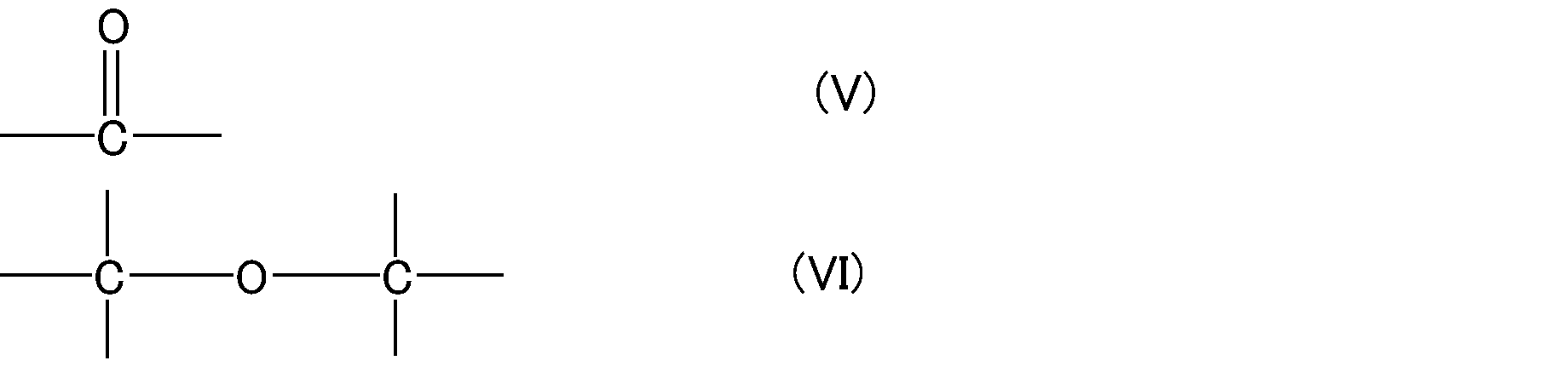
なお、本明細書において、アルキレンオキシド基は、環状エーテル化合物の環から水素原子を除いた1価の基を表す。

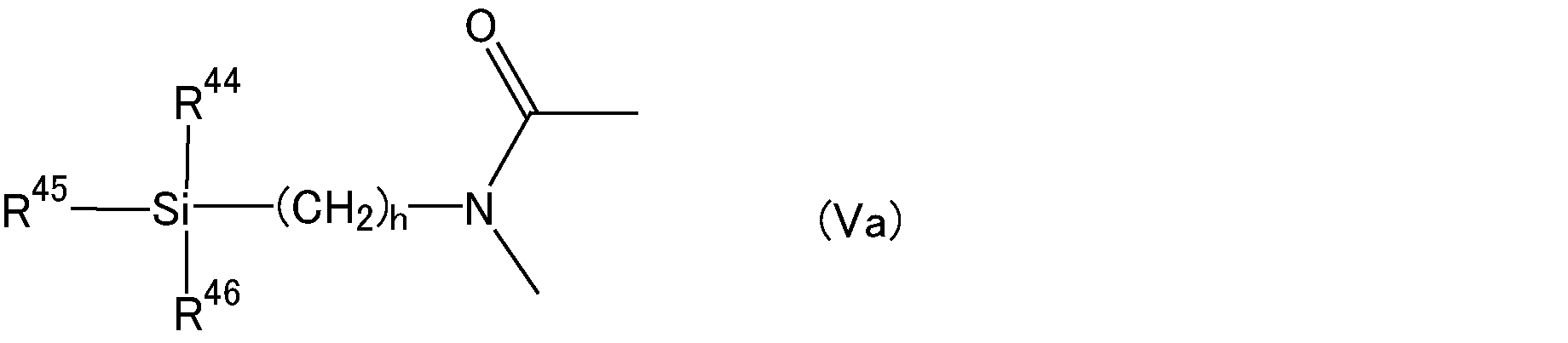
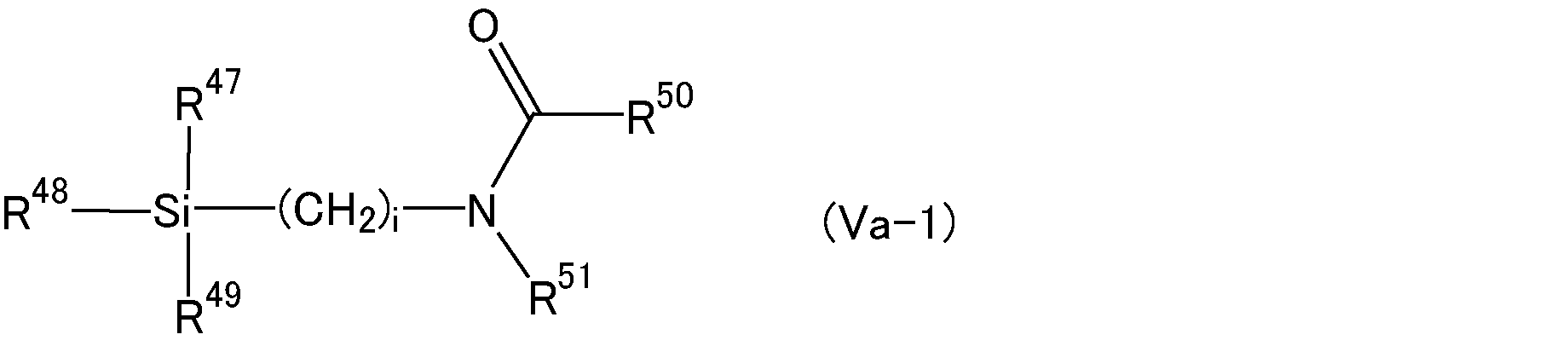
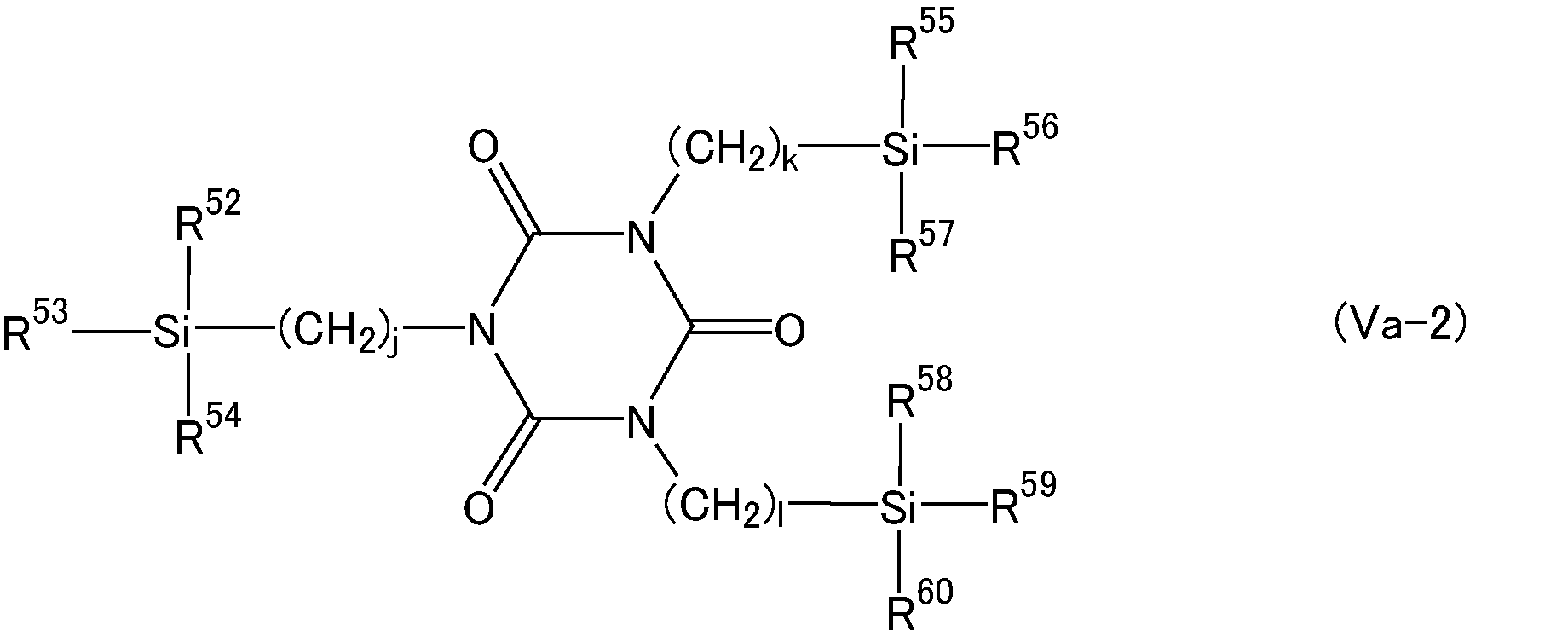
N-メチル-N-(トリメトキシシリルメチル)-アセトアミド、
N-メチル-N-(トリエトキシシリルメチル)-アセトアミド、
N-メチル-N-(2-トリメトキシシリルエチル)-アセトアミド、
N-メチル-N-(2-トリエトキシシリルエチル)-アセトアミド、
N-メチル-N-(3-トリメトキシシリルプロピル)-アセトアミド、
N-メチル-N-(3-トリエトキシシリルプロピル)-アセトアミド
などのN-アルキル-N-トリアルコキシシリルアルキル-アセトアミド;
N-メチル-N-(トリメトキシシリルメチル)-プロピオンアミド、
N-メチル-N-(トリエトキシシリルメチル)-プロピオンアミド、
N-メチル-N-(2-トリメトキシシリルエチル)-プロピオンアミド、
N-メチル-N-(2-トリエトキシシリルエチル)-プロピオンアミド、
N-メチル-N-(3-トリメトキシシリルプロピル)-プロピオンアミド、
N-メチル-N-(3-トリエトキシシリルプロピル)-プロピオンアミド
などのN-アルキル-N-トリアルコキシシリルアルキル-プロピオンアミドなど、
N-アルキル-N-トリアルコキシシリルアルキル置換カルボン酸アミドを挙げることができる。
N-アルキル-N-トリアルコキシシリルアルキル置換カルボン酸アミドであり、
より好ましくは、
N-アルキル-N-トリアルコキシシリルアルキル-プロピオンアミドであり、
更に好ましくは、
N-メチル-N-(3-トリメトキシシリルプロピル)-プロピオンアミド、
N-メチル-N-(3-トリエトキシシリルプロピル)-プロピオンアミドである。
1,3,5-トリス(トリメトキシシリルメチル)イソシアヌレート、
1,3,5-トリス(トリエトキシシリルメチル)イソシアヌレート、
1,3,5-トリス(トリメトキシシリルエチル)イソシアヌレート、
1,3,5-トリス(トリエトキシシリルエチル)イソシアヌレート、
1,3,5-トリス(3-トリメトキシシリルプロピル)イソシアヌレート、
1,3,5-トリス(3-トリエトキシシリルプロピル)イソシアヌレート
などの1,3,5-トリス(トリアルコキシシリルアルキル)イソシアヌレートを挙げることができる。
1,3,5-トリス(3-トリメトキシシリルプロピル)イソシアヌレート、
1,3,5-トリス(3-トリエトキシシリルプロピル)イソシアヌレートである。

なお、本明細書において、アルキレンオキシドアルキル基は、アルキル基の1つ以上の水素原子がアルキレンオキシド基で置換されている基を表す。
R64がアルキル基である化合物として、
3-(メトキシ)プロピルトリメトキシシラン、
3-(エトキシ)プロピルトリメトキシシラン、
3-(n-プロポキシ)プロピルトリメトキシシラン、
3-(イソプロポキシ)プロピルトリメトキシシラン、
3-(n-ブトキシ)プロピルトリメトキシシラン、
3-(sec-ブトキシ)プロピルトリメトキシシラン、
3-(t-ブトキシ)プロピルトリメトキシシラン
などの3-(アルコキシ)プロピルトリアルコキシシランを挙げることができる。
2-グリシドキシエチルトリメトキシシラン、
3-グリシドキシプロピルトリメトキシシラン、
2-グリシドキシエチルトリエトキシシラン、
3-グリシドキシプロピルトリエトキシシラン
などのグリシドキシアルキルトリアルコキシシラン;
2-テトラヒドロフルフリロキシエチルトリメトキシシラン、
3-テトラヒドロフルフリロキシプロピルトリメトキシシラン、
2-テトラヒドロフルフリロキシエチルトリエトキシシラン、
3-テトラヒドロフルフリロキシプロピルトリエトキシシラン
などのテトラヒドロフルフリロキシアルキルトリアルコキシシランを挙げることができる。
3-(メトキシメトキシ)プロピルトリメトキシシラン、
3-(メトキシエトキシ)プロピルトリメトキシシラン、
3-(エトキシメトキシ)プロピルトリメトキシシラン、
3-(エトキシエトキシ)プロピルトリメトキシシラン、
3-(メトキシメトキシ)プロピルトリエトキシシラン、
3-(メトキシエトキシ)プロピルトリエトキシシラン、
3-(エトキシメトキシ)プロピルトリエトキシシラン、
3-(エトキシエトキシ)プロピルトリエトキシシラン
などの3-(アルコキシアルコキシ)プロピルトリアルコキシシランを挙げることができる。
3-グリシドキシプロピルトリメトキシシラン、
3-グリシドキシプロピルトリエトキシシラン、
3-テトラヒドロフルフリロキシプロピルトリメトキシシラン、
3-テトラヒドロフルフリロキシプロピルトリエトキシシランである。
メタクリロキシアルキルトリアルコキシシランとしては、3-メタクリロキシプロピルトリメトキシシラン、3-メタクリロキシプロピルトリエトキシシランなどの3-メタクリロキシプロピルトリアルコキシシランを挙げることができる。
トリアルコキシシリルアルキル無水マレイン酸としては、3-トリメトキシシリルプロピル無水マレイン酸、3-トリエトキシシリルプロピル無水マレイン酸などの3-トリアルコキシシリルプロピル無水マレイン酸を挙げることができる。


なお、本明細書において、アルキレンオキシド基は、環状エーテル化合物の環から水素原子を除いた1価の基を表す。また、アルキレンオキシドアルキル基は、アルキル基の1つ以上の水素原子がアルキレンオキシド基で置換されている基を表す。
N,N-ジメチルホルムアミドジメチルアセタール、N,N-ジエチルホルムアミドジメチルアセタール、N,N-ジ(n-プロピル)ホルムアミドジメチルアセタール、
N,N-ジメチルホルムアミドジエチルアセタール、N,N-ジエチルホルムアミドジエチルアセタール、N,N-ジ(n-プロピル)ホルムアミドジエチルアセタール、
N,N-ジメチルホルムアミドエチルメチルアセタール、N,N-ジエチルホルムアミドエチルメチルアセタール、N,N-ジ(n-プロピル)ホルムアミドエチルメチルアセタールなどのN,N-ジアルキルホルムアミドジアルキルアセタール;
N,N-ジメチルアセトアミドジエチルアセタール、N,N-ジエチルアセトアミドジエチルアセタール、N,N-ジ(n-プロピル)アセトアミドジエチルアセタール、
N,N-ジメチルアセトアミドエチルメチルアセタール、N,N-ジエチルアセトアミドエチルメチルアセタール、N,N-ジ(n-プロピル)アセトアミドエチルメチルアセタールなどのN,N-ジアルキルアセトアミドジアルキルアセタール;
N,N-ジメチルプロピオンアミドジエチルアセタール、N,N-ジエチルプロピオンアミドジエチルアセタール、N,N-ジ(n-プロピル)プロピオンアミドジエチルアセタール、
N,N-ジメチルプロピオンアミドエチルメチルアセタール、N,N-ジエチルプロピオンアミドエチルメチルアセタール、N,N-ジ(n-プロピル)プロピオンアミドエチルメチルアセタールなどのN,N-ジアルキルプロピオンアミドジアルキルアセタールなどが挙げられる。
N,N-ジアルキルホルムアミドジアルキルアセタールであり、
より好ましくは、
N,N-ジメチルホルムアミドジメチルアセタール、
N,N-ジエチルホルムアミドジメチルアセタール、
N,N-ジメチルホルムアミドジエチルアセタール、
N,N-ジエチルホルムアミドジエチルアセタールである。
(工程A):炭化水素溶媒中で、アルカリ金属触媒により、共役ジエンと下式(IX)で表されるビニル化合物とを含む単量体を重合させ、共役ジエンに基づく単量体単位と下式(IX)で表されるビニル化合物に基づく単量体単位とを有する重合体鎖の少なくとも一端に、該触媒由来のアルカリ金属を有する重合体を得る工程。


(工程B):工程Aで得られた重合体と上記変性剤1~5の少なくとも1つとを反応させる工程。
R91 aML4-a(X)
[式中、R91はアルキル基、アルケニル基、シクロアルケニル基又は芳香族残基を表し、Mはケイ素原子又はスズ原子を表し、Lはハロゲン原子又はヒドロカルビルオキシ基を表し、aは0~2の整数を表す。]
ここで、芳香族残基は、芳香族炭化水素から芳香環に結合している水素を除いた1価の基を表す。


シリカは単独で用いてもよく、2種以上組み合わせて用いてもよい。
なお、シリカの窒素吸着比表面積は、ASTM D3037-81に準じてBET法で測定される値である。


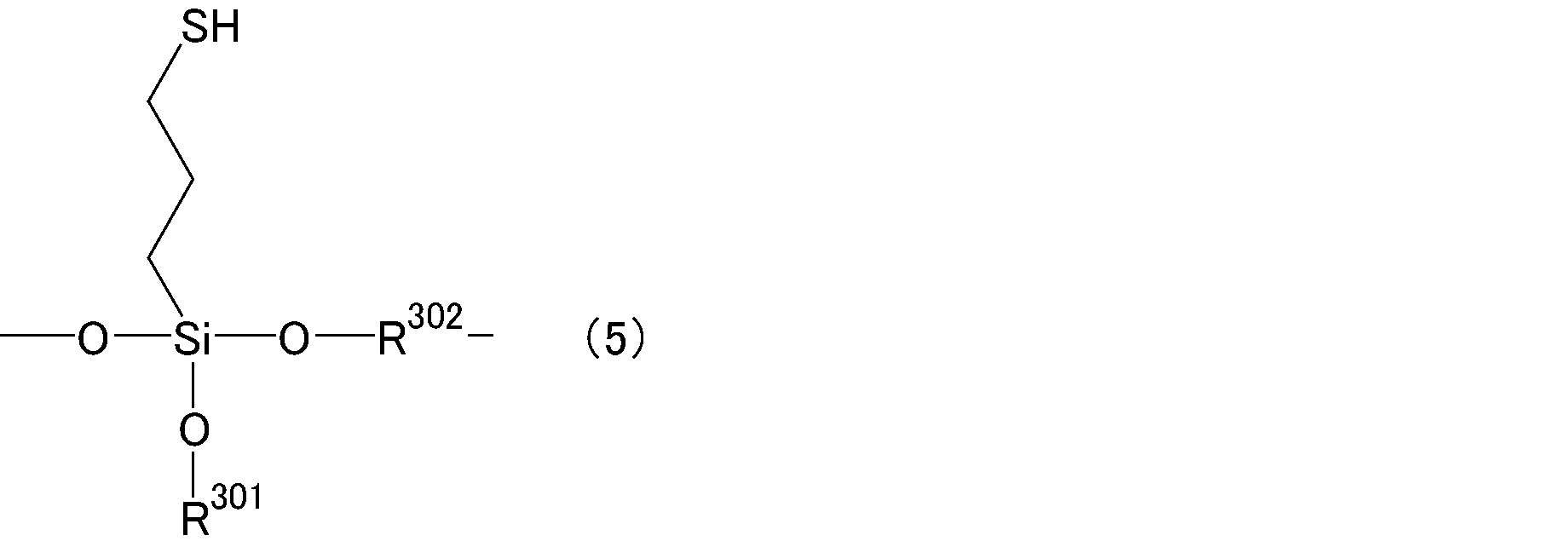
該炭化水素基としては、例えば、分岐若しくは非分岐の炭素数1~30のアルキレン基、分岐若しくは非分岐の炭素数2~30のアルケニレン基、分岐若しくは非分岐の炭素数2~30のアルキニレン基、炭素数6~30のアリーレン基などが挙げられる。中でも、分岐若しくは非分岐の炭素数1~30のアルキレン基が好ましい。

なお、結合単位A、Bの含有量は、結合単位A、Bがシランカップリング剤の末端に位置する場合も含む量である。結合単位A、Bがシランカップリング剤の末端に位置する場合の形態は特に限定されず、結合単位A、Bを示す式(4)、(5)と対応するユニットを形成していればよい。
加硫剤、加硫促進剤を配合する場合、混練温度は、通常100℃以下であり、好ましくは室温~80℃である。また、加硫剤、加硫促進剤を配合した組成物は、通常、プレス加硫などの加硫処理を行って用いられる。加硫温度としては、通常120~200℃、好ましくは140~180℃である。
重合体の物性評価は次の方法で行った。
赤外分光分析法により、ビニル基の吸収ピークである910cm-1付近の吸収強度より重合体のビニル結合量を求めた。
JIS K6383(1995)に従って、屈折率から重合体のスチレン単位の含量を求めた。
下記の条件(1)~(8)でゲル・パーミエイション・クロマトグラフ(GPC)法により、重合体の重量平均分子量(Mw)と数平均分子量(Mn)を測定した。そして、測定したMw、Mnから重合体の分子量分布(Mw/Mn)を求めた。
(1)装置:東ソー(株)製HLC-8020
(2)分離カラム:東ソー(株)製GMH-XL(2本直列)
(3)測定温度:40℃
(4)キャリア:テトラヒドロフラン
(5)流量:0.6mL/分
(6)注入量:5μL
(7)検出器:示差屈折
(8)分子量標準:標準ポリスチレン
内容積20リットルのステンレス製重合反応器内を洗浄、乾燥し、乾燥窒素で置換し、ヘキサン(比重0.68g/cm3)10.2kg、1,3-ブタジエン547g、スチレン173g、テトラヒドロフラン6.1ml、エチレングリコールジエチルエーテル5.0mlを重合反応器内に投入した。次に、ビス(ジエチルアミノ)メチルビニルシラン11.1mmol及びn-ブチルリチウム13.1mmolを、それぞれ、シクロヘキサン溶液及びn-ヘキサン溶液として投入し、重合を開始した。
撹拌速度を130rpm、重合反応器内温度を65℃とし、単量体を重合反応器内に連続的に供給しながら、1,3-ブタジエンとスチレンの共重合を3時間行った。全重合での1,3-ブタジエンの供給量は821g、スチレンの供給量は259gであった。
次に、得られた重合体溶液を130rpmの撹拌速度で撹拌し、3-ジエチルアミノプロピルトリエトキシシラン11.1mmolを添加し、15分間撹拌した。重合体溶液にメタノール0.54mlを含むヘキサン溶液20mlを加えて、更に重合体溶液を5分間撹拌した。
内容積20リットルのステンレス製重合反応器内を洗浄、乾燥し、乾燥窒素で置換し、ヘキサン(比重0.68g/cm3)10.2kg、1,3-ブタジエン547g、スチレン173g、テトラヒドロフラン6.1ml、エチレングリコールジエチルエーテル5.0mlを重合反応器内に投入した。次に、ビス(ジエチルアミノ)メチルビニルシラン11.1mmol及びn-ブチルリチウム13.1mmolを、それぞれ、シクロヘキサン溶液及びn-ヘキサン溶液として投入し、重合を開始した。
撹拌速度を130rpm、重合反応器内温度を65℃とし、単量体を重合反応器内に連続的に供給しながら、1,3-ブタジエンとスチレンの共重合を3時間行った。全重合での1,3-ブタジエンの供給量は821g、スチレンの供給量は259gであった。
次に、得られた重合体溶液を130rpmの撹拌速度で撹拌し、3-ジエチルアミノプロピルトリエトキシシラン11.1mmolを添加し、15分間撹拌した。重合体溶液にメタノール0.54mlを含むヘキサン溶液20mlを加えて、更に重合体溶液を5分間撹拌した。
内容積20リットルのステンレス製重合反応器内を洗浄、乾燥し、乾燥窒素で置換し、ヘキサン(比重0.68g/cm3)10.2kg、1,3-ブタジエン547g、スチレン173g、テトラヒドロフラン6.1ml、エチレングリコールジエチルエーテル5.0mlを重合反応器内に投入した。次に、n-ブチルリチウム13.1mmolをn-ヘキサン溶液として投入し、重合を開始した。
撹拌速度を130rpm、重合反応器内温度を65℃とし、単量体を重合反応器内に連続的に供給しながら、1,3-ブタジエンとスチレンの共重合を3時間行った。全重合での1,3-ブタジエンの供給量は821g、スチレンの供給量は259gであった。
次に、重合体溶液にメタノール0.54mlを含むヘキサン溶液20mlを加えて、更に重合体溶液を5分間撹拌した。
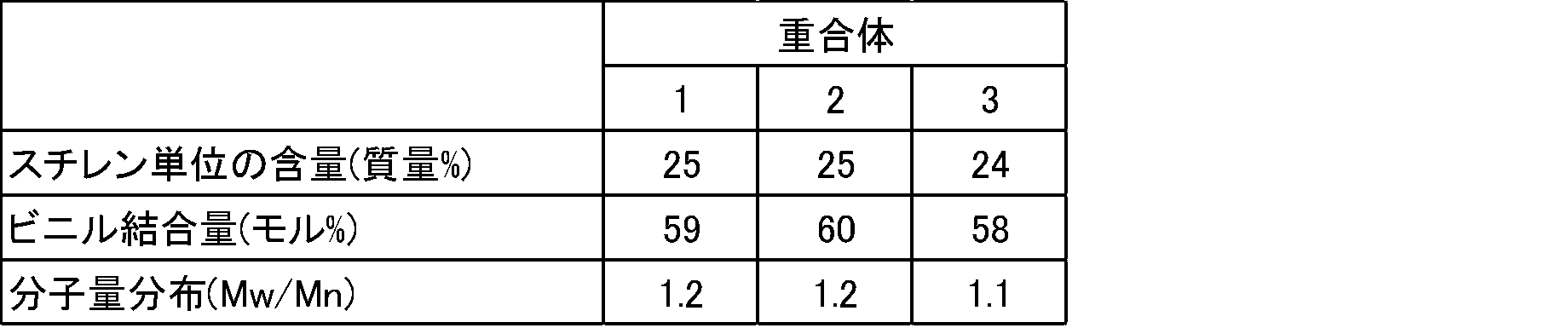
内容積20リットルのステンレス製重合反応器内を洗浄、乾燥し、乾燥窒素で置換し、ヘキサン(比重0.68g/cm3)10.2kg、1,3-ブタジエン547g、スチレン173g、テトラヒドロフラン6.1ml、エチレングリコールジエチルエーテル5.0mlを重合反応器内に投入した。次に、ビス(ジエチルアミノ)メチルビニルシラン11.0mmol及びn-ブチルリチウム14.3mmolを、それぞれ、シクロヘキサン溶液及びn-ヘキサン溶液として投入し、重合を開始した。
撹拌速度を130rpm、重合反応器内温度を65℃とし、単量体を重合反応器内に連続的に供給しながら、1,3-ブタジエンとスチレンの共重合を3時間行った。全重合での1,3-ブタジエンの供給量は821g、スチレンの供給量は259gであった。
次に、得られた重合体溶液を130rpmの撹拌速度で撹拌し、1,3-ジメチル-2-イミダゾリジノン11.0mmolを添加し、15分間撹拌した。重合体溶液にメタノール0.54mlを含むヘキサン溶液20mlを加えて、更に重合体溶液を5分間撹拌した。
内容積20リットルのステンレス製重合反応器内を洗浄、乾燥し、乾燥窒素で置換し、ヘキサン(比重0.68g/cm3)10.2kg、1,3-ブタジエン547g、スチレン173g、テトラヒドロフラン6.1ml、エチレングリコールジエチルエーテル5.0mlを重合反応器内に投入した。次に、ビス(ジエチルアミノ)メチルビニルシラン11.0mmol及びn-ブチルリチウム14.3mmolを、それぞれ、シクロヘキサン溶液及びn-ヘキサン溶液として投入し、重合を開始した。
撹拌速度を130rpm、重合反応器内温度を65℃とし、単量体を重合反応器内に連続的に供給しながら、1,3-ブタジエンとスチレンの共重合を3時間行った。全重合での1,3-ブタジエンの供給量は821g、スチレンの供給量は259gであった。
次に、得られた重合体溶液を130rpmの撹拌速度で撹拌し、1,3-ジメチル-2-イミダゾリジノン11.0mmolを添加し、15分間撹拌した。重合体溶液にメタノール0.54mlを含むヘキサン溶液20mlを加えて、更に重合体溶液を5分間撹拌した。

内容積20リットルのステンレス製重合反応器内を洗浄、乾燥し、乾燥窒素で置換し、ヘキサン(比重0.68g/cm3)10.2kg、1,3-ブタジエン547g、スチレン173g、テトラヒドロフラン6.1ml、エチレングリコールジエチルエーテル5.0mlを重合反応器内に投入した。次に、ビス(ジエチルアミノ)メチルビニルシラン10.5mmol及びn-ブチルリチウム14.9mmolを、それぞれ、シクロヘキサン溶液及びn-ヘキサン溶液として投入し、重合を開始した。
撹拌速度を130rpm、重合反応器内温度を65℃とし、単量体を重合反応器内に連続的に供給しながら、1,3-ブタジエンとスチレンの共重合を3時間行った。全重合での1,3-ブタジエンの供給量は821g、スチレンの供給量は259gであった。
次に、得られた重合体溶液を130rpmの撹拌速度で撹拌し、N-(3-ジメチルアミノプロピル)アクリルアミド10.5mmolを添加し、15分間撹拌した。重合体溶液にメタノール0.54mlを含むヘキサン溶液20mlを加えて、更に重合体溶液を5分間撹拌した。
内容積20リットルのステンレス製重合反応器内を洗浄、乾燥し、乾燥窒素で置換し、ヘキサン(比重0.68g/cm3)10.2kg、1,3-ブタジエン547g、スチレン173g、テトラヒドロフラン6.1ml、エチレングリコールジエチルエーテル5.0mlを重合反応器内に投入した。次に、n-ブチルリチウム12.9mmolをn-ヘキサン溶液として投入し、1,3-ブタジエンとスチレンの共重合を0.83時間行った。重合中、撹拌速度を130rpm、重合反応器内温度を65℃とし、単量体を重合反応器内に連続的に供給した。
該0.83時間の重合後、ビス(ジエチルアミノ)メチルビニルシラン10.5mmolをシクロヘキサン溶液として、撹拌速度を130rpm、重合反応器内温度を65℃の条件下で、重合反応器内に投入した。
次に、重合反応器内に連続的に単量体を供給し、1,3-ブタジエンとスチレンの共重合を1.67時間行った。重合中、撹拌速度を130rpm、重合反応器内温度を65℃とした。全重合での1,3-ブタジエンの供給量は821g、スチレンの供給量は259gであった。
次に、得られた重合体溶液を130rpmの撹拌速度で撹拌し、N-(3-ジメチルアミノプロピル)アクリルアミド10.5mmolを添加し、15分間撹拌した。重合体溶液にメタノール0.54mlを含むヘキサン溶液20mlを加えて、更に重合体溶液を5分間撹拌した。
内容積20リットルのステンレス製重合反応器内を洗浄、乾燥し、乾燥窒素で置換し、ヘキサン(比重0.68g/cm3)10.2kg、1,3-ブタジエン547g、スチレン173g、テトラヒドロフラン6.1ml、エチレングリコールジエチルエーテル5.0mlを重合反応器内に投入した。次に、ビス(ジエチルアミノ)メチルビニルシラン10.5mmol及びn-ブチルリチウム13.4mmolを、それぞれシクロヘキサン溶液及びn-ヘキサン溶液として投入し、1,3-ブタジエンとスチレンの共重合を1時間行った。重合中、撹拌速度を130rpm、重合反応器内温度を65℃とし、単量体を重合反応器内に連続的に供給した。
該1時間の重合後、ビス(ジエチルアミノ)メチルビニルシラン10.5mmolをシクロヘキサン溶液として、撹拌速度を130rpm、重合反応器内温度を65℃の条件下で、重合反応器内に投入した。
次に、重合反応器内に連続的に単量体を供給し、1,3-ブタジエンとスチレンの共重合を0.5時間行った。重合中、撹拌速度を130rpm、重合反応器内温度を65℃とした。
該0.5時間の重合後、ビス(ジエチルアミノ)メチルビニルシラン10.5mmolをシクロヘキサン溶液として、撹拌速度を130rpm、重合反応器内温度を65℃の条件下で、重合反応器内に投入した。
次に、重合反応器内に連続的に単量体を供給し、1,3-ブタジエンとスチレンの共重合を1.5時間行った。重合中、撹拌速度を130rpm、重合反応器内温度を65℃とした。全重合での1,3-ブタジエンの供給量は821g、スチレンの供給量は259gであった。
次に、得られた重合体溶液を130rpmの撹拌速度で撹拌し、N-(3-ジメチルアミノプロピル)アクリルアミド10.5mmolを添加し、15分間撹拌した。
内容積20リットルのステンレス製重合反応器内を洗浄、乾燥し、乾燥窒素で置換し、ヘキサン(比重0.68g/cm3)10.2kg、1,3-ブタジエン547g、スチレン173g、テトラヒドロフラン6.1ml、エチレングリコールジエチルエーテル5.0mlを重合反応器内に投入した。次に、ビス{ジ(n-ブチル)アミノ}メチルビニルシラン10.5mmol及びn-ブチルリチウム13.4mmolを、それぞれ、シクロヘキサン溶液及びn-ヘキサン溶液として投入し、重合を開始した。
撹拌速度を130rpm、重合反応器内温度を65℃とし、単量体を重合反応器内に連続的に供給しながら、1,3-ブタジエンとスチレンの共重合を3時間行った。全重合での1,3-ブタジエンの供給量は821g、スチレンの供給量は259gであった。
次に、得られた重合体溶液を130rpmの撹拌速度で撹拌し、N-(3-ジメチルアミノプロピル)アクリルアミド10.5mmolを添加し、15分間撹拌した。重合体溶液にメタノール0.54mlを含むヘキサン溶液20mlを加えて、更に重合体溶液を5分間撹拌した。
内容積5リットルのステンレス製重合反応器内を洗浄、乾燥し、乾燥窒素で置換し、ヘキサン(比重0.68g/cm3)2.55kg、1,3-ブタジエン137g、スチレン43g、テトラヒドロフラン1.5ml、エチレングリコールジエチルエーテル1.2mlを重合反応器内に投入した。次に、n-ブチルリチウム3.6mmolをn-ヘキサン溶液として投入し、1,3-ブタジエンとスチレンの共重合を2.5時間行った。重合中、撹拌速度を130rpm、重合反応器内温度を65℃とし、単量体を重合反応器内に連続的に供給した。1,3-ブタジエンの供給量は205g、スチレンの供給量は65gであった。
該2.5時間の重合後、ビス(ジエチルアミノ)メチルビニルシラン2.8mmolをシクロヘキサン溶液として、撹拌速度130rpm、重合反応器内温度65℃の条件下で、重合反応器内に投入し30分間撹拌した。
次に、メタノール0.14mlを含むヘキサン溶液20mlを重合反応器内に投入し、重合体溶液を5分間撹拌した。
内容積20リットルのステンレス製重合反応器内を洗浄、乾燥し、乾燥窒素で置換し、ヘキサン(比重0.68g/cm3)10.2kg、1,3-ブタジエン547g、スチレン173g、テトラヒドロフラン6.1ml、エチレングリコールジエチルエーテル5.0mlを重合反応器内に投入した。次に、ビス(ジエチルアミノ)メチルビニルシラン10.5mmol及びn-ブチルリチウム14.9mmolを、それぞれ、シクロヘキサン溶液及びn-ヘキサン溶液として投入し、重合を開始した。
撹拌速度を130rpm、重合反応器内温度を65℃とし、単量体を重合反応器内に連続的に供給しながら、1,3-ブタジエンとスチレンの共重合を3時間行った。全重合での1,3-ブタジエンの供給量は821g、スチレンの供給量は259gであった。
次に、重合体溶液にメタノール0.54mlを含むヘキサン溶液20mlを加えて、更に重合体溶液を5分間撹拌した。
内容積20リットルのステンレス製重合反応器内を洗浄、乾燥し、乾燥窒素で置換し、ヘキサン(比重0.68g/cm3)10.2kg、1,3-ブタジエン547g、スチレン173g、テトラヒドロフラン6.1ml、エチレングリコールジエチルエーテル5.0mlを重合反応器内に投入した。次に、n-ブチルリチウム14.9mmolをn-ヘキサン溶液として投入し、重合を開始した。
撹拌速度を130rpm、重合反応器内温度を65℃とし、単量体を重合反応器内に連続的に供給しながら、1,3-ブタジエンとスチレンの共重合を3時間行った。全重合での1,3-ブタジエンの供給量は821g、スチレンの供給量は259gであった。
次に、得られた重合体溶液を130rpmの撹拌速度で撹拌し、N-(3-ジメチルアミノプロピル)アクリルアミド10.5mmolを添加し、15分間撹拌した。重合体溶液にメタノール0.54mlを含むヘキサン溶液20mlを加えて、更に重合体溶液を5分間撹拌した。
内容積20リットルのステンレス製重合反応器内を洗浄、乾燥し、乾燥窒素で置換し、ヘキサン(比重0.68g/cm3)10.2kg、1,3-ブタジエン547g、スチレン173g、テトラヒドロフラン6.1ml、エチレングリコールジエチルエーテル5.0mlを重合反応器内に投入した。次に、n-ブチルリチウム14.9mmolをn-ヘキサン溶液として投入し)、重合を開始した。
撹拌速度を130rpm、重合反応器内温度を65℃とし、単量体を重合反応器内に連続的に供給しながら、1,3-ブタジエンとスチレンの共重合を3時間行った。全重合での1,3-ブタジエンの供給量は821g、スチレンの供給量は259gであった。
次に、重合体溶液にメタノール0.54mlを含むヘキサン溶液20mlを加えて、更に重合体溶液を5分間撹拌した。
内容積20リットルのステンレス製重合反応器内を洗浄、乾燥し、乾燥窒素で置換し、ヘキサン(比重0.68g/cm3)10.2kg、1,3-ブタジエン547g、スチレン173g、テトラヒドロフラン6.1ml、エチレングリコールジエチルエーテル5.0mlを重合反応器内に投入した。次に、ビス(ジエチルアミノ)メチルビニルシラン10.5mmol及びn-ブチルリチウム14.9mmolを、それぞれ、シクロヘキサン溶液及びn-ヘキサン溶液として投入し、重合を開始した。
撹拌速度を130rpm、重合反応器内温度を65℃とし、単量体を重合反応器内に連続的に供給しながら、1,3-ブタジエンとスチレンの共重合を3時間行った。全重合での1,3-ブタジエンの供給量は821g、スチレンの供給量は259gであった。
次に、得られた重合体溶液を130rpmの撹拌速度で撹拌し、N-(3-ジメチルアミノプロピル)アクリルアミド10.5mmolを添加し、15分間撹拌した。重合体溶液にメタノール0.54mlを含むヘキサン溶液20mlを加えて、更に重合体溶液を5分間撹拌した。

内容積20リットルのステンレス製重合反応器内を洗浄、乾燥し、乾燥窒素で置換し、ヘキサン(比重0.68g/cm3)10.2kg、1,3-ブタジエン547g、スチレン173g、テトラヒドロフラン6.1ml、エチレングリコールジエチルエーテル5.0mlを重合反応器内に投入した。次に、ビス(ジエチルアミノ)メチルビニルシラン16.0mmol及びn-ブチルリチウム18.5mmolを、それぞれ、シクロヘキサン溶液及びn-ヘキサン溶液として投入し、重合を開始した。
撹拌速度を130rpm、重合反応器内温度を65℃とし、単量体を重合反応器内に連続的に供給しながら、1,3-ブタジエンとスチレンの共重合を3時間行った。全重合での1,3-ブタジエンの供給量は821g、スチレンの供給量は259gであった。
次に、得られた重合体溶液を130rpmの撹拌速度で撹拌し、1,3,5-トリス(3-トリメトキシシリルプロピル)イソシアヌレート4.0mmolを添加し、15分間撹拌した。重合体溶液にメタノール0.80mlを含むヘキサン溶液20mlを加えて、更に重合体溶液を5分間撹拌した。
内容積20リットルのステンレス製重合反応器内を洗浄、乾燥し、乾燥窒素で置換し、ヘキサン(比重0.68g/cm3)10.2kg、1,3-ブタジエン547g、スチレン173g、テトラヒドロフラン6.1ml、エチレングリコールジエチルエーテル5.0mlを重合反応器内に投入した。次に、n-ブチルリチウム17.3mmolをn-ヘキサン溶液として投入し、1,3-ブタジエンとスチレンの共重合を1時間行った。重合中、撹拌速度を130rpm、重合反応器内温度を65℃とし、単量体を重合反応器内に連続的に供給した。
該1時間の重合後、ビス(ジエチルアミノ)メチルビニルシラン14.4mmolをシクロヘキサン溶液として、撹拌速度を130rpm、重合反応器内温度を65℃の条件下で、重合反応器内に投入した。
次に、重合反応器内に連続的に単量体を供給し、1,3-ブタジエンとスチレンの共重合を0.5時間行った。重合中、撹拌速度を130rpm、重合反応器内温度を65℃とした。
該0.5時間の重合後、ビス(ジエチルアミノ)メチルビニルシラン14.4mmolをシクロヘキサン溶液として、撹拌速度を130rpm、重合反応器内温度を65℃の条件下で、重合反応器内に投入した。
次に、重合反応器内に連続的に単量体を供給し、1,3-ブタジエンとスチレンの共重合を0.5時間行った。重合中、撹拌速度を130rpm、重合反応器内温度を65℃とした。
該0.5時間の重合後、ビス(ジエチルアミノ)メチルビニルシラン14.4mmolをシクロヘキサン溶液として、撹拌速度を130rpm、重合反応器内温度を65℃の条件下で、重合反応器内に投入した。
次に、重合反応器内に連続的に単量体を供給し、1,3-ブタジエンとスチレンの共重合を0.5時間行った。重合中、撹拌速度を130rpm、重合反応器内温度を65℃とした。全重合での1,3-ブタジエンの供給量は821g、スチレンの供給量は259gであった。
次に、得られた重合体溶液を130rpmの撹拌速度で撹拌し、1,3,5-トリス(3-トリメトキシシリルプロピル)イソシアヌレート3.6mmolを添加し、15分間撹拌した。重合体溶液にメタノール0.80mlを含むヘキサン溶液20mlを加えて、更に重合体溶液を5分間撹拌した。
内容積5リットルのステンレス製重合反応器内を洗浄、乾燥し、乾燥窒素で置換し、ヘキサン(比重0.68g/cm3)2.55kg、1,3-ブタジエン137g、スチレン43g、テトラヒドロフラン1.5ml、エチレングリコールジエチルエーテル1.2mlを重合反応器内に投入した。次に、n-ブチルリチウム3.6mmolをn-ヘキサン溶液として投入し、1,3-ブタジエンとスチレンの共重合を2.5時間行った。重合中、撹拌速度を130rpm、重合反応器内温度を65℃とし、単量体を重合反応器内に連続的に供給した。1,3-ブタジエンの供給量は205g、スチレンの供給量は65gであった。
該2.5時間の重合後、ビス(ジエチルアミノ)メチルビニルシラン2.8mmolをシクロヘキサン溶液として、撹拌速度130rpm、重合反応器内温度を65℃の条件下で、重合反応器内に投入し30分間撹拌した。
次に、メタノール0.14mlを含むヘキサン溶液20mlを重合反応器内に投入し、重合体溶液を5分間撹拌した。
内容積20リットルのステンレス製重合反応器内を洗浄、乾燥し、乾燥窒素で置換し、ヘキサン(比重0.68g/cm3)10.2kg、1,3-ブタジエン547g、スチレン173g、テトラヒドロフラン6.1ml、エチレングリコールジエチルエーテル5.0mlを重合反応器内に投入した。次に、ビス(ジエチルアミノ)メチルビニルシラン16.0mmol及びn-ブチルリチウム18.5mmolを、それぞれ、シクロヘキサン溶液及びn-ヘキサン溶液として投入し、重合を開始した。
撹拌速度を130rpm、重合反応器内温度を65℃とし、単量体を重合反応器内に連続的に供給しながら、1,3-ブタジエンとスチレンの共重合を3時間行った。全重合での1,3-ブタジエンの供給量は821g、スチレンの供給量は259gであった。
次に、重合体溶液にメタノール0.80mlを含むヘキサン溶液20mlを加えて、更に重合体溶液を5分間撹拌した。
内容積20リットルのステンレス製重合反応器内を洗浄、乾燥し、乾燥窒素で置換し、ヘキサン(比重0.68g/cm3)10.2kg、1,3-ブタジエン547g、スチレン173g、テトラヒドロフラン6.1ml、エチレングリコールジエチルエーテル5.0mlを重合反応器内に投入した。次に、n-ブチルリチウム18.5mmolをn-ヘキサン溶液として投入し、重合を開始した。
撹拌速度を130rpm、重合反応器内温度を65℃とし、単量体を重合反応器内に連続的に供給しながら、1,3-ブタジエンとスチレンの共重合を3時間行った。全重合での1,3-ブタジエンの供給量は821g、スチレンの供給量は259gであった。
次に、得られた重合体溶液を130rpmの撹拌速度で撹拌し、1,3,5-トリス(3-トリメトキシシリルプロピル)イソシアヌレート4.0mmolを添加し、15分間撹拌した。重合体溶液にメタノール0.80mlを含むヘキサン溶液20mlを加えて、更に重合体溶液を5分間撹拌した。
内容積20リットルのステンレス製重合反応器内を洗浄、乾燥し、乾燥窒素で置換し、ヘキサン(比重0.68g/cm3)10.2kg、1,3-ブタジエン547g、スチレン173g、テトラヒドロフラン6.1ml、エチレングリコールジエチルエーテル5.0mlを重合反応器内に投入した。次に、n-ブチルリチウム18.5mmolをn-ヘキサン溶液として投入し、重合を開始した。
撹拌速度を130rpm、重合反応器内温度を65℃とし、単量体を重合反応器内に連続的に供給しながら、1,3-ブタジエンとスチレンの共重合を3時間行った。全重合での1,3-ブタジエンの供給量は821g、スチレンの供給量は259gであった。
次に、重合体溶液にメタノール0.80mlを含むヘキサン溶液20mlを加えて、更に重合体溶液を5分間撹拌した。
内容積20リットルのステンレス製重合反応器内を洗浄、乾燥し、乾燥窒素で置換し、ヘキサン(比重0.68g/cm3)10.2kg、1,3-ブタジエン547g、スチレン173g、テトラヒドロフラン6.1ml、エチレングリコールジエチルエーテル5.0mlを重合反応器内に投入した。次に、ビス(ジエチルアミノ)メチルビニルシラン16.0mmol及びn-ブチルリチウム18.5mmolを、それぞれ、シクロヘキサン溶液及びn-ヘキサン溶液として投入し、重合を開始した。
撹拌速度を130rpm、重合反応器内温度を65℃とし、単量体を重合反応器内に連続的に供給しながら、1,3-ブタジエンとスチレンの共重合を3時間行った。全重合での1,3-ブタジエンの供給量は821g、スチレンの供給量は259gであった。
次に、得られた重合体溶液を130rpmの撹拌速度で撹拌し、1,3,5-トリス(3-トリメトキシシリルプロピル)イソシアヌレート4.0mmolを添加し、15分間撹拌した。重合体溶液にメタノール0.80mlを含むヘキサン溶液20mlを加えて、更に重合体溶液を5分間撹拌した。
内容積20リットルのステンレス製重合反応器内を洗浄、乾燥し、乾燥窒素で置換し、ヘキサン(比重0.68g/cm3)10.2kg、1,3-ブタジエン547g、スチレン173g、テトラヒドロフラン6.1ml、エチレングリコールジエチルエーテル5.0mlを重合反応器内に投入した。次に、ビス(ジエチルアミノ)メチルビニルシラン16.0mmol及びn-ブチルリチウム18.5mmolを、それぞれ、シクロヘキサン溶液及びn-ヘキサン溶液として投入し、重合を開始した。
撹拌速度を130rpm、重合反応器内温度を65℃とし、単量体を重合反応器内に連続的に供給しながら、1,3-ブタジエンとスチレンの共重合を3時間行った。全重合での1,3-ブタジエンの供給量は821g、スチレンの供給量は259gであった。
次に、得られた重合体溶液を130rpmの撹拌速度で撹拌し、3-(メトキシ)プロピルトリメトキシシラン4.0mmolを添加し、15分間撹拌した。重合体溶液にメタノール0.80mlを含むヘキサン溶液20mlを加えて、更に重合体溶液を5分間撹拌した。
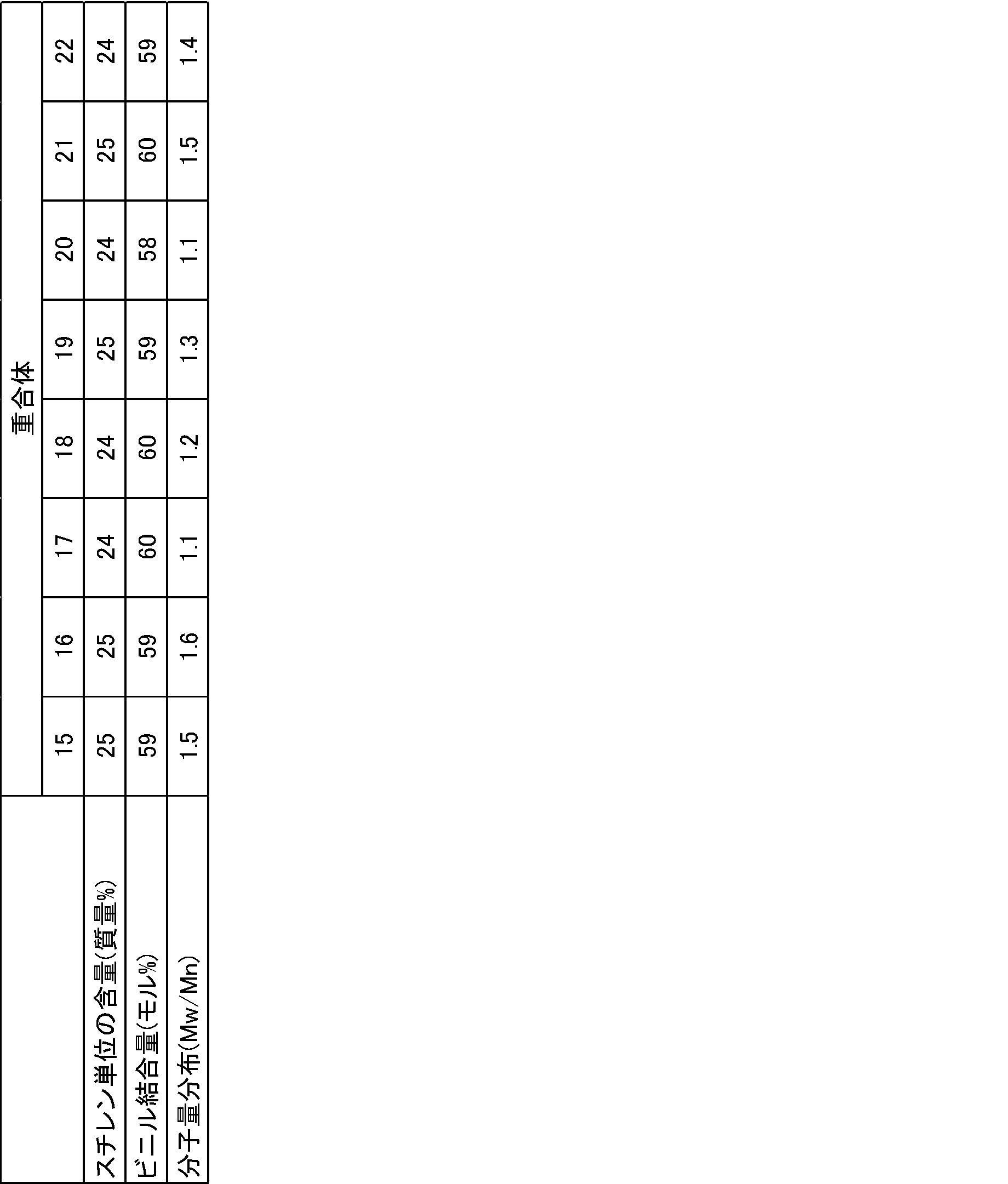
内容積20リットルのステンレス製重合反応器内を洗浄、乾燥し、乾燥窒素で置換し、ヘキサン(比重0.68g/cm3)10.2kg、1,3-ブタジエン547g、スチレン173g、テトラヒドロフラン6.1ml、エチレングリコールジエチルエーテル5.0mlを重合反応器内に投入した。次に、ビス(ジエチルアミノ)メチルビニルシラン11.5mmol及びn-ブチルリチウム14.1mmolを、それぞれ、シクロヘキサン溶液及びn-ヘキサン溶液として投入し、重合を開始した。
撹拌速度を130rpm、重合反応器内温度を65℃とし、単量体を重合反応器内に連続的に供給しながら、1,3-ブタジエンとスチレンの共重合を3時間行った。全重合での1,3-ブタジエンの供給量は821g、スチレンの供給量は259gであった。
次に、得られた重合体溶液を130rpmの撹拌速度で撹拌し、N,N-ジメチルホルムアミドジメチルアセタール11.5mmolを添加し、15分間撹拌した。重合体溶液にメタノール0.54mlを含むヘキサン溶液20mlを加えて、更に重合体溶液を5分間撹拌した。
内容積20リットルのステンレス製重合反応器内を洗浄、乾燥し、乾燥窒素で置換し、ヘキサン(比重0.68g/cm3)10.2kg、1,3-ブタジエン547g、スチレン173g、テトラヒドロフラン6.1ml、エチレングリコールジエチルエーテル5.0mlを重合反応器内に投入した。次に、n-ブチルリチウム14.1mmolをn-ヘキサン溶液として投入し、1,3-ブタジエンとスチレンの共重合を1時間行った。重合中、撹拌速度を130rpm、重合反応器内温度を65℃とし、単量体を重合反応器内に連続的に供給した。
該1時間の重合後、ビス(ジエチルアミノ)メチルビニルシラン11.0mmolをシクロヘキサン溶液として、撹拌速度を130rpm、重合反応器内温度を65℃の条件下で、重合反応器内に投入した。
次に、重合反応器内に連続的に単量体を供給し、1,3-ブタジエンとスチレンの共重合を0.5時間行った。重合中、撹拌速度を130rpm、重合反応器内温度を65℃とした。
該0.5時間の重合後、ビス(ジエチルアミノ)メチルビニルシラン11.0mmolをシクロヘキサン溶液として、撹拌速度を130rpm、重合反応器内温度を65℃の条件下で、重合反応器内に投入した。
次に、重合反応器内に連続的に単量体を供給し、1,3-ブタジエンとスチレンの共重合を0.5時間行った。重合中、撹拌速度を130rpm、重合反応器内温度を65℃とした。
該0.5時間の重合後、ビス(ジエチルアミノ)メチルビニルシラン11.0mmolをシクロヘキサン溶液として、撹拌速度を130rpm、重合反応器内温度を65℃の条件下で、重合反応器内に投入した。
次に、重合反応器内に連続的に単量体を供給し、1,3-ブタジエンとスチレンの共重合を0.5時間行った。重合中、撹拌速度を130rpm、重合反応器内温度を65℃とした。全重合での1,3-ブタジエンの供給量は821g、スチレンの供給量は259gであった。
次に、得られた重合体溶液を130rpmの撹拌速度で撹拌し、N,N-ジメチルホルムアミドジメチルアセタール11.0mmolを添加し、15分間撹拌した。重合体溶液にメタノール0.54mlを含むヘキサン溶液20mlを加えて、更に重合体溶液を5分間撹拌した。
内容積5リットルのステンレス製重合反応器内を洗浄、乾燥し、乾燥窒素で置換し、ヘキサン(比重0.68g/cm3)2.55kg、1,3-ブタジエン137g、スチレン43g、テトラヒドロフラン1.5ml、エチレングリコールジエチルエーテル1.2mlを重合反応器内に投入した。次に、n-ブチルリチウム3.6mmolをn-ヘキサン溶液として投入し、1,3-ブタジエンとスチレンの共重合を2.5時間行った。重合中、撹拌速度を130rpm、重合反応器内温度を65℃とし、単量体を重合反応器内に連続的に供給した。1,3-ブタジエンの供給量は205g、スチレンの供給量は65gであった。
該2.5時間の重合後、ビス(ジエチルアミノ)メチルビニルシラン2.8mmolをシクロヘキサン溶液として、撹拌速度130rpm、重合反応器内温度65℃の条件下で、重合反応器内に投入し30分間撹拌した。次に、メタノール0.14mlを含むヘキサン溶液20mlを重合反応器内に投入し、重合体溶液を5分間撹拌した。
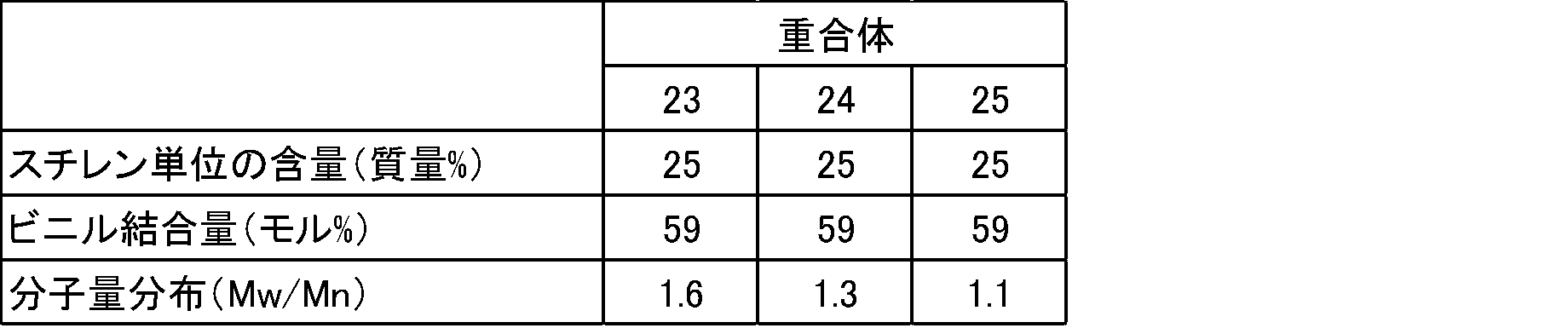
NR1:RSS#3
NR2:SIR20
BR:宇部興産(株)製のウベポールBR150B
SBR:日本ゼオン(株)製のNipol NS116R(ビニル含有量:60質量%、スチレン含有量:20質量%)
重合体1~25:上記製造例1~25
シリカ:エボニックデグッサ社製のウルトラシルVN3-G(N2SA:175m2/g)
シランカップリング剤1:エボニックデグッサ社製のSi363(下式で表される化合物)

シランカップリング剤3:エボニックデグッサ社製のSi69
カーボンブラック1:三菱化学(株)製のダイアブラックN339(N2SA:96m2/g、DBP吸収量:124ml/100g)
カーボンブラック2:三菱化学(株)製のダイアブラックN220(N2SA:114m2/g、DBP吸収量:114ml/100g)
アミド化合物1(加工助剤1):Schill+Seilacher社製のHT254(脂肪酸アミド系加工助剤(脂肪酸アミド(上記式(1)で表される化合物(N-(1-オキソオクタデシル)サルコシン))とアミノ酸誘導体の混合物、脂肪酸アミドの含有率:25~50質量%))
アミド化合物2(加工助剤2):N,N-ジメチルホルムアミド
オイル1:出光興産(株)製のダイアナプロセスオイルAH-25
オイル2:JX日鉱日石エネルギー(株)製のX-140
オイル3:出光興産(株)製のNH70-S
老化防止剤1:住友化学(株)製のアンチゲン3C
老化防止剤2:住友化学(株)製のアンチゲン6C
ステアリン酸:日油(株)製のビーズステアリン酸つばき
酸化亜鉛1:三井金属鉱業(株)製の酸化亜鉛(亜鉛華1号)
酸化亜鉛2:三井金属鉱業(株)製の酸化亜鉛2種
ワックス:大内新興化学工業(株)製のサンノックN
硫黄1:鶴見化学工業(株)製の粉末硫黄
硫黄2:鶴見化学工業(株)製の5%オイル処理粉末硫黄
加硫促進剤1:住友化学(株)製のソクシノールCZ
加硫促進剤2:住友化学(株)製のソクシノールD
表6~12に示す配合内容に従い、(株)神戸製鋼所製の1.7Lバンバリーミキサーを用いて、硫黄及び加硫促進剤以外の材料を150℃の条件下で5分間混練りし、混練り物を得た。次に、得られた混練り物に硫黄及び加硫促進剤を添加し、オープンロールを用いて、80℃の条件下で5分間練り込み、未加硫ゴム組成物を得た。得られた未加硫ゴム組成物を170℃で20分間、0.5mm厚の金型でプレス加硫し、加硫ゴム組成物を得た。
また、得られた未加硫ゴム組成物をトレッドの形状に成型し、タイヤ成型機上で他のタイヤ部材と共に貼り合わせて未加硫タイヤを形成した後、170℃で12分間加硫し、試験用タイヤ(サイズ:195/65R15)を製造した。
得られた未加硫ゴム組成物、加硫ゴム組成物及び試験用タイヤを使用して、以下の試験方法により評価を行った。それぞれの試験結果を表6に示す。
転がり抵抗試験機を用い、試験用タイヤを、リム(15×6JJ)、内圧(230kPa)、荷重(3.43kN)、速度(80km/h)で走行させたときの転がり抵抗を測定した。そして、比較例1の転がり抵抗指数を100とし、以下に示す計算式により、各配合の転がり抵抗を指数表示した。数値が大きいほど転がり抵抗が小さく、低燃費性に優れることを示す。
(転がり抵抗指数)=(比較例1の転がり抵抗)/(各配合の転がり抵抗)×100
製造した試験用タイヤを車両(国産FF2000cc)の全輪に装着させ、湿潤アスファルト路面にて、初速度100km/hからの制動距離を測定した。そして、比較例1のウェットグリップ性能指数を100とし、以下に示す計算式により、各配合のウェットスキッド性能(ウェットグリップ性能)を指数表示した。数値が大きいほどウェットグリップ性能に優れることを示す。
(ウェットグリップ性能指数)=(比較例1の制動距離)/(各配合の制動距離)×100
製造した試験用タイヤを車両(国産FF2000cc)の全輪に装着して実車走行させ、30000km走行前後のトレッドパターンの溝深さの変化を測定した。そして、比較例1の耐摩耗性指数を100とし、以下に示す計算式により、各配合の溝深さの変化を指数表示した。数値が大きいほど耐摩耗性に優れることを示す。
(耐摩耗性指数)=(基準比較例の溝深さの変化)/(各配合の溝深さの変化)×100
製造した試験用タイヤを車両(国産FF2000cc)の全輪に装着して実車走行させ、ドライバーの官能評価により操縦安定性を評価した。評価は、基準比較例を6点とし、10点満点で相対評価を行った。操縦安定性の評点が大きいほど、操縦安定性に優れることを示す。
未加硫ゴム組成物を押出し成型し、得られたゴムシートのシート形状を目視により以下の基準で評価した。シート形状が悪いほど、作業性(加工性)が低いことを示す。
◎:シート形状は非常に良好
○:シート形状は良好
△:シート形状は悪い
×:シート形状はかなり悪い
得られた未加硫ゴム組成物について、JIS K6300-1:2001に準拠したムーニー粘度の測定方法に従い、130℃で測定した。比較例1のムーニー粘度(ML1+4)を100とし、下記計算式により指数表示した(ムーニー粘度指数)。数値が大きいほどムーニー粘度が低く、加工性に優れることを示す。
(ムー二粘度指数)=(比較例1のML1+4)/(各配合のML1+4)×100
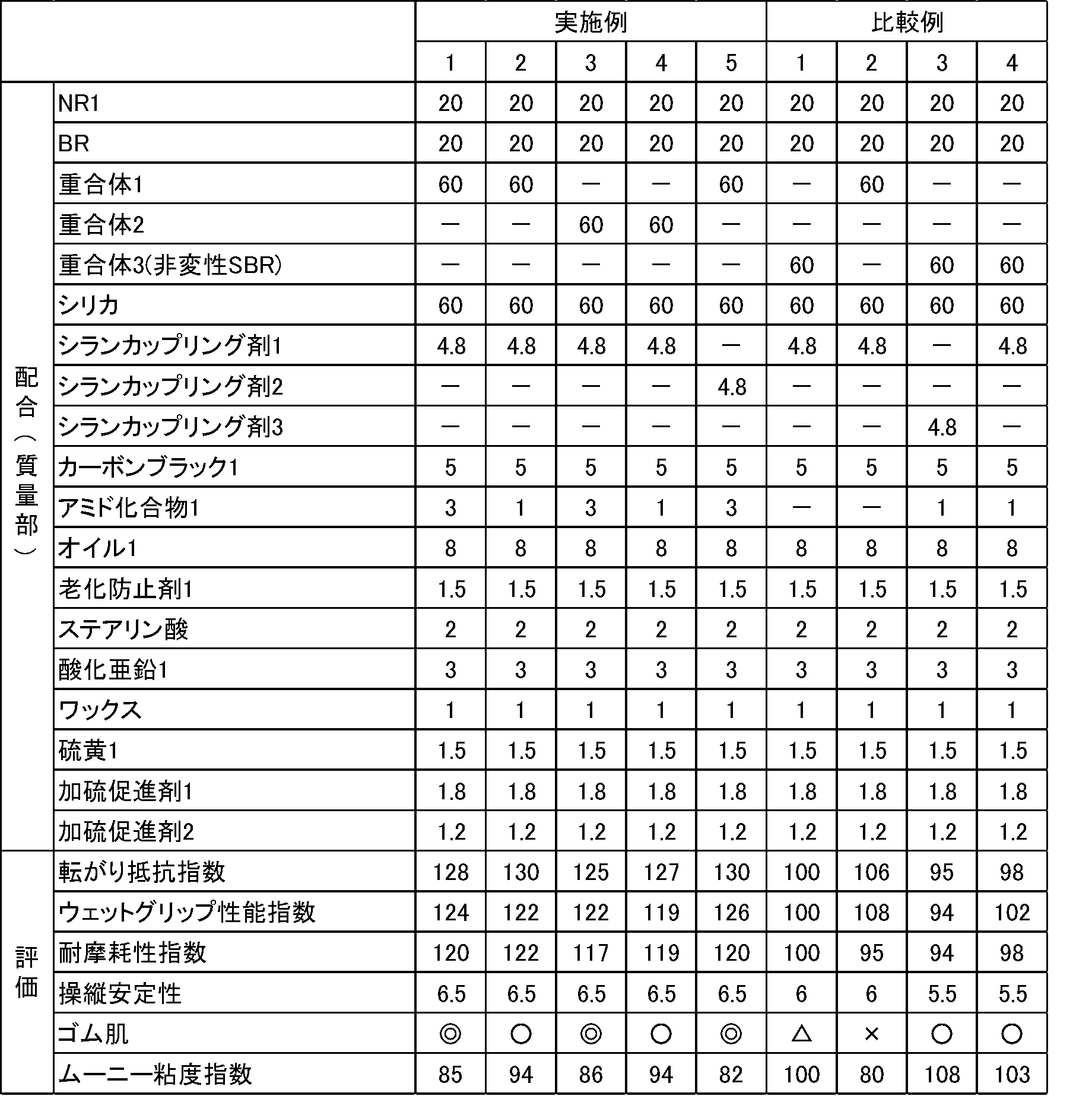
得られた未加硫ゴム組成物及び加硫ゴム組成物を使用して、以下の試験方法により評価を行った。それぞれの試験結果を表7に示す。
未加硫ゴム組成物について、JIS K6300-1:2001に準拠したムーニー粘度の測定方法に従い、130℃で測定した。比較例5のムーニー粘度(ML1+4)を100とし、下記計算式により指数表示した(ムーニー粘度指数)。指数が大きいほど、ムーニー粘度が低く、加工性に優れることを示す。
(ムーニー粘度指数)=(比較例5のML1+4)/(各配合のML1+4)×100
未加硫ゴム組成物を押出し成型し、得られたゴムシートのシート形状を目視により以下の基準で評価した。シート形状が悪いほど、作業性(加工性)が低いことを示す。
◎:シート形状は非常に良好
○:シート形状は良好
△:シート形状は悪い
粘弾性スペクトロメーターVES((株)岩本製作所製)を用いて、温度50℃、初期歪み10%、動歪み2%、周波数10Hzの条件下で各配合(加硫ゴム組成物)の損失正接(tanδ)を測定し、比較例5のtanδを100として、下記計算式により指数表示した。指数が大きいほど、転がり抵抗が低く、低燃費性に優れることを示す。
(tanδ指数)=(比較例5のtanδ)/(各配合のtanδ)×100
ランボーン摩耗試験機を用いて、温度20℃、スリップ率20%及び試験時間2分間の条件下で加硫ゴム組成物のランボーン摩耗量を測定した。そして、測定したランボーン摩耗量から容積損失量を計算し、比較例5の容積損失量を100として、下記計算式により指数表示した。指数が大きいほど、耐摩耗性に優れることを示す。
(耐摩耗性指数)=(比較例5の容積損失量)/(各配合の容積損失量)×100
(株)上島製作所製フラットベルト式摩耗試験機(FR5010型)を用いてウェットグリップ性能を評価した。幅20mm、直径100mmの円筒形にした加硫ゴム組成物をサンプルとして用い、速度20km/時間、荷重4kgf、路面温度20℃の条件で、路面に対するサンプルのスリップ率を0~50%まで変化させ、その際に検出される摩擦係数の最大値を読み取った。結果は、比較例5の摩擦係数の最大値を100として、下記計算式により指数表示した。指数が大きいほど、ウェットグリップ性能に優れることを示す。
(ウェットグリップ性能指数)=(各配合の摩擦係数の最大値)/(比較例5の摩擦係数の最大値)×100

得られた未加硫ゴム組成物及び試験用タイヤを使用して、以下の試験方法により評価を行った。それぞれの試験結果を表8及び9に示す。
未加硫ゴム組成物について、JIS K6300-1:2001に準拠したムーニー粘度の測定方法に従い、130℃で測定した。比較例16のムーニー粘度(ML1+4)を100とし、下記計算式により指数表示した(ムーニー粘度指数)。指数が大きいほどムーニー粘度が低く、加工性に優れることを示す。
(ムーニー粘度指数)=(比較例16のML1+4)/(各配合のML1+4)×100
未加硫ゴム組成物を押出し成型し、得られたゴムシートの表面性状を目視により以下の基準で評価した。シート性状が良好なほど、作業性に優れることを示す。
◎:シート生地が非常に良好
○:シート生地が良好
△:シート生地がやや悪い
×:シート生地が非常に悪い
転がり抵抗試験機を用い、試験用タイヤを、リム(15×6JJ)、内圧(230kPa)、荷重(3.43kN)、速度(80km/h)で走行させたときの転がり抵抗を測定し、比較例16を100とした時の指数で表示した。指数が大きいほど転がり抵抗が小さく、低燃費性に優れることを示している。
製造した試験用タイヤを車両(国産FF2000cc)の全輪に装着して、湿潤アスファルト路面にて初速度100km/hからの制動距離を求めた。結果は指数で表し、指数が大きいほどウェットスキッド性能(ウェットグリップ性能)が良好である。指数は次の式で求めた。
(ウェットグリップ性能指数)=(比較例16の制動距離)/(各配合の制動距離)×100
製造した試験用タイヤを車両(国産FF2000cc)の全輪に装着して実車走行させ、35000km走行前後のトレッドパターンの溝深さの変化を測定した。そして、比較例16の耐摩耗性指数を100とし、以下に示す計算式により、各配合の溝深さの変化を指数表示した。指数が大きいほど耐摩耗性に優れることを示している。
(耐摩耗性指数)=(比較例16の溝深さの変化)/(各配合の溝深さの変化)×100
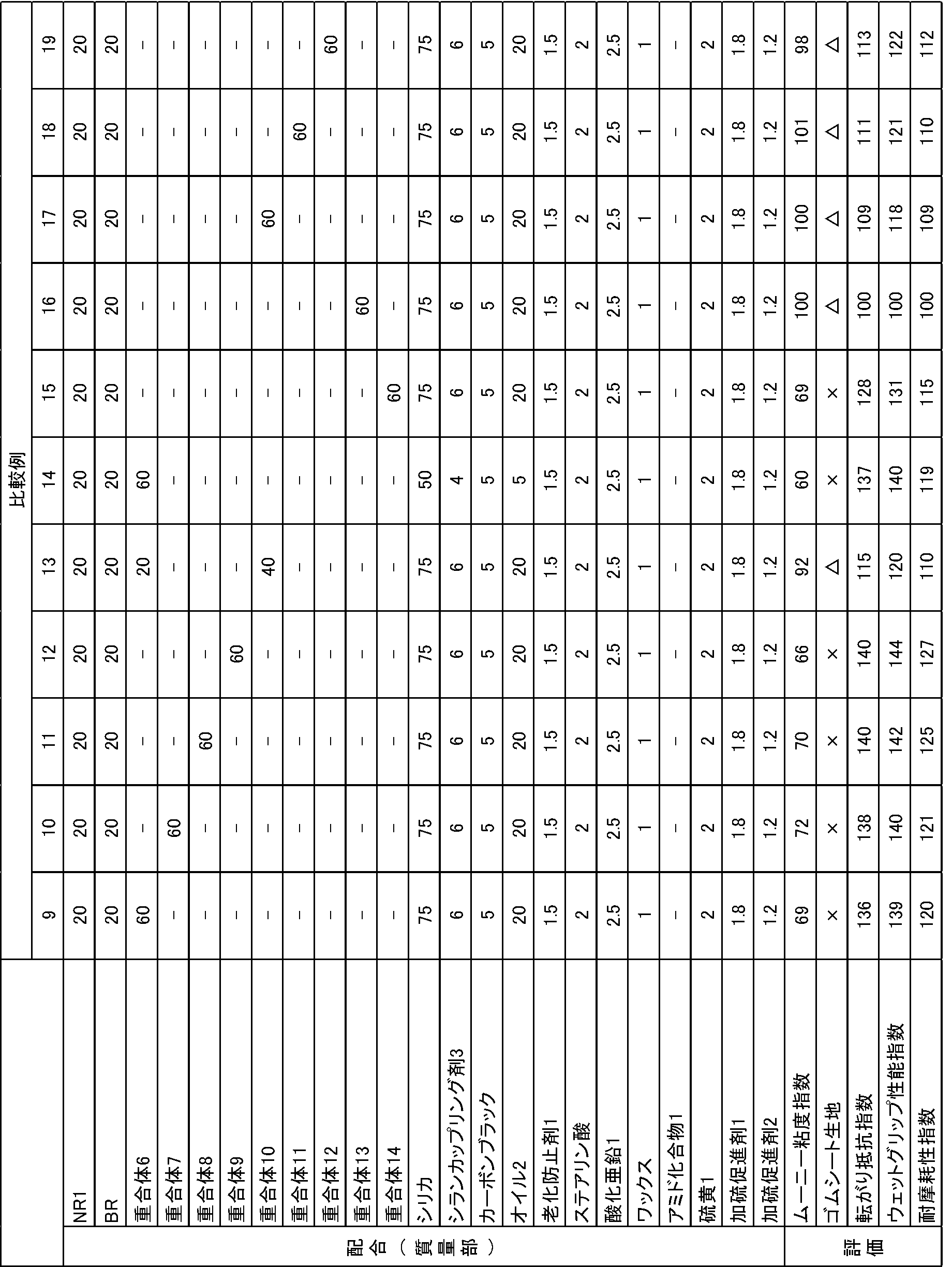
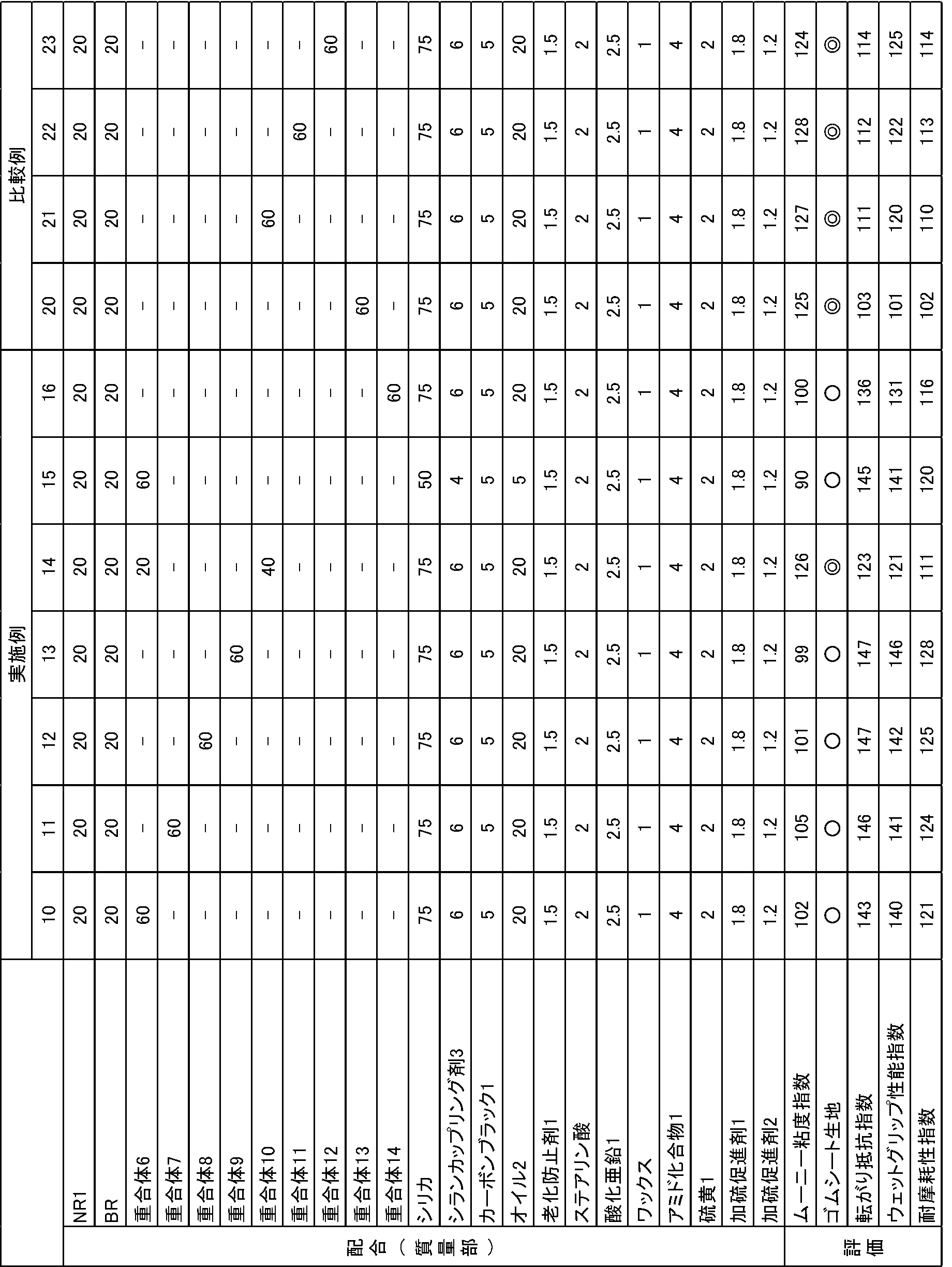
得られた未加硫ゴム組成物、加硫ゴム組成物及び試験用タイヤを使用して、以下の試験方法により評価を行った。それぞれの試験結果を表10及び11に示す。
シート状の加硫ゴム組成物から幅1mm又は2mm、長さ40mmの短冊状試験片を打ち抜き、試験に供した。(株)上島製作所製スペクトロメーターを用いて、動的歪振幅1%、周波数10Hz、温度50℃でtanδを測定した。tanδの逆数の値について比較例24を100として指数表示した。数値が大きいほど転がり抵抗が小さく、低燃費性に優れることを示している。
転がり抵抗試験機を用い、試験用タイヤを、リム(15×6JJ)、内圧(230kPa)、荷重(3.43kN)、速度(80km/h)で走行させたときの転がり抵抗を測定し、比較例24を100とした時の指数で表示した。数値が大きいほど転がり抵抗が小さく、低燃費性に優れることを示している。
各試験用タイヤを車両(国産FF2000cc)の全輪に装着して、湿潤アスファルト路面にて初速度100km/hからの制動距離を求めた。結果は指数で表し、数値が大きいほどウェットスキッド性能(ウェットグリップ性能)が良好である。指数は次の式で求めた。
(ウェットグリップ性能指数)=(比較例24の制動距離)/(各配合の制動距離)×100
LAT試験機(Laboratory Abration and Skid Tester)を用い、荷重50N、速度20km/h、スリップアングル5°の条件にて、各加硫ゴム組成物の容積損失量を測定した。表10及び11の数値(耐摩耗性指数)は、比較例24の容積損失量を100としたときの相対値である。当該数値が大きいほど耐摩耗性に優れている。
未加硫ゴム組成物について、JIS K6300-1:2001に準拠したムーニー粘度の測定方法に従い、130℃で測定した。比較例24のムーニー粘度(ML1+4)を100とし、下記計算式により指数表示した(ムーニー粘度指数)。指数が大きいほどムーニー粘度が低く、加工性に優れることを示す。
(ムーニー粘度指数)=(比較例24のML1+4)/(各配合のML1+4)×100
未加硫ゴム組成物を押出し成型し、得られたゴムシートの表面性状を目視により以下の基準で評価した。シート性状が良好なほど、作業性に優れることを示す。
◎:シート生地が非常に良好
○:シート生地が良好
△:シート生地がやや悪い
×:シート生地が非常に悪い
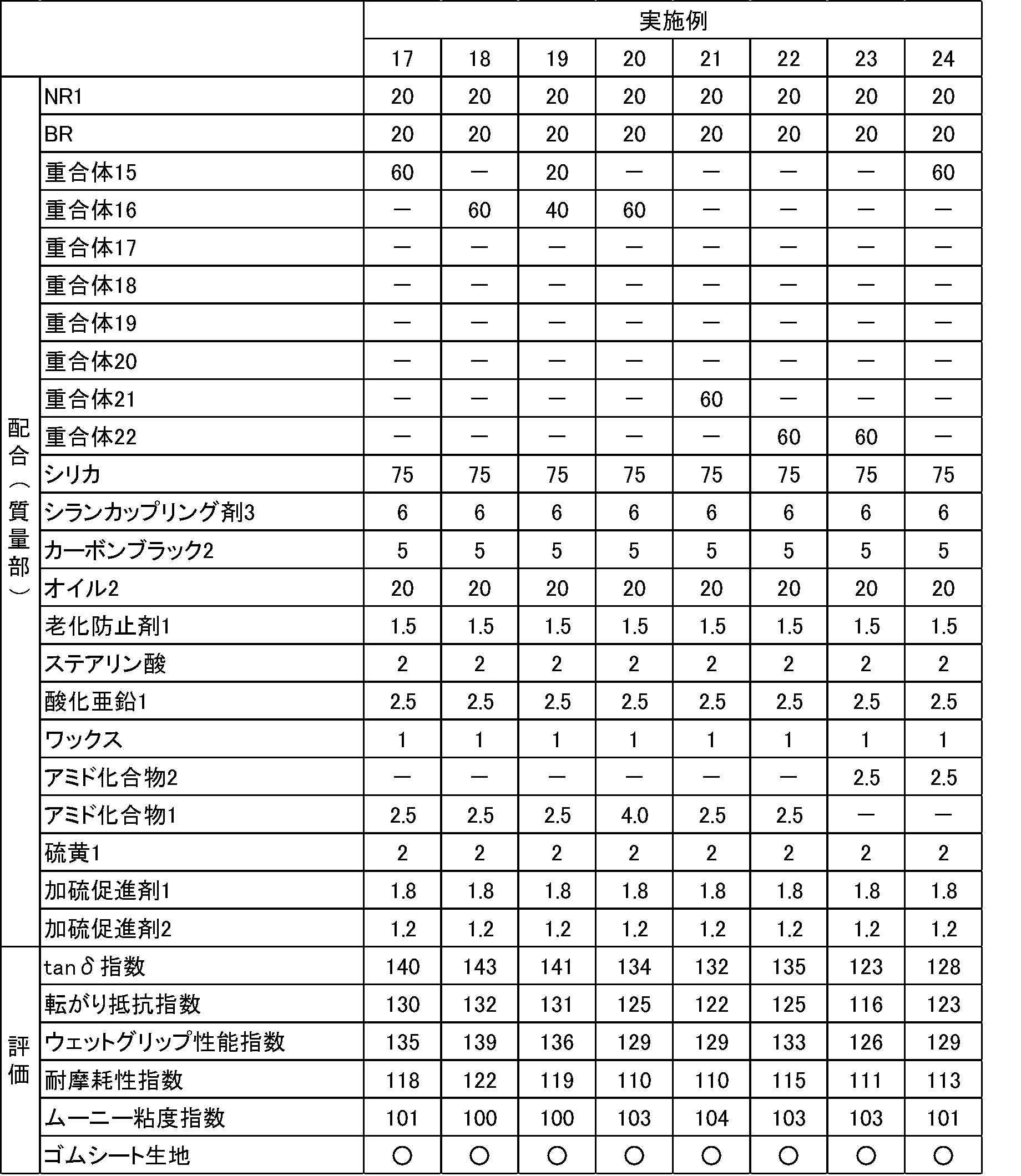
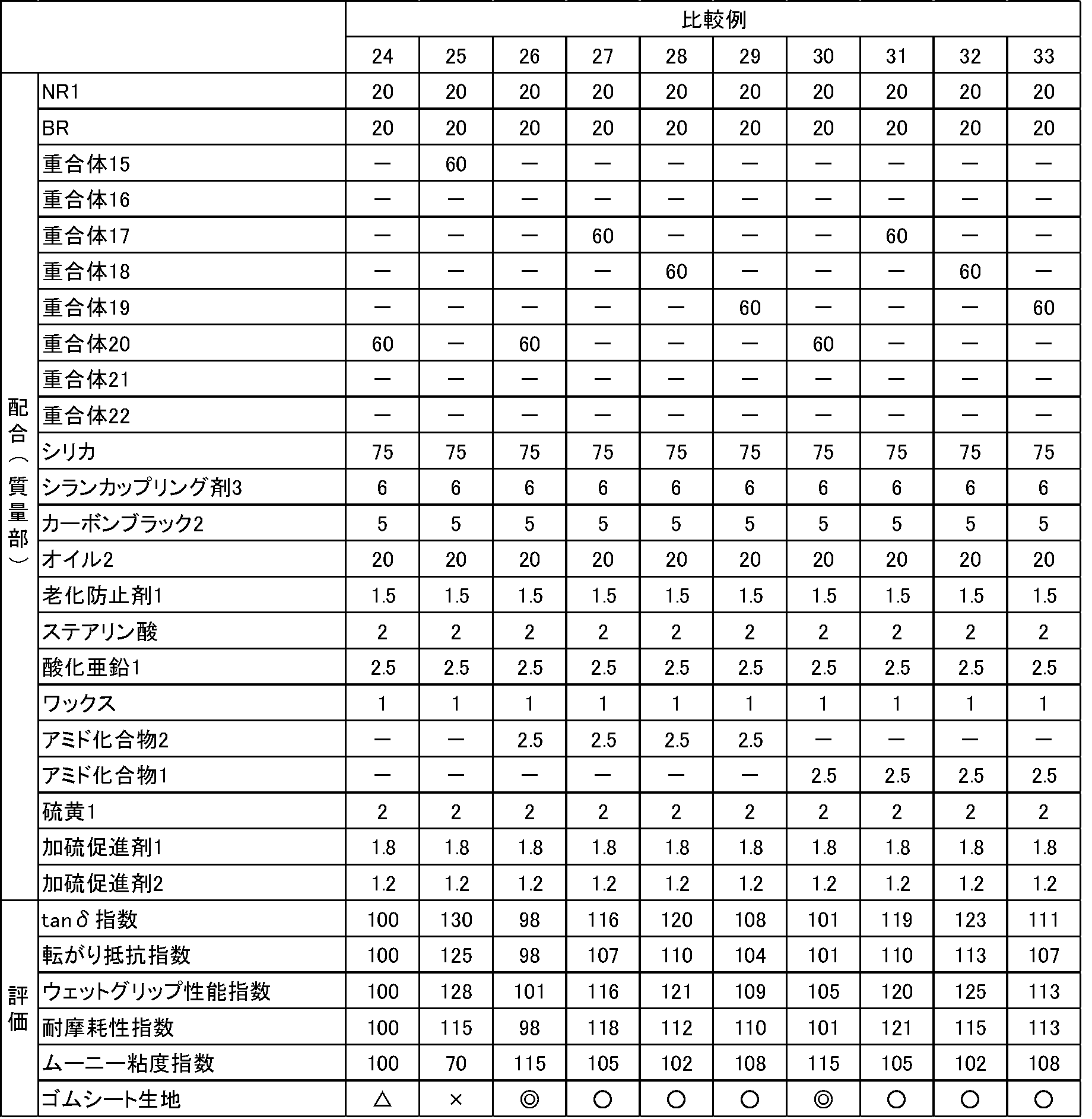
得られた未加硫ゴム組成物、加硫ゴム組成物及び試験用タイヤを使用して、以下の試験方法により評価を行った。それぞれの試験結果を表12に示す。
未加硫ゴム組成物を押出し成型し、得られたゴムシートのシート性状を目視により以下の基準で評価した。シート性状が良好なほど、作業性(加工性)に優れることを示す。
◎:シート形状が非常に良好
○:シート形状が良好
△:シート形状に凹凸あり
×:シート形状がボロボロ
シート状の加硫ゴム組成物から幅1mm又は2mm、長さ40mmの短冊状試験片を打ち抜き、試験に供した。(株)上島製作所製スペクトロメーターを用いて、動的歪振幅1%、周波数10Hz、温度50℃でtanδを測定した。tanδの逆数の値について比較例36を100として指数表示した。数値が大きいほど転がり抵抗が小さく、低燃費性であることを示している。
転がり抵抗試験機を用い、試験タイヤを、リム(15×6JJ)、内圧(230kPa)、荷重(3.43kN)、速度(80km/h)で走行させたときの転がり抵抗を測定し、比較例36を100とした時の指数で表示した。指数は大きい方が良好(低燃費性)である。
各試験用タイヤを車両(国産FF2000cc)の全輪に装着して、湿潤アスファルト路面にて初速度100km/hからの制動距離を求めた。結果は指数で表し、数字が大きいほどウェットスキッド性能(ウェットグリップ性能)が良好である。指数は次の式で求めた。
(ウェットグリップ性能指数)=(比較例36の制動距離)/(各配合の制動距離)×100
未加硫ゴム組成物について、JIS K6300-1:2001に準拠したムーニー粘度の測定方法に従い、130℃で測定した。比較例3のムーニー粘度(ML1+4)を100とし、下記計算式により指数表示した(ムーニー粘度指数)。指数が小さいほどムーニー粘度が低く、加工性に優れる。
(ムーニー粘度指数)=(各実施例又は各比較例のML1+4)/(比較例3のML1+4)×100
LAT試験機(Laboratory Abration and Skid Tester)を用い、荷重50N、速度20km/h、スリップアングル5°の条件にて、各加硫ゴム組成物の容積損失量を測定した。表12の数値(耐摩耗性指数)は、比較例36の容積損失量を100としたときの相対値である。当該数値が大きいほど耐摩耗性に優れている。
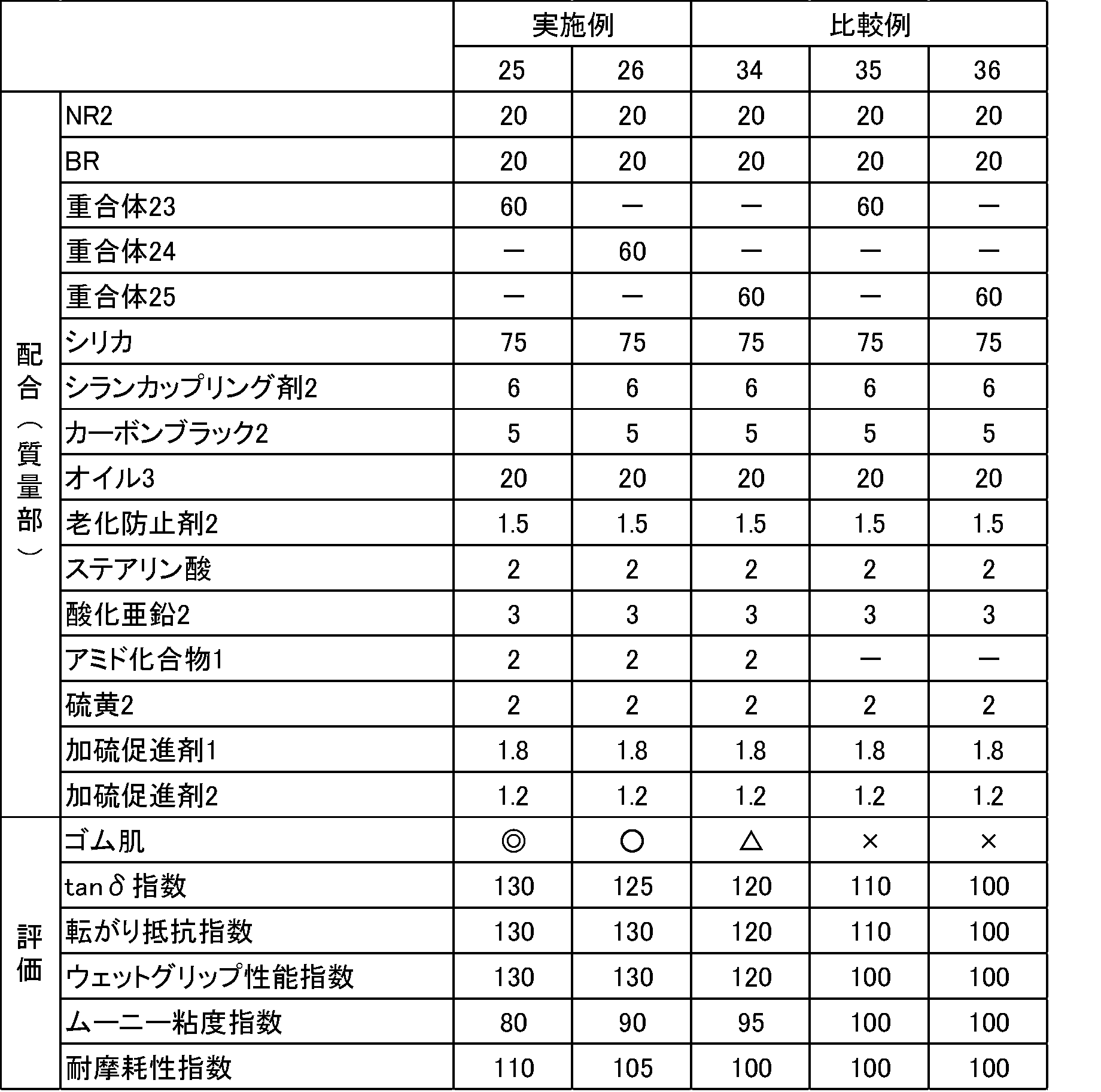
Claims (19)
- ゴム成分、シリカ及び下式(1)で表される化合物を含有し、
前記ゴム成分100質量%のうち、共役ジエンに基づく構成単位と下式(I)で表される構成単位とを有し、下式(II)で表される化合物、下式(III)で表される基を有する化合物、下式(IV)で表される化合物、下式(V)で表される基及び/又は下式(VI)で表される基を有するケイ素化合物、並びに下式(VII)で表される基を有する化合物からなる群より選択される少なくとも1種の化合物によって重合体の少なくとも一端が変性されてなる共役ジエン系重合体の含有量が5質量%以上であり、
前記ゴム成分100質量部に対する前記シリカの含有量が5~150質量部であることを特徴とするゴム組成物。





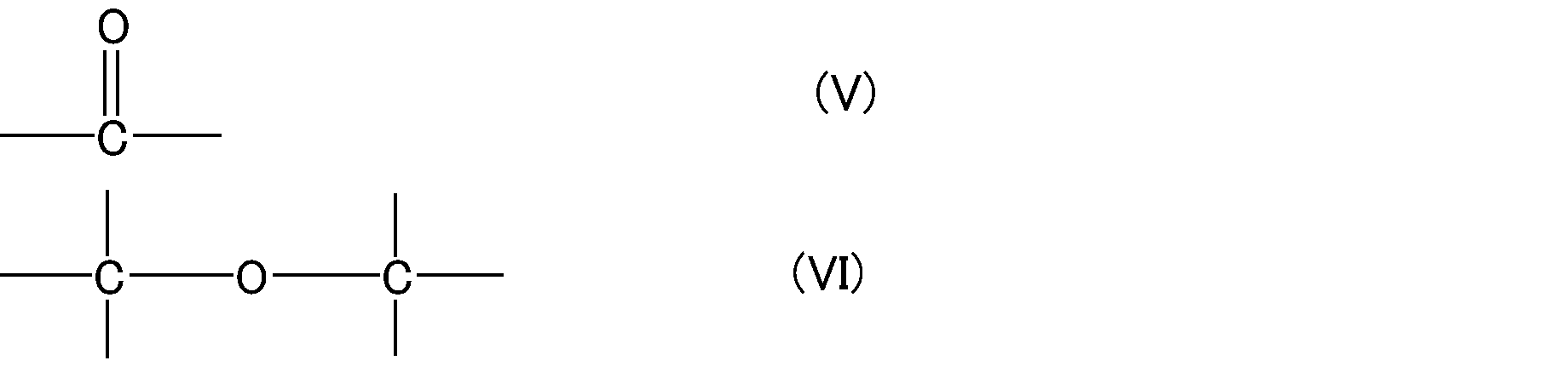



- 式(Ia)のR1及びR2が炭素原子数1~6のヒドロカルビル基であることを特徴とする請求項1に記載のゴム組成物。
- 式(I)のX1、X2及びX3の2つが式(Ia)で表される基又は水酸基であることを特徴とする請求項1又は2に記載のゴム組成物。
- 式(II)のA1が下式(IIa)で表される基であることを特徴とする請求項1~3のいずれかに記載のゴム組成物。

- 式(III)で表される基が、下式(IIIa)で表される基であることを特徴とする請求項1~4のいずれかに記載のゴム組成物。

- 式(III)で表される基を有する化合物が、下式(IIIa-1)で表される化合物、下式(IIIa-2)で表される化合物及び下式(IIIa-3)で表される化合物からなる化合物群から選ばれる少なくとも1種の化合物であることを特徴とする請求項5に記載のゴム組成物。



- 式(III)で表される基を有する化合物が、下式(IIIb-1)で表される化合物であることを特徴とする請求項1~4のいずれかに記載のゴム組成物。

- 式(IIIb-1)で表される化合物が、下式(IIIb-1-1)で表される化合物及び下式(IIIb-1-2)で表される化合物からなる化合物群から選ばれる少なくとも1種の化合物であることを特徴とする請求項7に記載のゴム組成物。


- 式(IV)のA4が、下式(IVa)で表される基又は水酸基であることを特徴とする請求項1~8のいずれかに記載のゴム組成物。

- ケイ素化合物が下式(VIII)で表される基を有することを特徴とする請求項1~9のいずれかに記載のゴム組成物。

- ケイ素化合物が下式(Va)で表される基を有することを特徴とする請求項1~10のいずれかに記載のゴム組成物。
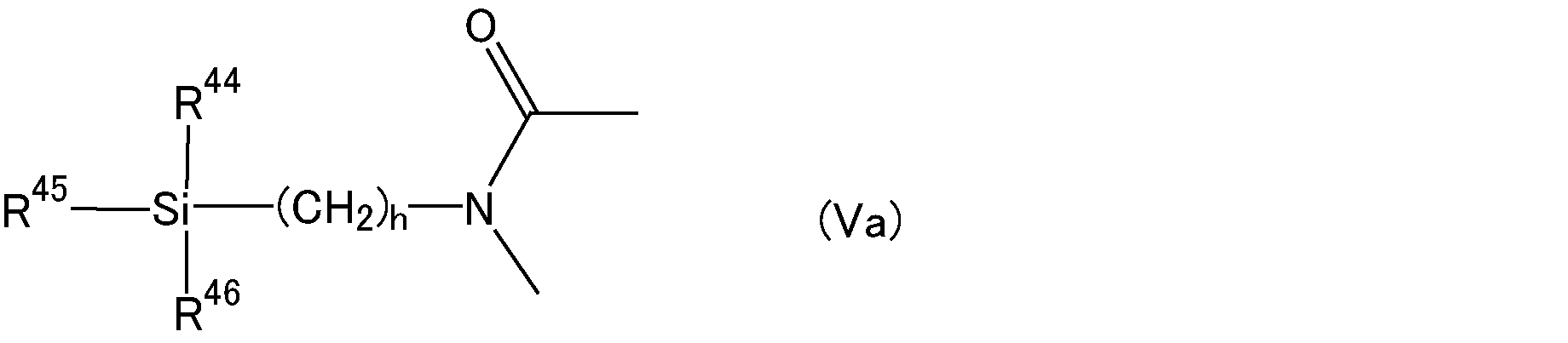
- 式(VII)で表される基を有する化合物が下式(VII-1)で表される化合物であることを特徴とする請求項1~11のいずれかに記載のゴム組成物。

- 式(VII-1)のR74及びR75の一方が水素原子であることを特徴とする請求項12に記載のゴム組成物。
- 共役ジエン系重合体のビニル結合量が、共役ジエンに基づく構成単位の含有量を100モル%として、10モル%以上80モル%以下であることを特徴とする請求項1~13のいずれかに記載のゴム組成物。
- 天然ゴム及び/又はブタジエンゴムを含有することを特徴とする請求項1~14のいずれかに記載のゴム組成物。
- シリカの窒素吸着比表面積が40~400m2/gであることを特徴とする請求項1~15のいずれかに記載のゴム組成物。
- シリカ100質量部に対する式(1)で表される化合物の含有量が0.1~20質量部であることを特徴とする請求項1~16のいずれかに記載のゴム組成物。
- トレッド用ゴム組成物として用いられることを特徴とする請求項1~17のいずれかに記載のゴム組成物。
- 請求項1~18のいずれかに記載のゴム組成物を用いて作製した空気入りタイヤ。
Priority Applications (4)
| Application Number | Priority Date | Filing Date | Title |
|---|---|---|---|
| EP12765169.3A EP2679629B1 (en) | 2011-03-25 | 2012-03-23 | Rubber composition and pneumatic tire |
| US13/982,160 US9315647B2 (en) | 2011-03-25 | 2012-03-23 | Rubber composition and pneumatic tire |
| BR112013024592A BR112013024592A2 (pt) | 2011-03-25 | 2012-03-23 | composição de borracha e pneu |
| CN201280014604.0A CN103443189B (zh) | 2011-03-25 | 2012-03-23 | 橡胶组合物及充气轮胎 |
Applications Claiming Priority (10)
| Application Number | Priority Date | Filing Date | Title |
|---|---|---|---|
| JP2011068588A JP5623951B2 (ja) | 2011-03-25 | 2011-03-25 | ゴム組成物及び空気入りタイヤ |
| JP2011-068588 | 2011-03-25 | ||
| JP2011096555A JP5623971B2 (ja) | 2011-04-22 | 2011-04-22 | ゴム組成物及び空気入りタイヤ |
| JP2011-096555 | 2011-04-22 | ||
| JP2011138588A JP5628755B2 (ja) | 2011-06-22 | 2011-06-22 | ゴム組成物及び空気入りタイヤ |
| JP2011138583A JP2013006902A (ja) | 2011-06-22 | 2011-06-22 | ゴム組成物及び空気入りタイヤ |
| JP2011-138588 | 2011-06-22 | ||
| JP2011-138583 | 2011-06-22 | ||
| JP2011-150306 | 2011-07-06 | ||
| JP2011150306A JP5623987B2 (ja) | 2011-07-06 | 2011-07-06 | ゴム組成物及び空気入りタイヤ |
Publications (1)
| Publication Number | Publication Date |
|---|---|
| WO2012133177A1 true WO2012133177A1 (ja) | 2012-10-04 |
Family
ID=46930900
Family Applications (1)
| Application Number | Title | Priority Date | Filing Date |
|---|---|---|---|
| PCT/JP2012/057498 Ceased WO2012133177A1 (ja) | 2011-03-25 | 2012-03-23 | ゴム組成物及び空気入りタイヤ |
Country Status (5)
| Country | Link |
|---|---|
| US (1) | US9315647B2 (ja) |
| EP (1) | EP2679629B1 (ja) |
| CN (1) | CN103443189B (ja) |
| BR (1) | BR112013024592A2 (ja) |
| WO (1) | WO2012133177A1 (ja) |
Cited By (7)
| Publication number | Priority date | Publication date | Assignee | Title |
|---|---|---|---|---|
| JP2013075977A (ja) * | 2011-09-30 | 2013-04-25 | Yokohama Rubber Co Ltd:The | タイヤ用ゴム組成物及びこれを用いる空気入りタイヤ |
| WO2014065222A1 (ja) * | 2012-10-22 | 2014-05-01 | 住友ゴム工業株式会社 | トレッド用ゴム組成物及び空気入りタイヤ |
| JP2014084375A (ja) * | 2012-10-22 | 2014-05-12 | Sumitomo Rubber Ind Ltd | トレッド用ゴム組成物及び空気入りタイヤ |
| JP2014084368A (ja) * | 2012-10-22 | 2014-05-12 | Sumitomo Rubber Ind Ltd | トレッド用ゴム組成物及び空気入りタイヤ |
| JP2014084365A (ja) * | 2012-10-22 | 2014-05-12 | Sumitomo Rubber Ind Ltd | トレッド用ゴム組成物及び空気入りタイヤ |
| JP2014084369A (ja) * | 2012-10-22 | 2014-05-12 | Sumitomo Rubber Ind Ltd | トレッド用ゴム組成物及び空気入りタイヤ |
| WO2015076064A1 (ja) * | 2013-11-25 | 2015-05-28 | 住友ゴム工業株式会社 | 空気入りタイヤ |
Families Citing this family (4)
| Publication number | Priority date | Publication date | Assignee | Title |
|---|---|---|---|---|
| WO2016061300A1 (en) | 2014-10-15 | 2016-04-21 | Bridgestone Corporation | Improved rubber compositions and uses thereof |
| WO2016061304A2 (en) | 2014-10-15 | 2016-04-21 | Bridgestone Corporation | Improved rubber compositions and uses thereof |
| US10118973B2 (en) | 2014-12-25 | 2018-11-06 | Sumitomo Chemical Company, Limited | Modified conjugated diene polymer, and polymer composition containing said polymer |
| CN110582520B (zh) | 2017-03-08 | 2022-04-22 | 株式会社普利司通 | 偶联聚合物产物、制备方法以及含有其的组合物 |
Citations (11)
| Publication number | Priority date | Publication date | Assignee | Title |
|---|---|---|---|---|
| JPH0477536A (ja) * | 1990-07-13 | 1992-03-11 | Bridgestone Corp | ゴム組成物 |
| JP2000344955A (ja) | 1999-06-04 | 2000-12-12 | Sumitomo Rubber Ind Ltd | 変性ジエン系ゴム組成物 |
| JP2003533574A (ja) * | 2000-05-15 | 2003-11-11 | 株式会社ブリヂストン | シリカ補強ゴムにアミド化合物を含有させることによる加工性の改良 |
| JP2008150435A (ja) * | 2006-12-14 | 2008-07-03 | Toyo Tire & Rubber Co Ltd | タイヤ用ゴム組成物及び空気入りタイヤ |
| JP2008280438A (ja) * | 2007-05-11 | 2008-11-20 | Toyo Tire & Rubber Co Ltd | タイヤトレッド用ゴム組成物 |
| JP2009126907A (ja) | 2007-11-21 | 2009-06-11 | Sumitomo Rubber Ind Ltd | ゴム組成物 |
| JP2010077413A (ja) * | 2008-08-27 | 2010-04-08 | Sumitomo Chemical Co Ltd | 共役ジエン系重合体、共役ジエン系重合体組成物及び共役ジエン系重合体の製造方法 |
| JP2010077414A (ja) * | 2008-08-27 | 2010-04-08 | Sumitomo Chemical Co Ltd | 共役ジエン系重合体、共役ジエン系重合体組成物及び共役ジエン系重合体の製造方法 |
| JP2010077415A (ja) * | 2008-08-27 | 2010-04-08 | Sumitomo Chemical Co Ltd | 共役ジエン系重合体、共役ジエン系重合体組成物及び共役ジエン系重合体の製造方法 |
| JP2010077412A (ja) * | 2008-08-27 | 2010-04-08 | Sumitomo Chemical Co Ltd | 共役ジエン系重合体、共役ジエン系重合体組成物及び共役ジエン系重合体の製造方法 |
| JP2010270292A (ja) * | 2008-08-27 | 2010-12-02 | Sumitomo Chemical Co Ltd | 共役ジエン系重合体、共役ジエン系重合体組成物及び共役ジエン系重合体の製造方法 |
Family Cites Families (44)
| Publication number | Priority date | Publication date | Assignee | Title |
|---|---|---|---|---|
| US3937681A (en) | 1969-02-07 | 1976-02-10 | Chemische Werke Huels Aktiengesellschaft | Tire tread of homopolymers of butadiene |
| DE3167793D1 (en) | 1980-06-19 | 1985-01-31 | Huels Chemische Werke Ag | 1,3-diene-homo and copolymers containing reactive silyl groups, process for their preparation and their use |
| US4836262A (en) | 1986-08-08 | 1989-06-06 | Bridgestone Corporation | Metal cords and pneumatic tires using the same |
| US5189109A (en) | 1988-02-25 | 1993-02-23 | Sumitomo Chemical Company, Limited | Modified diene polymer rubbers |
| JP2540901B2 (ja) | 1988-02-25 | 1996-10-09 | 住友化学工業株式会社 | 変性ゴム組成物 |
| CA1338317C (en) | 1988-02-25 | 1996-05-07 | Akio Imai | Modified diene polymer rubbers |
| JPH0262620A (ja) | 1988-08-30 | 1990-03-02 | Shimadzu Corp | 手書き情報入力装置 |
| JP3130995B2 (ja) | 1992-02-05 | 2001-01-31 | 株式会社ブリヂストン | トレッドゴム組成物 |
| JP3736580B2 (ja) | 1996-02-23 | 2006-01-18 | 日本ゼオン株式会社 | ジエン系ゴム |
| CA2296818A1 (en) | 1999-01-22 | 2000-07-22 | Ube Industries, Ltd. | Modified diene elastomer and its preparation |
| US20020011293A1 (en) | 1999-03-02 | 2002-01-31 | David John Zanzig | Tire with reinforced rubber sidewall |
| US6221953B1 (en) | 1999-08-10 | 2001-04-24 | The Goodyear Tire & Rubber Company | Tire with tread which contains spatially-defined resins |
| CN100347208C (zh) | 2001-09-27 | 2007-11-07 | Jsr株式会社 | 共轭二烯均聚或共聚橡胶、均聚或共聚橡胶的制造方法、橡胶组合物、复合体以及轮胎 |
| JP3986821B2 (ja) | 2001-12-26 | 2007-10-03 | 住友ゴム工業株式会社 | タイヤ用ゴム組成物および当該ゴム組成物を用いたタイヤ |
| US7339005B2 (en) | 2003-01-31 | 2008-03-04 | Sumitomo Chemical Company, Limited | Process for producing modified diene polymer rubber |
| EP2261283A3 (en) | 2003-11-28 | 2012-03-21 | Sumitomo Rubber Industries, Ltd. | Rubber composition for a tire and tire using the same |
| JP2005213486A (ja) | 2004-02-02 | 2005-08-11 | Yokohama Rubber Co Ltd:The | アンダートレッド用ゴム組成物及びそれを使用する空気入りタイヤ |
| JP4475992B2 (ja) | 2004-03-18 | 2010-06-09 | 住友ゴム工業株式会社 | タイヤトレッド用ゴム組成物およびそれを用いた空気入りタイヤ |
| EP1577341B1 (en) | 2004-03-18 | 2006-12-13 | Sumitomo Rubber Industries, Ltd. | Rubber composition for tire tread and pneumatic tire using the same |
| US20050272852A1 (en) | 2004-06-02 | 2005-12-08 | Sandstrom Paul H | Natural rubber-rich composition and tire with tread thereof |
| US20060173118A1 (en) | 2005-01-28 | 2006-08-03 | Sumitomo Rubber Industries, Ltd. | Rubber composition and tire having tread comprising thereof |
| JP4566888B2 (ja) | 2005-01-28 | 2010-10-20 | 住友ゴム工業株式会社 | ゴム組成物およびそれを用いたトレッドを有するタイヤ |
| JP5198746B2 (ja) | 2005-11-29 | 2013-05-15 | 住友ゴム工業株式会社 | ゴム組成物およびそれを用いた空気入りタイヤ |
| DE602006004826D1 (de) | 2005-11-29 | 2009-03-05 | Sumitomo Rubber Ind | Kautschukzusammensetzung und Luftreifen, der diese verwendet |
| JP5154071B2 (ja) | 2005-12-28 | 2013-02-27 | 住友ゴム工業株式会社 | ゴム組成物およびそれを用いたタイヤ |
| EP1803770B1 (en) | 2005-12-28 | 2014-07-16 | Sumitomo Rubber Industries, Ltd. | Rubber composition and tire using the same |
| EP1808456B1 (de) | 2006-01-14 | 2010-03-24 | Continental Reifen Deutschland GmbH | Kautschukmischung und Reifen |
| TWI365208B (en) | 2006-01-16 | 2012-06-01 | Ube Industries | Polybutadiene composition for tire |
| EP1882716A1 (en) | 2006-07-26 | 2008-01-30 | Sumitomo Rubber Industries, Ltd. | Rubber composition and tire having tread and/or sidewall using same |
| JP4663687B2 (ja) | 2006-07-26 | 2011-04-06 | 住友ゴム工業株式会社 | ゴム組成物ならびにそれを用いたトレッドおよび/またはサイドウォールを有するタイヤ |
| JP5006617B2 (ja) | 2006-10-19 | 2012-08-22 | 住友ゴム工業株式会社 | ゴム組成物およびそれを用いたトレッドを有するタイヤ |
| EP2130841B1 (en) | 2007-03-23 | 2013-10-23 | JSR Corporation | Method for producing modified conjugated diene polymer, modified conjugated diene polymer, and rubber composition |
| JP2009091482A (ja) | 2007-10-10 | 2009-04-30 | Sumitomo Rubber Ind Ltd | スタッドレスタイヤに用いるトレッド用ゴム組成物およびそれを用いたトレッドを有するスタッドレスタイヤ |
| JP5605669B2 (ja) | 2007-11-02 | 2014-10-15 | 住友ゴム工業株式会社 | タイヤ用ゴム組成物およびタイヤ |
| DE102008013265A1 (de) * | 2008-03-08 | 2009-09-10 | Continental Aktiengesellschaft | Kautschukmischung und daraus hergestellte Reifen |
| SG155871A1 (en) | 2008-03-31 | 2009-10-29 | Sumitomo Chemical Co | Conjugated diene polymer, conjugated diene polymer composition, and process for producing conjugated diene polymer |
| CN101659732A (zh) * | 2008-08-27 | 2010-03-03 | 住友化学株式会社 | 共轭二烯系聚合物、共轭二烯系聚合物组合物及其制造方法 |
| CN101724185B (zh) | 2008-10-16 | 2013-10-23 | 住友橡胶工业株式会社 | 橡胶组合物及轮胎 |
| JP5466474B2 (ja) | 2008-10-16 | 2014-04-09 | 住友ゴム工業株式会社 | ゴム組成物およびそれを用いたタイヤ |
| JP4881362B2 (ja) | 2008-11-05 | 2012-02-22 | 住友ゴム工業株式会社 | ゴム組成物及びタイヤ |
| JP4810567B2 (ja) | 2008-12-10 | 2011-11-09 | 住友ゴム工業株式会社 | スタッドレスタイヤ用トレッドゴム組成物及びスタッドレスタイヤ |
| JP5466415B2 (ja) | 2009-03-18 | 2014-04-09 | 住友ゴム工業株式会社 | ベーストレッド用ゴム組成物及びタイヤ |
| JP5200134B2 (ja) | 2010-07-16 | 2013-05-15 | 住友ゴム工業株式会社 | トレッド用ゴム組成物及び空気入りタイヤ |
| JP5249404B2 (ja) | 2010-12-13 | 2013-07-31 | 住友ゴム工業株式会社 | ゴム組成物及び空気入りタイヤ |
-
2012
- 2012-03-23 BR BR112013024592A patent/BR112013024592A2/pt not_active IP Right Cessation
- 2012-03-23 US US13/982,160 patent/US9315647B2/en not_active Expired - Fee Related
- 2012-03-23 EP EP12765169.3A patent/EP2679629B1/en not_active Not-in-force
- 2012-03-23 CN CN201280014604.0A patent/CN103443189B/zh not_active Expired - Fee Related
- 2012-03-23 WO PCT/JP2012/057498 patent/WO2012133177A1/ja not_active Ceased
Patent Citations (11)
| Publication number | Priority date | Publication date | Assignee | Title |
|---|---|---|---|---|
| JPH0477536A (ja) * | 1990-07-13 | 1992-03-11 | Bridgestone Corp | ゴム組成物 |
| JP2000344955A (ja) | 1999-06-04 | 2000-12-12 | Sumitomo Rubber Ind Ltd | 変性ジエン系ゴム組成物 |
| JP2003533574A (ja) * | 2000-05-15 | 2003-11-11 | 株式会社ブリヂストン | シリカ補強ゴムにアミド化合物を含有させることによる加工性の改良 |
| JP2008150435A (ja) * | 2006-12-14 | 2008-07-03 | Toyo Tire & Rubber Co Ltd | タイヤ用ゴム組成物及び空気入りタイヤ |
| JP2008280438A (ja) * | 2007-05-11 | 2008-11-20 | Toyo Tire & Rubber Co Ltd | タイヤトレッド用ゴム組成物 |
| JP2009126907A (ja) | 2007-11-21 | 2009-06-11 | Sumitomo Rubber Ind Ltd | ゴム組成物 |
| JP2010077413A (ja) * | 2008-08-27 | 2010-04-08 | Sumitomo Chemical Co Ltd | 共役ジエン系重合体、共役ジエン系重合体組成物及び共役ジエン系重合体の製造方法 |
| JP2010077414A (ja) * | 2008-08-27 | 2010-04-08 | Sumitomo Chemical Co Ltd | 共役ジエン系重合体、共役ジエン系重合体組成物及び共役ジエン系重合体の製造方法 |
| JP2010077415A (ja) * | 2008-08-27 | 2010-04-08 | Sumitomo Chemical Co Ltd | 共役ジエン系重合体、共役ジエン系重合体組成物及び共役ジエン系重合体の製造方法 |
| JP2010077412A (ja) * | 2008-08-27 | 2010-04-08 | Sumitomo Chemical Co Ltd | 共役ジエン系重合体、共役ジエン系重合体組成物及び共役ジエン系重合体の製造方法 |
| JP2010270292A (ja) * | 2008-08-27 | 2010-12-02 | Sumitomo Chemical Co Ltd | 共役ジエン系重合体、共役ジエン系重合体組成物及び共役ジエン系重合体の製造方法 |
Non-Patent Citations (1)
| Title |
|---|
| See also references of EP2679629A4 * |
Cited By (10)
| Publication number | Priority date | Publication date | Assignee | Title |
|---|---|---|---|---|
| JP2013075977A (ja) * | 2011-09-30 | 2013-04-25 | Yokohama Rubber Co Ltd:The | タイヤ用ゴム組成物及びこれを用いる空気入りタイヤ |
| WO2014065222A1 (ja) * | 2012-10-22 | 2014-05-01 | 住友ゴム工業株式会社 | トレッド用ゴム組成物及び空気入りタイヤ |
| JP2014084375A (ja) * | 2012-10-22 | 2014-05-12 | Sumitomo Rubber Ind Ltd | トレッド用ゴム組成物及び空気入りタイヤ |
| JP2014084368A (ja) * | 2012-10-22 | 2014-05-12 | Sumitomo Rubber Ind Ltd | トレッド用ゴム組成物及び空気入りタイヤ |
| JP2014084365A (ja) * | 2012-10-22 | 2014-05-12 | Sumitomo Rubber Ind Ltd | トレッド用ゴム組成物及び空気入りタイヤ |
| JP2014084369A (ja) * | 2012-10-22 | 2014-05-12 | Sumitomo Rubber Ind Ltd | トレッド用ゴム組成物及び空気入りタイヤ |
| WO2015076064A1 (ja) * | 2013-11-25 | 2015-05-28 | 住友ゴム工業株式会社 | 空気入りタイヤ |
| JP2015101641A (ja) * | 2013-11-25 | 2015-06-04 | 住友ゴム工業株式会社 | 空気入りタイヤ |
| CN105722909A (zh) * | 2013-11-25 | 2016-06-29 | 住友橡胶工业株式会社 | 充气轮胎 |
| US10189987B2 (en) | 2013-11-25 | 2019-01-29 | Sumitomo Rubber Industries, Ltd. | Pneumatic tire |
Also Published As
| Publication number | Publication date |
|---|---|
| EP2679629B1 (en) | 2015-08-05 |
| US20130310512A1 (en) | 2013-11-21 |
| US9315647B2 (en) | 2016-04-19 |
| CN103443189B (zh) | 2016-09-07 |
| CN103443189A (zh) | 2013-12-11 |
| BR112013024592A2 (pt) | 2016-12-27 |
| EP2679629A4 (en) | 2014-09-03 |
| EP2679629A1 (en) | 2014-01-01 |
Similar Documents
| Publication | Publication Date | Title |
|---|---|---|
| JP6181529B2 (ja) | 空気入りタイヤ | |
| US9315647B2 (en) | Rubber composition and pneumatic tire | |
| US9012560B2 (en) | Rubber composition and pneumatic tire | |
| WO2012144488A1 (ja) | ゴム組成物及び空気入りタイヤ | |
| JP2013204003A (ja) | ベーストレッド用ゴム組成物及び空気入りタイヤ | |
| JP5623947B2 (ja) | ゴム組成物及び空気入りタイヤ | |
| EP2671916B1 (en) | Rubber composition and pneumatic tire | |
| WO2012144577A1 (ja) | ゴム組成物及び空気入りタイヤ | |
| JP5628735B2 (ja) | ゴム組成物及び空気入りタイヤ | |
| WO2012147830A1 (ja) | ゴム組成物及び空気入りタイヤ | |
| JP5628758B2 (ja) | ゴム組成物及び空気入りタイヤ | |
| JP2013014732A (ja) | ゴム組成物及び空気入りタイヤ | |
| JP5628744B2 (ja) | ゴム組成物及び空気入りタイヤ | |
| WO2012144576A1 (ja) | ゴム組成物及び空気入りタイヤ | |
| JP5977087B2 (ja) | トラック・バスタイヤ用ゴム組成物及びトラック・バスタイヤ | |
| JP5866244B2 (ja) | サイドウォール用ゴム組成物及び空気入りタイヤ | |
| JP5890260B2 (ja) | トラック・バスタイヤ用ゴム組成物及びトラック・バスタイヤ | |
| JP5922472B2 (ja) | スタッドレスタイヤ用ゴム組成物及びスタッドレスタイヤ | |
| JP5952083B2 (ja) | サイドウォール用ゴム組成物及び空気入りタイヤ | |
| WO2012144575A1 (ja) | ゴム組成物及び空気入りタイヤ | |
| JP2014001304A (ja) | タイヤサイド部補強用ゴム組成物及びランフラットタイヤ | |
| JP2014001309A (ja) | タイヤサイド部補強用ゴム組成物及びランフラットタイヤ | |
| JP2013203903A (ja) | トラック・バスタイヤ用ゴム組成物及びトラック・バスタイヤ |
Legal Events
| Date | Code | Title | Description |
|---|---|---|---|
| 121 | Ep: the epo has been informed by wipo that ep was designated in this application |
Ref document number: 12765169 Country of ref document: EP Kind code of ref document: A1 |
|
| WWE | Wipo information: entry into national phase |
Ref document number: 13982160 Country of ref document: US |
|
| NENP | Non-entry into the national phase |
Ref country code: DE |
|
| WWE | Wipo information: entry into national phase |
Ref document number: 1301005296 Country of ref document: TH Ref document number: 2012765169 Country of ref document: EP |
|
| REG | Reference to national code |
Ref country code: BR Ref legal event code: B01A Ref document number: 112013024592 Country of ref document: BR |
|
| ENP | Entry into the national phase |
Ref document number: 112013024592 Country of ref document: BR Kind code of ref document: A2 Effective date: 20130925 |