WO2012144159A1 - Appareil de traitement d'informations, appareil de communication sans fil et procédé de traitement d'informations - Google Patents
Appareil de traitement d'informations, appareil de communication sans fil et procédé de traitement d'informations Download PDFInfo
- Publication number
- WO2012144159A1 WO2012144159A1 PCT/JP2012/002478 JP2012002478W WO2012144159A1 WO 2012144159 A1 WO2012144159 A1 WO 2012144159A1 JP 2012002478 W JP2012002478 W JP 2012002478W WO 2012144159 A1 WO2012144159 A1 WO 2012144159A1
- Authority
- WO
- WIPO (PCT)
- Prior art keywords
- group
- information
- wireless communication
- request
- communication apparatus
- Prior art date
- Legal status (The legal status is an assumption and is not a legal conclusion. Google has not performed a legal analysis and makes no representation as to the accuracy of the status listed.)
- Ceased
Links
Images







Classifications
-
- H—ELECTRICITY
- H04—ELECTRIC COMMUNICATION TECHNIQUE
- H04W—WIRELESS COMMUNICATION NETWORKS
- H04W4/00—Services specially adapted for wireless communication networks; Facilities therefor
- H04W4/06—Selective distribution of broadcast services, e.g. multimedia broadcast multicast service [MBMS]; Services to user groups; One-way selective calling services
- H04W4/08—User group management
-
- H—ELECTRICITY
- H04—ELECTRIC COMMUNICATION TECHNIQUE
- H04L—TRANSMISSION OF DIGITAL INFORMATION, e.g. TELEGRAPHIC COMMUNICATION
- H04L63/00—Network architectures or network communication protocols for network security
- H04L63/08—Network architectures or network communication protocols for network security for authentication of entities
- H04L63/083—Network architectures or network communication protocols for network security for authentication of entities using passwords
-
- H—ELECTRICITY
- H04—ELECTRIC COMMUNICATION TECHNIQUE
- H04L—TRANSMISSION OF DIGITAL INFORMATION, e.g. TELEGRAPHIC COMMUNICATION
- H04L63/00—Network architectures or network communication protocols for network security
- H04L63/10—Network architectures or network communication protocols for network security for controlling access to devices or network resources
- H04L63/104—Grouping of entities
-
- H—ELECTRICITY
- H04—ELECTRIC COMMUNICATION TECHNIQUE
- H04W—WIRELESS COMMUNICATION NETWORKS
- H04W12/00—Security arrangements; Authentication; Protecting privacy or anonymity
- H04W12/06—Authentication
-
- H—ELECTRICITY
- H04—ELECTRIC COMMUNICATION TECHNIQUE
- H04L—TRANSMISSION OF DIGITAL INFORMATION, e.g. TELEGRAPHIC COMMUNICATION
- H04L63/00—Network architectures or network communication protocols for network security
- H04L63/06—Network architectures or network communication protocols for network security for supporting key management in a packet data network
- H04L63/065—Network architectures or network communication protocols for network security for supporting key management in a packet data network for group communications
-
- H—ELECTRICITY
- H04—ELECTRIC COMMUNICATION TECHNIQUE
- H04W—WIRELESS COMMUNICATION NETWORKS
- H04W12/00—Security arrangements; Authentication; Protecting privacy or anonymity
- H04W12/40—Security arrangements using identity modules
- H04W12/43—Security arrangements using identity modules using shared identity modules, e.g. SIM sharing
-
- H—ELECTRICITY
- H04—ELECTRIC COMMUNICATION TECHNIQUE
- H04W—WIRELESS COMMUNICATION NETWORKS
- H04W4/00—Services specially adapted for wireless communication networks; Facilities therefor
- H04W4/70—Services for machine-to-machine communication [M2M] or machine type communication [MTC]
Definitions
- the present disclosure relates to an information processing apparatus, a communications device, a communications system, and corresponding methods for securely associating communications devices with groups of device having a corresponding connection right.
- 3GPP 3rd Generation Partnership Project
- Machine to Machine Equipment Using such an expanded functionality, known as "Machine to Machine Equipment,” it will become possible to flexibly use information showing what services can be utilized. Such information may be referred to as a Machine Communication Identity Module (MCIM), which is one example of contact authentication information. As an example, it may possible to download an MCIM from a network, and additionally or alternatively, to temporarily invalidate and then revalidate an MCIM within a network.
- MCIM Machine Communication Identity Module
- SIM Subscriber Identity Module
- an MCIM By using the expanded functionality described above, it is possible to conceive new methods of using an MCIM that differ to the past. For example, it would be conceivably possible for an MCIM to be shared by a plurality of wireless communication apparatuses. In such case, it is important for the operations relating to sharing to be easy to carry out and for security to be maintained when sharing the MCIM.
- Exemplary embodiments of the present disclosure were conceived in view of the above and aims to share the right to connect to a network between a plurality of wireless communication apparatuses and to maintain security for such sharing.
- an information processing apparatus includes a receiving unit configured to receive, from a first communications device, a first request to join a group of second communications devices.
- the first request includes first information identifying the group, and the group is associated with at least one connection right.
- the information processing device also includes a control unit configured to associate the first communications device with the group, based at least the received information.
- a computer-implemented method receives, from a first communications device, a first request to join a group of second communications devices.
- the first request includes first information identifying the group, and the group is associated with at least one connection right.
- the method associates, using at least one processor, the first communications device with the group, based at least the received information.
- a tangible, non-transitory computer-readable medium stores instructions that, when executed by at least one processor, cause the processor to perform a method that includes receiving, from a first communications device, a first request to join a group of second communications devices.
- the first request includes first information identifying the group, and the group is associated with at least one connection right.
- the method includes associating the first communications device with the group, based at least the received information.
- an information processing apparatus includes a transmission control unit configured to generate a first instruction to transmit a request to join a group of communications devices to an information processing apparatus.
- the request includes information identifying the group, and the group us associated with at least one connection right
- the communications device includes a display control unit configured to generate a second instruction to display information associated with an outcome of the request.
- a communications system includes a terminal device comprising a transmission control unit configured to generate a first instruction to transmit a request to join a group of communications devices to an information processing apparatus, and an information processing apparatus in communications with the terminal device.
- the information processing apparatus includes a receiving unit configured to receive, from the terminal device, a request to join a group of communications devices.
- the request includes information identifying the group, and the group is associated with at least one connection right.
- the information processing apparatus also includes a control unit configured to associate the first communications device with the group, based at least the received information.
- a notable effect whereby the right to connect to a network is shared between a plurality of wireless communication apparatuses and security is maintained for such sharing may be achieved.
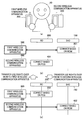
- Figs. 1(a) to 1(c) are simplified diagrams showing one example usage of a plurality of wireless communication devices according to a first exemplary embodiment
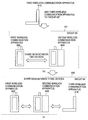
- Figs. 2(a) and 2(b) are simplified diagrams showing an example of a group in a case where an MCIM is shared by a plurality of wireless communication devices according to the first exemplary embodiment
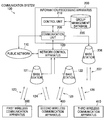
- Fig. 3 is a block diagram showing an exemplary system configuration of a communication system, according to the first exemplary embodiment
- Figs. 4(a) and 4(b) are schematically diagrams of a group management database, according to the first exemplary embodiment
- Fig. 5 is a block diagram showing an example of an internal configuration of a wireless communication apparatus, according to the first exemplary embodiment
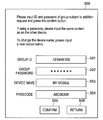
- FIG. 6 is a diagram showing an example of an addition operation screen displayed by a display unit of a wireless communication apparatus, according to the first exemplary embodiment
- Figs. 7(a) and 7(b) are examples of display screens showing additional authentication results to be displayed on a display unit of a wireless communication apparatus, according to the first exemplary embodiment
- Fig. 8 is a flowchart of an exemplary communication process performed by apparatuses of a communication system, according to the first exemplary embodiment
- Fig. 9 is flowchart of an exemplary communication process performed by apparatuses of a communication system, according to the first exemplary embodiment
- Fig. 10 is a flowchart of an exemplary communication process performed by various apparatuses of a communication system, according to the first exemplary embodiment
- FIG. 11 is a flowchart of an exemplary communication process performed by a wireless communication apparatus, according to the first exemplary embodiment
- Fig. 12 is a flowchart of an exemplary communication process performed by by an information processing apparatus, according to the first exemplary embodiment
- Fig. 13 is a flowchart of a first authentication process performed by an information processing apparatus, according to the first exemplary embodiment
- Fig. 14 is a flowchart of a second authentication process performed by an information processing apparatus, according to the first exemplary embodiment
- Fig. 15 is a block diagram showing a functional configuration of a wireless communication apparatus, according to a second exemplary embodiment
- FIGS. 16(a) and 16(b) are diagrams of a display screen for carrying out contactless communication that is displayed on a display unit of a wireless communication apparatus, and states of respective wireless communication apparatuses when contactless communication is carried out, according to the second exemplary embodiment;
- FIG. 17 is a diagram showing an example of an addition operation screen displayed on a display unit of a wireless communication apparatus, according to the second exemplary embodiment;
- Fig. 18 is a flowchart of an exemplary communication process performed by apparatuses of a communication system, according to the second exemplary embodiment;
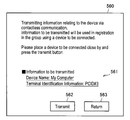
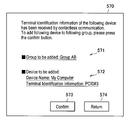
- Fig. 19 is a diagram of an exemplary contactless communication operation screen displayed on a display unit of a wireless communication apparatus, according to a third exemplary embodiment;
- FIG. 20 is a diagram showing an exemplary addition operation screen displayed on a display unit of a wireless communication apparatus, according to the third exemplary embodiment
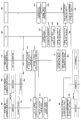
- Fig. 21 is a flowchart of an exemplary communication process performed by various apparatuses of a communication system, according to the third exemplary embodiment
- Figs. 22(a) and 22(b) are perspective views of a speaker apparatus according to a modification to the exemplary embodiments.
- FIG. 1(a) to 1(c) are simplified diagrams showing one exemplary usage of a plurality of wireless communication apparatuses ( ordevices), according to a first exemplary embodiment.
- Fig. 1(a) shows a state where a plurality of wireless communication apparatuses (a first wireless communication apparatus 300 and a second wireless communication apparatus 400) are used by a user 10.
- the first wireless communication apparatus 300 is a mobile telephone apparatus (for example, a "smartphone")
- the second wireless communication apparatus 400 is an electronic book display apparatus equipped with a wireless communication function.
- Fig. 1(b) and 1(c) show an example of how use rights for an MCIM (Machine Communication Identity Module) are transferred when the MCIM is shared between a plurality of wireless communication apparatuses.
- an example network configuration composed of an SHO (Selected Home Operator) 150 and an RO (Registration Operator) 200 is shown.
- the SHO 150 provides Internet services and the like, and as one example corresponds to a wireless communication provider (for example, a mobile telephone provider) that provides a wireless connection service.
- the RO 200 also provides services such as initial connection and registration and as one example corresponds to a wireless communication provider (for example, a mobile telephone provider) that provides a wireless connection service.
- the SHO 150 and the RO 200 are also connected and are capable of communicating with one another.
- RO and SHO represent logical roles and although a case where such devices are operated by different businesses is imagined, it would also be possible for the same business to operate both devices. It is also possible for multiple RO and SHO to be present. Also, RO and SHO may be configured as a single information processing apparatus or may be constructed of a plurality of apparatuses. Here, RO and SHO refer to relative roles with respect to a particular wireless communication apparatus in possession of a valid MCIM. This means that it is possible for a device that corresponds to an RO for one wireless communication apparatus to correspond to an SHO for a different wireless communication apparatus.
- a wireless communication apparatus storing a valid MCIM is shown using a bold outline. That is, Fig. 1(b) shows a case where the first wireless communication apparatus 300 stores a valid MCIM and Fig. 1(c) shows a case where the second wireless communication apparatus 400 stores a valid MCIM. Also, as shown in Figs. 1(b) and 1(c), it is possible for the first wireless communication apparatus 300 and the second wireless communication apparatus 400 to connect to the SHO 150 only when such apparatuses store a valid MCIM (301 and 402). Conversely, it is possible for a wireless communication apparatus that does not store a valid MCIM to connect to the RO 200 based on a PCID (Provisional Connectivity Identity) (401 and 302).
- PCID Provisional Connectivity Identity
- an MCIM is one example of contract authentication information and such contract authentication information is information including telephone subscriber information and authentication key information.
- an MCIM is contract authentication information (a so-called "software downloadable SIM (Subscriber Identity Module)") that is not limited to a specified communication provider (for example, a mobile telephone provider) when a device is purchased and can be flexibly set by a communication provider after purchase.
- the expression "when a valid MCIM is not stored” refers to when an MCIM itself is not stored or when only MCIM that have been invalidated by an MCIM invalidation process are stored.
- PCID is an identifier (for example, the terminal identification information 225 on a network shown in Fig. 4) for connecting to the RO and is assigned to every wireless communication apparatus (device).
- FIGs. 2(a) and 2(b) are simplified diagrams showing an example of a group in a case where an MCIM is shared by a plurality of wireless communication apparatuses according to the first exemplary embodiment.
- a third wireless communication apparatus 410 is added to a group AB (shown by the dotted rectangle 161) composed of the first wireless communication apparatus 300 and the second wireless communication apparatus 400.
- group AB is the name assigned to the group (for example, the "group name 211" shown in Fig. 4).
- the third wireless communication apparatus 410 is an information processing apparatus (for example, a notebook personal computer) equipped with a wireless communication function.
- Fig. 2(b) shows a case where the third wireless communication apparatus 410 has been added to the group AB (shown by the dotted rectangle 161) shown in Fig. 2(a), so that the group AB becomes composed of three devices (shown by the dotted rectangle 162).
- the user 10 is also capable of deleting a desired device out of the three devices that compose the group AB (shown by the dotted rectangle 162) shown in Fig. 2(b) from the group AB.
- Example Configuration of Communication System Fig. 3 is a block diagram showing an example system configuration of a communication system 100 according to the first exemplary embodiment.
- the communication system 100 includes a public network 110, base stations 121, 122, and 206, a network control apparatus 120, an information processing apparatus 200, the first wireless communication apparatus 300, the second wireless communication apparatus 400, and the third wireless communication apparatus 410.
- the public network 110 is a public network such as a telephone network or the Internet.
- the public network 110 and the network control apparatus 120 are connected via a gateway (not shown).
- the public network 110 and the information processing apparatus 200 are connected via a gateway (not shown).
- the network control apparatus 120 is a communication control apparatus managed by a wireless communication provider that provides a wireless connection service and includes an authentication control unit (not shown). This authentication control unit carries out authentication control of wireless communication apparatuses connected via the base stations 121 and 122. Here, aside from special cases, the authentication control unit of the network control apparatus 120 authenticates a wireless communication apparatus storing a valid MCIM (contract authentication information) out of the wireless communication apparatuses connected via the base stations 121 and 122. The network control apparatus 120 also connects the authenticated wireless communication apparatus via the gateway (not shown) to the public network 110.
- MCIM contract authentication information
- the network control apparatus 120 is also connected to the information processing apparatus 200 so as to exchange various information with the information processing apparatus 200.
- a wireless communication apparatus that does not store a valid MCIM (contract authentication information) is capable of connecting (with a limited connection) via the network control apparatus 120 to the information processing apparatus 200 based on the PCID of the wireless communication apparatus.
- the base stations 121, 122 are mobile communication base stations (NodeB) that connect the first wireless communication apparatus 300, the second wireless communication apparatus 400, and the third wireless communication apparatus 410, to the network control apparatus 120 via wireless connections 123 to 126.
- NodeB mobile communication base stations
- the respective wireless communication apparatuses are connected via the wireless connections 123 to 126 to the base stations 121, 122 and are connected via the base stations 121, 122 to the network control apparatus 120.
- the respective wireless communication apparatuses are also connected via the network control apparatus 120 to the information processing apparatus 200.
- the first wireless communication apparatus 300, the second wireless communication apparatus 400, and the third wireless communication apparatus 410 are respectively capable of connecting to any of the base stations 121, 122 in accordance with the locations at which such apparatuses are being used.
- the network control apparatus 120 and the base stations 121, 122 correspond to an SHO.
- a wireless communication apparatus that does not store a valid MCIM contract authentication information
- the information processing apparatus 200 and the base station 206 correspond to an RO.
- the information processing apparatus 200 is sometimes referred to as the "RO 200".
- the information processing apparatus 200 provides services such as initial connection and registration, and includes a communication unit 205, a control unit 210, and a group management database 220.
- the communication unit 205 transmits and receives various information based on control by the control unit 210.
- the communication unit 205 is connected to the network control apparatus 120, for example, and transmits and receives various information to and from the respective wireless communication apparatuses connected via the network control apparatus 120.
- the communication unit 205 receives a group addition request (including group information relating to that group), which requests additional registration of a new wireless communication apparatus in a group composed of a plurality of wireless communication apparatuses that share an MCIM, from one or a plurality of wireless communication apparatuses.
- the communication unit 205 then outputs various information received from wireless communication apparatuses and the like to the control unit 210.
- the communication unit 205 is an example of a receiving unit.
- the control unit 210 carries out various control relating to the wireless communication apparatuses connected via the communication unit 205 and the network control apparatus 120. For example, the control unit 210 receives a group addition request from one or a plurality of the wireless communication apparatuses via the communication unit 205. In this way, when a group addition request has been received, the control unit 210 controls the additional registration in a group of a new wireless communication apparatus based on the group information included in such group addition request.
- group addition requests have been received from both a wireless communication apparatus that has already been registered in the group and a new wireless communication apparatus, the control unit 210 carries out additional registration based on the group information included in the respective group addition requests.
- control unit 210 extracts a group that matches the group information included in the group addition request from the group management database 220 and registers the new wireless communication apparatus so as to be associated with the matching group in the group management database 220. That is, the control unit 210 determines whether the group information included in such group addition requests matches and carries out additional registration of the new wireless communication apparatus only when the group information matches.
- control unit 210 carries out control to transmit, via wireless connections, notification of this to the respective wireless communication apparatuses that transmitted the group addition requests and has such notification displayed.
- the group described above can be understood as a group that shares one or more comment network connection rights.
- Such network connection rights are the right to connect to a specified network (for example, the public network 110) via a wireless connection and as one example correspond to use rights over an MCIM. That is, the network connection rights are rights for connecting to base stations operated by a communication provider based on an MCIM (contract authentication information) for connecting to such base stations. For example, the presence or absence of such network connection rights can be decided according to the presence or absence of use rights over an MCIM.
- the group management database 220 is a database for managing groups which are each composed of a plurality of wireless communication apparatuses sharing an MCIM. Note that the group management database 220 will be described in detail with reference to Figs. 4(a) and 4(b).
- the group management database 220 is one example of a "storage unit" referred to in the patent claims.
- the MCIM is stored in advance in the respective wireless communication apparatuses.
- the network control apparatus 120 is capable of transferring the use rights over the MCIM by validating or invalidating the MCIM of the respective wireless communication apparatuses.
- Figs. 4(a) and 4(b) are tables schematically showing the group management database 220 according to the first exemplary embodiment. Note that in Fig. 4(a), a case where the first wireless communication apparatus 300 and the second wireless communication apparatus 400 are registered in the group AB is shown. Also, in Fig. 4(b), a case where the third wireless communication apparatus 410 is additionally registered in the group AB shown in Fig. 4(a) is shown.
- a group name 221, a group ID 222, a group password 223, a device name 224, terminal identification information 225, and valid/invalid information 226 are stored so as to be associated with one another in group units. Such information is successively updated by the control unit 210 based on requests (group addition requests, group deletion requests) from the respective wireless communication apparatuses, for example.
- a name assigned to a group is stored in the group name 221. Such name is stored for example when a group is generated.
- a group ID assigned to a group is stored in the group ID 222.
- a password assigned to a group is stored in the group password 223.
- a group addition request is made using such ID and password.
- the respective wireless communication apparatuses belonging to a group may store in advance the ID and password assigned to such group (for example, storage in a memory 340 shown in Fig. 5). Alternatively, an arrangement may be used where the ID and password are not stored in a wireless communication apparatus and are inputted each time by the user.
- Names assigned to devices are stored in the device name 224. As one example, such names are stored when devices are newly added to a group.
- Terminal identification numbers of wireless communication apparatuses are stored in the terminal identification information 225.
- Terminal identification information is identification information for identifying a wireless communication apparatus, and as one example a PCID is stored.
- PCID#1" in the terminal identification information 225 corresponds to the first wireless communication apparatus 300.
- PCID#2" in the terminal identification information 225 corresponds to the second wireless communication apparatus 400 and "PCID#3" in the terminal identification information 225 corresponds to the third wireless communication apparatus 410.
- FIG. 5 is a block diagram showing an example of the internal configuration of the first wireless communication apparatus 300 according to the first exemplary embodiment. Note that since the internal configurations of the second wireless communication apparatus 400 and the third wireless communication apparatus 410 are the same as that of the first wireless communication apparatus 300, description thereof is omitted here. Also, in Fig. 6 onwards, when describing the second wireless communication apparatus 400 or the third wireless communication apparatus 410, names and reference numerals corresponding to the first wireless communication apparatus 300 are used.
- the first wireless communication apparatus 300 includes an antenna 311, an antenna sharing unit 312, a modulating unit 321, a demodulating unit 322, a control unit 330, a tangible, non-transitory computer-readable storage medium, an example of which is memory 340, and the MCIM information storage unit 350.
- the first wireless communication apparatus 300 also includes an operation unit 360, a display unit 370, a location information acquiring unit 380, a microphone 391, and a speaker 392. Such components are connected by a bus 331.
- the first wireless communication apparatus 300 is realized by a mobile telephone apparatus capable of telephone calls and data communication.
- radio waves received by the antenna 311 are demodulated via the antenna sharing unit 312 by the demodulating unit 322 and demodulated reception data is supplied to the control unit 330.
- the reception process is an incoming call process
- the demodulated reception data (audio data) is outputted via the control unit 330 from the speaker 392 as sound.
- the transmission data outputted by the control unit 330 is modulated by the modulating unit 321 and the modulated transmission data is transmitted via the antenna sharing unit 312 from the antenna 311.
- the transmission process is an outgoing call process
- audio data inputted from the microphone 391 is modulated via the control unit 330 by the modulating unit 321 and modulated transmission data (audio data) is transmitted via the antenna sharing unit 312 from the antenna 311.
- the control unit 330 carries out various control based on instructions (e.g., a control program) stored in the memory 340.
- the control unit 330 is constructed of a microprocessor.
- the control unit 330 is connected to the modulating unit 321 and the demodulating unit 322 and transmits and receives various data to and from the network control apparatus 120 connected via the base stations 121, 122.
- the control unit 330 also carries out a connection process that connects to the RO 200 (with a limited connection) via a wireless connection based on the PCID, for example, without using the MCIM.
- the control unit 330 is one example of a "transmission control unit” and a "display control unit.”
- the memory 340 is a memory storing instructions (e.g., a control program) that may be executed by the microprocessor to enable the control unit 330 to carry out various control, in addition to transmission data, reception data, and the like.
- the memory 340 is constructed of ROM (Read Only Memory) and/or RAM (Random Access Memory).
- Terminal identification information (PCID#1) for specifying the first wireless communication apparatus 300 and a device name (for example, the device name 224 shown in Fig. 4(a)) of the first wireless communication apparatus 300 are also stored in the memory 340. Such device name is registered for example by a user operation.
- the ID and password assigned to the group AB to which the first wireless communication apparatus 300 belongs are also stored in the memory 340.
- group ID and password are included in a group addition authentication result given in response to a group addition request, transmitted from the information processing apparatus 200, and stored in the memory 340.
- the MCIM information storage unit 350 is a memory storing an MCIM (contract authentication information).
- MCIM information storage unit 350 as examples it is possible to use a UICC (Universal Integrated Circuit) card or a dedicated memory for securely storing an MCIM.
- UICC Universal Integrated Circuit
- a card capable of a validation process and an invalidation process for the MCIM is used. That is, a device that enables the control unit 330 to carry out a validation process and an invalidation process for an MCIM based on transfer information that has been received from the antenna 311 and demodulated is used. Also, a device that allows the MCIM to be rewritten is used.
- the validation process and invalidation process for the MCIM can be carried out according to the validation process and invalidation process defined by 3GPP (Third Generation Partnership Project). Also, by providing a secure region in the memory 340, the MCIM information storage unit 350 may be provided inside the memory 340.
- the control unit 330 carries out control to transmit a group addition request via a wireless connection to the RO 200.
- group addition request requests additional registration in the group of a wireless communication apparatus aside from the wireless communication apparatuses that compose such group and includes group information (for example, an ID and password of a group) stored in the memory 340.
- the RO 200 When a group addition request has been received, the RO 200 additionally registers a new wireless communication apparatus in the group based on the group information included in such group addition request.
- control unit 330 carries out control to display such notification.
- Example displays of such a notification are shown in Figs. 7(a) and 7(b).
- the control unit 330 transmits a group deletion request for deletion of the wireless communication apparatus to be deleted from the group to the RO 200.
- the RO 200 then carries out a deletion process for deleting the wireless communication apparatus to be deleted from the group.
- the operation unit 360 is an operation receiving unit receiving an operation input made by the user and outputs a signal in accordance with the received operation input to the control unit 330.
- the operation unit 360 includes various keys such as numeric keys and/or alphabet keys and receives an instruction operation (or "specified operation") made by the user who designates a group addition request.
- the display unit 370 is a display unit that displays various information (text information, time information, and the like) based on control by the control unit 330. As one example, the display unit 370 displays various information (for example, the display screens shown in Figs. 6, 7(a), and 7(b)) relating to a group addition request. Note that as examples, it is possible to use a display panel such as an organic EL (Electro Luminescence) panel or an LCD (Liquid Crystal Display) panel. It is also possible to integrally construct the operation unit 360 and the display unit 370 using a touch panel that enables the user to make an operation input by touching or placing his/her finger close to a display screen.
- a display panel such as an organic EL (Electro Luminescence) panel or an LCD (Liquid Crystal Display) panel. It is also possible to integrally construct the operation unit 360 and the display unit 370 using a touch panel that enables the user to make an operation input by touching or placing his/her finger close to a display screen.
- the location information acquiring unit 380 acquires location information showing the location where the first wireless communication apparatus 300 is present and outputs the acquired location information to the control unit 330.
- the location information acquiring unit 380 can be realized by a GPS (Global Positioning System) unit that calculates the location information using GPS signals received by a GPS signal reception antenna (not shown).
- the calculated location information includes various data relating to location, such as latitude, longitude, and altitude, at the time the GPS signals were received.
- a wireless LAN Local Area Network
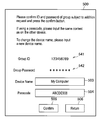
- Example Display of Addition Operation Screen Fig. 6 is a diagram showing one example of an addition operation screen display by the display unit 370 of the first wireless communication apparatus 300 according to the first exemplary embodiment.
- the addition operation screen 500 shown in Fig. 6 is a display screen for carrying out an addition operation for adding a wireless communication apparatus aside from the first wireless communication apparatus 300 to the group AB.
- the addition operation screen 500 includes a group ID input region 501, a group password input region 502, a device name display region 503, a passcode input region 504, a confirm button 505, and a return button 506.
- the group ID input region 501 is a region for inputting the ID of the group to which the other wireless communication apparatus is to be added.
- the group password input region 502 is a region for inputting a password of the group to which the other wireless communication apparatus is to be added. That is, the ID of the group AB to which the first wireless communication apparatus 300 belongs is inputted into the group ID input region 501 and the password of the group AB to which the first wireless communication apparatus 300 belongs is inputted into the group password input region 502. Note that since the password is not displayed on the actual screen for security purposes, the password is shown as "******" in Fig. 6. Passwords are also shown as "******" or the like in other display screens.
- the device name display region 503 is a region in which the device name registered in the first wireless communication apparatus 300 is displayed.
- “My Mobile” is stored in the memory 340 as the device name of the first wireless communication apparatus 300.
- the device name "My Mobile” registered in the first wireless communication apparatus 300 is stored in the device name 224 of the group management database 220.
- a new device name can be inputted into the device name display region 503.
- the passcode input region 504 is a region for inputting information associated with a user, for example, a passcode used in an authentication process when adding another wireless communication apparatus.
- the passcode is a shared code (in other words, a temporary password) used only in a special authentication process (for example, an authentication process relating to a group addition request) and that by using a passcode together with a password, it is possible to further improve the security of group registration. As one example, it is still possible to maintain security for group registration even when the ID and password of a group have leaked out.
- the confirm button 505 is a button that is pressed after the various operations described above (input operation, selection operation) have been carried out and is used to confirm the content of such operations.
- the return button 506 is a button pressed when returning to a display screen that was displayed immediately before the addition operation screen 500, for example. Note that since the return buttons 533, 563 and the like shown in drawings such as Figs. 16 and 19 are substantially the same, description of such buttons is omitted for such drawings.
- addition operation screen 500 displayed on the first wireless communication apparatus 300 is shown in Fig. 6, it is assumed that the addition operation screen displayed on the wireless communication apparatus to be added is substantially the same. However, in the addition operation screen displayed on the wireless communication apparatus to be added, the device name of the wireless communication apparatus to be added is displayed in the device name display region 503.
- Figs. 7(a) and 7(b) are diagrams showing examples of a display screen for the addition authentication result that is displayed by the display unit 370 of the first wireless communication apparatus 300 according to the first exemplary embodiment.
- the display screens 510 and 515 shown in Figs. 7(a) and 7(b) are screens displaying addition authentication results in response to an addition operation for adding a wireless communication apparatus to the group AB. More specifically, Fig. 7(a) shows the display screen 510 showing a message that addition to the group was successfully authenticated for such addition operation and Fig. 7(b) shows the display screen 515 showing a message that authentication of the group addition failed for such addition operation.
- the display screen 510 shown in Fig. 7(a) displays a message showing that group addition was successfully authenticated and is additionally provided with a device display region 511 showing the device with a valid MCIM, a button 512 for switching to an MCIM transfer operation screen, and a confirm button 513.
- the device display region 511 showing the device with a valid MCIM is a region displaying information (device information) relating to a device with a valid MCIM out of the devices that belong to the group subjected to additional registration.
- the content of the group management database 220 is included in the group addition authentication result and the device information is displayed based on such content.
- the button 512 for switching to an MCIM transfer operation screen is a button which is pressed when switching to a display screen for carrying out an operation for transferring the MCIM between devices that belong to the group subjected to the additional registration.
- the confirm button 513 is a button pressed by the user after confirming the additional registration in the group and confirming the device with the valid MCIM.
- a specified display screen for example, an initial screen
- the display screen 515 shown in Fig. 7(b) displays a message showing that authentication of the group addition failed and is additionally provided with a button 516 for switching to an addition request operation screen and a confirm button 517.
- the button 516 for switching to an addition request operation screen is a button pressed when switching to a display screen (for example, the addition operation screen 500 shown in Fig. 6) for repeating an addition operation for adding the wireless communication apparatus, for which authentication of the group addition failed, to the group AB.
- the confirm button 517 is a button pressed by the user after confirming that authentication of the group addition failed.
- a specified display screen for example, an initial screen
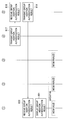
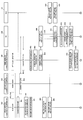
- FIGs. 8 and 9 are sequence charts showing an example of the communication process carried out between the apparatuses that compose the communication system 100 according to the first exemplary embodiment.
- Figs. 8 and 9 an imaginary case is explained where the group AB is composed of the first wireless communication apparatus 300 and the second wireless communication apparatus 400 and the first wireless communication apparatus 300 is storing a valid MCIM. Also, in Figs. 8 and 9, an example of a communication process when additionally registering the third wireless communication apparatus 410 in the group AB by operating the first wireless communication apparatus 300 and the third wireless communication apparatus 410 that is yet to subscribe to the group AB is shown. Here, an example is described where group addition requests are made by first operating the third wireless communication apparatus 410 and then operating the first wireless communication apparatus 300. Note that in Figs. 8 and 9, it is assumed that the first wireless communication apparatus 300 is connected to the SHO 150 (601) and that the second wireless communication apparatus 400 and the third wireless communication apparatus 410 are connected to the RO 200 (602, and 603).
- a display screen for carrying out an addition operation for the group AB is displayed on the display units 370 of the first wireless communication apparatus 300 and the third wireless communication apparatus 410.
- the addition operation screen 500 shown in Fig. 6 (except that the respective input regions are blank) is displayed by the display unit 370 of the first wireless communication apparatus 300.
- the addition operation screen 500 shown in Fig. 6 (except that "My Computer" is displayed in the device name display region 503 and the respective input regions are blank) is also displayed by the display unit 370 of the third wireless communication apparatus 410.
- the ID and the password of the group AB are inputted into the group ID input region 501 and the group password input region 502 (604 and 607).
- the passcode desired by the user is inputted into the passcode input region 504 (604 and 607).
- the ID and password of the group AB and the passcode are examples of "group information" relating to the group AB.
- the passcode is also one example of "specified information” included in the group information.
- the ID and password of the group AB are stored in the memory 340 of the first wireless communication apparatus 300. This means that by using the ID and password of the group AB stored in the memory 340, it is possible to omit the operation inputs into the group ID input region 501 and the group password input region 502. That is, the content (the ID and password assigned to the group AB) stored in the memory 340 of the first wireless communication apparatus 300 are displayed in the group ID input region 501 and the group password input region 502 of the addition operation screen 500. By doing so, it becomes unnecessary for the user to input the ID and password of the group AB and the user can instead simply confirm the displayed content for such information.
- a group addition request corresponding to such addition operation is transmitted from the third wireless communication apparatus 410 to the RO 200 (605 and 606).
- the group addition request is transmitted directly from the third wireless communication apparatus 410 to the RO 200 (605 and 606).
- a group addition request corresponding to such addition operation is transmitted from the first wireless communication apparatus 300 to the RO 200 (608 to 611).
- the group addition request is transmitted from the information processing apparatus 200 via the SHO 150 to the R200 (608 to 611).
- a group addition request includes various information inputted into the addition operation screen 500 and identification information (the terminal identification information stored in the memory 340) of the device that made the group addition request.
- the various information inputted into the addition operation screen 500 is the ID and password of the group and, if a passcode has been inputted by a user operation, such passcode.
- the identification information of the device that made the group addition request the terminal identification information (PCID#1) is included in the group addition request from the first wireless communication apparatus 300 and the terminal identification information (PCID#3) is included in the group addition request from the third wireless communication apparatus 410.
- the control unit 210 starts to monitor whether another group addition request is received before an acceptance period has elapsed (e.g., a range in a vertical direction shown by the dotted line 625 in Fig. 8).
- the length of the acceptance period (the range shown by the dotted line 625) changes in accordance with whether a passcode is included in the group addition request received first. For example, if a passcode is included in the group addition request received first, a first value is set as the acceptance period. Meanwhile, if a passcode is not included in the group addition request received first, a second value is set as the acceptance period. Here, it is assumed that the second value is smaller than the first value. As one example, it is possible to set ten seconds to two minutes as the first value. In such case, as one example it is possible to set a value that is half of the first value (e.g., five seconds to one minute) as the second value.
- the control unit 210 carries out the authentication process for the received group addition requests based on the content of the group management database 220 (612).
- the control unit 210 authenticates the additional registration of the third wireless communication apparatus 410 related to the received group addition requests.
- the control unit 210 authenticates the additional registration of the third wireless communication apparatus 410 related to the received group addition requests.
- the control unit 210 updates the content of the group management database 220 (613). That is, in the group management database 220, the third wireless communication apparatus 410 is additionally registered in the group AB (i.e., updating from the state shown in Fig. 4(a) to the state shown in Fig. 4(b) (the dotted rectangle 227).
- the RO 200 transmits the group addition authentication result showing addition to the group to the third wireless communication apparatus 410 (614 and 615).
- a group addition authentication result showing addition to the group has been received (615)
- a message showing the result is displayed on the display unit 370 of the third wireless communication apparatus 410 (616).
- One example display is shown in Fig. 7(a).
- the third wireless communication apparatus 410 is connected to the RO 200 (603). For this reason, the group addition authentication result is directly transmitted from the RO 200 to the third wireless communication apparatus 410 (614 to 616).
- the RO 200 also transmits the group addition authentication result showing addition to the group to the first wireless communication apparatus 300 (617 to 620).
- a group addition authentication result showing addition to the group has been received (620)
- a message showing the result is displayed on the display unit 370 of the first wireless communication apparatus 300 (621).
- One example display is shown in Fig. 7(b).
- the first wireless communication apparatus 300 is connected to the SHO 150 (601). For this reason, the group addition authentication result is transmitted from the RO 200 via the SHO 150 to the first wireless communication apparatus 300 (617 to 620).
- the third wireless communication apparatus 410 transmits a group addition request first
- the first wireless communication apparatus 300 may transmit a group addition request first.
- monitoring for the reception of a group addition request from the third wireless communication apparatus 410 is carried out from reception by the RO 200 of the group addition request from the first wireless communication apparatus 300 until the acceptance period (the range shown by the dotted line 625) elapses.
- control unit 210 additionally registers the third wireless communication apparatus 410 in the group AB on the condition that the next group addition request is received before the acceptance period from the reception of the first group addition request elapses.
- the control unit 210 is also capable of changing the length of the acceptance period based on whether passcodes are included in the two group addition requests. For example, the acceptance period when at least one out of the two group addition requests does not include a passcode can be set shorter than the acceptance period when the two group addition requests both include a passcode.
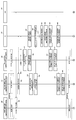
- FIG. 10 is a sequence chart showing an example of a communication process between the various apparatuses that compose the communication system 100 according to the first exemplary embodiment. Note that since the sequence chart shown in Fig. 10 is a modification of Figs. 8 and 9, parts that are the same as Figs. 8 and 9 have been assigned the same reference numerals and the description thereof is partially omitted. Also, Fig. 10 shows an example of a communication process for a case where the third wireless communication apparatus 410 is additionally registered in the group AB by operating two devices (the second wireless communication apparatus 400 and the third wireless communication apparatus 410) that do not store a valid MCIM.
- the two devices that do not store a valid MCIM are capable of connecting to the RO 200 with only a limited connection based on the PCIDs. For this reason, in the example shown in Fig. 10, the group addition requests are directly transmitted from the respective devices to the RO 200 and the group addition authentication result is directly transmitted from the RO 200 to the respective devices.
- the processes (631 to 633) shown in Fig. 10 correspond to the processes (604 to 606) shown in Fig. 8.
- the processes (634 to 636) shown in Fig. 10 correspond to the processes (607 to 611) shown in Fig. 8.
- the example in Fig. 10 differs in that the addition operation for the group AB is carried out at the second wireless communication apparatus 400 and the group addition request is directly transmitted from the second wireless communication apparatus 400 to the RO 200.
- the acceptance period (the range shown by the dotted line 647) shown in Fig. 10 corresponds to the acceptance period (the range shown by the dotted line 625) shown in Fig. 8.
- the processes (637 to 641) shown in Fig. 10 correspond to the processes (612 to 616) shown in Fig. 8.
- the processes (642 to 644) shown in Fig. 10 correspond to the processes (617 to 621) shown in Fig. 9.
- the example in Fig. 10 differs in that the group addition authentication result is transmitted directly from the RO 200 to the second wireless communication apparatus 400 (642 and 643) without passing via the SHO 150.
- the contact authentication information (MCIM) of the public network 110 can be easily shared by a plurality of devices in a group.
- MCIM contact authentication information
- additional registration of a device to be added is performed by carrying out authentication using the ID and password of the group and with the condition that specified operations are carried out within a set time using both a device registered in the group and the device to be added. By doing so, it is possible to increase security and reliably add a device.
- the third wireless communication apparatus 410 For example, by carrying out specified operations in a set time using the first wireless communication apparatus 300 and the third wireless communication apparatus 410, it is possible to add the third wireless communication apparatus 410 to the group AB. By doing so, even in a case where the ID and/or password of the group AB has been lost or the ID and/or password has leaked out to a third party, it will still be possible to prevent unexpected additions to the group AB by a third party. That is, according to the first exemplary embodiment, it is possible to easily share the right to connect to a network between a plurality of wireless communication apparatuses. In such case, it is possible to maintain security over the sharing.
- FIG. 11 is a flowchart showing one example of the processing procedure of the communication process carried out by the first wireless communication apparatus 300 according to the first exemplary embodiment.
- the case where the first wireless communication apparatus 300 makes a group addition request will be described as one example. Note that although only the example operation of the first wireless communication apparatus 300 is shown in Fig. 11, it is also possible to apply such operation to other wireless communication apparatuses.
- control unit 330 judges whether an addition operation for a group sharing an MCIM has been carried out (step S901) and when such addition operation has not been carried out, such monitoring is continued.
- the control unit 330 displays a display screen (for example, the addition operation screen 500 shown in Fig. 6) for carrying out an addition operation for the group sharing the MCIM on the display unit 370 (step S902).
- control unit 330 determines whether a pressing operation has been carried out for the return button in such display screen (for example, a pressing operation for the return button 506 in the addition operation screen 500 shown in Fig. 6) (step S903). If such button operation has been carried out (step S903), the processing returns to step S901.
- step S903 the control unit 330 determines whether a transmission operation for a group addition request has been carried out in the display screen (step S904).
- This transmission operation is for example a pressing operation of the confirm button 505 after operating the items in the addition operation screen 500 shown in Fig. 6.
- step S904 the processing returns to step S903.
- the control unit 330 transmits a group addition request corresponding to the addition operation to the RO 200 (step S905).
- the group addition request is transmitted from the first wireless communication apparatus 300 via the SHO 150 to the RO 200.
- the group addition request is directly transmitted from the first wireless communication apparatus 300 to the RO 200.
- step S906 it is determined whether a group addition authentication result has been received (step S906) and when the group addition authentication result has not been received, such monitoring is continued. Meanwhile, if a group addition authentication result has been received (step S906), the control unit 330 displays the group addition authentication result on the display unit 370 (step S907). Here, when a group addition authentication result showing that authentication succeeded for group addition has been received (step S906), the control unit 330 displays a message showing that authentication succeeded on the display unit 370 (for example, the display screen 510 shown in Fig. 7(a)).
- control unit 330 displays a message showing that authentication failed on the display unit 370 (for example, the display screen 515 shown in Fig. 7(b)).
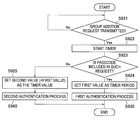
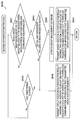
- FIG. 12 is a flowchart showing one example of the processing procedure of the communication process carried out by the information processing apparatus 200 according to the first exemplary embodiment.
- control unit 210 judges whether a group addition request has been received (step S921) and when a group addition request has not been received, such monitoring is continued. Meanwhile, when a group addition request has been received (step S921), a timer for determining whether the acceptance period has elapsed is started (step S922).
- step S923 it is determined whether a passcode is included in the received group addition request (step S923) and when a passcode is included in the received group addition request, the control unit 210 sets the first value as the timer period (acceptance period) (step S923).
- step S930 a first authentication process is carried out (step S930). The first authentication process will be described in detail with reference to Fig. 13.
- control unit 210 sets the second value as the timer period (acceptance period) (step S925). As described earlier, it is assumed that the second value is smaller than the first value.
- step S940 a second authentication process is carried out.
- the second authentication process will be described in detail with reference to Fig. 14.
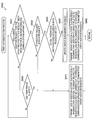
- Fig. 13 is a flowchart showing the first authentication process procedure (the processing procedure in step S930 shown in Fig. 12) out of the processing procedure in the communication process carried out by the information processing apparatus 200 according to the first exemplary embodiment.
- control unit 210 determines whether a group addition request for a group to which a received group addition request relates has been received from another wireless communication apparatus (step S931). When a group addition request for such group has not been received from another wireless communication apparatus (step S931), the control unit 210 determines whether the timer period (acceptance period) from the reception of the first group addition request has elapsed (step S932).
- step S932 If the timer period (acceptance period) has not elapsed from transmission of the first group addition request (step S932), the processing returns to step S931. Meanwhile, if the timer period (acceptance period) has elapsed from the transmission of the first group addition request (step S932), the processing proceeds to step S937. That is, the control unit 210 transmits a group addition authentication result showing that addition to the group related to the group addition request is not possible to the respective wireless communication apparatuses that transmitted the group addition requests (step S937). In such case, if the wireless communication apparatus to which the group addition authentication result is to be transmitted stores a valid MCIM, the group addition authentication result is transmitted from the RO 200 via the SHO 150. Meanwhile, if the wireless communication apparatus to which the group addition authentication result is to be transmitted does not store a valid MCIM, the group addition authentication result is directly transmitted from the RO 200. This also applies to the transmission in step S936.
- step S931 determines whether a group addition request relating to the group has been received from another wireless communication apparatus. If a group addition request relating to the group has been received from another wireless communication apparatus (step S931), the control unit 210 determines whether a passcode is included in the newly received group addition request (step S933). If a passcode is included in the newly received group addition request (step S933), the control unit 210 compares the received group addition requests with the content of the group management database 220 (step S934).
- the ID and password of the group respectively included in the received group addition requests and the ID and password of the group stored in the group management database 220 are compared and it is determined whether such IDs and passwords match (step S934).
- the expression "received group addition requests” here refers to the group addition request received first and the next group addition request to be received.
- the passcodes included in the respective group addition requests that have been received match step S934.
- step S934 When the IDs and passwords of the group and the passcodes included in the respective group addition requests all match (step S934), the control unit 210 updates the content of the group management database 220 (step S935). Next, the control unit 210 transmits a group addition authentication result showing that addition was carried out to the respective wireless communication apparatuses that transmitted the group addition requests (step S936).
- step S933 and S934 are examples of the "determining" referred to in the patent claims.
- step S935 is one example of the "additionally registering” referred to in the patent claims.
- step S933 if a passcode is not included in the group addition request that has been newly received (step S933), or if at least one of the IDs and passwords of the group and the passcodes included in the group addition requests do not match (step S934), the processing proceeds to step S937.
- the control unit 210 transmits a group addition authentication result showing that addition to the group related to the group addition requests is not possible to the respective wireless communication apparatuses that transmitted the group addition requests (step S937).
- Fig. 14 is a flowchart showing a second authentication process procedure (the processing procedure of step S940 shown in Fig. 12) out of the processing procedure of the communication process of the information processing apparatus 200 according to the first exemplary embodiment.
- control unit 210 determines whether a group addition request related to the group to which a received group addition request relates has been received from another wireless communication apparatus (step S941). If a group addition request related to the group has not been received from another wireless communication apparatus (step S941), the control unit 210 determines whether the timer period (acceptance period) from the transmission of the first group addition request has elapsed (step S942).
- step S942 If the timer period (acceptance period) has not elapsed from transmission of the first group addition request (step S942), the processing returns to step S941. Meanwhile, when the timer period (acceptance period) has elapsed from the transmission of the first group addition request (step S942), the processing proceeds to step S946. That is, the control unit 210 transmits a group addition authentication result showing that addition to the group related to the group addition request is not possible to the respective wireless communication apparatuses that transmitted the group addition requests (step S946). In such case, if the wireless communication apparatus to which the group addition authentication result is to be transmitted stores a valid MCIM, the group addition authentication result is transmitted from the RO 200 via the SHO 150. Meanwhile, if the wireless communication apparatus to which the group addition authentication result is to be transmitted does not store a valid MCIM, the group addition authentication result is directly transmitted from the RO 200. This also applies to the transmission in step S945.
- control unit 210 compares the received group addition requests with the content of the group management database 220 (step S943).
- the ID and password of the group respectively included in the received group addition requests and the ID and password of the group stored in the group management database 220 are compared and it is determined whether such IDs and passwords match (step S943).
- the expression “received group addition requests” here refers to the group addition request received first and the next group addition request to be received.
- step S943 When the IDs and passwords of the group included in the respective group addition requests match (step S943), the control unit 210 updates the content of the group management database 220 (step S944). Next, the control unit 210 transmits a group addition authentication result showing that addition was carried out to the respective wireless communication apparatuses that transmitted the group addition requests (step S945).
- step S943 is one example of the "determining” referred to in the patent claims.
- step S944 is one example of the "additionally registering” referred to in the patent claims.
- step S943 if at least one of the IDs and passwords of the group included in the group addition requests do not match, the processing proceeds to step S946.
- the authentication process may be carried out on condition that the two wireless communication apparatuses that transmitted the group addition requests are within a specified range (for example, a circle with a radius of 1 to 5km). In such case, it is possible to include location information acquired by the location information acquiring unit 380 in the group addition request and to specify the locations of the wireless communication apparatuses based on such location information.
- the information processing apparatus 200 is capable of specifying the locations of respective wireless communication apparatuses based on the location information included in the group addition requests received from the two wireless communication apparatuses.
- the information processing apparatus 200 is also capable of acquiring the IDs or location information (longitude and latitude) of the base stations to which the respective wireless communication apparatuses are connected and specifying the position of each wireless communication apparatus based on such information.
- timer period in accordance with the distance between the two wireless communication apparatuses that transmitted the group addition requests.
- timer period so as to become shorter the greater the distance between the two wireless communication apparatuses.
- control unit 210 is capable of carrying out the authentication process on condition that the two wireless communication apparatuses are present within a specified range at the time of transmission of the group addition requests. Based on such result, it is possible to additionally register the wireless communication apparatus to be added in a group.
- Second Embodiment In the first exemplary embodiment, an example is described where additional registration in a group is carried out by inputting items such as an ID and password of the group according to a manual operation by the user.
- items such as an ID and password of the group according to a manual operation by the user.
- the user operates the device to be registered and the device that makes the group addition request for carrying out such registration at substantially the same time.
- it since it may be necessary to input the same information into two devices, it would be preferable to facilitate such input operations while maintaining security.
- the input operation for the ID, password, and the like of a group is carried out automatically using contactless communication.
- FIG. 15 is a block diagram showing one example of the functional configuration of a first wireless communication apparatus 700 according to the second exemplary embodiment.
- the first wireless communication apparatus 700 is a modification of the first wireless communication apparatus 300 shown in Fig. 5.
- parts that are the same as in the first wireless communication apparatus 300 have been assigned the same reference numerals and the description thereof is partially omitted.
- the first wireless communication apparatus 700 includes a contactless communication unit 710, a communication unit 720, and a control unit 740.
- the communication unit 720 corresponds to the antenna 311, the antenna sharing unit 312, the modulating unit 321, and the demodulating unit 322 shown in Fig. 5.
- the contactless communication unit 710 Based on control by the control unit 740, the contactless communication unit 710 carries out communication (contactless communication) according to a contactless communication method with another appliance (an appliance equipped with a contactless communication unit, not shown) and/or a reader/writer apparatus (not shown).
- the contactless communication unit 710 is a contactless communication unit equipped with an IC card function and is capable of carrying out transmission and reception of data in a contactless manner with an appliance or a reader/writer apparatus when placed within a distance of several centimeters of the appliance or reader/writer apparatus.
- the contactless communication unit 710 includes an antenna 711, an antenna sharing unit 712, a modulating unit 713, and a demodulating unit 714. Note that although a different communication method is used, the functions of the antenna 711, the antenna sharing unit 712, the modulating unit 713, and the demodulating unit 714 correspond to the antenna 311, the antenna sharing unit 312, the modulating unit 321, and the demodulating unit 322 shown in Fig. 5. For this reason, detailed description of such functions is omitted here.
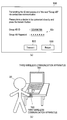
- FIGs. 16(a) and (b) are diagrams showing an example of a contactless communication operation screen displayed on the display unit 370 of the first wireless communication apparatus 700 according to the second exemplary embodiment and the state of the wireless communication apparatuses when contactless communication is carried out.
- the contactless communication operation screen 530 shown in Fig. 16(a) is a display screen for carrying out a transmission operation for transmitting the ID and password of the group AB from the first wireless communication apparatus 700 to a third wireless communication apparatus 760 according to contactless communication.
- the contactless communication operation screen 530 is provided with a group ID and password display region 531, a transmit button 532, and a return button 533.
- the group ID and password display region 531 is a region showing the ID and password of a group (the group AB) to which the first wireless communication apparatus 700 belongs.
- the transmit button 532 is a button which is pressed when transmitting the group ID and password displayed in the group ID and password display region 531 to another wireless communication apparatus.
- Fig. 16(b) schematically shows the states of the respective wireless communication apparatuses when the ID and password of the group AB are transmitted by contactless communication from the first wireless communication apparatus 700 to the third wireless communication apparatus 760.
- the user 20 places the first wireless communication apparatus 700 near the third wireless communication apparatus 760 so that the respective contactless communication units 710 of the first wireless communication apparatus 700 and the third wireless communication apparatus 760 are close (for example, so that the distance between the devices is several centimeters or less) or are touching.
- the user 20 carries out a pressing operation of the transmit button 532 in the contactless communication operation screen 530 displayed on the first wireless communication apparatus 700. Due to this pressing operation, the ID and password of the group AB are transmitted by contactless communication from the first wireless communication apparatus 700 to the third wireless communication apparatus 760.
- a message showing this is displayed on the respective display units 370 of the first wireless communication apparatus 700 and the third wireless communication apparatus 760 and an addition operation screen is displayed.
- An example display of this addition operation screen is shown in Fig. 17.
- FIG. 17 is a diagram showing an example of the addition operation screen displayed on the display unit 370 of the third wireless communication apparatus 760 according to the second exemplary embodiment.
- the addition operation screen 540 shown in Fig. 17 is a display screen that is a partial modification of the addition operation screen 500 shown in Fig. 6 and is a display screen for carrying out an addition operation that adds the third wireless communication apparatus 760 to the group AB. For this reason, parts that are the same as the addition operation screen 500 have been assigned the same names and description thereof is partially omitted.
- the addition operation screen 540 includes a group ID display region 541, a group password display region 542, the device name display region 503, the passcode input region 504, the confirm button 505, and the return button 506.
- the group ID display region 541 is a region displaying the ID of the group (the group AB) transmitted from the first wireless communication apparatus 700.
- the group password display region 542 is a region displaying the password of the group (the group AB) transmitted from the first wireless communication apparatus 700.
- addition operation screen 540 displayed on the third wireless communication apparatus 760 is shown in Fig. 17, the addition operation screen displayed on the first wireless communication apparatus 700 is substantially the same except that the device name of the first wireless communication apparatus 700 is displayed in the device name display region 503.
- FIG. 18 is a sequence chart showing an example of the communication process carried out between the apparatuses that compose the communication system 100 according to the second exemplary embodiment.
- Fig. 18 is a modification of the communication process shown in Figs. 8 and 9 and differs in that input of the ID and password of the group is omitted by transmitting the ID and password of the group by contactless communication. Aside from this, since the process is substantially the same as the communication process shown in Figs. 8 and 9, parts that are the same as the communication process shown in Figs. 8 and 9 have been assigned the same reference numerals and description thereof is partially omitted.
- a display screen for carrying out a transmission operation for transmitting group information (the group ID and password) relating to the group AB is displayed on the display unit 370 of the first wireless communication apparatus 700.
- group information the group ID and password
- the contactless communication operation screen 530 shown in Fig. 16(a) is displayed on the display unit 370 of the first wireless communication apparatus 700.
- the user confirms the ID and password of the group AB displayed in the group ID and password display region 531. Note that since the password is not displayed, as one example the user may confirm the number of characters.
- a transmission operation is carried out for the group information (650). That is, in the contactless communication operation screen 530, after the ID and password of the group AB have been confirmed, a pressing operation for the transmit button 532 (i.e., a transmission operation) is carried out (650).
- the group information (the ID and password of the group AB) in the contactless communication operation screen 530 is transmitted (651, 652). That is, the group information is transmitted by contactless communication from the first wireless communication apparatus 700 to the third wireless communication apparatus 760 (651, 652).
- the respective contactless communication units 710 of the first wireless communication apparatus 700 and the third wireless communication apparatus 760 are not close, it is not possible to transmit the group information by contactless communication.
- an error screen is displayed on the first wireless communication apparatus 700 and the third wireless communication apparatus 760 respectively to instruct the user to place the devices in a state where contactless communication is possible.
- a display screen for carrying out an addition operation for the group AB is displayed on the respective display units 370 of the first wireless communication apparatus 700 and the third wireless communication apparatus 760.
- the contactless communication operation screen 530 shown in Fig. 17 (except that "My Mobile" is displayed in the device name display region 503 and the passcode input region 504 is blank) is displayed on the display unit 370 of the first wireless communication apparatus 700.
- the contactless communication operation screen 540 shown in Fig. 17 (except that the passcode input region 504 is blank) is displayed on the display unit 370 of the third wireless communication apparatus 760.
- group information stored in the memory 340 is displayed by the first wireless communication apparatus 700 and group information transmitted from the first wireless communication apparatus 700 is displayed by the third wireless communication apparatus 760.
- a group addition request corresponding to the addition operation is transmitted to the RO 200 (654 and 606, 656 and 609).
- the ID and password of the group are transmitted by contactless communication from a device that has already been registered to a device that is to be added. By doing so, it is possible to omit an input operation for the group ID and password when carrying out operations for a group addition request. In such case, since contactless communication of the group ID and password is carried out based on a transmission operation by the user, it is possible to prevent the group ID and password from leaking to another appliance. That is, according to the second exemplary embodiment, it is possible to easily share the rights for connecting to a network between a plurality of wireless communication apparatuses. In this case, it is possible to maintain security for such sharing.
- Example Display of Contactless Communication Operation Screen Fig. 19 is a diagram showing an example of the contactless communication operation screen displayed on the display unit 370 of the third wireless communication apparatus 760 according to the third exemplary embodiment.
- the contactless communication operation screen 560 shown in Fig. 19 is a display screen for carrying out a transmission operation that transmits information (for example, terminal identification information) relating to the third wireless communication apparatus 760 from the third wireless communication apparatus 760 to the first wireless communication apparatus 700 using contactless communication.
- information for example, terminal identification information
- the contactless communication operation screen 560 is provided with a transmission information display region 561, a transmit button 562, and a return button 563.
- the transmission information display region 561 is a region displaying information to be transmitted to the first wireless communication apparatus 700 out of the various information stored in the third wireless communication apparatus 760.
- this third embodiment of the present disclosure describes an example where out of the various information stored in the third wireless communication apparatus 760, the device name and terminal identification information is the information to be transmitted.
- the transmit button 562 is a button that is pressed when transmitting the various information displayed in the transmission information display region 561 to another wireless communication apparatus.
- the state of the respective wireless communication apparatuses when contactless communication is carried out between the third wireless communication apparatus 760 and the first wireless communication apparatus 700 is substantially the same as the state shown in Fig. 16(b) except that the device being operated is the third wireless communication apparatus 760.
- FIG. 20 is a diagram showing one example of the addition operation screen displayed on the display unit 370 of the first wireless communication apparatus 700 according to the third exemplary embodiment.
- the addition operation screen 570 shown in Fig. 20 is a display screen for carrying out an addition operation for adding the third wireless communication apparatus 760 to the group AB.
- the addition operation screen 570 is provided with an added group display region 571, an added device display region 572, a confirm button 573, and a return button 574.
- the added group display region 571 is a region displaying the name of the group to which the first wireless communication apparatus 700 belongs.
- the added device display region 572 is a region displaying information transmitted from the third wireless communication apparatus 760. Note that part of the information transmitted from the third wireless communication apparatus 760 may be in a non-displayed state.
- the confirm button 573 is a button which is pressed after confirming the various items described above to make a group addition request for the confirmed content. That is, when the confirm button 573 is pressed, a group addition request for adding the device displayed in the added device display region 572 to the group displayed in the group display region 571 is transmitted.
- FIG. 21 is a sequence chart showing an example of the communication process carried out by the various apparatuses that compose the communication system 100 according to the third exemplary embodiment.
- the example shown in Fig. 21 is a modification to the communication process shown in Fig. 18 and by transmitting information relating to the device to be added via contactless communication to another device, transmission of a group addition request from the device to be added is omitted. Also, in the example shown in Fig. 21, in the authentication process for a group addition request, authentication is carried out using only the group information included in the group addition request transmitted from one device. Note that aside from the above, the processing is substantially the same as in the communication process shown in Fig. 18 and therefore parts that are the same as in the communication process shown in Fig. 18 have been assigned the same reference numerals and the description thereof is partially omitted.
- a display screen for carrying out a transmission operation that transmits information relating to the third wireless communication apparatus 760 is displayed on the display unit 370 of the third wireless communication apparatus 760.
- the contactless communication operation screen 560 shown in Fig. 19 is displayed on the display unit 370 of the third wireless communication apparatus 760.
- the user confirms the information (as examples, the terminal identification information and/or device name) displayed in the transmission information display region 561 of the contactless communication operation screen 560.
- a transmission operation for such information is carried out (670). That is, in the contactless communication operation screen 560, a pressing operation (transmission operation) for the confirm button 532 is carried out after confirming the information to be transmitted (670).
- the information in the contactless communication operation screen 560 for such transmission operation (as examples, the terminal identification information and/or device name) is transmitted (671, 672). That is, the information is transmitted by contactless communication from the third wireless communication apparatus 760 to the first wireless communication apparatus 700.
- the contactless communication units 710 of the first wireless communication apparatus 700 and the third wireless communication apparatus 760 are not close, it is not possible to transmit the information by contactless communication.
- an error screen is displayed on the first wireless communication apparatus 700 and the third wireless communication apparatus 760 respectively to instruct the user to place the devices in a state where contactless communication is possible.
- a display screen for carrying out an addition operation for the group AB is displayed on the display unit 370 of the first wireless communication apparatus 700.
- an addition operation screen 570 shown in Fig. 20 is displayed on the display unit 370 of the first wireless communication apparatus 700.
- the information transmitted from the third wireless communication apparatus 760 is displayed by the first wireless communication apparatus 700.
- the confirm button 573 is pressed (673).
- a group addition request corresponding to such addition operation is transmitted to the RO 200 (674 to 677).
- the RO 200 674 to 677.
- an authentication process is carried out for the received group addition request (678).
- a determination of whether a timer period (acceptance period) has passed is not carried out.
- a process determining whether a passcode is included is not carried out.
- only one group addition request is received, only a comparison of the content of the received group addition request with the content of the group management database 220 is carried out. If a group with a matching ID and password is present, the control unit 210 then updates the content of the group management database 220 (613).
- the various processes (679 to 682) shown in Fig. 21 correspond to the various processes (613 to 616) shown in Fig. 8.
- the various processes (683 to 687) shown in Fig. 21 correspond to the various processes (617 to 621) shown in Fig. 9.
- the processing differs in that when a group addition authentication result is transmitted from the RO 200 to the third wireless communication apparatus 760 (680, 681), the terminal identification information of the third wireless communication apparatus 760 included in the group addition request transmitted from the first wireless communication apparatus 700 is used.
- control unit 210 is capable of additionally registering the third wireless communication apparatus 760 in the group AB using the wireless communication apparatus information (the terminal identification information or the like of the third wireless communication apparatus 760) included in the group addition request.
- information (wireless communication apparatus information) relating to the device to be added is transmitted from the device to be added to a device that has already been registered. Since this makes it possible for the registered device to acquire the wireless communication apparatus information, it is possible to carry out an addition operation for the group using only the registered device. In such case, since the wireless communication apparatus information is transmitted by contactless communication based on a transmission operation made by the user, it is possible to prevent the wireless communication apparatus from leaking to another appliance. That is, according to the third exemplary embodiment, it is possible to easily share the right to connect to a network between a plurality of wireless communication apparatuses. In such case, it is possible to maintain security for the sharing.
- the second and third exemplary embodiments describe examples where contactless communication units are provided in the wireless communication apparatuses and information (as examples, the ID and password of a group) is exchanged between the wireless communication apparatuses using the contactless communication units.
- the wireless communication apparatuses it is also possible for the wireless communication apparatuses to be provided with near field communication units and for the information to be exchanged between the wireless communication apparatuses using the near field communication units.
- the near field communication units are capable of communicating with other devices (appliances equipped with near field communication units using the same method) present within a range of several meters to several tens of meters and are realized as one example using Bluetooth.
- the wireless communication apparatuses can be provided with infrared communication units and for the information to be exchanged between the wireless communication apparatuses using the infrared communication units. It is also possible to exchange information between the wireless communication apparatuses by carrying out wired communication using an interface such as a cable.
- FIGs. 22(a) and 22(b) are perspective views showing an example of the external construction of a speaker apparatus 800 according to a modification to the embodiments of the present disclosure. That is, in Fig. 22, the speaker apparatus 800 is shown as one example of a wireless communication apparatus equipped with only a user interface of limited display performance. Also, in Fig. 22, in the speaker apparatus 800 equipped with only a user interface of limited display performance, one example of operation elements used when carrying out an addition operation for a group (i.e., a light emitting unit 810 and an operation unit 820) are shown.
- Fig. 22(a) is a perspective view from the front side of the speaker apparatus 800 and Fig. 22(b) is a perspective view from the rear side of the speaker apparatus 800.
- the speaker apparatus 800 includes the light emitting unit 810, the operation unit 820, and a contactless communication unit 830.
- the internal configuration relating to communication in the speaker apparatus 800 is assumed to be substantially the same as in the first wireless communication apparatus 700 shown in Fig. 15.
- the light emitting unit 810 corresponds to the display unit 370
- the operation unit 820 corresponds to the operation unit 360
- the contactless communication unit 830 corresponds to the contactless communication unit 710.
- the light emitting unit 810 is a light emitting unit provided on an exterior surface of the speaker apparatus 800 and is constructed of a LED, for example.
- the light emitting unit 810 is lit up and extinguished based on a control signal from the control unit 740.
- the operation unit 820 is constructed of one or a plurality of operation elements provided on the exterior surface of the speaker apparatus 800.
- the third exemplary embodiment when additionally registering the speaker apparatus 800 in the group AB, it is possible to apply the third exemplary embodiment.
- the user by carrying out a specified operation of the operation elements (for example pressing a confirm button five times consecutively), the user transmits various information relating to the speaker apparatus 800 via the contactless communication unit 830 to the first wireless communication apparatus 700 (670 to 672 shown in Fig. 21). After this transmission operation, the user carries out an addition operation for additionally registering the speaker apparatus 800 in the group AB using the first wireless communication apparatus 700 (673 in Fig. 21).
- the speaker apparatus 800 when the group addition authentication result is received by the speaker apparatus 800 (681 shown in Fig. 21), by having the light emitting unit 810 carry out a specified flashing operation (for example, flashing five times with a fixed interval), it is possible to notify the user of the authentication result (682 shown in Fig. 21).
- a specified flashing operation for example, flashing five times with a fixed interval
- the speaker apparatus 800 belongs to the group AB.
- the speaker apparatus 800 when additionally registering another wireless communication apparatus (for example, the third wireless communication apparatus 760) using the speaker apparatus 800, it is possible to apply the second exemplary embodiment.
- the speaker apparatus 800 transmits group information relating to the group AB via the contactless communication unit 830 to the third wireless communication apparatus 760 (650 to 652 shown in Fig. 21).
- the user carries out an addition operation for additionally registering the third wireless communication apparatus 760 in the group AB using the speaker apparatus 800 and the third wireless communication apparatus 760 (653, 655 in Fig. 18).
- this addition operation (655 shown in Fig. 18) for the group AB at the speaker apparatus 800 is realized by the user carrying out a specified operation of the operation elements (for example pressing a decide button three times consecutively while pressing a specified button).
- the information processing apparatus 200 is constructed of a single device.
- the various components of the information processing apparatuses for example, the control unit 210 and the group management database 220
- the group AB is composed of two or three wireless communication apparatuses
- mobile wireless communication apparatuses for example a dedicated data communication terminal apparatus
- fixed-type wireless communication apparatuses for example, a wireless communication apparatus for data collection at a vending machine.
- the processing procedures described in the embodiments given above may take the form of a method including a series of such procedures and may also take the form of a program for causing a computer to execute a series of such procedures or a recording medium storing such a program.
- a CD Compact Disc
- MD MiniDisc
- DVD Digital Versatile Disc
- a memory card a Blu-ray Disc (registered trademark) or the like as the recording medium.
- An information processing apparatus comprising: a receiving unit configured to receive, from a first communications device, a first request to join a group of second communications devices, the first request comprising first information identifying the group, and the group being associated with at least one connection right; and a control unit configured to associate the first communications device with the group, based at least the received information.
- a receiving unit configured to receive, from a first communications device, a first request to join a group of second communications devices, the first request comprising first information identifying the group, and the group being associated with at least one connection right
- a control unit configured to associate the first communications device with the group, based at least the received information.
- control unit is further configured to: determine whether the first request comprises information associated with a first user of the first communications device; and establish a first time period for associating the first communications device with the group, when the first request includes the first user information.
- the first user information comprises a numerical passcode specified by the first user.
- the receiving unit is further configured to receive, from a corresponding one of the second communications devices, a second request to add the first communications device to the group; and the control unit is further configured to determine whether the second request is received within the first time period.
- the second request comprises information associated with a second user of the corresponding second communications device; and the control unit is further configured to determine whether the first user information matches the second user information, when the second request is received within the first time period.
- the second user information comprises a numerical passcode specified by the second user.
- the control unit is further configured to generate information indicative of a failure to associate the first communications device with the group, when the first user information does not match the second user information.
- the second request comprises second information identifying the group; and the control unit is further configured to determine whether at least a portion of the first group information matches a corresponding portion of the second group information, when the first user information matches the second user information.
- the control unit is further configured to associate the first communications device with the group, when the first group information matches the second group information.
- the control unit is further configured to generate information indicative of a failure to associate the first communications device with the group, when the second request is not received within the first time period.
- control unit is further configured to: establish a second time period for associating the first communications device with the group, when the first request does not include the first user information, the first time period exceeding the second time period; and determine whether the second request is received within the second time period
- the second request comprises second information identifying the group
- the control unit is further configured to determine whether at least a portion of the first group information matches a corresponding portion of the second group information, when the second request is received within the second time period.
- control unit is further configured to associate the first communications device with the group, when the first group information portion matches the second group information portion.
- control unit is further configured to generate information indicative of a failure to associate the first communications device with the group, when the first group information does not correspond to the second group information.
- control unit is further configured to: generate a confirmation indicative of the association between the first communications device and the group; and generate an instruction to transmit the confirmation to the first communications device and at least one of the second communications devices.
- Communication system 110 Public network 120 Network control apparatus 121, 122, 206 Base station 123-126, 207 Wireless connection 200 Information processing apparatus (RO) 205, 720 Communication unit 210, 740 Control unit 220 Group management database 300, 700 First wireless communication apparatus 311, 711 Antenna 312, 712 Antenna sharing unit 321, 713 Modulating unit 322, 714 Demodulating unit 330 Control unit 331 Bus 340 Memory 350 MCIM information storage unit 360, 820 Operation unit 370 Display unit 380 Position information acquiring unit 391 Microphone 392 Speaker 400, 750 Second wireless communication apparatus 410, 760 Third wireless communication apparatus 710, 830 Contactless communication unit 800 Speaker apparatus 810 Light emitting unit
Landscapes
- Engineering & Computer Science (AREA)
- Computer Networks & Wireless Communication (AREA)
- Signal Processing (AREA)
- Computer Security & Cryptography (AREA)
- Computer Hardware Design (AREA)
- Computing Systems (AREA)
- General Engineering & Computer Science (AREA)
- Multimedia (AREA)
- Mobile Radio Communication Systems (AREA)
- Telephonic Communication Services (AREA)
- Information Transfer Between Computers (AREA)
- Telephone Function (AREA)
Abstract
L'invention concerne un appareil et un procédé de traitement d'informations fournissant une logique pour le traitement d'informations. Dans un mode de réalisation, un appareil de traitement d'informations peut comprendre une unité de réception configurée pour recevoir d'un premier dispositif de communication une première requête pour se joindre à un groupe de seconds dispositifs de communication. Dans de tels modes de réalisation, la première requête contient de premières informations identifiant le groupe, et le groupe est associé à au moins un droit de connexion. L'appareil de traitement d'informations peut par ailleurs comprendre une unité de commande configurée pour associer le premier dispositif de communication au groupe au moins sur la base des informations reçues.
Priority Applications (3)
| Application Number | Priority Date | Filing Date | Title |
|---|---|---|---|
| US14/111,195 US9271124B2 (en) | 2011-04-19 | 2012-04-10 | Information processing apparatus, wireless communication apparatus, communication system, and information processing method |
| CN201280018057.3A CN103477619B (zh) | 2011-04-19 | 2012-04-10 | 信息处理装置、无线通信装置、通信系统及信息处理方法 |
| EP12773799.7A EP2700216B1 (fr) | 2011-04-19 | 2012-04-10 | Appareil de traitement d'informations, appareil de communication sans fil et procédé de traitement d'informations |
Applications Claiming Priority (2)
| Application Number | Priority Date | Filing Date | Title |
|---|---|---|---|
| JP2011092956A JP5741172B2 (ja) | 2011-04-19 | 2011-04-19 | 情報処理装置、通信システムおよび情報処理方法 |
| JP2011-092956 | 2011-04-19 |
Publications (1)
| Publication Number | Publication Date |
|---|---|
| WO2012144159A1 true WO2012144159A1 (fr) | 2012-10-26 |
Family
ID=47041293
Family Applications (1)
| Application Number | Title | Priority Date | Filing Date |
|---|---|---|---|
| PCT/JP2012/002478 Ceased WO2012144159A1 (fr) | 2011-04-19 | 2012-04-10 | Appareil de traitement d'informations, appareil de communication sans fil et procédé de traitement d'informations |
Country Status (5)
| Country | Link |
|---|---|
| US (1) | US9271124B2 (fr) |
| EP (1) | EP2700216B1 (fr) |
| JP (1) | JP5741172B2 (fr) |
| CN (1) | CN103477619B (fr) |
| WO (1) | WO2012144159A1 (fr) |
Families Citing this family (13)
| Publication number | Priority date | Publication date | Assignee | Title |
|---|---|---|---|---|
| JP5659875B2 (ja) * | 2011-03-07 | 2015-01-28 | ソニー株式会社 | 無線通信装置、情報処理装置、通信システムおよび無線通信装置の制御方法 |
| US8707022B2 (en) * | 2011-04-05 | 2014-04-22 | Apple Inc. | Apparatus and methods for distributing and storing electronic access clients |
| JP6375917B2 (ja) * | 2014-03-25 | 2018-08-22 | 株式会社デンソー | 近距離無線通信装置及び登録管理プログラム |
| JP6634694B2 (ja) * | 2014-06-06 | 2020-01-22 | ソニー株式会社 | 情報処理装置、情報処理方法およびプログラム |
| US20180054587A1 (en) * | 2015-03-05 | 2018-02-22 | Embertec Pty Ltd | Standby power controller with improved standby detection |
| CN108353277B (zh) * | 2015-09-30 | 2021-09-28 | 谷歌有限责任公司 | 低能耗无线电装置和包括低能耗无线电装置的系统 |
| WO2017068926A1 (fr) * | 2015-10-21 | 2017-04-27 | ソニー株式会社 | Dispositif de traitement d'informations, procédé de commande associé, et programme informatique |
| US10313351B2 (en) * | 2016-02-22 | 2019-06-04 | At&T Intellectual Property I, L.P. | Dynamic passcodes in association with a wireless access point |
| JP6485484B2 (ja) * | 2017-04-12 | 2019-03-20 | 株式会社Jvcケンウッド | 端末装置、管理装置、プログラム |
| US20190045263A1 (en) * | 2017-08-07 | 2019-02-07 | Embertec Pty Ltd | Standby power controller with improved standby detection |
| JP2022018672A (ja) * | 2020-07-16 | 2022-01-27 | 富士フイルムビジネスイノベーション株式会社 | 情報処理装置及び情報処理プログラム |
| US12407688B2 (en) * | 2022-02-08 | 2025-09-02 | Cisco Technology, Inc. | End-to-end encryption with password access |
| US12341761B2 (en) | 2022-10-27 | 2025-06-24 | Zohaib Khan Khattak | Proximity-based communication systems and methods |
Citations (3)
| Publication number | Priority date | Publication date | Assignee | Title |
|---|---|---|---|---|
| JPH10285281A (ja) * | 1997-04-05 | 1998-10-23 | Casio Comput Co Ltd | 情報管理装置及び記録媒体 |
| JP2005311765A (ja) * | 2004-04-22 | 2005-11-04 | Hitachi Hybrid Network Co Ltd | 電話接続システム |
| JP2006164234A (ja) * | 2004-11-10 | 2006-06-22 | Nec Corp | 情報共有空間提供システム、情報共有空間提供方法及びコンピュータプログラム |
Family Cites Families (14)
| Publication number | Priority date | Publication date | Assignee | Title |
|---|---|---|---|---|
| US6873824B2 (en) * | 2000-08-22 | 2005-03-29 | Omega Patents, L.L.C. | Remote control system using a cellular telephone and associated methods |
| JP2005100364A (ja) * | 2003-09-03 | 2005-04-14 | Nippon Telegr & Teleph Corp <Ntt> | コンテンツ配信システム |
| JP2004325459A (ja) * | 2004-05-31 | 2004-11-18 | Toshiba Corp | 位置情報表示装置、位置情報管理システムおよび位置情報管理方法 |
| DE102004049907A1 (de) * | 2004-10-13 | 2006-04-20 | Infineon Technologies Ag | Verfahren zum Anfordern oder Zuteilen eines Push-to-talk-Sprachrechts und/oder zum Erfragen oder Mitteilen von Warteschlangeninformation, Push-to-talk-Client-Einheit, Push-to-talk-Steuerserverrechner und Entscheidungseinheit |
| JP4333602B2 (ja) * | 2005-02-18 | 2009-09-16 | ヤマハ株式会社 | グループセッション支援方法、セッション管理サーバ装置 |
| JP4925786B2 (ja) * | 2006-10-26 | 2012-05-09 | 京セラ株式会社 | 携帯電話システム、携帯端末装置、サーバ、携帯電話システムの制御方法、および携帯端末装置の制御方法 |
| US8712474B2 (en) * | 2007-04-20 | 2014-04-29 | Telefonaktiebolaget L M Ericsson (Publ) | Secure soft SIM credential transfer |
| US7860525B2 (en) * | 2007-04-25 | 2010-12-28 | Nokia Corporation | System, method, and computer program product for service and application configuration in a network device |
| EP3346669A1 (fr) * | 2008-01-18 | 2018-07-11 | Interdigital Patent Holdings, Inc. | Procédé et appareil permettant une communication machine à machine |
| US9065868B2 (en) * | 2009-04-08 | 2015-06-23 | Blackberry Limited | System and method for sharing data in a group of mobile devices |
| JP5280937B2 (ja) * | 2009-05-21 | 2013-09-04 | Kddi株式会社 | 移動機が属するグループを登録するためのシステム及び方法 |
| JP5094804B2 (ja) * | 2009-08-31 | 2012-12-12 | シャープ株式会社 | 会議中継装置及びコンピュータプログラム |
| JP5659875B2 (ja) | 2011-03-07 | 2015-01-28 | ソニー株式会社 | 無線通信装置、情報処理装置、通信システムおよび無線通信装置の制御方法 |
| US8589075B1 (en) * | 2011-10-19 | 2013-11-19 | Google Inc. | Method, system, and computer program product for visualizing trip progress |
-
2011
- 2011-04-19 JP JP2011092956A patent/JP5741172B2/ja not_active Expired - Fee Related
-
2012
- 2012-04-10 CN CN201280018057.3A patent/CN103477619B/zh not_active Expired - Fee Related
- 2012-04-10 US US14/111,195 patent/US9271124B2/en not_active Expired - Fee Related
- 2012-04-10 EP EP12773799.7A patent/EP2700216B1/fr not_active Not-in-force
- 2012-04-10 WO PCT/JP2012/002478 patent/WO2012144159A1/fr not_active Ceased
Patent Citations (3)
| Publication number | Priority date | Publication date | Assignee | Title |
|---|---|---|---|---|
| JPH10285281A (ja) * | 1997-04-05 | 1998-10-23 | Casio Comput Co Ltd | 情報管理装置及び記録媒体 |
| JP2005311765A (ja) * | 2004-04-22 | 2005-11-04 | Hitachi Hybrid Network Co Ltd | 電話接続システム |
| JP2006164234A (ja) * | 2004-11-10 | 2006-06-22 | Nec Corp | 情報共有空間提供システム、情報共有空間提供方法及びコンピュータプログラム |
Non-Patent Citations (1)
| Title |
|---|
| See also references of EP2700216A4 * |
Also Published As
| Publication number | Publication date |
|---|---|
| EP2700216B1 (fr) | 2018-12-05 |
| CN103477619A (zh) | 2013-12-25 |
| US9271124B2 (en) | 2016-02-23 |
| EP2700216A1 (fr) | 2014-02-26 |
| CN103477619B (zh) | 2017-02-15 |
| EP2700216A4 (fr) | 2014-10-15 |
| US20140031074A1 (en) | 2014-01-30 |
| JP2012227691A (ja) | 2012-11-15 |
| JP5741172B2 (ja) | 2015-07-01 |
Similar Documents
| Publication | Publication Date | Title |
|---|---|---|
| EP2700216B1 (fr) | Appareil de traitement d'informations, appareil de communication sans fil et procédé de traitement d'informations | |
| US9918347B2 (en) | Wireless communication apparatus, information processing apparatus, communication system, and communication method | |
| CN102547704B (zh) | 无线终端设备、通信系统、以及无线终端设备的控制方法 | |
| EP2721808B1 (fr) | Appareil de communication sans fil, appareil de traitement d'informations, système de communication, et procédé de commande pour un appareil de communication sans fil | |
| EP2702783B1 (fr) | Appareil de traitement d'informations, appareil de commande de réseau, appareil de communication sans fil, système de communication et procédé de traitement d'informations | |
| WO2012096226A1 (fr) | Dispositif terminal sans fil, dispositif de traitement d'informations, système de communication et procédé de commande de dispositif terminal sans fil | |
| JP5659875B2 (ja) | 無線通信装置、情報処理装置、通信システムおよび無線通信装置の制御方法 | |
| JP2013081051A (ja) | 情報処理装置、通信システムおよび情報処理方法 | |
| US9998465B2 (en) | Wireless communication apparatus, information processing apparatus, communication system, and method of controlling wireless communication apparatus | |
| JP2013090244A (ja) | 情報処理装置、無線通信装置、通信システムおよび情報処理装置の制御方法 |
Legal Events
| Date | Code | Title | Description |
|---|---|---|---|
| 121 | Ep: the epo has been informed by wipo that ep was designated in this application |
Ref document number: 12773799 Country of ref document: EP Kind code of ref document: A1 |
|
| WWE | Wipo information: entry into national phase |
Ref document number: 2012773799 Country of ref document: EP |
|
| WWE | Wipo information: entry into national phase |
Ref document number: 14111195 Country of ref document: US |
|
| NENP | Non-entry into the national phase |
Ref country code: DE |