WO2012144378A1 - 電気絶縁用立体形状物及び電気絶縁性シート材 - Google Patents
電気絶縁用立体形状物及び電気絶縁性シート材 Download PDFInfo
- Publication number
- WO2012144378A1 WO2012144378A1 PCT/JP2012/059838 JP2012059838W WO2012144378A1 WO 2012144378 A1 WO2012144378 A1 WO 2012144378A1 JP 2012059838 W JP2012059838 W JP 2012059838W WO 2012144378 A1 WO2012144378 A1 WO 2012144378A1
- Authority
- WO
- WIPO (PCT)
- Prior art keywords
- resin
- electrically insulating
- sheet material
- dimensionally shaped
- resin layer
- Prior art date
- Legal status (The legal status is an assumption and is not a legal conclusion. Google has not performed a legal analysis and makes no representation as to the accuracy of the status listed.)
- Ceased
Links
Images


Classifications
-
- H—ELECTRICITY
- H01—ELECTRIC ELEMENTS
- H01B—CABLES; CONDUCTORS; INSULATORS; SELECTION OF MATERIALS FOR THEIR CONDUCTIVE, INSULATING OR DIELECTRIC PROPERTIES
- H01B17/00—Insulators or insulating bodies characterised by their form
- H01B17/56—Insulating bodies
-
- B—PERFORMING OPERATIONS; TRANSPORTING
- B32—LAYERED PRODUCTS
- B32B—LAYERED PRODUCTS, i.e. PRODUCTS BUILT-UP OF STRATA OF FLAT OR NON-FLAT, e.g. CELLULAR OR HONEYCOMB, FORM
- B32B27/00—Layered products comprising a layer of synthetic resin
- B32B27/06—Layered products comprising a layer of synthetic resin as the main or only constituent of a layer, which is next to another layer of the same or of a different material
- B32B27/08—Layered products comprising a layer of synthetic resin as the main or only constituent of a layer, which is next to another layer of the same or of a different material of synthetic resin
-
- B—PERFORMING OPERATIONS; TRANSPORTING
- B32—LAYERED PRODUCTS
- B32B—LAYERED PRODUCTS, i.e. PRODUCTS BUILT-UP OF STRATA OF FLAT OR NON-FLAT, e.g. CELLULAR OR HONEYCOMB, FORM
- B32B27/00—Layered products comprising a layer of synthetic resin
- B32B27/06—Layered products comprising a layer of synthetic resin as the main or only constituent of a layer, which is next to another layer of the same or of a different material
- B32B27/10—Layered products comprising a layer of synthetic resin as the main or only constituent of a layer, which is next to another layer of the same or of a different material of paper or cardboard
-
- B—PERFORMING OPERATIONS; TRANSPORTING
- B32—LAYERED PRODUCTS
- B32B—LAYERED PRODUCTS, i.e. PRODUCTS BUILT-UP OF STRATA OF FLAT OR NON-FLAT, e.g. CELLULAR OR HONEYCOMB, FORM
- B32B27/00—Layered products comprising a layer of synthetic resin
- B32B27/12—Layered products comprising a layer of synthetic resin next to a fibrous or filamentary layer
-
- B—PERFORMING OPERATIONS; TRANSPORTING
- B32—LAYERED PRODUCTS
- B32B—LAYERED PRODUCTS, i.e. PRODUCTS BUILT-UP OF STRATA OF FLAT OR NON-FLAT, e.g. CELLULAR OR HONEYCOMB, FORM
- B32B27/00—Layered products comprising a layer of synthetic resin
- B32B27/28—Layered products comprising a layer of synthetic resin comprising synthetic resins not wholly covered by any one of the sub-groups B32B27/30 - B32B27/42
- B32B27/286—Layered products comprising a layer of synthetic resin comprising synthetic resins not wholly covered by any one of the sub-groups B32B27/30 - B32B27/42 comprising polysulphones; polysulfides
-
- B—PERFORMING OPERATIONS; TRANSPORTING
- B32—LAYERED PRODUCTS
- B32B—LAYERED PRODUCTS, i.e. PRODUCTS BUILT-UP OF STRATA OF FLAT OR NON-FLAT, e.g. CELLULAR OR HONEYCOMB, FORM
- B32B27/00—Layered products comprising a layer of synthetic resin
- B32B27/34—Layered products comprising a layer of synthetic resin comprising polyamides
-
- B—PERFORMING OPERATIONS; TRANSPORTING
- B32—LAYERED PRODUCTS
- B32B—LAYERED PRODUCTS, i.e. PRODUCTS BUILT-UP OF STRATA OF FLAT OR NON-FLAT, e.g. CELLULAR OR HONEYCOMB, FORM
- B32B27/00—Layered products comprising a layer of synthetic resin
- B32B27/36—Layered products comprising a layer of synthetic resin comprising polyesters
-
- B—PERFORMING OPERATIONS; TRANSPORTING
- B32—LAYERED PRODUCTS
- B32B—LAYERED PRODUCTS, i.e. PRODUCTS BUILT-UP OF STRATA OF FLAT OR NON-FLAT, e.g. CELLULAR OR HONEYCOMB, FORM
- B32B3/00—Layered products comprising a layer with external or internal discontinuities or unevennesses, or a layer of non-planar shape; Layered products comprising a layer having particular features of form
- B32B3/26—Layered products comprising a layer with external or internal discontinuities or unevennesses, or a layer of non-planar shape; Layered products comprising a layer having particular features of form characterised by a particular shape of the outline of the cross-section of a continuous layer; characterised by a layer with cavities or internal voids ; characterised by an apertured layer
- B32B3/28—Layered products comprising a layer with external or internal discontinuities or unevennesses, or a layer of non-planar shape; Layered products comprising a layer having particular features of form characterised by a particular shape of the outline of the cross-section of a continuous layer; characterised by a layer with cavities or internal voids ; characterised by an apertured layer characterised by a layer comprising a deformed thin sheet, i.e. the layer having its entire thickness deformed out of the plane, e.g. corrugated, crumpled
-
- B—PERFORMING OPERATIONS; TRANSPORTING
- B32—LAYERED PRODUCTS
- B32B—LAYERED PRODUCTS, i.e. PRODUCTS BUILT-UP OF STRATA OF FLAT OR NON-FLAT, e.g. CELLULAR OR HONEYCOMB, FORM
- B32B5/00—Layered products characterised by the non- homogeneity or physical structure, i.e. comprising a fibrous, filamentary, particulate or foam layer; Layered products characterised by having a layer differing constitutionally or physically in different parts
- B32B5/02—Layered products characterised by the non- homogeneity or physical structure, i.e. comprising a fibrous, filamentary, particulate or foam layer; Layered products characterised by having a layer differing constitutionally or physically in different parts characterised by structural features of a fibrous or filamentary layer
- B32B5/022—Non-woven fabric
-
- H—ELECTRICITY
- H01—ELECTRIC ELEMENTS
- H01B—CABLES; CONDUCTORS; INSULATORS; SELECTION OF MATERIALS FOR THEIR CONDUCTIVE, INSULATING OR DIELECTRIC PROPERTIES
- H01B3/00—Insulators or insulating bodies characterised by the insulating materials; Selection of materials for their insulating or dielectric properties
- H01B3/18—Insulators or insulating bodies characterised by the insulating materials; Selection of materials for their insulating or dielectric properties mainly consisting of organic substances
- H01B3/30—Insulators or insulating bodies characterised by the insulating materials; Selection of materials for their insulating or dielectric properties mainly consisting of organic substances plastics; resins; waxes
- H01B3/301—Macromolecular compounds obtained by reactions forming a linkage containing sulfur with or without nitrogen, oxygen or carbon in the main chain of the macromolecule, not provided for in group H01B3/302
-
- H—ELECTRICITY
- H01—ELECTRIC ELEMENTS
- H01B—CABLES; CONDUCTORS; INSULATORS; SELECTION OF MATERIALS FOR THEIR CONDUCTIVE, INSULATING OR DIELECTRIC PROPERTIES
- H01B3/00—Insulators or insulating bodies characterised by the insulating materials; Selection of materials for their insulating or dielectric properties
- H01B3/18—Insulators or insulating bodies characterised by the insulating materials; Selection of materials for their insulating or dielectric properties mainly consisting of organic substances
- H01B3/30—Insulators or insulating bodies characterised by the insulating materials; Selection of materials for their insulating or dielectric properties mainly consisting of organic substances plastics; resins; waxes
- H01B3/303—Macromolecular compounds obtained by reactions forming a linkage containing nitrogen with or without oxygen or carbon in the main chain of the macromolecule, not provided for in groups H01B3/38 or H01B3/302
- H01B3/305—Polyamides or polyesteramides
-
- H—ELECTRICITY
- H02—GENERATION; CONVERSION OR DISTRIBUTION OF ELECTRIC POWER
- H02K—DYNAMO-ELECTRIC MACHINES
- H02K3/00—Details of windings
- H02K3/30—Windings characterised by the insulating material
-
- B—PERFORMING OPERATIONS; TRANSPORTING
- B32—LAYERED PRODUCTS
- B32B—LAYERED PRODUCTS, i.e. PRODUCTS BUILT-UP OF STRATA OF FLAT OR NON-FLAT, e.g. CELLULAR OR HONEYCOMB, FORM
- B32B2262/00—Composition or structural features of fibres which form a fibrous or filamentary layer or are present as additives
- B32B2262/02—Synthetic macromolecular fibres
- B32B2262/0261—Polyamide fibres
- B32B2262/0269—Aromatic polyamide fibres
-
- B—PERFORMING OPERATIONS; TRANSPORTING
- B32—LAYERED PRODUCTS
- B32B—LAYERED PRODUCTS, i.e. PRODUCTS BUILT-UP OF STRATA OF FLAT OR NON-FLAT, e.g. CELLULAR OR HONEYCOMB, FORM
- B32B2262/00—Composition or structural features of fibres which form a fibrous or filamentary layer or are present as additives
- B32B2262/02—Synthetic macromolecular fibres
- B32B2262/0276—Polyester fibres
- B32B2262/0284—Polyethylene terephthalate [PET] or polybutylene terephthalate [PBT]
-
- B—PERFORMING OPERATIONS; TRANSPORTING
- B32—LAYERED PRODUCTS
- B32B—LAYERED PRODUCTS, i.e. PRODUCTS BUILT-UP OF STRATA OF FLAT OR NON-FLAT, e.g. CELLULAR OR HONEYCOMB, FORM
- B32B2270/00—Resin or rubber layer containing a blend of at least two different polymers
-
- B—PERFORMING OPERATIONS; TRANSPORTING
- B32—LAYERED PRODUCTS
- B32B—LAYERED PRODUCTS, i.e. PRODUCTS BUILT-UP OF STRATA OF FLAT OR NON-FLAT, e.g. CELLULAR OR HONEYCOMB, FORM
- B32B2274/00—Thermoplastic elastomer material
-
- B—PERFORMING OPERATIONS; TRANSPORTING
- B32—LAYERED PRODUCTS
- B32B—LAYERED PRODUCTS, i.e. PRODUCTS BUILT-UP OF STRATA OF FLAT OR NON-FLAT, e.g. CELLULAR OR HONEYCOMB, FORM
- B32B2307/00—Properties of the layers or laminate
- B32B2307/20—Properties of the layers or laminate having particular electrical or magnetic properties, e.g. piezoelectric
- B32B2307/206—Insulating
Definitions
- the present invention relates to a three-dimensional object for electric insulation in which a sheet material having electric insulation is three-dimensionally processed.
- the present invention also relates to an electrically insulating sheet material that is three-dimensionally processed to become a three-dimensional object.
- a bobbin for a motor used by winding a coil is known.
- a three-dimensionally shaped object for electrical insulation for example, protective layers for protecting the resin layer are disposed on both sides of a sheet-like resin layer containing a resin having electrical insulation, and three-dimensional crosslinking is performed.
- a sheet material in which a resin layer and a protective layer are laminated via a curing adhesive is three-dimensionally processed by bending, and a plurality of three-dimensionally processed sheet materials are further bonded to each end. Is formed into a bobbin shape (Patent Document 1).
- Patent Document 1 in a three-dimensionally shaped electrically insulating structure in which a plurality of sheet materials are bonded together, for example, due to a tightening load by a wound coil, vibration of the motor, or heat generation from the coil, the bobbin for the motor In this case, a part of the bonded portion is peeled off, and the electrical insulation property can be lowered with time.
- Such a three-dimensional object for electrical insulation does not have a portion where a plurality of sheet materials are bonded together, the deterioration of electrical insulation over time is suppressed, but it adheres with bending such as drawing. Since it is difficult for the agent to be deformed, for example, there is a problem that delamination occurs between the resin layer and the protective layer due to force in bending. In addition, since it contains a hardened adhesive, due to the elastic recovery of the hardened adhesive after bending, for example, a predetermined shape cannot be maintained after bending of the sheet material, that is, transfer of the shape of the mold during processing There is a problem that the accuracy is not sufficient. As described above, such a three-dimensionally shaped electrically insulating material has a problem in that it is not necessarily excellent in formability at the time of three-dimensional processing, although a decrease in electrical insulating property with time is suppressed.
- the present invention has been made in view of the above-mentioned problems and the like, and an object thereof is to provide a three-dimensionally shaped object for electric insulation that is excellent in moldability during three-dimensional processing and in which a decrease in electric insulation is suppressed. It is another object of the present invention to provide an electrically insulating sheet material that can produce a three-dimensionally shaped electrically insulating material that has excellent formability during three-dimensional processing and that suppresses a decrease in electric insulation.
- the three-dimensionally shaped electrically insulating material of the present invention is an electrically insulating three-dimensionally shaped material obtained by bending at least an electrically insulating sheet material, and the sheet material includes a thermoplastic resin having nitrogen or sulfur in the molecule. And a sheet-like protective layer disposed on both sides of the resin layer.
- the resin layer includes at least one selected from the group consisting of a polyamide resin, a polysulfone resin, and a polyphenylene sulfide resin as the thermoplastic resin.
- the resin layer includes at least one selected from the group consisting of polyamide resin, polysulfone resin, and polyphenylene sulfide resin, so that the sheet material is bent between the protective layer and the resin layer. There is an advantage that the delamination of is suppressed more.
- the polyamide resin is preferably an aromatic polyamide resin having an aromatic hydrocarbon in the molecule.
- said polyamide resin being an aromatic polyamide resin having an aromatic hydrocarbon in the molecule, delamination between the protective layer and the resin layer when the sheet material is bent is further suppressed.
- the polysulfone resin is preferably a polyethersulfone resin further having a plurality of ether bonds in the molecule. Moreover, it is preferable that the polysulfone resin is a polyphenylsulfone resin further having a plurality of aromatic hydrocarbons in the molecule.
- the resin layer further contains a thermoplastic elastomer resin.
- the thermoplastic elastomer resin is a maleic anhydride-modified polyolefin thermoplastic elastomer.
- the product of the tensile elastic modulus (MPa) and the thickness (mm) of the sheet material is preferably 100 MPa ⁇ mm to 750 MPa ⁇ mm.
- the protective layer preferably contains wholly aromatic polyamide or polyethylene terephthalate.
- the protective layer is preferably paper produced by a wet papermaking method.
- the protective layer is preferably a wholly aromatic polyamide paper containing wholly aromatic polyamide fibers or polyethylene terephthalate paper containing polyethylene terephthalate fibers.
- the said protective layer is a nonwoven fabric.
- the three-dimensionally shaped electrically insulating product according to the present invention is preferably subjected to corona treatment on at least the resin layer side of the protective layer.
- the three-dimensional object for electric insulation according to the present invention is preferably used for electric insulation of a motor coil.
- the electrically insulating sheet material according to the present invention is an electrically insulating sheet material that is processed into a three-dimensional shape by at least bending work, and includes a sheet-like resin layer containing a thermoplastic resin having nitrogen or sulfur in the molecule; And a sheet-like protective layer disposed on both sides of the resin layer.
- the three-dimensionally shaped electrically insulating product of the present invention is excellent in moldability at the time of three-dimensional processing, and has an effect that a decrease in electric insulation is suppressed.
- Sectional drawing which showed typically the cross section by which the flat sheet material was cut
- seat material was bent was seen from diagonally upward.
- seat material was seen from diagonally upward.
- seat material was bent was seen from diagonally upward.
- the three-dimensionally shaped electrically insulating material of the present embodiment is a three-dimensionally shaped electrically insulating material obtained by bending at least an electrically insulating sheet material, and the sheet material is thermoplastic having nitrogen or sulfur in the molecule.
- a sheet-like resin layer containing a resin and sheet-like protective layers respectively disposed on both sides of the resin layer are provided.
- the electrically insulating sheet material of the present embodiment is an electrically insulating sheet material that is processed into a three-dimensional shape by at least bending processing, and is a sheet-like resin containing a thermoplastic resin having nitrogen or sulfur in the molecule And a sheet-like protective layer disposed on both sides of the resin layer.
- the electrical insulating sheet material (hereinafter also simply referred to as a sheet material) includes one resin layer and a protective layer disposed on both sides of the resin layer so as to be in contact with the resin layer. This will be described in detail with reference to the drawings.
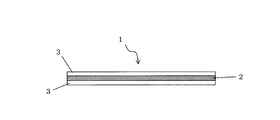
- FIG. 1 is a cross-sectional view schematically showing a cross section of a sheet material 1 having protective layers 3 disposed on both sides of the resin layer 2 in the thickness direction.
- the sheet material 1 is formed by laminating two protective layers 3 with a sheet-like resin layer 2 interposed therebetween, and the two layers of the resin layer 2 are in contact with each other.
- a protective layer 3 is provided. That is, the resin layer 2 and the protective layer 3 are laminated so as to contact each other.
- the product of the tensile modulus (MPa) and the thickness (mm) of the sheet material 1 is preferably 750 MPa ⁇ mm or less, and more preferably 600 MPa ⁇ mm or less. Since the product is 750 MPa ⁇ mm or less, the resin layer is deformed in accordance with a force during processing when the sheet material 1 is bent, and an interlayer between the protective layer 3 and the resin layer 2 is formed. There is an advantage that peeling is suppressed. Moreover, it is preferable that the product of a tensile elasticity modulus (MPa) and thickness (mm) is 100 Mpa * mm or more at the point that the said sheet
- the tensile modulus is obtained by performing a tensile test at 23 ° C. based on JIS K7161. In detail, it calculates
- the resin layer 2 is formed in a sheet shape and contains a thermoplastic resin having nitrogen or sulfur in the molecule.
- the resin layer 2 may include other thermoplastic resins other than the thermoplastic resin having nitrogen or sulfur in the molecule.
- thermoplastic resin having nitrogen (N) in the molecule examples include a polyamide resin; a polyetherimide (PEI) resin having a plurality of aromatic hydrocarbons, an imide bond and an ether bond in the molecule; Thermoplastic polyamide-imide resins having a plurality of imide bonds and a plurality of amide bonds; aromatic-containing vinyl resins such as a copolymer of acrylonitrile, butadiene and styrene (ABS resin), and the like.
- a polyamide resin is preferable at the point that the moldability of the said resin layer 2 when processing the said sheet
- thermoplastic resin having sulfur (S) in the molecule examples include polysulfone resin; polyphenylene sulfide (PPS) resin having a plurality of aromatic hydrocarbons and a plurality of sulfide bonds (—S—) in the molecule. Can be mentioned.
- thermoplastic resin having nitrogen or sulfur in the molecule it has a nitrogen (N) -containing polar functional group or a sulfur (S) -containing polar functional group in the molecule, and is rubbery at room temperature (20 ° C.).
- the thermoplastic elastomer resin which shows is mentioned.
- the nitrogen (N) -containing polar functional group include —NRR ′, —NHR, —NH 2 ,> C ⁇ N—, —CN, —NCO, —OCN, —SCN, —NO, —NO 2 , —CONH. 2 , —CONHR, —CONH—,> C ⁇ NH, and the like.
- an isocyanate group (—NCO) or an amino group such as —NRR ′, —NHR, and —NH 2 is preferred.
- sulfur (S) -containing polar functional group include —SH, —SO 3 H, —SO 2 H, —SOH,> C ⁇ S, —CH ⁇ S, —CSOR, and the like.
- R and R ′ in the functional group represent a hydrogen atom, an alkyl group, an aryl group, or the like.
- the thermoplastic elastomer resin include polyurethane, nitrile, and polyamide thermoplastic elastomer resins.
- thermoplastic resin a thermoplastic having nitrogen in the molecule in that delamination between the protective layer 3 and the resin layer 2 when the sheet material 1 is bent is further suppressed.
- the polyamide resin as a resin, or the polysulfone resin or the polyphenylene sulfide resin as a thermoplastic resin having sulfur in the molecule is preferable. That is, the thermoplastic resin is preferably at least one selected from the group consisting of the polyamide resin, the polysulfone resin, and the polyphenylene sulfide resin.
- the resin layer 2 contains the polyamide resin in that delamination between the protective layer 3 and the resin layer 2 when the sheet material 1 is bent is further suppressed.
- the polysulfone resin is further included. Since the thermoplastic resin contains a polyamide resin having a relatively high polarity, the resin layer 2 can be more closely attached to the protective layer 3. There is an advantage that the delamination of is suppressed more. Further, since the thermoplastic resin further contains the polysulfone resin, the fluidity of the resin layer 2 becomes more stable, and the shape when the sheet material 1 is processed into a three-dimensional shape is obtained. There is an advantage that the transferability is further improved. Further, the advantage that the resin layer 2 is further excellent in heat resistance, specifically, for example, the heat generated from the coil while the motor bobbin as a three-dimensional object for electric insulation maintains electric insulation. There is an advantage that it becomes more resistant to.
- the polyamide resin is obtained by polymerizing at least a polyamine compound and a polycarboxylic acid compound by dehydration condensation.
- the polyamide resin examples include an aromatic polyamide resin having an aromatic hydrocarbon in the molecule and an aliphatic polyamide resin having only an aliphatic hydrocarbon as a hydrocarbon in the molecule.
- numerator is preferable at the point that the said resin layer 2 can become the thing excellent in heat resistance.
- the polyamide resin is an aromatic polyamide resin having an aromatic hydrocarbon in the molecule, specifically, for example, a motor bobbin as a three-dimensional object for electric insulation maintains electric insulation. There is an advantage that it is more resistant to heat generated from the coil.
- the aromatic polyamide resin having an aromatic hydrocarbon in the molecule includes a wholly aromatic polyamide resin having only an aromatic hydrocarbon as a hydrocarbon in the molecule, an aliphatic hydrocarbon and an aromatic as a hydrocarbon in the molecule. Examples thereof include semi-aromatic polyamide resins having both hydrocarbons.
- the aromatic polyamide resin having an aromatic hydrocarbon in the molecule the semi-aromatic polyamide resin is excellent in that the resin layer 2 is excellent in heat resistance and is more difficult to delaminate between the protective layer 3. preferable.
- polyamine compound used in the polymerization of the polyamide resin include a diamine compound.
- diamine compound include aliphatic diamines containing linear or branched hydrocarbon groups, alicyclic diamines containing cyclic saturated hydrocarbon groups, and aromatic diamines containing aromatic hydrocarbon groups. .
- R 1 in the following formula (1) represents an aliphatic hydrocarbon group having 4 to 12 carbon atoms, or an alicyclic hydrocarbon group having 4 to 12 carbon atoms including a cyclic saturated hydrocarbon, or Represents a hydrocarbon group containing an aromatic ring.
- R 1 in the following formula (1) represents an aliphatic hydrocarbon group having 4 to 12 carbon atoms, or an alicyclic hydrocarbon group having 4 to 12 carbon atoms including a cyclic saturated hydrocarbon, or Represents a hydrocarbon group containing an aromatic ring.
- nonanediamine having 9 carbon atoms in R 1 in formula (1) is preferable in that the resin layer 2 can be more excellent in electrical insulation, and 1,9-nonanediamine and 2 More preferred is a mixture of -methyl-1,8-octanediamine.
- aromatic diamine include phenylenediamine and xylylenediamine.
- polycarboxylic acid compound used in the polymerization of the polyamide resin include a dicarboxylic acid compound.
- dicarboxylic acid compound examples include an aliphatic dicarboxylic acid containing a linear or branched hydrocarbon group, an alicyclic dicarboxylic acid containing a cyclic saturated hydrocarbon group, and an aromatic dicarboxylic acid containing an aromatic hydrocarbon group. Etc.
- Examples of the aliphatic dicarboxylic acid, the alicyclic dicarboxylic acid, or the aromatic dicarboxylic acid include those represented by the following formula (2).
- R 2 in the following formula (2) represents an aliphatic hydrocarbon group having 4 to 25 carbon atoms, or an alicyclic hydrocarbon group having 4 to 12 carbon atoms including a cyclic saturated hydrocarbon, or Represents a hydrocarbon group containing an aromatic ring.
- Examples of the aliphatic dicarboxylic acid include adipic acid and sebacic acid.
- Examples of the aromatic dicarboxylic acid include terephthalic acid, methyl terephthalic acid, and naphthalene dicarboxylic acid.
- terephthalic acid can be used because the heat resistance of the polyamide resin can be further improved. Acid is preferred.
- the polyamide resin may be one obtained by polymerizing one kind of diamine compound and one kind of dicarboxylic acid compound, or may be one obtained by polymerizing a combination of plural kinds of each compound. Good. Further, if necessary, a material obtained by further polymerizing a compound other than the diamine compound and the dicarboxylic acid compound may be used.
- the polyamide resin is preferably the semi-aromatic polyamide resin.
- the semi-aromatic polyamide resin an aliphatic diamine as a diamine compound and an aromatic dicarboxylic acid as a dicarboxylic acid compound are polymerized. More preferred are those obtained by polymerizing nonanediamine as an aliphatic diamine and terephthalic acid as an aromatic dicarboxylic acid (PA9T).
- the content of the polyamide resin is preferably 1% by weight or more, and more preferably 10% by weight or more. Moreover, it is preferable that it is 90 weight% or less, and it is more preferable that it is 70 weight% or less.
- the content ratio of the polyamide resin is 1% by weight or more, there is an advantage that delamination between the protective layer 3 and the resin layer 2 when the sheet material 1 is bent is further suppressed.
- the content ratio of the polyamide resin is 90% by weight or less, the fluidity of the resin layer 2 becomes more stable in the bending process such as the drawing process, and the sheet material 1 becomes a three-dimensional shape. There is an advantage that the transferability of the shape when processed is more excellent.
- the polysulfone resin has a plurality of sulfonyl groups in the molecule. That is, it has a molecular structure containing a plurality of sulfonyl groups (—SO 2 —).
- the polysulfone resin include a polyethersulfone resin further having a plurality of ether bonds (—O—) in the molecule, and a polyphenylsulfone resin further having a plurality of aromatic hydrocarbons in the molecule.
- the polysulfone resin include polyether polyphenylsulfone resins further having a plurality of ether bonds and a plurality of aromatic hydrocarbons in the molecule.
- polysulfone resin a polyethersulfone resin or a polyphenylsulfone resin is preferable in that the moldability of the resin layer 2 when the sheet material 1 is three-dimensionally processed becomes preferable.
- Polyphenylsulfone resin is more preferable.
- the polyether polyphenylsulfone resin preferably has a molecular structure represented by the following formula (3).
- polyether polyphenylsulfone resin commercially available products can be used. For example, “Ultra Zone E Series” manufactured by BASF, “Radel A Series” manufactured by Solvay, “ “Sumika Excel series”.
- the content of the polysulfone resin is preferably 20% by weight or more, and more preferably 40% by weight or more. Moreover, it is preferable that the content rate of the said polysulfone resin is 90 weight% or less, and it is more preferable that it is 70 weight% or less.
- the content ratio of the polysulfone resin is 20% by weight or more, there is an advantage that the heat resistance of the resin layer 2 becomes more excellent.
- the resin layer 2 can be more closely attached to the protective layer 3 when the content ratio of the polysulfone resin is 90% by weight or less, delamination between the resin layer 2 and the protective layer 3 is achieved. There is an advantage that is suppressed more.
- the other thermoplastic resin is not particularly limited.
- a polyacetal (POM) resin having a plurality of oxymethylene (—CH 2 O—) groups in the molecule; heat generated by reaction of bisphenols and epichlorohydrin.
- Plastic polyhydroxy polyether phenoxy resin polyphenylene oxide (PPO) resin such as polyphenylene ether (PPE) resin in which the basic structure of the aromatic hydrocarbon-ether bond is repeated in the molecule; aromatic hydrocarbon in the molecule
- Aromatic polyetherketone (PEK) resin in which the basic structure of ether bond-aromatic hydrocarbon-ketone bond is repeated; aromatic hydrocarbon-ether bond-aromatic hydrocarbon-ether bond-aromatic carbonization in the molecule
- Aromatic polyether ether with repeating hydrogen-ketone bond basic structure Ketone (PEEK) resin Polyolefin resin such as polyethylene, polypropylene, polycycloolefin; Polyester resin such as polyethylene naphthalate (PEN) resin, polybutylene ter
- thermoplastic resins examples include thermoplastic elastomer resins that exhibit rubber-like elasticity at room temperature (20 ° C.).
- thermoplastic elastomer resin examples include polyolefin-based and polyester-based thermoplastic elastomer resins. Specifically, for example, polybutadiene-based thermoplastic elastomers, styrene / butadiene-based thermoplastic elastomers, or styrene -Isoprene block copolymer and the like.
- thermoplastic elastomer resin examples include —COOH (carboxyl group), an acid anhydride group of carboxyl group, —OH,> C ⁇ O, —CH ⁇ O, —COOR (R represents a hydrogen atom, an alkyl group, An aryl group or the like), an epoxy group, or a compound having a polar functional group such as a halogen group in the molecule.
- the polar functional group is preferably a carboxyl group, a carboxyl acid anhydride group, a hydroxy group (—OH), more preferably a carboxyl acid anhydride group, and a maleic acid anhydride (maleic anhydride group). Is more preferable.
- thermoplastic elastomer resin As the thermoplastic elastomer resin, the tensile elastic modulus of the sheet material 1 is further reduced, and the moldability when the sheet material 1 is three-dimensionally processed is further improved.
- a thermoplastic elastomer resin having a group is preferred, and a maleic anhydride-modified polyolefin thermoplastic elastomer is more preferred.
- ethylene-propylene maleic anhydride-modified is used in that the resin layer 2 has a better moldability when the sheet material 1 is three-dimensionally processed.
- a copolymer is preferred.
- the content of the thermoplastic elastomer resin is preferably 0.1% by weight or more, and more preferably 0.5% by weight or more. Moreover, it is preferable that the content rate of the said thermoplastic elastomer resin is 5.0 weight% or less, and it is more preferable that it is 4.0 weight% or less.
- the content ratio of the thermoplastic elastomer resin is 0.1% by weight or more, the tensile modulus of the sheet material 1 becomes smaller, and the moldability when the sheet material 1 is three-dimensionally processed is better. There is an advantage of becoming something.
- the content rate of the said thermoplastic elastomer resin is 5.0 weight% or less, there exists an advantage that the heat resistance of the resin layer 2 can become more excellent.
- the thickness of the resin layer 2 is not particularly limited, and is usually 1 ⁇ m to 500 ⁇ m.
- additives may be blended in the resin layer 2 as long as the effects of the present invention are not impaired.
- the additive include alkylphenol resins, alkylphenol-acetylene resins, xylene resins, coumarone-indene resins, terpene resins, rosin and other tackifiers, brominated flame retardants such as polybromodiphenyl oxide and tetrabromobisphenol A, Chlorinated flame retardants such as chlorinated paraffin and perchlorocyclodecane, phosphorus flame retardants such as phosphate esters and halogen-containing phosphate esters, boron flame retardants, oxide flame retardants such as antimony trioxide, aluminum hydroxide Hydrated metal compounds such as magnesium hydroxide, phenolic, phosphorus, sulfur antioxidants, silica, clay, calcium carbonate, barium carbonate, strontium carbonate, aluminum oxide, magnesium oxide, boron nitride, silicon nitride, nitrid
- aromatic polyamide fibers montmorillonite having a particle size of several nm to several hundred nm, and the like can be mentioned.
- These additives can be used in an amount of, for example, 0.1 to 5 parts by weight with respect to 100 parts by weight of the thermoplastic resin.
- the protective layer 3 protects the resin layer 2.
- the surface of the resin layer 2 is damaged by bending when the sheet material 1 is three-dimensionally formed by bending. It is suppressed.
- the protective layer 3 is not particularly limited as long as it is a sheet. Further, the thickness of the protective layer 3 is not particularly limited, and is usually 10 to 100 ⁇ m.
- the protective layer 3 examples include non-woven fabric, paper, or film.
- the protective layer 3 is preferably a nonwoven fabric or paper in that the electrical insulation property of the three-dimensionally shaped electrically insulating material is more excellent.
- Examples of the protective layer 3 include those prepared by a wet papermaking method and those prepared by a dry method in the air.
- the protective layer 3 is preferably paper produced by a wet papermaking method in that the electrical insulation property of the three-dimensionally shaped electrically insulating material is more excellent.
- Examples of the material of the protective layer 3 include synthetic polymer compounds such as polyamide and polyester, natural polymer compounds such as cellulose, and the like. Polyamide or polyester is preferable in that delamination between the protective layer 3 and the resin layer 2 when bent is further suppressed.
- the polyamide includes a wholly aromatic polyamide in which all of the constituent monomers have aromatic hydrocarbons, an aliphatic polyamide in which all of the constituent monomers have only aliphatic hydrocarbons, and a semi-aromatic in which some of the constituent monomers have aromatic hydrocarbons.
- Aromatic polyamides and the like are listed, and the electrical insulation of the three-dimensionally shaped object for electrical insulation is excellent, and delamination between the protective layer 3 and the resin layer 2 when the sheet material 1 is bent is further suppressed. Therefore, wholly aromatic polyamides are preferred. That is, it is preferable that the protective layer 3 contains the wholly aromatic polyamide.
- the protective layer 3 is more preferably a wholly aromatic polyamide paper containing wholly aromatic polyamide fibers in that the three-dimensionally shaped electrically insulating material is more excellent in electrical insulation. That is, a wholly aromatic polyamide paper produced by a wet papermaking method using a wholly aromatic polyamide fiber is more preferable.
- the wholly aromatic polyamide paper examples include, for example, a wholly aromatic polyamide fiber obtained by fiberizing a condensation polymerization product (fully aromatic polyamide) of phenylenediamine and phthalic acid, which includes a benzene ring except for an amide group. Are formed as the main constituent material.
- the wholly aromatic polyamide paper preferably has a basis weight of 5 g / m 2 or more in terms of excellent mechanical properties and good handling in the production process of the three-dimensionally shaped electrically insulating material. When the basis weight is 5 g / m 2 or more, an insufficient mechanical strength is suppressed, and there is an advantage that it is difficult to break during the production of the three-dimensionally shaped object for electrical insulation.
- the other components can be added to the wholly aromatic polyamide paper as long as the effects of the present invention are not impaired.
- the other components include polyphenylene sulfide fibers, polyether ether ketone fibers, polyester fibers, and arylates.
- examples thereof include organic fibers such as fibers, liquid crystal polyester fibers, and polyethylene naphthalate fibers, or inorganic fibers such as glass fibers, rock wool, asbestos, boron fibers, and alumina fibers.
- the wholly aromatic polyamide paper include those commercially available from DuPont under the trade name “NOMEX”.
- polyester used as the material for the protective layer 3 examples include polyethylene terephthalate, polyethylene naphthalate, polytrimethylene terephthalate, and polybutylene terephthalate.
- polyester polyethylene terephthalate is preferable in that it is excellent in flexibility and delamination between the protective layer 3 and the resin layer 2 when the sheet material 1 is bent is further suppressed.
- the protective layer 3 preferably contains polyethylene terephthalate, and the protective layer 3 is preferably polyethylene terephthalate paper containing polyethylene terephthalate fibers.
- the polyethylene terephthalate paper for example, those commercially available from DuPont under the trade name “NOMEX LT” can be used.
- the protective layer 3 is preferably subjected to a corona treatment on the resin layer 2 side.
- the corona treatment is advantageous in that delamination between the protective layer 3 and the resin layer 2 can be further suppressed.
- the corona treatment is a treatment in which one surface of the protective layer 3 in contact with the resin layer 2 is subjected to a discharge treatment to generate a carboxyl group or a hydroxyl group having polarity to be roughened.
- a conventionally known general method can be employed.
- the sheet material 1 is provided with a protective layer 3 so as to be in contact with both surfaces of the resin layer 2, and the resin layer 2 and the protective layer 3 are separated from each other by the cohesive failure force of the resin layer 2 and the protective layer 3. It is preferable that the interlayer adhesive force is increased. With such a configuration, delamination between the resin layer 2 and the protective layer 3 is suppressed.
- the sheet material 1 usually has a dielectric breakdown voltage (BDV) value of 2 kV or more as an index of electrical insulation measured based on JIS K6911.
- BDV dielectric breakdown voltage
- the sheet material 1 preferably does not include a layer containing a resin cured by molecular crosslinking. That is, it is preferable not to include a layer containing a resin cured by three-dimensional crosslinking. By not providing such a layer, there is an advantage that the shape transferability when the sheet material 1 is bent is more excellent.
- the sheet material 1 preferably has a melting point of the resin layer 2 equal to or lower than that of the protective layer 3.
- the melting point of the resin layer 2 is equal to or lower than the melting point of the protective layer 3, for example, during the bending process such as drawing with heating, the thermal deformation of the resin layer 2 becomes more stable.
- the fluidity of the layer 2 becomes more stable.
- the dimensional stability of the sheet material 1 becomes better after bending such as drawing.
- the protective layer 3 includes the synthetic polymer compound, and is included in the protective layer 3 and at least one structural unit constituting the thermoplastic resin included in the resin layer 2. It is preferable that at least one structural unit constituting the synthetic polymer compound is the same. Specifically, at least one structural unit constituting the thermoplastic resin or the synthetic polymer compound contained in each of the resin layer 2 and the protective layer 3 is an amide group, a carboxyl group, or a hydroxy group. It is preferable that it is an amide group.
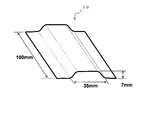
- FIG. 2 is a perspective view of a specific example of the three-dimensional object for electrical insulation as viewed obliquely from above.
- the three-dimensional object 10 for electrical insulation is formed into a three-dimensional shape by bending the sheet material 1 at least.
- the three-dimensional object 10 for electrical insulation for example, as shown in FIG. 2, in the sheet material 1 having a rectangular shape as viewed from above, an end portion of the sheet material 1 along the opposite side is the side. And the like that have been bent by drawing or the like.
- the three-dimensional object 10 for electrical insulation one that is three-dimensionally processed by bending without bonding a plurality of the sheet materials 1 is preferable. That is, it is preferable that one sheet material 1 is three-dimensionally processed by bending such as drawing. Since the one sheet material 1 is three-dimensionally processed, there is no portion where the sheet materials 1 are bonded to each other, so that the bonded portion does not peel off. Specifically, for example, when the three-dimensional object 10 for electrical insulation in which one sheet material 1 is three-dimensionally processed is used for electrical insulation in a motor coil, heat from the motor coil, or motor There is no peeling of the bonded part due to vibrations. Therefore, the leakage due to peeling off of the bonded portion does not occur, and the electrical insulating property of the three-dimensional object 10 for electrical insulation becomes more excellent because there is no bonded portion.
- the three-dimensionally shaped object 10 for electrical insulation has a dielectric breakdown voltage (BDV) value of 2 kV or more as an electrical insulation index measured based on JIS K6911.
- BDV dielectric breakdown voltage
- the three-dimensional object 10 for electrical insulation is preferably used for electrical insulation of motor coils.
- the three-dimensional object 10 for electrical insulation can be manufactured by bending the sheet material 1 after producing the sheet material 1.
- the resin layer 2 of the sheet material 1 can be produced by molding the thermoplastic resin stirred while heating to a predetermined temperature into a sheet shape by a conventionally known general method. Specifically, for example, what is stirred while being heated by a general mixing means such as a kneader, a pressure kneader, a kneading roll, a Banbury mixer, or a twin screw extruder is formed into a sheet by an extruder equipped with a T-die. It can be produced by extruding the material.
- a general mixing means such as a kneader, a pressure kneader, a kneading roll, a Banbury mixer, or a twin screw extruder is formed into a sheet by an extruder equipped with a T-die. It can be produced by extruding the material.
- the protective layer 3 of the sheet material for example, commercially available sheet-like paper or nonwoven fabric can be used.
- seat material 1 can be produced by pressing the thing of the state which pinched
- the three-dimensional object 10 for electrical insulation can be manufactured by bending the sheet material 1 into a three-dimensional shape by various methods. Specific examples of the method of bending the sheet material 1 include bending and drawing. In the drawing process, for example, a hot press process, a vacuum forming process, a pressure forming process, a vacuum / pressure forming process, or the like can be employed.
- the three-dimensional object 10 for electrical insulation can be manufactured while producing the sheet material 1. That is, by producing the sheet material 1 so as to have a predetermined three-dimensional shape, the three-dimensional object 10 for electrical insulation having a three-dimensional shape can be manufactured.
- the three-dimensionally shaped object 10 for electric insulation utilizes the point of having electric insulation, for example, an electric insulation member for a motor in an automobile or the like, an electric insulation member for a transformer (transformer), an electric for a bus bar. It can be used in an insulating member.
- the three-dimensionally shaped electrically insulating material of the present embodiment is as illustrated above, but the present invention is not limited to the three-dimensionally shaped electrically insulating material and electrically insulating sheet material illustrated above. Moreover, the various aspects used in the general three-dimensionally shaped electrical insulating material and the electrically insulating sheet material can be employed within a range not impairing the effects of the present invention.
- a three-dimensionally shaped electrical insulating material obtained by processing a sheet material (shown in FIG. 1) in which one protective layer is disposed on both sides of a sheet-like resin layer into a three-dimensional shape.
- the present invention is not limited to such an embodiment, and a sheet material including a plurality of resin layers between two protective layers may be three-dimensionally processed.
- PA Polyamide
- PA resin Constituent monomer: Hexamethylenediamine, 2-methylpentamethylenediamine, tere
- the pressure of 200 N / cm ⁇ 2 > is used using the hot press machine which pinched
- the produced sheet material was drawn by a vacuum / pressure forming machine (manufactured by Toko Co., Ltd.) to process the sheet material into a three-dimensional shape.
- the processing conditions were a heating temperature of 400 ° C., a pressure of 0.08 MPa, a drawing depth of 7 mm, and a width of 35 mm. In this way, a three-dimensional object for electrical insulation having the shape shown in FIG. 2 was produced.
- Example 2 First, the following raw materials were prepared.
- Polysulfone resin Polyether polyphenylsulfone resin (PES) resin (having a plurality of sulfonyl groups, ether bonds, and aromatic hydrocarbons in the molecule and having a molecular structure of the formula (3)) (Trade name “Radel A-300A” manufactured by Solvay) was used.
- PES Polyether polyphenylsulfone resin
- Example 3 Two fully aromatic polyamide papers as protective layers on both sides of a polyphenylene sulfide (PPS) resin film (100 ⁇ m thick) having a plurality of aromatic hydrocarbons and a plurality of sulfide bonds (-S-) in the molecule ( Using a sheet material having a thickness of 200 ⁇ m (trade name “NSN242” manufactured by Kawamura Sangyo Co., Ltd.) formed by bonding DuPont's product name “NOMEX T410” (50 ⁇ m thick) in the same manner as in Example 1, a solid for electrical insulation A shape was produced.
- PPS polyphenylene sulfide
- Example 4 Except for using a resin layer prepared in the same manner as in Example 2 and using two sheets of polyethylene terephthalate paper (trade name “NOMEX LT”, thickness 60 ⁇ m, manufactured by DuPont) as the protective layer, the same as in Example 1. Thus, a three-dimensional object for electrical insulation was manufactured.
- PEN Polyethylene naphthalate
- PEN Polyethylene naphthalate
- Adhesive Polyacrylic cross-linked adhesive manufactured by Nitto Shinko
- Fully aromatic polyamide paper DuPont brand name “NOMEX T410” thickness 50 ⁇ m
- the above-mentioned adhesive was applied to both surfaces of the film so that the thickness after curing was 30 ⁇ m, placed under drying conditions at 120 ° C. for 3 minutes, further pasted with the above-mentioned polyamide paper, and at 0.degree. Pressurization was performed under a pressure condition of 2 MPa.
- Comparative Example 2 Comparative Example 1 except that the same PEN film having a thickness of 75 ⁇ m, the same polyamide paper having a thickness of 75 ⁇ m, and the adhesive was applied so that the thickness after curing was 15 ⁇ m. Similarly, a sheet material having a thickness of 255 ⁇ m was produced, and the sheet material was further processed into a three-dimensional shape in the same manner as in Example 1 to produce a three-dimensional object.
- Comparative Example 3 Except for using a similar PEN film with a thickness of 75 ⁇ m, using a similar polyamide paper with a thickness of 75 ⁇ m, and applying an adhesive so that the thickness after curing is 15 ⁇ m, the same as in Comparative Example 1.
- a sheet material having a thickness of 255 ⁇ m was produced. Further, the manufactured sheet material was cut into an appropriate size and vacuum-formed in the same manner as described above to prepare A, B, and C sheet materials as shown in FIG. And each sheet
- ⁇ Measurement of tensile modulus of sheet material> the tensile modulus was measured in the extrusion direction (MD direction) and the orthogonal direction (TD direction) of the sheet material at 23 ° C. under the tensile conditions of 200 mm / min and the marked line of 100 mm. .
- the thickness of the sheet material was added to the tensile elastic modulus to the measured tensile elastic modulus, and the value of tensile elastic modulus ⁇ thickness (MPa ⁇ mm) was calculated.
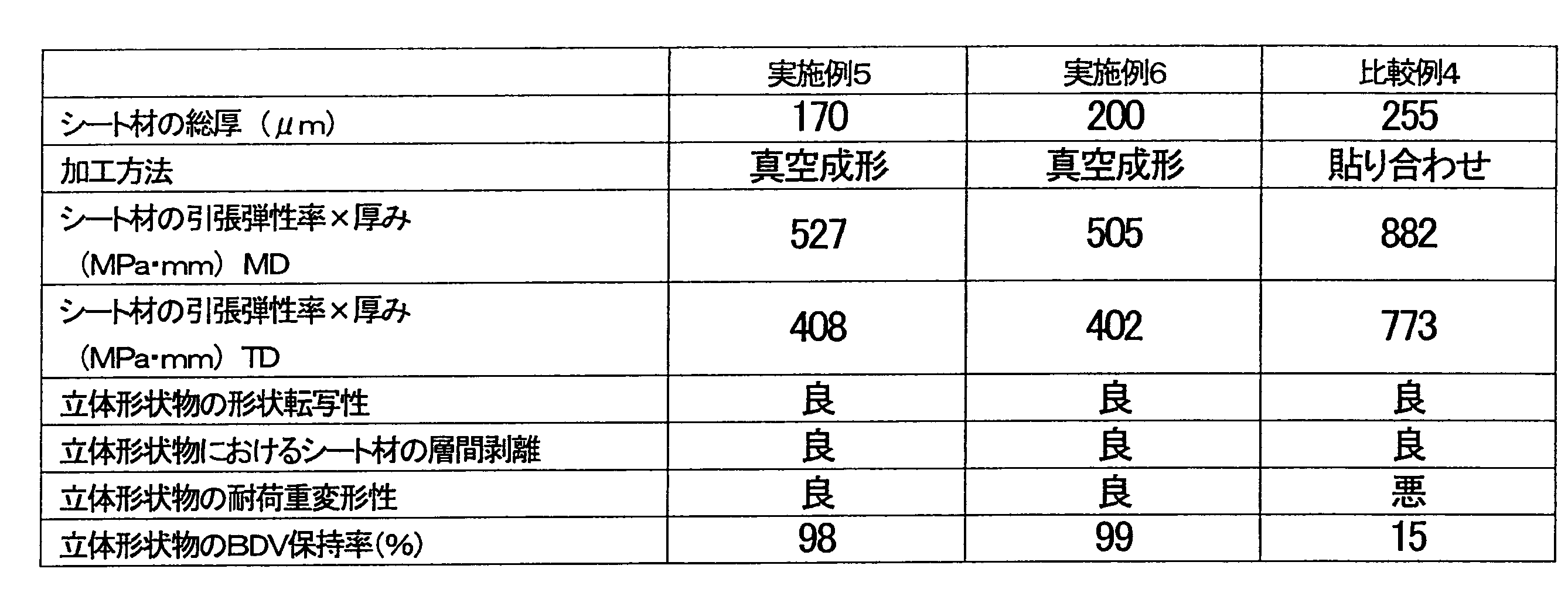
- Table 1 shows the results of each evaluation test.
- Example 5 a sheet material having a thickness of 170 ⁇ m was produced in the same manner as in Example 1. Next, the produced sheet material was drawn by a vacuum / pressure forming machine (manufactured by Toko Co., Ltd.) to process the sheet material into a three-dimensional shape.
- the processing conditions were a heating temperature of 400 ° C., a pressure of 0.08 MPa, a drawing depth of 7 mm, a long side of 100 mm, and a short side of 35 mm. In this way, a three-dimensional object for electrical insulation that was three-dimensionally processed without bonding the sheet material was manufactured.
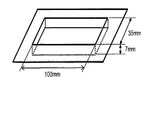
- a box member (F) having a rectangular bottom portion as viewed from above and a side wall portion extending upward from an edge along the circumferential direction of the bottom portion, and an outer side from the upper end along the circumferential direction of the box member.
- a three-dimensional object for electrical insulation having the shape shown in FIG. 5 provided with a flange member (G) extending toward the side was manufactured.
- Example 6 A three-dimensionally shaped electrically insulating product having the shape shown in FIG. 5 was produced in the same manner as in Example 5 except that the sheet material produced in the same manner as in Example 2 was used.
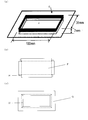
- Comparative Example 4 The sheet material produced in Comparative Example 3 was cut to an appropriate size in order to manufacture a three-dimensionally shaped object by bonding together the box member F and the flange member G constituting the three-dimensionally shaped object shown in FIG. That is, the sheet material is cut out so as to have the shape shown in FIG. 6B, bent along the broken line shown in FIG. 6B, and the adhesive portion H attached to the side wall portion is attached to the adjacent side wall portion. Thus, a box member F was produced. Further, the sheet material is cut out so as to have the shape shown in FIG. 6C, bent along the broken line shown in FIG. 6C, and the adhesive portion H attached to the flange member is attached to the side wall portion of the box member F.
- a three-dimensional object was manufactured by pasting on the inner side. The pasting was performed using the above-mentioned polyacrylic crosslinking adhesive applied to the bonding portion H. Further, the three-dimensional object shown in FIG. 6 was manufactured so as to have a shape and size almost equal to the shape and size of the three-dimensional object shown in FIG.
- the three-dimensionally shaped electrically insulating material of the present invention can be suitably used as an electrically insulating member having a three-dimensional shape. Specifically, for example, it is suitable for applications such as an electrical insulation member disposed around the coil wire of a motor, a transformer, a bus bar, a capacitor, an electrical insulation member for a cable, or an insulation member of an electronic circuit board. is there.
Landscapes
- Physics & Mathematics (AREA)
- Spectroscopy & Molecular Physics (AREA)
- Chemical & Material Sciences (AREA)
- Chemical Kinetics & Catalysis (AREA)
- Engineering & Computer Science (AREA)
- Power Engineering (AREA)
- Textile Engineering (AREA)
- Laminated Bodies (AREA)
- Organic Insulating Materials (AREA)
Abstract
Description
また、前記保護層が不織布であることが好ましい。
図1に示すように、前記シート材1は、シート状の樹脂層2を介して、2層の保護層3が貼り合わされて形成されており、樹脂層2の両面に接するように2層の保護層3が配されている。即ち、樹脂層2と保護層3とが互いに接するように積層されている。
前記窒素(N)含有極性官能基としては、-NRR’、-NHR、-NH2、>C=N-、-CN、-NCO、-OCN、-SCN、-NO、-NO2、-CONH2、-CONHR、-CONH-、>C=NH等が挙げられる。なかでも、イソシアネート基(-NCO)、又は、-NRR’、-NHR、-NH2などのアミノ基が好ましい。
前記硫黄(S)含有極性官能基としては、-SH、-SO3H、-SO2H、-SOH、>C=S、-CH=S、-CSOR等が挙げられる。
なお、上記官能基におけるR、R’は、水素原子、アルキル基、アリール基等を示す。
前記熱可塑性エラストマー樹脂としては、具体的には、例えば、ポリウレタン系、ニトリル系、又はポリアミド系の各熱可塑性エラストマー樹脂などが挙げられる。
具体的には、前記樹脂層2は、前記シート材1を曲げ加工したときの前記保護層3と前記樹脂層2との間の層間剥離がより抑制されるという点で、前記ポリアミド樹脂を含んでいることが好ましい。また、前記ポリスルホン樹脂をさらに含んでいることがより好ましい。
前記熱可塑性樹脂が、比較的高い極性を有するポリアミド樹脂を含んでいることにより、前記樹脂層2がより前記保護層3と密着し得ることから、前記樹脂層2と前記保護層3との間の層間剥離がより抑制されるという利点がある。また、前記熱可塑性樹脂が、さらに前記ポリスルホン樹脂を含んでいることにより、前記樹脂層2の流動性がより安定なものになり、前記シート材1が立体形状物に加工されたときの形状の転写性がより優れたものになるという利点がある。また、前記樹脂層2がさらに耐熱性に優れたものになるという利点、具体的には、例えば、電気絶縁用立体形状物としてのモーター用ボビンが、電気絶縁性を維持しつつコイルから生じる熱に対してより耐性に優れたものになるという利点がある。
分子中に芳香族炭化水素を有する芳香族ポリアミド樹脂としては、樹脂層2が耐熱性に優れ、前記保護層3との間でより層間剥離しにくくなるという点で、前記半芳香族ポリアミド樹脂が好ましい。
該ジアミン化合物としては、直鎖状又は分岐鎖状の炭化水素基を含む脂肪族ジアミン、環状の飽和炭化水素基を含む脂環族ジアミン、芳香族炭化水素基を含む芳香族ジアミンなどが挙げられる。
H2N-R1-NH2 ・・・(1)
前記芳香族ジアミンとしては、フェニレンジアミン、キシリレンジアミンなどが挙げられる。
該ジカルボン酸化合物としては、直鎖状又は分岐鎖状の炭化水素基を含む脂肪族ジカルボン酸、環状の飽和炭化水素基を含む脂環族ジカルボン酸、芳香族炭化水素基を含む芳香族ジカルボン酸などが挙げられる。
HOOC-R2-COOH ・・・(2)
前記芳香族ジカルボン酸としては、テレフタル酸、メチルテレフタル酸、ナフタレンジカルボン酸などが挙げられ、該芳香族ジカルボン酸としては、前記ポリアミド樹脂の耐熱性がより優れたものになり得るという点で、テレフタル酸が好ましい。
前記ポリアミド樹脂の含有割合が1重量%以上であることにより、前記シート材1を曲げ加工したときの前記保護層3と前記樹脂層2との間の層間剥離がより抑制されるという利点がある。また、前記ポリアミド樹脂の含有割合が90重量%以下であることにより、絞り加工などの曲げ加工において、前記樹脂層2の流動性がより安定なものになり、前記シート材1が立体形状物に加工されたときの形状の転写性がより優れたものになるという利点がある。
該ポリスルホン樹脂としては、分子中に複数のエーテル結合(-O-)をさらに有するポリエーテルスルホン樹脂、又は、分子中に複数の芳香族炭化水素をさらに有するポリフェニルスルホン樹脂などが挙げられる。また、該ポリスルホン樹脂としては、分子中に複数のエーテル結合と複数の芳香族炭化水素とをさらに有するポリエーテルポリフェニルスルホン樹脂が挙げられる。

前記ポリスルホン樹脂の含有割合が20重量%以上であることにより、樹脂層2の耐熱性がより優れたものになるという利点がある。また、前記ポリスルホン樹脂の含有割合が90重量%以下であることにより、前記樹脂層2がより前記保護層3と密着し得ることから、前記樹脂層2と前記保護層3との間の層間剥離がより抑制されるという利点がある。
また、該熱可塑性エラストマー樹脂としては、-COOH(カルボキシル基)、カルボキシル基の酸無水物基、-OH、>C=O、-CH=O、-COOR(Rは、水素原子、アルキル基、アリール基等を示す)、エポキシ基、又は、ハロゲン基などの極性官能基を分子中に有するものなどが挙げられる。
前記極性官能基としては、カルボキシル基、カルボキシル基の酸無水物基、ヒドロキシ基(-OH)などが好ましく、カルボキシル基の酸無水物基がより好ましく、マレイン酸の酸無水物(無水マレイン酸基)がさらに好ましい。
前記熱可塑性エラストマー樹脂の含有割合が0.1重量%以上であることにより、シート材1の引張弾性率がより小さくなり、前記シート材1を立体的に加工するときの成形性がより良好なものになるという利点がある。また、前記熱可塑性エラストマー樹脂の含有割合が5.0重量%以下であることにより、樹脂層2の耐熱性がより優れたものになり得るという利点がある。
該添加剤としては、例えば、アルキルフェノール樹脂、アルキルフェノール-アセチレン樹脂、キシレン樹脂、クマロン-インデン樹脂、テルペン樹脂、ロジンなどの粘着付与剤、ポリブロモジフェニルオキサイド、テトラブロモビスフェノールAなどの臭素系難燃剤、塩素化パラフィン、パークロロシクロデカンなどの塩素系難燃剤、リン酸エステル、含ハロゲンリン酸エステルなどのリン系難燃剤、ホウ素系難燃剤、三酸化アンチモンなどの酸化物系難燃剤、水酸化アルミニウム、水酸化マグネシウムなどの水和金属化合物、フェノール系、リン系、硫黄系の酸化防止剤、シリカ、クレー、炭酸カルシウム、炭酸バリウム、炭酸ストロンチウム、酸化アルミニウム、酸化マグネシウム、窒化硼素、窒化珪素、窒化アルミニウムといった無機フィラー、ガラス繊維などの無機繊維、熱安定剤、光安定剤、紫外線吸収剤、滑剤、顔料、架橋剤、架橋助剤、シランカップリング剤、チタネートカップリング剤などの一般的なプラスチック用配合成分などが挙げられる。また、芳香族ポリアミド繊維、数nm~数百nmの粒径のモンモリロナイトなどが挙げられる。これら添加剤は、前記熱可塑性樹脂100重量部に対して、例えば0.1~5重量部用いることができる。
前記保護層3は、シート状のものであれば特に限定されない。
また、前記保護層3は、厚みが特に限定されるものではなく、通常、10~100μmである。
前記保護層3としては、電気絶縁用立体形状物の電気絶縁性がより優れたものになるという点で、湿式抄紙法により作製された紙が好ましい。
前記全芳香族ポリアミド紙は、力学的特性に優れ、電気絶縁用立体形状物の製造工程におけるハンドリングが良好であるという点で、坪量が5g/m2以上であることが好ましい。坪量が5g/m2以上であることにより、力学的強度の不足が抑制され電気絶縁用立体形状物の製造中に破断しにくいという利点がある。
なお、前記全芳香族ポリアミド紙には、本発明の効果を損なわない範囲において他の成分を加えることができ、該他の成分としては、ポリフェニレンスルフィド繊維、ポリエーテルエーテルケトン繊維、ポリエステル繊維、アリレート繊維、液晶ポリエステル繊維、ポリエチレンナフタレート繊維などの有機繊維、又は、ガラス繊維、ロックウール、アスベスト、ボロン繊維、アルミナ繊維などの無機繊維が挙げられる。
前記全芳香族ポリアミド紙としては、例えば、デュポン社より商品名「ノーメックス」で市販されているもの等を用いることができる。
前記ポリエチレンテレフタレート紙としては、例えば、デュポン社より商品名「ノーメックスLT」で市販されているもの等を用いることができる。
前記コロナ処理は、樹脂層2と接する保護層3の一方の面に放電処理を行い、極性を持つカルボキシル基や水酸基を生成させ粗面化する処理である。前記コロナ処理においては、従来公知の一般的な方法を採用することができる。
前記電気絶縁用立体形状物10としては、具体的には例えば、図2に示すように、上方視矩形状の前記シート材1において、対向する辺に沿ったシート材1の端部が該辺に沿って、絞り加工などによって曲げ加工されたもの等が挙げられる。
前記シート材1の保護層3としては、例えば、市販されているシート状の紙や不織布を用いることができる。
そして、前記シート材1は、例えば、2枚の保護層3で樹脂層2を挟み込んだ状態のものを押圧することなどにより作製することができる。
さらに、様々な方法によって前記シート材1を立体的な形状に曲げ加工することにより、前記電気絶縁用立体形状物10を製造することができる。
前記シート材1の曲げ加工の方法としては、具体的には例えば、折り曲げ加工、絞り加工などが挙げられる。前記絞り加工においては、例えば、加熱プレス加工、真空成形加工、圧空成形加工、真空圧空成形加工等を採用することができる。
なお、前記電気絶縁用立体形状物10は、前記シート材1を作製しつつ製造することができる。即ち、前記シート材1を所定の立体的な形状になるように作製することにより、立体的な形状を有する電気絶縁用立体形状物10を製造することができる。
また、一般の電気絶縁用立体形状物及び電気絶縁性シート材において用いられる種々の態様を、本発明の効果を損ねない範囲において、採用することができる。
まず、下記の原料を用意した。
・ポリアミド(PA)樹脂(構成モノマー:
ヘキサメチレンジアミン、2-メチルペンタメチレンジアミン、テレフタル酸)
(デュポン社製 商品名「ザイテルHTN501」)
・熱可塑性のポリヒドロキシポリエーテルフェノキシ樹脂
(ビスフェノール類とエピクロルヒドリンとが反応したもの、
重量平均分子量:52000)
(東都化成社製 商品名「フェノトートYP-50S」)
次に、「ザイテルHTN501」(PA樹脂)/「フェノトートYP-50S」(ポリヒドロキシポリエーテルフェノキシ樹脂)=60/40の重量比になるように、2軸混練機(テクノベル社製)を用いて310℃で混合し、樹脂混合物を調製した。
続いて、樹脂混合物を押出成形により310℃で70μm厚のシート状に成形して樹脂層を形成した。
一方、2枚の全芳香族ポリアミド紙(デュポン社製 商品名「ノーメックスT410」厚み50μm)を保護層として用意した。さらに、それぞれの保護層の樹脂層と接する側の面には、コロナ処理を施した。コロナ処理は、機器としてPILLAR TECHNOLOGIES社製「500シリーズ」を用いて、大気圧下で、出力500W、処理速度4m/分、試料幅0.4mの条件により行った。
そして、作製した樹脂層の両面側に2枚の全芳香族ポリアミド紙を配置した状態のものを2枚の金属板で挟み、350℃に加熱した熱プレス機を用いて、圧力200N/cm2で60秒間プレスし、樹脂層の両面側に2枚の保護層を備えた170μm厚のシート材を作製した。
作製したシート材を真空圧空成形機(トーコー社製)によって絞り加工することにより、シート材を立体的形状に加工した。加工条件は、加熱温度400℃、圧力0.08MPa、絞り深さ7mm、幅35mmとした。このようにして、図2に示す形状の電気絶縁用立体形状物を製造した。
まず、下記の原料を用意した。
・ポリスルホン樹脂:ポリエーテルポリフェニルスルホン樹脂(PES)樹脂
(分子中にスルホニル基、エーテル結合、及び芳香族炭化水素を複数有し且つ式(3)の分子構造を有する)
(ソルベイ社製 商品名「レーデルA-300A」)を用いた。
・5重量%濃度の無水マレイン酸変性ポリオレフィン系熱可塑性エラストマーと、
95重量%濃度のポリアミド(PA)樹脂との混合物
(クラレ社製 商品名「ジェネスタN1001A」)
(無水マレイン酸変性ポリオレフィン系熱可塑性エラストマー;
エチレン-プロピレン無水マレイン酸変性共重合体(EPMA))
(PA樹脂;分子中にテレフタル酸単位及びノナンジアミン単位を有するPA9T)
次に、PES樹脂、PA樹脂、及びEPMAがPES/PA/EPMA=80/19/1の重量比になるように、2軸混練機(テクノベル社製)を用いて310℃で混合し、樹脂混合物を調製した。
続いて、樹脂混合物を押出成形により310℃で100μm厚のシート状に成形して樹脂層を形成した。
その後、実施例1と同様にして200μm厚のシート材を作製し、さらに、実施例1と同様にして電気絶縁用立体形状物を製造した。
分子中に複数の芳香族炭化水素及び複数のスルフィド結合(-S-)を有するポリフェニレンスルフィド(PPS)樹脂フィルム(100μm厚)の両面側に、保護層としての2枚の全芳香族ポリアミド紙(デュポン社製 商品名「ノーメックスT410」厚み50μm)を貼り合わせて形成された厚み200μmのシート材(河村産業社製 商品名「NSN242」)を用いて、実施例1と同様にして電気絶縁用立体形状物を製造した。
樹脂層として実施例2と同様にして作製したものを用い、保護層として2枚のポリエチレンテレフタレート紙(デュポン社製 商品名「ノーメックスLT」厚み60μm)を用いた点以外は、実施例1と同様にして電気絶縁用立体形状物を製造した。
下記の原材料を用意した。
・ポリエチレンナフタレート(PEN)フィルム
(帝人デュポンフィルム社製 商品名「テオネックスQ51 125μm」)
・接着剤 ポリアクリル系架橋型接着剤(日東シンコー社製」)
・全芳香族ポリアミド紙
(デュポン社製 商品名「ノーメックスT410」厚み50μm)
上記フィルムの両面に、硬化後の厚みが30μmとなるように上記の接着剤を塗工し、120℃で3分間の乾燥条件の置き、さらに上記のポリアミド紙を貼り付け、90℃で0.2MPaの加圧条件にて加圧した。そして、130℃で24時間経過させる硬化条件により接着剤を硬化させ、285μm厚のシート材を作製した。
作製したシート材を実施例1と同様にして立体的形状に加工することにより、立体形状物を製造した。
厚み75μmの同様なPENフィルムを用いた点、厚み75μmの同様なポリアミド紙を用いた点、硬化後の厚みが15μmとなるように上記の接着剤を塗工した点以外は、比較例1と同様にして255μm厚のシート材を作製し、さらに該シート材を実施例1と同様にして立体的形状に加工することにより、立体形状物を製造した。
厚み75μmの同様なPENフィルムを用いた点、厚み75μmの同様なポリアミド紙を用いた点、硬化後の厚みが15μmとなるように接着剤を塗布した点以外は、比較例1と同様にして255μm厚のシート材を作製した。
さらに、製造したシート材を適当な大きさに切断し、上記と同様にして真空成形加工することにより、図3に示すようなA、B、及びCの各シート材を用意した。そして、各シート材を図3に示すように配置して、上記のポリアクリル系架橋型接着剤を用いて、比較例1と同様な加圧条件及び硬化条件により、各シート材を貼り合わせた。
JIS K7161に準じて、23℃において、引張速度200mm/分、標線100mmの引張条件にて、シート材の押出方向(MD方向)及びその直交方向(TD方向)について引張弾性率をそれぞれ測定した。測定した引張弾性率にシート材の厚みを引張弾性率に積算し、引張弾性率×厚み(MPa・mm)の値を算出した。
シート材を加工した後における転写された形状の精度を目視で観察することにより、成形性を評価した。
全体的に形状が転写されている:良
部分的に形状が転写されている:やや悪
形状が転写されていない:悪
シート材を加工した後の様子を目視により観察し、層間剥離の程度を確認することにより成形性を評価した。
層間剥離なし:良
部分的な浮きやしわが発生している:やや悪
全体的に浮きやしわが発生している:悪
図4に示すように、製造した立体形状物を配置し、上方側から500gの荷重(E)をかけた状態で200℃にて1時間放置した。その後、目視により状態を観察した。
変形なし:良
部分的に変形しているか又は部分的に貼り合わせ部分が浮いている:やや悪
全体的に変形しているか又は全体的に貼り合わせ部分が浮いている:悪
上記の耐荷重変形性の試験前後の立体形状物において、図4のDに示す傾斜部分の絶縁破壊電圧(BDV)をJIS K6911に基づいて測定した。
上記の耐荷重変形性の試験前のBDV値を初期値とし、該初期値に対する上記の耐荷重変形性の試験後のBDV値を保持率として算出した。

まず、実施例1と同様にして170μm厚のシート材を作製した。
次に、作製したシート材を真空圧空成形機(トーコー社製)によって絞り加工することにより、シート材を立体的形状に加工した。加工条件は、加熱温度400℃、圧力0.08MPa、絞り深さ7mm、長辺100mm、短辺35mmとした。このようにして、シート材を貼り合わせることなく立体的に加工された電気絶縁用立体形状物を製造した。即ち、上方側から見て矩形の底部及び該底部の周方向に沿った端縁から上方側へ延びた側壁部を有する箱部材(F)と、該箱部材の周方向に沿った上端から外方側へ延びたフランジ部材(G)とを備えた図5に示す形状の電気絶縁用立体形状物を製造した。
実施例2と同様にして作製したシート材を用いた点以外は、実施例5と同様にして、図5に示す形状の電気絶縁用立体形状物を製造した。
図6(a)に示す立体形状物を構成する箱部材F及びフランジ部材Gを貼り合わせることにより立体形状物を製造すべく、比較例3で作製したシート材を適当な大きさに切断した。即ち、図6(b)に示す形状となるようにシート材を切り出し、図6(b)に示す破線に沿って折り曲げ、側壁部に取り付けられた接着部分Hを、隣接する側壁部に貼り付けることにより箱部材Fを作製した。さらに、図6(c)に示す形状となるようにシート材を切り出し、図6(c)に示す破線に沿って折り曲げ、フランジ部材に取り付けられた接着部分Hを、箱部材Fの側壁部の内方側に貼り付けることにより立体形状物を製造した。なお、貼り付けは、接着部分Hに塗布した上述のポリアクリル系架橋型接着剤により行った。また、図6に示す立体形状物は、図5に示す立体形状物の形状及び大きさとほぼ等しい形状及び大きさになるように製造した。
Claims (16)
- 電気絶縁性を有するシート材が少なくとも曲げ加工された電気絶縁用立体形状物であって、
前記シート材が、分子中に窒素又は硫黄を有する熱可塑性樹脂を含むシート状の樹脂層と、該樹脂層の両面側にそれぞれ配されたシート状の保護層とを備えていることを特徴とする電気絶縁用立体形状物。 - 前記樹脂層が、ポリアミド樹脂、ポリスルホン樹脂、及び、ポリフェニレンスルフィド樹脂からなる群より選択された少なくとも1種を前記熱可塑性樹脂として含んでいる請求項1記載の電気絶縁用立体形状物。
- 前記ポリアミド樹脂が、分子中に芳香族炭化水素を有する芳香族ポリアミド樹脂である請求項2記載の電気絶縁用立体形状物。
- 前記ポリスルホン樹脂が、分子中に複数のエーテル結合をさらに有するポリエーテルスルホン樹脂である請求項2又は3に記載の電気絶縁用立体形状物。
- 前記ポリスルホン樹脂が、分子中に複数の芳香族炭化水素をさらに有するポリフェニルスルホン樹脂である請求項2~4のいずれか1項に記載の電気絶縁用立体形状物。
- 前記樹脂層が、熱可塑性エラストマー樹脂をさらに含んでいる請求項1~5のいずれか1項に記載の電気絶縁用立体形状物。
- 前記熱可塑性エラストマー樹脂が、無水マレイン酸変性ポリオレフィン系熱可塑性エラストマーである請求項6に記載の電気絶縁用立体形状物。
- 前記シート材の引張弾性率(MPa)と厚み(mm)との積が100MPa・mm~750MPa・mmである請求項1~7のいずれか1項に記載の電気絶縁用立体形状物。
- 前記保護層が全芳香族ポリアミド又はポリエチレンテレフタレートを含んでいる請求項1~8のいずれか1項に記載の電気絶縁用立体形状物。
- 前記保護層が、湿式抄紙法により作製された紙である請求項1~9のいずれか1項に記載の電気絶縁用立体形状物。
- 前記保護層が、全芳香族ポリアミド繊維を含む全芳香族ポリアミド紙又はポリエチレンテレフタレート繊維を含むポリエチレンテレフタレート紙である請求項1~10のいずれか1項に記載の電気絶縁用立体形状物。
- 前記保護層が不織布である請求項1~9のいずれか1項に記載の電気絶縁用立体形状物。
- 前記保護層の少なくとも樹脂層側には、コロナ処理が施されている請求項1~12のいずれか1項に記載の電気絶縁用立体形状物。
- 前記樹脂層の両面に接するように保護層が配され、しかも前記樹脂層及び前記保護層の各凝集破壊力より、前記樹脂層と前記保護層との間の層間接着力が大きくなるように構成されている請求項1~13のいずれか1項に記載の電気絶縁用立体形状物。
- モーターコイルの電気絶縁用途で使用される請求項1~14のいずれか1項に記載の電気絶縁用立体形状物。
- 少なくとも曲げ加工により立体形状物に加工される電気絶縁性シート材であって、
分子中に窒素又は硫黄を有する熱可塑性樹脂を含むシート状の樹脂層と、該樹脂層の両面側にそれぞれ配されたシート状の保護層とを備えていることを特徴とする電気絶縁性シート材。
Priority Applications (4)
| Application Number | Priority Date | Filing Date | Title |
|---|---|---|---|
| KR1020137017669A KR20140043702A (ko) | 2011-04-18 | 2012-04-11 | 전기 절연용 입체 형상물 및 전기 절연성 시트재 |
| US14/110,821 US20140048309A1 (en) | 2011-04-18 | 2012-04-11 | Three-dimensionally shaped electrically insulating product and electrically insulating sheet material |
| CN201280018279.5A CN103477401B (zh) | 2011-04-18 | 2012-04-11 | 电绝缘用立体形状物及电绝缘性片材 |
| EP12773559.5A EP2701162A4 (en) | 2011-04-18 | 2012-04-11 | THREE-DIMENSIONAL OBJECT FOR ELECTRICAL INSULATION AND ELECTRICALLY INSULATED RAIL MATERIAL |
Applications Claiming Priority (2)
| Application Number | Priority Date | Filing Date | Title |
|---|---|---|---|
| JP2011092246 | 2011-04-18 | ||
| JP2011-092246 | 2011-04-18 |
Publications (1)
| Publication Number | Publication Date |
|---|---|
| WO2012144378A1 true WO2012144378A1 (ja) | 2012-10-26 |
Family
ID=47041489
Family Applications (1)
| Application Number | Title | Priority Date | Filing Date |
|---|---|---|---|
| PCT/JP2012/059838 Ceased WO2012144378A1 (ja) | 2011-04-18 | 2012-04-11 | 電気絶縁用立体形状物及び電気絶縁性シート材 |
Country Status (6)
| Country | Link |
|---|---|
| US (1) | US20140048309A1 (ja) |
| EP (1) | EP2701162A4 (ja) |
| JP (1) | JP5964627B2 (ja) |
| KR (1) | KR20140043702A (ja) |
| CN (1) | CN103477401B (ja) |
| WO (1) | WO2012144378A1 (ja) |
Families Citing this family (6)
| Publication number | Priority date | Publication date | Assignee | Title |
|---|---|---|---|---|
| US9773583B2 (en) * | 2014-04-24 | 2017-09-26 | Essex Group, Inc. | Continously transposed conductor |
| US20180118938A1 (en) * | 2015-11-24 | 2018-05-03 | Nitto Shinko Corporation | Resin composition and electric insulating sheet |
| JP7264170B2 (ja) * | 2018-08-27 | 2023-04-25 | 住友電気工業株式会社 | 電気絶縁ケーブル |
| KR102383612B1 (ko) * | 2018-09-19 | 2022-04-19 | 주식회사 아모센스 | 자기장 차폐시트 및 자기장 차폐시트의 제조방법 |
| JP7262272B2 (ja) * | 2019-03-28 | 2023-04-21 | 株式会社オートネットワーク技術研究所 | コネクタ装置 |
| EP4325526A1 (en) * | 2022-08-19 | 2024-02-21 | Ahlstrom Oyj | Electrical insulation paper |
Citations (8)
| Publication number | Priority date | Publication date | Assignee | Title |
|---|---|---|---|---|
| JP2003096698A (ja) * | 2001-09-27 | 2003-04-03 | Unitika Ltd | 耐熱性絶縁紙及びその製造方法 |
| JP2006158070A (ja) * | 2004-11-29 | 2006-06-15 | Yaskawa Electric Corp | 回転電機 |
| JP2007083613A (ja) * | 2005-09-22 | 2007-04-05 | Ntn Corp | 複合誘電性エラストマーシート |
| JP2007276457A (ja) * | 2006-03-16 | 2007-10-25 | Toray Ind Inc | 電気絶縁用シートおよびそれを用いてなるモーター |
| JP2008114216A (ja) * | 2006-10-11 | 2008-05-22 | Toray Ind Inc | 電気絶縁性シートの塗布方法及び薄膜付き電気絶縁性シートロール体の製造方法 |
| JP2008119999A (ja) * | 2006-11-14 | 2008-05-29 | Nitto Shinko Kk | 積層シート |
| JP2008178197A (ja) * | 2007-01-17 | 2008-07-31 | Nitto Shinko Kk | モーター用絶縁紙 |
| JP2010153120A (ja) * | 2008-12-24 | 2010-07-08 | Nitto Shinko Kk | 絶縁シート |
Family Cites Families (17)
| Publication number | Priority date | Publication date | Assignee | Title |
|---|---|---|---|---|
| CA1332013C (en) * | 1987-08-17 | 1994-09-13 | Yuichi Orikasa | Thermoplastic resin composition and method for preparing the same |
| JPH11293012A (ja) * | 1998-04-06 | 1999-10-26 | Asahi Chem Ind Co Ltd | 接着性の改良されたパラ系アラミドフィルム及びその製造方法 |
| JP2000309706A (ja) * | 1999-04-27 | 2000-11-07 | Toray Ind Inc | 射出溶着用樹脂組成物 |
| US20040071952A1 (en) * | 2002-10-01 | 2004-04-15 | Anderson David Wayne | Aramid paper laminate |
| CN1922011A (zh) * | 2003-12-24 | 2007-02-28 | 帝人株式会社 | 层合件 |
| JP2006077043A (ja) * | 2004-09-07 | 2006-03-23 | Sumitomo Chemical Co Ltd | ポリエーテルスルホンの精製方法並びにそれにより得られる高純度ポリエーテルスルホン溶液及び高純度ポリエーテルスルホン |
| US20060068670A1 (en) * | 2004-09-30 | 2006-03-30 | Anderson David W | Electrical insulation laminates and electrical devices containing such laminates |
| EP1802704B1 (en) * | 2004-10-04 | 2014-11-12 | Solvay Specialty Polymers USA, LLC. | High performance membranes, methods of making, and uses thereof |
| JP4875855B2 (ja) * | 2005-05-20 | 2012-02-15 | 日東シンコー株式会社 | 積層シート |
| JP2008280507A (ja) * | 2007-04-10 | 2008-11-20 | Toray Ind Inc | 二軸配向ポリアリーレンスルフィドフィルム、金属化フィルムおよびコンデンサー |
| JP5071481B2 (ja) * | 2007-08-24 | 2012-11-14 | 住友ベークライト株式会社 | 多層配線基板および半導体装置 |
| JP4617513B2 (ja) * | 2007-12-10 | 2011-01-26 | 河村産業株式会社 | アラミド紙及びその製造方法、並びにアラミド−樹脂フィルム積層体 |
| JP4402734B1 (ja) * | 2008-07-30 | 2010-01-20 | 株式会社日立エンジニアリング・アンド・サービス | 無接着剤アラミド−ポリフェニレンサルファイド積層体の製造方法、回転電機の絶縁部材及び絶縁構造 |
| JP5438960B2 (ja) * | 2008-12-24 | 2014-03-12 | 日東シンコー株式会社 | 絶縁シート |
| JP5603029B2 (ja) * | 2009-06-22 | 2014-10-08 | 河村産業株式会社 | 電動機用絶縁シートおよびその製造方法 |
| CN101746097B (zh) * | 2009-12-22 | 2014-04-16 | 上海磁浮交通发展有限公司 | 一种用于交通运输工具的多夹芯成份复合板 |
| EP2594610B1 (en) * | 2010-07-16 | 2018-11-07 | Nitto Shinko Corporation | Electrically insulating resin composition, and laminate sheet |
-
2012
- 2012-03-26 JP JP2012068663A patent/JP5964627B2/ja active Active
- 2012-04-11 WO PCT/JP2012/059838 patent/WO2012144378A1/ja not_active Ceased
- 2012-04-11 EP EP12773559.5A patent/EP2701162A4/en not_active Withdrawn
- 2012-04-11 CN CN201280018279.5A patent/CN103477401B/zh not_active Expired - Fee Related
- 2012-04-11 KR KR1020137017669A patent/KR20140043702A/ko not_active Ceased
- 2012-04-11 US US14/110,821 patent/US20140048309A1/en not_active Abandoned
Patent Citations (8)
| Publication number | Priority date | Publication date | Assignee | Title |
|---|---|---|---|---|
| JP2003096698A (ja) * | 2001-09-27 | 2003-04-03 | Unitika Ltd | 耐熱性絶縁紙及びその製造方法 |
| JP2006158070A (ja) * | 2004-11-29 | 2006-06-15 | Yaskawa Electric Corp | 回転電機 |
| JP2007083613A (ja) * | 2005-09-22 | 2007-04-05 | Ntn Corp | 複合誘電性エラストマーシート |
| JP2007276457A (ja) * | 2006-03-16 | 2007-10-25 | Toray Ind Inc | 電気絶縁用シートおよびそれを用いてなるモーター |
| JP2008114216A (ja) * | 2006-10-11 | 2008-05-22 | Toray Ind Inc | 電気絶縁性シートの塗布方法及び薄膜付き電気絶縁性シートロール体の製造方法 |
| JP2008119999A (ja) * | 2006-11-14 | 2008-05-29 | Nitto Shinko Kk | 積層シート |
| JP2008178197A (ja) * | 2007-01-17 | 2008-07-31 | Nitto Shinko Kk | モーター用絶縁紙 |
| JP2010153120A (ja) * | 2008-12-24 | 2010-07-08 | Nitto Shinko Kk | 絶縁シート |
Also Published As
| Publication number | Publication date |
|---|---|
| US20140048309A1 (en) | 2014-02-20 |
| CN103477401B (zh) | 2016-04-20 |
| EP2701162A4 (en) | 2015-03-11 |
| JP5964627B2 (ja) | 2016-08-03 |
| CN103477401A (zh) | 2013-12-25 |
| JP2012232570A (ja) | 2012-11-29 |
| KR20140043702A (ko) | 2014-04-10 |
| EP2701162A1 (en) | 2014-02-26 |
Similar Documents
| Publication | Publication Date | Title |
|---|---|---|
| JP5964627B2 (ja) | 電気絶縁用立体形状物及び電気絶縁性シート材 | |
| US11331876B2 (en) | Electrically insulating resin composition and laminate sheet | |
| JP5056015B2 (ja) | 二軸配向ポリアリーレンスルフィドフィルムおよびそれからなる積層ポリアリーレンスルフィドシート | |
| JP2016046969A (ja) | モーター用絶縁シート | |
| CN102171773A (zh) | 绝缘膜和使用该绝缘膜的扁平电缆 | |
| JP5695927B2 (ja) | 電気絶縁性樹脂シート | |
| KR102567078B1 (ko) | 절연 시트 및 플랫 케이블 | |
| WO2014030657A1 (ja) | 電気絶縁用樹脂組成物及びシート材 | |
| WO2013035652A1 (ja) | 電気絶縁性シート | |
| JP5690606B2 (ja) | 電気絶縁性樹脂シート | |
| JP6059500B2 (ja) | 電気絶縁用立体形状物 | |
| JP2010110898A (ja) | 熱ラミネート積層フィルムおよびその製造方法 | |
| JP2011140150A (ja) | 積層体 | |
| JP5710399B2 (ja) | 積層シート | |
| WO2025234479A1 (ja) | モーター用絶縁フィルム及びモーター | |
| JP2025140148A (ja) | モーター用絶縁フィルム、モーター及びモーター用絶縁フィルムの製造方法 | |
| JP5568401B2 (ja) | 電気絶縁性樹脂組成物 | |
| JP2016173882A (ja) | 絶縁シート | |
| JPS62148265A (ja) | 耐熱性複合フイルム | |
| JP2019025810A (ja) | ポリマーシート |
Legal Events
| Date | Code | Title | Description |
|---|---|---|---|
| WWE | Wipo information: entry into national phase |
Ref document number: 201280018279.5 Country of ref document: CN |
|
| 121 | Ep: the epo has been informed by wipo that ep was designated in this application |
Ref document number: 12773559 Country of ref document: EP Kind code of ref document: A1 |
|
| ENP | Entry into the national phase |
Ref document number: 20137017669 Country of ref document: KR Kind code of ref document: A |
|
| WWE | Wipo information: entry into national phase |
Ref document number: 2012773559 Country of ref document: EP |
|
| WWE | Wipo information: entry into national phase |
Ref document number: 14110821 Country of ref document: US |
|
| NENP | Non-entry into the national phase |
Ref country code: DE |