WO2012157665A1 - Composant de module semi-conducteur et composition de résine liquide pour une encapsulation - Google Patents
Composant de module semi-conducteur et composition de résine liquide pour une encapsulation Download PDFInfo
- Publication number
- WO2012157665A1 WO2012157665A1 PCT/JP2012/062486 JP2012062486W WO2012157665A1 WO 2012157665 A1 WO2012157665 A1 WO 2012157665A1 JP 2012062486 W JP2012062486 W JP 2012062486W WO 2012157665 A1 WO2012157665 A1 WO 2012157665A1
- Authority
- WO
- WIPO (PCT)
- Prior art keywords
- resin composition
- semiconductor module
- module component
- liquid resin
- liquid
- Prior art date
- Legal status (The legal status is an assumption and is not a legal conclusion. Google has not performed a legal analysis and makes no representation as to the accuracy of the status listed.)
- Ceased
Links
Images

Classifications
-
- H—ELECTRICITY
- H10—SEMICONDUCTOR DEVICES; ELECTRIC SOLID-STATE DEVICES NOT OTHERWISE PROVIDED FOR
- H10W—GENERIC PACKAGES, INTERCONNECTIONS, CONNECTORS OR OTHER CONSTRUCTIONAL DETAILS OF DEVICES COVERED BY CLASS H10
- H10W74/00—Encapsulations, e.g. protective coatings
- H10W74/40—Encapsulations, e.g. protective coatings characterised by their materials
- H10W74/47—Encapsulations, e.g. protective coatings characterised by their materials comprising organic materials, e.g. plastics or resins
- H10W74/476—Organic materials comprising silicon
-
- C—CHEMISTRY; METALLURGY
- C08—ORGANIC MACROMOLECULAR COMPOUNDS; THEIR PREPARATION OR CHEMICAL WORKING-UP; COMPOSITIONS BASED THEREON
- C08G—MACROMOLECULAR COMPOUNDS OBTAINED OTHERWISE THAN BY REACTIONS ONLY INVOLVING UNSATURATED CARBON-TO-CARBON BONDS
- C08G59/00—Polycondensates containing more than one epoxy group per molecule; Macromolecules obtained by polymerising compounds containing more than one epoxy group per molecule using curing agents or catalysts which react with the epoxy groups
- C08G59/18—Macromolecules obtained by polymerising compounds containing more than one epoxy group per molecule using curing agents or catalysts which react with the epoxy groups ; e.g. general methods of curing
- C08G59/20—Macromolecules obtained by polymerising compounds containing more than one epoxy group per molecule using curing agents or catalysts which react with the epoxy groups ; e.g. general methods of curing characterised by the epoxy compounds used
- C08G59/22—Di-epoxy compounds
- C08G59/226—Mixtures of di-epoxy compounds
-
- C—CHEMISTRY; METALLURGY
- C08—ORGANIC MACROMOLECULAR COMPOUNDS; THEIR PREPARATION OR CHEMICAL WORKING-UP; COMPOSITIONS BASED THEREON
- C08G—MACROMOLECULAR COMPOUNDS OBTAINED OTHERWISE THAN BY REACTIONS ONLY INVOLVING UNSATURATED CARBON-TO-CARBON BONDS
- C08G59/00—Polycondensates containing more than one epoxy group per molecule; Macromolecules obtained by polymerising compounds containing more than one epoxy group per molecule using curing agents or catalysts which react with the epoxy groups
- C08G59/18—Macromolecules obtained by polymerising compounds containing more than one epoxy group per molecule using curing agents or catalysts which react with the epoxy groups ; e.g. general methods of curing
- C08G59/68—Macromolecules obtained by polymerising compounds containing more than one epoxy group per molecule using curing agents or catalysts which react with the epoxy groups ; e.g. general methods of curing characterised by the catalysts used
- C08G59/686—Macromolecules obtained by polymerising compounds containing more than one epoxy group per molecule using curing agents or catalysts which react with the epoxy groups ; e.g. general methods of curing characterised by the catalysts used containing nitrogen
-
- C—CHEMISTRY; METALLURGY
- C08—ORGANIC MACROMOLECULAR COMPOUNDS; THEIR PREPARATION OR CHEMICAL WORKING-UP; COMPOSITIONS BASED THEREON
- C08L—COMPOSITIONS OF MACROMOLECULAR COMPOUNDS
- C08L63/00—Compositions of epoxy resins; Compositions of derivatives of epoxy resins
-
- H—ELECTRICITY
- H10—SEMICONDUCTOR DEVICES; ELECTRIC SOLID-STATE DEVICES NOT OTHERWISE PROVIDED FOR
- H10W—GENERIC PACKAGES, INTERCONNECTIONS, CONNECTORS OR OTHER CONSTRUCTIONAL DETAILS OF DEVICES COVERED BY CLASS H10
- H10W74/00—Encapsulations, e.g. protective coatings
- H10W74/10—Encapsulations, e.g. protective coatings characterised by their shape or disposition
- H10W74/111—Encapsulations, e.g. protective coatings characterised by their shape or disposition the semiconductor body being completely enclosed
- H10W74/114—Encapsulations, e.g. protective coatings characterised by their shape or disposition the semiconductor body being completely enclosed by a substrate and the encapsulations
- H10W74/117—Encapsulations, e.g. protective coatings characterised by their shape or disposition the semiconductor body being completely enclosed by a substrate and the encapsulations the substrate having spherical bumps for external connection
-
- H—ELECTRICITY
- H10—SEMICONDUCTOR DEVICES; ELECTRIC SOLID-STATE DEVICES NOT OTHERWISE PROVIDED FOR
- H10W—GENERIC PACKAGES, INTERCONNECTIONS, CONNECTORS OR OTHER CONSTRUCTIONAL DETAILS OF DEVICES COVERED BY CLASS H10
- H10W90/00—Package configurations
- H10W90/701—Package configurations characterised by the relative positions of pads or connectors relative to package parts
- H10W90/721—Package configurations characterised by the relative positions of pads or connectors relative to package parts of bump connectors
- H10W90/724—Package configurations characterised by the relative positions of pads or connectors relative to package parts of bump connectors between a chip and a stacked insulating package substrate, interposer or RDL
Definitions
- the present invention relates to a semiconductor module component produced using a liquid sealing resin composition.
- This module component provides a one-segment digital TV broadcast reception function of a cellular phone, a wireless network communication function of a portable terminal, and the like.
- a circuit board of such a module component has used a board using a core material having a thermal expansion coefficient of about 15 ppm / ° C., a room temperature elastic modulus of 20 GPa, and a thermal elastic modulus of about 10 GPa. Since warpage occurs, it is difficult to make the substrate thickness 500 ⁇ m or less. However, along with the trend toward miniaturization and thinning of portable terminals, it is indispensable to make module parts thinner, and efforts are being made to reduce the thickness of module substrates.
- the substrate warps after the components are mounted.
- sealing form of the module there are two kinds of sealing, that is, metal can sealing and resin sealing.
- resin sealing is more preferable because of reverse engineering and easy thinning.
- the height of the electronic component to be mounted is limited, and the thickness limit on the sealing side is considered to be about 0.8 mm at present. Therefore, when trying to make the module component thinner, the thickness on the substrate side must be further reduced from the conventional 500 ⁇ m.
- the objective of this invention is providing the thinner semiconductor module component which suppressed the curvature at the time of a semiconductor module component sealed with the liquid sealing resin composition.
- the present invention is as follows. [1] In a semiconductor module component in which a semiconductor chip and / or a passive element is mounted on a module circuit board composed of a core substrate including a core material and sealed with a resin composition, the resin composition contains (A A liquid resin composition comprising as essential components :) an epoxy resin; (B) an inorganic filler; (C) a curing accelerator; and (D) a silane compound having a secondary amino group or a tertiary amino group. A cured product of which the elastic modulus at 250 ° C. is 1 to 15 GPa, the thermal expansion coefficient from 25 ° C. to 260 ° C.
- the semiconductor module component according to any one of [1] to [4], wherein the liquid resin composition further contains 0.1 to 1.0% by weight of a low stress additive.
- the semiconductor module component in any one of. [7] The semiconductor module component according to any one of [1] to [6], wherein the thickness of the module circuit board is 500 ⁇ m or less. [8] A liquid sealing resin composition used for sealing the semiconductor module component according to any one of [1] to [7].
- a thinner semiconductor module component can be manufactured with less warping during mounting.
- the present invention relates to a semiconductor module component in which a semiconductor chip and / or a passive element is mounted on a module circuit board composed of a core substrate including a core material and sealed with a resin composition.
- a liquid resin composition comprising, as essential components, a) an epoxy resin, (B) an inorganic filler, (C) a curing accelerator, and (D) a silane compound having a secondary amino group or a tertiary amino group.
- Semiconductor module component having an elastic modulus of 1 to 15 GPa at 250 ° C., a thermal expansion coefficient of 2500 to 4500 ppm from 25 ° C. to 260 ° C., and a height of the semiconductor module component of 1.6 mm or less It is.
- the present invention will be described in detail.
- the liquid resin composition used in the present invention is designed to match the characteristics of the module circuit board, and the cured product must have an elastic modulus at 250 ° C. of 1 to 15 GPa. Preferably, it is 1 to 10 GPa. If the elastic modulus at 250 ° C. is less than the lower limit value, the rigidity of the resin is insufficient and the warpage may increase. Further, when the elastic modulus at 250 ° C. exceeds the upper limit value, there is a possibility that the sealed internal components are adversely affected by the thermal stress at the time of component mounting. Furthermore, by setting the coefficient of thermal expansion from 25 ° C. to 260 ° C.
- the warpage as a module component may increase.
- the semiconductor module component of the present invention has a height of 1.6 mm or less. When the thickness exceeds 1.6 mm, a component having no warpage problem may be obtained without using the liquid resin composition, but it is not a thin semiconductor module component. On the other hand, the minimum height is estimated to be about 0.5 mm even when a thin substrate and a thin mounting component are combined, due to restrictions on the height of component mounting inside the module.
- the liquid resin composition is composed of the following components. That is, the molecular weight and structure are not particularly limited as long as (A) the epoxy resin has two or more epoxy groups in one molecule and is liquid at normal temperature.
- novolak type epoxy resins such as phenol novolac type epoxy resin and cresol novolak type epoxy resin, bisphenol F type epoxy resin, N, N-diglycidylaniline, N, N-diglycidyltoluidine, diaminodiphenylmethane type glycidylamine, aminophenol Aromatic glycidylamine type epoxy resin such as glycidylamine type, hydroquinone type epoxy resin, biphenyl type epoxy resin, stilbene type epoxy resin, triphenolmethane type epoxy resin, triphenolpropane type epoxy resin, alkyl-modified triphenolmethane type epoxy Resin, triazine nucleus-containing epoxy resin, dicyclopentadiene-modified phenol type epoxy resin, naphthol type epoxy resin, naphthal
- the amount of the aliphatic or alicyclic epoxy resin is preferably limited from the viewpoint of reliability, particularly adhesiveness, but is not limited as long as it has low viscosity and low curing shrinkage. These may be used alone or in combination of two or more.
- the epoxy resin is finally liquid at room temperature (25 ° C.), but even an epoxy resin that is solid at room temperature is dissolved in the liquid epoxy resin at room temperature, and as a result, in a liquid state I just need it.
- room temperature refers to 25 ° C.
- liquid refers to a resin or resin composition having fluidity.
- the liquid resin composition has fluidity at room temperature (25 ° C.).
- an inorganic filler what is generally used for the sealing material can be used.
- examples thereof include fused silica, crystalline silica, talc, alumina, silicon nitride and the like, and these may be used alone or in combination of two or more.
- fused silica, crystalline silica, and synthetic silica powder are preferable because the heat resistance, moisture resistance, strength, and the like of the resin composition can be improved.
- the shape of the inorganic filler is not particularly limited, but the shape is preferably spherical from the viewpoint of viscosity characteristics and flow characteristics.
- the content of the inorganic filler is preferably 70 to 90% by volume, more preferably 74 to 84% by volume, based on the balance between moldability and solder crack resistance, in the total liquid resin composition.
- the content of the inorganic filler is less than the lower limit value, the coefficient of thermal expansion is not sufficiently reduced, the effect of suppressing the warpage of the module component is reduced, and the solder crack resistance accompanying the increase in water absorption is reduced. There is a risk of malfunction. If the upper limit is exceeded, the viscosity becomes too high, which may cause a problem in the dispensing performance of the liquid sealing resin composition.
- the curing accelerator is not particularly limited as long as it accelerates the reaction between epoxy groups or between an epoxy group and a curing agent.
- Organic phosphines such as triphenylphosphine and methyldiphenylphosphine, tetraphenylphosphonium / tetraphenylborate, tetraphenylphosphonium / tetrabenzoic acid borate, tetraphenylphosphonium / tetranaphthoic acid borate, tetraphenylphosphonium / tetranaphthoyloxyborate Phosphorus compounds such as tetraphenylphosphonium and tetranaphthyloxyborate, etc., phosphorus compounds such as tetrasubstituted phosphonium and tetrasubstituted borates, diazabicycloalkenes such as 1,8-diazabicyclo (5,4,0) undecene-7 and derivatives thereof, Amine compounds such as butylamine and benzyldimethylamine can also be used.
- curing agent for the liquid resin composition used for this invention as needed.
- the curing agent include phthalic anhydride, maleic anhydride, trimellitic anhydride, pyromellitic anhydride, hexahydrophthalic anhydride, 3-methyl-hexahydrophthalic anhydride, 4-methyl-hexahydrophthalic anhydride, 3-methyl -Mixtures of hexahydrophthalic anhydride and 4-methyl-hexahydrophthalic anhydride, acid anhydrides such as tetrahydrophthalic anhydride, nadic anhydride, or methyl nadic anhydride, aliphatic amines, aromatic amines, phenol resins, etc.
- the curing agent is preferably liquid and has a viscosity as low as possible.
- tetrahydrophthalic anhydride or the like is preferably used as such a curing agent.
- silane compound having a secondary amino group or a tertiary amino group N-phenyl-3-aminopropyltrimethoxysilane, 3-triethoxysilyl-N- (1,3-dimethyl-butylidene) propylamine Bis (dimethylamino) dimethylsilane, 1,1′-ethylenebis (N, N, 1,1-tetramethylsilaneamine), dimethylaminotrimethylsilane, etc., which are effective in improving fluidity If it is, it will not specifically limit to these.
- the silane compound having a secondary amino group or a tertiary amino group is preferably used in the range of 0.05 to 1.0% by weight in the liquid resin composition.
- the fluidity mentioned here is preferably 300 Pa ⁇ s or less in viscosity measured at 0.5 rpm at 25 ° C. with a CP-51 type cone attached to an E type viscometer. More preferably, it is 200 Pa ⁇ s or less.
- the thixotropy is preferably 1.6 or less, more preferably 1.4 or less. The thixotropy is a ratio of the viscosities measured with the E-type viscometer, and is obtained by [viscosity at 0.5 rpm] / [viscosity at 5.0 rpm].
- a low stress additive can be used for the liquid resin composition used in the present invention.
- the low stress additive include, but are not limited to, liquid epoxidized polybutadiene rubber, silicone oil, core shell type silicone, solid silicone rubber, and the like.
- a liquid low-stress agent is preferable in order to maintain fluidity
- a liquid epoxidized polybutadiene rubber is more preferable in order to maintain adhesion.
- the addition amount is preferably 0.1 to 1.0% by weight, more preferably 0.3 to 1.0% by weight in the liquid resin composition. If the addition amount is less than the lower limit value, the effect of reducing the stress cannot be sufficiently obtained, and further reduction in warpage cannot be expected.
- the upper limit is exceeded, the glass transition temperature of the cured product is lowered, and on the contrary, the warpage as a module component may be deteriorated, or the adhesion to the components in the module may be lowered.
- components that can be used in addition to the above include silicone compounds as antifoaming agents, mold release agents such as waxes, and the like, which can be added according to required properties.
- the glass transition temperature of the cured product of the liquid resin composition used in the present invention is a peak temperature of a tan ⁇ curve obtained by measuring a liquid resin composition sample cured under predetermined conditions with DMA.
- the glass transition temperature is preferably 200 ° C. or higher, more preferably 220 ° C. or higher. If the glass transition temperature is less than the lower limit value, warpage may increase at a high temperature during the solder reflow process when the module component is mounted on the mother board.
- each component is dispersed and kneaded using an apparatus such as a planetary mixer, three rolls, two heat rolls, or a laika machine, and then as necessary. Produced by defoaming under vacuum.
- the module circuit board used in the present invention is composed of a core board.
- the core substrate may be formed by forming circuits and / or through holes on both sides of the core material.
- the core material of the core substrate used in the present invention preferably has an elastic modulus at 250 ° C. of 15 GPa or more, a linear expansion coefficient in the in-plane direction of 3 to 14 ppm, and a glass transition temperature of 240 ° C. or more. More preferably, the elastic modulus at 250 ° C. is 20 GPa or more, the linear expansion coefficient in the in-plane direction is 5 to 12 ppm, and the glass transition temperature is 260 ° C. or more. If the elastic modulus at 250 ° C. of the core material is less than the lower limit value, it is difficult to suppress warpage during component mounting.
- the thermal expansion coefficient mismatch with the semiconductor silicon to be flip-chip connected will increase, and the warpage may be worsened. There is a possibility that the mismatch of the expansion coefficient becomes large and the warpage is worsened.
- the glass transition temperature is less than the lower limit value, the coefficient of thermal expansion near the soldering temperature when the module component is mounted increases, and the mismatch of the coefficient of thermal expansion with the mounted component also increases. For this reason, there is a risk of poor connection of components.
- a laminate formed of a core material and a metal foil and / or a through hole formed thereon, or a substrate formed with a circuit on the core material surface by a method such as electroless plating can be used.
- the laminated plate can be obtained by laminating a metal foil on at least one of upper and lower surfaces of one or a plurality of laminated prepregs, and heating and pressing.
- the prepreg is formed by impregnating a base material with a resin composition described later. Thereby, it is possible to obtain a prepreg suitable for manufacturing a printed wiring board excellent in various characteristics such as dielectric characteristics, mechanical and electrical connection reliability under high temperature and high humidity.
- the metal foil is not particularly limited, for example, copper and copper alloys, aluminum and aluminum alloys, silver and silver alloys, gold and gold alloys, zinc and zinc alloys, nickel and nickel alloys, tin and tin And metal foils such as iron alloys, iron and iron alloys.
- the substrate is not particularly limited, but glass fiber substrates such as glass woven fabric and glass nonwoven fabric, polyamide resin fibers, aromatic polyamide resin fibers, polyamide resin fibers such as wholly aromatic polyamide resin fibers, polyester resin fibers, Synthetic fiber substrate, kraft paper, cotton linter composed of woven or non-woven fabric mainly composed of aromatic polyester resin fiber, polyester resin fiber such as wholly aromatic polyester resin fiber, polyimide resin fiber, fluororesin fiber, etc.
- Examples thereof include organic fiber base materials such as paper base materials mainly composed of paper, mixed paper of linter and kraft pulp, and the like.
- a glass fiber base material is preferable. Thereby, the intensity
- thermosetting resin examples include novolac type phenol resins such as phenol novolac resin, cresol novolac resin, bisphenol A novolac resin, unmodified resol phenol resin, oil-modified resole phenol modified with tung oil, linseed oil, walnut oil, and the like.
- Phenol resin such as resol type phenol resin such as resin, bisphenol A type epoxy resin, bisphenol F type epoxy resin, bisphenol S type epoxy resin, bisphenol E type epoxy resin, bisphenol M type epoxy resin, bisphenol P type epoxy resin, bisphenol Z Type epoxy resin, bisphenol type epoxy resin, phenol novolac type epoxy resin, cresol novolac epoxy resin, etc.
- novolac type epoxy resin novolac type epoxy resin, biphenyl Epoxy resin, biphenyl aralkyl type epoxy resin, aryl alkylene type epoxy resin, naphthalene type epoxy resin, anthracene type epoxy resin, phenoxy type epoxy resin, dicyclopentadiene type epoxy resin, norbornene type epoxy resin, adamantane type epoxy resin, fluorene type epoxy resin Epoxy resin such as resin, triazine ring resin such as urea (urea) resin, melamine resin, unsaturated polyester resin, bismaleimide resin, polyurethane resin, diallyl phthalate resin, silicone resin, resin having benzoxazine ring, norbornene series Examples thereof include resins, cyanate resins, benzocyclobutene resins, and bismaleimide triazine resins.
- thermosetting resin among epoxy resins, cyanate resins (including prepolymers of cyanate resins), phenol resins, benzocyclobutene resins, and bismaleimide triazine resins is particularly preferable. Of these, cyanate resins are most preferred.
- LL ⁇ Z4785GS (trade name, manufactured by Sumitomo Bakelite Co., Ltd.) or the like is available as a core substrate constituting such a module circuit board.
- the module circuit board used in the present invention may be obtained by further laminating a resin layer on a core board.
- a via hole may be formed in the resin layer so as to be electrically connected to the core substrate, and a conductor circuit may be formed on the surface of the resin layer.
- a solder resist generally used for a printed wiring board may be formed on the conductor circuit.
- the resin layer a base material impregnated with the above resin composition, that is, a prepreg can be used. Thereby, the thermal expansion coefficient of a resin layer can be made small, and curvature can be reduced by it.
- the substrate is preferably an organic fiber substrate or a glass fiber substrate. Thereby, it is excellent in the balance of a low thermal expansion coefficient and workability. Moreover, you may use what laminated
- FIG. 1 A schematic cross-sectional view of an example of the semiconductor module component of the present invention is shown in FIG.
- Copper foil circuits are formed on both surfaces of the core material, and a resin layer 2 made of prepreg is formed on both surfaces of the core substrate 1 on which through holes (internal conduction circuits) 6 are formed. Further, a solder resist 7 is formed to obtain a module circuit board.
- a mounting part 4 such as a semiconductor chip or a passive element is mounted on the module circuit board and sealed with the liquid resin composition 3 to obtain a semiconductor module part.
- the semiconductor module component is mounted on another circuit board or the like via the solder ball 5.
- a method for manufacturing a semiconductor module component of the present invention for example, there is the following method, but the method is not limited thereto. That is, after mounting a passive element such as a chip resistor or a chip capacitor and a semiconductor chip on a module circuit board that is a support, it is passed through a reflow soldering apparatus and electrically and physically bonded to the board. As for the electrical connection of the semiconductor chip, the bonding pad is provided around the mounting position of the substrate in the wire bonding method. Next, a liquid sealing resin composition is applied and cured. The application of the liquid resin composition may be performed at room temperature or at a room temperature according to the viscosity characteristics.
- the curing temperature of the liquid resin composition may vary depending on the combination of the curing accelerator and the curing agent used in the composition. However, if the temperature is too low, the productivity decreases, and if it is too high, the liquid resin cured product and the module circuit are used. Due to the difference in thermal expansion coefficient between the substrate and the mounted component, the warpage of the module becomes large, so that it is at most about 180 ° C, preferably around 150 ° C. Moreover, it is preferable that a plurality of modules are arranged on one module circuit board. In this case, after the liquid resin composition is cured, it is cut by a dicing apparatus and separated into individual pieces to obtain one semiconductor module component.
- Example 1 (1) As epoxy resin 1 (A), N, N-bis (oxiranylmethyl) -4- (oxiranylmethoxy) aniline) (JER-630, manufactured by Mitsubishi Chemical Corporation) 100 parts by weight (2) 1,4 cyclohexanedimethanol diglycidyl ether ZX-1658GS as epoxy resin 2 (A) 68 parts by weight (3) As inorganic filler 1 (B) Fused silica: HS-202 Micron 1150 parts by weight (4) As inorganic filler 2 (B) Fused silica: SO-C3 240 parts by weight manufactured by Admatechs (5) As curing accelerator 1 (C), 2-phenyl-4-methylimidazole 0.5 parts by weight manufactured by Shikoku Kasei Co., Ltd.
- Curing accelerator 2 ( C): 11 parts by weight of dicyandiamide (7) N-phenyl-3-aminopropyltrimethoxysilane KBM-573 as a silane compound (D) having a tertiary amino group 3 parts by weight of Shin-Etsu Chemical Co., Ltd. (8) Coupling ⁇ -glycidyl / propyl / triethoxysilane KBE-403E Shin-Etsu Chemical Co., Ltd.
- the produced liquid resin composition A was evaluated as follows.
- Viscosity measurement CP-51 type cone was attached to an E type viscometer, and measurement was carried out under the conditions of 0.5 rpm at 25 ° C. and 5 rpm at 25 ° C.
- B Thixotropic: In the above viscosity measurement, the following calculation was made from the viscosity results measured at 5 rpm and 0.5 rpm. [Viscosity at 0.5 rpm] ⁇ [Viscosity at 5 rpm].
- (C) Viscosity stability during heating Using a rheometer RS150 manufactured by Haake, measurement was performed for 2 hours with a plate-type rotor having a measurement gap of 250 mm, a measurement mode CS of 500 Pa, 1 Hz, and 20 mm ⁇ , and a temperature fixed at 80 ° C. [Viscosity after 2 hours] ⁇ [Viscosity at the start of measurement] was defined as the viscosity stability during heating.
- the peak temperature of the tan ⁇ curve measured at the same time was defined as the glass transition temperature.
- the viscosity of the prepared liquid resin composition at 25 ° C. is 143 Pa ⁇ s at 0.5 rpm, 100 Pa ⁇ s at 5.0 rpm, thixotropy 1.4, thermal expansion coefficient from 25 ° C. to 260 ° C. is 3400 ppm, 250 ° C.
- the elastic modulus was 7.7 GPa and the glass transition temperature was 232 ° C.
- the liquid resin composition A was applied to the following simulated circuit board a for modules.
- a core substrate (L ⁇ Z4785GS: manufactured by Sumitomo Bakelite Co., Ltd.) made of a core material having an elastic modulus at 250 ° C. of 20 GPa, an in-plane linear expansion coefficient of 10 ppm, and a glass transition temperature of 260 ° C. was used. .
- the characteristics of the core material were evaluated by the following methods.
- Glass transition temperature of core material The copper foil of the core substrate is etched all over to create a 10 mm x 20 mm test piece, and the elastic modulus is measured at a measuring temperature range of 0 ° C to 300 ° C and a heating rate of 5 ° C per minute using a DMA measuring device (manufactured by Seiko Instruments Inc.) The temperature at which tan ⁇ is maximized was taken as the glass transition temperature.
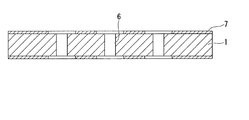
- the core substrate has a core material layer thickness of 200 ⁇ m, and has a copper foil circuit of 10 ⁇ m thickness above and below the core material layer, and a module coated with a 15 ⁇ m thick solder resist (PSR4000-AUS308) on the copper foil circuit.
- a simulated circuit board was created. A schematic cross-sectional view of the module simulation circuit board is shown in FIG.
- the module simulation circuit board has a size of 90 ⁇ 100 mm and a total thickness of 250 ⁇ m.
- Liquid resin composition A was applied to the center of the substrate using an application robot (three-axis robot dispenser: manufactured by Musashi Engineering Co., Ltd.) so that the thickness of the resin portion was 1.0 ⁇ 0.2 mm.
- the application size is 80x90 mm.
- the coating pressure was adjusted so that the inner diameter of the needle used for coating was 2.27 mm, the coating pitch was 1.8 mm, and the coating speed was 21 mm / s.
- the blank portion on the outer periphery of the substrate after application was attached to a flat aluminum plate having a thickness of about 1 cm using a clip (file binder) and cured in an oven at 150 ° C. for 3 hours. After sufficiently cooling, the clip was removed to obtain a resin-sealed substrate (module before division). The warpage of this resin-sealed substrate was measured with a shadow moire measuring device (manufactured by AcroMetrix). Warpage was measured on the resin-coated portion of the substrate at room temperature.
- the substrate warpage amount at room temperature after curing by the combination of the liquid composition A and the module simulated circuit board a thus obtained was 411 ⁇ m, and the substrate warpage amount at 260 ° C. was 731 ⁇ m.
- the amount of warpage at this substrate size at room temperature is preferably 1 mm or less. If the amount of warpage is 1 mm or more, there is a possibility that a problem may occur in resin adsorption when the wafer is separated into pieces by dicing. Moreover, it is preferable that the amount of warpage of the substrate at 260 ° C.
- One module component can be obtained by dividing the pre-division module with a dicing machine and dividing it into individual pieces.
- Epoxy resin Bisphenol F Type diglycidyl ether YDF870GS (manufactured by Nippon Steel Chemical Co., Ltd.)
- Curing agent Methyltetrahydrophthalic anhydride HN-2200-R manufactured by Hitachi Chemical Co., Ltd.
- the present invention in a semiconductor module component using a liquid resin sealing material, warpage during mounting is small, and a thinner semiconductor module component can be produced. Therefore, the present invention is extremely useful industrially.
- Core board (module circuit board core) 2. Resin layer (module circuit board prepreg) 3. 3. Sealing material 4. Mounted parts 5. Solder balls Through hole (module circuit board internal conduction circuit) 7. Solder resist (circuit board for modules, solder resist)
Landscapes
- Chemical & Material Sciences (AREA)
- Health & Medical Sciences (AREA)
- Chemical Kinetics & Catalysis (AREA)
- Medicinal Chemistry (AREA)
- Polymers & Plastics (AREA)
- Organic Chemistry (AREA)
- Compositions Of Macromolecular Compounds (AREA)
- Structures Or Materials For Encapsulating Or Coating Semiconductor Devices Or Solid State Devices (AREA)
- Epoxy Resins (AREA)
Abstract
La présente invention se rapporte à un composant de module semi-conducteur moins épais qui est encapsulé avec une composition de résine d'encapsulation liquide et pour lequel la formation d'un gauchissement peut être supprimée lorsqu'il est chauffé. Ce composant de module semi-conducteur est obtenu par montage d'une puce semi-conductrice et/ou d'un élément passif sur une carte de circuit imprimé pour des modules, ladite carte de circuit imprimé étant composée d'un substrat central qui contient un matériau central, et par encapsulation de la puce semi-conductrice et/ou de l'élément passif avec une composition de résine. La composition de résine est une composition de résine liquide qui contient, comme ingrédients essentiels, (A) une résine époxy, (B) un agent de remplissage inorganique, (C) un accélérateur de durcissement et (D) un composé silane qui comprend un groupe amino secondaire ou un groupe amino tertiaire. Un produit durci de la composition de résine liquide présente un module élastique à une température de 25 °C qui varie entre 1 et 15 GPa et un coefficient de dilatation thermique à une température comprise entre 25 °C et 260 °C qui varie entre 2 500 et 4 500 ppm. Le composant de module semi-conducteur présente une hauteur égale ou inférieure à 1,6 mm.
Applications Claiming Priority (2)
| Application Number | Priority Date | Filing Date | Title |
|---|---|---|---|
| JP2011-112202 | 2011-05-19 | ||
| JP2011112202 | 2011-05-19 |
Publications (1)
| Publication Number | Publication Date |
|---|---|
| WO2012157665A1 true WO2012157665A1 (fr) | 2012-11-22 |
Family
ID=47176982
Family Applications (1)
| Application Number | Title | Priority Date | Filing Date |
|---|---|---|---|
| PCT/JP2012/062486 Ceased WO2012157665A1 (fr) | 2011-05-19 | 2012-05-16 | Composant de module semi-conducteur et composition de résine liquide pour une encapsulation |
Country Status (3)
| Country | Link |
|---|---|
| JP (1) | JP2012255147A (fr) |
| TW (1) | TW201250950A (fr) |
| WO (1) | WO2012157665A1 (fr) |
Cited By (2)
| Publication number | Priority date | Publication date | Assignee | Title |
|---|---|---|---|---|
| WO2014196296A1 (fr) * | 2013-06-07 | 2014-12-11 | 日東電工株式会社 | Procédé de fabrication d'un dispositif à semi-conducteurs |
| CN109233212A (zh) * | 2017-07-10 | 2019-01-18 | 味之素株式会社 | 树脂组合物 |
Families Citing this family (3)
| Publication number | Priority date | Publication date | Assignee | Title |
|---|---|---|---|---|
| JP6424570B2 (ja) * | 2014-11-04 | 2018-11-21 | 株式会社村田製作所 | 電子部品内蔵基板およびその製造方法 |
| JP6301031B1 (ja) * | 2017-04-21 | 2018-03-28 | 三菱電機株式会社 | 半導体装置 |
| JP7060068B2 (ja) * | 2020-12-09 | 2022-04-26 | 味の素株式会社 | 樹脂組成物 |
Citations (3)
| Publication number | Priority date | Publication date | Assignee | Title |
|---|---|---|---|---|
| JPH10270610A (ja) * | 1997-01-23 | 1998-10-09 | Toray Ind Inc | 樹脂封止型半導体装置 |
| JP2008007692A (ja) * | 2006-06-30 | 2008-01-17 | Sumitomo Bakelite Co Ltd | 封止用エポキシ樹脂組成物及び電子部品装置 |
| JP2011058090A (ja) * | 2009-08-10 | 2011-03-24 | Sumitomo Bakelite Co Ltd | 無電解ニッケル−パラジウム−金めっき方法、めっき処理物、プリント配線板、インターポーザ、および半導体装置 |
-
2012
- 2012-05-04 TW TW101116033A patent/TW201250950A/zh unknown
- 2012-05-16 WO PCT/JP2012/062486 patent/WO2012157665A1/fr not_active Ceased
- 2012-05-17 JP JP2012113099A patent/JP2012255147A/ja not_active Withdrawn
Patent Citations (3)
| Publication number | Priority date | Publication date | Assignee | Title |
|---|---|---|---|---|
| JPH10270610A (ja) * | 1997-01-23 | 1998-10-09 | Toray Ind Inc | 樹脂封止型半導体装置 |
| JP2008007692A (ja) * | 2006-06-30 | 2008-01-17 | Sumitomo Bakelite Co Ltd | 封止用エポキシ樹脂組成物及び電子部品装置 |
| JP2011058090A (ja) * | 2009-08-10 | 2011-03-24 | Sumitomo Bakelite Co Ltd | 無電解ニッケル−パラジウム−金めっき方法、めっき処理物、プリント配線板、インターポーザ、および半導体装置 |
Cited By (2)
| Publication number | Priority date | Publication date | Assignee | Title |
|---|---|---|---|---|
| WO2014196296A1 (fr) * | 2013-06-07 | 2014-12-11 | 日東電工株式会社 | Procédé de fabrication d'un dispositif à semi-conducteurs |
| CN109233212A (zh) * | 2017-07-10 | 2019-01-18 | 味之素株式会社 | 树脂组合物 |
Also Published As
| Publication number | Publication date |
|---|---|
| TW201250950A (en) | 2012-12-16 |
| JP2012255147A (ja) | 2012-12-27 |
Similar Documents
| Publication | Publication Date | Title |
|---|---|---|
| KR101195408B1 (ko) | 반도체 장치 | |
| KR101439565B1 (ko) | 플립 칩 반도체 패키지용 접속 구조, 빌드업층 재료, 봉지 수지 조성물 및 회로 기판 | |
| JP5608977B2 (ja) | 半導体パッケージ、コア層材料、ビルドアップ層材料および封止樹脂組成物 | |
| CN101983425B (zh) | 多层电路板、绝缘片和使用多层电路板的半导体封装件 | |
| JP6171280B2 (ja) | 半導体装置の製造方法 | |
| KR20190006443A (ko) | 수지 조성물 | |
| WO2012157665A1 (fr) | Composant de module semi-conducteur et composition de résine liquide pour une encapsulation | |
| KR20210147945A (ko) | 수지 조성물 | |
| JP3785047B2 (ja) | 半導体装置用接着剤組成物および接着シート | |
| KR20150093730A (ko) | 수지층이 형성된 금속층, 적층체, 회로 기판 및 반도체 장치 | |
| JP6428638B2 (ja) | 金属張積層板、回路基板、および電子装置 | |
| JP5696302B2 (ja) | インターポーザ用の金属張積層板とそれを用いた半導体パッケージ | |
| JP6217870B2 (ja) | 構造体、配線基板および配線基板の製造方法 | |
| JP2012151214A (ja) | 半導体モジュール部品及び液状封止用樹脂組成物 | |
| JP2023505277A (ja) | 半導体パッケージ用アンダーフィルフィルム及びこれを用いた半導体パッケージの製造方法 | |
| KR102545377B1 (ko) | 가압 실장용 ncf, 그 경화물 및 이를 사용한 반도체 장치 | |
| JPH11260865A (ja) | Tab用接着剤付きテープおよび半導体集積回路接続用基板ならびに半導体装置 | |
| CN119894957A (zh) | 环氧树脂组合物、树脂糊剂、薄膜型粘接剂、印刷电路板、半导体芯片封装体和电子装置 | |
| CN121548597A (zh) | 组合物、环氧树脂组合物、薄膜、印刷电路板、半导体芯片封装体和电子装置 | |
| JP2007266394A (ja) | 半導体用接着剤シート、これを用いた半導体接続用基板および半導体装置 | |
| JPH11279373A (ja) | プリント回路用樹脂組成物、並びにこれを用いたプリント回路用積層板、多層プリント回路用積層板およびボールグリッドアレイ型半導体装置 |
Legal Events
| Date | Code | Title | Description |
|---|---|---|---|
| 121 | Ep: the epo has been informed by wipo that ep was designated in this application |
Ref document number: 12785436 Country of ref document: EP Kind code of ref document: A1 |
|
| NENP | Non-entry into the national phase |
Ref country code: DE |
|
| 122 | Ep: pct application non-entry in european phase |
Ref document number: 12785436 Country of ref document: EP Kind code of ref document: A1 |