WO2012164977A1 - Protection inférieure de carrosserie de véhicule - Google Patents
Protection inférieure de carrosserie de véhicule Download PDFInfo
- Publication number
- WO2012164977A1 WO2012164977A1 PCT/JP2012/053630 JP2012053630W WO2012164977A1 WO 2012164977 A1 WO2012164977 A1 WO 2012164977A1 JP 2012053630 W JP2012053630 W JP 2012053630W WO 2012164977 A1 WO2012164977 A1 WO 2012164977A1
- Authority
- WO
- WIPO (PCT)
- Prior art keywords
- thermoplastic synthetic
- fiber
- base material
- material layer
- nonwoven fabric
- Prior art date
- Legal status (The legal status is an assumption and is not a legal conclusion. Google has not performed a legal analysis and makes no representation as to the accuracy of the status listed.)
- Ceased
Links
Images
Classifications
-
- B—PERFORMING OPERATIONS; TRANSPORTING
- B62—LAND VEHICLES FOR TRAVELLING OTHERWISE THAN ON RAILS
- B62D—MOTOR VEHICLES; TRAILERS
- B62D25/00—Superstructure or monocoque structure sub-units; Parts or details thereof not otherwise provided for
- B62D25/20—Floors or bottom sub-units
- B62D25/2072—Floor protection, e.g. from corrosion or scratching
-
- B—PERFORMING OPERATIONS; TRANSPORTING
- B60—VEHICLES IN GENERAL
- B60R—VEHICLES, VEHICLE FITTINGS, OR VEHICLE PARTS, NOT OTHERWISE PROVIDED FOR
- B60R13/00—Elements for body-finishing, identifying, or decorating; Arrangements or adaptations for advertising purposes
- B60R13/08—Insulating elements, e.g. for sound insulation
- B60R13/0861—Insulating elements, e.g. for sound insulation for covering undersurfaces of vehicles, e.g. wheel houses
-
- B—PERFORMING OPERATIONS; TRANSPORTING
- B32—LAYERED PRODUCTS
- B32B—LAYERED PRODUCTS, i.e. PRODUCTS BUILT-UP OF STRATA OF FLAT OR NON-FLAT, e.g. CELLULAR OR HONEYCOMB, FORM
- B32B27/00—Layered products comprising a layer of synthetic resin
- B32B27/12—Layered products comprising a layer of synthetic resin next to a fibrous or filamentary layer
-
- B—PERFORMING OPERATIONS; TRANSPORTING
- B32—LAYERED PRODUCTS
- B32B—LAYERED PRODUCTS, i.e. PRODUCTS BUILT-UP OF STRATA OF FLAT OR NON-FLAT, e.g. CELLULAR OR HONEYCOMB, FORM
- B32B27/00—Layered products comprising a layer of synthetic resin
- B32B27/18—Layered products comprising a layer of synthetic resin characterised by the use of special additives
- B32B27/20—Layered products comprising a layer of synthetic resin characterised by the use of special additives using fillers, pigments, thixotroping agents
-
- B—PERFORMING OPERATIONS; TRANSPORTING
- B32—LAYERED PRODUCTS
- B32B—LAYERED PRODUCTS, i.e. PRODUCTS BUILT-UP OF STRATA OF FLAT OR NON-FLAT, e.g. CELLULAR OR HONEYCOMB, FORM
- B32B5/00—Layered products characterised by the non- homogeneity or physical structure, i.e. comprising a fibrous, filamentary, particulate or foam layer; Layered products characterised by having a layer differing constitutionally or physically in different parts
- B32B5/02—Layered products characterised by the non- homogeneity or physical structure, i.e. comprising a fibrous, filamentary, particulate or foam layer; Layered products characterised by having a layer differing constitutionally or physically in different parts characterised by structural features of a fibrous or filamentary layer
- B32B5/022—Non-woven fabric
-
- B—PERFORMING OPERATIONS; TRANSPORTING
- B32—LAYERED PRODUCTS
- B32B—LAYERED PRODUCTS, i.e. PRODUCTS BUILT-UP OF STRATA OF FLAT OR NON-FLAT, e.g. CELLULAR OR HONEYCOMB, FORM
- B32B5/00—Layered products characterised by the non- homogeneity or physical structure, i.e. comprising a fibrous, filamentary, particulate or foam layer; Layered products characterised by having a layer differing constitutionally or physically in different parts
- B32B5/02—Layered products characterised by the non- homogeneity or physical structure, i.e. comprising a fibrous, filamentary, particulate or foam layer; Layered products characterised by having a layer differing constitutionally or physically in different parts characterised by structural features of a fibrous or filamentary layer
- B32B5/08—Layered products characterised by the non- homogeneity or physical structure, i.e. comprising a fibrous, filamentary, particulate or foam layer; Layered products characterised by having a layer differing constitutionally or physically in different parts characterised by structural features of a fibrous or filamentary layer the fibres or filaments of a layer being of different substances, e.g. conjugate fibres, mixture of different fibres
-
- B—PERFORMING OPERATIONS; TRANSPORTING
- B62—LAND VEHICLES FOR TRAVELLING OTHERWISE THAN ON RAILS
- B62D—MOTOR VEHICLES; TRAILERS
- B62D35/00—Vehicle bodies characterised by streamlining
- B62D35/02—Streamlining the undersurfaces
-
- G—PHYSICS
- G10—MUSICAL INSTRUMENTS; ACOUSTICS
- G10K—SOUND-PRODUCING DEVICES; METHODS OR DEVICES FOR PROTECTING AGAINST, OR FOR DAMPING, NOISE OR OTHER ACOUSTIC WAVES IN GENERAL; ACOUSTICS NOT OTHERWISE PROVIDED FOR
- G10K11/00—Methods or devices for transmitting, conducting or directing sound in general; Methods or devices for protecting against, or for damping, noise or other acoustic waves in general
- G10K11/16—Methods or devices for protecting against, or for damping, noise or other acoustic waves in general
- G10K11/162—Selection of materials
- G10K11/168—Plural layers of different materials, e.g. sandwiches
-
- B—PERFORMING OPERATIONS; TRANSPORTING
- B32—LAYERED PRODUCTS
- B32B—LAYERED PRODUCTS, i.e. PRODUCTS BUILT-UP OF STRATA OF FLAT OR NON-FLAT, e.g. CELLULAR OR HONEYCOMB, FORM
- B32B2307/00—Properties of the layers or laminate
- B32B2307/10—Properties of the layers or laminate having particular acoustical properties
- B32B2307/102—Insulating
-
- B—PERFORMING OPERATIONS; TRANSPORTING
- B32—LAYERED PRODUCTS
- B32B—LAYERED PRODUCTS, i.e. PRODUCTS BUILT-UP OF STRATA OF FLAT OR NON-FLAT, e.g. CELLULAR OR HONEYCOMB, FORM
- B32B2307/00—Properties of the layers or laminate
- B32B2307/50—Properties of the layers or laminate having particular mechanical properties
- B32B2307/584—Scratch resistance
-
- B—PERFORMING OPERATIONS; TRANSPORTING
- B32—LAYERED PRODUCTS
- B32B—LAYERED PRODUCTS, i.e. PRODUCTS BUILT-UP OF STRATA OF FLAT OR NON-FLAT, e.g. CELLULAR OR HONEYCOMB, FORM
- B32B2605/00—Vehicles
- B32B2605/08—Cars
Definitions
- the present invention relates to an automobile body undercover.
- a body under cover that covers the lower surface side of an automobile is attached to the lower part of the automobile in order to suppress the air resistance of the airflow that flows downward (see Patent Document 1).
- This body undercover is for improving the fuel efficiency by suppressing the air resistance value by improving the flow of the airflow flowing through the lower surface of the vehicle body. Furthermore, it can not only stabilize the running and maneuvering, but also protect the body components from scattering of foreign objects such as stepping stones while driving.
- Patent Document 2 discloses an engine undercover technology that uses a thermoplastic resin such as polypropylene as an example of an automobile body undercover.
- the body undercover for automobiles made of a resin material mainly composed of olefin has a problem that it is heavy in weight. Therefore, in order to reduce the weight, a body undercover for automobiles using a fiber-based plate material made of glass fiber as a reinforcing material is disclosed.
- the body undercover for automobiles can improve sound absorption performance due to the structure of fine holes between the fibers.
- a resin reinforcing layer is formed on the outer surface on the road surface side in order not to impair the functions originally required as a body undercover for automobiles, such as durability against stepping stones, difficulty of getting snow and snow, and smoothness. (See Patent Document 3)
- the resin reinforcement layer blocks ventilation, the road surface side cannot efficiently exhibit sound absorbing performance against road noise that is a sound source.
- the road surface side cannot efficiently exhibit sound absorbing performance against road noise that is a sound source.
- the non-woven fabric has a problem of lack of durability against stepping stones, and the original function of the underbody cover for automobiles may be impaired.
- the vehicle body undercover of the present disclosure takes the following means.
- the vehicle body undercover is disposed on the lower surface of the vehicle body.
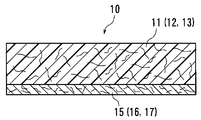
- the body undercover for automobile includes at least a base material layer in which a fiber reinforcing material and a first thermoplastic synthetic resin are mixed, and a nonwoven fabric layer made of a thermoplastic synthetic fiber on the road surface side of the base material layer.
- the surface portions of the two layers are heat-sealed and formed into a predetermined shape by compression molding to form a fiber molded body.
- the 1st thermoplastic synthetic resin of the said base material layer is melting
- the non-woven fabric layer is a non-woven fabric layer in which a second thermoplastic synthetic fiber having a melting point that melts in a heating step at the time of molding and a third thermoplastic synthetic fiber having a melting point that does not melt in the heating step at the time of molding are mixed. .
- the first thermoplastic synthetic resin of the base material layer and the second thermoplastic synthetic fiber of the non-woven fabric layer melt in the heating process at the time of molding, and the fiber reinforcing material of the base material layer and the non-woven fabric layer first 3 is a fiber molded body in which the thermoplastic synthetic fibers 3 are bonded by heat fusion.
- a lightweight automobile body undercover can be obtained. Since the 3rd thermoplastic synthetic fiber of the nonwoven fabric layer arrange
- the melted second thermoplastic synthetic fiber is impregnated and fixed in the third thermoplastic synthetic fiber, thereby forming a reinforcing layer having fine holes between the fibers. Sound absorption characteristics are exhibited by the structure of the fine holes between the fibers.
- it since it prevents fuzz on the surface and forms a smooth surface, it has durability against scattering of foreign matters such as stepping stones. From the above, durability against scattering of foreign objects such as stepping stones even when nonwoven fabric is used on the outer surface of the road surface in order to exhibit sound absorption characteristics against engine noise leaking out of the vehicle and road noise where the road surface is the sound source It is possible to provide a body undercover for an automobile having the following.
- the first thermoplastic synthetic resin and the second thermoplastic synthetic fiber are the same thermoplastic synthetic fibers.
- the first thermoplastic synthetic resin and the second thermoplastic synthetic fiber are made of the same material, so that the base layer and the nonwoven fabric layer can be more effectively heat-sealed. Moreover, it can be set as the structure which a base material layer and a nonwoven fabric layer cannot peel easily.
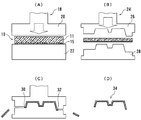
- FIG. 2A is a cross-sectional view illustrating a process of heating and pressurizing with a hot platen press in a manufacturing process of an automobile body undercover according to an embodiment of the present disclosure.
- FIG. 2B is a cross-sectional view showing a cold pressing process in the cold pressing in the manufacturing process.
- FIG. 2C is a cross-sectional view showing a process of cutting an extra part outside the outer periphery of the laminated body by a cut part outside the part during cold press forming in the same manufacturing process.
- FIG. 2A is a cross-sectional view illustrating a process of heating and pressurizing with a hot platen press in a manufacturing process of an automobile body undercover according to an embodiment of the present disclosure.
- FIG. 2B is a cross-sectional view showing a cold pressing process in the cold pressing in the manufacturing process.
- FIG. 2C is a cross-sectional view showing a process of cutting an extra part outside the outer periphery of the laminated body by a cut part
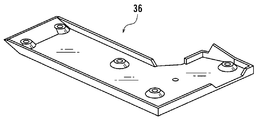
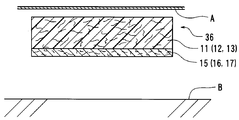
- 2D is a cross-sectional view showing a molded product 34 of a body undercover for automobiles in the same manufacturing process. It is a perspective view showing a body undercover for vehicles concerning an embodiment of this indication. It is sectional drawing which showed typically the state which attached the vehicle body undercover which concerns on embodiment of this indication to the vehicle. It is the figure which showed the sound absorption performance of the body undercover for motor vehicles based on embodiment of this indication.
- the automobile body undercover 36 of the present embodiment is a fiber molded body in which a base material layer 11 and a nonwoven fabric layer 15 are laminated.
- the vehicle body undercover 36 has the base material layer 11 disposed on the vehicle body A side and the nonwoven fabric layer 15 disposed on the road surface B side.
- the base material layer 11 has a fiber reinforcing material 12 and a first thermoplastic synthetic resin 13.
- the nonwoven fabric layer 15 has a second thermoplastic synthetic fiber 16 and a third thermoplastic synthetic fiber 17.
- the base material layer 11 is a fiber mat having a fiber reinforcing material 12 and a first thermoplastic synthetic resin 13.
- the base material layer 11 can be formed by selecting either a dry method typified by a cross layer, an air lay or the like, or a wet method typified by a papermaking method.
- the dry method cross layer
- the base material layer 11 is prepared by cutting the fiber body of the fiber reinforcing material 12 and the first thermoplastic synthetic resin 13 into a predetermined fiber length and mixing them well with a fiber spreader (mixed cotton) ) Laminated with a card machine to make a fiber web with a predetermined basis weight.
- the fiber web is needle punched to interlace the fibers of the fiber reinforcement 12 and the first thermoplastic synthetic resin 13 into a fiber mat.
- the base material layer 11 in the case of using the dry method (air lay) is obtained by cutting the fiber body of the fiber reinforcing material 12 and the first thermoplastic synthetic resin 13 into a predetermined fiber length and mixing them well with an air flow called air lay. (Mixed cotton) is laminated to obtain a fiber web having a predetermined basis weight. Then, the fiber web is needle punched to interlace the fibers of the fiber reinforcement 12 and the first thermoplastic synthetic resin 13 into a fiber mat.
- a thermoplastic synthetic fiber is selected as the first thermoplastic synthetic resin 13 in the dry method.
- the base material layer 11 is formed by dispersing the fiber reinforcing material 12 and the first thermoplastic synthetic resin 13 in water, forming a fleece with a net-like net, and drying it with a heater. Use fiber mat.
- the first thermoplastic synthetic resin 13 in the wet method uses a powdered thermoplastic synthetic resin.
- the fiber reinforcement 12 is made of natural fibers such as glass fibers, which are inorganic fibers such as chopped strands, and organic fibers such as jute, kenaf, ramie, hemp, sisal, bamboo, etc. A fiber etc. are selected suitably.
- the fiber length of the fiber reinforcement 12 when using the dry method is configured in the range of 20 to 100 mm.
- the fiber reinforcing material 12 is less than 20 mm, the effective bending rigidity by the fiber reinforcing material 12 cannot be obtained. Further, the entanglement between the fiber reinforcement 12 and the first thermoplastic synthetic resin 13 is reduced.
- the thickness of the fiber reinforcement 12 is in the range of 5 to 50 ⁇ m.
- the fiber length of the fiber reinforcement 12 is in the range of 5 to 20 mm. The reason why it is shorter than the dry method is to disperse it uniformly in water.
- the first thermoplastic synthetic resin 13 in the case of using the dry method (cross layer, air lay), polyethylene fiber, polypropylene fiber or the like is selected.
- the softening point of polyethylene fibers is 100 to 115 ° C., and the melting point is 125 to 135 ° C.
- the softening point of polypropylene fiber is 140 to 160 ° C., and the melting point is 165 to 173 ° C. Since the first thermoplastic synthetic resin 13 is melted in a heating process at the time of molding described later, the fiber length, the fiber can be used as long as it can be formed into a fiber mat uniformly mixed with the fiber reinforcing material 12 in the needle punch. The diameter is not limited.
- the first thermoplastic synthetic resin 13 in the case of using the wet method (paper making method) powders such as polyethylene and polypropylene are selected. The softening point and melting point of polyethylene and polypropylene are the same as above.
- the total basis weight of the base material layer 11 is in the range of 500 to 2000 g / m 2 .
- the lower limit of the total basis weight of the base material layer 11 is 500 g / m 2 , preferably 700 g / m 2 or more, more preferably 1000 g / m 2 or more. If the total basis weight of the base material layer 11 is lower than this lower limit value, the bending rigidity and impact resistance are lowered.
- the upper limit of the total basis weight of the base material layer 11 is 2000 g / m 2 or less, preferably 1500 g / m 2 or less, more preferably 1400 g / m 2 or less.
- the basis weight of the base material layer 11 is appropriately set according to the required value for the vehicle body undercover 36 for each vehicle type.
- the basis weight of the fiber reinforcement 12 is 30 to 60% by weight with respect to the total basis weight 500 to 2000 g / m 2 of the base material layer 11.
- the basis weight is less than 30% by weight, the bending rigidity and impact resistance are lowered. If the weight per unit area is more than 60% by weight, the first thermoplastic synthetic resin 13 is reduced and the adhesive strength with the nonwoven fabric layer 15 described later is lowered.
- the nonwoven fabric layer 15 is a fiber mat having a second thermoplastic synthetic fiber 16 and a third thermoplastic synthetic fiber 17.
- the second thermoplastic synthetic fiber 16 is selected from a material that melts depending on the heating temperature during processing of the automobile body undercover 36. A material that does not melt at the heating temperature during processing is selected for the third thermoplastic synthetic fiber 17.
- the second thermoplastic synthetic fiber 16 is melted by the heating temperature at the time of processing and is impregnated and fixed to the third thermoplastic synthetic fiber 17 to form a reinforcing layer in a state where fine holes are opened.
- the heating temperature during processing is determined by the melting temperature of the first thermoplastic synthetic resin 13 of the base material layer 11.
- the third thermoplastic synthetic fiber 17 has a melting point (preferably a softening point) higher than the melting temperature of the first thermoplastic synthetic resin 13 of the base material layer 11.
- the second thermoplastic synthetic fiber 16 is made of the same material as the first thermoplastic synthetic resin 13 of the base material layer 11 in view of the more effective heat fusion bonding of the base material layer 11 and the nonwoven fabric layer 15. It is preferred that it be selected.
- the second thermoplastic synthetic fiber 16 polyethylene fiber, polypropylene fiber, or the like is selected.
- the softening point of polyethylene fibers is 100 to 115 ° C., and the melting point is 125 to 135 ° C.
- the softening point of polypropylene fiber is 140 to 160 ° C., and the melting point is 165 to 173 ° C.
- the second thermoplastic synthetic fiber 16 is preferably made of the same material as the first thermoplastic synthetic resin 13. This is because heat fusion bonding between the base material layer 11 and the nonwoven fabric layer 15 is more effectively achieved, and the base material layer 11 and the nonwoven fabric layer 15 are hardly separated.
- the fiber length of the second thermoplastic synthetic fiber 16 is in the range of 20 to 100 mm.
- the entanglement with the 3rd thermoplastic synthetic fiber 17 will decrease.
- the length is longer than 100 mm, it is difficult to mix with the third thermoplastic synthetic fiber 17 and it is difficult to mix both fibers evenly with respect to the unit area, and uniform bending strength and impact resistance are obtained. I can't. Since the second thermoplastic synthetic fiber 16 melts in a heating process at the time of molding, which will be described later, the fiber diameter is within a range that can be formed in a fiber mat uniformly mixed with the third thermoplastic synthetic fiber 17 in the needle punch. It is not limited.
- the third thermoplastic synthetic fiber 17 is a thermoplastic synthetic fiber material having a melting point (preferably a softening point) of approximately 200 ° C. or higher. Polyethylene terephthalate fiber, polyester fiber, etc. are selected. The softening point of the polyethylene terephthalate fiber is 238 to 240 ° C., and the melting point is 255 to 260 ° C. The softening point of the polyester fiber is 238 to 240 ° C., and the melting point is 255 to 260 ° C. The fiber length of the third thermoplastic synthetic fiber 17 is in the range of 20 to 100 mm. When the 3rd thermoplastic synthetic fiber 17 is less than 20 mm, the entanglement with the 2nd thermoplastic synthetic fiber 16 will decrease.
- a melting point preferably a softening point
- the thickness of the third thermoplastic synthetic fiber 17 is in the range of 2 to 15 dtex. If the thickness is less than 2 dtex, the stitches of the third thermoplastic synthetic fiber 17 become small and the sound absorption coefficient is lowered. If the thickness is greater than 15 dtex, the stitches of the third thermoplastic synthetic fiber 17 are increased, the air permeability is increased, and the surface smoothness is inferior. More preferably, the range is 3 to 11 dtex.
- the total basis weight of the nonwoven fabric layer 15 is in the range of 50 to 400 g / m 2 .
- the lower limit of the total fabric weight of the nonwoven fabric layer 15 is 50 g / m 2 , preferably 80 g / m 2 or more, more preferably 100 g / m 2 or more. If the total basis weight of the nonwoven fabric layer 15 is lower than this lower limit value, the nonwoven fabric layer 15 is thinly transparent, and a part of the surface is broken, so that ice and snow are likely to adhere. In addition, bending rigidity and impact resistance are reduced, and durability due to stepping stones is reduced.
- the upper limit of the total fabric weight of the nonwoven fabric layer 15 is 400 g / m 2 or less, preferably 230 g / m 2 or less, more preferably 200 g / m 2 or less. If the total basis weight of the nonwoven fabric layer 15 is higher than the upper limit value, the weight increases, and thus weight reduction cannot be achieved.
- the total weight per unit area of the nonwoven fabric layer 15 is appropriately set within the above range according to the required value for the vehicle body undercover 36 for each vehicle type.
- the nonwoven fabric layer 15 is manufactured by the dry method (cross layer, air lay) of the manufacturing method similar to the base material layer 11.
- the basis weight of the third thermoplastic synthetic fiber 17 is 30 to 50% by weight with respect to the total basis weight 50 to 400 g / m 2 of the nonwoven fabric layer 15.
- the basis weight of the third thermoplastic synthetic fiber 17 is less than 30% by weight, the second thermoplastic synthetic fiber 16 to be melted increases, and the eyes between the fibers of the third thermoplastic synthetic fiber 17 are clogged. As a result, the sound absorption performance is degraded.
- the basis weight of the third thermoplastic synthetic fiber 17 is more than 50% by weight, the fuzz of the third thermoplastic synthetic fiber 17 is remarkably reduced and the durability due to stepping stones or the like is lowered.
- the vehicle body undercover 36 of the present disclosure is manufactured by including the following configuration. (1) At least the base material layer 11 in which the fiber reinforcing material 12 and the first thermoplastic synthetic resin 13 are mixed, and the second thermoplastic synthetic fiber 16 on the surface of the base material layer 11 on the road surface B side. And a laminate 10 in which a nonwoven fabric layer 15 made of the third thermoplastic synthetic fiber 17 is laminated.
- the surface portions of both layers are heat-sealed and formed into a predetermined shape by compression molding to be formed as a fiber molded body.
- the 1st thermoplastic synthetic resin 13 of the base material layer 11 is melting
- the nonwoven fabric layer 15 is a mixture of the second thermoplastic synthetic fiber 16 having a melting point that melts in the heating process at the time of molding and the third thermoplastic synthetic fiber 17 having a melting point that does not melt in the heating process at the time of molding. It is a nonwoven fabric layer 15.
- the body undercover 36 for automobiles is manufactured by a first process by the hot platen press 18 in a state where the base material layer 11 and the nonwoven fabric layer 15 are laminated, and a second process in which cooling, compression and molding are performed by the cold press 24.
- the fiber molded body has a predetermined shape.
- the laminated body 10 of the base material layer 11 and the nonwoven fabric layer 15 is heated and pressed in the hot platen press 18 to thereby form the first thermoplastic resin of the base material layer 11.
- the synthetic resin 13 is melted and intertwined with the fiber reinforcing material 12 and thermally fused, and the second thermoplastic synthetic fiber 16 of the nonwoven fabric layer 15 is melted to heat both surface portions of the base material layer 11 and the nonwoven fabric layer 15. Bond by fusing.
- the base material layer 11 and the non-woven fabric layer 15 are laminated and in the state of the laminated body 10, the hot platen press 18 heated to a predetermined temperature is inserted between the upper plate 20 and the lower plate 22, and heated and pressurized to be compressed.
- the first thermoplastic synthetic resin 13 of the base material layer 11 is melted and entangled with the fiber reinforcing material 12 and thermally fused.
- the second thermoplastic synthetic fiber 16 of the nonwoven fabric layer 15 is melted and entangled with the third thermoplastic synthetic fiber 17 to be heat-sealed.
- the respective surfaces of the first thermoplastic synthetic resin 13 of the base material layer 11 and the second thermoplastic synthetic fiber 16 of the nonwoven fabric layer 15 are thermally fused.
- the lower limit of the heating temperature of the hot platen press 18 is set to 180 ° C. or higher, which is higher than the melting point of the first thermoplastic synthetic resin 13.
- the upper limit value of the heating temperature of the hot platen press 18 is set to 230 ° C. or lower which is lower than the softening point of the third thermoplastic synthetic fiber 17. Preferably, it is set to 190 to 210 ° C.
- the laminated body 10 of the base material layer 11 and the nonwoven fabric layer 15 that are heat-sealed and bonded in the cold press 24 is cooled, compressed, and molded to have a predetermined shape. It is set as the fiber molded object.
- the laminated body 10 of the base material layer 11 and the nonwoven fabric layer 15 that are heat-sealed and bonded is conveyed to the cold press 24 while being heated. Cooling water circulates in the mold of the cold press 24, and the laminate 10 is pressurized simultaneously with cooling and compression-molded, whereby the first thermoplastic synthetic resin 13 and the nonwoven fabric layer 15 of the base material layer 11 are formed.
- the second thermoplastic synthetic fiber 16 is molded in a plastically deformed state.
- the final plate thickness in the second step is processed in the range of 1.0 to 10.0 mm.
- the final plate thickness of the body under cover 36 for automobiles may be uniformly the same plate thickness, or may have a partial change in plate thickness.
- a part where a stepping stone or the like is likely to hit may be considered depending on an arrangement part of the body under cover 36 for an automobile.
- the thickness may be partially reduced to a high density of 1.0 to 2.5 mm so as to improve the impact resistance.
- it in order to improve the sound absorption coefficient, it may be molded to a low density with a plate thickness of 5.0 to 10.0 mm.
- the thermally bonded laminate 10 is taken out from the hot platen press 18 and conveyed to the cold press 24. Cooling water circulates in the upper mold 26 and the lower mold 28 of the cold press 24 so as to cool the laminate 10 more effectively.
- the laminate 10 conveyed from the hot platen press 18 is set between the upper die 26 and the lower die 28 of the cold press 24, and is pressed and pressed to be crushed to the final plate thickness and cooled.
- the outside of the product on the outer periphery of the laminate 10 is cut by the cut parts 30 and 32 outside the parts.
- the hole processing is also performed in the mold at the same time.
- the case where the outer periphery of the laminate 10 is removed from the product and the hole processing is performed simultaneously with the molding is shown.
- the present invention is not limited to this, and in the subsequent process, the outside of the product may be cut using a trim press, or the outside of the product may be cut using a water knife. Further, hole processing may be performed in a subsequent process.
- the molded product 34 of the automobile body undercover 36 is finally obtained.
- the body under cover 36 for automobiles is completed by drilling holes and mounting parts that could not be performed in the mold due to product requirements.
- an automobile body undercover 36 is an example.
- a 1st process heats and pressurizes the laminated body 10 of the base material layer 11 and the nonwoven fabric layer 15 in the hot platen press 18, and the 1st thermoplastic synthetic resin 13 of the base material layer 11 is made. While melted and intertwined with the fiber reinforcing material 12, the second thermoplastic synthetic fiber 16 of the nonwoven fabric layer 15 is melted and both surface portions of the base material layer 11 and the nonwoven fabric layer 15 are thermally fused.
- the laminated body 10 of the base material layer 11 and the nonwoven fabric layer 15 that are heat-sealed and bonded in the cold press 24 is cooled, compressed, and molded to obtain a fiber molded body having a predetermined shape.
- the first step and the second step may be performed intermittently. That is, after the first step is performed, cooling and compression are performed in a separate cooling press or cooling roll to obtain a flat plate member.
- the plate member is reheated to a temperature at which the first thermoplastic synthetic resin and the second thermoplastic synthetic fiber are melted again by a non-contact heater such as a far infrared heater. Then, a manufacturing method may be used in which a cold-pressed 24 is cooled, compressed, and molded to form a fiber molded body having a predetermined shape for an automobile body undercover.
- a non-contact heater such as a far infrared heater.
- the vehicle body undercover 36 according to the present disclosure as a whole is configured with the following sound absorption coefficient by having the above configuration.
- This sound absorption coefficient is a numerical value measured by the reverberation room method sound absorption coefficient in accordance with the standard of JIS A 1409. Specifically, in order to simulate the vehicle mounting state, the measurement was performed on a 5.0 mm flat plate under the condition of a back air layer of 20 mm. In the frequency band of 400 to 6300 Hz, the sound absorption coefficient is at least 30%. In the frequency band of 630 to 6300 Hz, the sound absorption coefficient is at least 40%. In the frequency band of 1000 to 5000 Hz, the sound absorption coefficient is at least 60%.
- the frequency band of 1250 to 4000 Hz has a sound absorption rate of at least 70%.
- the frequency band of 1600 to 3150 Hz has a sound absorption coefficient of at least 75%.
- the sound absorption coefficient is at least 80%.
- the dislocation of the nonwoven fabric layer 15 due to a stepping stone of the body undercover 36 for automobiles or road surface interference in the present disclosure has the following characteristics.
- the slippage of the nonwoven fabric layer 15 due to stepping stones or road surface interference is 9.81 N on a 5.0 mm flat plate using a H-18 wear ring by a Taber type wear tester according to the standard of JIS L 10968.19.
- the weight loss due to wear was measured under 500 conditions. Under such conditions, the wear reduction amount has a characteristic of a reduction amount within 0.12 g.
- the first thermoplastic synthetic resin 13 of the base material layer 11 and the second thermoplastic synthetic fiber 16 of the nonwoven fabric layer 15 are melted in the heating process at the time of molding.
- the fiber reinforcing material 12 of the base material layer 11 and the third thermoplastic synthetic fiber 17 of the non-woven fabric layer 15 are formed into a fiber molded body obtained by heat fusion bonding.
- the lightweight vehicle body undercover 36 can be obtained. Since the third thermoplastic synthetic fiber 17 of the nonwoven fabric layer 15 disposed on the road surface B side is a fiber body that does not melt in the heating process at the time of molding, it remains even if the second thermoplastic synthetic fiber 16 melts. .
- the melted second thermoplastic synthetic fiber 16 is impregnated and fixed in the third thermoplastic synthetic fiber 17, thereby forming a reinforcing layer having fine holes between the fibers. Due to the structure of the fine holes between the fibers, the sound absorption characteristics of the porous base material layer are exhibited. In addition, since it prevents fuzz on the surface and forms a smooth surface, it has durability against scattering of foreign matters such as stepping stones. From the above, engine noise that has leaked outside the vehicle, road noise that causes the road surface B to be a sound source, etc., even if a nonwoven fabric is used on the outer surface of the road surface B in order to exhibit sound absorption characteristics, An automobile body undercover 36 having durability against scattering of foreign matters can be provided.
- thermoplastic synthetic resin 13 and the second thermoplastic synthetic fiber 16 By using the same material for the first thermoplastic synthetic resin 13 and the second thermoplastic synthetic fiber 16, it is possible to more effectively achieve thermal fusion bonding between the base material layer 11 and the nonwoven fabric layer 15. Moreover, the base material layer 11 and the nonwoven fabric layer 15 can be made difficult to peel.
- Example 1 (1) Base material layer 11
- Glass fiber (average fiber length 75 mm (3 inch), average diameter 10 ⁇ m, basis weight: 600 g / m 2 ) was selected as the fiber reinforcement 12.
- B As the first thermoplastic synthetic resin 13, polypropylene fiber (average fiber length 64 mm (2.5 inches), average diameter 6.6 dtex, basis weight: 600 g / m 2 ) was selected.
- C The total basis weight was 1200 g / m 2 .
- D The above glass fiber (fiber reinforcing material 12) and polypropylene fiber (first thermoplastic synthetic resin 13) were web-formed with a cotton blender and obtained by needle punching.
- the base material layer in Example 1 was selected from Nippon Glass Fiber Industry Co., Ltd.
- thermoplastic synthetic fiber 16 As the second thermoplastic synthetic fiber 16, a polypropylene fiber (average fiber length 64 mm (2.5 inches), average diameter 6.6 dtex, basis weight: 100 g / m 2 ) was selected. (B) Polyethylene terephthalate fiber (average fiber length 64 mm (2.5 inches), average diameter 3.3 dtex, basis weight: 50 g / m 2 ) was selected as the third thermoplastic synthetic fiber 17. (C) The blending amount of the polypropylene fiber (second thermoplastic synthetic fiber 16) and the polyethylene terephthalate fiber (third thermoplastic synthetic fiber 17) is 67% by weight of the second thermoplastic synthetic fiber 16 (weight per unit of 100 g).
- thermoplastic synthetic fiber 17 was 33% by weight (weight per unit area 50 g / m 2 ). That is, the total basis weight was 150 g / m 2 .
- Polypropylene fiber (second thermoplastic synthetic fiber 16) and polyethylene terephthalate fiber (third thermoplastic synthetic fiber 17) were web-formed with a cotton blender and obtained by needle punching.
- the nonwoven fabric layer in Example 1 was selected from those manufactured by UNIX Corporation.
- the laminated body 10 in which the base material layer 11 and the nonwoven fabric layer 15 are laminated is put into a hot platen press 18 heated to a temperature of 190 to 210 ° C., and pressurized, heated and compressed.
- the laminate 10 has a temperature of about 200 ° C., and the polypropylene fibers of the base material layer 11 and the nonwoven fabric layer 15 are in a molten state, and the thickness is about 10.0 mm.
- the laminated body 10 heated by the hot platen press 18 is pressed by the cold press 24 and pressed to a final plate thickness of 1.5 to 5.0 mm to be molded and simultaneously cooled.
- Example 1 an automobile body undercover 36 having a plate thickness of 1.5 to 5.0 mm and a basis weight of 1350 g / m 2 was obtained.
- Example 2 (1) Base material layer 11 As the base material layer 11, the same configuration as in Example 1 was selected. (2) Nonwoven fabric layer 15 (A) As the second thermoplastic synthetic fiber 16, the same polypropylene fiber as in Example 1 was used. (B) Polyethylene terephthalate fiber (average fiber length 64 mm (2.5 inches), average diameter 11 dtex, basis weight: 150 g / m 2 ) was selected as the third thermoplastic synthetic fiber 17. (C) The blending amount of the polypropylene fiber (second thermoplastic synthetic fiber 16) and the polyethylene terephthalate fiber (third thermoplastic synthetic fiber 17) is 50% by weight of the second thermoplastic synthetic fiber 16 (the basis weight is 150 g).
- Example 2 The nonwoven fabric layer 15 is manufactured in the same manner as in Example 1. In addition, the non-woven fabric layer in Example 2 was selected from UNIX Corporation. (3) The manufacturing method is the same as in Example 1. In Example 2, an automobile body undercover 36 having a plate thickness of 1.5 to 5.0 mm and a basis weight of 1500 g / m 2 was obtained.
- Example 1 (1) Base material layer The base material layer used the same structure as Example 1. (2) Reinforcing layer In place of the nonwoven fabric layer 15 on the road surface B side of the base material layer 11 of Example 1, polyethylene terephthalate fibers (average fiber length 64 mm (2.5 inch) mm, average diameter 3.3 dtex, basis weight: 150 g / M 2 ) was selected. Between the base material layer 11 and the polyethylene terephthalate fiber layer, an adhesive film in which polyethylene 30 ⁇ m, polyamide resin 40 ⁇ m, and polyethylene 30 ⁇ m were laminated was laminated. The adhesive film in Comparative Example 1 was selected from Kurashiki Boseki Co., Ltd.
- a laminate obtained by laminating the base material layer 11, the adhesive film, and the polyethylene terephthalate fiber layer is put into a hot platen press 18 heated to a temperature of 190 to 210 ° C., and pressurized, heated, and compressed.
- the laminated body is at a temperature of about 200 ° C.
- the polypropylene fiber of the base material layer and the polyethylene of the adhesive film are melted to a thickness of about 10.0 mm.
- the sheet is pressed with a cold press 24 and pressed to a final plate thickness of 1.5 to 5.0 mm, and simultaneously cooled.
- a laminate having a plate thickness of 1.5 to 5.0 mm and a basis weight of 1350 g / m 2 was obtained.
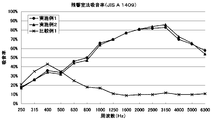
- FIG. 5 shows the sound absorption rates of Example 1, Example 2, and Comparative Example 1.
- the sound absorption coefficient is a numerical value measured by the reverberation room method sound absorption coefficient in accordance with the standard of JIS A 1409. Specifically, in order to simulate the vehicle mounting state, the measurement was performed under the condition of a rear air layer of 20 mm using a flat plate portion of 5.0 mm.
- the sound absorption coefficient is at least 30%. In the frequency band of 630 to 6300 Hz, the sound absorption coefficient is at least 40%. In the frequency band of 1000 to 5000 Hz, the sound absorption coefficient is at least 60%. The frequency band of 1250 to 4000 Hz has a sound absorption rate of at least 70%. The frequency band of 1600 to 3150 Hz has a sound absorption coefficient of at least 75%. In the frequency band of 2000 to 3150 Hz, the sound absorption coefficient is at least 80%.
- the sound absorption rate of Comparative Example 1 was gradually increased from 250 to 400 Hz. However, the sound absorption coefficient of Comparative Example 1 gradually decreased in the high frequency band of 400 Hz or more with the peak of the 400 Hz frequency band as a boundary. Specifically, the sound absorption coefficient is at least 20% in the frequency band of 250 Hz. In the frequency band of 315 Hz, the sound absorption coefficient is at least 30%. In the frequency band of 400 Hz, the sound absorption coefficient is at least 40%. The sound absorption coefficient in the 400 Hz frequency band showed the highest value. In the frequency band of 500 Hz, the sound absorption coefficient is at least 30%. In the frequency band of 630 Hz, the sound absorption coefficient is at least 20%. In the frequency band of 800 to 6300 Hz, only a sound absorption rate of less than 20% was obtained.
- Comparative Example 1 an adhesive film (polyethylene 30 ⁇ m, polyamide resin 40 ⁇ m, polyethylene 30 ⁇ m) is laminated between the base material layer 11 and the polyethylene terephthalate fiber layer. Of this adhesive film, the polyethylene film melts. However, the polyamide resin film remains without melting. For this reason, the polyamide resin film blocks air flow and lowers the sound absorption characteristics. It was revealed that Comparative Example 1 has a higher sound absorption rate than Examples 1 and 2 in the frequency band of 250 to 500 Hz. However, in the frequency band of 630 to 6300 Hz, it has become clear that the sound absorption coefficient is lower than that in the first and second embodiments.
- Example 1 and Example 2 had a sound absorption rate of at least 60%, whereas Comparative Example 1 had a sound absorption rate of 20% or less.
- the body undercover 36 for automobiles is a main sound absorption target for road noise in which the road surface B side is a sound source.
- the sound in the road noise frequency band is around 1000 Hz. Therefore, it became clear that Examples 1 and 2 were suitable for the sound absorption of road noise in which the road surface B side was a sound source. That is, it is conceivable that the body undercover 36 for automobiles is preferably configured so that the entire material has air permeability and does not constitute a layer that blocks ventilation.
- Example 1 ⁇ About peel strength of icing>
- the test piece was 40 mm or more in length and 40 mm or more in width.
- a hole is provided in the central portion of the side surface at a position of 5 mm from the end face of one end of the square pipe.
- Example 2 The peel strength of Example 2 was 107N.
- the peel strength of Comparative Example 1 was 142N. Thereby, when it compared in Example 1, Example 2, and the comparative example 1, it became clear that the comparative example 1 was relatively hard to remove ice. On the other hand, since Example 1 and Example 2 had a lower peel strength than Comparative Example 1, it became clear that the icing was likely to peel off.
- the vehicle body undercover of the present disclosure is not limited to the present embodiment, and can be implemented in various other forms.
Landscapes
- Engineering & Computer Science (AREA)
- Mechanical Engineering (AREA)
- Physics & Mathematics (AREA)
- Acoustics & Sound (AREA)
- Chemical & Material Sciences (AREA)
- Combustion & Propulsion (AREA)
- Transportation (AREA)
- Textile Engineering (AREA)
- Multimedia (AREA)
- Body Structure For Vehicles (AREA)
- Laminated Bodies (AREA)
Abstract
L'invention concerne une protection inférieure de carrosserie de véhicule résistant à la projection de corps étrangers, comme la projection de cailloux, même lorsqu'un tissu non tissé est utilisé sur une surface externe du côté de la route afin de présenter des caractéristiques d'absorption du son par rapport à un bruit de moteur s'échappant à l'extérieur du véhicule ou à un bruit de route provenant de la surface de la route, par exemple. La protection inférieure de carrosserie de véhicule comprend au moins une couche de matériau de base (11) d'un mélange de matériau renforcé par des fibres et une première résine synthétique thermoplastique (13) et une couche de tissu non tissé (15) de fibres synthétiques thermoplastiques stratifiée sur une surface latérale de la surface de route de la couche de matériau de base (11), les couches formant un corps moulé de fibres, des parties de surface des couches étant liées par liaison par fusion thermique et présentant une forme prédéterminée obtenue par moulage par compression. La première résine synthétique thermoplastique (13) de la couche de matériau de base (11) présente un point de fusion fondant dans une étape de chauffage au moment du moulage. La couche de tissu non tissé (15) est un mélange d'une deuxième fibre synthétique thermoplastique (16) présentant un point de fusion fondant dans l'étape de chauffage au moment du moulage et d'une troisième fibre synthétique thermoplastique (17) présentant un point de fusion ne fondant pas dans l'étape de chauffage au moment du moulage.
Priority Applications (2)
| Application Number | Priority Date | Filing Date | Title |
|---|---|---|---|
| US13/821,211 US20140070562A1 (en) | 2011-05-30 | 2012-02-16 | Automobile body undercover |
| CN2012800107578A CN103415416A (zh) | 2011-05-30 | 2012-02-16 | 机动车车体底罩 |
Applications Claiming Priority (2)
| Application Number | Priority Date | Filing Date | Title |
|---|---|---|---|
| JP2011120571A JP2012245925A (ja) | 2011-05-30 | 2011-05-30 | 自動車用ボディーアンダーカバー |
| JP2011-120571 | 2011-05-30 |
Publications (1)
| Publication Number | Publication Date |
|---|---|
| WO2012164977A1 true WO2012164977A1 (fr) | 2012-12-06 |
Family
ID=47258845
Family Applications (1)
| Application Number | Title | Priority Date | Filing Date |
|---|---|---|---|
| PCT/JP2012/053630 Ceased WO2012164977A1 (fr) | 2011-05-30 | 2012-02-16 | Protection inférieure de carrosserie de véhicule |
Country Status (4)
| Country | Link |
|---|---|
| US (1) | US20140070562A1 (fr) |
| JP (1) | JP2012245925A (fr) |
| CN (1) | CN103415416A (fr) |
| WO (1) | WO2012164977A1 (fr) |
Cited By (2)
| Publication number | Priority date | Publication date | Assignee | Title |
|---|---|---|---|---|
| KR20190091447A (ko) | 2016-12-13 | 2019-08-06 | 유니티카 가부시끼가이샤 | 자동차 장비재용 반제품의 제조 방법 |
| US11525220B2 (en) | 2017-04-19 | 2022-12-13 | Unitika Ltd. | Process for producing fibrous board |
Families Citing this family (28)
| Publication number | Priority date | Publication date | Assignee | Title |
|---|---|---|---|---|
| DE102009007891A1 (de) * | 2009-02-07 | 2010-08-12 | Willsingh Wilson | Resonanz-Schallabsorber in mehrschichtiger Ausführung |
| JP2014159219A (ja) * | 2013-02-20 | 2014-09-04 | Inoac Corp | 車両用エンジンアンダーカバー |
| PL3047060T3 (pl) * | 2013-09-20 | 2018-10-31 | Basf Se | Sposób wytwarzania elementu kształtowego |
| CN104669730A (zh) * | 2013-11-27 | 2015-06-03 | 上海杰事杰新材料(集团)股份有限公司 | 一种敞车下侧门用复合材料门板及其制备方法 |
| KR20150070877A (ko) * | 2013-12-17 | 2015-06-25 | 현대자동차주식회사 | 휠가드의 제조방법 |
| DE102013021403A1 (de) | 2013-12-18 | 2015-06-18 | Daimler Ag | Unterbodenaussteifungs- und Verkleidungsmodul, Herstellverfahren sowie Kraftfahrzeug-Unterboden und Montageverfahren |
| CN104339782B (zh) * | 2014-10-08 | 2015-07-29 | 武汉新环球汽车内饰件有限公司 | 一种车用吸音隔热材料及制备方法、制备的车用隔音垫 |
| JP6053058B2 (ja) * | 2015-02-12 | 2016-12-27 | トヨタ紡織株式会社 | 車両用アンダーカバーの製造方法 |
| KR101704195B1 (ko) * | 2015-05-06 | 2017-02-13 | 현대자동차주식회사 | 차량 외장용 섬유 부품 및 제조 방법 |
| JP6504502B2 (ja) * | 2015-07-30 | 2019-04-24 | パナソニックIpマネジメント株式会社 | 積層不織布および空気清浄機 |
| DE102015218974A1 (de) * | 2015-09-30 | 2017-03-30 | Röchling Automotive SE & Co. KG | Fahrzeugbodenanordnung |
| US10607589B2 (en) | 2016-11-29 | 2020-03-31 | Milliken & Company | Nonwoven composite |
| EP3246442B1 (fr) * | 2017-03-17 | 2019-11-13 | Carl Freudenberg KG | Composite textile insonorisant |
| KR102219310B1 (ko) | 2017-03-31 | 2021-02-22 | 코오롱인더스트리 주식회사 | 강성 및 흡음성이 향상된 부직포와 이의 제조방법 및, 강성 및 흡음성이 향상된 부직포를 포함한 자동차 언더커버 |
| MX2019014766A (es) * | 2017-06-12 | 2020-02-07 | Unipres Corp | Estructura para acoplar una cubierta inferior a la carroceria del vehiculo. |
| JP7191656B2 (ja) | 2017-11-27 | 2022-12-19 | 日本バイリーン株式会社 | 成型用基材不織布及びこれによって得られる成型体 |
| FR3076807B1 (fr) * | 2018-01-12 | 2024-08-23 | Psa Automobiles Sa | Ecran aeraulique pour plate-forme de vehicule automobile avec evidement d’acces en son interieur |
| FR3078040B1 (fr) * | 2018-02-22 | 2020-03-13 | Faurecia Automotive Industrie | Piece d'insonorisation de vehicule automobile et procede de fabrication associe |
| JP6842448B2 (ja) * | 2018-09-18 | 2021-03-17 | 矢崎総業株式会社 | ワイヤハーネスの固定方法 |
| WO2020158600A1 (fr) * | 2019-01-30 | 2020-08-06 | 株式会社Howa | Matériau intérieur/extérieur pour véhicules, procédé de production d'un matériau intérieur/extérieur pour véhicules, et moule de presse destiné à être utilisé dans la production d'un matériau intérieur/extérieur pour véhicules |
| JP7233286B2 (ja) * | 2019-03-29 | 2023-03-06 | 林テレンプ株式会社 | 車両用外装部材及びその製造方法 |
| CN110217084B (zh) * | 2019-06-28 | 2024-03-26 | 佛山科学技术学院 | 一种汽车防护围栏 |
| FR3098337B1 (fr) * | 2019-07-04 | 2022-08-12 | Treves Products Services & Innovation | Ecran de protection acoustique destiné à être monté sous un moteur de véhicule automobile |
| US11472244B2 (en) * | 2020-04-16 | 2022-10-18 | Honda Motor Co., Ltd. | Skid plate with recovery point |
| JP7680250B2 (ja) * | 2021-04-16 | 2025-05-20 | 株式会社Howa | 乗物用内外装品及び乗物用内外装品の製造方法 |
| CN114683577B (zh) * | 2022-04-02 | 2023-06-16 | 广东汇天航空航天科技有限公司 | 部件成型方法、防护板及飞行汽车 |
| CN117863678A (zh) * | 2022-10-11 | 2024-04-12 | 卡尔·弗罗伊登伯格公司 | 非织造层合件 |
| JP7654036B2 (ja) * | 2022-10-11 | 2025-03-31 | カール・フロイデンベルク・カーゲー | 不織布積層体 |
Citations (3)
| Publication number | Priority date | Publication date | Assignee | Title |
|---|---|---|---|---|
| JP2004359066A (ja) * | 2003-06-03 | 2004-12-24 | Toyoda Gosei Co Ltd | 外装材及びそれを備えたアンダープロテクター |
| JP2007176474A (ja) * | 2005-03-31 | 2007-07-12 | Toyoda Gosei Co Ltd | 外装材 |
| JP2009096401A (ja) * | 2007-10-18 | 2009-05-07 | Howa Holdings:Kk | 自動車用ボディーアンダーカバー |
Family Cites Families (10)
| Publication number | Priority date | Publication date | Assignee | Title |
|---|---|---|---|---|
| US6238506B1 (en) * | 1996-01-26 | 2001-05-29 | Toho Rayon Co., Ltd. | Method of manufacturing steering wheel |
| JP3654809B2 (ja) * | 1999-05-06 | 2005-06-02 | 有限会社ケイエイエム | 吸音部材 |
| JP3675359B2 (ja) * | 2001-05-23 | 2005-07-27 | 豊田合成株式会社 | 自動車外装用吸音材 |
| JP3945204B2 (ja) * | 2001-10-02 | 2007-07-18 | 豊田合成株式会社 | 車両用外装材及びそれを用いた外装品並びにその成形方法 |
| US7294218B2 (en) * | 2003-10-17 | 2007-11-13 | Owens Corning Intellectual Capital, Llc | Composite material with improved structural, acoustic and thermal properties |
| US7497509B2 (en) * | 2005-03-08 | 2009-03-03 | Toyoda Gosei Co., Ltd. | Exterior component |
| CN100460265C (zh) * | 2005-03-31 | 2009-02-11 | 丰田合成株式会社 | 外装件 |
| JP5581083B2 (ja) * | 2010-03-19 | 2014-08-27 | 本田技研工業株式会社 | 車体後部構造体 |
| JP5138000B2 (ja) * | 2010-05-18 | 2013-02-06 | 株式会社ヒロタニ | 車両用フェンダーライナ |
| US20120246873A1 (en) * | 2011-04-01 | 2012-10-04 | Rama Konduri | Hollow articles comprising fiber-filled polyester compositions, methods of manufacture, and uses thereof |
-
2011
- 2011-05-30 JP JP2011120571A patent/JP2012245925A/ja active Pending
-
2012
- 2012-02-16 WO PCT/JP2012/053630 patent/WO2012164977A1/fr not_active Ceased
- 2012-02-16 CN CN2012800107578A patent/CN103415416A/zh active Pending
- 2012-02-16 US US13/821,211 patent/US20140070562A1/en not_active Abandoned
Patent Citations (3)
| Publication number | Priority date | Publication date | Assignee | Title |
|---|---|---|---|---|
| JP2004359066A (ja) * | 2003-06-03 | 2004-12-24 | Toyoda Gosei Co Ltd | 外装材及びそれを備えたアンダープロテクター |
| JP2007176474A (ja) * | 2005-03-31 | 2007-07-12 | Toyoda Gosei Co Ltd | 外装材 |
| JP2009096401A (ja) * | 2007-10-18 | 2009-05-07 | Howa Holdings:Kk | 自動車用ボディーアンダーカバー |
Cited By (2)
| Publication number | Priority date | Publication date | Assignee | Title |
|---|---|---|---|---|
| KR20190091447A (ko) | 2016-12-13 | 2019-08-06 | 유니티카 가부시끼가이샤 | 자동차 장비재용 반제품의 제조 방법 |
| US11525220B2 (en) | 2017-04-19 | 2022-12-13 | Unitika Ltd. | Process for producing fibrous board |
Also Published As
| Publication number | Publication date |
|---|---|
| JP2012245925A (ja) | 2012-12-13 |
| US20140070562A1 (en) | 2014-03-13 |
| CN103415416A (zh) | 2013-11-27 |
Similar Documents
| Publication | Publication Date | Title |
|---|---|---|
| WO2012164977A1 (fr) | Protection inférieure de carrosserie de véhicule | |
| KR101974469B1 (ko) | 딥 드로우 복합물 및 이를 사용하는 방법 | |
| KR100225617B1 (ko) | 종이 뜨는 방법의 스탬퍼블 시트, 경량 스탬퍼블 시트 성형체 및 경량 스탬퍼블 시트 성형체의 제조방법 | |
| US5971099A (en) | Soundproof material | |
| JP7175690B2 (ja) | 車両用アンダーカバー | |
| JP5450722B2 (ja) | 車両用内装部材の成形方法 | |
| CN102341296B (zh) | 车辆外装材料用叠层体及其制造方法、以及车辆外装材料 | |
| JP2009096401A (ja) | 自動車用ボディーアンダーカバー | |
| JP5820773B2 (ja) | フェンダーライナ及びその製造方法 | |
| JP5844339B2 (ja) | 車両用防音材の製造方法 | |
| KR101901235B1 (ko) | 폐섬유를 이용한 자동차용 경량 흡음 내장재 및 이의 제조방법 | |
| JP2018513309A (ja) | 軽量エンジン取り付けトリム部品 | |
| KR100921073B1 (ko) | 자동차용 플로워카페트 및 이의 성형방법 | |
| CN107984818B (zh) | 车辆底罩及其制造方法 | |
| JP6046930B2 (ja) | 繊維マット及び積層体 | |
| JP2013086599A (ja) | 車両用アンダーカバー及びその製造方法 | |
| JP5898873B2 (ja) | 車両用アンダーカバー及びその製造方法 | |
| JP6527791B2 (ja) | 車両用外装防音材の製造方法 | |
| JP2004142675A (ja) | 外装材及びそれを備えたアンダープロテクター | |
| JP6035405B2 (ja) | 車両用防音材の製造方法 | |
| JP7684836B2 (ja) | 吸音材、その吸音材を備えた乗物用外装品、及び吸音材の製造方法 | |
| JPWO2017141801A1 (ja) | 自動車用内外装材用シート及びその製造方法 | |
| CN115702093A (zh) | 交通工具用内外饰及交通工具用内外饰的制造方法 | |
| JP6033367B2 (ja) | フェンダーライナ及びその製造方法 | |
| JP2004122545A (ja) | 熱成形性芯材及びこれを用いた自動車用内装材 |
Legal Events
| Date | Code | Title | Description |
|---|---|---|---|
| 121 | Ep: the epo has been informed by wipo that ep was designated in this application |
Ref document number: 12794138 Country of ref document: EP Kind code of ref document: A1 |
|
| WWE | Wipo information: entry into national phase |
Ref document number: 13821211 Country of ref document: US |
|
| NENP | Non-entry into the national phase |
Ref country code: DE |
|
| 122 | Ep: pct application non-entry in european phase |
Ref document number: 12794138 Country of ref document: EP Kind code of ref document: A1 |