WO2012165507A1 - フェノール系樹脂およびリソグラフィー用下層膜形成材料 - Google Patents
フェノール系樹脂およびリソグラフィー用下層膜形成材料 Download PDFInfo
- Publication number
- WO2012165507A1 WO2012165507A1 PCT/JP2012/063995 JP2012063995W WO2012165507A1 WO 2012165507 A1 WO2012165507 A1 WO 2012165507A1 JP 2012063995 W JP2012063995 W JP 2012063995W WO 2012165507 A1 WO2012165507 A1 WO 2012165507A1
- Authority
- WO
- WIPO (PCT)
- Prior art keywords
- group
- acid
- resin
- layer film
- formula
- Prior art date
- Legal status (The legal status is an assumption and is not a legal conclusion. Google has not performed a legal analysis and makes no representation as to the accuracy of the status listed.)
- Ceased
Links
Classifications
-
- G—PHYSICS
- G03—PHOTOGRAPHY; CINEMATOGRAPHY; ANALOGOUS TECHNIQUES USING WAVES OTHER THAN OPTICAL WAVES; ELECTROGRAPHY; HOLOGRAPHY
- G03F—PHOTOMECHANICAL PRODUCTION OF TEXTURED OR PATTERNED SURFACES, e.g. FOR PRINTING, FOR PROCESSING OF SEMICONDUCTOR DEVICES; MATERIALS THEREFOR; ORIGINALS THEREFOR; APPARATUS SPECIALLY ADAPTED THEREFOR
- G03F7/00—Photomechanical, e.g. photolithographic, production of textured or patterned surfaces, e.g. printing surfaces; Materials therefor, e.g. comprising photoresists; Apparatus specially adapted therefor
- G03F7/004—Photosensitive materials
- G03F7/09—Photosensitive materials characterised by structural details, e.g. supports, auxiliary layers
- G03F7/11—Photosensitive materials characterised by structural details, e.g. supports, auxiliary layers having cover layers or intermediate layers, e.g. subbing layers
-
- C—CHEMISTRY; METALLURGY
- C08—ORGANIC MACROMOLECULAR COMPOUNDS; THEIR PREPARATION OR CHEMICAL WORKING-UP; COMPOSITIONS BASED THEREON
- C08G—MACROMOLECULAR COMPOUNDS OBTAINED OTHERWISE THAN BY REACTIONS ONLY INVOLVING UNSATURATED CARBON-TO-CARBON BONDS
- C08G8/00—Condensation polymers of aldehydes or ketones with phenols only
- C08G8/04—Condensation polymers of aldehydes or ketones with phenols only of aldehydes
-
- C—CHEMISTRY; METALLURGY
- C08—ORGANIC MACROMOLECULAR COMPOUNDS; THEIR PREPARATION OR CHEMICAL WORKING-UP; COMPOSITIONS BASED THEREON
- C08L—COMPOSITIONS OF MACROMOLECULAR COMPOUNDS
- C08L61/00—Compositions of condensation polymers of aldehydes or ketones; Compositions of derivatives of such polymers
- C08L61/04—Condensation polymers of aldehydes or ketones with phenols only
-
- C—CHEMISTRY; METALLURGY
- C09—DYES; PAINTS; POLISHES; NATURAL RESINS; ADHESIVES; COMPOSITIONS NOT OTHERWISE PROVIDED FOR; APPLICATIONS OF MATERIALS NOT OTHERWISE PROVIDED FOR
- C09D—COATING COMPOSITIONS, e.g. PAINTS, VARNISHES OR LACQUERS; FILLING PASTES; CHEMICAL PAINT OR INK REMOVERS; INKS; CORRECTING FLUIDS; WOODSTAINS; PASTES OR SOLIDS FOR COLOURING OR PRINTING; USE OF MATERIALS THEREFOR
- C09D161/00—Coating compositions based on condensation polymers of aldehydes or ketones; Coating compositions based on derivatives of such polymers
- C09D161/04—Condensation polymers of aldehydes or ketones with phenols only
- C09D161/06—Condensation polymers of aldehydes or ketones with phenols only of aldehydes with phenols
-
- G—PHYSICS
- G03—PHOTOGRAPHY; CINEMATOGRAPHY; ANALOGOUS TECHNIQUES USING WAVES OTHER THAN OPTICAL WAVES; ELECTROGRAPHY; HOLOGRAPHY
- G03F—PHOTOMECHANICAL PRODUCTION OF TEXTURED OR PATTERNED SURFACES, e.g. FOR PRINTING, FOR PROCESSING OF SEMICONDUCTOR DEVICES; MATERIALS THEREFOR; ORIGINALS THEREFOR; APPARATUS SPECIALLY ADAPTED THEREFOR
- G03F7/00—Photomechanical, e.g. photolithographic, production of textured or patterned surfaces, e.g. printing surfaces; Materials therefor, e.g. comprising photoresists; Apparatus specially adapted therefor
- G03F7/004—Photosensitive materials
- G03F7/075—Silicon-containing compounds
- G03F7/0752—Silicon-containing compounds in non photosensitive layers or as additives, e.g. for dry lithography
-
- G—PHYSICS
- G03—PHOTOGRAPHY; CINEMATOGRAPHY; ANALOGOUS TECHNIQUES USING WAVES OTHER THAN OPTICAL WAVES; ELECTROGRAPHY; HOLOGRAPHY
- G03F—PHOTOMECHANICAL PRODUCTION OF TEXTURED OR PATTERNED SURFACES, e.g. FOR PRINTING, FOR PROCESSING OF SEMICONDUCTOR DEVICES; MATERIALS THEREFOR; ORIGINALS THEREFOR; APPARATUS SPECIALLY ADAPTED THEREFOR
- G03F7/00—Photomechanical, e.g. photolithographic, production of textured or patterned surfaces, e.g. printing surfaces; Materials therefor, e.g. comprising photoresists; Apparatus specially adapted therefor
- G03F7/004—Photosensitive materials
- G03F7/09—Photosensitive materials characterised by structural details, e.g. supports, auxiliary layers
- G03F7/091—Photosensitive materials characterised by structural details, e.g. supports, auxiliary layers characterised by antireflection means or light filtering or absorbing means, e.g. anti-halation, contrast enhancement
-
- G—PHYSICS
- G03—PHOTOGRAPHY; CINEMATOGRAPHY; ANALOGOUS TECHNIQUES USING WAVES OTHER THAN OPTICAL WAVES; ELECTROGRAPHY; HOLOGRAPHY
- G03F—PHOTOMECHANICAL PRODUCTION OF TEXTURED OR PATTERNED SURFACES, e.g. FOR PRINTING, FOR PROCESSING OF SEMICONDUCTOR DEVICES; MATERIALS THEREFOR; ORIGINALS THEREFOR; APPARATUS SPECIALLY ADAPTED THEREFOR
- G03F7/00—Photomechanical, e.g. photolithographic, production of textured or patterned surfaces, e.g. printing surfaces; Materials therefor, e.g. comprising photoresists; Apparatus specially adapted therefor
- G03F7/004—Photosensitive materials
- G03F7/09—Photosensitive materials characterised by structural details, e.g. supports, auxiliary layers
- G03F7/094—Multilayer resist systems, e.g. planarising layers
-
- H—ELECTRICITY
- H10—SEMICONDUCTOR DEVICES; ELECTRIC SOLID-STATE DEVICES NOT OTHERWISE PROVIDED FOR
- H10P—GENERIC PROCESSES OR APPARATUS FOR THE MANUFACTURE OR TREATMENT OF DEVICES COVERED BY CLASS H10
- H10P76/00—Manufacture or treatment of masks on semiconductor bodies, e.g. by lithography or photolithography
Definitions
- the present invention relates to a phenolic resin and a resin composition containing the resin.
- the present invention also relates to an underlayer film forming material for lithography, an underlayer film for lithography, and a photoresist pattern forming method using the underlayer film forming material for lithography.
- polyphenols and novolak resins are used as coating agents for semiconductors and resins for resists, but heat resistance is required as one of the performances in these applications.
- Patent Document 4 has problems such as expensive materials, severe reaction conditions for obtaining acenaphthene resin, and many complicated reaction steps.
- the light source for lithography used in forming the resist pattern is shortened from KrF excimer laser (248 nm) to ArF excimer laser (193 nm).
- KrF excimer laser (248 nm)
- ArF excimer laser (193 nm)
- simply thinning the resist makes it difficult to obtain a resist pattern film thickness sufficient for substrate processing. Therefore, not only a resist pattern but also a process of creating a resist underlayer film between the resist and a semiconductor substrate to be processed and providing this resist underlayer film with a function as a mask during substrate processing has become necessary.
- various resist underlayer films for such processes are known.
- a terminal layer is removed by applying a predetermined energy as a resist underlayer film for lithography having a dry etching rate selection ratio close to that of a resist.
- a material for forming a lower layer film for a multilayer resist process has been proposed which contains at least a resin component having a substituent that generates a sulfonic acid residue and a solvent (see Patent Document 5).
- a resist underlayer film material containing a polymer having a specific repeating unit has been proposed as a material for realizing a resist underlayer film for lithography having a lower dry etching rate selection ratio than a resist (see Patent Document 6). ).
- a repeating unit of acenaphthylenes and a repeating unit having a substituted or unsubstituted hydroxy group are copolymerized.
- a resist underlayer film material containing a polymer is proposed (see Patent Document 7).
- an amorphous carbon underlayer film formed by CVD using methane gas, ethane gas, acetylene gas or the like as a raw material is known.
- a resist underlayer film material capable of forming a resist underlayer film by a wet process such as spin coating or screen printing is required.
- the inventors of the present invention have a lithographic lower layer containing a naphthalene formaldehyde polymer containing a specific structural unit and an organic solvent as a material that is excellent in optical properties and etching resistance and is soluble in a solvent and applicable to a wet process.
- the film forming composition (refer patent document 8) is proposed.
- the technique of Patent Document 8 is required to improve etching resistance.
- the present invention has been made in view of the above problems, and its purpose is that the carbon concentration in the resin is relatively high, the oxygen concentration is relatively low, the heat resistance is relatively high, and the solvent solubility is also high. It is an object of the present invention to provide a novel phenol-based resin and a composition containing the resin, which are relatively high and can be applied to a wet process.
- Another object of the present invention is a resin useful for forming a novel photoresist underlayer film having a relatively high solvent solubility and applicable to a wet process and having excellent etching resistance as an underlayer film for a multilayer resist
- An object of the present invention is to provide a lithography lower layer film forming material and a lithography lower layer film using the resin, and a pattern forming method using the lithography lower layer film forming material.
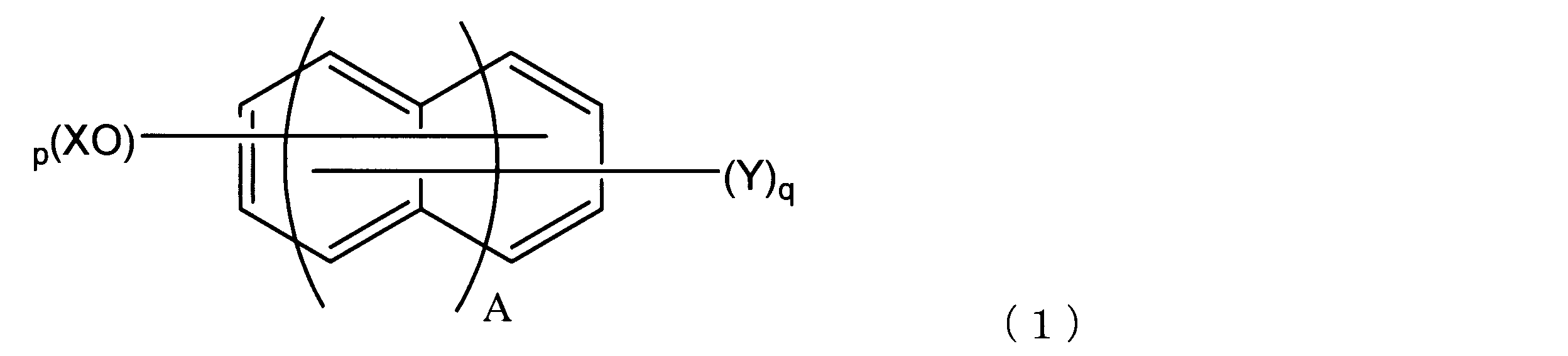
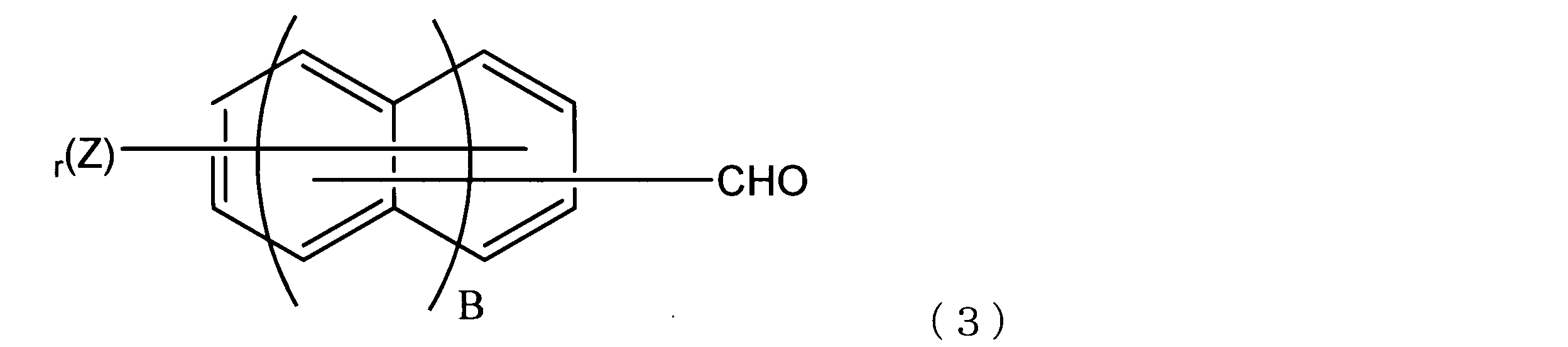
- [1] A resin obtained by reacting a compound represented by the formula (1) and / or (2) with an aldehyde represented by the formula (3) and / or (4) in the presence of an acidic catalyst.
- X represents a hydrogen atom, an alkyl group having 1 to 10 carbon atoms, an aryl group or cyclohexyl group having 6 to 10 carbon atoms
- Y represents an alkyl group having 1 to 10 carbon atoms
- p represents a number of 1 to 3
- q represents a number of 0 to 3
- A represents a number from 0 to 2, preferably a number from 0 to 1.
- Z represents an alkyl group having 1 to 10 carbon atoms, an aryl group having 6 to 10 carbon atoms, a cyclohexyl group, a hydroxyl group, a formyl group, or a carbonyl group, and r represents 0 to 6
- each Z may be the same or different
- B in the formula (3) represents a number from 0 to 2, preferably a number from 0 to 1.
- the compound represented by the formula (1) is phenols, catechols, hydroquinones, cresols, ethylphenols, propylphenols, butylphenols, phenylphenols, methylcatechols, methylhydroquinones, naphthols, dihydroxy Is at least one selected from the group consisting of naphthalenes, hydroxyanthracenes, dihydroxyanthracenes, trihydroxyanthracenes and tetrahydroxyanthracenes, Resin of said [1] description. [3] A in the formula (1) is 0 or 1. Resin of said [1] description.
- the compound represented by the formula (2) is at least one selected from the group consisting of phenanthrols, methylphenanthrols, dimethylphenanthrols and dihydroxyphenanthrols, Resin of said [1] description.
- the aldehyde represented by the formula (3) is a benzaldehyde, a methylbenzaldehyde, an ethylbenzaldehyde, a propylbenzaldehyde, a butylbenzaldehyde, a cyclohexylbenzaldehyde, a biphenylaldehyde, a hydroxybenzaldehyde, a dihydroxybenzaldehyde, a naphthaldehyde, Is at least one selected from the group consisting of hydroxynaphthaldehydes and anthracene carboxaldehydes, The resin according to any one of [1] to [4] above.
- the aldehyde represented by the formula (4) is at least one selected from the group consisting of phenanthrenecarbaldehydes, methylphenanthrenecarbaldehydes, dimethylphenanthrenecarbaldehydes, hydroxyphenanthrenecarbaldehydes, and dihydroxyphenanthrenecarbaldehydes.
- the resin according to any one of [1] to [4] above.
- the acidic catalyst is hydrochloric acid, sulfuric acid, phosphoric acid, oxalic acid, malonic acid, succinic acid, adipic acid, sebacic acid, citric acid, fumaric acid, maleic acid, formic acid, p-toluenesulfonic acid, methanesulfonic acid, trifluoro Acetic acid, dichloroacetic acid, trichloroacetic acid, trifluoromethanesulfonic acid, benzenesulfonic acid, naphthalenesulfonic acid, naphthalene disulfonic acid, zinc chloride, aluminum chloride, iron chloride, boron trifluoride, silicotungstic acid, phosphotungstic acid, silicomolybdic acid , At least one selected from the group consisting of phosphomolybdic acid, hydrobromic acid and hydrofluoric acid, The resin according to any one of [1] to [6] above.
- a lower layer film is formed on the substrate using the lower layer film forming material for lithography described in [15], and at least one photoresist layer is formed on the lower layer film. The region is irradiated with radiation and developed with alkali, Pattern formation method.
- a lower layer film is formed on the substrate using the lower layer film forming material for lithography described in [15], and an intermediate layer film is formed on the lower layer film using a resist intermediate layer film material containing silicon atoms.
- a desired region of the photoresist layer is irradiated with radiation, and developed with alkali to form a resist pattern, and then the resist pattern is masked Etching the intermediate layer film, etching the lower layer film using the obtained intermediate layer film pattern as an etching mask, and etching the substrate using the obtained lower layer film pattern as an etching mask to form a pattern on the substrate It is characterized by Pattern formation method.
- the carbon concentration is relatively high, the oxygen concentration is relatively low, the heat resistance is relatively high, the solvent solubility is also relatively high, and a novel wet process can be applied.
- a suitable phenolic resin can be realized. Therefore, this phenolic resin is used in, for example, electrical insulating materials, resist resins, semiconductor sealing resins, adhesives for printed wiring boards, electrical laminates mounted on electrical equipment / electronic equipment / industrial equipment, etc. Matrix resin, prepreg matrix resin, build-up laminated board materials, resin for fiber reinforced plastic, liquid crystal display panel sealing resin, paints, various coating agents, adhesives, etc. mounted on electrical, electronic, industrial equipment, etc. It is useful as a resin used in semiconductor coating agents and semiconductor resist resins.
- a material for forming a lower layer film for lithography useful for forming a photoresist lower layer film having a relatively high solvent solubility and applicable to a wet process and having excellent etching resistance.
- this lower layer film forming material for lithography it is possible to form a lower layer film having excellent etching resistance against oxygen plasma etching and the like, and furthermore, excellent adhesion to the resist layer.
- a resist pattern can be obtained.
- the phenolic resin of the present embodiment reacts the compound represented by the formula (1) and / or (2) with the aldehyde represented by the formula (3) and / or (4) in the presence of an acidic catalyst. It is resin obtained by making it.
- the compound represented by the formula (1) varies depending on the type of aldehyde represented by the formula (3) and / or (4) to be reacted with the compound, but the larger the number of A, the higher the carbon concentration of the obtained resin.
- A is 0 to 1. It is preferably a number.
- At least one X is preferably a hydrogen atom.
- the solubility tends to be increased when the substituent is present, and the etching resistance tends to be increased as the carbon concentration is increased.
- the number and type of substituents can be appropriately set and is not particularly limited.
- p is preferably a number of 1 to 2, more preferably 1
- q is preferably a number from 0 to 2, more preferably a number from 0 to 1.
- phenol derivative represented by the formula (1) examples include phenol, catechol, resorcinol, hydroquinone, cresol, ethylphenol, propylphenol, butylphenol, phenylphenol, methylcatechol, methylresorcinol, methylhydroquinone, naphthol, methylnaphthol, Examples thereof include, but are not limited to, dihydroxynaphthalene, methyldihydroxynaphthalene, hydroxyanthracene, dihydroxyanthracene, trihydroxyanthracene, and tetrahydroxyanthracene.
- phenols catechols, hydroquinones, cresols, ethylphenols, propylphenols, butylphenols, phenylphenols, methylcatechols, methylhydroquinones, naphthols, dihydroxynaphthalenes, hydroxyanthracenes Dihydroxyanthracenes, trihydroxyanthracenes and tetrahydroxyanthracenes are preferred.
- the phenols mean to include phenol and substituted phenols (having the above-mentioned p substituents -OX and q substituents -Y), and naphthols are naphthols and substituted phenols.
- naphthol having the above-mentioned p substituents -OX and q substituents -Y
- naphthol having the above-mentioned p substituents -OX and q substituents -Y
- phenol derivatives containing a conjugated structure involving at least two unshared electron pairs on the benzene ring are excellent in heat resistance, optical properties, etc., so that phenylphenol, naphthol, methylnaphthol, dihydroxynaphthalene, methyldihydroxy Naphthalene, hydroxyanthracene, dihydroxyanthracene, trihydroxyanthracene, and tetrahydroxyanthracene are more preferable.
- phenol derivative represented by the formula (2) include phenanthrols, methylphenanthrols, dimethylphenanthrols and dihydroxyphenanthrols, but are not particularly limited thereto.
- phenanthrol includes phenanthrol and substituted phenanthrol (having the above-mentioned p substituents —OX and q substituents —Y), and the same applies to the rest. is there.
- the said phenol derivative can be used individually or in combination of 2 or more types.
- the compound represented by the formula (3) varies depending on the type of the compound represented by the formula (1) and / or (2) to be reacted with the compound.
- the larger the number of B the higher the carbon concentration of the obtained resin. Therefore, the etching resistance and heat resistance of the lower layer film for lithography obtained by using this increase, and the solvent solubility of the resin obtained tends to increase as the number of B decreases. Therefore, the number of B may be appropriately set in consideration of these balances, and is not particularly limited.
- B is 0 to 1. It is preferably a number.
- the aldehyde represented by the formula (4) is one in which one aldehyde group and r substituents -Z are introduced into the phenanthrene ring.
- r is preferably a number from 0 to 4, more preferably a number from 0 to 2. Further, in the above formulas (3) and (4), the solubility tends to be increased when having a substituent, and the etching resistance tends to be increased as the carbon concentration is higher. In consideration of the above, the number and type of substituents can be appropriately set and is not particularly limited. However, in the above formula (3), when B is 0, r is preferably a number of 1 to 2, more preferably 1.
- aldehyde represented by the formula (3) examples include benzaldehyde, methylbenzaldehyde, dimethylbenzaldehyde, ethylbenzaldehyde, propylbenzaldehyde, butylbenzaldehyde, cyclohexylbenzaldehyde, biphenylaldehyde, hydroxybenzaldehyde, dihydroxybenzaldehyde, naphthaldehyde, methylnaphthaldehyde, Examples include dimethyl naphthaldehyde, hydroxy naphthaldehyde, dihydroxy naphthaldehyde, anthracene carboxaldehyde and the like, but are not particularly limited thereto.
- benzaldehydes methylbenzaldehydes, ethylbenzaldehydes, propylbenzaldehydes, butylbenzaldehydes, cyclohexylbenzaldehydes, biphenylaldehydes, hydroxybenzaldehydes, dihydroxybenzaldehydes, naphthaldehydes, hydroxynaphthaldehydes and anthracene Carboxaldehydes are preferred.
- benzaldehydes mean to include benzaldehyde and substituted benzaldehydes (having the above-mentioned r substituents —Z), and the same applies to others.
- aldehydes having a conjugated structure involving at least two unshared electron pairs on the benzene ring are excellent in heat resistance, optical properties, and the like. Therefore, biphenylaldehyde, naphthaldehyde, methylnaphthaldehyde, dimethylnaphthaldehyde, hydroxy Naphthaldehyde, dihydroxynaphthaldehyde, and anthracene carboxaldehyde are more preferable.
- aldehyde represented by the formula (4) examples include phenanthrenecarbaldehydes, methylphenanthrenecarbaldehydes, dimethylphenanthrenecarbaldehydes, hydroxyphenanthrenecarbaldehydes, dihydroxyphenanthrenecarbaldehydes, and the like. Although it is possible, it is not particularly limited to these.
- the phenanthrenecarbaldehyde includes phenanthrenecarbaldehyde and substituted phenanthrenecarbaldehyde (having the above-mentioned r substituents —Z), and the same applies to the rest.
- These aldehydes can be used alone or in combination of two or more.
- the molar ratio when the phenol derivative represented by the formula (1) and / or (2) is reacted with the aldehyde represented by the formula (3) or (4) can be appropriately set according to the desired performance, and is particularly limited.
- the phenol derivative: aldehyde is preferably from 1: 0.1 to 1: 6, more preferably from 1: 0.2 to 1: 6, still more preferably from 1: 0.3 to 1: 5, Particularly preferred is 1: 0.3 to 1: 4, and most preferred is 1: 0.3 to 1: 3.
- Resin yield of the resin obtained by adjusting the molar ratio of the phenol derivative represented by the formula (1) and / or (2) and the aldehyde represented by the formula (3) and / or (4) to the above preferred range Can be maintained at a relatively high level, and the raw material remaining unreacted can be reduced, so that productivity and economy tend to be improved.
- reaction conditions Is not particularly limited, and can be set appropriately.
- the reaction can be carried out under normal pressure at a temperature not lower than the temperature at which the raw materials to be used are compatible (usually 80 to 250 ° C.) or while distilling off generated water. Moreover, it can also carry out under pressure as needed.
- a solvent inert to the condensation reaction can be used.
- the solvent include saturated aliphatic hydrocarbons such as heptane and hexane; alicyclic hydrocarbons such as cyclohexane; ethers such as dioxane and dibutyl ether; alcohols such as 2-propanol; ketones such as methyl isobutyl ketone; However, it is not particularly limited to these.
- a solvent can be used individually by 1 type or in combination of 2 or more types.
- the acidic catalyst that can be used in the condensation reaction can be appropriately selected from known ones and is not particularly limited.
- inorganic acids and organic acids are widely known, and specific examples thereof include inorganic acids such as hydrochloric acid, sulfuric acid, phosphoric acid, hydrobromic acid, hydrofluoric acid, oxalic acid, Malonic acid, succinic acid, adipic acid, sebacic acid, citric acid, fumaric acid, maleic acid, formic acid, p-toluenesulfonic acid, methanesulfonic acid, trifluoroacetic acid, dichloroacetic acid, trichloroacetic acid, trifluoromethanesulfonic acid, benzenesulfone Acids, organic acids such as naphthalene sulfonic acid, naphthalene disulfonic acid, Lewis acids such as zinc chloride, aluminum chloride, iron chloride, boron trifluoride, silicotungstic acid,
- inorganic acids, sulfonic acids and tungstic acids are preferable, and oxalic acid, citric acid, p-toluenesulfonic acid, methanesulfonic acid, trifluoromethanesulfonic acid, and benzenesulfonic acid are more preferable.
- oxalic acid, citric acid, p-toluenesulfonic acid, methanesulfonic acid, trifluoromethanesulfonic acid, and benzenesulfonic acid are more preferable.
- Naphthalenesulfonic acid, naphthalene disulfonic acid, phosphotungstic acid are preferable, and oxalic acid, citric acid, p-toluenesulfonic acid, methanesulfonic acid, trifluoromethanesulfonic acid, and benzenesulfonic acid.
- the amount of the acidic catalyst used can be appropriately set according to the raw material to be used, the type of catalyst to be used, and further the reaction conditions and the like, and is not particularly limited, but with the phenol derivative represented by the formula (1) and / or (2)
- the amount is preferably 0.01 to 100 parts by weight, more preferably 0.01 to 20 parts by weight, more preferably 100 parts by weight with respect to the total amount of the aldehyde represented by formula (3) and / or (4).
- the amount is preferably 0.1 to 10 parts by mass.
- the reaction time is not particularly limited, but is preferably 1 to 10 hours, more preferably about 2 to 8 hours. By setting it as the said preferable reaction time, it exists in the tendency for the resin which has the target property to be obtained economically and industrially advantageously.
- acquisition (isolation) of the obtained resin can be performed according to a conventional method, and is not particularly limited.
- the solvent is further added to the reaction product solution and diluted, and then allowed to stand to separate into two phases, and the resin phase that is an oil phase and the aqueous phase are separated, and then further washed with water.
- the acidic catalyst is completely removed, and the added solvent and the unreacted modifier are removed by a general method such as distillation, whereby the phenolic resin as the target product can be obtained.
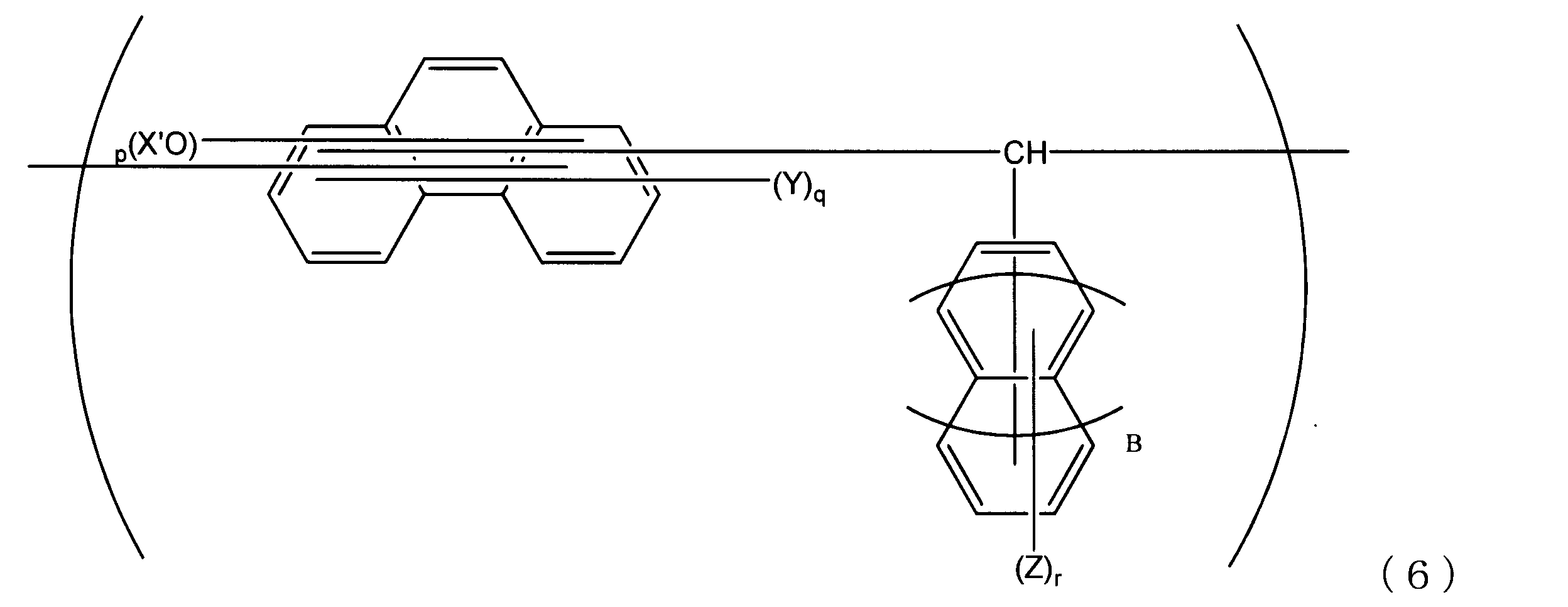
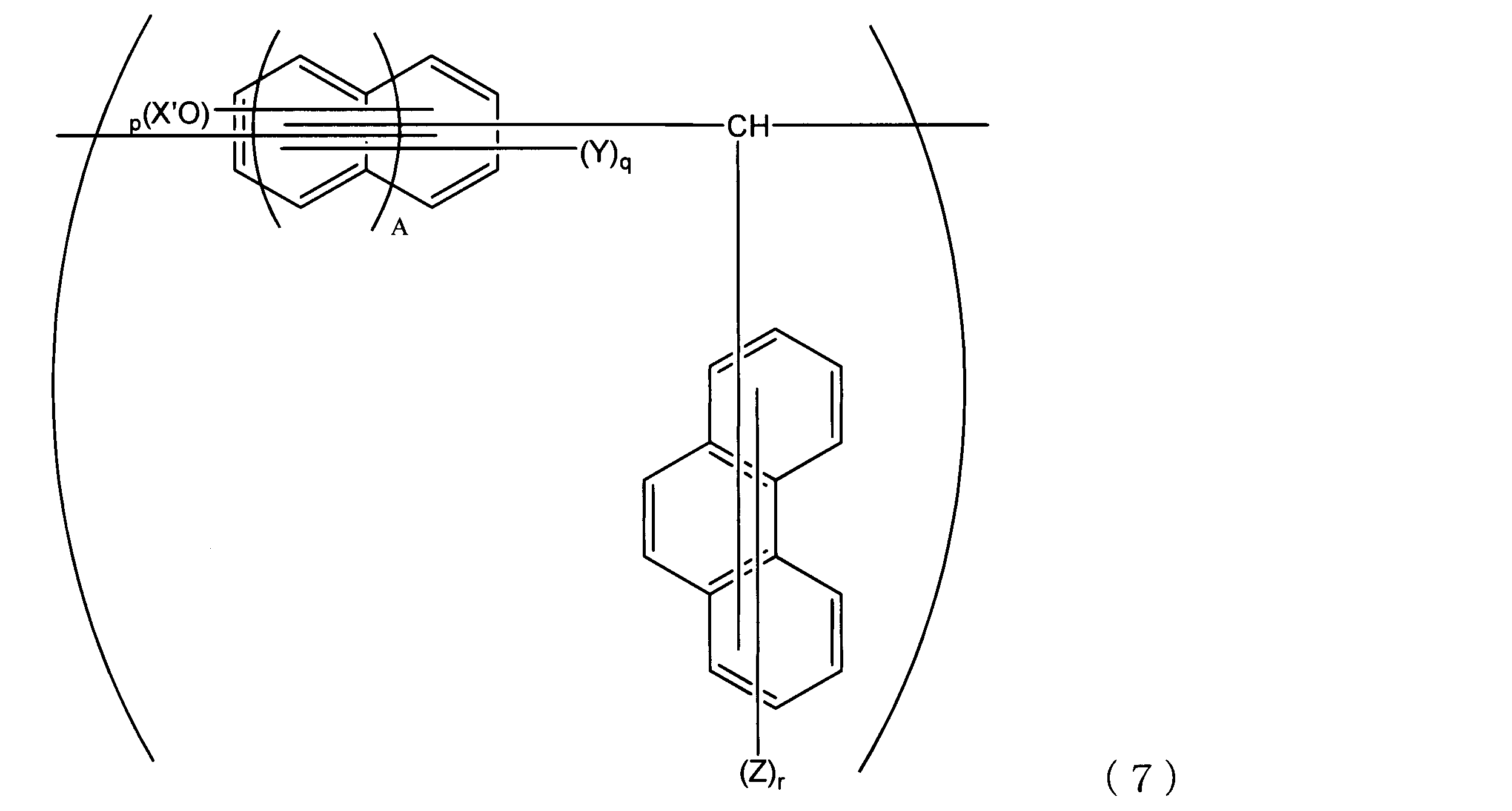
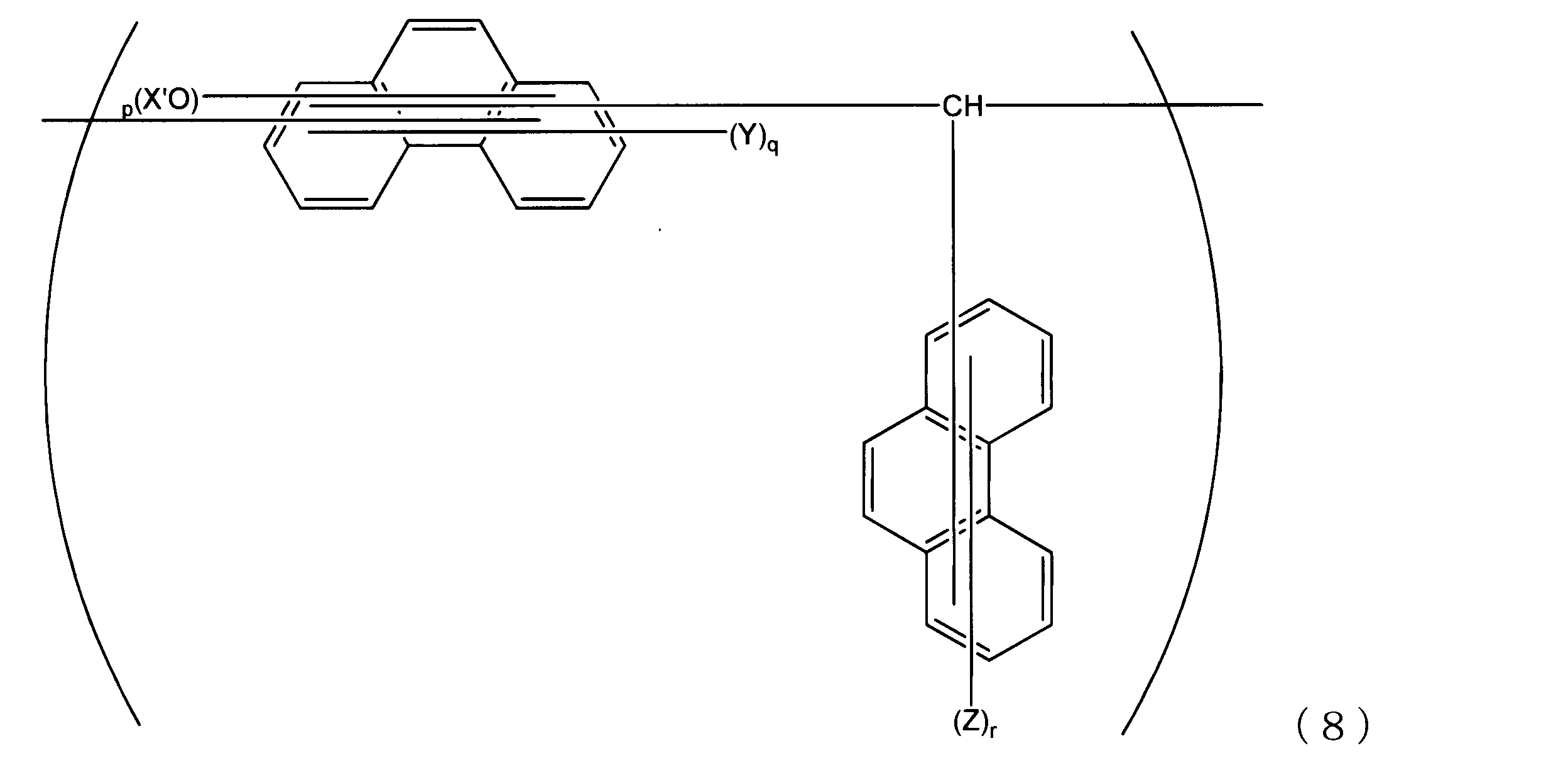
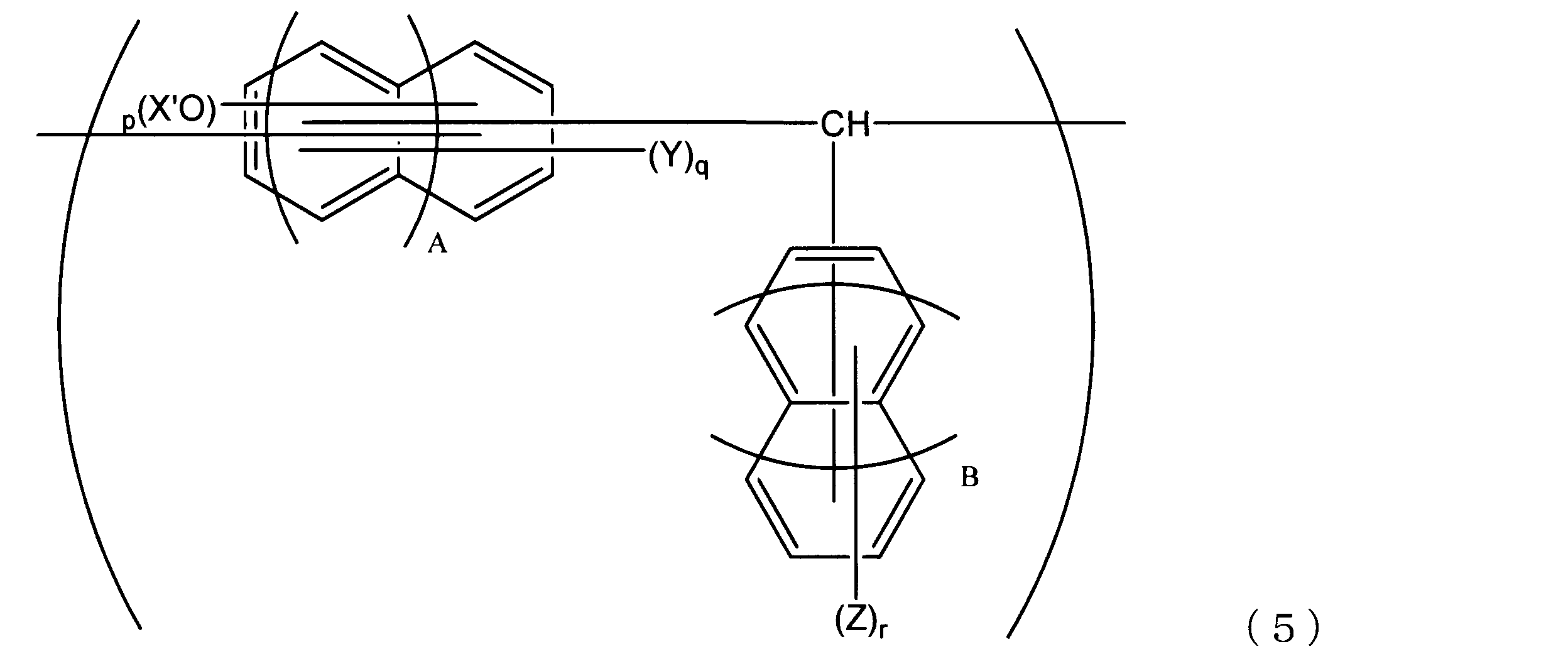
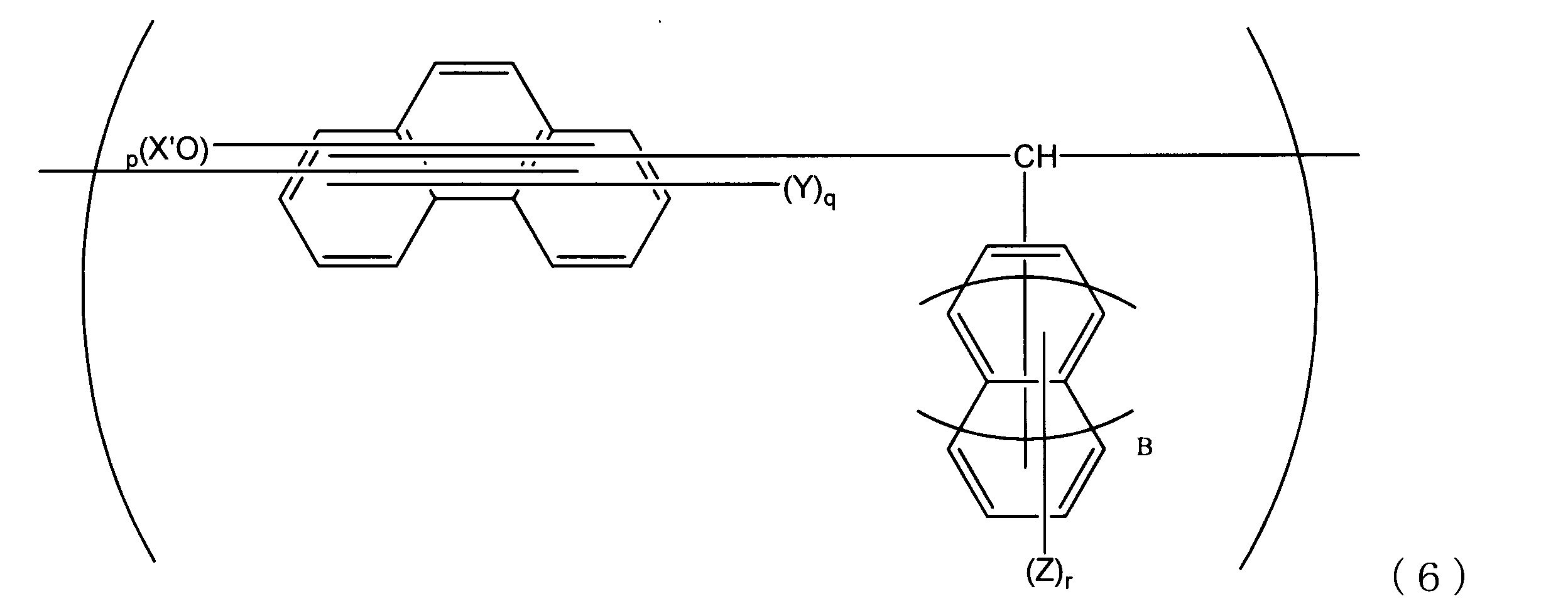
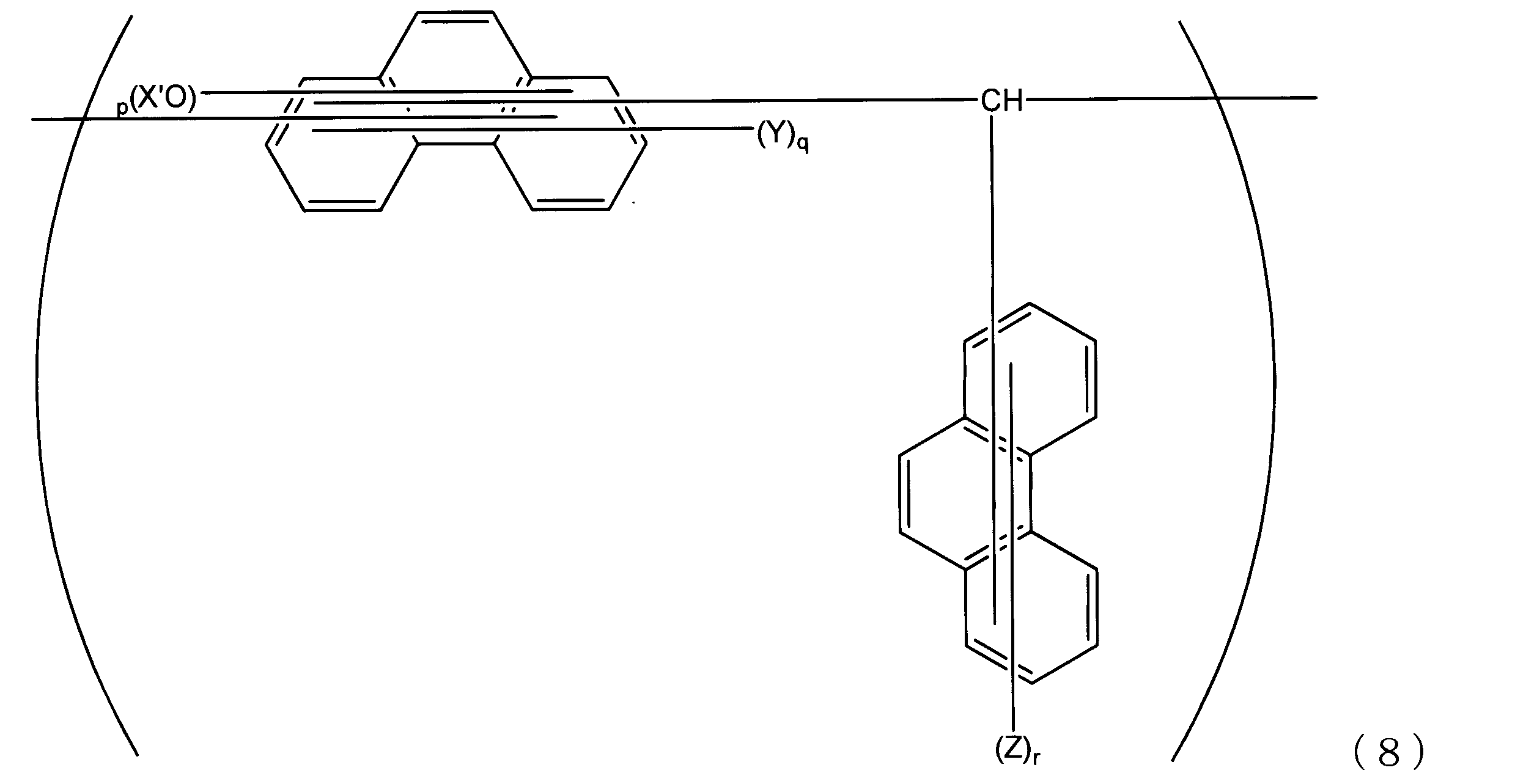
- the phenolic resin that can be obtained as described above preferably has a structure represented by the following formulas (5), (6), (7), and / or (8).
- Y, Z, p, q and r are all the same as those described in the formulas (1), (2), (3) and (4)
- X ′ is the formula (1 ) Or (2), or a single bond that directly forms a bond with X, Y, Z, or an aromatic ring in the resin
- a and B are also represented by the above formulas (1) and (3).
- it represents a number from 0 to 2, preferably when A and B are both numbers from 0 to 1.
- the carbon concentration in the phenolic resin of the present embodiment is not particularly limited, but is preferably 80 to 99.9% by mass, more preferably 85 to 99.9% by mass from the viewpoint of improving heat resistance. Is 90 to 99.9% by mass.
- the oxygen concentration in the phenolic resin of the present embodiment is not particularly limited, but is preferably 0 to 10% by mass, more preferably 0 to 7% by mass, and further preferably 0 to 5% by mass from the viewpoint of improving heat resistance. %.
- the carbon concentration and the oxygen concentration in the resin mean mass% of carbon and oxygen contained in the resin, respectively.
- the molecular weight of the phenolic resin of the present embodiment is not particularly limited, but the weight average molecular weight (Mw) is preferably 600 to 10,000, more preferably 650 to 10,000, still more preferably 700 to 5, 000, particularly preferably 750 to 4000.
- Mw weight average molecular weight
- the solvent solubility is enhanced and the increase in viscosity in the wet process tends to be suppressed, the heat resistance is enhanced, and the outgassing property tends to be reduced.
- the number average molecular weight (Mn) is preferably 400 to 8,000, more preferably 450 to 8,000, still more preferably 500 to 5,000, and particularly preferably 600 to 4,000.
- dispersion degree Mw / Mn is 2 or less, More preferably, it is 1.70 or less, More preferably, it is 1.50 or less.
- the amount of residual metal is small from the viewpoint of suppressing metal contamination.
- the amount of residual metal is preferably 1000 mass ppb or less, more preferably 100 mass ppb or less, and still more preferably 50 mass ppb or less.
- the amount of remaining metal in the resin can be reduced by a known method. Examples of such a method include, but are not particularly limited to, a method of washing a resin solution with ultrapure water or the like, or a method of contacting an ion exchange resin.
- an epoxy group can be introduced into the phenolic hydroxyl group, thereby further enhancing the curability of the resin and further reducing the outgassing property.
- the introduction of the epoxy group can be performed by a known method, and is not particularly limited.
- an epoxy group can be introduced into the phenolic resin by the action of a base by reacting a phenolic resin having a phenolic hydroxyl group with an epoxy-containing compound such as epichlorohydrin.
- the phenolic resin has high solubility in a solvent. More specifically, the phenolic resin preferably has a solubility in propylene glycol monomethyl ether acetate of 10% by mass or more.
- the solubility in propylene glycol monomethyl ether acetate is defined as “mass of resin ⁇ (mass of resin + mass of solvent) ⁇ 100 (mass%)”. For example, when 10 g of the phenolic resin is dissolved in 90 g of propylene glycol monomethyl ether acetate, the solubility of the phenolic resin in propylene glycol monomethyl ether acetate is “10% by mass or more”. Less than mass% ".
- the resin composition of this embodiment contains the above-mentioned phenolic resin.
- the resin composition of the present embodiment may contain an organic solvent as necessary.
- the resin composition of this embodiment may contain other components, such as a crosslinking agent and an acid generator, as needed. Since these other components such as the organic solvent, the crosslinking agent, and the acid generator will be described later in the description of the material for forming a lower layer film for lithography, a duplicate description is omitted here.
- the material for forming a lower layer film for lithography of this embodiment contains at least the above-mentioned phenolic resin and an organic solvent.
- the phenolic resin is obtained by reacting the compound represented by the formula (1) and / or (2) with the aldehyde represented by the formula (3) and / or (4) in the presence of an acidic catalyst. Resin.
- the content of the phenolic resin is not particularly limited, but is preferably 1 to 33 parts by mass with respect to 100 parts by mass in total including the organic solvent, The amount is more preferably 2 to 25 parts by mass, still more preferably 3 to 20 parts by mass.
- the organic solvent that can be used in the material for forming a lower layer film for lithography of the present embodiment is not particularly limited as long as it can dissolve at least the above-described phenolic resin, and a known one can be used as appropriate.
- organic solvents include ketone solvents such as acetone, methyl ethyl ketone, methyl isobutyl ketone and cyclohexanone, cellosolve solvents such as propylene glycol monomethyl ether and propylene glycol monomethyl ether acetate, ethyl lactate, methyl acetate, ethyl acetate and butyl acetate.
- Ester solvents such as isoamyl acetate, ethyl lactate, methyl methoxypropionate and methyl hydroxyisobutyrate, alcohol solvents such as methanol, ethanol, isopropanol and 1-ethoxy-2-propanol, aromatics such as toluene, xylene and anisole Examples thereof include, but are not limited to, hydrocarbons. These organic solvents can be used alone or in combination of two or more.
- cyclohexanone propylene glycol monomethyl ether, propylene glycol monomethyl ether acetate, ethyl lactate, methyl hydroxyisobutyrate, anisole and the like are preferable from the viewpoint of safety.
- the content of the organic solvent is not particularly limited, but from the viewpoint of solubility and film formation, it is 100 to 10, It is preferably 000 parts by mass, more preferably 200 to 5,000 parts by mass.
- the lower layer film forming material for lithography of the present embodiment may contain a crosslinking agent as necessary from the viewpoint of suppressing intermixing.
- Crosslinking agents include compounds containing double bonds such as melamine compounds, guanamine compounds, glycoluril compounds or urea compounds, epoxy compounds, thioepoxy compounds, isocyanate compounds, azide compounds, alkenyl ether groups, methylol groups, alkoxymethyl groups Examples thereof include those substituted with at least one group selected from a group and an acyloxymethyl group, but are not particularly limited thereto.
- these crosslinking agents can be used individually by 1 type or in combination of 2 or more types. These may be used as additives, but these crosslinkable groups may be introduced as pendant groups in the polymer side chain.
- a compound containing a hydroxy group can also be used as a crosslinking agent.
- the melamine compound examples include hexamethylol melamine, hexamethoxymethyl melamine, a compound obtained by methoxymethylating 1 to 6 methylol groups of hexamethylol melamine or a mixture thereof, hexamethoxyethyl melamine, hexaacyloxymethyl melamine, hexa Examples thereof include compounds in which 1 to 6 methylol groups of methylolmelamine are acyloxymethylated, or mixtures thereof.
- epoxy compound examples include tris (2,3-epoxypropyl) isocyanurate, trimethylolmethane triglycidyl ether, trimethylolpropane triglycidyl ether, triethylolethane triglycidyl ether, and the like.
- the guanamine compound examples include tetramethylolguanamine, tetramethoxymethylguanamine, a compound in which 1 to 4 methylol groups of tetramethylolguanamine are methoxymethylated, or a mixture thereof, tetramethoxyethylguanamine, tetraacyloxyguanamine, tetramethylol.
- examples thereof include compounds in which 1 to 4 methylol groups of guanamine are acyloxymethylated or a mixture thereof.
- glycoluril compound examples include tetramethylol glycoluril, tetramethoxyglycoluril, tetramethoxymethylglycoluril, a compound in which 1 to 4 methylol groups of tetramethylolglycoluril are methoxymethylated, or a mixture thereof, tetramethylol glycol Examples thereof include compounds in which 1 to 4 methylol groups of uril are acyloxymethylated or mixtures thereof.
- urea compound examples include tetramethylol urea, tetramethoxymethyl urea, a compound in which 1 to 4 methylol groups of tetramethylol urea are methoxymethylated or a mixture thereof, tetramethoxyethyl urea, and the like.
- the compound containing an alkenyl ether group examples include ethylene glycol divinyl ether, triethylene glycol divinyl ether, 1,2-propanediol divinyl ether, 1,4-butanediol divinyl ether, tetramethylene glycol divinyl ether, neopentyl glycol.
- Examples include divinyl ether, trimethylolpropane trivinyl ether, hexanediol divinyl ether, 1,4-cyclohexanediol divinyl ether, pentaerythritol trivinyl ether, pentaerythritol tetravinyl ether, sorbitol tetravinyl ether, sorbitol pentavinyl ether, and trimethylolpropane trivinyl ether.
- the content of the crosslinking agent is not particularly limited, but is preferably 5 to 50 parts by mass, more preferably 10 parts relative to 100 parts by mass of the phenolic resin. ⁇ 40 parts by mass.
- the underlayer film forming material for lithography of the present embodiment may contain an acid generator as necessary from the viewpoint of further promoting the crosslinking reaction by heat.
- an acid generator those that generate acid by thermal decomposition and those that generate acid by light irradiation are known, and any of them can be used.
- an acid generator 1) an onium salt of the following general formula (P1a-1), (P1a-2), (P1a-3) or (P1b), 2) a diazomethane derivative of the following general formula (P2), 3) a glyoxime derivative of the following general formula (P3), 4) A bissulfone derivative of the following general formula (P4), 5) A sulfonic acid ester of an N-hydroxyimide compound of the following general formula (P5), 6) ⁇ -ketosulfonic acid derivative, 7) a disulfone derivative, 8) Nitrobenzyl sulfonate derivative, 9) Examples thereof include, but are not particularly limited to, sulfonic acid ester derivatives. In addition, these acid generators can be used individually by 1 type or in combination of 2 or more types.
- R 101a , R 101b and R 101c are each independently a linear, branched or cyclic alkyl group having 1 to 12 carbon atoms, an alkenyl group, an oxoalkyl group or an oxoalkenyl group, and 6 to 6 carbon atoms.
- 20 aryl group, aralkyl group having 7 to 12 carbon atoms or aryloxoalkyl group, part or all of hydrogen atoms of these groups may be substituted by alkoxy group or the like.
- R 101b and R 101c may form a ring. When a ring is formed, R 101b and R 101c each independently represent an alkylene group having 1 to 6 carbon atoms.
- K ⁇ represents a non-nucleophilic counter ion.
- R 101d , R 101e , R 101f and R 101g are each independently represented by adding a hydrogen atom to R 101a , R 101b and R 101c .
- R 101d and R 101e , R 101d and R 101e and R 101f may form a ring.
- R 101d and R 101e and R 101d , R 101e and R 101f have 3 carbon atoms.
- R 101a , R 101b , R 101c , R 101d , R 101e , R 101f and R 101g may be the same as or different from each other.
- examples of the alkyl group include methyl, ethyl, propyl, isopropyl, n-butyl, sec-butyl, tert-butyl, pentyl, hexyl, heptyl, octyl, and cyclopentyl.
- cyclohexyl group cycloheptyl group, cyclopropylmethyl group, 4-methylcyclohexyl group, cyclohexylmethyl group, norbornyl group, adamantyl group and the like.
- alkenyl group include a vinyl group, an allyl group, a propenyl group, a butenyl group, a hexenyl group, and a cyclohexenyl group.
- oxoalkyl group include a 2-oxocyclopentyl group, a 2-oxocyclohexyl group, and the like.
- a 2-oxopropyl group, a 2-cyclopentyl-2-oxoethyl group, a 2-cyclohexyl-2-oxoethyl group, 2- (4 -Methylcyclohexyl) -2-oxoethyl group and the like can be mentioned.
- Examples of the oxoalkenyl group include a 2-oxo-4-cyclohexenyl group and a 2-oxo-4-propenyl group.
- aryl group examples include a phenyl group, a naphthyl group, a p-methoxyphenyl group, an m-methoxyphenyl group, an o-methoxyphenyl group, an ethoxyphenyl group, a p-tert-butoxyphenyl group, and an m-tert-butoxyphenyl group.
- Alkylphenyl groups such as alkoxyphenyl groups, 2-methylphenyl groups, 3-methylphenyl groups, 4-methylphenyl groups, ethylphenyl groups, 4-tert-butylphenyl groups, 4-butylphenyl groups, dimethylphenyl groups, etc.
- Alkyl naphthyl groups such as methyl naphthyl group and ethyl naphthyl group, alkoxy naphthyl groups such as methoxy naphthyl group and ethoxy naphthyl group, dialkyl naphthyl groups such as dimethyl naphthyl group and diethyl naphthyl group, dimethoxy naphthyl group and diethoxy naphthyl group Dialkoxynaphthyl group And the like.
- the aralkyl group include a benzyl group, a phenylethyl group, and a phenethyl group.
- 2-aryl-2-oxoethyl group such as 2-phenyl-2-oxoethyl group, 2- (1-naphthyl) -2-oxoethyl group, 2- (2-naphthyl) -2-oxoethyl group, etc. Groups and the like.
- Non-nucleophilic counter ions of K 2 ⁇ include halide ions such as chloride ions and bromide ions, triflate, fluoroalkyl sulfonates such as 1,1,1-trifluoroethanesulfonate, nonafluorobutanesulfonate, tosylate, and benzenesulfonate.
- Aryl sulfonates such as 4-fluorobenzene sulfonate and 1,2,3,4,5-pentafluorobenzene sulfonate, and alkyl sulfonates such as mesylate and butane sulfonate.
- the heteroaromatic ring may be an imidazole derivative (for example, imidazole, 4-methyl Imidazole, 4-methyl-2-phenylimidazole, etc.), pyrazole derivatives, furazane derivatives, pyrroline derivatives (eg pyrroline, 2-methyl-1-pyrroline etc.), pyrrolidine derivatives (eg pyrrolidine, N-methylpyrrolidine, pyrrolidinone, N- Methylpyrrolidone etc.), imidazoline derivatives, imidazolidine derivatives, pyridine derivatives (eg pyridine, methylpyridine, ethylpyridine, propylpyridine, butylpyridine, 4- (1-butylpentyl) pyridine, dimethylpyridine, trimethylpyridine, triethylpyridine, phenylpyri
- imidazole derivative for example, imidazole, 4-methyl Imidazole, 4-methyl-2-phenylimidazole, etc.
- the general formula (P1a-1) and the general formula (P1a-2) are effective as both a photoacid generator and a thermal acid generator, but the general formula (P1a-3) acts as a thermal acid generator. To do.
- R 102a and R 102b each independently represent a linear, branched or cyclic alkyl group having 1 to 8 carbon atoms.
- R 103 represents a linear, branched or cyclic alkylene group having 1 to 10 carbon atoms.
- R 104a and R 104b each independently represent a 3-oxoalkyl group having 3 to 7 carbon atoms.
- K ⁇ represents a non-nucleophilic counter ion.
- R 102a and R 102b include a methyl group, an ethyl group, a propyl group, an isopropyl group, an n-butyl group, a sec-butyl group, a tert-butyl group, a pentyl group, a hexyl group, a heptyl group, and an octyl group.
- R 103 includes methylene group, ethylene group, propylene group, butylene group, pentylene group, hexylene group, heptylene group, octylene group, nonylene group, 1,4-cyclohexylene group, 1,2-cyclohexylene. Group, 1,3-cyclopentylene group, 1,4-cyclooctylene group, 1,4-cyclohexanedimethylene group and the like.
- R 104a and R 104b include a 2-oxopropyl group, a 2-oxocyclopentyl group, a 2-oxocyclohexyl group, and a 2-oxocycloheptyl group.
- K - is the formula (P1a-1), can be exemplified the same ones as described in (P1a-2) and (P1a-3).
- R 105 and R 106 are each independently a linear, branched or cyclic alkyl group or halogenated alkyl group having 1 to 12 carbon atoms, an aryl group having 6 to 20 carbon atoms or a halogenated group. An aryl group or an aralkyl group having 7 to 12 carbon atoms is shown.
- Examples of the alkyl group represented by R 105 and R 106 include methyl group, ethyl group, propyl group, isopropyl group, n-butyl group, sec-butyl group, tert-butyl group, pentyl group, hexyl group, heptyl group, octyl group, Examples include amyl group, cyclopentyl group, cyclohexyl group, cycloheptyl group, norbornyl group, adamantyl group and the like.
- halogenated alkyl group examples include a trifluoromethyl group, 1,1,1-trifluoroethyl group, 1,1,1-trichloroethyl group, nonafluorobutyl group and the like.
- aryl group an alkoxyphenyl group such as a phenyl group, p-methoxyphenyl group, m-methoxyphenyl group, o-methoxyphenyl group, ethoxyphenyl group, p-tert-butoxyphenyl group, m-tert-butoxyphenyl group, etc.
- alkylphenyl groups such as 2-methylphenyl group, 3-methylphenyl group, 4-methylphenyl group, ethylphenyl group, 4-tert-butylphenyl group, 4-butylphenyl group and dimethylphenyl group.
- halogenated aryl group include a fluorophenyl group, a chlorophenyl group, and 1,2,3,4,5-pentafluorophenyl group.
- aralkyl group include a benzyl group and a phenethyl group.
- R 107 , R 108 and R 109 are each independently a linear, branched or cyclic alkyl group or halogenated alkyl group having 1 to 12 carbon atoms, or an aryl group having 6 to 20 carbon atoms. Or a halogenated aryl group or an aralkyl group having 7 to 12 carbon atoms.
- R 108 and R 109 may be bonded to each other to form a cyclic structure.
- R 108 and R 109 each represent a linear or branched alkylene group having 1 to 6 carbon atoms. .
- Examples of the alkyl group, halogenated alkyl group, aryl group, halogenated aryl group, and aralkyl group of R 107 , R 108 , and R 109 include the same groups as those described for R 105 and R 106 .
- Examples of the alkylene group for R 108 and R 109 include a methylene group, an ethylene group, a propylene group, a butylene group, and a hexylene group.
- R 101a and R 101b are the same as described above.
- R 110 represents an arylene group having 6 to 10 carbon atoms, an alkylene group having 1 to 6 carbon atoms, or an alkenylene group having 2 to 6 carbon atoms, and part or all of the hydrogen atoms of these groups are Further, it may be substituted with a linear or branched alkyl group or alkoxy group having 1 to 4 carbon atoms, a nitro group, an acetyl group, or a phenyl group.
- R 111 represents a linear, branched or substituted alkyl group, alkenyl group, alkoxyalkyl group, phenyl group, or naphthyl group having 1 to 8 carbon atoms, and some or all of the hydrogen atoms of these groups are further An alkyl group or alkoxy group having 1 to 4 carbon atoms; a phenyl group optionally substituted by an alkyl group having 1 to 4 carbon atoms, an alkoxy group, a nitro group or an acetyl group; a heteroaromatic group having 3 to 5 carbon atoms; Alternatively, it may be substituted with a chlorine atom or a fluorine atom.
- examples of the arylene group of R 110 include a 1,2-phenylene group and a 1,8-naphthylene group.
- examples of the alkylene group include a methylene group, an ethylene group, a trimethylene group, a tetramethylene group, a phenylethylene group, and a norbornane-2,3-diyl group.
- examples of the alkenylene group include a 1,2-vinylene group, a 1-phenyl-1,2-vinylene group, and a 5-norbornene-2,3-diyl group.
- examples of the alkyl group for R 111 include the same groups as R 101a to R 101c .
- alkenyl groups include vinyl, 1-propenyl, allyl, 1-butenyl, 3-butenyl, isoprenyl, 1-pentenyl, 3-pentenyl, 4-pentenyl, dimethylallyl, Examples include a hexenyl group, a 3-hexenyl group, a 5-hexenyl group, a 1-heptenyl group, a 3-heptenyl group, a 6-heptenyl group, and a 7-octenyl group.
- alkoxyalkyl group examples include a methoxymethyl group, an ethoxymethyl group, a propoxymethyl group, a butoxymethyl group, a pentyloxymethyl group, a hexyloxymethyl group, a heptyloxymethyl group, a methoxyethyl group, an ethoxyethyl group, a propoxyethyl group, Butoxyethyl group, pentyloxyethyl group, hexyloxyethyl group, methoxypropyl group, ethoxypropyl group, propoxypropyl group, butoxypropyl group, methoxybutyl group, ethoxybutyl group, propoxybutyl group, methoxypentyl group, ethoxypentyl group, A methoxyhexyl group, a methoxyheptyl group, etc. are mentioned.
- examples of the optionally substituted alkyl group having 1 to 4 carbon atoms include a methyl group, an ethyl group, a propyl group, an isopropyl group, an n-butyl group, an isobutyl group, and a tert-butyl group.
- examples of the alkoxy group having 1 to 4 carbon atoms include methoxy group, ethoxy group, propoxy group, isopropoxy group, n-butoxy group, isobutoxy group, tert-butoxy group and the like.
- Examples of the phenyl group which may be substituted with an alkyl group having 1 to 4 carbon atoms, an alkoxy group, a nitro group or an acetyl group include a phenyl group, a tolyl group, a p-tert-butoxyphenyl group, a p-acetylphenyl group, p -Nitrophenyl group and the like.
- Examples of the heteroaromatic group having 3 to 5 carbon atoms include a pyridyl group and a furyl group.
- tetramethylammonium trifluoromethanesulfonate tetramethylammonium nonafluorobutanesulfonate, triethylammonium nonafluorobutanesulfonate, pyridinium nonafluorobutanesulfonate, triethylammonium camphorsulfonate, pyridinium camphorsulfonate, nona Tetra n-butylammonium fluorobutanesulfonate, tetraphenylammonium nonafluorobutanesulfonate, tetramethylammonium p-toluenesulfonate, diphenyliodonium trifluoromethanesulfonate, phenyliodonium trifluoromethanesulfonate (p-tert-butoxyphenyl) phenyliodonium, p-Toluenesulf
- triphenylsulfonium trifluoromethanesulfonate trifluoromethanesulfonic acid (p-tert-butoxyphenyl) diphenylsulfonium, trifluoromethanesulfonic acid tris (p-tert-butoxyphenyl) sulfonium, p-toluenesulfonic acid Triphenylsulfonium, p-toluenesulfonic acid (p-tert-butoxyphenyl) diphenylsulfonium, p-toluenesulfonic acid tris (p-tert-butoxyphenyl) sulfonium, trifluoromethanesulfonic acid trinaphthylsulfonium, trifluoromethanesulfonic acid cyclohexylmethyl (2-oxocyclohexyl) sulfonium, trifluoromethanesulfonic acid cyclo
- the content of the acid generator is not particularly limited, but is preferably 0.1 to 50 parts by mass with respect to 100 parts by mass of the phenolic resin, More preferably, it is 0.5 to 40 parts by mass.
- the material for forming a lower layer film for lithography according to the present embodiment may contain a basic compound from the viewpoint of improving storage stability.
- the basic compound serves as a quencher for the acid to prevent the acid generated in a trace amount from the acid generator from causing the crosslinking reaction to proceed.
- Examples of such basic compounds include primary, secondary, and tertiary aliphatic amines, hybrid amines, aromatic amines, heterocyclic amines, nitrogen-containing compounds having a carboxy group, and sulfonyl groups. Nitrogen-containing compounds having a hydroxyl group, nitrogen-containing compounds having a hydroxyl group, nitrogen-containing compounds having a hydroxyphenyl group, alcoholic nitrogen-containing compounds, amide derivatives, imide derivatives, and the like, but are not particularly limited thereto.
- primary aliphatic amines include ammonia, methylamine, ethylamine, n-propylamine, isopropylamine, n-butylamine, isobutylamine, sec-butylamine, tert-butylamine, pentylamine, tert-amylamine.
- secondary aliphatic amines include dimethylamine, diethylamine, di-n-propylamine, diisopropylamine, di-n-butylamine, diisobutylamine, di-sec-butylamine, dipentylamine, dicyclopentylamine.
- tertiary aliphatic amines include trimethylamine, triethylamine, tri-n-propylamine, triisopropylamine, tri-n-butylamine, triisobutylamine, tri-sec-butylamine, tripentylamine, tripentylamine, Cyclopentylamine, trihexylamine, tricyclohexylamine, triheptylamine, trioctylamine, trinonylamine, tridecylamine, tridodecylamine, tricetylamine, N, N, N ′, N′-tetramethylmethylenediamine, Examples thereof include N, N, N ′, N′-tetramethylethylenediamine, N, N, N ′, N′-tetramethyltetraethylenepentamine and the like.
- the mixed amines include dimethylethylamine, methylethylpropylamine, benzylamine, phenethylamine, benzyldimethylamine and the like.
- aromatic amines and heterocyclic amines include aniline derivatives (for example, aniline, N-methylaniline, N-ethylaniline, N-propylaniline, N, N-dimethylaniline, 2-methylaniline, 3- Methylaniline, 4-methylaniline, ethylaniline, propylaniline, trimethylaniline, 2-nitroaniline, 3-nitroaniline, 4-nitroaniline, 2,4-dinitroaniline, 2,6-dinitroaniline, 3,5- Dinitroaniline, N, N-dimethyltoluidine, etc.), diphenyl (p-tolyl) amine, methyldiphenylamine, triphenylamine, phenylenediamine, naphthylamine, diaminona
- nitrogen-containing compound having a carboxy group examples include aminobenzoic acid, indolecarboxylic acid, amino acid derivatives (for example, nicotinic acid, alanine, arginine, aspartic acid, glutamic acid, glycine, histidine, isoleucine, glycylleucine, Leucine, methionine, phenylalanine, threonine, lysine, 3-aminopyrazine-2-carboxylic acid, methoxyalanine) and the like.
- aminobenzoic acid for example, nicotinic acid, alanine, arginine, aspartic acid, glutamic acid, glycine, histidine, isoleucine, glycylleucine, Leucine, methionine, phenylalanine, threonine, lysine, 3-aminopyrazine-2-carboxylic acid, methoxyalan
- nitrogen-containing compound having a sulfonyl group examples include 3-pyridinesulfonic acid and pyridinium p-toluenesulfonate.
- nitrogen-containing compounds having a hydroxyl group, nitrogen-containing compounds having a hydroxyphenyl group, and alcoholic nitrogen-containing compounds include 2-hydroxypyridine, aminocresol, 2,4-quinolinediol, 3-indolemethanol hydrate, mono Ethanolamine, diethanolamine, triethanolamine, N-ethyldiethanolamine, N, N-diethylethanolamine, triisopropanolamine, 2,2'-iminodiethanol, 2-aminoethanol, 3-amino-1-propanol, 4- Amino-1-butanol, 4- (2-hydroxyethyl) morpholine, 2- (2-hydroxyethyl) pyridine, 1- (2-hydroxyethyl) piperazine, 1- [2- (2-hydroxyethoxy) ethyl]
- amide derivatives include formamide, N-methylformamide, N, N-dimethylformamide, acetamide, N-methylacetamide, N, N-dimethylacetamide, propionamide, benzamide and the like.
- imide derivative include phthalimide, succinimide, maleimide and the like.
- the content of the basic compound is not particularly limited, but is preferably 0.001 to 2 parts by mass with respect to 100 parts by mass of the phenolic resin. More preferably, it is 0.01 to 1 part.
- the material for forming a lower layer film for lithography of this embodiment may contain other resins and / or compounds for the purpose of imparting thermosetting properties and controlling the absorbance.
- Such other resins and / or compounds include naphthol resins, xylene resins, naphthol modified resins, phenol modified resins of naphthalene resins, polyhydroxystyrene, dicyclopentadiene resins, (meth) acrylates, dimethacrylates, trimethacrylates, tetra Resins containing no heterocyclic ring or aromatic ring such as methacrylate, vinyl naphthalene, polyacenaphthylene and other naphthalene rings, phenanthrenequinone, biphenyl rings such as fluorene, hetero rings having hetero atoms such as thiophene and indene; rosin resins; Examples thereof include resins or compounds containing alicyclic structures such as cyclodextrin, a
- the underlayer film for lithography of this embodiment is formed from the above-described material for forming an underlayer film for lithography.
- a lower layer film is formed on the substrate using the above-described lower layer film forming material for lithography, and at least one photoresist layer is formed on the lower layer film. Then, radiation is applied to a required region of the photoresist layer and alkali development is performed.
- the multilayer resist pattern forming method of the present embodiment includes forming a lower layer film on the substrate using the above-described lithography lower layer film forming material, and a resist intermediate layer film containing silicon atoms on the lower layer film An intermediate layer film is formed using a material, and at least one photoresist layer is formed on the intermediate layer film. Then, a predetermined region of the photoresist layer is irradiated with radiation, and alkali development is performed to form a resist. After forming the pattern, the intermediate layer film is etched using the resist pattern as a mask, the lower layer film is etched using the obtained intermediate layer film pattern as an etching mask, and the resulting lower layer film pattern is used as an etching mask. Is etched to form a pattern on the substrate.
- the formation method of the underlayer film for lithography of the present embodiment is not particularly limited as long as it is formed from the above-described material for forming an underlayer film for lithography, and a technique known in the art can be applied.
- a technique known in the art can be applied.
- the lower layer film is removed by evaporating an organic solvent or the like. Can be formed.
- the baking temperature is not particularly limited, but is preferably in the range of 80 to 450 ° C., more preferably 200 to 400 ° C.
- the baking time is not particularly limited, but is preferably within the range of 10 to 300 seconds.
- the thickness of the lower layer film can be appropriately selected according to the required performance, and is not particularly limited, but is usually preferably about 30 to 20,000 nm, more preferably 50 to 15,000 nm. .
- a silicon-containing resist layer or a single layer resist made of normal hydrocarbon is formed on the lower layer film, and in the case of a three-layer process, a silicon-containing layer is formed on the lower layer film.
- a single-layer resist layer not containing silicon can be produced on the intermediate layer and further on the silicon-containing intermediate layer.
- the photoresist material for forming the resist layer can be appropriately selected from known materials and is not particularly limited.
- a silicon-containing resist material for a two-layer process a silicon atom-containing polymer such as a polysilsesquioxane derivative or a vinylsilane derivative is used as a base polymer from the point of resistance to oxygen gas etching, and an organic solvent, an acid generator, A positive type photoresist material containing a basic compound or the like is preferably used if necessary, but is not particularly limited.
- the silicon atom-containing polymer a known polymer used in this type of resist material can be used.
- a polysilsesquioxane-based intermediate layer is preferably used as the silicon-containing intermediate layer for the three-layer process.
- the intermediate layer With an effect as an antireflection film, reflection can be suppressed.
- the k value increases and the substrate reflection tends to increase, but by suppressing the reflection in the intermediate layer, The substrate reflection can be reduced to 0.5% or less.
- polysilsesquioxane crosslinked with acid or heat in which a light absorbing group having a phenyl group or a silicon-silicon bond is introduced, is preferably used for 193 nm exposure.
- a light absorbing group having a phenyl group or a silicon-silicon bond is introduced
- an intermediate layer formed by a Chemical-Vapor-deposition (CVD) method can be used.
- a SiON film is known as an intermediate layer having a high effect as an antireflection film manufactured by a CVD method.
- the formation of the intermediate layer by a wet process such as spin coating or screen printing has a simpler and more cost-effective advantage than the CVD method.
- the upper layer resist in the three-layer process may be either a positive type or a negative type, and the same one as a commonly used single layer resist can be used.
- the lower layer film of this embodiment can also be used as an antireflection film for a normal single layer resist or a base material for suppressing pattern collapse. Since the lower layer film of this embodiment is excellent in etching resistance for the base processing, it can be expected to function as a hard mask for the base processing.
- a wet process such as spin coating or screen printing is preferably used as in the case of forming the lower layer film.
- prebaking is usually performed, but this prebaking is preferably performed at 80 to 180 ° C. for 10 to 300 seconds.
- a resist pattern can be obtained by performing exposure, post-exposure baking (PEB), and development.
- the thickness of the resist layer is not particularly limited, but is preferably 30 to 500 nm, particularly 50 to 400 nm.
- the exposure light may be appropriately selected and used according to the photoresist material to be used.
- high energy rays having a wavelength of 300 nm or less, specifically, 248 nm, 193 nm, 157 nm excimer laser, 3 to 20 nm soft X-ray, electron beam, X-ray and the like can be mentioned.
- the resist pattern formed by the above method is one in which pattern collapse is suppressed by the lower layer film of this embodiment. Therefore, by using the lower layer film of this embodiment, a finer pattern can be obtained, and the exposure amount necessary for obtaining the resist pattern can be reduced.
- gas etching is preferably used as the etching of the lower layer film in the two-layer process.
- gas etching etching using oxygen gas is suitable.
- an inert gas such as He or Ar, or CO, CO 2 , NH 3 , SO 2 , N 2 , NO 2 , or H 2 gas.
- gas etching can be performed only with CO, CO 2 , NH 3 , N 2 , NO 2 , and H 2 gas without using oxygen gas.
- the latter gas is used for side wall protection for preventing undercut of the pattern side wall.
- gas etching is also preferably used in the etching of the intermediate layer in the three-layer process.
- the gas etching the same one as described in the above two-layer process can be applied.
- the processing of the intermediate layer in the three-layer process is preferably performed using a fluorocarbon gas and a resist pattern as a mask.
- the lower layer film is processed by, for example, oxygen gas etching using the intermediate layer pattern as a mask.
- a silicon oxide film, a silicon nitride film, or a silicon oxynitride film is formed by a CVD method, an ALD method, or the like.
- the method for forming the nitride film is described in, for example, JP-A-2002-334869 and WO2004 / 066377.
- a photoresist layer can be formed directly on such an intermediate layer film, but an organic antireflection film (BARC) is formed on the intermediate layer film by spin coating, and a photoresist layer is formed thereon. May be.
- an intermediate layer based on polysilsesquioxane is also preferably used.
- the resist intermediate layer film As an antireflection film, reflection can be suppressed. Examples of the material for the polysilsesquioxane-based intermediate layer are described in JP-A-2007-226170 and JP-A-2007-226204.
- Etching of the next substrate can also be performed by a conventional method.
- the substrate is SiO 2 or SiN
- etching mainly using a chlorofluorocarbon gas and if p-Si, Al, or W is chlorine or bromine gas, Etching mainly composed of can be performed.
- the substrate processing is etched with chlorofluorocarbon gas, the silicon-containing resist of the two-layer resist process and the silicon-containing intermediate layer of the three-layer process are peeled off simultaneously with the substrate processing.
- the silicon-containing resist layer or the silicon-containing intermediate layer is separately peeled, and generally, dry etching peeling with a chlorofluorocarbon-based gas is performed after the substrate processing. .
- the lower layer film of this embodiment is characterized by excellent etching resistance of these substrates.
- a substrate known in the art can be appropriately selected and used, and is not particularly limited, but Si, ⁇ -Si, p-Si, SiO 2 , SiN, SiON, W, TiN, Al, etc. Is mentioned.
- the substrate may be a laminate having a film to be processed on a base material (support). Examples of such a film to be processed include various low-k films such as Si, SiO 2 , SiON, SiN, p-Si, ⁇ -Si, W, W-Si, Al, Cu, and Al-Si, and their stopper films. In general, a material different from the base material (support) is used.
- the thickness of the substrate to be processed or the film to be processed is not particularly limited, but is usually preferably about 50 to 10,000 nm, more preferably 75 to 5,000 nm.
- thermal weight loss rate (thermal decomposition amount (%)) when reaching 400 ° C was measured.
- Device TG / DTA6200 (manufactured by SII Nanotechnology) Measurement temperature: 30 to 550 ° C. (temperature increase rate 10 ° C./min) Measurement atmosphere: N 2 or Air circulation
- thermogravimetry TG
- thermogravimetric reduction rate at 400 ° C. 20% (N 2 ) and 14% (Air).
- solubility of the phenolic resin obtained in Synthesis Example 3 in propylene glycol monomethyl ether acetate was 10% by mass or more.
- ethylbenzene As a diluent solvent, 1.8 kg of ethylbenzene (special grade reagent manufactured by Wako Pure Chemical Industries, Ltd.) was added, and after standing, the lower aqueous phase was removed. Further, neutralization and washing with water were performed, and ethylbenzene and unreacted 1,5-dimethylnaphthalene were distilled off under reduced pressure to obtain 1.25 kg of a light brown solid dimethylnaphthalene formaldehyde resin. As a result of GPC analysis, they were Mn: 562, Mw: 1168, and Mw / Mn: 2.08. As a result of organic elemental analysis, the carbon concentration was 84.2% by mass, and the oxygen concentration was 8.3% by mass. In addition, the solubility with respect to propylene glycol monomethyl ether acetate of the obtained dimethyl naphthalene formaldehyde resin was less than 10 mass%.
- Etching resistance was evaluated according to the following procedure. First, a novolak underlayer film was prepared under the same conditions as in Example 1 except that novolak (PSM4357 manufactured by Gunei Chemical Co., Ltd.) was used instead of the phenolic resin in Example 1. Then, the above-described etching test of the novolak underlayer film was performed, and the etching rate at that time was measured.
- novolak PSM4357 manufactured by Gunei Chemical Co., Ltd.
- Acid generator Ditertiary butyl diphenyliodonium nonafluoromethanesulfonate (DTDPI) manufactured by Midori Chemical Co., Ltd.
- Cross-linking agent Nikalac MX270 (Nikalac) manufactured by Sanwa Chemical Co., Ltd.
- Organic solvent propylene glycol monomethyl ether acetate (PGMEA),
- Organic solvent cyclohexanone (CHN)
- Novolak PSM4357 manufactured by Gunei Chemical Co., Ltd.
- Example 4 the lower layer film-forming material of Example 1 was applied onto a 300 nm thick SiO 2 substrate and baked at 240 ° C. for 60 seconds and further at 400 ° C. for 120 seconds to form an 80 nm thick lower layer film. did.
- an ArF resist solution was applied and baked at 130 ° C. for 60 seconds to form a 150 nm-thick photoresist layer.
- the ArF resist solution a compound of the following formula (9): 5 parts by mass, triphenylsulfonium nonafluoromethanesulfonate: 1 part by mass, tributylamine: 2 parts by mass, and PGMEA: 92 parts by mass are blended. The prepared one was used. (In the formula (9), 40, 40, and 20 indicate the ratio of each structural unit, and do not indicate a block copolymer.)
- the photoresist layer was subjected to mask exposure using an electron beam lithography apparatus (ELIONX, ELS-7500, 50 keV), baked at 115 ° C. for 90 seconds (PEB), and 2.38 mass% tetramethylammonium hydroxide.
- ELIONX electron beam lithography apparatus
- PEB baked at 115 ° C. for 90 seconds
- TMAH TMAH
- Table 2 shows the results of observation of the shape of the obtained resist pattern.
- Example 5 Except for using the lower layer film forming material of Example 2, the same procedure as in Example 4 was performed, and the lower layer film and the photoresist layer were formed on the SiO 2 substrate to obtain a positive resist pattern. The evaluation results are shown in Table 2.
- Example 7 the lower layer film-forming material of Example 1 was applied onto a 300 nm thick SiO 2 substrate and baked at 240 ° C. for 60 seconds and further at 400 ° C. for 120 seconds to form an 80 nm thick lower layer film. did.
- a silicon-containing intermediate layer material was applied and baked at 200 ° C. for 60 seconds to form an intermediate layer film having a thickness of 35 nm.
- the ArF resist solution used in Example 4 was applied on this intermediate layer film, and baked at 130 ° C. for 60 seconds to form a 150 nm-thick photoresist layer.
- the silicon-containing intermediate layer material a silicon atom-containing polymer described in ⁇ Synthesis Example 1> of JP-A-2007-226170 was used.
- the photoresist layer was subjected to mask exposure using an electron beam lithography apparatus (ELIONX, ELS-7500, 50 keV), baked at 115 ° C. for 90 seconds (PEB), and 2.38 mass% tetramethylammonium hydroxide.
- TMAH aqueous solution for 60 seconds
- a positive resist pattern of 55 nm L / S (1: 1) was obtained.
- the silicon-containing intermediate layer film SOG was dry-etched using the obtained resist pattern as a mask, and then the obtained silicon-containing intermediate layer film pattern was A dry etching process for the lower layer film was performed using the mask as a mask, and a dry etching process for the SiO 2 film was sequentially performed using the obtained lower layer film pattern as a mask.
- each etching condition is as shown below.
- Output: 50W Pressure: 20Pa Time: 2min Etching gas Ar gas flow rate: CF 4 gas flow rate: O 2 gas flow rate 50: 5: 5 (sccm) Etching conditions for resist underlayer film pattern to SiO 2 film.
- Output: 50W Pressure: 20Pa Time: 2min Etching gas Ar gas flow rate: C 5 F 12 gas flow rate: C 2 F 6 gas flow rate: O 2 gas flow rate 50: 4: 3: 1 (sccm)
- Example 7 using the underlayer film of the present invention was a multilayer. It was confirmed that the shape of the SiO 2 film after etching in resist processing was good.
- the resin of the present invention has a relatively high carbon concentration in the resin, a relatively low oxygen concentration, a relatively high heat resistance, a relatively high solvent solubility, and a wet process is applicable. In various applications where these performances are required, they can be used widely and effectively.
- the present invention provides, for example, an electrical insulating material, a resist resin, a semiconductor sealing resin, an adhesive for printed wiring boards, an electrical laminate mounted on electrical equipment / electronic equipment / industrial equipment, etc. ⁇
- Matrix resin for prepregs, built-up laminate materials, resin for fiber reinforced plastics, sealing resin for liquid crystal display panels, paints, various coating agents, adhesives, and coatings for semiconductors installed in electronic equipment and industrial equipment It can be used widely and effectively in an agent, a resist resin for a semiconductor, a resin for forming a lower layer film, and the like, and can be used particularly effectively in the field of a lower layer film for lithography and a lower layer film for multilayer resist.
Landscapes
- Engineering & Computer Science (AREA)
- Chemical & Material Sciences (AREA)
- General Physics & Mathematics (AREA)
- Physics & Mathematics (AREA)
- Structural Engineering (AREA)
- Architecture (AREA)
- Organic Chemistry (AREA)
- Materials Engineering (AREA)
- Wood Science & Technology (AREA)
- Life Sciences & Earth Sciences (AREA)
- Health & Medical Sciences (AREA)
- Polymers & Plastics (AREA)
- Medicinal Chemistry (AREA)
- Chemical Kinetics & Catalysis (AREA)
- Phenolic Resins Or Amino Resins (AREA)
- Photosensitive Polymer And Photoresist Processing (AREA)
- Exposure Of Semiconductors, Excluding Electron Or Ion Beam Exposure (AREA)
- Materials For Photolithography (AREA)
Abstract
Description

しかしながら、この特許文献4の技術は、材料が高価である、アセナフテン樹脂を得るための反応条件が厳しい、反応工程が多く複雑であるなど難点がある。
現在、このようなプロセス用のレジスト下層膜として、種々のものが知られている。例えば、従来のエッチング速度の速いレジスト下層膜とは異なり、レジストに近いドライエッチング速度の選択比を持つリソグラフィー用レジスト下層膜を実現するものとして、所定のエネルギーが印加されることにより末端基が脱離してスルホン酸残基を生じる置換基を少なくとも有する樹脂成分と溶媒とを含有する多層レジストプロセス用下層膜形成材料が提案されている(特許文献5参照)。また、レジストに比べて小さいドライエッチング速度の選択比を持つリソグラフィー用レジスト下層膜を実現するものとして、特定の繰り返し単位を有する重合体を含むレジスト下層膜材料が提案されている(特許文献6参照)。さらに、半導体基板に比べて小さいドライエッチング速度の選択比を持つリソグラフィー用レジスト下層膜を実現するものとして、アセナフチレン類の繰り返し単位と、置換又は非置換のヒドロキシ基を有する繰り返し単位とを共重合してなる重合体を含むレジスト下層膜材料が提案されている(特許文献7参照)。
また、本発明の他の目的は、溶媒溶解性が比較的に高く湿式プロセスが適用可能で、多層レジスト用下層膜としてエッチング耐性に優れる新規なフォトレジスト下層膜を形成するために有用な樹脂、該樹脂を用いたリソグラフィー用下層膜形成材料およびリソグラフィー用下層膜、ならびに、該リソグラフィー用下層膜形成材料を用いたパターン形成方法を提供することにある。
[1]
式(1)および/または(2)で示される化合物と、式(3)および/または(4)で示されるアルデヒドを酸性触媒の存在下で反応させて得られる、樹脂。


前記式(1)で示される化合物が、フェノール類、カテコール類、ヒドロキノン類、クレゾール類、エチルフェノール類、プロピルフェノール類、ブチルフェノール類、フェニルフェノール類、メチルカテコール類、メチルヒドロキノン類、ナフトール類、ジヒドロキシナフタレン類、ヒドロキシアントラセン類、ジヒドロキシアントラセン類、トリヒドロキシアントラセン類およびテトラヒドロキシアントラセン類からなる群より選ばれる少なくとも一種である、
上記[1]記載の樹脂。
[3]
前記式(1)のAが0または1である、
上記[1]記載の樹脂。
[4]
前記式(2)で示される化合物が、フェナントロール類、メチルフェナントロール類、ジメチルフェナントロール類およびジヒドロキシフェナントロール類からなる群より選ばれる少なくとも一種である、
上記[1]記載の樹脂。
[5]
前記式(3)で示されるアルデヒドが、ベンズアルデヒド類、メチルベンズアルデヒド類、エチルベンズアルデヒド類、プロピルベンズアルデヒド類、ブチルベンズアルデヒド類、シクロヘキシルベンズアルデヒド類、ビフェニルアルデヒド類、ヒドロキシベンズアルデヒド類、ジヒドロキシベンズアルデヒド類、ナフトアルデヒド類、ヒドロキシナフトアルデヒド類およびアントラセンカルボキシアルデヒド類からなる群より選ばれる少なくとも一種である、
上記[1]~[4]のいずれか一項に記載の樹脂。
[6]
前記式(4)で示されるアルデヒドが、フェナントレンカルバルデヒド類、メチルフェナントレンカルバルデヒド類、ジメチルフェナントレンカルバルデヒド類、ヒドロキシフェナントレンカルバルデヒド類およびジヒドロキシフェナントレンカルバルデヒド類からなる群より選ばれる少なくとも一種である、
上記[1]~[4]のいずれか一項に記載の樹脂。
[7]
前記酸性触媒が、塩酸、硫酸、リン酸、シュウ酸、マロン酸、こはく酸、アジピン酸、セバシン酸、クエン酸、フマル酸、マレイン酸、蟻酸、p-トルエンスルホン酸、メタンスルホン酸、トリフルオロ酢酸、ジクロロ酢酸、トリクロロ酢酸、トリフルオロメタンスルホン酸、ベンゼンスルホン酸、ナフタレンスルホン酸、ナフタレンジスルホン酸、塩化亜鉛、塩化アルミニウム、塩化鉄、三フッ化ホウ素、ケイタングステン酸、リンタングステン酸、ケイモリブデン酸、リンモリブデン酸、臭化水素酸およびフッ酸からなる群より選ばれる少なくとも一種である、
上記[1]~[6]のいずれか一項に記載の樹脂。
[8]
下記式(5)、(6)、(7)および/または(8)で示される構造を含む、
上記[1]~[7]のいずれか一項に記載の樹脂。

[9]
炭素濃度が80~99.9質量%である、
上記[1]~[8]のいずれか一項に記載の樹脂。
[10]
プロピレングリコールモノメチルエーテルアセテートに対する溶解度が10質量%以上である、
上記[1]~[9]のいずれか一項に記載の樹脂。
上記[1]~[10]のいずれか一項に記載の樹脂を含む、
樹脂組成物。
[12]
さらに、有機溶媒を含む、
上記[11]記載の樹脂組成物。
[13]
さらに、酸発生剤を含む、
上記[11]または[12]記載の樹脂組成物。
[14]
さらに、架橋剤を含む、
上記[11]~[13]のいずれか一項に記載の樹脂組成物。
上記[11]~[14]のいずれか一項に記載の樹脂組成物を含む、
リソグラフィー用下層膜形成材料。
[16]
上記[15]記載のリソグラフィー用下層膜形成材料から形成される、
リソグラフィー用下層膜。
基板上に、上記[15]記載のリソグラフィー用下層膜形成材料を用いて下層膜を形成し、該下層膜上に、少なくとも1層のフォトレジスト層を形成した後、該フォトレジスト層の所要の領域に放射線を照射し、アルカリ現像することを特徴とする、
パターン形成方法。
[18]
基板上に、上記[15]記載のリソグラフィー用下層膜形成材料を用いて下層膜を形成し、該下層膜上に、珪素原子を含有するレジスト中間層膜材料を用いて中間層膜を形成し、該中間層膜の上に、少なくとも1層のフォトレジスト層を形成した後、該フォトレジスト層の所要の領域に放射線を照射し、アルカリ現像してレジストパターンを形成後、該レジストパターンをマスクとして前記中間層膜をエッチングし、得られた中間層膜パターンをエッチングマスクにして前記下層膜をエッチングし、得られた下層膜パターンをエッチングマスクにして基板をエッチングして基板にパターンを形成することを特徴とする、
パターン形成方法。
本実施形態のフェノール系樹脂は、前記式(1)および/または(2)で示される化合物と、前記式(3)および/または(4)で示されるアルデヒドとを酸性触媒の存在下に反応させることで得られる樹脂である。
前記式(1)で示される化合物は、これに反応させる式(3)および/または(4)で示されるアルデヒドの種類によっても異なるが、Aの数が大きいほど得られる樹脂の炭素濃度が高くなり、これを用いて得られるリソグラフィー用下層膜のエッチング耐性、耐熱性が高くなり、Aの数が小さいほど得られる樹脂の溶媒溶解性が高くなる傾向にある。そのため、Aの数は、これらのバランスを考慮して適宜設定すればよく、特に限定されないが、炭素濃度或いはエッチング耐性と溶媒溶解性とを高い次元で両立させる観点から、Aは0~1の数であることが好ましい。
また、式(2)で示されるフェノール誘導体の具体例としては、フェナントロール類、メチルフェナントロール類、ジメチルフェナントロール類、ジヒドロキシフェナントロール類等を例示することができるが、これらに特に限定されない。なお、ここでフェナントロール類とは、フェナントロール及び置換フェナントロール(上述したp個の置換基-OXとq個の置換基-Yを有するもの)を包含する意味であり、その他についても同様である。
上記フェノール誘導体は、単独でまたは2種類以上組み合わせて使用することができる。
また、式(4)で示されるアルデヒドの具体例としては、フェナントレンカルバルデヒド類、メチルフェナントレンカルバルデヒド類、ジメチルフェナントレンカルバルデヒド類、ヒドロキシフェナントレンカルバルデヒド類、ジヒドロキシフェナントレンカルバルデヒド類等を例示することができるが、これらに特に限定されない。なお、ここでフェナントレンカルバルデヒド類とは、フェナントレンカルバルデヒド及び置換フェナントレンカルバルデヒド(上述したr個の置換基-Zを有するもの)を包含する意味であり、その他についても同様である。
上記アルデヒドは、単独でまたは2種類以上組み合わせて使用することができる。

また、本実施形態のフェノール系樹脂中の酸素濃度は、特に限定されないが、耐熱性を高める観点から0~10質量%が好ましく、より好ましくは0~7質量%、さらに好ましくは0~5質量%である。
なお、樹脂中の炭素濃度と酸素濃度は、それぞれ、樹脂中に含まれる炭素、酸素の質量%を意味する。
本実施形態の樹脂組成物は前述のフェノール系樹脂を含むものである。ここで、本実施形態の樹脂組成物は、必要に応じて有機溶媒を含んでいてもよい。また、本実施形態の樹脂組成物は、必要に応じて架橋剤や酸発生剤等の他の成分を含んでいてもよい。これら有機溶媒、架橋剤、酸発生剤等の他の成分については、以降のリソグラフィー用下層膜形成材料のところで説明するため、ここでの重複した説明は省略する。
本実施形態のリソグラフィー用下層膜形成材料は、少なくとも前述のフェノール系樹脂および有機溶媒を含む。該フェノール系樹脂は、前記式(1)および/または(2)で示される化合物と、前記式(3)および/または(4)で示されるアルデヒドとを酸性触媒の存在下で反応させて得られる樹脂である。
本実施形態のリソグラフィー用下層膜形成材料において、上記のフェノール系樹脂の含有量は、特に限定されないが、有機溶媒を含む総量100質量部に対して、1~33質量部であることが好ましく、より好ましくは2~25質量部、さらに好ましくは3~20質量部である。
有機溶媒の具体例としては、アセトン、メチルエチルケトン、メチルイソブチルケトン、シクロヘキサノン等のケトン系溶媒、プロピレングリコールモノメチルエーテル、プロピレングリコールモノメチルエーテルアセテート等のセロソルブ系溶媒、乳酸エチル、酢酸メチル、酢酸エチル、酢酸ブチル、酢酸イソアミル、乳酸エチル、メトキシプロピオン酸メチル、ヒドロキシイソ酪酸メチル等のエステル系溶媒、メタノール、エタノール、イソプロパノール、1-エトキシ-2-プロパノール等のアルコール系溶媒、トルエン、キシレン、アニソール等の芳香族系炭化水素等が挙げられるが、これらに特に限定されない。これらの有機溶媒は、1種を単独で或いは2種以上を組み合わせて用いることができる。
1)下記一般式(P1a-1)、(P1a-2)、(P1a-3)または(P1b)のオニウム塩、
2)下記一般式(P2)のジアゾメタン誘導体、
3)下記一般式(P3)のグリオキシム誘導体、
4)下記一般式(P4)のビススルホン誘導体、
5)下記一般式(P5)のN-ヒドロキシイミド化合物のスルホン酸エステル、
6)β-ケトスルホン酸誘導体、
7)ジスルホン誘導体、
8)ニトロベンジルスルホネート誘導体、
9)スルホン酸エステル誘導体
等が挙げられるが、これらに特に限定されない。なお、これらの酸発生剤は、1種を単独で或いは2種以上を組み合わせて用いることができる。






ビス(ベンゼンスルホニル)ジアゾメタン、ビス(p-トルエンスルホニル)ジアゾメタン、ビス(キシレンスルホニル)ジアゾメタン、ビス(シクロヘキシルスルホニル)ジアゾメタン、ビス(シクロペンチルスルホニル)ジアゾメタン、ビス(n-ブチルスルホニル)ジアゾメタン、ビス(イソブチルスルホニル)ジアゾメタン、ビス(sec-ブチルスルホニル)ジアゾメタン、ビス(n-プロピルスルホニル)ジアゾメタン、ビス(イソプロピルスルホニル)ジアゾメタン、ビス(tert-ブチルスルホニル)ジアゾメタン、ビス(n-アミルスルホニル)ジアゾメタン、ビス(イソアミルスルホニル)ジアゾメタン、ビス(sec-アミルスルホニル)ジアゾメタン、ビス(tert-アミルスルホニル)ジアゾメタン、1-シクロヘキシルスルホニル-1-(tert-ブチルスルホニル)ジアゾメタン、1-シクロヘキシルスルホニル-1-(tert-アミルスルホニル)ジアゾメタン、1-tert-アミルスルホニル-1-(tert-ブチルスルホニル)ジアゾメタン等のジアゾメタン誘導体、ビス-(p-トルエンスルホニル)-α-ジメチルグリオキシム、ビス-(p-トルエスルホニル)-α-ジフェニルグリオキシム、ビス-(p-トルエンスルホニル)-α-ジシクロヘキシルグリオキシム、ビス-(p-トルエンスルホニル)-2,3-ペンタンジオングリオキシム、ビス-(p-トルエンスルホニル)-2-メチル-3,4-ペンタンジオングリオキシム、ビス-(n-ブタンスルホニル)-α-ジメチルグリオキシム、ビス-(n-ブタンスルホニル)-α-ジフェニルグリオキシム、ビス-(n-ブタンスルホニル)-α-ジシクロヘキシルグリオキシム、ビス-(n-ブタンスルホニル)-2,3-ペンタンジオングリオキシム、ビス-(n-ブタンスルホニル)-2-メチル-3,4-ペンタンジオングリオキシム、ビス-(メタンスルホニル)-α-ジメチルグリオキシム、ビス-(トリフルオロメタンスルホニル)-α-ジメチルグリオキシム、ビス-(1,1,1-トリフルオロエタンスルホニル)-α-ジメチルグリオキシム、ビス-(tert-ブタンスルホニル)-α-ジメチルグリオキシム、ビス-(パーフルオロオクタンスルホニル)-α-ジメチルグリオキシム、ビス-(シクロヘキサンスルホニル)-α-ジメチルグリオキシム、ビス-(ベンゼンスルホニル)-α-ジメチルグリオキシム、ビス-(p-フルオロベンゼンスルホニル)-α-ジメチルグリオキシム、ビス-(p-tert-ブチルベンゼンスルホニル)-α-ジメチルグリオキシム、ビス-(キシレンスルホニル)-α-ジメチルグリオキシム、ビス-(カンファースルホニル)-α-ジメチルグリオキシム等のグリオキシム誘導体、
ビスナフチルスルホニルメタン、ビストリフルオロメチルスルホニルメタン、ビスメチルスルホニルメタン、ビスエチルスルホニルメタン、ビスプロピルスルホニルメタン、ビスイソプロピルスルホニルメタン、ビス-p-トルエンスルホニルメタン、ビスベンゼンスルホニルメタン等のビススルホン誘導体、2-シクロヘキシルカルボニル-2-(p-トルエンスルホニル)プロパン、2-イソプロピルカルボニル-2-(p-トルエンスルホニル)プロパン等のβ-ケトスルホン誘導体、ジフェニルジスルホン誘導体、ジシクロヘキシルジスルホン誘導体等のジスルホン誘導体、p-トルエンスルホン酸2,6-ジニトロベンジル、p-トルエンスルホン酸2,4-ジニトロベンジル等のニトロベンジルスルホネート誘導体、1,2,3-トリス(メタンスルホニルオキシ)ベンゼン、1,2,3-トリス(トリフルオロメタンスルホニルオキシ)ベンゼン、1,2,3-トリス(p-トルエンスルホニルオキシ)ベンゼン等のスルホン酸エステル誘導体、N-ヒドロキシスクシンイミドメタンスルホン酸エステル、N-ヒドロキシスクシンイミドトリフルオロメタンスルホン酸エステル、N-ヒドロキシスクシンイミドエタンスルホン酸エステル、N-ヒドロキシスクシンイミド1-プロパンスルホン酸エステル、N-ヒドロキシスクシンイミド2-プロパンスルホン酸エステル、N-ヒドロキシスクシンイミド1-ペンタンスルホン酸エステル、N-ヒドロキシスクシンイミド1-オクタンスルホン酸エステル、N-ヒドロキシスクシンイミドp-トルエンスルホン酸エステル、N-ヒドロキシスクシンイミドp-メトキシベンゼンスルホン酸エステル、N-ヒドロキシスクシンイミド2-クロロエタンスルホン酸エステル、N-ヒドロキシスクシンイミドベンゼンスルホン酸エステル、N-ヒドロキシスクシンイミド-2,4,6-トリメチルベンゼンスルホン酸エステル、N-ヒドロキシスクシンイミド1-ナフタレンスルホン酸エステル、N-ヒドロキシスクシンイミド2-ナフタレンスルホン酸エステル、N-ヒドロキシ-2-フェニルスクシンイミドメタンスルホン酸エステル、N-ヒドロキシマレイミドメタンスルホン酸エステル、N-ヒドロキシマレイミドエタンスルホン酸エステル、N-ヒドロキシ-2-フェニルマレイミドメタンスルホン酸エステル、N-ヒドロキシグルタルイミドメタンスルホン酸エステル、N-ヒドロキシグルタルイミドベンゼンスルホン酸エステル、N-ヒドロキシフタルイミドメタンスルホン酸エステル、N-ヒドロキシフタルイミドベンゼンスルホン酸エステル、N-ヒドロキシフタルイミドトリフルオロメタンスルホン酸エステル、N-ヒドロキシフタルイミドp-トルエンスルホン酸エステル、N-ヒドロキシナフタルイミドメタンスルホン酸エステル、N-ヒドロキシナフタルイミドベンゼンスルホン酸エステル、N-ヒドロキシ-5-ノルボルネン-2,3-ジカルボキシイミドメタンスルホン酸エステル、N-ヒドロキシ-5-ノルボルネン-2,3-ジカルボキシイミドトリフルオロメタンスルホン酸エステル、N-ヒドロキシ-5-ノルボルネン-2,3-ジカルボキシイミドp-トルエンスルホン酸エステル等のN-ヒドロキシイミド化合物のスルホン酸エステル誘導体等が挙げられる。
これらのなかでも、特に、トリフルオロメタンスルホン酸トリフェニルスルホニウム、トリフルオロメタンスルホン酸(p-tert-ブトキシフェニル)ジフェニルスルホニウム、トリフルオロメタンスルホン酸トリス(p-tert-ブトキシフェニル)スルホニウム、p-トルエンスルホン酸トリフェニルスルホニウム、p-トルエンスルホン酸(p-tert-ブトキシフェニル)ジフェニルスルホニウム、p-トルエンスルホン酸トリス(p-tert-ブトキシフェニル)スルホニウム、トリフルオロメタンスルホン酸トリナフチルスルホニウム、トリフルオロメタンスルホン酸シクロヘキシルメチル(2-オキソシクロヘキシル)スルホニウム、トリフルオロメタンスルホン酸(2-ノルボニル)メチル(2-オキソシクロヘキシル)スルホニウム、1,2’-ナフチルカルボニルメチルテトラヒドロチオフェニウムトリフレート等のオニウム塩、ビス(ベンゼンスルホニル)ジアゾメタン、ビス(p-トルエンスルホニル)ジアゾメタン、ビス(シクロヘキシルスルホニル)ジアゾメタン、ビス(n-ブチルスルホニル)ジアゾメタン、ビス(イソブチルスルホニル)ジアゾメタン、ビス(sec-ブチルスルホニル)ジアゾメタン、ビス(n-プロピルスルホニル)ジアゾメタン、ビス(イソプロピルスルホニル)ジアゾメタン、ビス(tert-ブチルスルホニル)ジアゾメタン等のジアゾメタン誘導体、ビス-(p-トルエンスルホニル)-α-ジメチルグリオキシム、ビス-(n-ブタンスルホニル)-α-ジメチルグリオキシム等のグリオキシム誘導体、ビスナフチルスルホニルメタン等のビススルホン誘導体、N-ヒドロキシスクシンイミドメタンスルホン酸エステル、N-ヒドロキシスクシンイミドトリフルオロメタンスルホン酸エステル、N-ヒドロキシスクシンイミド1-プロパンスルホン酸エステル、N-ヒドロキシスクシンイミド2-プロパンスルホン酸エステル、N-ヒドロキシスクシンイミド1-ペンタンスルホン酸エステル、N-ヒドロキシスクシンイミドp-トルエンスルホン酸エステル、N-ヒドロキシナフタルイミドメタンスルホン酸エステル、N-ヒドロキシナフタルイミドベンゼンスルホン酸エステル等のN-ヒドロキシイミド化合物のスルホン酸エステル誘導体が好ましく用いられる。
本実施形態のリソグラフィー用下層膜は、前述のリソグラフィー用下層膜形成材料から形成される。
また、本実施形態の多層レジストパターンの形成方法は、基板上に、前述のリソグラフィー用下層膜形成材料を用いて下層膜を形成し、該下層膜上に、少なくとも1層のフォトレジスト層を形成した後、該フォトレジスト層の所要の領域に放射線を照射し、アルカリ現像することを特徴とする。
さらに、本実施形態の多層レジストパターンの形成方法は、基板上に、前述のリソグラフィー用下層膜形成材料を用いて下層膜を形成し、該下層膜上に、珪素原子を含有するレジスト中間層膜材料を用いて中間層膜を形成し、該中間層膜の上に、少なくとも1層のフォトレジスト層を形成した後、該フォトレジスト層の所要の領域に放射線を照射し、アルカリ現像してレジストパターンを形成後、該レジストパターンをマスクとして前記中間層膜をエッチングし、得られた中間層膜パターンをエッチングマスクにして前記下層膜をエッチングし、得られた下層膜パターンをエッチングマスクにして基板をエッチングして基板にパターンを形成することを特徴とする。
このような中間層膜の上に直接フォトレジスト層を形成することができるが、中間層膜の上に有機反射防止膜(BARC)をスピンコートで形成して、その上にフォトレジスト層を形成してもよい。
なお、基板は、当業界で公知のものを適宜選択して使用することができ、特に限定されないが、Si、α-Si、p-Si、SiO2、SiN、SiON、W、TiN、Al等が挙げられる。また、基板は、基材(支持体)上に被加工膜を有する積層体であってもよい。このような被加工膜としては、Si、SiO2、SiON、SiN、p-Si、α-Si、W、W-Si、Al、Cu、Al-Si等種々のLow-k膜およびそのストッパー膜等が挙げられ、通常、基材(支持体)とは異なる材質のものが用いられる。なお、加工対象となる基板或いは被加工膜の厚さは、特に限定されないが、通常、50~10,000nm程度であることが好ましく、より好ましくは75~5,000nmである。
有機元素分析によりフェノール系樹脂中の炭素濃度および酸素濃度(質量%)を測定した。
装置:CHNコーダーMT-6(ヤナコ分析工業(株)製)
ゲル浸透クロマトグラフィー(GPC)分析により、ポリスチレン換算の重量平均分子量(Mw)、数平均分子量(Mn)を求め、分散度(Mw/Mn)を求めた。
装置:Shodex GPC-101型(昭和電工(株)製)
カラム:LF-804×3
溶離液:THF 1ml/min
温度:40℃
400℃到達時点における熱重量減少率(熱分解量(%))を測定した。
装置:TG/DTA6200(エス・アイ・アイ・ナノテクノロジー社製)
測定温度:30~550℃(昇温速度10℃/分)
測定雰囲気:N2またはAir流通下
ジムロート冷却管、温度計および攪拌翼を備えた内容積1Lの四つ口フラスコに、窒素気流下で、1-ナフトール(Acros Organics社製)144g(1.0mol)およびビフェニルアルデヒド(三菱ガス化学(株)製)182g(1.0mol)を仕込んで120℃で加熱溶融後、メタンスルホン酸(関東化学(株)製)0.5mlを加え反応を開始した後、直ちに220℃まで昇温し、6時間反応させた。反応開始2時間後および4時間後、メタンスルホン酸0.5mlを加えた。メチルイソブチルケトン(関東化学(株)製)400g、アニソール(関東化学(株)製)200gで希釈後、中和および水洗を行い、溶剤を減圧下で除去することにより、合成例1のフェノール系樹脂(NF-1)255gを得た。
GPC分析の結果、Mn:798、Mw:1135、Mw/Mn:1.42であった。有機元素分析の結果、炭素濃度は91.1質量%、酸素濃度は3.6質量%であった。熱重量測定(TG)の結果、400℃での熱重量減少率は9%(N2)および15%(Air)であった。
また、この合成例1で得られたフェノール系樹脂のプロピレングリコールモノメチルエーテルアセテートに対する溶解度は10質量%以上であった。
合成例1の結果から、式(1)で示される化合物および式(3)で示されるアルデヒドを酸性触媒の存在下で反応させて得られたフェノール系樹脂は、炭素濃度が高く、さらに、プロピレングリコールモノメチルエーテルアセテートに対する溶解度が10質量%以上であることが確認された。
ジムロート冷却管、温度計および攪拌翼を備えた内容積1Lの四つ口フラスコに、窒素気流下で、1-ナフトール(Acros Organics社製)144g(1.0mol)およびビフェニルアルデヒド(三菱ガス化学(株)製)182g(1.0mol)を仕込んで120℃で加熱溶融後、シュウ酸(関東化学(株)製)3.0gを加え反応を開始した後、直ちに220℃まで昇温し、6時間反応させた。反応開始2時間後および4時間後、シュウ酸3.0gを加えた。メチルイソブチルケトン(関東化学(株)製)400g、アニソール(関東化学(株)製)200gで希釈後、中和および水洗を行い、溶剤を減圧下で除去することにより、合成例2のフェノール系樹脂(NF-2)190gを得た。
GPC分析の結果、Mn:600、Mw:849、Mw/Mn:1.42であった。有機元素分析の結果、炭素濃度は91.1質量%、酸素濃度は3.6質量%であった。熱重量測定(TG)の結果、400℃での熱重量減少率は15%(N2)および16%(Air)であった。
また、この合成例2で得られたフェノール系樹脂のプロピレングリコールモノメチルエーテルアセテートに対する溶解度は10質量%以上であった。
合成例2の結果から、式(1)で示される化合物および式(3)で示されるアルデヒドを酸性触媒の存在下で反応させて得られたフェノール系樹脂は、炭素濃度が高く、さらに、プロピレングリコールモノメチルエーテルアセテートに対する溶解度が10質量%以上であることが確認された。
ジムロート冷却管、温度計および攪拌翼を備えた内容積1Lの四つ口フラスコに、窒素気流下で、1-ナフトール(Acros Organics社製)144g(1.0mol)および1-ナフトアルデヒド(関東化学(株)製)156g(1.0mol)を仕込んで120℃で加熱溶融後、220℃まで昇温し、220℃到達時を反応開始とし、6時間反応させた。反応開始1時間後および3時間後、メタンスルホン酸(関東化学(株)製)1.0mlを加えた。メチルイソブチルケトン(関東化学(株)製)400g、アニソール(関東化学(株)製)200gで希釈後、中和および水洗を行い、溶剤および未反応原料を減圧下で除去することにより、合成例3のフェノール系樹脂(NF-3)120gを得た。
GPC分析の結果、Mn:680、Mw:960、Mw/Mn:1.41であった。有機元素分析の結果、炭素濃度は92.3質量%、酸素濃度は3.2質量%であった。熱重量測定(TG)の結果、400℃での熱重量減少率は20%(N2)および14%(Air)であった。
また、この合成例3で得られたフェノール系樹脂のプロピレングリコールモノメチルエーテルアセテートに対する溶解度は10質量%以上であった。
合成例3の結果から、式(1)で示される化合物および式(3)で示されるアルデヒドを酸性触媒の存在下で反応させて得られたフェノール系樹脂は、炭素濃度が高く、さらに、プロピレングリコールモノメチルエーテルアセテートに対する溶解度が10質量%以上であることが確認された。
ジムロート冷却管、温度計および攪拌翼を備えた、底抜きが可能な内容積10Lの四つ口フラスコに、窒素気流中、1,5-ジメチルナフタレン1.09kg(7mol、三菱ガス化学(株)製)、40質量%ホルマリン水溶液2.1kg(ホルムアルデヒドとして28mol、三菱ガス化学(株)製)および98質量%硫酸(関東化学(株)製)0.97を仕込み、常圧下、100℃で還流させながら7時間反応させた。希釈溶媒としてエチルベンゼン(和光純薬工業(株)製試薬特級)1.8kgを加え、静置後、下相の水相を除去した。さらに、中和および水洗を行い、エチルベンゼンおよび未反応の1,5-ジメチルナフタレンを減圧下で留去することにより、淡褐色固体のジメチルナフタレンホルムアルデヒド樹脂1.25kgを得た。
GPC分析の結果、Mn:562、Mw:1168、Mw/Mn:2.08であった。有機元素分析の結果、炭素濃度は84.2質量%、酸素濃度は8.3質量%であった。
なお、得られたジメチルナフタレンホルムアルデヒド樹脂のプロピレングリコールモノメチルエーテルアセテートに対する溶解度は10質量%未満であった。
ジムロート冷却管、温度計および攪拌翼を備えた内容積0.5Lの四つ口フラスコに、窒素気流下で、製造例1で得たジメチルナフタレンホルムアルデヒド樹脂100g(0.51mol)に、パラトルエンスルホン酸0.05gを加え、190℃まで昇温させて2時間加熱した後、攪拌した。その後、1-ナフトール52.0g(0.36mol)を加え、さらに220℃まで昇温させて2時間反応させた。溶剤希釈後、中和および水洗を行い、溶剤を減圧下で除去することにより、黒褐色固体の変性樹脂(CR-1)126.1gを得た。
GPC分析の結果、Mn:885、Mw:2220、Mw/Mn:4.17であった。有機元素分析の結果、炭素濃度は89.1質量%、酸素濃度は4.5質量%であった。熱重量測定(TG)の結果、400℃での熱重量減少率は35%(N2)および32%(Air)であった。
なお、得られたナフトール変性ジメチルナフタレンホルムアルデヒド樹脂のプロピレングリコールモノメチルエーテルアセテートに対する溶解度は10質量%以上であった。
表1に示す組成の下層膜形成材料を各々調製した。次に、これらの下層膜形成材料をシリコン基板上に回転塗布して、240℃で60秒間、さらに400℃で120秒間ベークして、膜厚200nmの下層膜を各々作製した。
そして、下記に示す条件でエッチング試験を行い、エッチング耐性を評価した。評価結果を表1に示す。
エッチング装置:サムコインターナショナル社製 RIE-10NR
出力:50W
圧力:20Pa
時間:2min
エッチングガス
Arガス流量:CF4ガス流量:O2ガス流量=50:5:5(sccm)
[エッチング耐性の評価]
エッチング耐性の評価は、以下の手順で行った。
まず、実施例1のフェノール系樹脂に代えてノボラック(群栄化学社製 PSM4357)を用いること以外は、実施例1と同様の条件で、ノボラックの下層膜を作製した。そして、このノボラックの下層膜の上記のエッチング試験を行い、そのときのエッチングレートを測定した。
次に、実施例1~3及び比較例1の下層膜のエッチング試験を同様に行い、そのときのエッチングレートを測定した。
そして、ノボラックの下層膜のエッチングレートを基準として、以下の評価基準でエッチング耐性を評価した。
<評価基準>
A;ノボラックに比べてエッチングレートが、-5%以下の場合
B;ノボラックに比べてエッチングレートが、+5%超の場合
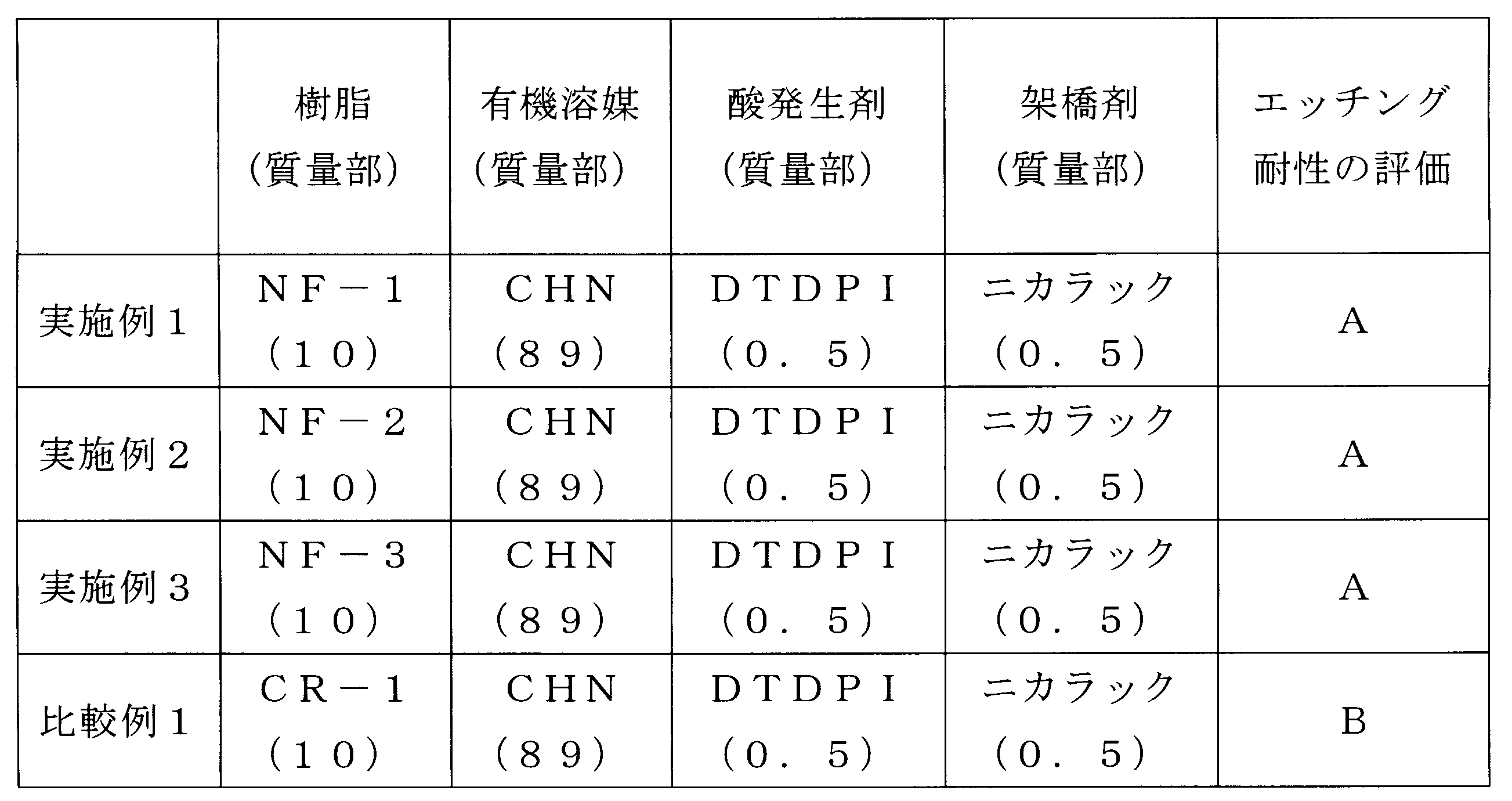
架橋剤:三和ケミカル社製 ニカラックMX270(ニカラック)
有機溶媒:プロピレングリコールモノメチルエーテルアセテート(PGMEA)、
有機溶媒:シクロヘキサノン(CHN)
ノボラック:群栄化学社製 PSM4357
次に、実施例1の下層膜形成材料を膜厚300nmのSiO2基板上に塗布して、240℃で60秒間、さらに400℃で120秒間ベークすることにより、膜厚80nmの下層膜を形成した。この下層膜上に、ArF用レジスト溶液を塗布し、130℃で60秒間ベークすることにより、膜厚150nmのフォトレジスト層を形成した。なお、ArFレジスト溶液としては、下記式(9)の化合物:5質量部、トリフェニルスルホニウムノナフルオロメタンスルホナート:1質量部、トリブチルアミン:2質量部、及びPGMEA:92質量部を配合して調製したものを用いた。
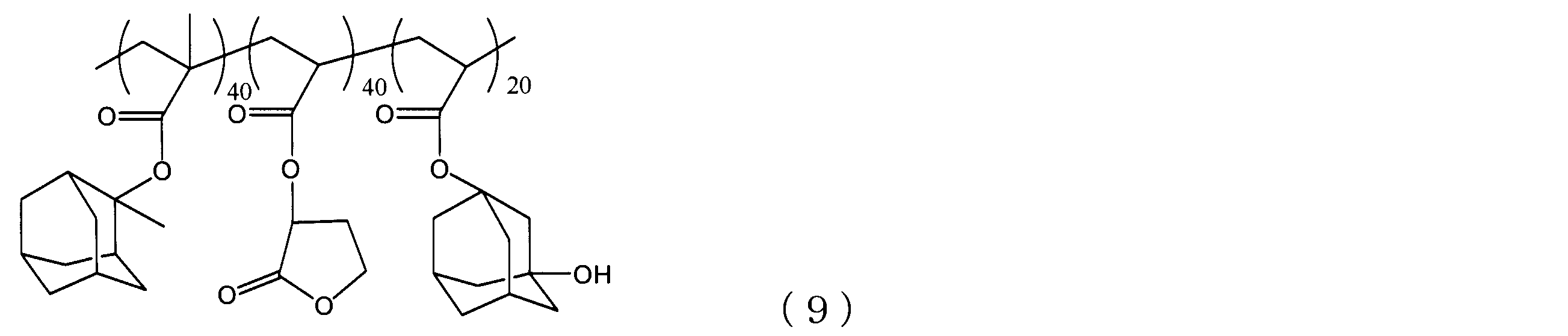
実施例2の下層膜形成材料を用いること以外は、実施例4と同様に行い、下層膜及びフォトレジスト層をSiO2基板上に形成し、ポジ型のレジストパターンを得た。評価結果を、表2に示す。
実施例3の下層膜形成材料を用いること以外は、実施例4と同様に行い、下層膜及びフォトレジスト層をSiO2基板上に形成し、ポジ型のレジストパターンを得た。評価結果を、表2に示す。
下層膜の形成を省略すること以外は、実施例4と同様に行い、フォトレジスト層をSiO2基板上に形成し、ポジ型のレジストパターンを得た。評価結果を、表2に示す。
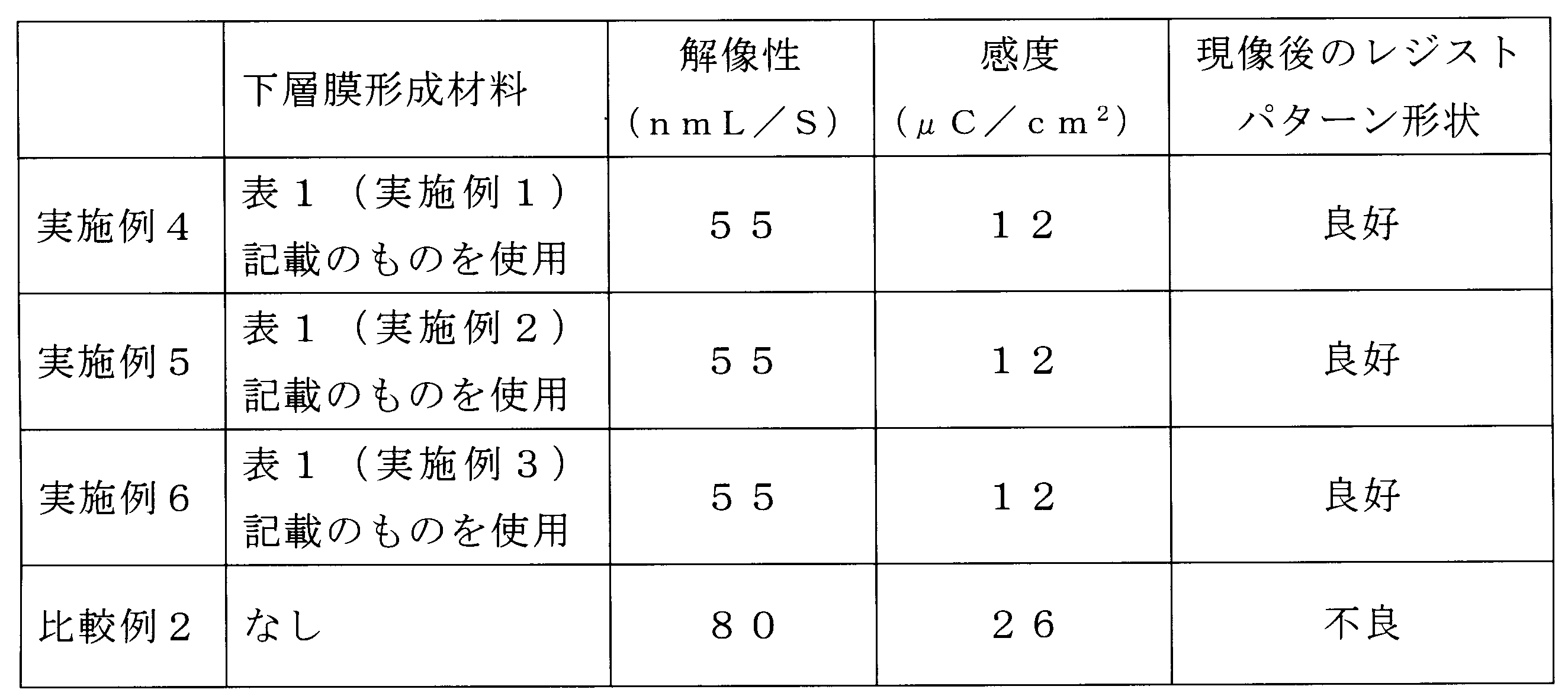
表2から明らかなように、実施例4~6の下層膜は、比較例2に比して、解像性および感度ともに有意に優れていることが確認された。また、現像後のレジストパターン形状も良好であることが確認された。また、現像後のレジストパターン形状の相違から、本発明のフェノール系樹脂は、レジスト材料との密着性が良いことが示された。
次に、実施例1の下層膜形成材料を膜厚300nmのSiO2基板上に塗布して、240℃で60秒間、さらに400℃で120秒間ベークすることにより、膜厚80nmの下層膜を形成した。この下層膜上に、珪素含有中間層材料を塗布し、200℃で60秒間ベークすることにより、膜厚35nmの中間層膜を形成した。さらに、この中間層膜上に、実施例4で用いたArF用レジスト溶液を塗布し、130℃で60秒間ベークすることにより、膜厚150nmのフォトレジスト層を形成した。なお、珪素含有中間層材料としては、特開2007-226170号公報の<合成例1>に記載の珪素原子含有ポリマーを用いた。
次いで、電子線描画装置(エリオニクス社製;ELS-7500,50keV)を用いて、フォトレジスト層をマスク露光し、115℃で90秒間ベーク(PEB)し、2.38質量%テトラメチルアンモニウムヒドロキシド(TMAH)水溶液で60秒間現像することにより、55nmL/S(1:1)のポジ型のレジストパターンを得た。
次いで、サムコインターナショナル社製 RIE-10NRを用いて、得られたレジストパターンをマスクにして珪素含有中間層膜(SOG)のドライエッチング加工を行い、続いて、得られた珪素含有中間層膜パターンをマスクにして下層膜のドライエッチング加工と、得られた下層膜パターンをマスクにしてSiO2膜のドライエッチング加工とを順次行った。
レジストパターンのレジスト中間層膜へのエッチング条件。
出力:50W
圧力:20Pa
時間:1min
エッチングガス
Arガス流量:CF4ガス流量:O2ガス流量=50:8:2(sccm)
レジスト中間膜パターンのレジスト下層膜へのエッチング条件。
出力:50W
圧力:20Pa
時間:2min
エッチングガス
Arガス流量:CF4ガス流量:O2ガス流量=50:5:5(sccm)
レジスト下層膜パターンのSiO2膜へのエッチング条件。
出力:50W
圧力:20Pa
時間:2min
エッチングガス
Arガス流量:C5F12ガス流量:C2F6ガス流量:O2ガス流量=50:4:3:1(sccm)
上記のようにして得られた実施例7のパターン断面を、(株)日立製作所製電子顕微鏡(S-4800)を用いて観察したところ、本発明の下層膜を用いた実施例7は、多層レジスト加工におけるエッチング後のSiO2膜の形状が良好であることが確認された。
Claims (18)
- 式(1)および/または(2)で示される化合物と、式(3)および/または(4)で示されるアルデヒドを酸性触媒の存在下で反応させて得られる、樹脂。
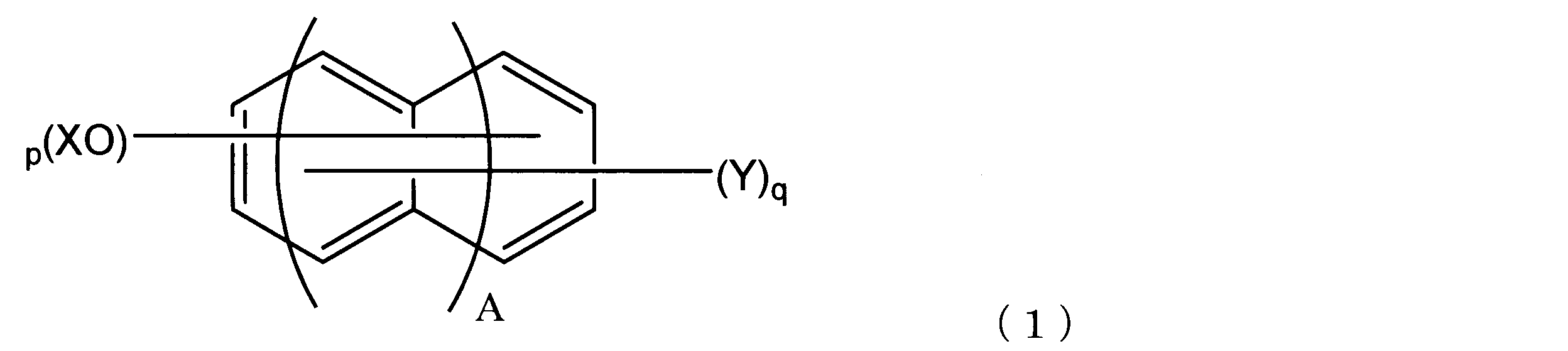
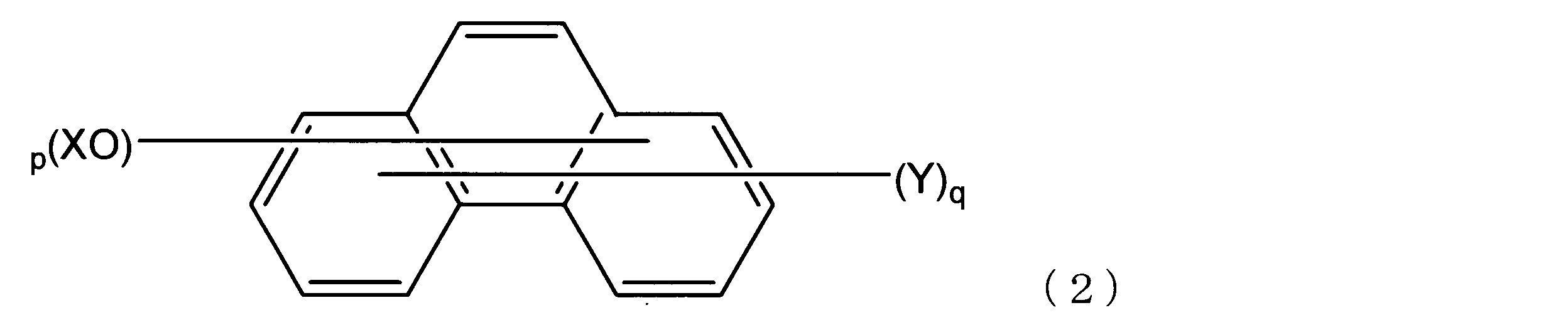
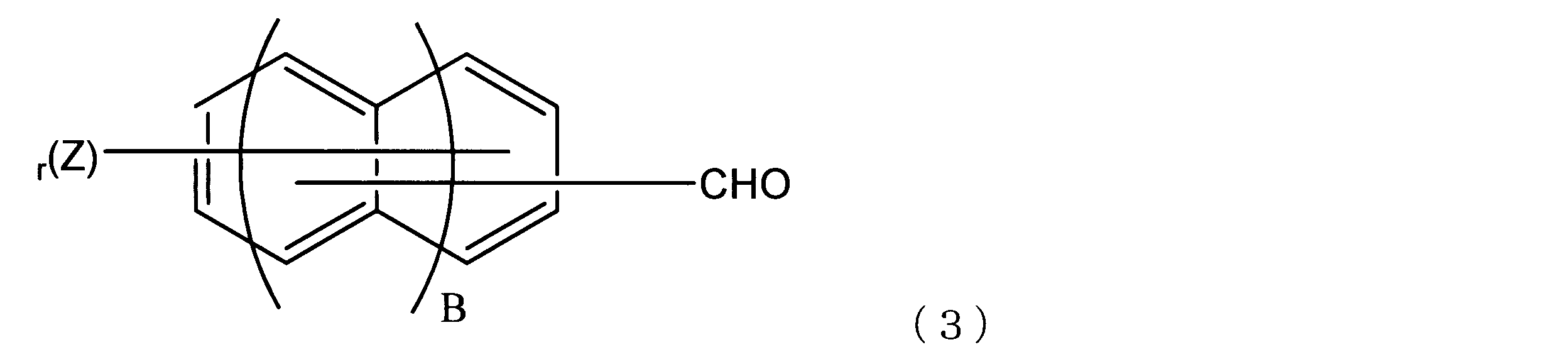

- 前記式(1)で示される化合物が、フェノール類、カテコール類、ヒドロキノン類、クレゾール類、エチルフェノール類、プロピルフェノール類、ブチルフェノール類、フェニルフェノール類、メチルカテコール類、メチルヒドロキノン類、ナフトール類、ジヒドロキシナフタレン類、ヒドロキシアントラセン類、ジヒドロキシアントラセン類、トリヒドロキシアントラセン類およびテトラヒドロキシアントラセン類からなる群より選ばれる少なくとも一種である、
請求項1記載の樹脂。 - 前記式(1)のAが0又は1である、
請求項1記載の樹脂。 - 前記式(2)で示される化合物が、フェナントロール類、メチルフェナントロール類、ジメチルフェナントロール類およびジヒドロキシフェナントロール類からなる群より選ばれる少なくとも一種である、
請求項1記載の樹脂。 - 前記式(3)で示されるアルデヒドが、ベンズアルデヒド類、メチルベンズアルデヒド類、エチルベンズアルデヒド類、プロピルベンズアルデヒド類、ブチルベンズアルデヒド類、シクロヘキシルベンズアルデヒド類、ビフェニルアルデヒド類、ヒドロキシベンズアルデヒド類、ジヒドロキシベンズアルデヒド類、ナフトアルデヒド類、ヒドロキシナフトアルデヒド類およびアントラセンカルボキシアルデヒド類からなる群より選ばれる少なくとも一種である、
請求項1~4のいずれか一項に記載の樹脂。 - 前記式(4)で示されるアルデヒドが、フェナントレンカルバルデヒド類、メチルフェナントレンカルバルデヒド類、ジメチルフェナントレンカルバルデヒド類、ヒドロキシフェナントレンカルバルデヒド類およびジヒドロキシフェナントレンカルバルデヒド類からなる群より選ばれる少なくとも一種である、
請求項1~4のいずれか一項に記載の樹脂。 - 前記酸性触媒が、塩酸、硫酸、リン酸、シュウ酸、マロン酸、こはく酸、アジピン酸、セバシン酸、クエン酸、フマル酸、マレイン酸、蟻酸、p-トルエンスルホン酸、メタンスルホン酸、トリフルオロ酢酸、ジクロロ酢酸、トリクロロ酢酸、トリフルオロメタンスルホン酸、ベンゼンスルホン酸、ナフタレンスルホン酸、ナフタレンジスルホン酸、塩化亜鉛、塩化アルミニウム、塩化鉄、三フッ化ホウ素、ケイタングステン酸、リンタングステン酸、ケイモリブデン酸、リンモリブデン酸、臭化水素酸およびフッ酸からなる群より選ばれる少なくとも一種である、
請求項1~6のいずれか一項に記載の樹脂。 - 下記式(5)、(6)、(7)および/または(8)で示される構造を含む、
請求項1~7のいずれか一項に記載の樹脂。
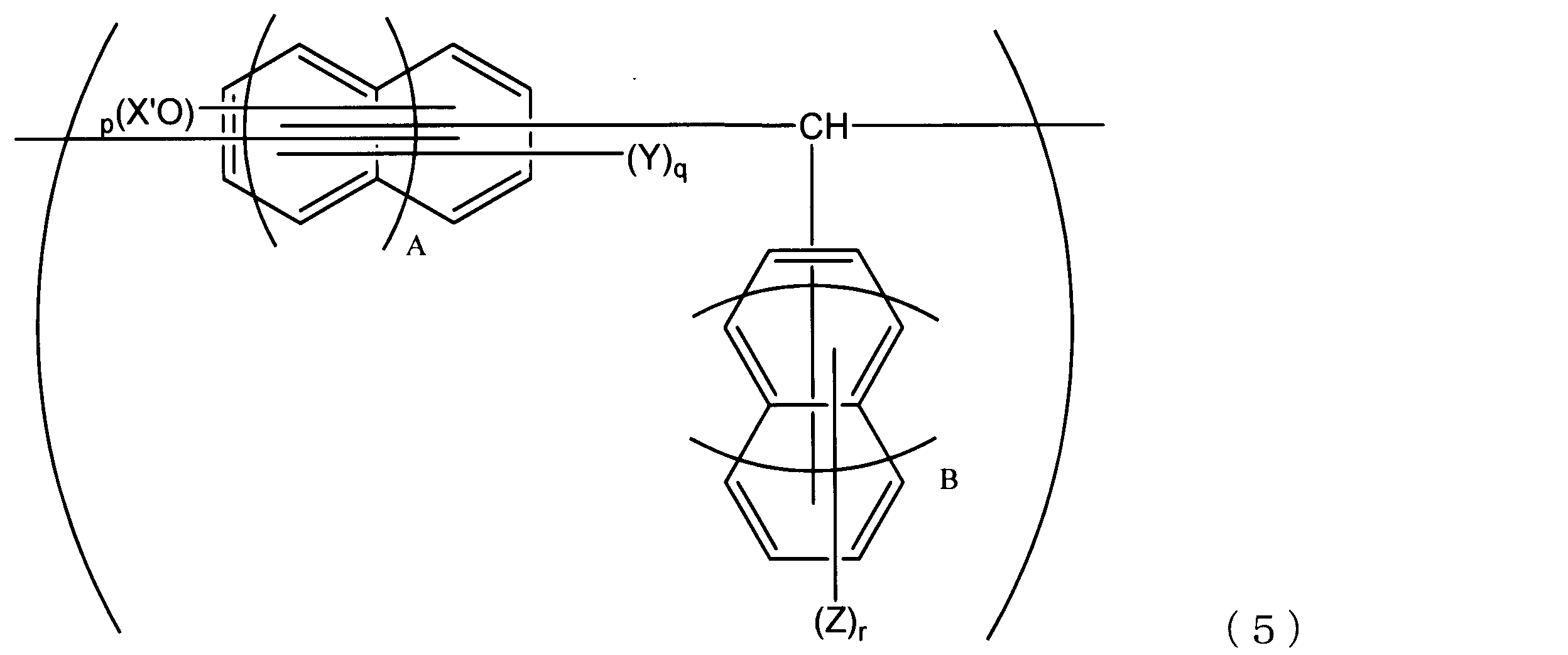
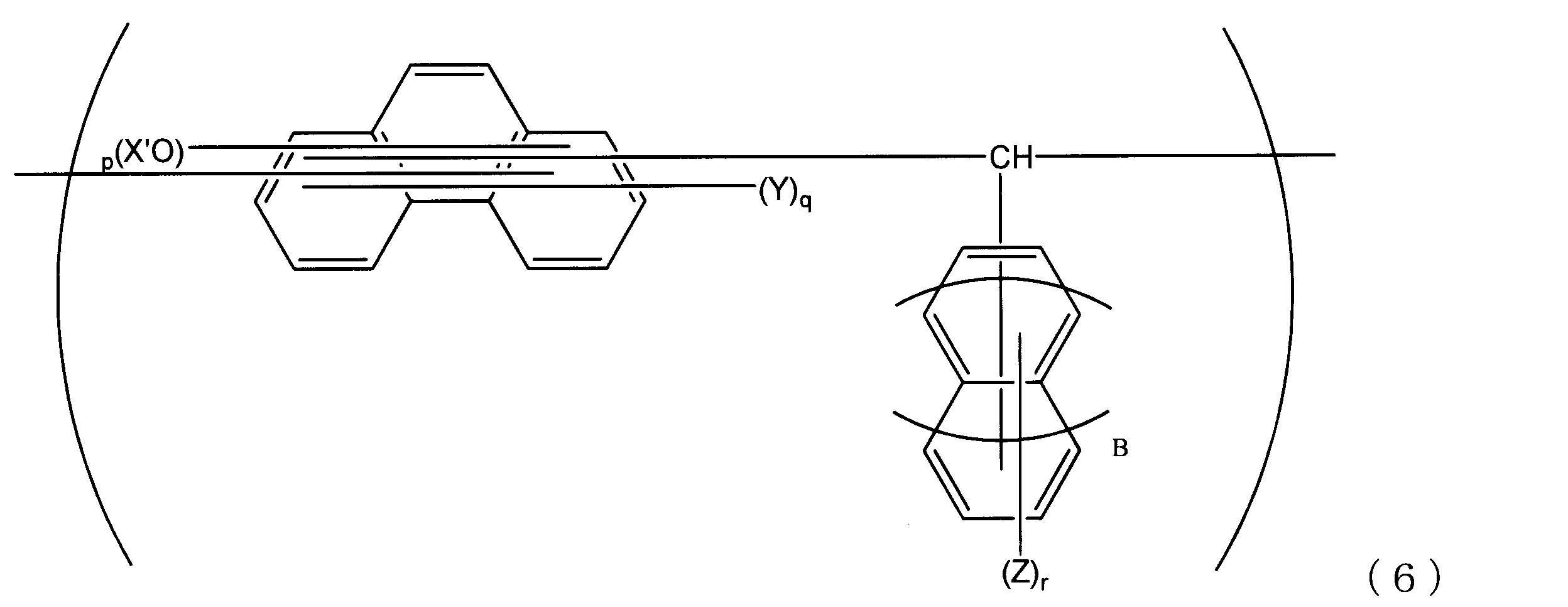
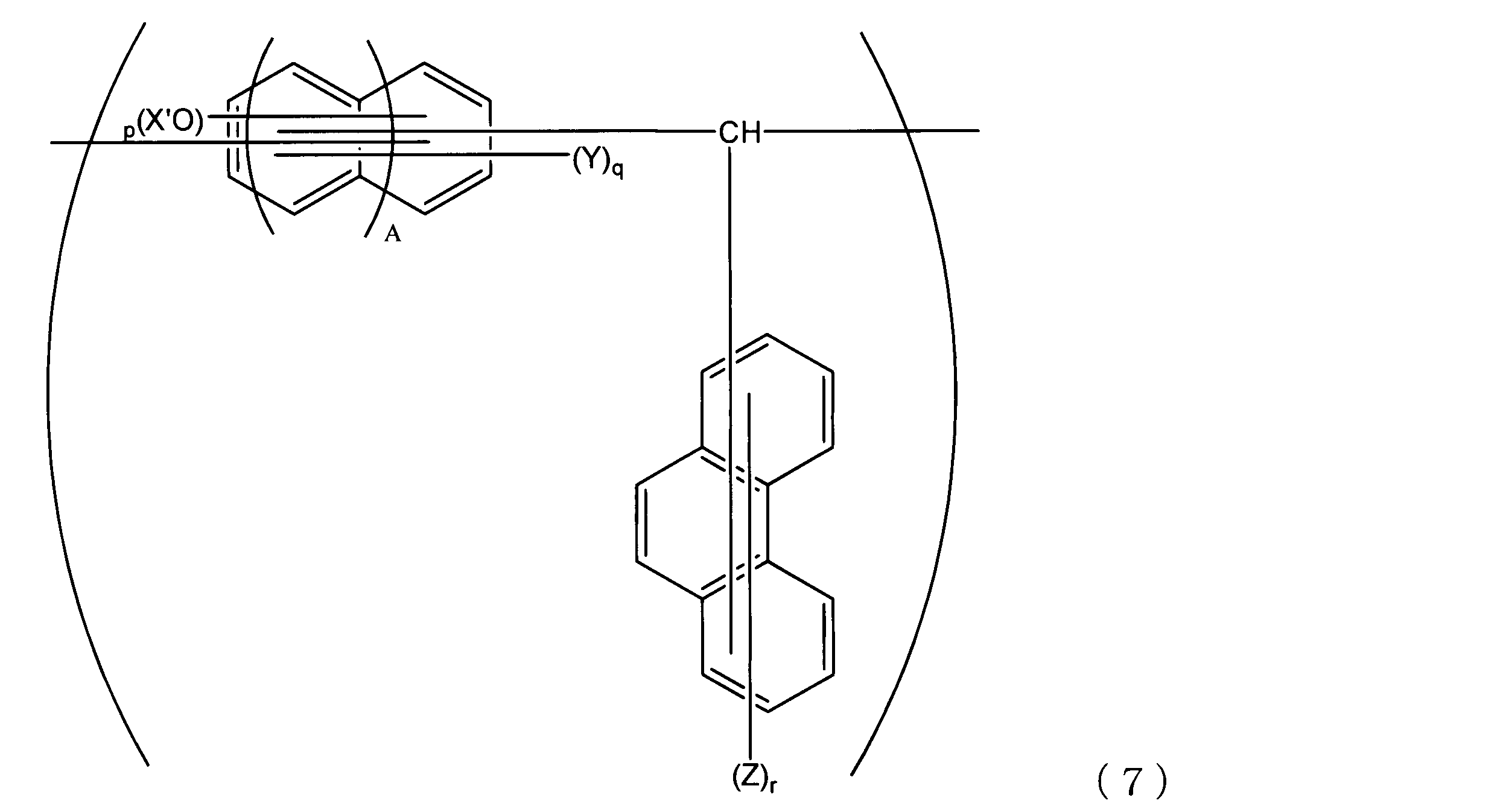

- 炭素濃度が80~99.9質量%である、
請求項1~8のいずれか一項に記載の樹脂。 - プロピレングリコールモノメチルエーテルアセテートに対する溶解度が10質量%以上である、
請求項1~9のいずれか一項に記載の樹脂。 - 請求項1~10のいずれか一項に記載の樹脂を含む、
樹脂組成物。 - さらに、有機溶媒を含む、
請求項11記載の樹脂組成物。 - さらに、酸発生剤を含む、
請求項11または12記載の樹脂組成物。 - さらに、架橋剤を含む、
請求項11~13のいずれか一項に記載の樹脂組成物。 - 請求項11~14のいずれか一項に記載の樹脂組成物を含む、
リソグラフィー用下層膜形成材料。 - 請求項15記載のリソグラフィー用下層膜形成材料から形成される、
リソグラフィー用下層膜。 - 基板上に、請求項15記載のリソグラフィー用下層膜形成材料を用いて下層膜を形成し、該下層膜上に、少なくとも1層のフォトレジスト層を形成した後、該フォトレジスト層の所要の領域に放射線を照射し、アルカリ現像することを特徴とする、
パターン形成方法。 - 基板上に、請求項15記載のリソグラフィー用下層膜形成材料を用いて下層膜を形成し、該下層膜上に、珪素原子を含有するレジスト中間層膜材料を用いて中間層膜を形成し、該中間層膜の上に、少なくとも1層のフォトレジスト層を形成した後、該フォトレジスト層の所要の領域に放射線を照射し、アルカリ現像してレジストパターンを形成後、該レジストパターンをマスクとして前記中間層膜をエッチングし、得られた中間層膜パターンをエッチングマスクにして前記下層膜をエッチングし、得られた下層膜パターンをエッチングマスクにして基板をエッチングして基板にパターンを形成することを特徴とする、
パターン形成方法。
Priority Applications (5)
| Application Number | Priority Date | Filing Date | Title |
|---|---|---|---|
| KR1020137031478A KR101869929B1 (ko) | 2011-06-03 | 2012-05-30 | 페놀계 수지 및 리소그래피용 하층막 형성 재료 |
| EP12793749.8A EP2716671B1 (en) | 2011-06-03 | 2012-05-30 | Phenolic resin and material for forming underlayer film for lithography |
| CN201280027219.XA CN103619892B (zh) | 2011-06-03 | 2012-05-30 | 酚醛系树脂以及光刻用下层膜形成材料 |
| JP2013518139A JP6064904B2 (ja) | 2011-06-03 | 2012-05-30 | フェノール系樹脂およびリソグラフィー用下層膜形成材料 |
| US14/123,471 US9110373B2 (en) | 2011-06-03 | 2012-05-30 | Phenolic resin and material for forming underlayer film for lithography |
Applications Claiming Priority (2)
| Application Number | Priority Date | Filing Date | Title |
|---|---|---|---|
| JP2011-125029 | 2011-06-03 | ||
| JP2011125029 | 2011-06-03 |
Publications (1)
| Publication Number | Publication Date |
|---|---|
| WO2012165507A1 true WO2012165507A1 (ja) | 2012-12-06 |
Family
ID=47259359
Family Applications (1)
| Application Number | Title | Priority Date | Filing Date |
|---|---|---|---|
| PCT/JP2012/063995 Ceased WO2012165507A1 (ja) | 2011-06-03 | 2012-05-30 | フェノール系樹脂およびリソグラフィー用下層膜形成材料 |
Country Status (7)
| Country | Link |
|---|---|
| US (1) | US9110373B2 (ja) |
| EP (1) | EP2716671B1 (ja) |
| JP (1) | JP6064904B2 (ja) |
| KR (1) | KR101869929B1 (ja) |
| CN (1) | CN103619892B (ja) |
| TW (1) | TWI553043B (ja) |
| WO (1) | WO2012165507A1 (ja) |
Cited By (19)
| Publication number | Priority date | Publication date | Assignee | Title |
|---|---|---|---|---|
| JP2015011169A (ja) * | 2013-06-28 | 2015-01-19 | 日産化学工業株式会社 | リソグラフィー用レジスト上層膜形成組成物及びそれを用いた半導体装置の製造方法 |
| KR20150069557A (ko) * | 2013-12-12 | 2015-06-23 | 롬 앤드 하스 일렉트로닉 머트어리얼즈 엘엘씨 | 하부층용 방향족 수지 |
| JP2017125182A (ja) * | 2016-01-08 | 2017-07-20 | Jsr株式会社 | レジスト下層膜形成用重合体及びその製造方法、レジスト下層膜形成用組成物、レジスト下層膜並びにパターニングされた基板の製造方法 |
| US9809601B2 (en) | 2013-02-08 | 2017-11-07 | Mitsubishi Gas Chemical Company, Inc. | Compound, material for forming underlayer film for lithography, underlayer film for lithography and pattern forming method |
| US9828355B2 (en) | 2013-02-08 | 2017-11-28 | Mitsubishi Gas Chemical Company, Inc. | Compound, material for forming underlayer film for lithography, underlayer film for lithography and pattern forming method |
| US9828457B2 (en) * | 2013-07-19 | 2017-11-28 | Dic Corporation | Compound containing phenolic hydroxy group, photosensitive composition, composition for resists, resist coating film, curable composition, composition for resist underlayer films, and resist underlayer film |
| US20170349564A1 (en) | 2014-12-25 | 2017-12-07 | Mitsubishi Gas Chemical Company, Inc. | Compound, resin, material for forming underlayer film for lithography, underlayer film for lithography, pattern forming method, and purification method |
| TWI638235B (zh) * | 2012-12-18 | 2018-10-11 | 日商日產化學工業股份有限公司 | 含多環芳香族乙烯基化合物之自己組織化膜的下層膜形成組成物 |
| US10294183B2 (en) | 2014-03-13 | 2019-05-21 | Mitsubishi Gas Chemical Company, Inc. | Compound, resin, material for forming underlayer film for lithography, underlayer film for lithography, pattern forming method, and method for purifying the compound or resin |
| US10303055B2 (en) | 2014-03-13 | 2019-05-28 | Mitsubishi Gas Chemical Company, Inc. | Resist composition and method for forming resist pattern |
| US10377734B2 (en) | 2013-02-08 | 2019-08-13 | Mitsubishi Gas Chemical Company, Inc. | Resist composition, method for forming resist pattern, polyphenol derivative for use in the composition |
| US10466590B2 (en) | 2014-10-10 | 2019-11-05 | Dic Corporation | Naphthol-type calixarene compound and method for producing the same, photosensitive composition, resist material, and coating |
| US10642156B2 (en) | 2015-03-30 | 2020-05-05 | Mitsubishi Gas Chemical Company, Inc. | Resist base material, resist composition and method for forming resist pattern |
| US10747112B2 (en) | 2015-03-30 | 2020-08-18 | Mitsubishi Gas Chemical Company, Inc. | Compound, resin, and purification method thereof, material for forming underlayer film for lithography, composition for forming underlayer film, and underlayer film, as well as resist pattern forming method and circuit pattern forming method |
| US11137686B2 (en) | 2015-08-31 | 2021-10-05 | Mitsubishi Gas Chemical Company, Inc. | Material for forming underlayer film for lithography, composition for forming underlayer film for lithography, underlayer film for lithography and production method thereof, and resist pattern forming method |
| US11143962B2 (en) | 2015-08-31 | 2021-10-12 | Mitsubishi Gas Chemical Company, Inc. | Material for forming underlayer film for lithography, composition for forming underlayer film for lithography, underlayer film for lithography and production method thereof, pattern forming method, resin, and purification method |
| US11243467B2 (en) | 2015-09-10 | 2022-02-08 | Mitsubishi Gas Chemical Company, Inc. | Compound, resin, resist composition or radiation-sensitive composition, resist pattern formation method, method for producing amorphous film, underlayer film forming material for lithography, composition for underlayer film formation for lithography, method for forming circuit pattern, and purification method |
| US11256170B2 (en) | 2015-03-31 | 2022-02-22 | Mitsubishi Gas Chemical Company, Inc. | Compound, resist composition, and method for forming resist pattern using it |
| US11480877B2 (en) | 2015-03-31 | 2022-10-25 | Mitsubishi Gas Chemical Company, Inc. | Resist composition, method for forming resist pattern, and polyphenol compound used therein |
Families Citing this family (8)
| Publication number | Priority date | Publication date | Assignee | Title |
|---|---|---|---|---|
| JP6213328B2 (ja) * | 2014-03-20 | 2017-10-18 | Jsr株式会社 | 膜形成用組成物、レジスト下層膜及びその形成方法並びにパターン形成方法 |
| JP6028883B1 (ja) * | 2015-01-16 | 2016-11-24 | Dic株式会社 | レジスト永久膜用硬化性組成物及びレジスト永久膜 |
| WO2017069063A1 (ja) * | 2015-10-19 | 2017-04-27 | 日産化学工業株式会社 | 長鎖アルキル基含有ノボラックを含むレジスト下層膜形成組成物 |
| TWI738761B (zh) * | 2016-06-16 | 2021-09-11 | 南韓商東友精細化工有限公司 | 硬遮罩用組合物 |
| CN107189027B (zh) * | 2017-03-13 | 2019-04-19 | 忻州师范学院 | 一种腰果酚糠醛树脂与一种油漆涂料 |
| US11042090B2 (en) | 2017-08-04 | 2021-06-22 | Shin-Etsu Chemical Co., Ltd. | Composition for forming organic film |
| CN113461885B (zh) * | 2021-08-09 | 2022-07-05 | 北京彤程创展科技有限公司 | 一种光刻胶用酚醛树脂及其制备方法 |
| CN115981100A (zh) * | 2022-08-11 | 2023-04-18 | 武汉梵佳鑫科技有限公司 | 一种用于光刻的耐氢氟酸保护材料及其光刻工艺 |
Citations (15)
| Publication number | Priority date | Publication date | Assignee | Title |
|---|---|---|---|---|
| JPS6099117A (ja) * | 1983-11-02 | 1985-06-03 | Sumitomo Bakelite Co Ltd | 熱硬化性樹脂組成物 |
| JPH02248417A (ja) * | 1989-03-22 | 1990-10-04 | Fuji Photo Film Co Ltd | 高分子量フェノール樹脂の製造法 |
| JPH061741A (ja) | 1992-06-18 | 1994-01-11 | Honsyu Kagaku Kogyo Kk | 新規なポリフエノール及びその高純度品の製造方法 |
| JP2000143937A (ja) | 1998-11-16 | 2000-05-26 | Jsr Corp | 反射防止膜形成組成物 |
| JP2002334869A (ja) | 2001-02-07 | 2002-11-22 | Tokyo Electron Ltd | シリコン窒化膜の形成方法、形成装置及びこの形成装置の洗浄前処理方法 |
| JP2004511584A (ja) | 2000-09-08 | 2004-04-15 | セカ ソシエテ アノニム | ノボラック樹脂と、その製造方法および使用 |
| JP2004177668A (ja) | 2002-11-27 | 2004-06-24 | Tokyo Ohka Kogyo Co Ltd | 多層レジストプロセス用下層膜形成材料およびこれを用いた配線形成方法 |
| WO2004066377A1 (ja) | 2003-01-24 | 2004-08-05 | Tokyo Electron Limited | 被処理基板上にシリコン窒化膜を形成するcvd方法 |
| JP2004271838A (ja) | 2003-03-07 | 2004-09-30 | Shin Etsu Chem Co Ltd | レジスト下層膜材料ならびにパターン形成方法 |
| JP2005250434A (ja) | 2004-02-04 | 2005-09-15 | Shin Etsu Chem Co Ltd | レジスト下層膜材料ならびにパターン形成方法 |
| JP2007226204A (ja) | 2006-01-25 | 2007-09-06 | Shin Etsu Chem Co Ltd | 反射防止膜材料、基板、及びパターン形成方法 |
| JP2007226170A (ja) | 2006-01-27 | 2007-09-06 | Shin Etsu Chem Co Ltd | 反射防止膜材料、反射防止膜を有する基板及びパターン形成方法 |
| JP2008088197A (ja) | 2006-09-29 | 2008-04-17 | Sumitomo Bakelite Co Ltd | フォトレジスト用フェノール樹脂とその製造方法、及びフォトレジスト用樹脂組成物 |
| JP2008138128A (ja) * | 2006-12-04 | 2008-06-19 | Ube Ind Ltd | フォトレジスト用ノボラック型フェノール樹脂およびその製造方法 |
| WO2009072465A1 (ja) | 2007-12-07 | 2009-06-11 | Mitsubishi Gas Chemical Company, Inc. | リソグラフィー用下層膜形成組成物及び多層レジストパターン形成方法 |
Family Cites Families (20)
| Publication number | Priority date | Publication date | Assignee | Title |
|---|---|---|---|---|
| US5094934A (en) * | 1987-04-06 | 1992-03-10 | Morton International, Inc. | Method of developing a high contrast, positive photoresist using a developer containing alkanolamine |
| JPH0751611B2 (ja) * | 1988-01-25 | 1995-06-05 | 旭有機材工業株式会社 | フェノール樹脂及びビスフェノールの製造方法 |
| US4954607A (en) * | 1988-08-25 | 1990-09-04 | Gunma University | Ferromagnetic organic substance having triaryl methane structure and process for manufacturing the same |
| EP0414537B1 (en) * | 1989-08-23 | 1999-02-17 | Director-General Of The Agency Of Industrial Science And Technology | Organic ferromagnetic substance |
| MY108461A (en) * | 1991-10-11 | 1996-09-30 | Sumitomo Chemical Co | Polyhydric phenol from naphthaldehyde and epoxy resin obtained using the same. |
| US6773864B1 (en) * | 1991-11-15 | 2004-08-10 | Shipley Company, L.L.C. | Antihalation compositions |
| US5932389A (en) * | 1998-02-20 | 1999-08-03 | Shipley Company, L.L.C. | Controlled alternating and block copolymer resins |
| JP4076710B2 (ja) * | 2000-06-23 | 2008-04-16 | 住友ベークライト株式会社 | ヒドロキシナフタレン樹脂及びその製造方法 |
| US6660811B2 (en) * | 2001-01-30 | 2003-12-09 | Dainippon Ink And Chemicals, Inc. | Epoxy resin composition and curing product thereof |
| JP3944765B2 (ja) * | 2001-01-30 | 2007-07-18 | 大日本インキ化学工業株式会社 | エポキシ樹脂、エポキシ樹脂組成物及びその硬化物 |
| EP2080750B1 (en) * | 2006-11-02 | 2020-07-29 | Mitsubishi Gas Chemical Company, Inc. | Radiation-sensitive composition |
| JP5260094B2 (ja) * | 2007-03-12 | 2013-08-14 | ローム・アンド・ハース・エレクトロニック・マテリアルズ,エル.エル.シー. | フェノール系ポリマー及びこれを含有するフォトレジスト |
| JP4778535B2 (ja) * | 2007-04-06 | 2011-09-21 | 大阪瓦斯株式会社 | フェノール樹脂およびその製造方法 |
| US8648152B2 (en) | 2007-11-16 | 2014-02-11 | Mitsubishi Gas Chemical Company, Inc. | Polyfunctional dimethylnaphthalene formaldehyde resin, and process for production thereof |
| KR101506756B1 (ko) * | 2007-12-07 | 2015-03-27 | 미츠비시 가스 가가쿠 가부시키가이샤 | 변성 나프탈렌 포름알데히드 수지 및 트리시클로데칸 골격 함유 나프톨 화합물 및 에스테르 화합물 |
| CN101581882A (zh) | 2008-05-16 | 2009-11-18 | 住友化学株式会社 | 化学放大型正性抗蚀剂组合物 |
| JP5513747B2 (ja) * | 2009-01-09 | 2014-06-04 | 昭和電工株式会社 | ノボラック樹脂およびその製造方法 |
| JP5742715B2 (ja) * | 2009-09-15 | 2015-07-01 | 三菱瓦斯化学株式会社 | 芳香族炭化水素樹脂及びリソグラフィー用下層膜形成組成物 |
| EP2660257B1 (en) * | 2010-12-28 | 2018-09-19 | Mitsubishi Gas Chemical Company, Inc. | Aromatic hydrocarbon resin, composition for forming lithographic underlayer film, and method for forming multilayer resist pattern |
| JP2013109175A (ja) * | 2011-11-22 | 2013-06-06 | Ricoh Co Ltd | トナーの製造方法とそれにより得られるトナー |
-
2012
- 2012-05-30 KR KR1020137031478A patent/KR101869929B1/ko not_active Expired - Fee Related
- 2012-05-30 JP JP2013518139A patent/JP6064904B2/ja active Active
- 2012-05-30 EP EP12793749.8A patent/EP2716671B1/en not_active Not-in-force
- 2012-05-30 WO PCT/JP2012/063995 patent/WO2012165507A1/ja not_active Ceased
- 2012-05-30 CN CN201280027219.XA patent/CN103619892B/zh not_active Expired - Fee Related
- 2012-05-30 US US14/123,471 patent/US9110373B2/en active Active
- 2012-06-01 TW TW101119758A patent/TWI553043B/zh not_active IP Right Cessation
Patent Citations (15)
| Publication number | Priority date | Publication date | Assignee | Title |
|---|---|---|---|---|
| JPS6099117A (ja) * | 1983-11-02 | 1985-06-03 | Sumitomo Bakelite Co Ltd | 熱硬化性樹脂組成物 |
| JPH02248417A (ja) * | 1989-03-22 | 1990-10-04 | Fuji Photo Film Co Ltd | 高分子量フェノール樹脂の製造法 |
| JPH061741A (ja) | 1992-06-18 | 1994-01-11 | Honsyu Kagaku Kogyo Kk | 新規なポリフエノール及びその高純度品の製造方法 |
| JP2000143937A (ja) | 1998-11-16 | 2000-05-26 | Jsr Corp | 反射防止膜形成組成物 |
| JP2004511584A (ja) | 2000-09-08 | 2004-04-15 | セカ ソシエテ アノニム | ノボラック樹脂と、その製造方法および使用 |
| JP2002334869A (ja) | 2001-02-07 | 2002-11-22 | Tokyo Electron Ltd | シリコン窒化膜の形成方法、形成装置及びこの形成装置の洗浄前処理方法 |
| JP2004177668A (ja) | 2002-11-27 | 2004-06-24 | Tokyo Ohka Kogyo Co Ltd | 多層レジストプロセス用下層膜形成材料およびこれを用いた配線形成方法 |
| WO2004066377A1 (ja) | 2003-01-24 | 2004-08-05 | Tokyo Electron Limited | 被処理基板上にシリコン窒化膜を形成するcvd方法 |
| JP2004271838A (ja) | 2003-03-07 | 2004-09-30 | Shin Etsu Chem Co Ltd | レジスト下層膜材料ならびにパターン形成方法 |
| JP2005250434A (ja) | 2004-02-04 | 2005-09-15 | Shin Etsu Chem Co Ltd | レジスト下層膜材料ならびにパターン形成方法 |
| JP2007226204A (ja) | 2006-01-25 | 2007-09-06 | Shin Etsu Chem Co Ltd | 反射防止膜材料、基板、及びパターン形成方法 |
| JP2007226170A (ja) | 2006-01-27 | 2007-09-06 | Shin Etsu Chem Co Ltd | 反射防止膜材料、反射防止膜を有する基板及びパターン形成方法 |
| JP2008088197A (ja) | 2006-09-29 | 2008-04-17 | Sumitomo Bakelite Co Ltd | フォトレジスト用フェノール樹脂とその製造方法、及びフォトレジスト用樹脂組成物 |
| JP2008138128A (ja) * | 2006-12-04 | 2008-06-19 | Ube Ind Ltd | フォトレジスト用ノボラック型フェノール樹脂およびその製造方法 |
| WO2009072465A1 (ja) | 2007-12-07 | 2009-06-11 | Mitsubishi Gas Chemical Company, Inc. | リソグラフィー用下層膜形成組成物及び多層レジストパターン形成方法 |
Non-Patent Citations (1)
| Title |
|---|
| See also references of EP2716671A4 |
Cited By (25)
| Publication number | Priority date | Publication date | Assignee | Title |
|---|---|---|---|---|
| TWI638235B (zh) * | 2012-12-18 | 2018-10-11 | 日商日產化學工業股份有限公司 | 含多環芳香族乙烯基化合物之自己組織化膜的下層膜形成組成物 |
| US10508181B2 (en) | 2012-12-18 | 2019-12-17 | Nissan Chemical Industries, Ltd. | Bottom layer film-formation composition of self-organizing film containing polycyclic organic vinyl compound |
| CN104854205B (zh) * | 2012-12-18 | 2018-12-28 | 日产化学工业株式会社 | 含有多环芳香族乙烯基化合物的自组装膜的下层膜形成用组合物 |
| US10377734B2 (en) | 2013-02-08 | 2019-08-13 | Mitsubishi Gas Chemical Company, Inc. | Resist composition, method for forming resist pattern, polyphenol derivative for use in the composition |
| US9809601B2 (en) | 2013-02-08 | 2017-11-07 | Mitsubishi Gas Chemical Company, Inc. | Compound, material for forming underlayer film for lithography, underlayer film for lithography and pattern forming method |
| US9828355B2 (en) | 2013-02-08 | 2017-11-28 | Mitsubishi Gas Chemical Company, Inc. | Compound, material for forming underlayer film for lithography, underlayer film for lithography and pattern forming method |
| JP2015011169A (ja) * | 2013-06-28 | 2015-01-19 | 日産化学工業株式会社 | リソグラフィー用レジスト上層膜形成組成物及びそれを用いた半導体装置の製造方法 |
| US9828457B2 (en) * | 2013-07-19 | 2017-11-28 | Dic Corporation | Compound containing phenolic hydroxy group, photosensitive composition, composition for resists, resist coating film, curable composition, composition for resist underlayer films, and resist underlayer film |
| KR102313101B1 (ko) * | 2013-12-12 | 2021-10-15 | 롬 앤드 하스 일렉트로닉 머트어리얼즈 엘엘씨 | 하부층용 방향족 수지 |
| JP2015131954A (ja) * | 2013-12-12 | 2015-07-23 | ローム アンド ハース エレクトロニック マテリアルズ エルエルシーRohm and Haas Electronic Materials LLC | 下層のための芳香族樹脂 |
| KR20150069557A (ko) * | 2013-12-12 | 2015-06-23 | 롬 앤드 하스 일렉트로닉 머트어리얼즈 엘엘씨 | 하부층용 방향족 수지 |
| US10294183B2 (en) | 2014-03-13 | 2019-05-21 | Mitsubishi Gas Chemical Company, Inc. | Compound, resin, material for forming underlayer film for lithography, underlayer film for lithography, pattern forming method, and method for purifying the compound or resin |
| US10303055B2 (en) | 2014-03-13 | 2019-05-28 | Mitsubishi Gas Chemical Company, Inc. | Resist composition and method for forming resist pattern |
| US10466590B2 (en) | 2014-10-10 | 2019-11-05 | Dic Corporation | Naphthol-type calixarene compound and method for producing the same, photosensitive composition, resist material, and coating |
| US10745372B2 (en) | 2014-12-25 | 2020-08-18 | Mitsubishi Gas Chemical Company, Inc. | Compound, resin, material for forming underlayer film for lithography, underlayer film for lithography, pattern forming method, and purification method |
| US20170349564A1 (en) | 2014-12-25 | 2017-12-07 | Mitsubishi Gas Chemical Company, Inc. | Compound, resin, material for forming underlayer film for lithography, underlayer film for lithography, pattern forming method, and purification method |
| US10747112B2 (en) | 2015-03-30 | 2020-08-18 | Mitsubishi Gas Chemical Company, Inc. | Compound, resin, and purification method thereof, material for forming underlayer film for lithography, composition for forming underlayer film, and underlayer film, as well as resist pattern forming method and circuit pattern forming method |
| US10642156B2 (en) | 2015-03-30 | 2020-05-05 | Mitsubishi Gas Chemical Company, Inc. | Resist base material, resist composition and method for forming resist pattern |
| US11256170B2 (en) | 2015-03-31 | 2022-02-22 | Mitsubishi Gas Chemical Company, Inc. | Compound, resist composition, and method for forming resist pattern using it |
| US11480877B2 (en) | 2015-03-31 | 2022-10-25 | Mitsubishi Gas Chemical Company, Inc. | Resist composition, method for forming resist pattern, and polyphenol compound used therein |
| US11137686B2 (en) | 2015-08-31 | 2021-10-05 | Mitsubishi Gas Chemical Company, Inc. | Material for forming underlayer film for lithography, composition for forming underlayer film for lithography, underlayer film for lithography and production method thereof, and resist pattern forming method |
| US11143962B2 (en) | 2015-08-31 | 2021-10-12 | Mitsubishi Gas Chemical Company, Inc. | Material for forming underlayer film for lithography, composition for forming underlayer film for lithography, underlayer film for lithography and production method thereof, pattern forming method, resin, and purification method |
| US11243467B2 (en) | 2015-09-10 | 2022-02-08 | Mitsubishi Gas Chemical Company, Inc. | Compound, resin, resist composition or radiation-sensitive composition, resist pattern formation method, method for producing amorphous film, underlayer film forming material for lithography, composition for underlayer film formation for lithography, method for forming circuit pattern, and purification method |
| US11572430B2 (en) | 2015-09-10 | 2023-02-07 | Mitsubishi Gas Chemical Company, Inc. | Compound, resin, resist composition or radiation-sensitive composition, resist pattern formation method, method for producing amorphous film, underlayer film forming material for lithography, composition for underlayer film formation for lithography, method for forming circuit pattern, and purification method |
| JP2017125182A (ja) * | 2016-01-08 | 2017-07-20 | Jsr株式会社 | レジスト下層膜形成用重合体及びその製造方法、レジスト下層膜形成用組成物、レジスト下層膜並びにパターニングされた基板の製造方法 |
Also Published As
| Publication number | Publication date |
|---|---|
| KR20140031273A (ko) | 2014-03-12 |
| EP2716671A1 (en) | 2014-04-09 |
| TWI553043B (zh) | 2016-10-11 |
| EP2716671B1 (en) | 2018-10-10 |
| JP6064904B2 (ja) | 2017-01-25 |
| JPWO2012165507A1 (ja) | 2015-02-23 |
| US20140186776A1 (en) | 2014-07-03 |
| TW201305255A (zh) | 2013-02-01 |
| EP2716671A4 (en) | 2015-09-09 |
| CN103619892B (zh) | 2016-08-24 |
| CN103619892A (zh) | 2014-03-05 |
| KR101869929B1 (ko) | 2018-06-21 |
| US9110373B2 (en) | 2015-08-18 |
Similar Documents
| Publication | Publication Date | Title |
|---|---|---|
| JP6064904B2 (ja) | フェノール系樹脂およびリソグラフィー用下層膜形成材料 | |
| JP6094947B2 (ja) | フルオレン構造を有する樹脂及びリソグラフィー用下層膜形成材料 | |
| JP5979384B2 (ja) | リソグラフィー用下層膜形成材料、リソグラフィー用下層膜及びパターン形成方法 | |
| JP5742715B2 (ja) | 芳香族炭化水素樹脂及びリソグラフィー用下層膜形成組成物 | |
| JP6573217B2 (ja) | 化合物、樹脂、リソグラフィー用下層膜形成材料、リソグラフィー用下層膜、パターン形成方法、及び化合物又は樹脂の精製方法 | |
| JP5853959B2 (ja) | 芳香族炭化水素樹脂、リソグラフィー用下層膜形成組成物及び多層レジストパターンの形成方法 | |
| JP6390911B2 (ja) | 化合物、リソグラフィー用下層膜形成材料、リソグラフィー用下層膜及びパターン形成方法 | |
| JP6388126B2 (ja) | 化合物、リソグラフィー用下層膜形成材料、リソグラフィー用下層膜及びパターン形成方法 | |
| WO2016104214A1 (ja) | 化合物、樹脂、リソグラフィー用下層膜形成材料、リソグラフィー用下層膜、パターン形成方法及び精製方法 | |
| WO2016129679A1 (ja) | 化合物、樹脂、リソグラフィー用下層膜形成材料、リソグラフィー用下層膜形成用組成物、リソグラフィー用下層膜、レジストパターン形成方法、回路パターン形成方法及び化合物又は樹脂の精製方法 | |
| WO2017014191A1 (ja) | 化合物、樹脂、リソグラフィー用下層膜形成材料、リソグラフィー用下層膜形成用組成物、リソグラフィー用下層膜及びレジストパターン形成方法、回路パターン形成方法、及び、精製方法 | |
| WO2016143635A1 (ja) | 化合物、樹脂、リソグラフィー用下層膜形成材料、リソグラフィー用下層膜、パターン形成方法及び化合物又は樹脂の精製方法 |
Legal Events
| Date | Code | Title | Description |
|---|---|---|---|
| 121 | Ep: the epo has been informed by wipo that ep was designated in this application |
Ref document number: 12793749 Country of ref document: EP Kind code of ref document: A1 |
|
| ENP | Entry into the national phase |
Ref document number: 2013518139 Country of ref document: JP Kind code of ref document: A |
|
| ENP | Entry into the national phase |
Ref document number: 20137031478 Country of ref document: KR Kind code of ref document: A |
|
| NENP | Non-entry into the national phase |
Ref country code: DE |
|
| WWE | Wipo information: entry into national phase |
Ref document number: 14123471 Country of ref document: US |