WO2013140652A1 - 工作機械用潤滑油組成物 - Google Patents
工作機械用潤滑油組成物 Download PDFInfo
- Publication number
- WO2013140652A1 WO2013140652A1 PCT/JP2012/077886 JP2012077886W WO2013140652A1 WO 2013140652 A1 WO2013140652 A1 WO 2013140652A1 JP 2012077886 W JP2012077886 W JP 2012077886W WO 2013140652 A1 WO2013140652 A1 WO 2013140652A1
- Authority
- WO
- WIPO (PCT)
- Prior art keywords
- group
- phosphate
- branched
- carbon atoms
- mass
- Prior art date
- Legal status (The legal status is an assumption and is not a legal conclusion. Google has not performed a legal analysis and makes no representation as to the accuracy of the status listed.)
- Ceased
Links
Classifications
-
- C—CHEMISTRY; METALLURGY
- C10—PETROLEUM, GAS OR COKE INDUSTRIES; TECHNICAL GASES CONTAINING CARBON MONOXIDE; FUELS; LUBRICANTS; PEAT
- C10M—LUBRICATING COMPOSITIONS; USE OF CHEMICAL SUBSTANCES EITHER ALONE OR AS LUBRICATING INGREDIENTS IN A LUBRICATING COMPOSITION
- C10M141/00—Lubricating compositions characterised by the additive being a mixture of two or more compounds covered by more than one of the main groups C10M125/00 - C10M139/00, each of these compounds being essential
- C10M141/10—Lubricating compositions characterised by the additive being a mixture of two or more compounds covered by more than one of the main groups C10M125/00 - C10M139/00, each of these compounds being essential at least one of them being an organic phosphorus-containing compound
-
- C—CHEMISTRY; METALLURGY
- C10—PETROLEUM, GAS OR COKE INDUSTRIES; TECHNICAL GASES CONTAINING CARBON MONOXIDE; FUELS; LUBRICANTS; PEAT
- C10M—LUBRICATING COMPOSITIONS; USE OF CHEMICAL SUBSTANCES EITHER ALONE OR AS LUBRICATING INGREDIENTS IN A LUBRICATING COMPOSITION
- C10M2203/00—Organic non-macromolecular hydrocarbon compounds and hydrocarbon fractions as ingredients in lubricant compositions
- C10M2203/10—Petroleum or coal fractions, e.g. tars, solvents, bitumen
- C10M2203/102—Aliphatic fractions
- C10M2203/1025—Aliphatic fractions used as base material
-
- C—CHEMISTRY; METALLURGY
- C10—PETROLEUM, GAS OR COKE INDUSTRIES; TECHNICAL GASES CONTAINING CARBON MONOXIDE; FUELS; LUBRICANTS; PEAT
- C10M—LUBRICATING COMPOSITIONS; USE OF CHEMICAL SUBSTANCES EITHER ALONE OR AS LUBRICATING INGREDIENTS IN A LUBRICATING COMPOSITION
- C10M2219/00—Organic non-macromolecular compounds containing sulfur, selenium or tellurium as ingredients in lubricant compositions
- C10M2219/02—Sulfur-containing compounds obtained by sulfurisation with sulfur or sulfur-containing compounds
- C10M2219/024—Sulfur-containing compounds obtained by sulfurisation with sulfur or sulfur-containing compounds of esters, e.g. fats
-
- C—CHEMISTRY; METALLURGY
- C10—PETROLEUM, GAS OR COKE INDUSTRIES; TECHNICAL GASES CONTAINING CARBON MONOXIDE; FUELS; LUBRICANTS; PEAT
- C10M—LUBRICATING COMPOSITIONS; USE OF CHEMICAL SUBSTANCES EITHER ALONE OR AS LUBRICATING INGREDIENTS IN A LUBRICATING COMPOSITION
- C10M2219/00—Organic non-macromolecular compounds containing sulfur, selenium or tellurium as ingredients in lubricant compositions
- C10M2219/08—Thiols; Sulfides; Polysulfides; Mercaptals
- C10M2219/082—Thiols; Sulfides; Polysulfides; Mercaptals containing sulfur atoms bound to acyclic or cycloaliphatic carbon atoms
-
- C—CHEMISTRY; METALLURGY
- C10—PETROLEUM, GAS OR COKE INDUSTRIES; TECHNICAL GASES CONTAINING CARBON MONOXIDE; FUELS; LUBRICANTS; PEAT
- C10M—LUBRICATING COMPOSITIONS; USE OF CHEMICAL SUBSTANCES EITHER ALONE OR AS LUBRICATING INGREDIENTS IN A LUBRICATING COMPOSITION
- C10M2219/00—Organic non-macromolecular compounds containing sulfur, selenium or tellurium as ingredients in lubricant compositions
- C10M2219/10—Heterocyclic compounds containing sulfur, selenium or tellurium compounds in the ring
- C10M2219/104—Heterocyclic compounds containing sulfur, selenium or tellurium compounds in the ring containing sulfur and carbon with nitrogen or oxygen in the ring
- C10M2219/106—Thiadiazoles
-
- C—CHEMISTRY; METALLURGY
- C10—PETROLEUM, GAS OR COKE INDUSTRIES; TECHNICAL GASES CONTAINING CARBON MONOXIDE; FUELS; LUBRICANTS; PEAT
- C10M—LUBRICATING COMPOSITIONS; USE OF CHEMICAL SUBSTANCES EITHER ALONE OR AS LUBRICATING INGREDIENTS IN A LUBRICATING COMPOSITION
- C10M2223/00—Organic non-macromolecular compounds containing phosphorus as ingredients in lubricant compositions
- C10M2223/02—Organic non-macromolecular compounds containing phosphorus as ingredients in lubricant compositions having no phosphorus-to-carbon bonds
- C10M2223/04—Phosphate esters
-
- C—CHEMISTRY; METALLURGY
- C10—PETROLEUM, GAS OR COKE INDUSTRIES; TECHNICAL GASES CONTAINING CARBON MONOXIDE; FUELS; LUBRICANTS; PEAT
- C10M—LUBRICATING COMPOSITIONS; USE OF CHEMICAL SUBSTANCES EITHER ALONE OR AS LUBRICATING INGREDIENTS IN A LUBRICATING COMPOSITION
- C10M2223/00—Organic non-macromolecular compounds containing phosphorus as ingredients in lubricant compositions
- C10M2223/02—Organic non-macromolecular compounds containing phosphorus as ingredients in lubricant compositions having no phosphorus-to-carbon bonds
- C10M2223/04—Phosphate esters
- C10M2223/041—Triaryl phosphates
-
- C—CHEMISTRY; METALLURGY
- C10—PETROLEUM, GAS OR COKE INDUSTRIES; TECHNICAL GASES CONTAINING CARBON MONOXIDE; FUELS; LUBRICANTS; PEAT
- C10N—INDEXING SCHEME ASSOCIATED WITH SUBCLASS C10M RELATING TO LUBRICATING COMPOSITIONS
- C10N2020/00—Specified physical or chemical properties or characteristics, i.e. function, of component of lubricating compositions
- C10N2020/01—Physico-chemical properties
- C10N2020/02—Viscosity; Viscosity index
-
- C—CHEMISTRY; METALLURGY
- C10—PETROLEUM, GAS OR COKE INDUSTRIES; TECHNICAL GASES CONTAINING CARBON MONOXIDE; FUELS; LUBRICANTS; PEAT
- C10N—INDEXING SCHEME ASSOCIATED WITH SUBCLASS C10M RELATING TO LUBRICATING COMPOSITIONS
- C10N2030/00—Specified physical or chemical properties which is improved by the additive characterising the lubricating composition, e.g. multifunctional additives
- C10N2030/06—Oiliness; Film-strength; Anti-wear; Resistance to extreme pressure
-
- C—CHEMISTRY; METALLURGY
- C10—PETROLEUM, GAS OR COKE INDUSTRIES; TECHNICAL GASES CONTAINING CARBON MONOXIDE; FUELS; LUBRICANTS; PEAT
- C10N—INDEXING SCHEME ASSOCIATED WITH SUBCLASS C10M RELATING TO LUBRICATING COMPOSITIONS
- C10N2040/00—Specified use or application for which the lubricating composition is intended
- C10N2040/08—Hydraulic fluids, e.g. brake-fluids
Definitions
- the present invention relates to a lubricating oil composition for machine tools, and in particular, relates to a lubricating oil composition suitably used as a lubricant used for lubricating a sliding guide surface of a machine tool and a hydraulic device.
- Lubricating oil for sliding guide surfaces such as machine tool processing tables is required to have lubricity in order to improve processing accuracy. And in order to satisfy
- additives examples include phosphate esters, acidic phosphate esters, phosphite esters, carboxylic acids, sulfur compounds, amines, and the like (see, for example, Patent Document 1).
- attempts have been made to improve stability by neutralizing acidic phosphate esters with alkylamines (see, for example, Patent Document 2).
- amines such as a monoamine, a polyamine, and an alkanolamine
- an oil-based agent for example, refer patent document 2, 3
- Monoamines and polyamines are blended with simple amines (see, for example, Patent Document 2).
- alkanolamine is A method used as a compound for forming a salt such as an amine salt with an acidic phosphate ester or an amide with a carboxylic acid is described (for example, Patent Document 3).
- the present invention has been made in view of such circumstances, and an object thereof is to provide a lubricating oil composition for machine tools having excellent wear resistance.
- the inventors of the present invention have a lubricating oil composition containing a specific amount of a specific phosphate ester compound, a specific acidic phosphate ester and a sulfur compound in the lubricant base oil.
- the present inventors have found that the above problems can be solved by a product, and have completed the present invention.
- the lubricating oil composition for machine tools of the present invention is Lubricating base oil, Based on the total amount of the composition, 0.05-5 mass% of the following general formula (1): (R 1 O) 3 P ⁇ O (1)
- R 1 represents any of an aryl group having 6 to 15 carbon atoms and a saturated hydrocarbon group having 1 to 20 carbon atoms, and R 1 may be the same or different from each other.
- R 2 represents an alkyl group having 4 to 20 carbon atoms, n is 1 or 2, and R 2 may be the same or different.
- R 2 in the general formula (2) is preferably an alkyl group having 8 carbon atoms.
- R 1 in the general formula (1) is preferably a saturated hydrocarbon group having 1 to 20 carbon atoms.
- the lubricating oil composition for machine tools of the present invention can be suitably used as a lubricating oil for simultaneously lubricating the sliding guide surface of the machine tool and the hydraulic pump.
- the lubricating oil composition of the present invention is excellent in wear resistance. Therefore, the lubricating oil composition of the present invention is very useful in terms of stabilizing the operation of the machine tool and high machining accuracy. Further, it is very useful in terms of wear resistance in lubricating a hydraulic pump.
- a lubricating oil composition for machine tools according to an embodiment of the present invention, Lubricating base oil, (A) The following general formula (1): (R 1 O) 3 P ⁇ O (1) [In Formula (1), R 1 represents any of an aryl group having 6 to 15 carbon atoms and a saturated hydrocarbon group having 1 to 20 carbon atoms, and R 1 may be the same or different from each other. ] A phosphate ester represented by (hereinafter also referred to as “component (A)”), (B) The following general formula (2): (R 2 O) n P ( ⁇ O) (OH) (3-n) (2) [In Formula (2), R 2 represents an alkyl group having 4 to 20 carbon atoms, n is 1 or 2, and R 2 may be the same or different.
- component (B) Acidic phosphate ester represented by (hereinafter also referred to as “component (B)”), (C) a sulfur compound (hereinafter also referred to as “component (C)”); Containing.
- component (B) Acidic phosphate ester represented by (hereinafter also referred to as “component (B)”
- component (C) a sulfur compound
- Containing Containing.
- the contents of the above components (A) to (C) are, based on the total amount of the composition, 0.05 to 5% by mass of component (A), 0.01 to 2% by mass of component (B), and component (C) Is 0.5 to 5% by mass.
- the lubricant base oil in the present embodiment is not particularly limited, and examples thereof include mineral oil, fats and oils, and synthetic oils.
- a lubricating oil fraction obtained by subjecting crude oil to atmospheric distillation and reduced pressure distillation is subjected to solvent removal, solvent extraction, hydrocracking, solvent Mention may be made of paraffinic or naphthenic mineral oils obtained by applying one or two or more refining means such as dewaxing, catalytic dewaxing, hydrorefining, sulfuric acid washing and clay treatment.
- fats and oils examples include beef tallow, pork tallow, soybean oil, rapeseed oil, rice bran oil, coconut oil, palm oil, palm kernel oil, and hydrogenated products thereof. Moreover, the said fats and oils which raised the oleic acid content using the gene recombination technique can also be used conveniently.
- Synthetic oils include, for example, poly- ⁇ -olefins (ethylene-propylene copolymers, polybutenes, 1-octene oligomers, 1-decene oligomers, hydrides thereof), alkylbenzenes, alkylnaphthalenes, monoesters (butyl stearate).
- lubricating base oil one kind selected from the above-mentioned mineral oils, fats and oils and synthetic oils may be used alone, or two or more kinds may be used in combination.
- the viscosity of the lubricating base oil is not particularly limited, the kinematic viscosity is preferably 10 ⁇ 700mm 2 / s at 40 ° C., and more preferably 15 ⁇ 500mm 2 / s.
- the content of the lubricating base oil is not particularly limited, but is preferably 50 to 99.98% by mass based on the total amount of the composition.
- the phosphoric acid ester as the component (A) is a compound represented by the above general formula (1), and has an aryl group having 6 to 15 carbon atoms (preferably an aryl group having 6 to 9 carbon atoms) and 1 to 20 carbon atoms. And a saturated phosphate group (preferably a saturated hydrocarbon group having 4 to 12 carbon atoms), more preferably a normal phosphate ester having a group selected from saturated hydrocarbon groups having 8 to 12 carbon atoms.
- the phosphoric acid ester of the component (A) include triphenyl phosphate, tricresyl phosphate, trixylenyl phosphate, cresyl diphenyl phosphate, xylenyl diphenyl phosphate, tris (isopropylphenyl) phosphate, tris (T-butylphenyl) phosphate, tributyl phosphate (including linear and branched), tripentyl phosphate (including linear and branched), trihexyl phosphate (including linear and branched), triheptyl phosphate ( Straight chain and branched chain), trioctyl phosphate (including straight chain and branched chain), trinonyl phosphate (including straight chain and branched chain), tridecyl phosphate (including straight chain and branched chain), triun Decyl phosphate (linear and Branched chain), tridodecyl phosphate (including straight and
- triphenyl phosphate, tricresyl phosphate, triheptyl phosphate (including linear and branched chains), trioctyl phosphate (including linear and branched chains), trinonyl phosphate (including linear and branched chains) and Tridecyl phosphate (including linear and branched) is preferred; More preferred are tricresyl phosphate and trioctyl phosphate (including linear and branched); More preferred is trioctyl phosphate (including linear and branched); Tri-2-ethylhexyl phosphate is particularly preferred.
- the content of the phosphoric acid ester as the component (A) is 0.05% by mass or more, preferably 0.1% by mass or more, more preferably 0.2% by mass or more, based on the total amount of the composition. It is not more than mass%, preferably not more than 3 mass%. When the content is less than 0.05% by mass, the wear resistance is insufficient. Moreover, when it exceeds 5 mass%, the abrasion-resistance improvement effect corresponding to content cannot be acquired, and it is unpreferable also from the point of economical efficiency.
- the acidic phosphate ester of the component is a compound represented by the above general formula (2), and is an acidic phosphate ester having an alkyl group having 4 to 20 carbon atoms.
- the acidic phosphate ester of component (B) include monoalkyl acidic phosphate esters, dialkyl acidic phosphate esters, and mixtures thereof.
- the alkyl group of these alkyl acidic phosphates may be a linear or branched alkyl group and may be saturated or unsaturated, but is preferably linear.
- the alkyl group has 4 to 20 carbon atoms, preferably 6 to 16 carbon atoms, more preferably 6 to 10 carbon atoms, and most preferably a linear alkyl group having 8 carbon atoms (n-octyl group).
- the carbon number of the two alkyl groups of the dialkyl acidic phosphate ester may be the same or different. When the number of carbon atoms is 4 or less, the solubility is poor, which is not preferable. Moreover, since the effect per unit mass will fall when carbon number exceeds 20, it is not preferable.
- alkyl group having 4 to 20 carbon atoms include butyl, pentyl, hexyl, heptyl, octyl, nonyl, decyl, undecyl, dodecyl, tridecyl, tetradecyl, pentadecyl Group, hexadecyl group, heptadecyl group, octadecyl group and nonadecyl group, and saturated and unsaturated linear or saturated unsaturated branched ones can be used.
- the acidic phosphate ester mono n-butyl acid phosphate, mono n-pentyl acid phosphate, mono n-hexyl acid phosphate, Mono n-heptyl acid acid phosphate, mono n-octyl acid phosphate, mono n-nonyl acid phosphate, mono n-decyl acid phosphate, Mono n-dodecyl acid phosphate, mono n-octadecyl acid phosphate, Monoiso-butyl acid phosphate, monoiso-pentyl acid phosphate, Monoiso-hexyl acid phosphate, monoiso-heptyl acid acid phosphate, monoiso-octyl acid phosphate, monoiso-nonyl acid phosphate, monoiso-decyl acid phosphate, monoiso-dodecyl acid phosphate, monoiso-hexade
- the content of the acidic phosphate ester as the component (B) is 0.01% by mass or more, more preferably 0.02% by mass or more, more preferably, based on the total amount of the composition. Is 0.3% by mass or more, 2% by mass or less, more preferably 1% by mass or less, and most preferably 0.8% by mass or less.
- the wear resistance is insufficient.
- it exceeds 2 mass% the abrasion-resistance improvement effect corresponding to content cannot be acquired, and it is unpreferable also from the point of economical efficiency.
- the sulfur compound of component (C) is not particularly limited as long as it does not impair the characteristics of the lubricating oil composition, but it is sulfurized fat, thiadiazole compound, dihydrocarbyl polysulfide, sulfurized fatty acid, sulfurized olefin, sulfide ester, sulfide mineral oil, zinc dithiophosphate.
- a compound, a zinc dithiocarbamate compound, a molybdenum dithiophosphate, a molybdenum dithiocarbamate, an alkylthiocarbamoyl compound, a thiocarbamate compound, a thioterpene compound, and a dialkylthiodipropionate compound are preferably used.
- Sulfurized fats and oils are obtained by reacting sulfur and sulfur-containing compounds with fats and oils (lard oil, whale oil, vegetable oil, fish oil, etc.).
- fats and oils for example, sulfurized lard, sulfurized rapeseed oil, sulfided castor oil, sulfided soybean oil, sulfided rice bran oil Etc.
- Examples of the thiadiazole compound include 1,3,4-thiadiazole represented by the following general formula (3), 1,2,4-thiadiazole compound represented by the following general formula (4), and the following general formula (5).
- thiadiazole compounds include 2,5-bis (n-hexyldithio) -1,3,4-thiadiazole, 2,5-bis (n-octyldithio) -1,3,4-thiadiazole 2,5-bis (n-nonyldithio) -1,3,4-thiadiazole, 2,5-bis (1,1,3,3-tetramethylbutyldithio) -1,3,4-thiadiazole, 3, 5-bis (n-hexyldithio) -1,2,4-thiadiazole, 3,5-bis (n-octyldithio) -1,2,4-thiadiazole, 3,5-bis (n-nonyldithio) -1 , 2,4-thiadiazole, 3,5-bis (1,1,3,3-tetramethylbutyldithio) -1,2,4-thiadiazole, 4,5-bis (n-hexyldithio) -1
- Dihydrocarbyl polysulfide is a sulfur compound generally called polysulfide or sulfurized olefin.
- R 9 -S x -R 10 (6) R 9 and R 10 may be the same or different and each represents a linear or branched alkyl group having 3 to 20 carbon atoms, an aryl group having 6 to 20 carbon atoms, Represents an alkylaryl group having 6 to 20 carbon atoms or an arylalkyl group having 6 to 20 carbon atoms, and x represents an integer of 2 to 6, preferably 2 to 5.
- the compound represented by these is meant.
- R 9 and R 10 in the general formula (6) include a propyl group, a butyl group, a pentyl group, a hexyl group, a heptyl group, an octyl group, a nonyl group, a decyl group, an undecyl group, and a dodecyl group.
- Each linear or branched alkyl group such as tridecyl group, tetradecyl group, pentadecyl group, hexadecyl group, heptadecyl group, octadecyl group, nonadecyl group, icosyl group;
- Aryl groups such as phenyl and naphthyl groups; Tolyl group, ethylphenyl group, xylyl group, ethylmethylphenyl group, diethylphenyl group, linear or branched propylphenyl group, linear or branched butylphenyl group, linear or branched pentylphenyl group, linear or branched Branched hexylphenyl group, linear or branched heptylphenyl group, linear or branched octylphenyl group, linear or branched nonylphenyl group, linear or branched decyl
- R 9 and R 10 in the general formula (6) are each an alkyl group having 3 to 18 carbon atoms derived from propylene, 1-butene or isobutylene, or an aryl group having 6 to 8 carbon atoms, alkyl An aryl group or an arylalkyl group is preferable, and an alkyl group having 3 to 18 carbon atoms derived from propylene, 1-butene or isobutylene is particularly preferable. Examples of these groups include isopropyl group, branched hexyl group derived from propylene dimer, branched nonyl group derived from propylene trimer, and branched dodecyl derived from propylene tetramer.
- branched pentadecyl group derived from propylene pentamer branched octadecyl group derived from propylene hexamer, sec-butyl group, tert-butyl group, 1-butene dimer
- Branched octyl group branched octyl group derived from isobutylene dimer, branched dodecyl group derived from 1-butene trimer, branched dodecyl group derived from isobutylene trimer
- Examples include alkyl groups such as a branched hexadecyl group derived from a 1-butene tetramer and a branched hexadecyl group derived from an isobutylene tetramer. Branched isomers are included.
- R 9 and R 10 in the general formula (6) are each a branched alkyl group having 3 to 18 carbon atoms derived from ethylene or propylene, from the viewpoint of improving the wear resistance. More preferred is a branched alkyl group having 6 to 15 carbon atoms derived from ethylene or propylene. ⁇ "Abrasion resistance" OK
- sulfurized fatty acids examples include sulfurized oleic acid.
- a sulfurized olefin the compound represented by following General formula (7) is mentioned, for example.
- This compound is obtained by reacting an olefin having 2 to 15 carbon atoms or a dimer to tetramer thereof with a sulfurizing agent such as sulfur or sulfur chloride.
- a sulfurizing agent such as sulfur or sulfur chloride.
- the olefin propylene, isobutene, diisobutene and the like are preferable.
- R 11 -S y -R 12 (7) [In formula (7), R 11 represents an alkenyl group having 2 to 15 carbon atoms, R 12 represents an alkyl group or alkenyl group having 2 to 15 carbon atoms, and y represents an integer of 1 to 8. ]
- sulfurized ester examples include animal and vegetable fats and oils such as beef tallow, pork tallow, fish fat, rapeseed oil and soybean oil; unsaturated fatty acids (including oleic acid, linoleic acid or fatty acids extracted from the above-mentioned animal and vegetable fats and oils) and various types Examples thereof include unsaturated fatty acid esters obtained by reacting with alcohols; and those obtained by sulfurizing a mixture thereof and the like by an arbitrary method. More specifically, mention may be made of methyl sulfide oleate, sulfurized rice bran fatty acid octyl, and mixtures thereof.
- Sulfided mineral oil refers to mineral oil dissolved in elemental sulfur.
- mineral oil used for the sulfide mineral oil concerning this invention, What is mentioned as mineral oil among the base oils of this invention can be used.
- elemental sulfur any form such as a lump, powder, molten liquid, etc. may be used, but when powdered or molten liquid elemental sulfur is used, it is efficiently dissolved in the base oil. Is preferable.
- the sulfur content in the sulfide mineral oil is not particularly limited, but usually it is preferably 0.05 to 1.0 mass%, more preferably 0.1 to 0.5 mass%, based on the total amount of sulfide mineral oil.
- the zinc dithiophosphate compound, the zinc dithiocarbamate compound, the molybdenum dithiophosphate and the molybdenum dithiocarbamate mean compounds represented by the following general formulas (8) to (11), respectively.
- R 13 , R 14 , R 15 , R 16 , R 17 , R 18 , R 19 , R 20 , R 21 , R 22 , R 23 , R 24 , R 25 , R 26 , R 27 and R 28 may be the same or different and each represents a hydrocarbon group having 1 or more carbon atoms, and X 1 and X 2 each represent an oxygen atom or a sulfur atom.
- R 13 , R 14 , R 15 , R 16 , R 17 , R 18 , R 19 , R 20 , R 21 , R 22 , R 23 , R 24 , R 25 , R 26 , R 27 and R 28 Specific examples of the hydrocarbon group represented by the formula: In addition to methyl group and ethyl group, propyl group, butyl group, pentyl group, hexyl group (including all branched isomers), heptyl group, octyl group Nonyl group, decyl group, undecyl group, dodecyl group, tridecyl group, tetradecyl group, pentadecyl group, hexadecyl group, heptadecyl group, octadecyl group, nonadecyl group, icosyl group, heicosyl group, docosyl group, tricosyl group, tetracosyl group, etc
- a cycloalkyl group such as a cyclopentyl group, a cyclohexyl group, a cycloheptyl group; Methylcyclopentyl group, ethylcyclopentyl group, dimethylcyclopentyl group, propylcyclopentyl group, methylethylcyclopentyl group, trimethylcyclopentyl group, butylcyclopentyl group, methylpropylcyclopentyl group, diethylcyclopentyl group, dimethylethylcyclopentyl group, methylcyclohexyl group, ethylcyclohexyl group , Dimethylcyclohexyl group, propylcyclohexyl group, methylethylcyclohexyl group, trimethylcyclohexyl group, butylcyclohexyl group, methylpropylcyclohexyl group, butylcyclohexyl
- alkylthiocarbamoyl compound examples include a compound represented by the following general formula (12).
- R 29 , R 30 , R 31 and R 32 may be the same or different and each represents an alkyl group having 1 to 20 carbon atoms, and g represents an integer of 1 to 8.
- alkylthiocarbamoyl compounds include bis (dimethylthiocarbamoyl) monosulfide, bis (dibutylthiocarbamoyl) monosulfide, bis (dimethylthiocarbamoyl) disulfide, bis (dibutylthiocarbamoyl) disulfide, and bis (diamil).
- Preferable examples include thiocarbamoyl) disulfide, bis (dioctylthiocarbamoyl) disulfide, and mixtures thereof.
- R 33 , R 34 , R 35 and R 36 may be the same or different and each represents an alkyl group having 1 to 20 carbon atoms, and R 37 represents an alkyl group having 1 to 10 carbon atoms. Indicates. ]
- alkylthiocarbamate compounds include methylenebis (dibutyldithiocarbamate), methylenebis [di (2-ethylhexyl) dithiocarbamate] and the like.
- examples of the thioterpene compound include a reaction product of phosphorus pentasulfide and pinene
- examples of the dialkylthiodipropionate compound include dilauryl thiodipropionate, distearyl thiodipropionate, and a mixture thereof. be able to.
- sulfurized fats and oils it is preferable to use at least one selected from the group consisting of sulfurized fats and oils, thiadiazole compounds and dihydrocarbyl polysulfide because the effect of improving the wear resistance property can be obtained at a higher level. Furthermore, it is more preferable to use sulfurized fats and oils.
- the content when the component (C) is a sulfur compound other than the thiadiazole compound is 0.5% by mass or more, more preferably 0.7% by mass, based on the total amount of the composition. % Or more, and 5% by mass or less, more preferably 3% by mass or less.
- the content is less than 0.5% by mass, the wear resistance is insufficient, and when it exceeds 2% by mass, the effect of improving the wear resistance commensurate with the content cannot be obtained. It is not preferable.
- the content is 0.05% by mass or more, more preferably 0.1% by mass or more, and 1% by mass or less, based on the total amount of the composition. Preferably it is 0.5 mass% or less.
- the content is less than 0.05% by mass, the wear resistance is insufficient, and when it exceeds 1% by mass, the effect of improving the wear resistance commensurate with the content cannot be obtained. It is not preferable.
- the lubricating oil composition in order to further improve the performance of the lubricating oil composition according to the present embodiment, the lubricating oil composition, particularly in the lubricating oil field in order to provide performance necessary as a lubricating oil composition for sliding surfaces of machine tools.
- Known additives can be blended.
- additives include monohydric alcohols or polyhydric alcohols, monobasic acids or polybasic acids, esters of the alcohol and the acid, phenolic compounds such as di-tert-butyl-p-cresol, bisphenol A, and the like.
- Antioxidants such as amine compounds such as phenyl- ⁇ -naphthylamine and N, N′-di (2-naphthyl) -p-phenylenediamine; Anti-wear agents such as phosphoric acid ester compounds containing sulfur; Oily agents such as esters, carboxylic acids, aliphatic alcohols; Metal deactivators such as benzotriazole; Antifoaming agents such as silicone oil and fluorosilicone oil; Rust prevention additives such as alkenyl succinic acid and sorbitan monooleate; Pour point depressants such as polymethacrylates; Viscosity index improvers such as polybutenes, polyalkylstyrenes, olefin copolymers, styrene-diene copolymers, styrene-maleic anhydride copolymers; Oil film retainers for olefin polymers such as ethylene-propylene copolymer, poly
- the lubricating oil composition according to this embodiment is excellent in wear resistance. Therefore, the lubricating oil composition according to the present embodiment is very useful in terms of stabilizing the operation of the machine tool and processing accuracy. Further, it is very useful in that the increase in liquid leakage due to wear generated in the hydraulic pump can be suppressed and the pump efficiency can be maintained. Furthermore, the lubricating oil composition according to this embodiment is suitably used in various applications that require wear resistance. Above all, when used as a lubricating oil for a sliding guide surface (sliding surface) of a machine tool or the like, the above effect is further exhibited. Also, when used as a hydraulic fluid, the above effects are further exhibited.
- Example 1 to 16 and Comparative Examples 1 to 7 lubricating oil compositions having the compositions shown in Tables 1 to 4 were prepared.
- the components used for the preparation of each lubricating oil composition are as follows.
- Lubricating base oil base oil 1 solvent dewaxing, hydrorefined paraffinic mineral oil (kinematic viscosity at 40 ° C. 68.8 mm 2 / s, viscosity index 98, sulfur content 0.62% by mass)
- Base oil 2 Synthetic lubricating base material (number average molecular weight 3700, kinematic viscosity at 100 ° C.
- component acidic phosphate ester B1: n-butyl acid phosphate B2: n-octyl acid phosphate B3: 2-ethylhexyl acid phosphate B4: oleyl acid phosphate B5: eicosaacid phosphate B6: docosaacid phosphate A mixture of branched chains)
- C2 2,5-bis (1,1,3,3-tetramethylbutyldithio) -1,3,4-thiadiazole
- C3 Di-tert-dodecyl polysulfide
Landscapes
- Chemical & Material Sciences (AREA)
- Chemical Kinetics & Catalysis (AREA)
- General Chemical & Material Sciences (AREA)
- Oil, Petroleum & Natural Gas (AREA)
- Organic Chemistry (AREA)
- Lubricants (AREA)
Abstract
Description
酸性リン酸エステルとのアミン塩やカルボン酸とのアミドなど、塩を形成する化合物として用いる方法が記載されている(例えば、特許文献3)。
潤滑油基油と、
組成物全量基準で、
0.05~5質量%の下記一般式(1):
(R1O)3P=O (1)
[式(1)中、R1は、炭素数6~15のアリール基及び炭素数1~20の飽和炭化水素基のいずれかを示し、R1同士はそれぞれ同一でも異なってもよい。]
で表わされるリン酸エステルと、
0.01~2質量%の下記一般式(2):
(R2O)nP(=O)(OH)(3-n) (2)
[式(2)中、R2は炭素数4~20のアルキル基を示し、nは1又は2であり、R2は同一でも異なってもよい。]
で表わされる酸性リン酸エステルと、
0.5~5質量%の硫黄化合物と、
を含有する。
潤滑油基油と、
(A)下記一般式(1):
(R1O)3P=O (1)
[式(1)中、R1は、炭素数6~15のアリール基及び炭素数1~20の飽和炭化水素基のいずれかを示し、R1同士はそれぞれ同一でも異なってもよい。]
で表わされるリン酸エステル(以下、「(A)成分」ともいう。)と、
(B)下記一般式(2):
(R2O)nP(=O)(OH)(3-n) (2)
[式(2)中、R2は炭素数4~20のアルキル基を示し、nは1又は2であり、R2同士はそれぞれ同一でも異なってもよい。]
で表わされる酸性リン酸エステル(以下、「(B)成分」ともいう。)と、
(C)硫黄化合物(以下、「(C)成分」ともいう。)と、
を含有する。上記(A)~(C)成分の含有量は、組成物全量基準で、(A)成分が0.05~5質量%、(B)成分が0.01~2質量%、(C)成分が0.5~5質量%である。
トリクレジルホスフェート及びトリオクチルホスフェート(直鎖及び分岐鎖を含む)がより好ましく;
トリオクチルホスフェート(直鎖及び分岐鎖を含む)がさらに好ましく;
トリ2-エチルヘキシルホスヘートが特に好ましい。
炭素数が4以下では、溶解性が劣るため好ましくない。また、炭素数が20を超えると、単位質量あたり効果が落ちるため好ましくない。
モノn-ヘプチルアシッドアシッドホスフェート、モノn-オクチルアシッドホスフェート、モノn-ノニルアシッドホスフェート、モノn-デシルアシッドホスフェート、
モノn-ドデシルアシッドホスフェート、モノn-オクタデシルアシッドホスフェート、
モノiso-ブチルアシッドホスフェート、モノiso-ペンチルアシッドホスフェート、
モノiso-ヘキシルアシッドホスフェート、モノiso-ヘプチルアシッドアシッドホスフェート、モノiso-オクチルアシッドホスフェート、モノiso-ノニルアシッドホスフェート、モノiso-デシルアシッドホスフェート、モノiso-ドデシルアシッドホスフェート、モノiso-ヘキサデシルアシッドホスフェート、モノiso-オクタデシルアシッドホスフェート、ジn-ブチルアシッドホスフェート、ジn-ペンチルアシッドホスフェート、ジn-ヘキシルアシッドホスフェート、ジn-ヘプチルアシッドアシッドホスフェート、ジn-オクチルアシッドホスフェート、ジn-ノニルアシッドホスフェート、ジn-デシルアシッドホスフェート、ジn-ドデシルアシッドホスフェート、ジn-オクタデシルアシッドホスフェート、ジiso-ブチルアシッドホスフェート、ジiso-ペンチルアシッドホスフェート、ジiso-ヘキシルアシッドホスフェート、ジiso-ヘプチルアシッドアシッドホスフェート、ジiso-オクチルアシッドホスフェート、ジiso-ノニルアシッドホスフェート、ジiso-デシルアシッドホスフェート、ジiso-ドデシルアシッドホスフェート、ジiso-ヘキサデシルアシッドホスフェート、ジiso-オクタデシルアシッドホスフェート、などが挙げられる。
モノn-オクチルアシッドホスフェート、ジn-オクチルアシッドホスフェート、ジiso-オクチルアシッドホスフェート、及びこれらの混合物がより好ましい。



R9-Sx-R10 (6)
[式(6)中、R9及びR10は同一でも異なっていてもよく、それぞれ炭素数3~20の直鎖状又は分枝状のアルキル基、炭素数6~20のアリール基、炭素数6~20のアルキルアリール基あるいは炭素数6~20のアリールアルキル基を表し、xは2~6、好ましくは2~5の整数を表す]
で表される化合物を意味する。
フェニル基、ナフチル基などのアリール基;
トリル基、エチルフェニル基、キシリル基、エチルメチルフェニル基、ジエチルフェニル基、直鎖又は分枝プロピルフェニル基、直鎖又は分枝ブチルフェニル基、直鎖又は分枝ペンチルフェニル基、直鎖又は分枝ヘキシルフェニル基、直鎖又は分枝ヘプチルフェニル基、直鎖又は分枝オクチルフェニル基、直鎖又は分枝ノニルフェニル基、直鎖又は分枝デシルフェニル基、直鎖又は分枝ウンデシルフェニル基、直鎖又は分枝ドデシルフェニル基、ジ(直鎖又は分枝)プロピルフェニル基、ジ(直鎖又は分枝)ブチルフェニル基、メチルナフチル基、エチルナフチル基、直鎖又は分枝プロピルナフチル基、直鎖又は分枝ブチルナフチル基、ジメチルナフチル基、エチルメチルナフチル基、ジエチルナフチル基、ジ(直鎖又は分枝)プロピルナフチル基、ジ(直鎖又は分枝)ブチルナフチル基などのアルキルアリール基;ベンジル基、フェニルエチル基、フェニルプロピル基などのアリールアルキル基;
などを挙げることができ、いずれの化合物も全ての異性体及び構造異性体を含む。
R11-Sy-R12 (7)
[式(7)中、R11は炭素数2~15のアルケニル基、R12は炭素数2~15のアルキル基又はアルケニル基を示し、yは1~8の整数を示す。]




シクロペンチル基、シクロヘキシル基、シクロヘプチル基などのシクロアルキル基;
メチルシクロペンチル基、エチルシクロペンチル基、ジメチルシクロペンチル基、プロピルシクロペンチル基、メチルエチルシクロペンチル基、トリメチルシクロペンチル基、ブチルシクロペンチル基、メチルプロピルシクロペンチル基、ジエチルシクロペンチル基、ジメチルエチルシクロペンチル基、メチルシクロヘキシル基、エチルシクロヘキシル基、ジメチルシクロヘキシル基、プロピルシクロヘキシル基、メチルエチルシクロヘキシル基、トリメチルシクロヘキシル基、ブチルシクロヘキシル基、メチルプロピルシクロヘキシル基、ジエチルシクロヘキシル基、ジメチルエチルシクロヘキシル基、メチルシクロヘプチル基、エチルシクロヘプチル基、ジメチルシクロヘプチル基、プロピルシクロヘプチル基、メチルエチルシクロヘプチル基、トリメチルシクロヘプチル基、ブチルシクロヘプチル基、メチルプロピルシクロヘプチル基、ジエチルシクロヘプチル基、ジメチルエチルシクロヘプチル基などのいずれもすべての置換異性体及び分岐異性体を含むアルキルシクロアルキル基;
フェニル基、ナフチル基などのアリール基;
トリル基、キシリル基、エチルフェニル基、プロピルフェニル基、メチルエチルフェニル基、トリメチルフェニル基、ブチルフェニル基、メチルプロピルフェニル基、ジエチルフェニル基、ジメチルエチルフェニル基、ペンチルフェニル基、ヘキシルフェニル基、ヘプチルフェニル基、オクチルフェニル基、ノニルフェニル基、デシルフェニル基、ウンデシルフェニル基、ドデシルフェニル基、トリデシルフェニル基、テトラデシルフェニル基、ペンタデシルフェニル基、ヘキサデシルフェニル基、ヘプタデシルフェニル基、オクタデシルフェニル基などのいずれもすべての置換異性体及び分岐異性体を含むアルキルアリール基;
ベンジル基、フェネチル基、フェニルプロピル基(すべての分枝異性体を含む)、フェニルブチル基(すべての分枝異性体を含む)などのアリールアルキル基などが挙げられる。


硫黄を含有するリン酸エステル化合物等の摩耗防止剤;
エステル、カルボン酸、脂肪族アルコール等の油性剤;
ベンゾトリアゾール等の金属不活性化剤;
シリコーン油、フルオロシリコン油等の消泡剤;
アルケニルコハク酸、ソルビタンモノオレート等のさび止め添加剤;
ポリメタクリレート等の流動点降下剤;
ポリブテン、ポリアルキルスチレン、オレフィンコポリマー、スチレン-ジエンコポリマー、スチレン-無水マレイン酸コポリマー等の粘度指数向上剤;
エチレン-プロピレンコポリマー、ポリブテン、ポリイソブチレン等のオレフィン系ポリマーの油膜保持剤;
などが挙げられる。
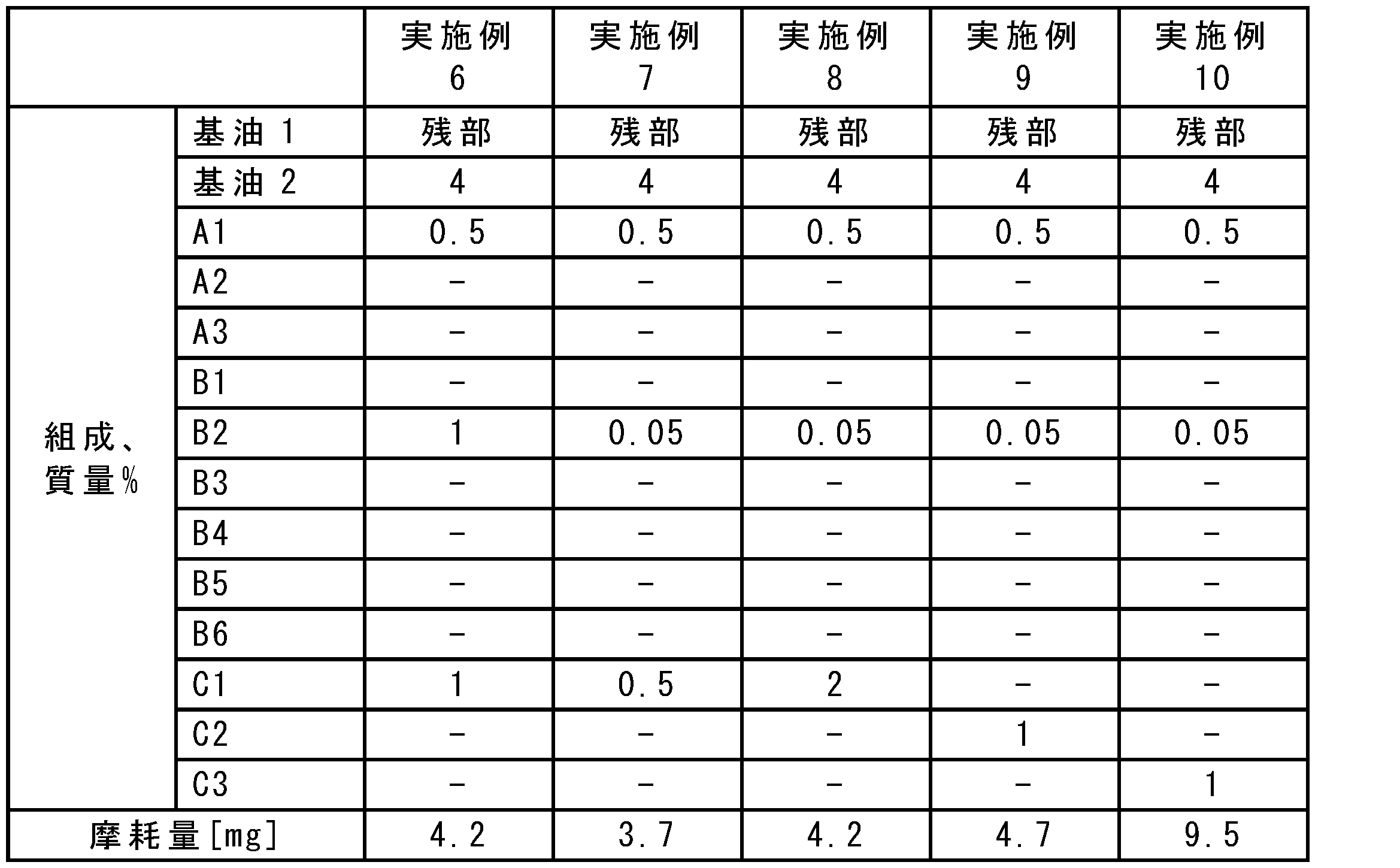
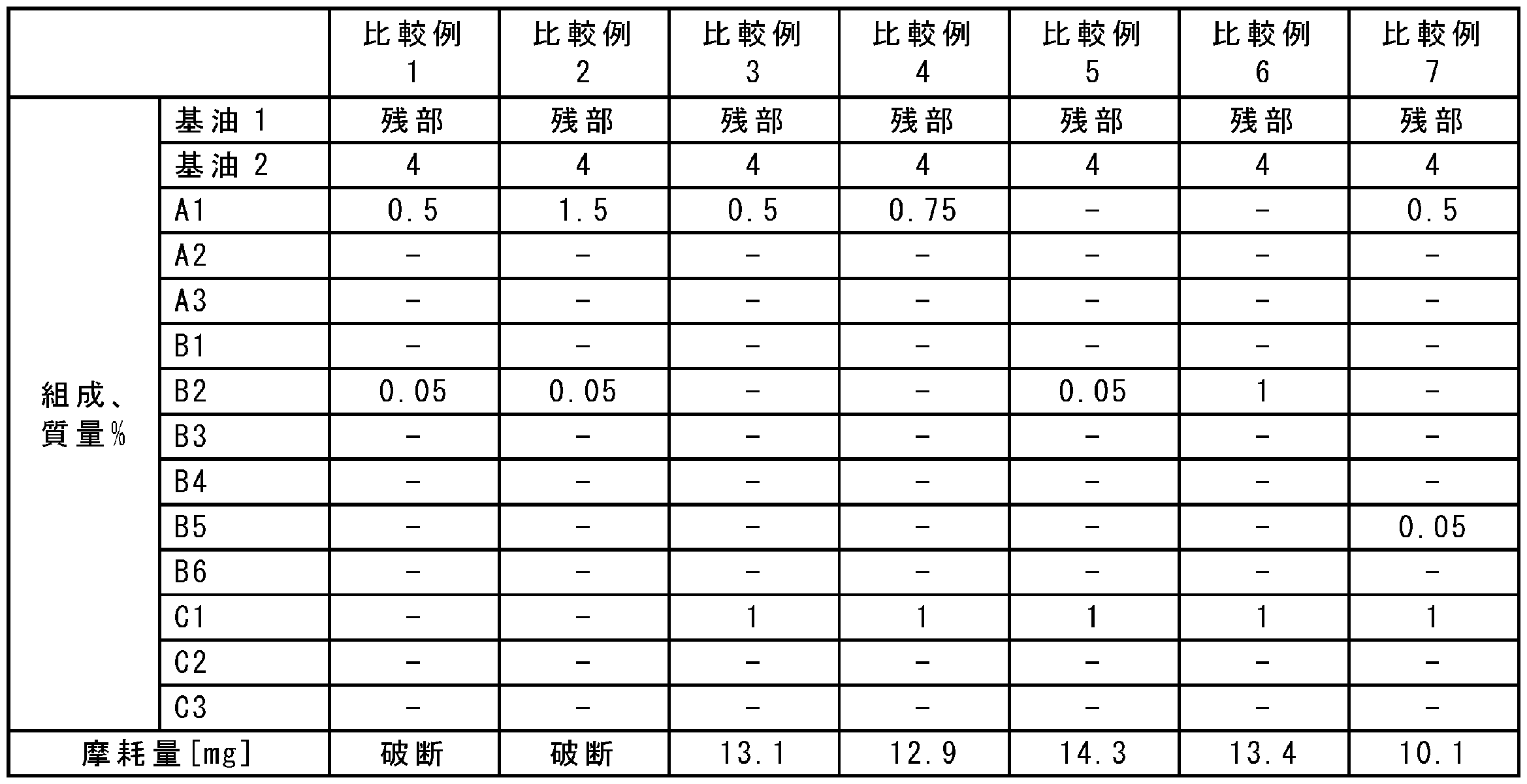
実施例1~16及び比較例1~7においては、それぞれ表1~4に示す組成を有する潤滑油組成物を調製した。各潤滑油組成物の調製に用いた成分は、以下のとおりである。
基油1:溶剤脱ろう、水素化精製したパラフィン系鉱油(40℃における動粘度68.8mm2/s、粘度指数98、硫黄分0.62質量%)
基油2:合成系潤滑基材(数平均分子量3700、100℃動粘度2000mm2/s、粘度指数300、硫黄分0.1質量%未満)
(A)成分:リン酸エステル
A1:トリ2-エチルヘキシルホスフェート
A2:トリクレジルホスフェート
A3:下記一般式(14)で示されるトリ(イソプロピルアリール)リン酸エステル

(B)成分:酸性リン酸エステル
B1:n-ブチルアシッドホスフェート
B2:n-オクチルアシッドホスフェート
B3:2-エチルヘキシルアシッドホスフェート
B4:オレイルアシッドホスフェート
B5:エイコサアシッドホスフェート
B6:ドコサアシッドホスフェート(直鎖と分岐鎖の混合物)
(C)成分:硫黄化合物
C1:硫化油脂
C2:2,5-ビス(1,1,3,3-テトラメチルブチルジチオ)-1,3,4-チアジアゾール
C3:ジ-tert-ドデシルポリスルフィド
潤滑性の評価はASTM D3233-93(ファレックスP/V試験)に準拠して摩耗量(mg)を測定した。得られた結果を表1~4に示す。なお、表4中の「破断」はP(ピン)が折れたりねじ切れたりするなどの破損を意味する。


Claims (4)
- 潤滑油基油と、
組成物全量基準で、
0.05~5質量%の下記一般式(1):
(R1O)3P=O (1)
[式(1)中、R1は、炭素数6~15のアリール基及び炭素数1~20の飽和炭化水素基のいずれかを示し、R1同士はそれぞれ同一でも異なってもよい。]
で表わされるリン酸エステルと、
0.01~2質量%の、下記一般式(2):
(R2O)nP(=O)(OH)(3-n) (2)
[式(2)中、R2は炭素数4~20のアルキル基を示し、nは1又は2であり、R2同士は同一でも異なってもよい。]
で表わされる酸性リン酸エステルと、
0.5質量%~5質量%の硫黄化合物と、
を含有する工作機械用潤滑油組成物。 - 前記一般式(2)中のR2が炭素数8のアルキル基である、請求項1に記載の工作機械用潤滑油組成物。
- 前記一般式(1)中のR1が炭素数1~20の飽和炭化水素基である、請求項1に記載の工作機械用潤滑油組成物。
- 工作機械のすべり案内面と油圧ポンプを同時に潤滑する請求項1に記載の工作機械潤滑油組成物。
Priority Applications (5)
| Application Number | Priority Date | Filing Date | Title |
|---|---|---|---|
| US14/386,454 US9404059B2 (en) | 2012-03-21 | 2012-10-29 | Lubricating oil composition for machining tool |
| KR1020147025936A KR101656304B1 (ko) | 2012-03-21 | 2012-10-29 | 공작 기계용 윤활유 조성물 |
| CN201280071617.1A CN104204166B (zh) | 2012-03-21 | 2012-10-29 | 机床用润滑油组合物 |
| SG11201405440UA SG11201405440UA (en) | 2012-03-21 | 2012-10-29 | Lubricating oil composition for machining tool |
| IN7440DEN2014 IN2014DN07440A (ja) | 2012-03-21 | 2012-10-29 |
Applications Claiming Priority (2)
| Application Number | Priority Date | Filing Date | Title |
|---|---|---|---|
| JP2012-063981 | 2012-03-21 | ||
| JP2012063981A JP5809090B2 (ja) | 2012-03-21 | 2012-03-21 | 工作機械用潤滑油組成物 |
Publications (1)
| Publication Number | Publication Date |
|---|---|
| WO2013140652A1 true WO2013140652A1 (ja) | 2013-09-26 |
Family
ID=49222141
Family Applications (1)
| Application Number | Title | Priority Date | Filing Date |
|---|---|---|---|
| PCT/JP2012/077886 Ceased WO2013140652A1 (ja) | 2012-03-21 | 2012-10-29 | 工作機械用潤滑油組成物 |
Country Status (8)
| Country | Link |
|---|---|
| US (1) | US9404059B2 (ja) |
| JP (1) | JP5809090B2 (ja) |
| KR (1) | KR101656304B1 (ja) |
| CN (1) | CN104204166B (ja) |
| IN (1) | IN2014DN07440A (ja) |
| SG (1) | SG11201405440UA (ja) |
| TW (1) | TWI580774B (ja) |
| WO (1) | WO2013140652A1 (ja) |
Cited By (3)
| Publication number | Priority date | Publication date | Assignee | Title |
|---|---|---|---|---|
| CN104371807A (zh) * | 2014-10-29 | 2015-02-25 | 河南师范大学 | 一种导轨油及其生产方法 |
| CN106544103A (zh) * | 2016-11-03 | 2017-03-29 | 金福英 | 一种液压导轨油及其制备方法 |
| JP2020033520A (ja) * | 2018-08-31 | 2020-03-05 | Jxtgエネルギー株式会社 | 熱媒体液及び工作機械の温度を制御する方法 |
Families Citing this family (9)
| Publication number | Priority date | Publication date | Assignee | Title |
|---|---|---|---|---|
| JP5885039B2 (ja) | 2013-09-19 | 2016-03-15 | 株式会社デンソー | 回転電機および車両用動力装置 |
| US20150170688A1 (en) * | 2013-12-18 | 2015-06-18 | Western Digital Technologies, Inc. | Grease composition additive for pivot bearing assemblies |
| JP6405217B2 (ja) * | 2014-12-09 | 2018-10-17 | シェルルブリカンツジャパン株式会社 | すべり案内面用潤滑油組成物 |
| JP6822635B2 (ja) * | 2016-03-25 | 2021-01-27 | 出光興産株式会社 | 潤滑油組成物、及び潤滑油組成物の使用方法 |
| JP6849213B2 (ja) * | 2016-12-16 | 2021-03-24 | 出光興産株式会社 | 摺動面用潤滑油組成物 |
| JP7296711B2 (ja) * | 2018-10-23 | 2023-06-23 | 出光興産株式会社 | 潤滑油組成物、潤滑油組成物を備える機械装置および潤滑油組成物の製造方法 |
| JP7256701B2 (ja) * | 2019-06-21 | 2023-04-12 | 株式会社オートネットワーク技術研究所 | 表面保護剤組成物および端子付き被覆電線 |
| EP4368687B1 (en) * | 2022-11-10 | 2025-06-25 | Afton Chemical Corporation | Corrosion inhibitor and industrial lubricant including the same |
| US11795412B1 (en) * | 2023-03-03 | 2023-10-24 | Afton Chemical Corporation | Lubricating composition for industrial gear fluids |
Citations (10)
| Publication number | Priority date | Publication date | Assignee | Title |
|---|---|---|---|---|
| JPH0415296A (ja) * | 1990-05-09 | 1992-01-20 | Nippon Seiko Kk | 滑り又は転がり部材、この部材を用いた滑り軸受,転がり軸受、及びローラロッカアーム用滑り軸受 |
| JPH07157787A (ja) * | 1993-12-08 | 1995-06-20 | Tonen Corp | 潤滑油組成物 |
| JPH08209175A (ja) * | 1995-02-01 | 1996-08-13 | Nippon Oil Co Ltd | すべり案内面用潤滑油組成物 |
| JPH1053783A (ja) * | 1996-08-12 | 1998-02-24 | Idemitsu Kosan Co Ltd | 摺動面用潤滑油組成物 |
| JPH111693A (ja) * | 1997-06-11 | 1999-01-06 | Nippon Oil Co Ltd | すべり案内面用潤滑油組成物 |
| JPH11209775A (ja) * | 1998-01-22 | 1999-08-03 | Idemitsu Kosan Co Ltd | 工作機械油組成物 |
| JP2002275489A (ja) * | 2001-03-19 | 2002-09-25 | Japan Energy Corp | 摺動面用潤滑油組成物 |
| JP2007238765A (ja) * | 2006-03-08 | 2007-09-20 | Nippon Oil Corp | 潤滑油組成物 |
| WO2008038571A1 (fr) * | 2006-09-25 | 2008-04-03 | Idemitsu Kosan Co., Ltd. | Composition d'huile hydraulique |
| JP2011068801A (ja) * | 2009-09-28 | 2011-04-07 | Jx Nippon Oil & Energy Corp | 潤滑油組成物 |
Family Cites Families (11)
| Publication number | Priority date | Publication date | Assignee | Title |
|---|---|---|---|---|
| US2274291A (en) * | 1938-11-26 | 1942-02-24 | Standard Oil Co | Compounded mineral oil |
| JP3299819B2 (ja) | 1993-06-30 | 2002-07-08 | 東燃ゼネラル石油株式会社 | 自動変速機用潤滑油組成物 |
| JP4142115B2 (ja) | 1994-11-09 | 2008-08-27 | シエル・インターナシヨナル・リサーチ・マートスハツペイ・ベー・ヴエー | 潤滑油組成物 |
| JPH09111278A (ja) * | 1995-10-18 | 1997-04-28 | Nippon Oil Co Ltd | 潤滑油組成物 |
| TWI250204B (en) * | 2001-04-06 | 2006-03-01 | Nippon Mitsubishi Oil Corp | Oil for very small amount oil supply type cutting-grinding operation and sliding face, and very small amount oil supply type cutting-grinding method using it |
| TWI228540B (en) * | 2001-04-06 | 2005-03-01 | Nippon Mitsubishi Oil Corp | Oil composition for very small amount oil supply type cutting and grinding operation |
| JP3914759B2 (ja) | 2001-12-10 | 2007-05-16 | 出光興産株式会社 | 潤滑油組成物 |
| JP4524102B2 (ja) * | 2003-12-25 | 2010-08-11 | 新日本石油株式会社 | 潤滑油組成物 |
| JP4870452B2 (ja) | 2006-03-08 | 2012-02-08 | Jx日鉱日石エネルギー株式会社 | 潤滑油組成物 |
| JP4865430B2 (ja) | 2006-07-06 | 2012-02-01 | Jx日鉱日石エネルギー株式会社 | 工作機械用潤滑油組成物 |
| CN101981168A (zh) | 2008-03-28 | 2011-02-23 | 出光兴产株式会社 | 圆形塑模滚轧成形加工用润滑油组合物 |
-
2012
- 2012-03-21 JP JP2012063981A patent/JP5809090B2/ja active Active
- 2012-10-29 SG SG11201405440UA patent/SG11201405440UA/en unknown
- 2012-10-29 WO PCT/JP2012/077886 patent/WO2013140652A1/ja not_active Ceased
- 2012-10-29 KR KR1020147025936A patent/KR101656304B1/ko active Active
- 2012-10-29 IN IN7440DEN2014 patent/IN2014DN07440A/en unknown
- 2012-10-29 CN CN201280071617.1A patent/CN104204166B/zh active Active
- 2012-10-29 US US14/386,454 patent/US9404059B2/en active Active
- 2012-12-07 TW TW101146239A patent/TWI580774B/zh active
Patent Citations (10)
| Publication number | Priority date | Publication date | Assignee | Title |
|---|---|---|---|---|
| JPH0415296A (ja) * | 1990-05-09 | 1992-01-20 | Nippon Seiko Kk | 滑り又は転がり部材、この部材を用いた滑り軸受,転がり軸受、及びローラロッカアーム用滑り軸受 |
| JPH07157787A (ja) * | 1993-12-08 | 1995-06-20 | Tonen Corp | 潤滑油組成物 |
| JPH08209175A (ja) * | 1995-02-01 | 1996-08-13 | Nippon Oil Co Ltd | すべり案内面用潤滑油組成物 |
| JPH1053783A (ja) * | 1996-08-12 | 1998-02-24 | Idemitsu Kosan Co Ltd | 摺動面用潤滑油組成物 |
| JPH111693A (ja) * | 1997-06-11 | 1999-01-06 | Nippon Oil Co Ltd | すべり案内面用潤滑油組成物 |
| JPH11209775A (ja) * | 1998-01-22 | 1999-08-03 | Idemitsu Kosan Co Ltd | 工作機械油組成物 |
| JP2002275489A (ja) * | 2001-03-19 | 2002-09-25 | Japan Energy Corp | 摺動面用潤滑油組成物 |
| JP2007238765A (ja) * | 2006-03-08 | 2007-09-20 | Nippon Oil Corp | 潤滑油組成物 |
| WO2008038571A1 (fr) * | 2006-09-25 | 2008-04-03 | Idemitsu Kosan Co., Ltd. | Composition d'huile hydraulique |
| JP2011068801A (ja) * | 2009-09-28 | 2011-04-07 | Jx Nippon Oil & Energy Corp | 潤滑油組成物 |
Cited By (5)
| Publication number | Priority date | Publication date | Assignee | Title |
|---|---|---|---|---|
| CN104371807A (zh) * | 2014-10-29 | 2015-02-25 | 河南师范大学 | 一种导轨油及其生产方法 |
| CN104371807B (zh) * | 2014-10-29 | 2017-09-29 | 河南师范大学 | 一种导轨油及其生产方法 |
| CN106544103A (zh) * | 2016-11-03 | 2017-03-29 | 金福英 | 一种液压导轨油及其制备方法 |
| JP2020033520A (ja) * | 2018-08-31 | 2020-03-05 | Jxtgエネルギー株式会社 | 熱媒体液及び工作機械の温度を制御する方法 |
| JP7165540B2 (ja) | 2018-08-31 | 2022-11-04 | Eneos株式会社 | 熱媒体液及び工作機械の温度を制御する方法 |
Also Published As
| Publication number | Publication date |
|---|---|
| KR101656304B1 (ko) | 2016-09-09 |
| US9404059B2 (en) | 2016-08-02 |
| TW201339296A (zh) | 2013-10-01 |
| KR20140135206A (ko) | 2014-11-25 |
| JP5809090B2 (ja) | 2015-11-10 |
| SG11201405440UA (en) | 2014-10-30 |
| CN104204166A (zh) | 2014-12-10 |
| JP2013194172A (ja) | 2013-09-30 |
| IN2014DN07440A (ja) | 2015-04-24 |
| TWI580774B (zh) | 2017-05-01 |
| CN104204166B (zh) | 2016-04-13 |
| US20150072908A1 (en) | 2015-03-12 |
Similar Documents
| Publication | Publication Date | Title |
|---|---|---|
| JP5809090B2 (ja) | 工作機械用潤滑油組成物 | |
| US8722597B2 (en) | Lubricating oil composition for internal combustion engine | |
| KR101420890B1 (ko) | 윤활유 조성물 | |
| JP5328674B2 (ja) | 耐摩耗剤およびその潤滑組成物 | |
| JP6030631B2 (ja) | 潤滑油組成物 | |
| JP3914759B2 (ja) | 潤滑油組成物 | |
| JP2010516865A5 (ja) | ||
| US10800991B2 (en) | Lubricating oil composition, and precision reduction gear using same | |
| CN113906070B (zh) | 丙烯酸酯系共聚物、该共聚物的制造方法、由该共聚物构成的摩擦抑制剂以及含有该摩擦抑制剂的润滑油组合物 | |
| JP2019151804A (ja) | 潤滑油組成物 | |
| US10647940B2 (en) | Lubricating oil composition, and precision reduction gear using same | |
| JP2019123855A (ja) | 潤滑油組成物 | |
| JP2021080429A (ja) | 潤滑油組成物 | |
| US12286601B2 (en) | Lubricating oil composition, buffer and method for using lubricating oil composition | |
| JP2019123818A (ja) | 潤滑油組成物 | |
| JP2020026488A (ja) | 潤滑油組成物 | |
| JP5373568B2 (ja) | ボールねじ用潤滑油組成物 | |
| JP7261528B2 (ja) | 潤滑油組成物 | |
| CN105018190A (zh) | 润滑油组合物 | |
| JP4524102B2 (ja) | 潤滑油組成物 | |
| JP2021080339A (ja) | 潤滑油組成物 | |
| JP7453449B1 (ja) | 潤滑油組成物 | |
| JP4351765B2 (ja) | エンジン油用潤滑剤およびエンジン油用潤滑性組成物 | |
| JP2018062951A (ja) | 摩擦低減方法及び摺動機構 | |
| JP2007262344A (ja) | グリース組成物 |
Legal Events
| Date | Code | Title | Description |
|---|---|---|---|
| 121 | Ep: the epo has been informed by wipo that ep was designated in this application |
Ref document number: 12872266 Country of ref document: EP Kind code of ref document: A1 |
|
| ENP | Entry into the national phase |
Ref document number: 20147025936 Country of ref document: KR Kind code of ref document: A |
|
| WWE | Wipo information: entry into national phase |
Ref document number: 14386454 Country of ref document: US |
|
| WWE | Wipo information: entry into national phase |
Ref document number: IDP00201406305 Country of ref document: ID |
|
| NENP | Non-entry into the national phase |
Ref country code: DE |
|
| 122 | Ep: pct application non-entry in european phase |
Ref document number: 12872266 Country of ref document: EP Kind code of ref document: A1 |