WO2013140905A1 - 家電材料用及び自動車内装材料用オレフィン樹脂組成物の製造方法 - Google Patents
家電材料用及び自動車内装材料用オレフィン樹脂組成物の製造方法 Download PDFInfo
- Publication number
- WO2013140905A1 WO2013140905A1 PCT/JP2013/053748 JP2013053748W WO2013140905A1 WO 2013140905 A1 WO2013140905 A1 WO 2013140905A1 JP 2013053748 W JP2013053748 W JP 2013053748W WO 2013140905 A1 WO2013140905 A1 WO 2013140905A1
- Authority
- WO
- WIPO (PCT)
- Prior art keywords
- olefin resin
- resin composition
- polymerization
- producing
- olefin
- Prior art date
- Legal status (The legal status is an assumption and is not a legal conclusion. Google has not performed a legal analysis and makes no representation as to the accuracy of the status listed.)
- Ceased
Links
Classifications
-
- C—CHEMISTRY; METALLURGY
- C08—ORGANIC MACROMOLECULAR COMPOUNDS; THEIR PREPARATION OR CHEMICAL WORKING-UP; COMPOSITIONS BASED THEREON
- C08K—Use of inorganic or non-macromolecular organic substances as compounding ingredients
- C08K5/00—Use of organic ingredients
- C08K5/16—Nitrogen-containing compounds
- C08K5/20—Carboxylic acid amides
-
- C—CHEMISTRY; METALLURGY
- C08—ORGANIC MACROMOLECULAR COMPOUNDS; THEIR PREPARATION OR CHEMICAL WORKING-UP; COMPOSITIONS BASED THEREON
- C08F—MACROMOLECULAR COMPOUNDS OBTAINED BY REACTIONS ONLY INVOLVING CARBON-TO-CARBON UNSATURATED BONDS
- C08F110/00—Homopolymers of unsaturated aliphatic hydrocarbons having only one carbon-to-carbon double bond
- C08F110/04—Monomers containing three or four carbon atoms
- C08F110/06—Propene
-
- C—CHEMISTRY; METALLURGY
- C08—ORGANIC MACROMOLECULAR COMPOUNDS; THEIR PREPARATION OR CHEMICAL WORKING-UP; COMPOSITIONS BASED THEREON
- C08K—Use of inorganic or non-macromolecular organic substances as compounding ingredients
- C08K5/00—Use of organic ingredients
- C08K5/49—Phosphorus-containing compounds
- C08K5/51—Phosphorus bound to oxygen
- C08K5/52—Phosphorus bound to oxygen only
- C08K5/524—Esters of phosphorous acids, e.g. of H3PO3
- C08K5/526—Esters of phosphorous acids, e.g. of H3PO3 with hydroxyaryl compounds
-
- C—CHEMISTRY; METALLURGY
- C08—ORGANIC MACROMOLECULAR COMPOUNDS; THEIR PREPARATION OR CHEMICAL WORKING-UP; COMPOSITIONS BASED THEREON
- C08K—Use of inorganic or non-macromolecular organic substances as compounding ingredients
- C08K5/00—Use of organic ingredients
- C08K5/56—Organo-metallic compounds, i.e. organic compounds containing a metal-to-carbon bond
-
- C—CHEMISTRY; METALLURGY
- C08—ORGANIC MACROMOLECULAR COMPOUNDS; THEIR PREPARATION OR CHEMICAL WORKING-UP; COMPOSITIONS BASED THEREON
- C08K—Use of inorganic or non-macromolecular organic substances as compounding ingredients
- C08K5/00—Use of organic ingredients
- C08K5/49—Phosphorus-containing compounds
- C08K5/51—Phosphorus bound to oxygen
- C08K5/52—Phosphorus bound to oxygen only
- C08K5/524—Esters of phosphorous acids, e.g. of H3PO3
-
- C—CHEMISTRY; METALLURGY
- C08—ORGANIC MACROMOLECULAR COMPOUNDS; THEIR PREPARATION OR CHEMICAL WORKING-UP; COMPOSITIONS BASED THEREON
- C08L—COMPOSITIONS OF MACROMOLECULAR COMPOUNDS
- C08L23/00—Compositions of homopolymers or copolymers of unsaturated aliphatic hydrocarbons having only one carbon-to-carbon double bond; Compositions of derivatives of such polymers
- C08L23/02—Compositions of homopolymers or copolymers of unsaturated aliphatic hydrocarbons having only one carbon-to-carbon double bond; Compositions of derivatives of such polymers not modified by chemical after-treatment
- C08L23/10—Homopolymers or copolymers of propene
- C08L23/12—Polypropene
Definitions
- the present invention relates to a method for producing an olefin resin composition for home appliance materials and automobile interior materials, and in particular, produces an olefin resin composition having good color tone and fogging resistance and suitable for home appliance materials or automobile interior materials.
- the present invention relates to a method for producing an olefin resin composition for home appliance materials and automobile interior materials.
- Olefin resin has poor stability to heat and light, and easily oxidizes / deteriorates when exposed to high-temperature molding or strong light, so that the life required for plastic products cannot be obtained.
- a stabilizer such as a phenol-based antioxidant, a phosphorus-based antioxidant, a sulfur-based antioxidant, a hydroxylamine compound, a hindered amine compound, an ultraviolet absorber, an acid scavenger, etc. should be added. Is generally done.
- a method of adding a stabilizer to an olefin resin a method of dispersing the stabilizer in the olefin resin by mixing the olefin resin obtained by polymerizing the olefin monomer and the stabilizer, and melt-kneading with a molding processing apparatus such as an extruder. And a method of obtaining a stabilized olefin resin by adding a stabilizer and polymerizing before or during the polymerization of the olefin monomer.
- the method of blending the olefin resin and the stabilizer by melt-kneading is economically disadvantageous because the stabilizer must be added more than necessary to cope with the problem of poor dispersion of the stabilizer.
- the method of adding a stabilizer before or during the polymerization of the olefin monomer has a problem that the stabilizer may inhibit the polymerization of the olefin monomer.
- Olefin resins are also used in the exteriors of home appliances and automobile interiors, but these products are constantly exposed to the eyes of consumers in daily life, and in recent years, not only functionality but also design requirements have increased. There is a feature that. Therefore, with regard to olefin resins used for household appliance materials and automobile interiors, it is particularly important that the appearance is good, as well as excellent general characteristics such as heat resistance and light resistance, as well as excellent coloration resistance and fogging resistance. Is required.
- fogging refers to a phenomenon in which additives contained in automobile interior materials volatilize inside a heated vehicle and condense on the inner surface of a window glass that has been cooled by the outside air, causing it to become white and cloudy, thus hindering visibility. Not only can it be lost, but it can interfere with safety because it obstructs visibility.
- Patent Document 1 discloses (A) an olefin resin, (B) an ethylene- ⁇ -olefin copolymer rubber, and (C) an additive for a resin that satisfies specific conditions. ) Is added in an amount of 0.05 to 0.6 parts by weight and 0.05 to 0.4 parts by weight per 100 parts by weight of the total amount.
- Additives for resins corresponding to the above (C) include phenolic antioxidants having a molecular weight of 200 to 1500, phosphorus antioxidants, hindered amine light stabilizers having a molecular weight of 200 to 1000, hydroxybenzotriazole light stabilizers, carbon Several tens to 25 fatty acid amide and / or bis fatty acid amide lubricants are disclosed.
- Patent Document 2 by propylene polymerization using a metallocene catalyst as a polymerization catalyst, a by-product of a low molecular weight component is suppressed, and a propylene polymer having a narrow molecular weight distribution is obtained. It is shown that an excellent resin composition can be obtained.
- the fogging resistance of the obtained resin composition is not yet satisfactory, and further improvement has been demanded.
- the resin composition described in Patent Document 2 has a problem that the processability is lowered due to the narrow molecular weight distribution, and molding unevenness frequently occurs in a molded product having a complicated shape.
- an object of the present invention is to produce an olefin resin composition for home appliance materials and automobile interior materials that can reduce the cost by suppressing the total amount of stabilizer added, has good color tone, and has excellent fogging resistance. It is to provide a method that can.
- the present inventors can solve the above problems by adding a specific phenolic antioxidant masked with an organoaluminum compound during the polymerization of the olefin monomer.
- the present invention has been completed.
- the present inventors have disclosed olefin polymerization in existing catalyst feed tanks or polymerization tanks in JP-A-2005-206625, JP-A-2005-255953, JP-A-2006-282985, and the like.
- a method of stabilizing a polymer without reducing the activity of a polymerization catalyst by mixing a commonly used organoaluminum compound and a phenolic antioxidant and performing a masking treatment has been proposed. The effect of improving the fogging resistance was not mentioned at all.
- the method for producing an olefin resin composition for automobile interior materials is a method for producing an olefin resin composition for automobile interior materials obtained by polymerizing an olefin monomer, What is obtained by masking a phenolic antioxidant represented by the following general formula (1) with an organoaluminum compound is 0.001 to 0.5 parts by mass with respect to 100 parts by mass of the olefin resin obtained by polymerization.
- the method includes a step of adding before or during the polymerization of the olefin monomer.
- R is an optionally substituted alkyl group having 1 to 30 carbon atoms, an optionally substituted cycloalkyl group having 3 to 12 carbon atoms, and an optionally substituted carbon atom. Represents an aryl group of formula 6-18.
- the manufacturing method of the olefin resin composition for household appliances of this invention is a manufacturing method of the olefin resin composition for household appliances formed by superposing
- the method includes a step of adding before or during the polymerization of the olefin monomer.
- R is an optionally substituted alkyl group having 1 to 30 carbon atoms, an optionally substituted cycloalkyl group having 3 to 12 carbon atoms, and an optionally substituted carbon atom. Represents an aryl group of formula 6-18.
- the organoaluminum compound is preferably trialkylaluminum.
- the organoaluminum compound is preferably trialkylaluminum.
- a phosphorus-based antioxidant before or during polymerization of a monomer having an ethylenically unsaturated bond.
- a phosphorus-based antioxidant before or during the polymerization of a monomer having an ethylenically unsaturated bond.
- the automobile interior material of the present invention is formed by molding the olefin resin composition for automobile interior materials produced by the above-described method for producing an olefin resin composition for automobile interior materials.
- the home appliance exterior material of the present invention is characterized in that it is formed by molding the olefin resin composition for home appliances produced by the above-described method for producing the olefin resin composition for home appliances.
- the present invention provides a method for producing an olefin resin composition for home appliance materials and automobile interior materials that can reduce the cost by suppressing the total amount of stabilizer added, has good color tone, and has excellent fogging resistance. It becomes possible to do.
- the olefin resin composition for home appliance materials and automobile interior materials obtained by the production method of the present invention does not exhibit fogging resistance in a fogging resistance test based on ISO6452.
- the manufacturing method of the olefin resin composition for automobile interior materials of the present invention and the manufacturing method of the olefin resin composition for household electrical appliance materials each masked the phenolic antioxidant represented by the following general formula (1) with organoaluminum. These are blended before or during the polymerization of the olefin monomer so as to be 0.001 to 0.5 parts by mass with respect to 100 parts by mass of the polymer obtained by polymerization.
- R is an optionally substituted alkyl group having 1 to 30 carbon atoms, an optionally substituted cycloalkyl group having 3 to 12 carbon atoms, and an optionally substituted carbon atom. Represents an aryl group of formula 6-18.
- alkyl group having 1 to 30 carbon atoms which may have a branch and represented by R in the general formula (1) include, for example, a methyl group, an ethyl group, a propyl group, an isopropyl group, a butyl group, sec-butyl, t-butyl, isobutyl, pentyl, isopentyl, t-pentyl, hexyl, heptyl, n-octyl, isooctyl, t-octyl, nonyl, isononyl, decyl Group, undecyl group, dodecyl group, tridecyl group, tetradecyl group, pentadecyl group, hexadecyl group, heptadecyl group, octadecyl group and the like.
- Phenol antioxidants with fewer than 12 carbon atoms in the alkyl group may easily volatilize, and if the alkyl group has more than 24 carbon atoms, the ratio of phenol to the molecular weight of the phenolic antioxidant will decrease. Therefore, the stabilization effect may be reduced.
- alkyl groups may be interrupted by an oxygen atom, a sulfur atom, or the following aryl group, and a hydrogen atom in the alkyl group is a chain fatty acid such as a hydroxy group, a cyano group, an alkenyl group, or an alkenyloxy group.
- Examples of the optionally substituted cycloalkyl group having 3 to 12 carbon atoms represented by R in the general formula (1) include a cyclopropyl group, a cyclopentyl group, a cyclohexyl group, a cycloheptyl group, a cyclo An octyl group, a cyclononyl group, a cyclodecyl group, and the like, and a hydrogen atom in the cycloalkyl group may be substituted with an alkyl group, an alkenyl group, an alkenyloxy group, a hydroxy group, or a cyano group, It may be interrupted by an oxygen atom or a sulfur atom.
- Examples of the aryl group having 6 to 18 carbon atoms which may have a substituent represented by R in the general formula (1) include, for example, a phenyl group, a methylphenyl group, a butylphenyl group, and an octylphenyl group. 4-hydroxyphenyl group, 3,4,5-trimethoxyphenyl group, 4-t-butylphenyl group, biphenyl group, naphthyl group, methylnaphthyl group, anthracenyl group, phenanthryl group, benzyl, phenylethyl group, 1- And phenyl-1-methylethyl group.
- a hydrogen atom in the aryl group may be substituted with an alkyl group, an alkenyl group, an alkenyloxy group, a hydroxy group, or a cyano group, and the alkyl group may be interrupted with an oxygen atom or a sulfur atom. Good.
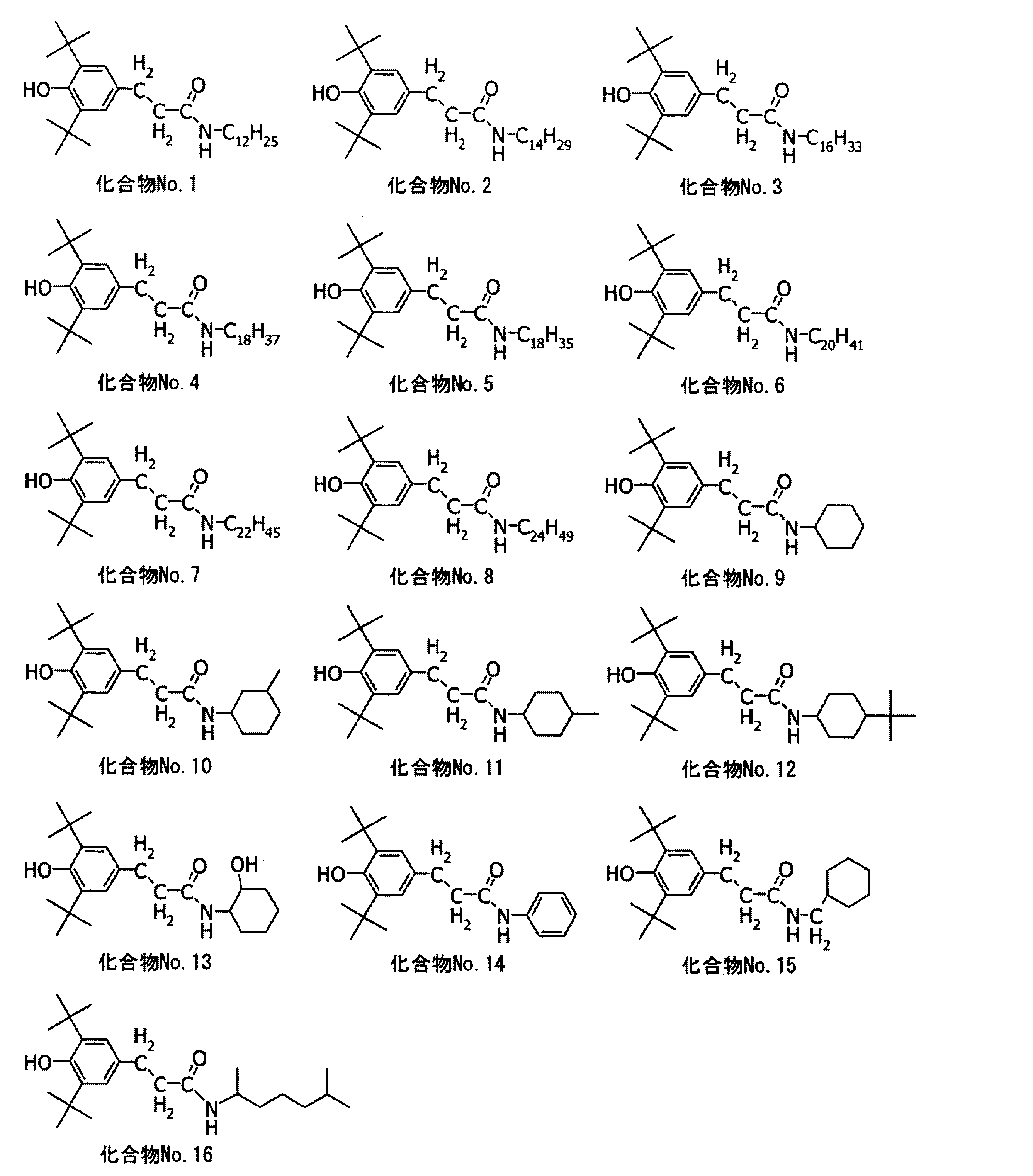
- Examples of the specific structure of the phenolic antioxidant represented by the general formula (1) include the following compound No. 1-No. 16 is mentioned. However, the present invention is not limited by the following compounds.
- the phenolic antioxidant is 0.001 to 0.5 parts by mass, preferably 0.001 to 0.3 parts per 100 parts by mass of a polymer obtained by polymerization (hereinafter also simply referred to as polymer). Add so that it becomes a mass part.
- stearyl-3- (3,5-ditert-butyl-4-hydroxyphenyl) propionic acid amide palmityl-3- (3,5-ditert-butyl-4-hydroxyphenyl) propion Acid amide, myristyl-3- (3,5-ditert-butyl-4-hydroxyphenyl) propionic acid amide, lauryl-3- (3,5-ditert-butyl-4-hydroxyphenyl) propionic acid amide, etc.
- An amide compound of 3- (3,5-dialkyl-4-hydroxyphenyl) propionic acid represented by the general formula (1) is preferable because of its excellent stabilizing effect and color tone of the resulting olefin resin composition.
- the hydrogen of the phenolic hydroxyl group of the phenolic antioxidant can be easily replaced with the organoaluminum compound, and the phenolic antioxidant Can be masked with organoaluminum.
- the organoaluminum compound an organoaluminum compound that can be regenerated into phenol by treating the masked phenolic antioxidant with a hydrogen-donating compound such as water, alcohol, or acid is used.
- the organoaluminum compound for example, alkylaluminum, alkylaluminum hydride and the like can be used, but alkylaluminum is preferable, and trialkylaluminum is particularly preferable, and specifically, trimethylaluminum, triethylaluminum, tri-n. -Propyl aluminum, triisobutyl aluminum, tri-n-hexyl aluminum, tri-n-octyl aluminum and the like. Any of the organoaluminum compounds can be used as a mixture. Moreover, the aluminoxane obtained by reaction of alkylaluminum or alkylaluminum hydride and water can be used similarly.
- the masked phenolic antioxidant is added before or during the polymerization of the olefin monomer.
- the addition site include a polymerization system, a catalyst system, and a compounding tube. .
- the masking method may be simply mixing and stirring the organoaluminum compound and the phenolic antioxidant in an inert solvent.
- the by-product compound when the by-product compound does not affect the polymer, it can be used as it is, but when the by-product compound inhibits the polymerization, it should be used after removing the compound by distillation under reduced pressure or the like. Is preferred.
- the mixing ratio of the organoaluminum compound and the phenolic antioxidant represented by the general formula (1) is preferably 1/5 to 100/1 by mass ratio. If it is less than 1/5, there is a problem that an excessive phenolic antioxidant adversely affects the catalyst activity. If it is more than 100/1, an aluminum compound remains in the polymer after polymerization, and the physical properties of the polymer are lowered. In some cases, the desired polymerization cannot be performed due to the influence of the component ratio of the catalyst metal.
- the inert solvent examples include aliphatic and aromatic hydrocarbon compounds.
- the aliphatic hydrocarbon compound examples include saturated hydrocarbon compounds such as n-pentane, n-hexane, n-heptane, n-octane, isooctane and purified kerosene, and cyclic saturated hydrocarbons such as cyclopentane, cyclohexane and cycloheptane.
- the aromatic hydrocarbon compound include compounds such as benzene, toluene, ethylbenzene, and xylene. Of these compounds, n-hexane or n-heptane is preferably used.
- the concentration of the trialkylaluminum salt in the inert solvent is preferably in the range of 0.001 to 0.5 mol / L, particularly preferably 0.01 to 0.1 mol / L.
- a phosphorus-based antioxidant is further added before or during polymerization of a monomer having an ethylenically unsaturated bond. Is preferably added.
- Examples of the phosphorus antioxidant include triphenyl phosphite, trisnonylphenyl phosphite, tris (2,4-ditertiarybutylphenyl) phosphite, tris (2,4-ditertiarybutyl-5- Methylphenyl) phosphite, tris [2-tert-butyl-4- (3-tert-butyl-4-hydroxy-5-methylphenylthio) -5-methylphenyl] phosphite, tridecyl phosphite, octyldiphenylphos Phyto, di (decyl) monophenyl phosphite, di (tridecyl) pentaerythritol diphosphite, di (nonylphenyl) pentaerythritol diphosphite, bis (2,4-ditert-butylphenyl) pentaerythr
- phosphorus-based antioxidants such as tris (2,4-ditertiarybutylphenyl) phosphite that do not adversely affect the polymerization even when added before polymerization are preferred.
- the amount of the phosphorus antioxidant used is 0.001 to 1 part by mass, and more preferably 0.001 to 0.5 part by mass with respect to 100 parts by mass of the polymer obtained by polymerization.
- the phosphorus-based antioxidant When the phosphorus-based antioxidant is added before or during the polymerization of the ethylenically unsaturated monomer, it is mixed with the inert solvent and used in advance.
- the phenol represented by the general formula (1) is used in advance. It may be mixed with an inert solvent together with the system antioxidant, or mixed with the inert solvent separately from the phenolic antioxidant represented by the general formula (1) to form a polymerization system, catalyst It may be added to the system or piping.
- Examples of the monomer having an ethylenically unsaturated bond include ethylene, propylene, 1-butene, 1-hexene, 3-methyl-1-butene, 3-methyl-1-pentene, 4-methyl-1-pentene, Examples thereof include vinylcycloalkane, styrene, and derivatives thereof.
- one of the above monomers having an ethylenically unsaturated bond is used alone.
- Polymerization of the ethylenically unsaturated monomer needs to be performed in an inert gas atmosphere such as nitrogen in the presence of a polymerization catalyst, but may be performed in the above inert solvent.
- an active hydrogen compound, a particulate carrier, an organoaluminum compound, an ion exchange layered compound, and an inorganic silicate may be added as long as polymerization is not inhibited.
- the polymerization catalyst is not particularly limited, and a known polymerization catalyst can be used.
- transition metals of Group 3 to 11 of the periodic table for example, titanium, zirconium, hafnium, vanadium, iron, nickel, Lead, platinum, yttrium, samarium, etc.
- typical examples include Ziegler catalysts, Ziegler-Natta catalysts comprising a titanium-containing solid transition metal component and an organometallic component, and at least one cyclopentadienyl.
- the metallocene catalyst include a transition metal compound of Group 4 to Group 6 of the periodic table having a skeleton and a promoter component. Use of an electron donating compound is preferable because a high-quality polymer can be obtained.
- titanium trichloride or titanium trichloride composition obtained by reducing titanium tetrachloride with organoaluminum or the like is treated with an electron-donating compound and further activated (for example, JP-A-47). -34478, JP-A-58-23806, JP-A-63-146906), obtained by reducing titanium tetrachloride with an organoaluminum compound and further treating with various electron donors and electron acceptors.
- Catalysts comprising the obtained titanium trichloride composition, an organoaluminum compound and an aromatic carboxylic acid ester (Japanese Patent Laid-Open Nos.
- a supported catalyst comprising magnesium halide, titanium tetrachloride and various electron donors (Japanese Patent Kokai 57-63310) JP, 58-157808, JP 58-83006, JP 58-5310, JP 61-218606, JP 63-43915, JP 63 -83116) and the like.
- metallocene catalyst examples include, for example, transition metal metallocene catalysts described in JP-A-9-12621, JP-A-5-043616, JP-A-5-295022, JP-A-5-301919, JP-A-6-239914, JP-A-6-239915, JP-A-6-239917, JP-A-7-082311, JP-A-7-228621, JP-A-7-330820, JP-A-8 -059724, JP-A-8-085707, JP-A-8-085708, JP-A-8-127613, JP-A-10-226712, JP-A-10-259143, JP-A-10-265490.
- Examples of the electron donating compound include ether compounds, ester compounds, ketone compounds, alkoxysilane compounds, and the like. A single compound may be added to the electron donor compound, or a plurality of compounds may be added as necessary.
- ether compounds include diethyl ether, dipropyl ether, diisopropyl ether, di-n-butyl ether, diethylene glycol dimethyl ether, propylene glycol dimethyl ether, ethylene oxide, tetrahydrofuran, 2,2,5,5-tetramethyltetrahydrofuran, dioxane and the like. Is mentioned.
- ester compound examples include methyl acetate, ethyl acetate, acetic acid-n-propyl, isopropyl acetate, methyl propionate, ethyl propionate, propionate-n-propyl, methyl methacrylate, ethyl methacrylate, methacrylic acid- n-propyl, ethyl phenylacetate, methyl benzoate, ethyl benzoate, phenyl benzoate, methyl toluate, ethyl toluate, methyl anisate, ethyl anisate, methyl methoxybenzoate, ethyl methoxybenzoate, methyl methacrylate, Examples thereof include ethyl methacrylate, dimethyl phthalate, diethyl phthalate, dipropyl phthalate, dibutyl phthalate, diisobutyl phthalate, dihexyl phthalate, ⁇ -butyrol
- ketone compound examples include acetone, diethyl ketone, methyl ethyl ketone, acetophenone, and the like.
- alkoxysilane compounds include tetramethoxysilane, ethyltrimethoxysilane, propyltrimethoxysilane, isopropyltrimethoxysilane, t-butyltrimethoxysilane, i-butyltrimethoxysilane, phenyltrimethoxysilane, cyclohexyltri Methoxysilane, diethyldimethoxysilane, dipropyldimethoxysilane, diisopropyldimethoxysilane, diphenyldimethoxysilane, t-butylmethyldimethoxysilane, t-butylethyldimethoxysilane, t-butyl-n-propyldimethoxysilane, t-butylisopropyldimethoxysilane Cyclohexylmethyldimethoxysilane, tetraeth
- carriers such as an inorganic oxide
- carriers such as porous polyolefin
- the inorganic carrier include silica, alumina, magnesium oxide, zirconium oxide, titanium oxide, iron oxide, calcium oxide, and zinc oxide.
- Other inorganic carriers include magnesium halides such as magnesium chloride and magnesium bromide, magnesium alkoxides such as magnesium ethoxide, and ion-exchangeable layered compounds.
- the ion-exchangeable layered compound has a crystal structure in which surfaces formed by ionic bonds and the like are stacked in parallel with a weak binding force, and represents a compound in which contained ions can be exchanged.
- Specific examples of the ion-exchangeable layered compound include, for example, kaolin, bentonite, talc, kaolinite, vermiculite, montmorillonite group, mica group, ⁇ -Zr (HAsO 4 ) 2 .H 2 O, ⁇ -Zr (HPO 4 ) 2 ⁇ H 2 O, ⁇ -Sn (HPO 4 ) 2 ⁇ H 2 O, ⁇ -Ti (NH 4 PO 4 ) 2 ⁇ H 2 O, and the like.
- organic carrier examples include polyethylene, polypropylene, polystyrene, ethylene-butene copolymer, ethylene-propylene copolymer, polymethacrylic acid ester, polyacrylic acid ester, polyacrylonitrile, polyamide, polycarbonate, and polyethylene terephthalate.
- examples thereof include polyester, polyvinyl chloride, and the like, and these may be crosslinked, for example, as a styrene-divinylbenzene copolymer.
- a catalyst in which a catalyst is chemically bonded to these organic supports can be used.
- the particle diameter (volume average) of these carriers is usually from 0.1 to 300 ⁇ m, preferably from 1 to 200 ⁇ m, more preferably from 10 to 100 ⁇ m. If the particle size is smaller than 1 ⁇ m, a finely powdered polymer is likely to be formed, and if it is too large, coarse particles are produced. Therefore, the particle size of the carrier should be selected according to the desired particle shape.
- the pore volume of the carrier is usually from 0.1 to 5 cm 2 / g, preferably from 0.3 to 3 cm 2 / g.
- the pore volume can be measured by, for example, the BET method or the mercury intrusion method.
- a conventionally used method can be employed.
- aliphatic hydrocarbons such as butane, pentane, hexane, heptane, isooctane
- alicyclic hydrocarbons such as cyclopentane, cyclohexane, methylcyclohexane
- aromatic hydrocarbons such as toluene, xylene, ethylbenzene, gasoline fraction
- hydrogen A method for carrying out polymerization in the liquid phase in the presence of an inert solvent such as a liquefied diesel fraction, a method for carrying out polymerization using the liquefied olefin itself as a medium, and a method for carrying out polymerization in the gas phase under conditions where there is substantially no liquid phase
- a polymerization method in which two or more of these are combined can also be used.
- the polymerization may be either a batch type or a continuous type, and may be a one
- a continuous reaction tank in an existing polymerization facility may be used as it is, and the present invention is not particularly limited to conventional polymerization facilities in terms of size, shape, material, and the like.
- the above polymer can be blended with other ordinary additives as required.
- other additives can be added at the time of polymerization of the olefin monomer as long as they do not inhibit the polymerization.
- another additive may be mixed with the olefin resin in a blending amount according to the purpose, and melt-kneaded with a molding machine such as an extruder, and granulated and molded.
- additives include, for example, phenolic antioxidants, phosphorus antioxidants, thioether antioxidants, UV absorbers, heavy metal deactivators, nucleating agents, flame retardants, metal soaps, hydrotalcite , Fillers, lubricants, antistatic agents, pigments, dyes, plasticizers and the like.
- phenolic antioxidant examples include 2,6-di-t-butyl-p-cresol, 2,6-diphenyl-4-octadecyloxyphenol, stearyl (3,5-di-t-butyl- 4-hydroxyphenyl) propionate, distearyl (3,5-di-t-butyl-4-hydroxybenzyl) phosphonate, tridecyl-3,5-di-t-butyl-4-hydroxybenzylthioacetate, thiodiethylenebis [ (3,5-di-tert-butyl-4-hydroxyphenyl) propionate], 4,4′-thiobis (6-tert-butyl-m-cresol), 2-octylthio-4,6-di (3,5 -Di-t-butyl-4-hydroxyphenoxy) -s-triazine, 2,2'-methylenebis (4-methyl-6-t-butylphenol) Bis [3,3-bis (4-hydroxy-3-t-
- Examples of the phosphorus antioxidant include the same compounds as those exemplified above.
- thioether-based antioxidant examples include tetrakis [methylene-3- (laurylthio) propionate] methane, bis (methyl-4- [3-n-alkyl (C12 / C14) thiopropionyloxy] 5-t-butyl.
- Phenyl) sulfide ditridecyl-3,3′-thiodipropionate, dilauryl-3,3′-thiodipropionate, dimyristyl-3,3′-thiodipropionate, distearyl-3,3′-thiodipro Pionate, lauryl / stearyl thiodipropionate, 4,4'-thiobis (6-t-butyl-m-cresol), 2,2'-thiobis (6-t-butyl-p-cresol), distearyl- Disulfide is mentioned.
- the amount of the thioether-based antioxidant used is preferably 0.001 to 0.3 parts by mass, more preferably 0.01 to 0.3 parts by mass with respect to 100 parts by mass of the polymer.
- ultraviolet absorber examples include 2,4-dihydroxybenzophenone, 2-hydroxy-4-methoxybenzophenone, 2-hydroxy-4-octoxybenzophenone, and 5,5′-methylenebis (2-hydroxy-4-methoxybenzophenone).
- 2-hydroxybenzophenones such as 2-; 2- (2-hydroxy-5-methylphenyl) benzotriazole, 2- (2-hydroxy-5-tert-octylphenyl) benzotriazole, 2- (2-hydroxy-3, 5-di-tert-butylphenyl) -5-chlorobenzotriazole, 2- (2-hydroxy-3-tert-butyl-5-methylphenyl) -5-chlorobenzotriazole, 2- (2-hydroxy-3,5 -Dicumylphenyl) benzotriazole, 2,2'-methylenebis (4-tertiary Octyl-6-benzotriazolylphenol), polyethylene glycol ester of 2- (2-hydroxy-3-tert-butyl-5-carboxyphenyl) benzotriazole, 2- [2-hydroxy-3- (2-acryloyloxy) Ethyl) -5-methylphenyl] benzotriazole, 2- [2-hydroxy-3- (2-methacryloyloxyethyl) -5
- hindered amine light stabilizer examples include 2,2,6,6-tetramethyl-4-piperidyl stearate, 1,2,2,6,6-pentamethyl-4-piperidyl stearate, 2,2, 6,6-tetramethyl-4-piperidylbenzoate, bis (2,2,6,6-tetramethyl-4-piperidyl) sebacate, tetrakis (2,2,6,6-tetramethyl-4-piperidyl) -1 , 2,3,4-butanetetracarboxylate, tetrakis (1,2,2,6,6-pentamethyl-4-piperidyl) -1,2,3,4-butanetetracarboxylate, bis (2,2, 6,6-tetramethyl-4-piperidyl) .di (tridecyl) -1,2,3,4-butanetetracarboxylate, bis (1,2,2,6,6-pentamethyl-4 Piperidyl) -di (tridecyl) -1,2,3,
- nucleating agent examples include carboxylic acids such as sodium benzoate, aluminum 4-tert-butylbenzoate, sodium adipate and disodium bicyclo [2.2.1] heptane-2,3-dicarboxylate.
- Metal salts sodium bis (4-tert-butylphenyl) phosphate, sodium-2,2′-methylenebis (4,6-ditert-butylphenyl) phosphate and lithium-2,2′-methylenebis (4,6-di) Phosphoric acid ester metal salts such as tert-butylphenyl) phosphate, polyhydric alcohol derivatives such as dibenzylidene sorbitol, bis (methylbenzylidene) sorbitol, bis (p-ethylbenzylidene) sorbitol, and bis (dimethylbenzylidene) sorbitol, N, N ′, N ′′ -tris [2-methylcyclohexyl 1,2,3-prop
- the flame retardant examples include aromatic phosphates such as triphenyl phosphate, tricresyl phosphate, trixylenyl phosphate, cresyl diphenyl phosphate, cresyl-2,6-xylenyl phosphate, and resorcinol bis (diphenyl phosphate).
- aromatic phosphates such as triphenyl phosphate, tricresyl phosphate, trixylenyl phosphate, cresyl diphenyl phosphate, cresyl-2,6-xylenyl phosphate, and resorcinol bis (diphenyl phosphate).
- Esters such as divinyl phenylphosphonate, diallyl phenylphosphonate and phenylphosphonic acid (1-butenyl), phenyl diphenylphosphinate, methyl diphenylphosphinate, 9,10-dihydro-9-oxa-10-phospha Phosphinic acid esters such as phenanthrene-10-oxide derivatives, phosphazene compounds such as bis (2-allylphenoxy) phosphazene and dicresyl phosphazene, melamine phosphate, melamine pyrophosphate, Melamine phosphate, melam polyphosphate, ammonium polyphosphate, phosphorus-containing vinylbenzyl compounds and phosphorus-based flame retardants such as red phosphorus, metal hydroxides such as magnesium hydroxide and aluminum hydroxide, brominated bisphenol A type epoxy resin, bromine Phenol novolac epoxy resin, hexabromobenzene
- Examples of the filler include talc, mica, calcium carbonate, calcium oxide, calcium hydroxide, magnesium carbonate, magnesium hydroxide, magnesium oxide, magnesium sulfate, aluminum hydroxide, barium sulfate, glass powder, glass fiber, clay, Dolomite, mica, silica, alumina, potassium titanate whisker, wollastonite, fibrous magnesium oxysulfate and the like are preferable.
- these fillers those having an average particle diameter (spherical or flat) or an average fiber diameter (needle or fiber) of 5 ⁇ m or less are preferable.
- the amount of the filler used can be appropriately used as long as the present invention is not impaired.
- the above-mentioned lubricant is added for the purpose of imparting lubricity to the surface of the molded body and enhancing the effect of preventing damage.
- the lubricant include unsaturated fatty acid amides such as oleic acid amide and erucic acid amide; saturated fatty acid amides such as behenic acid amide and stearic acid amide. These may be used alone or in combination of two or more.
- the addition amount of the lubricant is in the range of 0.03 to 2 parts by mass, more preferably 0.04 to 1 part by mass, with respect to 100 parts by mass of the polymer. If the amount is less than 0.03 parts by mass, the desired lubricity may not be obtained. If the amount exceeds 2 parts by mass, the lubricant component may bleed on the surface of the polymer molded product or cause a decrease in physical properties.
- the above-mentioned antistatic agent is added for the purpose of reducing the chargeability of the molded product and preventing dust adhesion due to charging.
- antistatic agents such as cationic, anionic and nonionic.
- Preferred examples include polyoxyethylene alkylamines, polyoxyethylene alkylamides or their fatty acid esters, glycerin fatty acid esters, and the like. These may be used alone or in combination of two or more.
- the addition amount of the antistatic agent is preferably 0.03 to 2 parts by mass, more preferably 0.04 to 1 part by mass with respect to 100 parts by mass of the polymer. When the amount of the antistatic agent is too small, the antistatic effect is insufficient. On the other hand, when the amount is too large, bleeding to the surface and deterioration of physical properties of the polymer may be caused.
- the olefin resin composition for automobile interior materials obtained by the method for producing an olefin resin composition for automobile interior materials of the present invention is suitable as a plastic material used for automobile interiors.
- automobile interiors include air bag covers, door modules, steering handles, console boxes, glove boxes, heater cases, indoor lamp housings, room mirrors, assist grips, various lever grips, instrument panels, steering members, and air conditioners. Cockpit modules that integrate systems, airbag systems, various displays, switches, audio, and the like.
- the olefin resin composition for home appliances obtained by the method for producing an olefin resin composition for home appliances according to the present invention is suitable as a plastic material used for home appliance materials, in particular, interior and exterior of home appliances.
- the home appliance include a TV, a video deck, a DVD deck, a Blu-ray player, an audio, a component, a refrigerator, a microwave oven, a rice cooker, a washing machine, a dishwasher, a vacuum cleaner, and an air conditioner.
- a manufacture example represents the polymerization method of an ethylenically unsaturated monomer
- an Example and a comparative example represent evaluation of the olefin resin composition obtained by superposing
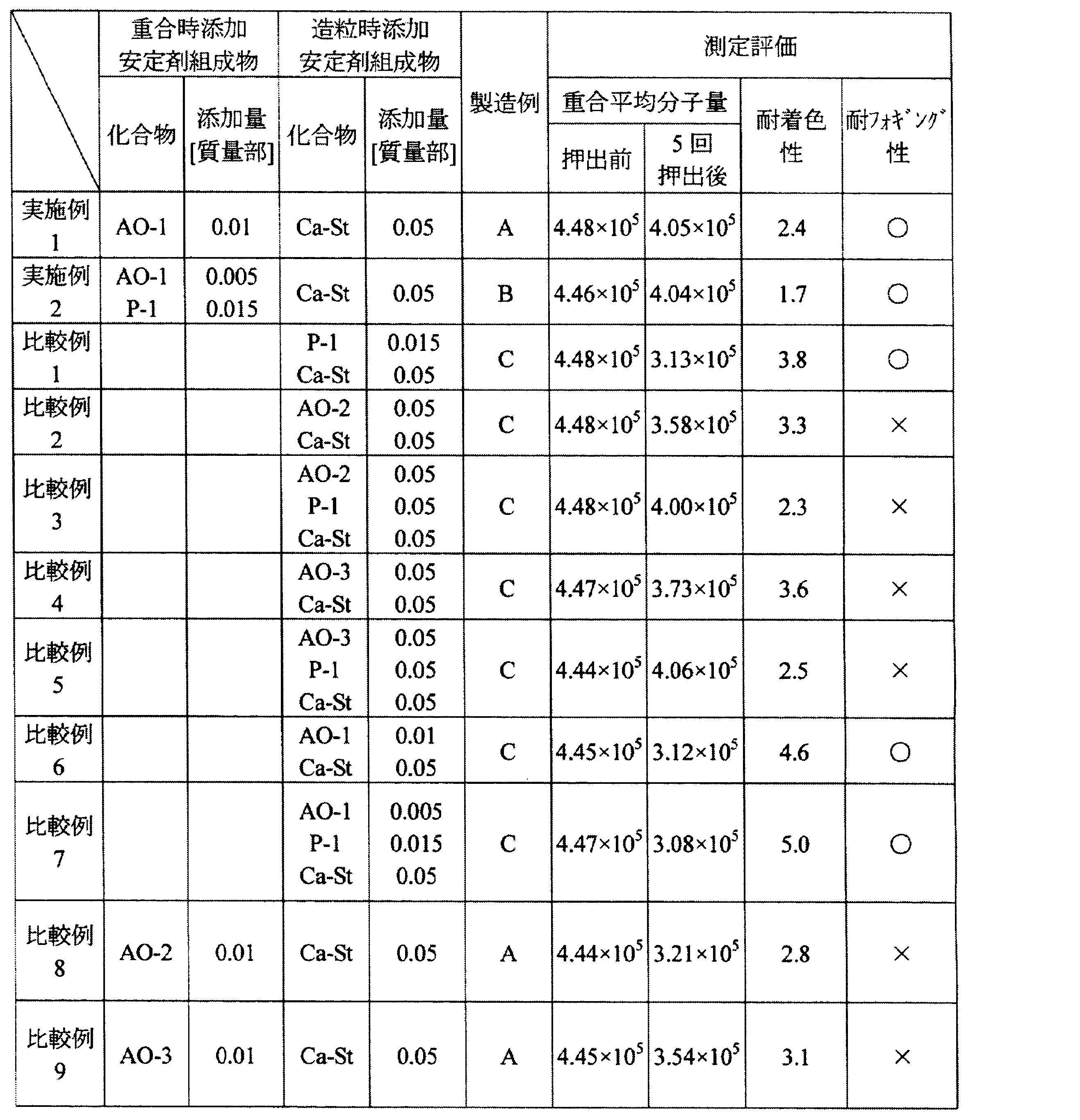
- Production Example B In the polymerization of Production Example A, a phosphite solution was prepared by the following method, and Production Example A was added except that the phenoxide solution and the phosphite solution were added so as to have the composition of the stabilizer composition described in Table 1. Polymerization was carried out in the same procedure as above to obtain a polyolefin resin composition.
- Thermal stability The above pellets were put into a twin screw extruder (Plastomill Micro manufactured by Toyo Seiki Seisakusho, extrusion temperature 230 ° C., screw rotation speed 50 rpm) and kneaded repeatedly 5 times, and gel permeation chromatograph (apparatus: GPC2000 type manufactured by Waters) , Column: 2 Styragel HT6E and 1 Styragel HT2 manufactured by Waters, measurement temperature 135 ° C., solvent: orthodichlorobenzene, concentration: 6 mg / 10 g), and the weight average molecular weight was measured. These results are shown in Table 1 below.
- AO-1 Compound No. 1 4
- AO-2 Octadecyl-3- (3,5-di-t-butyl-4-hydroxyphenyl) propionate
- AO-3 Tetrakis [methylenebis-3- (3,5-di-t-butyl- 4'-hydroxyphenyl) propionate] methane 4)
- P-1 Tris (2,4-di-t-butylphenyl) phosphite 5)
- Ca-St calcium stearate
- Comparative Examples 1 to 9 a polyolefin resin composition obtained by a production method different from the production method of the present invention was not obtained that satisfies all of the thermal stability, coloration resistance and fogging resistance. On the other hand, as is clear from Examples 1 and 2, it was confirmed that the polyolefin resin composition obtained by the production method of the present invention was excellent in thermal stability, color tone and fogging resistance. Further, in Examples 1 and 2, although the total amount of the antioxidant used was the same as that of Comparative Examples 6 and 7, respectively, the obtained polymers had high thermal stability and excellent coloration resistance. It was.
Landscapes
- Chemical & Material Sciences (AREA)
- Health & Medical Sciences (AREA)
- Chemical Kinetics & Catalysis (AREA)
- Medicinal Chemistry (AREA)
- Polymers & Plastics (AREA)
- Organic Chemistry (AREA)
- Compositions Of Macromolecular Compounds (AREA)
- Polymerisation Methods In General (AREA)
- Transition And Organic Metals Composition Catalysts For Addition Polymerization (AREA)
Abstract
Description
例えば、特許文献1には、(A)オレフィン樹脂、(B)エチレン-α-オレフィン系共重合体ゴム、(C)特定の条件を満足する樹脂用添加剤をそれぞれ、(A)と(B)の合計量100重量部あたり、0.05~0.6重量部、0.05~0.4重量部添加することが開示されている。上記(C)に該当する樹脂用添加剤としては、分子量200~1500のフェノール系酸化防止剤、リン系酸化防止剤、分子量200~1000であるヒンダードアミン系耐光剤、ヒドロキシベンゾトリアゾール系耐光剤、炭素数10~25の脂肪酸アミド及び/又はビス脂肪酸アミド系滑剤が開示されている。
なお、本発明者等は、これまで、特開2005-206625号公報、特開2005-255953号公報、特開2006-282985号公報等において、既存の触媒フィードタンク又は重合槽において、オレフィン重合で通常使用される有機アルミニウム化合物及びフェノール系酸化防止剤を混合してマスキング処理をすることにより、重合触媒の活性を低下させることなく重合物を安定化させる方法を提案しているが、上記文献において、耐フォギング性の改善といった効果は全く触れられていなかった。
下記一般式(1)で表されるフェノール系酸化防止剤を有機アルミニウム化合物でマスキング処理したものを、重合により得られるオレフィン樹脂100質量部に対して、0.001~0.5質量部となるように、オレフィンモノマーの重合前又は重合中に添加する工程を備えることを特徴とするものである。

下記一般式(1)で表されるフェノール系酸化防止剤を有機アルミニウム化合物でマスキング処理したものを、重合により得られるオレフィン樹脂100質量部に対して、0.001~0.5質量部となるように、オレフィンモノマーの重合前又は重合中に添加する工程を備えることを特徴とするものである。


上記リン系酸化防止剤としては、例えば、トリフェニルホスファイト、トリスノニルフェニルホスファイト、トリス(2,4-ジ第三ブチルフェニル)ホスファイト、トリス(2,4-ジ第三ブチル-5-メチルフェニル)ホスファイト、トリス〔2-第三ブチル-4-(3-第三ブチル-4-ヒドロキシ-5-メチルフェニルチオ)-5-メチルフェニル〕ホスファイト、トリデシルホスファイト、オクチルジフェニルホスファイト、ジ(デシル)モノフェニルホスファイト、ジ(トリデシル)ペンタエリスリトールジホスファイト、ジ(ノニルフェニル)ペンタエリスリトールジホスファイト、ビス(2,4-ジ第三ブチルフェニル)ペンタエリスリトールジホスファイト、ビス(2,6-ジ第三ブチル-4-メチルフェニル)ペンタエリスリトールジホスファイト、ビス(2,4,6-トリ第三ブチルフェニル)ペンタエリスリトールジホスファイト、ビス(2,4-ジクミルフェニル)ペンタエリスリトールジホスファイト、テトラ(トリデシル)イソプロピリデンジフェノールジホスファイト、テトラ(トリデシル)-4,4’-n-ブチリデンビス(2-第三ブチル-5-メチルフェノール)ジホスファイト、ヘキサ(トリデシル)-1,1,3-トリス(2-メチル-4-ヒドロキシ-5-第三ブチルフェニル)ブタントリホスファイト、テトラキス(2,4-ジ第三ブチルフェニル)ビフェニレンジホスホナイト、9,10-ジハイドロ-9-オキサ-10-ホスファフェナンスレン-10-オキサイド、2,2’-メチレンビス(4,6-第三ブチルフェニル)-2-エチルヘキシルホスファイト、2,2’-メチレンビス(4,6-第三ブチルフェニル)-オクタデシルホスファイト、2,2’-エチリデンビス(4,6-ジ第三ブチルフェニル)フルオロホスファイト、トリス(2-〔(2,4,8,10-テトラキス第三ブチルジベンゾ〔d,f〕〔1,3,2〕ジオキサホスフェピン-6-イル)オキシ〕エチル)アミン、2-エチル-2-ブチルプロピレングリコールと2,4,6-トリ第三ブチルフェノールのホスファイト等が挙げられる。中でもトリス(2,4-ジ第三ブチルフェニル)ホスファイトのような重合前に添加しても重合に悪影響しないリン系酸化防止剤が好ましい。上記リン系酸化防止剤の使用量は、重合して得られる重合体100質量部に対して、0.001~1質量部、より好ましくは、0.001~0.5質量部である。
上記無機担体としては、例えば、シリカ、アルミナ、酸化マグネシウム、酸化ジルコニウム、酸化チタン、酸化鉄、酸化カルシウム、酸化亜鉛等が挙げられる。またこの他の無機担体としては塩化マグネシウム、臭化マグネシウム等のハロゲン化マグネシウム、マグネシウムエトキシドなどのマグネシウムアルコキシド、イオン交換性層状化合物が挙げられる。
チオエーテル系酸化防止剤の使用量は、好ましくは、前記重合体100質量部に対して、0.001~0.3質量部、より好ましくは0.01~0.3質量部である。
上記紫外線吸収剤の使用量は、前記重合体100質量部に対して、0.001~5質量部、より好ましくは0.005~0.5質量部である。
上記ヒンダードアミン系光安定剤の使用量は、前記重合体100質量部に対して、0.001~5質量部、より好ましくは0.005~0.5質量部である。
上記造核剤の使用量は、前記重合体100質量部に対して、0.001~10質量部、より好ましくは0.005~5質量部である。
上記難燃剤の使用量は、前記重合体100質量部に対して、1~70質量部、より好ましくは、10~30質量部である。
上記滑剤の添加量は、前記重合体100質量部に対し、0.03~2質量部、より好ましくは0.04~1質量部の範囲である。0.03質量部未満では、所望の滑性が得られない場合があり、2質量部を超えると滑剤成分が重合体の成形品表面にブリードしたり、物性低下の原因となる場合がある。
本発明はこれらの実施例等によって制限を受けるものではない。尚、製造例とはエチレン性不飽和モノマーの重合方法を表し、実施例及び比較例は、重合して得られたオレフィン樹脂組成物の評価を表す。
(固体触媒成分の調製)
無水塩化マグネシウム4.76g(50mmol)、デカン25mL及び2-エチルへキシルアルコール23.4mL(150mmol)を加えて、130℃で2時間加熱反応を行い均一溶液とした後、さらに無水フタル酸1.11g(7.5mmol)を添加し、130℃を維持しながら1時間撹拌して、無水フタル酸を該均一溶液に溶解させた。次に、均一溶液を室温に冷却し、―20℃に保持された四塩化チタン200mL(1.8mol)中に1時間にわたって全量滴下装入した。装入終了後、4時間かけて110℃まで昇温した。110℃に到達後、ジイソブチルフタレート2.68mL(12.5mmol)を加え、110℃を維持しながら2時間撹拌して反応させた。反応終了後、熱時ろ過にて残渣を採取し、該残渣を200mlの四塩化チタンにて再懸濁させた後、再び110℃まで加熱して2時間反応させた。反応終了後、再び熱時ろ過で残渣を採取し、110℃のデカン及びヘキサンにて、洗液中に遊離しているチタン化合物が検出されなくなるまで充分に洗浄して固体チタン触媒成分を得た。この固体チタン触媒成分の一部をサンプリングして乾燥し、触媒組成を分析したところ、チタン3.1重量%、塩素56.0重量%、マグネシウム17.0重量%及びイソブチルフタレート20.9重量%であった。
窒素置換したフラスコに、ヘプタン10ml、トリエチルアルミニウム54mg及び表1記載のフェノール系酸化防止剤161mgを混合・撹拌してフェノール系酸化防止剤をマスキングし、フェノール系酸化防止剤の濃度が16mg/mlの安定剤溶液を調製した。
窒素置換したオートクレーブにヘプタン600mL、トリエチルアルミニウム303mg、前記フェノキシド溶液を表1に記載の安定剤組成物の配合になるように添加し、ジシクロペンチルジメトキシシラン0.26mmol及び固体Ti触媒成分のヘプタンスラリー(Tiとして13μmol)を順次加えた。オートクレーブ内をプロピレン雰囲気に置換し、プロピレンで1kgf/cm2Gの圧力をかけ、50℃で5分間プレ重合した。プロピレンをパージした後、水素340ml(23℃)を吹き込み、70℃まで昇温し、オートクレーブ内にプロピレンで6kgf/cm2Gの圧力をかけ、70℃で1時間重合反応を行った。窒素ガスで系内を置換してから40℃でエタノール5mlを加え重合反応を停止させた後、50℃で減圧脱溶媒を行ない、次いで、真空中、40℃でポリマーを5時間乾燥することにより、ポリオレフィン樹脂組成物を得た。
製造例Aの重合において、下記の方法でホスファイト溶液を調製して、フェノキシド溶液及びホスファイト溶液を表1に記載の安定剤組成物の配合になるように添加した以外には、製造例Aと同様の手順で重合を行い、ポリオレフィン樹脂組成物を得た。
窒素置換したフラスコに、リン系酸化防止剤144mgを加え、ヘプタン6mLを添加して混合・撹拌して、リン系酸化防止剤24mg/mLのホスファイト溶液を調製した。
製造例Aの重合において、フェノキシド溶液を添加しなかった以外は、製造例Aと同様の手順で重合を行い、ポリオレフィン樹脂組成物を得た。
上記の方法で得られたポリオレフィン樹脂組成物100質量部に対して、表1に記載の安定剤組成物及びステアリン酸カルシウム0.05質量部を添加し、混合した。混合後、押出機(単軸押出機;押出温度230℃、スクリュー速度50rpm)で造粒し、ペレットを得た。
上記ペレットについて、二軸押出機(東洋精機製作所製プラストミルマイクロ、押出温度230℃、スクリュー回転速度50rpm)に投入して混練を5回くり返し、ゲルパーミエーションクロマトグラフ(装置:ウォーターズ社製GPC2000型、カラム:ウォーターズ社製Styragel HT6E 2本とStyragelHT2 1本、測定温度135℃、溶媒:オルトジクロロベンゼン、濃度:6mg/10g)により重量平均分子量を測定した。これらの結果について下記表1に示す。
上記ペレットについて、180℃に加熱してプレスし、厚み2mmのシートを作成した。分光測色計(SC-T;スガ試験機株式会社製)によりシートの黄色度を測定した。これらの結果について下記表1に示す。
上記ペレットについて、ISO6452に準拠してフォギング試験を行ったガラス板の曇り具合を目視し、ガラス板に曇りが認められなかった場合について、耐フォギング性ありとして○をつけ、ガラス板に曇りがあった場合は耐フォギング性がなしとして×をつけて評価した。これらの結果について下記表1に示す。
2)AO-2:オクタデシル-3-(3,5-ジ-t-ブチル-4-ヒドロキシフェニル)プロピオネート
3)AO-3:テトラキス〔メチレンビス-3-(3,5-ジ-t-ブチル-4’-ヒドロキシフェニル)プロピオネート〕メタン
4)P-1:トリス(2,4-ジ-t-ブチルフェニル)ホスファイト
5)Ca-St:ステアリン酸カルシウム
Claims (8)
- オレフィンモノマーを重合してなる自動車内装材料用オレフィン樹脂組成物の製造方法であって、
下記一般式(1)で表されるフェノール系酸化防止剤を有機アルミニウム化合物でマスキング処理したものを、重合により得られるオレフィン樹脂100質量部に対して、0.001~0.5質量部となるように、オレフィンモノマーの重合前又は重合中に添加する工程を備えることを特徴とする自動車内装材料用オレフィン樹脂組成物の製造方法。
(式中、Rは分岐を有してもよい炭素原子数1~30のアルキル基、置換されていてもよい炭素原子数3~12のシクロアルキル基、置換基を有してもよい炭素原子数6~18のアリール基を表す。)
- オレフィンモノマーを重合してなる家電材料用オレフィン樹脂組成物の製造方法であって、
下記一般式(1)で表されるフェノール系酸化防止剤を有機アルミニウム化合物でマスキング処理したものを、重合により得られるオレフィン樹脂100質量部に対して、0.001~0.5質量部となるように、オレフィンモノマーの重合前又は重合中に添加する工程を備えることを特徴とする家電材料用オレフィン樹脂組成物の製造方法。
(式中、Rは分岐を有してもよい炭素原子数1~30のアルキル基、置換されていてもよい炭素原子数3~12のシクロアルキル基、置換基を有してもよい炭素原子数6~18のアリール基を表す。)
- 前記有機アルミニウム化合物が、トリアルキルアルミニウムである請求項1記載の自動車内装材料用オレフィン樹脂組成物の製造方法。
- 前記有機アルミニウム化合物が、トリアルキルアルミニウムである請求項2記載の家電材料用オレフィン樹脂組成物の製造方法。
- エチレン性不飽和結合を有するモノマーの重合前又は重合中に、さらにリン系酸化防止剤を添加する請求項1記載の自動車内装材料用オレフィン樹脂組成物の製造方法。
- エチレン性不飽和結合を有するモノマーの重合前又は重合中に、さらにリン系酸化防止剤を添加する請求項2記載の家電材料用オレフィン樹脂組成物の製造方法。
- 請求項1記載の自動車内装材料用オレフィン樹脂組成物の製造方法により製造された自動車内装材料用オレフィン樹脂組成物を成形してなることを特徴とする自動車内装材。
- 請求項2記載の家電材料用オレフィン樹脂組成物の製造方法により製造された家電材料用オレフィン樹脂組成物を成形してなることを特徴とする家電外装材。
Priority Applications (5)
| Application Number | Priority Date | Filing Date | Title |
|---|---|---|---|
| KR20147029815A KR20140139066A (ko) | 2012-03-23 | 2013-02-15 | 가전 재료용 및 자동차 내장 재료용 올레핀 수지 조성물의 제조 방법 |
| IN1990MUN2014 IN2014MN01990A (ja) | 2012-03-23 | 2013-02-15 | |
| EP13764537.0A EP2829554A4 (en) | 2012-03-23 | 2013-02-15 | METHOD FOR PRODUCING AN OLEFIN RESIN COMPOSITION FOR MATERIALS OF AN ELECTRICAL APPLICATION AND MOTOR VEHICLE INTERIOR COVERING MATERIALS |
| US14/387,465 US20150065649A1 (en) | 2012-03-23 | 2013-02-15 | Method for producing olefin resin composition for electric appliance materials and automotive interior materials |
| CN201380015833.9A CN104203991B (zh) | 2012-03-23 | 2013-02-15 | 家电材料用和汽车内部装饰材料用烯烃树脂组合物的制造方法 |
Applications Claiming Priority (2)
| Application Number | Priority Date | Filing Date | Title |
|---|---|---|---|
| JP2012-067832 | 2012-03-23 | ||
| JP2012067832A JP2013199551A (ja) | 2012-03-23 | 2012-03-23 | 家電材料用及び自動車内装材料用オレフィン樹脂組成物の製造方法 |
Publications (1)
| Publication Number | Publication Date |
|---|---|
| WO2013140905A1 true WO2013140905A1 (ja) | 2013-09-26 |
Family
ID=49222370
Family Applications (1)
| Application Number | Title | Priority Date | Filing Date |
|---|---|---|---|
| PCT/JP2013/053748 Ceased WO2013140905A1 (ja) | 2012-03-23 | 2013-02-15 | 家電材料用及び自動車内装材料用オレフィン樹脂組成物の製造方法 |
Country Status (8)
| Country | Link |
|---|---|
| US (1) | US20150065649A1 (ja) |
| EP (1) | EP2829554A4 (ja) |
| JP (1) | JP2013199551A (ja) |
| KR (1) | KR20140139066A (ja) |
| CN (1) | CN104203991B (ja) |
| IN (1) | IN2014MN01990A (ja) |
| TW (1) | TWI582149B (ja) |
| WO (1) | WO2013140905A1 (ja) |
Families Citing this family (2)
| Publication number | Priority date | Publication date | Assignee | Title |
|---|---|---|---|---|
| BR112016008951B1 (pt) * | 2013-10-21 | 2021-11-03 | Adeka Corporation | Método para produção de polímero estabilizado |
| JP6909594B2 (ja) | 2017-03-03 | 2021-07-28 | 株式会社Adeka | 安定化されたオレフィン系樹脂組成物の製造方法 |
Citations (49)
| Publication number | Priority date | Publication date | Assignee | Title |
|---|---|---|---|---|
| JPS4734478A (ja) | 1971-03-23 | 1972-11-21 | ||
| JPS56100806A (en) | 1980-01-17 | 1981-08-13 | Chisso Corp | Preparation of alpha-olefin polymer |
| JPS56120712A (en) | 1980-02-27 | 1981-09-22 | Chisso Corp | Preparation of poly alpha-olefin |
| JPS5763310A (en) | 1980-08-13 | 1982-04-16 | Montedison Spa | Ingredient and catalyst for olefin polymerization |
| JPS585310A (ja) | 1981-07-03 | 1983-01-12 | Mitsubishi Petrochem Co Ltd | オレフイン重合用触媒成分 |
| JPS5823806A (ja) | 1981-08-04 | 1983-02-12 | Chisso Corp | α−オレフイン重合体を製造する方法 |
| JPS5883006A (ja) | 1981-11-13 | 1983-05-18 | Mitsui Petrochem Ind Ltd | オレフインの重合方法 |
| JPS58104907A (ja) | 1981-12-17 | 1983-06-22 | Chisso Corp | 高剛性成形品用ポリプロピレンの製造方法 |
| JPS58157808A (ja) | 1982-03-16 | 1983-09-20 | Ube Ind Ltd | α−オレフインの重合方法 |
| JPS61218606A (ja) | 1985-03-25 | 1986-09-29 | Sumitomo Chem Co Ltd | α−オレフイン重合体の製造法 |
| JPS6343915A (ja) | 1986-08-11 | 1988-02-25 | Mitsubishi Petrochem Co Ltd | プロピレンブロツク共重合体の製造法 |
| JPS6383116A (ja) | 1986-09-26 | 1988-04-13 | Mitsubishi Petrochem Co Ltd | プロピレンブロツク共重合体の製造法 |
| JPS63146906A (ja) | 1986-09-26 | 1988-06-18 | ソルベイ(ソシエテ アノニム) | アルフアーオレフインの立体特異性重合に使用できる固形触媒 |
| JPH0543616A (ja) | 1991-08-20 | 1993-02-23 | Mitsubishi Petrochem Co Ltd | オレフイン重合用触媒 |
| JPH05295022A (ja) | 1992-04-23 | 1993-11-09 | Mitsubishi Kasei Corp | オレフィン重合用触媒およびオレフィン重合体の製造方法 |
| JPH05301917A (ja) | 1991-05-01 | 1993-11-16 | Mitsubishi Kasei Corp | オレフィン重合用触媒およびこれを用いたオレフィン重合体の製造方法 |
| JPH06239915A (ja) | 1993-02-19 | 1994-08-30 | Mitsubishi Petrochem Co Ltd | α‐オレフィン重合用触媒成分およびそれを用いたα‐オレフィン重合体の製造法 |
| JPH06239917A (ja) | 1993-02-19 | 1994-08-30 | Mitsubishi Petrochem Co Ltd | α‐オレフィン重合用触媒成分およびそれを用いたα‐オレフィン重合体の製造法 |
| JPH06239914A (ja) | 1993-02-19 | 1994-08-30 | Mitsubishi Petrochem Co Ltd | α‐オレフィン重合用触媒成分およびそれを用いたα‐オレフィン重合体の製造法 |
| JPH0782311A (ja) | 1993-09-10 | 1995-03-28 | Mitsubishi Chem Corp | オレフィン重合用触媒およびこれを用いたオレフィン重合体の製造方法 |
| JPH07228621A (ja) | 1994-02-21 | 1995-08-29 | Mitsubishi Chem Corp | オレフィン重合用触媒およびこれを用いたオレフィンの重合方法 |
| JPH07330820A (ja) | 1994-06-10 | 1995-12-19 | Chisso Corp | 架橋型メタロセン化合物およびその製造法 |
| JPH0859724A (ja) | 1994-08-17 | 1996-03-05 | Mitsubishi Chem Corp | α‐オレフィン重合用触媒成分およびそれを用いたα‐オレフィン重合体の製造法 |
| JPH0885707A (ja) | 1994-07-22 | 1996-04-02 | Mitsubishi Chem Corp | α‐オレフィン重合用触媒成分およびそれを用いたα‐オレフィン重合体の製造法 |
| JPH0885708A (ja) | 1994-07-22 | 1996-04-02 | Mitsubishi Chem Corp | α‐オレフィン重合用触媒成分およびそれを用いたα‐オレフィン重合体の製造法 |
| JPH08127613A (ja) | 1994-05-18 | 1996-05-21 | Mitsubishi Chem Corp | オレフィン重合用触媒およびオレフィンの重合方法 |
| JPH0912621A (ja) | 1995-06-29 | 1997-01-14 | Ciba Geigy Ag | 安定化されたオレフィンポリマーの製造方法 |
| JPH1036578A (ja) | 1996-01-26 | 1998-02-10 | Sumitomo Chem Co Ltd | 自動車内装用熱可塑性エラストマー組成物及び自動車内装部品 |
| JPH10226712A (ja) | 1996-12-09 | 1998-08-25 | Mitsubishi Chem Corp | α−オレフィン重合用触媒およびα−オレフィン重合体の製造方法 |
| JPH10259143A (ja) | 1996-07-23 | 1998-09-29 | Mitsubishi Chem Corp | メタロセン化合物類の精製法及びα−オレフィンの重合方法 |
| JPH10265490A (ja) | 1997-01-21 | 1998-10-06 | Mitsubishi Chem Corp | ケイ素またはゲルマニウム含有有機化合物、遷移金属錯体、α−オレフィン重合用触媒およびα−オレフィン重合体の各製造方法 |
| WO1999037654A1 (en) | 1998-01-27 | 1999-07-29 | Chisso Corporation | Metallocene compounds having bis(naphthylcyclo pentadienyl) ligand and process for producing the same |
| WO1999045014A1 (en) | 1998-03-05 | 1999-09-10 | Chisso Corporation | Metallocene compounds having bis(2,5-disubstituted-3-phenylcyclopentadienyl) ligand and process for producing the same |
| JPH11246582A (ja) | 1998-02-27 | 1999-09-14 | Chisso Corp | ビス置換シクロペンタジエニル配位子を有するメタロセン化合物 |
| JPH11279189A (ja) | 1998-01-27 | 1999-10-12 | Chisso Corp | ビス(2−置換−4−フェニル−シクロペンタジエニル)配位子を有するメタロセン化合物およびその製造方法 |
| JPH11349633A (ja) | 1998-06-08 | 1999-12-21 | Mitsubishi Chemical Corp | 新規な遷移金属化合物、オレフィン重合用触媒成分およびα−オレフィン重合体の製造方法 |
| WO2000008036A1 (en) | 1998-08-03 | 2000-02-17 | Chisso Corporation | ν-OXOBISMETALLOCENE COMPLEXES, CATALYST FOR OLEFIN POLYMERIZATION CONTAINING THE SAME, AND POLYMERIZATION METHOD |
| JP2000229990A (ja) | 1999-02-15 | 2000-08-22 | Chisso Corp | ビス(2,5−二置換−3−ナフチルシクロペンタジエニル)配位子を有するメタロセン化合物およびその製造方法 |
| JP2001206914A (ja) | 2000-01-27 | 2001-07-31 | Japan Polychem Corp | プロピレン系ランダム共重合体の製造方法 |
| JP2002037795A (ja) | 1999-10-22 | 2002-02-06 | Chisso Corp | インデニル配位子を有するメタロセン化合物およびこれを含むオレフィン重合用触媒 |
| JP2002194016A (ja) | 2000-05-23 | 2002-07-10 | Chisso Corp | メタロセン化合物、それを含むオレフィン重合用触媒および該触媒を用いるオレフィン重合体の製造方法 |
| JP2002194015A (ja) | 2000-12-25 | 2002-07-10 | Chisso Corp | オレフィン重合体製造用触媒およびそれを用いたオレフィン重合体の製造方法 |
| JP2002535339A (ja) | 1999-01-25 | 2002-10-22 | チッソ株式会社 | オレフィン重合用触媒成分としてのメタロセン化合物 |
| JP2004323545A (ja) * | 2003-04-21 | 2004-11-18 | Mitsui Chemicals Inc | 自動車内装用ポリプロピレン樹脂組成物 |
| JP2005206625A (ja) | 2004-01-20 | 2005-08-04 | Asahi Denka Kogyo Kk | 安定化されたポリマーの製造方法 |
| JP2005255953A (ja) | 2004-03-15 | 2005-09-22 | Asahi Denka Kogyo Kk | 安定化されたポリマーの製造方法 |
| JP2006188625A (ja) | 2005-01-07 | 2006-07-20 | Mitsui Chemicals Inc | ポリプロピレン系複合材料 |
| JP2006282985A (ja) | 2005-03-11 | 2006-10-19 | Adeka Corp | 安定化されたポリマーの製造方法 |
| JP2010196033A (ja) * | 2009-01-28 | 2010-09-09 | Adeka Corp | 食品・医療・水道用パイプ用途のポリオレフィン系樹脂組成物 |
Family Cites Families (13)
| Publication number | Priority date | Publication date | Assignee | Title |
|---|---|---|---|---|
| JPH0710869B2 (ja) * | 1986-02-26 | 1995-02-08 | 旭電化工業株式会社 | ヒドロキシフエニルカルボン酸アマイド化合物 |
| JPH0819397B2 (ja) * | 1987-08-17 | 1996-02-28 | 三菱化学株式会社 | 塩化ビニル系樹脂製パッキン |
| JPH06279642A (ja) * | 1993-03-26 | 1994-10-04 | Shin Etsu Chem Co Ltd | 粉末スラッシュ成形用塩化ビニル系樹脂組成物 |
| JP4055342B2 (ja) * | 2000-09-19 | 2008-03-05 | 三井化学株式会社 | オレフィン系熱可塑性エラストマー成形品、その製造方法および用途 |
| JP2003071996A (ja) * | 2001-09-07 | 2003-03-12 | Sumitomo Chem Co Ltd | 積層体 |
| US8003725B2 (en) * | 2002-08-12 | 2011-08-23 | Exxonmobil Chemical Patents Inc. | Plasticized hetero-phase polyolefin blends |
| JP5044997B2 (ja) * | 2005-06-03 | 2012-10-10 | 三菱化学株式会社 | 塗料及びその製造方法、並びに積層体及びその製造方法 |
| CN103146156B (zh) * | 2005-09-30 | 2015-06-24 | 株式会社钟化 | 阻燃性聚酯树脂组合物 |
| JP2008174683A (ja) * | 2007-01-22 | 2008-07-31 | Toray Ind Inc | ゴム質含有樹脂組成物 |
| JP5443063B2 (ja) * | 2009-06-05 | 2014-03-19 | サンアロマー株式会社 | ポリプロピレン系樹脂組成物及び自動車内装部品用成形体 |
| KR102115865B1 (ko) * | 2010-11-16 | 2020-05-27 | 가부시키가이샤 아데카 | 폴리머의 장기 안정화 방법 및 부직포, 일래스터머 조성물의 제조 방법 |
| EP2966095B1 (en) * | 2011-03-02 | 2017-05-03 | Adeka Corporation | Process of producing resin composition for coating members |
| JP5734826B2 (ja) * | 2011-12-20 | 2015-06-17 | 株式会社Adeka | オレフィン樹脂組成物の製造方法 |
-
2012
- 2012-03-23 JP JP2012067832A patent/JP2013199551A/ja active Pending
-
2013
- 2013-02-15 WO PCT/JP2013/053748 patent/WO2013140905A1/ja not_active Ceased
- 2013-02-15 CN CN201380015833.9A patent/CN104203991B/zh not_active Expired - Fee Related
- 2013-02-15 EP EP13764537.0A patent/EP2829554A4/en not_active Withdrawn
- 2013-02-15 IN IN1990MUN2014 patent/IN2014MN01990A/en unknown
- 2013-02-15 US US14/387,465 patent/US20150065649A1/en not_active Abandoned
- 2013-02-15 KR KR20147029815A patent/KR20140139066A/ko not_active Ceased
- 2013-03-05 TW TW102107647A patent/TWI582149B/zh not_active IP Right Cessation
Patent Citations (49)
| Publication number | Priority date | Publication date | Assignee | Title |
|---|---|---|---|---|
| JPS4734478A (ja) | 1971-03-23 | 1972-11-21 | ||
| JPS56100806A (en) | 1980-01-17 | 1981-08-13 | Chisso Corp | Preparation of alpha-olefin polymer |
| JPS56120712A (en) | 1980-02-27 | 1981-09-22 | Chisso Corp | Preparation of poly alpha-olefin |
| JPS5763310A (en) | 1980-08-13 | 1982-04-16 | Montedison Spa | Ingredient and catalyst for olefin polymerization |
| JPS585310A (ja) | 1981-07-03 | 1983-01-12 | Mitsubishi Petrochem Co Ltd | オレフイン重合用触媒成分 |
| JPS5823806A (ja) | 1981-08-04 | 1983-02-12 | Chisso Corp | α−オレフイン重合体を製造する方法 |
| JPS5883006A (ja) | 1981-11-13 | 1983-05-18 | Mitsui Petrochem Ind Ltd | オレフインの重合方法 |
| JPS58104907A (ja) | 1981-12-17 | 1983-06-22 | Chisso Corp | 高剛性成形品用ポリプロピレンの製造方法 |
| JPS58157808A (ja) | 1982-03-16 | 1983-09-20 | Ube Ind Ltd | α−オレフインの重合方法 |
| JPS61218606A (ja) | 1985-03-25 | 1986-09-29 | Sumitomo Chem Co Ltd | α−オレフイン重合体の製造法 |
| JPS6343915A (ja) | 1986-08-11 | 1988-02-25 | Mitsubishi Petrochem Co Ltd | プロピレンブロツク共重合体の製造法 |
| JPS6383116A (ja) | 1986-09-26 | 1988-04-13 | Mitsubishi Petrochem Co Ltd | プロピレンブロツク共重合体の製造法 |
| JPS63146906A (ja) | 1986-09-26 | 1988-06-18 | ソルベイ(ソシエテ アノニム) | アルフアーオレフインの立体特異性重合に使用できる固形触媒 |
| JPH05301917A (ja) | 1991-05-01 | 1993-11-16 | Mitsubishi Kasei Corp | オレフィン重合用触媒およびこれを用いたオレフィン重合体の製造方法 |
| JPH0543616A (ja) | 1991-08-20 | 1993-02-23 | Mitsubishi Petrochem Co Ltd | オレフイン重合用触媒 |
| JPH05295022A (ja) | 1992-04-23 | 1993-11-09 | Mitsubishi Kasei Corp | オレフィン重合用触媒およびオレフィン重合体の製造方法 |
| JPH06239915A (ja) | 1993-02-19 | 1994-08-30 | Mitsubishi Petrochem Co Ltd | α‐オレフィン重合用触媒成分およびそれを用いたα‐オレフィン重合体の製造法 |
| JPH06239917A (ja) | 1993-02-19 | 1994-08-30 | Mitsubishi Petrochem Co Ltd | α‐オレフィン重合用触媒成分およびそれを用いたα‐オレフィン重合体の製造法 |
| JPH06239914A (ja) | 1993-02-19 | 1994-08-30 | Mitsubishi Petrochem Co Ltd | α‐オレフィン重合用触媒成分およびそれを用いたα‐オレフィン重合体の製造法 |
| JPH0782311A (ja) | 1993-09-10 | 1995-03-28 | Mitsubishi Chem Corp | オレフィン重合用触媒およびこれを用いたオレフィン重合体の製造方法 |
| JPH07228621A (ja) | 1994-02-21 | 1995-08-29 | Mitsubishi Chem Corp | オレフィン重合用触媒およびこれを用いたオレフィンの重合方法 |
| JPH08127613A (ja) | 1994-05-18 | 1996-05-21 | Mitsubishi Chem Corp | オレフィン重合用触媒およびオレフィンの重合方法 |
| JPH07330820A (ja) | 1994-06-10 | 1995-12-19 | Chisso Corp | 架橋型メタロセン化合物およびその製造法 |
| JPH0885708A (ja) | 1994-07-22 | 1996-04-02 | Mitsubishi Chem Corp | α‐オレフィン重合用触媒成分およびそれを用いたα‐オレフィン重合体の製造法 |
| JPH0885707A (ja) | 1994-07-22 | 1996-04-02 | Mitsubishi Chem Corp | α‐オレフィン重合用触媒成分およびそれを用いたα‐オレフィン重合体の製造法 |
| JPH0859724A (ja) | 1994-08-17 | 1996-03-05 | Mitsubishi Chem Corp | α‐オレフィン重合用触媒成分およびそれを用いたα‐オレフィン重合体の製造法 |
| JPH0912621A (ja) | 1995-06-29 | 1997-01-14 | Ciba Geigy Ag | 安定化されたオレフィンポリマーの製造方法 |
| JPH1036578A (ja) | 1996-01-26 | 1998-02-10 | Sumitomo Chem Co Ltd | 自動車内装用熱可塑性エラストマー組成物及び自動車内装部品 |
| JPH10259143A (ja) | 1996-07-23 | 1998-09-29 | Mitsubishi Chem Corp | メタロセン化合物類の精製法及びα−オレフィンの重合方法 |
| JPH10226712A (ja) | 1996-12-09 | 1998-08-25 | Mitsubishi Chem Corp | α−オレフィン重合用触媒およびα−オレフィン重合体の製造方法 |
| JPH10265490A (ja) | 1997-01-21 | 1998-10-06 | Mitsubishi Chem Corp | ケイ素またはゲルマニウム含有有機化合物、遷移金属錯体、α−オレフィン重合用触媒およびα−オレフィン重合体の各製造方法 |
| WO1999037654A1 (en) | 1998-01-27 | 1999-07-29 | Chisso Corporation | Metallocene compounds having bis(naphthylcyclo pentadienyl) ligand and process for producing the same |
| JPH11279189A (ja) | 1998-01-27 | 1999-10-12 | Chisso Corp | ビス(2−置換−4−フェニル−シクロペンタジエニル)配位子を有するメタロセン化合物およびその製造方法 |
| JPH11246582A (ja) | 1998-02-27 | 1999-09-14 | Chisso Corp | ビス置換シクロペンタジエニル配位子を有するメタロセン化合物 |
| WO1999045014A1 (en) | 1998-03-05 | 1999-09-10 | Chisso Corporation | Metallocene compounds having bis(2,5-disubstituted-3-phenylcyclopentadienyl) ligand and process for producing the same |
| JPH11349633A (ja) | 1998-06-08 | 1999-12-21 | Mitsubishi Chemical Corp | 新規な遷移金属化合物、オレフィン重合用触媒成分およびα−オレフィン重合体の製造方法 |
| WO2000008036A1 (en) | 1998-08-03 | 2000-02-17 | Chisso Corporation | ν-OXOBISMETALLOCENE COMPLEXES, CATALYST FOR OLEFIN POLYMERIZATION CONTAINING THE SAME, AND POLYMERIZATION METHOD |
| JP2002535339A (ja) | 1999-01-25 | 2002-10-22 | チッソ株式会社 | オレフィン重合用触媒成分としてのメタロセン化合物 |
| JP2000229990A (ja) | 1999-02-15 | 2000-08-22 | Chisso Corp | ビス(2,5−二置換−3−ナフチルシクロペンタジエニル)配位子を有するメタロセン化合物およびその製造方法 |
| JP2002037795A (ja) | 1999-10-22 | 2002-02-06 | Chisso Corp | インデニル配位子を有するメタロセン化合物およびこれを含むオレフィン重合用触媒 |
| JP2001206914A (ja) | 2000-01-27 | 2001-07-31 | Japan Polychem Corp | プロピレン系ランダム共重合体の製造方法 |
| JP2002194016A (ja) | 2000-05-23 | 2002-07-10 | Chisso Corp | メタロセン化合物、それを含むオレフィン重合用触媒および該触媒を用いるオレフィン重合体の製造方法 |
| JP2002194015A (ja) | 2000-12-25 | 2002-07-10 | Chisso Corp | オレフィン重合体製造用触媒およびそれを用いたオレフィン重合体の製造方法 |
| JP2004323545A (ja) * | 2003-04-21 | 2004-11-18 | Mitsui Chemicals Inc | 自動車内装用ポリプロピレン樹脂組成物 |
| JP2005206625A (ja) | 2004-01-20 | 2005-08-04 | Asahi Denka Kogyo Kk | 安定化されたポリマーの製造方法 |
| JP2005255953A (ja) | 2004-03-15 | 2005-09-22 | Asahi Denka Kogyo Kk | 安定化されたポリマーの製造方法 |
| JP2006188625A (ja) | 2005-01-07 | 2006-07-20 | Mitsui Chemicals Inc | ポリプロピレン系複合材料 |
| JP2006282985A (ja) | 2005-03-11 | 2006-10-19 | Adeka Corp | 安定化されたポリマーの製造方法 |
| JP2010196033A (ja) * | 2009-01-28 | 2010-09-09 | Adeka Corp | 食品・医療・水道用パイプ用途のポリオレフィン系樹脂組成物 |
Non-Patent Citations (1)
| Title |
|---|
| See also references of EP2829554A4 |
Also Published As
| Publication number | Publication date |
|---|---|
| KR20140139066A (ko) | 2014-12-04 |
| US20150065649A1 (en) | 2015-03-05 |
| TW201402673A (zh) | 2014-01-16 |
| JP2013199551A (ja) | 2013-10-03 |
| EP2829554A4 (en) | 2015-11-18 |
| CN104203991B (zh) | 2016-07-06 |
| IN2014MN01990A (ja) | 2015-07-10 |
| EP2829554A1 (en) | 2015-01-28 |
| TWI582149B (zh) | 2017-05-11 |
| CN104203991A (zh) | 2014-12-10 |
Similar Documents
| Publication | Publication Date | Title |
|---|---|---|
| EP2796477B1 (en) | Method for producing stabilized polymer | |
| KR101853773B1 (ko) | 폴리머의 장기 안정화 방법 및 부직포, 일래스터머 조성물의 제조 방법 | |
| KR101966269B1 (ko) | 라미네이트 필름 및 도장 부재용 수지 조성물의 제조 방법 | |
| JP2010215892A (ja) | ポリオレフィン系樹脂組成物 | |
| WO2013140905A1 (ja) | 家電材料用及び自動車内装材料用オレフィン樹脂組成物の製造方法 | |
| JP6905820B2 (ja) | 安定剤組成物および安定化された重合体の製造方法 | |
| JP2012107106A (ja) | 熱可塑性エラストマー組成物の製造方法 | |
| JP5808906B2 (ja) | ポリマーの製造方法 | |
| JP2017226750A (ja) | 安定化された重合体の製造方法 | |
| JP2022017798A (ja) | ポリオレフィン系樹脂組成物の製造方法、ポリオレフィン系樹脂組成物およびその成形品 |
Legal Events
| Date | Code | Title | Description |
|---|---|---|---|
| 121 | Ep: the epo has been informed by wipo that ep was designated in this application |
Ref document number: 13764537 Country of ref document: EP Kind code of ref document: A1 |
|
| WWE | Wipo information: entry into national phase |
Ref document number: P997/2014 Country of ref document: AE |
|
| WWE | Wipo information: entry into national phase |
Ref document number: 14387465 Country of ref document: US |
|
| WWE | Wipo information: entry into national phase |
Ref document number: 2013764537 Country of ref document: EP |
|
| REG | Reference to national code |
Ref country code: BR Ref legal event code: B01A Ref document number: 112014023518 Country of ref document: BR |
|
| ENP | Entry into the national phase |
Ref document number: 20147029815 Country of ref document: KR Kind code of ref document: A |
|
| NENP | Non-entry into the national phase |
Ref country code: DE |
|
| ENP | Entry into the national phase |
Ref document number: 112014023518 Country of ref document: BR Kind code of ref document: A2 Effective date: 20140922 |