WO2013161303A1 - Nouvelle levure de boulanger - Google Patents
Nouvelle levure de boulanger Download PDFInfo
- Publication number
- WO2013161303A1 WO2013161303A1 PCT/JP2013/002806 JP2013002806W WO2013161303A1 WO 2013161303 A1 WO2013161303 A1 WO 2013161303A1 JP 2013002806 W JP2013002806 W JP 2013002806W WO 2013161303 A1 WO2013161303 A1 WO 2013161303A1
- Authority
- WO
- WIPO (PCT)
- Prior art keywords
- dough
- weight
- parts
- yeast
- amount
- Prior art date
- Legal status (The legal status is an assumption and is not a legal conclusion. Google has not performed a legal analysis and makes no representation as to the accuracy of the status listed.)
- Ceased
Links
Images




Classifications
-
- C—CHEMISTRY; METALLURGY
- C12—BIOCHEMISTRY; BEER; SPIRITS; WINE; VINEGAR; MICROBIOLOGY; ENZYMOLOGY; MUTATION OR GENETIC ENGINEERING
- C12N—MICROORGANISMS OR ENZYMES; COMPOSITIONS THEREOF; PROPAGATING, PRESERVING, OR MAINTAINING MICROORGANISMS; MUTATION OR GENETIC ENGINEERING; CULTURE MEDIA
- C12N1/00—Microorganisms; Compositions thereof; Processes of propagating, maintaining or preserving microorganisms or compositions thereof; Processes of preparing or isolating a composition containing a microorganism; Culture media therefor
- C12N1/14—Fungi; Culture media therefor
- C12N1/16—Yeasts; Culture media therefor
-
- C—CHEMISTRY; METALLURGY
- C12—BIOCHEMISTRY; BEER; SPIRITS; WINE; VINEGAR; MICROBIOLOGY; ENZYMOLOGY; MUTATION OR GENETIC ENGINEERING
- C12N—MICROORGANISMS OR ENZYMES; COMPOSITIONS THEREOF; PROPAGATING, PRESERVING, OR MAINTAINING MICROORGANISMS; MUTATION OR GENETIC ENGINEERING; CULTURE MEDIA
- C12N1/00—Microorganisms; Compositions thereof; Processes of propagating, maintaining or preserving microorganisms or compositions thereof; Processes of preparing or isolating a composition containing a microorganism; Culture media therefor
- C12N1/14—Fungi; Culture media therefor
- C12N1/16—Yeasts; Culture media therefor
- C12N1/18—Baker's yeast; Brewer's yeast
-
- A—HUMAN NECESSITIES
- A21—BAKING; EDIBLE DOUGHS
- A21D—TREATMENT OF FLOUR OR DOUGH FOR BAKING, e.g. BY ADDITION OF MATERIALS; BAKING; BAKERY PRODUCTS
- A21D10/00—Batters, dough or mixtures before baking
- A21D10/002—Dough mixes; Baking or bread improvers; Premixes
-
- A—HUMAN NECESSITIES
- A21—BAKING; EDIBLE DOUGHS
- A21D—TREATMENT OF FLOUR OR DOUGH FOR BAKING, e.g. BY ADDITION OF MATERIALS; BAKING; BAKERY PRODUCTS
- A21D13/00—Finished or partly finished bakery products
-
- A—HUMAN NECESSITIES
- A21—BAKING; EDIBLE DOUGHS
- A21D—TREATMENT OF FLOUR OR DOUGH FOR BAKING, e.g. BY ADDITION OF MATERIALS; BAKING; BAKERY PRODUCTS
- A21D6/00—Other treatment of flour or dough before baking, e.g. cooling, irradiating or heating
- A21D6/001—Cooling
-
- A—HUMAN NECESSITIES
- A21—BAKING; EDIBLE DOUGHS
- A21D—TREATMENT OF FLOUR OR DOUGH FOR BAKING, e.g. BY ADDITION OF MATERIALS; BAKING; BAKERY PRODUCTS
- A21D8/00—Methods for preparing or baking dough
- A21D8/02—Methods for preparing dough; Treating dough prior to baking
- A21D8/04—Methods for preparing dough; Treating dough prior to baking treating dough with microorganisms or enzymes
- A21D8/047—Methods for preparing dough; Treating dough prior to baking treating dough with microorganisms or enzymes with yeasts
-
- C—CHEMISTRY; METALLURGY
- C12—BIOCHEMISTRY; BEER; SPIRITS; WINE; VINEGAR; MICROBIOLOGY; ENZYMOLOGY; MUTATION OR GENETIC ENGINEERING
- C12N—MICROORGANISMS OR ENZYMES; COMPOSITIONS THEREOF; PROPAGATING, PRESERVING, OR MAINTAINING MICROORGANISMS; MUTATION OR GENETIC ENGINEERING; CULTURE MEDIA
- C12N1/00—Microorganisms; Compositions thereof; Processes of propagating, maintaining or preserving microorganisms or compositions thereof; Processes of preparing or isolating a composition containing a microorganism; Culture media therefor
- C12N1/02—Separating microorganisms from their culture media
-
- C—CHEMISTRY; METALLURGY
- C12—BIOCHEMISTRY; BEER; SPIRITS; WINE; VINEGAR; MICROBIOLOGY; ENZYMOLOGY; MUTATION OR GENETIC ENGINEERING
- C12N—MICROORGANISMS OR ENZYMES; COMPOSITIONS THEREOF; PROPAGATING, PRESERVING, OR MAINTAINING MICROORGANISMS; MUTATION OR GENETIC ENGINEERING; CULTURE MEDIA
- C12N1/00—Microorganisms; Compositions thereof; Processes of propagating, maintaining or preserving microorganisms or compositions thereof; Processes of preparing or isolating a composition containing a microorganism; Culture media therefor
- C12N1/14—Fungi; Culture media therefor
- C12N1/16—Yeasts; Culture media therefor
- C12N1/18—Baker's yeast; Brewer's yeast
- C12N1/185—Saccharomyces isolates
-
- C—CHEMISTRY; METALLURGY
- C12—BIOCHEMISTRY; BEER; SPIRITS; WINE; VINEGAR; MICROBIOLOGY; ENZYMOLOGY; MUTATION OR GENETIC ENGINEERING
- C12R—INDEXING SCHEME ASSOCIATED WITH SUBCLASSES C12C - C12Q, RELATING TO MICROORGANISMS
- C12R2001/00—Microorganisms ; Processes using microorganisms
- C12R2001/645—Fungi ; Processes using fungi
- C12R2001/85—Saccharomyces
- C12R2001/865—Saccharomyces cerevisiae
Definitions
- the present invention relates to a novel bread yeast, bread dough containing the bread yeast, bread obtained by baking the bread dough, and a method for producing the bread yeast.
- the physical properties of the bread dough are one of the important factors that affect the workability during the bread making process and the quality of the final product, the bread.
- the dough with moderate hardness and elongation and less stickiness is preferred.
- hardness tensile strength
- high-strength (hard) dough has good workability, and because the dough expands sufficiently, it has excellent volume and texture. It becomes the bread.
- a dough with a low tensile strength (softened) has a reduced workability during baking, the surface of the dough is rough, and the volume tends to decrease, and the dough under fermentation cannot support its own weight.
- the bread cannot be fully swelled and has a low texture and a heavy texture.
- One cause of such softening of the dough is the sugar concentration in the bread dough.
- the sugar concentration in bread dough is shown as the ratio of sugar or sugar solution to the flour, and when this sugar concentration is increased, the amount of gluten in the dough decreases relatively and softening of the dough occurs. It is considered.
- a method of increasing the water absorption of bread dough more than before has been used, and in this case also softening of the dough occurs.
- Vitamin C is fast-acting and cannot maintain its physical properties for a long period of time, so that sufficient effects cannot be obtained, and potassium bromate is considered to be carcinogenic. Refrained from safety and security. Therefore, an alternative method for suppressing the softening of fabrics is required. Furthermore, when the water absorption amount of the bread dough is increased, not only the dough is softened, but also various germs such as mold are easily generated during storage of the bread, resulting in a problem that the expiration date is shortened. Therefore, there is a demand for a method for suppressing or delaying the occurrence of mold to improve the physical properties of the dough and to extend the shelf life of bread.
- the frozen dough manufacturing method is a method in which a molded dough is frozen and baked after thawing, and the dough is softened by damaging the microbial cells at the time of cooling and thawing and leaking out the microbial components.
- dry yeast is a product obtained by drying baker's yeast (raw yeast) with a moisture content of about 65% until the moisture content is about 5%. Softens. Therefore, even when a frozen dough manufacturing method or dry yeast is used, there is a demand for a method capable of suppressing the softening of the dough, but no effective prescription has been reported.
- yeast that has both functions of suppressing fabric softening and mold control. Furthermore, there has never been a yeast having a freeze-tolerant function or a dry-tolerant function.
- an object of the present invention is to provide a baked yeast having a function of increasing the tensile strength of a dough, a fungus suppressing function, and a function of high sugar fermenting power, a bread dough containing the yeast, and a bread obtained by baking the bread dough. And providing a method for producing baker's yeast.
- Another object of the present invention is to provide baker's yeast having a freeze-tolerant function or a dry-tolerant function in addition to the above functions, a bread dough containing the yeast, a bread obtained by baking the bread dough, and a method for producing the bread yeast. .
- the present inventors have determined that the value of tensile strength and the amount of acetic acid produced by using a specific dough produced using yeast, and the time when another specific dough was fermented. It has been found that baker's yeast having a gas generation amount value of a specific value or more has improved functions and further integrated the functions, and has completed the present invention.
- the first of the present invention is baker's yeast, which is blended 2 (strong flour: 100 parts by weight, sucrose: 30 parts by weight, yeast: 0 parts by weight, water (30 ° C.): arbitrary amount), condition 4 ( After mixing for 3 minutes to obtain a dough, 150 g of the dough was divided, and after standing for 160 minutes at 30 ° C. and then molded), the dough prepared according to AACC method 54-10 was measured with an extensogram The tensile strength of 500B. U.
- the dough A in which the amount of water (30 ° C.) in Formulation 2 was adjusted was Dough A, and Formulation 3 (Strong flour: 100 parts by weight, Super white sugar: 30 parts by weight, Baker baker's yeast (water content 65% wet cell) : 4 parts by weight, water (30 ° C.): the same amount as the water used in the dough A), the dough B produced according to the condition 4 has a tensile strength of 500 B when measured by an extensogram in accordance with AACC method 54-10 .
- the amount of acetic acid in the dough B is 400 ppm or more.
- Formulation 1 strong flour: 100 parts by weight, sucrose: 30 parts by weight, salt: 0.5 parts by weight, baker's yeast (water 65% wet cell): 4
- the amount of gas generated when the dough was fermented under conditions 3 was 360 ml. The above relates to baker's yeast.
- the above-described baker's yeast has a composition 4 (strong flour: 100 parts by weight, sucrose: 15 parts by weight, salt: 0.5 parts by weight, the baker's yeast (water 65% wet cell): 6 parts by weight. Part, water: 58 parts by weight), condition 5 (mixed for 3 minutes to obtain a dough, then divided into 20 g, pre-fermented at 30 ° C. for 60 minutes, and then frozen at ⁇ 20 ° C. for 4 weeks. Baked at 25 ° C. for 30 minutes, and then fermented dough at 38 ° C. for 2 hours).
- condition 5 mixtureed for 3 minutes to obtain a dough, then divided into 20 g, pre-fermented at 30 ° C. for 60 minutes, and then frozen at ⁇ 20 ° C. for 4 weeks. Baked at 25 ° C. for 30 minutes, and then fermented dough at 38 ° C. for 2 hours).
- formulation 3 (strong flour: 100 parts by weight, white sucrose: 30 parts by weight, dried baker's yeast: 2 parts by weight, water (30 ° C.): the same amount of water used in dough A)
- the tensile strength when the fabric B ′ prepared according to condition 4 is measured by an extensogram according to AACC method 54-10 indicates 50% or more of the tensile strength of fabric B
- the amount of acetic acid in the dough B ′ indicates 75% or more of the amount of acetic acid in the dough B
- conditions 3 were fermented
- the present invention relates to a baker's yeast in which the amount of gas generated at the time shows 50% or more of the amount of gas generated when the dough is fermented under Formulation 1, Condition 3.
- the baker's yeast of the present invention can be obtained, for example, by performing the following screening process.
- Formula 2 strong powder: 100 parts by weight, super white sugar: 30 parts by weight, yeast: 0 parts by weight, water (30 ° C.): arbitrary amount
- condition 4 mixtureing for 3 minutes to obtain a dough, then 150 g of the dough
- the tensile strength when the dough prepared in accordance with AACC method 54-10 was measured with an extensogram in accordance with AACC method 54-10 was 500B.
- the dough A in which the amount of water (30 ° C.) in Formulation 2 is adjusted is Dough A, and Formulation 3 (Strong flour: 100 parts by weight, Upper sucrose: 30 parts by weight, Yeast (moisture moisture 65%): 4 Parts by weight, water (30 ° C.): the same amount as the water used in the dough A), and the tensile strength when the dough B prepared according to the condition 4 was measured with an extensogram in accordance with AACC method 54-10 was 500B.
- Dough A The dough A in which the amount of water (30 ° C.) in Formulation 2 is adjusted is Dough A
- Formulation 3 (Strong flour: 100 parts by weight, Upper sucrose: 30 parts by weight, Yeast (moisture moisture 65%): 4 Parts by weight, water (30 ° C.): the same amount as the water used in the dough A)
- the tensile strength when the dough B prepared according to the condition 4 was measured with an extensogram in accordance with AACC method 54-10 was 500
- the amount of acetic acid in the dough B is 400 ppm or more, and further formulation 1 (strong powder: 100 parts by weight, super white sugar: 30 parts by weight, salt: 0.5 parts by weight, yeast (water 65% wet cell): 4
- the amount of gas generated when the dough was fermented under conditions 3 was 360 ml.
- Yeast (polyploid) is selected using the above as an index.
- it is further formulated 4 (strong powder: 100 parts by weight, sucrose: 15 parts by weight, salt: 0.5 parts by weight, yeast (water 65% wet cell): 6 parts by weight, water: 58 parts by weight ), Condition 5 (After mixing for 3 minutes to obtain a dough, the dough was divided into 20 g, pre-fermented at 30 ° C. for 60 minutes, and then frozen at ⁇ 20 ° C. for 4 weeks and thawed at 25 ° C. for 30 minutes. After the treatment, yeast (polyploid) is selected using as an indicator that the amount of gas generated when fermenting the dough at 38 ° C. for 2 hours is 100 ml or more.
- formulation 3 ′ strong powder: 100 parts by weight, super white sugar: 30 parts by weight, dried yeast: 2 parts by weight, water (30 ° C.): the same amount as the water used in dough A
- formulation 3 ′ strong powder: 100 parts by weight, super white sugar: 30 parts by weight, dried yeast: 2 parts by weight, water (30 ° C.): the same amount as the water used in dough A
- the baker's yeast of the present invention can be obtained by performing the following screening steps (1) to (5).
- the spore strain (a), spore strain (b) and spore strain (c) are obtained by the following method.
- Condition 1 medium extract (yeast extract: 1 part by weight, peptone: 2 parts by weight, glucose: 2 parts by weight, water: 95 parts by weight, yeast: 1 platinum ear), shaking culture at 30 ° C. for 18 hours)
- the yeast (polyploid) is selected by using as an indicator that the glutathione content in the supernatant of the obtained culture solution is 120 ⁇ mol / L or less, and the yeast is sporulated, and the spores are separated.
- spore strain (a) medium extract (yeast extract: 1 part by weight, peptone: 2 parts by weight, glucose: 2 parts by weight, water: 95 parts by weight, yeast: 1 platinum ear), shaking culture at 30 ° C. for 18 hours)
- the yeast (polyploid) is selected by using as an indicator that the glutathione content in the supernatant of the obtained culture solution is 120 ⁇
- yeast (polyploid) After cultivating yeast (polyploid) under condition 1, the culture solution is fractioned so that the yeast content becomes 100 mg in dry conversion, and the yeast (polyploid) obtained by centrifuging it is treated with condition 2 (medium) (Maltose: 10 parts by weight, glucose: 0.6 parts by weight, citrate buffer (citric acid 12.3% by weight aqueous solution (pH 5.28)): 3.2 parts by weight, salt: 1 part by weight, water: 85. 2 parts by weight) and fermentation at 30 ° C. for 3 hours), yeast (polyploid) is selected as an indicator that the pH of the supernatant of the obtained fermentation broth is 5.0 or less, and the yeast is spore And forming the spore strain (b).
- condition 2 medium
- yeast (polyploid) is selected as an indicator that the pH of the supernatant of the obtained fermentation broth is 5.0 or less, and the yeast is spore And forming the spore strain (b).
- Formulation 1 strong powder: 100 parts by weight, sucrose: 30 parts by weight, salt: 0.5 parts by weight, yeast (water 65% wet cell): 4 parts by weight, water: 52 parts by weight
- condition 3 After mixing for a minute to obtain a dough, 50 g of the dough is divided and fermented at 38 ° C. for 2 hours to select the yeast (polyploid) as an indicator that the amount of gas generated when fermenting the dough is 300 ml or more Then, the yeast is sporulated, and the spore is separated to obtain a spore strain (c).
- a spore strain (d) and a spore strain (e) are obtained by the following method.
- the glutathione content in the supernatant is 120 ⁇ mol / L or less, and after culturing the yeast (polyploid) under condition 1, the culture solution is fractioned to a dry yeast content of 100 mg and centrifuged.
- the obtained yeast (polyploid) is fermented under Condition 2, and the yeast (polyploid) is selected with an indicator that the pH of the supernatant of the obtained fermentation broth is 5.0 or less, and the yeast is sporulated.
- the spores are separated into a spore strain (d).
- the culture solution is dry-converted
- the yeast content obtained by centrifuging the yeast (polyploid) is fermented under condition 2
- the pH of the supernatant of the obtained fermentation broth is 5.0 or less
- the yeast (polyploid) is selected as an indicator that the amount of gas generated when the dough is fermented under Formulation 1, Condition 3 is 300 ml or more, the yeast is sporulated, the spores are separated and the spore strain ( e).
- Screening step (3) From the second generation yeast (polyploid) obtained by crossing the spore strain (d) and the spore strain (e), Formulation 2 (strong powder: 100 parts by weight, super white sugar: 30 parts by weight, yeast: 0 Parts by weight, water (30 ° C .: arbitrary amount), condition 4 (mixing for 3 minutes to obtain a dough, then dividing the dough into 150 g, standing at 30 ° C. for 160 minutes and molding), The tensile strength when measured by an extensogram in accordance with AACC method 54-10 is 500B. U.
- the dough A in which the amount of water (30 ° C.) in Formulation 2 is adjusted is Dough A, and Formulation 3 (Strong flour: 100 parts by weight, Upper sucrose: 30 parts by weight, Yeast (moisture moisture 65%): 4 Parts by weight, water (30 ° C.): the same amount as the water used in the dough A), and the tensile strength when the dough B prepared according to the condition 4 was measured with an extensogram in accordance with AACC method 54-10 was 500B.
- the yeast polyploid
- the yeast is selected using as an indicator that the amount of acetic acid in the dough B is 400 ppm or more, and that the amount of gas generated when the dough is fermented under formulation 1 and condition 3 is 360 ml or more.
- Screening step (4) From the yeast (polyploid) selected in the above screening step (3), Formula 4 (strong powder: 100 parts by weight, sucrose: 15 parts by weight, salt: 0.5 parts by weight, yeast (water 65% wet) (Bacteria): 6 parts by weight, water: 58 parts by weight), condition 5 (mixed for 3 minutes to obtain a dough, then divided into 20 g, pre-fermented at 30 ° C. for 60 minutes, and then at ⁇ 20 ° C. Yeast (polyploid) using as an index that the amount of gas generated when fermenting dough after thawing the dough frozen for 4 weeks at 25 ° C for 30 minutes and then fermenting the dough at 38 ° C for 2 hours) Select.
- Formula 4 strong powder: 100 parts by weight, sucrose: 15 parts by weight, salt: 0.5 parts by weight, yeast (water 65% wet) (Bacteria): 6 parts by weight, water: 58 parts by weight
- condition 5 mixed for 3 minutes to obtain a dough, then divided into 20
- the composition 3 ′ (power flour: 100 parts by weight, upper sucrose: 30 parts by weight, dried yeast: 2 parts by weight, Water (30 ° C.): the same amount as the water used in the fabric A), the tensile strength when the fabric B ′ prepared in accordance with condition 4 was measured with an extensogram according to the AACC method 54-10 is the tensile strength of the fabric B 50% or more,
- the amount of acetic acid in the dough B ′ indicates 75% or more of the amount of acetic acid in the dough B, Formula 1 '(strong powder: 100 parts by weight, sucrose: 30 parts by weight, salt: 0.5 parts by weight, dried yeast: 2 parts by weight, water: 52 parts by weight), when the dough was fermented under Condition 3
- Yeast (polyploid) is selected using as an indicator that the amount of gas generated is 50% or more of the amount of gas generated when the dough is fermented under Formulation 1, Condition 3.
- Preferred embodiments are Saccharomyces cerevisiae KCY1240 (NITE BP-1269), Saccharomyces cerevisiae KCY1249 (NITE BP-1270), Saccharomyces cerevisiae KCY1251 (NITE BP-1272), or Saccharomyces K-C14-54 The above-mentioned baker's yeast.
- the second of the present invention relates to a bread dough containing the above-mentioned baker's yeast and having a sugar concentration of 15 to 40% by weight.
- the third aspect of the present invention relates to a bread obtained by baking the bread dough described above.
- 4th of this invention is related with the manufacturing method of baker's yeast including performing baker's yeast by performing the above-mentioned screening process.
- the present invention even under conditions where dough softening is a concern in high-sugar dough, it is possible to suppress dough softening without reducing water absorption, and it is excellent in volume and waist height improvement and mold suppression, more preferably freezing resistance and / or Alternatively, it is possible to provide baker's yeast having excellent drying resistance, and a high-sugar bread having a soft texture using the yeast and a bread of good quality prepared by a frozen dough manufacturing method.
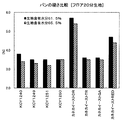
- dough Graph comparing the volume of the dough-containing water content of 61.5% and the bread of each example and comparative example The graph which compares the waist highness which the bread
- the graph which compares the volume of the bread produced using frozen dough in an Example and a comparative example The graph which compares the waist height of the bread produced using the frozen dough in an Example and a comparative example The graph which compares the hardness of the bread produced using frozen dough in an Example and a comparative example The graph which compares the tensile strength of the bread dough of an Example and a comparative example The graph which compares the volume of the bread
- the baker's yeast of one embodiment of the present invention can be finally obtained by sequentially performing the screening steps (1) to (3) with a specific index.
- a screening step (4) is also performed.
- a screening step (5) is also performed.
- the term used in this specification is the same as the meaning of the term normally used in the said field except the case where it demonstrates especially below.
- a spore strain (a), a spore strain (b), and a spore strain (c) are obtained.
- the yeast used as the selection target in the screening step (1) may be a yeast isolated from natural soil, rivers, fruits, etc.
- a spore strain is obtained from the yeast thus isolated, and these are appropriately used.
- the yeast obtained by combining and crossing by a conventional method may be sufficient.
- commercially available yeast may be sufficient.
- the spore strain (a) is obtained as follows. That is, condition 1 (medium (yeast extract: 1 part by weight, peptone: 2 parts by weight, glucose: 2 parts by weight, water: 95 parts by weight, yeast: 1 platinum ear (described in Table 2)), 30 ° C. for 18 hours
- the yeast (polyploid) is cultured by shaking culture), and the yeast (polyploid) is selected by using as an index that the glutathione content of the supernatant of the obtained culture solution is 120 ⁇ mol / L or less.
- the spore is separated into a spore strain (a).
- the amount of glutathione refers to the amount of glutathione that is originally contained in yeast and leaks out of the yeast due to fermentation.
- glutathione is one factor that breaks the SS bond in the gluten network in the dough and causes the softening of the dough (the effect of improving the physical properties of wheat dough by the additive-Mie University Bioresource Bulletin, No. 19, 21-27, December 1, 1997).
- the amount of glutathione in the culture supernatant it is possible to estimate the state of softening of the dough without preparing the dough.
- the glutathione content of the culture supernatant is 120 ⁇ mol / L or less as an indicator, softening of the dough when it is made into dough is relatively reduced, and it is easy to obtain yeast that can produce dough that is easy to work with become.
- the amount of glutathione is measured as follows. Dispense 5 ml of the medium of the above condition 1 into a large test tube, sterilize by autoclave, and use for culture. Breeding strain 1 Inoculate all platinum loops in a large test tube and shake culture at 30 ° C for 18 hours. The culture solution is taken so that the yeast content becomes 100 mg on a dry basis, and centrifuged at 3000 rpm for 10 minutes. To do. 1 ml of the supernatant after centrifugation is collected, and the amount of glutathione is measured according to the “Total Glutathione Quantification Kit” manual (Revised November 11, 2008) manufactured by Dojin.
- the spore strain (b) is obtained as follows. That is, after cultivating yeast (polyploid) under the above-mentioned condition 1, the culture solution is fractioned so that the yeast content becomes 100 mg in terms of dryness, and the yeast (polyploid) obtained by centrifugation at 3000 rpm for 10 minutes. , Condition 2 (medium (maltose: 10 parts by weight, glucose: 0.6 parts by weight, citrate buffer (12.3% by weight aqueous solution of citric acid (pH 5.28)): 3.2 parts by weight, salt: 1 part by weight Parts, water: 85.2 parts by weight (described in Table 3)), fermentation at 30 ° C.
- Condition 2 medium (maltose: 10 parts by weight, glucose: 0.6 parts by weight, citrate buffer (12.3% by weight aqueous solution of citric acid (pH 5.28)): 3.2 parts by weight, salt: 1 part by weight Parts, water: 85.2 parts by weight (described in Table 3)
- the pH of the supernatant of the obtained fermentation broth is 5.0 or less as an indicator.
- (Polyploid) is selected, the yeast is sporulated, and the spore is separated into a spore strain (b).
- the pH may be measured according to a conventional method.
- Acetic acid is one of the substances that yeast by-produces during fermentation, and has the effect of inhibiting mold growth. If the amount of acetic acid produced is large, the pH tends to decrease. Therefore, it is possible to easily estimate the mold suppressing effect by measuring the pH. If the pH of the supernatant of the fermentation broth is 5.0 or less as an index, it is easy to obtain yeast that exhibits a fungi-inhibiting effect equivalent to or higher than that of existing fungi-inhibiting yeast (for example, Kaneka yeast DR). Become.
- the spore strain (c) is obtained as follows. That is, Formulation 1 (strong powder: 100 parts by weight, super white sugar: 30 parts by weight, salt: 0.5 parts by weight, yeast (water 65% wet cell): 4 parts by weight, water: 52 parts by weight (described in Table 1) )), Condition 3 (After mixing for 3 minutes to obtain a dough, the dough was divided into 50 g, and the dough was fermented by fermentation at 38 ° C. for 2 hours (described in Table 1)). As an index, yeast (polyploid) is selected, the yeast is sporulated, and the spore is separated into a spore strain (c). However, the amount of gas generated was actually measured by measuring the gas amount of 20 g of dough for 2 hours at 38 ° C. using Pharmagraph II (manufactured by ATTO), multiplying the total amount of gas generated by 2.5 to obtain 50 g of dough. The total gas amount corresponding to is calculated. In addition, the moisture 65% moisture cell means the moisture cell which occupies 65% of moisture
- the amount of gas generated when the dough is fermented indicates the fermentative power of the yeast.
- the fermenting power function in the high sugar dough can be estimated. In this step, if the amount of gas generated when fermenting the dough is 300 ml or more, it is possible to obtain yeast having a high sugar fermenting power function with a gas generation amount of 360 ml or more in the final screening by cross breeding. It becomes easy.
- yeast having a moisture content of 65% can be obtained as follows.
- a medium having the composition shown in Table 4 is dispensed in 5 ml of a large test tube and 50 ml in a 500 ml Sakaguchi flask, sterilized by autoclave, and used for culture.
- Slat-preserved yeast is inoculated in a large test tube with 1 platinum ear, shaken at 30 ° C for 1 day, transferred to a 500 ml Sakaguchi flask, and further shaken at 30 ° C for 1 day.
- the obtained cells are centrifuged at 2000 rpm for 5 minutes, and sucked and dehydrated with Nutsche to obtain wet cells. Then, the moisture content of the wet cells is measured, and when actually used, it is adjusted so that the pure amount of the yeast described in Formulation 1 matches.
- the spore strain (d) is obtained by the method shown below. That is, obtained by culturing the yeast (polyploid) under the condition 1 from the first generation yeast (polyploid) obtained by crossing the spore strain (a) and the spore strain (b) according to a conventional method.
- the amount of glutathione in the supernatant of the resulting culture solution is 120 ⁇ mol / L or less, and after culturing the yeast (polyploid) under condition 1, the culture solution is fractionated so that the yeast content is 100 mg in terms of dryness, Yeast (polyploid) obtained by centrifuging for 10 minutes at 3000 rpm is fermented under condition 2, and the yeast (polyploid) is used as an indicator that the pH of the supernatant of the obtained fermentation broth is 5.0 or less.
- the yeast is sporulated, and the spores are separated into a spore strain (d).
- the pH may be measured according to a conventional method.
- the spore strain (e) is obtained by the method shown below. That is, after culturing the yeast (polyploid) under the condition 1 from the first generation yeast (polyploid) obtained by crossing the spore strain (b) and the spore strain (c) according to a conventional method. The liquid is fractioned so that the yeast content becomes 100 mg in dry conversion, and the yeast (polyploid) obtained by centrifuging it is fermented under condition 2, and the pH of the supernatant of the obtained fermentation liquid is 5.0.
- the yeast (polyploid) is selected as an indicator that the amount of gas generated when the dough is fermented under Formulation 1, Condition 3 is 300 ml or more, and the yeast is sporulated, and the spores are separated.
- the novel baker's yeast of the present invention is obtained using the spore strain (d) and spore strain (e) obtained in the screening step (2).
- the dough A in which the amount of water (30 ° C.) in Formulation 2 is adjusted is Dough A, and Formulation 3 (Strong flour: 100 parts by weight, Upper sucrose: 30 parts by weight, Yeast (moisture moisture 65%): 4 Part by weight, water (30 ° C.): the same amount as the water used in the dough A (described in Table 9), when the dough B prepared according to condition 4 was measured with an extensogram according to AACC method 54-10 The tensile strength of 500B. U.
- the yeast (polyploid) is selected using as an index that the amount of acetic acid in the dough B is 400 ppm or more and that the amount of gas generated when fermenting the dough prepared in Formulation 1 and Condition 3 is 360 ml or more.
- the amount of gas generated was actually measured by measuring the gas amount of 20 g of dough for 2 hours at 38 ° C. using Pharmagraph II (manufactured by ATTO), multiplying the total amount of gas generated by 2.5 to obtain 50 g of dough. The total gas amount corresponding to is calculated.
- a dough having a higher tensile strength obtained by measuring an extensograph means that the ability to hold a gas generated by yeast fermentation and the ability to withstand expansion are higher.
- yeast having a high tensile strength is used, the gas generated by the yeast is not escaped, and the dough expands upward, so that it is possible to produce a bread with a large volume and a high waist.
- the tensile strength of fabric B is 500B. U.
- yeast that makes it possible to produce bread that has a significant volume and waist height compared to the case of using conventional strains, as it is noticeable that dough softening is significantly suppressed during breadmaking. Can be obtained.
- the tensile strength is measured using an extender graph (manufactured by Brabender) according to the method described in AACC method 54-10. That is, 150 g ⁇ 1 g pieces of dough for measuring the tensile strength are collected and lightly hand-rolled, and then left to stand for 160 minutes in a thermostatic bath at 30 ° C. After that, after fixing the both sides of the dough molded into a rod shape (width 18 mm, height 22.5 mm) in a thermostatic bath at 25 ° C. for 20 minutes, place the sample on the arm of the extender graph, A hook is applied and pulled downward until the fabric is cut, and the force applied to the hook is the tensile strength.
- an extender graph manufactured by Brabender
- acetic acid is one of the substances that yeast is by-produced during fermentation, and has the effect of suppressing the growth of mold. Therefore, when the amount of acetic acid is measured, the mold suppression effect can be estimated. .
- the amount of acetic acid in the dough B is 400 ppm or more, it is possible to obtain a yeast exhibiting a remarkably superior fungus-suppressing effect compared to conventional strains.
- the lower limit of the amount of acetic acid in the dough B to be used as an index is preferably 450 ppm or more, more preferably 500 ppm or more, and the upper limit is preferably 1000 ppm or less, more preferably 900 ppm or less.
- the amount of acetic acid is measured as follows. Add 40 ml of sterilized water to 10 g of dough and homogenize at 15000 rpm for 10 minutes (using “AM-8 HOMOGENIZER” manufactured by NISSEI). A value obtained by measuring the pH of the crushed liquid with a pH meter is defined as a dough pH. Immediately after pH measurement, 1 ml of 10% benzalkonium chloride is added to obtain 50 ml of crushed liquid. The crushing liquid was centrifuged at 3000 rpm for 10 minutes, 0.9 ml of supernatant was collected, 0.1 ml of 10% perchloric acid was added and mixed well, and then the supernatant was centrifuged at 12000 rpm for 10 minutes.
- the amount of acetic acid is measured by high performance liquid chromatography (HPLC) about the obtained sample solution.
- HPLC high performance liquid chromatography
- the analysis conditions by HPLC are as follows.
- the baker's yeast of the present invention has a high mold inhibitory property, and when the baker's yeast is used, the amount of acetic acid in the dough increases, and the occurrence of mold occurring in the baked bread is delayed.
- the novel baker's yeast of the present invention obtained in the screening step (3) is further mixed with 4 (strong powder: 100 parts by weight, upper white sugar: 15 parts by weight, salt: 0.5 parts by weight, yeast (Moisture 65% wet cells): 6 parts by weight, water: 58 parts by weight), condition 5 (after mixing for 3 minutes to obtain a dough, 20 g of the dough was divided and pre-fermented at 30 ° C.
- Yeast polyploid
- the amount of gas generated when the dough after thawing is fermented is 100 ml or more as an indicator, it is possible to obtain yeast comparable to existing yeast having freezing resistance.
- the baker's yeast obtained through the screening steps (1) to (3) has a tensile strength of 500 B. when the dough B is measured by an extensogram according to AACC method 54-10.
- U. The baker's yeast shows the above, wherein the amount of acetic acid in the dough B is 400 ppm or more, and further, the amount of gas generated when the dough is fermented under formulation 1 and condition 3 is 360 ml or more.
- the baker's yeast obtained through the screening step (4) exhibits a gas generation amount of 100 ml or more when the dough after thawing is fermented under formulation 4 and condition 5. It is baker's yeast.
- the baker's yeast obtained through the screening step (5) uses dry yeast prepared by drying the baker's yeast,
- the tensile strength of the fabric B 'prepared according to the blending 3' and condition 4 is 50% or more of the tensile strength of the fabric B, and the acetic acid content in the fabric B 'is 75% or more of the acetic acid content in the fabric B.
- 1 ' is a baker's yeast in which the amount of gas generated when the dough is fermented under condition 3 is 50% or more of the amount of gas generated when the dough is fermented under blend 1 and condition 3 using raw yeast.
- the baker's yeast of the present invention can suppress the softening of the dough without reducing water absorption even under conditions where the softening of the dough is concerned in a high sugar dough, and is excellent in improving the volume and waist height and suppressing the mold.
- pan which uses this baker's yeast has a soft texture even if it is high sugar.
- the fermenting power after thawing is high and the bread volume is sufficient.
- the baker's yeast is dried and used to make bread after producing dry yeast, softening can be suppressed, and the volume and waist height are improved and the mold is suppressed, and the dough is stored frozen. Even when used for bread making, the fermenting power after thawing is high and the bread volume is sufficient.
- the high sugar dough means a dough containing 15 to 40% by weight of dough sugar, and preferably 20 to 40 parts by weight.
- the baker's yeast of the present invention is obtained by the screening steps (1) to (5), but the baker's yeast of the present invention is not limited to those that have undergone the above screening step.
- the tensile strength of the fabric B is 500B. U.
- the amount of acetic acid in the dough B is 400 ppm or more, and the amount of gas generated when the dough is fermented under the blending conditions 1 and 3 is 360 ml or more.
- the blending 4 4 functions that the amount of gas generated when the dough after thawing is fermented under condition 5 is 100 ml or more, and when used as dry yeast, the tensile strength is 50% or more and the amount of acetic acid is higher than that of fresh yeast. If the functions of 75% or more and gas generation amount of 50% or more are exhibited, it corresponds to the baker's yeast of the present invention.
- the baker's yeast of the present invention can also be obtained by performing only the screening step (3) without performing the screening steps (1) and (2). In addition, you may implement screening process (4) and / or (5) after screening process (3).
- the yeast used as the selection target in the screening step (3) is obtained by crossing the spore strain (d) and the spore strain (e) as described above according to a conventional method. It is not limited to the second generation yeast (polyploid) obtained. It may be a yeast isolated from natural soil, rivers, fruits, etc., or a spore strain obtained from a yeast isolated in this way, combined appropriately, and a yeast obtained by crossing by a conventional method. There may be. Moreover, commercially available yeast may be sufficient. However, the baker's yeast of the present invention can be obtained more reliably by performing the screening steps (1) and (2) before the screening step (3).
- baker's yeast belonging to Saccharomyces cerevisiae is preferably selected.
- KCY1240 strain accession number: NITE BP-1269
- Saccharomyces cerevisiae KCY1249 strain trusted
- No .: NITE BP-1270 Saccharomyces cerevisiae KCY1251 strain
- Saccharomyces cerevisiae KCY1254 strain accesion number: NITE BP-1396.
- the KCY1240 strain, the KCY1249 strain, the KCY1251 strain, and the KCY1254 strain were transferred to Saccharomyces cerevisiae “NITE BP-1269 (NITE P-1269 deposited on March 6, 2012 (original deposit date). Transfer date: 2013: "NITE BP-1270 (transferred from NITE P-1270 deposited on March 6, 2012 (original deposit date). Transfer date: February 20, 2013)", “NITE BP-1272 (transferred from NITE P-1272 deposited on March 6, 2012 (original deposit date). Transfer date: February 20, 2013), “NITE BP-1396 (July 27, 2012) (Transferred from NITE P-1396 deposited on the original deposit date. Transfer date: February 20, 2013) It has been deposited with the National Institute of Technology and Evaluation, Patent Microorganisms Depositary Center (Kisarazu, Chiba Kazusa legs bowed in 2-chome address 5 Japan 8).
- the baker's yeast of the present invention can be suitably used for producing bread dough having a sugar concentration of 15 to 40% by weight.
- the sugar concentration is less than 15% by weight, the amount of gluten relative to the total amount of dough does not decrease so much that dough is softened, and the characteristics of the baker's yeast of the present invention are hardly exhibited.
- the sugar concentration exceeds 40% by weight, the amount of gluten with respect to the total amount of dough is extremely reduced, and is further affected by osmotic pressure, and the characteristics of the baker's yeast of the present invention are hardly exhibited.
- wheat flour is 1 grade flour “Camelia” (Nisshin Flour Milling)
- yeast food is “East Food C” (Kaneka)
- shortening is “Snowlight”. "(Manufactured by Kaneka Corporation) was used.
- Other bread-making materials and bread-making auxiliary materials used were those available from general retailers.
- the amount of yeast used in the evaluation of bread making in the examples is described as the amount used of 65% moisture cells, and when the moisture content is actually different, it is used so that the pure amount of yeast described matches.
- the amount of water was adjusted according to the actual moisture content of the wet cells. When dry yeast having a water content of about 5% was used, half of the wet cells were used.
- ⁇ Measurement of generation amount of medium-sized gas The amount of gas of 20 g of the dough after completion of the medium seed mixing prepared in the example was measured at 30 ° C. for 4 hours using a Pharmagraph II (manufactured by ATTO), and the total gas amount was multiplied by 2.5 to complete the medium seed mixing. The total gas amount corresponding to 50 g of the subsequent dough was calculated.
- ⁇ Measurement of proof gas generation> Measure the amount of gas in the dough after the completion of mixing of the main roll prepared in the example or 20 g of the dough after thawing using Pharmagraph II (manufactured by ATTO) at 38 ° C. for 2 hours, and set the total gas amount to 2.5. Multiplying, the total gas amount corresponding to 50 g of the main body dough was calculated.
- the amount of glutathione in the culture supernatant of the 18 kinds of yeast (polyploid) obtained was measured according to the above-described measurement method, and 5 strains of yeast (polyploid) in which the glutathione amount was 120 ⁇ mol / L or less were obtained. Selected. When these yeasts (polyploids) were identified, a strain of Saccharomyces cerevisiae with a particularly low glutathione level of 104.3 ⁇ mol / L was designated as NITE BP-1271 (KCY1250 strain) as an independent administrative corporation product evaluation.
- the 18 hybrid strains obtained in screening step (1) -1 were cultured under condition 1. Using the obtained bacterial cells (polyploids), the amount of gas generated when a dough was prepared and fermented under formulation 1 and condition 3 was measured according to the measurement method described above. Ten baker's yeast strains (polyploid) with a gas generation amount of 300 ml or more were selected. Of the 10 strains, 1 strain was Kaneka East TR (trade name) manufactured by Kaneka Corporation, and the amount of gas generated was 369 ml. These 10 strains of baker's yeast (polyploid) were each sporulated, and a total of 40 spore strains obtained by separating the spores were used as spore strains (c).
- the spore strain (b) and the spore strain (c) were crossed according to a conventional method to obtain 28 first-generation hybrid strains, which were cultured under condition 1.
- the obtained culture solution of 28 kinds of hybrid strains was fractionated so that the yeast content was 100 mg in terms of dryness, and the baker's yeast (polyploid) obtained by centrifugation was fermented under condition 2 and obtained.
- the pH of the supernatant of the fermentation broth is 5.0 or less, and the baker's yeast (polyploid) is cultured under condition 1, and the dough is prepared under formulation 1, condition 3 using the obtained yeast cells.
- spore strains Ten strains of baker's yeast (polyploid) having a gas generation amount of 300 ml or more measured according to the measurement method when fermented were selected. These baker's yeasts (polyploids) were each sporulated, and 40 spore strains obtained by separating the spores were designated as spore strains (e).
- accession number: NITE BP-1269 (KCY1240 strain, Example 1)
- accession number: NITE BP-1270 (KCY1249 strain, Example 2)
- accession number: NITE BP -Deposited as 1272 (KCY1251 shares, Example 3) at the Patent Microorganisms Depositary Center of the National Institute of Technology and Evaluation (2-8, Kazusa Kamashi, Kisarazu City, Chiba, Japan) (Transfer Date: February 2013) May 20).
- Table 11 shows the tensile strength and acetic acid amount of the dough B produced using these KCY1240 strain, KCY1249 strain, or KCY1251 strain, and the amount of gas generated when the dough was prepared and fermented under Formulation 1, Condition 3.
- Comparative Example 2 Kaneka East DR manufactured by Kaneka Table 11 shows the tensile strength, acetic acid amount, and gas generation amount measured in the same manner as in Comparative Example 1 except that the commercially available Kaneka Yeast DR manufactured by Kaneka Co., Ltd. obtained in (Screening Step (1) -2) was used. Indicated.
- Comparative Example 3 Kaneka East TR manufactured by Kaneka Table 11 shows the tensile strength, acetic acid amount, and gas generation amount measured in the same manner as in Comparative Example 1 except that the commercially available Kaneka Yeast TR manufactured by Kaneka Co., Ltd. obtained in (Screening Step (1) -3) was used. Indicated.
- Saccharomyces cerevisiae was identified, and under the accession number: NITE BP-1396 (KCY1254 strain, Example 10), the National Institute for Product Evaluation Technology, Japan Patent Microorganisms Deposit Center (Kazusa Kamashika, Kisarazu City, Chiba Prefecture, Japan) Deposited at 2-chome, 5-8 (transfer date: February 20, 2013).
- Yeast 2 parts by weight, water (30 ° C.): same amount as water used in dough A), tensile strength when dough B ′ prepared according to condition 4 was measured with an extensogram according to AACC method 54-10 Indicates 50% or more of the tensile strength of the fabric B, The amount of acetic acid in the dough B ′ indicates 75% or more of the amount of acetic acid in the dough B, When the dough was prepared and fermented using raw yeast, the amount of gas generated when the dough was prepared and fermented under formulation 1 'and condition 3 was measured according to the above measurement method. A new strain of baker's yeast having 50% or more of the amount of gas generated was obtained.
- Saccharomyces cerevisiae was identified, and under the accession number: NITE BP-1396 (KCY1254 strain, Example 12), the National Institute of Technology and Evaluation, National Institute for Product Evaluation Technology (Kazusa Kamashika, Kisarazu City, Chiba Prefecture, Japan) Deposited at 2-chome, 5-8) (date of deposit: February 20, 2013).
- a medium having the composition shown in Table 4 is dispensed in 5 ml of a large test tube and 50 ml in a 500 ml Sakaguchi flask, sterilized by autoclave, and used for culture. Breeding strain 1 Platinum ears are inoculated into a large test tube, transferred to a 500 ml Sakaguchi flask after shaking culture at 30 ° C. for 1 day, and further cultured in a shake culture at 30 ° C. for 1 day. For 5L jar seed culture. When adjusting the medium, molasses was used as the sugar, and the sugar concentration was adjusted to 4% (weight / volume).
- molasses was used as the sugar, and the sugar concentration was adjusted to 4% (weight / volume).
- the starting solution was the medium composition described in Table 7, 50 g of seed mother cells cultured in a 5 L jar were added as wet cells, and main culture was performed under the conditions described in Table 8. Specifically, culture was performed for 13 hours, and sugar was added in portions during the 12-hour culture. The 5 L jar cultured cells were centrifuged immediately after the completion of the culture, and sucked and dehydrated with Nutsche to prepare wet cells, which were used in the following examples. During the preparation of the medium, 230 g of molasses was added as sugar after measurement of the sugar concentration.
- a granulator Fluji Paudal Co., Ltd.
- Flow coater MINI manufactured by Freund Sangyo Co., Ltd.
- Example 4 Evaluation of bread making Dough content water 61.5% Using NITE BP-1269 (KCY1240 strain / Example 4), NITE BP-1270 (KCY1249 strain / Example 5), and NITE BP-1272 (KCY1251 strain / Example 6), the formulation 1 described in Table 12 was used.
- a bread dough was prepared by the process described in Table 13. About the produced bread dough, the medium seed gas generation amount measured according to ⁇ Medium seed gas generation amount measurement>, and the proof gas generation amount measured according to ⁇ Measurement of proof gas generation amount>, and the medium seed dough and the floor 20 minute dough above, Table 14 shows the tensile strength measured by the extensogram as described above.
- the bread volume (specific volume) and waist height of each bread dough were measured according to the above ⁇ Evaluation of bread specific volume and waist height>, and are shown in Table 15. Furthermore, the hardness of the crumb measured according to the above ⁇ Evaluation of bread hardness>, the concentration of acetic acid measured according to the measurement of the amount of acetic acid, and the mold evaluation evaluated according to the above ⁇ Evaluation of mold inhibition by mold application method> The occurrence state is shown in Table 15.
- Example 7-9 Baking evaluation Dough-containing moisture 65.5% Using NITE BP-1269 (KCY1240 strain / Example 7), NITE BP-1270 (KCY1249 strain / Example 8), and NITE BP-1272 (KCY1251 strain / Example 9), the formulation 2 described in Table 12 was used.
- a bread dough was prepared by the process described in Table 13.
- Table 16 shows the amount of generated middle seed gas and the amount of proof gas measured in the same manner as in Example 4-6 and the tensile strength of the middle seed fabric and the floor 20 minute dough.
- Table 17 shows the volume (specific volume), waist height, crumb hardness, acetic acid concentration, and mold occurrence, which were measured in the same manner as in Example 4-6 for breads produced by baking each dough.
- FIG. 1 shows the tensile strength of the medium-sized fabric and the floor 20-minute fabric measured for Example 4-6 and Comparative Example 4-8.
- FIG. 2 shows the volume (specific volume) measured for Example 4-6 and Comparative Example 4-8.
- FIG. 3 shows the waist height measured for Example 4-6 and Comparative Example 4-8.
- FIG. 4 shows the tensile strength of the floor 20 minutes fabric measured for Example 4-9 and Comparative Example 4-13.
- FIG. 5 shows the volume (specific volume) measured for Example 4-9 and Comparative Example 4-13.
- FIG. 6 shows the waist height measured for Example 4-9 and Comparative Example 4-13.
- FIG. 7 shows the hardness of the puncture measured for Example 4-9 and Comparative Example 4-13.
- KCY1240 strain, KCY1249 strain, KCY1251 strain, and KCY1250 strain of comparative example Kaneka Kaneka East GA, Kaneka Kaneka East DR, Kaneka Kaneka East RED and
- the tensile strength is high and fabric softening is suppressed. Therefore, as shown in FIGS. 2 and 3, the bread volume and waist height tend to be improved as compared with Kaneka Yeast DR manufactured by Kaneka and Kaneka East RED manufactured by Kaneka.
- KCY1240 strain and KCY1249 strain show an acetic acid production amount equivalent to or higher than Kaneka yeast DR having a fungus-inhibiting function. It was markedly shown to have an effect. Although the KCY1251 strain was inferior in acetic acid production than these strains, it was confirmed that the KCY1250 strain, Kaneka East TR, Kaneka East GA, and Kaneka East RED had a higher mold inhibitory effect.
- Example 11 Evaluation of frozen dough bread Using NITE BP-1396 (KCY1254 strain), the frozen dough was thawed according to the formulation shown in Table 19 and Step 2 shown in Table 20, to prepare bread dough.
- the amount of gas generated after thawing of the prepared bread dough was measured according to ⁇ Measurement of amount of proof gas> and is shown in Table 21.
- the volume (specific volume) and waist height of bread produced by baking the dough were measured according to the above ⁇ Evaluation of specific volume and waist height of bread>, and are shown in Table 21.
- FIG. 8 shows the volume (specific volume) measured for Example 11 and Comparative Examples 14-16.
- FIG. 9 shows the waist height measured for Example 11 and Comparative Examples 14-16.
- FIG. 10 shows the puncture hardness measured for Example 11 and Comparative Examples 14-16.
- Example 13 Dry yeast bread test NITE BP-1396 (KCY1254 strain) or dry yeast prepared by drying the bread dough, the composition shown in Table 19 and bread dough according to Step 1 described in Table 20
- the gas generation amount of the prepared bread dough was measured according to ⁇ Measurement of proof gas generation amount>, and the tensile strength was further measured as described above.
- the volume (specific volume) of bread produced by baking the dough was measured according to the above ⁇ Evaluation of specific volume of bread and waist height> and is shown in Table 22. Further, Table 22 shows the acetic acid concentration measured according to the acetic acid amount measurement and the mold generation state evaluated according to the above ⁇ Evaluation of mold inhibition by mold application method>.
- Example 11 and 12 show the tensile strength and volume (specific volume) measured for Example 13 and Comparative Examples 17-19.
- the KCY1254 strain has drought tolerance, so even when it is used as dry yeast, the amount of gas generation is large. Therefore, as shown in FIG. 11 and FIG. It can be seen that bread having superior tensile strength and volume compared to conventional yeast can be produced.
- Example 14 Bread test for dry yeast made of frozen dough NITE BP-1396 (KCY1254 strain), or dry yeast produced by drying this, the formulation described in Table 19 and the process described in Table 20
- the frozen dough was thawed by 2 to prepare bread dough.
- the amount of gas generated after thawing of the prepared bread dough was measured according to ⁇ Measurement of amount of proof gas>, and the tensile strength was measured as described above. It was measured according to the volume (specific volume) of bread produced by baking the dough, and is shown in Table 23. Further, Table 23 shows the acetic acid concentration measured according to the acetic acid amount measurement and the mold generation state evaluated according to the above ⁇ Evaluation of mold inhibition by mold application method>.
- FIGS. 13 and 14 show the tensile strength and volume (specific volume) measured for Example 14 and Comparative Examples 20-22.
- the KCY1254 strain has not only freezing resistance but also dry resistance, so even when used as dry yeast, the amount of gas generated after thawing is large. As shown in 13 and 14, it can be seen that bread having superior tensile strength and volume compared to conventional yeast can be produced.
- the strains according to the present invention have a function to increase the fabric tensile strength, and in particular, in high sugar dough, it suppresses fabric softening without reducing water absorption, and the volume As well as improving the waist height and exhibiting the fungus-inhibiting effect, the softness and moist feeling can be improved by increasing the water absorption. Furthermore, since the KCY1254 strain also has a high freezing tolerance function, it was found that it is a strain that can suppress a decrease in volume and softness due to long-term freezing.
- KCY1254 strain also has a high drought tolerance function, even when dry yeast prepared from the baker's yeast is used, dough softening is suppressed without reducing water absorption in high sugar dough, and volume and While improving the waist height and exhibiting the mold suppressing effect, it is also possible to improve softness and moist feeling due to increased water absorption, and it is also possible to suppress the decrease in volume and softness due to long-term freezing.
Landscapes
- Life Sciences & Earth Sciences (AREA)
- Engineering & Computer Science (AREA)
- Health & Medical Sciences (AREA)
- Chemical & Material Sciences (AREA)
- Mycology (AREA)
- Bioinformatics & Cheminformatics (AREA)
- Genetics & Genomics (AREA)
- Biotechnology (AREA)
- Organic Chemistry (AREA)
- Zoology (AREA)
- Wood Science & Technology (AREA)
- Microbiology (AREA)
- Food Science & Technology (AREA)
- Tropical Medicine & Parasitology (AREA)
- Biomedical Technology (AREA)
- Virology (AREA)
- Biochemistry (AREA)
- General Engineering & Computer Science (AREA)
- General Health & Medical Sciences (AREA)
- Medicinal Chemistry (AREA)
- Botany (AREA)
- Physics & Mathematics (AREA)
- Thermal Sciences (AREA)
- Micro-Organisms Or Cultivation Processes Thereof (AREA)
- Bakery Products And Manufacturing Methods Therefor (AREA)
Priority Applications (2)
| Application Number | Priority Date | Filing Date | Title |
|---|---|---|---|
| CN201380021933.2A CN104411814B (zh) | 2012-04-26 | 2013-04-25 | 新型面包酵母 |
| JP2014512371A JP5677624B2 (ja) | 2012-04-26 | 2013-04-25 | 新規パン酵母 |
Applications Claiming Priority (2)
| Application Number | Priority Date | Filing Date | Title |
|---|---|---|---|
| JP2012-101336 | 2012-04-26 | ||
| JP2012101336 | 2012-04-26 |
Publications (1)
| Publication Number | Publication Date |
|---|---|
| WO2013161303A1 true WO2013161303A1 (fr) | 2013-10-31 |
Family
ID=49482646
Family Applications (1)
| Application Number | Title | Priority Date | Filing Date |
|---|---|---|---|
| PCT/JP2013/002806 Ceased WO2013161303A1 (fr) | 2012-04-26 | 2013-04-25 | Nouvelle levure de boulanger |
Country Status (3)
| Country | Link |
|---|---|
| JP (1) | JP5677624B2 (fr) |
| CN (1) | CN104411814B (fr) |
| WO (1) | WO2013161303A1 (fr) |
Cited By (3)
| Publication number | Priority date | Publication date | Assignee | Title |
|---|---|---|---|---|
| WO2018038244A1 (fr) * | 2016-08-26 | 2018-03-01 | 株式会社カネカ | Corps façonné de levure fraîche congelée et procédé pour sa production |
| WO2018207779A1 (fr) * | 2017-05-09 | 2018-11-15 | 株式会社カネカ | Nouvelle levure de panification |
| WO2020031237A1 (fr) * | 2018-08-06 | 2020-02-13 | 大和製罐株式会社 | Produit de boulangerie emballé |
Families Citing this family (1)
| Publication number | Priority date | Publication date | Assignee | Title |
|---|---|---|---|---|
| JP6810826B2 (ja) * | 2018-02-27 | 2021-01-06 | 株式会社カネカ | 凍結生イースト成形体及びその製造方法 |
Citations (3)
| Publication number | Priority date | Publication date | Assignee | Title |
|---|---|---|---|---|
| JP2005245355A (ja) * | 2004-03-05 | 2005-09-15 | Kaneka Corp | 新規パン酵母及び該酵母を含有する生地 |
| JP2006187282A (ja) * | 2004-12-09 | 2006-07-20 | Kaneka Corp | 新規パン酵母 |
| JP2007195474A (ja) * | 2006-01-27 | 2007-08-09 | Kaneka Corp | 新規パン酵母 |
Family Cites Families (6)
| Publication number | Priority date | Publication date | Assignee | Title |
|---|---|---|---|---|
| JP4411864B2 (ja) * | 2002-05-20 | 2010-02-10 | 株式会社カネカ | 新規パン酵母 |
| JP4513383B2 (ja) * | 2003-04-02 | 2010-07-28 | 株式会社カネカ | 新規パン酵母 |
| ES2308053T3 (es) * | 2004-01-30 | 2008-12-01 | Lesaffre Et Compagnie | Levaduras de planificacion resistentes a una elevada concentracion de azucar en la masa y a la presencia de acidos organicos debiles. |
| JP4475144B2 (ja) * | 2005-03-03 | 2010-06-09 | 株式会社カネカ | 新規パン酵母及び該酵母を含有する生地 |
| CN101575577B (zh) * | 2008-05-05 | 2011-06-01 | 安琪酵母股份有限公司 | 一种耐冷冻酵母及其组合物、面团 |
| UA111839C2 (uk) * | 2011-02-18 | 2016-06-24 | Лесаффр Е Компані | Штами saccharomyces cerevisiae, придатні для виробляння пекарських дріжджів, що є осмостійкими та стійкими до дії слабких органічних кислот, способи їх одержання та застосування |
-
2013
- 2013-04-25 JP JP2014512371A patent/JP5677624B2/ja active Active
- 2013-04-25 CN CN201380021933.2A patent/CN104411814B/zh active Active
- 2013-04-25 WO PCT/JP2013/002806 patent/WO2013161303A1/fr not_active Ceased
Patent Citations (3)
| Publication number | Priority date | Publication date | Assignee | Title |
|---|---|---|---|---|
| JP2005245355A (ja) * | 2004-03-05 | 2005-09-15 | Kaneka Corp | 新規パン酵母及び該酵母を含有する生地 |
| JP2006187282A (ja) * | 2004-12-09 | 2006-07-20 | Kaneka Corp | 新規パン酵母 |
| JP2007195474A (ja) * | 2006-01-27 | 2007-08-09 | Kaneka Corp | 新規パン酵母 |
Cited By (4)
| Publication number | Priority date | Publication date | Assignee | Title |
|---|---|---|---|---|
| WO2018038244A1 (fr) * | 2016-08-26 | 2018-03-01 | 株式会社カネカ | Corps façonné de levure fraîche congelée et procédé pour sa production |
| JPWO2018038244A1 (ja) * | 2016-08-26 | 2019-03-28 | 株式会社カネカ | 凍結生イースト成形体及びその製造方法 |
| WO2018207779A1 (fr) * | 2017-05-09 | 2018-11-15 | 株式会社カネカ | Nouvelle levure de panification |
| WO2020031237A1 (fr) * | 2018-08-06 | 2020-02-13 | 大和製罐株式会社 | Produit de boulangerie emballé |
Also Published As
| Publication number | Publication date |
|---|---|
| CN104411814B (zh) | 2017-06-13 |
| JP5677624B2 (ja) | 2015-02-25 |
| CN104411814A (zh) | 2015-03-11 |
| JPWO2013161303A1 (ja) | 2015-12-24 |
Similar Documents
| Publication | Publication Date | Title |
|---|---|---|
| JP5677624B2 (ja) | 新規パン酵母 | |
| CN113388535A (zh) | 一种主食发酵剂及其制备方法和应用 | |
| CN100557011C (zh) | 新的面包酵母以及使用该面包酵母的面包 | |
| CN106399137A (zh) | 一株酿酒酵母及其应用 | |
| JP5907161B2 (ja) | 新規パン酵母 | |
| Vernon-Carter et al. | Rheological and thermal properties of dough and textural and microstructural characteristics of bread with pulque as leavening agent | |
| WO2006064910A1 (fr) | Agent d’amelioration de panification et produits panifies l’utilisant | |
| CN106566783A (zh) | 一种晋南地区风味发酵面制品复合发酵剂 | |
| JP4565789B2 (ja) | 新規パン酵母および該酵母を含有する生地 | |
| JP2014083022A (ja) | 新規パン生地およびこれを焼成してなるパン | |
| CN118216639B (zh) | 一种酸面团发酵剂及其制备和应用 | |
| JPH11155559A (ja) | 冷凍生地製パン用インスタント乾燥酵母 | |
| EP2000033B1 (fr) | Starter microbien, comprenant des souches de Saccharomyces cerevisiae, pour la panification | |
| CN104357342A (zh) | 一种新疆地方特色馕面团优质酵母及其在制馕中的应用 | |
| JP6462173B1 (ja) | 乳酸菌、パン類の製造方法、パン類生地及びパン類 | |
| JP4411864B2 (ja) | 新規パン酵母 | |
| Lira et al. | Use of Lactobacillus from pulque in sourdough | |
| JP4513383B2 (ja) | 新規パン酵母 | |
| JP7212614B2 (ja) | 新規パン酵母 | |
| JP4839809B2 (ja) | 新規パン酵母 | |
| KR102933681B1 (ko) | 내당성이 우수한 이스트를 이용한 아리흑통밀빵 제조방법 | |
| JP5926494B2 (ja) | 新規パン酵母 | |
| CN117546894B (zh) | 肠膜明串珠菌d3用于改善发酵面制品品质的应用 | |
| KR102463098B1 (ko) | 제주조릿대 추출물을 이용한 천연 발효종 제조방법 | |
| JP4839860B2 (ja) | 新規パン酵母 |
Legal Events
| Date | Code | Title | Description |
|---|---|---|---|
| 121 | Ep: the epo has been informed by wipo that ep was designated in this application |
Ref document number: 13780783 Country of ref document: EP Kind code of ref document: A1 |
|
| ENP | Entry into the national phase |
Ref document number: 2014512371 Country of ref document: JP Kind code of ref document: A |
|
| NENP | Non-entry into the national phase |
Ref country code: DE |
|
| WWE | Wipo information: entry into national phase |
Ref document number: IDP00201407388 Country of ref document: ID |
|
| 122 | Ep: pct application non-entry in european phase |
Ref document number: 13780783 Country of ref document: EP Kind code of ref document: A1 |