WO2013164992A1 - Agent stimulant la régénération de cartilage - Google Patents
Agent stimulant la régénération de cartilage Download PDFInfo
- Publication number
- WO2013164992A1 WO2013164992A1 PCT/JP2013/062525 JP2013062525W WO2013164992A1 WO 2013164992 A1 WO2013164992 A1 WO 2013164992A1 JP 2013062525 W JP2013062525 W JP 2013062525W WO 2013164992 A1 WO2013164992 A1 WO 2013164992A1
- Authority
- WO
- WIPO (PCT)
- Prior art keywords
- milk
- basic protein
- protein fraction
- derived basic
- cartilage formation
- Prior art date
- Legal status (The legal status is an assumption and is not a legal conclusion. Google has not performed a legal analysis and makes no representation as to the accuracy of the status listed.)
- Ceased
Links
Images


Classifications
-
- A—HUMAN NECESSITIES
- A61—MEDICAL OR VETERINARY SCIENCE; HYGIENE
- A61K—PREPARATIONS FOR MEDICAL, DENTAL OR TOILETRY PURPOSES
- A61K35/00—Medicinal preparations containing materials or reaction products thereof with undetermined constitution
- A61K35/12—Materials from mammals; Compositions comprising non-specified tissues or cells; Compositions comprising non-embryonic stem cells; Genetically modified cells
- A61K35/20—Milk; Whey; Colostrum
-
- A—HUMAN NECESSITIES
- A23—FOODS OR FOODSTUFFS; TREATMENT THEREOF, NOT COVERED BY OTHER CLASSES
- A23K—FODDER
- A23K20/00—Accessory food factors for animal feeding-stuffs
- A23K20/10—Organic substances
- A23K20/142—Amino acids; Derivatives thereof
-
- A—HUMAN NECESSITIES
- A23—FOODS OR FOODSTUFFS; TREATMENT THEREOF, NOT COVERED BY OTHER CLASSES
- A23K—FODDER
- A23K20/00—Accessory food factors for animal feeding-stuffs
- A23K20/10—Organic substances
- A23K20/142—Amino acids; Derivatives thereof
- A23K20/147—Polymeric derivatives, e.g. peptides or proteins
-
- A—HUMAN NECESSITIES
- A23—FOODS OR FOODSTUFFS; TREATMENT THEREOF, NOT COVERED BY OTHER CLASSES
- A23K—FODDER
- A23K50/00—Feeding-stuffs specially adapted for particular animals
- A23K50/40—Feeding-stuffs specially adapted for particular animals for carnivorous animals, e.g. cats or dogs
-
- A—HUMAN NECESSITIES
- A23—FOODS OR FOODSTUFFS; TREATMENT THEREOF, NOT COVERED BY OTHER CLASSES
- A23L—FOODS, FOODSTUFFS OR NON-ALCOHOLIC BEVERAGES, NOT OTHERWISE PROVIDED FOR; PREPARATION OR TREATMENT THEREOF
- A23L2/00—Non-alcoholic beverages; Dry compositions or concentrates therefor; Preparation or treatment thereof
- A23L2/52—Adding ingredients
- A23L2/66—Proteins
-
- A—HUMAN NECESSITIES
- A23—FOODS OR FOODSTUFFS; TREATMENT THEREOF, NOT COVERED BY OTHER CLASSES
- A23L—FOODS, FOODSTUFFS OR NON-ALCOHOLIC BEVERAGES, NOT OTHERWISE PROVIDED FOR; PREPARATION OR TREATMENT THEREOF
- A23L33/00—Modifying nutritive qualities of foods; Dietetic products; Preparation or treatment thereof
- A23L33/10—Modifying nutritive qualities of foods; Dietetic products; Preparation or treatment thereof using additives
-
- A—HUMAN NECESSITIES
- A23—FOODS OR FOODSTUFFS; TREATMENT THEREOF, NOT COVERED BY OTHER CLASSES
- A23L—FOODS, FOODSTUFFS OR NON-ALCOHOLIC BEVERAGES, NOT OTHERWISE PROVIDED FOR; PREPARATION OR TREATMENT THEREOF
- A23L33/00—Modifying nutritive qualities of foods; Dietetic products; Preparation or treatment thereof
- A23L33/10—Modifying nutritive qualities of foods; Dietetic products; Preparation or treatment thereof using additives
- A23L33/17—Amino acids, peptides or proteins
- A23L33/18—Peptides; Protein hydrolysates
-
- A—HUMAN NECESSITIES
- A23—FOODS OR FOODSTUFFS; TREATMENT THEREOF, NOT COVERED BY OTHER CLASSES
- A23L—FOODS, FOODSTUFFS OR NON-ALCOHOLIC BEVERAGES, NOT OTHERWISE PROVIDED FOR; PREPARATION OR TREATMENT THEREOF
- A23L33/00—Modifying nutritive qualities of foods; Dietetic products; Preparation or treatment thereof
- A23L33/10—Modifying nutritive qualities of foods; Dietetic products; Preparation or treatment thereof using additives
- A23L33/17—Amino acids, peptides or proteins
- A23L33/19—Dairy proteins
-
- A—HUMAN NECESSITIES
- A61—MEDICAL OR VETERINARY SCIENCE; HYGIENE
- A61K—PREPARATIONS FOR MEDICAL, DENTAL OR TOILETRY PURPOSES
- A61K38/00—Medicinal preparations containing peptides
- A61K38/01—Hydrolysed proteins; Derivatives thereof
- A61K38/012—Hydrolysed proteins; Derivatives thereof from animals
- A61K38/018—Hydrolysed proteins; Derivatives thereof from animals from milk
-
- A—HUMAN NECESSITIES
- A61—MEDICAL OR VETERINARY SCIENCE; HYGIENE
- A61K—PREPARATIONS FOR MEDICAL, DENTAL OR TOILETRY PURPOSES
- A61K38/00—Medicinal preparations containing peptides
- A61K38/16—Peptides having more than 20 amino acids; Gastrins; Somatostatins; Melanotropins; Derivatives thereof
- A61K38/17—Peptides having more than 20 amino acids; Gastrins; Somatostatins; Melanotropins; Derivatives thereof from animals; from humans
- A61K38/22—Hormones
- A61K38/30—Insulin-like growth factors, i.e. somatomedins, e.g. IGF-1, IGF-2
-
- A—HUMAN NECESSITIES
- A61—MEDICAL OR VETERINARY SCIENCE; HYGIENE
- A61K—PREPARATIONS FOR MEDICAL, DENTAL OR TOILETRY PURPOSES
- A61K38/00—Medicinal preparations containing peptides
- A61K38/16—Peptides having more than 20 amino acids; Gastrins; Somatostatins; Melanotropins; Derivatives thereof
- A61K38/17—Peptides having more than 20 amino acids; Gastrins; Somatostatins; Melanotropins; Derivatives thereof from animals; from humans
- A61K38/40—Transferrins, e.g. lactoferrins, ovotransferrins
-
- A—HUMAN NECESSITIES
- A61—MEDICAL OR VETERINARY SCIENCE; HYGIENE
- A61K—PREPARATIONS FOR MEDICAL, DENTAL OR TOILETRY PURPOSES
- A61K38/00—Medicinal preparations containing peptides
- A61K38/16—Peptides having more than 20 amino acids; Gastrins; Somatostatins; Melanotropins; Derivatives thereof
- A61K38/43—Enzymes; Proenzymes; Derivatives thereof
- A61K38/44—Oxidoreductases (1)
-
- A—HUMAN NECESSITIES
- A61—MEDICAL OR VETERINARY SCIENCE; HYGIENE
- A61K—PREPARATIONS FOR MEDICAL, DENTAL OR TOILETRY PURPOSES
- A61K38/00—Medicinal preparations containing peptides
- A61K38/16—Peptides having more than 20 amino acids; Gastrins; Somatostatins; Melanotropins; Derivatives thereof
- A61K38/43—Enzymes; Proenzymes; Derivatives thereof
- A61K38/46—Hydrolases (3)
- A61K38/48—Hydrolases (3) acting on peptide bonds (3.4)
- A61K38/482—Serine endopeptidases (3.4.21)
-
- A—HUMAN NECESSITIES
- A61—MEDICAL OR VETERINARY SCIENCE; HYGIENE
- A61P—SPECIFIC THERAPEUTIC ACTIVITY OF CHEMICAL COMPOUNDS OR MEDICINAL PREPARATIONS
- A61P19/00—Drugs for skeletal disorders
- A61P19/02—Drugs for skeletal disorders for joint disorders, e.g. arthritis, arthrosis
-
- A—HUMAN NECESSITIES
- A61—MEDICAL OR VETERINARY SCIENCE; HYGIENE
- A61P—SPECIFIC THERAPEUTIC ACTIVITY OF CHEMICAL COMPOUNDS OR MEDICINAL PREPARATIONS
- A61P43/00—Drugs for specific purposes, not provided for in groups A61P1/00-A61P41/00
-
- C—CHEMISTRY; METALLURGY
- C12—BIOCHEMISTRY; BEER; SPIRITS; WINE; VINEGAR; MICROBIOLOGY; ENZYMOLOGY; MUTATION OR GENETIC ENGINEERING
- C12Y—ENZYMES
- C12Y111/00—Oxidoreductases acting on a peroxide as acceptor (1.11)
- C12Y111/01—Peroxidases (1.11.1)
- C12Y111/01007—Peroxidase (1.11.1.7), i.e. horseradish-peroxidase
-
- A—HUMAN NECESSITIES
- A23—FOODS OR FOODSTUFFS; TREATMENT THEREOF, NOT COVERED BY OTHER CLASSES
- A23V—INDEXING SCHEME RELATING TO FOODS, FOODSTUFFS OR NON-ALCOHOLIC BEVERAGES AND LACTIC OR PROPIONIC ACID BACTERIA USED IN FOODSTUFFS OR FOOD PREPARATION
- A23V2002/00—Food compositions, function of food ingredients or processes for food or foodstuffs
Definitions
- the present invention relates to a cartilage formation promoter that promotes cartilage formation, comprising a milk-derived basic protein fraction as an active ingredient, and a food or feed for promoting cartilage formation that contains this cartilage formation promoter.
- Cartilage is present in the joints, nose, auricle and the like. Among these, articular cartilage has a role of assisting the motor function of the individual.
- OA osteoarthritis
- the number of osteoarthritis (OA) patients in Japan was reported to be 25 million for the knee and 38 million for the lumbar spine.
- the number of knees is 8.6 million
- female is 16.7 million
- the lumbar spine is 18.9 million male and 19 million female, but this number is increasing year by year.
- OA along with osteoporosis, lowers the daily living behavior (ADL) and quality of life (QOL) of the elderly, so the establishment of a radical treatment method is desired.
- ADL daily living behavior
- QOL quality of life
- Articular cartilage tissue is composed of collagen, hyaluronic acid and proteoglycan produced by chondrocytes, and retains a large amount of water due to the presence of proteoglycan and hyaluronic acid between collagen fibers taking a network structure. That is, articular cartilage retains its cushioning properties by collagen and proteoglycan.
- chondrocytes When blood circulation around the joints deteriorates and the supply of oxygen decreases, production of proteoglycans and the like by chondrocytes decreases, or dead chondrocytes stimulate the synovium and cause inflammation, causing pain in the joints. Furthermore, the release of cytokines during inflammation further induces chondrocyte death and intensifies pain symptoms.
- symptomatic treatment of OA includes administration of painkillers and anti-inflammatory preparations, injection of high molecular hyaluronic acid (sodium hyaluronate) into the joint cavity, and other methods other than symptomatic treatment include:
- approaches such as promotion of chondrocyte differentiation or suppression of chondrocyte hypertrophy, collagen and proteoglycan transcription and synthesis promotion by chondrocytes have begun to be taken.
- Proteoglycan which is one of the components of cartilage, is composed of sulfated glycosaminoglycan (GAG), which is a kind of sugar chain, and a core protein, and GAG and core protein are covalently bonded.
- GAG glycosaminoglycan
- the amount of proteoglycan in chondrocytes is known to increase in the process of differentiation and proliferation from progenitor chondrocytes (Non-patent Document 1). It has been suggested to have an important role in formation.
- proteoglycan contained in salmon cartilage is effective as an anti-obesity agent and anti-diabetic agent (Patent Document 1), prevention and treatment of inflammatory diseases and autoimmune diseases, suppression of rejection during organ transplantation, treatment of allergies It is reported to be useful (Patent Document 2). Moreover, the effect as a skin external preparation for anti-aging is also reported by accelerating
- Non-patent Document 2 mice mutated with chondroitin 4-O-sulfotransferase-1 (C4ST-1) which transfers sulfate group to the 4-position of GalNAc of chondroitin 4 sulfate on activated glycosaminoglycan, the amount of chondroitin sulfate synthesized is There is a report that the symptoms of cartilage dysplasia were observed (Non-patent Document 3). Therefore, it is considered that promotion of activities of Sox9 and C4ST-1 is important for the biosynthesis of proteoglycans.
- C4ST-1 chondroitin 4-O-sulfotransferase-1
- An object of the present invention is to provide a novel cartilage formation promoter. Another object of the present invention is to provide a novel proteoglycan synthesis accelerator.
- the present invention has the following configuration.
- a cartilage formation promoter comprising a milk-derived basic protein fraction as an active ingredient.
- the chondrogenesis promoting agent according to (1) wherein the promotion of cartilage formation is due to promotion of proteoglycan synthesis.
- a preventive, ameliorating, or therapeutic agent for joint diseases comprising a milk-derived basic protein fraction as an active ingredient.
- a preventive, ameliorating, or therapeutic agent for joint diseases comprising a milk-derived basic protein fraction degradation product as an active ingredient.
- a supplement for prevention / amelioration of joint diseases comprising a milk-derived basic protein fraction degradation product as an active ingredient.
- the joint disease prevention / amelioration supplement according to (15), wherein the joint disease is degenerative joint disease.
- the milk-derived basic protein fraction degradation product is obtained by treating a milk-derived basic protein fraction with a proteolytic enzyme, as described in (10) or (11) Cartilage formation promoter.
- a proteolytic enzyme as described in (10) or (11) Cartilage formation promoter.
- (21) A method for preventing, ameliorating, or treating a joint disease by ingesting 10 mg / day or more of a milk-derived basic protein fraction and / or a milk-derived basic protein fraction degradation product.
- the chondrogenesis-promoting agent of the present invention promotes the expression of Sox9 and chondroitin 4-O-sulfotransferase-1 (C4ST-1) mRNA, which are chondrocyte differentiation regulators, to induce chondrocyte differentiation and proteoglycan Synthesis can be promoted and cartilage formation can be effectively promoted.
- the proteoglycan synthesis promoter of the present invention promotes the synthesis of proteoglycan and has preventive, ameliorating, and therapeutic effects on joint diseases.
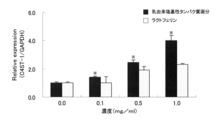
- the concentration-dependent influence on C4ST-1 mRNA expression by the milk-derived basic protein fraction is shown.
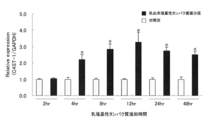
- the time-dependent influence on C4ST-1 mRNA expression by the milk-derived basic protein fraction is shown.
- the concentration-dependent influence on the cartilage differentiation control factor Sox9 mRNA expression by the milk-derived basic protein fraction is shown.
- the time-dependent influence on the cartilage differentiation control factor Sox9 mRNA expression by the milk-derived basic protein fraction is shown.
- the influence on the amount of proteoglycan synthesis by the milk-derived basic protein fraction is shown.
- the effect on knee osteoarthritis by the milk-derived basic protein fraction is shown.
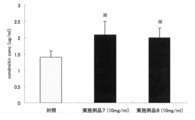
- combination by the milk-derived basic protein fraction degradation product is shown.
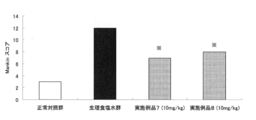
- the effect on knee osteoarthritis by the milk-derived basic protein fraction degradation product is shown.
- the present invention is characterized by using a milk-derived basic protein fraction as an active ingredient.
- the milk-derived basic protein fraction of the present invention has the following properties. 1) According to sodium dodecyl sulfate-polyacrylamide gel electrophoresis (SDS-PAGE), it consists of several proteins having a molecular weight in the range of 3,000-80,000. 2) 95% by weight or more is protein and contains a small amount of other fat and ash. 3) Protein mainly consists of lactoferrin and lactoperoxidase. 4) The amino acid composition of the protein contains 15% by weight or more of basic amino acids such as lysine, histidine and arginine.
- This milk-derived basic protein fraction can be obtained from milk of mammals such as cow's milk, human milk, goat's milk, and sheep milk.
- basic protein can be obtained by contacting milk or a milk-derived raw material with a cation exchanger.
- a basic protein fraction adsorbed on the cation exchanger after elution with an eluent exceeding pH 5 and exceeding ionic strength 0.5 JP-A-5-202098
- a method using an alginate gel Japanese Patent Laid-Open No. 61-246198
- a method obtained from whey using inorganic porous particles Japanese Patent Laid-Open No. 1-086839
- a milk using a sulfated ester compound Japanese Patent Laid-Open No. 1-086839
- a milk-derived basic protein fraction obtained by such a method can be used.
- the obtained milk-derived basic protein fraction can be further treated with a proteolytic enzyme to be used as a milk-derived basic protein fraction degradation product having an average molecular weight of 4,000 or less.
- a proteolytic enzyme commercially available protease A “Amano” SD (trade name), Samoase PC10F (trade name), protin SD-AY10 (trade name) and other proteases for food and industry can be used. Mention may be made of enzymes such as pepsin, trypsin, chymotrypsin, pancreatin, papain and the like. Moreover, you may use combining these proteolytic enzymes suitably.
- the milk-derived basic protein fraction can be used as it is as a cartilage formation promoter or a proteoglycan synthesis promoter, and in addition to the milk-derived basic protein fraction, sugars, lipids, Mixing other ingredients such as proteins, vitamins, minerals, flavors, and other drugs, foods, and feeds that are usually used in powders, granules, tablets, capsules, drinks, etc. It is also possible to formulate.
- a coating agent it can be used with normal application forms, such as emulsion, cream, lotion, and a pack. These coating agents are produced by a conventional method, and the milk-derived basic protein fraction, which is the active ingredient of the present invention, may be appropriately blended during the production process. Further, in addition to the milk-derived basic protein fraction, it can be used in combination with other components having a cartilage formation promoting effect and other components having an effect of improving joint diseases.
- the compounding amount of the cartilage formation promoter of the present invention is not particularly limited, but it is expected to have a chondrogenesis promoting effect and a proteoglycan synthesis promoting effect by ingesting 10 mg or more of milk-derived basic protein fraction per adult day. It is possible to secure this amount because it is possible.
- the milk-derived cartilage formation-promoting food and drink and the proteoglycan synthesis-promoting food and drink according to the present invention may be obtained by blending a milk-derived basic protein fraction into ordinary foods and drinks such as yogurt, milk drinks, wafers and desserts. .
- a milk-derived basic protein fraction into ordinary foods and drinks such as yogurt, milk drinks, wafers and desserts.
- the basic protein fraction per 100 g of food or drink is used depending on the form of the food or drink. It is preferable to add 1 to 100 mg.
- the chondrogenesis promoter of the present invention may be obtained by blending a milk-derived basic protein fraction into a normal feed such as livestock feed or pet food. For example, for these feeds, when a milk-derived basic protein fraction is blended, it is preferable to blend 1 to 100 mg of the milk-derived basic protein fraction per 100 g of the feed.
- the method of blending the milk-derived basic protein fraction is not particularly limited.
- the milk-derived basic protein fraction is suspended or dissolved in deionized water. After stirring and mixing, it is prepared and used in the form of pharmaceuticals, foods and drinks and feeds.
- the milk-derived basic protein fraction may be mixed uniformly, and stirring and mixing may be performed using an ultradisperser, a TK homomixer, or the like.
- the solution of the said composition can be used by concentrating with an RO membrane etc. or lyophilizing
- the sterilization process normally used for manufacture of a pharmaceutical, food-drinks, and feed can be performed, and if it is a powder form, dry heat sterilization is also possible. Therefore, various forms of pharmaceuticals, foods and drinks, and feeds, such as liquids, gels, powders, and granules, containing the milk-derived basic protein fraction of the present invention can be produced.
- a column (diameter 5 cm ⁇ height 30 cm) packed with 400 g of a cation exchange resin sulfonated chitopearl (Fuji Boseki Co., Ltd.) was thoroughly washed with deionized water, and then 40 l of unsterilized skim milk (pH 6.7) was added to the column. At a flow rate of 25 ml / min. After passing through the column, the column was thoroughly washed with deionized water, and the basic protein fraction adsorbed on the resin was eluted with 0.02 M carbonate buffer (pH 7.0) containing 0.98 M sodium chloride.
- 0.02 M carbonate buffer pH 7.0
- the eluate was desalted with a reverse osmosis membrane (RO membrane), concentrated, and lyophilized to obtain 21 g of milk-derived basic protein fraction powder (Example product 1).
- the obtained milk-derived basic protein fraction was measured by sodium dodecyl sulfate-polyacrylamide gel electrophoresis (SDS-PAGE), and the molecular weight was distributed in the range of 3,000-80,000.
- the composition was as shown in Table 1. Further, after hydrolysis with 6N hydrochloric acid at 110 ° C. for 24 hours, the amino acid composition was analyzed with an amino acid analyzer (L-8500 type, manufactured by Hitachi, Ltd.). As a result, as shown in Table 2, 15 wt. % Was included. Furthermore, when the protein composition was analyzed by ELISA, 40% or more of lactoferrin and lactoperoxidase were contained as shown in Table 3.
- Example 1 The effect of milk-derived basic protein fraction on mRNA expression of proteoglycan synthase was examined using real-time PCR.
- Example product 1 was used as the milk-derived basic protein fraction.
- ATDC5 cells which are mouse EC-derived mesenchymal cells, were used. ATDC5 cells were seeded in a 24-well plate at 0.5 ⁇ 10 5 cells / well and cultured in DMEM / F12 medium (manufactured by Sigma) at 37 ° C. in a 5% CO 2 environment for 1 week.
- RNA extractant ISOGEN Natural Gene
- RNA solution 0.25 ml of 2-propyl alcohol was added to the recovered solution, left standing for 10 minutes, and then centrifuged at 15,000 rpm and 4 ° C. for 15 minutes to obtain a total RNA precipitate. The obtained precipitate was washed with 70% ethanol and then dissolved in DEPC water to obtain an RNA solution.
- CDNA was synthesized from 1 ⁇ g of RNA using Takara PrimeScriptTM RT reagent Kit. Real-time PCR using SYBR Green (Takara SYBR Prime Ex Taq II) was performed using the obtained cDNA as a template.
- the reaction conditions were 95 ° C, 30 seconds of initial denaturation, 95 ° C, 5 seconds of denaturation, 57 ° C, 15 seconds of annealing, 72 ° C, 20 seconds of extension for 40 cycles.
- Primers for C4ST1 listed in Table 4 were used. The results are shown in Figure 1. In addition, * shows that there exists a significant difference compared with a control group (p ⁇ 0.05).
- FIG. 1 revealed that C4ST-1 mRNA expression by the milk-derived basic protein fraction was enhanced depending on the concentration of the milk-derived basic protein fraction. Further, it was revealed that C4ST-1 mRNA expression enhancing effect was higher than lactoferrin which is one of milk proteins.
- Example product 1 was used as the milk-derived basic protein fraction.
- the method was in accordance with the method described in Test Example 1. That is, the milk-derived basic protein fraction was added to ATDC5 cells from 2 hours to 48 hours, then total RNA was recovered, cDNA was synthesized, and real-time PCR was performed. In the control group, total RNA was recovered from ATDC5 cells cultured from 2 hours to 48 hours without administering the milk-derived basic protein fraction, and cDNA was synthesized and real-time PCR was performed. The results are shown in FIG.
- the mRNA expression of C4ST-1 by the milk-derived basic protein fraction was significantly increased in 4 hours after acting on the ATDC cells in the milk-derived basic protein fraction, and in 12 to 24 hours. A peak was reached and decreased at 48 hours.
- Example 3 The effect of the milk-derived basic protein fraction on the mRNA expression of the chondrogenic differentiation factor was examined using a real-time PCR method.
- Example product 1 was used as the milk-derived basic protein fraction.
- purified lactoferrin was used as a control group.
- the method was in accordance with the method described in Test Example 1. Primers for Sox9 listed in Table 5 were used as primers. The results are shown in FIG.
- FIG. 3 revealed that Sox9 mRNA expression by the milk-derived basic protein fraction was enhanced depending on the concentration of the whey degradation product. Further, it was revealed that Sox9 mRNA expression enhancing effect was higher than lactoferrin, which is one of milk proteins.
- Example product 1 was used as the milk-derived basic protein fraction.
- the method was in accordance with the method described in Test Example 1. That is, the milk-derived basic protein fraction was added to ATDC5 cells from 2 hours to 48 hours, then total RNA was recovered, cDNA was synthesized, and real-time PCR was performed. In the control group, total RNA was recovered from ATDC5 cells cultured from 2 hours to 48 hours without administering the milk-derived basic protein fraction, and cDNA was synthesized and real-time PCR was performed. The results are shown in FIG.
- the expression of Sox9 mRNA by the milk-derived basic protein fraction was significantly increased in 2 hours after the milk-derived basic protein fraction was allowed to act on ATDC cells, and reached a peak in 4 to 6 hours. It decreased after 12 hours.
- Example 5 About the influence on the proteoglycan synthesis
- Example product 1 was used as the milk-derived basic protein fraction. The measurement was performed by the following method. ATDC5 cells were seeded in 12-well plates at 1 ⁇ 10 5 cells / well, and cultured in DMEM / F12 medium at 37 ° C. in a CO 2 environment. After 4 days of culture, the enzyme solution (1 bag / 10 ml water) in the kit was added to 200 ⁇ l / well to solubilize the cells.
- the solubilized solution was collected in a 1.5 ml tube and then treated at 60 ° C. for 1 hour. A sample was used. Sample and standard chondroitin sulfate solution (1-50 ⁇ g / ml) are dispensed into tubes of 100 ⁇ l each, and 1.3 ml of reaction solution (chromogenic stock solution 0.4 ml / buffer solution 12.6 ml) is added, and 10-20 minutes later The absorbance value was measured at OD 650 nm. The concentration was determined from the standard curve obtained from the absorbance value of the standard chondroitin sulfate solution and the absorbance value of the sample. The results are shown in FIG.
- FIG. 5 shows that the proteoglycan amount significantly increased depending on the concentration of the milk-derived basic protein fraction.
- Example 6 Regarding the effect of milk-derived basic protein fraction on cartilage formation, a milk-derived basic protein fraction administration test was performed using STR / ORT mice, which are mice with spontaneous osteoarthritis of the knee.
- Example product 1 was used as the milk-derived basic protein fraction. The measurement was performed by the following method. Ten 15-week-old STR / ORT mice were divided into a physiological saline group and a group in which 10 mg of the milk-derived basic protein fraction was administered per 1 kg of the mouse body weight. Multiple oral gavages were performed. Ten normal mice (CBA / JN) were also set as a normal control group.
- mice After 12 weeks of breeding, each group of mice was sacrificed, the knee joint of the hind limb was excised and removed, and the osteochondral tissue was washed with 4 ° C. phosphate buffered saline (PBS) and diluted in PBS. Fixing with 4% paraformaldehyde at 4 ° C for 18 hours, degreasing overnight with 70% to 100% ethanol series, and tissue in phosphate buffer containing 10% ethylenediaminetetraacetic acid (EDTA) was infiltrated and decalcified at 4 ° C. for 2 weeks. The tissue was embedded in paraffin to prepare a 4 ⁇ m sliced specimen. The tissue specimen was deparaffinized and re-hydrophilized, then subjected to Safranin-O staining, and scored according to the Mankin score (Table 6), which is a score of the degree of arthritis progression. The results are shown in FIG.
- PBS phosphate buffered saline
- EDTA ethylenediaminetetra
- FIG. 6 shows that administration of the milk-derived basic protein fraction significantly reduced the Mankin score of STR / ORT mice compared to the administration of physiological saline. This shows that the symptoms of knee osteoarthritis were alleviated by the promotion of chondrogenesis in mice by administration of the milk-derived basic protein fraction.
- liquid nutritional composition thus obtained, no precipitation or the like was observed, and no abnormal flavor was felt.
- This liquid nutritional composition contained 10 mg of a milk-derived basic protein fraction per 100 g, and had an effect of promoting cartilage formation and / or proteoglycan synthesis.
- this milk-derived basic protein fraction solution 10 kg of this milk-derived basic protein fraction solution, 12 kg of soybean meal, 14 kg of skim milk powder, 4 kg of soybean oil, 2 kg of corn oil, 23.2 kg of palm oil, 14 kg of corn starch, 9 kg of wheat flour, 2 kg of bran, 5 kg of vitamin mixture, 2 kg of cellulose, 8 kg and 2 kg of the mineral mixture were blended and sterilized at 120 ° C. for 4 minutes to produce 100 kg of the breeding feed for dogs of the present invention.
- this breeding feed for dogs contained 200 mg of the milk-derived basic protein fraction per 100 g, and had an effect of promoting cartilage formation and / or proteoglycan synthesis.
- the tablets of the present invention were produced by molding and tableting into 1 g of ordinary methods.
- 1 mg of this tablet contained 100 mg of milk-derived basic protein fraction, and had an effect of promoting cartilage formation and / or promoting proteoglycan synthesis.
- Example product 7 After dissolving 50 g of milk-derived basic protein fraction powder obtained in the same manner as in Example 1 in 10 liters of distilled water, 1% pancreatin (manufactured by Sigma) was added and reacted at 37 ° C. for 2 hours. It was. After the reaction, the enzyme was inactivated by heat treatment at 80 ° C. for 10 minutes to obtain 48.3 g of a milk-derived basic protein fraction degradation product (Example product 7).
- Example product 8 120 g of milk-derived basic protein fraction obtained by the same method as in Example 1 was dissolved in 1.8 liters of purified water, and kept at 45 ° C. to maintain protease A “Amano” SD (manufactured by Amano Enzyme). 20 g was added and reacted for 2 hours. The enzyme was inactivated by heating at 80 ° C. for 10 minutes, and then freeze-dried to obtain 95 g of a milk-derived basic protein fraction degradation product (Example product 8).
- Example 7 Using Example Product 7 and Example Product 8, the influence of the milk-derived basic protein fraction degradation product on proteoglycan synthesis was verified.
- the test method was carried out according to the method of Test Example 5. The results are shown in FIG.
- the milk-derived basic protein fraction degradation product significantly increased the amount of proteoglycan.
- Example 8 Using Example Product 7 and Example Product 8, the influence of the milk-derived basic protein fraction degradation product on cartilage formation was verified.
- the dosage of the milk-derived basic protein fraction degradation product to STR / ORT mice was 10 mg per kg body weight of the mouse, and the test method was carried out according to the method of Test Example 6. The results are shown in FIG.
- FIG. 8 shows that, similarly to the milk-derived basic protein fraction, the Mankin score of the STR / ORT mice was significantly decreased by administration of the milk-derived basic protein fraction degradation product as compared with the physiological saline administration. That is, administration of a milk-derived basic protein fraction degradation product promoted cartilage formation in mice and alleviated the symptoms of knee osteoarthritis.
- this drink contained 400 mg of a milk-derived basic protein fraction degradation product per 100 g, and had an effect of promoting cartilage formation and / or proteoglycan synthesis.
- the tablets of the present invention were produced by molding and tableting into 1 g by a conventional method.
- 1 mg of this tablet contained 100 mg of a milk-derived basic protein fraction degradation product, and had an effect of promoting cartilage formation and / or proteoglycan synthesis.
Landscapes
- Life Sciences & Earth Sciences (AREA)
- Health & Medical Sciences (AREA)
- Chemical & Material Sciences (AREA)
- Engineering & Computer Science (AREA)
- Polymers & Plastics (AREA)
- Proteomics, Peptides & Aminoacids (AREA)
- Zoology (AREA)
- General Health & Medical Sciences (AREA)
- Food Science & Technology (AREA)
- Pharmacology & Pharmacy (AREA)
- Animal Behavior & Ethology (AREA)
- Medicinal Chemistry (AREA)
- Public Health (AREA)
- Veterinary Medicine (AREA)
- Bioinformatics & Cheminformatics (AREA)
- Immunology (AREA)
- Epidemiology (AREA)
- Nutrition Science (AREA)
- Organic Chemistry (AREA)
- Mycology (AREA)
- Animal Husbandry (AREA)
- Gastroenterology & Hepatology (AREA)
- Molecular Biology (AREA)
- Virology (AREA)
- Biomedical Technology (AREA)
- Developmental Biology & Embryology (AREA)
- Cell Biology (AREA)
- Biotechnology (AREA)
- Genetics & Genomics (AREA)
- Wood Science & Technology (AREA)
- General Engineering & Computer Science (AREA)
- Biochemistry (AREA)
- Birds (AREA)
- Chemical Kinetics & Catalysis (AREA)
- General Chemical & Material Sciences (AREA)
- Nuclear Medicine, Radiotherapy & Molecular Imaging (AREA)
- Diabetes (AREA)
- Endocrinology (AREA)
- Rheumatology (AREA)
- Orthopedic Medicine & Surgery (AREA)
Priority Applications (5)
| Application Number | Priority Date | Filing Date | Title |
|---|---|---|---|
| JP2014513374A JP6240066B2 (ja) | 2012-05-02 | 2013-04-30 | 軟骨形成促進剤 |
| US14/397,707 US20150132276A1 (en) | 2012-05-02 | 2013-04-30 | Cartilage regeneration-promoting agent |
| EP13784252.2A EP2851082A4 (fr) | 2012-05-02 | 2013-04-30 | Agent stimulant la régénération de cartilage |
| US15/133,588 US20160303167A1 (en) | 2012-05-02 | 2016-04-20 | Cartilage regeneration-promoting agent |
| US16/571,506 US20200046772A1 (en) | 2012-05-02 | 2019-09-16 | Cartilage regeneration-promoting agent |
Applications Claiming Priority (2)
| Application Number | Priority Date | Filing Date | Title |
|---|---|---|---|
| JP2012-105509 | 2012-05-02 | ||
| JP2012105509 | 2012-05-02 |
Related Child Applications (2)
| Application Number | Title | Priority Date | Filing Date |
|---|---|---|---|
| US14/397,707 A-371-Of-International US20150132276A1 (en) | 2012-05-02 | 2013-04-30 | Cartilage regeneration-promoting agent |
| US15/133,588 Division US20160303167A1 (en) | 2012-05-02 | 2016-04-20 | Cartilage regeneration-promoting agent |
Publications (1)
| Publication Number | Publication Date |
|---|---|
| WO2013164992A1 true WO2013164992A1 (fr) | 2013-11-07 |
Family
ID=49514391
Family Applications (1)
| Application Number | Title | Priority Date | Filing Date |
|---|---|---|---|
| PCT/JP2013/062525 Ceased WO2013164992A1 (fr) | 2012-05-02 | 2013-04-30 | Agent stimulant la régénération de cartilage |
Country Status (5)
| Country | Link |
|---|---|
| US (3) | US20150132276A1 (fr) |
| EP (1) | EP2851082A4 (fr) |
| JP (2) | JP6240066B2 (fr) |
| TW (1) | TW201347769A (fr) |
| WO (1) | WO2013164992A1 (fr) |
Cited By (3)
| Publication number | Priority date | Publication date | Assignee | Title |
|---|---|---|---|---|
| WO2015196245A1 (fr) * | 2014-06-25 | 2015-12-30 | Adelaide Research & Innovation Pty Ltd | Modulation de l'ostéogenèse et/ou de l'angiogenèse par modulation de la fonctionnalité peroxydase |
| JP2017137266A (ja) * | 2016-02-04 | 2017-08-10 | 雪印メグミルク株式会社 | 軟骨機能改善剤 |
| JP2018188395A (ja) * | 2017-05-09 | 2018-11-29 | 雪印メグミルク株式会社 | 軟骨形成促進用組成物 |
Citations (8)
| Publication number | Priority date | Publication date | Assignee | Title |
|---|---|---|---|---|
| JPS61246198A (ja) | 1985-02-07 | 1986-11-01 | オレオフイナ・ソシエテ・アノニム | 蛋白の精製法 |
| JPS63255300A (ja) | 1987-04-10 | 1988-10-21 | Snow Brand Milk Prod Co Ltd | 硫酸エステル化物を用いて乳からラクトフエリンを分離、精製する方法 |
| JPS6486839A (en) | 1987-06-19 | 1989-03-31 | Entamonto Sa | Method for selectively extracting metal protein from whey |
| JPH05202098A (ja) | 1992-01-29 | 1993-08-10 | Snow Brand Milk Prod Co Ltd | 乳質原料から生理活性物質の製造法 |
| JPH08151331A (ja) * | 1994-09-30 | 1996-06-11 | Snow Brand Milk Prod Co Ltd | 骨強化剤 |
| JP2006028071A (ja) | 2004-07-15 | 2006-02-02 | Nippon Menaade Keshohin Kk | プロテオグリカンの生成促進剤 |
| JP2007131548A (ja) | 2005-11-08 | 2007-05-31 | Hirosaki Univ | プロテオグリカンの新規医薬用途 |
| JP2010126461A (ja) | 2008-11-26 | 2010-06-10 | Hirosaki Univ | プロテオグリカンの医薬用途 |
Family Cites Families (4)
| Publication number | Priority date | Publication date | Assignee | Title |
|---|---|---|---|---|
| JP2974604B2 (ja) * | 1996-01-23 | 1999-11-10 | 雪印乳業株式会社 | 塩基性タンパク質組成物、塩基性ペプチド組成物及びその利用 |
| JP4592127B2 (ja) * | 1999-03-30 | 2010-12-01 | 雪印乳業株式会社 | 骨吸収抑制剤 |
| JP2001346519A (ja) * | 2000-06-09 | 2001-12-18 | Snow Brand Milk Prod Co Ltd | 乳塩基性シスタチン高含有画分及びその分解物の製造方法 |
| EP1937298A4 (fr) * | 2005-10-14 | 2009-11-11 | Auckland Uniservices Ltd | Utilisation de fragments de lactoferrine et d'hydrolysats |
-
2013
- 2013-04-30 EP EP13784252.2A patent/EP2851082A4/fr not_active Withdrawn
- 2013-04-30 US US14/397,707 patent/US20150132276A1/en not_active Abandoned
- 2013-04-30 JP JP2014513374A patent/JP6240066B2/ja active Active
- 2013-04-30 WO PCT/JP2013/062525 patent/WO2013164992A1/fr not_active Ceased
- 2013-05-02 TW TW102115748A patent/TW201347769A/zh unknown
-
2016
- 2016-04-20 US US15/133,588 patent/US20160303167A1/en not_active Abandoned
-
2017
- 2017-11-02 JP JP2017212956A patent/JP6410909B2/ja active Active
-
2019
- 2019-09-16 US US16/571,506 patent/US20200046772A1/en not_active Abandoned
Patent Citations (8)
| Publication number | Priority date | Publication date | Assignee | Title |
|---|---|---|---|---|
| JPS61246198A (ja) | 1985-02-07 | 1986-11-01 | オレオフイナ・ソシエテ・アノニム | 蛋白の精製法 |
| JPS63255300A (ja) | 1987-04-10 | 1988-10-21 | Snow Brand Milk Prod Co Ltd | 硫酸エステル化物を用いて乳からラクトフエリンを分離、精製する方法 |
| JPS6486839A (en) | 1987-06-19 | 1989-03-31 | Entamonto Sa | Method for selectively extracting metal protein from whey |
| JPH05202098A (ja) | 1992-01-29 | 1993-08-10 | Snow Brand Milk Prod Co Ltd | 乳質原料から生理活性物質の製造法 |
| JPH08151331A (ja) * | 1994-09-30 | 1996-06-11 | Snow Brand Milk Prod Co Ltd | 骨強化剤 |
| JP2006028071A (ja) | 2004-07-15 | 2006-02-02 | Nippon Menaade Keshohin Kk | プロテオグリカンの生成促進剤 |
| JP2007131548A (ja) | 2005-11-08 | 2007-05-31 | Hirosaki Univ | プロテオグリカンの新規医薬用途 |
| JP2010126461A (ja) | 2008-11-26 | 2010-06-10 | Hirosaki Univ | プロテオグリカンの医薬用途 |
Non-Patent Citations (5)
| Title |
|---|
| BIOCHEM. BIOPHYS. RES. COMMUN., vol. 301, no. 2, 2003, pages 338 - 343 |
| BMC MUSCULOSKELET DISORD., 2004, pages 26 |
| J. BIOL. CHEM., vol. 265, no. 10, 1990, pages 5903 - 5909 |
| See also references of EP2851082A4 * |
| YOSHIKAZU MORITA ET AL.: "Nyu Enkisei Tanpakushitsu (MBP) no Kotsuseicho ni Tomonau Nankotsu Saibo Kasseika Sayo", ANNUAL MEETING OF JSBBA KOEN YOSHISHU, vol. 2002, 5 March 2002 (2002-03-05), pages 105, XP008175449 * |
Cited By (11)
| Publication number | Priority date | Publication date | Assignee | Title |
|---|---|---|---|---|
| WO2015196245A1 (fr) * | 2014-06-25 | 2015-12-30 | Adelaide Research & Innovation Pty Ltd | Modulation de l'ostéogenèse et/ou de l'angiogenèse par modulation de la fonctionnalité peroxydase |
| JP2017137266A (ja) * | 2016-02-04 | 2017-08-10 | 雪印メグミルク株式会社 | 軟骨機能改善剤 |
| WO2017135400A1 (fr) * | 2016-02-04 | 2017-08-10 | 雪印メグミルク株式会社 | Composition alimentaire pour améliorer la fonction du cartilage |
| CN108601812A (zh) * | 2016-02-04 | 2018-09-28 | 雪印惠乳业株式会社 | 软骨机能改善用食品组合物 |
| EP3412301A4 (fr) * | 2016-02-04 | 2020-01-08 | Megmilk Snow Brand Co., Ltd. | Composition alimentaire pour améliorer la fonction du cartilage |
| EP3756478A1 (fr) | 2016-02-04 | 2020-12-30 | Megmilk Snow Brand Co. Ltd. | Composition alimentaire pour améliorer la fonction du cartilage |
| JP2021121591A (ja) * | 2016-02-04 | 2021-08-26 | 雪印メグミルク株式会社 | 軟骨機能改善剤 |
| CN113729231A (zh) * | 2016-02-04 | 2021-12-03 | 雪印惠乳业株式会社 | 软骨机能改善用食品组合物 |
| EP3935963A1 (fr) | 2016-02-04 | 2022-01-12 | Megmilk Snow Brand Co., Ltd. | Composition alimentaire pour améliorer la fonction du cartilage |
| JP7633874B2 (ja) | 2016-02-04 | 2025-02-20 | 雪印メグミルク株式会社 | 軟骨機能改善剤 |
| JP2018188395A (ja) * | 2017-05-09 | 2018-11-29 | 雪印メグミルク株式会社 | 軟骨形成促進用組成物 |
Also Published As
| Publication number | Publication date |
|---|---|
| US20160303167A1 (en) | 2016-10-20 |
| JP2018030880A (ja) | 2018-03-01 |
| EP2851082A4 (fr) | 2016-02-17 |
| TW201347769A (zh) | 2013-12-01 |
| US20200046772A1 (en) | 2020-02-13 |
| JP6410909B2 (ja) | 2018-10-24 |
| EP2851082A1 (fr) | 2015-03-25 |
| JP6240066B2 (ja) | 2017-11-29 |
| JPWO2013164992A1 (ja) | 2015-12-24 |
| US20150132276A1 (en) | 2015-05-14 |
Similar Documents
| Publication | Publication Date | Title |
|---|---|---|
| CN101466389B (zh) | 包含乳清蛋白及水解产物的用于改善肌肉恢复的制剂 | |
| EP0704218B1 (fr) | Agent de consolidation des os, aliments et boissons contenant ledit agent | |
| ES2215940T5 (es) | Traccion proteica basica derivada de la leche como agente para reducir la hipertension. | |
| JP6259209B2 (ja) | コラーゲン産生促進剤 | |
| JP6410909B2 (ja) | 軟骨形成促進剤 | |
| NZ578722A (en) | Skin-beautifying agent | |
| KR101789355B1 (ko) | 피부 콜라겐 생성 촉진제 | |
| JP6259208B2 (ja) | ヒアルロン酸産生促進剤 | |
| KR20200011584A (ko) | 신규 단백질 소재 | |
| JPH09191856A (ja) | 栄養補給用組成物 | |
| TWI607709B (zh) | 骨強化劑 | |
| JP7025112B2 (ja) | Bdnf産生促進剤 | |
| AU2012319579B2 (en) | Sense-improving agent | |
| TWI574696B (zh) | 新穎蛋白質素材 | |
| US20250319133A1 (en) | Methods for improving bone health with bovine milk exosome-enriched products and vitamin k2 | |
| JP7633874B2 (ja) | 軟骨機能改善剤 | |
| TW201347779A (zh) | 玻尿酸產生促進劑 | |
| TW201511769A (zh) | 消炎劑 |
Legal Events
| Date | Code | Title | Description |
|---|---|---|---|
| 121 | Ep: the epo has been informed by wipo that ep was designated in this application |
Ref document number: 13784252 Country of ref document: EP Kind code of ref document: A1 |
|
| WWE | Wipo information: entry into national phase |
Ref document number: 14397707 Country of ref document: US |
|
| NENP | Non-entry into the national phase |
Ref country code: DE |
|
| WWE | Wipo information: entry into national phase |
Ref document number: 2013784252 Country of ref document: EP |
|
| ENP | Entry into the national phase |
Ref document number: 2014513374 Country of ref document: JP Kind code of ref document: A |