WO2013180272A1 - Film poreux creux - Google Patents
Film poreux creux Download PDFInfo
- Publication number
- WO2013180272A1 WO2013180272A1 PCT/JP2013/065204 JP2013065204W WO2013180272A1 WO 2013180272 A1 WO2013180272 A1 WO 2013180272A1 JP 2013065204 W JP2013065204 W JP 2013065204W WO 2013180272 A1 WO2013180272 A1 WO 2013180272A1
- Authority
- WO
- WIPO (PCT)
- Prior art keywords
- porous membrane
- hollow porous
- molecular weight
- average molecular
- hollow
- Prior art date
- Legal status (The legal status is an assumption and is not a legal conclusion. Google has not performed a legal analysis and makes no representation as to the accuracy of the status listed.)
- Ceased
Links
Images


Classifications
-
- B—PERFORMING OPERATIONS; TRANSPORTING
- B01—PHYSICAL OR CHEMICAL PROCESSES OR APPARATUS IN GENERAL
- B01D—SEPARATION
- B01D71/00—Semi-permeable membranes for separation processes or apparatus characterised by the material; Manufacturing processes specially adapted therefor
- B01D71/06—Organic material
- B01D71/30—Polyalkenyl halides
- B01D71/32—Polyalkenyl halides containing fluorine atoms
- B01D71/34—Polyvinylidene fluoride
-
- B—PERFORMING OPERATIONS; TRANSPORTING
- B01—PHYSICAL OR CHEMICAL PROCESSES OR APPARATUS IN GENERAL
- B01D—SEPARATION
- B01D69/00—Semi-permeable membranes for separation processes or apparatus characterised by their form, structure or properties; Manufacturing processes specially adapted therefor
- B01D69/08—Hollow fibre membranes
- B01D69/081—Hollow fibre membranes characterised by the fibre diameter
-
- B—PERFORMING OPERATIONS; TRANSPORTING
- B01—PHYSICAL OR CHEMICAL PROCESSES OR APPARATUS IN GENERAL
- B01D—SEPARATION
- B01D69/00—Semi-permeable membranes for separation processes or apparatus characterised by their form, structure or properties; Manufacturing processes specially adapted therefor
- B01D69/02—Semi-permeable membranes for separation processes or apparatus characterised by their form, structure or properties; Manufacturing processes specially adapted therefor characterised by their properties
-
- B—PERFORMING OPERATIONS; TRANSPORTING
- B01—PHYSICAL OR CHEMICAL PROCESSES OR APPARATUS IN GENERAL
- B01D—SEPARATION
- B01D69/00—Semi-permeable membranes for separation processes or apparatus characterised by their form, structure or properties; Manufacturing processes specially adapted therefor
- B01D69/08—Hollow fibre membranes
-
- B—PERFORMING OPERATIONS; TRANSPORTING
- B01—PHYSICAL OR CHEMICAL PROCESSES OR APPARATUS IN GENERAL
- B01D—SEPARATION
- B01D69/00—Semi-permeable membranes for separation processes or apparatus characterised by their form, structure or properties; Manufacturing processes specially adapted therefor
- B01D69/10—Supported membranes; Membrane supports
- B01D69/105—Support pretreatment
-
- B—PERFORMING OPERATIONS; TRANSPORTING
- B01—PHYSICAL OR CHEMICAL PROCESSES OR APPARATUS IN GENERAL
- B01D—SEPARATION
- B01D69/00—Semi-permeable membranes for separation processes or apparatus characterised by their form, structure or properties; Manufacturing processes specially adapted therefor
- B01D69/10—Supported membranes; Membrane supports
- B01D69/107—Organic support material
-
- B—PERFORMING OPERATIONS; TRANSPORTING
- B01—PHYSICAL OR CHEMICAL PROCESSES OR APPARATUS IN GENERAL
- B01D—SEPARATION
- B01D69/00—Semi-permeable membranes for separation processes or apparatus characterised by their form, structure or properties; Manufacturing processes specially adapted therefor
- B01D69/12—Composite membranes; Ultra-thin membranes
- B01D69/1213—Laminated layers
-
- B—PERFORMING OPERATIONS; TRANSPORTING
- B01—PHYSICAL OR CHEMICAL PROCESSES OR APPARATUS IN GENERAL
- B01D—SEPARATION
- B01D69/00—Semi-permeable membranes for separation processes or apparatus characterised by their form, structure or properties; Manufacturing processes specially adapted therefor
- B01D69/12—Composite membranes; Ultra-thin membranes
- B01D69/1216—Three or more layers
-
- B—PERFORMING OPERATIONS; TRANSPORTING
- B32—LAYERED PRODUCTS
- B32B—LAYERED PRODUCTS, i.e. PRODUCTS BUILT-UP OF STRATA OF FLAT OR NON-FLAT, e.g. CELLULAR OR HONEYCOMB, FORM
- B32B5/00—Layered products characterised by the non- homogeneity or physical structure, i.e. comprising a fibrous, filamentary, particulate or foam layer; Layered products characterised by having a layer differing constitutionally or physically in different parts
- B32B5/22—Layered products characterised by the non- homogeneity or physical structure, i.e. comprising a fibrous, filamentary, particulate or foam layer; Layered products characterised by having a layer differing constitutionally or physically in different parts characterised by the presence of two or more layers which are next to each other and are fibrous, filamentary, formed of particles or foamed
- B32B5/24—Layered products characterised by the non- homogeneity or physical structure, i.e. comprising a fibrous, filamentary, particulate or foam layer; Layered products characterised by having a layer differing constitutionally or physically in different parts characterised by the presence of two or more layers which are next to each other and are fibrous, filamentary, formed of particles or foamed one layer being a fibrous or filamentary layer
-
- C—CHEMISTRY; METALLURGY
- C08—ORGANIC MACROMOLECULAR COMPOUNDS; THEIR PREPARATION OR CHEMICAL WORKING-UP; COMPOSITIONS BASED THEREON
- C08J—WORKING-UP; GENERAL PROCESSES OF COMPOUNDING; AFTER-TREATMENT NOT COVERED BY SUBCLASSES C08B, C08C, C08F, C08G or C08H
- C08J9/00—Working-up of macromolecular substances to porous or cellular articles or materials; After-treatment thereof
- C08J9/28—Working-up of macromolecular substances to porous or cellular articles or materials; After-treatment thereof by elimination of a liquid phase from a macromolecular composition or article, e.g. drying of coagulum
-
- B—PERFORMING OPERATIONS; TRANSPORTING
- B01—PHYSICAL OR CHEMICAL PROCESSES OR APPARATUS IN GENERAL
- B01D—SEPARATION
- B01D2325/00—Details relating to properties of membranes
- B01D2325/04—Characteristic thickness
-
- B—PERFORMING OPERATIONS; TRANSPORTING
- B01—PHYSICAL OR CHEMICAL PROCESSES OR APPARATUS IN GENERAL
- B01D—SEPARATION
- B01D2325/00—Details relating to properties of membranes
- B01D2325/20—Specific permeability or cut-off range
-
- B—PERFORMING OPERATIONS; TRANSPORTING
- B01—PHYSICAL OR CHEMICAL PROCESSES OR APPARATUS IN GENERAL
- B01D—SEPARATION
- B01D2325/00—Details relating to properties of membranes
- B01D2325/24—Mechanical properties, e.g. strength
-
- B—PERFORMING OPERATIONS; TRANSPORTING
- B01—PHYSICAL OR CHEMICAL PROCESSES OR APPARATUS IN GENERAL
- B01D—SEPARATION
- B01D2325/00—Details relating to properties of membranes
- B01D2325/34—Molecular weight or degree of polymerisation
-
- B—PERFORMING OPERATIONS; TRANSPORTING
- B01—PHYSICAL OR CHEMICAL PROCESSES OR APPARATUS IN GENERAL
- B01D—SEPARATION
- B01D2325/00—Details relating to properties of membranes
- B01D2325/34—Molecular weight or degree of polymerisation
- B01D2325/341—At least two polymers of same structure but different molecular weight
-
- B—PERFORMING OPERATIONS; TRANSPORTING
- B01—PHYSICAL OR CHEMICAL PROCESSES OR APPARATUS IN GENERAL
- B01D—SEPARATION
- B01D2325/00—Details relating to properties of membranes
- B01D2325/40—Fibre reinforced membranes
Definitions
- the present invention relates to a hollow porous membrane suitably used for water treatment.
- a hollow porous membrane is used, which is adopted in various water treatments such as sewage treatment and water purification treatment.
- Various hollow porous membranes have been studied.
- a hollow knitted string support in which yarns are circularly knitted is used as a support for a hollow porous membrane (hereinafter sometimes simply referred to as a support), and a porous membrane layer is provided on the outer peripheral surface thereof.
- a porous film is provided on the outer peripheral surface thereof.
- the hollow porous membrane is manufactured, for example, as follows.
- the film forming stock solution is discharged from the double tube spinning nozzle, and the film forming stock solution is applied to the outer peripheral surface of the support. Thereafter, the support on which the film-forming stock solution has been applied is passed through the coagulation bath, and the film-forming stock solution is solidified with the coagulation solution in the coagulation bath. Thereby, a hollow porous membrane is obtained.
- a hollow porous membrane is required to have excellent separation and permeation properties and high mechanical properties. For example, in the field of water purification treatment, it is required to physically remove viruses with a particle size of about several tens to 50 nm contained in rivers, etc., against the background of stricter regulations.
- the membrane surface and activated carbon or inorganic particles May cause the membrane surface to wear, or activated carbon or inorganic particles may pierce the membrane surface and cause defects in the membrane, which may reduce the filtration performance of the membrane.
- the hollow porous membrane has resistance against such stabs and wear, and therefore, virus removal performance even when used in combination with activated carbon or when inorganic particles are contained in the treated raw water. Is required to be maintained.
- a virus removal mechanism there are generally a sieve filtering that performs filtration with a pore size smaller than that of the virus, a so-called depth filtration that traps the virus in the pore, and the like.
- Patent Document 1 As a hollow porous membrane, for example, in Patent Document 1, a three-dimensional network structure separation functional layer containing polyvinylidene fluoride having a melt viscosity of 2500 Pa ⁇ s or more is laminated on a polyvinylidene fluoride-based support layer having a spherical structure. Described membranes are described. Patent Document 1 describes that the membrane has high virus removal performance and physical strength. Patent Document 2 discloses a hollow porous membrane having an outer layer made of a thermoplastic resin having a mass average molecular weight of 400,000 or more and a soft inner layer made of a thermoplastic resin having a mass average molecular weight of less than 400,000. .
- Patent Document 2 describes that, since the hollow porous membrane has a soft inner layer, the pressing force on the outer surface when the membranes are in contact with each other is dispersed and lowered, and the abrasion can be reduced.
- Patent Document 3 discloses a hollow porous membrane having a dense layer on the membrane surface and inside the membrane. According to Patent Document 3, even if the hollow porous membrane is damaged in the dense layer on the surface of the membrane and the rejection rate of the substance to be removed is reduced, the dense layer inside the membrane inhibits the substance to be removed. Therefore, it is described that extremely high safety can be maintained.
- the membrane disclosed in Patent Document 1 is not sufficiently resistant to piercing and wear of activated carbon, inorganic particles, and the like, and there is a concern that the virus removal performance may be deteriorated due to such piercing or wear. Moreover, even if the film disclosed in Patent Document 2 has resistance against abrasion, it cannot be said that the resistance against piercing is sufficient.
- the membranes described in Examples 1 and 2 of Patent Document 3 have an original average pore diameter as large as 80 nm, and the average pore diameter is changed from 80 nm to 100 nm by a sandfall test, and the particle diameter is several tens. It cannot maintain the removal performance of small viruses of ⁇ 50 nm.
- the present invention has been made in view of the above circumstances, and has resistance to sticking to the membrane surface such as activated carbon and inorganic particles at the time of air scrubbing treatment, and abrasion of the membrane surface due to these particles.
- An object is to provide a hollow porous membrane capable of maintaining virus removal performance.
- the hollow porous membrane of the present invention has the following aspects.
- the hollow porous membrane has a burst pressure of 200 kPa or higher when internal pressure is applied, and a virus removal performance of LRV4 or higher when MS2 phage is used as a test bacterium. .
- the hollow porous membrane according to [3], wherein the cylindrical support made of the multifilament is a knitted string support circularly knitted in a cylindrical shape.
- thermoplastic resin (a) used for the outermost layer has a mass average molecular weight of the thermoplastic used for the other layers.
- each of the plurality of types of thermoplastic resins has a mass average molecular weight of 400,000 or more.
- the thermoplastic resin (a) used for the outermost layer has a mass average molecular weight of 600,000 or more [1] to [11]
- the hollow porous membrane according to any one of [1] to [13] which has a water permeability of 8 m 3 / m 2 / hr / MPa or more.
- the hollow porous membrane of the present invention has high virus removal performance, and is resistant to piercing into the membrane surface such as activated carbon and inorganic particles during air scrubbing treatment, and abrasion of the membrane surface due to these particles. Have Therefore, high virus removal performance can be maintained and good treated water can be stably supplied.
- the hollow porous membrane of the present invention is a hollow porous membrane having a plurality of porous membrane layers, and at least two of the porous membrane layers are thermoplastic resins having a mass average molecular weight of 500,000 or more. (A) is used.
- the hollow porous membrane of the present invention has a burst pressure of 200 kPa or higher when internal pressure is applied, and a virus removal performance of LRV4 or higher when MS2 phage is used as a test bacterium.
- the burst pressure when the internal pressure is applied means the air pressure when the air is gradually applied to the inside (hollow portion) of the hollow porous membrane and the membrane is ruptured.
- a sample obtained by sealing one end of a hollow porous membrane cut to a length of 4 cm with a polyurethane resin is measured by the following method. First, the sample is immersed in ethanol (25 ° C.). On the other hand, a container is prepared. Next, the other end of the sample (that is, the open end not sealed with polyurethane resin) and the container are connected by a tube, and the internal pressure is gradually applied to the hollow part of the sample by compressed air. Do so. And the pressure value when the film
- This measurement is performed three times, and the minimum value among the three measured pressure values is defined as the burst pressure of the hollow porous membrane.
- the method of measuring the virus removal performance at the time of using MS2 phage as a test microbe is mentioned later in detail, it is as follows. Escherichia coli phase MS2 (particle size: about 25 nm) is used as a test bacterium, grown in E. coli to the order of 10 6 pfu / ml, adjusted to pH 7 with 0.1 ml M phosphate buffer, and this is used as a test stock solution. And the nondestructive removal performance test mentioned later is done. From this result, LRV, which is an index of removal performance, is calculated.
- LRV4 or higher means that 99.99% or more of the flowed test bacteria are blocked.
- USEPA US Environmental Protection Agency
- the virus removal performance is desirably LRV 4 or more, and more preferably LRV 4.5 or more.
- Such a hollow porous membrane is used in combination with activated carbon in various water treatments, or in a situation where inorganic particles such as sand are contained in the treated raw water, the membrane is oscillated by air scrubbing treatment, Even when activated carbon or inorganic particles are sandwiched between the membrane, the membrane surface is hardly worn by the activated carbon or inorganic particles. Further, these particles are unlikely to pierce the film surface. Therefore, even if the air scrubbing process is repeatedly performed, the pore diameter is hardly increased due to the film surface being worn and plastically deformed. Further, in the air scrubbing process, defect points due to particle sticking hardly occur, and high virus removal performance can be maintained.
- defect point when “defect point” is simply described, it means one generated by an air scrubbing process or the like.
- the porous membrane layer using the thermoplastic resin (a) having a mass average molecular weight of 500,000 or more, the wear resistance of the porous membrane layer is improved, and the plastic deformation of the membrane surface due to wear is reduced. It is possible to suppress the increase in the hole diameter due to plastic change. And, by forming two or more such porous membrane layers, even if the outer layer of these layers is temporarily worn and the pore diameter increases, even if the virus removal performance is reduced, Virus removal performance can be maintained by the inner layer. Moreover, when the burst pressure of the hollow porous membrane is 200 kPa or more, activated carbon and inorganic particles are unlikely to pierce the membrane surface of the hollow porous membrane, and defect points are less likely to occur.
- the mass average molecular weight of the thermoplastic resin (a) used for forming the porous membrane layer is preferably 600,000 or more.
- the upper limit of the mass average molecular weight is not particularly limited, but if the mass average molecular weight is too high, the discharge pressure becomes very high during the production of the film and the formability deteriorates, so 3 million is preferable, more preferably 200 It is ten thousand.
- the burst pressure of the hollow porous membrane is preferably 220 kPa or more.
- the upper limit of the burst pressure is not particularly limited, but is actually 1000 kPa from the manufacturing aspect.
- thermoplastic resin (a) for example, one or more of polyvinylidene fluoride, polysulfone, polyacrylonitrile, polyimide and the like can be used. Among them, heat resistance and hollow porous membranes such as hypochlorite are used. Polyvinylidene fluoride is preferred because of its excellent resistance to cleaning chemicals.
- thermoplastic resin (a) a plurality of resins of different types and different molecular weights may be mixed and used, and in that case, the mass average molecular weight of the mixture may be 500,000 or more. However, if the molecular weight distribution of the mixture becomes wider on the low molecular weight side, defects are likely to occur locally in the porous film layer formed from the mixture.
- the mass average molecular weight is preferably 400,000 or more.
- thermoplastic resin (a) having a mass average molecular weight of 500,000 or more as a component other than the thermoplastic resin (a), polyvinyl chloride is used for the purpose of adjusting the viscosity of the stock solution.
- a hydrophilic polymer such as pyrrolidone may be added to the film forming stock solution. However, the added hydrophilic polymer is removed in the manufacturing process of the hollow porous membrane, and usually the hydrophilic polymer does not remain in the finally obtained hollow porous membrane.
- the number of layers of the porous membrane layer formed using the thermoplastic resin (a) having a mass average molecular weight of 500,000 or more is not particularly limited as long as it is 2 or more, but the production process becomes longer as the number of layers increases. From the viewpoint of complexity, 2 to 4 layers are preferable. If the number of porous membrane layers formed using the thermoplastic resin (a) having a mass average molecular weight of 500,000 or more is 2 or more, the burst pressure of the hollow porous membrane is controlled to 200 kPa or more. Although it is easy, among the layers formed using the thermoplastic resin (a), the thermoplastic resin (a) used in the outermost layer has a mass average molecular weight of the thermoplastic resin used in the other layers.
- the burst pressure of the hollow porous membrane can be easily controlled by 200 kPa or more.
- the mass average molecular weight of the thermoplastic resin (a) used in the outermost layer is more preferably 600,000 or more, and more preferably 700,000 or more, the burst pressure of the hollow porous membrane is reduced. It is easier to control at 200 kPa or more.
- the burst pressure of the hollow porous membrane is affected by the mass average molecular weight of the thermoplastic resin forming the porous membrane layer as described above. It also depends on the resin concentration (solid content concentration) in the membrane stock solution; the membrane structure such as a homogeneous structure and a heterogeneous structure; the thickness of the membrane (film thickness); Among these, the burst pressure tends to be greatly influenced by the mass average molecular weight of the thermoplastic resin forming the porous membrane layer.
- the hollow porous membrane may be provided with a support such as a braided string support obtained by circularly knitting multifilaments into a cylindrical shape such as a cylindrical shape (support for a hollow porous membrane).
- the burst pressure tends to be 200 kPa or more.
- the support is provided, and all the porous membrane layers laminated on the outer peripheral surface of the support are formed of a thermoplastic resin (a) having a mass average molecular weight of 500,000 or more.
- a thermoplastic resin
- An example is a hollow porous membrane.
- Examples of the multifilament material used for manufacturing the support include synthetic fibers, semi-synthetic fibers, regenerated fibers, and natural fibers.
- the multifilament may be a combination of a plurality of types of fibers.
- Synthetic fibers include polyamide fibers such as nylon 6, nylon 66 and aromatic polyamide; polyester fibers such as polyethylene terephthalate, polybutylene terephthalate, polylactic acid and polyglycolic acid; acrylic fibers such as polyacrylonitrile; polyethylene and polypropylene Polyolefin fiber such as polyvinyl alcohol fiber; polyvinylidene chloride fiber; polyvinyl chloride fiber; polyurethane fiber; phenol resin fiber; fluorine fiber such as polyvinylidene fluoride and polytetrafluoroethylene; polyalkylene paraoxybenzoate System fibers and the like.
- Examples of the semi-synthetic fibers include cellulose derivative fibers made from cellulose diacetate, cellulose triacetate, chitin, chitosan and the like: protein fibers called promix.
- Examples of the regenerated fiber include cellulosic regenerated fibers (rayon, cupra, polynosic, etc.) obtained by the viscose method, copper-ammonia method, organic solvent method and the like.
- Examples of natural fibers include flax and jute.
- hollow porous membranes are often chemically washed with hypochlorite, etc., so polyester fibers, acrylic fibers, polyvinyl alcohol fibers, polyamide fibers with excellent chemical resistance Or a polyolefin fiber is preferable and especially a polyester fiber is more preferable.
- the fineness of the multifilament is preferably 50 to 1000 dtex, more preferably 100 to 400 dtex, in view of the breaking strength of the hollow porous membrane and the ease of controlling the outer diameter.
- the total thickness of all the porous membrane layers constituting the hollow porous membrane is determined by the wear of the membrane surface or the particle surface on the membrane surface. From the viewpoint of puncture resistance, the water permeability performance, the burst pressure of the hollow porous membrane, etc., 50 ⁇ m or more and 200 ⁇ m or less is preferable, and 60 ⁇ m or more and 150 ⁇ m or less is more preferable. If the total thickness of the porous membrane layer is less than 50 ⁇ m, the filtration resistance is reduced and the water permeability is improved, but the membrane surface wear and the resistance to particle piercing to the membrane surface tend to be reduced.
- the trapping ability of virus in the pores (depth filtration ability) and film-forming stability are also likely to be lowered.
- the total film thickness of the porous membrane layer exceeds 200 ⁇ m, the resistance to abrasion on the membrane surface and the piercing of particles to the membrane surface will be sufficient, but the filtration resistance will increase and the water permeability will decrease, the raw material cost The problem that increases.
- each porous membrane layer is preferably in the range of 20 to 100 ⁇ m, although it depends on the total thickness of the porous membrane layer and the total number of porous membrane layers.
- the outer diameter of the hollow porous membrane is preferably about 1.0 to 5.0 mm, more preferably about 1.2 mm to 3.0 mm from the viewpoint of maintaining the hollow shape against crushing.
- the inner diameter of the hollow porous membrane is preferably 0.6 mm or more and more preferably 0.7 mm or more from the viewpoint of suppressing water permeation performance due to in-pipe resistance.
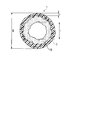
- FIG. 5 shows an example of the hollow porous membrane of the present invention in which a plurality of porous membrane layers are laminated on the outer peripheral surface of the support.
- symbol 10 shows a support body and the code
- the total film thickness t of the porous membrane layer and the inner and outer diameters of the hollow porous membrane will be described.
- the length indicated by the symbol D is the outer diameter D of the hollow porous membrane
- the length indicated by the symbol r is the inner diameter r of the hollow porous membrane.
- the inner diameter r is the length of a line obtained by connecting the convex and concave portions of the inner peripheral surface of the support 10 so as to be orthogonal to the axis (center line) of the hollow porous membrane.
- the length indicated by the symbol t is the total film thickness of the porous membrane layer.
- the total film thickness t is the length in the radial direction from the boundary between the layer 2 composed of the porous membrane layer and the uneven convex portion of the outer peripheral surface of the support 10 to the outermost surface of the hollow porous membrane.
- the total film thickness t of the porous membrane layer, the outer diameter D and the inner diameter r of the hollow porous membrane can be measured by the following method. First, several hollow porous membranes are bundled and the entire outside thereof is covered with polyurethane resin, and the hollow portion of each hollow porous membrane is filled with polyurethane resin and cured. Next, the cured bundle is sliced along the radial direction of the hollow porous membrane so that the length in the longitudinal direction is about 0.5 mm to obtain a flaky sample having a thickness of about 0.5 mm. Next, an optical image of the cross section of the sample is projected onto a screen at a magnification of, for example, 100 using a projector.
- the outer diameter D and inner diameter r of the hollow porous membrane and the total thickness t of the porous membrane layer are measured.
- the operation of cutting out and measuring the sample in this manner is repeated three times, and the average value of the three values is taken as the outer diameter D and inner diameter r of the hollow porous membrane and the total thickness t of the porous membrane layer.
- the water permeability of the hollow porous membrane is preferably 8 m 3 / m 2 / hr / MPa or more, and more preferably 10 m 3 / m 2 / hr / MPa or more. If the water permeability of the hollow porous membrane is 8 m 3 / m 2 / hr / MPa or more, even if the hollow porous membrane is worn and the membrane structure is plastically deformed, the water permeability performance is lowered. The membrane filtration operation is not affected.
- the hollow porous membrane of the present invention is prepared by preparing a film-forming stock solution for forming each porous membrane layer, and then coagulating each film-forming stock solution from each discharge port of the multi-tube spinning nozzle. It can manufacture by employ
- the film-forming stock solution is a liquid containing a resin and a solvent, which are materials for the porous membrane layer. That is, the raw film forming solution for the porous film layer formed using the thermoplastic resin (a) contains at least the thermoplastic resin (a) and the solvent.
- the solvent include N, N-dimethylformamide, N, N-dimethylacetamide, dimethyl sulfoxide, N-methyl-2-pyrrolidone and the like. From the point that the formed porous membrane layer has high water permeability, N, N N-dimethylacetamide or N-methyl-2-pyrrolidone is preferred.
- a hydrophilic polymer such as polyvinylpyrrolidone may be added to the film-forming stock solution for the purpose of adjusting the viscosity of the film-forming stock solution.
- the resin concentration in the membrane forming stock solution is preferably 5 to 30% by mass from the viewpoint that a suitable porous membrane structure can be formed and that the burst pressure of the hollow porous membrane can be easily controlled to 200 kPa or more. The mass% is more preferable.
- the coagulation liquid an aqueous solution containing the same solvent as the film forming stock solution is preferable.
- the solvent for forming the film is N, N-dimethylacetamide
- the concentration of the solvent is preferably 1 to 50% by mass in the coagulating liquid (100% by mass), and the temperature of the coagulating liquid is preferably 50 to 90 ° C.
- the concentration of the solvent is preferably 1 to 50% by mass in the coagulating liquid (100% by mass), and the temperature of the coagulating liquid is preferably 10 to 90 ° C.
- the hollow porous membrane has a braided string support formed by circularly knitting multifilaments and a plurality of porous membrane layers are laminated on the outer peripheral surface of the braided string support, It can manufacture by the method demonstrated to.
- a knitted string support in which multifilaments are circularly knitted into a cylindrical shape is manufactured.
- the braided string support can be manufactured by a manufacturing method having the following steps (a) and (b).
- Circular knitting is a method of knitting a cylindrical knitted fabric using a circular knitting machine.
- a knitted string obtained by circularly knitting multifilaments into a cylindrical shape is a spiral shape that curves the multifilaments.
- a continuous loop is formed, and these loops are related to each other in the front, rear, left, and right directions.
- a braided string support body can be manufactured, for example using the support body manufacturing apparatus shown in FIG.
- the support manufacturing apparatus 20 in FIG. 1 has a plurality of bobbins 22, a circular knitting machine 24 that circularly knits the multifilament 16 drawn from the bobbin 22, and a knitted string support 12 knitted by the circular knitting machine 24.
- a string supply device 26 that pulls with a tension of 10 mm, a mold 28 that heat-treats the braided string support 12, a take-up device 30 that takes up the heat-treated braided string support 12, and a bobbin using the braided string support 12 as the support 10.
- a winder 32 that winds the wire.
- the knitting speed varies slightly depending on the shape of the braided string support 12, but is substantially determined by the number of rotations of the cylinder.
- the number of rotations of the cylinder can be set to 1 to 4000 rpm, and 100 to 3000 rpm is preferable from the viewpoint of stable knitting.
- the knitted string support 12 knitted in this way has stretchability due to its structure. Therefore, in the next step (b), it is preferable that the knitted string support 12 is contracted by heat-treating the knitted string support 12 using the mold 28 to suppress stretchability (change in outer diameter). . Further, the braided string support 12 is not easily crushed by the heat treatment.
- the mold 28 includes a main body made of a metal block, a plate or the like in which through holes are formed at both ends in the longitudinal direction, and heating means. Examples of the heating means include a band heater and an aluminum cast heater.
- the treatment temperature in the mold 28 depends on the material of the multifilament 16, it is preferable to perform heat treatment at a temperature not lower than Tm (80 ° C.) and not higher than Tm when the melting point (or glass transition temperature) of the material is Tm.
- the treatment temperature is usually preferably 180 to 250 ° C, more preferably 190 to 230 ° C.
- the multifilament 16 may be fed from a plurality of bobbins 22 and combined. Multifilaments having a desired fineness and number of filaments can be supplied by combining the yarns. Further, even when the same type of multifilament 16 is used, the properties of the knitted string support 12 can be improved by combining the multifilaments 16 having different properties such as heat shrinkability or by combining different types of multifilaments 16. You may change it. In order to appropriately manage the tension, it is necessary to provide the tension adjusting device 23 for each multifilament when the multifilament 16 is combined.
- the string supply device 26 may not be installed. In this case, it is preferable to keep a constant tension by arranging a dancer roll or the like between the circular knitting machine 24 and the mold 28 by heat shrinkage of the knitted string support 12.
- a porous membrane layer is formed on the outer peripheral surface of the support manufactured as described above as follows.
- the thermoplastic resin (a) having a mass average molecular weight of 500,000 or more it can be produced, for example, by a method having the following steps (i) to (vii): .
- thermoplastic resin (a) whose mass mean molecular weight is 500,000 or more melt
- Vii A step of winding the hollow porous membrane.
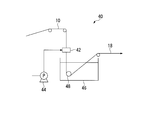
- FIG. 2 is a schematic configuration diagram showing an example of a hollow porous membrane manufacturing apparatus used in steps (i) to (ii).
- the hollow porous membrane manufacturing apparatus 40 includes a double tube spinning nozzle 42 for continuously applying a film forming raw solution to the support 10 continuously supplied from an unwinding device (not shown), and double tube spinning.
- a stock solution supply device 44 for supplying a film-forming stock solution to the nozzle 42, a coagulation bath 46 containing a coagulating liquid for coagulating the film-forming stock solution applied to the support 10, and a support 10 applied with the film-forming stock solution are coagulated.
- a guide roll 48 continuously introduced into the bathtub 46.
- a predetermined amount of the first film-forming stock solution is supplied from the stock solution supply device 44, and the first film-forming stock solution is applied to the outer peripheral surface of the support 10 to obtain a predetermined film thickness.
- the coating film is formed.
- the inner diameter of the pipe line of the double pipe spinning nozzle 42 is slightly larger than the outer diameter of the support body 10, and the inner peripheral surface of the pipe path of the double pipe spinning nozzle 42 and the support body 10 have a certain gap.
- the gap is determined by the thickness of the coating film, the viscosity of the stock solution, the running speed of the support 10 and the like.
- (V) Process For example, the hollow porous membrane is washed in hot water at 60 to 100 ° C. to remove the solvent, then washed with a chemical solution such as hypochlorous acid, and then washed in hot water at 60 to 100 ° C. Then remove the chemical.
- a chemical solution such as hypochlorous acid
- the hollow porous membrane is dried at 60 ° C. or higher and lower than 110 ° C. for 1 minute or longer and less than 24 hours, and then wound around a bobbin, a cassette or the like.
- the hollow porous membrane thus produced becomes a hollow porous membrane free from defects in the membrane caused by the single fiber end of the yarn splicing portion or the fiber breaking portion.
- the method of sequentially forming the first porous membrane layer and the second porous membrane layer using the double tube spinning nozzle 42 is exemplified, but the double tube spinning nozzle 42 is used.
- the double tube spinning nozzle 42 is used.
- two different types of film-forming stock solutions are discharged at the same time and guided to the coagulation bath so that the first porous film layer and the second porous film layer And may be formed simultaneously.
- the production method has been described by exemplifying a hollow porous membrane that includes the support 10 and has a porous membrane layer formed on the outer peripheral surface of the support 10.
- the hollow porous membrane of the present invention at least two of the porous membrane layers are formed using a thermoplastic resin having a mass average molecular weight of 500,000 or more, and burst when an internal pressure is applied.
- the pressure is 200 kPa or more and the virus removal performance when MS2 phage is used as a test bacterium is LRV4 or more, the support may not be provided.
- a pipe for passage of the support in the center is not an internal solidification but a support.
- the internal coagulation liquid is preferably an aqueous solution containing the same solvent as the film-forming stock solution.
- the hollow porous membrane having two porous membrane layers is exemplified and the manufacturing method thereof has been described.
- the hollow porous membrane having three or more porous membrane layers is described.
- a method of increasing the steps (iii) to (iv) according to the number of layers may be adopted.
- the so-called non-solvent induced phase separation method has been exemplified as the method for forming the porous membrane layer.
- a known thermally induced layer separation method may be employed.
- thermoplastic resin (a) having a mass average molecular weight of 500,000 or more, and the burst pressure when an internal pressure is applied.
- a hollow porous membrane having a pressure of 200 kPa or more has resistance to sticking to the membrane surface such as activated carbon and inorganic particles during air scrubbing treatment, and abrasion of the membrane surface by these particles, and thus high virus removal Performance can be maintained.
- a thin piece having a thickness of about 0.5 mm (corresponding to the length in the longitudinal direction of the hollow fiber membrane) was cut out using a razor blade.
- the sliced optical section of the sliced piece is projected onto a screen at a magnification of 100 times (objective lens) using a projector (Nikon Corporation, PROFILE PROJECTOR V-12).
- the outer diameter D of the hollow porous membrane, the total thickness t of the porous membrane layer, and the inner diameter r of the hollow porous membrane were read. This measurement was performed three times, and the average value of the measured values was defined as the outer diameter D of the hollow porous membrane, the total thickness t of the porous membrane layer, and the inner diameter r of the hollow porous membrane.
- the hollow porous membrane was cut into a length of 4 cm, and one end of the cut hollow porous membrane was sealed with a polyurethane resin.
- the sample was immersed in ethanol and the hollow porous membrane was evacuated for 5 minutes or more, and then the sample was immersed in pure water to replace the pores with pure water.
- a container containing pure water (25 ° C.) was prepared, the other end of the sample (that is, the open end not sealed with polyurethane resin) and the container were connected by a tube, and an air pressure of 100 kPa was applied in the container.
- pure water was allowed to flow out of the sample holes.
- the amount of pure water coming out of the hole was measured for 1 minute. This was measured three times to obtain an average value. This value was divided by the surface area of the sample, and the value converted to a pressure of 1 MPa was taken as the water permeation performance of the hollow porous membrane.
- the hollow porous membrane was cut into a length of 4 cm, and one end of the cut hollow porous membrane was sealed with a polyurethane resin.
- the sample is immersed in ethanol (25 ° C.), the other end of the sample is connected to the prepared container with a tube, and the internal pressure is gradually applied to the container with compressed air. Was measured. This measurement was performed three times, and the minimum value among the three measured pressure values was defined as the burst pressure of the hollow porous membrane.
- Samples ( ⁇ ) were prepared by bundling hollow porous membranes having a surface area of 280 cm 2 and sealing one end with a polyurethane resin.
- the sample ( ⁇ ) is immersed in a container containing pure water (25 ° C.), a tube is connected to the unsealed end of the sample ( ⁇ ), and an internal pressure is applied to the sample ( ⁇ ) with 100 kPa air through the tube. It was. At this time, generation of bubbles from the sample ( ⁇ ) was not observed. This confirmed that the sample ( ⁇ ) before the air scrubbing test had no defects.
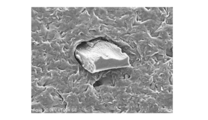
- a container having a capacity enough to contain the sample ( ⁇ ) is filled with pure water, and a wooden activated carbon (picahydroMP23 Pica USA, Inc) shown in FIG. 3 is added to the pure water to a concentration of 6000 ppm. Then, an activated carbon dispersion solution was prepared. After the sample ( ⁇ ) was immersed in ethanol and the hollow porous membrane was decompressed for 5 minutes or more, the sample ( ⁇ ) was immersed in pure water to replace the pores with pure water. Thereafter, the sample ( ⁇ ) was immersed in the activated carbon dispersion solution.
- Virus removal performance Escherichia coli phase MS2 (particle size: about 25 nm) was used as a test bacterium, grown in E. coli to the order of 10 6 pfu / ml, adjusted to pH 7 with 0.1 ml M phosphate buffer, and this was used as a test stock solution. And the virus removal performance of the hollow porous membrane was evaluated by the following nondestructive test. (1) Virus removal performance after air scrubbing test Both ends of the sample ( ⁇ ) used in the air scrubbing test were cut off, and the bundled hollow porous membrane was once separated. Thereafter, 15 of them were bundled again and bent into a U-shape. On the other hand, a cylindrical case with one end opened was prepared.
- the hollow porous membrane was fixed in the cylindrical case using polyurethane resin so that the opening of the both ends of the hollow porous membrane bent in the U shape was maintained. Then, 1000 ml of the phage solution is fed into the cylindrical case through a hole provided in the wall surface of the cylindrical case under a pressure of 20 kPa, and the phage solution is filtered into a hollow porous membrane by out-in. I let you. Then, the filtrate was taken out from the open end of the hollow porous membrane, and the final flow of 20 ml was sampled. MS2 of the test stock solution and the sampled filtrate was quantified, and the removal performance of MS2 phage after the air scrubbing test was calculated from the following formula (2).
- Virus removal performance before air scrubbing test The removal performance of MS2 phage before air scrubbing test was also calculated in the same manner as described above, except that a hollow porous membrane not subjected to air scrubbing test was used. .
- Example 1 In the following manner, two porous membrane layers made of polyvinylidene fluoride having a mass average molecular weight of 500,000 or more are formed on the outer peripheral surface of a knitted string support obtained by circularly knitting multifilaments in a cylindrical shape, and the burst pressure is reduced. A hollow porous membrane having a virus removal performance of LRV4 or higher when MS2 phage was used as a test bacterium at 200 kPa or higher was produced. In addition, as the knitted string support, a multi-filament made of polyester having a fineness of 167 dtex was circularly knitted using the support manufacturing apparatus of FIG.
- a hollow porous membrane was produced using the production apparatus shown in FIG.
- the knitted string support is passed through the center pipe line of the double tube spinning nozzle, the first film forming stock solution is fed from the outside, and the first film forming stock solution is applied to the outer peripheral surface of the knitted string support.
- the first porous membrane layer is solidified by being led to a first coagulation bath filled with an N-methyl-2-pyrrolidone aqueous solution (coagulation liquid) having a solvent concentration of 40% by mass and a temperature of 25 ° C. Formed.
- coagulation liquid N-methyl-2-pyrrolidone aqueous solution having a solvent concentration of 40% by mass and a temperature of 25 ° C. Formed.
- the second membrane-forming stock solution was applied onto the first porous membrane layer in the same manner as in the case of the first membrane-forming stock solution, and N-methyl having a solvent concentration of 30 mass% and a temperature of 61 ° C.
- a second porous film layer was formed by being guided to a second coagulation bath filled with a -2-pyrrolidone aqueous solution (coagulation liquid) and coagulating. After immersing this in a sodium hypochlorite solution at a normal temperature at a concentration of 13% by mass, staying in a steam atmosphere at 100 ° C. and then immersing it in warm water at 90 ° C. three times, The polyvinylpyrrolidone remaining in was washed and removed. After washing, moisture remaining in the membrane was evaporated in a drying oven heated to 105 ° C. and dried to obtain a hollow porous membrane.
- the obtained hollow porous membrane had an outer diameter of 1.56 mm, an inner diameter of 0.88 mm, a total thickness of the porous membrane layer made of polyvinylidene fluoride: 77 ⁇ m, a burst pressure: 343 kPa, pure
- the water permeability of water was 11.0 m 3 / m 2 / hr / MPa.
- the virus removal performance was 6.2 before the air scrubbing test and 5.4 after the test, and there was no significant decrease in the virus removal performance.
- Example 2 In the following manner, two porous membrane layers made of polyvinylidene fluoride having a mass average molecular weight of 500,000 or more are formed on the outer peripheral surface of a knitted string support obtained by circularly knitting multifilaments in a cylindrical shape, and the burst pressure is reduced. A hollow porous membrane having a virus removal performance of LRV4 or higher when MS2 phage was used as a test bacterium at 200 kPa or higher was produced.
- Second film-forming stock solution 15.2% by mass of polyvinylidene fluoride (mass average molecular weight: 1.1 ⁇ 10 6 ), 8.6% by mass of polyvinylpyrrolidone (mass average molecular weight: 4 ⁇ 10 4 ), and N-methyl- which is a solvent 76.2% by mass of 2-pyrrolidone was stirred and mixed at room temperature to obtain a second film-forming stock solution.
- the obtained hollow porous membrane has an outer diameter of 1.59 mm, an inner diameter of 0.91 mm, a total thickness of the porous membrane layer made of polyvinylidene fluoride: 86 ⁇ m, a burst pressure: 304 kPa, pure Water permeability of water: 13.5 m 3 / m 2 / hr / MPa.
- the virus removal performance was 6.8 before the air scrubbing test and 5.9 after the test, and there was no significant decrease in the virus removal performance.
- Example 3 In the following manner, two porous membrane layers made of polyvinylidene fluoride having a mass average molecular weight of 500,000 or more are formed on the outer peripheral surface of a knitted string support obtained by circularly knitting multifilaments in a cylindrical shape, and the burst pressure is 200 kPa.
- a hollow porous membrane having a virus removal performance of LRV4 or higher when MS2 phage was used as a test bacterium was produced.
- a hollow porous membrane was produced in the same manner as in Example 2 using the above-mentioned first membrane forming stock solution and second membrane forming stock solution.
- the obtained hollow porous membrane has an outer diameter of 1.60 mm, an inner diameter of 0.91 mm, a total thickness of a porous membrane layer made of polyvinylidene fluoride: 83 ⁇ m, a burst pressure: 230 kPa, pure Water permeability of water: 18.6 m 3 / m 2 / hr / MPa.
- the virus removal performance was 4.7 before the air scrubbing test and 4.2 after the test, and there was no significant decrease in the virus removal performance.
- a porous membrane layer made of polyvinylidene fluoride having a mass average molecular weight of 500,000 or more is formed on the outer peripheral surface of a braided string support formed by circularly knitting multifilaments in the following manner, and the burst pressure is 200 kPa.
- the above hollow porous membrane was manufactured.
- a hollow porous membrane was produced using the production apparatus shown in FIG.
- the knitted string support is passed through the center pipe line of the double tube spinning nozzle, the first film forming stock solution is fed from the outside, and the first film forming stock solution is applied to the outer peripheral surface of the knitted string support.
- the film was led to a first coagulation bath filled with an N-methyl-2-pyrrolidone aqueous solution (coagulation liquid) having a solvent concentration of 30% by mass and a temperature of 60 ° C., and coagulated to form a film.
- coagulation liquid N-methyl-2-pyrrolidone aqueous solution having a solvent concentration of 30% by mass and a temperature of 60 ° C.
- the obtained hollow porous membrane had an outer diameter of 1.50 mm, an inner diameter of 0.88 mm, and the total thickness (layer thickness) of the porous membrane layer made of polyvinylidene fluoride was 50 ⁇ m.
- the bursting pressure was 282 kPa, and the water permeability of pure water was 19.7 m 3 / m 2 / hr / MPa.
- the virus removal performance was 2.3 after the air scrubbing test and was greatly reduced from 4.8 before the test.
- Second film-forming stock solution 15.0% by mass of polyvinylidene fluoride (mass average molecular weight: 6.8 ⁇ 10 5 ), 17.7% by mass of polyvinylpyrrolidone (mass average molecular weight: 4.0 ⁇ 10 4 ), and N— which is a solvent 67.3 mass% of methyl-2-pyrrolidone was stirred and mixed at room temperature to obtain a second film-forming stock solution.
- a hollow porous membrane was produced in the same manner as in Example 1 using the above-mentioned first membrane forming stock solution and second membrane forming stock solution. However, an N-methyl-2-pyrrolidone aqueous solution (coagulation liquid) having a solvent concentration of 30% by mass and a temperature of 55 ° C. is used for the first coagulation bath, and a concentration of 30% by mass is used for the second coagulation tank. An N-methyl-2-pyrrolidone aqueous solution (coagulation solution) having a temperature of 59 ° C. was used.
- the obtained hollow porous membrane had an outer diameter of 1.66 mm, an inner diameter of 0.91 mm, a total thickness of the porous membrane layer made of polyvinylidene fluoride: 93 ⁇ m, a burst pressure of 159 kPa, pure Water permeability of water: 7.1 m 3 / m 2 / hr / MPa.
- the virus removal performance (LRV) was 2.0 before the air scrubbing test. Further, defect points were generated in the air scrubbing test.
- the hollow porous membrane having a bursting pressure of less than 200 kPa even if it has two layers made of the thermoplastic resin (a) Can be manufactured.
- a defect point is likely to occur due to the burst pressure being less than 200 kPa, so that a defect point is generated in the air scrubbing test.
- a porous membrane layer made of polyvinylidene fluoride was formed one by one to produce a hollow porous membrane having a burst pressure of 200 kPa or more.
- a hollow porous membrane was produced using the production apparatus shown in FIG. However, a triple pipe spinning nozzle was used instead of the double pipe spinning nozzle 42.
- the knitted string support is passed through the central pipe line of the triple tube spinning nozzle, and the first film forming solution and the second film forming solution are simultaneously fed from the outside to the outer peripheral surface of the knitted string support.
- the solution was filled with an aqueous N, N-dimethylacetamide solution (coagulating solution) having a solvent concentration of 20% by mass and a temperature of 64 ° C.
- the first coagulation bath was led and solidified to form a film.
- the obtained hollow porous membrane has an outer diameter of 1.62 mm, an inner diameter of 0.88 mm, a total thickness of the porous membrane layer made of polyvinylidene fluoride: 98 ⁇ m, a burst pressure: 242 kPa, pure
- the water permeability of water was 19.8 m 3 / m 2 / hr / MPa.
- the virus removal performance (LRV) was 6.4 before the air scrubbing test. Further, defect points were generated in the air scrubbing test.
- the mass average molecular weight of the two kinds of mixtures was calculated as 4.3 ⁇ 10 5 from the formula (1).
- Polyvinylidene fluoride weight average molecular weight: 5.5 ⁇ 10 5) and 12.0 wt% of polyvinylidene fluoride (weight average molecular weight: 2.5 ⁇ 10 5) and 8.0 wt% of polyvinylpyrrolidone (weight 10.0% by mass of average molecular weight: 1.3 ⁇ 10 6 ) and 70.0% by mass of N, N-dimethylacetamide as a solvent are stirred and mixed at room temperature to obtain a second film-forming stock solution. It was.
- a hollow porous membrane was produced in the same manner as in Example 1 using the above-mentioned first membrane forming stock solution and second membrane forming stock solution. However, an N, N-dimethylacetamide aqueous solution (coagulating liquid) having a solvent concentration of 5 mass% and a temperature of 80 ° C. was used for the first coagulating bath.
- the obtained hollow porous membrane had an outer diameter of 2.72 mm, an inner diameter of 1.20 mm, a total thickness of the porous membrane layer made of polyvinylidene fluoride: 433 ⁇ m, a burst pressure: 208 kPa, pure Water permeability of water: 84.7 m 3 / m 2 / hr / MPa.
- the virus removal performance (LRV) was 0.04 before the air scrubbing test, and the virus removal performance was not sufficient.
- the hollow porous membrane of each example having two porous membrane layers made of polyvinylidene fluoride having a mass average molecular weight of 500,000 or more and having a burst pressure of 200 kPa or more was subjected to an air scrubbing test in the presence of activated carbon. Even if it did, it had no defects and was resistant to abrasion of the membrane surface by activated carbon, and therefore maintained high virus removal performance.
- the hollow porous membrane of the comparative example was activated by the activated carbon scrubbing test, and the membrane surface was worn out even if no defect point or defect point occurred. The removal performance decreased.
- the hollow porous membrane of the present invention has resistance to the surface of the membrane such as activated carbon and inorganic particles during air scrubbing and the like, and wear resistance of the membrane surface due to these particles. High virus removal performance can be maintained. Therefore, according to the hollow porous membrane of the present invention, it is possible to provide safe treated water with a low risk of remaining viruses, and it is suitably used for water treatment by precision filtration such as sewage treatment and water purification, ultrafiltration, and the like. . In addition, since it is also resistant to abrasion due to contact with inorganic substances, it is also suitable for use in combination with activated carbon.
Landscapes
- Chemical & Material Sciences (AREA)
- Chemical Kinetics & Catalysis (AREA)
- Engineering & Computer Science (AREA)
- Materials Engineering (AREA)
- Health & Medical Sciences (AREA)
- Medicinal Chemistry (AREA)
- Polymers & Plastics (AREA)
- Organic Chemistry (AREA)
- Separation Using Semi-Permeable Membranes (AREA)
- Manufacture Of Porous Articles, And Recovery And Treatment Of Waste Products (AREA)
Priority Applications (5)
| Application Number | Priority Date | Filing Date | Title |
|---|---|---|---|
| US14/404,572 US9694327B2 (en) | 2012-06-01 | 2013-05-31 | Hollow porous membrane |
| EP13797685.8A EP2878363A4 (fr) | 2012-06-01 | 2013-05-31 | Film poreux creux |
| JP2013528149A JP5772959B2 (ja) | 2012-06-01 | 2013-05-31 | 中空状多孔質膜 |
| KR1020147033040A KR20150011819A (ko) | 2012-06-01 | 2013-05-31 | 중공상 다공질막 |
| CN201380039484.4A CN104487159B (zh) | 2012-06-01 | 2013-05-31 | 中空状多孔膜 |
Applications Claiming Priority (2)
| Application Number | Priority Date | Filing Date | Title |
|---|---|---|---|
| JP2012125875 | 2012-06-01 | ||
| JP2012-125875 | 2012-06-01 |
Publications (1)
| Publication Number | Publication Date |
|---|---|
| WO2013180272A1 true WO2013180272A1 (fr) | 2013-12-05 |
Family
ID=49673455
Family Applications (1)
| Application Number | Title | Priority Date | Filing Date |
|---|---|---|---|
| PCT/JP2013/065204 Ceased WO2013180272A1 (fr) | 2012-06-01 | 2013-05-31 | Film poreux creux |
Country Status (6)
| Country | Link |
|---|---|
| US (1) | US9694327B2 (fr) |
| EP (1) | EP2878363A4 (fr) |
| JP (1) | JP5772959B2 (fr) |
| KR (1) | KR20150011819A (fr) |
| CN (1) | CN104487159B (fr) |
| WO (1) | WO2013180272A1 (fr) |
Cited By (1)
| Publication number | Priority date | Publication date | Assignee | Title |
|---|---|---|---|---|
| JP2019103964A (ja) * | 2017-12-11 | 2019-06-27 | 積水化学工業株式会社 | 複合膜 |
Families Citing this family (2)
| Publication number | Priority date | Publication date | Assignee | Title |
|---|---|---|---|---|
| US10730774B1 (en) * | 2013-05-10 | 2020-08-04 | M. Eugene Evans | Waste water treatment system and method |
| AU2018342736A1 (en) * | 2017-09-28 | 2020-04-09 | Toray Industries, Inc. | Porous hollow fiber membrane and method for producing same |
Citations (6)
| Publication number | Priority date | Publication date | Assignee | Title |
|---|---|---|---|---|
| JPH04505579A (ja) * | 1990-05-10 | 1992-10-01 | ミリポア コーポレイション | 溶液からのウイルスの分離のための膜 |
| JP2006224051A (ja) | 2005-02-21 | 2006-08-31 | Toray Ind Inc | 多孔質膜、多孔質膜エレメント、および膜ろ過装置 |
| JP2008296220A (ja) * | 2004-06-25 | 2008-12-11 | Millipore Corp | 限外濾過膜および製造方法 |
| JP2009219979A (ja) | 2008-03-14 | 2009-10-01 | Asahi Kasei Chemicals Corp | 多孔性多層中空糸膜 |
| JP2010094670A (ja) | 2008-09-19 | 2010-04-30 | Toray Ind Inc | ポリフッ化ビニリデン系複合膜およびその製造方法 |
| JP2011036848A (ja) * | 2009-07-14 | 2011-02-24 | Toray Ind Inc | ポリフッ化ビニリデン系樹脂製分離膜およびその製造方法 |
Family Cites Families (20)
| Publication number | Priority date | Publication date | Assignee | Title |
|---|---|---|---|---|
| JPS53104578A (en) | 1977-02-24 | 1978-09-11 | Asahi Chem Ind Co Ltd | Hollow form micro-filter and production of the same |
| JPH0647066B2 (ja) | 1985-10-02 | 1994-06-22 | 宇部興産株式会社 | 多孔質分離膜とその製造方法 |
| US5472607A (en) * | 1993-12-20 | 1995-12-05 | Zenon Environmental Inc. | Hollow fiber semipermeable membrane of tubular braid |
| US6354444B1 (en) | 1997-07-01 | 2002-03-12 | Zenon Environmental Inc. | Hollow fiber membrane and braided tubular support therefor |
| US7229665B2 (en) * | 2001-05-22 | 2007-06-12 | Millipore Corporation | Process of forming multilayered structures |
| JP2003311133A (ja) | 2002-04-19 | 2003-11-05 | Daicel Chem Ind Ltd | 中空糸状半透膜 |
| US7306105B2 (en) | 2002-11-12 | 2007-12-11 | Mitsubishi Rayon Co., Ltd. | Composite porous membrane and method for producing the same |
| JP5339677B2 (ja) * | 2004-06-15 | 2013-11-13 | 株式会社クレハ | フッ化ビニリデン系樹脂中空糸多孔濾水膜およびその製造方法 |
| JP4757311B2 (ja) | 2005-11-29 | 2011-08-24 | コーロン インダストリーズ インク | 編物により補強された複合中空繊維膜 |
| JP2008114180A (ja) | 2006-11-07 | 2008-05-22 | Mitsubishi Rayon Co Ltd | 中空状多孔質膜用支持体、中空状多孔質膜およびそれらの製造方法 |
| JP2007083239A (ja) | 2006-12-15 | 2007-04-05 | Daicel Chem Ind Ltd | 中空糸状半透膜 |
| TWI377978B (en) | 2008-05-21 | 2012-12-01 | Mitsubishi Rayon Co | Hollow porous film and manufacturing method thereof |
| CN102159305B (zh) | 2008-09-19 | 2015-08-19 | 东丽株式会社 | 分离膜及其制造方法 |
| CN101439268B (zh) * | 2008-12-09 | 2011-06-29 | 南京龙源环保有限公司 | 高强度高通量聚偏氟乙烯中空纤维膜的制备方法 |
| JP5626865B2 (ja) | 2010-08-13 | 2014-11-19 | 旭化成ケミカルズ株式会社 | 複合多孔性中空糸膜、膜モジュール、膜ろ過装置、水処理方法 |
| WO2012148068A1 (fr) * | 2011-04-26 | 2012-11-01 | 제일모직 주식회사 | Membrane à fibre creuse ayant un monofilament renforcé |
| JP5796433B2 (ja) * | 2011-09-16 | 2015-10-21 | 三菱レイヨン株式会社 | 細径中空状多孔質膜 |
| CN102366714B (zh) * | 2011-10-21 | 2013-08-21 | 湖州森蓝环境工程有限公司 | 一种小孔径高通量中空纤维多微孔膜制备方法及其制品 |
| JP2013128865A (ja) | 2011-12-20 | 2013-07-04 | Mitsubishi Rayon Co Ltd | 中空糸膜用支持体及び中空糸膜並びにこれらの製造方法 |
| KR101916502B1 (ko) * | 2012-06-29 | 2018-11-07 | 미쯔비시 케미컬 주식회사 | 중공상 다공질막 |
-
2013
- 2013-05-31 EP EP13797685.8A patent/EP2878363A4/fr not_active Ceased
- 2013-05-31 US US14/404,572 patent/US9694327B2/en not_active Expired - Fee Related
- 2013-05-31 KR KR1020147033040A patent/KR20150011819A/ko not_active Ceased
- 2013-05-31 JP JP2013528149A patent/JP5772959B2/ja active Active
- 2013-05-31 CN CN201380039484.4A patent/CN104487159B/zh not_active Expired - Fee Related
- 2013-05-31 WO PCT/JP2013/065204 patent/WO2013180272A1/fr not_active Ceased
Patent Citations (6)
| Publication number | Priority date | Publication date | Assignee | Title |
|---|---|---|---|---|
| JPH04505579A (ja) * | 1990-05-10 | 1992-10-01 | ミリポア コーポレイション | 溶液からのウイルスの分離のための膜 |
| JP2008296220A (ja) * | 2004-06-25 | 2008-12-11 | Millipore Corp | 限外濾過膜および製造方法 |
| JP2006224051A (ja) | 2005-02-21 | 2006-08-31 | Toray Ind Inc | 多孔質膜、多孔質膜エレメント、および膜ろ過装置 |
| JP2009219979A (ja) | 2008-03-14 | 2009-10-01 | Asahi Kasei Chemicals Corp | 多孔性多層中空糸膜 |
| JP2010094670A (ja) | 2008-09-19 | 2010-04-30 | Toray Ind Inc | ポリフッ化ビニリデン系複合膜およびその製造方法 |
| JP2011036848A (ja) * | 2009-07-14 | 2011-02-24 | Toray Ind Inc | ポリフッ化ビニリデン系樹脂製分離膜およびその製造方法 |
Non-Patent Citations (2)
| Title |
|---|
| NIHON REOROJI GAKKAISHI, vol. 28, no. 3, 2000, pages 99 - 103 |
| See also references of EP2878363A1 |
Cited By (1)
| Publication number | Priority date | Publication date | Assignee | Title |
|---|---|---|---|---|
| JP2019103964A (ja) * | 2017-12-11 | 2019-06-27 | 積水化学工業株式会社 | 複合膜 |
Also Published As
| Publication number | Publication date |
|---|---|
| EP2878363A1 (fr) | 2015-06-03 |
| KR20150011819A (ko) | 2015-02-02 |
| US9694327B2 (en) | 2017-07-04 |
| JP5772959B2 (ja) | 2015-09-02 |
| EP2878363A4 (fr) | 2015-09-16 |
| JPWO2013180272A1 (ja) | 2016-01-21 |
| CN104487159B (zh) | 2019-04-12 |
| US20150108060A1 (en) | 2015-04-23 |
| CN104487159A (zh) | 2015-04-01 |
Similar Documents
| Publication | Publication Date | Title |
|---|---|---|
| JP6115592B2 (ja) | 中空状多孔質膜 | |
| JP6020592B2 (ja) | 多孔質中空糸膜及びその製造方法 | |
| CN102036741B (zh) | 中空状多孔质膜及其制造方法 | |
| JP4361901B2 (ja) | 多孔質中空糸膜及びその製造方法 | |
| JP2019022893A (ja) | 中空状多孔質膜及びその製造方法 | |
| JP5772959B2 (ja) | 中空状多孔質膜 | |
| JP2008114180A (ja) | 中空状多孔質膜用支持体、中空状多孔質膜およびそれらの製造方法 | |
| JP5207220B2 (ja) | 中空状多孔質膜用支持体、中空状多孔質膜およびそれらの製造方法 | |
| JP5796433B2 (ja) | 細径中空状多孔質膜 | |
| JP5637176B2 (ja) | 中空状多孔質膜用支持体の製造方法、中空状多孔質膜およびその製造方法 | |
| JP6863333B2 (ja) | 水処理膜エレメントの製造方法 | |
| JP2013128865A (ja) | 中空糸膜用支持体及び中空糸膜並びにこれらの製造方法 | |
| JP5197865B2 (ja) | 中空状多孔質膜用支持体、中空状多孔質膜およびそれらの製造方法 | |
| KR20100108649A (ko) | 복합 중공사막 및 그 제조방법 |
Legal Events
| Date | Code | Title | Description |
|---|---|---|---|
| ENP | Entry into the national phase |
Ref document number: 2013528149 Country of ref document: JP Kind code of ref document: A |
|
| 121 | Ep: the epo has been informed by wipo that ep was designated in this application |
Ref document number: 13797685 Country of ref document: EP Kind code of ref document: A1 |
|
| ENP | Entry into the national phase |
Ref document number: 20147033040 Country of ref document: KR Kind code of ref document: A |
|
| WWE | Wipo information: entry into national phase |
Ref document number: 14404572 Country of ref document: US |
|
| NENP | Non-entry into the national phase |
Ref country code: DE |
|
| WWE | Wipo information: entry into national phase |
Ref document number: 2013797685 Country of ref document: EP |