WO2014002908A1 - コーティング剤、ならびにこれを用いた塗膜およびフィルム - Google Patents
コーティング剤、ならびにこれを用いた塗膜およびフィルム Download PDFInfo
- Publication number
- WO2014002908A1 WO2014002908A1 PCT/JP2013/067132 JP2013067132W WO2014002908A1 WO 2014002908 A1 WO2014002908 A1 WO 2014002908A1 JP 2013067132 W JP2013067132 W JP 2013067132W WO 2014002908 A1 WO2014002908 A1 WO 2014002908A1
- Authority
- WO
- WIPO (PCT)
- Prior art keywords
- film
- polyoxyalkylene
- coating agent
- mass
- coating
- Prior art date
- Legal status (The legal status is an assumption and is not a legal conclusion. Google has not performed a legal analysis and makes no representation as to the accuracy of the status listed.)
- Ceased
Links
Classifications
-
- C—CHEMISTRY; METALLURGY
- C08—ORGANIC MACROMOLECULAR COMPOUNDS; THEIR PREPARATION OR CHEMICAL WORKING-UP; COMPOSITIONS BASED THEREON
- C08G—MACROMOLECULAR COMPOUNDS OBTAINED OTHERWISE THAN BY REACTIONS ONLY INVOLVING UNSATURATED CARBON-TO-CARBON BONDS
- C08G18/00—Polymeric products of isocyanates or isothiocyanates
- C08G18/06—Polymeric products of isocyanates or isothiocyanates with compounds having active hydrogen
- C08G18/28—Polymeric products of isocyanates or isothiocyanates with compounds having active hydrogen characterised by the compounds used containing active hydrogen
- C08G18/40—High-molecular-weight compounds
- C08G18/48—Polyethers
- C08G18/4833—Polyethers containing oxyethylene units
- C08G18/4837—Polyethers containing oxyethylene units and other oxyalkylene units
-
- C—CHEMISTRY; METALLURGY
- C09—DYES; PAINTS; POLISHES; NATURAL RESINS; ADHESIVES; COMPOSITIONS NOT OTHERWISE PROVIDED FOR; APPLICATIONS OF MATERIALS NOT OTHERWISE PROVIDED FOR
- C09D—COATING COMPOSITIONS, e.g. PAINTS, VARNISHES OR LACQUERS; FILLING PASTES; CHEMICAL PAINT OR INK REMOVERS; INKS; CORRECTING FLUIDS; WOODSTAINS; PASTES OR SOLIDS FOR COLOURING OR PRINTING; USE OF MATERIALS THEREFOR
- C09D175/00—Coating compositions based on polyureas or polyurethanes; Coating compositions based on derivatives of such polymers
- C09D175/04—Polyurethanes
- C09D175/08—Polyurethanes from polyethers
-
- C—CHEMISTRY; METALLURGY
- C08—ORGANIC MACROMOLECULAR COMPOUNDS; THEIR PREPARATION OR CHEMICAL WORKING-UP; COMPOSITIONS BASED THEREON
- C08G—MACROMOLECULAR COMPOUNDS OBTAINED OTHERWISE THAN BY REACTIONS ONLY INVOLVING UNSATURATED CARBON-TO-CARBON BONDS
- C08G18/00—Polymeric products of isocyanates or isothiocyanates
- C08G18/06—Polymeric products of isocyanates or isothiocyanates with compounds having active hydrogen
- C08G18/28—Polymeric products of isocyanates or isothiocyanates with compounds having active hydrogen characterised by the compounds used containing active hydrogen
- C08G18/40—High-molecular-weight compounds
- C08G18/48—Polyethers
- C08G18/4804—Two or more polyethers of different physical or chemical nature
- C08G18/4808—Mixtures of two or more polyetherdiols
-
- C—CHEMISTRY; METALLURGY
- C08—ORGANIC MACROMOLECULAR COMPOUNDS; THEIR PREPARATION OR CHEMICAL WORKING-UP; COMPOSITIONS BASED THEREON
- C08G—MACROMOLECULAR COMPOUNDS OBTAINED OTHERWISE THAN BY REACTIONS ONLY INVOLVING UNSATURATED CARBON-TO-CARBON BONDS
- C08G18/00—Polymeric products of isocyanates or isothiocyanates
- C08G18/06—Polymeric products of isocyanates or isothiocyanates with compounds having active hydrogen
- C08G18/28—Polymeric products of isocyanates or isothiocyanates with compounds having active hydrogen characterised by the compounds used containing active hydrogen
- C08G18/40—High-molecular-weight compounds
- C08G18/48—Polyethers
- C08G18/4804—Two or more polyethers of different physical or chemical nature
- C08G18/4812—Mixtures of polyetherdiols with polyetherpolyols having at least three hydroxy groups
-
- C—CHEMISTRY; METALLURGY
- C08—ORGANIC MACROMOLECULAR COMPOUNDS; THEIR PREPARATION OR CHEMICAL WORKING-UP; COMPOSITIONS BASED THEREON
- C08G—MACROMOLECULAR COMPOUNDS OBTAINED OTHERWISE THAN BY REACTIONS ONLY INVOLVING UNSATURATED CARBON-TO-CARBON BONDS
- C08G18/00—Polymeric products of isocyanates or isothiocyanates
- C08G18/06—Polymeric products of isocyanates or isothiocyanates with compounds having active hydrogen
- C08G18/28—Polymeric products of isocyanates or isothiocyanates with compounds having active hydrogen characterised by the compounds used containing active hydrogen
- C08G18/40—High-molecular-weight compounds
- C08G18/48—Polyethers
- C08G18/4833—Polyethers containing oxyethylene units
-
- C—CHEMISTRY; METALLURGY
- C08—ORGANIC MACROMOLECULAR COMPOUNDS; THEIR PREPARATION OR CHEMICAL WORKING-UP; COMPOSITIONS BASED THEREON
- C08G—MACROMOLECULAR COMPOUNDS OBTAINED OTHERWISE THAN BY REACTIONS ONLY INVOLVING UNSATURATED CARBON-TO-CARBON BONDS
- C08G18/00—Polymeric products of isocyanates or isothiocyanates
- C08G18/06—Polymeric products of isocyanates or isothiocyanates with compounds having active hydrogen
- C08G18/28—Polymeric products of isocyanates or isothiocyanates with compounds having active hydrogen characterised by the compounds used containing active hydrogen
- C08G18/40—High-molecular-weight compounds
- C08G18/48—Polyethers
- C08G18/4833—Polyethers containing oxyethylene units
- C08G18/4837—Polyethers containing oxyethylene units and other oxyalkylene units
- C08G18/4845—Polyethers containing oxyethylene units and other oxyalkylene units containing oxypropylene or higher oxyalkylene end groups
-
- C—CHEMISTRY; METALLURGY
- C08—ORGANIC MACROMOLECULAR COMPOUNDS; THEIR PREPARATION OR CHEMICAL WORKING-UP; COMPOSITIONS BASED THEREON
- C08G—MACROMOLECULAR COMPOUNDS OBTAINED OTHERWISE THAN BY REACTIONS ONLY INVOLVING UNSATURATED CARBON-TO-CARBON BONDS
- C08G18/00—Polymeric products of isocyanates or isothiocyanates
- C08G18/06—Polymeric products of isocyanates or isothiocyanates with compounds having active hydrogen
- C08G18/70—Polymeric products of isocyanates or isothiocyanates with compounds having active hydrogen characterised by the isocyanates or isothiocyanates used
- C08G18/72—Polyisocyanates or polyisothiocyanates
- C08G18/74—Polyisocyanates or polyisothiocyanates cyclic
- C08G18/76—Polyisocyanates or polyisothiocyanates cyclic aromatic
- C08G18/7657—Polyisocyanates or polyisothiocyanates cyclic aromatic containing two or more aromatic rings
- C08G18/7664—Polyisocyanates or polyisothiocyanates cyclic aromatic containing two or more aromatic rings containing alkylene polyphenyl groups
- C08G18/7671—Polyisocyanates or polyisothiocyanates cyclic aromatic containing two or more aromatic rings containing alkylene polyphenyl groups containing only one alkylene bisphenyl group
-
- C—CHEMISTRY; METALLURGY
- C08—ORGANIC MACROMOLECULAR COMPOUNDS; THEIR PREPARATION OR CHEMICAL WORKING-UP; COMPOSITIONS BASED THEREON
- C08J—WORKING-UP; GENERAL PROCESSES OF COMPOUNDING; AFTER-TREATMENT NOT COVERED BY SUBCLASSES C08B, C08C, C08F, C08G or C08H
- C08J5/00—Manufacture of articles or shaped materials containing macromolecular substances
- C08J5/18—Manufacture of films or sheets
-
- C—CHEMISTRY; METALLURGY
- C09—DYES; PAINTS; POLISHES; NATURAL RESINS; ADHESIVES; COMPOSITIONS NOT OTHERWISE PROVIDED FOR; APPLICATIONS OF MATERIALS NOT OTHERWISE PROVIDED FOR
- C09D—COATING COMPOSITIONS, e.g. PAINTS, VARNISHES OR LACQUERS; FILLING PASTES; CHEMICAL PAINT OR INK REMOVERS; INKS; CORRECTING FLUIDS; WOODSTAINS; PASTES OR SOLIDS FOR COLOURING OR PRINTING; USE OF MATERIALS THEREFOR
- C09D175/00—Coating compositions based on polyureas or polyurethanes; Coating compositions based on derivatives of such polymers
- C09D175/04—Polyurethanes
-
- C—CHEMISTRY; METALLURGY
- C08—ORGANIC MACROMOLECULAR COMPOUNDS; THEIR PREPARATION OR CHEMICAL WORKING-UP; COMPOSITIONS BASED THEREON
- C08J—WORKING-UP; GENERAL PROCESSES OF COMPOUNDING; AFTER-TREATMENT NOT COVERED BY SUBCLASSES C08B, C08C, C08F, C08G or C08H
- C08J2375/00—Characterised by the use of polyureas or polyurethanes; Derivatives of such polymers
- C08J2375/04—Polyurethanes
- C08J2375/08—Polyurethanes from polyethers
Definitions
- the present invention relates to a coating agent suitable for forming a moisture-permeable coating film or film, a coating film obtained using the coating agent, and a film obtained using the coating agent.
- hydrophilic polyurethane resin that is substantially nonporous on a porous substrate such as fabric.
- the hydrophilic polyurethane resin layer absorbs moisture from the high-humidity side and releases moisture to the low-humidity side, thereby exhibiting moisture permeability.
- a method of forming a coating film by applying a solution and dispersion of a hydrophilic polyurethane resin to a porous substrate, and a raw material mixture of the hydrophilic polyurethane resin, A coating agent selected from the solution and dispersion is directly applied to a porous substrate to form a coating film, or the coating agent is applied onto a peelable substrate and completely cured.
- a method is generally employed in which an uncured coating film is formed and then the uncured coating film is laminated on a porous substrate and then cured.
- the average number of hydroxyl groups in this polyol mixture is about 2.1, and the molecular weight per hydroxyl group is about 1,000.
- the average number of hydroxyl groups n is 2.7 ⁇ n ⁇ 3.6, and the average content of oxyethylene groups is 60 to 90% by weight.
- a polyoxyalkylene polyol mixture is used.
- the average number of hydroxyl groups of the polyoxyalkylene-based polyol mixture used in Example 4 (Comparative Example) of Patent Document 2 is 2.6, and the molecular weight per hydroxyl group is about 1093.
- the coating film or film having moisture permeability it is desired to further improve moisture permeability, flexibility, and tensile strength with diversification of uses.
- the average number of hydroxyl groups in the polyol mixture may be increased, but the flexibility tends to decrease.
- the coating agents described in Patent Documents 1 and 2 are not necessarily sufficient in storage stability of the isocyanate group-containing prepolymer used as an intermediate of the hydrophilic polyurethane resin, and improvement is desired.
- the present invention has been made in view of the above circumstances, and is a coating agent that can form a coating film or film having good moisture permeability, flexibility, and tensile strength, and a coating film of a hydrophilic polyurethane resin that is a cured product of the coating agent. And a film of a hydrophilic polyurethane resin, which is a cured product of the coating agent.
- the coating agent, the coating film comprising the cured product of the coating agent, and the film comprising the cured product of the coating agent are also excellent in the storage stability of the isocyanate group-containing prepolymer used as the main component of the coating agent. The purpose is to provide.
- the coating agent of the present invention comprises a mixture of two or more polyoxyalkylene polyols having at least one of the number of hydroxyl groups and the hydroxyl value, and the average number of hydroxyl groups is 2.2 to 2.6.
- An isocyanate obtained by reacting a polyol mixture (A) having a molecular weight per hydroxyl group of 1,500 to 10,000 and an oxyethylene group content of 60% by mass or more with a polyisocyanate compound (B) It contains a group-containing prepolymer.
- the ratio of the number of moles of isocyanate groups in the polyisocyanate compound (B) to the number of moles of hydroxyl groups in the polyol mixture (A) is preferably 3.0 to 4.5.
- the polyol mixture (A) is a polyoxyalkylene polyol (a) having a hydroxyl number of 3 or more, an oxyethylene group content of 60% by mass or more, and a molecular weight per hydroxyl group of 1,500 to 10,000.
- This invention provides the coating film or film which consists of hardened
- the coating film or film of a hydrophilic polyurethane resin obtained by curing the isocyanate group-containing prepolymer in the coating agent of the present invention is excellent in moisture permeability, flexibility and tensile strength.
- the isocyanate group-containing prepolymer is also excellent in storage stability. According to the present invention, a coating film or film excellent in flexibility and moisture permeability can be obtained.
- the coating agent of this invention contains the isocyanate group containing prepolymer obtained by making a polyol mixture (A) and a polyisocyanate compound (B) react.
- the isocyanate group-containing prepolymer obtained by reacting the polyol mixture (A) with the polyisocyanate compound (B) is also referred to as “prepolymer (X)”.
- a hydrophilic polyurethane-based resin that is a cured product of the prepolymer (X) obtained by curing the prepolymer (X) with a curing agent such as moisture or diamine is also referred to as “hydrophilic polyurethane (Y)”.
- the coating agent of the present invention is a coating agent containing only prepolymer (X) as a reaction curable component, or a coating agent containing prepolymer (X) and a curing agent as a reaction curable component.
- the prepolymer (X) in the coating film formed by the coating is reacted with moisture in the air and cured.
- the prepolymer (X) in the coating film can be cured by contacting with a gasified curing agent (for example, gasified diamine).
- a gasified curing agent for example, gasified diamine.
- the coating can be performed immediately after mixing the prepolymer (X) and the curing agent because the usable time is usually short. It is preferable to use for.
- the coating agent of the present invention may contain additives such as a stabilizer, a urethanization catalyst, and a reaction modifier, which will be described later, in addition to the reaction curing component.
- a solvent may be mix
- the polyol mixture (A) is composed of a mixture of two or more polyoxyalkylene polyols having at least one of the number of hydroxyl groups and the hydroxyl value, and the average number of hydroxyl groups in the whole mixture is 2.2 to 2.6. Has a molecular weight of 1,500 to 10,000 and an oxyethylene group content of 60% by mass or more.
- the coating film or film of the hydrophilic polyurethane (Y) is excellent and the tensile strength of the film is 2.6 or less.
- the film and film are excellent in flexibility, and the storage stability of the prepolymer (X) before curing is excellent.
- the average number of hydroxyl groups in the polyol mixture (A) is preferably 2.2 to 2.6, and more preferably 2.3 to 2.6.
- the average number of hydroxyl groups of the polyol mixture (A) in the above range (1) a method of mixing two or more polyoxyalkylene polyols having different hydroxyl numbers, or (2) two or more types having different active hydrogen numbers
- the number of active hydrogens in the initiator refers to the number of hydrogen atoms that can undergo a ring-opening addition reaction with a monoepoxide such as ethylene oxide (that is, a hydrogen atom of a reactive group such as a hydroxyl group or an amino group).
- the coating film or film of the hydrophilic polyurethane (Y) is excellent in flexibility and moisture permeability, and when it is 10,000 or less, the hydrophilic polyurethane ( The tensile strength of the coating film or film of Y) is excellent.
- the molecular weight per hydroxyl group in the polyol mixture (A) is preferably 1,500 to 10,000, more preferably 1,500 to 8,000, and particularly preferably 1,500 to 5,000.
- the polyol mixture (A) contains oxyethylene groups (—O—C 2 H 4 —).
- the oxyethylene group is a group that imparts hydrophilicity to the urethane polymer. When the oxyethylene content is 60% by weight or more, good moisture permeability is easily obtained. 60 mass% or more is preferable and, as for oxyethylene group content of a polyol mixture (A), 70 mass% or more is more preferable.
- the upper limit of the oxyethylene group content is not particularly limited, and may be 100% by mass. 95 mass% or less is preferable at the point which prevents crystallization of the polyol at low temperature, 92 mass% or less is more preferable, and 90 mass% or less is especially preferable.
- the polyol mixture (A) preferably contains one or more of the following polyoxyalkylene polyols (a) and one or more of the polyoxyalkylene diols (b). That is, a polyol having an average number of hydroxyl groups of 2.2 to 2.6 by mixing a polyoxyalkylene polyol (a) having 3 or more hydroxyl groups and a polyoxyalkylene diol (b) having 2 hydroxyl groups. It is preferable to obtain a mixture (A).
- the polyoxyalkylene polyol (a) is a polyoxyalkylene polyol having 3 or more hydroxyl groups, an oxyethylene group content of 60% by mass or more, and a molecular weight per hydroxyl group of 1,500 to 10,000.
- the upper limit of the number of hydroxyl groups of the polyoxyalkylene polyol (a) is not particularly limited, but 4 is preferable and 3 is more preferable in terms of the flexibility and storage stability of the coating film or film of the hydrophilic polyurethane (Y).
- the polyoxyalkylene polyol (a) is preferably obtained by ring-opening addition polymerization of ethylene oxide (hereinafter sometimes referred to as EO) or a monoepoxide other than ethylene oxide and ethylene oxide to a trivalent or higher initiator. .
- EO ethylene oxide
- monoepoxides other than ethylene oxide are hereinafter referred to as “other monoepoxides”.
- the trivalent or higher initiator has a functional group to which epoxide can undergo ring-opening addition, for example, an active hydrogen-containing group such as a hydroxyl group, an amino group, an imino group, or a carboxyl group, and the number of active hydrogens per molecule.
- an active hydrogen-containing group such as a hydroxyl group, an amino group, an imino group, or a carboxyl group
- Is preferably a compound having 3 or more.
- examples thereof include compounds such as trihydric or higher polyhydric alcohols, trihydric or higher polyhydric phenols, alkanolamines, and polyamines. Of these, trivalent or tetravalent alcohols are more preferred.
- trivalent or higher initiator examples include glycerin, trimethylolpropane, 1,2,6-hexanetriol, pentaerythritol, diglycerin, dextrose, sucrose, monoethanolamine, diethanolamine, triethanolamine, There are ethylenediamine, propylenediamine, diaminotoluene, diaminodiphenylmethane and the like. Glycerin, pentaerythritol and trimethylolpropane are particularly preferred. These initiators can be used alone or in combination of two or more.
- the other monoepoxide is propylene oxide (hereinafter sometimes referred to as PO), 1,2-butylene oxide. It is preferable to contain one or more alkylene oxides having 3 to 4 carbon atoms such as 2,3-butylene oxide. Further, an alkylene oxide other than the alkylene oxide having 3 to 4 carbon atoms may be contained. For example, styrene oxide, epichlorohydrin, glycidyl alkyl (or aryl) ether and the like can be used in combination.
- the order of addition of ethylene oxide and other monoepoxides to the initiator is not particularly limited, and ring-opening addition polymerization can be carried out in a block or random manner.
- Components other than the oxyethylene group of the polyoxyalkylene polyol (a) may include residues of initiators and residues derived from other monoepoxides.
- the residue of the other monoepoxide is preferably 5% by mass or more, more preferably 8% by mass or more of the whole polyoxyalkylene polyol (a).
- the content of the residue of the other monoepoxide is 5% by mass or more, the polyoxyalkylene polyol (a) is difficult to become a solid and the handleability is easily improved.
- solidification and increase in viscosity of the prepolymer (X) obtained using the polyoxyalkylene polyol (a) are easily suppressed.
- propylene oxide residues that is, oxypropylene groups
- the constituent components of the polyoxyalkylene polyol (a) other than the residue of the initiator consist of an oxyethylene group and an oxypropylene group.
- the polyoxyalkylene polyol (a) has an oxypropylene group, the polyoxyalkylene polyol (a) is likely to be liquid at room temperature and easy to handle. Further, the viscosity of the prepolymer (X) obtained using the polyoxyalkylene polyol (a) tends to be low.
- the oxyethylene group content in the polyoxyalkylene polyol (a) is 60% by mass or more, preferably 70% by mass or more, and more preferably 80% by mass or more.
- the moisture permeability of the coating film and film of hydrophilic polyurethane (Y) is excellent in it being 60 mass% or more.
- the upper limit of oxyethylene group content in polyoxyalkylene polyol (a) is not specifically limited, As mentioned above, it is preferable that the residue of other monoepoxides is contained 5 mass% or more.
- the molecular weight per hydroxyl group of the polyoxyalkylene polyol (a) is 1,500 to 10,000, preferably 1,500 to 8,000, more preferably 1,500 to 5,000.
- the coating film and film of the hydrophilic polyurethane (Y) have excellent flexibility and moisture permeability, and are not more than the upper limit. And excellent in the tensile strength of the coating film and film of hydrophilic polyurethane (Y).
- the polyoxyalkylene polyol (b) is a polyoxyalkylene diol having two hydroxyl groups, an oxyethylene group content of 60% by mass or more, and a molecular weight per hydroxyl group of 1,500 to 10,000.
- the polyoxyalkylene diol (a) is preferably obtained by ring-opening addition polymerization of ethylene oxide or ethylene oxide and another monoepoxide to a divalent initiator.
- the divalent initiator has a functional group that can be subjected to ring-opening addition of an epoxide, for example, an active hydrogen-containing group such as a hydroxyl group, an amino group, an imino group, or a carboxyl group, and the number of active hydrogens per molecule.
- an active hydrogen-containing group such as a hydroxyl group, an amino group, an imino group, or a carboxyl group
- Two or more compounds are preferred. Examples thereof include divalent compounds such as alcohols, phenols, alkanolamines, monoamines, and polyamines. Of these, divalent alcohols are more preferred.
- Examples include propylene glycol, ethylene glycol, 1,4-butanediol, diethylene glycol, dipropylene glycol, triethylene glycol, and tripropylene glycol. Of these, propylene glycol, ethylene glycol, diethylene glycol, and dipropylene glycol are particularly preferable.
- These initiators can be used alone or in combination of two or more.
- Other monoepoxides to be subjected to ring-opening addition polymerization to the initiator are the same as the polyoxyalkylene polyol (a) including preferred embodiments.
- the order of addition of ethylene oxide and other monoepoxides to the initiator is not particularly limited, and ring-opening addition polymerization can be carried out in a block or random manner.
- Components other than the oxyethylene group of the polyoxyalkylene diol (b) may include residues of initiators and residues derived from other monoepoxides.
- the residue of the other monoepoxide is preferably 5% by mass or more, more preferably 8% by mass or more of the whole polyoxyalkylene diol (b).
- the content of the other monoepoxide residue is 5% by mass or more, the polyoxyalkylene diol (b) hardly becomes a solid, and the handleability is easily improved.
- solidification and increase in viscosity of the prepolymer (X) obtained using the polyoxyalkylene diol (b) are easily suppressed.
- propylene oxide residues that is, oxypropylene groups
- the constituent components of the polyoxyalkylene diol (b) other than the residue of the initiator consist of an oxyethylene group and an oxypropylene group.
- the polyoxyalkylene diol (b) has an oxypropylene group, the polyoxyalkylene diol (b) is likely to be liquid at normal temperature and easy to handle. Further, the viscosity of the prepolymer (X) obtained using the polyoxyalkylene diol (b) tends to be low.
- the oxyethylene group content in the polyoxyalkylene diol (b) is 60% by mass or more, preferably 70% by mass or more, and more preferably 80% by mass or more.
- the moisture permeability of the coating film and film of hydrophilic polyurethane (Y) is excellent in it being 60 mass% or more.
- the upper limit of oxyethylene group content in polyoxyalkylene diol (b) is not specifically limited, As mentioned above, it is preferable that the residue of other monoepoxides is contained 5 mass% or more.
- the molecular weight per hydroxyl group of the polyoxyalkylene diol (b) is 1,500 to 10,000, preferably 1,500 to 8,000, more preferably 1,500 to 5,000.
- the coating film or film of the hydrophilic polyurethane (Y) has excellent flexibility and moisture permeability, and is not more than the upper limit. And excellent in the tensile strength of the coating film and film of hydrophilic polyurethane (Y).
- the polyol mixture (A) contains other polyoxyalkylene polyols (c) that are not included in any of the polyoxyalkylene polyol (a) and the polyoxyalkylene diol (b) as long as the effects of the present invention are not impaired. And the polyol mixture (A) has an average number of hydroxyl groups of 2.2 to 2.6, a molecular weight per hydroxyl group of 1,500 to 10,000, and an oxyethylene group content of 60% by mass or more. You may go out.
- the proportion of the total amount of the polyoxyalkylene polyol (a) and the polyoxyalkylene diol (b) in the entire polyol mixture (A) is preferably 50% by mass or more, more preferably 70% by mass or more, and 100% by mass. It is particularly preferred that That is, it is particularly preferable that the polyol mixture (A) is a mixture of the polyoxyalkylene polyol (a) and the polyoxyalkylene diol (b).
- the average hydroxyl group number of the polyol mixture (A) can be adjusted by the content ratio (a) / (b) of the polyoxyalkylene polyol (a) and the polyoxyalkylene diol (b) in the polyol mixture (A).
- the content ratio (a) / (b) is preferably set according to the value of the average number of hydroxyl groups of the polyol mixture (A) to be obtained.
- the polyisocyanate compound (B) that can be used in the present invention is not particularly limited, and examples thereof include 4,4′-diphenylmethane diisocyanate (MDI) and 2,4′-diphenylmethane diisocyanate (2,4′MDI).
- MDI 4,4′-diphenylmethane diisocyanate
- 2,4′MDI 2,4′-diphenylmethane diisocyanate
- Aromatic polyisocyanate compounds such as naphthalene-1,5-diisocyanate, polyphenylene polymethylene polyisocyanate (also known as polymeric MDI or crude MDI), 2,4-tolylene diisocyanate, and 2,6-tolylene diisocyanate
- Aralkyl polyisocyanate compounds such as tetramethylxylylene diisocyanate and xylylene diisocyanate
- aliphatic polyisocyanate compounds such as hexamethylene diisocyanate
- isophorone diisocyanate and Alicyclic polyisocyanate compounds such as 4,4′-methylenebis (cyclohexyl isocyanate); and urethane-modified products, burette-modified products, allophanate-modified products, carbodiimide-modified products, and isocyanurate-modified products obtained from the polyisocyanate compounds.
- An aromatic diisocyanate is preferred as the polyisocyanate compound (B) because it is excellent in reactivity with the polyol mixture (A) and the viscosity of the resulting prepolymer (X) is generally 4,4 ′.
- -Diphenylmethane diisocyanate is preferred.
- aliphatic polyisocyanate compounds or alicyclic polyisocyanate compounds are preferred, and hexamethylene diisocyanate and isophorone diisocyanate are particularly preferred.
- the polyisocyanate compound (B) may be used alone or in combination of two or more.
- the prepolymer (X) in the present invention is obtained by reacting the polyol mixture (A) and the polyisocyanate compound (B) in a stoichiometrically excessive condition of isocyanate groups. Specifically, the ratio of the number of moles of isocyanate groups in the polyisocyanate compound (B) to be reacted with the number of moles of hydroxyl groups in the polyol mixture (A) (hereinafter sometimes referred to as NCO / OH). ) Is preferably 3.0 to 4.5, more preferably 3.0 to 4.0.
- the storage stability of the isocyanate group-containing prepolymer and the tensile strength of the coating film or film of the hydrophilic polyurethane (Y) are excellent, and when the NCO / OH is 4.5 or less, the hydrophilic polyurethane ( The flexibility and moisture permeability of the coating film and film of Y) are excellent.
- NCO / OH is 3.0 or more, a relatively large amount of unreacted polyisocyanate compound (B) may be present in the prepolymer (X).
- the prepolymer (X) in the present invention also means a prepolymer containing such an unreacted polyisocyanate compound (B).
- the viscosity (25 ° C.) of the prepolymer (X) is not particularly limited, but is preferably 40,000 mPa ⁇ s (20000 cP) or less in that a coating agent with good handleability can be easily obtained without using a solvent. 30,000 mPa ⁇ s or less is more preferable.
- the value of the viscosity of the isocyanate group-containing prepolymer in this specification is obtained by attaching a rotor (No. 4 (3 ° ⁇ R14)) to a RE85U viscometer manufactured by Toki Sangyo Co., Ltd. The value measured 10 minutes after the start of measurement.
- a curing agent is used when the prepolymer (X) is cured.
- curing agent the water
- the coating agent of the present invention may be a coating agent containing only the prepolymer (X) as a reactive curing component (in this case, curing with moisture in the air or a gaseous curing agent), and reactive curing.
- a coating agent comprising at least two components of a prepolymer (X) and a curing agent for curing the prepolymer (X) may be used.
- the curing agent a compound having two or more functional groups reactive with an isocyanate group is used, and a relatively low molecular weight polyol, alkanolamine, or polyamine is employed. Water also acts as a bifunctional curing agent.
- the curing agent refers to something other than water.
- Particularly preferred curing agents are diols and diamines having a molecular weight of 400 or less, more preferably 300 or less, and particularly 200 or less.
- ethylene glycol, 1,4-butanediol, neopentyl glycol, 1,6-hexanediol, 1,5-pentanediol, ethylenediamine, tetramethylenediamine, hexamethylenediamine, dichlorobenzidine, isophoronediamine and the like are preferable.
- the amount of the curing agent used is 0.3 to 1.3 mol, particularly 0.4 to 1.0 mol, based on 1 mol of all isocyanate groups in the prepolymer (X). Mole is preferred. When the amount of the curing agent used is less than 1 mol, the remaining isocyanate groups react with moisture in the air and the prepolymer (X) is cured.
- the prepolymer ((X) without using the curing agent, it is possible to cure the prepolymer ((X) with moisture in the air, polyamine vapor, etc.
- the coating film made of the prepolymer (X) is moisture in the air. It is preferable to cure with a diamine or gasified diamine to form a coating film or film of hydrophilic polyurethane (Y).
- various components can be appropriately blended in addition to the pre-polymer (X) or the main raw material comprising the combination of the pre-polymer (X) and the curing agent.
- various stabilizers called ultraviolet absorbers, light stabilizers, and antioxidants can be blended.
- the ultraviolet absorber is used for preventing the photo-deterioration of the coating composition and improving the weather resistance.
- the ultraviolet absorber of benzotriazole triazine, benzophenone, benzoate, etc. Agents and the like.
- the benzotriazole ultraviolet absorber include 2- (2-hydroxy-5-methylphenyl) benzotriazole, 2,4-bis (1-methyl-1-phenylethyl) -6- (2H-benzotriazole- 2-yl) phenol, 2- (5-chloro-2-benzotriazolyl) -6-tert-butyl-p-cresol, 2- (2-hydroxy-5-tert-octylphenyl) benzotriazole, (2 , 2-methylenebis [6- (2H-benzotriazol-2-yl) -4- (1,1,3,3, -tetramethylbutyl) phenol], 2- (2H-benzotriazol-2-yl)- 4,6-bis (1,1-dimethyl-propyl)
- Examples of the triazine-based ultraviolet absorber include 2- [4,6-diphenyl-1,3,5-triazin-2-yl] -5- (hexyloxy) phenol, 2- [4,6-bis (2 , 4-dimethylphenyl) -1,3,5-triazin-2-yl] -5- (isooctyloxy) -phenol.
- Examples of the benzophenone ultraviolet absorber include 2-hydroxy-4-n-octyloxybenzophenone, (2,4-dihydroxyphenyl) phenyl-methanone, and the like.
- Examples of the benzoate ultraviolet classifier include 2- [4,6-diphenyl-1,3,5-triazin-2-yl] -5- (hexyloxy) phenol.
- the said light stabilizer is used in order to prevent the photodegradation of a coating agent composition and to improve a weather resistance, for example, a hindered amine type light stabilizer is mentioned.
- a hindered amine type light stabilizer examples include the following compounds. N, N′-bis (2,2,6,6-tetramethyl-4-piperidinyl) -N ′-[4- [butyl (2,2,6,6-tetramethyl-4-piperidinyl) amino]- 1,3,5-triazin-2-yl] -1,6-hexanediamine, butanedioic acid 1- [2- (4-hydroxy-2,2,6,6-tetramethylpiperidino) ethyl], 2-butyl-2- (4-hydroxy-3,5-di-tert-butylbenzyl) malonic acid bis (1,2,2,6,6-pentamethylpiperidin-4-yl), decanedioic acid bis ( 1,2,2,6,6-pentamethylpiperidin
- the said antioxidant is used in order to prevent the oxidation of a coating agent composition, and to improve a weather resistance and heat resistance, for example, a phenol type, phosphorus type antioxidant, etc. are mentioned.
- phenolic antioxidant include the following compounds. Pentaerythritol tetrakis [3- (3,5-di-tert-butyl-4-hydroxyphenyl) propionate], 2,2′-thiodiethylbis [3- (3,5-di-tert-butyl-4-hydroxy) Phenyl) propionate], 3- (3,5-di-tert-butyl-4-hydroxyphenyl) stearyl propionate, N, N ′-(1,6-hexanediyl) bis [3,5-bis (1, 1-dimethylethyl) -4-hydroxybenzenepropanamide], octyl-3,5-di-tert-butyl-4-hydroxy-hydrosilicic acid, 2,4,6-tri
- Examples of the phosphorus antioxidant include the following compounds. Triphenyl phosphite, diphenylisodecyl phosphite, phenyl diisodecyl phosphite, 4,4′-butylidene-bis (3-methyl-6-tert-butylphenylditridecyl) phosphite, cyclic neopentanetetrayl bis (nonyl) Phenyl) phosphite, cyclic neopentanetetrayl bis (dinonylphenyl) phosphite, cyclic neopentanetetrayl tris (nonylphenyl) phosphite, cyclic neopentanetetrayl tris (dinonylphenyl) phosphite, 10 -(2,5-dihydroxyphenyl) -10H-9-oxa-10-phosphaphen
- the coating agent of the present invention can be blended with a urethanization catalyst such as a tertiary amine or an organic tin compound in order to accelerate the curing reaction.
- a urethanization catalyst such as a tertiary amine or an organic tin compound
- flame retardants, fillers, colorants, plasticizers, reaction modifiers, and other components can be arbitrarily blended.
- the reaction modifier include phosphoric acid and phosphate esters.
- phosphate esters include ethyl phosphate, butyl phosphate, 2-ethylhexyl phosphate, and bis (2-ethylhexyl) phosphate.
- a solvent may be appropriately used.
- the prepolymer (X) is cured after evaporating and removing the solvent from the coating film containing the prepolymer (X) and the solvent.
- the hydrophilic polyurethane (Y) obtained from the coating agent of the present invention is suitably used for applications that form moisture-permeable and substantially nonporous coating films or films.
- the coating agent is applied to a porous substrate (for example, a fabric or the like) or a peelable substrate (for example, an easily peelable sheet or a release paper), and the prepolymer (X) is cured, A coating film or film made of hydrophilic polyurethane (Y) is formed.
- a film laminated on a substrate is called a coating film
- a film in a state where the coating film is peeled off from the substrate is called a film.
- the coating film or film of hydrophilic polyurethane (Y) obtained from the coating agent of the present invention is substantially nonporous and has moisture permeability.
- being substantially non-porous means not being formed by a method for forming a porous film such as a wet coagulation method.
- the coating film or film of hydrophilic polyurethane (Y) obtained from the coating agent of the present invention may be a foam-like foam, but substantially in that good air permeability is easily obtained. It is preferred that the film be non-cellular, i.e., a substantially solid coating or film.
- having moisture permeability means that the film is formed into a film having a thickness of 0.05 mm, and the moisture permeability (unit: g / m 2 ⁇ 24 h) is measured in accordance with JIS Z-0208. It means that the value of moisture permeability is 10,000 g / m 2 ⁇ 24 h or more.
- a coating film or film of hydrophilic polyurethane (Y) having a moisture permeability of 35,000 g / m 2 ⁇ 24 h or more, preferably 45,000 g / m 2 ⁇ 24 h or more is obtained. Can do.
- the clothing having the layer of the hydrophilic polyurethane (Y) obtained is more quickly stuffy due to sweating. It can be removed and comfort is improved.
- the coating agent of the present invention it is possible to form a coating film or film of a hydrophilic polyurethane resin that is excellent in moisture permeability, flexibility and tensile strength.
- the isocyanate group-containing prepolymer used as the main component of the coating agent of the present invention has good storage stability. The reason why such an effect can be obtained is considered as follows. That is, in the polyol mixture (A) having an oxyethylene group content of 60% by mass or more, the molecular weight per hydroxyl group is increased to 1,500 or more, and the average number of hydroxyl groups is in the range of 2.2 to 2.6.
- the intermolecular molecular weight between crosslinks is appropriately increased and moisture permeability is improved, and good flexibility and tensile strength can be obtained simultaneously due to the balance between the degree of crosslinkage and the molecular weight between crosslinks.
- the NCO / OH ratio in the isocyanate group-containing prepolymer is increased (that is, when a polyol having the same hydroxyl value is used, the isocyanate group content is reduced).
- the increase in NCO / OH is considered to improve the storage stability of the isocyanate group-containing prepolymer.
- part means “part by mass”.
- the raw materials used in each example are as follows.
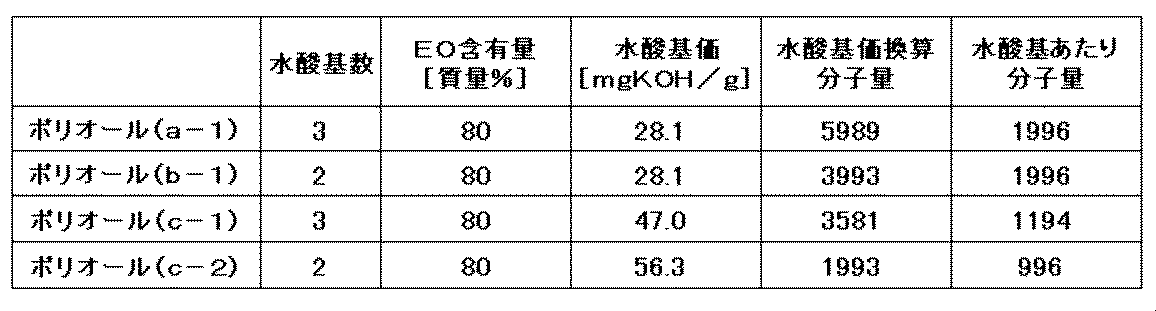
- (A-1) and (c-1) have different molecular weights. The number of hydroxyl groups, the oxyethylene group content (EO content), the hydroxyl value, the hydroxyl value converted molecular weight, and the molecular weight per hydroxyl group of each polyol are shown in Table 1 (hereinafter the same).
- Polyols (b-1) and (c-2) A mixture of ethylene oxide (EO) and propylene oxide (PO) using a potassium hydroxide catalyst to propylene glycol as an initiator (mass ratio of EO: PO) 80:20) is a polyoxyalkylene diol obtained by ring-opening addition polymerization.
- (B-1) and (c-2) have different molecular weights.
- Examples 1-2 are examples, and examples 3-7 are comparative examples.
- Polyols (A) were prepared by mixing polyols with the formulation shown in Table 2.
- Table 2 shows the average number of hydroxyl groups, the molecular weight per hydroxyl group, and the oxyethylene group content (described as “EO content” in the table) of the polyol mixture (A).
- various additives were mixed according to the formulation shown in Table 2.
- the structure and manufacturer of the additive in the table are as follows.
- MDI which is a polyisocyanate compound (B) was added so that NCO / OH (molar ratio) was a value shown in Table 2, and reacted at 70 ° C. for 5 hours to obtain an isocyanate group-containing prepolymer.
- the storage stability of the obtained isocyanate group-containing prepolymer was evaluated by the method described below.
- IRGANOX-245 (trade name, manufactured by BASF): bis [3- (3-tert-butyl-4-hydroxy-5-methylphenyl) propionic acid] [ethylene bis (oxyethylene)], TINUVIM-234 (trade name, manufactured by BASF): 2- [2-hydroxy-3,5-bis ( ⁇ , ⁇ -dimethylbenzyl) phenyl] -2H-benzotriazole, TINUVIN-765 (trade name, manufactured by BASF): bis sebacate (1,2,2,6,6-pentamethyl-4-piperidyl), HOSTAVIN 3050 (trade name, manufactured by Clariant): 7-oxa-3,20-diazadispiro [5.1.1.12] heneicosane-20-propanoic acid 2,2,4,4-tetramethyl-21-oxo- Dodecyl / tetradecyl ester, IRGASTAB PUR68 (trade name, manufactured by BASF): (Structure not disclosed)
- the film for moisture permeability evaluation was produced using the obtained isocyanate group containing prepolymer. That is, an isocyanate group-containing prepolymer was applied to a porous PTFE membrane having a thickness of 300 ⁇ m to a predetermined thickness, and 23 ° C., 60% R.D. H. The film was allowed to stand for 4 days in the above environment and cured by moisture to produce a film for evaluating moisture permeability.
- a film for evaluating mechanical properties was produced using the obtained isocyanate group-containing prepolymer. That is, an isocyanate group-containing prepolymer was applied to an OPP film having a thickness of 75 ⁇ m to a predetermined thickness, and 23 ° C., 60% RP H. The solution was allowed to stand for 4 days in the environment of and cured by moisture. Thereafter, the moisture cured film of the isocyanate group-containing prepolymer was peeled off from the OPP film to obtain a mechanical property evaluation film.
- the obtained film was evaluated for moisture permeability and mechanical properties by the methods described below.
- the film for evaluating moisture permeability sets the coating thickness so that the thickness after curing is 0.05 mm, and the film for evaluating mechanical properties is 0.15 mm after curing.
- the coating thickness was set so that
- the 100% modulus (M 100 ) is a value serving as an index of flexibility, and the smaller the value, the better the flexibility.
- the polyol mixture (A) has an average number of hydroxyl groups of 2.2 to 2.6, a molecular weight of 1,500 to 10,000 per hydroxyl group, and an oxyethylene group content of 60% by mass.
- NCO / OH is 3.0 to 4.5
- a film excellent in moisture permeability, flexibility and tensile strength is obtained, and the storage stability of the isocyanate group-containing prepolymer is also good. there were.
- Example 5 the average number of hydroxyl groups of the polyol mixture (A) was as large as 3.0 and the molecular weight per hydroxyl group was as small as 1194.
- Example 3 the average number of hydroxyl groups of the polyol mixture (A) is as large as 2.9, and NCO / OH is as small as 2.5. In this example, the storage stability of the isocyanate group-containing prepolymer is poor. In Example 4, the average number of hydroxyl groups of the polyol mixture (A) is as small as 2.1, and NCO / OH is as large as 5.0. In this example, the tensile strength and moisture permeability of the film are inferior.
- Example 6 the molecular weight per hydroxyl group is as small as 1,115, and NCO / OH is as small as 2.5. In this example, the moisture permeability, flexibility, tensile strength, and storage stability of the isocyanate group-containing prepolymer are poor. In Example 7, the average number of hydroxyl groups of the polyol mixture (A) is as large as 2.7. In this example, the storage stability of the isocyanate group-containing prepolymer is poor. In particular, when Example 2 is compared with Example 6, it can be seen that moisture permeability is remarkably improved by setting the molecular weight per hydroxyl group to 1,500 or more.
- the coating agent of the present invention is used for forming a coating film or a film of a hydrophilic polyurethane resin having moisture permeability and substantially nonporous.
- the obtained coating film or film of hydrophilic polyurethane resin is used for applications such as clothing materials having moisture permeability.
Landscapes
- Chemical & Material Sciences (AREA)
- Organic Chemistry (AREA)
- Polymers & Plastics (AREA)
- Health & Medical Sciences (AREA)
- Chemical Kinetics & Catalysis (AREA)
- Medicinal Chemistry (AREA)
- Engineering & Computer Science (AREA)
- Materials Engineering (AREA)
- Wood Science & Technology (AREA)
- Life Sciences & Earth Sciences (AREA)
- Manufacturing & Machinery (AREA)
- Polyurethanes Or Polyureas (AREA)
- Paints Or Removers (AREA)
- Manufacture Of Macromolecular Shaped Articles (AREA)
Abstract
Description
特許文献1の実施例において、イソシアネート基含有プレポリマーの合成に用いられているポリオール混合物は、水酸基価47.0のポリオキシアルキレントリオール80部と、水酸基価56.1のポリオキシアルキレンジオール700部の混合物である。このポリオール混合物における平均水酸基数は約2.1、水酸基あたり分子量は約1,000である。
特許文献2に記載の方法は、イソシアネート基含有プレポリマーの合成に、平均水酸基数nが2.7<n<3.6であり、オキシエチレン基の平均含有量が60~90重量%であるポリオキシアルキレン系ポリオール混合物を用いること特徴とする。特許文献2の例4(比較例)で用いられているポリオキシアルキレン系ポリオール混合物の平均水酸基数は2.6、水酸基あたり分子量は約1093である。
しかしながら、これらの特性を同時にバランス良く良好にすることは容易ではない。例えば、引張強度向上のためにはポリオール混合物の平均水酸基数を大きくすればよいが、そうすると柔軟性が低下しやすい。
また特許文献1、2に記載されているコーティング剤は、親水性ポリウレタン系樹脂の中間体として用いられるイソシアネート基含有プレポリマーの貯蔵安定性が必ずしも十分ではなく、改善が望まれる。
好ましくは、さらにコーティング剤の主成分として用いられるイソシアネート基含有プレポリマーの貯蔵安定性にも優れた、コーティング剤、該コーティング剤の硬化物からなる塗膜、および該コーティング剤の硬化物からなるフィルムを提供することを目的とする。
前記ポリオール混合物(A)が、水酸基数が3以上、オキシエチレン基含有量が60質量%以上、かつ水酸基1個あたりの分子量が1,500~10,000であるポリオキシアルキレンポリオール(a)、および水酸基数が2、オキシエチレン基含有量が60質量%以上、かつ水酸基1個あたりの分子量が1,500~10,000であるポリオキシアルキレンジオール(b)を含むことが好ましい。
本発明は、本発明のコーティング剤の硬化物からなる、塗膜またはフィルムを提供する。
本発明によれば、柔軟性および透湿性に優れる塗膜またはフィルムが得られる。
以下、ポリオール混合物(A)とポリイソシアネート化合物(B)とを反応させて得られるイソシアネート基含有プレポリマーを「プレポリマー(X)」ともいう。また、プレポリマー(X)を水分やジアミンなどの硬化剤で硬化させて得られるプレポリマー(X)の硬化物である親水性ポリウレタン系樹脂を「親水性ポリウレタン(Y)」ともいう。
本発明のコーティング剤は、反応硬化性成分としてプレポリマー(X)のみを含むコーティング剤であるか、または、反応硬化性成分としてプレポリマー(X)と硬化剤とを含むコーティング剤である。
反応硬化性成分としてプレポリマー(X)と硬化剤とを含む本発明のコーティング剤の場合は、通常可使用時間が短いことより、プレポリマー(X)と硬化剤とを混合した後速やかにコーティングに供することが好ましい。
本発明のコーティング剤には、上記反応硬化成分以外に、後述する安定剤、ウレタン化触媒、反応調整剤などの添加剤が配合されていてもよい。また、コーティングのために特に低粘度のコーティング剤が必要な場合は溶剤が配合されてもよい。溶剤は、コーティング剤から塗膜を形成した後かつプレポリマー(X)の硬化前に、その塗膜から蒸発除去される。
ポリオール混合物(A)は、水酸基数および水酸基価の少なくともいずれかが異なる2種以上のポリオキシアルキレンポリオールの混合物からなり、混合物全体における平均水酸基数が2.2~2.6、水酸基1個あたりの分子量が1,500~10,000、オキシエチレン基含有量が60質量%以上である。
ポリオール混合物(A)の平均水酸基数を上記の範囲とする方法として、(1)水酸基数の異なる2種以上のポリオキシアルキレンポリオールを混合する方法、または(2)活性水素数の異なる2種以上の混合開始剤にエチレンオキシド、またはエチレンオキシドとそれ以外のモノエポキシドとを開環付加重合させる方法がある。なお、開始剤の活性水素数とは、エチレンオキシドなどのモノエポキシドが開環付加反応しうる水素原子(すなわち、水酸基、アミノ基などの反応性基の水素原子)の数をいう。
ポリオール混合物(A)のオキシエチレン基含有量は、60質量%以上が好ましく、70質量%以上がより好ましい。該オキシエチレン基含有量の上限は特に限定されず100質量%でもよい。低温でのポリオールの結晶化を防ぐ点では95質量%以下が好ましく、92質量%以下がより好ましく、90質量%以下が特に好ましい。
すなわち、水酸基数が3以上であるポリオキシアルキレンポリオール(a)と、水酸基数が2であるポリオキシアルキレンジオール(b)を混合して、平均水酸基数が2.2~2.6であるポリオール混合物(A)を得ることが好ましい。
ポリオキシアルキレンポリオール(a)は、水酸基数が3以上、オキシエチレン基含有量が60質量%以上、水酸基1個あたりの分子量が1,500~10,000のポリオキシアルキレンポリオールである。
ポリオキシアルキレンポリオール(a)の水酸基数の上限は特に限定されないが、親水性ポリウレタン(Y)の塗膜やフィルムの柔軟性、貯蔵安定性の点では4が好ましく、3がより好ましい。
ポリオキシアルキレンポリオール(a)は3価以上の開始剤に、エチレンオキシド(以下、EOと記載することもある。)、またはエチレンオキシドとエチレンオキシド以外のモノエポキシドを開環付加重合させて得られるものが好ましい。エチレンオキシド以外のモノエポキシドを以下「他のモノエポキシド」という。
3価以上の開始剤としては、具体的には、グリセリン、トリメチロールプロパン、1,2,6-ヘキサントリオール、ペンタエリスリトール、ジグリセリン、デキストロース、シュークロース、モノエタノールアミン、ジエタノールアミン、トリエタノールアミン、エチレンジアミン、プロピレンジアミン、ジアミノトルエン、ジアミノジフェニルメタンなどがある。グリセリン、ペンタエリスリトール、トリメチロールプロパンが特に好ましい。これら開始剤は単独または2種以上の併用も可能である。
開始剤へのエチレンオキシドと他のモノエポキシドの付加順序は特に限定されず、ブロック状またはランダム状に開環付加重合させることができる。
他のモノエポキシドの残基は、ポリオキシアルキレンポリオール(a)全体の5質量%以上であることが好ましく、8質量%以上がより好ましい。該他のモノエポキシドの残基の含有量が5質量%以上であると、ポリオキシアルキレンポリオール(a)が固体になり難くなって取り扱い性が向上しやすい。また、該ポリオキシアルキレンポリオール(a)を用いて得られるプレポリマー(X)の固体化や高粘度化が抑制されやすい。
ポリオキシアルキレンポリオール(a)がオキシプロピレン基を有すると、該ポリオキシアルキレンポリオール(a)が常温で液状になりやすく、取り扱いが容易になりやすい。また該ポリオキシアルキレンポリオール(a)を用いて得られるプレポリマー(X)の粘度が低くなりやすい。
ポリオキシアルキレンポリオール(a)におけるオキシエチレン基含有量の上限は、特に限定されないが、上述したように、他のモノエポキシドの残基が5質量%以上含まれることが好ましい。
該ポリオキシアルキレンポリオール(a)の水酸基1個あたりの分子量が上記範囲の下限値以上であると親水性ポリウレタン(Y)の塗膜やフィルムの柔軟性、透湿性に優れ、上限値以下であると親水性ポリウレタン(Y)の塗膜やフィルムの引張強度に優れる。
ポリオキシアルキレンポリオール(b)は、水酸基数が2、オキシエチレン基含有量が60質量%以上、水酸基1個あたりの分子量が1,500~10,000のポリオキシアルキレンジオールである。
2価の開始剤としては、エポキシドが開環付加しうる官能基、例えば水酸基、アミノ基、イミノ基、カルボキシル基などの活性水素含有基を有し、かつその1分子あたりの活性水素の数が2個以上である化合物が好ましい。その例としては、2価の、アルコール類、フェノール類、アルカノールアミン類、モノアミン類、ポリアミン類などの化合物が用いられる。
これらのうちで2価のアルコール類がより好ましい。具体的には、プロピレングリコール、エチレングリコール、1,4-ブタンジオール、ジエチレングリコール、ジプロピレングリコール、トリエチレングリコール、トリプロピレングリコールなどが挙げられる。これらのうち、プロピレングリコール、エチレングリコール、ジエチレングリコール、ジプロピレングリコールが特に好ましい。これら開始剤は単独または2種以上の併用も可能である。
開始剤に開環付加重合させる他のモノエポキシドは、好ましい態様も含めて上記ポリオキシアルキレンポリオール(a)と同様である。
開始剤へのエチレンオキシドと他のモノエポキシドの付加順序は特に限定されず、ブロック状またはランダム状に開環付加重合させることができる。
他のモノエポキシドの残基は、ポリオキシアルキレンジオール(b)全体の5質量%以上であることが好ましく、8質量%以上がより好ましい。該他のモノエポキシドの残基の含有量が5質量%以上であると、ポリオキシアルキレンジオール(b)が固体になり難くなって取り扱い性が向上しやすい。また、該ポリオキシアルキレンジオール(b)を用いて得られるプレポリマー(X)の固体化や高粘度化が抑制されやすい。
ポリオキシアルキレンジオール(b)がオキシプロピレン基を有すると、該ポリオキシアルキレンジオール(b)が常温で液状になりやすく、取り扱いが容易になりやすい。また該ポリオキシアルキレンジオール(b)を用いて得られるプレポリマー(X)の粘度が低くなりやすい。
ポリオキシアルキレンジオール(b)におけるオキシエチレン基含有量の上限は、特に限定されないが、上述したように、他のモノエポキシドの残基が5質量%以上含まれることが好ましい。
該ポリオキシアルキレンジオール(b)の水酸基1個あたりの分子量が上記範囲の下限値以上であると親水性ポリウレタン(Y)の塗膜やフィルムの柔軟性、透湿性に優れ、上限値以下であると親水性ポリウレタン(Y)の塗膜やフィルムの引張強度に優れる。
ポリオキシアルキレンポリオール(a)とポリオキシアルキレンジオール(b)の合計量が、ポリオール混合物(A)の全体に占める割合は、50質量%以上が好ましく、70質量%以上がより好ましく、100質量%であることが特に好ましい。すなわち、ポリオール混合物(A)が、ポリオキシアルキレンポリオール(a)とポリオキシアルキレンジオール(b)の混合物であることが特に好ましい。
ポリオール混合物(A)におけるポリオキシアルキレンポリオール(a)とポリオキシアルキレンジオール(b)の含有比率(a)/(b)によって、ポリオール混合物(A)の平均水酸基数を調整できる。該含有比率(a)/(b)は、得ようとするポリオール混合物(A)の平均水酸基数の値に応じて設定することが好ましい。
本発明で用いることができるポリイソシアネート化合物(B)は特に限定されるものではないが、例えば、4,4’―ジフェニルメタンジイソシアネート(MDI)、2,4’―ジフェニルメタンジイソシアネート(2,4’MDI)、ナフタレン-1,5-ジイソシアネート、ポリフェニレンポリメチレンポリイソシアネート(通称ポリメリックMDI、またはクルードMDIともいう。)、2,4-トリレンジイソシアネート、および2,6-トリレンジイソシアネートなどの芳香族ポリイソシアネート化合物;テトラメチルキシリレンジイソシアネート、キシリレンジイソシアネートなどのアラルキルポリイソシアネート化合物;ヘキサメチレンジイソシアネートなどの脂肪族ポリイソシアネート化合物;イソホロンジイソシアネートおよび4,4’-メチレンビス(シクロヘキシルイソシアネート)などの脂環族ポリイソシアネート化合物;ならびに、前記ポリイソシアネート化合物から得られるウレタン変性体、ビュレット変性体、アロファネート変性体、カルボジイミド変性体、およびイソシアヌレート変性体などが挙げられる。
ポリオール混合物(A)との反応性に優れていること、および得られるプレポリマー(X)の粘度が一般に低いことから、ポリイソシアネート化合物(B)として芳香族ジイソシアネートが好ましく、なかでも4,4’―ジフェニルメタンジイソシアネートが好ましい。
また経時的な黄変を嫌う用途では脂肪族ポリイソシアネート化合物または脂環族ポリイソシアネート化合物が好ましく、ヘキサメチレンジイソシアネート、イソホロンジイソシアネートが特に好ましい。
ポリイソシアネート化合物(B)は、1種単独でもよく、2種類以上を併用してもよい。
具体的には、ポリオール混合物(A)中の水酸基のモル数に対する、これと反応させるポリイソシアネート化合物(B)中のイソシアネート基のモル数の比(以下、NCO/OHと記載することもある。)が、3.0~4.5であることが好ましく、3.0~4.0がより好ましい。該NCO/OHが3.0以上であるとイソシアネート基含有プレポリマーの貯蔵安定性、親水性ポリウレタン(Y)の塗膜やフィルムの引張強度が優れ、4.5以下であると親水性ポリウレタン(Y)の塗膜やフィルムの柔軟性、透湿性が優れる。
なお、NCO/OHが3.0以上の場合、プレポリマー(X)中に未反応のポリイソシアネート化合物(B)が比較的多く存在することがある。本発明におけるプレポリマー(X)とは、このような未反応のポリイソシアネート化合物(B)を含むプレポリマーであるものも意味する。
なお、本明細書におけるイソシアネート基含有プレポリマーの粘度の値は、東機産業株式会社製、RE85U型粘度計にローター(No.4(3°×R14))を取り付け、25℃の温度条件で測定して、測定開始10分後の値である。
本発明において、プレポリマー(X)を硬化させる際に硬化剤を使用する。硬化剤としては、硬化させる雰囲気中の水分やガス状の化合物であってもよく、プレポリマー(X)に混入して使用される化合物であってもよい。すなわち、本発明のコーティング剤は、反応硬化成分としてプレポリマー(X)のみを含むコーティング剤であってもよく(その場合は、空気中の水分やガス状の硬化剤で硬化させる)、反応硬化成分としてプレポリマー(X)および該プレポリマー(X)を硬化させる硬化剤の少なくとも2成分からなるコーティング剤であってもよい。
特に好ましい硬化剤は分子量400以下、さらには300以下、特に200以下のジオールやジアミンである。例えばエチレングリコール、1,4-ブタンジオール、ネオペンチルグリコール、1,6-ヘキサンジオール、1,5-ペンタンジオール、エチレンジアミン、テトラメチレンジアミン、ヘキサメチレンジアミン、ジクロルベンチジン、イソホロンジアミンなどが好ましい。
上記硬化剤を使用する場合の使用量は、プレポリマー(X)中の全イソシアネート基1モルに対し、硬化剤の官能基が0.3~1.3モル、特に0.4~1.0モルであることが好ましい。硬化剤の使用量が1モル未満の場合、残余のイソシアネート基は空気中の水分などと反応してプレポリマー(X)が硬化する。
他の成分としては例えば、紫外線吸収剤、光安定剤、酸化防止剤と呼ばれる種々の安定剤が配合できる。
ベンゾトリアゾール系紫外線吸収剤としては、例えば、2-(2-ヒドロキシ-5-メチルフェニル)ベンゾトリアゾール、2,4-ビス(1-メチル-1-フェニルエチル)-6-(2H-ベンゾトリアゾール-2-イル)フェノール、2-(5-クロロ-2-ベンゾトリアゾリル)-6-tert-ブチル-p-クレゾール、2-(2-ヒドロキシ-5-tert-オクチルフェニル)ベンゾトリアゾール、(2,2-メチレンビス〔6-(2H-ベンゾトリアゾール-2-イル)-4-(1,1,3,3,-テトラメチルブチル)フェノール〕、2-(2H-ベンゾトリアゾール-2-イル)-4,6-ビス(1,1-ジメチル-プロピル)-フェノール等が挙げられる。
トリアジン系紫外線吸収剤としては、例えば、2-[4,6-ジフェニル-1,3,5-トリアジン-2-イル]-5-(ヘキシルオキシ)フェノール、2-[4,6-ビス(2,4-ジメチルフェニル)-1,3,5-トリアジン-2-イル]-5-(イソオクチロキシ)-フェノール等が挙げられる。
ベンゾフェノン系紫外線吸収剤としては、例えば、2-ヒドロキシ-4-n-オクチルオキシベンゾフェノン、(2,4-ジヒドロキシフェニル)フェニル-メタノンなどが挙げられる。
ベンゾエート系紫外線級剤としては、例えば、2-[4,6-ジフェニル-1,3,5-トリアジン-2-イル]-5-(ヘキシルオキシ)フェノール等が挙げられる。
ヒンダードアミン系の光安定剤としては、例えば、以下の化合物が挙げられる。
N,N’-ビス(2,2,6,6-テトラメチル-4-ピペリジニル)-N’-[4-[ブチル(2,2,6,6-テトラメチル-4-ピペリジニル)アミノ]-1,3,5-トリアジン-2-イル]-1,6-ヘキサンジアミン、ブタン二酸1-[2-(4-ヒドロキシ-2,2,6,6-テトラメチルピペリジノ)エチル]、2-ブチル-2-(4-ヒドロキシ-3,5-ジ-tert-ブチルベンジル)マロン酸ビス(1,2,2,6,6-ペンタメチルピペリジン-4-イル)、デカン二酸ビス(1,2,2,6,6-ペンタメチルピペリジン-4-イル)、デカン二酸ビス(2,2,6,6-テトラメチル-4-ピペリジニル)、ブタン-1,2,3,4-テトラカルボン酸テトラキス(1,2,2,6,6-ペンタメチル-4-ピペリジニル)、1,2,3,4-ブタンテトラカルボン酸テトラキス(2,2,6,6-テトラメチルピペリジン-4-イル)、メタクリル酸1,2,2,6,6-ペンタメチル-4-ピペリジル、メタクリル酸(1,2,2,6,6-ペンタメチルピペリジン-4-イル)、メタクリル酸2,2,6,6-テトラメチル-4-ピペリジル、7-オキサ-3,20-ジアザジスピロ[5.1.11.2]ヘンエイコサン-20-プロパノン酸 2,2,4,4-テトラメチル-21-オキソ-ドデシル/テトラデシルエステル、2,2,4,4-テトラメチル-7-オキサ-3,20ジアザジスピロ[5.1.11.2]-ヘンエイコサン-21-オン、β-アラニン N-(2,2,4,4-テトラメチル-4-ピペリジニル)-ドデシル/テトラデシルエステル、2,5-ピロリジンジオン 3-ドデシル-1-(2,2,6,6-テトラメチル-4-ピペリジニル)、2,5-ピロリジンジオン N-アセチル-3-ドデシル-1-(2,2,6,6-テトラ-メチル-4-ピペリジニル)。
フェノール系酸化防止剤としては、例えば、以下の化合物が挙げられる。
ペンタエリトリトールテトラキス[3-(3,5-ジ-tert-ブチル-4-ヒドロキシフェニル)プロピオナート]、2,2’-チオジエチルビス[3-(3,5-ジ-tert-ブチル-4-ヒドロキシフェニル)プロピオナート]、3-(3,5-ジ-tert-ブチル-4-ヒドロキシフェニル)プロピオン酸ステアリル、N,N’-(1,6-ヘキサンジイル)ビス[3,5-ビス(1,1-ジメチルエチル)-4-ヒドロキシベンゼンプロパンアミド]、オクチル-3,5-ジ-tert-ブチル-4-ヒドロキシ-ヒドロ肉桂酸、2,4,6-トリス(3’,5’-ジ-tert-ブチル-4’-ヒドロキシベンジル)メシチレン、カルシウムビス[3,5-ジ(tert-ブチル)-4-ヒドロキシベンジル(エトキシ)ホスフィナート]、2,4-ビス(オクチルチオメチル)-6-メチルフェノール、2,4-ビス[(オクチルチオ)メチル]-6-メチルフェノール、ビス[3-(1,1-ジメチルエチル)-4-ヒドロキシ-5-メチルベンゼンプロピオン酸]エチレンビス(オキシ-2,1-エタンジイル)、1,6-ヘキサンジオール-ビス[3(3,5-ジ-t-ブチル-4-ヒドロキシフェニル)プロピオネート]、1,3,5-トリス[[3,5-ビス(1,1-ジメチルエチル)-4-ヒドロキシフェニル]メチル]-1,3,5-トリアジン-2,4,6(1H,3H,5H)-トリオン、1,1’-イミノビス[4-(1,1,3,3-テトラメチルブチル)ベンゼン]、4-[[4,6-ビス(オクチルチオ)-1,3,5-トリアジン-2-イル]アミノ]-2,6-ジ-tert-ブチルフェノール、ジエチル{[3,5-ビス(1,1-ジメチルエチル)-4-ヒドロキシルフエニル]メチル}ホスホネート。
トリフェニルホスファイト、ジフェニルイソデシルホスファイト、フェニルジイソデシルホスファイト、4,4’-ブチリデン-ビス(3-メチル-6-t-ブチルフェニルジトリデシル)ホスファイト、サイクリックネオペンタンテトライルビス(ノニルフェニル)ホスファイト、サイクリックネオペンタンテトライルビス(ジノニルフェニル)ホスファイト、サイクリックネオペンタンテトライルトリス(ノニルフェニル)ホスファイト、サイクリックネオペンタンテトライルトリス(ジノニルフェニル)ホスファイト、10-(2,5-ジヒドロキシフェニル)-10H-9-オキサ-10-ホスファフェナントレン-10-オキシド、ジイソデシルペンタエリスリトールジホスファイト、トリス(2,4-ジ-t-ブチルフェニル)ホスファイト、ビス(2,4-ジーtert-ブチル-6-メチルフェニル)=エチル=ホスファイト、ブチリデンビス[(2-tert-ブチル-5-メチル-4,1-フェニレン)オキシ]ビス(亜ホスホン酸ジトリデシル)。
反応調整剤としてはリン酸、リン酸エステル類が挙げられる。リン酸エステル類としては、リン酸エチル、リン酸ブチル、リン酸2-エチルヘキシル、リン酸ビス(2-エチルヘキシル)などが挙げられる。
さらに、前記のように、プレポリマー(X)の粘度が高い場合には、溶剤を適宜使用してもよい。本発明のコーティング剤が溶剤を含有する場合には、プレポリマー(X)と溶剤を含む塗膜から溶剤を蒸発除去した後にプレポリマー(X)を硬化させる。
本発明のコーティング剤から得られる親水性ポリウレタン(Y)の塗膜やフィルムは実質的に無孔質でありながら透湿性を有する。ここで、実質的に無孔質であるとは、例えば湿式凝固法など多孔質膜を形成するための方法で形成されたものではないことを意味する。
また、本発明のコーティング剤から得られる親水性ポリウレタン(Y)の塗膜またはフィルムは、気泡を有するフォーム状のものであってもよいが、良好な通気性が得られやすい点で実質的に無気泡質、すなわち実質的に中実の塗膜またはフィルムであることが好ましい。
かかる効果が得られる理由については以下のように考えられる。すなわち、オキシエチレン基含有量が60質量%以上であるポリオール混合物(A)の、水酸基1個あたりの分子量を1,500以上と大きくし、平均水酸基数を2.2~2.6の範囲内としたことにより、架橋間分子量が適度に大きくなって透湿性が向上するとともに、架橋度と架橋間分子量のバランスにより、良好な柔軟性および引張強度が同時に得られると考えられる。
また、水酸基1個あたりの分子量を1,500以上と大きくすることで、イソシアネート基含有プレポリマー中のNCO/OH比が増大(すなわち、同一水酸基価のポリオールを用いた場合、イソシアネート基含有量が増大)しても柔軟性および透湿性が低下しにくくなるとともに、NCO/OHが増大することでイソシアネート基含有プレポリマーの貯蔵安定性が向上すると考えられる。
各例で用いた原料は以下の通りである。
・ポリオール(a-1)および(c-1):開始剤であるグリセリンに、水酸化カリウム触媒を用いて、エチレンオキシド(EO)とプロピレンオキシド(PO)との混合物(EO:POの質量比80:20)を開環付加重合させて得られたポリオキシアルキレントリオール。(a-1)と(c-1)は分子量が異なる。各ポリオールの水酸基数、オキシエチレン基含有量(EO含有量)、水酸基価、水酸基価換算分子量、水酸基1個あたりの分子量を表1に示す(以下、同様)。
・ポリオール(b-1)および(c-2):開始剤であるプロピレングリコールに、水酸化カリウム触媒を用いて、エチレンオキシド(EO)とプロピレンオキシド(PO)との混合物(EO:POの質量比80:20)を開環付加重合させて得られたポリオキシアルキレンジオール。(b-1)と(c-2)は分子量が異なる。
<ポリイソシアネート化合物>
・ポリイソシアネート化合物(B)として、4,4’-ジフェニルメタンジイソシアネート(略称:MDI)を用いた。
例1~2は実施例、例3~7は比較例である。
表2に示す配合でポリオールを混合してポリオール混合物(A)を調製した。ポリオール混合物(A)の平均水酸基数、水酸基1個あたりの分子量、オキシエチレン基含有量(表には「EO含有量」と記載する。)は表2に示すとおりである。
次に、得られたポリオール混合物(A)100部に対し、表2に示す配合で各種添加剤を混合した。なお、表中の添加剤の構造及びメーカーは下記のとおりである。
さらに、ポリイソシアネート化合物(B)であるMDIを、NCO/OH(モル比)が表2に示す値となるように加え、70℃で、5時間反応させてイソシアネート基含有プレポリマーを得た。
得られたイソシアネート基含有プレポリマーの貯蔵安定性を後述の方法で評価した。
TINUVIM-234(商品名、BASF社製):2-[2-ヒドロキシ-3,5-ビス(α,α-ジメチルベンジル)フェニル]-2H-ベンゾトリアゾール、
TINUVIN-765(商品名、BASF社製):セバシン酸ビス(1,2,2,6,6-ペンタメチル-4-ピペリジル)、
HOSTAVIN 3050(商品名、クラリアント社製):7-オキサ-3,20-ジアザジスピロ[5.1.11.2]ヘンエイコサン-20-プロパノン酸 2,2,4,4-テトラメチル-21-オキソ-ドデシル/テトラデシルエステル、
IRGASTAB PUR68(商品名、BASF社製):(構造非開示)
AP-8(商品名、大八化学社製):リン酸2-エチルヘキシル、
リン酸:リン酸85wt%水溶液(純正化学社製)
得られたイソシアネート基含有プレポリマーを用いて透湿性評価用フィルムを作製した。すなわち、イソシアネート基含有プレポリマーを厚さ300μmの多孔質PTFE膜に所定の厚さに塗布し、23℃、60%R.H.の環境下に4日間静置させて湿気硬化させ、透湿性評価用のフィルムを作成した。
得られたイソシアネート基含有プレポリマーを用いて機械的特性評価用フィルムを作製した。すなわち、イソシアネート基含有プレポリマーを厚さ75μmのOPPフィルムに所定の厚さに塗布し、23℃、60%R.H.の環境下に4日間静置させて湿気硬化させた。その後、OPPフィルムからイソシアネート基含有プレポリマーの湿気硬化フィルムをはがし、機械的特性評価用フィルムとした。
上記で得られた厚さ0.05mmのフィルムを用いて、JIS Z-0208の規定に従って透湿度(単位:g/m2・24h)を測定した。結果を表2に示す。透湿度の値が大きいほど透湿性に優れていることを表す。
<機械的特性の評価>
上記で得られた厚さ0.15mmのフィルムを用いて、伸び(単位:%)、引張強度(Ts、単位:MPa)、および100%モジュラス(M100、単位:MPa)をJISK-6301の規定に従って測定した。結果を表2に示す。
100%モジュラス(M100)は柔軟性の指標となる値であり、値が小さいほど柔軟性に優れていることを表す。
<貯蔵安定性の評価>
調製直後のイソシアネート基含有プレポリマーの粘度を測定し、初期粘度とした。該イソシアネート基含有プレポリマーを80℃の雰囲気中で3日間貯蔵した後、粘度を測定し、3日後粘度とした。下記式(1)により粘度上昇率(単位:%)を求めた。粘度上昇率が小さいほど貯蔵安定性に優れていることを表す。結果を表2に示す。
粘度上昇率(%)=(3日後粘度-初期粘度)/初期粘度×100 ・・・(1)
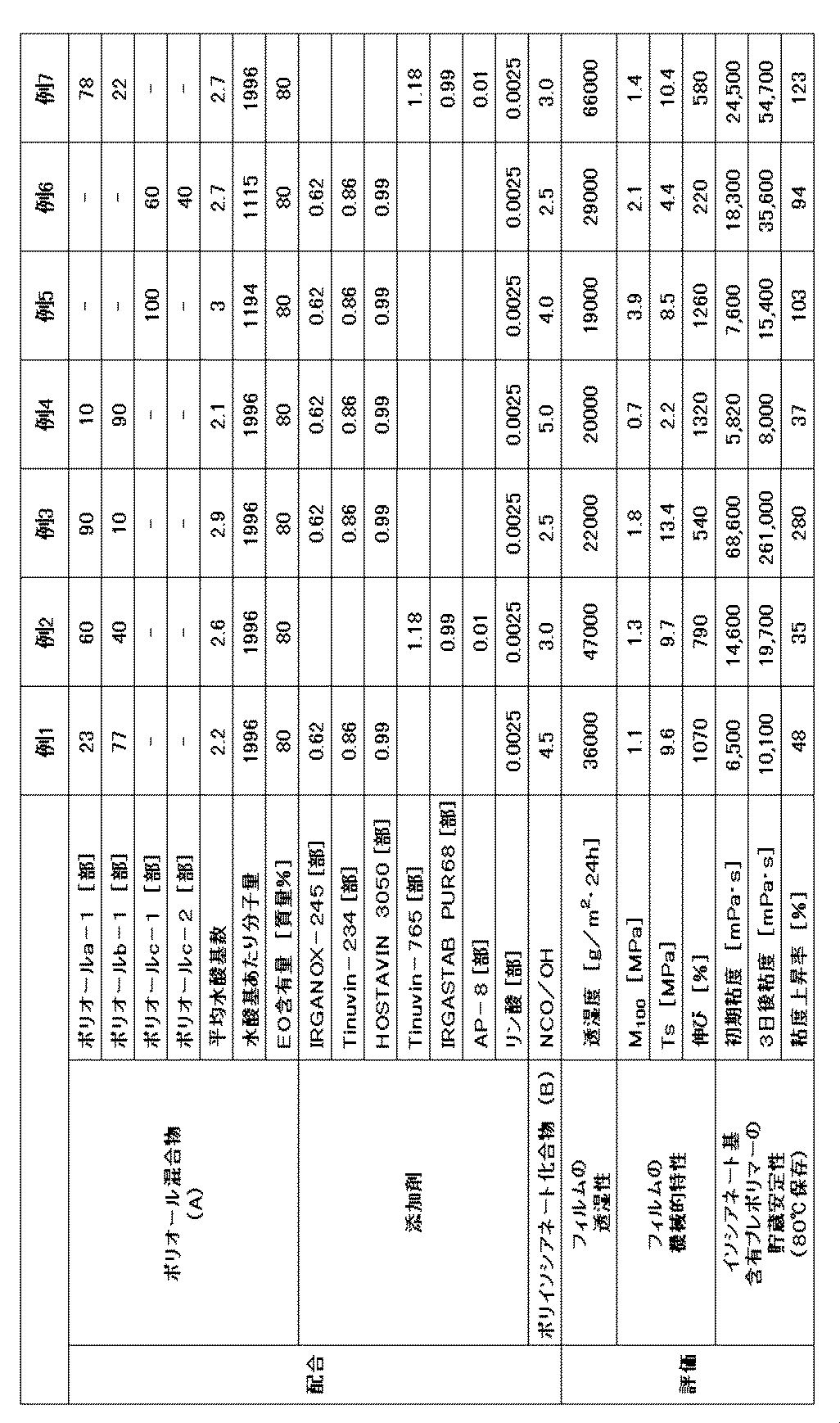
これに対して例5は、ポリオール混合物(A)の平均水酸基数が3.0と大きく、水酸基1個あたりの分子量が1194と小さいため、透湿性、柔軟性、イソシアネート基含有プレポリマーの貯蔵安定性に劣る。
例3はポリオール混合物(A)の平均水酸基数が2.9と大きく、NCO/OHが2.5と小さい。この例ではイソシアネート基含有プレポリマーの貯蔵安定性が劣る。
例4はポリオール混合物(A)の平均水酸基数が2.1と小さく、NCO/OHが5.0と大きい。この例ではフィルムの引張強度、透湿性が劣る。
例6は水酸基1個あたりの分子量が1,115と小さく、NCO/OHが2.5と小さい。この例では透湿性、柔軟性、引張強度、イソシアネート基含有プレポリマーの貯蔵安定性に劣る。
例7はポリオール混合物(A)の平均水酸基数が2.7と大きい。この例では、イソシアネート基含有プレポリマーの貯蔵安定性に劣る。
特に、例2と例6とを比較すると、水酸基1個あたりの分子量を1,500以上とすることで透湿性が著しく向上していることがわかる。
なお、2012年6月26日に出願された日本特許出願2012-143222号の明細書、特許請求の範囲及び要約書の全内容をここに引用し、本発明の明細書の開示として、取り入れるものである。
Claims (12)
- 水酸基数および水酸基価の少なくともいずれかが異なる2種以上のポリオキシアルキレンポリオールの混合物からなり、平均水酸基数が2.2~2.6、水酸基1個あたりの分子量が1,500~10,000、かつオキシエチレン基含有量が60質量%以上であるポリオール混合物(A)と、ポリイソシアネート化合物(B)とを反応させて得られるイソシアネート基含有プレポリマーを含有する、コーティング剤。
- 前記ポリオール混合物(A)の水酸基1個あたりの分子量が1,500~5,000、かつオキシエチレン基含有量が70~95質量%である、請求項1に記載のコーティング剤。
- 前記ポリオール混合物(A)中の水酸基のモル数に対する、前記ポリイソシアネート化合物(B)中のイソシアネート基のモル数の比が3.0~4.5である、請求項1または2に記載のコーティング剤。
- 前記ポリオール混合物(A)が、水酸基数が3以上、オキシエチレン基含有量が60質量%以上、かつ水酸基1個あたりの分子量が1,500~10,000であるポリオキシアルキレンポリオール(a)、および水酸基数が2、オキシエチレン基含有量が60質量%以上、かつ水酸基1個あたりの分子量が1,500~10,000であるポリオキシアルキレンジオール(b)を含む、請求項1または2に記載のコーティング剤。
- 前記ポリオキシアルキレンポリオール(a)が、水酸基数が3または4、オキシエチレン基含有量が70質量%以上、かつ水酸基1個あたりの分子量が1,500~5,000のポリオキシアルキレンポリオールである、請求項4に記載のコーティング剤。
- 前記ポリオキシアルキレンポリオール(a)が、開始剤にエチレンオキシドとプロピレンオキシドとを開環付加重合させて得られたポリオキシアルキレンポリオールであって、オキシプロピレン基含有量が5質量%以上のポリオキシアルキレンポリオールである、請求項4または5に記載のコーティング剤。
- 前記ポリオキシアルキレンジオール(b)が、オキシエチレン基含有量が70質量%以上、かつ水酸基1個あたりの分子量が1,500~5,000のポリオキシアルキレンジオールである、請求項4に記載のコーティング剤。
- 前記ポリオキシアルキレンジオール(b)が、開始剤にエチレンオキシドとプロピレンオキシドとを開環付加重合させて得られたポリオキシアルキレンジオールであって、オキシプロピレン基含有量が5質量%以上のポリオキシアルキレンジオールである、請求項7に記載のコーティング剤。
- 前記イソシアネート基含有プレポリマーと硬化剤を含有する、請求項1~8のいずれか一項に記載のコーティング剤。
- 前記硬化剤がジオールまたはジアミンである、請求項9に記載のコーティング剤。
- 請求項1~10の何れか一項に記載のコーティング剤を塗布した塗膜中のイソシアネート基含有プレポリマーの硬化物からなる、塗膜またはフィルム。
- イソシアネート基含有プレポリマーを空気中の水分またはガス化した硬化剤で硬化してなる、請求項11に記載の塗膜またはフィルム。
Priority Applications (5)
| Application Number | Priority Date | Filing Date | Title |
|---|---|---|---|
| JP2014522602A JP6135669B2 (ja) | 2012-06-26 | 2013-06-21 | コーティング剤、ならびにこれを用いた塗膜およびフィルム |
| CN201380031562.6A CN104364330B (zh) | 2012-06-26 | 2013-06-21 | 涂布剂、以及使用该涂布剂的涂膜和膜 |
| KR1020147031097A KR20150027046A (ko) | 2012-06-26 | 2013-06-21 | 코팅제, 그리고 이것을 사용한 도포막 및 필름 |
| EP13808752.3A EP2865726B1 (en) | 2012-06-26 | 2013-06-21 | Coating agent, and coating film and film each using same |
| US14/531,698 US10294390B2 (en) | 2012-06-26 | 2014-11-03 | Coating agent, and coating layer and film using same |
Applications Claiming Priority (2)
| Application Number | Priority Date | Filing Date | Title |
|---|---|---|---|
| JP2012143222 | 2012-06-26 | ||
| JP2012-143222 | 2012-06-26 |
Related Child Applications (1)
| Application Number | Title | Priority Date | Filing Date |
|---|---|---|---|
| US14/531,698 Continuation US10294390B2 (en) | 2012-06-26 | 2014-11-03 | Coating agent, and coating layer and film using same |
Publications (1)
| Publication Number | Publication Date |
|---|---|
| WO2014002908A1 true WO2014002908A1 (ja) | 2014-01-03 |
Family
ID=49783060
Family Applications (1)
| Application Number | Title | Priority Date | Filing Date |
|---|---|---|---|
| PCT/JP2013/067132 Ceased WO2014002908A1 (ja) | 2012-06-26 | 2013-06-21 | コーティング剤、ならびにこれを用いた塗膜およびフィルム |
Country Status (6)
| Country | Link |
|---|---|
| US (1) | US10294390B2 (ja) |
| EP (1) | EP2865726B1 (ja) |
| JP (1) | JP6135669B2 (ja) |
| KR (1) | KR20150027046A (ja) |
| CN (1) | CN104364330B (ja) |
| WO (1) | WO2014002908A1 (ja) |
Cited By (1)
| Publication number | Priority date | Publication date | Assignee | Title |
|---|---|---|---|---|
| JP2023032016A (ja) * | 2021-08-26 | 2023-03-09 | 東ソー株式会社 | ポリアルキレンオキシド組成物、およびそれを用いた建築材料 |
Families Citing this family (3)
| Publication number | Priority date | Publication date | Assignee | Title |
|---|---|---|---|---|
| WO2016208284A1 (ja) * | 2015-06-26 | 2016-12-29 | Dic株式会社 | 鋼板表面処理剤、及びその塗膜を有する鋼板 |
| KR101916723B1 (ko) | 2016-12-27 | 2018-11-08 | 엘지전자 주식회사 | 차량용 램프 및 그것의 제어방법 |
| RU2737743C1 (ru) * | 2020-03-16 | 2020-12-02 | федеральное государственное бюджетное образовательное учреждение высшего образования "Казанский национальный исследовательский технологический университет" (ФГБОУ ВО "КНИТУ") | Полиуретановая композиция для защитных покрытий |
Citations (9)
| Publication number | Priority date | Publication date | Assignee | Title |
|---|---|---|---|---|
| JPS5978227A (ja) * | 1982-10-27 | 1984-05-07 | Yokohama Rubber Co Ltd:The | ウレタンプレポリマ−組成物 |
| JPS6257467A (ja) * | 1985-09-06 | 1987-03-13 | Asahi Glass Co Ltd | コ−テイング剤組成物 |
| JPH0228210A (ja) * | 1988-04-26 | 1990-01-30 | Asahi Glass Co Ltd | プレポリマー組成物,その製造方法,およびその用途 |
| JPH08311148A (ja) * | 1995-05-15 | 1996-11-26 | Sanyo Chem Ind Ltd | 水性ボールペン用インキ改質剤 |
| JPH10266077A (ja) * | 1997-03-26 | 1998-10-06 | Dai Ichi Kogyo Seiyaku Co Ltd | ケラティン繊維の処理剤、及びこれを用いたケラティン繊維の処理方法 |
| JP2954631B2 (ja) | 1990-02-05 | 1999-09-27 | 旭硝子株式会社 | コーティング剤組成物 |
| JP2002069370A (ja) | 2000-06-12 | 2002-03-08 | Asahi Glass Co Ltd | コーティング剤組成物 |
| WO2006075710A1 (ja) * | 2005-01-13 | 2006-07-20 | Asahi Glass Co., Ltd. | コーティング剤組成物およびその用途 |
| JP2013001905A (ja) * | 2011-06-17 | 2013-01-07 | Rohm & Haas Co | 改良された粘度プロファイルを有する疎水変性アルキレンオキシドウレタンポリマー |
Family Cites Families (6)
| Publication number | Priority date | Publication date | Assignee | Title |
|---|---|---|---|---|
| US2720401A (en) | 1953-07-14 | 1955-10-11 | Thor Power Tool Co | Drill steel retainer |
| GB2146035B (en) * | 1983-07-04 | 1987-01-07 | Dai Ichi Kogyo Seiyaku Co Ltd | Anti-corrosive coating composition |
| DE3812051A1 (de) * | 1988-04-12 | 1989-10-26 | Bayer Ag | Mischungen von thermoplastischen poly(ester)carbonaten mit thermoplastischen polyurethanen |
| EP0339435B1 (en) | 1988-04-26 | 1993-08-18 | Asahi Glass Company Ltd. | Prepolymer composition, process for its production, and its use |
| GB9102089D0 (en) * | 1991-01-31 | 1991-03-13 | Johnson & Johnson Medical | Net wound dressings |
| CN108178943B (zh) * | 2013-12-20 | 2020-04-21 | 日华化学株式会社 | 车辆座椅用阻燃性涂布剂及阻燃性车辆座椅材料的制造方法 |
-
2013
- 2013-06-21 CN CN201380031562.6A patent/CN104364330B/zh active Active
- 2013-06-21 EP EP13808752.3A patent/EP2865726B1/en active Active
- 2013-06-21 WO PCT/JP2013/067132 patent/WO2014002908A1/ja not_active Ceased
- 2013-06-21 KR KR1020147031097A patent/KR20150027046A/ko not_active Withdrawn
- 2013-06-21 JP JP2014522602A patent/JP6135669B2/ja active Active
-
2014
- 2014-11-03 US US14/531,698 patent/US10294390B2/en active Active
Patent Citations (9)
| Publication number | Priority date | Publication date | Assignee | Title |
|---|---|---|---|---|
| JPS5978227A (ja) * | 1982-10-27 | 1984-05-07 | Yokohama Rubber Co Ltd:The | ウレタンプレポリマ−組成物 |
| JPS6257467A (ja) * | 1985-09-06 | 1987-03-13 | Asahi Glass Co Ltd | コ−テイング剤組成物 |
| JPH0228210A (ja) * | 1988-04-26 | 1990-01-30 | Asahi Glass Co Ltd | プレポリマー組成物,その製造方法,およびその用途 |
| JP2954631B2 (ja) | 1990-02-05 | 1999-09-27 | 旭硝子株式会社 | コーティング剤組成物 |
| JPH08311148A (ja) * | 1995-05-15 | 1996-11-26 | Sanyo Chem Ind Ltd | 水性ボールペン用インキ改質剤 |
| JPH10266077A (ja) * | 1997-03-26 | 1998-10-06 | Dai Ichi Kogyo Seiyaku Co Ltd | ケラティン繊維の処理剤、及びこれを用いたケラティン繊維の処理方法 |
| JP2002069370A (ja) | 2000-06-12 | 2002-03-08 | Asahi Glass Co Ltd | コーティング剤組成物 |
| WO2006075710A1 (ja) * | 2005-01-13 | 2006-07-20 | Asahi Glass Co., Ltd. | コーティング剤組成物およびその用途 |
| JP2013001905A (ja) * | 2011-06-17 | 2013-01-07 | Rohm & Haas Co | 改良された粘度プロファイルを有する疎水変性アルキレンオキシドウレタンポリマー |
Non-Patent Citations (1)
| Title |
|---|
| See also references of EP2865726A4 |
Cited By (2)
| Publication number | Priority date | Publication date | Assignee | Title |
|---|---|---|---|---|
| JP2023032016A (ja) * | 2021-08-26 | 2023-03-09 | 東ソー株式会社 | ポリアルキレンオキシド組成物、およびそれを用いた建築材料 |
| JP7775598B2 (ja) | 2021-08-26 | 2025-11-26 | 東ソー株式会社 | ポリアルキレンオキシド組成物、およびそれを用いた建築材料 |
Also Published As
| Publication number | Publication date |
|---|---|
| JP6135669B2 (ja) | 2017-05-31 |
| KR20150027046A (ko) | 2015-03-11 |
| JPWO2014002908A1 (ja) | 2016-05-30 |
| US20150057409A1 (en) | 2015-02-26 |
| EP2865726B1 (en) | 2017-01-11 |
| EP2865726A1 (en) | 2015-04-29 |
| US10294390B2 (en) | 2019-05-21 |
| EP2865726A4 (en) | 2015-11-18 |
| CN104364330B (zh) | 2016-05-04 |
| CN104364330A (zh) | 2015-02-18 |
Similar Documents
| Publication | Publication Date | Title |
|---|---|---|
| CN103140555B (zh) | 阻燃性涂敷材用水系聚氨酯树脂组合物、及涂敷该组合物而成的涂敷品 | |
| US9624337B2 (en) | One-component type curable composition and one-component type waterproofing material | |
| TW200418895A (en) | Polyurethane dispersion and articles prepared therefrom | |
| KR101514107B1 (ko) | 우레탄프레폴리머 | |
| JP6904454B1 (ja) | 2液硬化型接着剤組成物 | |
| KR20210122224A (ko) | 휘발성 유기 화합물을 실질적으로 갖지 않고 고체 함량이 높은 수성 폴리우레탄 분산물의 제조 방법 | |
| JP6135669B2 (ja) | コーティング剤、ならびにこれを用いた塗膜およびフィルム | |
| JP6582363B2 (ja) | 接着剤組成物及びその製造方法 | |
| JP5354475B2 (ja) | ポリウレタン樹脂形成性組成物、シール材及び中空糸膜モジュール | |
| WO2009119752A1 (ja) | 無溶剤型ポリウレタンウレア発泡体シート及びその製造方法並びに合成皮革 | |
| JP2006511661A (ja) | 抽出可能物の少ない、有機金属を含まないポリウレタン | |
| JP5561658B2 (ja) | ポリウレタン樹脂形成性組成物及び鋼矢板用止水材 | |
| JP5447655B2 (ja) | ポリウレタン樹脂形成性組成物及び鋼矢板用水膨張性止水材 | |
| KR20060061926A (ko) | 아크릴 졸 조성물 | |
| EP1164152B1 (en) | Coating composition | |
| KR102455218B1 (ko) | 2k 폴리우레탄 접착제를 위한 플라스틱 접착 촉진 | |
| JP4993464B2 (ja) | アクリルゾル組成物 | |
| WO2023233962A1 (ja) | 接着剤組成物及び物品 | |
| CN110167985A (zh) | 聚氨酯的物理性能改进 | |
| JP2006316127A (ja) | 無溶剤型硬化性ウレタン樹脂組成物及び該組成物を用いて得られるシート状物。 | |
| JP2023170895A (ja) | 接着剤、硬化物及び積層体 | |
| WO2022107881A1 (ja) | 無溶剤型反応性接着剤、その硬化物及び積層体 | |
| US20230323063A1 (en) | Polyurethane Foam Composition and Polyurethane Foam Comprising Cured Product Thereof | |
| CN116507691A (zh) | 无溶剂型反应性粘接剂、其硬化物及层叠体 |
Legal Events
| Date | Code | Title | Description |
|---|---|---|---|
| WWE | Wipo information: entry into national phase |
Ref document number: 201380031562.6 Country of ref document: CN |
|
| 121 | Ep: the epo has been informed by wipo that ep was designated in this application |
Ref document number: 13808752 Country of ref document: EP Kind code of ref document: A1 |
|
| ENP | Entry into the national phase |
Ref document number: 2014522602 Country of ref document: JP Kind code of ref document: A |
|
| REEP | Request for entry into the european phase |
Ref document number: 2013808752 Country of ref document: EP |
|
| WWE | Wipo information: entry into national phase |
Ref document number: 2013808752 Country of ref document: EP |
|
| ENP | Entry into the national phase |
Ref document number: 20147031097 Country of ref document: KR Kind code of ref document: A |
|
| NENP | Non-entry into the national phase |
Ref country code: DE |