WO2014103162A1 - バリカンの刃、及びバリカンの刃を備えたバリカン - Google Patents
バリカンの刃、及びバリカンの刃を備えたバリカン Download PDFInfo
- Publication number
- WO2014103162A1 WO2014103162A1 PCT/JP2013/006908 JP2013006908W WO2014103162A1 WO 2014103162 A1 WO2014103162 A1 WO 2014103162A1 JP 2013006908 W JP2013006908 W JP 2013006908W WO 2014103162 A1 WO2014103162 A1 WO 2014103162A1
- Authority
- WO
- WIPO (PCT)
- Prior art keywords
- blade
- movable
- tip
- fixed
- clipper
- Prior art date
- Legal status (The legal status is an assumption and is not a legal conclusion. Google has not performed a legal analysis and makes no representation as to the accuracy of the status listed.)
- Ceased
Links
Images









Classifications
-
- B—PERFORMING OPERATIONS; TRANSPORTING
- B26—HAND CUTTING TOOLS; CUTTING; SEVERING
- B26B—HAND-HELD CUTTING TOOLS NOT OTHERWISE PROVIDED FOR
- B26B19/00—Clippers or shavers operating with a plurality of cutting edges, e.g. hair clippers, dry shavers
- B26B19/02—Clippers or shavers operating with a plurality of cutting edges, e.g. hair clippers, dry shavers of the reciprocating-cutter type
- B26B19/04—Cutting heads therefor; Cutters therefor; Securing equipment thereof
- B26B19/06—Cutting heads therefor; Cutters therefor; Securing equipment thereof involving co-operating cutting elements both of which have shearing teeth
-
- B—PERFORMING OPERATIONS; TRANSPORTING
- B26—HAND CUTTING TOOLS; CUTTING; SEVERING
- B26B—HAND-HELD CUTTING TOOLS NOT OTHERWISE PROVIDED FOR
- B26B19/00—Clippers or shavers operating with a plurality of cutting edges, e.g. hair clippers, dry shavers
- B26B19/38—Details of, or accessories for, hair clippers, or dry shavers, e.g. housings, casings, grips, guards
- B26B19/3846—Blades; Cutters
Definitions
- the present invention relates to a clipper blade having a fixed blade and a movable blade and a clipper having a clipper blade.
- a hair clipper blade for cutting human or animal hair includes a fixed blade having a plurality of blades and a movable blade having a plurality of blades, and the movable blades are overlapped with each other so as to be able to reciprocate. ing.
- This type of clipper requires that the hair be cut short without damaging the skin.
- Patent Document 1 In response to such a request, the technique described in Patent Document 1 is known.
- the fixed blade and the movable blade are overlapped so that the tip of the blade of the fixed blade and the tip of each blade of the movable blade are in sliding contact with each other.
- tip part of a movable blade are formed in the curved surface. Thereby, the damage of the skin is suppressed.
- Patent Document 2 discloses a clipper blade in which resin is applied to the tip of the fixed blade and the tip of the movable blade. That is, the tip portions of the fixed blade and the movable blade are formed into curved surfaces by application of resin. Thereby, the damage of the skin which arises when a front-end
- Patent Document 1 when the movable blade is slid with the tip of the clipper blade pressed against the skin, the skin is sandwiched between the tip of each of the fixed blade and the movable blade. May be damaged.
- the present invention has been made in view of such circumstances, and an object of the present invention is to provide a clipper blade having a low possibility of damaging the skin and excellent in manufacturability, and a clipper provided with the clipper blade. It is in.
- This means comprises: “a fixed blade having a plurality of blades, and a movable blade having a plurality of blades arranged in the same direction as the arrangement of the blades of the fixed blade,
- Each of the blade bodies has a cutting portion having a movable slidable contact surface in contact with the fixed blade, and a blade body tip portion provided on the tip side of the cutting portion, and the blade body of the movable blade
- the distal end portion includes a clipper blade having an inner surface located on the movable blade side with respect to a plane including the movable sliding contact surface.
- the blade body of the movable blade has cutting blade portions provided on both side surfaces of the blade body, and is provided at the tip of the blade body among the cutting blade portions.
- the part that has been made includes a clipper blade having a curved surface or a machined cutting edge.
- each of the blade bodies of the fixed blade is provided with a cutting portion having a fixed sliding contact surface in contact with the movable sliding contact surface, and a tip side of the cutting portion.
- a blade tip, and the blade tip of the fixed blade includes a clipper blade having an inner surface on the fixed blade side with respect to a plane including the fixed sliding contact surface.
- the fixed sliding contact surface of the plurality of blades of the fixed blade has a first tip end edge, and the plurality of blades of the movable blade.
- the movable slidable contact surface includes a clipper blade having a second tip side edge disposed on the base side of the blade body of the movable blade with respect to the first tip side edge.
- the blade tip portion of the movable blade has the inner surface and an outer surface facing the outer surface continuous to the inner surface, and the blade tip portion of the movable blade The tip point on the boundary line between the inner surface and the outer surface exists between the upper surface of the blade tip portion and the movable sliding contact surface, and the distance between the tip point and the upper surface is A clipper blade larger than the distance between the tip point and the movable sliding contact surface ”.
- One mode of the above means includes “a clipper having a clipper blade”.
- the blades and clippers of this clipper are less likely to damage the skin and are excellent in manufacturability.
- FIG. 9 is a cross-sectional view taken along the line CC of FIG. Fig.11 (a) and FIG.11 (b) are the schematic diagrams which show the deformation
- the hair clipper according to the embodiment will be described with reference to FIG.
- the clipper 1 includes a main body device 2 and a head portion 3 that can be attached to the main body device 2.
- the main body device 2 includes a drive mechanism 21, a power supply unit 22, a control unit 23 that controls the drive mechanism 21 and the power supply unit 22, and an operation unit 24.
- the drive mechanism 21 reciprocates a movable part (movable blade 40 described later) of the head unit 3, and has an output shaft 21a for transmitting power.
- the drive mechanism 21 includes, for example, a motor and a power transmission mechanism that transmits power of the motor.
- the power supply unit 22 supplies power to the drive mechanism 21.
- the power supply part 22 is comprised by the secondary battery, for example.
- the operation unit 24 switches the operation state of the movable part between the operation state and the stop state.
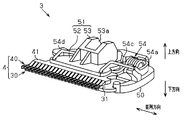
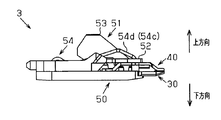
- the head unit 3 will be described with reference to FIGS.
- the head unit 3 includes a clipper blade 4, a fixed frame 50, a holding frame 51, and a pressing device 54.
- the clipper blade 4 includes a fixed blade 30 and a movable blade 40.
- the fixed blade 30 and the movable blade 40 are overlapped with each other.
- the movable blade 40 is provided so as to be able to reciprocate in a parallel direction (described later) with respect to the fixed blade 30.
- the fixed frame 50 supports the fixed blade 30 from the lower side (the side opposite to the side where the movable blade 40 is disposed in the fixed blade 30).
- the fixed frame 50 holds the fixed blade 30 so as not to be displaced with respect to the fixed frame 50.
- the holding frame 51 holds the movable blade 40 from the upper side (the side opposite to the side where the fixed blade 30 is disposed in the movable blade 40).
- the holding frame 51 holds the movable blade 40 so as not to be displaced with respect to the holding frame 51.
- the holding frame 51 has a plate 52 that is pressed against the movable blade 40.
- the plate 52 is provided with an engaging portion 53 that engages with the output shaft 21 a of the drive mechanism 21. As shown in FIG. 2, the engaging portion 53 includes a fitting portion 53 a that fits with the output shaft 21 a.
- the pressing device 54 presses the movable blade 40 and the plate 52 so that the fixed blade 30 and the movable blade 40 press each other.
- the pressing device 54 includes, for example, two connected torsion springs 54a and 54b (see FIG. 3).
- the pressing device 54 is attached to the fixed frame 50 so that the end portions 54c and 54d of the torsion springs 54a and 54b press the plate 52 and the movable blade 40 toward the fixed blade 30 side.
- the direction from the fixed blade 30 toward the movable blade 40 is referred to as “upward”, and the arrangement in the upward direction when viewed from a predetermined one is referred to as “upper”.
- the direction opposite to the upward direction is referred to as “downward direction”, and the arrangement of the downward direction as viewed from a predetermined object is referred to as “lower side”.
- the fixed blade 30 is disposed above the fixed frame 50.
- a movable blade 40 is disposed above the fixed blade 30.
- the movable blade 40 is held by a holding frame 51.
- the plate 52 of the holding frame 51 is disposed above the movable blade 40.
- Ends 54c and 54d of the torsion spring (pressing device 54) are arranged on the upper side of the plate 52 and push the plate 52 downward. With such a structure, the movable blade 40 is pressed against the fixed blade 30.
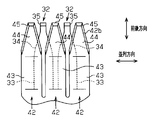
- the fixed blade 30 has a plate-shaped main body 31 (see FIG. 2) and a plurality of blade bodies 32 extending from the main body 31.
- the plurality of blade bodies 32 are arranged in a line at a substantially constant interval.
- the direction in which the blade bodies 32 are arranged is referred to as a “parallel direction”.
- Each blade 32 has a base 33 (see FIG. 6) extending from the main body 31, a cutting part 34 further extending from the base 33, and a blade front end 35 extending further from the cutting part 34.
- the cutting part 34 has a fixed sliding contact surface 34 a (see FIG. 7) that contacts the movable blade 40. As shown in FIG. 6, the cutting portion 34 includes a tapered portion toward the blade tip portion 35 in plan view. That is, the lateral width (length in the parallel direction) of the cutting part 34 gradually decreases toward the blade tip part 35.
- the movable blade 40 has a plate-like main body portion 41 (see FIG. 2) and a plurality of blade bodies 42 extending from the main body portion 41.
- the plurality of blade bodies 42 are arranged in a line at substantially constant intervals.
- Each blade 42 includes a base 43 (see FIG. 6) extending from the main body 41, a cutting portion 44 extending from the base 43, a blade tip 45 extending further from the cutting portion 44, and a cutting blade 48 (FIG. 9).
- the cutting blade portion 48 is provided from the cutting portion 44 to the blade tip portion 45 on each of the side surfaces 42 b of the blade body 42. 5 and 6, the illustration of the cutting blade portion 48 is omitted.
- the base 43 is inclined with respect to the main body 41 (see FIG. 5).
- the cutting part 44 has a plane substantially parallel to the main body part 41.
- the cutting portion 44 has a movable sliding contact surface 44a (see FIG. 7) that is in sliding contact with the fixed blade 30.
- the length of the movable sliding contact surface 44a in the front-rear direction is shorter than the length of the fixed sliding contact surface 34a of the cutting portion 34 of the fixed blade 30 (see FIG. 7).
- the cutting portion 44 has a tapered portion toward the blade tip portion 45 in plan view. That is, the lateral width (length in the parallel direction) of the cutting portion 44 gradually decreases toward the blade tip portion 45.
- the interval (pitch) between the blade bodies 42 of the movable blade 40 and the interval (pitch) between the blade bodies 32 of the fixed blade 30 are different from each other for the following reason.
- each set of blade bodies that come into sliding contact with each other (the blade body 32 of the fixed blade 30 and the blade body of the movable blade 40). 42)
- the timing for cutting the hair is the same.
- the distance (pitch) between the blade bodies 32 of the fixed blade 30 and the distance (pitch) between the blade bodies 42 of the movable blade 40 are intended to avoid simultaneously cutting a large number of hairs. Different.
- FIG. 7 a structure (structure of clipper blade 4) in which the fixed blade 30 and the movable blade 40 are combined will be described.
- the cutting portion 34 of the blade body 32 of the fixed blade 30 and the cutting portion 44 of the blade body 42 of the movable blade 40 are in contact with each other so as to slide on each other.
- the most advanced point 32a of the blade body 32 of the fixed blade 30 and the most advanced point 42a of the blade body 42 of the movable blade 40 substantially coincide with each other in the front-rear direction of the blade bodies 32, 42 in a side view.
- the distance between the most distal point 32a of the blade body 32 of the fixed blade 30 and the most distal point 42a of the blade body 42 of the movable blade 40 in the front-rear direction is referred to as a “step”.
- the step is set to approximately “0”.
- FIG. 8 is an enlarged view of a portion A in FIG.
- the blade tip portion 35 of the blade body 32 of the fixed blade 30 has an inner surface 36 facing the movable blade 40, an outer surface 37 continuous with the inner surface 36 and facing outward, and a side surface 32 s facing the adjacent blade body 32.
- the outer surface 37 has a curved surface shape.
- the inner surface 36 is continuous with the fixed sliding contact surface 34a and extends to the tip side.
- the inner surface 36 has a flat surface inclined with respect to the fixed sliding contact surface 34a.
- the inner surface 36 is arranged closer to the fixed blade 30 than the reference surface SK1 when a plane (virtual plane) including the fixed sliding contact surface 34a is set as the reference surface SK1.
- the blade body tip portion 45 of the blade body 42 of the movable blade 40 has an inner surface 46 facing the fixed blade 30, an outer surface 47 continuous with the inner surface 46 and facing outward, and a side surface 42 s facing the adjacent blade body 42.
- the side surface 42s constitutes a part of the side surface 42b of the blade body 42.
- the outer surface 47 has a curved surface shape.
- the inner surface 46 is continuous with the movable sliding contact surface 44a and extends to the tip side.
- the inner surface 46 has a flat surface that is inclined with respect to the movable sliding contact surface 44a.
- the inner surface 46 is disposed closer to the movable blade 40 than the reference surface SK2 when a plane (virtual plane) including the movable sliding contact surface 44a is set as the reference surface SK2.
- the blade body tip portion 45 of the blade body 42 of the movable blade 40 has the following configuration.
- the movable slidable contact surface 44a of the blade body 42 of the movable blade 40 is provided on the back side (base 33 side) with respect to the fixed slidable contact surface 34a of the blade body 32 of the fixed blade 30. That is, the front end side edge 44b of the movable slidable contact surface 44a is disposed on the back side (base 43 side) with respect to the front end side end edge 34b of the fixed slidable contact surface 34a in the front-rear direction.
- the gap Sx that is narrower than the gap Sn formed by the two inner surfaces 36, 46 is a fixed sliding contact surface between the inner surface 46 of the blade body 42 of the movable blade 40 and the blade body 32 of the fixed blade 30. 34a.
- the blade body tip portion 45 of the blade body 42 of the movable blade 40 has the following configuration.
- a point on the boundary line 47 a (see FIG. 5) between the inner surface 46 and the outer surface 47 of the blade tip 45, which is the foremost point 47 b in the front-rear direction, is an upper surface 47 c of the blade tip 45. It arrange
- the distance L2 between the tip point 47b and the upper surface 47c is set to a value larger than the distance L1 between the tip point 47b and the movable sliding contact surface 44a. That is, the thickness (length in the vertical direction) (distance L2) of the outer surface 47 of the blade tip 45 is greater than at least half the thickness of the blade tip 45.
- the upper surface 47c of the blade tip 45 is the vertical direction at the intersection of the outer surface 47 and the virtual surface perpendicular to the movable sliding contact surface 44a from the distal end edge 44b of the movable sliding contact surface 44a.
- the surface including the uppermost point and parallel to the movable sliding contact surface 44a (two-dot chain line in FIG. 8).
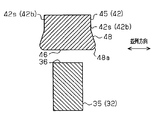
- FIG. 9 is a sectional view taken along line BB in FIG.
- FIG. 10 is a cross-sectional view taken along the line CC of FIG.
- the blade body 42 of the movable blade 40 has cutting edge portions 48 provided on both side surfaces 42b.
- the blade body 42 of the movable blade 40 includes a cutting blade portion 48 that protrudes from each of the side surfaces 42b toward the adjacent side surface (in the parallel direction).
- the blade body 42 of the movable blade 40 has a cutting blade portion 48 that protrudes from each of the side surfaces 42b toward the adjacent side surface (in the parallel direction).
- the 1st part provided in the cutting part 44 among the cutting blade parts 48 has the blade edge 48b which has a sharp shape. That is, as shown in FIG. 9, the lower surface of the cutting blade portion 48 corresponds to an extended surface of the movable sliding contact surface 44a, and the cutting edge 48b of the cutting blade portion 48 has an angle of 90 degrees or less.
- tip part 45 among the cutting blade parts 48 has the blade edge 48a which has a non-sharp shape.
- the cutting edge 48a of the cutting blade portion 48 has a curved surface.
- the inner surface 46 of the blade tip 45 of the movable blade 40 is not in contact with the blade tip 35 of the fixed blade 30. Therefore, the hair clipper blade 4 is not intended to cut hair by sliding between the blade tip portion 45 of the movable blade 40 and the blade tip portion 35 of the fixed blade 30.
- the cutting blade portion 48 provided on the side surface 42 s of the blade tip 45 has a sharp shape, when this portion hits the skin S due to the reciprocating motion of the movable blade 40, the skin S There is a risk of damage. Therefore, the cutting edge 48a of this portion of the cutting edge 48 has a curved surface.
- FIG. 11 shows a deformed state of the skin S when the head portion 3 is pressed against the skin S.
- FIG. 11A shows a deformed state of the skin S in a state where the blade body 32 of the fixed blade 30 and the blade body 42 of the movable blade 40 are arranged in the parallel direction.
- the blade bodies 32 of the fixed blades 30 adjacent to each other and adjacent to each other.
- the skin S enters between the blade bodies 42 of the movable blade 40.
- FIG. 11B shows a deformed state of the skin S in a state where the blade body 32 of the fixed blade 30 and the blade body 42 of the movable blade 40 are not aligned in the parallel direction. That is, the deformation state of the skin S when the blade body 42 of the movable blade 40 is disposed between the blade bodies 32 of the adjacent fixed blades 30 is shown. In this state, the skin S entering from between the blade bodies 32 of the fixed blade 30 and between the blade bodies 42 of the movable blade 40 is pushed back by the movement of the movable blade 40. That is, as shown in FIG. 11A and FIG. 11B, the skin S is between the blade bodies 32 of the fixed blade 30 and between the blade bodies 42 of the movable blade 40 by the reciprocating operation of the movable blade 40. Get in or get pushed back.
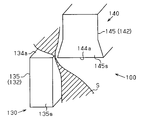
- FIGS. 12 and 13 show a state in which the clipper blades 4, 100 are pressed against the skin S, and the skin S is cut along the surface of the blade bodies 32, 42, 132, 142 that contacts the skin S, It is the figure seen from the front-end
- FIG. 12 is a diagram showing a deformed state of the skin S when the skin S enters between the blade body 142 of the movable blade 140 and the blade body 132 of the fixed blade 130 in the clipper blade 100 having a conventional structure.
- the clipper blade 100 of the conventional structure there is no gap Sn between the blade body tip portion 135 of the blade body 132 of the fixed blade 130 and the blade body tip portion 145 of the blade body 142 of the movable blade 140.
- FIG. 13 is a view showing a deformed state of the skin S when the skin S enters between the blade body 42 of the movable blade 40 and the blade body 32 of the fixed blade 30 in the clipper blade 4 according to the present embodiment. is there.
- the skin S has a blade body 132 of the fixed blade 130 and a blade body 142 of the movable blade 140. Remains in a state of being in between. And a part of this skin S is pinched
- the fixed slidable contact surface 34a of the blade tip 35 and the blade tip 45 are located behind the pressing surfaces (outer surfaces 37, 47) that press the skin S at the blade tip 35 and the blade tip 45. Since the movable slidable contact surface 44a exists, the skin S is not easily pinched.
- the clipper blade 4 according to the present embodiment has the following action.
- the outer surface 47 of the blade body tip portion 45 of the blade body 42 of the movable blade 40 has a curved surface and a distance (thickness) L2 that is set so that an area that contacts the skin S is increased.
- the curved surface is less caught on the skin S than the flat surface.
- tip part 45 of the blade 42 of the movable blade 40 presses the skin S is distributed, so that the area which contacts the skin S is large. For this reason, the hair clipper blade 4 has a sharp shape, or damage to the skin S is smaller than that of the blade tip portion having the distance L2 smaller than the distance L1.
- the clipper blade 4 or the clipper 1 of the present embodiment has the following effects.
- the inner surface 46 of the blade body distal end portion 45 of the movable blade 40 is more movable than the plane (reference surface SK2) including the movable sliding contact surface 44a of the movable blade 40.
- the gap Sn is provided between the blade tip 45 of the movable blade 40 and the fixed sliding contact surface 34 a of the fixed blade 30.
- the inner surface 46 of the blade tip 45 of the movable blade 40 and the fixed blade 30 are fixed. Clearances Sn and Sx are provided between the sliding contact surface 34a.
- the clipper blade 4 having the above-described configuration is formed by cutting or the like at the blade tip 45 of the movable blade 40 or the blade tip 35 of the fixed blade 30. That is, since the conventional technique of using a resin to make the tip of the blade tip 45 of the movable blade 40 curved is not easy to manufacture. That is, the blade 4 of the present clipper is excellent in manufacturability as compared with the related art.
- the blade body 42 of the movable blade 40 has cutting blade portions 48 provided on both side surfaces 42b.
- a portion of the blade edge 48a provided at the blade body tip portion 45 has a curved surface.
- a gap Sn is provided between the inner surface 46 of the blade tip 45 of the movable blade 40 and the blade tip 35 of the fixed blade 30, the skin is sandwiched between the skin S of the both blade tips 35 and 45. It is suppressed that S is damaged.
- the tip of the cutting edge portion 48 provided on the side surface 42b of the blade body 42 of the movable blade 40 is sharp, the skin S may be damaged. Therefore, in the above configuration, a part of the cutting blade portion 48 provided at the blade tip 45 has a non-sharp structure, for example, a curved surface. Thereby, the damage of the skin S is suppressed.
- the blade edge 48a of the cutting blade portion 48 provided at the blade body tip portion 45 may have a shape other than a curved surface (see FIG. 18 described later).
- the inner surface 46 of the blade tip 45 is located on the fixed blade 30 side with respect to the plane (reference surface SK1) including the fixed sliding contact surface 34a of the fixed blade 30.
- the gap Sn is provided between the inner surface 46 of the blade tip portion 45 of the movable blade 40 and the inner surface 36 of the blade tip portion 35 of the fixed blade 30.
- the distal end side edge 44b of the movable sliding contact surface 44a of the blade body 42 of the movable blade 40 is the distal end of the fixed sliding contact surface 34a of the blade body 32 of the fixed blade 30. It is arranged closer to the base 43 side of the blade body 42 of the movable blade 40 than the side edge 34b.
- the skin S may be damaged. Therefore, in order to lower the frequency of damaging the skin S, the above configuration is adopted. Thereby, the possibility of damaging the skin S can be reduced.
- the tip point 47b on the boundary line 47a between the inner surface 46 and the outer surface 47 of the blade body tip portion 45 of the movable blade 40 is the upper surface of the blade body tip portion 45. It exists between 47c and the movable sliding contact surface 44a. In such a configuration, the distance L2 between the tip point 47b and the upper surface 47c of the blade tip 45 is larger than the distance L1 between the tip 47b and the movable sliding contact surface 44a of the blade tip 45. .
- the blade tip portion 35 of the fixed blade 30 and the blade tip portion 45 of the movable blade 40 are pressed against the skin S.
- the blade tip 45 of the movable blade 40 is skinned by the reciprocating motion of the movable blade 40.
- the distance L2 between the tip point 47b on the boundary line 47a between the inner surface 46 and the outer surface 47 of the blade tip 45 and the upper surface 47c of the blade tip 45 is defined as the tip point 47b and the movable sliding contact surface.
- the distance L1 is set larger than the distance L1 to 44a. That is, the boundary line 47a between the inner surface 46 and the outer surface 47 is set at the blade tip 45 of the movable blade 40, and the area of the portion that is highly likely to be pressed against the skin S is increased. According to such a configuration, damage (abrasion) of the skin S can be suppressed as compared with a clipper blade in which the distance L2 is set to a length equal to or shorter than the distance L1.
- the clipper 1 of the above embodiment includes the clipper blade 4 having the above-described configuration.
- the hair clipper 1 having this configuration includes the hair clipper blade 4 having the above configuration, the possibility of damaging the skin S when cutting the hair can be reduced.
- the hair clipper 1 includes an embodiment different from the above embodiment.
- the modification of the said embodiment as other embodiment is shown.
- the following modifications can be combined with each other.
- tip part 35 of the fixed blade 30 is arrange
- 36 may be configured as follows. That is, the formation of the inner surface 36 of the blade body tip portion 35 of the fixed blade 30 may be omitted, and the fixed sliding contact surface 34 a may be extended to the blade body tip portion 35. Even in this case, since the gap Sn is provided between the blade tip portion 35 of the fixed blade 30 and the blade tip portion 45 of the movable blade 40, the effect according to the above (1) can be obtained.
- the inner surface 46 of the blade tip 45 of the movable blade 40 has a flat surface, but the form of the inner surface 46 is not limited to this.
- FIG. 14 shows another form of the inner surface 46 of the blade tip 45 of the movable blade 40.
- the inner surface 461 has a concave shape.
- the gap Sn increases between the blade body tip 45 of the movable blade 40 and the fixed sliding contact surface 34 a of the fixed blade 30, so that the skin S can be prevented from being caught.
- FIG. 15 shows still another form of the inner surface 46 of the blade tip 45 of the movable blade 40.
- the inner surface 462 has a curved shape having a raised portion at the center of the surface. In the case of this configuration, there is an effect of pushing back the skin S. Even with such a configuration, the effect according to the above (1) can be obtained.
- FIG. 16 shows still another form of the inner surface 46 of the blade tip 45 of the movable blade 40.
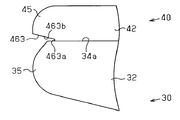
- the inner surface 463 is configured by two surfaces (a first surface 463a and a second surface 463b).
- the inner surface 463 includes a first surface 463a that is substantially perpendicular to the fixed sliding contact surface 34a of the fixed blade 30, and a second surface 463b that is an inclined surface extending from the first surface 463a to the tip side. Even with such a configuration, the effect according to the above (1) can be obtained.
- tip part 45 of the movable blade 40 is this. It is not limited.
- FIG. 17 shows another form of the blade tip 45 of the movable blade 40.
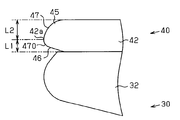
- a boundary portion 470 having a curved surface is provided between the inner surface 46 and the outer surface 47.
- damage (abrasion) of the skin S caused by the movable blade 40 can be suppressed.
- the boundary line 47a between the inner surface 46 and the outer surface 47 does not exist, and therefore the most advanced point 42a of the blade body 42 is used instead of the tip point 47b on the boundary line 47a (see FIG. 8). Using these, the distances L1 and L2 are defined.
- a part of the cutting blade portion 48 provided at the blade tip portion 45 has a curved blade edge 48a.
- 48a is not limited to this shape.
- FIG. 18 shows another form of the cutting edge 48a provided at the blade tip 45 of the cutting edge 48.
- the blade edge 480a has a chamfered portion. Even with such a configuration, damage to the skin S can be suppressed.
- the distance between the most advanced point 32a of the blade body 32 of the fixed blade 30 and the most advanced point 42a of the blade body 42 of the movable blade 40 is set to be substantially “0”.
- this step is not limited to approximately “0”.
- the size of the step is allowed in the range of about 0 to 0.5 mm.
- SYMBOLS 1 ... Hair clipper, 2 ... Main body apparatus, 3 ... Head part, 4 ... Hair clipper blade, 21 ... Drive mechanism, 21a ... Output shaft, 22 ... Power supply part, 23 ... Control part, 24 ... Operation part, 30 ... Fixed blade, DESCRIPTION OF SYMBOLS 31 ... Main-body part, 32 ... Blade body, 32a ... Most advanced point, 32s ... Side surface, 33 ... Base part, 34 ... Cutting part, 34a ... Fixed sliding contact surface, 34b ... Tip side edge, 35 ... Blade body tip part, 36 ... inner surface, 37 ... outer surface, 40 ... movable blade, 41 ... main body, 42 ... blade, 42a ...
- Blade 135,145 ... blade body tip part, 134a, 144a ... sliding contact surface, 135s, 145s ... pressing surface, 461, 462, 463 ... inner surface, 463a ... first surface, 463b ... second surface, 470 ... boundary part, 480a ... blade edge.
Landscapes
- Life Sciences & Earth Sciences (AREA)
- Forests & Forestry (AREA)
- Engineering & Computer Science (AREA)
- Mechanical Engineering (AREA)
- Dry Shavers And Clippers (AREA)
Priority Applications (1)
| Application Number | Priority Date | Filing Date | Title |
|---|---|---|---|
| EP13866943.7A EP2939802B1 (de) | 2012-12-25 | 2013-11-25 | Klinge einer haarschneidevorrichtung und haarschneidevorrichtung mit dieser klinge |
Applications Claiming Priority (2)
| Application Number | Priority Date | Filing Date | Title |
|---|---|---|---|
| JP2012-281669 | 2012-12-25 | ||
| JP2012281669A JP6016023B2 (ja) | 2012-12-25 | 2012-12-25 | バリカンの刃、及びバリカンの刃を備えたバリカン |
Publications (1)
| Publication Number | Publication Date |
|---|---|
| WO2014103162A1 true WO2014103162A1 (ja) | 2014-07-03 |
Family
ID=51020291
Family Applications (1)
| Application Number | Title | Priority Date | Filing Date |
|---|---|---|---|
| PCT/JP2013/006908 Ceased WO2014103162A1 (ja) | 2012-12-25 | 2013-11-25 | バリカンの刃、及びバリカンの刃を備えたバリカン |
Country Status (3)
| Country | Link |
|---|---|
| EP (1) | EP2939802B1 (de) |
| JP (1) | JP6016023B2 (de) |
| WO (1) | WO2014103162A1 (de) |
Cited By (1)
| Publication number | Priority date | Publication date | Assignee | Title |
|---|---|---|---|---|
| CN110181562A (zh) * | 2019-06-26 | 2019-08-30 | 温州市日电电器有限公司 | 一种剃须刀刀头弹片结构 |
Families Citing this family (9)
| Publication number | Priority date | Publication date | Assignee | Title |
|---|---|---|---|---|
| JP6341379B2 (ja) | 2014-09-30 | 2018-06-13 | パナソニックIpマネジメント株式会社 | トリマーの刃およびこれを備えるトリマー |
| EP3566828A1 (de) * | 2018-05-08 | 2019-11-13 | Koninklijke Philips N.V. | Stationäre klinge, klingensatz und haarschneidegerät |
| JP7349682B2 (ja) * | 2020-02-14 | 2023-09-25 | パナソニックIpマネジメント株式会社 | 除毛装置の刃および除毛装置の刃を備える除毛装置 |
| WO2023043629A1 (en) | 2021-09-14 | 2023-03-23 | Wahl Clipper Corporation | Hair clipper bladeset with variable rake angle array tooth geometry |
| USD1099427S1 (en) | 2021-09-14 | 2025-10-21 | Wahl Clipper Corporation | Hair clipper bladeset |
| USD1013267S1 (en) * | 2021-09-22 | 2024-01-30 | Manscaped, Llc | Blade and guard |
| JP7825172B2 (ja) * | 2021-12-06 | 2026-03-06 | パナソニックIpマネジメント株式会社 | バリカンの刃およびバリカン |
| EP4699751A1 (de) | 2024-08-21 | 2026-02-25 | Braun GmbH | Elektrischer haarschneider zum schneiden von intimhaar |
| EP4699750A1 (de) | 2024-08-21 | 2026-02-25 | Braun GmbH | Elektrischer haarschneider |
Citations (7)
| Publication number | Priority date | Publication date | Assignee | Title |
|---|---|---|---|---|
| JPS5323690U (de) * | 1976-08-02 | 1978-02-28 | ||
| JPS548052A (en) * | 1977-06-20 | 1979-01-22 | Matsushita Electric Works Ltd | Blade of electric razor |
| JPS55101286A (en) | 1979-12-28 | 1980-08-01 | Hamasawa Kogyo Kk | Edge shaving edge of electric razor |
| JPS5985166U (ja) * | 1983-08-08 | 1984-06-08 | 日立マクセル株式会社 | 電気かみそりのくし刃 |
| EP0278759A1 (de) * | 1987-02-13 | 1988-08-17 | Lister Shearing Equipment Limited | Ein Messer für eine Haarschneidemaschine |
| JPH0241353A (ja) | 1988-08-01 | 1990-02-09 | Mitsui Toatsu Chem Inc | 半導体封止用樹脂組成物 |
| JPH02305590A (ja) * | 1989-05-22 | 1990-12-19 | Tottori Matsuo | 襟刈バリカン |
-
2012
- 2012-12-25 JP JP2012281669A patent/JP6016023B2/ja active Active
-
2013
- 2013-11-25 EP EP13866943.7A patent/EP2939802B1/de active Active
- 2013-11-25 WO PCT/JP2013/006908 patent/WO2014103162A1/ja not_active Ceased
Patent Citations (7)
| Publication number | Priority date | Publication date | Assignee | Title |
|---|---|---|---|---|
| JPS5323690U (de) * | 1976-08-02 | 1978-02-28 | ||
| JPS548052A (en) * | 1977-06-20 | 1979-01-22 | Matsushita Electric Works Ltd | Blade of electric razor |
| JPS55101286A (en) | 1979-12-28 | 1980-08-01 | Hamasawa Kogyo Kk | Edge shaving edge of electric razor |
| JPS5985166U (ja) * | 1983-08-08 | 1984-06-08 | 日立マクセル株式会社 | 電気かみそりのくし刃 |
| EP0278759A1 (de) * | 1987-02-13 | 1988-08-17 | Lister Shearing Equipment Limited | Ein Messer für eine Haarschneidemaschine |
| JPH0241353A (ja) | 1988-08-01 | 1990-02-09 | Mitsui Toatsu Chem Inc | 半導体封止用樹脂組成物 |
| JPH02305590A (ja) * | 1989-05-22 | 1990-12-19 | Tottori Matsuo | 襟刈バリカン |
Cited By (1)
| Publication number | Priority date | Publication date | Assignee | Title |
|---|---|---|---|---|
| CN110181562A (zh) * | 2019-06-26 | 2019-08-30 | 温州市日电电器有限公司 | 一种剃须刀刀头弹片结构 |
Also Published As
| Publication number | Publication date |
|---|---|
| EP2939802A1 (de) | 2015-11-04 |
| EP2939802B1 (de) | 2019-07-03 |
| JP6016023B2 (ja) | 2016-10-26 |
| EP2939802A4 (de) | 2016-01-20 |
| JP2014124261A (ja) | 2014-07-07 |
Similar Documents
| Publication | Publication Date | Title |
|---|---|---|
| WO2014103162A1 (ja) | バリカンの刃、及びバリカンの刃を備えたバリカン | |
| RU2700884C2 (ru) | Режущая головка и устройство для стрижки волос | |
| US9381656B2 (en) | Skin guard for hair trimmer | |
| US9676110B2 (en) | Concaved cutter head assembly for hair trimmer | |
| JP6341379B2 (ja) | トリマーの刃およびこれを備えるトリマー | |
| JP2008142276A (ja) | 電気かみそり | |
| RU2008135061A (ru) | Машинка для стрижки волос | |
| ATE502741T1 (de) | Scherfolie für einen trockenrasierer | |
| WO2019068746A1 (en) | HAIRDRESSER COMB | |
| CN107520862B (zh) | 电动剃刀以及该电动剃刀所使用的外刀 | |
| CN109382852B (zh) | 夹层式结构的刀具及毛发修剪器 | |
| JP5821005B2 (ja) | ヘアーカッター | |
| JP5406769B2 (ja) | 電気かみそり | |
| CN111660327B (zh) | 一种有保护套的推剪刀头及其毛发推剪器 | |
| KR101809256B1 (ko) | 손톱깎이 | |
| WO2013021474A1 (ja) | 爪切り | |
| KR101845380B1 (ko) | 손톱깎이 | |
| US20240286304A1 (en) | Razor cartridge | |
| CN219543258U (zh) | 刀头组件和毛发修剪器 | |
| JP5879531B2 (ja) | 電気かみそり | |
| US12617109B2 (en) | Razor cartridge | |
| EP4711104A1 (de) | Kantenschutzzahn für eine haarschneidevorrichtung | |
| KR100913457B1 (ko) | 손톱깎기 | |
| US20240286303A1 (en) | Razor cartridge | |
| WO2011118684A1 (ja) | 電気かみそり |
Legal Events
| Date | Code | Title | Description |
|---|---|---|---|
| 121 | Ep: the epo has been informed by wipo that ep was designated in this application |
Ref document number: 13866943 Country of ref document: EP Kind code of ref document: A1 |
|
| WWE | Wipo information: entry into national phase |
Ref document number: 2013866943 Country of ref document: EP |
|
| NENP | Non-entry into the national phase |
Ref country code: DE |