WO2014156308A1 - Encre pour une imprimante par jet d'encre et matière imprimée - Google Patents
Encre pour une imprimante par jet d'encre et matière imprimée Download PDFInfo
- Publication number
- WO2014156308A1 WO2014156308A1 PCT/JP2014/052505 JP2014052505W WO2014156308A1 WO 2014156308 A1 WO2014156308 A1 WO 2014156308A1 JP 2014052505 W JP2014052505 W JP 2014052505W WO 2014156308 A1 WO2014156308 A1 WO 2014156308A1
- Authority
- WO
- WIPO (PCT)
- Prior art keywords
- resin
- ink
- printed
- copolymer
- group
- Prior art date
- Legal status (The legal status is an assumption and is not a legal conclusion. Google has not performed a legal analysis and makes no representation as to the accuracy of the status listed.)
- Ceased
Links
Images
Classifications
-
- C—CHEMISTRY; METALLURGY
- C09—DYES; PAINTS; POLISHES; NATURAL RESINS; ADHESIVES; COMPOSITIONS NOT OTHERWISE PROVIDED FOR; APPLICATIONS OF MATERIALS NOT OTHERWISE PROVIDED FOR
- C09D—COATING COMPOSITIONS, e.g. PAINTS, VARNISHES OR LACQUERS; FILLING PASTES; CHEMICAL PAINT OR INK REMOVERS; INKS; CORRECTING FLUIDS; WOODSTAINS; PASTES OR SOLIDS FOR COLOURING OR PRINTING; USE OF MATERIALS THEREFOR
- C09D11/00—Inks
- C09D11/30—Inkjet printing inks
- C09D11/38—Inkjet printing inks characterised by non-macromolecular additives other than solvents, pigments or dyes
-
- B—PERFORMING OPERATIONS; TRANSPORTING
- B41—PRINTING; LINING MACHINES; TYPEWRITERS; STAMPS
- B41J—TYPEWRITERS; SELECTIVE PRINTING MECHANISMS, i.e. MECHANISMS PRINTING OTHERWISE THAN FROM A FORME; CORRECTION OF TYPOGRAPHICAL ERRORS
- B41J2/00—Typewriters or selective printing mechanisms characterised by the printing or marking process for which they are designed
- B41J2/005—Typewriters or selective printing mechanisms characterised by the printing or marking process for which they are designed characterised by bringing liquid or particles selectively into contact with a printing material
- B41J2/01—Ink jet
- B41J2/015—Ink jet characterised by the jet generation process
- B41J2/02—Ink jet characterised by the jet generation process generating a continuous ink jet
-
- C—CHEMISTRY; METALLURGY
- C09—DYES; PAINTS; POLISHES; NATURAL RESINS; ADHESIVES; COMPOSITIONS NOT OTHERWISE PROVIDED FOR; APPLICATIONS OF MATERIALS NOT OTHERWISE PROVIDED FOR
- C09D—COATING COMPOSITIONS, e.g. PAINTS, VARNISHES OR LACQUERS; FILLING PASTES; CHEMICAL PAINT OR INK REMOVERS; INKS; CORRECTING FLUIDS; WOODSTAINS; PASTES OR SOLIDS FOR COLOURING OR PRINTING; USE OF MATERIALS THEREFOR
- C09D11/00—Inks
- C09D11/02—Printing inks
- C09D11/10—Printing inks based on artificial resins
- C09D11/106—Printing inks based on artificial resins containing macromolecular compounds obtained by reactions only involving carbon-to-carbon unsaturated bonds
-
- C—CHEMISTRY; METALLURGY
- C09—DYES; PAINTS; POLISHES; NATURAL RESINS; ADHESIVES; COMPOSITIONS NOT OTHERWISE PROVIDED FOR; APPLICATIONS OF MATERIALS NOT OTHERWISE PROVIDED FOR
- C09D—COATING COMPOSITIONS, e.g. PAINTS, VARNISHES OR LACQUERS; FILLING PASTES; CHEMICAL PAINT OR INK REMOVERS; INKS; CORRECTING FLUIDS; WOODSTAINS; PASTES OR SOLIDS FOR COLOURING OR PRINTING; USE OF MATERIALS THEREFOR
- C09D11/00—Inks
- C09D11/02—Printing inks
- C09D11/10—Printing inks based on artificial resins
- C09D11/106—Printing inks based on artificial resins containing macromolecular compounds obtained by reactions only involving carbon-to-carbon unsaturated bonds
- C09D11/107—Printing inks based on artificial resins containing macromolecular compounds obtained by reactions only involving carbon-to-carbon unsaturated bonds from unsaturated acids or derivatives thereof
-
- C—CHEMISTRY; METALLURGY
- C09—DYES; PAINTS; POLISHES; NATURAL RESINS; ADHESIVES; COMPOSITIONS NOT OTHERWISE PROVIDED FOR; APPLICATIONS OF MATERIALS NOT OTHERWISE PROVIDED FOR
- C09D—COATING COMPOSITIONS, e.g. PAINTS, VARNISHES OR LACQUERS; FILLING PASTES; CHEMICAL PAINT OR INK REMOVERS; INKS; CORRECTING FLUIDS; WOODSTAINS; PASTES OR SOLIDS FOR COLOURING OR PRINTING; USE OF MATERIALS THEREFOR
- C09D11/00—Inks
- C09D11/30—Inkjet printing inks
- C09D11/32—Inkjet printing inks characterised by colouring agents
- C09D11/322—Pigment inks
Definitions
- the present invention relates to an ink for an ink jet printer and a printed member on which the ink is printed.
- the electric wire has a structure in which a copper wire or the like is coated with a resin, and the resin is mainly made of inexpensive and flame-retardant polyvinyl chloride.
- the resin is mainly made of inexpensive and flame-retardant polyvinyl chloride.
- a plasticizer is added when used for a wire requiring flexibility.
- the plasticizer mainly inexpensive di (2-ethylhexyl) phthalate (DEHP) is added in an amount of about 30 to 100 parts by mass with respect to 100 parts by mass of polyvinyl chloride.
- dibutyl phthalate, di (2-ethylhexyl) adipate and the like are used.
- the serial number is printed on the wire with ink, but after printing, the plasticizer added during the indoor and outdoor storage leaks onto the surface of the wire.
- the plasticizer is predominantly ester structure.
- methyl ethyl ketone (MEK) which dries quickly after printing, is often used as a solvent for the ink, and most of the resin soluble in MEK dissolves in phthalic ester or adipic ester. Therefore, the resin in the printed dots is dissolved by the plasticizer, and the dots themselves are also dissolved. If the dots are dissolved, the display may be unclear and may disappear completely, so stable printing can not be maintained for a long time.
- Patent Document 1 for the purpose of providing an ultraviolet-curable white ink composition for ink jet recording, which is excellent in discharge stability and excellent in the visibility of printed matter on a substrate of black to dark ground, titanium oxide is used as a light. It is mainly aimed at stably dispersing in a polymerizable compound, and it is for ultraviolet curable ink jet recording comprising at least a titanium oxide, a polymer dispersant having an acidic polar group, a photopolymerizable compound, and a photopolymerization initiator.
- titanium oxide is surface-treated with silica and alumina, and the mass of alumina used for the surface treatment is disclosed to be larger than the mass of silica used for the surface treatment.
- This document also describes the results of evaluating the cured state of the printed film by methanol rubbing, by irradiating the printed matter on the PET film surface with ultraviolet light.
- An object of the present invention is to stabilize printing for a long time when printing on a member containing a large amount of plasticizer without curing the ink with ultraviolet light.
- the present invention is characterized in that the resin contains a carboxyl group or a hydroxyl group in an ink for an ink jet printer of a charge control system containing a resin, a pigment, a conductive agent and a solvent.
- the printed matter includes a resin and a pigment, and the resin includes a carboxyl group or a hydroxyl group. It is characterized by
- printing can be stabilized for a long time when printing is performed on a member containing a large amount of plasticizer, without performing ultraviolet irradiation or other special treatment.
- the ink contains a pigment, a resin, a solvent, and various additives. These are stirred by an overhead stirrer or the like to make them compatible with each other to form an ink. If the ink contains ions such as chlorine, bromine, iodine, etc., when the member to be printed is a metal such as iron or stainless steel, the member tends to be corroded, so the ink does not contain these. It was a composition.
- pigment Be titanium oxide (specific gravity: 4.1) or zirconium oxide (specific gravity: 6.1) is used as the pigment Be It is preferable to use titanium oxide having a smaller specific gravity because it is difficult to settle even if it is left for a long time. It is also insoluble in MEK which is an ink solvent, phthalic acid ester which is a plasticizer, and sebacic acid ester.
- the average particle size of titanium oxide is approximately 100 nm to 1000 nm. If it is smaller than this, it will be easy to aggregate, and if it is large, it will be easy to settle.
- a dispersant may be added.
- a surfactant is effective. Since the surface of the pigment is more hydrophilic than the solvent, it is thought that the pigment is dispersed in a micellar structure in which the hydrophilic group of the surfactant is directed to the pigment particle side and the hydrophobic group is directed to the solvent side.
- the dispersant is preferably a nonionic surfactant in consideration of the ease of dissolution in a solvent such as MEK.
- the anionic or cationic surfactant has a salt structure such as ammonium salt or phosphate, and is in the form of nitrogen or phosphorus having several alkyl chains bound thereto.
- the total of carbon atoms in the alkyl chain is preferably 12 or more in order to ensure the solubility in a solvent.
- the resin of the present invention uses a resin having a carboxyl group or a hydroxyl group, which is a hydrophilic substituent. This is to make the resin insoluble or hardly soluble in phthalic acid ester and sebacic acid ester which are plasticizers.
- the resin having such a substituent becomes soluble or swellable in a hydrophilic solvent such as water or alcohol.
- hydrophobic plasticizers such as phthalic acid ester and sebacic acid ester tend to be difficult to dissolve and swell. The higher the proportion of substituents, the easier the dissolution.
- the resin having a carboxyl group one having a structure represented by the following chemical formulas (1) to (6) is selected.
- the compound represented by the chemical formula (1) is a styrene / acrylic acid copolymer.
- the compound represented by the above chemical formula (2) is a styrene / methacrylic acid copolymer.
- the compound represented by the above chemical formula (3) is a copolymer of methyl acrylate / acrylic acid.
- the compound represented by the above chemical formula (4) is a copolymer of methyl acrylate / methacrylic acid.
- the compound represented by the above chemical formula (5) is a copolymer of methyl methacrylate / acrylic acid.
- the compound represented by the above chemical formula (6) is a copolymer of methyl methacrylate / methacrylic acid.
- the average molecular weight of the resin of the charge control ink jet printer ink is about 4000 to 40000. If it is larger than this range, the viscosity of the ink becomes high, and there is a possibility that discharge can not be performed smoothly. If it is smaller than this range, the formed printing dots tend to be fragile and easily peeled off. Not suitable.
- the molecular weight of the structure of the repeating unit is 72 to 104. Since the average molecular weight is about 4000 to 40000, the sum of m and n shown in the structure is about 40 to 500.
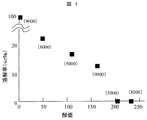
- FIG. 1 shows the relationship between the acid value of the resin and the dissolution rate to DEHP.
- the acid value refers to the number of mg of potassium hydroxide necessary to change an acid group (such as a carboxyl group or a sulfonic acid group) in 1 g of a sample of resin to a potassium salt structure.
- the ratio of carboxyl groups of these resins is represented by the acid value
- the acid value it was found that when the acid value is 200 or more, the resin hardly dissolves in DEHP. Also, when the acid value was 0, it was almost completely dissolved in DEHP. Therefore, it is preferable that the resin to be selected has as high an acid value as possible, and a resin having an acid value of 200 or more is more preferable.
- the resin having a hydroxyl group one having a structure represented by the following chemical formulas (7) and (8) is selected.
- the compound represented by the above chemical formula (7) is a polyvinyl butyral resin.
- the compound represented by the above chemical formula (8) is a polyvinyl acetal resin.
- the raw material for both is polyvinyl acetate. This is hydrolyzed to synthesize polyvinyl alcohol. In this reaction, hydrolysis does not proceed 100%, and some (about 1 to 5%) vinyl acetate groups (-[CH 2 CH (OCOCH 3 )] N- ) remain.
- a polyvinyl butyral resin can be synthesized by causing butyraldehyde to act on the polyvinyl alcohol thus synthesized.
- polyvinyl acetal resin can be synthesized by acting acetaldehyde instead of butyraldehyde.
- the ratio L, M of the repeating units of the compounds represented by the above chemical formulas (7) and (8) can be controlled by the ratio of butyraldehyde and acetaldehyde to be acted.
- the ratio of L to M to N is approximately 40 to 80:15 to 55: 1 to 5.
- the hydroxyl value refers to the number of mg of potassium hydroxide necessary to acetylate the hydroxyl group contained in 1 g of a sample of resin with acetic anhydride and convert the acetic acid generated by the acetylation to potassium acetate.
- polyvinyl butyral resin is difficult to dissolve in ink solvents such as MEK and ethanol when the proportion of polyvinyl alcohol units is 50% or more (hydroxyl value is 302 or more), and when it is intended to be stirred at normal temperature to dissolve Some melting residue will occur.
- polyvinyl acetal resin the same phenomenon occurs when the ratio of polyvinyl alcohol units is 45% or more (hydroxyl value is 306 or more). From the above, it is preferable to use a polyvinyl butyral resin and a polyvinyl acetal resin having a hydroxyl value of 300 or less.
- polyvinyl butyral resin and polyvinyl acetal resin are compared in the range of the above-mentioned suitable hydroxyl value, polyvinyl butyral resin has a butyl group of hydrophobicity, and compatibility with the resin member which forms an ink dot is There is a merit that high, high adhesion printing can be formed.
- polyvinyl acetal resin unlike the steric bulky butyral unit between two hydroxyl groups, forms a small acetal unit, so the distance between the resin chains becomes narrow, and high-density printing dots Can be formed. If the density is high, there is an advantage that a print having high abrasion resistance is formed.
- the resin having a hydroxyl group when the resin having a hydroxyl group is compared with the resin having a carboxyl group, the resin having a carboxyl group can be easily synthesized by copolymerizing two types of monomers.
- the resin having a hydroxyl group is one synthesized by hydrolysis and crosslinking reaction after polymerization. Therefore, the resin having a carboxyl group is advantageous in that the synthesis is simple.
- the proportion of the hydroxyl group can be controlled by changing the degree of hydrolysis of polyvinyl acetate and the subsequent addition rate of butyraldehyde or acetaldehyde. It is possible to control easily by the condition of
- the composition of the ink is mainly an organic solvent, resin and pigment mainly composed of MEK or ethanol. Since the conductivity of these is low, when the ink is constituted by only this, the resistance is as large as about 5000 to several tens of thousands of ⁇ cm, and desired printing becomes difficult in the charge control ink jet printer.
- the conductive agent needs to be dissolved in the solvent to be used, and it is also important not to affect the color tone.
- the color tone can not be said to be white, and therefore, it is necessary that the white ink be transparent or white when dissolved in a solvent.
- the conductive agent one having a salt structure is generally used. This is because high conductivity is easily exhibited since the charge has a bias in the molecule.
- the conductive agent preferably has a salt structure and the cation preferably has a tetraalkylammonium ion structure.
- the alkyl chain may be linear or branched.
- the number of carbons used in the ink is preferably about 2 to 8.
- hexafluorophosphate ion, tetrafluoroborate ion and the like are preferable in that they have high solubility in a solvent.
- chlorine, bromine and iodine ions are also mentioned, but these are not preferable since they have a tendency to corrode metals such as iron and stainless steel when they come in contact.
- preferred conductive agents are tetraethylammonium hexafluorophosphate, tetrapropylammonium hexafluorophosphate, tetrabutylammonium hexafluorophosphate, tetrapentylammonium hexafluorophosphate, tetrahexylammonium hexafluorophosphate, tetraoctylammonium Hexafluorophosphate, tetraethylammonium tetrafluoroborate, tetrapropylammonium tetrafluoroborate, tetrabutylammonium tetrafluoroborate, tetrapentylammonium tetrafluoroborate, tetrahexylammonium tetrafluoroborate, tetraoctylammonium tetrafluoroborate, etc. That.
- a compound having a polyalkoxy group at both ends of a dimethylsiloxane chain was used as a leveling agent.
- the general formula of this compound is represented by the following chemical formulas (9) and (10).
- the compound represented by the chemical formula (9) is a compound having a polyethoxy group at both ends
- the compound represented by the chemical formula (10) is a compound having a polypropoxy group at both ends.
- x is the repeat number of dimethylsiloxane units
- m is the repeat number of ethoxy units
- n is the repeat number of isopropoxy units.
- the leveling agents represented by the above chemical formulas (9) and (10) need to be dissolved in the solvent MEK.
- the printing paper needs to be hydrophobic to such an extent that the printing absorbs the moisture in the air and swells to cause peeling.
- x is preferably 20 to 60 and m is preferably 10 to 40, and in the above chemical formula (10), x is 20 to 60 and n is 20 to 60 is desirable.
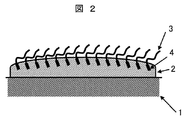
- FIG. 2 shows the case where a leveling agent having an alkoxy group at one end is used
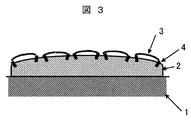
- FIG. 3 shows the case where a leveling agent having an alkoxy group at both ends is used.
- the solvent evaporates to form dots 2.
- the leveling agent is localized on the surface of the dot 2 and in the vicinity thereof.
- Polyalkoxy group 4 in the leveling agent having low compatibility with the resin etc. used in the ink is high in compatibility with the resin used in the ink etc. on the surface of the dot 2 and in the vicinity thereof Form inside the dot 2
- the polyalkoxy group 4 when the polyalkoxy group 4 is one end, the other end is the dimethylsiloxane chain 3 and thus does not enter the inside of the dot 2 and floats on the surface of the dot 2 It becomes a form. That is, the dimethylsiloxane chain 3 can not effectively cover the surface of the dot 2.
- the polyalkoxy group 4 when the polyalkoxy group 4 is present at both ends, the entire dimethylsiloxane chain 3 covers the surface of the dot 2, so that high leveling performance is exhibited with a small amount of addition. it can.
- the dimethylsiloxane chain has a structure with low solubility in MEK, when the ratio of addition to the ink is large, precipitation of dye, resin, etc. tends to occur, and there is a problem that this causes ink nozzle clogging. .
- the temperature may fall below -20 ° C. in winter storage in cold regions, the above-mentioned precipitation is more likely to occur. Therefore, we would like to reduce the level of the leveling agent as much as possible.
- a compound having an alkoxy group at both ends of the dimethylsiloxane chain is preferable because it exerts high leveling performance at a small addition ratio.
- the addition ratio of the leveling agent is preferably 0.02% by mass to 2% by mass with respect to the ink. If the addition rate is less than 0.02% by mass, the addition rate is low and the effect of the addition of the leveling agent is not recognized. On the other hand, when the addition rate exceeds 2% by mass, precipitation is observed at the lower part of the container containing the ink after standing for about 1 day even at normal temperature around 20 ° C.
- the specific gravity of the leveling agent is smaller than that of MEK, so it is considered that it sinks to the bottom after separation.
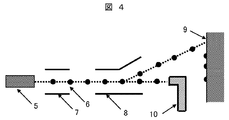
- Ink Jet Printer The inks described above can be loaded into an ink jet printer for printing and for providing the desired printing. The process until ink ejection and landing of the charge control type ink jet printer is shown in FIG.
- the ink droplet 6 discharged from the nozzle 5 is charged by the charging electrode 7, and then controlled in direction by the deflection electrode 8 to land on the printing object 9 (printing member).
- the ink not to be printed is collected from the gutter 10 and returned to the ink tank (not shown in FIG. 4).
- the member to be printed is not particularly limited, but may be a resin-coated wire, a tire formed of rubber (including synthetic rubber), a bottle formed of polyethylene terephthalate (PET), etc. .
- the ink returned to the ink tank in this process is slightly mixed with the moisture in the air, there is a possibility that the leveling agent, the dye, etc. having low compatibility with water may be deposited. However, since the resin having a hydroxyl group is mixed, such precipitation is suppressed.
- the viscosity of the ink is controlled to about 2 to 10 mPa ⁇ s at 20 ° C. If the viscosity is higher than this, it is difficult for the ink to be ejected from the printer head. If the viscosity is lower than this range, liquid leakage from the head occurs.
- the ink jet printer according to the present invention has a distance of several tens of millimeters, it can print even when the print head is separated from the print receiving member.
- it is also possible to print on a convex or concave surface, or print on a member with a large curvature such as an electric wire or a tire.
- the "printed member” printed is called “printed member”. That is, the "printed member” is a member on which the printed matter is formed on the surface of the print-receiving member.
- the print-receiving member may be made of resin or rubber.
- a resin which comprises a to-be-printed member in the case of an electric wire, polyvinyl chloride and polyethylene are mentioned.
- the member to be printed is a rubber product such as a tire, isoprene rubber, butadiene rubber, chloroprene rubber, nitrile rubber, silicone rubber and the like can be mentioned.
- These resins or rubbers may be used alone to produce a print-receiving member, or a mixture of plasticizers may be used.
- titanium oxide particles 100 g of 2 ⁇ m titanium oxide particles, 10 g of tetraethylene glycol monobutyl ether as a dispersant, 10 g of tetrabutylammonium tetraphenylborate as a conductive agent, a compound having a polyethoxy group at both ends of a dimethylsiloxane chain as a leveling agent 10 g of a compound represented by 9), in which x is 29 and m is 22), and the mixture is stirred until the titanium oxide is dispersed to prepare a white ink.
- This ink is filled in an ink jet printer (manufactured by Hitachi Sangyo Kiki Co., Ltd.), and a black coated electric wire (manufactured by Hitachi Cable, Ltd., IV 100 SQ, with a coating material of polyvinyl chloride: di-2-ethylhexyl phthalate 7: 3 by mass ratio)
- the composition was adjusted to a dot diameter of 300 to 400 ⁇ m on a piece cut to a length of 100 mm, and a production number was printed.
- a wire covering of the same type and cut into a length of 100 mm was fixed so as to be in contact with the printed portion of the wire, and was left at 20 ° C. for 7 days. After 7 days, when the unprinted wire was removed, it was confirmed by visual inspection that the printed portion was in the same state as immediately after printing. Further, no transfer of the print was observed in the portion where the printed portion of the non-printed wire was in contact.
- Example 1 A white ink was produced in the same manner as in Example 1. Using this ink and printing on a coated wire using the same members and apparatus as in Example 1, the same transfer test as in Example 1 was carried out, but no transfer of the print was observed.
- Example 1 Except using 100 g of polyvinyl butyral resin having an average molecular weight of 32,000 and a hydroxyl value of 97 (S-LEC BL-5 manufactured by Sekisui Chemical Co., Ltd.) instead of using 100 g of a styrene acrylic acid resin having an average molecular weight of 4,900 and an acid value of 215 as a resin.
- a white ink was produced.
- the same transfer test as in Example 1 was carried out, but no transfer of the print was observed.
- Example 1 Except using 100 g of polyvinyl acetal resin having an average molecular weight of 17,000 and a hydroxyl value of 146 (S-LEC KS-10 manufactured by Sekisui Chemical Co., Ltd.) instead of using 100 g of styrene acrylic acid resin having an average molecular weight of 4,900 and an acid value of 215 as a resin
- S-LEC KS-10 polyvinyl acetal resin having an average molecular weight of 17,000 and a hydroxyl value of 146
- styrene acrylic acid resin having an average molecular weight of 4,900 and an acid value of 215
- Example 1 In the same manner as in Example 1 except that 100 g of polymethyl methacrylate resin having an average molecular weight of 25,000 and an acid value of 0 is used instead of using 100 g of a styrene acrylic acid resin having an average molecular weight of 4,900 and an acid value of 215 as a resin. A white ink was made. The polymethyl methacrylate resin was obtained by polymerizing methyl methacrylate. After printing on a coated electric wire using the same members and apparatus as in Example 1 using this ink, the same transfer test as in Example 1 was carried out. As a result, the printed portion became thin and part was about to disappear . In addition, part of the print was transferred to the portion where the printed portion of the non-printed wire was in contact. Thus, it was found that transfer occurs when a polymethyl methacrylate resin having an acid value of 0 is used.
- Example 1 except using 100 g of polystyrene / polymethyl methacrylate copolymer having an average molecular weight of 25,000 and an acid value of 0 instead of using 100 g of a styrene acrylic acid resin having an average molecular weight of 4,900 and an acid value of 215 as a resin
- a white ink was produced in the same manner as in.
- the polystyrene / polymethyl methacrylate copolymer was obtained by copolymerizing styrene and methyl methacrylate. After printing on a coated electric wire using the same members and apparatus as in Example 1 using this ink, the same transfer test as in Example 1 was carried out.
- Example 1 Comparing Example 1 with Example 2, the resin used in Example 1 has a high acid value of 215, but the resin used in Example 2 has a low acid value of 108. Therefore, it was shown that the use of a resin having a high acid value of about 200 can suppress the transfer.
- Example 4 Comparing Example 3 with Example 4, the resin used in Example 4 has a high hydroxyl value of 146, but the resin used in Example 3 has a low hydroxyl value of 97. Therefore, it was found that using a resin having a hydroxyl value of 100 or more can suppress the transfer.
Landscapes
- Chemical & Material Sciences (AREA)
- Life Sciences & Earth Sciences (AREA)
- Engineering & Computer Science (AREA)
- Materials Engineering (AREA)
- Wood Science & Technology (AREA)
- Organic Chemistry (AREA)
- Chemical Kinetics & Catalysis (AREA)
- Inks, Pencil-Leads, Or Crayons (AREA)
- Ink Jet Recording Methods And Recording Media Thereof (AREA)
- Ink Jet (AREA)
- Particle Formation And Scattering Control In Inkjet Printers (AREA)
Abstract
Priority Applications (5)
| Application Number | Priority Date | Filing Date | Title |
|---|---|---|---|
| CN201480017127.2A CN105051126B (zh) | 2013-03-28 | 2014-02-04 | 喷墨印刷用墨水和印刷完成的部件 |
| EP14775746.2A EP2980170B1 (fr) | 2013-03-28 | 2014-02-04 | Encre pour une imprimante par jet d'encre et matière imprimée |
| JP2015508142A JP5974161B2 (ja) | 2013-03-28 | 2014-02-04 | インクジェットプリンタ用インク及び印字済み部材 |
| US14/779,762 US20160083600A1 (en) | 2013-03-28 | 2014-02-04 | Ink for Inkjet Printer and Printed Material |
| US16/008,788 US20180291221A1 (en) | 2013-03-28 | 2018-06-14 | Ink for Inkjet Printer and Printed Material |
Applications Claiming Priority (2)
| Application Number | Priority Date | Filing Date | Title |
|---|---|---|---|
| JP2013067831 | 2013-03-28 | ||
| JP2013-067831 | 2013-03-28 |
Related Child Applications (2)
| Application Number | Title | Priority Date | Filing Date |
|---|---|---|---|
| US14/779,762 A-371-Of-International US20160083600A1 (en) | 2013-03-28 | 2014-02-04 | Ink for Inkjet Printer and Printed Material |
| US16/008,788 Division US20180291221A1 (en) | 2013-03-28 | 2018-06-14 | Ink for Inkjet Printer and Printed Material |
Publications (1)
| Publication Number | Publication Date |
|---|---|
| WO2014156308A1 true WO2014156308A1 (fr) | 2014-10-02 |
Family
ID=51623309
Family Applications (1)
| Application Number | Title | Priority Date | Filing Date |
|---|---|---|---|
| PCT/JP2014/052505 Ceased WO2014156308A1 (fr) | 2013-03-28 | 2014-02-04 | Encre pour une imprimante par jet d'encre et matière imprimée |
Country Status (5)
| Country | Link |
|---|---|
| US (2) | US20160083600A1 (fr) |
| EP (1) | EP2980170B1 (fr) |
| JP (1) | JP5974161B2 (fr) |
| CN (1) | CN105051126B (fr) |
| WO (1) | WO2014156308A1 (fr) |
Cited By (2)
| Publication number | Priority date | Publication date | Assignee | Title |
|---|---|---|---|---|
| WO2015129326A1 (fr) * | 2014-02-27 | 2015-09-03 | 株式会社 日立産機システム | Encre d'imprimante à jet d'encre |
| JP2019172862A (ja) * | 2018-03-29 | 2019-10-10 | セイコーエプソン株式会社 | インクジェット用組成物および記録物 |
Families Citing this family (2)
| Publication number | Priority date | Publication date | Assignee | Title |
|---|---|---|---|---|
| JP6802749B2 (ja) * | 2017-04-05 | 2020-12-16 | 株式会社日立製作所 | マーキングシステム |
| US20220017699A1 (en) * | 2020-07-20 | 2022-01-20 | Applied Materials, Inc. | Molecular space filler for binder jet ink |
Citations (7)
| Publication number | Priority date | Publication date | Assignee | Title |
|---|---|---|---|---|
| JPH04218550A (ja) * | 1990-03-19 | 1992-08-10 | Sakai Chem Ind Co Ltd | 塩素含有樹脂組成物 |
| JP2001040255A (ja) * | 1999-08-03 | 2001-02-13 | Hitachi Ltd | インク組成物とそれを用いたインクジェット記録装置 |
| JP2003207078A (ja) * | 2002-01-11 | 2003-07-25 | Yokohama Rubber Co Ltd:The | 耐摩耗性ホース及びその製造方法 |
| JP2004059857A (ja) | 2002-07-31 | 2004-02-26 | Dainippon Ink & Chem Inc | 紫外線硬化型インクジェット記録用白色インク組成物 |
| JP2008297446A (ja) * | 2007-05-31 | 2008-12-11 | Sakata Corp | コンティニュアス型インクジェットインク組成物 |
| JP2013023636A (ja) * | 2011-07-25 | 2013-02-04 | Hitachi Industrial Equipment Systems Co Ltd | インクジェットプリンタ用インク |
| JP2013049786A (ja) * | 2011-08-31 | 2013-03-14 | Seiko Epson Corp | インク組成物、インクジェット記録方法および記録物 |
Family Cites Families (13)
| Publication number | Priority date | Publication date | Assignee | Title |
|---|---|---|---|---|
| US4098753A (en) * | 1976-08-16 | 1978-07-04 | Amax Inc. | Ester-plasticized polyvinyl chloride resin composition containing molybdenum flame retardant and smoke suppressant agent |
| JPS6092368A (ja) * | 1983-10-26 | 1985-05-23 | Hitachi Ltd | インクジエツト記録用白色インク |
| US6265049B1 (en) * | 1999-05-25 | 2001-07-24 | Hewlett-Packard Company | Inkjet printing media containing substantially water-insoluble plasticizer |
| US6919416B2 (en) * | 2003-04-11 | 2005-07-19 | E. I. Du Pont De Nemours And Company | Acetoacetylated polyvinyl polymers |
| US7432316B2 (en) * | 2003-11-03 | 2008-10-07 | Gem Gravure Company, Inc. | Inkjet inks, methods for applying inkjet ink, and articles printed with inkjet ink |
| JPWO2006129476A1 (ja) * | 2005-06-01 | 2008-12-25 | コニカミノルタホールディングス株式会社 | インクジェット用インク、インクジェット用インクセットおよびインクジェット記録方法 |
| US7888401B2 (en) * | 2006-07-28 | 2011-02-15 | Fujifilm Corporation | Ink composition and inkjet ink, and image-forming method and recorded material using the same, and oxetane compound |
| FR2912414B1 (fr) * | 2007-02-13 | 2012-09-28 | Imaje Sa | Composition d'encre pour l'impression par jet d'encre. |
| EP2423270A4 (fr) * | 2009-04-23 | 2013-06-26 | Konica Minolta Ij Technologies | Encre pour l'impression par jet d'encre et procédé d'impression par jet d'encre |
| JP5407594B2 (ja) * | 2009-06-30 | 2014-02-05 | 株式会社リコー | 液体吐出装置用水性インクおよび該インクを含有するインクカートリッジ |
| JP2012038648A (ja) * | 2010-08-10 | 2012-02-23 | Sumitomo Electric Ind Ltd | ビニル絶縁ビニルシースケーブル |
| JP2012119231A (ja) * | 2010-12-02 | 2012-06-21 | Swcc Showa Cable Systems Co Ltd | 同軸ケーブル |
| JP2012138285A (ja) * | 2010-12-27 | 2012-07-19 | Auto Network Gijutsu Kenkyusho:Kk | 同軸ケーブル |
-
2014
- 2014-02-04 WO PCT/JP2014/052505 patent/WO2014156308A1/fr not_active Ceased
- 2014-02-04 CN CN201480017127.2A patent/CN105051126B/zh active Active
- 2014-02-04 EP EP14775746.2A patent/EP2980170B1/fr active Active
- 2014-02-04 JP JP2015508142A patent/JP5974161B2/ja active Active
- 2014-02-04 US US14/779,762 patent/US20160083600A1/en not_active Abandoned
-
2018
- 2018-06-14 US US16/008,788 patent/US20180291221A1/en not_active Abandoned
Patent Citations (7)
| Publication number | Priority date | Publication date | Assignee | Title |
|---|---|---|---|---|
| JPH04218550A (ja) * | 1990-03-19 | 1992-08-10 | Sakai Chem Ind Co Ltd | 塩素含有樹脂組成物 |
| JP2001040255A (ja) * | 1999-08-03 | 2001-02-13 | Hitachi Ltd | インク組成物とそれを用いたインクジェット記録装置 |
| JP2003207078A (ja) * | 2002-01-11 | 2003-07-25 | Yokohama Rubber Co Ltd:The | 耐摩耗性ホース及びその製造方法 |
| JP2004059857A (ja) | 2002-07-31 | 2004-02-26 | Dainippon Ink & Chem Inc | 紫外線硬化型インクジェット記録用白色インク組成物 |
| JP2008297446A (ja) * | 2007-05-31 | 2008-12-11 | Sakata Corp | コンティニュアス型インクジェットインク組成物 |
| JP2013023636A (ja) * | 2011-07-25 | 2013-02-04 | Hitachi Industrial Equipment Systems Co Ltd | インクジェットプリンタ用インク |
| JP2013049786A (ja) * | 2011-08-31 | 2013-03-14 | Seiko Epson Corp | インク組成物、インクジェット記録方法および記録物 |
Non-Patent Citations (1)
| Title |
|---|
| See also references of EP2980170A4 |
Cited By (3)
| Publication number | Priority date | Publication date | Assignee | Title |
|---|---|---|---|---|
| WO2015129326A1 (fr) * | 2014-02-27 | 2015-09-03 | 株式会社 日立産機システム | Encre d'imprimante à jet d'encre |
| JP2015160881A (ja) * | 2014-02-27 | 2015-09-07 | 株式会社日立産機システム | インクジェットプリンタ用インク |
| JP2019172862A (ja) * | 2018-03-29 | 2019-10-10 | セイコーエプソン株式会社 | インクジェット用組成物および記録物 |
Also Published As
| Publication number | Publication date |
|---|---|
| JP5974161B2 (ja) | 2016-08-23 |
| EP2980170A1 (fr) | 2016-02-03 |
| EP2980170A4 (fr) | 2016-08-24 |
| EP2980170B1 (fr) | 2021-05-05 |
| JPWO2014156308A1 (ja) | 2017-02-16 |
| CN105051126A (zh) | 2015-11-11 |
| CN105051126B (zh) | 2018-08-14 |
| US20180291221A1 (en) | 2018-10-11 |
| US20160083600A1 (en) | 2016-03-24 |
Similar Documents
| Publication | Publication Date | Title |
|---|---|---|
| EP2436736B1 (fr) | Composition de résine organosiloxane et stratifié comprenant celle-ci | |
| AU2008220162B2 (en) | Coating composition and photochromic optical article | |
| US7407706B2 (en) | Encapsulated matter comprising multiple polymeric coatings of opposite charges and production process thereof | |
| US9051484B2 (en) | Liquid composition, ink jet recording method, ink jet recording apparatus and recorded image | |
| JP5561456B2 (ja) | インクジェット記録方法、記録物、インクジェット記録用インク組成物、インクセット、インクカートリッジ、およびインクジェット記録装置 | |
| TWI498391B (zh) | 透明被覆膜形成用塗佈液及附有透明被覆膜之基材 | |
| JP2010149484A (ja) | インクジェット記録方法、記録物、インクセット、インクカートリッジ、およびインクジェット記録装置 | |
| EP0731149A1 (fr) | Composition d'encre pour le marquage de supports non poreux | |
| TWI639627B (zh) | 中空粒子及中空粒子之用途 | |
| WO2014156308A1 (fr) | Encre pour une imprimante par jet d'encre et matière imprimée | |
| CN104995023B (zh) | 多层构成物、多层构成物的制造方法以及组合物组 | |
| CN101283060B (zh) | 喷墨打印 | |
| JP4619480B2 (ja) | 光硬化型インクジェット記録用インク組成物およびそれを用いたインクジェット記録方法 | |
| WO2018003759A1 (fr) | Encre à nanofil d'argent, procédé pour sa production et film électroconducteur | |
| EP3521385A1 (fr) | Composition d'encre aqueuse pour enregistrement à jet d'encre, et procédé de formation d'image | |
| EP0574274B1 (fr) | Compositions de revêtement | |
| US6773102B2 (en) | Inkjet printing method for an ink/receiver combination | |
| WO2015129326A1 (fr) | Encre d'imprimante à jet d'encre | |
| TW201615764A (zh) | 組合物 | |
| WO2019239923A1 (fr) | Procédé de formation d'image | |
| JPH11116619A (ja) | ポリビニルアセタール樹脂溶液の製造方法 | |
| JP2014218078A (ja) | サーマルインクジェット記録方法 | |
| JP2025162898A (ja) | (ポリ)グリセリン系アルコキシシラン含有組成物 | |
| JP5974160B2 (ja) | インクジェットプリンタ用インク及び印字物 | |
| JP6006865B2 (ja) | インクジェットプリンタ用インク及び印字物 |
Legal Events
| Date | Code | Title | Description |
|---|---|---|---|
| WWE | Wipo information: entry into national phase |
Ref document number: 201480017127.2 Country of ref document: CN |
|
| 121 | Ep: the epo has been informed by wipo that ep was designated in this application |
Ref document number: 14775746 Country of ref document: EP Kind code of ref document: A1 |
|
| ENP | Entry into the national phase |
Ref document number: 2015508142 Country of ref document: JP Kind code of ref document: A |
|
| WWE | Wipo information: entry into national phase |
Ref document number: 2014775746 Country of ref document: EP |
|
| WWE | Wipo information: entry into national phase |
Ref document number: 14779762 Country of ref document: US |
|
| NENP | Non-entry into the national phase |
Ref country code: DE |