WO2014156451A1 - 紡績糸および織編物 - Google Patents
紡績糸および織編物 Download PDFInfo
- Publication number
- WO2014156451A1 WO2014156451A1 PCT/JP2014/054800 JP2014054800W WO2014156451A1 WO 2014156451 A1 WO2014156451 A1 WO 2014156451A1 JP 2014054800 W JP2014054800 W JP 2014054800W WO 2014156451 A1 WO2014156451 A1 WO 2014156451A1
- Authority
- WO
- WIPO (PCT)
- Prior art keywords
- spun yarn
- cross
- fiber
- section
- mass
- Prior art date
- Legal status (The legal status is an assumption and is not a legal conclusion. Google has not performed a legal analysis and makes no representation as to the accuracy of the status listed.)
- Ceased
Links
Images
Classifications
-
- D—TEXTILES; PAPER
- D02—YARNS; MECHANICAL FINISHING OF YARNS OR ROPES; WARPING OR BEAMING
- D02G—CRIMPING OR CURLING FIBRES, FILAMENTS, THREADS, OR YARNS; YARNS OR THREADS
- D02G3/00—Yarns or threads, e.g. fancy yarns; Processes or apparatus for the production thereof, not otherwise provided for
- D02G3/02—Yarns or threads characterised by the material or by the materials from which they are made
- D02G3/04—Blended or other yarns or threads containing components made from different materials
-
- D—TEXTILES; PAPER
- D01—NATURAL OR MAN-MADE THREADS OR FIBRES; SPINNING
- D01F—CHEMICAL FEATURES IN THE MANUFACTURE OF ARTIFICIAL FILAMENTS, THREADS, FIBRES, BRISTLES OR RIBBONS; APPARATUS SPECIALLY ADAPTED FOR THE MANUFACTURE OF CARBON FILAMENTS
- D01F6/00—Monocomponent artificial filaments or the like of synthetic polymers; Manufacture thereof
- D01F6/58—Monocomponent artificial filaments or the like of synthetic polymers; Manufacture thereof from homopolycondensation products
- D01F6/62—Monocomponent artificial filaments or the like of synthetic polymers; Manufacture thereof from homopolycondensation products from polyesters
-
- D—TEXTILES; PAPER
- D03—WEAVING
- D03D—WOVEN FABRICS; METHODS OF WEAVING; LOOMS
- D03D15/00—Woven fabrics characterised by the material, structure or properties of the fibres, filaments, yarns, threads or other warp or weft elements used
- D03D15/30—Woven fabrics characterised by the material, structure or properties of the fibres, filaments, yarns, threads or other warp or weft elements used characterised by the structure of the fibres or filaments
- D03D15/37—Woven fabrics characterised by the material, structure or properties of the fibres, filaments, yarns, threads or other warp or weft elements used characterised by the structure of the fibres or filaments with specific cross-section or surface shape
-
- D—TEXTILES; PAPER
- D03—WEAVING
- D03D—WOVEN FABRICS; METHODS OF WEAVING; LOOMS
- D03D15/00—Woven fabrics characterised by the material, structure or properties of the fibres, filaments, yarns, threads or other warp or weft elements used
- D03D15/40—Woven fabrics characterised by the material, structure or properties of the fibres, filaments, yarns, threads or other warp or weft elements used characterised by the structure of the yarns or threads
- D03D15/47—Woven fabrics characterised by the material, structure or properties of the fibres, filaments, yarns, threads or other warp or weft elements used characterised by the structure of the yarns or threads multicomponent, e.g. blended yarns or threads
-
- D—TEXTILES; PAPER
- D04—BRAIDING; LACE-MAKING; KNITTING; TRIMMINGS; NON-WOVEN FABRICS
- D04B—KNITTING
- D04B1/00—Weft knitting processes for the production of fabrics or articles not dependent on the use of particular machines; Fabrics or articles defined by such processes
- D04B1/14—Other fabrics or articles characterised primarily by the use of particular thread materials
-
- D—TEXTILES; PAPER
- D01—NATURAL OR MAN-MADE THREADS OR FIBRES; SPINNING
- D01D—MECHANICAL METHODS OR APPARATUS IN THE MANUFACTURE OF ARTIFICIAL FILAMENTS, THREADS, FIBRES, BRISTLES OR RIBBONS
- D01D5/00—Formation of filaments, threads, or the like
- D01D5/253—Formation of filaments, threads, or the like with a non-circular cross section; Spinnerette packs therefor
-
- D—TEXTILES; PAPER
- D10—INDEXING SCHEME ASSOCIATED WITH SUBLASSES OF SECTION D, RELATING TO TEXTILES
- D10B—INDEXING SCHEME ASSOCIATED WITH SUBLASSES OF SECTION D, RELATING TO TEXTILES
- D10B2201/00—Cellulose-based fibres, e.g. vegetable fibres
-
- D—TEXTILES; PAPER
- D10—INDEXING SCHEME ASSOCIATED WITH SUBLASSES OF SECTION D, RELATING TO TEXTILES
- D10B—INDEXING SCHEME ASSOCIATED WITH SUBLASSES OF SECTION D, RELATING TO TEXTILES
- D10B2331/00—Fibres made from polymers obtained otherwise than by reactions only involving carbon-to-carbon unsaturated bonds, e.g. polycondensation products
- D10B2331/04—Fibres made from polymers obtained otherwise than by reactions only involving carbon-to-carbon unsaturated bonds, e.g. polycondensation products polyesters, e.g. polyethylene terephthalate [PET]
-
- D—TEXTILES; PAPER
- D10—INDEXING SCHEME ASSOCIATED WITH SUBLASSES OF SECTION D, RELATING TO TEXTILES
- D10B—INDEXING SCHEME ASSOCIATED WITH SUBLASSES OF SECTION D, RELATING TO TEXTILES
- D10B2401/00—Physical properties
- D10B2401/02—Moisture-responsive characteristics
-
- D—TEXTILES; PAPER
- D10—INDEXING SCHEME ASSOCIATED WITH SUBLASSES OF SECTION D, RELATING TO TEXTILES
- D10B—INDEXING SCHEME ASSOCIATED WITH SUBLASSES OF SECTION D, RELATING TO TEXTILES
- D10B2501/00—Wearing apparel
- D10B2501/02—Underwear
-
- D—TEXTILES; PAPER
- D10—INDEXING SCHEME ASSOCIATED WITH SUBLASSES OF SECTION D, RELATING TO TEXTILES
- D10B—INDEXING SCHEME ASSOCIATED WITH SUBLASSES OF SECTION D, RELATING TO TEXTILES
- D10B2501/00—Wearing apparel
- D10B2501/04—Outerwear; Protective garments
-
- Y—GENERAL TAGGING OF NEW TECHNOLOGICAL DEVELOPMENTS; GENERAL TAGGING OF CROSS-SECTIONAL TECHNOLOGIES SPANNING OVER SEVERAL SECTIONS OF THE IPC; TECHNICAL SUBJECTS COVERED BY FORMER USPC CROSS-REFERENCE ART COLLECTIONS [XRACs] AND DIGESTS
- Y10—TECHNICAL SUBJECTS COVERED BY FORMER USPC
- Y10T—TECHNICAL SUBJECTS COVERED BY FORMER US CLASSIFICATION
- Y10T428/00—Stock material or miscellaneous articles
- Y10T428/29—Coated or structually defined flake, particle, cell, strand, strand portion, rod, filament, macroscopic fiber or mass thereof
- Y10T428/2913—Rod, strand, filament or fiber
- Y10T428/2973—Particular cross section
- Y10T428/2978—Surface characteristic
-
- Y—GENERAL TAGGING OF NEW TECHNOLOGICAL DEVELOPMENTS; GENERAL TAGGING OF CROSS-SECTIONAL TECHNOLOGIES SPANNING OVER SEVERAL SECTIONS OF THE IPC; TECHNICAL SUBJECTS COVERED BY FORMER USPC CROSS-REFERENCE ART COLLECTIONS [XRACs] AND DIGESTS
- Y10—TECHNICAL SUBJECTS COVERED BY FORMER USPC
- Y10T—TECHNICAL SUBJECTS COVERED BY FORMER US CLASSIFICATION
- Y10T442/00—Fabric [woven, knitted, or nonwoven textile or cloth, etc.]
- Y10T442/30—Woven fabric [i.e., woven strand or strip material]
- Y10T442/3065—Including strand which is of specific structural definition
- Y10T442/3089—Cross-sectional configuration of strand material is specified
- Y10T442/3114—Cross-sectional configuration of the strand material is other than circular
- Y10T442/3122—Cross-sectional configuration is multi-lobal
Definitions
- the present invention relates to a spun yarn having good water absorption, quick-drying, see-through property, and soft texture, and is particularly suitable for woven and knitted fabrics suitable for clothing applications such as inner shirts, pants and sports shirts.
- the present invention relates to a spun yarn that can be obtained and a woven or knitted fabric using the spun yarn.
- a blended yarn comprising three or more protrusions as a cross-sectional shape and a deformed cross-section polyester short fiber having a deformity of 1.8 or more, a natural fiber, and a cellulosic fiber has been proposed (see Patent Document 2). ).
- Patent Document 2 a blended yarn composed of a modified cross-section polyester fiber, natural fiber, and cellulosic fiber is used, there is a problem that it is not sufficient in terms of water absorption and soft texture.
- the object of the present invention is to have a soft texture while using polyester fibers that could not be achieved by the above-mentioned prior art, and also to have high water absorption, quick drying and
- the object is to provide a spun yarn having an anti-scaling function.
- Another object of the present invention is to provide a woven or knitted fabric that is particularly suitable for clothing applications such as inner shirts, pants, sports shirts, white robes, sweaters, and national costumes.
- Patent Document 2 of the prior art document it was inferred that the modified cross-section polyester fiber used may not be sufficient in terms of water absorption and soft texture because there are few voids formed between single yarns.
- Patent Document 3 of the prior art document it was considered that the irregular reflection of light due to the fiber surface shape was not sufficient in terms of anti-scaling properties.
- the water absorption was not only unilaterally high, but it was presumed that compatibility with quick drying was important.
- the present inventors have used a specific flat multi-leaf cross-sectional polyester fiber and a cellulosic fiber in combination to realize a soft texture and to make a spun yarn or a woven or knitted fabric. It has been found that it has high water absorption and quick drying properties, and has high anti-scaling properties even without being blended with high-titanium-containing yarn.
- the spun yarn of the present invention is a spun yarn obtained by blending 20 to 80% by mass of flat multi-leaf cross-sectional polyester fiber and 20 to 80% by mass of cellulosic fiber.
- the cross-sectional shape is a flat shape having six or more convex portions
- the maximum length of the cross-section of the flat multi-leaf cross-section polyester fiber is A
- the maximum width of the cross-section of the flat multi-leaf cross-section polyester fiber is B
- C is the length of the line connecting the vertices of adjacent convex portions in the maximum uneven portion
- D is the recommended length lowered from the line connecting the vertices of the convex portions to the bottom point of the concave portion.
- the spun yarn satisfies the flatness defined by the equation (1) and the irregularity defined by the following equation (2).
- Flatness (A / B) 2.0 to 3.0 (1)
- Deformation degree (C / D) 1.0 to 5.0 (2)
- the degree of irregularity is 2.0 to 5.0.
- the maximum length A is the axis of symmetry, and the longest length excluding the transverse cross-section maximum width B among the opposing line segments between the convex portions is defined as E.
- the convex portion ratio defined by the following formula (3).
- ⁇ Convex ratio (E / B) 0.6 to 0.9 (3)
- the single fiber fineness of the flat multileaf polyester fiber is 2.0 dtex or less.
- the flat multilobal polyester fiber contains inorganic particles, and the content thereof is 0.2 to 2.5% by mass.
- the above-mentioned spun yarn of the present invention is suitably used for apparel use, for example, woven or knitted fabric for inner shirts and sports shirts.
- the present invention it is possible to have a large and small gap between fibers by having a flat shape and having irregularities on the outer periphery, and further making the unevenness height of the outer periphery uniform. Further, a spun yarn having both quick-drying performance and soft texture and a knitted or knitted fabric using the spun yarn can be obtained. Furthermore, according to the present invention, a spun yarn and a woven or knitted fabric having a high anti-scaling function can be obtained.
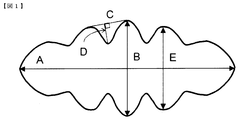
- FIG. 1 is a cross-sectional view for illustrating the cross-sectional shape of a flat multi-leaf cross-sectional polyester fiber provided in the spun yarn of the present invention having a plurality of (eight) convex portions on the circumference of the fiber cross section.
- the spun yarn of the present invention is a spun yarn obtained by blending 20 to 80% by mass of flat multi-leaf cross-sectional polyester fiber and 20 to 80% by mass of cellulose fiber.
- the cellulosic fiber used in the present invention is at least one cellulose type among natural fibers such as hemp, cotton and silk, regenerated fibers such as viscose rayon, cupra and solvent-spun cellulose, and semi-synthetic fibers such as acetate. Selected from fibers. Among these, regenerated fibers such as viscose rayon and solvent-spun cellulose are preferably used from the viewpoints of handleability, versatility and functionality.
- the cellulosic fibers used in the present invention preferably have a flat shape with an arbitrary cross-sectional shape having irregularities on the circumference.
- the water absorption is high, and the liquid is uniformly diffused by capillary action, so that there is an effect that it has a quick drying property and it is easy to maintain a dry feeling and a refreshing feeling.
- the number of convex portions on the circumference is preferably 6 to 14, more preferably 8 to 12. If the number of convex portions present on the circumference of the cross-sectional shape is less than 6, the number of voids is reduced, water absorption, liquid retention and diffusibility are poor, and the diffuse reflectance of light is reduced, thereby preventing Scaling is also reduced. Furthermore, the touching point when touching the skin is reduced, resulting in a rough texture. Moreover, when the number of convex parts exceeds 14, the cellulose fiber has lower rigidity than the polyester fiber, and is easily worn, resulting in a decrease in yarn strength. Furthermore, the water absorption becomes too high and the impregnated liquid is retained in the fiber, so that the liquid cannot be quickly evaporated and the quick drying property is poor. Moreover, it is preferable that the shape of a convex part is a rounded shape from a viewpoint of the touch property.
- the single fiber fineness of the cellulosic fiber is preferably 1.0 to 5.0 dtex.
- the single fiber fineness is more preferably 1.2 to 2.2 dtex.
- the single fiber fineness is less than 1.0 dtex, it tends to be easily wound around the card cylinder, and the process passability may be significantly lowered. As a result, there is a tendency that defects of the spun yarn are likely to occur.
- the single fiber fineness exceeds 5.0 dtex, the texture when touching human skin is hard, and the tendency to be unfavorable in terms of soft texture is exhibited.
- gap between fibers becomes large too much because the single fiber fineness becomes thick, there exists a tendency for water absorption to fall remarkably.
- the fiber length of the cellulosic fibers is preferably 30 to 64 mm from the viewpoint of high entanglement with other constituent fibers such as polyester fibers to be blended, and the card processability can be improved. .
- the fiber length is more preferably 35 to 51 mm.
- Examples of commercially available cellulose fibers include rayon (trade name “Corona”) manufactured by Daiwabo Rayon.
- the content of the cellulose fiber is 20 to 80% by mass.
- the mixing ratio (content ratio) of the cellulosic fibers is less than 20% by mass, the water absorbability impregnated with the liquid becomes weak, so that the diffusibility is lowered, and the dry feeling and the cool feeling are lowered in the spun yarn of the present invention. Further, in the spun yarn of the present invention, the soft texture peculiar to cellulosic fibers is also impaired, so that the touch between the two becomes inferior.
- the mixing ratio of the cellulosic fibers exceeds 80% by mass, the water absorption becomes too strong, the impregnated liquid is retained in the fibers, and the liquid cannot be quickly evaporated. That is, the quick drying property is poor.
- the polyester constituting the polyester fiber used in the present invention is a polymer produced by a condensation reaction of terephthalic acid and ethylene glycol, trimethylene glycol or butylene glycol, and sebacic acid, adipic acid, trimellitic acid, It means a condensate of isophthalic acid, para-benzoic acid and the like with ethylene glycol, and a polyester polymer containing other polyesters.
- the flat multi-leaf cross-sectional polyester fiber used in the present invention is a flat polyester fiber having a cross section having six or more convex portions.
- the number of convex portions present on the circumference of the cross-sectional shape is less than 6, the gaps formed between adjacent fibers are reduced, water absorption, liquid retention and diffusibility are poor, and light is irregularly reflected. The rate decreases and the anti-scaling property also decreases.
- the number of protrusions exceeds 12, due to the characteristics of the polyester fiber manufacturing method, the degree of irregularity is extremely reduced, and the gaps formed between adjacent fibers are reduced. Poor liquid retention and diffusibility.
- the cross-sectional shape is a flat shape
- voids can be formed between the fibers, and water absorption, liquid retention and diffusibility are improved.
- the diffuse reflectance of light is increased and the anti-scaling property is improved.
- the hair fallability per single fiber is improved, a soft texture can be obtained.
- FIG. 1 shows an example of a single fiber cross-sectional shape of a flat multi-leaf polyester fiber used in the present invention.
- FIG. 1 the cross-sectional shape of the flat multileaf cross-section polyester fiber with which the spun yarn of this invention which has several (eight) convex part on the circumference of a fiber cross section is illustrated.
- A is the maximum length of the cross section of the above-mentioned flat multi-leaf polyester fiber.
- B is the maximum width of the cross section of the flat multilobal polyester fiber, and the length of the maximum width line segment connecting the vertices of the convex portions perpendicular to the maximum length A.
- C represents the length of a line connecting the vertices of adjacent convex portions in the maximum uneven portion.
- D indicates the length of a perpendicular line extending from the line connecting the apexes of adjacent convex portions to the bottom point of the concave portion in the maximum uneven portion.
- E denotes the maximum length excluding the maximum width B among the opposing line-to-vertex line segments with the maximum length A as the axis of symmetry.
- a flat-shaped polyester fiber having 6 or more protrusions in the cross-sectional shape thereof is used, but preferably 7 to 13, more preferably 8 to 12.
- the shape of a convex part is a rounded shape from a viewpoint of the touch property.
- the flat multilobal cross-sectional polyester fiber used in the present invention has a flat multilobal cross-sectional shape in a single fiber cross section, a flatness defined by the following formula (1) and an irregularity defined by the following formula (2). It is important to satisfy Furthermore, it is a preferable aspect to satisfy the convex portion ratio defined by the following formula (3).
- Flatness (A / B) 2.0 to 3.0 (1)
- Deformation degree (C / D) 1.0 to 5.0
- ⁇ Convex ratio (E / B) 0.6 to 0.9 (3)
- the flatness (A / B) is 2.0 to 3.0.
- the flatness (A / B) is more preferably 2.0 to 2.7, and further preferably 2.0 to 2.5.
- the degree of irregularity (C / D) represents the size of the concave portion between the convex portions in the flat multilobal shape. When the value is large, the concave portion is small and the value is small. Means that the recess is large.
- the degree of profile (C / D) increases, the recesses become shallower and the gaps formed between the fibers also become smaller, so the water absorption and diffusibility tend to decrease. Furthermore, the diffuse reflectance of light also decreases, and the anti-scaling property tends to decrease. Therefore, the degree of profile (C / D) is 5.0 or less.
- the degree of irregularity (C / D) is 1.0 or more.
- the degree of profile (C / D) is 1.0 to 5.0 from the above viewpoint.
- the degree of irregularity (C / D) is more preferably 1.0 to 4.0 from the viewpoint of water absorption and diffusibility, and 2 from the viewpoint of the flat shape retention, water absorption and diffusivity balance. 0.0 to 4.0 is a more preferred embodiment.
- the convex portion ratio (E / B) indicates the length ratio between the maximum width A and the maximum convex portion apex length E excluding the maximum length A in the flat multilobal shape. This has a meaning as an index for measuring the degree of distortion of a substantially elliptical shape obtained when a line connecting the vertices of the convex portions having the maximum widths B and E and the maximum length A is drawn.
- the convex portion ratio is too small, the depth of the concave portion is reduced, and the cross-sectional shape thereof is infinitely approximate to a flat cross shape. Therefore, the capillary effect is reduced, and the water absorption and diffusibility are reduced.
- the convex portion ratio is preferably 0.6 or more.
- the convex portion ratio is too large, when the concave and convex portions of the fibers are fitted, the portion where the concave portion is completely blocked increases, so that the voids are reduced and the water absorption and diffusibility are lowered.
- the shape becomes a shape close to a flat hexagon, so that the number of convex portions to be contacted is reduced, and the feel and softness are lowered.
- the convex portion ratio (E / B) is preferably 0.9 or less.
- the convex portion ratio (E / B) is preferably 0.6 to 0.9 from the viewpoint described above. Furthermore, from the balance, the convex portion ratio (E / B) is preferably 0.6 to 0.8, and more preferably 0.7 to 0.8.
- the content of the flat multileaf polyester fiber used in the present invention in the spun yarn is 20 to 80% by mass.
- the mixing ratio (content ratio) of the flat multi-leaf cross-sectional polyester fiber is less than 20% by mass, the hydrophobicity of the spun yarn decreases, so the absorbed moisture tends to hardly evaporate, the quick drying property is poor, and the feeling of touch is also good. Deteriorate.
- the mixing ratio (content ratio) of the flat multilobal polyester fiber exceeds 80% by mass, the capillary effect is weakened and the diffusibility of the liquid is reduced, resulting in a dry feeling when touching the skin, The feeling is impaired.
- the content of the flat multi-leaf polyester fiber in the spun yarn is 30 to 70% by mass, and more preferably 40 to 60% by mass.
- the single fiber fineness of the flat multilobal polyester fiber used in the present invention is preferably 2.0 dtex or less.
- the single fiber fineness is more preferably 1.0 to 2.0 dtex, still more preferably 1.2 to 1.8 dtex.
- the rigidity specific to the polyester fiber becomes strong, and the stimulation of the feeling of touch becomes strong, and the soft texture may be impaired.
- the gap formed between the fibers becomes too large, the capillary effect is weakened, and the liquid diffusibility is lowered, so that the dry feeling and the cool feeling when touching the skin tend to be impaired.
- the single fiber fineness is smaller than 1.0 dtex, the process passability in the card process is deteriorated and the productivity tends to be lowered.
- the flat multilobal polyester fiber used in the present invention can contain inorganic particles for the purpose of improving the anti-scaling property and softness.
- the content of the inorganic particles is preferably 0.2 to 2.5% by mass, more preferably 0.2 to 2.2% by mass, and still more preferably 0.3 to 2.0% by mass. is there.
- the content of the inorganic particles is less than 0.2% by mass, the friction with the cellulosic fibers increases, the soft texture tends to be impaired, the light irregular reflection becomes insufficient, and the anti-scaling performance decreases. Tend.
- the content of the inorganic particles exceeds 2.5% by mass, the spinning process passability tends to decrease and guide wear tends to occur. Tends to decrease. Further, since the matte effect acts strongly, there is a tendency to lose colorability due to inferior whiteness.
- the fiber length of the flat multilobal polyester fiber is preferably 30 to 64 mm, more preferably 35 to 51 mm, from the viewpoint of process passability in spinning.
- the twist coefficient of the spun yarn of the present invention is preferably in the range of 3.0 to 4.5.
- the twist coefficient is less than 3.0, there is a tendency that sufficient yarn strength cannot be obtained, and there is a tendency that the yarn is broken during spinning or the strength is lowered when the knitted fabric is formed.
- the twist coefficient exceeds 4.5, there is a tendency that twist due to twist return occurs, and there is a tendency that there is a feeling of coarseness when a woven or knitted fabric is formed.
- the blending method can be blended with two types of blended fibers of flat multi-leafed polyester fiber and cellulosic fiber or with other fibers within the blending rate range of the present invention.
- the yarn count of the spun yarn is preferably 30 to 53, and more preferably 40, particularly when used for an inner material or shirt material.
- the woven or knitted fabric made of the spun yarn of the present invention may be a woven or knitted fabric using 100% of the spun yarn of the present invention, but it is a preferred embodiment that the spun yarn of the present invention is contained at least 40% by mass. . If the ratio of the spun yarn of the present invention is less than 40% by mass, the water absorption effect by the combination of the flat multi-section polyester fiber and the cellulose fiber of the present invention tends to be difficult to obtain. In the woven or knitted fabric of the present invention, the spun yarn of the present invention is used in a range of less than 60% by mass, and in addition to the spun yarn of the present invention, other spun yarns and filaments can be knitted and knitted. .
- the spun yarn of the present invention and the woven or knitted fabric comprising the same are suitable for inner shirts, pants, sports shirts, lab coats, sweaters, folk costumes and the like because they have water absorbency, quick drying properties, anti-scaling properties, and soft texture. Can be used.
- a spun yarn was obtained. Using this spun yarn for warp and weft, an air jet loom was used to obtain a plain fabric having a warp density of 110 / 2.54 cm and a horizontal density of 76 / 2.54 cm. Table 1 shows the fiber composition of the spun yarn, and Table 2 shows the evaluation results.
- A Maximum length of cross section of flat multilobal cross section polyester fiber
- B Maximum width of cross section of flat multileaf cross section polyester fiber
- C Length of line connecting vertices of adjacent convex sections in the maximum concave section
- D The length of a perpendicular line extending from the line connecting the vertices of adjacent convex portions to the bottom point of the concave portion in the maximum concavo-convex portion
- E A is the axis of symmetry and B is the line segment between both convex vertices facing each other. Excluding the longest length
Landscapes
- Engineering & Computer Science (AREA)
- Textile Engineering (AREA)
- Mechanical Engineering (AREA)
- Chemical & Material Sciences (AREA)
- Chemical Kinetics & Catalysis (AREA)
- General Chemical & Material Sciences (AREA)
- Woven Fabrics (AREA)
- Yarns And Mechanical Finishing Of Yarns Or Ropes (AREA)
- Artificial Filaments (AREA)
Abstract
Description
・扁平度(A/B)=2.0~3.0 ・・・ (1)
・異形度(C/D)=1.0~5.0 ・・・ (2)
本発明の紡績糸の好ましい態様によれば、前記の異形度は、2.0~5.0である。
・凸部比(E/B)=0.6~0.9 ・・・ (3)
本発明の紡績糸の好ましい態様によれば、前記の扁平多葉断面ポリエステル系繊維の単繊維繊度は2.0dtex以下である。
・扁平度(A/B)=2.0~3.0 ・・・ (1)
・異形度(C/D)=1.0~5.0 ・・・ (2)
・凸部比(E/B)=0.6~0.9 ・・・ (3)
本発明の紡績糸において、扁平度(A/B)は2.0~3.0である。扁平度(A/B)が2.0未満では、繊維の毛倒れ性が悪くなり、ソフトな風合いが得られなくなる。一方、扁平度(A/B)が3.0を超えると、ハリコシ感が小さく、へたり易くなり、また、製糸性の悪化や異形度が悪化する。扁平度(A/B)は、より好ましくは2.0~2.7であり、更に好ましくは2.0~2.5である。
本発明の紡績糸およびそれをもってなる織編物は、吸水性、速乾性および防スケ性とソフトな風合いとを兼ね備えているため、インナーシャツ、パンツ、スポーツシャツ、白衣、セーターおよび民族衣装等として好適に用いることができる。
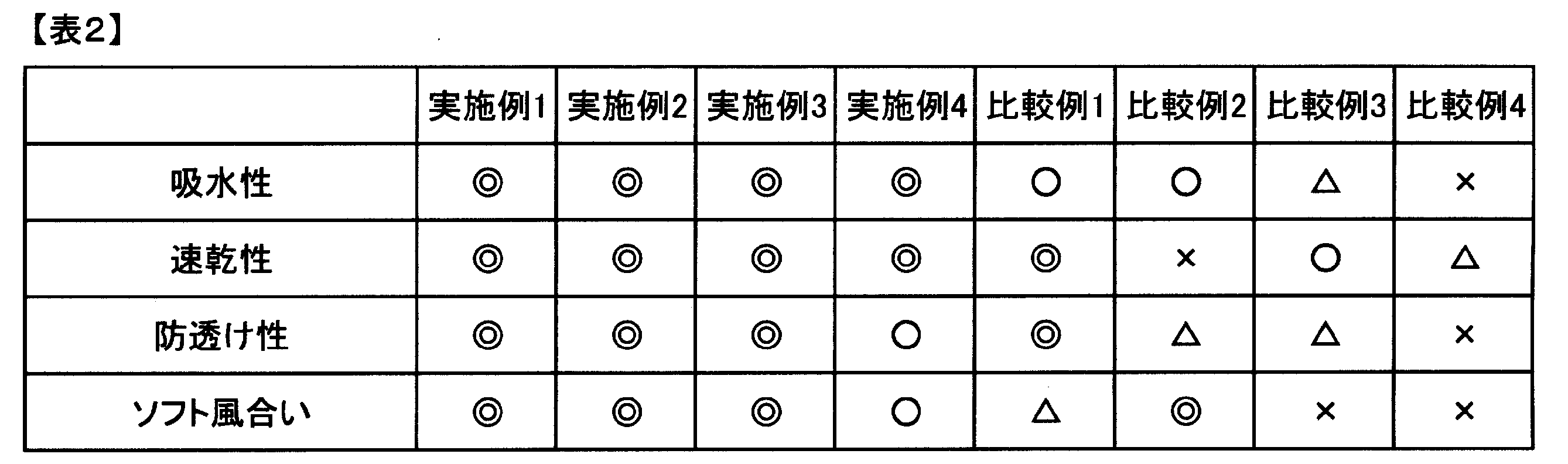
JIS L1907(2010年版、バイレック法)に準じて評価した。評価内容は次のとおりであり、本発明では「○」と「◎」を合格とした。
○:70~79mm
△:50~69mm
×:49mm以下。
室温25℃、湿度40%RH雰囲気下にて24時間放置した試験片を、10cm角に切り出して、質量(A)を測定する。その試験片をイオン交換水の中に30秒間浸し、その後、試験片の一角をピンセットでつまんで液から取り出す。取り出した試験片を同様に室温25℃、湿度40%RH雰囲気下に1時間放置し、自然乾燥させ、質量(B)を測定する。残存水分率(C)は、下記式で算出する。
・C(%)=(B-A)/A×100
評価内容は次のとおりであり、本発明では「○」と「◎」を合格とした。
◎:30%以下
○:31~40%
△:41~50%
×:51%以上。
分光光度計(ミノルタM-3600d)を用い、標準白板と標準黒板を試料生地の背景として各L値(反射率)を測定し、防透け度(%)として次式で求めた。
・防透け度(%)=100-(Lfw-Lfb)/(Lw-Lb)×100
Lw :試料生地がない状態での標準白板のL値
Lb :試料生地がない状態での標準黒板のL値
Lfw:試料生地を標準白板上に置いた時のL値
Lfb:試料生地を標準黒板上に置いた時のL値
評価内容は次のとおりであり、本発明では「○」と「◎」を合格とした。
◎:70%以上
○:60~69%
△:50~59%
×:49以下。
試験片を10cm角に切り出して、5名の被験者に切り出した試験片を握ってもらい、次の基準に従って点数評価を行った後に平均点を算出し、本発明では「○」と「◎」を合格とした。
3点:風合いが柔らか
2点:風合いがやや硬い
1点:風合いが硬い
◎:2.8点以上
○:2.4~2.7点
△:1.9~2.3点
×:1.8点以下。
単繊維繊度1.7dtex、酸化チタン含有率0.3質量%、扁平度2.1、異形度2.7、凸部比0.8で、横断面形状が8個の凸部を有する扁平多葉断面ポリエステル系繊維(繊維長51mm)20質量%と、単繊維繊度1.7dtexのレーヨン繊維(繊維長51mm)80質量%を混紡し、ヨリ係数K=3.5として英国式綿番手40sの紡績糸を得た。この紡績糸を経と緯に使い、エアジェット織機を用いて、タテ密度110本/2.54cm、ヨコ密度76本/2.54cmの平織物を得た。紡績糸の繊維構成を表1に、評価結果を表2に示す。
単繊維繊度1.7dtex、酸化チタン含有率0.3質量%、扁平度2.1、異形度2.7、凸部比0.8で、横断面形状が8個の凸部を有する扁平多葉断面ポリエステル系繊維(繊維長51mm)50質量%と、単繊維繊度1.7dtexのレーヨン繊維(繊維長51mm)50質量%を混紡し、ヨリ係数K=3.5として英国式綿番手40sの紡績糸を得た。この紡績糸を経と緯に使い、エアジェット織機を用いて、タテ密度110本/2.54cm、ヨコ密度76本/2.54cmの平織物を得た。紡績糸の繊維構成を表1に、評価結果を表2に示す。
繊度1.7dtex、酸化チタン含有率0.3質量%、扁平度2.1、異形度2.7、凸部比0.8で、横断面形状が8個の凸部を有する扁平多葉断面ポリエステル系繊維(繊維長51mm)80質量%と、単繊維繊度1.7dtexのレーヨン繊維(繊維長51mm)20質量%を混紡し、ヨリ係数K=3.5として英国式綿番手40sの紡績糸を得た。この紡績糸を経と緯に使い、エアジェット織機を用いて、タテ密度110本/2.54cm、ヨコ密度76本/2.54cmの平織物を得た。紡績糸の繊維構成を表1に、評価結果を表2に示す。
単繊維繊度1.7dtex、酸化チタン含有率0.1質量%、扁平度2.0、異形度2.5、凸部比0.7で、横断面形状が8個の凸部を有する扁平多葉断面ポリエステル系繊維(繊維長51mm)80質量%と、単繊維繊度1.7dtexのレーヨン繊維(繊維長51mm)20質量%を混紡し、ヨリ係数K=3.5として英国式綿番手40sの紡績糸を得た。この紡績糸を経と緯に使い、エアジェット織機を用いて、タテ密度110本/2.54cm、ヨコ密度76本/2.54cmの平織物を得た。紡績糸の繊維構成を表1に、評価結果を表2に示す。
単繊維繊度1.7dtex、酸化チタン含有率0.3質量%、扁平度2.1、異形度2.7、凸部比0.8で、横断面形状が8個の凸部を有する扁平多葉断面ポリエステル系繊維(繊維長51mm)85質量%と、単繊維繊度1.7dtexのレーヨン繊維(繊維長51mm)15質量%を混紡し、ヨリ係数K=3.5として英国式綿番手40sの紡績糸を得た。この紡績糸を経と緯に使い、エアジェット織機を用いて、タテ密度110本/2.54cm、ヨコ密度76本/2.54cmの平織物を得た。紡績糸の繊維構成を表1に、評価結果を表2に示す。
単繊維繊度1.7dtex、酸化チタン含有率0.3質量%、扁平度2.1、異形度2.7、凸部比0.8で、横断面形状が8個の凸部を有する扁平多葉断面ポリエステル系繊維(繊維長51mm)15質量%と、単繊維繊度1.7dtexのレーヨン繊維(繊維長51mm)85質量%を混紡し、ヨリ係数K=3.5として英国式綿番手40sの紡績糸を得た。この紡績糸を経と緯に使い、エアジェット織機を用いて、タテ密度110本/2.54cm、ヨコ密度76本/2.54cmの平織物を得た。紡績糸の繊維構成を表1に、評価結果を表2に示す。
単繊維繊度1.7dtex、酸化チタン含有率0.3質量%、扁平度1.0、異形度6.7、凸部比0.9で、横断面形状が3個の凸部を有する三葉断面(Y型)ポリエステル系繊維(繊維長51mm)80質量%と、単繊維繊度1.7dtexのレーヨン繊維(繊維長51mm)20質量%を混紡し、ヨリ係数K=3.5として英国式綿番手40sの紡績糸を得た。この紡績糸を経と緯に使い、エアジェット織機を用いて、タテ密度110本/2.54cm、ヨコ密度76本/2.54cmの平織物を得た。紡績糸の繊維構成を表1に、評価結果を表2に示す。
単繊維繊度1.7dtex、酸化チタン含有率0.3質量%で、横断面形状が丸型断面ポリエステル系繊維(繊維長51mm)80質量%と、単繊維繊度1.7dtexのレーヨン繊維(繊維長51mm)20質量%を混紡し、ヨリ係数K=3.5として英国式綿番手40sの紡績糸を得た。この紡績糸を経と緯に使い、エアジェット織機を用いて、タテ密度110本/2.54cm、ヨコ密度76本/2.54cmの平織物を得た。紡績糸の繊維構成を表1に、評価結果を表2に示す。

B:扁平多葉断面ポリエステル系繊維の横断面の最大幅
C:最大凹凸部において隣り合う凸部の頂点間を結ぶ線の長さ
D:最大凹凸部において隣り合う凸部の頂点間を結ぶ線から凹部の底点に下ろした垂線の長さ
E:Aを対称軸とし、対向する両凸部頂点間線分のうち、Bを除いて最長となる長さ
Claims (6)
- 扁平多葉断面ポリエステル系繊維20~80質量%とセルロース系繊維20~80質量%からなる紡績糸であって、前記扁平多葉断面ポリエステル系繊維の横断面形状が円周上に6個以上の凸部を有する扁平形状であり、前記扁平多葉断面ポリエステル系繊維の横断面の最大長さをA、前記扁平多葉断面ポリエステル系繊維の横断面の最大幅をB、最大凹凸部において隣り合う凸部の頂点間を結ぶ線の長さをC、前記最大凹凸部において隣り合う凸部の頂点間を結ぶ線から凹部の底点に下ろした垂線の長さをDとするとき、下記式(1)で定義される扁平度および下記式(2)で定義される異形度を満足することを特徴とする紡績糸。
・扁平度(A/B)=2.0~3.0 ・・・ (1)
・異形度(C/D)=1.0~5.0 ・・・ (2) - 異形度が2.0~5.0であることを特徴とする請求項1記載の紡績糸。
- 最大長さAを対称軸とし、対向する両凸部頂点間線分のうち、横断面最大幅Bを除いて最長となる長さをEとするとき、下記式(3)で定義される凸部比を満足することを特徴とする請求項1または2記載の紡績糸。
・凸部比(E/B)=0.6~0.9 ・・・ (3) - 扁平多葉断面ポリエステル系繊維の単繊維繊度が2.0dtex以下である請求項1~3のいずれかに記載の紡績糸。
- 扁平多葉断面ポリエステル系繊維が無機粒子を含有しており、その含有率が0.2~2.5質量%である請求項1~4のいずれかに記載の紡績糸。
- 請求項1~5のいずれかに記載の紡績糸からなる織編物。
Priority Applications (6)
| Application Number | Priority Date | Filing Date | Title |
|---|---|---|---|
| KR1020157026280A KR20150137067A (ko) | 2013-03-27 | 2014-02-27 | 방적사 및 직편물 |
| CN201480018443.1A CN105051275B (zh) | 2013-03-27 | 2014-02-27 | 纺纱及编织物 |
| JP2014515736A JP6332024B2 (ja) | 2013-03-27 | 2014-02-27 | 紡績糸および織編物 |
| US14/779,587 US20160076173A1 (en) | 2013-03-27 | 2014-02-27 | Spun yarn and woven or knitted fabric |
| EP14775600.1A EP2980288B1 (en) | 2013-03-27 | 2014-02-27 | Spun yarn and woven or knitted fabric |
| SA515361234A SA515361234B1 (ar) | 2013-03-27 | 2015-09-27 | خيط مغزول وتيلة غزل منسوجة أو محيكة |
Applications Claiming Priority (4)
| Application Number | Priority Date | Filing Date | Title |
|---|---|---|---|
| JP2013065489 | 2013-03-27 | ||
| JP2013-065489 | 2013-03-27 | ||
| JP2013-192735 | 2013-09-18 | ||
| JP2013192735 | 2013-09-18 |
Publications (1)
| Publication Number | Publication Date |
|---|---|
| WO2014156451A1 true WO2014156451A1 (ja) | 2014-10-02 |
Family
ID=51623445
Family Applications (1)
| Application Number | Title | Priority Date | Filing Date |
|---|---|---|---|
| PCT/JP2014/054800 Ceased WO2014156451A1 (ja) | 2013-03-27 | 2014-02-27 | 紡績糸および織編物 |
Country Status (7)
| Country | Link |
|---|---|
| US (1) | US20160076173A1 (ja) |
| EP (1) | EP2980288B1 (ja) |
| JP (1) | JP6332024B2 (ja) |
| KR (1) | KR20150137067A (ja) |
| CN (1) | CN105051275B (ja) |
| SA (1) | SA515361234B1 (ja) |
| WO (1) | WO2014156451A1 (ja) |
Cited By (6)
| Publication number | Priority date | Publication date | Assignee | Title |
|---|---|---|---|---|
| JP2016089284A (ja) * | 2014-10-30 | 2016-05-23 | 東レ株式会社 | 紡績糸および織編物 |
| JP2016098447A (ja) * | 2014-11-19 | 2016-05-30 | 東洋紡Stc株式会社 | 透け防止性に優れた織編物 |
| JP2016138352A (ja) * | 2015-01-28 | 2016-08-04 | 東レ株式会社 | 長短複合紡績糸 |
| JP2016164318A (ja) * | 2015-03-06 | 2016-09-08 | 東レ株式会社 | 衣料用織物 |
| JP2018000876A (ja) * | 2016-07-08 | 2018-01-11 | 山崎産業株式会社 | モール状糸体及びモール状糸体保持体 |
| JP2021070897A (ja) * | 2019-10-24 | 2021-05-06 | アクトインテリア株式会社 | 超吸水速乾樹脂繊維、不織布及び超吸水速乾樹脂繊維の製造方法 |
Families Citing this family (6)
| Publication number | Priority date | Publication date | Assignee | Title |
|---|---|---|---|---|
| US20170275792A1 (en) * | 2014-08-20 | 2017-09-28 | Toray Industries, Inc. | Non-woven fabric for sanitary materials, and sanitary material product |
| CN108468146A (zh) * | 2017-03-29 | 2018-08-31 | 江苏悦达棉纺有限公司 | 一种多功能涤纶涡流纺面料及其生产方法 |
| CN106868685B (zh) * | 2017-04-06 | 2019-10-29 | 浙江懿纱纺织科技有限公司 | 一种织物及其用途 |
| CN106868684A (zh) * | 2017-04-06 | 2017-06-20 | 浙江万姿布业有限公司 | 一种织物及其用途 |
| JP6346363B1 (ja) * | 2017-08-16 | 2018-06-20 | 東洋紡Stc株式会社 | 織物 |
| US20190233982A1 (en) * | 2018-01-31 | 2019-08-01 | Parkdale Incorporated | Multi-length, multi-denier, multi-cross section fiber blend yarn |
Citations (8)
| Publication number | Priority date | Publication date | Assignee | Title |
|---|---|---|---|---|
| JPH0319908A (ja) * | 1989-06-15 | 1991-01-29 | Toray Ind Inc | 特殊断面繊維 |
| JPH04240246A (ja) * | 1991-01-22 | 1992-08-27 | Toray Ind Inc | 内装用パイル布帛 |
| JPH0959838A (ja) | 1995-08-24 | 1997-03-04 | Kuraray Co Ltd | 紡績糸 |
| JP2004019046A (ja) * | 2002-06-17 | 2004-01-22 | Asahi Kasei Corp | 吸水速乾透防止繊維及びその製造方法 |
| JP2004068210A (ja) * | 2002-08-07 | 2004-03-04 | Toyobo Co Ltd | ポリエステル繊維含有布帛及びその製造方法 |
| JP2005220478A (ja) * | 2004-02-06 | 2005-08-18 | Toyobo Co Ltd | エア交絡紡績糸及びそれを含む布帛 |
| JP2008133584A (ja) | 2007-12-27 | 2008-06-12 | Toyobo Co Ltd | ポリエステル繊維含有織編物及びその製造法 |
| JP2012188792A (ja) | 2011-03-14 | 2012-10-04 | Toyobo Specialties Trading Co Ltd | ソフトで抗ピリング性に優れた紡績糸 |
Family Cites Families (10)
| Publication number | Priority date | Publication date | Assignee | Title |
|---|---|---|---|---|
| JPH0473213A (ja) * | 1990-07-09 | 1992-03-09 | Toray Ind Inc | 矩形型凹凸断面ポリエステル繊維 |
| JPH08246237A (ja) * | 1995-03-14 | 1996-09-24 | Toray Ind Inc | ポリエステル繊維およびポリエステル紡績糸の製造方法 |
| US5834119A (en) * | 1997-01-03 | 1998-11-10 | E. I. Du Pont De Nemours And Company | Filament cross-sections |
| EP1524343B1 (en) * | 2002-07-24 | 2013-05-15 | Teijin Fibers Limited | Flat multifilament-yarn textile |
| JP2004225180A (ja) * | 2003-01-21 | 2004-08-12 | Teijin Fibers Ltd | ポリエステル偏平断面繊維 |
| JP2004218125A (ja) * | 2003-01-14 | 2004-08-05 | Teijin Fibers Ltd | 異形断面ポリエステル繊維の製造方法 |
| JP2005350777A (ja) * | 2003-05-22 | 2005-12-22 | Toray Ind Inc | ポリエステル繊維 |
| JP2004346461A (ja) * | 2003-05-26 | 2004-12-09 | Teijin Fibers Ltd | 特殊断面形状の仮撚加工糸及びその製造方法 |
| US7195819B2 (en) * | 2004-04-23 | 2007-03-27 | Invista North America S.A.R.L. | Bicomponent fiber and yarn comprising same |
| JP5397392B2 (ja) * | 2011-02-07 | 2014-01-22 | 東レ株式会社 | 扁平多葉断面ポリアミド繊維 |
-
2014
- 2014-02-27 US US14/779,587 patent/US20160076173A1/en not_active Abandoned
- 2014-02-27 KR KR1020157026280A patent/KR20150137067A/ko not_active Ceased
- 2014-02-27 JP JP2014515736A patent/JP6332024B2/ja active Active
- 2014-02-27 CN CN201480018443.1A patent/CN105051275B/zh active Active
- 2014-02-27 EP EP14775600.1A patent/EP2980288B1/en active Active
- 2014-02-27 WO PCT/JP2014/054800 patent/WO2014156451A1/ja not_active Ceased
-
2015
- 2015-09-27 SA SA515361234A patent/SA515361234B1/ar unknown
Patent Citations (8)
| Publication number | Priority date | Publication date | Assignee | Title |
|---|---|---|---|---|
| JPH0319908A (ja) * | 1989-06-15 | 1991-01-29 | Toray Ind Inc | 特殊断面繊維 |
| JPH04240246A (ja) * | 1991-01-22 | 1992-08-27 | Toray Ind Inc | 内装用パイル布帛 |
| JPH0959838A (ja) | 1995-08-24 | 1997-03-04 | Kuraray Co Ltd | 紡績糸 |
| JP2004019046A (ja) * | 2002-06-17 | 2004-01-22 | Asahi Kasei Corp | 吸水速乾透防止繊維及びその製造方法 |
| JP2004068210A (ja) * | 2002-08-07 | 2004-03-04 | Toyobo Co Ltd | ポリエステル繊維含有布帛及びその製造方法 |
| JP2005220478A (ja) * | 2004-02-06 | 2005-08-18 | Toyobo Co Ltd | エア交絡紡績糸及びそれを含む布帛 |
| JP2008133584A (ja) | 2007-12-27 | 2008-06-12 | Toyobo Co Ltd | ポリエステル繊維含有織編物及びその製造法 |
| JP2012188792A (ja) | 2011-03-14 | 2012-10-04 | Toyobo Specialties Trading Co Ltd | ソフトで抗ピリング性に優れた紡績糸 |
Cited By (6)
| Publication number | Priority date | Publication date | Assignee | Title |
|---|---|---|---|---|
| JP2016089284A (ja) * | 2014-10-30 | 2016-05-23 | 東レ株式会社 | 紡績糸および織編物 |
| JP2016098447A (ja) * | 2014-11-19 | 2016-05-30 | 東洋紡Stc株式会社 | 透け防止性に優れた織編物 |
| JP2016138352A (ja) * | 2015-01-28 | 2016-08-04 | 東レ株式会社 | 長短複合紡績糸 |
| JP2016164318A (ja) * | 2015-03-06 | 2016-09-08 | 東レ株式会社 | 衣料用織物 |
| JP2018000876A (ja) * | 2016-07-08 | 2018-01-11 | 山崎産業株式会社 | モール状糸体及びモール状糸体保持体 |
| JP2021070897A (ja) * | 2019-10-24 | 2021-05-06 | アクトインテリア株式会社 | 超吸水速乾樹脂繊維、不織布及び超吸水速乾樹脂繊維の製造方法 |
Also Published As
| Publication number | Publication date |
|---|---|
| EP2980288A1 (en) | 2016-02-03 |
| JPWO2014156451A1 (ja) | 2017-02-16 |
| CN105051275B (zh) | 2018-02-13 |
| CN105051275A (zh) | 2015-11-11 |
| SA515361234B1 (ar) | 2019-08-07 |
| EP2980288B1 (en) | 2018-08-22 |
| US20160076173A1 (en) | 2016-03-17 |
| JP6332024B2 (ja) | 2018-05-30 |
| EP2980288A4 (en) | 2016-12-07 |
| KR20150137067A (ko) | 2015-12-08 |
Similar Documents
| Publication | Publication Date | Title |
|---|---|---|
| JP6332024B2 (ja) | 紡績糸および織編物 | |
| JP6943956B2 (ja) | 多層構造布帛および繊維製品 | |
| JP6360319B2 (ja) | 長短複合紡績糸及びそれを用いてなる布帛 | |
| JP5762084B2 (ja) | 涼感性編地 | |
| JP7015697B2 (ja) | 多層構造織編物および繊維製品 | |
| JP5658602B2 (ja) | ソフトで抗ピリング性に優れた紡績糸 | |
| Gun | Dimensional, physical and thermal properties of plain knitted fabrics made from 50/50 blend of modal viscose fiber in microfiber form with cotton fiber | |
| JP2016089284A (ja) | 紡績糸および織編物 | |
| JP6715633B2 (ja) | パイル布帛およびその製造方法および繊維製品 | |
| WO2017126223A1 (ja) | 編地および繊維製品 | |
| JP2008133584A (ja) | ポリエステル繊維含有織編物及びその製造法 | |
| JP6321530B2 (ja) | 透け防止性に優れた織編物 | |
| JP5785720B2 (ja) | 編物及びそれを用いた繊維製品 | |
| TWI658183B (zh) | 扁平剖面捲縮絲、該捲縮絲的製造方法和含有該捲縮絲的編織物 | |
| JP2011174190A (ja) | 長短複合織物 | |
| JP6360318B2 (ja) | 複合結束紡績糸及びそれを用いてなる布帛 | |
| JP5857479B2 (ja) | 紡績糸およびそれを用いてなる織編物 | |
| JP2016044377A (ja) | 扁平多葉断面ポリエステル系繊維 | |
| JP5368824B2 (ja) | 複合糸及びこれを用いた織編物 | |
| JP2007009369A (ja) | 混繊糸からなる織編物 | |
| JP6507673B2 (ja) | 長短複合紡績糸 | |
| JP7284257B2 (ja) | 複合糸および布帛および繊維製品 | |
| CN115449946A (zh) | 一种高保暖性的纱线、其纺织工艺以及纺织制品 | |
| JPH11124727A (ja) | 吸水性に優れた新規な風合いのポリエステル織編物 | |
| JP2016164318A (ja) | 衣料用織物 |
Legal Events
| Date | Code | Title | Description |
|---|---|---|---|
| WWE | Wipo information: entry into national phase |
Ref document number: 201480018443.1 Country of ref document: CN |
|
| ENP | Entry into the national phase |
Ref document number: 2014515736 Country of ref document: JP Kind code of ref document: A |
|
| 121 | Ep: the epo has been informed by wipo that ep was designated in this application |
Ref document number: 14775600 Country of ref document: EP Kind code of ref document: A1 |
|
| WWE | Wipo information: entry into national phase |
Ref document number: 2014775600 Country of ref document: EP |
|
| ENP | Entry into the national phase |
Ref document number: 20157026280 Country of ref document: KR Kind code of ref document: A |
|
| WWE | Wipo information: entry into national phase |
Ref document number: 14779587 Country of ref document: US |
|
| NENP | Non-entry into the national phase |
Ref country code: DE |