WO2014171402A1 - Résine polyester et dispersion aqueuse préparée en l'utilisant - Google Patents
Résine polyester et dispersion aqueuse préparée en l'utilisant Download PDFInfo
- Publication number
- WO2014171402A1 WO2014171402A1 PCT/JP2014/060464 JP2014060464W WO2014171402A1 WO 2014171402 A1 WO2014171402 A1 WO 2014171402A1 JP 2014060464 W JP2014060464 W JP 2014060464W WO 2014171402 A1 WO2014171402 A1 WO 2014171402A1
- Authority
- WO
- WIPO (PCT)
- Prior art keywords
- mol
- component
- polyester resin
- amount
- group
- Prior art date
- Legal status (The legal status is an assumption and is not a legal conclusion. Google has not performed a legal analysis and makes no representation as to the accuracy of the status listed.)
- Ceased
Links
Images
Classifications
-
- C—CHEMISTRY; METALLURGY
- C08—ORGANIC MACROMOLECULAR COMPOUNDS; THEIR PREPARATION OR CHEMICAL WORKING-UP; COMPOSITIONS BASED THEREON
- C08G—MACROMOLECULAR COMPOUNDS OBTAINED OTHERWISE THAN BY REACTIONS ONLY INVOLVING UNSATURATED CARBON-TO-CARBON BONDS
- C08G63/00—Macromolecular compounds obtained by reactions forming a carboxylic ester link in the main chain of the macromolecule
- C08G63/68—Polyesters containing atoms other than carbon, hydrogen and oxygen
- C08G63/688—Polyesters containing atoms other than carbon, hydrogen and oxygen containing sulfur
- C08G63/6884—Polyesters containing atoms other than carbon, hydrogen and oxygen containing sulfur derived from polycarboxylic acids and polyhydroxy compounds
Definitions
- the present invention relates to a polyester resin excellent in water resistance imparted with ionicity and an aqueous dispersion of the polyester resin.
- organic solvents have been used in large quantities in the fields of paints, inks, coating agents, adhesives, and various treatment agents such as textile products and paper. Recently, environmental pollution caused by these organic solvents, deterioration of the working environment, etc. As a result, organic solvent emission regulations have been strengthened year by year, both domestically and internationally. In response to such a trend, as a measure for reducing the use of organic solvents, there is an increasing trend of making water-based in many applications.
- a method for dispersing or solubilizing a polyester resin in water a method of copolymerizing a hydrophilic raw material and introducing it into a molecular skeleton, for example, a raw material containing a sulfonic acid metal base, a polyalkylene glycol or an aliphatic carboxylic acid A method of copolymerizing these alone or in combination is known.
- a method of copolymerizing these alone or in combination is known.
- Patent Document 1 in order to sufficiently disperse in water, it is necessary to use 8 mol% or more of the sulfonic acid metal base compound with respect to the total acid component and 20 mol% or more of polyethylene glycol with respect to the total glycol component. It is described.
- this polyester resin has poor water resistance. That is, being able to be sufficiently dispersed in water means that the water resistance of the film formed after drying is inferior. In this case, when the film comes into contact with water, not only the adhesive strength is lowered, but also the scratch resistance of the product is lowered, so it is difficult to say that it is practical. Thus, it will not be practical unless the problem of satisfying the contradictory performances of hydrophilicity and water resistance is overcome.
- Patent Document 2 when an ionic group such as a sulfonic acid metal base is copolymerized with a polyester resin, even if the introduction amount is minimized as much as possible in consideration of water resistance, After the film formation, the hydrophilic group remains in the molecular chain as it is. Therefore, as described above, moisture can be adsorbed again after drying and film formation, resulting in a decrease in the water resistance of the film.
- an ionic group such as a sulfonic acid metal base is copolymerized with a polyester resin
- the present invention has been made to solve the above-described problems of the conventional techniques. That is, the present invention can provide a polyester resin excellent in water resistance even when an ionic group is introduced to such an extent that it can be dispersed in water.
- the present inventor examined the above factors, and as a result, copolymerized a component having two or more ester-reactive functional groups represented by dimethyl 5-sodium sulfoisophthalate, and added a sulfonic acid metal base in the polymer chain. It was found that the resin contained was inferior in water resistance. Further, in order to improve the dispersibility in water, it is useful to increase the copolymerization amount of the sulfonic acid metal base, but an ester reactive functional group represented by dimethyl 5-sodium sulfoisophthalate.
- a resin containing a sulfonic acid metal base in a polymer chain obtained by copolymerizing a component having two or more has a high melt viscosity of the resin and the amount of copolymerization is limited. Accordingly, the present inventor has conducted extensive studies to solve the above problems, and as a result, the sulfonate group-containing monomer having one ester-reactive functional group and the compound having three or more functional groups are used in combination. A method for introducing a sulfonate group at the terminal was found, and the resin was found to be water-dispersible. In this method, it has been found that the melt viscosity of the resin becomes too high and the amount of copolymerization of the sulfonate group-containing compound is not limited.
- X 1 represents a divalent aromatic group having 6 to 20 carbon atoms or an alkylene group having 1 to 8 carbon atoms
- M + represents a metal ion, a tetraalkylphosphonium ion or a tetraalkylammonium ion. Represents.
- X 2 represents a divalent aromatic group having 6 to 20 carbon atoms or an alkylene group having 1 to 8 carbon atoms
- M + represents a metal ion, a tetraalkylphosphonium ion or a tetraalkylammonium ion.
- (C1 + C2) / (D1 + D2) 1.5 to 7.0
- Formula (I) [C1 and C2 represent the content (mol%) of the component (C1) and the content (mol%) of the component (C2), respectively, and D1 and D2 represent the content (mol%) of the component (D1), respectively. , (D2) represents the content (mol%) of the component. ]
- (C1) is a carboxylic acid component represented by the following (formula 3), (C2) is an alcohol component represented by the following (formula 4), (D1) is trimellitic acid, (D2 ) Is trimethylolpropane.
- the polyester resin of the present invention is excellent in water resistance. Therefore, application to a member exposed for a long time under high temperature and high humidity such as outdoors is useful.
- the polyester resin of the present invention is obtained by using a sulfonate group-containing monomer having one ester-reactive functional group (component (C)) and a compound having three or more functional groups (component (D)). It is characterized by containing a sulfonate group at the terminal.
- component (C) a sulfonate group-containing monomer having one ester-reactive functional group
- component (D) a compound having three or more functional groups
- mol% representing the copolymerization amount is that when the polyester resin is composed of a carboxylic acid component and an alcohol component, the total carboxylic acid component is 100 mol%, and the total alcohol component is 100 mol%. Represents mol%.
- the total amount of carboxylic acid components (mol%) constituting the polyester resin of the present invention and the total alcohol content (mol%) may not be the same.
- the total carboxylic acid component amount (mol%) / total alcohol component amount (mol%) is preferably in the range of 0.55 to 1.80.
- the total carboxylic acid component amount (mol%) and the total alcohol component amount (mol%) constituting the polyester resin of the present invention are not the same. Since the carboxylic acid component (C1) represented by (Formula 1) is present at the terminal, the total carboxylic acid component amount (mol%) / total alcohol component amount (mol%) exceeds 1. In this case, the total carboxylic acid component amount (mol%) / total alcohol component amount (mol%) is preferably in the range of 1.20 to 1.60.
- the sulfonate group-containing monomer having one ester-reactive functional group acts as a terminal blocking agent, and thus depends on the degree of polymerization of the resulting polymer. However, when used alone, it is usually 2 mol% (total carboxylic acid component 100 Only about the degree of copolymerization (with respect to 100% by mol or 100% by mol of all alcohol components) can be copolymerized, and this amount of copolymerization cannot be dispersed in water. In the case of a linear molecule, if it is attempted to copolymerize more than 2 mol%, it does not have a polymer terminal to react, so it exists as an unreacted substance and exists as a foreign substance (monomer) in the resin.
- a sulfonate group-containing monomer having one ester-reactive functional group component (C)
- a compound having three or more functional groups component (D)
- a compound having three or more functional groups increases the number of reactive resin ends that branch the resin, resulting in an increase in sulfonate group-containing monomers having one ester-reactive functional group copolymerized at the resin end. Enables water dispersion.
- the carboxylic acid component (C1) represented by the following (formula 1) of the component (C) will be described.
- the carboxylic acid component of (Formula 1) not only a carboxylic acid compound but also an alkyl ester compound having 1 to 6 carbon atoms can be used as a raw material.
- X 1 is a divalent aromatic group having 6 to 10 carbon atoms. Among them, a divalent benzene ring is more preferable, or an alkylene group having 2 to 6 carbon atoms is preferable.
- M + is preferably a metal ion, more preferably a sodium ion, a potassium ion, or a lithium ion, and even more preferably a sodium ion.
- X 1 represents a divalent aromatic group having 6 to 20 carbon atoms or an alkylene group having 1 to 8 carbon atoms
- M + represents a metal ion, a tetraalkylphosphonium ion or a tetraalkylammonium ion. Represents.
- the alcohol component (C2) represented by the following (formula 2) of the component (C) will be described.
- the alcohol component of (Formula 2) not only an alcohol compound but also an amine compound or a thiol compound which is a nucleophilic attack functional group capable of reacting with an ester can be used as a raw material.
- a compound in which the hydroxyl group is an acetoxy group, an epoxy group, and the hydroxyl group hydrogen is an alkyl group having 2 to 6 carbon atoms can also be used as a raw material.
- X 1 is a divalent aromatic group having 6 to 10 carbon atoms. Among them, a divalent benzene ring is more preferable, or an alkylene group having 2 to 8 carbon atoms is preferable.
- M + is preferably a metal ion, more preferably a sodium ion, a potassium ion, or a lithium ion, and even more preferably a sodium ion.
- sodium isethionate, potassium isethionate, lithium isethionate, tetramethylammonium isethionate, tetramethylphosphonium isethionate, sodium 1-hydroxyethanesulfonate, potassium 1-hydroxyethanesulfonate, 1-hydroxyethanesulfone Lithium acid, tetramethylammonium 1-hydroxyethanesulfonate, tetramethylphosphonium 1-hydroxyethanesulfonate, sodium 1-hydroxypropanesulfonate, sodium 1-hydroxybutanesulfonate, sodium 1-hydroxypentanesulfonate, 1-hydroxy Sodium hexanesulfonate, sodium 1-hydroxyheptanesulfonate, sodium 1-hydroxyoctanesulfonate, 4-aminoben Sodium Nsuruhon acid, sodium 2-mercapto ethanesulfonic acid, 4-acetoxy-1-sodium butane sulfonate include oxiranyl
- X 2 represents a divalent aromatic group having 6 to 20 carbon atoms or an alkylene group having 1 to 8 carbon atoms
- M + represents a metal ion, a tetraalkylphosphonium ion or a tetraalkylammonium ion. Represents.
- the carboxylic acid component (D1) having three or more functional groups as the component (D) and the alcohol component (D2) will be described.
- the compound having three or more functional groups is not particularly limited as long as it has three or more ester-reactive functional groups in the molecule.
- the trifunctional or more functional carboxylic acid component (D1) examples thereof include aromatic carboxylic acids such as trimellitic acid, pyromellitic acid, benzophenone tetracarboxylic acid and trimesic acid, and aliphatic carboxylic acids such as 1,2,3,4-butanetetracarboxylic acid.
- tri- or higher functional carboxylic acid components not only carboxylic acid compounds but also alkyl ester compounds having 1 to 6 carbon atoms and acid anhydride compounds can be used as raw materials.
- trimellitic anhydride, pyromellitic anhydride, benzophenone tetracarboxylic anhydride and the like can be used.
- the tri- or higher functional alcohol component (D2) include glycerol, trimethylolpropane, trimethylolethane, pentaerythritol, ⁇ -methylglucose, mannitol, and sorbitol.
- (D1) is preferably trimellitic acid
- (D2) is preferably trimethylolpropane.
- trimellitic anhydride and trimethylolpropane are preferable. The fact that a compound having three or more functional groups is copolymerized on the polyester resin can be analyzed by a nuclear magnetic resonance apparatus.
- the copolymerization amount is less than 3 mol%, it cannot be dispersed in water. If the copolymerization amount exceeds 30 mol%, the copolymerization amount of three or more functional groups also increases, the melt viscosity becomes too high, and gelation may be induced.
- the lower limit of the amount of copolymerization of component (C) is preferably 5 mol%, more preferably 8 mol%.
- the upper limit of the amount of copolymerization of component (C) is preferably 25 mol%, more preferably 22 mol%.
- (C1) considers the amount of copolymerization with respect to 100 mol% of all carboxylic acid components and (C2) with respect to 100 mol% of all alcohol components, for example, (C1) is 100 mol% of all carboxylic acid components.
- (C2) is copolymerized to 10 mol% with respect to 100 mol% of all alcohol components, the copolymerization amount of component (C) is considered to be 20 mol%.
- a sulfonate group-containing monomer having one ester-reactive functional group capable of being dispersed in water 1 to 20 mol% of a compound having three or more functional groups as component (D) is copolymerized. is required.
- the copolymerization amount is less than 1 mol%, it is possible to copolymerize only less than 3 mol% of the sulfonate group-containing monomer having one ester-reactive functional group necessary for water dispersion. If the copolymerization amount exceeds 20 mol%, gelation may be induced even in combination with a sulfonate group-containing monomer having one ester-reactive functional group.
- the minimum of the copolymerization amount of a component is 2 mol%, More preferably, it is 3 mol%.
- the upper limit of the copolymerization amount of component becomes like this. Preferably it is 15 mol%, More preferably, it is 10 mol%.
- (D1) considers the amount of copolymerization with respect to 100 mol% of all carboxylic acid components with respect to 100 mol% of all carboxylic acid components, for example, (D1) is 100 mol% of all carboxylic acid components.
- the amount of copolymerization of component (D) is considered to be 10 mol%.
- the copolymerization ratio is less than 1.5, the amount of copolymerization of the compound having three or more functional groups is large, and the gel point is set by the end capping effect of the sulfonate group-containing monomer having one ester-reactive functional group. There is a risk of gelation due to failure to seal.
- the copolymerization ratio is greater than 7.0, the amount of copolymerization of the compound having three or more functional groups is small, and the sulfonate group-containing monomer having one ester-reactive functional group is copolymerized to an amount capable of being dispersed in water. It cannot be polymerized.
- the lower limit of the copolymerization ratio is more preferably 1.8, particularly preferably 2.0, and the upper limit is more preferably 6.0, and particularly preferably 5.0.
- the copolymerization ratio can also be expressed as in formula (I).
- (C1 + C2) / (D1 + D2) 1.5 to 7.0
- Formula (I) [C1 and C2 represent the content (mol%) of the component (C1) and the content (mol%) of the component (C2), respectively, and D1 and D2 represent the content (mol%) of the component (D1), respectively. , (D2) represents the content (mol%) of the component. ]
- the polyester of the present invention is a resin composed of a carboxylic acid component and an alcohol component, and is a polyhydric alcohol containing one or more selected from polycarboxylic acids containing dicarboxylic acids and ester-forming derivatives thereof and glycol.
- a polyhydric alcohol containing one or more selected from polycarboxylic acids containing dicarboxylic acids and ester-forming derivatives thereof and glycol.
- the dicarboxylic acid component having no sulfonate group as the component (A) will be described.
- the dicarboxylic acid component not only a dicarboxylic acid but also an alkyl ester compound having 1 to 6 carbon atoms (dialkyl ester compound) can be used as a raw material.
- the aliphatic dicarboxylic acid having no sulfonate group is not particularly limited.
- the aromatic dicarboxylic acid having no sulfonate group is not particularly limited, and specific examples include terephthalic acid, isophthalic acid, phthalic acid, naphthalenedicarboxylic acid, 4,4′-dicarboxybiphenyl, and the like.
- Examples of the alicyclic dicarboxylic acid include 1,4-cyclohexanedicarboxylic acid, 1,3-cyclohexanedicarboxylic acid, 1,2-cyclohexanedicarboxylic acid, 2,5-norbornenedicarboxylic acid, and tetrahydrophthalic acid.
- terephthalic acid, isophthalic acid, and naphthalenedicarboxylic acid are preferable, and naphthalenedicarboxylic acid and terephthalic acid are most preferable.
- the naphthalenedicarboxylic acid is preferably 2,6-naphthalenedicarboxylic acid.
- the copolymerization amount of the component (A) is 50 to 100 mol%, but depending on the amount of copolymerization of the carboxylic acid component as the component (C) and / or the component (D), a preferable component (A) The upper limit and the lower limit of the copolymerization amount are changed so that the total carboxylic acid components constituting the polyester resin are 100 mol%.
- the amount of copolymerization of component (A) is preferably 70 to 97 mol%, and when (D1) is copolymerized 1 to 20 mol%, The copolymerization amount of component A) is preferably 80 to 99 mol%, and when (C1) is copolymerized 3 to 30 mol% and (D1) is 1 to 20 mol%, the copolymerization amount of component (A) is 50 to 96 mol% is preferable.
- the amount of copolymerization of component (A) is preferably 100 mol%.
- the glycol component having no sulfonate group (B) will be described.
- the glycol having no sulfonate group is not particularly limited. Specific examples include ethylene glycol, 1,2-propanediol, 1,3-propanediol, 1,2-butanediol, and 1,3-butane.
- diethylene glycol polyethylene glycol, or polytetramethylene glycol having an ether bond
- ethylene glycol diethylene glycol, and polyethylene glycol in combination.
- the number average molecular weight of polyethylene glycol is preferably 500 to 4000, and the content is preferably 1 to 10 mol%.
- the amount of copolymerization of component (B) is 50 to 100 mol%, but depending on the amount of alcohol component copolymerized as component (C) and / or component (D), the copolymerization of component (B) is preferred.
- the upper limit and the lower limit of the polymerization amount change so that the total alcohol components constituting the polyester resin are 100 mol%.
- the amount of copolymerization of component (B) is preferably 70 to 97 mol%, and when 1 to 20 mol% of (D2) is copolymerized, The copolymerization amount of the component (B) is preferably 80 to 99 mol%.
- the copolymerization amount of the component (B) is 50 to 96 mol% is preferable.
- the copolymerization amount of component (B) is preferably 100 mol%.
- a hydroxycarboxylic acid compound may be used within a range of 30 mol% or less. At this time, half of the content is calculated as a carboxylic acid component and the other half is calculated as an alcohol component.
- an ionic monomer having two or more ester-reactive functional groups represented by dimethyl 5-sodium sulfoisophthalate may be copolymerized if it is in a trace amount.
- the ionic monomer having two or more ester-reactive functional groups is preferably 2 mol% or less (based on 100 mol% of all carboxylic acid components or 100 mol% of all alcohol components). It is particularly preferably 5 mol% or less.
- these components are preferably 2 mol% or less (relative to 100 mol% of all carboxylic acid components or 100 mol% of all alcohol components), and particularly preferably 1.5 mol% or less. preferable.
- the glass transition point of the resin is preferably 0 ° C to 70 ° C.
- the glass transition point of the resin is more preferably 20 ° C. to 70 ° C., further preferably 30 ° C. to 70 ° C., and particularly preferably 45 ° C. to 70 ° C.
- a resin having a glass transition point exceeding 70 ° C. has a high melt viscosity during water dispersion and is difficult to disperse in water, and a resin having a glass transition temperature of less than 0 ° C. may be difficult to handle in production.
- esterification / exchange reaction all monomer components and / or low polymers thereof are reacted by heating and melting under an inert atmosphere.
- the esterification / exchange temperature is preferably 180 to 250 ° C, more preferably 200 to 250 ° C.
- the reaction time is preferably 2.5 to 10 hours, more preferably 4 to 6 hours. The reaction time is the time from the desired reaction temperature to the subsequent polycondensation reaction.
- the glycol component is distilled off from the esterified product obtained by the esterification reaction at a temperature of 220 to 260 ° C. under reduced pressure, and the polycondensation reaction proceeds until the desired molecular weight is reached.
- the reaction temperature for polycondensation is preferably 220 to 255 ° C, more preferably 220 to 250 ° C.
- the degree of vacuum is preferably 130 Pa or less. Insufficient pressure reduction is not preferable because the polycondensation time tends to be long.
- the pressure reduction time required to reach 130 Pa or less from atmospheric pressure is preferably gradually reduced over 60 to 180 minutes.
- polymerization is performed using an organic titanate compound such as tetrabutyl titanate, or an organic tin compound such as germanium dioxide, antimony oxide, or tin octylate.
- an organic titanate compound is preferable, and from the aspect of resin coloring, germanium dioxide is preferable.
- the reduced viscosity of the polyester resin used in the present invention is preferably 0.30 to 1.80 dl / g.
- the reduced viscosity is less than 0.30 dl / g, even if water can be dispersed to some extent, problems such as aggregation and sedimentation of molecules having no hydrophilic group in the molecular chain over time occur.
- it exceeds 1.80 dl / g the cohesive force between the molecular chains in the resin is strong, and the hydrophilic group in the resin is prevented from moving to the water interface and coming into contact with water. May not be achieved.
- the reduced viscosity is 0.32 to 0.75 dl / g, the effect of the present invention is exhibited to the maximum.
- the reduced viscosity 0.3 is about 3,000 in terms of number average molecular weight.
- the method for producing the aqueous dispersion of the polyester resin of the present invention is not particularly limited, and examples thereof include the following methods. That is, an organic solvent (referred to as solvent A) in which the polyester resin can be dissolved or swollen and an organic solvent (referred to as solvent B) that becomes a poor solvent in which the polyester resin does not dissolve or swell as required are used.
- solvent A organic solvent
- solvent B organic solvent
- the phase transition from the solvent system to the aqueous system of the polyester resin can be smoothly performed without agglomeration.
- the temperature at which the polyester resin is dissolved is preferably 40 to 160 ° C, more preferably 50 to 140 ° C, still more preferably 60 to 120 ° C, and most preferably 70 to 100 ° C. If the temperature is lower than 40 ° C., the crystalline polyester resin may be insufficiently dissolved or swollen, so that the entanglement between the molecular chains cannot be sufficiently solved. If the temperature exceeds 160 ° C., the polyester resin is deteriorated. This is because fear increases.
- Examples of the organic solvent in which the polyester resin can be dissolved or swelled by heating in a temperature range of 40 to 160 ° C. include methyl ethyl ketone, dimethylacetamide, dimethylformamide, N-methylpyrrolidone, tetrahydrofuran, 1,4-dioxane, 1,3- Examples thereof include dioxane, 1,3-dioxolane, 1,2-hexanediol, methyl cellosolve, butyl cellosolve, ethyl carbitol butyl carbitol, propylene glycol monopropyl ether, propylene glycol monobutyl ether, triethylene glycol monobutyl ether and the like. Of these, methyl ethyl ketone, butyl cellosolve, propylene glycol monopropyl ether, propylene glycol monobutyl ether, triethylene glycol monobutyl ether and the like. Of these, methyl
- the organic solvent that is a poor solvent in which the polyester resin does not dissolve or swell examples include methanol, ethanol, 1-propanol, isopropyl alcohol, and hexane. Of these, ethanol and isopropyl alcohol are particularly preferable.
- the organic solvent which is a poor solvent is preferably used in the range of 0 to 70% by mass with respect to the organic solvent in which the polyester resin can be dissolved or swollen. More preferably, it is 5 to 50%. If a poor solvent exceeding 70% is used, the resin may aggregate and settle.
- the organic solvent used in the production of the polyester resin aqueous dispersion of the present invention can be removed as necessary after the aqueous dispersion is obtained. However, in that case, it is preferable to select an organic solvent having a boiling point of less than 100 ° C. among the aforementioned organic solvents.
- the aqueous dispersion referred to in the present invention may contain a small amount of an organic solvent.
- the particle diameter of the aqueous polyester resin dispersion according to the present invention is very important because it greatly affects the appearance and storage stability of the coating film, and is preferably 30 to 250 nm. More preferably, it is 50 to 200 nm, and particularly preferably 100 to 150 nm.
- the particle diameter exceeds 250 nm, not only the dispersion stability is greatly lowered, but also the film forming property is lowered, so that the appearance of the resulting film is deteriorated.
- the thickness is less than 30 nm, the film-forming property tends to be remarkably improved. Therefore, fusion and aggregation between the dispersed particles are likely to occur, and as a result, the possibility of causing thickening and poor dispersion is increased. Absent.
- the polyester resin aqueous dispersion of the present invention is preferably prepared at a resin solid content concentration of 5 to 45% by mass. More preferably, it is 10 to 40% by mass, still more preferably 15 to 35% by mass, and most preferably 20 to 32% by mass.
- the resin solid content concentration exceeds 45% by mass, the solution viscosity becomes high and aggregation between the resin particles tends to occur, so that the dispersion stability is greatly lowered.
- it is less than 5 mass%, it is hard to say that it is practical from both a manufacturing surface and a use surface.
- aqueous dispersion of the present invention coarse particles of 1 ⁇ or more are 1% or less in the total polyester resin, preferably 0.5% or less, more preferably 0.2% or less, and still more preferably 0.01% or less. It is. If it exceeds 1%, a precipitate is generated with time, which may cause deterioration in storage stability or cause unevenness when used as a coating agent.
- a curing agent various additives, pigments such as titanium oxide, zinc white, and carbon black, dyes, polyester resins, urethane resins, olefin resins, acrylic resins, alkyd resins, as necessary.
- a cellulose derivative etc. can be mix
- polyester resin composition The composition and composition ratio of the polyester resin were determined by 1H-NMR measurement (proton nuclear magnetic resonance spectroscopy) with a resonance frequency of 500 MHz.
- Example 1 In a 2 liter stainless steel autoclave equipped with a stirrer, 187.8 g (0.77 mol) of dimethyl 2,6-naphthalenedicarboxylate, 91.9 g (0.47 mol) of dimethyl terephthalate, 35.1 g of trimellitic anhydride (0.
- the pressure of the reaction system was gradually lowered to 13.3 Pa (0.1 Torr), and a polyester polycondensation reaction was further performed at 240 ° C. and 13.3 Pa. .
- the resin under slight pressure is discharged into cold water in a strand form, quenched, then held in cold water for 20 seconds, and then cut into a cylinder-shaped polyester resin pellet with a length of about 3 mm and a diameter of about 2 mm.
- the properties of this polyester resin are shown in Table 1 with respect to the results of reduced viscosity, glass transition temperature, judgment of water dispersibility, and water resistance evaluation according to the above methods.
- each component is described by the name of the raw material used, and in the following composition analysis, each component is described by the name of the raw material used.
- the copolymerization amount of sodium m-sulfobenzoate, which is an ionic monomer, is large and could not be evaluated in water resistance evaluation 1 because the polyester resin was dissolved in water. However, in water resistance evaluation 2, the reduction in reduced viscosity was small and the water resistance It was found that the property is excellent.
- composition analysis The composition analysis was performed according to the method described above, and the composition was identified from the following peaks.
- deuterated chloroform was adjusted to 7.33 ppm, the peak near 8.7 ppm (integral value; 10.0) to dimethyl 2,6-naphthalenedicarboxylate, and the peak near 8.1 ppm (integral value; 27.4) to terephthalate Dimethyl acid, peak near 7.8 ppm (integral value; 0.696) to trimellitic anhydride, peak near 7.6 ppm (integral value; 1.28) from sodium m-sulfobenzoate, around 4.8 ppm From the peak (integral value: 15.3) to ethylene glycol, the peak near 4.6 ppm (integral value; 10.4) to diethylene glycol, the peak near 3.7 ppm (integral value; 33.2) to polyethylene glycol # 2000 The composition ratio was identified.
- Diethylene glycol was by-produced by condensation of ethylene glycol and remained in the resin.
- the final composition was calculated as integral value / number of protons as follows, and carboxylic acid component / alcohol component (total carboxylic acid component amount (mol%) / total alcohol component amount (mol%)) was analyzed by the following method. .
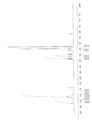
- the NMR chart is shown in FIG.
- Example 2 The polyester resin was polymerized according to Example 1, except that the raw material type and blending ratio were changed. Table 1 shows the properties of this polyester resin according to the above methods, the results of reduced viscosity, glass transition temperature, water dispersibility determination, water resistance evaluation, and composition analysis. Similar to Example 1, the amount of copolymerization of sodium m-sulfobenzoate, which is an ionic monomer, was large, and in water resistance evaluation 1, it was not possible to evaluate because the polyester resin was dissolved in water. It was found that the decrease in viscosity was small and the water resistance was excellent.
- Example 3 The polyester resin was polymerized according to Example 1, except that the raw material type and blending ratio were changed. Table 1 shows the properties of this polyester resin according to the above methods, the results of reduced viscosity, glass transition temperature, water dispersibility determination, water resistance evaluation, and composition analysis. Similar to Example 1, the amount of copolymerization of sodium m-sulfobenzoate, which is an ionic monomer, was large, and in water resistance evaluation 1, it was not possible to evaluate because the polyester resin was dissolved in water. It was found that the decrease in viscosity was small and the water resistance was excellent.
- Example 4 The polyester resin was polymerized according to Example 1, except that the raw material type and blending ratio were changed. Table 1 shows the properties of this polyester resin according to the above methods, the results of reduced viscosity, glass transition temperature, water dispersibility determination, water resistance evaluation, and composition analysis. Similar to Example 1, the amount of copolymerization of sodium m-sulfobenzoate, which is an ionic monomer, was large, and in water resistance evaluation 1, it was not possible to evaluate because the polyester resin was dissolved in water. It was found that the decrease in viscosity was small and the water resistance was excellent.
- Example 5 The polyester resin was polymerized according to Example 1, except that the raw material type and blending ratio were changed. Table 1 shows the properties of this polyester resin according to the above methods, the results of reduced viscosity, glass transition temperature, water dispersibility determination, water resistance evaluation, and composition analysis. Similar to Example 1, the amount of copolymerization of sodium m-sulfobenzoate, which is an ionic monomer, was large, and in water resistance evaluation 1, it was not possible to evaluate because the polyester resin was dissolved in water. It was found that the decrease in viscosity was small and the water resistance was excellent.
- Example 6 The polyester resin was polymerized according to Example 1, except that the raw material type and blending ratio were changed. Table 1 shows the properties of this polyester resin according to the above methods, the results of reduced viscosity, glass transition temperature, water dispersibility determination, water resistance evaluation, and composition analysis. Similar to Example 1, the amount of copolymerization of sodium isethionate, which is an ionic monomer, was large, and in water resistance evaluation 1, it was not possible to evaluate because the polyester resin was dissolved in water. Was found to be small and excellent in water resistance.
- Example 7 The polyester resin was polymerized according to Example 1, except that the raw material type and blending ratio were changed. Table 1 shows the properties of this polyester resin according to the above methods, the results of reduced viscosity, glass transition temperature, water dispersibility determination, water resistance evaluation, and composition analysis. Unlike Example 1, since no dissolution was observed in the water resistance evaluation 1, the polyester resin was collected by filtration, the reduced viscosity was measured according to the above method, and the ⁇ HS reduced viscosity was calculated. It was found that there was no reduction in reduced viscosity and water resistance was excellent. Even in the water resistance evaluation 2, it was found that the reduction in the reduced viscosity was small and the water resistance was excellent.
- Example 8 The polyester resin was polymerized according to Example 1, except that the raw material type and blending ratio were changed. Table 1 shows the properties of this polyester resin according to the above methods, the results of reduced viscosity, glass transition temperature, water dispersibility determination, water resistance evaluation, and composition analysis. Similar to Example 1, the amount of copolymerization of sodium m-sulfobenzoate, which is an ionic monomer, was large, and in water resistance evaluation 1, it was not possible to evaluate because the polyester resin was dissolved in water. It was found that the decrease in viscosity was small and the water resistance was excellent.
- Example 9 The polyester resin was polymerized according to Example 1, except that the raw material type and blending ratio were changed. Table 1 shows the properties of this polyester resin according to the above methods, the results of reduced viscosity, glass transition temperature, water dispersibility determination, water resistance evaluation, and composition analysis. Similar to Example 1, the amount of copolymerization of sodium m-sulfobenzoate, which is an ionic monomer, was large, and in water resistance evaluation 1, it was not possible to evaluate because the polyester resin was dissolved in water. It was found that the decrease in viscosity was small and the water resistance was excellent.
- Example 10 The polyester resin was polymerized according to Example 1, except that the raw material type and blending ratio were changed. Table 1 shows the properties of this polyester resin according to the above methods, the results of reduced viscosity, glass transition temperature, water dispersibility determination, water resistance evaluation, and composition analysis. Similar to Example 1, the amount of copolymerization of sodium m-sulfobenzoate, which is an ionic monomer, was large, and in water resistance evaluation 1, it was not possible to evaluate because the polyester resin was dissolved in water. It was found that the decrease in viscosity was small and the water resistance was excellent.
- Comparative Example 1 The polyester resin was polymerized according to Example 1, except that the raw material type and blending ratio were changed. Table 2 shows the properties of this polyester resin according to the above-mentioned methods, the results of reduced viscosity, glass transition temperature, water dispersibility determination, water resistance evaluation, and composition analysis. In Table 2, each component is described by the raw material name used. The copolymerization amount of the ionic monomer was small, and it could not be dispersed in water.
- Comparative Example 2 The polyester resin was polymerized according to Example 1, except that the raw material type and blending ratio were changed. Table 2 shows the properties of this polyester resin according to the above-mentioned methods, the results of reduced viscosity, glass transition temperature, water dispersibility determination, water resistance evaluation, and composition analysis. The amount of sodium m-sulfobenzoate added was large, it worked as a terminal blocking agent, and the reduced viscosity could not be improved. Further, the strand at the outlet was in a state where there was a large amount of unreacted sodium m-sulfobenzoate. Since the reduced viscosity was low and molecules having no hydrophilic group in the molecular chain aggregated and settled over time, they could not be dispersed in water.
- Comparative Example 3 The polyester resin was polymerized according to Example 1, except that the raw material type and blending ratio were changed. Table 2 shows the properties of this polyester resin according to the above-mentioned methods, the results of reduced viscosity, glass transition temperature, water dispersibility determination, water resistance evaluation, and composition analysis. Since the content ratio of trimellitic anhydride and sodium m-sulfobenzoate was not optimized, the reduced viscosity could not be improved as in Comparative Example 2. Since the reduced viscosity was low and molecules having no hydrophilic group in the molecular chain aggregated and settled over time, they could not be dispersed in water.
- Comparative Example 4 The polyester resin was polymerized according to Example 1, except that the raw material type and blending ratio were changed. Table 2 shows the properties of this polyester resin according to the above-mentioned methods, the results of reduced viscosity, glass transition temperature, water dispersibility determination, water resistance evaluation, and composition analysis. Gelling occurred during the polymerization because the content ratio of trimellitic anhydride and sodium m-sulfobenzoate was not optimized. The reduced viscosity could not be measured because it did not dissolve in the solution.
- Comparative Example 5 The polyester resin was polymerized according to Example 1, except that the raw material type and blending ratio were changed. Table 2 shows the properties of this polyester resin according to the above-mentioned methods, the results of reduced viscosity, glass transition temperature, water dispersibility determination, water resistance evaluation, and composition analysis. Since dimethyl 5-sodium sulfoisophthalate was used as the ionic monomer, it could be dispersed in water. However, as a result of the water resistance evaluations 1 and 2, it was found that the water resistance was inferior to that of Example 7.
- Example 7 the acid component is the same, and the reason why the water resistance is poor is that sodium sulfonate is contained in the molecular chain by using dimethyl 5-sodium sulfoisophthalate. It was judged.
- Comparative Example 6 The polyester resin was polymerized according to Example 1, except that the raw material type and blending ratio were changed. Table 2 shows the properties of this polyester resin according to the above-mentioned methods, the results of reduced viscosity, glass transition temperature, water dispersibility determination, water resistance evaluation, and composition analysis.
- the copolymerization amount of dimethyl 5-sodium sulfoisophthalate was large, the melt viscosity increased due to ion aggregation of sodium sulfonate in the molecular chain, and the polymerization had to be terminated with a reduced reduced viscosity. Since the reduced viscosity was low and molecules having no hydrophilic group in the molecular chain aggregated and settled over time, they could not be dispersed in water.
- the copolymerization amount of dimethyl 5-sodium sulfoisophthalate which is an ionic monomer
- water resistance evaluation 1 the polyester resin was dissolved in water.
- water resistance evaluation 2 the reduction in reduced viscosity is large and the water resistance is high. I found it inferior.
- the reason why the water resistance was poor was judged to be that sodium sulfonate was contained in the molecular chain by using dimethyl 5-sodium sulfoisophthalate.
- Comparative Example 7 The polyester resin was polymerized according to Example 1, except that the raw material type and blending ratio were changed. Table 2 shows the properties of this polyester resin according to the above-mentioned methods, the results of reduced viscosity, glass transition temperature, water dispersibility determination, water resistance evaluation, and composition analysis. Since dimethyl 5-sodium sulfoisophthalate was used as the ionic monomer, it could be dispersed in water. However, as a result of the water resistance evaluations 1 and 2, it was found that the water resistance was inferior to that of Example 7.
- Example 7 and Comparative Example 7 the acid component and the glycol composition ratio are the same, so the reason why the water resistance is poor is that sodium sulfonate is contained in the molecular chain by using dimethyl 5-sodium sulfoisophthalate. Judging because it is.
- the polyester resin of the present invention can increase the amount of ionicity and can be easily dispersed in water. Further, since the polyester resin of the present invention is excellent in water resistance, it is useful to be applied to a member that is exposed for a long time under high temperature and high humidity such as outdoors.
Landscapes
- Chemical & Material Sciences (AREA)
- Health & Medical Sciences (AREA)
- Chemical Kinetics & Catalysis (AREA)
- Medicinal Chemistry (AREA)
- Polymers & Plastics (AREA)
- Organic Chemistry (AREA)
- Polyesters Or Polycarbonates (AREA)
Abstract
La présente invention concerne une résine polyester constituée de composants acide carboxylique et de composants alcool, ladite résine polyester contenant (A) de 50 à 100 % en moles d'un composant acide dicarboxylique dépourvu de groupe sel sulfonate, (B) de 50 à 100 % en moles d'un composant glycol dépourvu de groupe sel sulfonate, (C) de 3 à 30 % en moles d'un monomère contenant un ou plusieurs groupes sel sulfonate ayant un groupe fonctionnel réactif avec les esters et (D) de 1 à 20 % en moles d'un composant ayant au moins trois groupes fonctionnels, la quantité totale de tous les composants acide carboxylique étant égale à 100 % en moles et la quantité totale de tous les composants alcool étant égale à 100 % en moles, et le rapport de la quantité du composant (C) sur la quantité du composant (D) appartenant à une fourchette spécifiée. Une telle résine polyester peut présenter une résistance à l'eau excellente, même lorsqu'un groupe ionique est introduit dans ladite résine polyester en une quantité telle que la résine polyester obtenue peut être dispersée dans l'eau.
Priority Applications (1)
| Application Number | Priority Date | Filing Date | Title |
|---|---|---|---|
| JP2014540668A JP6464747B2 (ja) | 2013-04-16 | 2014-04-11 | ポリエステル樹脂及びそれを用いてなる水分散体 |
Applications Claiming Priority (2)
| Application Number | Priority Date | Filing Date | Title |
|---|---|---|---|
| JP2013085821 | 2013-04-16 | ||
| JP2013-085821 | 2013-04-16 |
Publications (1)
| Publication Number | Publication Date |
|---|---|
| WO2014171402A1 true WO2014171402A1 (fr) | 2014-10-23 |
Family
ID=51731344
Family Applications (1)
| Application Number | Title | Priority Date | Filing Date |
|---|---|---|---|
| PCT/JP2014/060464 Ceased WO2014171402A1 (fr) | 2013-04-16 | 2014-04-11 | Résine polyester et dispersion aqueuse préparée en l'utilisant |
Country Status (2)
| Country | Link |
|---|---|
| JP (1) | JP6464747B2 (fr) |
| WO (1) | WO2014171402A1 (fr) |
Cited By (3)
| Publication number | Priority date | Publication date | Assignee | Title |
|---|---|---|---|---|
| CN109485838A (zh) * | 2018-10-14 | 2019-03-19 | 东华大学 | 共聚型高流动性阳离子聚酯母粒基体材料及其制备方法 |
| US10649099B2 (en) | 2014-05-03 | 2020-05-12 | Tolteq Group, LLC | Gamma detector protection for downhole operations |
| JP2023529387A (ja) * | 2020-06-12 | 2023-07-10 | 東レ繊維研究所(中国)有限公司 | カチオン可染ポリエステル組成物及びその製造方法と用途 |
Citations (4)
| Publication number | Priority date | Publication date | Assignee | Title |
|---|---|---|---|---|
| JPS5857433A (ja) * | 1981-09-30 | 1983-04-05 | Nippon Paint Co Ltd | 変成ポリエステル樹脂、その製法ならびに塗料組成物 |
| JPH08501577A (ja) * | 1992-09-30 | 1996-02-20 | イーストマン ケミカル カンパニー | 水分散性ポリエステル樹脂及びその製造方法 |
| JP2003531229A (ja) * | 2000-04-14 | 2003-10-21 | イーストマン ケミカル カンパニー | 極性連鎖停止剤を含むポリエステル組成物 |
| JP2011524450A (ja) * | 2008-06-17 | 2011-09-01 | クラリアント・ファイナンス・(ビーブイアイ)・リミテッド | ポリエステル顆粒の製造方法 |
-
2014
- 2014-04-11 WO PCT/JP2014/060464 patent/WO2014171402A1/fr not_active Ceased
- 2014-04-11 JP JP2014540668A patent/JP6464747B2/ja not_active Expired - Fee Related
Patent Citations (4)
| Publication number | Priority date | Publication date | Assignee | Title |
|---|---|---|---|---|
| JPS5857433A (ja) * | 1981-09-30 | 1983-04-05 | Nippon Paint Co Ltd | 変成ポリエステル樹脂、その製法ならびに塗料組成物 |
| JPH08501577A (ja) * | 1992-09-30 | 1996-02-20 | イーストマン ケミカル カンパニー | 水分散性ポリエステル樹脂及びその製造方法 |
| JP2003531229A (ja) * | 2000-04-14 | 2003-10-21 | イーストマン ケミカル カンパニー | 極性連鎖停止剤を含むポリエステル組成物 |
| JP2011524450A (ja) * | 2008-06-17 | 2011-09-01 | クラリアント・ファイナンス・(ビーブイアイ)・リミテッド | ポリエステル顆粒の製造方法 |
Cited By (4)
| Publication number | Priority date | Publication date | Assignee | Title |
|---|---|---|---|---|
| US10649099B2 (en) | 2014-05-03 | 2020-05-12 | Tolteq Group, LLC | Gamma detector protection for downhole operations |
| CN109485838A (zh) * | 2018-10-14 | 2019-03-19 | 东华大学 | 共聚型高流动性阳离子聚酯母粒基体材料及其制备方法 |
| JP2023529387A (ja) * | 2020-06-12 | 2023-07-10 | 東レ繊維研究所(中国)有限公司 | カチオン可染ポリエステル組成物及びその製造方法と用途 |
| JP7899099B2 (ja) | 2020-06-12 | 2026-08-03 | 東レ繊維研究所(中国)有限公司 | カチオン可染ポリエステル組成物及びその製造方法と用途 |
Also Published As
| Publication number | Publication date |
|---|---|
| JP6464747B2 (ja) | 2019-02-06 |
| JPWO2014171402A1 (ja) | 2017-02-23 |
Similar Documents
| Publication | Publication Date | Title |
|---|---|---|
| KR960008480B1 (ko) | 피복물용 중합체 전색제 | |
| WO2021031377A1 (fr) | Résine de polyester utilisée pour un revêtement en poudre contenant du graphène | |
| CN112654658B (zh) | 一种水性聚酯共聚物及其制备方法与应用 | |
| EP0312331B1 (fr) | Résine de polyester thermodurcissable et composition résineuse de revêtement en poudre contenant ce polyester | |
| JP6464747B2 (ja) | ポリエステル樹脂及びそれを用いてなる水分散体 | |
| CN112062941A (zh) | 一种6040型聚酯树脂及其制备方法 | |
| JP7232423B2 (ja) | 共重合ポリエステル、水分散体およびこれを用いた水性塗料 | |
| JP7423917B2 (ja) | 顔料分散性、および熱安定性に優れたポリエステル樹脂 | |
| US4370452A (en) | Process to induce rapid curing of a copolyester resin with epoxide compounds and a composition formed for that process | |
| TWI249543B (en) | Crosslinked polyester copolymers | |
| JP7415282B2 (ja) | 共重合ポリエステルおよび水分散体 | |
| JPH11228676A (ja) | 粉体塗料用ポリエステル樹脂及び組成物、並びにこれを用いた粉体塗料 | |
| CN114656861A (zh) | 一种水性硅改聚酯卷钢涂料及其制备方法 | |
| WO2026069769A1 (fr) | Dispersion aqueuse de résine polyester | |
| WO2026069770A1 (fr) | Dispersion aqueuse de résine polyester | |
| JPH1017660A (ja) | 粉体塗料用ポリエステル樹脂及び組成物 | |
| WO2026069768A1 (fr) | Dispersion aqueuse de résine polyester | |
| JP7548472B1 (ja) | 結晶性ポリエステル樹脂水分散体、塗料組成物、塗膜及び金属缶 | |
| JPS61143427A (ja) | 水性ポリエステル樹脂 | |
| JP2004175982A (ja) | 粉体塗料用ポリエステル樹脂、粉体塗料用樹脂組成物、およびこれを用いた粉体塗料 | |
| JP2005502751A (ja) | コポリエーテル組成物およびその生成方法と使用方法 | |
| JP2008163110A (ja) | 共重合ポリエステル樹脂 | |
| CN116284700A (zh) | 一种潜伏型催化剂及其制备方法和在超低温固化粉末料中的应用 | |
| JP2000178474A (ja) | 粉体塗料用ポリエステル樹脂の製造法 | |
| JPH1046056A (ja) | 粉体塗料用樹脂組成物 |
Legal Events
| Date | Code | Title | Description |
|---|---|---|---|
| ENP | Entry into the national phase |
Ref document number: 2014540668 Country of ref document: JP Kind code of ref document: A |
|
| 121 | Ep: the epo has been informed by wipo that ep was designated in this application |
Ref document number: 14785989 Country of ref document: EP Kind code of ref document: A1 |
|
| NENP | Non-entry into the national phase |
Ref country code: DE |
|
| 122 | Ep: pct application non-entry in european phase |
Ref document number: 14785989 Country of ref document: EP Kind code of ref document: A1 |